
A circle in the middle of the palm is probably the oldest idea in mehndi, and it keeps coming back because it gives every other line on the hand something to answer to. The round tikki, the mandala and the circular floral all sit comfortably on the palm, the back of the hand, the wrist or the forearm. A round design can be minimal for beginners or layered for a bride, and the choices that matter are small ones: a filled centre or an open one, petals or scallops, vines to the fingers or a bracelet at the wrist. The designs below cover Eid, weddings, engagements and ordinary family days.
Drawing a Circle That Stays Round on a Curved Palm
A palm isn’t flat. It dips in the middle and rises at the thumb mound and the heel, so a circle that looks perfect from directly above can look oval as soon as the hand tilts. Most lopsided tikkis I see are drawn freehand in one go, from one angle. A few habits fix most of it.
- Find the centre with the hand relaxed and slightly cupped, not stretched flat. That’s how it will be seen.
- Place four tiny guide dots at equal distances: toward the fingers, the wrist, the thumb and the outer edge.
- Join the dots in four short arcs instead of one long sweep, turning the hand between arcs rather than twisting your wrist.
- Build each ring the same way, guide dots first, so the spacing between rings stays even.
- Cover the guide dots with petals or scallops as you go.
If you’re practising at home, draw on a plastic sheet laid over a printed circle before moving to skin. Paste that’s too runny makes the line spread and the circle grow, so test the flow on paper first. A cone that stops and starts will give you a wobbly ring every time.
1. Simple Round Mehndi Design For Palm
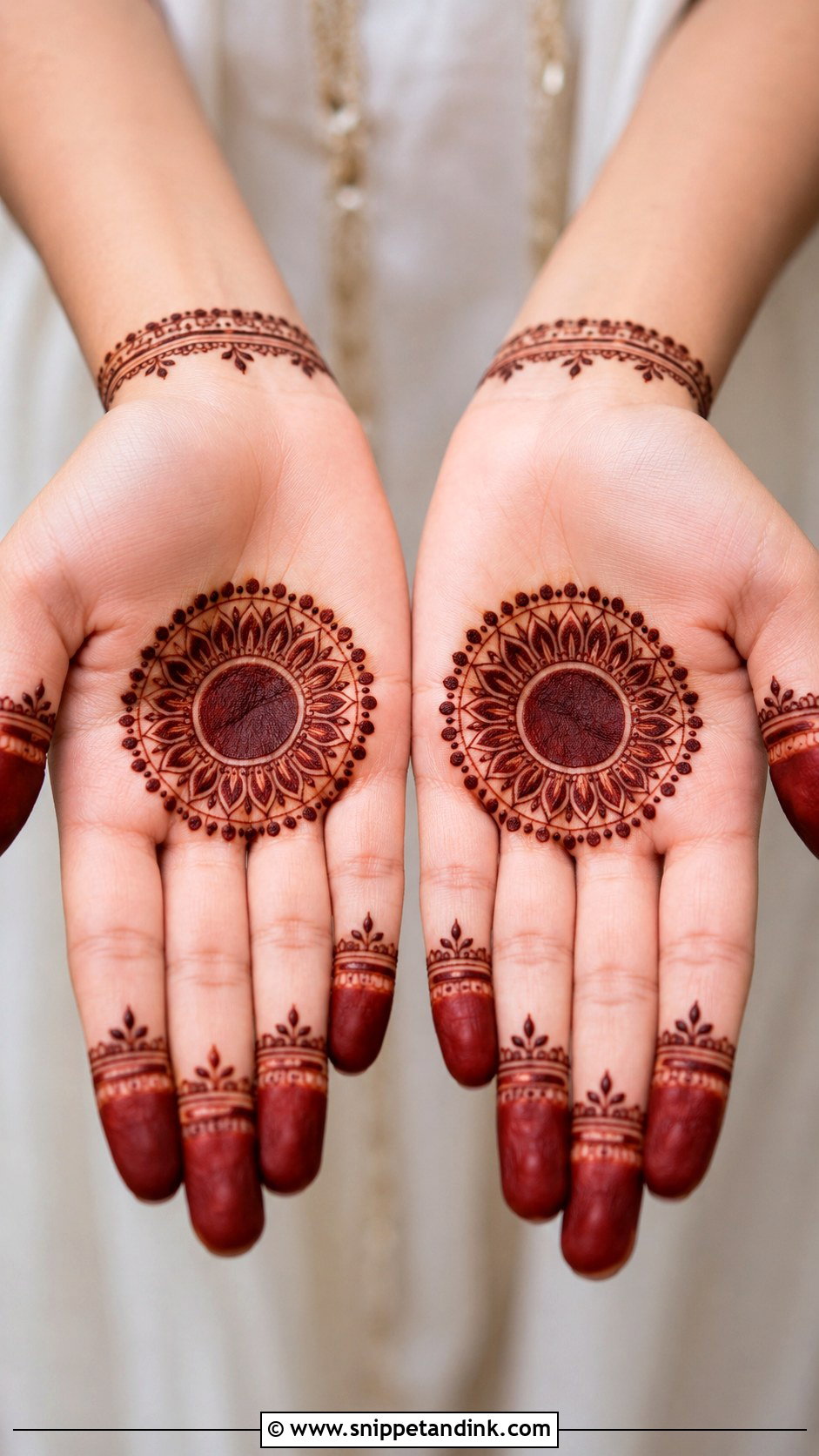
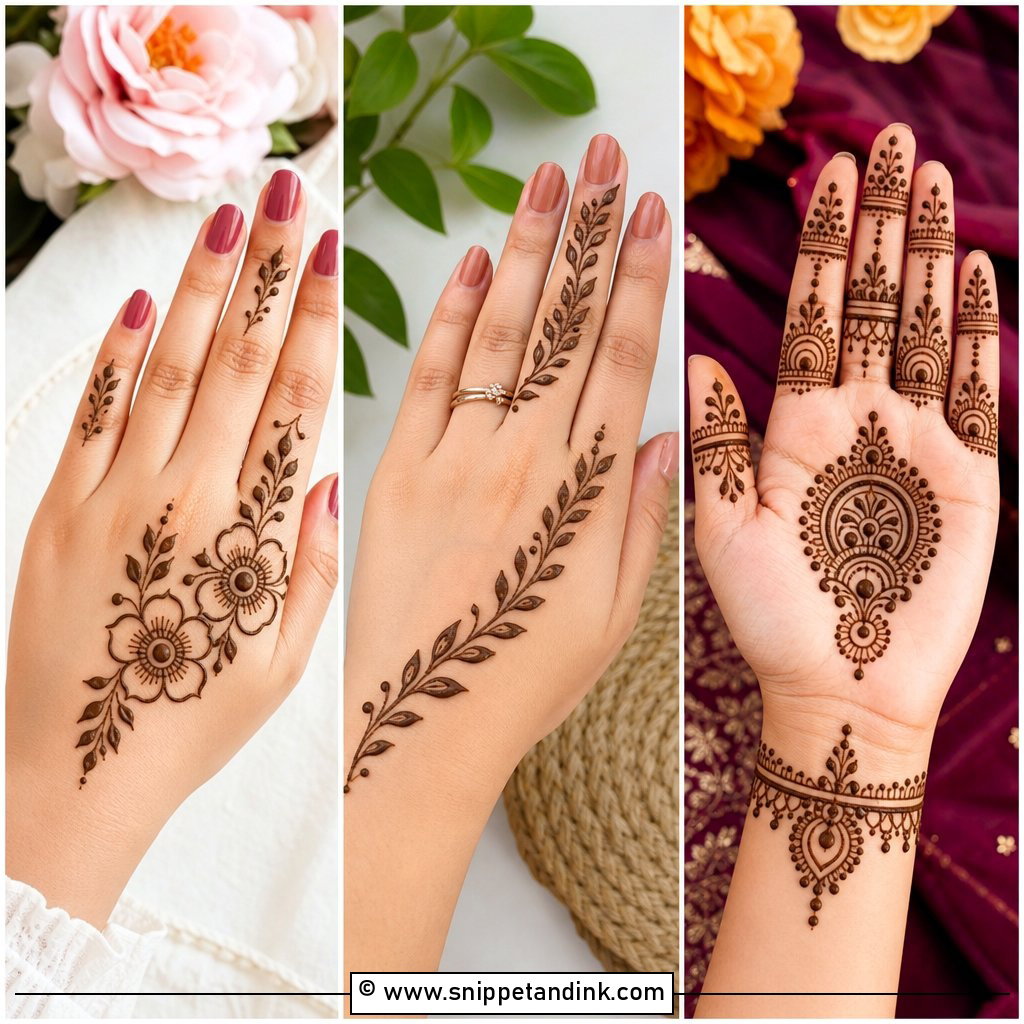
The simplest version: one neat circle in the centre of the palm, a filled dot inside it and a border of tiny petals or dots, with light finger lines, small leaves and fingertip caps. It takes very little time and still looks festive. Because everything grows from one shape, it’s where I start anyone learning. The single rule is space. Leave a clear ring of bare skin around the circle and it will read as round even if the line isn’t perfect. A slim wrist line finishes it.
2. Round Tikki Mehndi Design For Front Hand
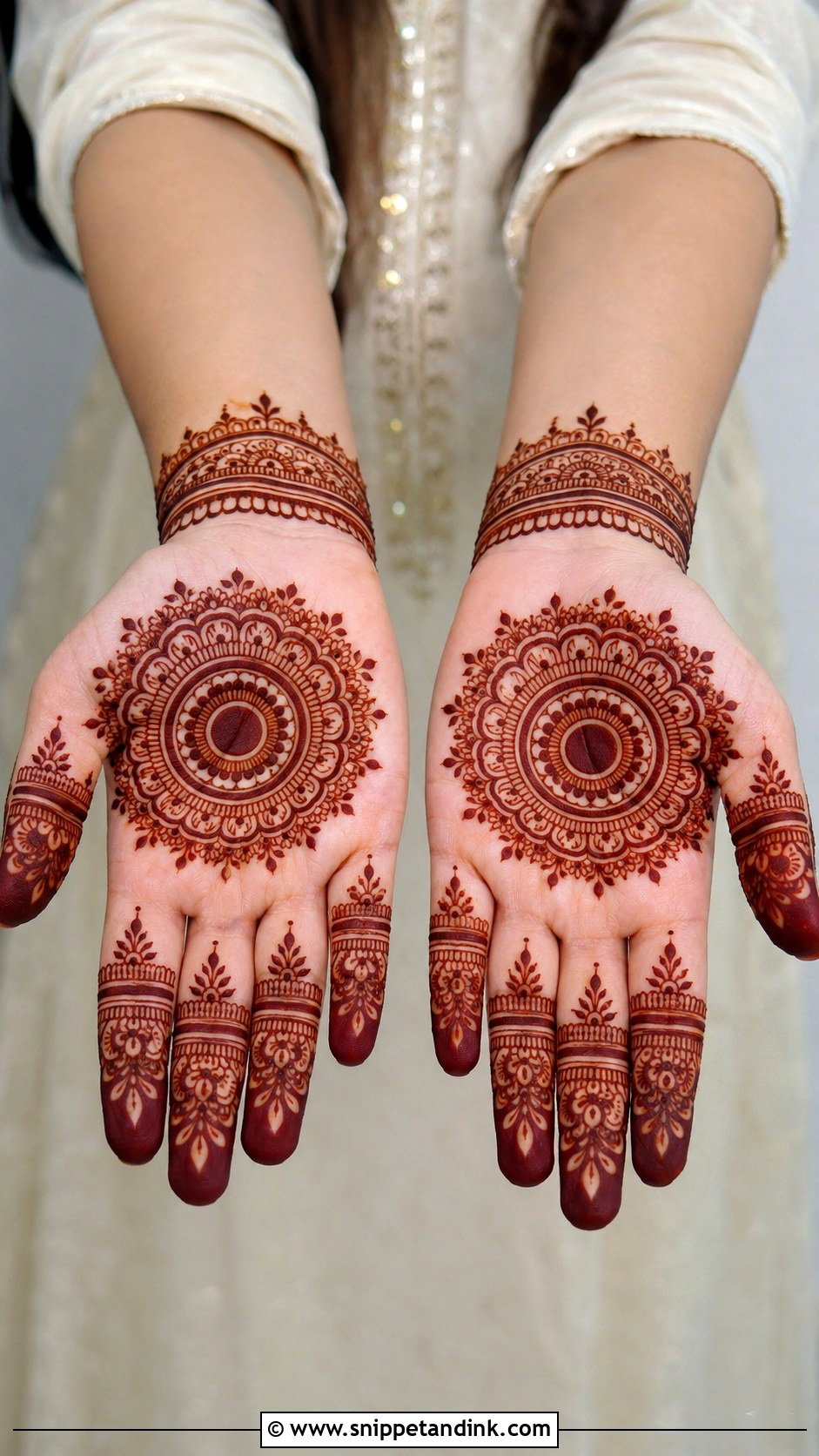
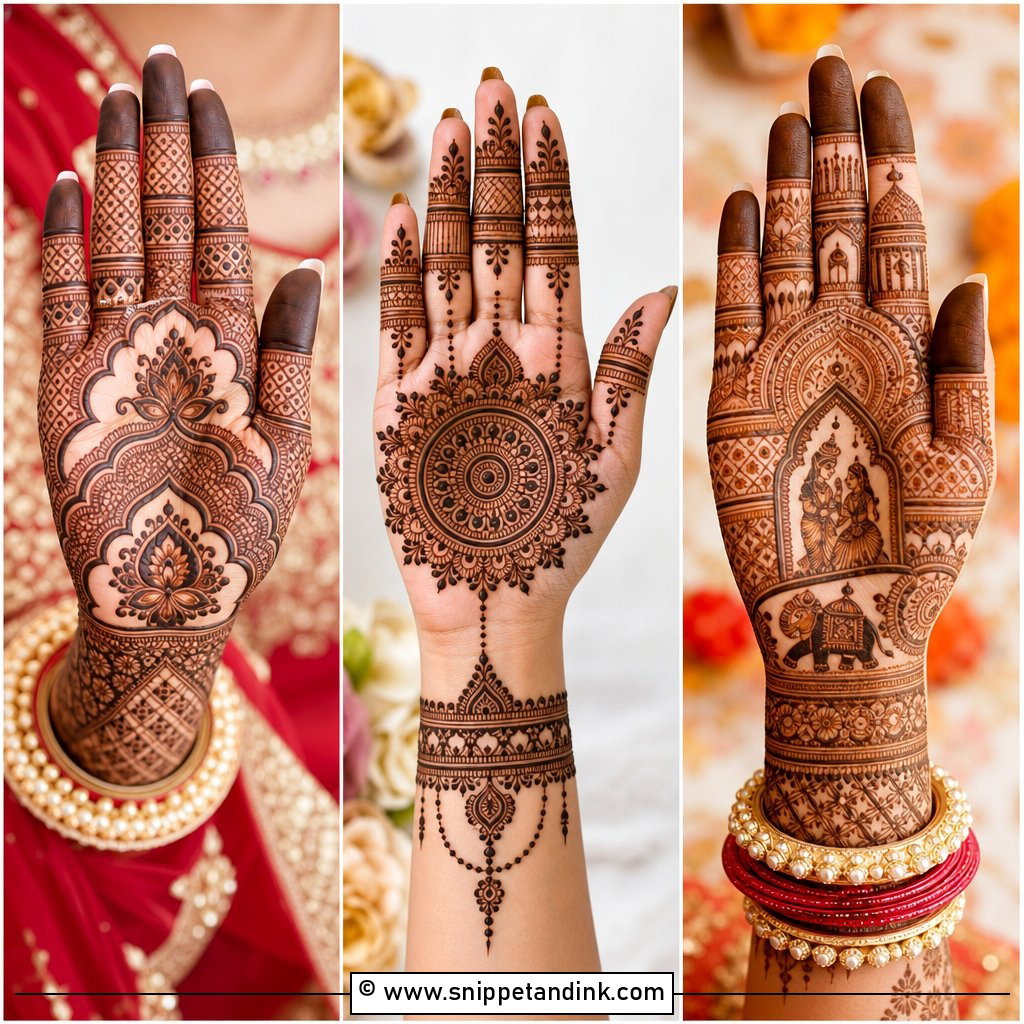
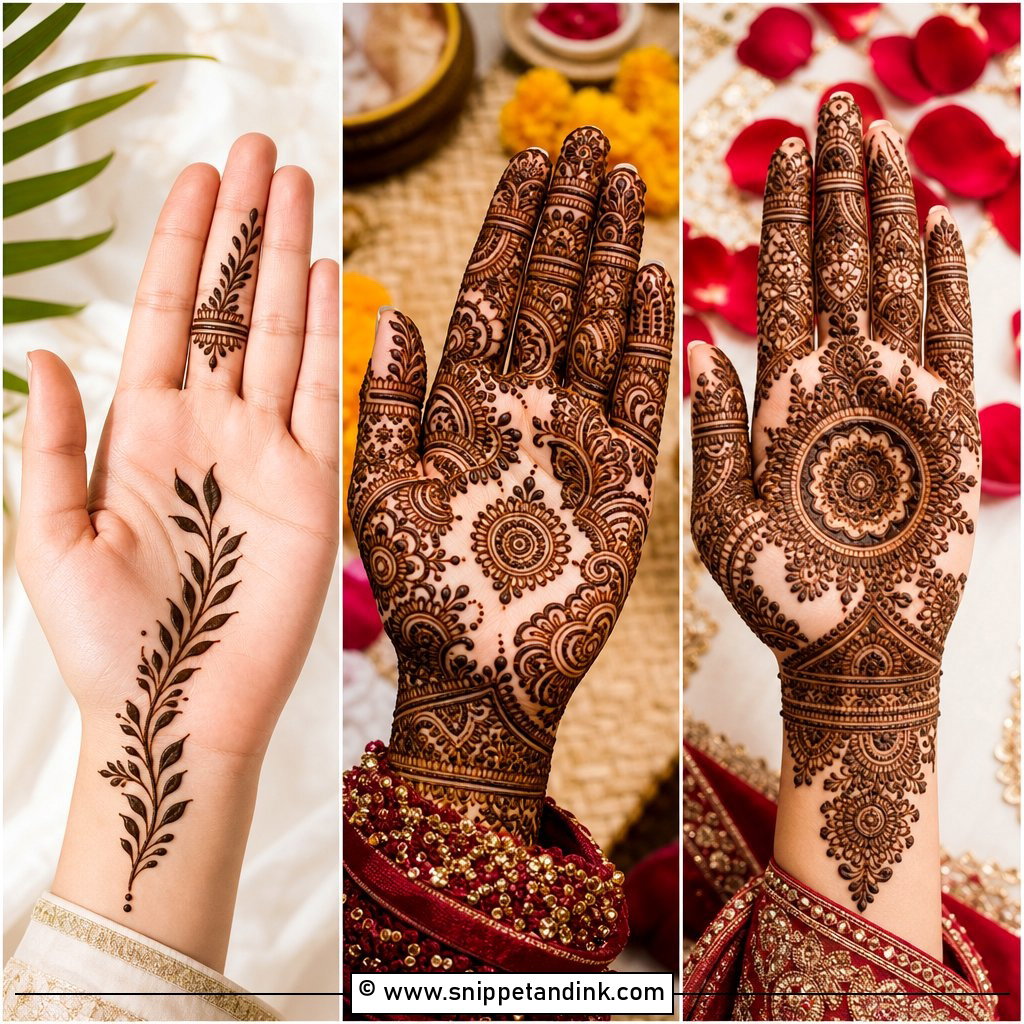
The tikki is the traditional palm circle, and in this front-hand version it carries the whole design. Layered petals, half-moons, dotted rings and small leafy vines surround it, and the fingers echo the same motifs in finer lines. For a bold stain, fill the centre solid; for something more delicate, leave it open and detail the inside. I usually ask which one a client wants before I start, because a filled centre needs a smoother, thicker layer of paste and that changes how I prepare the cone.
3. Round Mandala Mehndi Design For Hands
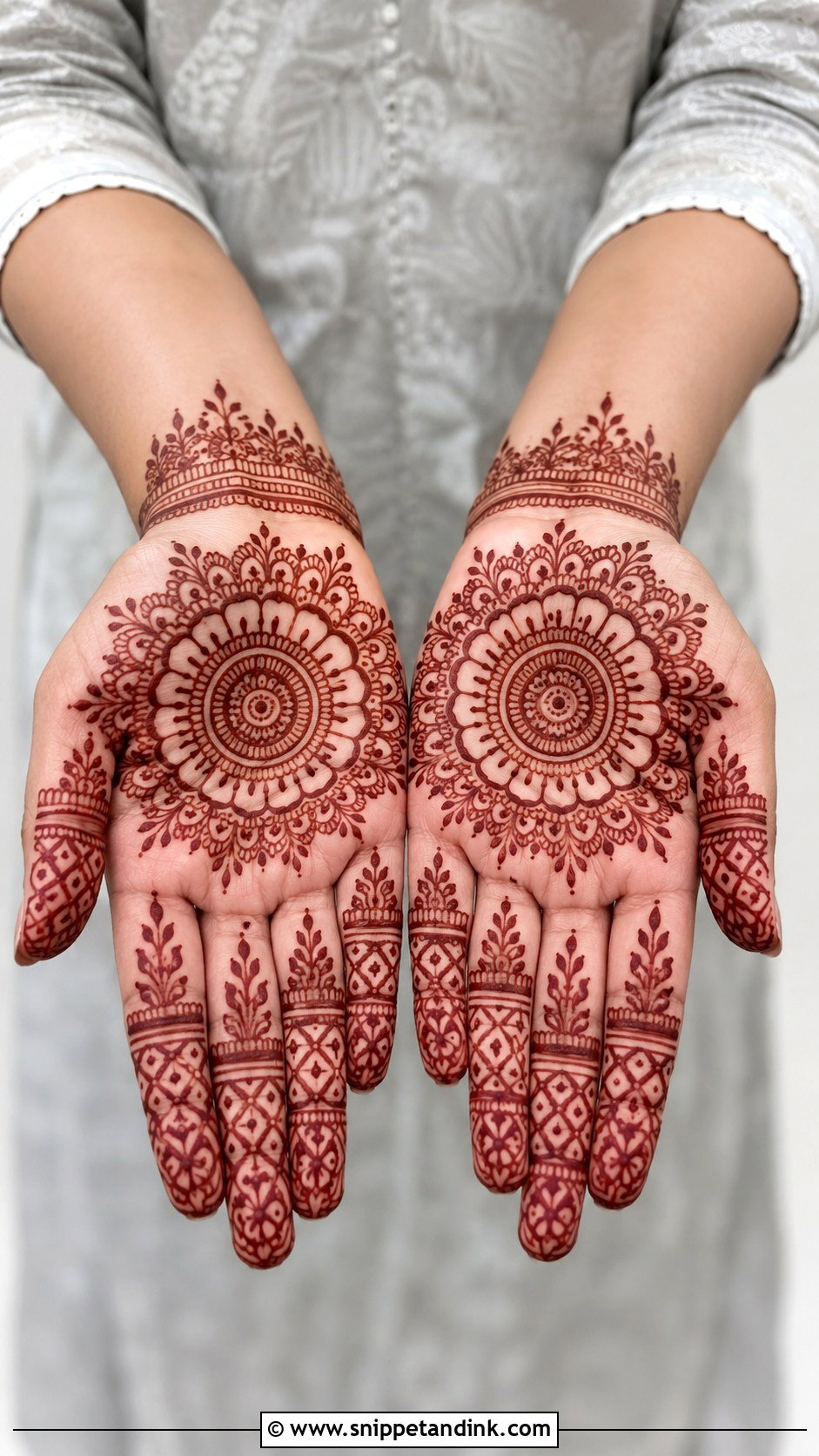
Mandalas build outward from a small circle: petal rings, scalloped borders, dots, leaves and fine geometric lines, each layer repeating evenly. You can wear it on the palm or the back of the hand depending on the event, and add matching finger bands and a small wrist cuff to finish. What makes a mandala look calm is consistency between rings. I count petals as I go, so the third ring has a sensible relationship to the second; when rings have random petal counts, the whole thing looks wobbly even when each line is clean.
4. Floral Round Mehndi Design For Back Hand
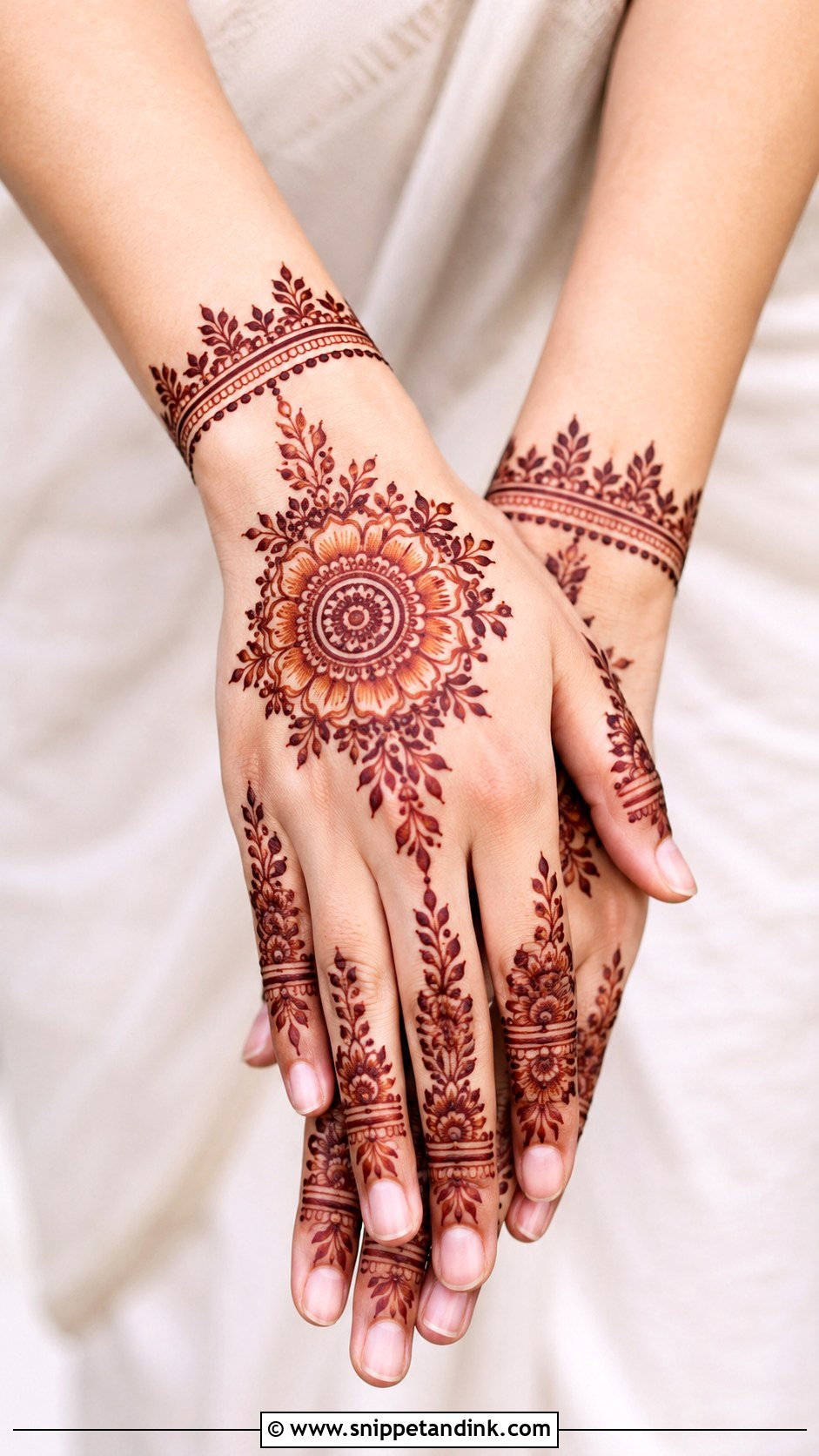
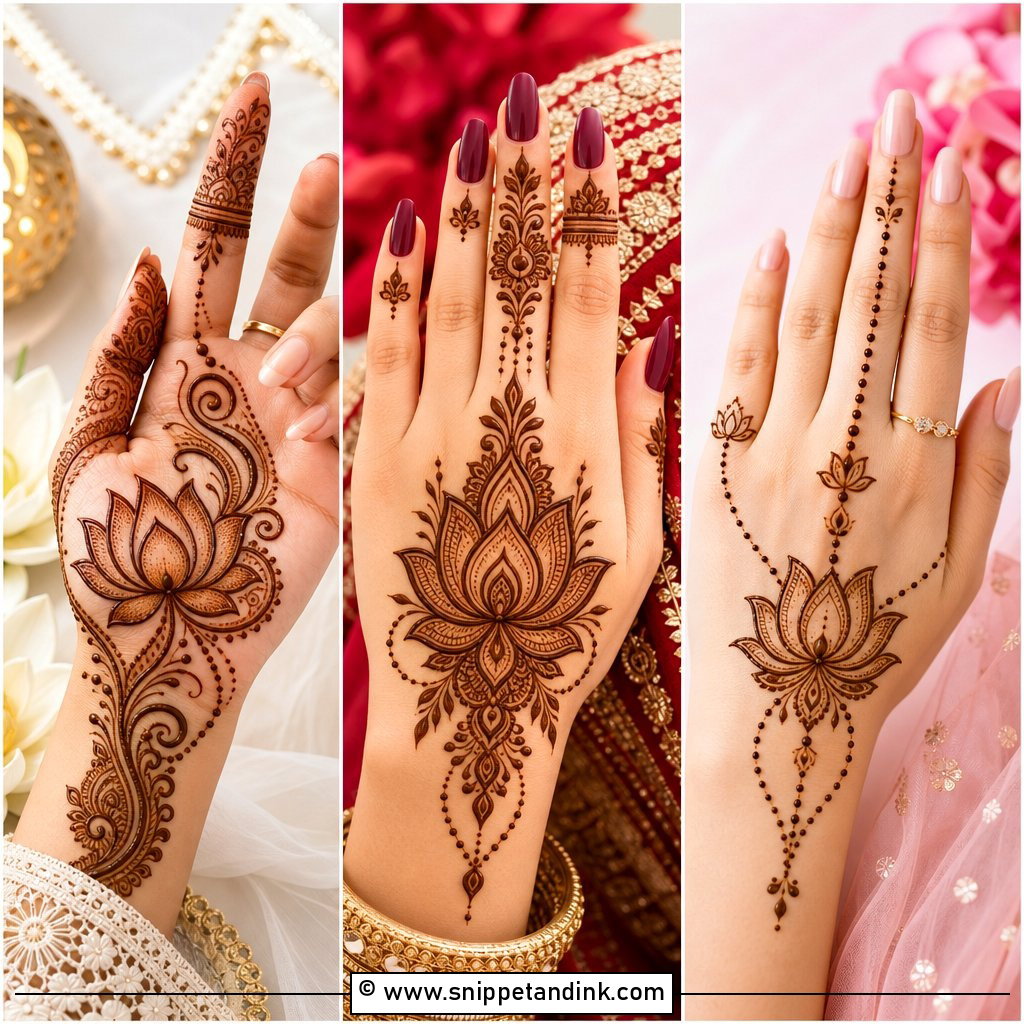
On the back of the hand, a round floral reads like a single flower resting on the skin, its centre shaped as a rose, lotus or daisy with petals layered around it. Small floral tips, leafy chains and thin ring bands on the fingers keep it light. Bangles leave this placement fully visible, which is why engagement guests ask for it. For a modern touch I leave a thin gap of skin between each petal layer so the flower looks airy. Without that gap the layers fuse into a solid disc once the stain darkens.
5. Arabic Round Mehndi Design For Hands
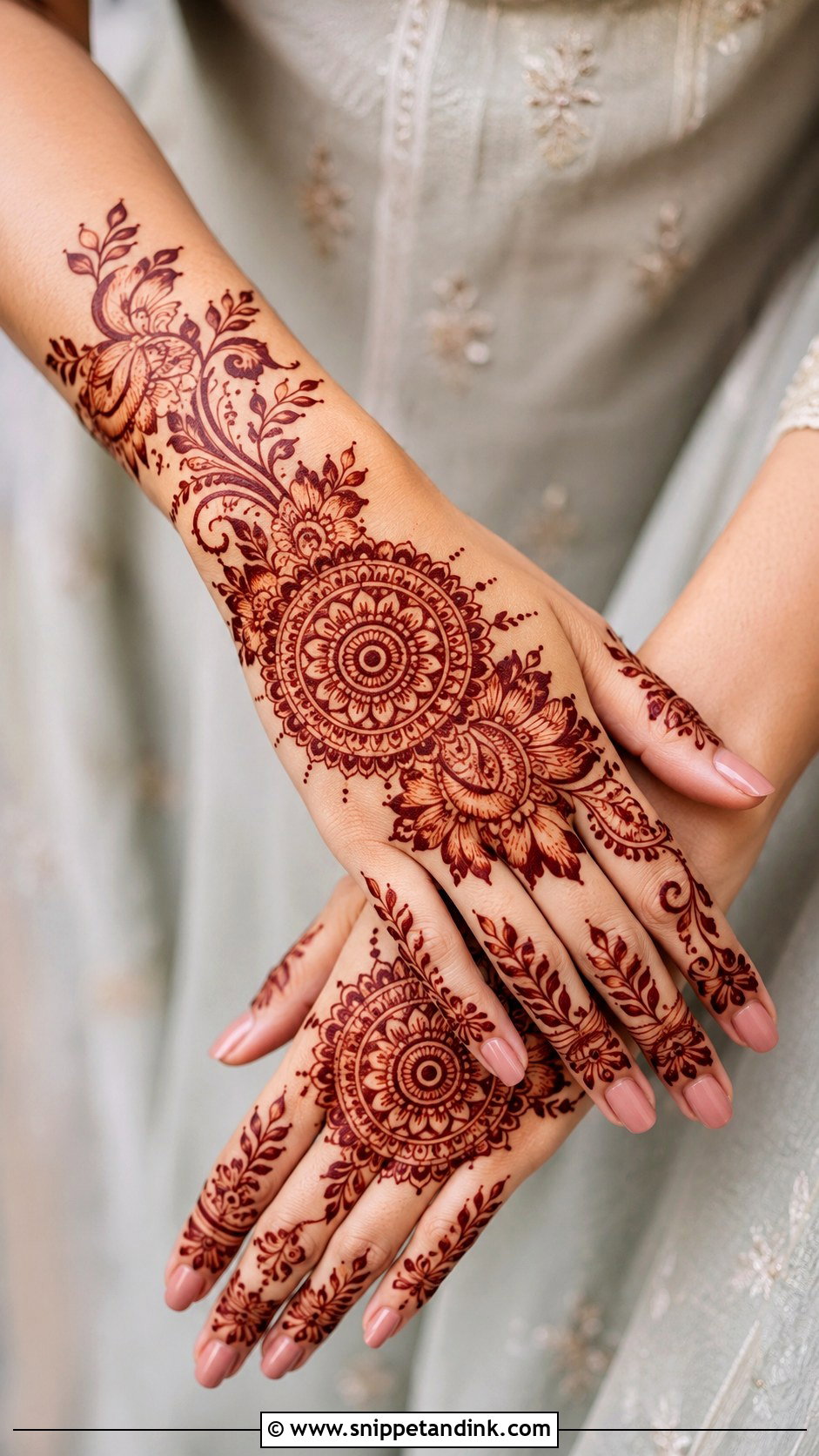
This blends a circular focal point with flowing Arabic trails. A round mandala sits on the palm or back of the hand and a vine runs diagonally from it toward the index finger and wrist, with big flowers, curved leaves and shaded petals. The rest of the hand stays open. It takes a fraction of the time of heavy bridal work, which makes it a regular at Eid gatherings and wedding guest appointments. I keep the circle slightly smaller than in an Indian layout, so the trail gets enough room to move.
6. Indo Arabic Round Mehndi Design For Palm
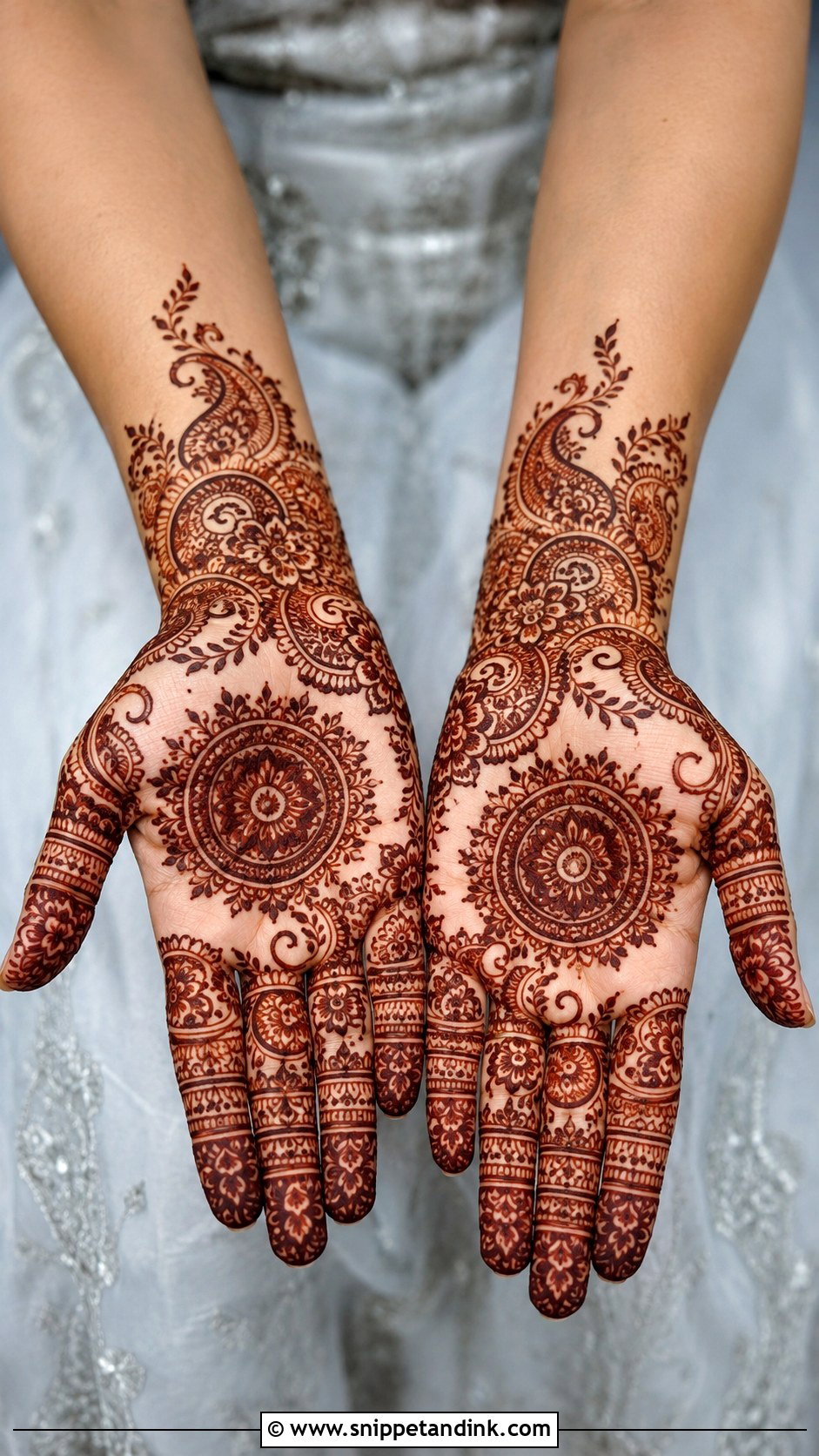
Indo-Arabic keeps a traditional tikki or mandala at the centre of the palm and surrounds it with Arabic vines, bold flowers and open spacing. Paisleys around the circle add the Indian accent, curved leaves flow toward the wrist and fingers, and the fingers carry small checks, dots and floral bands. The result is detailed without crowding. My one piece of advice is to keep the vines from touching the circle’s outer ring; a sliver of skin between them keeps the round shape legible in photos.
7. Bridal Round Mehndi Design For Full Hand
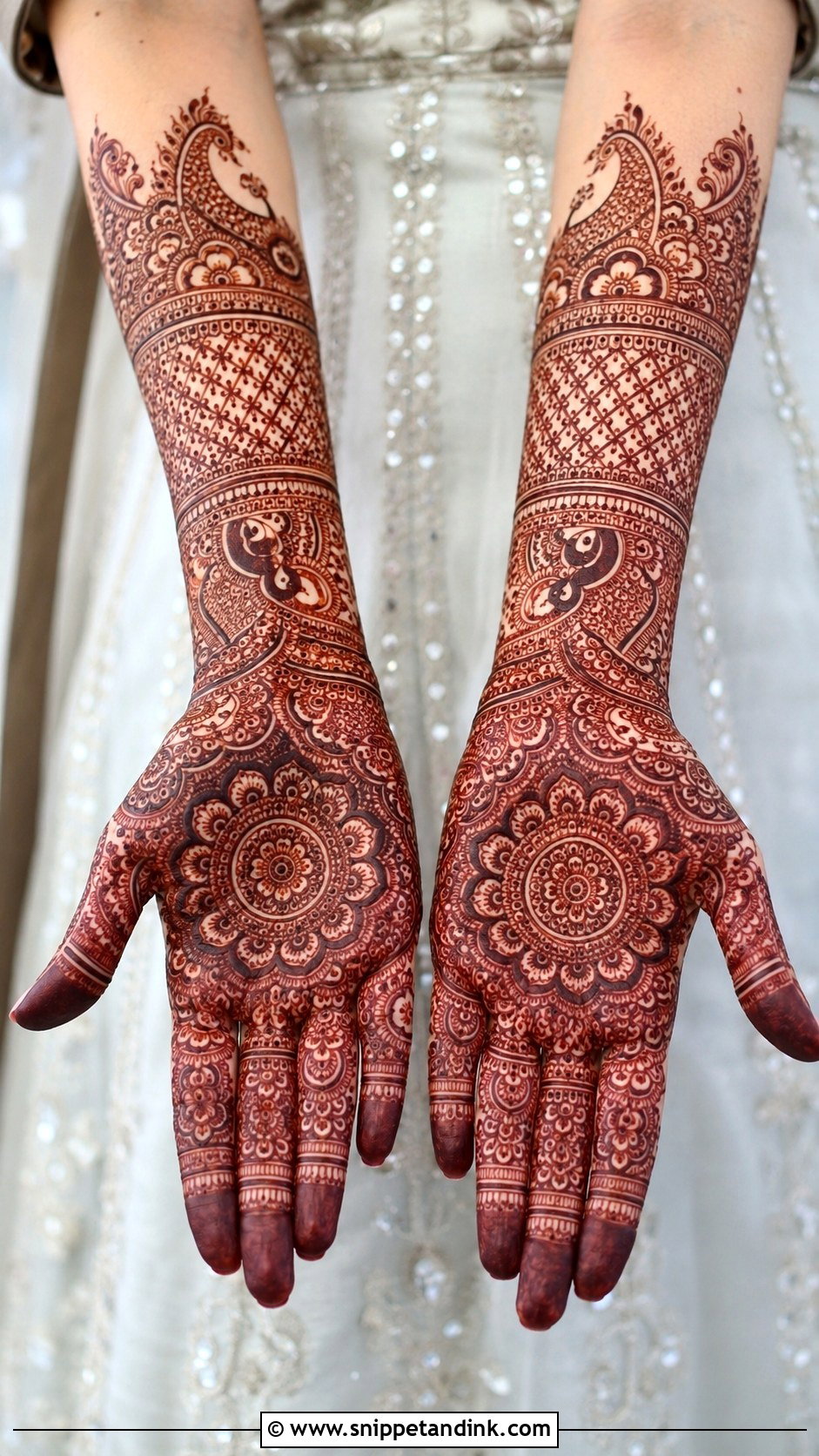
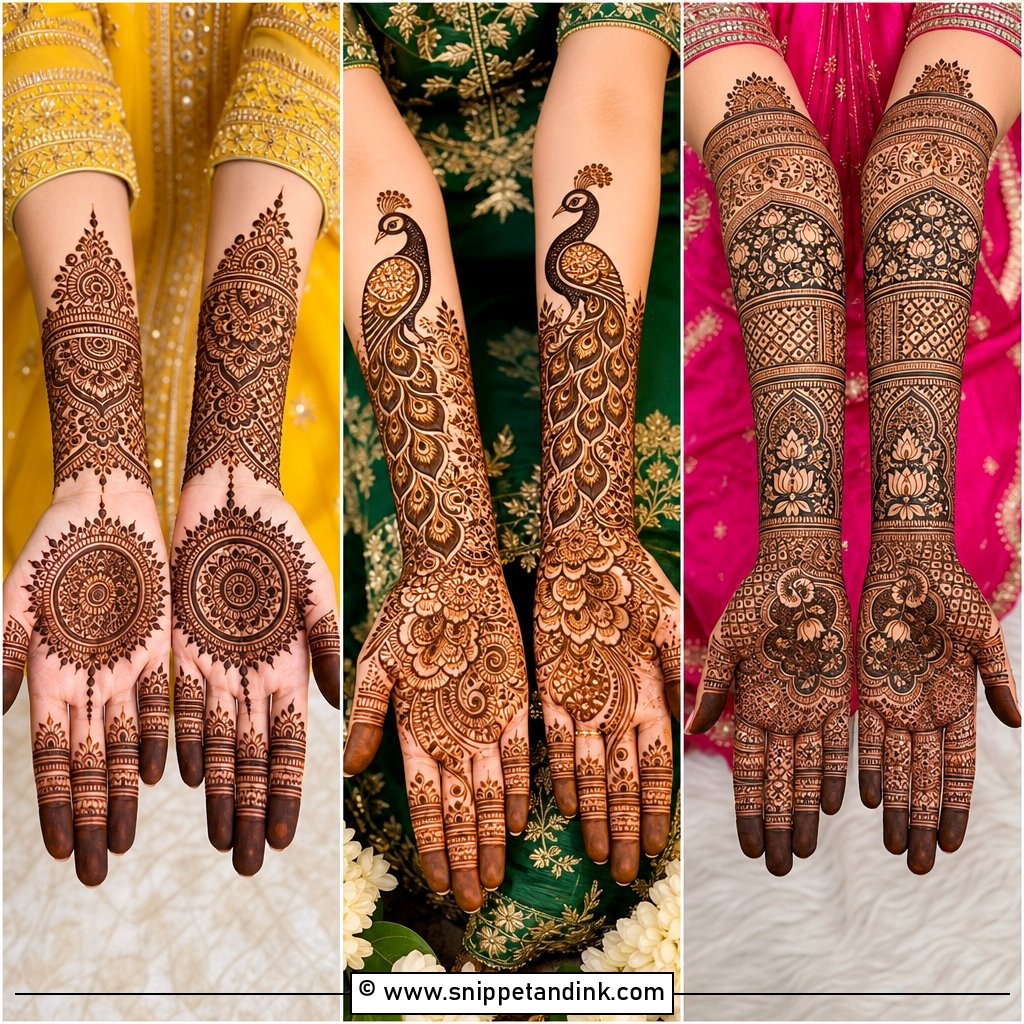
For a bride, the circle becomes the anchor of a full traditional layout: a large mandala or filled tikki on the palm, ringed by paisleys, peacocks, florals and fine jaali, continuing through the wrist and forearm with bracelet bands and circular accents. Fingers get grids, petals and shaded tips. In this much detail, I give the central circle a double outline and keep a few small negative spaces around it. Otherwise the round shape gets swallowed and the palm loses its focal point.
8. Minimal Round Mehndi Design For Back Hand
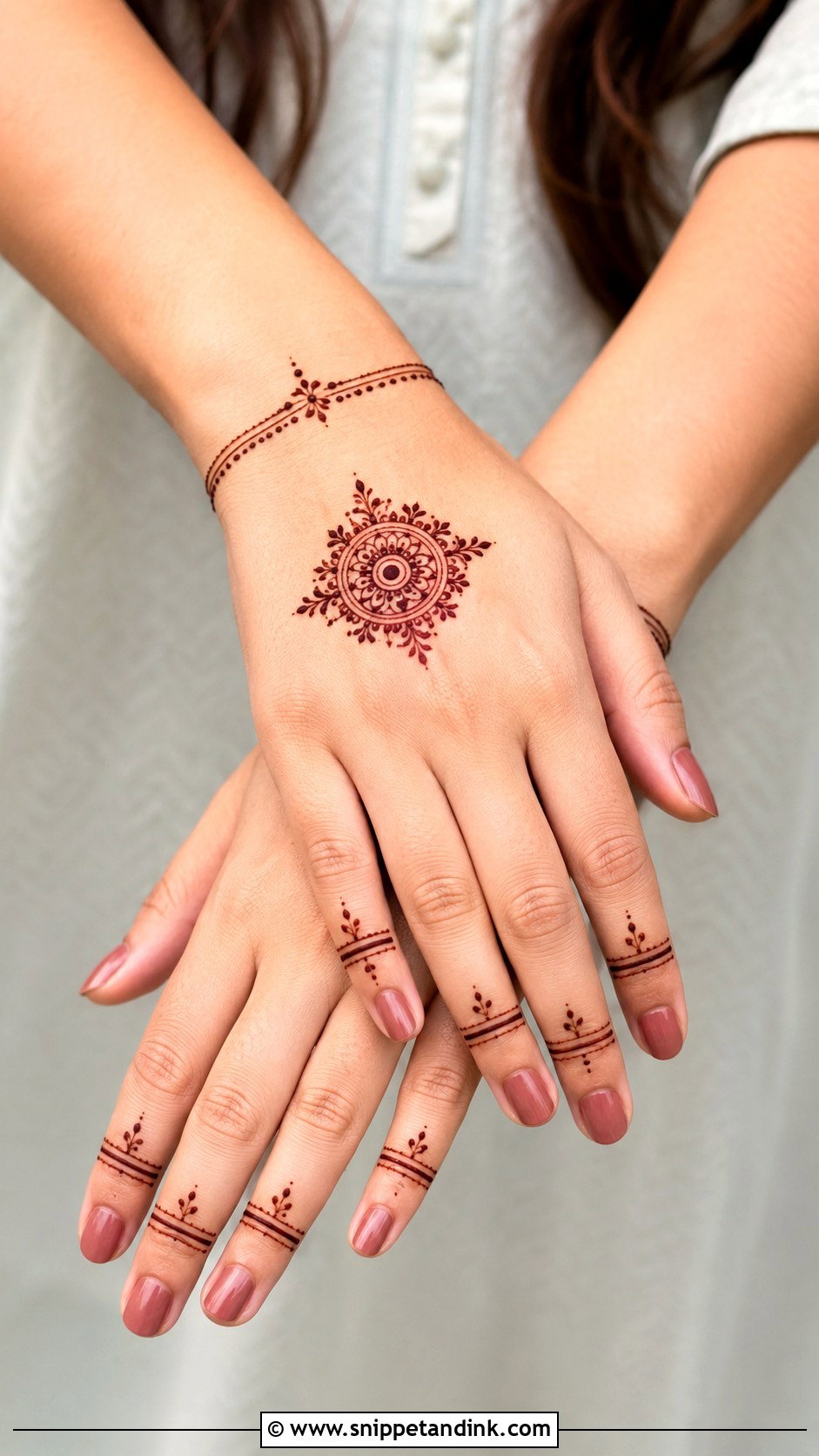
A small mandala near the centre of the back of the hand, thin finger bands, tiny dots and one delicate line at the wrist. That’s the whole design. It suits anyone who wears rings daily or needs to look tidy at work the next morning. The empty skin around the circle is what makes it look intentional, so resist the urge to add filler. Use the finest cone tip you have.
9. Easy Round Mehndi Design For Beginners
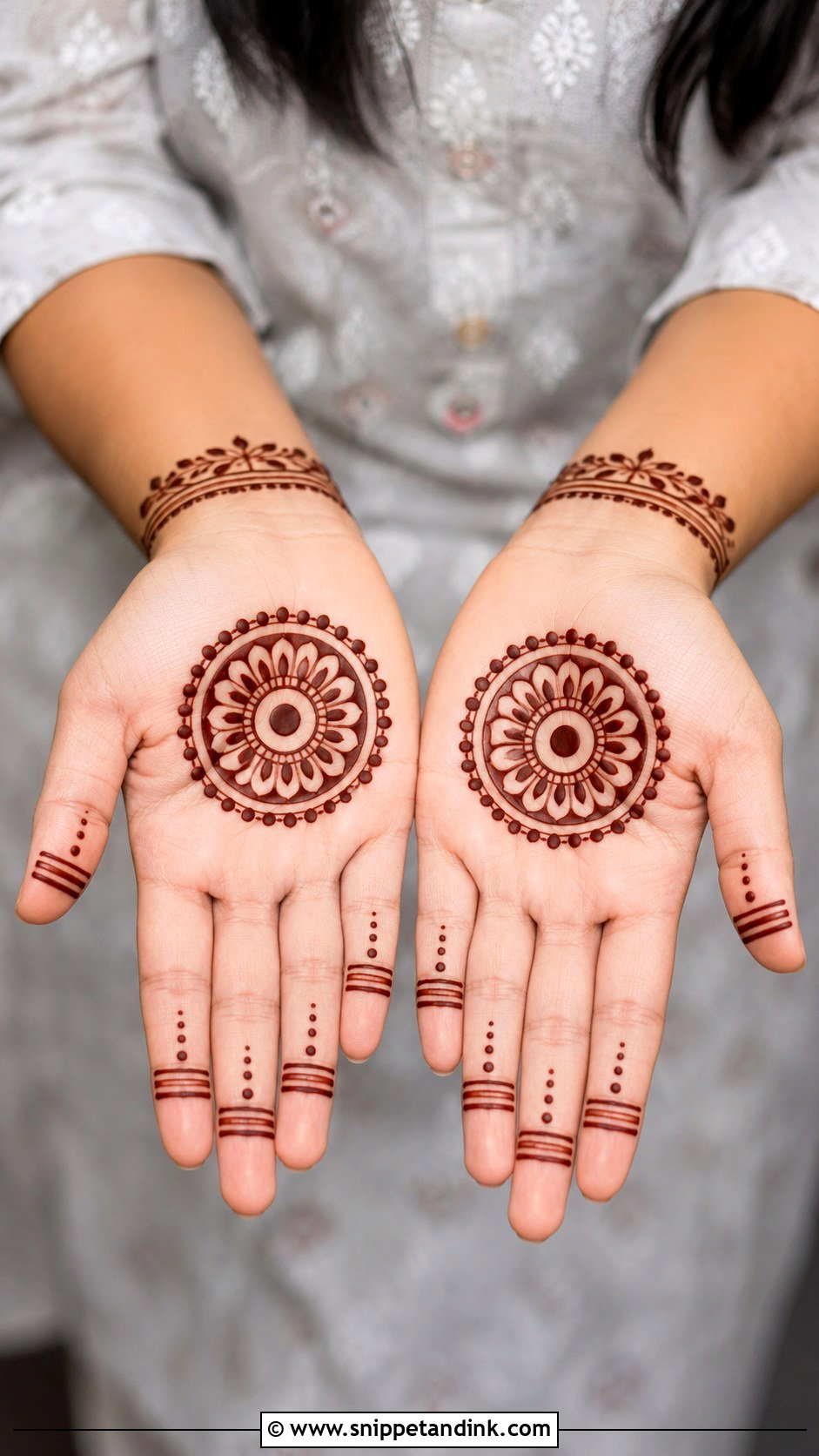
For a first attempt, put a dot in the centre of the palm, draw one circle around it, then a ring of petals, and finish with dots, small leaves and a few finger lines. Leave the wrist bare or add one band. There’s no shading and no tight spacing to worry about. If the circle comes out lopsided, cover the edge with petals or scallops; they hide an uneven line far better than trying to redraw it. This is the pattern I’d use to practise cone pressure and basic symmetry.
10. Modern Round Mehndi Design For Front Hand
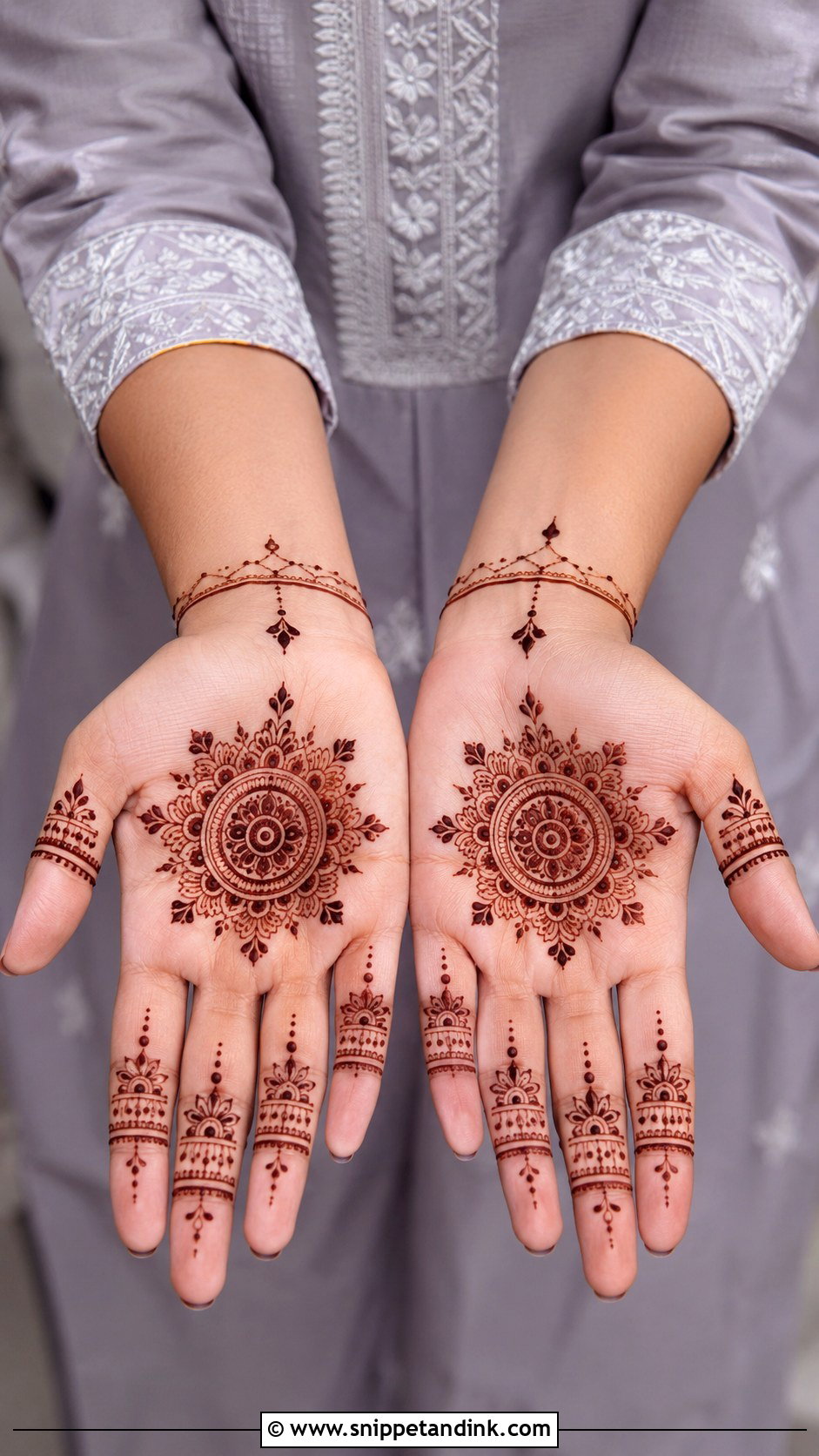
Modern front-hand designs keep the traditional circle but strip the clutter: one sharp mandala in the palm, slim finger bands, tiny dot trails and small geometric accents such as triangles or half-circles. The wrist can carry a thin bracelet with a small round charm in the middle. Heavy fills undo the effect, so I keep solid areas to the very centre. It sits well at office celebrations and low-key festive gatherings.
11. Heavy Round Mehndi Design For Wedding
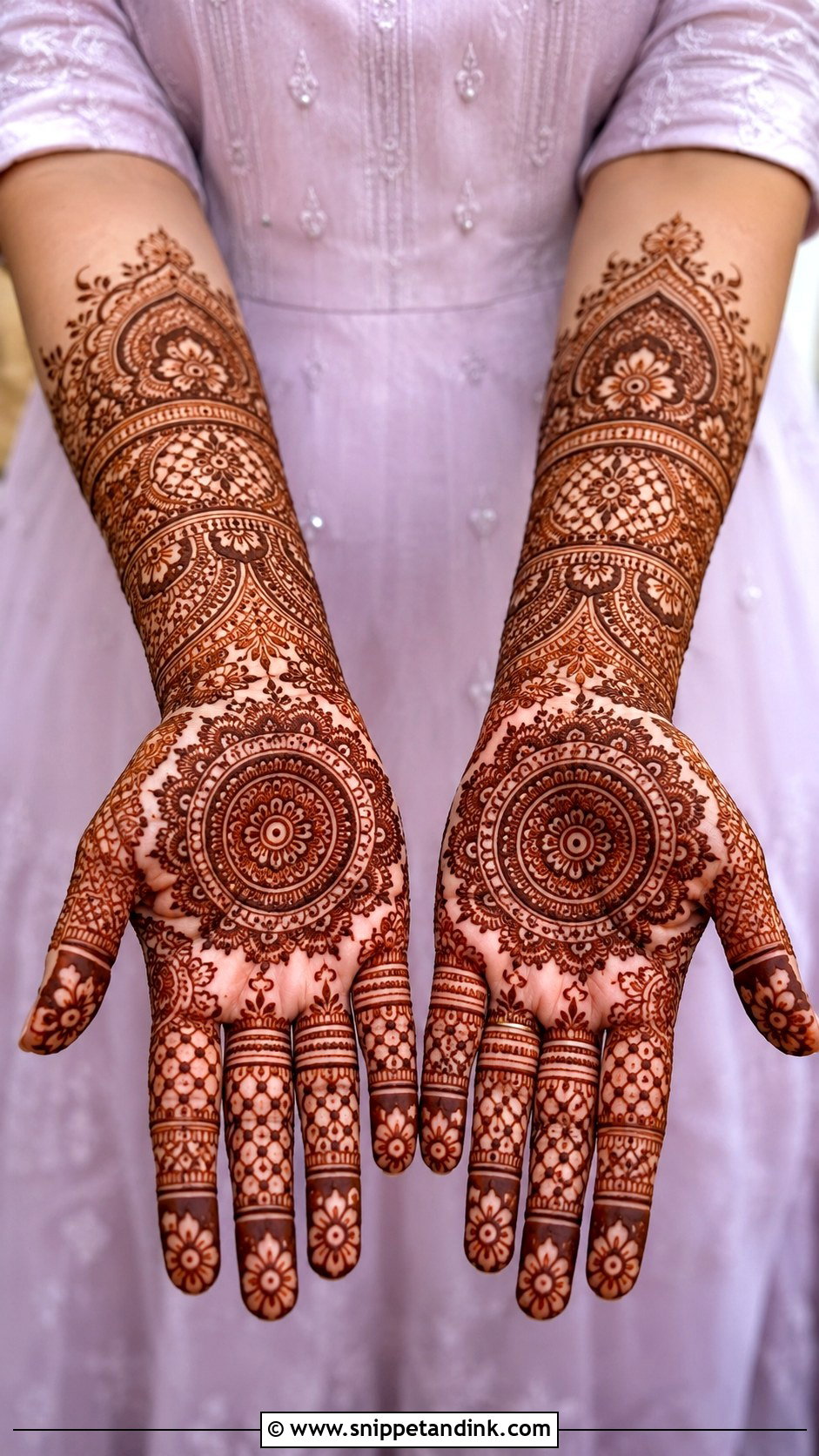
Heavy round work is for people who love detailed hands: a large palm mandala layered with flowers, paisleys and lace borders, packed motifs flowing into the fingers and wrist, jaali on the fingers and a wrist-to-forearm extension for photos. It stops short of a full bridal arm but still reads formal. The thing I watch most is the outline around the centre. Thicken it, or the round motif disappears among everything else.
12. Round Mehndi Design With Finger Pattern
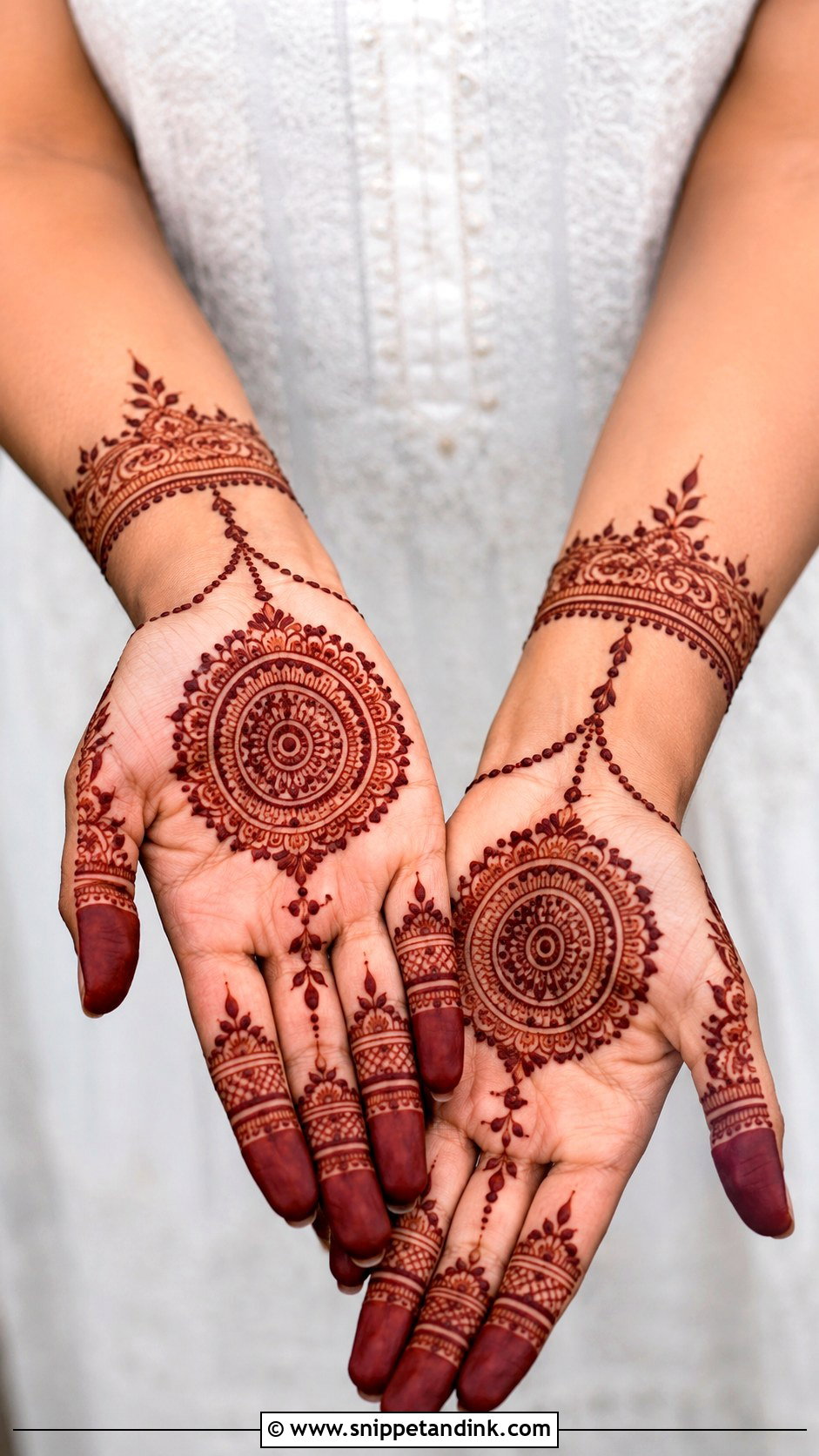
When the circle and the fingers are designed together, the hand looks complete. I draw the palm mandala first, then choose finger details that echo it: dotted lines, leafy vines, half-flower bands or shaded tips. Each finger can differ slightly, but I keep the same border style on all of them so they read as a set. Identical fingers look stamped. A thin curve at the wrist finishes it, and long fingers in particular look elegant with this kind of detail.
13. Round Mehndi Design With Wrist Bracelet
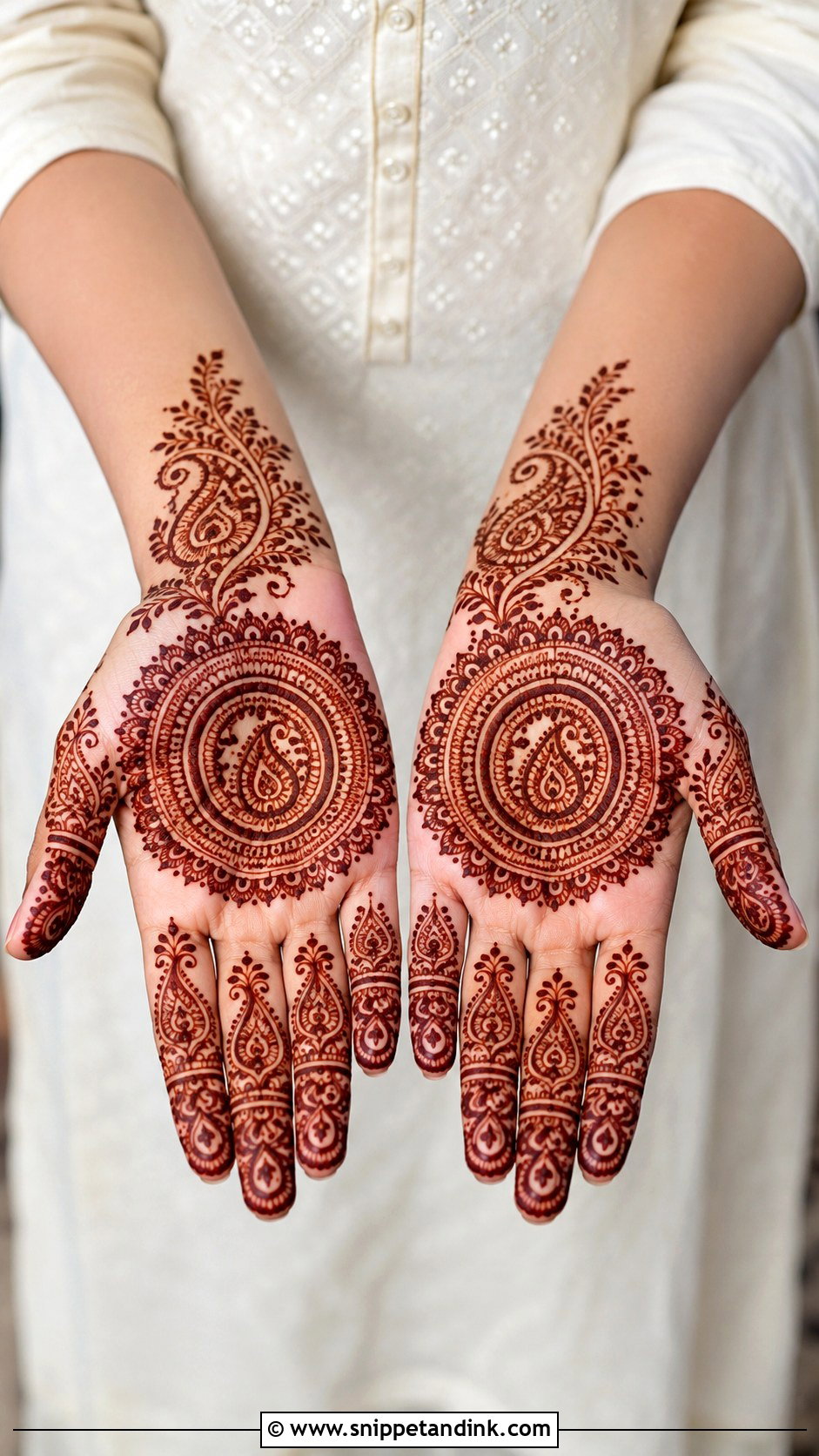
A bracelet at the wrist turns the round design into something like hand jewellery. The palm or back carries the circle, the wrist gets a band of dots, scallops, leaves or chains, and a thin connector line can join the two. Balance is the whole game. If the palm mandala is heavy, I keep the wrist lighter; if the circle is simple, the bracelet can carry more detail. That rule stops one part from overpowering the other at engagements and Eid.
14. Round Mehndi Design With Paisley Pattern
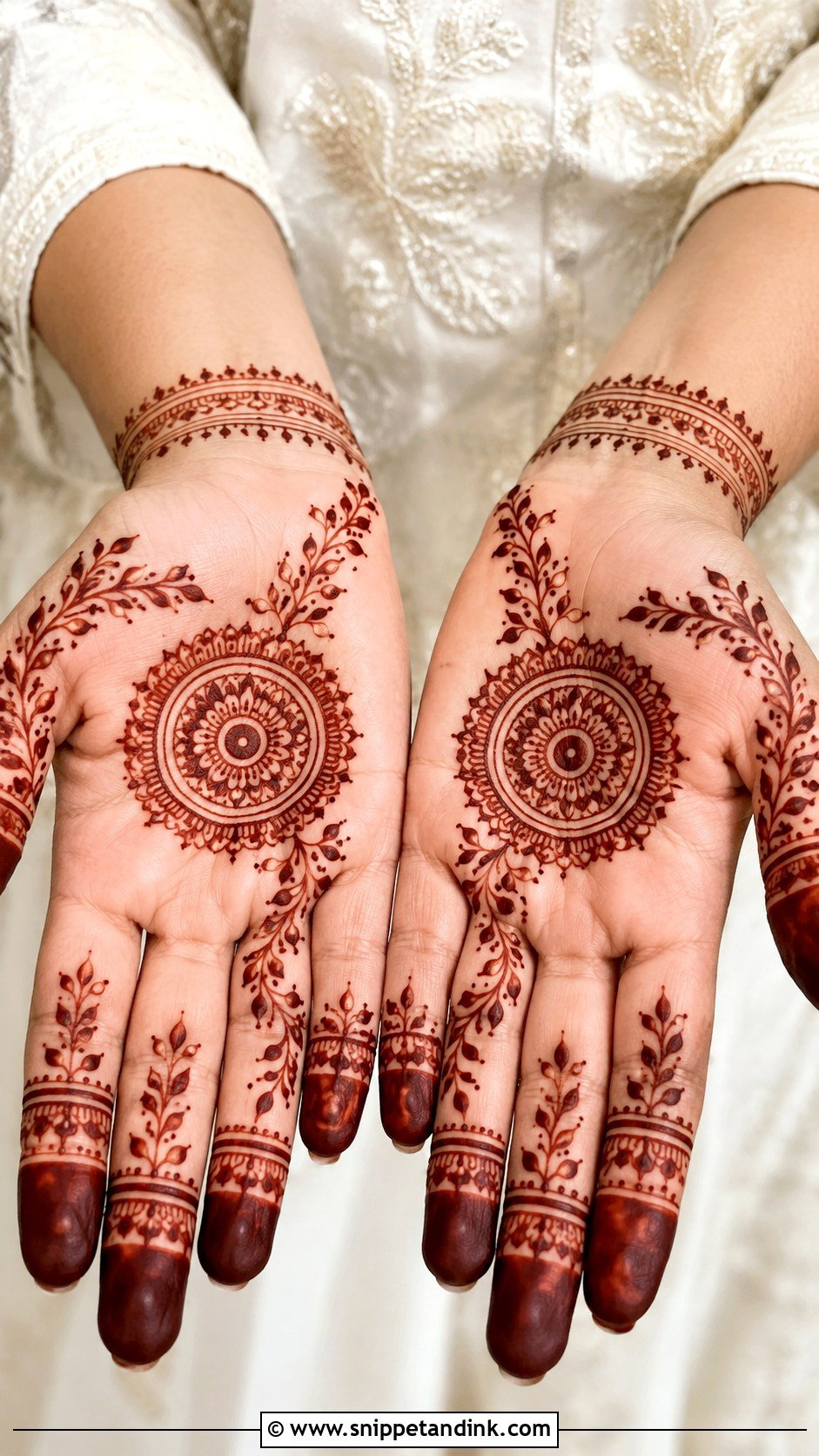
A circular tikki in the palm surrounded by curved paisleys on two or four sides, each paisley filled with tiny leaves, dots and curved lines. The circle gives stability and the paisleys add movement, which is why this pairing shows up at so many Indian and Pakistani celebrations. I point the paisley tips in the same rotational direction around the circle, like a pinwheel, so the eye travels around rather than bouncing. A small vine or border toward the wrist and slim paisley tips on the fingers complete it.
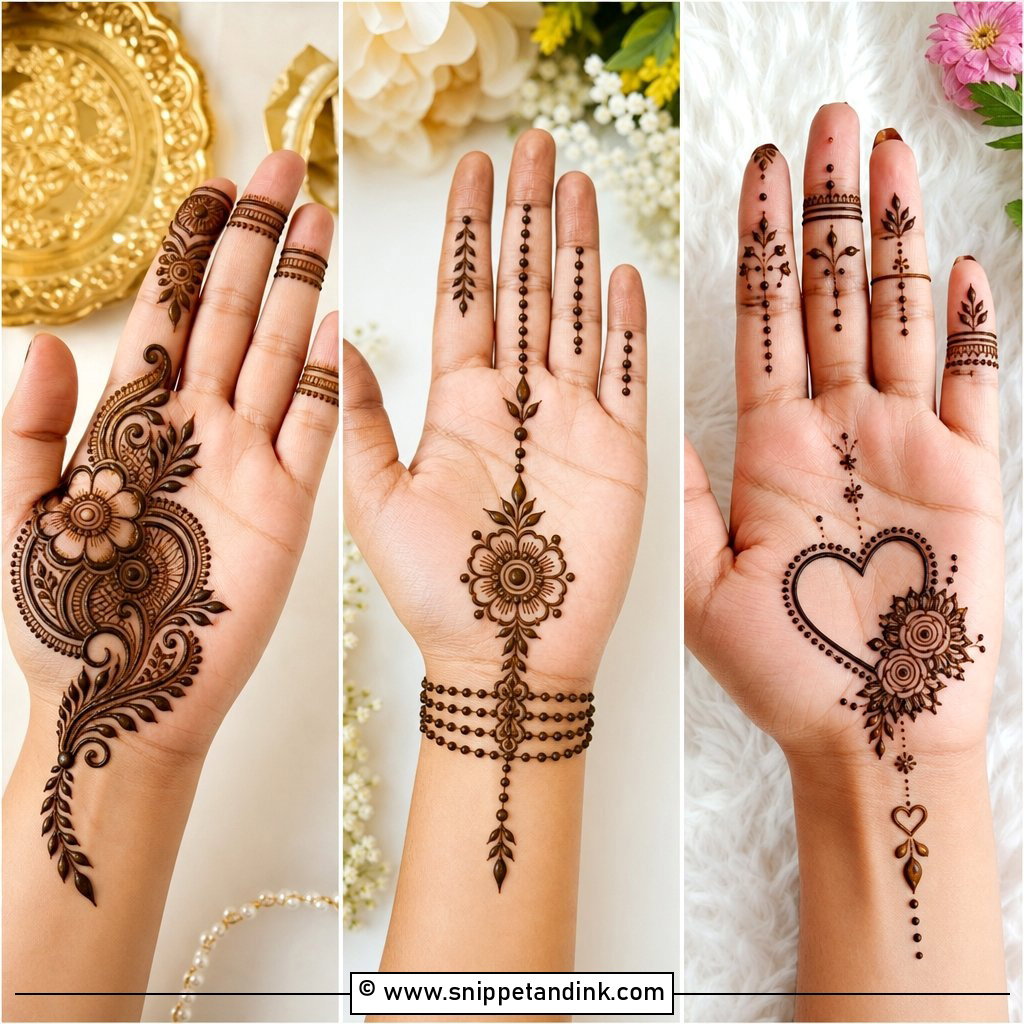
15. Round Mehndi Design With Flower Trail
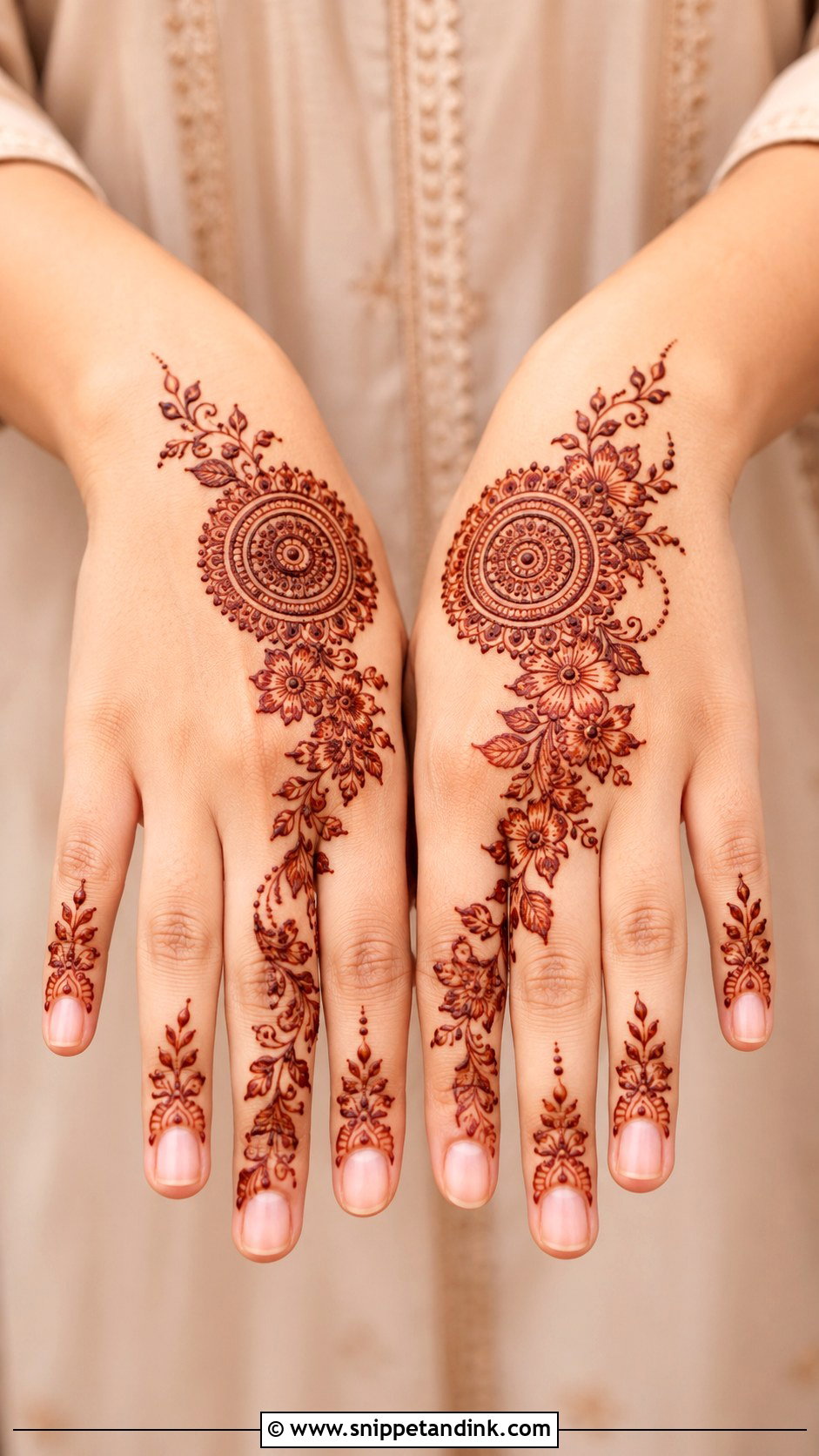
A mandala or simple tikki at the centre with a floral trail running from it toward the wrist or fingers, built from medium flowers, small leaves and dotted curves. It looks especially good on the back of the hand, where the trail can run diagonally. Keep the open skin clean so the trail’s movement shows. I repeat the trail’s flower shape once on a fingertip or the wrist border, which quietly ties the design together. A good pick for bridesmaids and daytime events.
16. Round Mehndi Design With Jaali Pattern
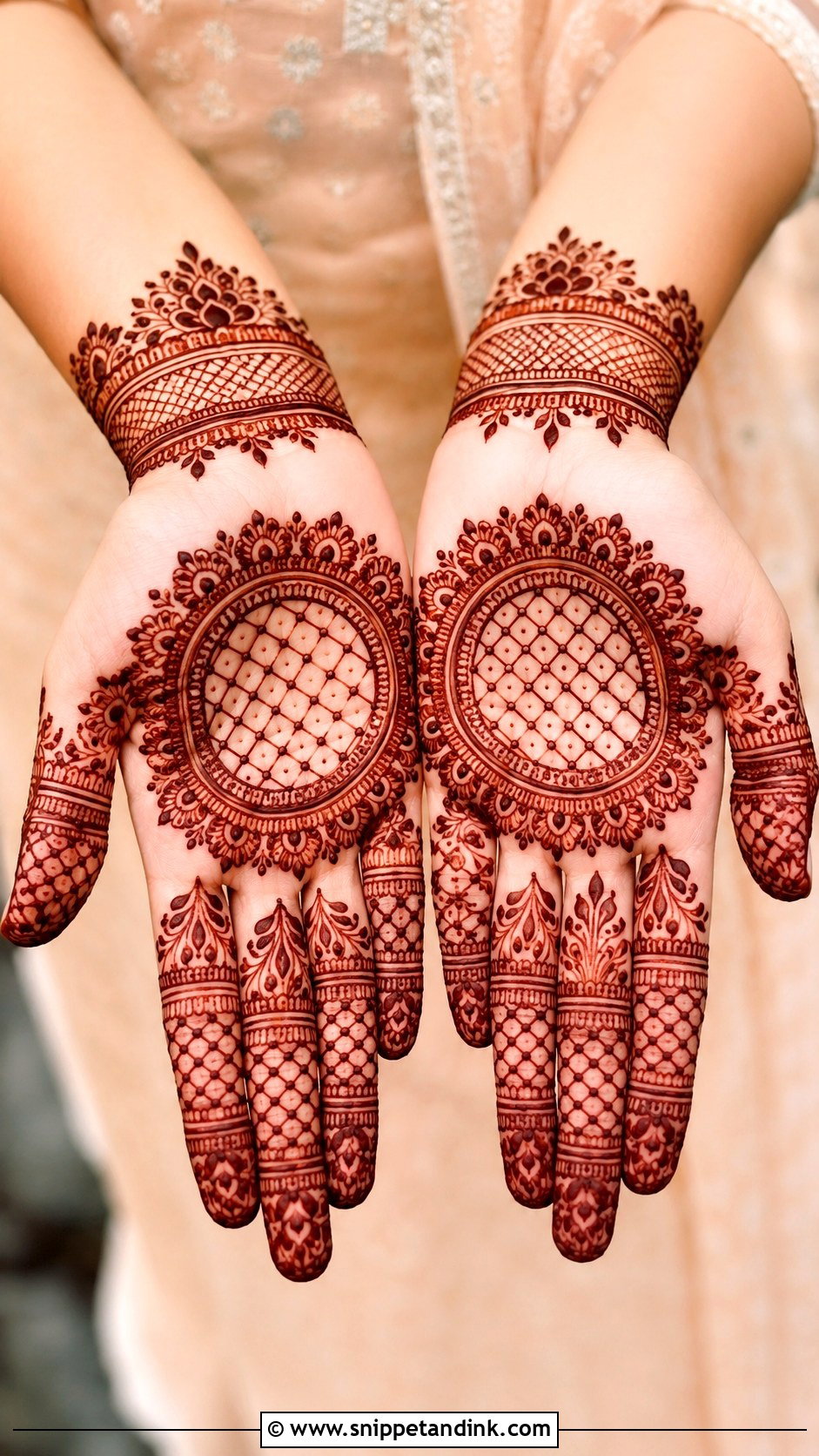
Jaali brings texture: a clean circular mandala in the centre with mesh on the fingers, wrist or one side of the palm, built from diamonds, squares or curved net lines, sometimes with tiny dots inside. It reads like lace, which suits formal events. Keep the centre bold enough to stay the focus. For a lighter version, I put jaali on just two fingers and leave more space around the mandala. Mesh lines should be thinner than the mandala’s outline, never the same weight.
17. Round Mehndi Design With Peacock Motif
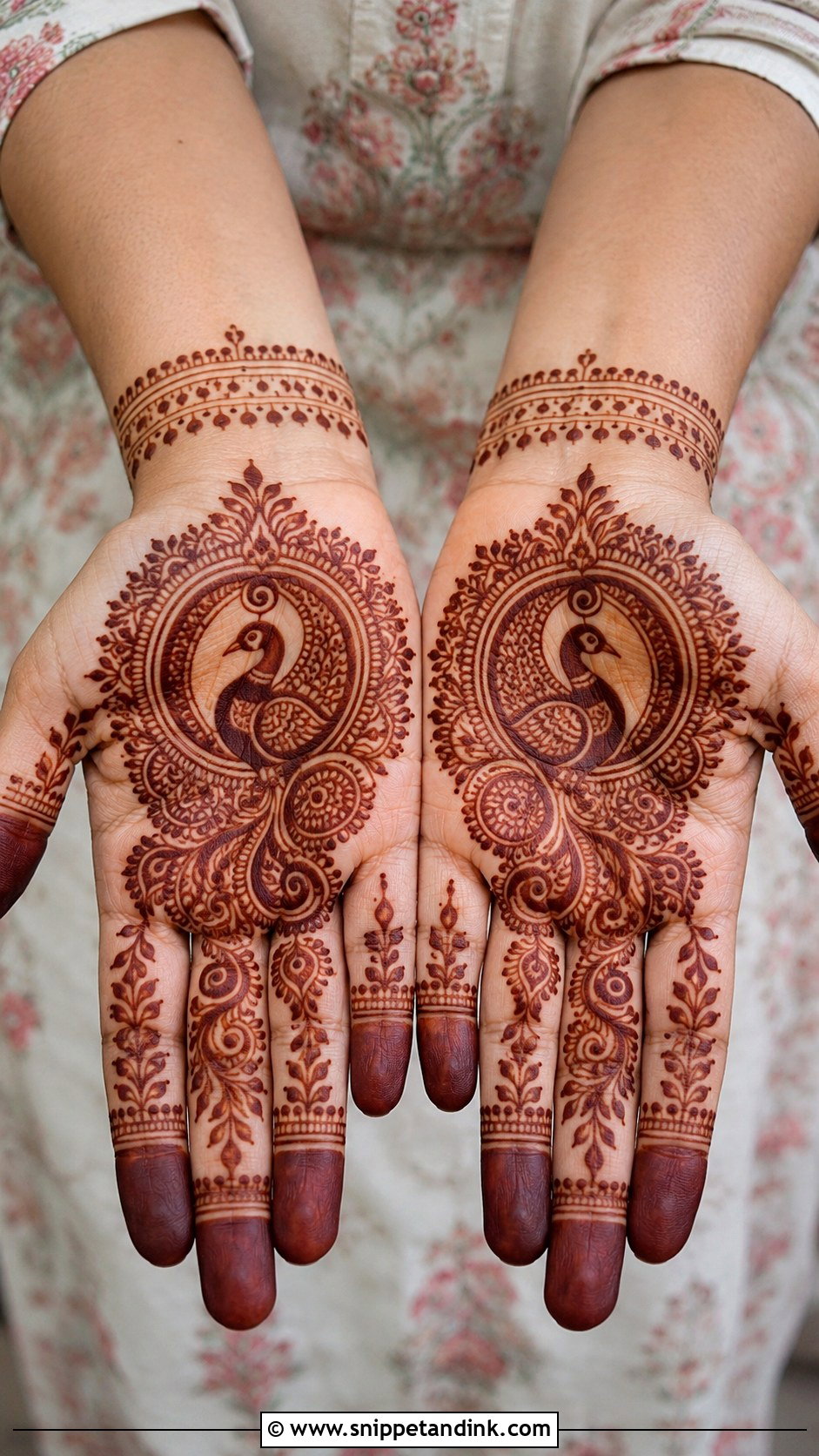
One or two peacocks curving around a palm circle give the design personality. I use the peacock’s body as a paisley shape and decorate the feathers with dots, leaves and tiny scallops, then add feather-like lines or leafy tips on the fingers and a wrist border of mini circles. It feels rich without needing full arm coverage, which makes it popular for sangeet nights. The birds should face toward the circle, not away from it. Facing out, they visually pull the design apart.
18. Round Mehndi Design With Leaf Vines
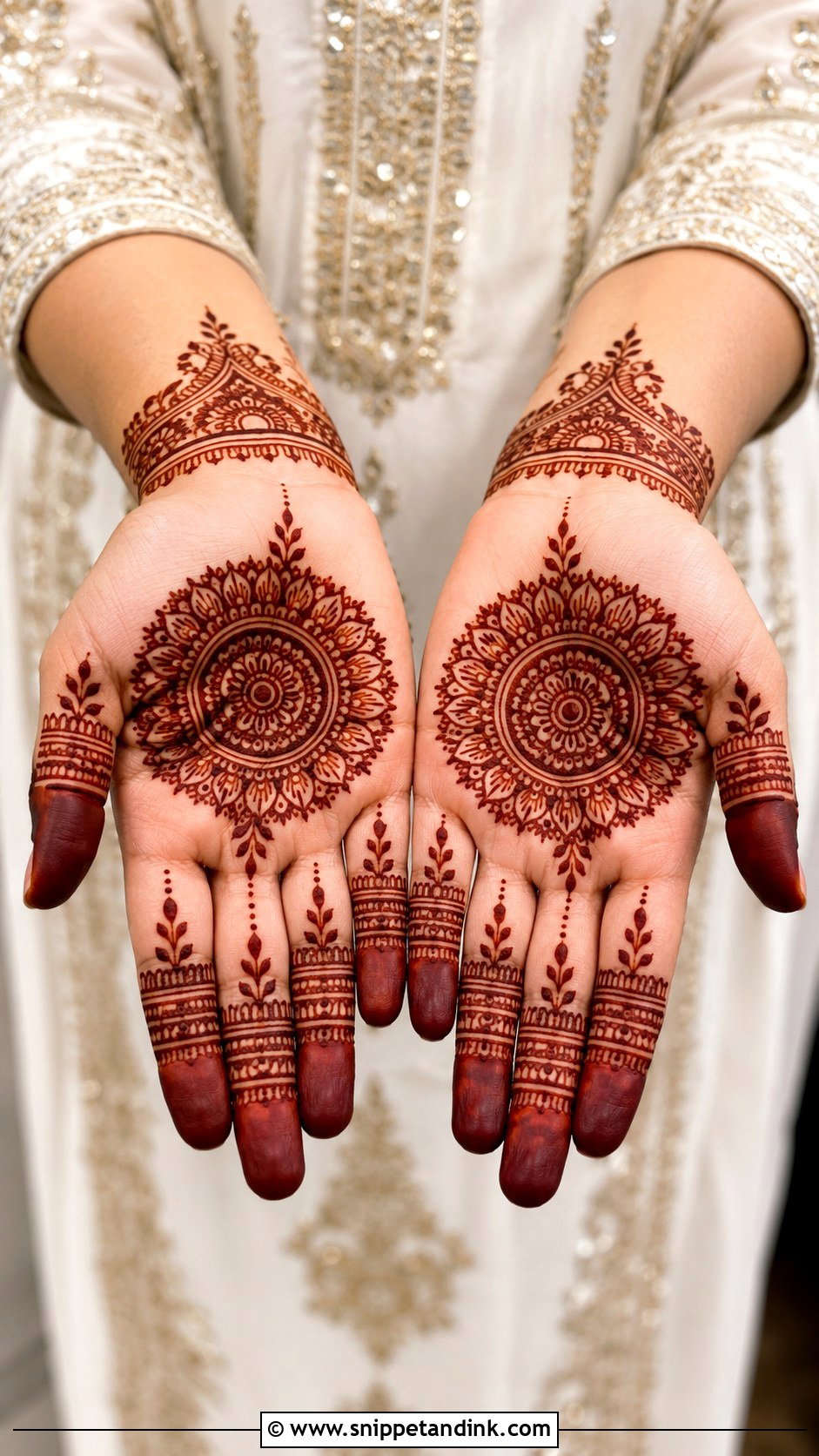
A round tikki or mandala in the palm with leafy vines growing outward toward the wrist and fingers. The leaves can be small and simple or shaded for depth. Vines soften the circle and lengthen the hand, and the finger work can stay light with leaf chains or fine lines. Draw the vines in smooth curves rather than straight paths; a stiff vine looks like a crack running away from the circle.
19. Round Mehndi Design With Dots
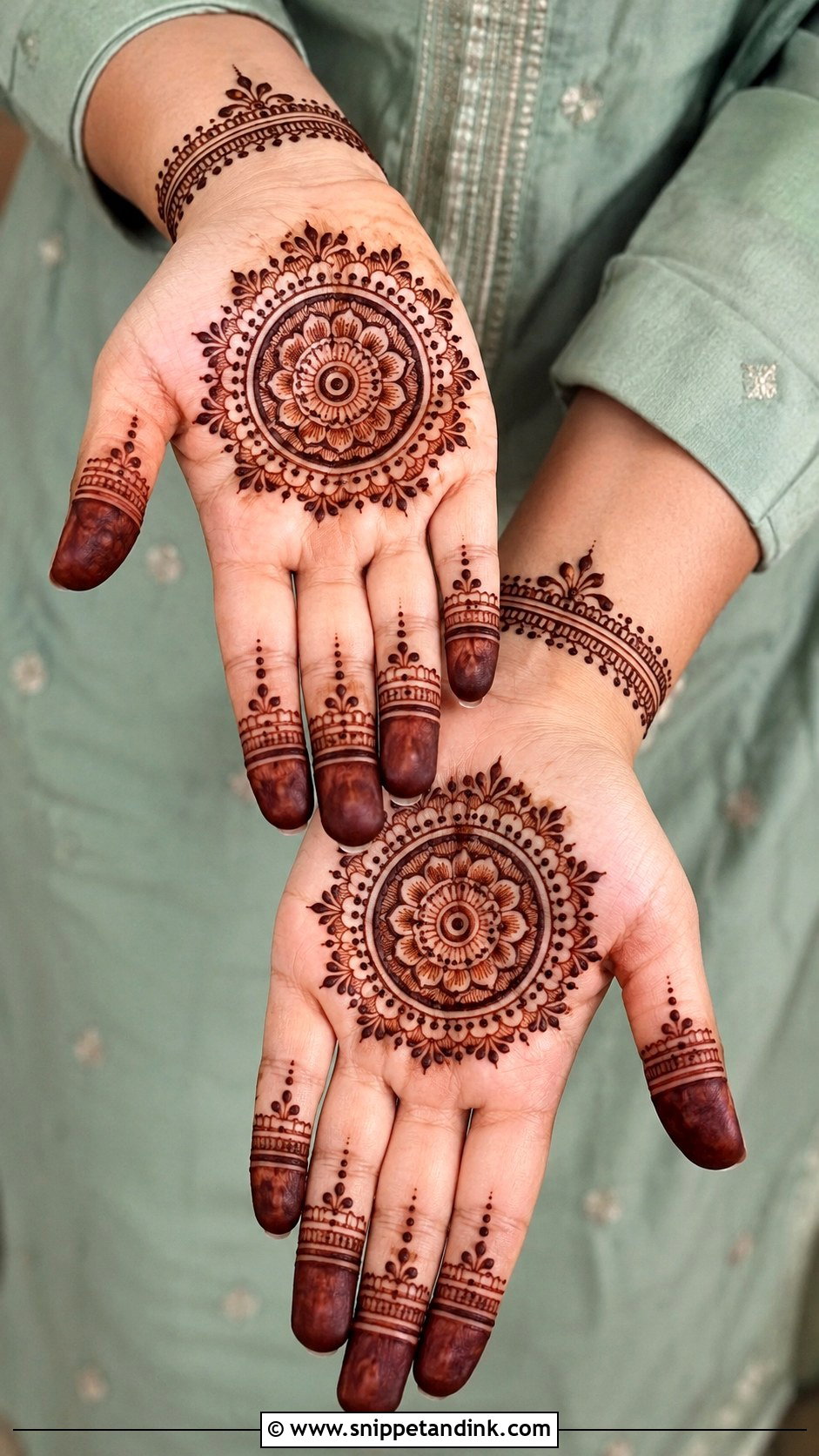
Dots do a surprising amount of work. Around a plain, filled or petalled circle, dots of different sizes form rings, trails and borders, with dotted chains on the fingers and a dotted bracelet at the wrist. They’re quick, they look delicate and they hide small spacing errors, which is why beginners do well with them. Graduate the dot sizes from large near the circle to small at the edges, and leave enough space between them that each one stains as a separate point.
20. Round Mehndi Design With Shaded Petals
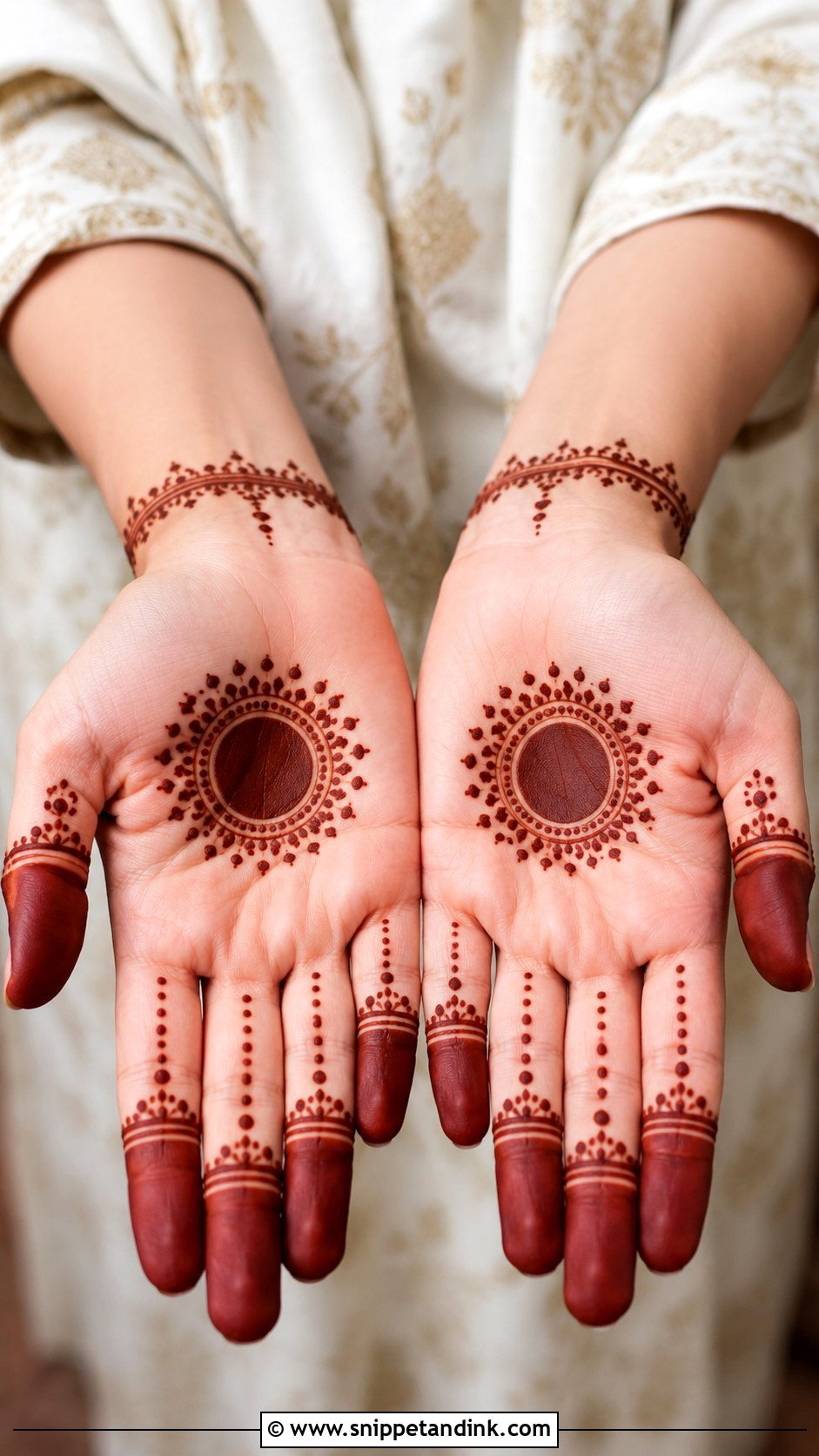
Shaded petals around a small central circle create a soft, dimensional flower, with fine outlines, dot borders and light finger work to complete it. Shading gives depth without adding motifs, so it suits both palms and backs. The technique is to push thinner paste inward from each petal’s outline with steady pressure; uneven pressure is what leaves shaded areas patchy. Keep the outer border clean and the result looks refined at Eid, Karwa Chauth and engagement events.
21. Round Mehndi Design For Eid
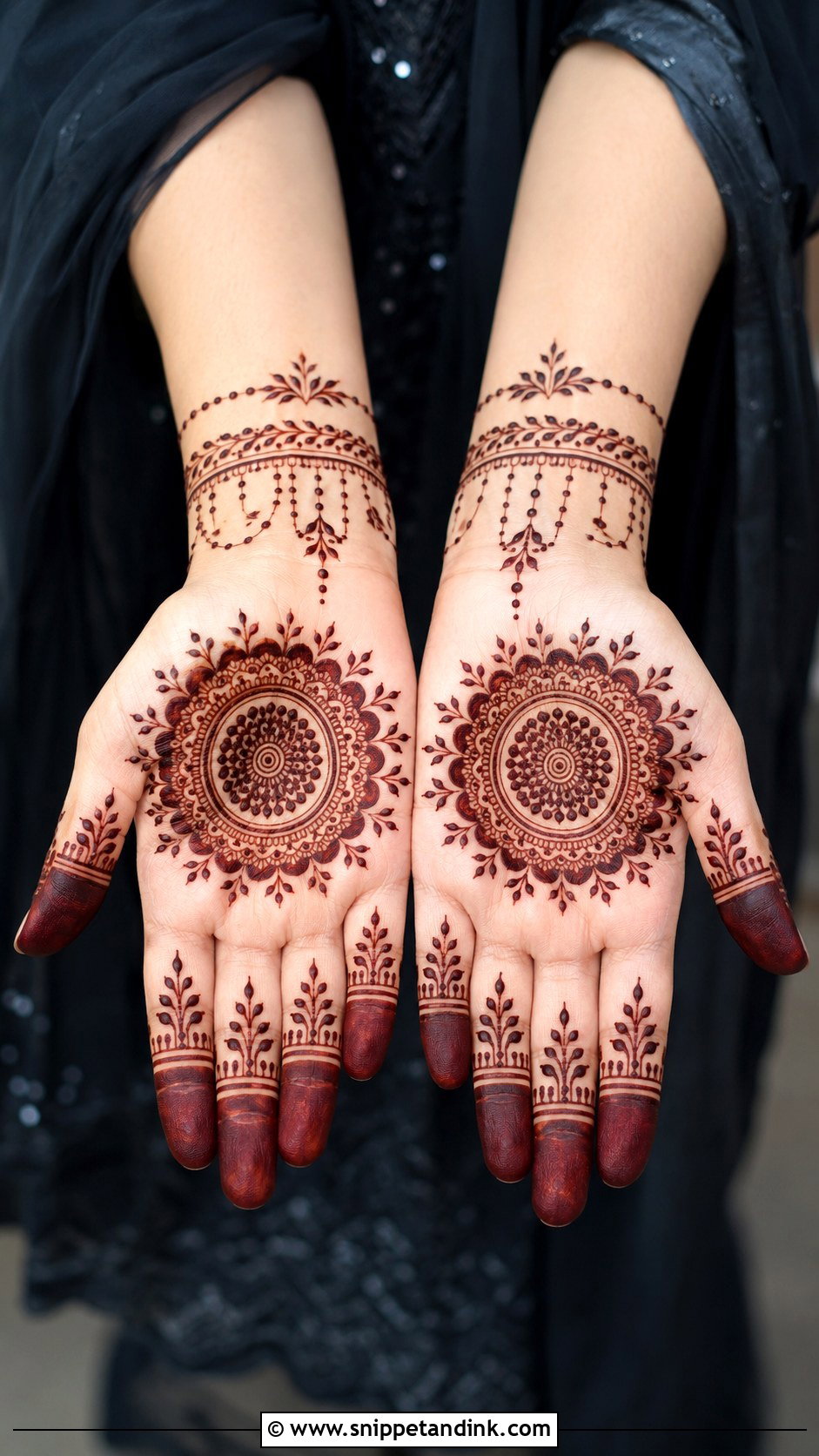
Eid henna needs to look festive, go on quickly and sit well with traditional outfits. A bold palm tikki with petal rings, finger bands, tiny leaves and dotted wrist chains does all of that. For a more modern feel, move the mandala to the back of the hand and add a diagonal floral vine. Round designs go on faster than full bridal patterns, which helps on chand raat when every artist has a queue. Keep the centre clean and symmetrical; that is what people notice first when you greet them.
22. Round Mehndi Design For Engagement
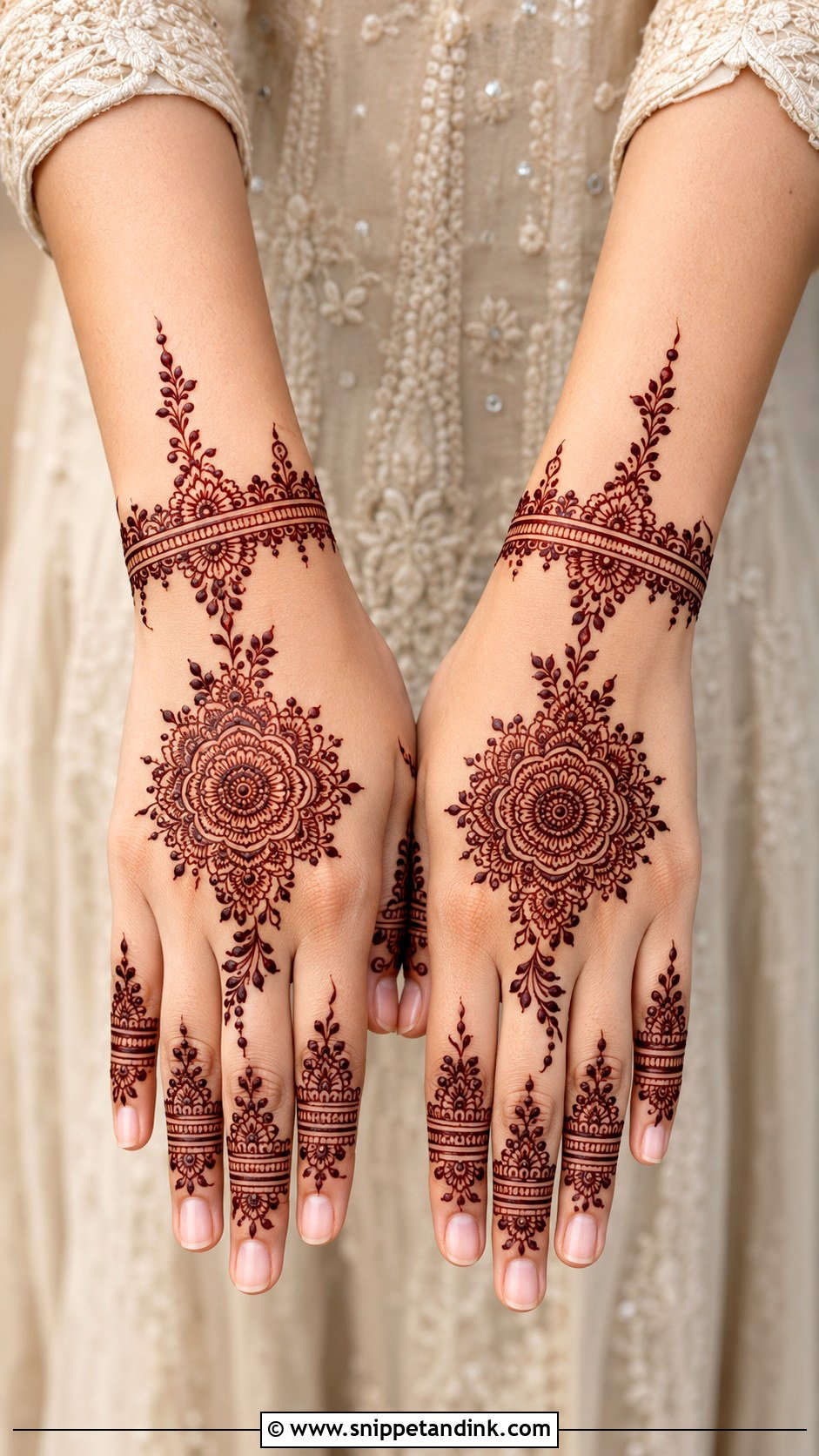
For an engagement, the back of the hand is where I’d put the circle, since rings and bracelets stay visible there. A round mandala in the centre, delicate finger bands, a floral trail and a bracelet-style wrist border, all in fine lines with clean spacing. It suits a bride who wants a light engagement design, and guests can wear a pared-down version. Tiny hearts are fine as a personal touch if they stay small. The round motif should always remain the main event.
23. Round Mehndi Design For Bridesmaids
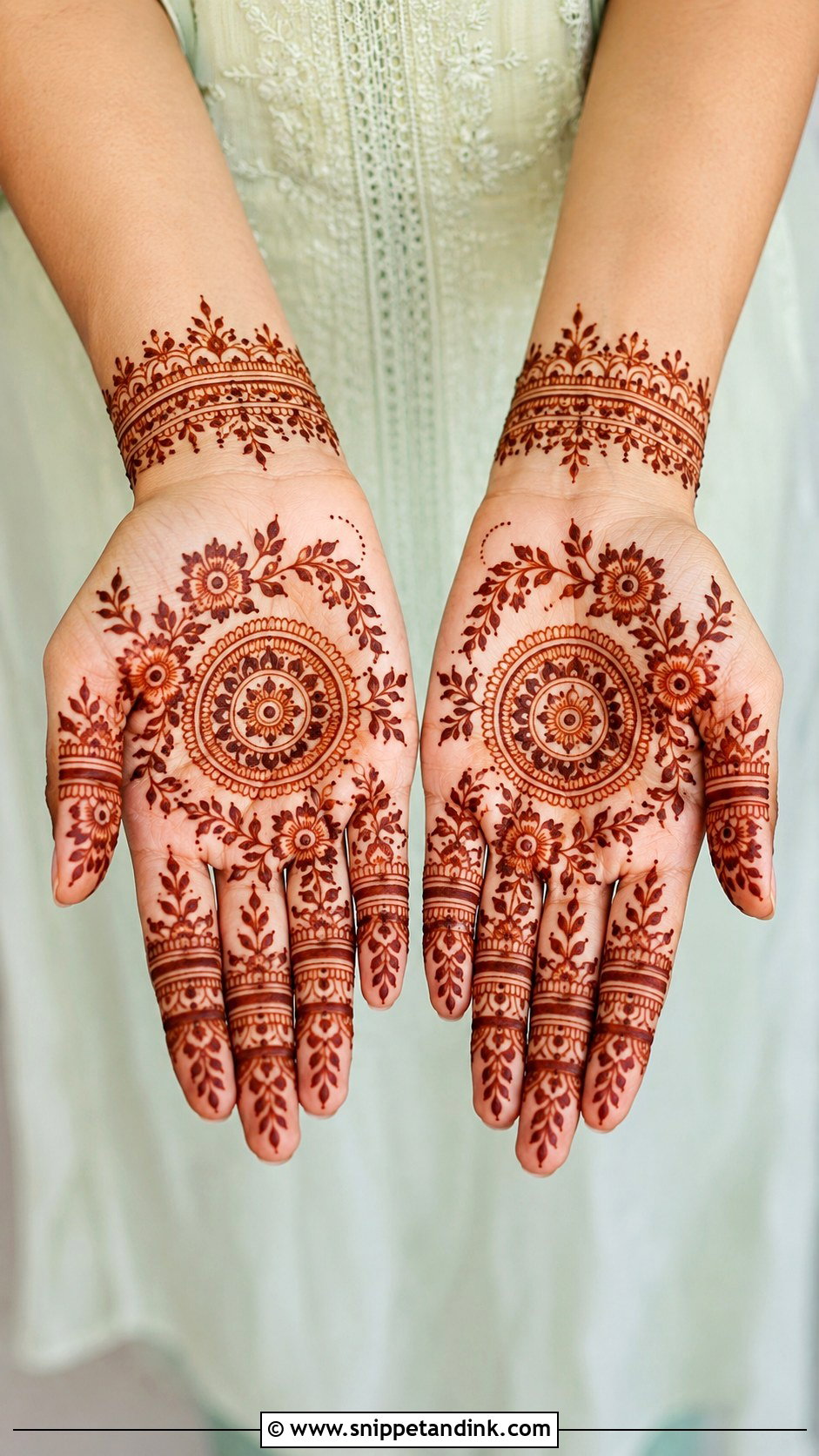
Bridesmaid designs should feel festive while staying clearly lighter than the bride’s. A medium mandala on the palm or back of the hand, surrounded by small flowers, leaf vines and dotted borders, with matching finger bands and a small wrist cuff, looks dressed for photos without hours in the chair. Give the whole group the same base mandala and vary only the finger patterns or wrist borders. In group shots the matching circles read as coordinated.
24. Round Mehndi Design For Kids
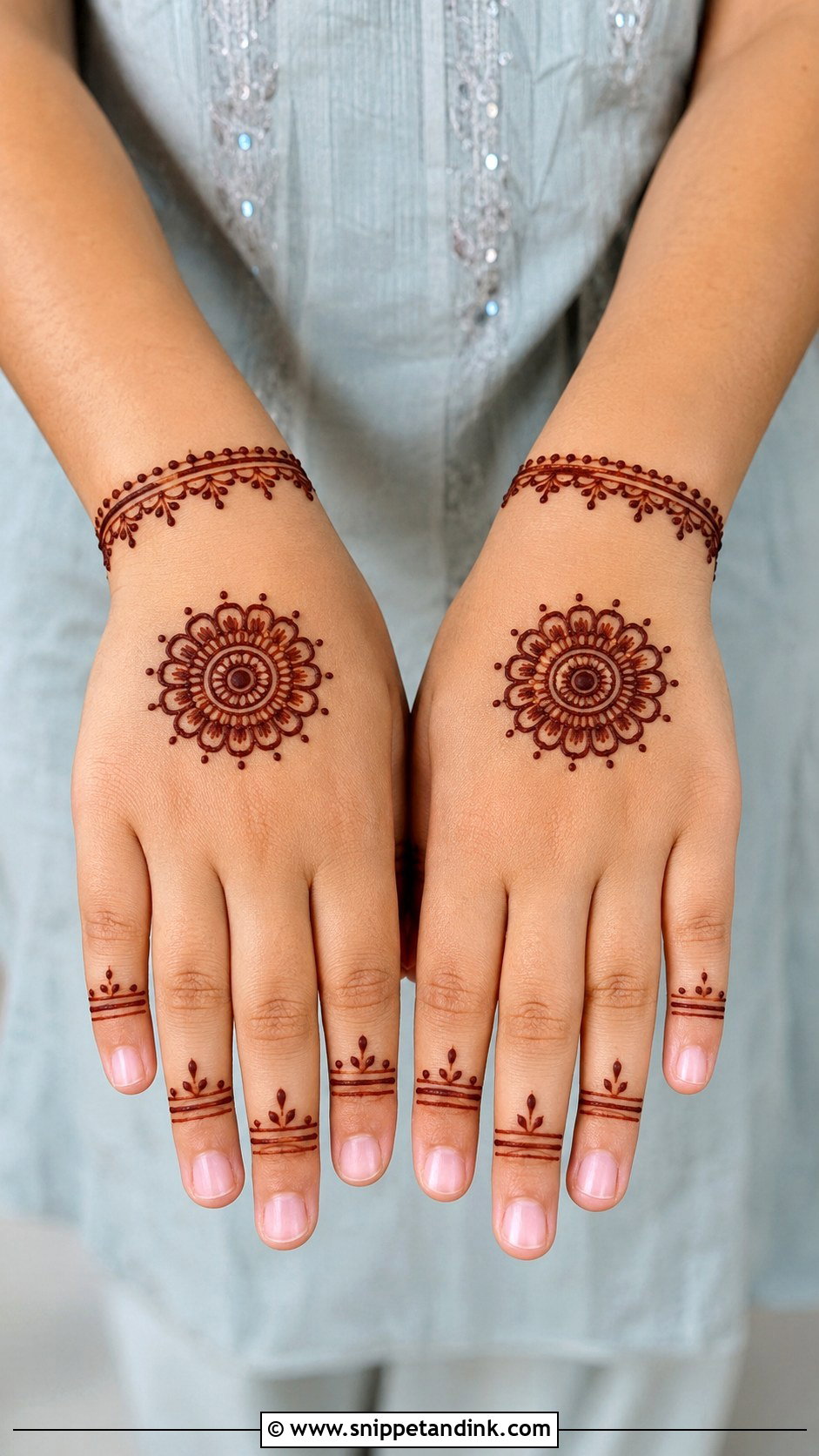
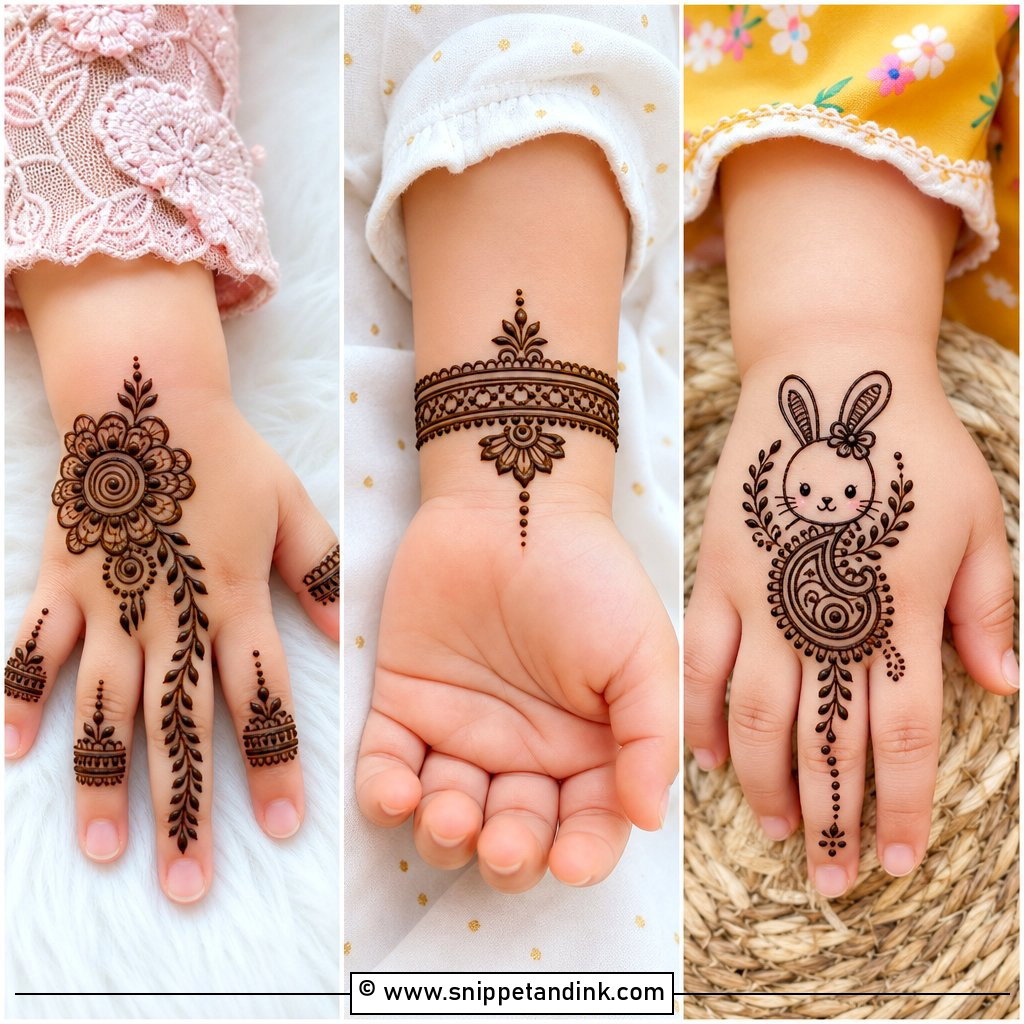
Kids need small, quick, open designs: a small circle or flower mandala on the palm or back of the hand, tiny dots, simple petals and short finger lines. A small wrist bracelet rounds it off without adding much time. Open patterns dry faster, which matters because children won’t sit still for long. Use only plain natural henna on a child’s skin, never black or instant henna, which can cause serious skin reactions.
25. Round Mehndi Design For Full Front Hand
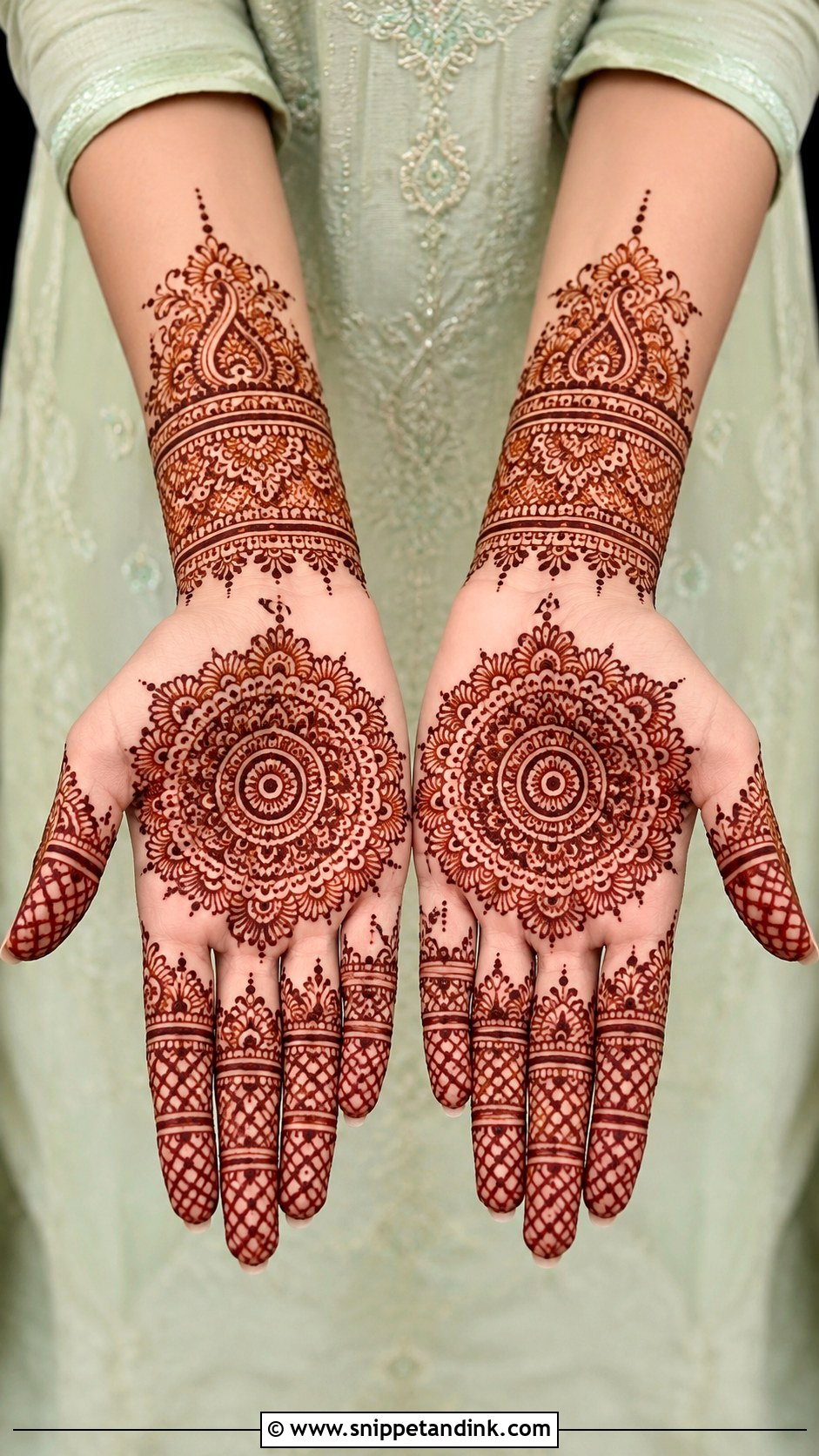
Full front-hand coverage starts with a large palm mandala and fills the surrounding skin with paisleys, florals, dots and fine curved lines, with mesh, bands and shaded tips on the fingers and a cuff at the wrist. The circle is the anchor and everything else should appear to grow from it. I leave tiny open spaces around the centre and between major motifs. Without them, full coverage tips into crowded very quickly.
26. Round Mehndi Design For Full Back Hand
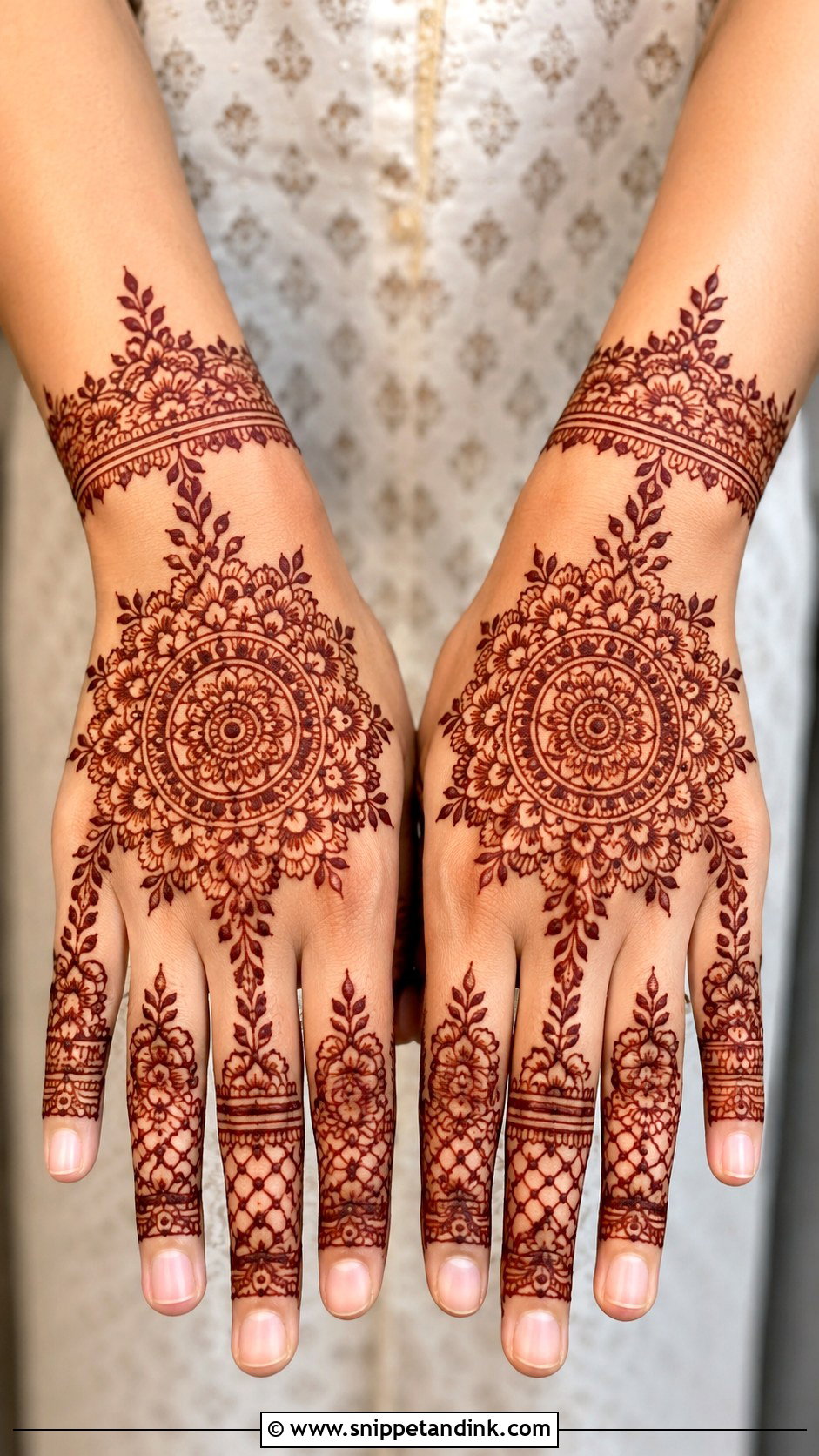
Full back-hand coverage flows from the fingers to the wrist around a central mandala, built up with flowers, leafy trails and fine mesh panels, ring-style finger bands, fingertip caps and a bracelet at the wrist. The back of the hand is always visible, so it’s a natural choice for engagement photos. I keep the mandala slightly bold and use lighter patterns over the knuckles, where the skin wrinkles and thick paste cracks when you make a fist.
27. Round Mehndi Design With Geometric Pattern
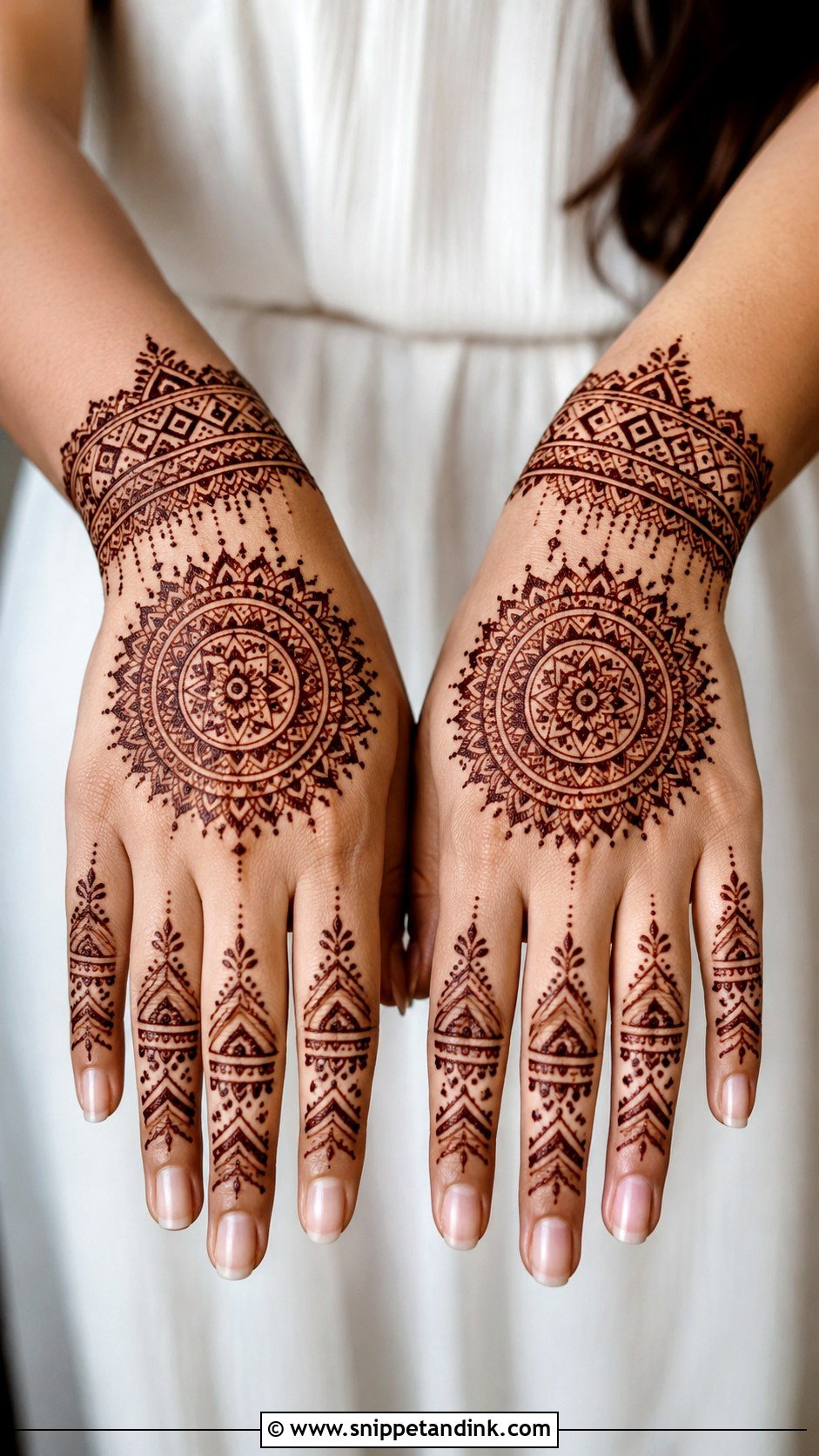
Here the mandala swaps petals for triangles, diamonds, chevrons and fine line rings, with matching geometric bands on the fingers and a neat wrist cuff. It’s for people who like structure and sharp detail, and it reads crisply on the back of the hand. I break up the hard lines with a few small dots or tiny leaves. Without that softening, geometric work can look more like a technical drawing than henna.
28. Moroccan Round Mehndi Design For Hands
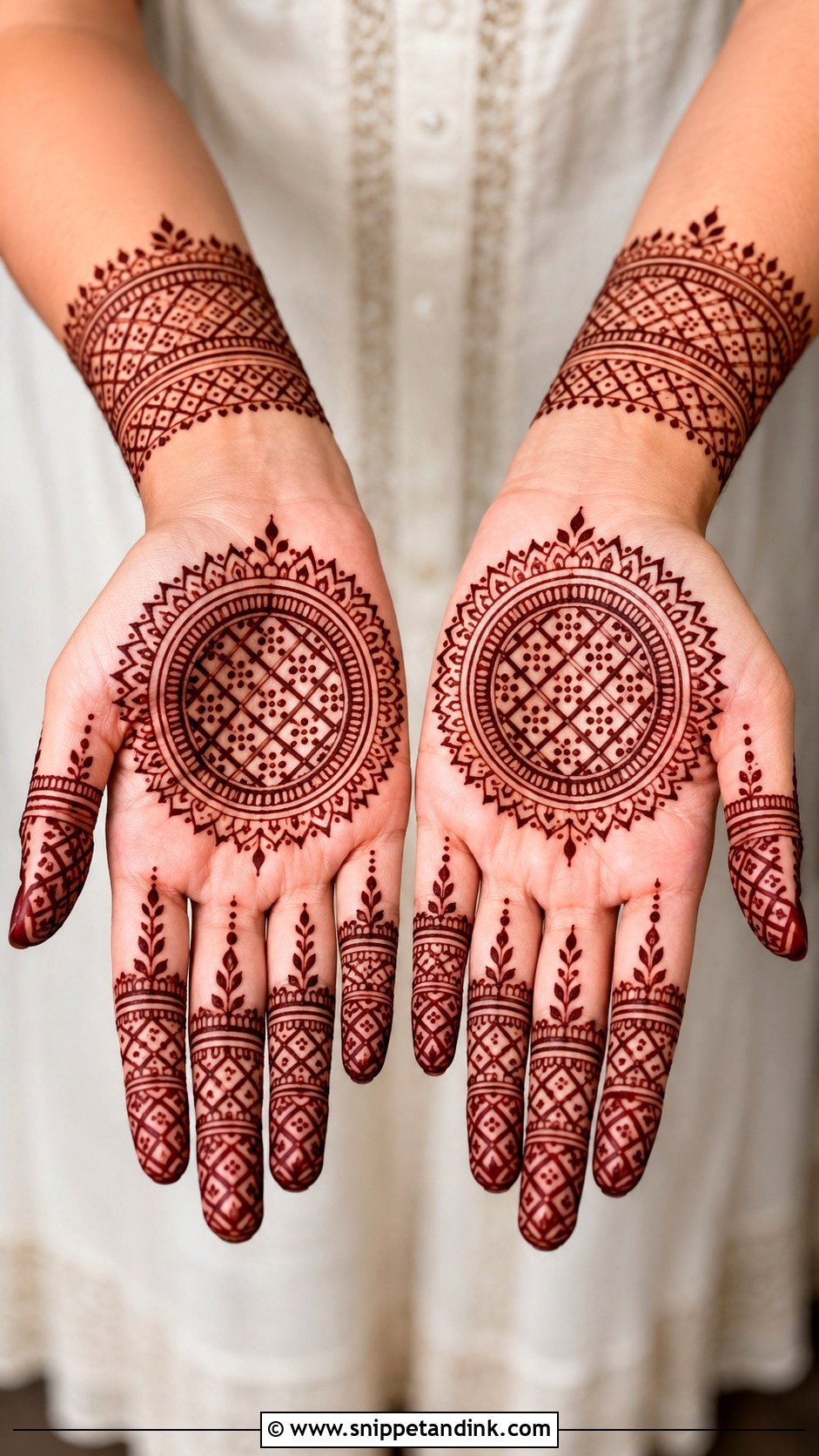
Moroccan-style round designs frame the circle with diamonds, zigzags, dots and grid lines instead of florals, with stacked bands and small geometric blocks on the fingers. It feels modern while still drawing on its own tradition. Spacing has to be exact, so I mark the main divisions around the circle with tiny dots before committing to any line. Keep the wrist border simple and let the frame and centre balance each other.
29. Gulf Round Mehndi Design For Back Hand
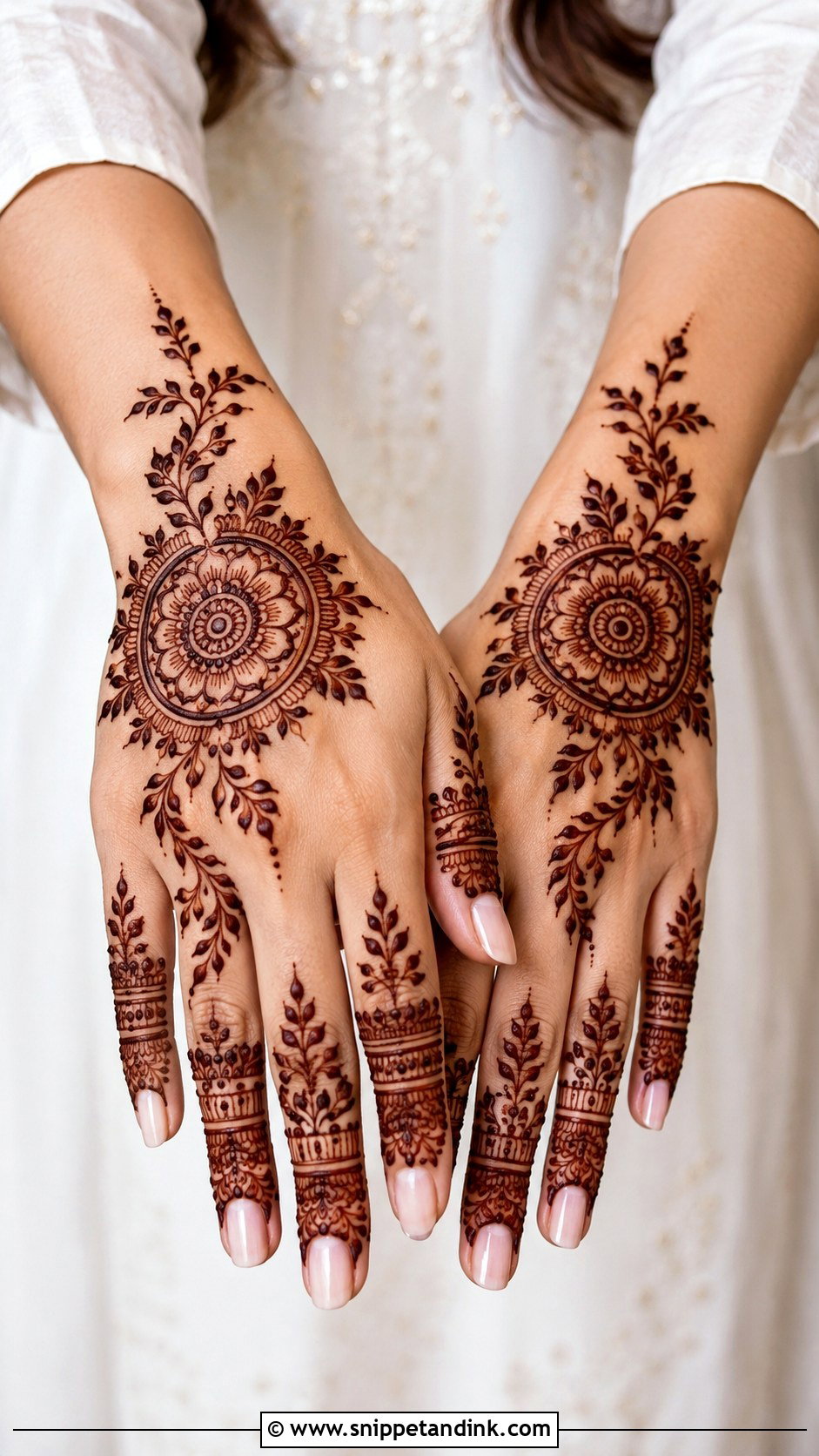
Gulf-style round work combines bold florals with airy spacing: a round floral mandala in the centre of the back of the hand, with large petals and leaf trails extending to the fingers and wrist. Thick outlines on the flowers and lighter detail inside them make it readable from a distance, and the fingers can stay simple with leafy curves or spaced bands. It looks polished at Eid and evening functions without the density of bridal work.
30. Pakistani Round Mehndi Design For Palm
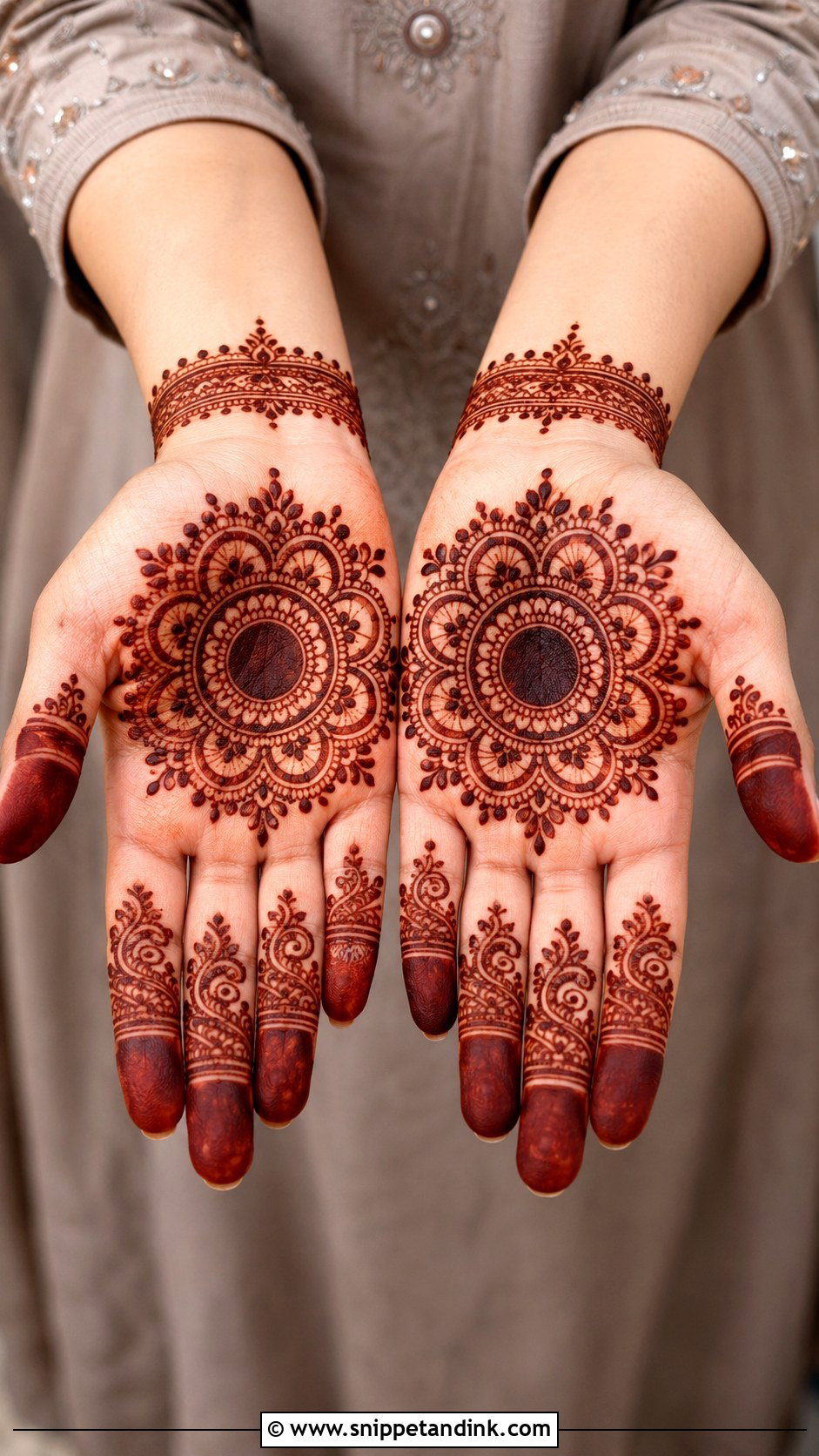
In Pakistani designs the gol tikki is the star of the palm. The centre is often bold and filled, surrounded by petals, dots and leafy borders, with paisley accents around the circle, fine bands and shaded tips on the fingers and a slim wrist cuff. It can be simple with fewer layers or heavy with more. A filled gol tikki is where paste quality shows most, so I make sure the centre is laid as one smooth, even layer rather than built up in patches.
31. Indian Round Mehndi Design For Wedding
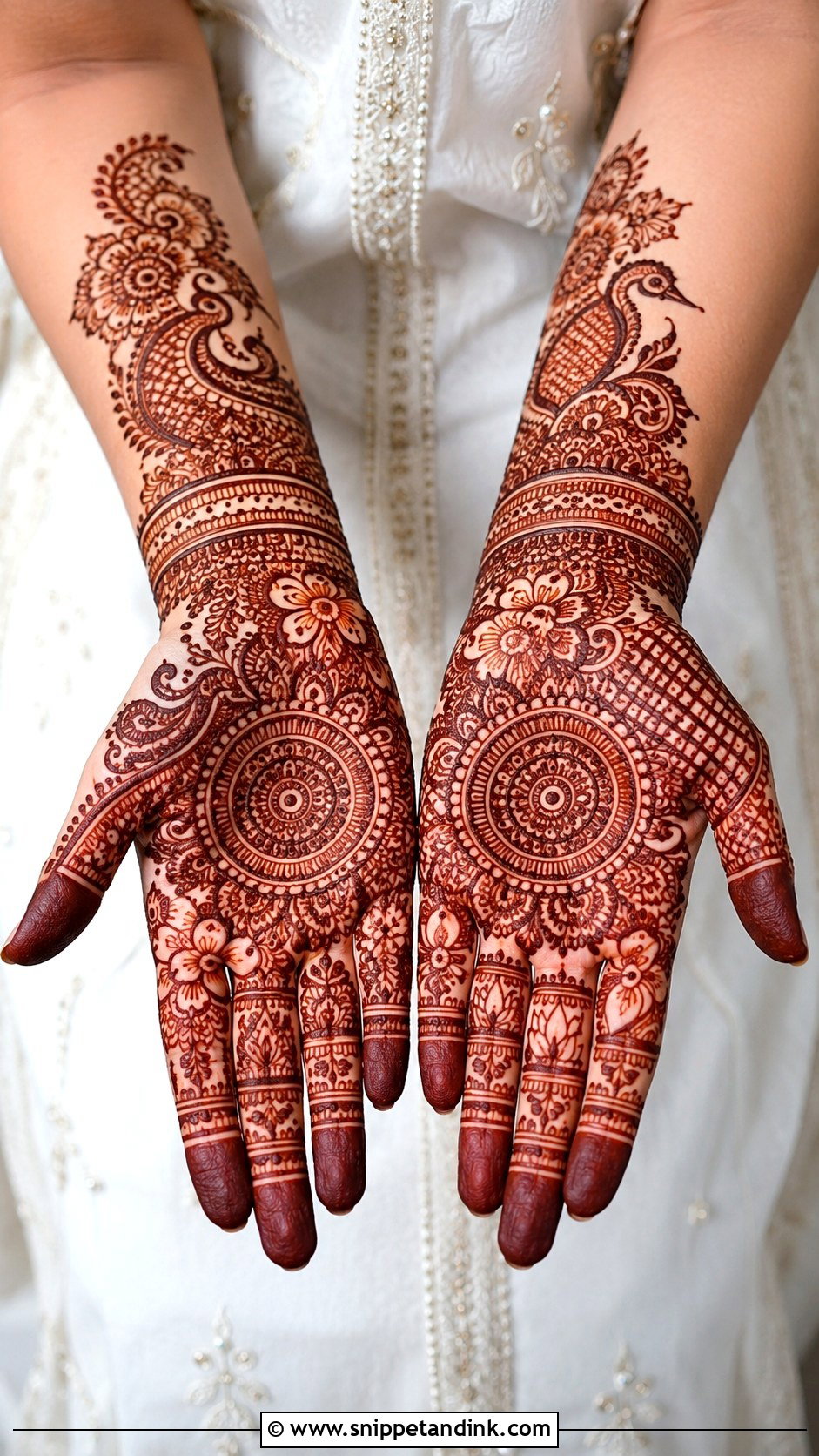
Indian wedding designs build around a large palm mandala, adding paisleys, flowers, peacock touches and fine net patterns, with fully covered fingers, shaded tips and bracelet bands at the wrist. It adapts from medium to heavy coverage depending on the function, and it suits brides, bridesmaids and close family. Keep the round motif bold and centred. Indian wedding mehndi tends to look strongest when the palm has one clear focal point and everything else supports it.
32. Round Mehndi Design With Negative Space
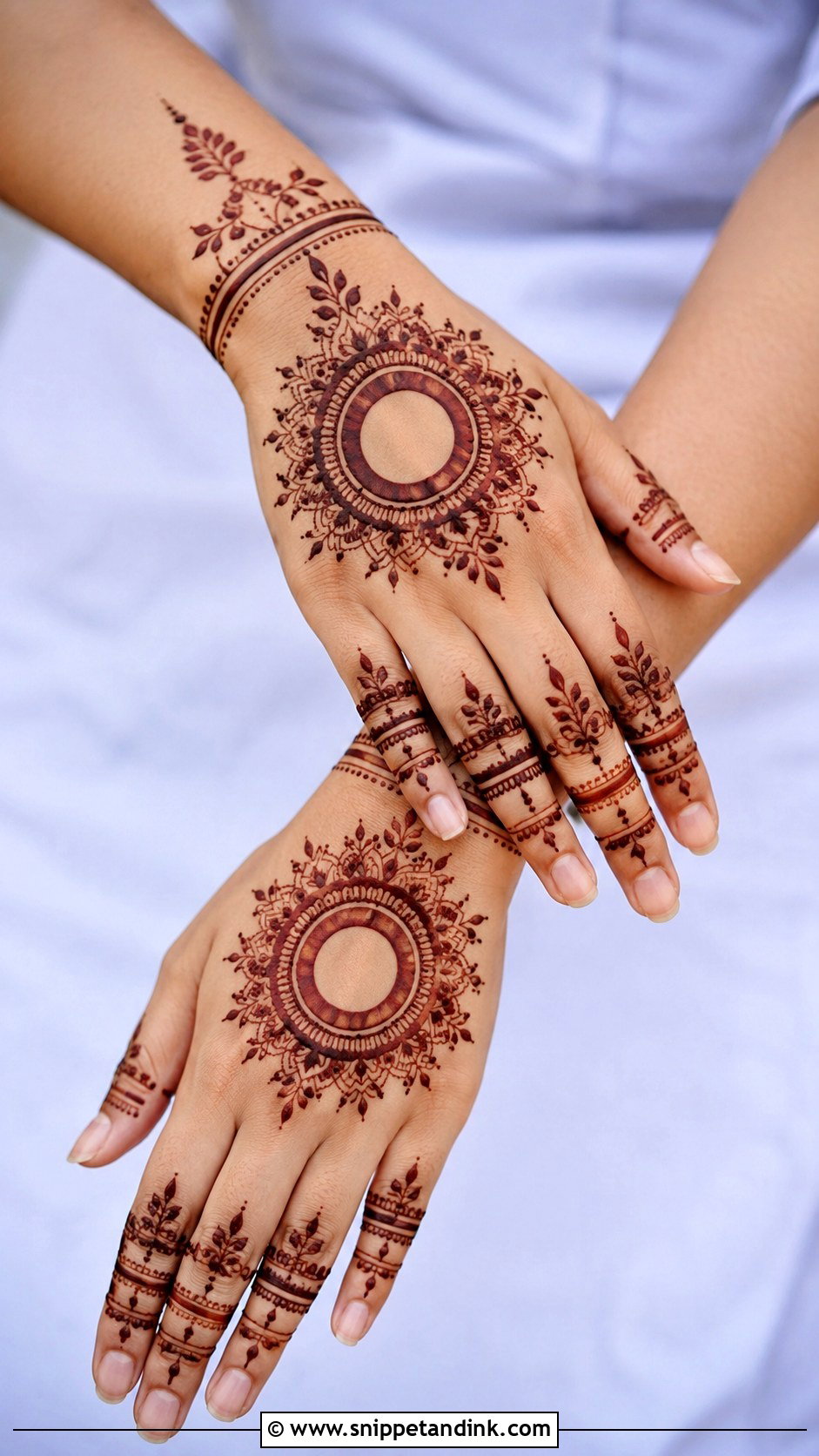
Negative space treats bare skin as part of the pattern. Open gaps sit around the central circle, between petal rings and along the finger patterns, so the round motif stands out more. Thin dots, fine lines and small leaves keep it soft. Planned gaps also help the stain look sharper, since each detail has room to develop without bleeding into its neighbour. Work out where the gaps go before you start, not as an afterthought.
33. Round Mehndi Design With Lace Pattern
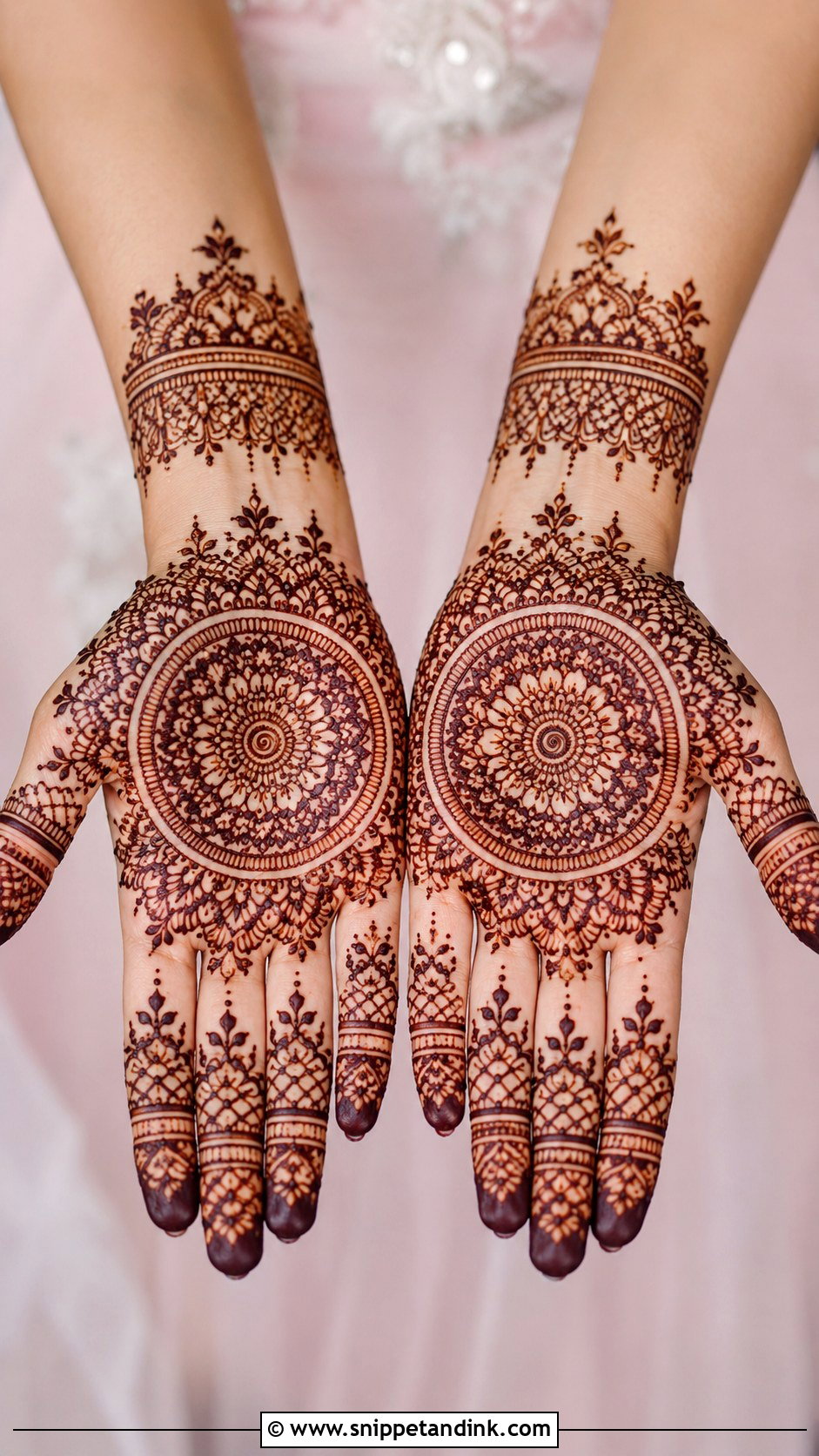
Lace work uses scalloped edges, fine mesh, tiny dots and curved borders around a circular mandala, with lace-inspired bands and small floral tips on the fingers and a scalloped wrist cuff. It looks dressy, which suits engagements, receptions and festive evenings. Lace only works in thin lines; the moment solid fill creeps in, it stops looking like lace. I keep my finest cone just for this kind of work.
34. Double Round Mehndi Design For Back Hand
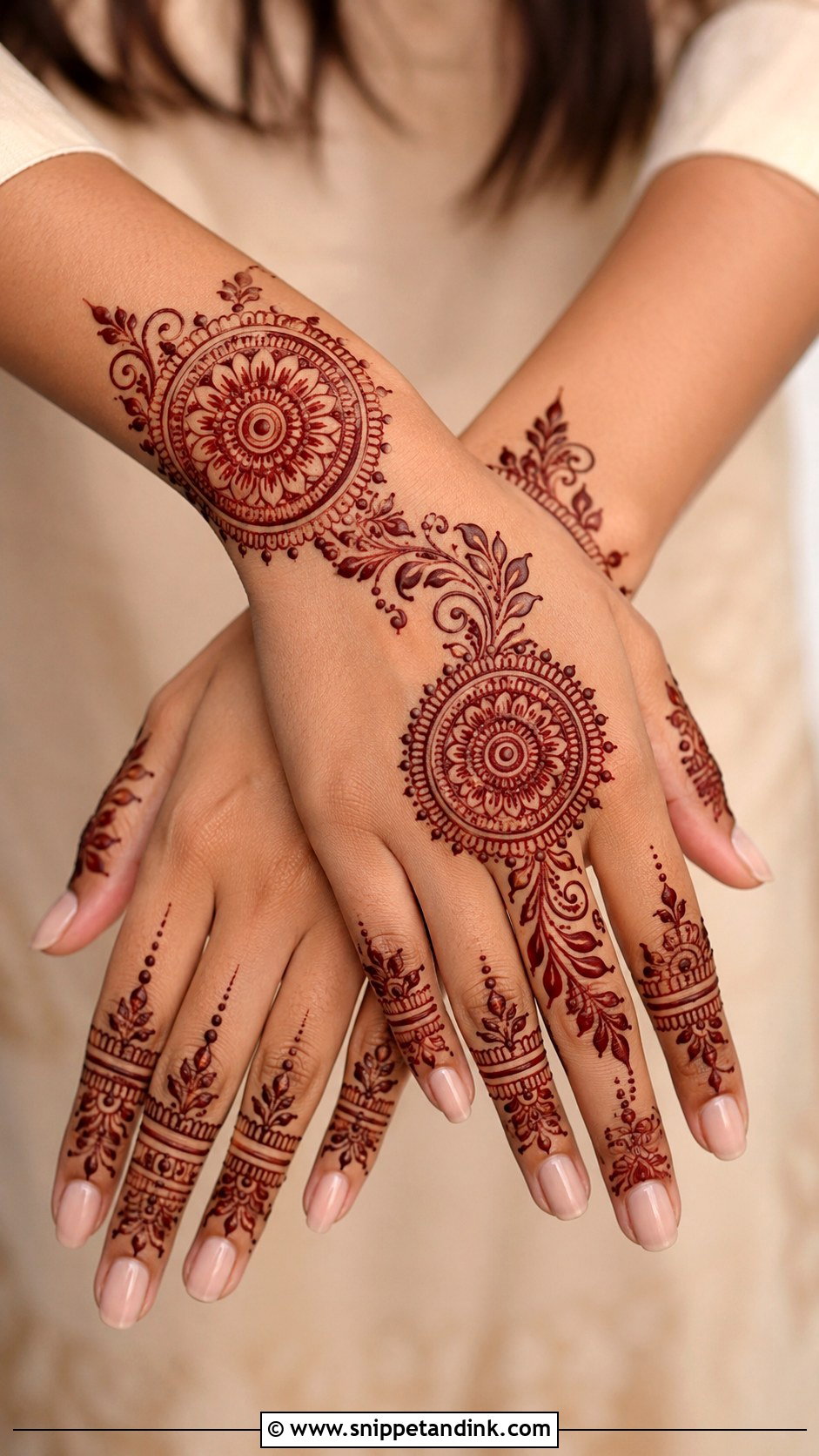
Two circles instead of one: a larger mandala near the centre of the back of the hand and a smaller one near the wrist or fingers, joined by dots, leaves or a slim curved vine. It creates movement while staying balanced, and it’s a nice change from the usual single tikki. Keep the fingers simple so they don’t compete. I tie the two circles together with the same border pattern and repeated petals, roughly two-thirds the size for the smaller one, so they look related.
35. Round Mehndi Design With Forearm Extension
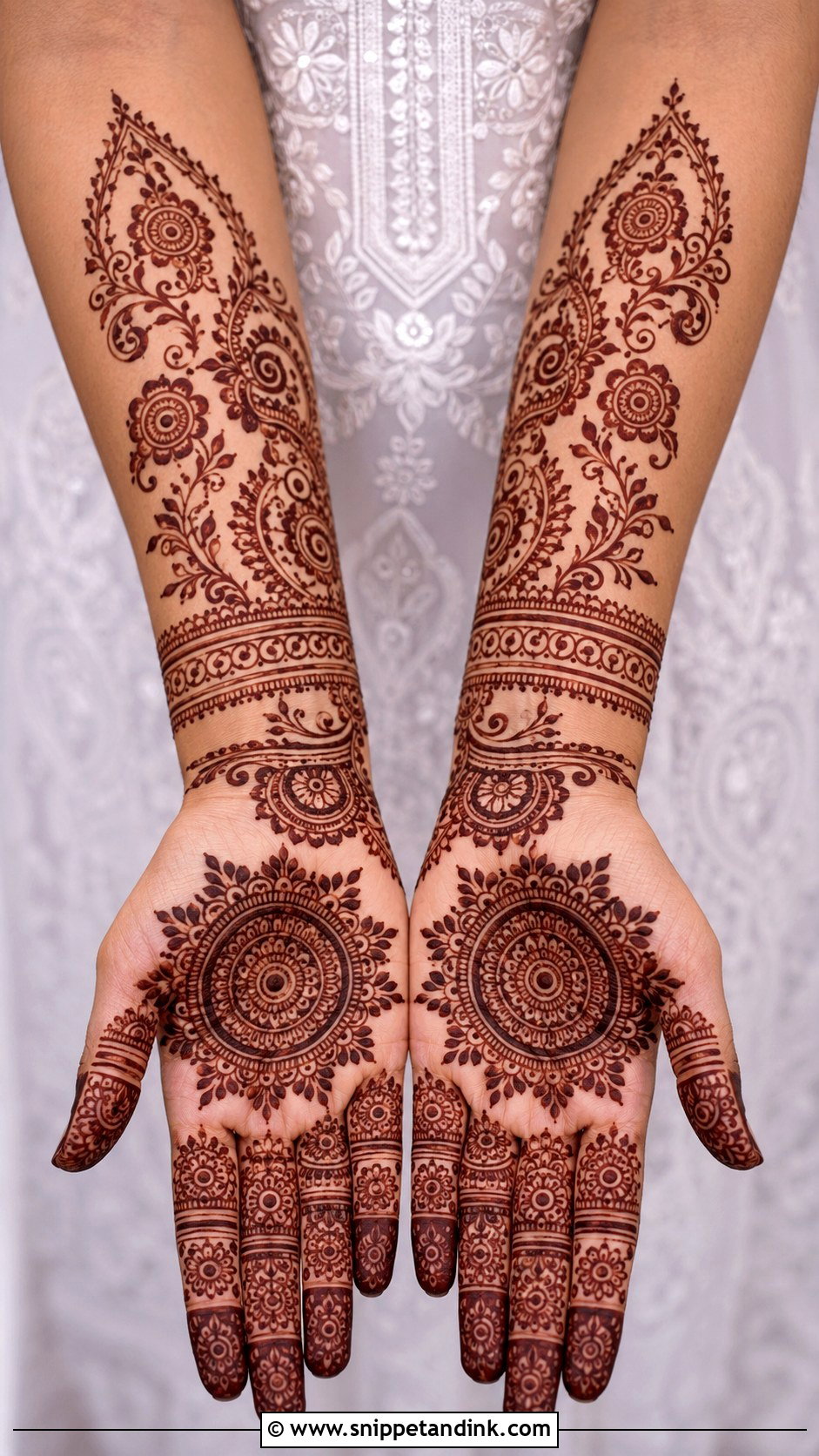
A round mehndi design with forearm extension suits a more formal occasion. Start with a detailed mandala on the palm or back of the hand and continue past the wrist with bracelet bands, floral vines and smaller circular motifs, plus paisleys, leaves or jaali for richness. The extension should speak the same pattern language as the hand. I make the forearm details gradually lighter as they climb, partly for grace and partly because the forearm stains lighter than the hand anyway.
Why Filled Tikkis Flake, and How to Keep the Centre Even
A solid centre looks simple, but it is the part of a round design most likely to come out patchy. Thick paste dries on top first, shrinks and cracks, and pieces of the centre drop away before they’ve had time to stain. Thin paste spread too lightly gives a pale, streaky disc. What you want is one even layer, laid in a single session, with no gaps showing skin underneath.
During application
I outline the circle first, let the outline set for a minute, then fill from the outline inward in small overlapping strokes. Rubbing or smoothing the paste with a finger thins it unevenly, so I avoid it. If the client needs to move, the filled palm is the last thing I draw, so it gets the longest undisturbed drying time.
Once it’s dry
A light dab of lemon and sugar over the centre helps the cracked layer stay stuck to the skin. If flakes do fall, leave the bare patch alone and don’t try to patch it with fresh paste hours later; the two areas would stain to different depths and the seam would show. Keep the hand warm and leave the paste on as long as you can, then scrape it off rather than washing. The centre usually ends up the darkest part of the whole design once it has had a day or two to deepen.
A Circle Is Only as Good as the Space Around It
A circle adapts to almost anything: simple, bridal, modern, floral, geometric or fully traditional. One round motif can become a full palm design, a back-hand mandala, a bracelet layout or a forearm pattern for the wedding. Think about the occasion, the outfit, the shape of your hand and how long you can sit. Beginners can stick to dots and petals; experienced artists can add paisleys, jaali, peacocks and shading. Minimal or detailed, the design that looks right is the one where the circle is clean and the spacing around it is generous.
You'll Like These Ideas:



Leave a Reply