
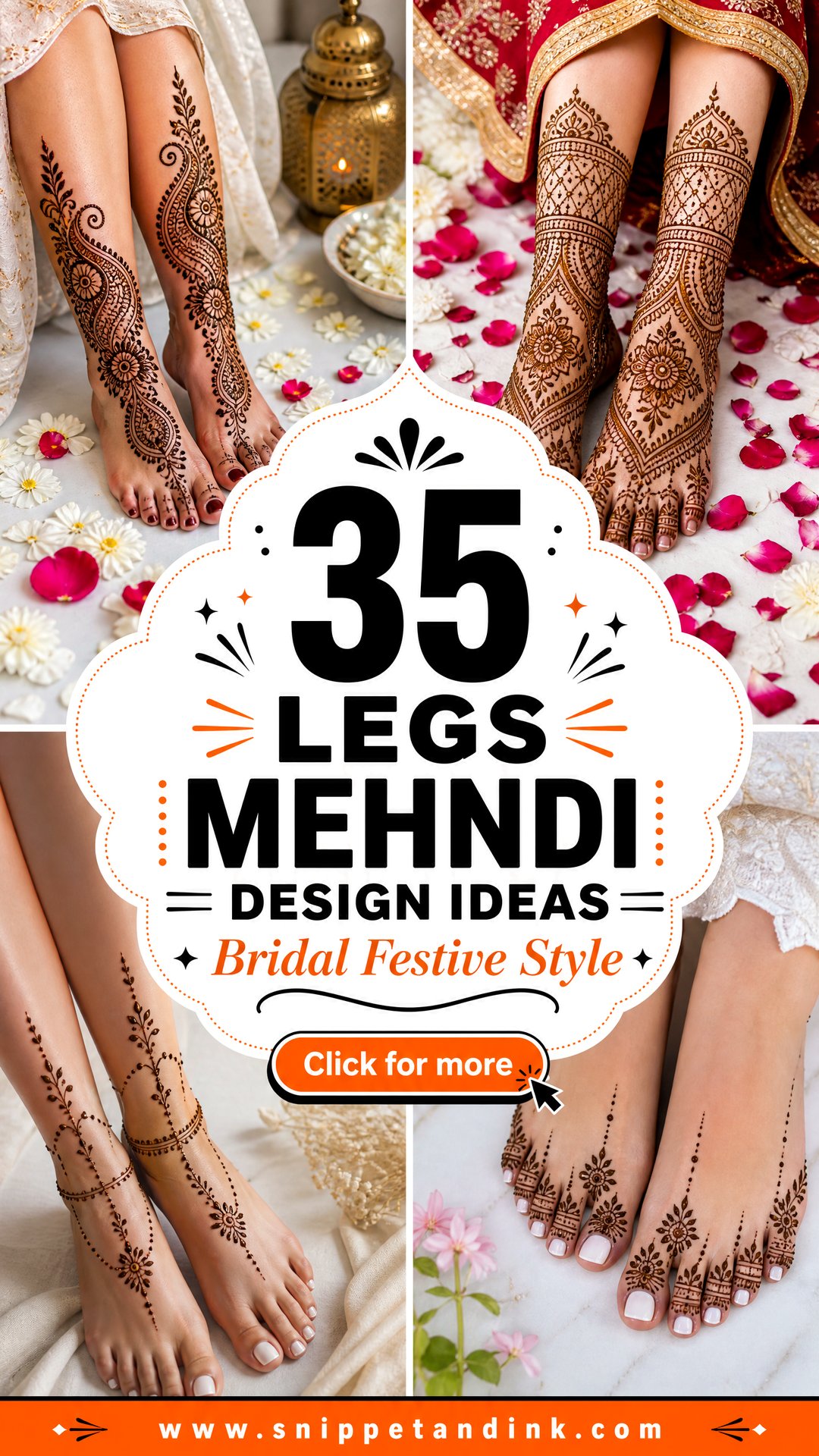
Feet are the hardest canvas I work on. They flex with every step, they sweat, and they spend the next week inside shoes, so a design that looks perfect in the chair can blur at the ankle crease by day three. The looks here are chosen with that in mind, from bridal full-leg mehndi to Arabic trails, anklet henna, mandala feet, jaali, paisley borders and minimal side-foot work, for weddings, Eid, Diwali, Karwa Chauth, engagements and ordinary festive dressing. Under each one I’ve noted how it wears and what I’d adjust in practice.
Plan the Design Around the Shoes You’ll Actually Wear
Before I sketch anything on a foot, I ask to see the shoes. It sounds fussy, but footwear decides which parts of the design are visible and which parts get rubbed away over the next few days.
- Juttis and closed khussas cover the toes and most of the foot. Only the ankle and the very top of the instep show, so that’s where I put the best work.
- Strappy sandals show nearly everything, but each strap rubs. I keep fine filler out of the strap lines and put bolder shapes there instead.
- Heels push your weight onto the ball of the foot and the toes. Toe designs on heels tend to fade faster at the tips.
- Barefoot rituals show the soles, which stain darkest of all, so a simple sole pattern is worth adding even to a light design.
Do the same with your hem. Stand in the outfit, then sit in it, and see where the fabric lands. A calf panel under a floor-length lehenga is time you’ll never get credit for, while a gharara that lifts as you walk shows far more ankle than you’d expect.
1. Bridal Legs Mehndi Design
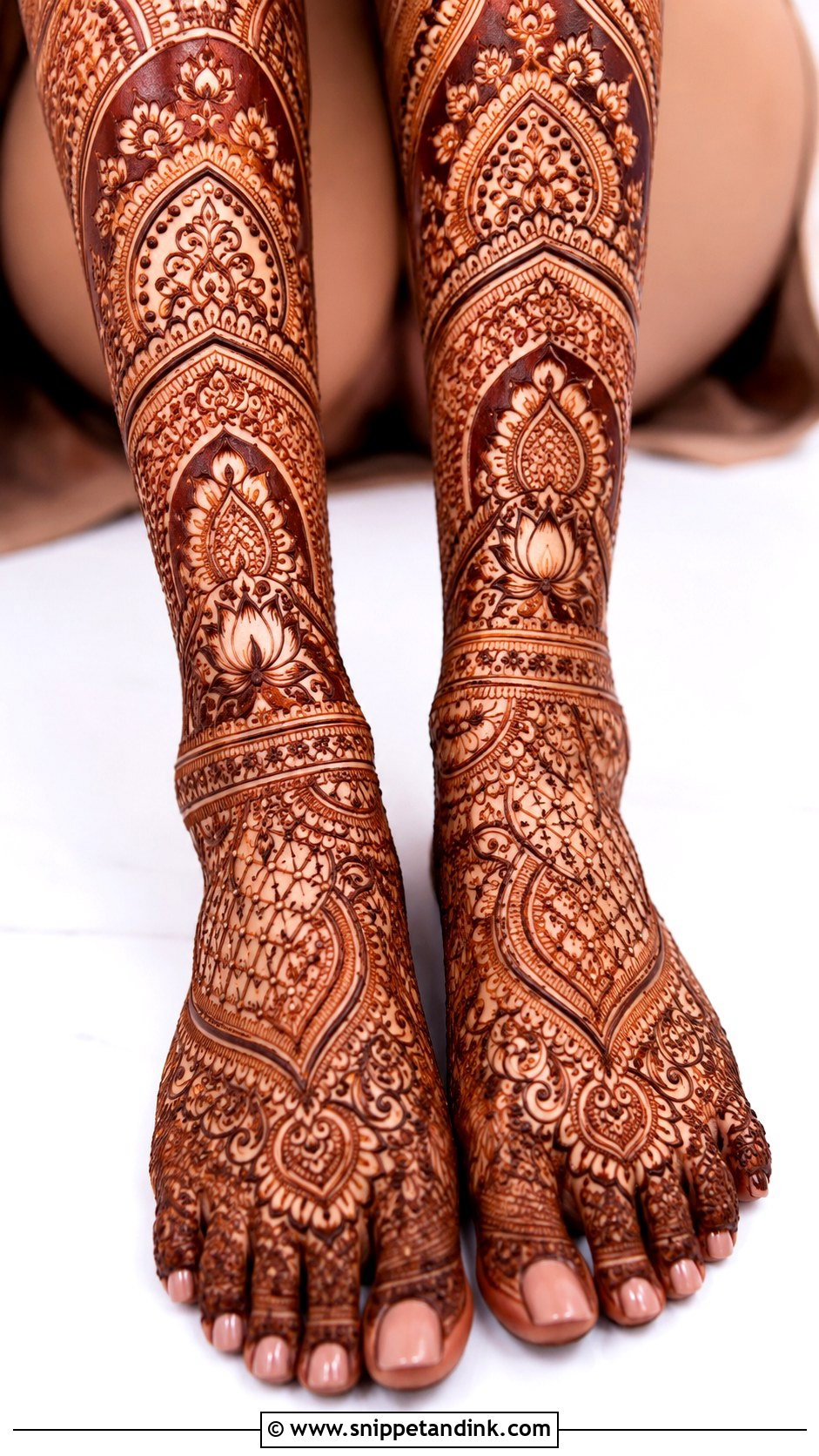
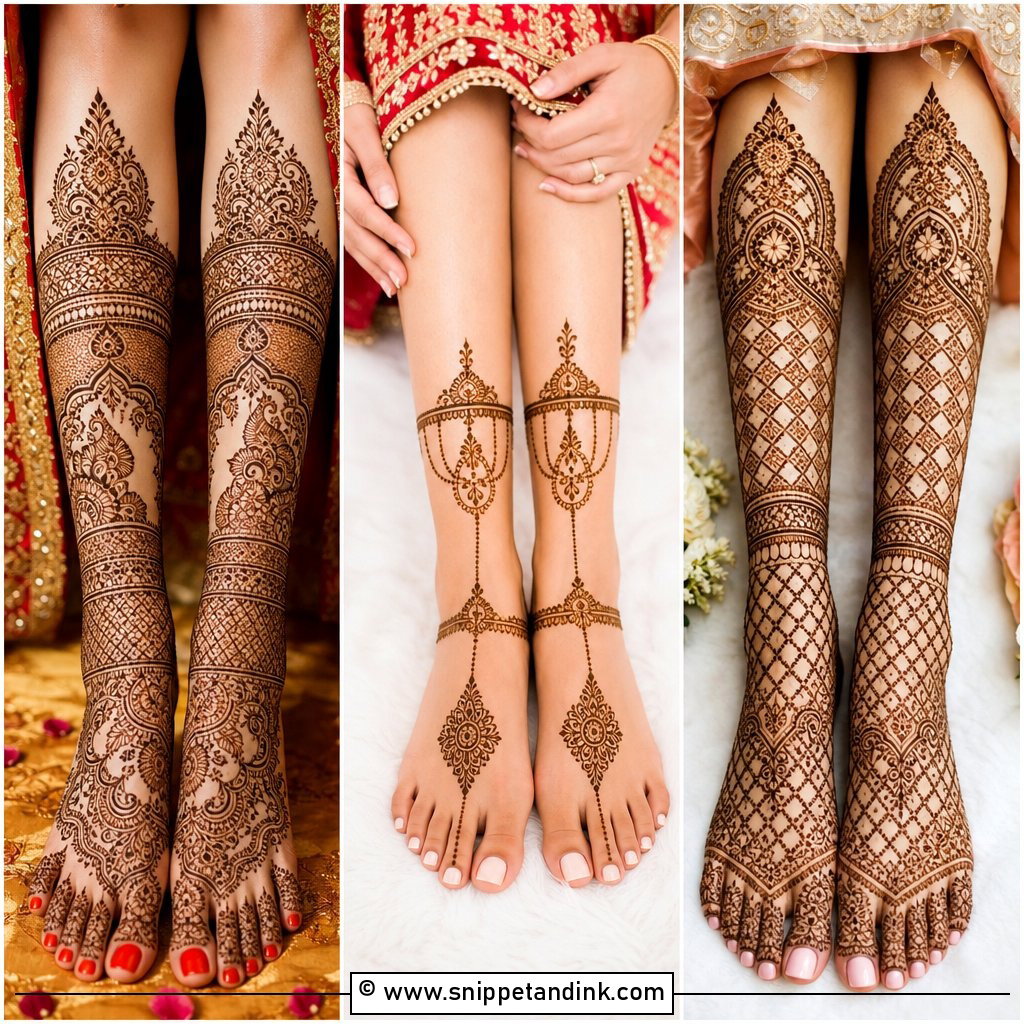
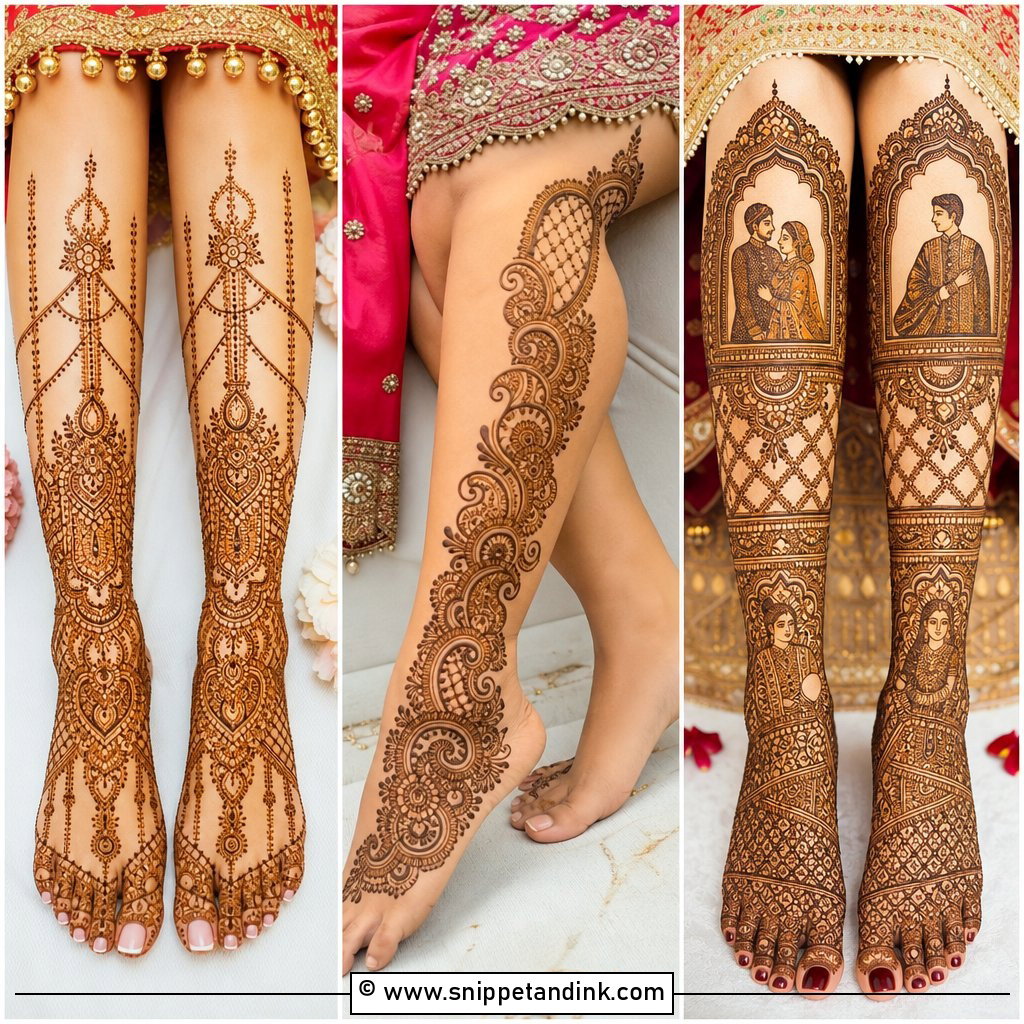
Bridal leg mehndi starts with filled toes, moves into floral panels across the foot and climbs to the calves with paisleys, jaali, mandalas and leafy borders. Small bride and groom figures or initials usually go near the ankle. My first question is always how high the lehenga or saree will lift when you sit and walk, because there’s no point spending an hour on a calf panel nobody will see. With bridal anklets on top, I leave open bands where the payal sits so the chains don’t cover the finest work. The stain should settle to a deep maroon by the second day.
2. Simple Legs Mehndi Design
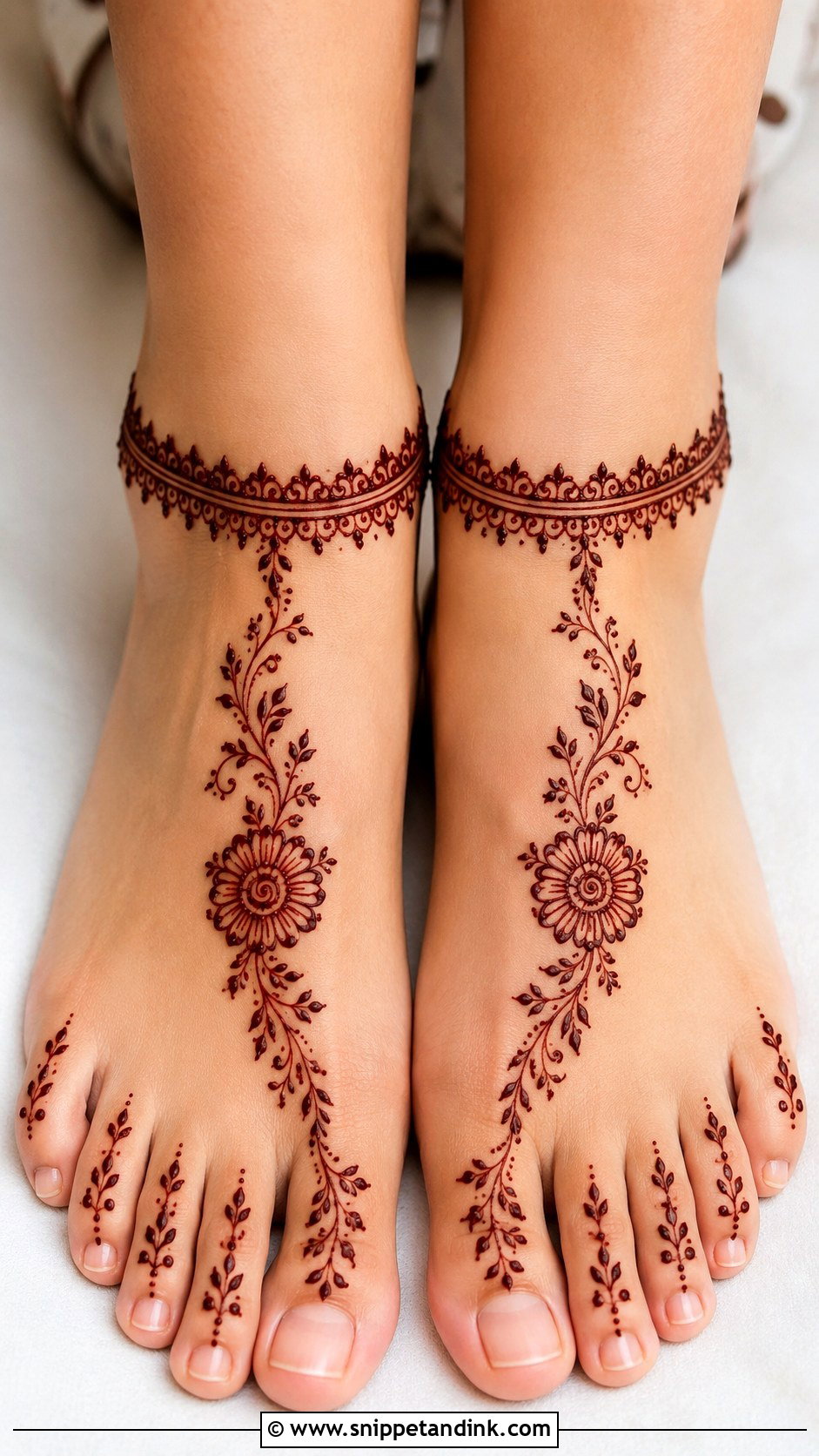
Decorated toes, one small motif in the middle of the foot and a light vine toward the ankle. That’s the whole design, and it’s enough. The open skin is doing half the work, so I’d rather you leave it alone than add filler. A clean anklet band finishes it. It’s the design I’d recommend for anyone who has never worn henna on the feet, because it shows how your skin takes the stain without committing to an afternoon in a chair.
3. Arabic Legs Mehndi Design
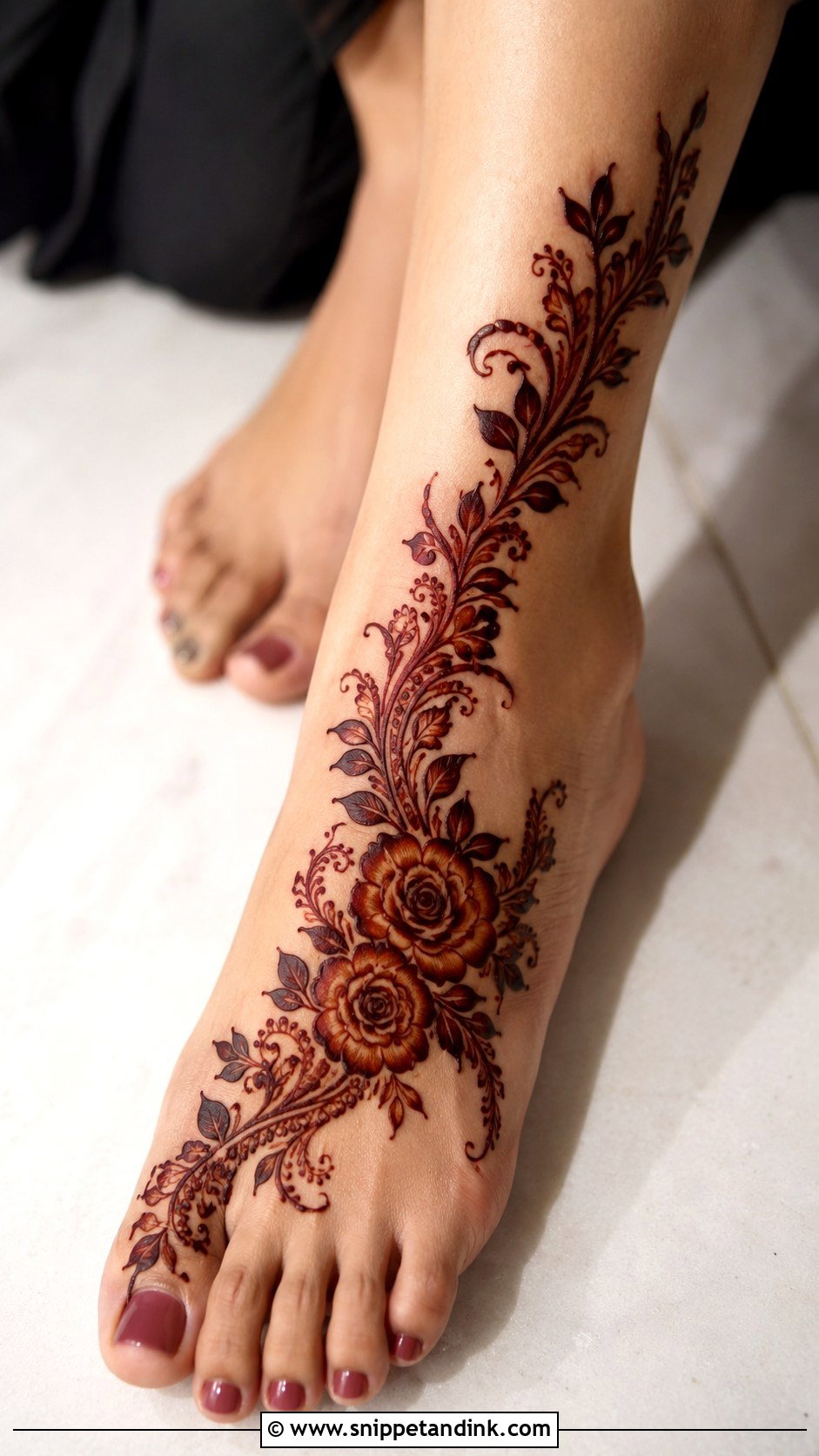
Arabic designs run diagonally from the toes to the ankle or lower leg, built from large roses, leaves, paisleys and curved lines with plenty of breathing room. The bold outline is what carries it after staining. I draw that outline in one confident pass so the line stays an even width, since stop-and-start strokes leave small blobs that stain darker than the rest. It suits Eid, parties and bridesmaids. Toes can stay plain or get a few leafy accents.
4. Full Leg Mehndi Design
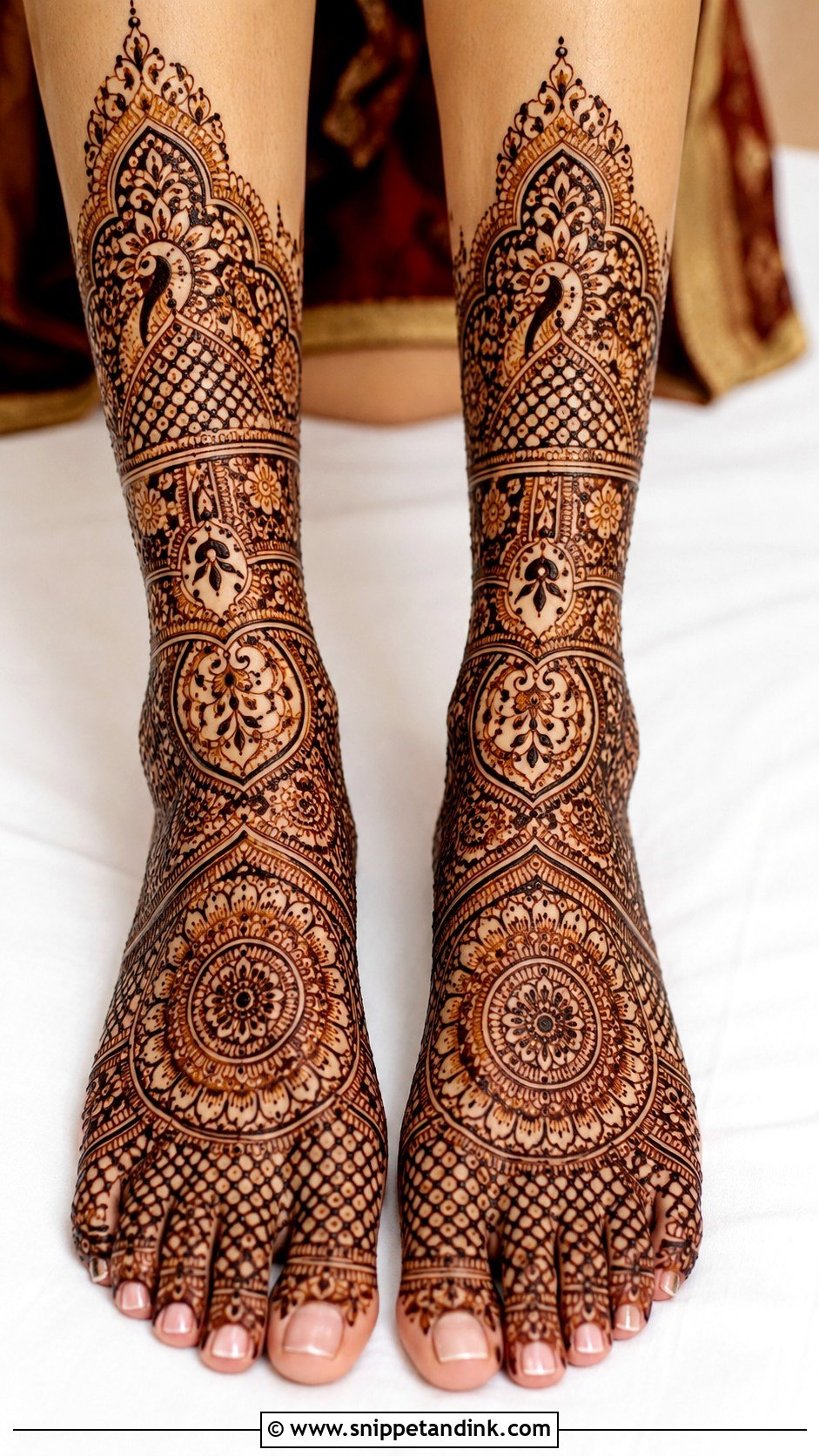
Full leg coverage runs from the toes up past the calf, and for some brides higher. I always divide it into zones: mandalas and florals on the feet, jewelry-style bands at the ankle, then paisleys, peacocks, lotus motifs or net patterns on the calf. Without those zones, a full leg reads as one dark sleeve from a distance. It’s a long sitting, and it only makes sense if the outfit actually shows the lower legs. Plan for someone to help you move afterward, because you won’t be able to walk freely until it’s dry.
5. Front Leg Mehndi Design
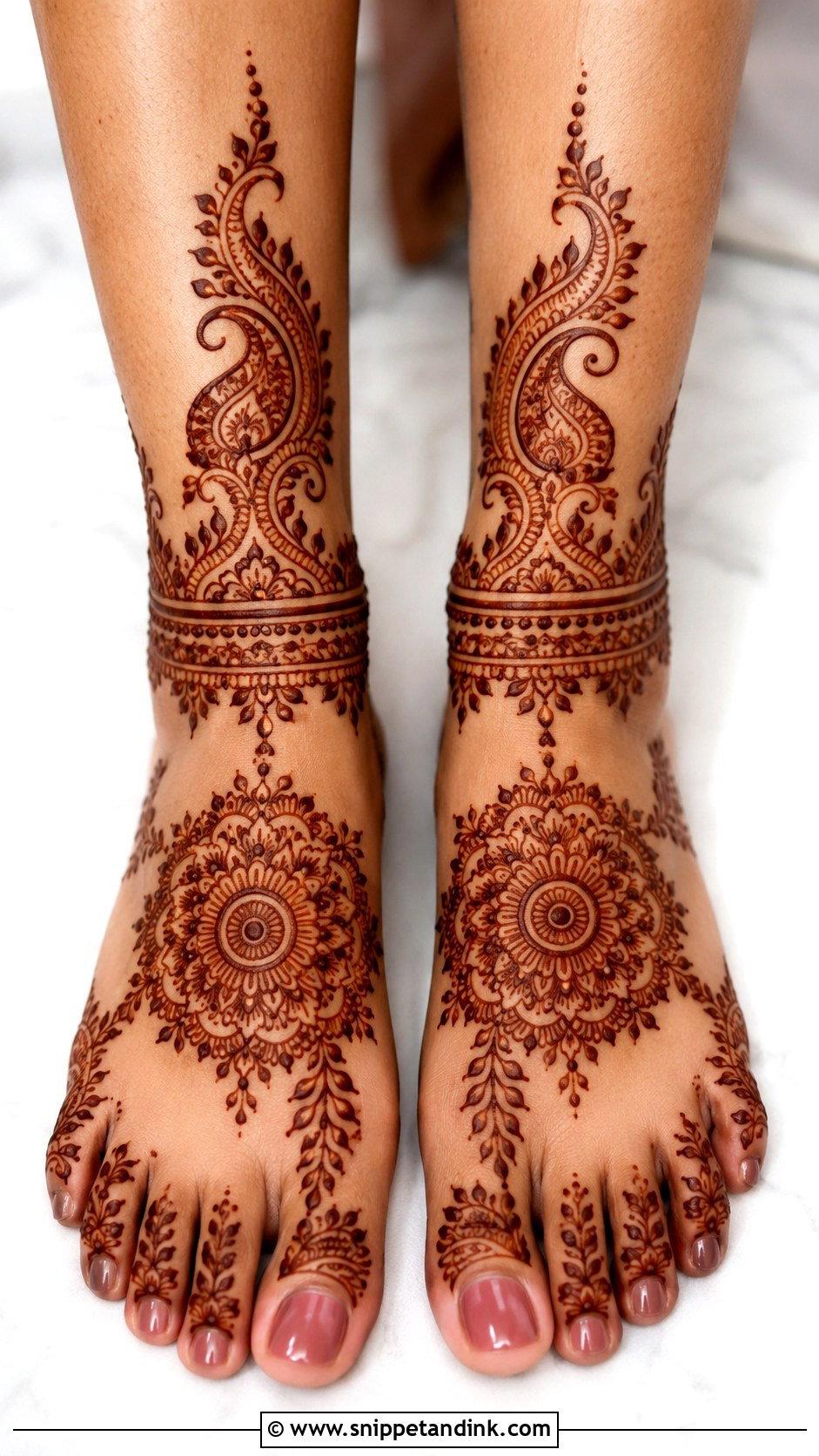
Front placement covers the top of the feet, ankles and front of the lower legs, the part everyone sees in sandals or heels. I start at the toes, place a round or floral motif centred on the foot, then let the pattern rise in a straight or curved line. Centring is harder than it looks: the top of the foot isn’t flat, so I line the motif up with the second toe rather than the middle of the ankle. Brides can add jaali and paisleys, while guests usually keep it to leaves and flowers.
6. Back Leg Mehndi Design
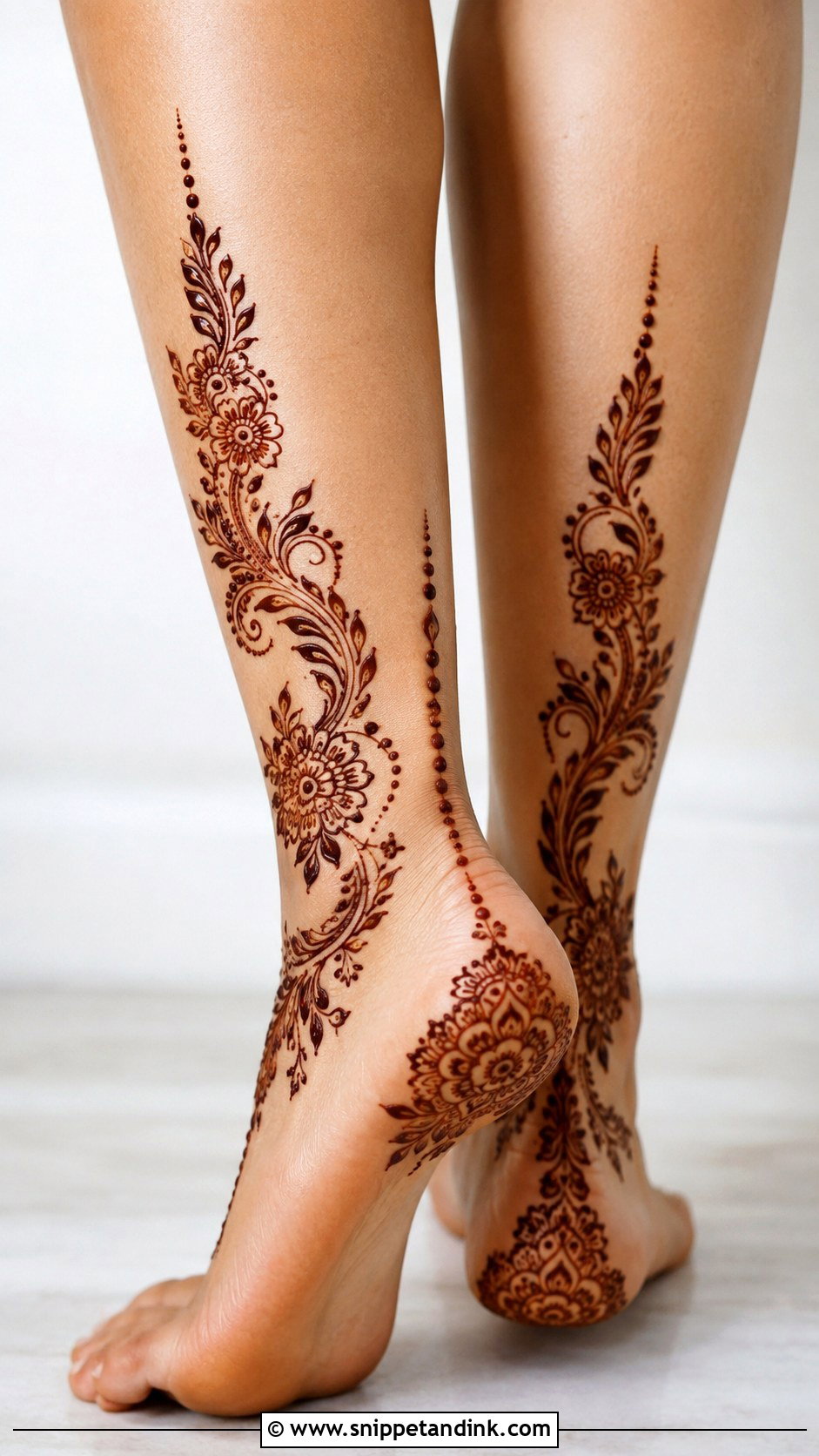
Back designs start at the heel with a rounded floral or mandala base and rise behind the ankle like an ornament, sometimes continuing into a calf trail. The back of the leg is a narrow strip visually, so a wide design wraps around and loses its shape. I keep it vertical. One practical warning: the heel is the part that rests on the floor and rubs on footwear straps, so detail placed low on the heel tends to wear away first. I lift the base motif slightly above where a sandal strap would sit.
7. Foot And Ankle Mehndi Design
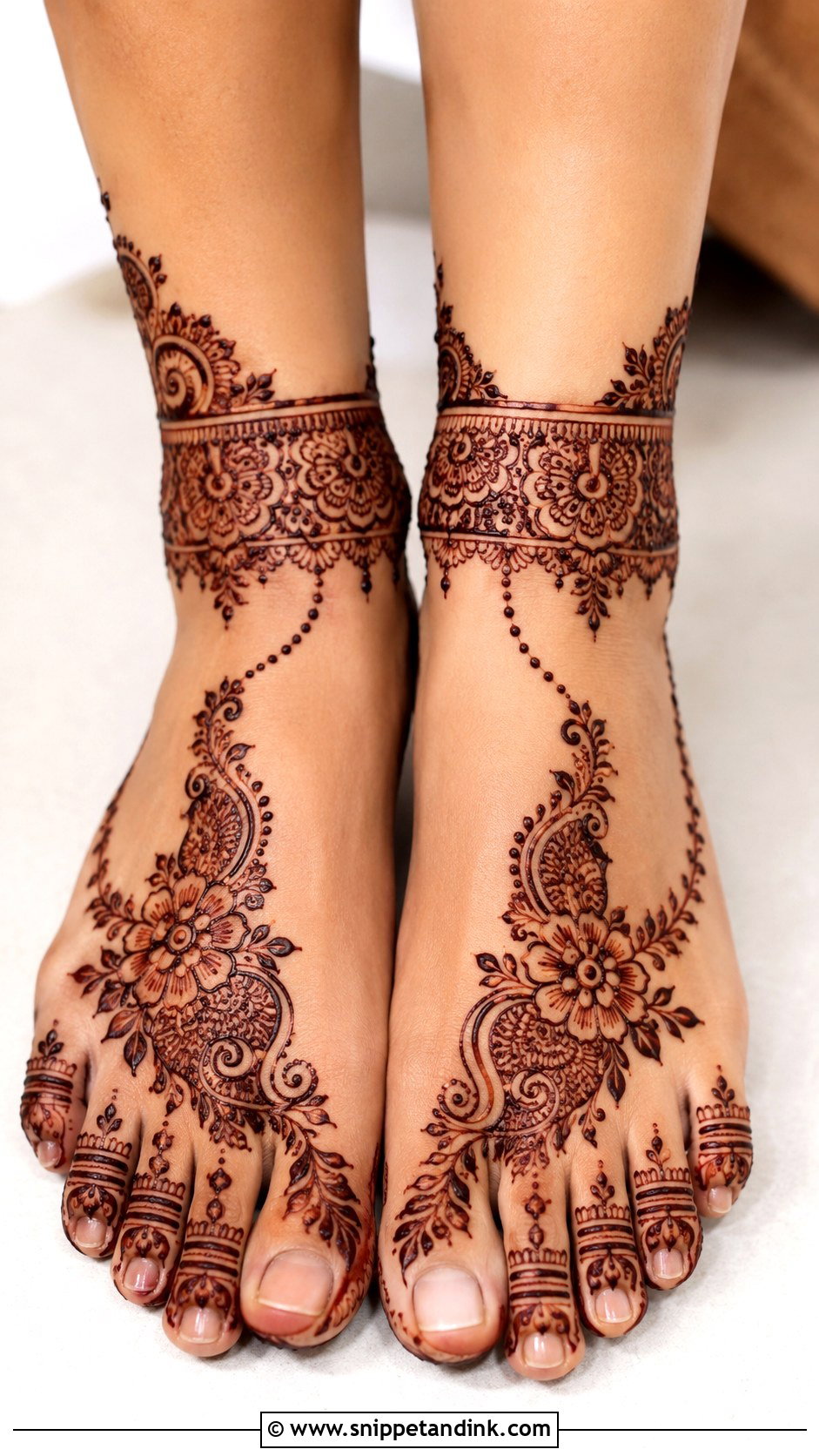
Foot and ankle is the combination I do most often. A mandala, floral spray or paisley cluster on the foot, then bands, chains, dots or a bracelet-like border around the ankle. It decorates without committing you to anything on the leg, which makes it easy for bridesmaids and family functions. Matching both feet is the classic finish. Mirror designs, where the trail runs on the outer edge of each foot, look more modern and are a little more forgiving if your feet aren’t the same size.
8. Anklet Mehndi Design For Legs
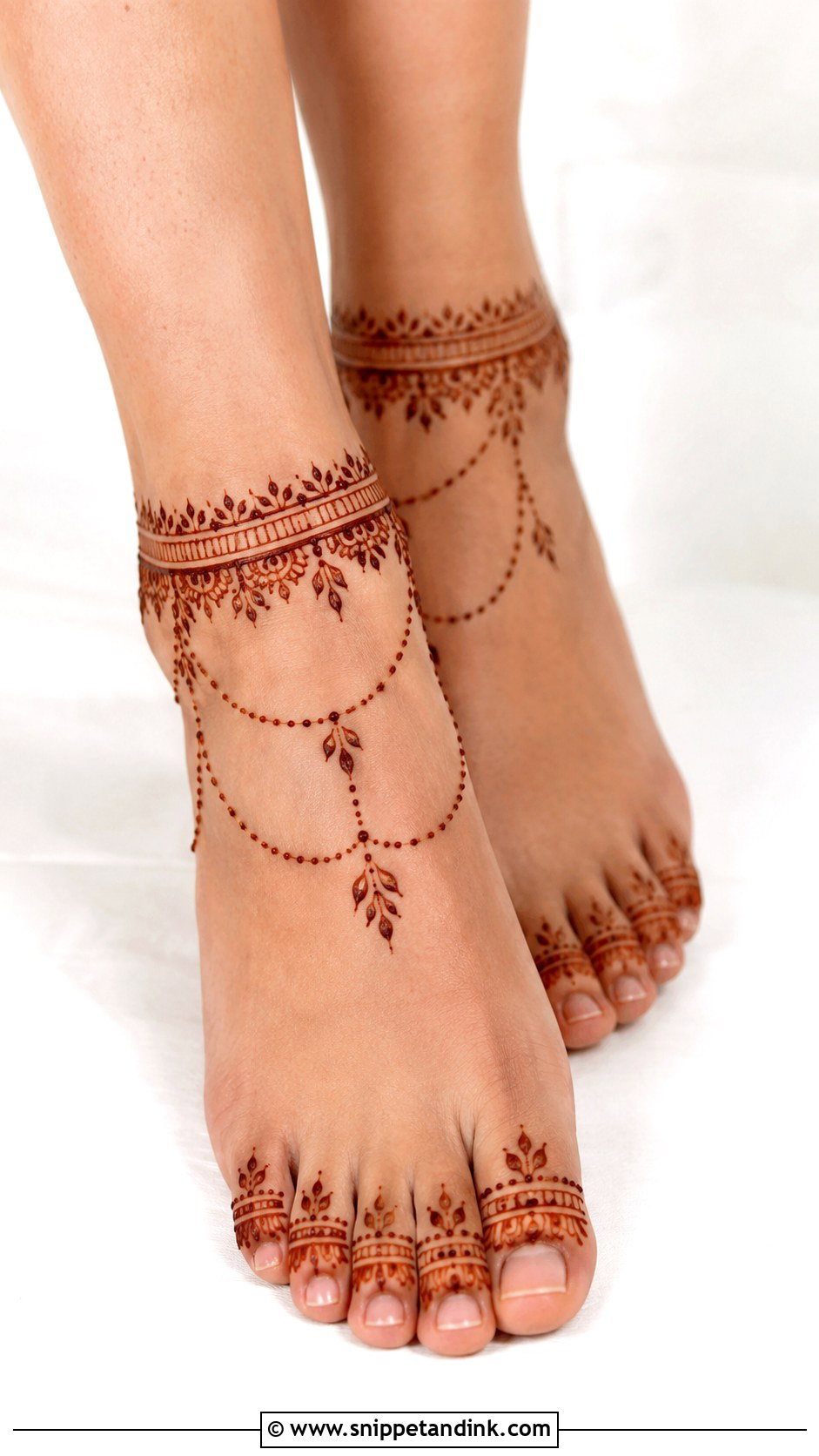
Anklet designs borrow from payal jewelry: chains, beads, leaves and small hanging motifs wrapped around the ankle, with the foot mostly bare or carrying a light trail to the toes. It suits almost every age and foot shape. If you’ll wear real anklets too, tell your artist which way they’ll hang, so the henna chain sits just above the silver rather than underneath it. Layered bands make it richer; tiny florals and dotted chains keep it soft.
9. Floral Legs Mehndi Design
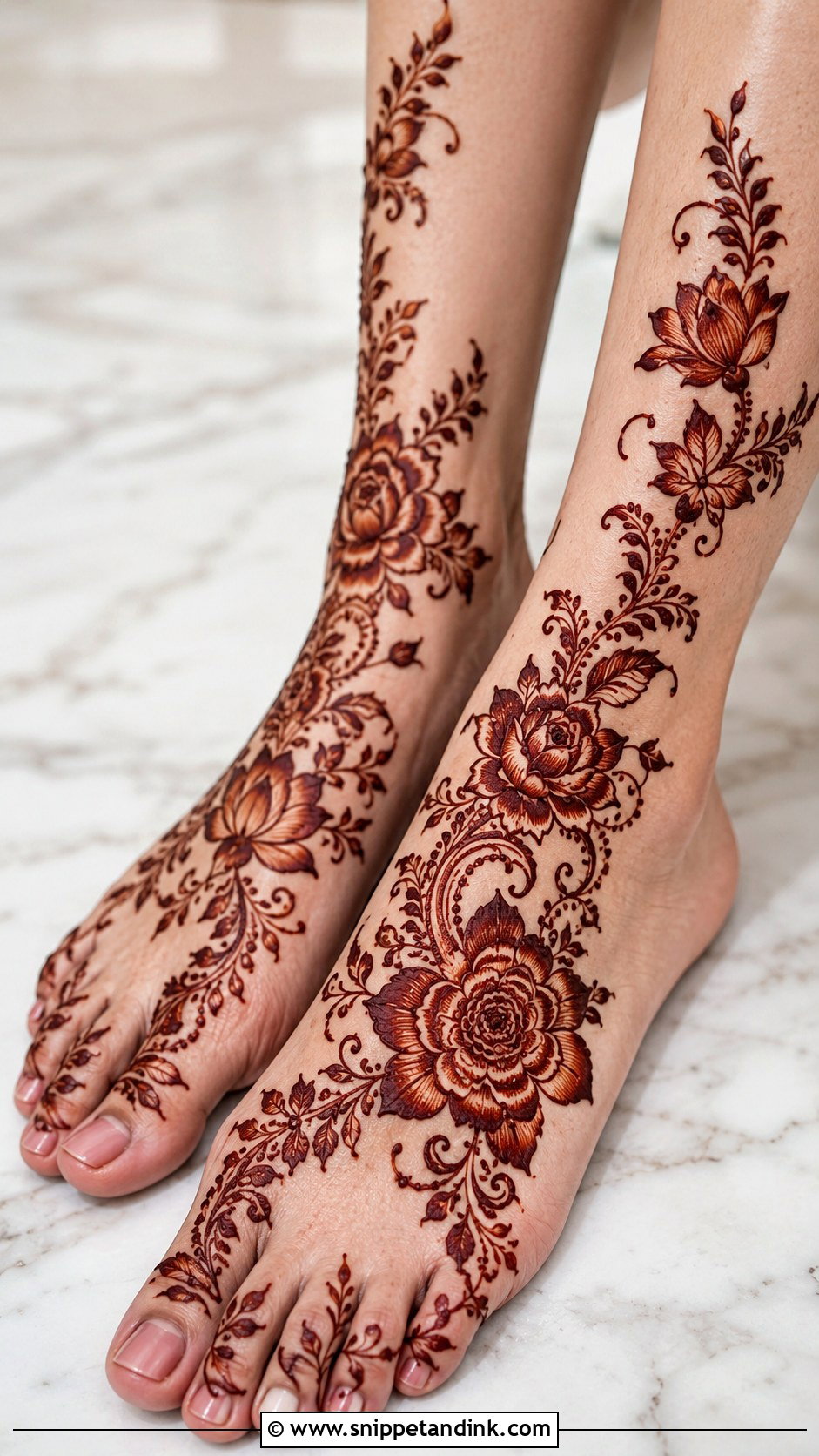
Flowers are the most adaptable motif I have. Roses or lotus blooms on the foot, leafy vines around the ankle and smaller flowers trailing up the leg can be drawn bold in an Arabic style or detailed in an Indian one. Floral leg henna suits brides, sisters of the bride and festival guests equally. For balance, I put the biggest flowers on the top of the foot and at the ankle, and use lighter vines toward the toes and up the calf, because a large bloom on the toes crowds that small area.
10. Mandala Legs Mehndi Design
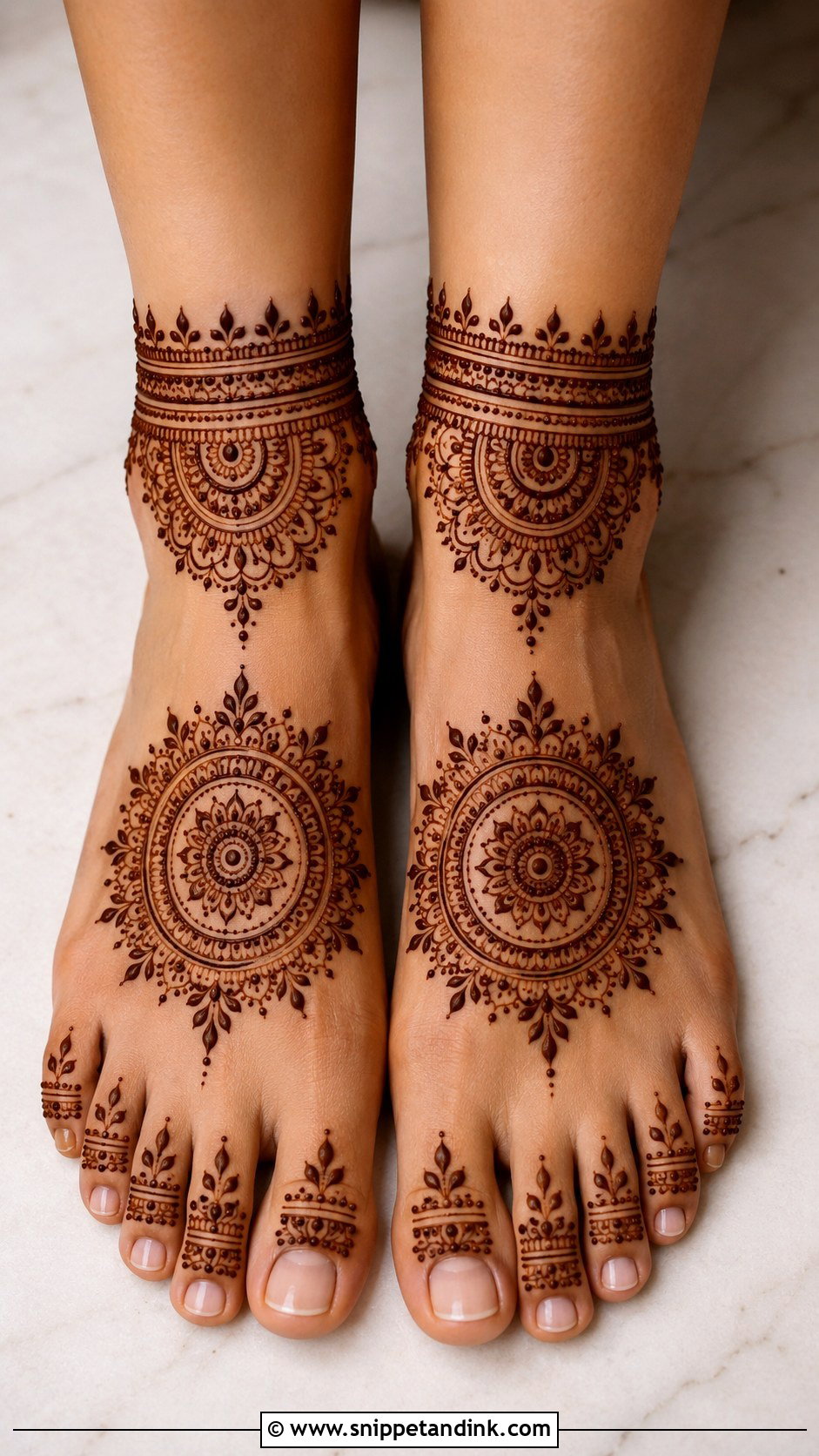
A round mandala on top of each foot, with details reaching toward the toes and ankle. It can be just petals and dots, or layered rings with fine lines and tiny leaves. People who love symmetry ask for it, and it’s traditional without being heavy. Connecting it to an ankle band makes it festive; surrounding it with jaali, paisley borders and filled toes makes it bridal. I build the rings from the centre outward and check the circle after every ring, since one flat edge throws off everything that follows.
11. Paisley Legs Mehndi Design
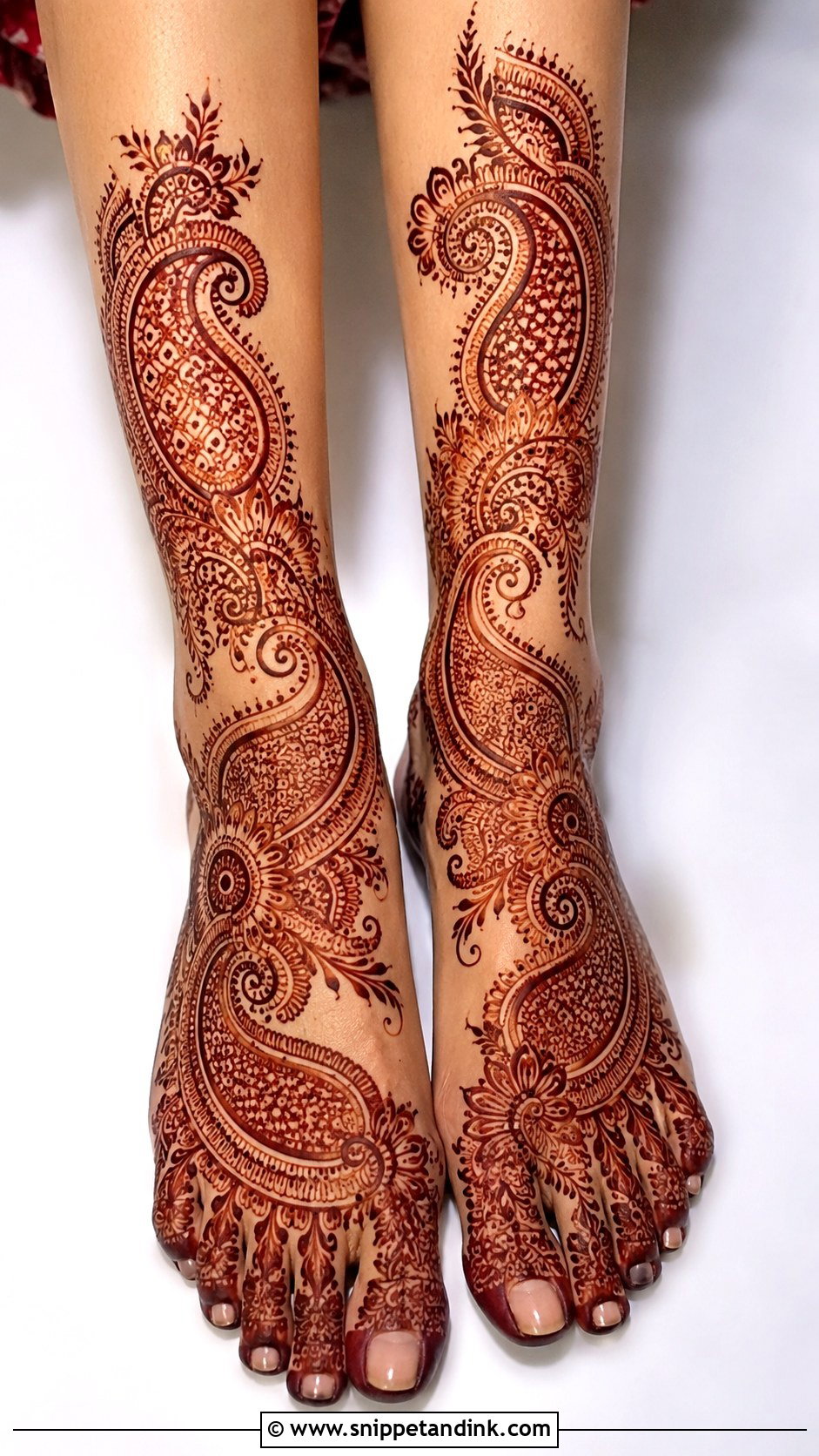
Paisley fits the top of the foot, the ankle and the lower leg without forcing it. I usually place large paisleys at the ankle and step down to smaller ones toward the toes, which gives a natural taper. Fine fillers, dots, petals and shaded leaves fill them out. I keep the paisley outlines thicker than the fillers inside them; otherwise, once the whole design stains, the shapes melt into each other and the paisley disappears.
12. Jaali Legs Mehndi Design
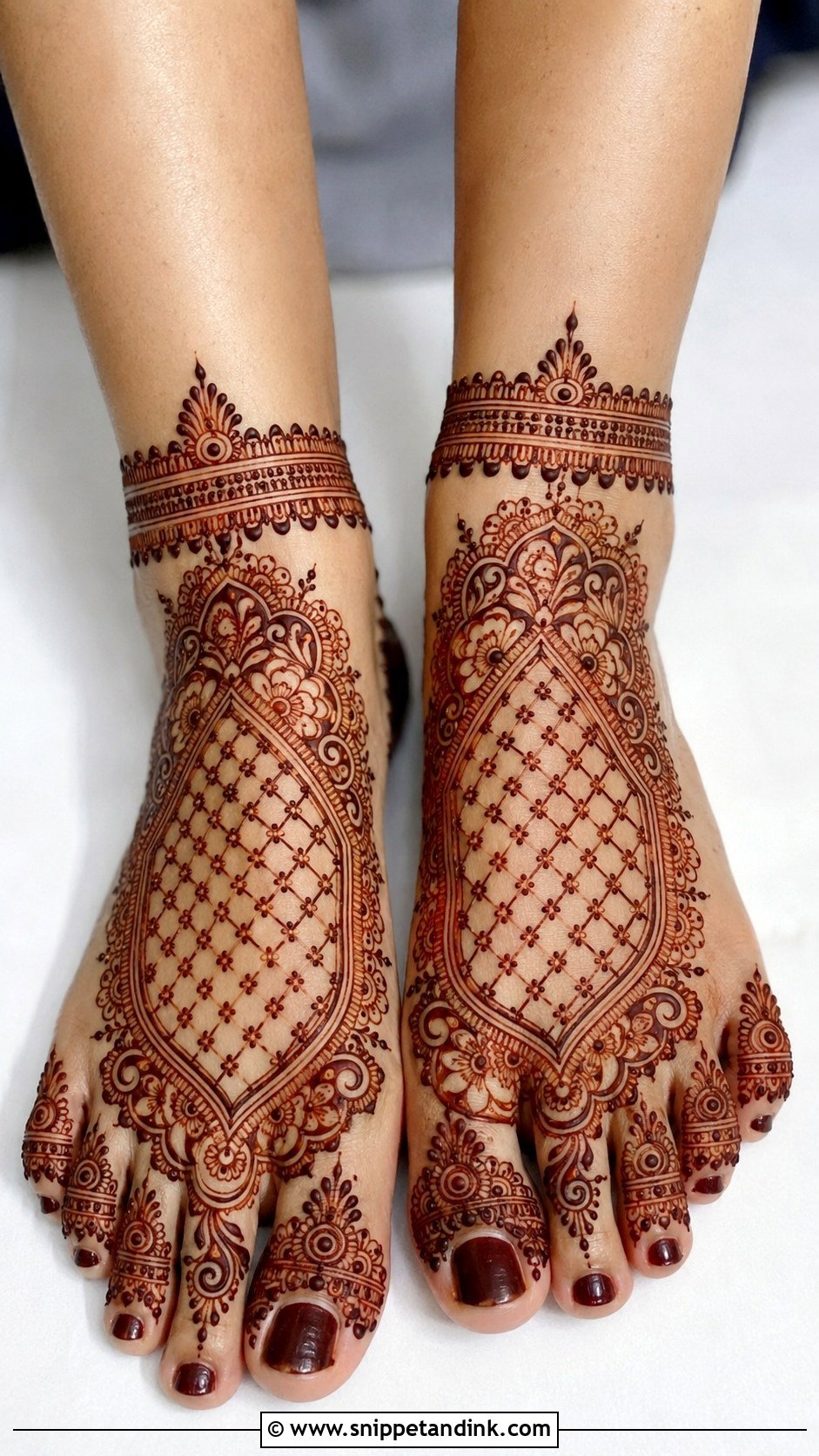
Jaali is net work that sits over the centre of the foot like a panel of fabric. On its own it looks flat, so I frame it with flowers, paisleys or leafy borders, turn it into a bracelet band at the ankle and keep the toes to simple lines and dots. It’s often the backbone of Indo-Arabic designs, where bold flowers sit right next to fine mesh. The lines need to be thin and even. I use a finer cone tip for jaali than for outlines, and I’d question an artist who does both with the same one.
13. Peacock Legs Mehndi Design
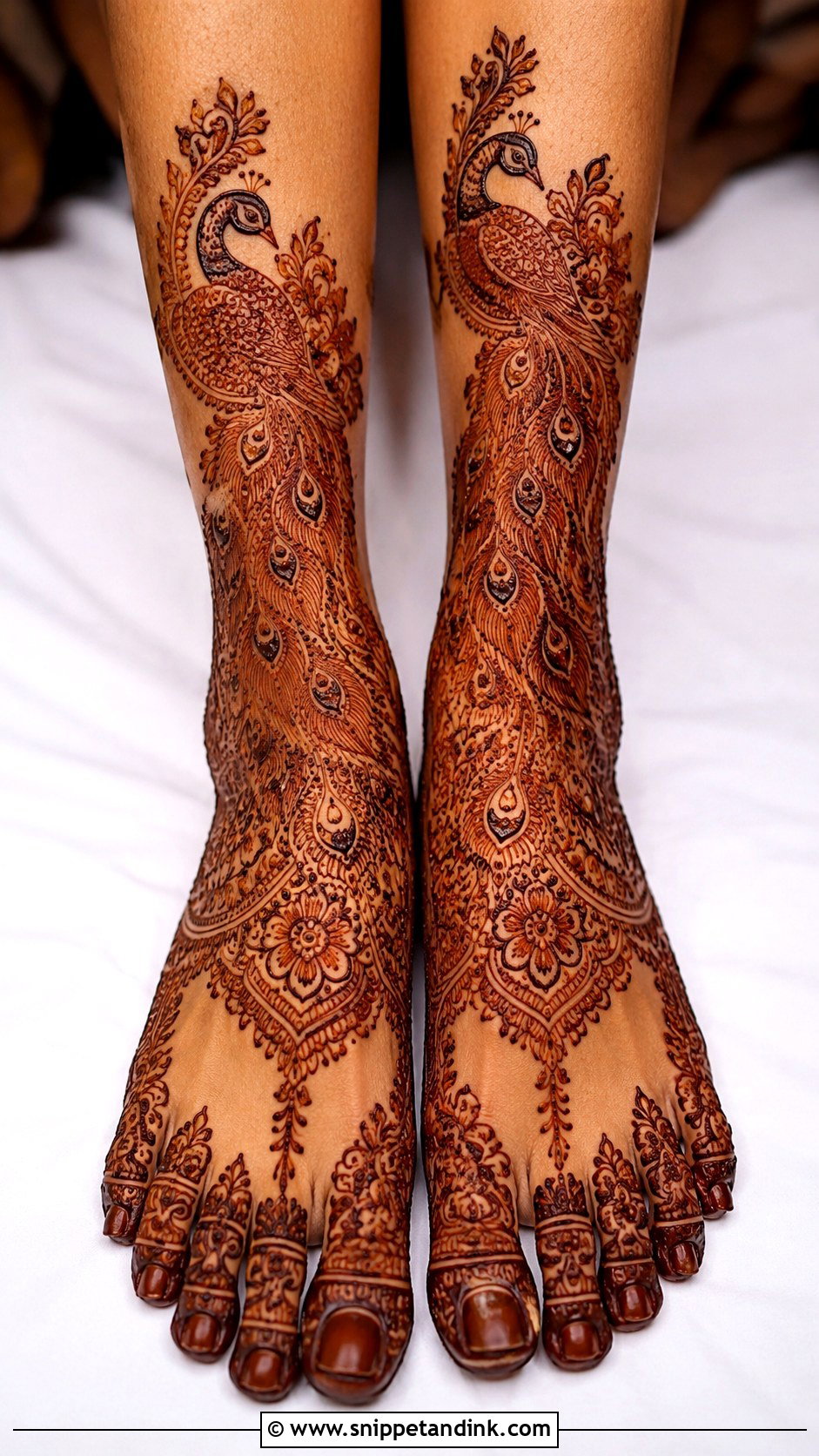
A peacock near the ankle or lower leg with its feathers flowing down toward the foot gives the design real movement. The feet carry paisleys, flowers and filled toes. Spacing is the whole skill here. I draw the body and neck first and leave a little clear skin around them before adding feathers, so the bird is still readable after the stain darkens. Heavier versions add detailed feather lines and shaded petals; a lighter one uses a single peacock on each leg over a floral base.
14. Lotus Legs Mehndi Design
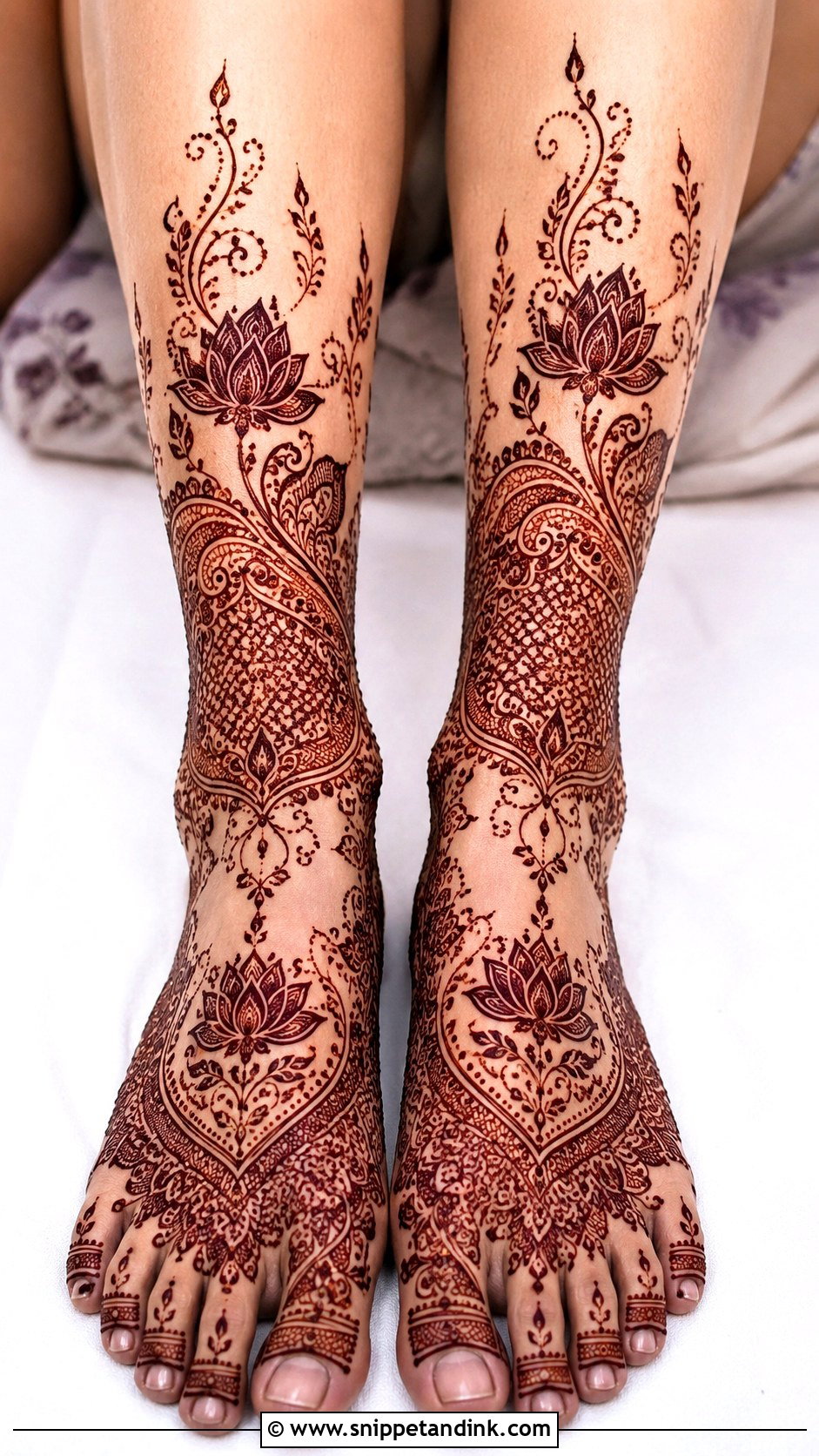
Lotus petals spread naturally across the top of the foot, which is why I like it there more than anywhere else on the body. Vines, dotted chains or curved borders link it to the ankle. For a bride, I expand it with jaali, paisley panels and full toe detailing. For a smaller occasion, one lotus per foot and a slim anklet band is enough. It sits comfortably in Indian or Indo-Arabic work, depending on how much I add around it.

15. Moroccan Legs Mehndi Design
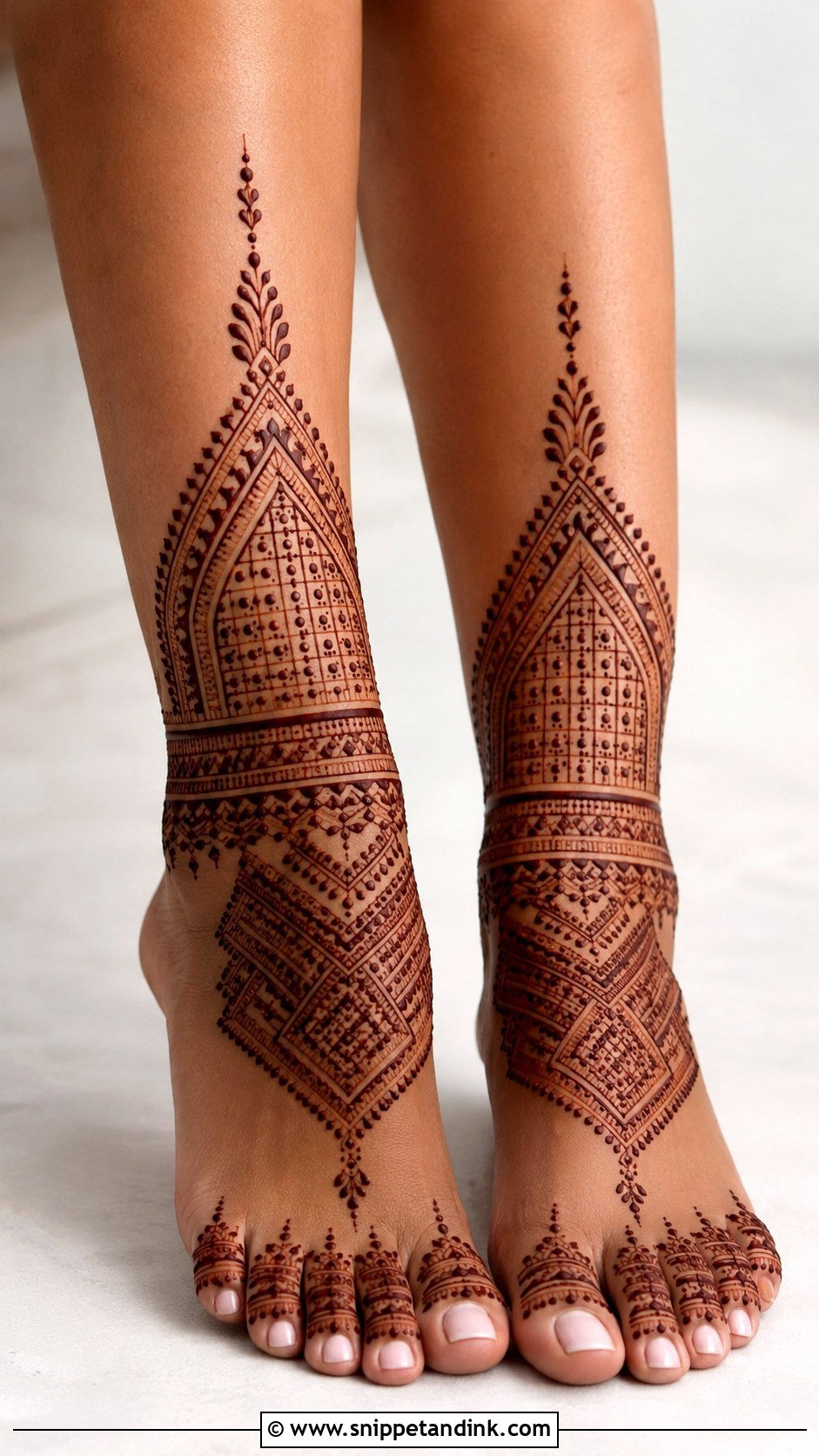
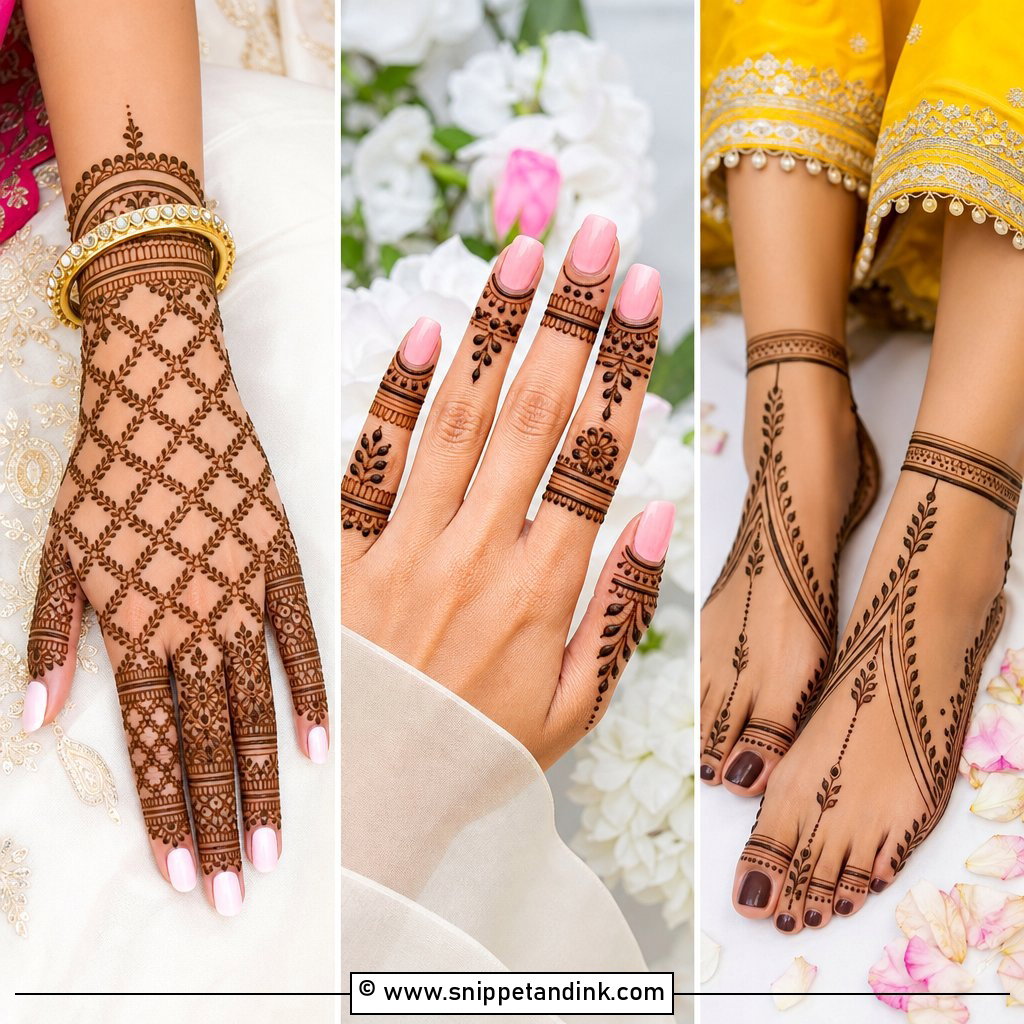
Moroccan designs swap floral trails for diamonds, triangles, grids, straight lines and strong borders, laid over the top of the foot like a tile panel and finished with bracelet bands at the ankle. It needs less shading and more structure. I’d only book it with someone who’s comfortable with straight lines, because the curve of the foot pulls every line slightly, and correcting for that takes practice. Small dots and simple toe lines keep it wearable. It looks sharp against a plain, single-colour outfit.
16. Indo Arabic Legs Mehndi Design
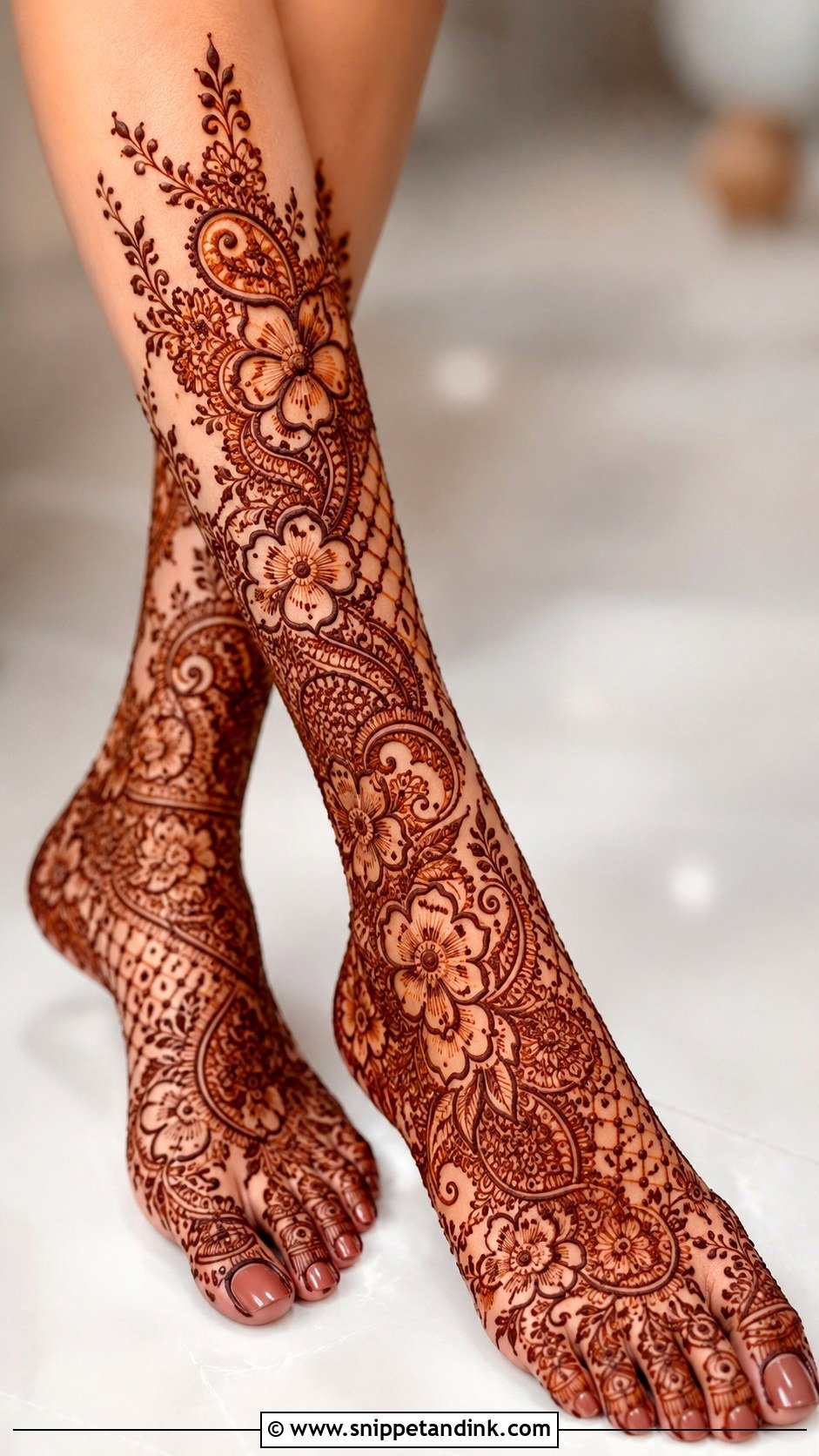
Indo-Arabic is the middle ground: large flowers and paisleys moving diagonally across the foot, with mesh, dots and leaves filling chosen spaces and a band or curved border at the ankle. It’s neither empty nor crowded. Bridesmaids, engagement guests and Eid dressing all suit it. The contrast is what makes it work: bold outlines, open gaps and dense insides. If an artist fills every gap, it stops being Indo-Arabic and becomes a heavy Indian design.
17. Indian Legs Mehndi Design
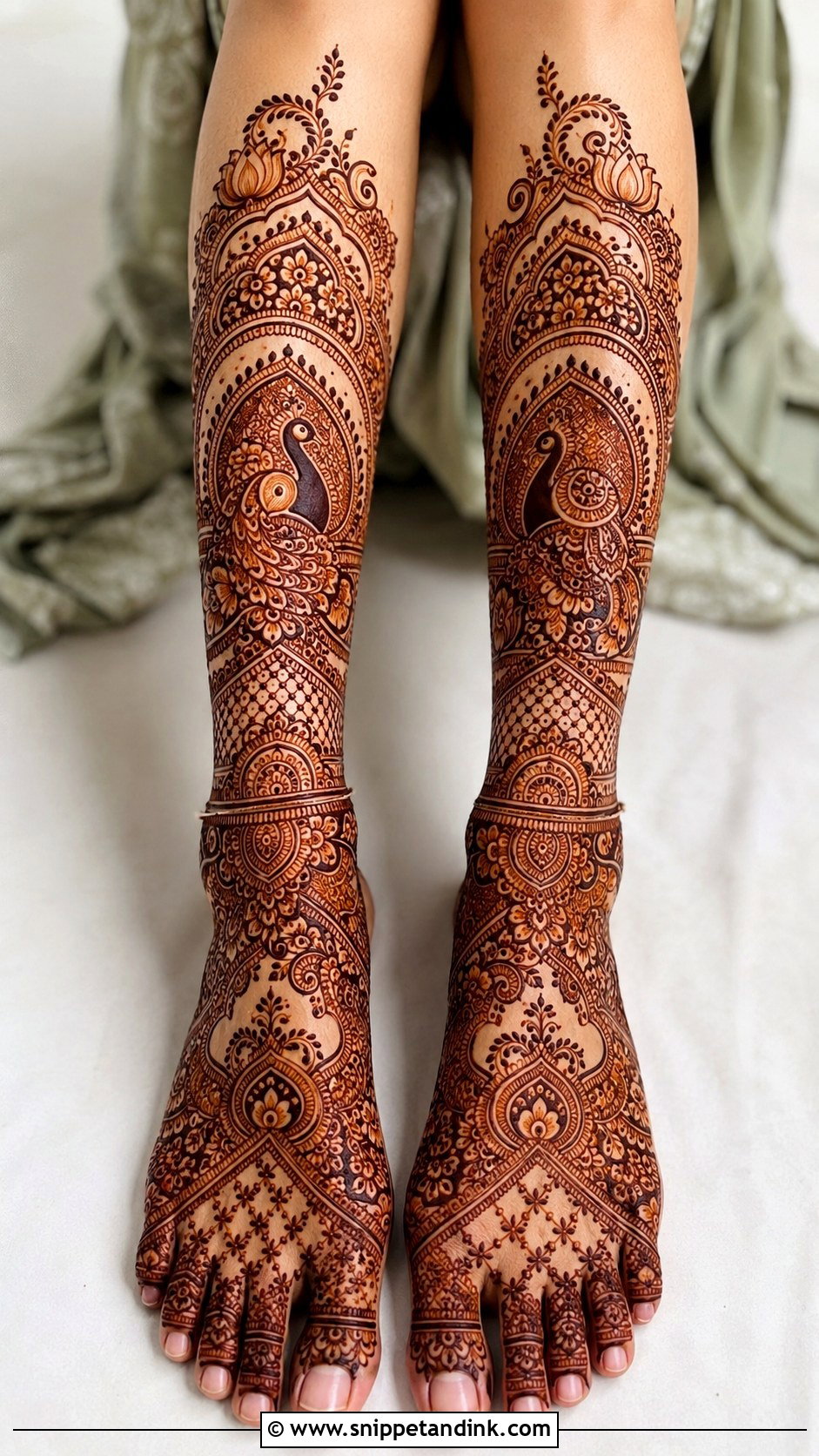
Indian legs mehndi design is dense, symmetrical work with paisleys, mandalas, peacocks, lotus flowers, vines, jaali and tiny fillers, covering far more skin than Arabic styles. On the feet it’s symmetrical; at the ankles and lower legs it rises in panels or borders. It’s the natural partner for heavily detailed bridal hands. I divide it into clear zones (toes, centre of the foot, ankle, calf) and finish each zone before starting the next. That’s what stops a dense design from looking crowded.
18. Gulf Legs Mehndi Design
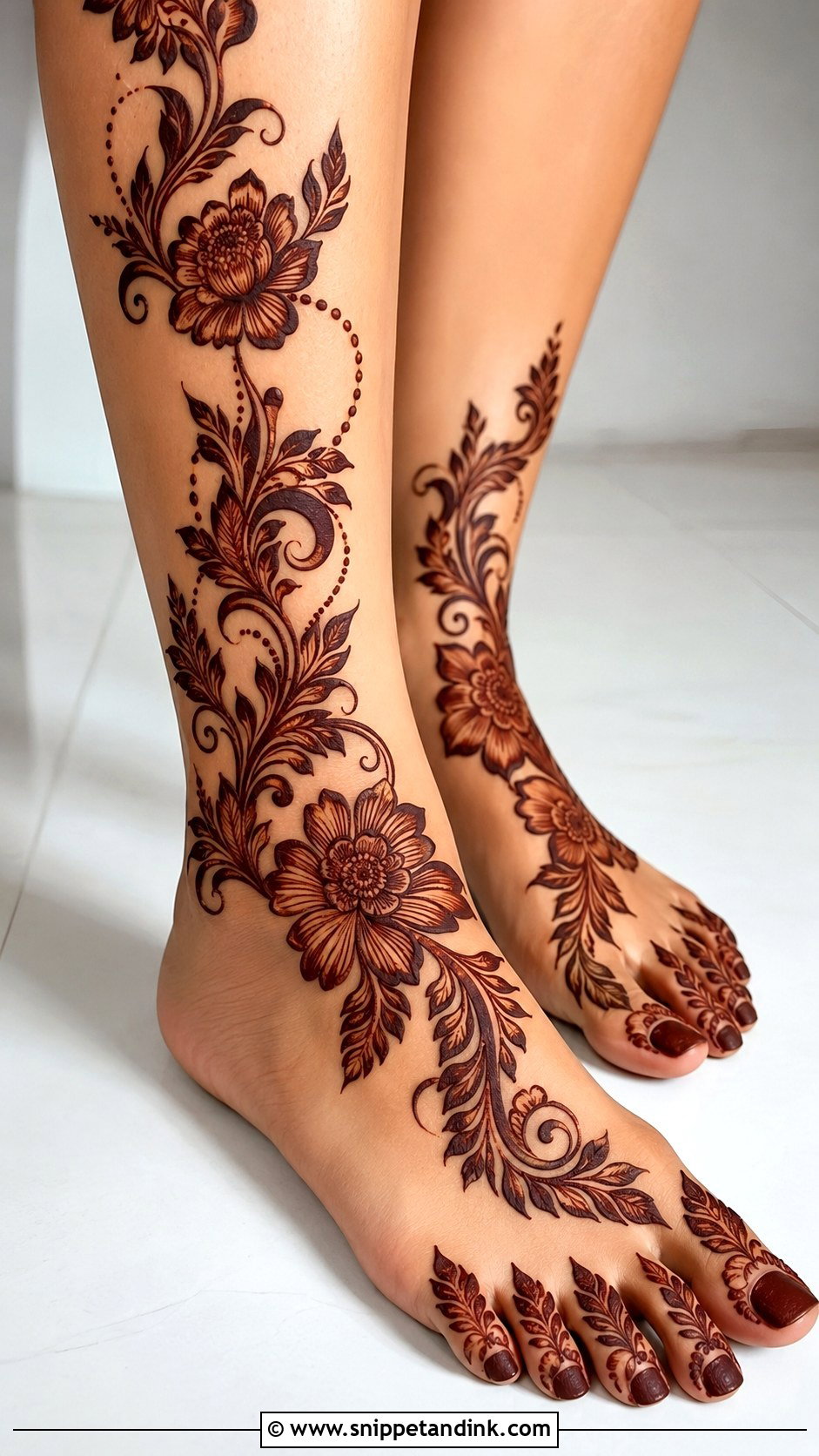
Khaleeji-inspired henna uses bold flowers, leafy vines and sweeping curves with generous negative space. It typically starts at the toes, curves across one side of the foot and ends at the ankle or lower leg. The outlines are thick and the paste is laid down generously, which tends to give a strong, dark stain. It suits Eid, weddings and evening events, especially with statement sandals. If you want more, add shaded petals and dotted chains, but keep the movement wide and open.
19. Minimal Legs Mehndi Design
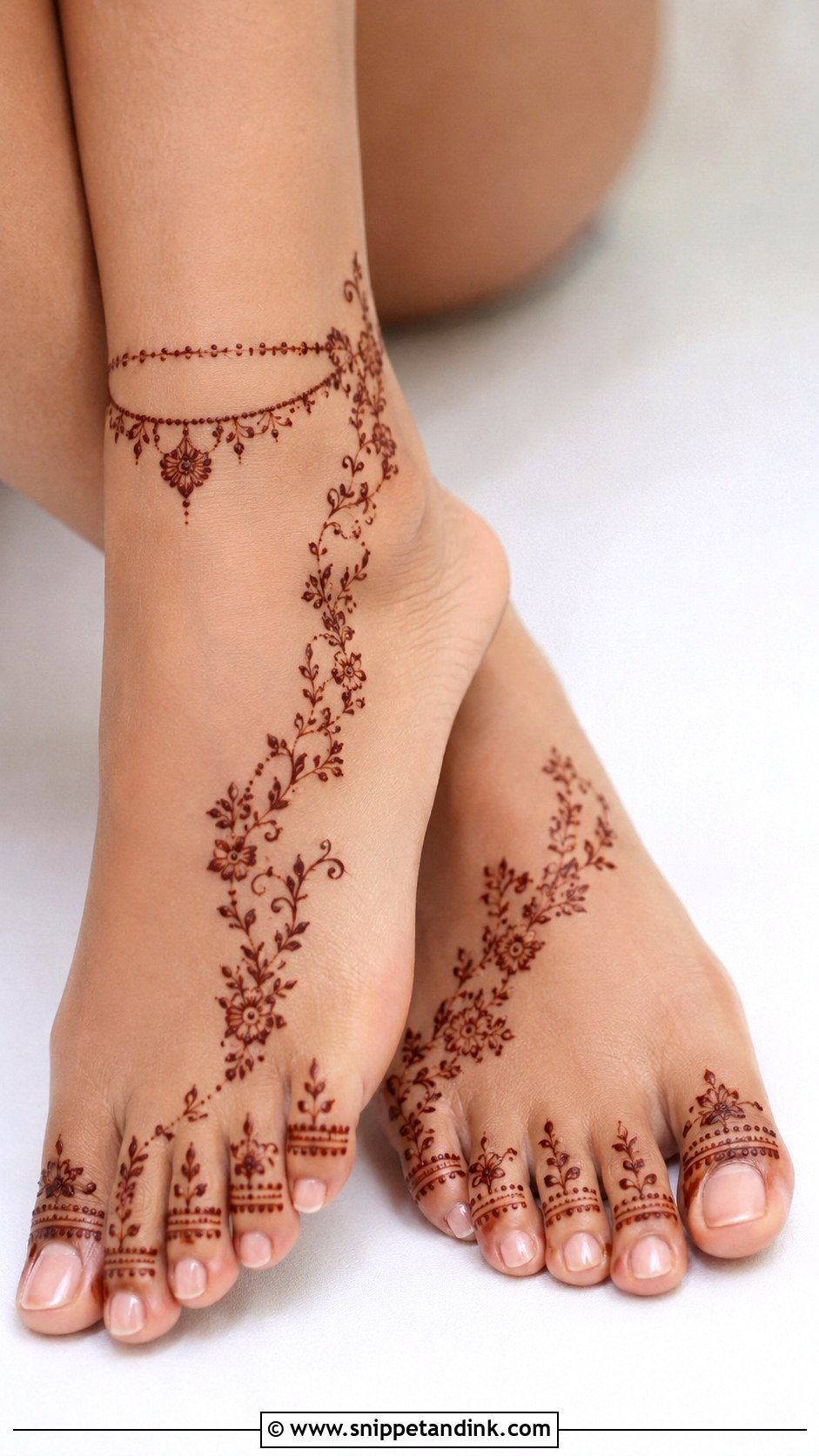
Tiny toe details, a slim vine along one side of the foot and a small anklet band, with lots of blank skin around them. Minimal designs are where a shaky hand shows most, so the work has to be neat, not random. I repeat a single leaf or flower shape rather than mixing several, which makes even a small design look planned. It’s easy to wear to office-friendly festivals and small family events, and it’s a sensible first try on the feet.

20. Easy Legs Mehndi Design
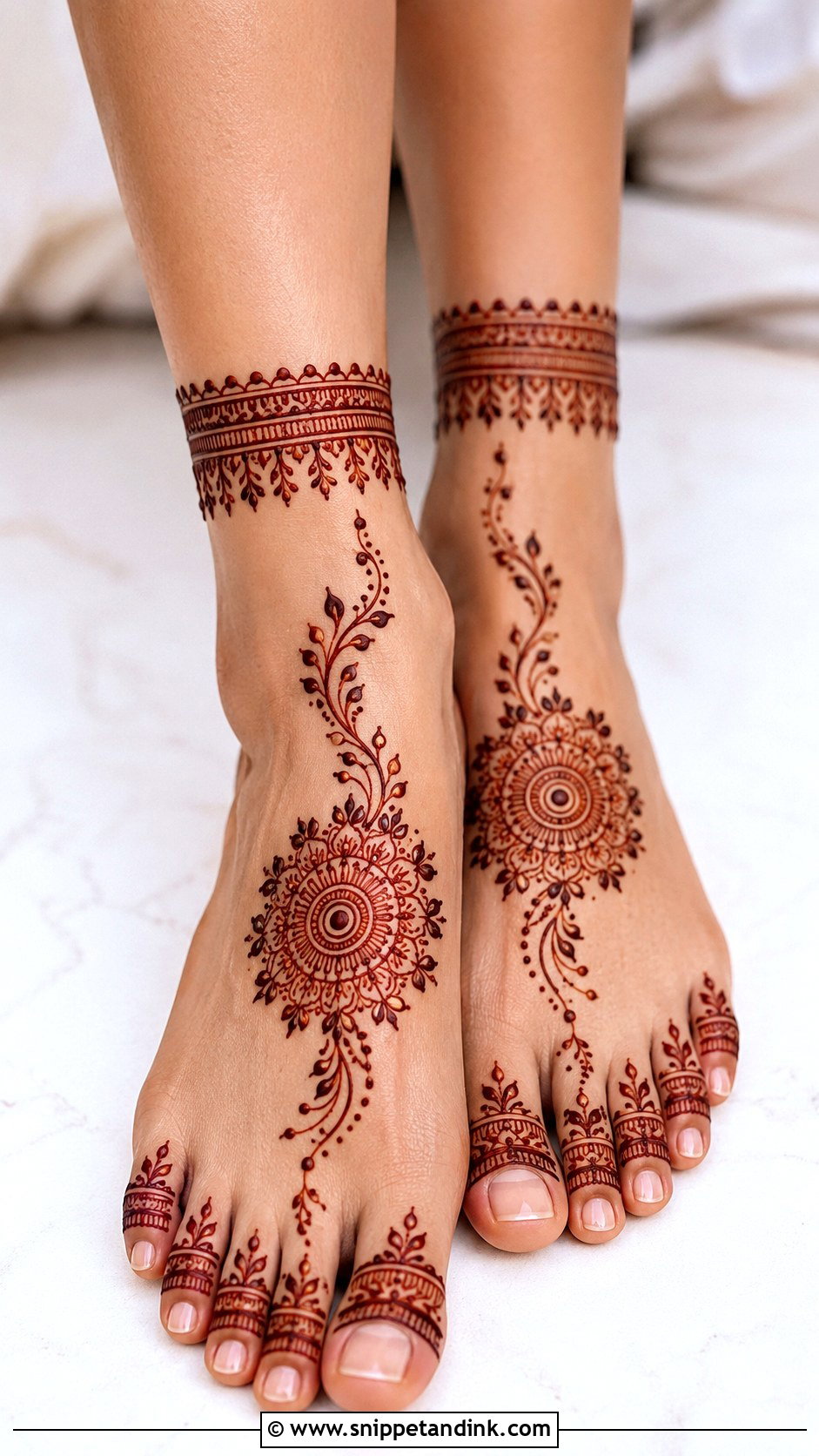
An easy design that still looks complete: decorated toes, a round flower or mandala on the foot, a curved vine or dotted chain to the ankle and a slim border to finish. There’s no fine filler to fuss over, so it’s quick. If you’re drawing it yourself or on a friend, keep the shapes clear and the spacing even. Those two things make home henna look far more professional than any amount of detail. Students and last-minute festive plans are where I see it most.
21. Bridal Foot Mehndi Design
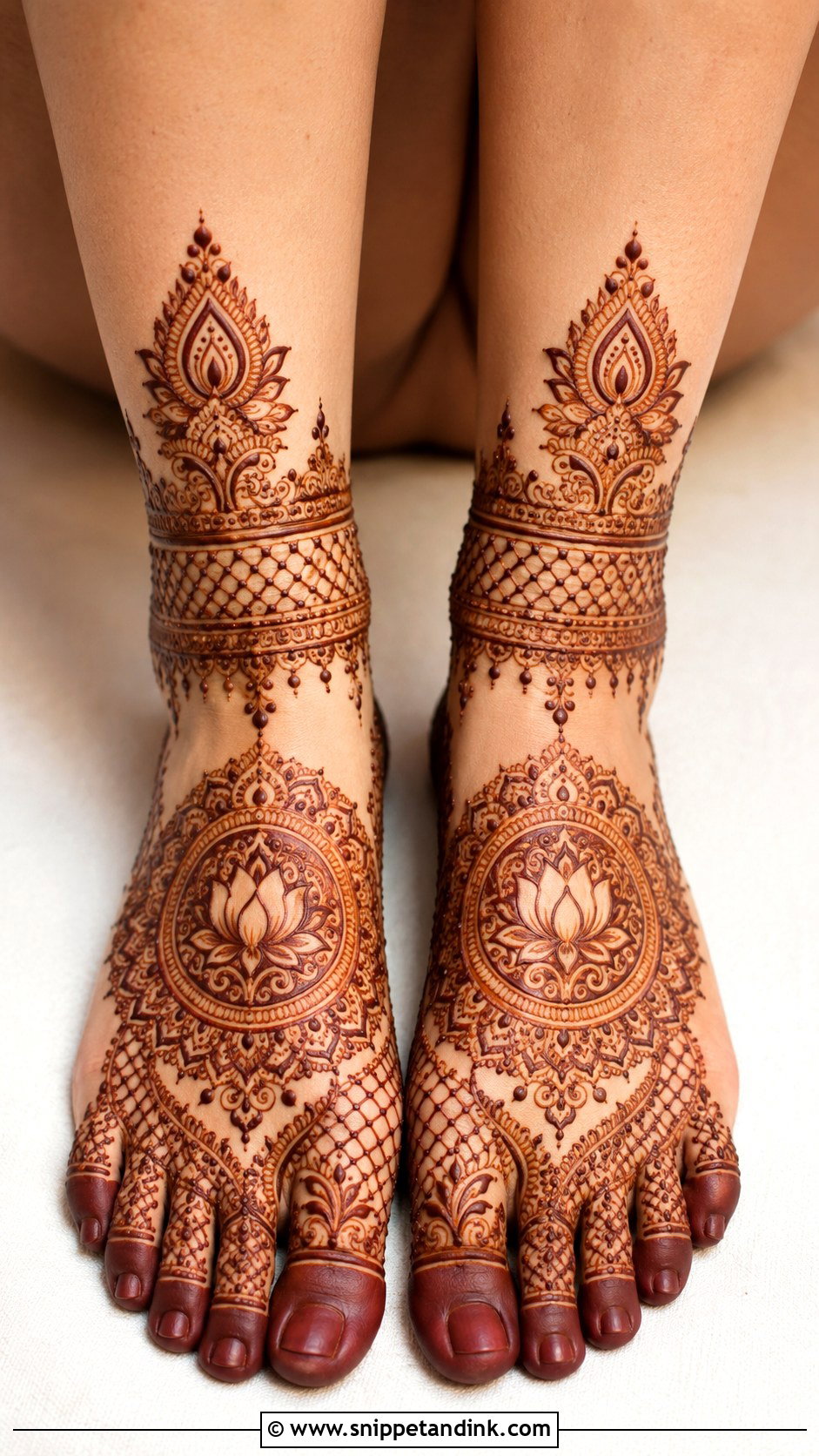
Bridal foot mehndi stays on the feet and ankle: filled toes, a large mandala, lotus, paisley or floral centrepiece on top, fine mesh and scalloped borders around it, and a payal-style band to tie it together. It makes sense when the bridal outfit covers the calves but leaves the feet visible. Bridal shoes are worth checking before we start. If your sandals have a wide strap across the top of the foot, I shift the centrepiece slightly toward the toes so the strap doesn’t hide it.
22. Heavy Legs Mehndi Design
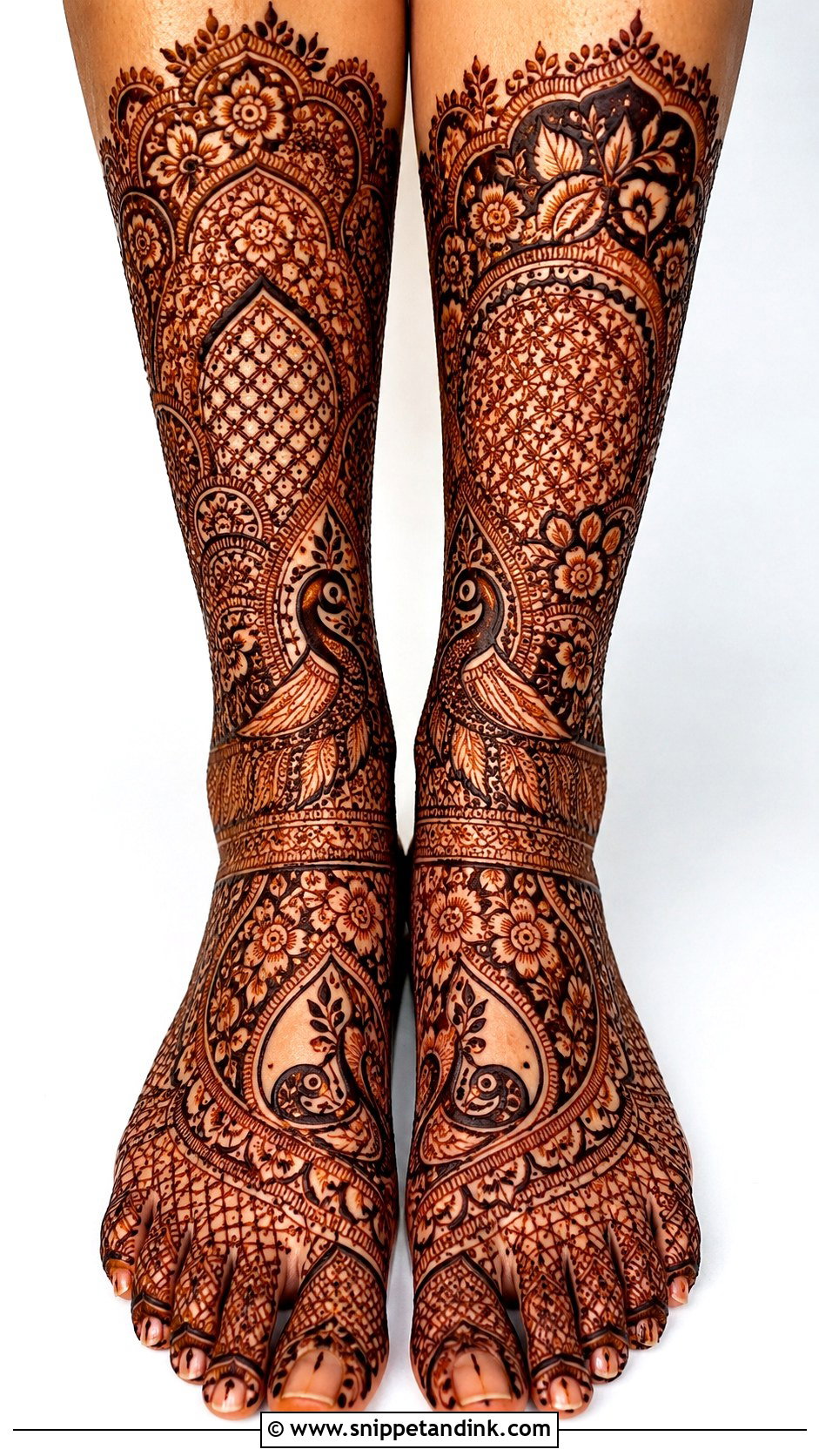
Heavy leg mehndi is maximum coverage: toes, feet, ankles and lower legs with full jaali, thick paisley borders, layered flowers, mandalas, peacocks and shaded leaves. Paired with full bridal hands, it’s dramatic. Dense coverage needs a plan, though. I place the large motifs first as anchors and only then add fine fillers around them. If you fill as you go, the pattern turns into one solid dark block once the stain develops, and none of the detail you sat through is visible.
23. Modern Legs Mehndi Design
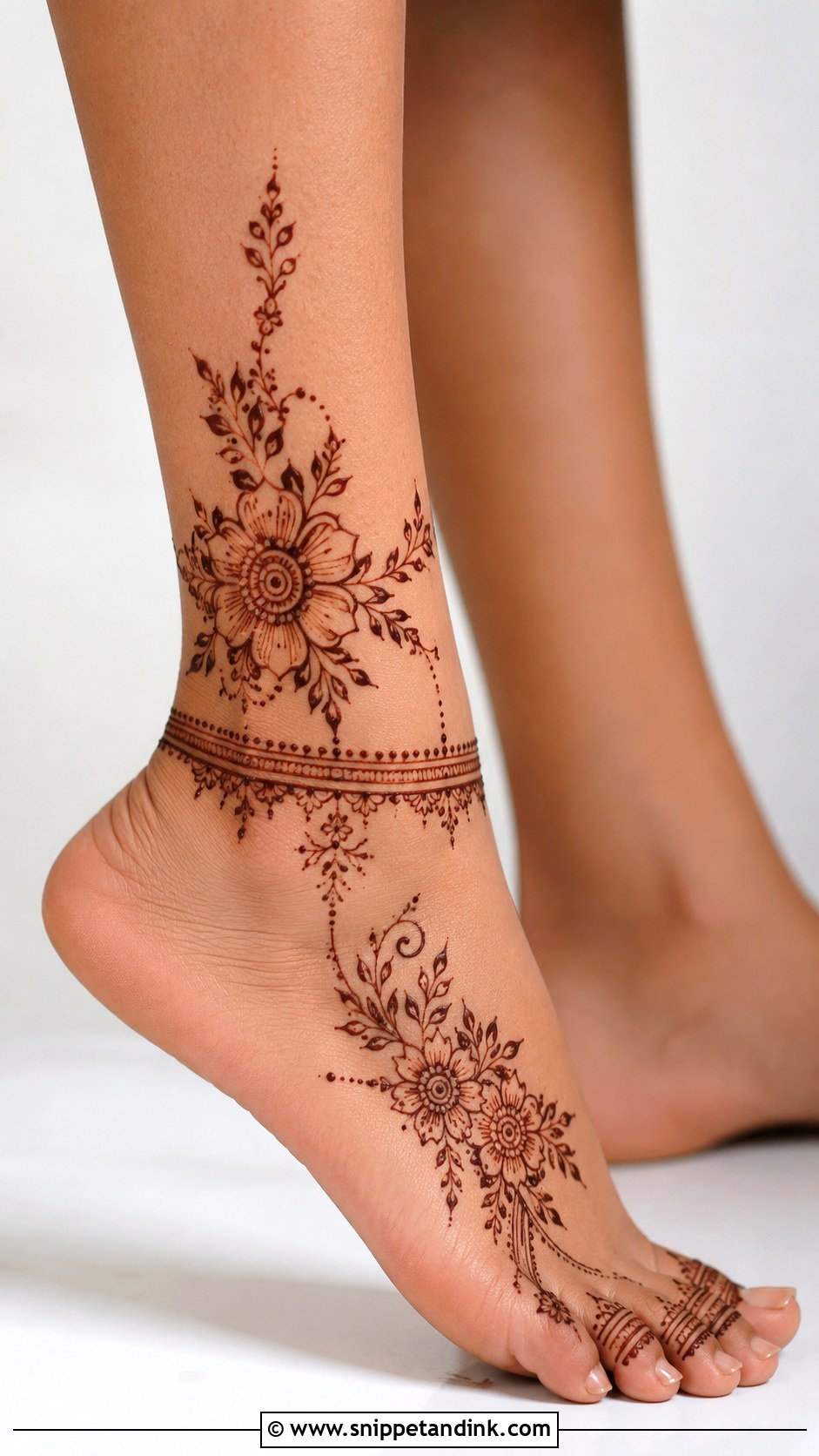
Modern leg mehndi keeps the motifs but changes the placement: a side-foot trail, thin ankle bands, geometric accents or one bold floral cluster, often asymmetrical. It suits engagement parties, sangeet nights, Eid and pared-back bridal looks, and goes well with heels and contemporary ethnic wear. The common mistake is mixing too many motif families in a small space. Pick one theme, florals or mandalas or lines, and let the bare skin shape the rest.
24. Stylish Legs Mehndi Design
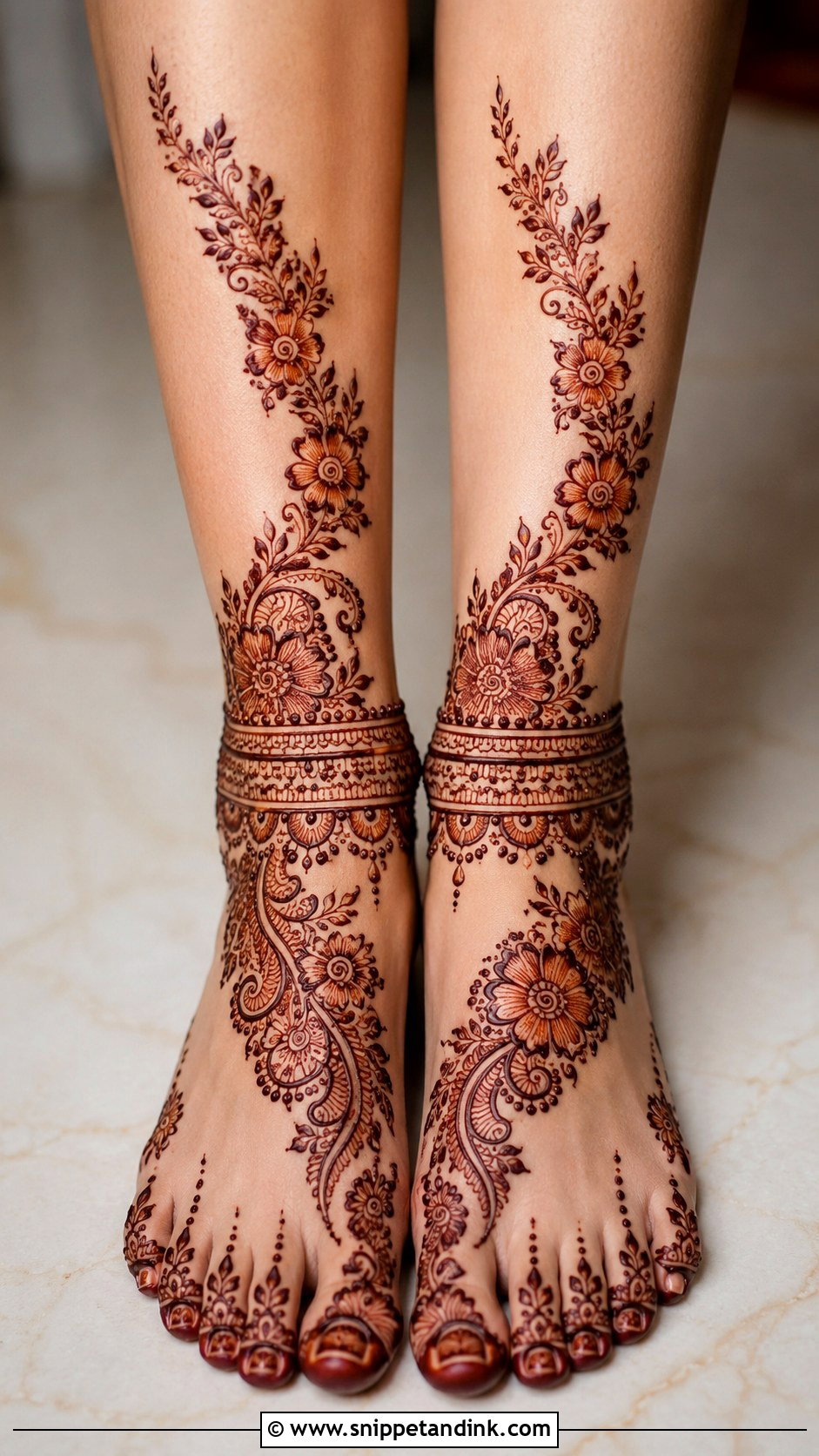
A stylish layout pairs a decorated ankle band with a diagonal floral trail and detailed toes. Bold outlines, light shading and clean negative space keep every element visible. Wedding guests who want more than a basic foot pattern often land here. Layered anklet borders push it toward glamorous; vines and petals keep it soft. I shape the diagonal to follow the line from your big toe to your outer ankle, which makes the foot look longer and slimmer.
25. Toe Mehndi Design For Legs
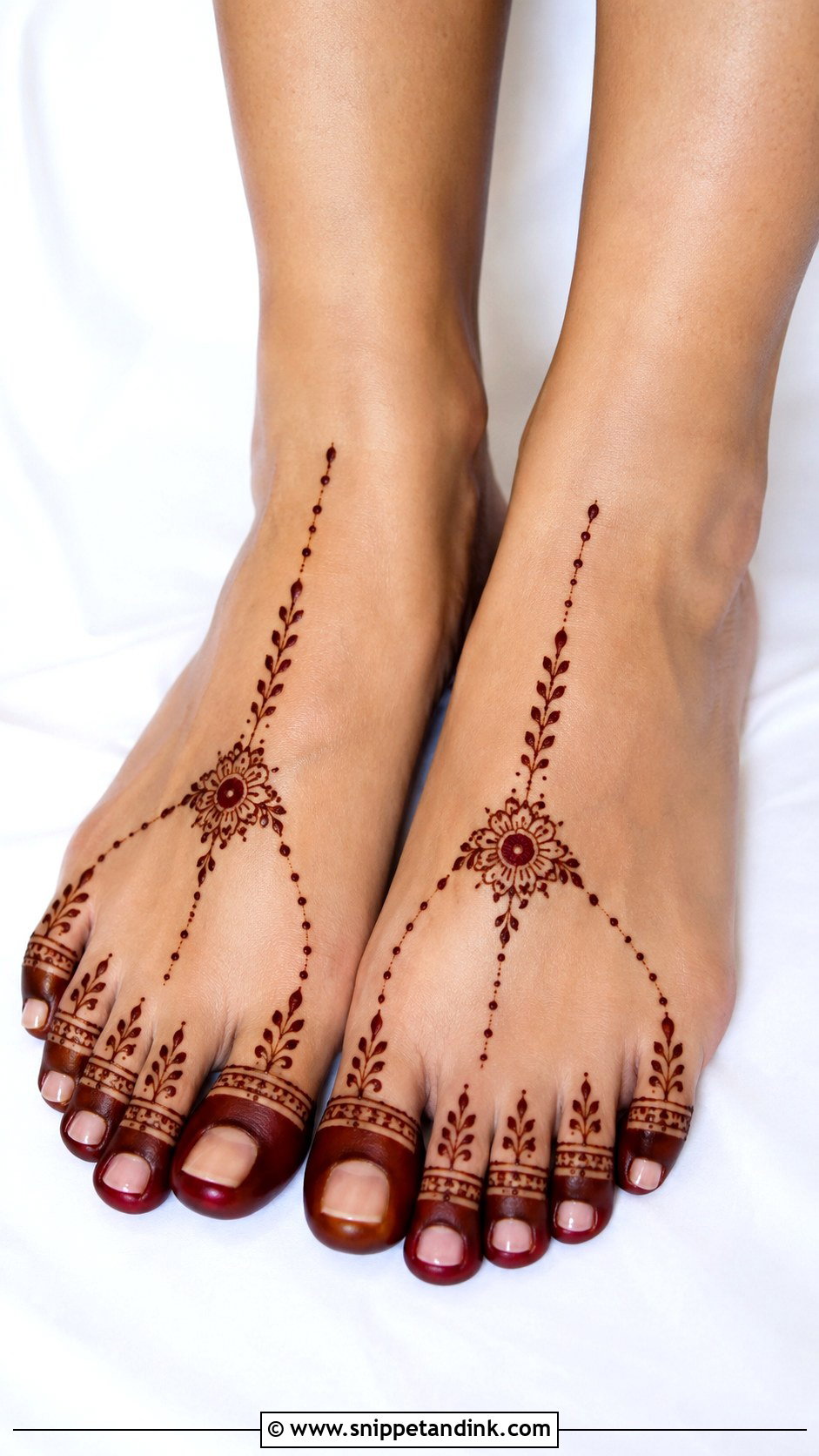
Toe designs fill the tips, add small rings around each toe and run a short trail up to the top of the foot. Without a centre flower, mandala or leaf cluster on the foot, it can look unfinished, so I always give it somewhere to land. It’s quick and comfortable, and it’s ideal with open-toe sandals. Toe tips stain very dark because the skin there is thick, so even a light design looks strong at the front of the foot.
26. Side Leg Mehndi Design
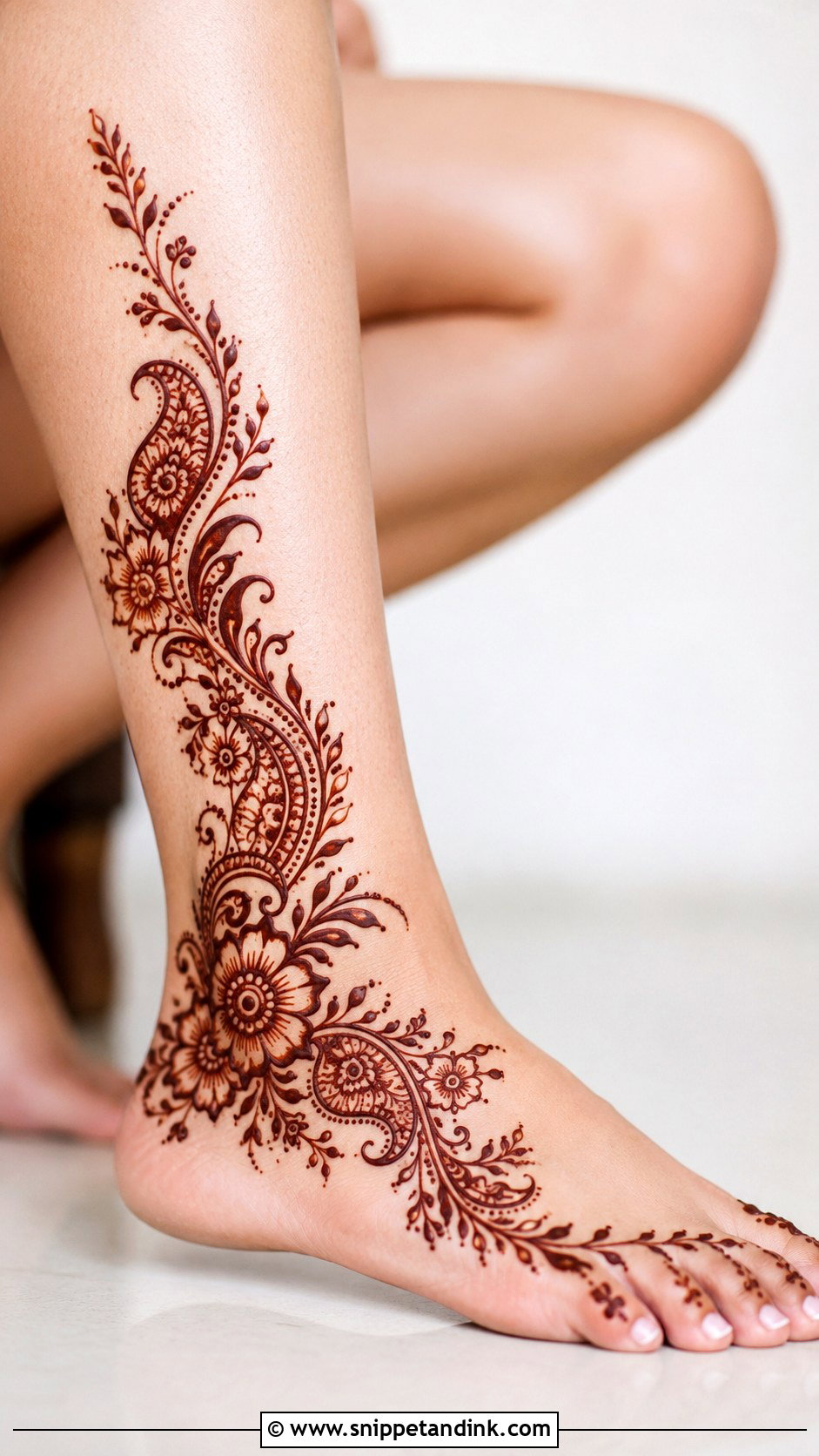
Side designs follow the outer edge of the foot and ankle, with a floral vine, paisley trail or leafy branch rising from the toes toward the ankle or calf while the top of the foot stays mostly bare. Because the pattern sits on the curve of the leg, it’s visible from several angles in sandals. I keep the trail in one smooth curve. It’s the best fit for someone who wants henna that reads stylish rather than traditional.
27. Calf Mehndi Design
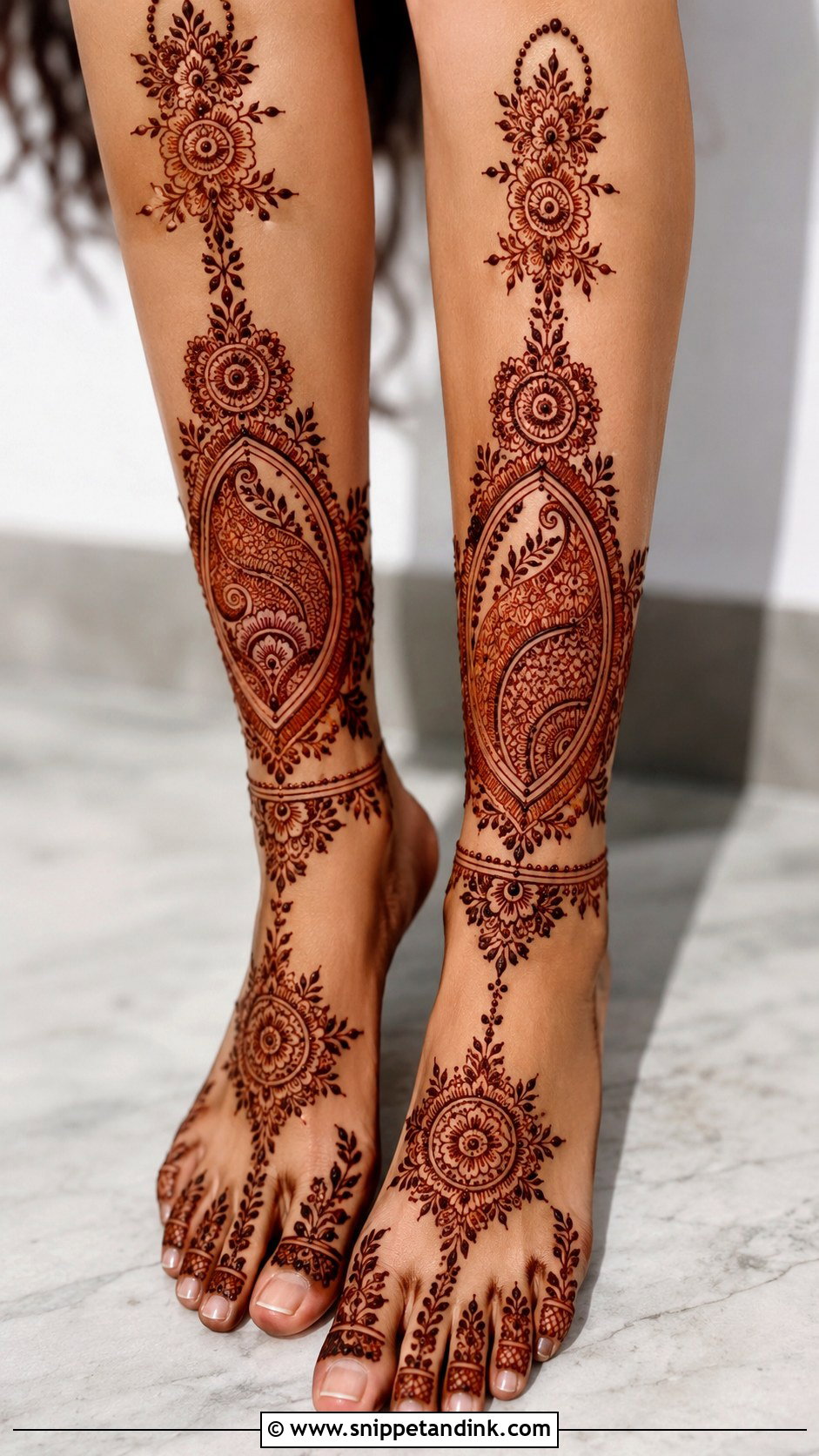
Calf designs carry the pattern past the ankle: a vertical floral trail, a peacock, a paisley panel or a mandala chain on the lower leg. They make sense with shorter lehenga hems or ankle-length outfits that show the calf. The calf section has to connect to the foot and ankle, or it looks like a separate tattoo. Brides can add fillers and layered borders; a lighter version is a single long vine with spaced flowers. Unless it’s full bridal coverage, I keep the calf work narrow, because slim vertical lines look more elegant than a wide band.
28. Rajasthani Legs Mehndi Design
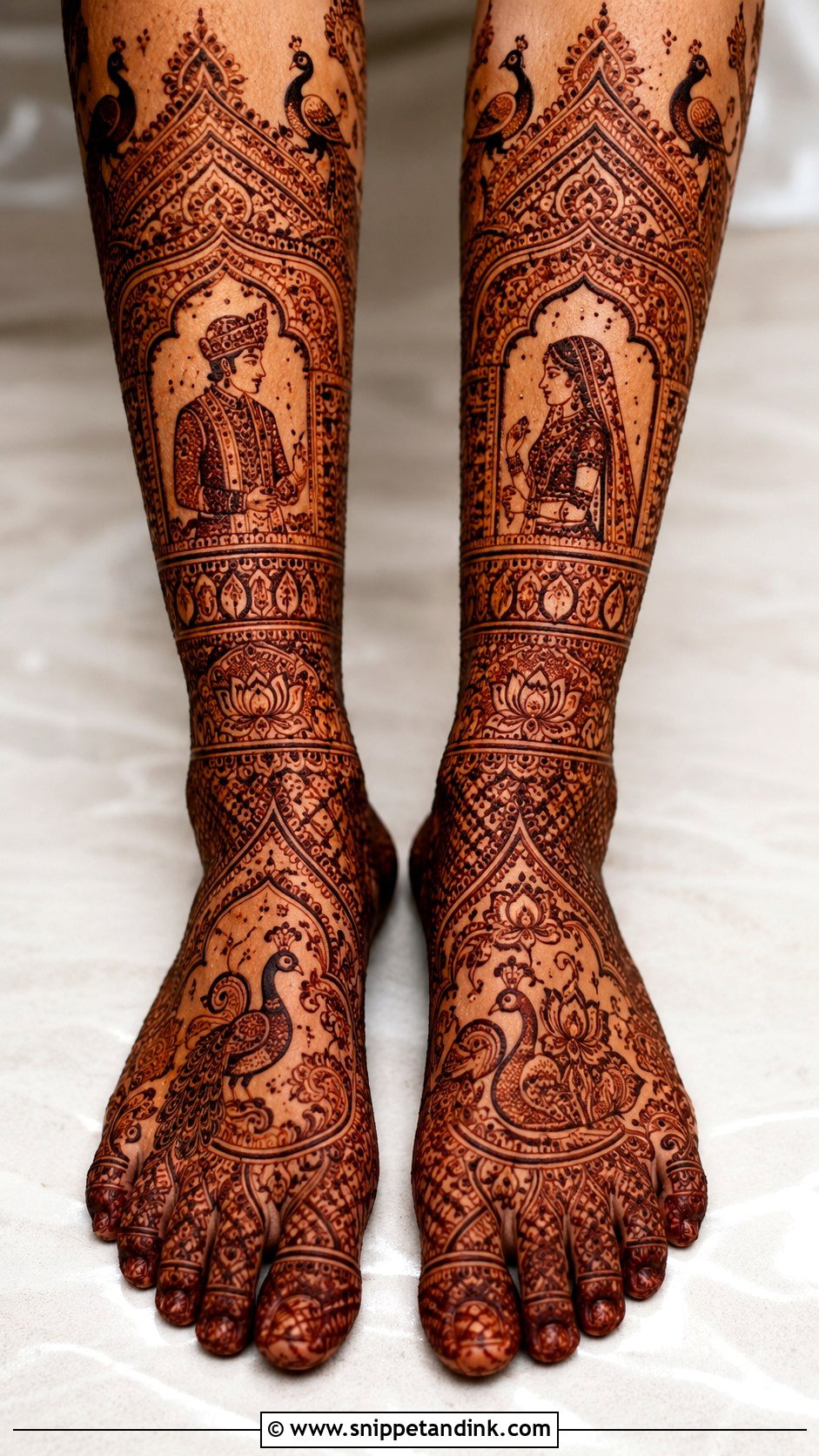
Rajasthani designs are the densest traditional work I do: bride and groom figures, peacocks, paisleys, lotus motifs, fine lines and filled sections, symmetrical on the feet with decorative panels up the ankles and lower legs. It suits brides who want cultural depth and a regal feel with embroidered outfits and heavy jewelry. It also takes the longest, so book it as a planned session, never a quick slot. The two legs have to mirror each other closely, which I check after every major motif rather than at the end.
29. Pakistani Legs Mehndi Design
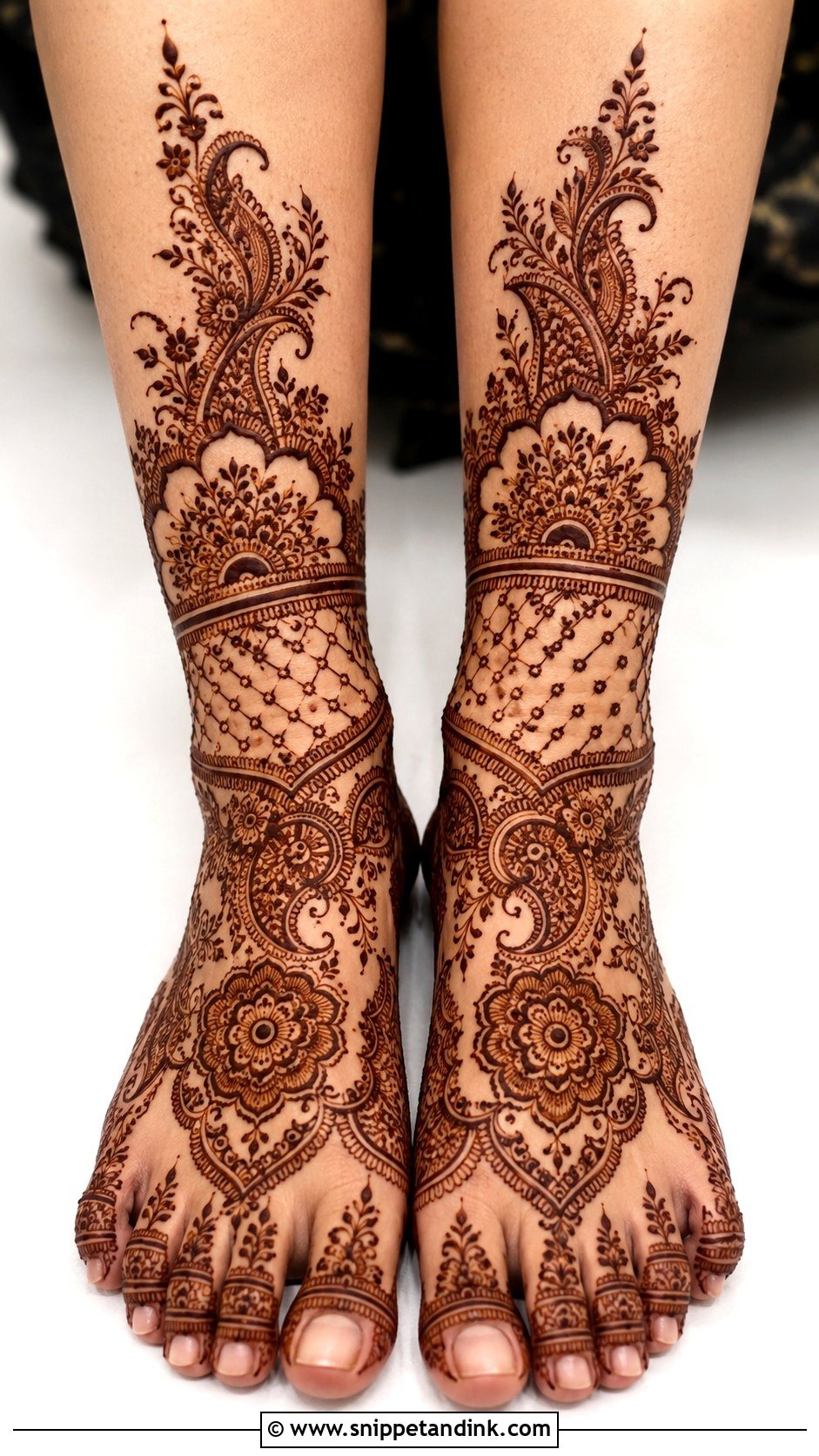
Pakistani leg designs mix fine traditional work with open space: bold floral sections, delicate jaali, paisleys, mandalas and bracelet-style ankle bands. A typical layout starts with decorated toes, moves into a floral foot pattern and ends with an ankle cuff or short lower-leg trail. It can be heavy for a bride or lighter for Eid and family events. That balance of detail and bare skin is what lets it sit well under ghararas, shararas and lehengas where the feet and ankles are always on show.
30. Engagement Legs Mehndi Design
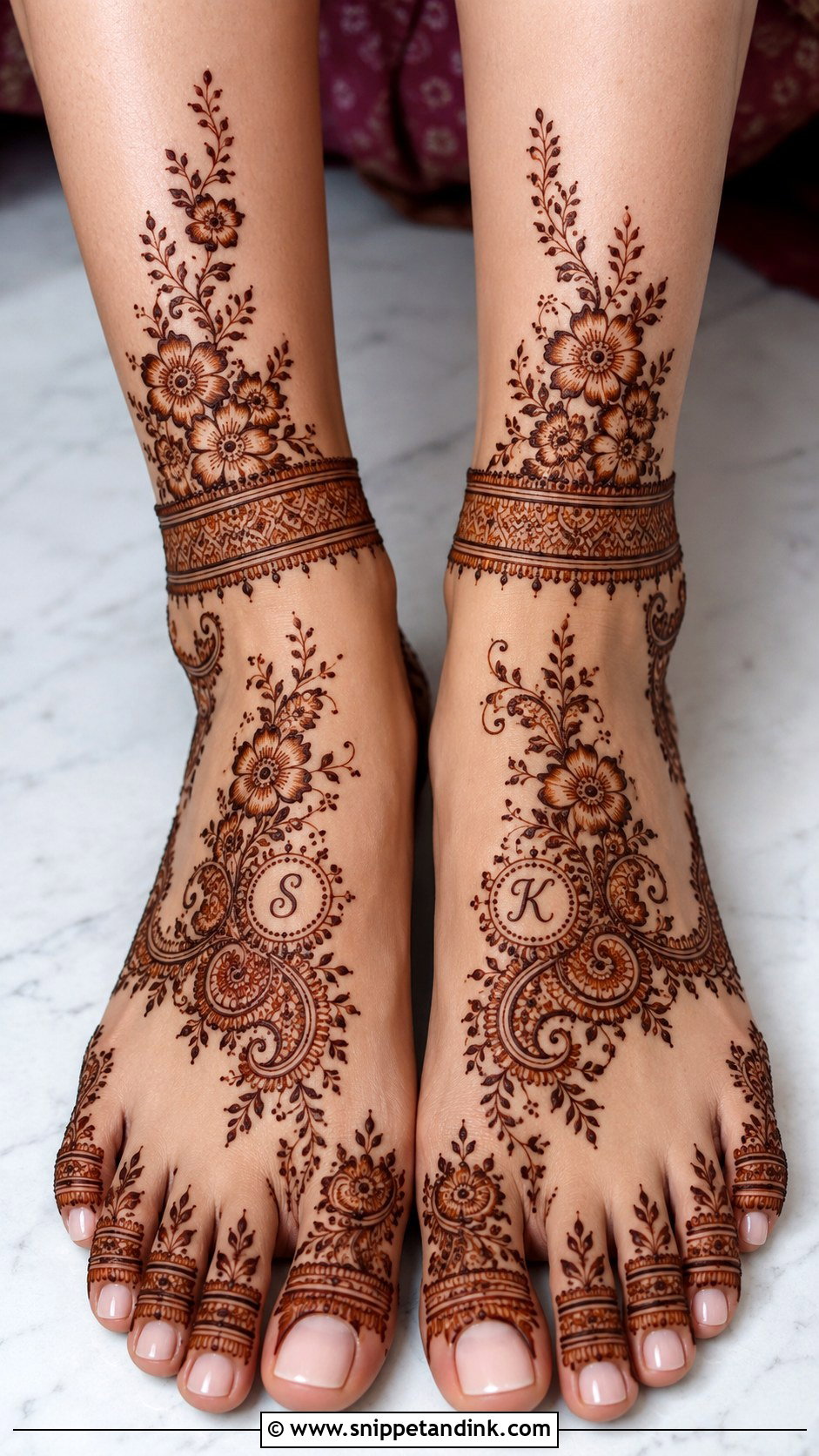
Engagement designs should be a step down from the wedding: floral feet, slim anklet bands, small paisleys and delicate vines rising just above the ankle. Some brides-to-be add initials or a tiny ring motif. I keep the top of the foot neat and centred so it looks right in engagement heels or traditional sandals. Medium coverage with clear outlines is enough. If the wedding is close, a lighter engagement design also means the old stain has faded before the bridal henna goes on.
31. Eid Legs Mehndi Design
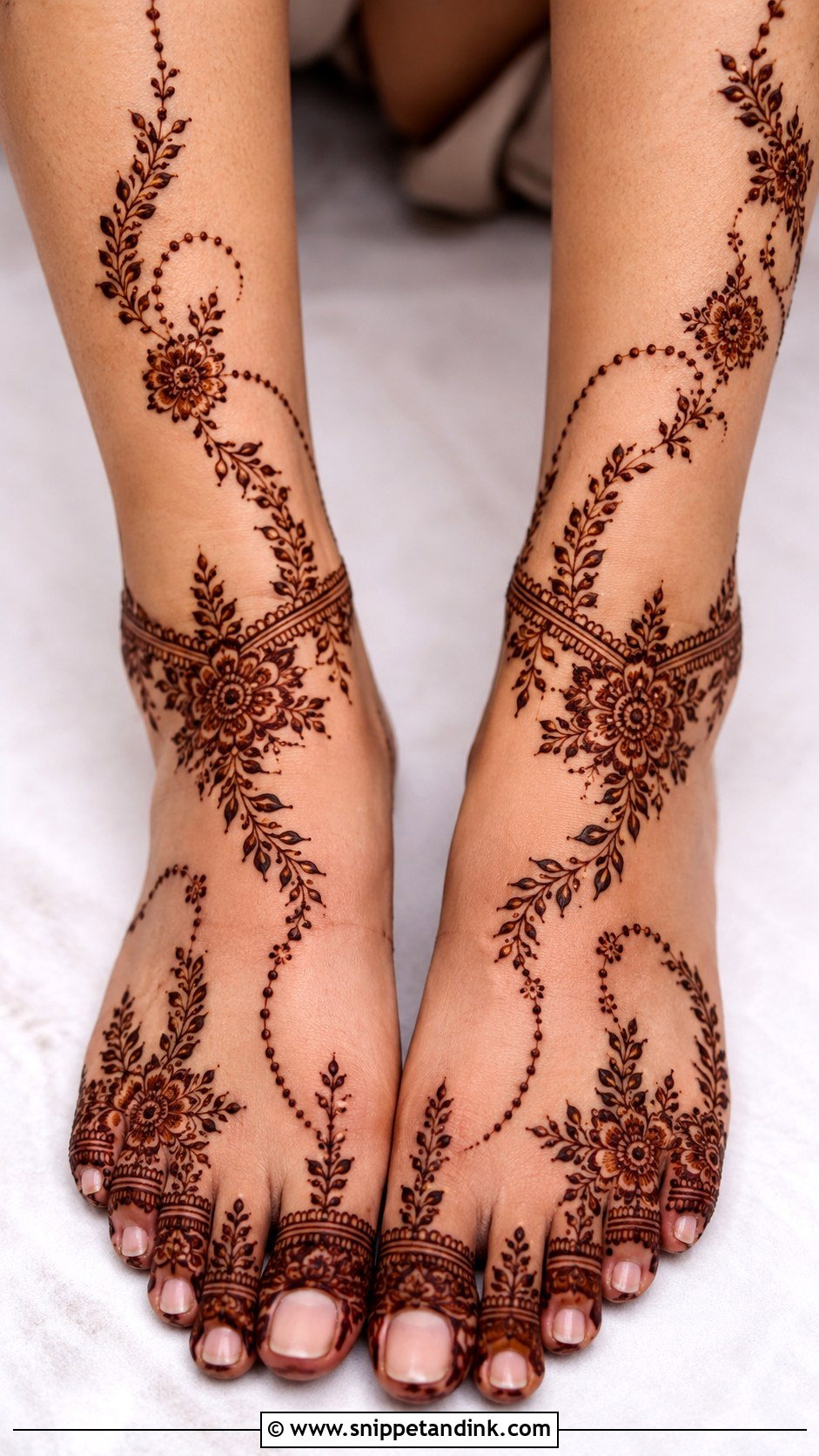
Eid footwear decides this one. Sandals, juttis and dressy flats all cover different parts of the foot, so I focus on the toes, top of the foot and ankle, wherever the shoes leave skin showing. Arabic trails, anklet bands, mandalas and leafy vines fit. A lighter design suits daytime visits; a bolder one suits evening. Eid henna is often done the night before, so a design that’s quick to apply and dries fast is more practical than a heavy one. A reddish-brown stain sits well with bright outfits and metallic shoes.
32. Karwa Chauth Legs Mehndi Design
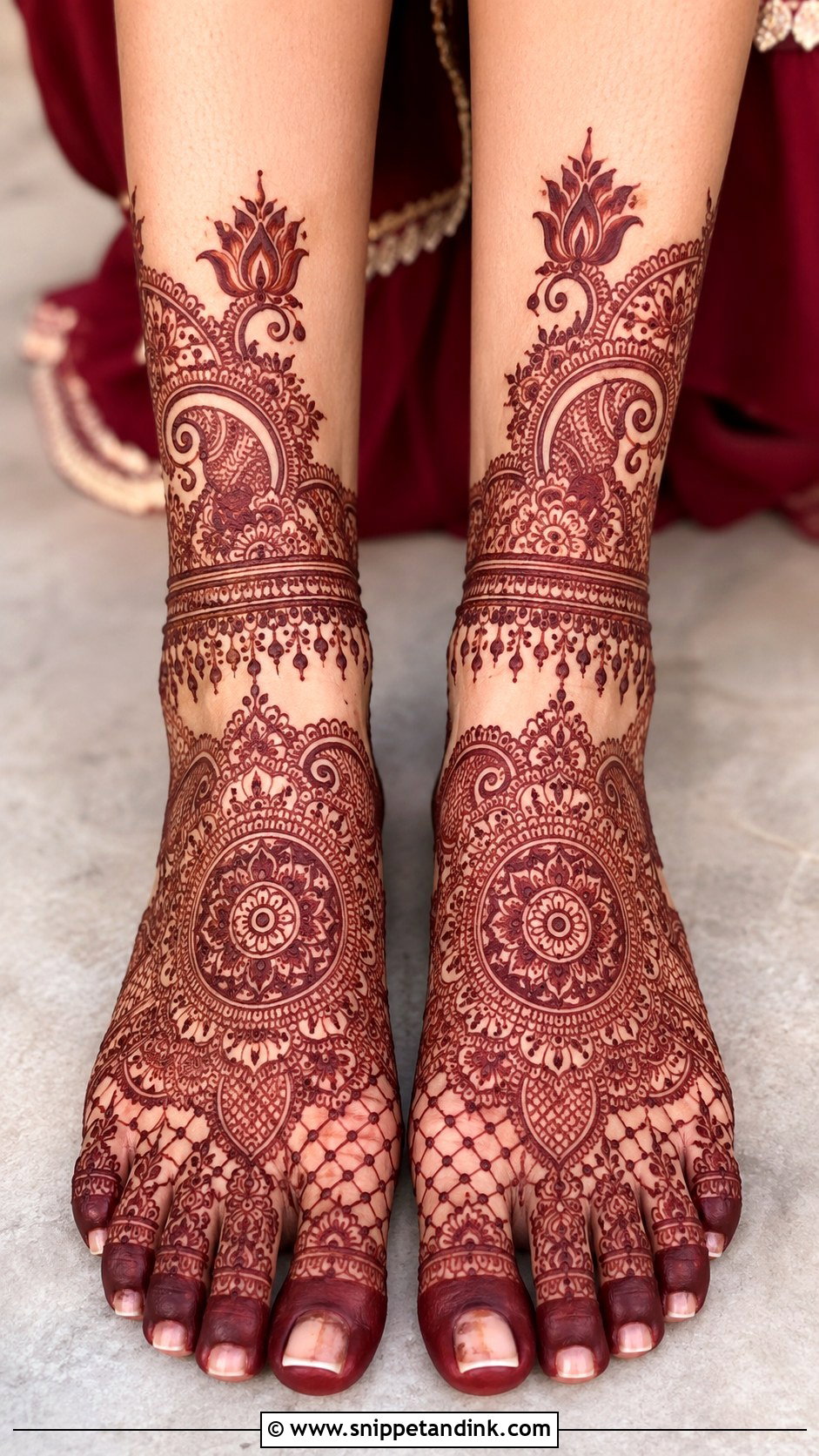
Karwa Chauth legs mehndi design leans traditional: filled toes, a central mandala on the foot, paisley borders and an anklet band. Married women often go richer with lotus, jaali and small decorative chains, to sit with sarees, lehengas and festive anklets. Medium to heavy coverage suits the occasion. For a shorter sitting, a bold foot mandala and a clean vine to the ankle still look festive. Since the fast day is busy, I suggest applying the henna a day or two earlier so the colour is fully developed in time.
33. Diwali Legs Mehndi Design
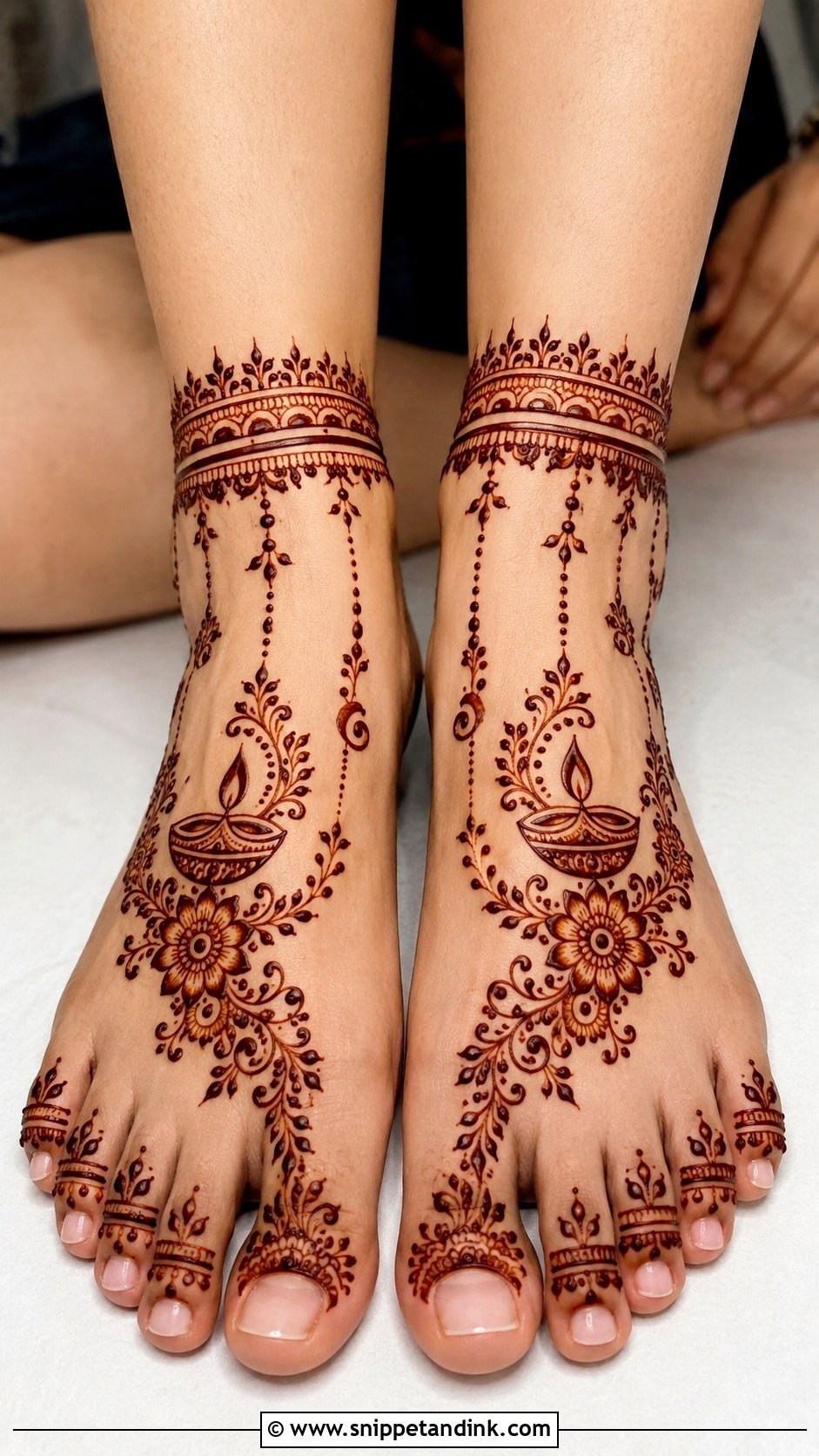
Diwali outfits are often bright and heavily worked, so the henna shouldn’t compete. Floral feet, diya-inspired shapes, dotted chains and jewelry-style ankle bands at medium coverage hold their own without clashing. Mandalas read traditional; Arabic vines read softer. Toe detailing finishes it, especially in open footwear. Think about the days around it too: with cleaning, cooking and puja preparations, hands and feet spend a lot of time in water, which fades the stain faster than usual.
34. Kids Legs Mehndi Design
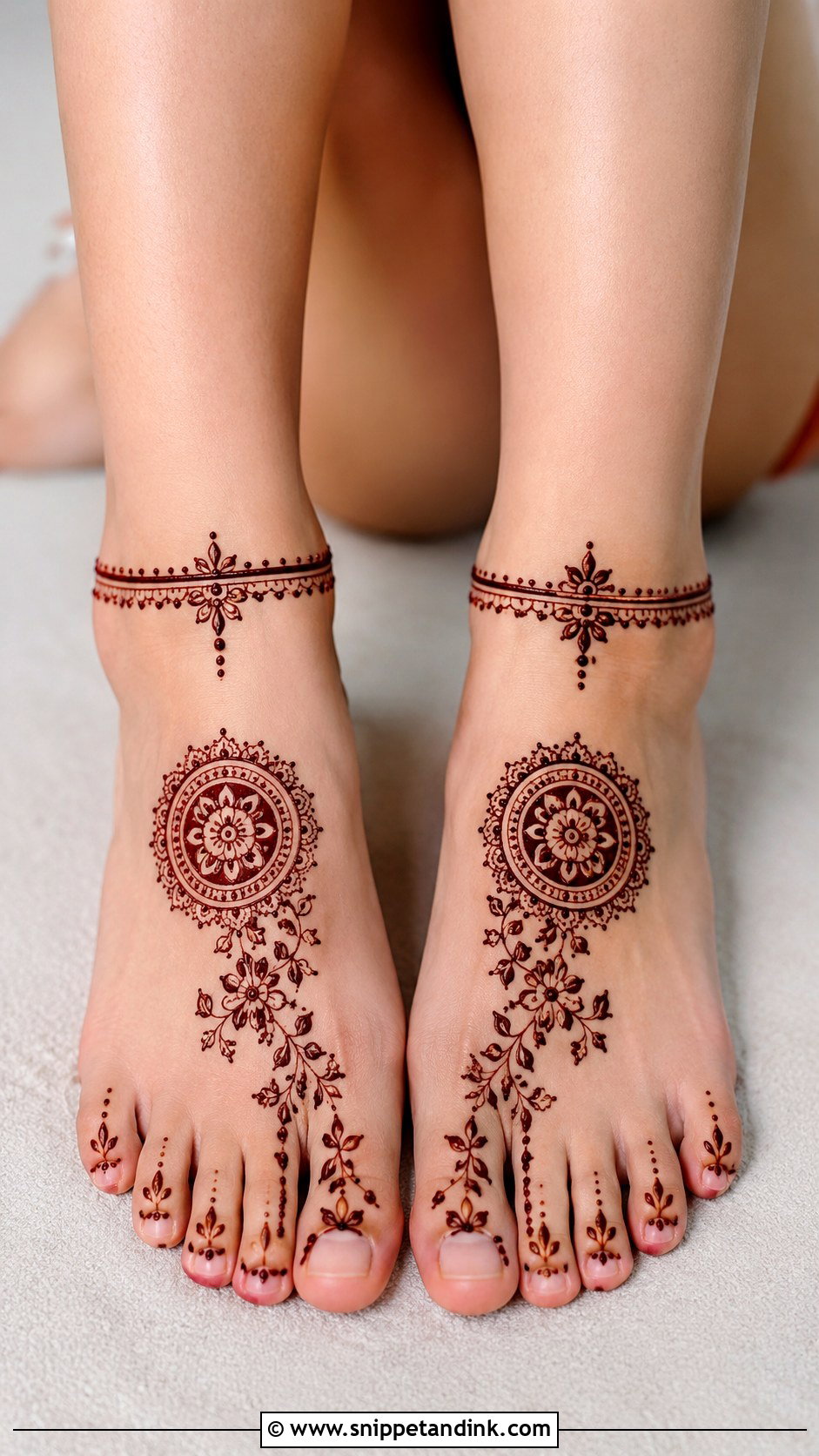
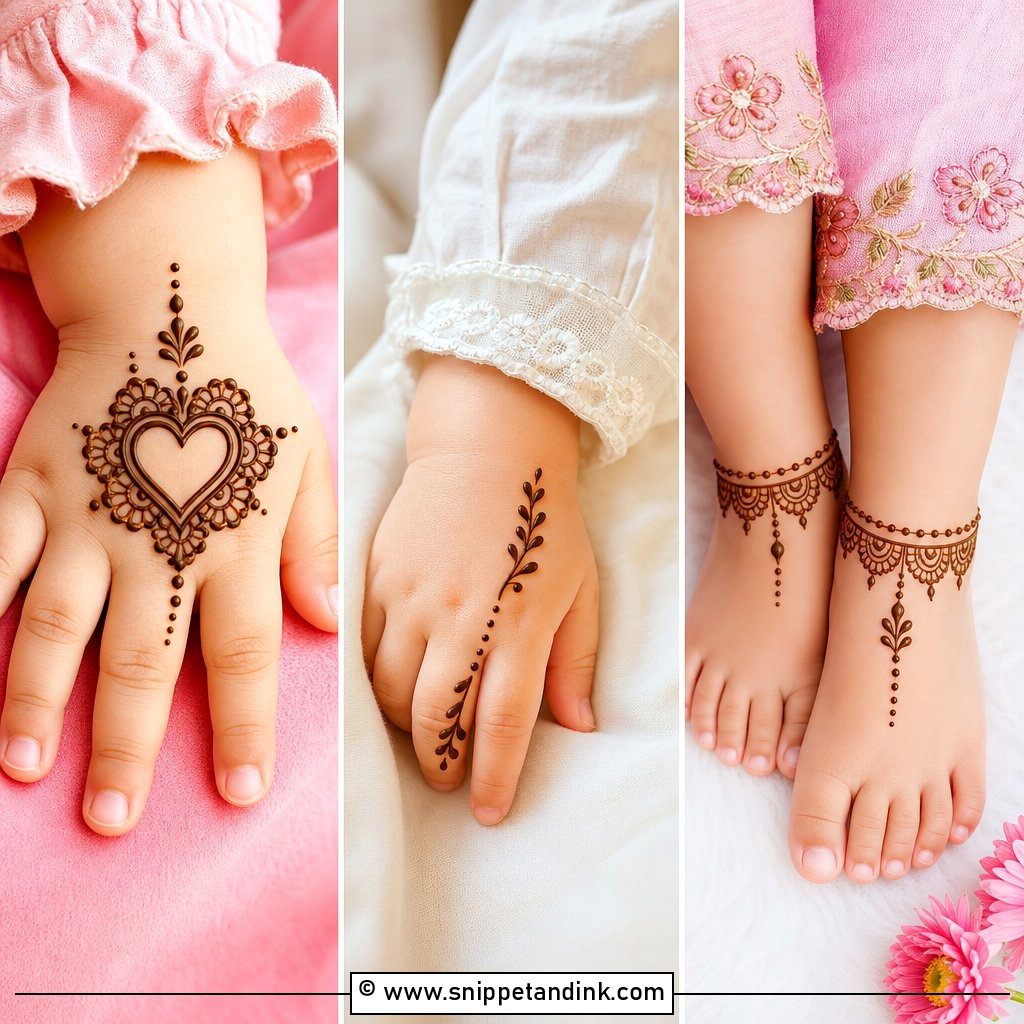
For children, small and quick is everything. A few tiny flowers on the feet, dotted toe lines and a small anklet band, or hearts, leaves and a simple mandala. I avoid lower-leg coverage on kids, because wet paste on a moving child ends up on the sofa. Use natural henna only, never anything sold as black henna, and keep the design light enough to fade comfortably over the following days of school and play.
35. White Legs Mehndi Design
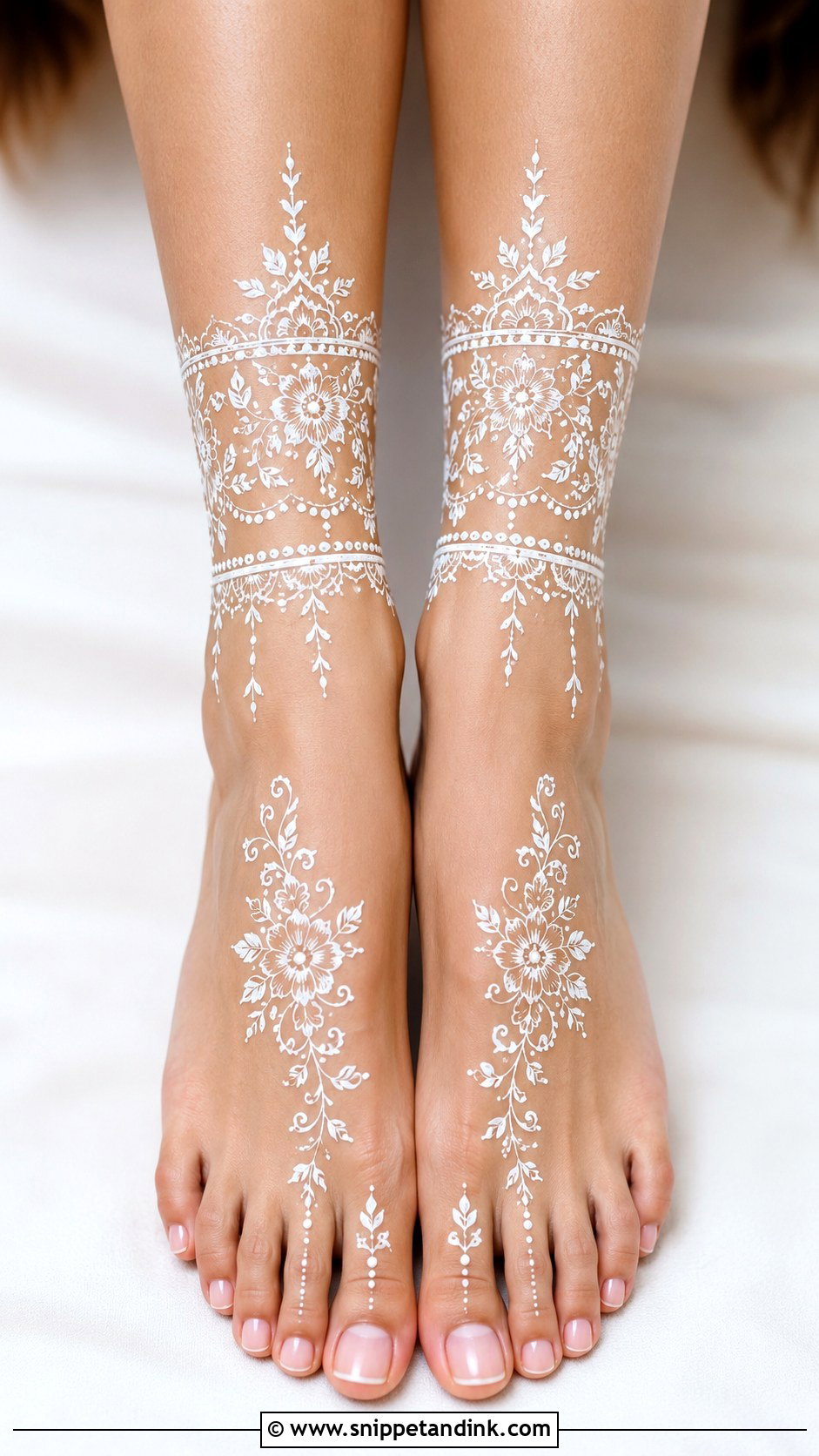
White mehndi isn’t henna at all. It’s a body-safe paint or adhesive that sits on top of the skin and leaves no stain, which is why it suits beach ceremonies, modern bridal shoots and fashion-led looks. Lace-like ankle bands, floral foot patterns and soft vines up the lower leg are typical, and it shows up strongly on deeper skin tones and with pastel or jewel-toned outfits. It’s for photos and short wear only: it rubs off with friction and water, so I keep the lines slightly bolder than usual. Ask for a patch test if your skin reacts to adhesives.
Orange on Day One? Here’s What Happens Next
Every first-timer panics when the paste comes off. Fresh henna stain is bright orange, almost neon, and it looks nothing like the pictures. That’s how natural henna works. Over the next day or two, the colour oxidises and darkens to reddish brown or maroon. Judge the stain on day two, not the first morning.
When it stays pale or goes patchy
If the colour never deepens, the usual culprits are paste removed too early, water on the skin within the first few hours, or lotion and oil on the legs before application. Cold matters too: feet left uncovered in an air-conditioned room overnight stain lighter than feet kept warm in socks. Patchiness on the soles or the sides of the toes is almost always friction from walking, not a fault in the paste.
I’m always honest about the calf. The skin there is thinner than on the foot, so it nearly always stains a shade lighter. If you want even colour all the way up, a lighter design on the foot and a bolder outline on the calf can balance it out. And if anything itches, burns or blisters, wash the paste off right away and stop. Pure henna rarely causes that, but added chemicals can.
Start From Your Hemline and Your Shoes
Between simple foot henna and full bridal legs there’s a design for every occasion here. Indian, Rajasthani, Pakistani, paisley and peacock work lean traditional; Arabic, Gulf, side-leg, anklet and minimal designs are lighter to wear. Weddings suit heavier coverage, while Eid, Diwali and casual events usually call for medium or simple patterns. Work back from your outfit hem and your shoes, then decide how long you can sit. A design that’s balanced across the feet, ankles and lower legs will always look better than one that’s simply bigger.
You'll Like These Ideas:



Leave a Reply