
A round motif is the first thing I teach and the last thing I stop practising. It gives a hand a centre of gravity, so a palm or back hand can look finished with surprisingly little coverage. I draw circles for Eid, Diwali, weddings, school functions and plenty of simple at-home henna days, and the same rule holds every time: if the circle is off, nothing around it can rescue the design. Below you’ll find bold minimal circles, finely filled Indian mandalas and Arabic layouts where the circle is just the start of a vine, with notes on what each one asks of the hand and the cone.
Centring a Mandala When No Hand Is Actually Round
Hands aren’t flat discs, so a circle drawn without landmarks almost always drifts toward the thumb. Before I open a cone, I ask the client to rest the hand flat and relaxed on a cushion, then I find the centre by eye using the knuckles and the wrist, not the edges of the hand.
- Back hand: I put the first dot over the tendon gap between the middle and ring finger knuckles, roughly two finger widths above the wrist bone. That area stays flat when the hand makes a fist.
- Palm: the visual centre sits a little lower than the measured centre, because the thumb mound makes the upper palm look busier.
- Size: a back-hand circle wider than the knuckle row starts to wrap around the side of the hand and look oval in photos.
- Both hands: I draw the centre dots on both hands before drawing a single ring, so the pair matches when you hold them together.
Then the circle grows ring by ring. I rotate the hand as I go instead of twisting my own wrist; keeping the cone at the same angle is what keeps the line even. If a ring goes slightly flat on one side, I correct it with the next ring rather than wiping, because wiping wet henna leaves a faint orange smudge you’ll see later.
1. Simple Circle Mehndi Design For Back Hand
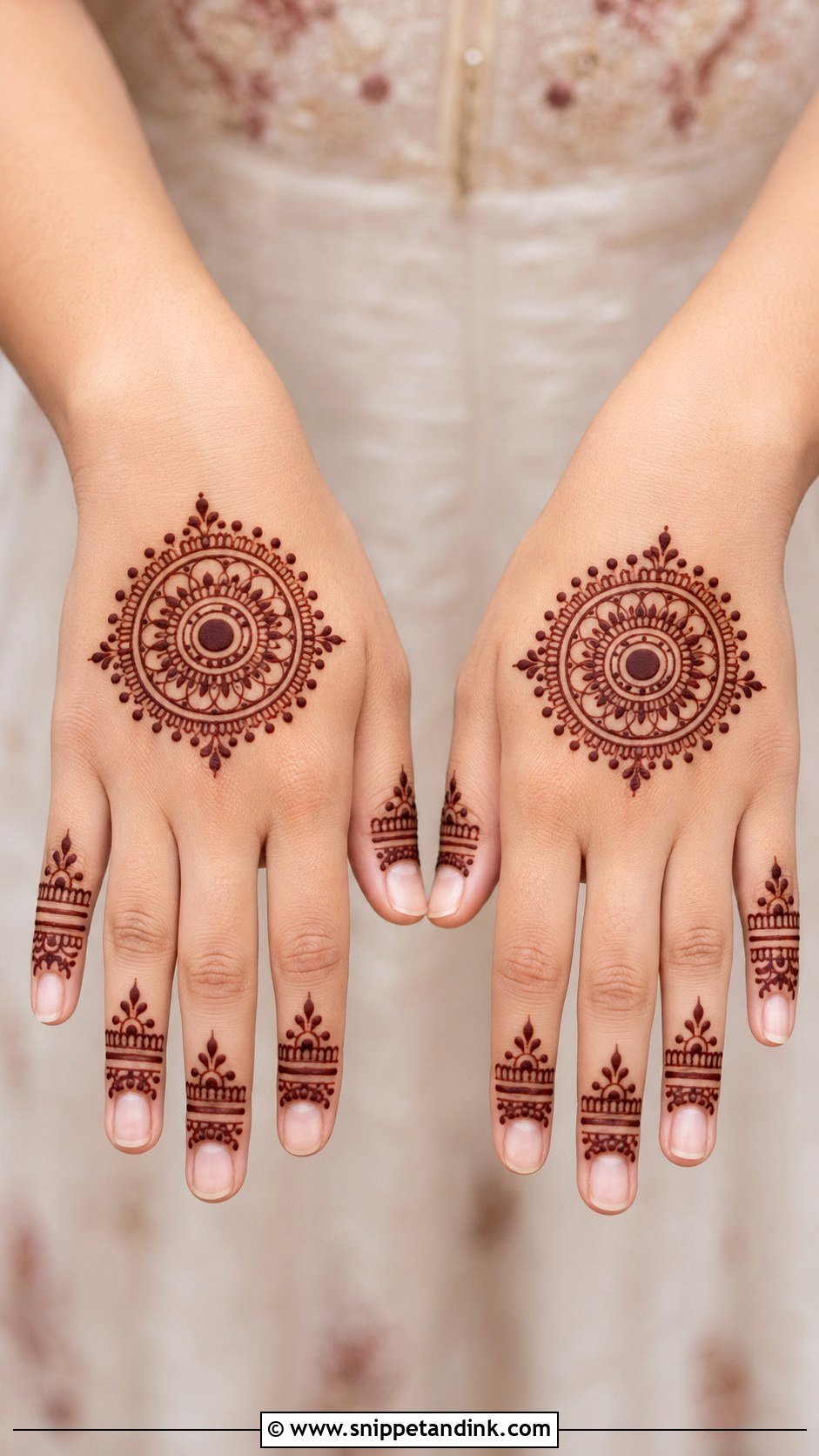
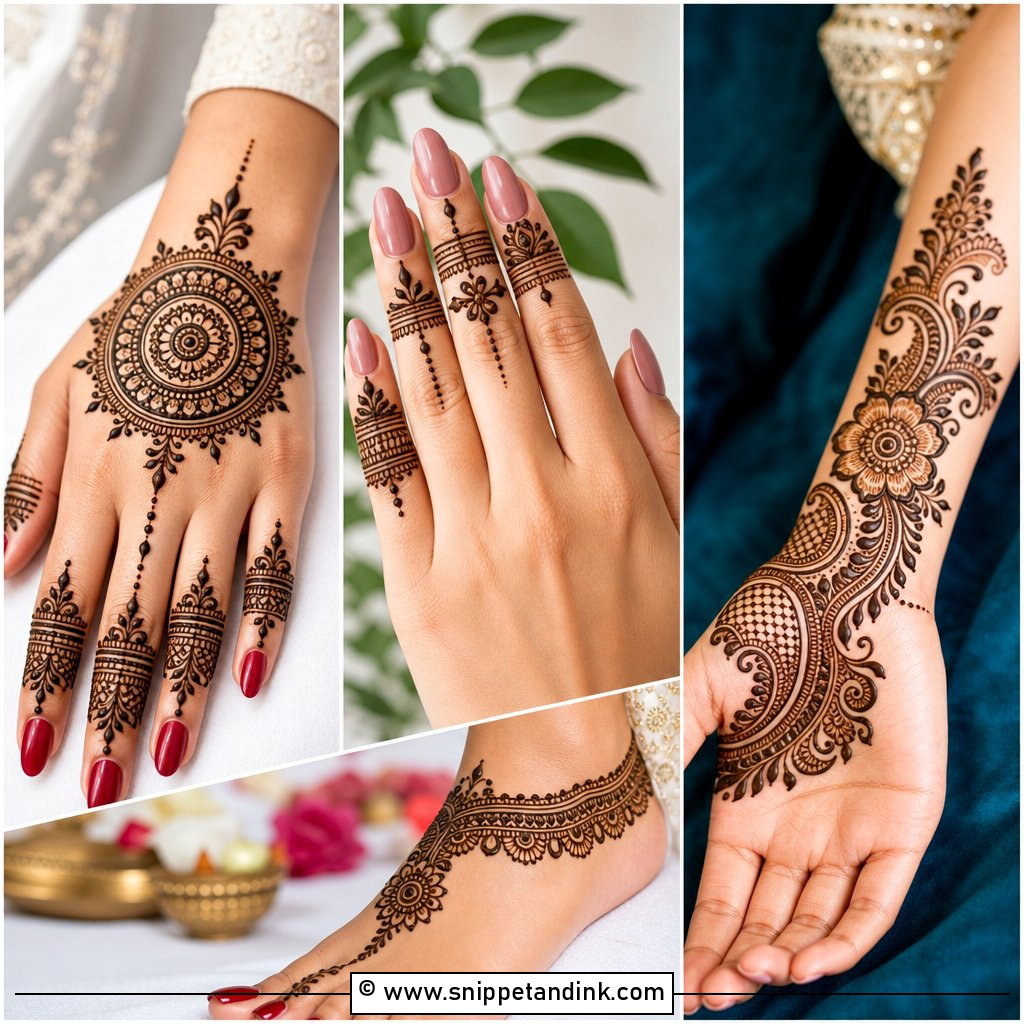
On the back hand I place the centre dot over the gap between the middle and ring finger knuckles, about two finger widths above the wrist bone, then build outward with small dots and thin borders. That spot stays flat when the fist closes, so the ring doesn’t warp. Fingers get light bands or leafy tips. It’s the layout I give nervous first-timers, because the circle does the planning for you; just leave a clear margin around it rather than filling every gap.
2. Front Hand Circle Mehndi Design
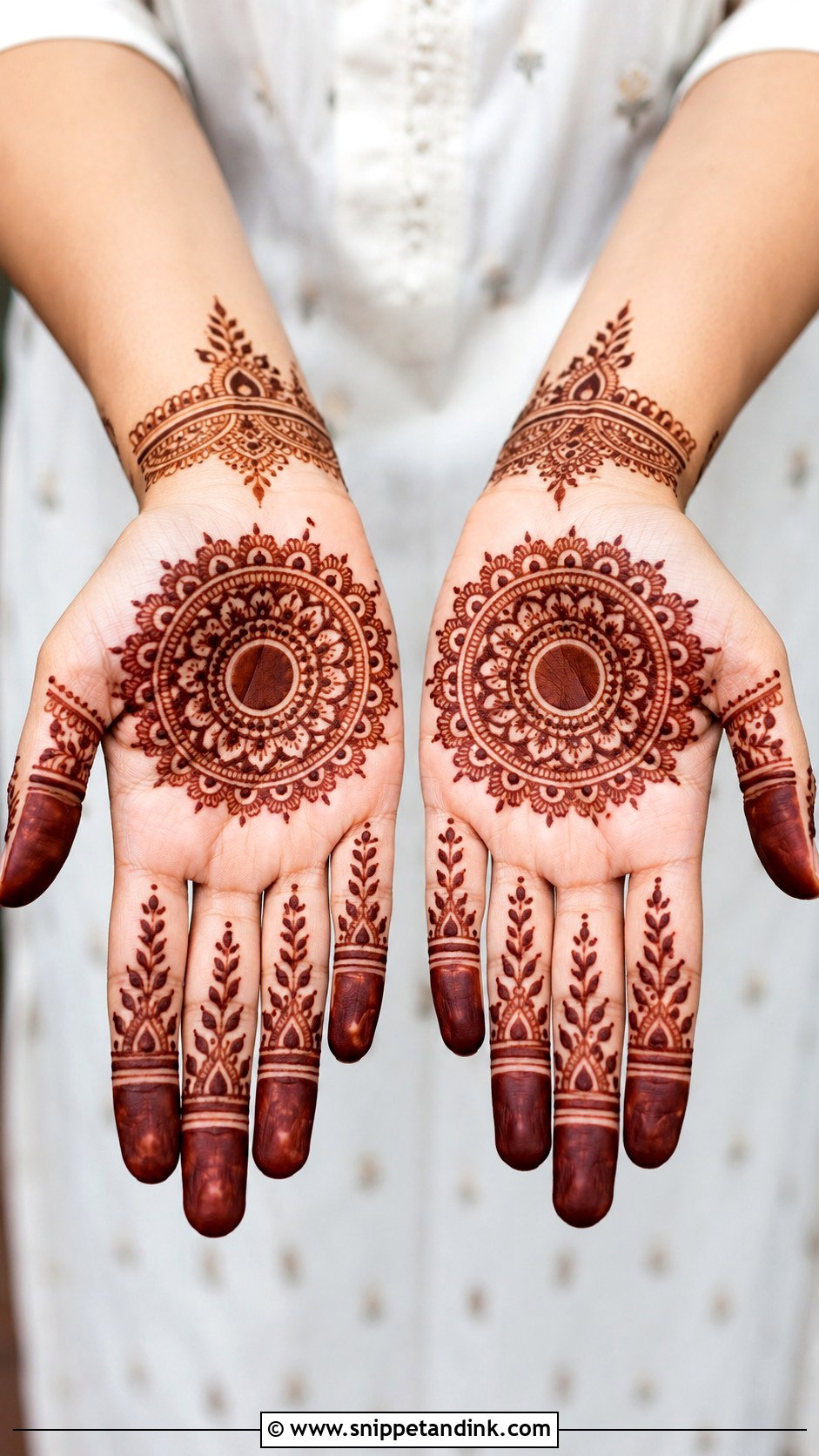
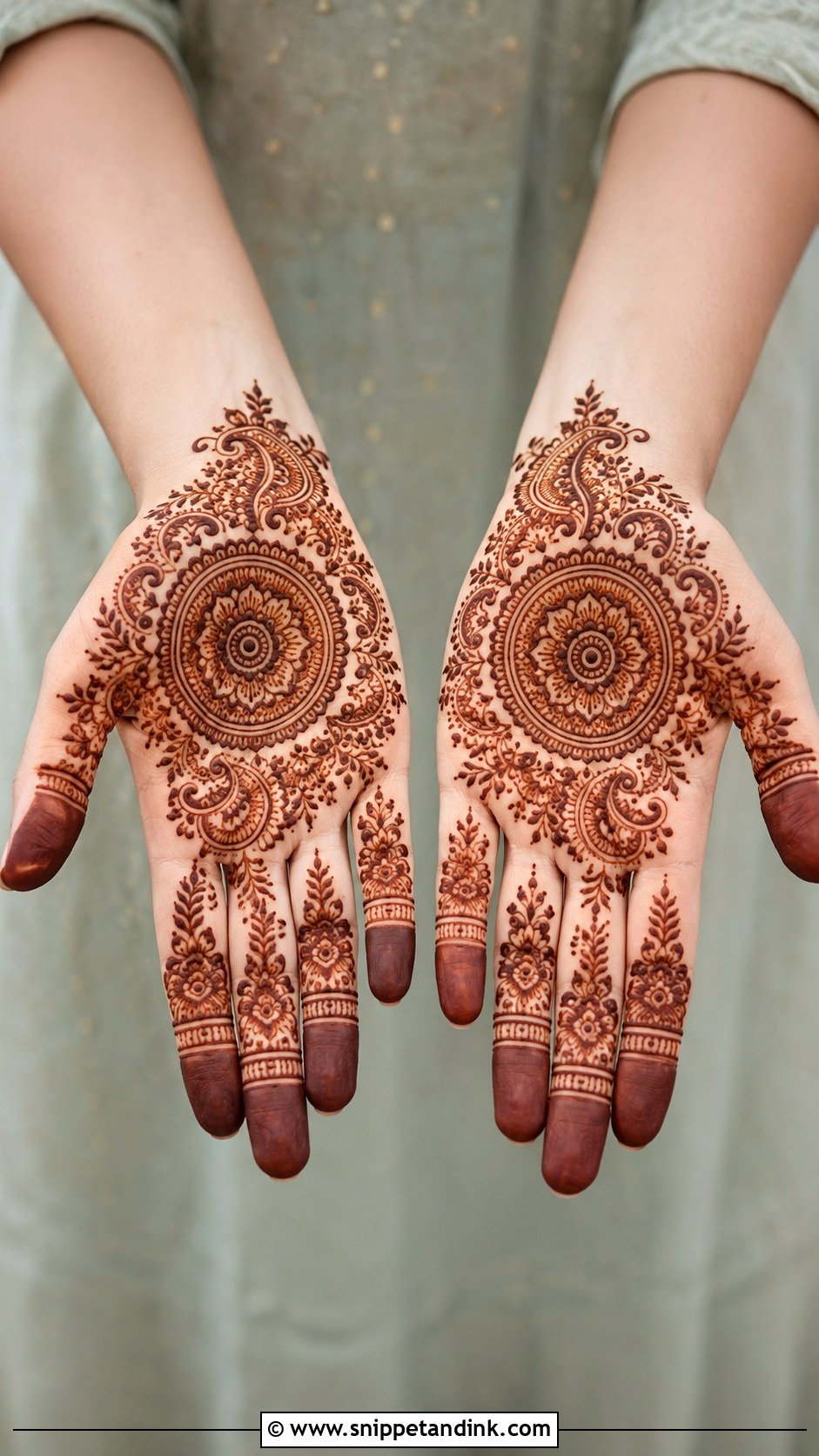
The palm can carry a bigger, busier circle than the back hand because there’s more flat skin in the hollow. I start the centre slightly below the true middle of the palm, since the lifeline crease pulls the eye upward once the hand is relaxed. From there it’s petals, scalloped borders and fine Indian lines, with the option of a bracelet band toward the wrist. Palm skin also stains darker than anywhere else, which is why this placement is the classic choice for pujas and family rituals.
3. Arabic Circle Mehndi Design
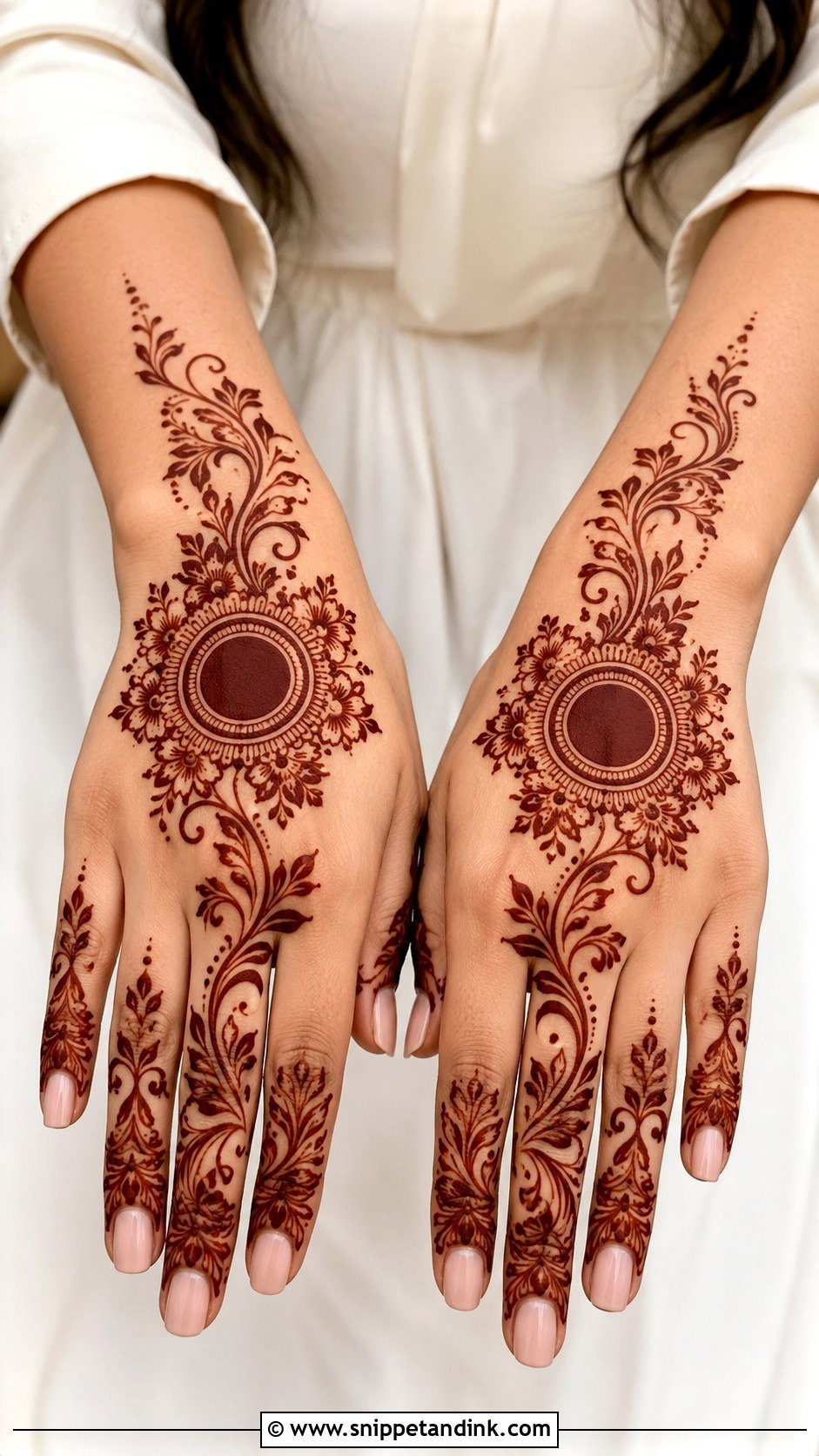
Arabic layouts treat the circle as a starting point rather than the whole story. A bold round motif sits on the back hand or palm, then a diagonal trail of vines, paisleys and half flowers runs toward the index or middle finger. I outline with a slightly thicker tip here and leave real gaps of bare skin, because negative space is what makes Arabic work read from across a room. If you love density, this one will feel unfinished to you; if heavy mehndi makes you feel gloved, it’s a relief.
4. Indian Circle Mehndi Design
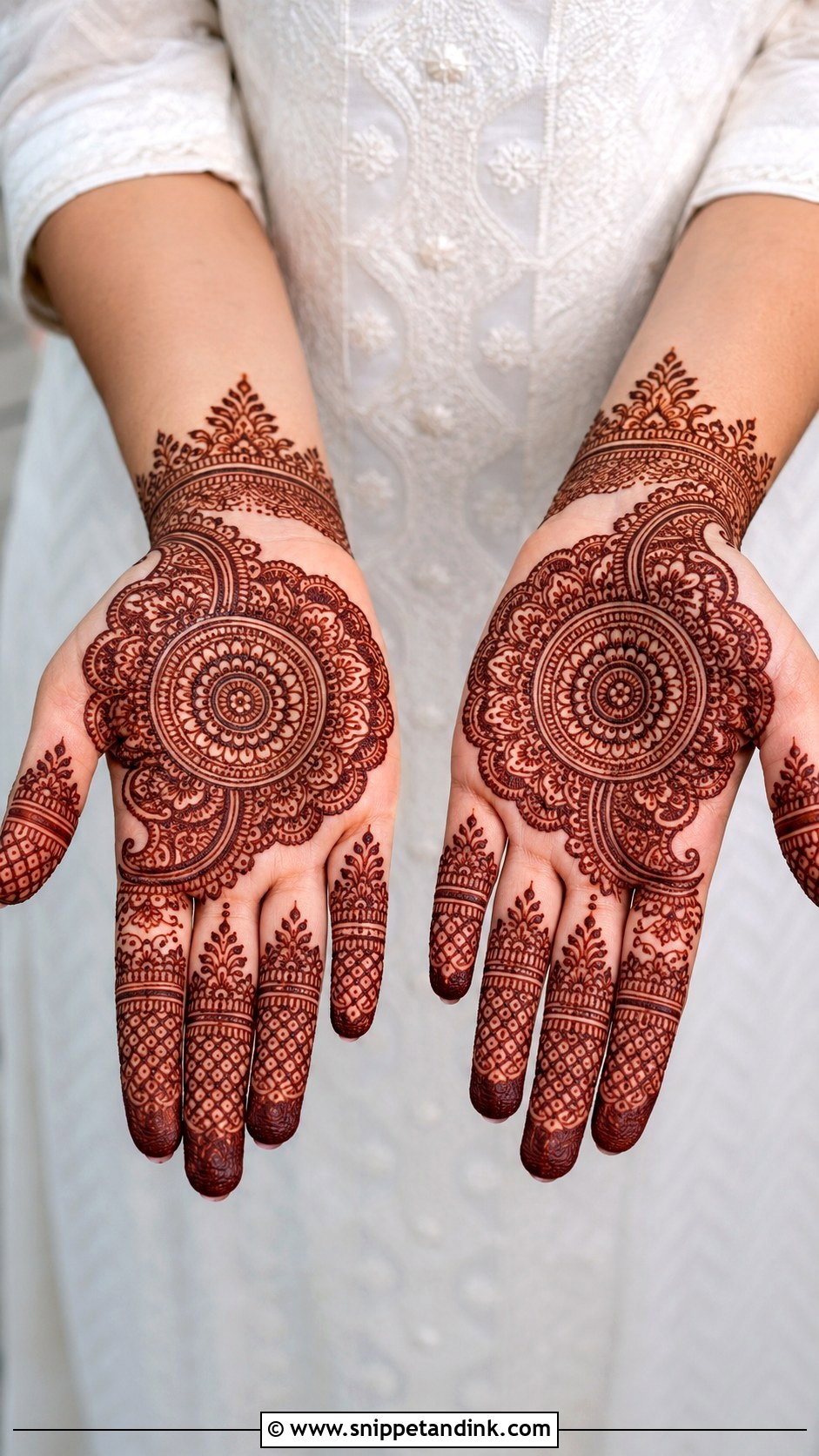
An Indian circle mehndi design lives or dies on spacing. The centre becomes a mandala ringed with petals, checks, tiny leaves and lace borders, and the whole thing can spill onto the wrist for weddings, Karwa Chauth, Teej and Diwali. I sketch the main rings first with a fine tip and only start filling once I’m happy they’re even, because fine checks drawn inside a lopsided ring make the flaw more obvious, not less. Peacock touches and finger bands come last.
5. Floral Circle Mehndi Design
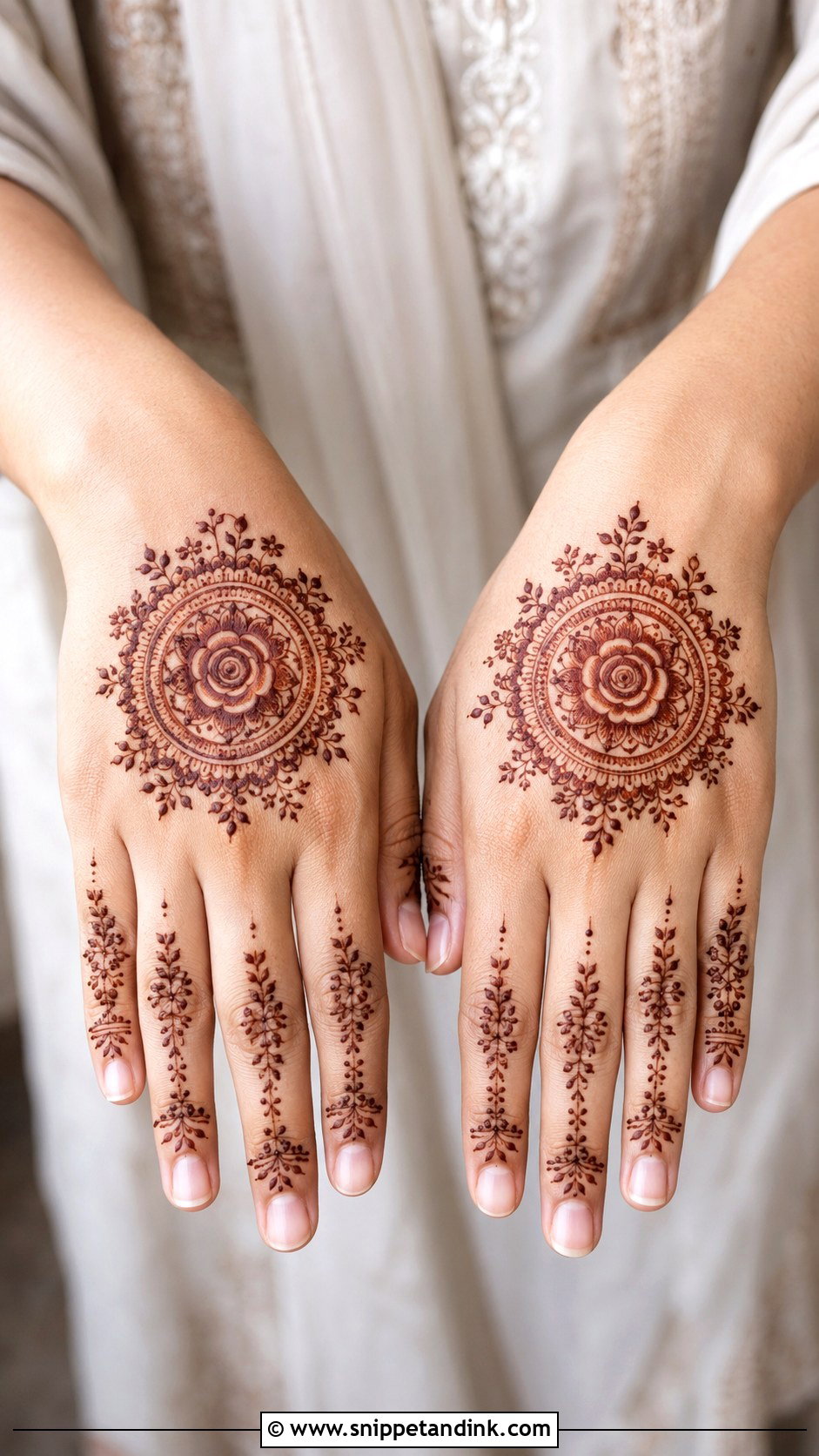
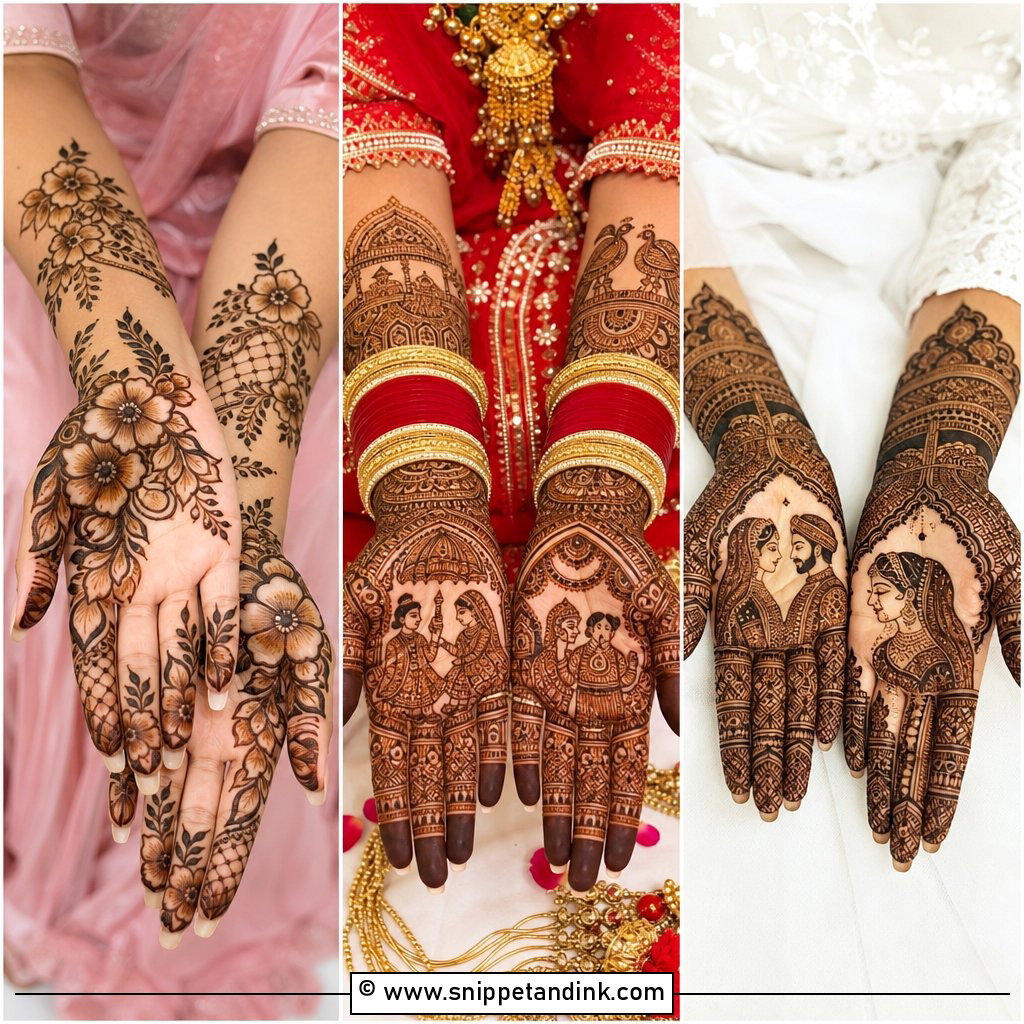
Flowers fit a round layout naturally, since petals already radiate from a centre. One large flower mandala reads clean; several floral rings read festive. The thing I watch is petal size: each ring outward should have slightly larger petals, otherwise the outer edge looks shrunken. Keep fingers to vines and dots, or give them petal bands if you want more. It’s my usual suggestion for engagements, baby showers and daytime events where you’ll be photographed in natural light.
6. Mandala Circle Mehndi Design
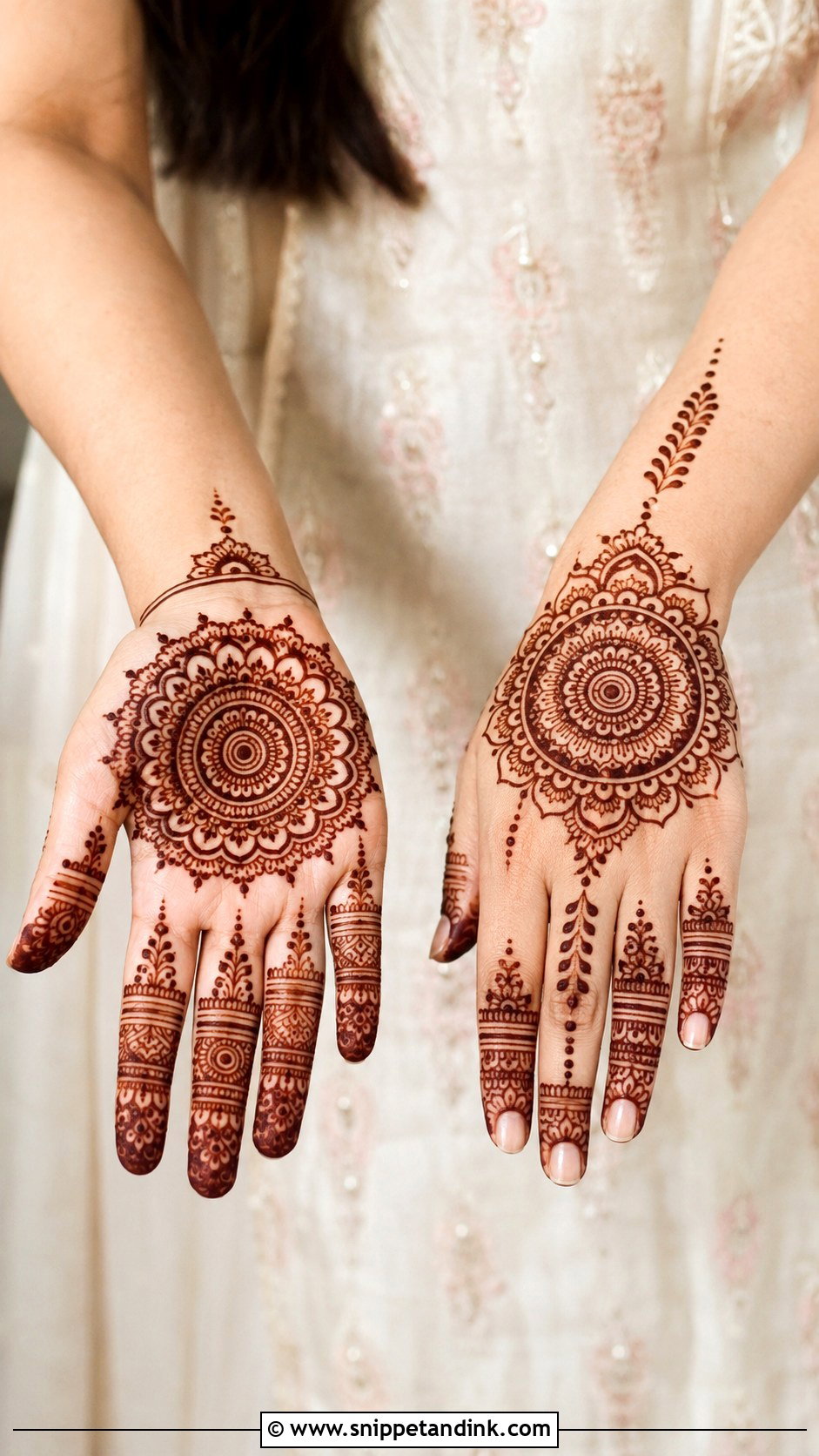
A mandala grows from a single dot through repeated rings of petals, arches and fine lines, and its symmetry is what makes it so calm to look at. On the palm it feels traditional; on the back hand it starts to look like jewellery. My habit is to turn the client’s hand, not my wrist, as I draw each ring, so the cone stays at the same angle all the way round. That one change does more for an even circle than any amount of care with pressure.
7. Bridal Circle Mehndi Design
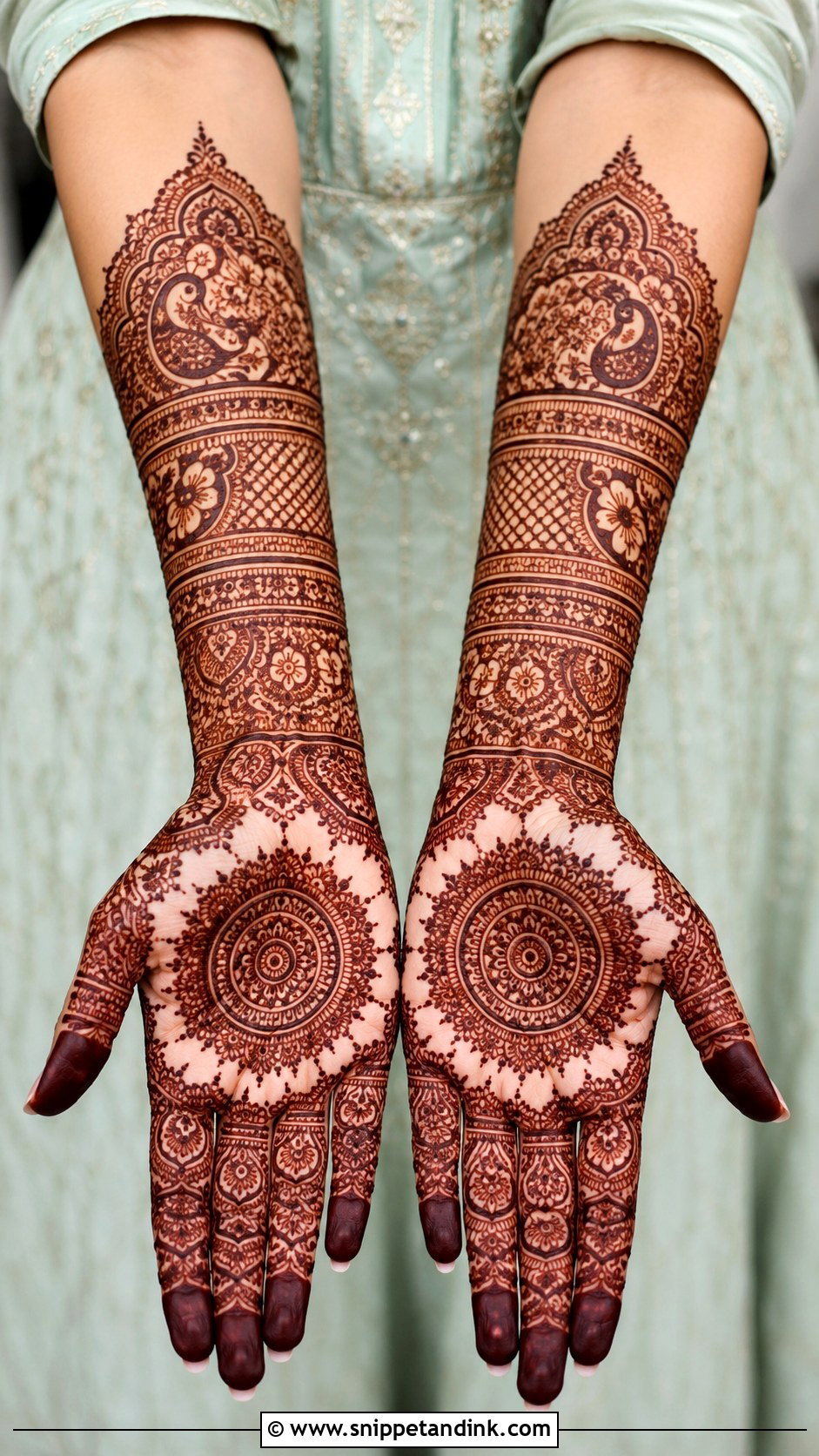
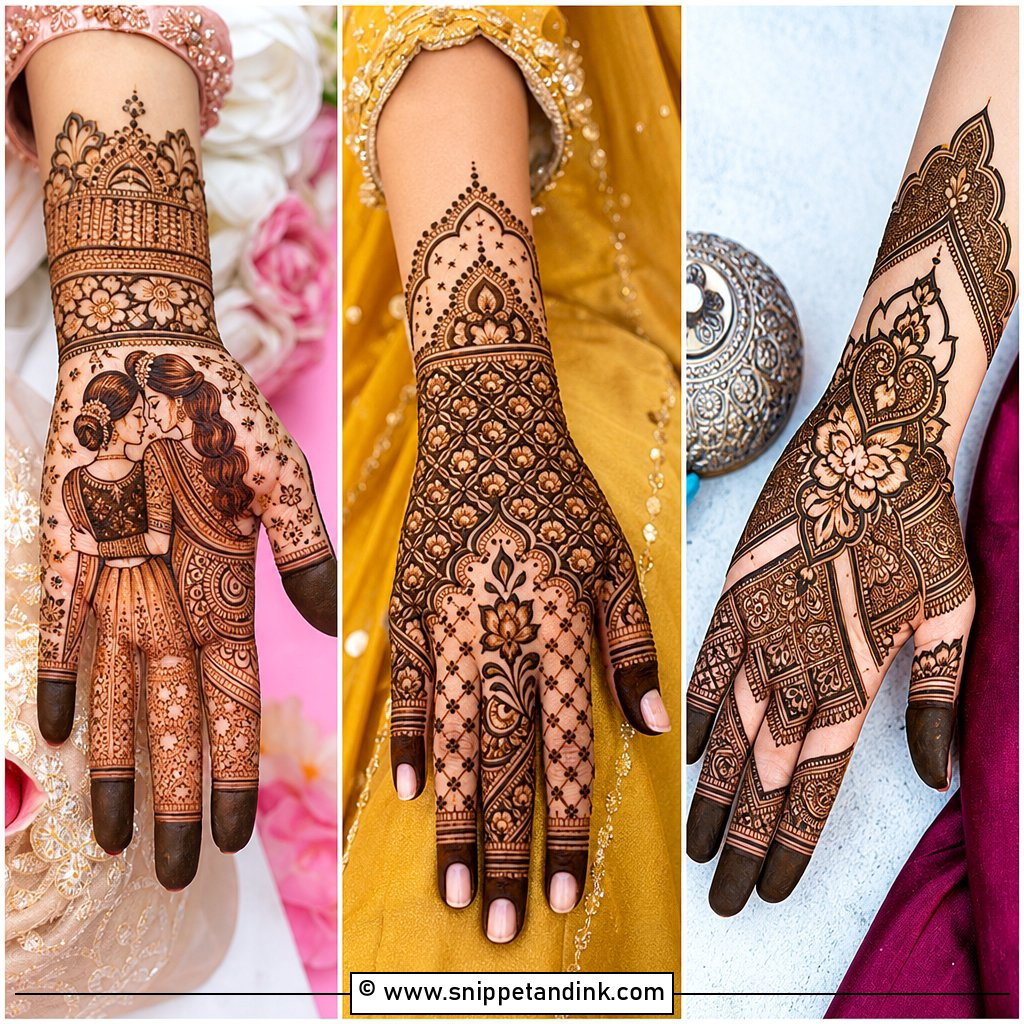
For brides, the mandala becomes the anchor of a much larger map: paisleys, peacocks, jaali mesh, filler, full fingers, cuffs and forearm panels all hang off it. I plan this one on paper first and agree where the circle sits before the cone opens, because moving it later means redrawing everything around it. Couples often ask me to hide initials or small wedding symbols in the outer rings, and those are easiest to tuck into the petal gaps. The round centre also gives the photographer a clear focal point for ring shots.
8. Full Hand Circle Mehndi Design
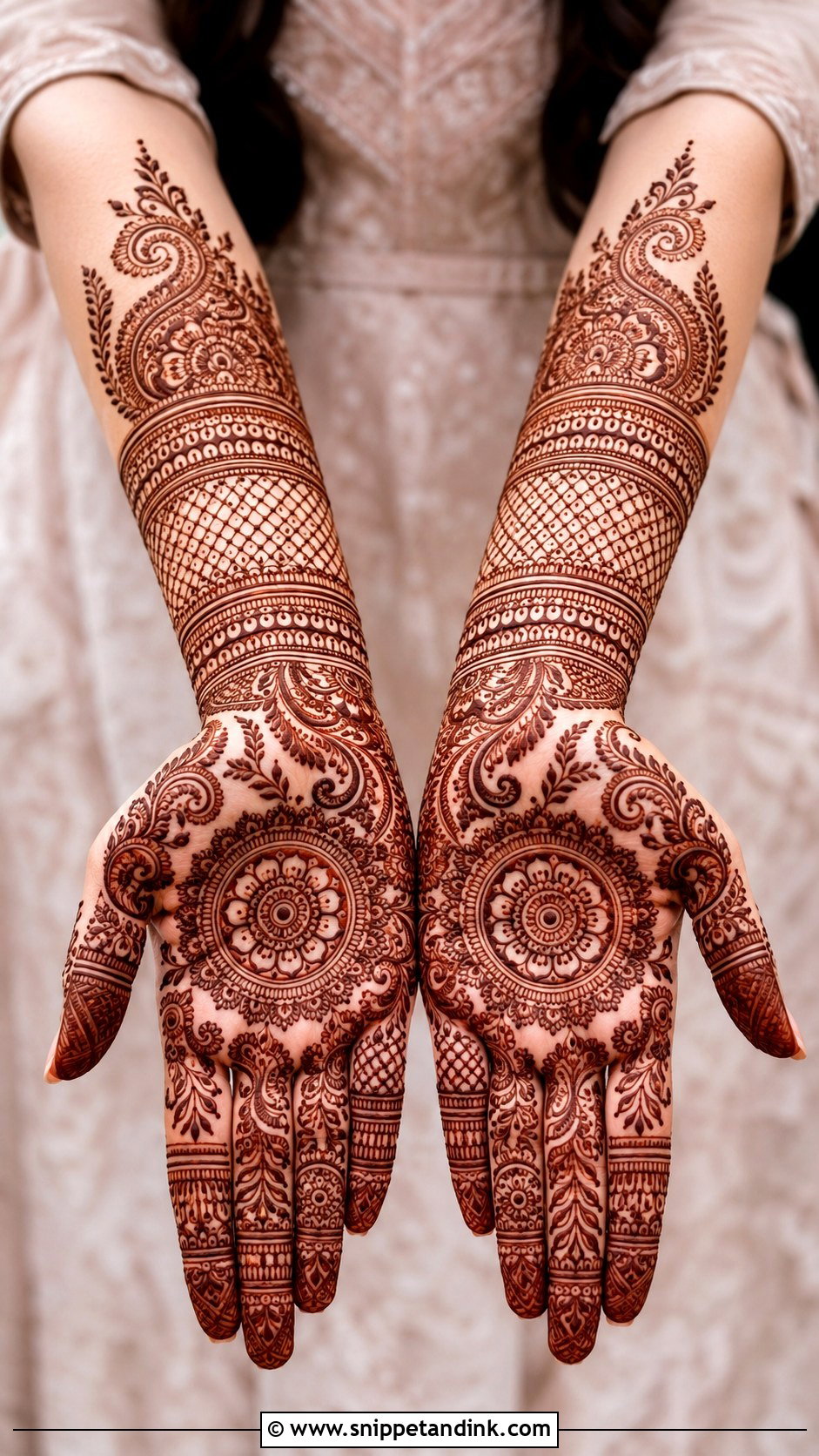
Full-hand coverage uses the circle as the anchor while paisley trails, floral panels, bracelet bands and net patterns travel across fingers, wrist and forearm. The risk is burying the circle under filler. I outline the mandala with a bolder line than anything around it and keep at least one ring of plain skin between it and the busier panels, so it still reads as the centre when the hand is fully covered for a wedding or sangeet.
9. Half Hand Circle Mehndi Design
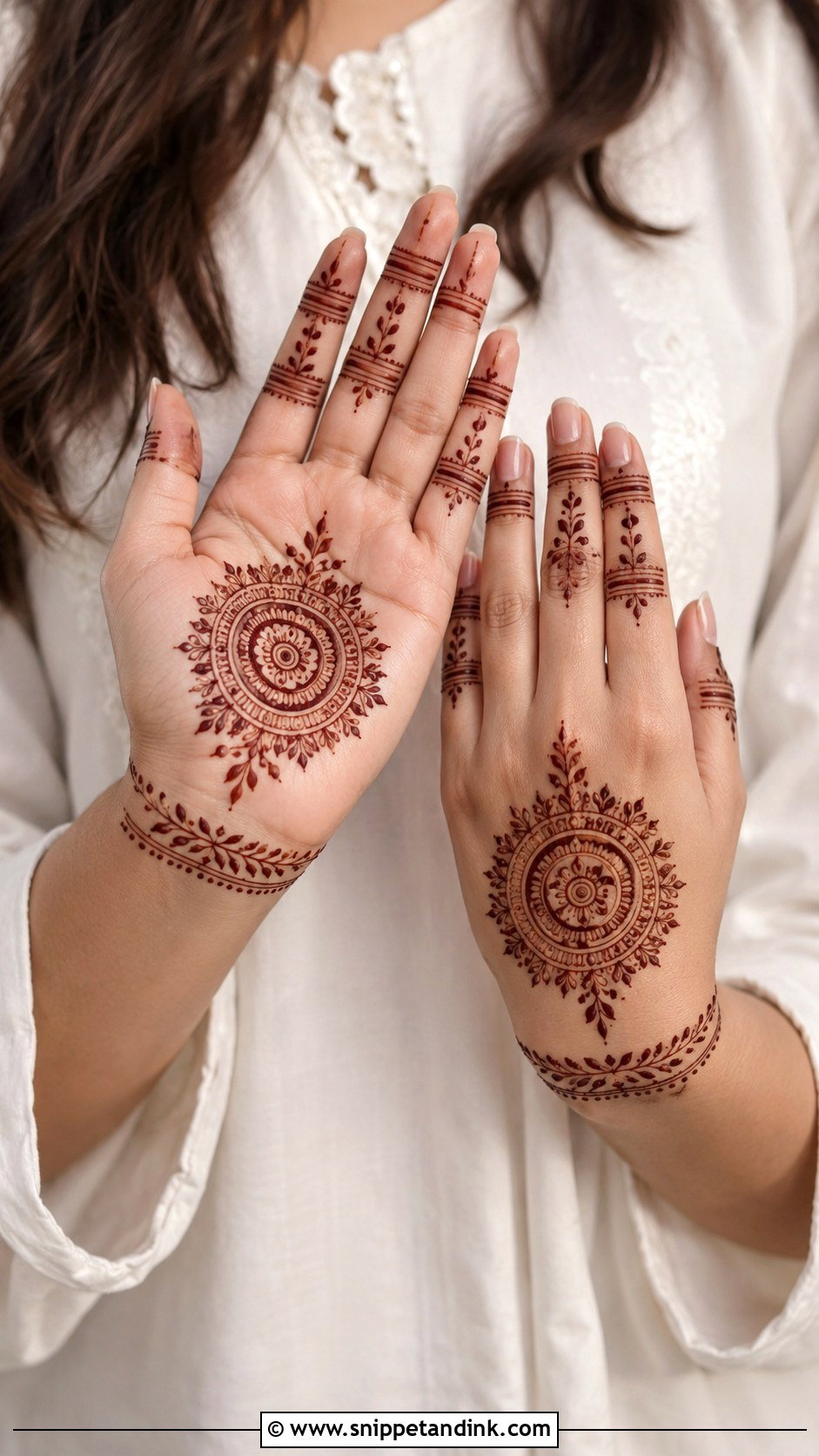
Half-hand work stops at the wrist and leaves the forearm bare, which is why I recommend it to guests with a full day of events or anyone who needs to be back at a desk on Monday. A round mandala or floral circle carries the design, and the fingers get simple bands, dots or leafy tips. Choose one strong motif and echo it with two or three smaller circles nearby; that repetition is what stops a half-hand design looking like it was abandoned partway.
10. Back Hand Circle Mehndi With Finger Design
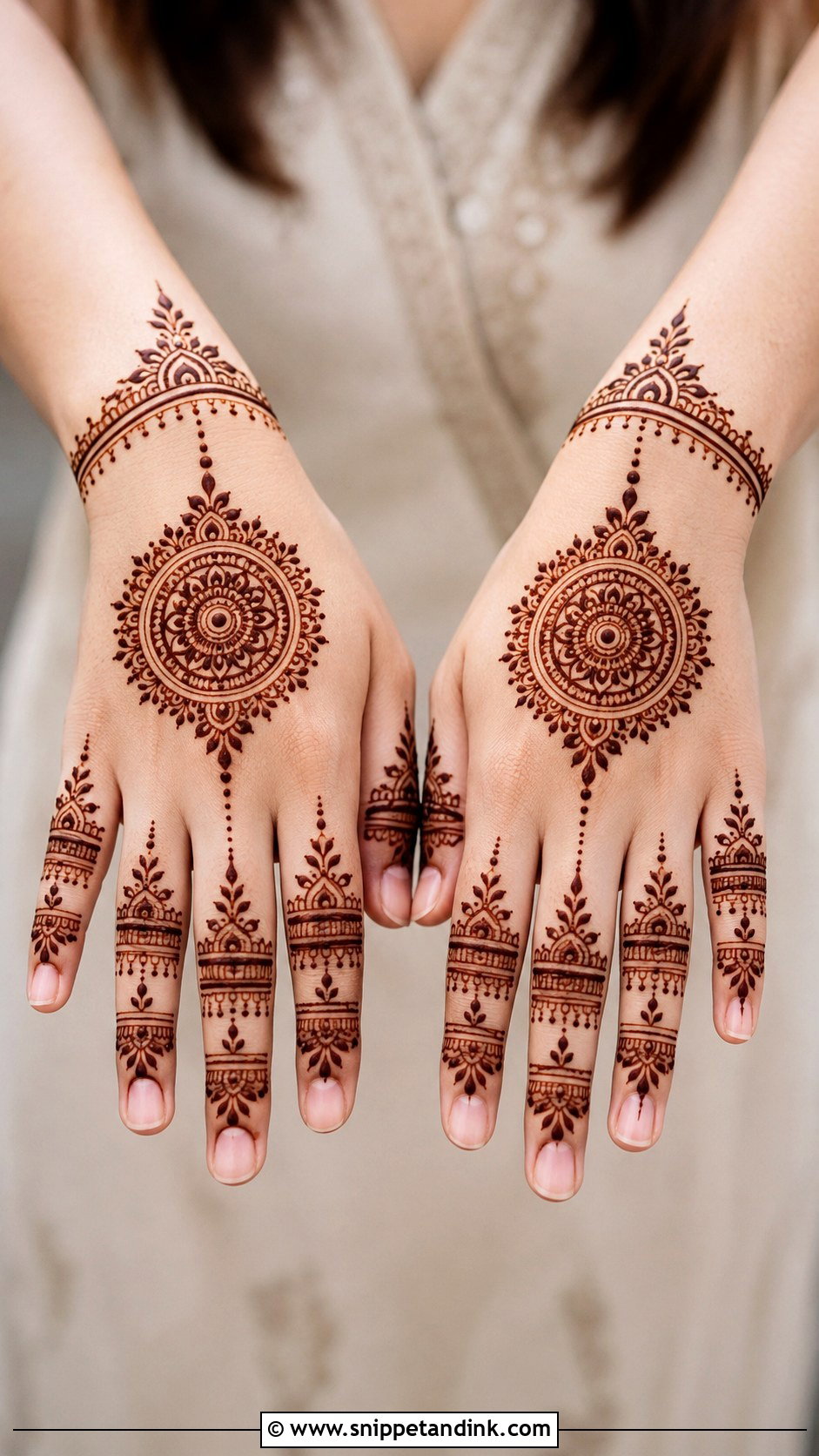
This is the hand-harness look: a central circle on the back hand linked to the fingers with thin chains, dots or leafy lines, and each finger finished with bands, tiny mandalas, shaded tips or crisscross detail. The contrast between bare skin and detailed fingers is the whole effect. I keep the finger work a touch lighter than the centre, because fingertips stain darker and will look heavier than they did in wet paste.
11. Palm Circle Mehndi Design
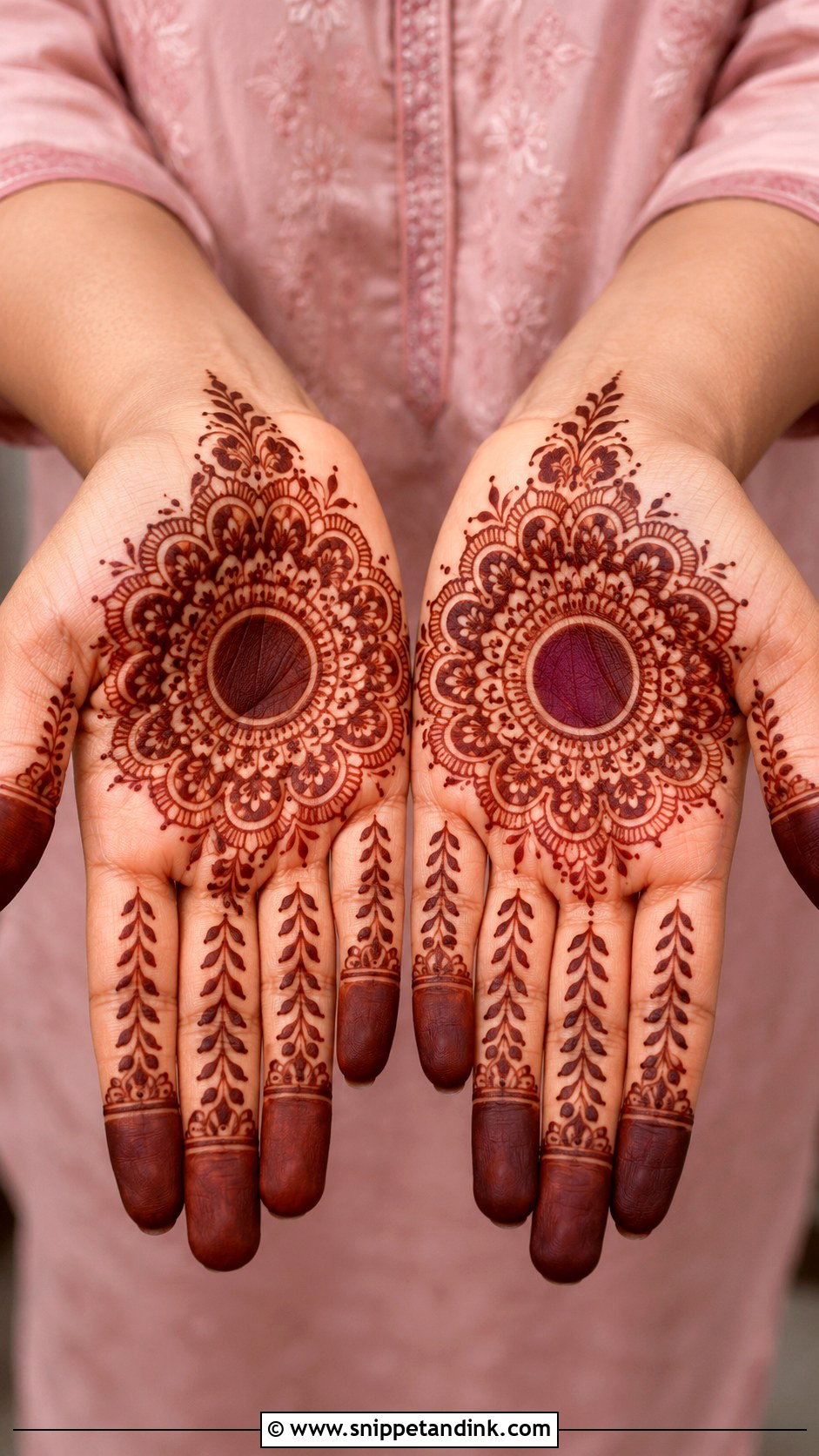
Palm skin is thicker and stains deeper than anywhere else on the hand, so a palm circle often dries to the richest colour of any design here. The round motif sits right in the hollow, the first thing anyone sees when you hold your hand out, whether it’s a dotted ring, a floral mandala or a dense Indian fill. Fingers can carry leafy trails, half circles, paisleys or shaded tips. Keep the outer rings crisp; a fuzzy edge on a palm circle is very visible once the stain darkens.
12. Round Tikki Circle Mehndi Design
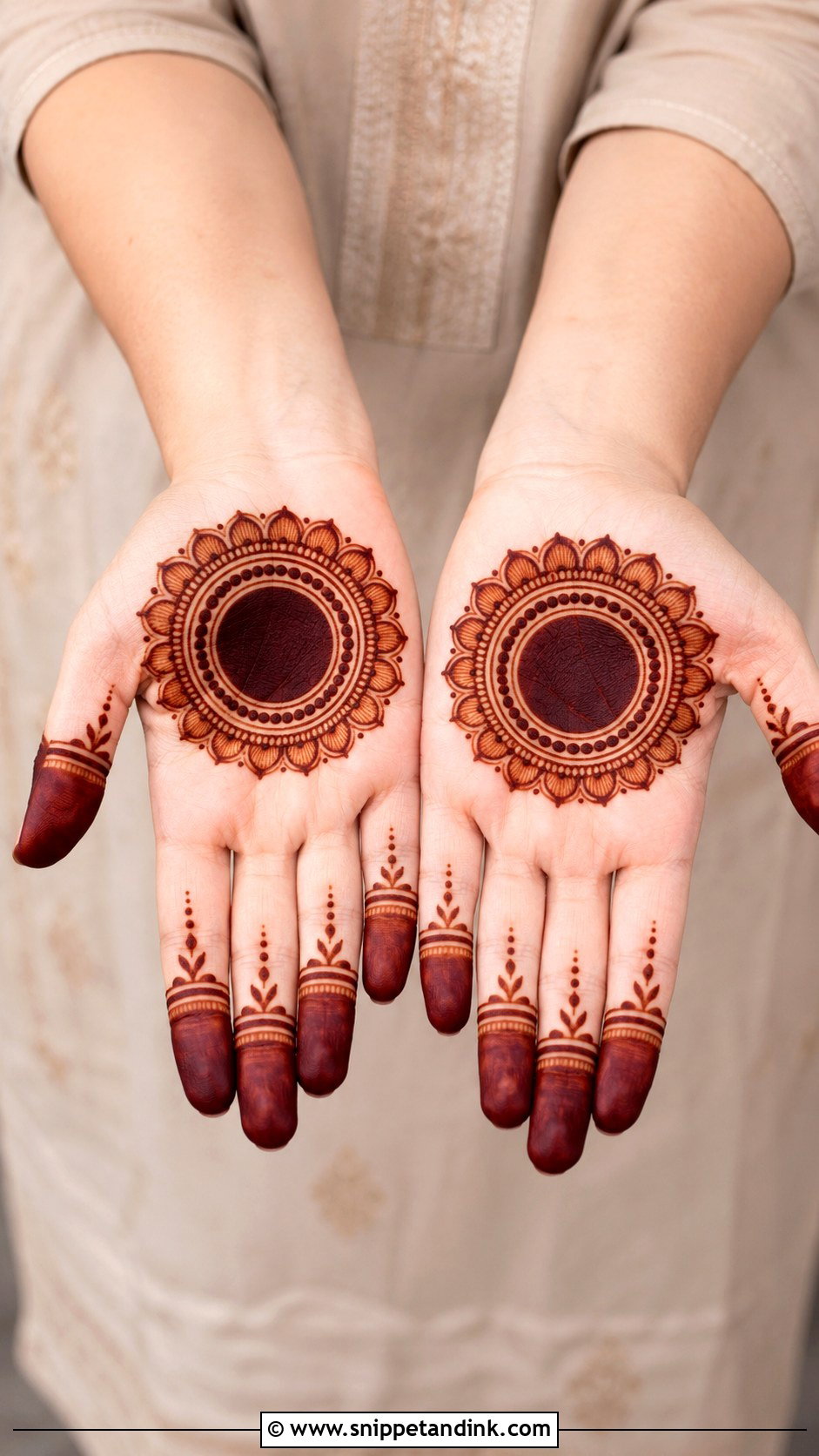
A tikki is a filled or half-filled disc, and it’s one of the quickest motifs I draw. Dots, petals, thin rings and small leafy borders soften it so it doesn’t sit there like a stamp. The trap is the fill: if the paste is laid too thick in the middle of the tikki, it cracks and flakes off early, leaving a patchy stain. I fill in thin, even layers and let it set before sealing. It suits Eid, home weddings and quick festive hands, and fingers can match with dots or small bands.
13. Modern Circle Mehndi Design
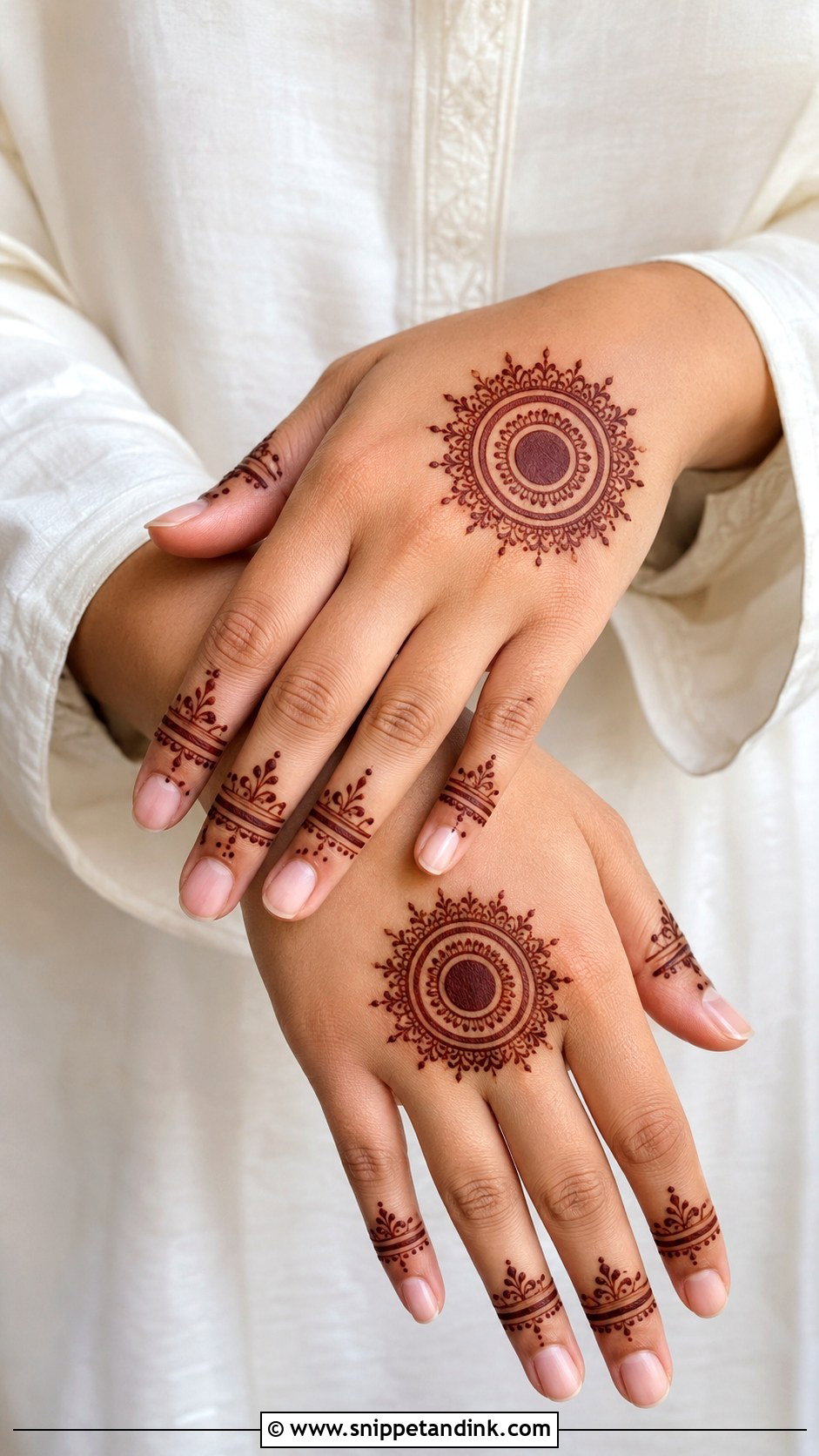
Modern circles rely on what you leave out. One bold ring, a few thin geometric lines, delicate finger bands and a lot of bare skin. Shifting the circle slightly off-centre toward the thumb side looks deliberate and contemporary, while dead centre reads cleaner. I’d say this is the hardest style to fake, because there’s no filler to hide a wobbly line, so ask to see an artist’s minimal work specifically before booking them for it.
14. Minimal Circle Mehndi Design
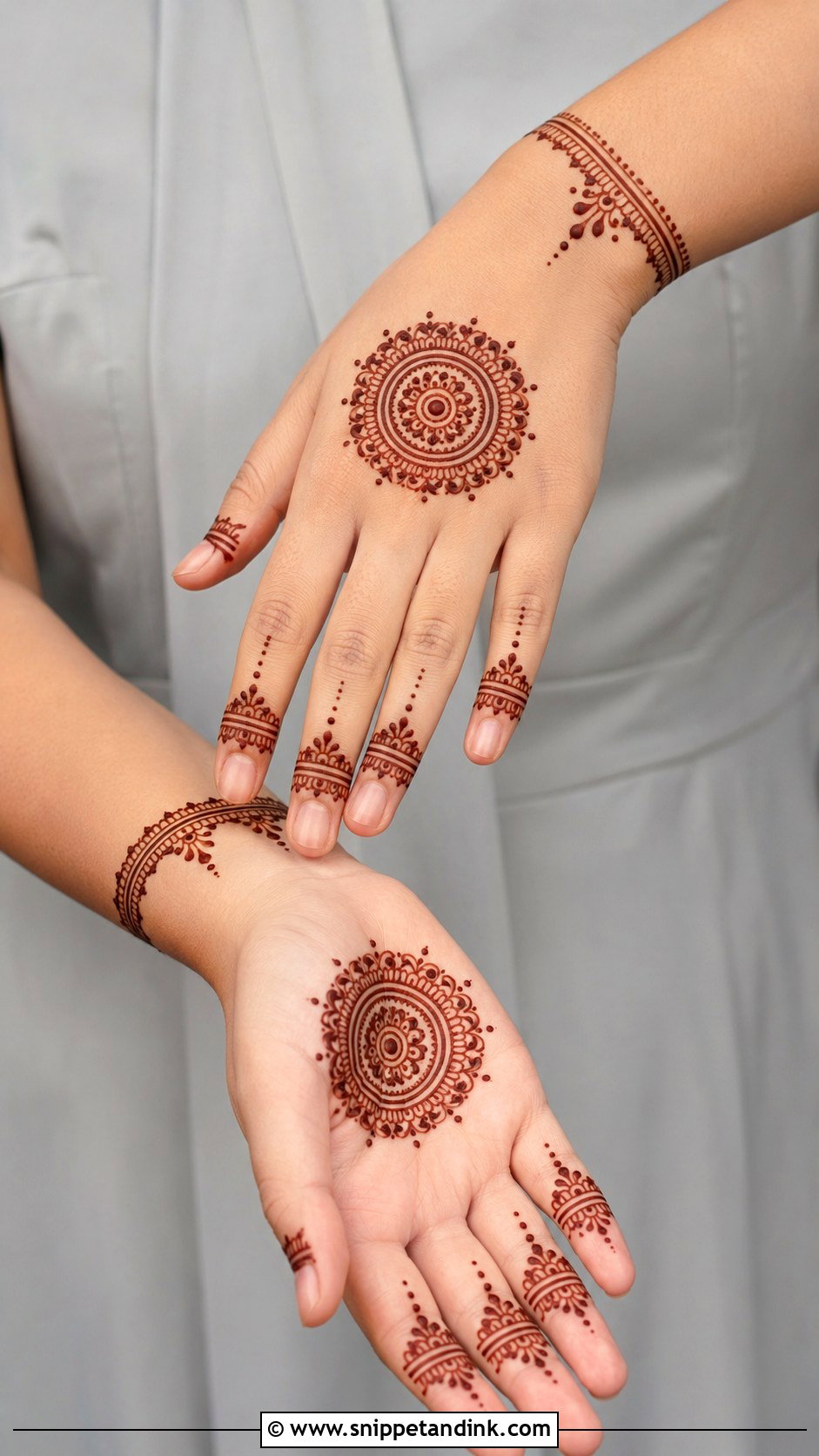
Minimal doesn’t mean empty. A small mandala on the back hand or palm with a few tiny dots, fine rings and light finger accents is quick, and it suits people who dislike heavy henna, younger girls and bridesmaids who have five other things to do that day. Because there’s so little on the hand, placement carries the whole design; I’ll often add a short line of wrist dots so the circle has something to relate to.
15. Easy Circle Mehndi Design For Beginners
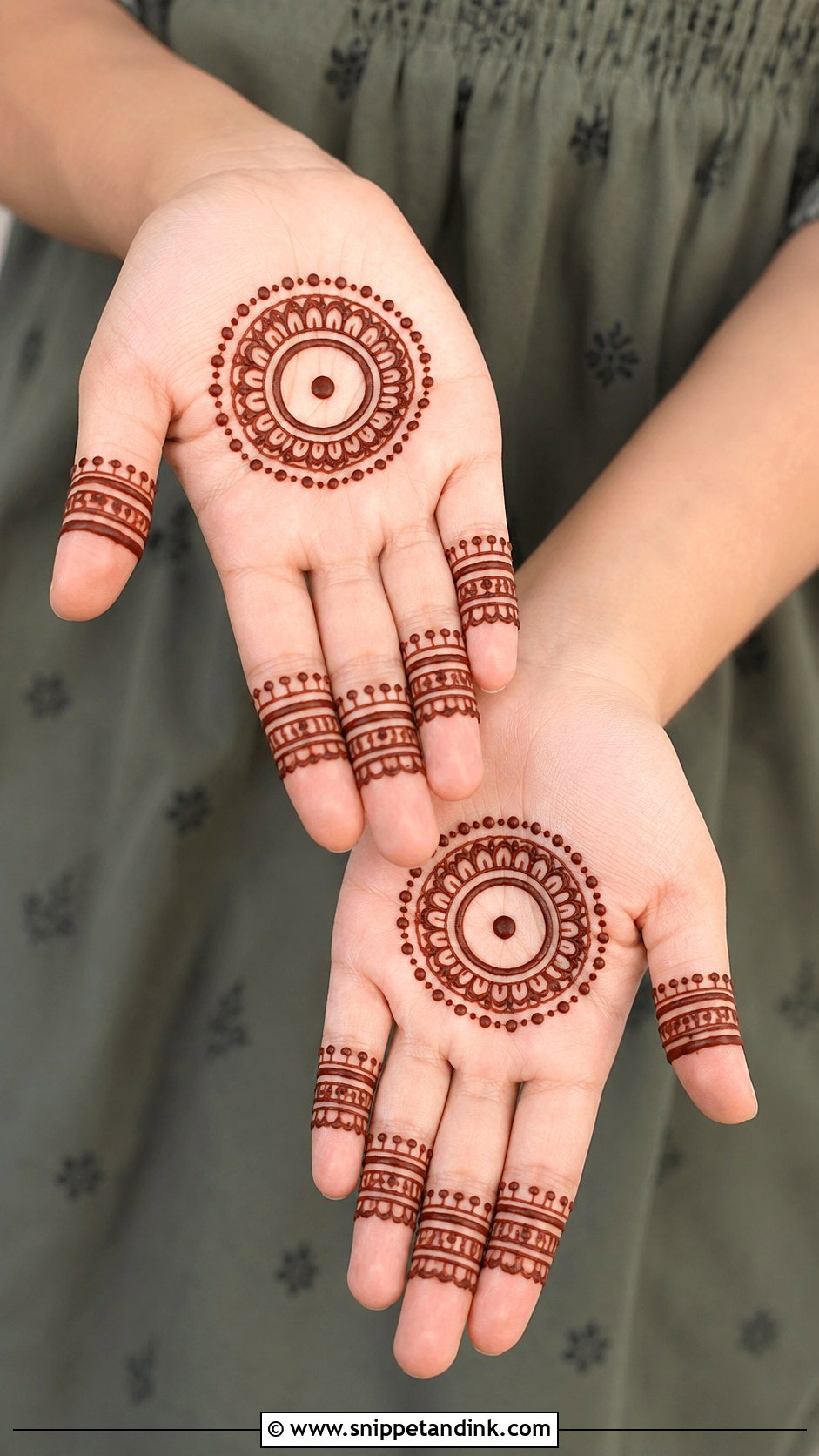
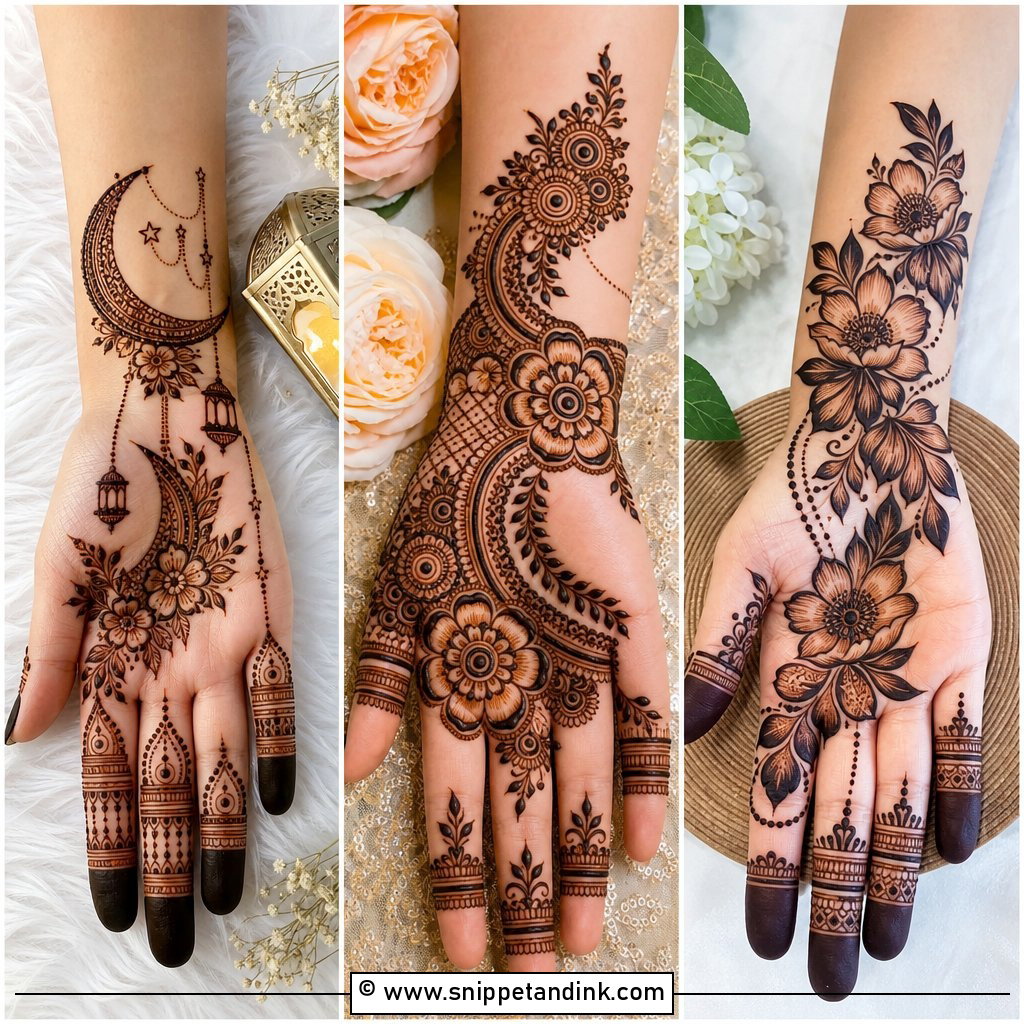
If you’re teaching yourself, start with a centre dot, draw one or two rings around it, then add petals, dots and short strokes, with basic finger bands to finish. Small mistakes are easy to disguise with an extra dot or leaf. The skill that actually improves your circles is steady cone pressure: squeeze from the top of the cone with your whole hand, not the tip, and lift the line slightly off the skin so the paste lays down rather than drags. Practice on paper or a plastic sheet before skin.
16. Circle Mehndi Design With Dots
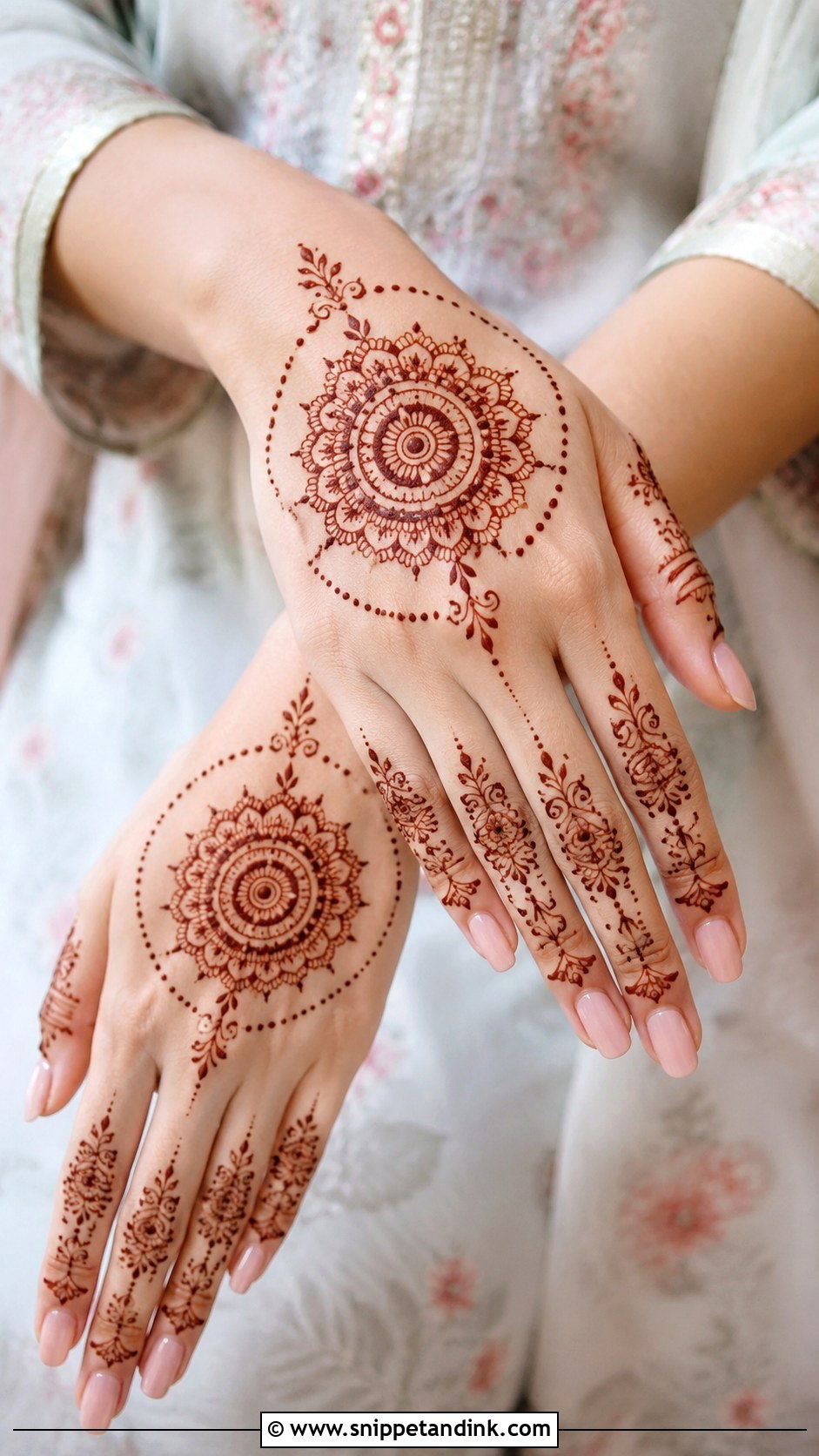
Dots do a surprising amount of structural work. They build borders, chains, finger trails and outer rings, and they let you connect two parts of a pattern without adding weight. I space them by eye using the previous dot as the guide, and on a back hand that rhythm makes the whole layout feel airy. Pair it with simple rings and thin bangles; chunky jewellery tends to swallow dotted work.
17. Circle Mehndi Design With Flowers
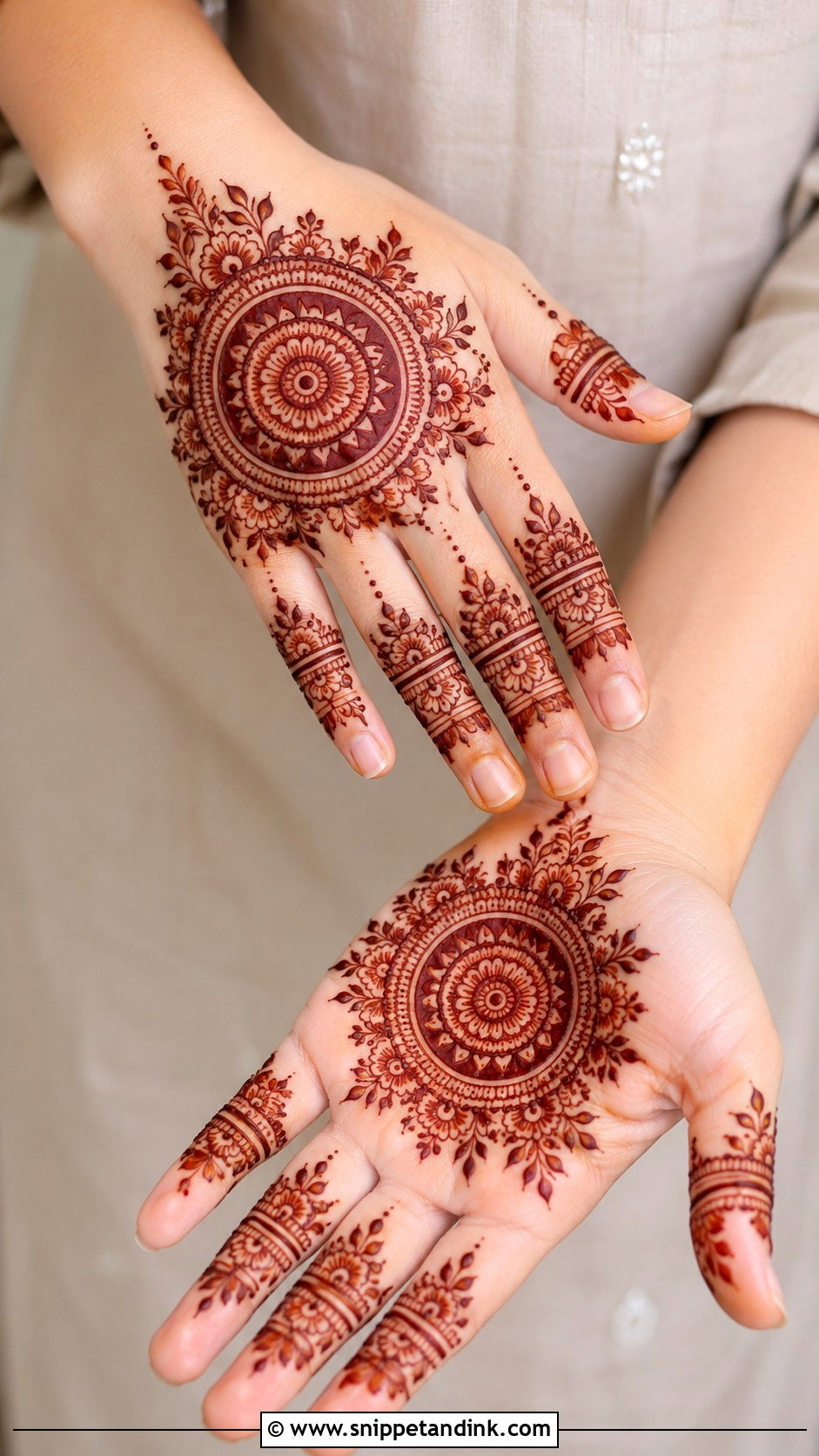
A large flower in the centre with petals opening outward in rings is one of the most flattering things you can put on a back hand, because it sits there like an ornament. Smaller flowers can drift toward the wrist or fingers. My one firm rule is to stick to a single petal shape across the circle. Mixing rose curves, pointed petals and daisy loops in the same ring is the most common reason a floral circle looks messy rather than full.
18. Circle Mehndi Design With Leaves
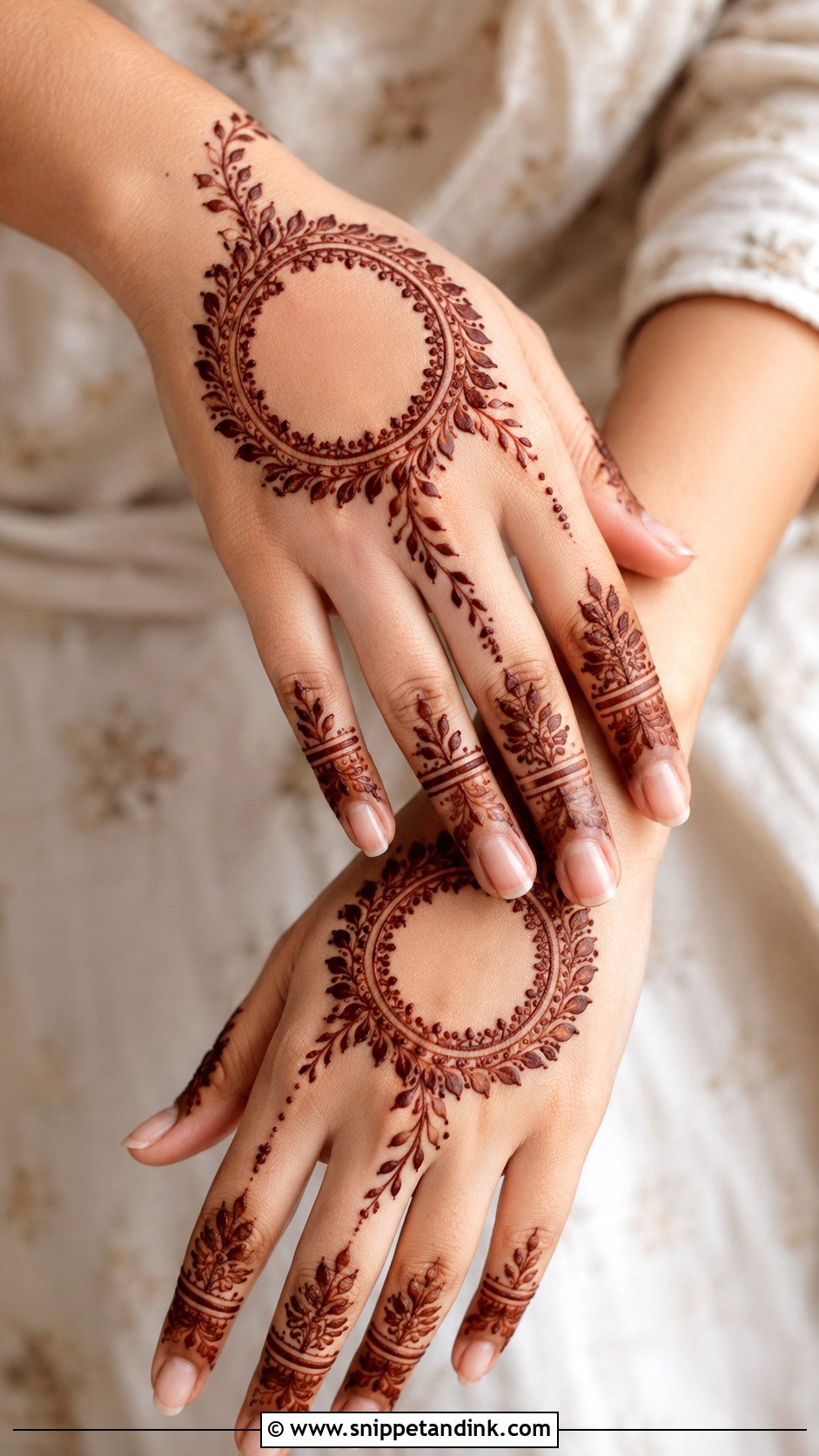
Leaves add movement without weight, which is why they show up so much in Arabic and Indo-Arabic work. The circle can stay plain with leafy vines framing it, or be filled with fine mandala detail while leaves branch toward the fingers. Draw every leaf on one vine pointing the same way; leaves that flip direction halfway along make the hand look restless. It sits well on the back hand, palm and wrist, for Eid, Diwali or a family lunch.
19. Circle Mehndi Design With Paisley
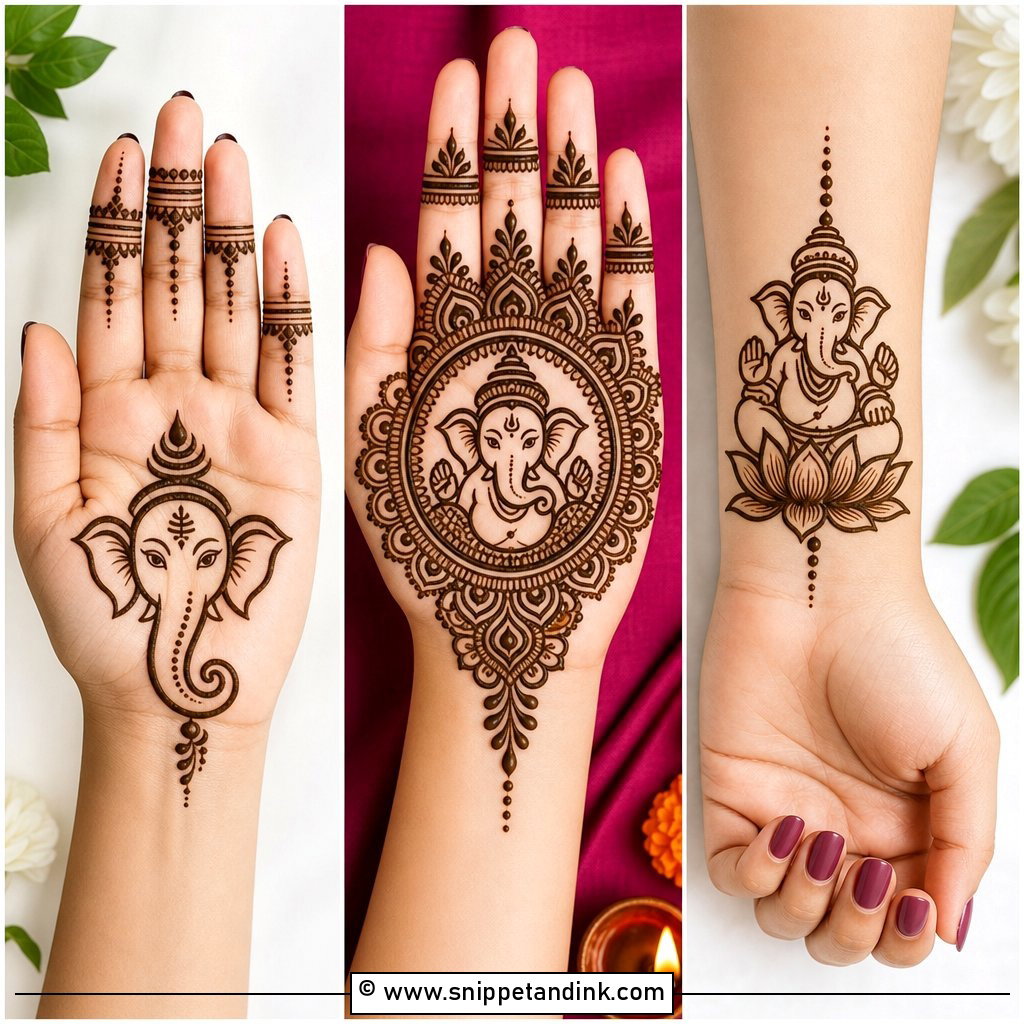
Paisley curves hug a round centre almost on their own, which is why this pairing has been around so long in Indian henna. They can form a border around the circle or flow down toward the wrist in a fuller pattern, and on the palm especially the shapes nest neatly. Outline every paisley boldly before you fill it with checks, petals and leaf strokes. If you fill first, the outline has nothing crisp to sit against and the paisley loses its shape once stained.



20. Circle Mehndi Design With Jaali
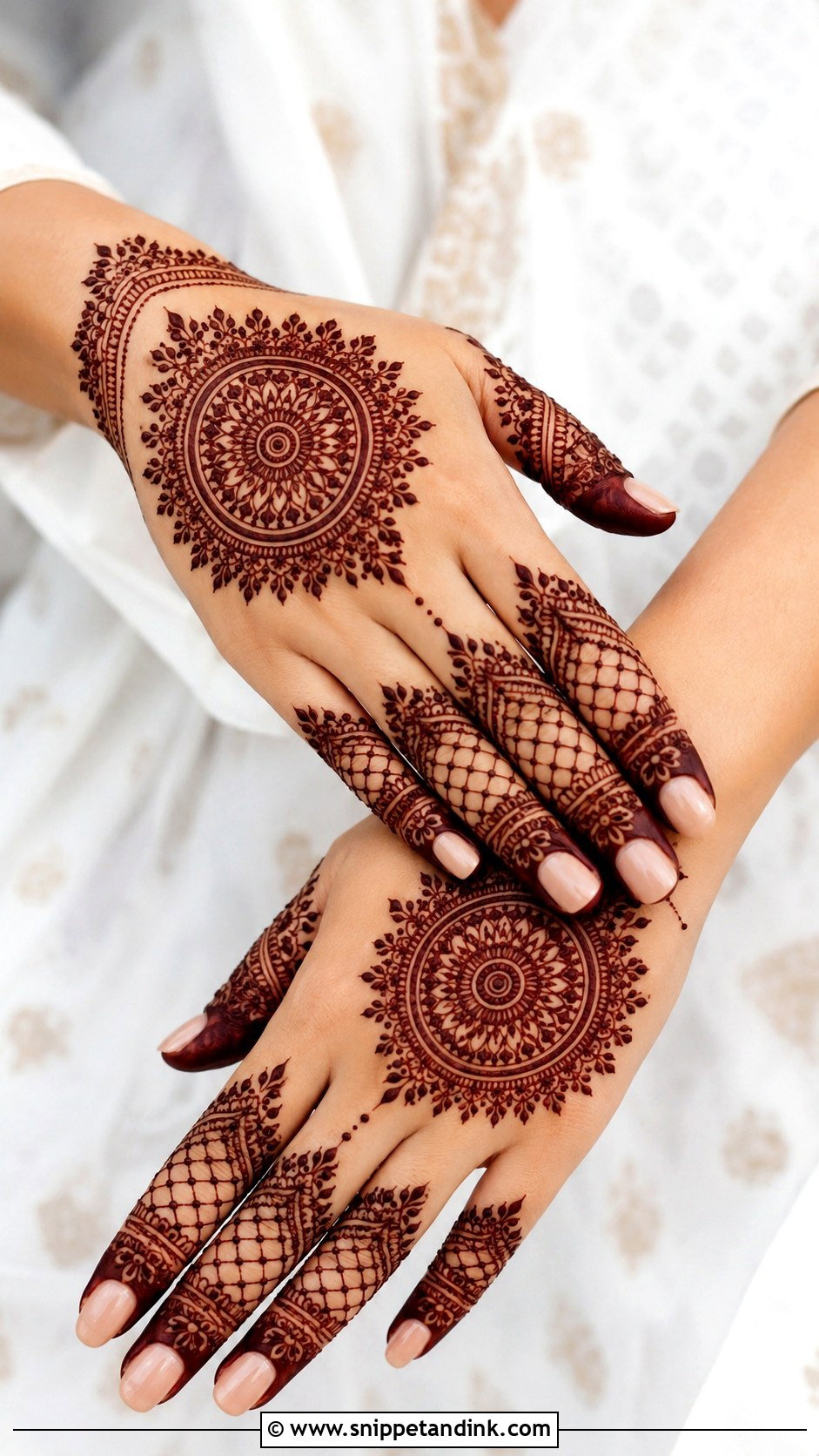
Jaali is a fine net, and it’s the most unforgiving filler I use. The circle sits in the centre while mesh fills a wrist panel, finger section or frame around it, giving a lace effect that reads well in photos. Uneven spacing jumps out instantly, so I draw all the lines in one direction first, then cross them, rather than building the grid square by square. Thick lines also bleed into each other as paste spreads, so use your finest tip.
21. Circle Mehndi Design With Peacock
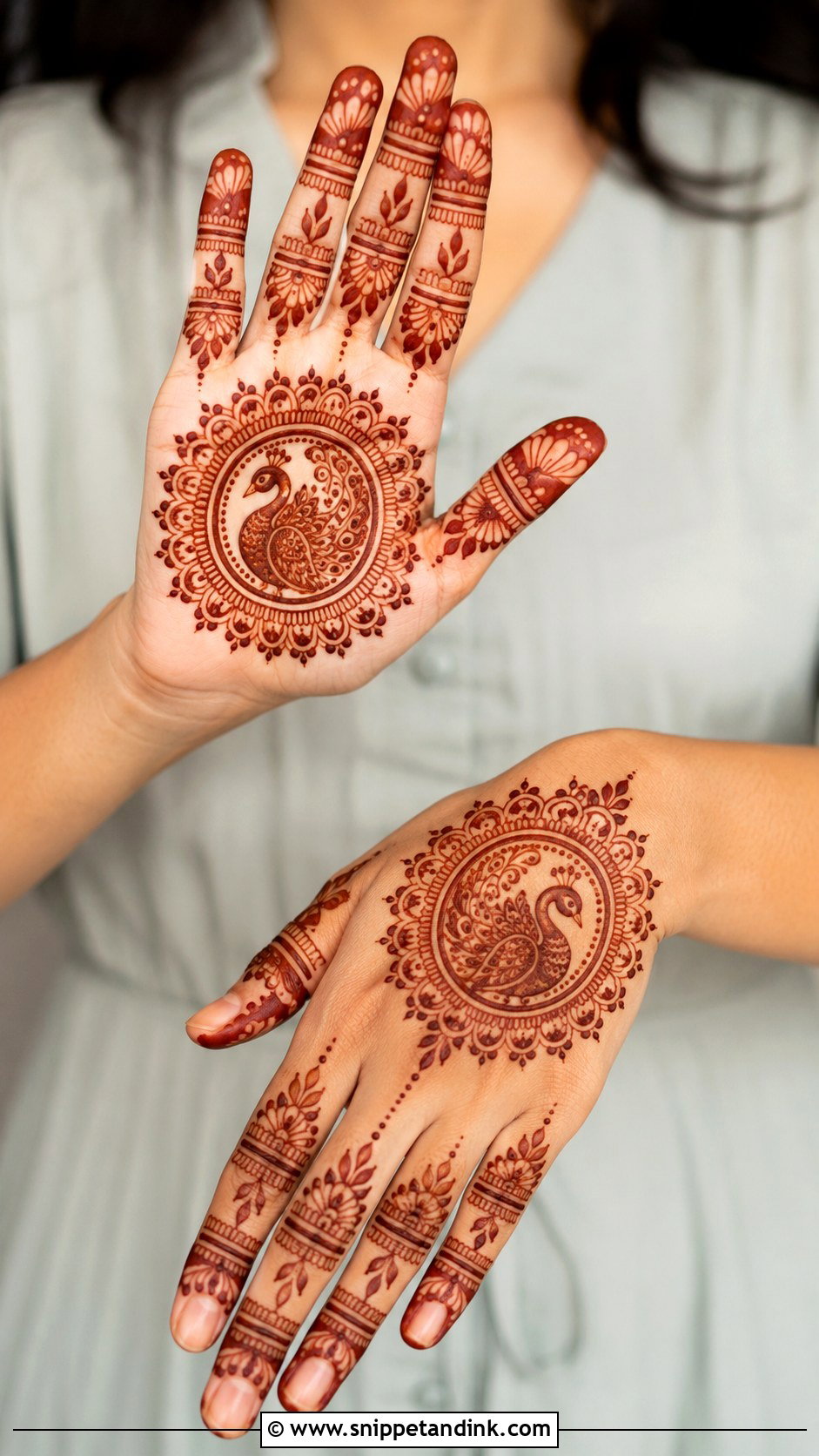
Peacocks are a long-standing motif in Indian bridal and festive henna. Feathers, a curved neck or feather-eye details wrap around a circle on the palm or back hand, and the design can be full or just one peacock beside the round centre. The curves are where it goes wrong: a peacock neck drawn in short choppy strokes looks broken. I draw the whole curve in one confident pull, then add the feather detail after.
22. Circle Mehndi Design With Bracelet
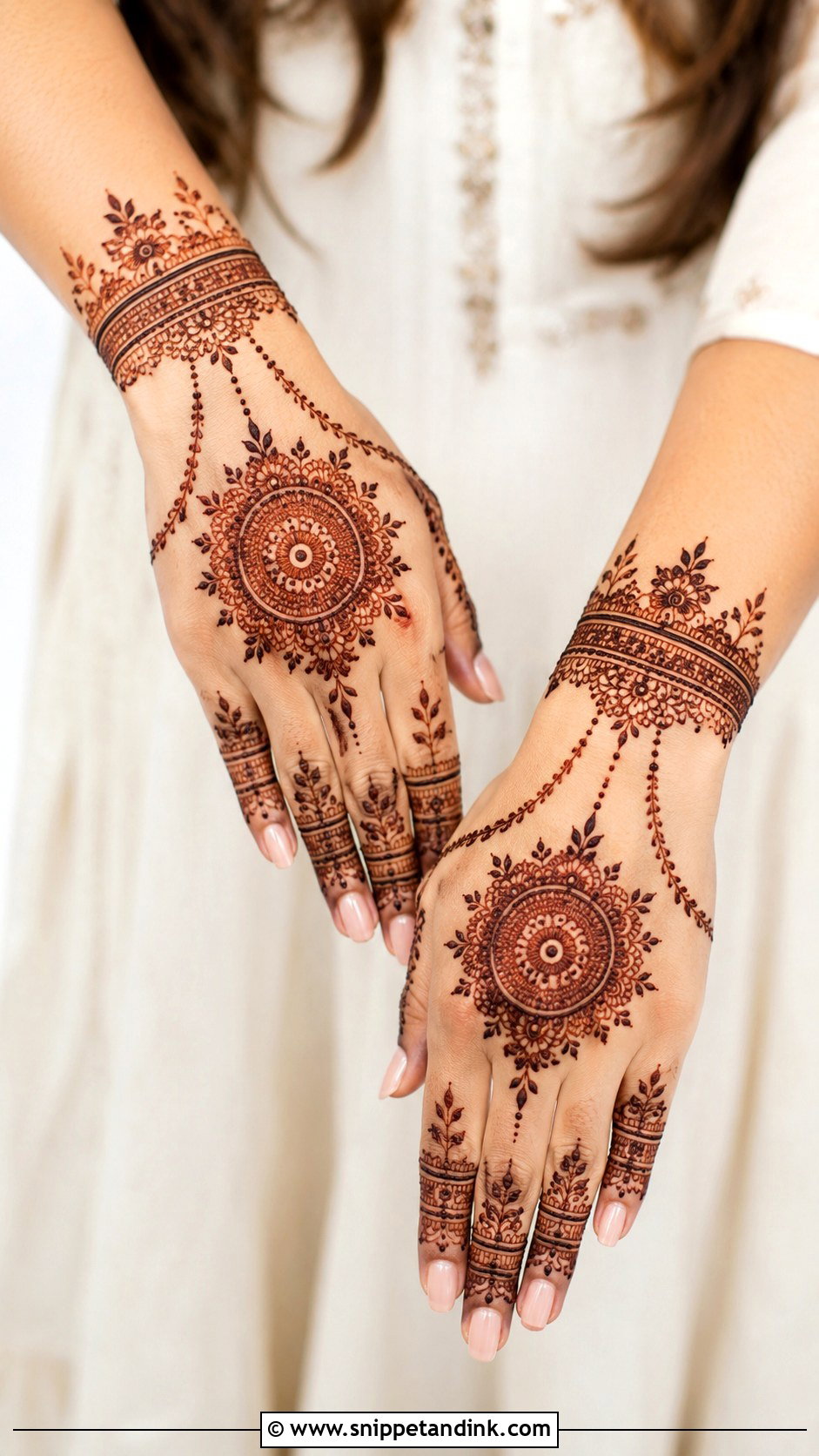
Here the circle on the back hand connects to a henna wrist band through dotted chains, leafy strings or thin curved lines, so the whole thing looks like hand jewellery. The band itself can hold small flowers, mandalas, jaali or parallel lines. Keep the connectors delicate and draw the band with the wrist relaxed, not bent back. A band drawn on a flexed wrist slides off-line as soon as the hand settles, and that tilt shows next to real bangles.
23. Circle Mehndi Design With Ring Chain
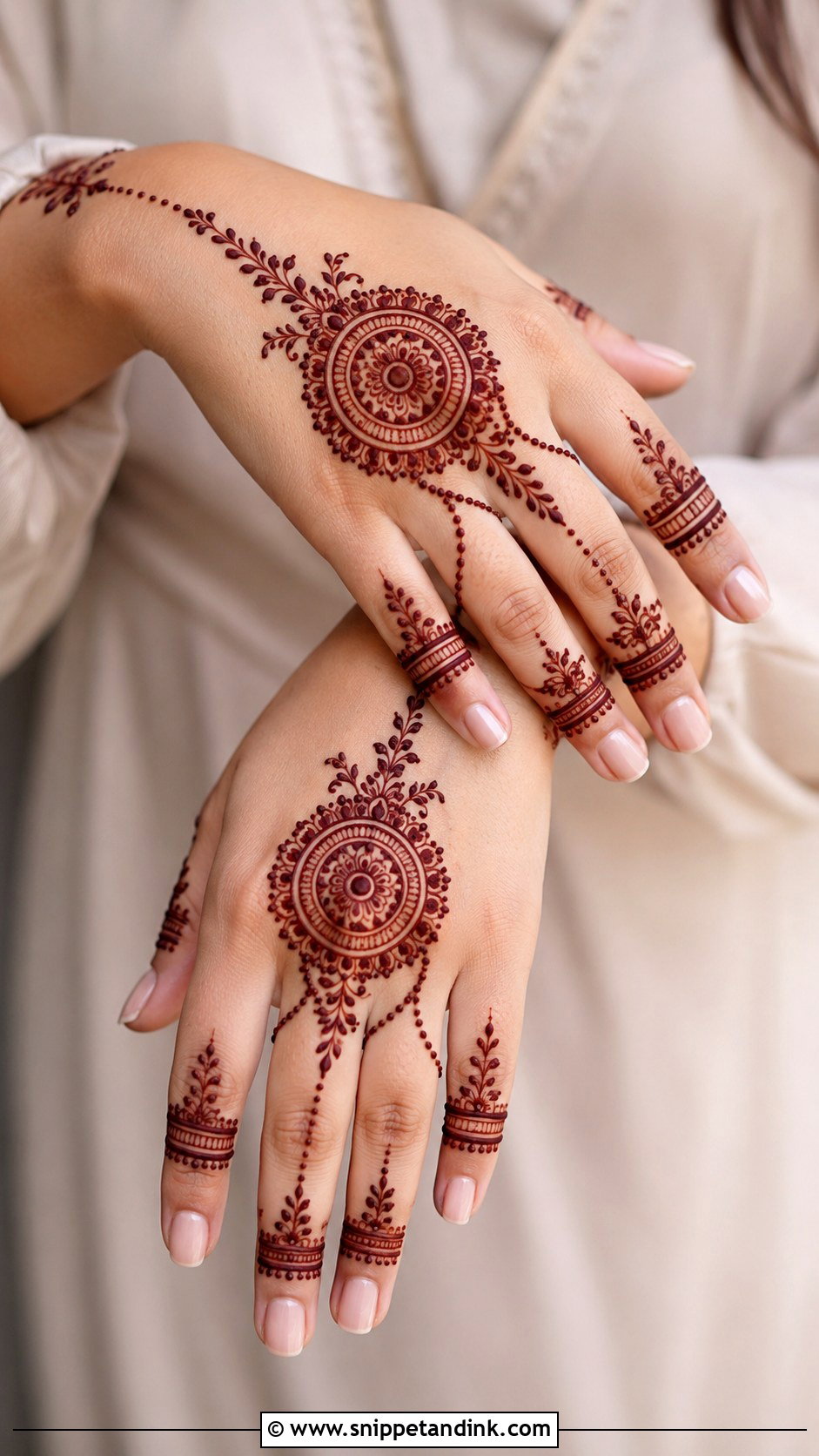
A centre circle acting as a handpiece, with dotted chains or fine lines running to one or more fingers, is about as close to wearing a haath phool in henna as you can get. Fingers take ring bands, leafy tips or tiny mandalas. Chains must stay thin and match on both sides, because thick ones turn the delicate harness into heavy stripes. It sits nicely with real rings, so it’s a favourite for engagement parties, Eid and bridesmaids.
24. Circle Mehndi Design For Eid
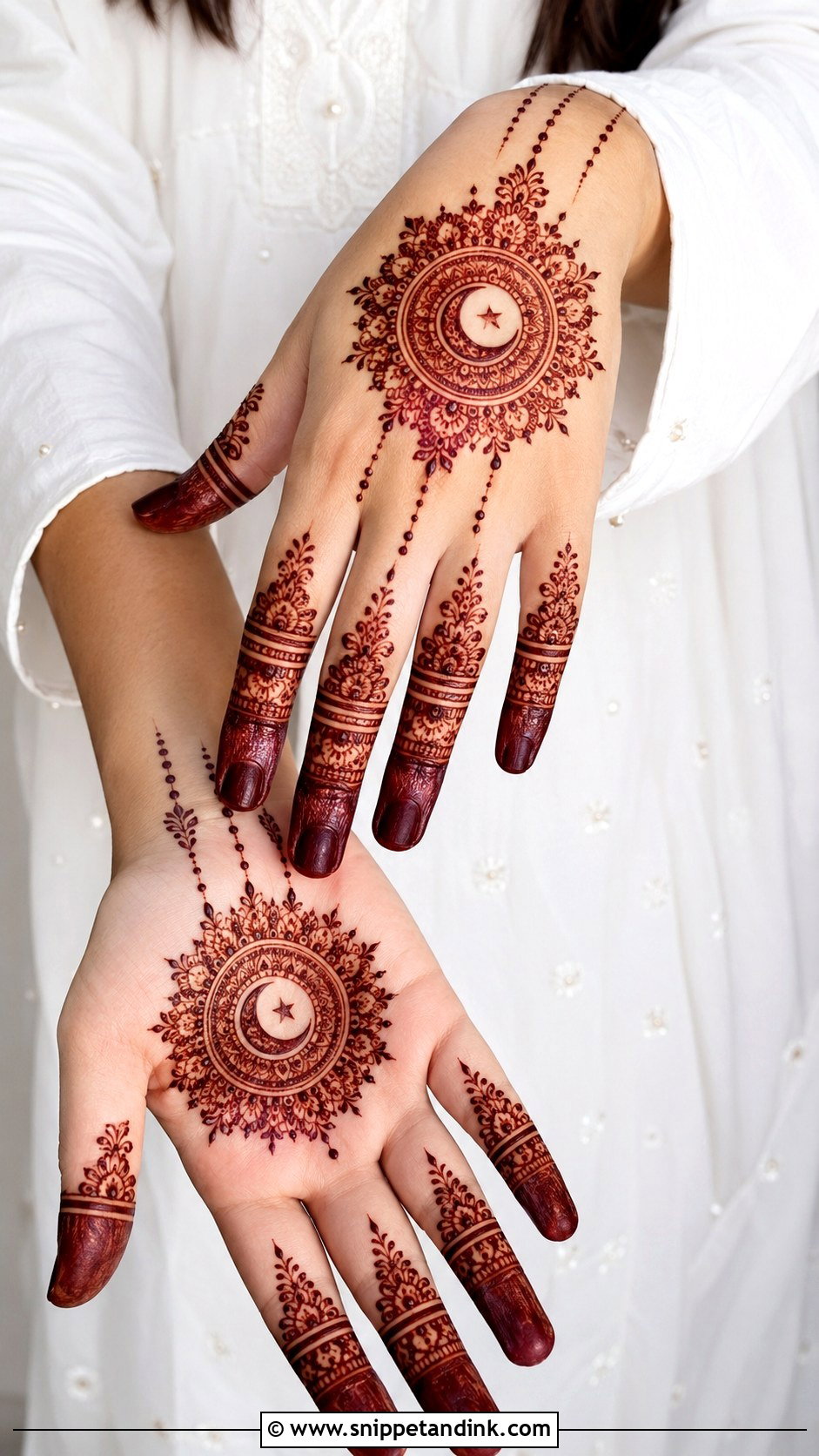
For Eid I usually suggest a back-hand mandala with floral rings, dotted chains and decorated fingers, or a round tikki with petals on the palm if you’d rather keep the back hand clear. Arabic circles also suit the day because the open space looks good with bangles. Remember the timing: henna applied on Chaand Raat is still deepening on Eid morning and will be darker by the afternoon visits. Apply a day earlier if you want the colour at its peak for prayer and photos.



25. Circle Mehndi Design For Diwali
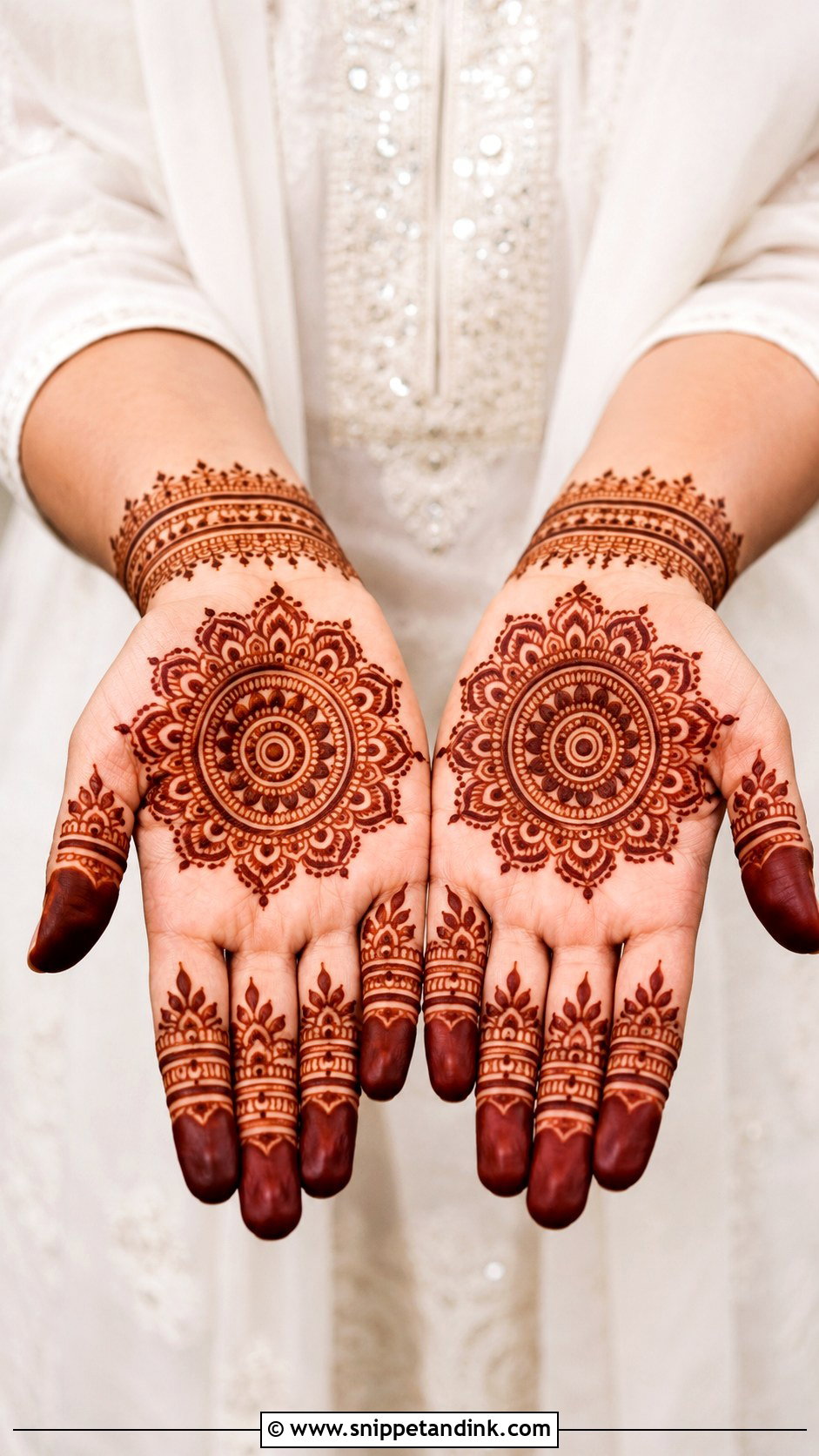
A circle mehndi design for Diwali can borrow directly from rangoli, with symmetrical rings, chakra petals and decorative borders. Add wrist bands, finger patterns and small leaves to make the hand feel ready for the evening. One practical note from Diwali bookings: the hands that come in during the last two days before the festival usually want to light diyas and cook, so I keep the palms lighter for anyone who’ll be handling oil and flour while the stain is still fresh.
26. Circle Mehndi Design For Wedding Guest
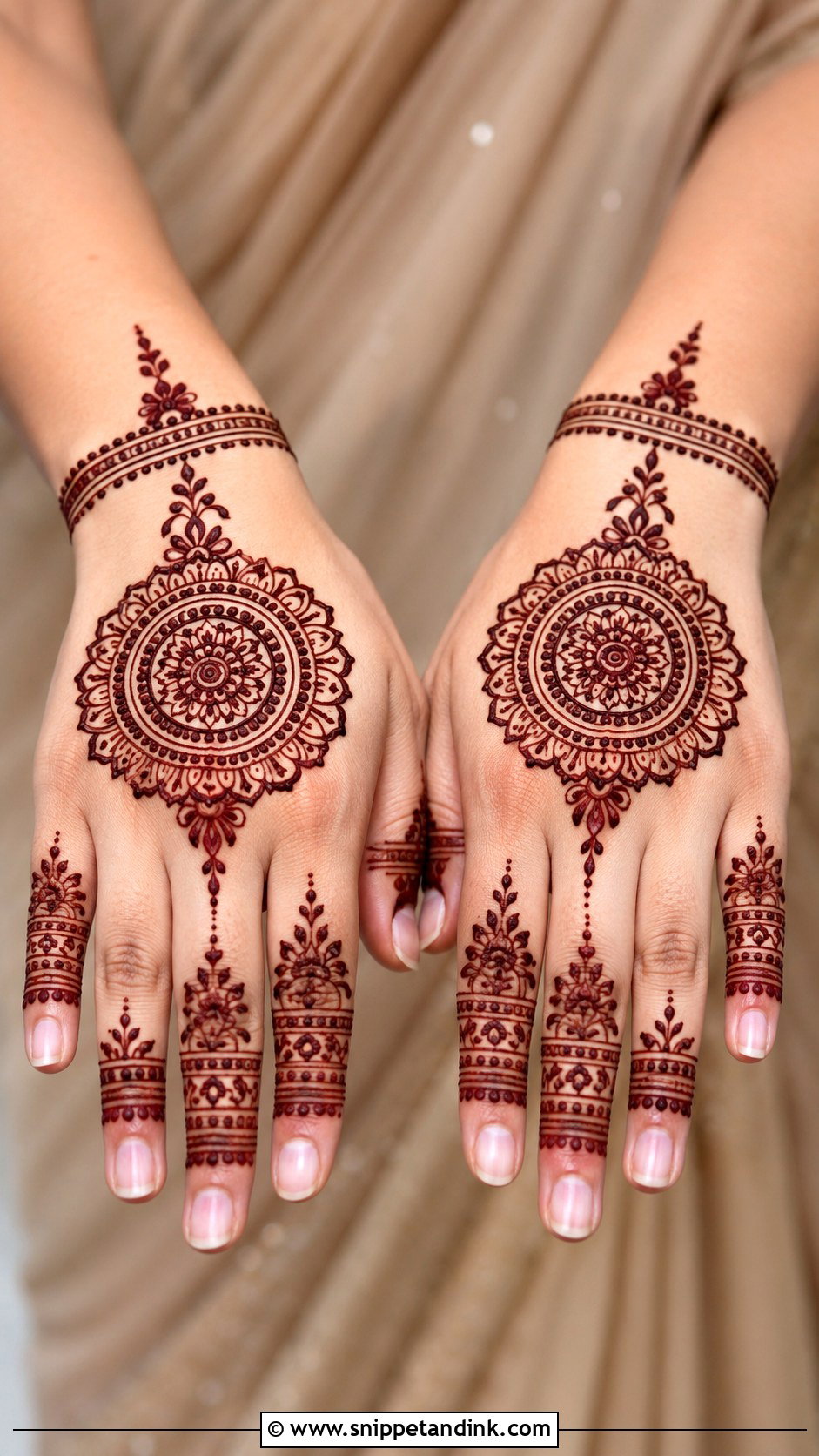
Guests should land somewhere below the bride. A medium mandala on the back hand, decorated fingers and a slim wrist detail is my usual guest brief, in floral, Arabic or Indo-Arabic style depending on the outfit. It’s comfortable through a long run of sangeet, mehndi night and reception because there’s less paste to protect and less skin to keep still while it dries. Bold outlines and a few paisleys or leaves keep it festive.
27. Circle Mehndi Design For Bridesmaid
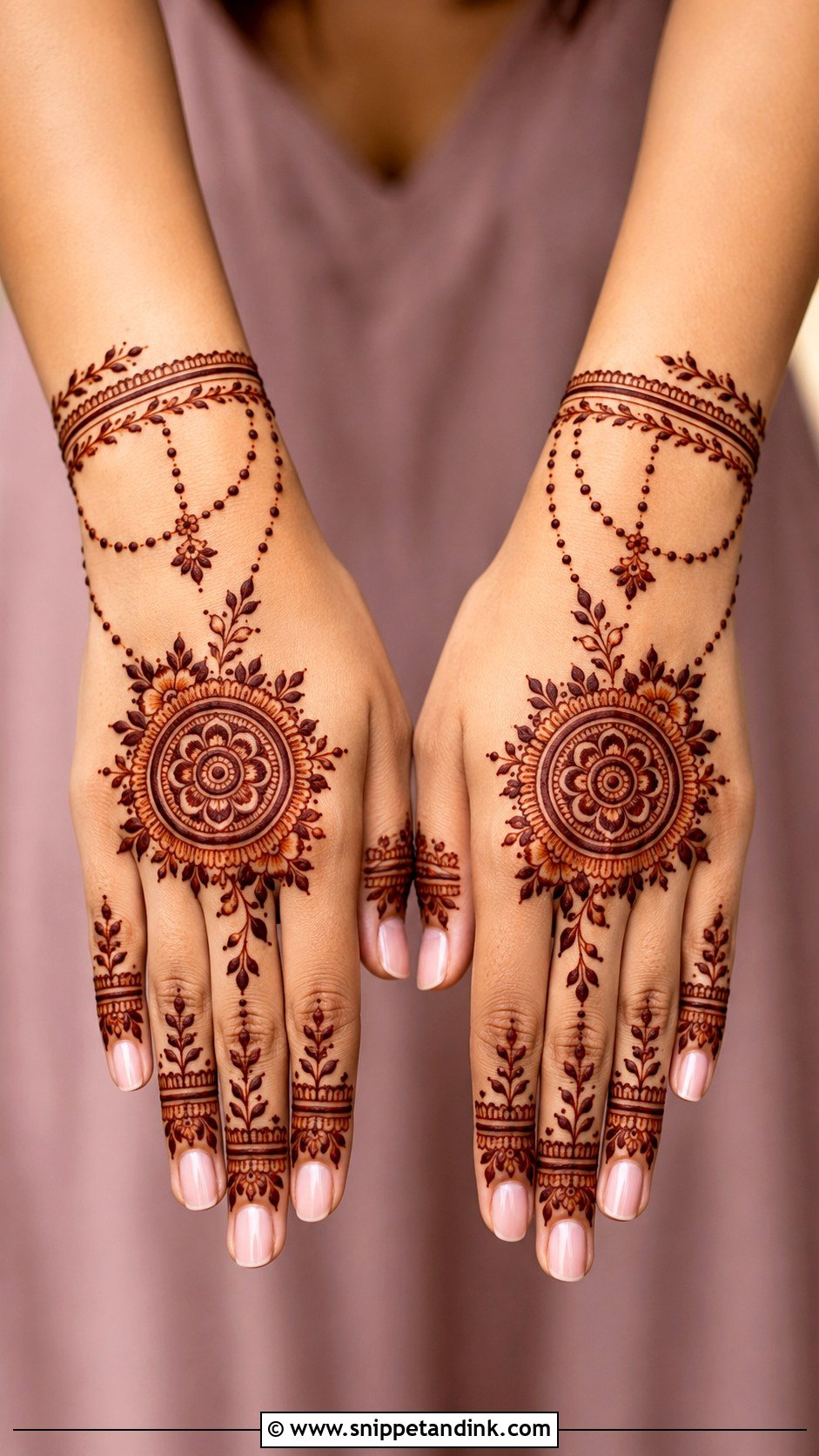
When I do a bridal party, I give everyone the same circle placement on the back hand and change the filler for each person: jaali for one, leaves for another, paisley or dots for the next. In group photos the hands look coordinated without being stamped from one template. Keep the wrist detail slim and stop short of the forearm. It’s also quicker, which matters when four bridesmaids need to be dry before the bride’s session starts.
28. Circle Mehndi Design For Kids
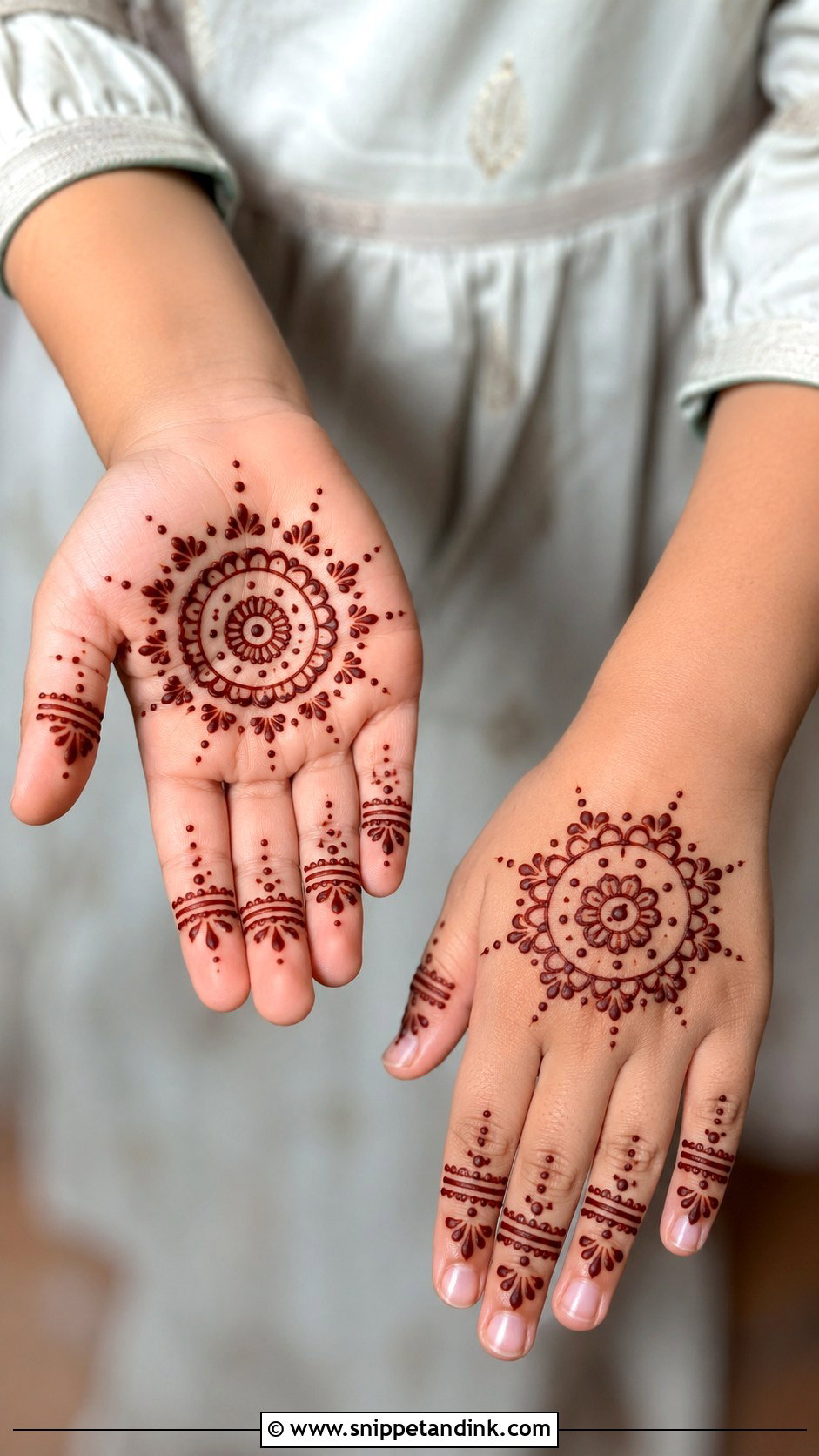
Circle mehndi design for kids should take minutes, not an hour, because children won’t sit still. A small round flower or tikki on the palm or back hand, a few dots, tiny petals and short finger bands is plenty. Skip fine crowded detail; it smudges the moment they touch anything. Only use natural henna on children, never black henna or anything that promises an instant dark result, and keep coverage light around the fingers.
29. Circle Mehndi Design For Engagement
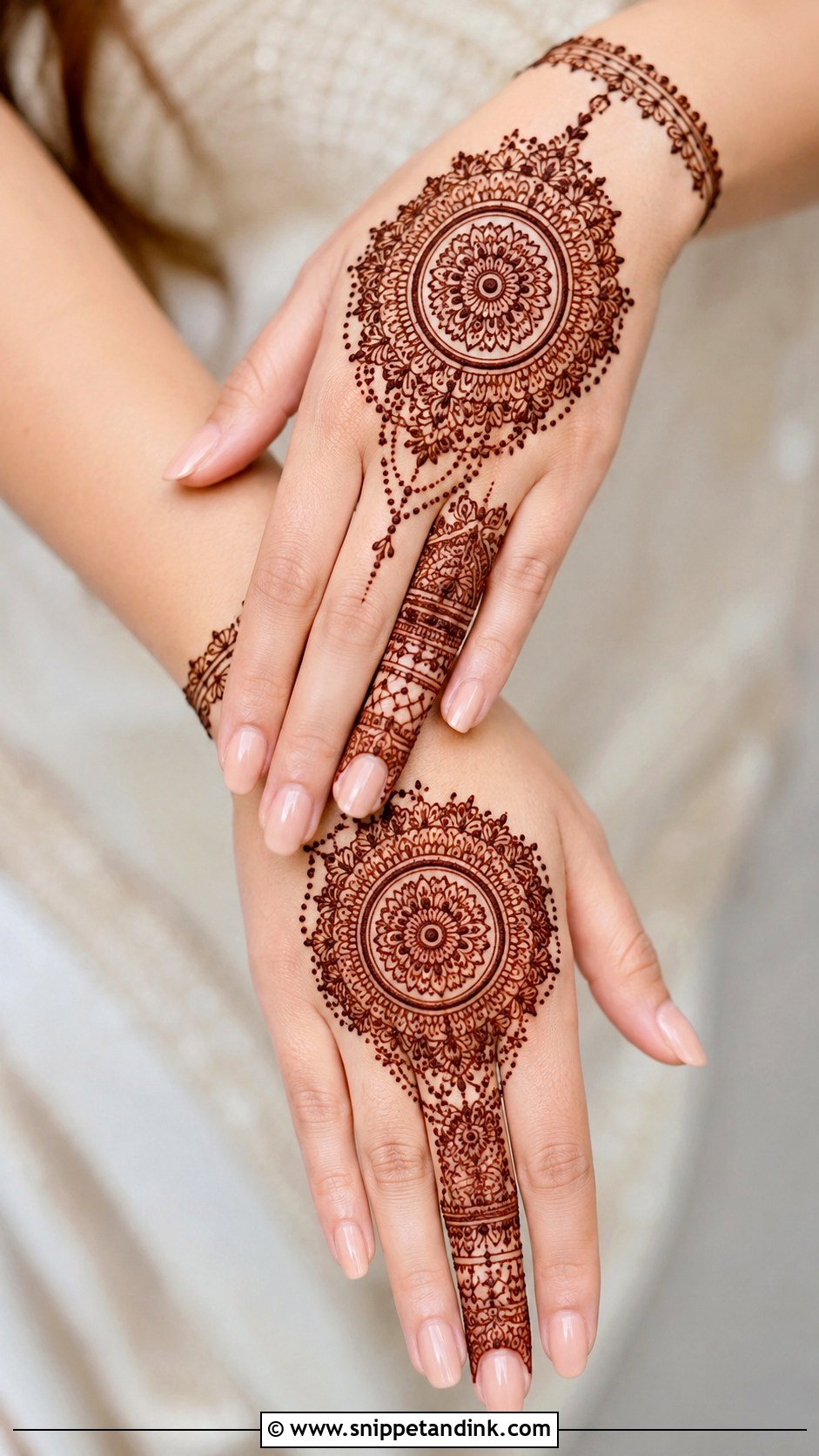
Circle mehndi design for engagement will be photographed close up, mostly around the ring. A back-hand mandala linked to ring-finger detail frames the ring rather than competing with it. I leave the base of the ring finger a little open so the band sits on clean skin, and make the detail just above it slightly richer than the other fingers. Floral rings, dots, small jaali sections and a bracelet band are enough; keep the forearm bare.
30. Circle Mehndi Design For Karwa Chauth
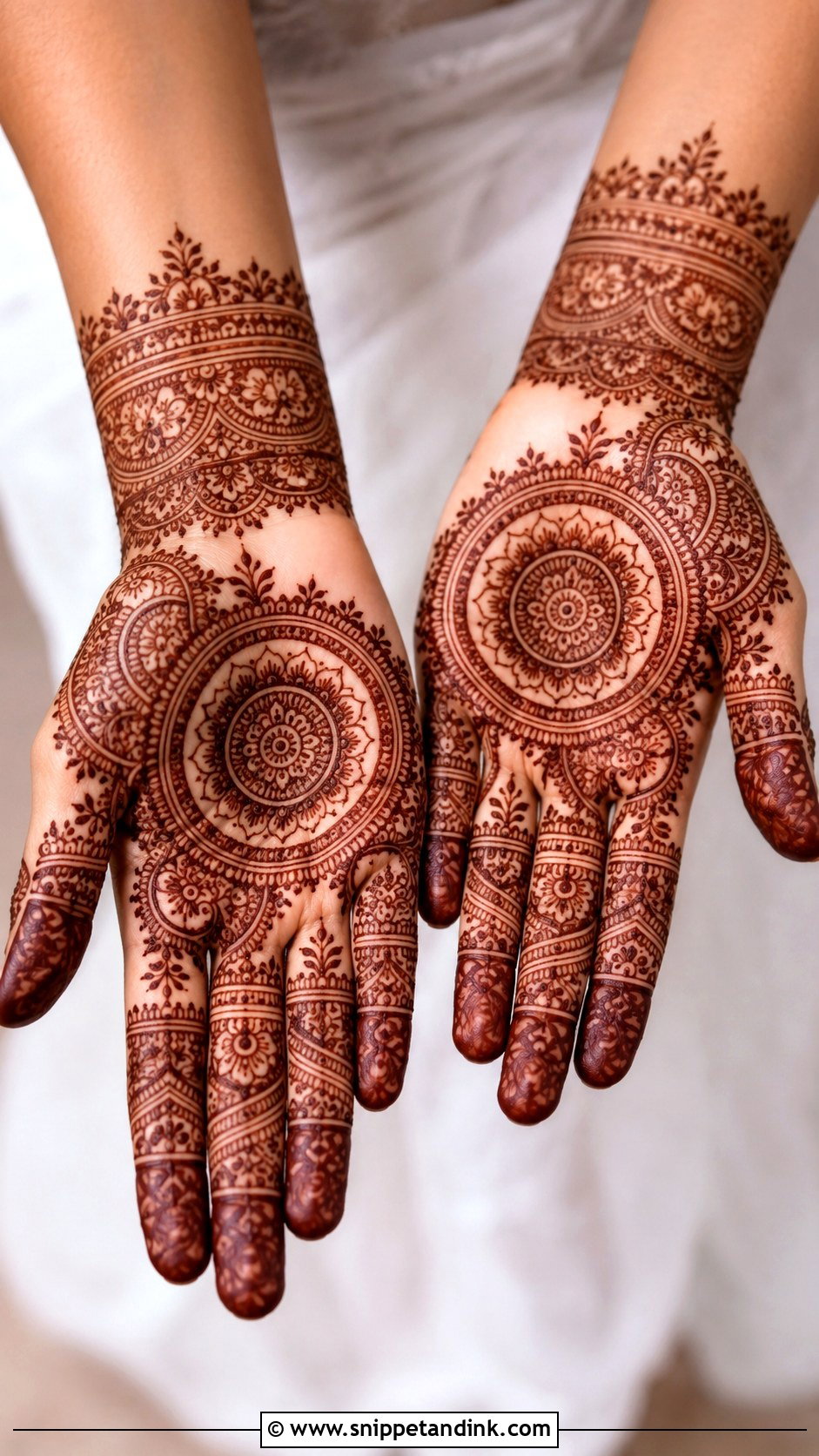
For Karwa Chauth, most women I draw for want fuller palms, since the palms are on show throughout the evening rituals and pair with a full set of bangles. A palm mandala or round tikki with petals, paisleys and fine finger work suits the occasion, extended into a cuff if you like. Because it’s a fasting day, apply the evening before at the latest and keep the design comfortable; nobody wants to be nursing wet paste while preparing the thali.
31. Indo Arabic Circle Mehndi Design
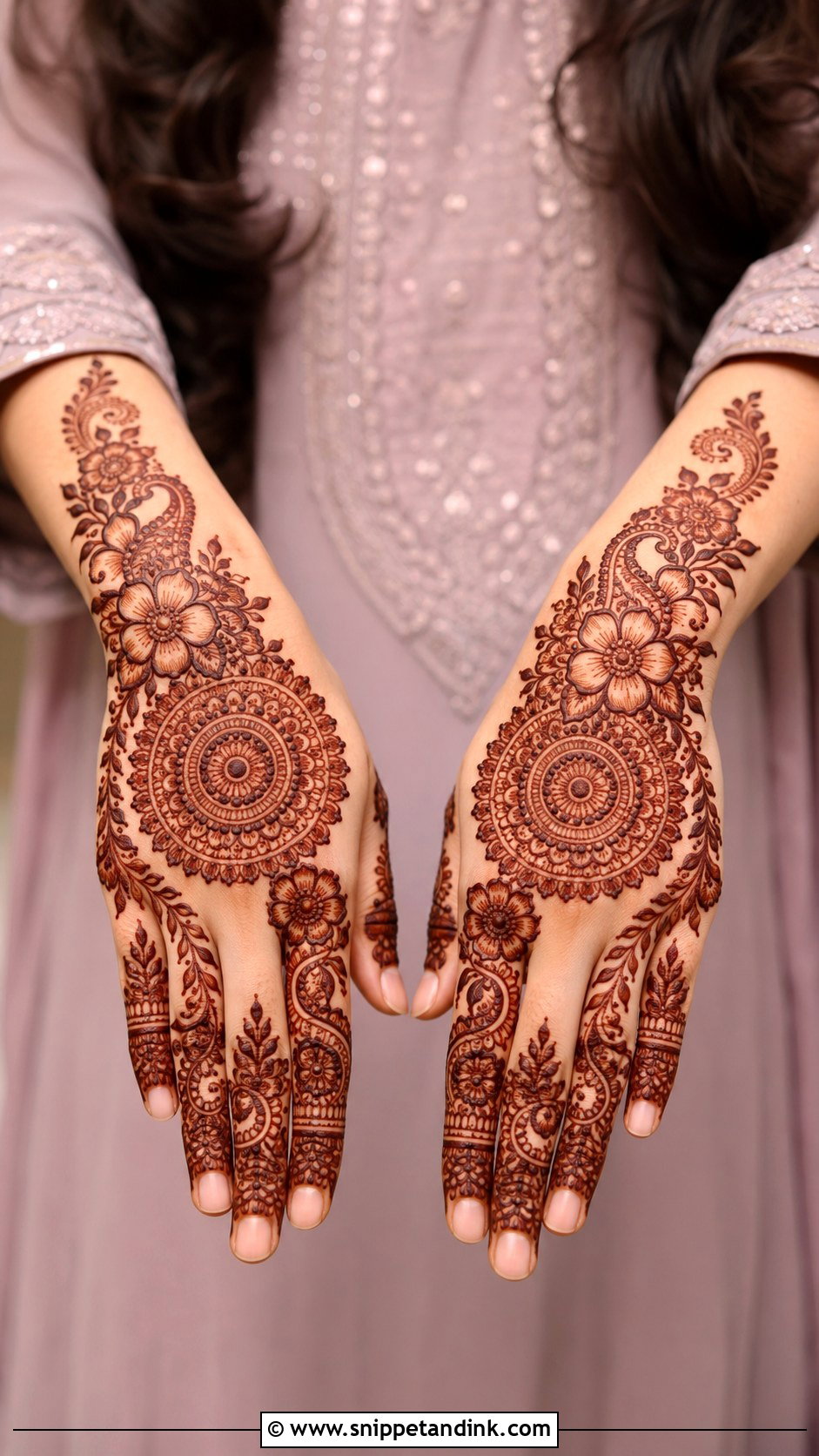
Indo-Arabic puts fine Indian mandala work inside the circle and bold Arabic flowers, leaves and open space around it. The circle connects diagonally toward the fingers or wrist, usually on the back hand. I switch cone tips for this: fine for the interior, slightly wider for the Arabic outlines, so the contrast in line weight is visible after staining. It suits people who find full Indian henna too dense but pure Arabic too sparse.
32. Moroccan Circle Mehndi Design
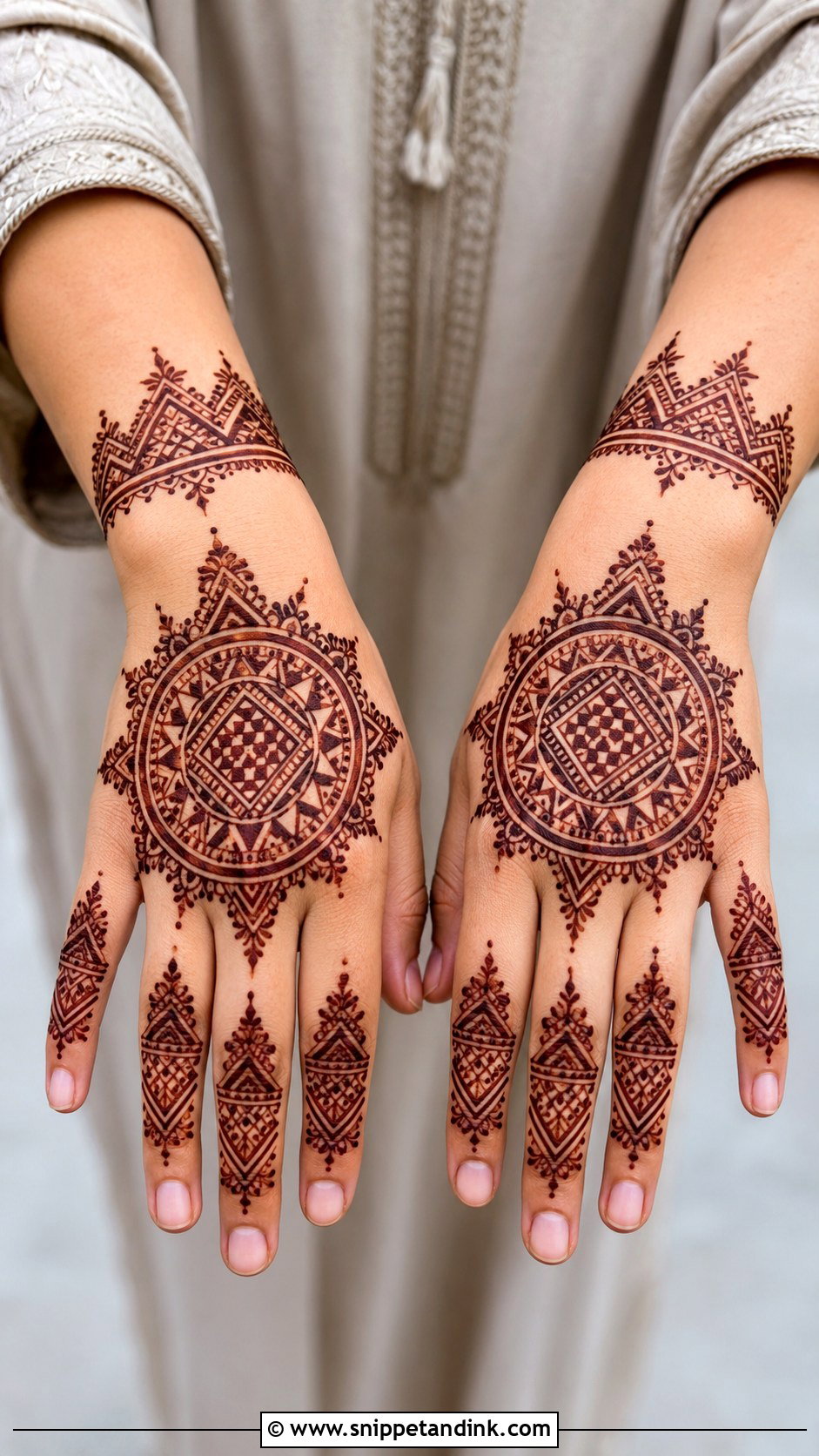
Moroccan-inspired circles swap petals for geometry: triangles, diamonds, straight lines, dots and clean borders, often with grids and angular tips on the fingers. The back hand is the best placement because straight lines stay straight there, while the palm folds and bends them. Straight lines in henna are harder than curves, so look for an artist whose geometric work is genuinely sharp. It pairs well with plain outfits where the hand becomes the pattern.
33. Gulf Circle Mehndi Design
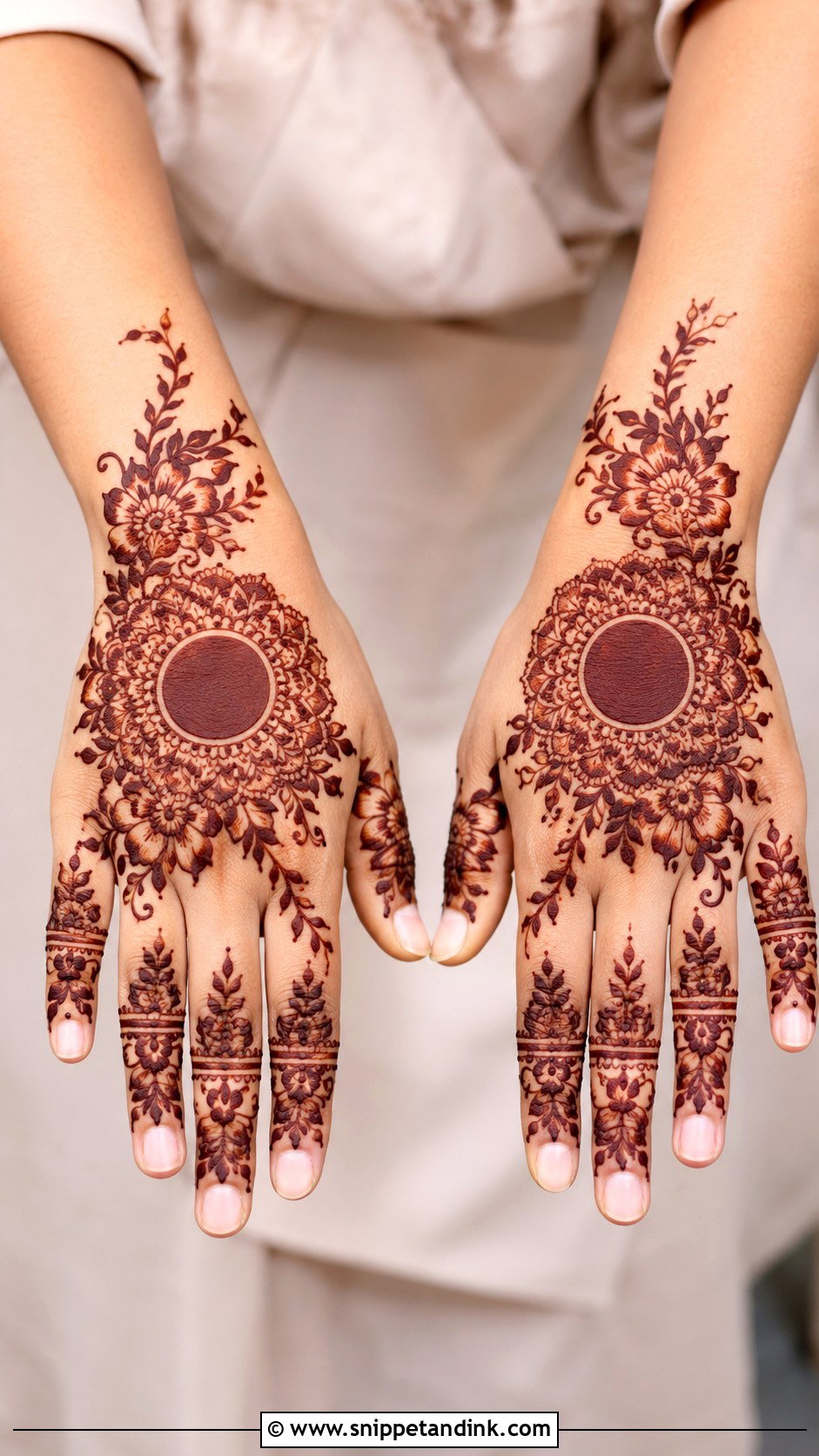
Gulf work is bold and open: a large simple circle framed by shaded flowers, leafy vines and thick confident outlines, readable from across a room. Shading is the signature, made by spreading a thin layer of paste inside each petal so it stains lighter than the outline. Too much paste and the shading stains solid, losing the effect. It sits best on the back hand with a soft floral trail toward the wrist, for Eid, weddings and evening events.
34. Circle Mehndi Design For Small Hands
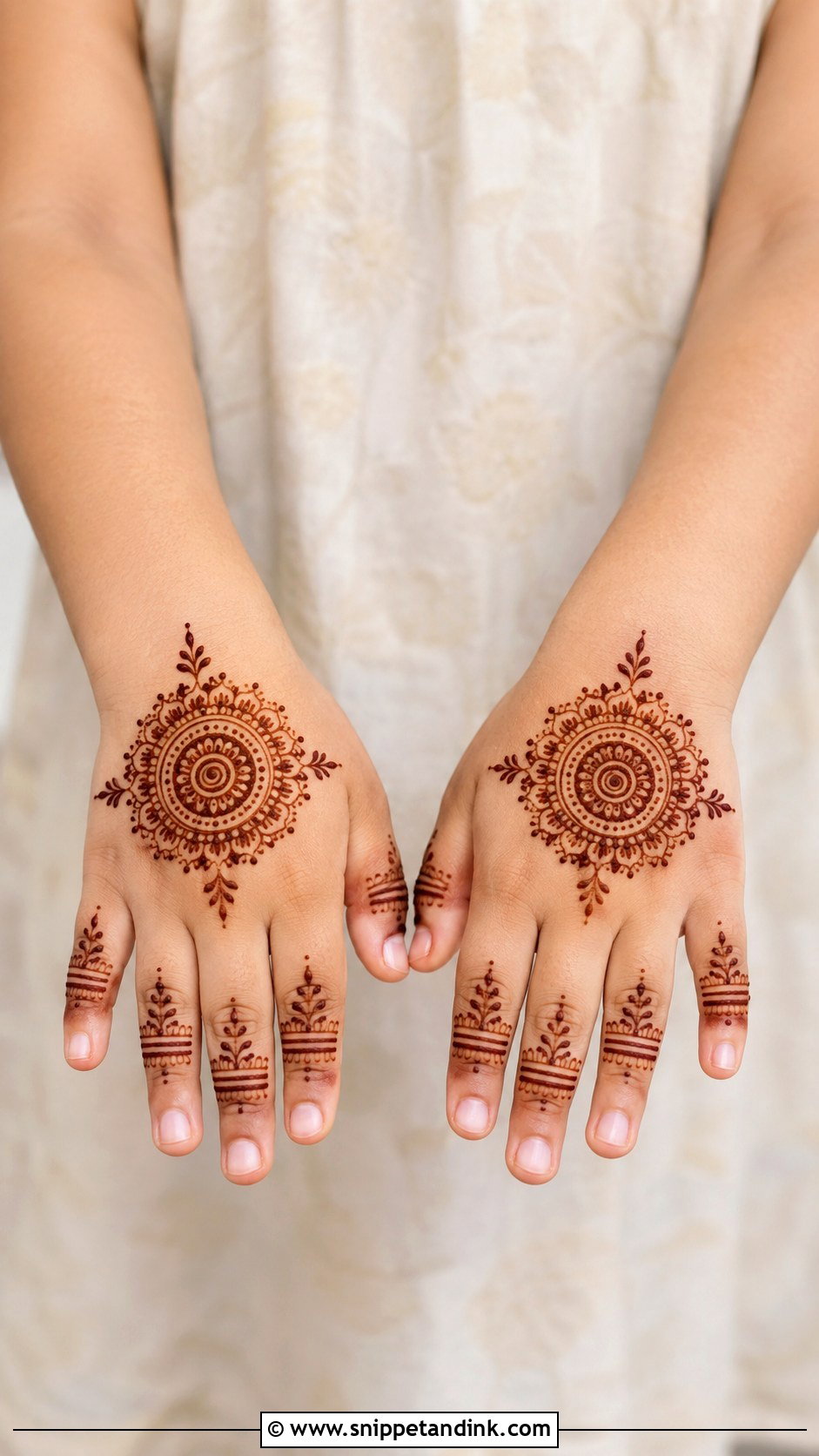
Proportion matters more than detail on petite hands. I size the circle to sit within the width of the middle three knuckles and no wider, keep the outer rings thin, and use small petals, dots and short vines. On the back hand, leave bare skin around the circle so it can breathe; on the palm, a compact tikki or small floral mandala with simple fingers. Teens and anyone with narrow hands tend to look most polished in this scale.
35. Circle Mehndi Design For Full Fingers
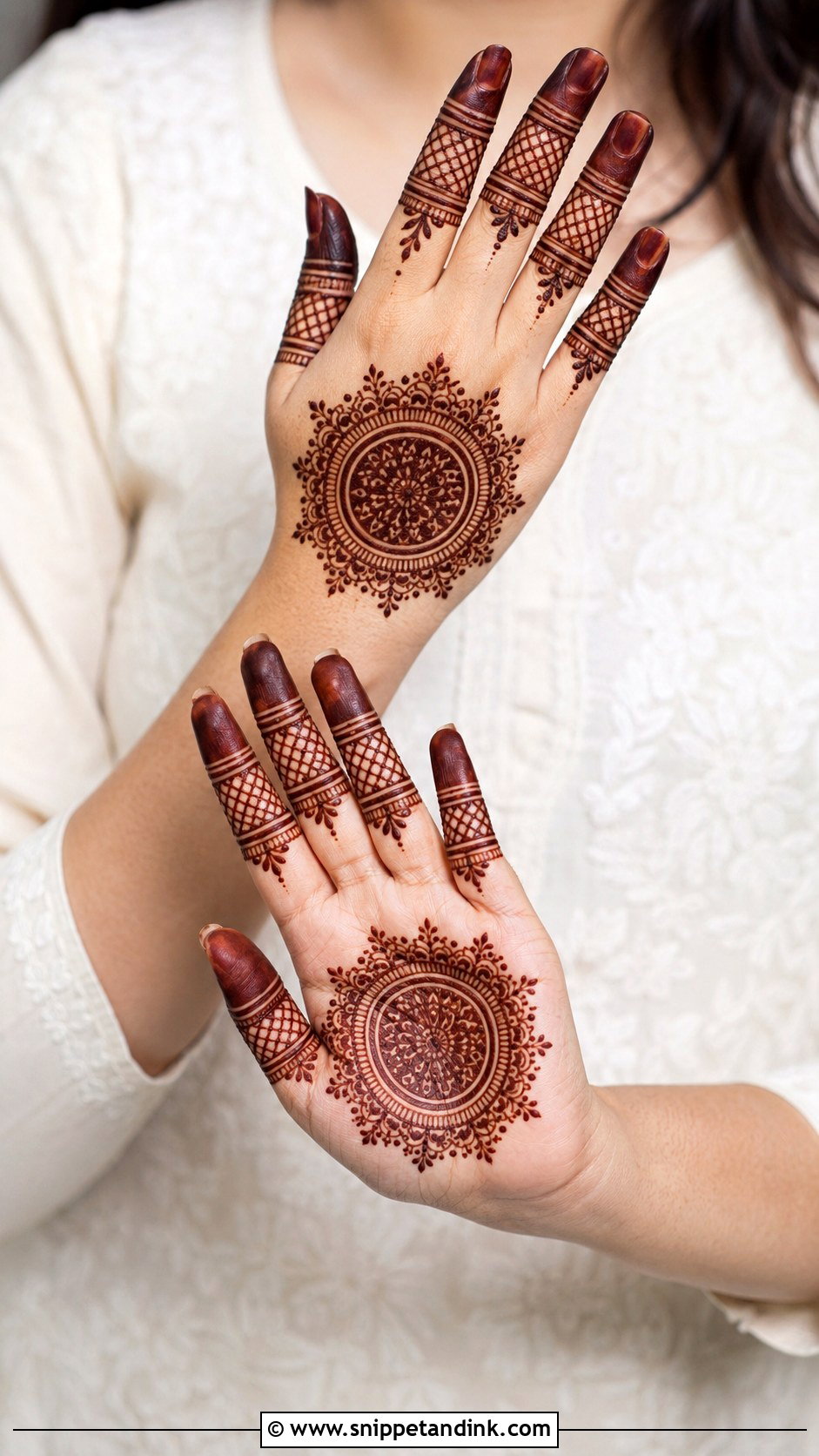
Full fingers with a round centre gives a complete festive hand without going up the forearm. The circle sits on the palm or back hand while each finger takes bands, dots, leaves, jaali or shaded tips. I let the fingers carry the heavier pattern and keep the centre clear, otherwise the hand reads as one dense block. Matching shapes across all fingers look neat; one slightly different finger, usually the ring finger, adds interest.
Paste Off, Stain Up: The First Two Days
A circle shows a weak stain more than any other motif, because a pale patch in one ring breaks the symmetry. Most of the colour is decided after I’ve finished drawing, so this is what I tell every client before they leave the chair.
- Let the paste dry until it looks matte, then dab on a little lemon and sugar to keep it stuck to the skin. Don’t soak it; a dripping hand smudges fine rings.
- Keep the paste on for as long as you comfortably can. Six to eight hours is a good target, overnight is better. Wrapping hands loosely in tissue for sleep keeps them warm.
- Scrape the dried paste off with a blunt edge or your fingernail. Don’t wash it off.
- Avoid water for the rest of that day if you can. A little mustard oil or balm on the stain before you shower helps.
- Expect an orange stain at first. Natural henna oxidises and deepens to brown or maroon over the next one to two days, so apply 24 to 48 hours before the event you care about most.
Reading a Cone Before It Touches Skin
Natural henna paste is greenish brown and smells earthy or of essential oils. It never stains black, and it never stains dark in minutes. If a cone promises an instant black result, or smells sharply chemical, I won’t put it on anyone, and I’d ask you to refuse it too. So-called black henna often contains PPD, a hair-dye chemical that can cause blistering and lasting skin sensitivity.
Fresh paste also behaves better for circles. Old or over-dried paste comes out in uneven blobs and breaks mid-ring, which is exactly where a mandala shows its flaws. I mix in small batches, keep the cones in the freezer, and thaw only what I need for the day. If you have sensitive skin, ask for a small patch on the inner wrist a day or two before the full design.
A Circle Is Only as Good as Its Centre
A round motif can be a quick back-hand dot cluster, a full palm mandala, a bridal centrepiece or a modern piece of henna jewellery, and you can fill it with flowers, dots, paisleys, jaali, peacocks or Arabic vines. What I come back to at every appointment is the centre: place it on the right spot for that hand, keep the rings even, and give the circle enough bare skin to read as the focus. Get that right and the rest of the design has something to hold onto, from a festival afternoon to a wedding week.
You'll Like These Ideas:











Leave a Reply