
Arabic mehndi on the back of the hand works because of what it leaves out. Bold flowers, leafy vines, paisleys and finger detail sit on the skin with plenty of bare space around them, so the pattern reads clearly from across a room and in photos. It’s what I’m asked for most at Eid, by wedding guests and by anyone short on time, since a good Arabic back-hand design takes a fraction of the sitting time of Indian bridal work. The 30 layouts below run from a single trail to wrist-to-forearm coverage, and the notes cover which hands suit them and where each one tends to go wrong.
Why the Back of the Hand Stains Lighter, and What Helps
Clients are often disappointed that the back of the hand never matches the palm. That’s normal. Henna stains the outer layer of skin, and the palm has a much thicker outer layer than the back of the hand, so the palm goes deep maroon while the back usually settles a shade or two lighter. Arabic designs suit the back of the hand partly because their bold lines carry well even when the stain is lighter.
- Wash hands with plain soap and dry them fully before application; lotion or oil blocks the dye.
- Leave the paste on for several hours, and longer on the back of the hand than you would on the palm.
- Keep your hands warm while the paste is on; cold hands stain weaker.
- Scrape the dried paste off instead of washing it, and keep water away for as long as you can afterwards.
1. Simple Arabic Back Hand Mehndi Design
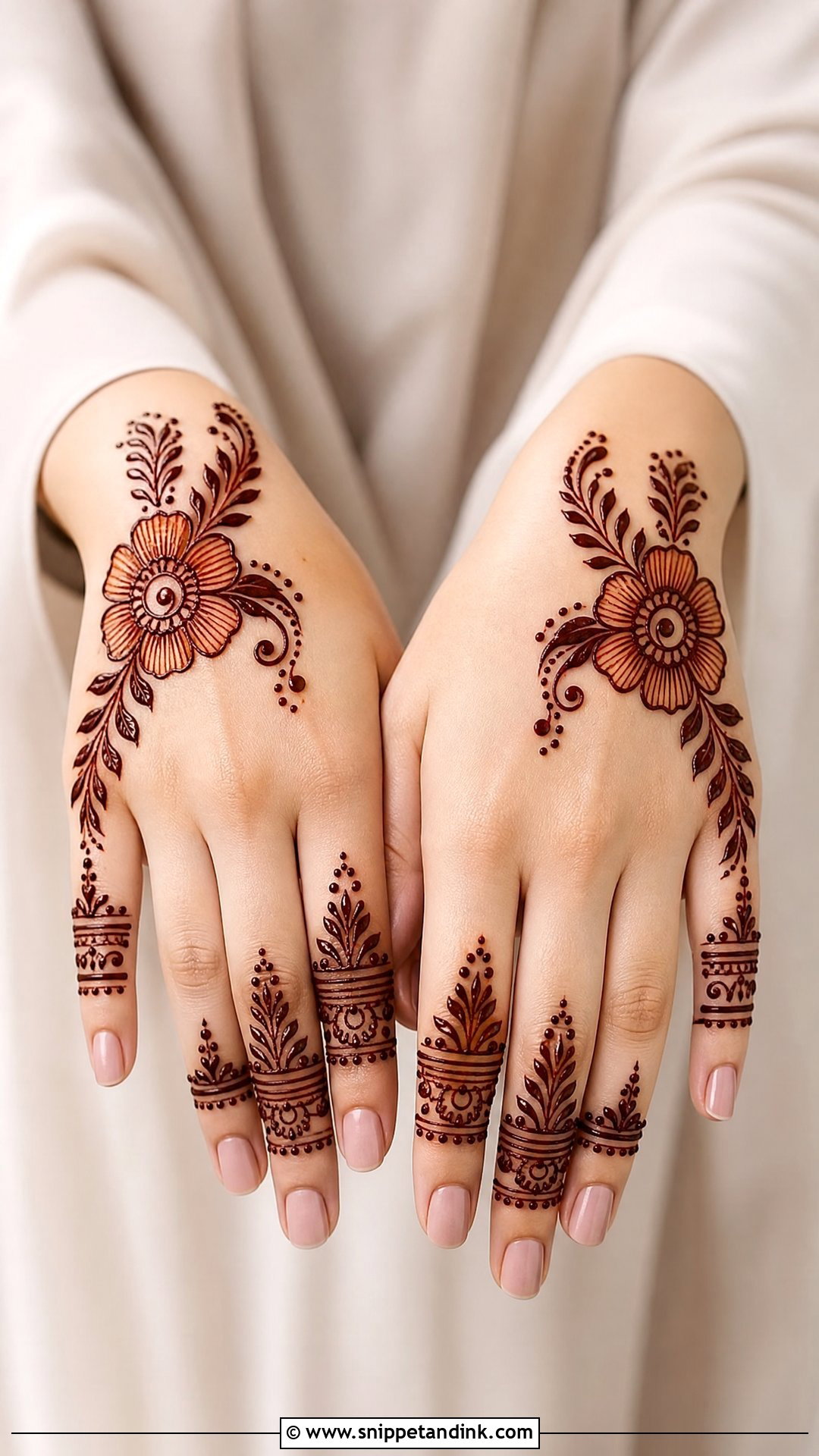
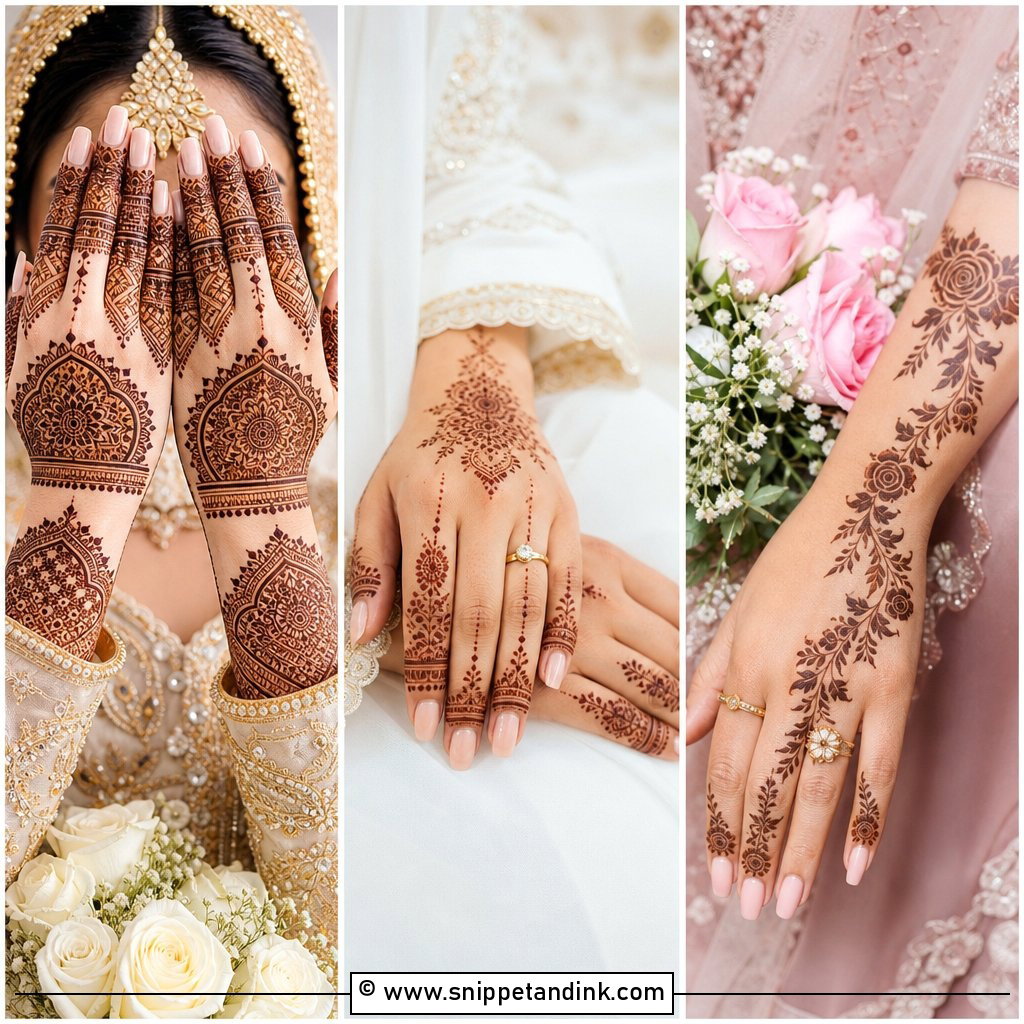
Start with one bold flower near the wrist or the side of the hand, then let a curved leafy trail climb toward the index or middle finger. That’s the whole design, plus slim bands, dots and light tip shading on the fingers. When people try this on themselves, the trail usually wanders; I tell them to imagine a line from the wrist bone to the knuckle of the chosen finger and keep the vine riding just alongside it. It suits small hands, beginners and Eid morning when time is short.
2. Floral Arabic Back Hand Mehndi Design
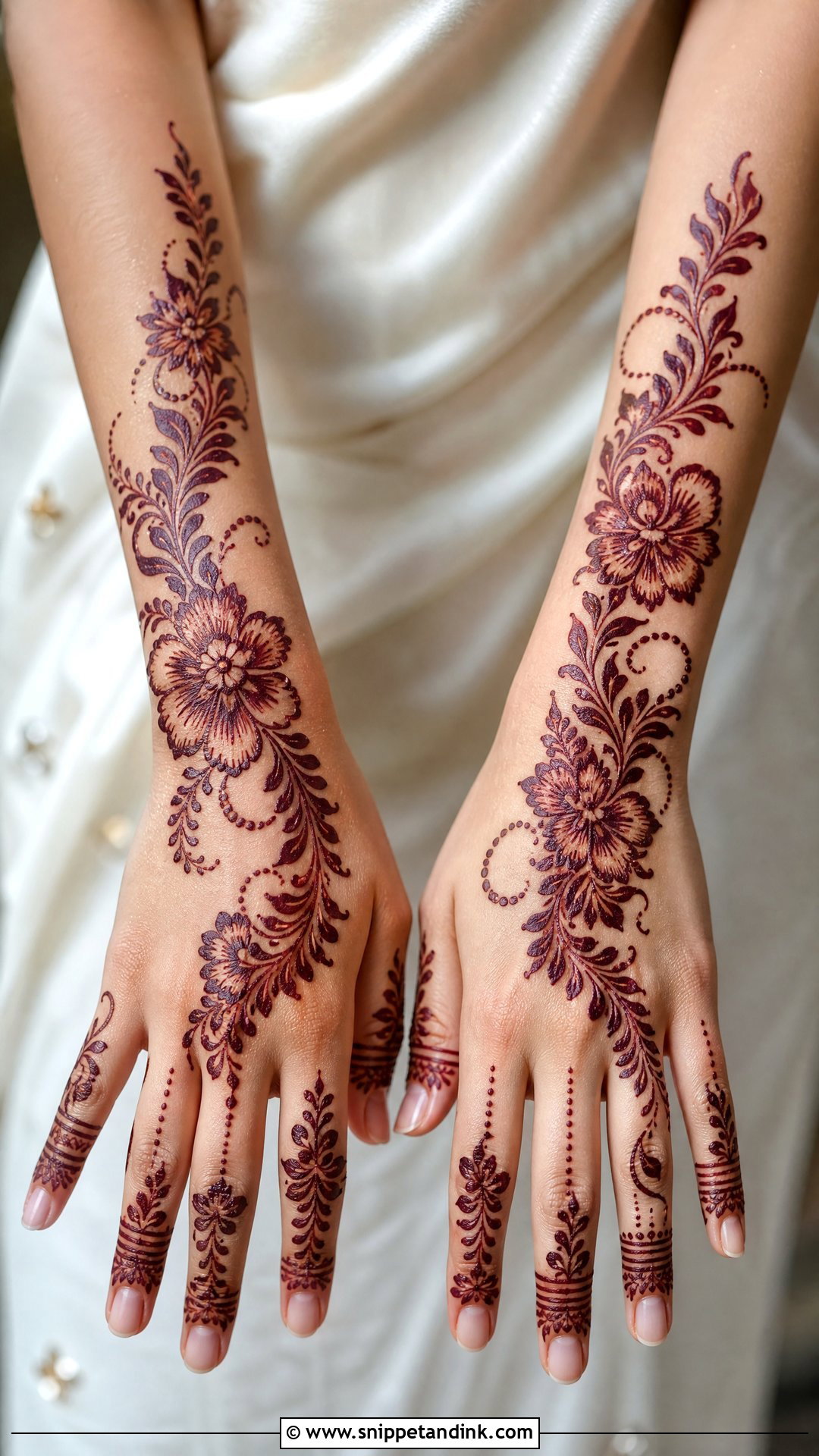
Floral layouts are the ones most people point to first when they sit down with me. One large flower sits on the centre or lower back of the hand, smaller flowers follow a diagonal path, and vines join them up. The outline of each flower should be noticeably thicker than the lines inside it. On the back of the hand the stain is lighter than on the palm, and thin outlines can vanish into the petals by the third day. Mini flowers or curved leaf bands on the fingers repeat the theme.
3. Rose Arabic Back Hand Mehndi Design
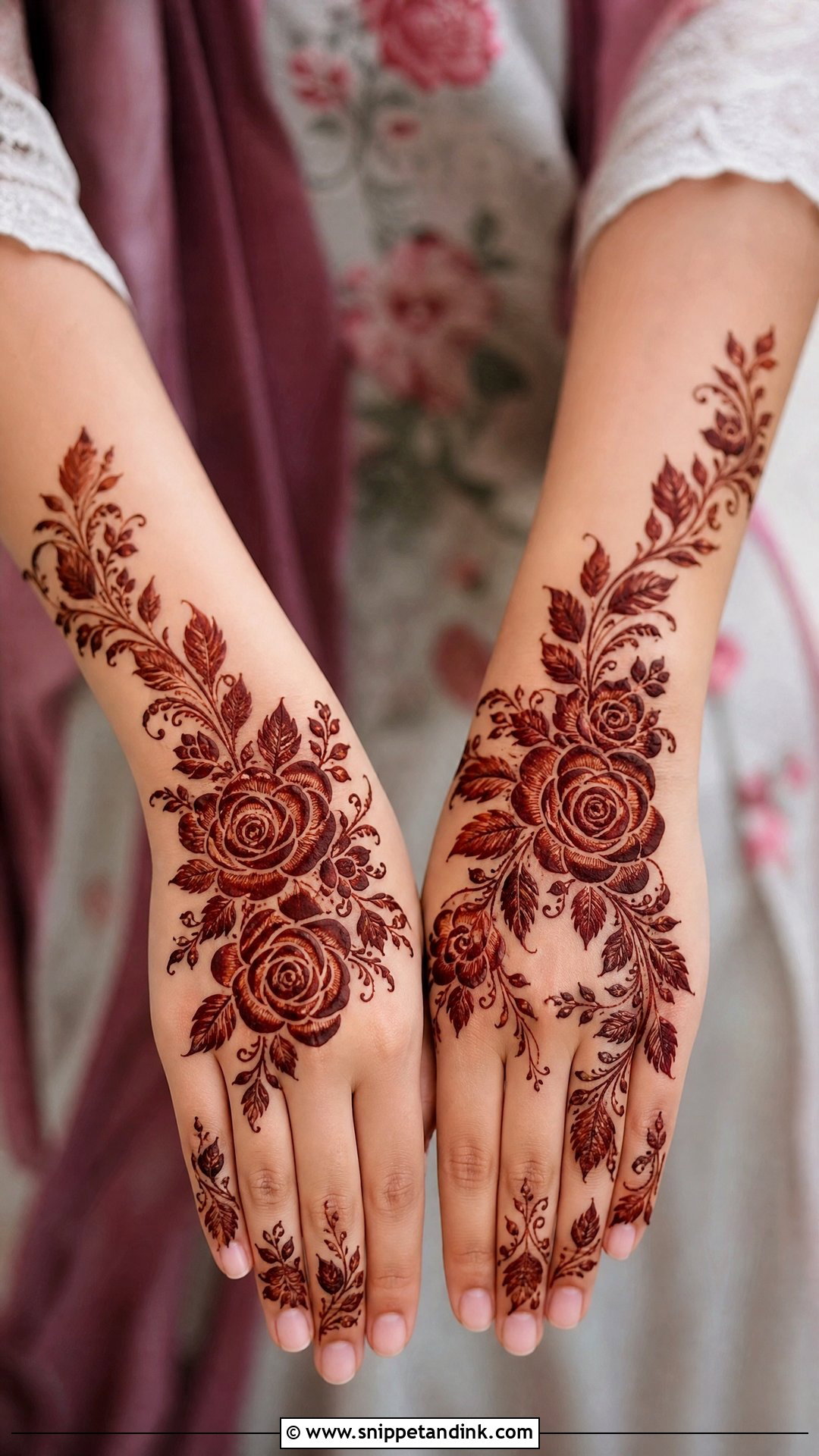
A rose gives the hand a single strong focal point. I place it near the wrist, the centre or the side of the hand, then extend vines and leaves toward the fingers, with a few buds around it so it doesn’t float alone. Open, bold petals look more current than a tight spiral. Shade just the inner edge of each petal layer; shading the whole petal turns a rose into a dark blob once the stain matures. Thin curves and tiny rose tips finish the fingers.
4. Leaf Vine Arabic Back Hand Mehndi Design
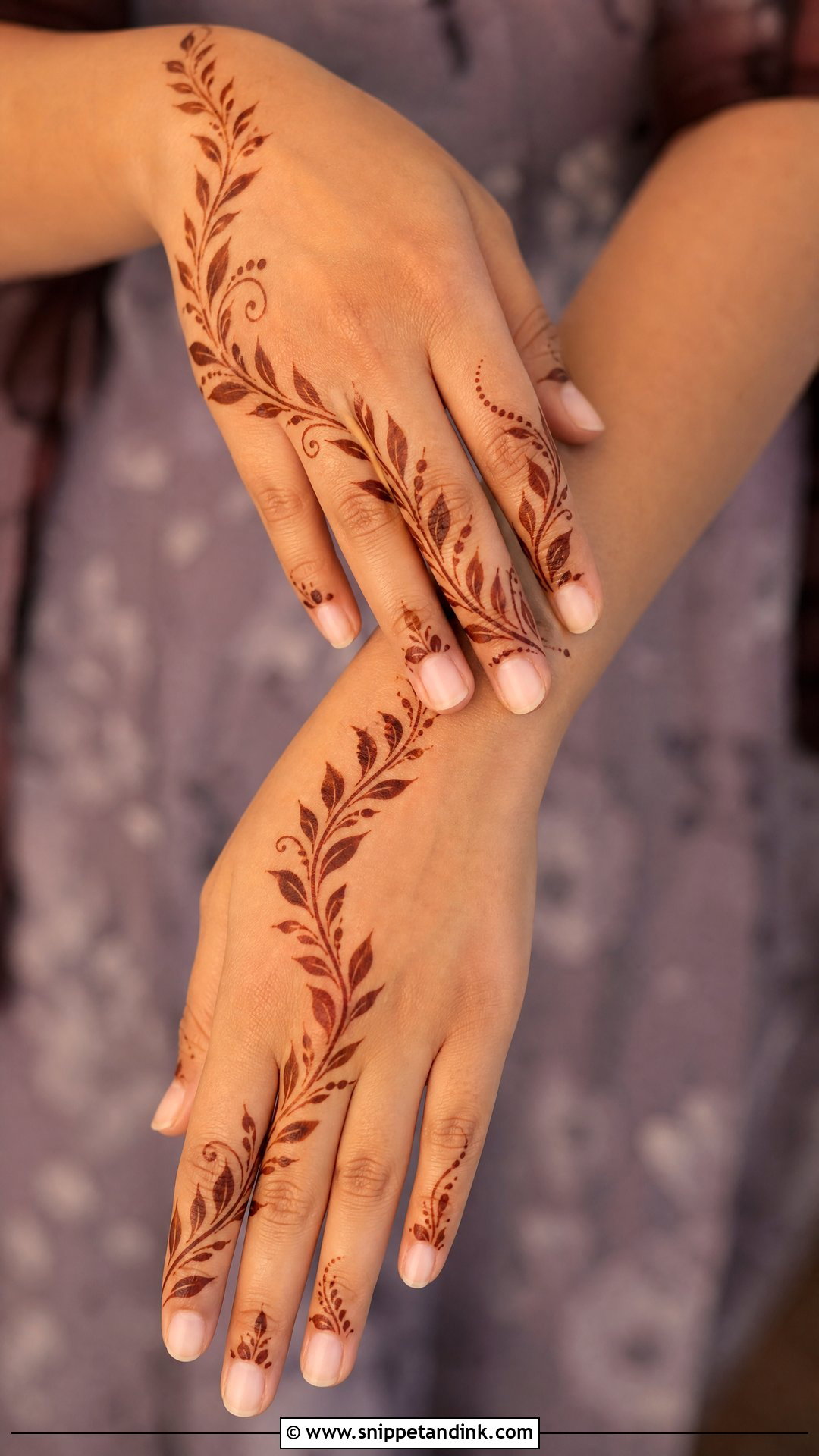
Here the vine does all the work. One long line travels diagonally from wrist to finger, with leaves drawn in pairs, alternating, or clustered around the knuckles. No flowers are needed. Leaves are drawn fastest as two strokes from the same point, and when they all lean the same way the vine looks like it’s growing. It’s lovely on long, slender fingers because it follows the bones of the hand.
5. Diagonal Arabic Back Hand Mehndi Design
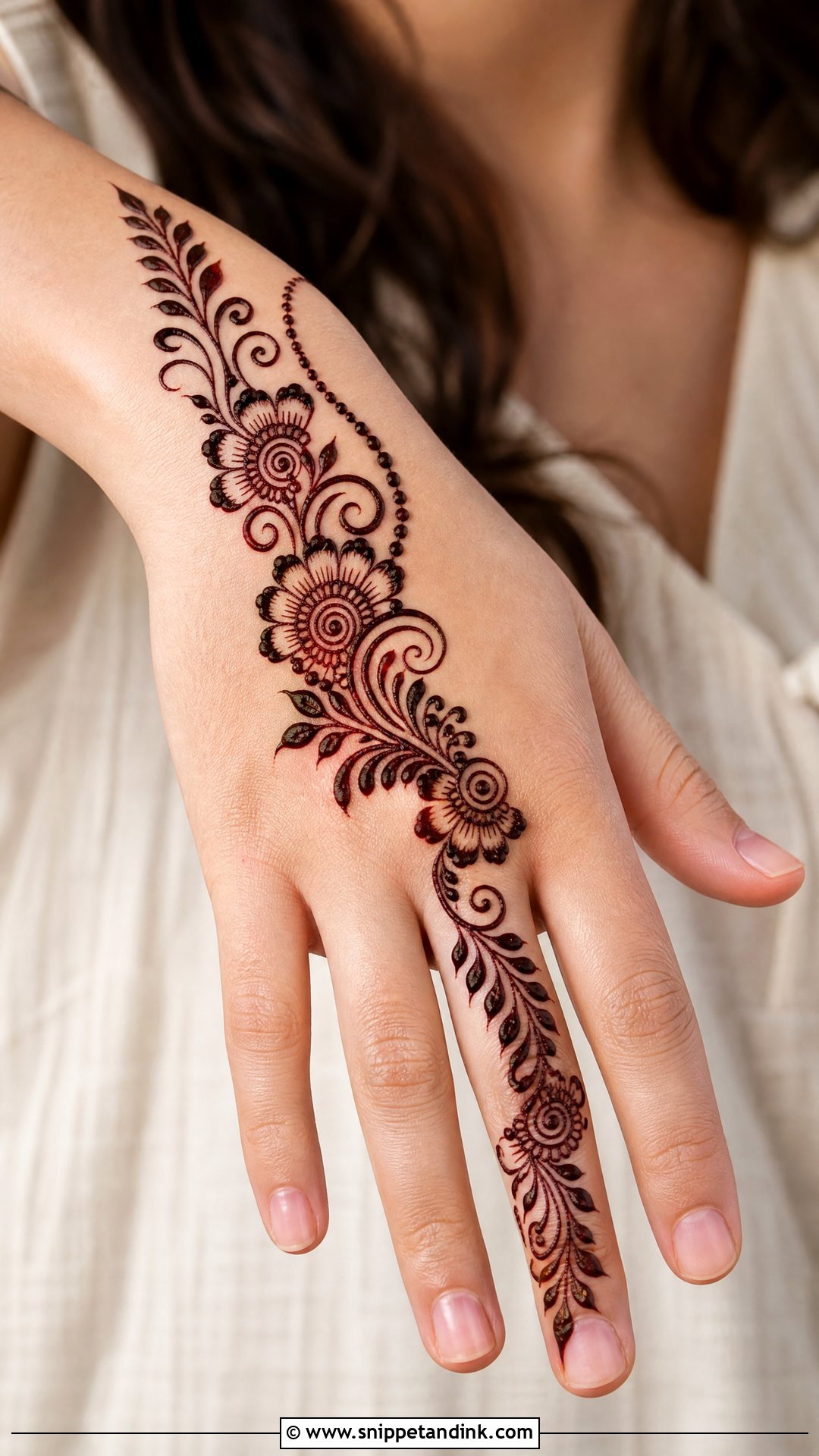
The diagonal is the backbone of Arabic mehndi: wrist, across the back of the hand, up to one finger, with flowers, leaves, paisleys, dots and a little mesh along the way. Open skin on both sides keeps it light. Which way should the diagonal run? I usually start at the outer wrist and finish at the index finger, because that’s the side people see when you hold a glass or wave. It suits wedding guests and casual parties.
6. Full Arabic Back Hand Mehndi Design
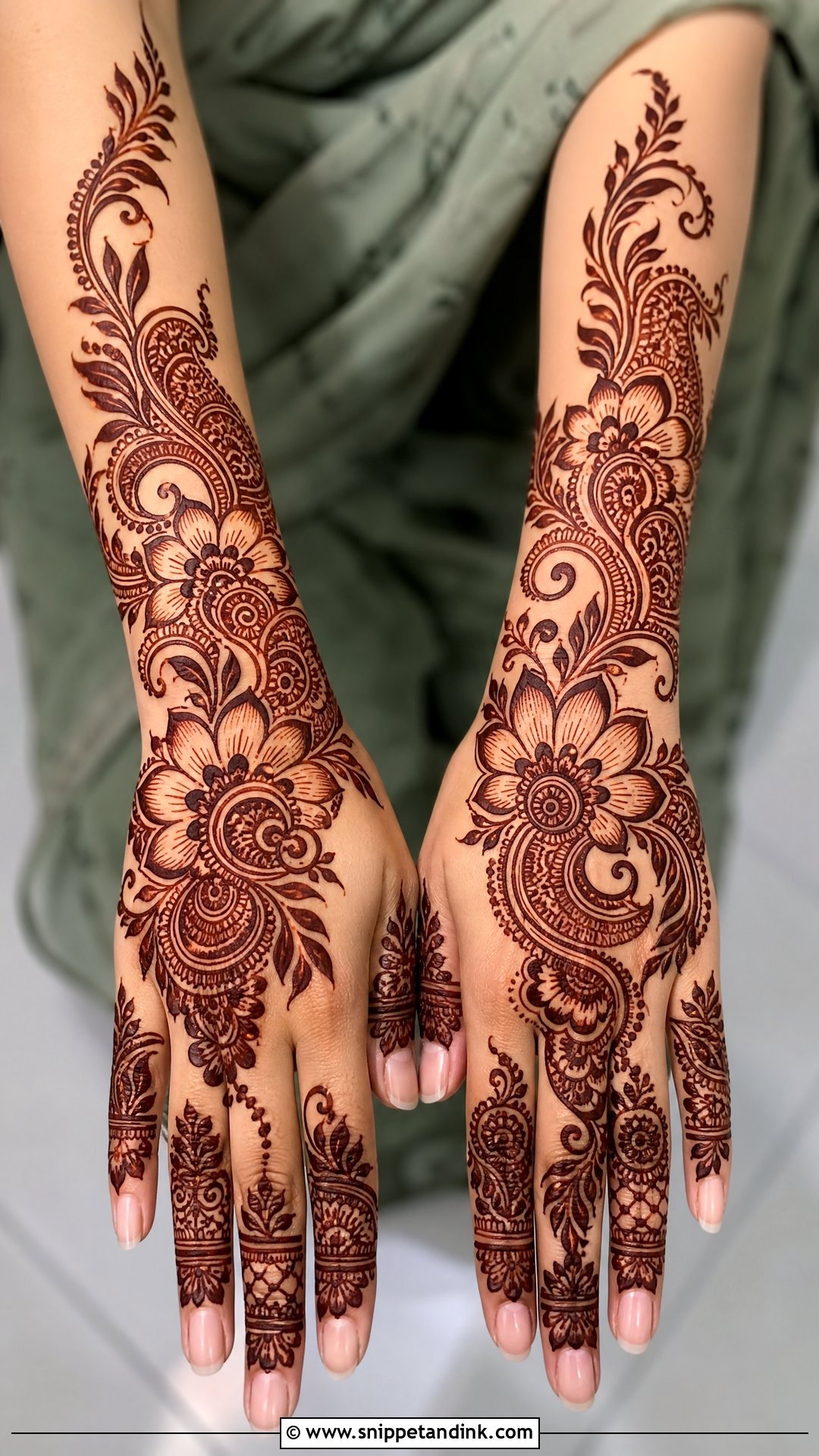
Full coverage in the Arabic style means bold sections rather than tiny fill: large florals, paisleys, leafy trails, a bracelet band at the wrist and neat finger patterns, with small gaps between motifs so the hand breathes. It pairs well with heavily embroidered outfits for Eid nights, sangeet or a bridesmaid look. Expect to sit for roughly twice as long as a single trail, and plan to keep the hand still for a few hours after.
7. Half Hand Arabic Back Hand Mehndi Design
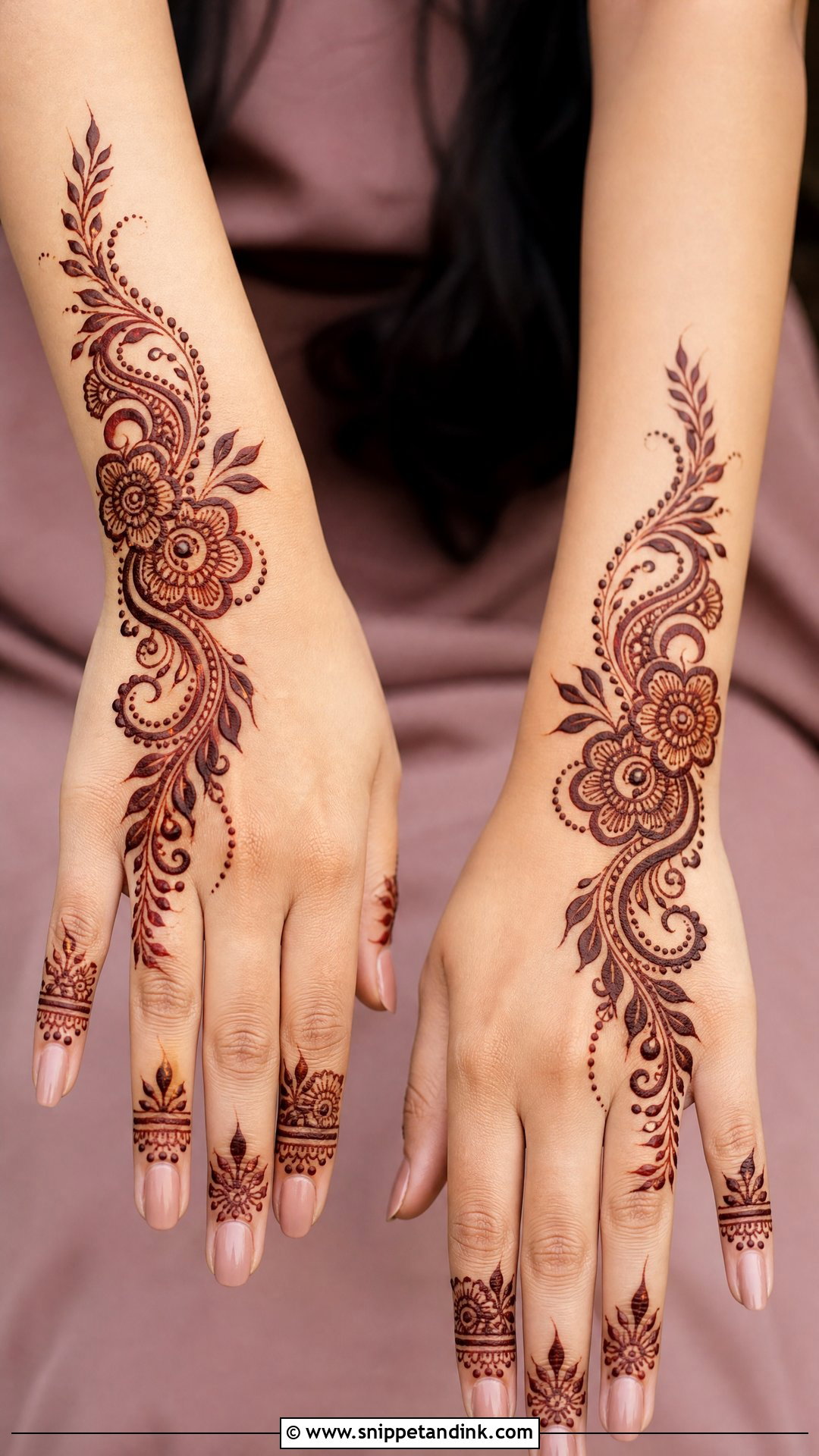
Half-hand designs cover the fingers, knuckles and one side of the back of the hand, finishing at the wrist, with a floral trail or paisley curve placed diagonally and the opposite side left bare. It’s my suggestion for people who need mehndi to look finished at a function but don’t want it showing on the forearm at work afterwards. It suits school and office celebrations, small family Eid gatherings and minor wedding events.
8. Front Finger Arabic Back Hand Mehndi Design
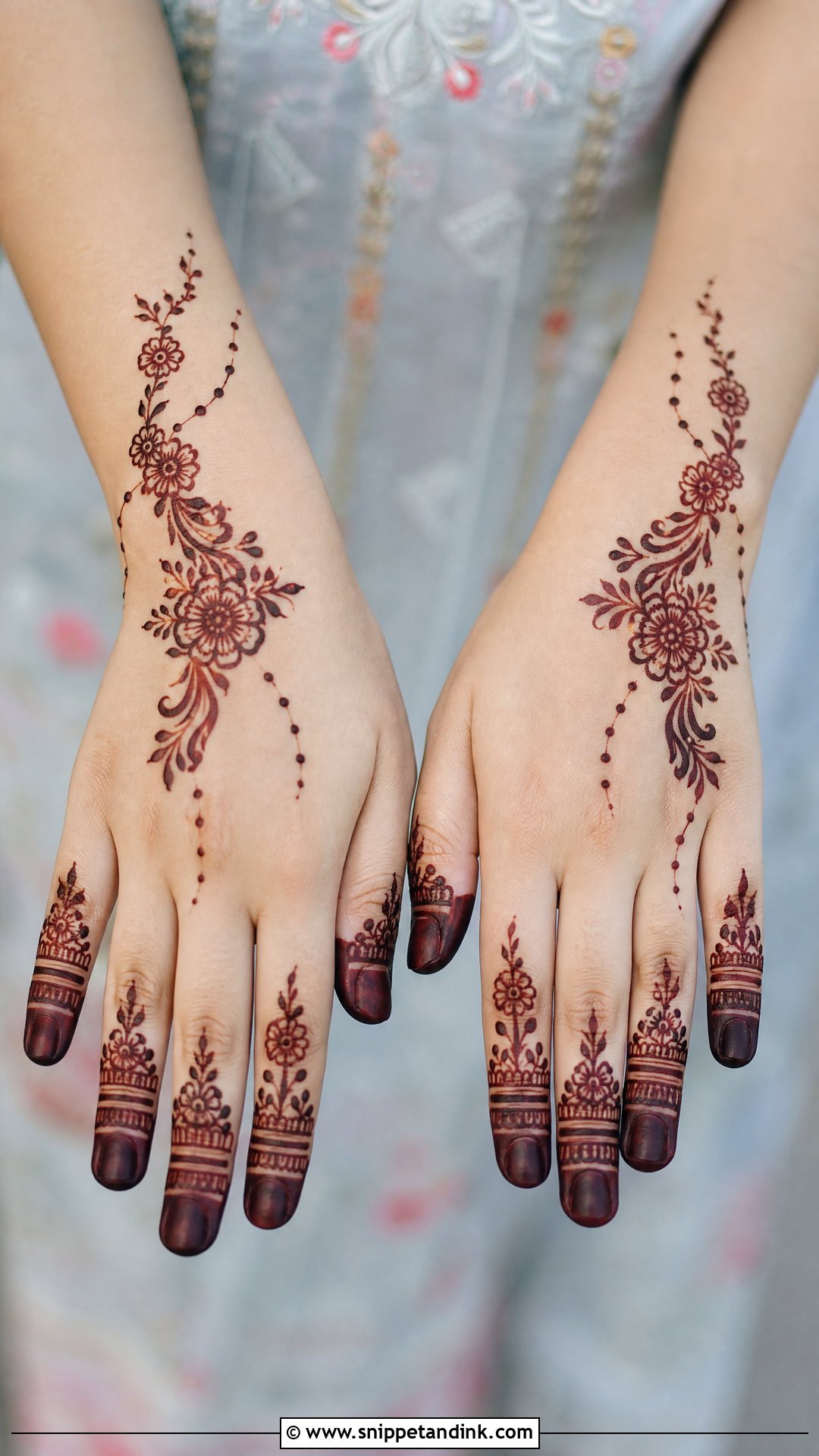
When the fingers carry the detail, the back of the hand can stay almost empty. This layout puts bands, leaf chains, dots, tiny flowers and shaded tips on the fingers, with one curved trail linking them to a small cluster near the wrist. Fingers get the most attention in photos and gestures. Leave thin gaps between bands; packed bands merge into a single dark stripe within a day. It suits modern outfits and minimal jewellery.
9. Wrist Bracelet Arabic Back Hand Mehndi Design
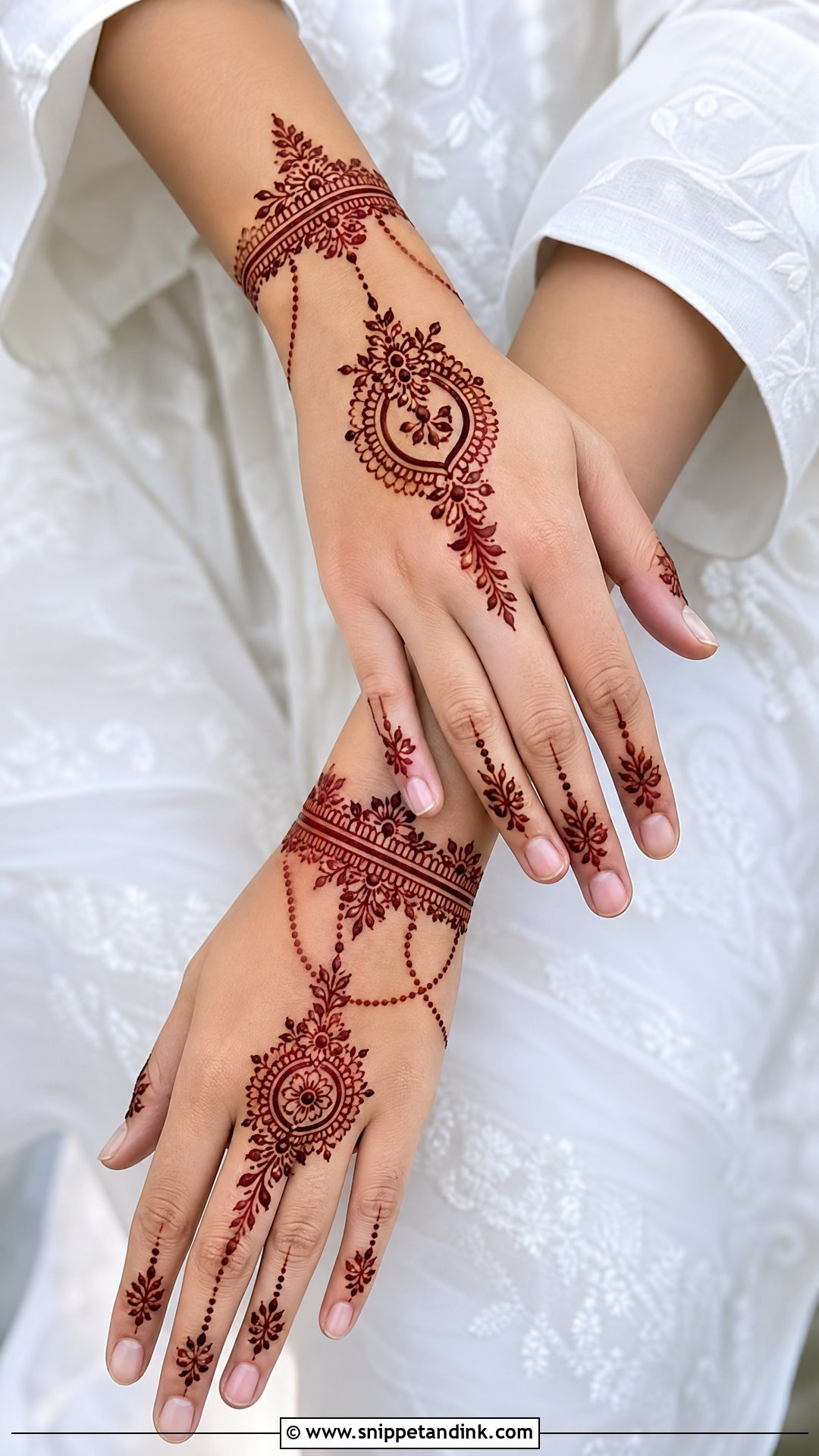
Henna jewellery is the idea here: a bracelet band at the wrist, chains, leaves and small flowers rising to a central motif on the back of the hand, with one or two finger trails. The bracelet can be simple scallops and dots or detailed with paisley edges. I draw the band with the wrist slightly bent back, so it doesn’t distort when the hand relaxes. It looks pretty for Eid, mehndi parties and baby showers, especially if you’re wearing few bangles.
10. Mandala Arabic Back Hand Mehndi Design
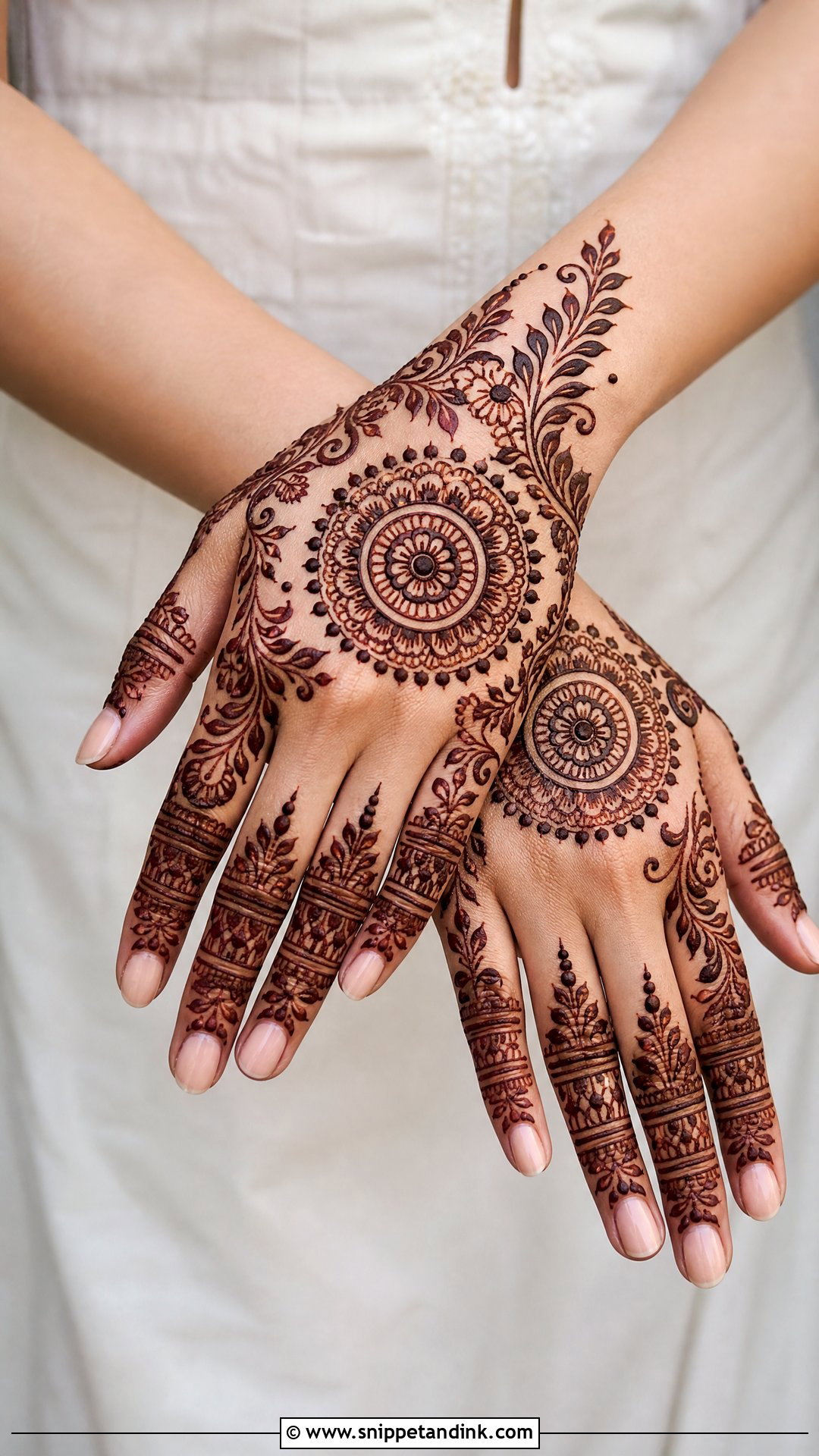
A mandala in the centre of the back of the hand with Arabic vines and flowers spreading out to the wrist and fingers combines symmetry with flow. Keep the mandala bold with clean circles, petals and dots, then soften its edges with leafy trails, and leave the fingers fairly simple. The back of the hand is curved, so a mandala drawn on a flat hand looks oval when the fist closes. I draw it with the hand slightly cupped.
11. Paisley Arabic Back Hand Mehndi Design
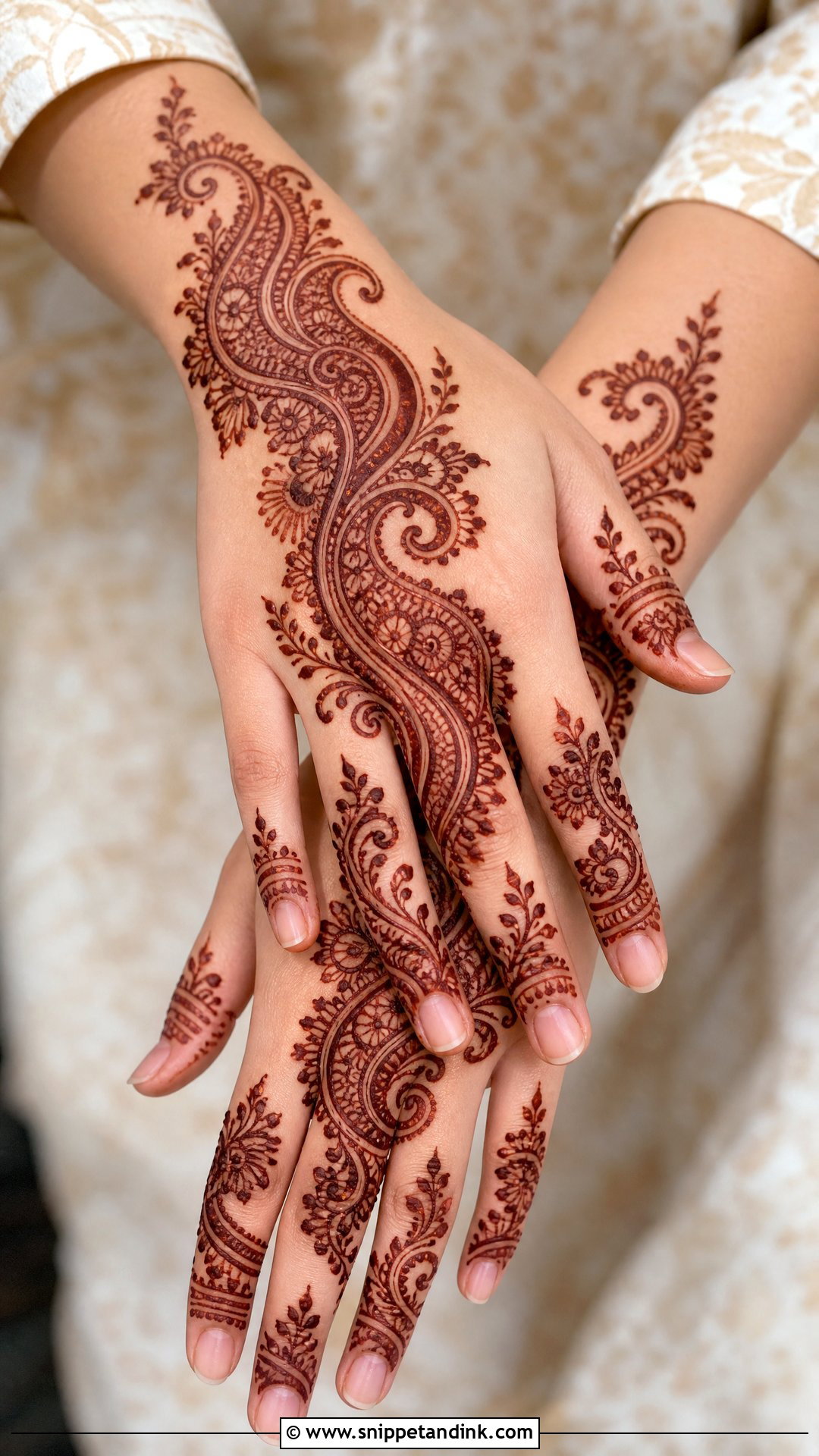
One or two large paisleys placed diagonally give a traditional feel inside an open Arabic layout. Leafy vines, curves, dots and small flower clusters join them, and the paisley interiors carry fine lines, tiny petals and shading. Leave visible skin around each paisley. I find this layout suits medium and larger hands best, since big paisleys crowd a small hand quickly. It’s a good fit for wedding guests and festive occasions.
12. Jaali Arabic Back Hand Mehndi Design
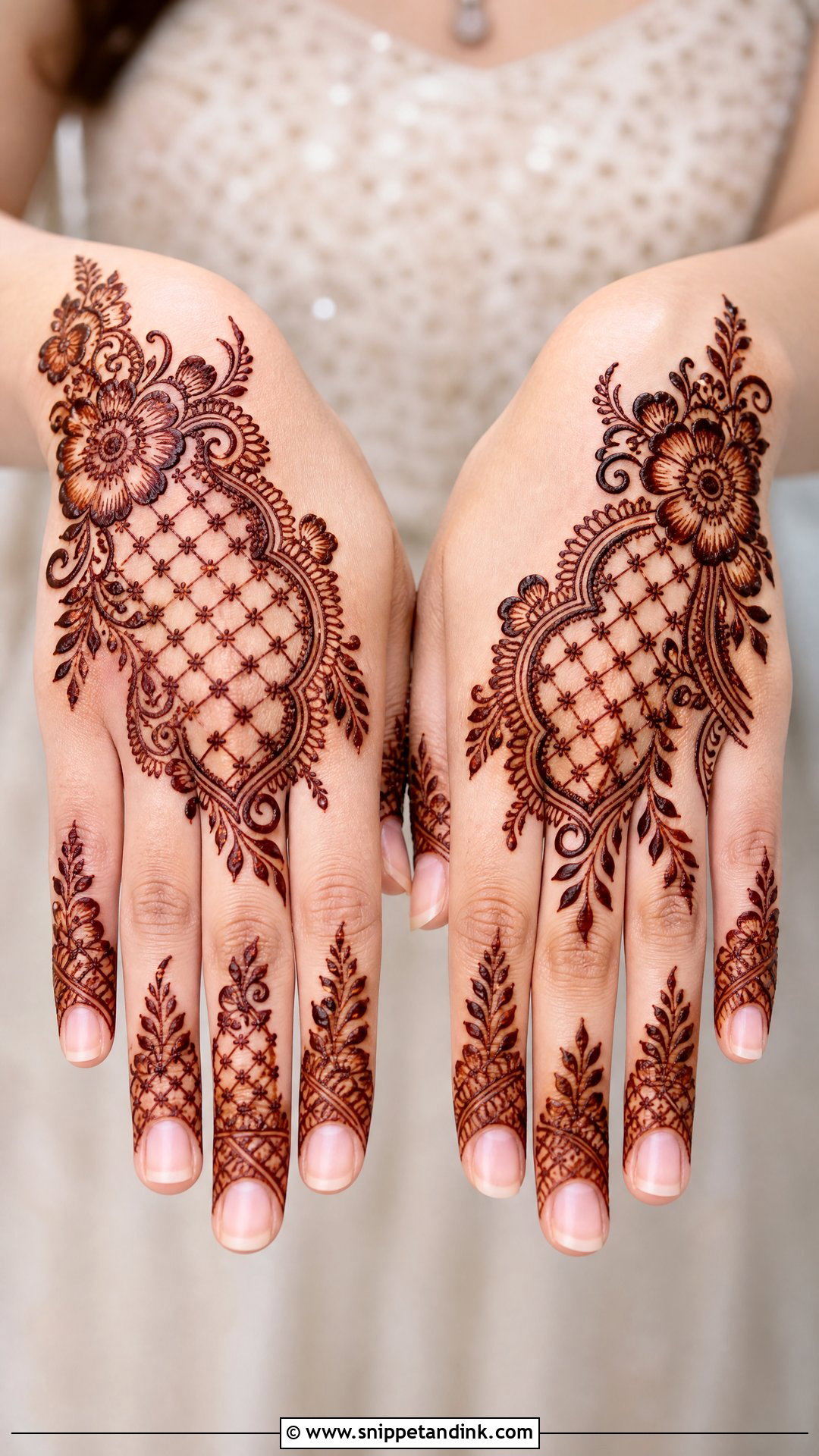
A jaali net can sit on one side of the hand, inside a paisley, at the wrist or across the fingers, paired with Arabic flowers so the design doesn’t look too geometric. A clean mesh with dots at the intersections looks polished in close-ups and sits well with rings. The mesh needs evenly spaced lines; I draw all the parallel lines in one direction first, then cross them, rather than building it square by square.
13. Gulf Arabic Back Hand Mehndi Design
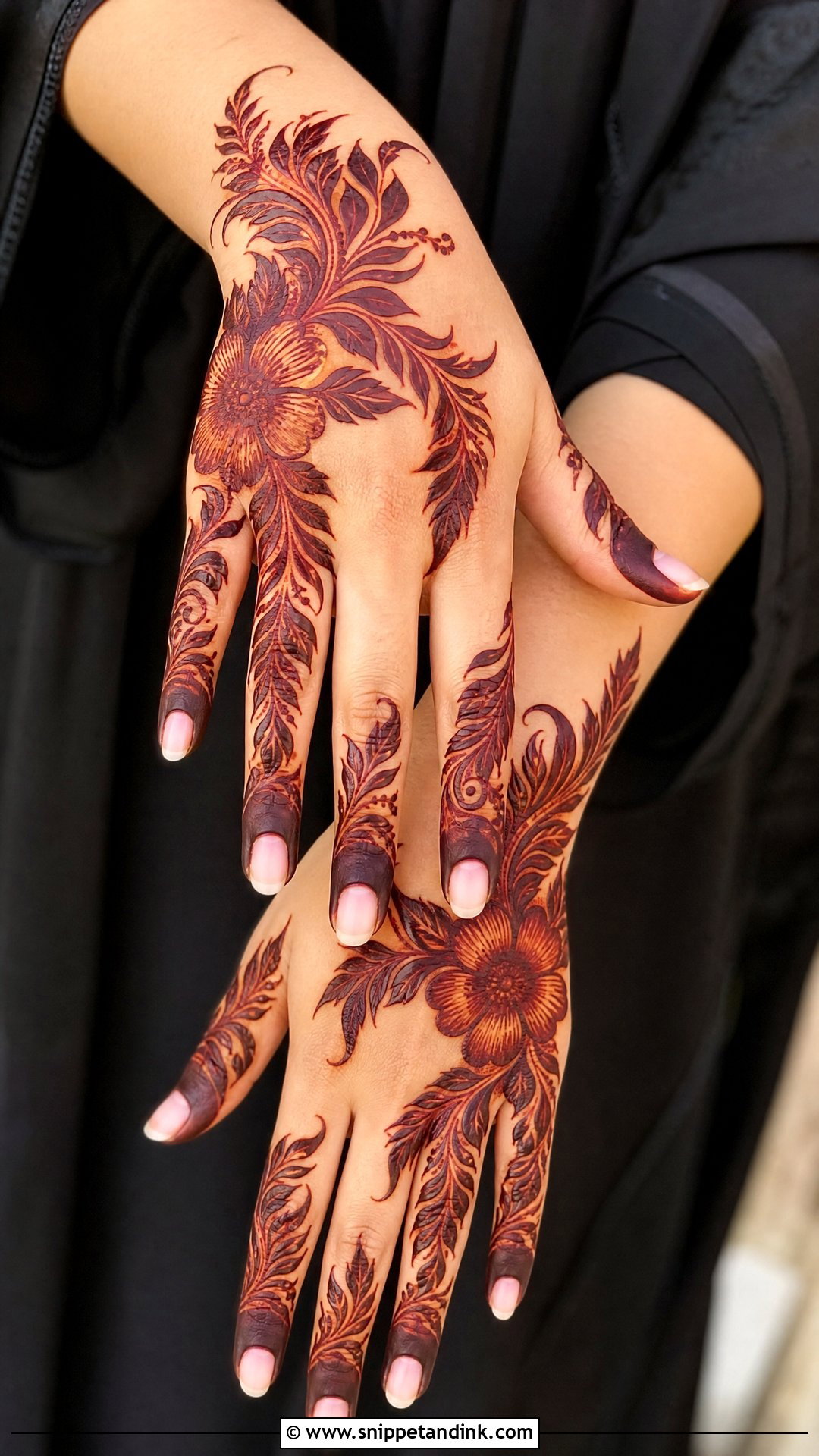
Gulf-style mehndi is bolder: bigger floral motifs, darker filled areas, thick outlines and flowing vines from wrist to fingers, still with open space between major elements. Filled areas need generous paste. A thin skim of henna over a large filled area stains patchy, so I lay it on thicker and leave it longer. It suits Eid nights and wedding functions, and on most skin tones the deep maroon stain looks dramatic.
14. Khaleeji Arabic Back Hand Mehndi Design
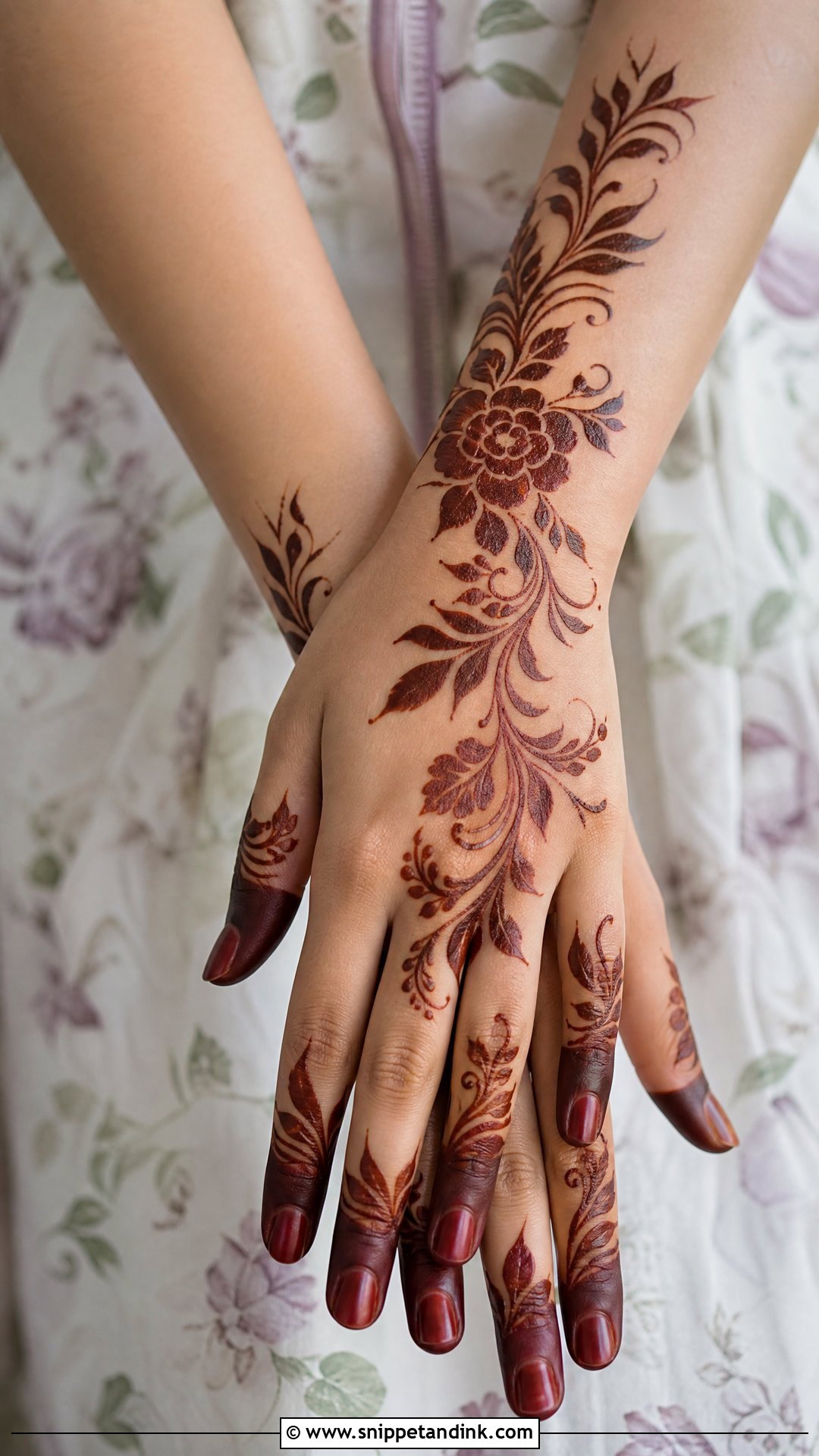
Khaleeji work is all about visible shapes: wide floral strokes, curved vines, thick leaves and bold fingertips, readable from a distance. Fine detail is used only where it’s needed. A large flower near the wrist with the design sweeping across the hand in a soft curve is typical. It’s quicker than fine Indian work but less forgiving; with lines this thick, any wobble shows. People who like statement mehndi without tiny detailing usually love it.
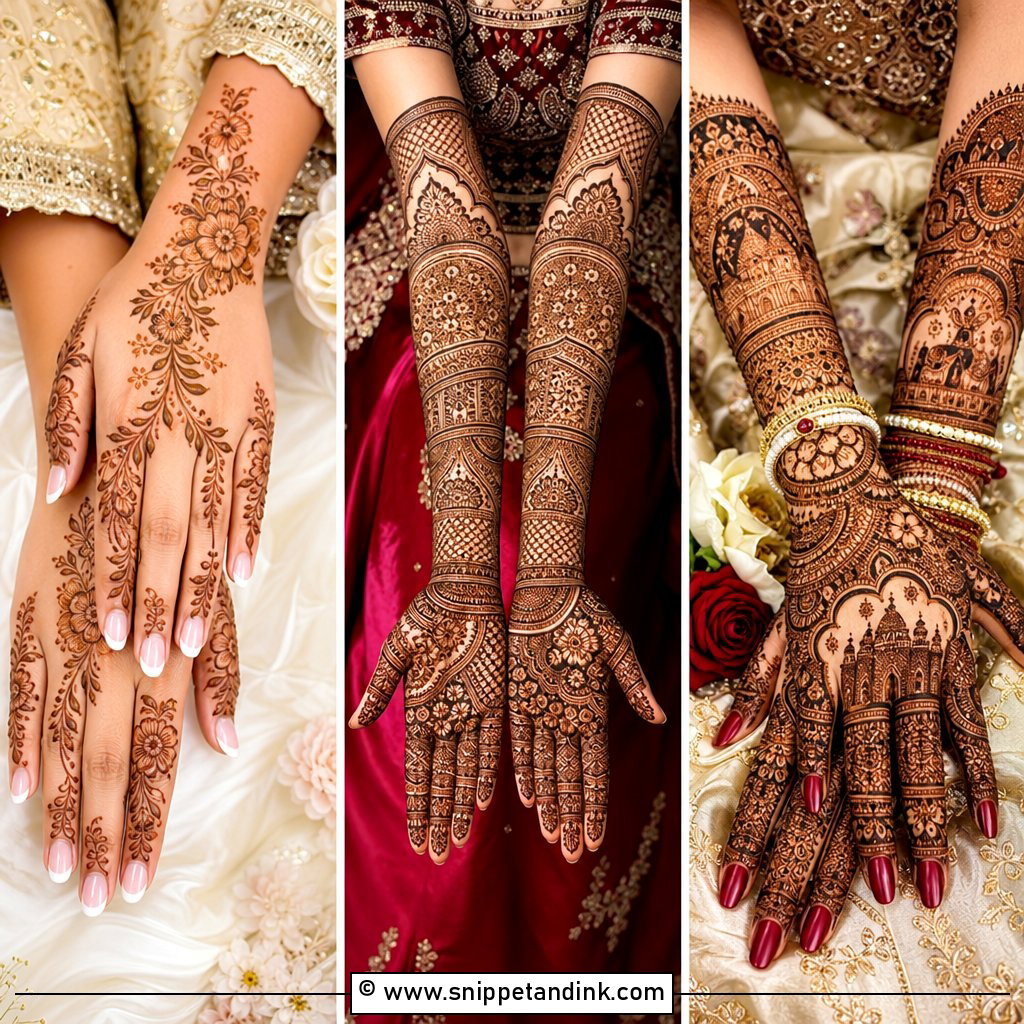

15. Indo Arabic Back Hand Mehndi Design
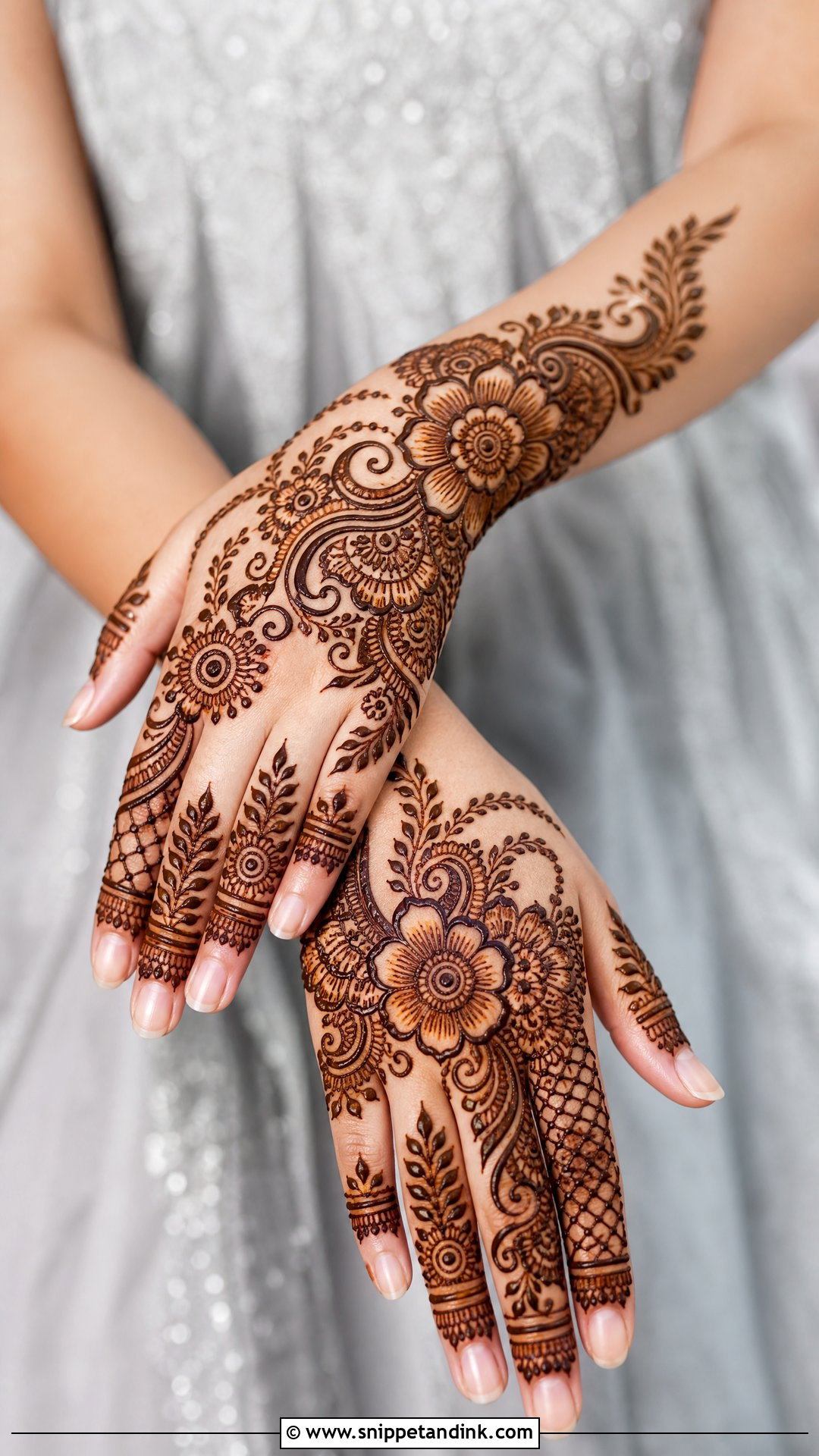
Indo-Arabic combines Arabic flow with finer Indian fill: large flowers and paisleys alongside small mandalas, mesh patches and detailed finger work. It’s fuller than pure Arabic but lighter than bridal coverage. Keep the main layout diagonal so the Arabic base stays visible, and add fine lines only inside selected motifs. For bridesmaids and engagement guests, I find it’s the best compromise between detail and sitting time.
16. Modern Arabic Back Hand Mehndi Design
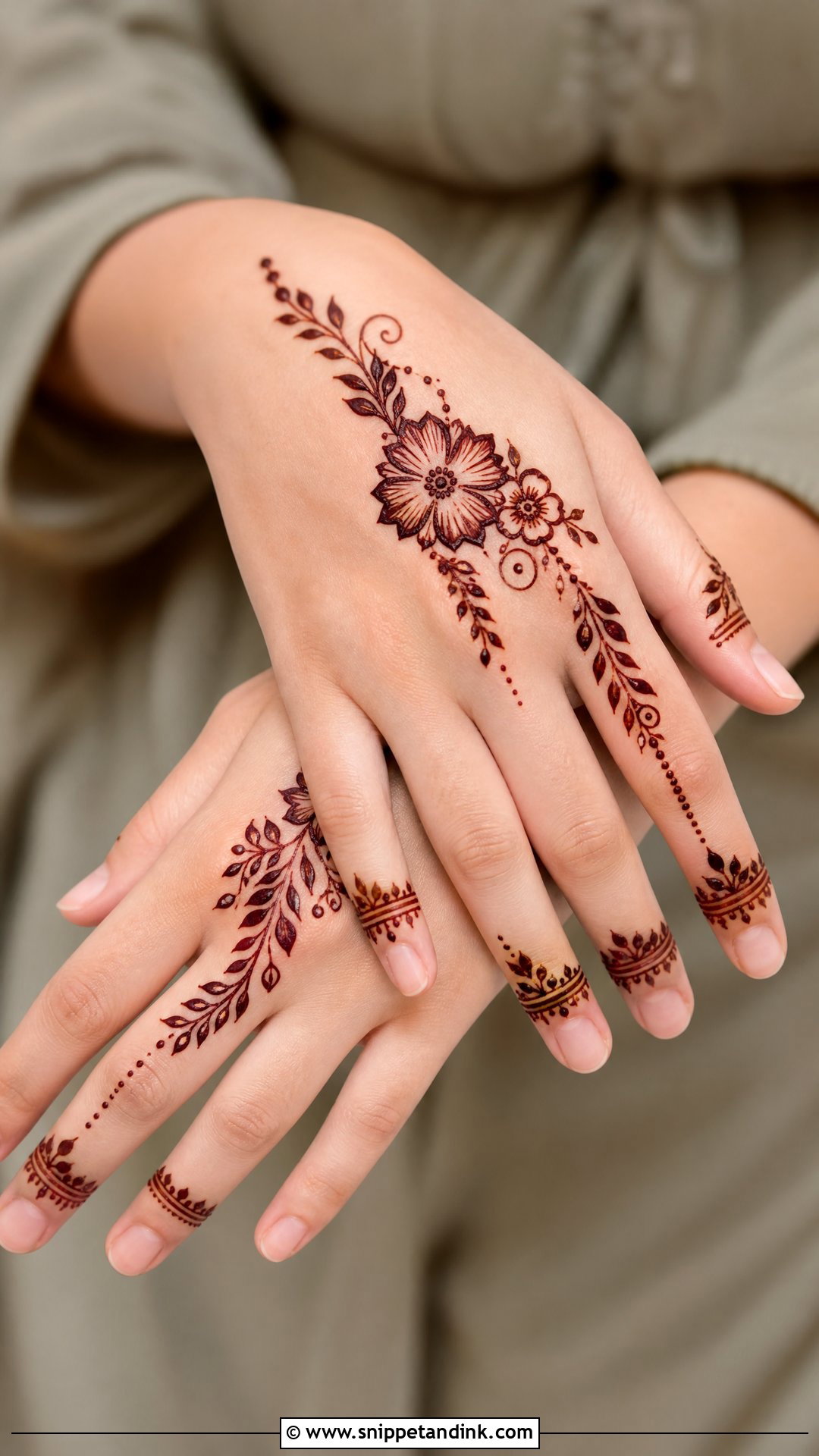
A modern layout uses fewer but stronger motifs: one bold flower, one curved vine, balanced negative space, with geometric accents, dots, mini leaves or a slim wrist bracelet. It pairs well with pastels and contemporary jewellery. With so few elements, each line has to be crisp, so I use a freshly cut cone and wipe the tip often. A clogged tip makes a blobby start to every stroke.
17. Minimal Arabic Back Hand Mehndi Design
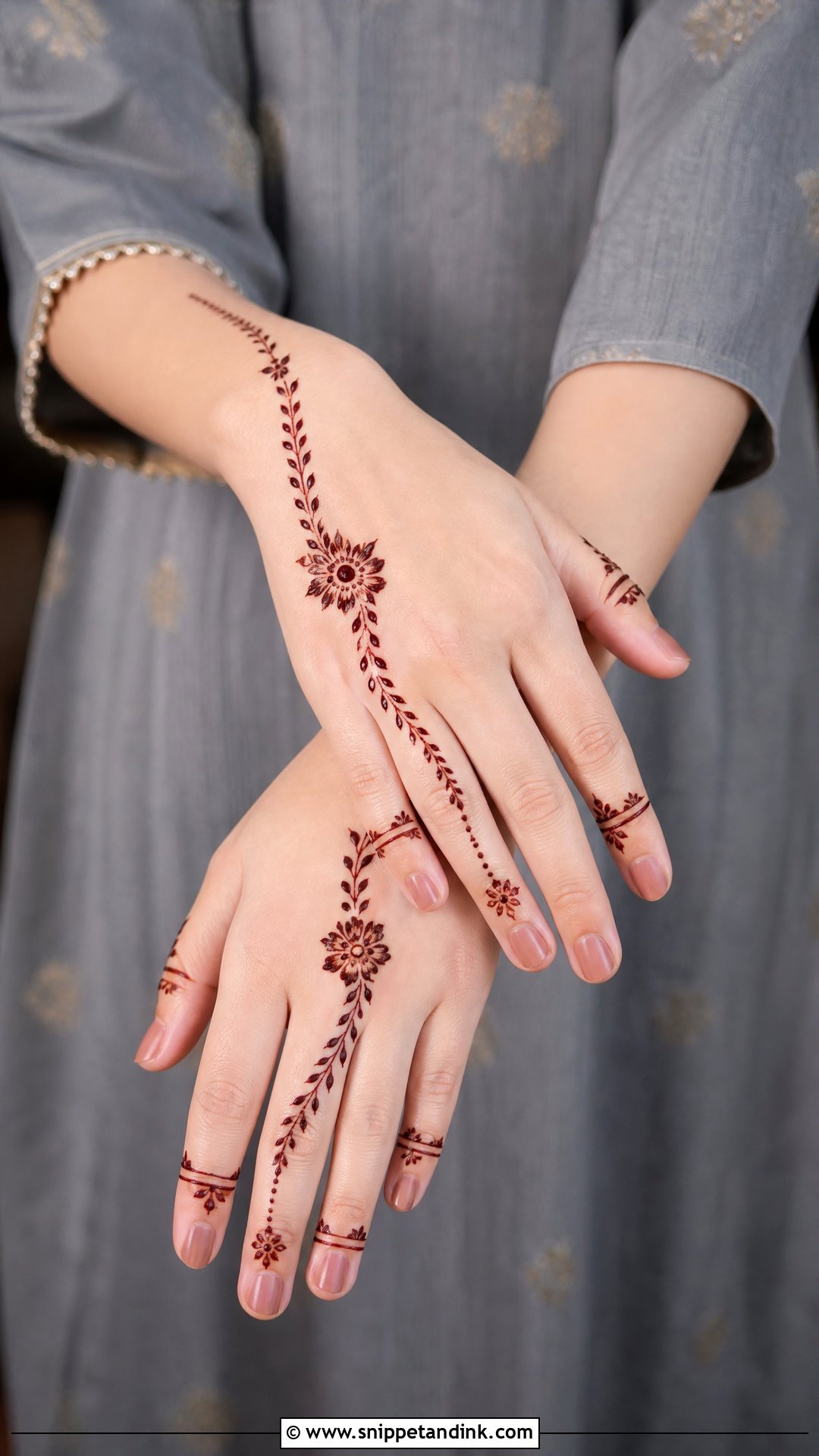
Minimal means a single leafy trail from wrist to one finger, a small flower cluster and very light finger detail. Spacing does the work. Leaving the fingertips bare gives it a modern look. It’s the design I’d draw at the last minute before an event, and for teens, students or office celebrations. Thin lines fade quickly, so draw them slightly bolder than you think.
18. Heavy Arabic Back Hand Mehndi Design
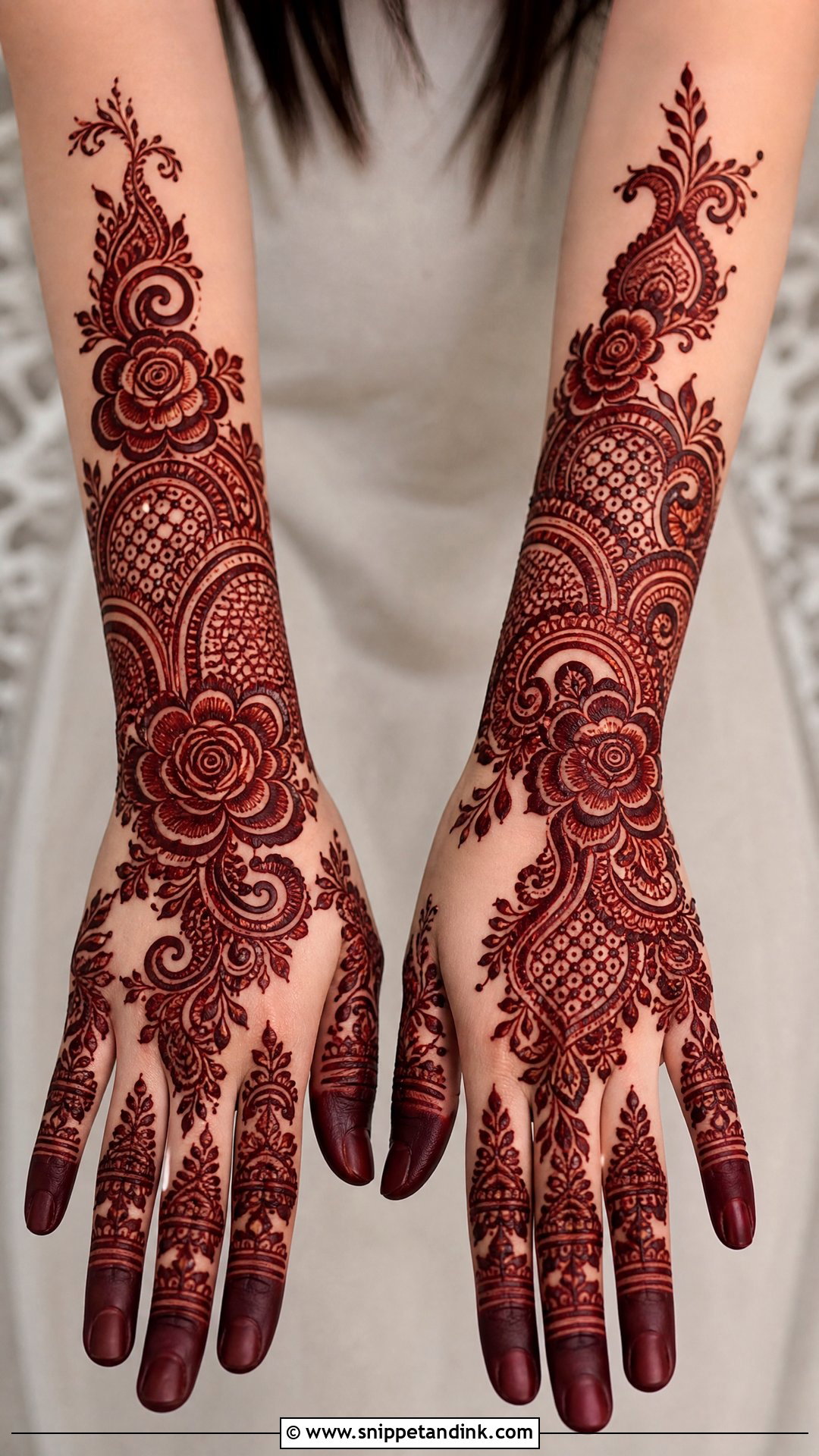
Heavy Arabic covers most of the back of the hand, the fingers and the wrist, using bold roses, paisleys, shaded leaves, jaali and bracelet bands rather than tiny all-over fill. Narrow gaps between major parts stop it from looking flat, and the fingers can carry detailed bands and filled tips. It’s suited to close family weddings, Eid evenings and bridal side events. Confident outlines matter most; hesitant strokes show up as uneven line width.
19. Bridal Arabic Back Hand Mehndi Design
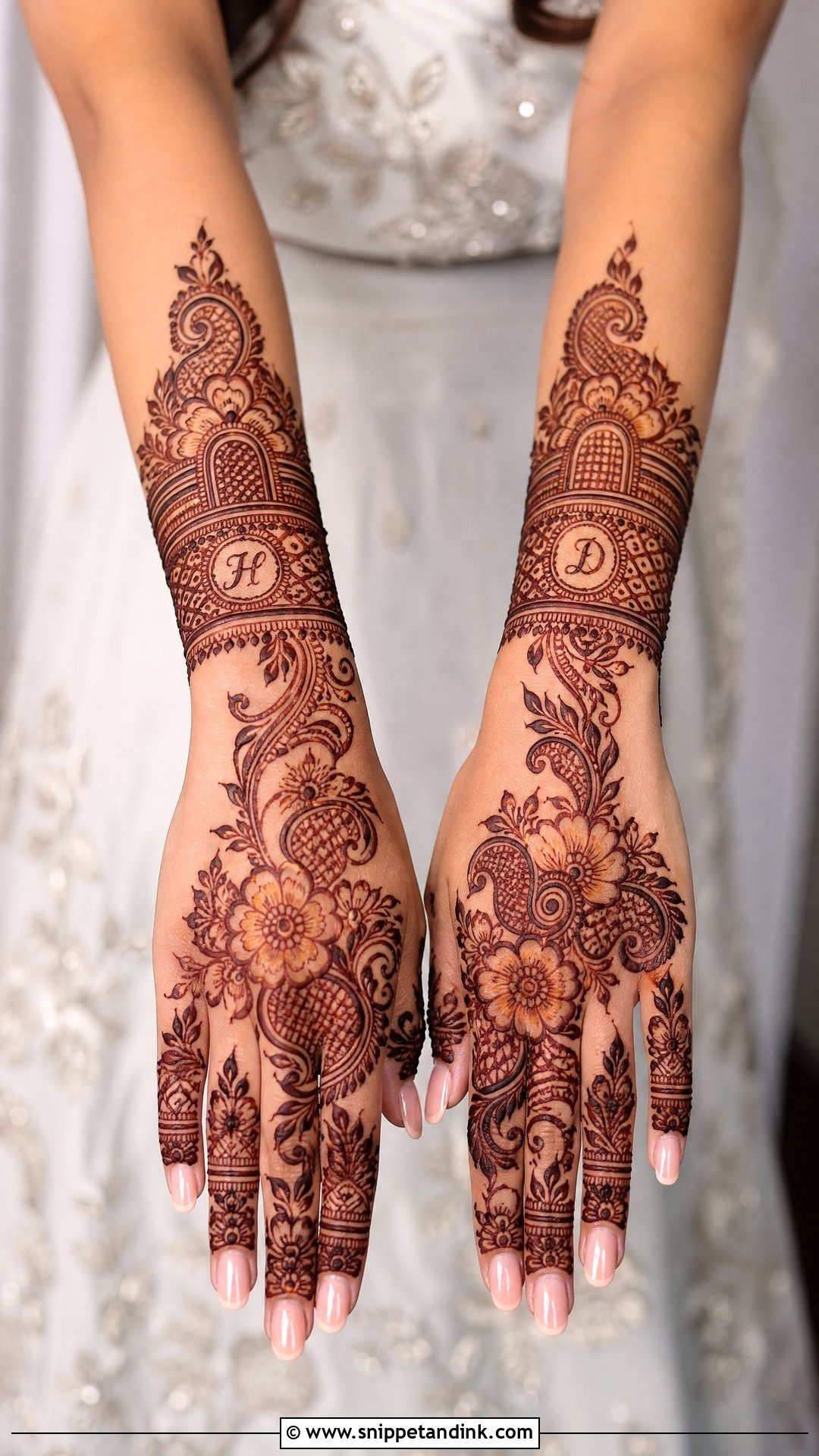
Arabic bridal work covers the hand from fingers to forearm with florals, paisleys, vines, jaali and bracelet sections, but keeps diagonal flow and open spaces. Initials can hide inside a flower, a date inside a band. It’s for brides who don’t want dense coverage, and it suits destination weddings where the bride wants something lighter. I’d still book a bridal artist for it; the scale and balance across both arms takes experience.



20. Eid Arabic Back Hand Mehndi Design
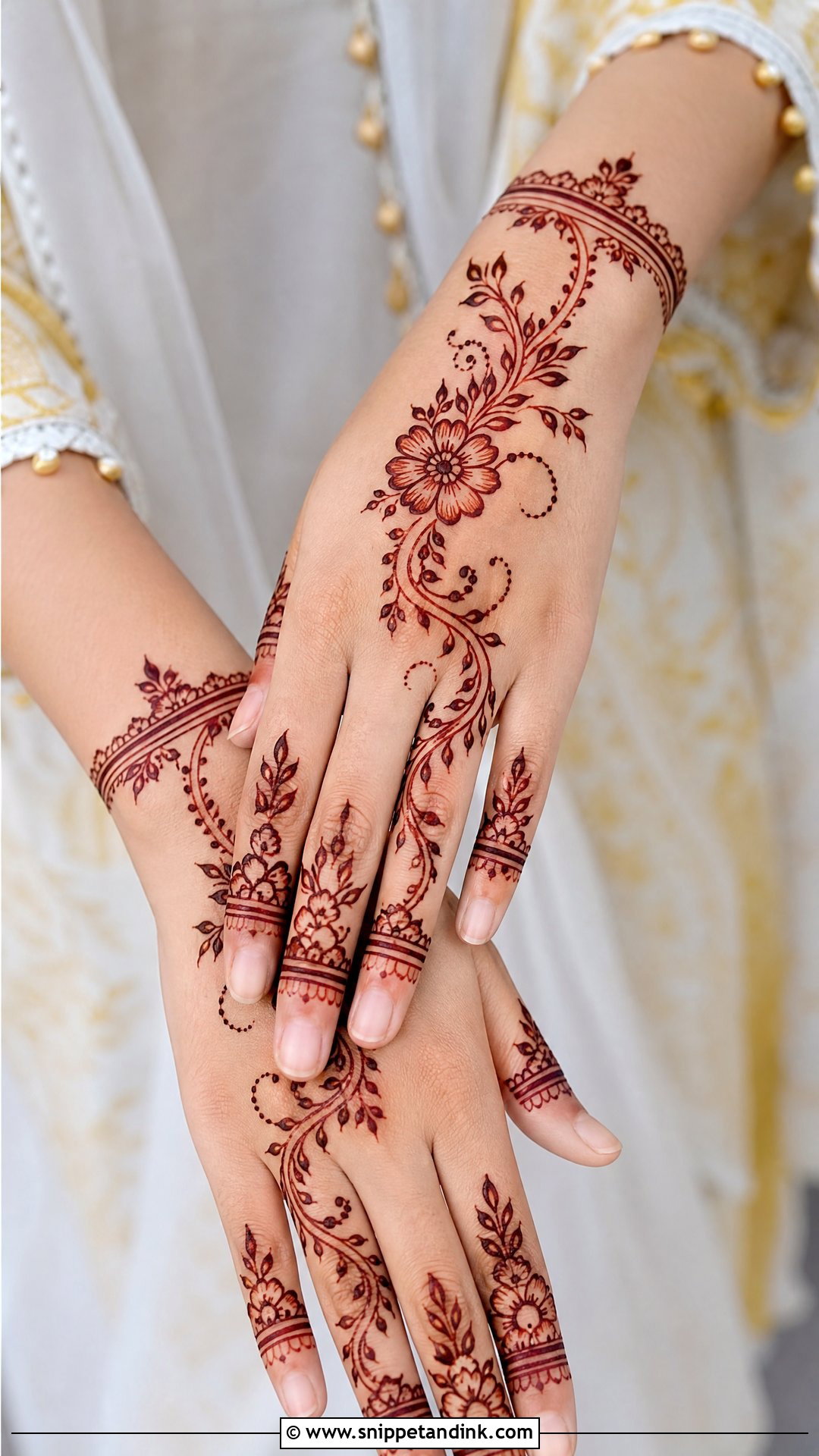
For Eid, a floral vine from the wrist, a medium flower on the back of the hand and decorated fingers is the common choice, partly because it doesn’t take long on a busy night. Leave open space near the centre or side, and add a wrist band if you want it more dressed up. It suits young girls and adults alike, and with traditional or modern outfits.
21. Wedding Guest Arabic Back Hand Mehndi Design
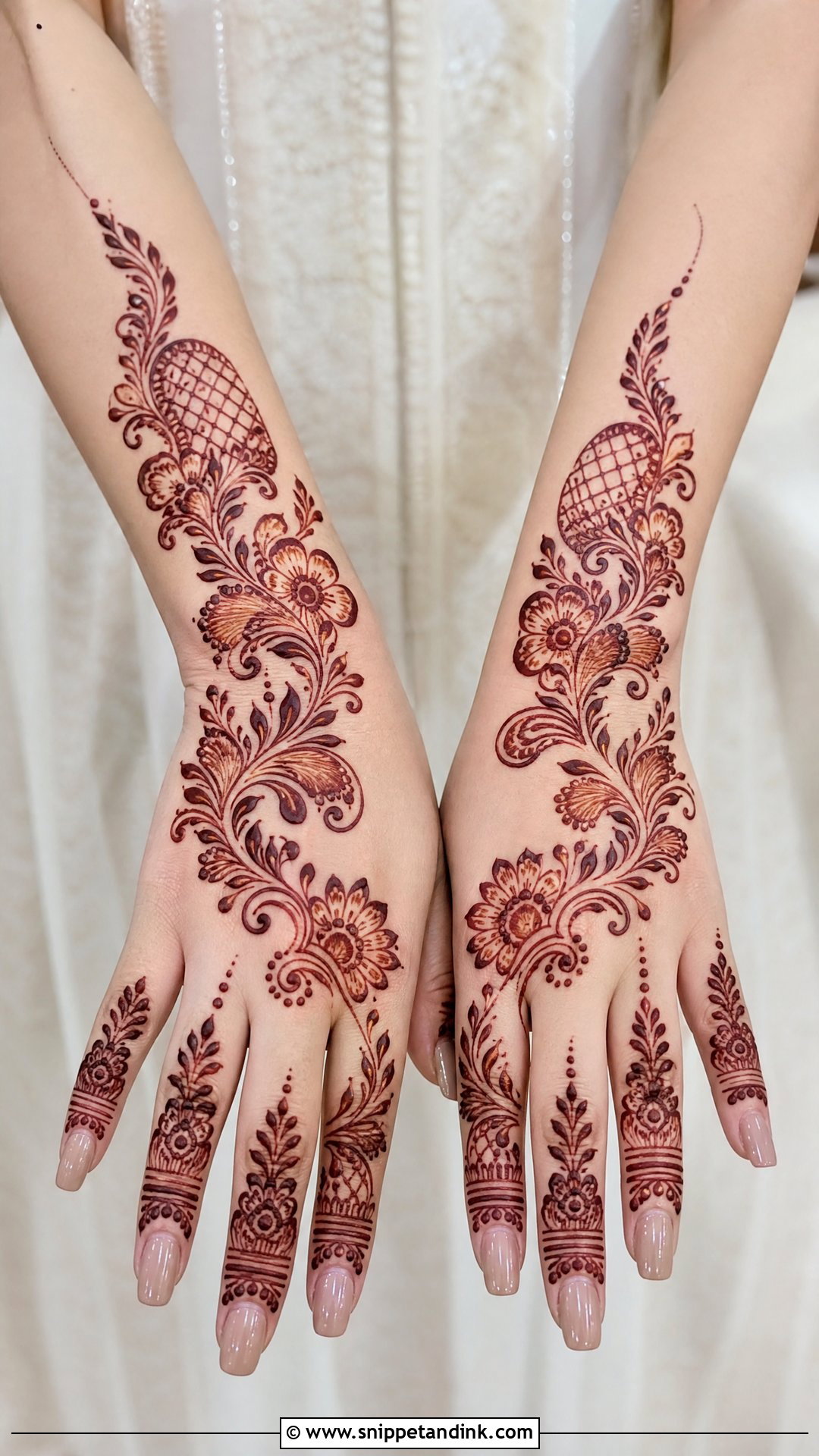
Guests should look festive without looking bridal. Medium coverage with bold florals, curved vines and decorated fingers works, with a diagonal trail that leaves skin visible and a wrist band or small jaali for detail. Avoid the full forearm; that’s traditionally the bride’s territory at many weddings. The design photographs well when you’re holding a clutch or showing jewellery.
22. Engagement Arabic Back Hand Mehndi Design
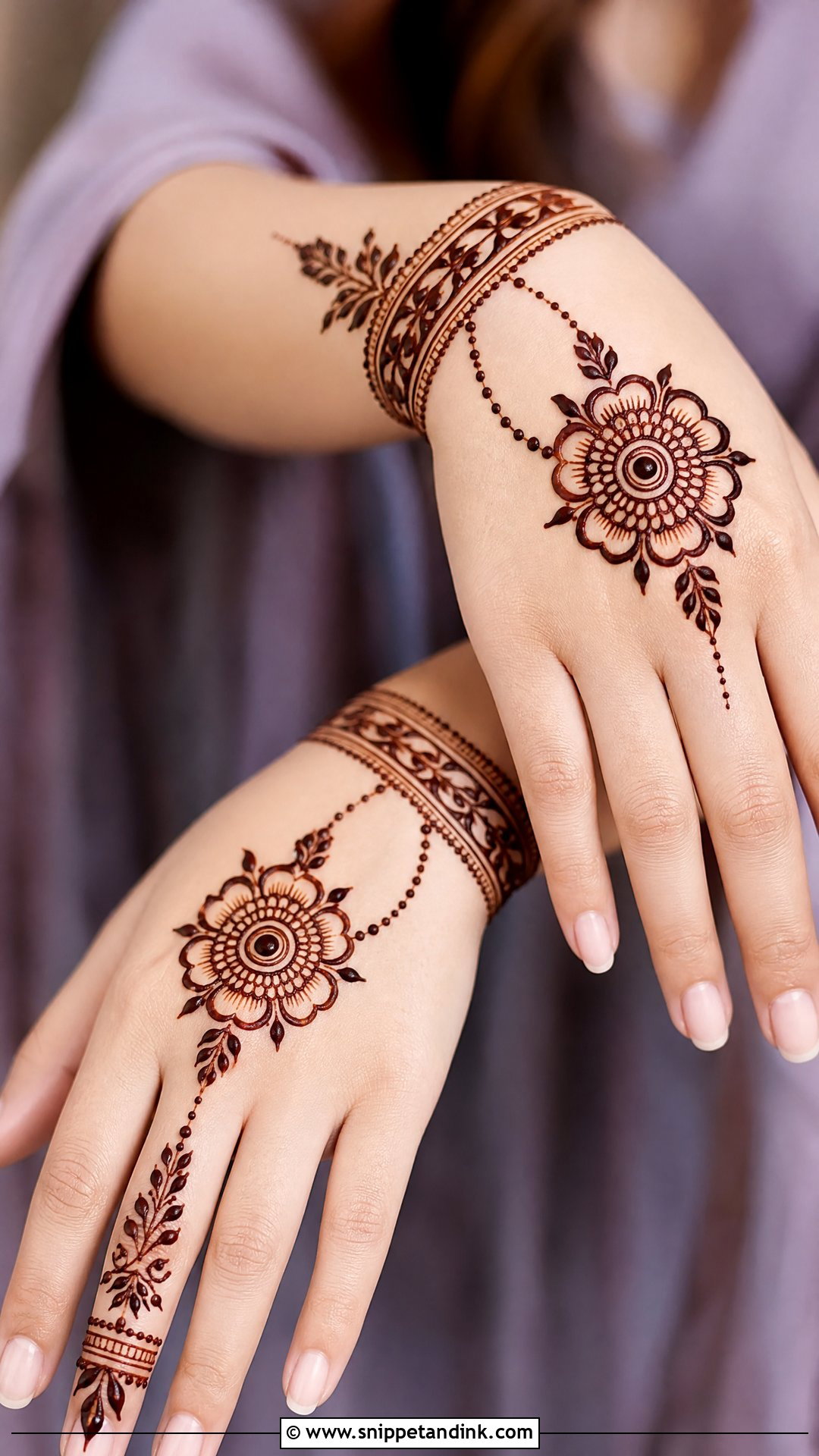
An engagement Arabic back hand mehndi design should build toward the ring finger. A central floral or mandala motif sends trails to the ring finger and wrist, and the area where the ring sits is kept clear so it shows. I draw only a thin band below the knuckle on that finger, nothing under the ring itself. A bracelet band and slim finger details complete it, for the bride-to-be or her guests.
23. Arabic Back Hand Mehndi Design For Bridesmaids
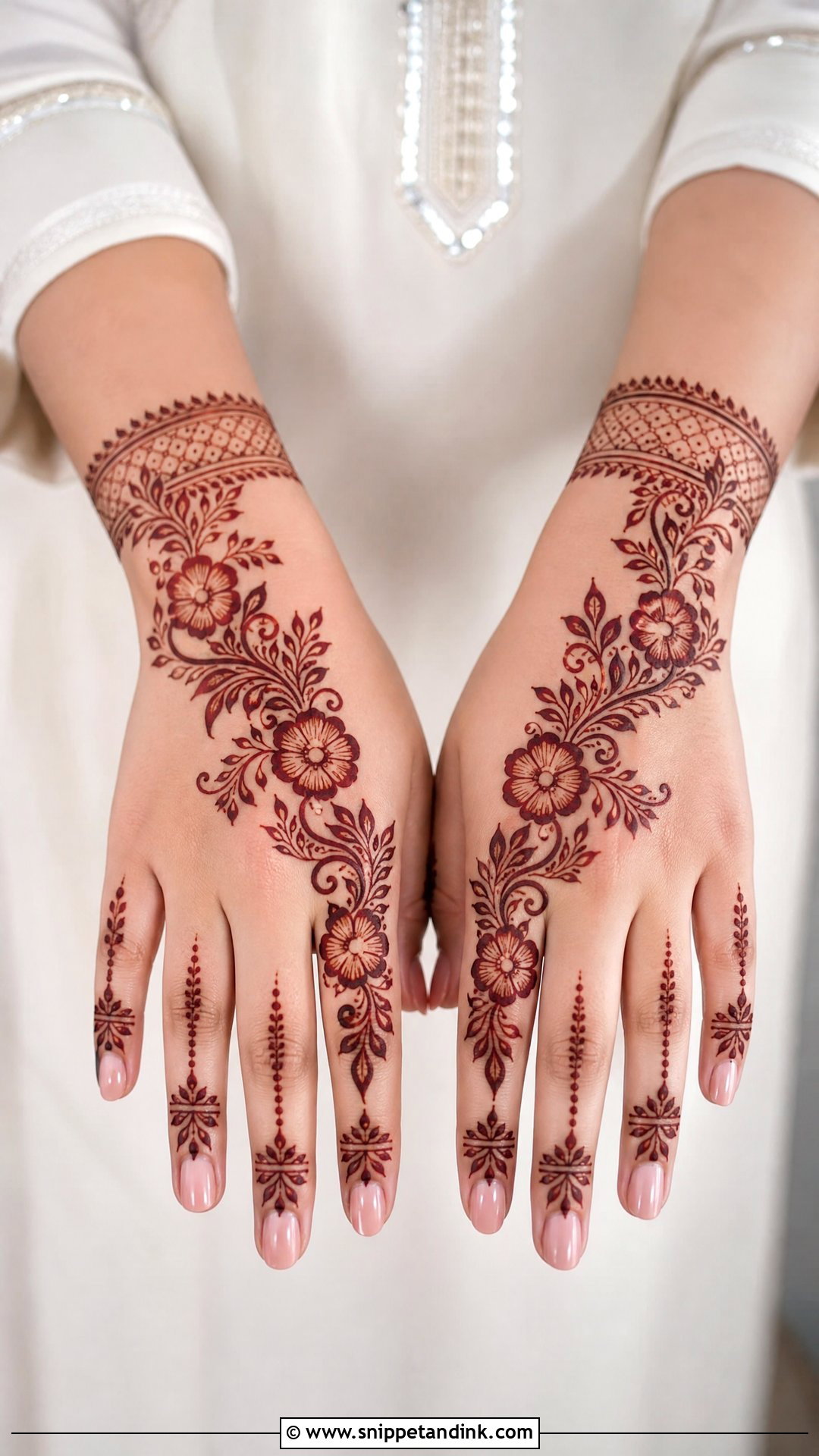
Bridesmaid designs have to be quick to repeat across several hands. A floral trail, leafy vines, light jaali and decorated fingers suits most hand shapes, with half to three-quarter coverage so it doesn’t compete with the bride. Matching the wrist bracelet or one finger band across the group looks coordinated. If several bridesmaids are booked with one artist, ask for a time per hand so the schedule doesn’t run into the event.
24. Arabic Back Hand Mehndi Design For Short Fingers
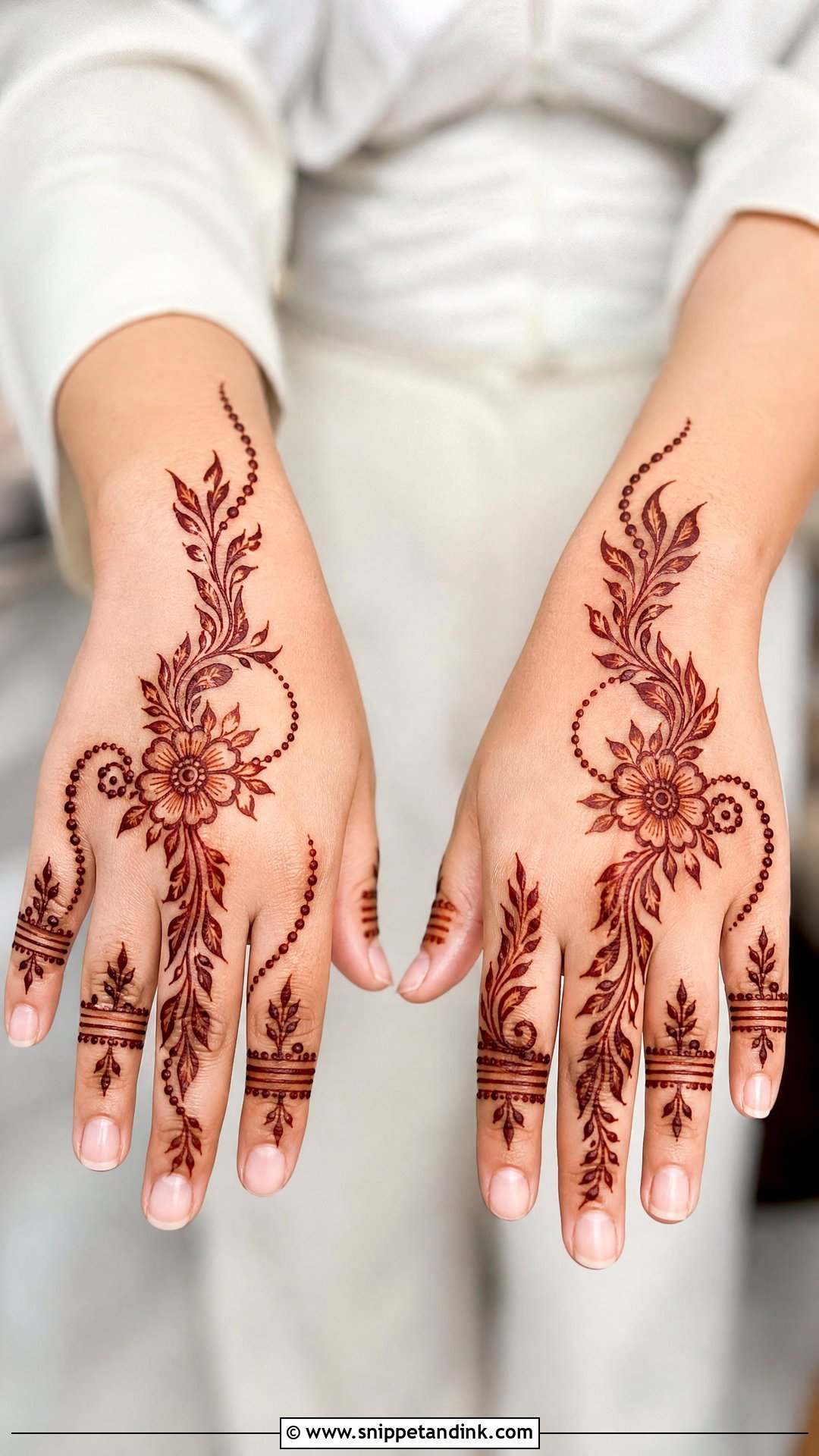
Short fingers look longer with vertical lines and slim details. A vine starts at the wrist and heads to the middle or index finger, finger bands stay thin and spaced, and larger flowers sit nearer the wrist or centre rather than at the fingertips. Wide bands across a short finger cut it into blocks and shorten it further. I draw a thin vertical line up the middle of the finger instead, which reads as length.


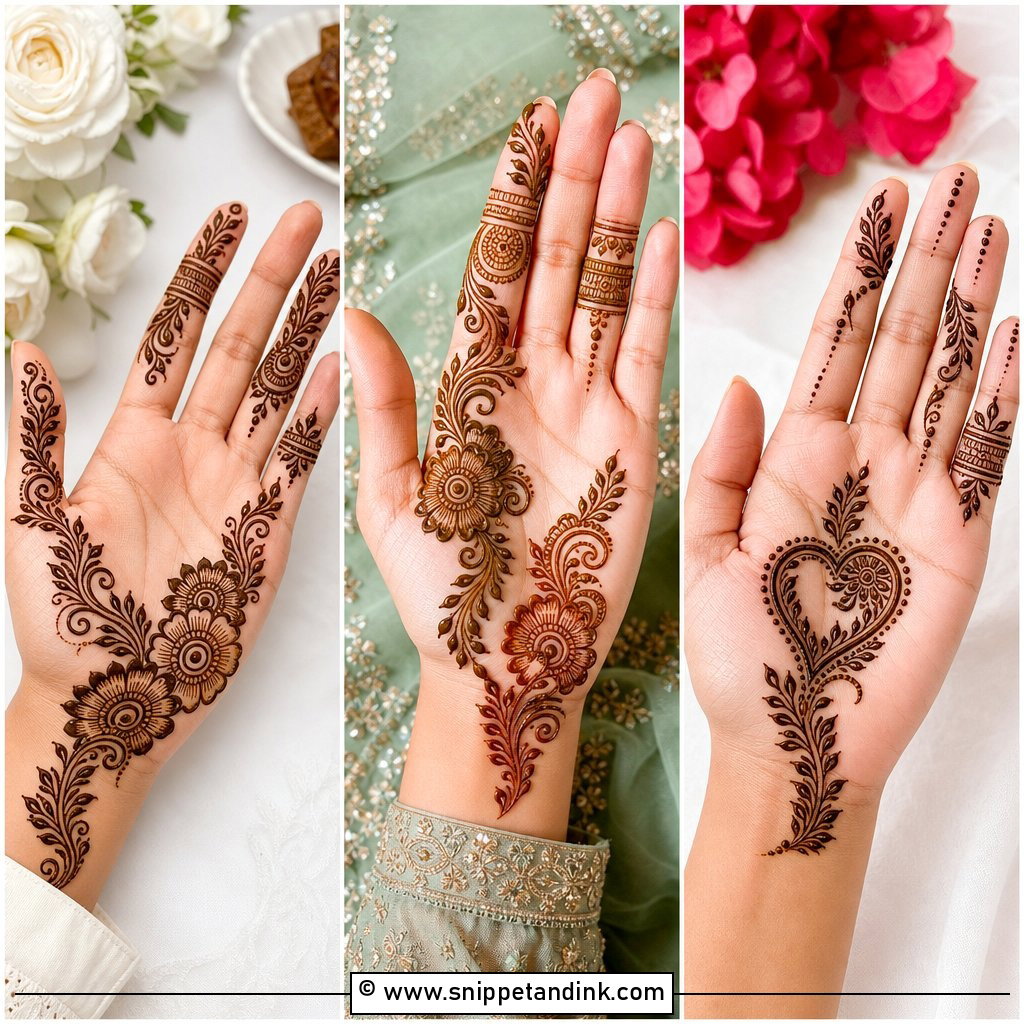
25. Arabic Back Hand Mehndi Design For Long Fingers
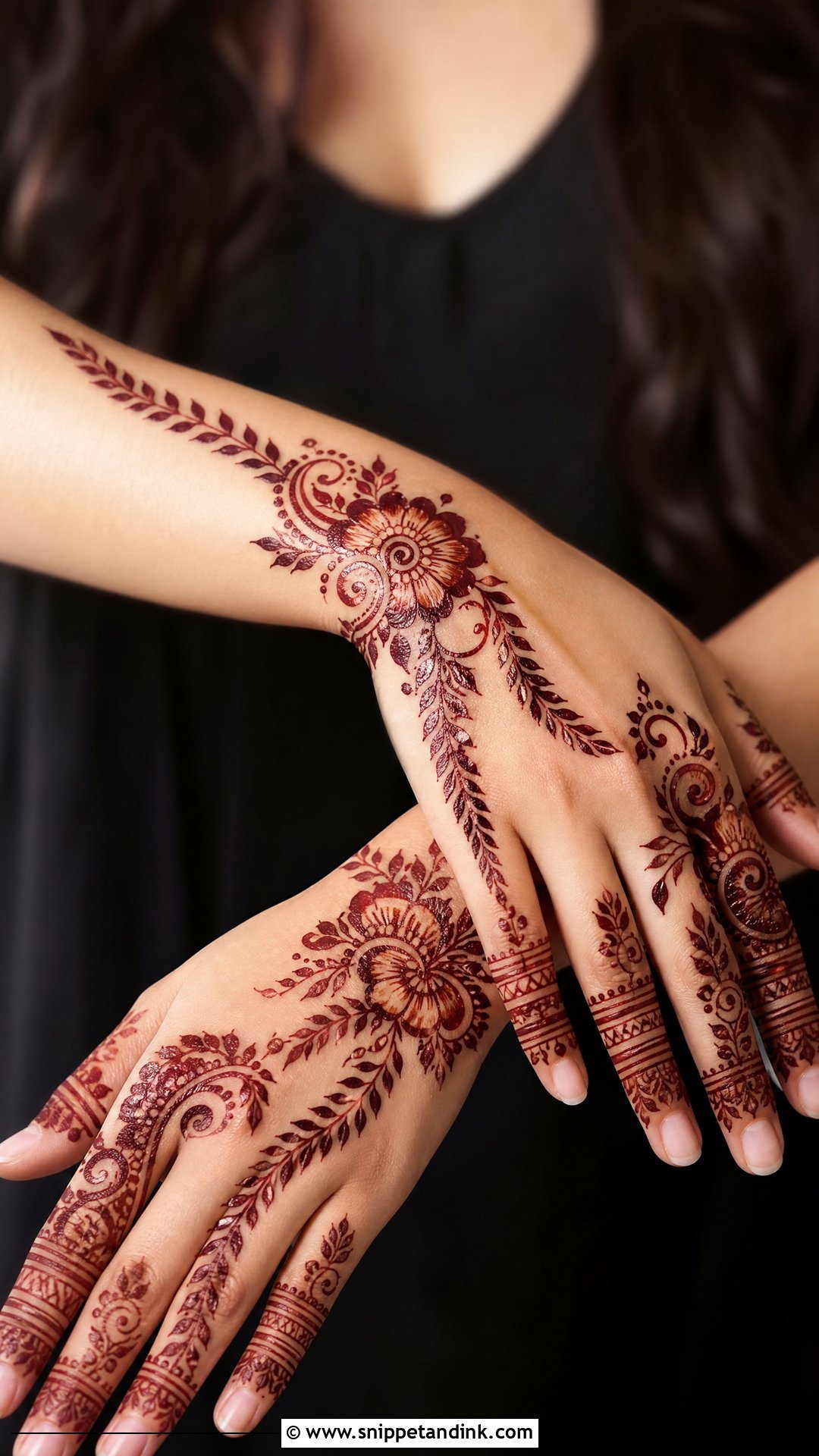
Long fingers can carry more: detailed finger bands, leafy chains, slim curves and small floral tips. A bold flower or paisley cluster on the back of the hand connects to them with a flowing vine, and shaded leaves and tiny dots add detail without weight. A bracelet band balances the wrist. It works for parties, weddings and Eid.
26. Arabic Back Hand Mehndi Design With Finger Bands
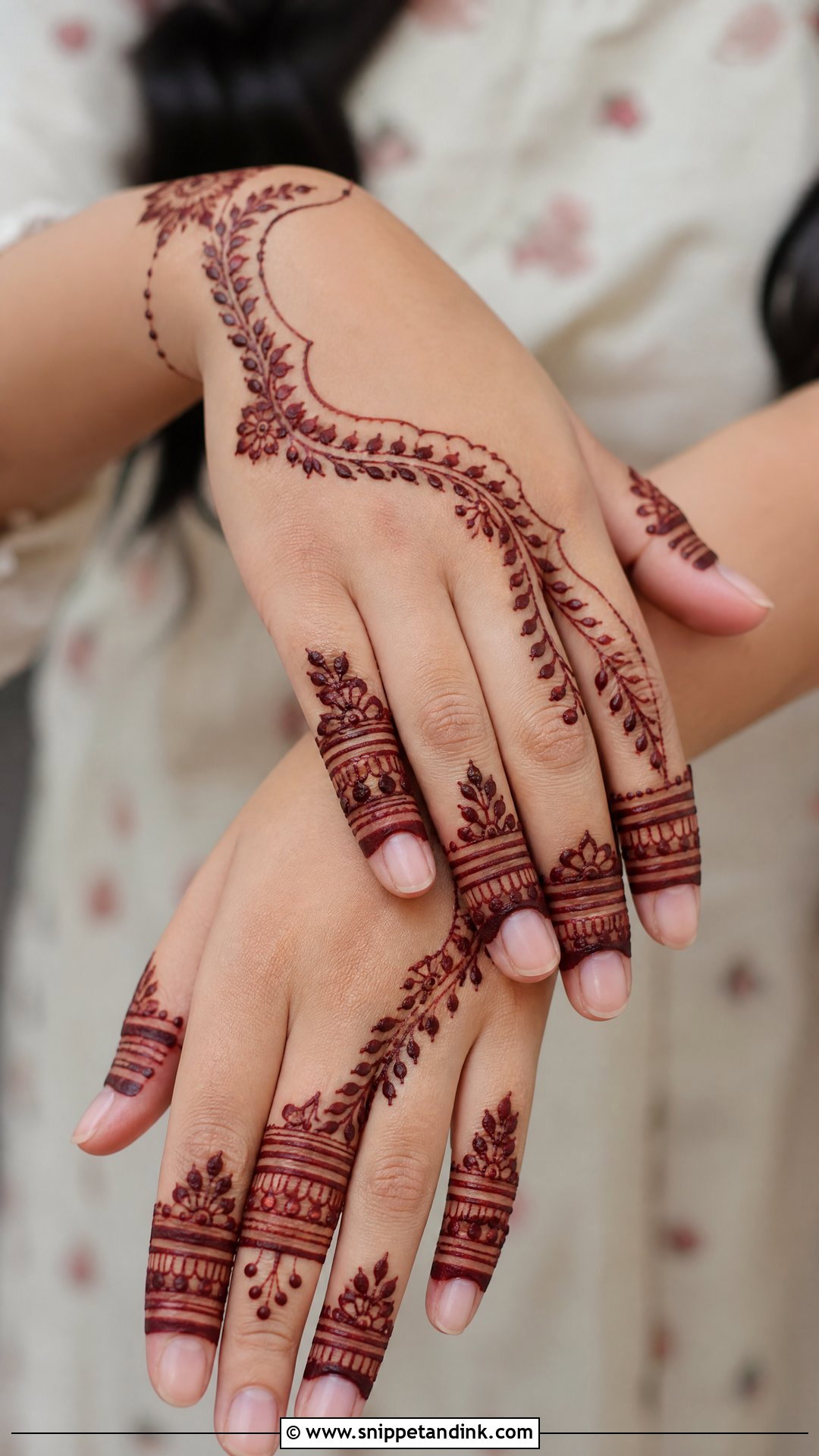
Finger bands become the main feature here: dots, scallops, leaves, checks and fine lines, with a lighter floral trail or wrist bracelet on the back of the hand. Varying the bands finger by finger looks modern. Bands on the knuckle crease crack as the paste dries when you bend your fingers, so I keep bands between the joints rather than over them. It suits rings and simple jewellery.
27. Arabic Back Hand Mehndi Design With Negative Space
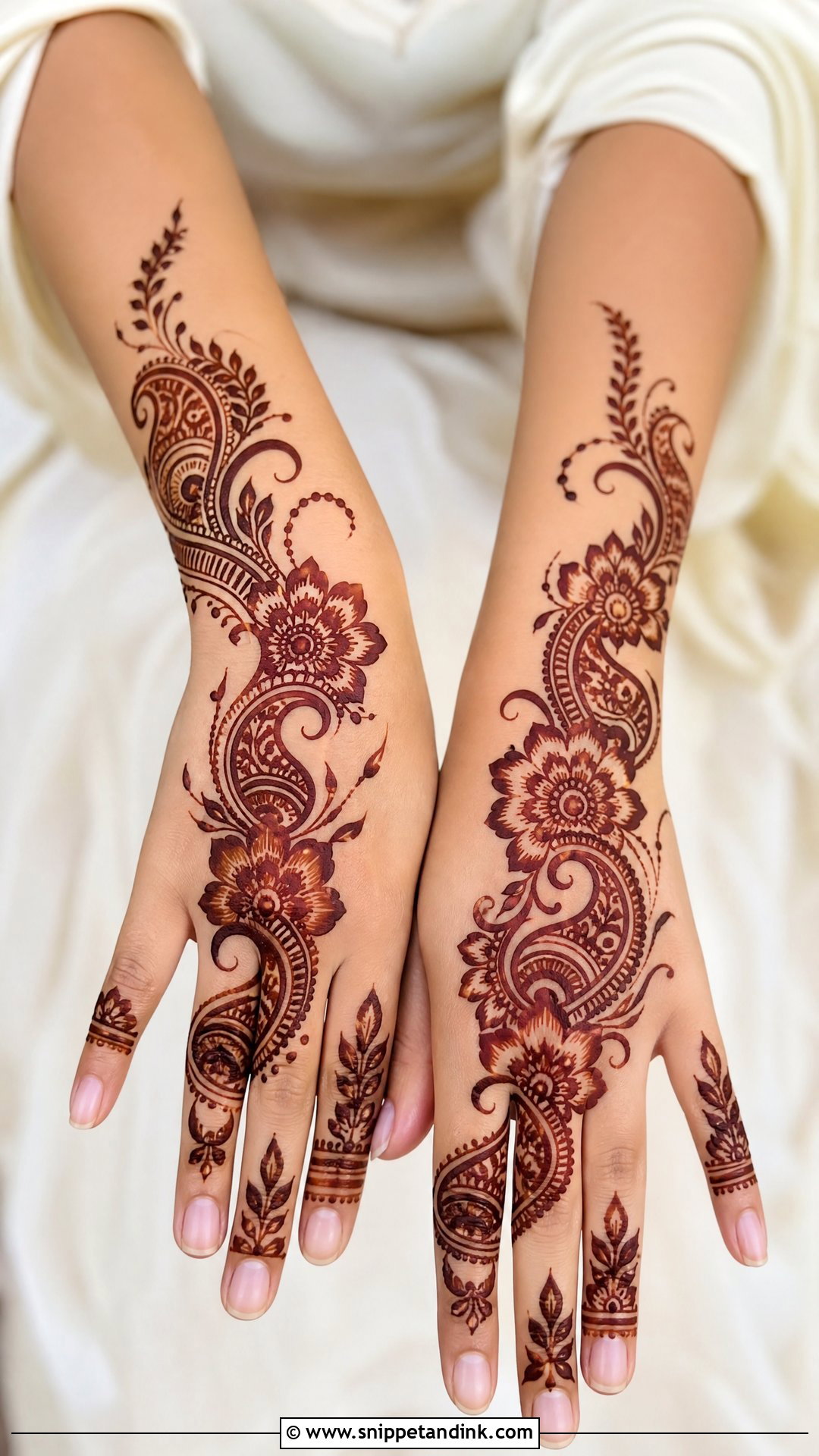
Treating bare skin as part of the pattern is what makes Arabic mehndi feel modern. Bold flowers, leaves, paisleys and curves are spaced with clear gaps, usually along a diagonal that leaves open sections on both sides, with light finger bands and dots. Negative space looks easy but needs planning: I sketch the main motifs as a few dots first, step back to check the spacing, then commit.
28. Arabic Back Hand Mehndi Design With Shaded Flowers
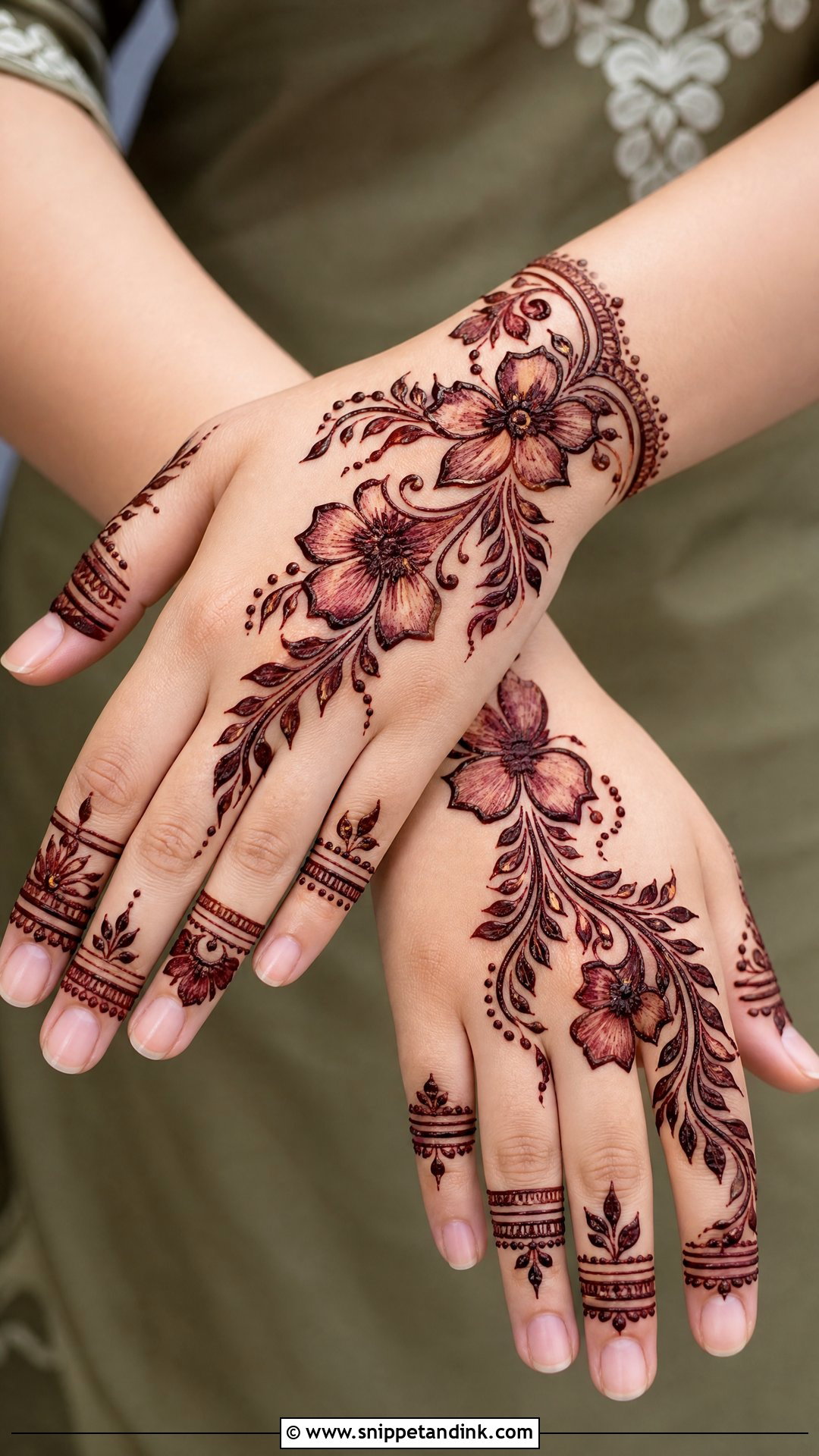
Shaded flowers bring depth without density. Two or three bold flowers sit along a diagonal, their petals shaded with fine lines or partial filling, with leaves and vines guiding the eye toward the fingers and an open background. Shading is done with a lighter touch on the cone, which leaves a thinner layer of paste, so those areas stain a softer tone than the outlines. That contrast deepens as the stain develops, which is why it reads well at evening events.
29. Arabic Back Hand Mehndi Design With Peacock
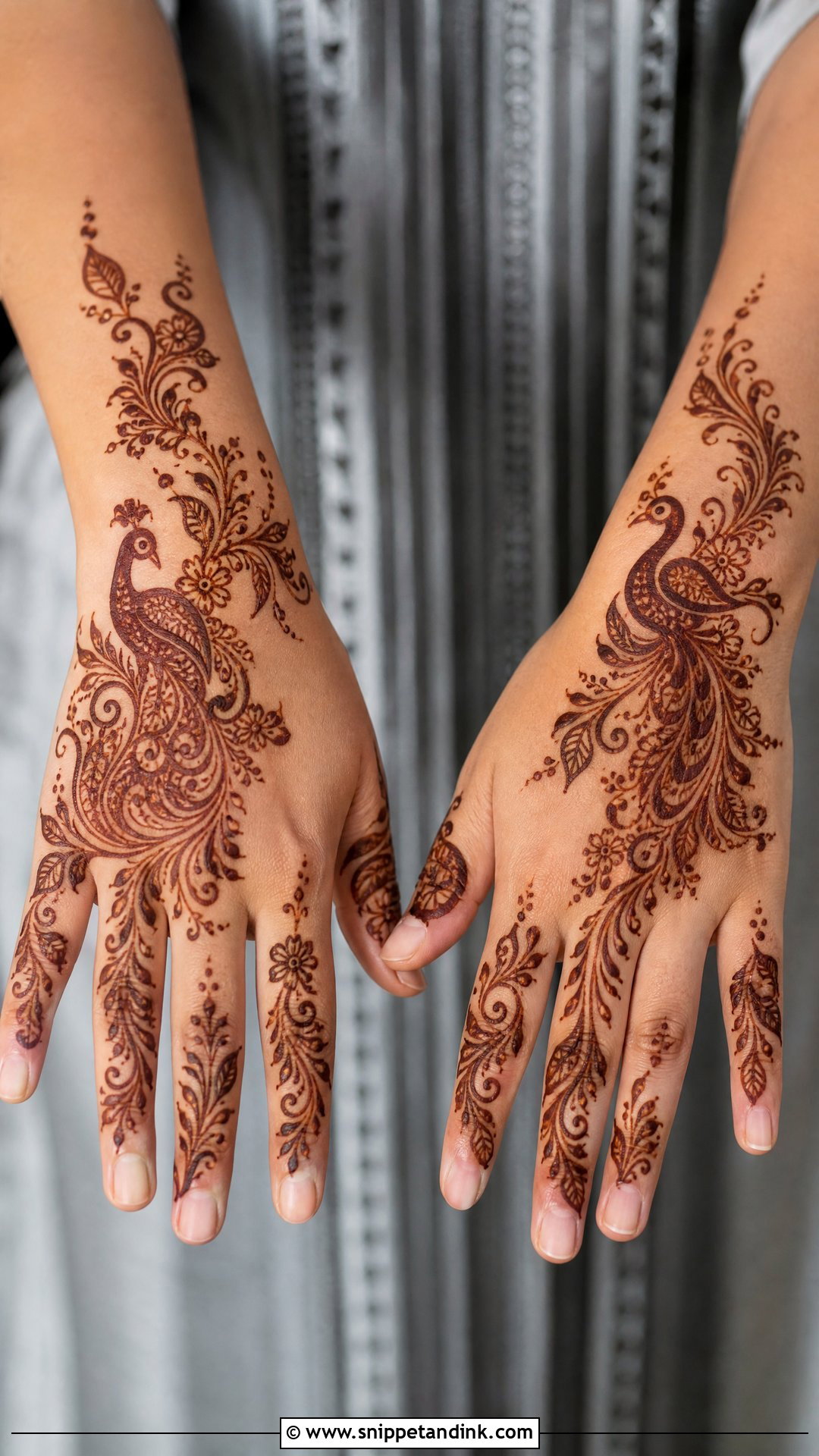
A peacock near the wrist or centre of the back of the hand, its tail extending into Arabic vines, flowers and paisleys, gives a traditional motif an Arabic layout. Keep the body bold and the feathers flowing rather than crowded, and leave open space around it. The neck is the tricky part; I draw it as one curved stroke, since a joined neck looks stiff. Finger bands or leafy trails complete it.
30. Arabic Back Hand Mehndi Design With Forearm Extension
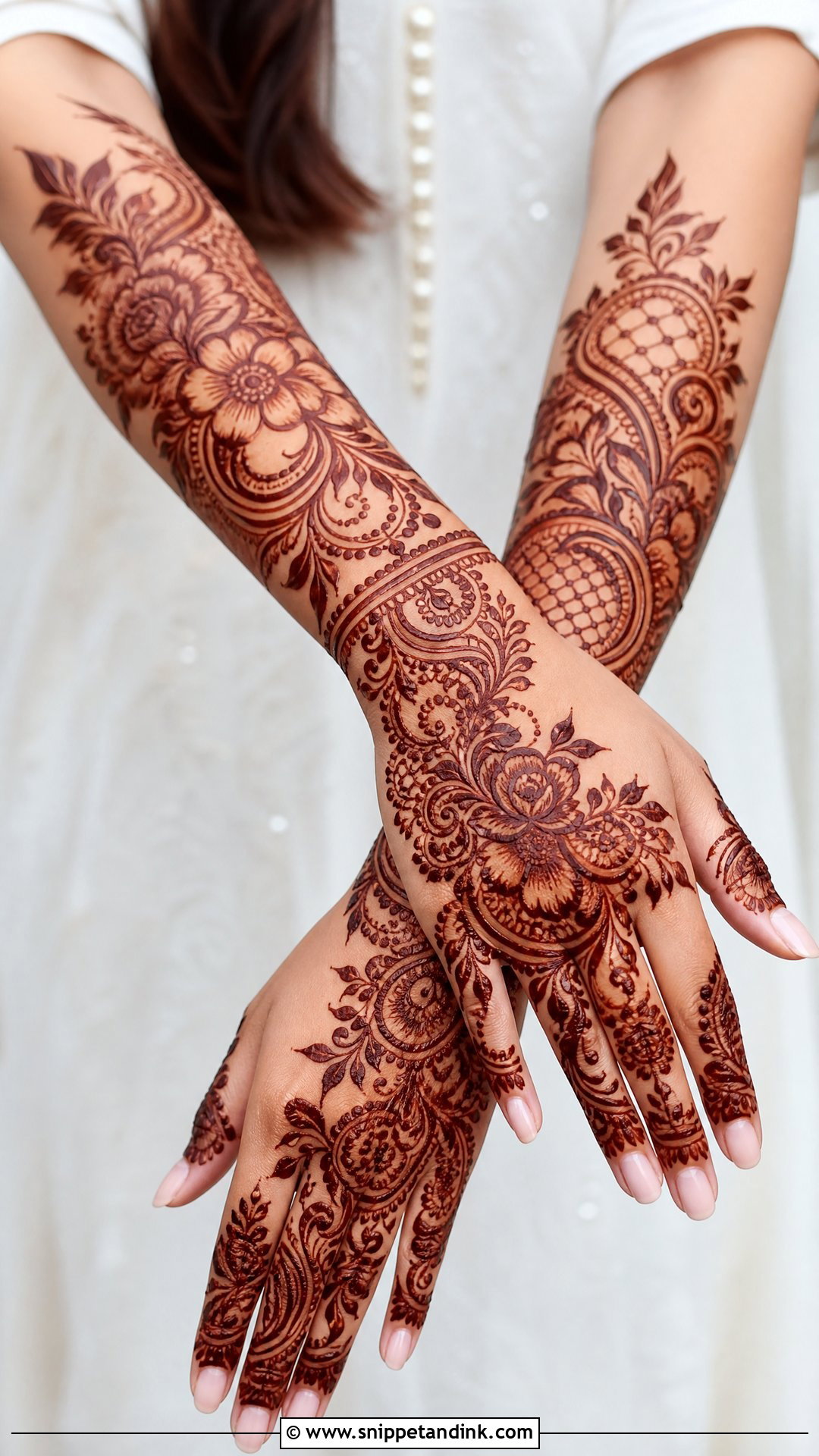
Extending the design past the wrist gives the most dramatic version of this style. The pattern starts at the fingers, crosses the back of the hand and continues up the arm with vines, florals, paisleys or bracelet bands, the same way forearm extension designs are usually built. Medium-sized motifs on the forearm keep it from overpowering the hand, and jaali, shaded leaves and bold flowers add richness. Forearm skin stains lighter than the hand, so I lay the paste a little thicker there.
Applying Mehndi on Chand Raat for Eid Morning
Most people put on their Eid mehndi on chand raat, the night the moon is sighted. The trouble is that henna starts orange and only reaches its deepest colour around two days later. If you apply it on chand raat, your hands will look bright orange-brown on Eid morning and deepen through the day. If you want a richer colour on Eid morning, apply one night earlier.
Doing your own back hand with your other hand
Drawing on the back of your own dominant hand with your weaker hand is hard. Pick a simple diagonal trail, use a cone with a small tip, and rest your elbow on a table so the drawing hand is steady. Practise the flowers on paper first. Your paste should be smooth with no lumps, roughly the thickness of toothpaste; if it’s runny it will bleed and blur the outlines.
Store-bought cones vary a lot. I’d avoid any cone that promises black colour or a dark stain in minutes, because those often contain chemical dyes that can burn or scar the skin. Natural henna smells earthy, comes out green-brown, and stains orange first.
Your Hand Shape Decides More Than the Trend
Arabic back-hand mehndi is at its best when the bold motifs and the open space are in balance. For everyday or office wear, minimal vines, finger bands and negative-space layouts are enough. For weddings and Eid nights, shaded flowers, paisleys, jaali, bracelet wrists or forearm extensions give more presence. Before you pick, look at your own hand: finger length, hand size, the jewellery you’ll wear and how long you can sit still. Then pick the layout that suits that hand rather than the one with the most likes.
You'll Like These Ideas:









Leave a Reply