
The lotus is the motif I get asked for most when someone wants meaning without a crowded hand. It opens in rings, so I can draw it tiny on a fingertip or let it fill half a palm, and the petals give the eye one clear place to land. Around it I build with vines, dots, paisleys, jaali or a mandala, depending on how much skin the occasion calls for. It sits comfortably on a small puja hand and on a full bridal arm, and it adapts to almost any hand shape because I can stretch it, center it or tilt it on a diagonal. Below are thirty ways I place and finish it, with notes on what each one asks of the paste, the skin and the person wearing it.
Drawing a Lotus That Still Reads After the Stain Deepens
Henna doesn’t stay the shade it was when the paste came off. It starts pale orange and darkens toward reddish brown over the next one to two days, and as it darkens, fine gaps visually shrink. That’s why a lotus that looked crisp on application can look muddy at the wedding. Most of what I do differently with this motif comes from planning for day two, not day one.
- Petal gaps: I leave a clear sliver of skin between every petal, wider on the palm than on the back of the hand, because the palm stains darkest.
- Line weight: outer petals get a firm outline, inner veins a hairline. If every line is the same weight, the flower looks flat.
- Size against filler: the lotus should always be the largest shape on that part of the hand. When paisleys or mandalas grow bigger, the flower stops being the subject.
- Placement on joints: I keep petals off knuckle and wrist creases, where dried paste cracks as you move.
When you show your artist a reference, tell her which part you love: the flower, the spacing, or the fill. Two designs can share a lotus and feel completely different because of what surrounds it.
1. Simple Lotus Mehndi Design For Palm
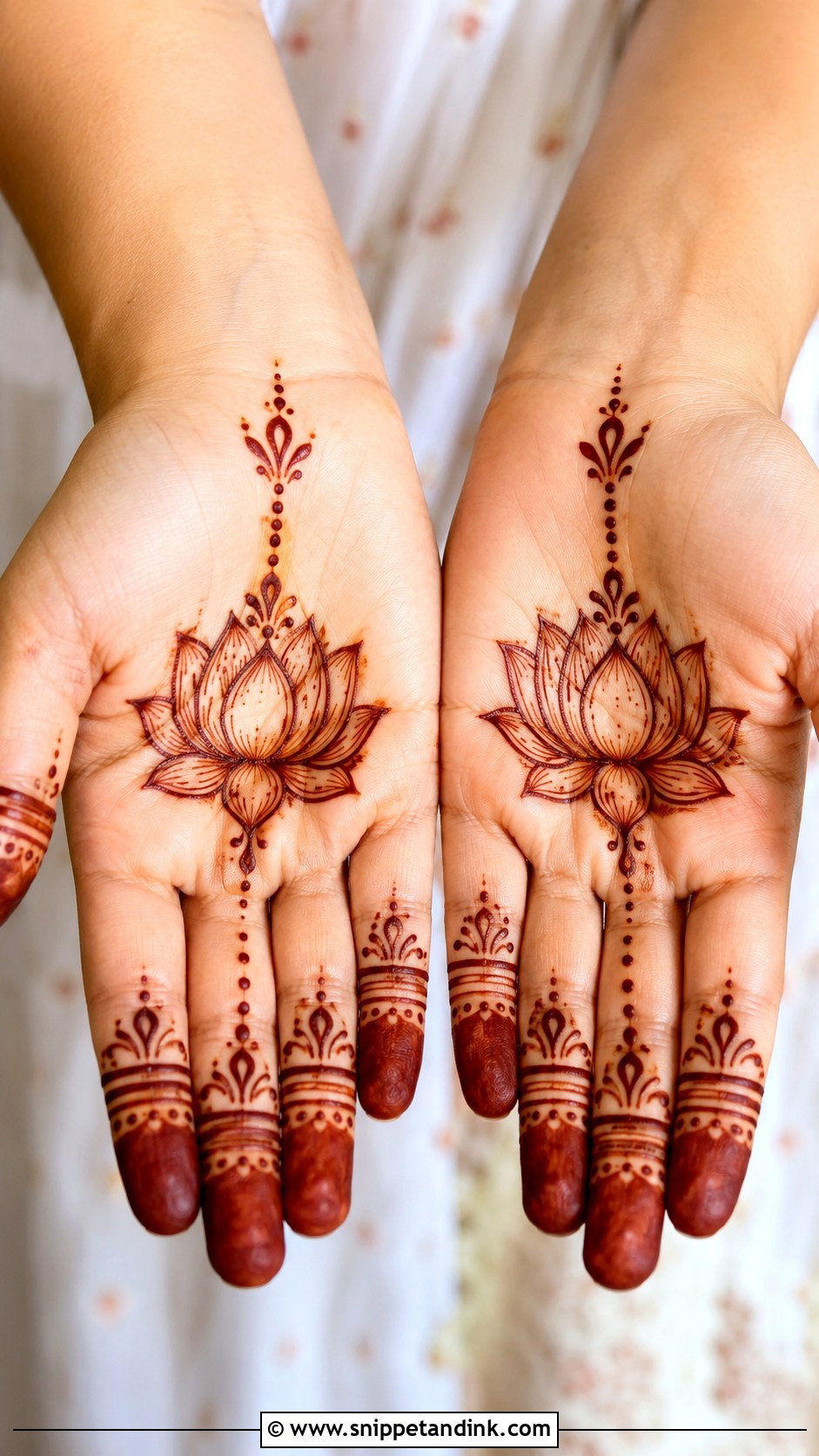
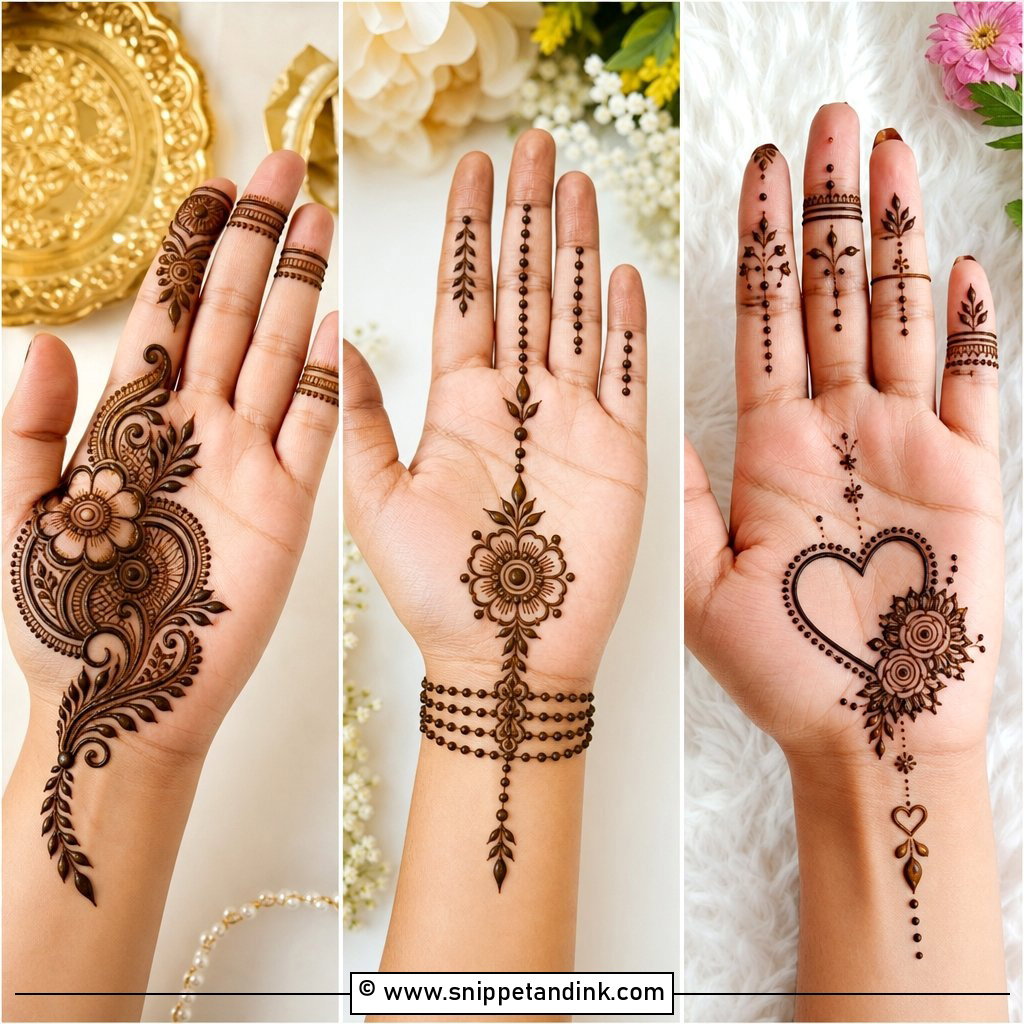
One open lotus in the middle of the palm, thin outlines, a ring of dots, and almost nothing else. I keep the fingers to fine bands and small tips so they don’t compete. The thing I watch here is spacing: palm skin stains darker than anywhere else on the body, and lines drawn too close together merge into a blot by day two. Leave a clear gap between every petal and the flower still reads after the stain deepens. It’s the layout I suggest for a first mehndi or a quiet family puja because it takes little time and forgives a shaky line.
2. Lotus Mehndi Design For Back Hand
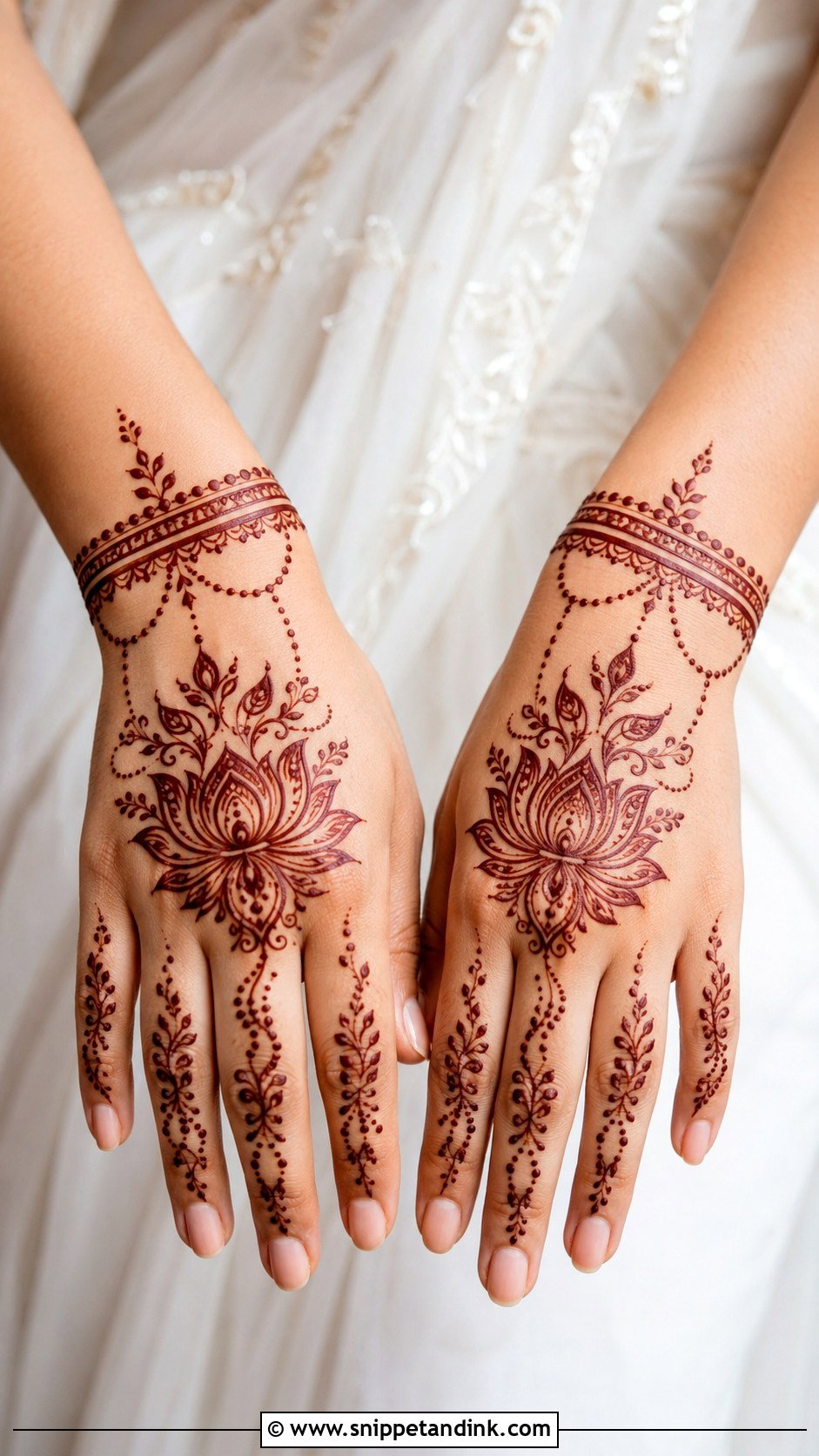
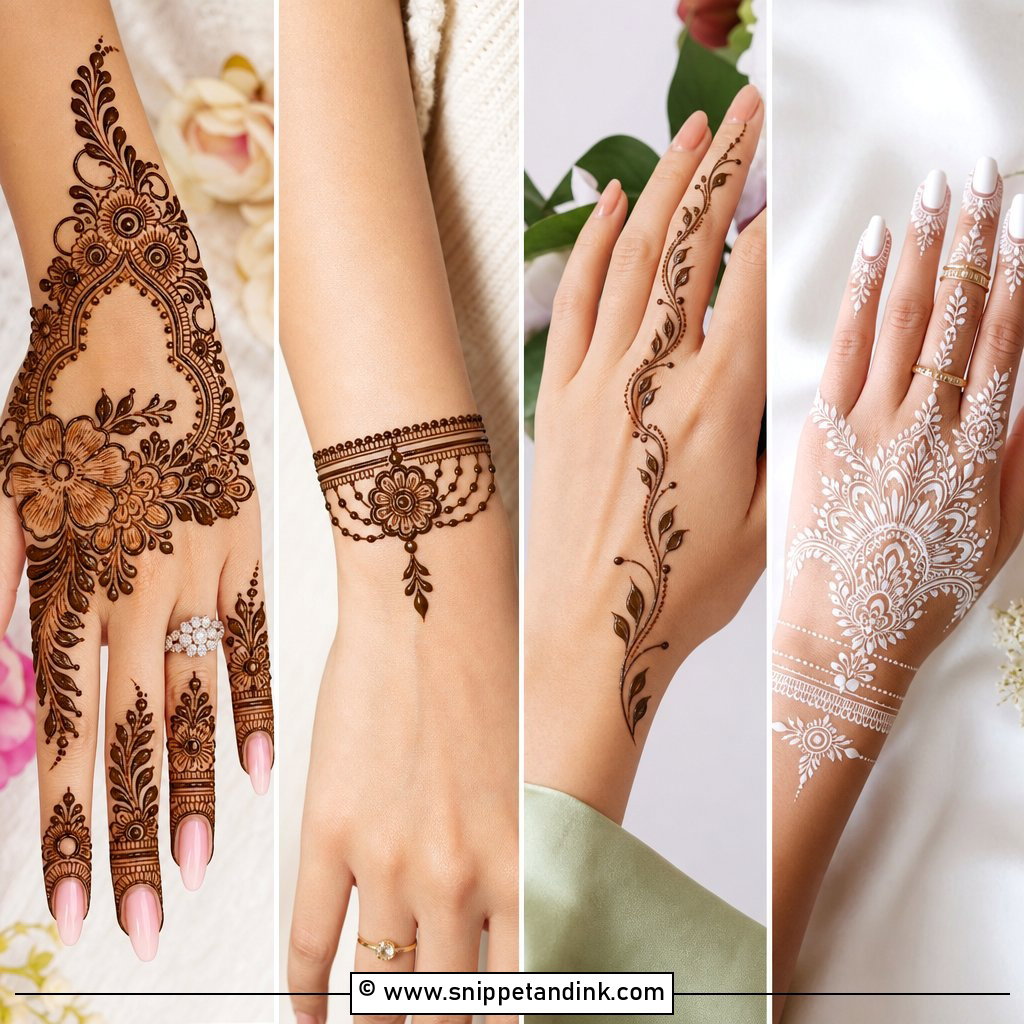
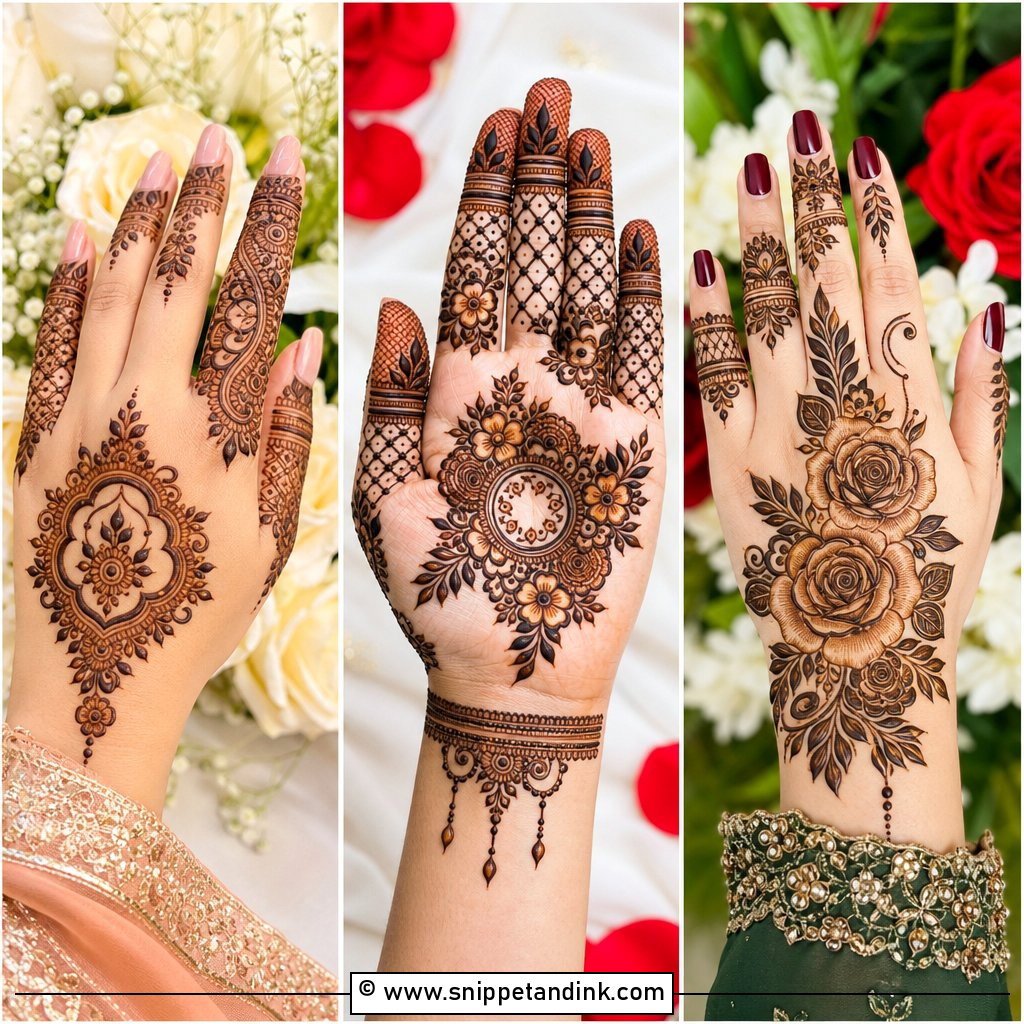
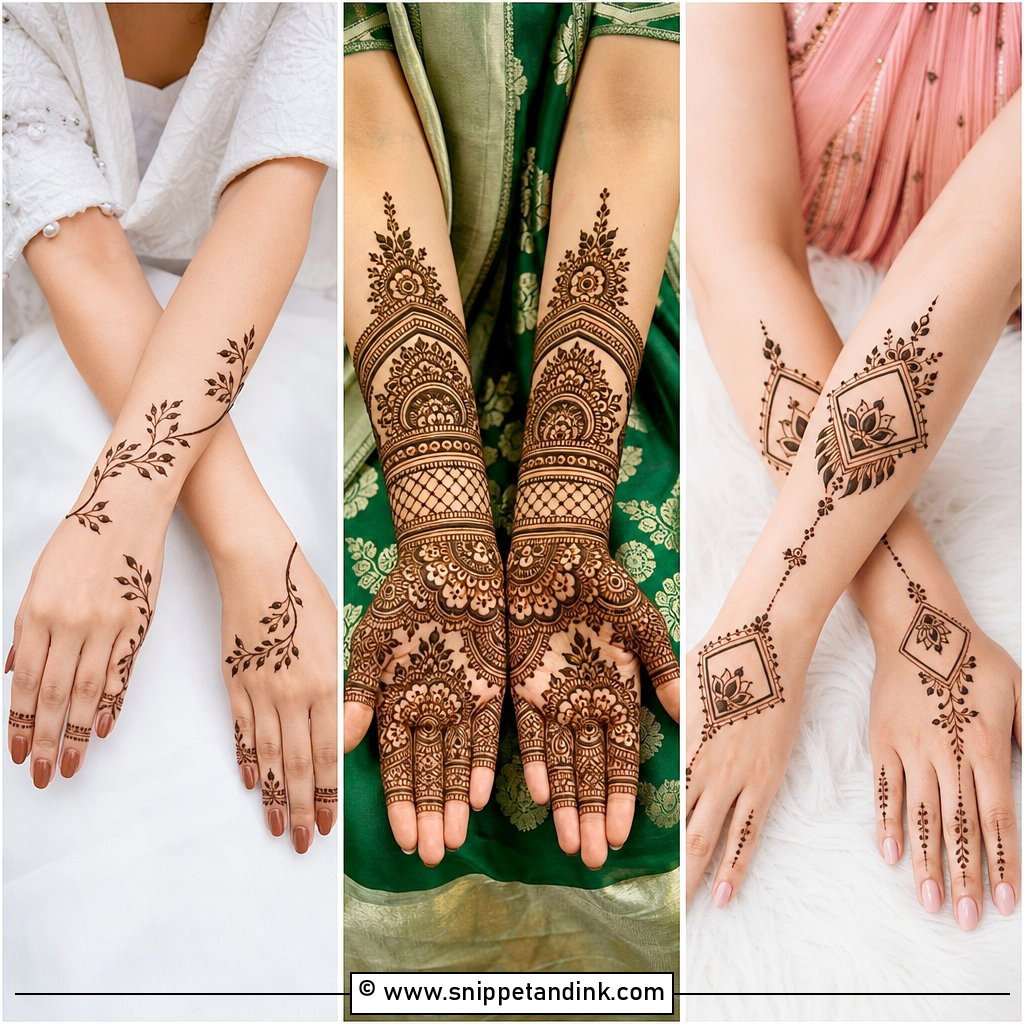
On the back of the hand I set a medium lotus at the center or nudged toward the wrist, then send leafy vines out toward the fingers. That outward pull is what makes the hand look longer. A bracelet line at the wrist and a few dotted chains finish it. Be aware that the back of the hand stains lighter than the palm, often a warm orange-brown rather than maroon, so I draw these petals with a slightly thicker cone line to keep the flower visible in photos. It suits bridesmaids and Eid or Diwali guests who want something neat but not dense.
3. Arabic Lotus Mehndi Design
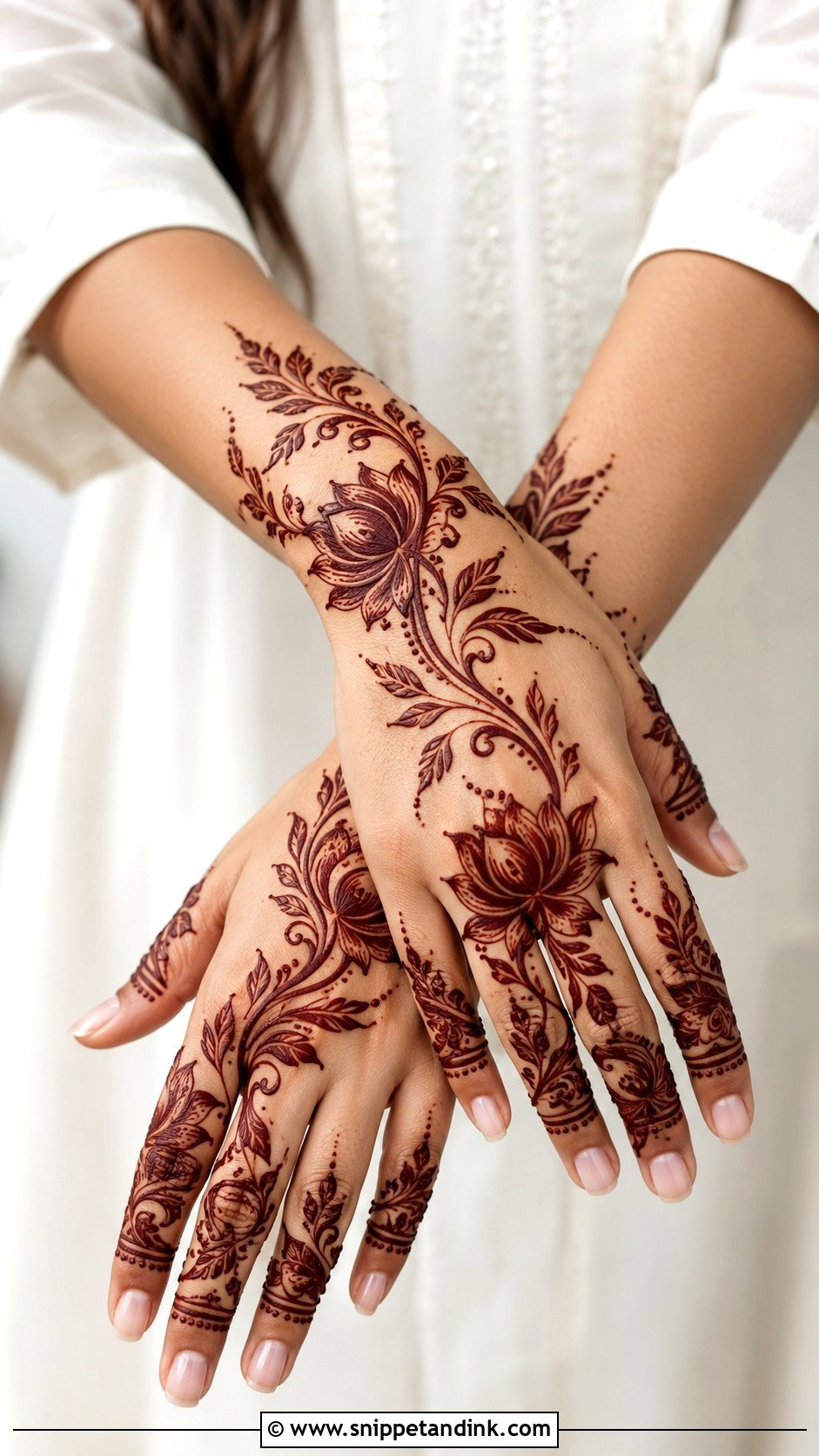
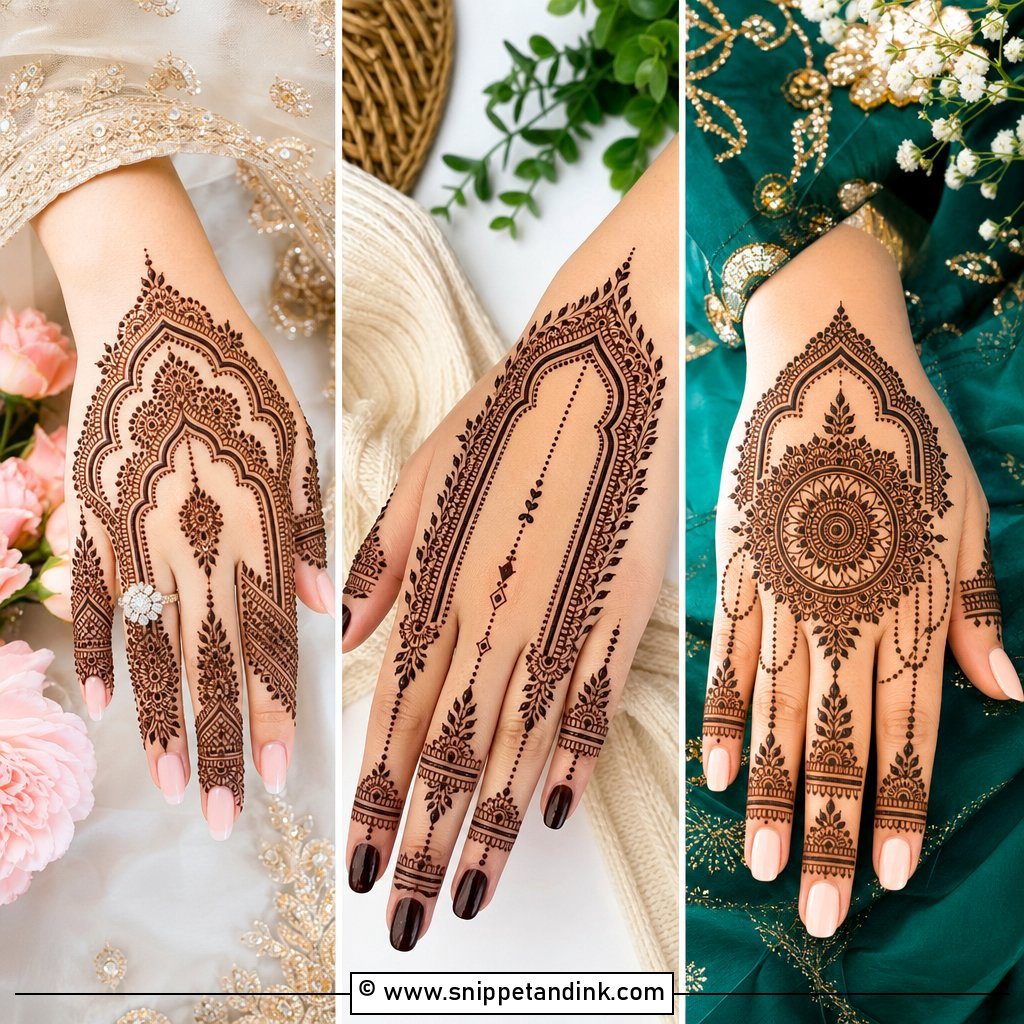
Arabic placement means the lotus rides a diagonal trail from the wrist toward the index or middle finger, with bare skin left on either side. I outline the petals boldly, shade the leaves, and only drop in spirals or dots where a gap looks accidental rather than chosen. Because so much skin stays open, this dries faster than a dense layout and the paste is less likely to smudge when you move. My only caution: a diagonal trail exaggerates any wobble in the line, so it needs a confident hand. It reads well at semi-formal events and festivals alike.
4. Bridal Lotus Mehndi Design Full Hand
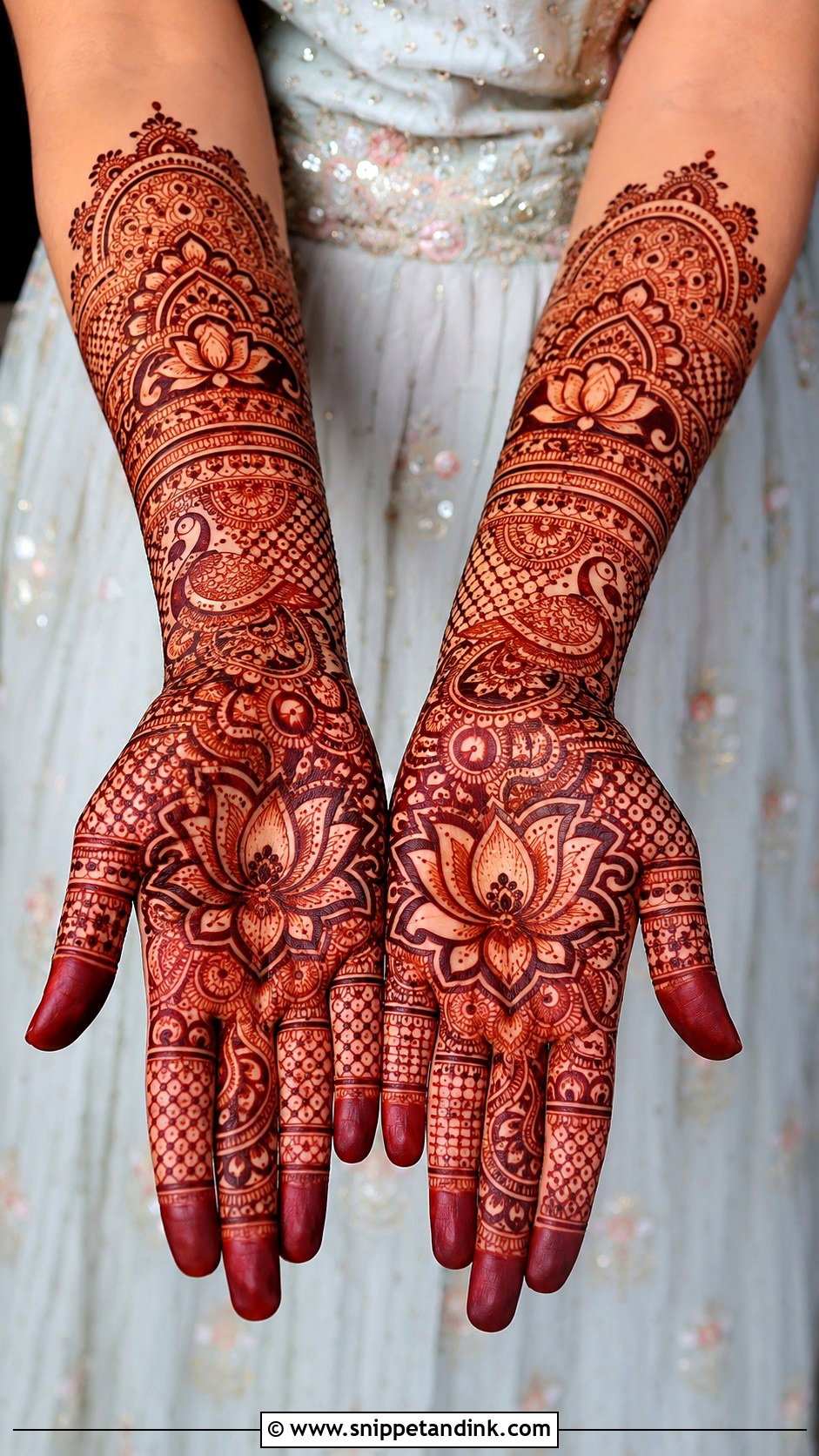
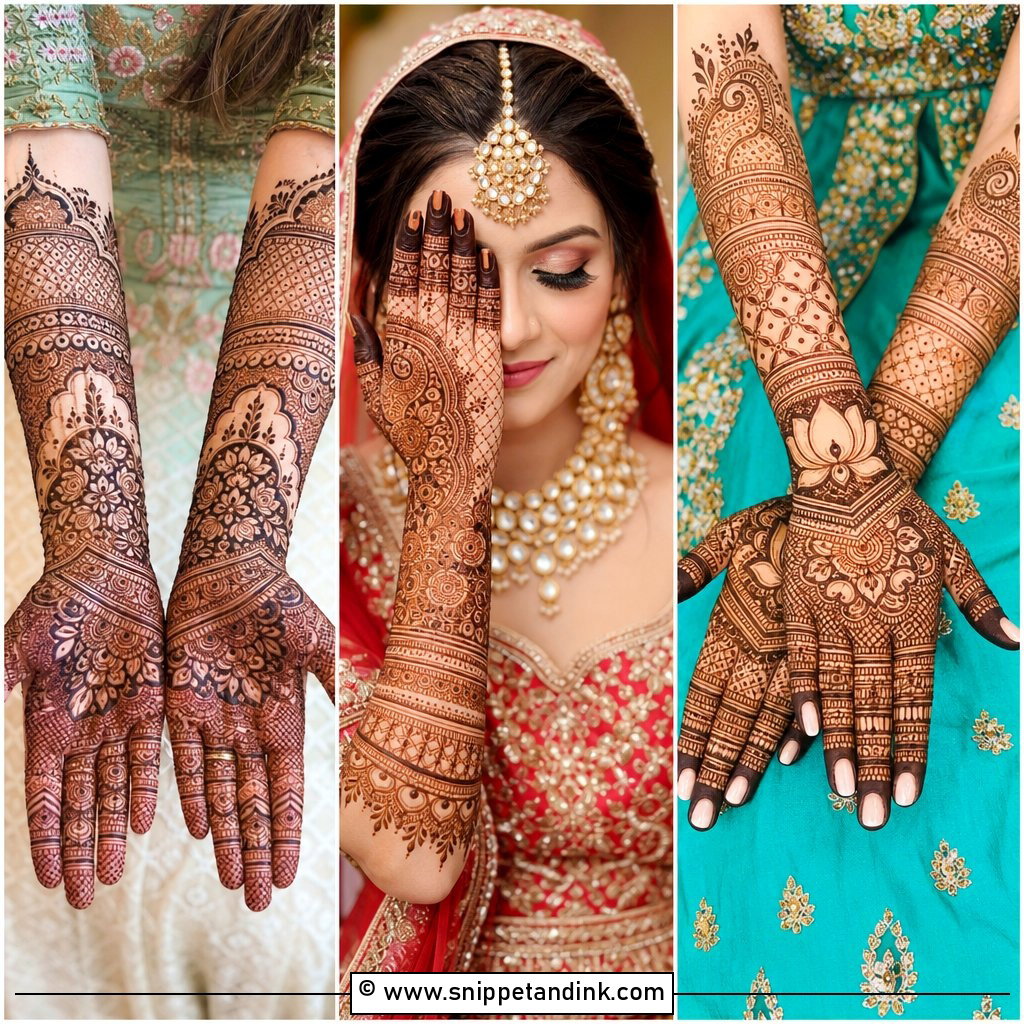
A bridal lotus mehndi design full hand is where I use the lotus as an anchor rather than the whole story. One large flower takes the palm center, smaller ones repeat at the wrist or inside a forearm panel, and paisleys, jaali, peacocks and fine vines carry everything between them. Balance is the hard part on a full hand. I sketch the big motifs first in the key spaces and only then fill, otherwise the fillers creep and the lotus gets swallowed. Many brides pick it for what it symbolizes: purity and a new beginning. Expect two to three hours per side for this level of detail, and plan to sit still.
5. Minimal Lotus Mehndi Design
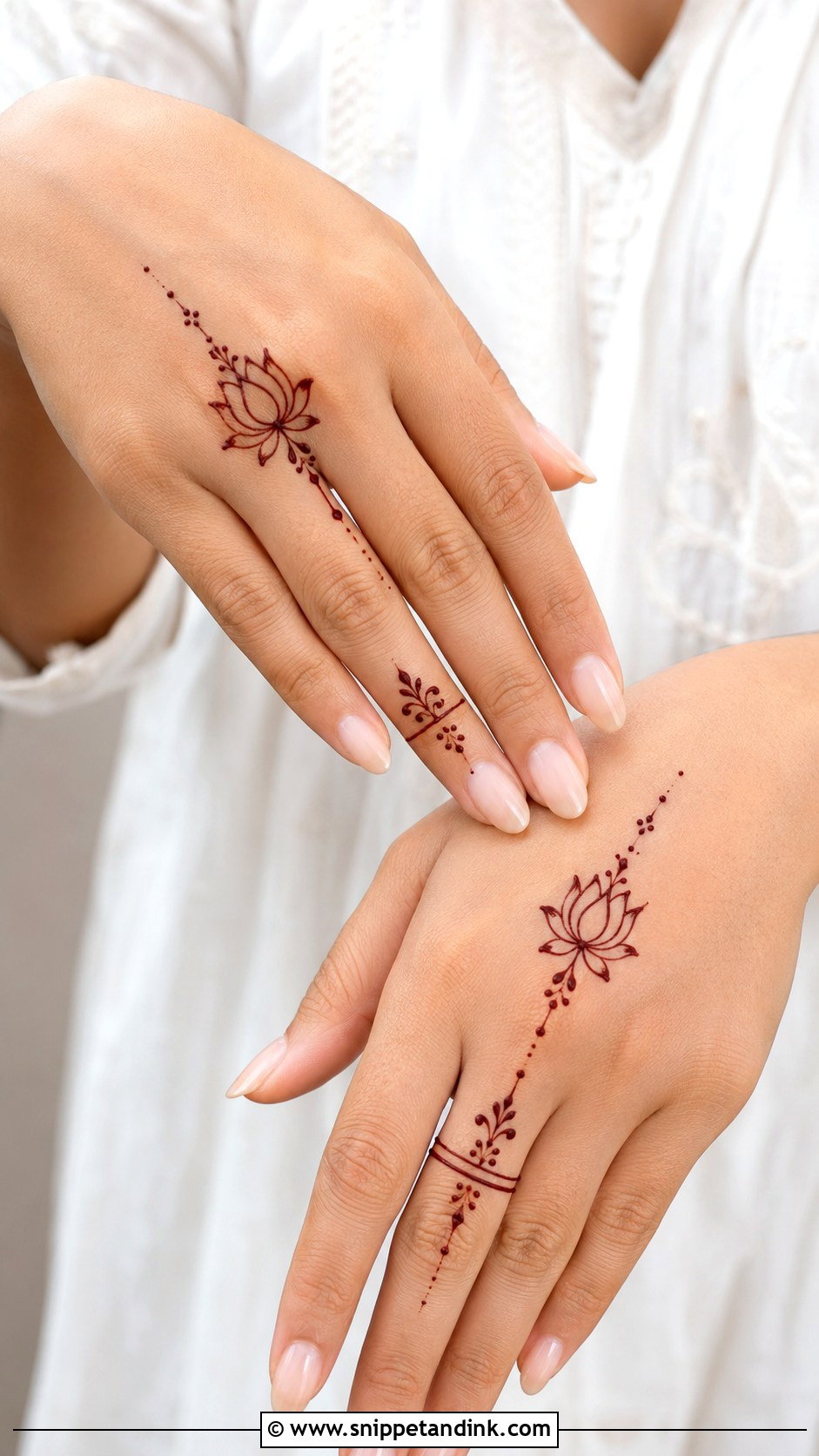
A small lotus on the back of the hand, the wrist, or just under the fingers, drawn with thin lines and a few tiny leaves and no heavy shading. Everything rests on petal shape and spacing, so I take more care over the curve of each petal here than I would in a busy design where fillers hide small faults. It’s quick, it’s office-friendly, and it works at any age. If it’s your first time with henna, this is where I’d start, since a small design also tells you how your skin takes the stain.
6. Lotus Mandala Mehndi Design
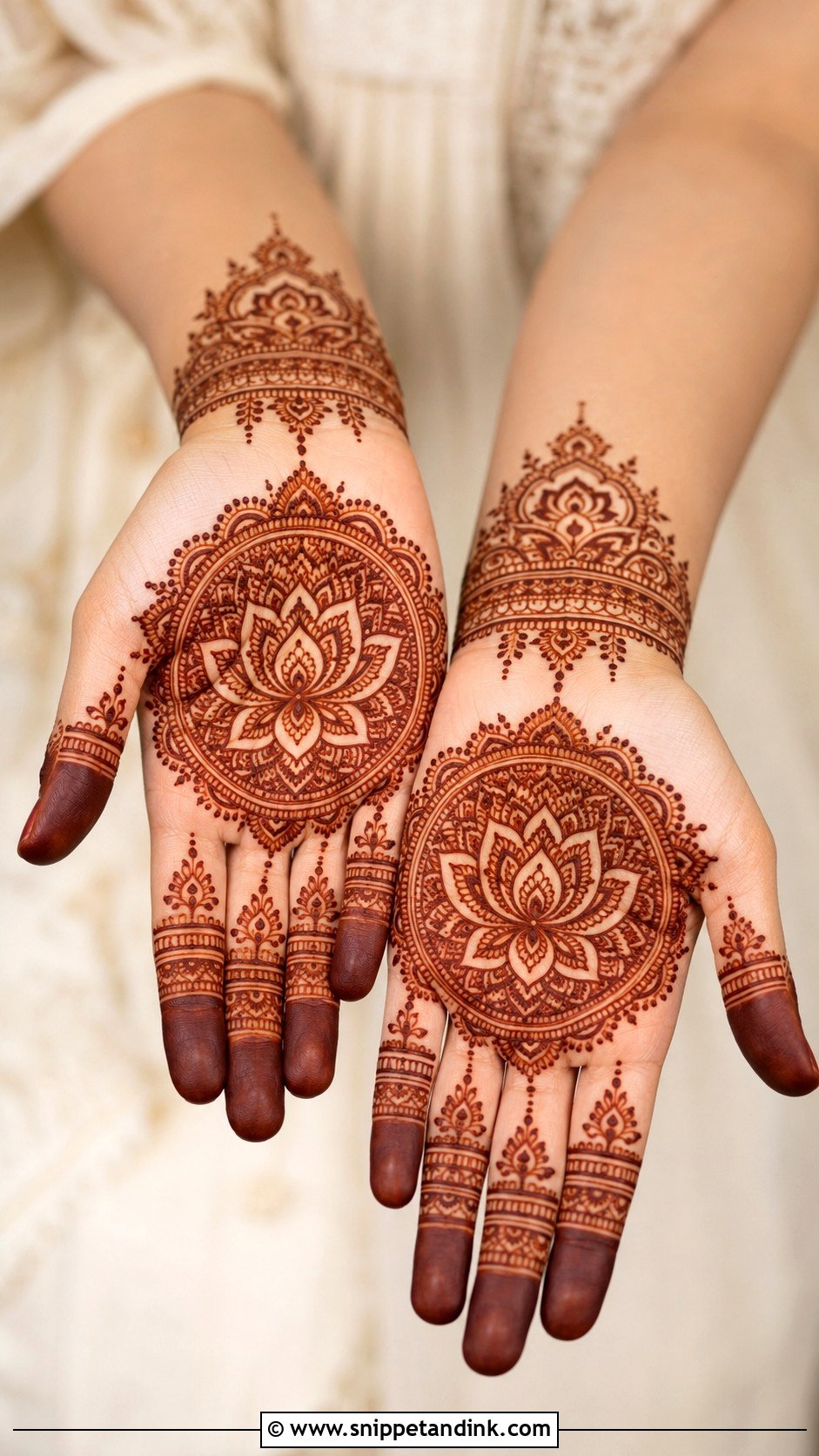
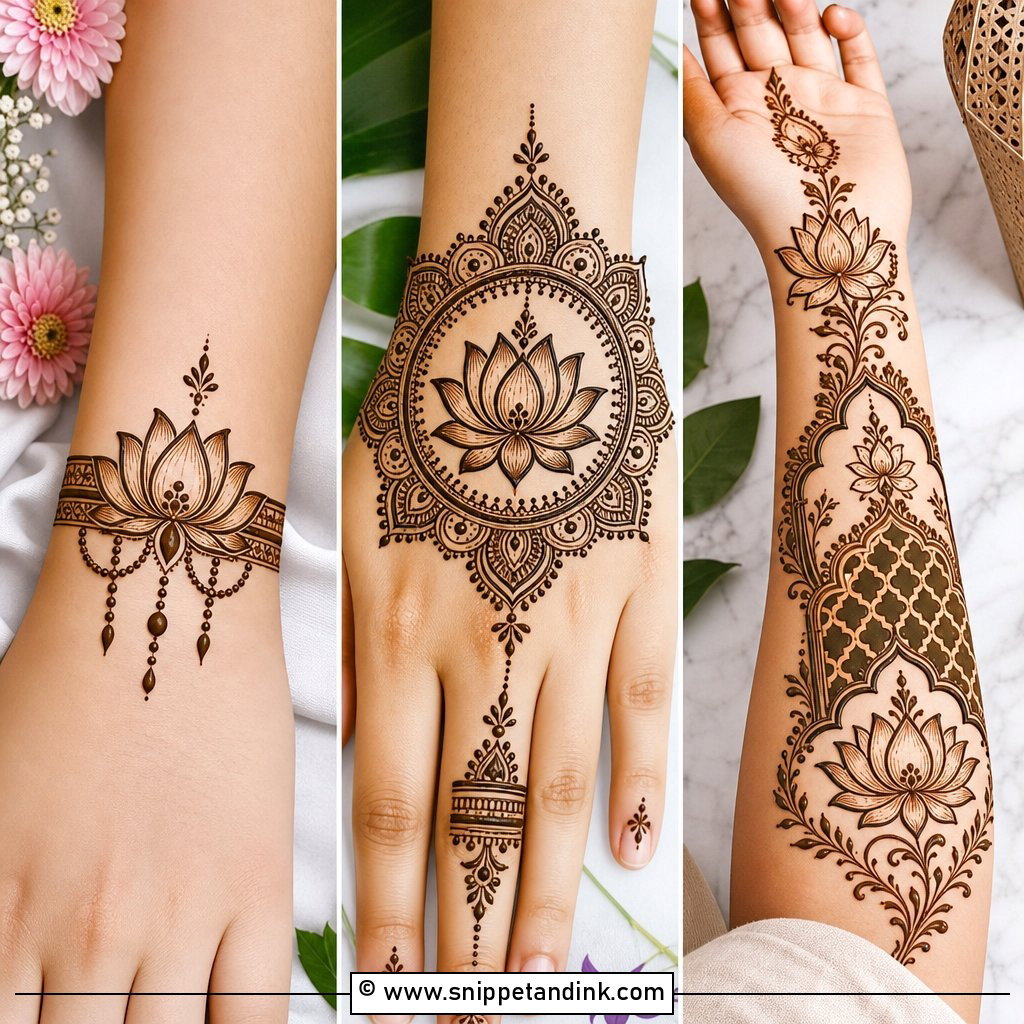
In a lotus mandala mehndi design the mandala sits at the center of the palm or back hand and the lotus petals become its outer ring. I build it ring by ring from the middle and keep a hairline gap between each layer. Skip that gap and the rings fuse once the stain darkens, and the calm symmetry turns into a dark disc. Fingers get matching bands or half-mandalas at the base. People who dislike diagonal trails usually love this one, and it fits poojas, haldi mornings and family gatherings.
7. Lotus Jaali Mehndi Design
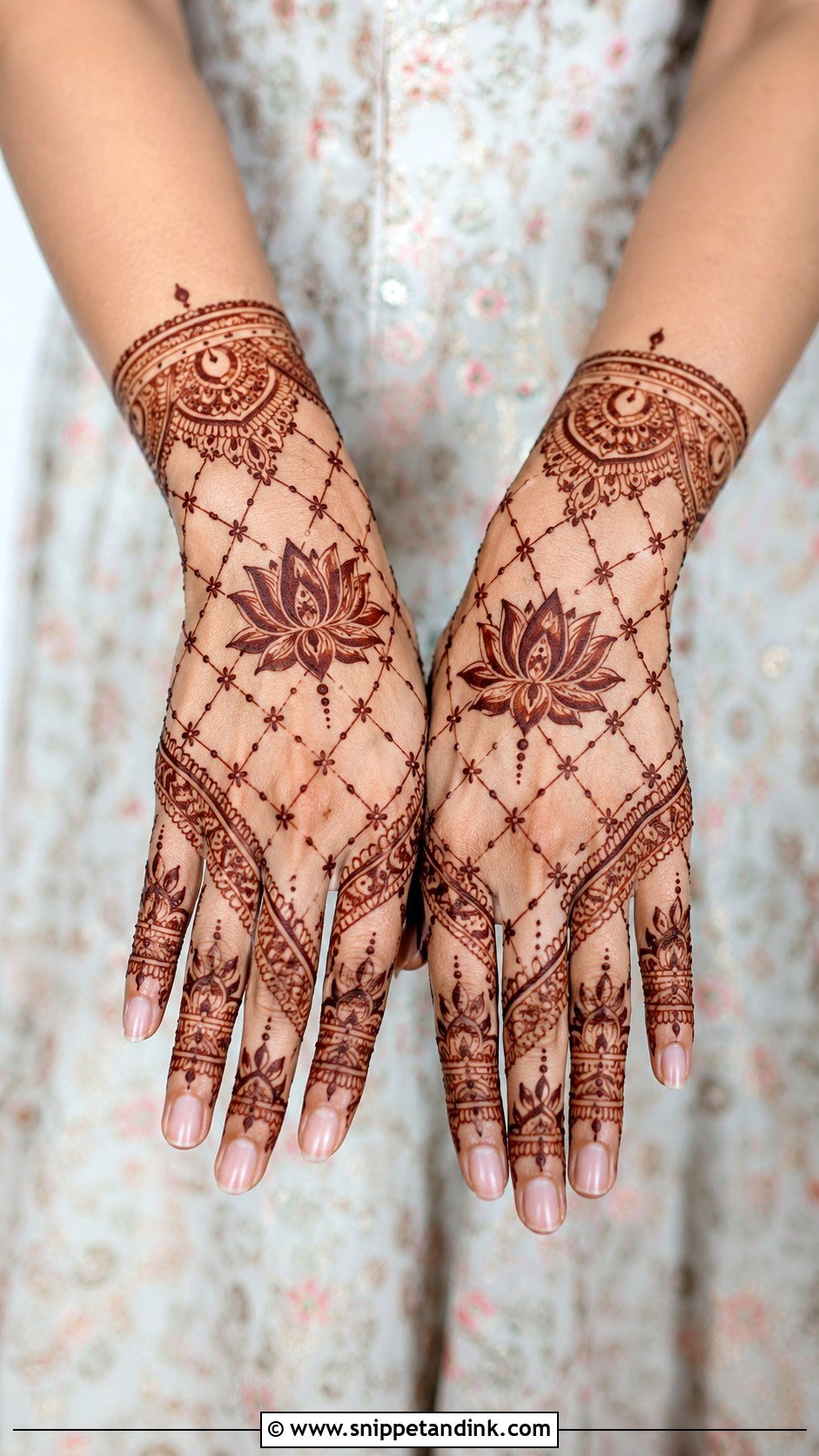
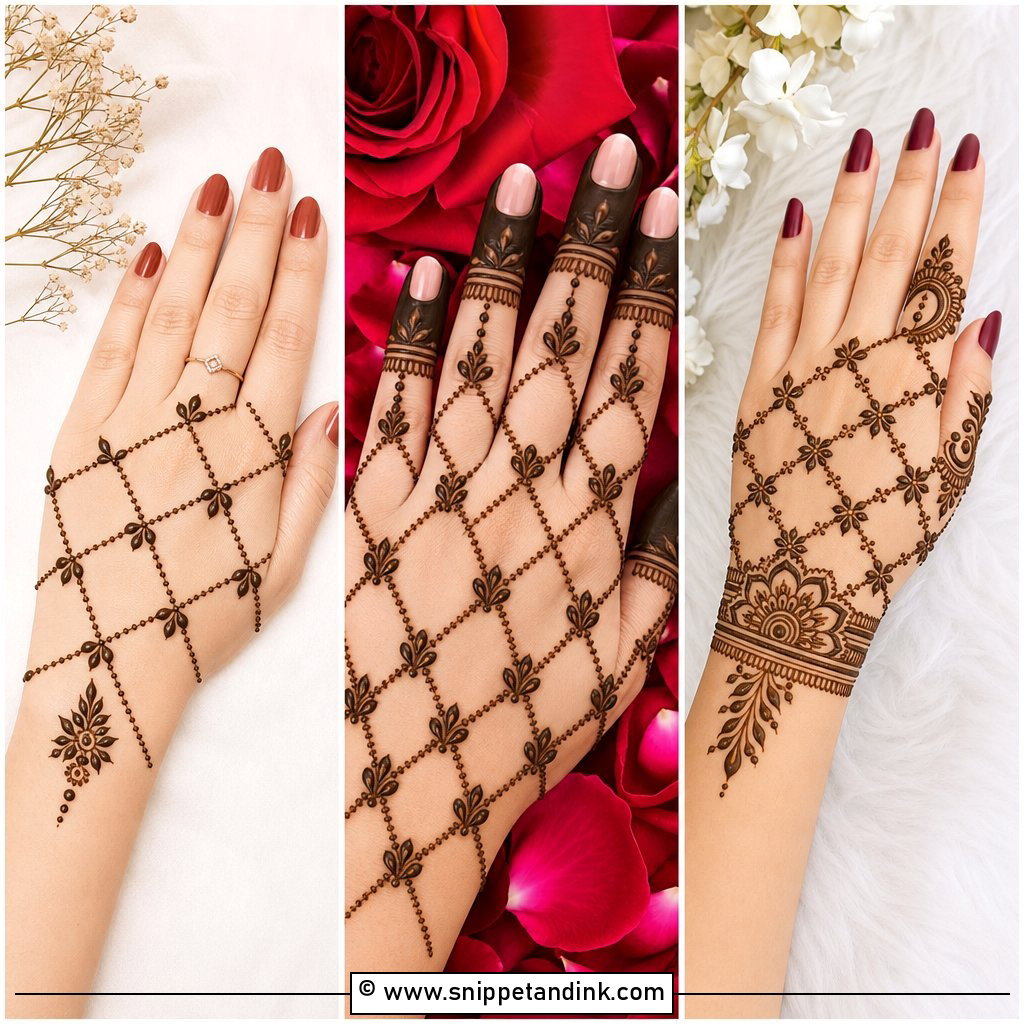
The jaali here is a fine mesh of diamonds, dots or tiny floral crossings laid around a bold lotus, and the contrast between open net and solid petal is the whole effect. I draw the mesh with the thinnest tip I have. Thick jaali lines close up the diamonds and the lace look disappears. It can run up toward the wrist with matching finger bands for engagement functions, where it looks more bridal than the actual coverage would suggest.
8. Indo Arabic Lotus Mehndi Design
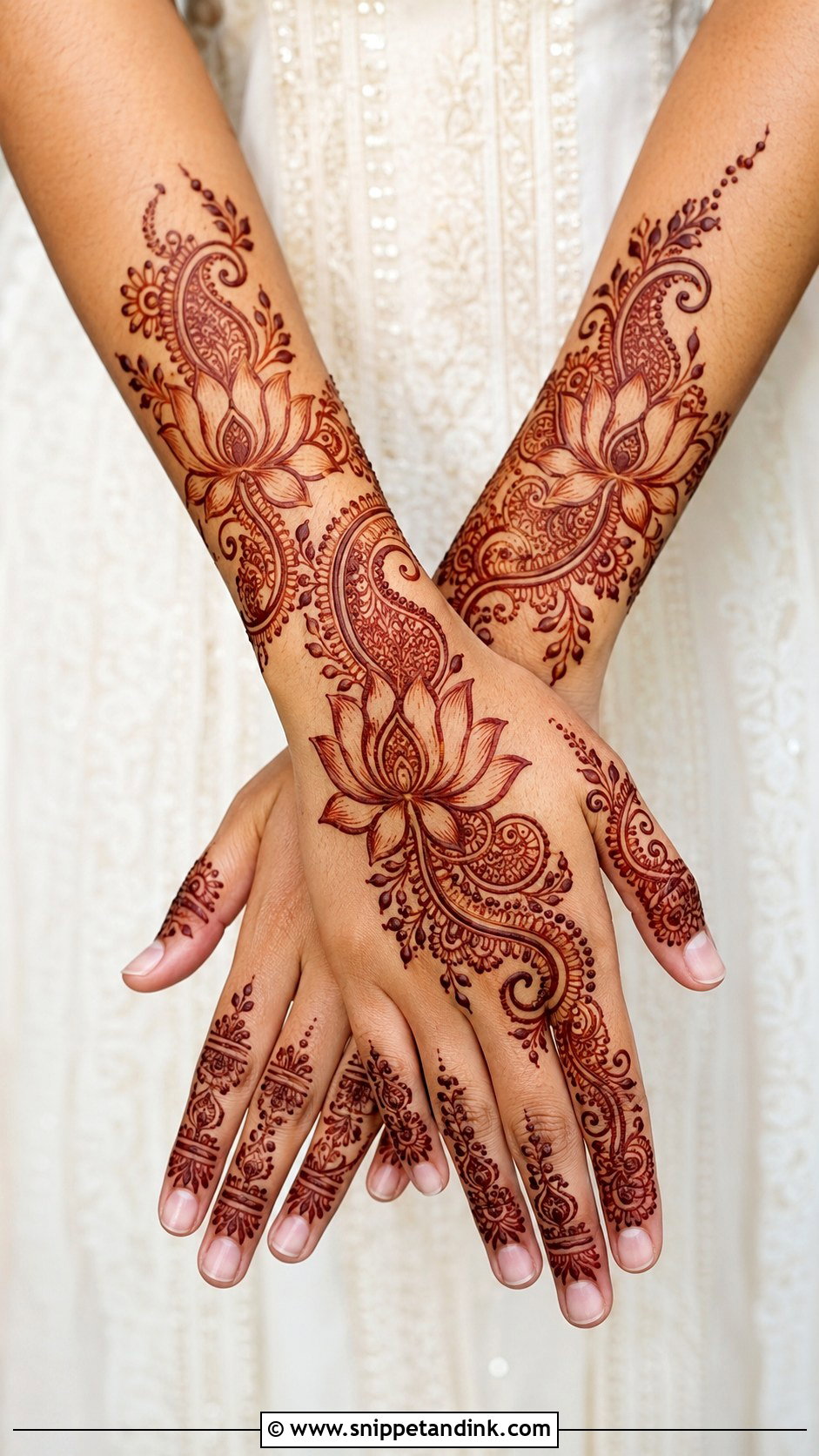
Indo-Arabic borrows the open spacing of Arabic work and the fine fill of Indian mehndi. A large lotus anchors the hand, paisleys and shaded leaves follow a diagonal, and there are deliberate breathing spaces between motifs. I use a thick outline on the lotus and lighter lines inside it to give dimension. For sisters of the bride and pre-wedding guests it’s my usual recommendation: it looks festive in a group photo and takes far less sitting time than a bridal hand.
9. Lotus Finger Mehndi Design
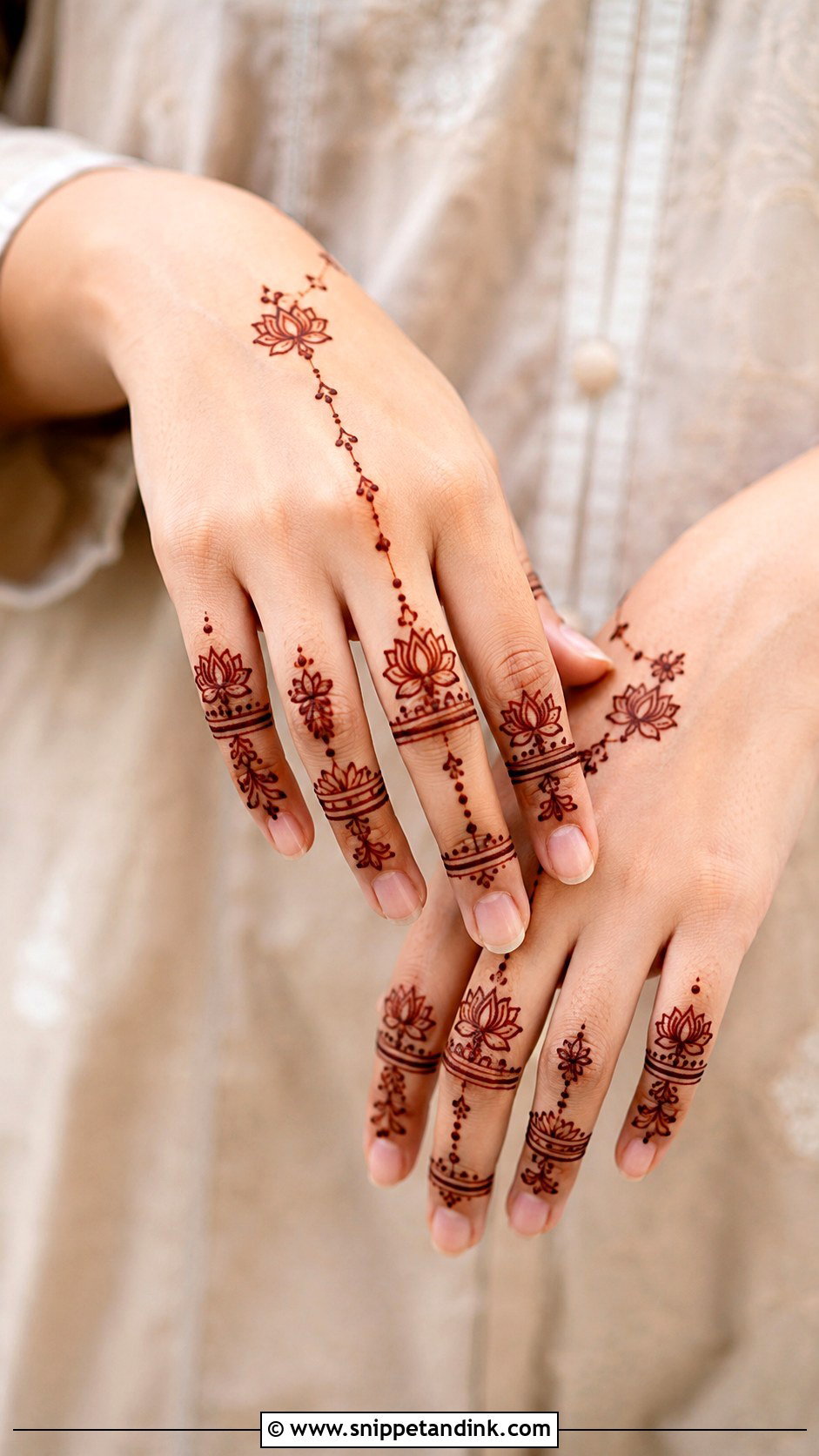
Rather than squeezing a whole flower onto one fingertip, I scatter tiny lotus buds near the knuckles and link them with lines, dots and leafy bands, then add one small lotus at the wrist or side of the hand so it reads as a finished design. Fingers have creases at every joint, and paste cracks there first as you bend, so I keep these motifs between the creases rather than across them. With an empty palm, rings sit cleanly against bare skin.
10. Lotus Bracelet Mehndi Design
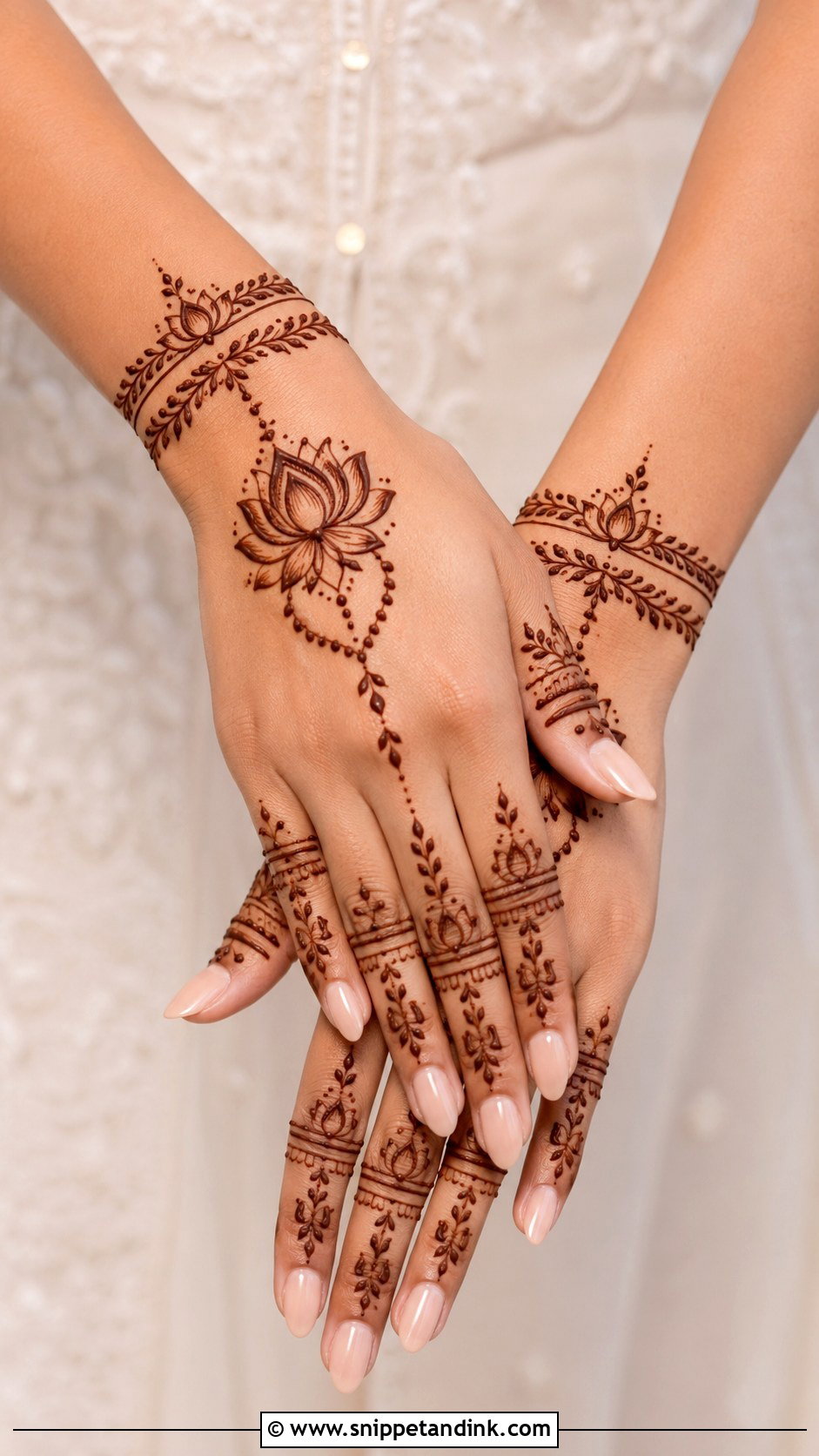
A Lotus bracelet mehndi design puts the flower at the center of the wrist with thin bands running around it like a cuff, plus chains, dots and small petal clusters. The back of the hand stays open and the fingers get fine tips. One practical point: the wrist moves constantly and rubs against sleeves, so I ask clients to keep it uncovered until the paste comes off. It’s light enough for an engagement dinner or Eid gathering and sits neatly under stacked bangles.
11. Lotus Vine Mehndi Design
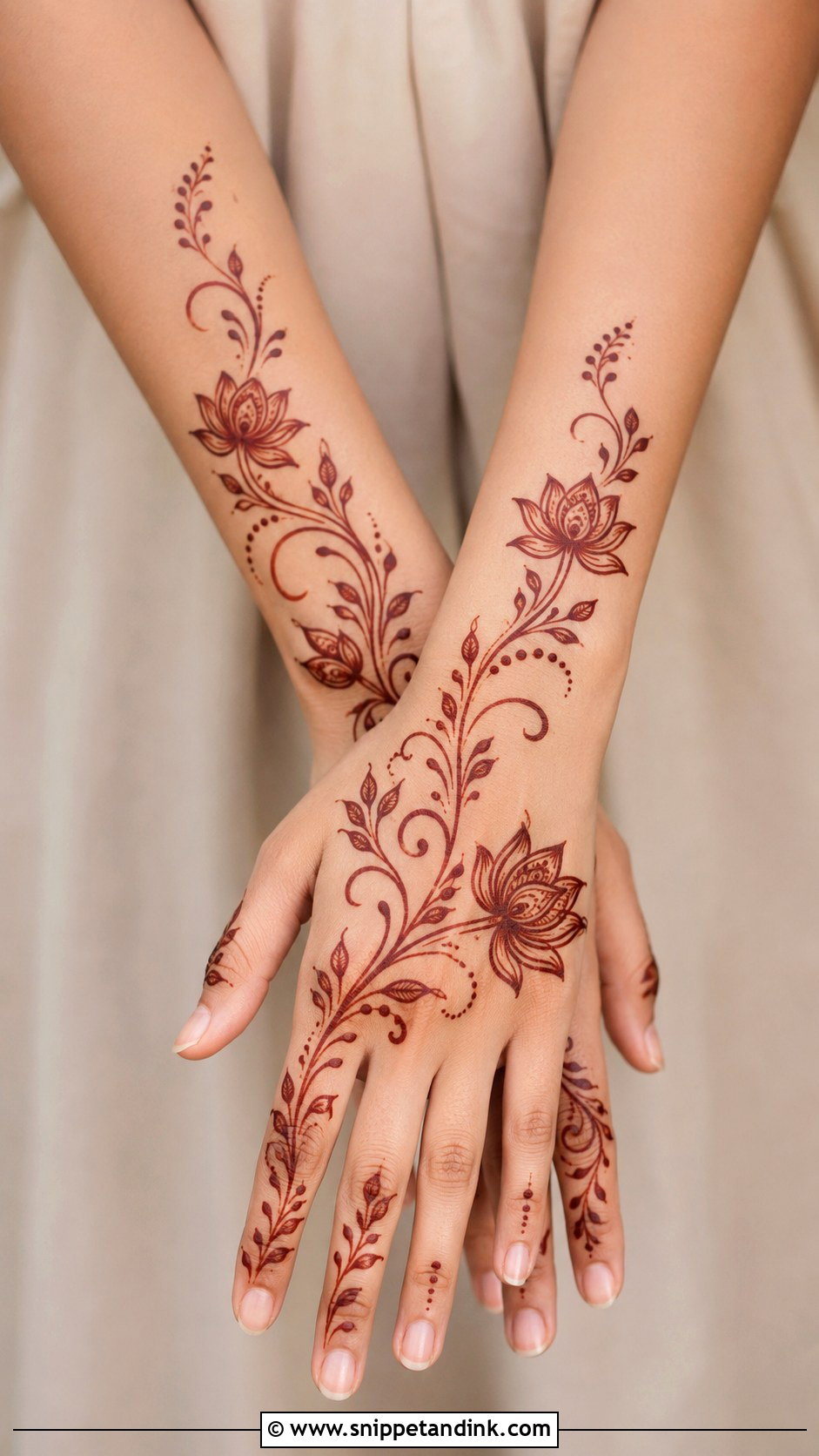
Several lotuses joined by curved stems, buds and small leaves, usually running from wrist to finger on a diagonal because that line follows the bones of the hand. I keep the petals bold and the space between the vine open. The mistake I see is too many flowers on one stem: three is usually the limit before the vine looks like a crowded garland. It works on either side of the hand and is quick to draw, which makes it handy for festival evenings.
12. Lotus Paisley Mehndi Design
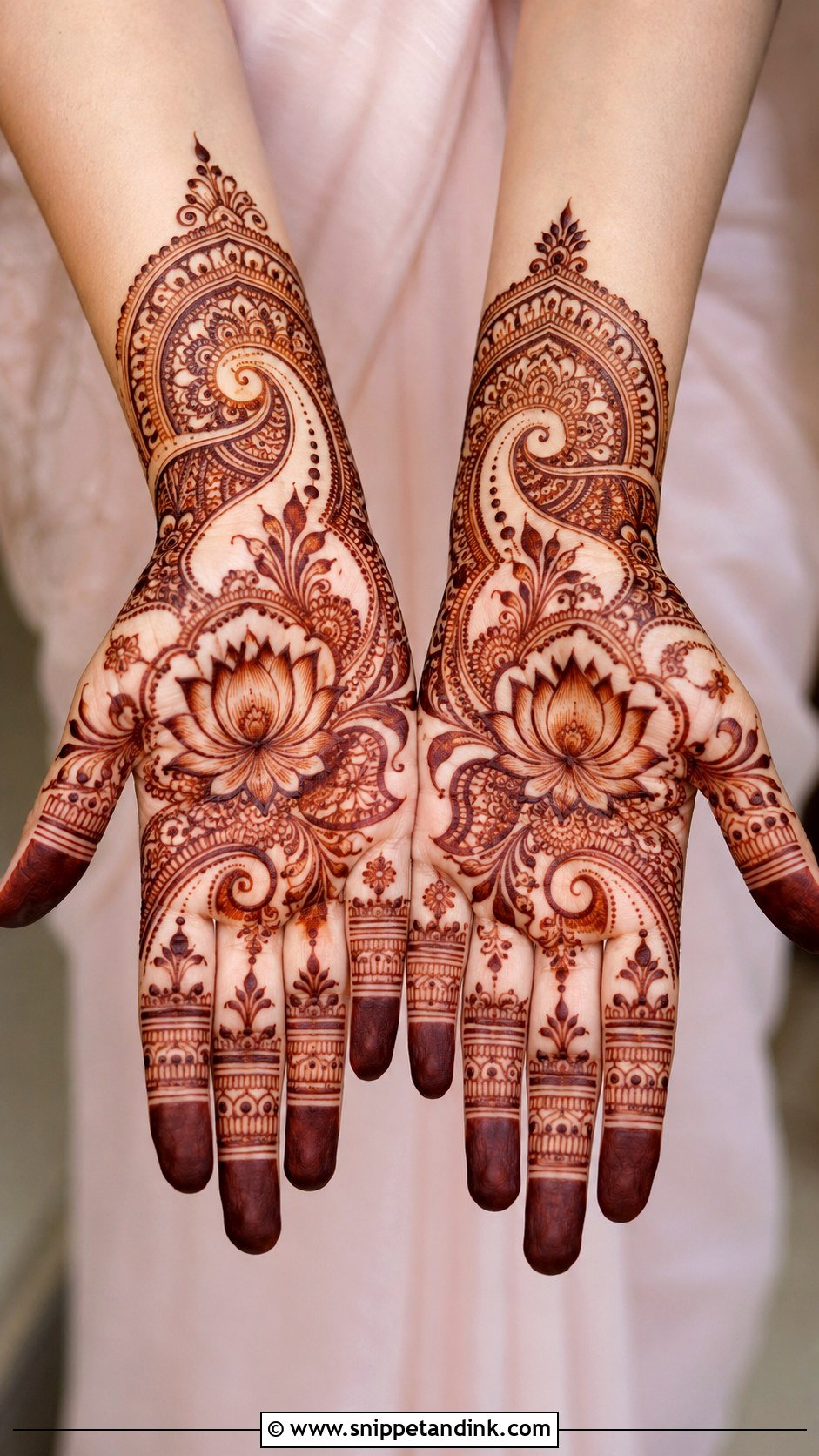
The lotus gives softness and the paisley gives movement, so I place a large flower near the center and curve paisleys around it like they’re orbiting. Paisleys get filled with fine lines, dots and shaded strokes for depth. The one rule I hold to is scale: the lotus petals must stay larger than the paisleys or the eye loses the flower. Coverage can be medium or full, which makes it flexible for a sangeet, a wedding or a family festival.
13. Lotus Peacock Mehndi Design
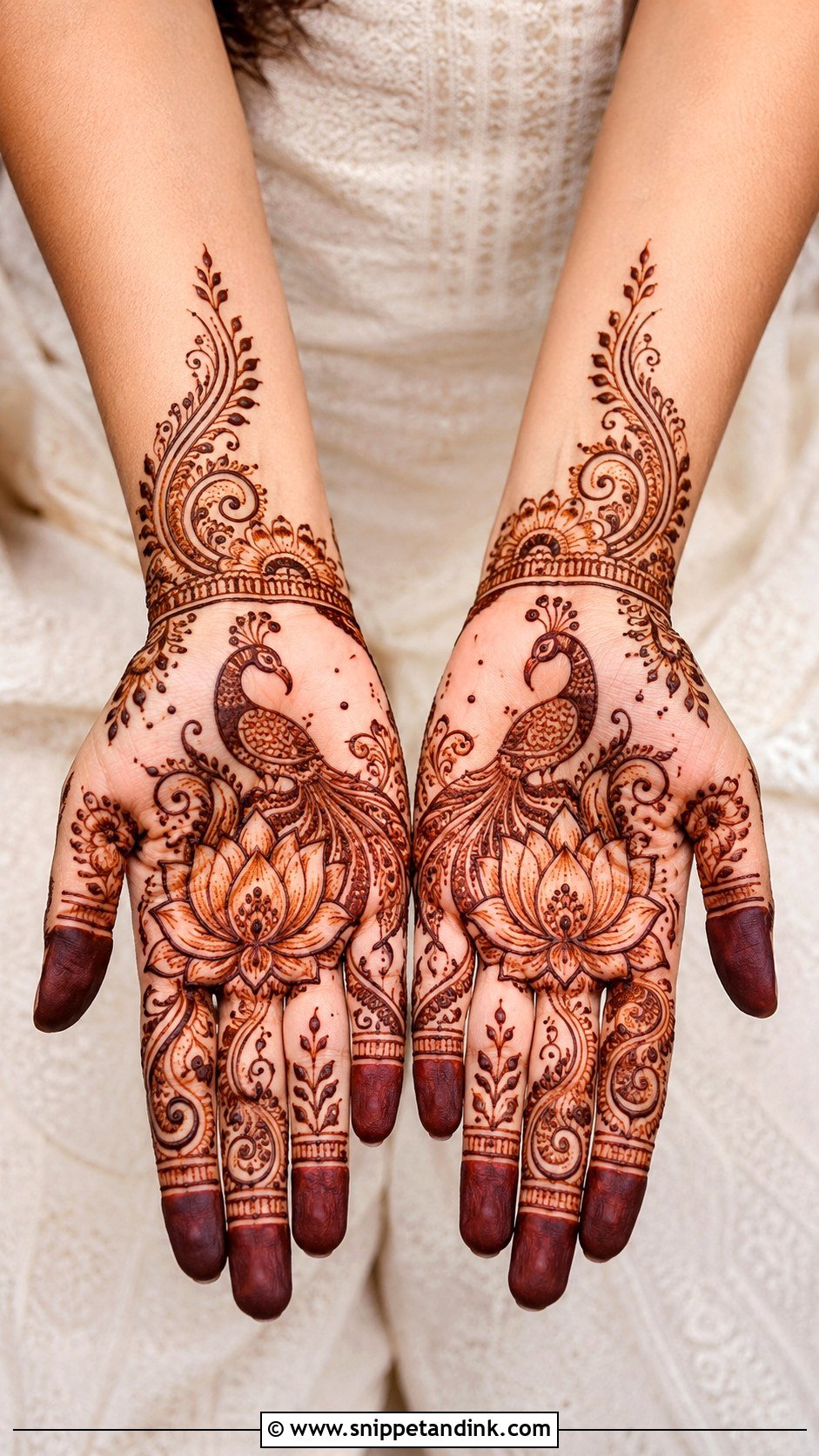
A peacock curling around an open lotus, its feathers turning into vines and paisleys. The palm takes the detailed version; the back of the hand carries a lighter one. Inside the feathers I use my finest lines, and around the lotus a bold outline, so the two motifs don’t blur together. They have to be connected by a shared curve or tail. Placed side by side as separate stickers, they look like two unrelated drawings. I’d save this for the bride and close family at bigger functions.
14. Lotus Front Hand Mehndi Design
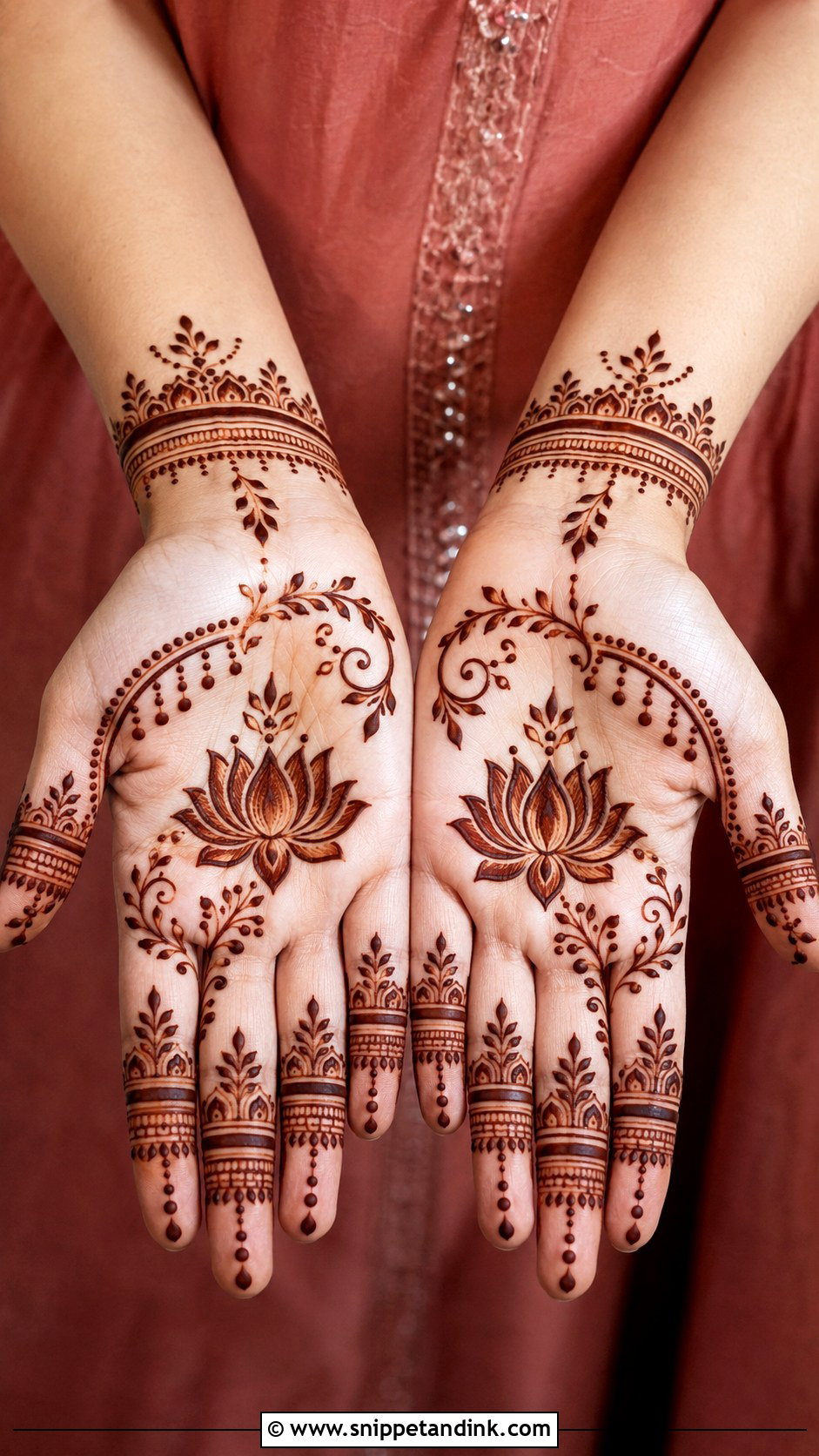
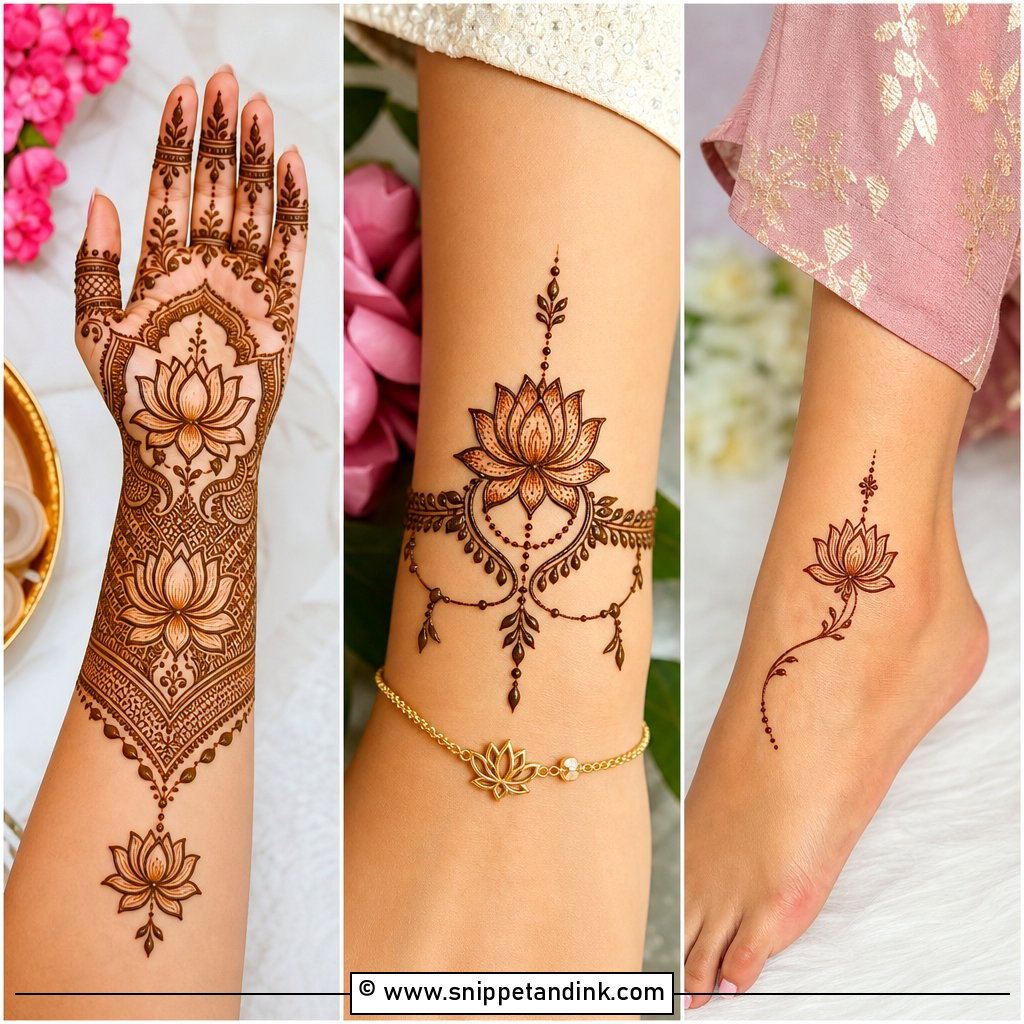
Here the palm is the canvas and the lotus its center, built out with curved vines, leaf borders and small mandala rings. Palms are shown during rituals and often turned to the camera, so this is the side I prioritize when time is short. Fingers can take stacked bands or simple tips. To stop the design floating, I connect it to the wrist with a narrow floral strip or bracelet. The palm also gives the deepest stain on the hand, so even a simple version looks rich.

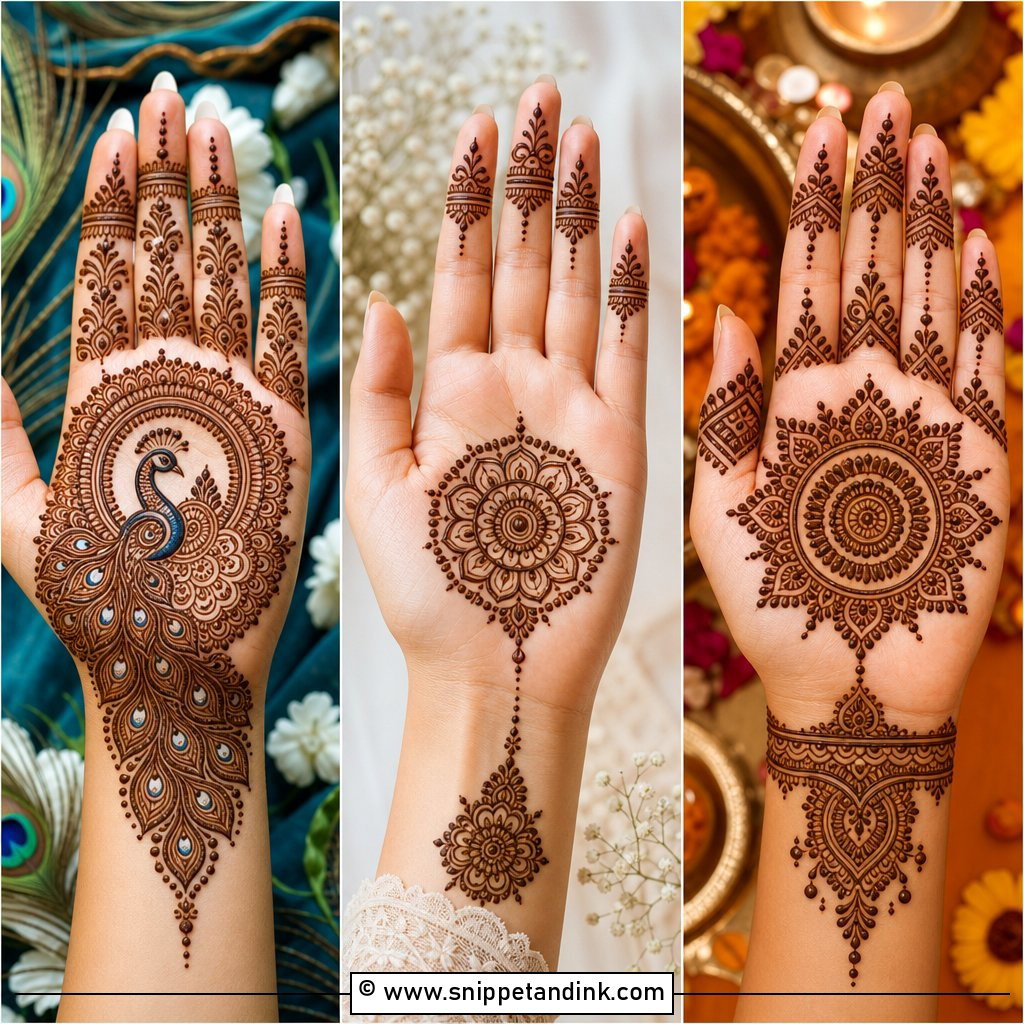
15. Lotus Back Hand Bridal Mehndi Design
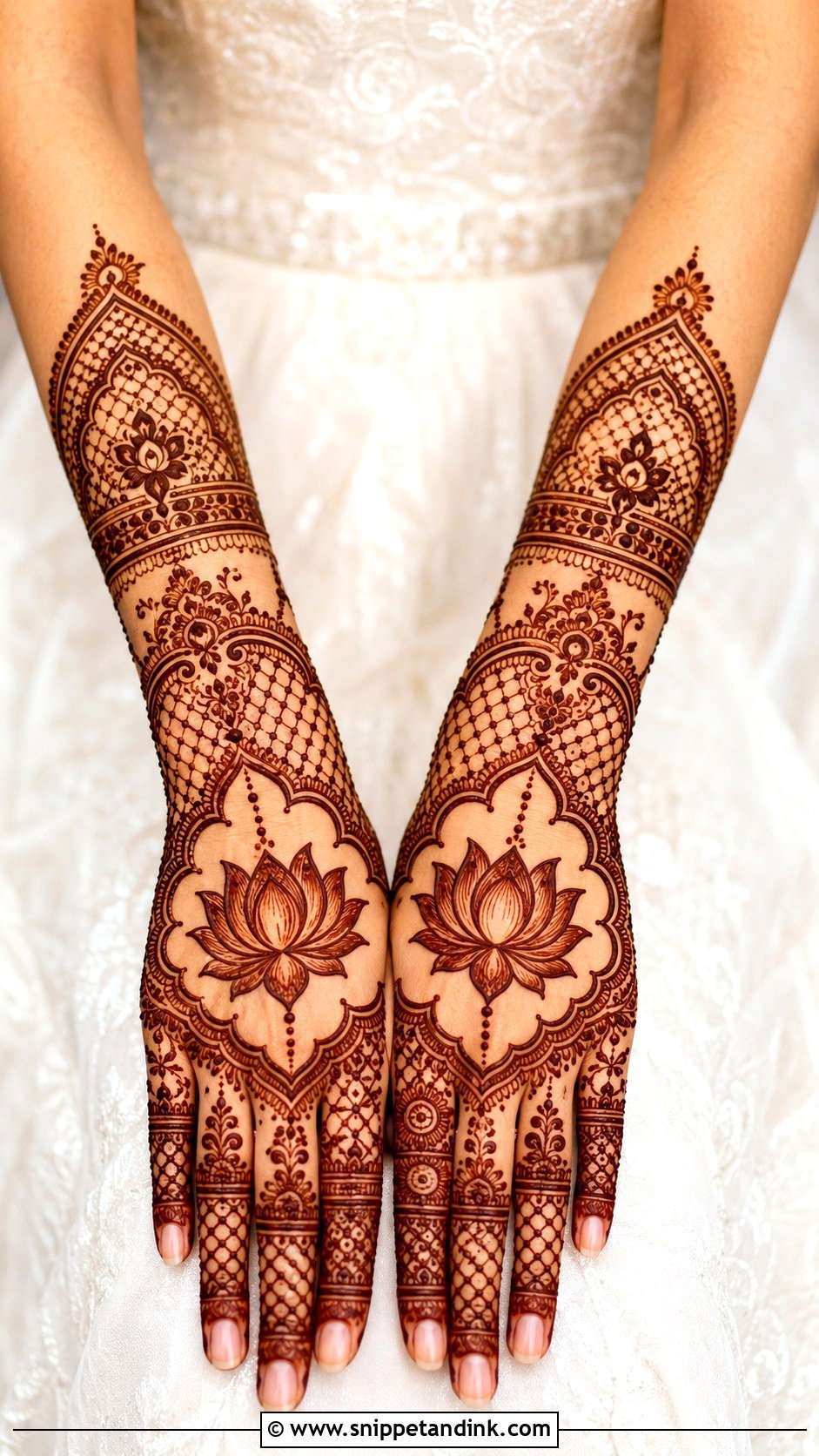
A Lotus back hand bridal mehndi design is photographed constantly, in ring shots, holding the bouquet, during the ceremony, so symmetry and spacing matter more here than anywhere. I place a bold lotus centerpiece, then jaali, lace borders and leafy trails running into wrist and forearm panels, and I match the finger detail to the richness of the hand. Since the back stains lighter than the palm, a good paste and a long wait before removal make the difference between orange and deep maroon. It sits well alongside rings, bangles and sheer bridal sleeves.
16. Lotus Mehndi Design With Leaves
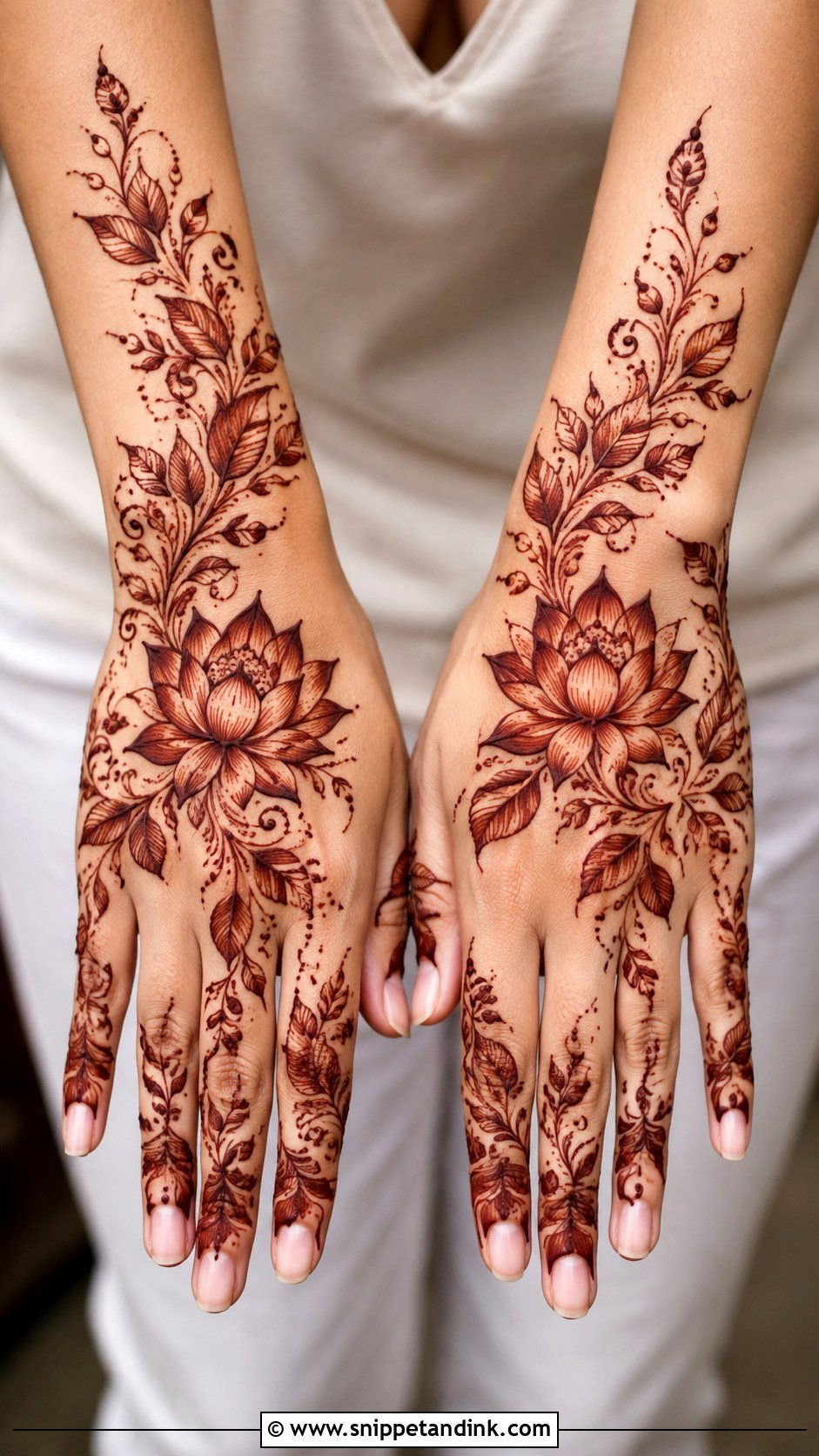
Leaves are my favorite filler because they read as natural rather than decorative. The lotus stays the main flower and leafy stems head toward the fingers and wrist, plugging gaps without adding weight. I vary leaf size on purpose, big shaded ones near the flower and fine sprigs at the edges, because identical leaves look stamped. It suits simple and medium coverage equally well.
17. Lotus Mehndi Design With Dots
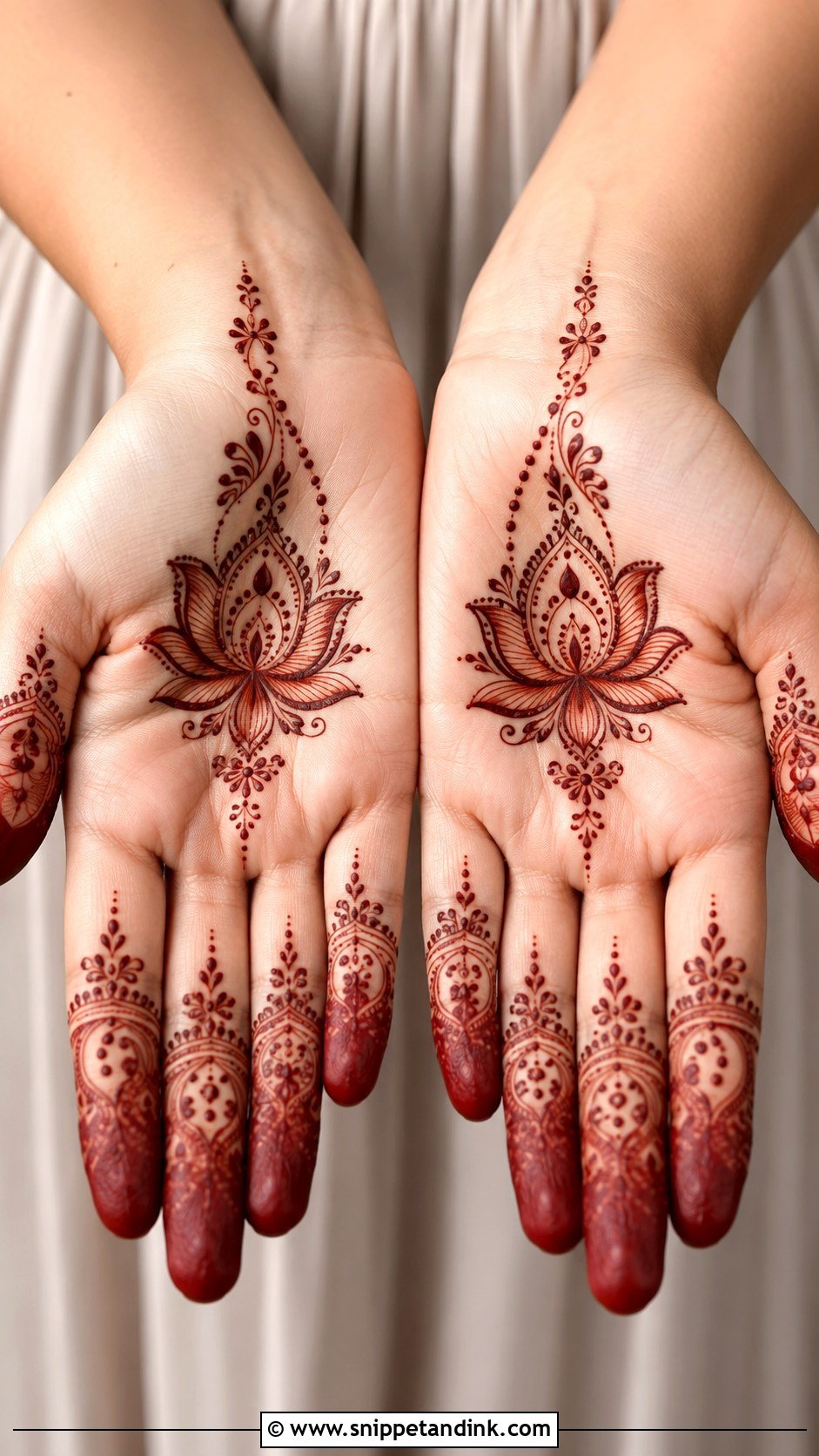
Dots do a surprising amount of work: they frame the petals, connect vines, edge the wrist, and hide small spacing gaps, which is why I teach this one to beginners. A central lotus with dotted chains up the fingers looks finished with very little fill. Keep the dots the same size by applying the same pressure on the cone each time. Uneven dots are the first thing a close-up photo shows.
18. Lotus Shaded Mehndi Design
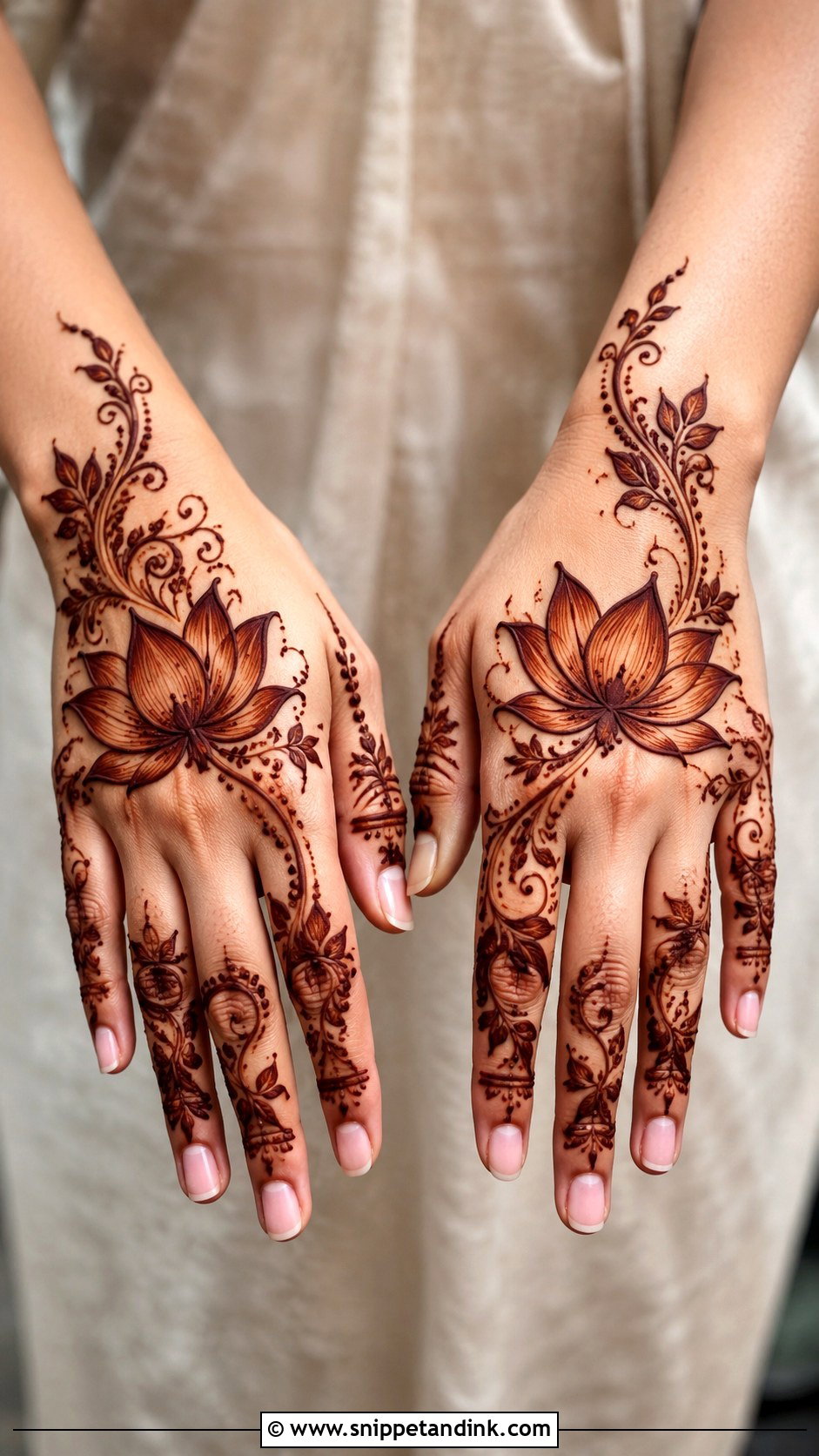
Shading gives the lotus dimension: dark at the outer petal edges, fine strokes fading toward the center. I do this by thinning the line and spacing strokes apart rather than by smearing paste. It needs a medium or large flower; on small petals the shading crowds and turns into a solid patch once the stain develops. Keep the surrounding vines simple and leave open space so the shaded flower is the bold part of the design. It works on palm or back hand for engagements and modern bridal events.
19. Lotus Mehndi Design For Wrist
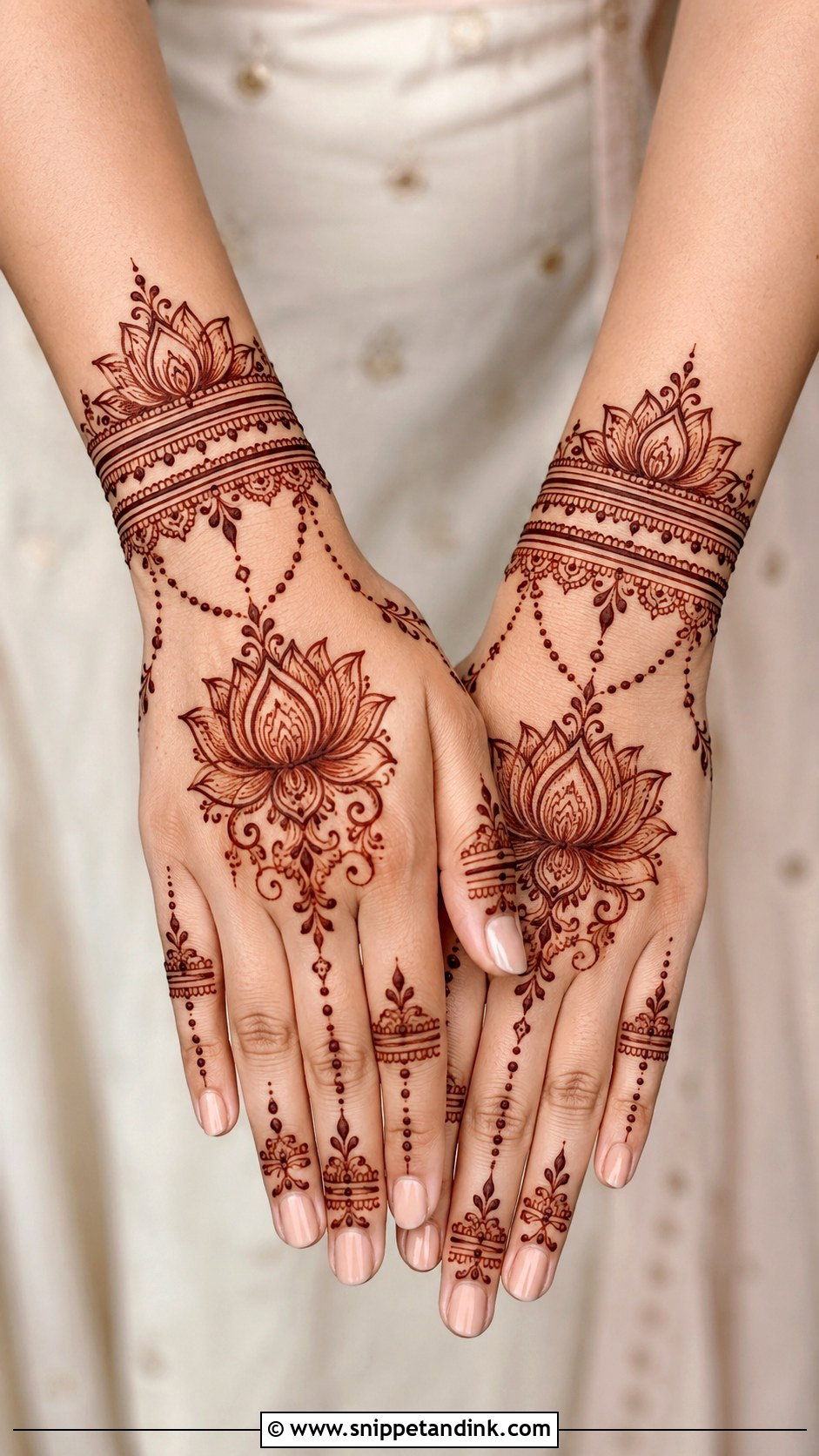
A cuff of parallel lines, dots and leafy borders wrapping a lotus at the center of the wrist, with a small vine reaching toward the back of the hand so it doesn’t look cut off. For anyone who wants minimal coverage it still looks complete. Clean edges are what sell it as jewelry, so I finish both borders with a steady line rather than letting the pattern trail off. Bangles slide over it nicely.
20. Lotus Mehndi Design For Engagement
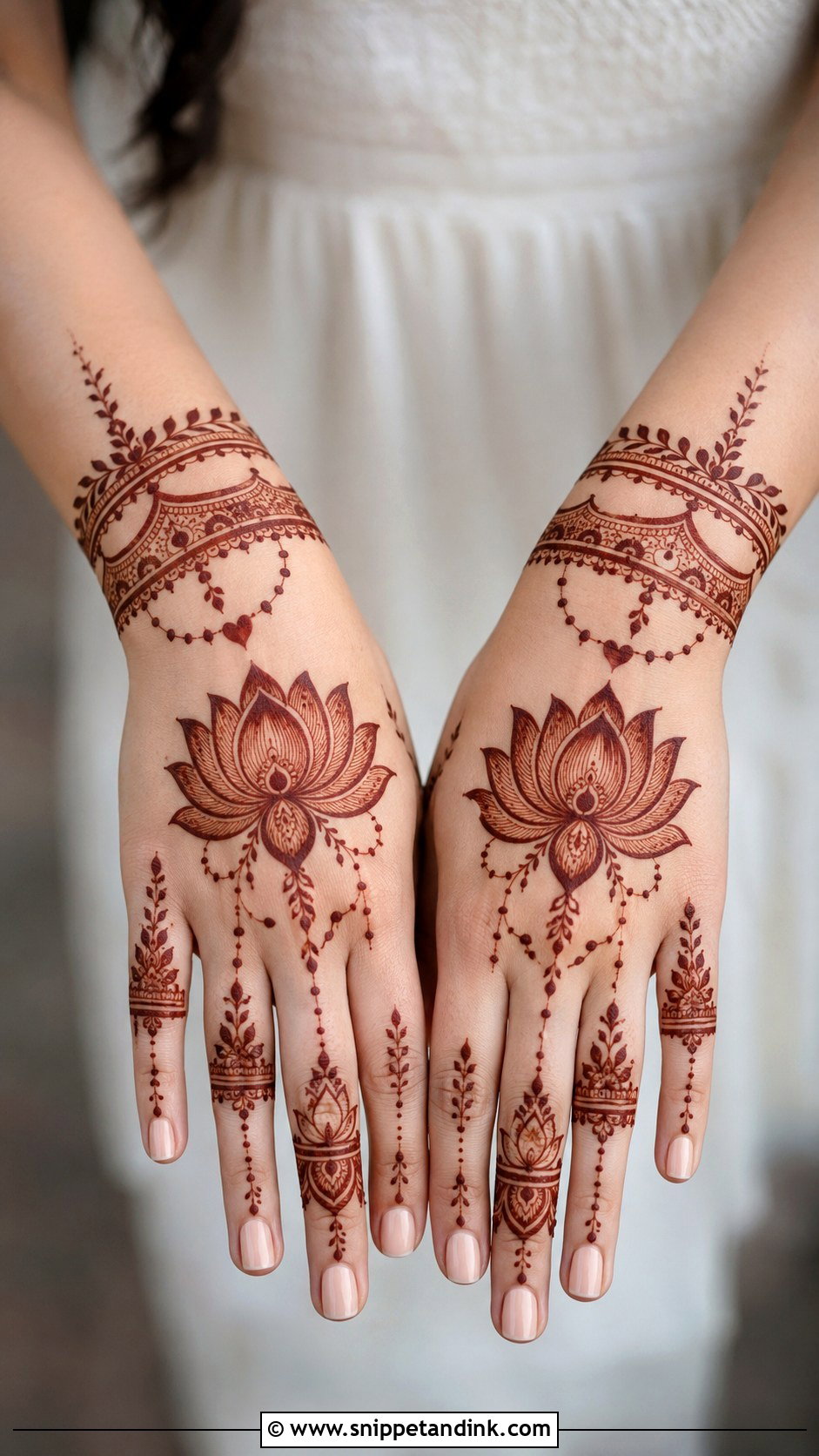
Engagement henna needs to look neat in close-up ring photos, which is why I keep it lighter than wedding mehndi. A back-hand layout with a central lotus, careful detail on the ring finger and bracelet-style wrist bands does the job. Initials or a tiny heart can be hidden in the vines if you’d like something personal, though I keep them small so they don’t fight the flower. Leave open skin around the ring finger itself; a ring sitting on dense pattern disappears in photos. A deep maroon stain needs a good paste and patience before removal.
21. Lotus Mehndi Design For Eid
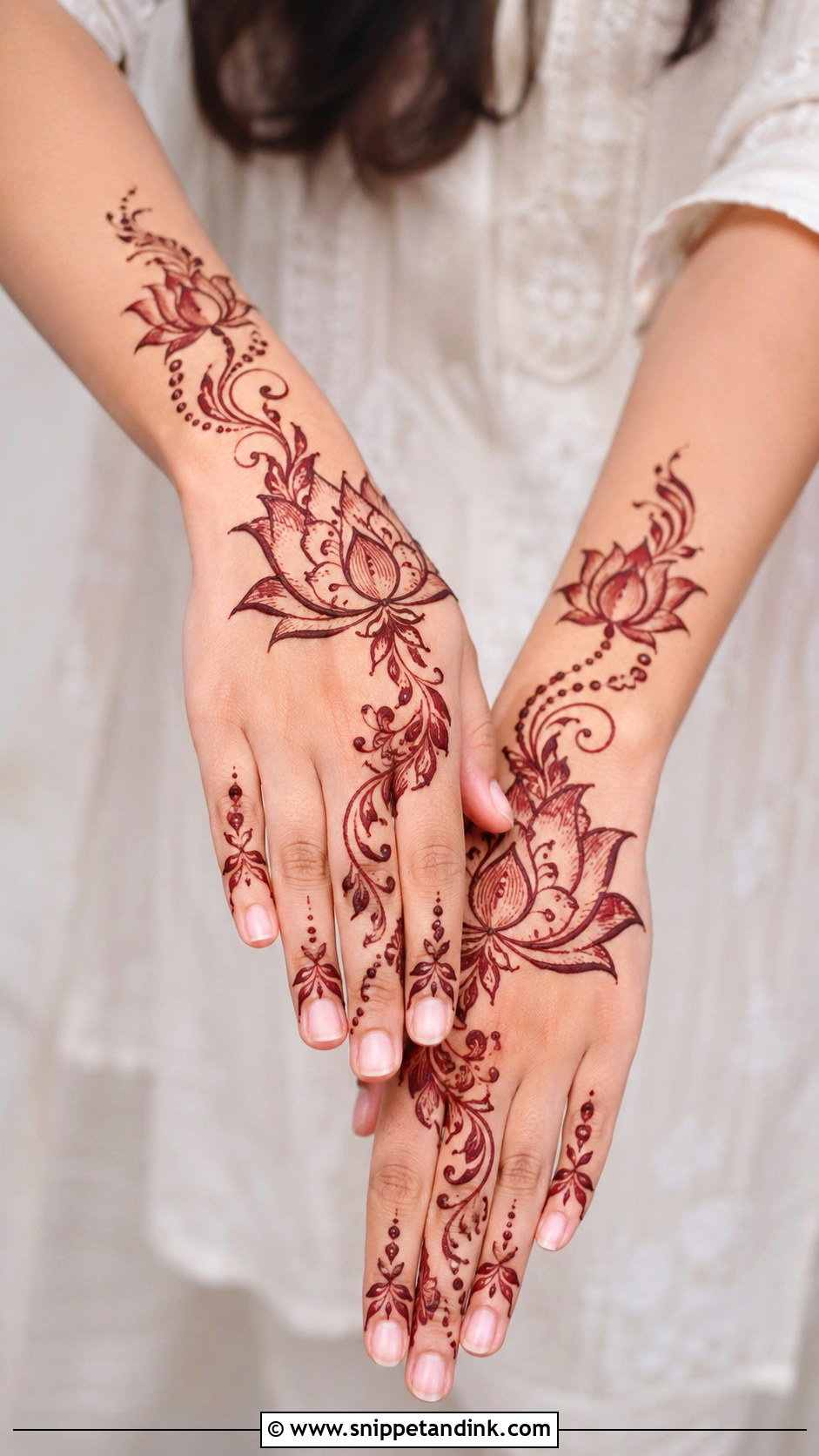
For Eid I usually reach for a diagonal Arabic trail on the back of the hand: bold petals, leafy curves, dot chains and light finger bands, with plenty of open skin. If you’d rather have the palm done, a single lotus with small vines toward the wrist works too. These go fast, which matters on chand raat when every artist has a queue. Ask for it a night ahead if you can, since the stain needs time to deepen before morning prayers and visits.
22. Lotus Mehndi Design For Diwali
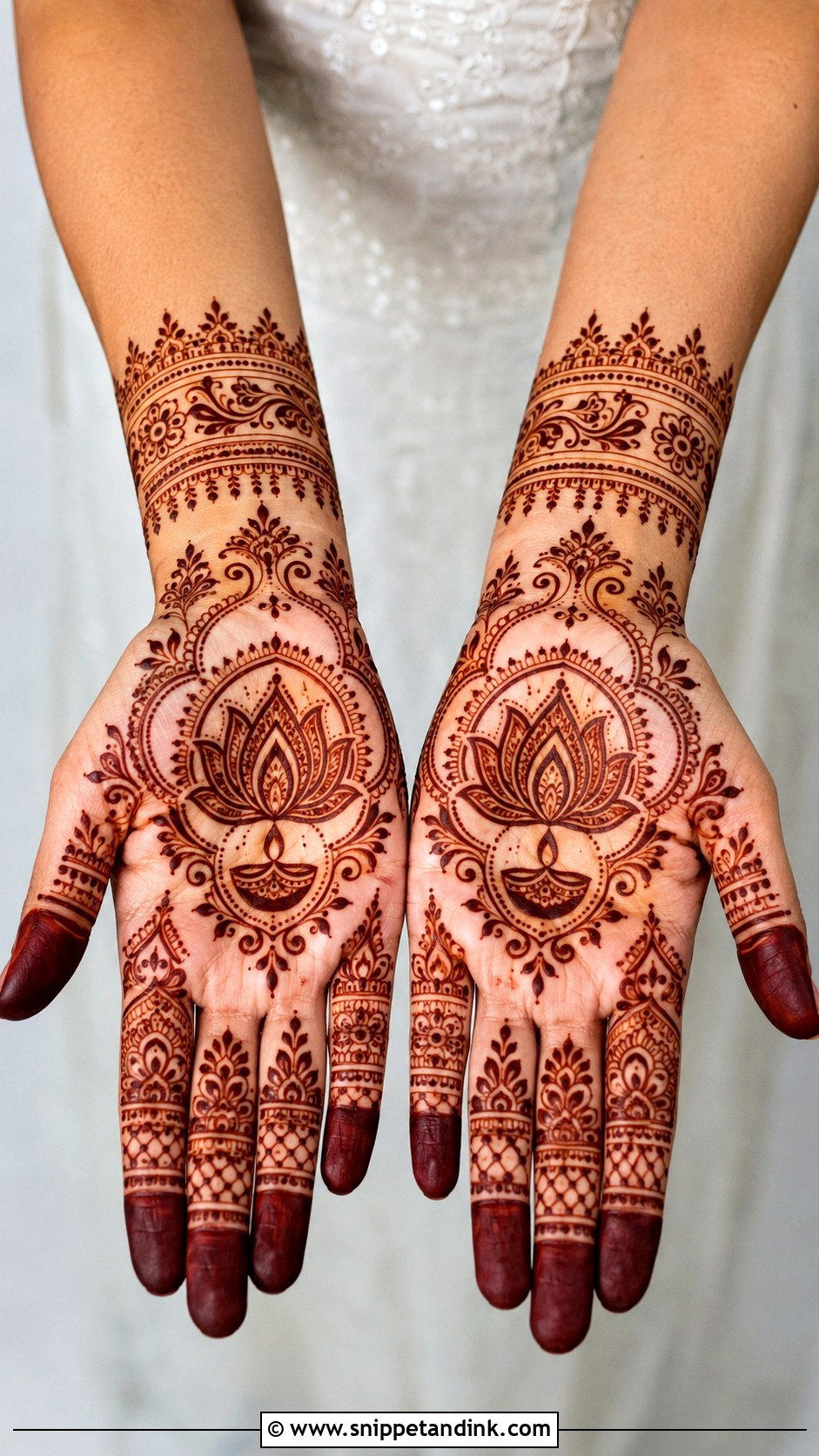
The lotus carries real weight at Diwali because of its link with Lakshmi and light, so I tend to draw it centered and symmetrical for this festival. A palm lotus inside mandala rings with diya-shaped curves, dots and leafy borders looks festive without being heavy. For a more modern outfit, a back-hand lotus bracelet with small floral trails is lighter. Remember that rangoli, cooking and lamp lighting all mean wet hands, so get it done a day or two before the main evening.
23. Lotus Mehndi Design For Bridesmaid
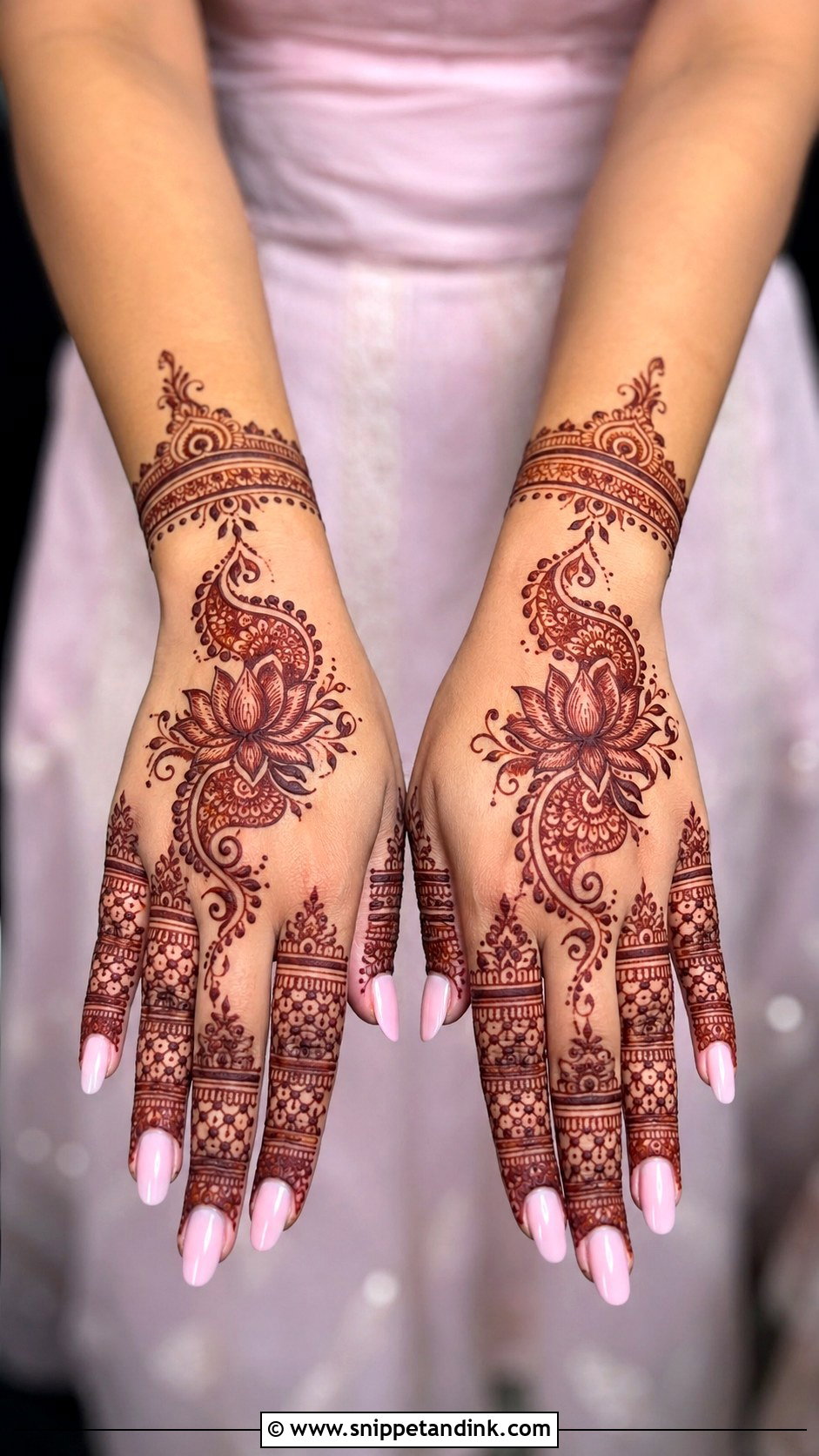
A bridesmaid’s mehndi should look festive in the group photo but never out-detail the bride’s. Medium coverage on the back of the hand, a lotus with vines, paisleys and finger bands, and a small bracelet at the wrist is the balance I aim for. Matching lotus trails across the bridesmaids photograph well together. These also matter for comfort: bridesmaids are carrying things and helping all day, and a lighter design is far less likely to smudge before it’s set.
24. Lotus Mehndi Design For Kids
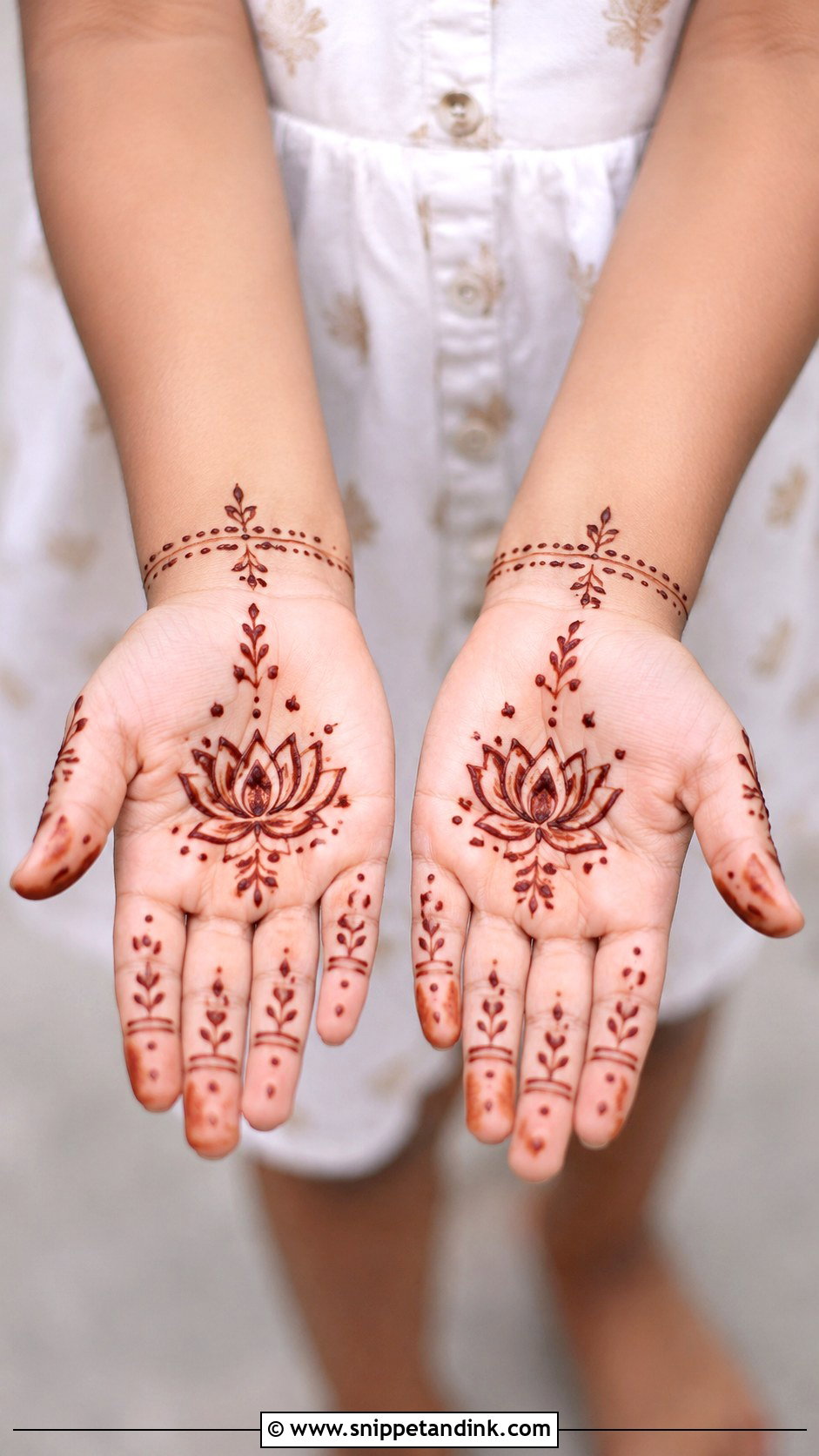
Keep it small and fast: a lotus on the palm or back of the hand with a few dots, leaves and fingertips. Children won’t sit through a long drying time, so I use rounded petals and slightly bolder lines that survive a wriggle. Natural henna only for kids, and I always ask a parent about allergies first. Never let anyone use dark “black henna” cones on a child, as these can contain harsh dyes that burn skin. A tiny wrist bracelet makes it feel finished.


25. Modern Lotus Mehndi Design
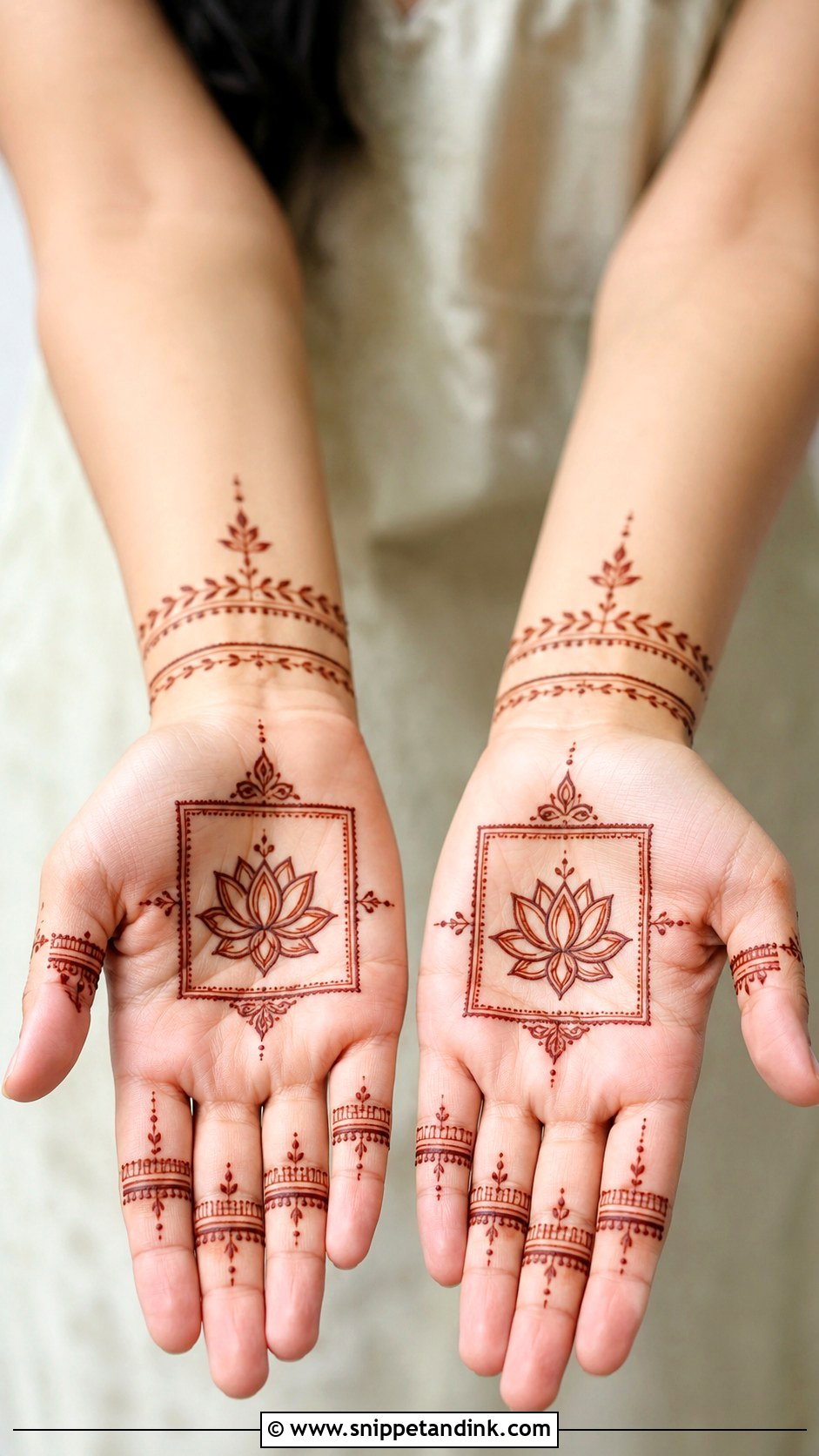
Putting the lotus inside a square, circle or diamond frame gives the traditional flower a sharper, contemporary outline. Fingers get minimal bands, negative-space lines or small leaves. I draw the frame lighter than the flower; a heavy frame overpowers the lotus every time. It goes with contemporary outfits and simple jewelry and appeals to anyone tired of classic full-hand mehndi.
26. Moroccan Lotus Mehndi Design
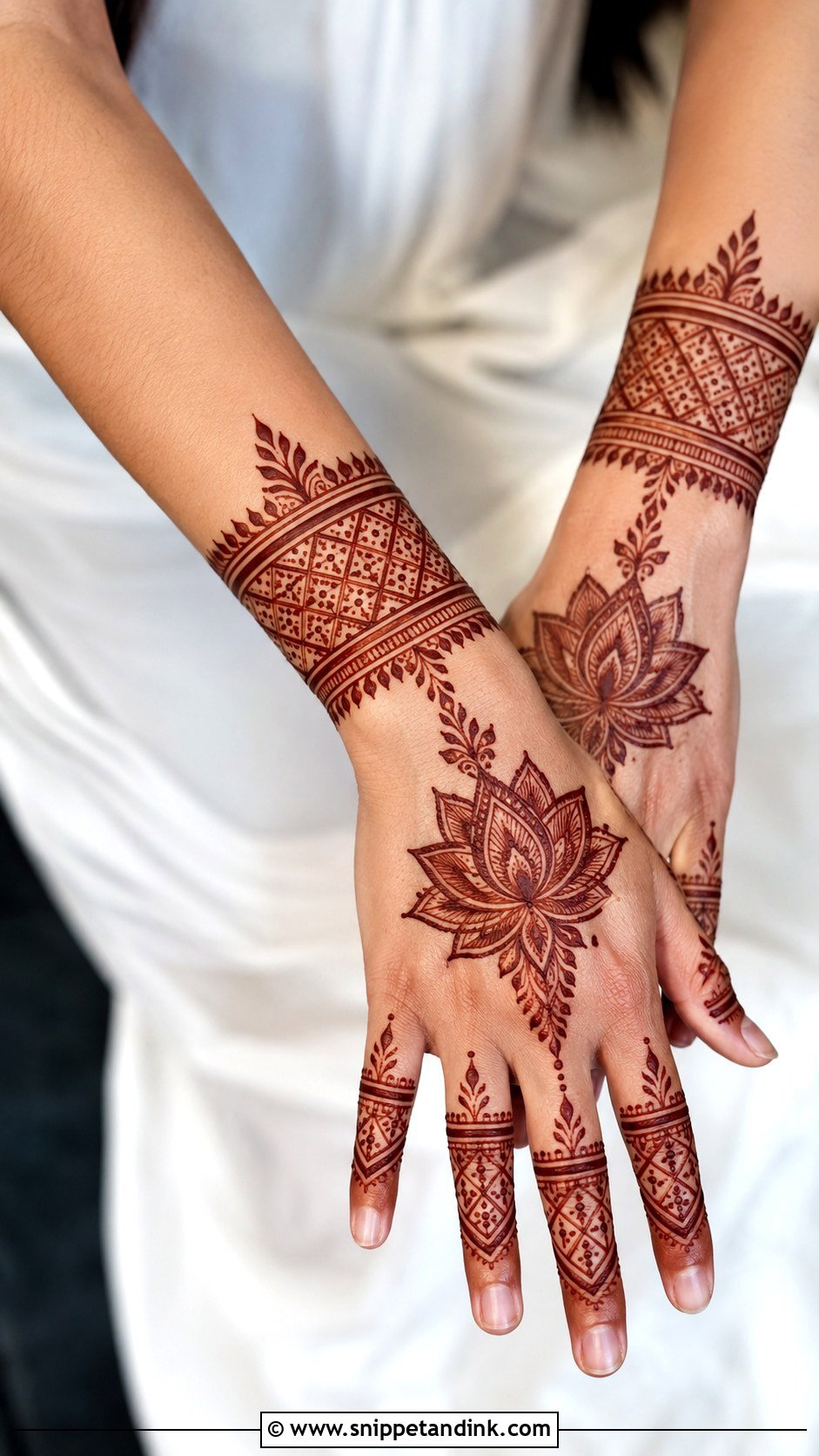
Moroccan styling swaps flowing vines for diamonds, grids, straight bands and angular borders, and the rounded lotus at the center plays against all those hard lines. Straight lines are less forgiving than curves, so I steady my wrist on the table and draw each one in a single pull. Fingers get matching geometric bands. It’s a good pick for someone who loves symmetry and wants a lotus design most guests haven’t seen.
27. Gulf Lotus Mehndi Design
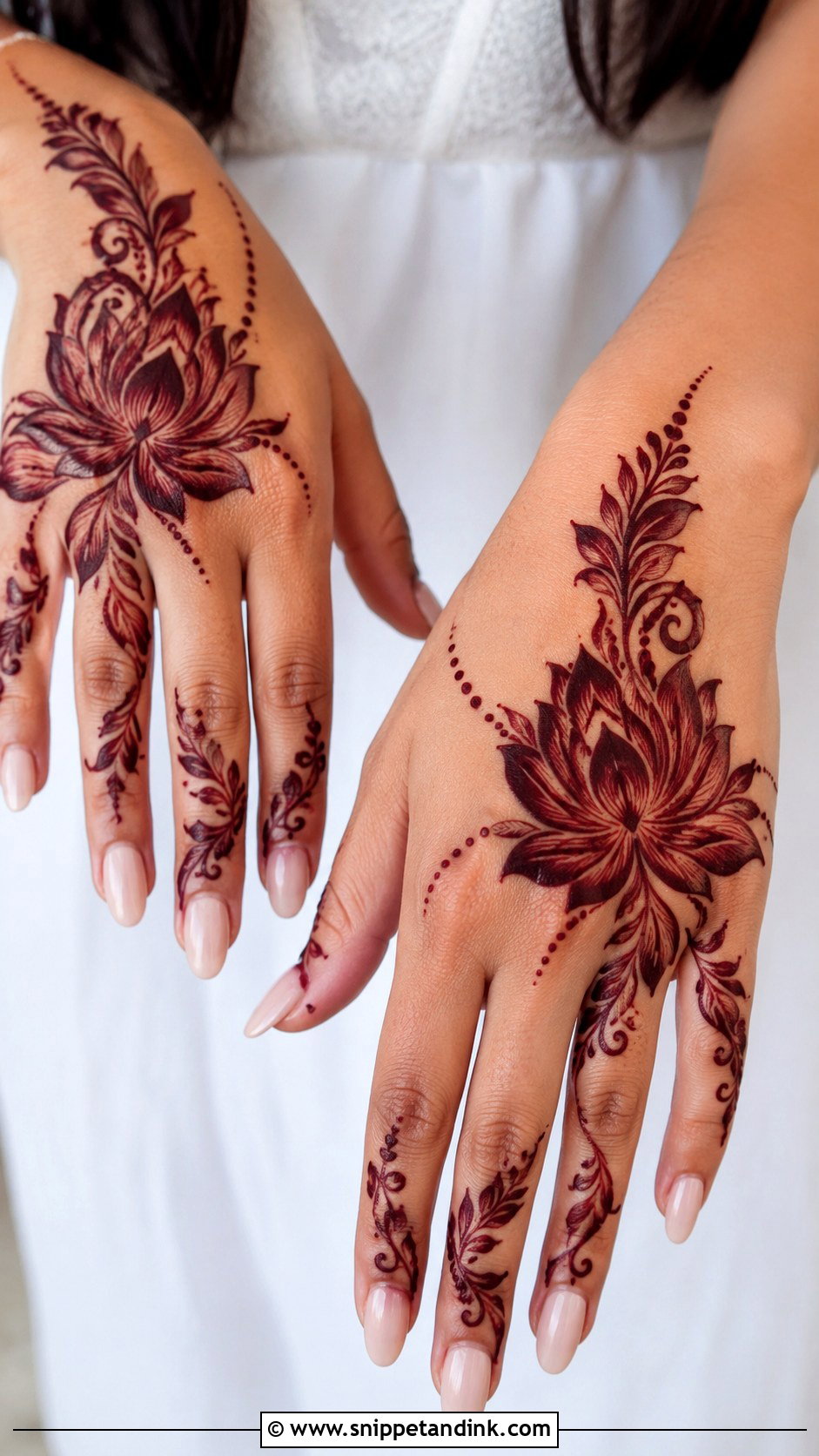
Gulf work relies on thick confident outlines, large petals and flowing leaves along one side of the hand, leaving a lot of open space on purpose. The back of the hand suits it because the trail runs neatly from wrist to fingers. I add shaded leaves and small blossoms but stop well before the empty areas fill up; that restraint is the style. It gives a rich look for Eid, weddings and evening events without the weight of full bridal coverage.
28. Lotus Mehndi Design For Forearm
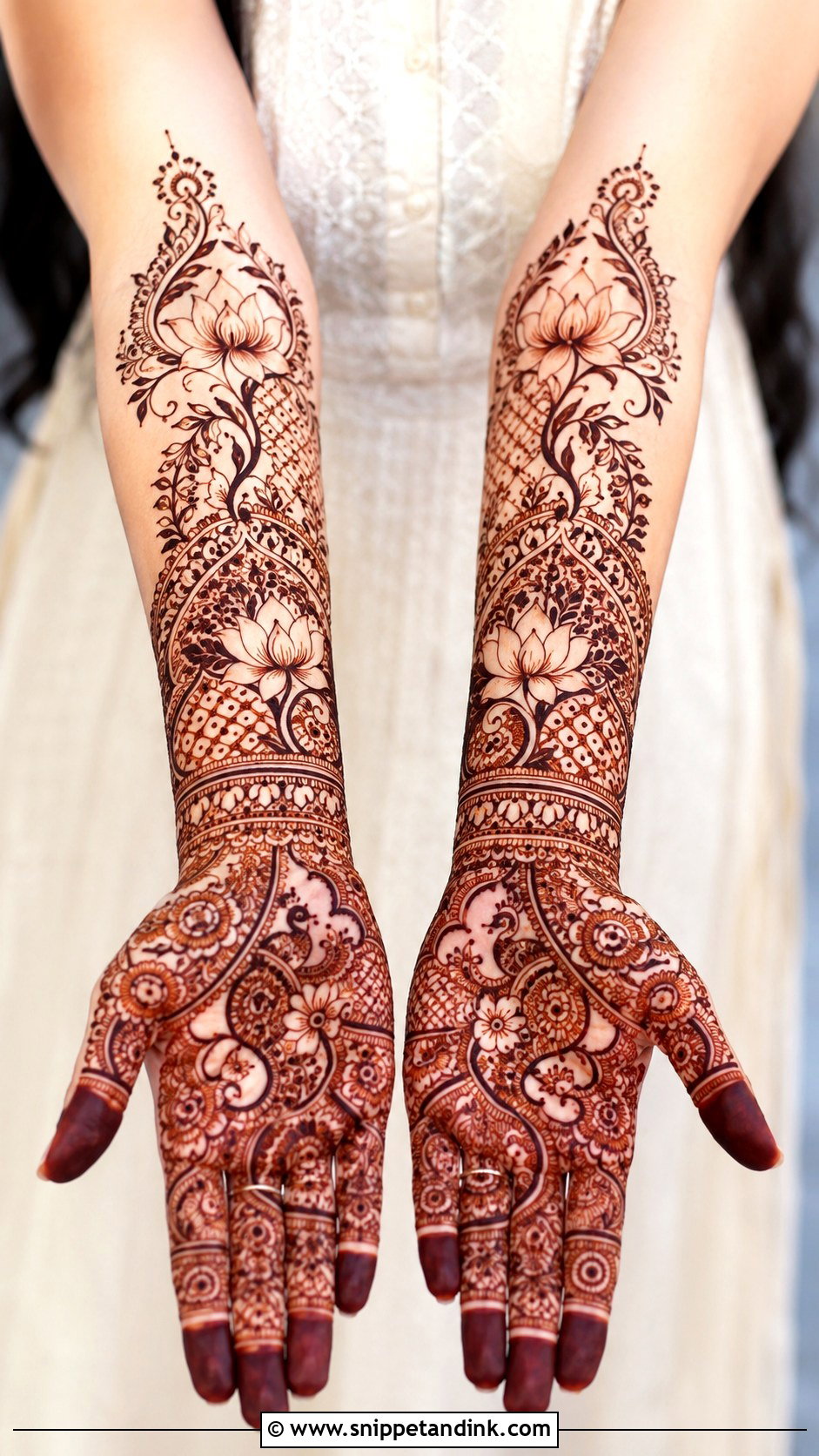
Starting at the wrist or lower forearm, a lotus sends vines, paisleys, jaali panels or floral borders upward, and the hand can stay light or continue into the palm. Forearm skin stains noticeably paler than the hand, so I tell clients to expect a lighter brown up the arm and I make the forearm motifs bolder to compensate. Keep the whole thing flowing in one direction or it looks scattered. It shows well with short sleeves and festive outfits.
29. Lotus Mehndi Design For Feet
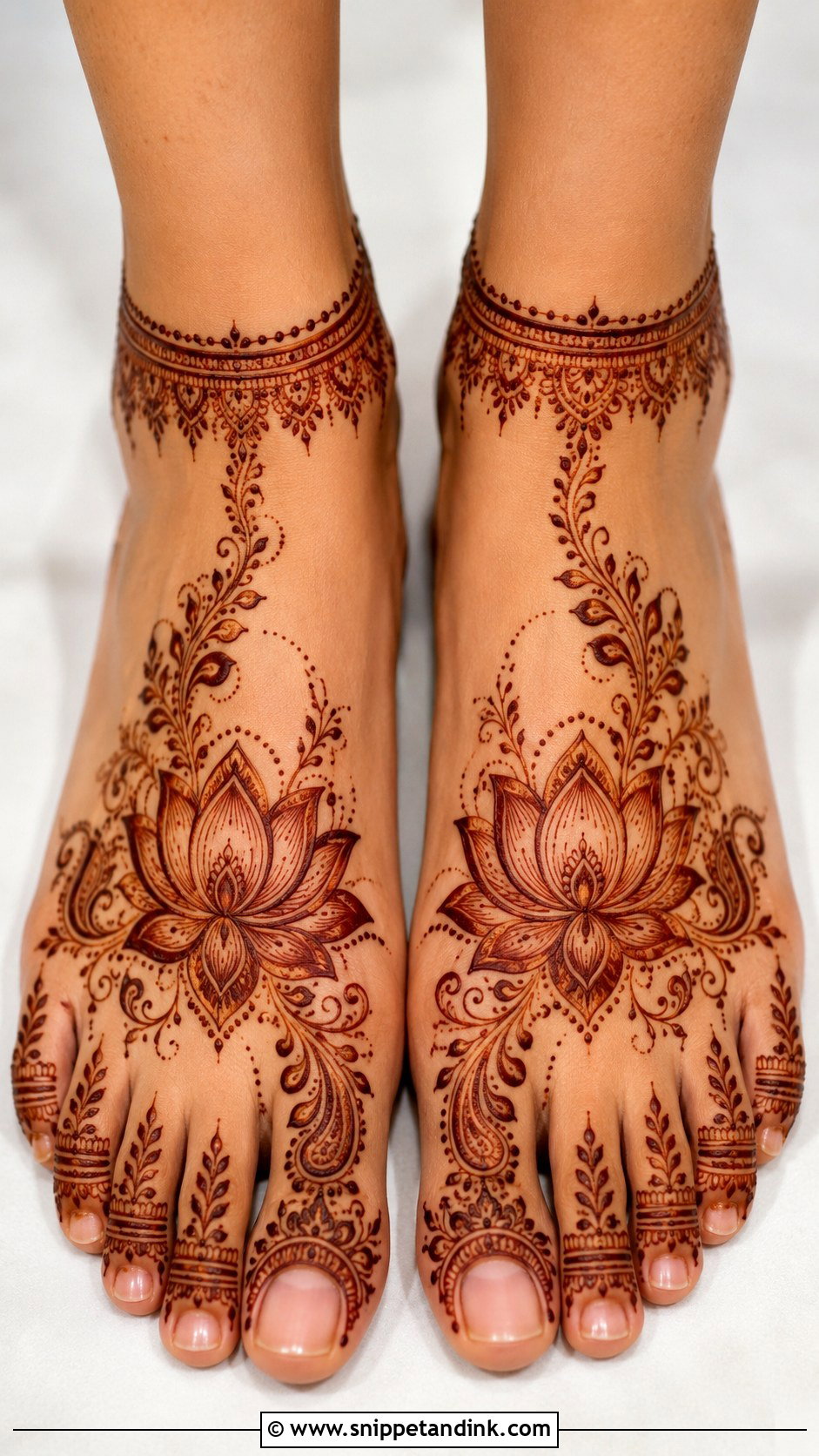
Lotus mehndi design for feet usually puts a large flower on the top of the foot, vines running down to the toes and up toward the ankle, with anklet bands, dot chains and small paisleys. For a bride I carry it higher up the lower leg; for a lighter version, one lotus and a few leaves. Feet stain very dark, but they also need the longest care: I ask clients to stay off them while the paste sets and to sleep with the feet wrapped so it doesn’t rub off on sheets. Matching detail on the toes ties the whole design together.
30. White Lotus Mehndi Design
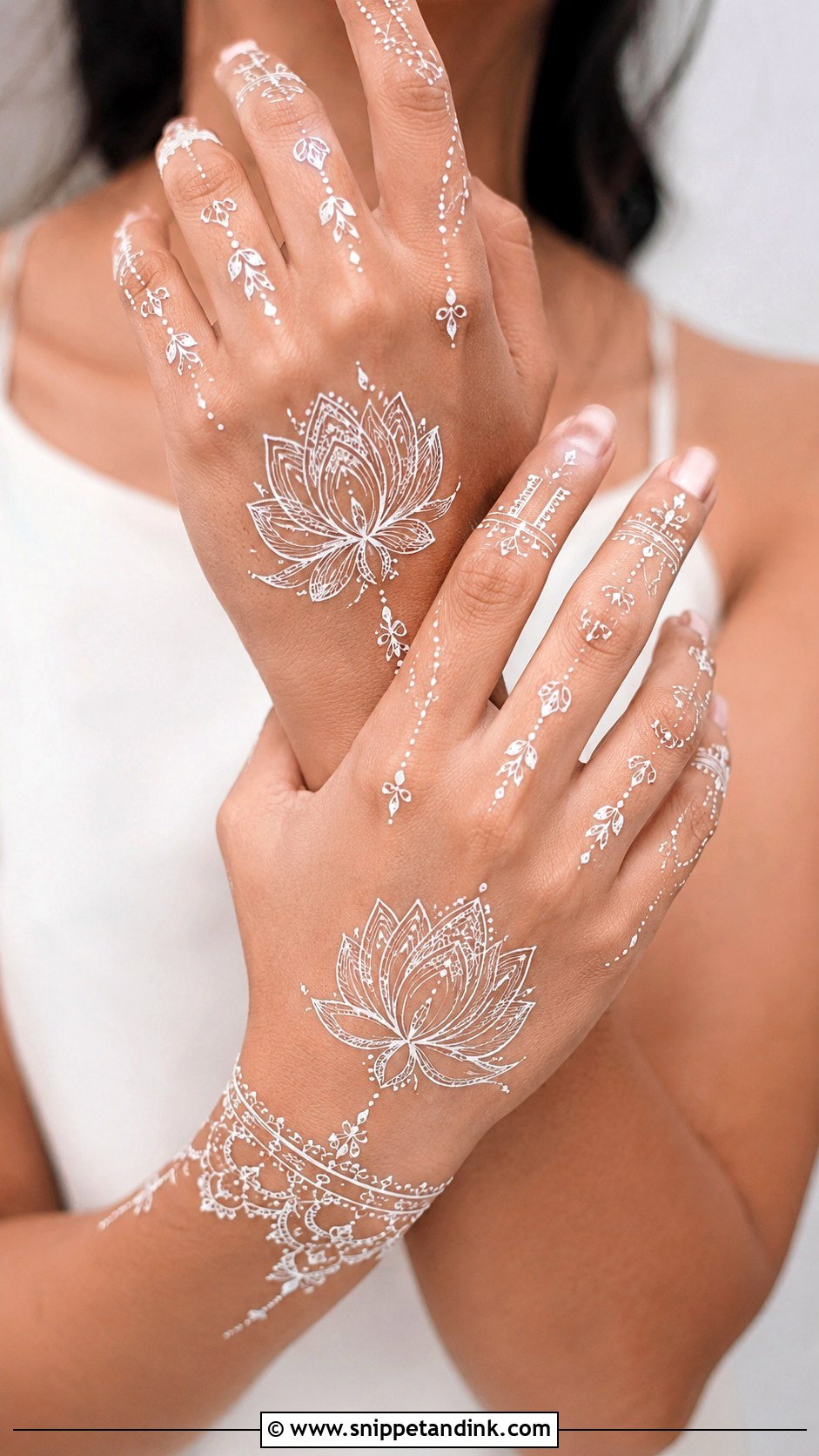
White “mehndi” isn’t henna at all. It’s a cosmetic body paint or skin-safe adhesive that sits on top of the skin, so it doesn’t stain and lasts a day or two at most. A white lotus with lace-like petals, dots and bracelet detail on the back of the hand reads like jewelry, which is why it’s popular for photoshoots and modern parties. I keep it simple, because white lines look busy faster than brown ones. Do a small patch test first, and don’t wear it near the stove or in water.
From Wet Paste to Day-Two Maroon
The best design in the world stains orange if the aftercare is rushed. This is the routine I give every client, bride or guest.
- Leave the paste on as long as you can manage, ideally six hours or overnight for bridal work. Body heat helps, so stay warm.
- Once it’s dry to the touch, a light dab of lemon and sugar keeps the paste stuck to the skin. Don’t soak it.
- Scrape the dried paste off with a blunt edge or your fingernail. Don’t wash it off.
- Keep water away for as long as you can, ideally the rest of the day. A thin layer of balm or coconut oil before showering helps.
- Give it 24 to 48 hours. The stain peaks around the second day, which is why bridal mehndi is usually applied one or two days before the wedding.
When a Lotus Petal Smudges
If wet paste smears, wipe it straight away with a damp cotton bud and let your artist redraw that petal. Once the stain has set, a smudge can’t be lifted, but it can often be folded into a shaded petal or a leaf. That’s one reason I like having shaded leaves around a lotus: they give me room to rescue a mistake without anyone noticing.
Matching Coverage to the Event and Your Sitting Time
Before picking from the list above, be honest about how long you can sit and what your hands need to do afterward. A single palm lotus or wrist cuff takes minutes. An Arabic trail on both hands is under an hour for most artists. Full bridal hands and feet can take most of an afternoon or evening, and you won’t be able to use your hands much until the paste is off. Guests who are cooking, driving or caring for children should lean toward back-hand or wrist designs, which leave the palms free for longer.
If you have sensitive skin or any history of reactions, ask for a patch test with the artist’s paste a couple of days ahead. Natural henna is a green-to-brown paste with an earthy smell; anything sold as instant, jet black or quick-staining should be avoided.
One Flower, Many Hands
The lotus earns its place because it scales: a single bud on a fingertip, a ring around a mandala, or the centerpiece of a full bridal arm, across palms, wrists, forearms and feet. What changes from one design to the next is the filler, jaali, paisley, vines, leaves or dots, and the regional style you draw it in, Indian, Arabic, Indo-Arabic, Moroccan or Gulf. Pick the coverage your event and your patience allow, show your artist the one or two designs above that you keep returning to, and give the stain its full two days to deepen.
You'll Like These Ideas:





Leave a Reply