
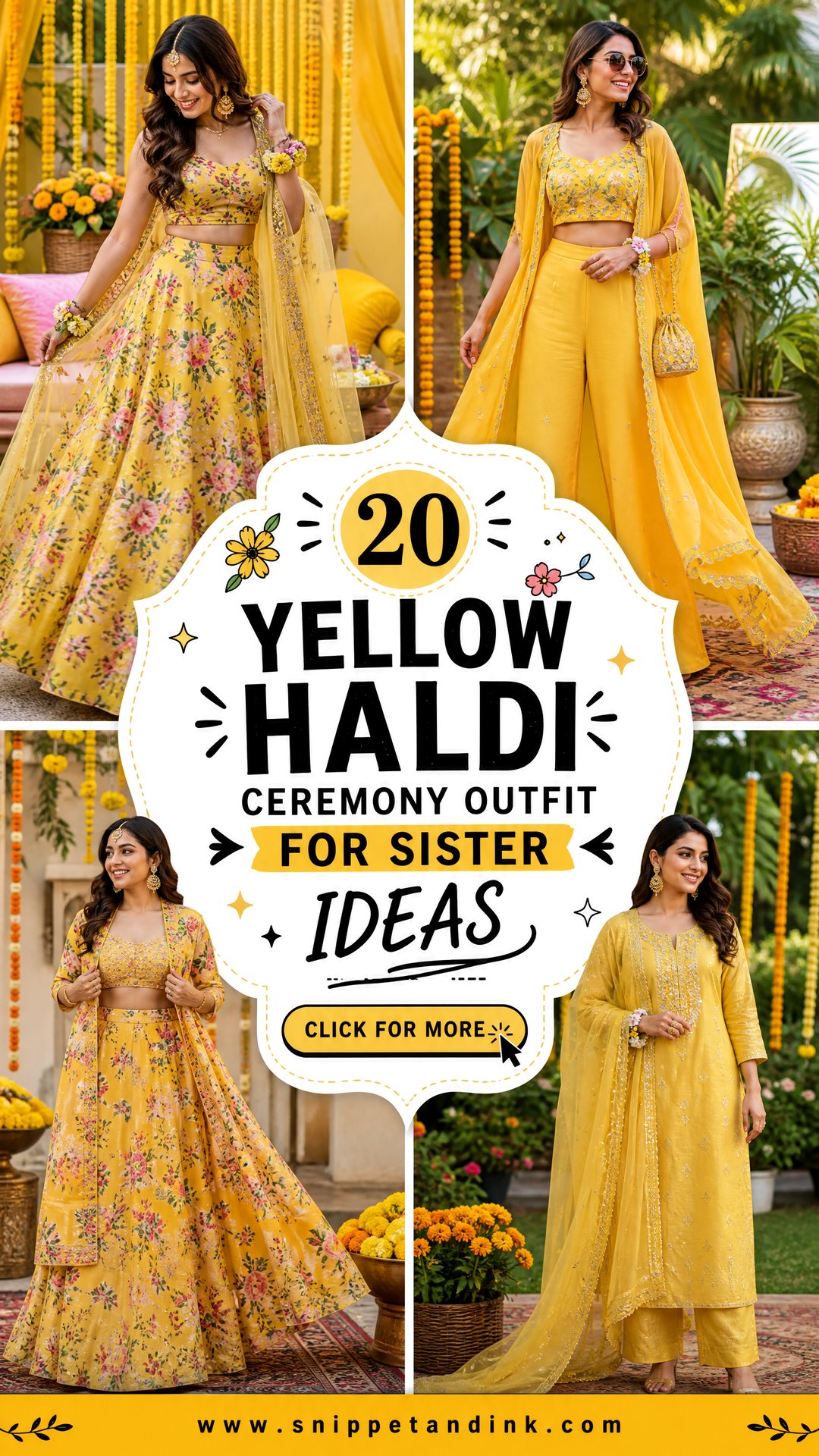
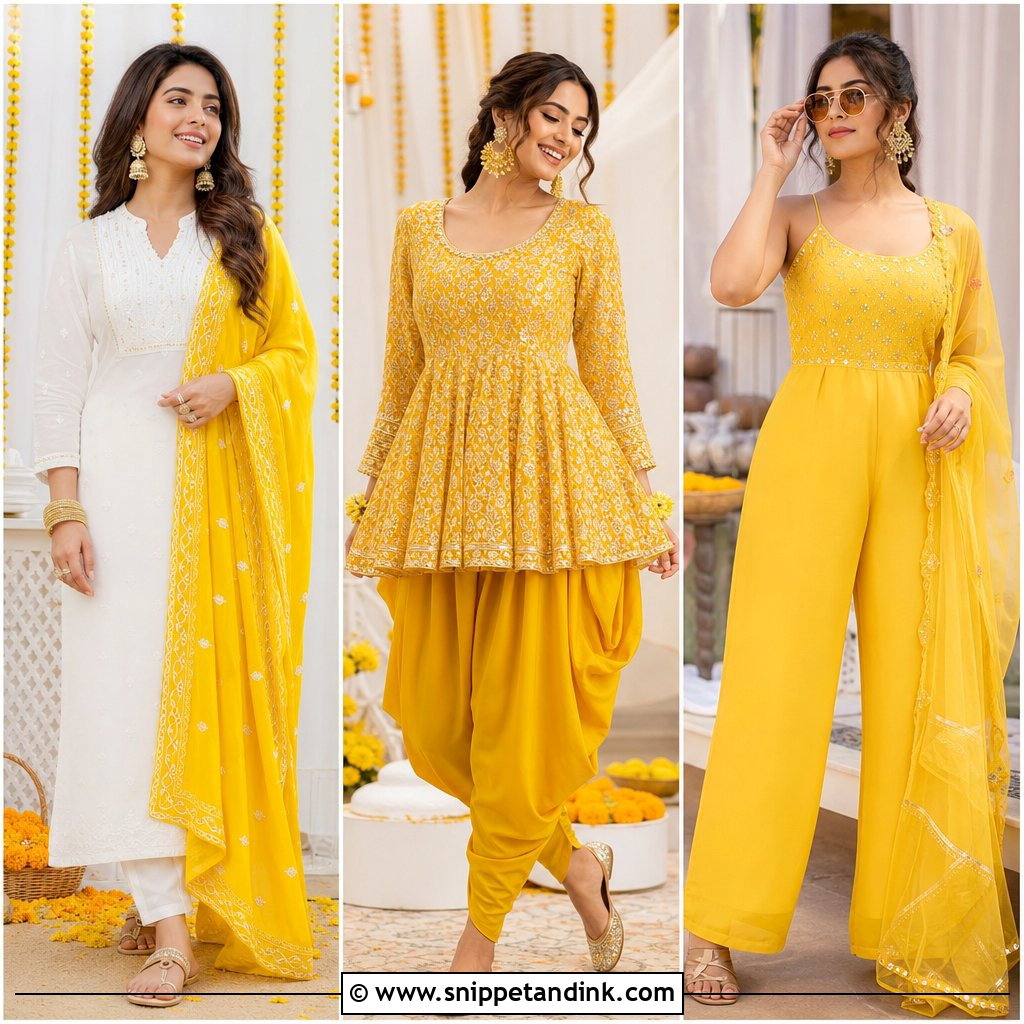
A haldi is bright, loud and gloriously messy, and the bride’s sister is in the middle of all of it: applying paste, fetching things, dancing, posing. Her outfit has to look festive and still let her work. Yellow suits the turmeric theme and looks warm in daytime photos, and when I style a sister for this function I look for lightweight fabric, a silhouette she can kneel and dance in, flat shoes and jewelry that won’t snag. The twenty looks below run from traditional shararas and sarees to jumpsuits and cape sets, each styled head to toe with jewelry, shoes and hair.
Paste Bowls, Errands and the First Dance Circle
The bride’s sister usually isn’t a guest at the haldi; she’s crew. She helps set out the paste, often applies it early in the ritual, carries trays, keeps track of the bride’s phone, and starts the dancing once the ceremony is done. Every outfit decision follows from that.
- Sleeves you can push above the elbow, or none at all. Paste climbs up wrists fast.
- A dupatta that’s pinned, or skipped. A loose one slides straight into the bowl.
- Flat, closed-back shoes, since you’ll be stepping on wet floors and petals.
- A neckline that stays put when you lean over a seated bride.
- Pockets, if your tailor can set them into a kurta or skirt seam. They’re worth asking for.
If you’re also dressing for the mehndi or sangeet the same day, plan the haldi outfit as the one that gets ruined and leave enough time to wash the turmeric off your arms and face before you change. Haldi stains skin for a day or two, so a gentle scrub and a little moisturiser right afterward makes the evening makeup sit far better.
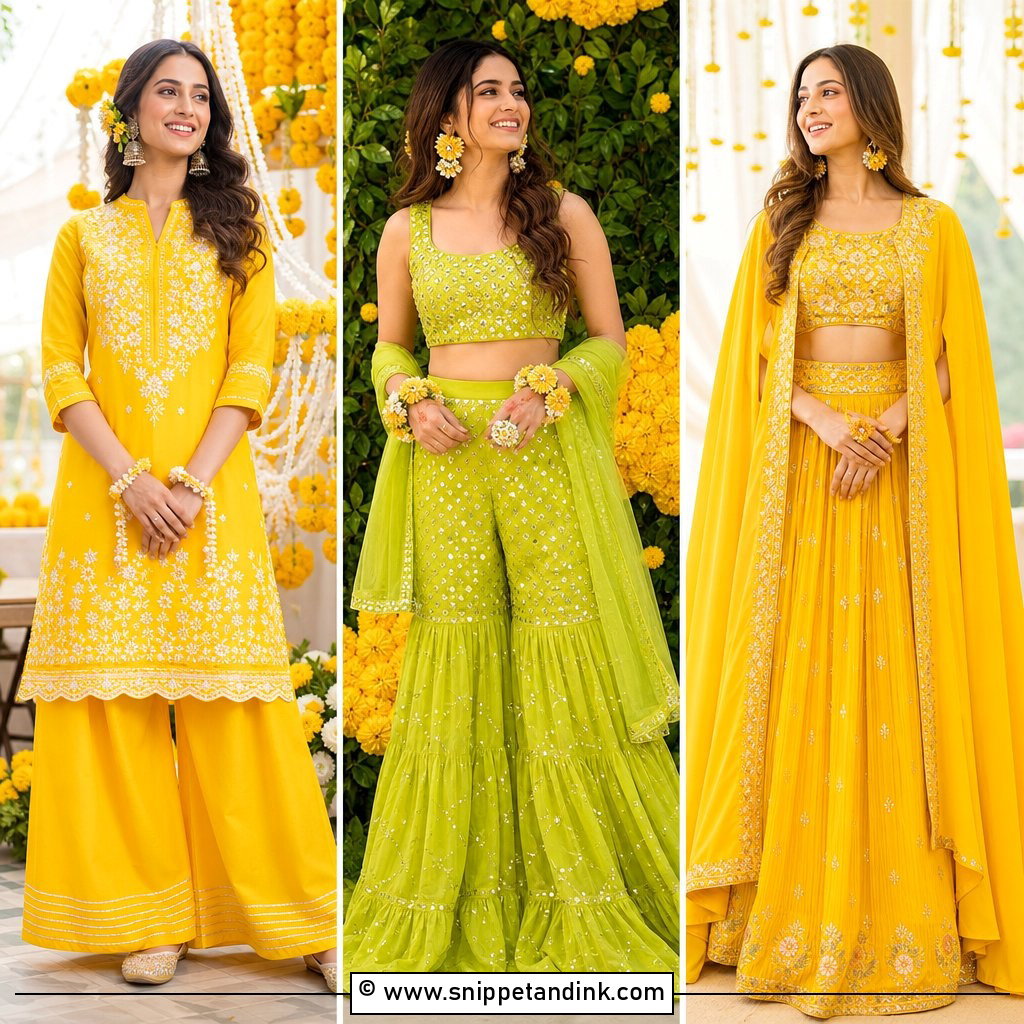
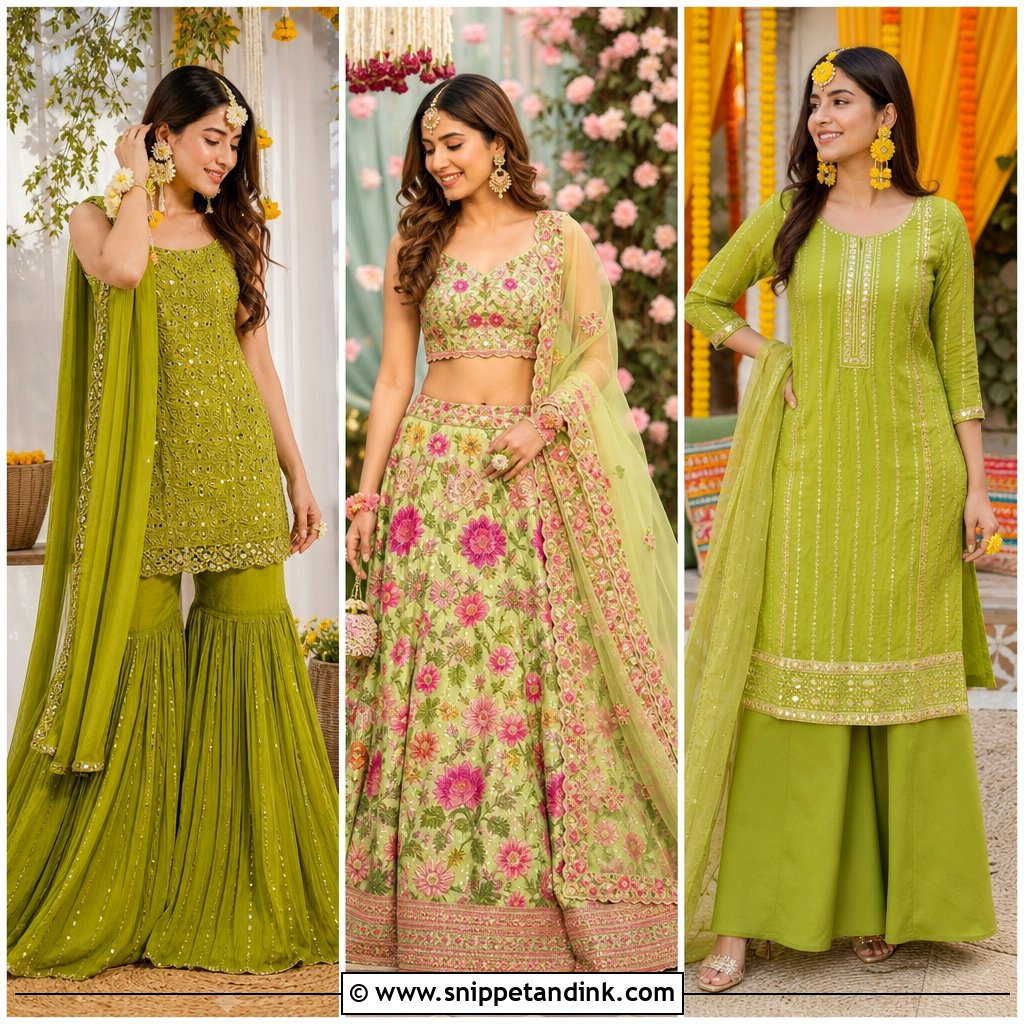
1. Yellow Sharara Set for Sister
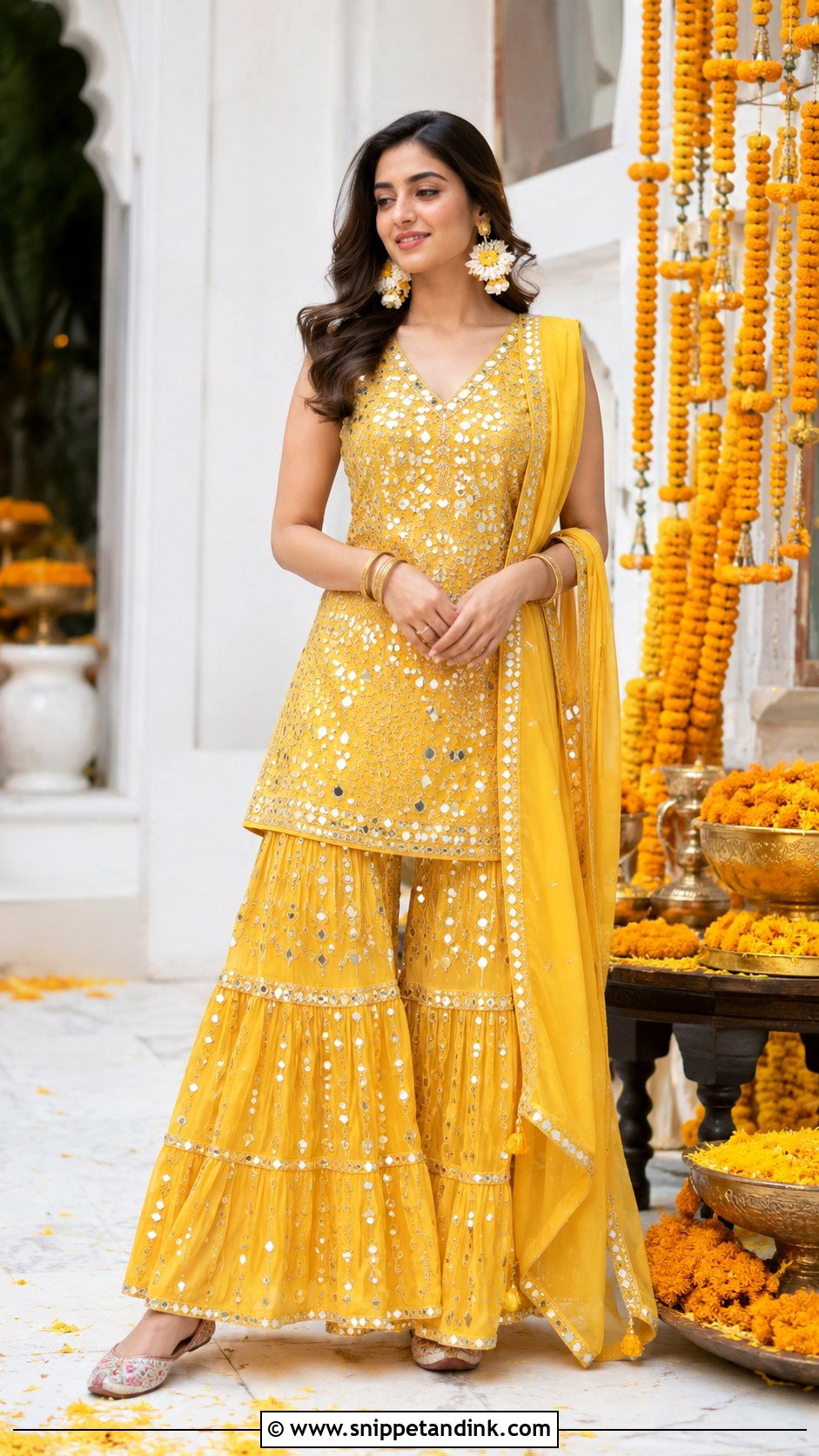
A sharara gives you volume to dance in and nothing to trip over. Choose a short embroidered kurta with wide, tiered sharara pants in lightweight cotton silk or georgette; mirror work, gota or delicate florals add sparkle without formality. Floral earrings, slim bangles and comfortable gold juttis. Drape a chiffon dupatta over one shoulder and pin it, which leaves both hands free for the paste bowl. The fitted kurta defines the upper body and the flare balances it below. A braided ponytail or soft bun and fresh makeup keep it daytime. Ask for a hook as well as the drawstring at the waistband, because tiered georgette drags a waistband down once you start dancing.
2. Yellow Anarkali Suit for Sister
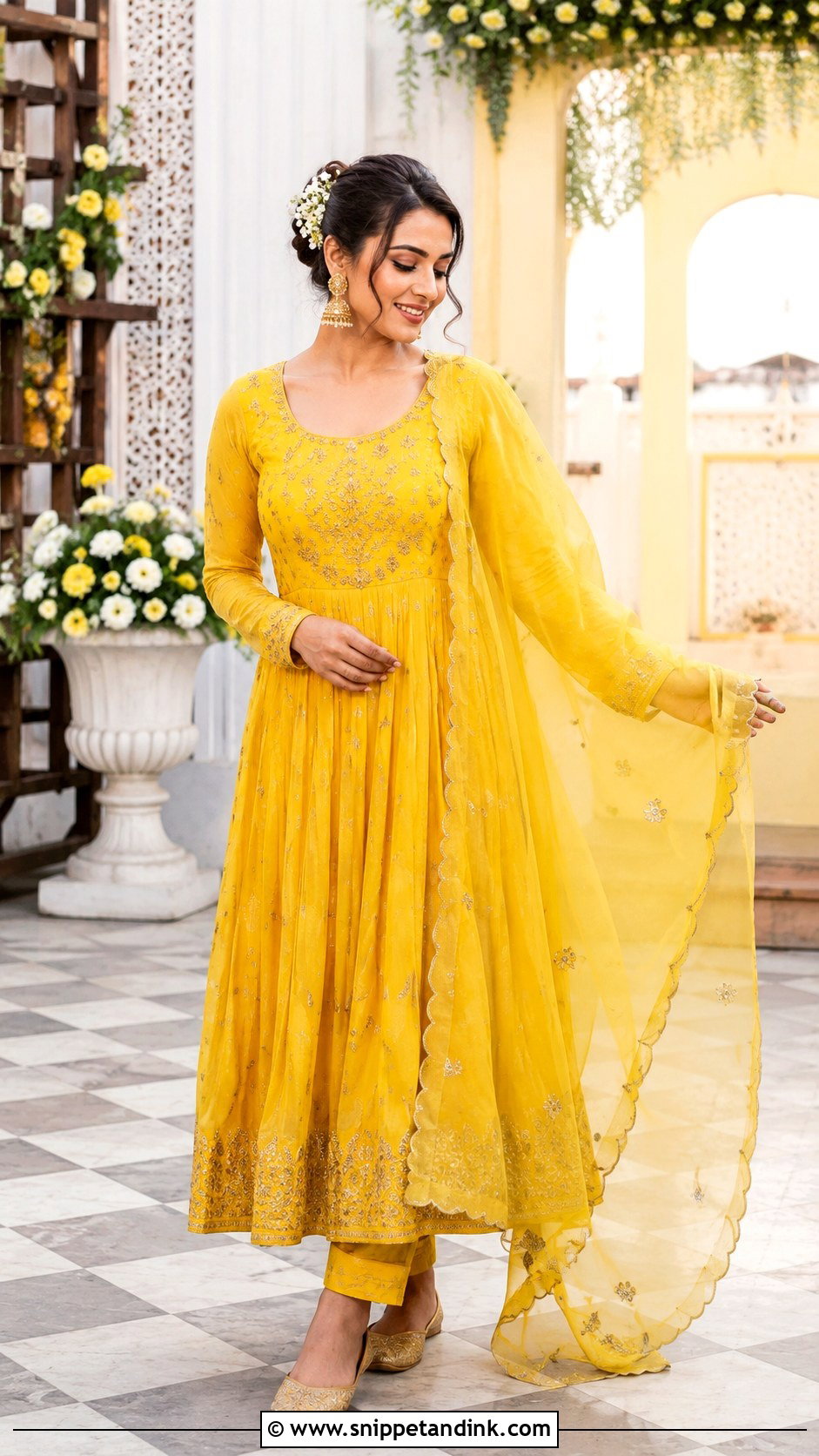
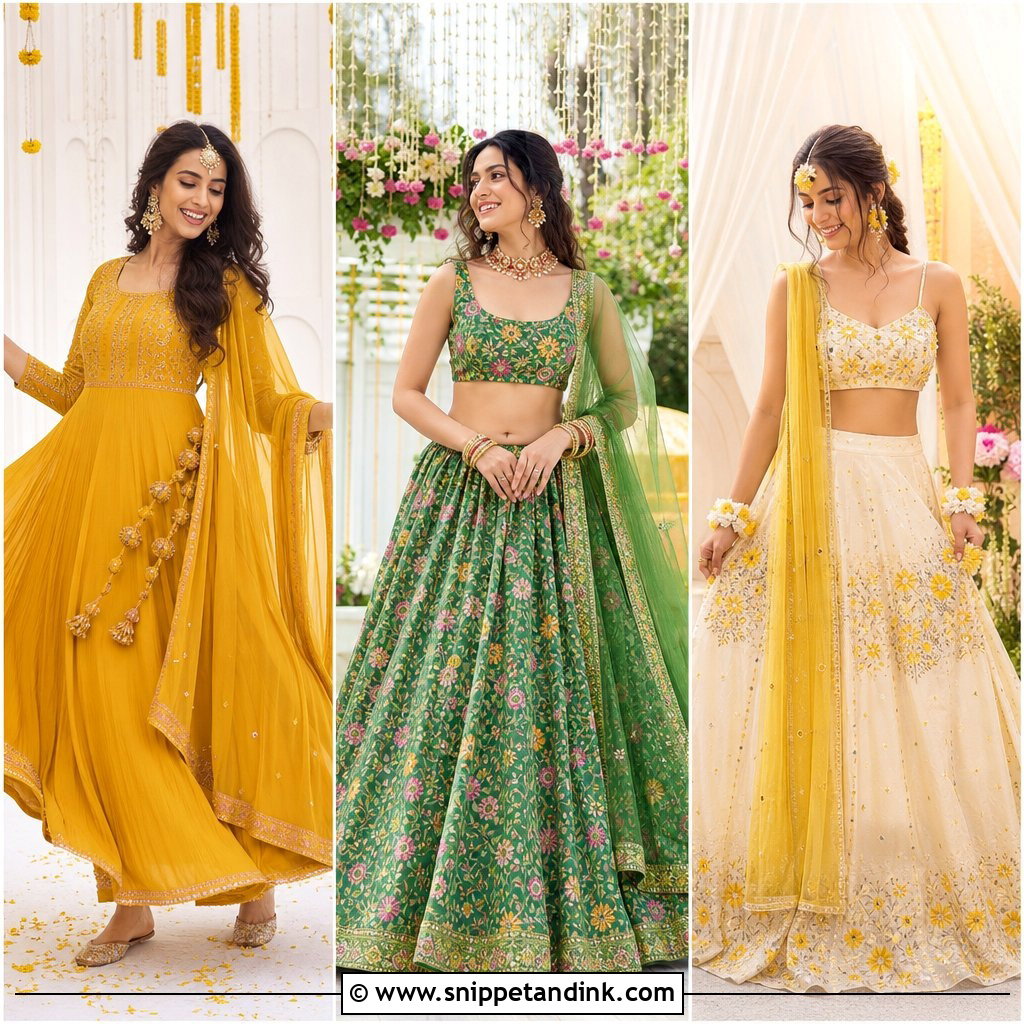
Anarkalis flow well, but for a sister on her feet all day I’d keep the flare moderate and the length at calf or ankle so you can sit on the floor without a fight. A fitted bodice, subtle mirror work at the neckline and a lightweight organza dupatta that adds a little structure. Cropped leggings or narrow pants, embroidered juttis and medium jhumkas. A sleek low bun with small yellow flowers stays tidy through the rituals. Skip extra layers, especially outdoors, since every layer is one more thing to catch splashes and hold heat.
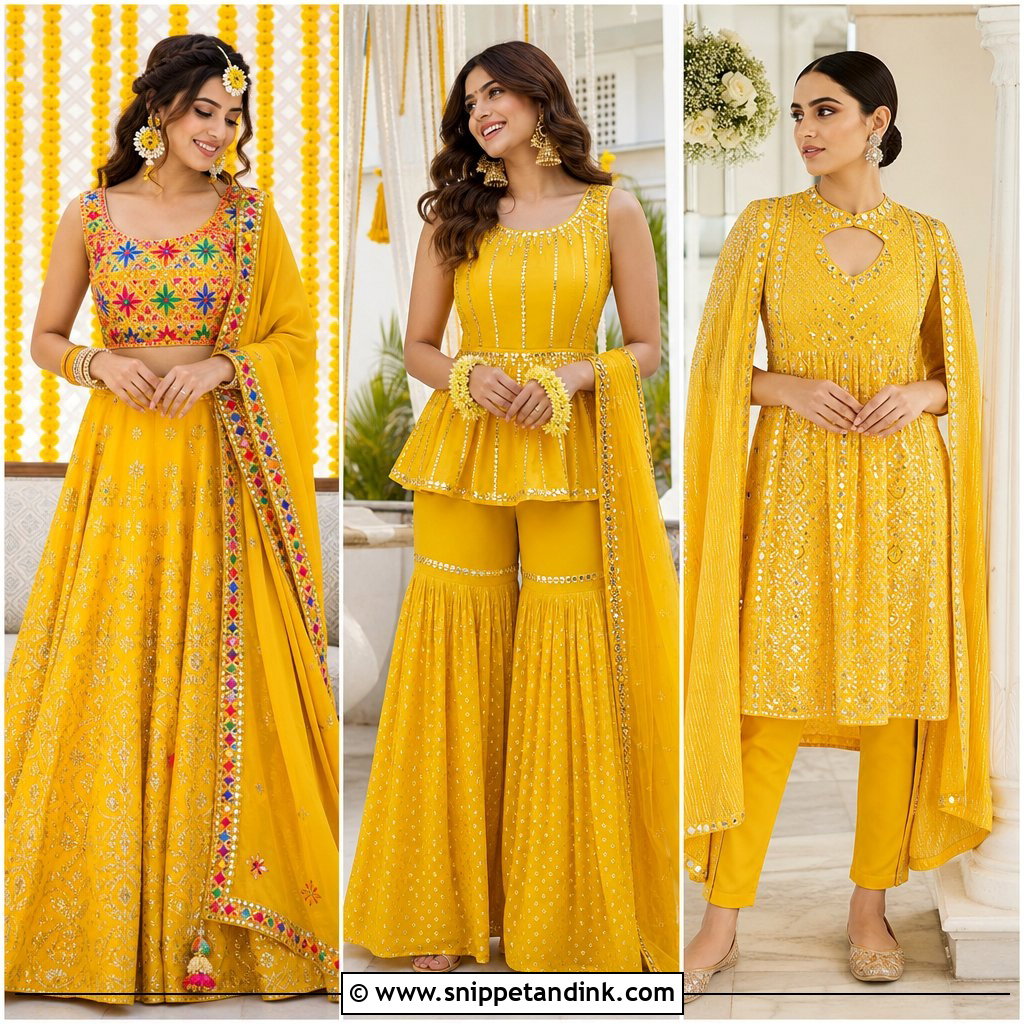
3. Yellow Lehenga Choli for Sister
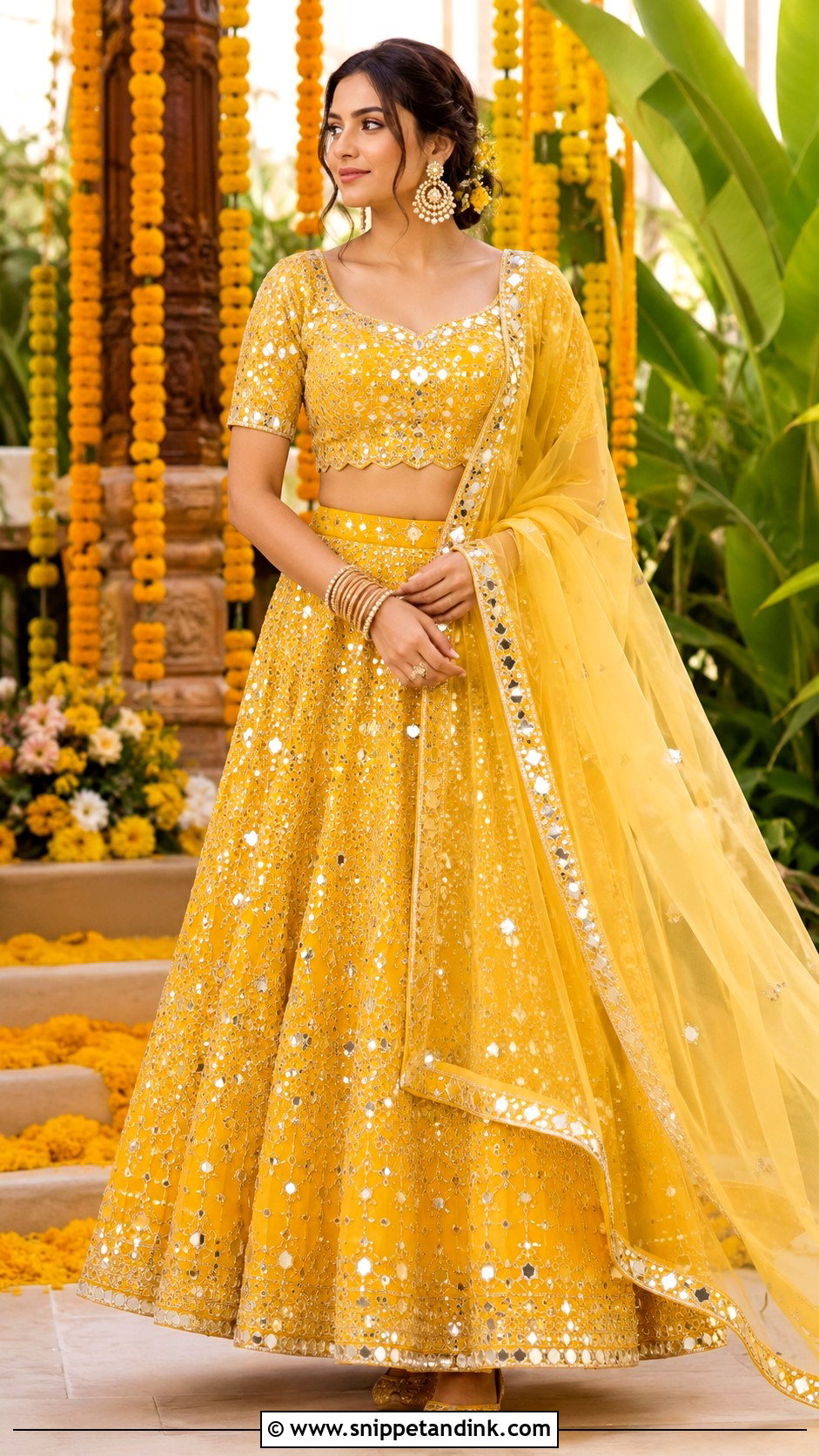
For a more formal haldi, a lightweight yellow lehenga choli marks you out as family. Choose a flared skirt with floral prints, small mirrors or a simple gota border, not dense bridal embroidery; heavy work is the bride’s territory. A fitted blouse with sleeves and a neckline you can move in. Wear a soft net or organza dupatta diagonally and pin it at the shoulder and the waist. Gold-toned chandbalis, stacked bangles and cushioned juttis, with a half-up braid or low ponytail. A stiff can-can under the skirt makes kneeling beside the bride awkward, so I’d ask for a soft lining only.
4. Yellow Saree With Floral Blouse
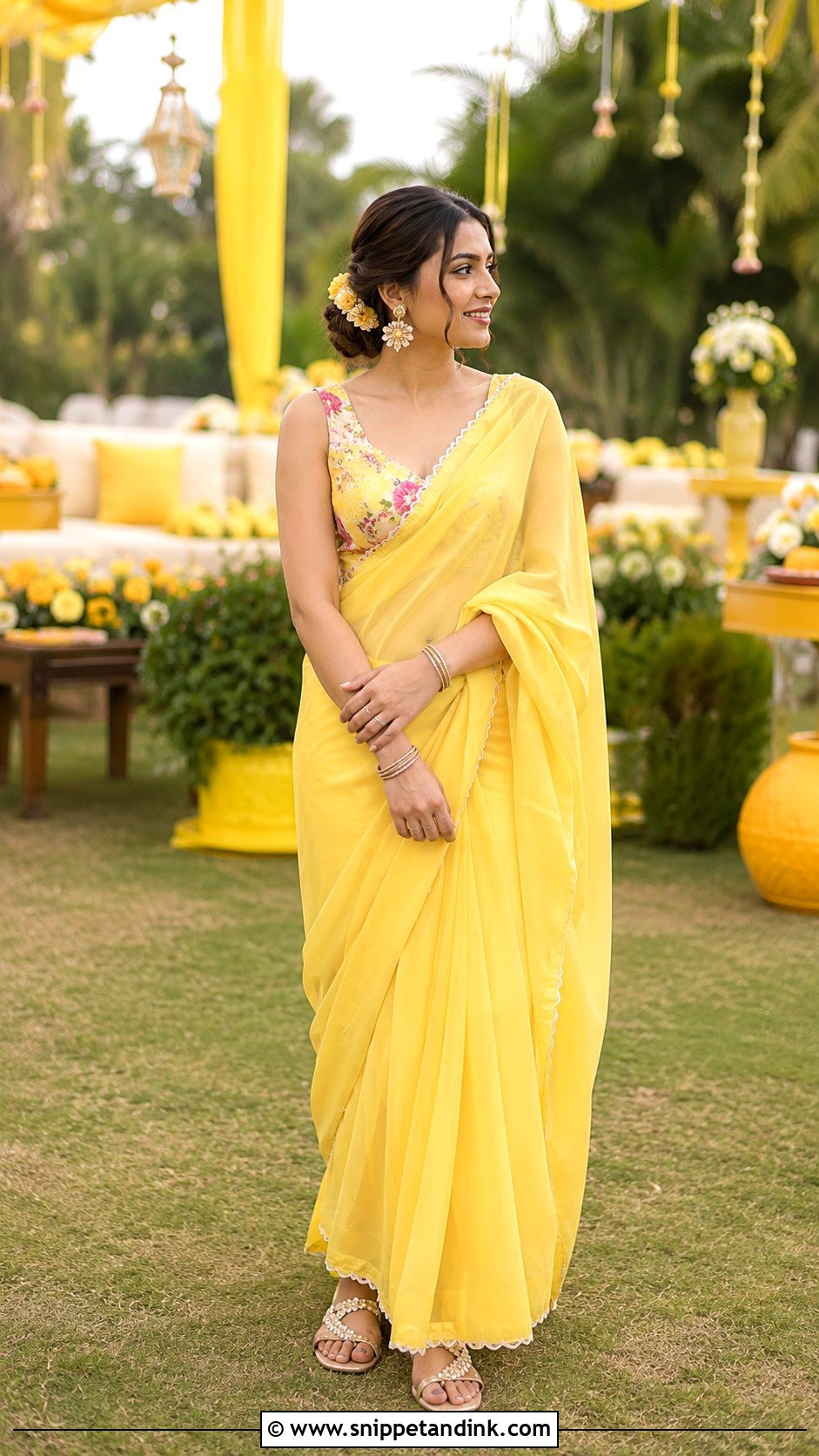
Sarees feel traditional, and with a floral blouse this one reads cheerful rather than heavy. Pick chiffon, georgette, cotton silk or linen so the drape stays comfortable through a long, busy ceremony. A blouse printed with pink, green or orange flowers adds contrast and ties into the décor. Pin the pleats and the pallu well; you won’t have time to keep re-adjusting. Floral studs, delicate bangles, flat sandals or embellished juttis, and a neat braid or low bun. Border width is the proportion trick: petite sisters look better in a narrow border, while taller ones carry a wide printed edge.
5. Yellow Palazzo Suit for Sister
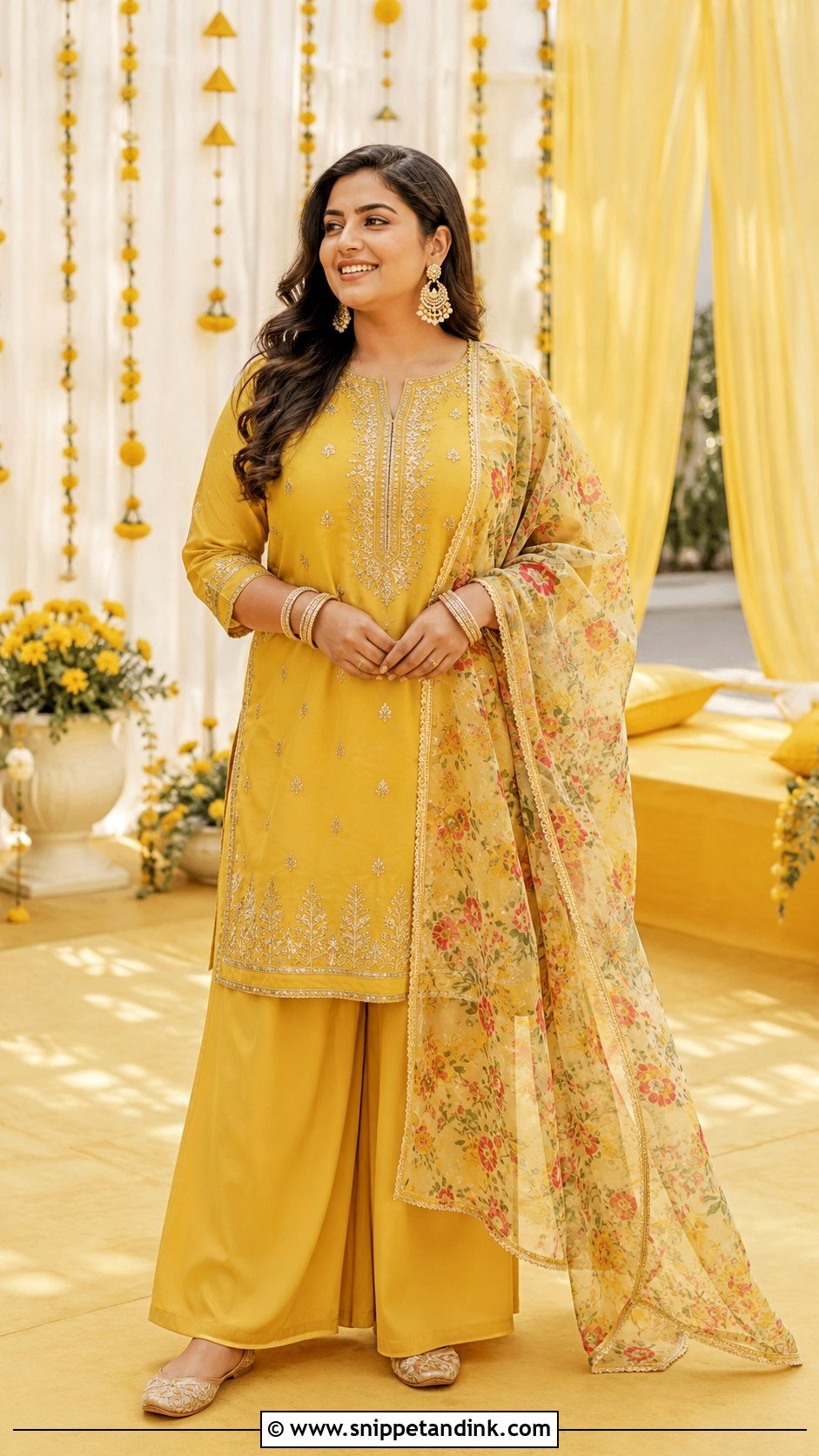
Comfort-first sisters, this one’s yours. A yellow palazzo suit pairs a straight or slightly flared kurta with wide-leg palazzos in breathable cotton, crepe or cotton silk. Thread embroidery, tiny mirrors or scalloped borders add interest and keep it light, and a printed dupatta in pink, green or ivory gives contrast. Statement earrings, a few metallic bangles and flat juttis you can stand in for hours. The long vertical lines lengthen the figure. Wide palazzos sweep the floor at a haldi, quite literally, so hem them a touch shorter than you would for a dinner.
6. Yellow Chikankari Kurta Set for Sister
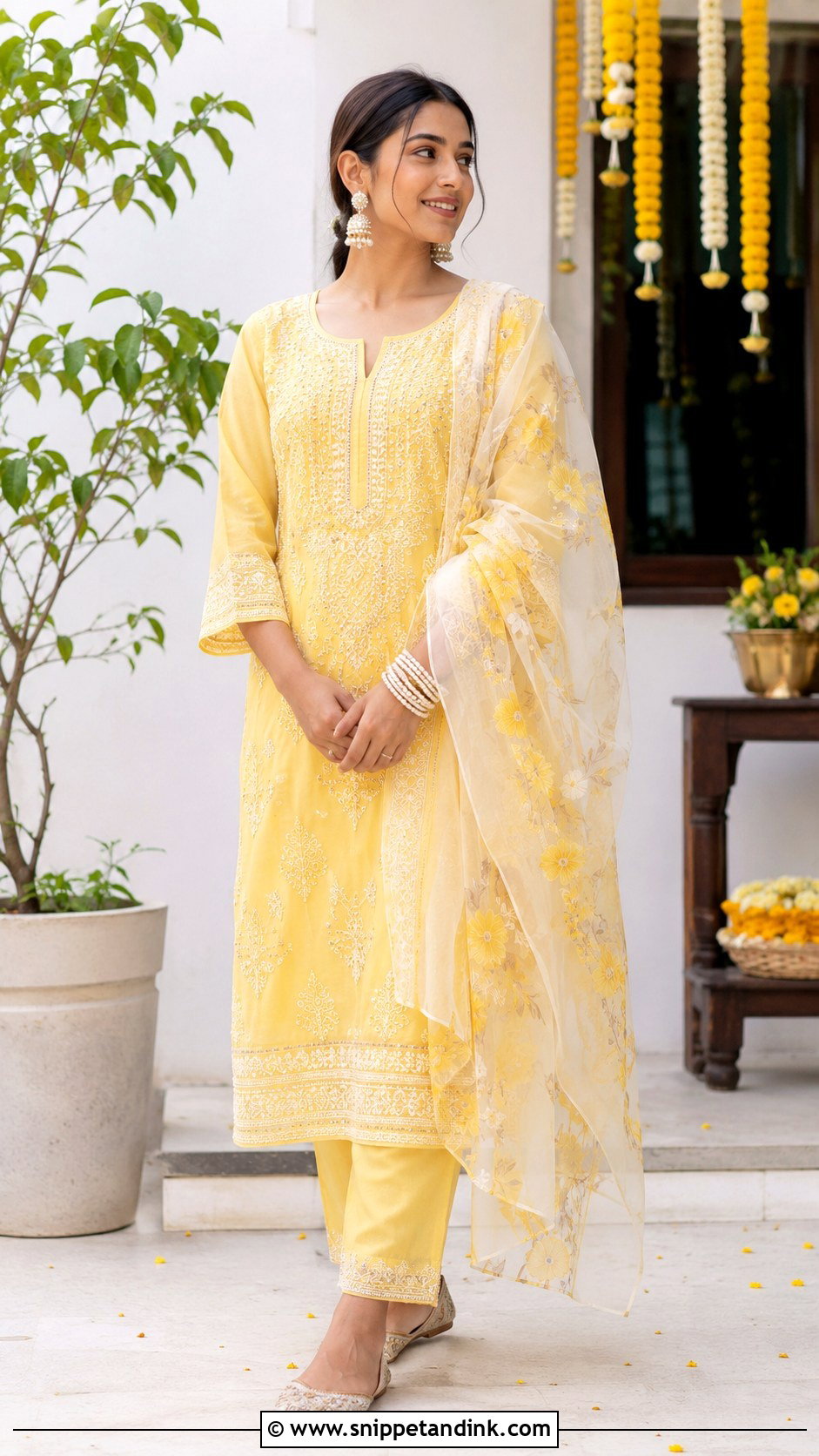
Chikankari is subtle, which suits a daytime haldi and a sister who doesn’t want to compete. Choose a breathable cotton or georgette kurta with tone-on-tone embroidery, straight pants or palazzos, and a white, yellow or floral organza dupatta. Pearl jhumkas, ivory bangles and neutral embroidered juttis, with fresh makeup, a rosy lip and a low ponytail. No heavy necklace; the embroidery is the detail. The base fabric is often sheer, so wear a matching slip or ask for a lined kurta. It adapts easily for sisters of different ages, and cotton chikankari can be hand-washed after the paste, which most festive wear can’t.
7. Yellow Dhoti Pants and Peplum Top
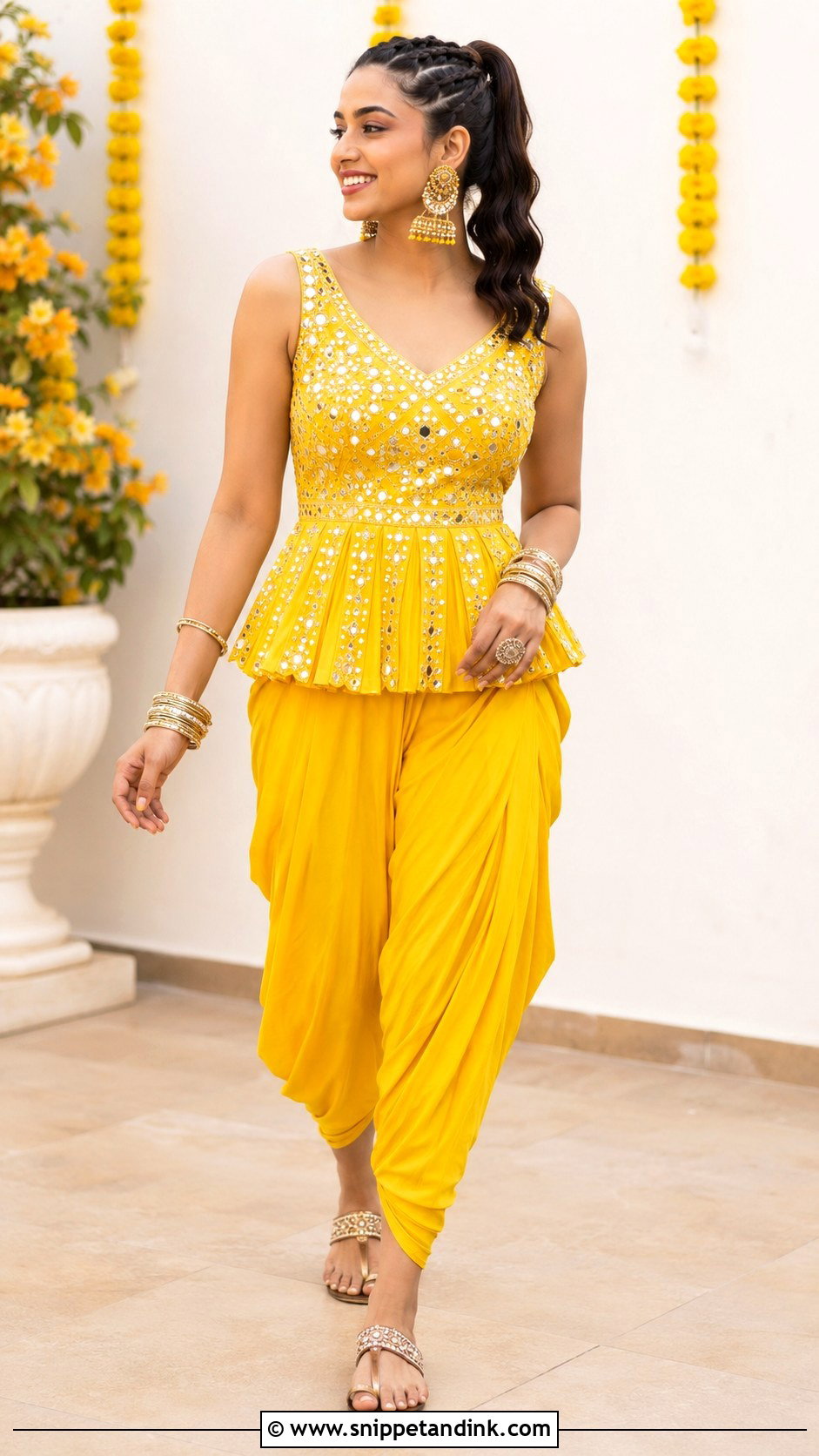
Peplum plus dhoti pants is a playful Indo-Western pairing for a lively haldi. A fitted or lightly structured peplum with mirror work, tassels or floral embroidery sits over pre-stitched dhoti pants with room at the hips and knees. The silhouette already has volume, so skip the dupatta or use a short, pinned one. Bold jhumkas, stacked bangles and flat kolhapuris, plus a high ponytail or braided bun to keep the neckline clear. I make sure the peplum ends above the widest part of the hip; if it lands right on it, it adds width instead of defining the waist.
8. Yellow Crop Top and Palazzo Set
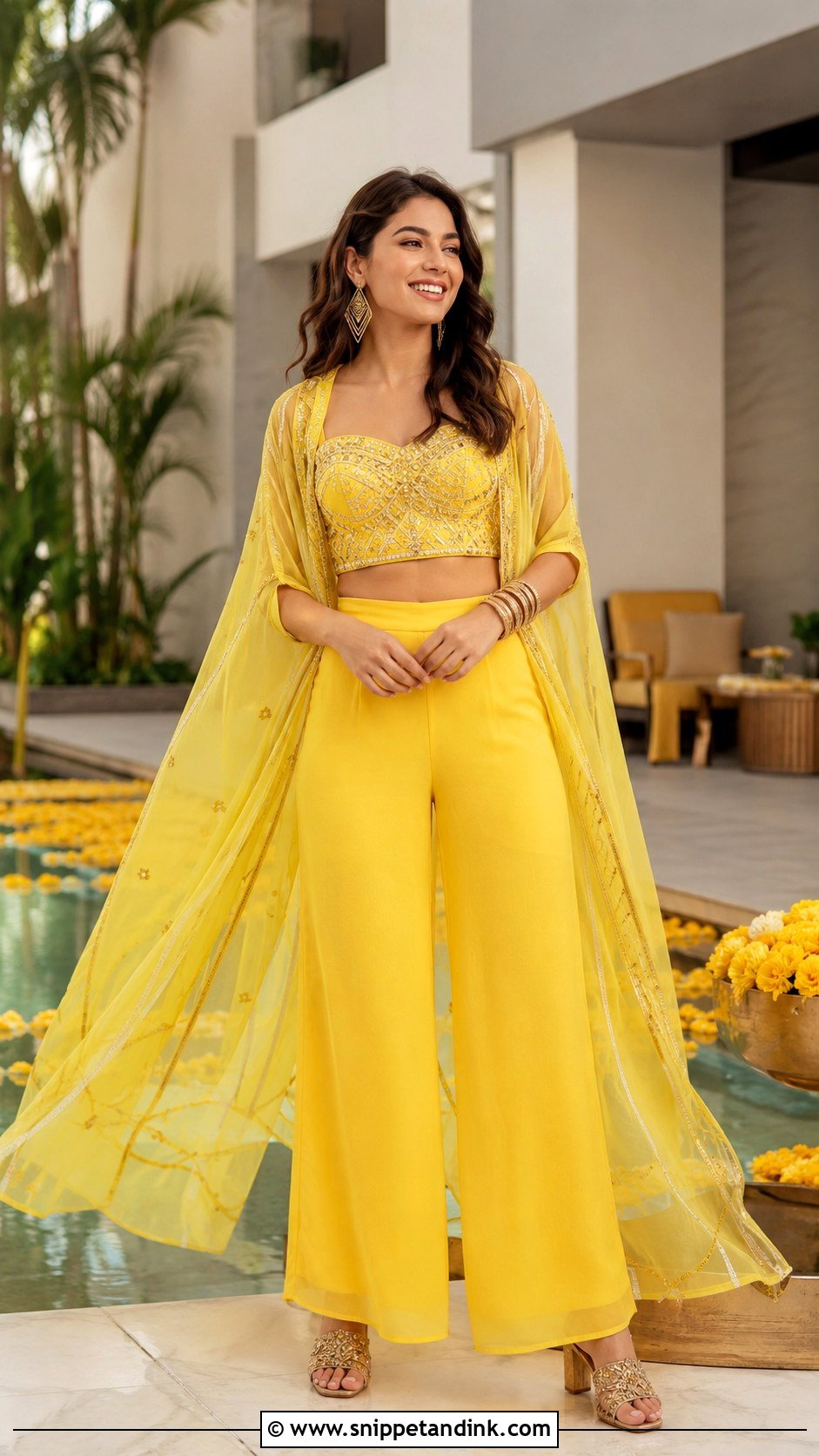
A yellow crop top and palazzo set suits a sister who likes clean, modern lines. A structured crop top with comfortable straps or sleeves and high-waisted palazzos keep coverage balanced, and a long jacket or light cape adds a layer and movement. Subtle mirrors, threadwork or small sequins instead of heavy embellishment. Geometric earrings and metallic bangles, with block heels only if the floor is even and flat juttis on a lawn. A sleek ponytail and luminous daytime makeup. Raise your arms in it before buying, because a crop that lifts to show more midriff than you planned is a common surprise.
9. Yellow Floral Printed Lehenga for Sister
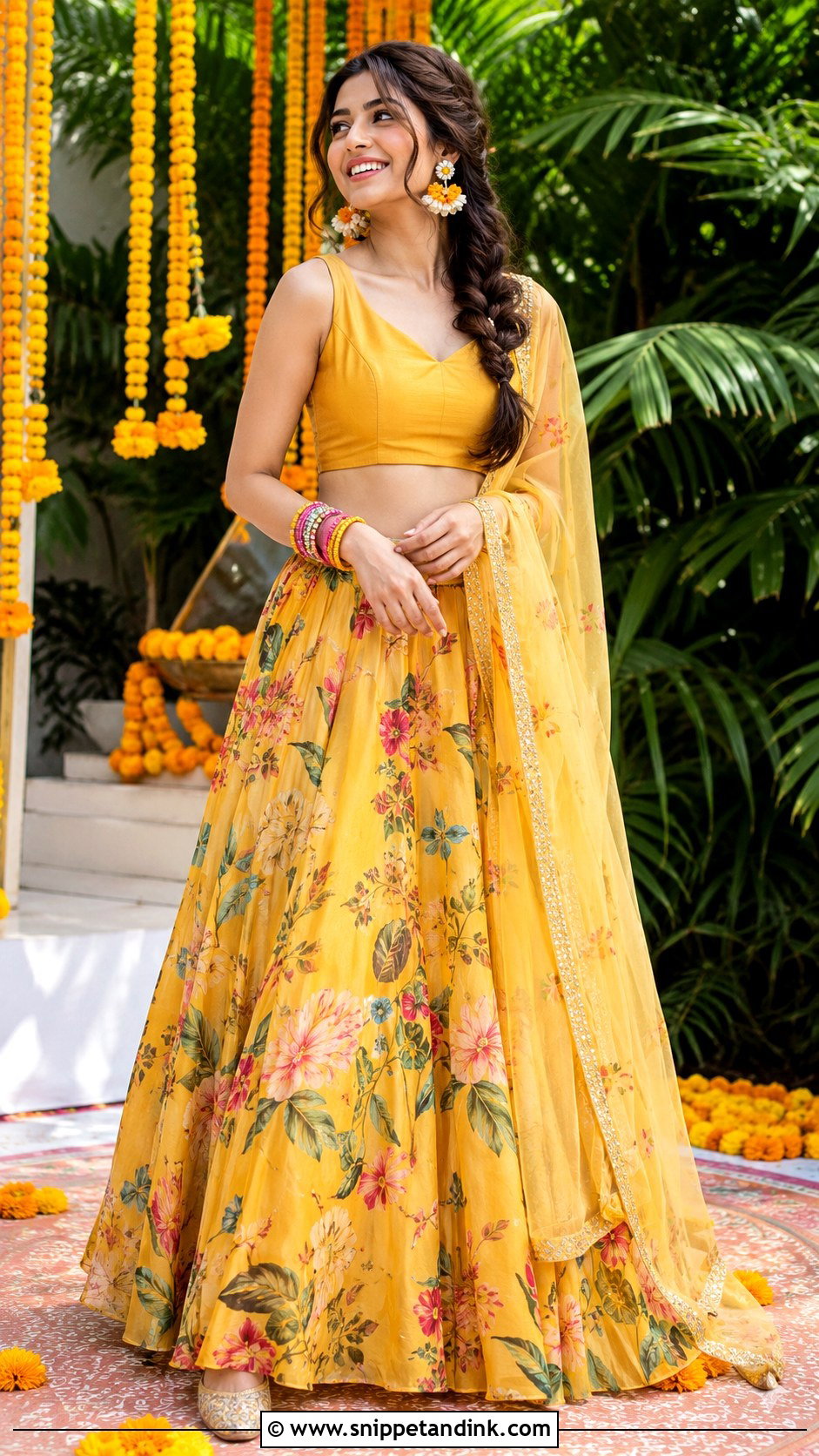
Print has a practical bonus at a haldi: it hides small turmeric marks far better than a plain surface. Choose a lightweight skirt with pink, orange, white or green botanicals and a plain yellow blouse so the print stands out, plus a sheer dupatta with a narrow embroidered edge. Flower-shaped earrings, colorful bangles and pale gold juttis. Loose waves pinned off the face, or a relaxed braid with tiny flowers. Keep the skirt at ankle length to cut down on tripping and dragging through paste. It feels youthful and still clearly family, and it suits a garden setting best of all.
10. Yellow Co-Ord Set With Cape
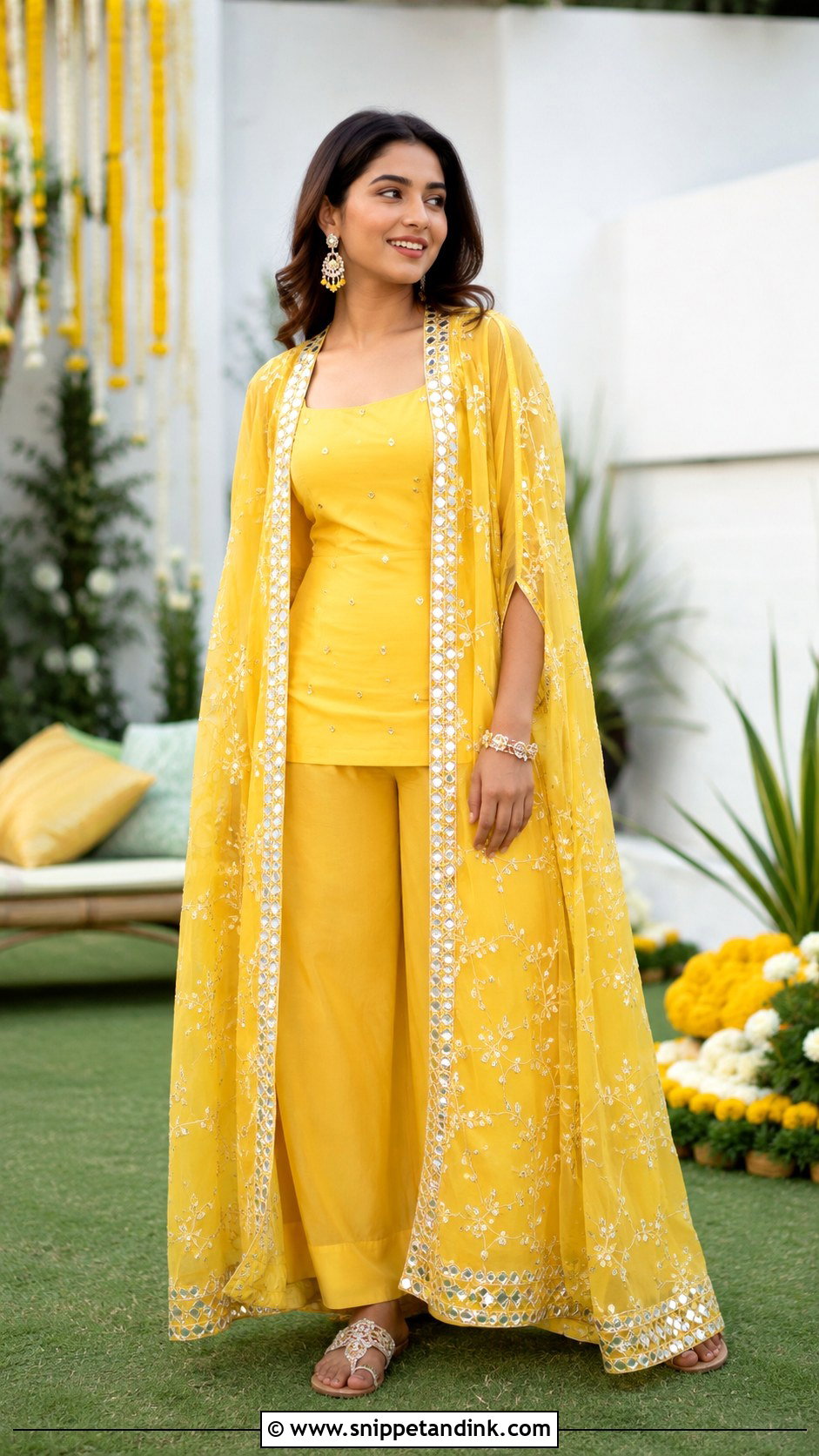
A co-ord with a flowing cape skips the dupatta entirely, which I like for a sister who’ll be using her hands all day. High-waisted straight pants or palazzos, a matching fitted top and a sheer embroidered cape to the knee or ankle. Mirror borders, floral appliqué or tonal threadwork make it ceremony-ready. Drop earrings, one statement bracelet and embellished flat sandals; a neat bun or smooth ponytail shows the neckline. The long cape draws a vertical line that suits most heights and shapes and covers the arms while staying cool. It’s an easy pick when the sisters are dressing as a coordinated group.
11. Yellow Patiala Suit for Sister
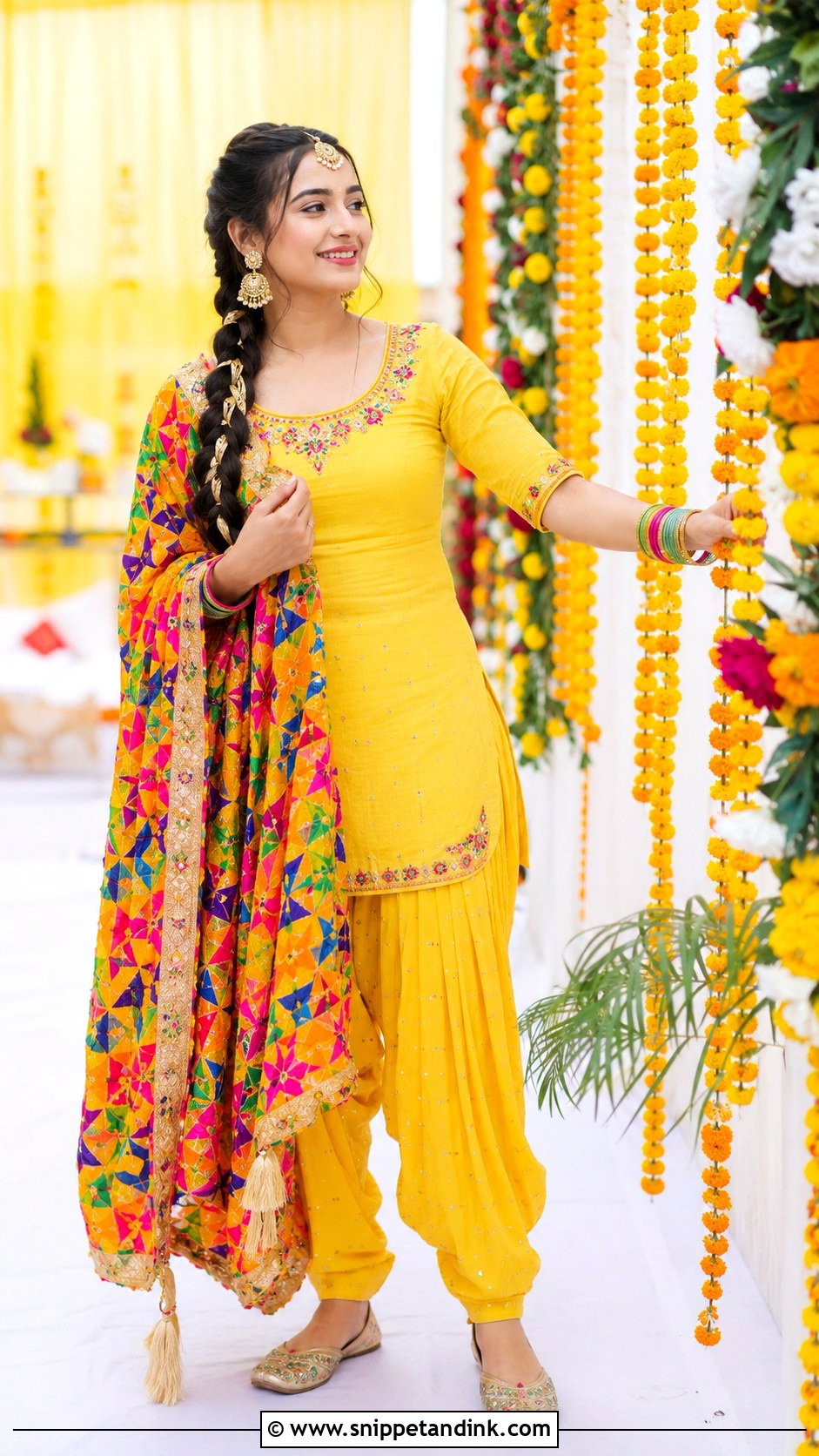
A yellow Patiala suit brings Punjabi energy to the haldi and is about the easiest outfit here to dance in. Wear a fitted short kurta over generously pleated Patiala pants, and make sure the waistband is secure; all those pleats are heavy, and a loose drawstring will slip. A phulkari or printed dupatta adds pink, green, blue and orange, draped across both shoulders or pinned to one side. Traditional jhumkas, colorful bangles and embroidered Punjabi juttis. A long braid with a paranda gives the regional touch, a braided ponytail a more modern one. Keep embroidery at the neckline and cuffs for a lighter daytime look.
12. Yellow Ruffle Saree for Sister
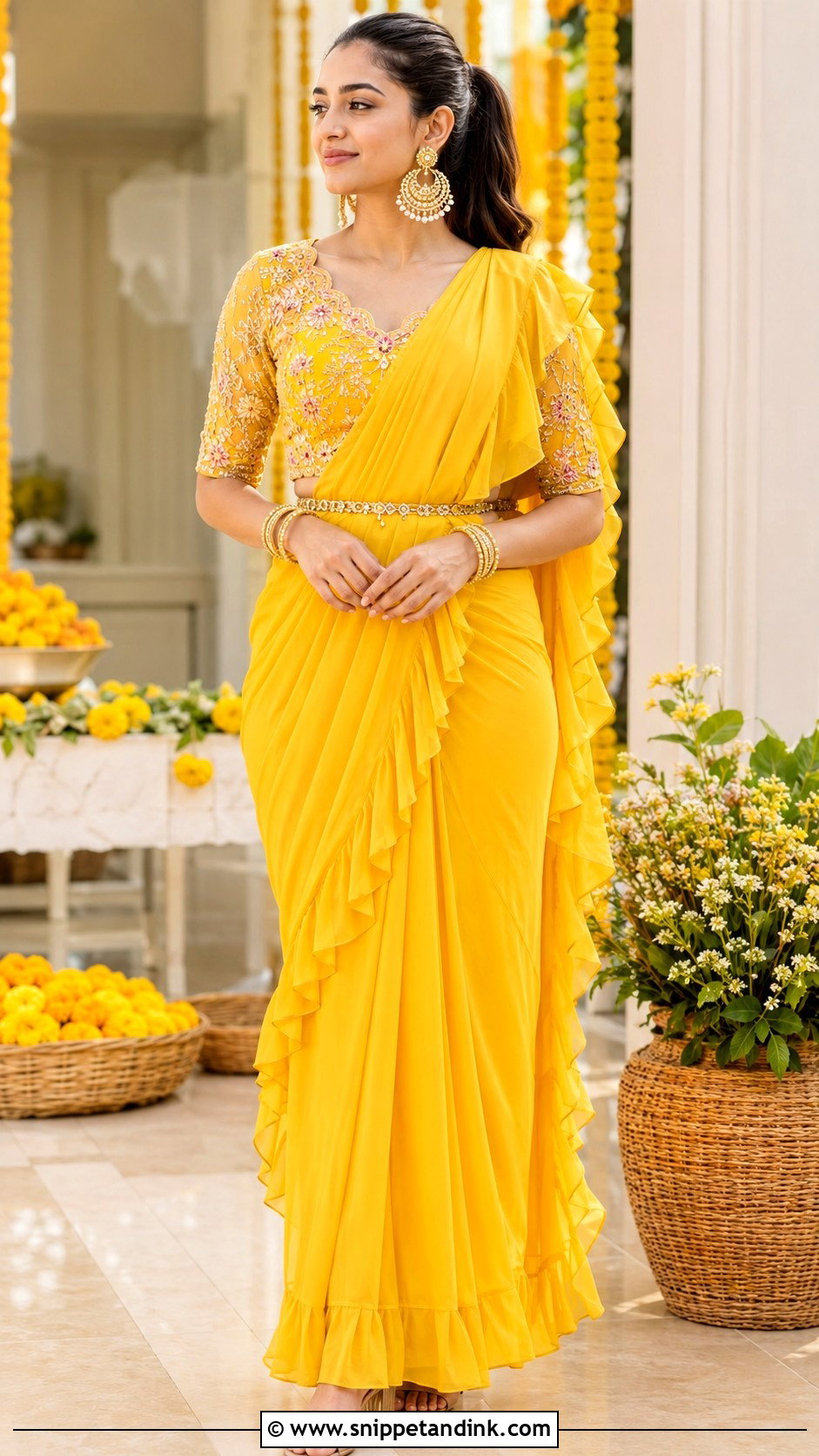
Think of this as a saree without the pleat anxiety. A pre-stitched ruffle saree is already constructed, so nothing comes loose during the rituals. Choose soft georgette or chiffon with one or two controlled ruffles, not a cascade, and pair it with a sleeved embroidered blouse, a mirror-work crop blouse or a contrasting floral one. Chandbalis, a slim waist belt and cushioned block heels or decorative flats; a polished ponytail balances the movement. The belt does real work here, holding the drape against your waist when you bend to apply paste.
13. Yellow Kurta With Printed Skirt
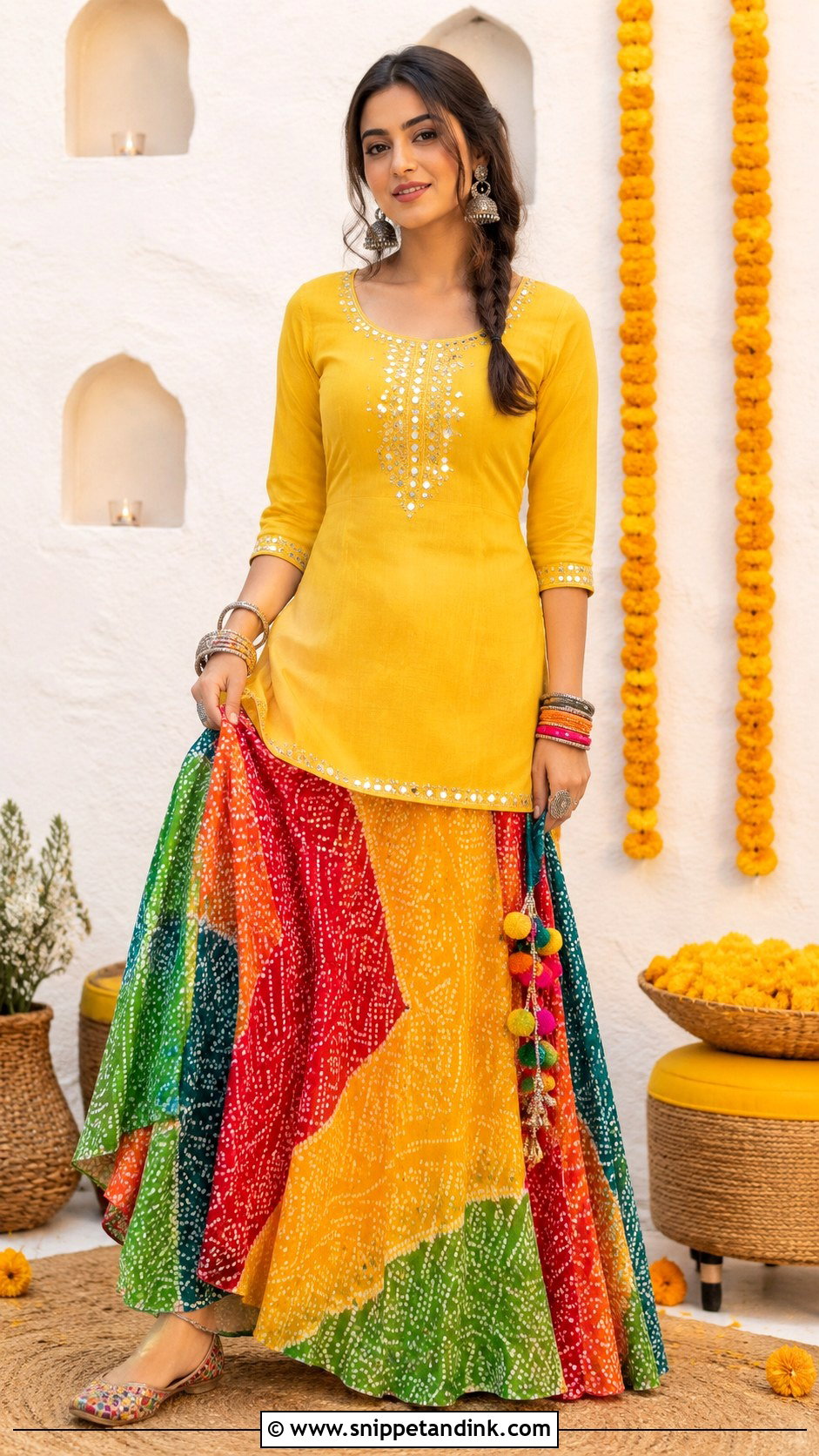
A yellow kurta over a printed skirt is a relaxed fusion look. Choose a fitted waist- or hip-length kurta and a flowing skirt in floral, bandhani, block-print or geometric motifs. I make sure the kurta repeats at least one shade from the skirt; that single link is what makes the pairing look planned rather than thrown together. Add a light dupatta only if the family expects one. Oxidized silver earrings, mixed bangles and juttis or kolhapuris, with a side braid or half-up style. Kurta length and skirt volume both adjust to suit different figures, and the whole outfit moves easily.
14. Yellow Bandhani Saree for Sister
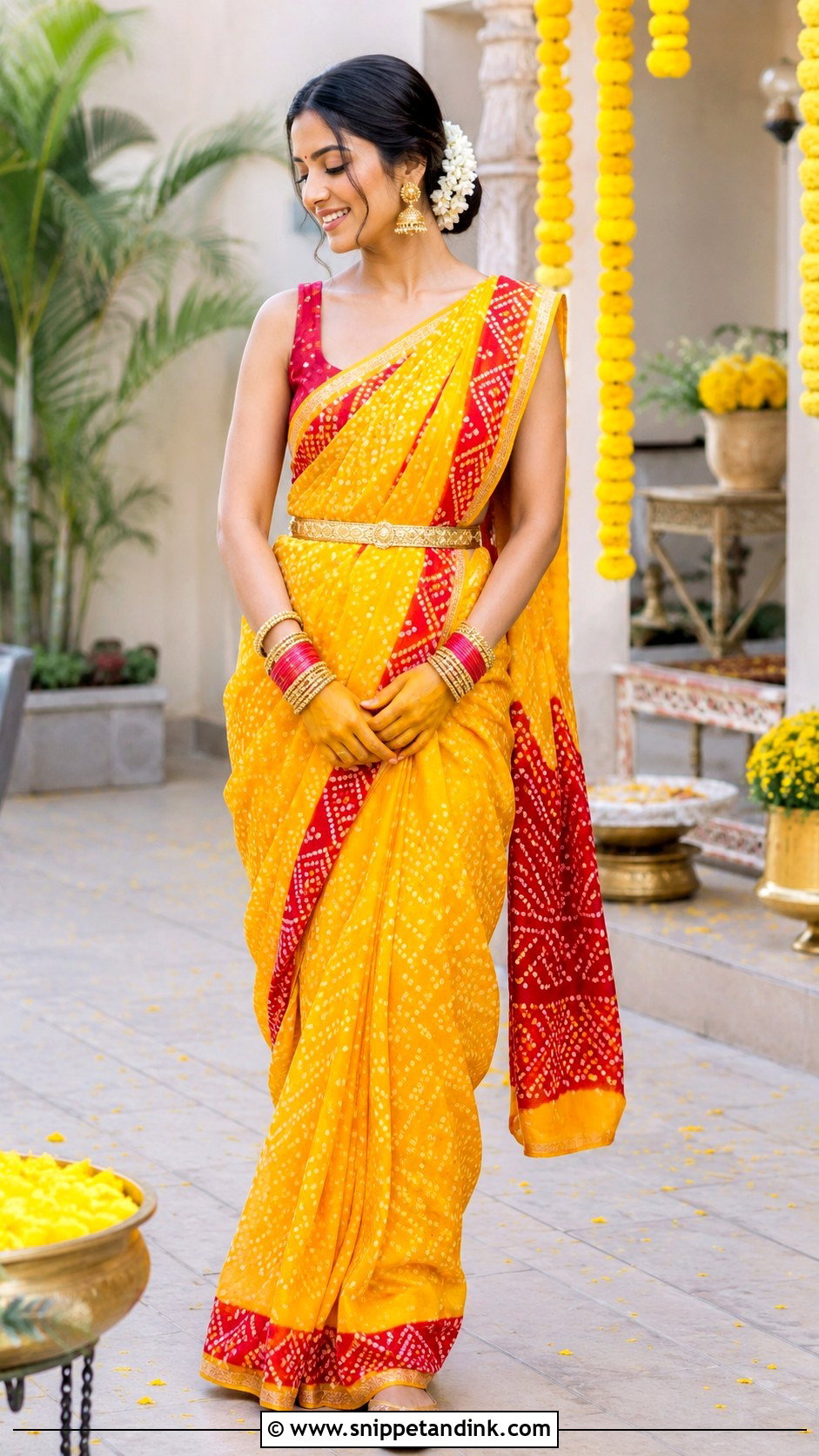
Bandhani carries its own pattern and cultural meaning, so it needs very little embroidery. Choose a lightweight georgette, chiffon or cotton-silk saree with white, red, pink or green tie-dye dots, and a plain contrasting blouse or a yellow one with a neat embroidered neckline. Pin the pallu at the shoulder; a slim waist belt helps keep the drape in place as you move. Gold jhumkas, glass bangles and traditional juttis, with a low bun and a few fresh flowers or a long tidy braid. Glass bangles and a busy haldi don’t always mix, so wear a few rather than a full stack. It suits younger, older and married sisters equally.
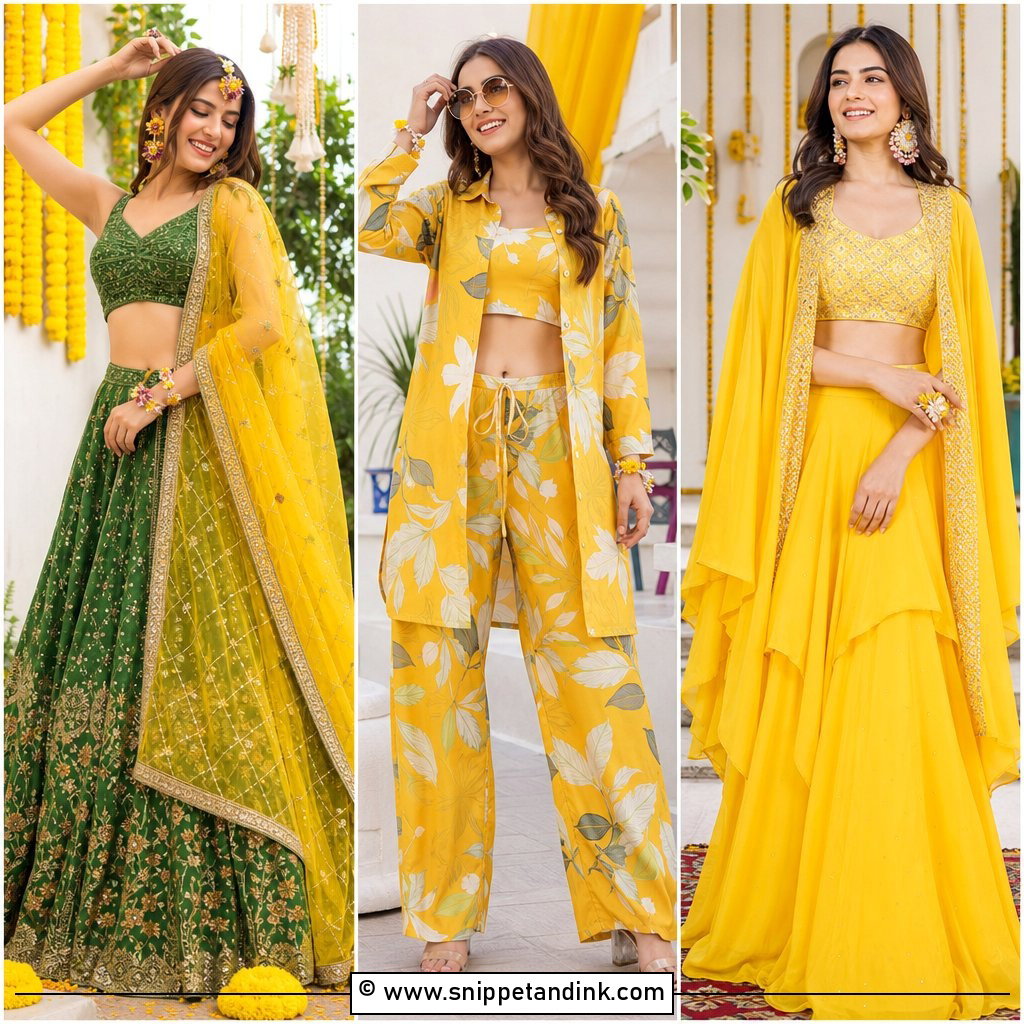

15. Yellow Angrakha Suit for Sister
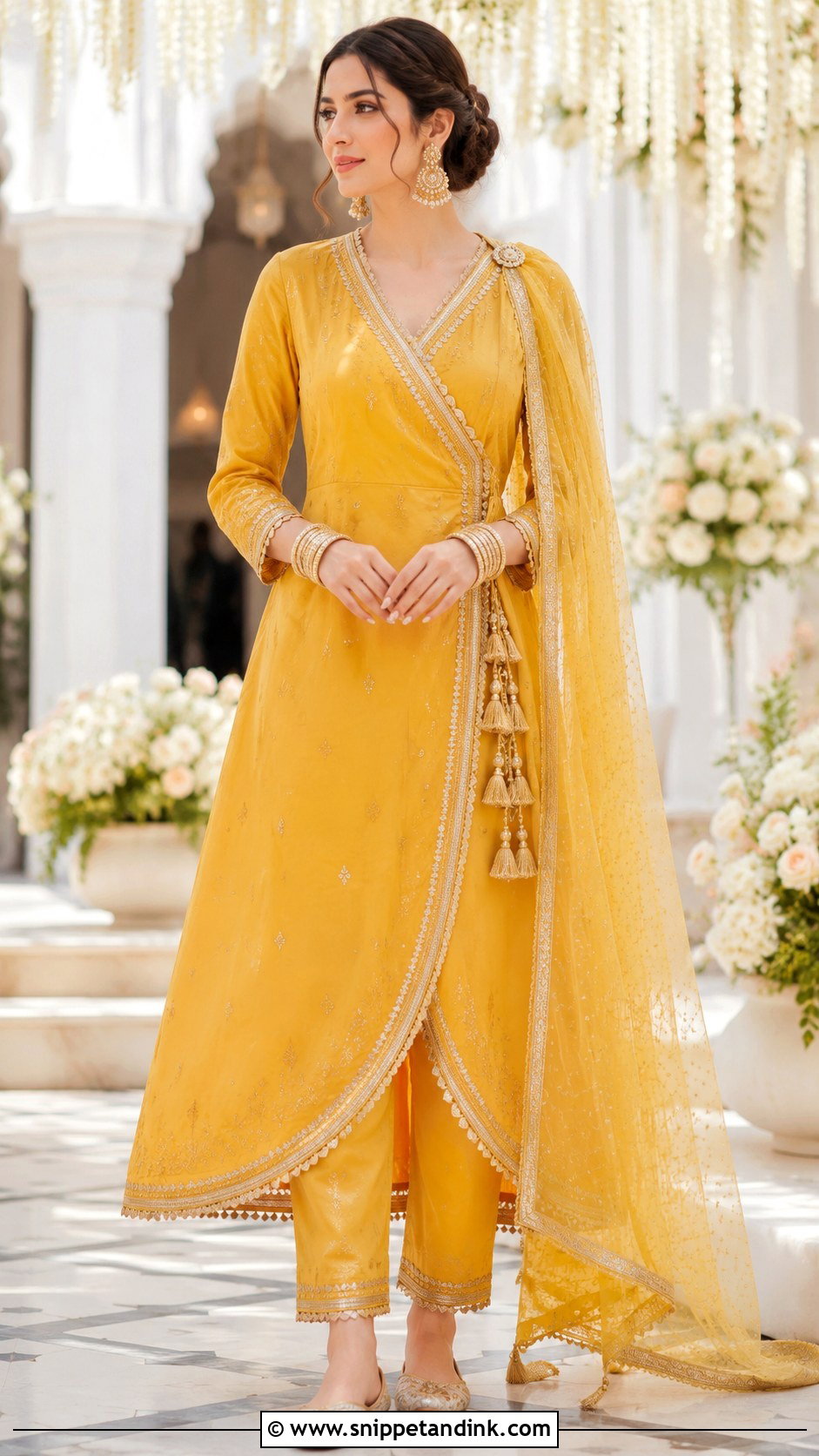
The overlapping neckline of a yellow angrakha suit gives traditional detail and soft movement. Choose a knee- or calf-length kurta with side ties, small tassels and delicate gota, over straight pants, churidar or lightly flared trousers. Keep the dupatta simple and over one shoulder so the wrap bodice shows. Dome earrings, a few bangles and pointed embroidered juttis. A low braided bun stops hair falling forward over the paste bowl. Tie the closures firmly and ask for a hidden hook inside, because the overlap can gape when you bend forward.
16. Yellow Jumpsuit With Dupatta
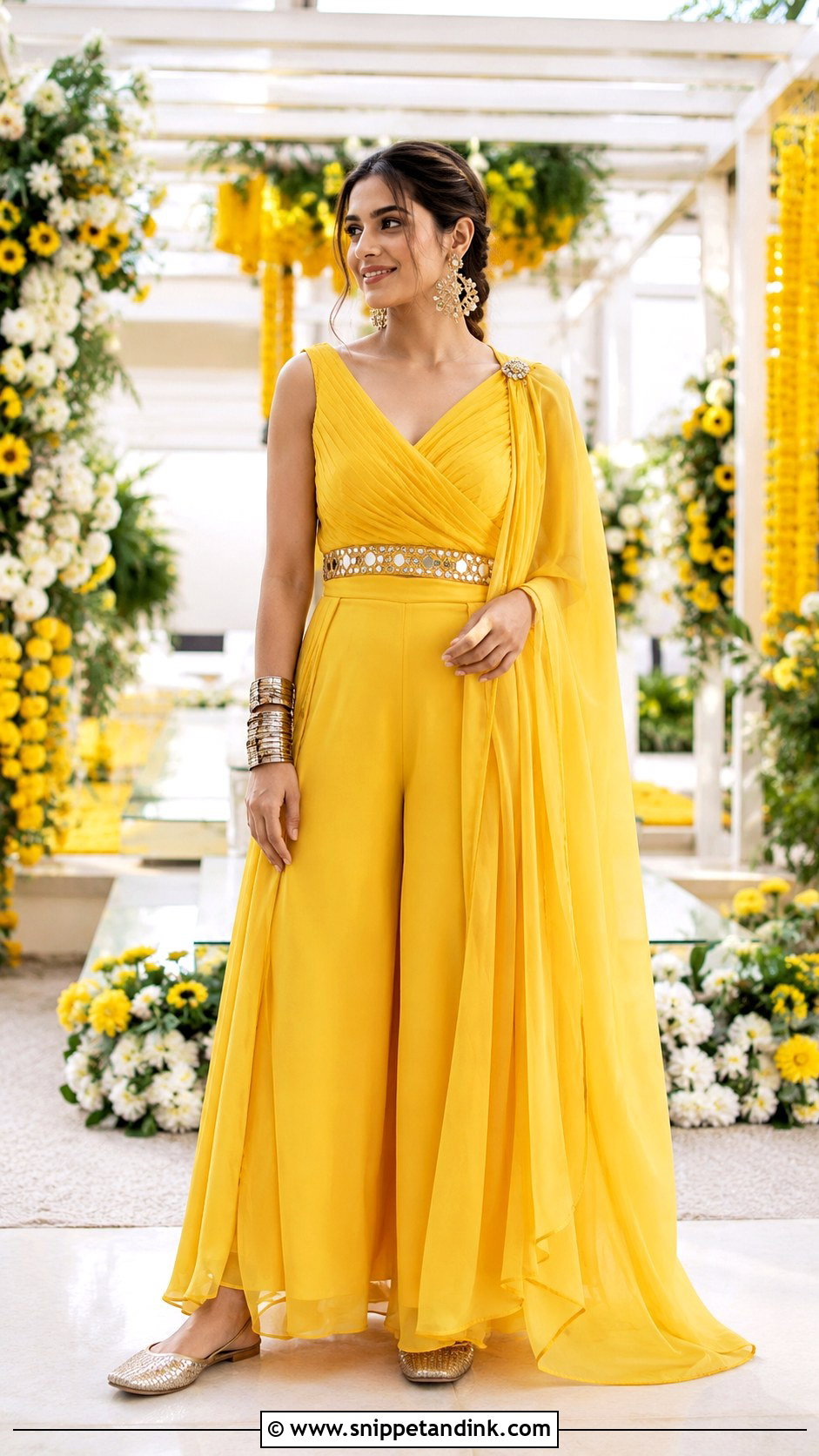
One piece, nothing to coordinate, dressed in five minutes on a frantic morning. Look for an ethnic jumpsuit with a wrap bodice, defined waist and wide palazzo-like legs, finished with embroidered shoulders, a mirror-work belt or a decorative neckline. A light dupatta over one arm or fixed at the shoulder. Sculptural earrings, stacked cuffs and gold flats or low block heels, with a sleek braid or high ponytail. The one catch is the bathroom: a jumpsuit means undressing completely, so I’d pick one with a zip you can reach yourself. Otherwise it handles dancing, hosting and running errands for the bride with ease.
17. Yellow Skirt and Long Jacket Set
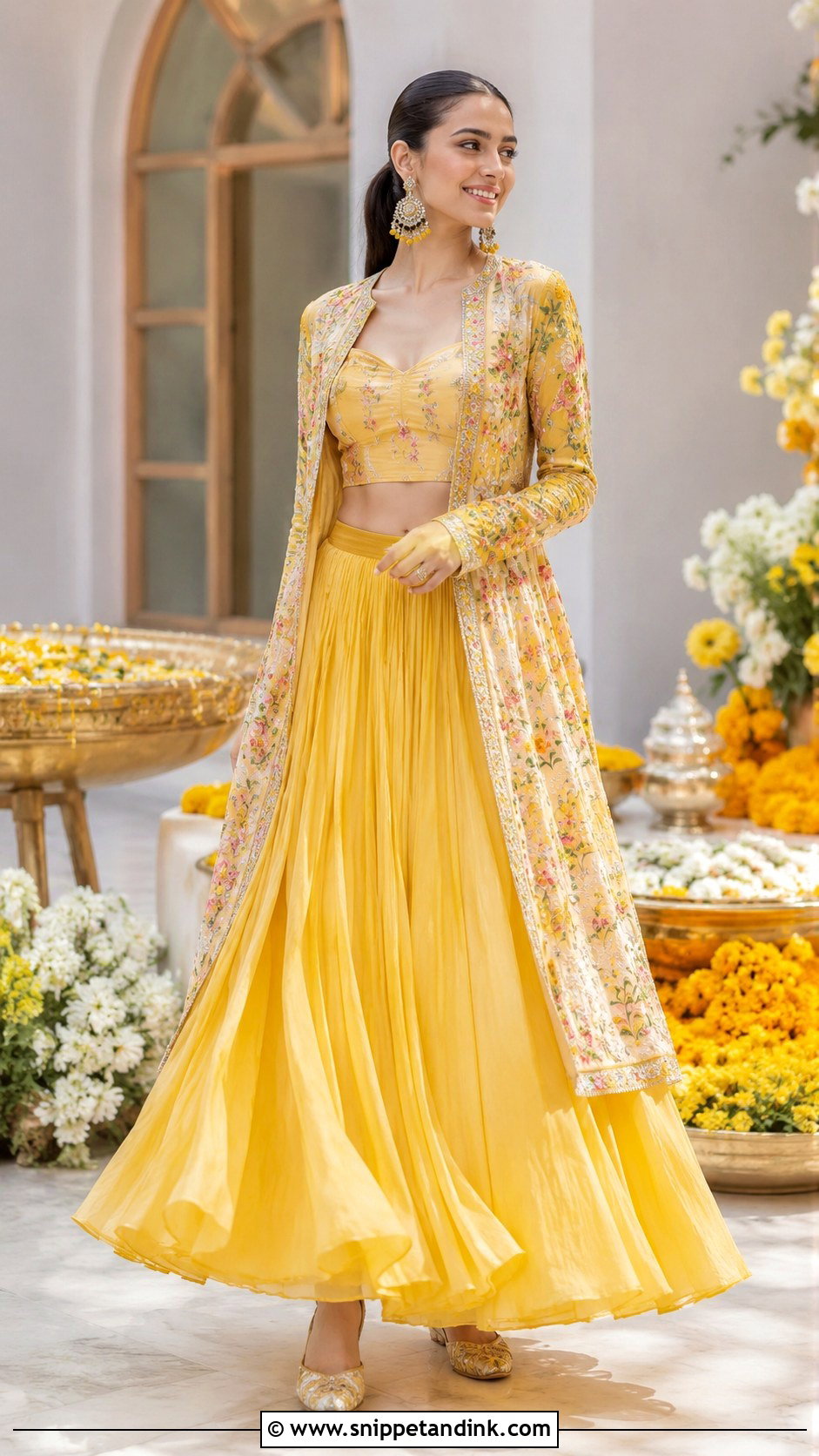
A long jacket gives you a regal look without a heavily embroidered lehenga. Start with a simple flared skirt and a fitted blouse or crop top, then add an open-front jacket below the knee with floral vines, mirrors or fine threadwork. Keep the skirt plain so the layers don’t compete. Statement earrings, a delicate ring and comfortable juttis; skip the necklace if the jacket neckline is detailed. A center-parted low ponytail or bun. The jacket gives coverage and frames everything beneath it in photos, but on a hot afternoon it’s an extra layer, so choose unlined cotton or georgette.
18. Yellow Gharara Set for Sister
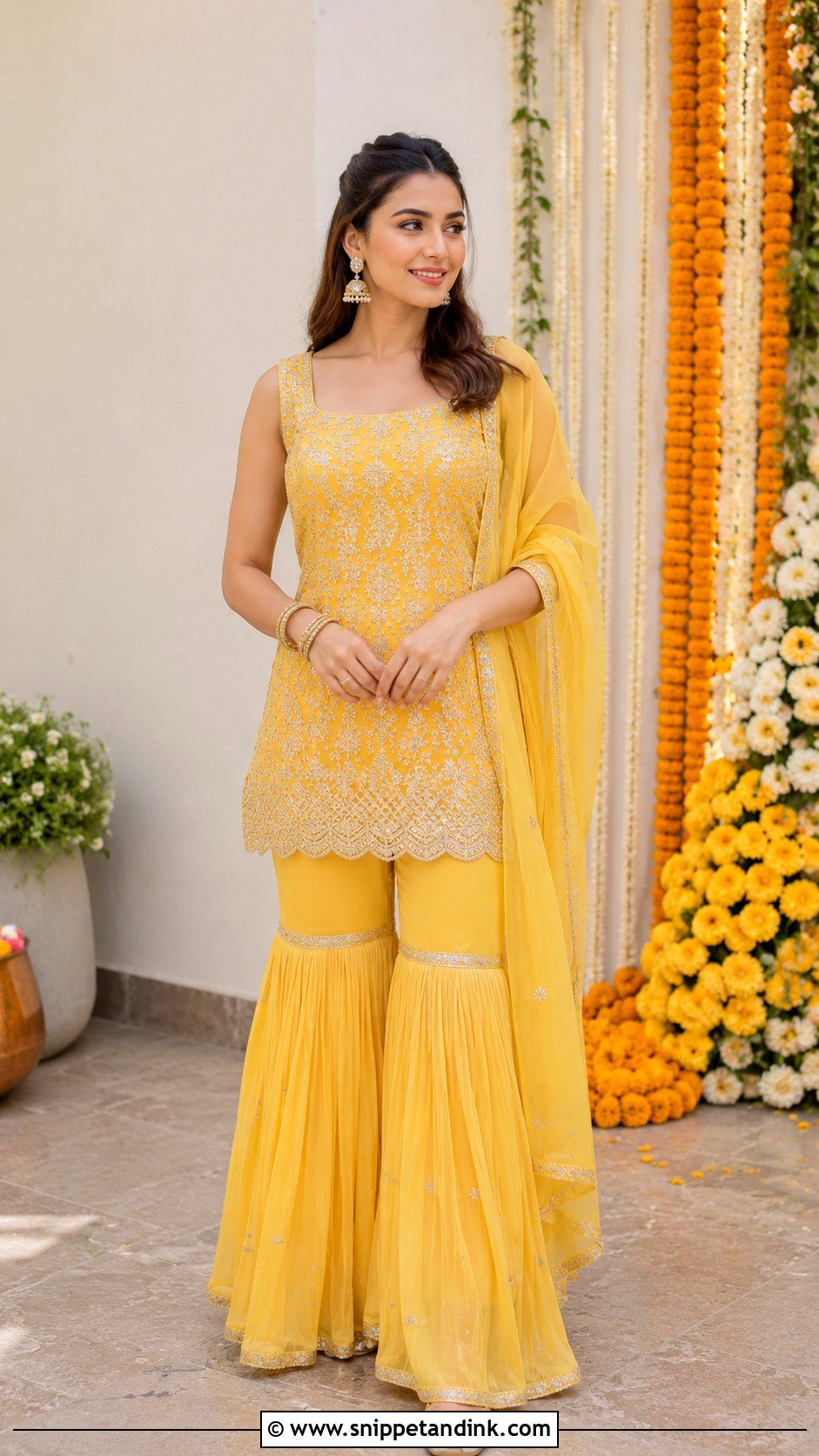
A yellow gharara set is dressier than straight pants and still comfortable. A short kurta ending near the hips goes over trousers fitted to the knee and flaring dramatically below, and gota or fine embroidery along the knee joint shows off how it’s made. A soft chiffon dupatta pinned discreetly at one shoulder. Pearl jhumkas, coordinated bangles and low-heeled juttis, with a half-up style or smooth bun to balance the volume. Get the length right with your shoes on, since a gharara that drags will collect every drop of paste on the floor. It suits a larger, more formal haldi.
19. Yellow Kaftan Set for Sister
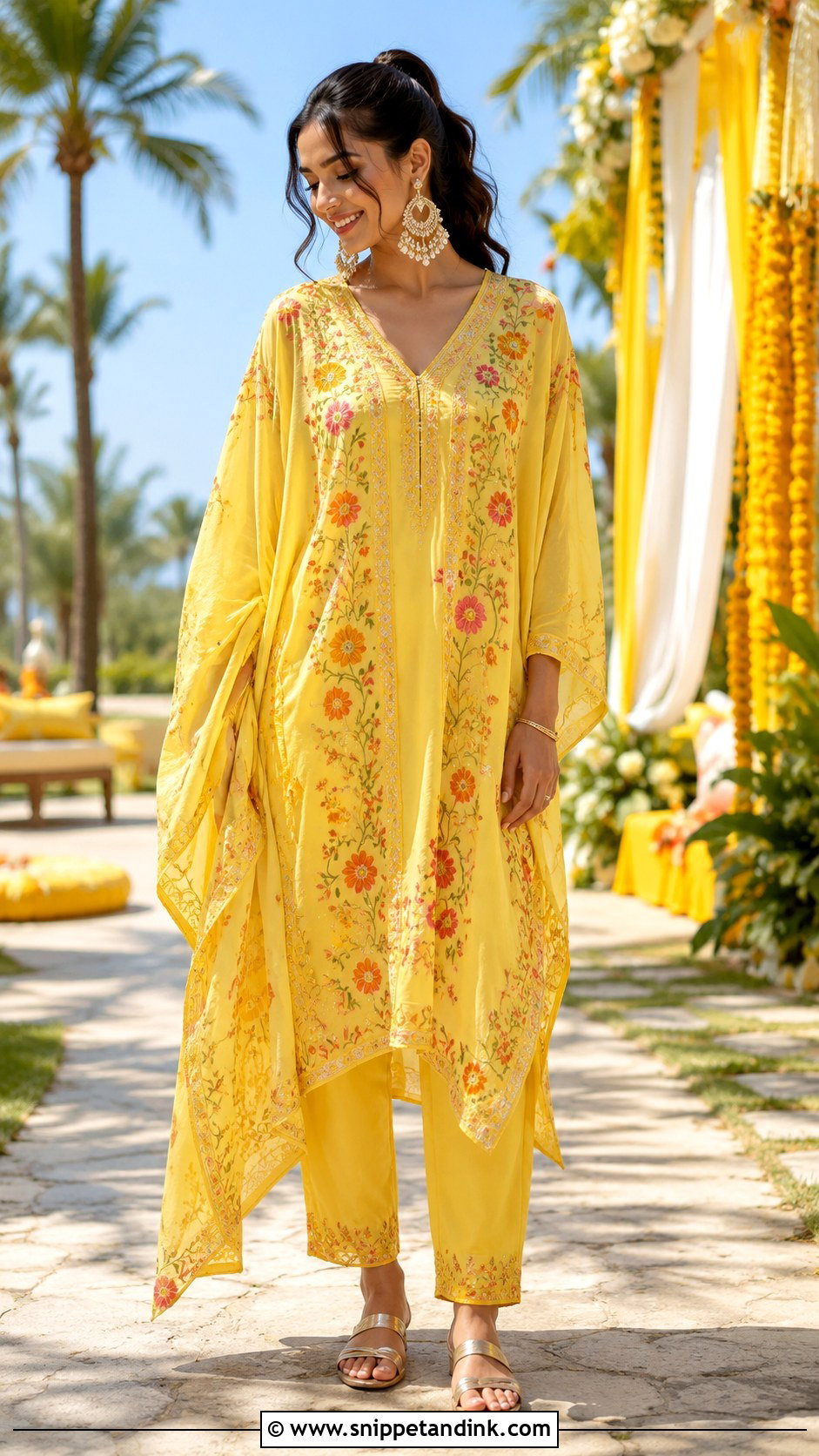
For an intimate, outdoor or destination haldi, a kaftan set is the most relaxed option. Choose calf length with a lightly defined waist, side slits and embroidery around the neckline, worn over straight pants or soft palazzos. Floral prints, scalloped edges or subtle mirrors add enough festive detail. Oversized earrings, a slim bracelet and flat metallic sandals, with a high ponytail or loose braid. Wide kaftan sleeves dip straight into the paste bowl, so I’d push them up or choose a version with a narrower sleeve. It adapts to almost any age and shape.
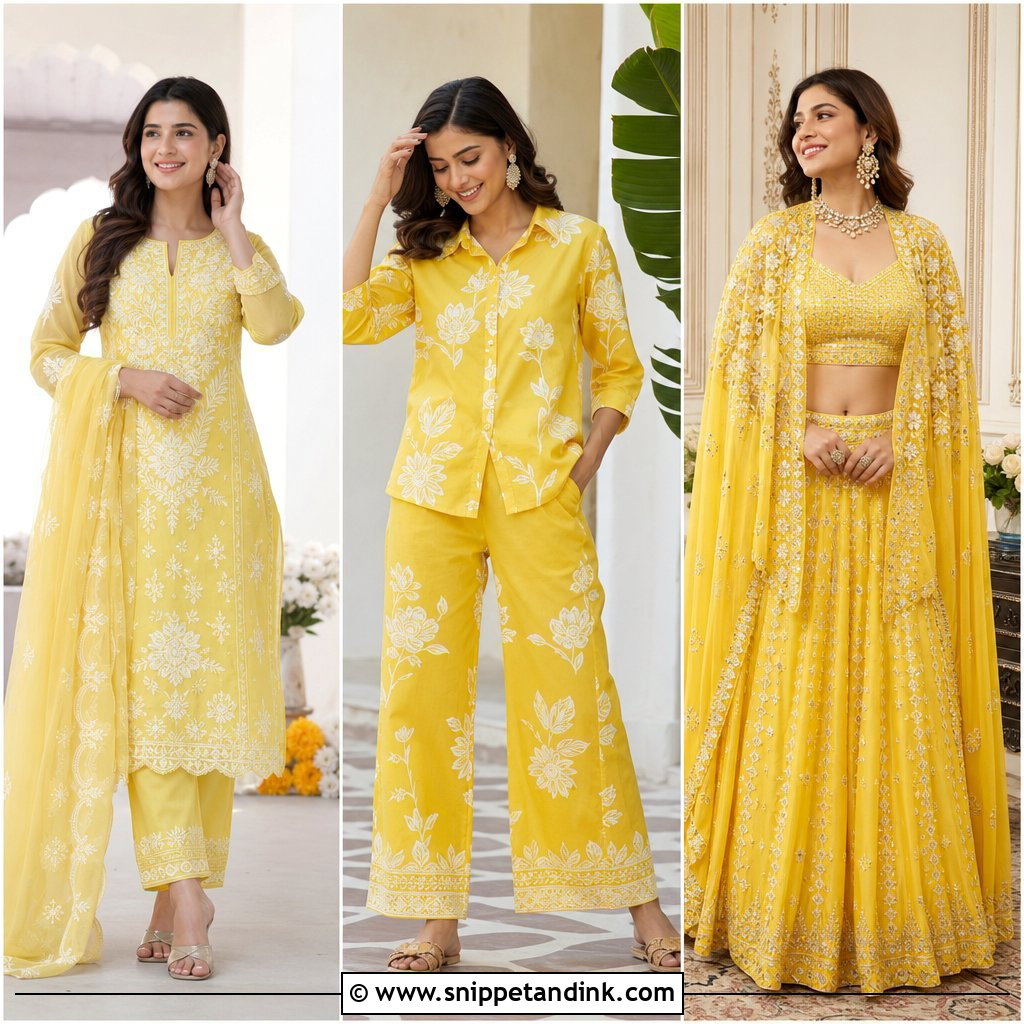
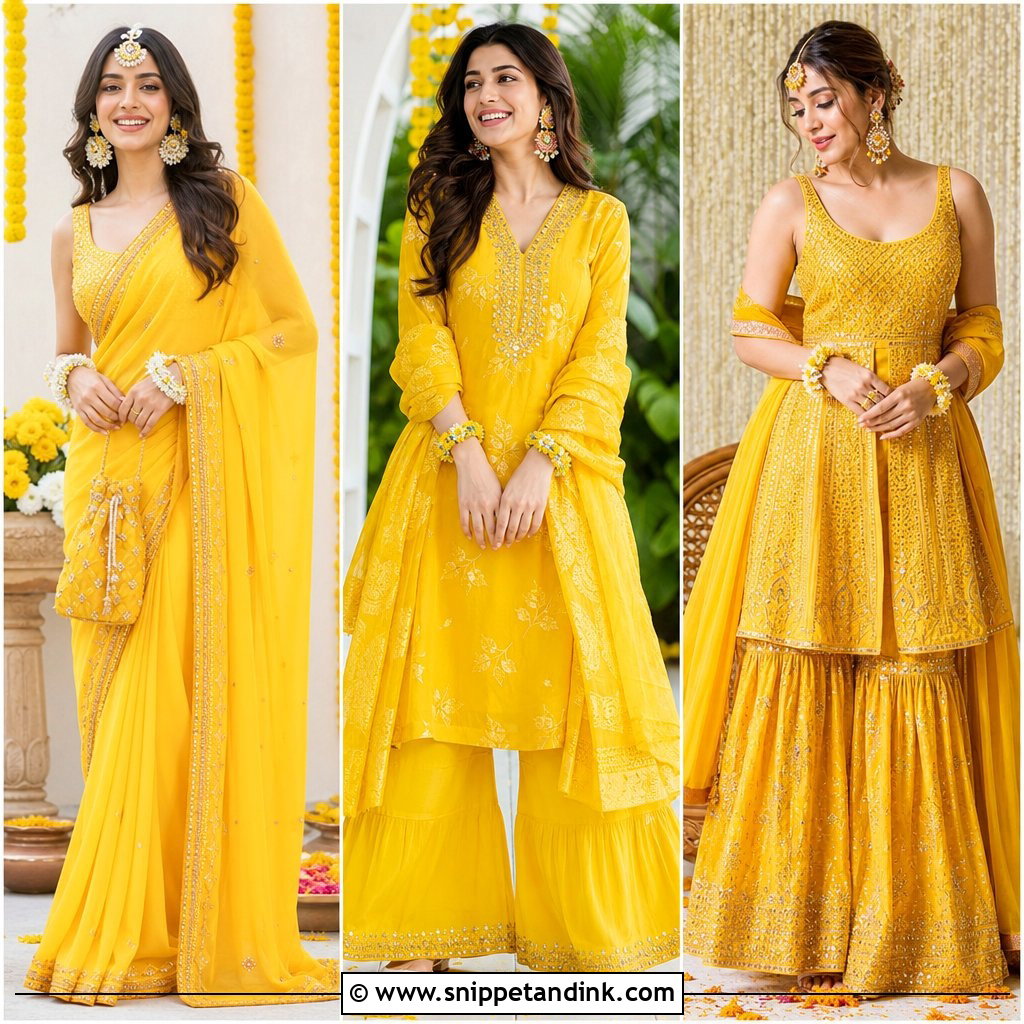
20. Yellow Chanderi Suit for Sister
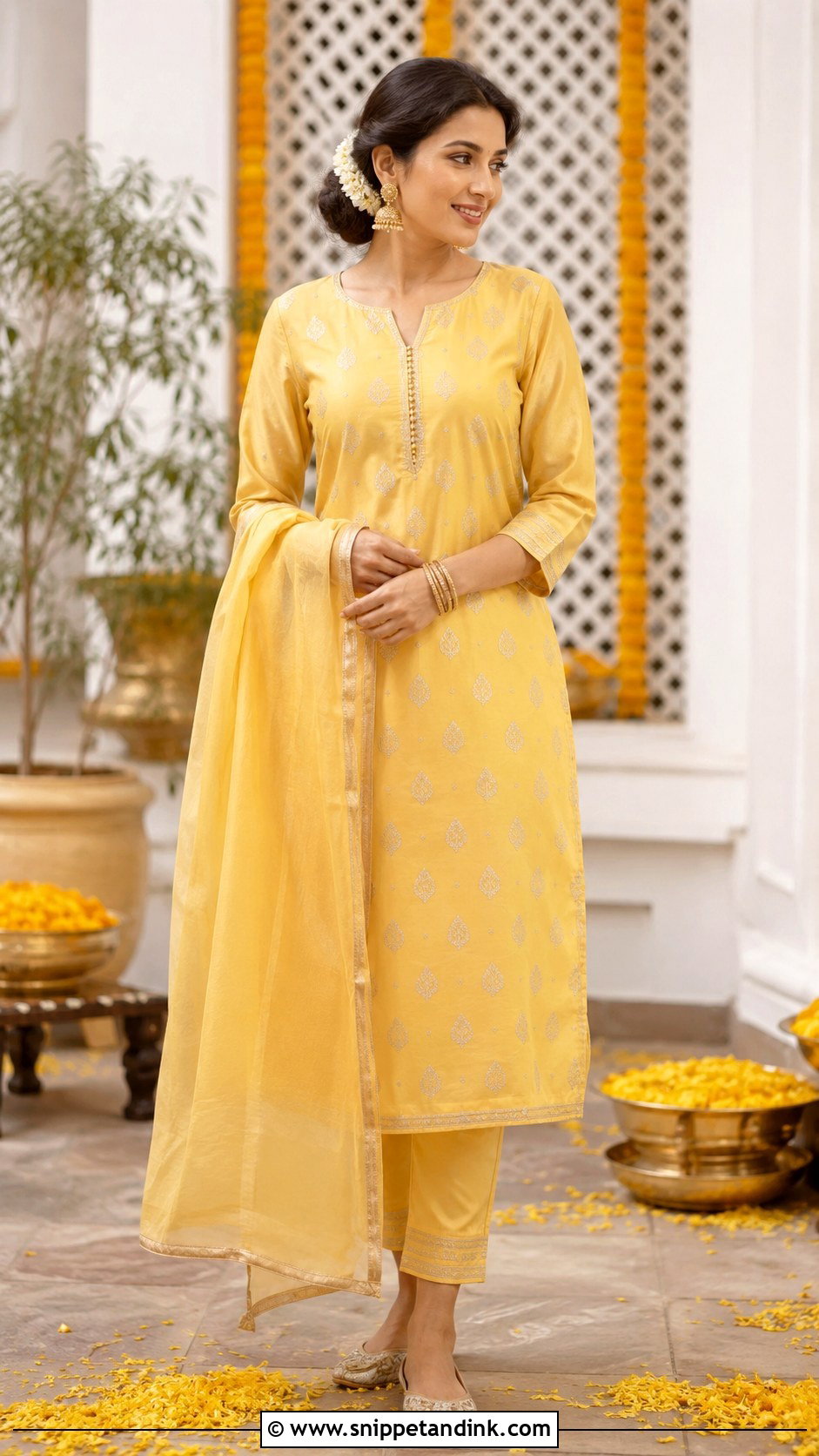
Chanderi has a gentle sheen and woven motifs that look refined in daylight with almost no embellishment. Choose a straight kurta with three-quarter sleeves and a lightly structured neckline, cropped pants and a sheer Chanderi or organza dupatta with a narrow gold border. Classic jhumkas, thin gold bangles and neutral or yellow juttis, plus a smooth low bun with small flowers. Chanderi is a fine silk or silk-cotton weave that marks easily, so wear it for portraits and the early part of the day and then change, or stay well back from the ritual area. It’s polished and modest for family photos.
Talk to the Bride Before You Buy Anything
Sisters sometimes shop first and coordinate later, and that’s how two people end up in the same mustard lehenga. Ask the bride three things: what shade she’s wearing, how heavy her embellishment is, and whether she’d like the sisters to match.
If she’s in bright turmeric yellow, a softer lemon or butter on you lets her stand out. If the sisters are coordinating, agree on a color and let each person choose her own silhouette. Matching shades in different cuts photograph better than identical outfits, and everyone ends up in something that suits her.
Jewelry That Can Handle Wet Turmeric
The haldi is the hardest function of the wedding on jewelry. Kundan and polki pieces have foil set behind the stones, and water that gets underneath can dull them for good. Plated and imitation pieces darken with moisture and turmeric too.
- Fresh flower jewelry is made for this: light, inexpensive and happy to be ruined.
- Take rings off before you apply paste, because it packs into settings and is hard to clean out.
- After the ceremony, wipe metal pieces with a soft dry cloth and let them air before you pack them away.
- Save the heirloom set for the mehndi or sangeet.
Dressing as Family, Not as a Second Bride
A good haldi look for the bride’s sister feels festive, lets you work, and sounds like you. Shararas, lehengas, sarees, kurta sets, jumpsuits and capes each strike a different balance of tradition and movement. Choose breathable fabric, a hem that clears the floor, draping that stays put and shoes you can stand in for hours. Keep jewelry easy to manage near turmeric, water and petals. And check with the bride, so your shade and embellishment frame her outfit instead of competing with it.
You'll Like These Ideas:









Leave a Reply