
Roses are one of the motifs I’m asked for most at bridal bookings, and they’re harder to draw well than they look. A rose is built from layered, curving petals, and if those lines sit too close the stain fills the gaps and the flower turns into a dark blob. Drawn with room to breathe, though, a rose softens any layout, from Indian and Arabic to Indo-Arabic, Gulf and modern minimal wedding henna. It can anchor a palm, trail across the back hand, circle the wrist or sit among paisleys, jaali and a hidden name. Below are twenty placements, with notes on how each one stains and who it suits.
What Makes a Rose Stain Clearly Instead of Blurring
Before you pick a layout, it helps to know why some rose designs look crisp a day later and others look muddy. A rose is made of curving petal lines placed close together. Henna paste spreads slightly as it sits, and the stain darkens for a day or two after removal. If the petal lines are packed too tightly, the stain bridges the gaps and the shape is lost.
- Ask your artist to leave clear skin between petals, especially on the palm, where the colour goes darkest.
- Fine petal work needs a fine cone tip and smooth, well-sifted paste. Lumpy paste makes blobby petals.
- Book a small test patch a few weeks before to see how deep your skin stains.
- Only use natural henna. So-called black henna can contain PPD, a dye that can cause serious skin reactions, so ask what’s in the paste.
1. Full Hand Bridal Rose Mehndi Design
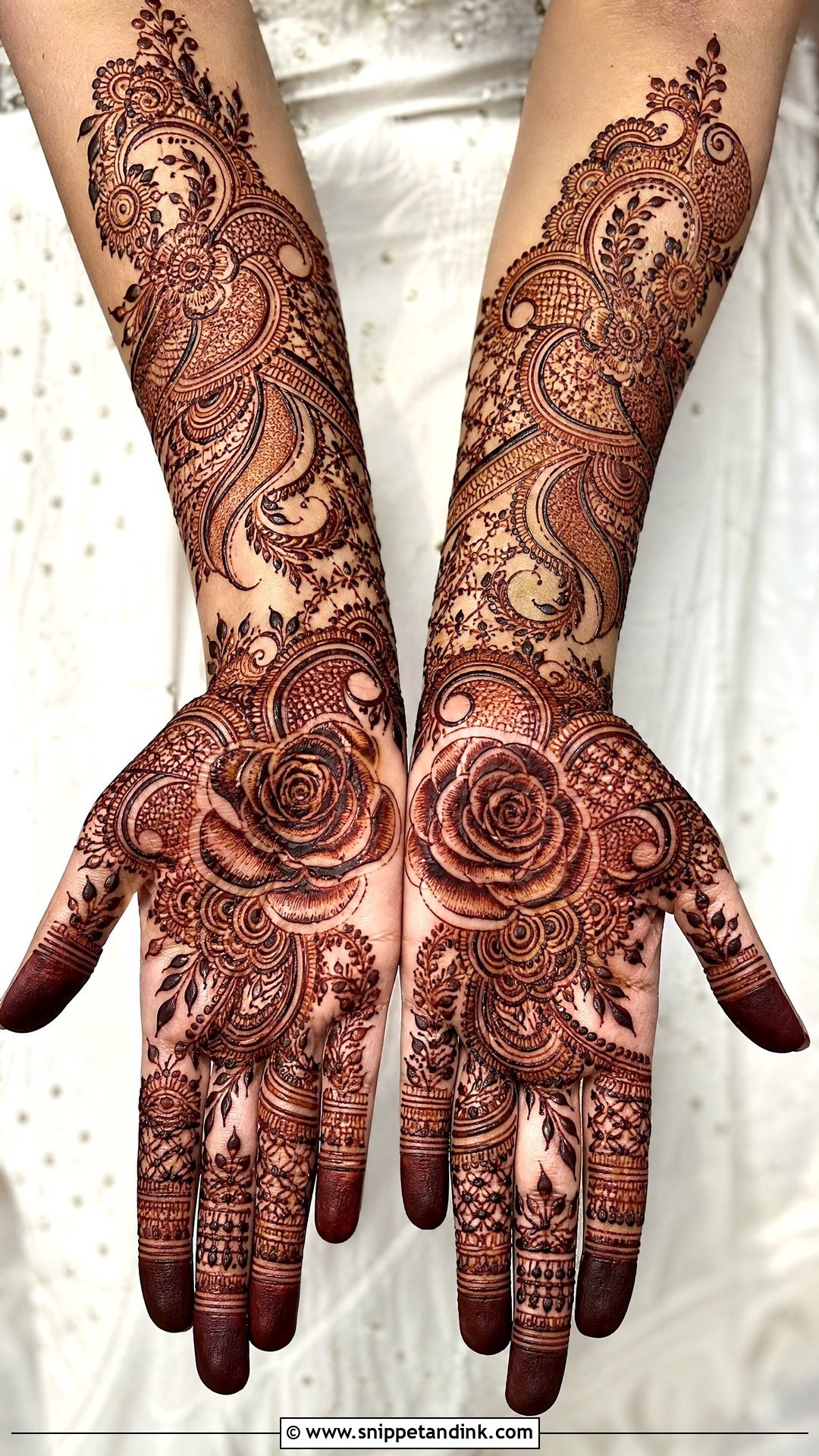
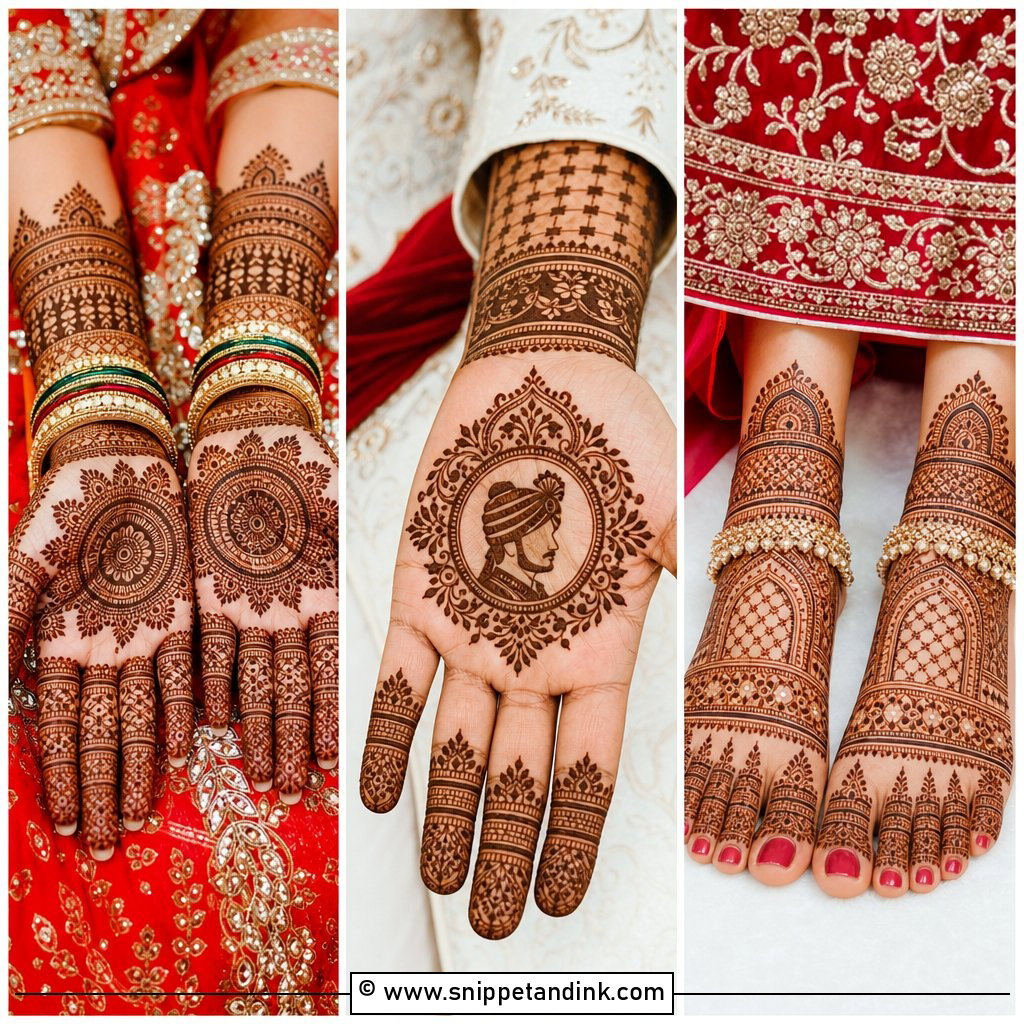
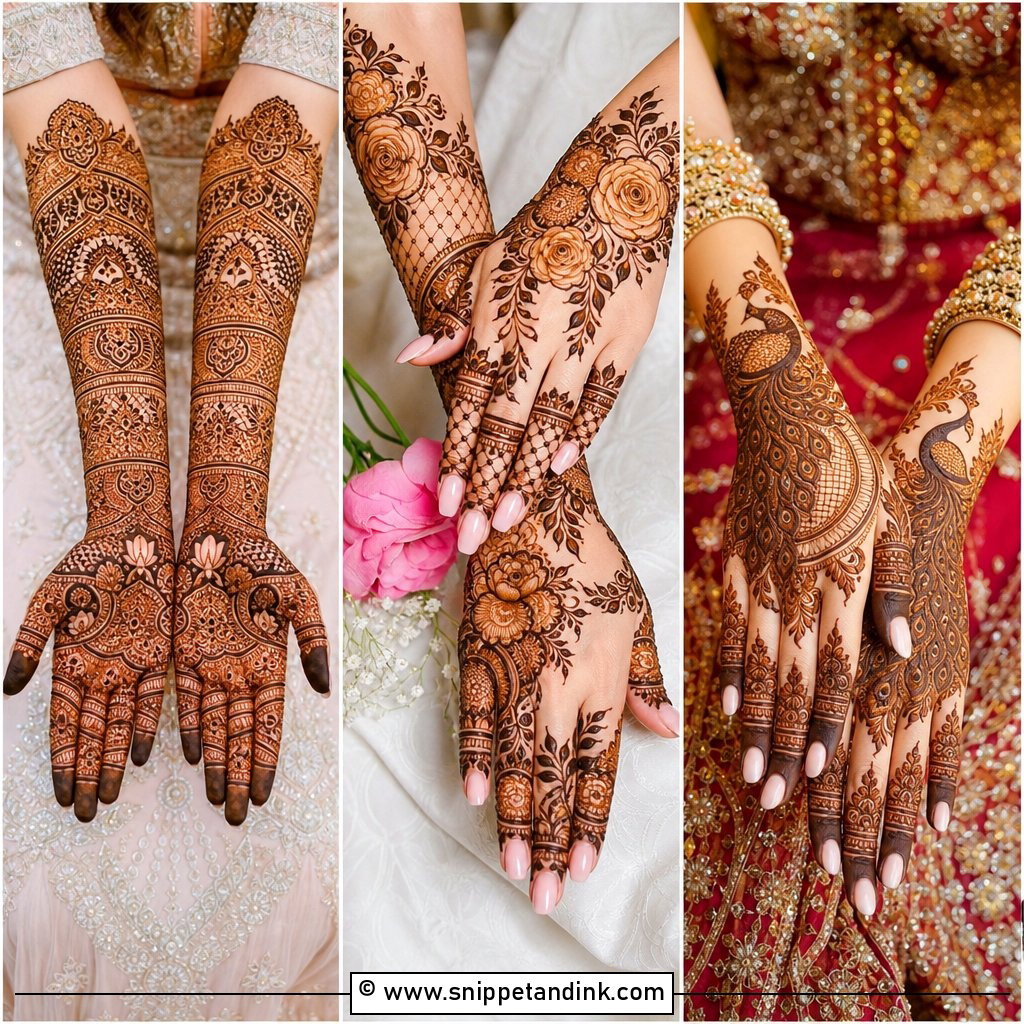
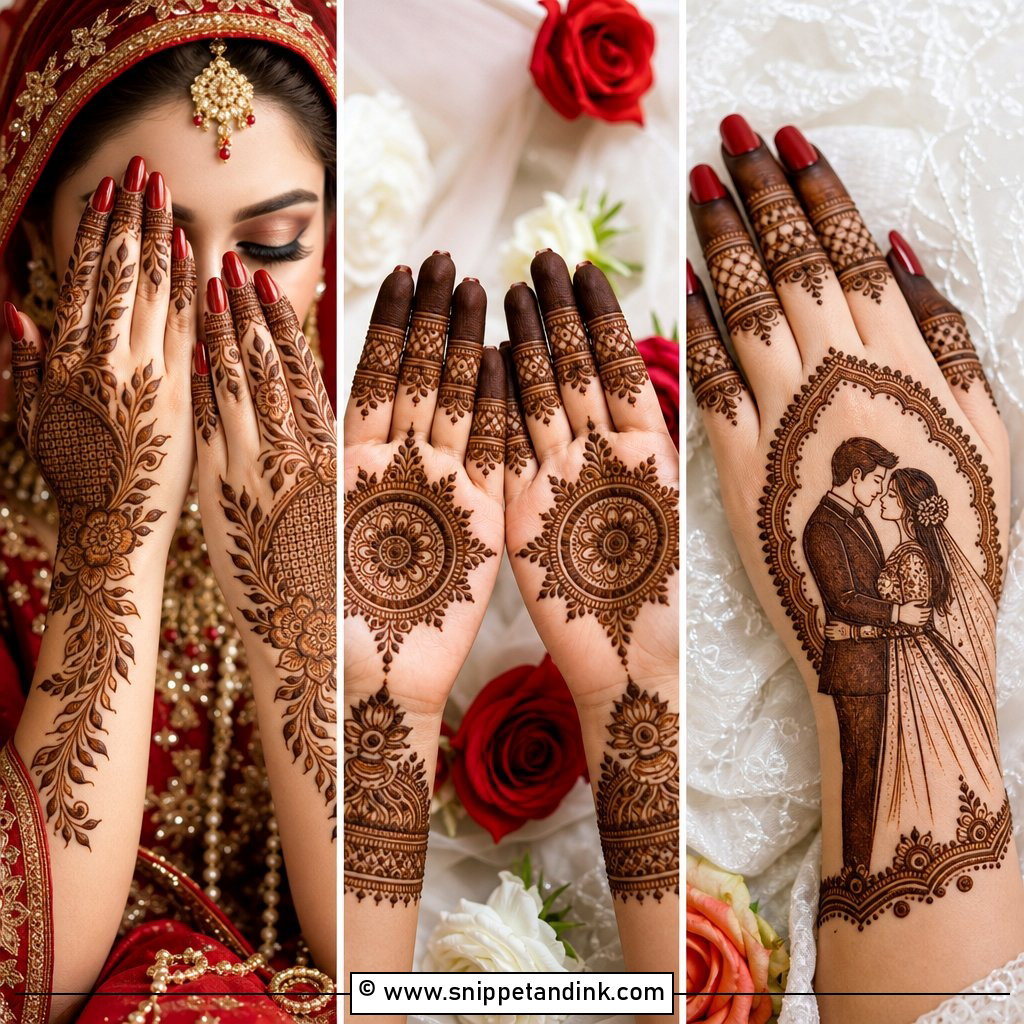
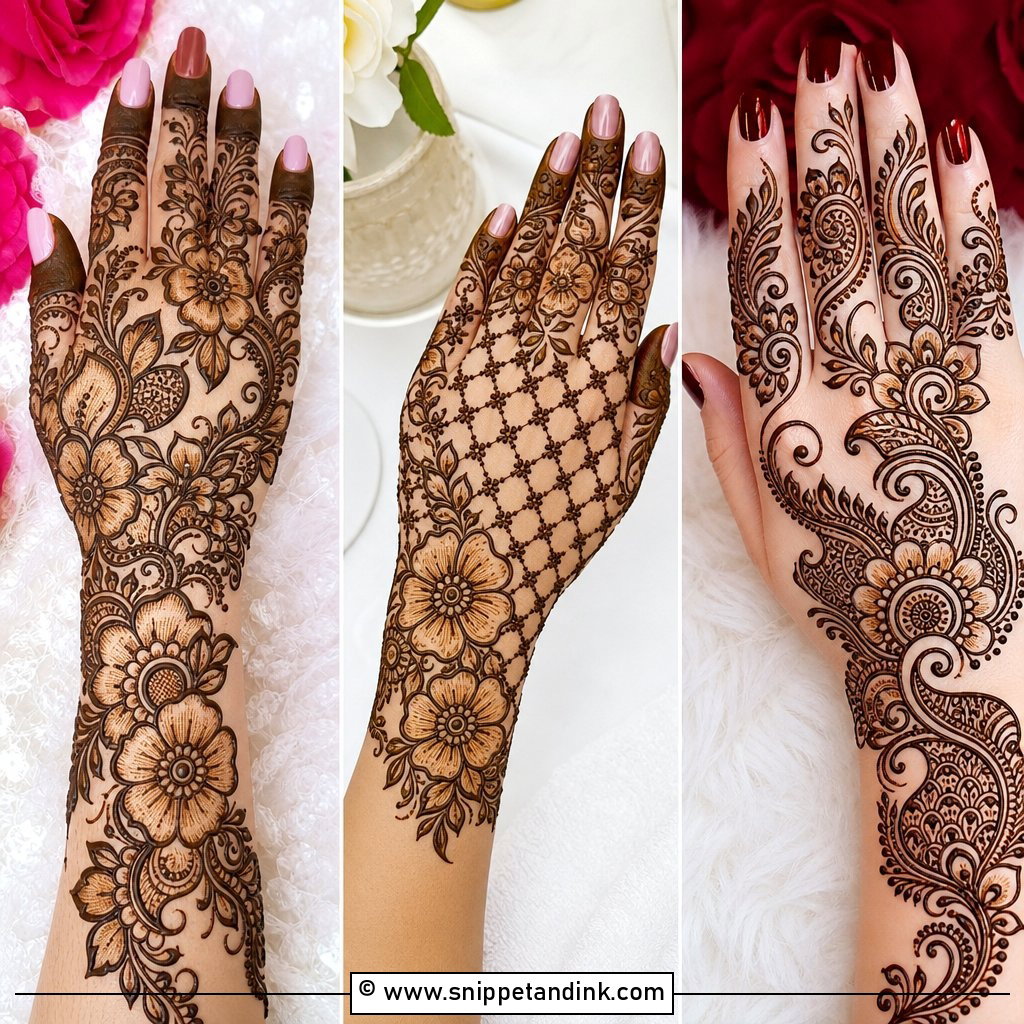
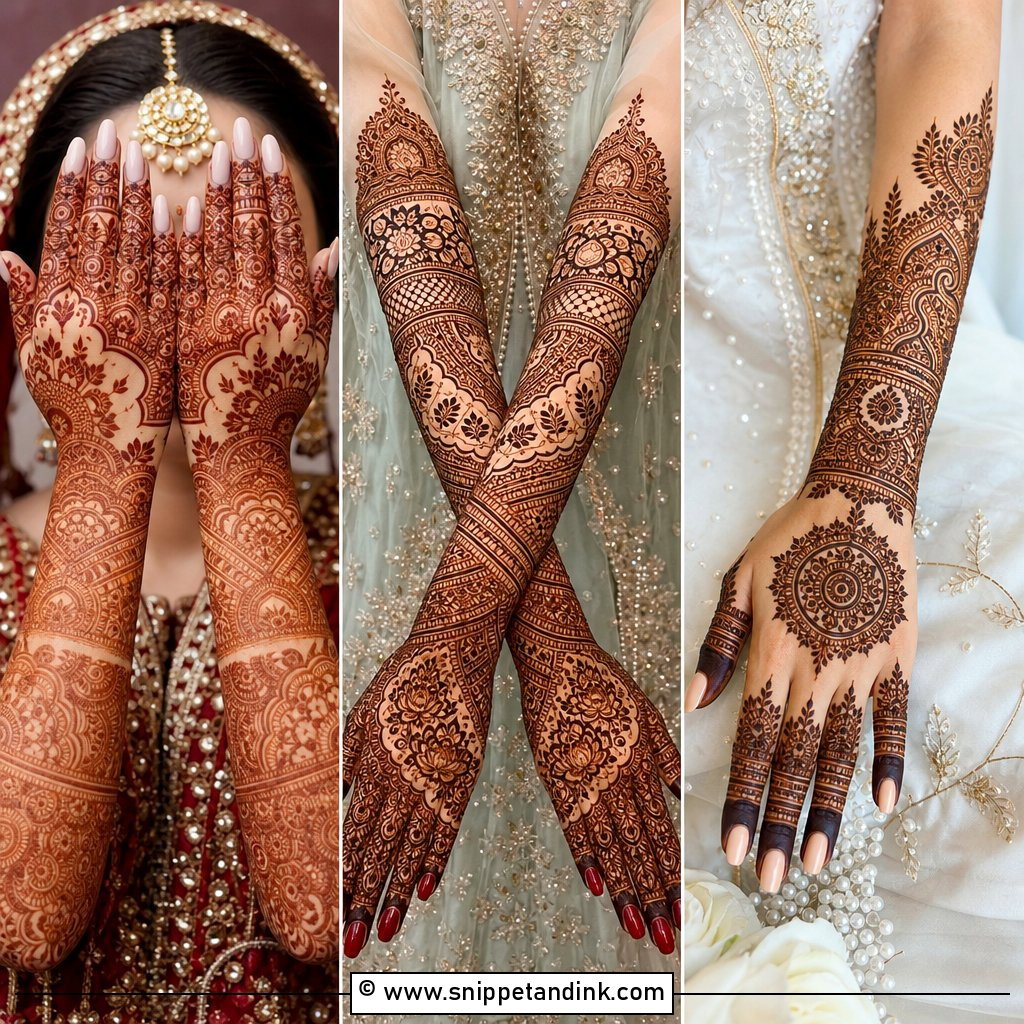
Full coverage from fingertips to forearm is the traditional bridal choice, and roses keep all that density from feeling heavy. I usually set the largest roses at the centre of the palm and back hand, then fill outward with leaves, fine vines, paisley curves and buds. The mistake I see most is every rose drawn the same size, which flattens the whole hand. Vary them: big near the centre, smaller around the wrist and fingers. Expect a full-hand bridal set to take several hours per pair of hands. It sits well with red, maroon, gold, ivory or pastel outfits.
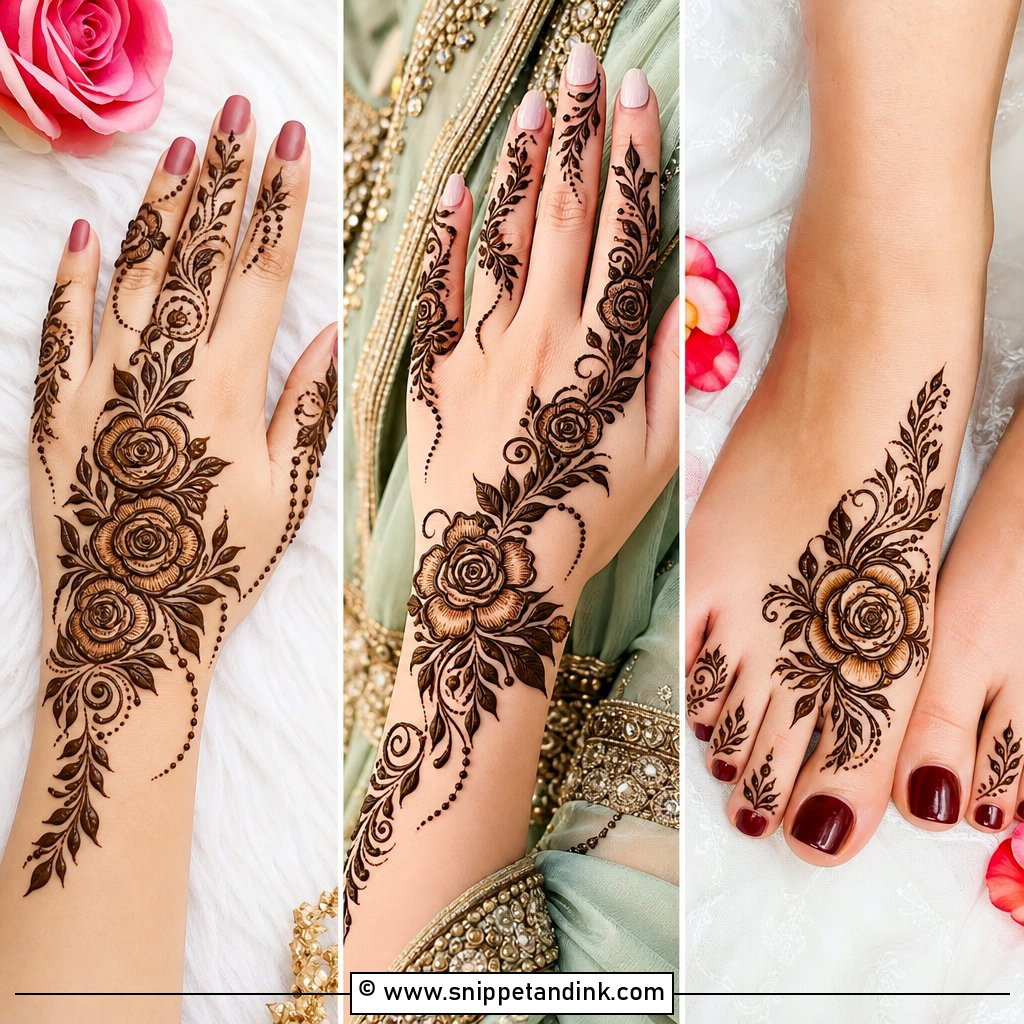
2. Arabic Bridal Rose Mehndi Design
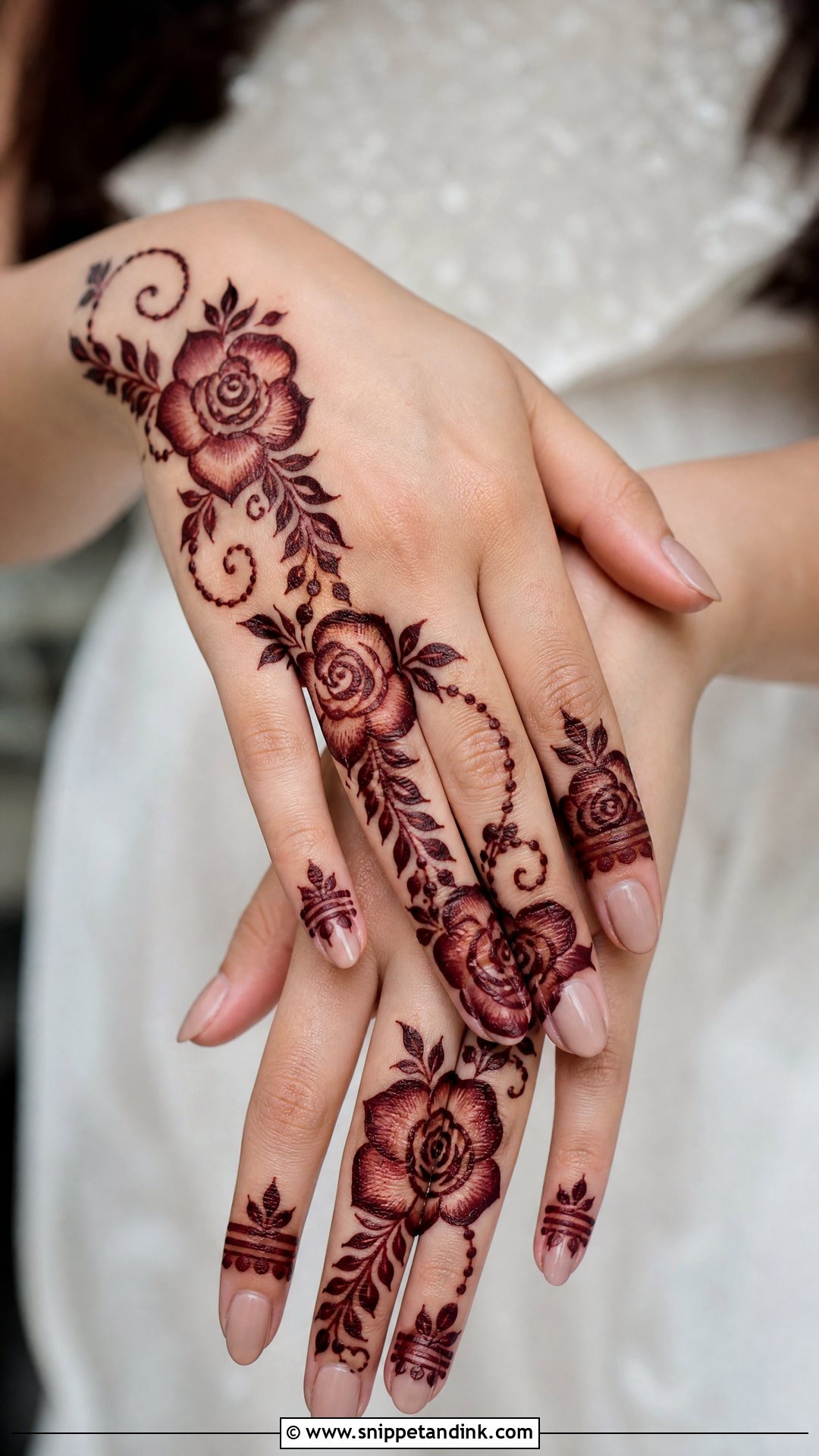
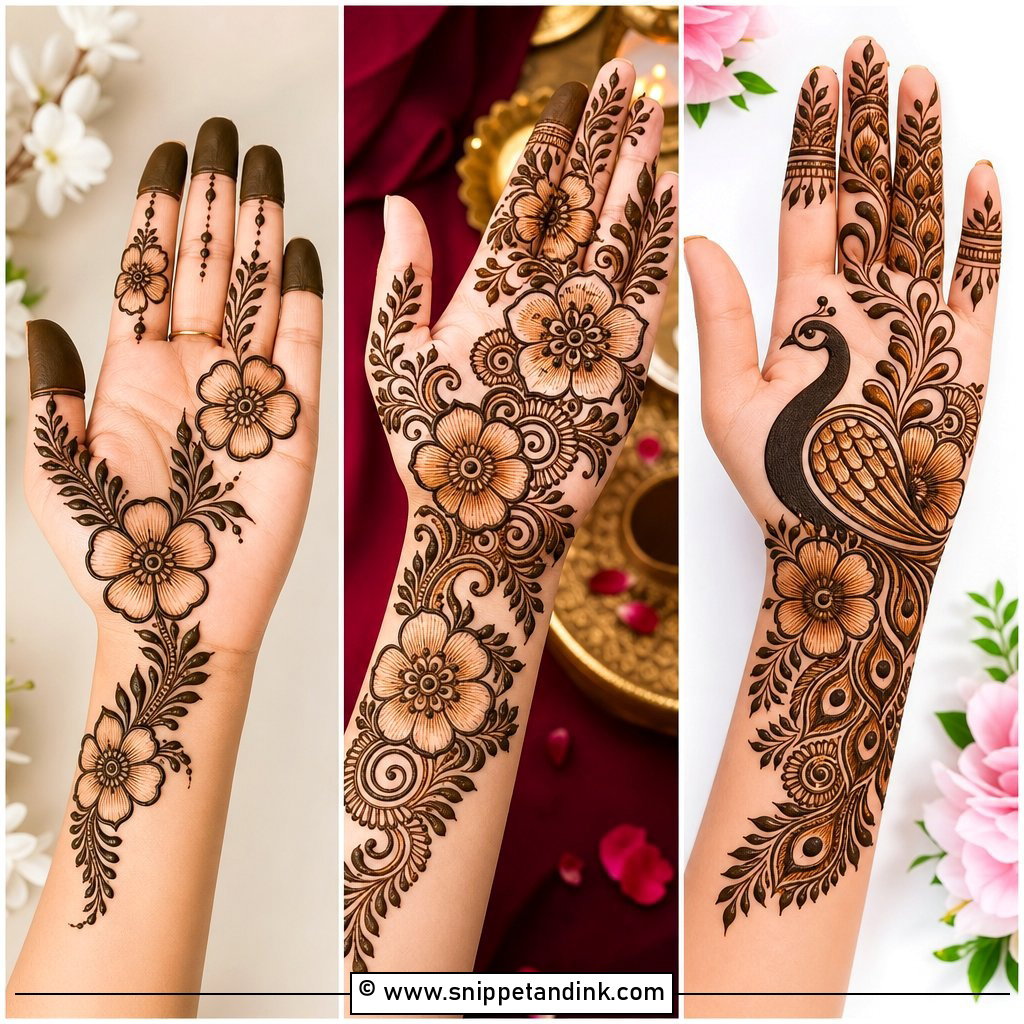
An Arabic bridal rose mehndi design runs a diagonal trail of large roses from the wrist toward the index or middle finger, with plenty of bare skin either side. Thick outlines and shaded petals are typical. Shading is done by thinning the paste into a lighter wash, so it stains a softer tone than the outline. It’s quick to apply, which makes it practical for an engagement, a nikkah or a bride with a packed schedule, and the open spacing reads clearly in photos.
3. Indian Bridal Rose Mehndi Design
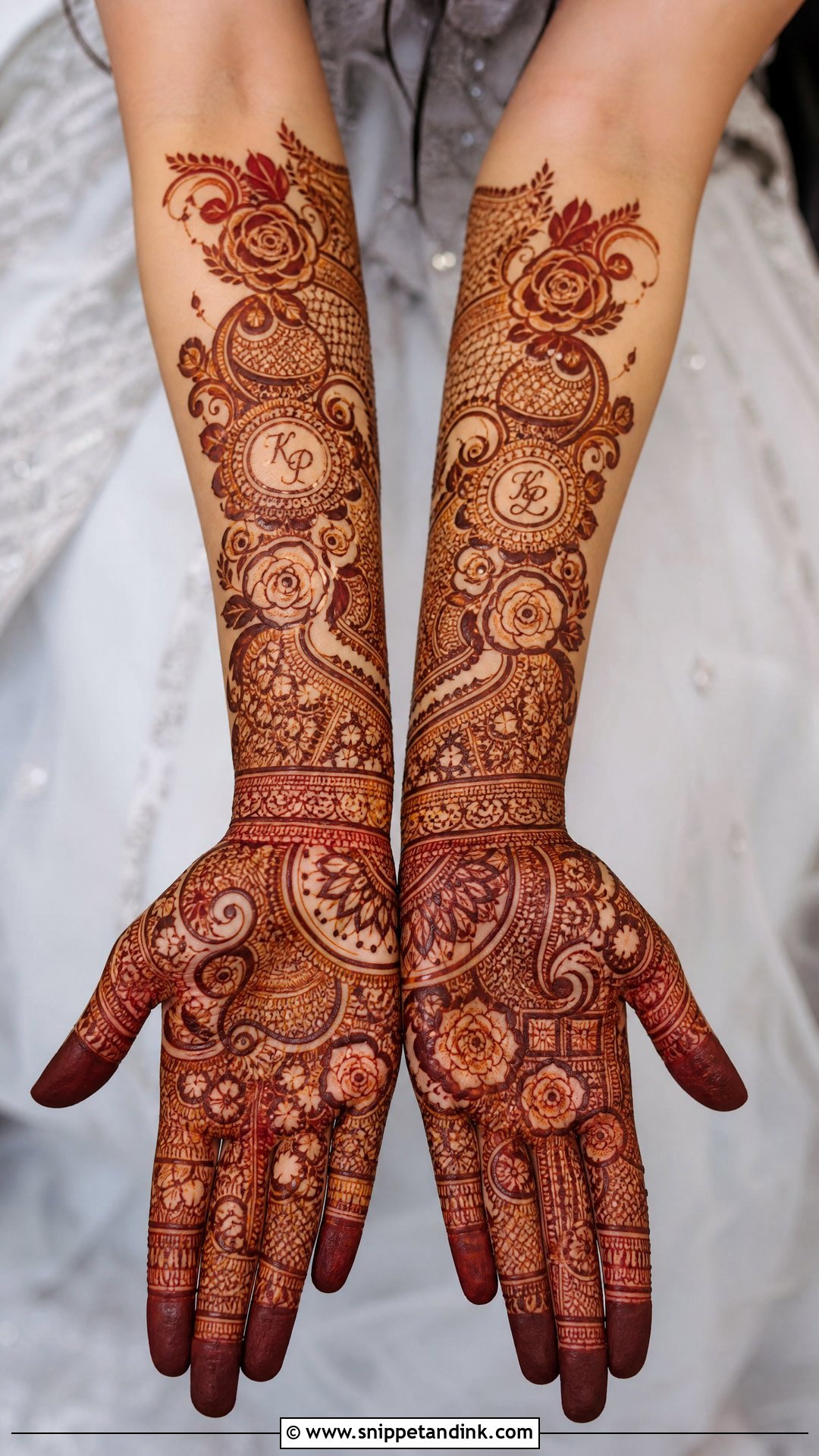
Traditional dulhan coverage meets the rose in this style: both sides of the hands, often up the forearms, with roses blended among paisleys, peacocks, mandalas, jaali and small symbols. A hidden initial or the wedding date can be tucked inside. With this much detail, I keep the roses as the main focal points and let everything else support them; otherwise the eye has nowhere to rest. Plan for a long sitting, and arrange to have someone feed you while the paste dries.
4. Indo Arabic Bridal Rose Mehndi Design
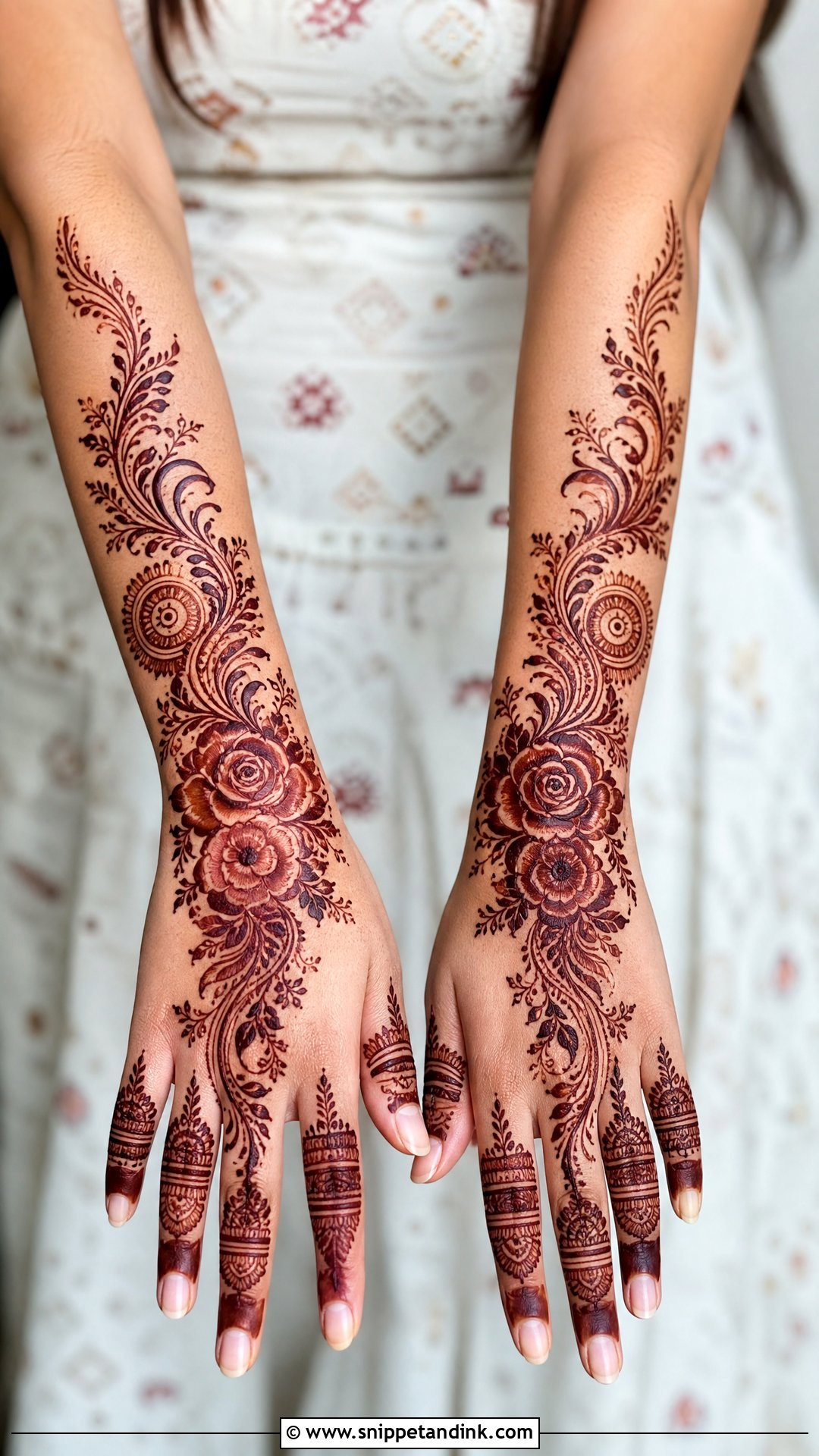
Indo-Arabic takes the bold floral flow of Arabic work and adds the fine filling of Indian mehndi. A common layout starts with a rose bouquet near the wrist, moves diagonally across the back hand and finishes with detailed fingers. Compared with plain Arabic, there are more fine lines, shaded petals, mini mandalas and leafy borders, but some negative space stays open so the roses remain readable. I’d suggest it to a bride who finds full Indian coverage too much and Arabic too sparse. Lehengas, shararas, sarees and fusion outfits all suit it.
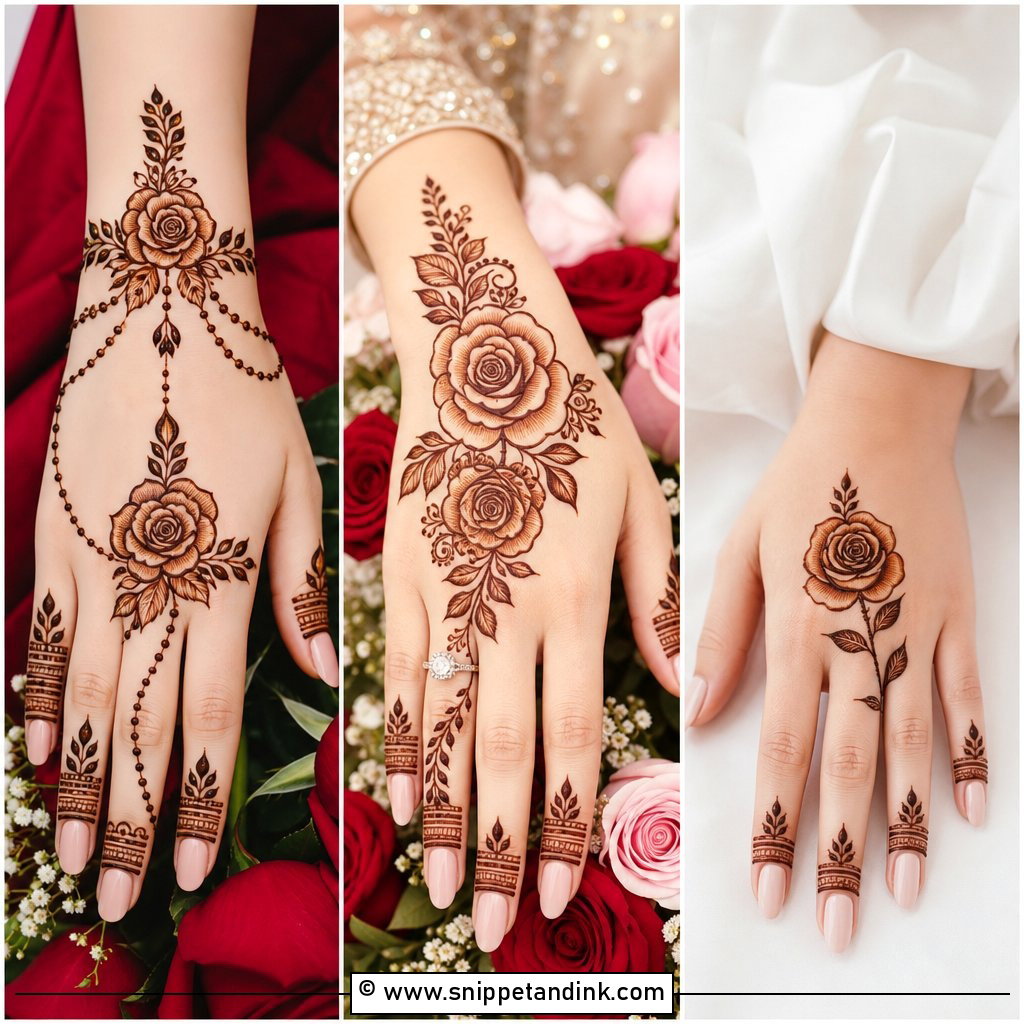
5. Bridal Rose Back Hand Mehndi Design
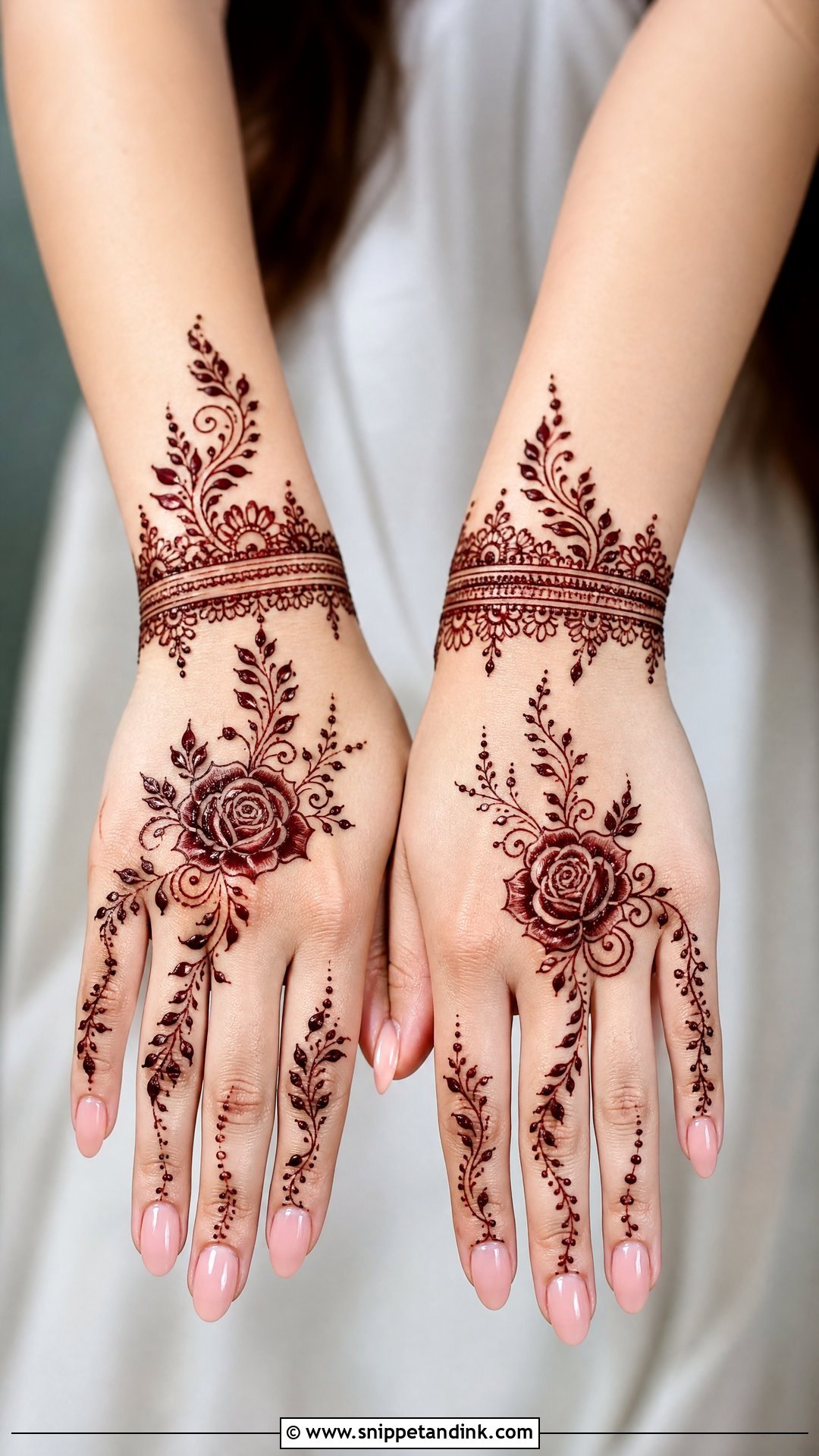
The back of the hand is what shows in ring, bangle and kaleera photos, so a bridal rose back hand mehndi design is where placement matters most. I set one large rose at the centre, then run vines toward the fingers and wrist, with cuffs, leafy chains and finger bands for a jewellery effect. Be aware that skin on the back of the hand is thinner and less absorbent than the palm, so it usually stains a shade lighter. Leaving a small gap of bare skin around the main rose gives it shape.
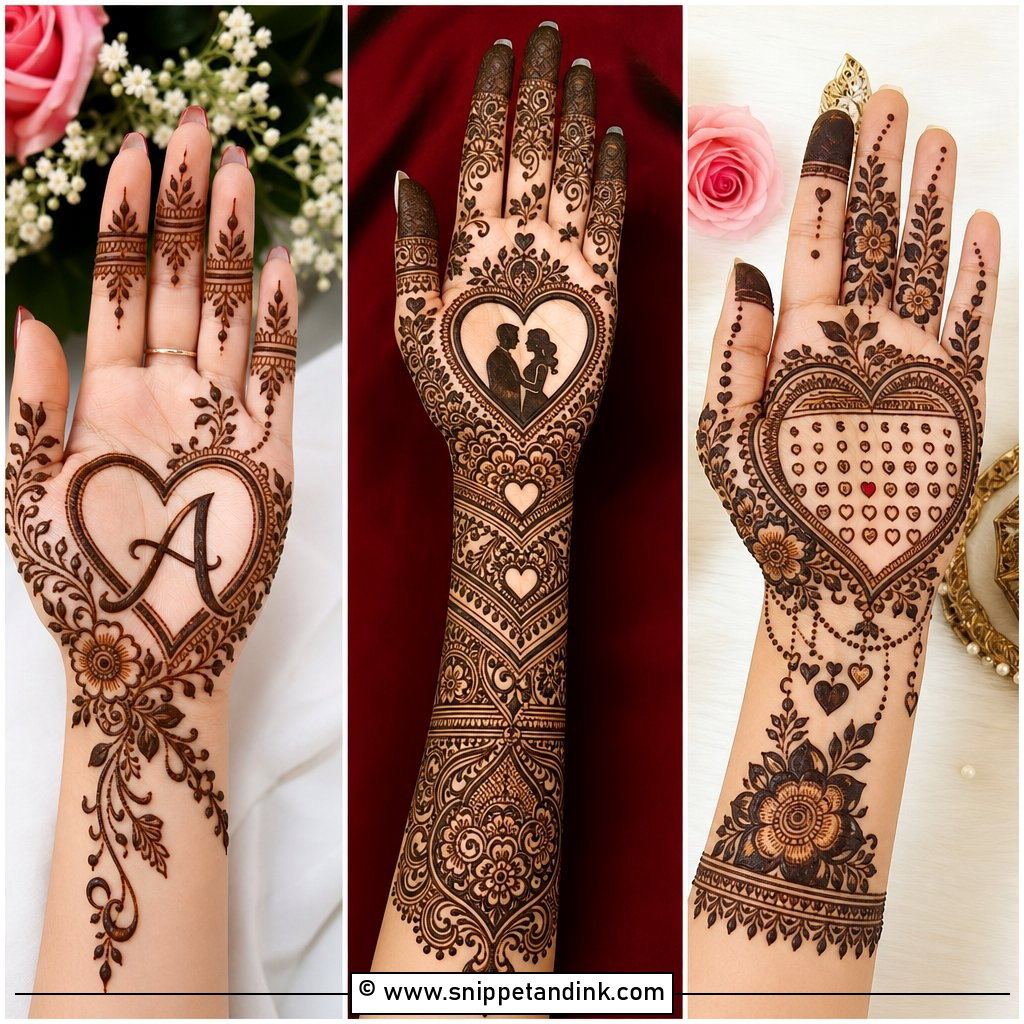
6. Bridal Rose Front Hand Mehndi Design
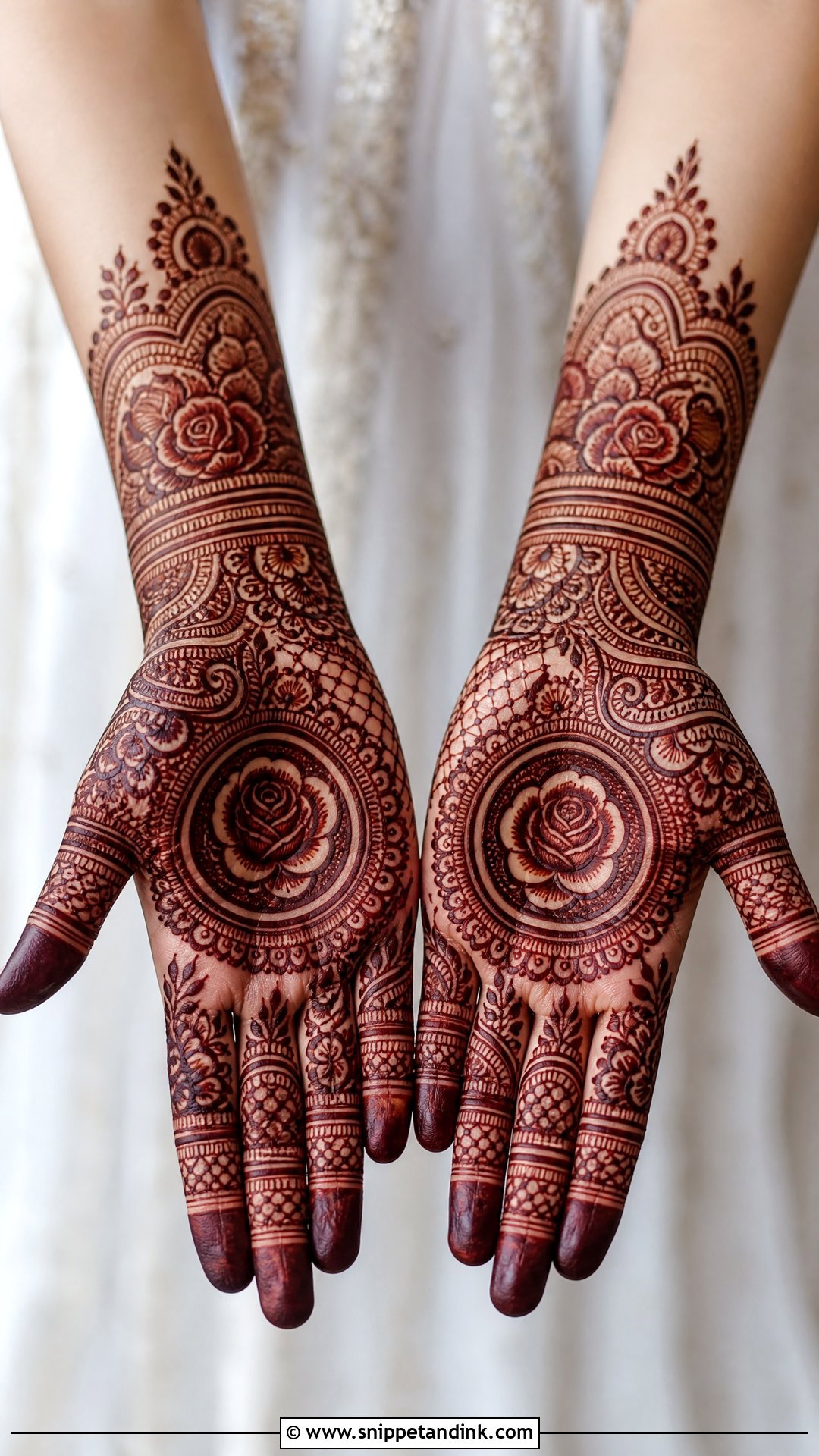
Palms take the darkest stain on the body, because the skin there is thicker and warmer, so roses drawn on the front of the hand come out rich and deep. A round rose mandala in the centre, surrounded by petals, vines, paisleys and small fillers, is the classic layout. Fingers can carry leafy lines, small roses or a net pattern. Here’s my main warning: because the palm darkens so much, I draw the petals slightly larger and more open than the fillers around them. If they’re too tight, the rose disappears once the stain develops.
7. Bridal Rose Mandala Mehndi Design
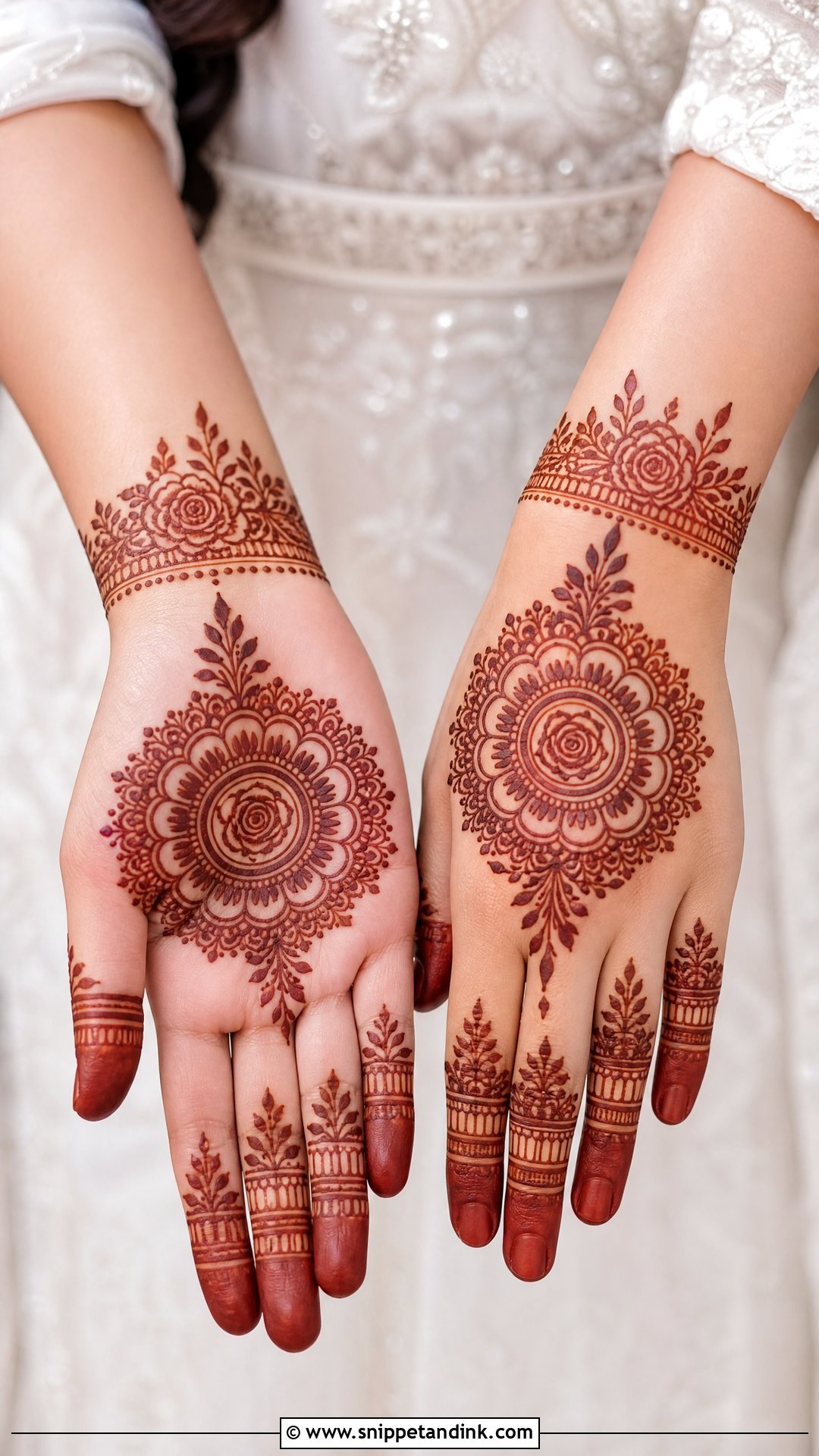
Here the centre of the mandala is built from rose petals instead of plain concentric rings. Around it go rings of dots, leaves and fine lace-like detail, extending toward the wrist with rose borders and toward the fingers with matching floral bands. Symmetry is unforgiving, so I mark the centre point and divide the circle lightly before drawing. It suits outfits with round motifs, floral embroidery or traditional jewellery, and it reads as calm and orderly on the hand.
8. Bridal Rose Jaali Mehndi Design
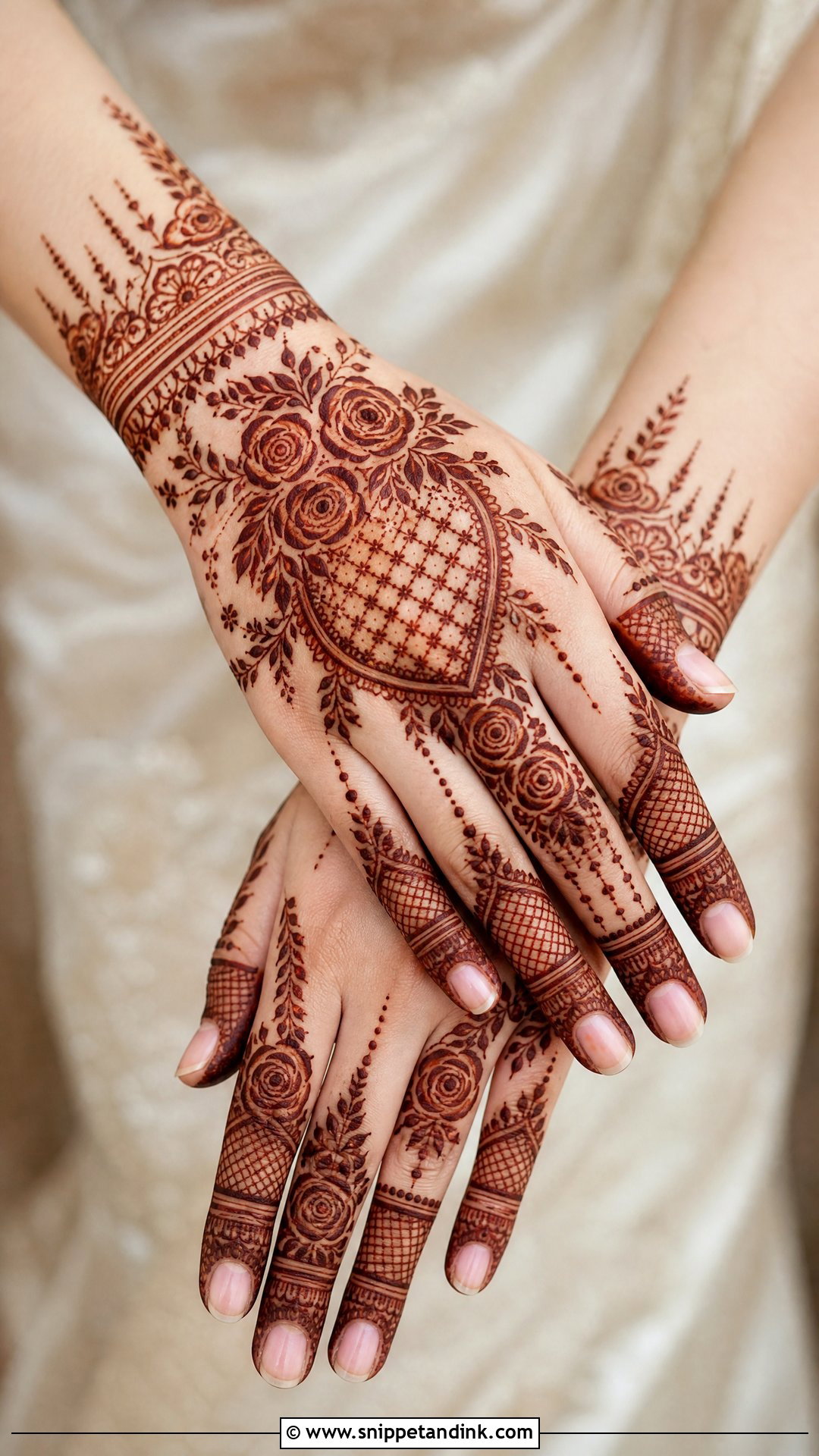
Jaali is the mesh pattern, and pairing it with roses gives the hand a look close to embroidered net fabric. Roses usually sit at the wrist, the centre and the base of the fingers, with jaali filling the spaces or forming panels around them. Tiny dots inside the mesh and leafy borders along the edges finish it. Jaali lines need to be evenly spaced and fine, because uneven mesh is the first thing anyone notices. It’s particularly good with heavily embroidered outfits, where the mesh echoes lace, net and zari work.
9. Bridal Rose Paisley Mehndi Design
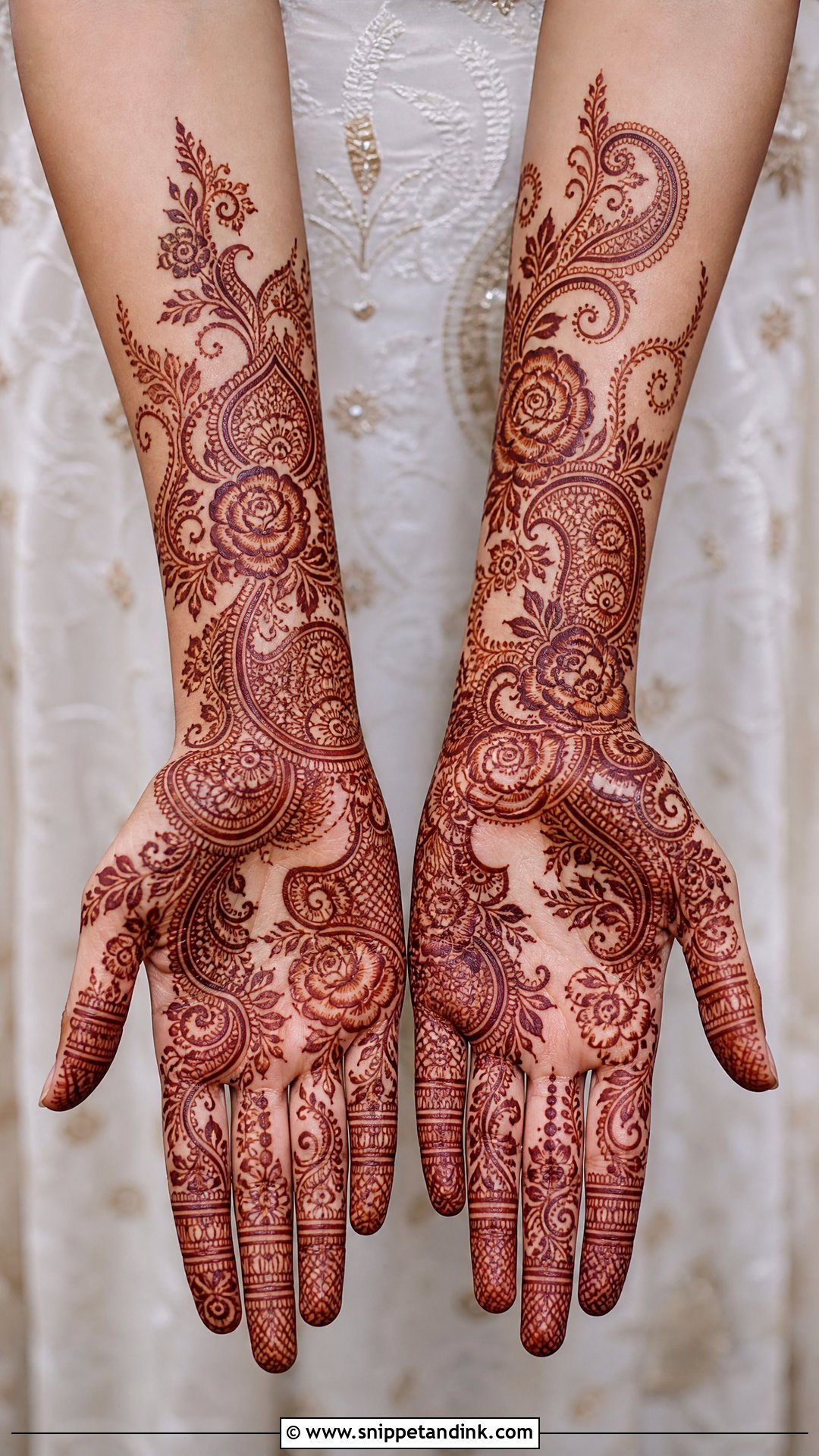
Paisleys have a long history in bridal mehndi, and a rose tucked inside one softens its curve. Roses can sit within paisley frames or flow around them like a garden vine. On the palm I’d use large paisleys with rose centres and repeat smaller versions at the wrist and fingers. Ask your artist for bold paisley outlines, because the fine petal work inside needs a strong frame to keep its structure once the stain darkens. It reads as classic Indian work with a fresh floral note.
10. Bridal Rose Peacock Mehndi Design
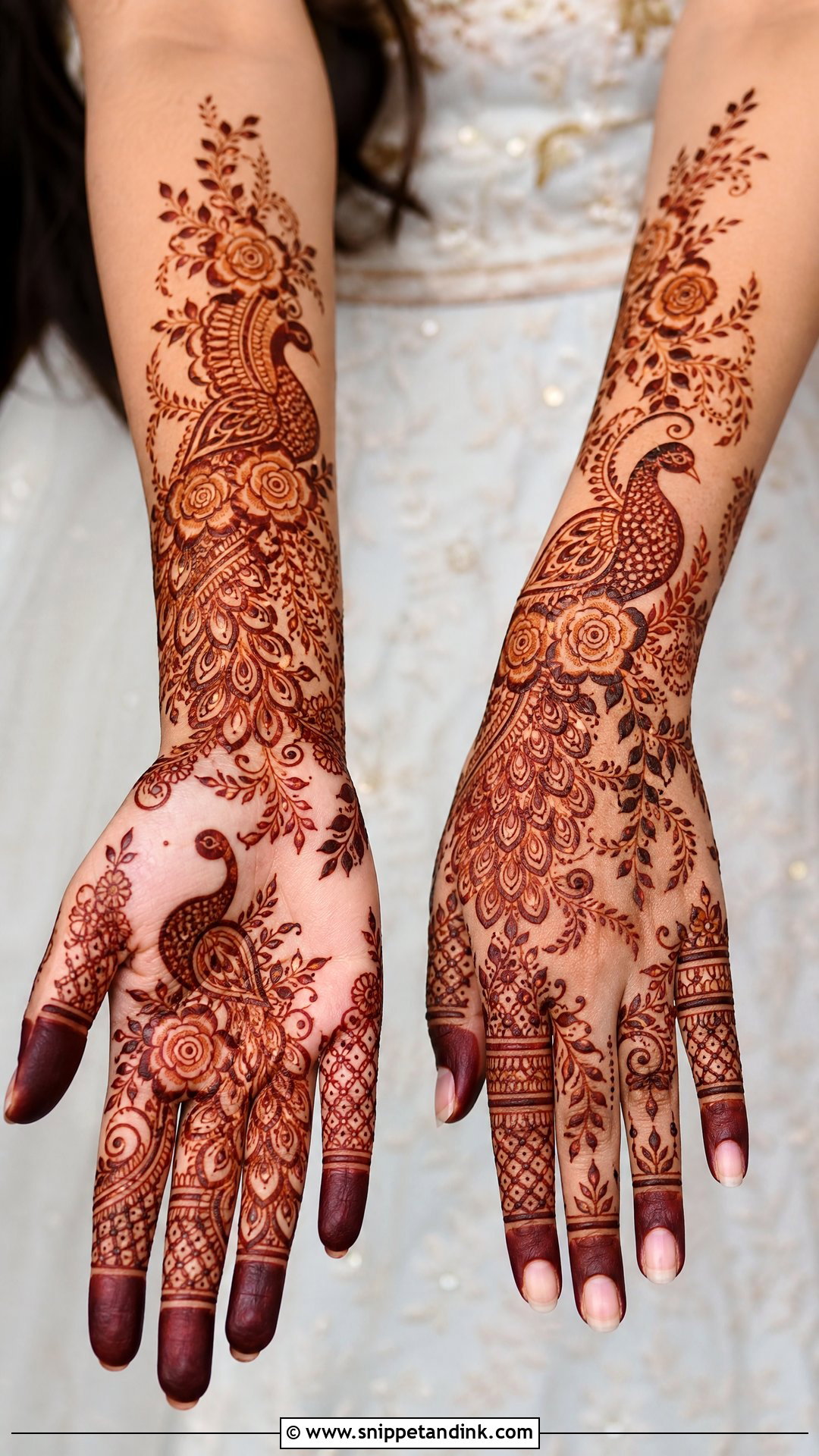
Peacocks and roses are both detailed motifs, and putting them together is where a bridal rose peacock mehndi design can tip into clutter. My rule is that one leads and the other supports. One layout puts a peacock on the palm or forearm with rose vines wrapping its feathers; another lines the wrist with roses and lets peacock feathers run toward the fingers. It suits a bride in a traditional lehenga, a silk saree or an outfit with peacock or floral embroidery.
11. Minimal Bridal Rose Mehndi Design
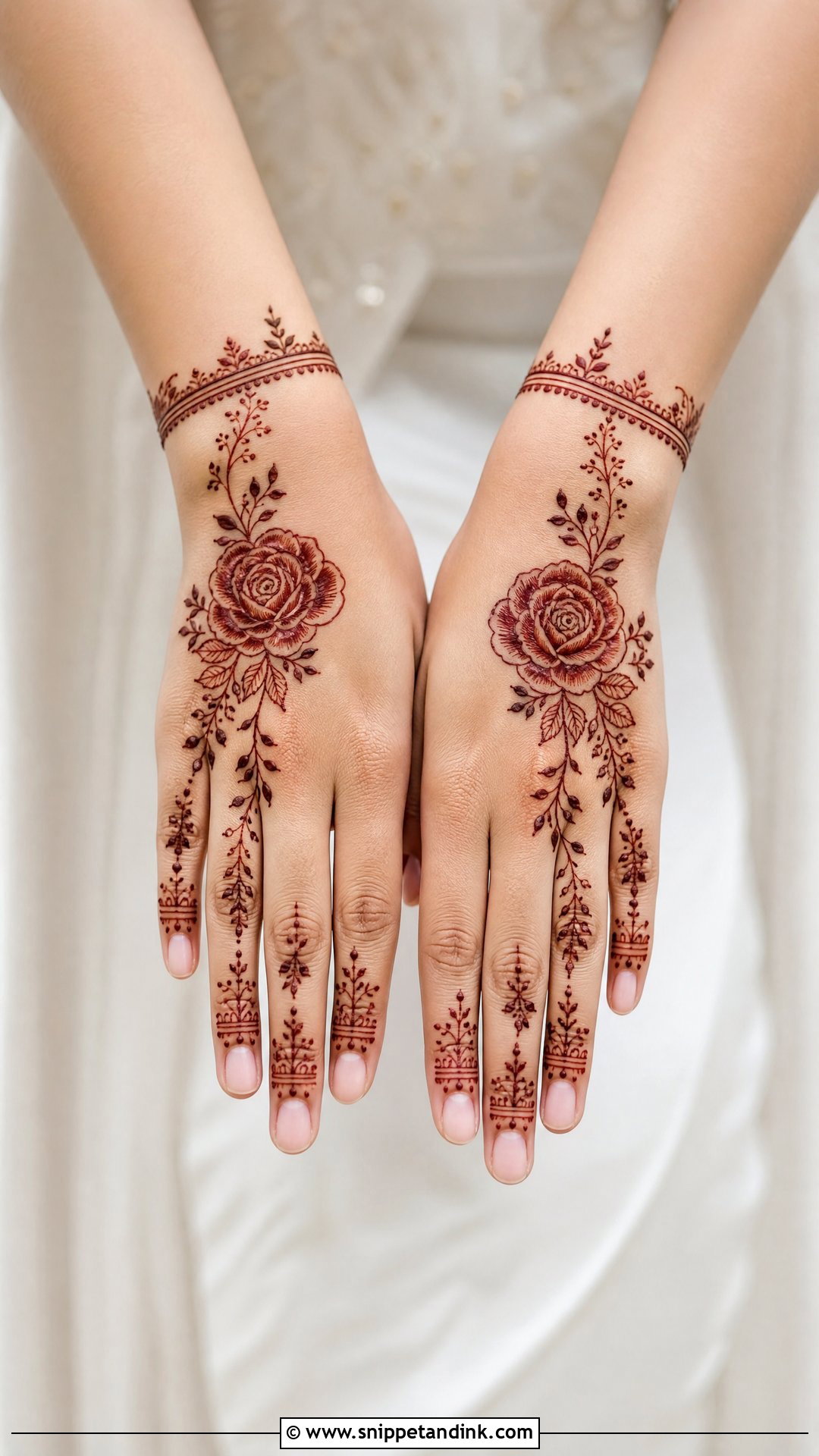
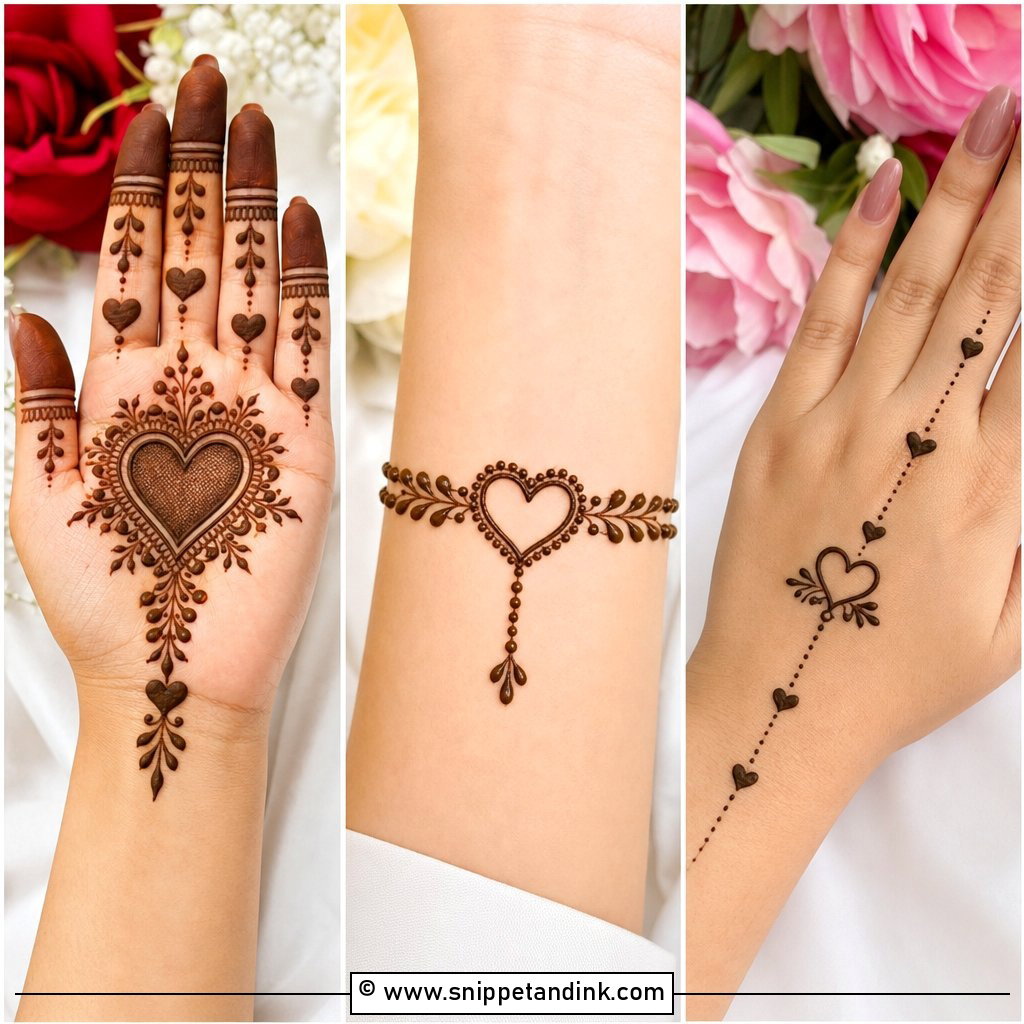
Not every bride wants heavy henna, and that’s fine. A minimal design uses one large rose or a small cluster, fine vines, clean finger details and a simple wrist border, with plenty of open skin that makes the rose look sharper. It suits courthouse and intimate weddings, engagements and brides wearing light jewellery. The risk with minimal work is that it looks casual, so I give the petals proper shading and plan the layout deliberately rather than scattering flowers. Rings and bangles stay in focus.
12. Modern Bridal Rose Mehndi Design
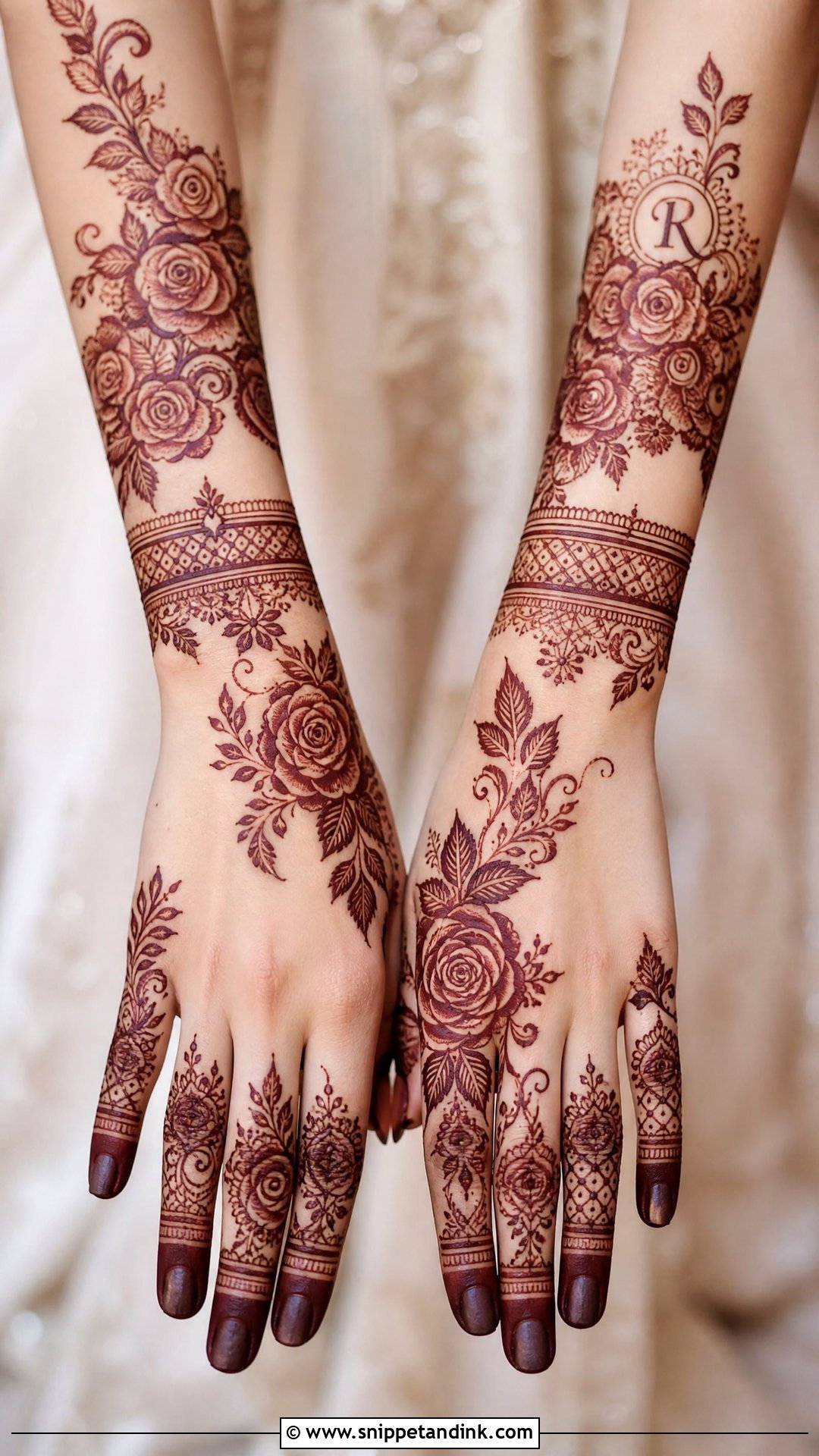
Modern layouts are about spacing. The roses might be oversized, boldly outlined or arranged asymmetrically, with slim vines, geometric borders and fine finger accents instead of dense filler. Initials or a small date near the wrist fit in quietly. Pastel lehengas, gowns and fusion outfits suit this style. It’s easy to overcrowd, so I’ll often remove one element at the end to give the roses more room. They stay crisp in person and in photos when the space around them is respected.
13. Bridal Rose Finger Mehndi Design
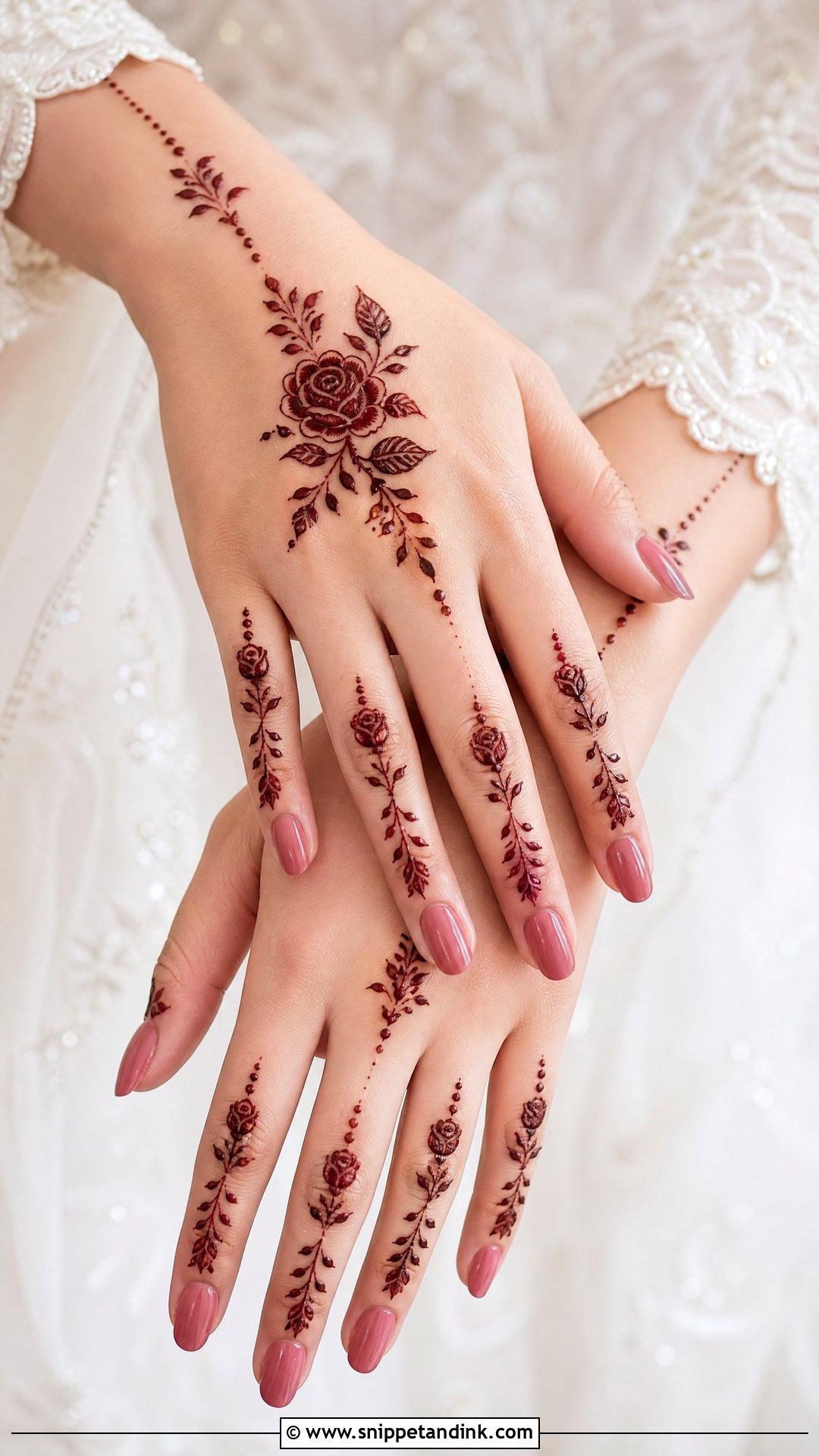
Finger-focused designs put rose buds on each finger, vines running along their length, or a central back-hand rose linked to detailed finger bands. They give an elegant hand without full coverage, and they sit well with rings, a haath phool and soft nail colours. Fingertips stain very dark, almost like the palm, so a dipped fingertip finish shows strongly. I always connect finger work to a wrist bracelet or small back-hand centrepiece; on its own, it can look unfinished.
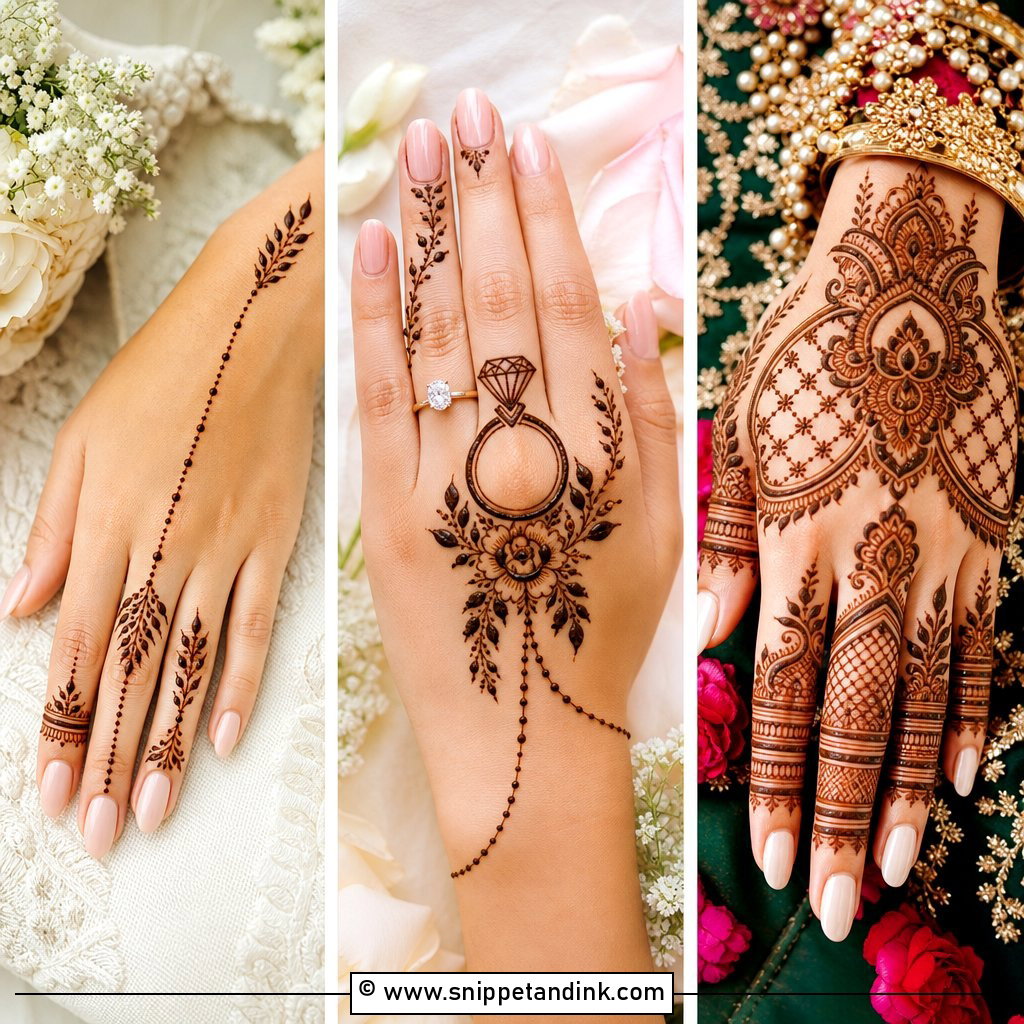
14. Bridal Rose Bracelet Mehndi Design
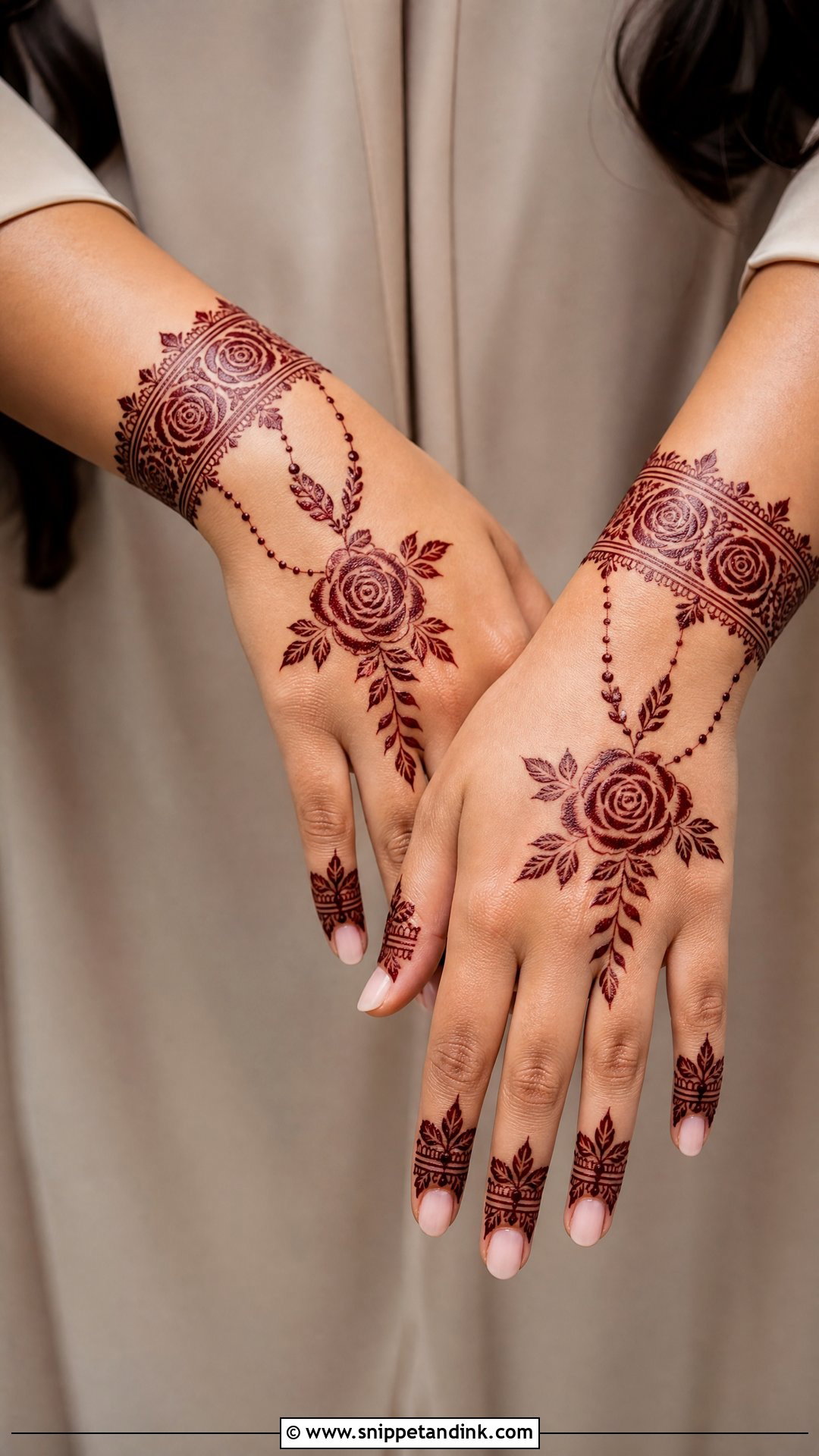
Bracelet designs mimic jewellery: a rose cuff at the wrist, chains of dots, leafy strings and a floral centrepiece on the back hand, sometimes linked to one finger for a haath phool effect. The roses can sit along the band or form the main charm. This is the design I’d suggest for a mehndi night, haldi, reception or engagement when you want something stylish but quick, since a bracelet pattern takes far less time than full coverage.

15. Bridal Rose Forearm Mehndi Design
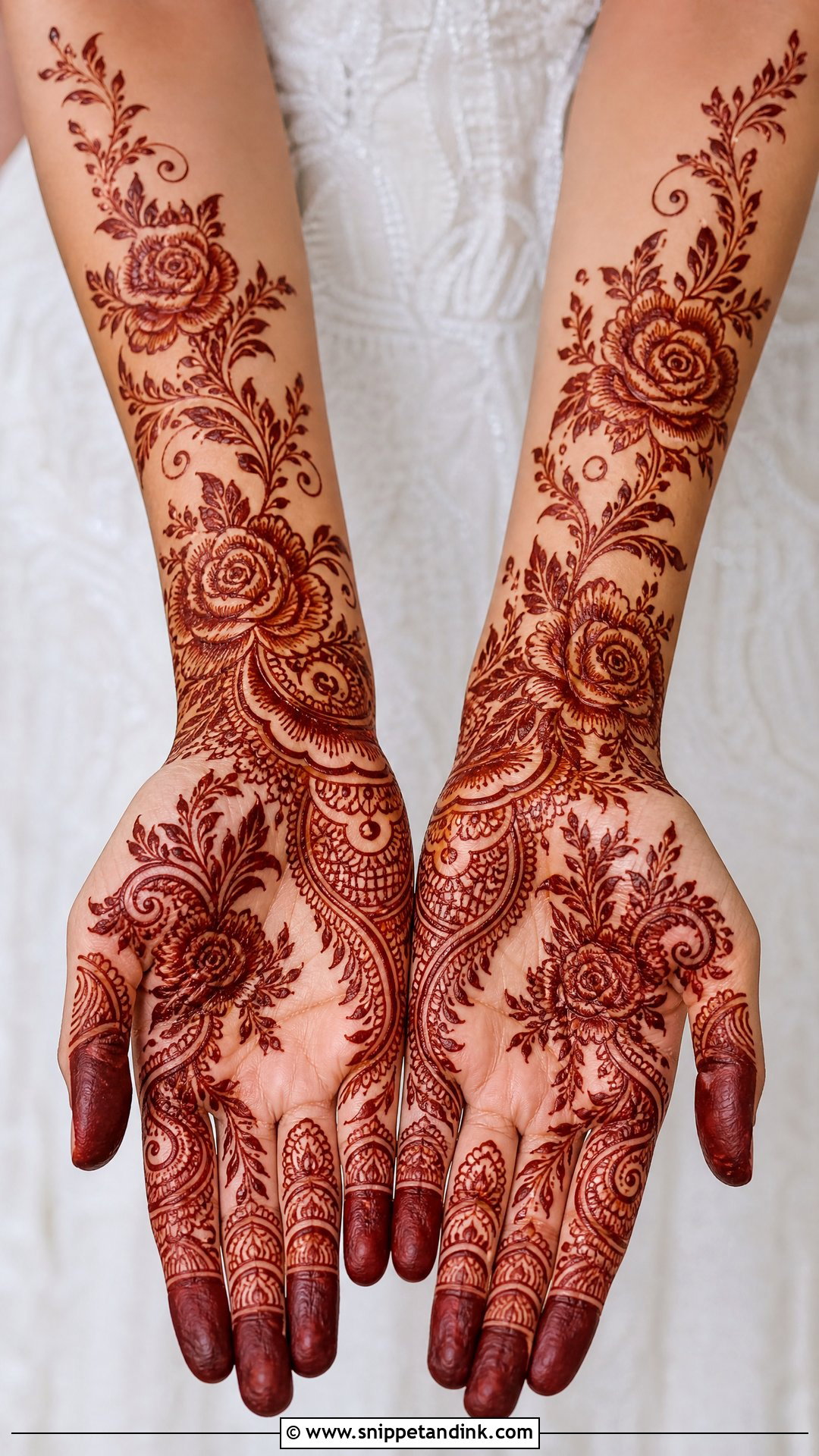
Short or sheer sleeves call for forearm work. Large roses climb from the wrist to the mid-forearm, linked with leaves, paisleys and fine filler. You can keep the palm detailed and let the forearm carry the main rose garden, or reverse it. The thing I avoid is a hard stop at the wrist; a vine that crosses the joint links hand and arm smoothly. Forearm skin stains lighter than the palm, so the colour will fade gently up the arm, which most brides like.
16. Bridal Rose Name Mehndi Design
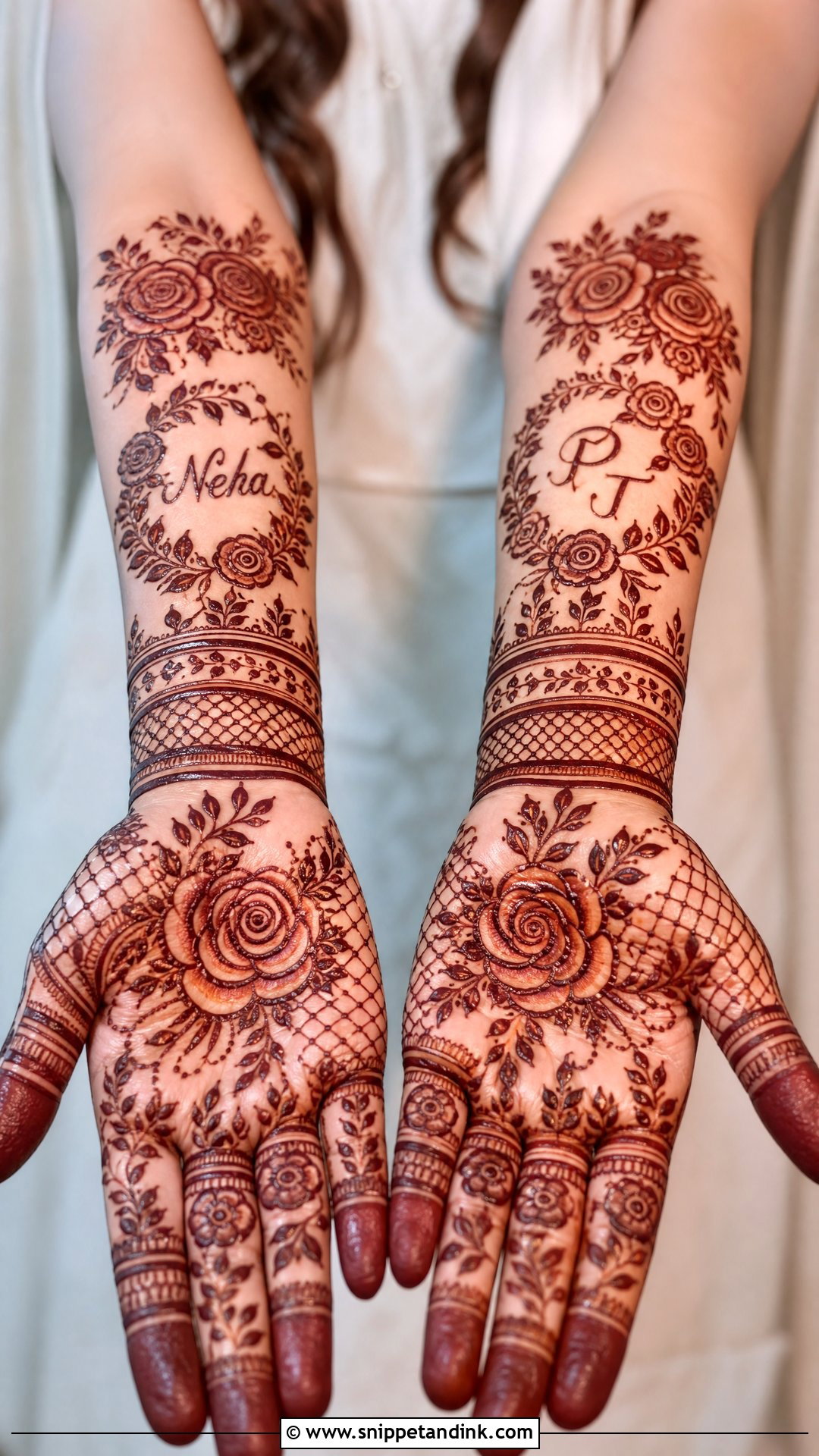
Hiding the groom’s name in the henna is a much-loved tradition, and in a bridal rose name mehndi design the letters can live inside petals, leaves, jaali gaps or wrist borders. Blend it in rather than writing it large. Write the name clearly for your artist ahead of time, with the spelling and the script you want, because getting it wrong on the day is no fun to fix. Guests searching for the hidden name is part of the fun, so make it findable but subtle.
17. Bridal Rose Bouquet Mehndi Design
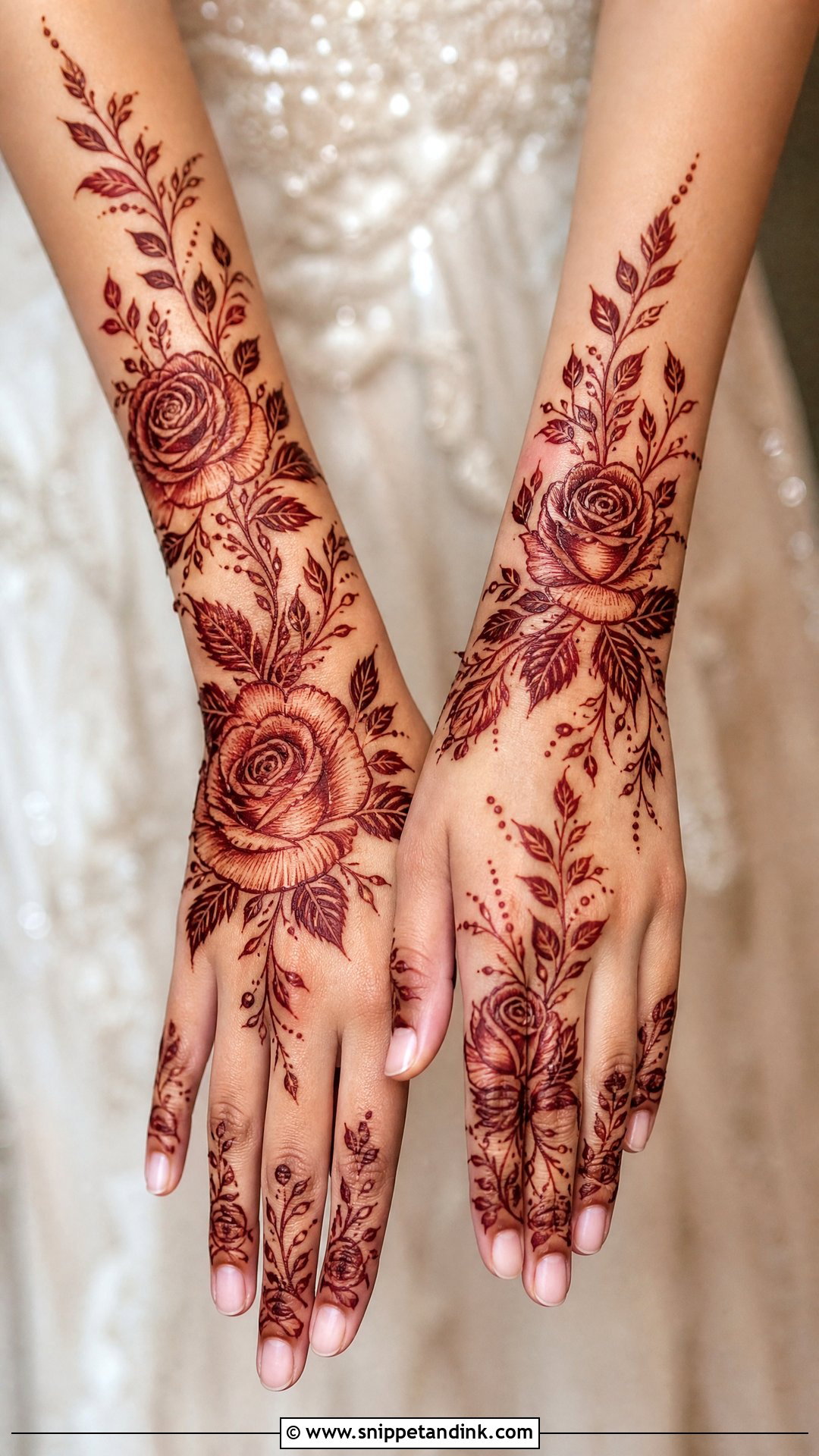
Clusters of roses, buds and leaves arranged like a hand-tied bouquet can sit on the back hand, palm or wrist, with stems extending toward the fingers or forearm. It suits floral wedding themes, fresh flower jewellery, pastel outfits and soft makeup. The design falls apart if every flower is the same size, so I mix large, medium and bud-sized roses with clear gaps between the leaves. It should feel like one arrangement, not separate flowers dropped on the skin.
18. Bridal Rose Vine Mehndi Design
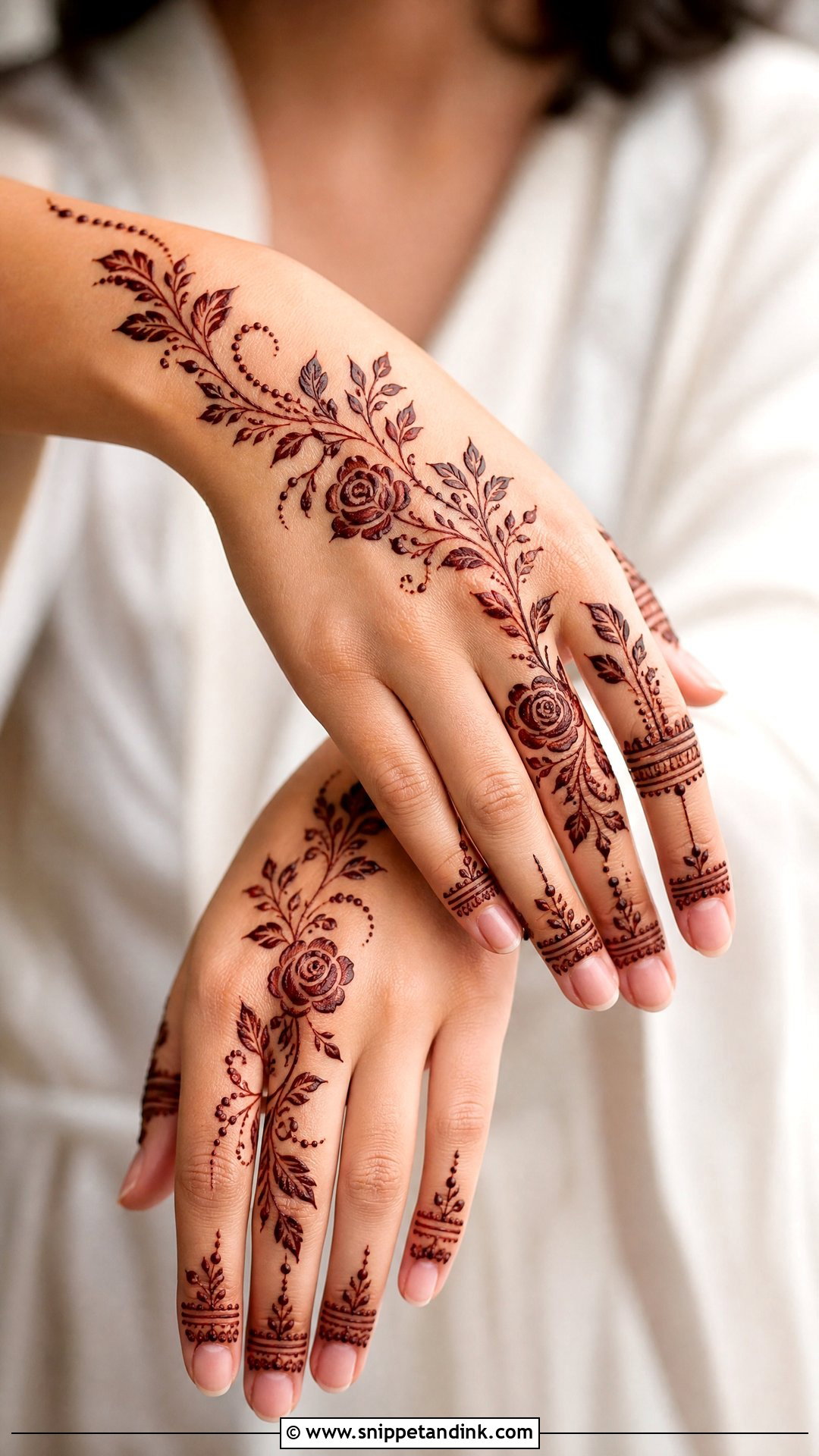
A vine is the simplest way to make a hand look longer. Starting at the wrist, it travels across the back hand toward the fingers, or wraps around the palm and forearm, with roses at natural intervals and leaves and buds filling the movement. That’s why I suggest it to brides wanting a slim, elongated look for the hands. It can be airy or dense. Add finger bands, a wrist border and a few filler dots to make it bridal.
19. Bridal Rose Feet Mehndi Design
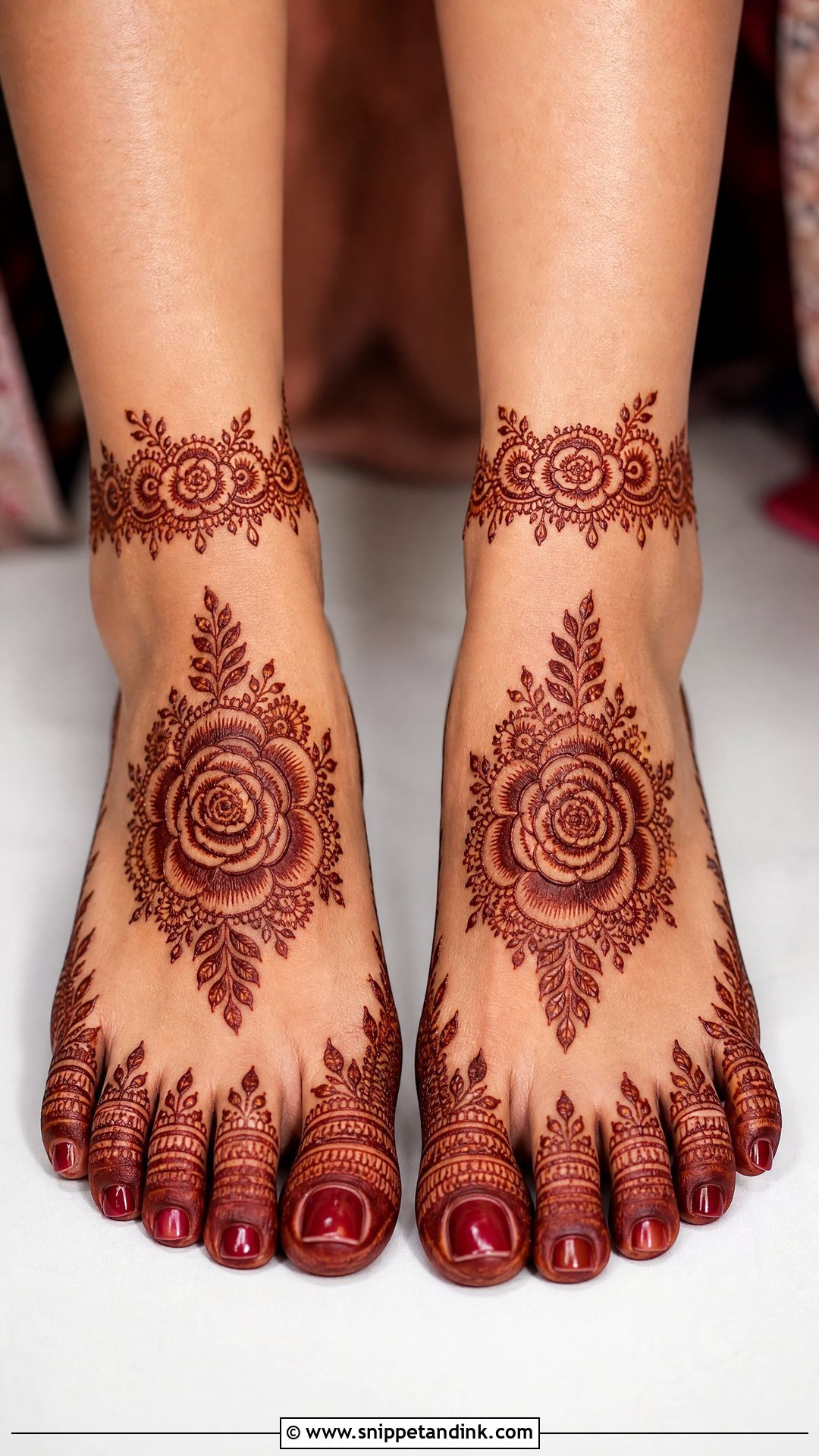
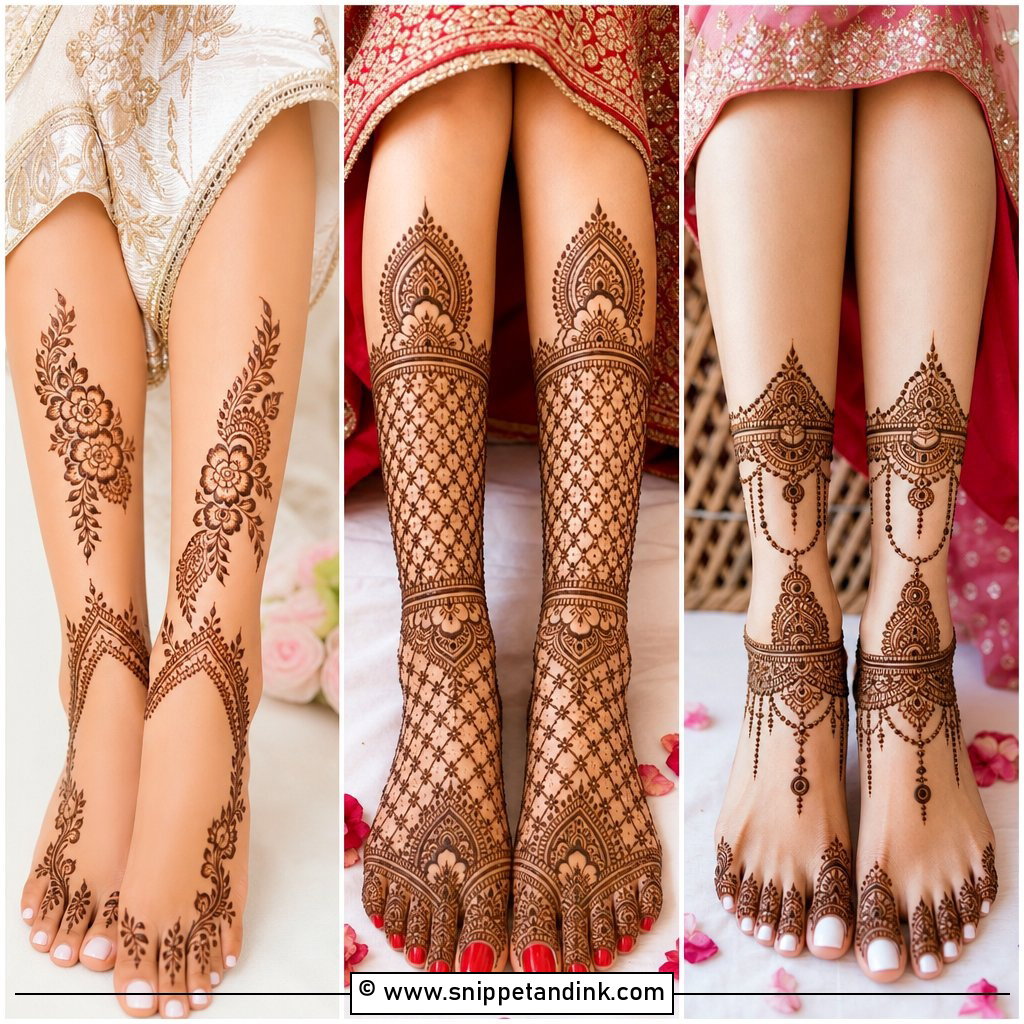
Feet are usually done for traditional ceremonies, and roses on the tops of the feet, around the ankles or near the toes like anklets match the hand work. A fuller version adds rose mandalas, leafy side borders and detailed toes. Feet are photographed from further away, so I draw the roses slightly bolder there. Feet also stain darker than you might expect, since the skin is thicker and they stay warm in socks. Matching motifs between hands and feet makes the whole set feel planned.
20. Bridal Rose Leg Mehndi Design
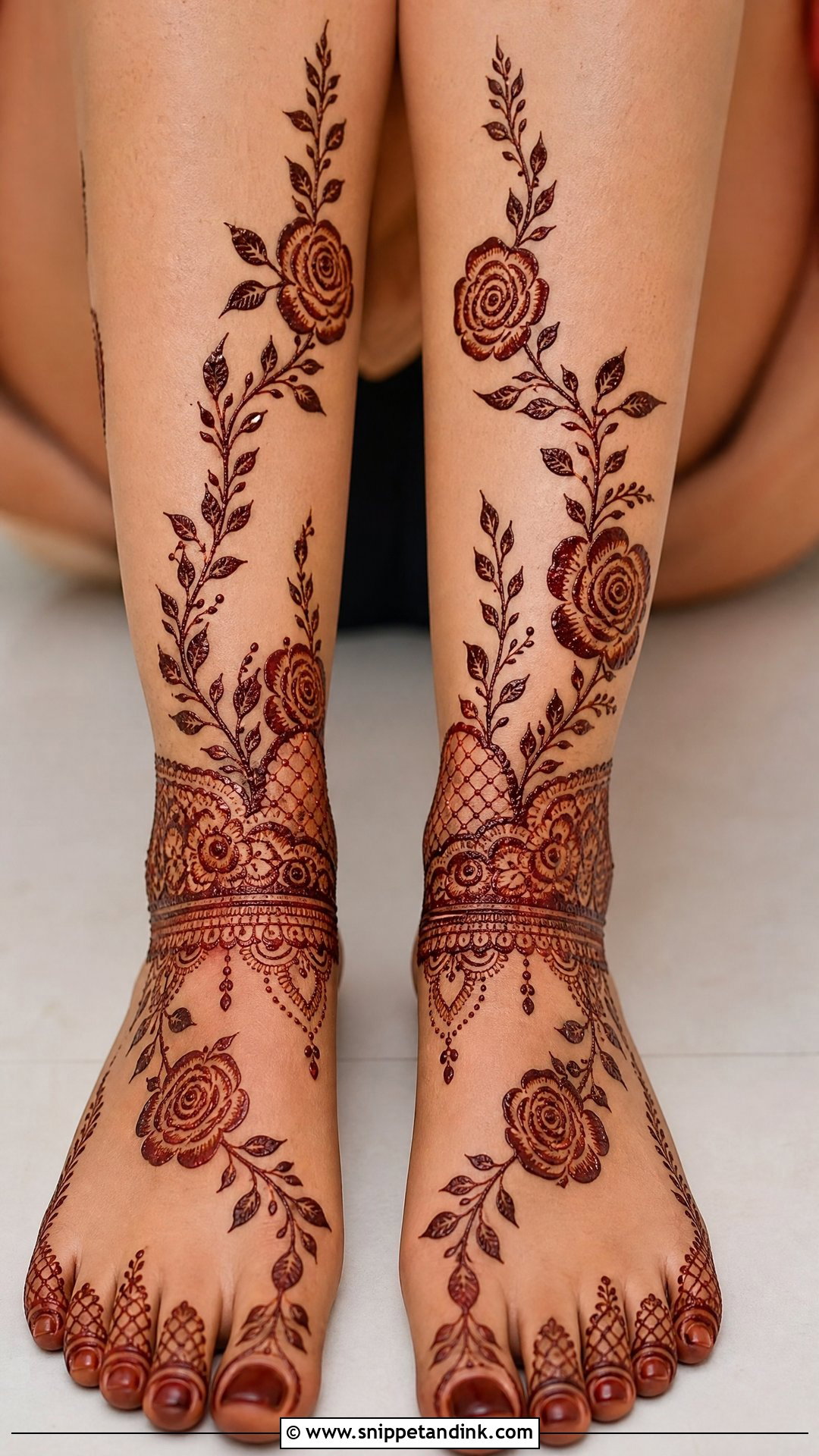
Leg designs begin at the toes, move over the foot and climb toward the ankle or calf with rose vines, floral cuffs and borders. They suit brides whose lehenga hem lifts in photos or ceremonies where the feet and lower legs show. Bold roses with delicate support detail work best, and repeating jaali, paisley or leafy trails from the hands ties the set together. Lower-leg skin stains lighter than the feet, and it needs a long sitting time, so schedule it with your hands for one session rather than two.
The Forty-Eight Hours After the Cone Comes Off
Natural henna starts out orange when the paste comes off and deepens over the next day or two toward reddish brown. That’s why I schedule bridal mehndi one or two days before the wedding, so the colour peaks on the day itself rather than the day after.
While the paste is on
Leave it as long as you comfortably can, ideally six to eight hours or overnight. A light dab of lemon and sugar keeps the paste moist and stuck to the skin. Keep your hands warm, since cold skin stains less deeply. Wrapping the hands loosely in tissue overnight helps.
Once it comes off
- Scrape the dried paste off with a blunt edge; don’t wash it off.
- Keep water away for as long as possible, ideally the rest of the day.
- A thin coat of balm or a little oil helps protect the design from water.
- Skip exfoliating scrubs, waxing, chlorine and harsh hand soaps until after the wedding.
Fingertips and palms stain darkest; the backs of the hands, forearms and legs come out lighter. That’s normal, and good artists plan the design with it in mind.
How Much Rose Do You Want on Your Hands?
Roses bend to almost any style: traditional, modern, bold or barely there. They pair with mandalas, paisleys, jaali, peacocks, vines, bracelets and hidden names, and they work from the palm to the calf. When you decide, think about your outfit, your jewellery, how many hours you can sit still and how much coverage you actually enjoy looking at. A layout with open space around each rose will always stain and photograph more clearly than a crowded one. Bring a few pictures you love to your artist and let them adapt the roses to your hands.
You'll Like These Ideas:





Leave a Reply