
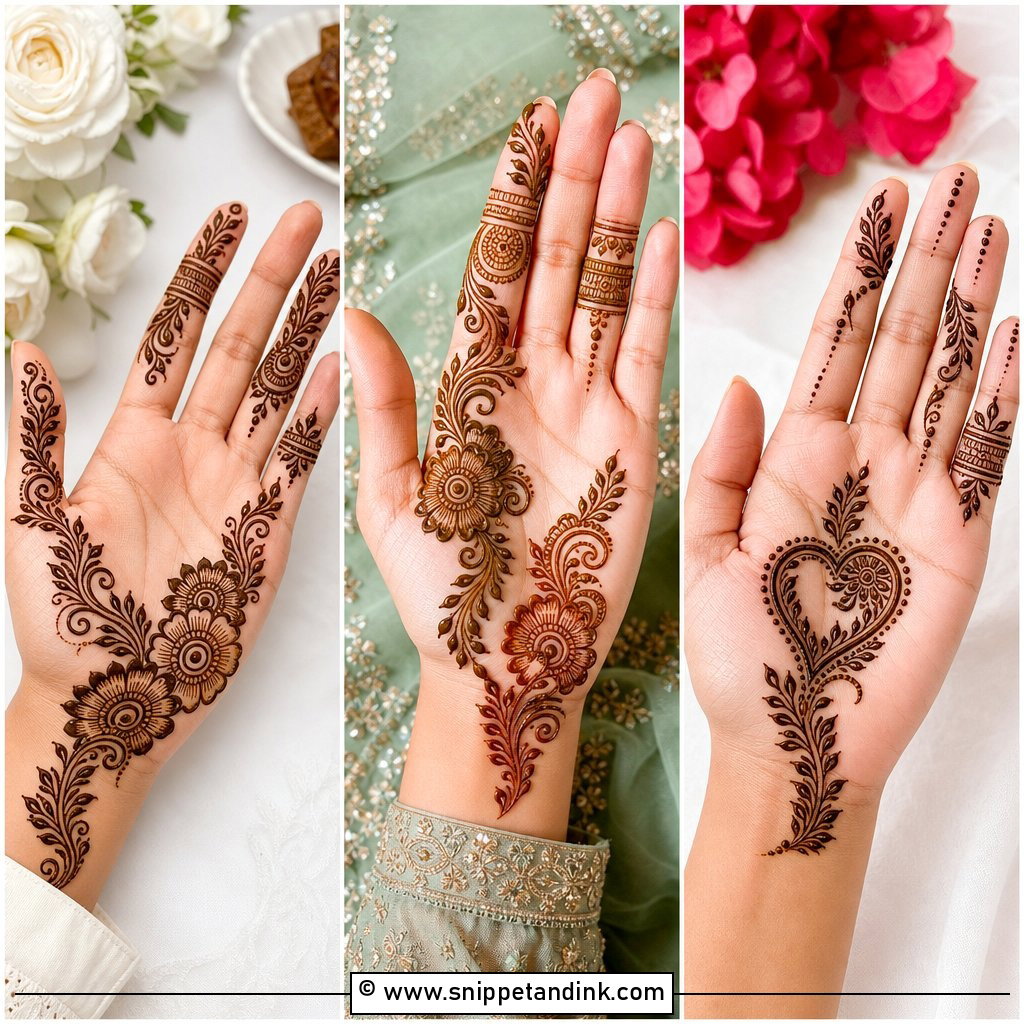
Arabic mehndi is the style I reach for when a bride wants her hands decorated but still wants to see skin. The whole look rests on a diagonal trail, bold outlines and deliberate gaps, so it reads clearly from across a room and stays crisp up close. Below are 35 layouts, from a single vine on the back of the hand to fuller bridal coverage, with notes on how each one behaves once the paste comes off. If you want more to compare, I keep a separate set of elegant Modern Arabic Mehndi Designs that leans toward lighter coverage.
How I Plan an Arabic Trail Before the Cone Touches Skin
Arabic layouts look loose, but the good ones are planned. Before I pipe anything, I check which hand will hold the ring in photos, where the jewellery will sit, and how the bride rests her hands without thinking. The trail follows the hand’s own diagonal, from the outer wrist toward the index or middle finger, because that line lengthens the fingers and still reads when the hand is half closed.
- The focal motif goes low. The largest flower or paisley sits near the wrist and everything gets smaller as it climbs. Reverse that and the hand looks top-heavy.
- Negative space is drawn, not left over. I decide where the bare skin will be before adding any filler, so the gaps look like part of the pattern.
- Outlines are bolder than they seem to need. Thin lines fade first, and an Arabic design relies on its outlines to read from a distance.
- Both hands get discussed up front. Mirrored hands look formal; a full trail on one hand with a lighter echo on the other looks more modern.
Bring photos of your outfit and jewellery to the appointment, not only henna pictures. A hand chain or a stack of bangles covers part of the back of the hand, and I’d rather put the detail where people will actually see it.
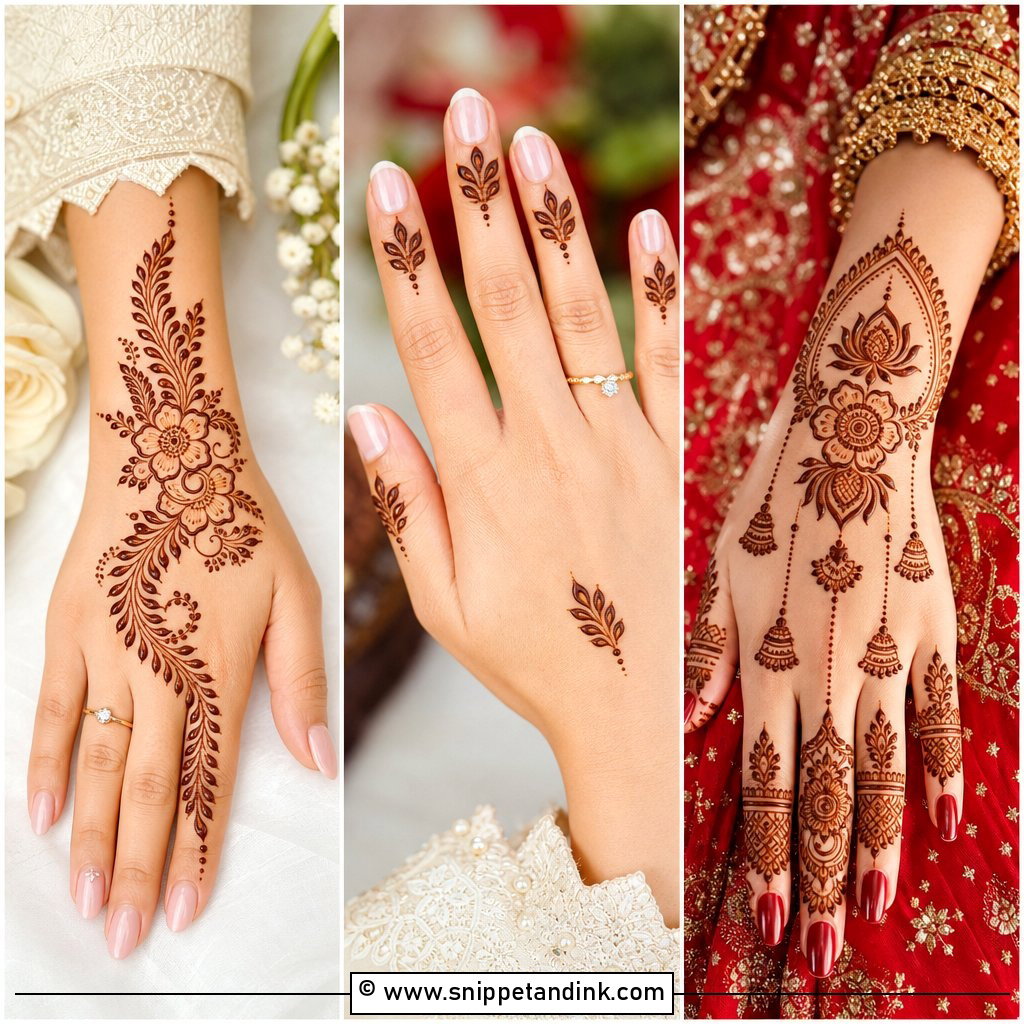
1. Arabic Back Hand Mehndi Design
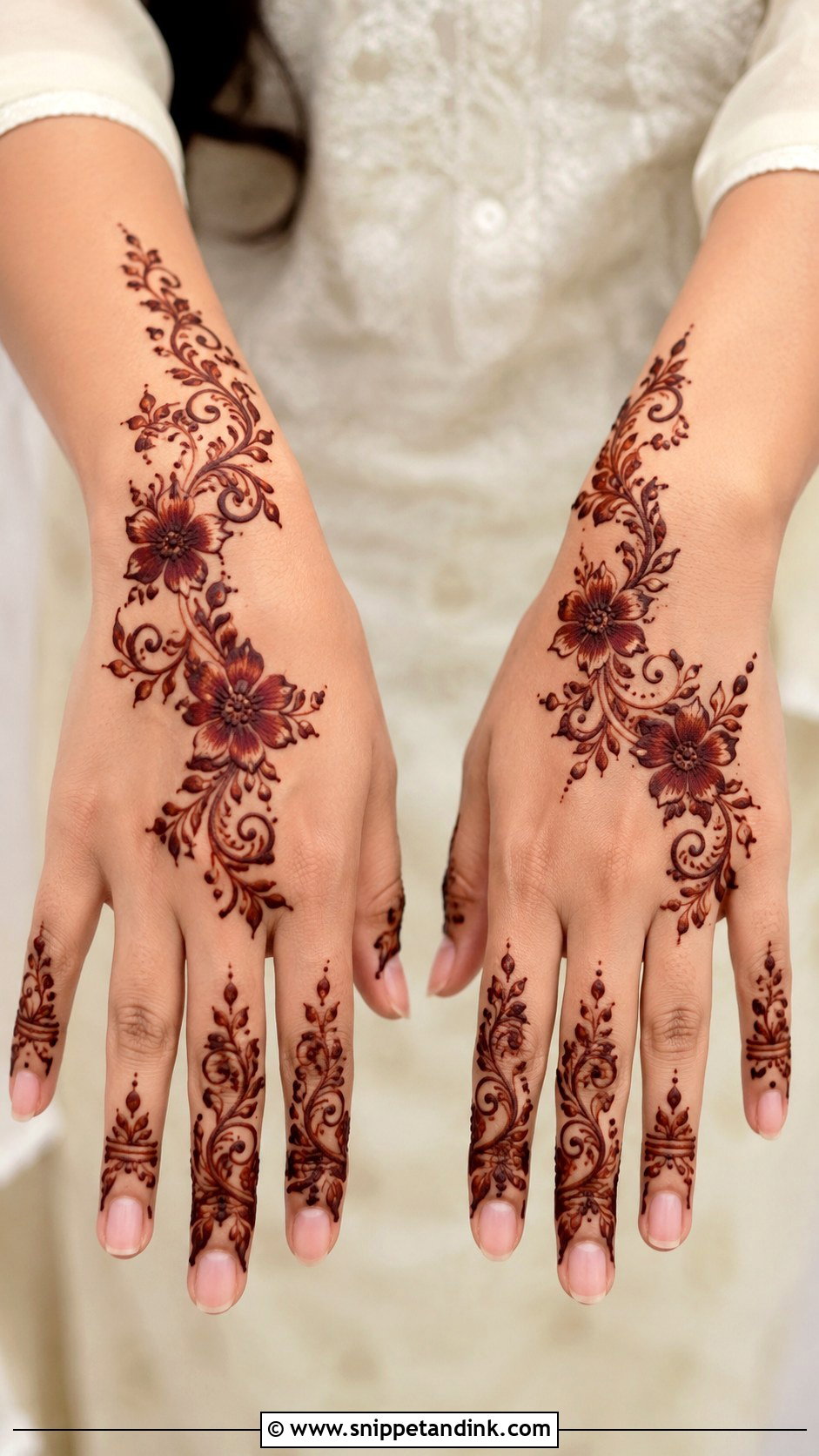
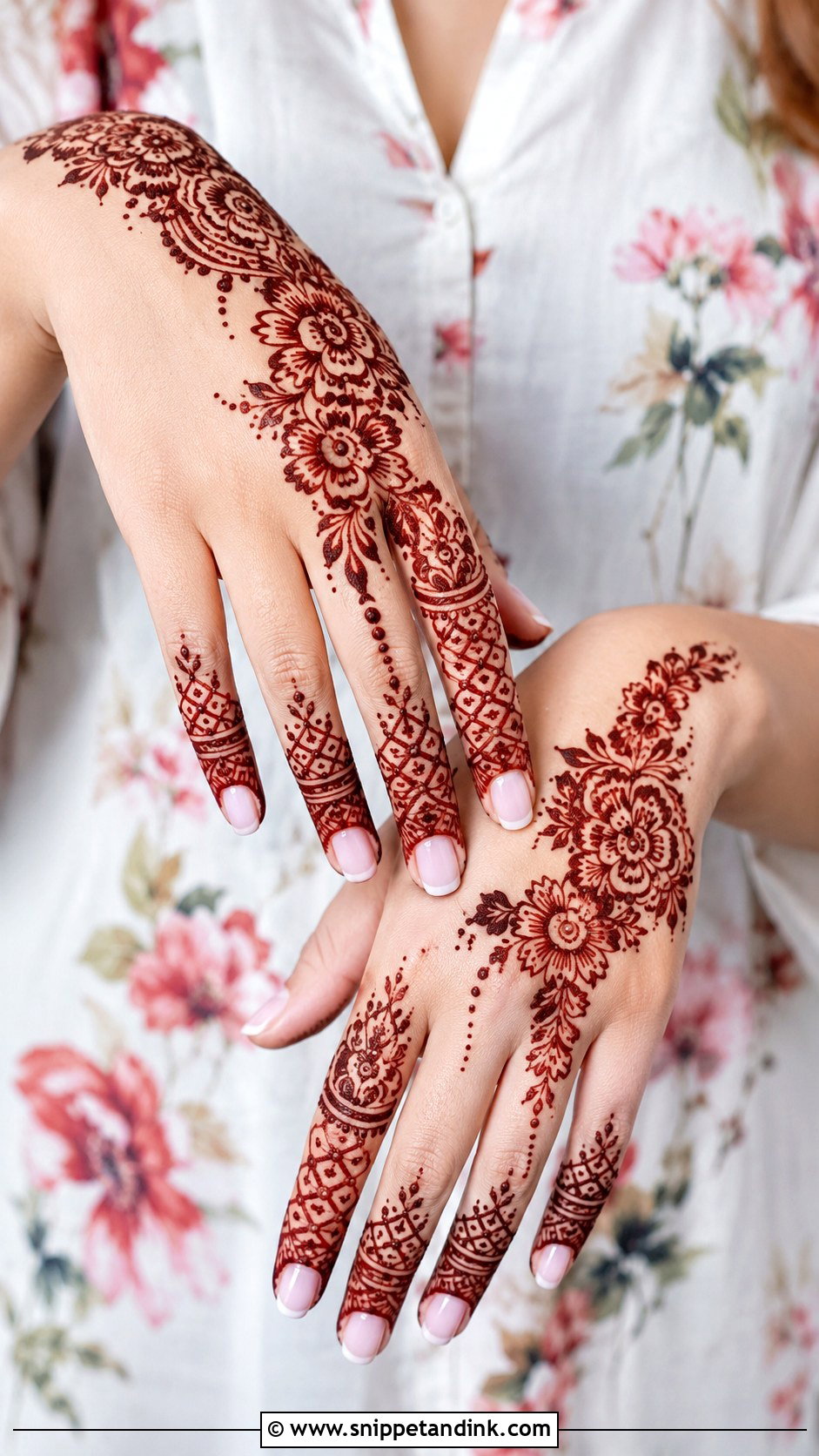
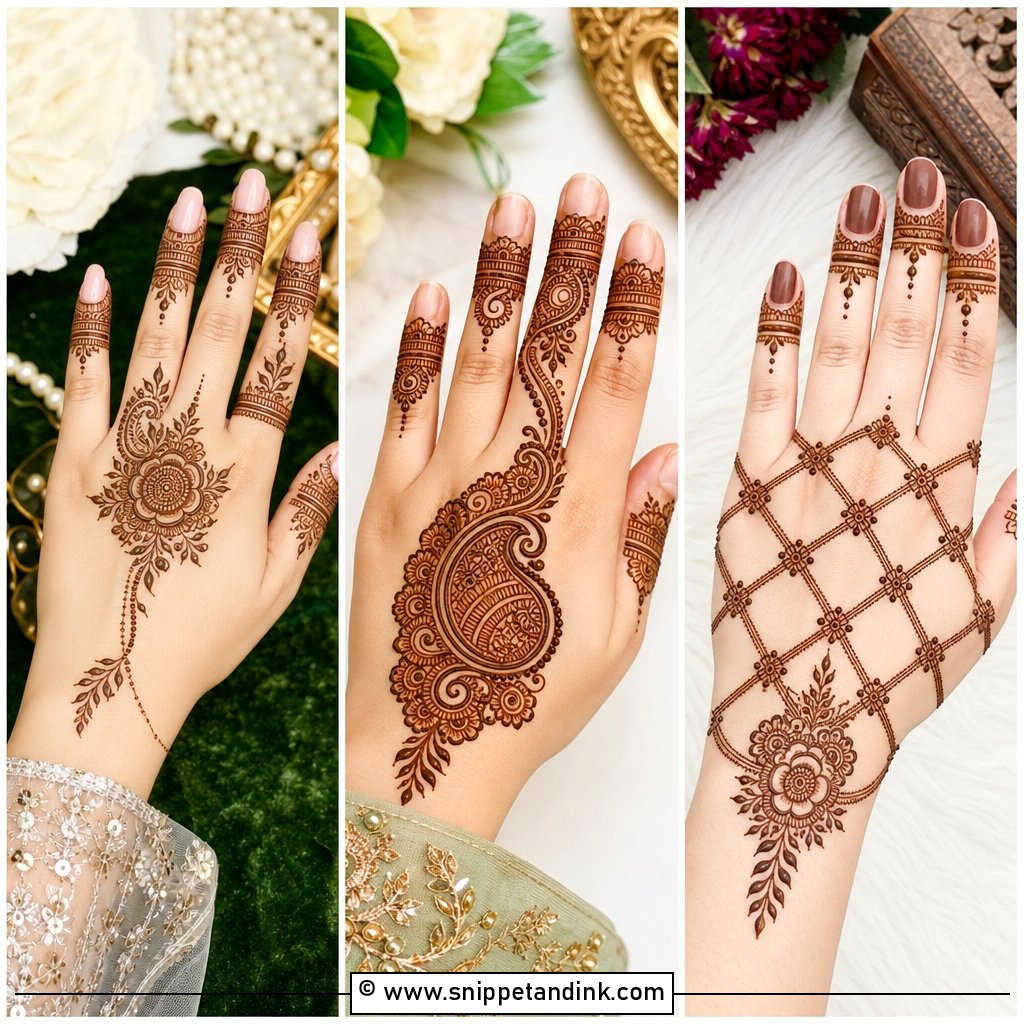
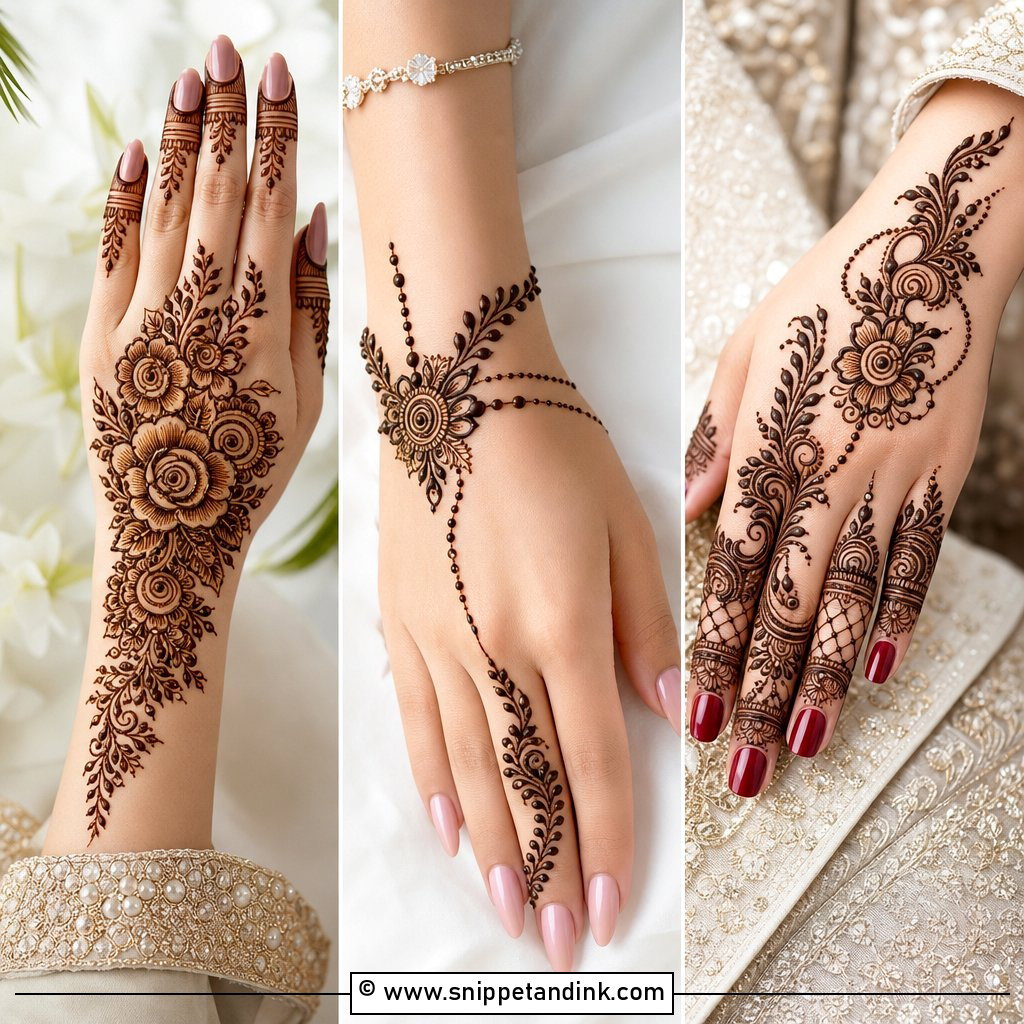
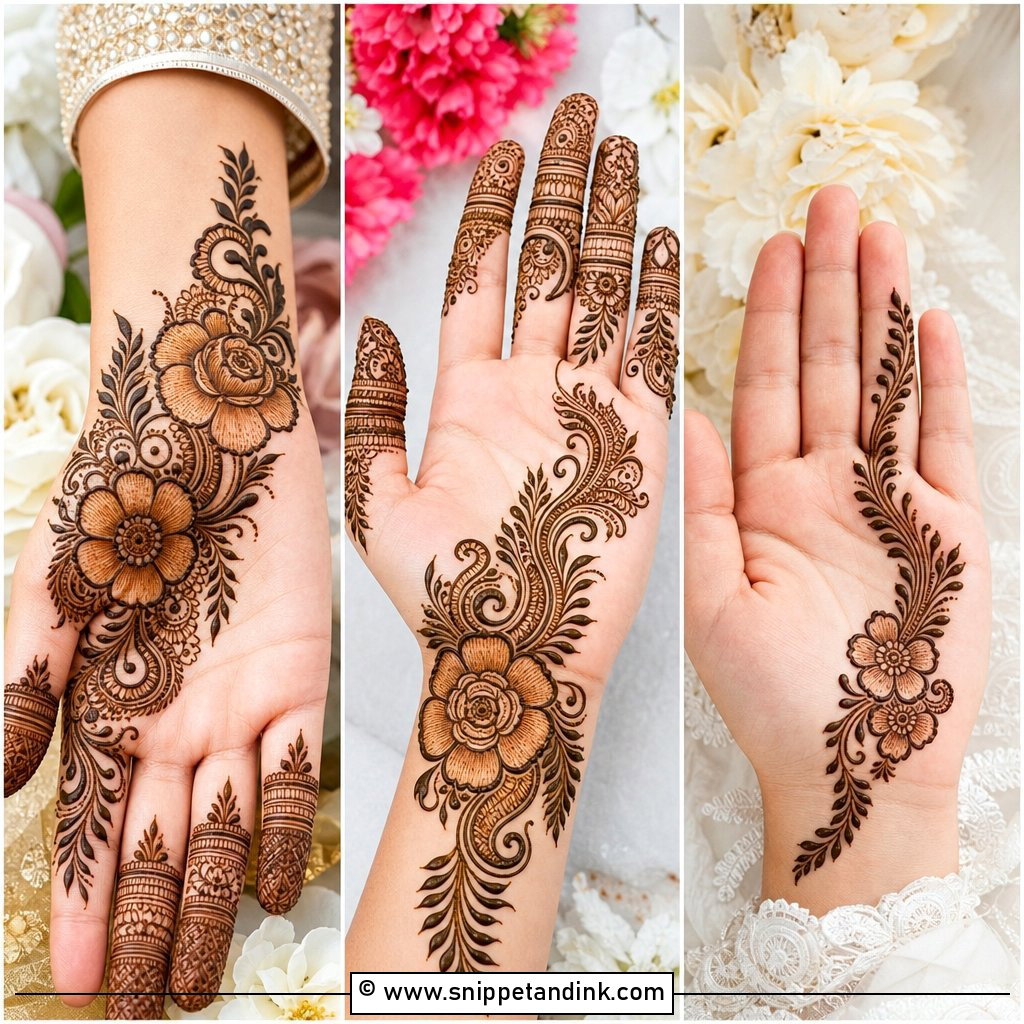
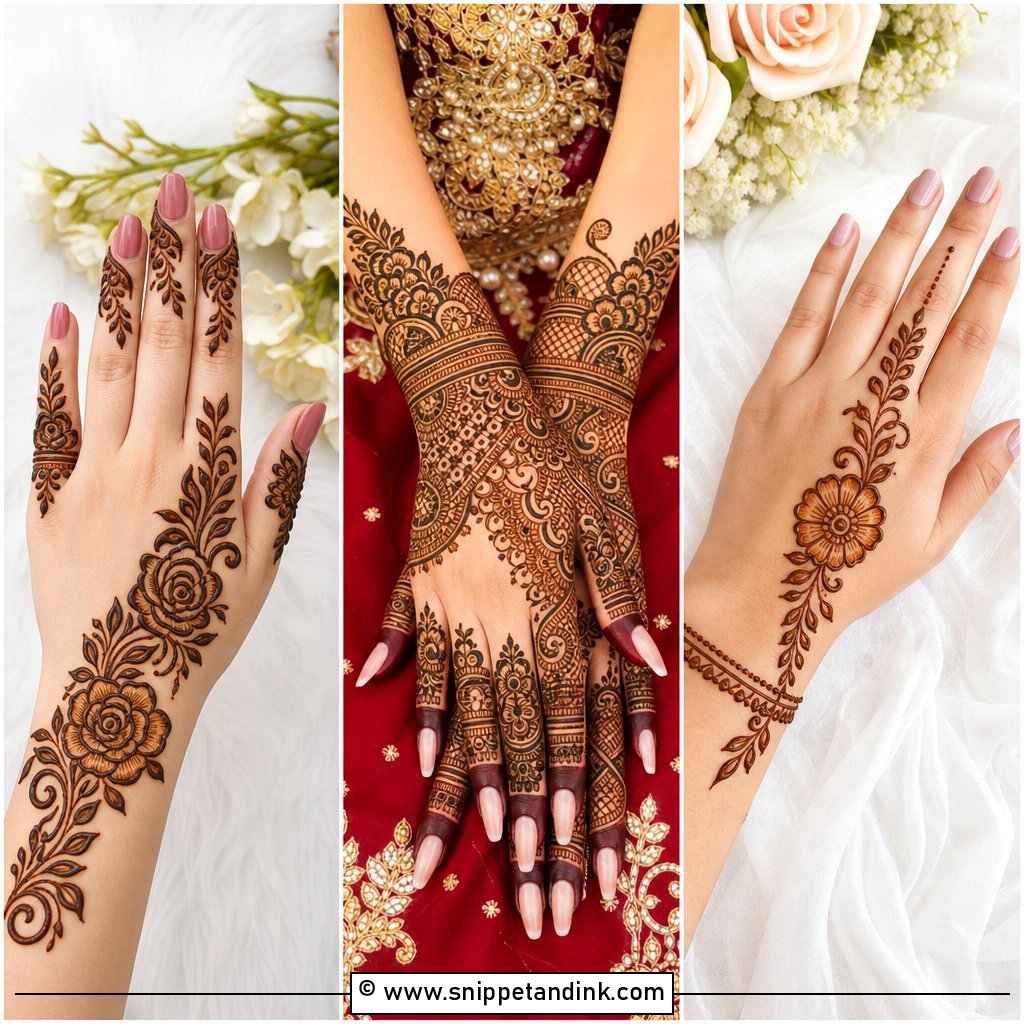
The back hand mehndi design is the one I apply most, because it shows when hands are folded in a lap or resting on a bouquet. I start the trail at the outer wrist bone and aim it at the index or middle finger, so the eye travels the length of the hand. Large florals sit low and the motifs shrink as they climb. The back of the hand usually stains a shade lighter than the palm, so I keep outlines bold rather than relying on fine shading there. Light leafy bands on the other fingers stop the hand looking lopsided.
2. Arabic Front Hand Mehndi Design
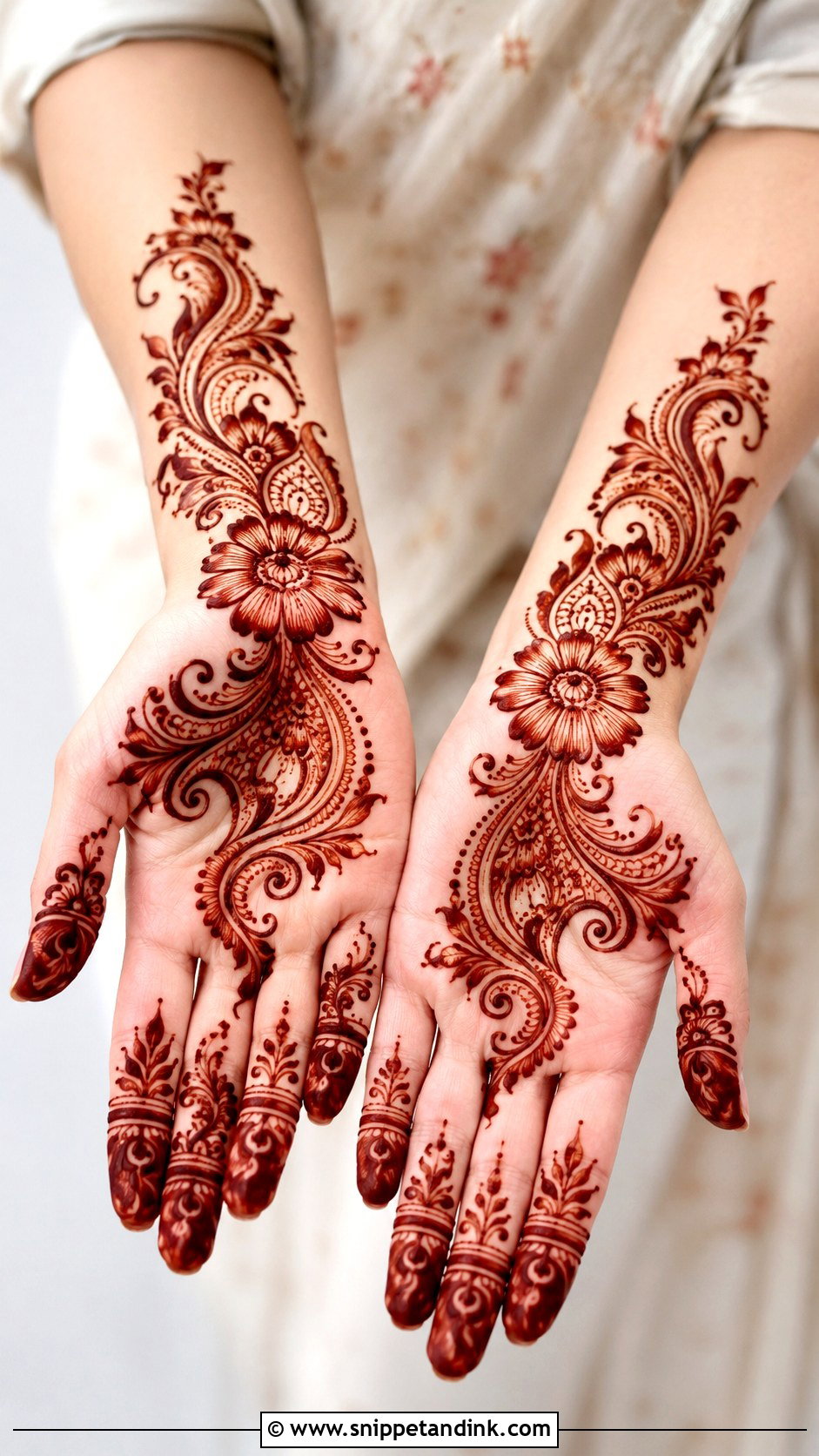
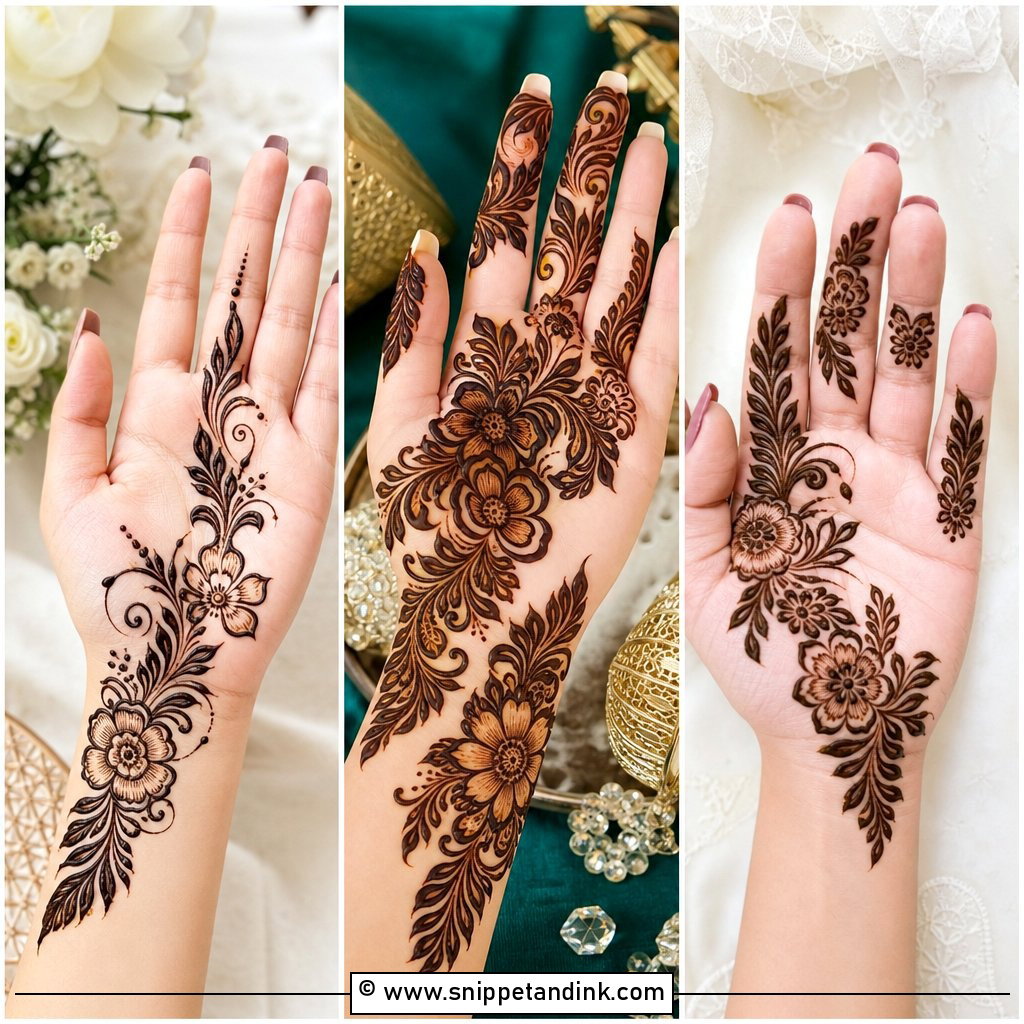
An Arabic front hand mehndi design puts the main floral trail across the palm and joins it to the wrist and fingertips with curved vines. Palms take the deepest stain on the body, so this is where a bold flower turns the richest maroon. I leave an open patch near the centre of the palm on purpose. Palms flex and sweat, and a tightly packed centre is where paste smudges first when someone forgets and closes her hand. Paisleys, shaded petals and a ring of dots around the main motif add depth without filling that gap.
3. Simple Arabic Mehndi Design
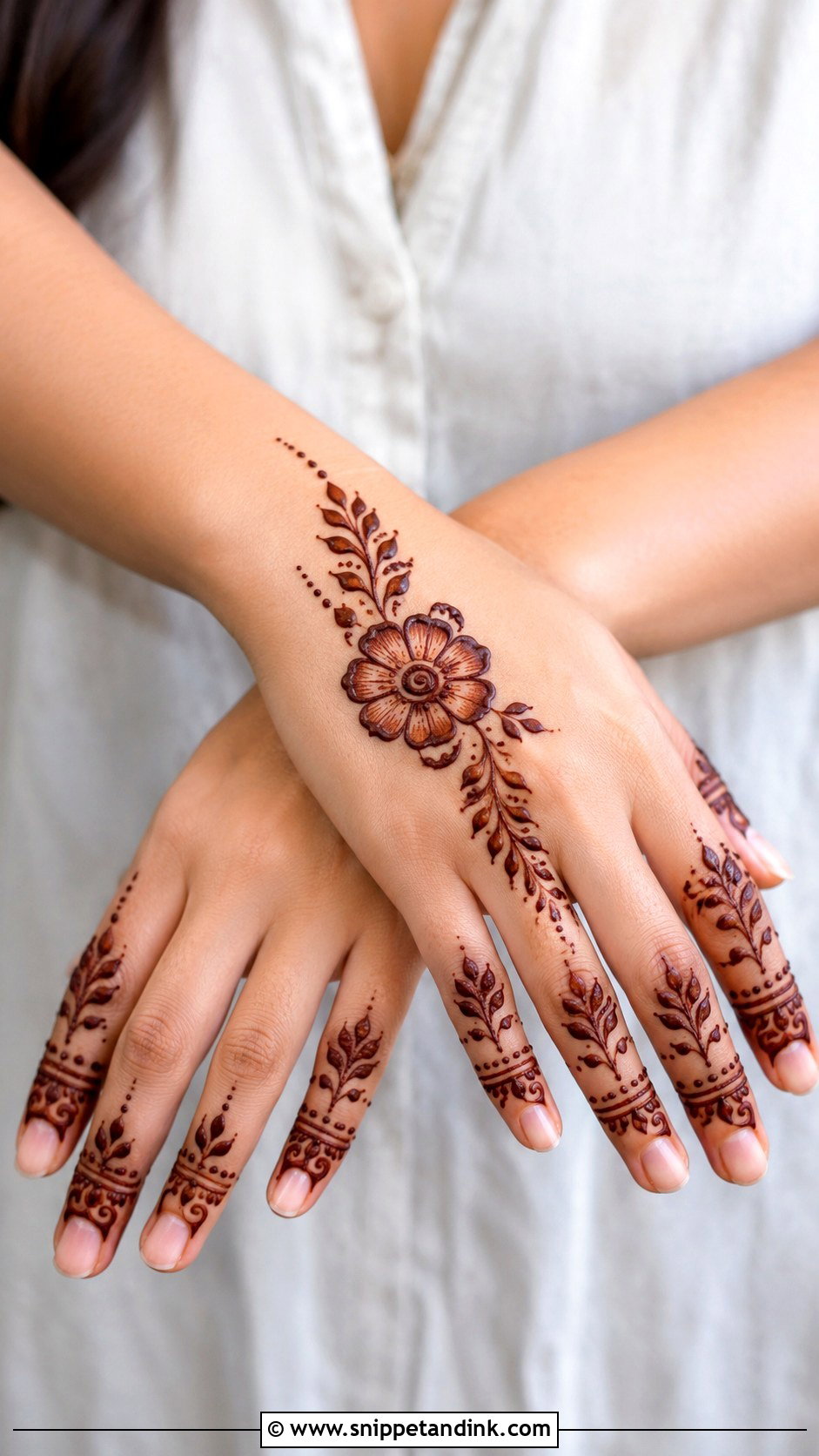
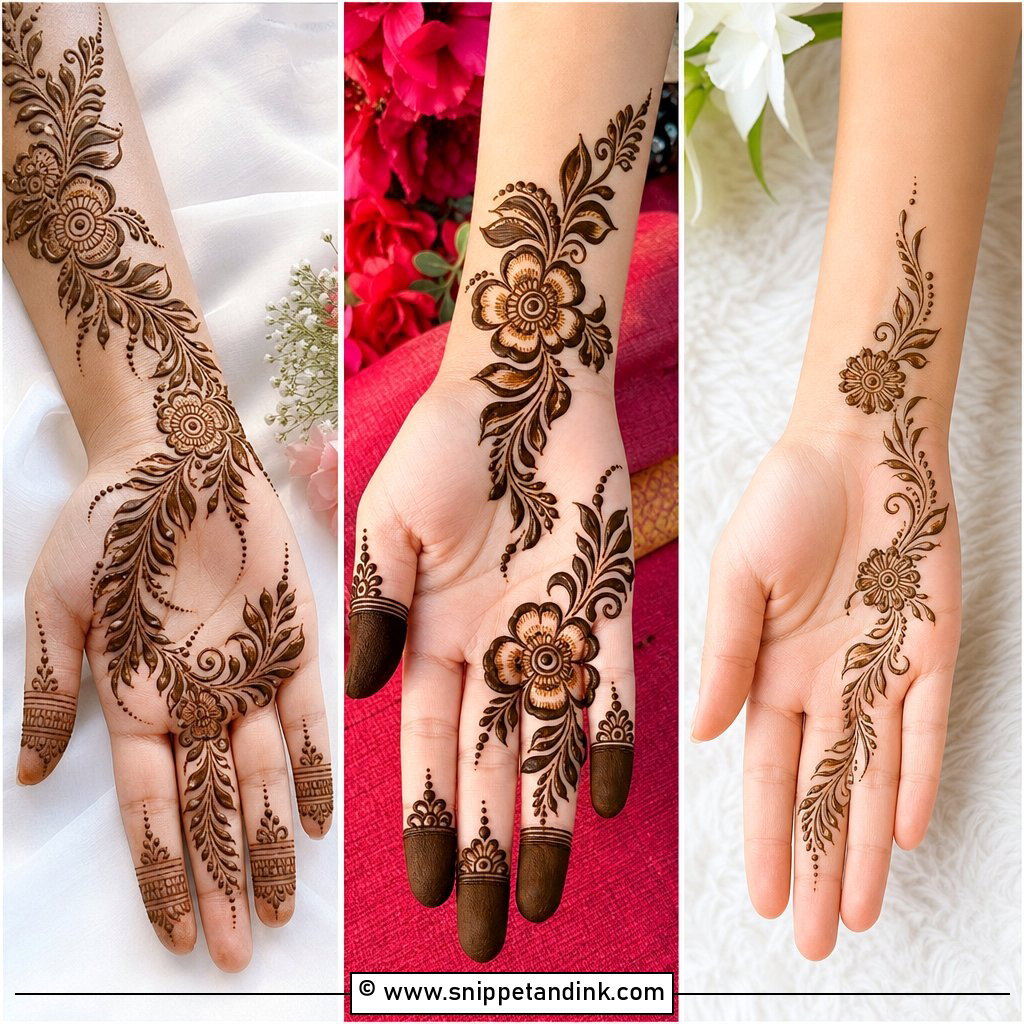
Simple doesn’t mean easy to fake. With one vine, a few bold flowers and neat finger detailing, every line is on show, so a shaky stroke has nowhere to hide. I usually place one statement flower near the wrist and let a slim leafy trail run to a single finger, because the diagonal makes fingers look longer. It’s what I suggest for casual events, or for guests who can’t sit still for long.
4. Full Hand Arabic Mehndi Design
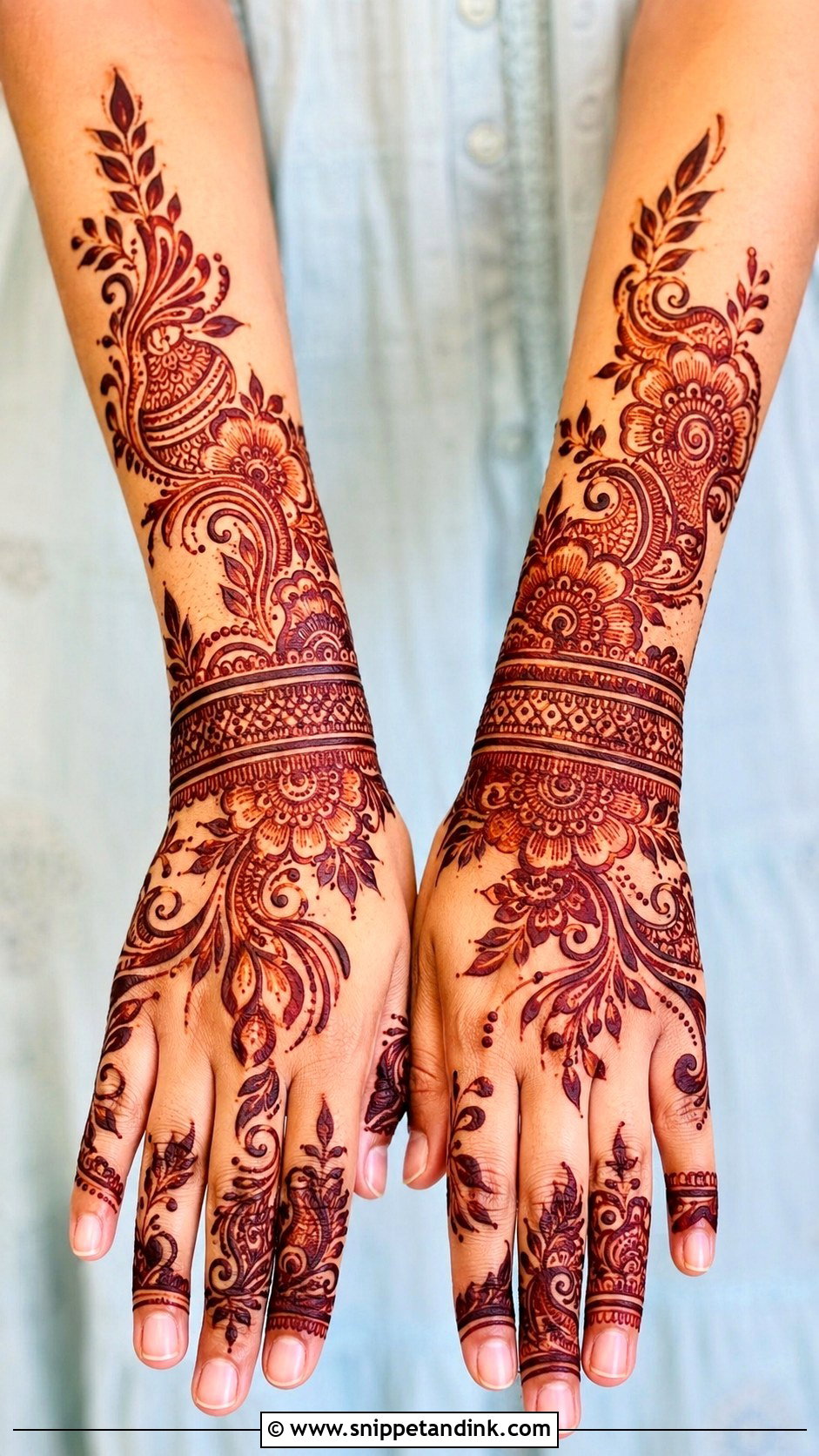
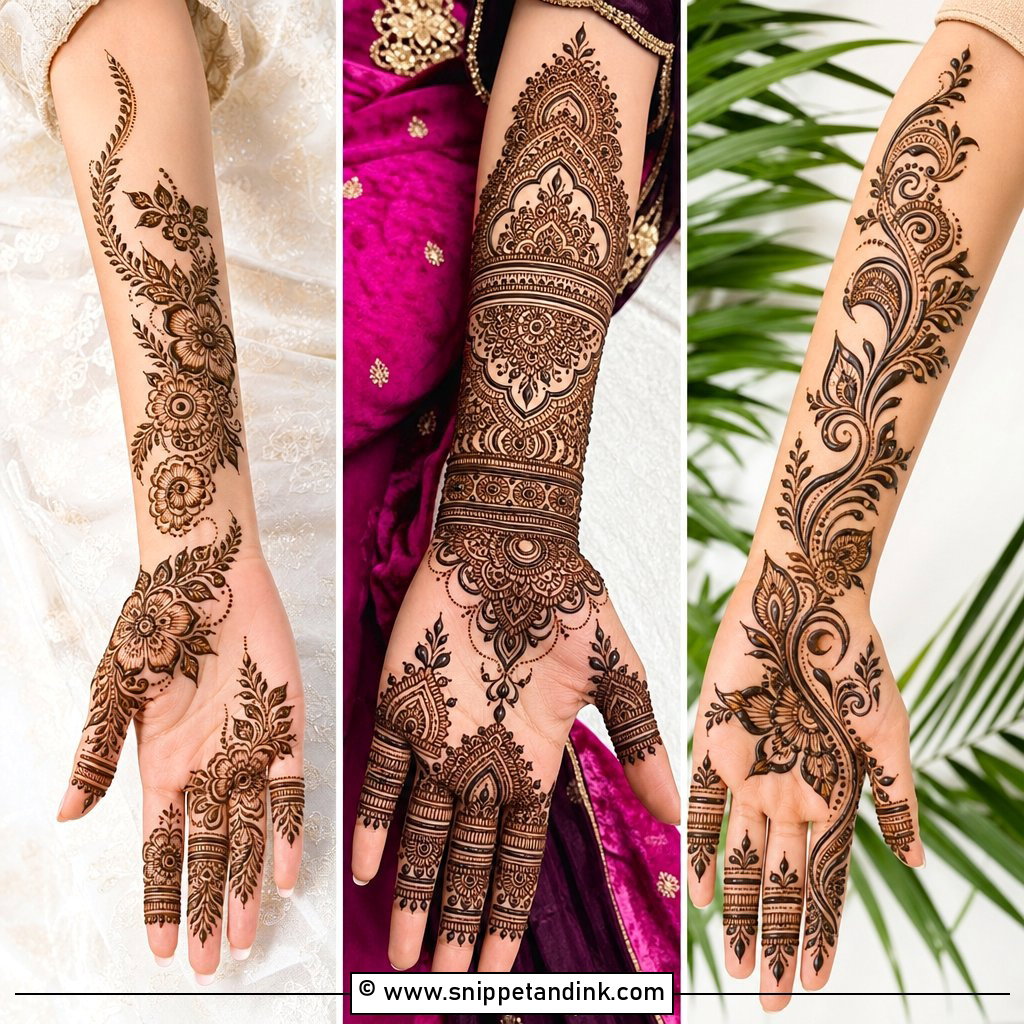
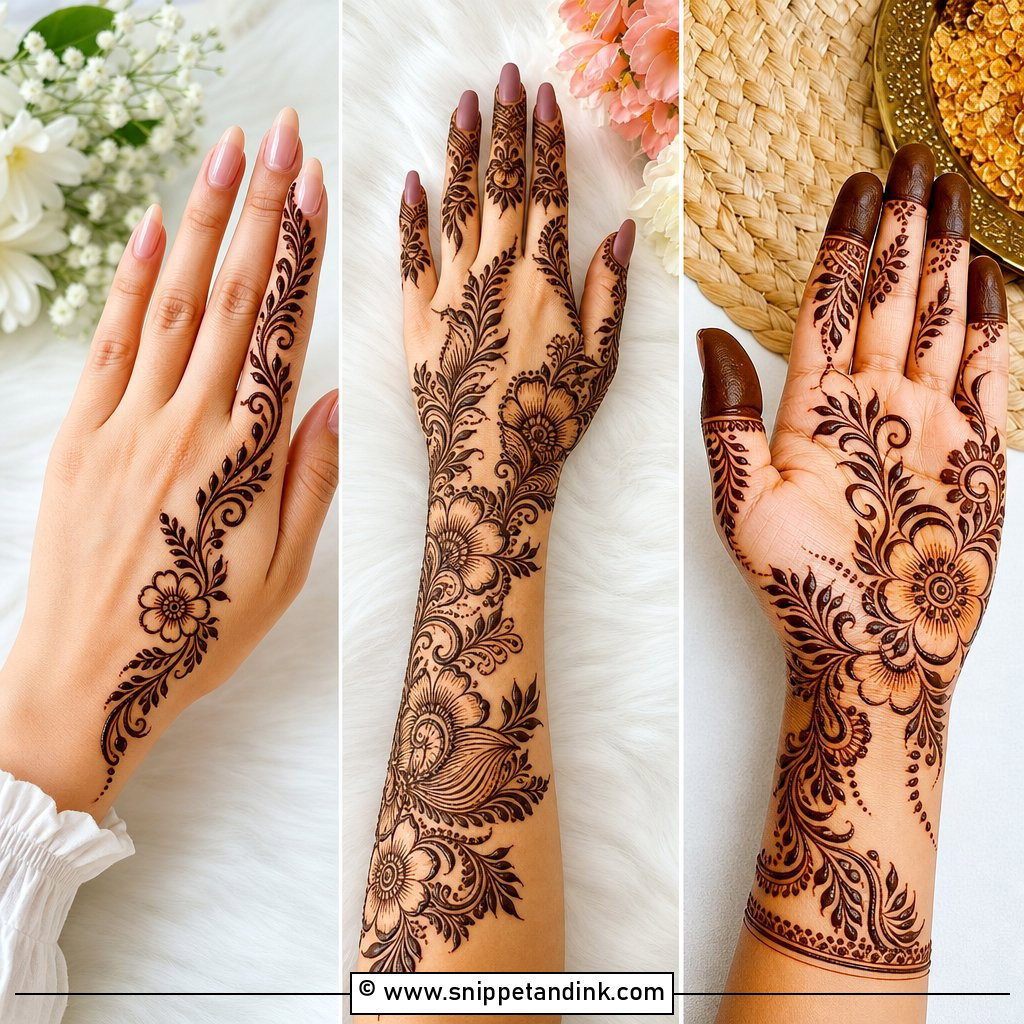
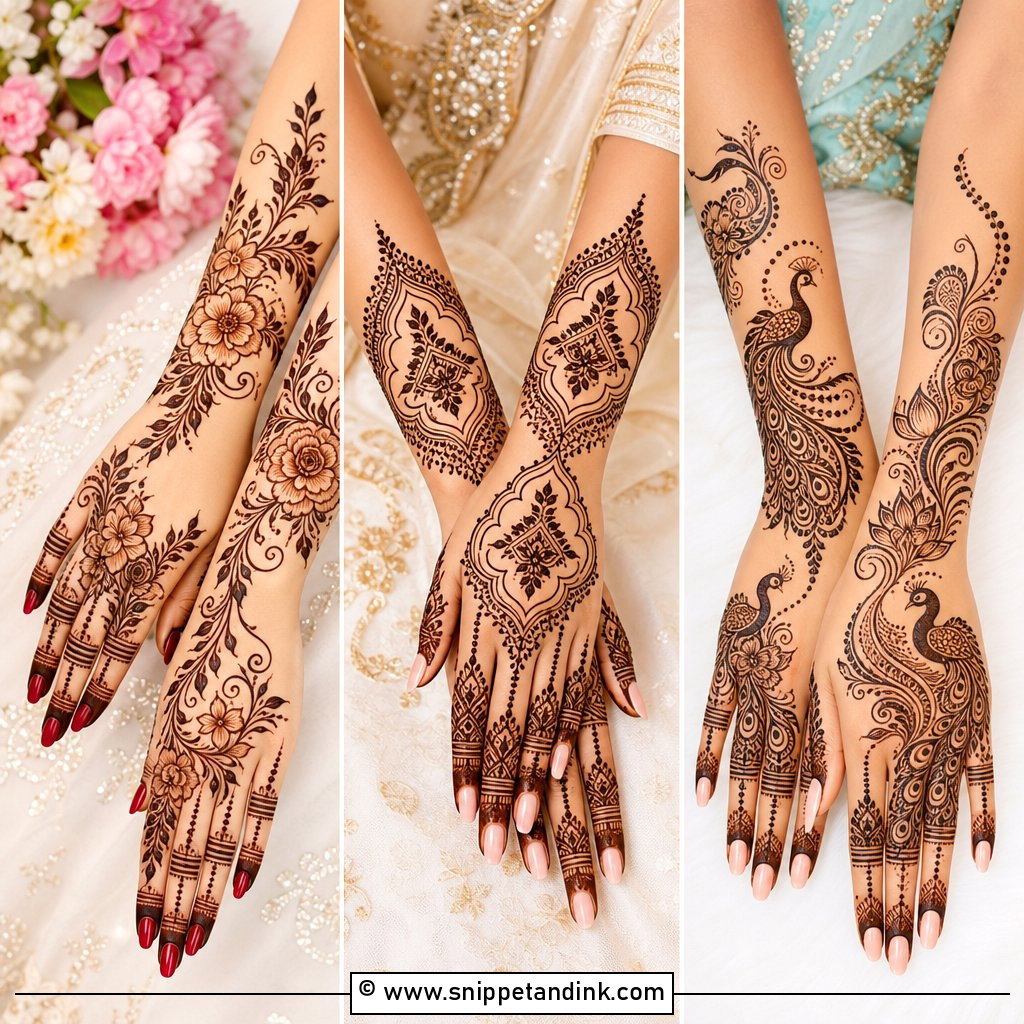
A Full hand Arabic mehndi design covers fingers, palm, wrist and forearm, yet keeps visible spacing between the major elements, which is what separates it from traditional bridal coverage. When I plan one, I draw the bracelet band first. It divides hand from arm and tells me where the larger flowers can go. Shaded petals and fine-line fillers add dimension. Ask your artist for a flowing layout rather than block filling; once the gaps close up, it stops reading as Arabic at all.
5. Modern Arabic Bridal Mehndi Design
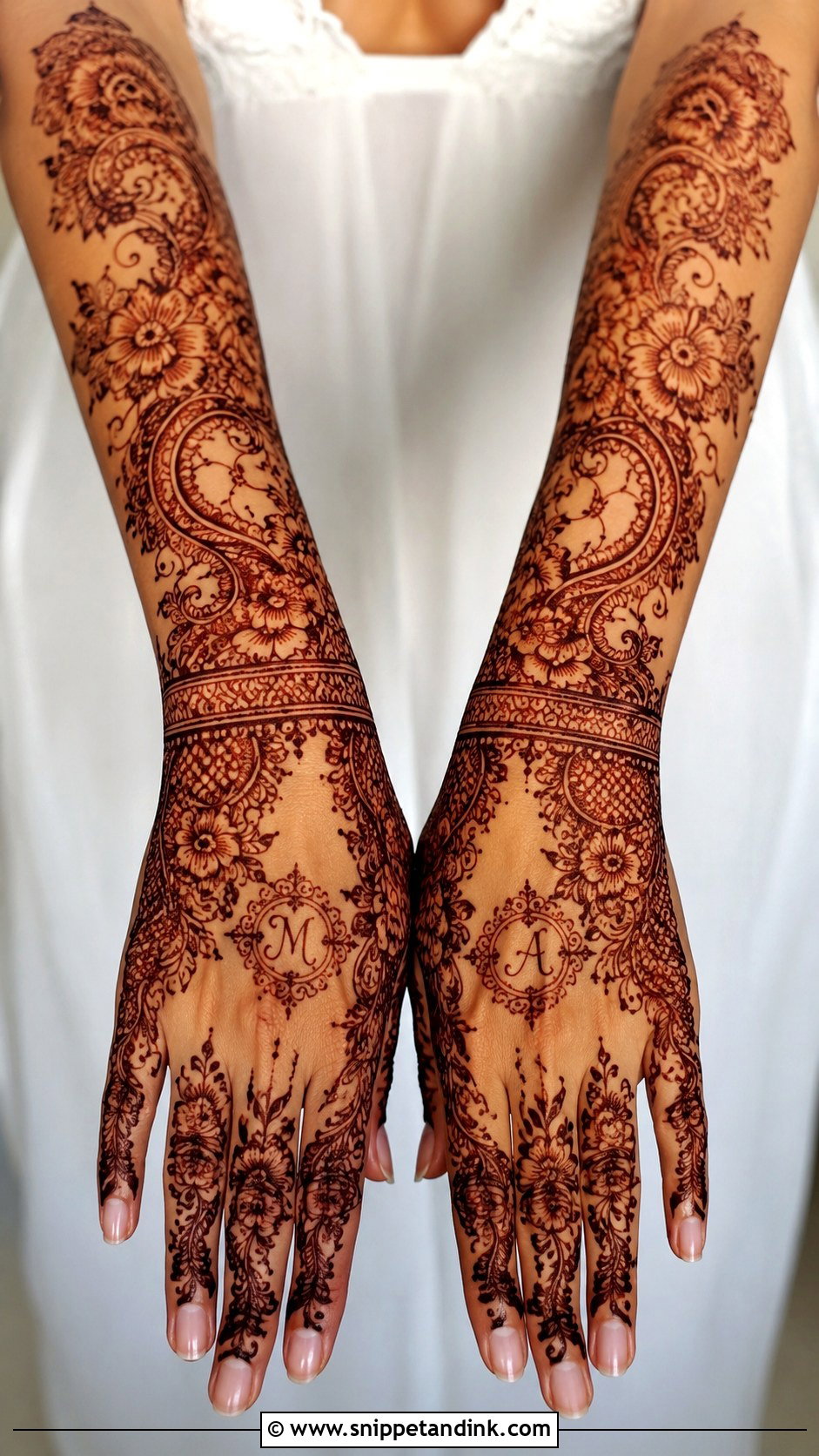
For a modern bridal set I combine bold Arabic florals with lace-like fillers, wrist cuffs and paisley trails, and plan the negative space so the design breathes even when it runs from fingertip to forearm. Initials, small domes or a meaningful motif can be tucked into the trail. I always ask to see the jewellery first. A heavy kada or haath phool sits right on the wrist and back of the hand, and there’s no point detailing a section that will be covered. A deep maroon stain makes the open spaces read sharper.
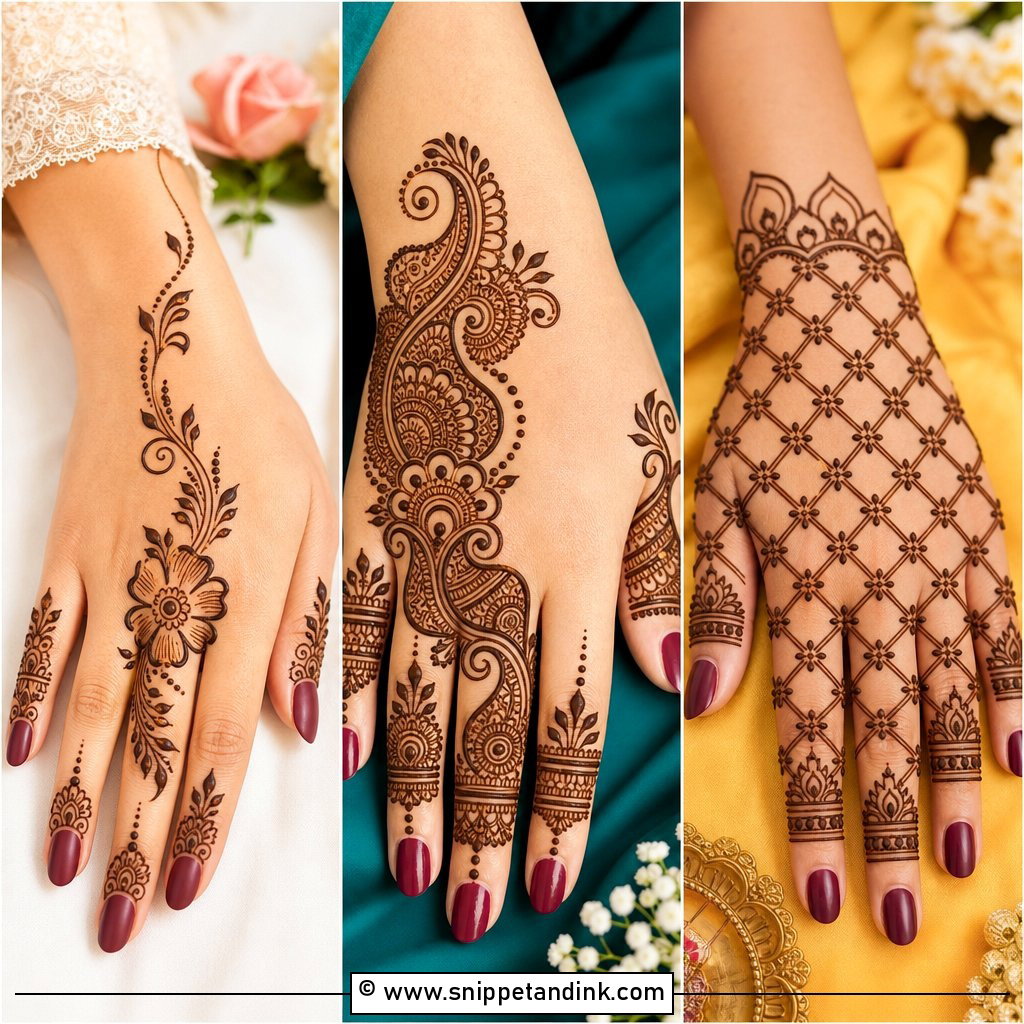
6. Arabic Floral Mehndi Design
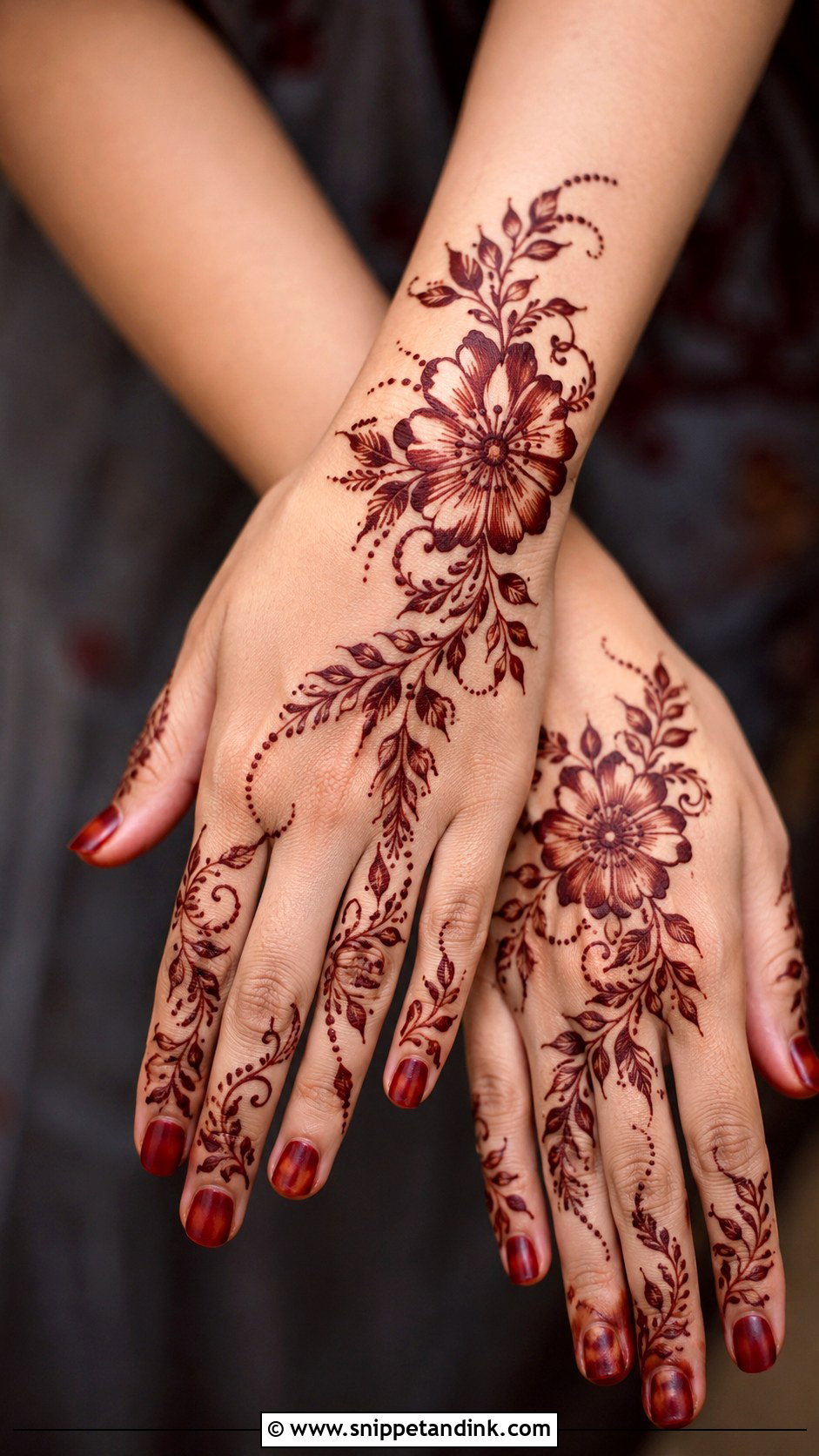
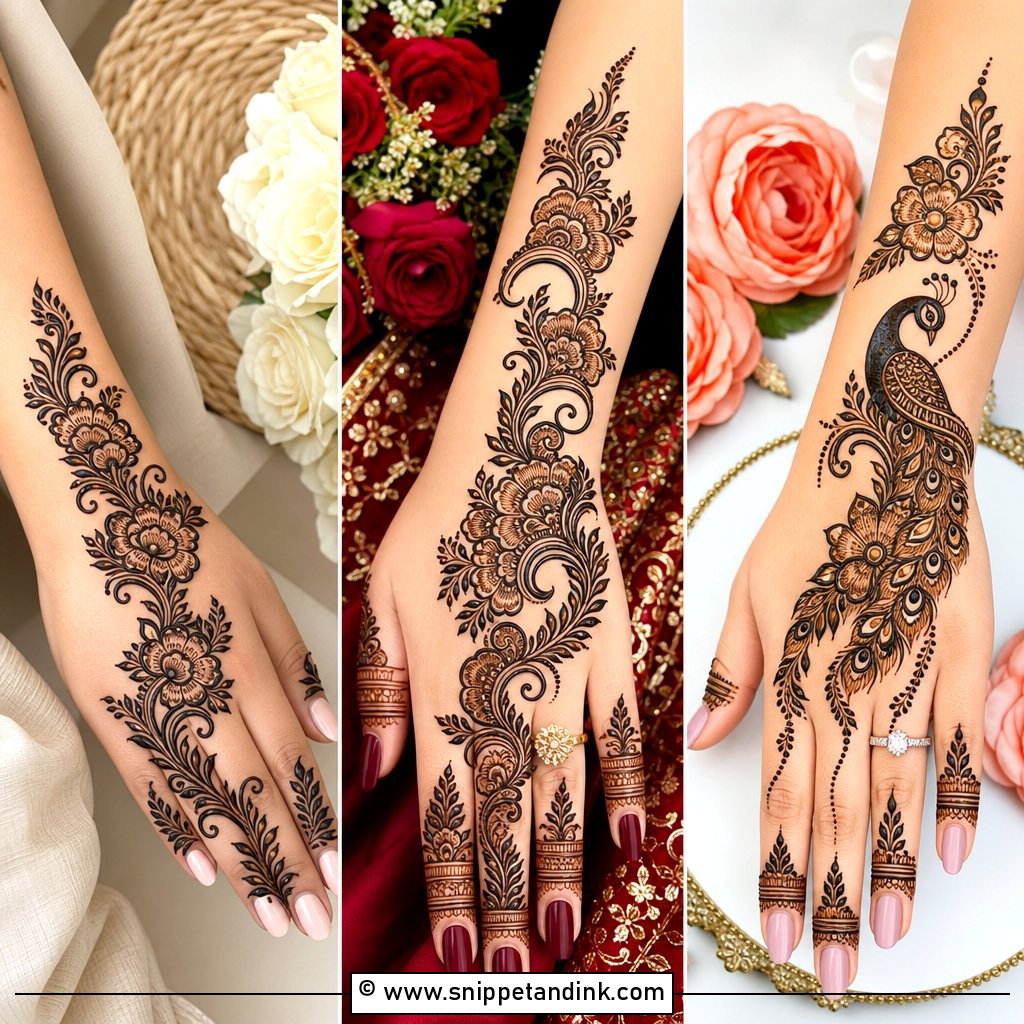
Big flowers, petal clusters and leafy branches run diagonally from wrist to fingers here. Florals scale well, which is why I trust this layout on small hands and large ones: I change the flower size, not the number of flowers. Inner shading in the petals is optional. Thin vine lines and a few dots between the large blooms keep it from turning heavy.
7. Arabic Rose Mehndi Design
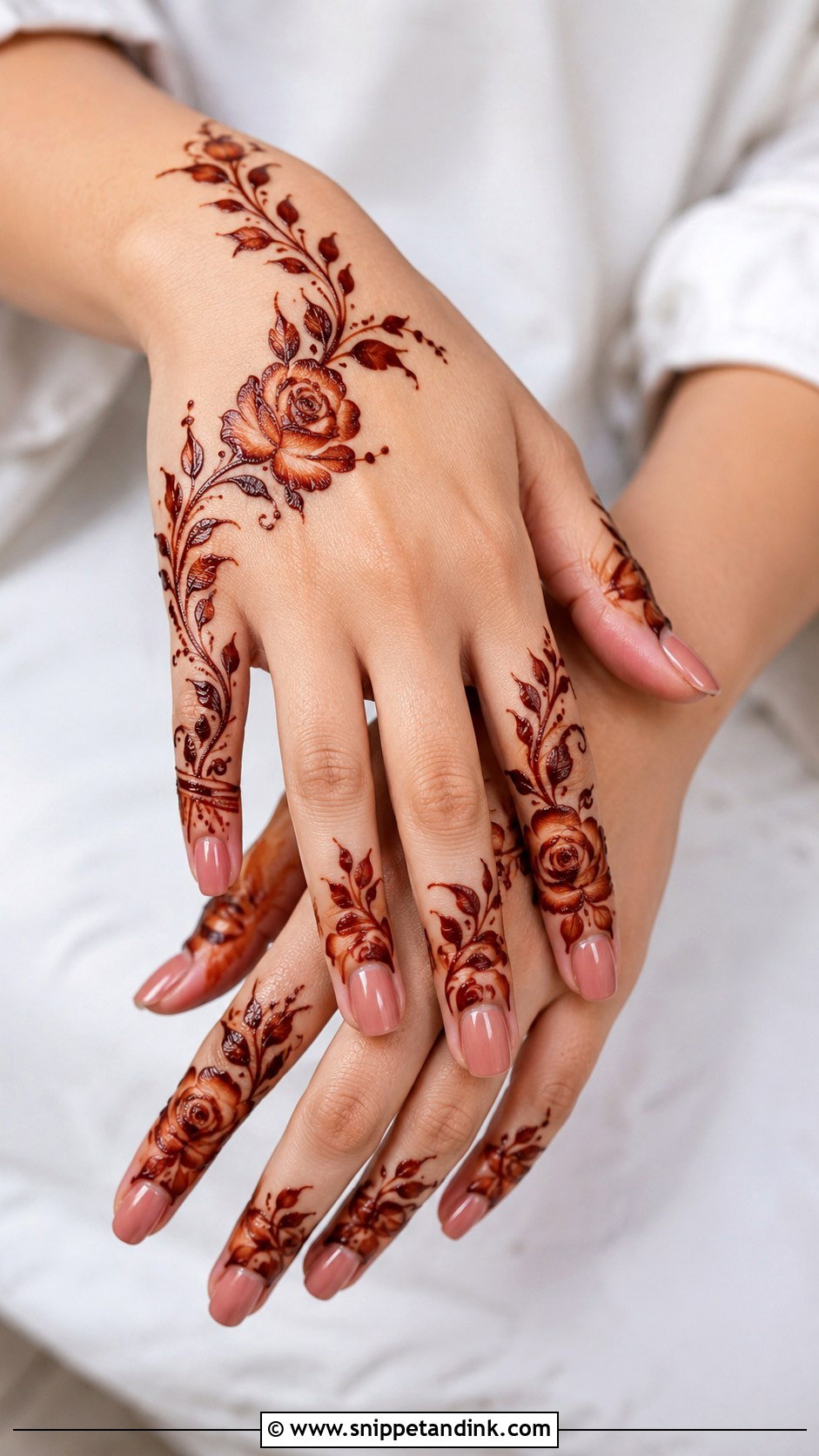
A rose carries more visual weight than a five-petal flower, so one placed near the wrist becomes the focal point of the whole hand. I build the petals in layers from the centre outward and add light shading inside each, which keeps it from staining as a flat circle. A leafy spray toward the index finger and minimal finger bands finish it. Resist adding a second large rose. Two compete, and neither wins.
8. Arabic Vine Mehndi Design
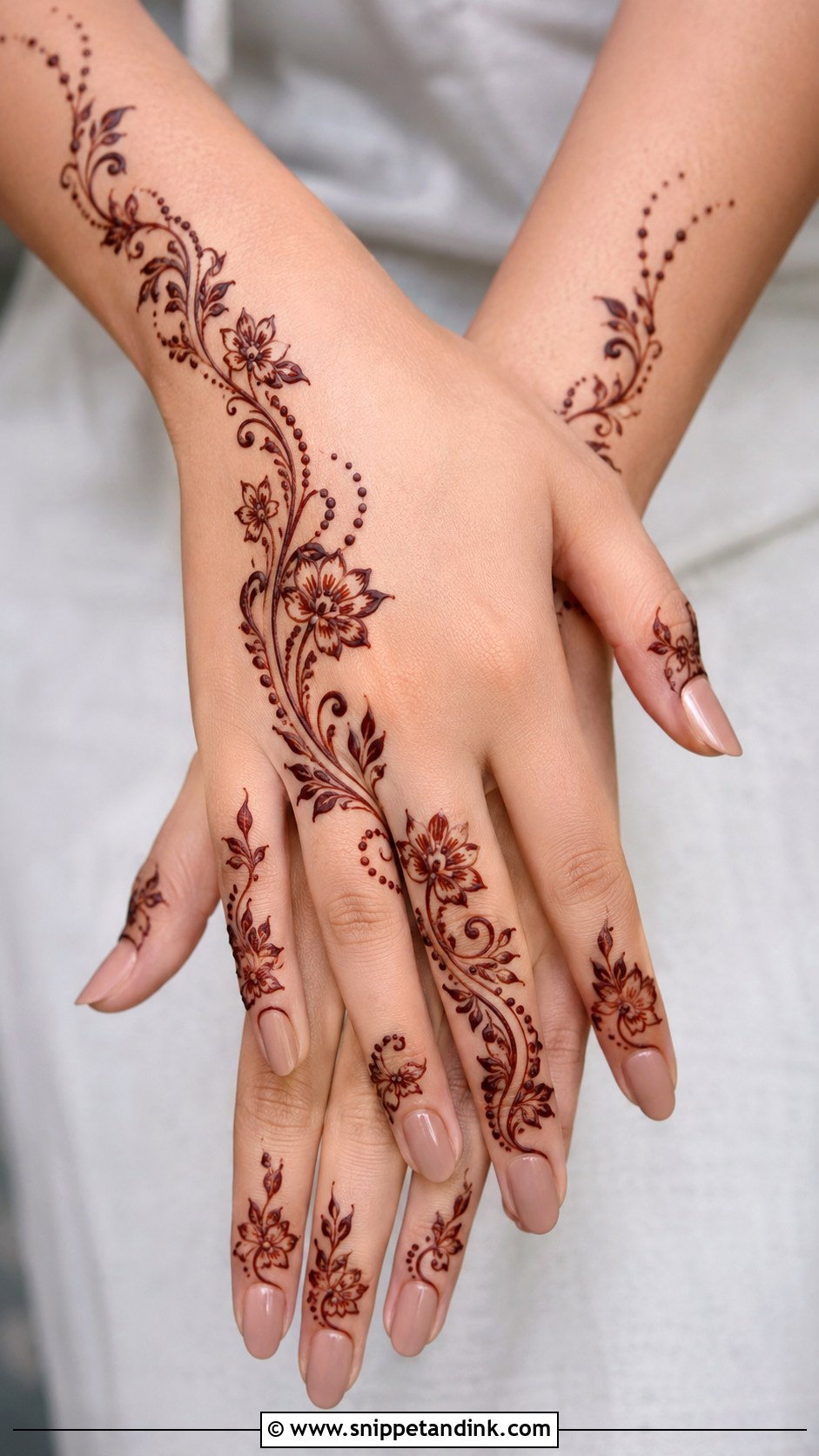
Everything hangs on one vine travelling from wrist to fingers, and the vine is the hardest part to get right. It needs one smooth pull of the cone, because a restart shows as a blob once the stain develops. Leaves, small flowers and tiny paisleys can sit along the curve, with the larger motifs near the wrist or the centre of the hand. It’s forgiving for anyone learning, and light enough that it rarely feels like too much.
9. Arabic Mandala Mehndi Design
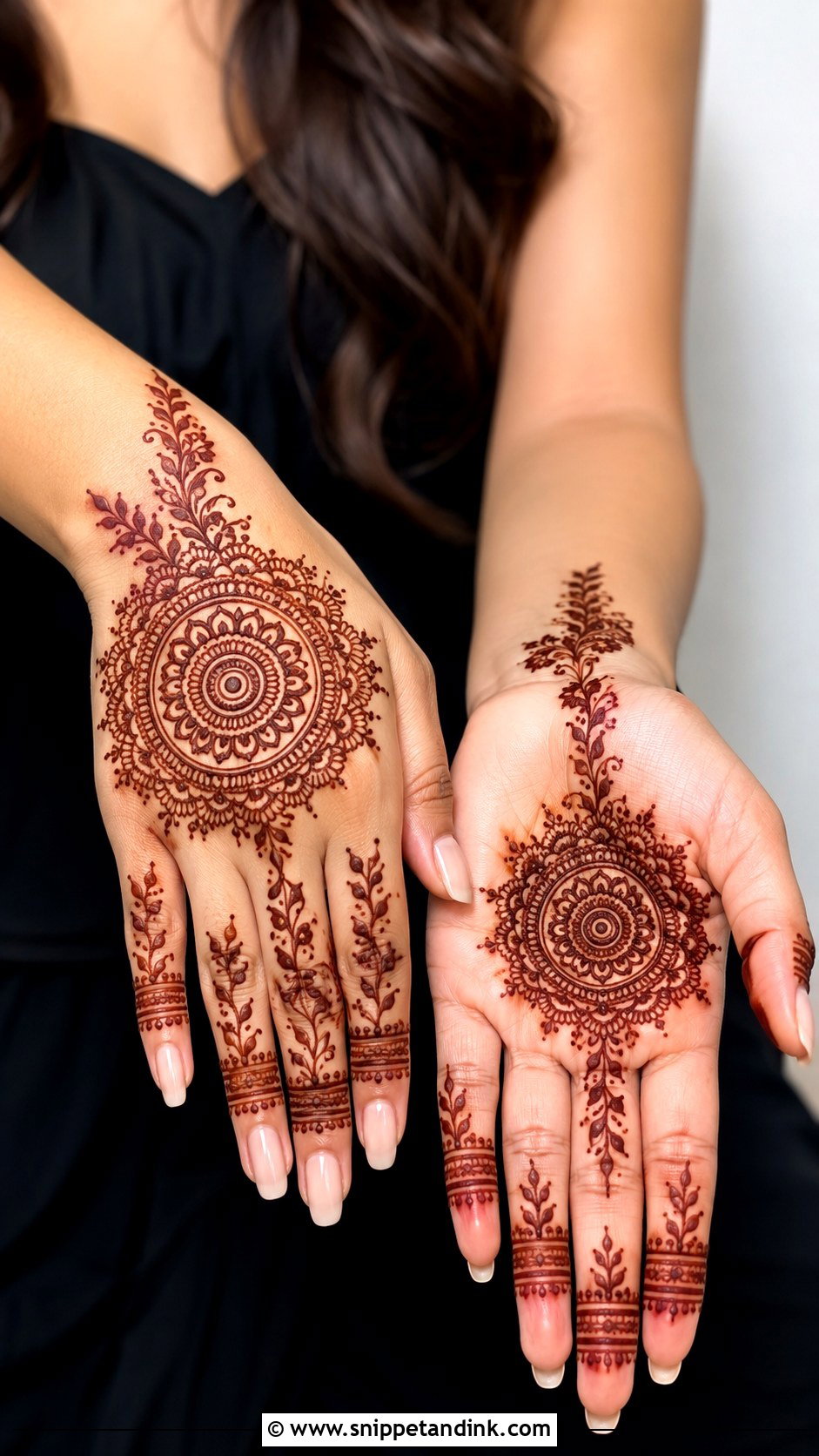
Mandalas are symmetrical and Arabic layouts are not, so this fusion only works when the mandala stays in its own zone. I place it on the palm or the back of the hand and let floral vines or a bracelet band carry the design outward. The circle has to sit on the flat part of the hand, not over the knuckles, or it distorts every time the fist closes. Keep the fingers to simple lines and small leaves, and leave clean skin around the circle so it holds attention.
10. Arabic Bracelet Mehndi Design
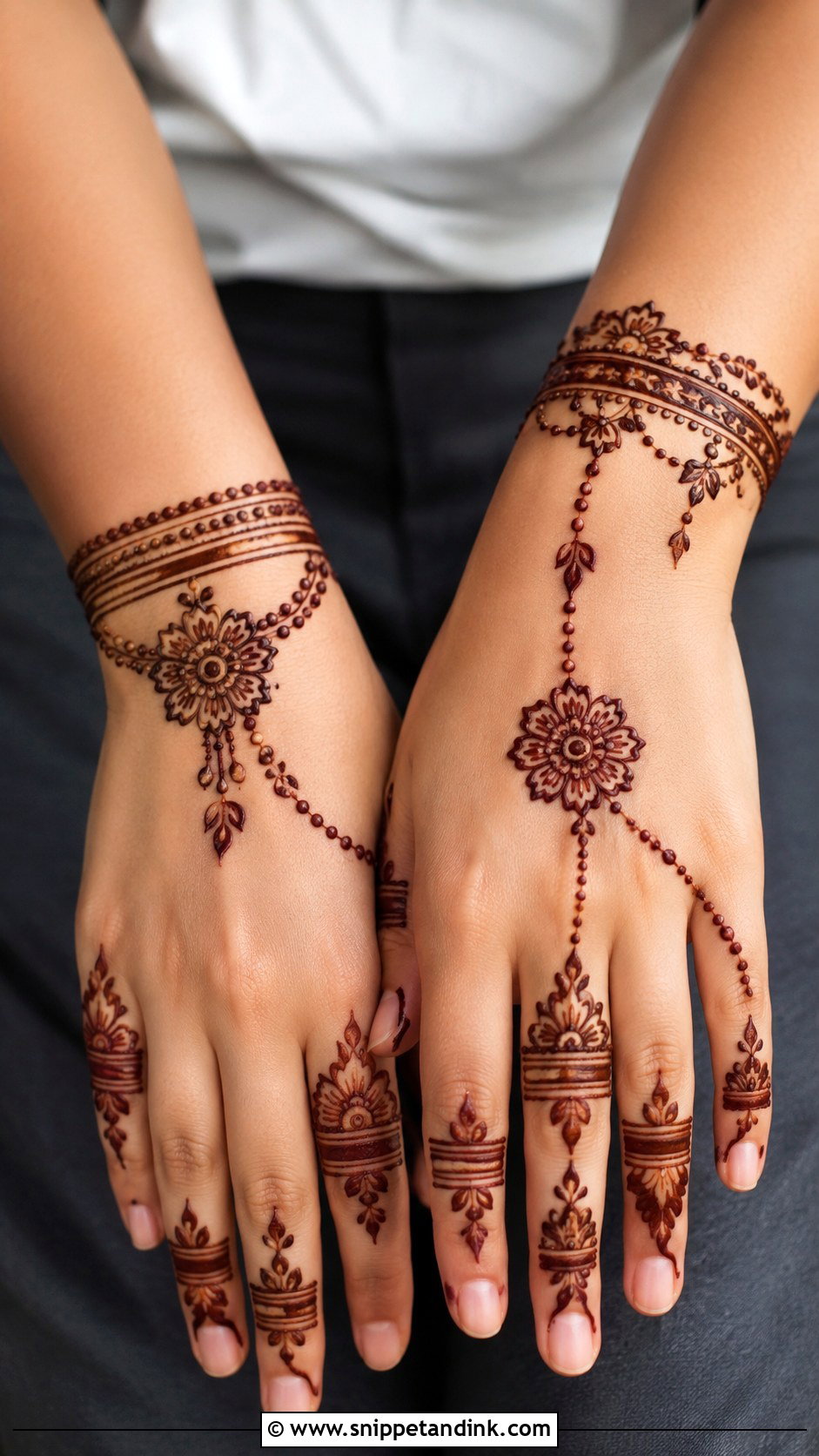
Here henna stands in for jewellery: a wrist band, chain-like curves, finger rings and a floral trail connecting them, with a flower or small mandala on the back of the hand acting as the pendant. I keep the chains thin and the wrist band bold. Thin lines lighten as the stain settles, and the band has to anchor the whole piece. It sits well under real bangles and rings and holds up without them too.
11. Arabic Finger Mehndi Design
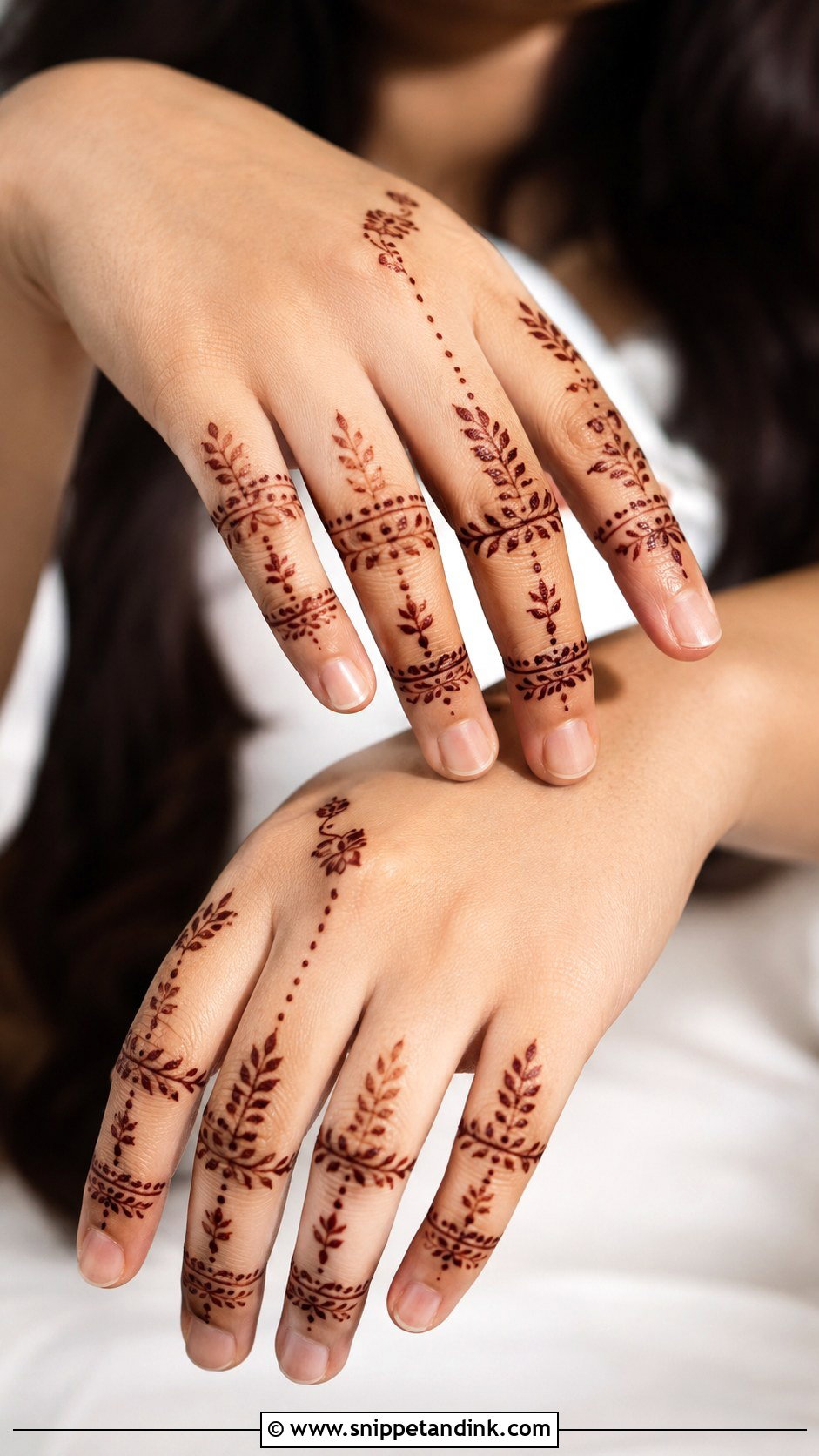
When most of the work sits on the fingers, spacing does all the talking. Each finger can carry leafy lines, mini floral bands, dots or curved strokes, with small extensions onto the hand. Fingertips often stain darker than anywhere else, so I keep the tip caps neat and even; a lopsided cap is the first thing people notice. Make one finger slightly more detailed than the rest and add a tiny knuckle accent, otherwise it can look like a row of identical stamps. College events and office-friendly celebrations suit it well.
12. Arabic Palm Mehndi Design
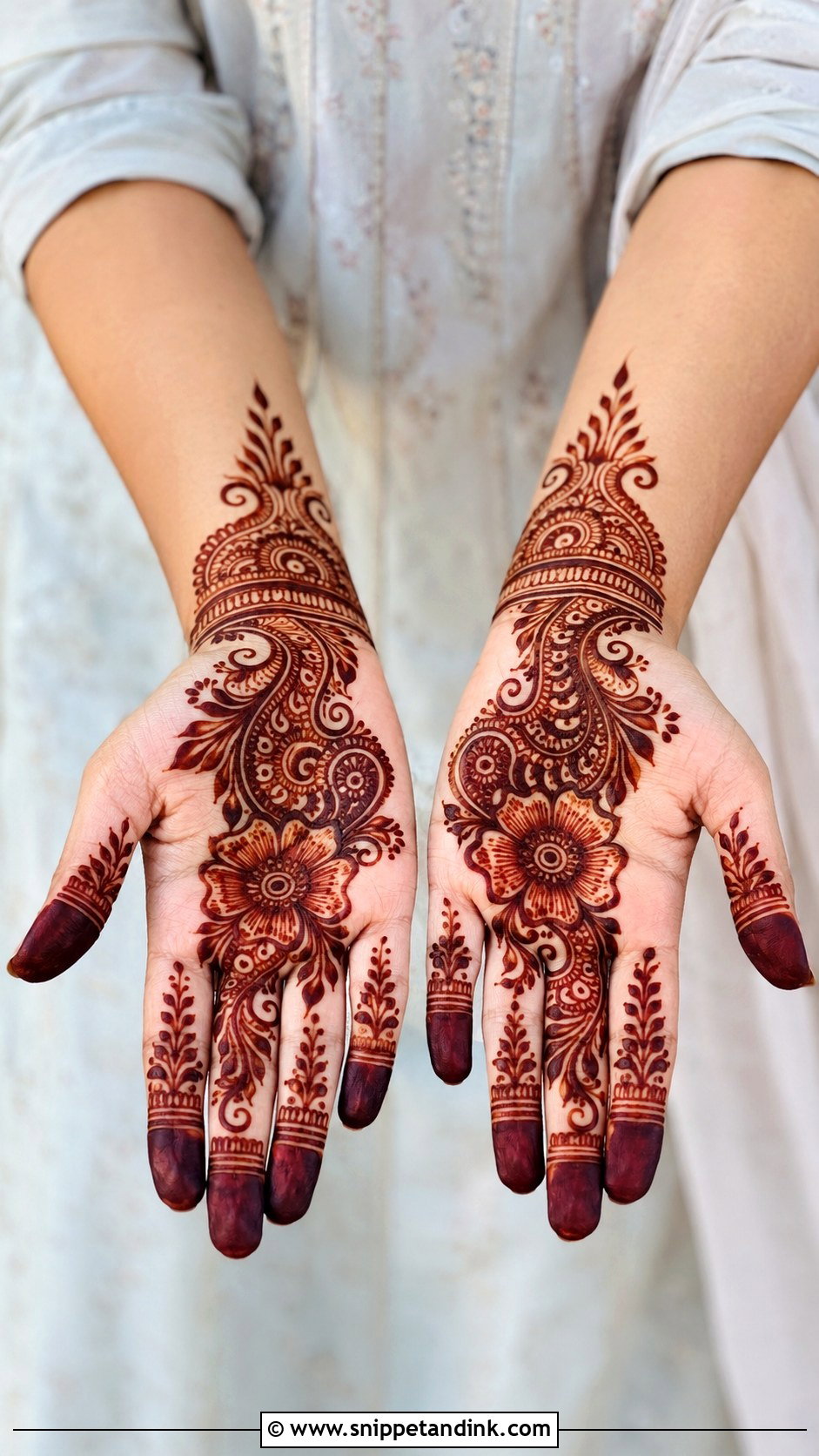
The palm stains darkest, which makes it the most rewarding spot for a large motif. A floral, a paisley cluster or a mandala sits in the centre with trails moving toward the wrist and fingers. Unlike dense Indian palm work, Arabic palms leave breathing room between elements. I avoid putting fine detail directly in the palm creases, where the skin folds and thin lines blur. Slim finger lines and a wrist bracelet complete it.
13. Arabic Wrist Mehndi Design
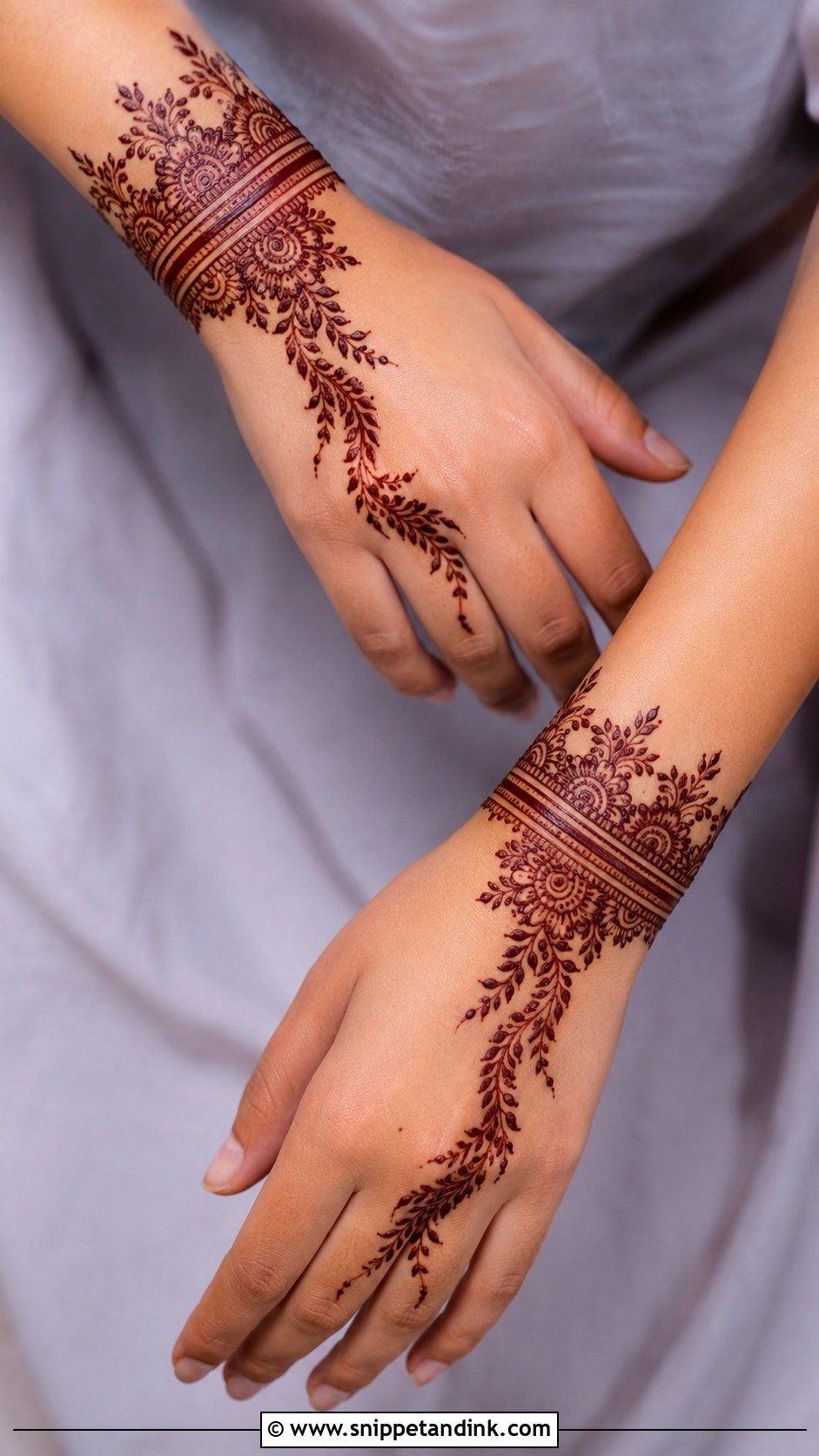
A wrist piece suits anyone who wants decoration that sleeves and bangles frame rather than hide. Floral bands, leafy borders, curved chains, paisley cuffs or lace details can all form the cuff, which then reaches a little toward the hand or forearm. Inner wrist skin is thin and takes colour well, but it’s also where fabric rubs, so I tell clients to keep sleeves pushed back until the paste has been off for a good while. One bold band connected to a small floral trail on the back of the hand is my usual modern version.
14. Arabic Forearm Mehndi Design
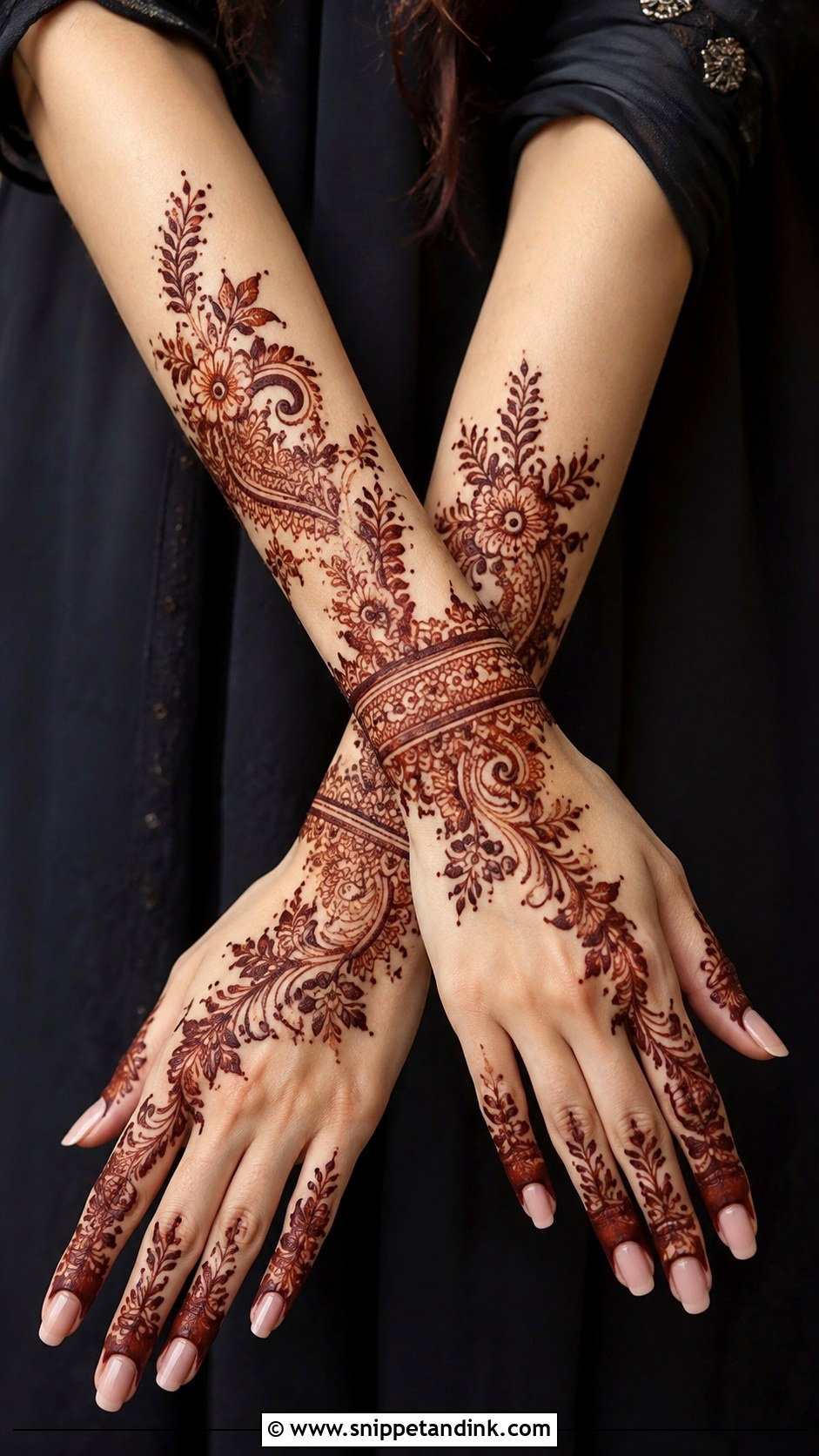
Starting at the wrist and climbing the arm, this layout adds length with flowers, paisleys, leaves and curved vines. Forearm skin stains noticeably lighter than the hands, often closer to a warm brown than maroon, so I warn brides to expect a softer colour up there and plan bigger, bolder motifs to compensate. Bracelet bands at the wrist and larger blooms higher up keep the proportions right. Leave gaps. Filling every space up the arm is what makes a forearm design look dated.
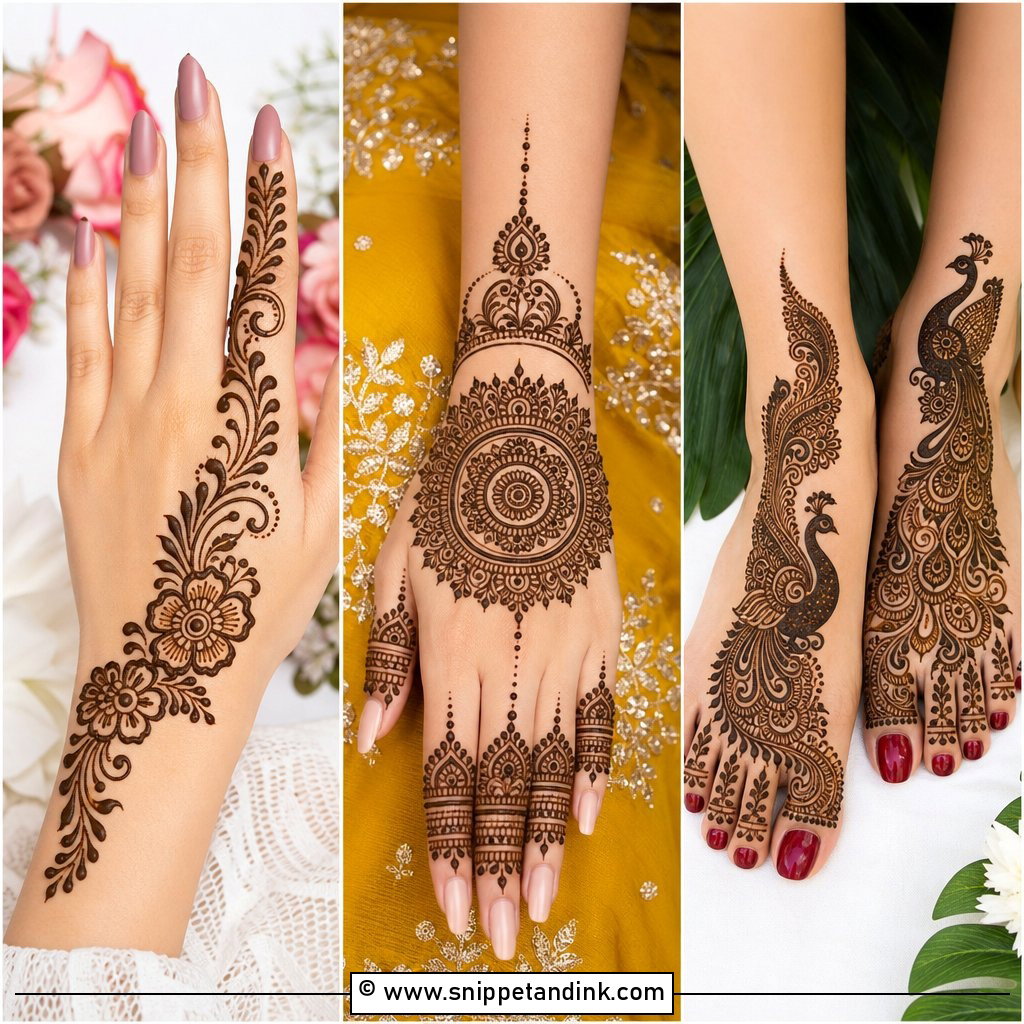
15. Arabic Jaali Mehndi Design
Jaali is the mesh, diamond or crisscross filling that gives Arabic henna its lace texture. My usual placement is one large floral trail on the back of the hand with jaali on one side and open skin on the other, so the contrast does the work. It needs even line spacing and steady pressure on the cone. If the lines touch or wander, the stain fills the gaps and the whole patch reads as a smudge. Fingers, wrist bands and forearm cuffs all take jaali well.
16. Arabic Paisley Mehndi Design
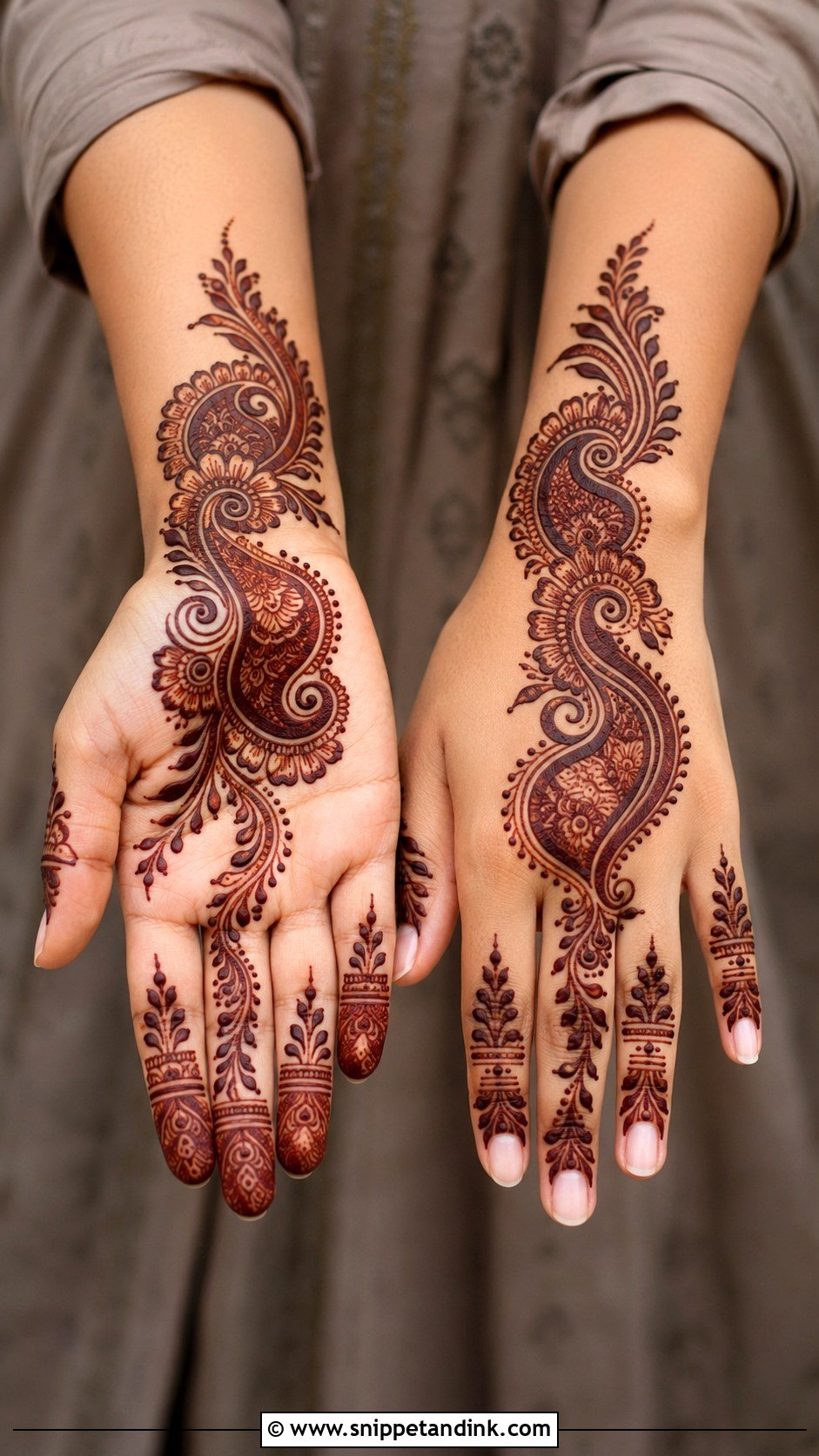
Paisleys follow the same curve as an Arabic vine, which is why they slot in so easily. A large paisley near the wrist can anchor a trail of flowers, leaves and dots toward the fingers, with smaller paisleys layered along the way. I outline them boldly and fill with simple lines or tiny petals; a paisley crammed with micro-detail loses its shape once stained. It works on the palm and the back of the hand equally.
17. Arabic Peacock Mehndi Design
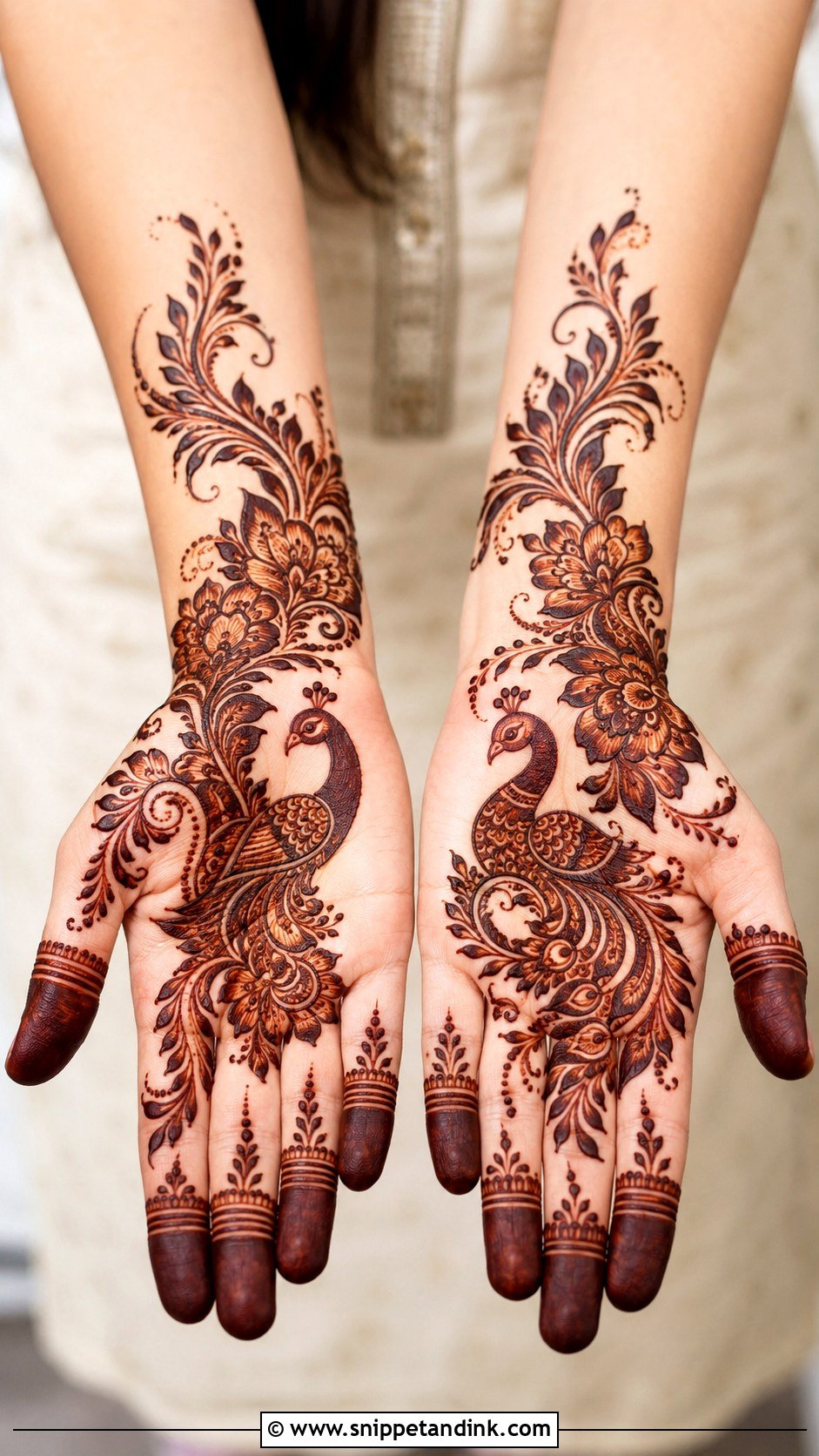
An Arabic peacock mehndi design keeps the bird clean and surrounded by open space, where a dense bridal peacock would bury it in filler. I place it on the palm, wrist or back of the hand and let the tail feathers become the vine, so the motif and the trail are one movement. Feathers built from paisley shapes, dots and curves read best after staining. One peacock is enough; keep the fingers simple so it stays the focus.
18. Arabic Khafif Mehndi Design
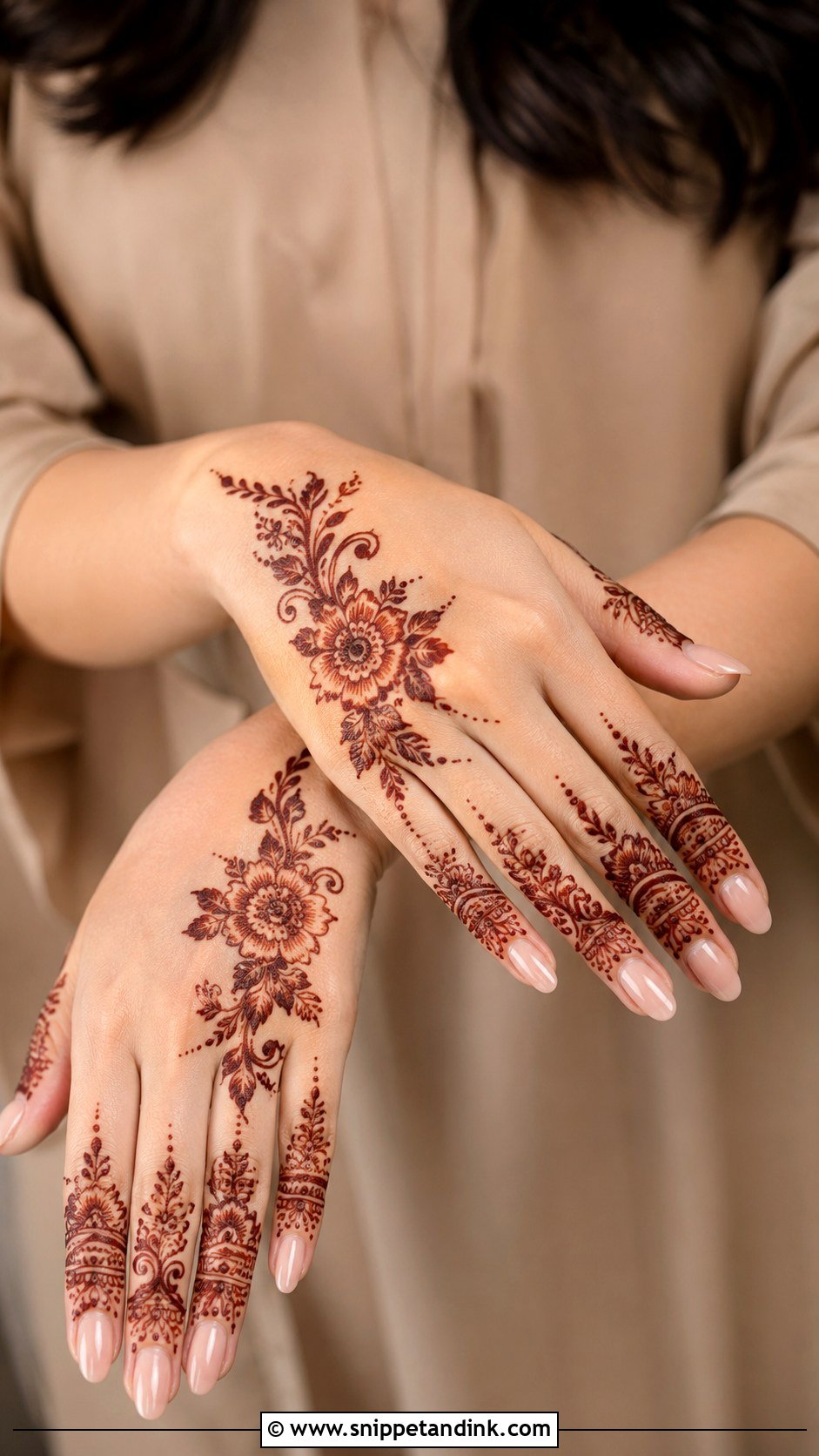
“Khafif” means light, and the style is built from thin lines, tiny flowers, lace-style fillers and soft shading laid over an Arabic structure. Fine lines need a cone with a very small opening and paste mixed perfectly smooth, since any grit in the powder breaks the line mid-stroke. The trade-off is colour: very thin lines stain paler than bold ones. So I put slightly bolder motifs at the wrist or the centre of the hand to give the eye a dark anchor. Bridesmaids and guests tend to like it for the detail without the heavy coverage.
19. Arabic Eid Mehndi Design
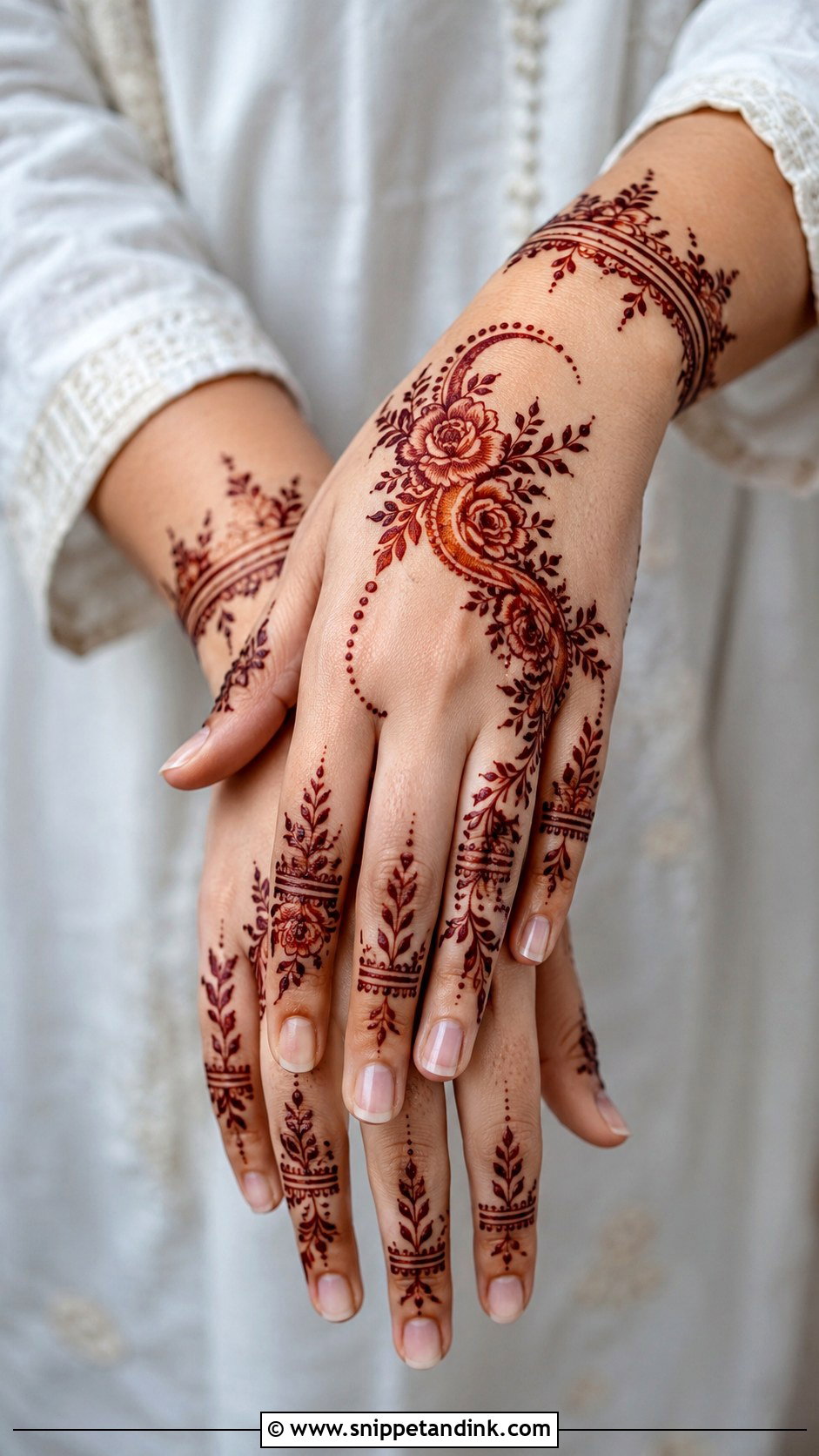
Eid henna gets worn through long days of cooking, hosting and visiting, so comfort counts as much as looks. A flowing floral trail on the back of the hand, with moon-like curves, dotted lines, small leafy branches and a bracelet band, gives a festive finish without a long sitting. If you want the brightest stain, choose a diagonal design on the palm instead, where colour develops deepest. Bold outlines around each flower and clean gaps between motifs keep it crisp.
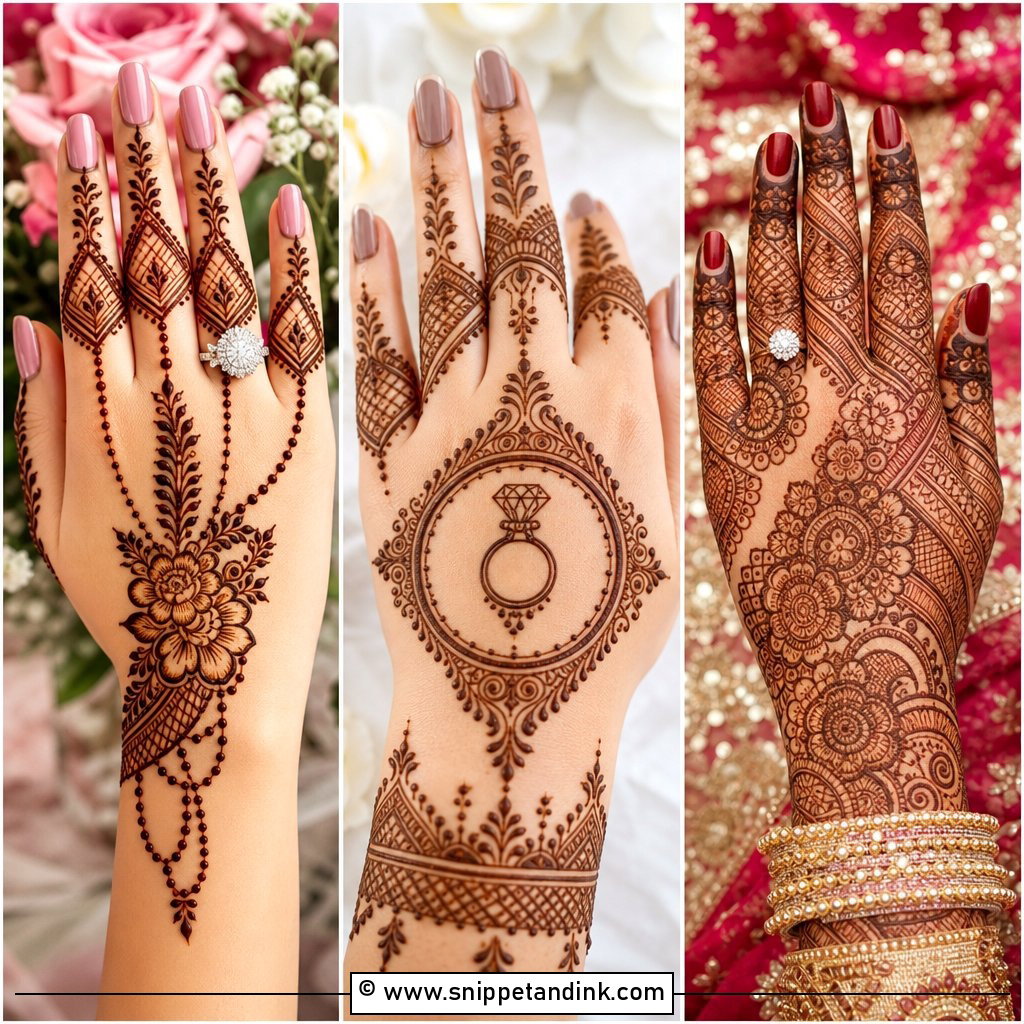
20. Arabic Engagement Mehndi Design
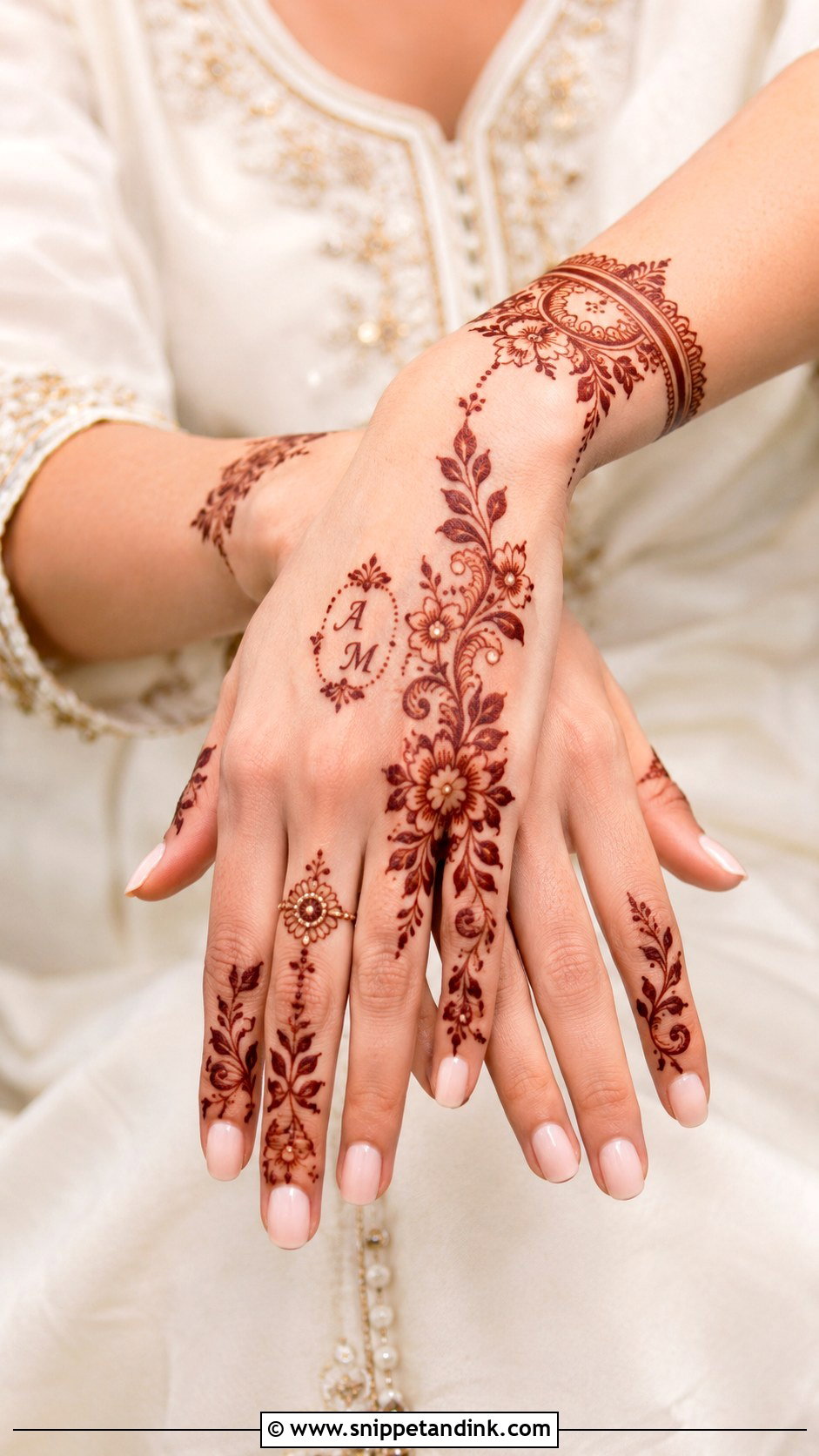
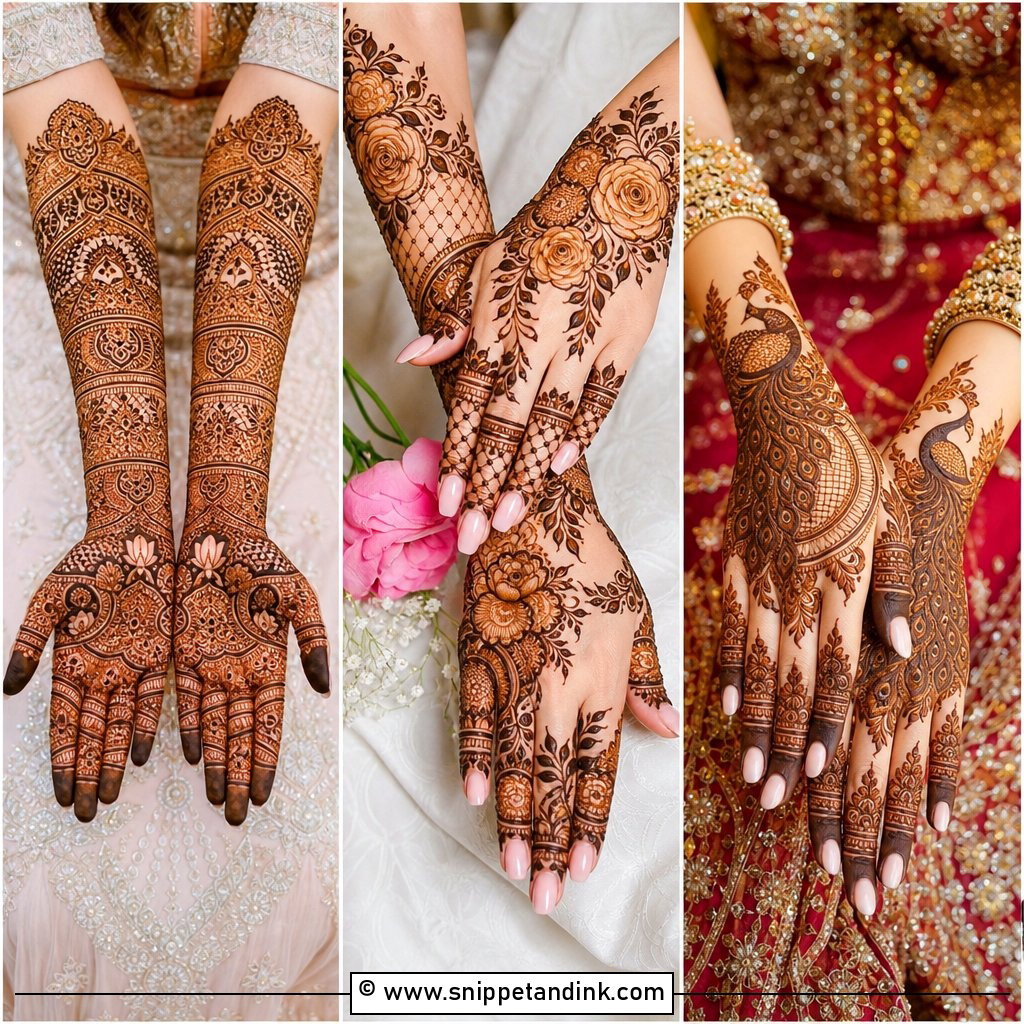
Engagement henna should sit a step below bridal. My go-to is a back-of-hand floral trail with a wrist bracelet and fine finger work, sometimes with initials, a small ring motif or a delicate mandala near the centre. The ring finger ends up in every close-up, so I keep the base of that finger lighter, leaving the band visible against bare skin instead of lost in pattern. Medium coverage with bold flowers and fine fillers gives a deep maroon stain room to show.
21. Arabic Wedding Guest Mehndi Design
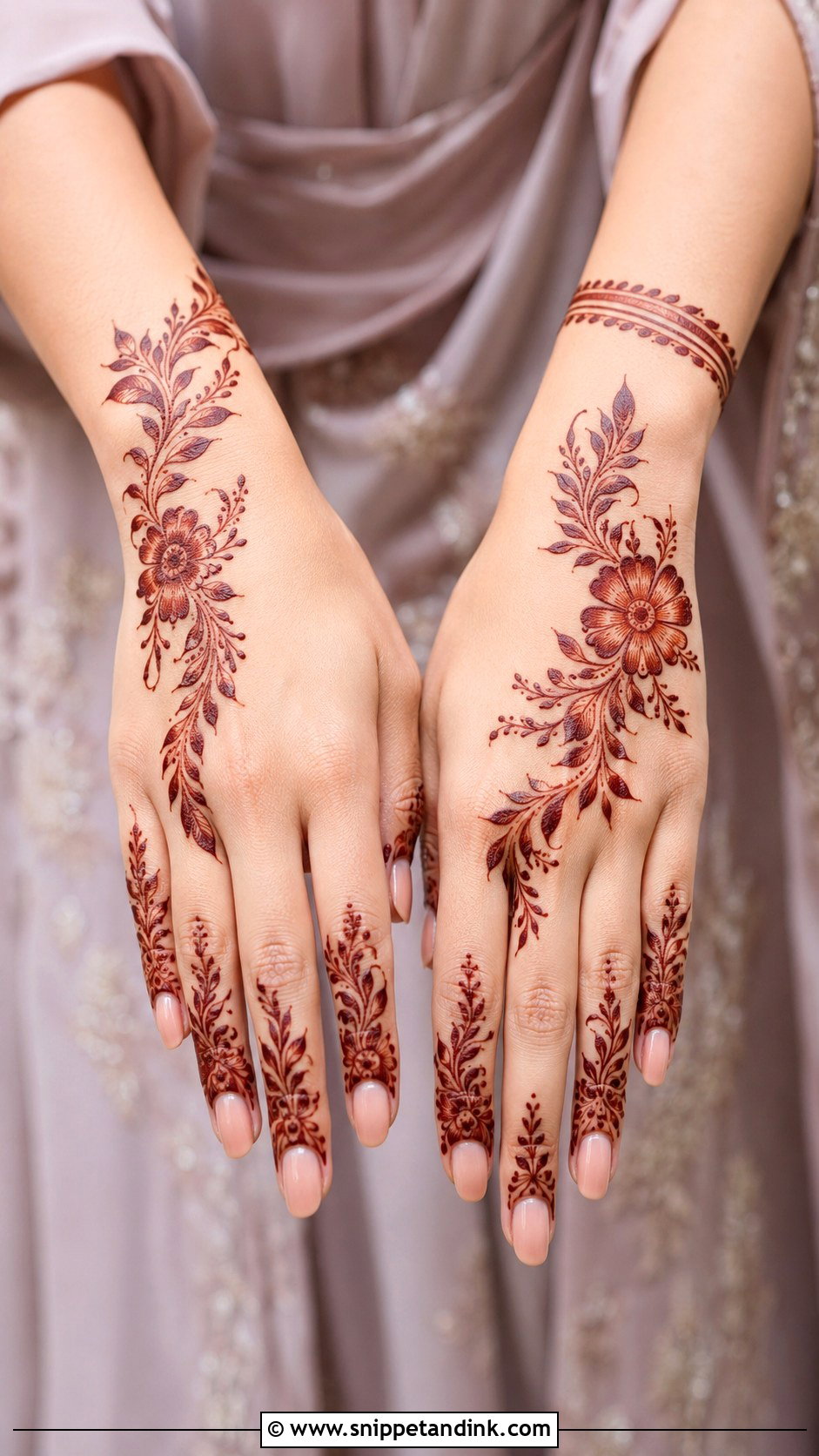
Guests have one rule: don’t out-decorate the bride. A diagonal trail with flowers, leaves and slim finger bands on the back of the hand is usually right, or a palm design with one large motif and a wrist cuff. Arabic layouts look finished without full-arm coverage, which also means a shorter wait in the queue on the mehndi night. Keep it medium in size and add a few shaded petals and dots for richness.
22. Arabic Minimal Mehndi Design
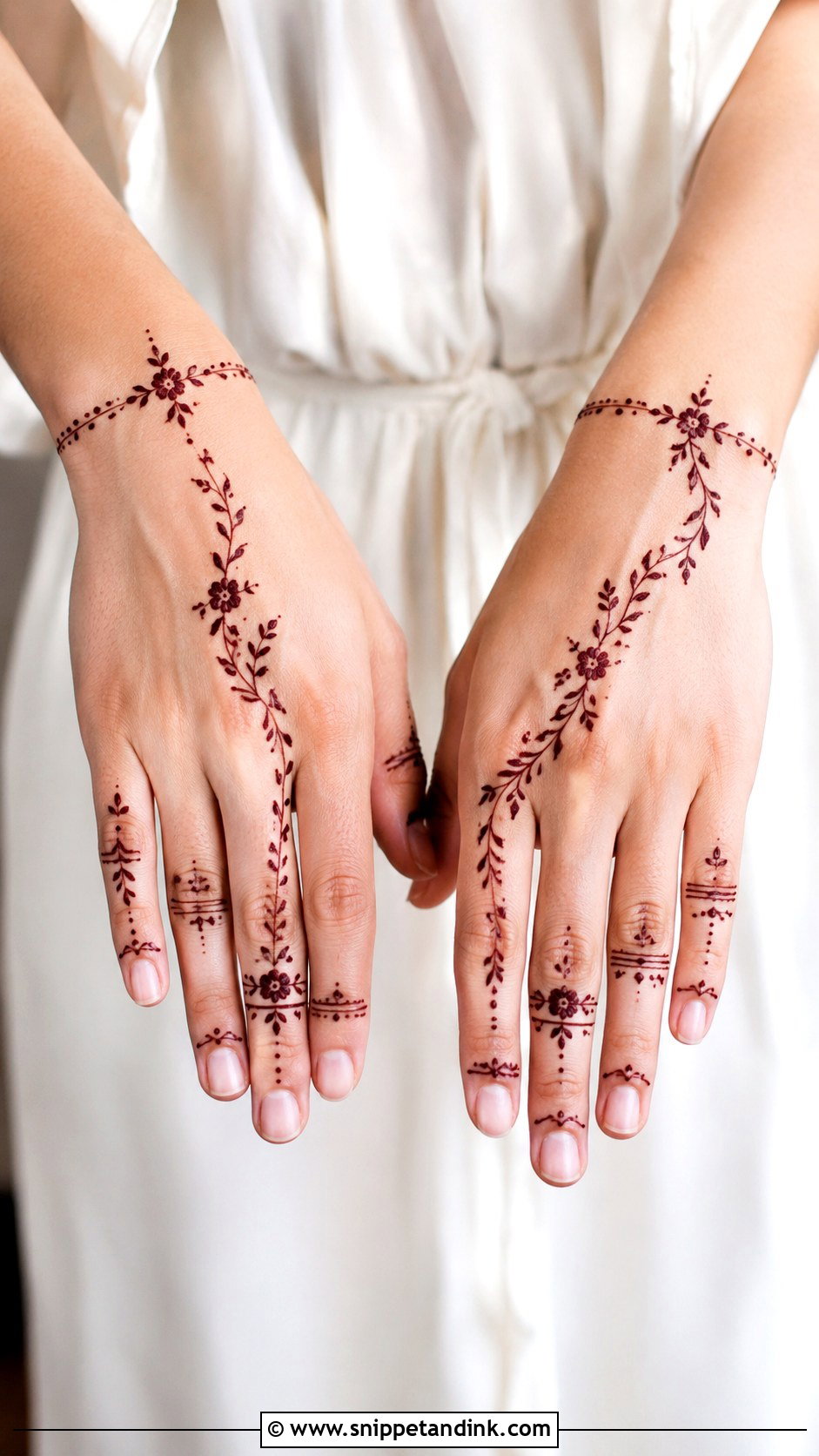
Minimal Arabic henna lives or dies on placement. With fewer motifs and more open skin, every flower has to sit exactly where it should. A slim vine from wrist to one finger is enough when the line is smooth, and a small mandala on the back of the hand with fingertip caps and a light wrist band also works. What I steer people away from is scattering: three small motifs dotted at random look unfinished. Pick one direction and one focal motif.
23. Arabic Heavy Mehndi Design
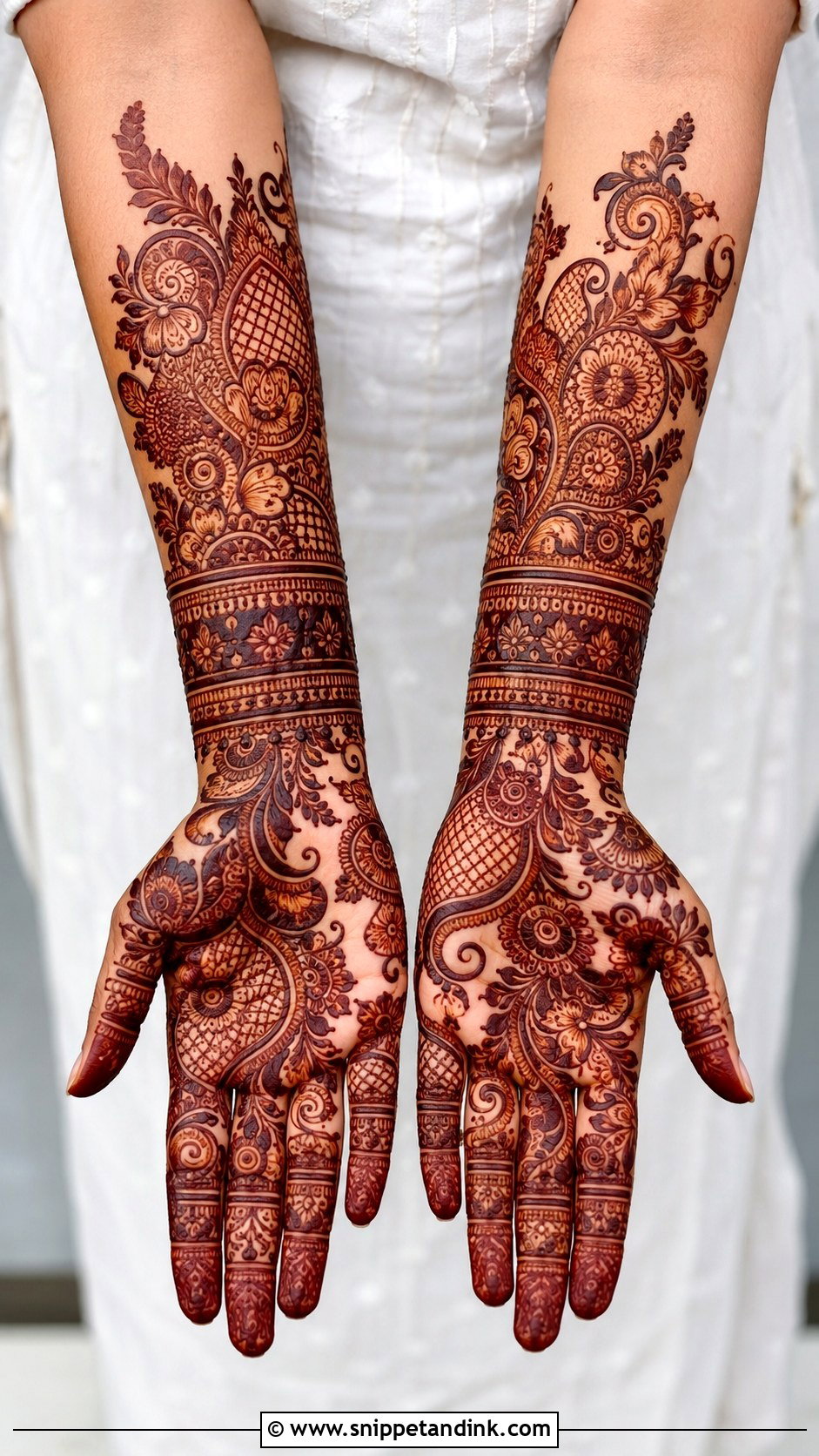
Heavy Arabic henna covers more of the hand with large flowers, thick vines, paisleys, jaali and shading, but it uses bigger motifs rather than tiny packed ones. That’s how it stays Arabic. A back-hand version can run from fingertips to forearm, and a front-hand version can fill the palm with open borders. Expect a longer sitting and a longer drying time, which matters if hair and makeup are booked the same day. I still leave small gaps around the major flowers so the pattern stays legible.
24. Arabic Shaded Mehndi Design
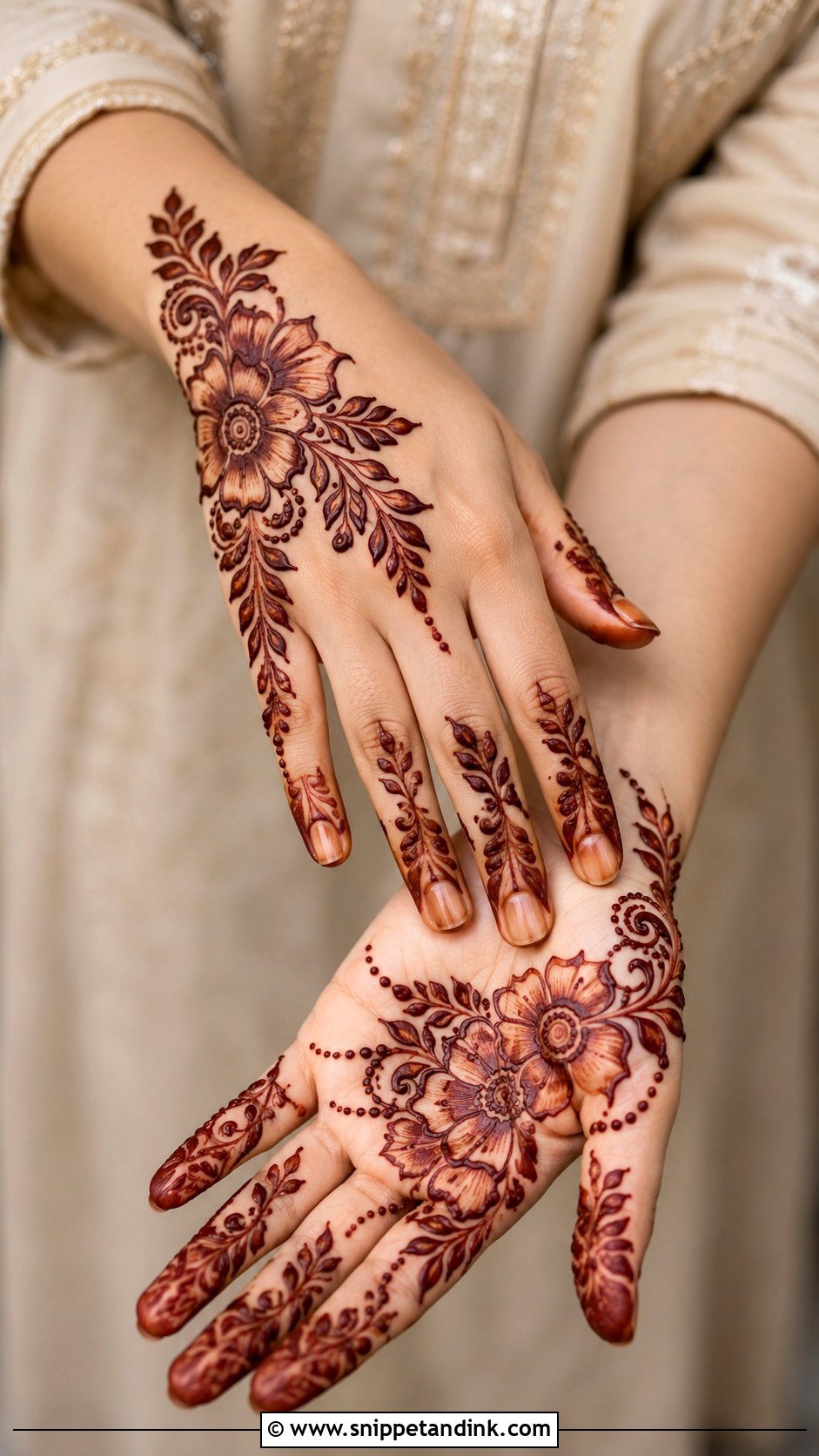
Shading creates depth through thin strokes, light smudging or close-set lines inside petals, leaves, paisleys and borders. Shaded areas stain lighter than outlines because less paste sits on the skin, and that difference is the dimension you see. So I keep outlines bold and shading deliberately light. A shaded rose trail is the classic modern pick, and the shading already shows clearly in the wet paste, so pictures taken that evening look finished.
25. Arabic Bel Mehndi Design
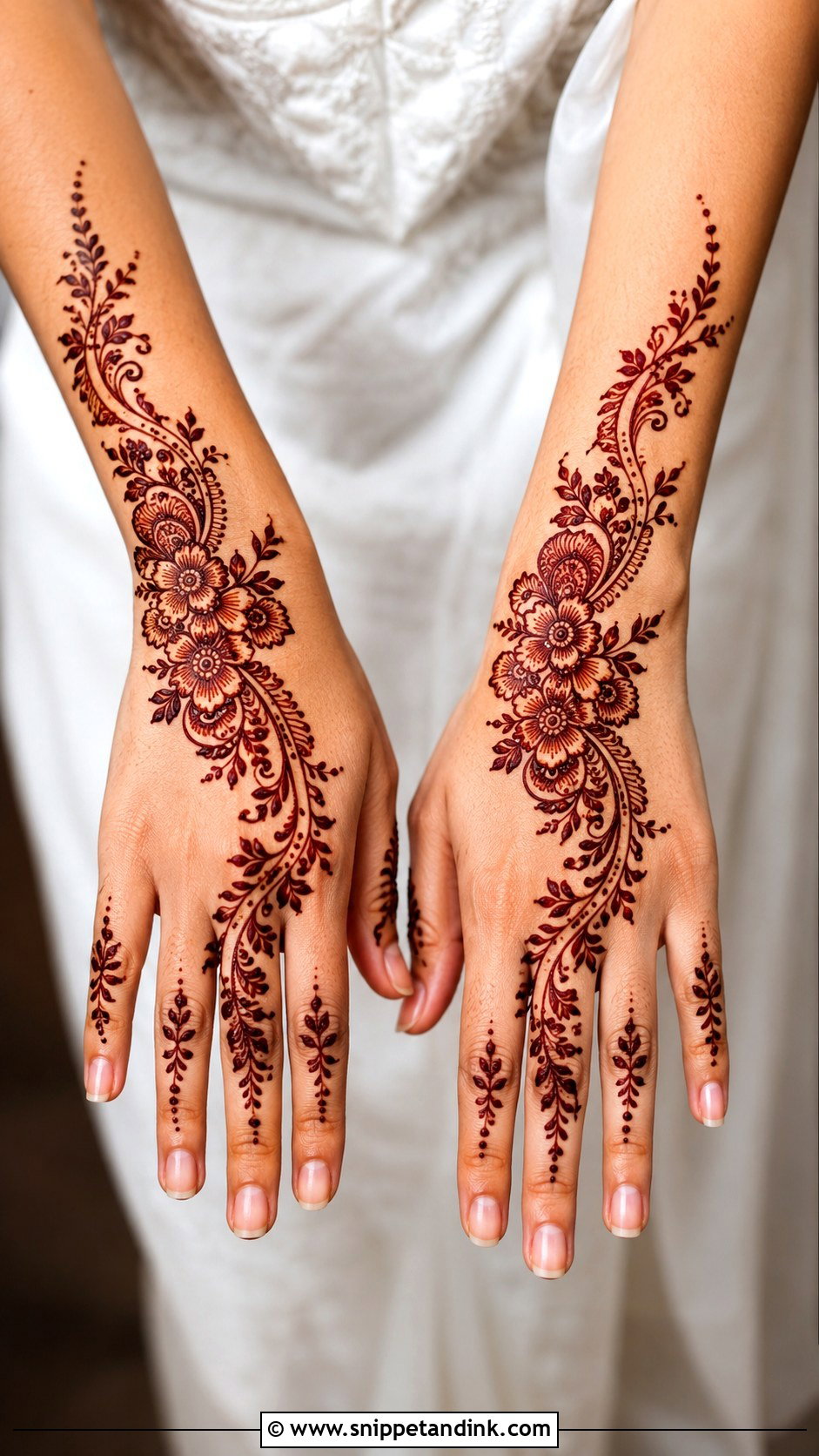
Bel is the vine itself, running diagonally across the back of the hand, curving over the palm or climbing from wrist to forearm. It’s one of the oldest Arabic layouts and still feels current with clean spacing. Flowers, leaves, paisleys and dots can sit along it. I like one bold flower near the wrist and the rest of the vine kept slim, so the weight sits at the base and thins toward the fingers the way a real branch does.
26. Arabic Leaf Mehndi Design
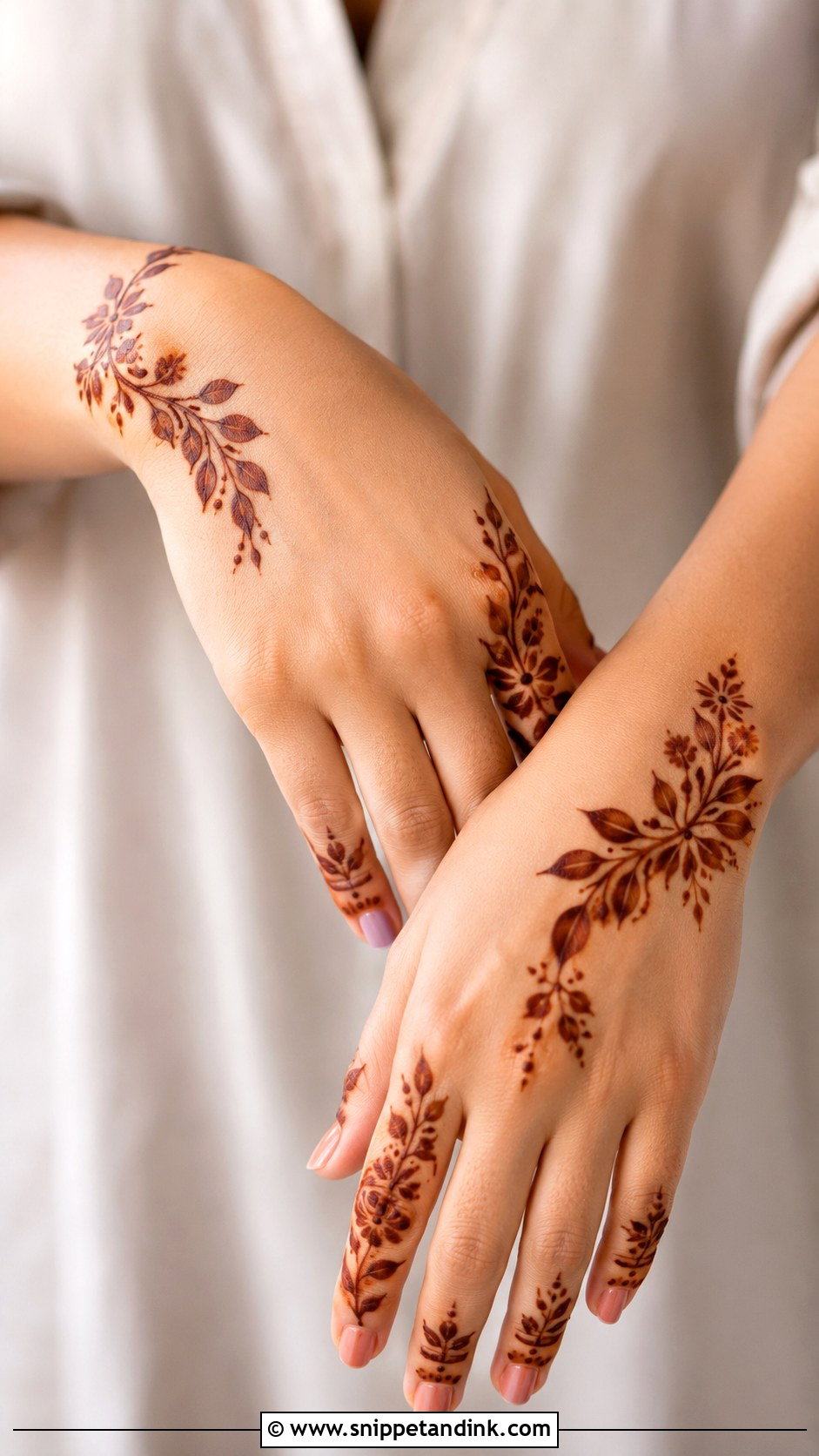
Leaf-led designs drop the big flowers for leafy vines, curved branches and fine botanical detail, which makes them a natural fit for minimal henna. You can build a diagonal leaf trail with a bracelet band, or pair the leaves with one small flower. Pointed tips are the sign of a practised hand: I lift the cone away as I finish each leaf so it tapers instead of ending in a round dot. Even spacing keeps it neat for casual events, Eid and simpler guest looks.
27. Arabic Lotus Mehndi Design
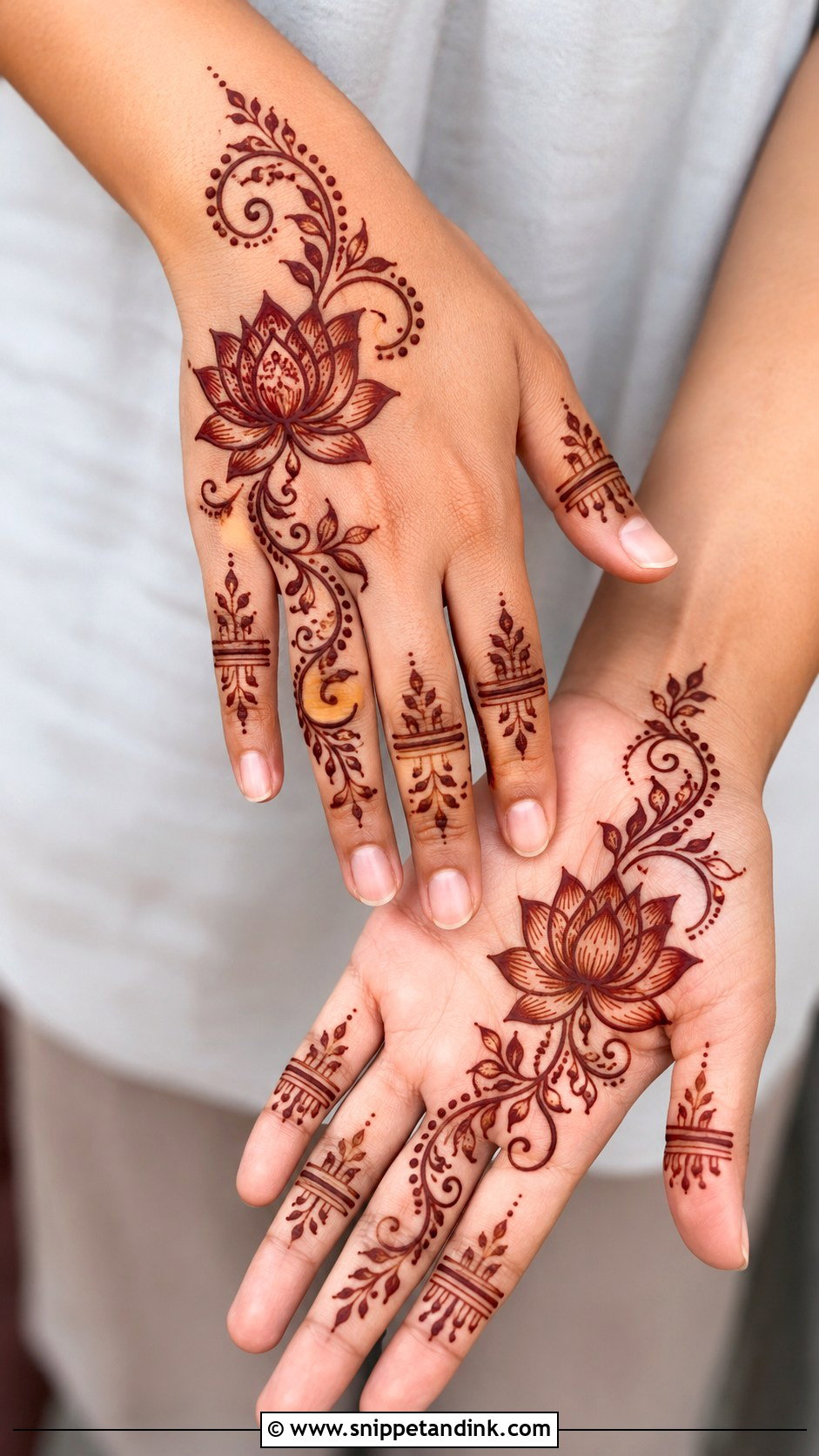
A lotus sits calmly at the centre of the back of the hand, in the palm or near the wrist, with curved vines, small leaves, dots and finger bands around it. Its petals are long and pointed, so they need bold outlines and only light inner shading, or the shape collapses into a blob. Families often ask for it at pujas and festivals as well as weddings. Keep the lotus large and clean and do the delicate work around it, not inside it.
28. Arabic Geometric Mehndi Design
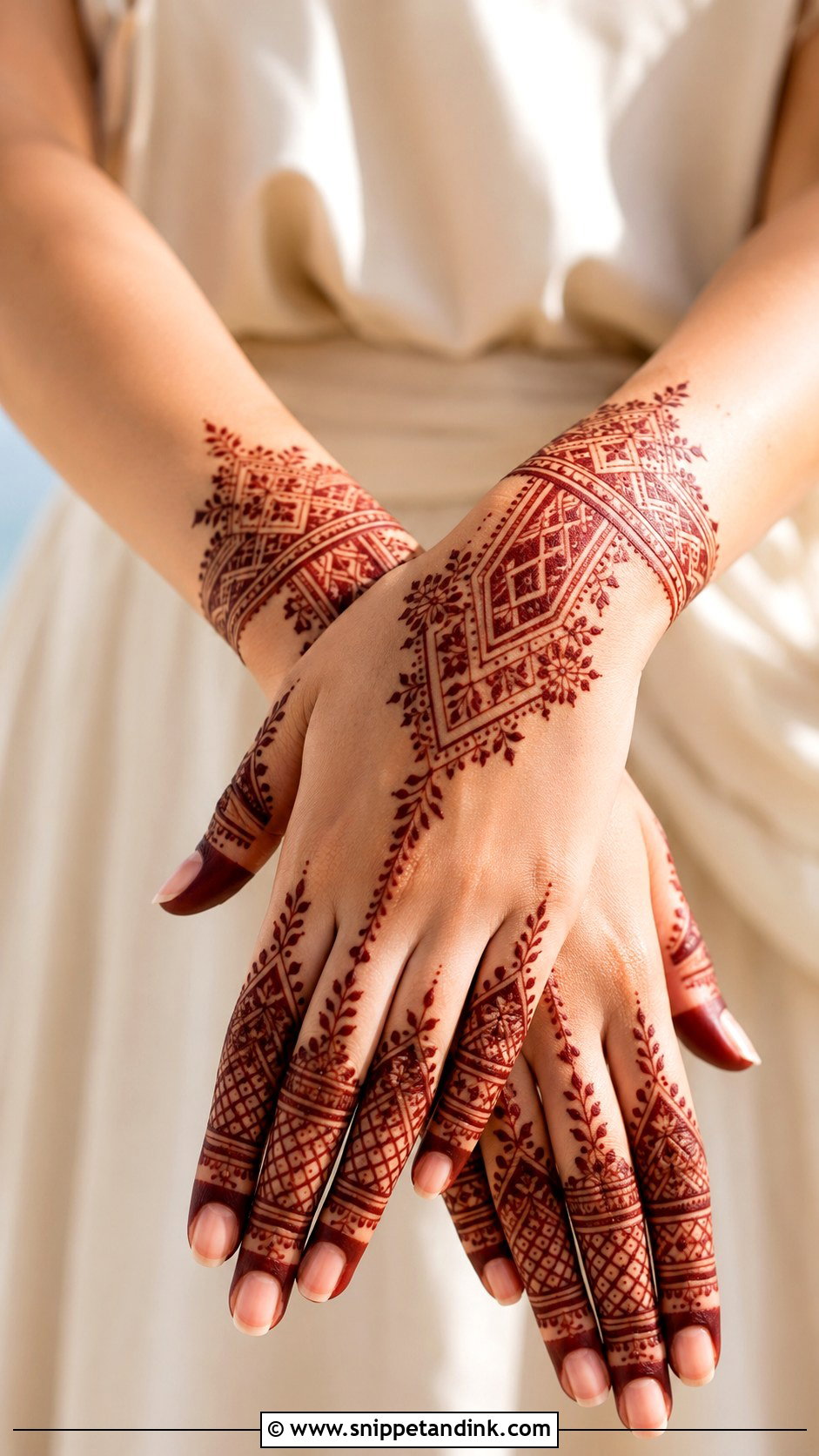
This one mixes floral trails with triangles, diamonds, chevrons, grids and neat linework. Straight lines are harder than curves on skin because a hand isn’t flat, so I map geometric sections onto the flatter areas, the wrist and the back of the hand, rather than across the knuckles. A geometric wrist cuff with a floral trail is a strong option, and diamond jaali on the fingers adds structure. Too many sharp shapes look stiff; leaves and curved vines soften them. It sits well with contemporary outfits and minimal jewellery.
29. Arabic Gulf Mehndi Design
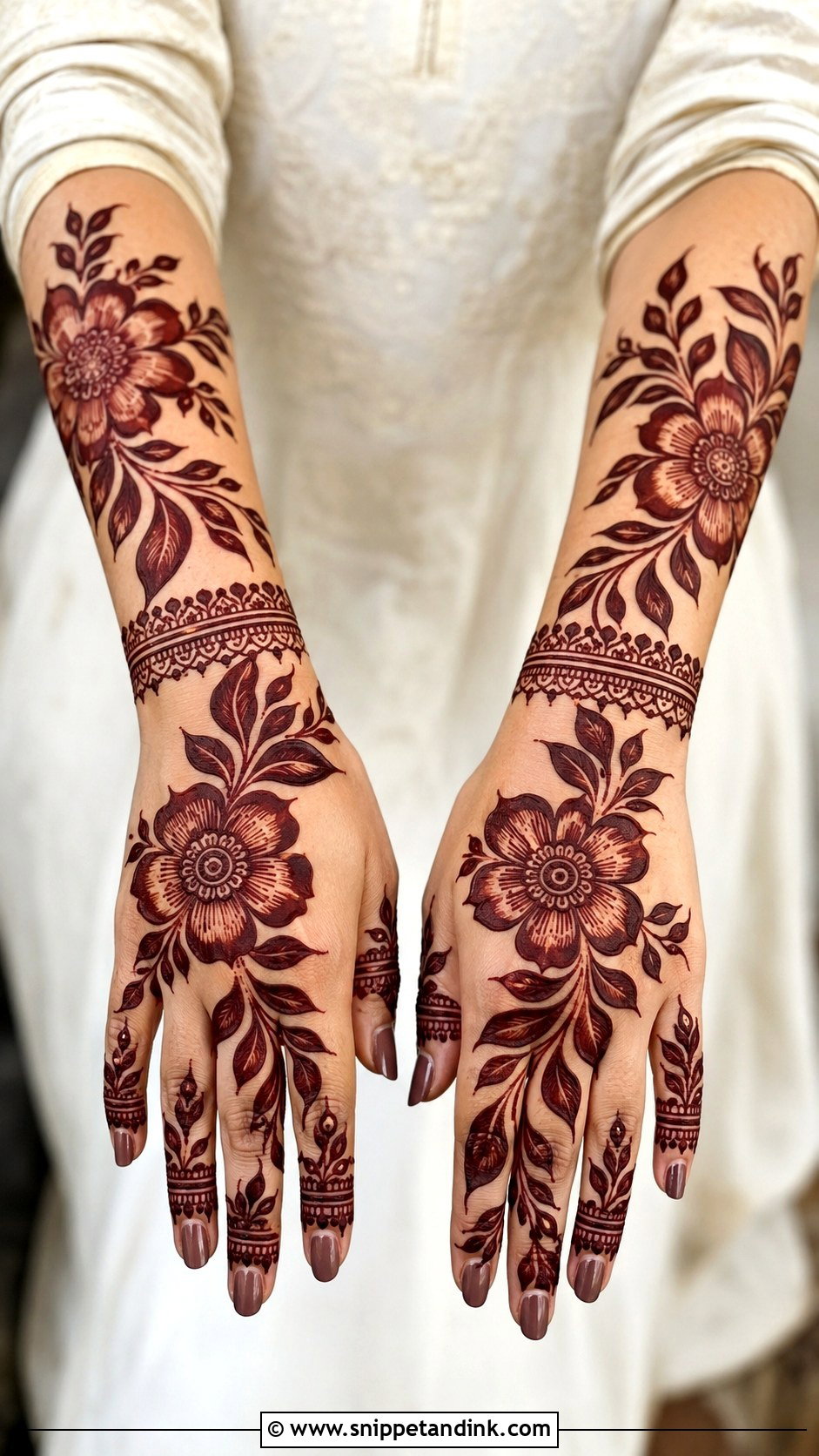
Khaleeji-inspired henna uses bold lines, dramatic spacing and oversized florals, so it reads more striking than softer Arabic work. Thick leafy vines and strong wrist details are typical, sometimes with fine fillers around the main motifs for contrast. These lines need a slightly wider cone opening and generous paste, and the reward is a stain that stays dark and clean even as it fades. Keep the fingers light so the main trail stays dominant.
30. Arabic Moroccan Mehndi Design
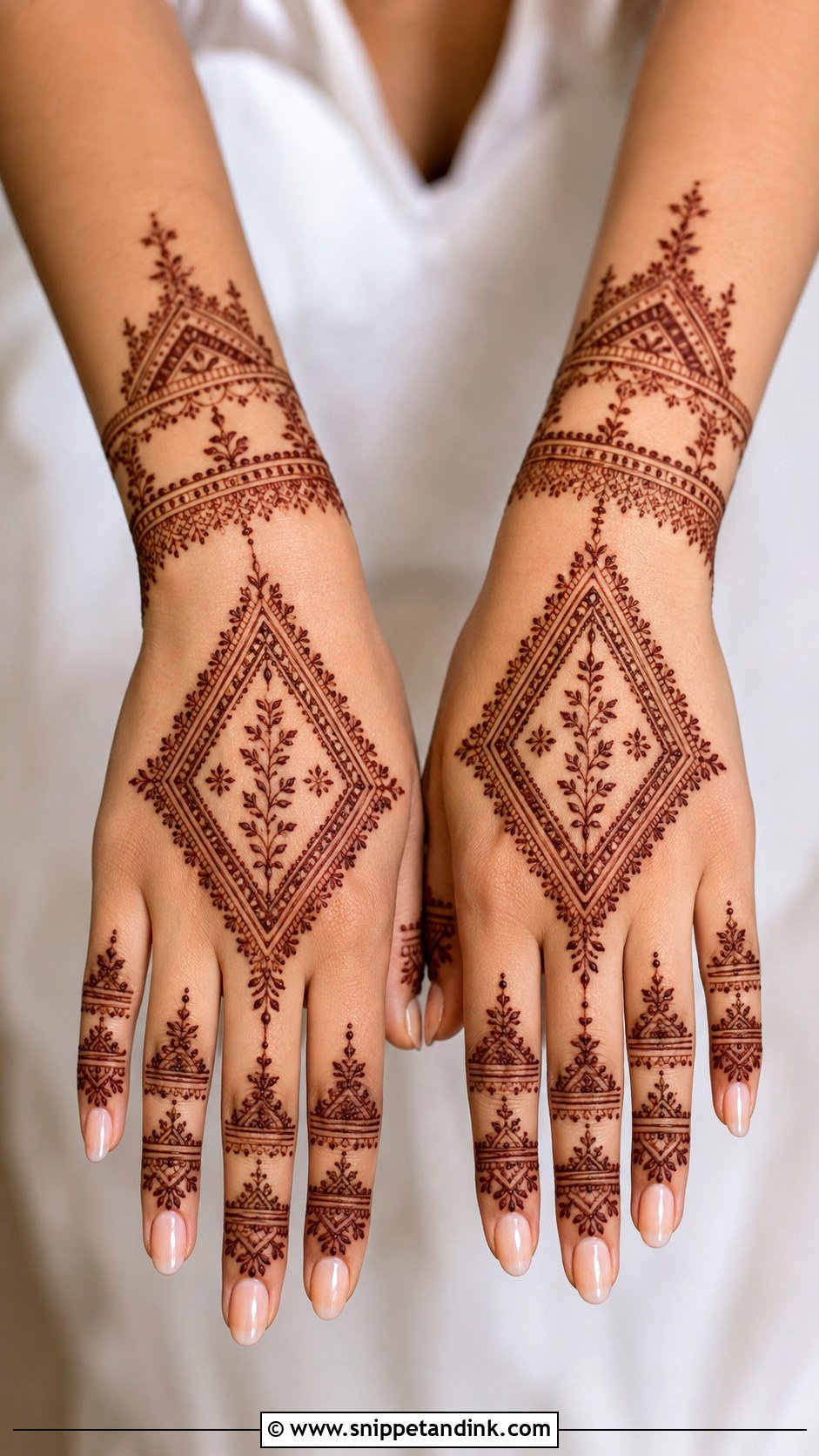
An Arabic Moroccan mehndi design pairs flowing Arabic placement with Moroccan geometry: diamonds, angled lines, small grids and bold borders alongside flowers and vines. On the back of the hand the geometric shapes frame the fingers neatly, and a diamond-patterned wrist cuff can link to a floral trail. On the palm, I’d choose a central geometric motif ringed with Arabic leaves. The geometric parts need symmetry, so I line them up by eye against the knuckles before starting, then soften the whole design with curved vines.
31. Arabic Indo Arabic Mehndi Design
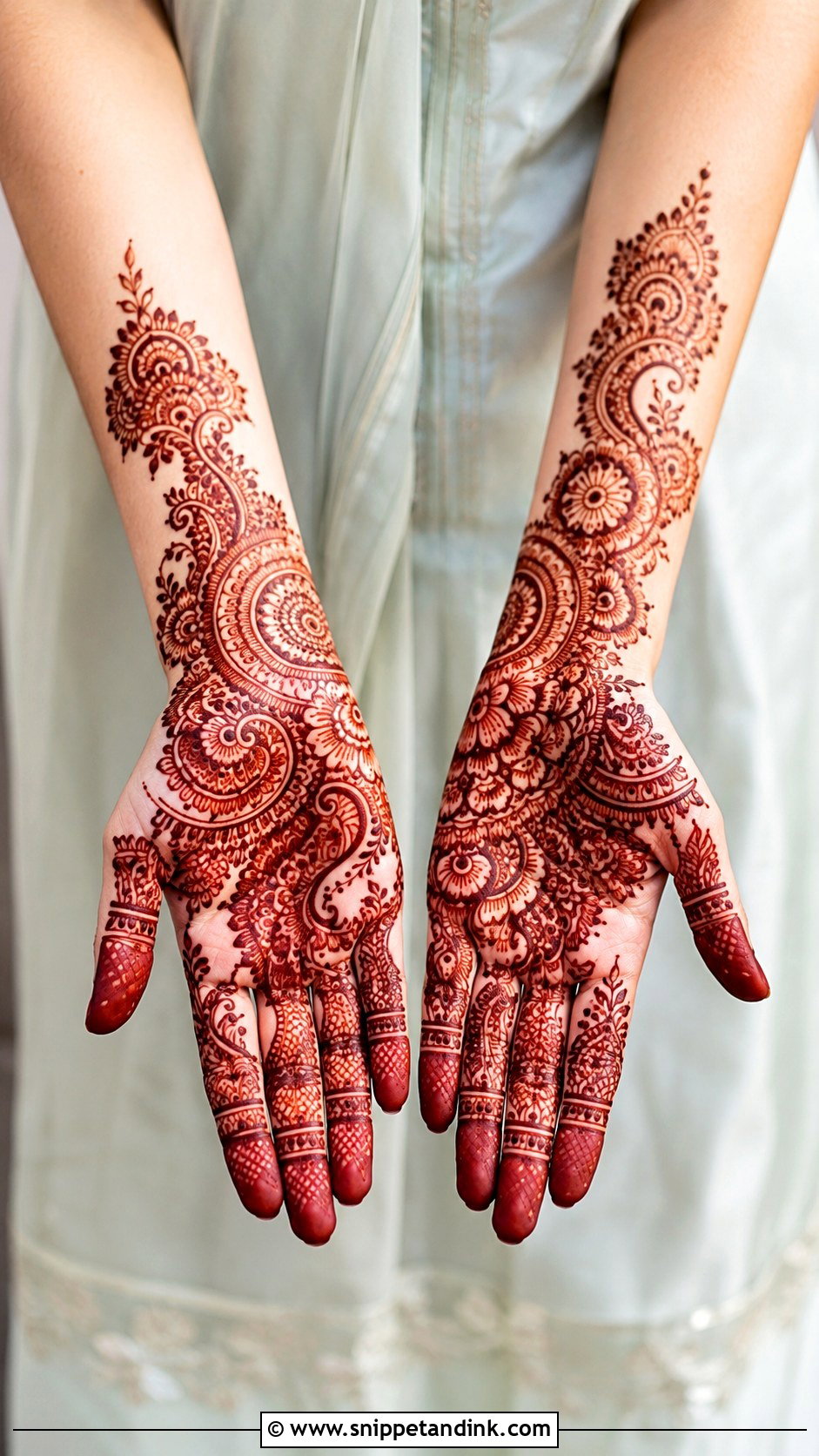
Indo-Arabic henna takes the open flow of Arabic work and adds the detail of Indian mehndi: large Arabic flowers beside Indian paisleys, mandalas, fine fillers and detailed fingers. It’s fuller than a simple trail and lighter than traditional bridal coverage. Where it goes wrong is when filling creeps everywhere. I keep the main layout diagonal and confine the detailed filling to a few chosen motifs, which keeps it wearable on either side of the hand.
32. Arabic Rajasthani Mehndi Design
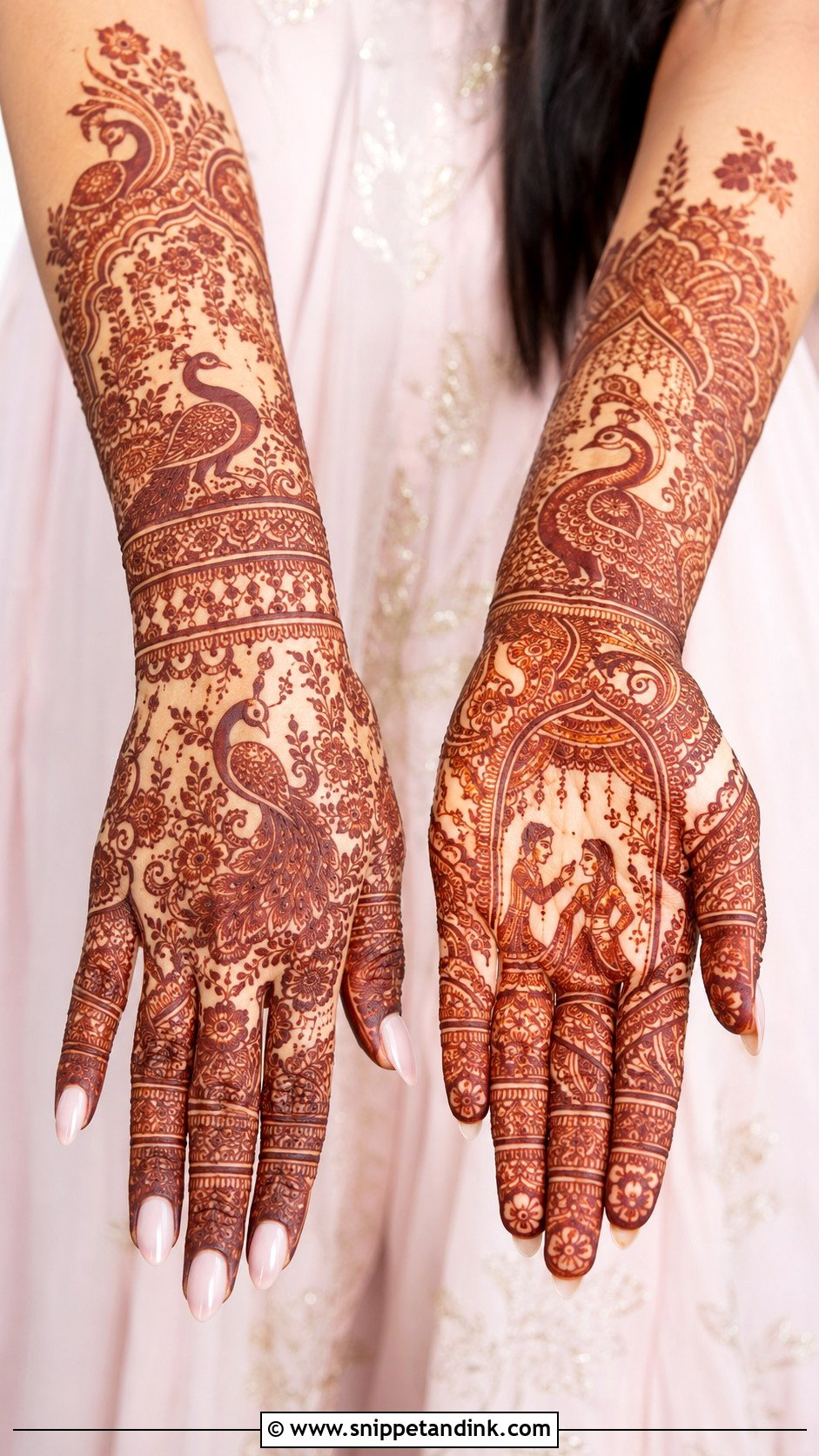
Rajasthani elements bring storytelling, with peacocks, bride and groom figures, paisleys and fine borders, paired here with Arabic floral trails. Figures need room. I usually place one on the palm, where there’s flat space and the darkest stain, and run Arabic vines out toward the wrist and fingers. Choose one storytelling element, not several, or the hand turns into a crowded scene. Brides, sisters and close family wear this one most.
33. Arabic Pakistani Mehndi Design
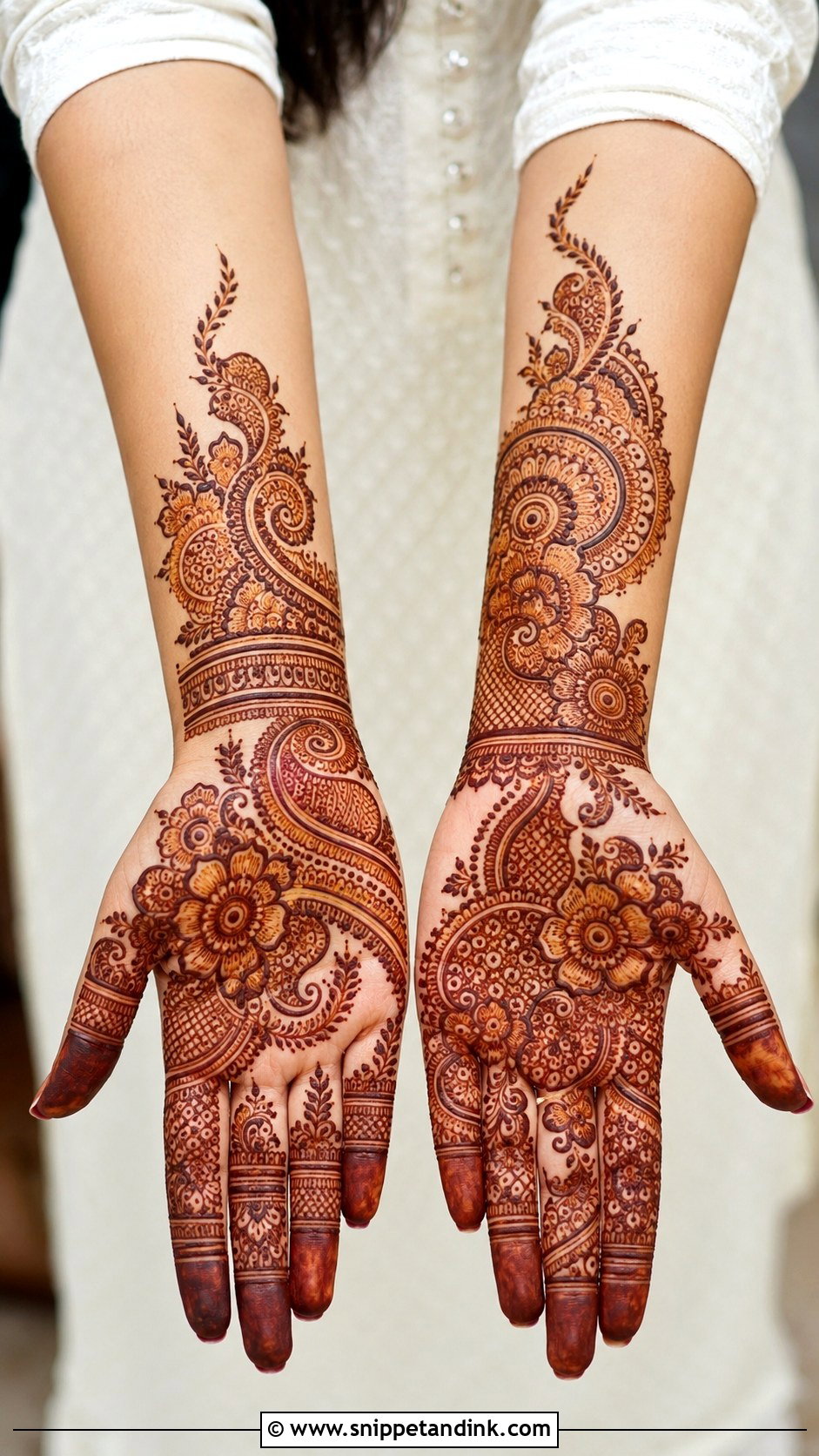
This fusion pairs bold Arabic flowers with fine Pakistani-style fillers, leafy bands, dots, paisleys and mandala accents, at medium or full coverage. For Eid or a guest, I’d keep it to a back-of-hand trail with detailed fingers. For a bride, it can run to the forearm with more filling and wrist bands. The contrast between strong main motifs and delicate fillers is what makes it work, so never let the fillers get heavier than the flowers.
34. Arabic Party Mehndi Design
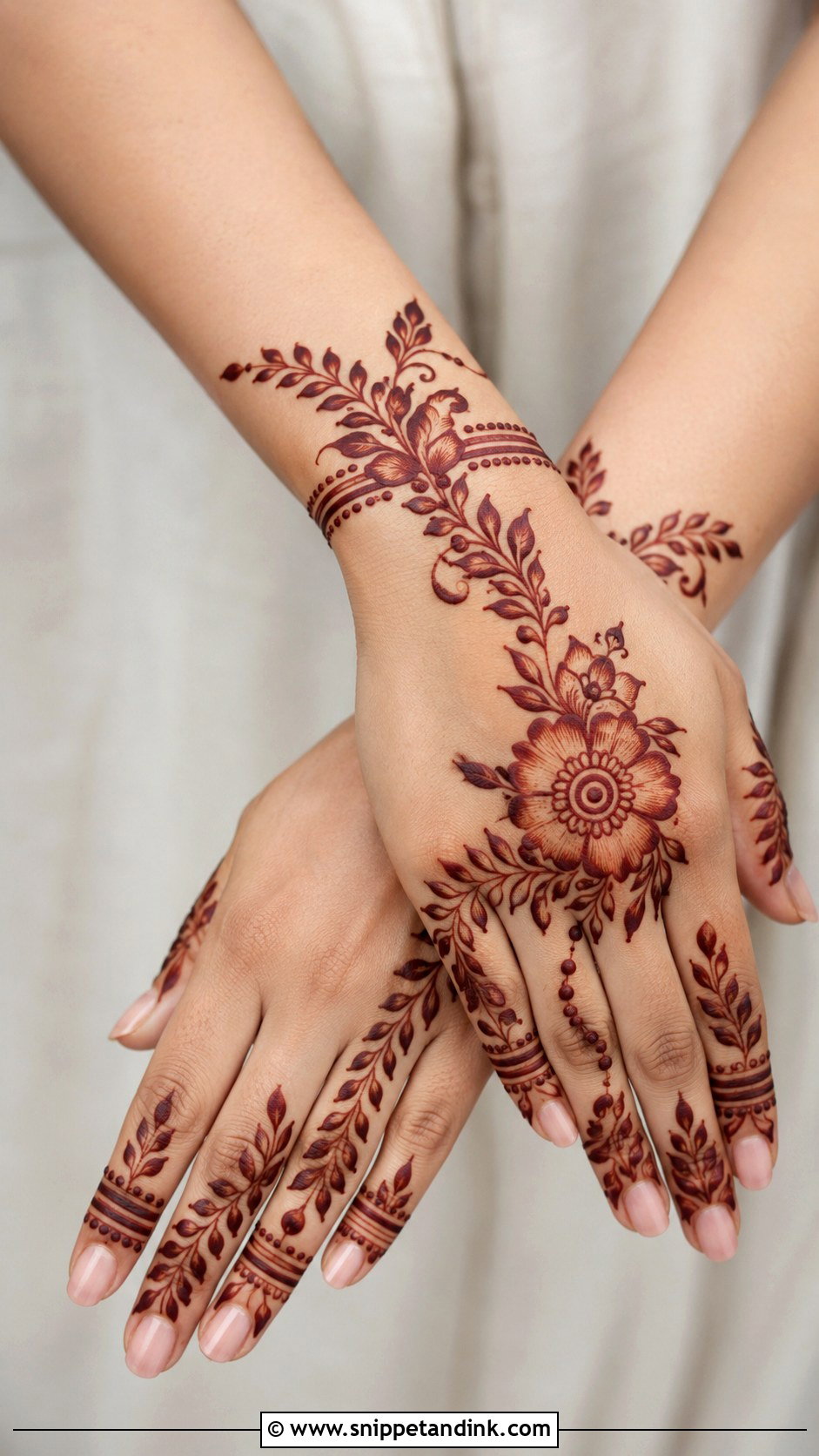
Party henna should go on fast and look good the same night. A clean back-hand pattern with one bold flower, a leafy vine and a bracelet detail fits that brief, or a finger-focused design if you want even less to look after. Bear in mind the stain will still be orange that evening if the paste only came off a few hours earlier; it deepens over the next day or two. If the party is the main event, have the henna done the day before, and leave room for rings and bangles.
35. Arabic Half Hand Mehndi Design
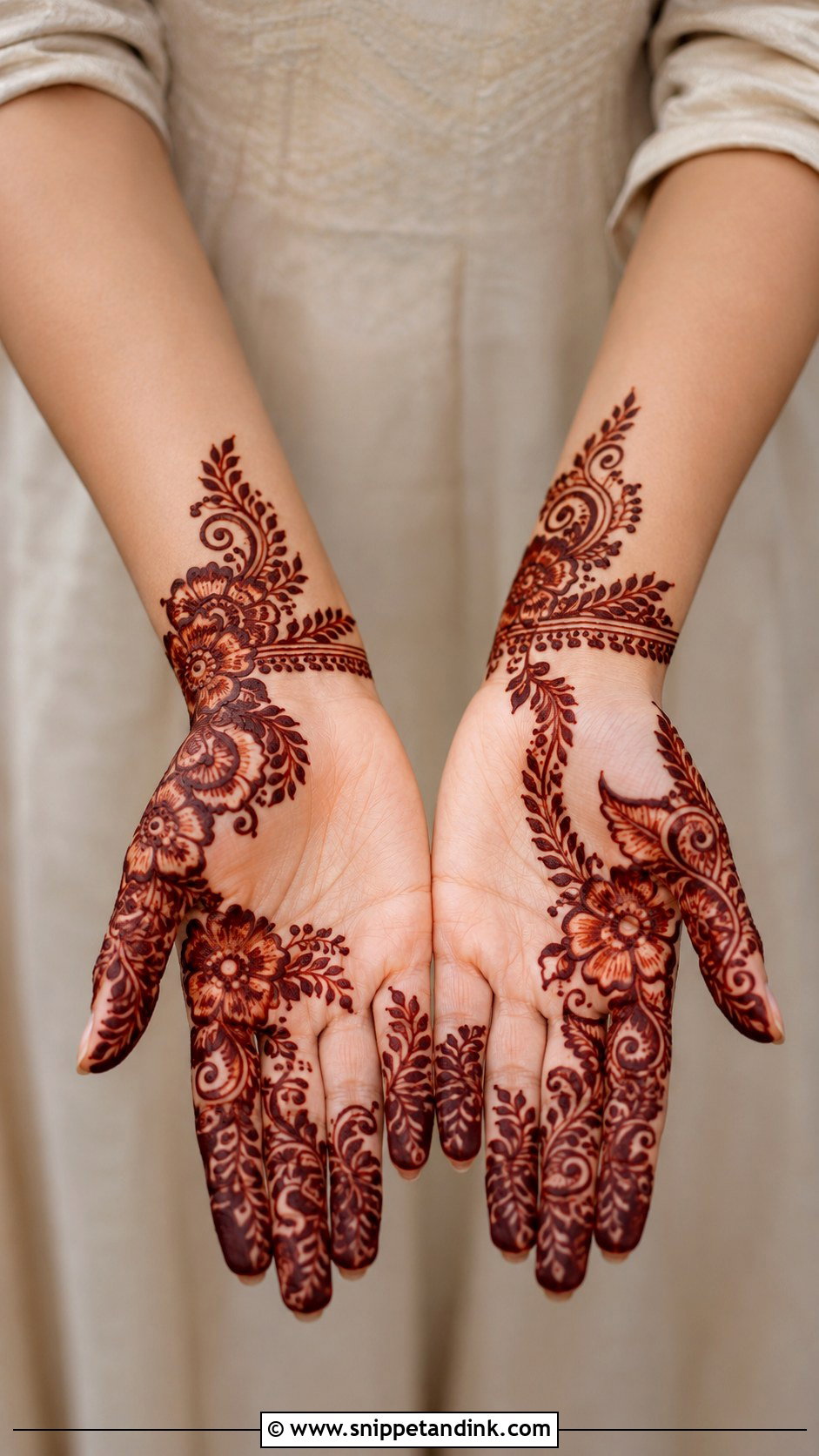
Half-hand coverage takes in the fingers, part of the palm or back of the hand and a small wrist section, then stops short of full-hand henna. Florals, paisleys, leaves and slim bands all fit. I treat the stopping point as part of the design, ending the trail on a leaf or a curl rather than a hard edge, so the bare skin beyond it looks intended. Keep the finger patterns connected to the main motif.
Coaxing a Deep Maroon Stain Out of an Open Design
Open patterns put less paste on the skin than dense bridal work, so the stain has to do more of the work. The colour comes from the dye in the henna leaf binding to the top layer of skin, and it develops in stages: bright orange when the paste comes off, then deepening to brown or maroon over the next day or two. That’s why I schedule bridal henna one to two days before the wedding, not the morning of.
While the paste is on
- Leave it on as long as you can manage. Overnight is ideal for bridal work; a few hours is the least I’d accept.
- Dab a little lemon and sugar mix over the dry paste so it stays stuck to the skin. A sticky film is enough, so don’t soak it.
- Keep your hands warm. Henna develops better on warm skin, and a cold, air-conditioned room slows it down.
- When it’s time, scrape or rub the dried paste away. Don’t rinse it off under the tap.
The day or two after
Keep water off the design until at least the next morning, and rub a little natural oil or balm over it before showers. Hand sanitiser, chlorinated pools and scrubbing all fade henna early, so plan around them in wedding week. Palms and fingertips go darkest while the back of the hand and the forearm stay lighter. That’s simply how skin behaves, not a sign of a bad batch.
One warning I give everyone: real henna never stains black. Paste sold as black henna can contain PPD, a hair-dye chemical that may cause blistering and lasting skin reactions. If the paste is jet black, smells of chemicals or promises full colour within an hour, say no.
Open Skin Is What Makes It Arabic
Arabic henna can be simple, bridal, minimal or bold depending on the layout, and the designs that wear best always pair strong outlines with open space. For a quick look, a back-hand trail or finger design does the job. For the wedding itself, full-hand, bridal, Indo-Arabic or shaded patterns carry more weight. For Eid and parties, floral trails, wrist cuffs and mandala accents are reliable. Whichever you pick, show your artist the outfit and jewellery first, and book the appointment so the stain peaks on the day you’ll be photographed.
You'll Like These Ideas:


Leave a Reply