
Roses are one of the most forgiving motifs I draw for brides, because a rose fits into almost any style around it: dense Indian detailing, bold Arabic trails, Indo-Arabic spacing, jaali mesh, mandalas, paisleys, peacocks and personalized bridal elements. A rose also has natural layers, so its petals give depth on the palm, fingers and forearm once the stain develops. The designs below all aim for full coverage, from heavy and symmetrical to airy and modern. Look at each one with your outfit, your bangles and the length of your sleeves in mind, since those decide how much of the forearm actually shows.
How I Draw a Rose in Henna, One Petal at a Time
A henna rose starts as a small spiral or bud at the center, and each petal is added as a curved outline wrapping around it. I work from the inside out so every new petal tucks behind the last one, which is what gives the flower its layered depth.
The details that matter most are invisible while the paste is on. Outlines need to be thicker than the filler, petals need a hairline gap between them, and shading should be a thinner layer of paste rather than another solid fill. Get those right and the rose stays crisp when the stain turns deep reddish brown. Get them wrong and it reads as a blob from across the room.
How long full hands take
Full bridal coverage on both sides of both hands, up the forearms, is a long sitting. Depending on the density of the design and the artist, it can run anywhere from three or four hours to most of a day. Ask for an estimate at your consultation, and plan food, water and a phone charger within reach, because you won’t be using your hands.
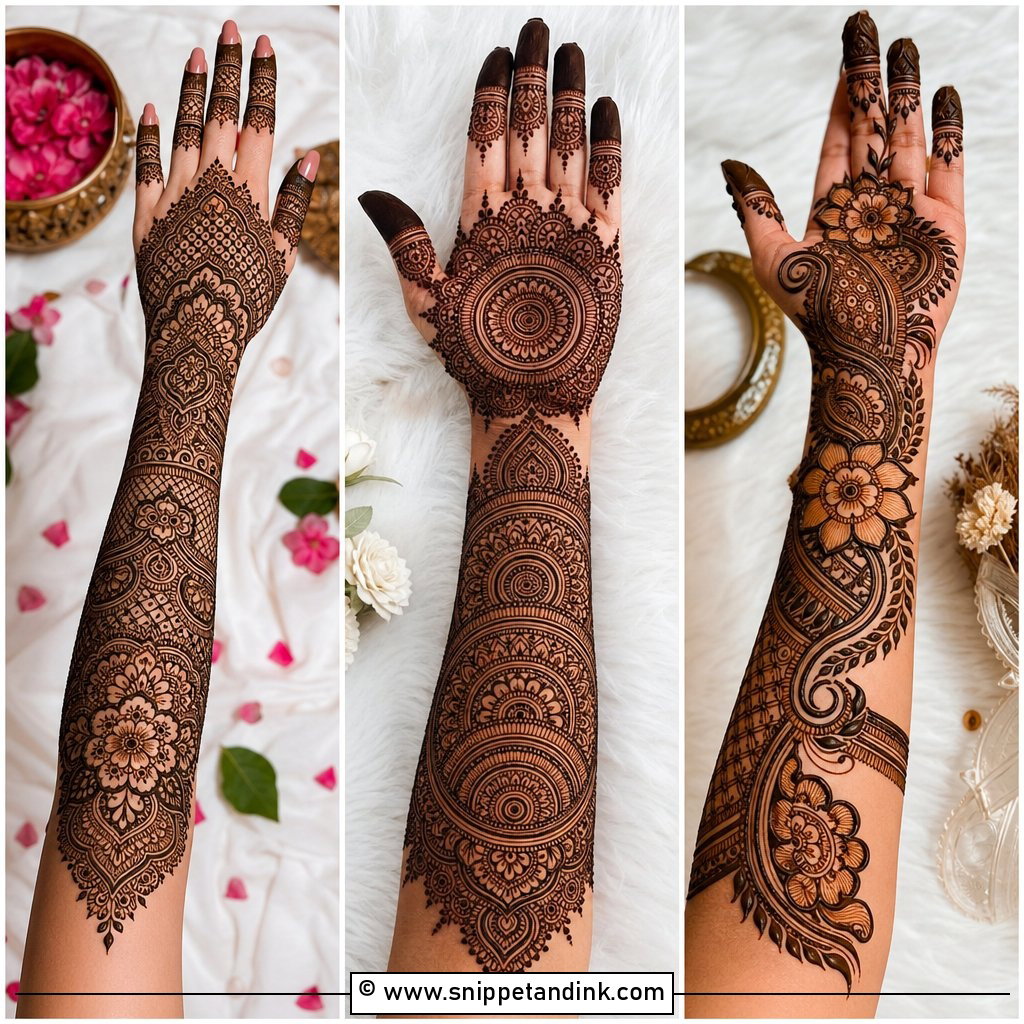
1. Full Hand Rose Bridal Mehndi Design
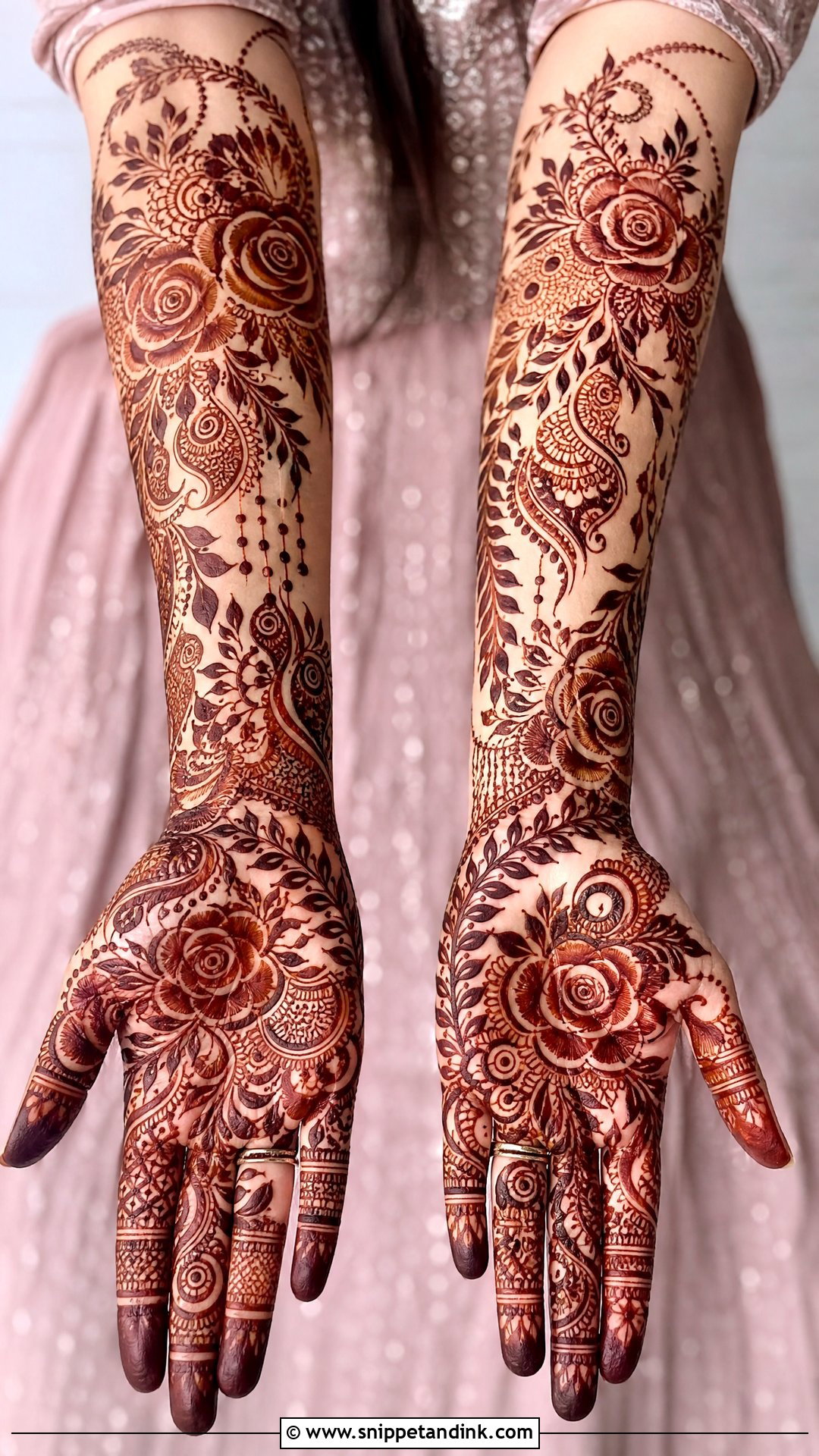
Large roses anchor the palms and back hands, and leafy vines, paisleys and fine filler connect them from fingertips to forearm. Small rose buds, mesh and shaded bands finish the fingers, and bracelet-style borders give the wrist a clean edge. When I draw this layout, I make each petal outline slightly thicker than the filler around it. Henna darkens to a deep reddish brown over the following day or two, and if outline and filler are the same weight, the roses blur into the background. It sits comfortably with red, maroon, pink, ivory or gold outfits.
2. Indian Rose Bridal Mehndi Full Hand
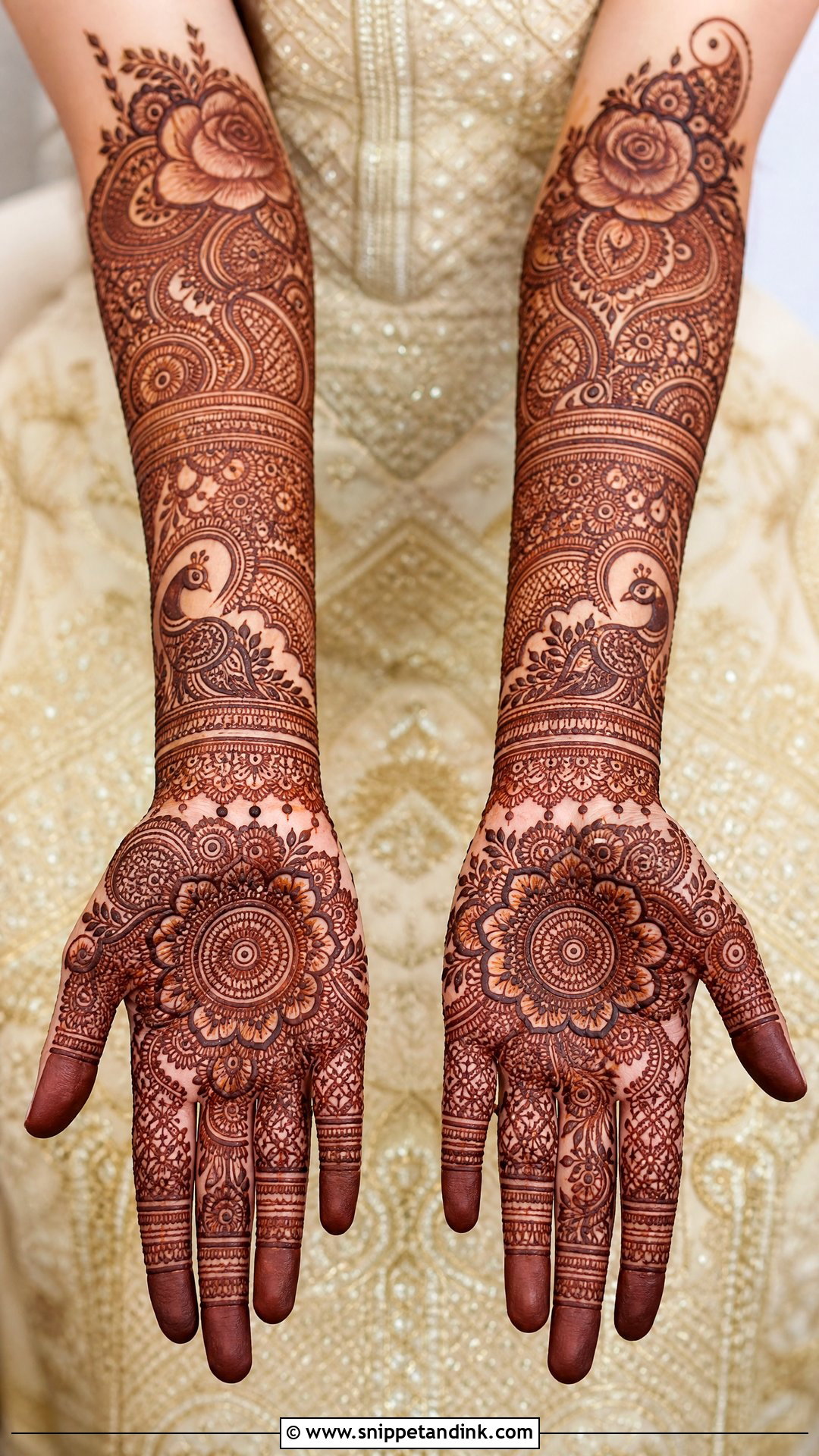
Dense detail and balanced symmetry define the Indian style, and roses fit in among the paisleys, peacocks, mandalas, dotted chains and fine fillers. I often put a rose bouquet in the center of the palm and let curved floral panels climb the forearm. Fingers stay detailed with rose tips and tiny vines. The trap with heavy Indian work is that roses vanish inside it, so I leave a thin ring of bare skin around every main flower. That small gap is what lets the rose read clearly once the paste comes off. It suits a bride who loves traditional mehndi but wants a softer look than paisleys alone.
3. Arabic Rose Bridal Mehndi Full Hand
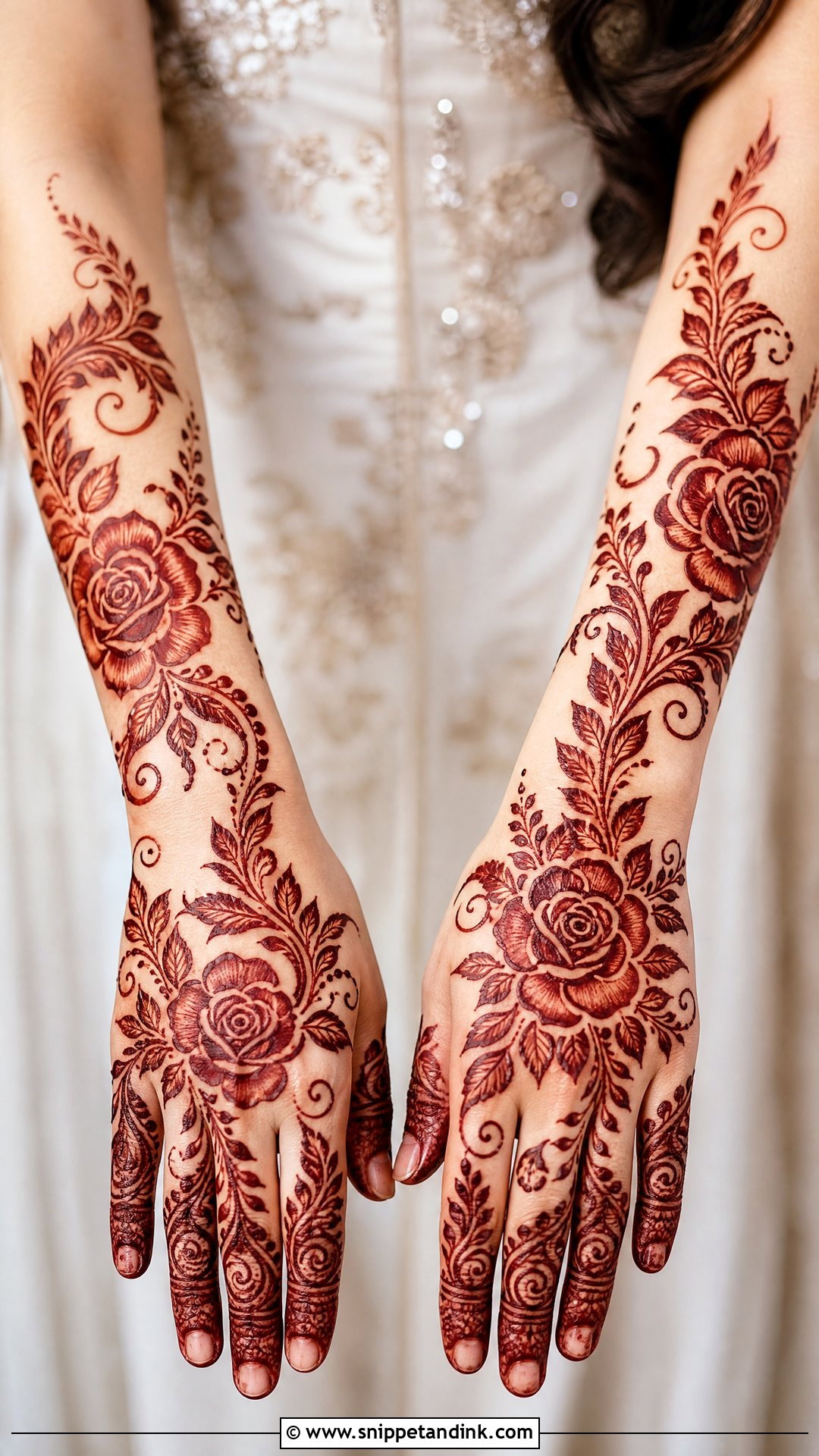
Arabic designs swap tiny filler for big roses, thick leaves, curved vines and open skin. The trail usually starts near the wrist or forearm and runs diagonally toward the fingers. For a bride, I thicken the trail with shaded petals, dotted borders, a lace-like wrist band and detailed fingertips so it reads as bridal rather than party henna. It’s also faster to apply than dense Indian work, which helps if you can’t sit for long. The larger motifs show clearly in daylight photos, especially at an outdoor ceremony.
4. Indo Arabic Rose Bridal Mehndi Full Hand
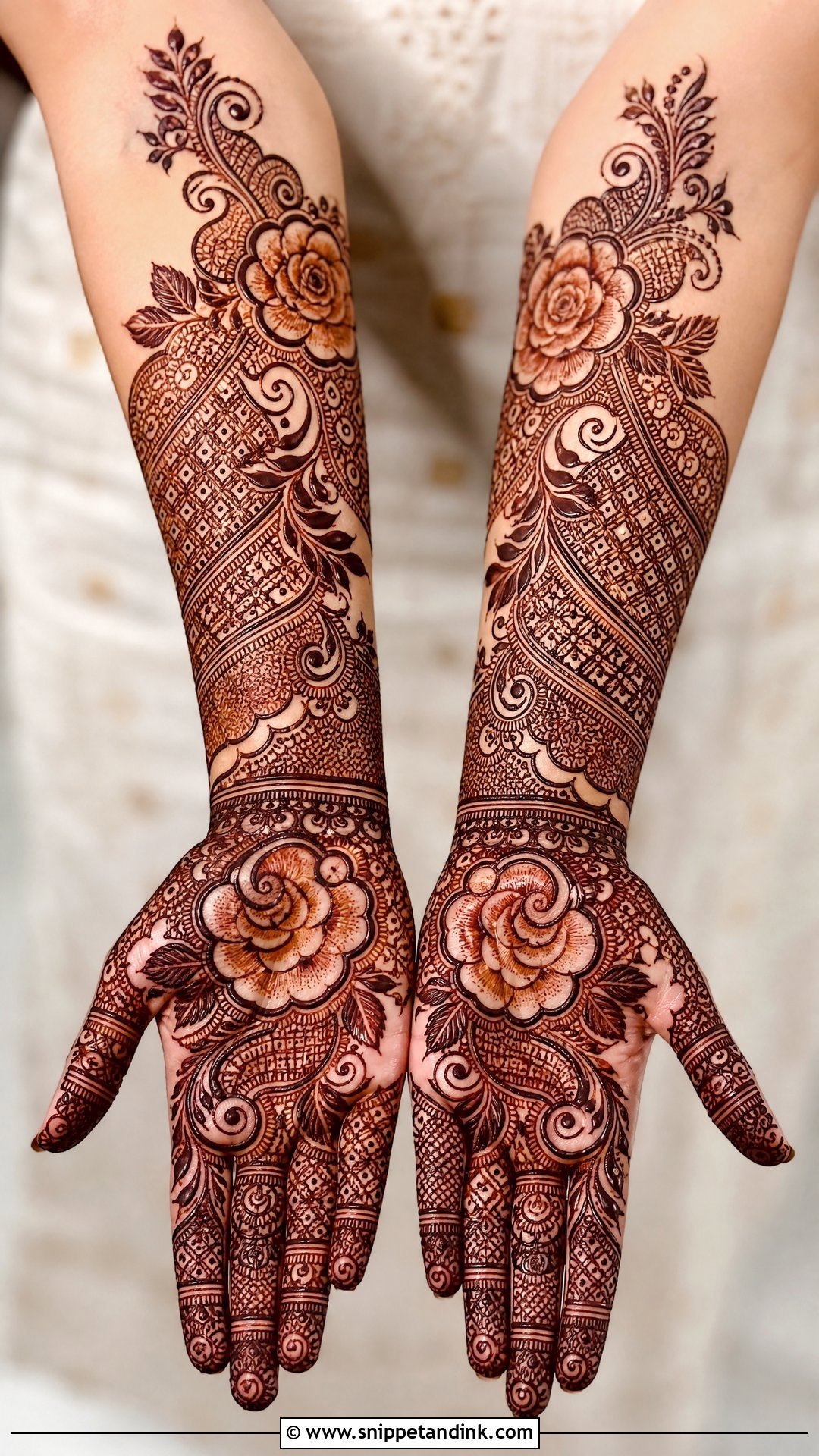
Here the roses and vines keep the Arabic flow, while Indian fillers add depth. I might put big roses on the back hand, detailed paisleys on the palm and a band of jaali near the wrist. The fingers alternate between bold floral tips and delicate line work. Indo-Arabic is the style I suggest most when a bride says full Indian feels too busy and pure Arabic feels too bare. Carrying the rose trail from palm to forearm with matching bracelet bands ties both halves together.
5. Rose Mandala Bridal Mehndi Full Hand
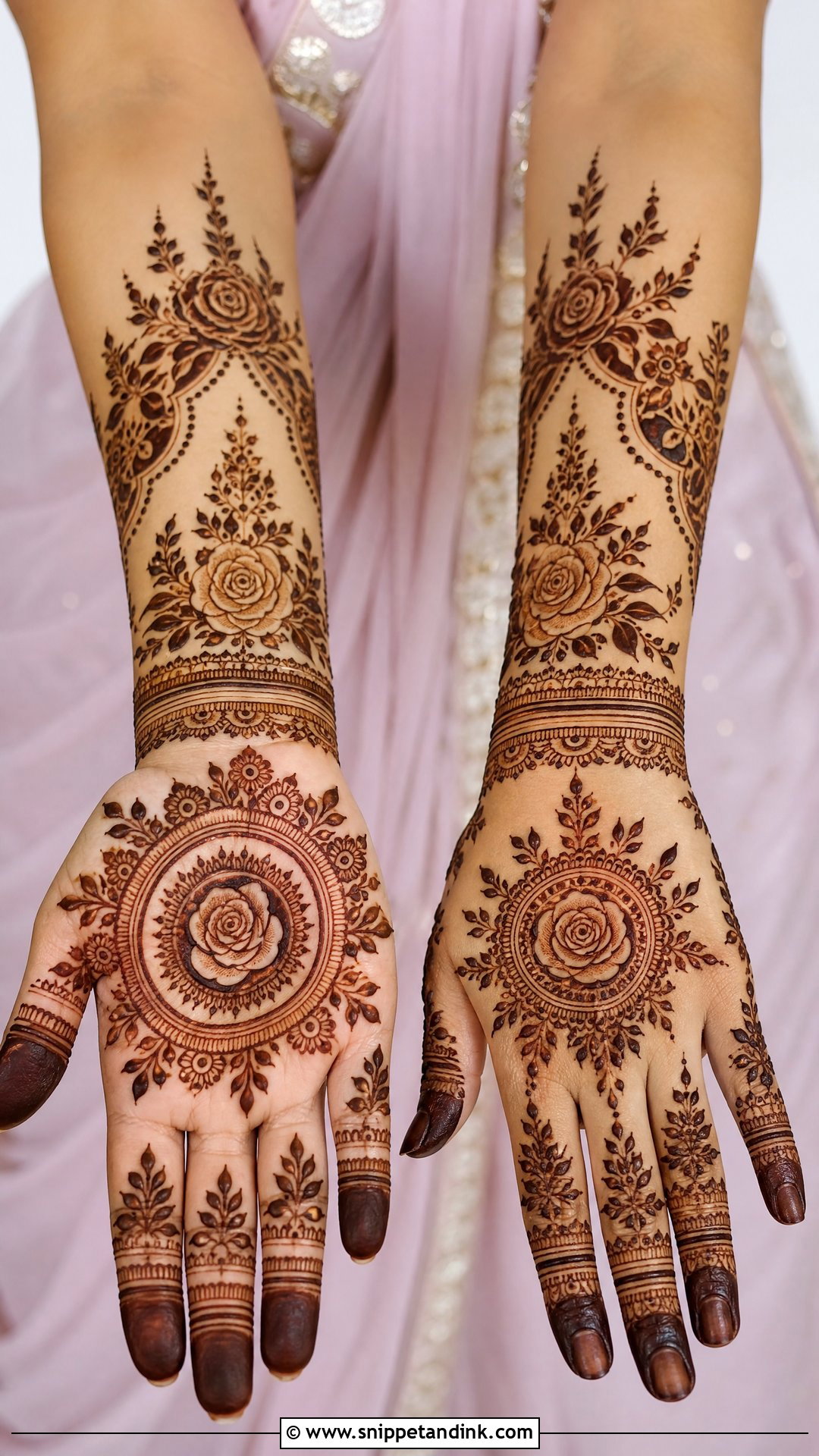
A round mandala on the palm gives a clean focal point, with rose petals worked into its center or outer rings. Around it go vines, leaves, paisleys and small buds, and the back hand can repeat the theme with a floral bracelet and finger extensions. Mandalas demand symmetry, so I mark the center of the palm with a tiny dot before I start and build the rings outward from it. That keeps the circle even on both hands, which matters when you hold your palms up side by side for photos. Fine dot chains and shaded petals add the bridal richness.
6. Rose Jaali Bridal Mehndi Full Hand
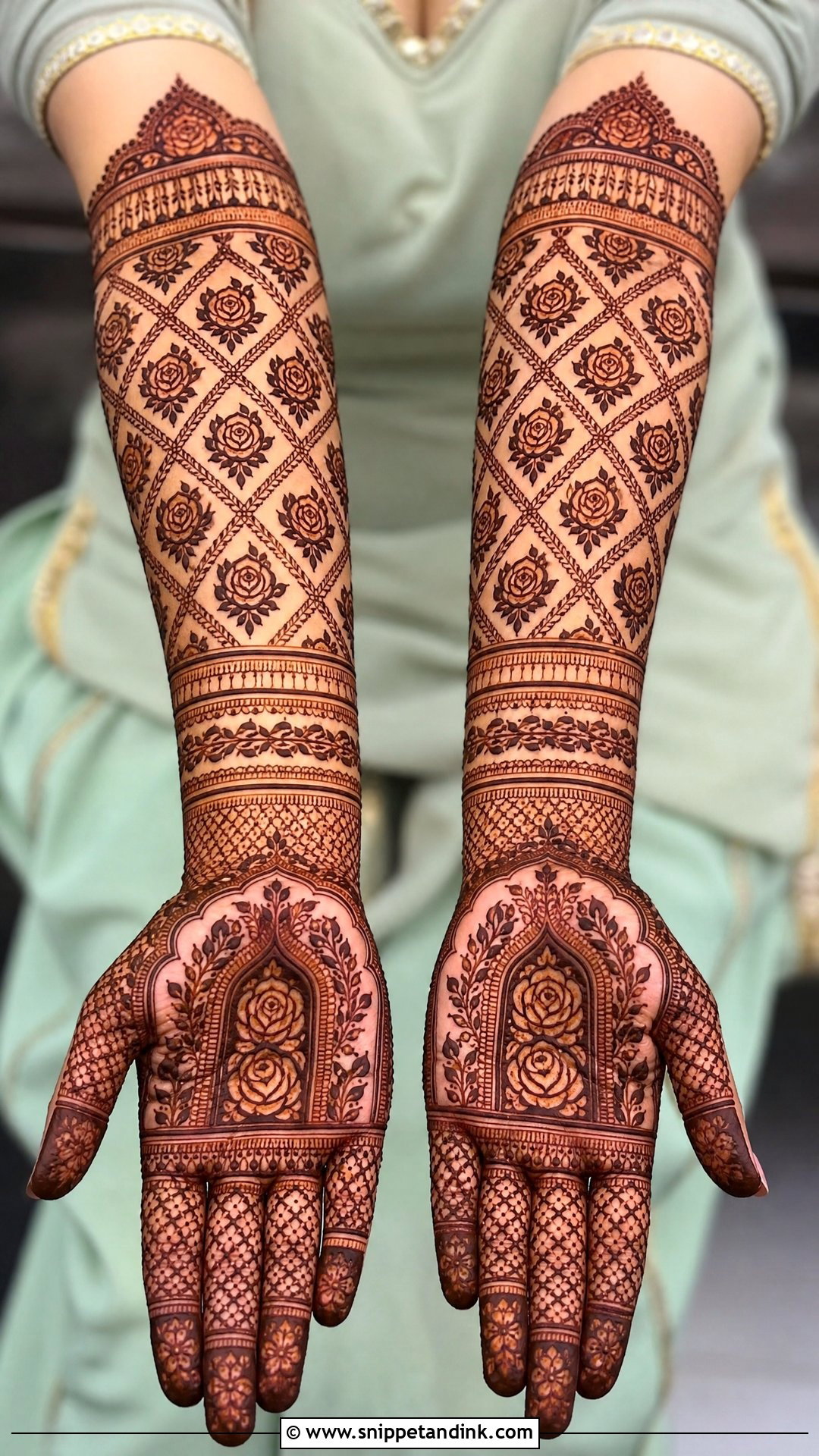
Soft flowers inside a structured mesh make a lovely contrast. Roses sit in diamond, square or curved jaali panels on the palm and back hand, and the mesh can continue up the forearm as a sleeve with rose borders at the top and wrist. Mesh lines need a very fine cone tip and a steady hand; if they’re too thick they merge into a solid patch as the stain deepens. I keep the rose petals noticeably bolder than the net so the flowers stand out. Fingers get a mix of mesh, floral tips and slim leafy bands.
7. Rose Paisley Bridal Mehndi Full Hand
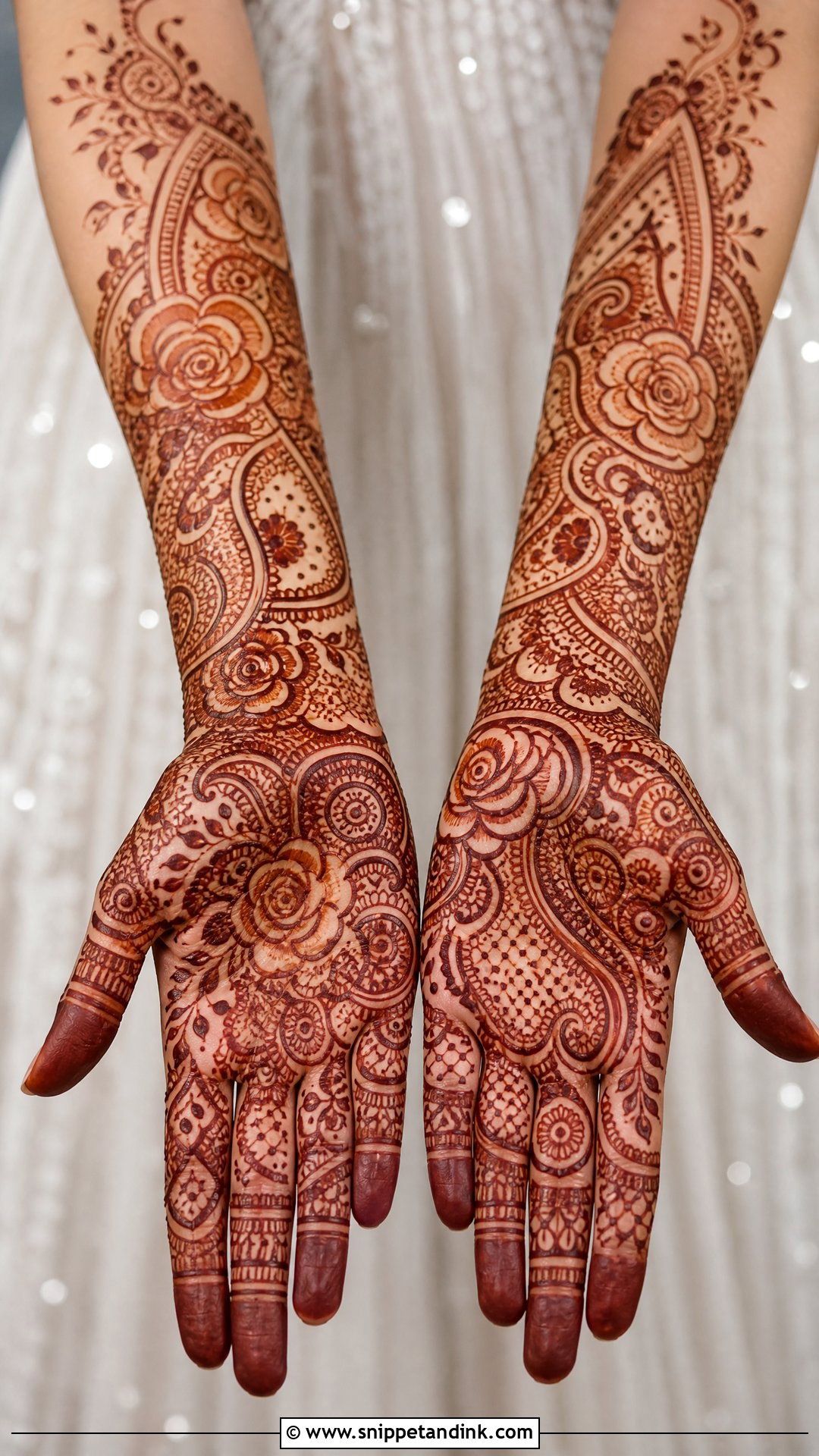
Paisleys bring movement and roses bring softness, which makes this pairing a traditional favorite. A large paisley on the palm can be filled with rose petals, leaves, dots and shaded curves, while a rose and paisley trail runs from the wrist toward the index finger on the back hand. If your lehenga has floral embroidery or paisley borders, ask your artist to look at it; I like to echo one motif from the outfit in the palm. Keep the roses as the main motifs and use smaller paisleys as fillers, or the design loses its focal point.
8. Rose Peacock Bridal Mehndi Full Hand
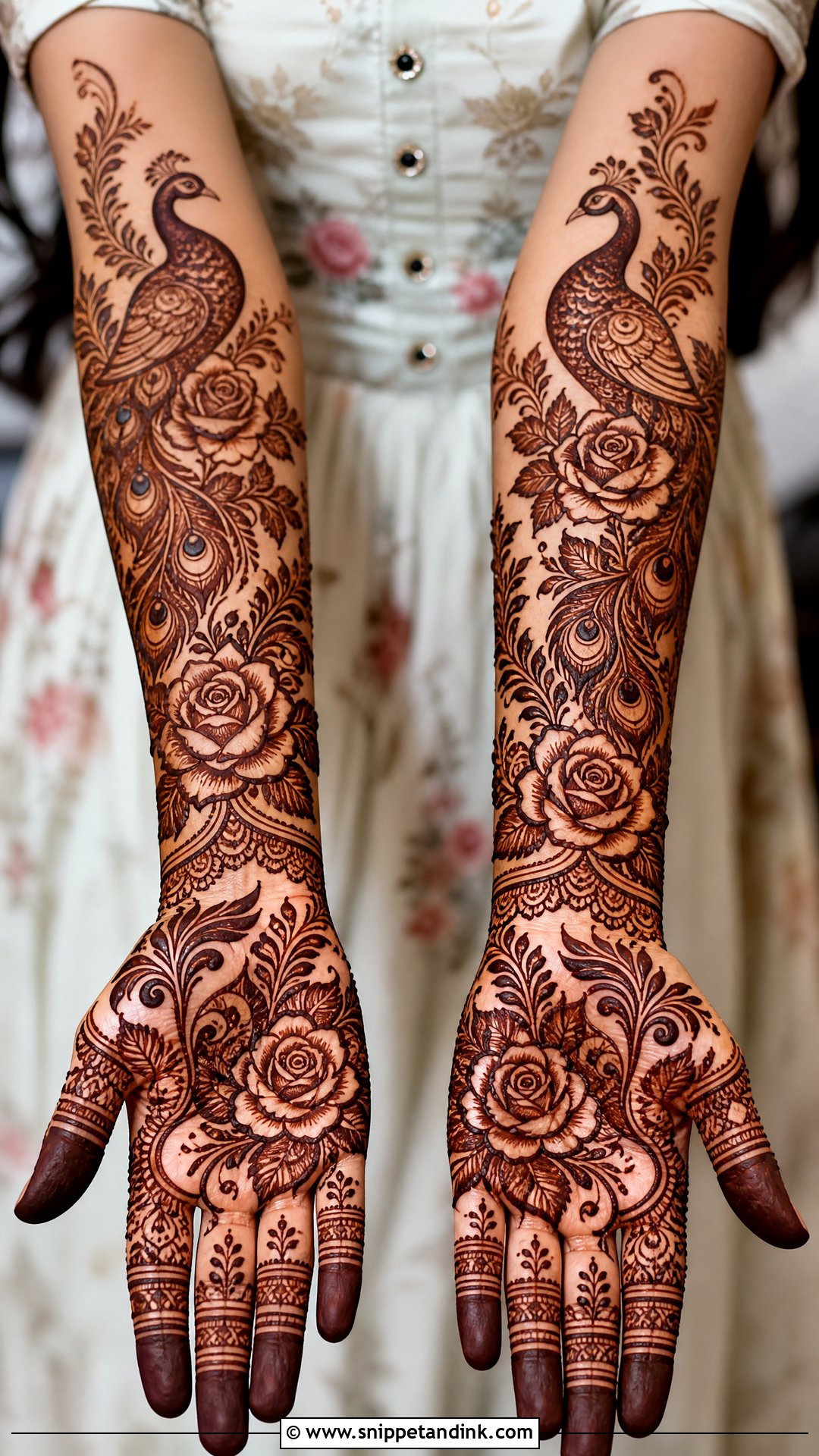
A peacock on the palm or forearm, with roses flowing around its feathers, mixes wedding symbolism with floral softness. The back hand can carry a rose vine with feather-like curves, and the fingers small feather details and buds. I draw the peacock’s outline first and boldest, then shade the roses lightly, because two heavily filled motifs side by side become muddy once the stain darkens. The neck and feathers need fine work, so this design takes longer than a plain floral. It’s a statement choice with real cultural weight.
9. Rose Dulha Dulhan Bridal Mehndi Full Hand
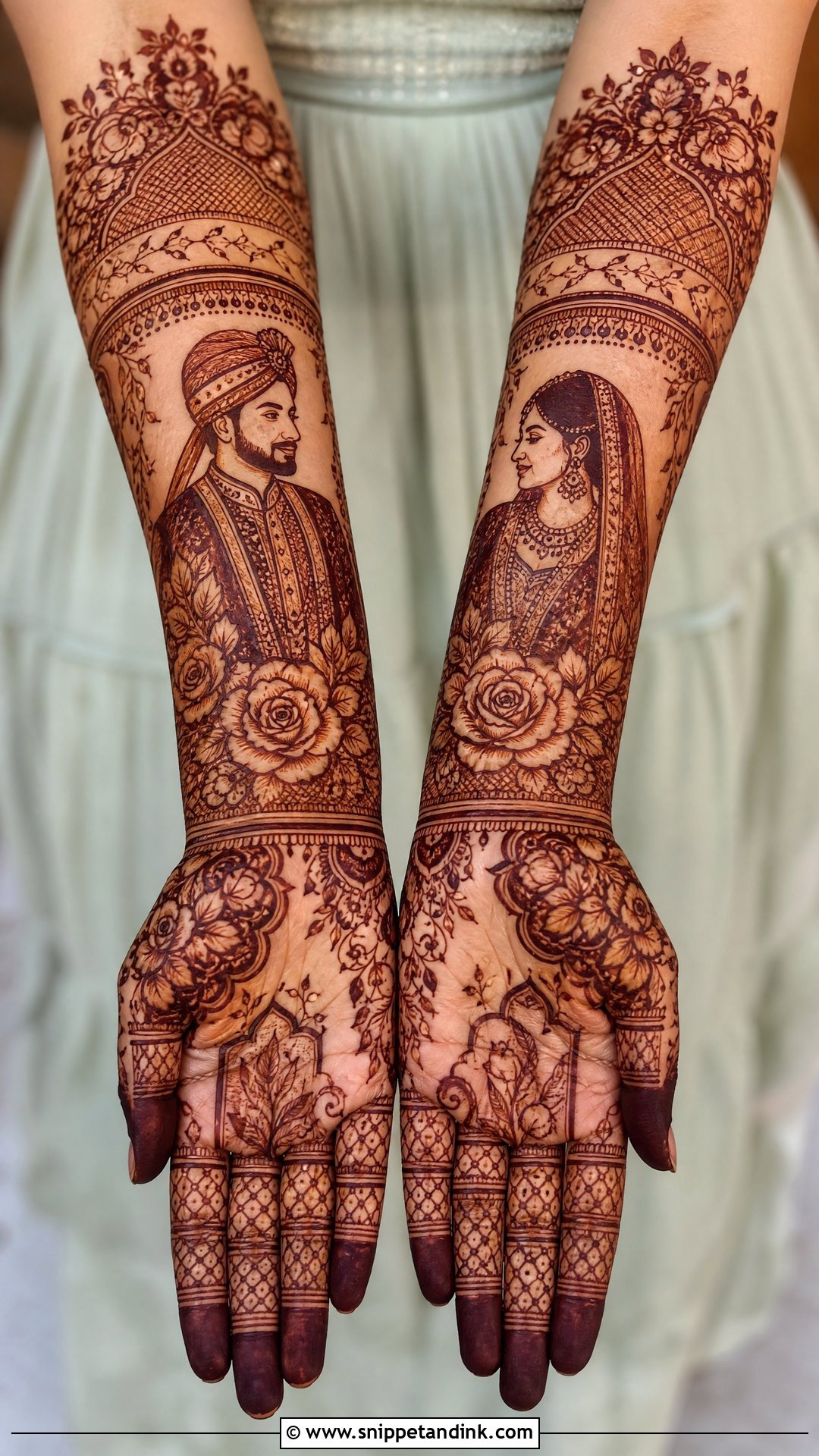
Rose dulha dulhan bridal mehndi tells a story: the bride on one palm and the groom on the other, framed with roses, vines and traditional borders. The forearms can add kalash, doli, mandap patterns or initials, whatever feels meaningful to you. Faces in henna are small and unforgiving, so I draw them with my finest cone and keep surrounding roses lighter to protect the figures. Keep the fingers detailed but uncrowded. Portrait work adds a good deal of time, so plan your session length with your artist well before the day.
10. Rose Bracelet Bridal Mehndi Full Hand
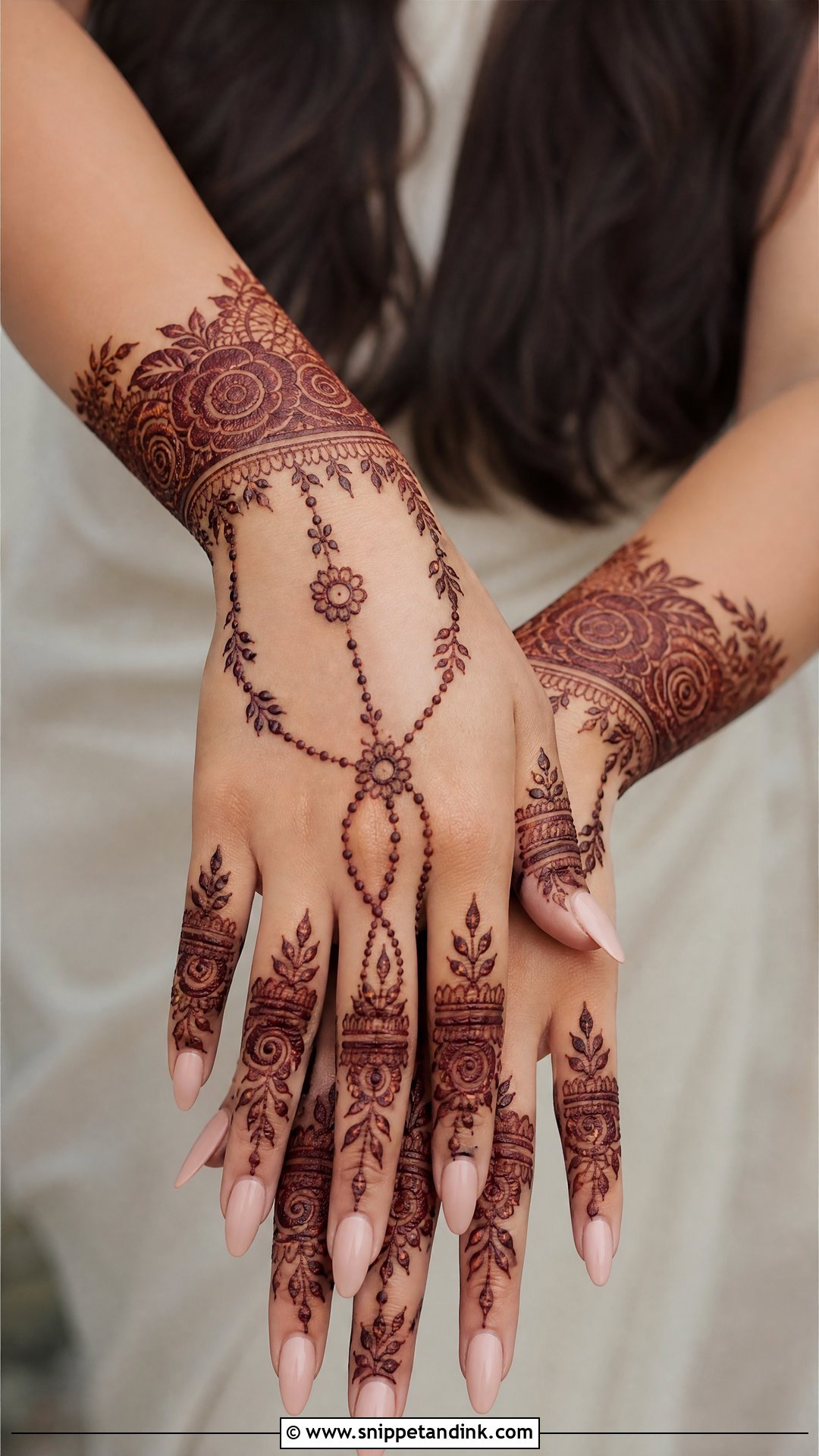
This layout is built around your jewelry. Rose cuffs sit at the wrist, chain-like details cross the back hand, and patterns run up each finger like hathphool chains. For full coverage, the bracelet idea extends into the forearm as layered floral bands, and the palm takes a rose mandala or curved panel. I ask brides to show me their bangles before I draw the wrist; if the cuff is thick and the bangles are stacked, the best part of the design ends up hidden. A slimmer wrist band usually looks better with real jewelry.
11. Shaded Rose Bridal Mehndi Full Hand
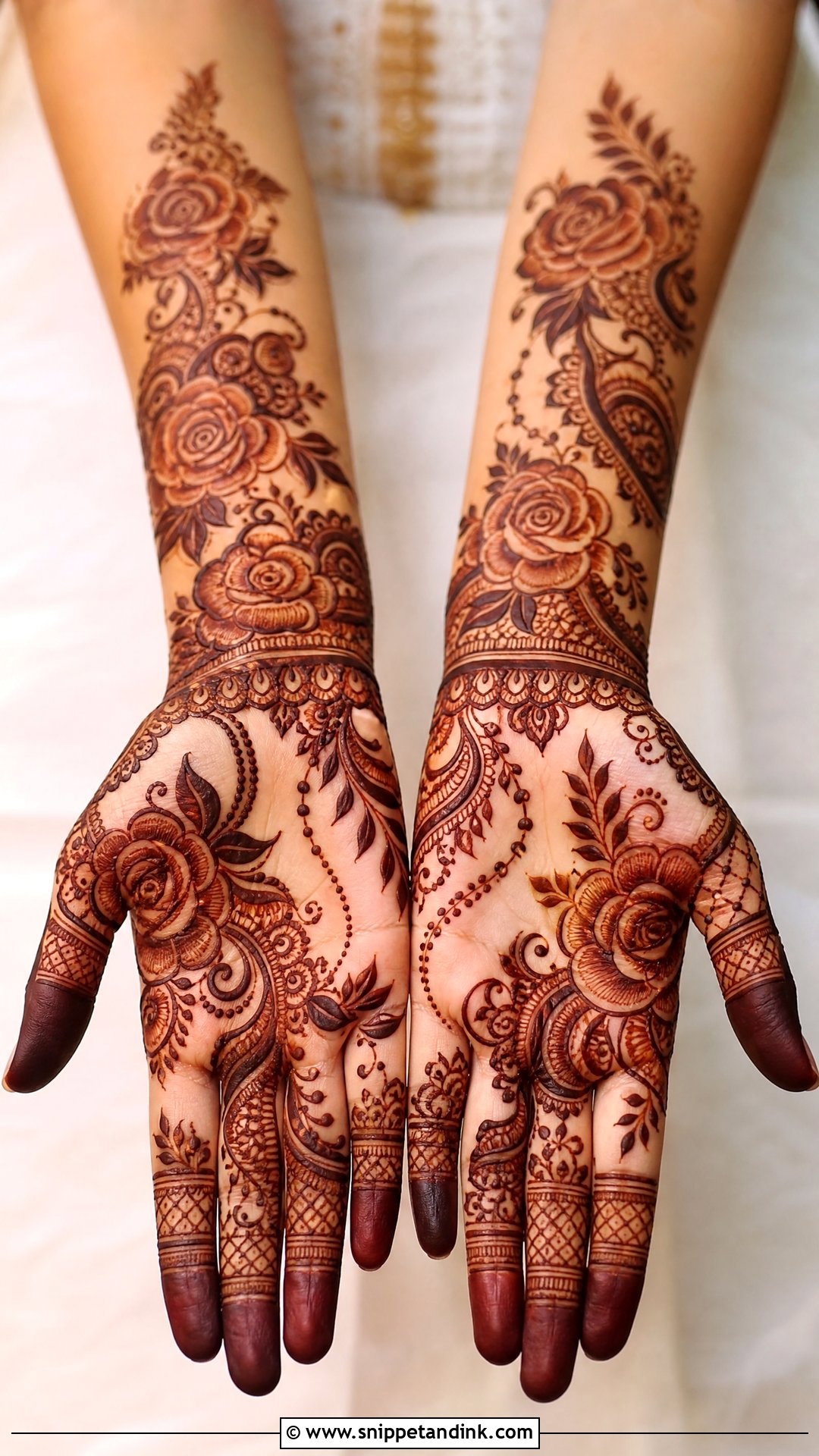
Shaded petals look soft and dimensional because they aren’t just outlined. I fill parts of each petal with a thin layer of paste, fine strokes or tiny dots, which stains lighter than the solid outline and creates a gradient. These shaded roses sit on the palms, back hands and forearms, joined with leaves, paisleys and dotted vines, and the fingers carry mini shaded buds. Shading needs space to show, so overcrowding is the main thing to avoid. Shaded work also takes longer to dry than fine lines, so plan for a little more sitting time.
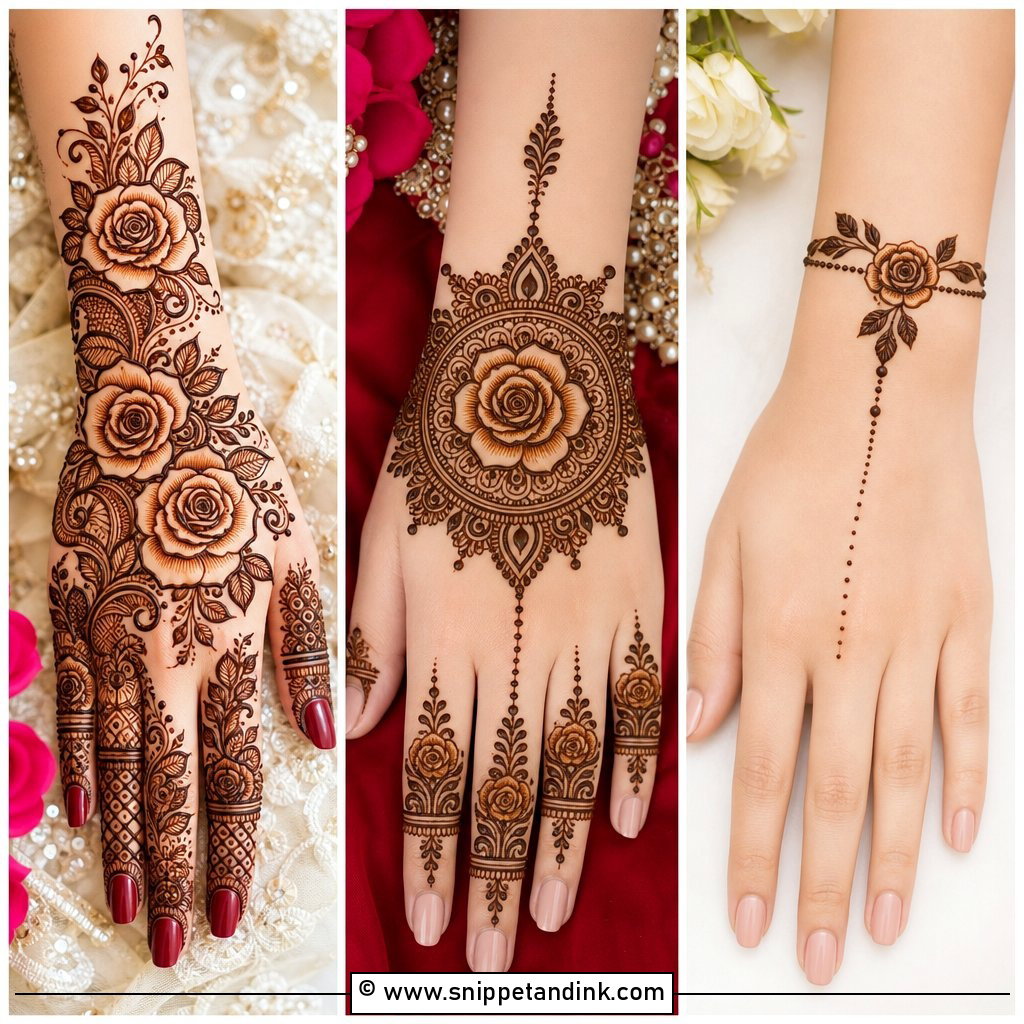
12. Minimal Rose Bridal Mehndi Full Hand
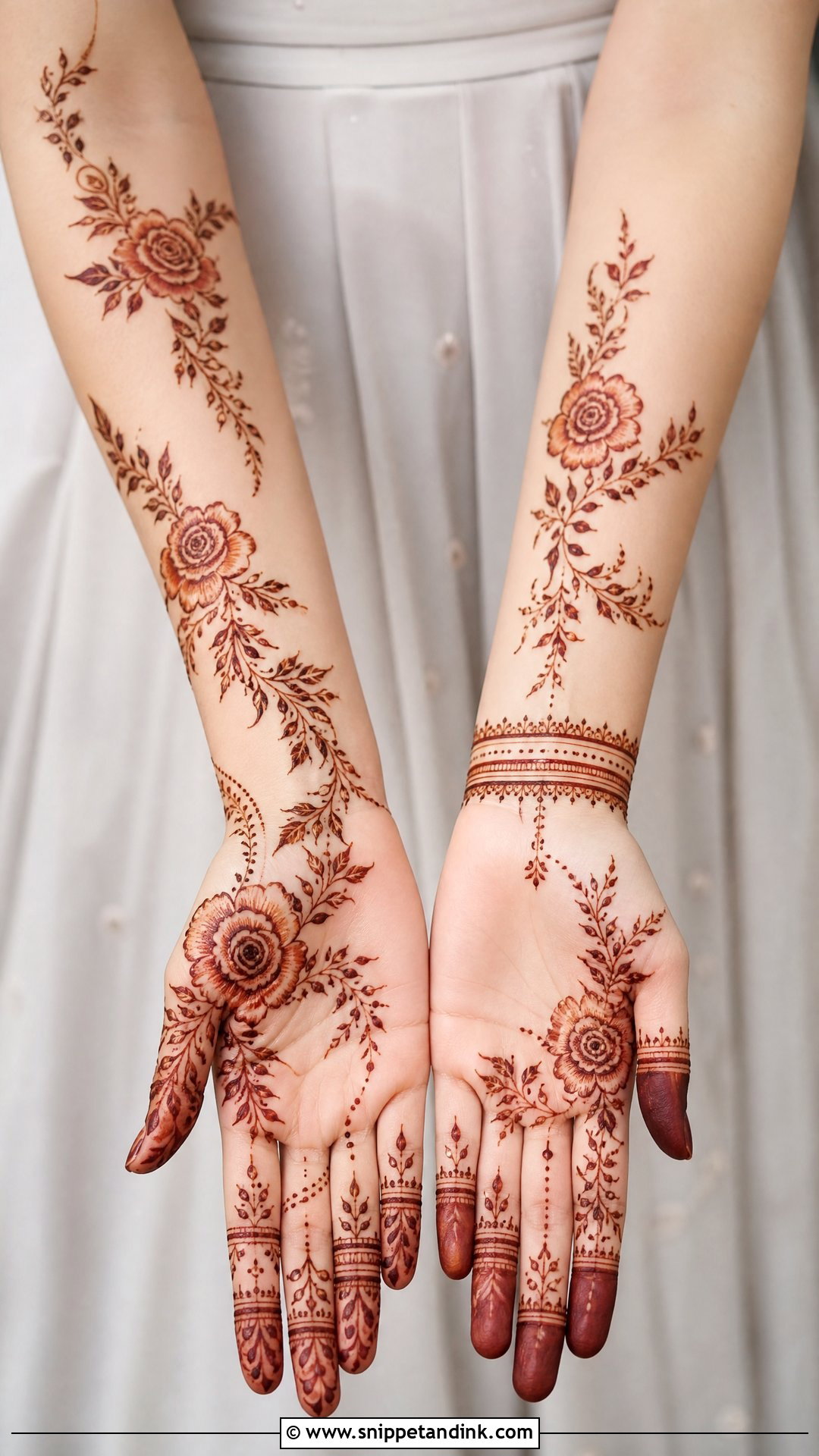
Full coverage doesn’t have to mean dense coverage. This style uses open spacing, slim vines, delicate rose outlines and fine finger details instead of heavy filling, while still running from the palm to the forearm. A large rose on the palm, a diagonal trail on the back hand and thin bracelet bands keep it bridal. It’s quicker to apply and easier on brides who find long sessions uncomfortable. The catch is that open designs show every wobble, so neat outlines and even spacing matter more here than in heavy work. Engagements and intimate weddings suit it well.
13. Heavy Rose Bridal Mehndi Full Hand
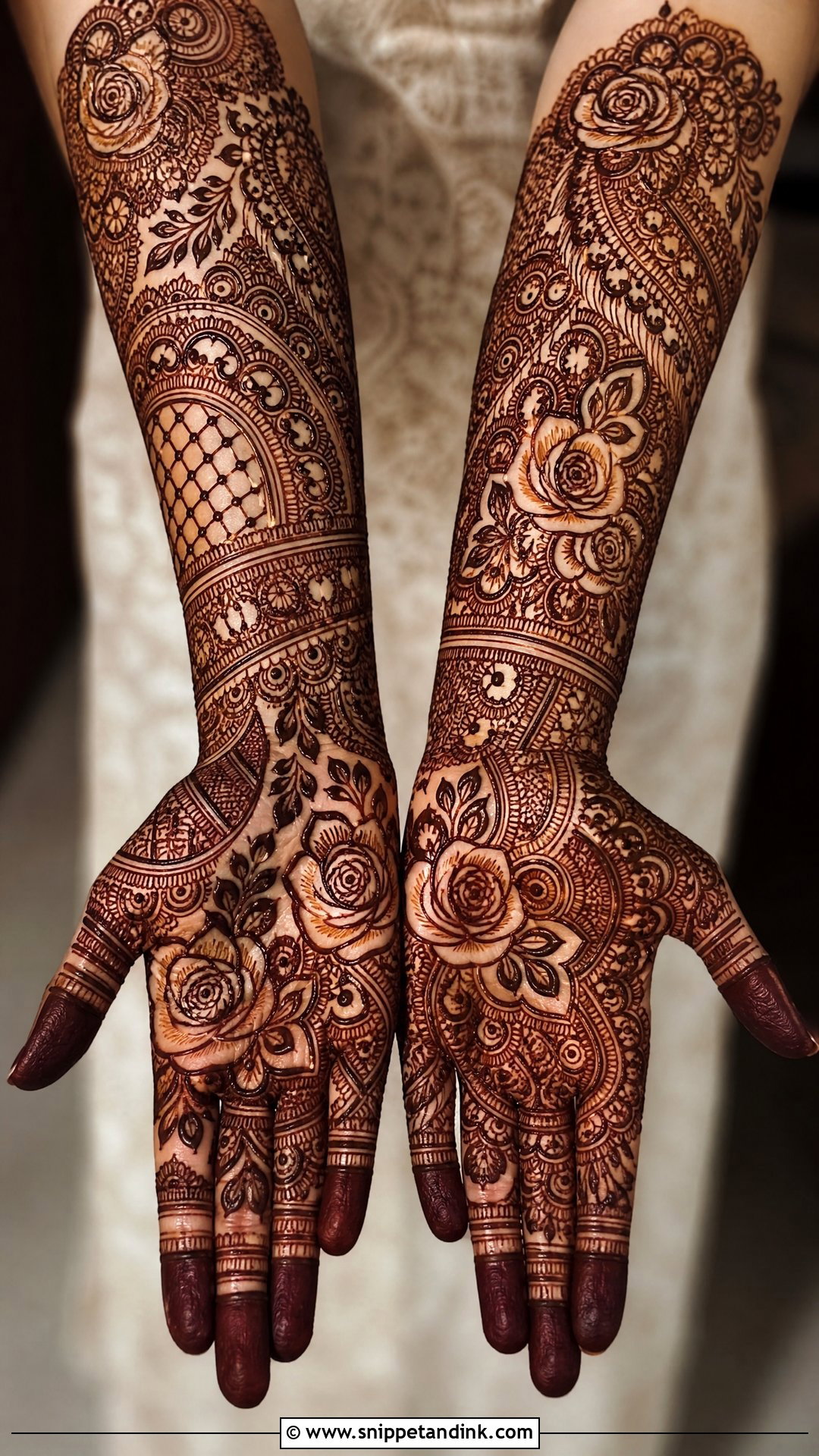
Almost every bit of the hand and forearm is filled here, with roses, paisleys, jaali, leaves, mandalas and tiny filler motifs clustered like a garden. Fingertips are usually filled dark for contrast, while the palms and wrists carry detailed rose panels. With this much coverage I vary the line thickness deliberately: bold for rose outlines, medium for borders, hair-fine for filler. Without that variation, a dense design turns into a single dark mass when the stain reaches deep maroon. Heavy jewelry and a traditional outfit sit naturally with it. Expect a long session, and eat before you start.
14. Modern Rose Bridal Mehndi Full Hand
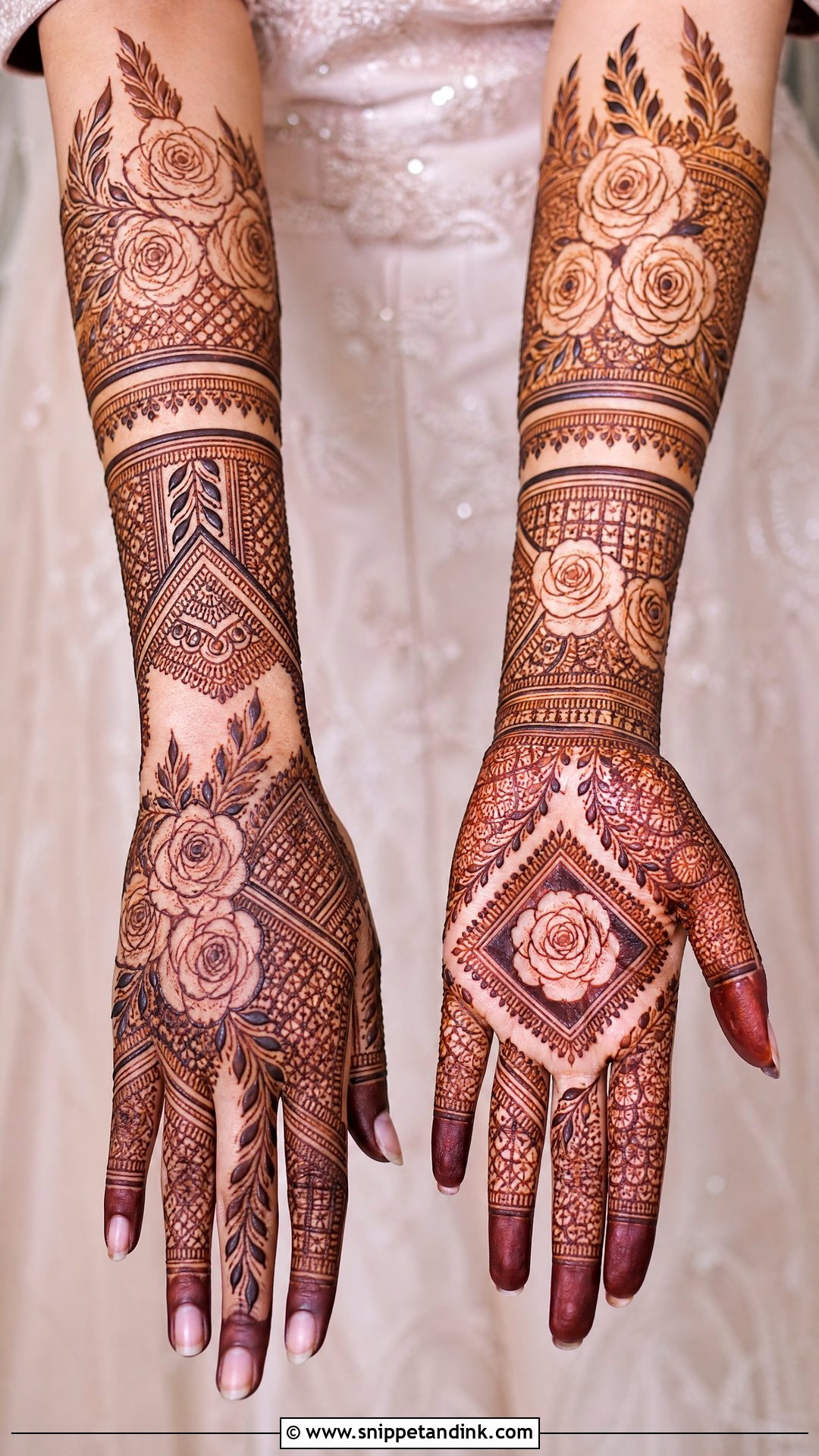
Clean rose outlines, negative space, sleek vines and geometric panels make this a fresh take that’s still wedding-ready. Bare skin becomes part of the design rather than a gap to fill. The palm might have a rose mandala with open borders and the back hand a structured rose trail, with neat bands and leafy tips on the fingers. Contemporary lehengas, pastels and fusion outfits pair well with it. My one push with modern designs is to keep enough detail at the wrist and forearm, otherwise it can read as guest henna in photos.
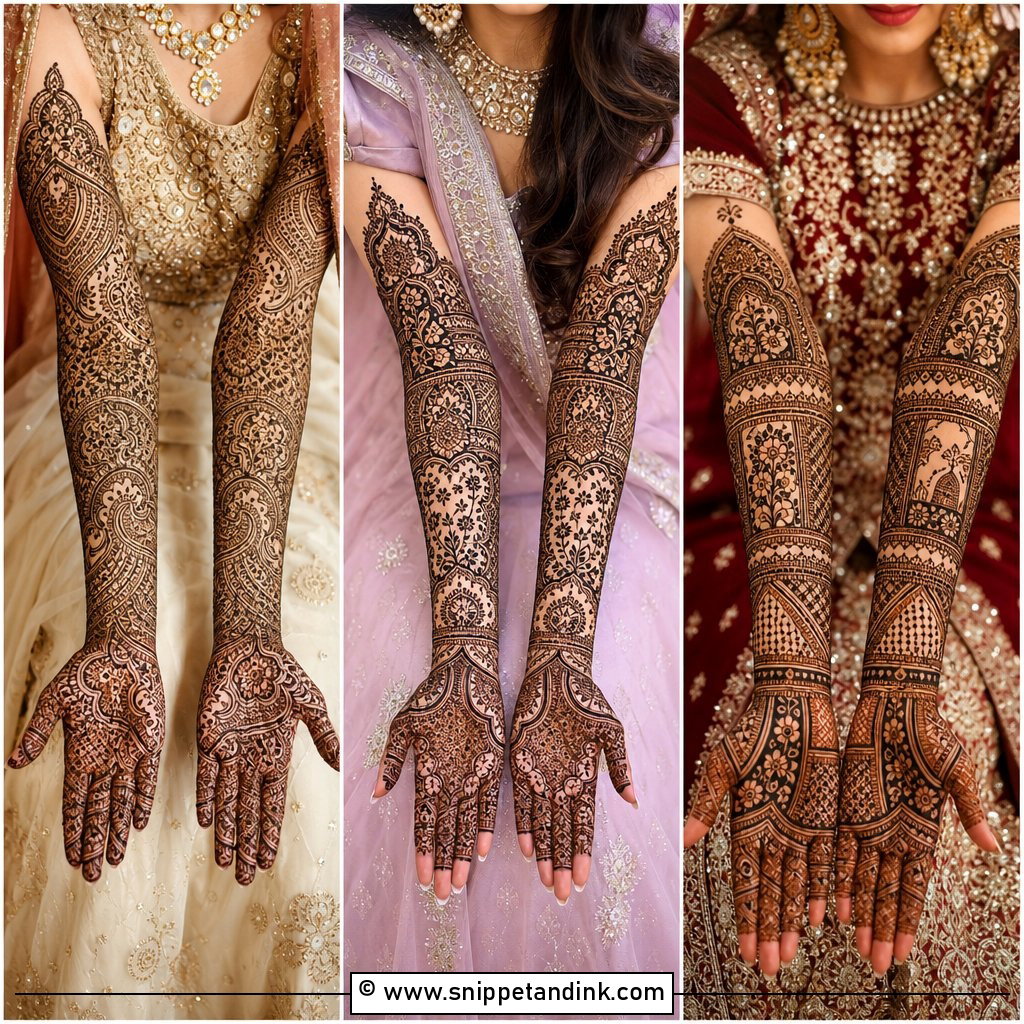

15. Pakistani Rose Bridal Mehndi Full Hand
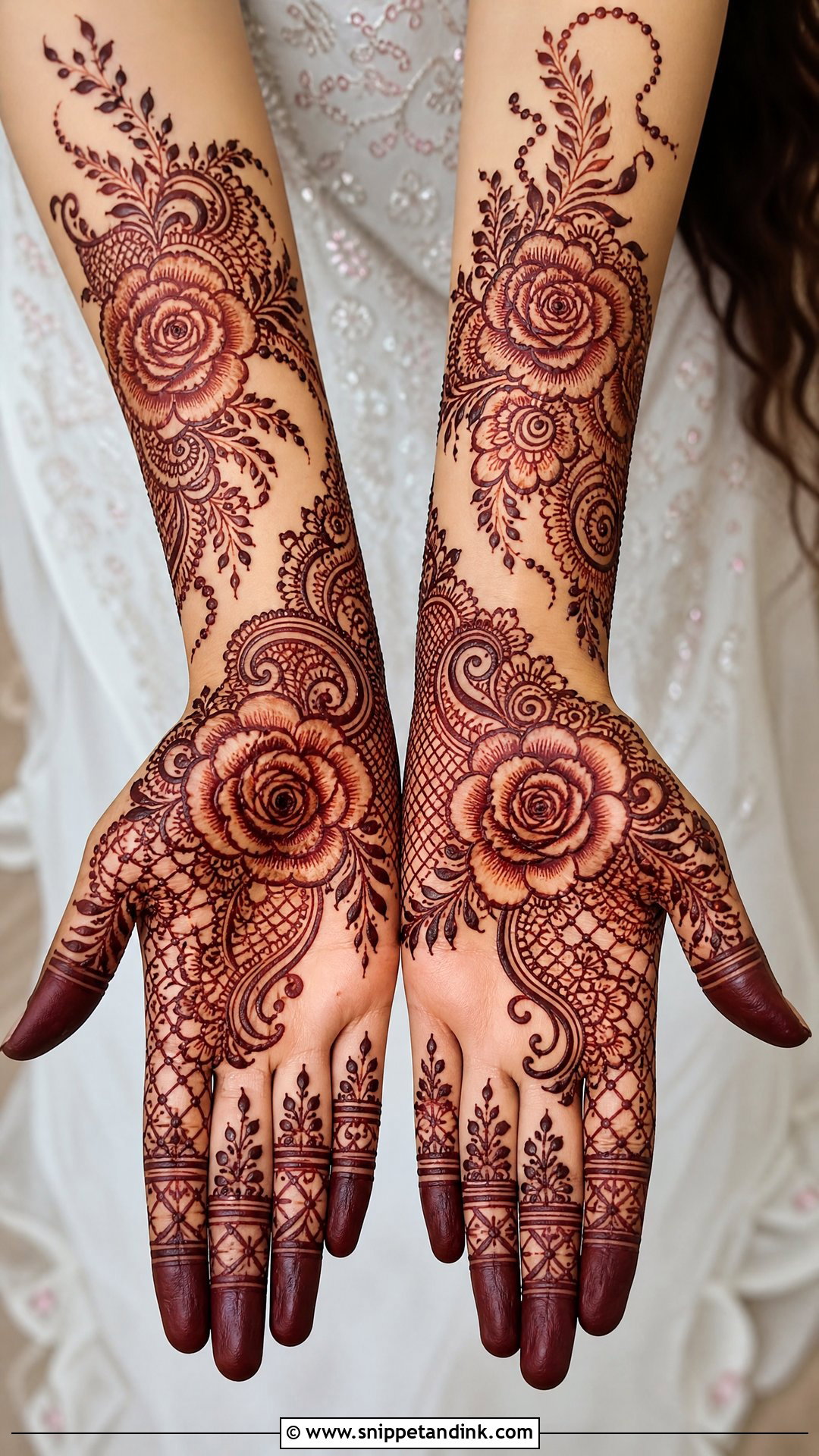
Bold, shaded roses surrounded by lace work, paisleys, fine dots and leafy vines give Pakistani designs their graceful, detailed look. The palm and back hand are usually covered fully, with flowing sections continuing toward the forearm, and fingers carry half-filled tips with floral bands and delicate mesh. What I love about this style is the lace effect: it relies on very fine, evenly spaced lines, so the cone has to be smooth and the paste free of grit. A deep maroon stain makes the petals and lace stand out clearly.
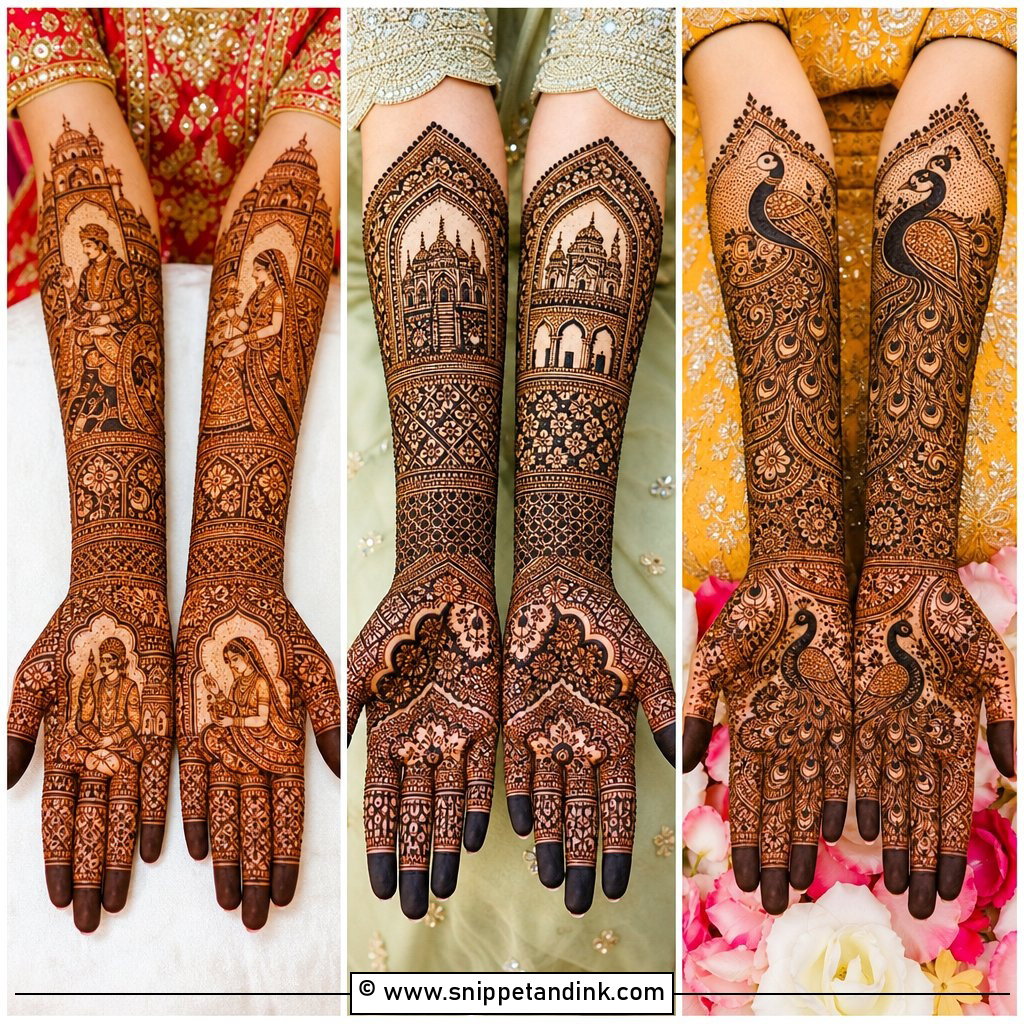
16. Rajasthani Rose Bridal Mehndi Full Hand
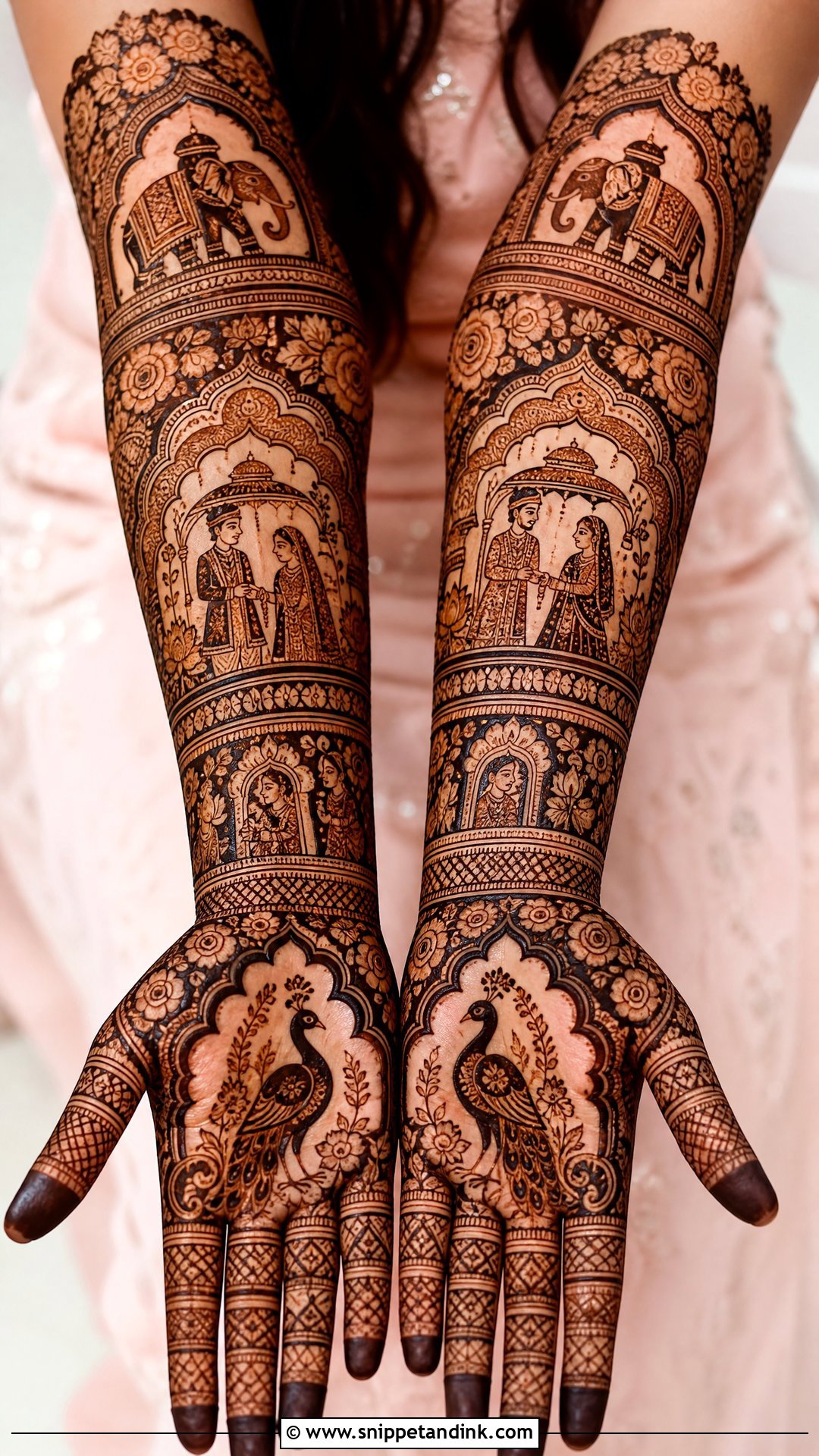
Storytelling and ornament define this style. Rajasthani rose bridal mehndi can include bridal scenes, mirror-like symmetry, elephants, peacocks, paisleys and architectural borders, with roses softening the grandeur. One hand may hold a central rose with royal-style panels and the other a matching floral story, while layered bands on the forearms look like bridal cuffs. Because the patterns are so detailed, I plan the rose clusters first and keep clean space around the major motifs, or the eye has nowhere to rest. It’s a natural pick for a heritage-inspired wedding.
17. Back Hand Rose Bridal Mehndi Full Hand
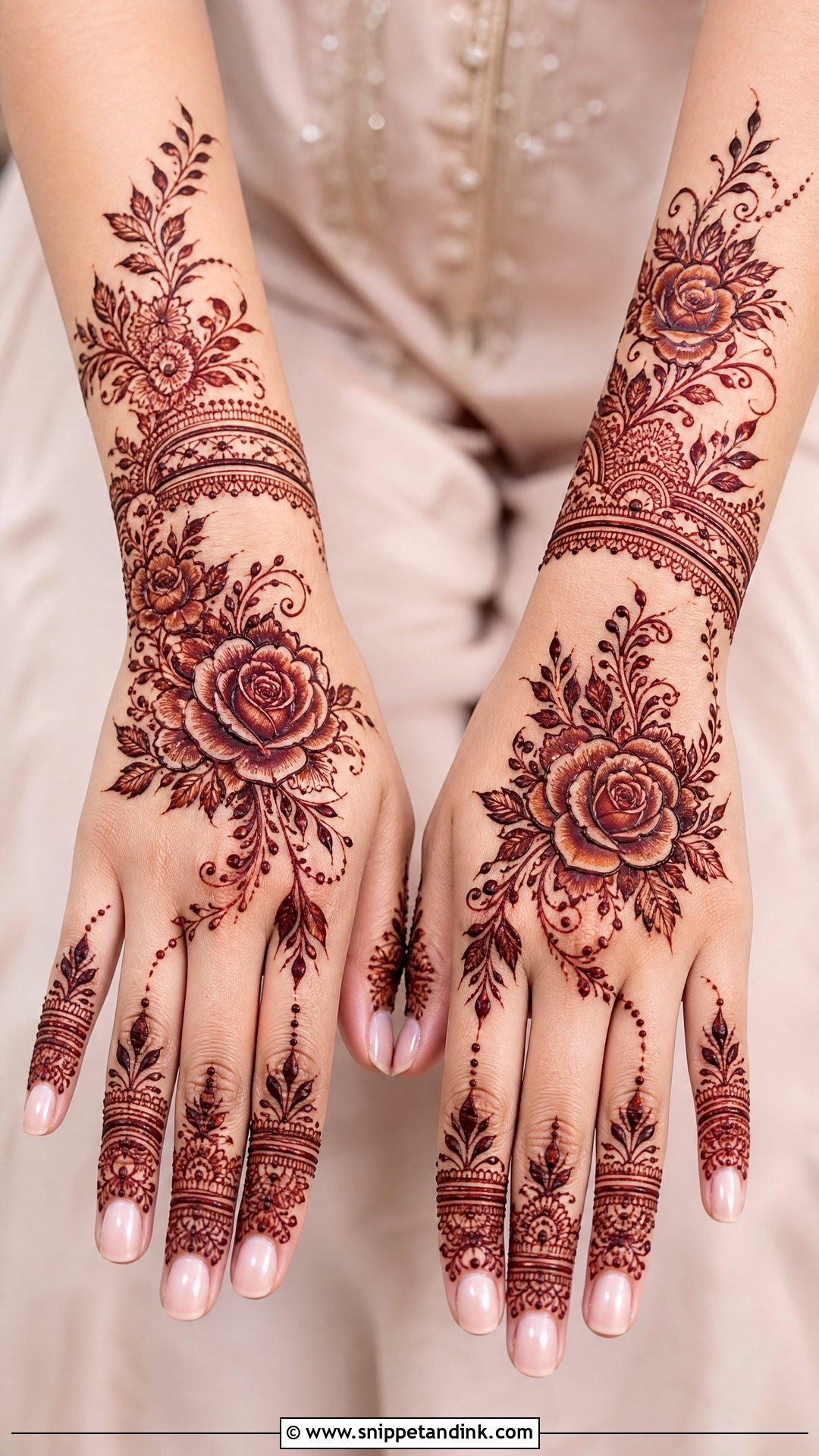
The back of the hand is what shows in ring shots and bangle close-ups, so it deserves a strong layout. A main rose sits in the center, with vines moving toward the fingers and wrist, and the pattern carries across the fingers and up the forearm with floral cuffs and leafy borders. I follow the natural curve of the hand from the knuckles to the wrist bone, which keeps the trail looking fluid when your hand is posed. Be aware that henna stains lighter on the back of the hand than on the palm, so I draw a little bolder there to compensate. Keep finger patterns connected to the main design so nothing looks unfinished.
18. Front Hand Rose Bridal Mehndi Full Hand
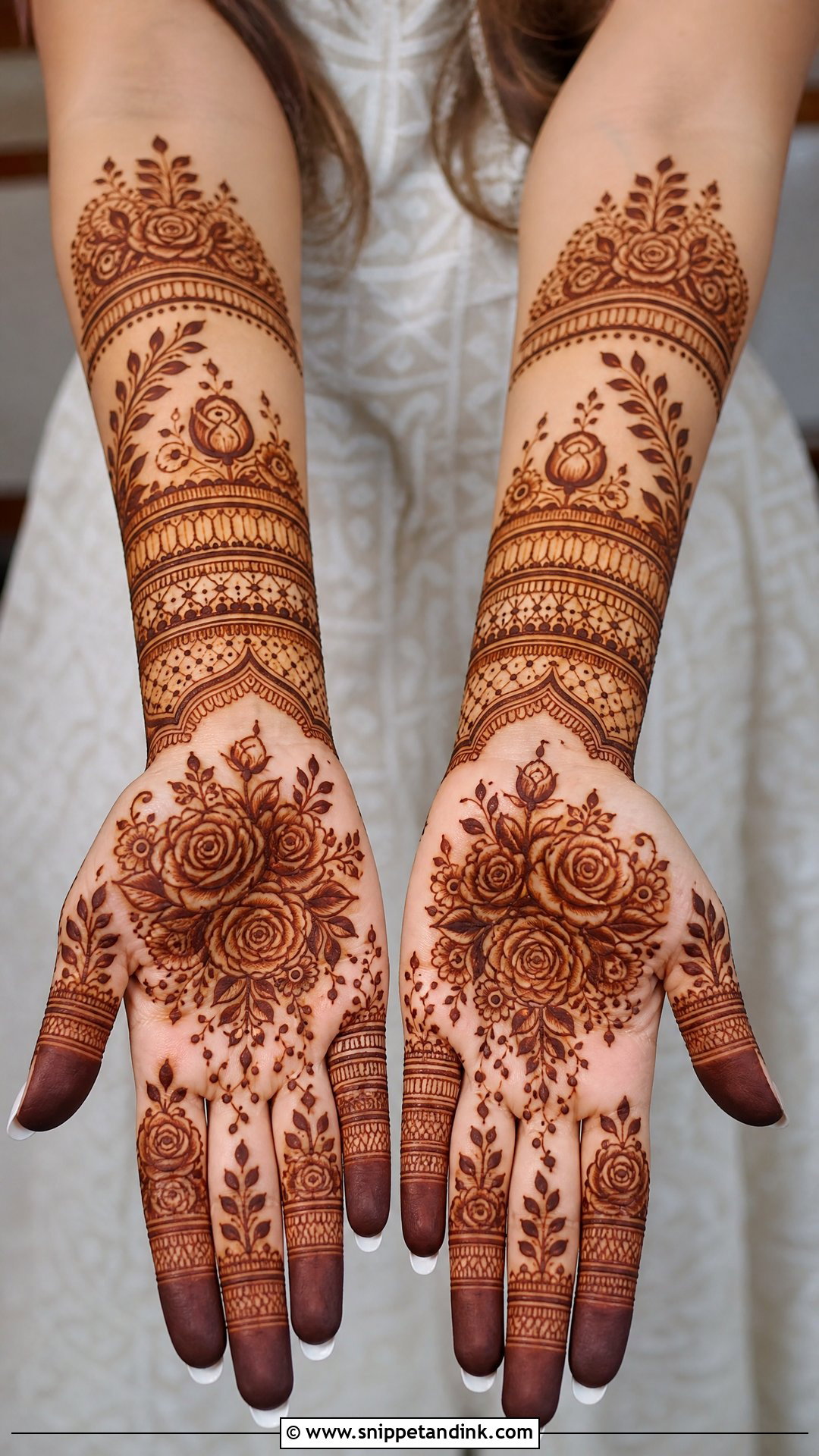
The palms take a large rose bouquet, rose mandala or rose paisley center, surrounded by fine fillers and bridal borders. Rose buds, dotted chains and shaded tips carry it into the fingers, and a floral band at the wrist connects to the forearm. Palms stain darker than anywhere else on the hand, which is why front-hand detail reads so richly in close-ups with both palms shown together. I balance the dense sections with small open spaces around the main roses so the flowers don’t drown.
19. Symmetrical Rose Bridal Mehndi Full Hand
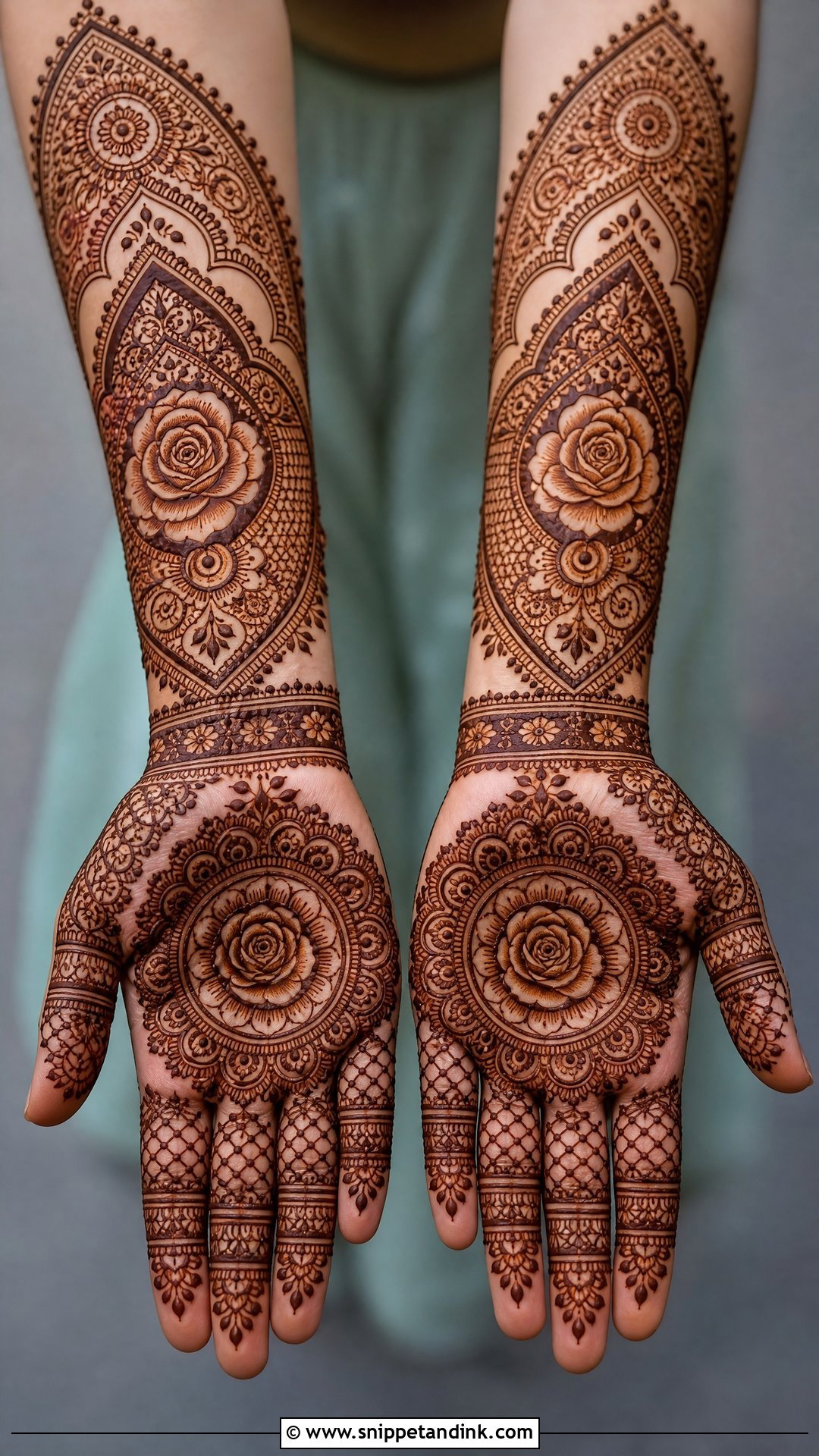
Both hands carry similar rose mandalas, mirrored paisleys, matching jaali panels and identical wrist cuffs, and the forearms repeat the same floral bands. Symmetry is harder than it looks, because hands are rarely the same size and most artists are steadier on one side. I draw the key motifs on both hands in turn rather than finishing one hand first, so proportions stay matched. Small changes in shading or filler stop the pair from looking flat. It coordinates easily with matching bridal jewelry.
20. Rose Bridal Mehndi With Initials Full Hand
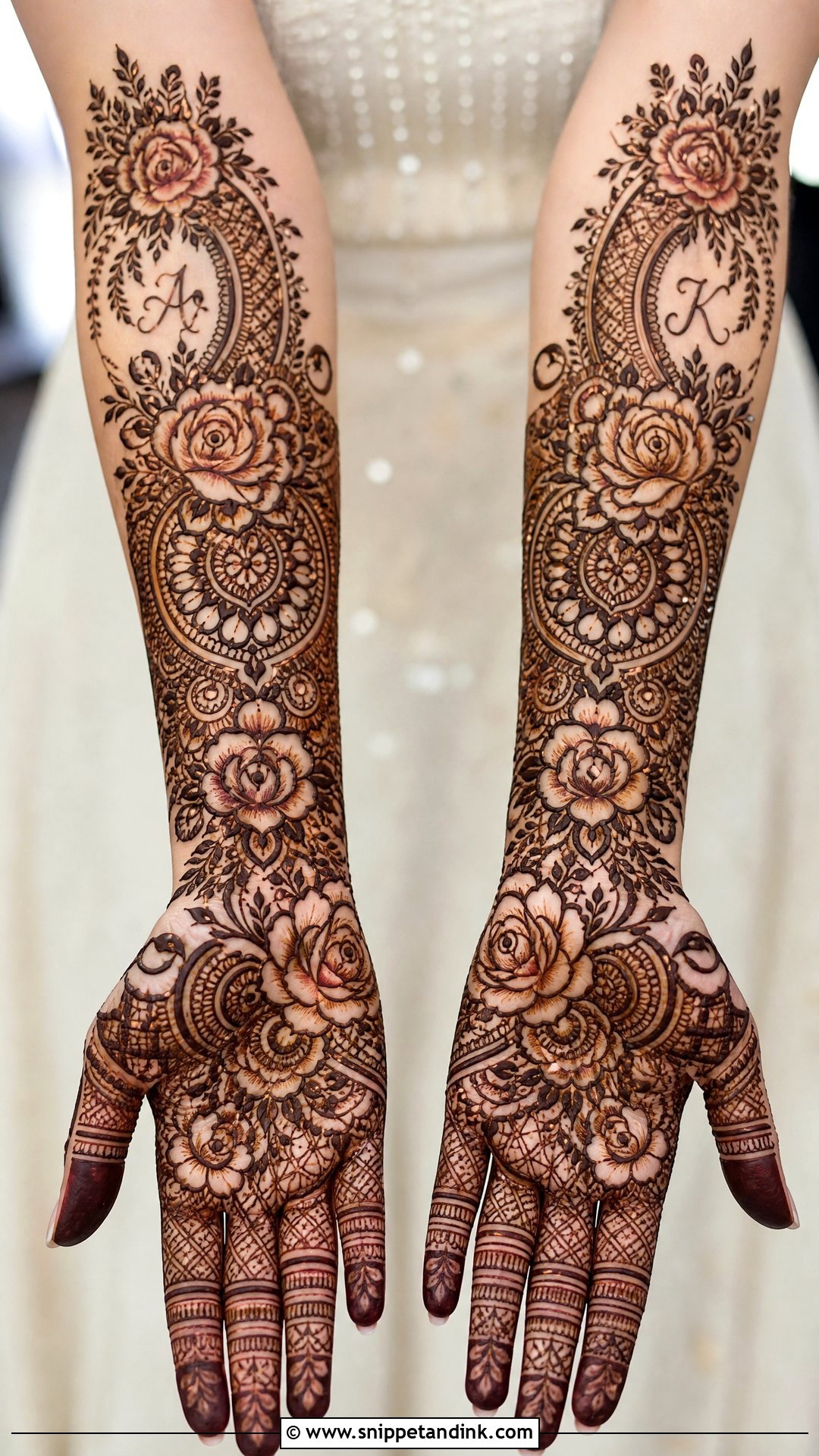
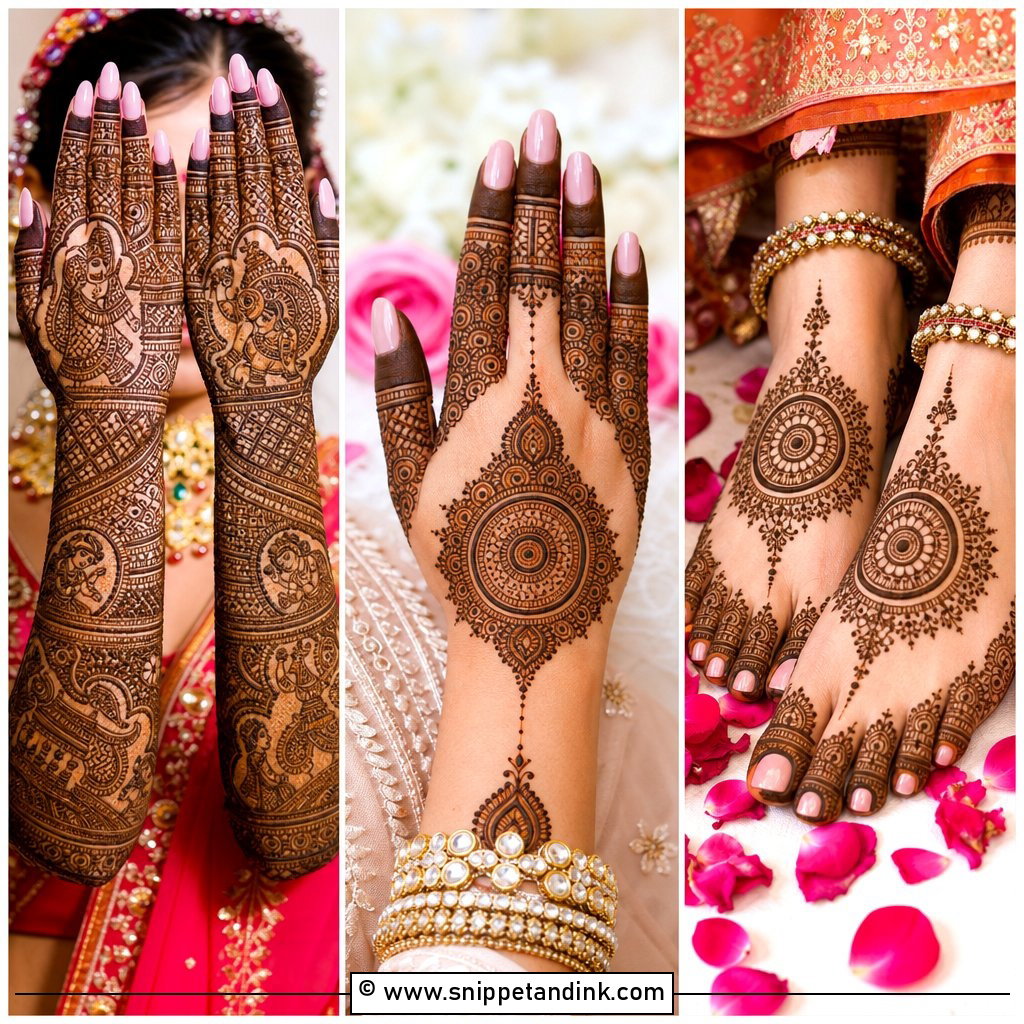
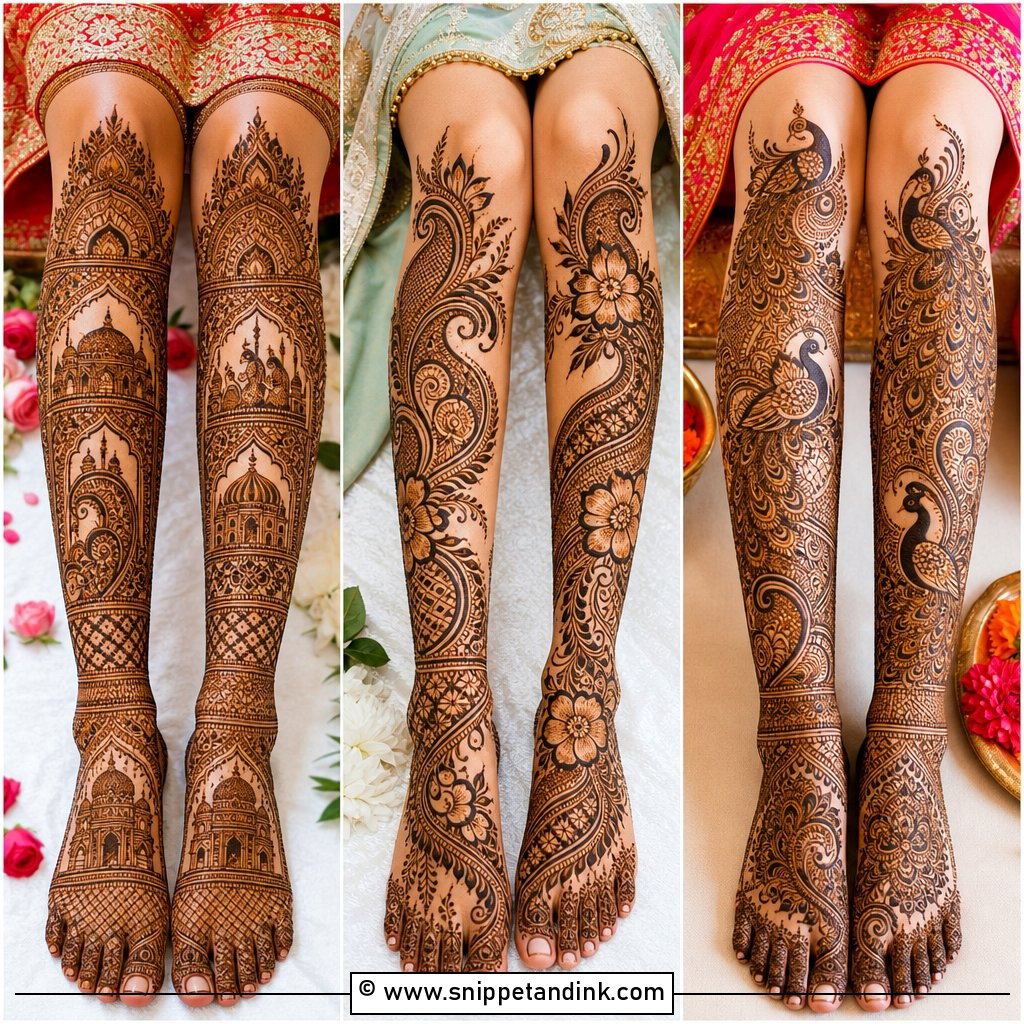
Initials are a sweet way to add meaning without changing the overall look. They can hide inside rose petals, curl into a vine or sit near the wrist band, and some brides also add a wedding date, a tiny heart or a meaningful symbol. The rest of the hand stays fully covered with roses, paisleys, mandalas and leaves. Tell your artist the exact letters and spelling before the session starts; I write them into the plan first so they land in a clear spot instead of being squeezed in at the end. Small but readable is the goal, and the hunt for them is part of the fun.
Scraping, Sealing and Waiting for the Stain to Deepen
Most of the color comes from what you do after I put the cone down. Natural henna stains orange when the paste first comes off and darkens over the next day or two, so don’t panic when you see it.
- Leave the paste on as long as you can, ideally overnight. Six hours is a reasonable minimum.
- Dab a lemon and sugar mix over the dried paste to help it stay in contact with the skin.
- Scrape the paste off with a blunt edge. Don’t wash it off.
- Keep water away from your hands for as long as possible afterward, ideally most of the next day.
- Keep your hands warm. A little body heat helps the stain develop.
Expect the palms and fingertips to go darkest and the backs of the hands and forearms to stay a little lighter; that difference is normal skin, not a weak paste. Steer clear of any paste promising an instant black stain. Natural henna never turns black, and dark products sold that way can contain chemical dyes that cause serious skin reactions.
Getting Waxed, Scrubbed and Manicured Before the Cone Touches Skin
Anything that removes the top layer of skin also removes stain. Book waxing, body scrubs and manicures before your mehndi session, not after. Arrive with clean, dry hands and no lotion or oil, which can stop the paste from bonding. I’d also time your session a day or two before the wedding, so the stain has reached its darkest by the time you walk in.
Keep the Roses Readable From Fingertip to Elbow
Roses soften bridal hands without losing anything traditional, and they adapt to Indian detail, Arabic flow, modern spacing, jaali, peacocks, portraits and initials alike. The layout that suits you depends on your outfit, your jewelry and how long you can comfortably sit. Whatever you choose, ask for clear main roses, a balance of dense filler and open skin, and a design that flows naturally from fingers to forearm. Show your artist your outfit and bangles at the consultation, and the design will be planned around how your hands will actually be seen.
You'll Like These Ideas:













Leave a Reply