
A henna rose is one of the first motifs I learned and still one of the hardest to draw well, because so many curved petals sit close together and want to merge once the stain develops. It fits almost any style: Arabic trails, Indian bridal fill, Indo-Arabic spacing, mandalas, jaali and modern minimal layouts. One open rose on the back of the hand can carry a whole design, while clusters of roses can fill a bride’s forearm. Below are complete hand, foot and wrist looks for Eid, weddings, engagements and quieter family days, with notes on where each one tends to go wrong.
What Separates a Clean Henna Rose From a Smudged Circle
Roses look easy in a photo and are anything but on skin. Every petal is a curve drawn close to another curve, and henna paste spreads slightly as it sits. If the gaps between petals are too tight, the stain fills them in and you’re left with a dark round blob. When I look at another artist’s portfolio, the roses are the first thing I zoom in on.
How I build one
- A small spiral or tight C-shape for the centre, never a solid dot.
- Two or three cupped petals hugging that centre, each one a single stroke.
- Wider outer petals, slightly open at the edge, with a hairline of skin between each one.
- Outline weight last: thicker on the outside of the bloom, finer inside.
- Leaves and buds only after the rose is finished, so they work around it.
What to look for in photos of finished stains
Ask to see photos taken a day or two after the paste came off, not just wet paste shots. Wet paste always looks crisp. In a finished stain, check that you can still count the petals, that the centre hasn’t closed up, and that the shaded areas show a soft change in tone rather than flat patches. If an artist’s roses hold up there, they’ll hold up on your hands.
1. Simple Rose Mehndi Design
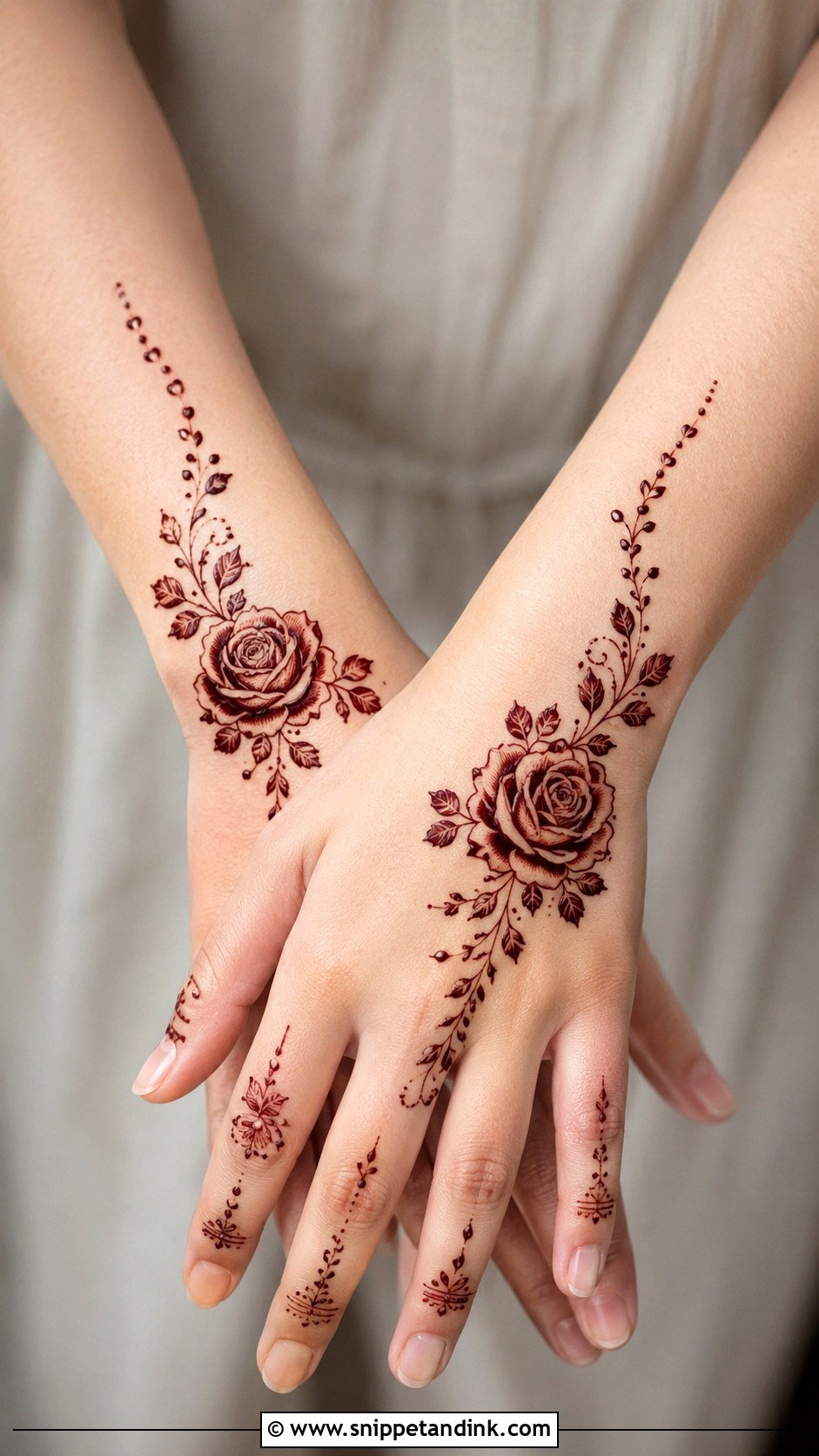
One open rose on the back of the hand or palm, a few leaves, thin vines and light finger work is all this needs. The spacing does the heavy lifting. I make the rose bold enough to hold attention, then keep everything around it airy so the bloom isn’t competing with filler. Beginners can manage it, since the petals are just stacked curves, but start with a slightly firmer paste than you’d use for fine lines; runny paste is what turns a beginner’s rose into a blot. Finish with a small vine bracelet at the wrist.
2. Arabic Rose Mehndi Design
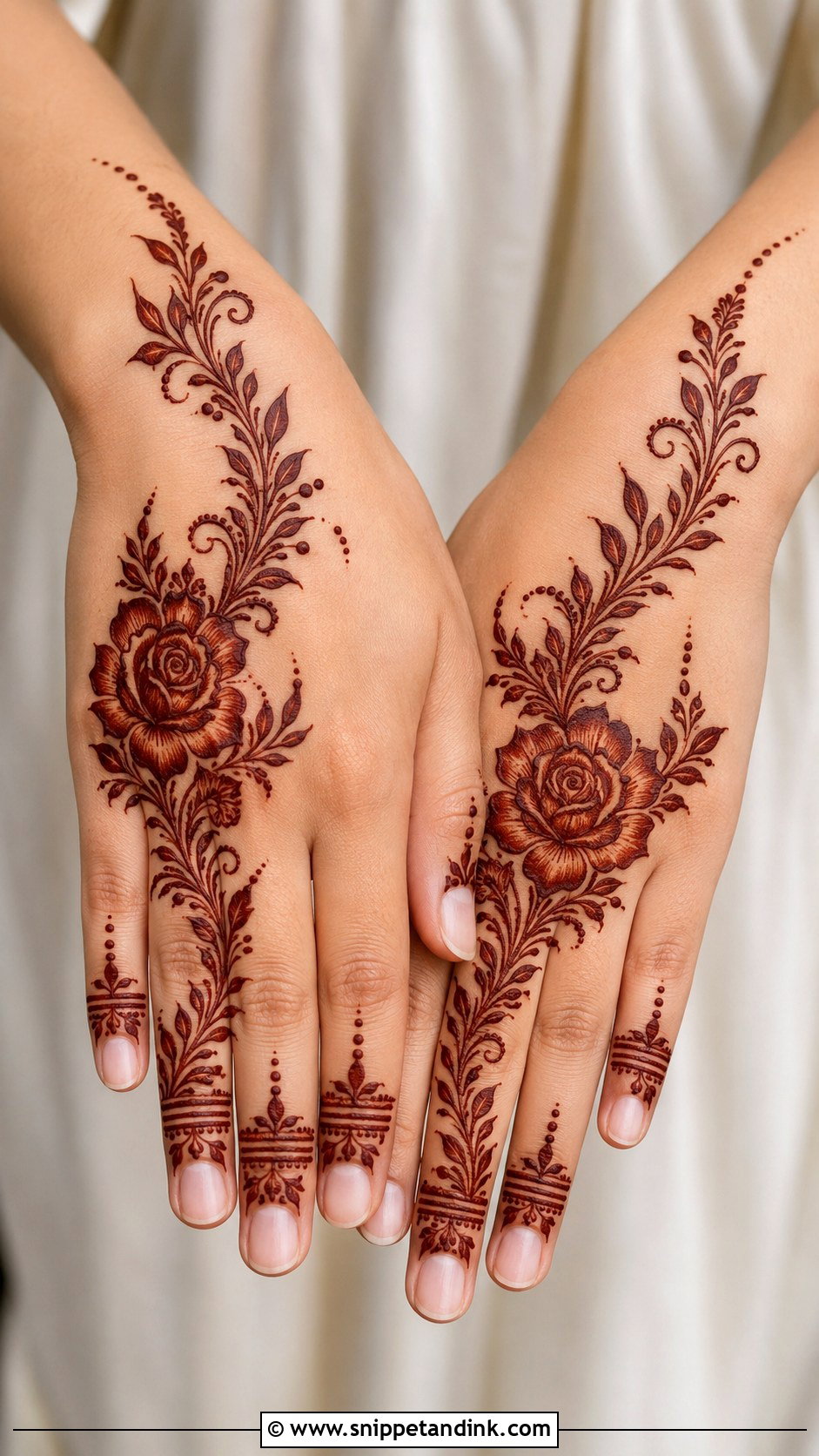
Arabic roses are drawn large, with thick outlines and shaded insides, and placed on a diagonal that starts near the wrist, crosses the back of the hand and exits on one or two fingers. That angle is what makes the hand look longer and slimmer. I join the blooms with leafy vines, buds, dots and curved bands, and I resist filling the open skin. Those gaps are doing a job: against bare skin, a reddish-brown stain looks far darker and sharper than it would inside a crowded pattern.
3. Rose Bridal Mehndi Design
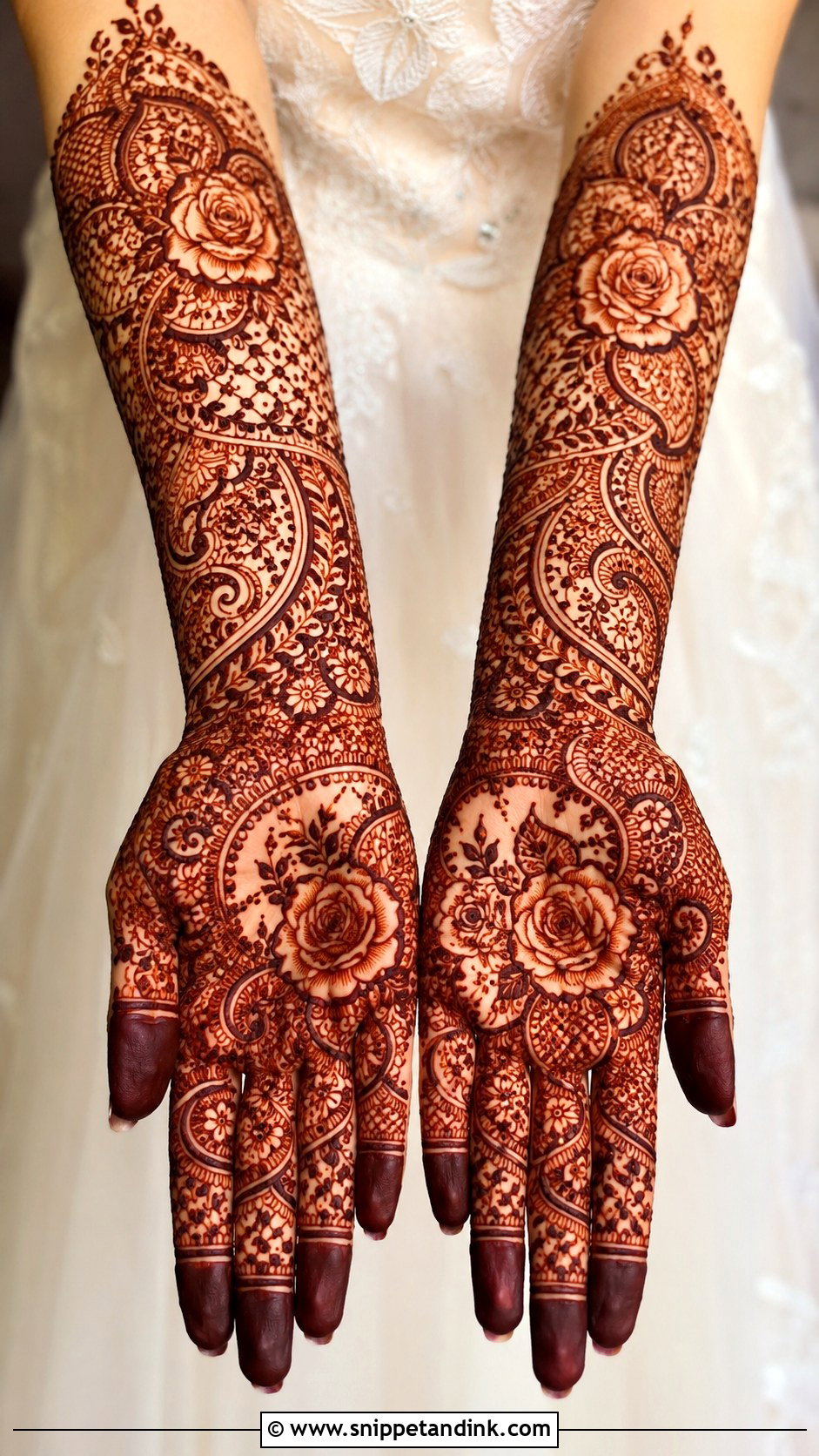
In a bridal set, roses soften what can otherwise be a very dense, formal layout of paisleys, jaali, mandalas and fine filler running from palm to forearm. They can be large centre motifs, small repeated blooms or borders around bridal figures, and the vines are an easy place to hide initials or the wedding date. The risk is that the roses drown. I keep at least two or three of them large and plainly outlined, and I draw them before the filler, not after, so the fine work has to flow around them rather than over them.
4. Back Hand Rose Mehndi Design
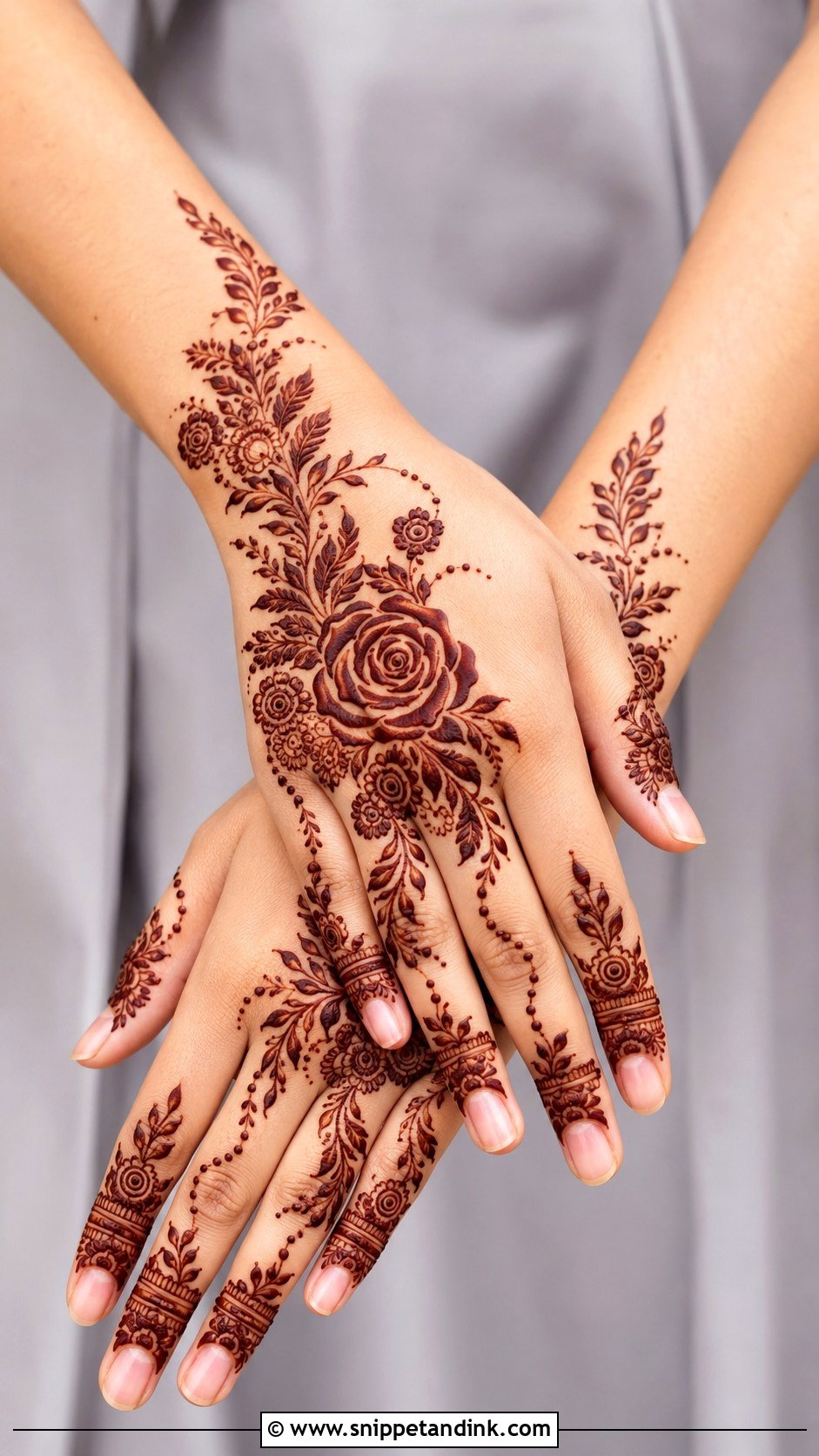
The back of the hand puts the rose exactly where people look when you’re holding a glass or adjusting a dupatta. I set a large bloom near the centre and let vines travel toward the fingers and wrist, with matching buds, leafy bands or fine lace lines on the fingers. Leave negative space around the main flower for a modern read, or add small shaded petals and dots near the knuckles for something fuller. Rings and bangles frame it naturally, so ask yourself what you’ll wear before you decide how far the design reaches.
5. Front Hand Rose Mehndi Design
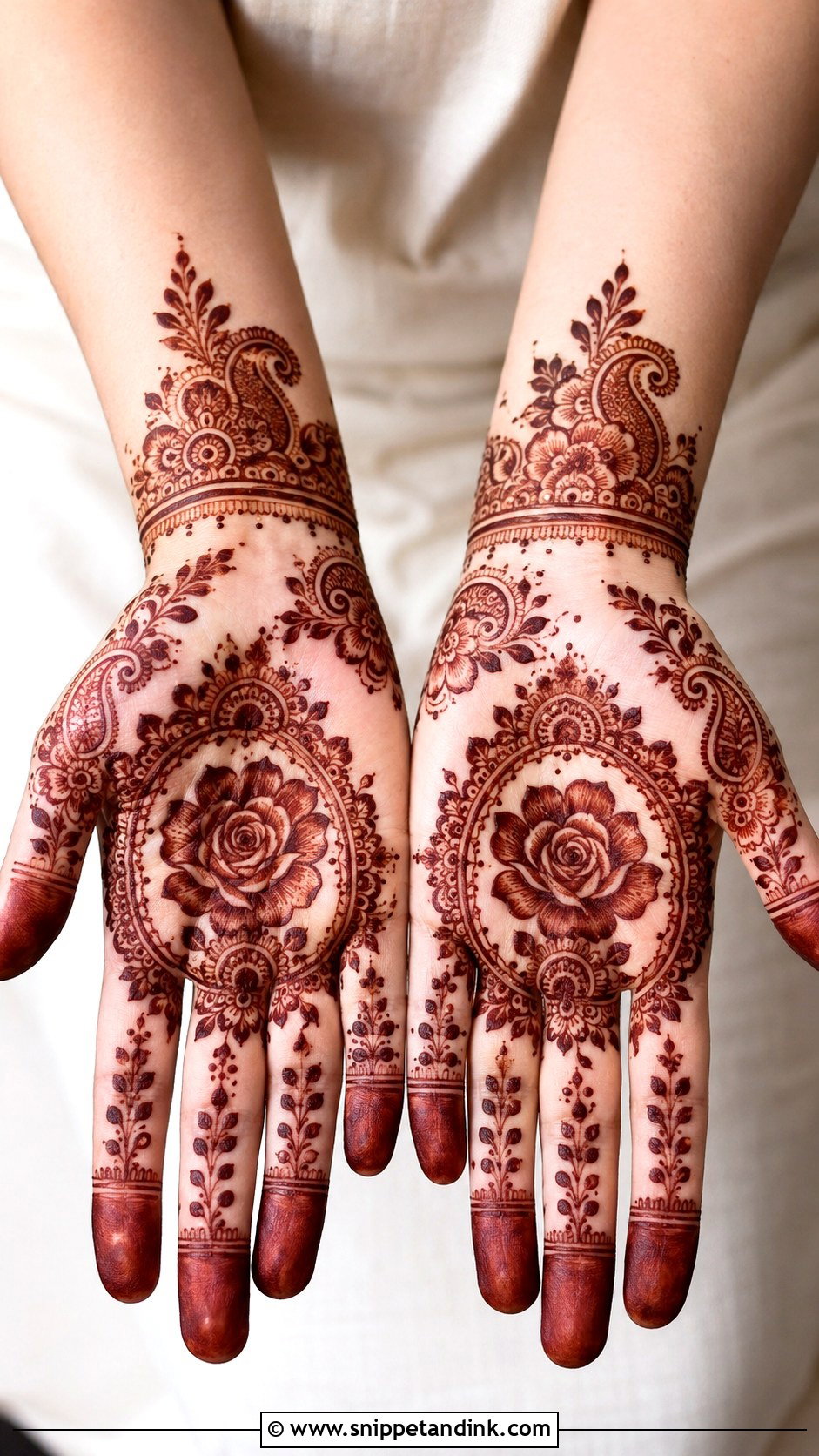
The palm gives room for a large rose, a circular floral frame or a rose mandala, extended into finger vines, leafy trails and small wrist details. It’s the side that reads complete when the hand is open in traditional poses. My test is simple: I ask the client to cup her hand. If the rose folds into the crease, I move it a little toward the heel of the palm. For a simple version use one rose and clean finger patterns; for something heavier, add paisleys, dots and shaded leaves, and balance the fingertips so nothing looks abandoned.
6. Full Hand Rose Mehndi Design
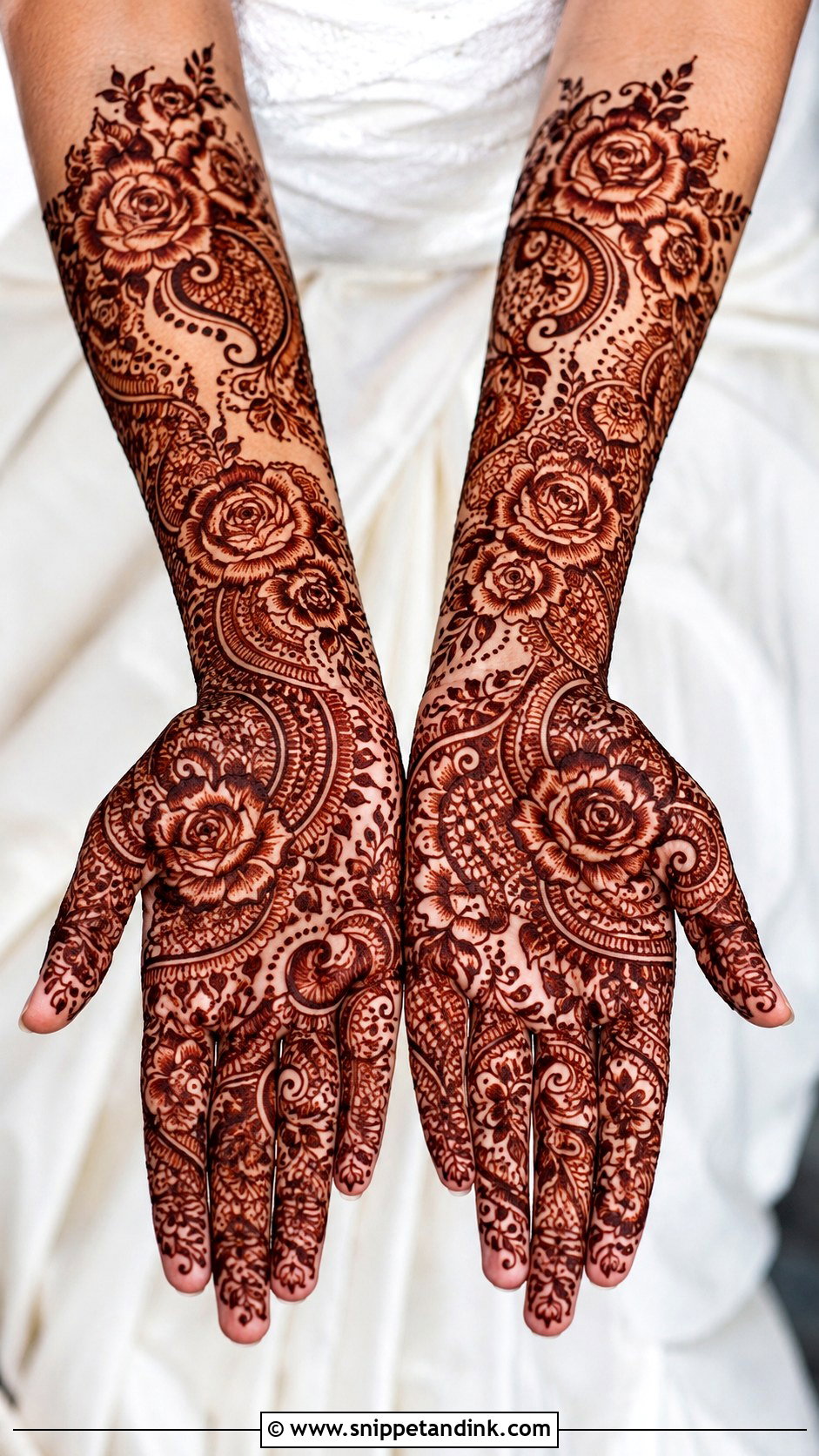
Full-hand rose work covers palm, back, fingers, wrist and sometimes the forearm, starting from one large bloom and stepping down to smaller roses along the vines and borders. Indian fillers like paisleys, checks and fine lines make it richer; Arabic spacing keeps it lighter. The mistake I see most is every rose drawn at the same size, which turns the hand into wallpaper. Vary the scale deliberately, roughly one large, two or three medium and the rest buds, and the eye will travel across the hand the way it would across a real stem.
7. Rose Finger Mehndi Design
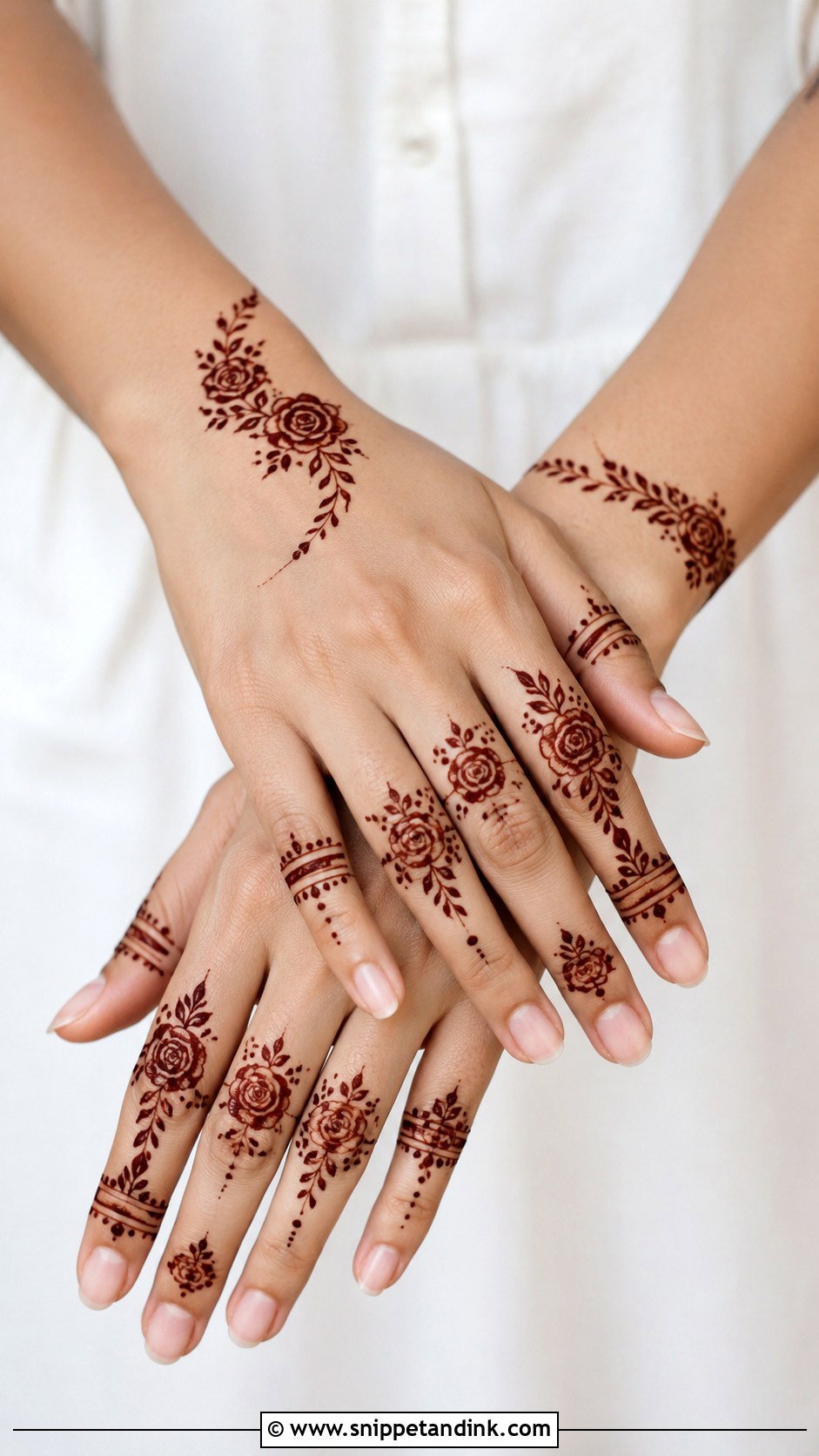
Tiny roses on the fingers, slim vines, dots and leafy bands make this delicate without looking unfinished. I usually seat one small rose at the base of the index, middle or ring finger and carry matching line work up the others. To round it into a full look, add a light wrist vine or a small rose on the back hand. Small roses on fingers need a very fine cone tip, because at that size even one thick petal closes up the centre. Natural nails and simple rings suit it best.
8. Rose Mandala Mehndi Design
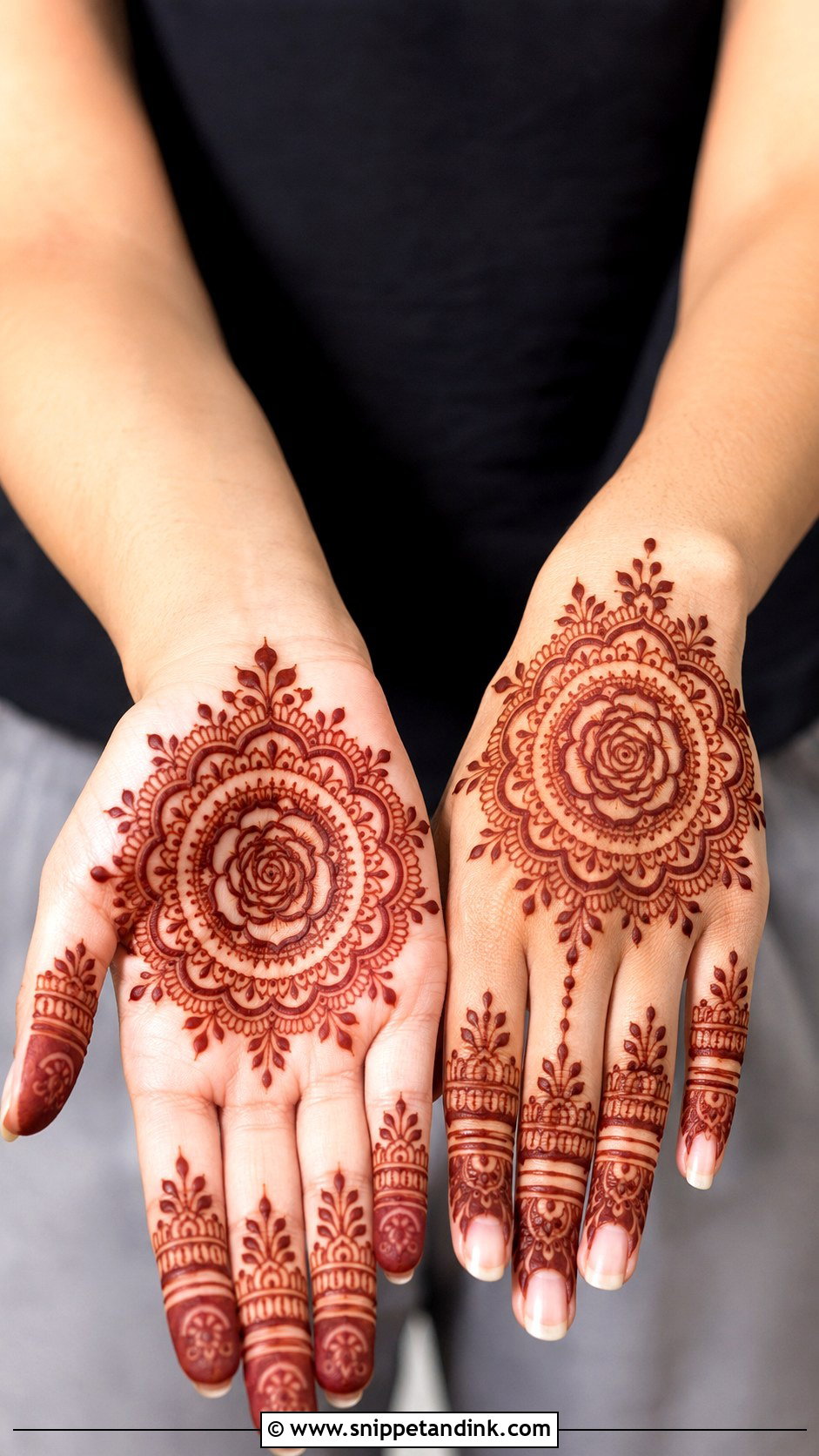
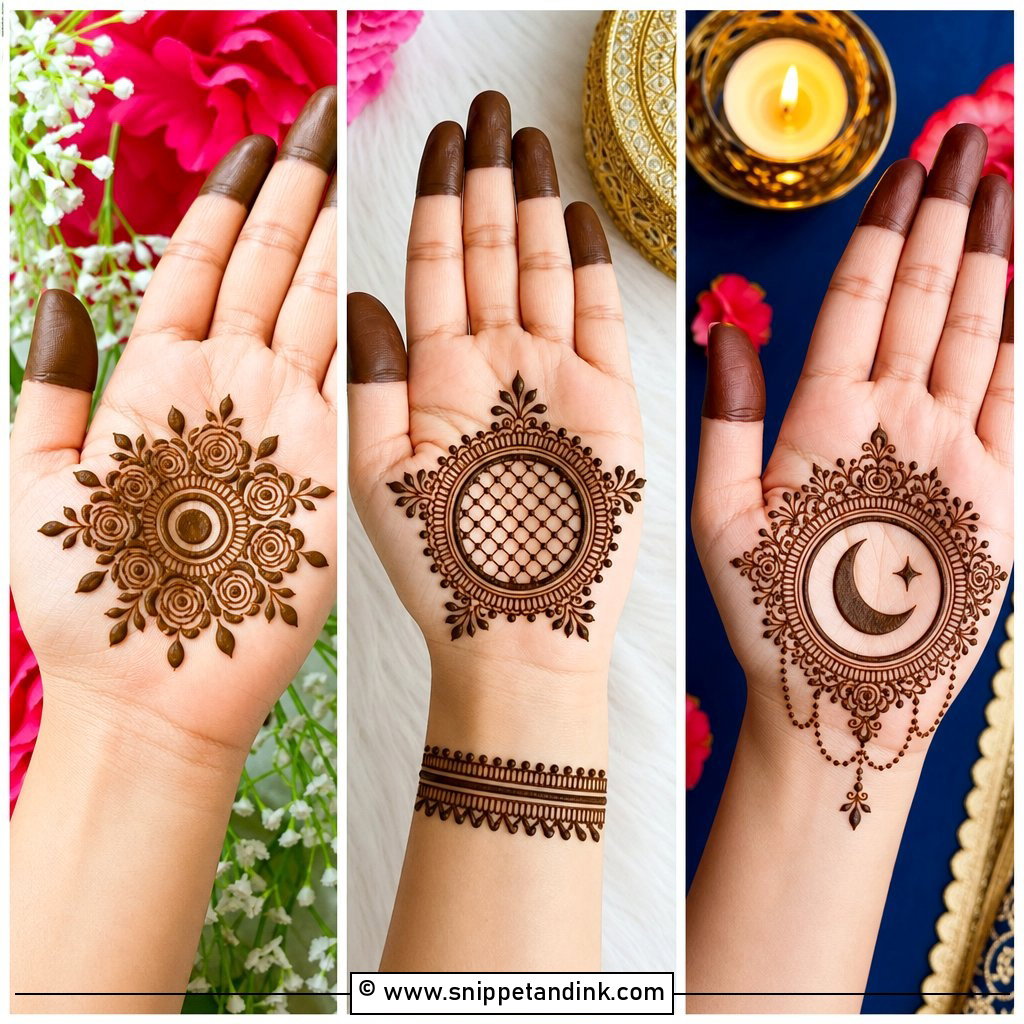
A rose mandala arranges petals in rings around a centre on the palm or back of the hand, finished with dots, leaves, scalloped borders and small petal rings. It’s balanced and traditional without getting heavy. I start these from a small spiral rather than a dot, which gives the centre a rose’s twist instead of a generic flower. Fingers can stay simple with leafy strips or buds. It’s my usual suggestion for pujas and for bridesmaids who want something neat and centred.
9. Rose Vine Mehndi Design
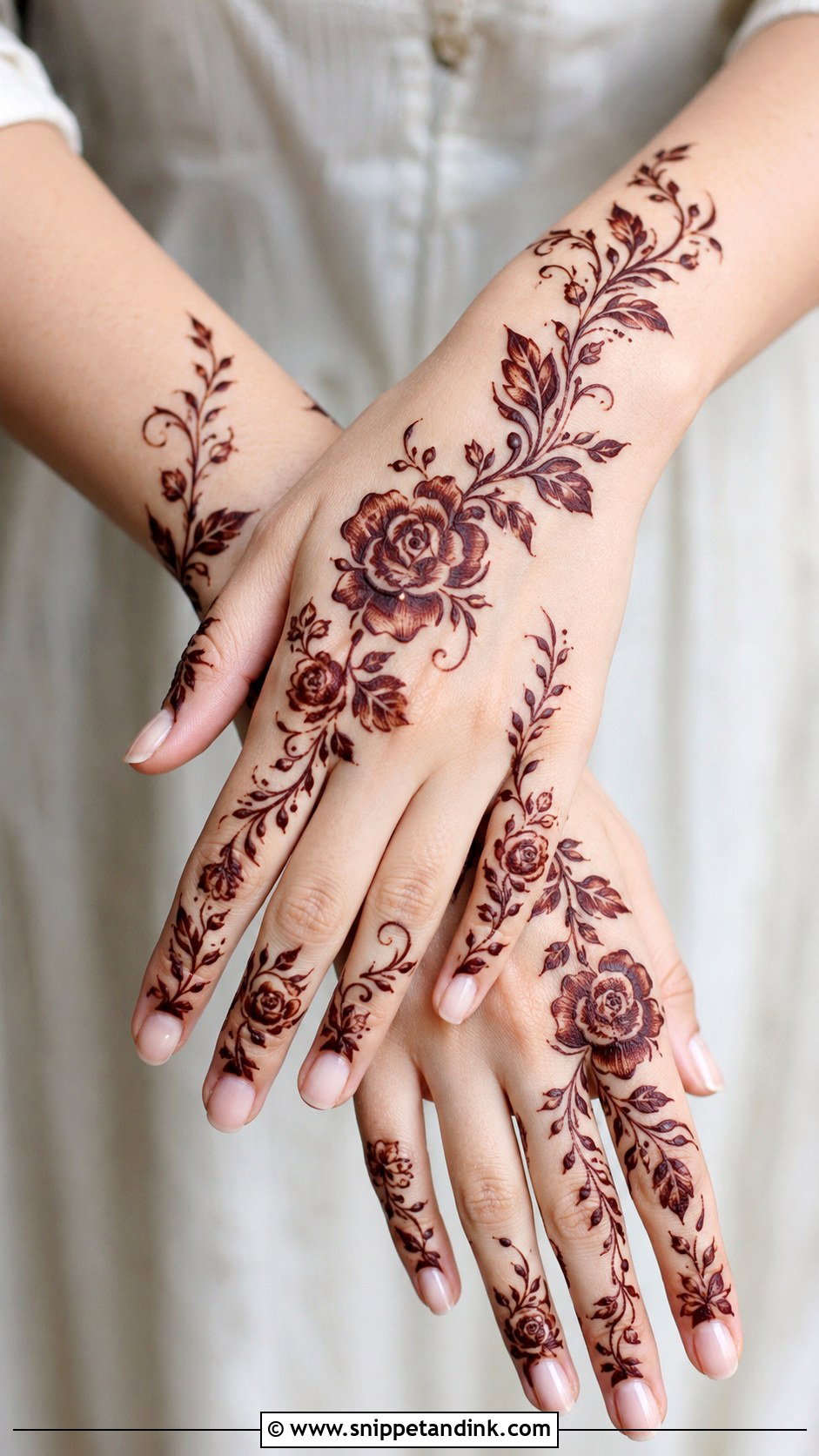
A rose vine starts at the wrist, curves across the back of the hand and continues toward the middle finger, with one or two open roses, buds and leaves along the stem. I keep the stem curved, never ruler-straight, so it follows the bones of the hand. You’ll see this layout a lot in Arabic and Gulf-inspired mehndi because it relies on movement and empty space, and it’s quick to apply. Shade the petals lightly and keep leaf strokes thin for a softer finish.
10. Rose Bail Mehndi Design
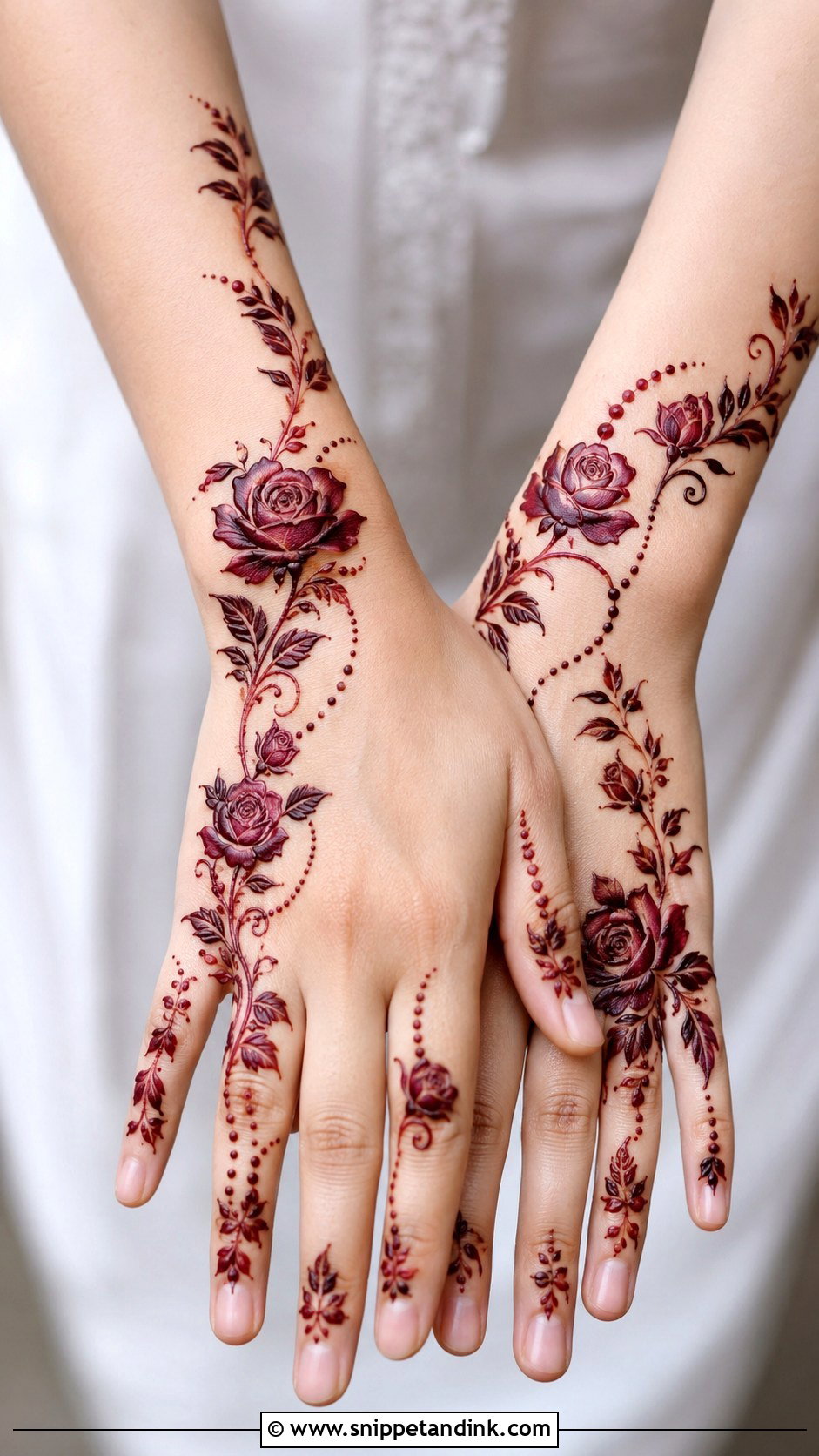
A bail is a long, narrow trail from the wrist to one finger, with roses spaced along it and joined by leaves, dots and curved stems. It scales easily. On a small hand I use one large rose and two buds; on a longer hand I add more space between blooms and a little wrist detail. It covers enough to feel finished without taking over the whole hand, which is why it’s a regular request for Eid, Raksha Bandhan and smaller wedding functions.
11. Rose Jaali Mehndi Design
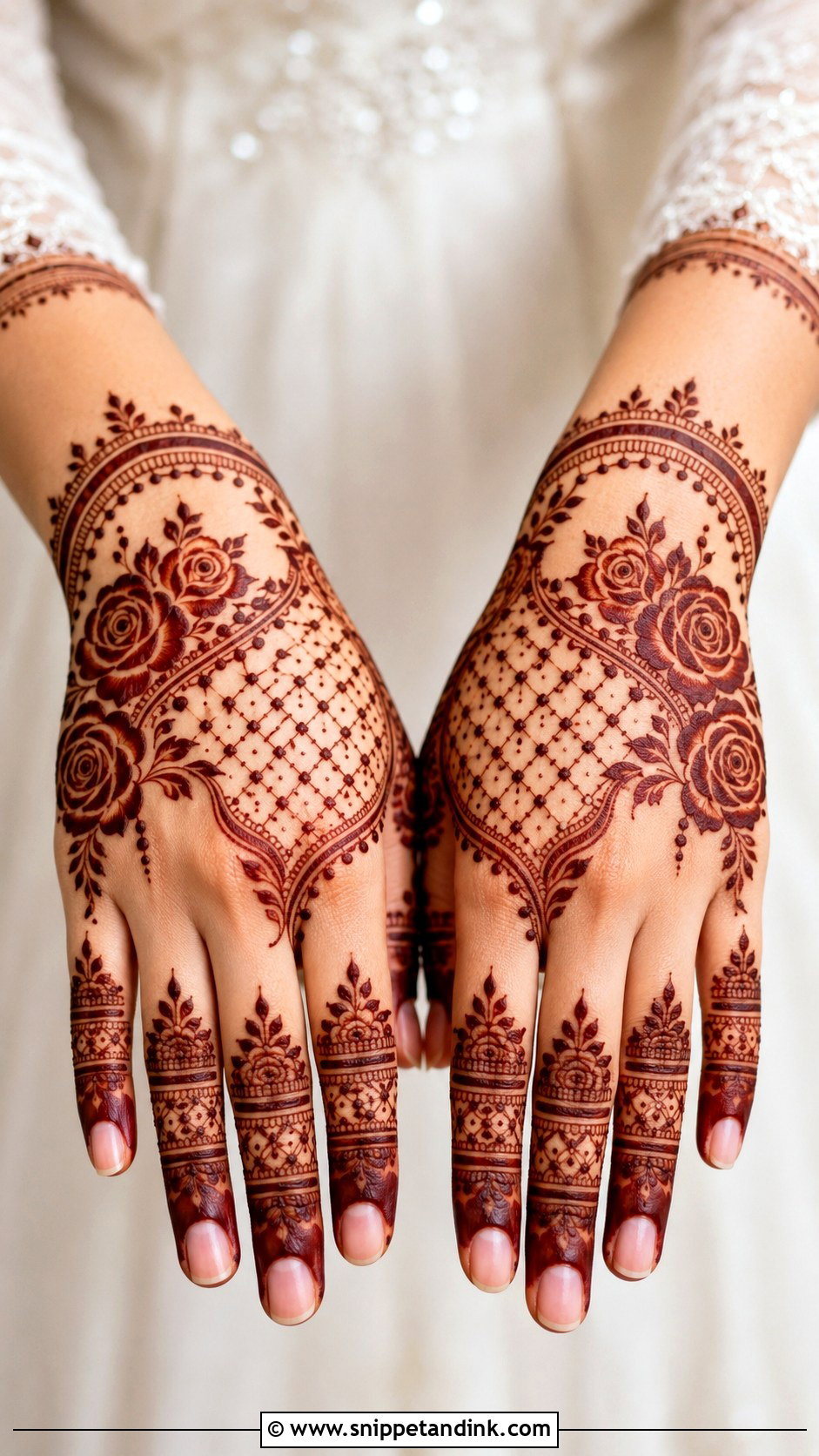
Here a rose sits on the back of the hand while jaali mesh fills one side or forms a glove-like background. The mesh needs to be even, with tiny dots or petals in some squares, and leaves and buds around the edges to soften the geometry. Rose and grid compete for attention, so I draw the rose with a noticeably thicker outline than the mesh lines. If the jaali continues into ring-style bands on the fingers, it pulls the whole hand together nicely for guests and bridesmaids.
12. Rose Bracelet Mehndi Design
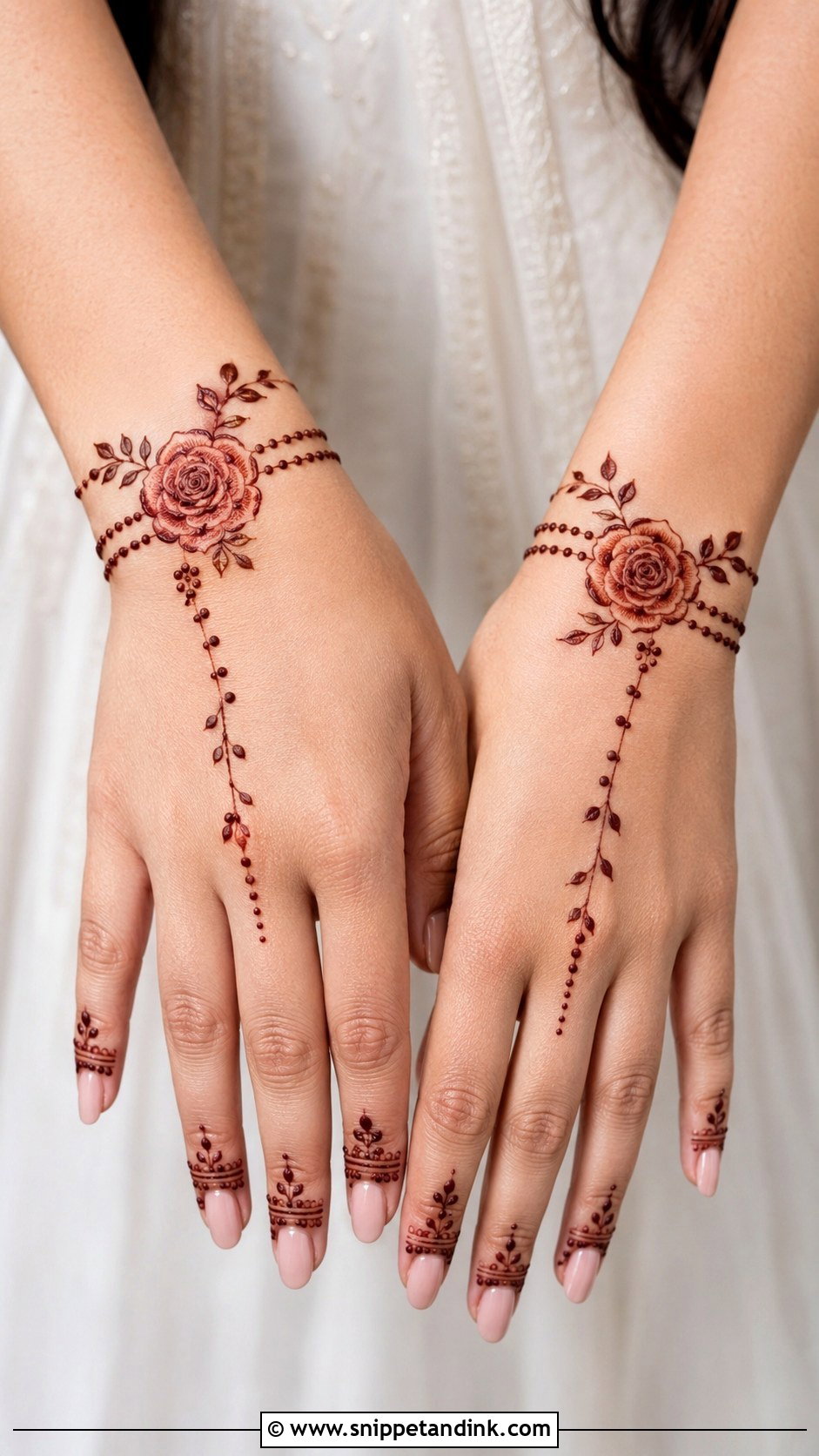
The rose sits at the wrist and curved bands wrap around it like a bracelet, with a thin vine reaching toward the back of the hand or a single finger. Small leaves, dotted chains and buds dress up the band, and the fingers can stay minimal. It’s quick and still looks dressed. One practical note from the chair: if you’re wearing bangles that evening, have the bracelet drawn a finger’s width higher than usual, so the bangles don’t sit on wet paste and smear it.
13. Rose Palm Mehndi Design
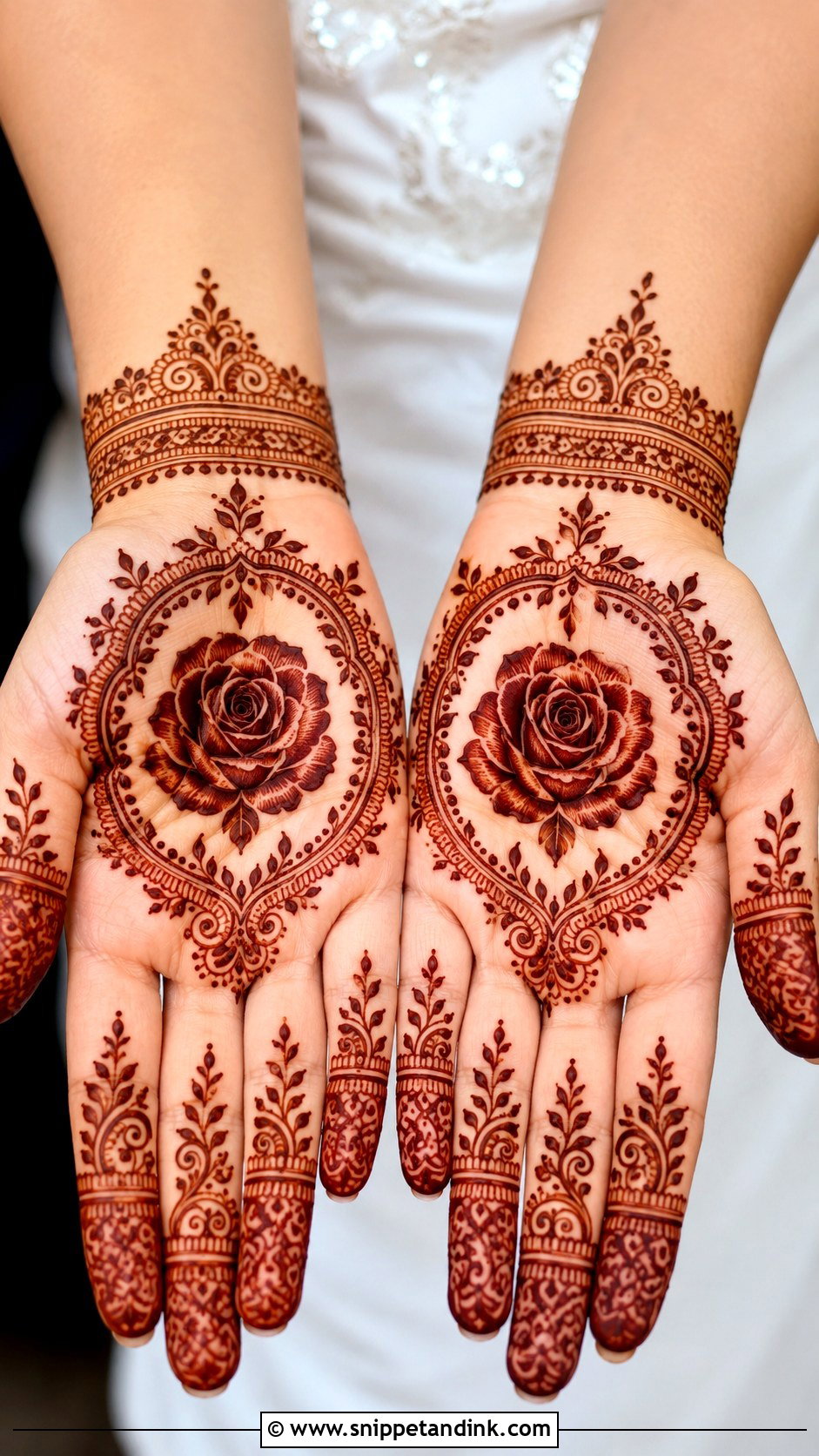
The palm centre is the focus here: a large rose surrounded by leaves, dotted circles and soft petal borders, with matching vines or floral strips on the fingers. Add paisley corners for a fuller look, or leave clean space around a bold rose for a simpler one. Palms stain deeply, so I can shade the petal centres more than I would on the back of the hand and they’ll still read clearly. It suits traditional hand poses because the rose is the first thing anyone sees.
14. Rose Wrist Mehndi Design
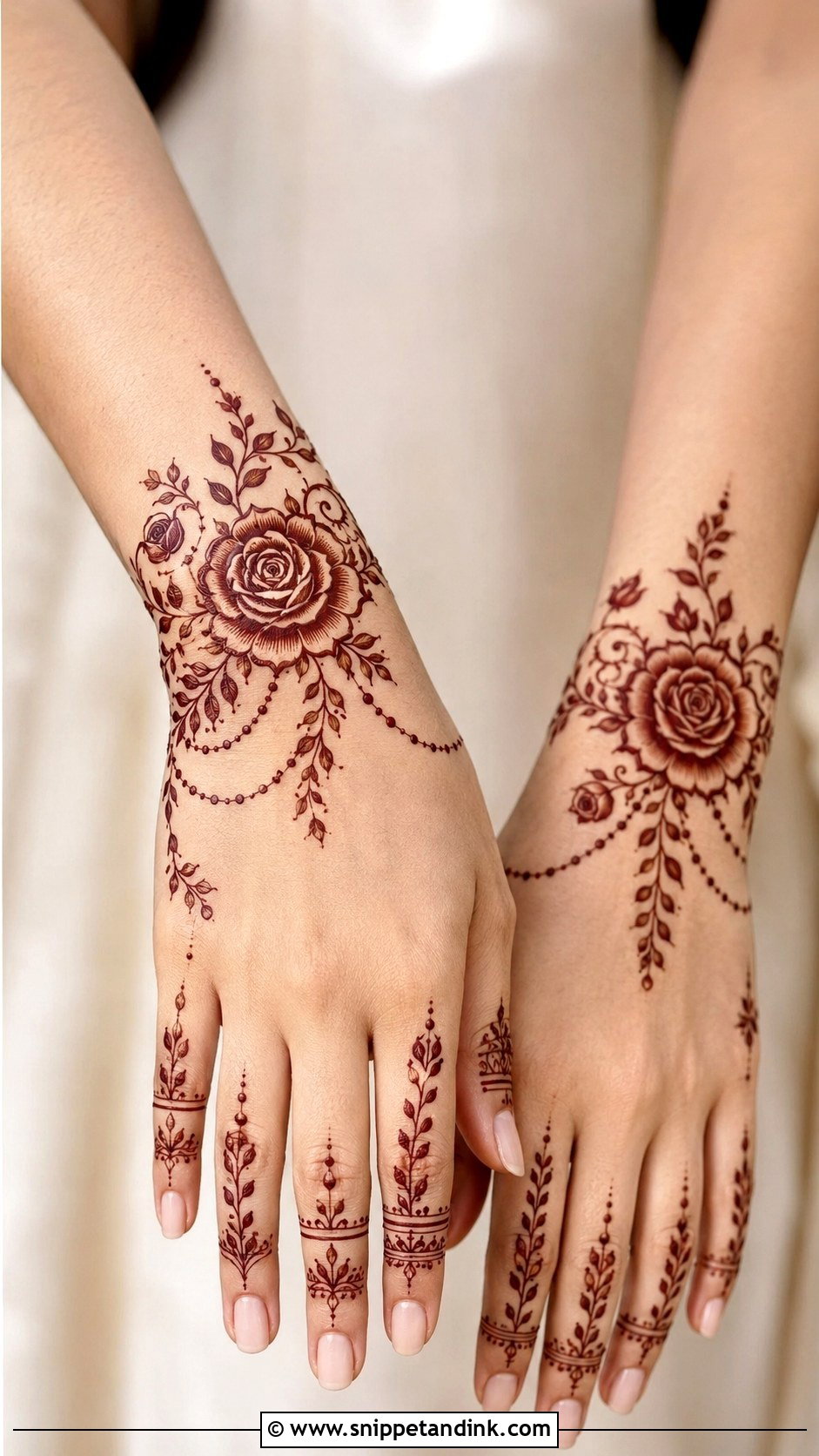
One medium-sized rose at the wrist, framed by vines that wrap like a cuff, with a thin trail toward the thumb side or back of the hand. It’s light enough for someone who doesn’t want palm coverage and discreet enough for office-friendly festive days. Don’t let the rose shrink too much; below a certain size the petals blur into a dot once the stain comes up. Dotted chains and leaves finish the wrist area.
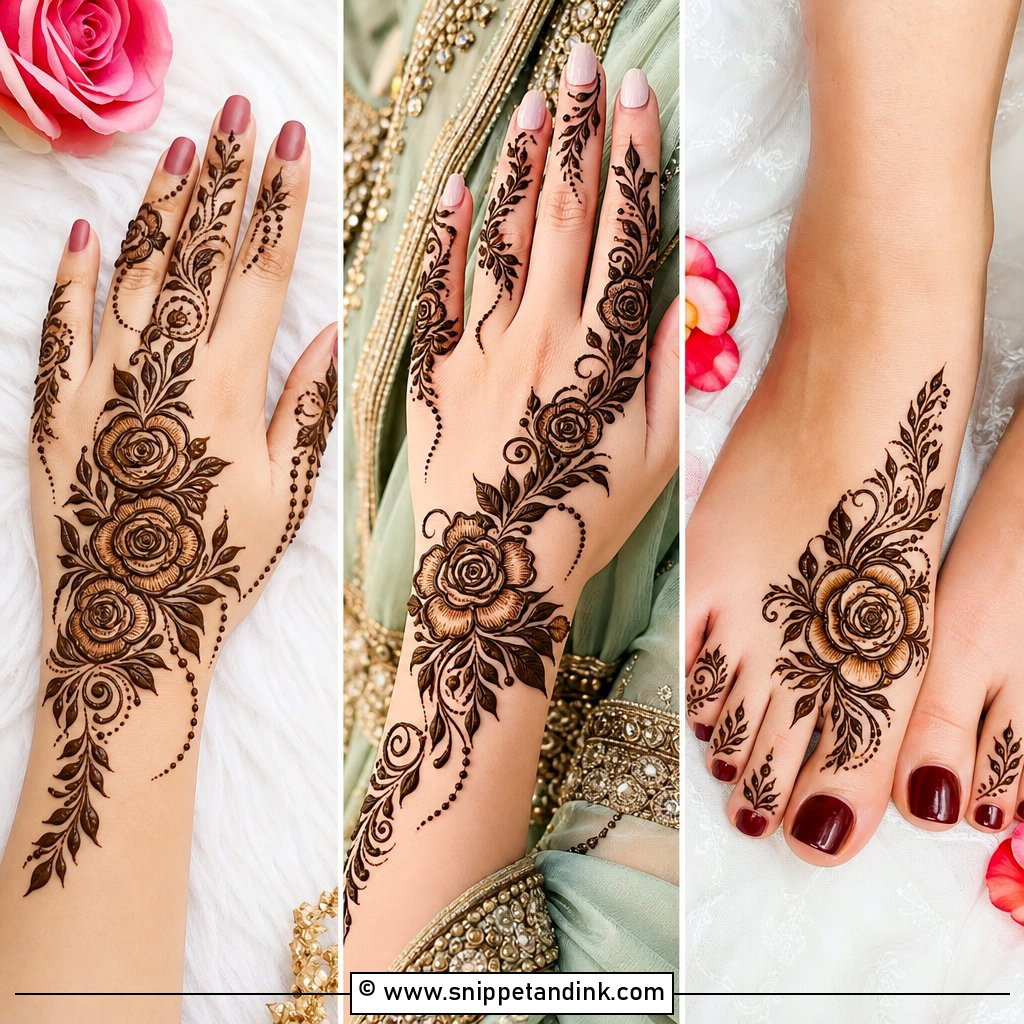
15. Rose Forearm Mehndi Design
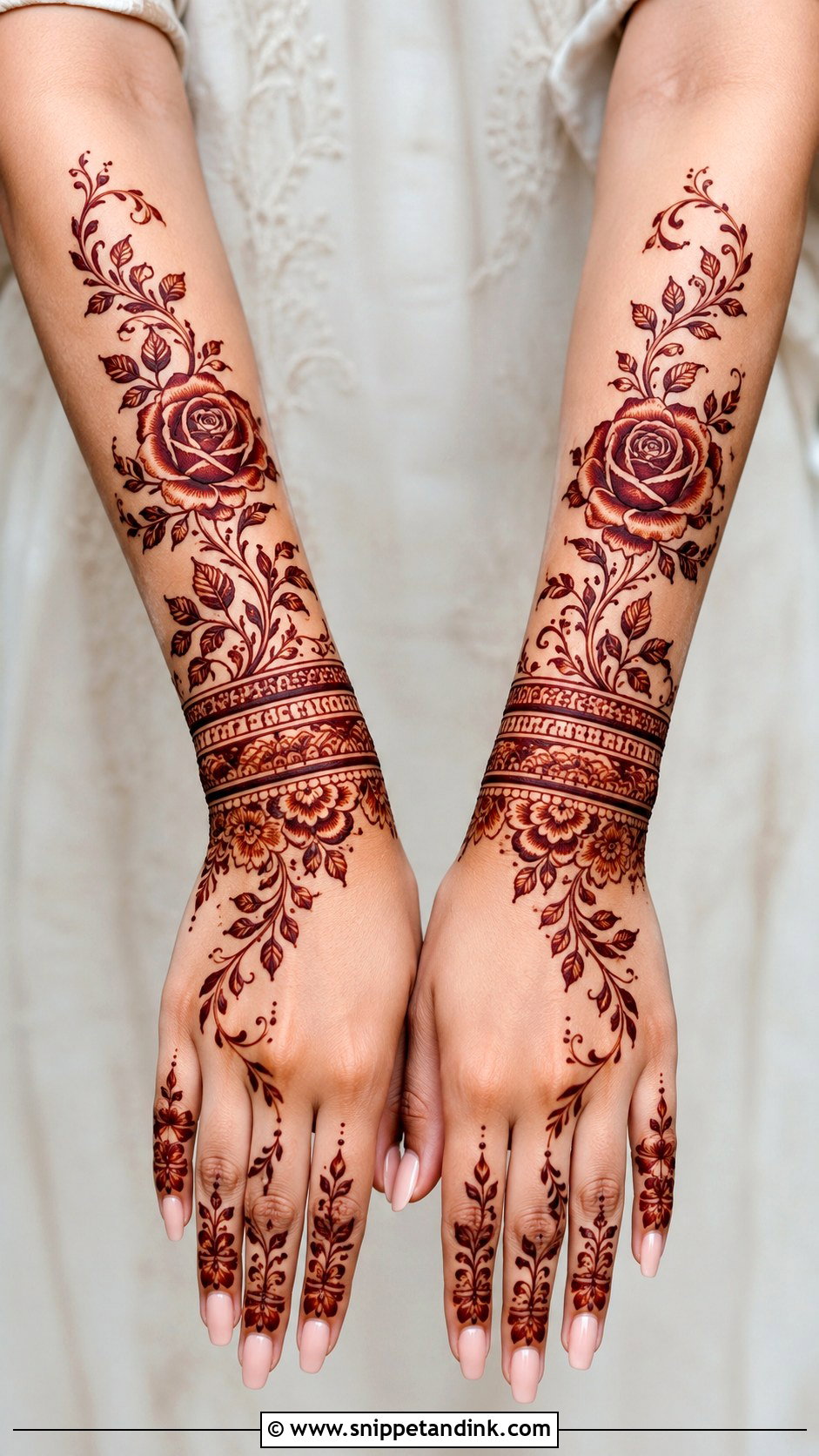
Forearm roses start from a bracelet at the wrist and climb with larger blooms, vines, leaves and ornamental bands. I often keep the hand itself a little lighter so the arm becomes the feature. Brides can fold this into a full bridal set, and guests can wear a simpler, more open version. The forearm stains lighter than the palm and fingertips, so I make the outlines slightly heavier up there, and I run the vines along the length of the arm rather than across it so the design doesn’t look stiff.
16. Rose Engagement Mehndi Design
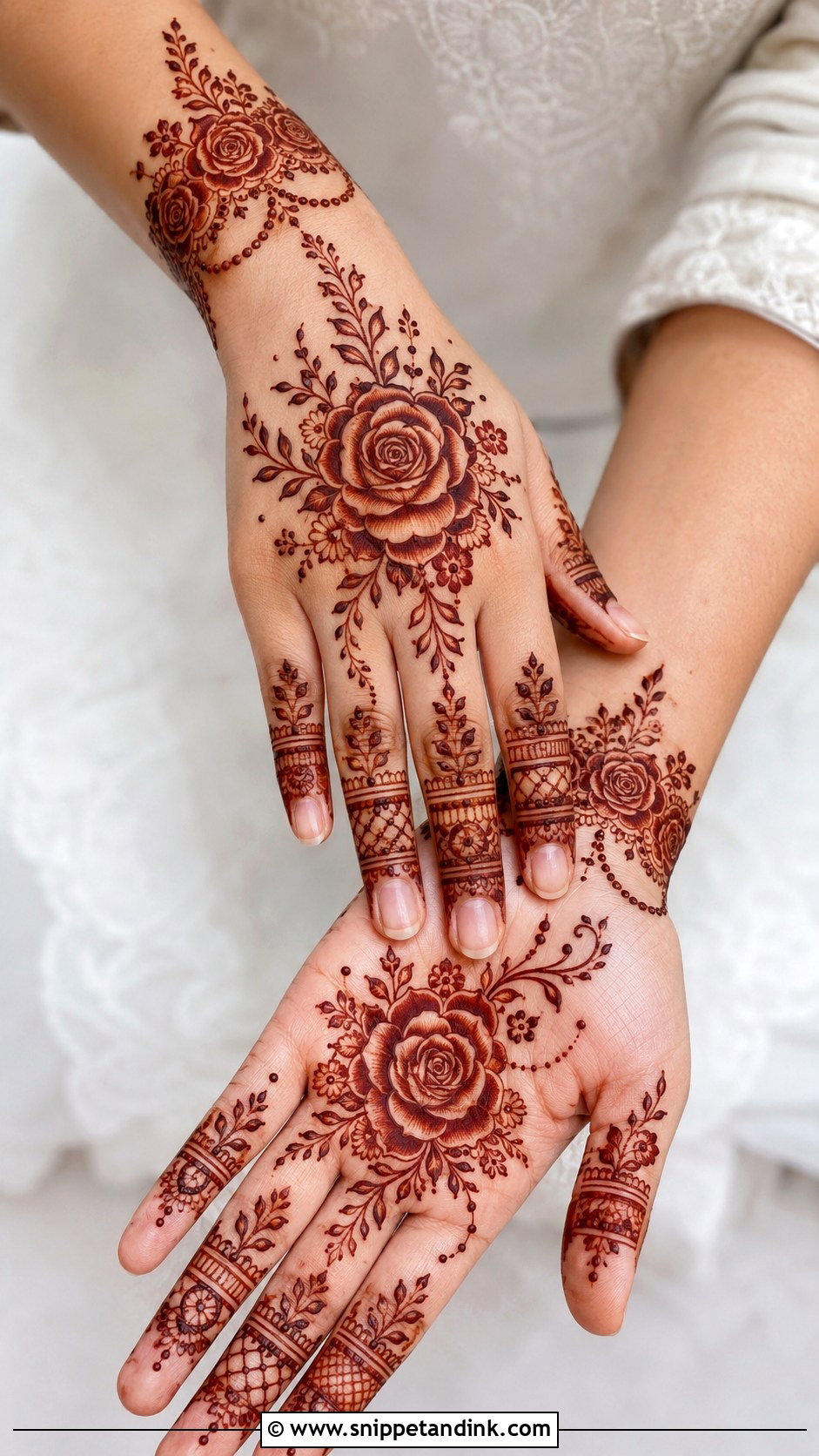
Rose engagement mehndi design sits between everyday henna and full bridal. A rose-centred back hand with ring-style finger detailing and a floral bracelet is the layout I’d suggest, with a matching rose mandala or small vine on the palm. Fine dots, leaf chains and shaded petals polish it. Initials fit neatly inside a small rose vine or wrist band if you’d like something personal. I keep the ring finger itself fairly light, because the ring is what everyone wants to photograph.
17. Rose Wedding Mehndi Design
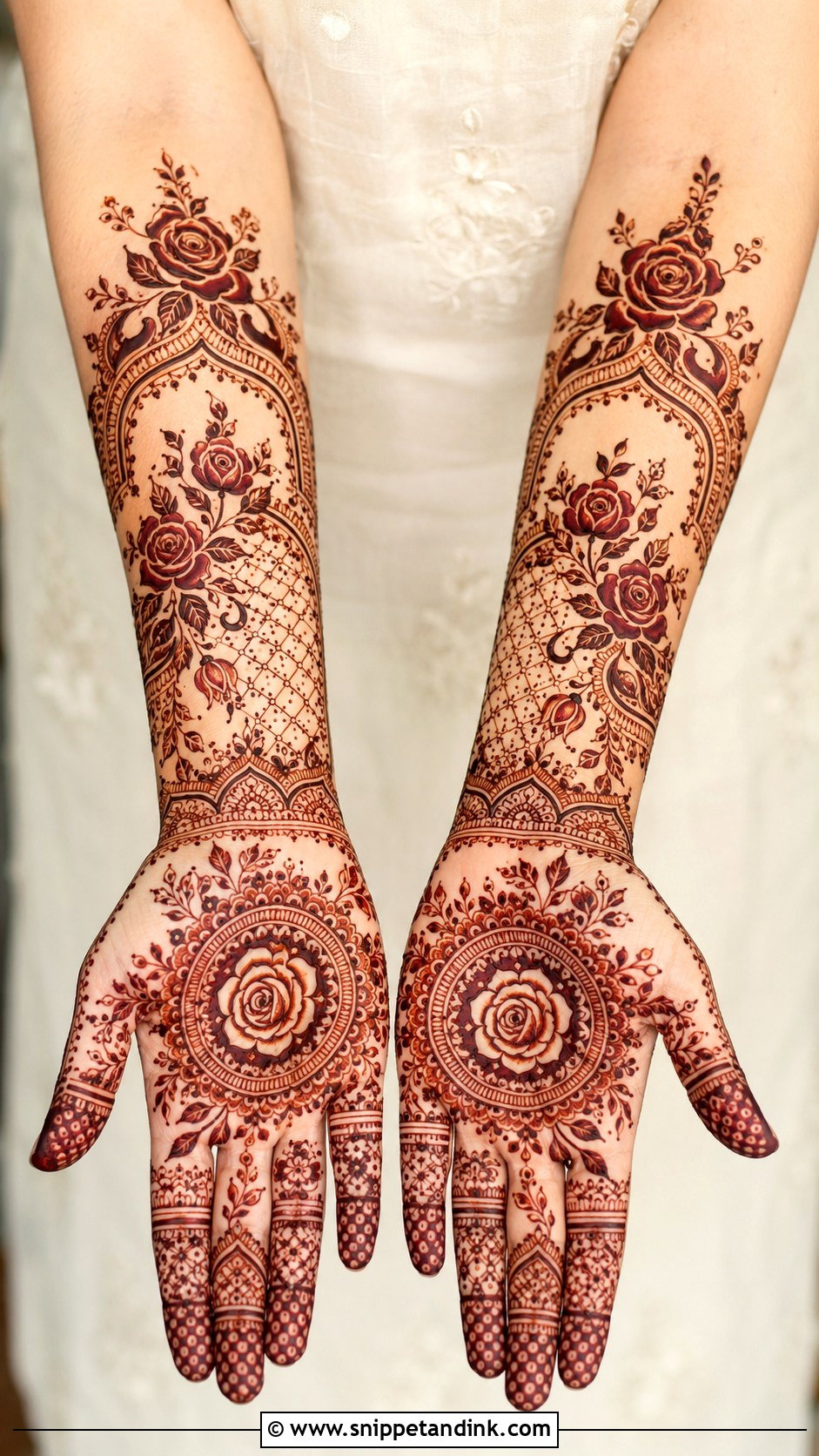
Wedding rose work scales from bride to guest. A bride might wear roses across palms, backs, wrists and forearms mixed with paisleys, mandalas and lace borders, packed with hidden details, while guests suit open rose trails and lighter finger work. Whichever end you’re on, mix large open roses with small buds rather than relying on tiny flowers alone. Small flowers on their own look like texture from a distance; the big blooms are what the camera picks out.
18. Rose Eid Mehndi Design
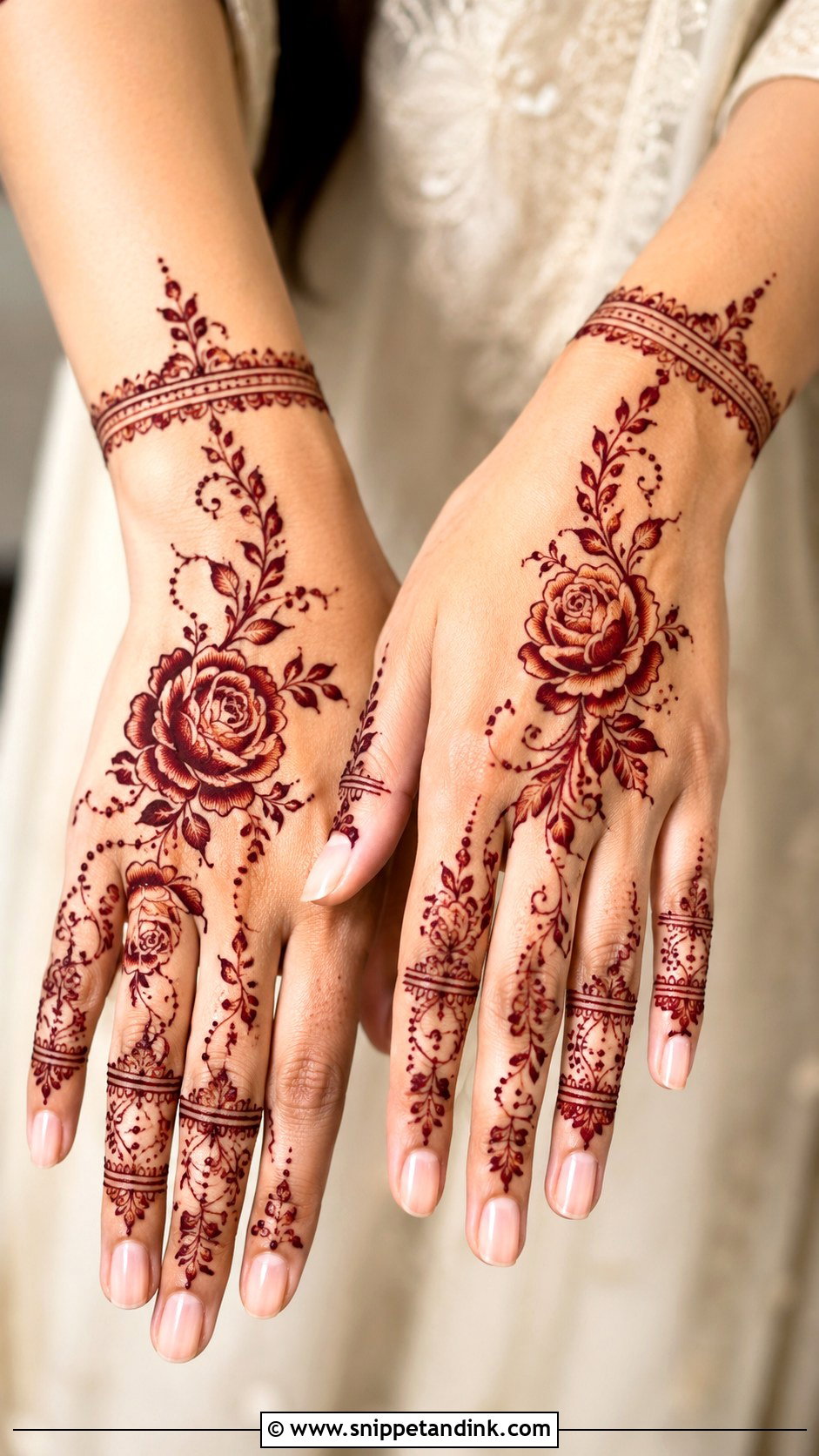
Eid rose henna is usually an Arabic trail: a shaded rose on the palm or back of the hand, vines flowing toward the fingers and a light floral band at the wrist. It leaves plenty of open skin, and it’s quick enough for a chand raat rush. Keep the fingers neat with leafy lines, dots and buds. A dark maroon stain makes the petals look rich against festive bangles, so if you can sit for your appointment a day earlier than the night before, the colour will thank you.
19. Rose Karva Chauth Mehndi Design
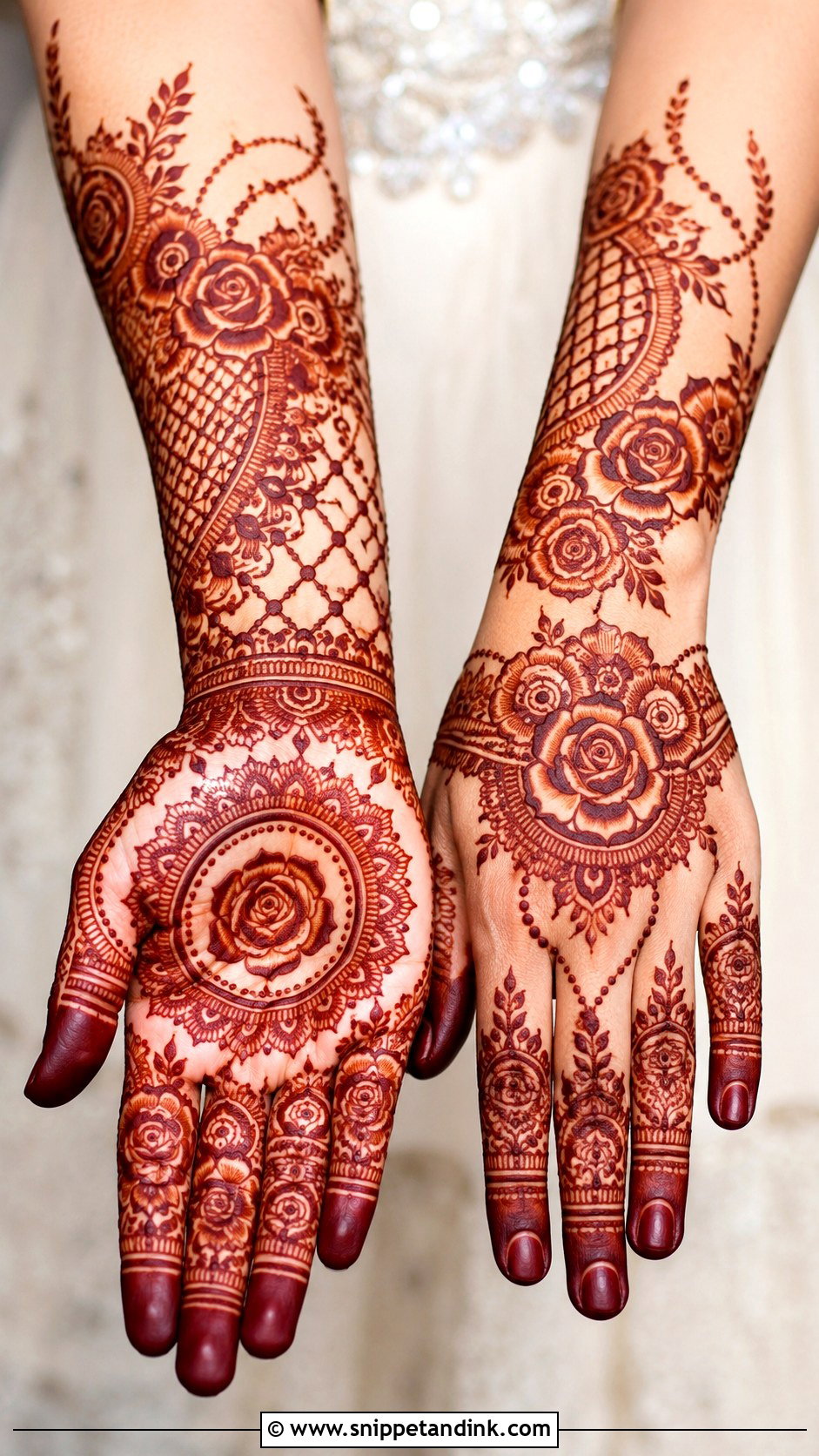
Karva Chauth designs tend to be fuller, so I build the roses into a traditional frame: a large rose in the palm, fine finger filling and a floral trail from wrist to forearm, with mandalas, paisleys and jaali spaces around them. Circular borders and dotted chains push it toward a more classic finish. Because both hands are seen together during the evening rituals, I mirror the main rose placement on each hand. A rose in the palm is a natural symbol of love for the occasion, and the leafy vines soften everything around it.



20. Rose Teej Mehndi Design
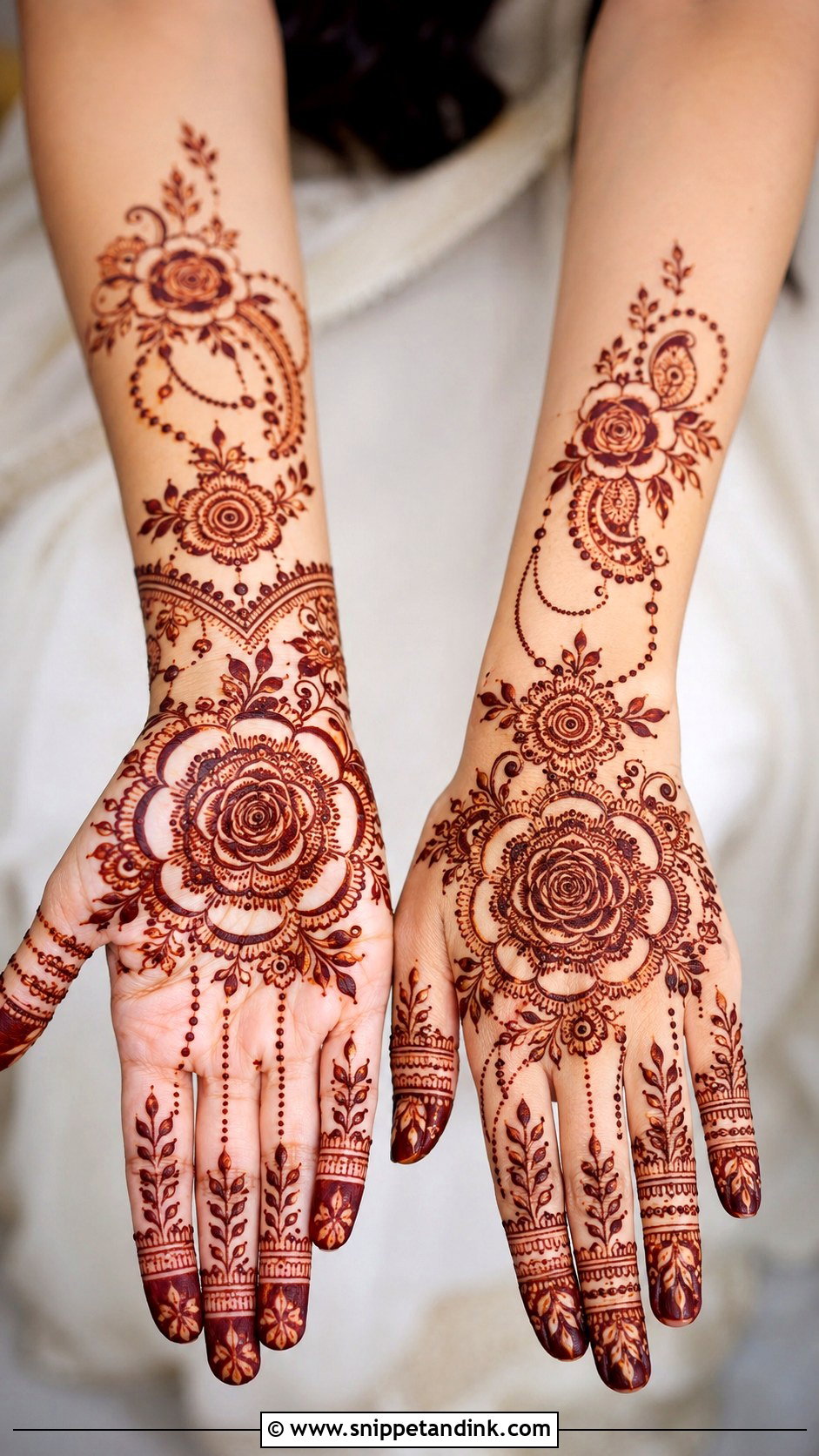
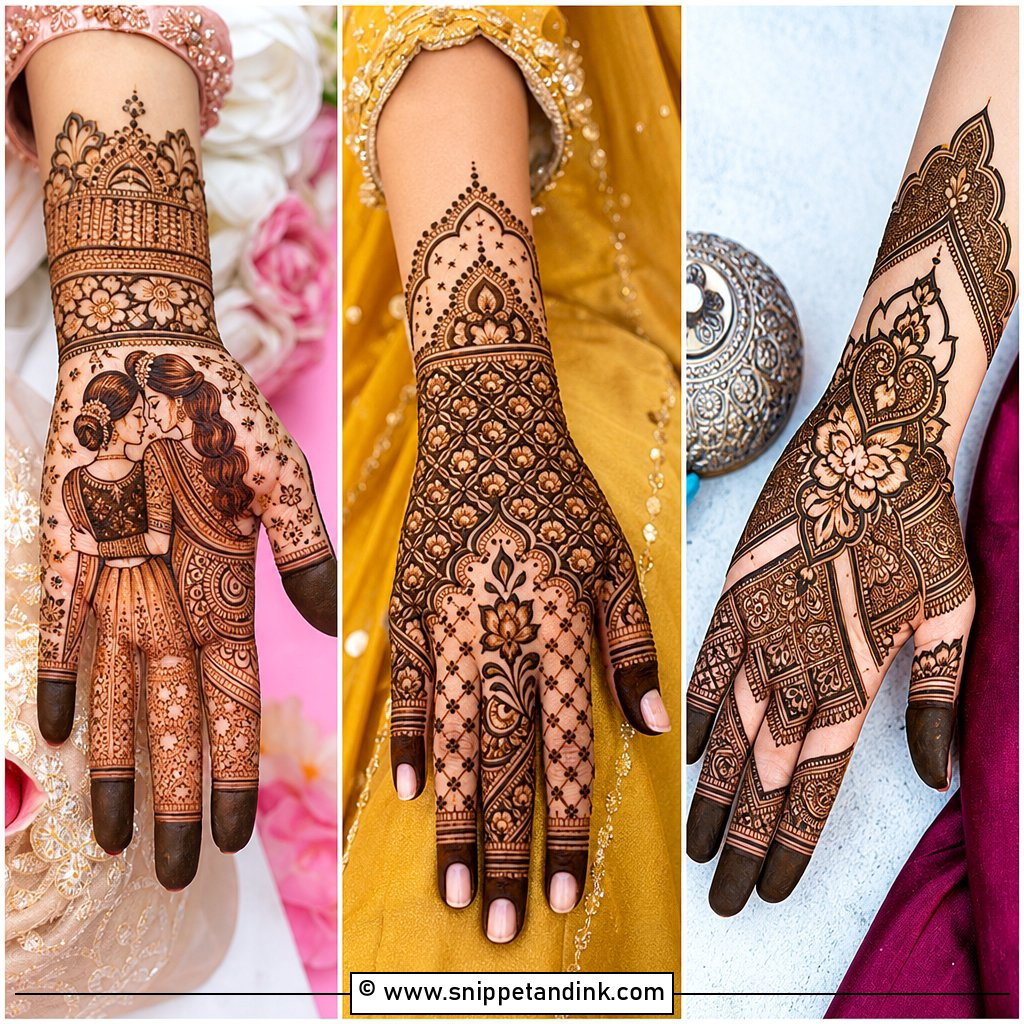
For Teej I like a rose mandala on the palm with leafy vines across the fingers, plus a rose trail on the back for a two-sided look. Traditional fillers such as dots, curved lines, paisleys and floral borders add richness, and the dark stain sits well against the greens, reds and yellows people wear for the festival. Lighter option: an Arabic rose bail with open spacing. Fuller option: extend the roses to the wrist and forearm with fine detail. Since Teej often means a long sitting with friends, the lighter version also dries faster.
21. Rose Raksha Bandhan Mehndi Design
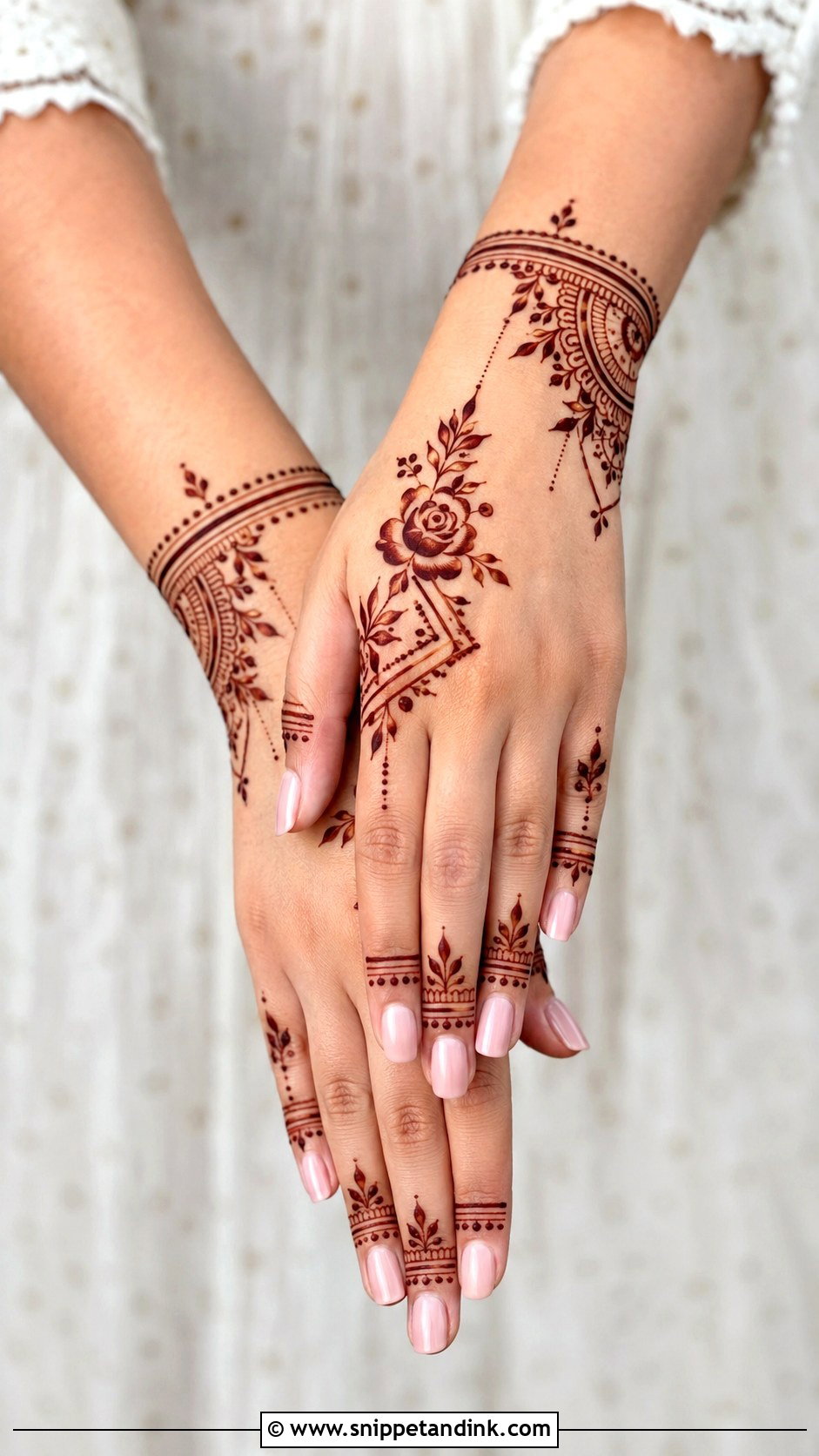
A back-hand rose bracelet leaves the palm free, which matters on a day spent tying rakhis, serving sweets and handling plates. I place one rose near the wrist or the centre of the back of the hand and connect it with leafy bands and finger vines. Younger girls suit smaller roses with dotted trails; adults can take more shading and some jaali. Keep the finger work tidy so it lasts the day without looking worn.
22. Rose Party Mehndi Design
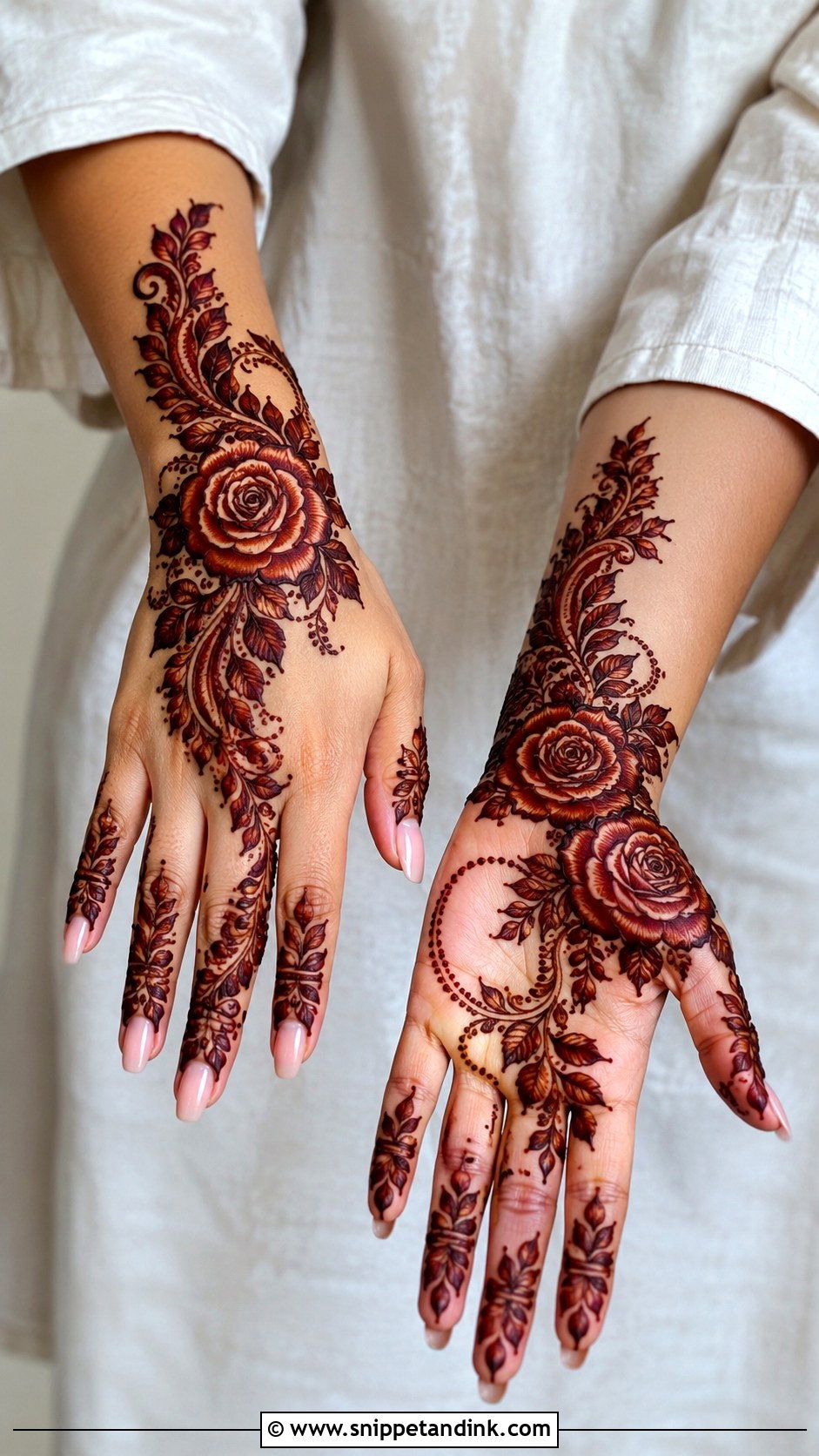
Party henna has to look good quickly. A bold rose on the back of the hand with a diagonal Arabic trail, shaded petals, curved leaves and simple finger bands can be done well inside half an hour per hand. If you want more, a little jaali near the knuckles creates a glove effect, but stop before it crowds the rose. It sits as comfortably with a sangeet outfit as with a dinner dress. The neater and bolder the lines, the better it holds up in phone photos under warm party lighting.
23. Rose Minimal Mehndi Design
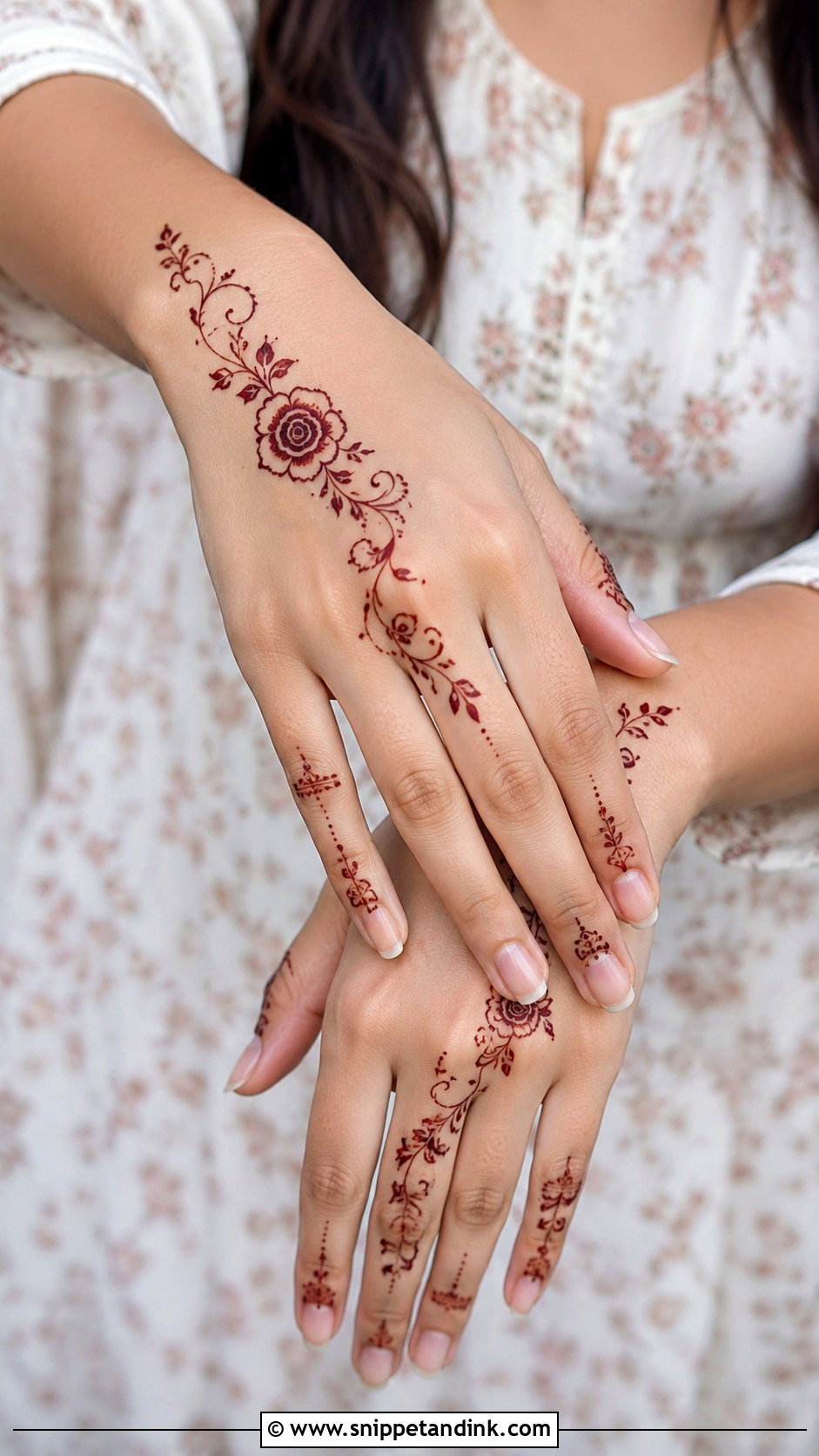
Minimal rose mehndi is one small rose on the back of the hand, a thin vine to the wrist and a few finger accents. No heavy filling, fine lines only. For first-time henna wearers I like it because it’s quick and they get to see how their skin takes colour before committing to anything larger. Tiny leaves and dots around the rose finish it better than a border would.
24. Rose Modern Mehndi Design
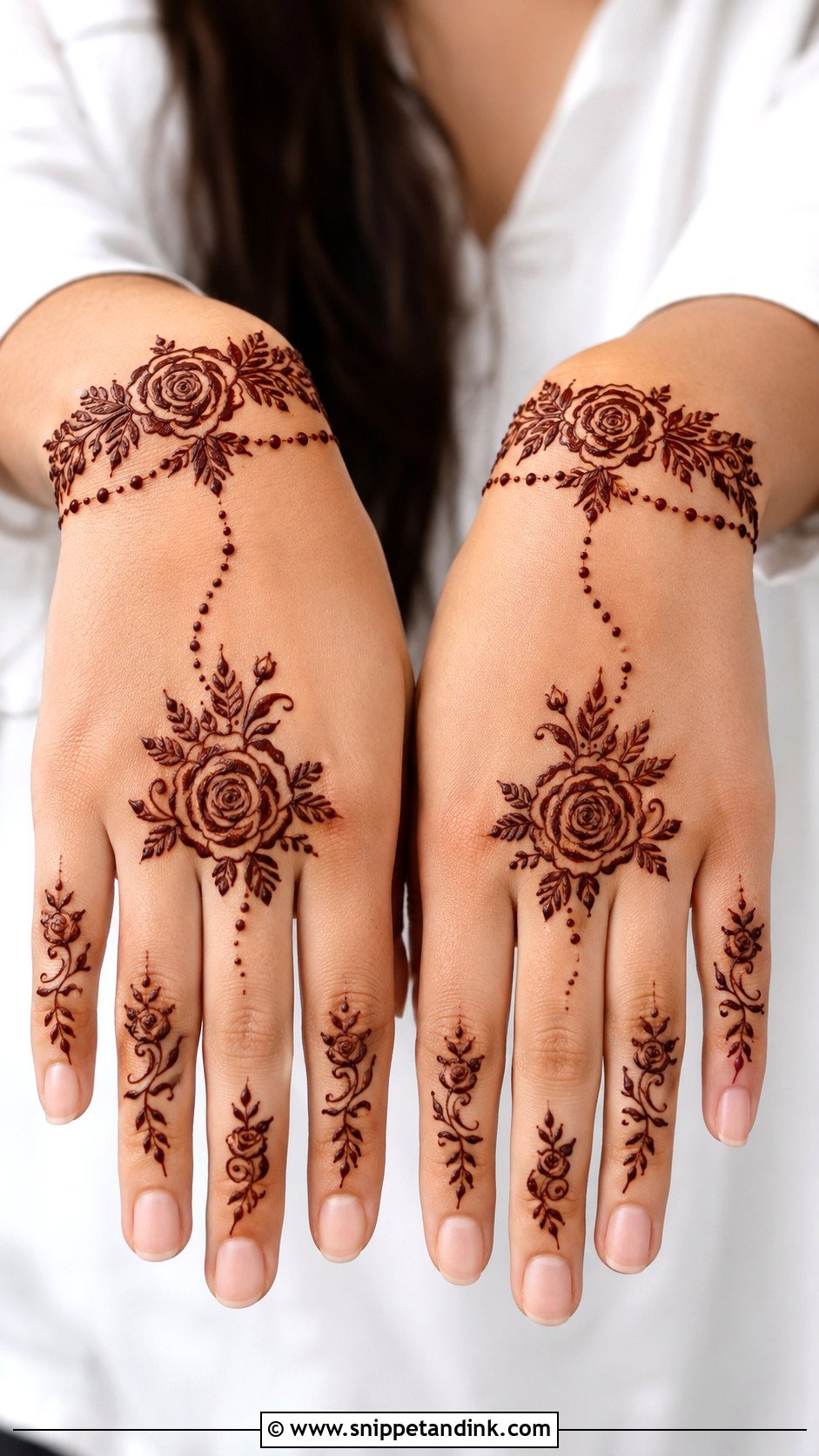
Modern rose layouts move the bloom off-centre on the back of the hand and connect it to geometric lines, half-mandala shapes, negative space or sleek finger bands. It should look intentional rather than full. I draw the rose first and then decide how little support it needs; usually it’s fewer leaves and dots than people expect. Smooth, clear petals are non-negotiable here, because a modern layout has no filler to disguise a wobbly curve.





25. Rose Indo-Arabic Mehndi Design
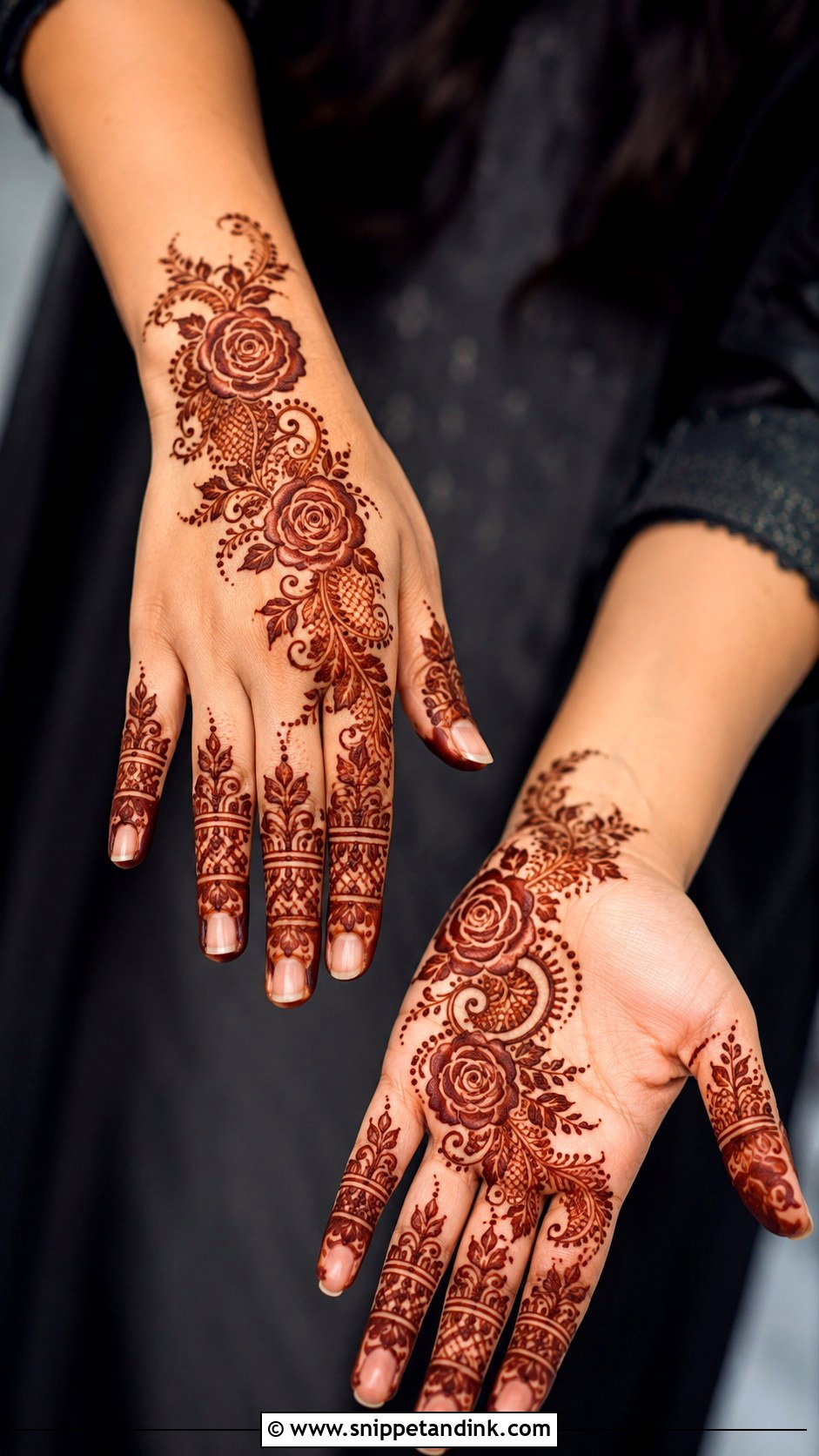
Indo-Arabic combines the bold flow of an Arabic trail with Indian-style filling. A diagonal rose trail on the back hand, paisley fillers, fine dots, leafy curls and decorated fingers make up the full look. I use one or two large roses as anchors and add smaller blooms around them, leaving enough open skin that it never feels dense. It sits comfortably at weddings, Eid and family functions, and it takes a fraction of the time of a full Indian set.
26. Rose Indian Mehndi Design
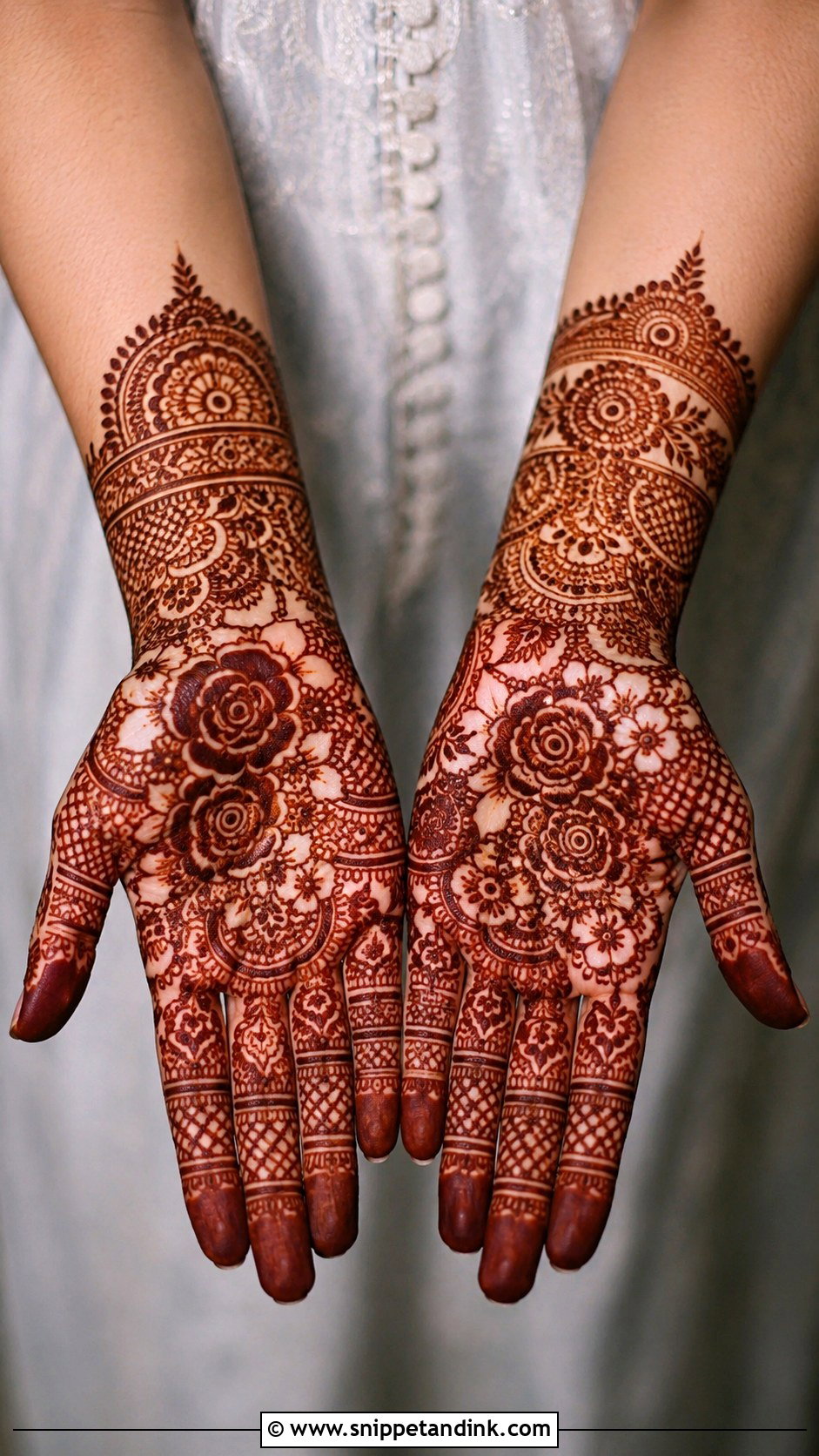
Indian rose designs are detailed and often symmetrical, with roses, paisleys, mandalas, leafy borders and fine line patterns covering most of the skin. A rose mandala on the palm, matching floral bands on the fingers and roses woven into jaali and paisleys on the back is a typical arrangement for brides and ceremonies. In this much detail, the roses only survive if their outlines are thicker than the fillers. I switch to a slightly wider cone opening for the rose outlines, then go back to fine for everything else.
27. Rose Moroccan Mehndi Design
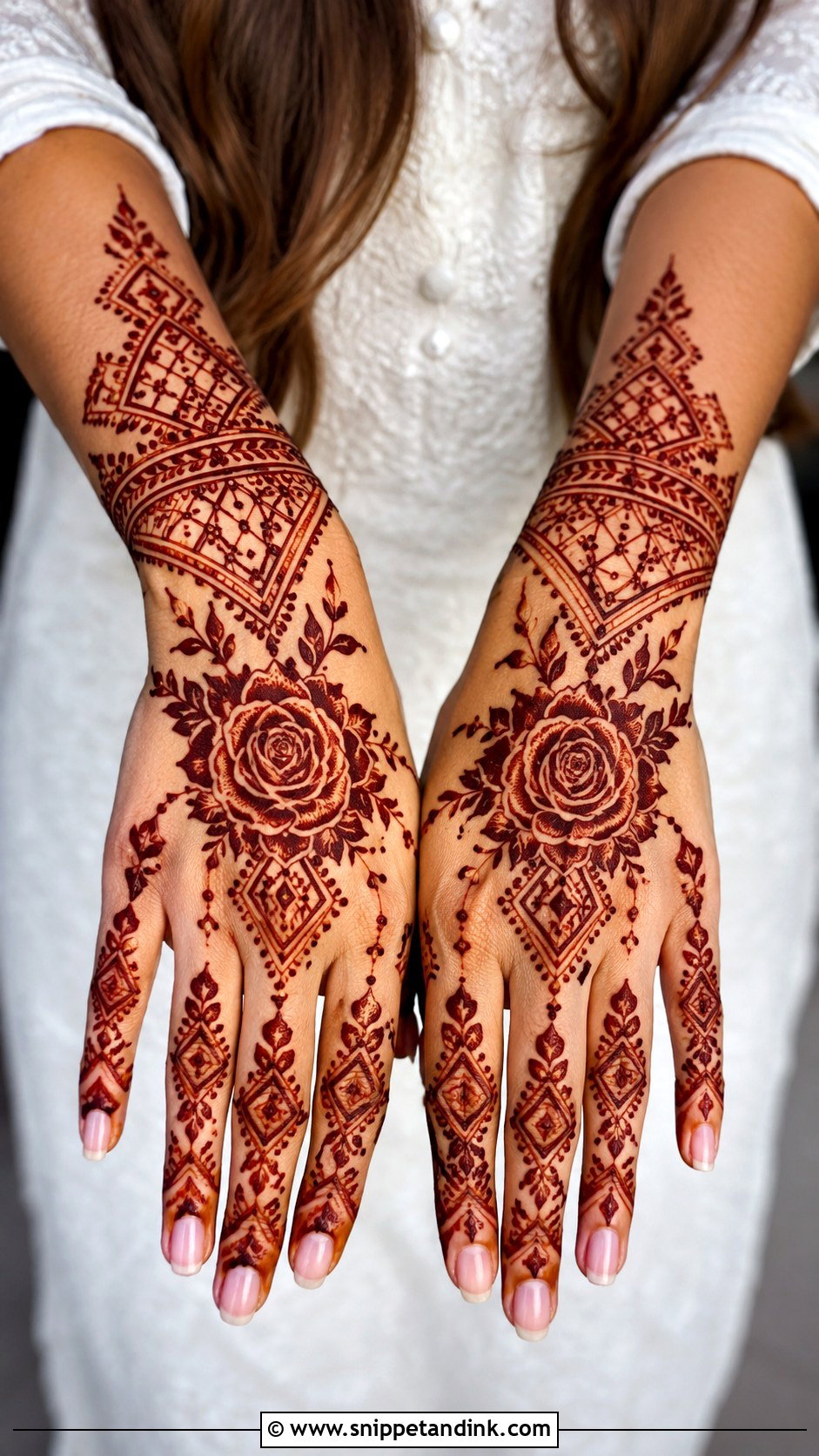
Moroccan-style henna is all diamonds, angular lines and clean symmetry, so dropping a rose into the middle of it creates a soft contrast. I place the rose at the centre of the back of the hand and surround it with diamond grids, leaf shapes and dotted accents, then decorate the fingers with simple geometric bands and small buds. It’s a good pick for someone tired of classic Indian or Arabic work. Straight lines show every tremor, though, so this one needs an artist with a steady hand.
28. Rose Gulf Mehndi Design
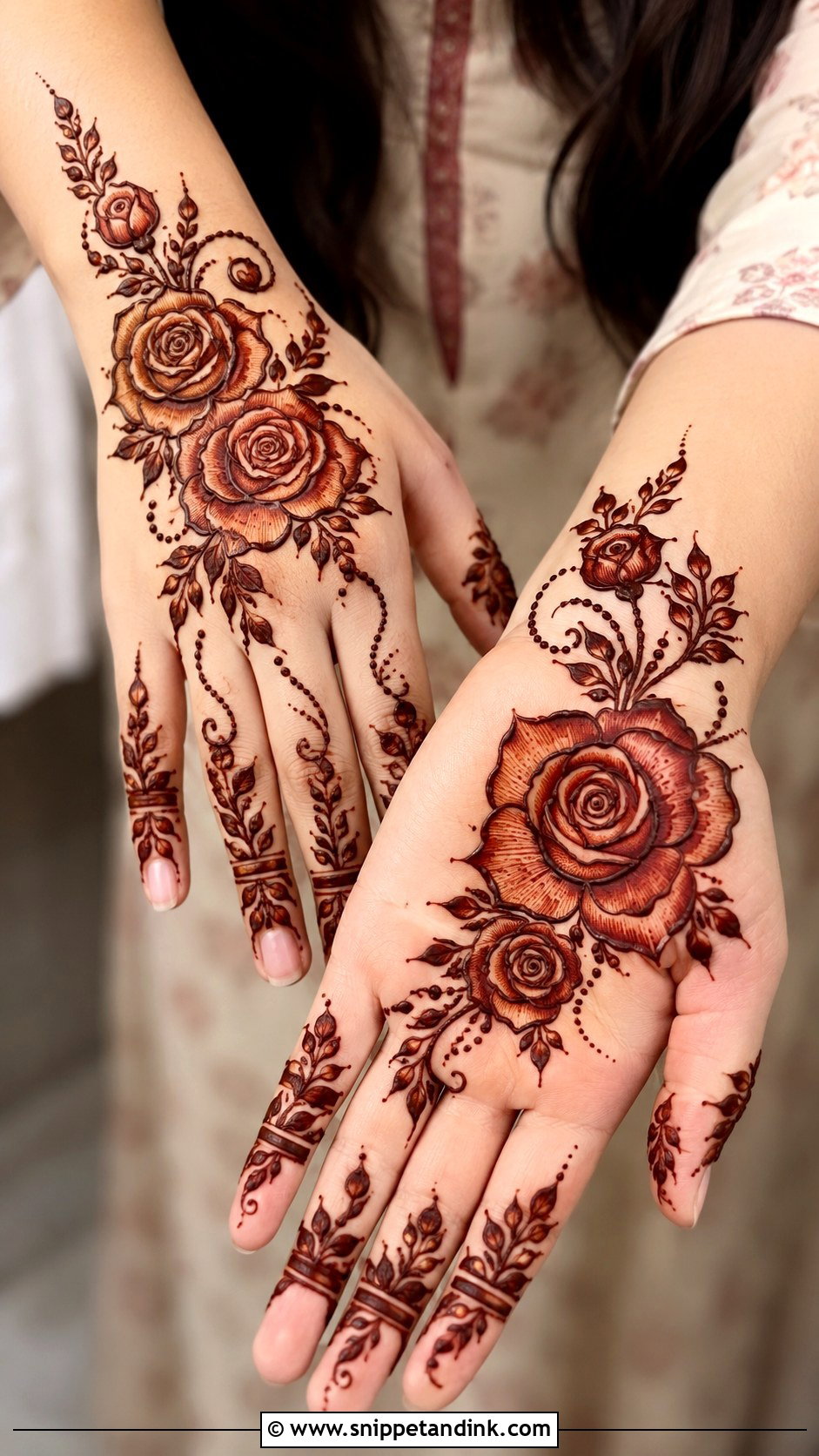
Rose Gulf mehndi design, inspired by Khaleeji henna, is bold and dramatic: large roses, thick leafy vines and open spaces across the back of the hand or palm. The petals are shaded deeply for strong contrast after staining, and the fingers carry bands, dots and floral tips without crowding. I keep the flow curved so the roses seem to drift across the hand. It’s a natural fit for Eid evenings and wedding functions where you want the henna noticed from across the room.
29. Rose Shaded Mehndi Design
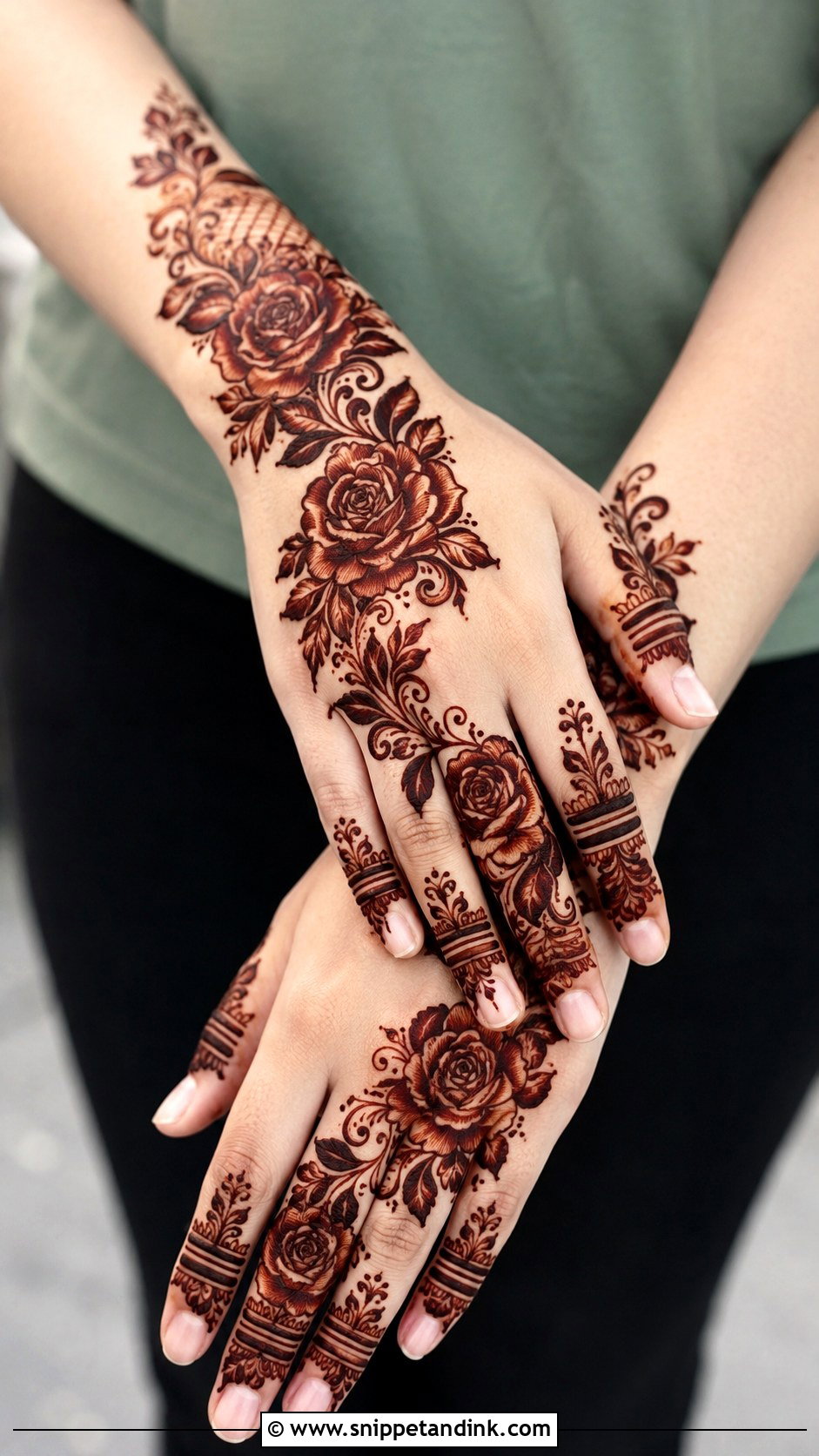
Shading gives a henna rose depth, so it looks fuller and more lifelike. One large shaded rose on the palm or back of the hand, with leaves and vines toward the fingers, is enough. The shading itself is done by dragging thinner paste inward from the outline: darker near the edge, lighter toward the middle of each petal. Too much and the petal fills solid. Small buds and dotted trails around the main flower keep the composition balanced, which is why this works so well in Arabic and modern layouts for engagements and Eid.
30. Rose Peacock Mehndi Design
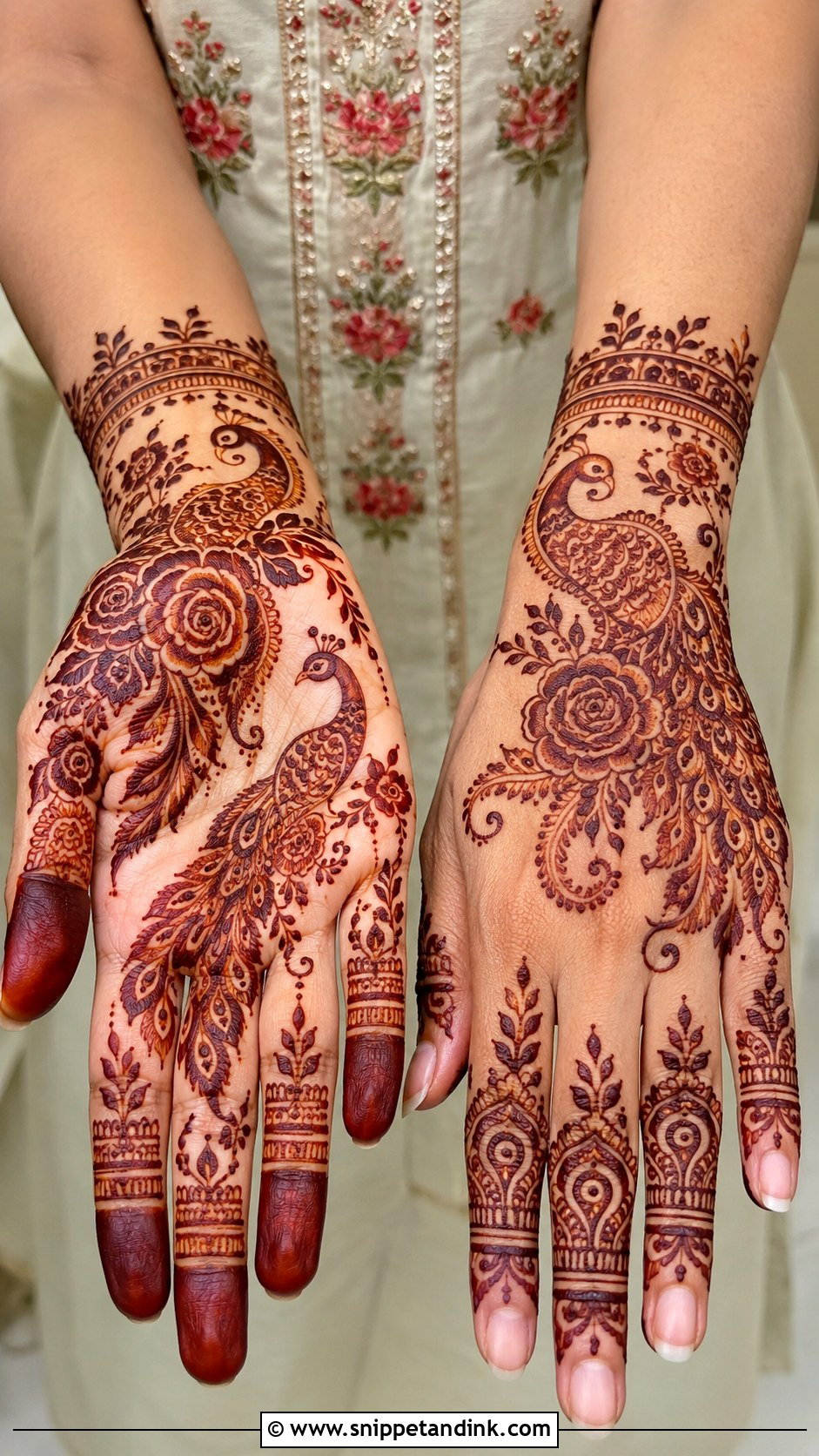
A peacock and roses together make a rich, symbolic piece for bridal and festive occasions. The peacock curves along the palm or back of the hand as the main traditional element, with rose vines around the tail, wrist and fingers. The two motifs share a lot of fine curved lines, and that’s the danger: rose petals blur into feather work if they sit too close. I leave a clear channel of skin between bird and blooms, then link them with dots, paisleys and fine lines.
31. Rose Paisley Mehndi Design
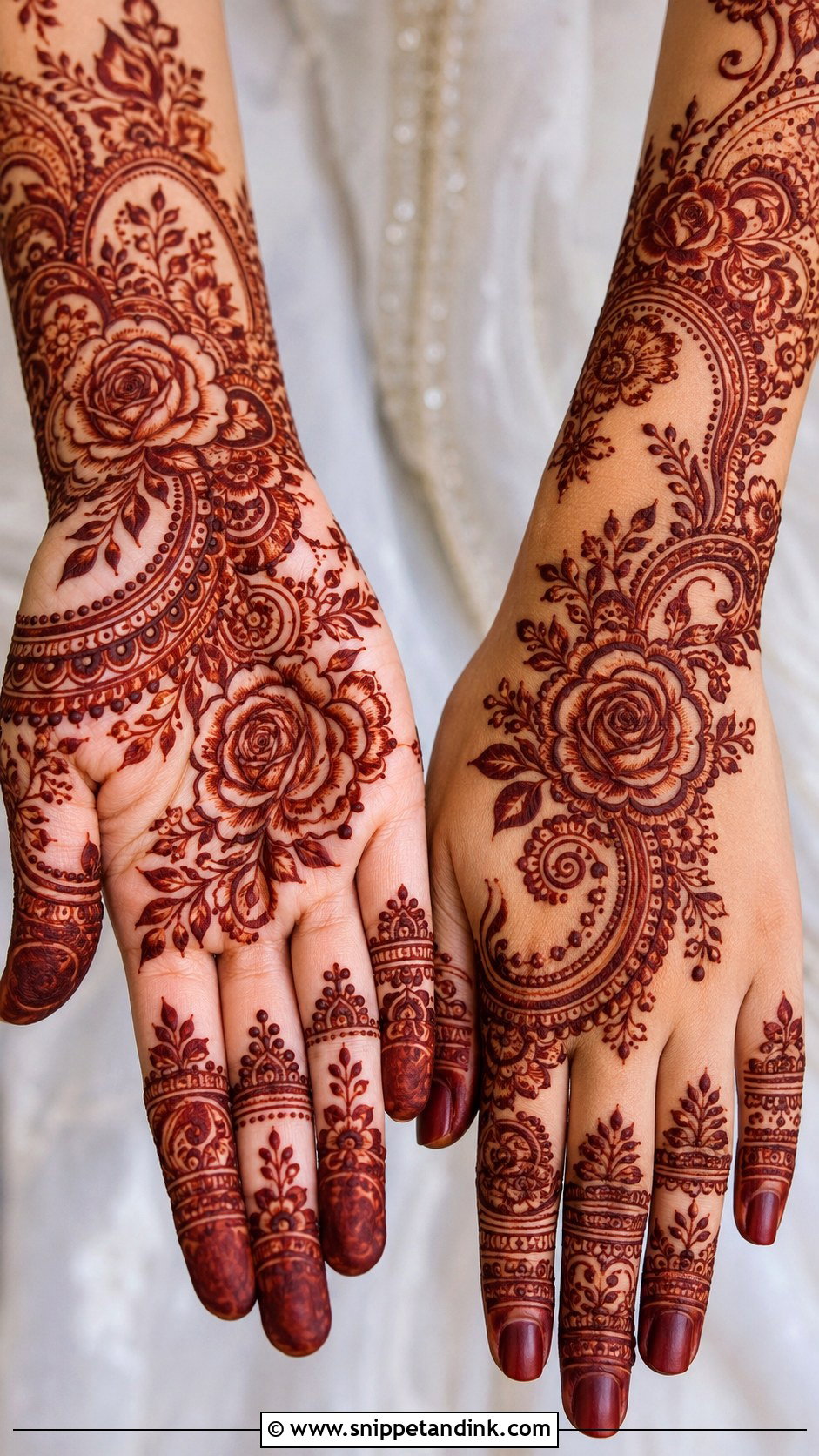
Paisleys can frame the rose, sit beside it or carry a trail from the wrist to the fingers. A typical back-hand layout is one large rose near the centre, two paisleys along the side and leafy vines tying them together; on the palm, the rose can sit inside a paisley-shaped border. The trick is balancing round petals against the paisley’s teardrop curve. I make the paisleys a little larger than feels natural, because they lose visual weight next to a rose.
32. Rose Lotus Mehndi Design
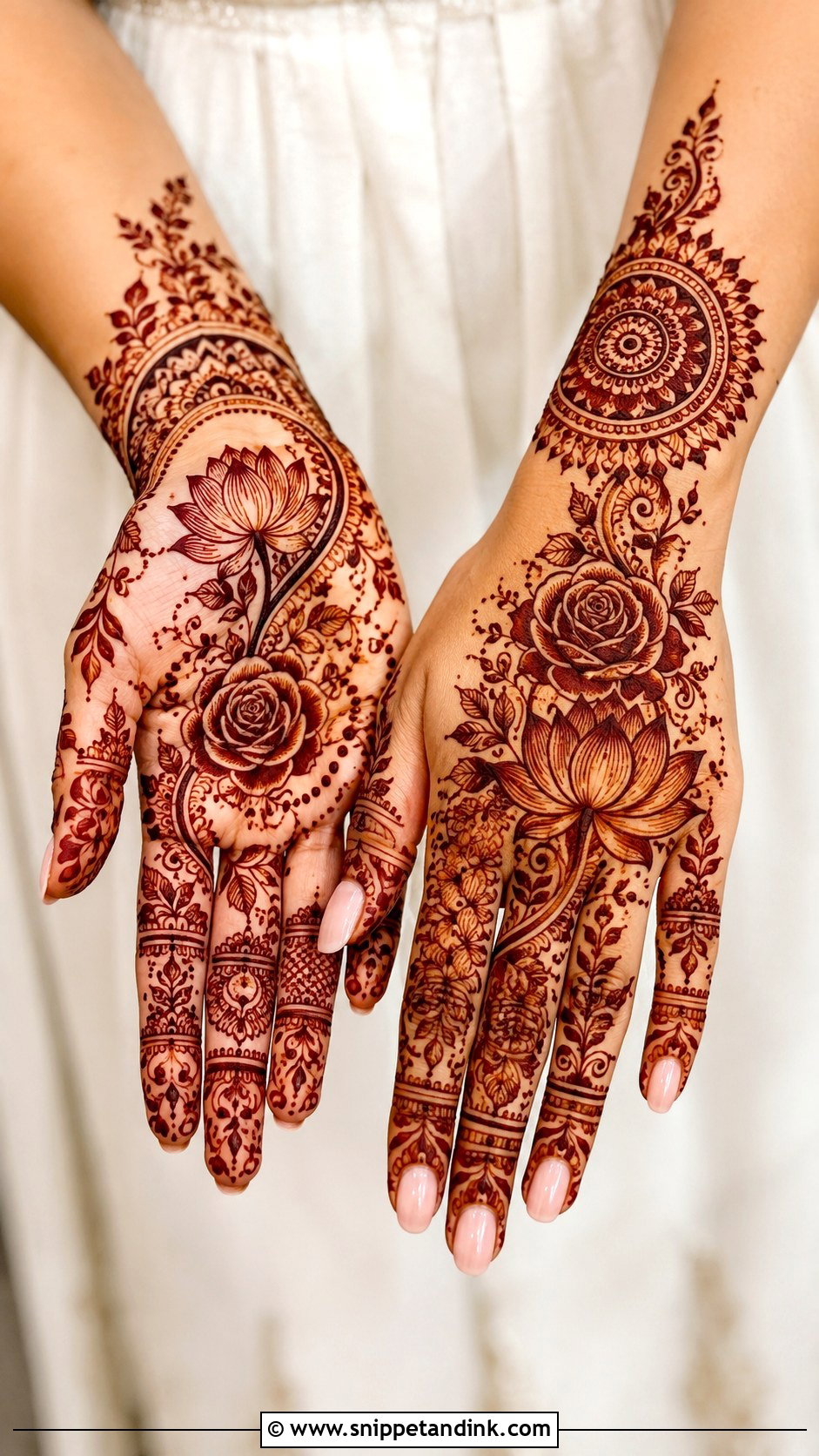
The rose brings softness and the lotus adds symmetry, so together they make a fuller botanical look for festive and pre-wedding events. I place a rose on the back of the hand and a lotus-style mandala near the wrist or palm, joined by leaves, dots and curved vines. Draw lotus petals pointed and rose petals rounded, or the two flowers become hard to tell apart once stained. Small rose buds and lotus-inspired bands on the fingers tie the hand together.
33. Rose Feet Mehndi Design
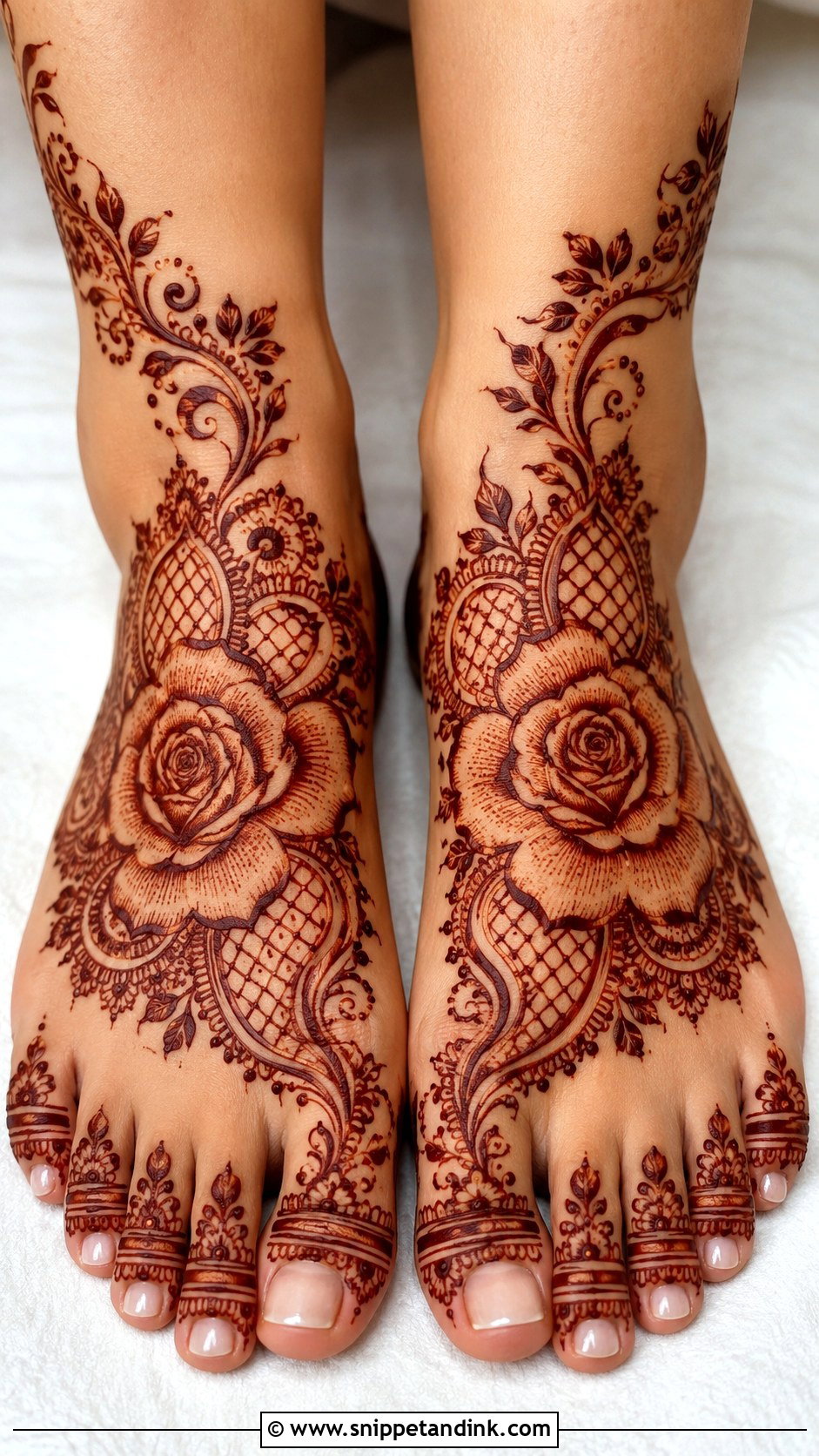
Feet are where roses really soften a design. A rose on top of each foot, leafy vines around the ankles and small floral bands across the toes make a complete look; brides can extend toward the ankle with jaali, paisley and mandala detail, while a single rose trail down the side of the foot is the simpler choice. Feet take longer to dry than hands and you’ll want to walk, so I always suggest booking feet first and then sitting for the hands. Mirror the placement on both feet.
34. Rose Ankle Mehndi Design
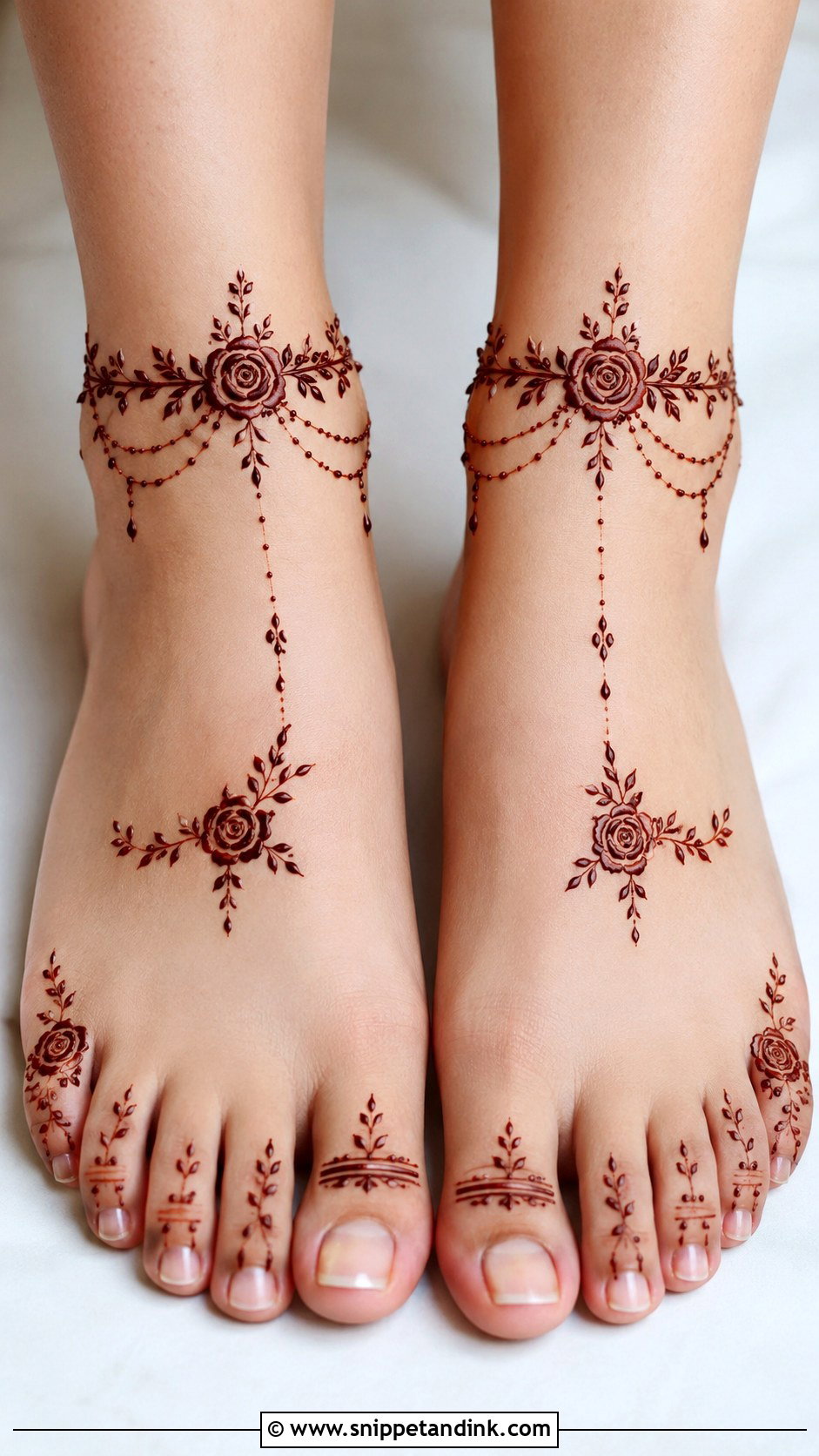
An ankle design wraps around like a floral anklet, with one rose at the centre or side and small leaves, dotted chains and buds completing the band. A slim vine can creep onto the top of the foot. It’s lighter than full foot mehndi and still festive, which suits bridesmaids and summer functions. Watch the strap line if you’re wearing sandals: anywhere a strap rubs while the paste is drying, the stain will come out patchy.
35. Rose Kids Mehndi Design
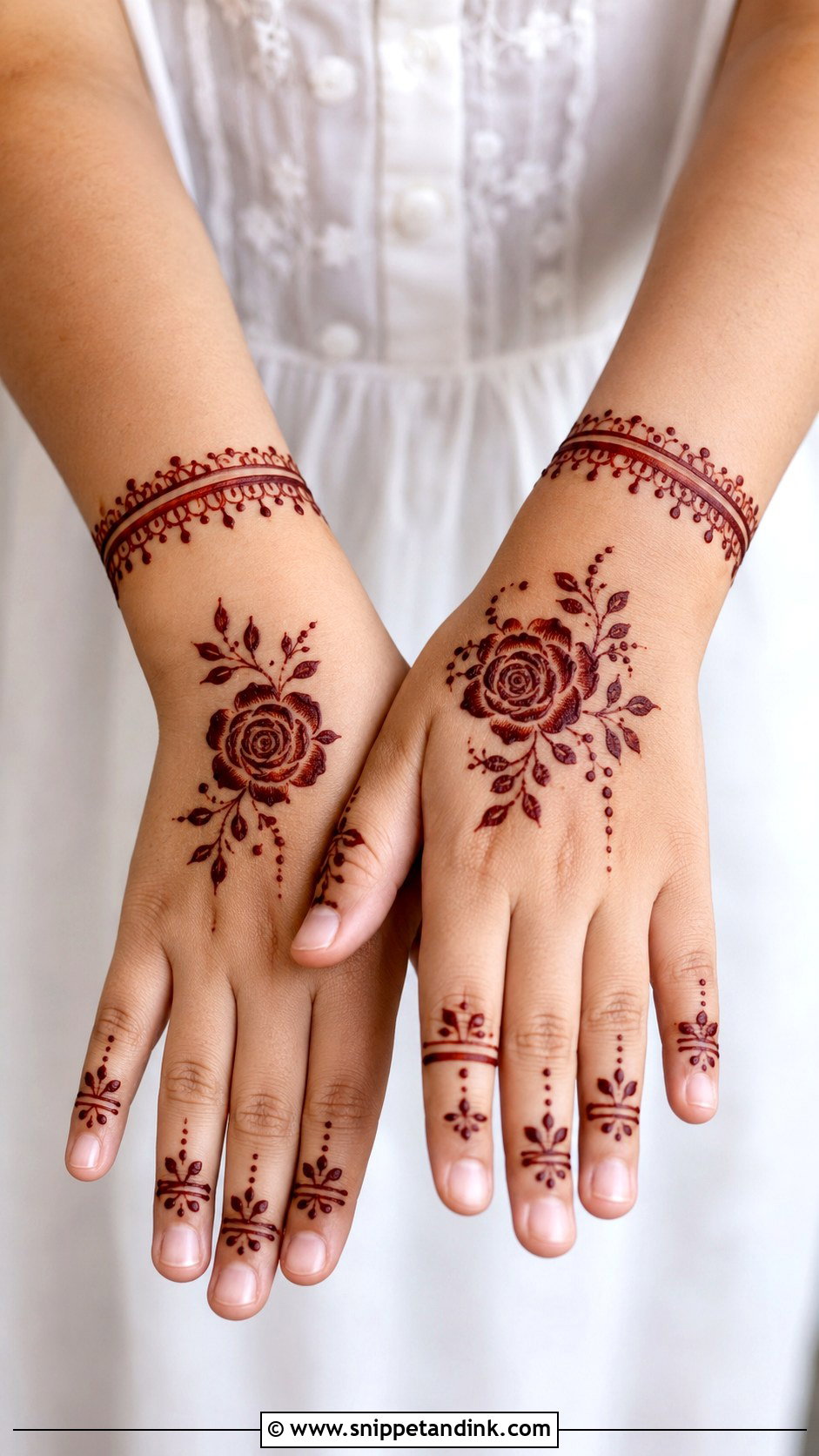
Kids need small, fast designs: one little rose on the back of the hand, a short vine toward the wrist and tiny dots on the fingers. Skip palm filling, because children won’t sit still long enough for it to dry and they’ll grab something within minutes. Rounded petals, small leaves and a simple wrist band are easy to recognise even with less detail. Only use plain natural henna on children’s skin, never black or instant products, which can cause serious reactions.
Matching the Rose to Your Outfit, Sleeves and Jewellery
A rose design should be planned with the clothes, not after them. A finished stain sits somewhere between orange-brown and deep maroon, and it reads differently against each fabric. Against red and maroon lehengas, heavy rose clusters can disappear into the outfit, so I lean on bigger open blooms with clear skin around them. Pastels, ivory and mint make almost any stain look darker, so lighter designs carry well there.
Sleeves decide coverage. With elbow or full sleeves, forearm roses go unseen and you can spend that time on the hands. Sleeveless and cap-sleeve blouses are where a forearm vine actually pays off.
Then there’s jewellery. Hathphool chains run across exactly the spot where a back-hand rose usually sits, so if you’re wearing one, I shift the main bloom toward the wrist or a finger base and let the chain sit over finer work. Kundan and gold-heavy sets look best beside roses with plenty of open skin; delicate diamond pieces suit finer, smaller roses. Bring a photo of the outfit and the jewellery to your appointment and you’ll get a design that belongs with them.
Where a Rose Sits Best on You
A rose can be a single clean centrepiece, a trail flowing across the hand or one thread in a dense bridal pattern, which is why it never really goes out of favour. Think about placement, the occasion, the size of your hand and how much coverage you can sit for. For quick events, a rose bail, bracelet or minimal back-hand design does the job. For a wedding, full-hand roses mixed with paisleys, jaali and mandalas carry the weight. In every case, I’d rather see well-spaced roses with clear petals than more of them.
You'll Like These Ideas:











Leave a Reply