
The back of the hand gets more camera time than the palm. It’s what shows during the ring exchange, when you lift a glass, when you rest your hand on your partner’s arm. Yet it’s the side many brides plan last. The designs below cover the full range for that side: dense dulhan and Rajasthani work, Arabic trails, bracelet and jewelry layouts, jaali, and personalized back-hand mehndi with initials, portraits or a date. As you look, picture your own rings and bangles on top, because on this side of the hand, the design and the jewelry are always seen together.
Knuckles, Tendons and Veins Change Where Each Motif Can Sit
The palm is a fairly flat canvas. The back of the hand is not. Knuckles fold, tendons rise when you spread your fingers, and veins can sit right where a central motif wants to go. When I map a back-hand design, I ask the bride to rest her hand naturally, then again to make a loose fist, and I watch where the skin creases.
- Fine filler stays off the knuckle creases; open motifs or bands sit there instead.
- Mandalas and portraits go on the flattest area, usually just above the wrist or in the middle of the hand.
- Diagonal trails can follow the line of a tendon, which makes them look like they belong to the hand.
- Very prominent veins are best left inside open space rather than crossed by fine detail.
It sounds technical, but it’s the difference between a design that looks right in still photos and one that still looks right when you’re holding hands, dancing or eating.
1. Full Hand Bridal Mehndi Back Hand
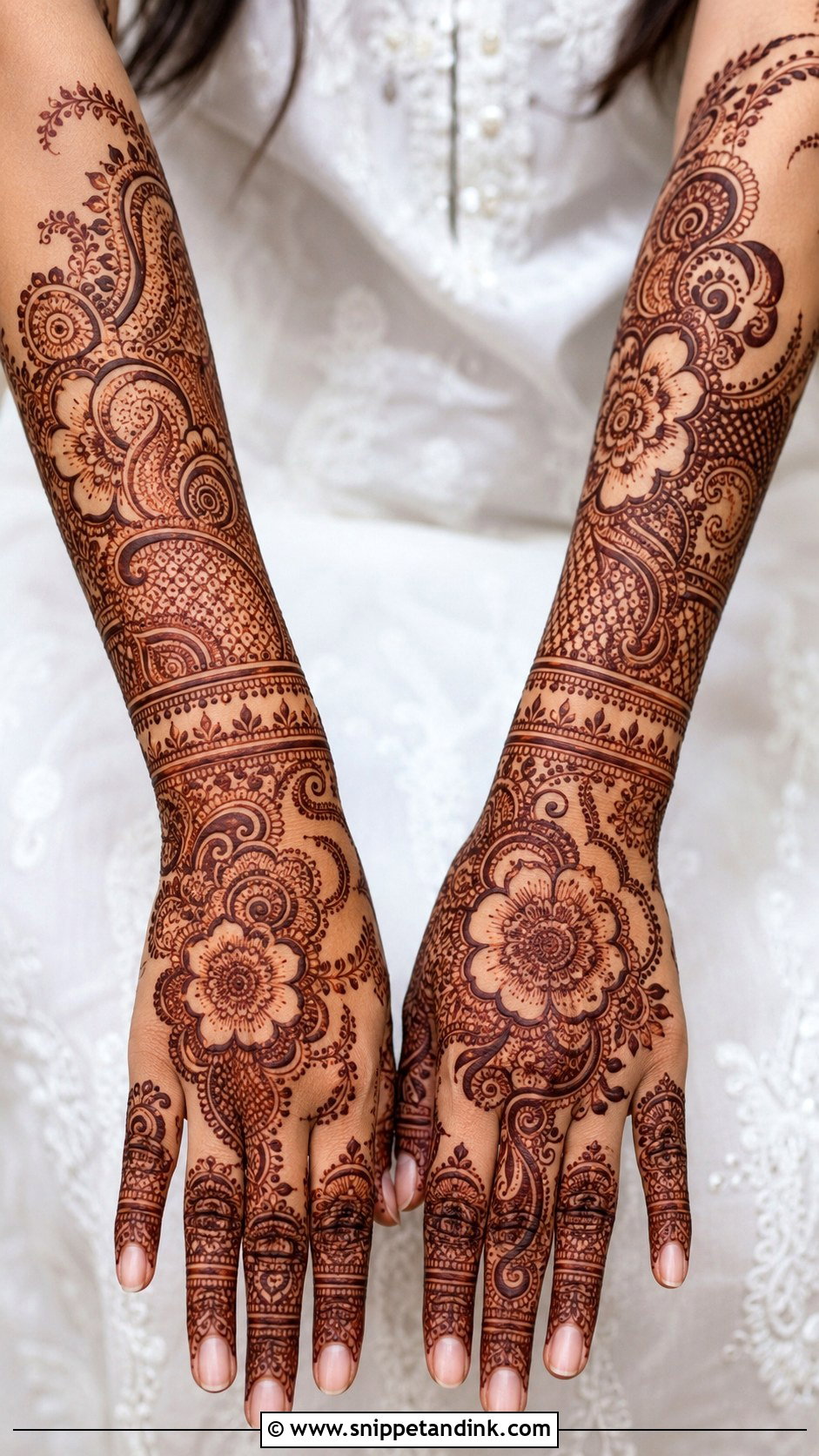
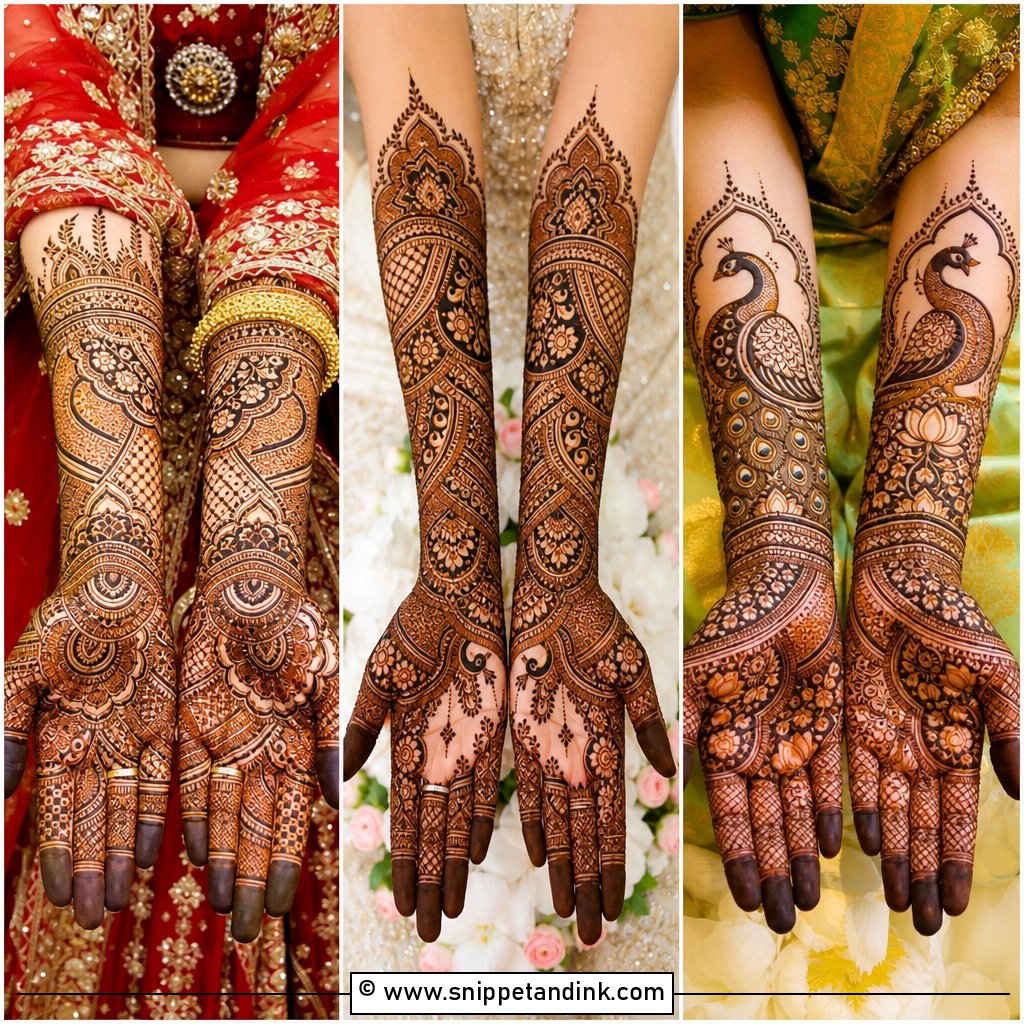
Full coverage runs from the fingertips over the whole back of the hand to the wrist or forearm, with almost no bare skin. Florals, paisleys, fine vines, small leaves and dotted borders layer on each other, and the fingers carry matching bands, checks and tiny floral rows. It sits well under heavy lehengas, silk sarees and ornate bangles. The part I spend the most care on is the knuckles. Skin there folds when you make a fist, so I keep fine filler off the crease lines and use small open motifs that still look intact when the hand bends.
2. Indian Bridal Mehndi Back Hand
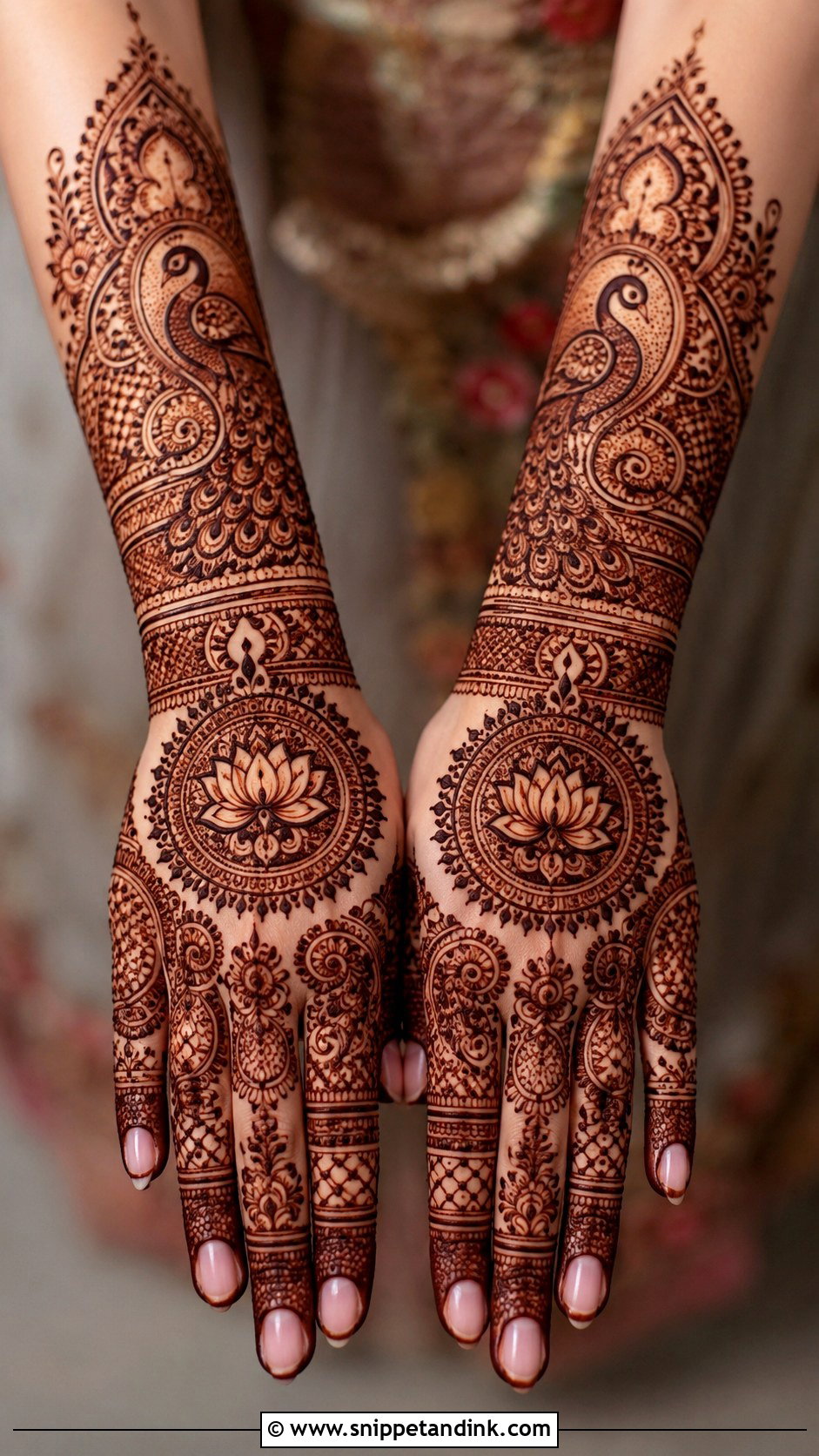
Classic Indian back-hand work is detailed and story-led: paisleys, lotuses, peacocks and mandalas, with tiny filler spreading from fingertip toward the forearm. I usually anchor it with one central motif between the knuckles and the wrist, then let the detail grow around it. Fingers get leafy lines, small curves and net patterns. Red, maroon, gold and deep green outfits all suit it. Because the back of the hand stains a shade lighter than the palm, I draw the filler slightly more open here than I would on the front, so it doesn’t turn into a flat brown patch.
3. Arabic Bridal Mehndi Back Hand
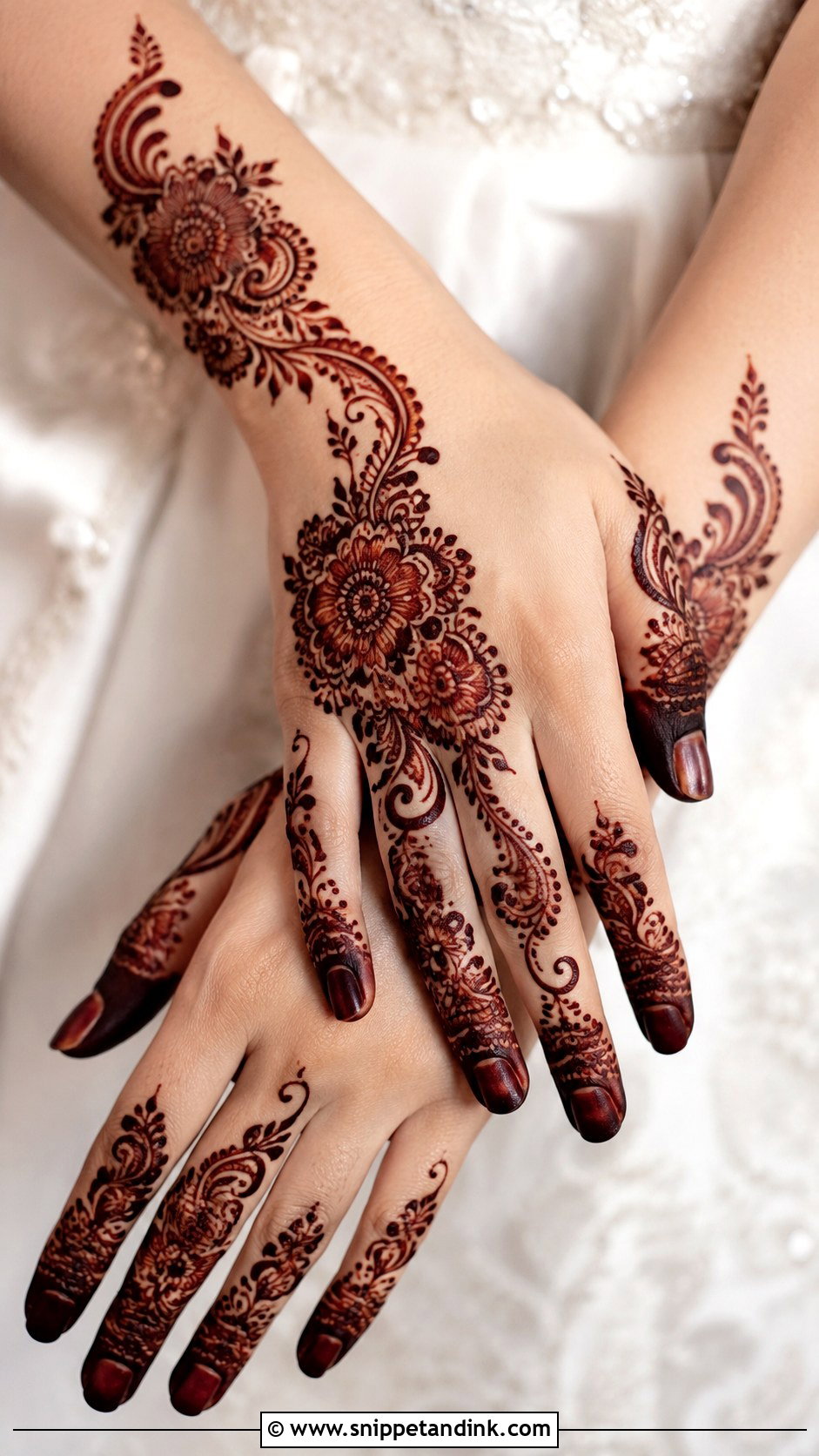
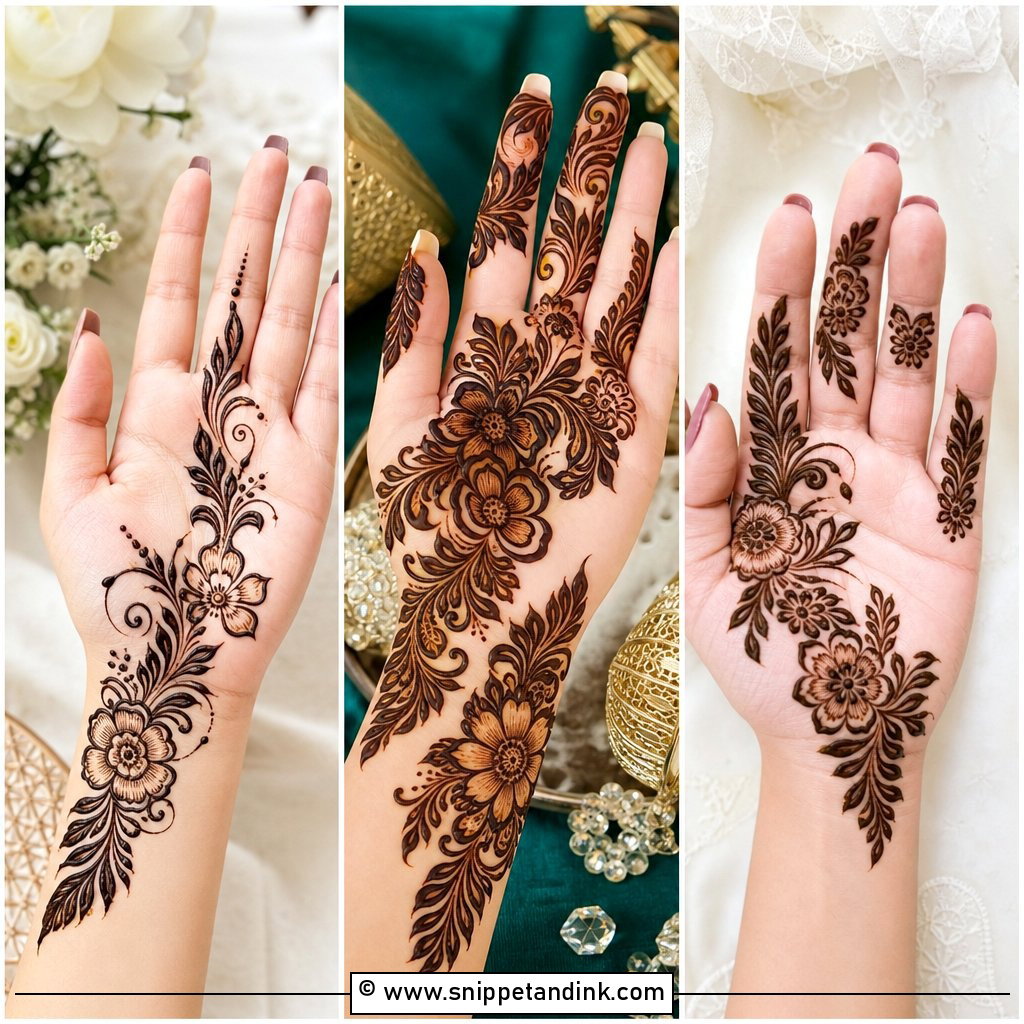
Open skin is the whole point of Arabic layouts. Bold floral trails, leafy vines and curved strokes run diagonally across the back of the hand, and the gaps let each flower read on its own. Fingers carry bold tips, flower bands or a vine that links into the main trail. I use a slightly heavier line for Arabic than for Indian work, which suits this side of the hand well: thicker paste deposits stain more strongly, so the design holds its color even where the skin is thinner. It works with traditional and fusion outfits alike.
4. Indo Arabic Bridal Mehndi Back Hand
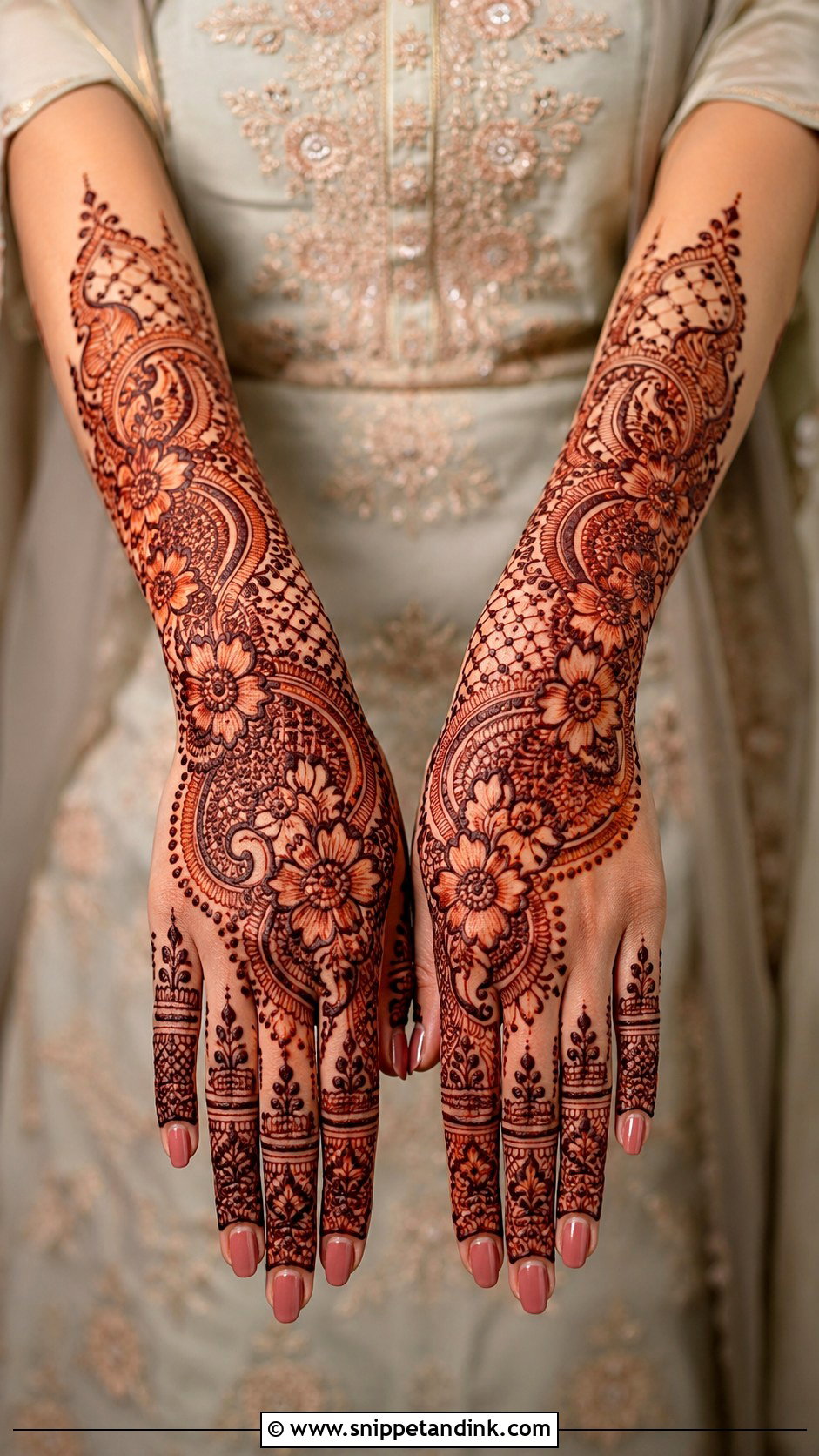
Indo Arabic bridal mehndi on the back hand is the middle road: an Arabic diagonal as the frame, with paisley sections, shaded petals, jaali patches and detailed finger bands filling parts of it. It reads clearly without looking sparse. The diagonal flatters almost every hand, since it draws the eye toward the fingertips and makes them look longer. If you can’t decide between dense and open, this is the style I’d suggest you try at your trial, because I can adjust the amount of fill on the spot.
5. Mandala Bridal Mehndi Back Hand
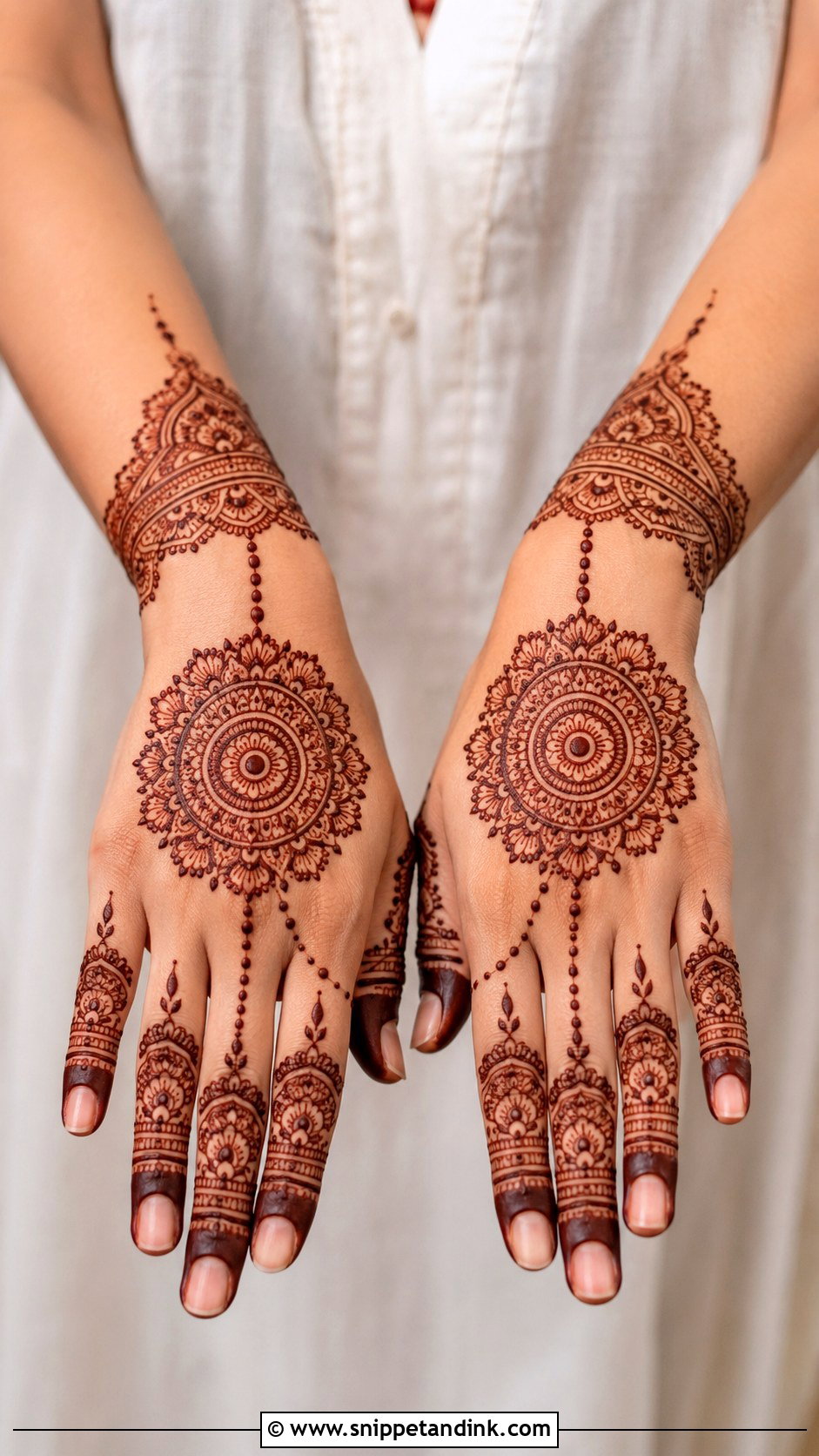
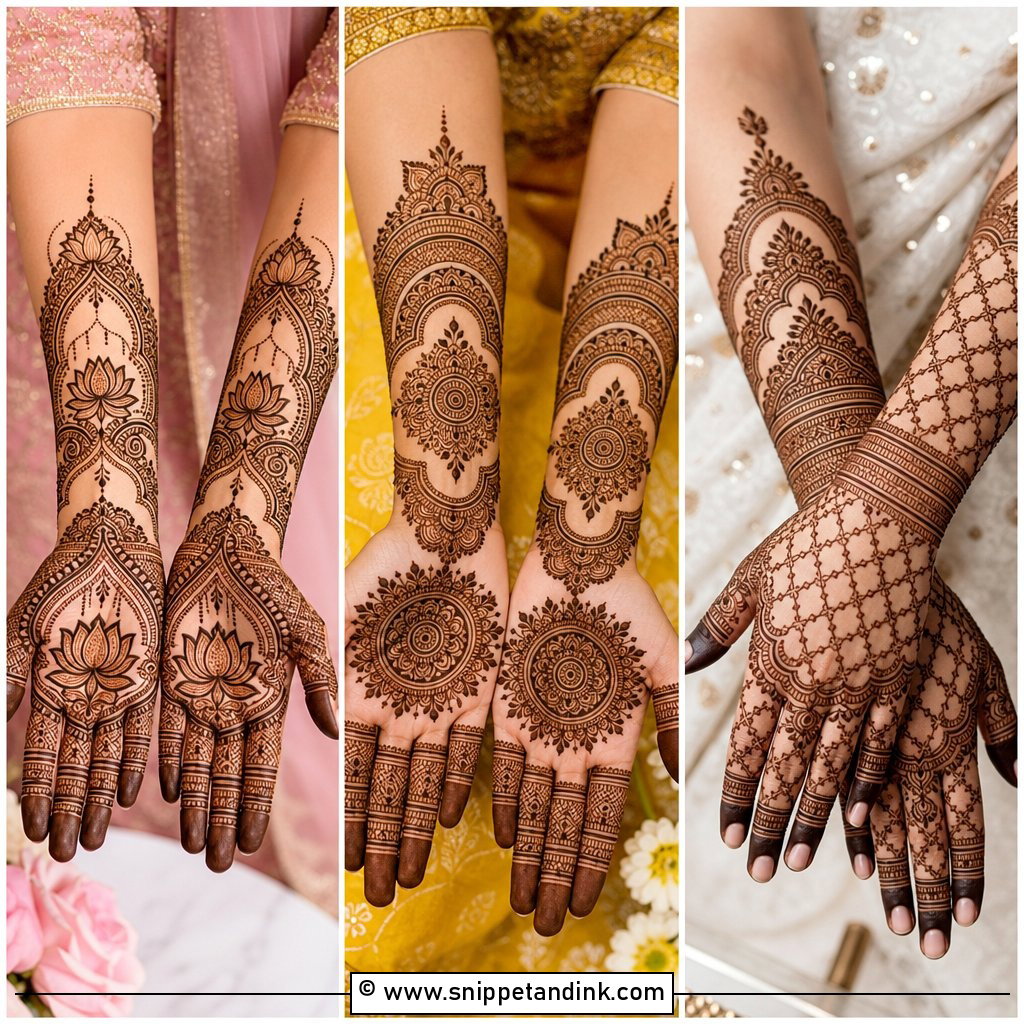
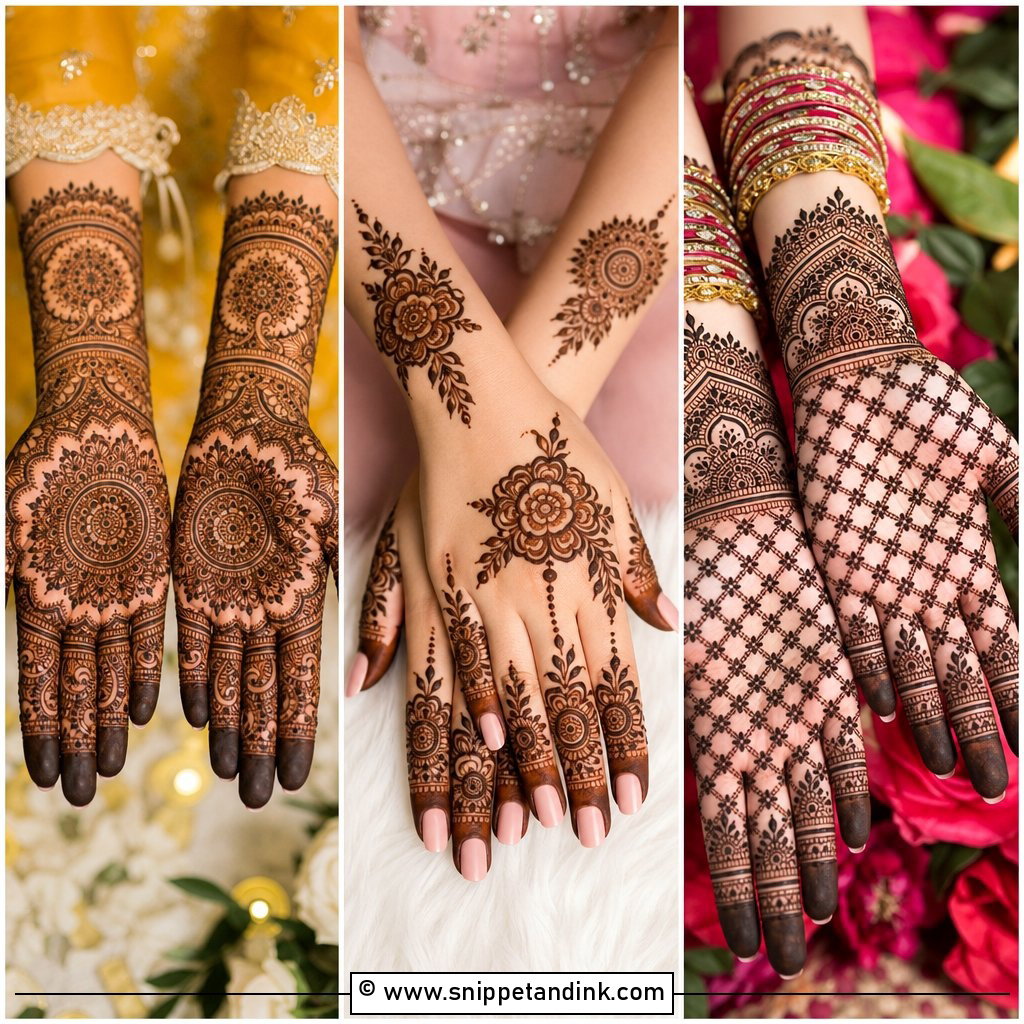
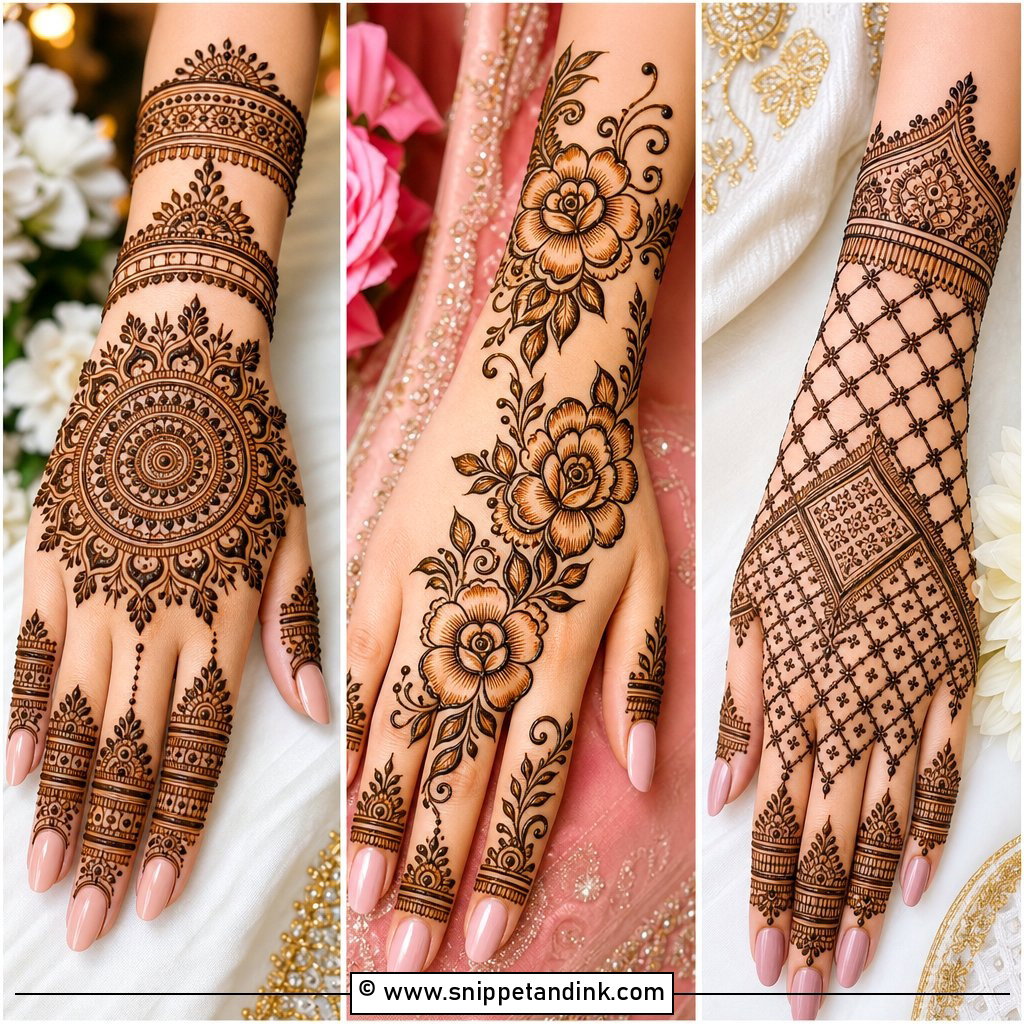
Symmetry lovers usually land on a mandala. A round motif sits in the centre of the back hand, with detailed fingers and a wrist extension around it, and the circle itself can be plain, floral or deeply intricate. Placement is everything. I centre it on the hand as it rests, not as it lies flat on my table, because a mandala placed while the fingers are stretched shifts off-centre once they relax. Paisley borders, leafy chains and dots around the circle make it bridal, and it suits a nikkah, engagement, wedding or reception equally.
6. Jaali Bridal Mehndi Back Hand
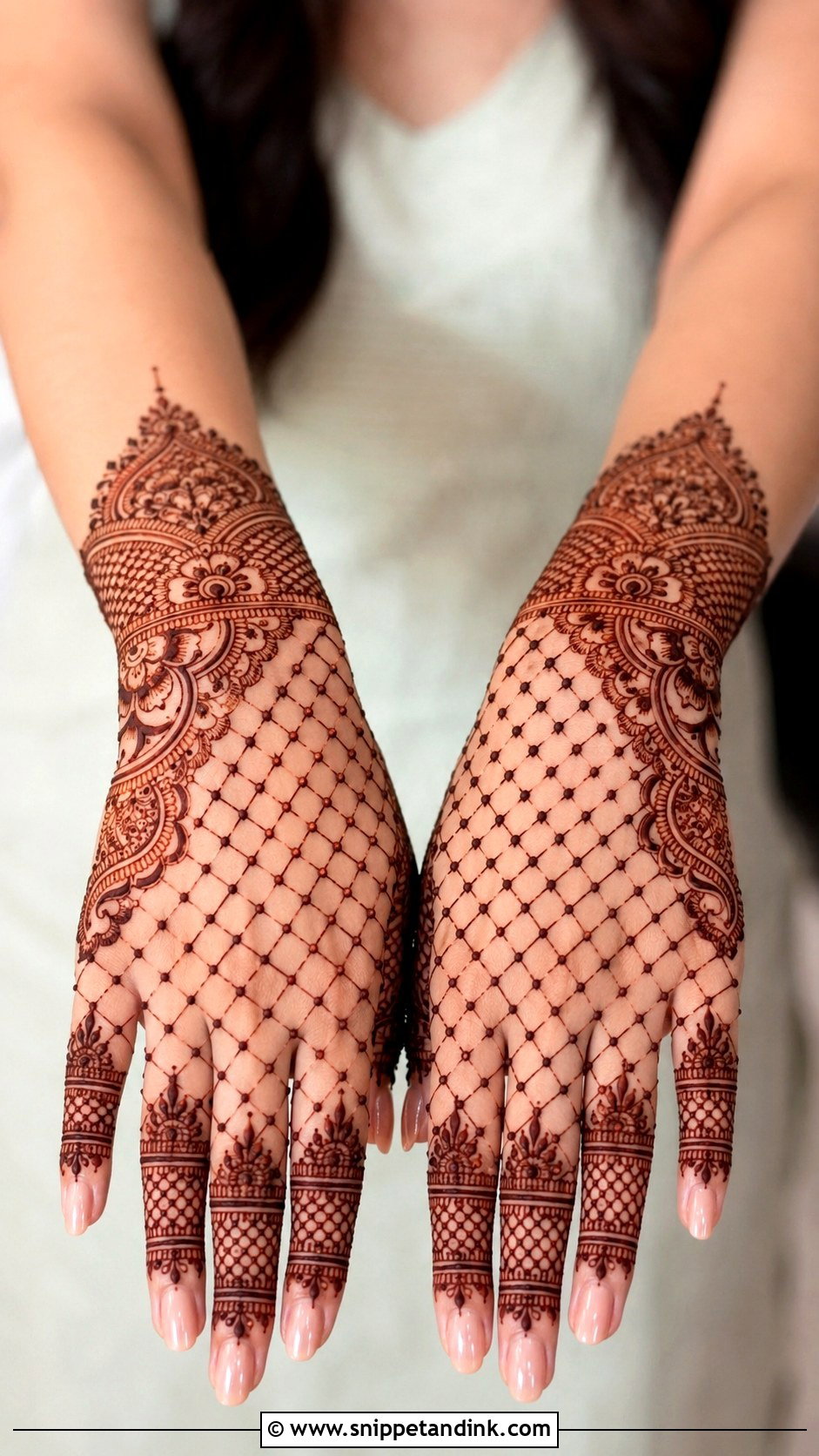
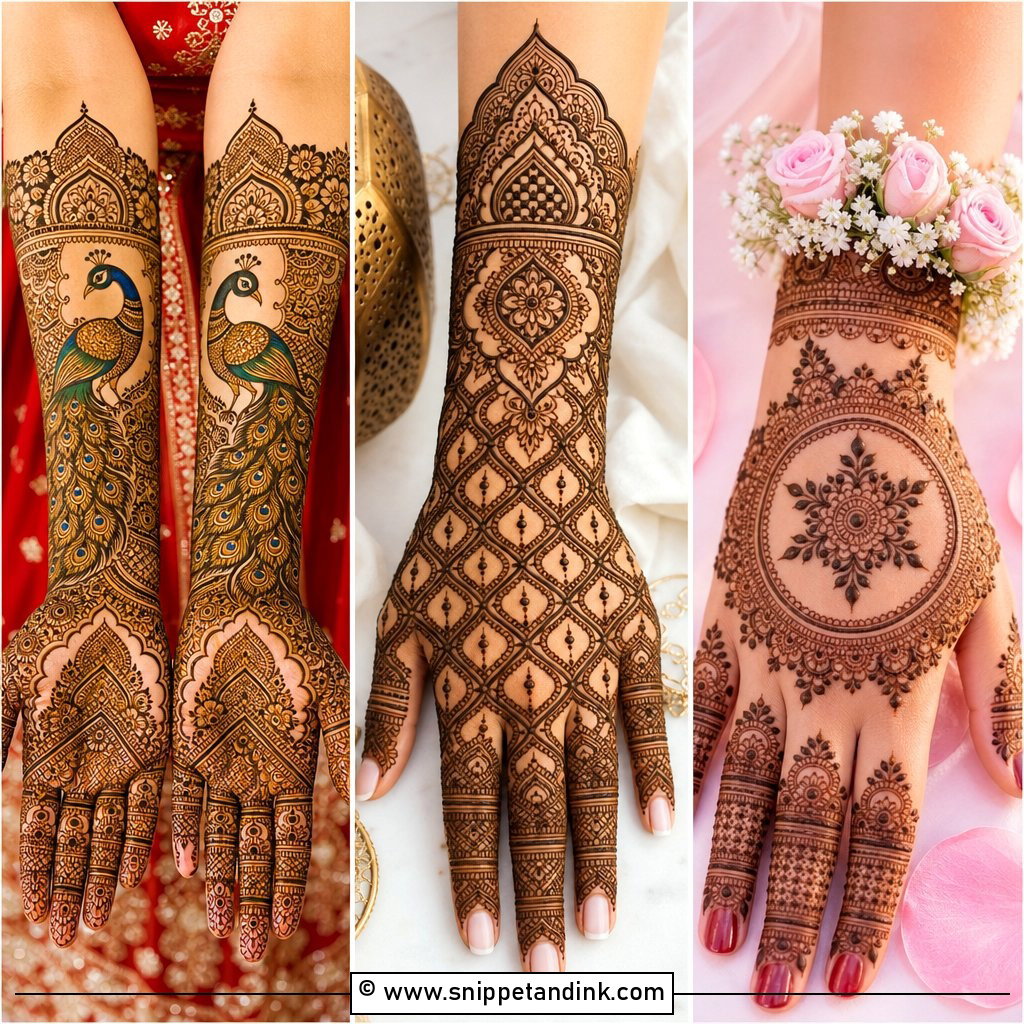
Jaali gives the back of the hand a lace finish, built from mesh, grids, diamonds or crisscross lines. It can cover the whole area or sit in panels around florals and paisleys. Brides like it because it looks like a henna glove under rings and bangles, and it echoes heavy embroidery on the outfit. Line weight decides whether it works. I draw jaali with a very fine cone tip and leave a clear gap between lines, because henna spreads a little as it darkens and tight mesh closes up into solid color.
7. Peacock Bridal Mehndi Back Hand
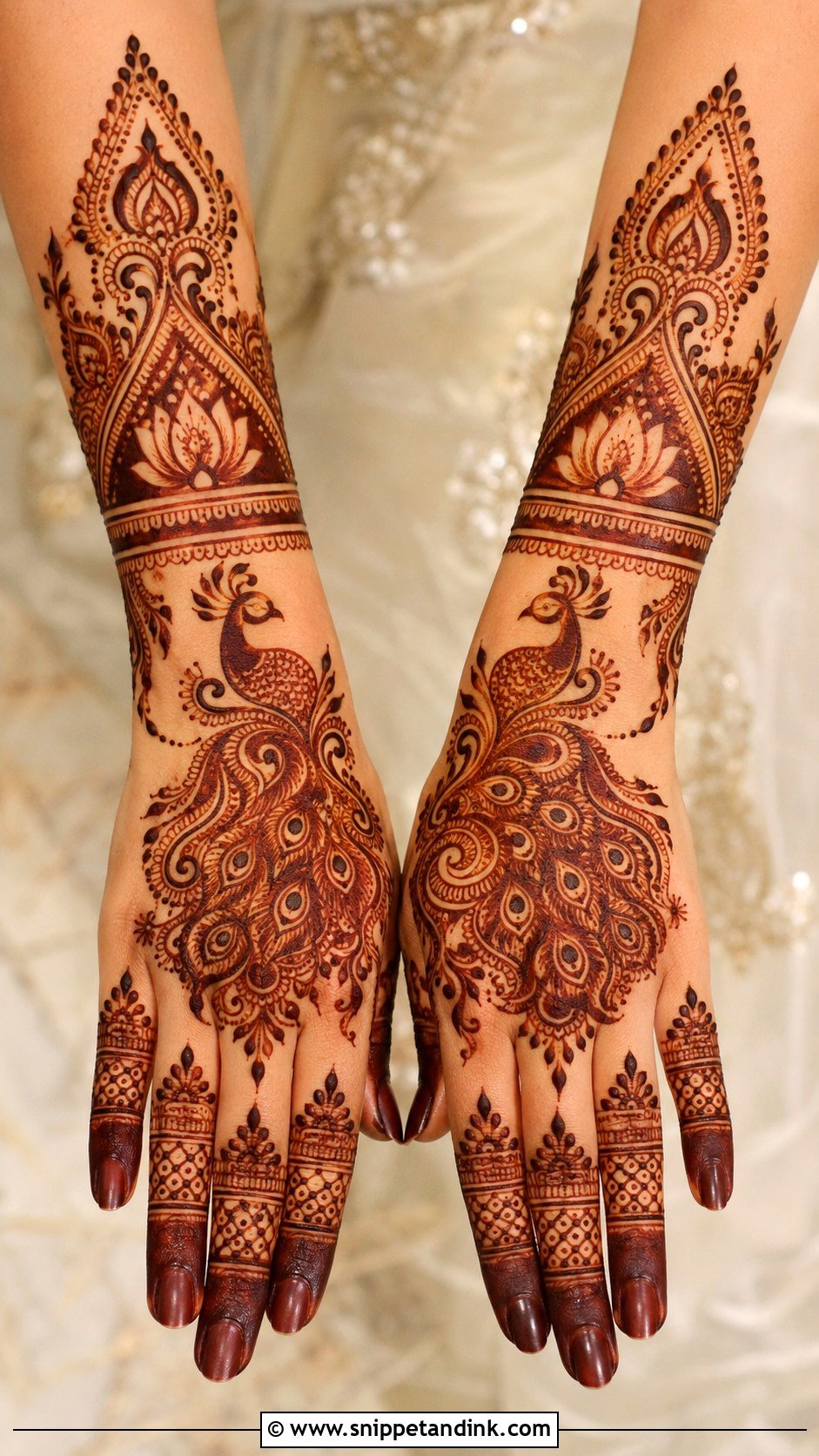
A peacock on the back hand can sit near the wrist, in the centre, or curl along one side as a flowing motif. Its feathers give the artist room for curves, fine lines, dots and shading, and it pairs well with lotuses, paisleys and filler for a fuller hand. Rooted in classic Indian bridal art, it suits grand outfits. My caution is about the fingers: if they are as busy as the peacock, the bird gets lost. I keep the fingers detailed but lighter, so the peacock is clearly the main subject.
8. Paisley Bridal Mehndi Back Hand
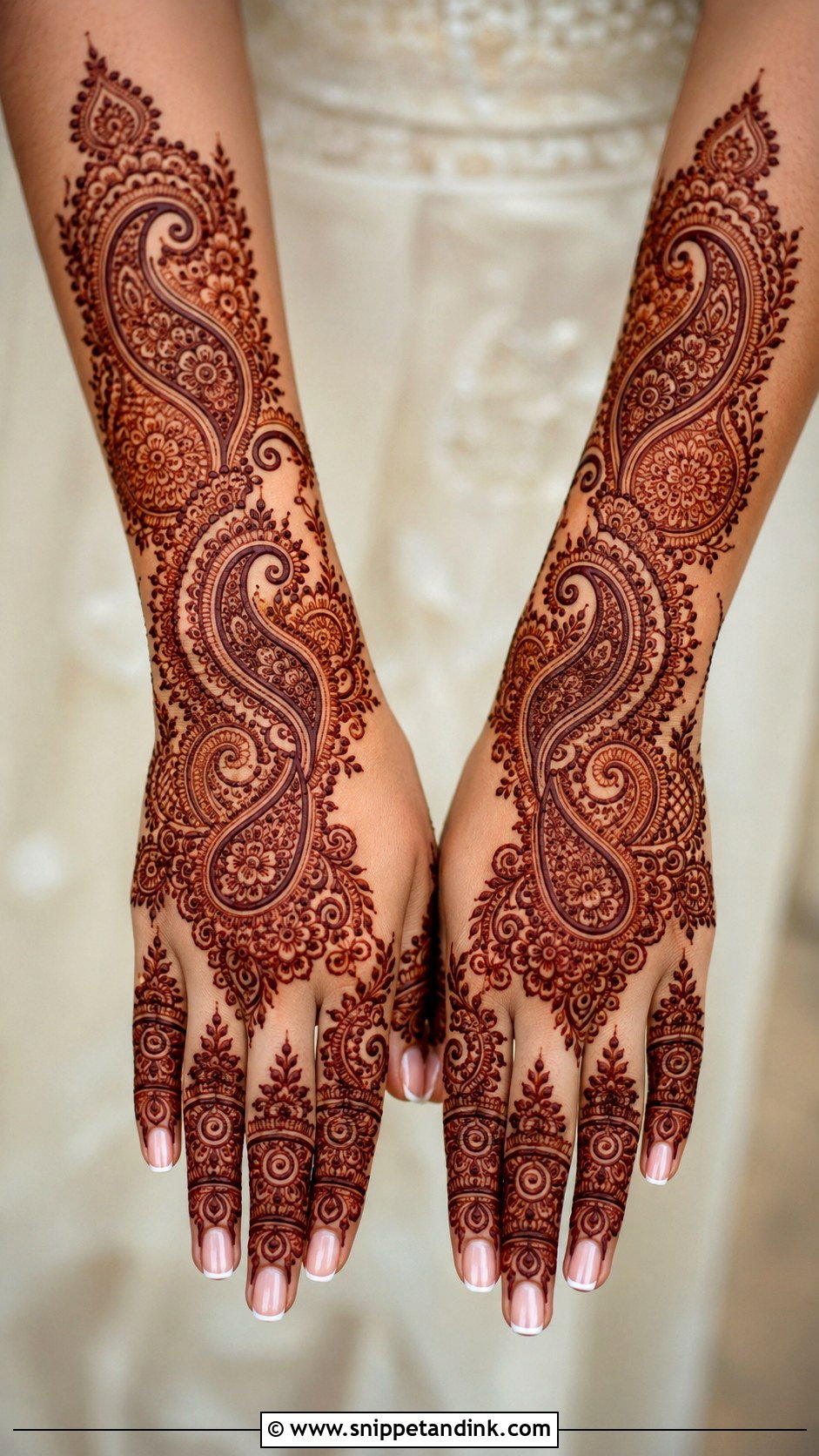
If you want something reliably rich and traditional without portraits, paisley is where I’d start. Large or small, the teardrop curve follows the wrist, the back of the hand and the base of the fingers naturally. Inside each one I can fill tiny flowers, checks, dots or spirals. Leave a few open spaces between them and the design stays readable. Gold jewelry and deep nail shades both sit well against it.
9. Floral Bridal Mehndi Back Hand
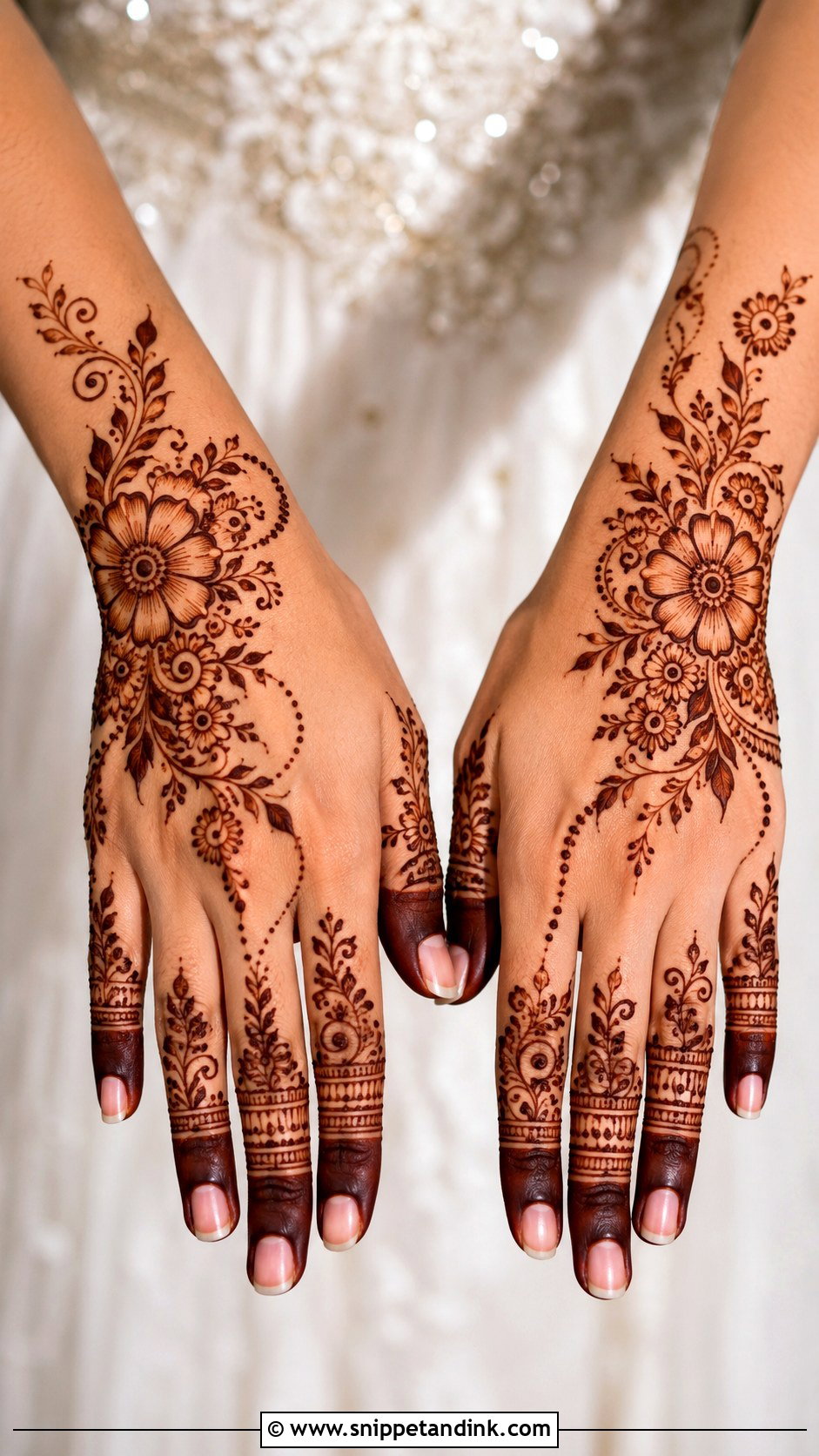
Florals can be light, medium or very heavy; it’s the size and spacing of the flowers that decide which. Big roses, lotus shapes, small blossoms and leafy vines can travel from the fingertips toward the wrist like a garden path. Almost every outfit color works with them. To make floral work bridal, I add shaded petals, dotted outlines and fine filler around the main blooms. One thing to plan for: large flowers on the back of the hand can sit right where your rings go, so tell your artist which fingers will carry rings before she maps the trail.
10. Rose Bridal Mehndi Back Hand
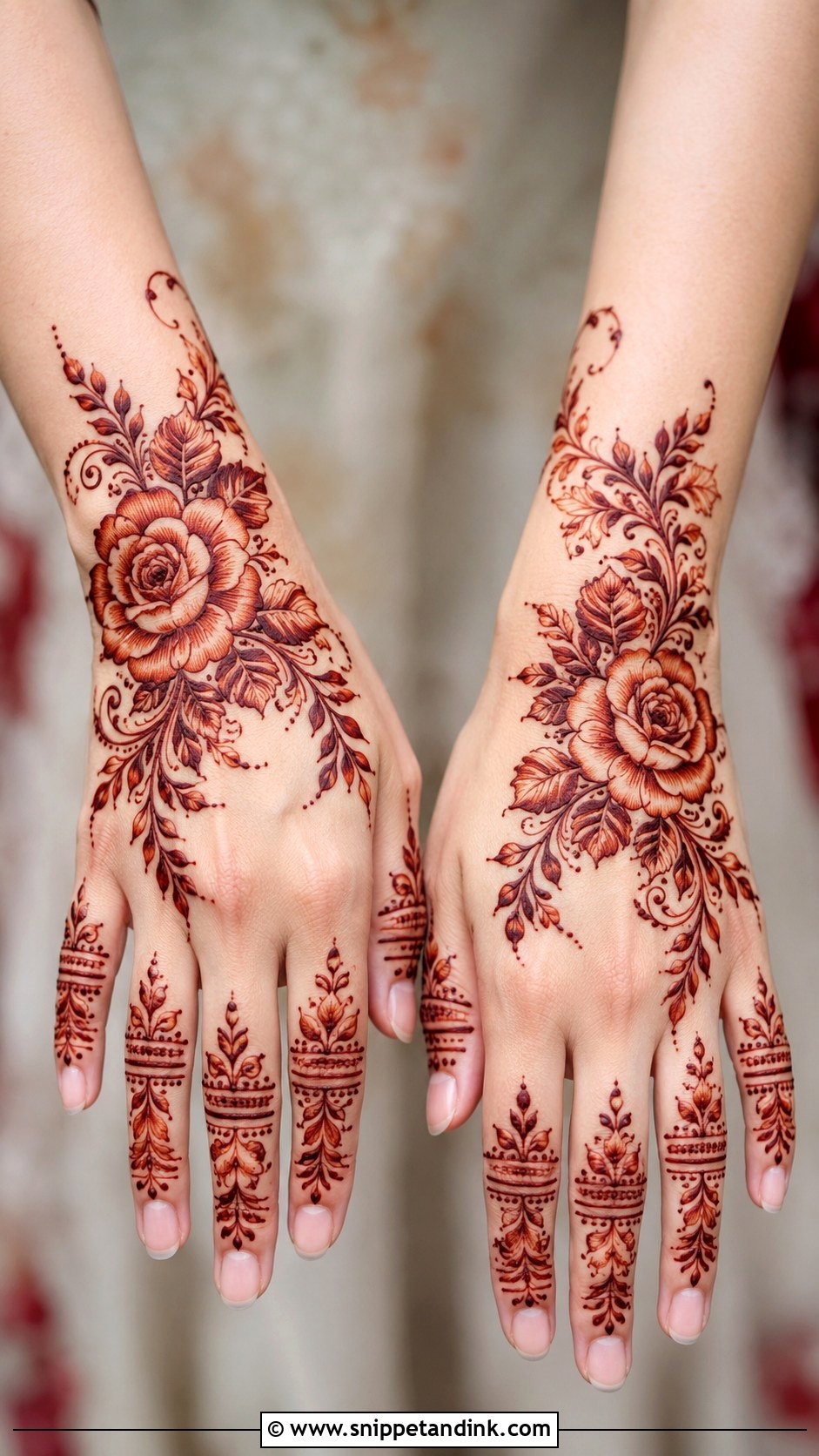
Roses need shading to look like roses. Without it, they read as circles. I build the petals with fine lines and short strokes so the stain develops depth instead of a flat blob. They work as large blooms across the back hand, smaller flowers along the fingers, or a trail from wrist to fingertip, and leafy vines, dots and curved borders finish them. Roses suit modern brides who still want henna to feel traditional, and they sit well with pastel outfits, red lehengas, pearls or gold.
11. Lotus Bridal Mehndi Back Hand
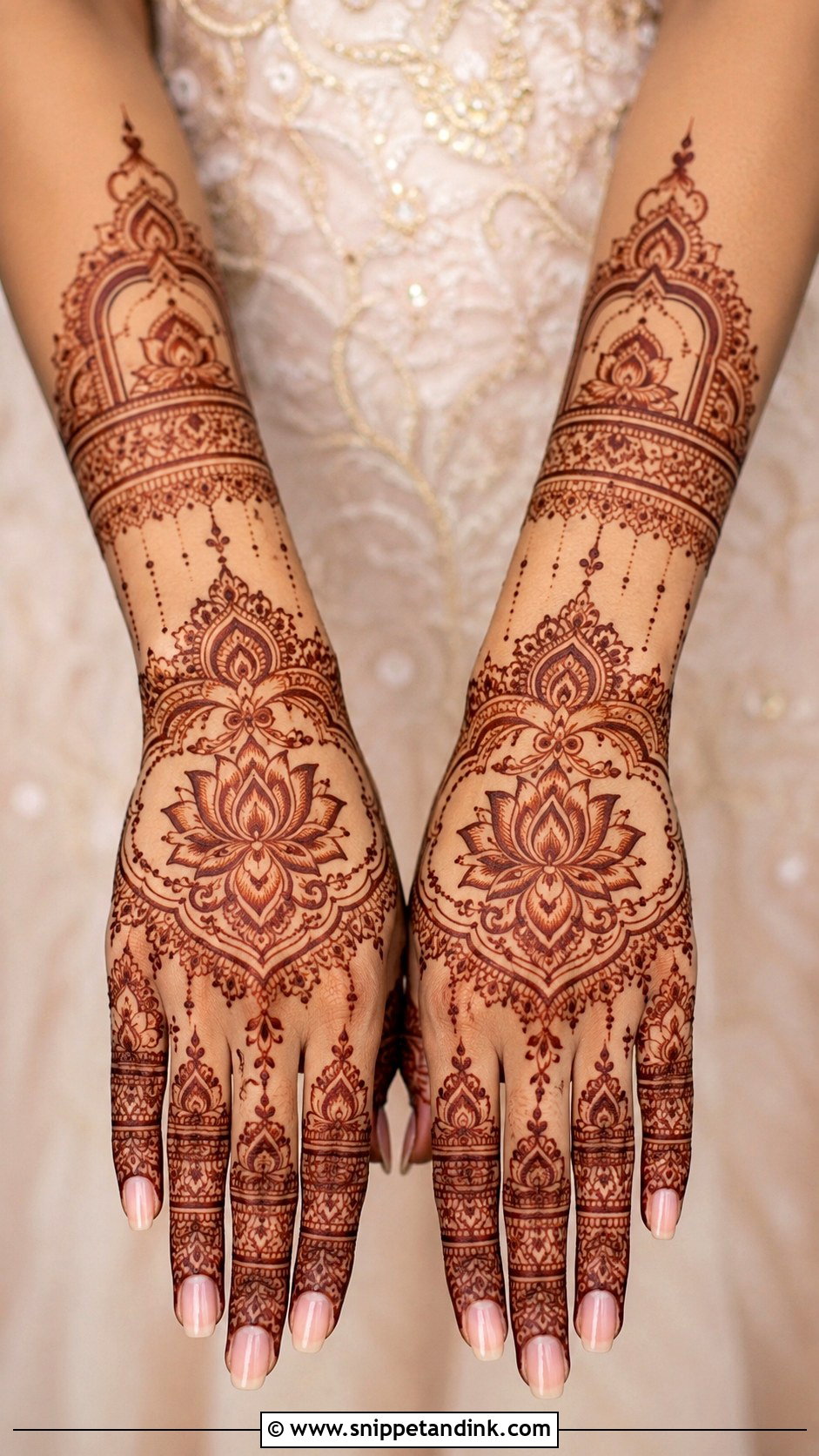
Lotus motifs carry a sacred meaning in many wedding traditions, which is why families often request them. A lotus can sit as the central motif, repeat near the wrist, or nest inside a larger mandala, and its layered petals leave room for fine detail inside each shape. Paisleys, peacocks, temple-style borders and dotted chains pair well with it. On the fingers I keep to slim leafy lines or small lotus bands. It suits narrow and broad hands alike, since I simply scale the central bloom to the width of the hand.
12. Minimal Bridal Mehndi Back Hand
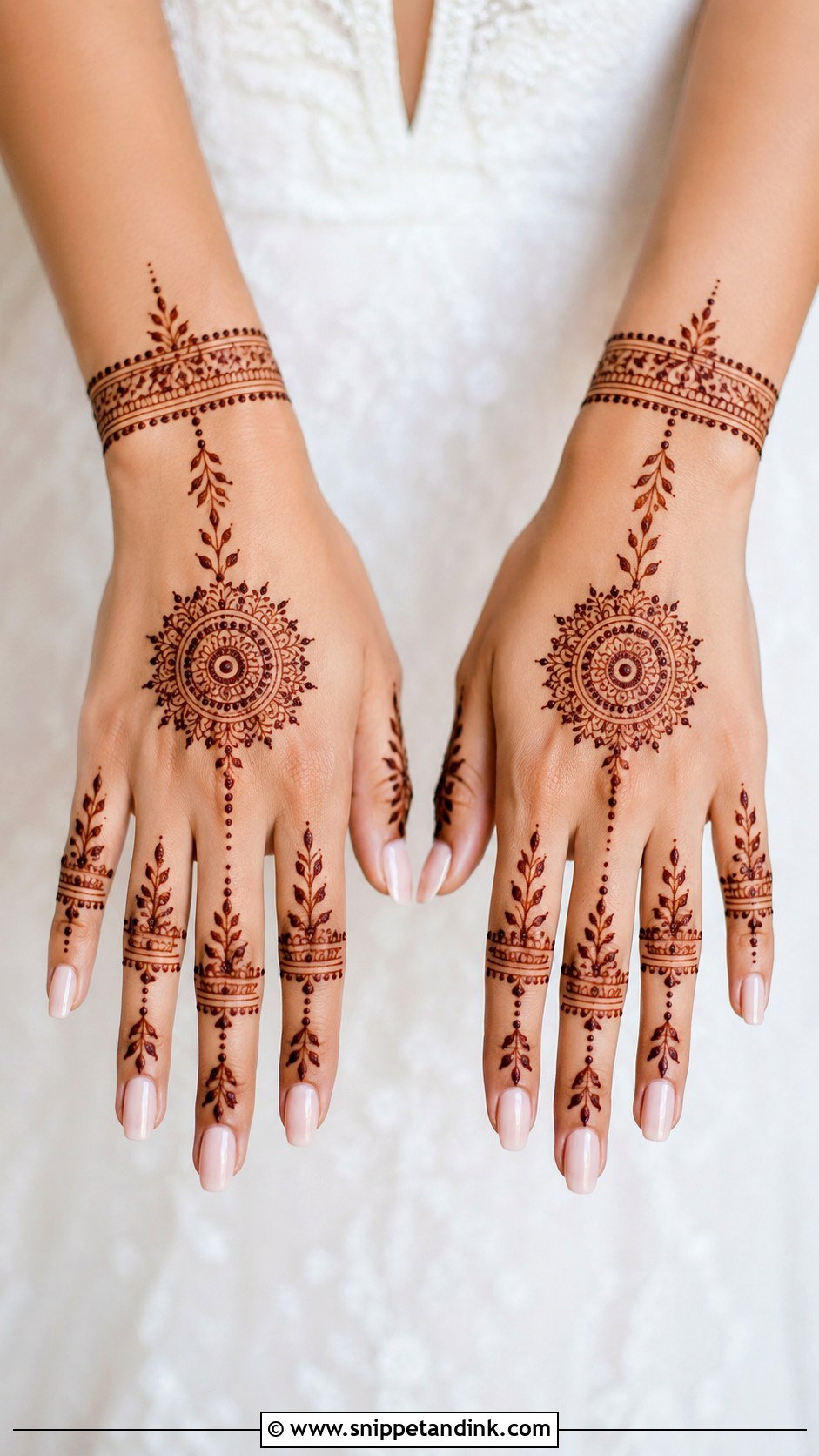
Minimal back-hand designs decorate only selected areas: the fingers, the centre of the hand and the wrist. A small mandala, a delicate floral trail, a fine bracelet band or a slim leafy line is enough to feel bridal. It keeps jewelry visible and suits intimate weddings, courthouse ceremonies, engagements and brides wearing henna for the first time. Expect every line to be on show, which is why I take minimal work more slowly than dense work. There’s nothing to hide a shaky stroke.
13. Modern Bridal Mehndi Back Hand
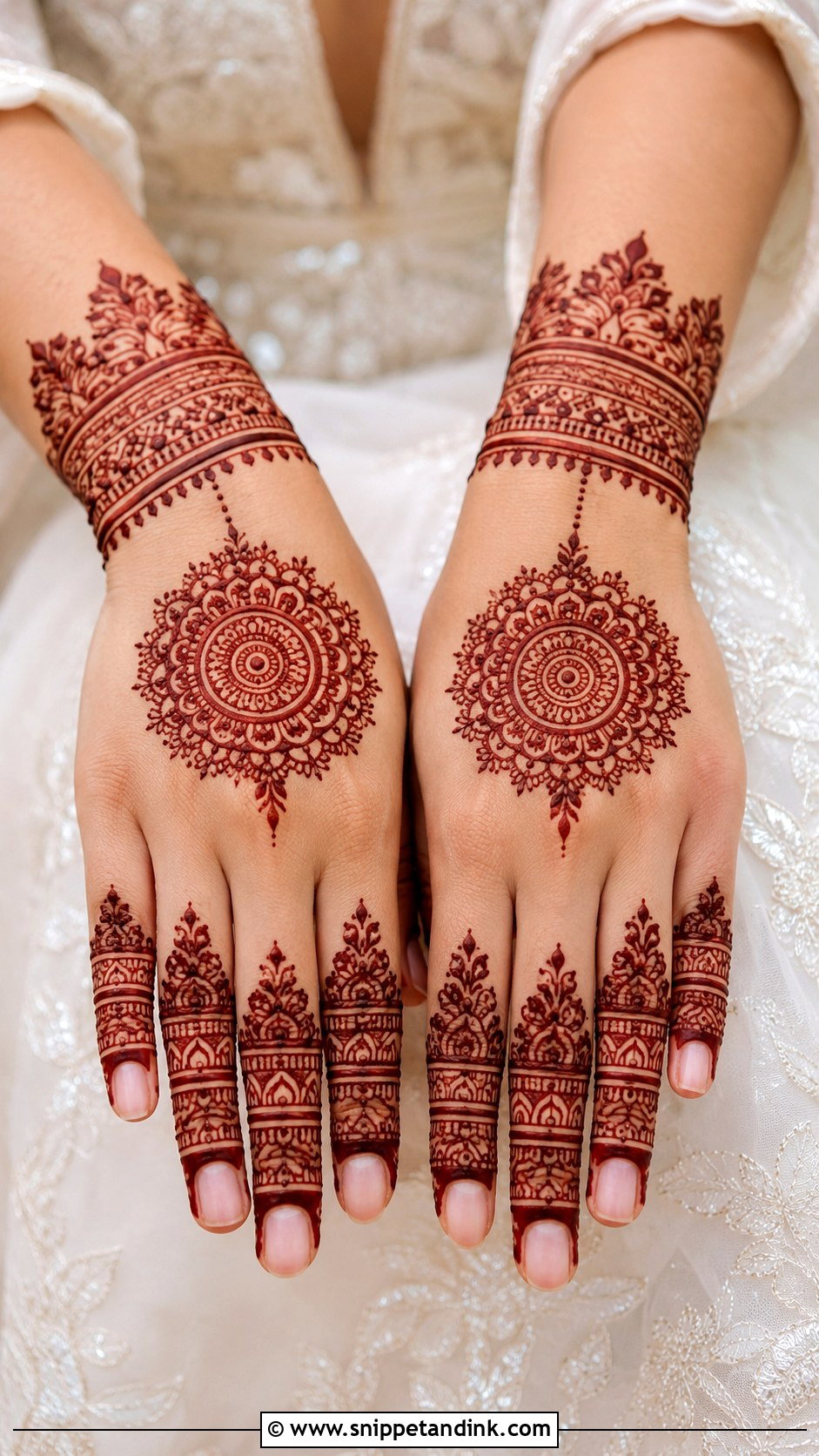
Modern back-hand work brings updated spacing and cleaner lines into traditional bridal henna. Think geometric bands, negative space, floral cuffs, mandala centres and finger-focused detail. It needs to look intentional rather than empty, so every motif must be finished cleanly. It frames the fingers well in ring shots, and initials, a date or a small symbol slot in easily. If your outfit is a contemporary lehenga, a gown or fusion wear, this is the direction I’d lean.
14. Simple Bridal Mehndi Back Hand
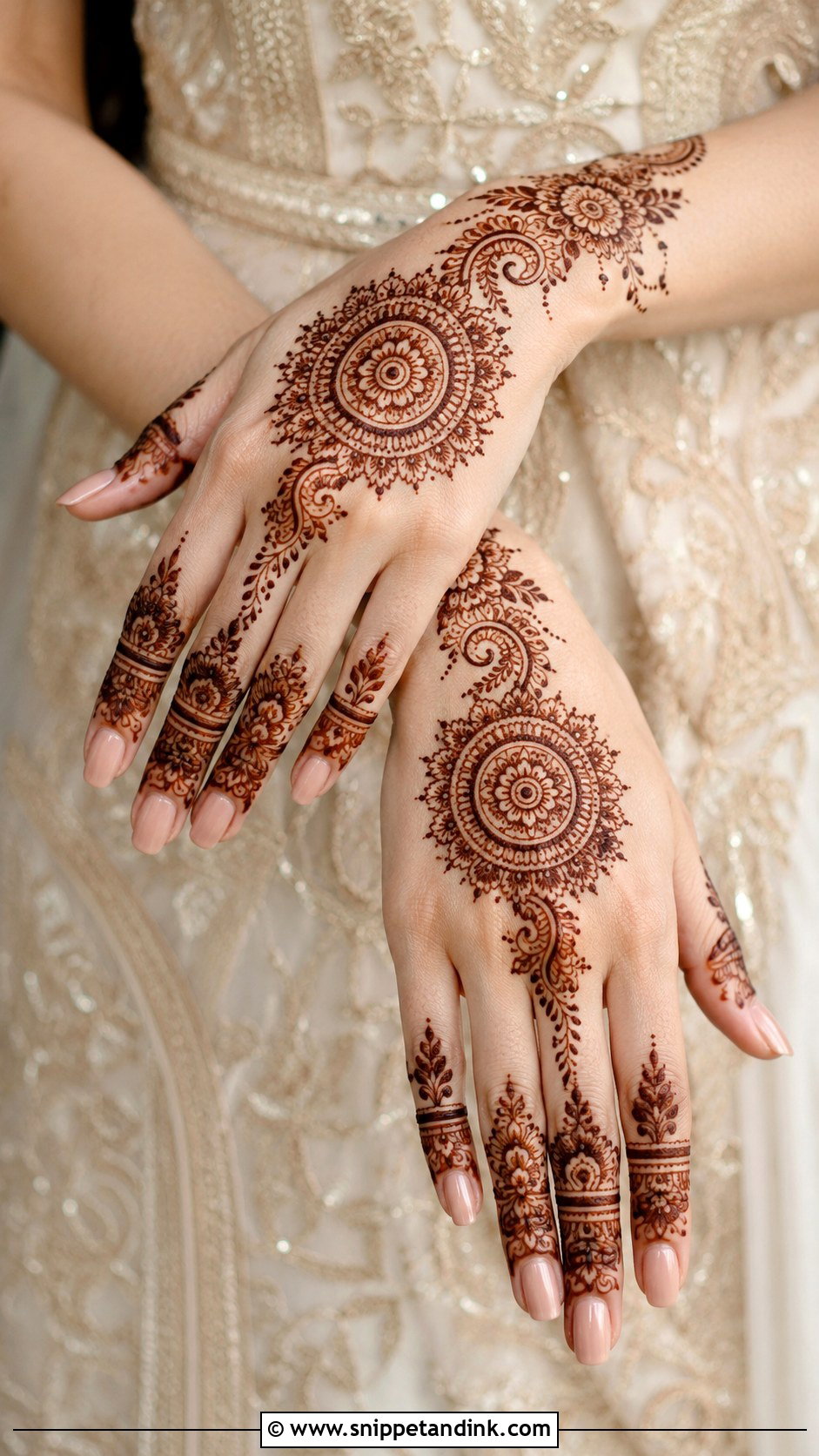
Simple doesn’t mean unfinished. A central mandala, floral vines, paisley curves and decorated fingers, with open space around them, can still look complete. Smaller hands often suit this better than full coverage, which can overwhelm them. It’s quicker to apply and easier to wear through a packed wedding schedule. What makes it bridal is neat line work and a strong stain, so the aftercare matters as much as the design.



15. Heavy Bridal Mehndi Back Hand
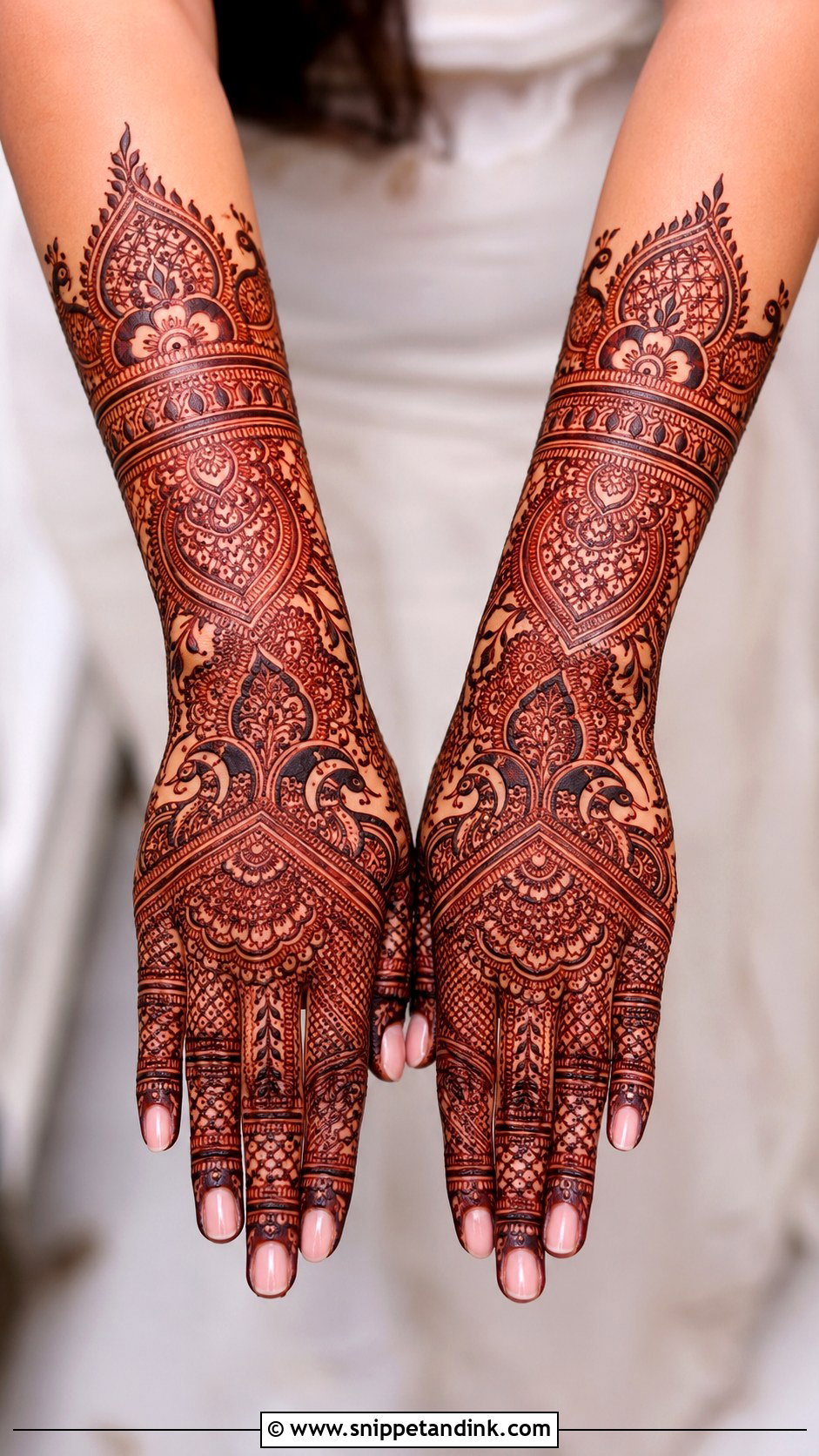
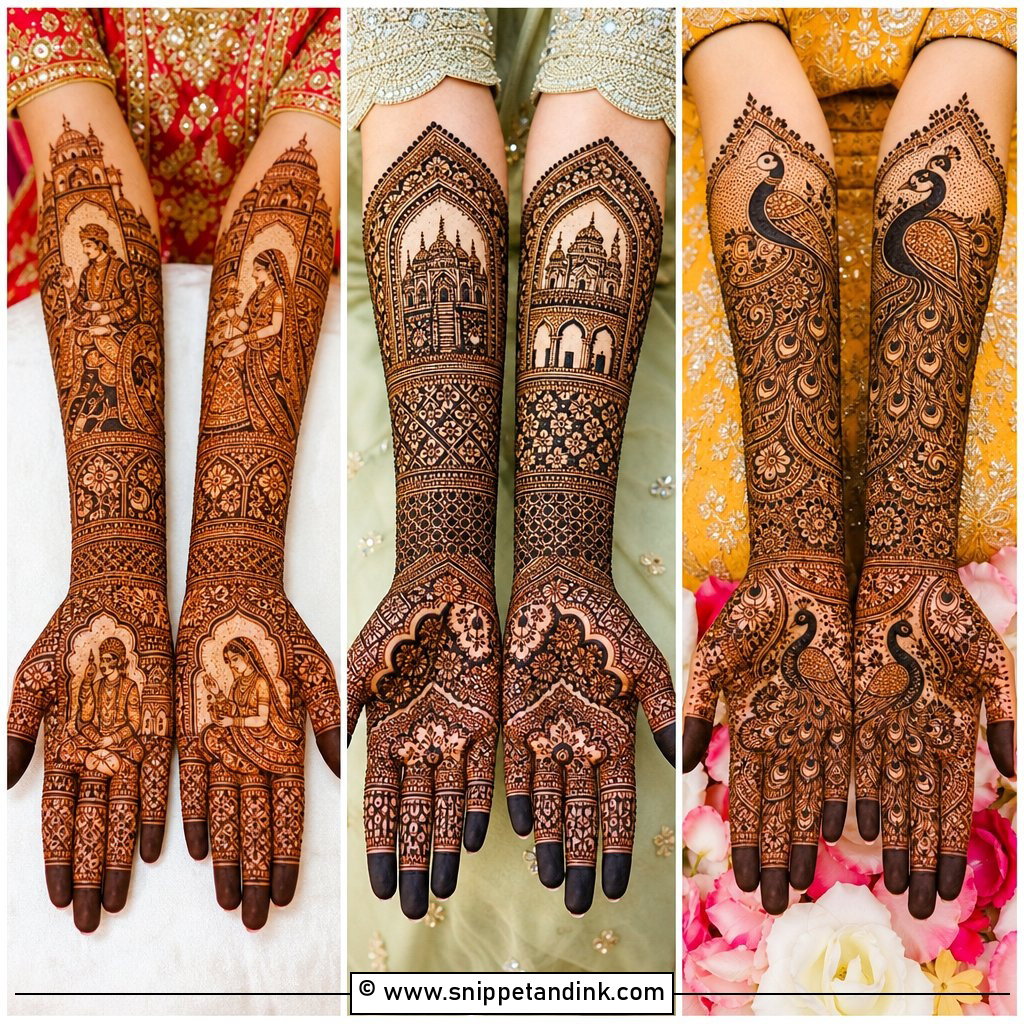
Heavy back-hand mehndi covers the fingers, the back of the hand, the wrist and often the forearm with dense pattern: paisleys, mandalas, peacocks, flowers, jaali and tiny fillers in one layout. Layering gives it richness, but without structure it turns into noise. I divide the hand into zones and leave a fine unfilled line between them so each part reads. Choose this for grand ceremonies and traditional outfits, and plan a long sitting. Stacked bangles and statement rings sit well against it.
16. Dulhan Mehndi Back Hand
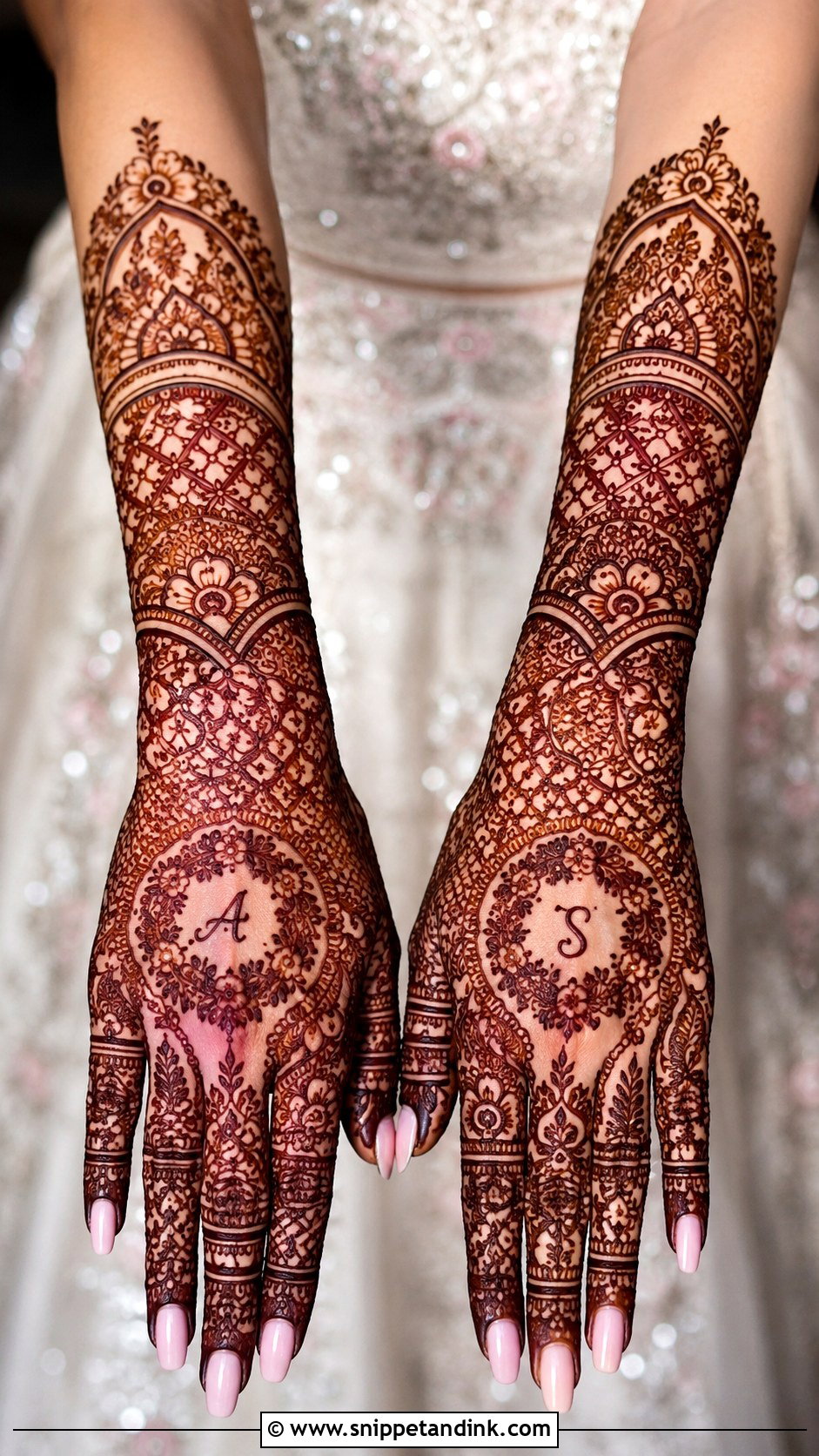
A dulhan back hand combines traditional motifs, dense finger work, wrist detail and often personal symbols. Bride-groom elements tend to go on the forearm or palm, leaving the back hand for florals, paisleys, mandalas and fine borders. The front and back must feel like one design. I sketch both sides of the hand before starting so the borders meet at the sides of the wrist instead of stopping abruptly. The groom’s initials can hide among leaves, petals or small curves.
17. Rajasthani Bridal Mehndi Back Hand
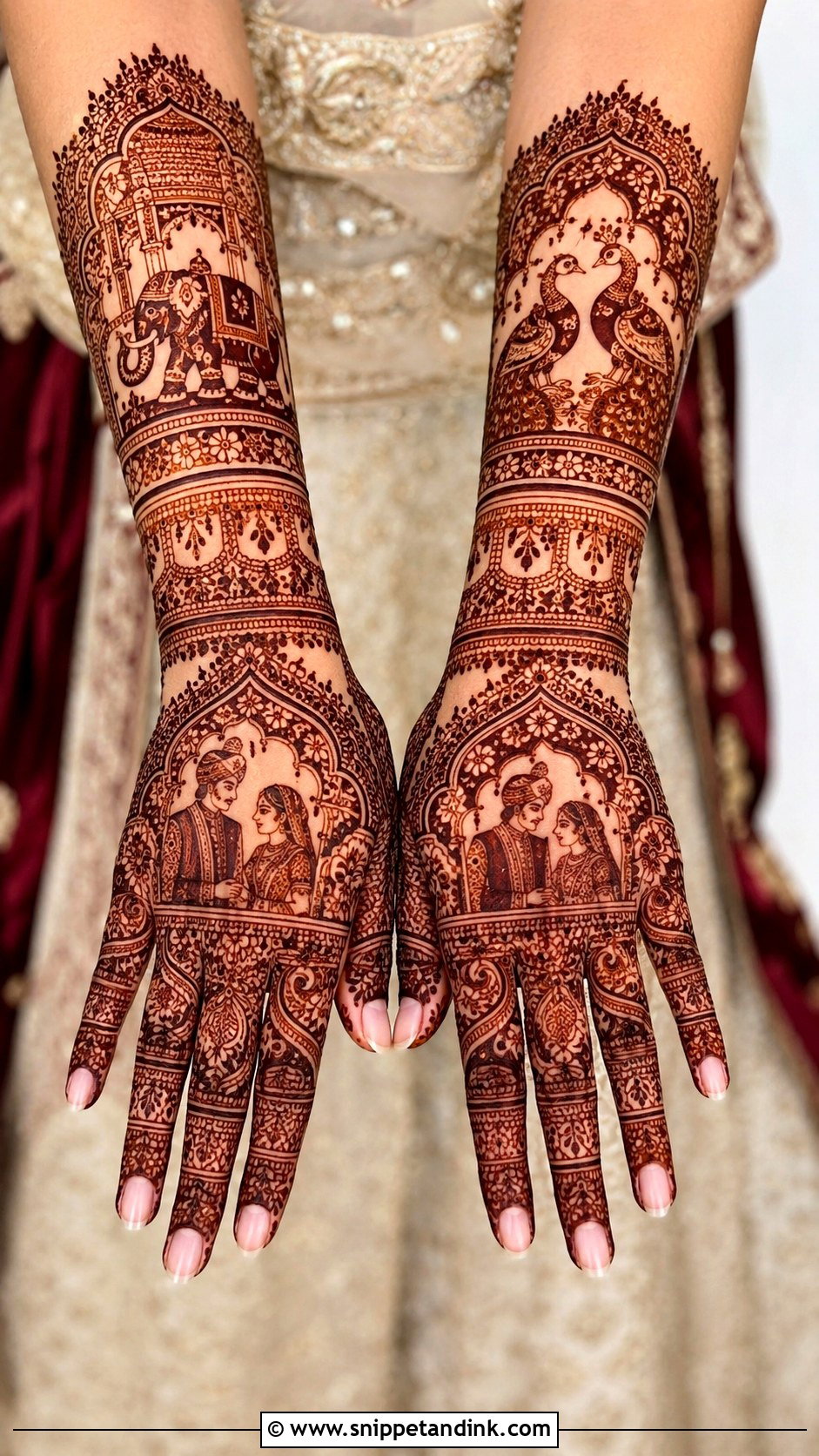
Rajasthani back-hand work is full of royal motifs: fine lines, bride-groom figures, peacocks, elephants, paisleys and ornate borders, often finished with a bracelet-like band at the wrist. Fingers fill with delicate checks, curves, dots and small florals. It’s slow, detailed work, so set aside a long mehndi session. Figure work on the back of the hand is harder than on the palm because the skin moves over tendons, and I’d only trust it to an artist whose figures you’ve seen on real hands.
18. Marwari Bridal Mehndi Back Hand
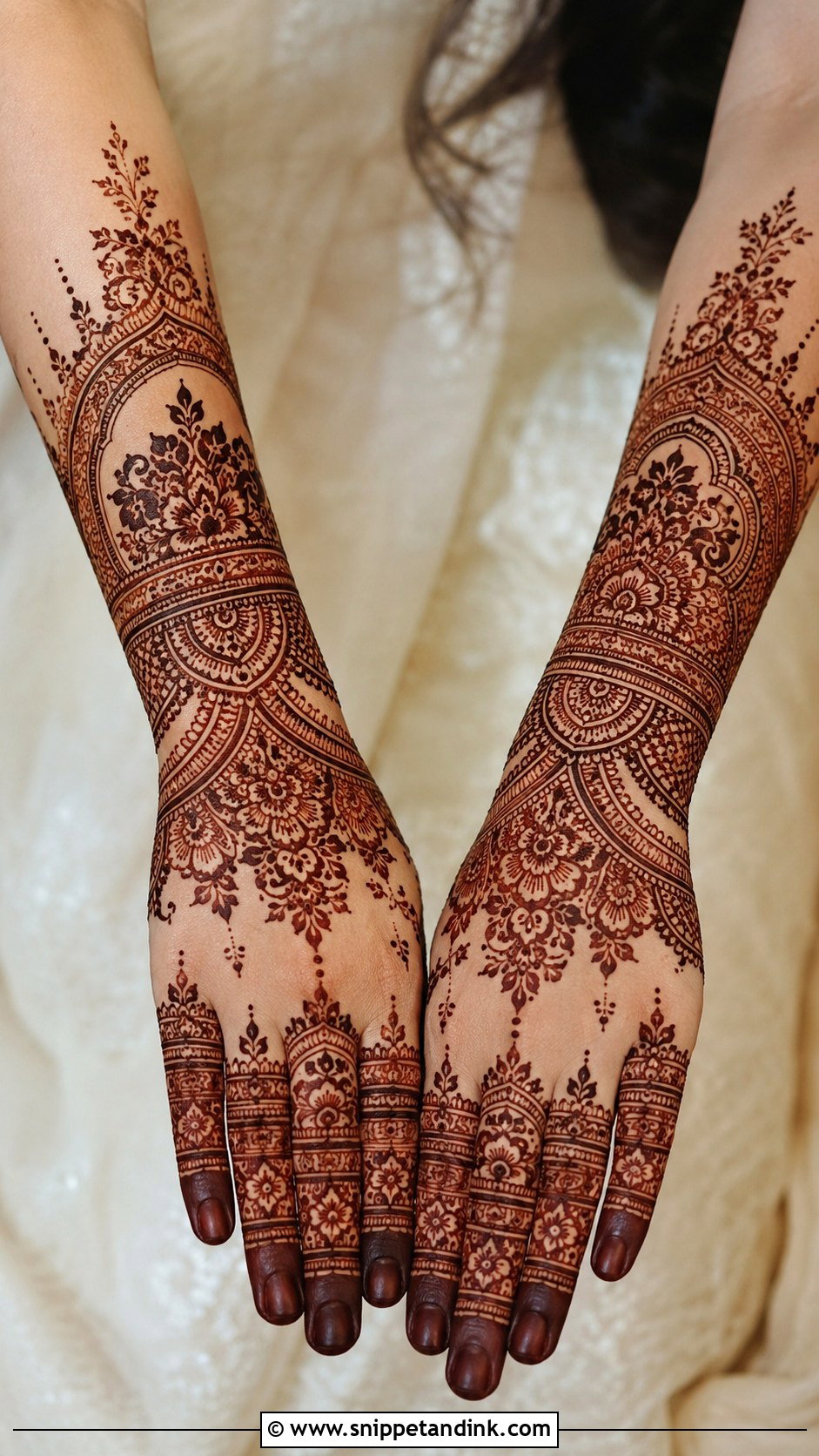
Marwari designs fill the back of the hand with very little empty space: fine paisleys, floral clusters, bride-groom accents, small animals and ornamental wrist bands. That density pairs naturally with traditional lehengas, bandhani, gota patti and heavy gold. I keep the fingers neat with tiny repeating patterns so they match the rich hand without competing. No modern additions are needed; the traditional vocabulary is enough.
19. Pakistani Bridal Mehndi Back Hand
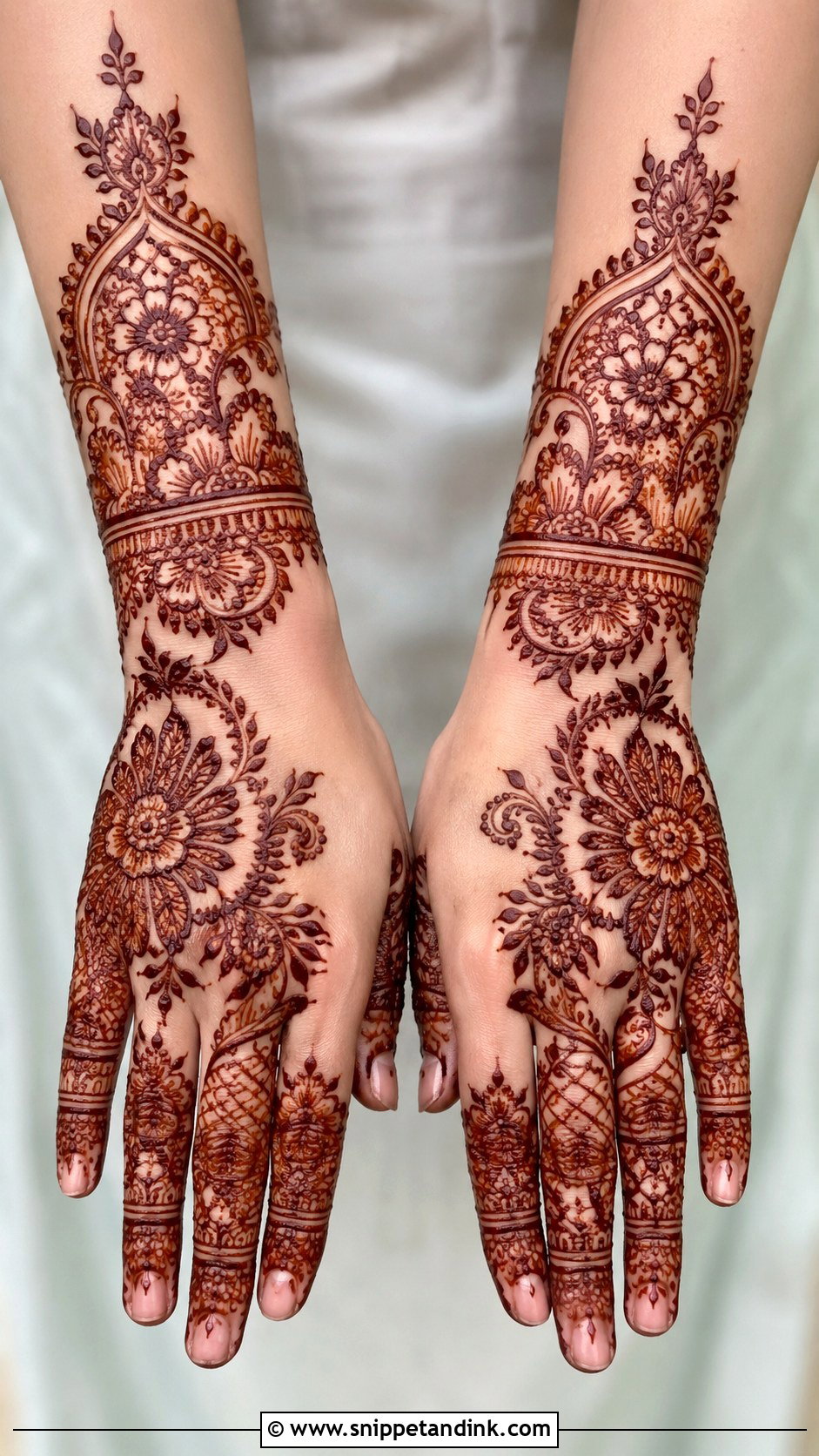
Pakistani back-hand work usually feels a touch softer than very dense Indian bridal designs while staying rich and complete. Floral domes, leafy vines, paisleys, delicate jaali and wrist-to-forearm extensions are typical. Many brides want a coordinated look across nikkah, baraat, or walima, and since one application has to last through several events, I plan the design so it still looks good as the stain starts to fade. Fingers get bands, petals and thin curved lines. Deep maroon nails, gold bangles and embroidered sleeves all suit it.
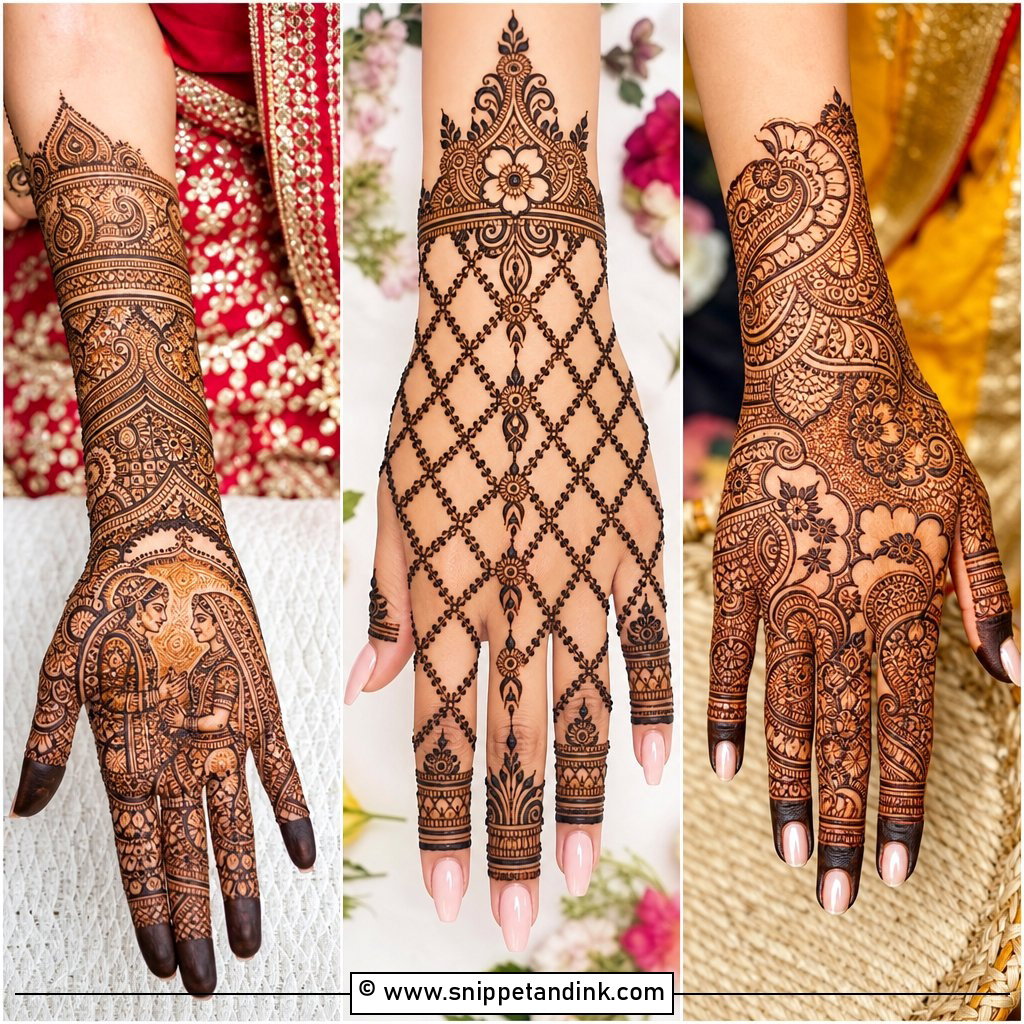


20. Moroccan Bridal Mehndi Back Hand
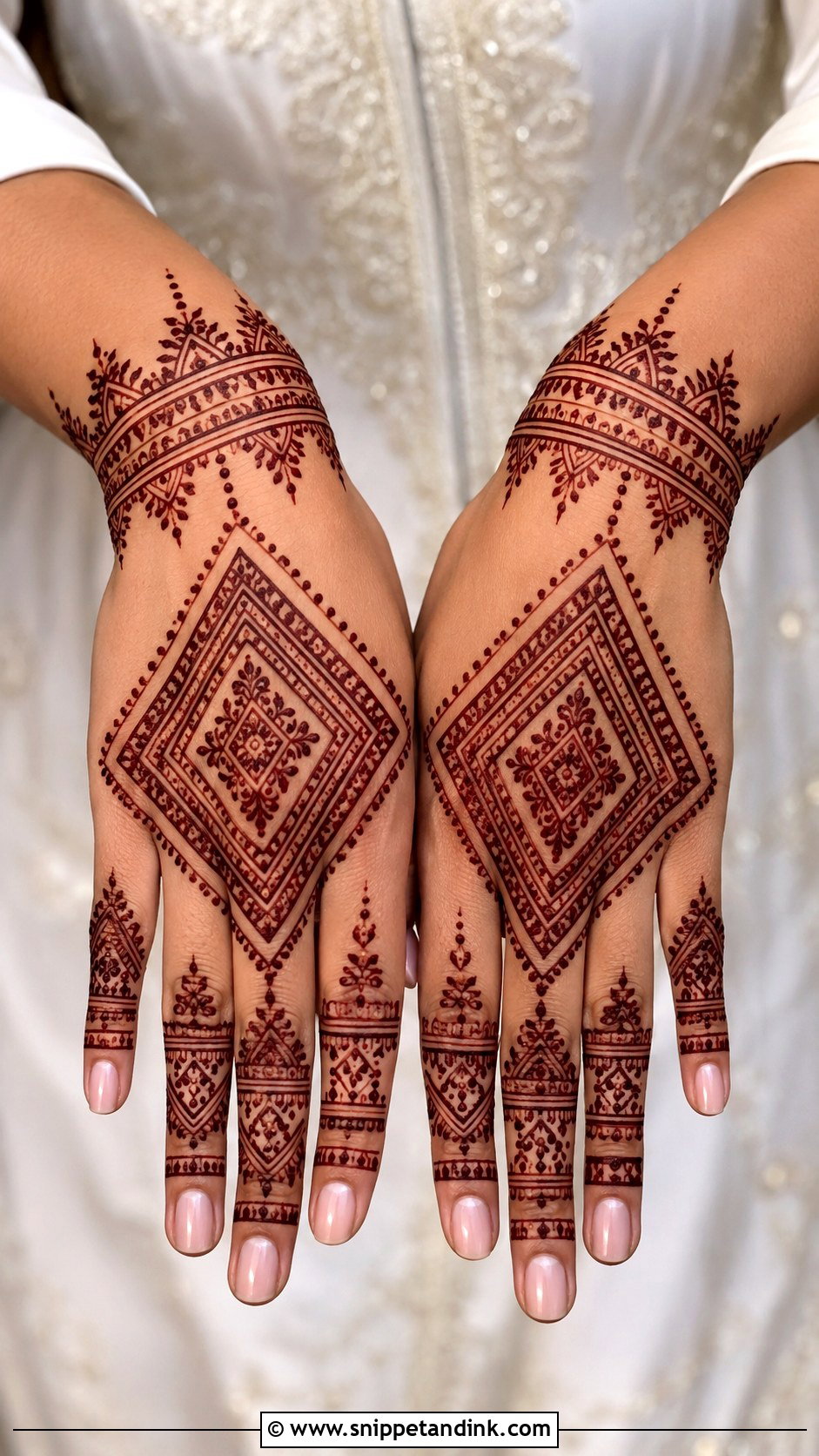
Moroccan work swaps flowers and paisleys for diamonds, lines, grids, triangles and bold structured patterns. On the back hand it looks cultural and modern at once. It can cover the full hand or form one strong central panel with decorated fingers. Straight lines are less forgiving than curves, so I mark key points first and check them from a distance before connecting them. Because the shapes are already busy, minimalist jewelry suits it best. Fine dots or a small floral touch at the wrist makes it read as bridal.
21. Gulf Bridal Mehndi Back Hand
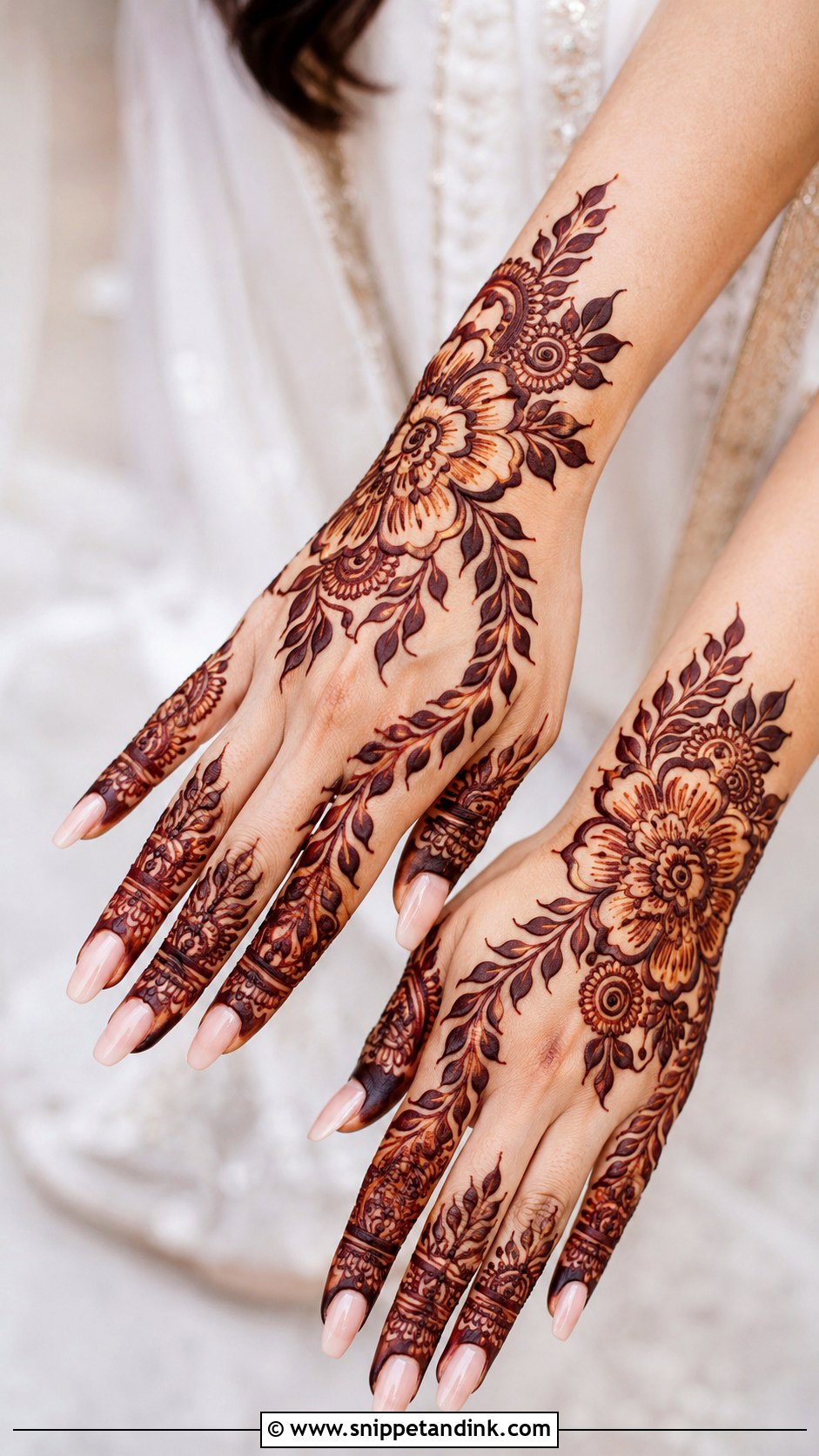
Khaleeji-inspired, or Gulf, mehndi uses big flowers, flowing leaves and dramatic open spacing. The outlines are thick and strong, which gives a deep, eye-catching stain. The layout either sweeps diagonally across the hand or fills it with oversized floral sections. Think of it as Arabic mehndi turned up for a wedding. Fingers carry thick leafy trails, flower bands and neat tips. Statement rings work well here, because the bold pattern remains visible around them rather than disappearing underneath.
22. Bracelet Bridal Mehndi Back Hand
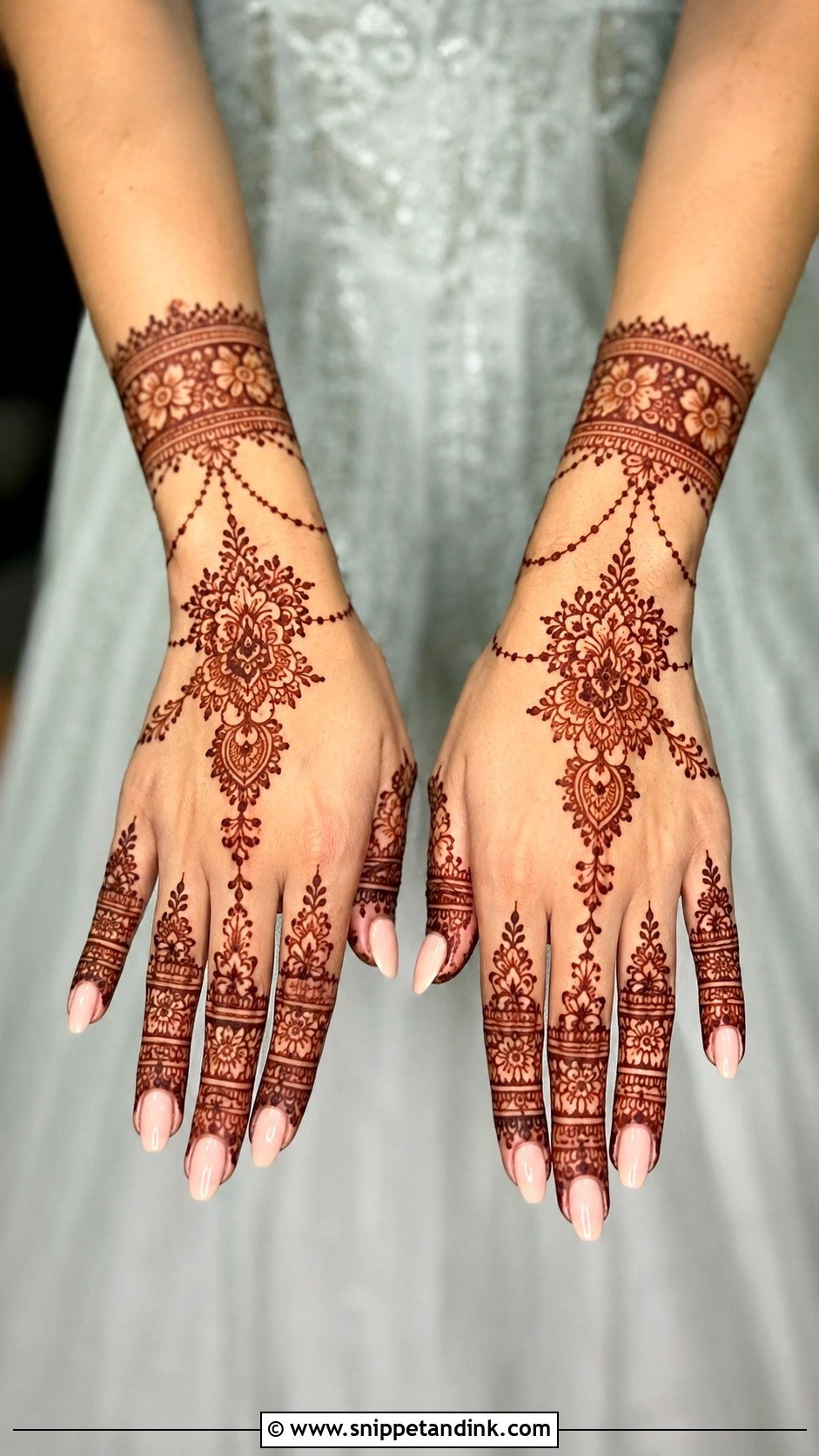
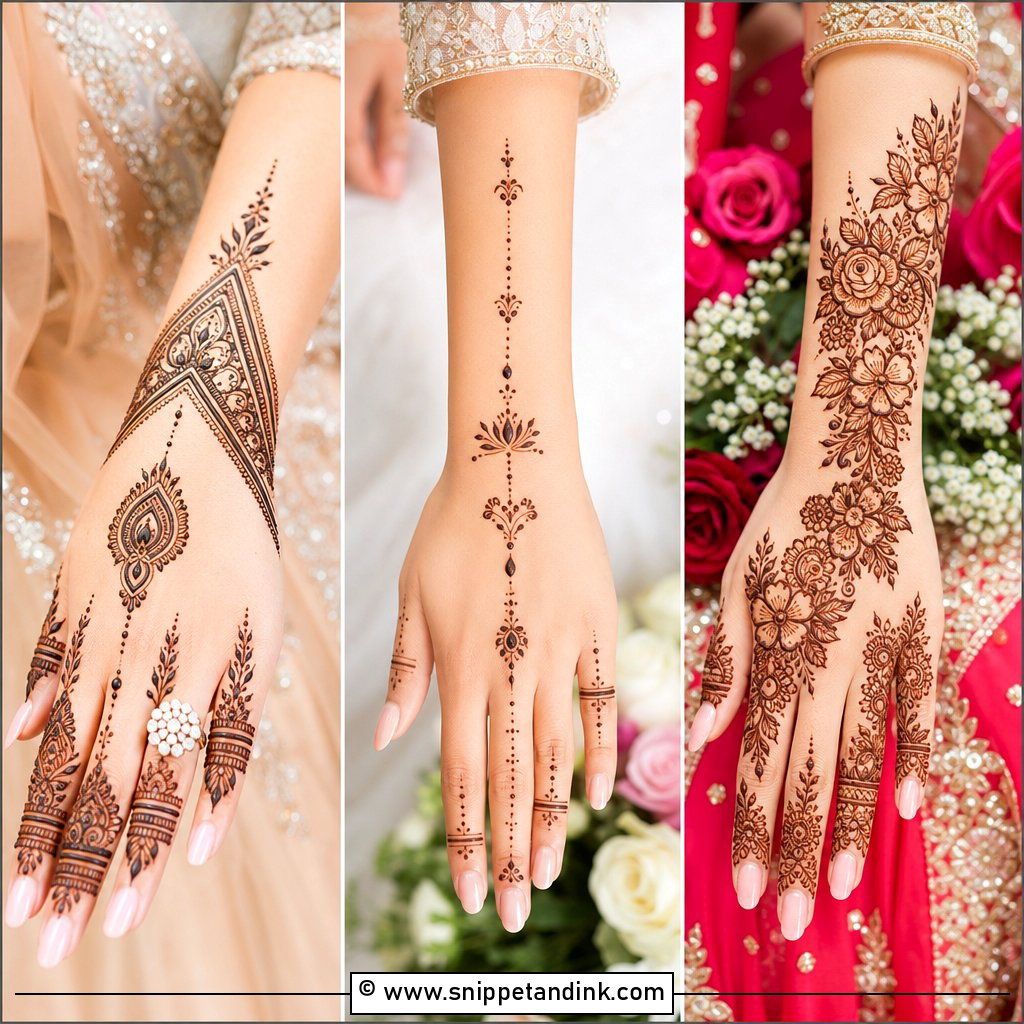
Bracelet designs turn henna into jewelry: a wrist cuff, chain-like lines, ring details and finger connections. They can be minimal or fully bridal depending on how much detail you add. A floral mandala on the back hand linked to a band at the wrist makes a complete layout. I always ask brides to bring their actual bangles to the appointment, because the cuff should sit just above or just below the stack, never directly under it where it gets hidden and rubbed.
23. Finger Bridal Mehndi Back Hand
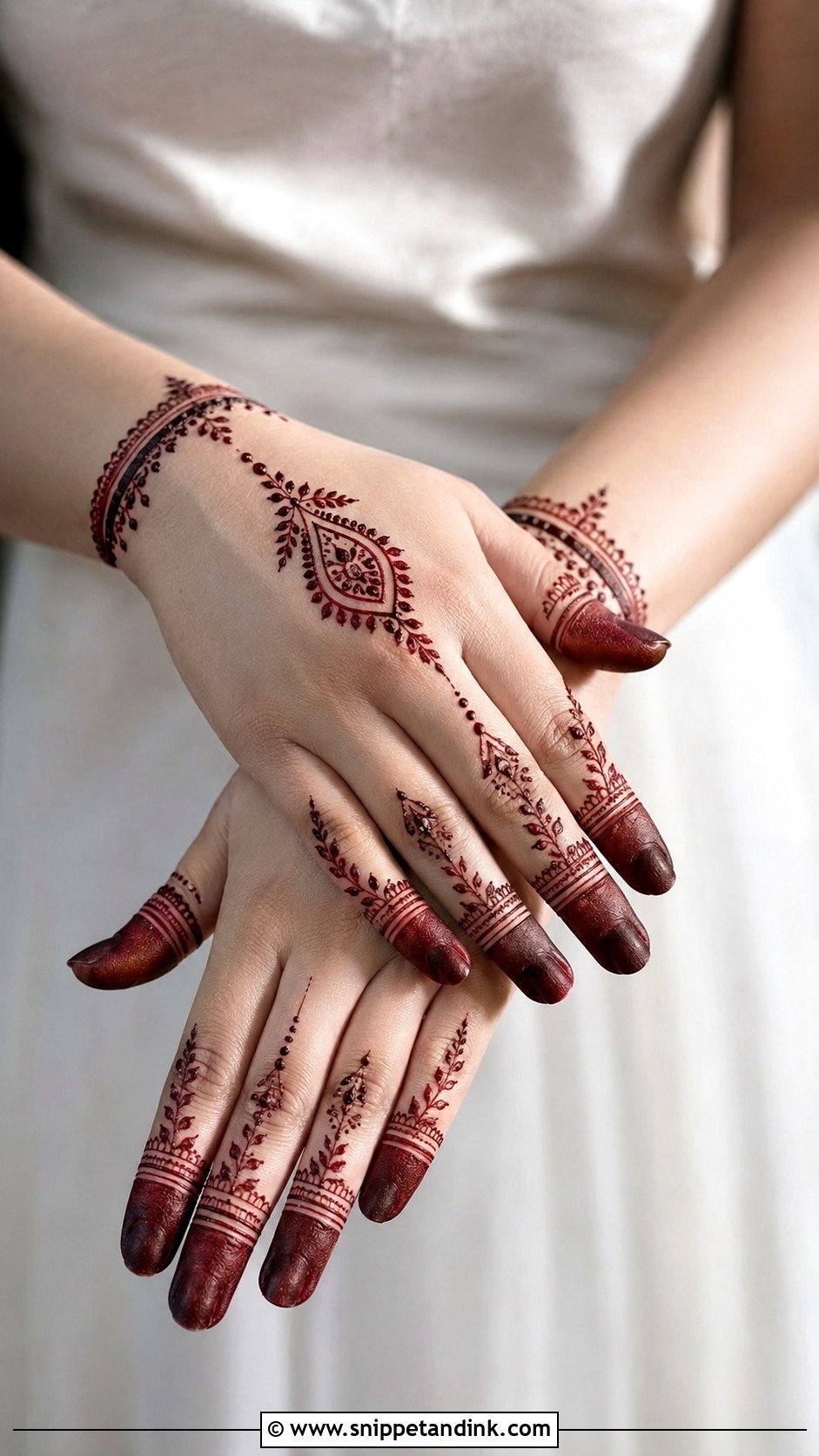
Here the fingers do most of the work: filled tips, ring bands, leafy lines and floral strips, with only a simple central motif on the back of the hand. It suits brides who talk with their hands and want rings and nails to stand out, or who prefer less coverage in the middle. A slim cuff or small floral extension at the wrist keeps it bridal. Fingertips stain darkest of anywhere on the hand, so this layout gives a strong result even with less coverage overall.
24. Jewelry Bridal Mehndi Back Hand
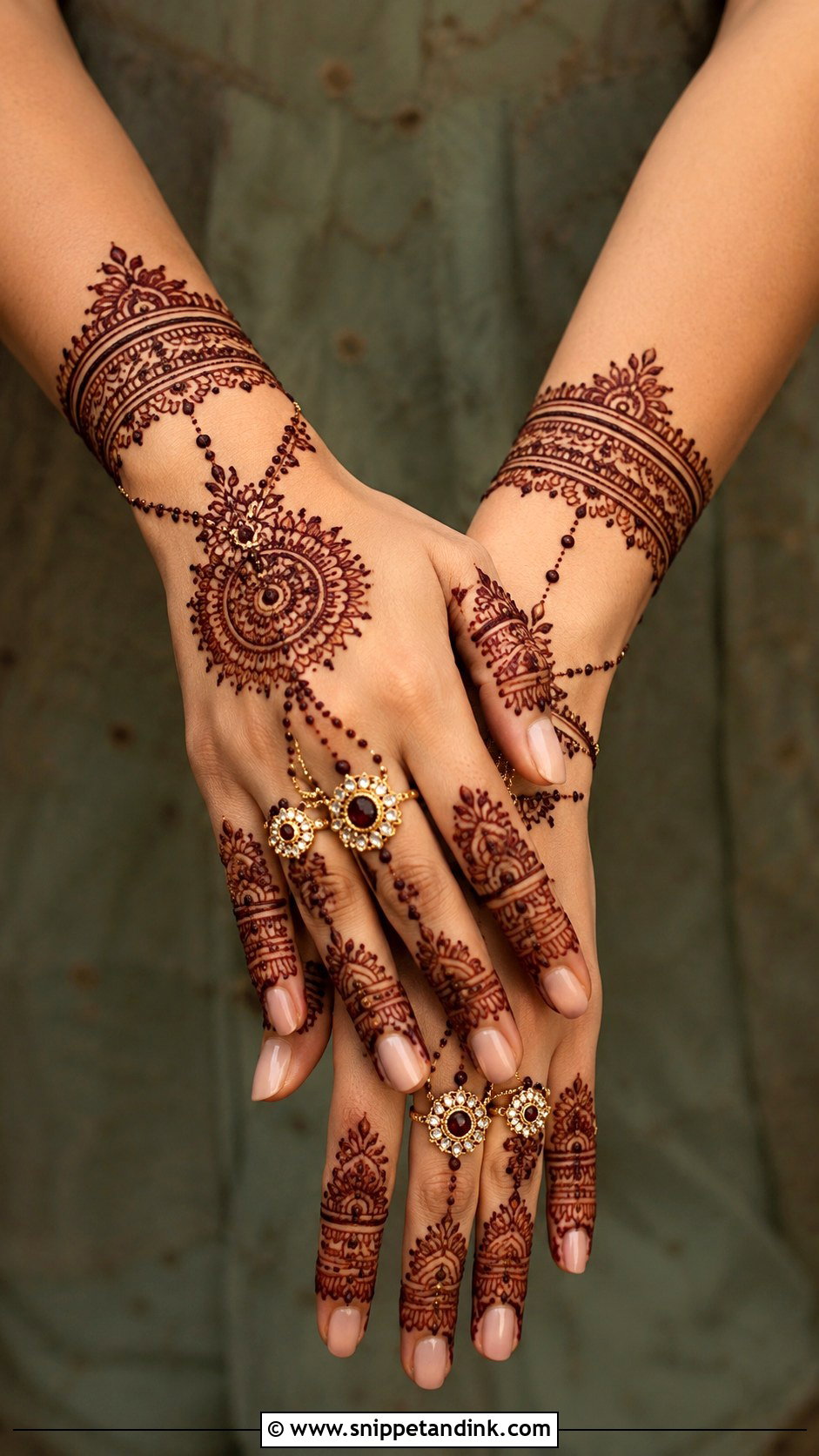
Jewelry-style mehndi mimics hand accessories: hathphool chains, ring patterns, bracelet bands and a pendant-like motif in the middle of the back hand. Fine chain lines link it to the fingers and wrist. It frames real jewelry instead of hiding it, which is why it suits engagements, nikahs and sangeets so well. If you’ll wear a real hathphool, tell your artist; I either draw around its path or skip the henna chain altogether so they don’t double up.
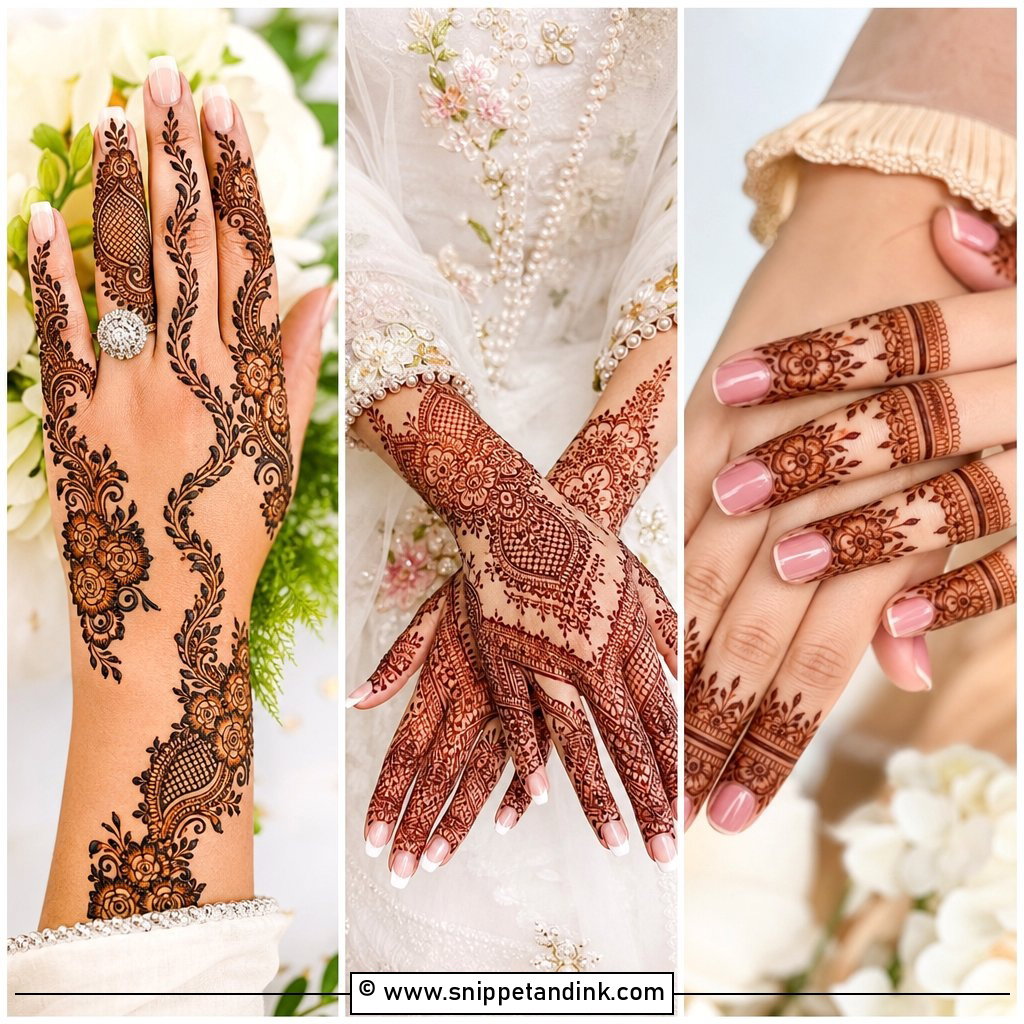

25. Personalized Bridal Mehndi Back Hand
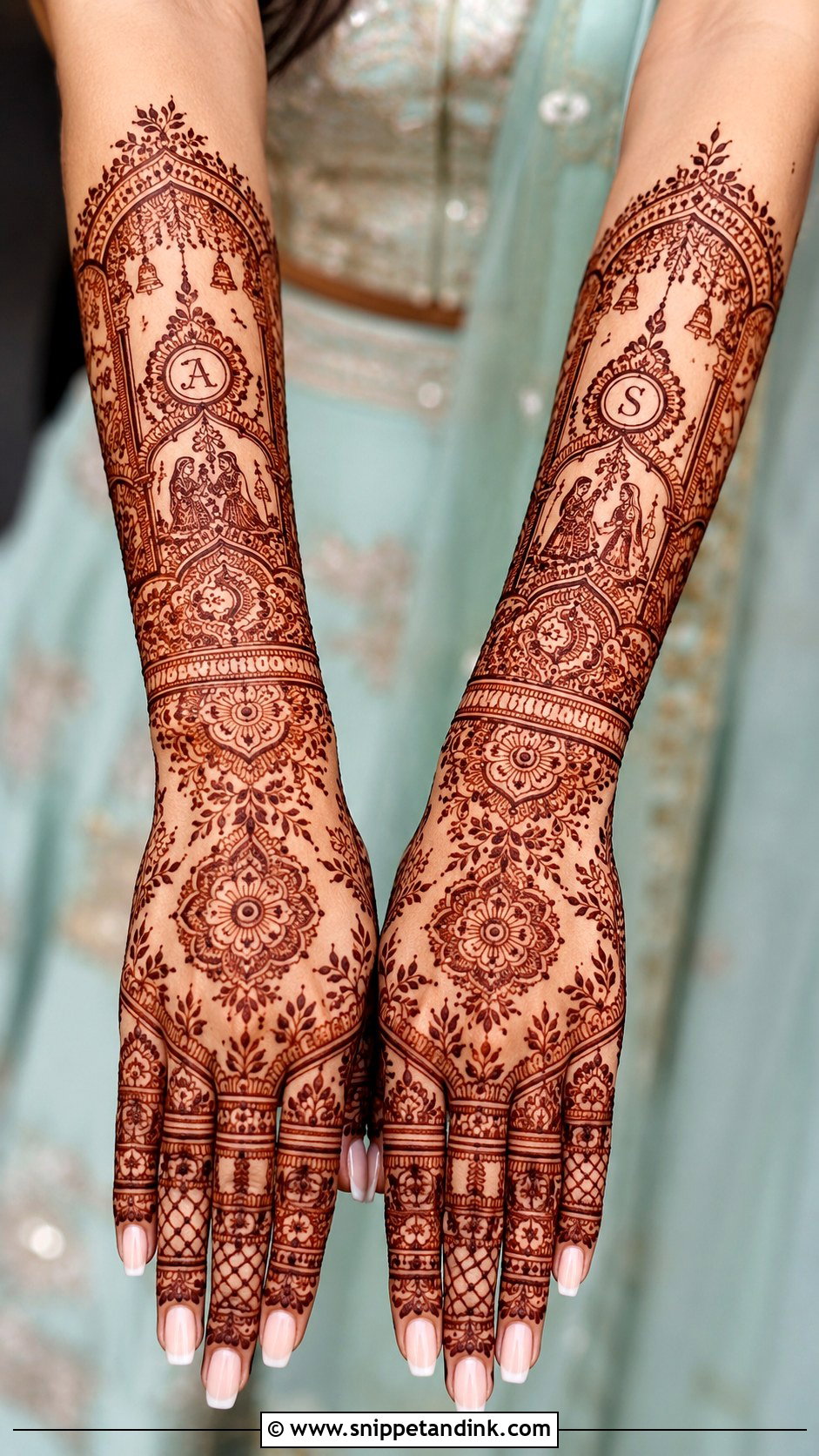
Personalized bridal mehndi on the back hand adds initials, dates, small symbols, meaningful flowers or couple icons. Placement needs thought on this side, as these details are visible to everyone rather than tucked into the palm. I hide initials inside petals, paisleys, jaali or wrist borders so they’re there to discover without shouting. It works with Indian, Indo-Arabic and modern layouts. Choose one or two personal elements; a hand full of symbols starts to look like a scrapbook.
26. Portrait Bridal Mehndi Back Hand
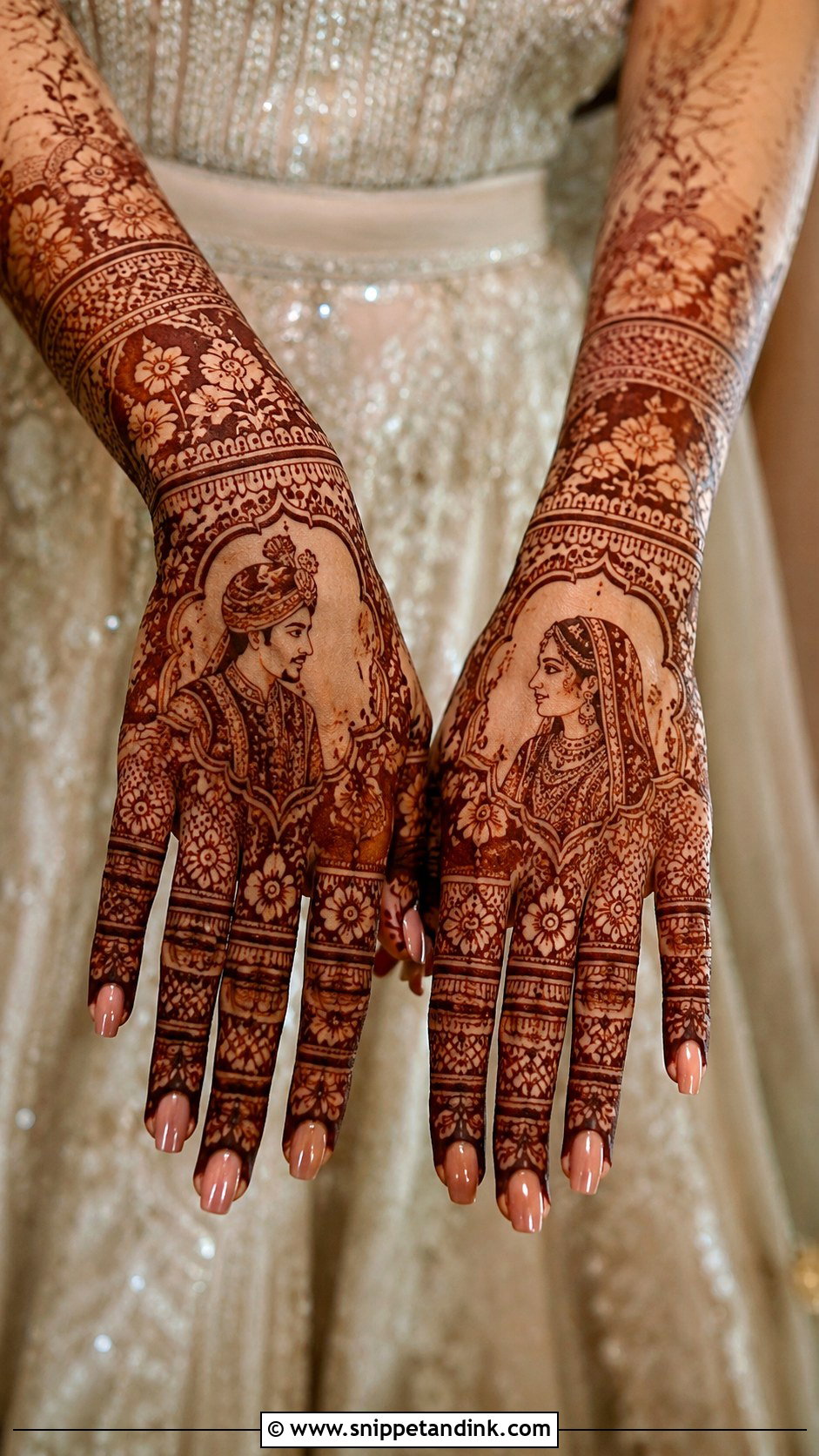
Portrait work on the back hand usually goes near the wrist or on the forearm, where the skin is flatter, while the hand itself carries florals, paisleys and borders. That keeps the design wearable and balanced. Faces demand clean, controlled lines, so this needs a very experienced artist and plenty of application and drying time. It looks most complete as part of full bridal coverage with detailed fingers and matching palms. Be prepared for the forearm portrait to stain lighter than palm portraits would.
27. Negative Space Bridal Mehndi Back Hand
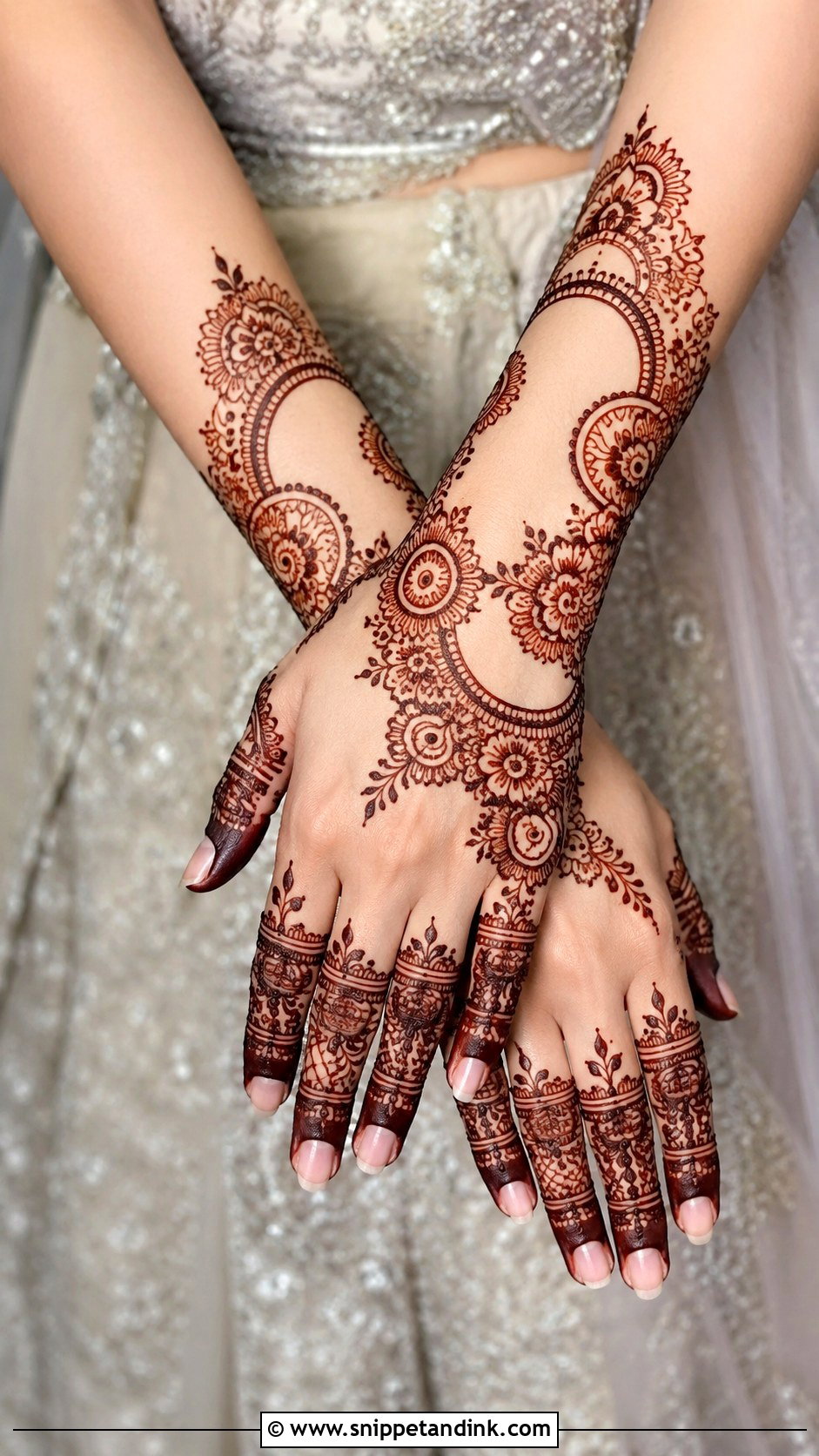
Negative space designs treat bare skin as part of the pattern. Flowers, mandalas, paisleys and jaali still appear, but open sections, bold outlines and careful placement create the contrast. You get a bold look that isn’t heavy, and the main motifs stand out clearly in photos. Banded fingers and filled tips keep the bridal feel. The skill is in the outline: I trace the edges of the empty shapes as carefully as the motifs, since a wobbly border is what makes negative space look accidental.
28. Shaded Bridal Mehndi Back Hand
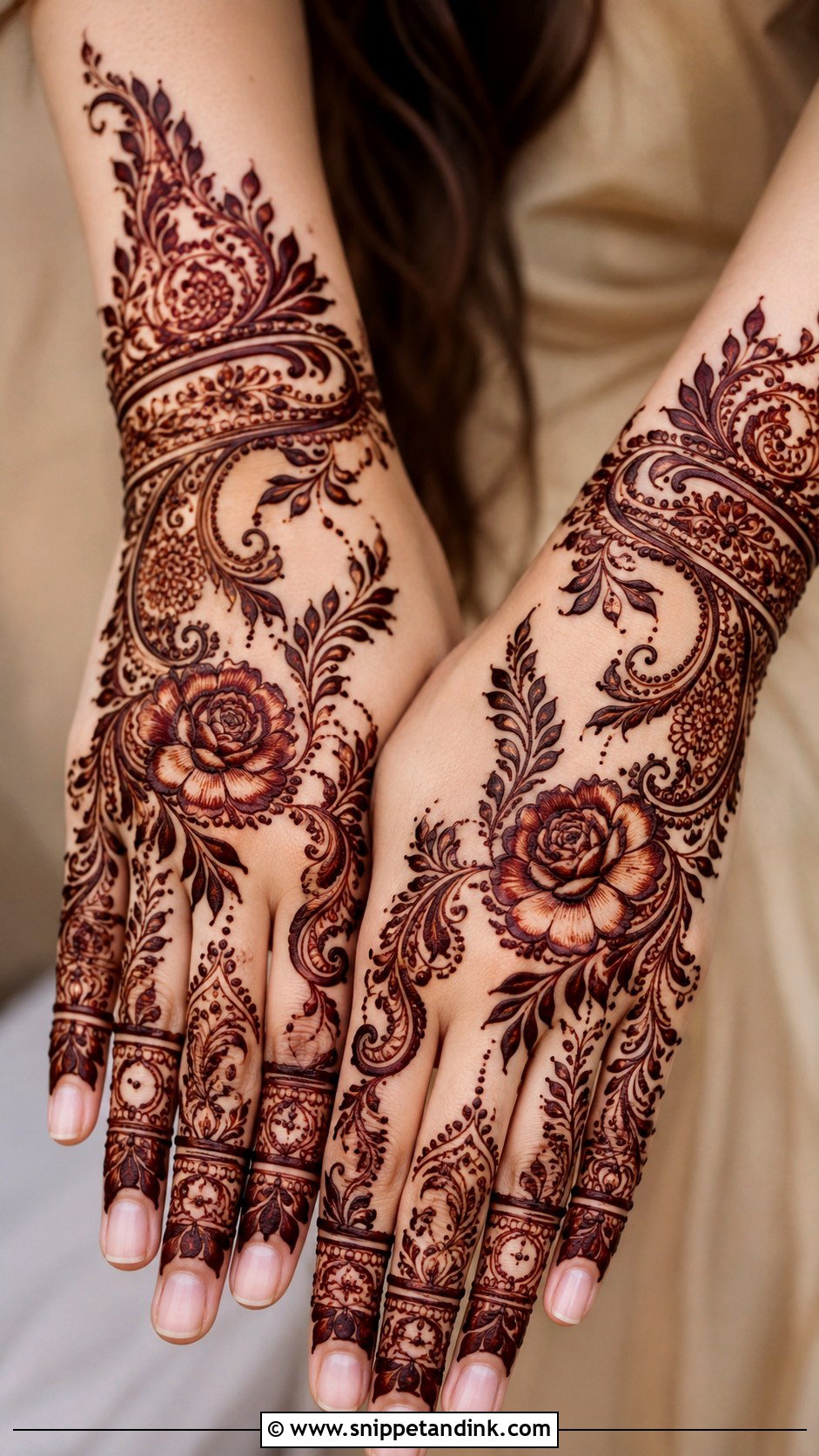
Shading fills flowers, leaves, paisleys and curves with soft texture, giving fullness without dozens of tiny fillers. It’s common in Arabic and Indo-Arabic work, where shaded roses, lotuses and leafy trails define the back hand. After the stain matures, the thicker shaded areas go deep while the fine details stay lighter, which gives the design real depth. I shade with closely spaced strokes rather than a smeared layer of paste; smears stain unevenly and look blotchy by the next day.
29. Back Hand Bridal Mehndi With Initials
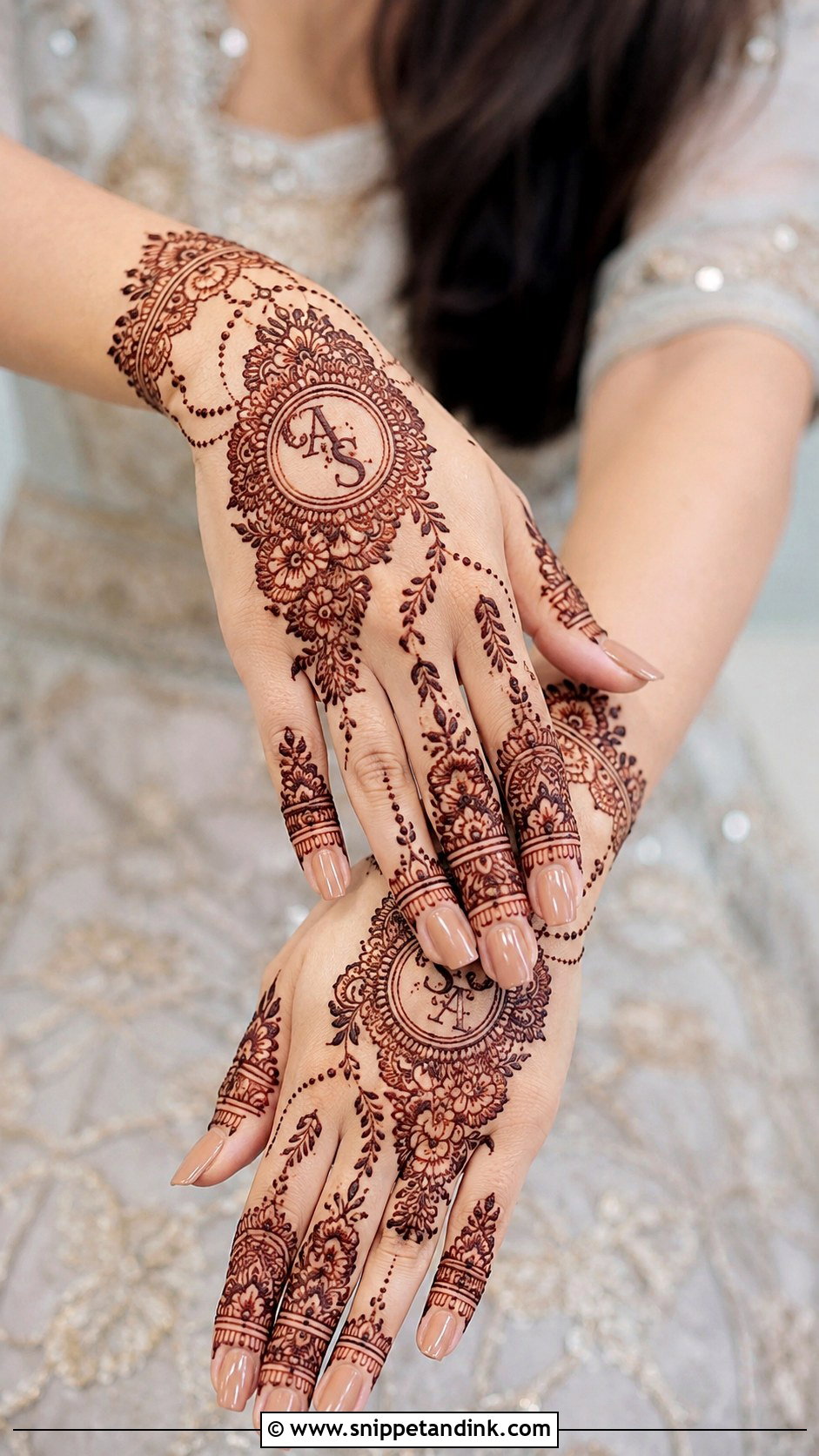
Initials are the classic hidden detail. They can sit inside a paisley, a flower centre, a mandala border or the wrist pattern, either clearly visible or disguised for the groom to hunt for later. The rest of the hand can be simple, modern or fully traditional. I write the letters into the design as I draw, never on top afterward, so they share the same line weight as the surrounding pattern. That’s what makes them hard to spot and fun to find.
30. Back Hand Bridal Mehndi With Wedding Date
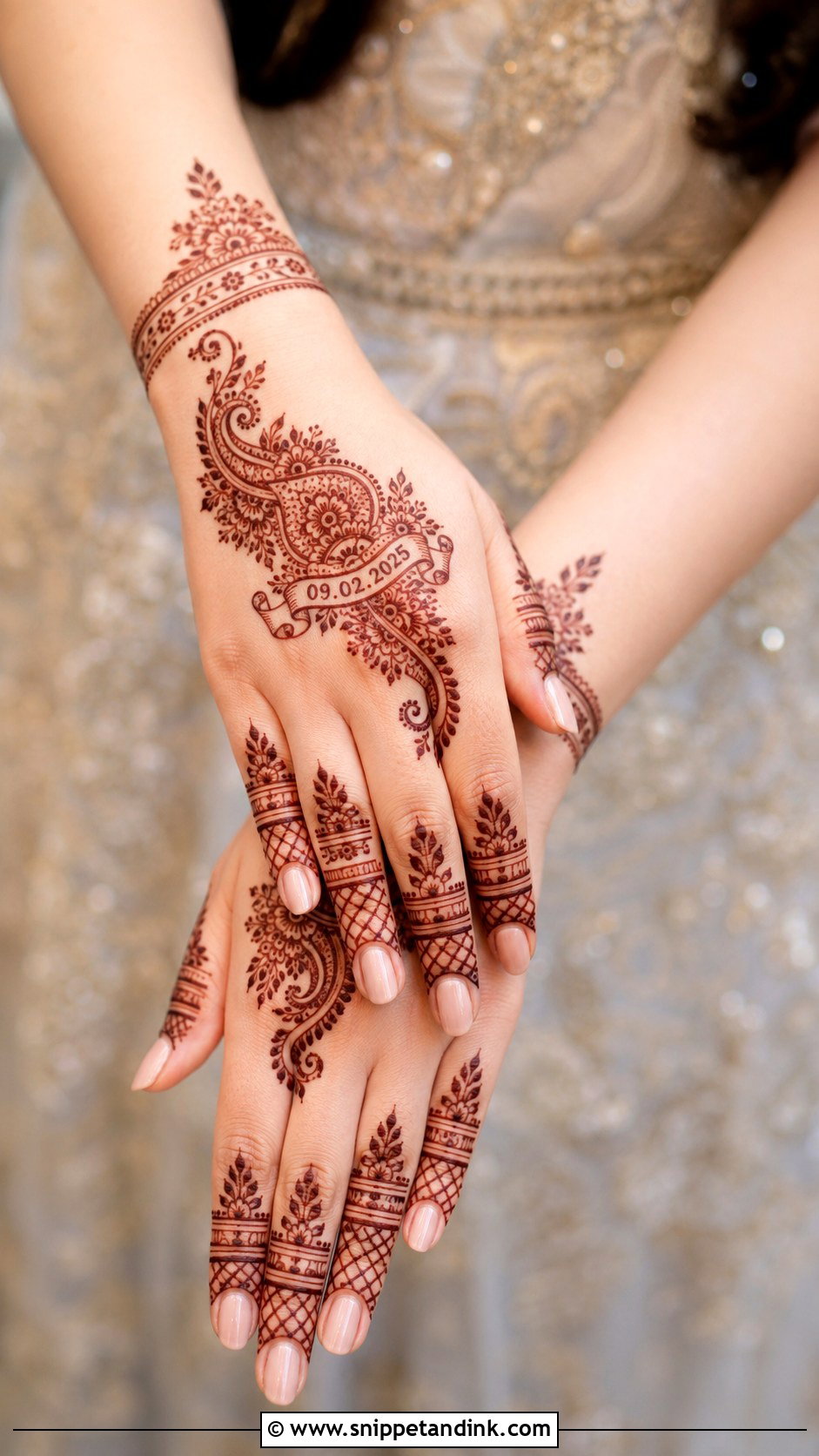
Back hand bridal mehndi with a wedding date marks the day in your own skin for the couple of weeks the stain lasts. The date can go in a small banner, inside a wrist cuff, near the mandala or woven into a floral trail. It needs enough clear space to read once the lines thicken slightly as the stain develops, so I write numbers a bit larger than initials. It sits well within Indo-Arabic, modern and personalized layouts, with florals, paisleys, jaali or fine finger work around it.
Coaxing a Deeper Color From Back-Hand Skin
Henna stains darkest where skin is thickest, so the back of the hand will always settle a shade lighter than the palm. You can narrow the gap. These are the habits I give every bride whose design sits mostly on the back of the hand.
- Arrive with clean, dry skin and no lotion, oil or sunscreen on the hands.
- Keep the paste on overnight if you can; the back of the hand benefits from the extra time more than the palm does.
- Stay warm while it dries. Cold hands stain weakly.
- Scrape the dried paste off rather than washing it, and keep water away until the next day.
- Book the application one to two days before the main event, since natural henna darkens over that time.
What I won’t do is use “black henna” or any paste that promises instant dark color. Those products can contain chemical dyes that cause serious skin reactions, and a bride’s hands are the last place to take that risk.
Planning Around Chooda, Kalire and Sleeves
On the wedding day, a lot of your back-hand henna may be partly covered. A chooda stack can sit over several inches of forearm, kalire hang from the wrists, and some outfits have sleeves that reach the back of the hand. I ask about all of this at the consultation, then place the wrist cuff and any personal details where they will actually be seen.
If your chooda will cover the forearm for weeks, you may decide to stop the design at the wrist and save hours of sitting. If sleeves are full length, the fingers and the back of the hand carry the look, so that’s where I put the most detail.
Which Back-Hand Style Fits Your Rings, Outfit and Schedule?
Start with coverage. Heavy Indian or Rajasthani work feels royal and traditional; Arabic, Gulf and negative-space designs feel cleaner and more modern. Then look at your jewelry, because mandalas, jaali, florals, paisleys and jewelry patterns all frame rings and bangles differently. Add initials or a date if they matter to you. Take the shortlist to a skilled artist and talk through stain, sitting time and comfort before you commit.
You'll Like These Ideas:



Leave a Reply