
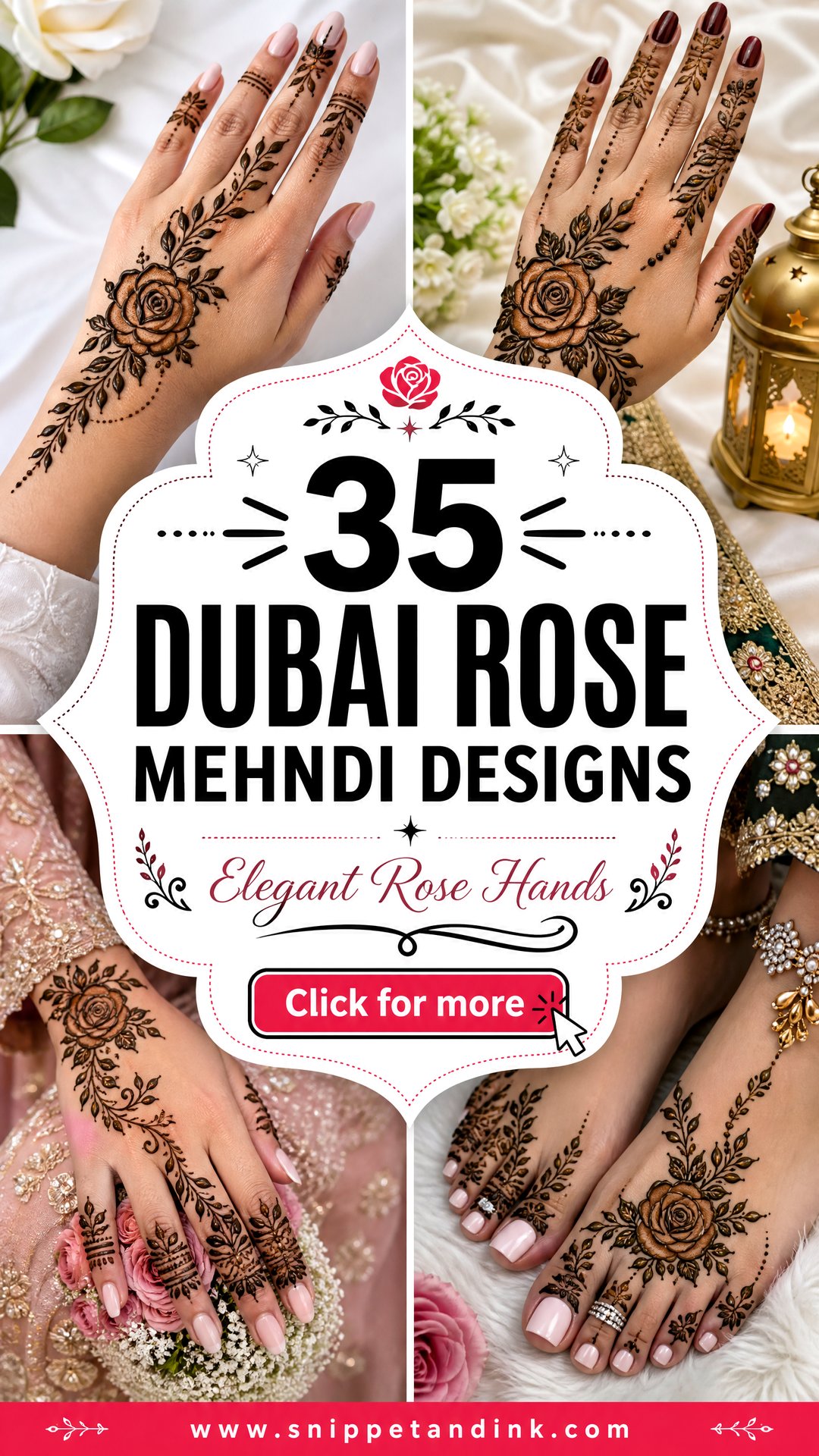
Roses are the flower I draw more than any other, and Gulf-style henna gives them the most room. Dubai rose mehndi designs pair big shaded roses with leafy vines, bracelet bands, finger detail and a lot of deliberate bare skin, which is why they work for Eid, weddings, engagements and quieter festive days alike. The rose brings the softness; the Dubai layout keeps it tidy. Below you’ll see light back-hand trails, full bridal layouts and simple palm roses, grouped by placement, occasion and hand type, with what I’d change for each.
Three Ways I Build a Henna Rose
Every design below depends on the rose itself, so it helps to know that artists don’t all draw it the same way. I use three constructions, and I pick between them based on the hand, the time and the look the client wants.
The spiral rose
A small tight swirl in the middle, then curved petals wrapping outward in a spiral. It’s the fastest and the most forgiving, which makes it the one I teach beginners. It reads best at small and medium sizes.
The layered cup rose
Petals stacked in rows like a cup, each row slightly larger than the one inside it. This takes longer and needs even spacing, but it gives the full, rounded bloom people picture when they ask for a Dubai rose.
The open shaded rose
Five or six large petals, each outlined boldly and shaded from the edge inward. It’s the most dramatic and the most Gulf-style, but it needs a confident hand and well-mixed paste, because uneven shading is obvious on petals that large.
1. Dubai Rose Mehndi Design Back Hand
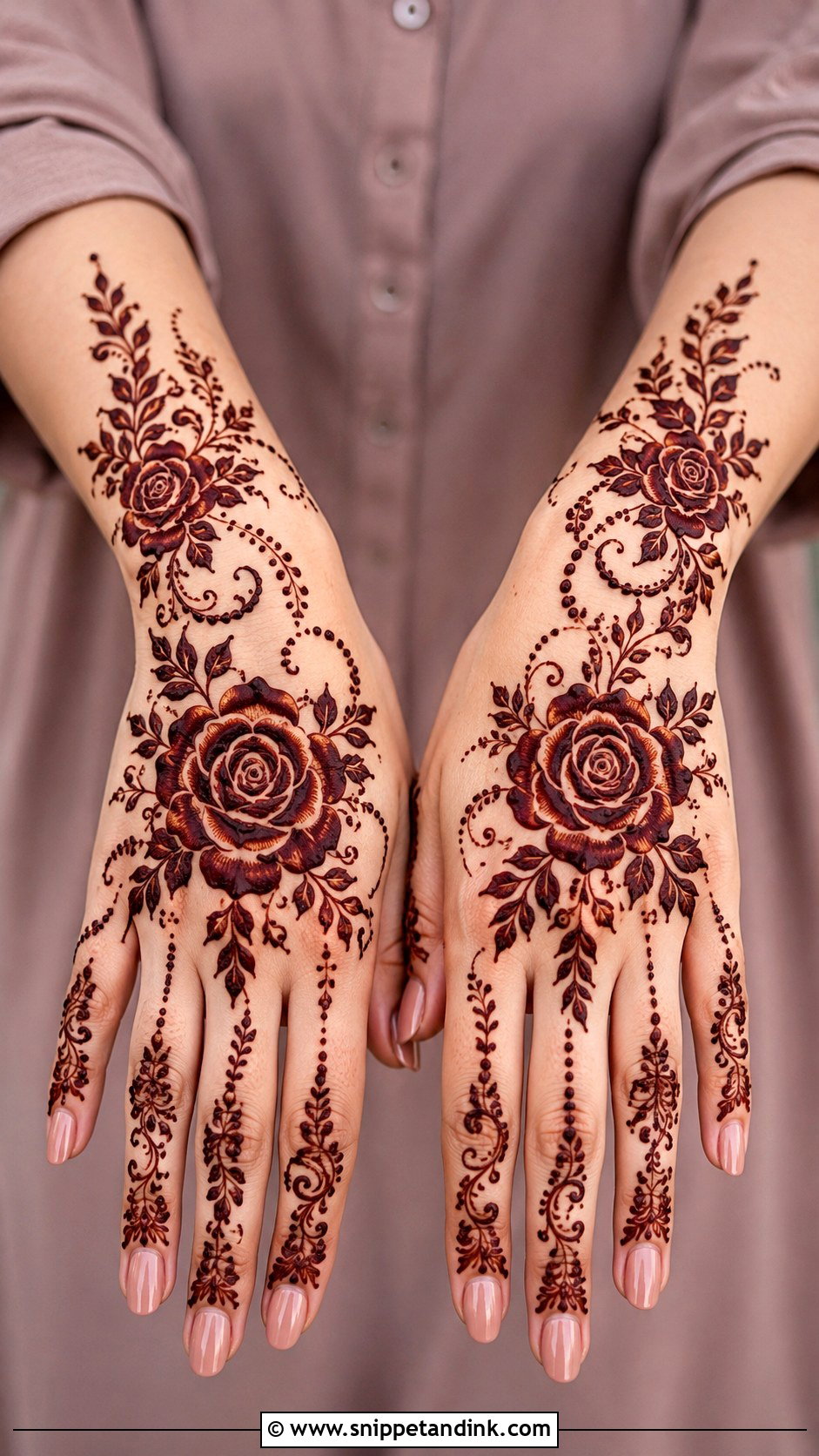
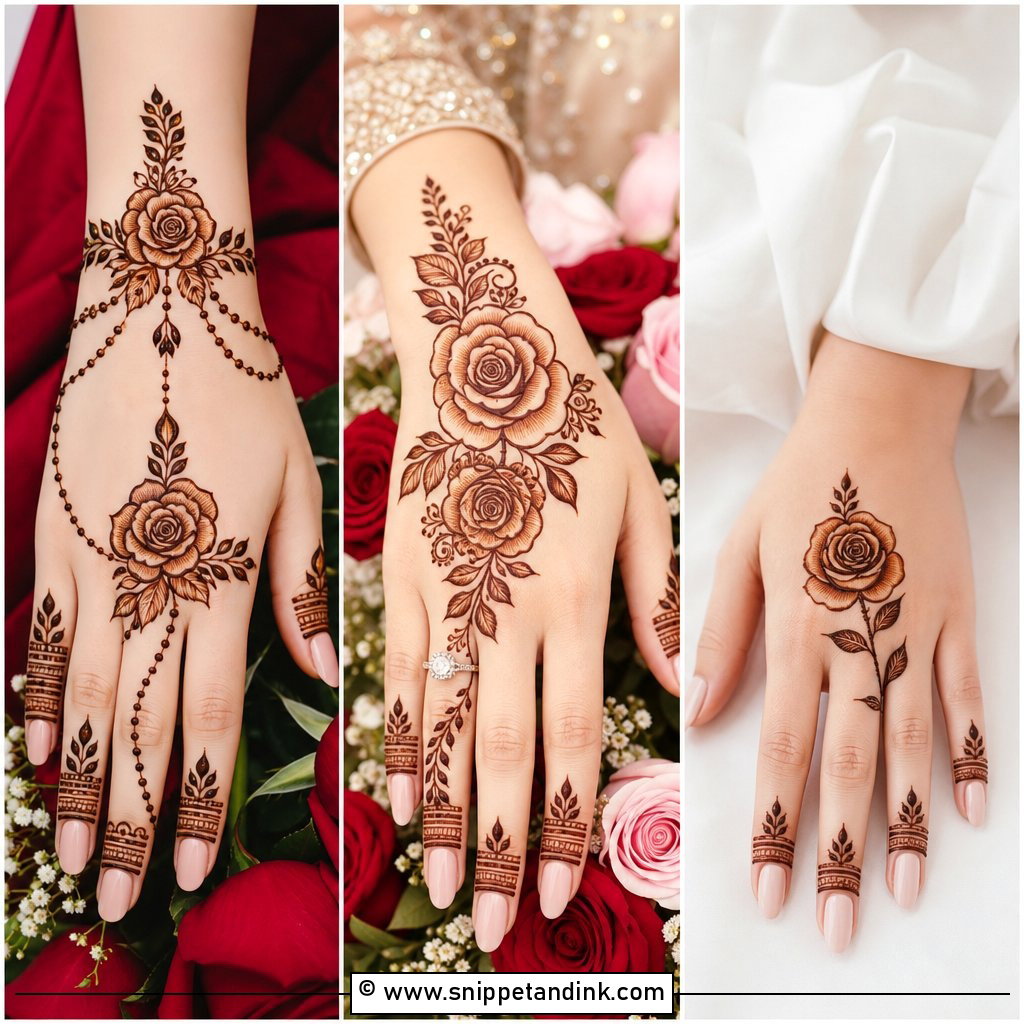
Give the rose space and it does the work. On the back of the hand I set the main bloom a little toward the thumb side of centre, then let vines run to the wrist or fingers. Bold, shaded, slightly layered petals make it read as full; slim leafy lines, dots and a rosebud or two on the fingers balance it. It’s my standard suggestion for Eid and family gatherings because it reads clearly in photos without a long sitting.
2. Dubai Rose Mehndi Design Front Hand
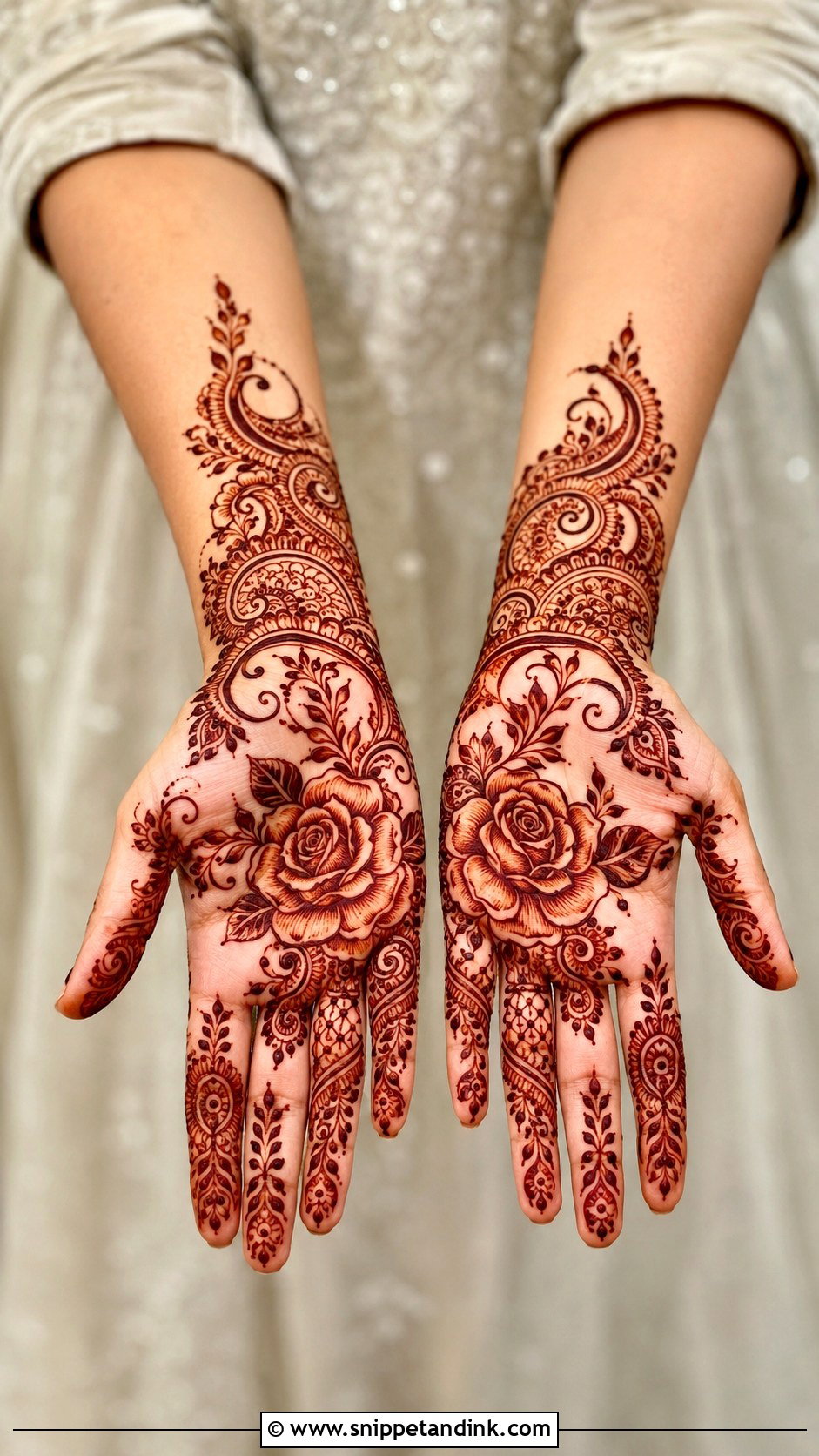
On the front hand, a rose takes on a richer, more traditional feel. The palm’s flat centre lets me put fine inner lines, dots and shaded edges into the petals, then frame it with paisley corners, a half mandala or a leafy border. Leave a thin channel of bare skin between the rose and whatever surrounds it. Without that gap, the petals merge into the border once the stain deepens and the rose disappears.
3. Simple Dubai Rose Mehndi Design
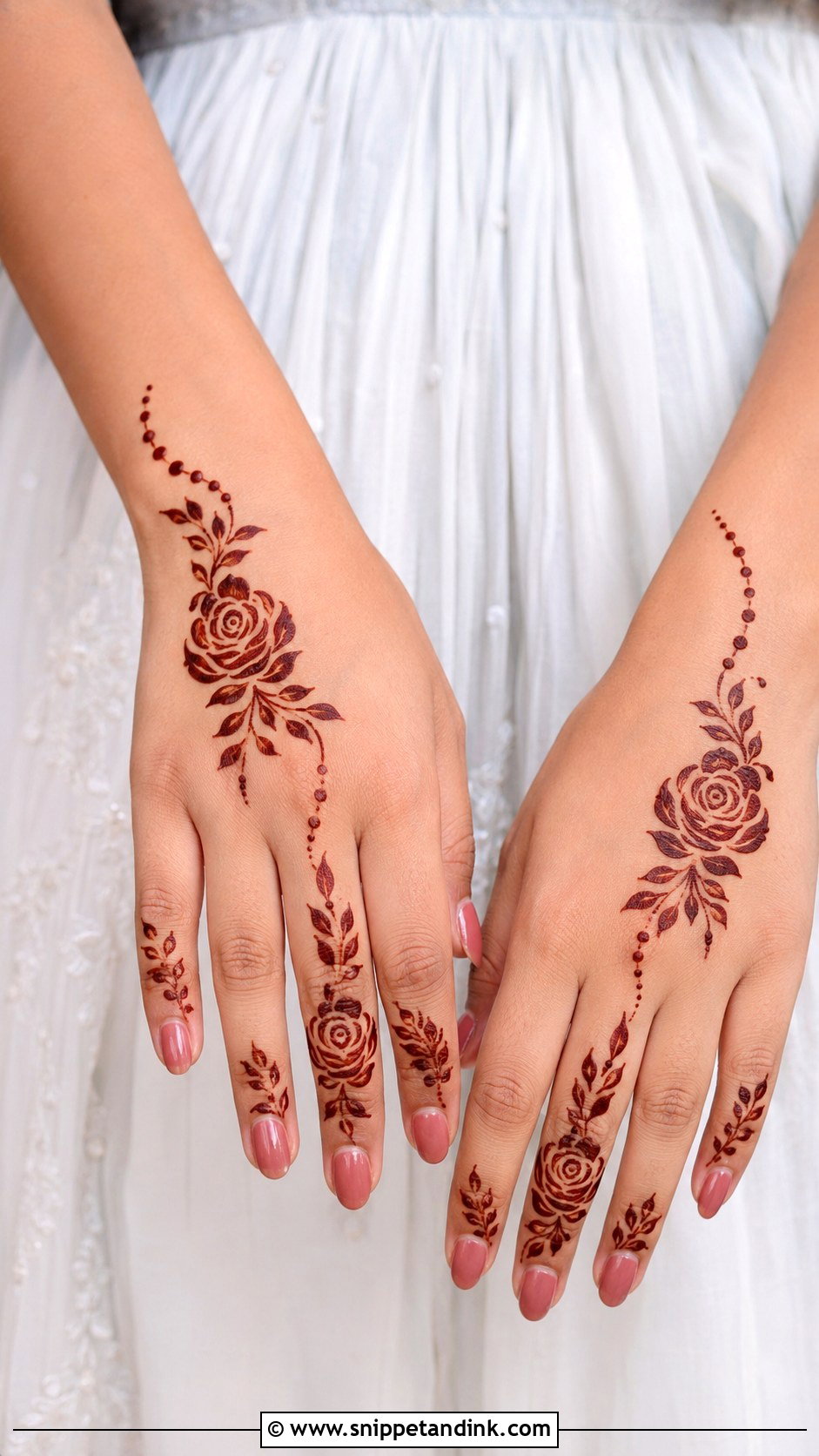
One medium rose on the back hand, a soft vine toward the index finger and a light line round the wrist. That’s the whole design, and it takes me minutes rather than an hour. Don’t fill the corners. Fingers get small leaves, dots and curved strokes at most. Working women, teens and first-timers tend to like it because it’s pretty for a weekend and fades without looking patchy.
4. Easy Dubai Rose Mehndi Design
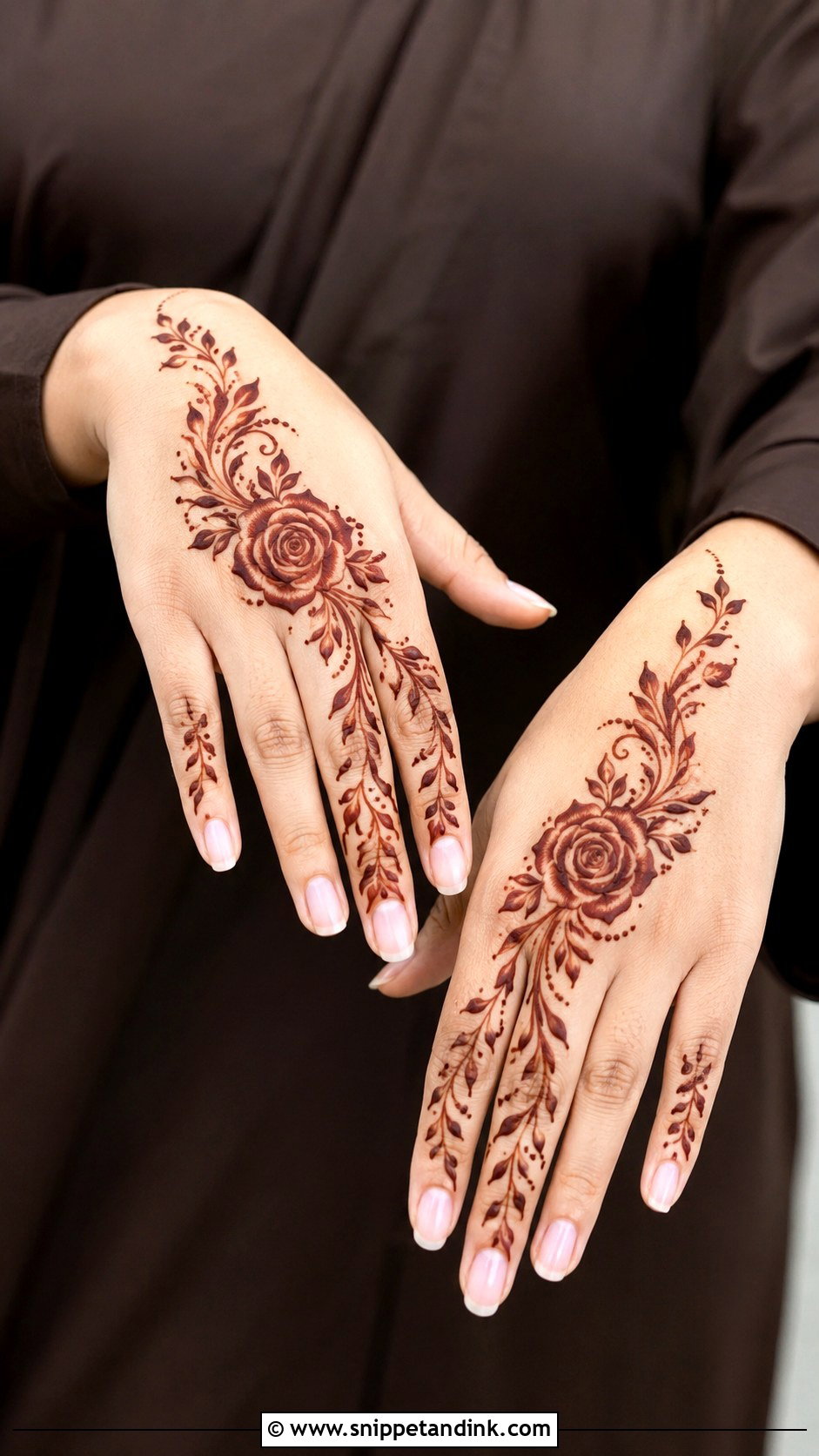
Easy doesn’t mean careless. Start with a round rose built from curved petal layers, connect it to a flowing vine, add leaves either side and finish with dots in the open spaces. The back of the hand suits it best because the vine can follow the natural line from wrist to fingers. If you’re drawing it yourself, practise the rose on paper ten times before you go near skin; the vine is easy, the rose is where the shape goes wrong.
5. Full Hand Dubai Rose Mehndi Design
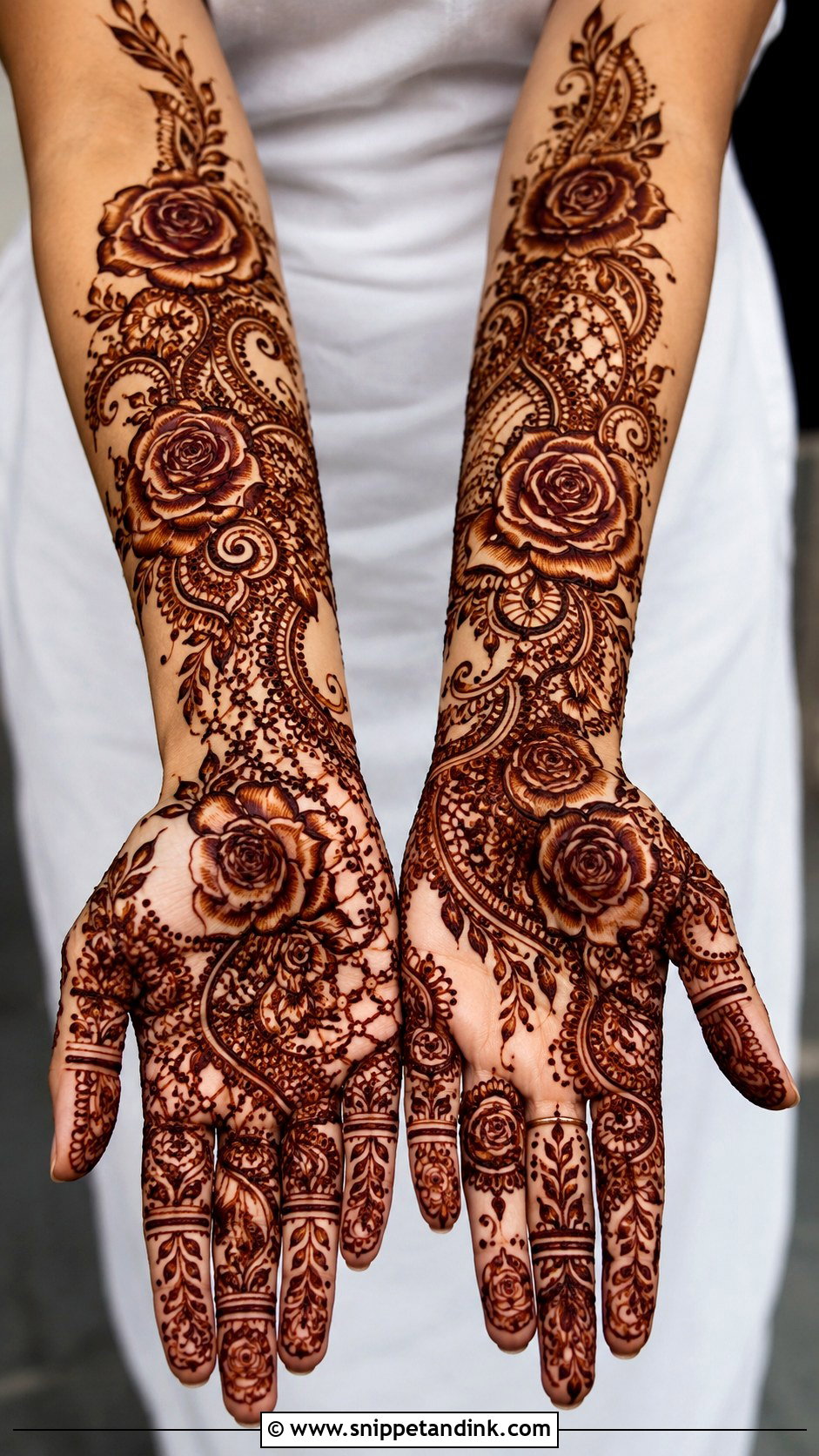
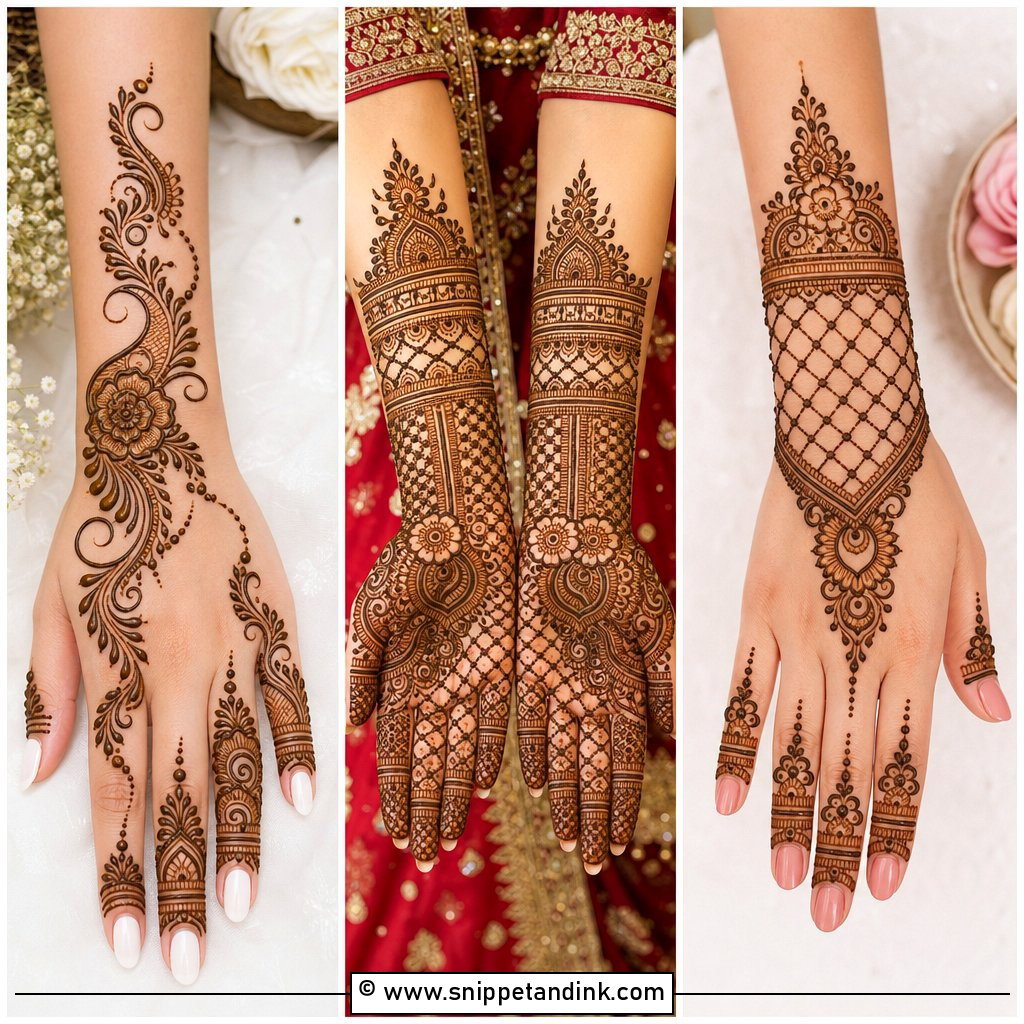
A full hand Dubai rose mehndi design covers fingers, palm or back hand, wrist and part of the forearm, anchored by large roses linked with vines, paisleys, shaded leaves and small filler flowers. Even at full coverage, I leave negative space between each rose cluster; otherwise the hand stains as one flat brown shape. Fingertips take fine lines and leafy strips. It suits bridesmaids and close family on the big day.
6. Bridal Dubai Rose Mehndi Design
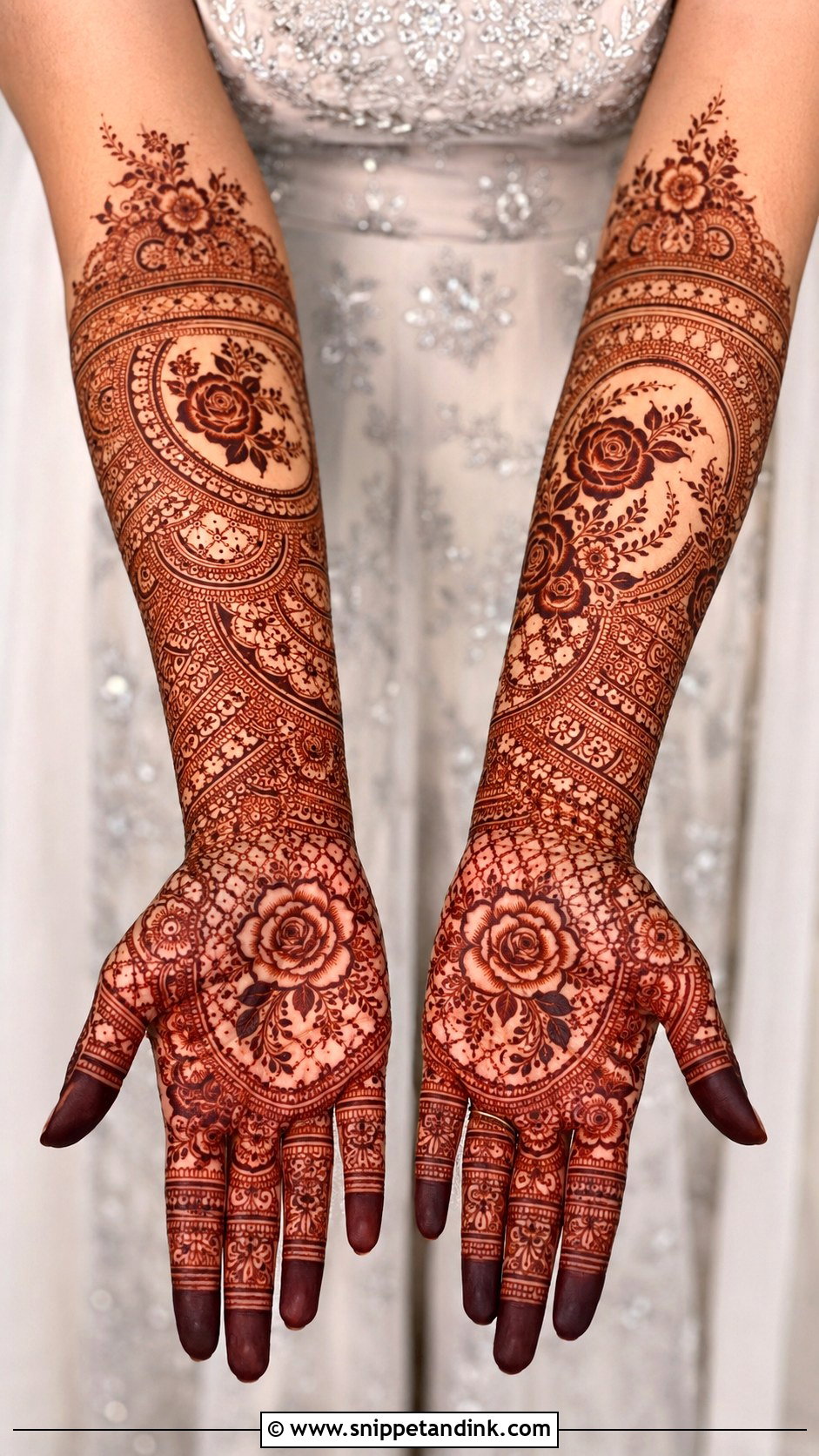
A bridal rose hand starts with large roses on the palm and continues into detailed vines across wrists and forearms, with paisleys, jaali, tiny florals and space for personal details. It should be fuller than party henna, yet every rose still needs to be visible. I draw the roses first on both hands, check they mirror each other, and only then add filler around them. Fingers get dense bands, leafy tips and floral chains.
7. Arabic Dubai Rose Mehndi Design
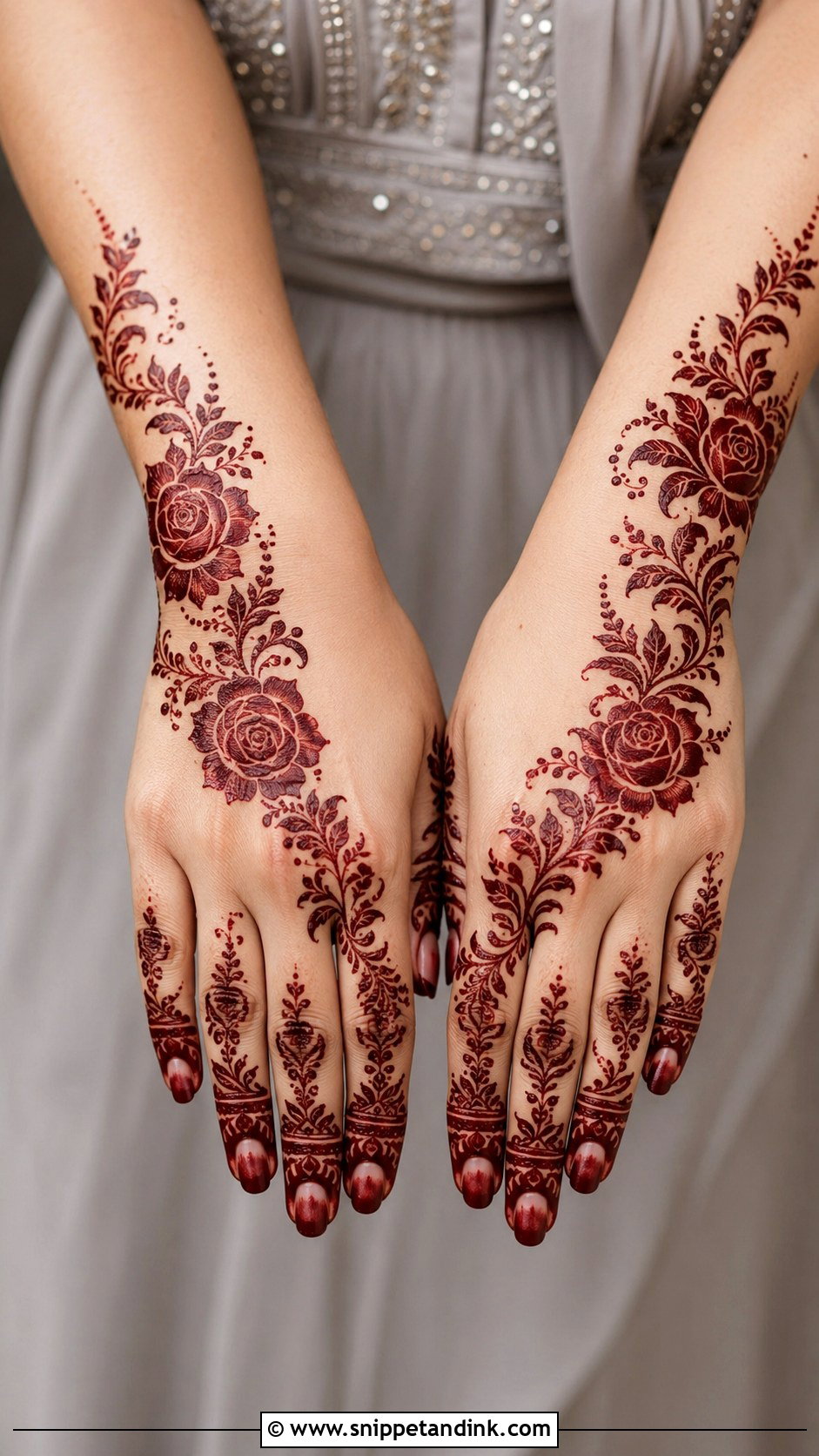
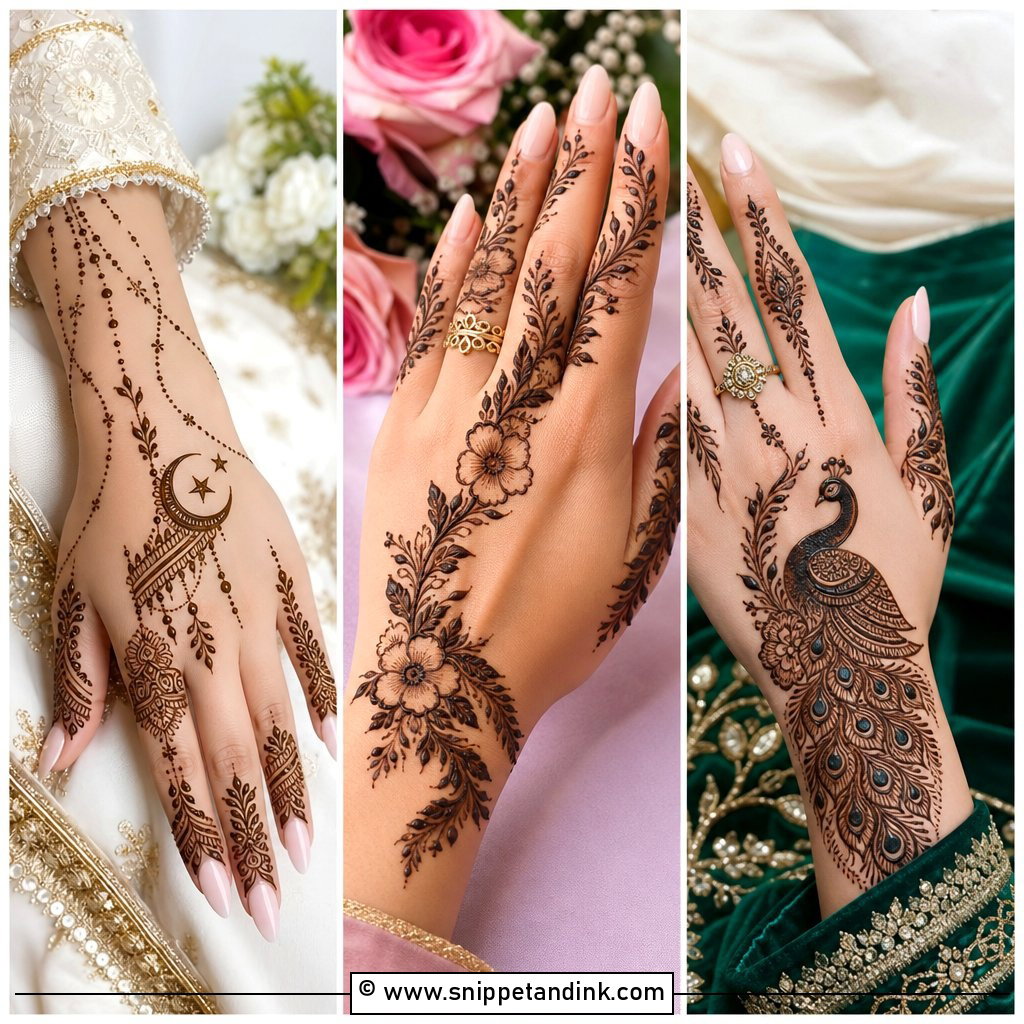
This is the classic Arabic rose trail: diagonal from wrist to index finger, roses along the way, each with a thick outline, soft shading and leaves curving with the hand. The empty spaces matter as much as the drawn ones. My outline cone for this has a slightly larger opening than my detail cone, because a thin outline on an Arabic rose looks hesitant. It goes with traditional and modern outfits equally.
8. Indo Arabic Dubai Rose Mehndi Design
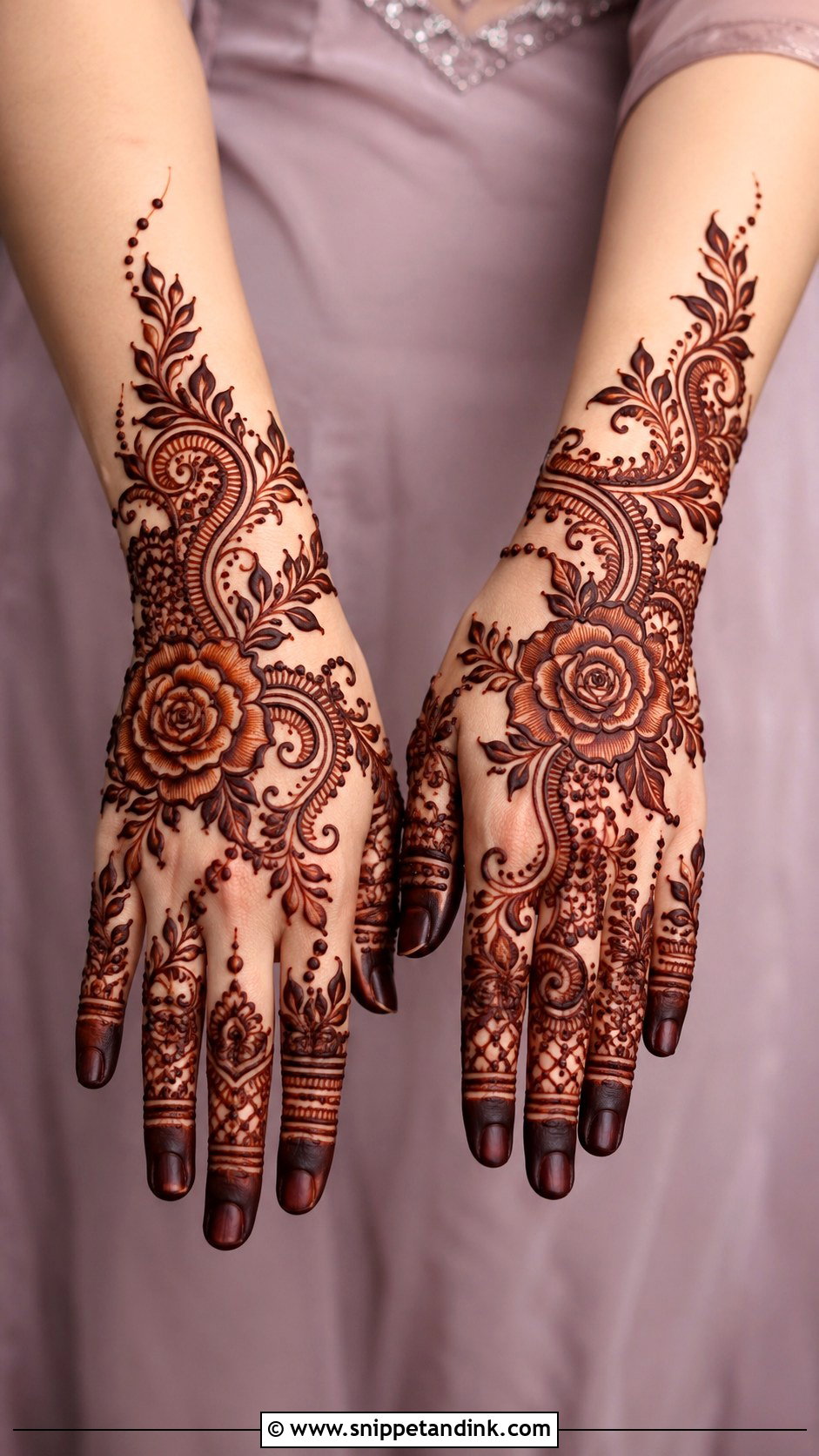
Indo-Arabic roses combine the open flow of Arabic henna with Indian detail: bold roses, paisley sections, mandala curves and fine filler, usually travelling diagonally from the wrist. The contrast between thick floral outlines and delicate interiors is the whole appeal. Keep the filler inside shapes rather than spreading it across the open skin, or the Arabic side of the design gets lost. It’s a good fit for engagements and semi-bridal events.
9. Dubai Rose Mehndi Design For Eid
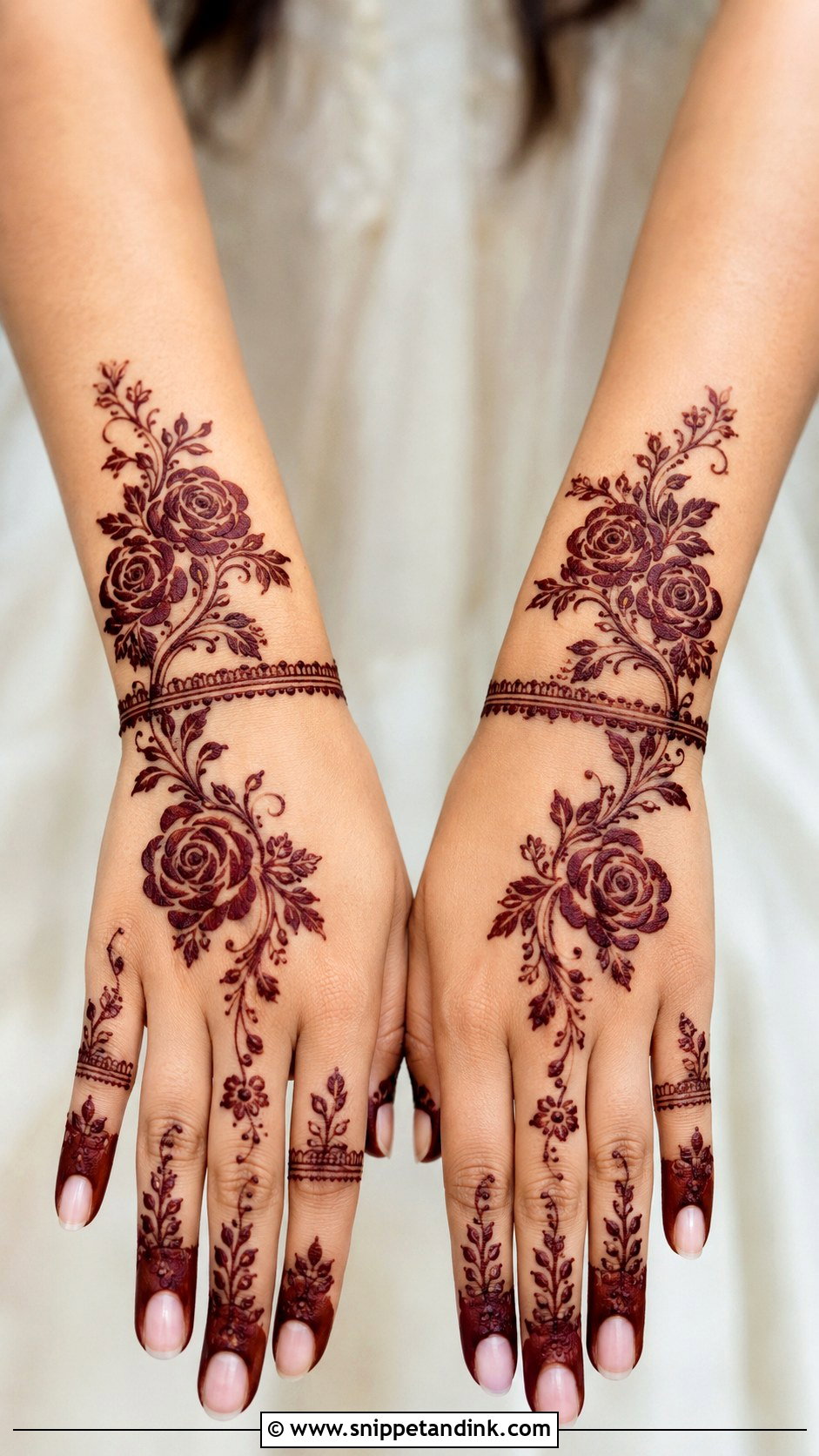
For Eid, two or three roses on the back hand with vines toward the fingers and a bracelet band or small floral cuff at the wrist is about right: festive, not bridal. Shaded petals, neat leaves and dotted accents give enough detail for celebration photos. I sometimes leave one or two fingers lighter on purpose. Book your slot a day or two before Eid if you can; the colour is at its best a day or two after the paste comes off.
10. Dubai Rose Mehndi Design For Wedding
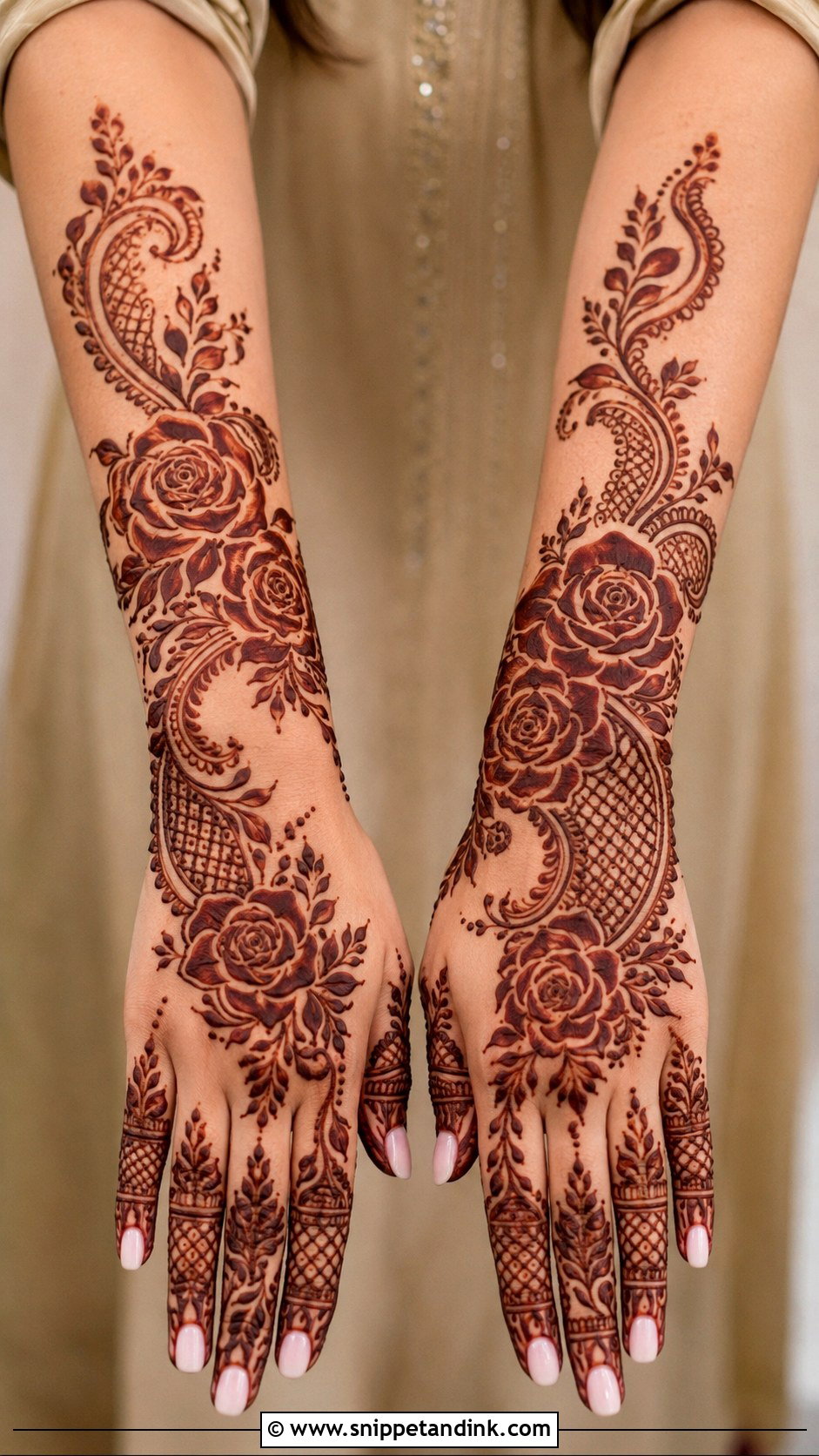
Wedding guests and the bride’s family can go richer: rose clusters across the back hand and up the forearm, with paisley curves, leafy vines, thin jaali sections and small floral fillers. Place the roses along a flowing line so the design looks graceful from the side as well as the front. It feels dressy without matching the density of the bride’s own henna, which is exactly where sisters and close friends usually want to land.
11. Dubai Rose Mehndi Design For Engagement
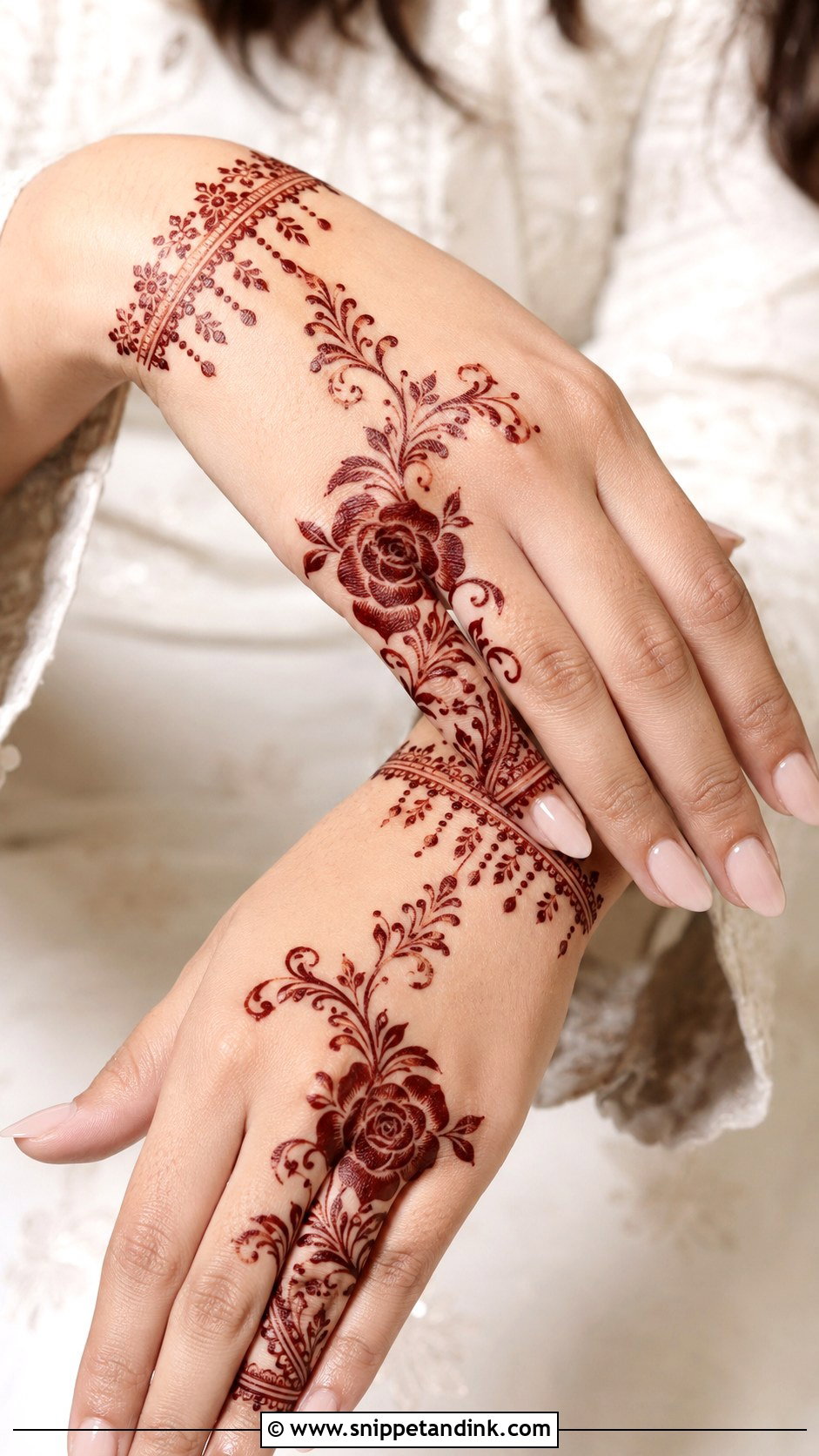
Roses and engagements go together naturally. I put a large rose on the ring-finger side of the back hand and let vines cross toward the wrist, which pulls attention to the ring in photos. Tiny leaves, dots, fine finger lines and a light wrist bracelet finish it. Keep the ring finger’s base clear so the ring sits on clean skin. Too much density and the ring gets lost in close-ups.
12. Dubai Rose Mehndi Design For Bride
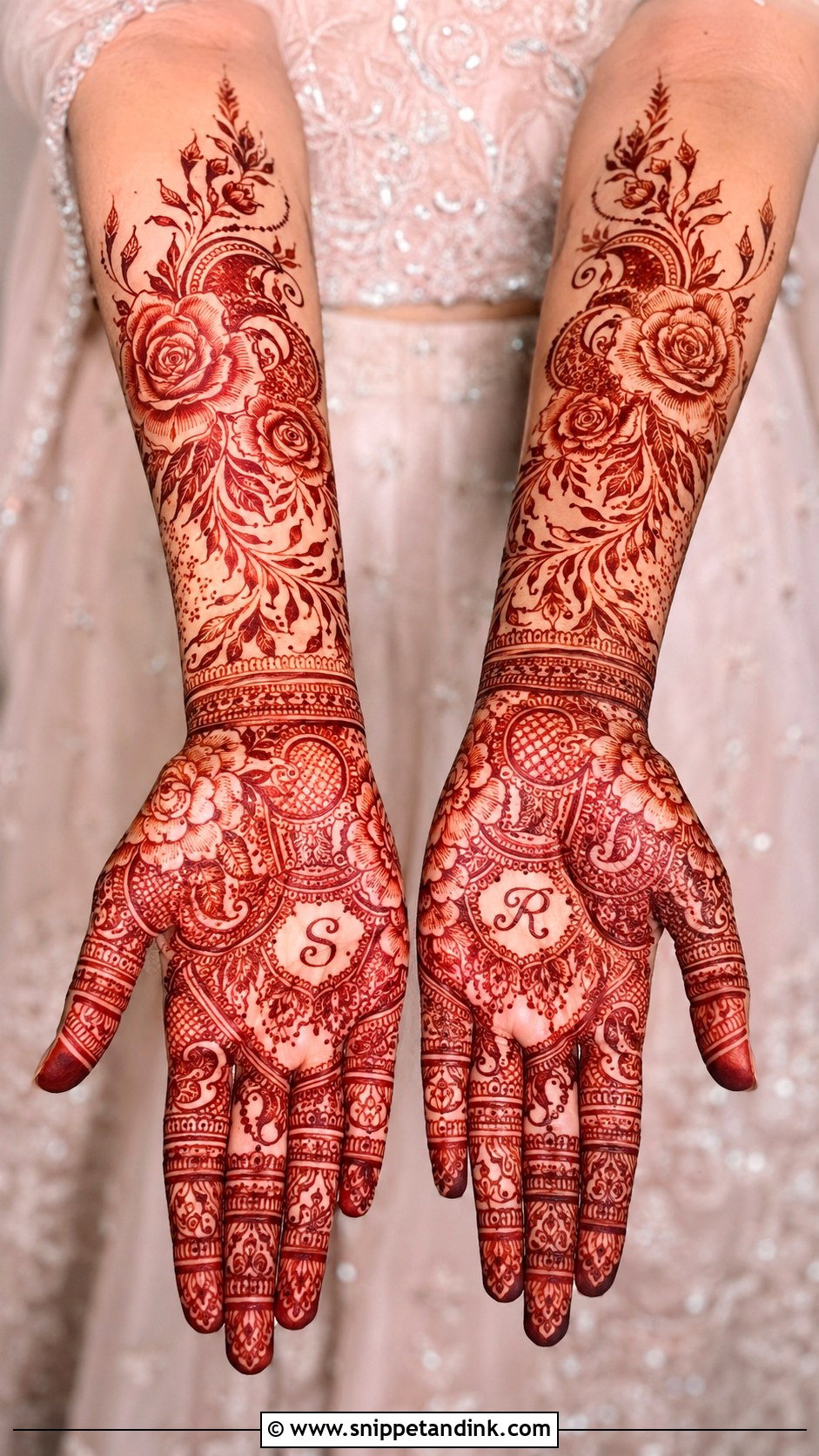
For a bride, I build rose clusters on both palms, wrist cuffs and forearm vines, with space for initials, small hearts, paisleys or matching rosebuds. Flowing lines and clear spacing keep it Gulf-style rather than traditional dense coverage. Fingers get detailed bands and leafy tips, and feet can follow with matching roses. If initials matter to you, tell me before I start; I plan their spot inside a rose centre or leaf so they look part of the design rather than added later.
13. Dubai Rose Mehndi Design For Bridesmaid
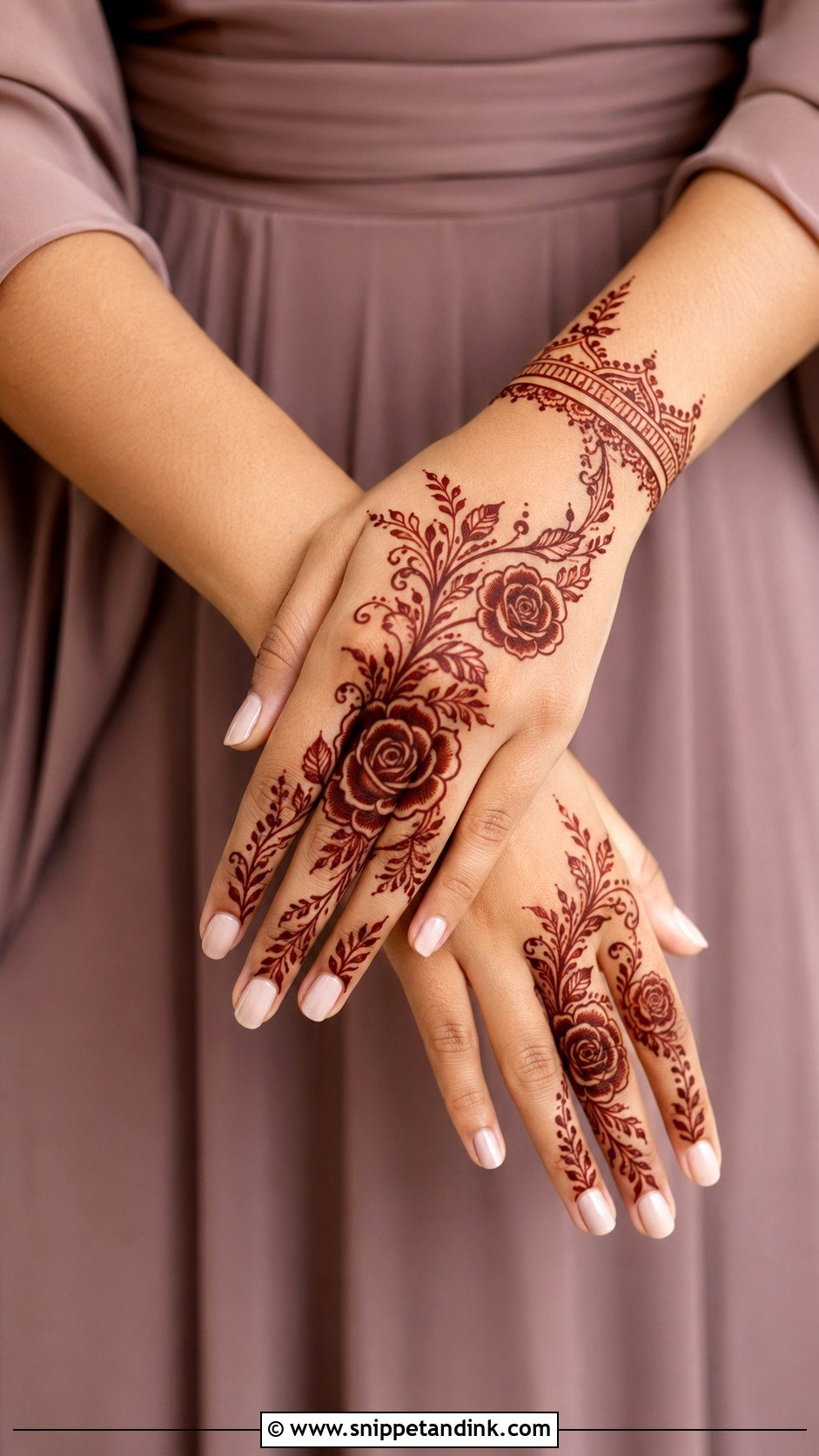
Bridesmaid hands need to be quicker than the bride’s. One large rose, two smaller ones and a vine to the wrist on the back hand, with light leafy fingers and a small cuff that sits under bangles, takes a fraction of a bridal sitting. When I do a whole group, I keep the same rose shape across everyone so the hands look related in photos, then vary the vines so each one is a little different from her neighbour.
14. Dubai Rose Mehndi Design For Kids
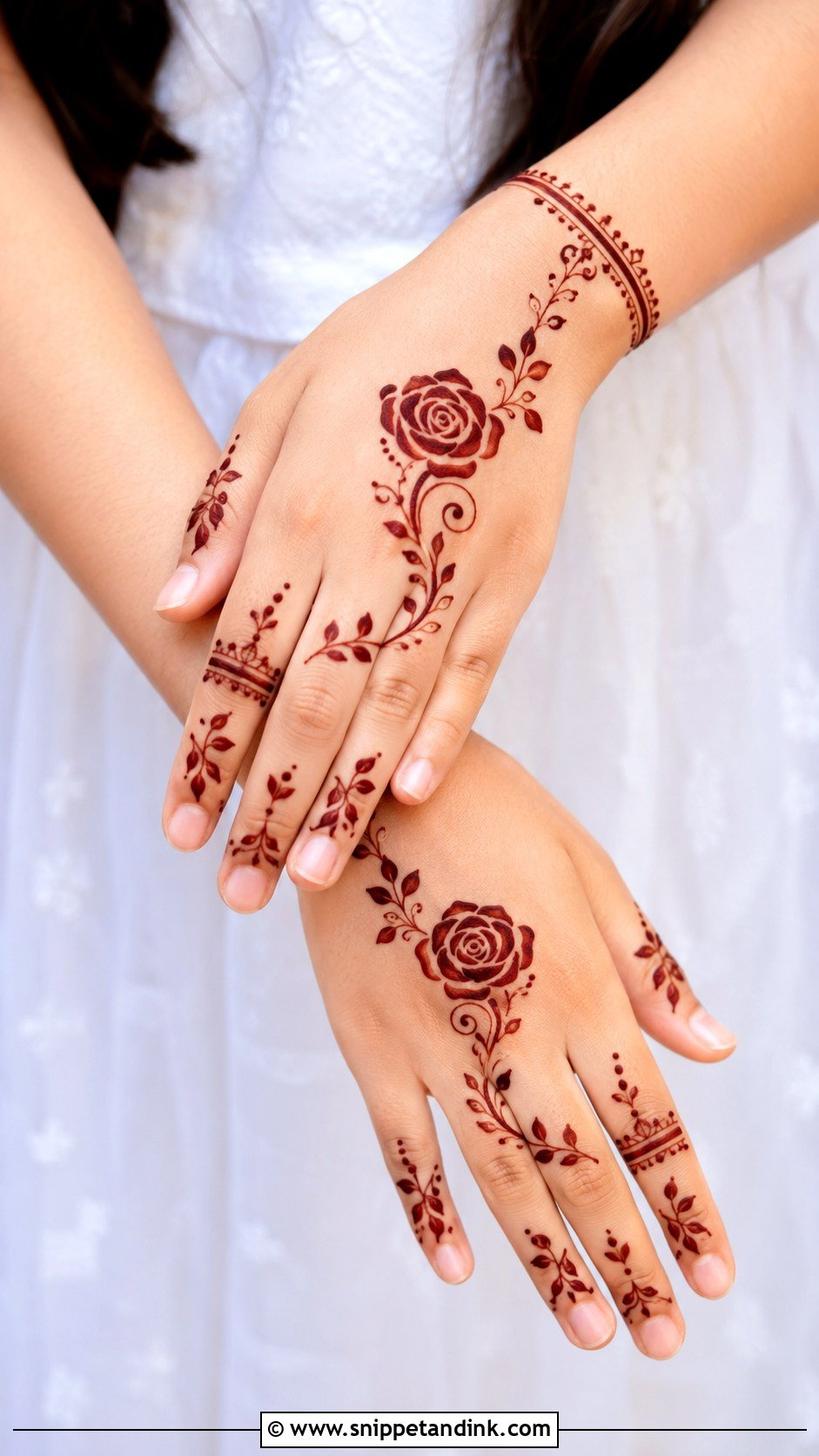
One small rose, a tiny vine and a few leaves on the back of the hand is enough for a child. Add dots and a little finger detail if they’re patient. Skip fine, time-consuming work entirely. I use slightly thinner paste lines on children so the design dries before they start grabbing things, and only natural henna, nothing that promises an instant dark colour.
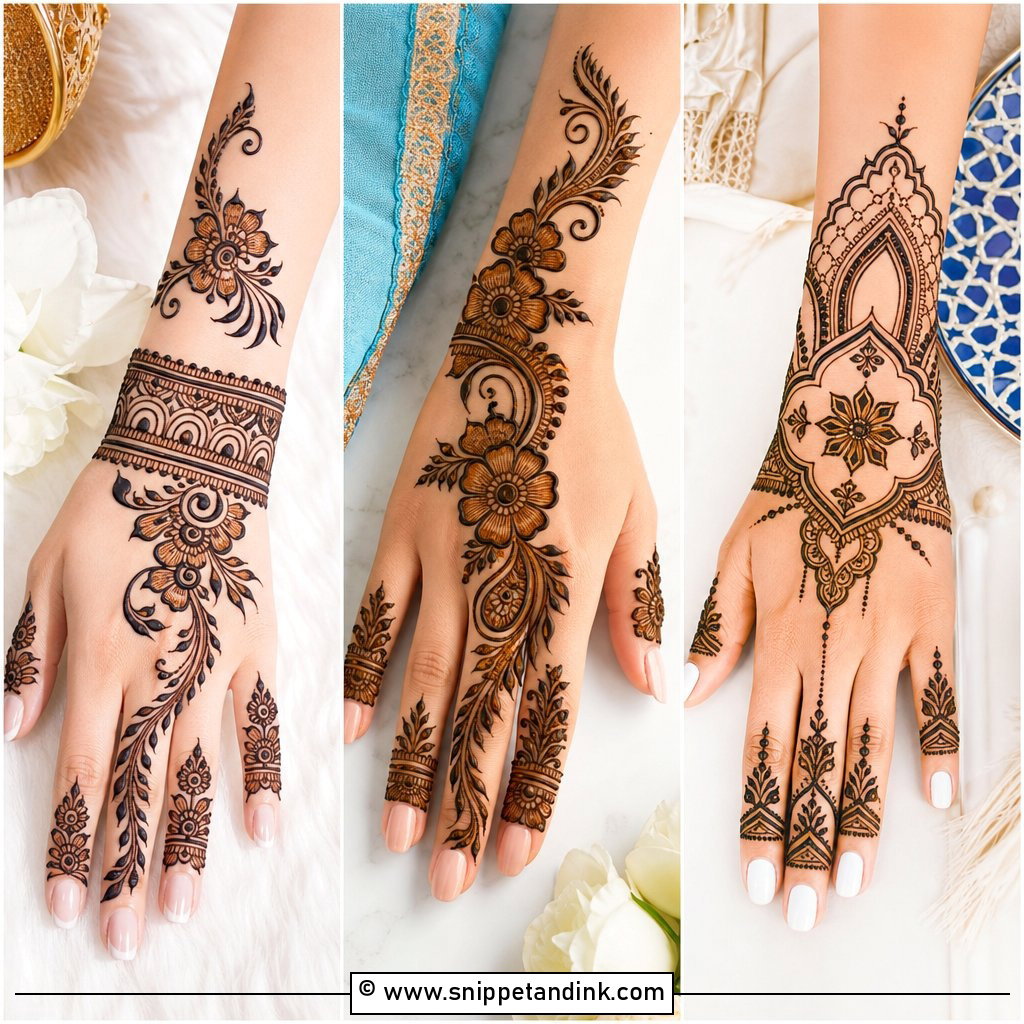
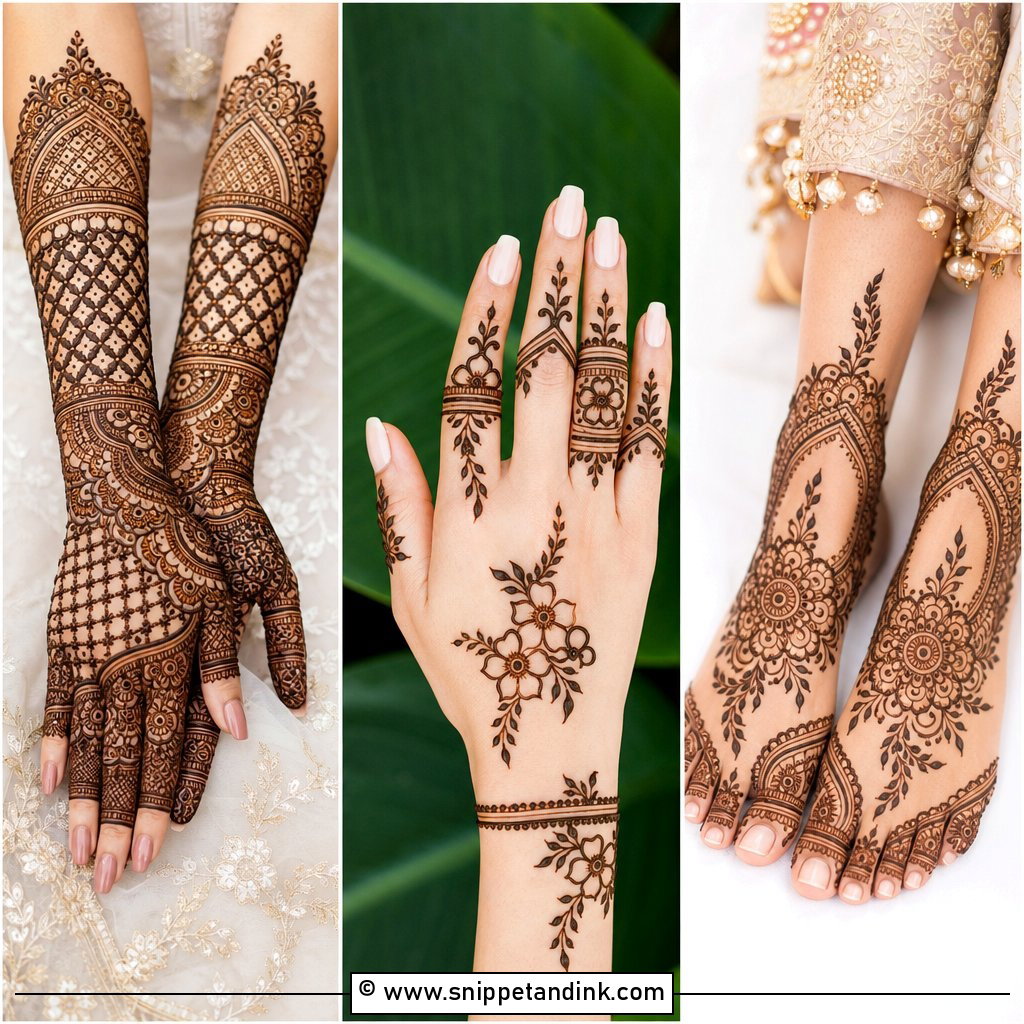
15. Dubai Rose Mehndi Design For Teenagers
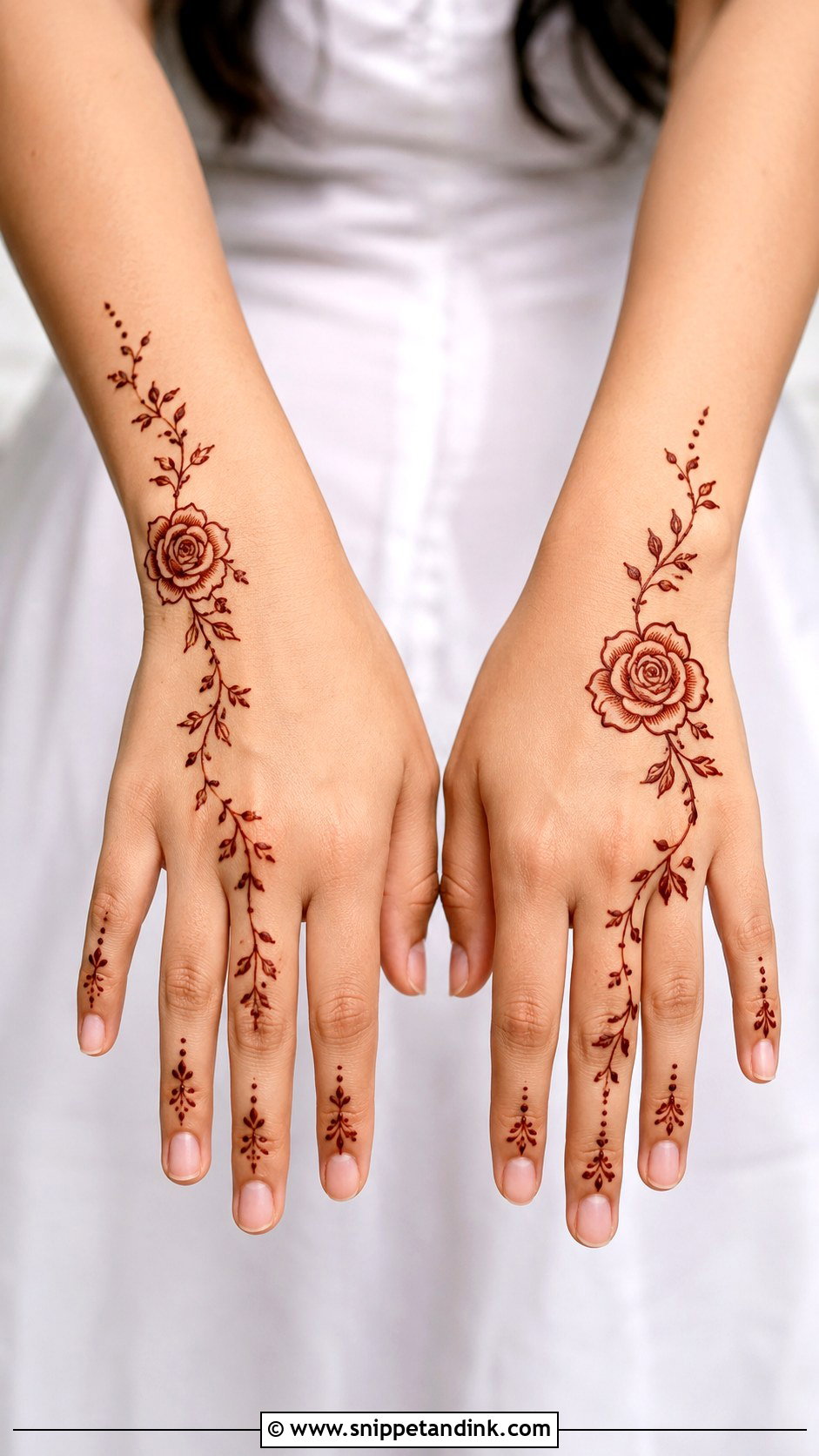
Teens usually want something modern and light rather than bridal. A slim floral trail on the back hand with an off-centre rose, thin leaves, small dots and a delicate wrist line looks current with both ethnic and fusion outfits. Leave the palms bare. For school events and family weddings, this also fades evenly, which matters when it’s still on your hands the following Monday.
16. Dubai Rose Mehndi Design For Small Hands
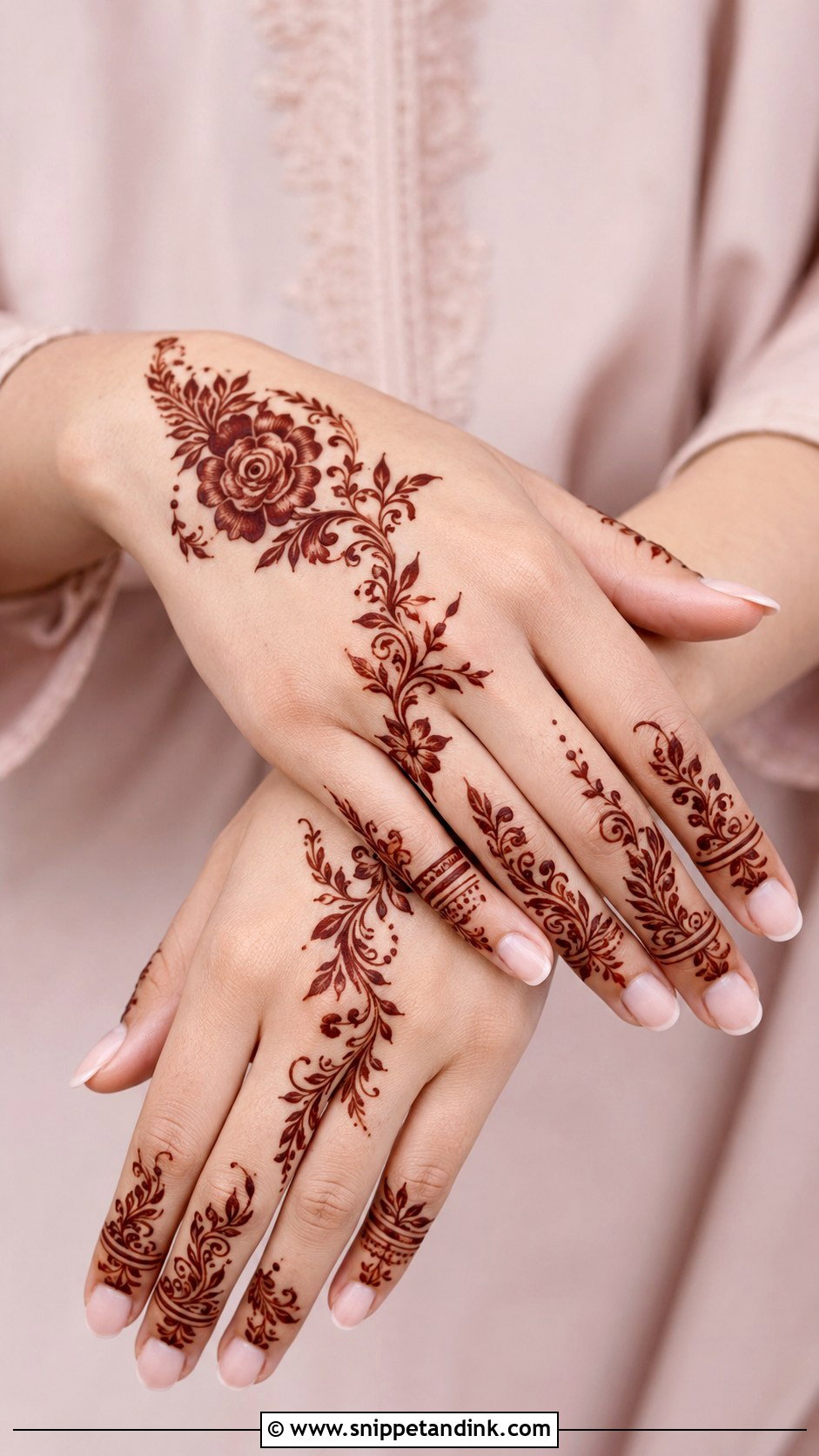
On small hands I scale the rose to sit within the width of three knuckles at most, then add one short vine toward the wrist. Fingers get slim lines, not heavy bands. Smaller leaves, fewer dots and simple petal shading keep it balanced, and open skin around the rose makes the hand look longer. Two large roses on a petite hand nearly always look cramped; one well-sized rose looks deliberate.
17. Dubai Rose Mehndi Design For Long Fingers
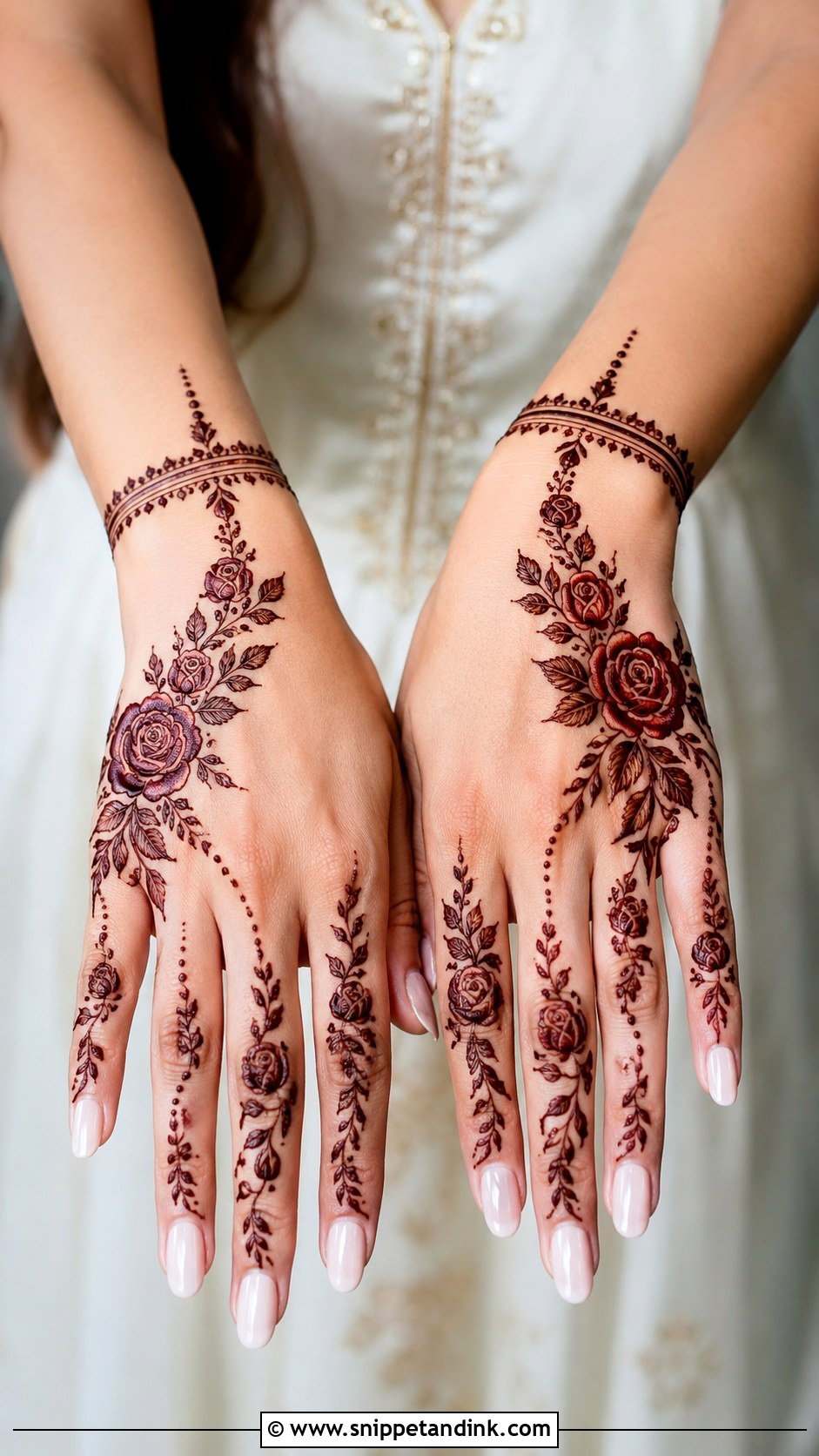
Long fingers give you room to stretch the design. A large rose cluster on the back hand, then leafy lines, slim rosebud chains, fine dots and curved bands up the fingers to show off the length. A light bracelet links to the main vine. Balance the hand itself with medium detail; I’ve seen designs that put everything on the fingers and leave the back of the hand looking unfinished.
18. Dubai Rose Mehndi Design For Fair Skin
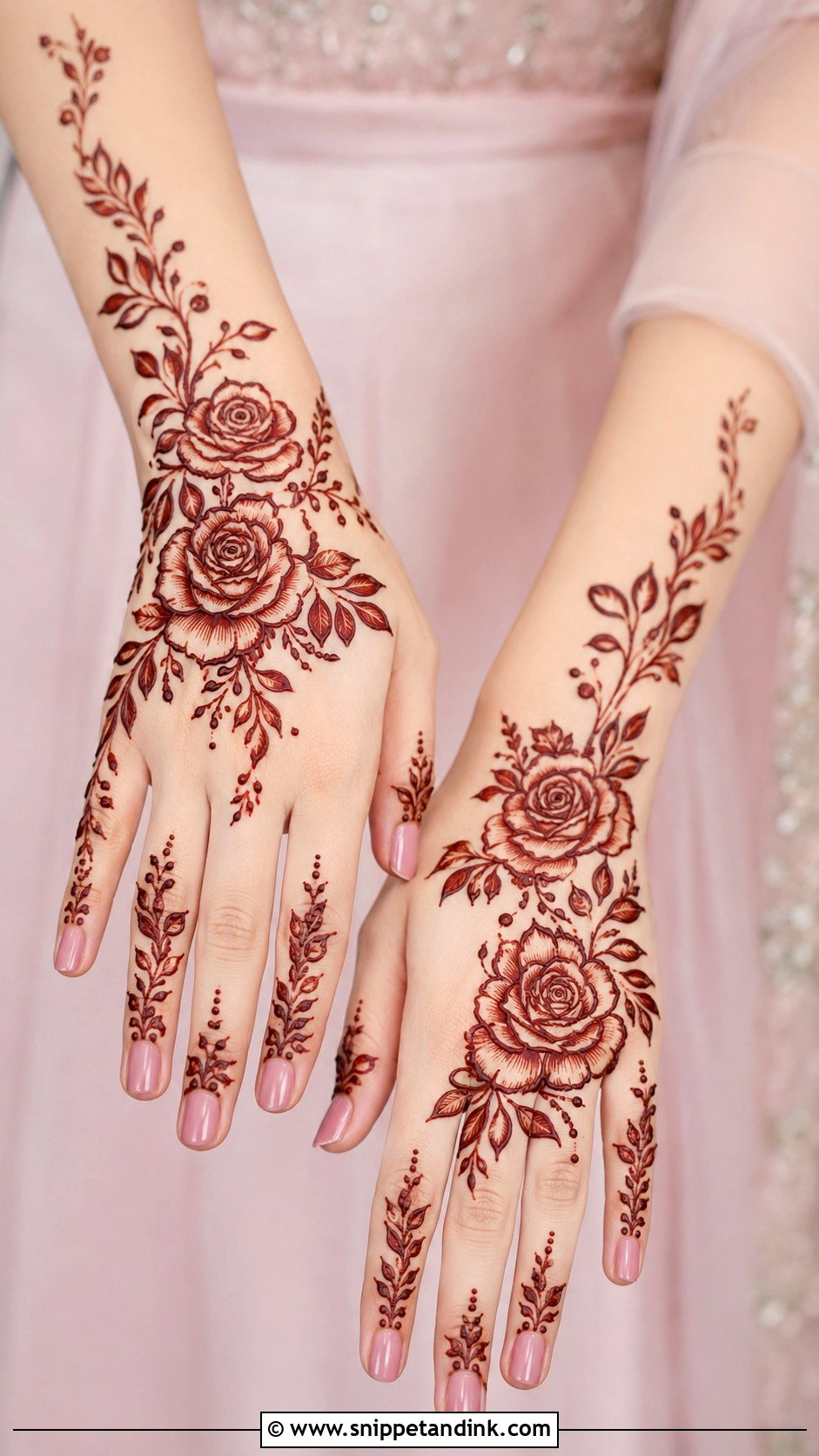
On fair skin the stain contrast is high, so the reddish-brown or maroon reads sharply. That means fine internal petal lines stay visible, and so does every wobble. I’m more careful with line quality here than anywhere else. Bold outlines, shaded petals and fine vines across the back hand, with open space around each rose, give crisp close-up photos for Eid, engagements and family weddings.
19. Dubai Rose Mehndi Design For Dark Skin
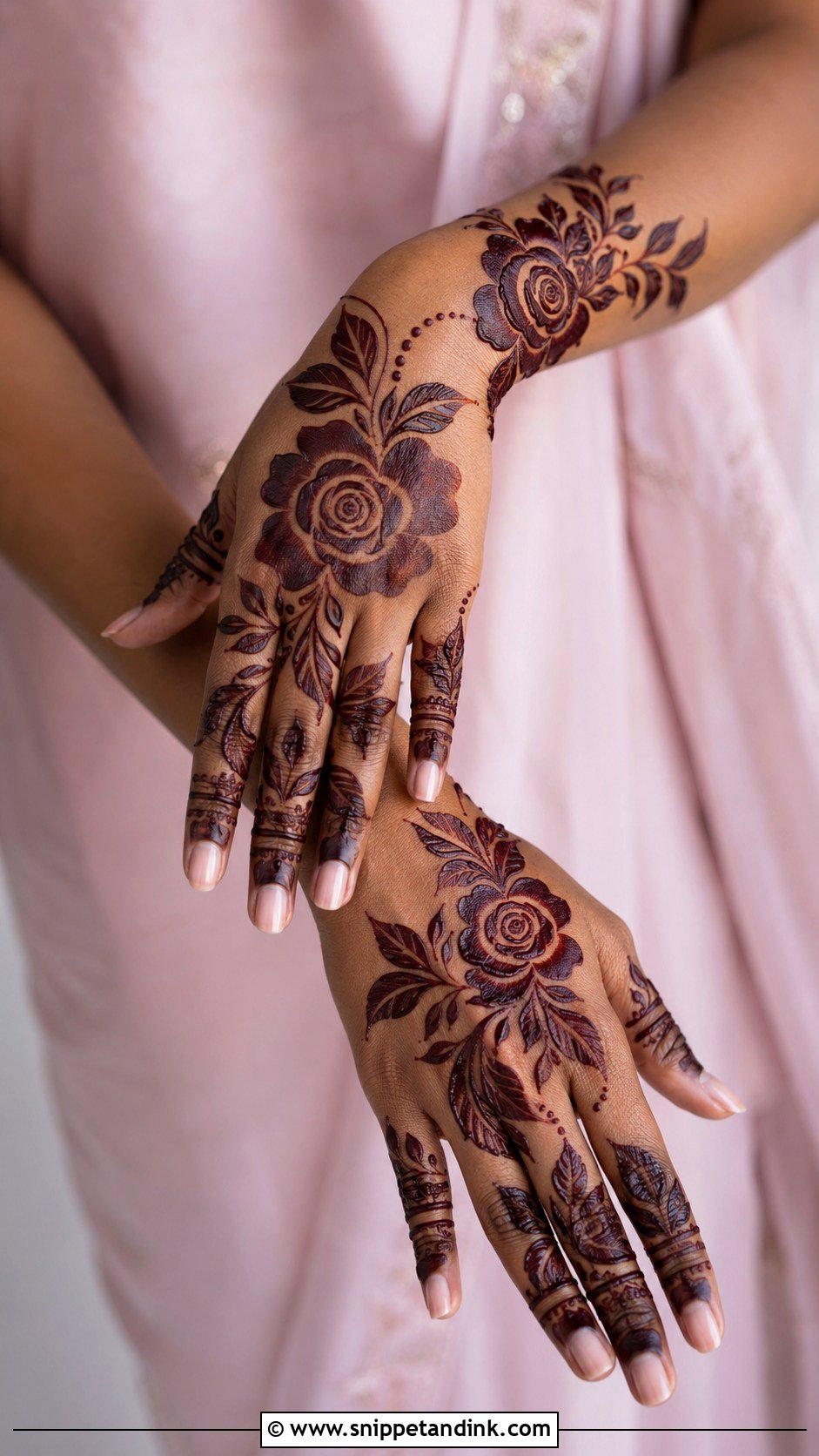
On deeper skin, henna still stains the same way, but the contrast is lower, so the design reads as a warm darker brown. I adapt the drawing rather than the paste: bolder outlines, thicker petals, larger motifs and fewer tiny fillers, which can blur into the skin tone from a distance. Two roses on the back hand with open spaces and decorated fingers is a flattering layout. Deeper shading inside the petals adds dimension.
20. Dubai Rose Mehndi Design With Bracelet
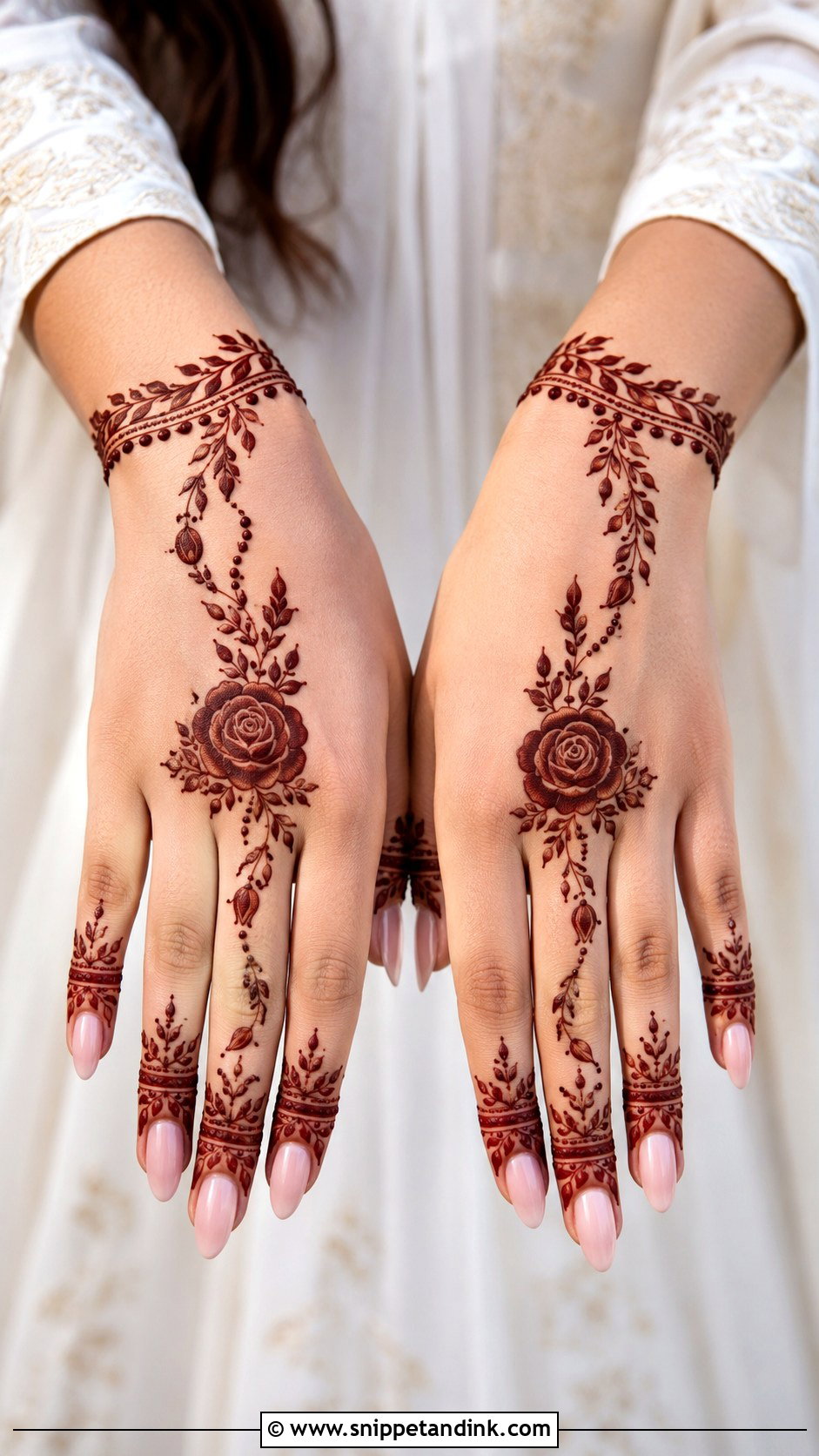
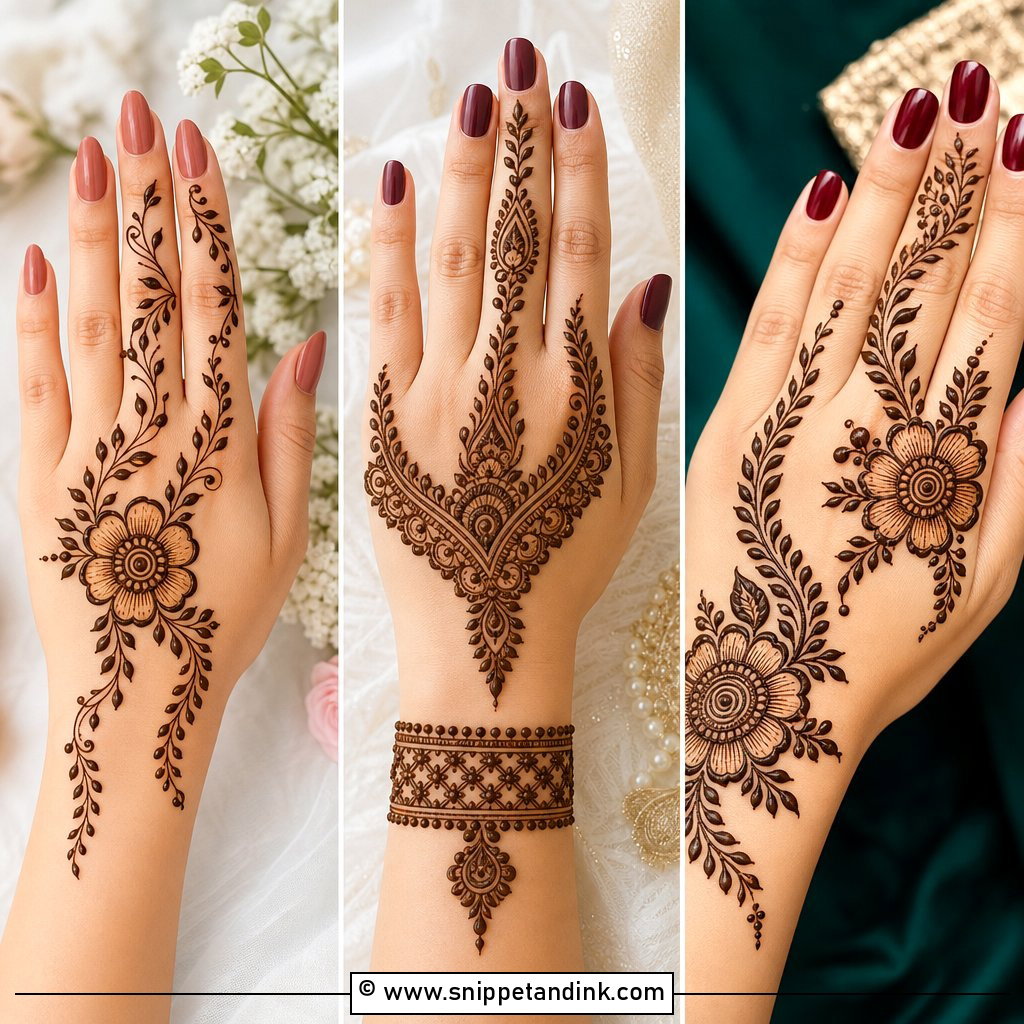
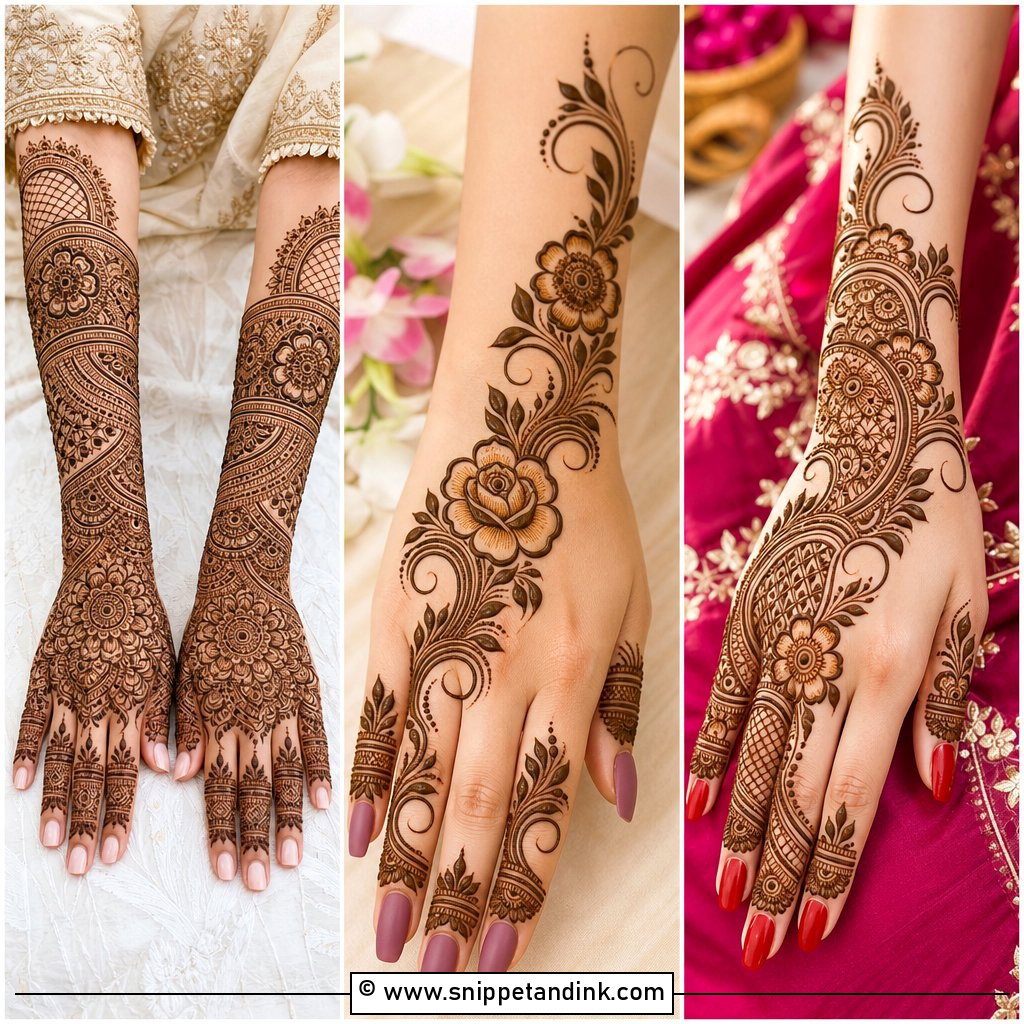
The bracelet layout puts the rose on the back hand and a band of leaves, dots and small floral links round the wrist, with a vine running to one finger for a soft hand-chain effect. It works with rings and bangles and looks complete without them. I draw the band with the wrist straight and the hand relaxed so it sits level once you move. The rose remains the focus; the wrist adds structure.
21. Dubai Rose Mehndi Design With Finger Trail
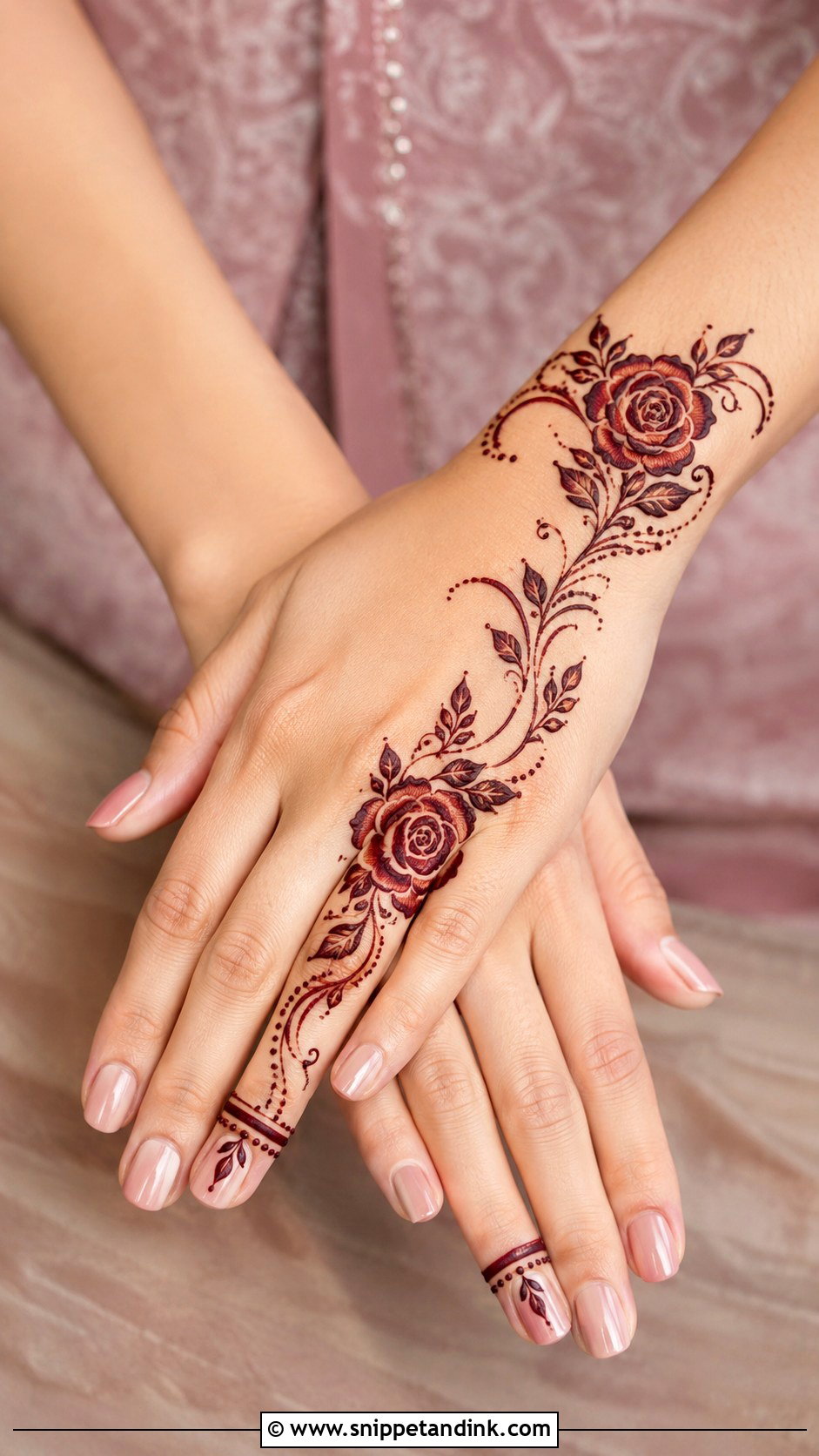
One strong path: a rose on the back hand and a curved vine toward the middle or index finger, with leaves, dots, mini petals and small bands near the tip. The other fingers stay lighter so the trail stands out. It’s a clean, modern option for family events and dinners. I finish the trail just short of the nail edge, since paste on the very fingertip tends to wear off first.
22. Dubai Rose Mehndi Design With Mandala
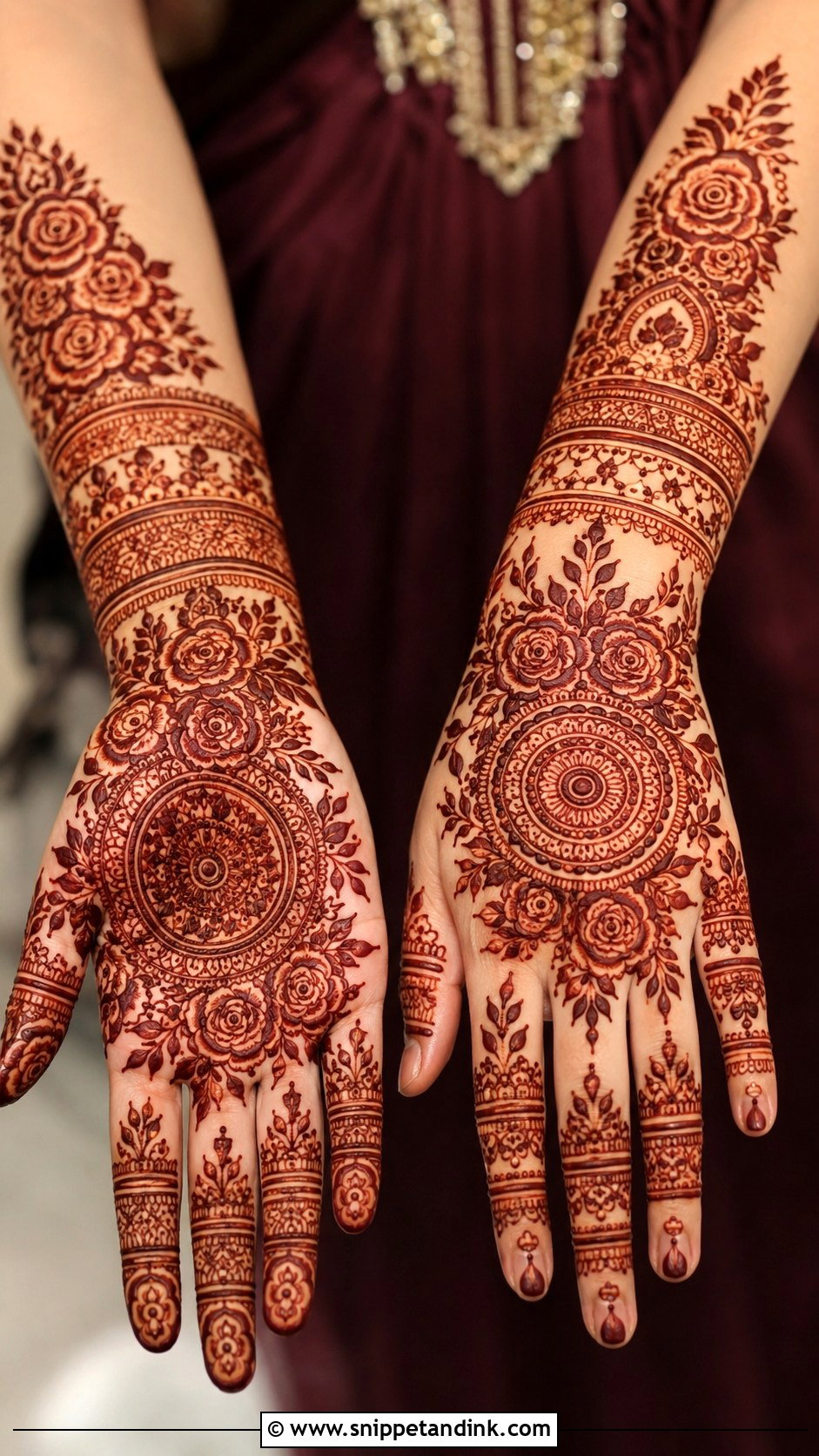
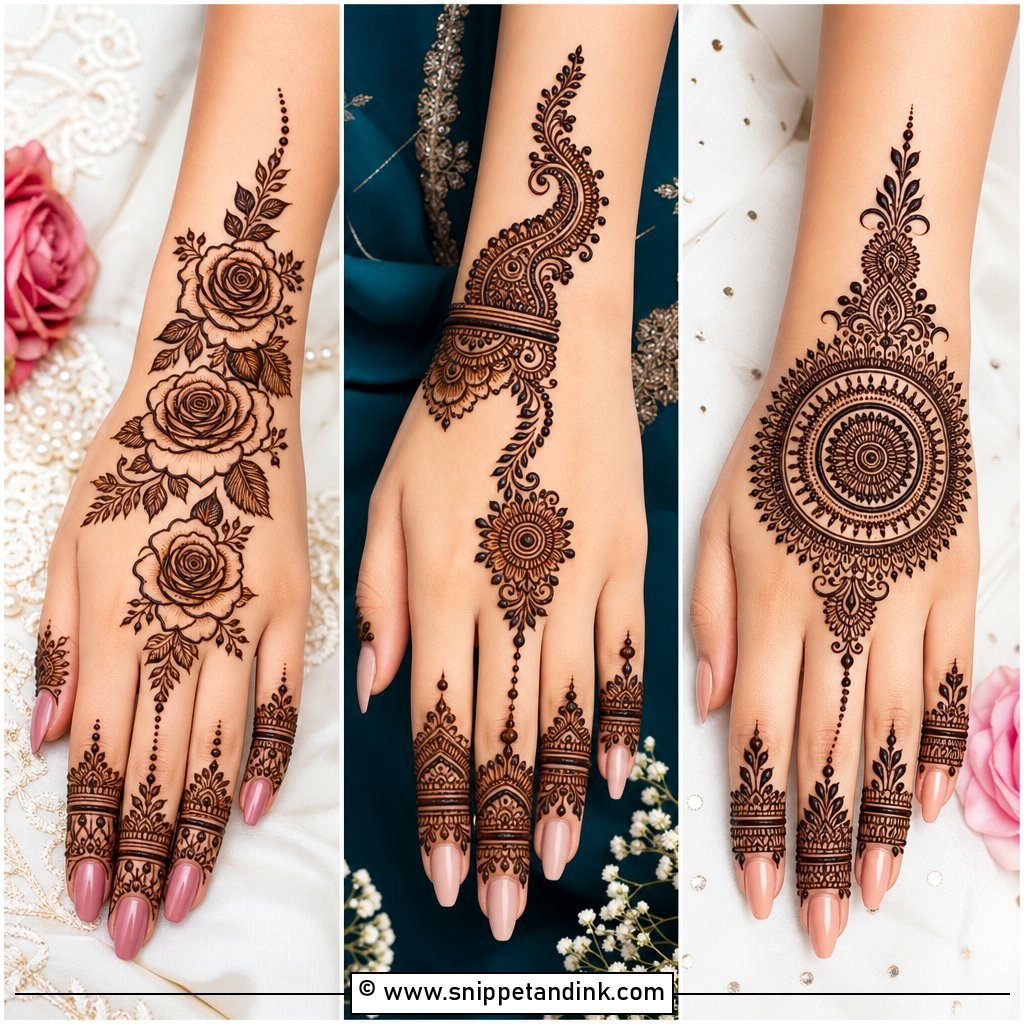
A round mandala on the palm or back hand, framed by rose clusters and leafy vines, puts symmetry and floral movement side by side. Clean inner circles and small dots round the edges keep it polished; fingers get repeated bands and slim leaves. The rose should sit off the mandala’s edge rather than overlapping it, so each shape keeps its outline when stained.
23. Dubai Rose Mehndi Design With Jaali
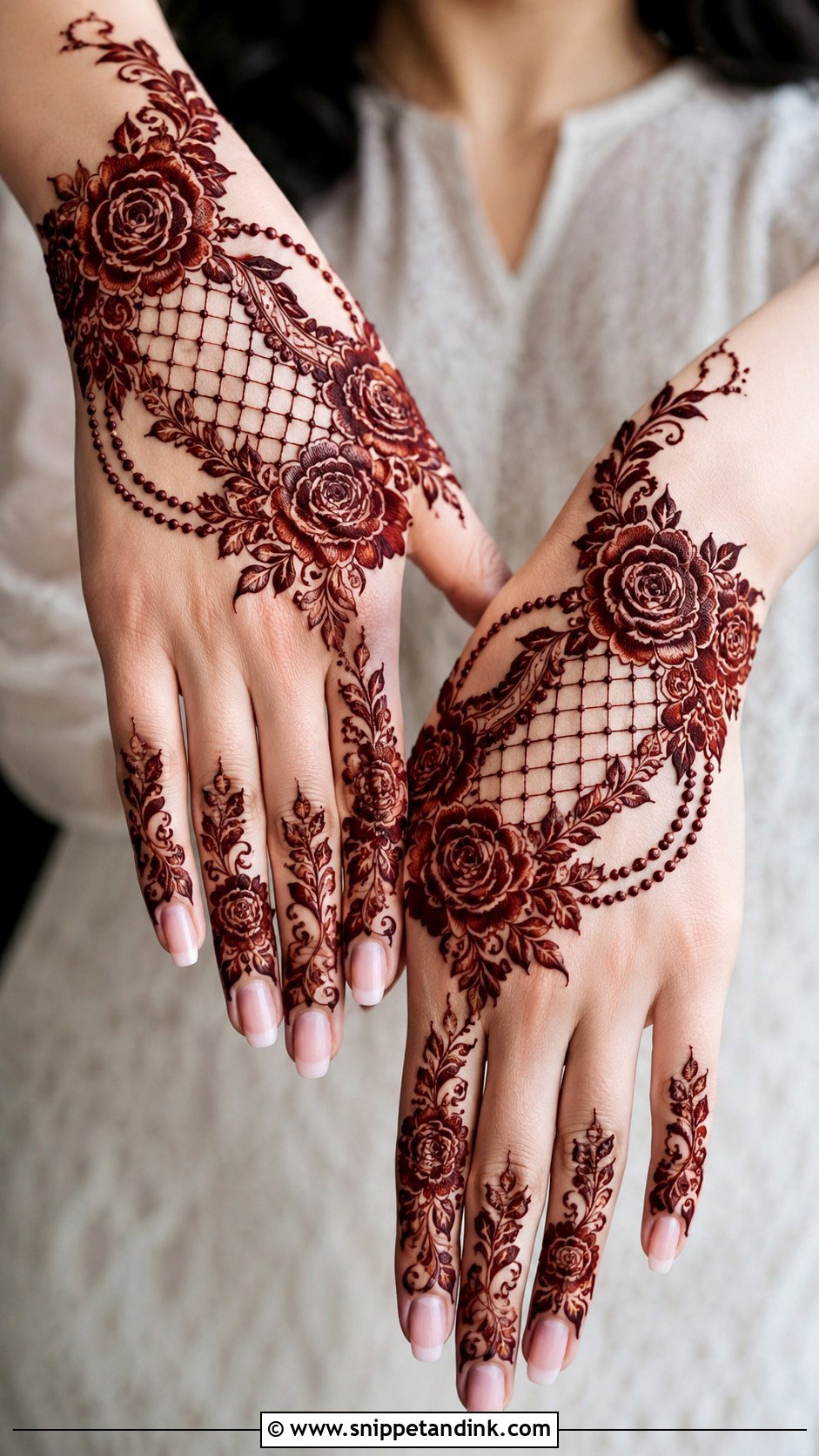
A rose cluster on one side of the back hand with a small jaali panel near the wrist or fingers gives detail without heavy coverage. Soft petals against geometric mesh is a good contrast. I connect the two sections with leaves so they don’t look like separate designs, and keep the mesh lines evenly spaced with dots at the crossings. It looks intricate in photos while staying open, which suits guests well.
24. Dubai Rose Mehndi Design With Paisley
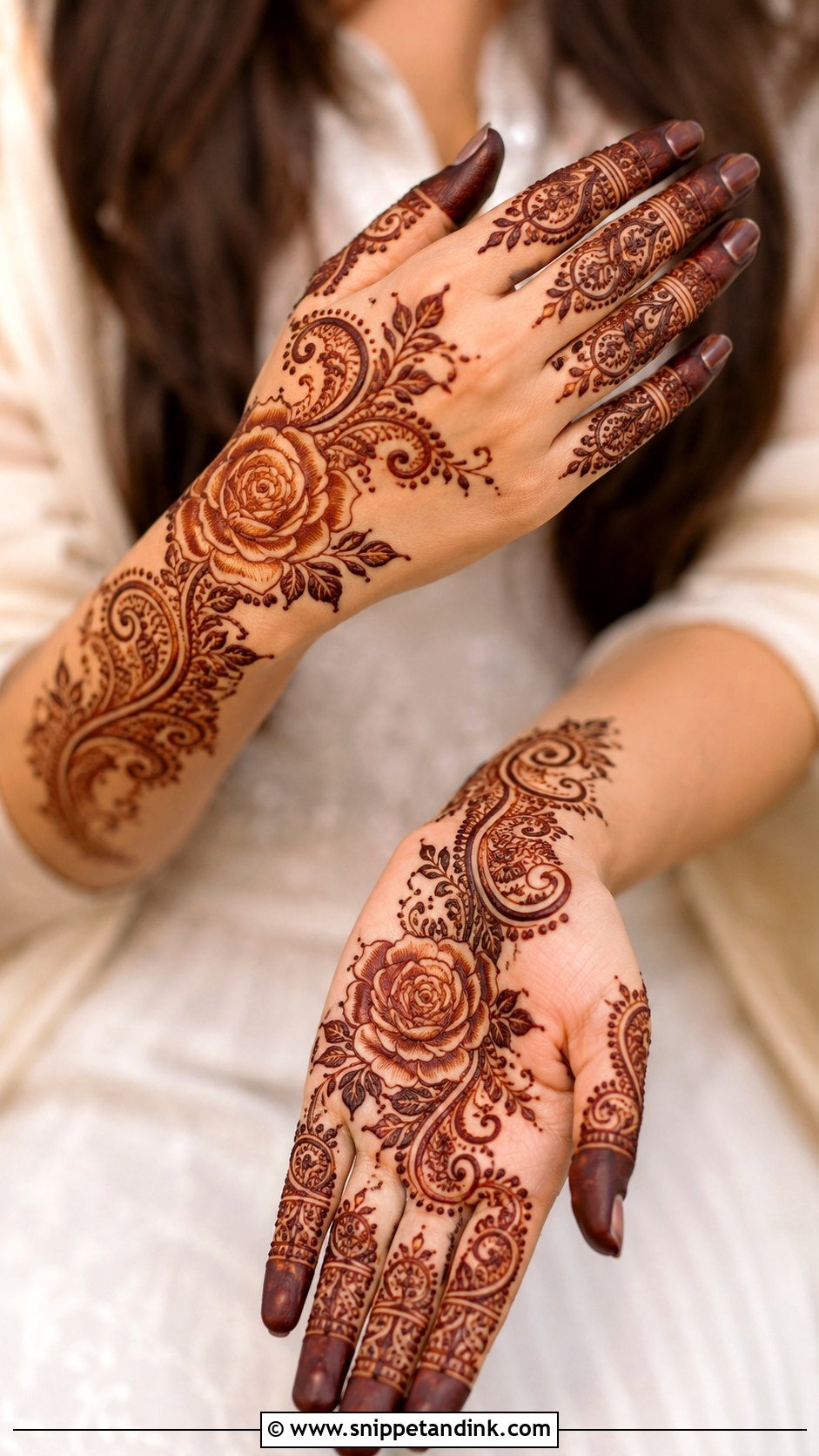
Paisleys wrapping around a large rose give a traditional base with a softer floral centre. Small leaves, dots and fine lines connect everything; fingers can carry slim paisley tips or leafy bands. I draw the rose first and fit the paisleys round it, never the other way, because a rose squeezed into the space left by paisleys always comes out lopsided. Detailed enough for weddings, comfortable for a long day.





25. Dubai Rose Mehndi Design With Leaves
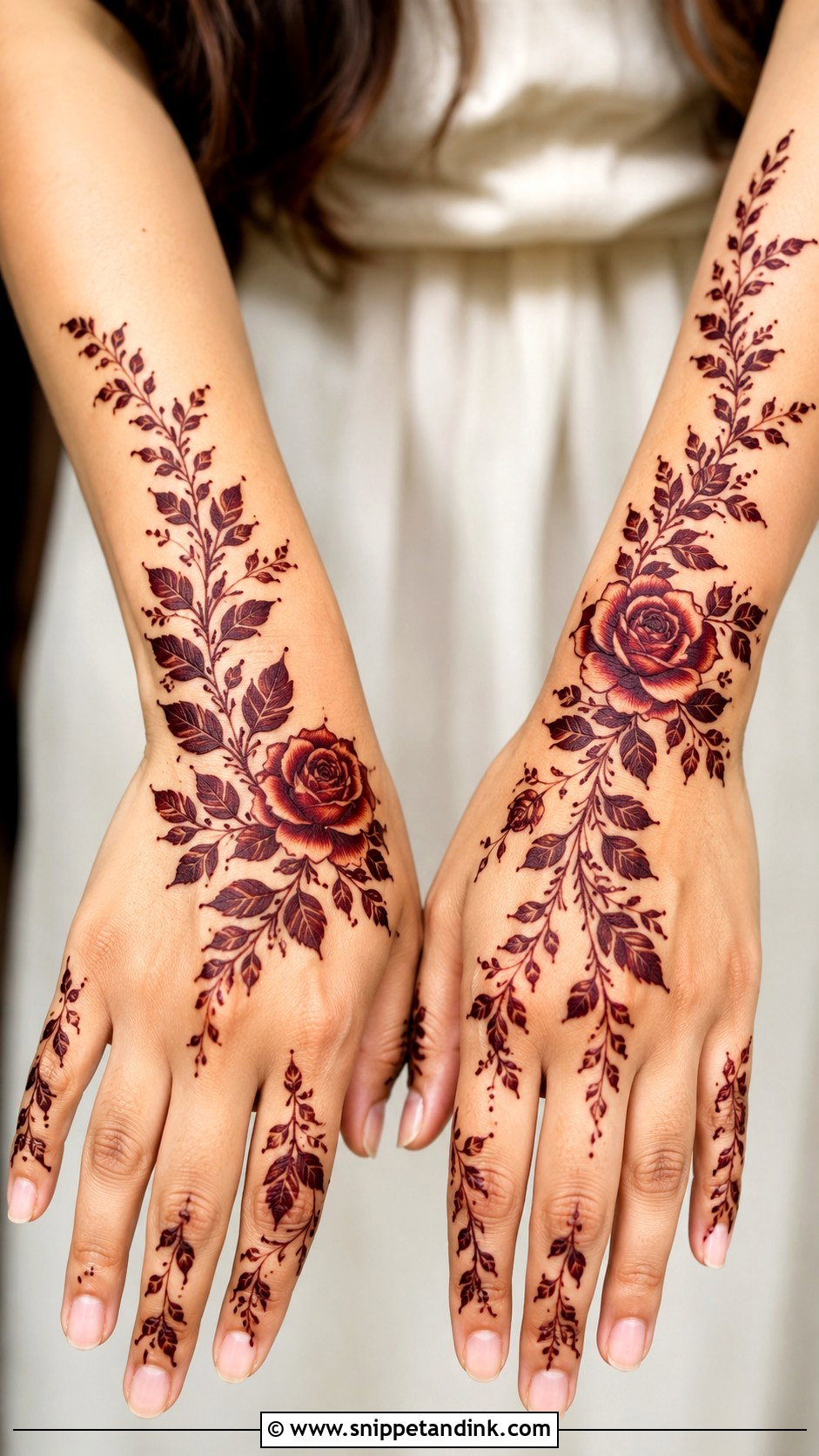
Leaves are what make a rose design flow. One or two roses with long leafy vines from wrist to fingers, larger leaves near the rose, smaller ones on the fingers and wrist. Varying leaf size creates movement. Keep the petals bolder than the leaves, or the roses get lost in the greenery. This is the easiest rose layout to adapt for any hand size because you simply add or remove leaves.
26. Dubai Rose Mehndi Design With Shading
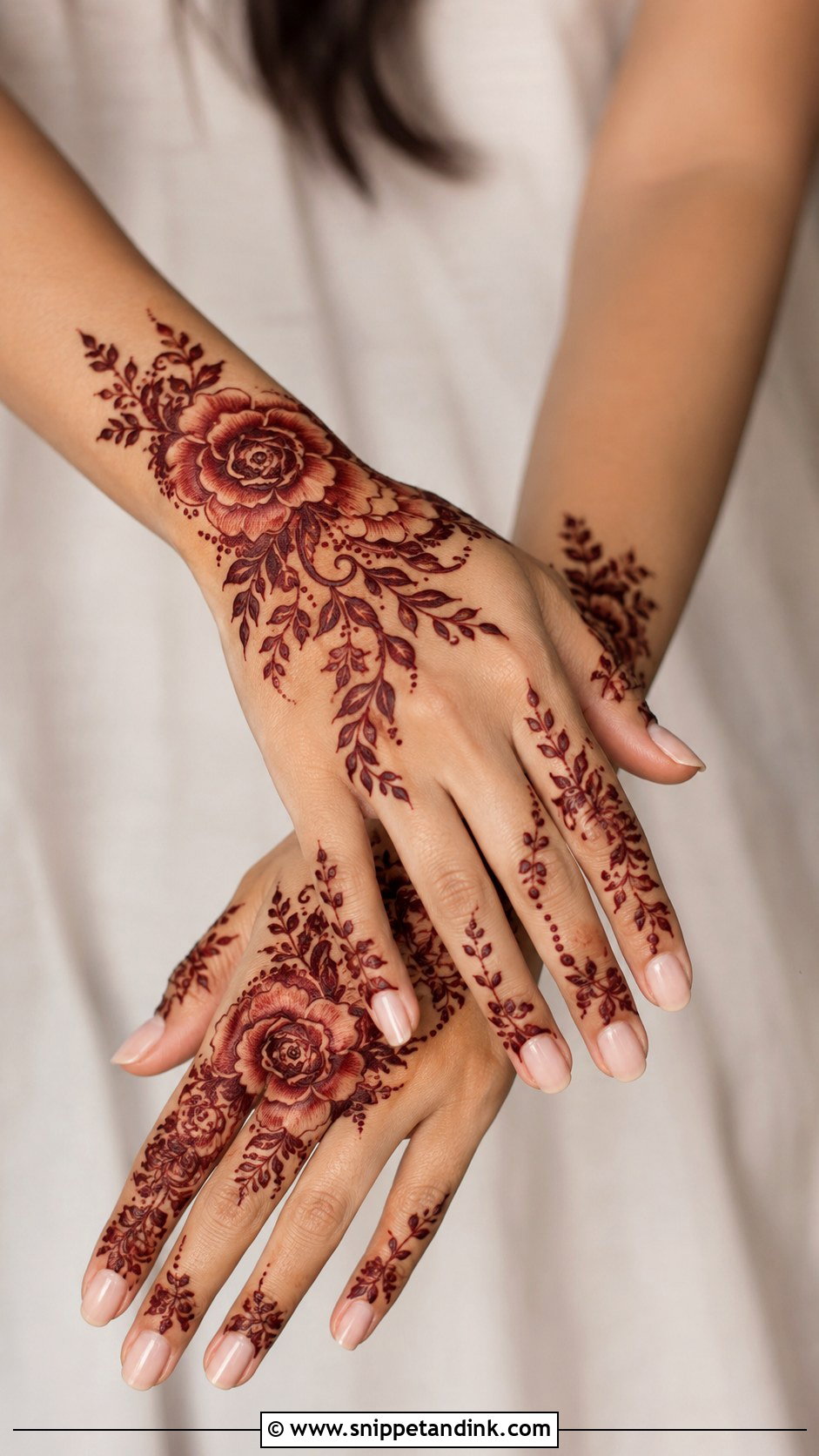
Shaded petals create the soft 3D effect that photographs so well. I outline each petal, then spread a thin film of paste inward so the centre stains lighter than the edge; the shading should be smooth, never as dark as the outline. A large shaded rose on the back hand with light vines, dotted finger trails and small leaf bands is enough. Overdo the paste and it stains as solid blocks.
27. Dubai Rose Mehndi Design Full Fingers
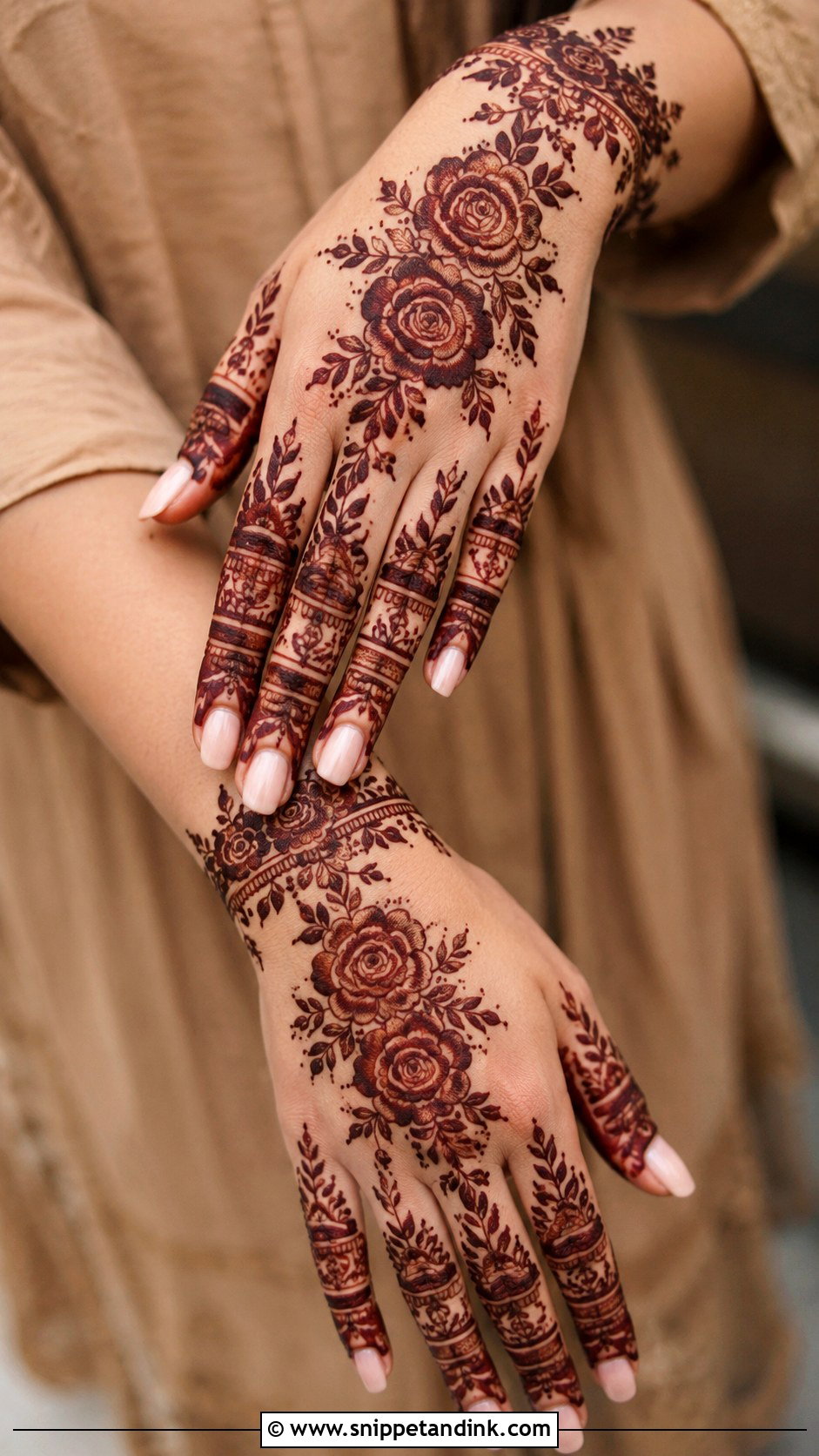
Full fingers make a rose design look dressy: a rose cluster on the back hand, then matching bands, leaves, dots and fine lines on every finger, with a small floral cuff at the wrist. I usually give the index and middle fingers heavier detail and keep the others lighter, which reads balanced rather than uniform. It sits between a simple trail and full bridal coverage.
28. Dubai Rose Mehndi Design Half Hand
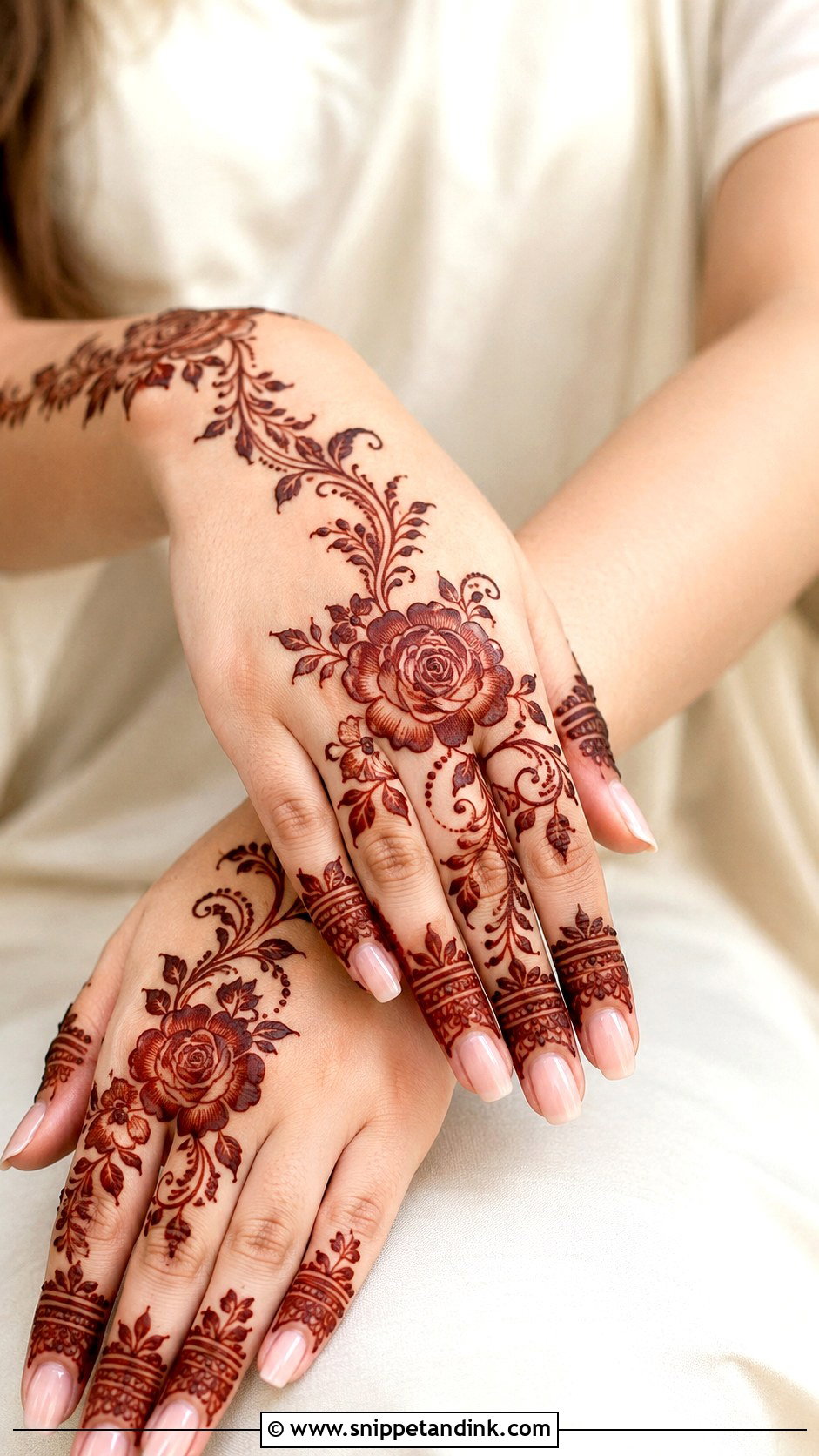
Half-hand roses cover the back of the hand and wrist and leave the forearm bare: a central rose, a curved vine, a few rosebuds near the fingers and a thin bracelet or leafy border. It’s quick, comfortable and goes with almost any outfit. If you’ve never worn henna before and can’t decide on coverage, this is where I’d start you.
29. Dubai Rose Mehndi Design For Palm
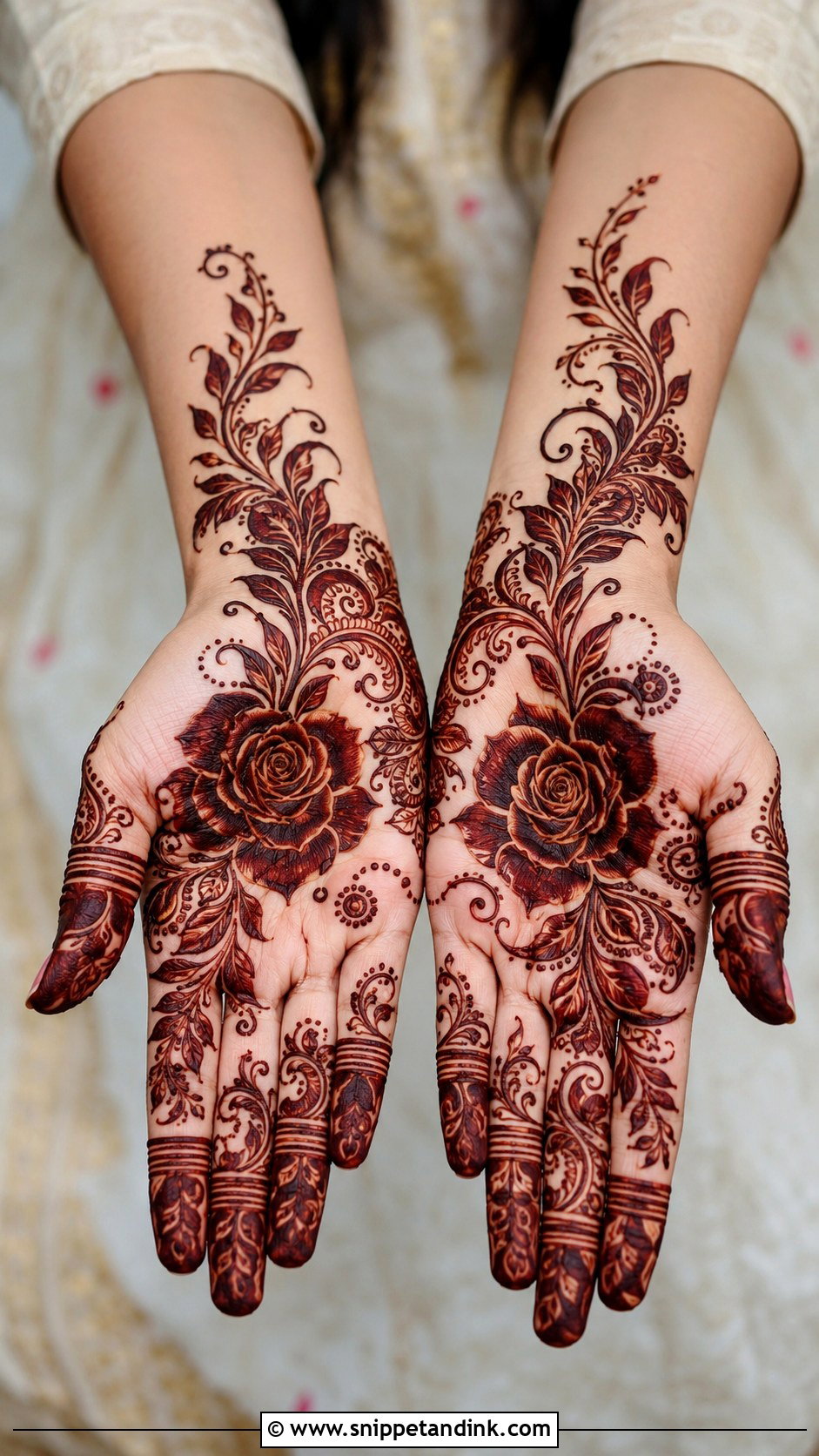
A large rose in the centre of the palm, ringed by curved leaves, dots and small paisleys, with banded or leafy fingertips and a light wrist border. Palms take the deepest stain on the body, so a palm rose dries rich and bold. It’s the design people see when you greet them, which suits home functions and festive days. I keep the rose clear of the main palm crease where I can, so the stain doesn’t crack along it.
30. Dubai Rose Mehndi Design For Wrist
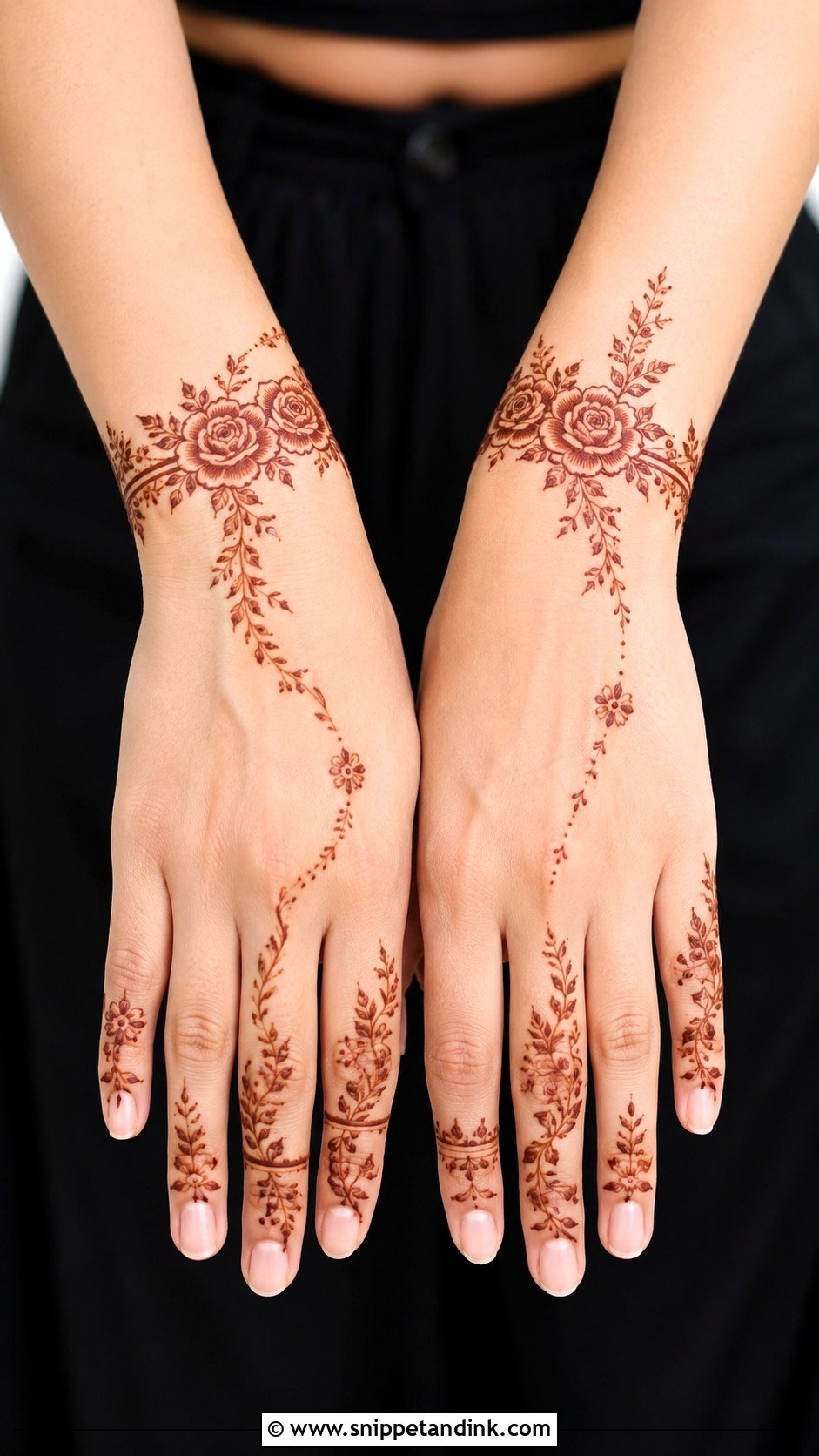
A wrist-based Dubai rose mehndi design makes a floral bracelet: a rose with leaves and small buds forming a soft cuff, perhaps a thin vine onto the back hand or forearm. Fingers can stay bare or take tiny dots. It’s the subtlest option here and good for office-friendly celebrations. The wrist moves constantly, so the paste can crack early; I seal it lightly and ask clients to keep the wrist still for a while.
31. Dubai Rose Mehndi Design For Forearm
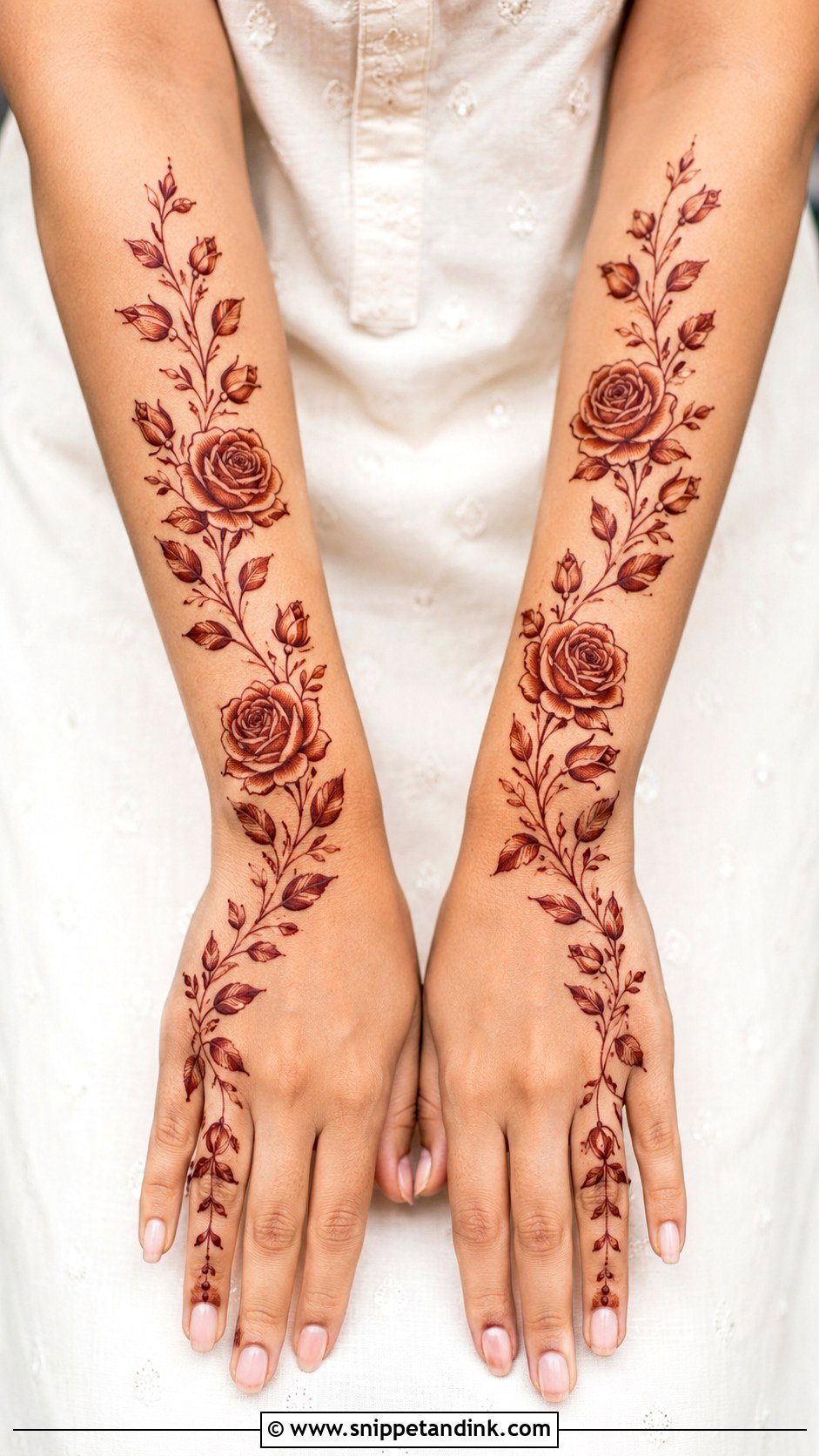
Forearm roses start near the wrist and climb with vines, leaves and buds, while the hand stays lighter so the arm becomes the feature. Keep it slim. A narrow vertical arrangement looks elegant; a wide one starts to look like a sleeve. Shaded petals and thin connecting lines finish it. It pairs well with short sleeves at weddings and parties.
32. Dubai Rose Mehndi Design For Feet
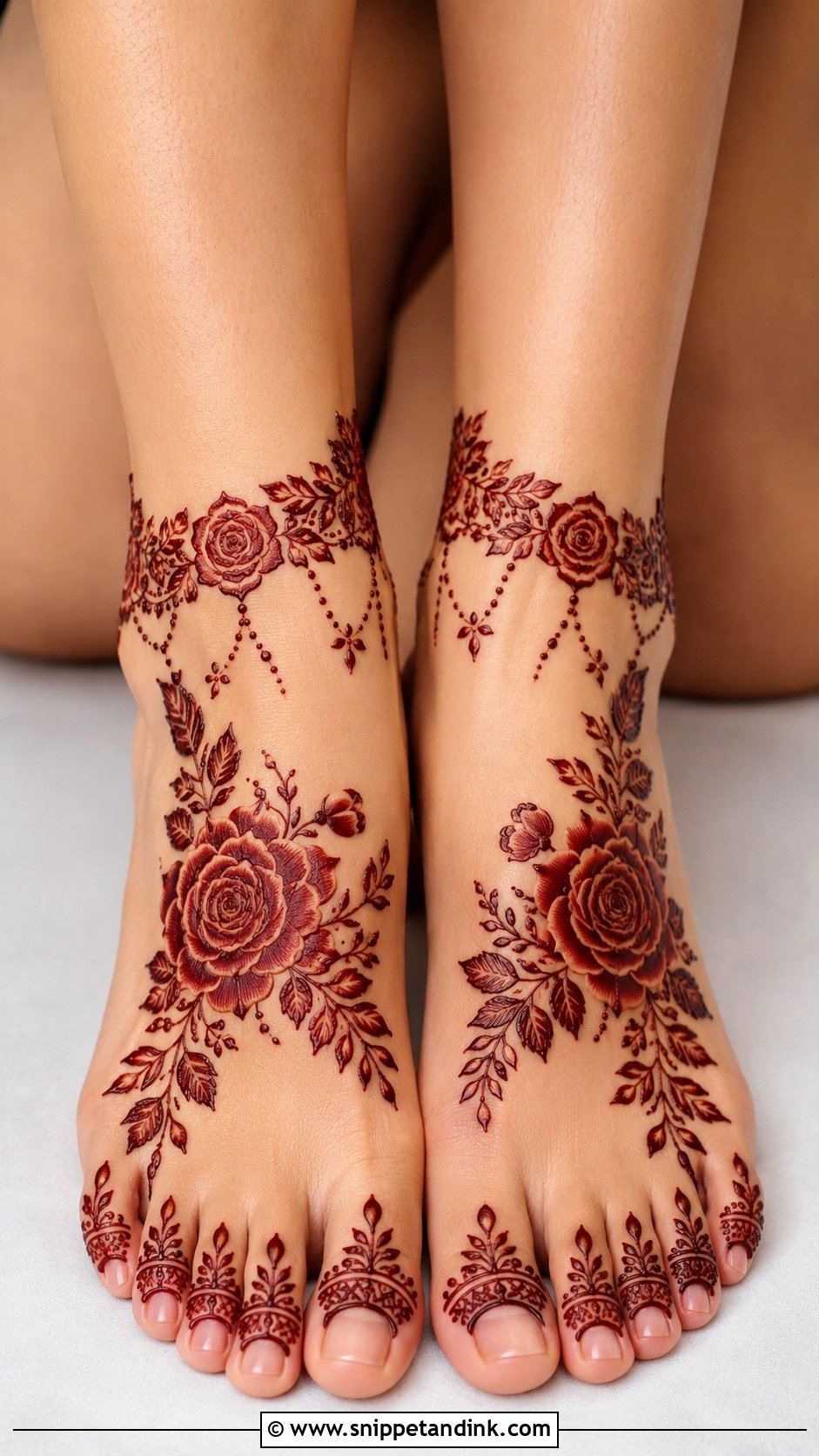
On the foot, I place the main rose on the upper foot and let vines move toward the toes or ankle, with small buds, leafy trails, toe detail and an optional ankle band. Open space around the rose keeps it clean. The top of the foot stains less deeply than the sole, so I draw the rose slightly bolder than I would on a hand. It looks good with sandals and suits brides, bridesmaids and Eid.
33. Dubai Rose Mehndi Design For Toes
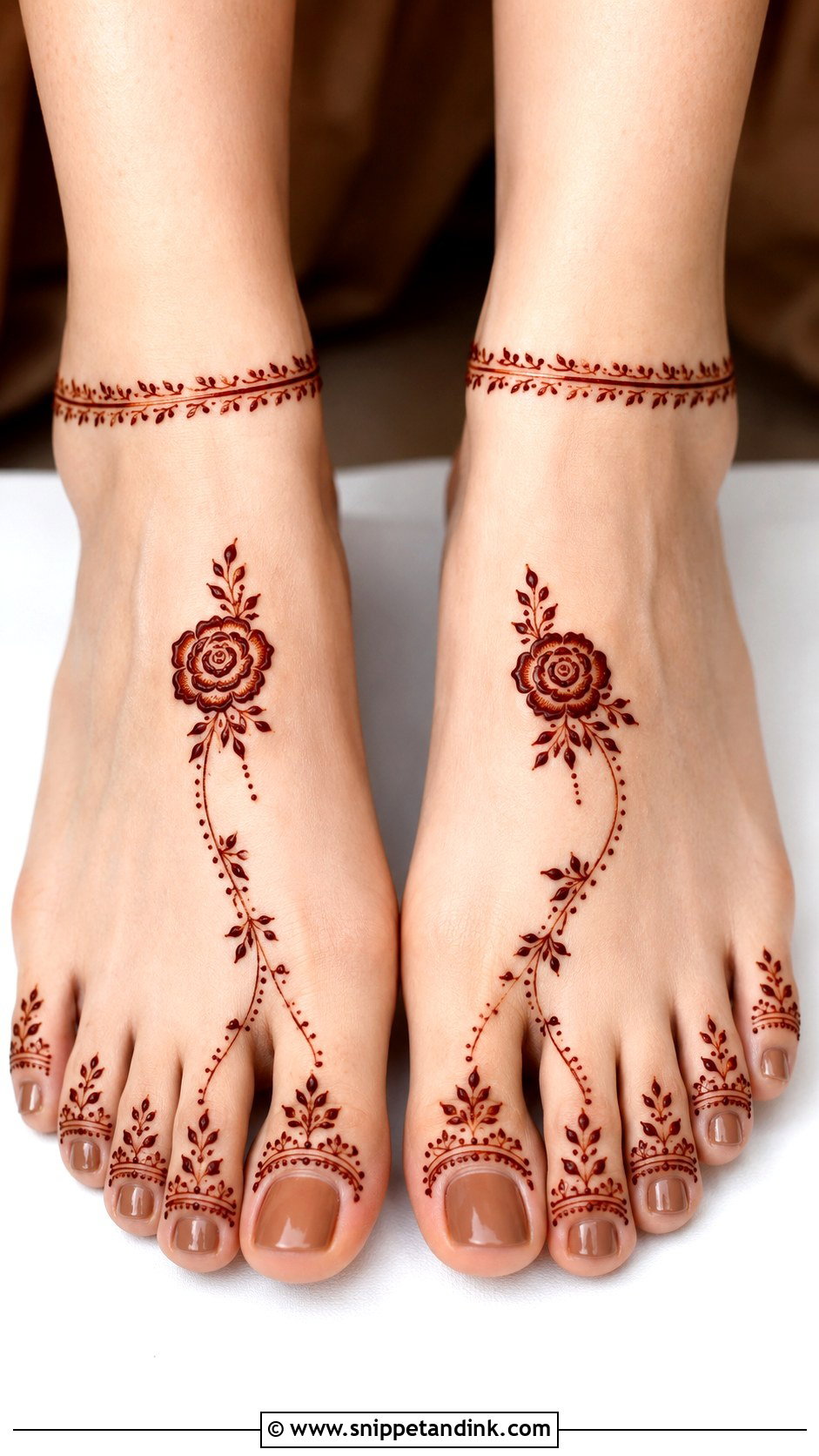
Toe-focused designs put the rose on the upper foot and send thin vines to each toe, with tiny leaves, dots and small curved bands. Keep it light so the toes don’t look crowded, and add a slim ankle border if you want more. Toes rub inside shoes, so I’d avoid closed footwear for the first day while the stain develops. Open sandals at Eid or a beach wedding show it off best.
34. Modern Dubai Rose Mehndi Design
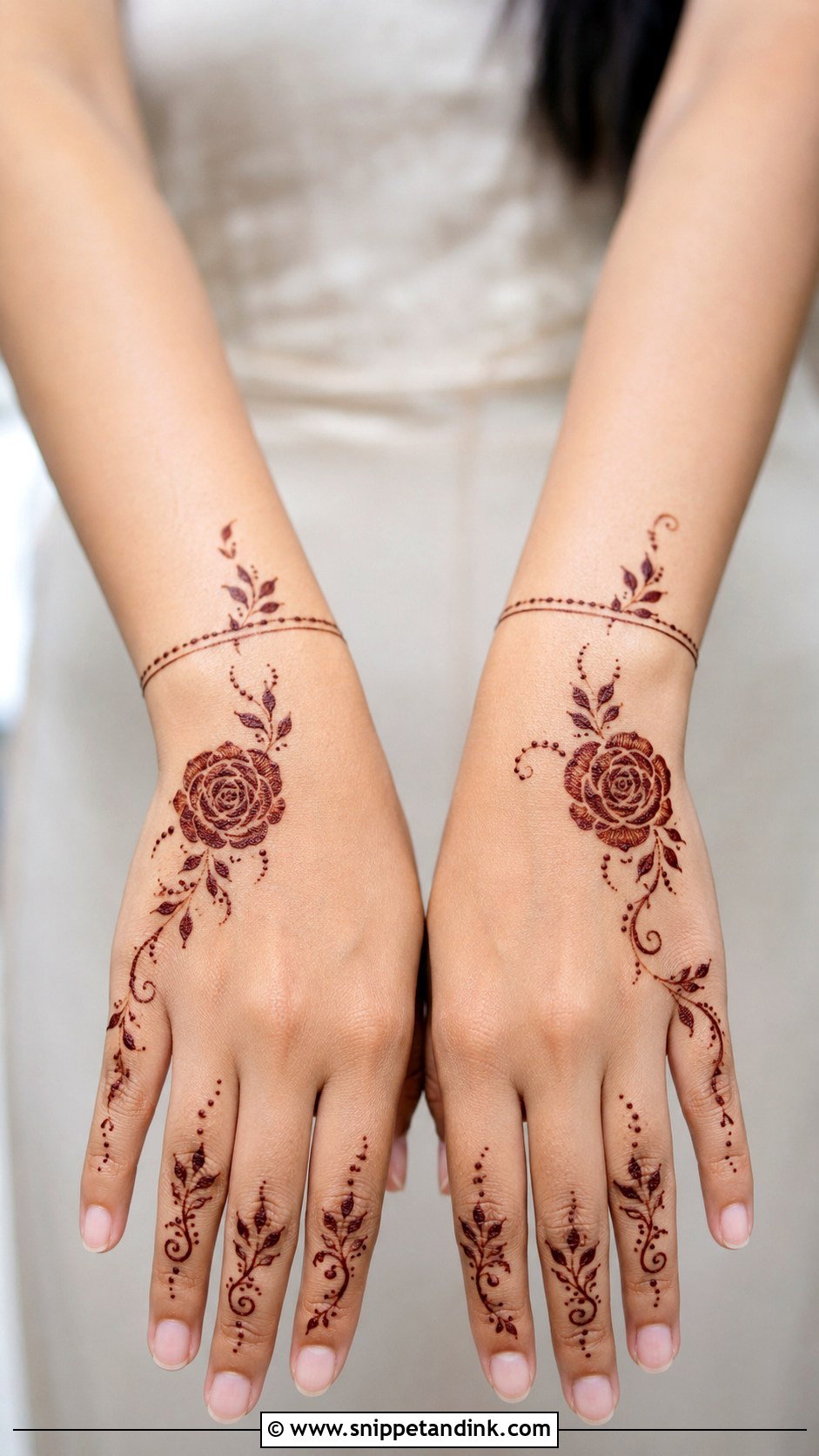
Modern rose henna is about placement: an off-centre rose on the back hand, a thin vine toward the wrist, minimal finger accents and generous open skin. Tiny dots, delicate leaves and one bracelet line add structure. When I’m asked for modern, I usually take the original design and remove a third of it; that restraint is most of what makes it look current.
35. Minimal Dubai Rose Mehndi Design
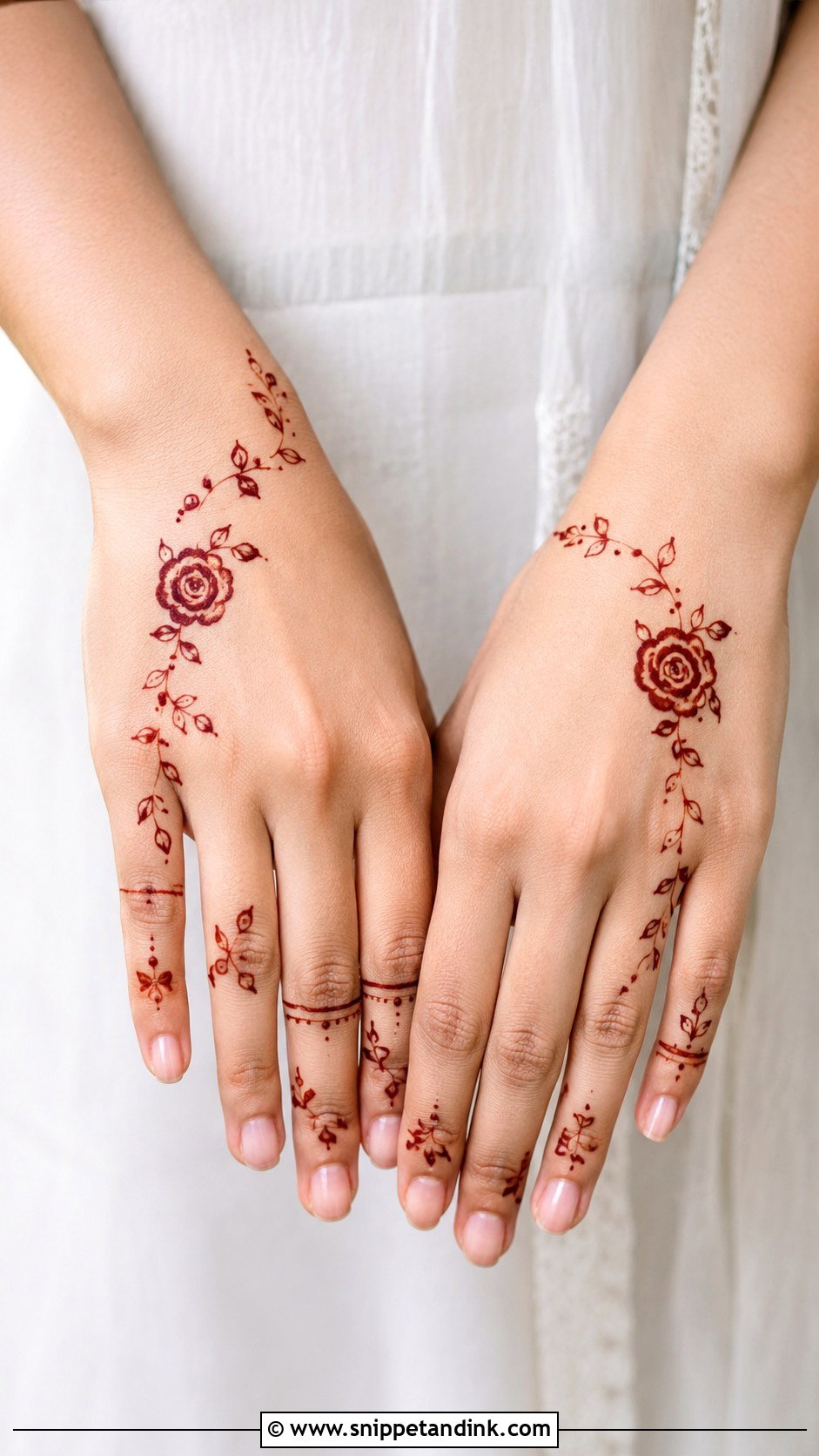
A small rose near the wrist or on the back hand with a fine vine and a few tiny leaves. Fingers almost bare, maybe a dot or slim line. It’s quick to apply and easy to wear for everyday festive moments, and it’s the best design to practise on if you’re learning. Clean drawing and placement are the whole job. Let the rose breathe and resist adding filler.
If a Petal Smudges While the Paste Is Wet
It happens to everyone: a sleeve brushes the hand, a child grabs a finger. Don’t wipe it. Wiping spreads the paste and leaves a pale orange haze around the rose. Instead, lift the smudged paste straight off with a cotton bud or the tip of a toothpick, in one movement, and leave the skin alone. Then redraw the line over the clean spot. A faint mark may still show for a day, but it usually fades into the stain as it deepens.
Making the Stain Last Into the Second Week
Henna stains the top layers of skin, so it fades as those layers naturally shed, usually over one to three weeks. Palms and fingers fade faster because they’re washed and used most. You can slow it down, though not stop it.
- Skip exfoliating scrubs, loofahs and waxing on the design.
- Wear gloves for washing up and cleaning; detergent and hot water strip the stain.
- Pat hands dry rather than rubbing, and moisturise with a plain oil or balm.
- Chlorinated pools and salt water fade it quickly, so save swimming until after the event photos.
When it starts to fade unevenly, a gentle soak and a little exfoliation will even it out rather than leaving patchy roses for days.
One Rose, Placed With Intent
Rose henna in the Dubai style covers everything from one small bloom at the wrist to bridal hands and feet, with shaded petals, bracelets and trails in between. The right one depends on your hand shape, outfit, occasion and how much time you can sit for. Whatever you pick, the same three things decide whether it works: a clear rose with a confident outline, balanced spacing, and neat details that don’t crowd it. Show your artist where you want the main rose to sit, and build from there.
You'll Like These Ideas:










Leave a Reply