
Burgundy is one of the colours I’m asked for most in autumn and winter, and one of the trickiest to get right on a cake. Against white icing it looks rich and grown-up, but a deep red that’s slightly off can read brown under warm lights or almost purple in daylight photos. The pairing suits fall weddings, ballroom receptions, barns and garden venues, and it works across smooth fondant, textured buttercream, pressed flowers, painted details and old-fashioned piping. Below are twenty ways I’d put the two colours together, with notes on how each one behaves once it leaves my kitchen.
Getting a True Burgundy Into Icing Without It Bleeding
Deep red is the colour I spend the longest on in the kitchen. It’s worth knowing a little about how it behaves, because it explains why bakers often steer burgundy into flowers and accents rather than whole tiers.
It darkens as it rests
Red and burgundy colouring keeps developing for hours after mixing. I mix a shade a few tones lighter than the target, cover it and leave it overnight. If you see a sample at your tasting, ask whether it was mixed that day or the day before, because the difference can be big.
It can bleed onto white
Dark buttercream sitting against white buttercream in a warm room can tint the edges pink. I chill the cake firmly between colours and add burgundy details last, so they sit on a set surface. Sugar flowers and fondant pieces avoid the problem entirely, which is one reason I use them for the darkest accents.
It changes under different light
Warm candlelight pushes burgundy toward brown, and cool daylight pushes it toward purple. If your reception is lit warmly, a burgundy with a touch more red reads truer. Bring a swatch of your bridesmaid dresses or napkins and look at the sample in both kinds of light.
1. Burgundy And White Wedding Cake With Roses
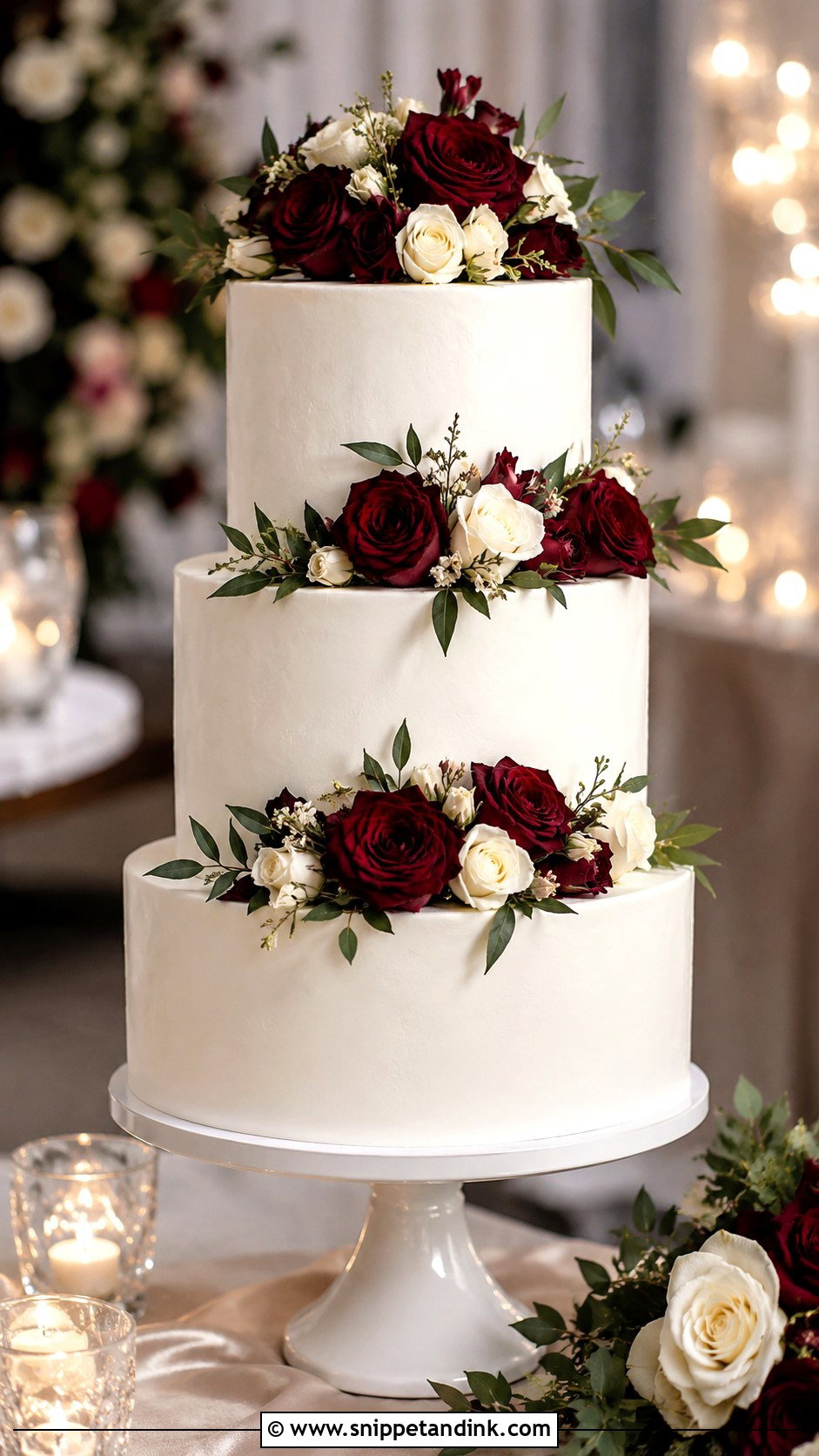
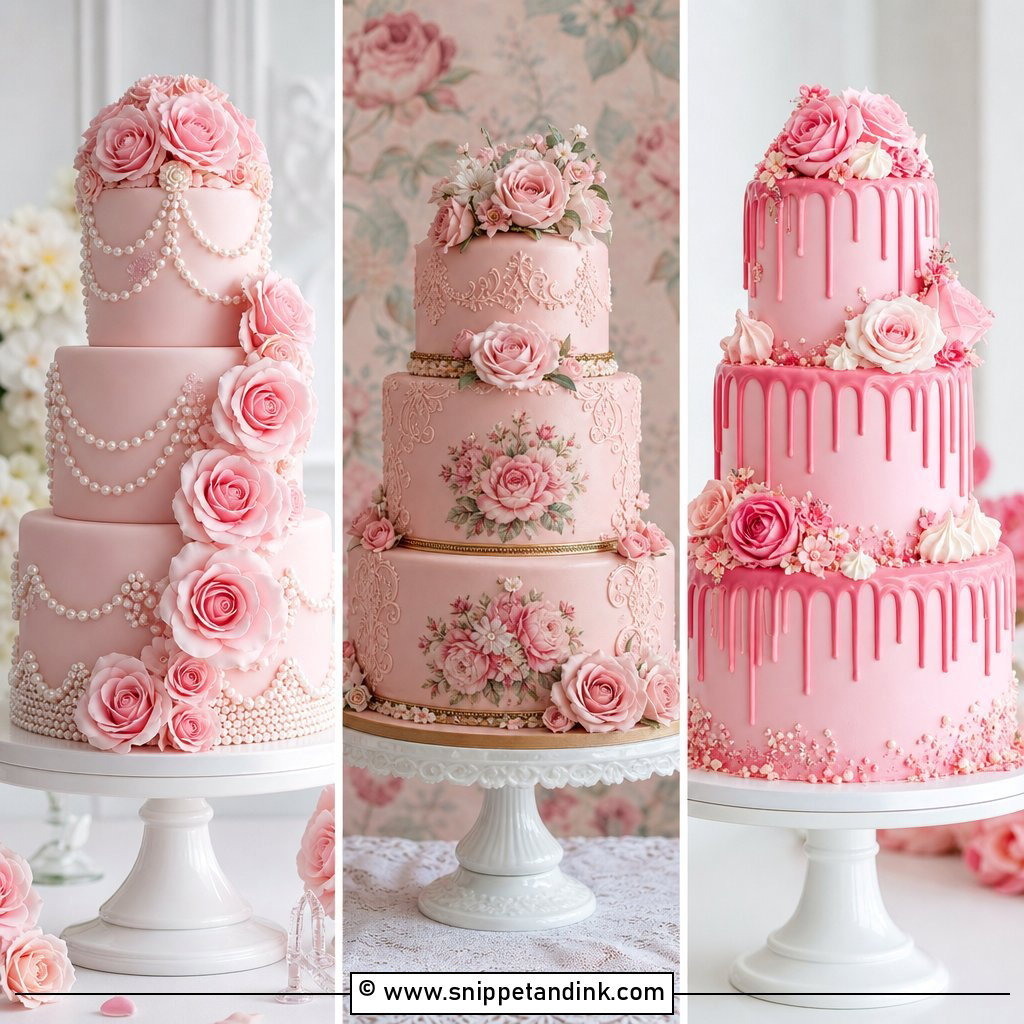
Roses are the most familiar way to bring burgundy onto a white cake, and they work because the colour sits in concentrated clusters rather than across the whole surface. I place them at the tier seams, where they also hide the join. Fresh roses look lush; sugar roses look cleaner and never droop. Mixing in ivory blooms and a few buds keeps a cluster from looking like a block of dark red. A two-tier cake suits an intimate wedding, and three tiers suit a formal room. Leave white space between clusters; crowded roses on a white cake read as heavy rather than generous.
2. Burgundy And White Wedding Cake With Gold
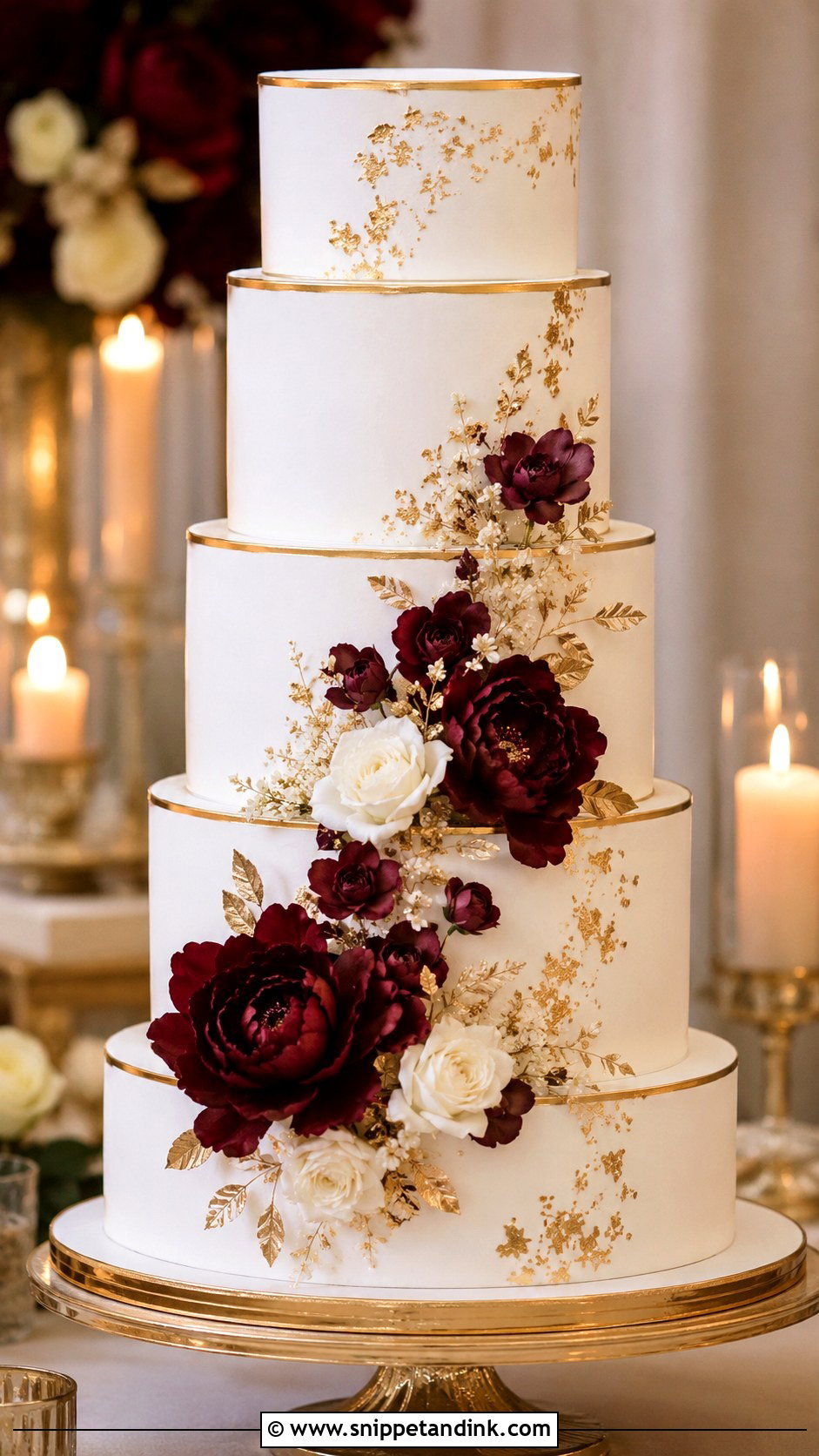
Gold with burgundy works when it’s a whisper, not a coat. I’ll use thin gold leaf on one tier, a painted edge along the top of each tier, or a narrow drip on just one level. A full gold tier next to burgundy tends to look like a holiday ornament. Candlelit rooms and warm uplighting suit this combination, and it ties in neatly if your tables already have gold flatware. Ask for a soft, brushed metallic rather than a mirror finish, which bounces flash and shows every fingerprint.
3. Burgundy And White Wedding Cake With Buttercream
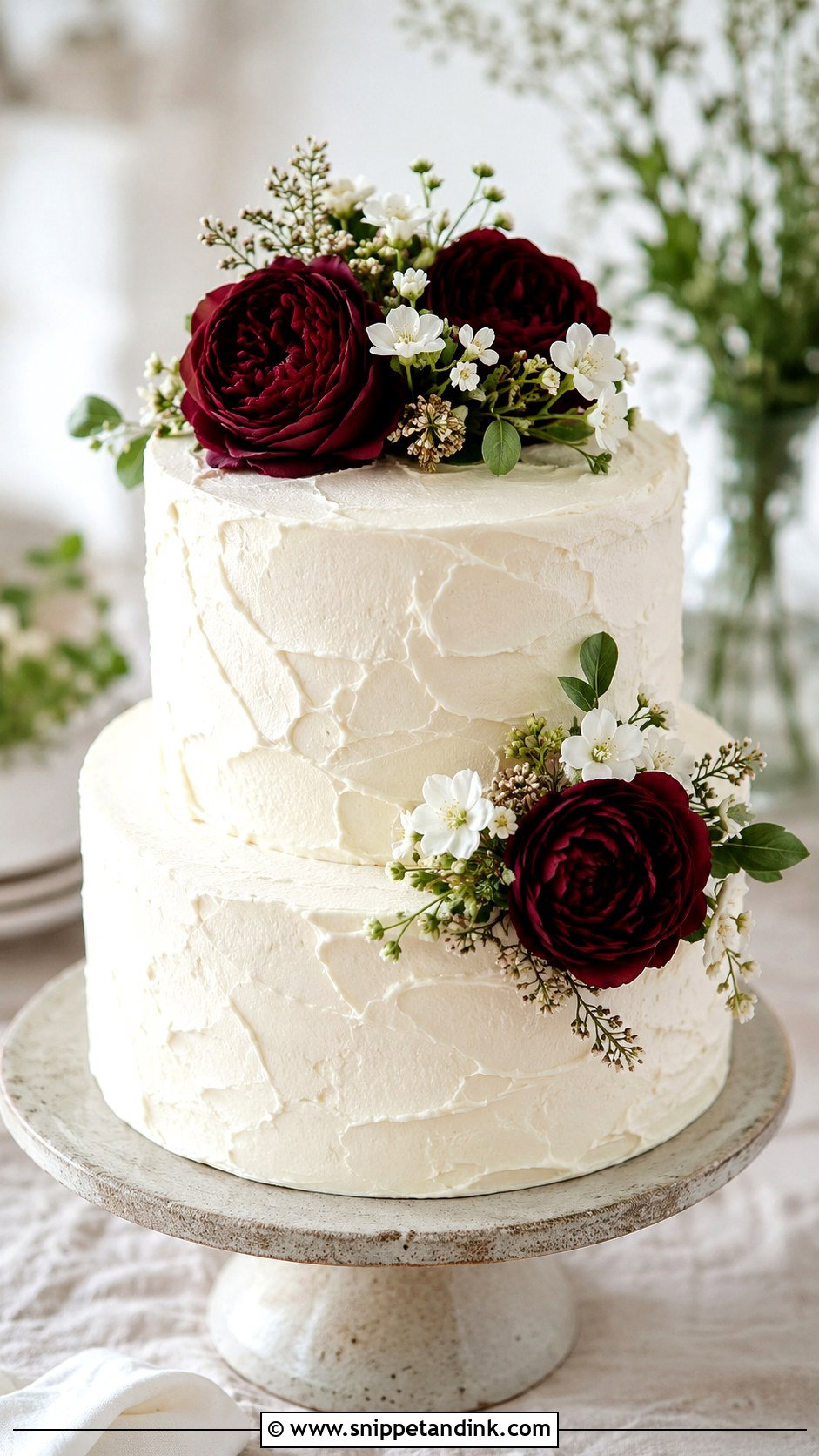
Buttercream gives this palette a softer, handmade feel. A lightly textured white finish, made with a palette knife or a comb, catches light and makes deep red flowers or berries look even richer next to it. Burgundy can come in as a topper, a small cascade or a few painted strokes. One thing couples don’t always know: very dark buttercream needs a lot of colouring, which can leave a slightly bitter aftertaste, so I keep deep burgundy to accents and leave the bulk of the icing white. It’s also the cake I’d point you to if flavour is your first priority.
4. Burgundy And White Wedding Cake With Fresh Flowers
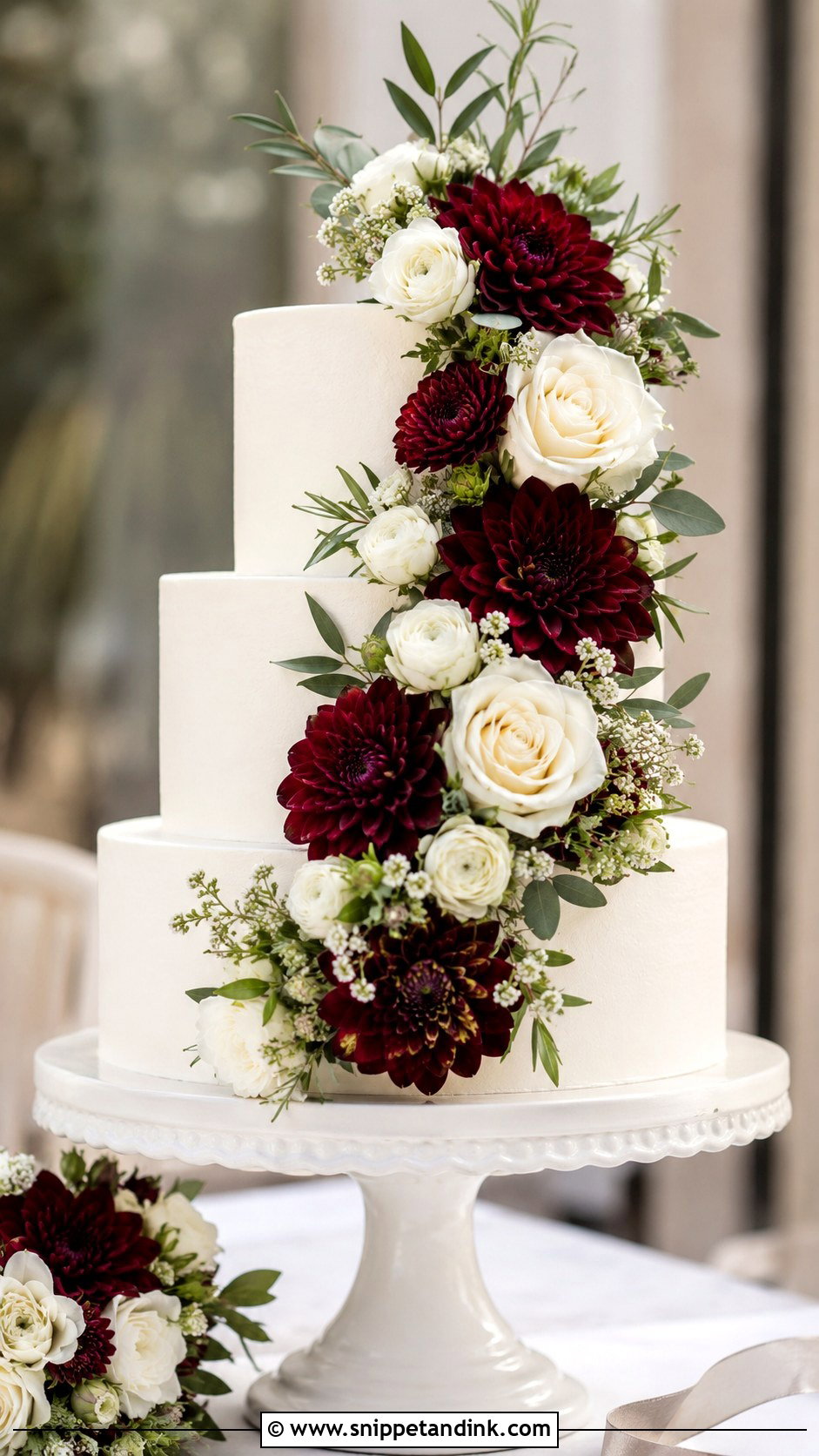
Fresh flowers can make a white cake the centrepiece of the room. Burgundy dahlias, roses and ranunculus bring the depth, ivory blooms between them keep it bridal, and a little eucalyptus or ruscus adds shape without covering the icing. Not every flower is safe near food, and many are sprayed, so I only use blooms the florist confirms are pesticide-free, and every stem is wrapped in floral tape or set in a food-safe pick so nothing touches the icing directly. Matching the cake to bouquets and centrepieces that already use the same flowers makes the whole room feel planned.
5. Burgundy And White Wedding Cake With Sugar Flowers
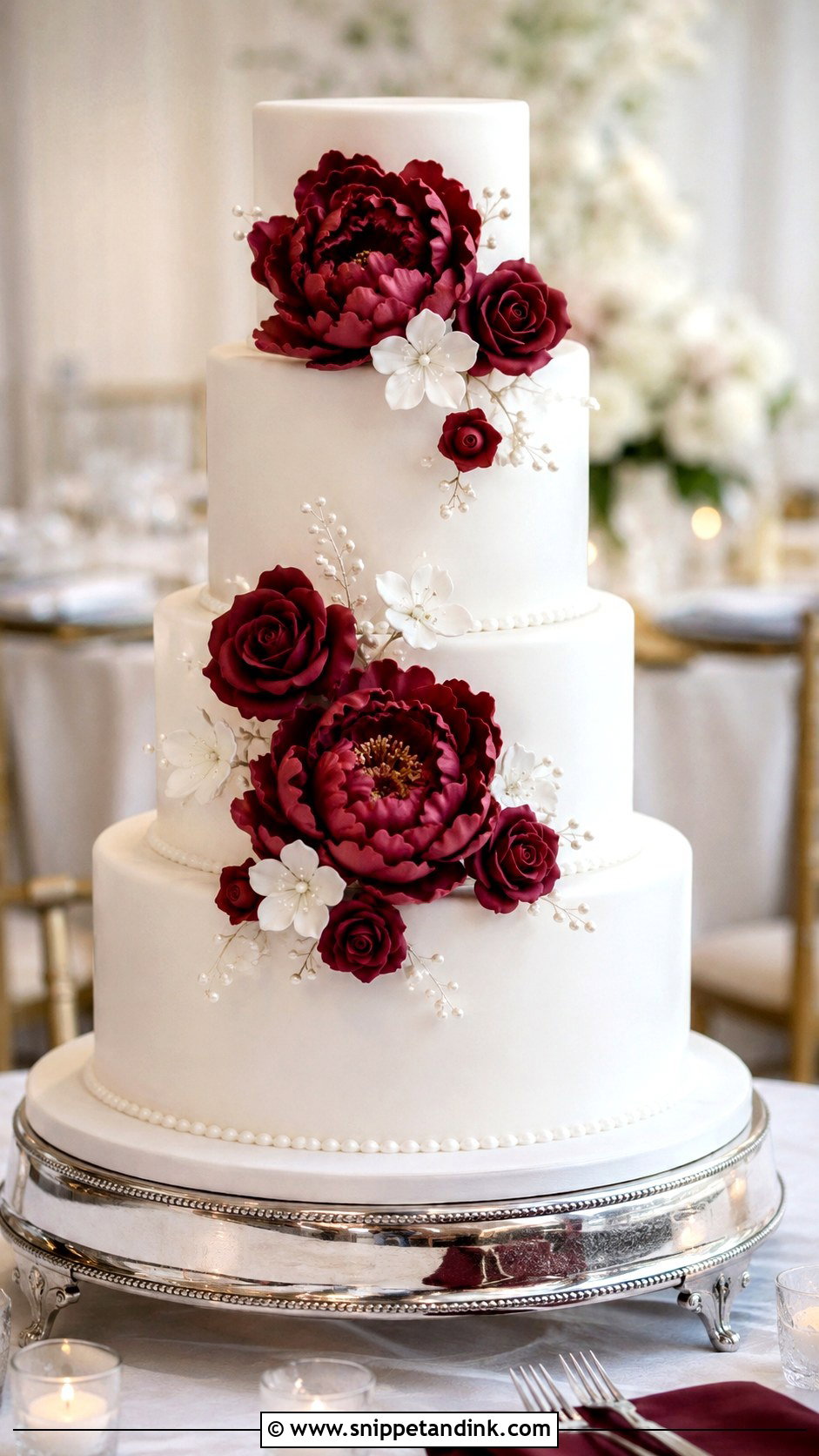
Sugar flowers are the answer when you need to control the exact shade. Deep reds vary hugely in photos, and sugar petals can be dusted until they match a dress swatch or a bridesmaid’s fabric. They also hold their shape through a long reception in a warm room, which fresh blooms don’t always manage. A smooth white fondant cake with burgundy sugar roses, peonies or anemones suits formal hotels and classic venues. Realistic sugar flowers take many hours to make, so they’re best ordered well ahead and they add noticeably to the cost.
6. Burgundy And White Wedding Cake With Drip
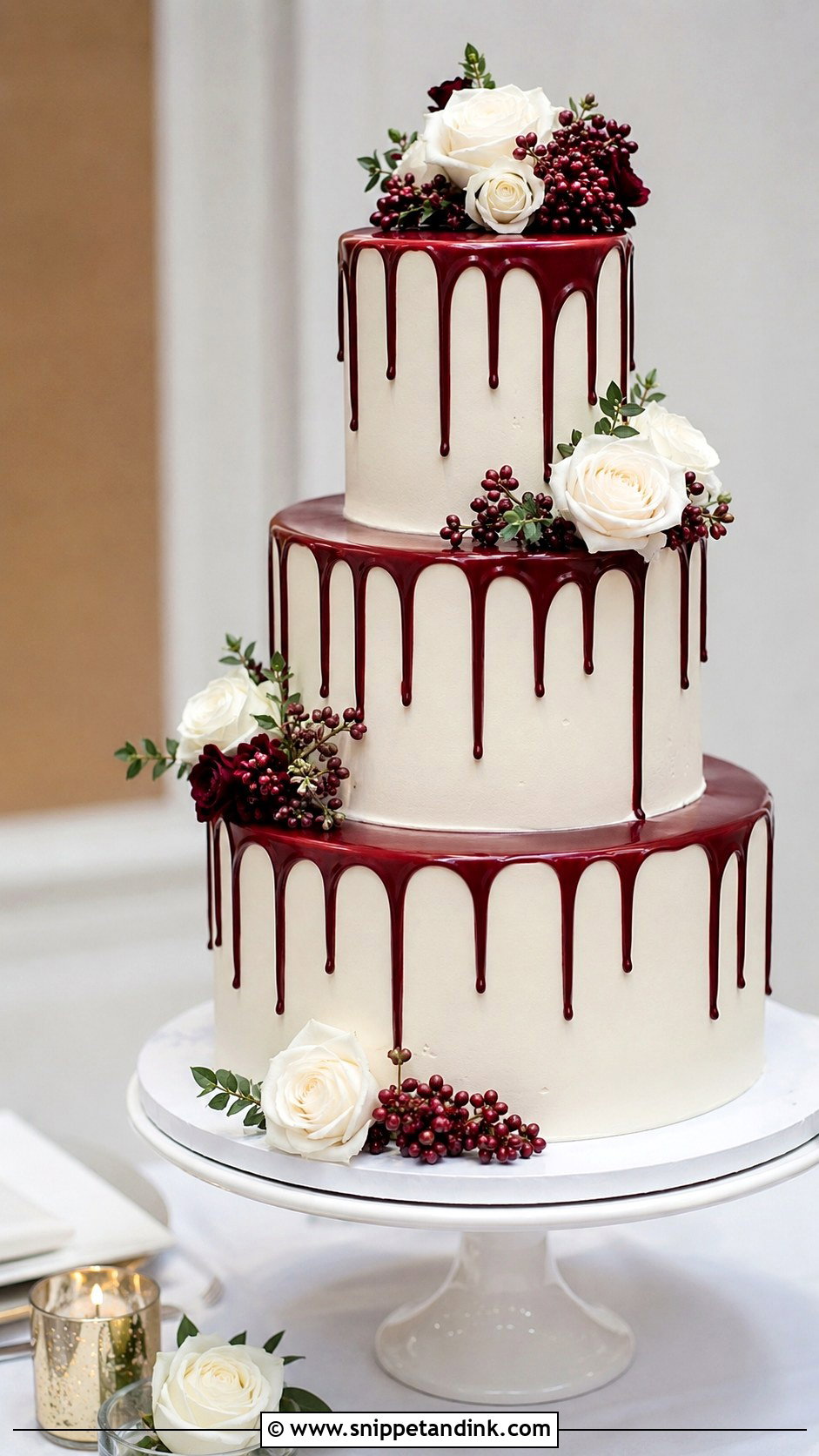
A drip adds movement, and burgundy makes it look richer than the usual pastel. I make it with white chocolate ganache coloured deep red, and the consistency matters: too warm and it runs to the cake board, too cool and it sits in stubby blobs. I test a drip on the back of the cake before going round. Keep it neat and short, then add white and burgundy flowers on top or down one side. Drip cakes are less suited to outdoor summer receptions, since ganache softens in heat.
7. Burgundy And White Wedding Cake With Lace
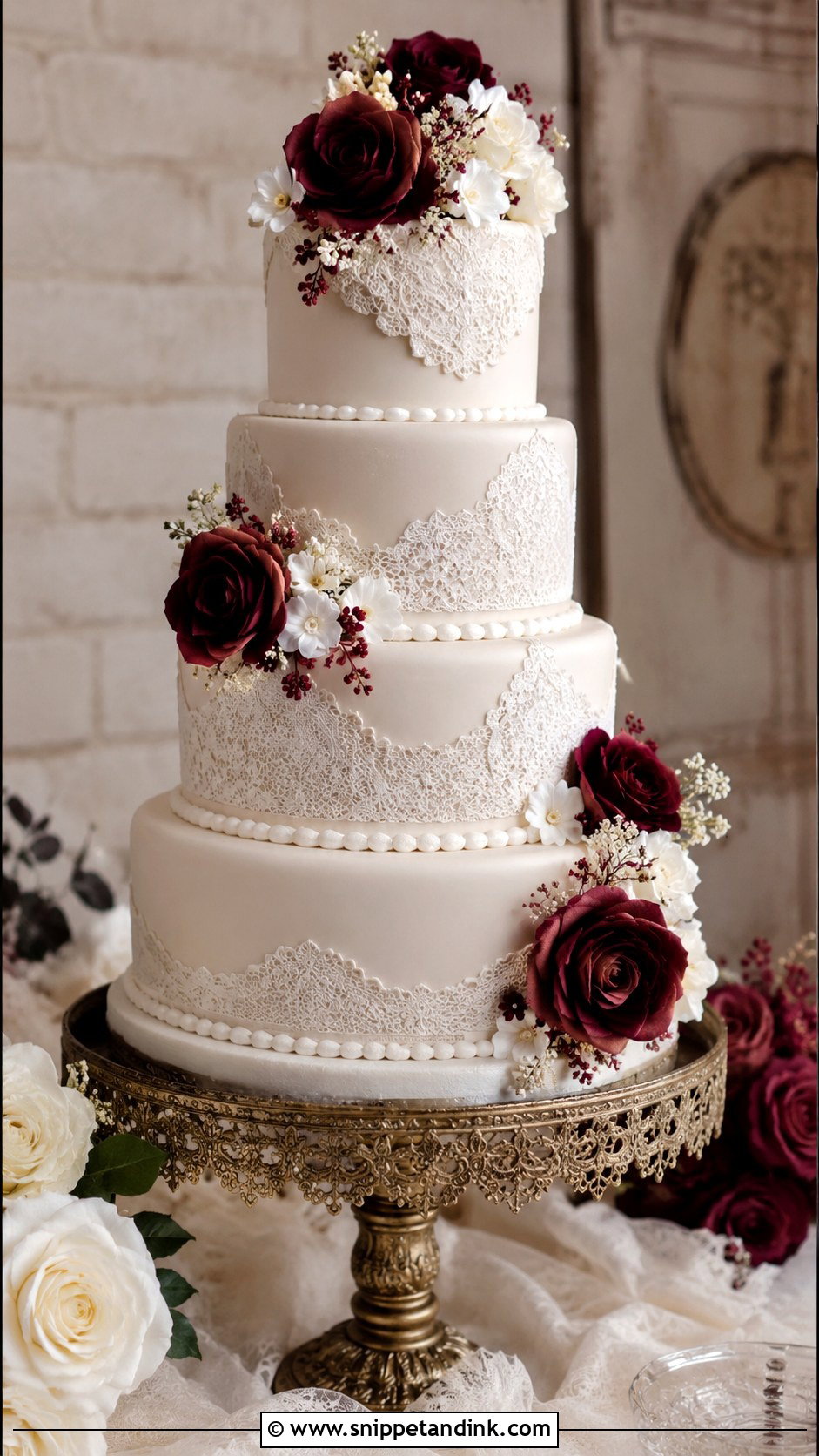
Edible lace is one of the details guests lean in to look at. It goes on as a flexible sheet over white fondant or a firmly chilled buttercream, and I keep it to one or two tiers so the cake doesn’t look busy. Burgundy comes through flowers, a narrow band or a small topper. It’s a natural partner for dresses with lace sleeves or vintage detailing; bring a photo of the lace pattern and we can echo it. Let the burgundy frame the lace, not cover it.
8. Burgundy And White Wedding Cake With Pearls
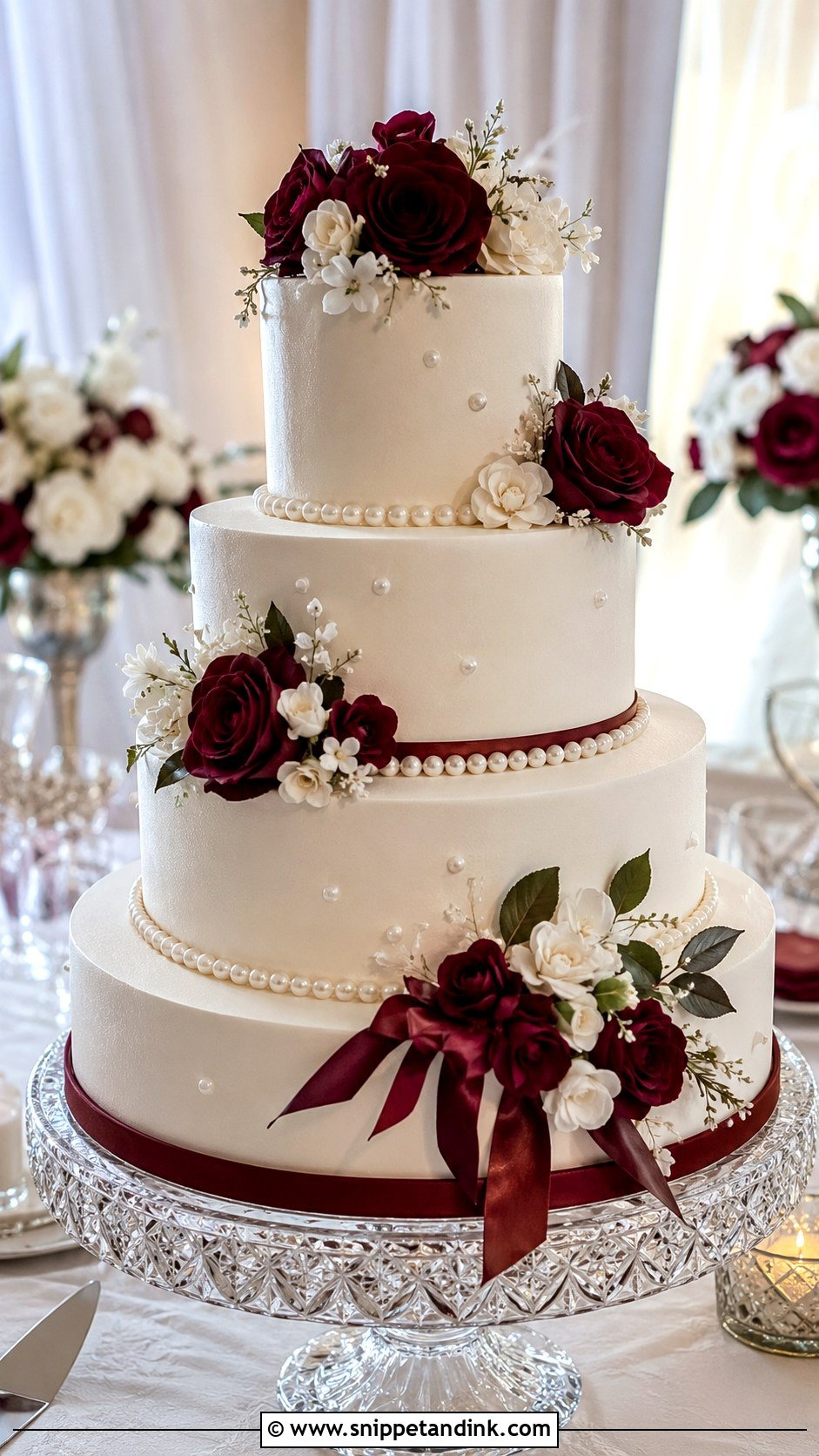
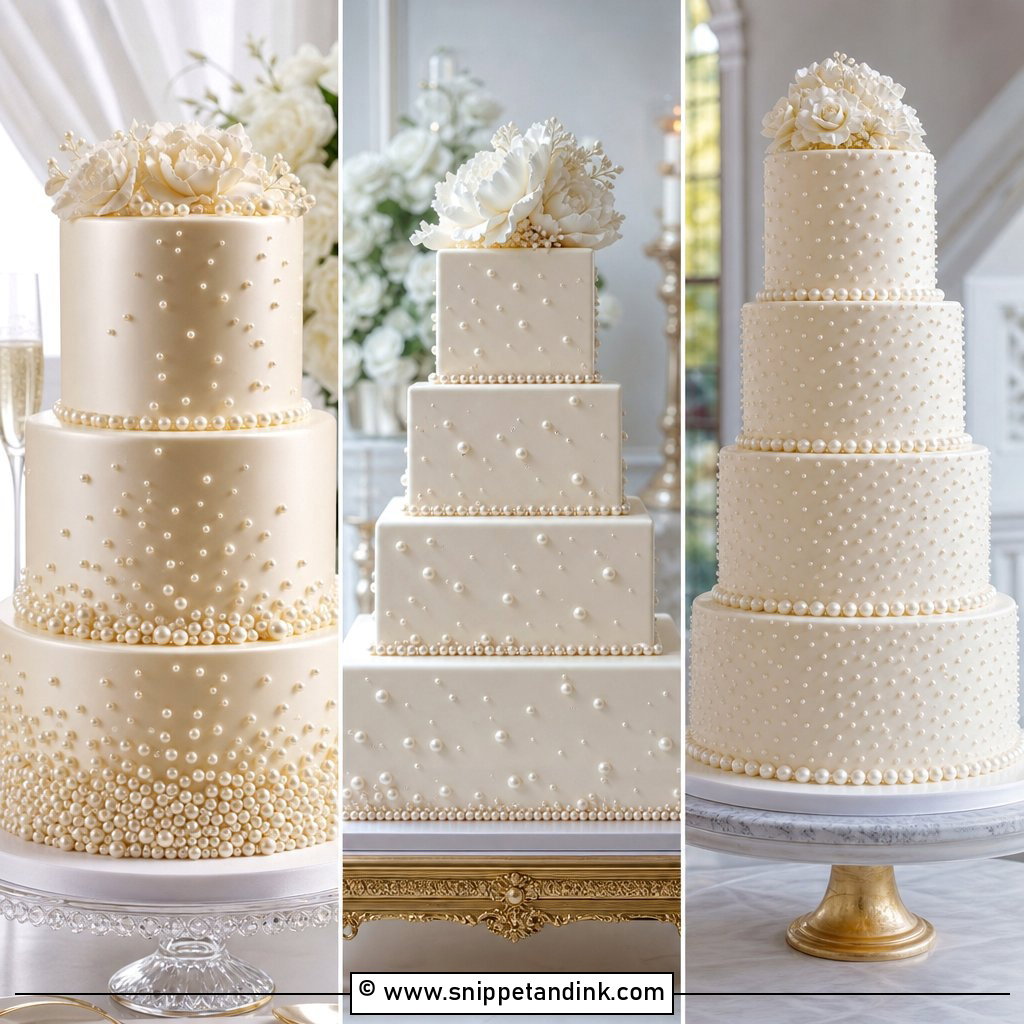
Edible pearls give a white cake a soft, graceful finish. I set small ones around the base of each tier, where they hide the join and catch light, then add burgundy through flowers or a band. Formal receptions, historic venues and black-tie weddings suit this. Pearls work on smooth buttercream, fondant or delicate piping. Restraint is the whole trick here: a single neat row reads intentional, while pearls dotted everywhere start to look like a craft project.
9. Burgundy And White Wedding Cake With Ribbon
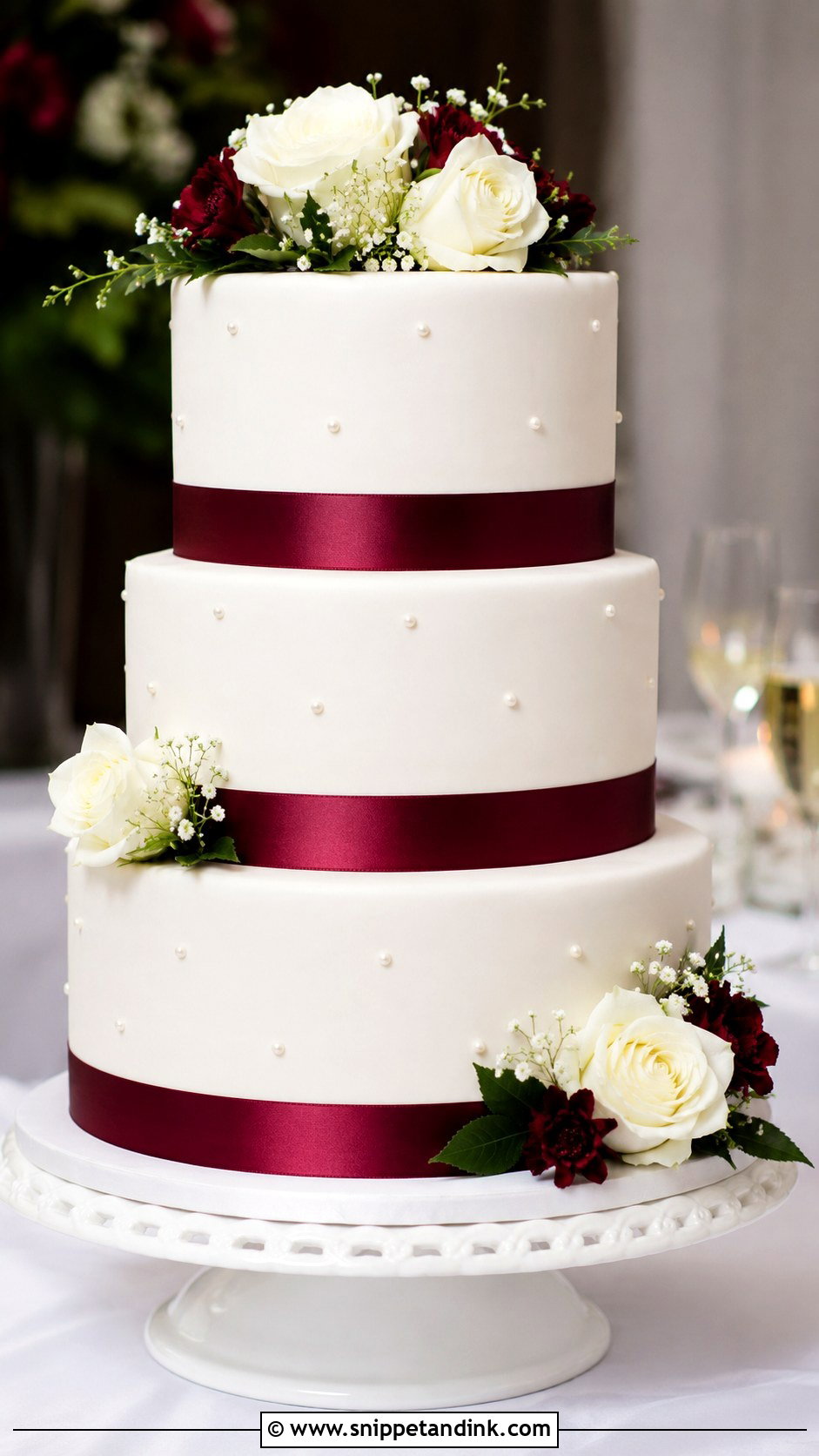
A burgundy ribbon is the simplest way to tie a white cake into your colours. I use fondant ribbon or a real satin ribbon with a food-safe backing so the oils in the icing don’t stain it. One band per tier looks classic; a single band on the bottom tier is more minimal. Real ribbon needs to go on close to delivery, because buttercream can seep through the fibres and leave dark spots. Add a few white flowers or burgundy roses if you want more than a band.
10. Burgundy And White Wedding Cake With Ombre
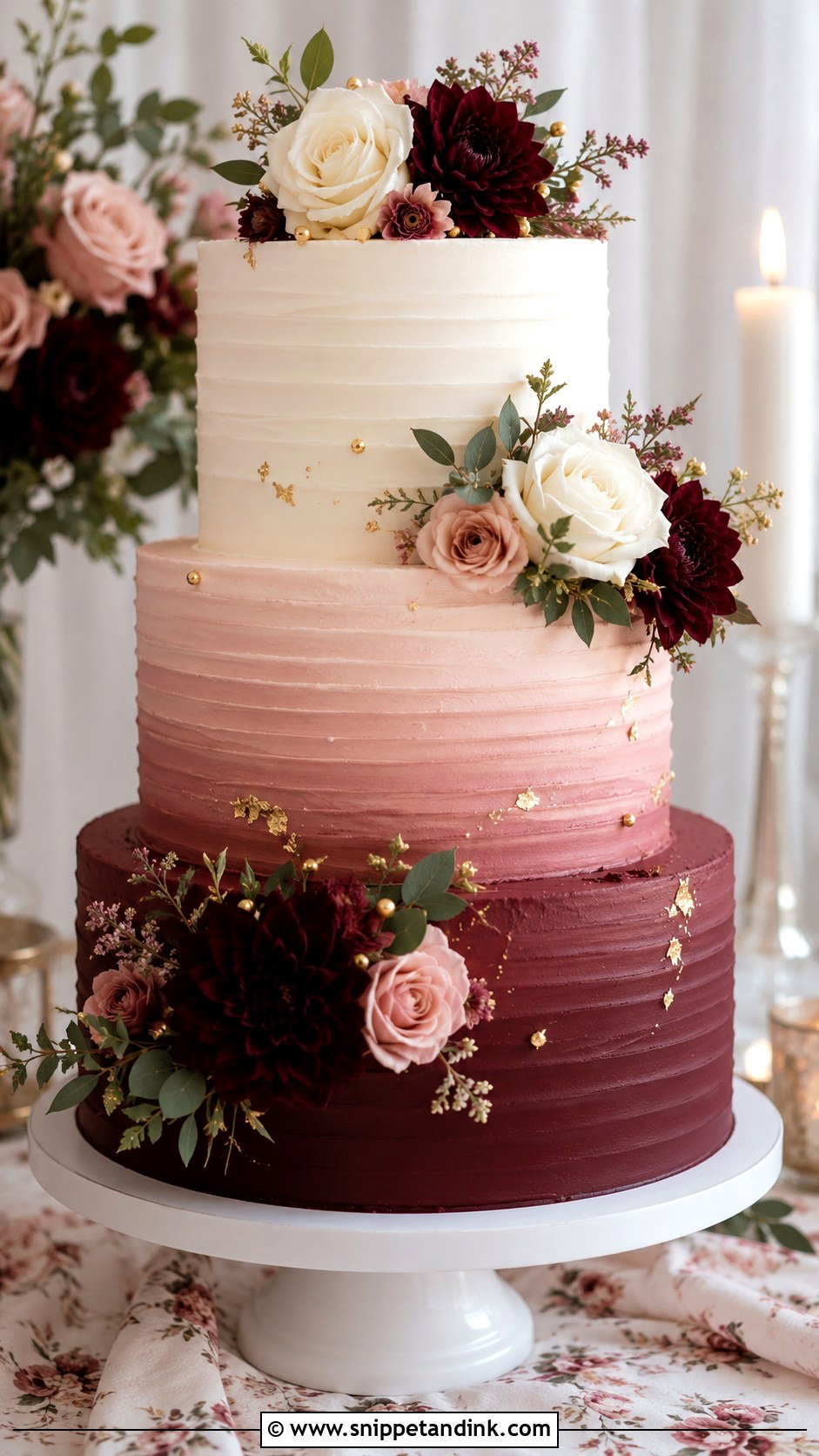
Ombre lets burgundy fade into white across the tiers, usually darkest at the base and palest at the top. You can also go through blush and mauve on the way, which softens the jump from deep red to white. Buttercream blends beautifully for this. I mix each shade separately and let them sit for a few hours, because red colouring deepens as it rests and a shade that looks right fresh can end up darker by the next morning. Keep decorations simple so the gradient stays the focus.
11. Burgundy And White Wedding Cake With Watercolor
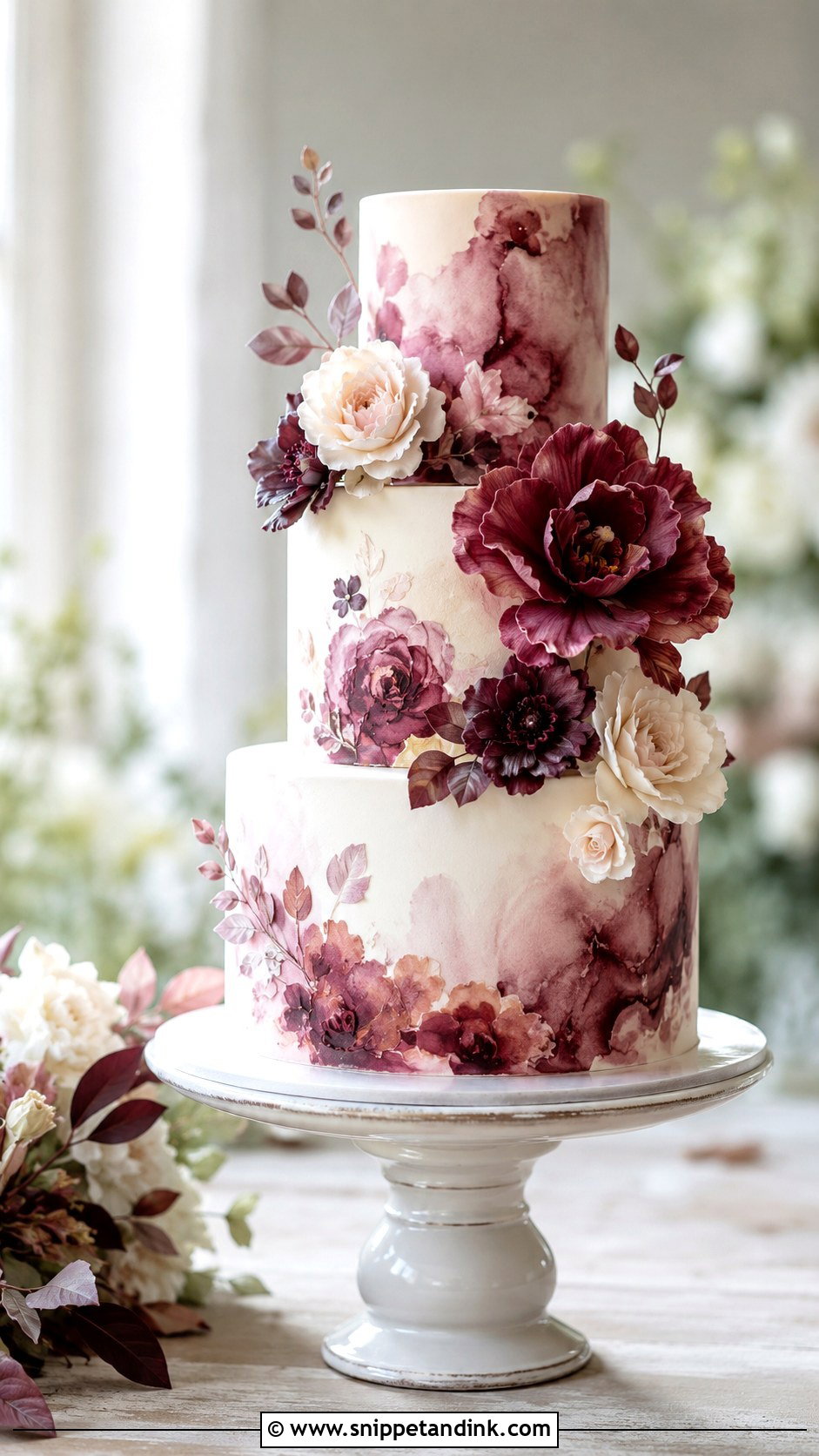
A burgundy and white watercolor wedding cake gives you colour without a heavy solid finish. I paint diluted colour over white fondant or chilled buttercream in layered washes, building the burgundy slowly with hints of blush, mauve or ivory. A few fresh or sugar flowers connect the painting to the wedding florals. The washes have movement and depth in photos. It suits garden weddings and couples who like an artistic, modern look, though it needs a steady, experienced hand, so look at a baker’s painted cakes before booking.
12. Burgundy And White Wedding Cake With Marble
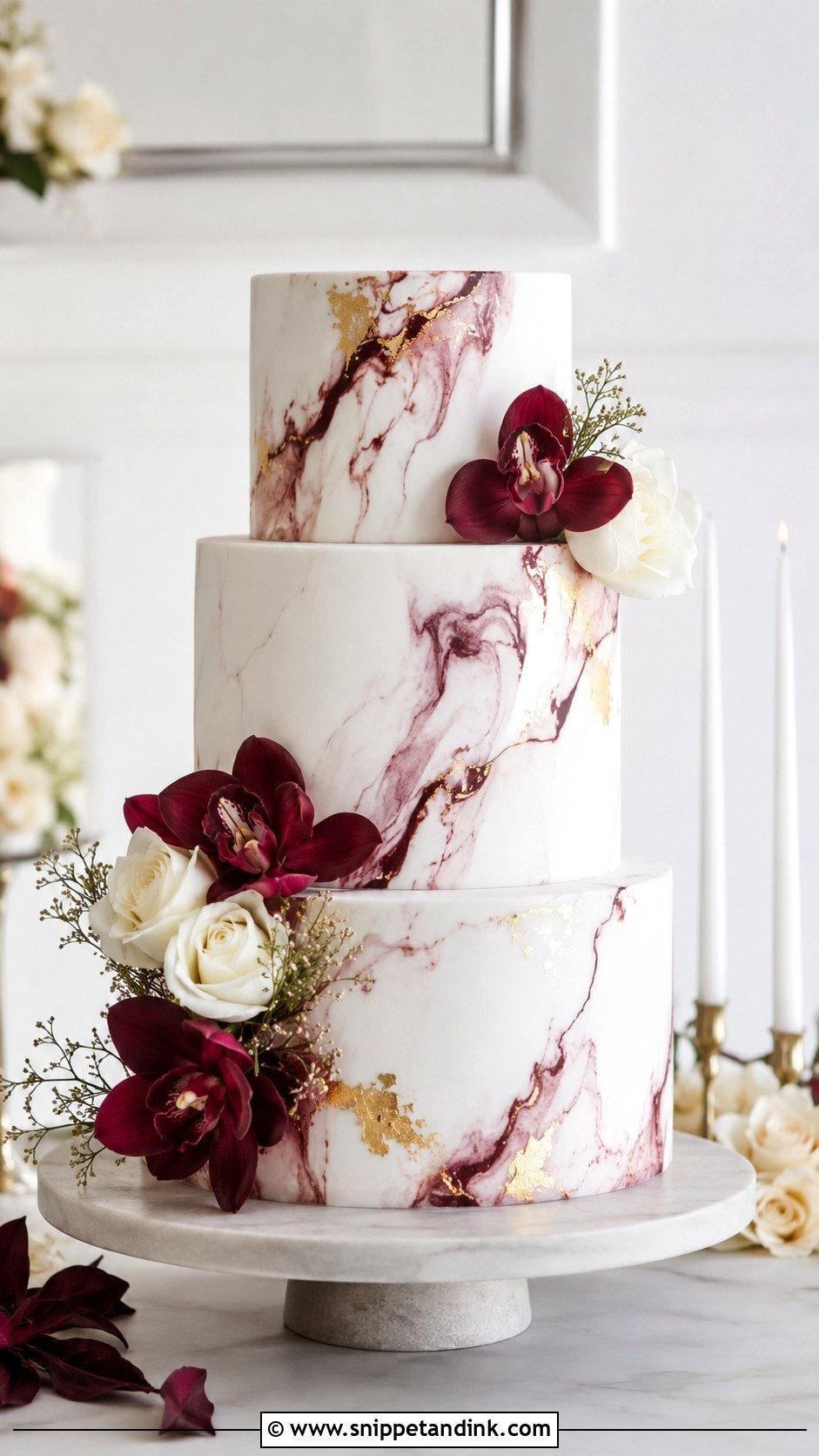
Marble looks modern and works best with very little else on the cake. The veining can be subtle, with thin burgundy lines through white fondant, or bolder swirls on one tier only. I keep decorations to a few burgundy flowers, white roses or small gold touches. Ask for white to stay the main colour and the burgundy to read as veining, not patches. It suits galleries, modern venues and indoor receptions. Each marbled sheet comes out a little differently, so treat the sample photo as a guide, not a guarantee.
13. Burgundy And White Wedding Cake With Geode
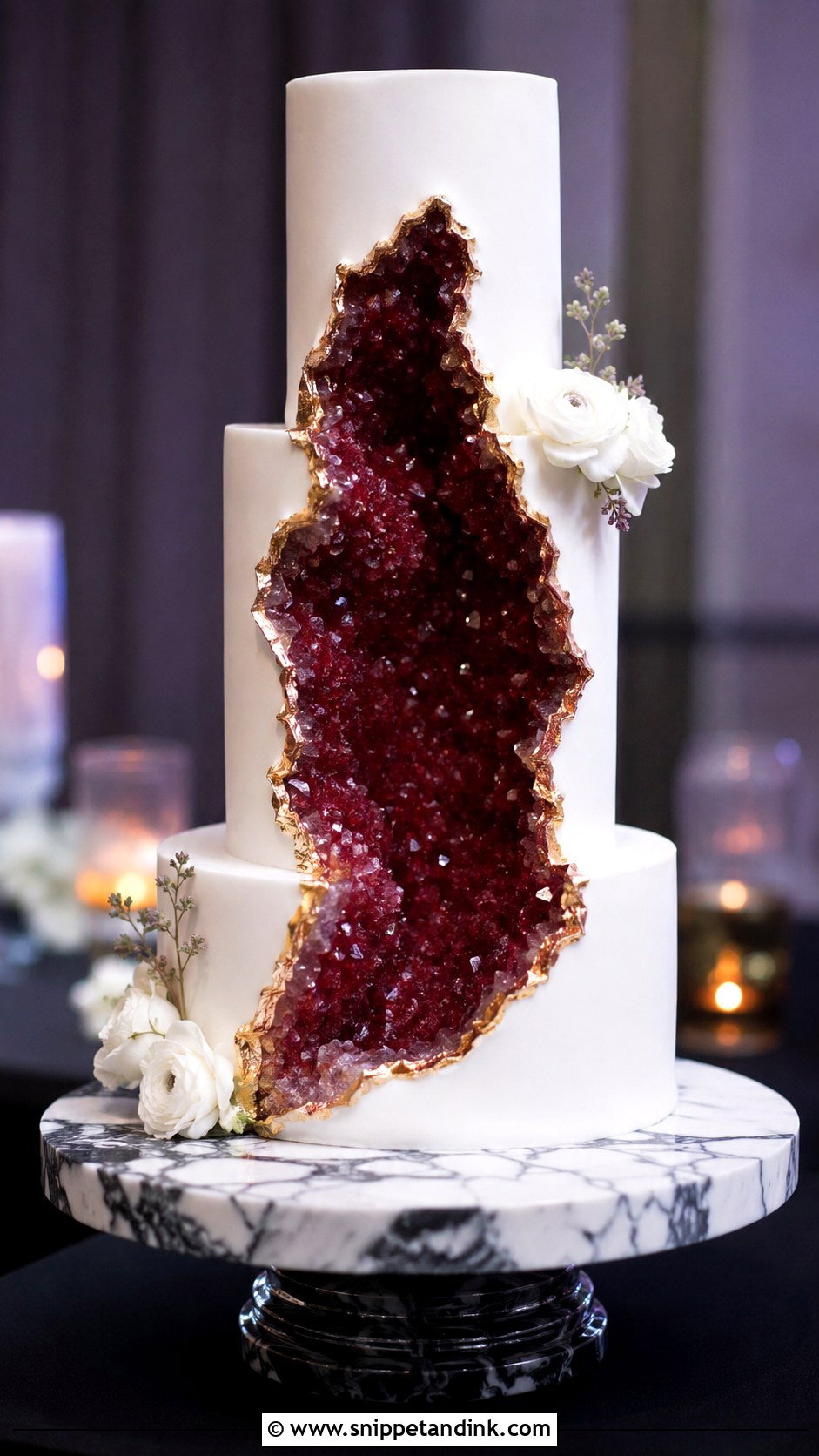
A geode cake keeps most of the surface clean and white, with one carved section filled with sugar crystals in deep burgundy and ruby. A thin gold edge around the opening makes it look finished. Everything else should stay plain so the crystals stand out. It suits evening receptions and modern venues, and the crystals sparkle under soft lighting. Isomalt crystals are sensitive to humidity and can turn cloudy or sticky in a damp room, so I tend to advise against this one for outdoor summer weddings.
14. Burgundy And White Wedding Cake With Cupcakes
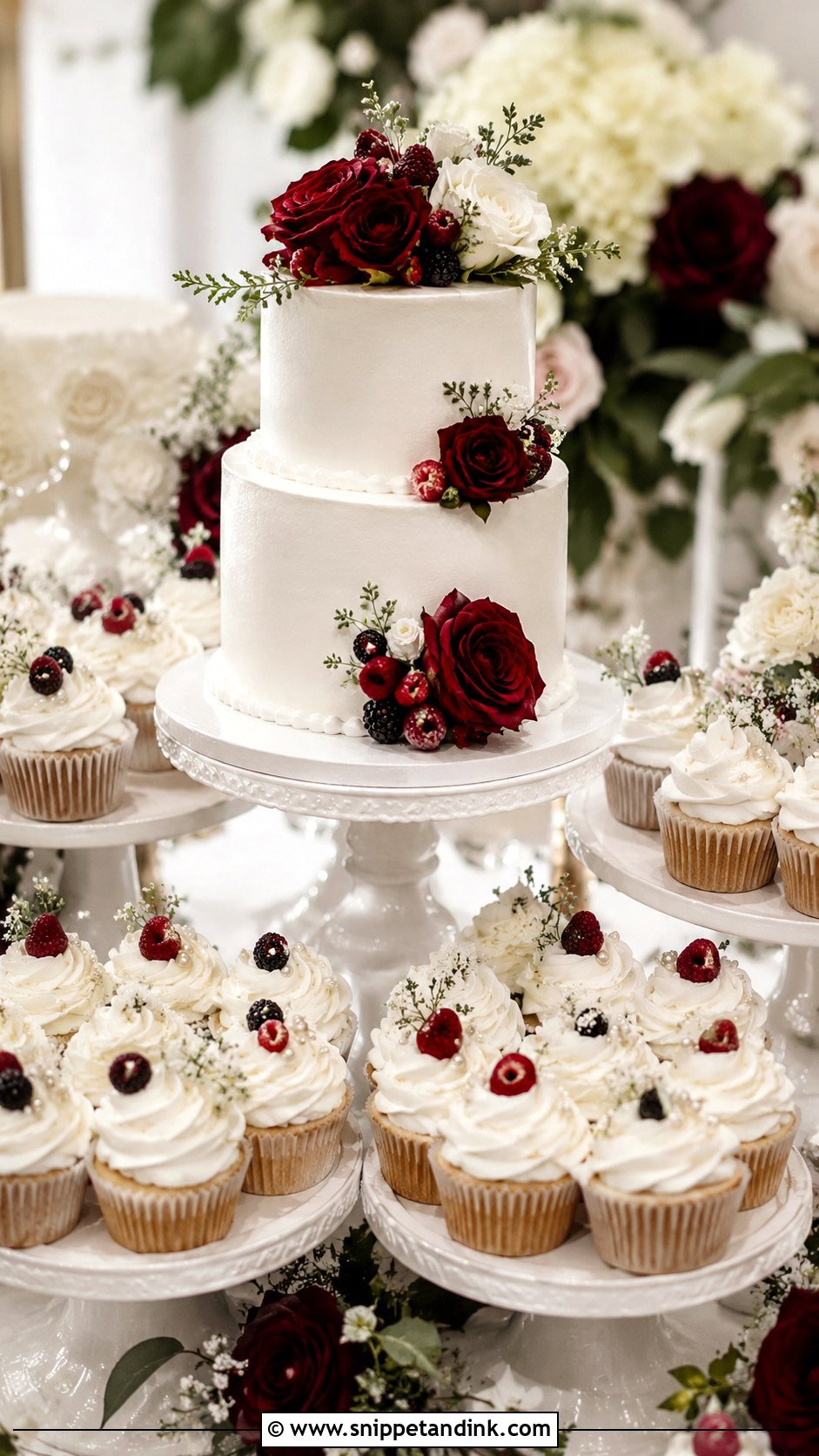
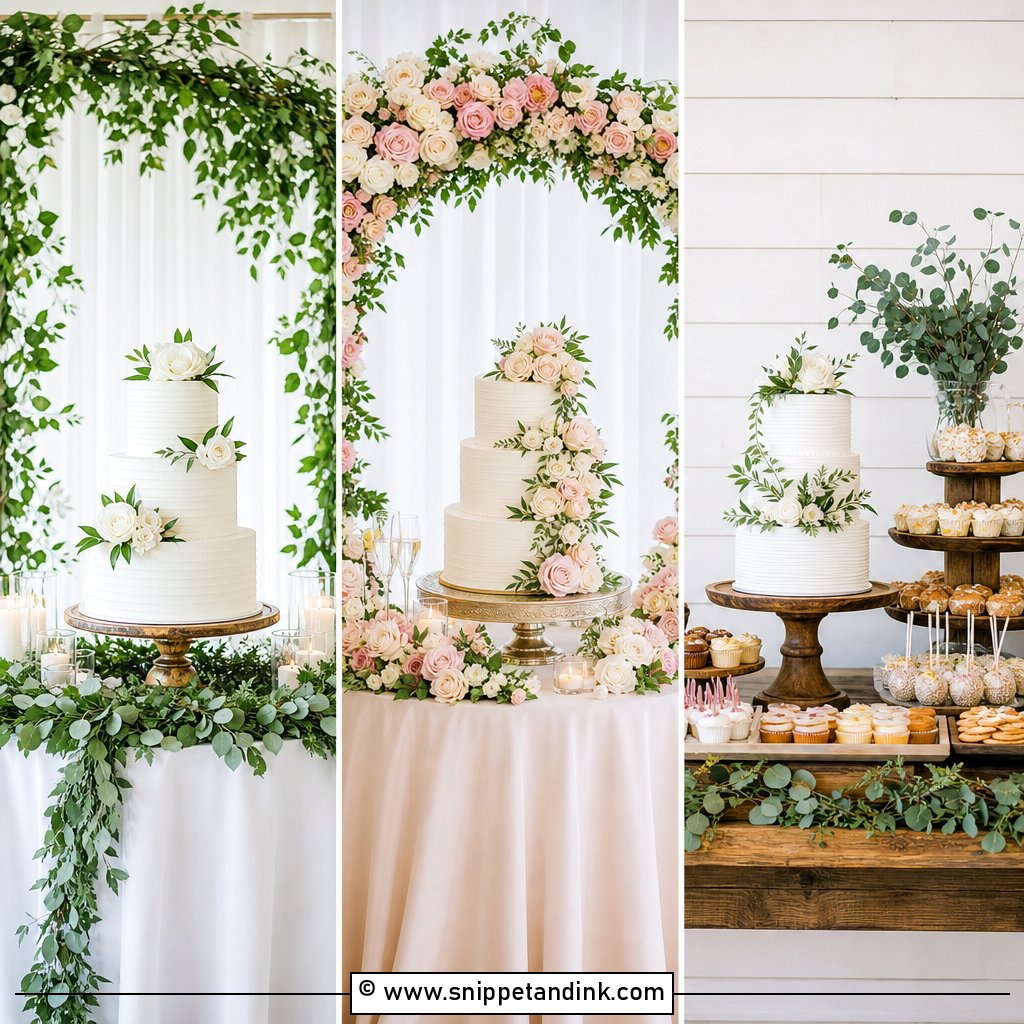
Pairing a main cake with cupcakes is practical and still looks planned. A small two-tier white cake with burgundy flowers sits on top, with matching cupcakes around it on a tiered stand. Cupcakes can carry white swirls, burgundy sugar flowers, berry filling or small pearls. You get a cutting cake for photos and quick serving for guests, plus room for more than one flavour. Use the same palette across both so the table reads as one design. Cupcakes in a deep red liner can sometimes bleed colour onto the white icing, so I use white or foil liners.



15. Burgundy And White Wedding Cake With Macarons
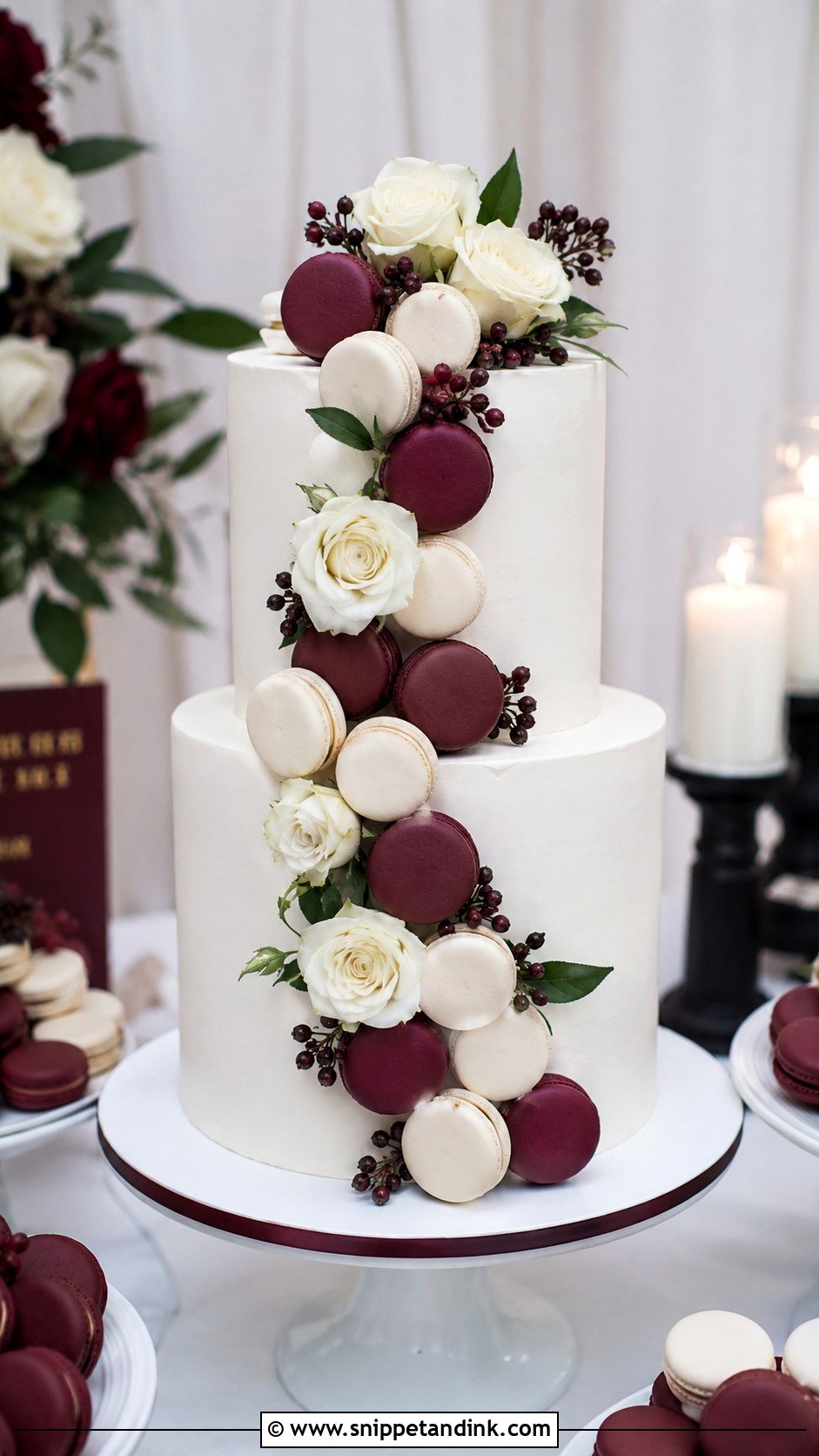
Macarons add a neat, modern finish. A white buttercream cake with burgundy and ivory macarons in a cascade, around the base or on top with flowers works for couples who like a dessert-table look but want one main cake. A soft blush shade alongside the burgundy and white gives a layered effect. Macarons soften as they absorb moisture from buttercream, so I add them on the day rather than the night before; otherwise they lose their crisp edge.
16. Burgundy And White Wedding Cake With Berries
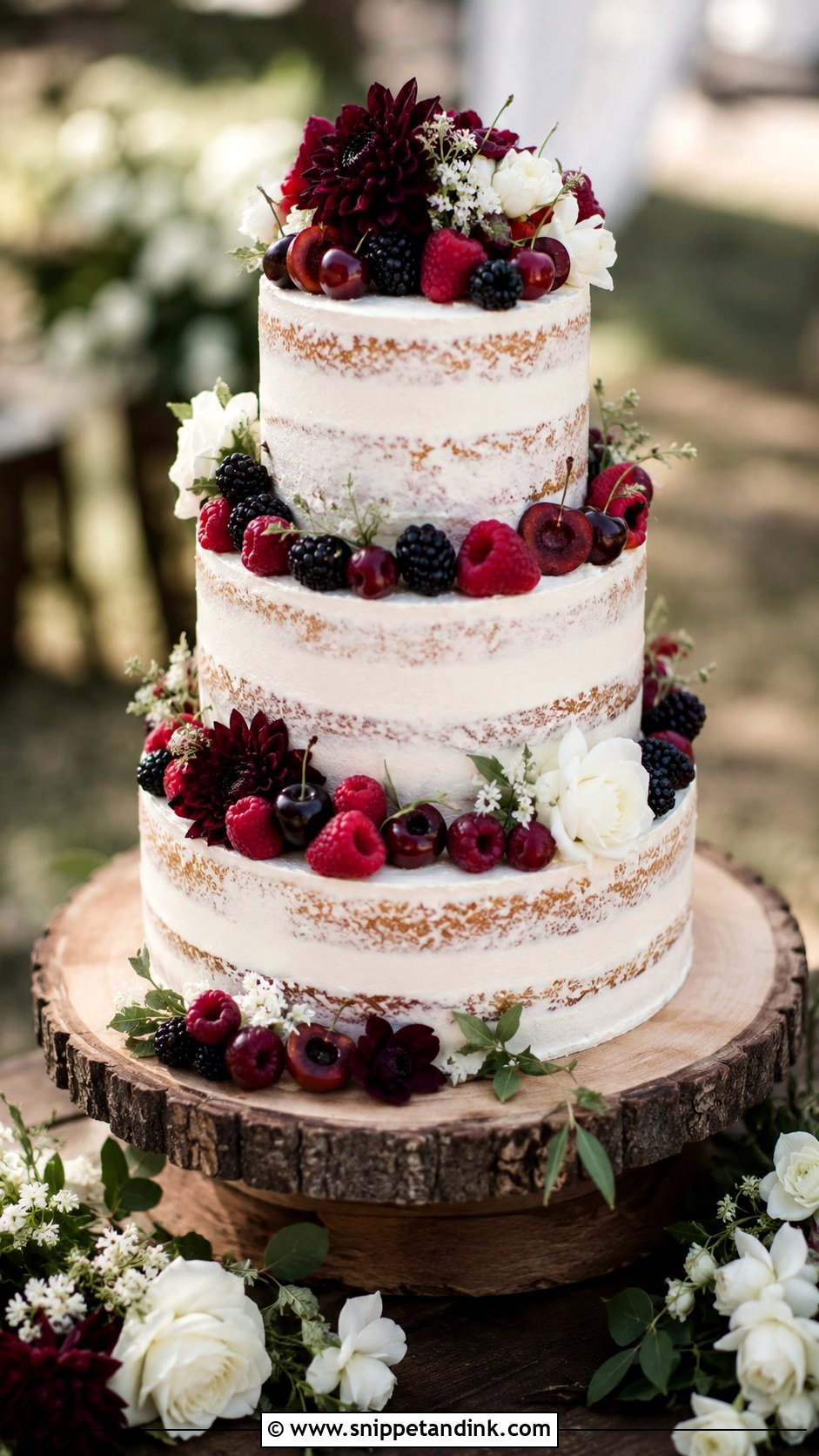
Berries give this palette a fresh, natural look. White buttercream or cream cheese frosting is the base, and blackberries, raspberries, cherries or red currants bring the burgundy. A semi-naked or softly textured finish suits it, with a few white flowers or herbs. Berries pair well with flavors like vanilla bean, almond, lemon, red velvet and chocolate. The catch is juice: cut or very ripe berries weep onto white icing within hours, so I use whole, firm fruit, pat it dry and place it as close to the reception as I can. It suits outdoor and rustic weddings.
17. Burgundy And White Wedding Cake With Greenery
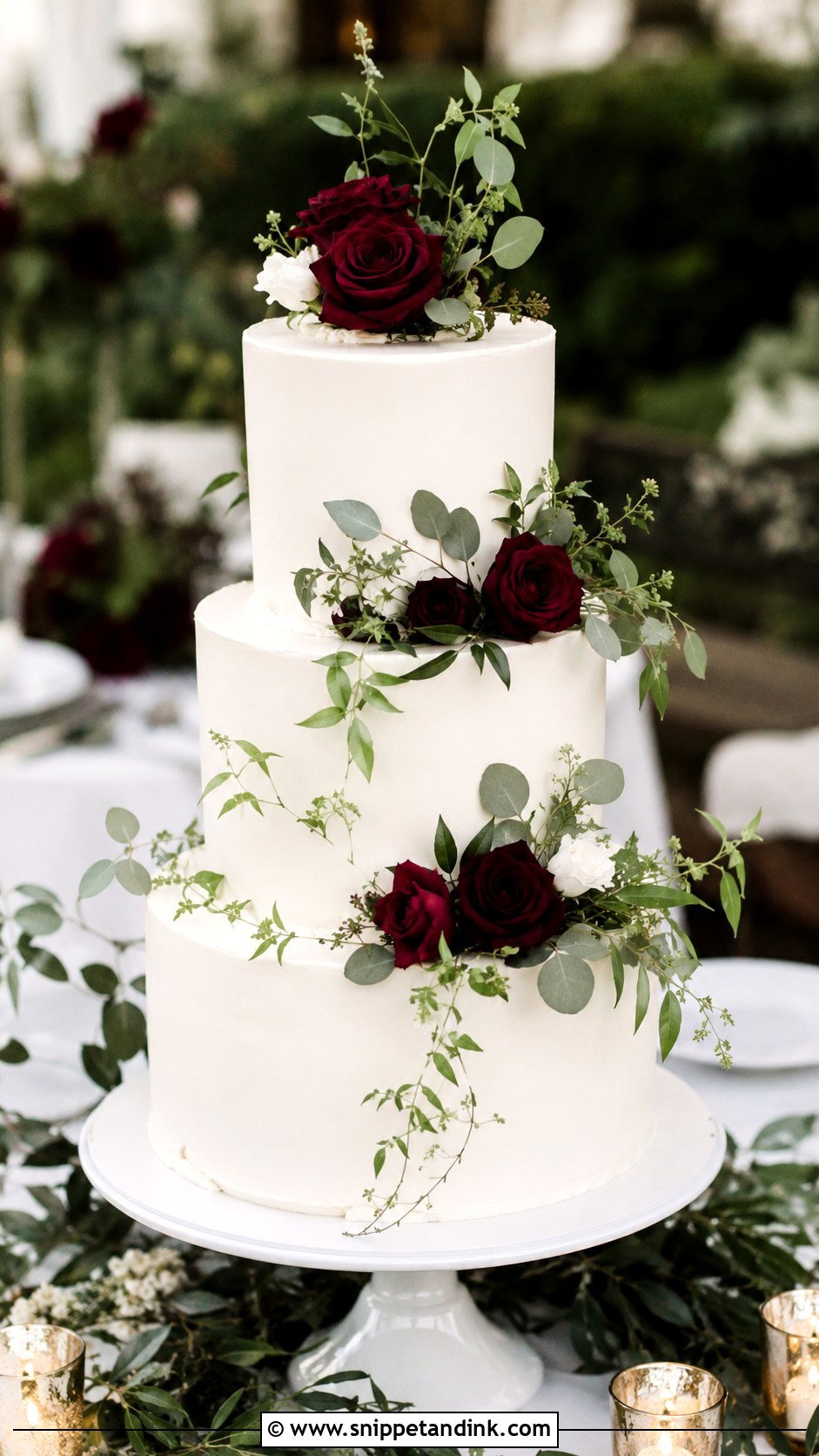
Greenery keeps burgundy from feeling too dark. A small vine around one tier, a few eucalyptus leaves or some ruscus tucked into a flower cluster is enough; too much hides the white icing and makes the cake look crowded. Garden venues, barns and estates suit it. As with fresh flowers, I only use greenery the florist confirms is food-safe or unsprayed, and I keep stems wrapped. The finished cake should look gathered, not overgrown.
18. Burgundy And White Wedding Cake With Vintage Piping
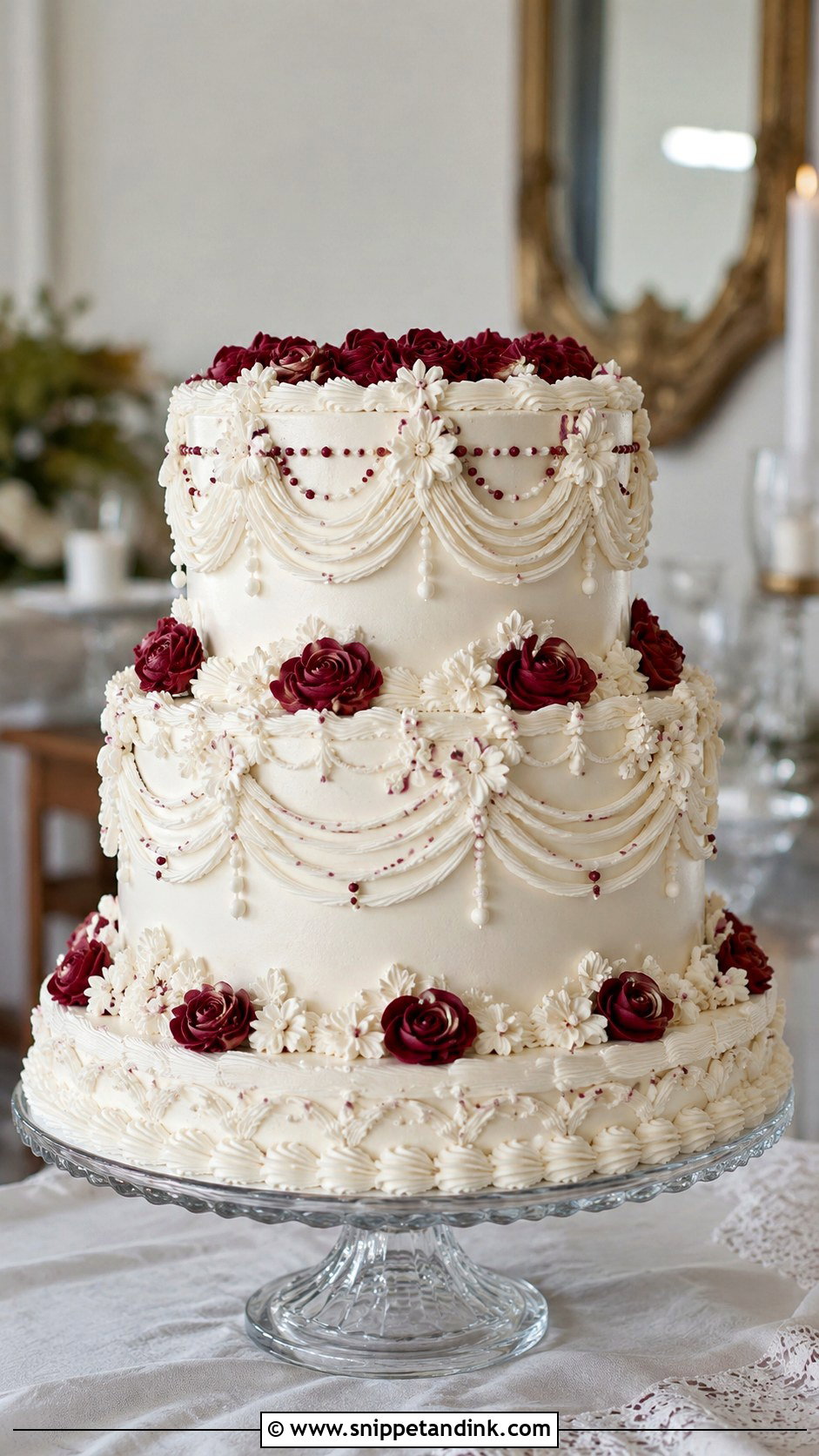
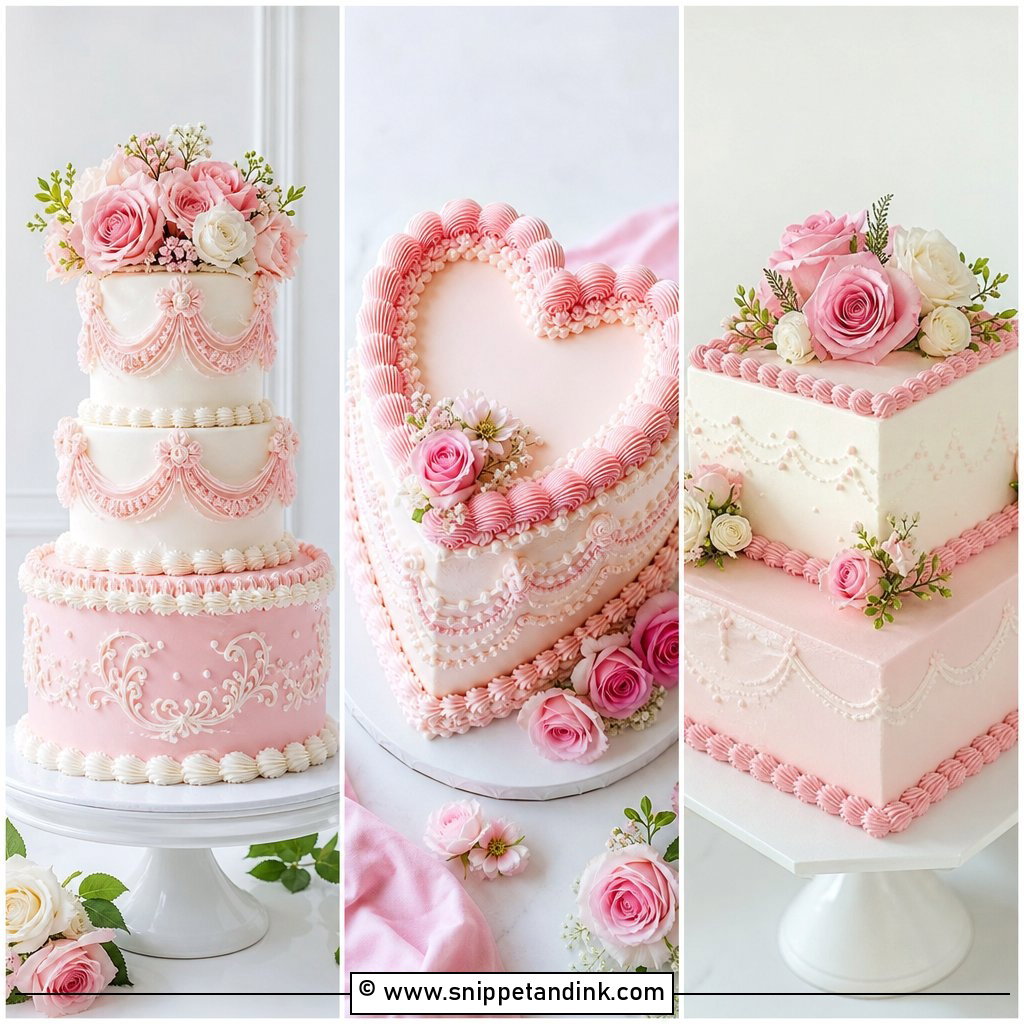
Vintage piping is back, and burgundy accents make it more romantic. A white cake with piped shells, swags, ruffles and borders looks nostalgic; burgundy comes in through small rosettes, cherries or floral details. It can be a heart-shaped cake, a round two-tier or a tall Lambeth-style one. Lambeth piping is layered and takes time to do well, so check that your baker has made this style before. Keep the burgundy to accents, and keep the piping lines clean.
19. Burgundy And White Wedding Cake With Pressed Flowers
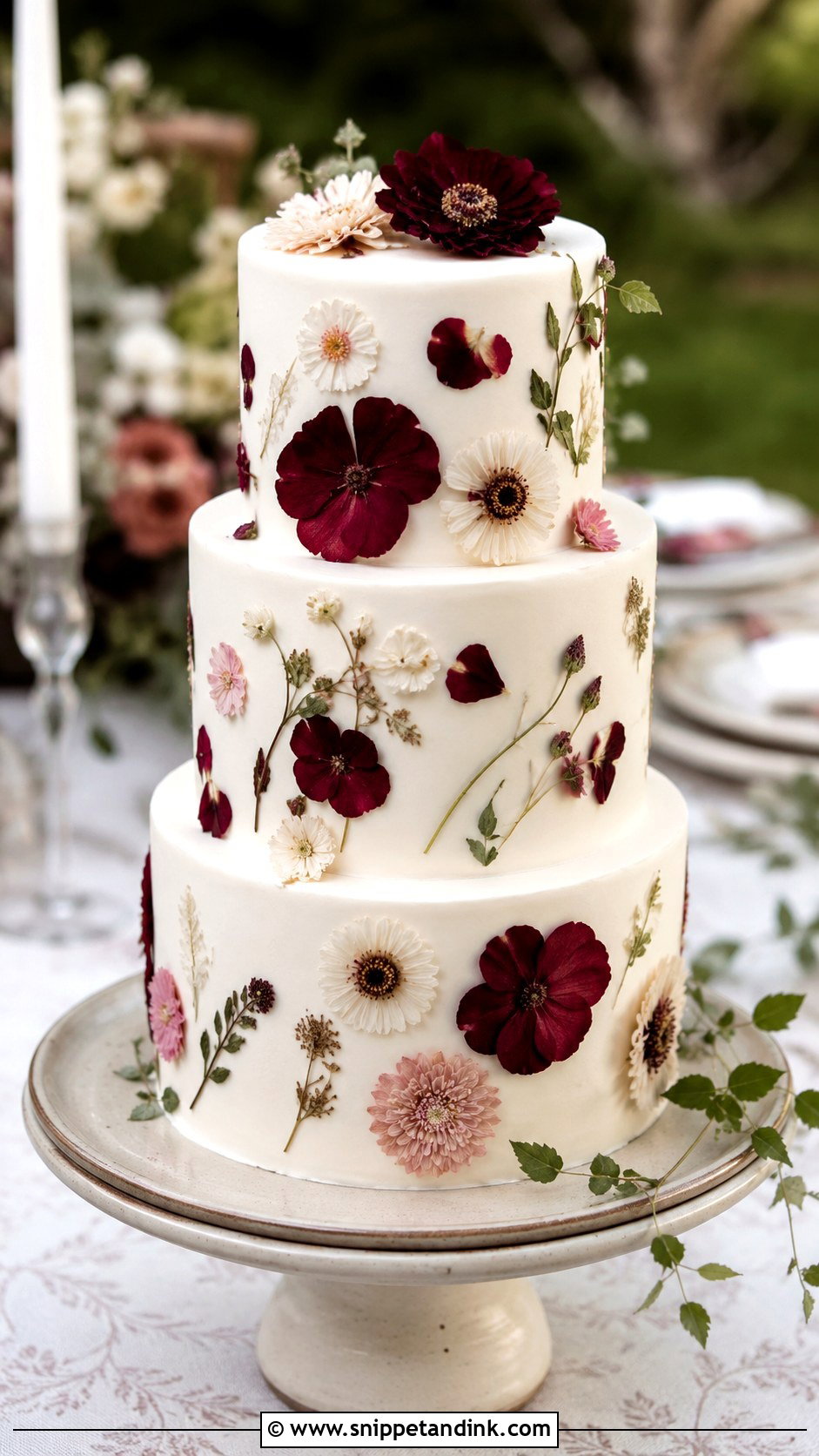
Pressed flowers give a delicate, garden look. Smooth white buttercream or fondant shows them best. I use edible pressed flowers in burgundy, ivory and soft pink, scattered lightly or arranged along one side. Pressed petals can fade if the cake sits in strong sunlight, so I keep the cake shaded until it’s cut. It suits outdoor weddings and couples who want floral detail without large blooms.

20. Burgundy And White Wedding Cake With Black Accents
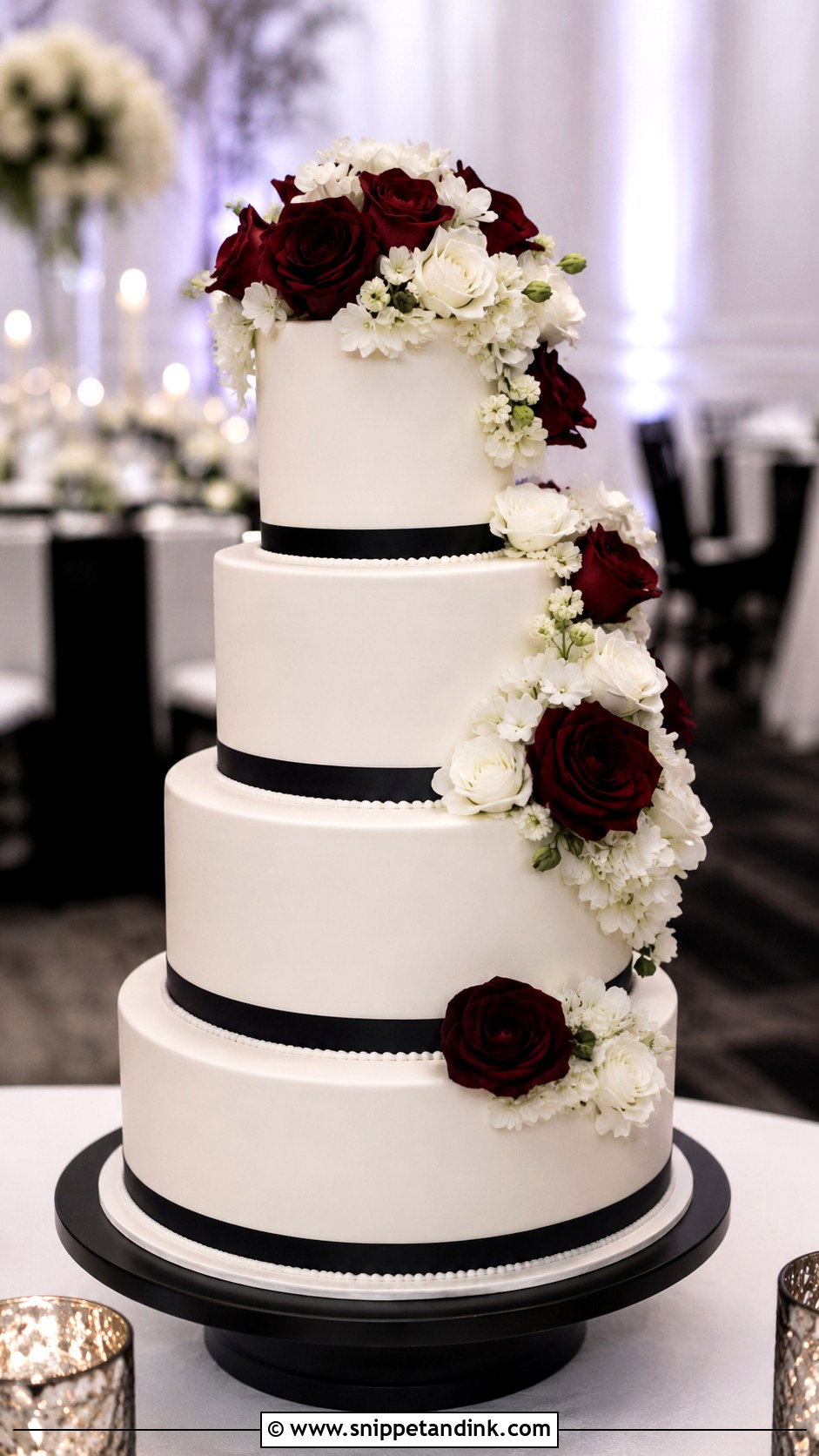
Black accents add structure and drama. White tiers keep the cake bridal, burgundy flowers bring romance, and fine black details give contrast: thin bands, a small monogram, painted edges or dark flower centres. It suits evening receptions and formal weddings with a dramatic palette. Black colouring is very strong and can stain teeth and lips, so I keep it to thin lines and dark flower centres that guests aren’t eating in quantity. Let white and burgundy lead, with black as the frame.
From the Bakery to the Cake Table
A dark palette shows every scuff, so the hours between my kitchen and your first cut matter. A few things I plan for with every burgundy and white cake:
- Delivery and setup timing. Fresh flowers, berries and real ribbon go on at the venue, so I need access to the cake table well before guests arrive, usually an hour or so.
- Room temperature. Buttercream holds well in a cool room and softens in a warm one; a cake table next to a window or under a heat lamp is a problem. Tell your venue where the cake should stand.
- Flower handover. If your florist is supplying the blooms, agree who prepares them, whether they’ve been sprayed, and who places them.
- Timing of the cut. White icing picks up colour from cut berries and red velvet crumbs, so the earlier the cut happens after photos, the cleaner the slices look.
- Order lead time. Couples often book their baker several months out, and sugar flowers and hand-painted cakes need extra time on top, so book early in your planning if you want either.
None of these are reasons to avoid the palette. They’re just the details a baker juggles on the day, and knowing them helps you ask the right questions at your tasting.
How Much Burgundy Is Too Much on a White Cake?
Burgundy and white can lean classic, rustic, modern or dramatic depending on the finish. Roses, lace, pearls and pressed flowers keep it soft; marble, geode, ombre and a drip make it bolder. A small cake with cupcakes or macarons is the practical choice for serving. In every version, the white does the work of keeping the cake bright and bridal, and the burgundy is there in flowers, fruit, piping, ribbon or paint. Bring a fabric swatch to your tasting so your baker can match the exact shade.
You'll Like These Ideas:




Leave a Reply