
Nearly every couple who sits down with me says some version of “we just want it white.” That sounds like the simplest brief, and it’s the one with the most decisions hidden inside it. Which white? Buttercream or fondant? Texture, piping or flowers? What shape, and how many tiers for your guest list? With no color to lean on, the finish and the structure carry the whole design, so every flaw and every good choice shows. The thirty cakes below cover pearls, pressed flowers, ruffles, scallops, lace, tall tiers, square shapes and modern minimal finishes, with the practical notes I’d give you at a consultation.
Bright White, Ivory or Somewhere Between?
There is no single white in cake. Butter, egg yolks and vanilla all push buttercream toward cream, and fondant comes in several shades from bright white to soft ivory. Before I sketch anything, I ask which white the couple means.
- Bright white buttercream usually means a recipe with part shortening, clear vanilla, or a tiny dot of violet gel to cancel the yellow. Some bakers use a whitening additive; it’s restricted in some countries, so ask what your baker uses if that matters to you.
- Ivory looks warmer and richer, and it sits more kindly next to most wedding dresses, which are rarely pure white themselves.
- Under flash and bright daylight, very white cakes can lose their detail in photos. Ivory and soft white hold piping and texture shadows better.
My practical test: bring a fabric swatch from your dress or the table linen to the tasting, and hold it against the icing sample. If the cake looks gray or yellow next to it, adjust the shade before anything else is decided.
1. White Buttercream Wedding Cake
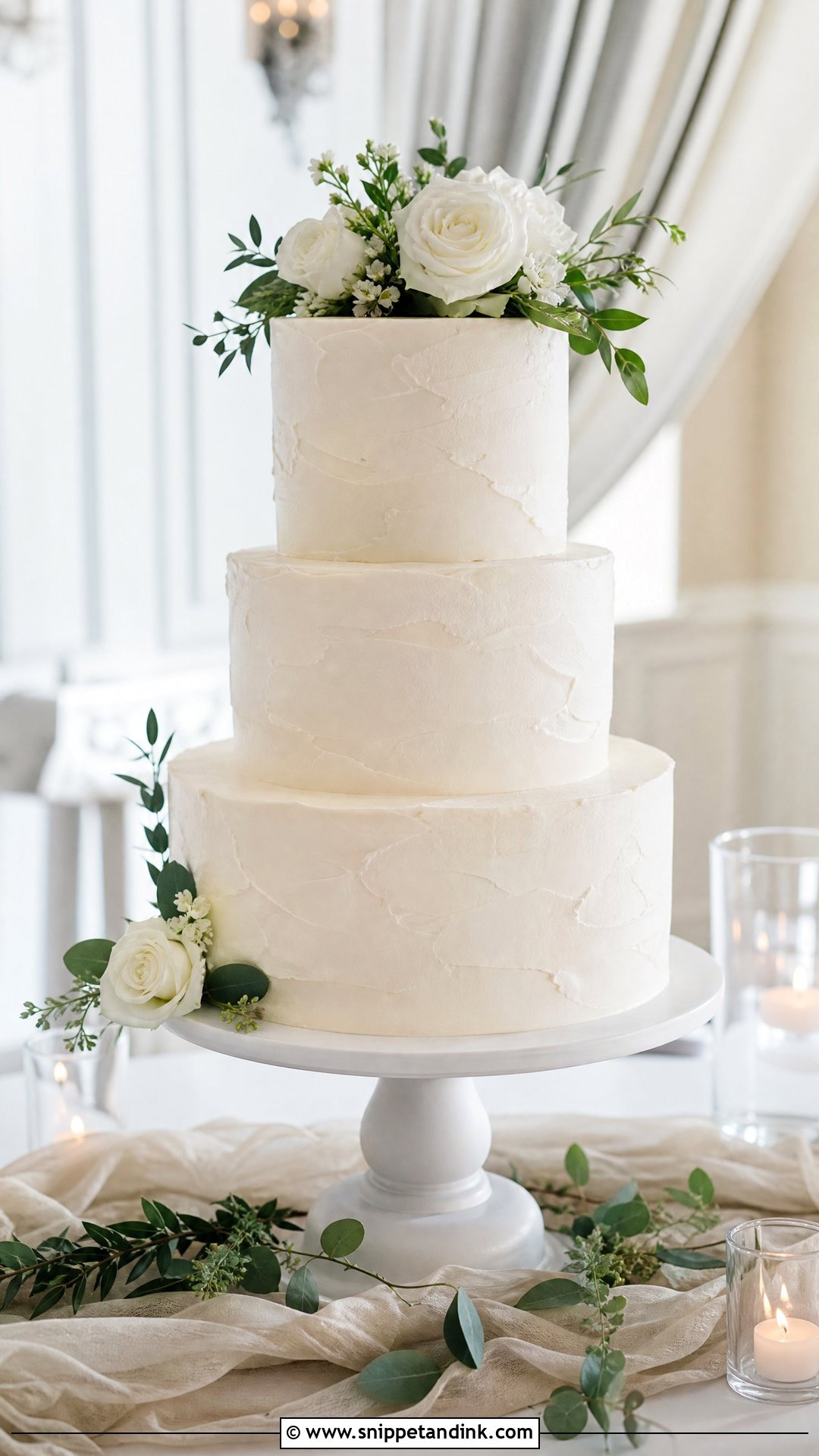
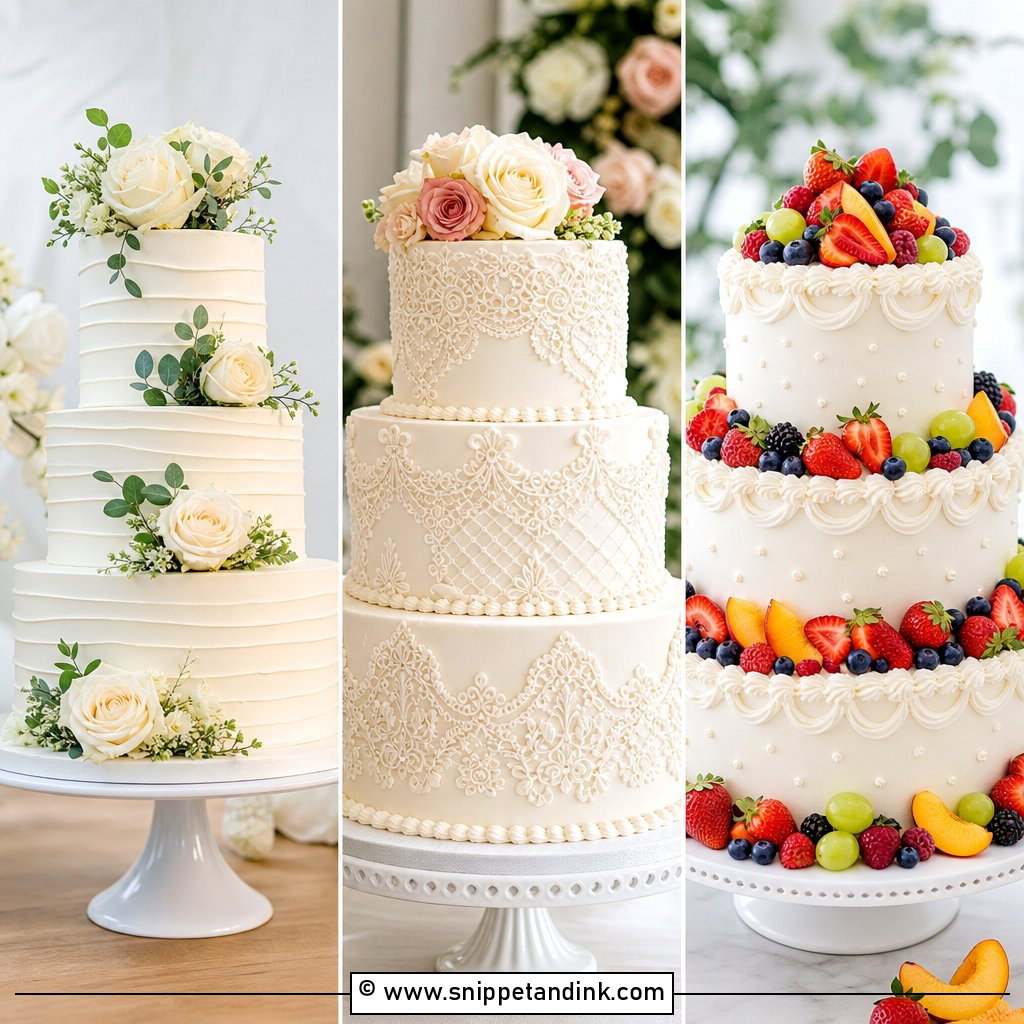
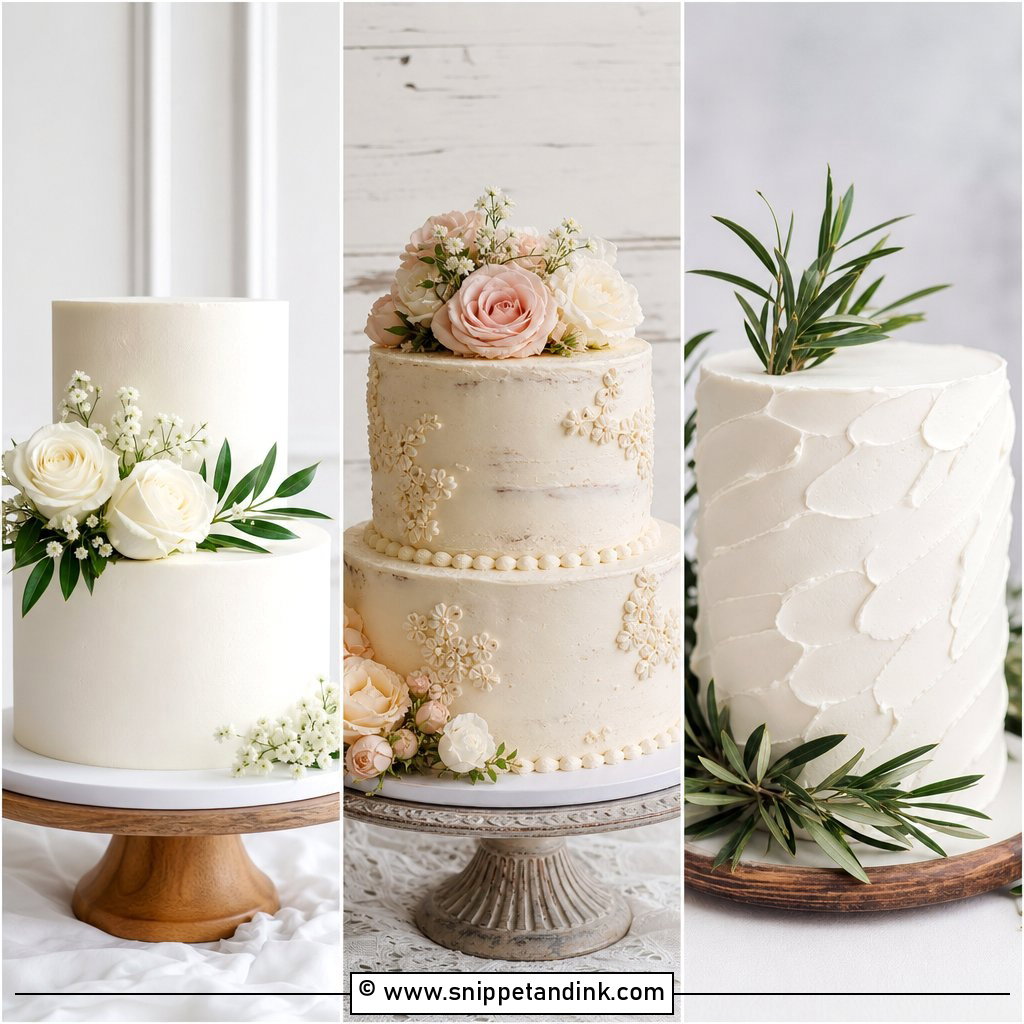
Buttercream is the finish most guests actually enjoy eating, and it adapts to the room. For a ballroom I scrape it to sharp edges and add simple flower clusters; for a garden or barn I leave soft spatula marks. One honest note: real butter makes buttercream ivory, not snow white, so if you want a brighter white, say so early and your baker can adjust the recipe. Vanilla, almond, lemon and white chocolate layers all suit it. A plain stand, a few fresh white blooms and some green leaves are enough.
2. White Fondant Wedding Cake
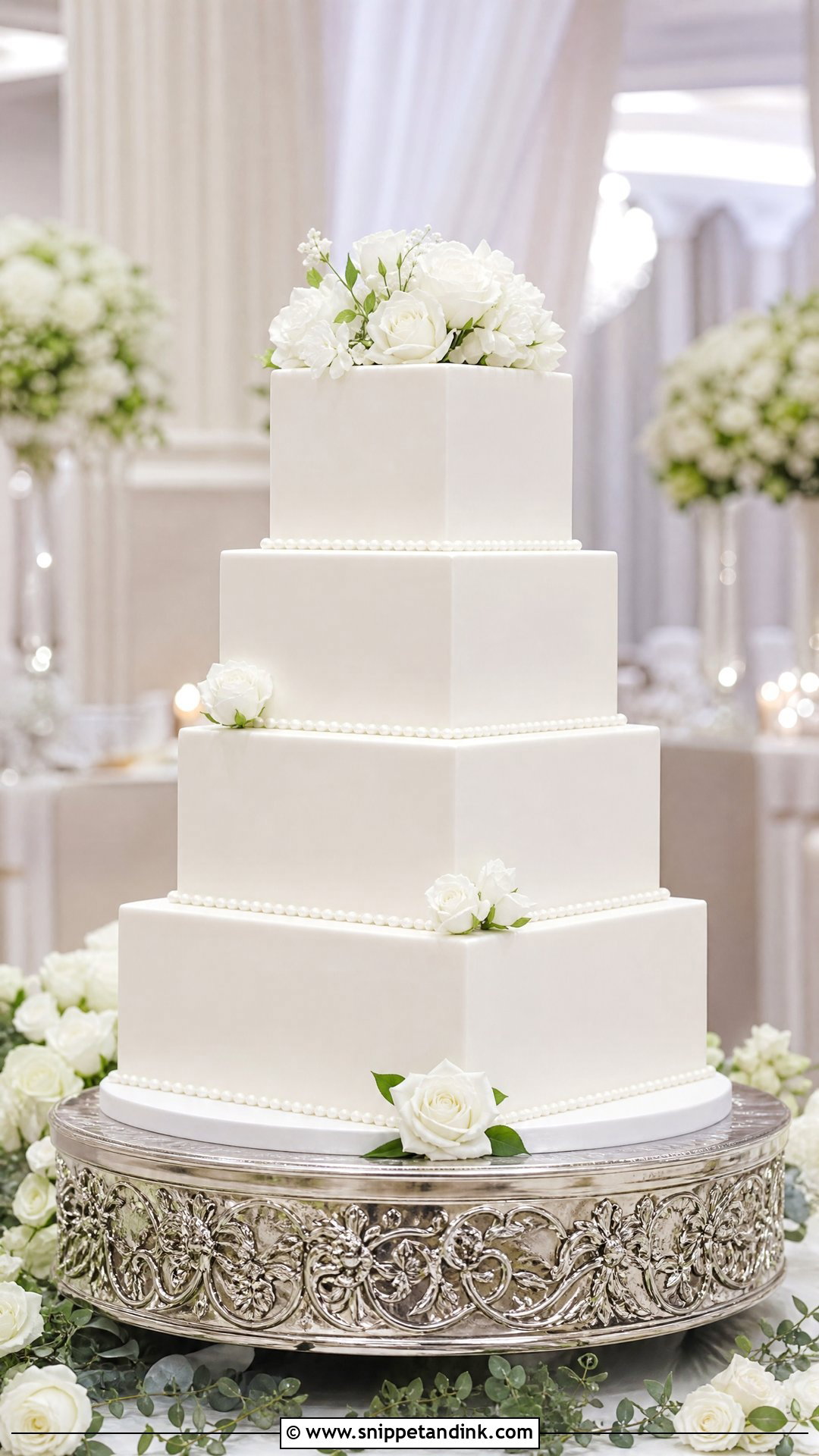
Fondant gives the flawless surface people picture from formal receptions, and it’s the right tool for sharp edges, tall tiers, molded details and fine patterns such as pleats or sculpted borders. It also seals the cake, so it handles a long display better than buttercream. The trade-off is taste and texture; plenty of guests peel it off. I always put a layer of buttercream or ganache underneath and suggest a flavorful filling so what’s inside earns the outside. A textured tier or a soft flower cascade keeps it from looking stiff.
3. White Pearl Wedding Cake
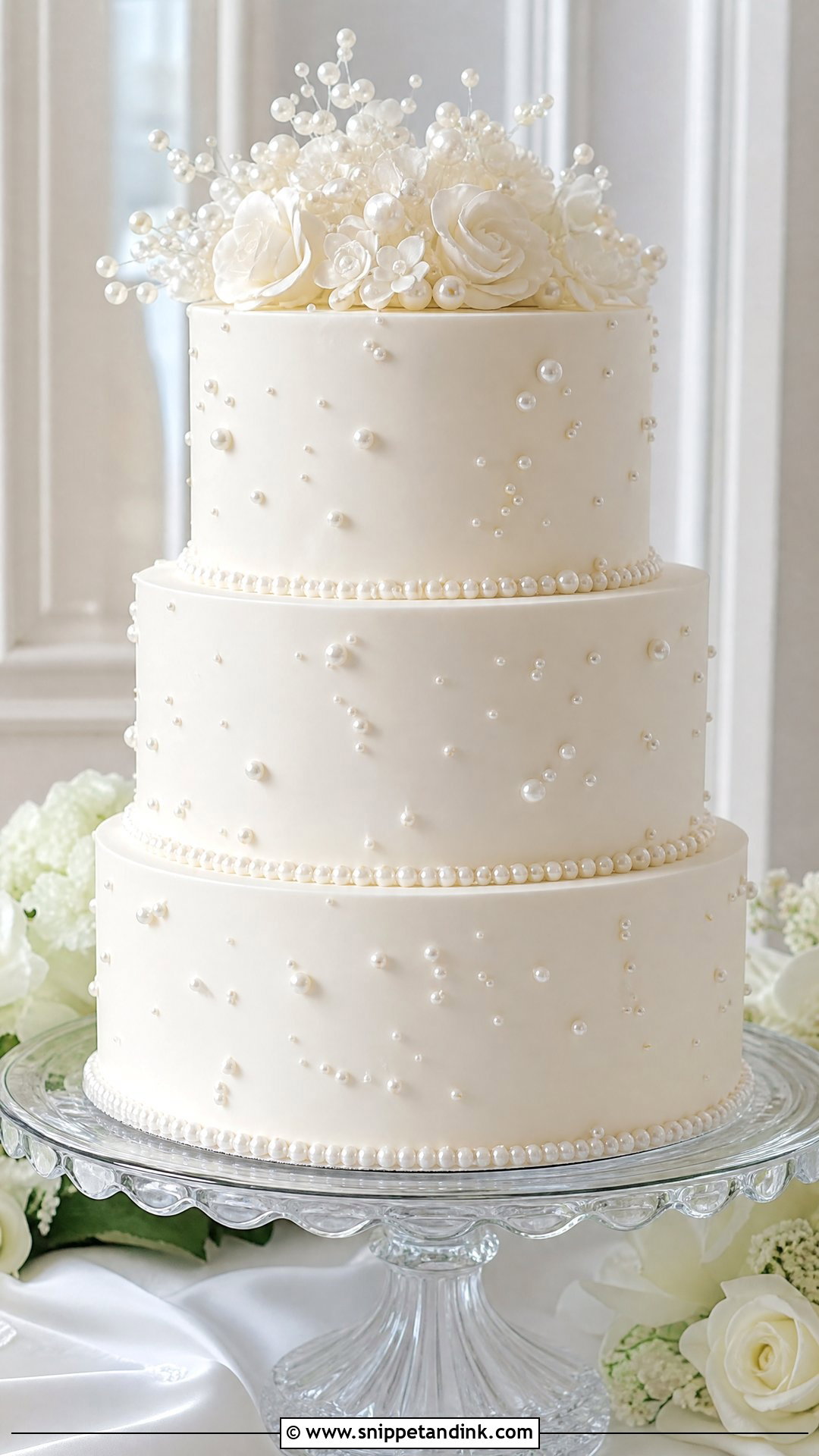
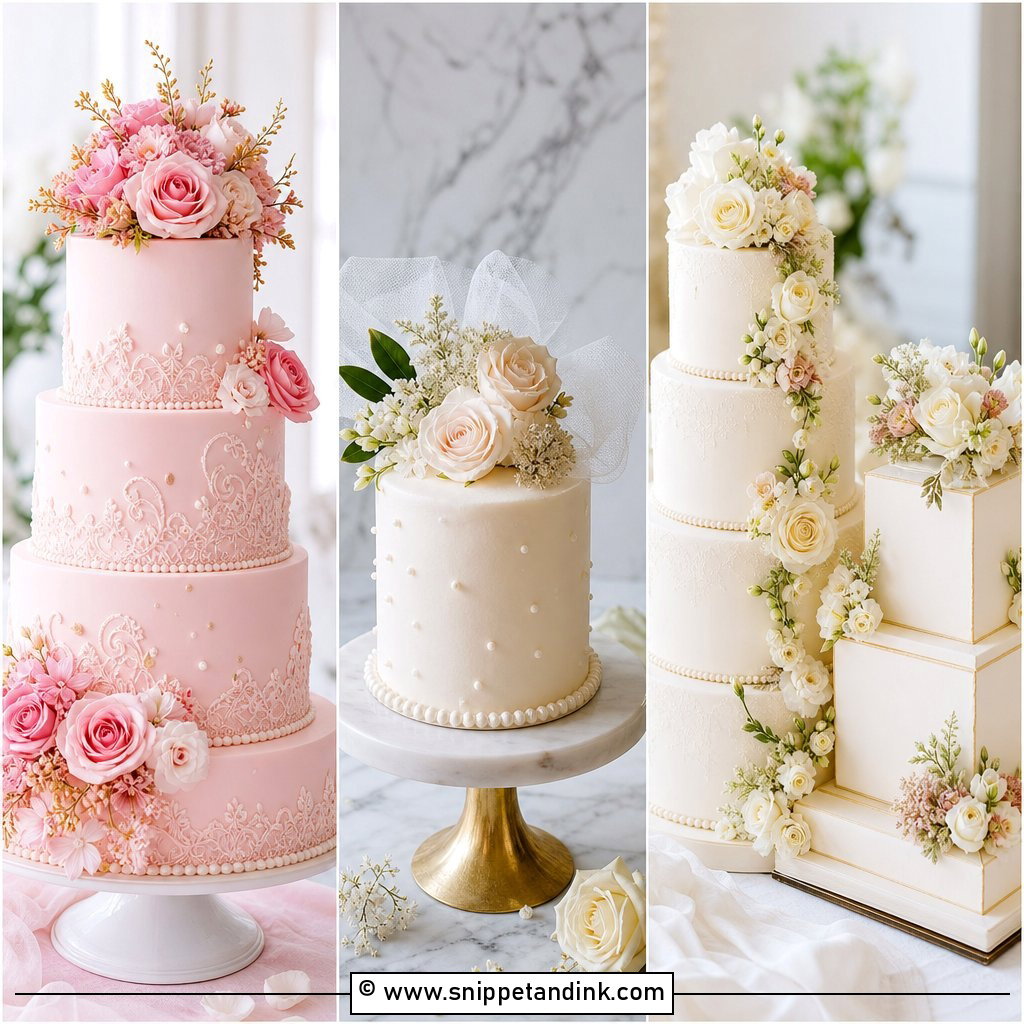
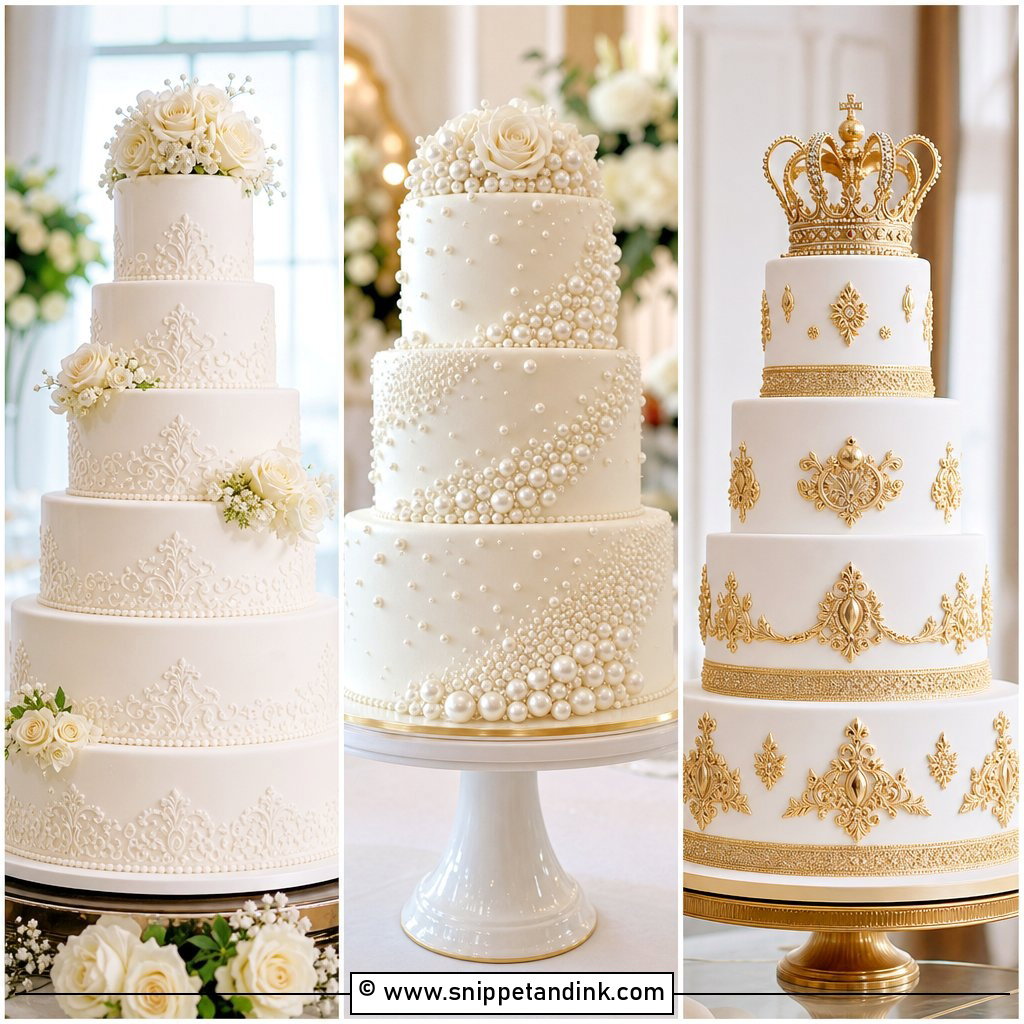
Pearls look bridal because they echo the jewelry. They can be scattered, set in neat rows, or clustered like a necklace around a tier. On a stark white cake, pearls nearly vanish, so I usually go a shade warmer toward ivory, which lets them show softly. Small pearls read delicate; big ones look more like fashion. Ask your baker which pearls are edible sugar and which are decorative only, because some dragees are labeled for decoration and must be removed before serving.
4. White Floral Wedding Cake
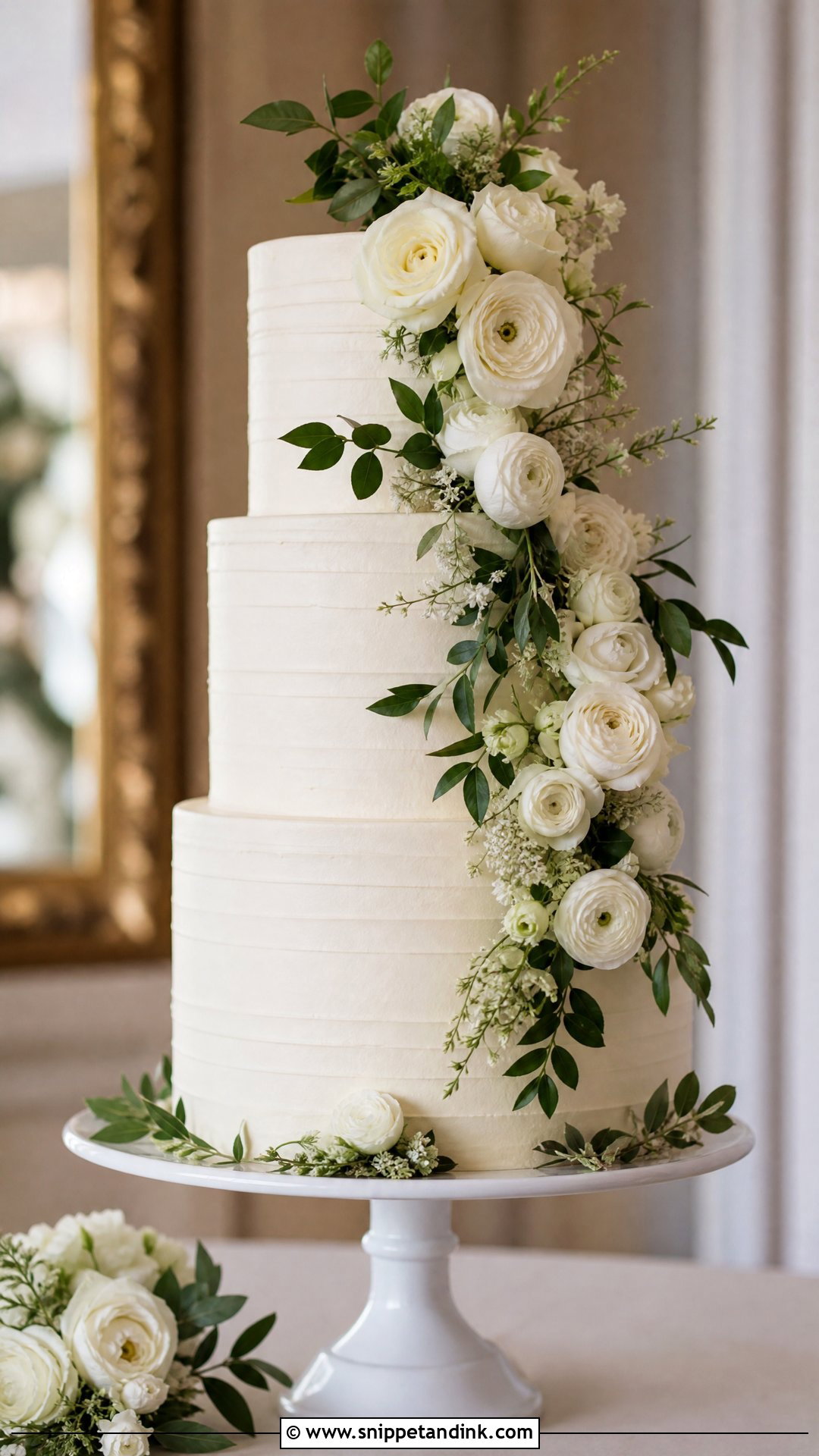
Flowers are what tie a white cake to the bouquet. White roses, ranunculus, orchids, lisianthus and peonies can sit in a diagonal cascade, ring the base or fill the gaps between tiers. If you use fresh blooms, the florist should supply pesticide-free stems and the baker should insert them with wrapped picks, so nothing touches the sponge. Sugar flowers are the fully edible route and hold their shape all night. Either way, keep the frosting smooth or softly textured so the petals lead. Spring, summer and indoor receptions all suit it.
5. White Ruffle Wedding Cake
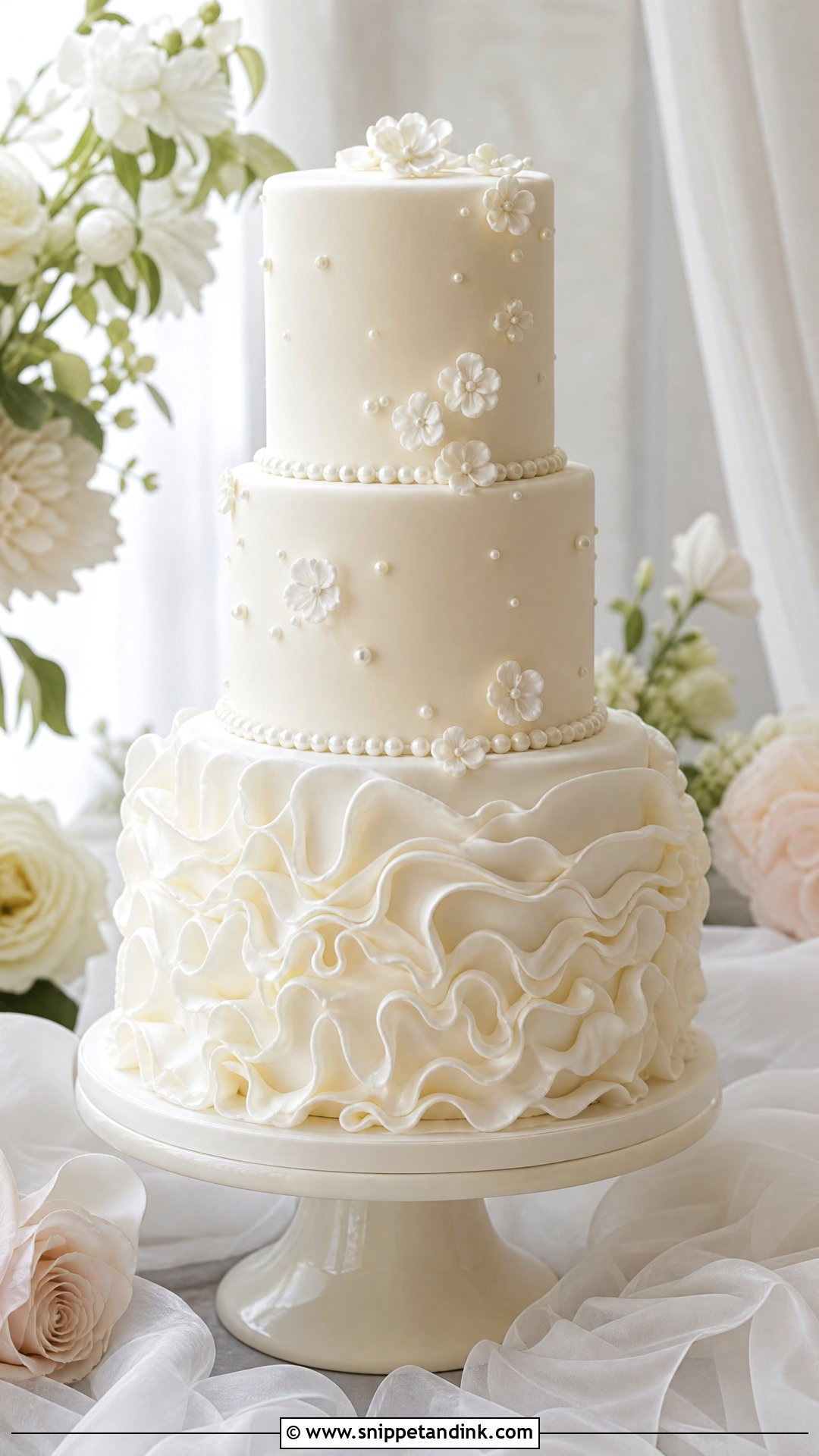
Ruffles bring movement to an all-white cake. I make them in buttercream, fondant, wafer paper or sugar paste depending on how fine they need to be; wafer paper gives the thinnest, most fabric-like edge but softens in humid air. Thin vertical ruffles look modern; full horizontal ones look romantic. I’d use them on one or two tiers and leave the rest smooth, which makes the texture feel deliberate and pairs well with a flowing gown.
6. White Lace Wedding Cake
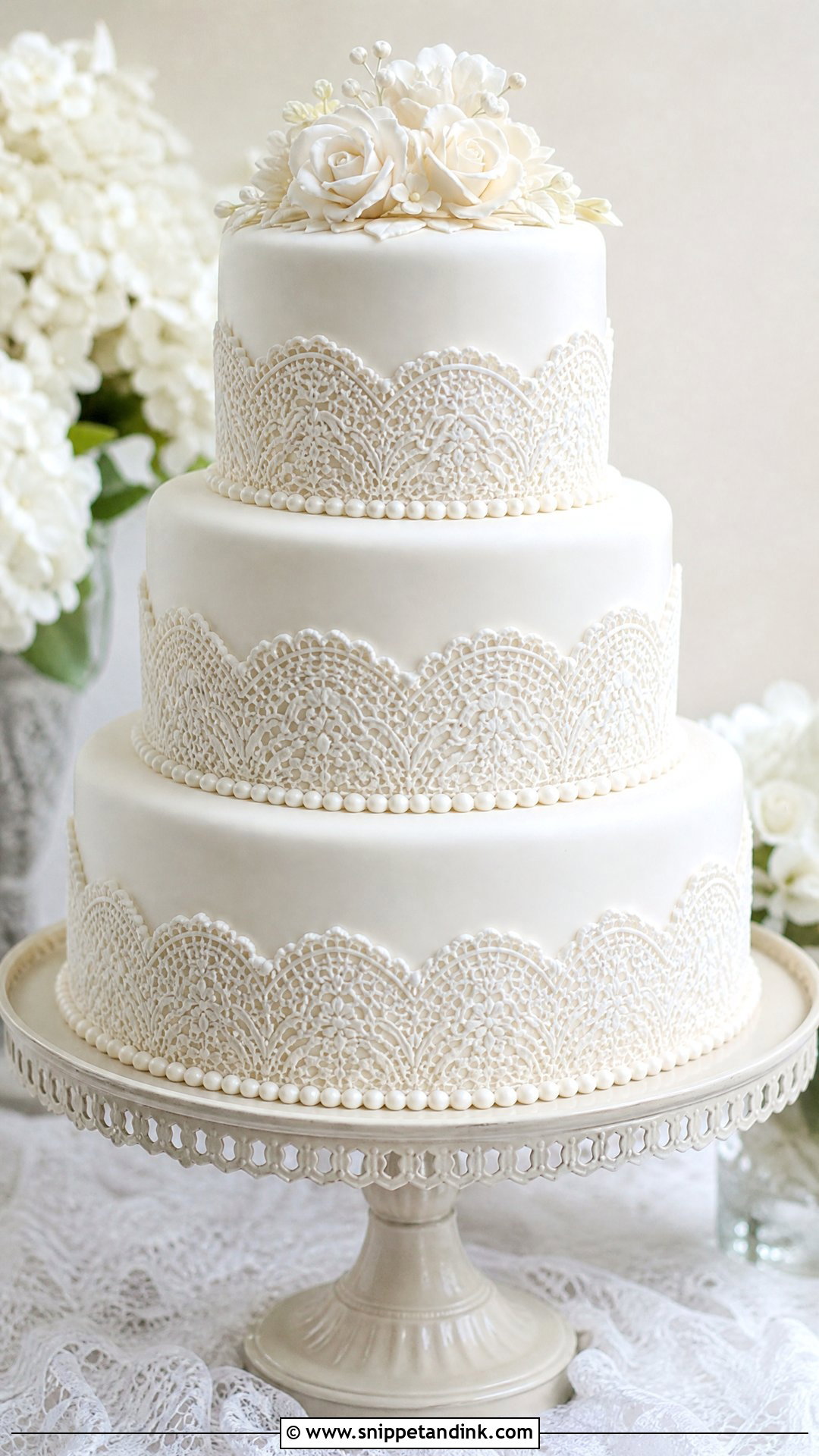
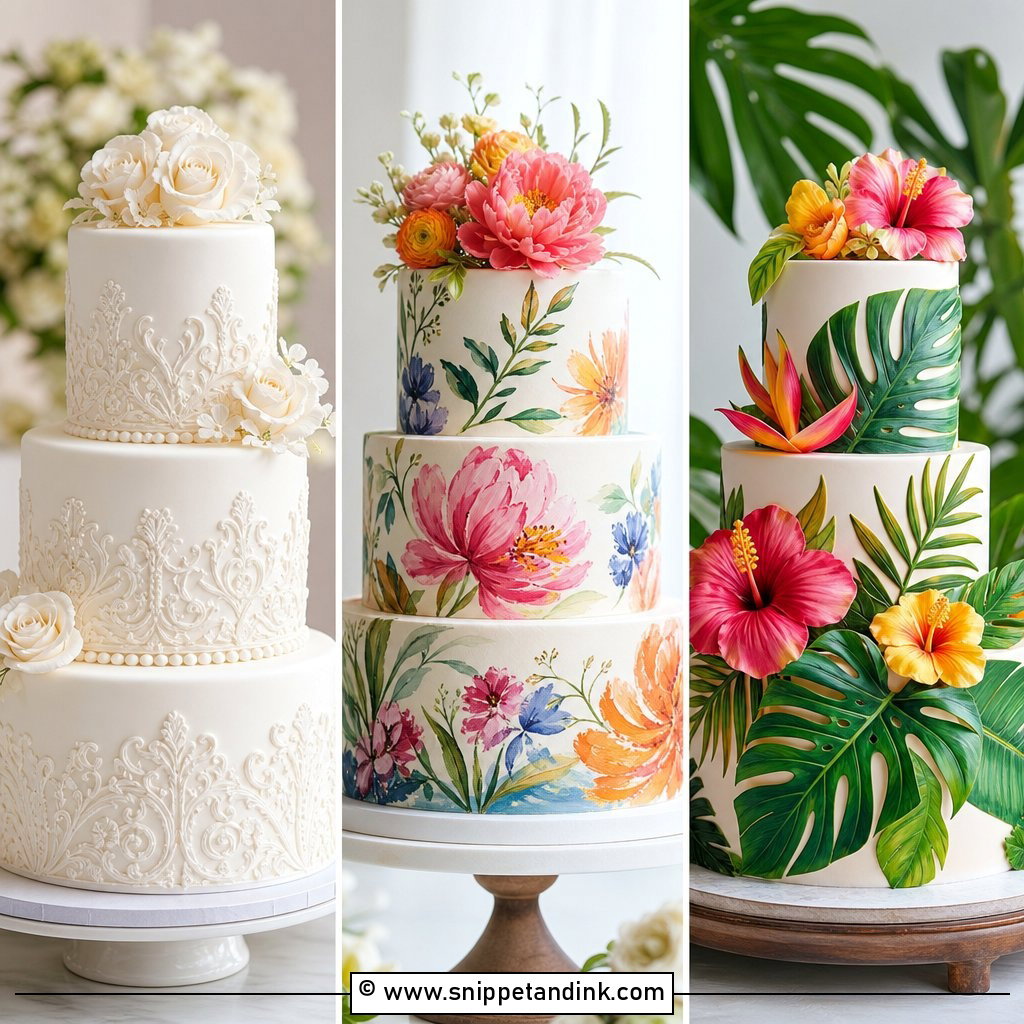
Lace on a cake should be clear, not crowded. It can be piped in royal icing, pressed into fondant with a mat, or made as edible lace appliques that are set in a mold and laid on like fabric. A single lace tier between smooth ones looks refined; full coverage looks formal and vintage. If you want the cake lace to echo your gown, bring a photo of the dress detail to the consultation. Soft white or ivory icing lets the pattern cast enough shadow to be seen.
7. White Vintage Wedding Cake
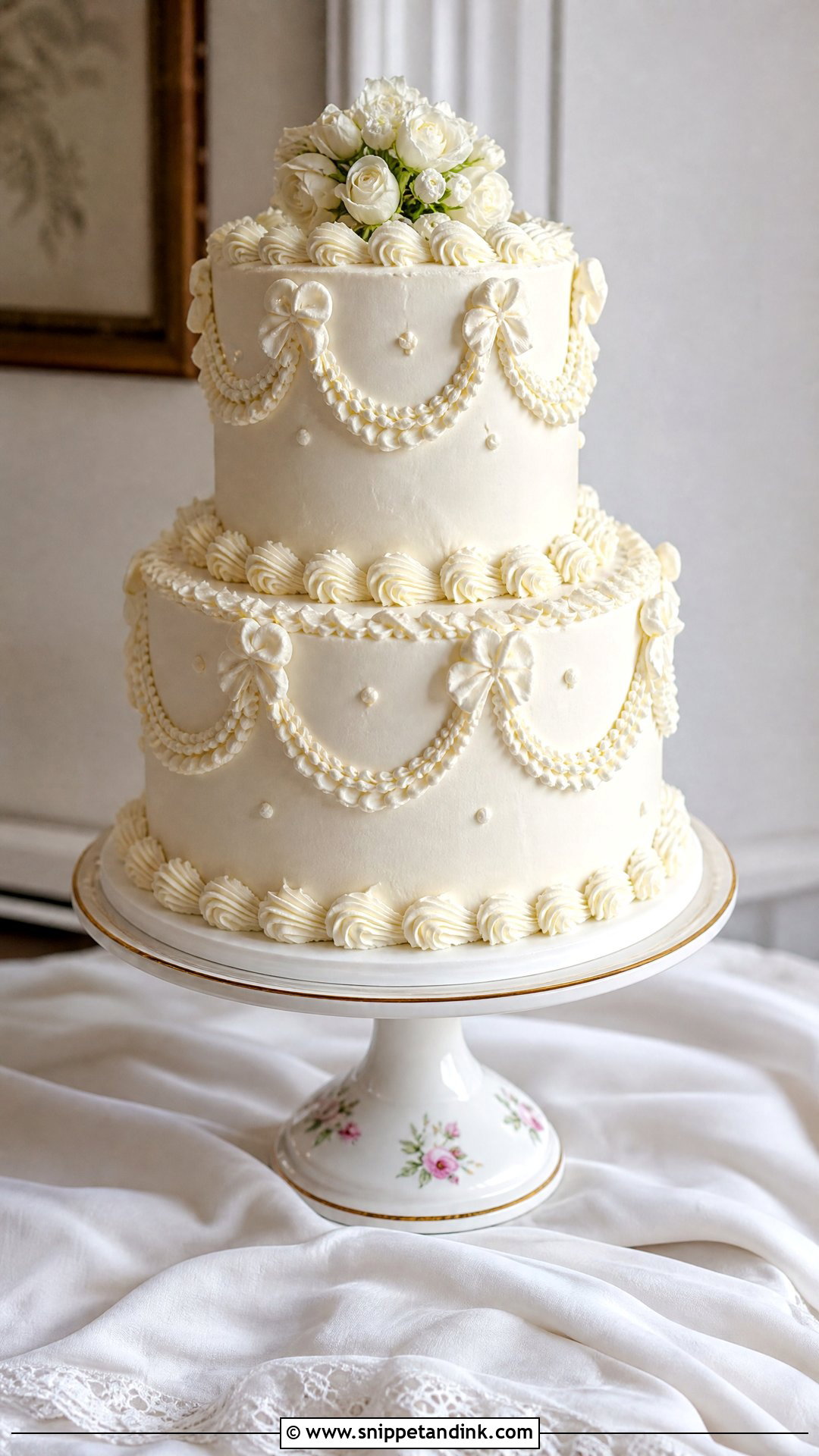
Vintage white cakes are mostly about the piping: shell borders, swags, bows and small pearl dots. The fresh version has more white space between details than the heirloom cakes it’s based on. Two or three tiers suit a smaller reception, and a tall one makes a dessert table centerpiece. Because the work is so detailed, I keep everything else calm, a footed stand, pressed linens and a few white flowers. Vanilla buttercream with almond cake or a lemon filling is a classic match.
8. White Lambeth Wedding Cake
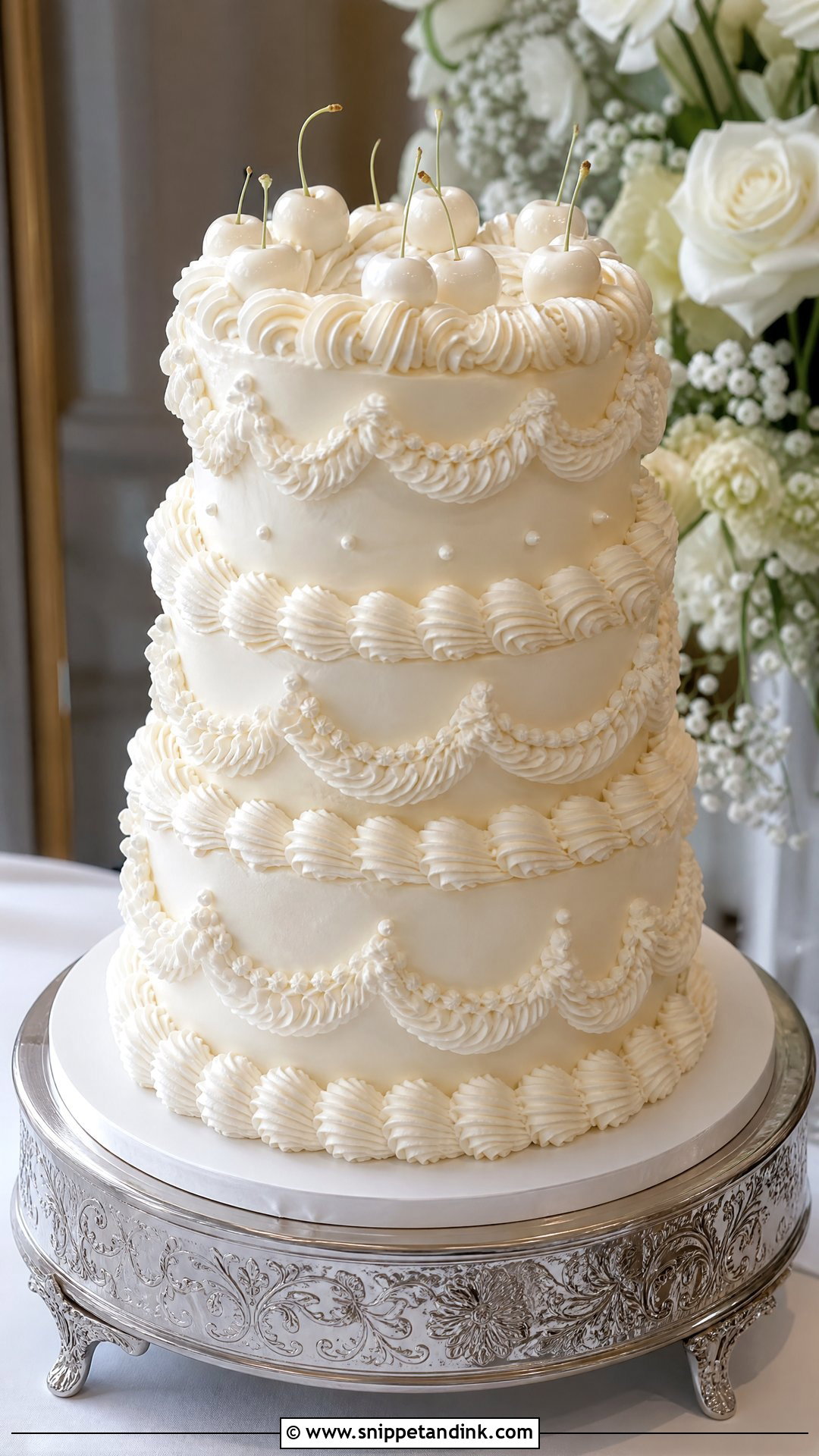
Lambeth is vintage piping taken to its limit, with overpiping built up in layers of borders, scrolls, shells and swags until the surface has real depth. In all white, a white Lambeth wedding cake stays bridal instead of busy. It takes hours of bench work, and every piped layer must set before the next, so this is not a last-minute order. It can be a tall single tier for a small wedding or several stacked tiers. Add only tiny pearls or a few white cherries.
9. White Square Wedding Cake
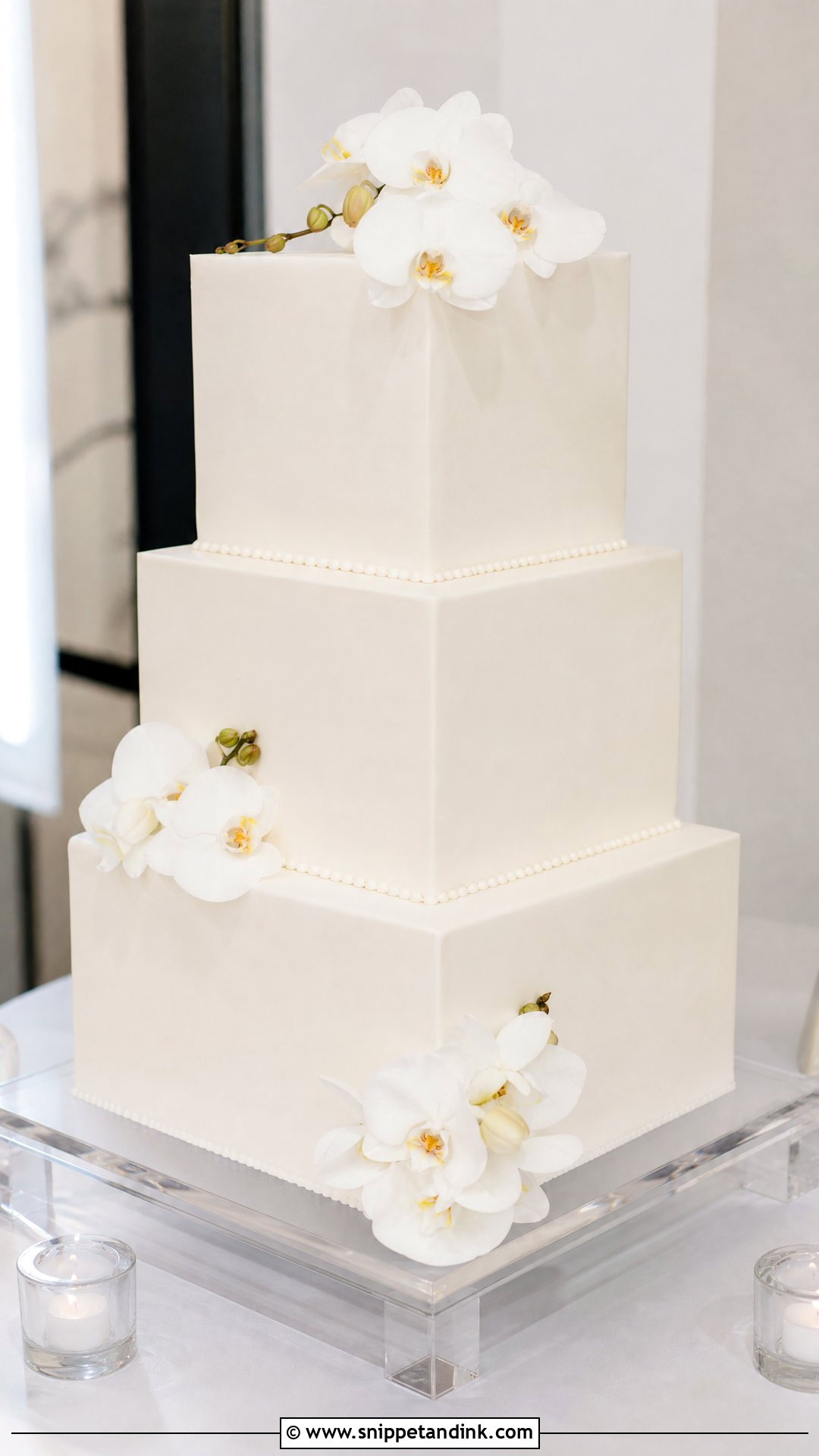
Square tiers change the whole feel of a white cake: structured, a little unexpected, suited to hotels, galleries and modern venues. They’re harder to finish than rounds, because sharp corners show any lean or dent, so look closely at a baker’s previous square work. A square tier also serves more slices than a round of the same width. Smooth fondant, crisp buttercream, ribbon borders or geometric piping all suit it. Flowers on the corners soften the lines, and mixing square and round tiers adds interest.
10. White Tiered Wedding Cake
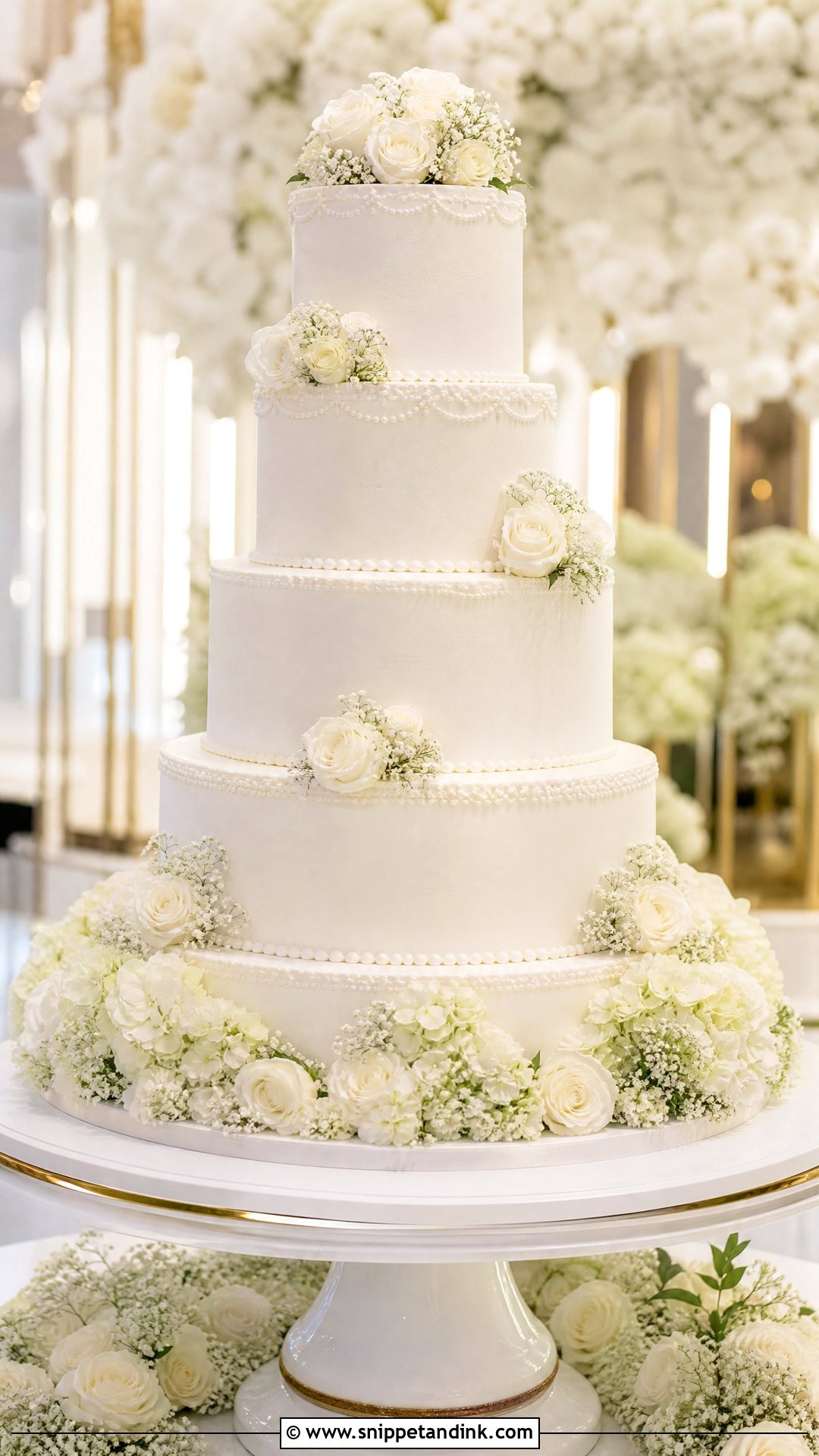
Tiers are where structure matters most. Every tier above the base sits on its own board, supported by dowels or straws through the tier below, and a tall cake also gets a central dowel. A white tiered wedding cake can be stacked tight for a clean look or separated with flower spacers for a formal one. Plan it around guest count and room size; three tiers balance most receptions, five fill a ballroom. Keep the decoration consistent from top to bottom.
11. White Two Tier Wedding Cake
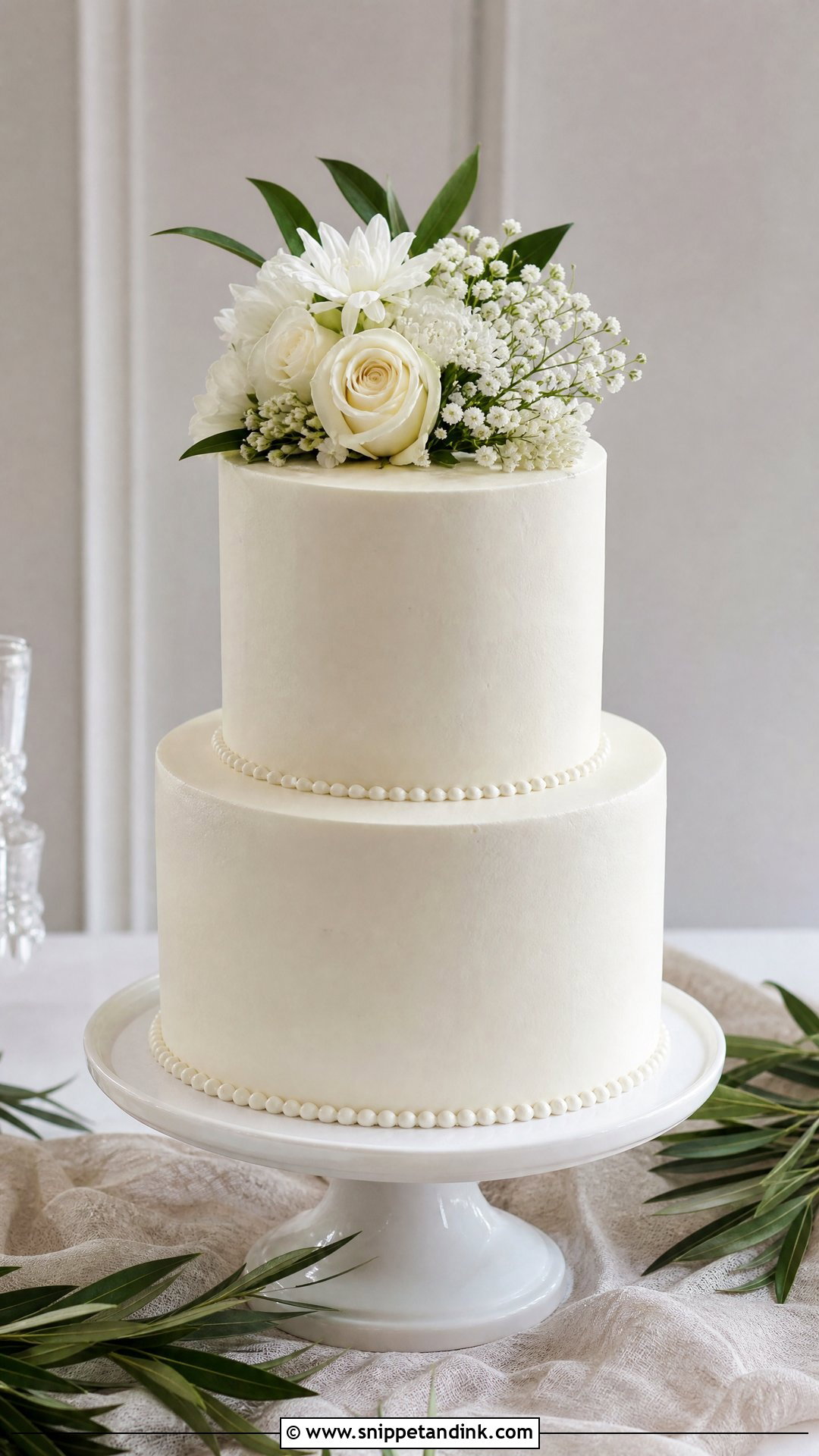
Two tiers is the size I’d suggest for elopements, courthouse weddings and small receptions. It still looks like a wedding cake without becoming leftovers for days. Making the tiers taller than standard, called double-barrel, gives it presence. Smooth and plain, pressed white flowers, pearls or a vintage border all work. With only two tiers, you can afford a flavor per tier: vanilla raspberry, almond cream, lemon curd or white chocolate. Put it on a raised stand.
12. White Three Tier Wedding Cake
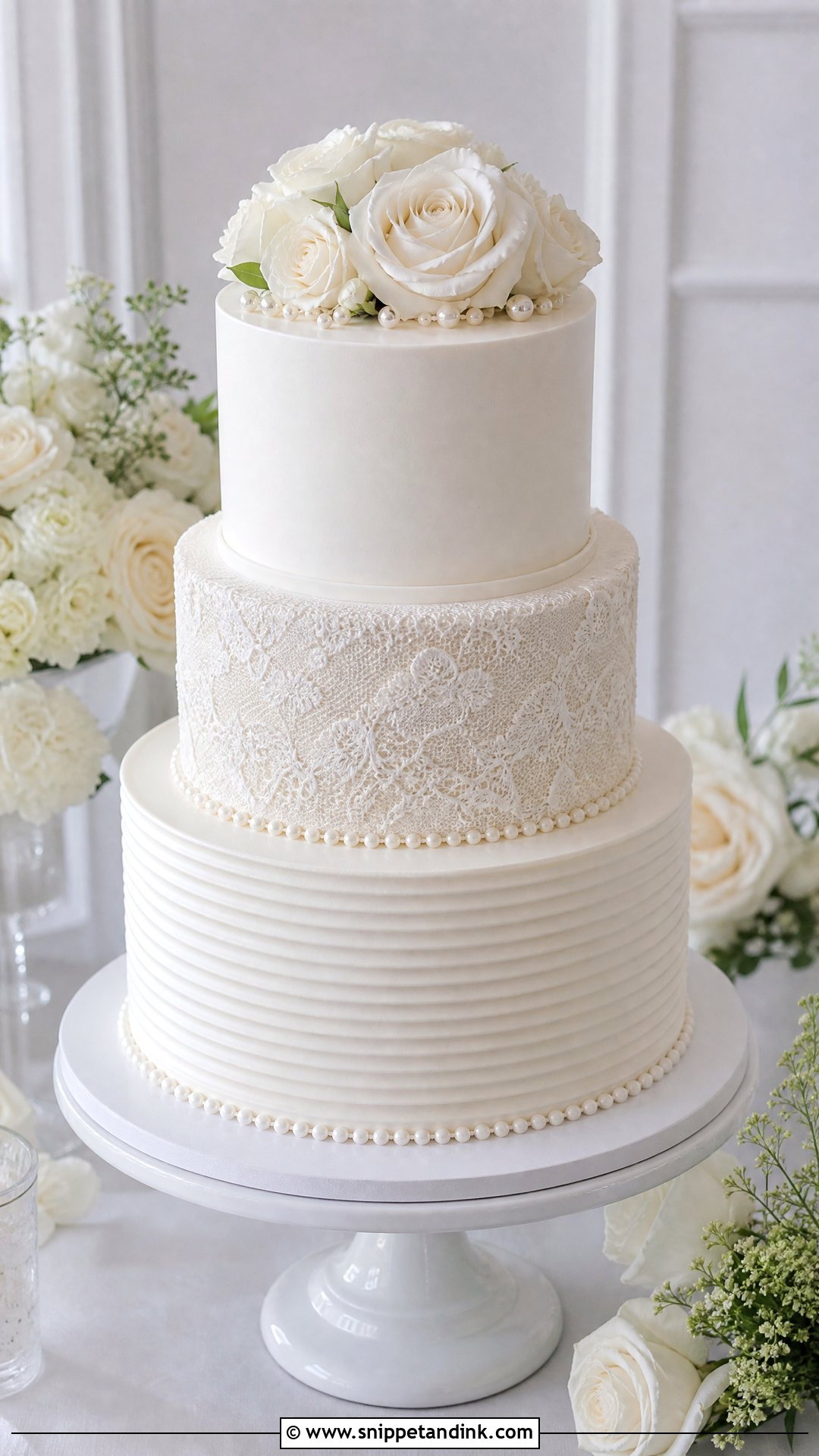
Three tiers is the balanced default, tall enough for photos and practical for many guest counts. It also gives room to mix textures without color: smooth buttercream on top, lace in the middle, soft ruffles at the base. If you do that, keep the flowers to one cascade so the textures stay readable. I like one classic flavor and one brighter one, such as lemon, raspberry or strawberry, so guests get a choice.
13. White Minimalist Wedding Cake
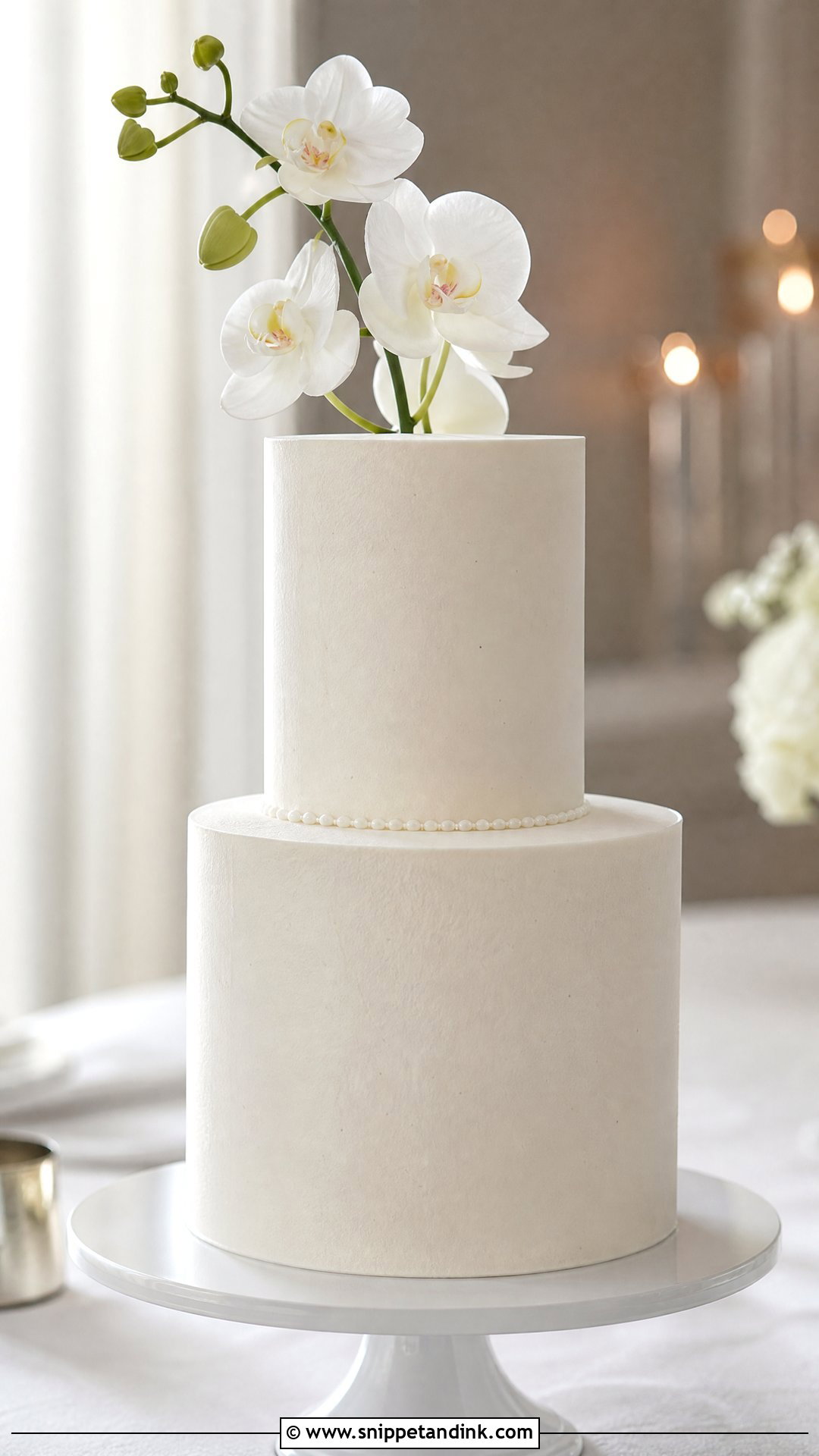
A minimalist cake has nothing to distract from the finish, so it needs the most precise work of anything here: perfectly level tiers, smooth sides, sharp edges. Many bakers use ganache under the buttercream to get there. One flower, a fine pearl border or a single satin-look ribbon is the whole decoration. Modern venues, rooftops and small dinners suit it, and the stand and flowers around it carry more weight. Vanilla bean, almond, coconut and lemon taste as clean as it looks.
14. White Modern Wedding Cake
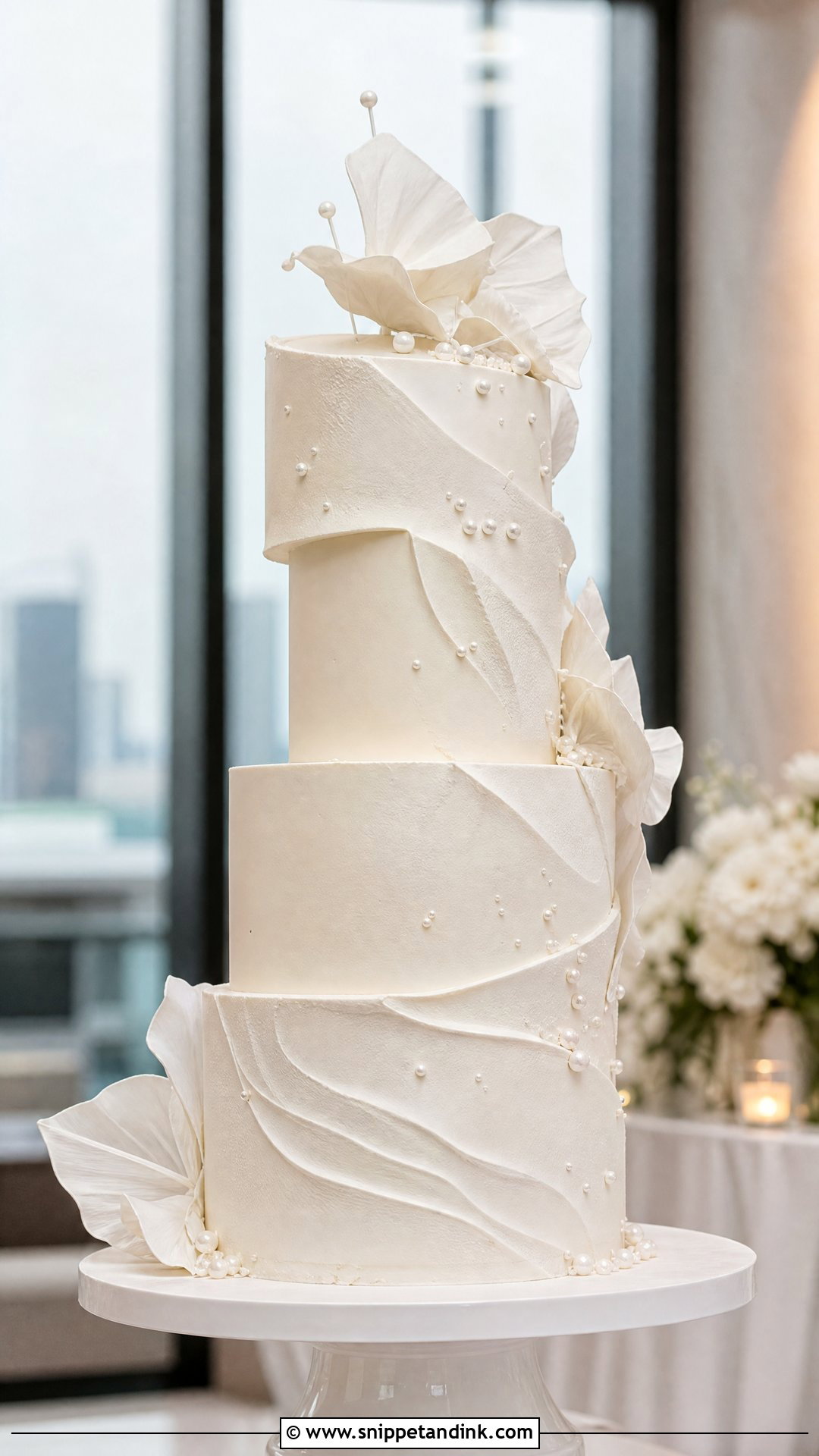
Modern white cakes get their interest from shape rather than ornament: tall narrow tiers, offset stacking, curved edges, sculpted buttercream or clean geometric lines. Offset and very tall tiers need more internal support than a standard stack, so ask how the baker will build it. I keep decoration to one thing, such as a single orchid stem, a pearl sheen or a subtle embossed pattern. Walk around the cake at the tasting sketch stage; a modern design should look intentional from the back too.

15. White Rustic Wedding Cake
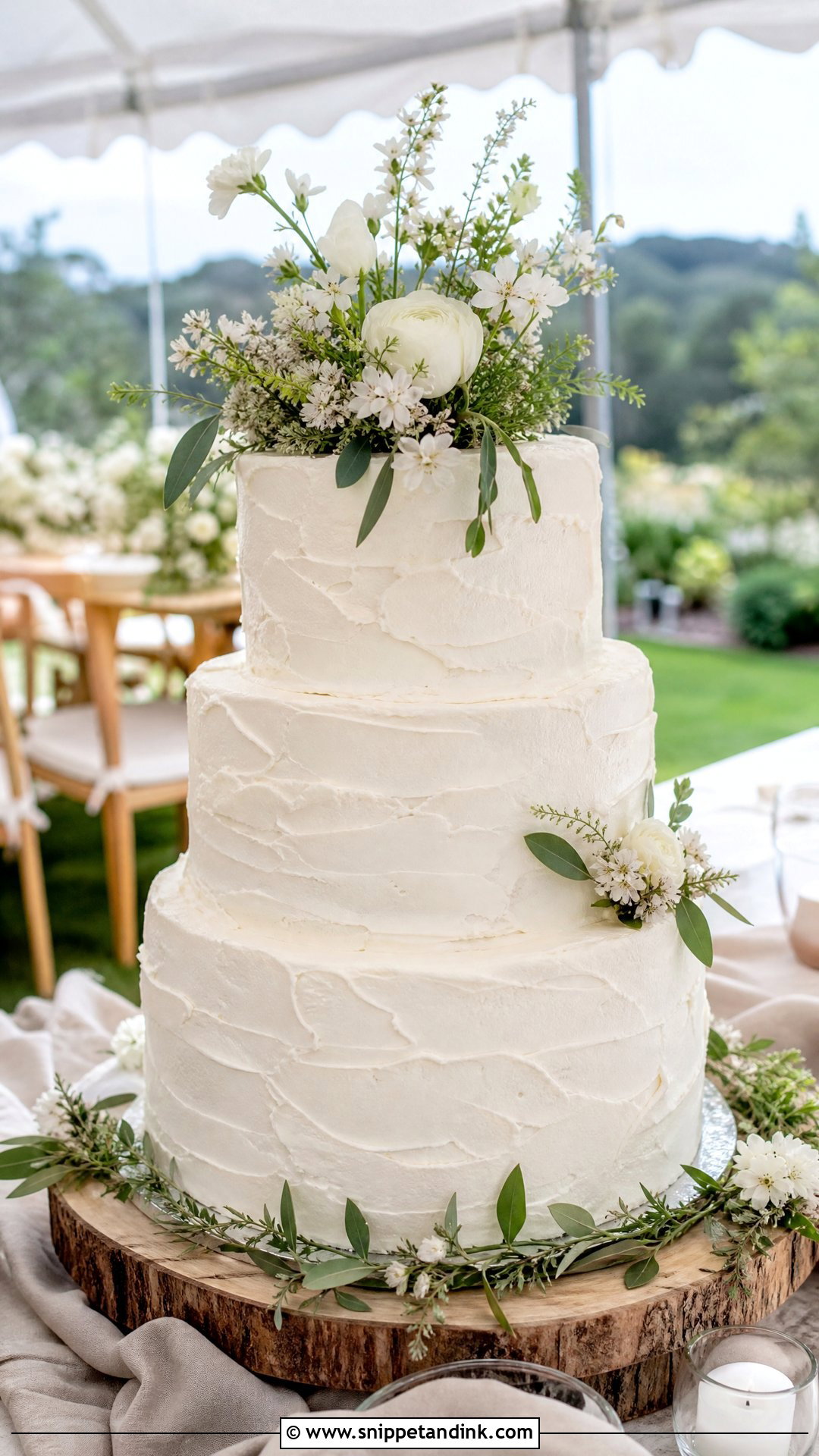
Rustic doesn’t need color. Textured buttercream, slightly soft edges, a few fresh flowers, greenery or a touch of fruit make an all-white cake look relaxed for barns, gardens and farmhouse tables. Texture and placement do the work: a small flower cluster at the base and a few blooms near the top are often enough. Lemon, vanilla, almond and coconut all suit it. A wood, ceramic or matte white stand finishes it, provided the wood is sealed or lined.
16. White Garden Wedding Cake
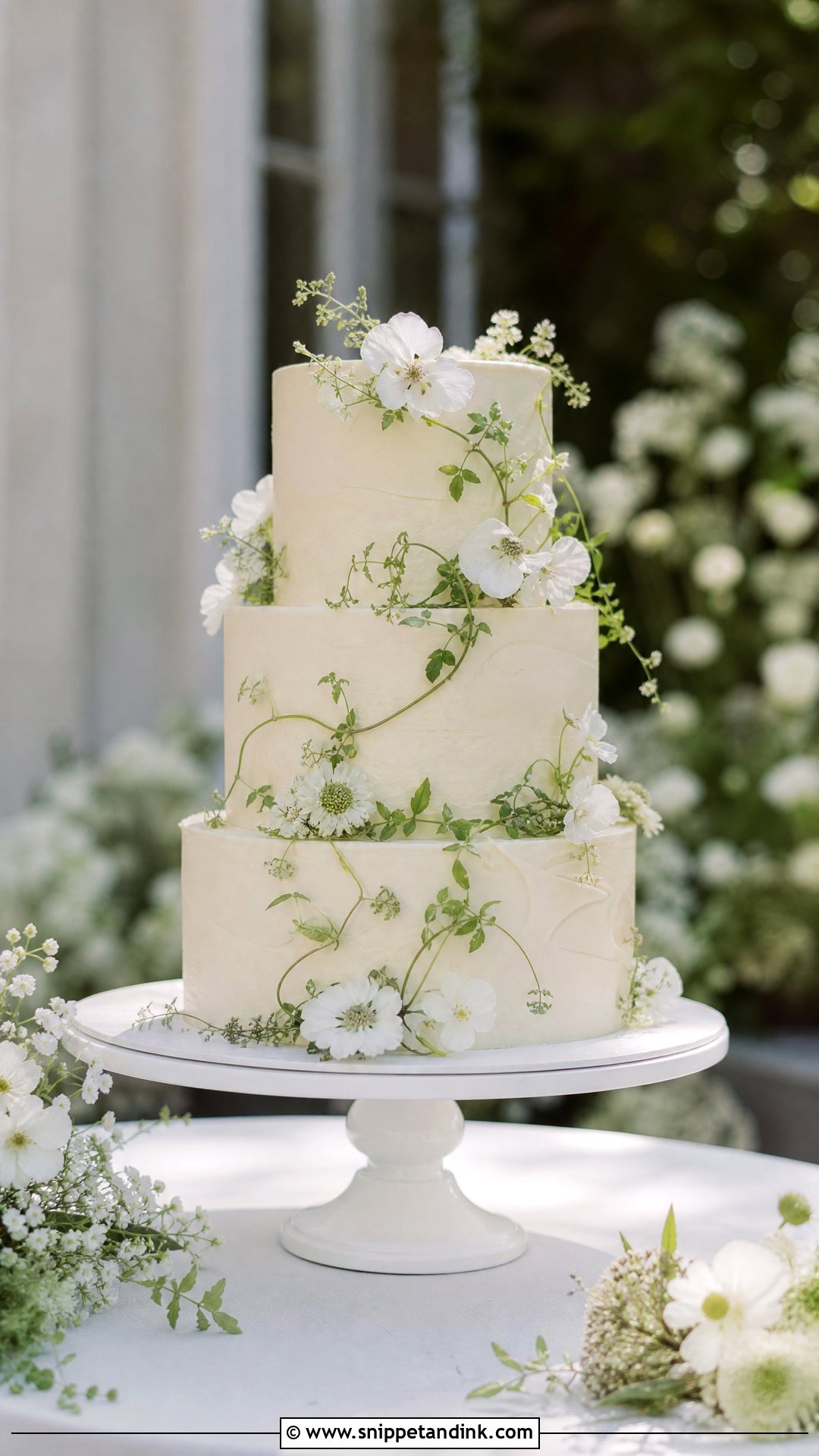
Garden cakes use white flowers, greenery, vines or pressed petals in an airy arrangement, so the white cake still shows through. Get your florist and baker talking early; the cake flowers should come from the same order as the centerpieces. Trailing vines like smilax or jasmine look natural but must be wrapped or kept off the icing, since not all are food-safe. Smooth buttercream, pale ivory fondant or a light texture underneath, and lemon elderflower, vanilla berry, almond or coconut inside.
17. White Rose Wedding Cake
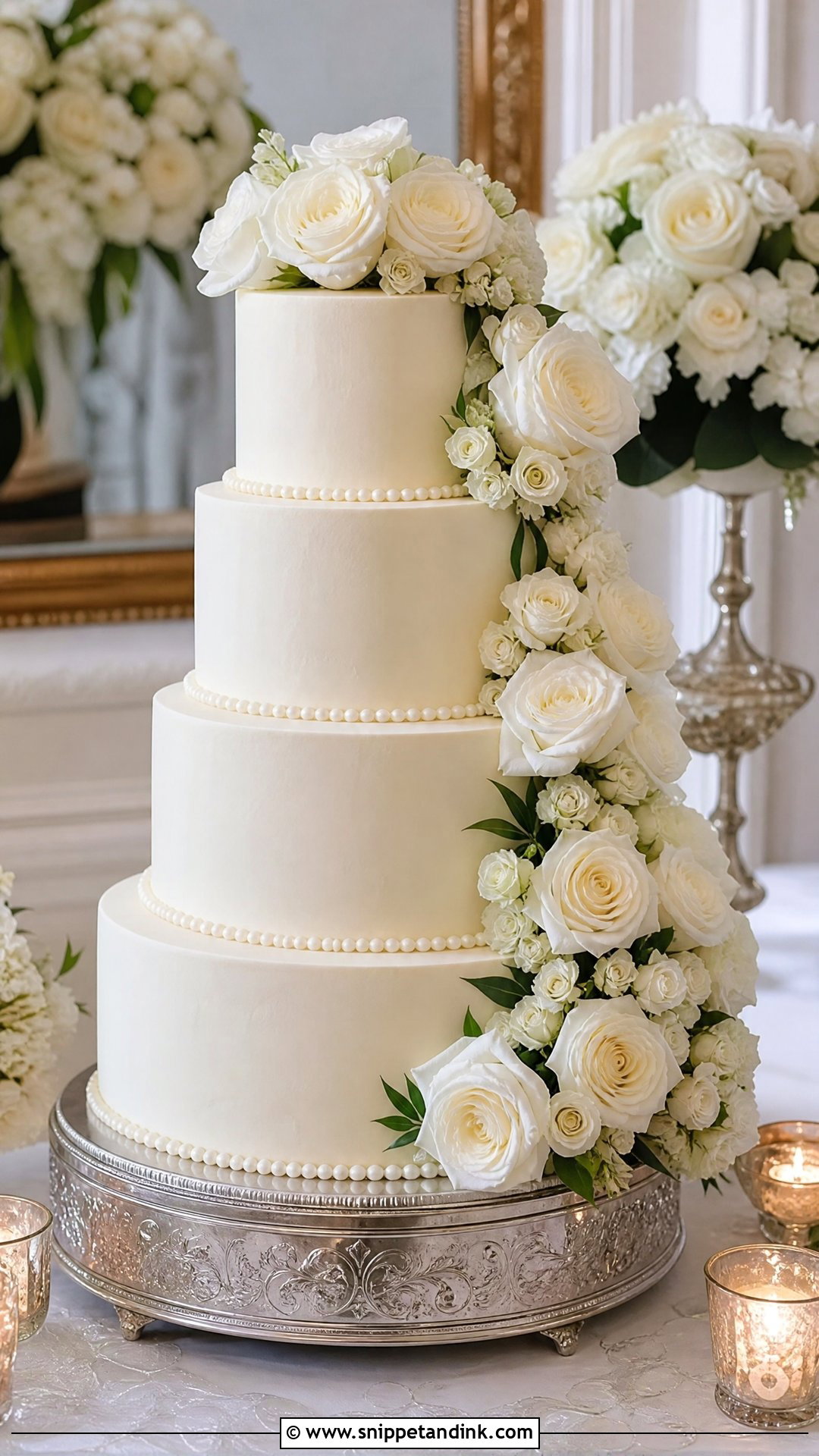
Roses are versatile on a white cake: fresh, sugar or piped. Large garden roses look dramatic; spray roses look delicate. A cascade down one side suits tall tiers, and a ring at the base looks traditional. Fresh roses should be checked for thorns and residue, then wrapped at the stem. I keep the frosting simple so the roses lead. Vanilla bean, almond or white chocolate raspberry are good flavor matches.
18. White Orchid Wedding Cake
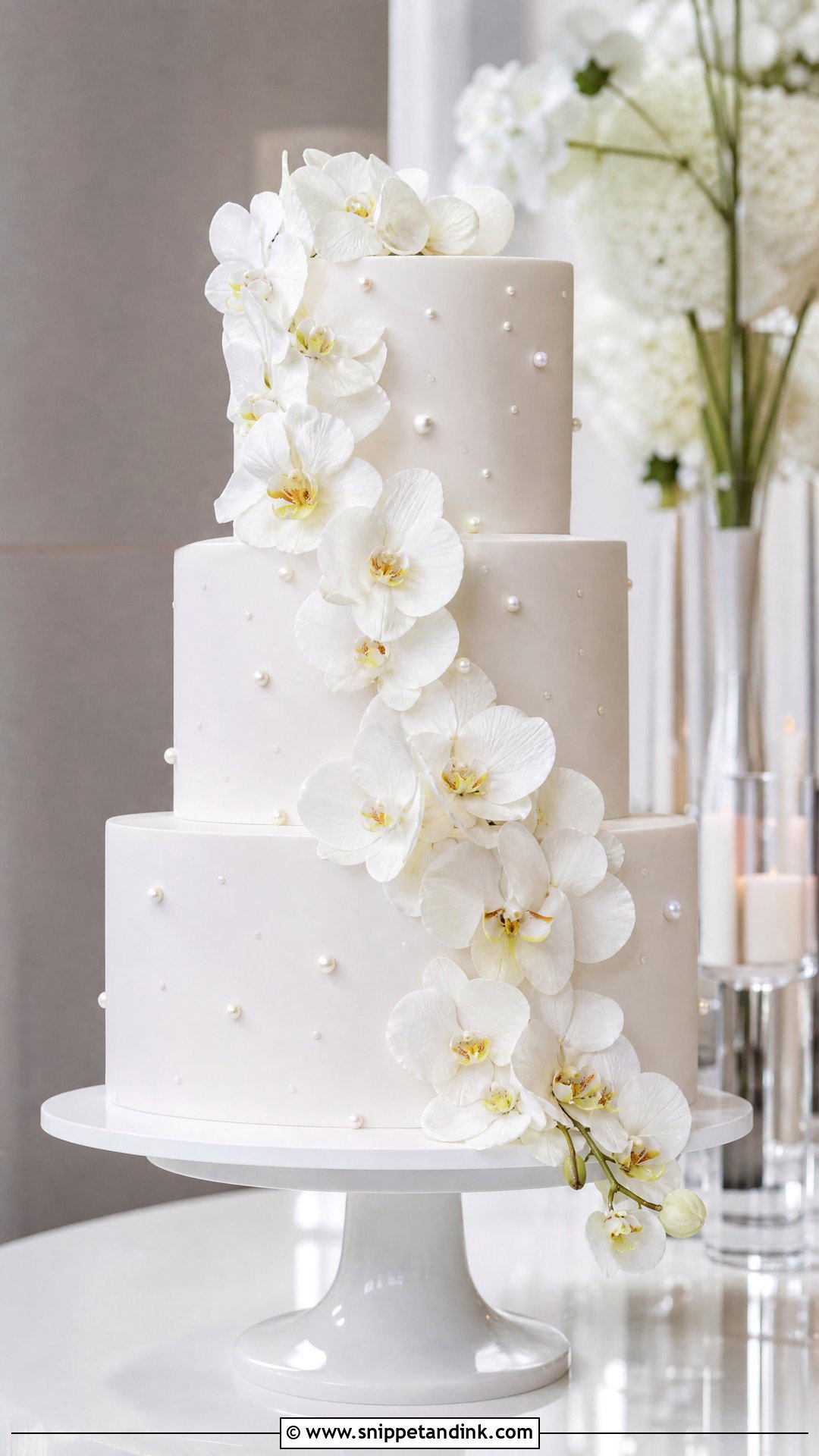
Orchids are sculptural, so a short line down one side of smooth white tiers can make a plain cake look costly. They suit beach weddings, hotels and destination celebrations. Phalaenopsis blooms are wide and heavy for their stems, so I wire them into position rather than resting them on the icing. Keep everything else minimal on smooth buttercream or fondant. Coconut, vanilla, passion fruit and white chocolate fillings suit the light, tropical mood.
19. White Hydrangea Wedding Cake
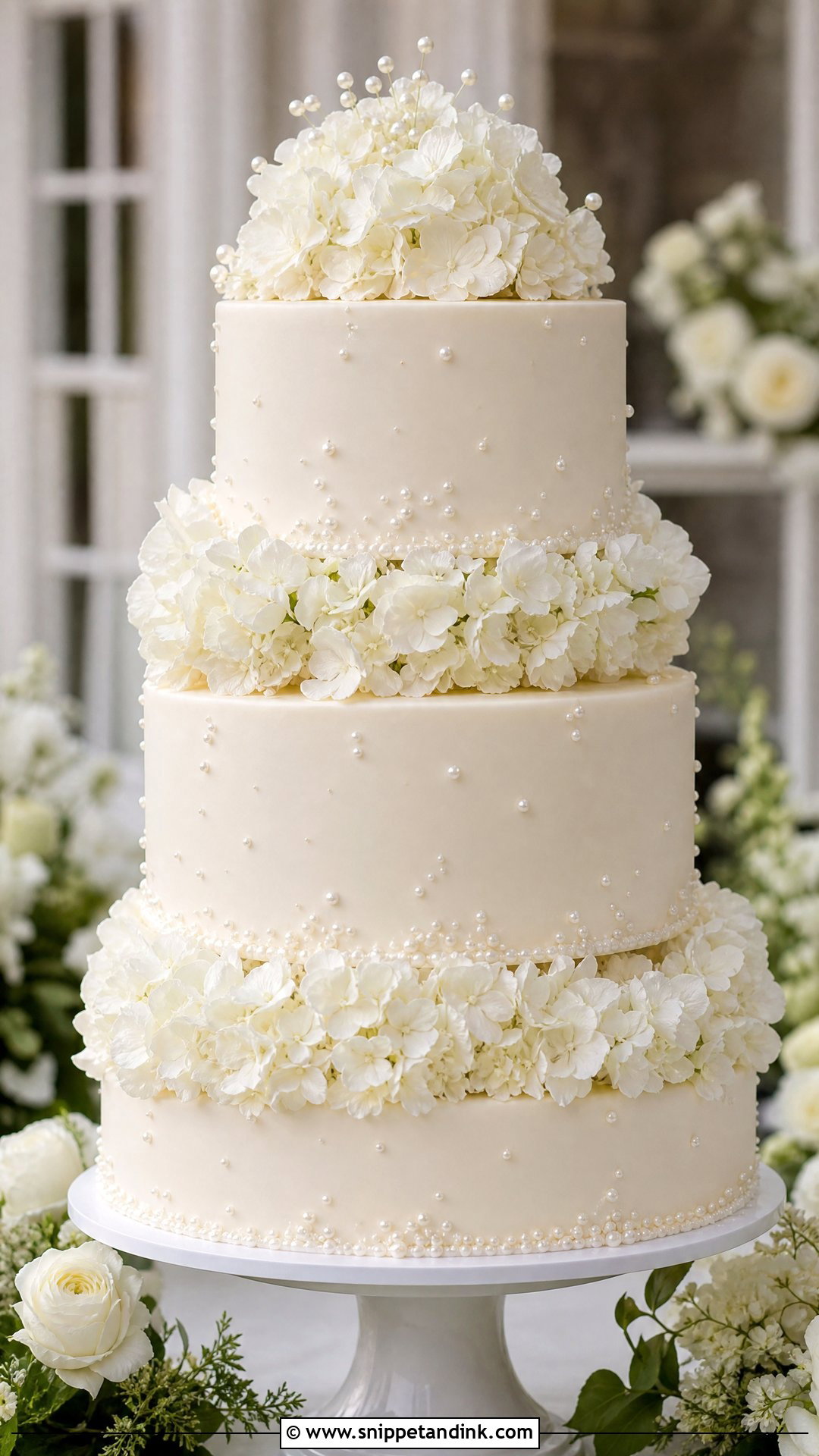
Hydrangeas give volume without needing many flower types, between tiers, at the base or as a cloud on top. They’re also among the first flowers to wilt out of water, and fresh hydrangea isn’t safe for direct contact with food, so I’d only use real ones on a barrier, close to display time, in a cool room. Sugar hydrangeas solve both problems and are the route I usually suggest. Smooth white buttercream keeps it fresh.

20. White Sugar Flower Wedding Cake
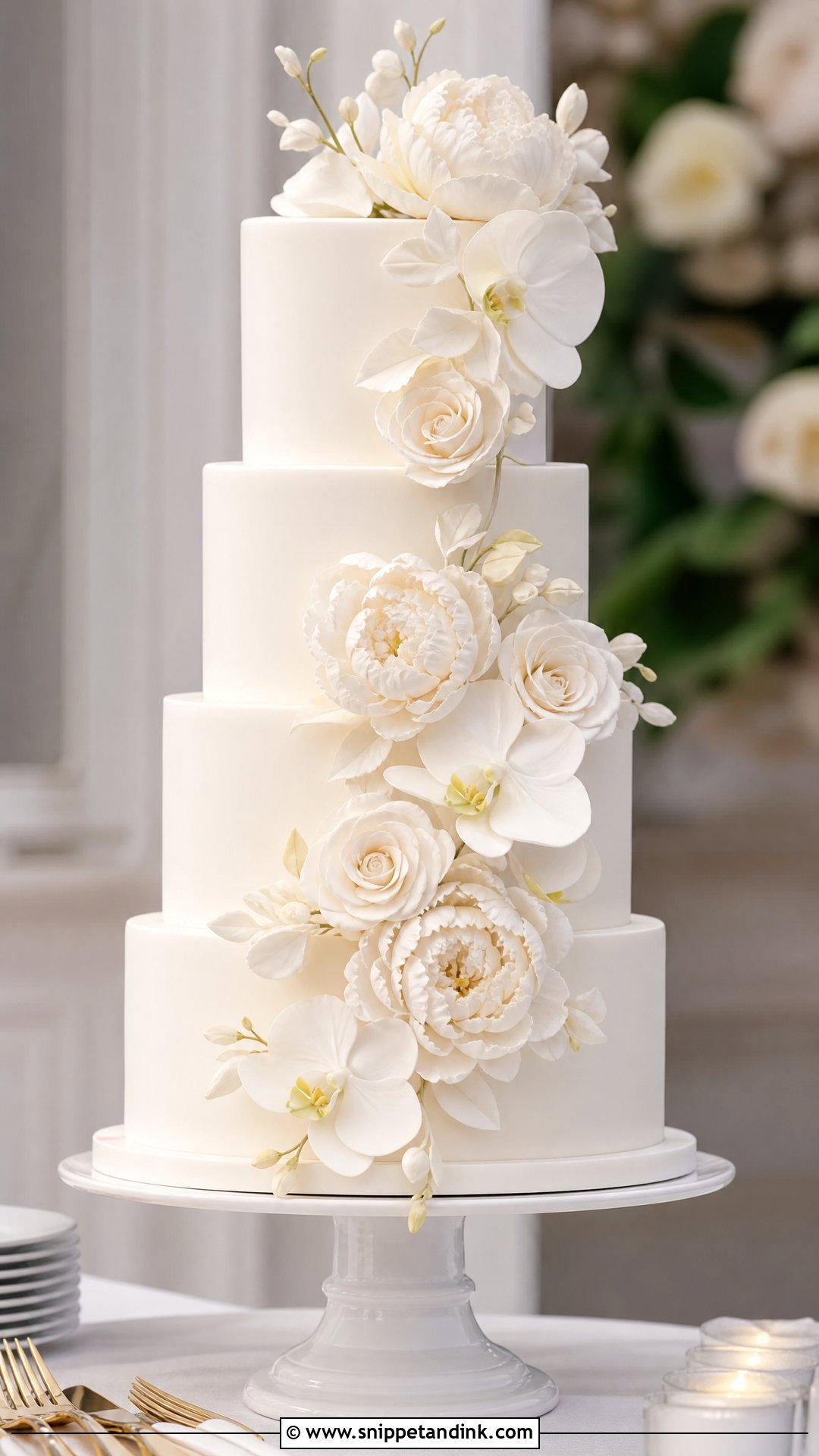
Sugar flowers are made petal by petal in gum paste, wired and dried, then arranged on the cake like a real spray. A white sugar flower wedding cake can carry roses, peonies, orchids, ranunculus, magnolias or tiny blossoms, and they hold their form all night. Because they’re so labor-heavy, they often take up a big share of the cake’s price. The wires make them inedible as a whole, but they can be kept as a keepsake in a dry box away from sunlight.
21. White Pressed Flower Wedding Cake
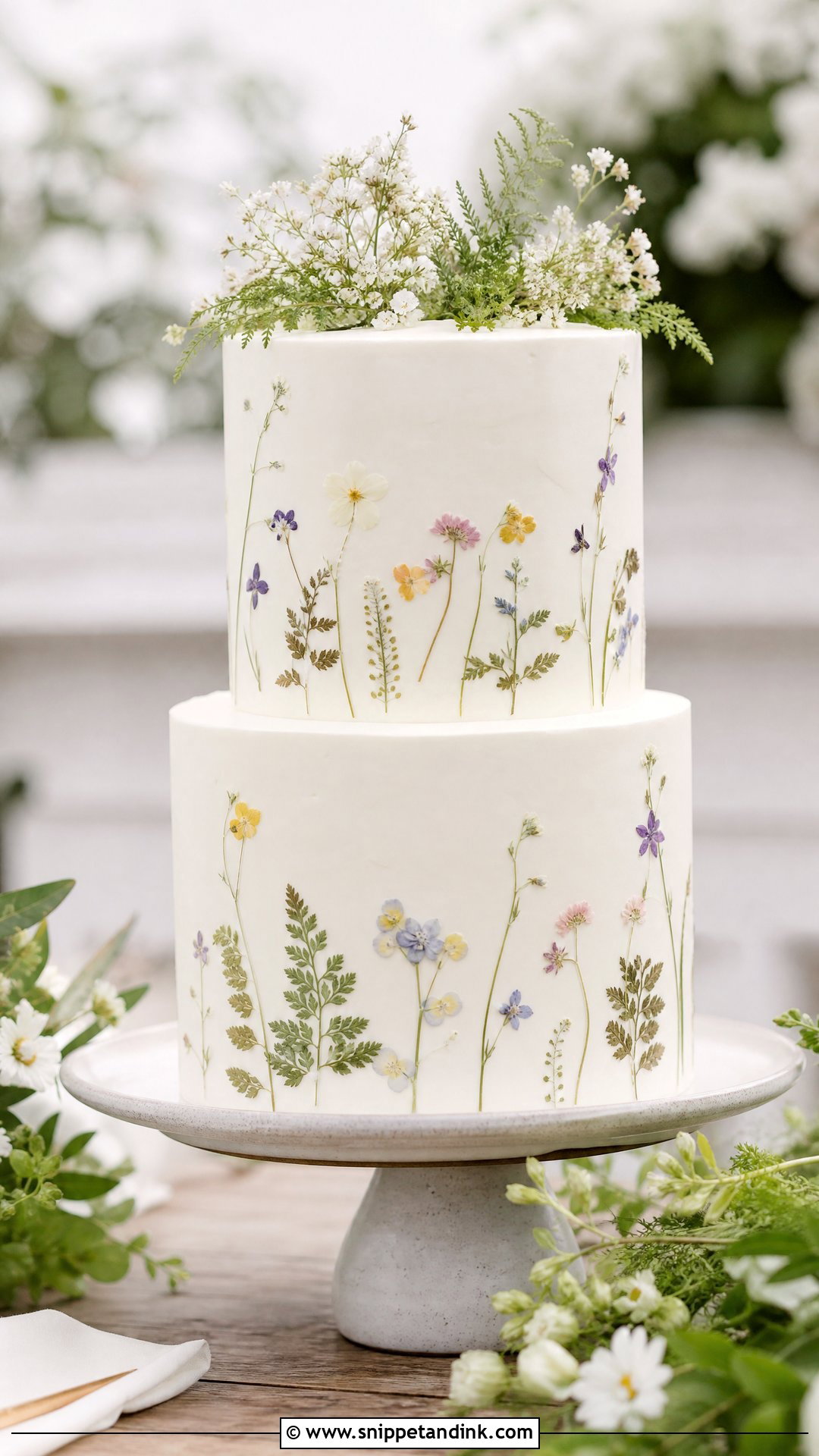
For an all-white pressed flower cake, I use pale edible petals, tiny white blossoms and a few soft green stems laid flat against buttercream, so they look printed into the surface. Edible-grade flowers from a dedicated supplier are a must; florist flowers are often sprayed. They suit smooth or lightly textured frosting and garden or spring weddings. Apply them close to the event, because moisture darkens petals. Lemon, vanilla, honey and almond suit the botanical look.
22. White Textured Wedding Cake
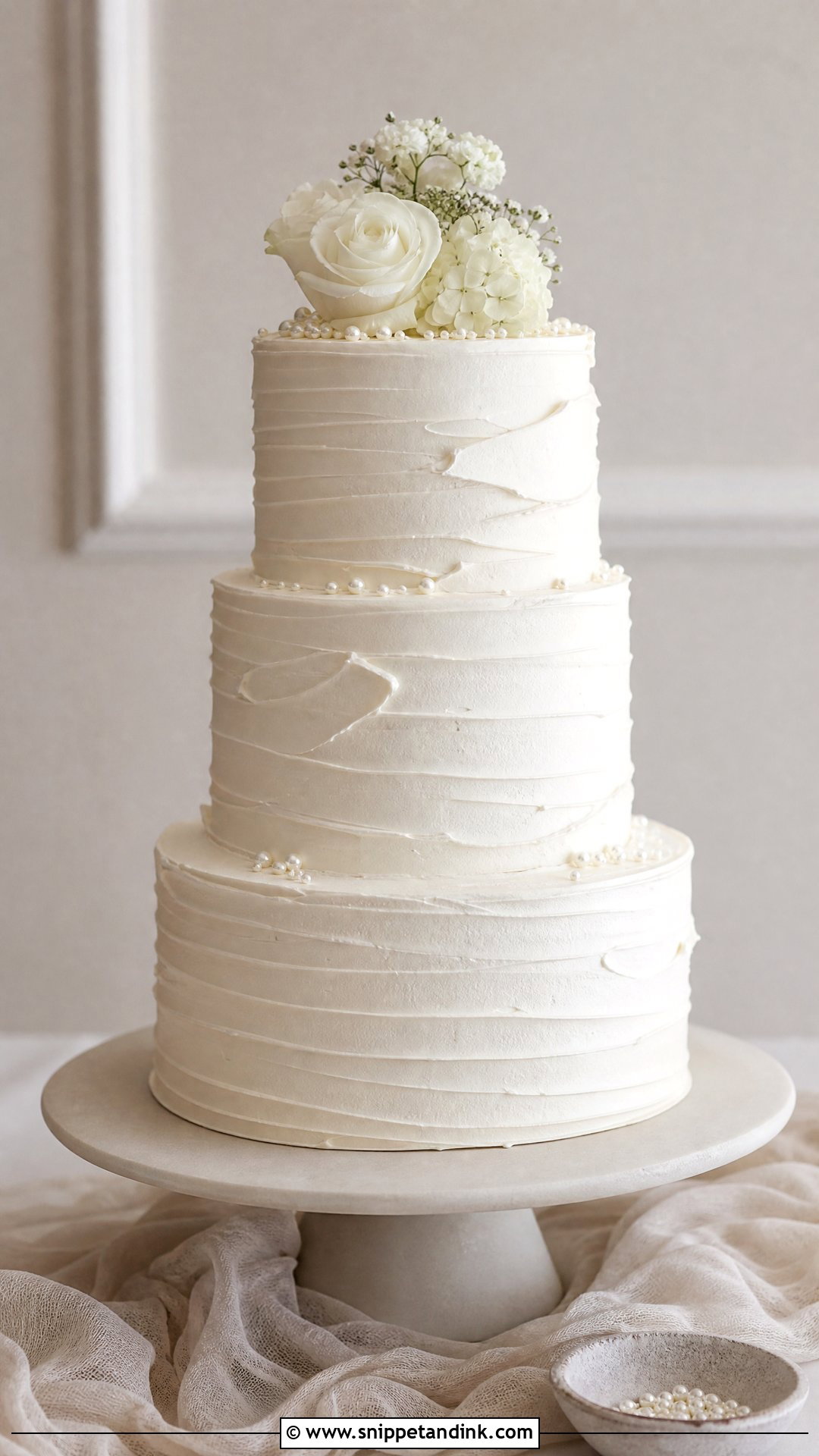
Texture gives a white cake interest under any light: combed buttercream, palette knife strokes, stucco, soft waves, pleats or rough edges. It’s also forgiving, hiding the small marks that travel leaves behind. If the texture is strong, it needs nothing else; otherwise add one flower cluster or a few pearls. Creamy fillings such as vanilla bean, coconut, almond or lemon cream match the soft finish.
23. White Scallop Wedding Cake
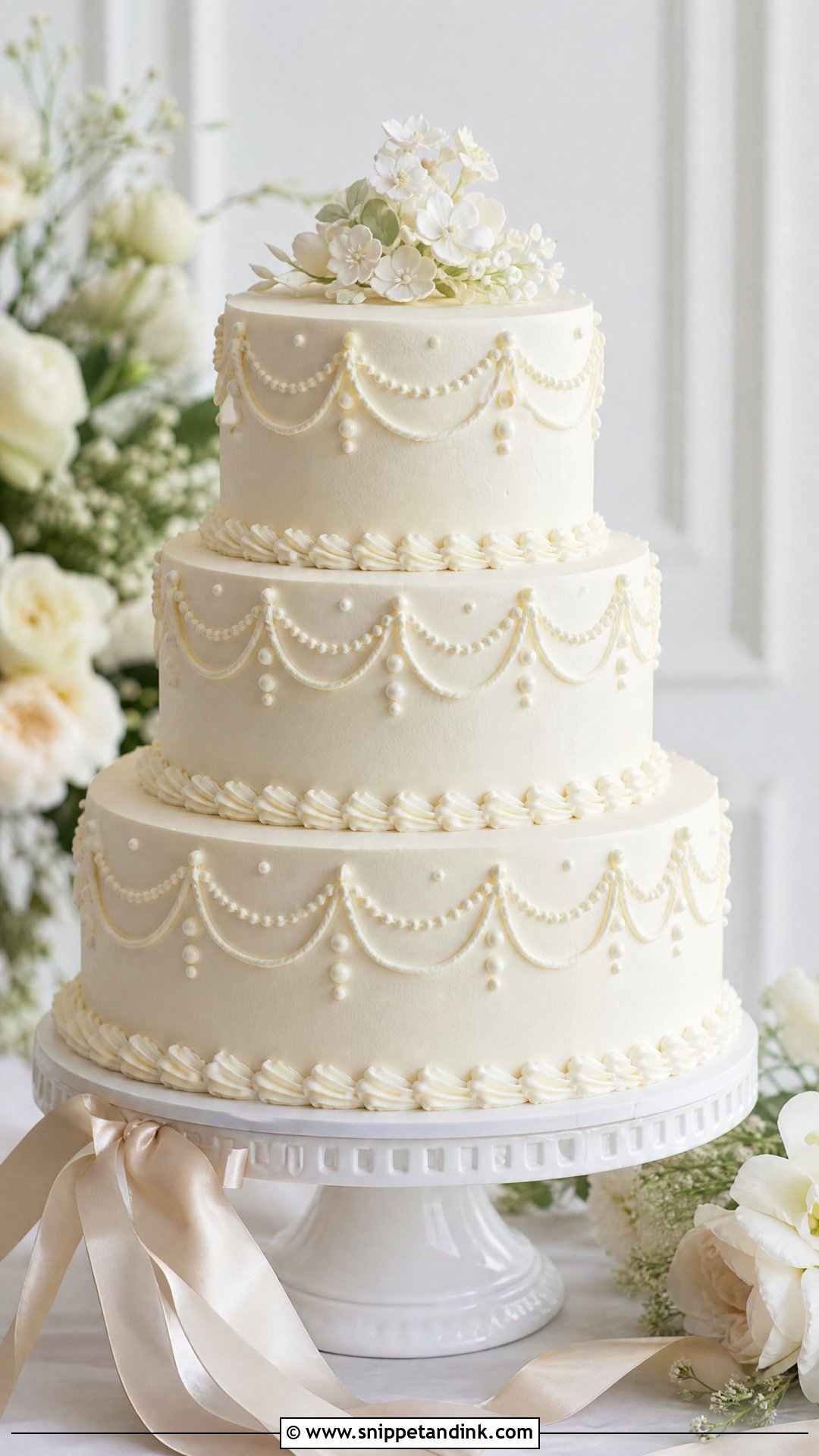
Scallops are a gentle way to add pattern. Piped scallops can frame each tier, edge the borders or repeat across the whole cake. Small scallops with pearl dots look classic; oversized scalloped tiers with clean space between them look bolder. The spacing has to be measured, because uneven scallops are obvious from a distance, so I mark them with a template before piping. Satin bows and round floral arrangements suit it.
24. White Bow Wedding Cake
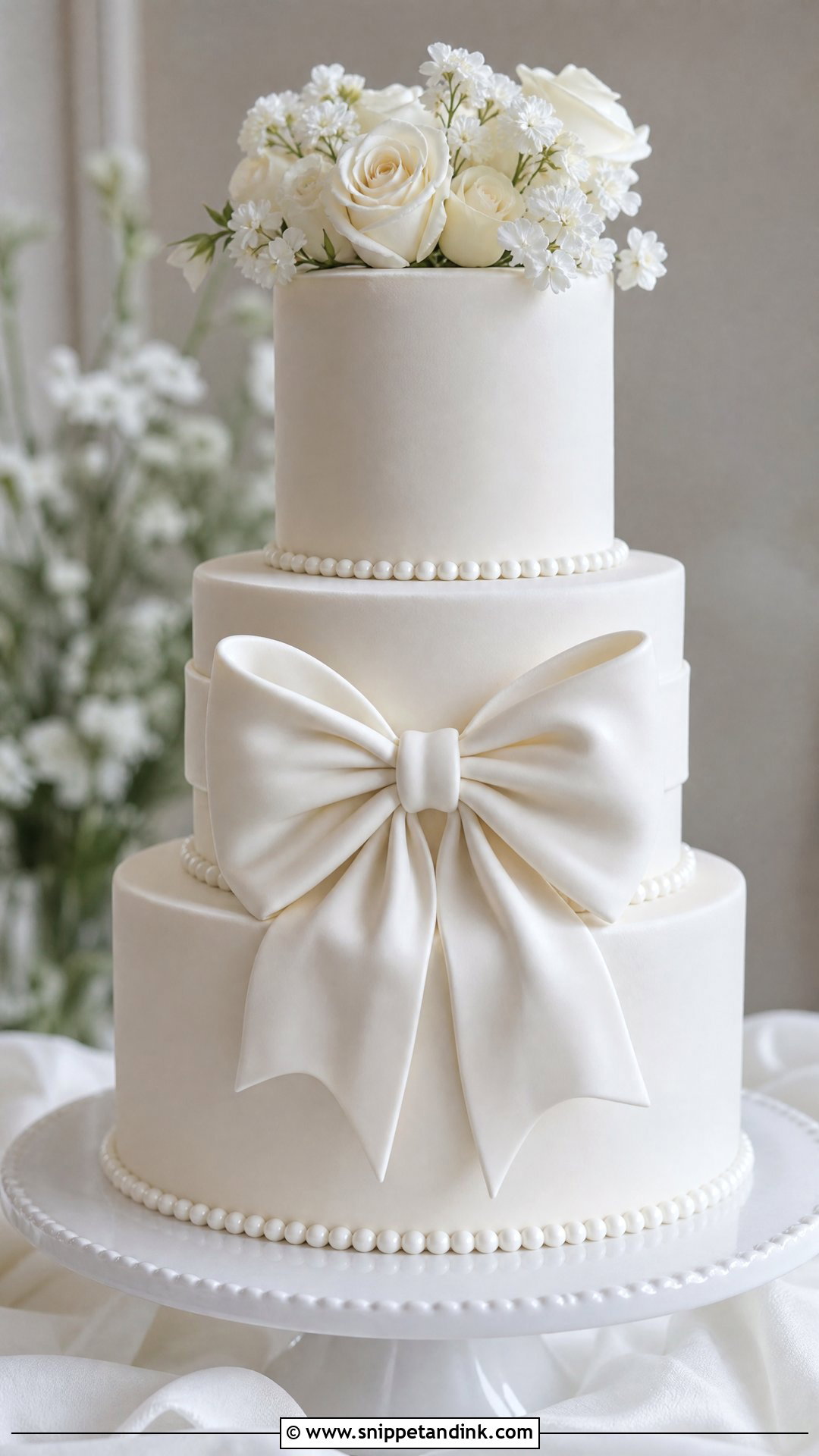
Bows can be fondant, sugar paste, edible sheet or real fabric ribbon. A real ribbon needs a barrier strip under it, or the butter seeps into the fabric and leaves a grease line. One large bow on a tier looks like fashion; little bows all around look sweet and vintage. Smooth white icing keeps the shape crisp. Pearl borders or soft flowers can join it, with vanilla almond, white chocolate or strawberry cream inside.

25. White Monogram Wedding Cake
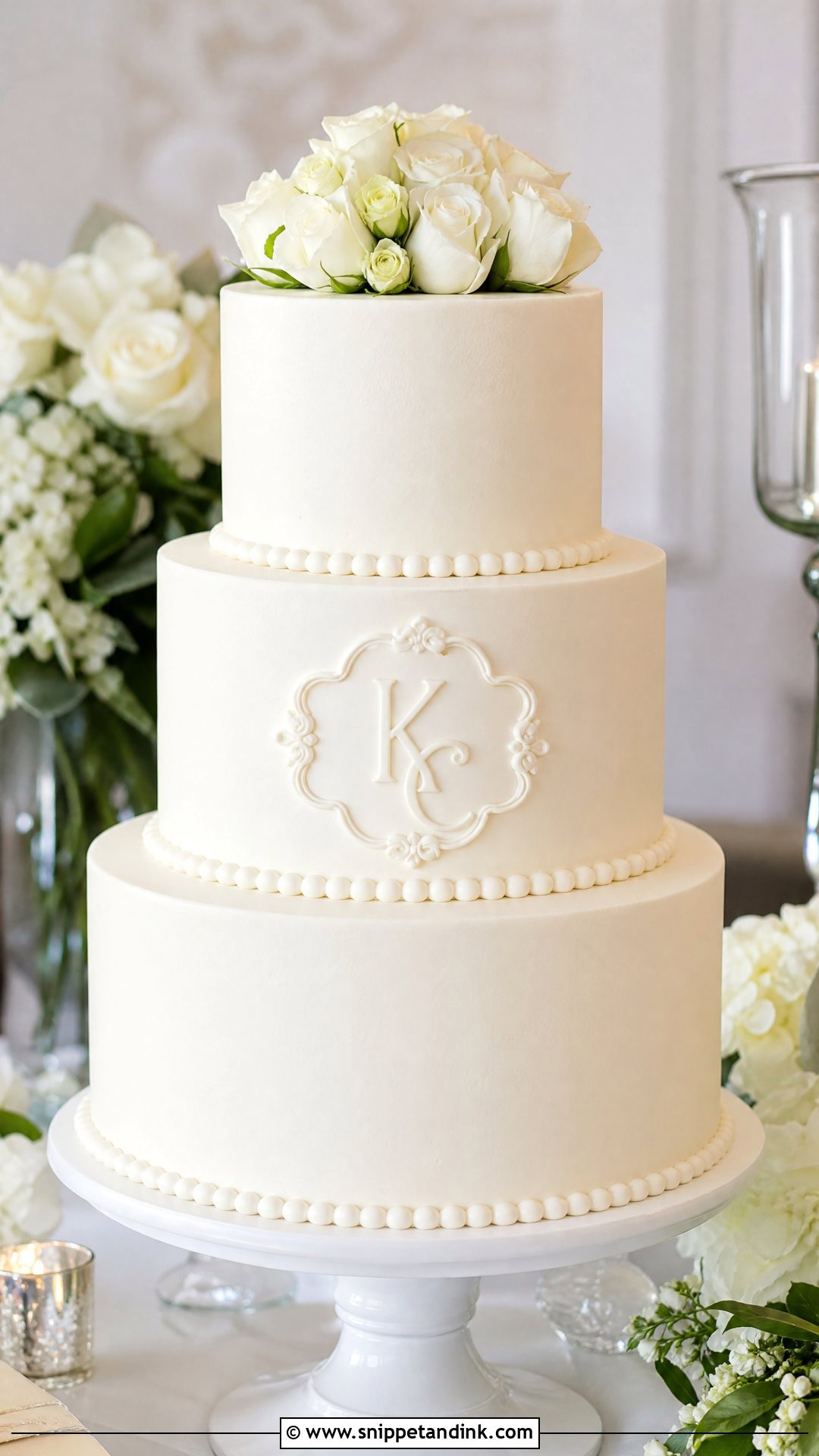
The couple’s initials can be piped, embossed, painted white-on-white or set on a sugar plaque. White-on-white is my favorite version: raised lettering shows only through shadow, so it’s quiet up close and almost invisible from across the room, which suits a formal cake. Center the monogram on one tier and leave the rest simple, with smooth fondant, pearl borders and a few small white flowers. Send the exact initials and their order in writing.
26. White Geometric Wedding Cake
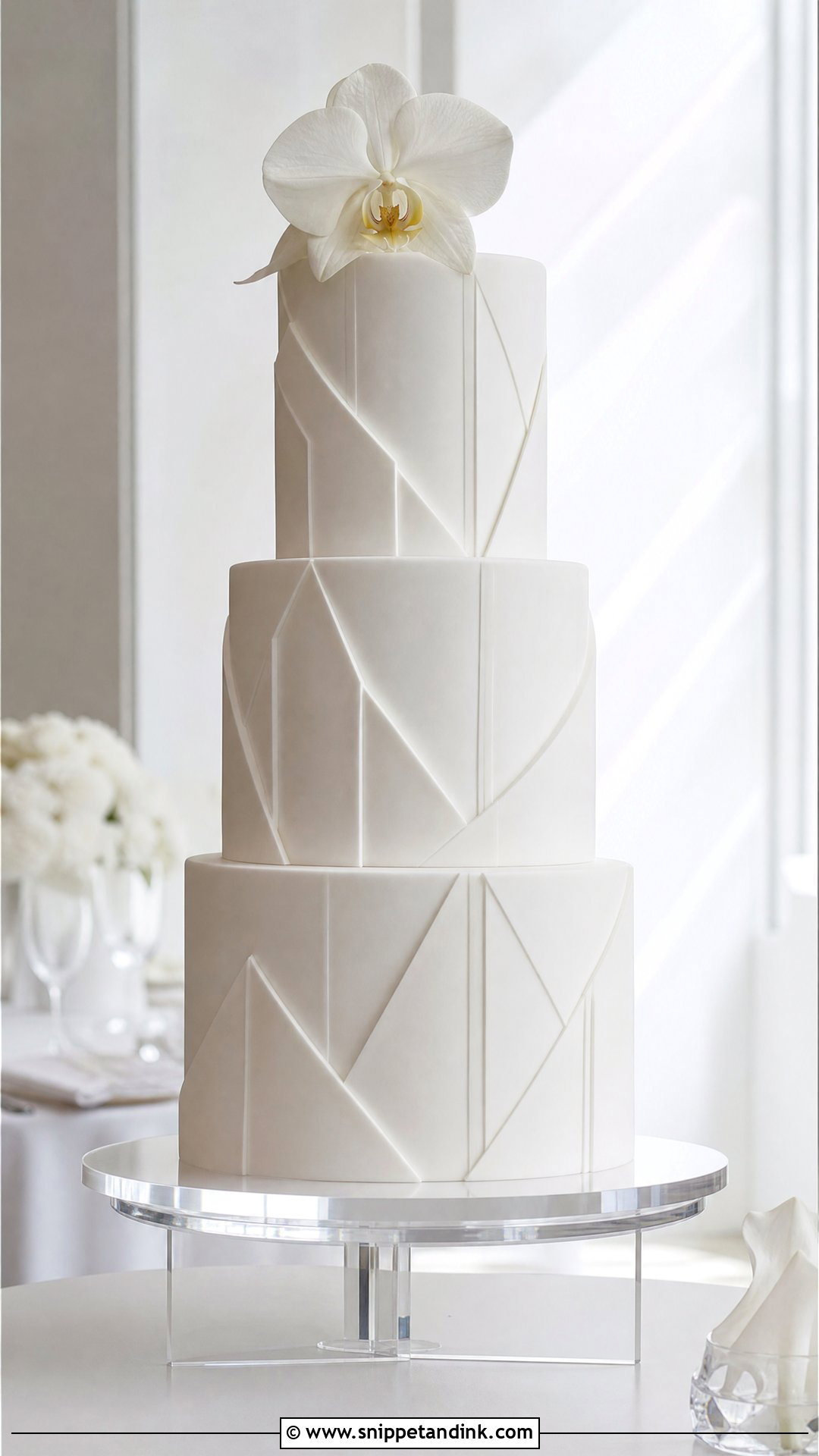
Geometric designs depend on accuracy. Embossed lines, angular panels, hexagon tiers or pressed repeating patterns only work when the edges are sharp and the spacing exact, so choose a baker whose portfolio shows that precision. A white geometric wedding cake stays soft enough for a wedding because the color is plain. City weddings, galleries and museums suit it. One small orchid, a few sugar leaves or nothing at all, with vanilla bean, coconut, lemon or almond inside.
27. White Marble Wedding Cake
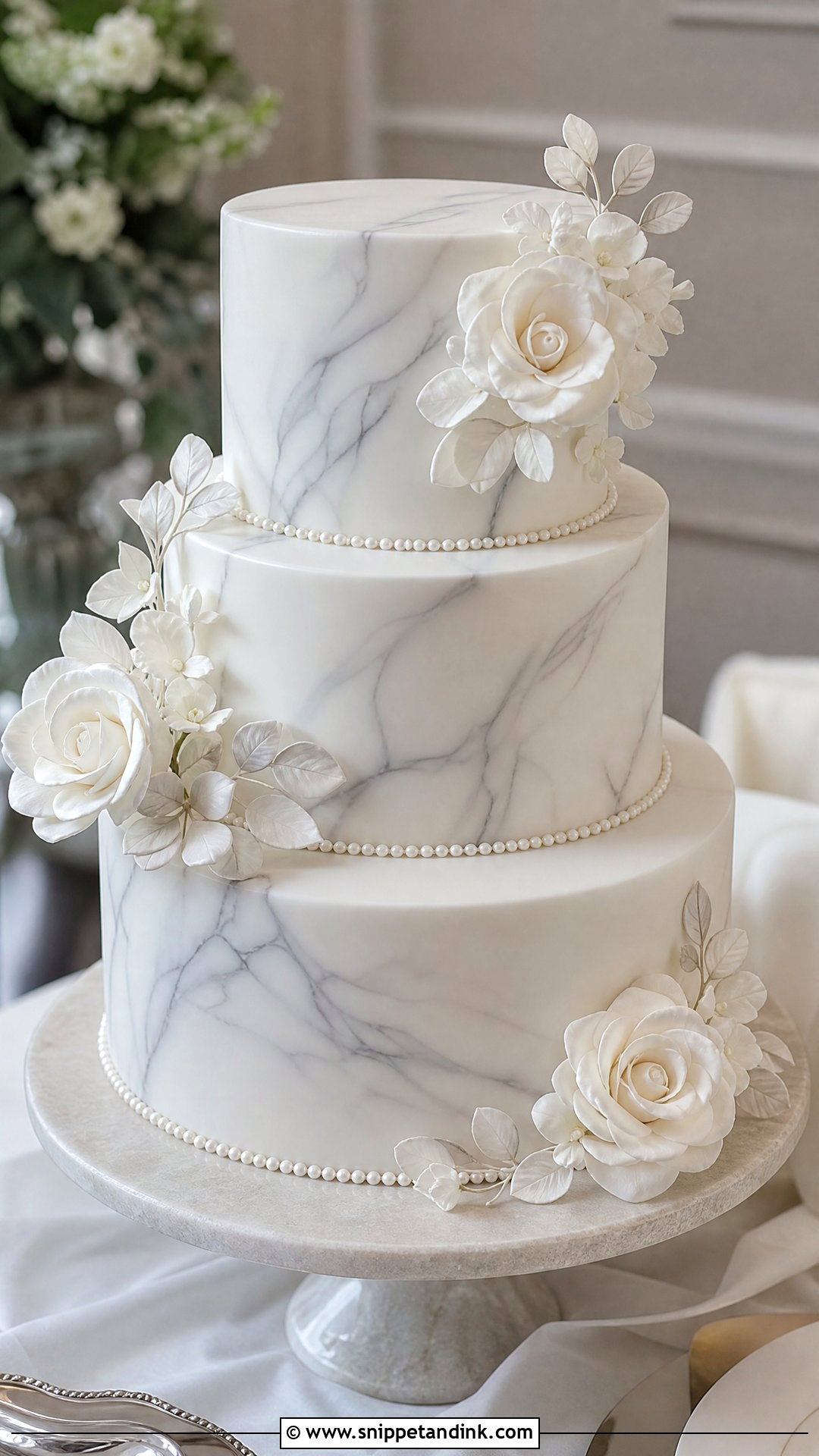
White marble is mostly about restraint: ivory swirled into white for something subtle, or pale gray veining for more contrast. I marble fondant by twisting tinted and plain pieces together before rolling, and it never comes out the same twice, which is the charm. Painted veining on buttercream is more controllable. White sugar flowers, pearls or a slim border are plenty. White chocolate, vanilla, almond and coconut suit it.
28. White Drip Wedding Cake
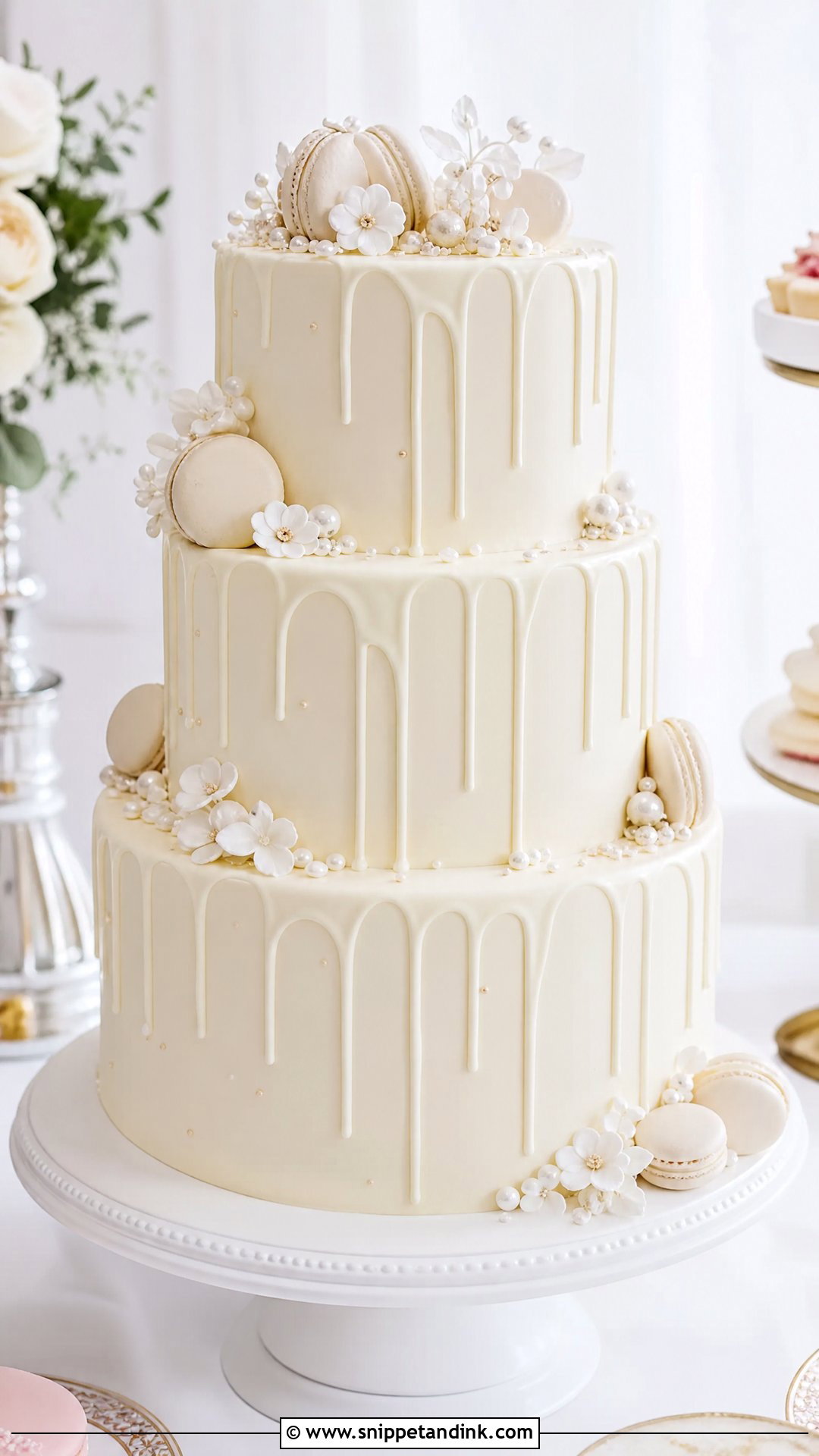
White drips are trickier than dark ones. White chocolate is softer and sets more slowly than dark chocolate, so the drip has to be cooled to just the right temperature and poured onto a cold cake. A white chocolate drip over smooth white buttercream feels relaxed but still bridal. Keep the drips short and even on a tiered cake. White macarons, sugar flowers, pearls or small meringues dress the top. Vanilla raspberry, lemon cream, coconut and white chocolate work well.
29. White Cake With Fresh Fruit
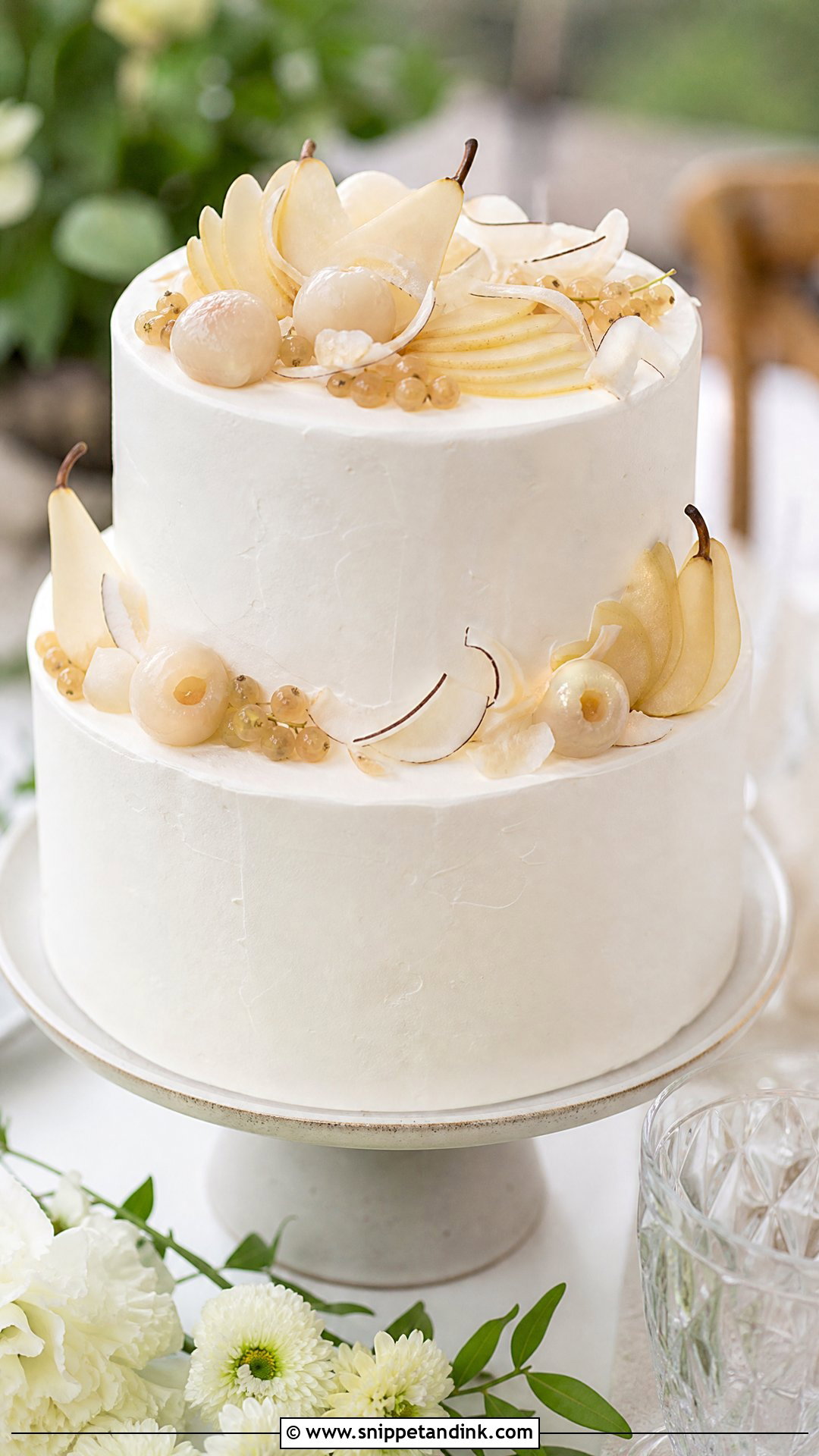
Fruit and an all-white palette is a tricky pairing, since most fruit is colorful. Pale options include white strawberries when in season, lychee, white currants, peeled pear and coconut. Pear and lychee brown or weep once cut, so I add them on site and brush them with a clear glaze. A few soft herbs add freshness. Whipped frosting or light buttercream suits warm-weather and brunch weddings, though whipped cream won’t survive a long, warm display. Keep the placement clean.
30. White Single Tier Wedding Cake
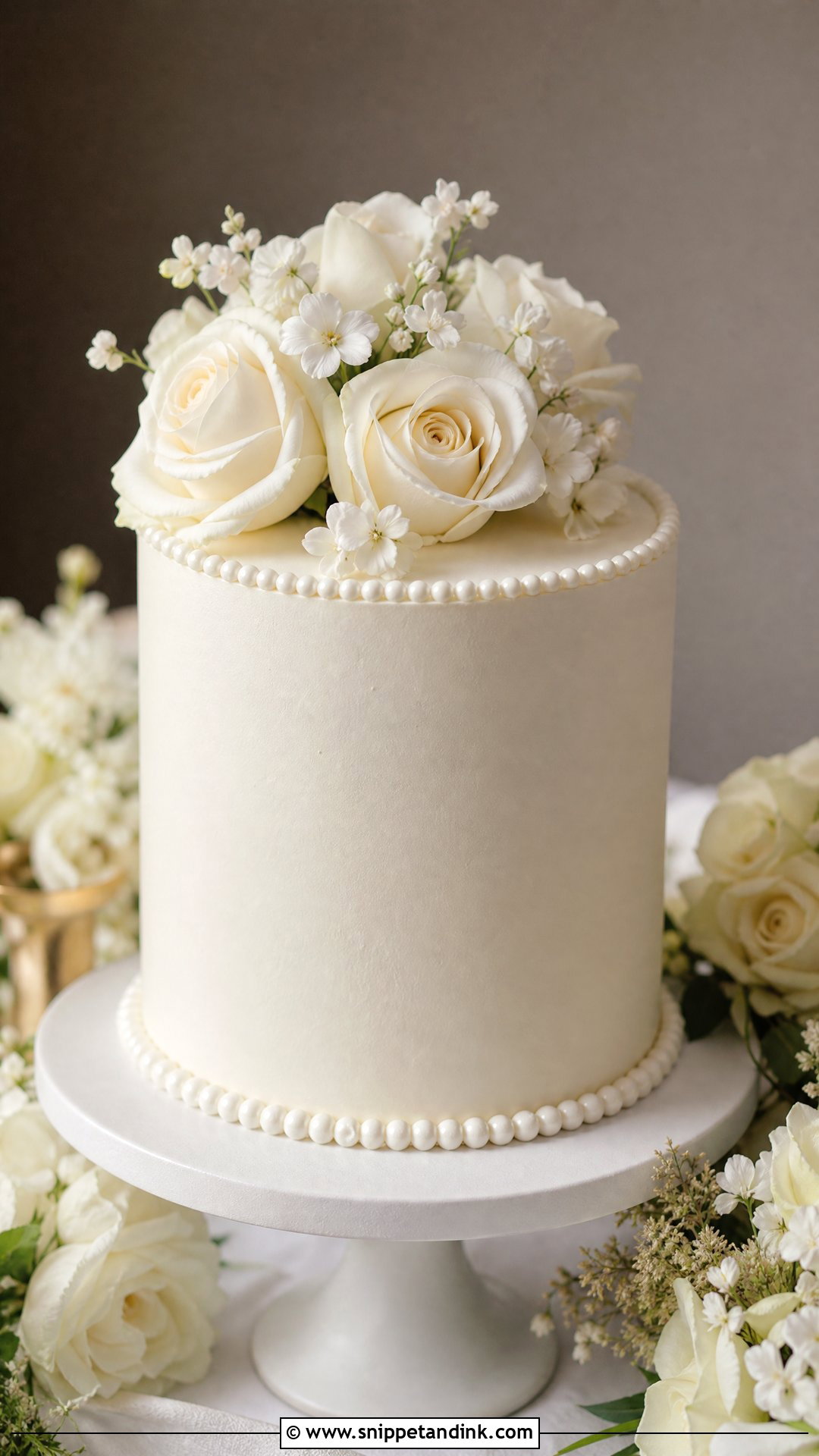
A single tier is the honest choice when you’re serving other desserts or hosting a tiny wedding. A tall tier with smooth buttercream, pearl piping, fresh flowers or a vintage border still looks like a wedding cake in photos, and it fits on a small pedestal. Because fewer people share it, pick the flavor you two love most. Vanilla bean, almond, lemon, coconut and white chocolate are all good starting points.
Servings, Tiers and the Kitchen Cake Nobody Sees
Couples often choose the number of tiers by how it looks, then discover it doesn’t match the guest list. It helps to know how bakers count.
Wedding portions are cut as narrow fingers, much smaller than a birthday slice, so a wedding cake feeds more people than its size suggests. As a rough guide, a classic three-tier round of six, eight and ten inches serves somewhere around seventy to eighty wedding portions, but every baker’s chart is a little different, so ask for theirs. Square tiers serve more than rounds of the same width, and taller double-barrel tiers serve more again.
When the cake you want looks right but feeds too few, there are two common fixes. A plain kitchen cake, iced to match and kept in the back, is cut alongside the display cake and served from the kitchen; it costs less than an extra decorated tier. When you want the opposite, a tall cake with a small guest list, one or two tiers can be styrofoam dummies iced the same way as the real ones. Nobody can tell from the room, and you won’t pay for cake that goes uneaten.
Tell your venue too. Some charge a cake-cutting fee per guest, and that cost belongs in the same conversation as tier count.
Your White Cake Should Match the Room It Stands In
White suits almost any wedding because it takes on the character of its shape, texture and setting: sleek, romantic, rustic, vintage or minimal. Before you decide, think about the venue, the guest count, your dress details, the flowers and the season, and bring photos of each to your tasting. A white cake that matches all of those will look like part of the day rather than a cake that happens to be in the room.
You'll Like These Ideas:









Leave a Reply