
A garden reception changes what a cake has to do. Outdoors it competes with real flowers, open sky and afternoon warmth, so the designs I steer couples toward are the ones that echo the venue and the bouquet instead of ignoring them. Before I sketch anything, I want to know where the dessert table will stand, what’s blooming that month and whether the cake will sit in shade. The twenty designs below run from loose and rustic to formal enough for a black-tie lawn, and each comes with what I’d tell you at a tasting.
Heat, Shade and Buttercream at an Outdoor Reception
The first thing I ask about a garden wedding isn’t the flavor. It’s where the cake will stand and for how long. Buttercream is mostly fat, and fat softens as the air warms, so a cake that looks crisp at setup can slump by the first dance if it sits in the sun.
How each finish copes outside
- Swiss and Italian meringue buttercreams taste light and silky, but they’re nearly all butter and soften quickly in heat. I chill those cakes thoroughly and bring them out closer to service.
- American buttercream made with some shortening crusts over and holds piping better on warm days, though it’s sweeter.
- Fondant over ganache is the steadiest choice for heat, but a cold fondant cake carried into humid air will bead with moisture for a while before it settles.
- Naked and semi-naked cakes barely melt, yet they dry out, so with those I worry about the clock more than the thermometer.
Whatever the finish, the table needs shade for the whole time the cake is out, not only at setup. Walk the venue at the hour of your reception and see where the shadow really falls. A corner that’s shaded at noon can be in full sun by four.
1. Floral Garden Wedding Cake
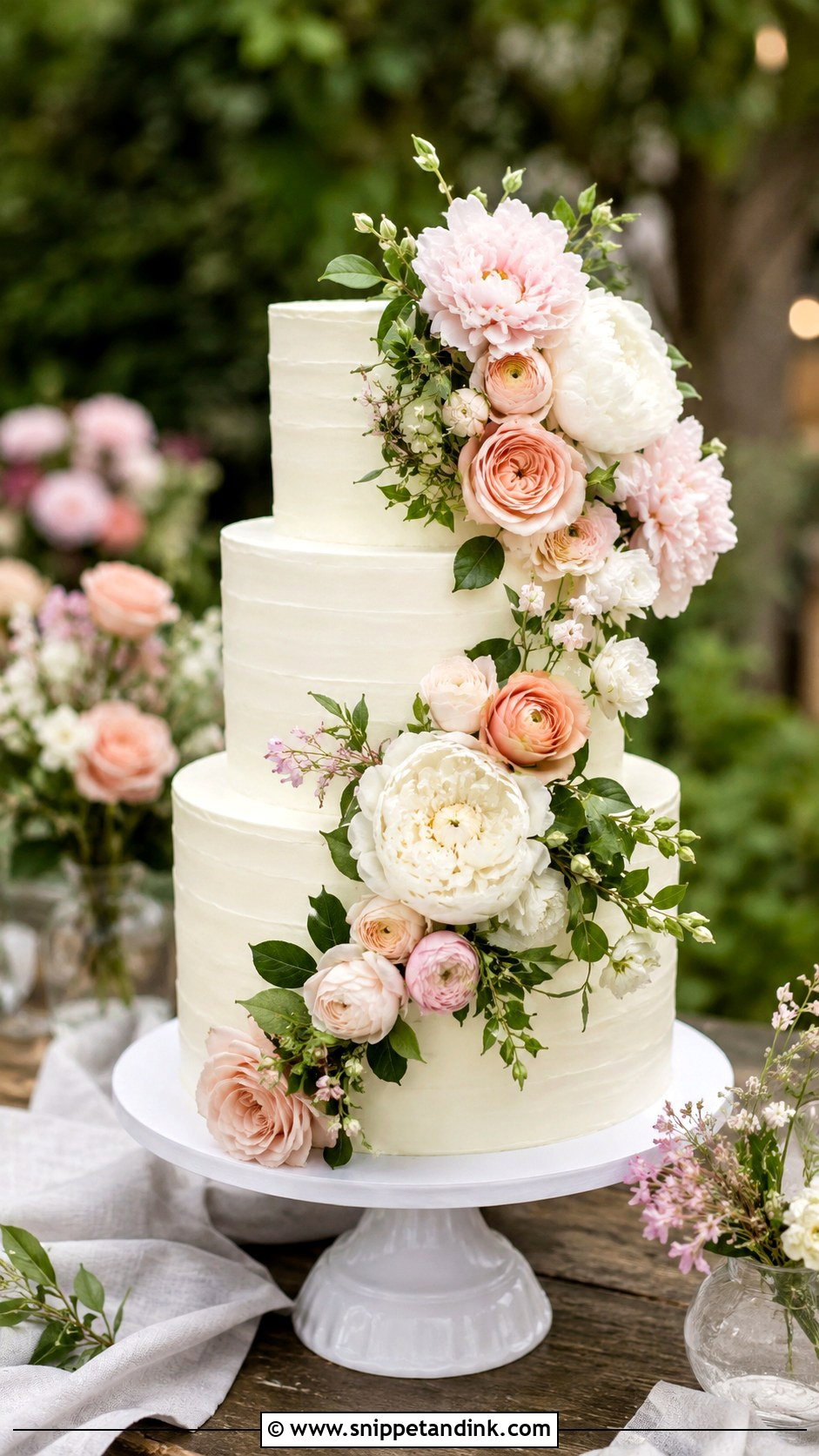
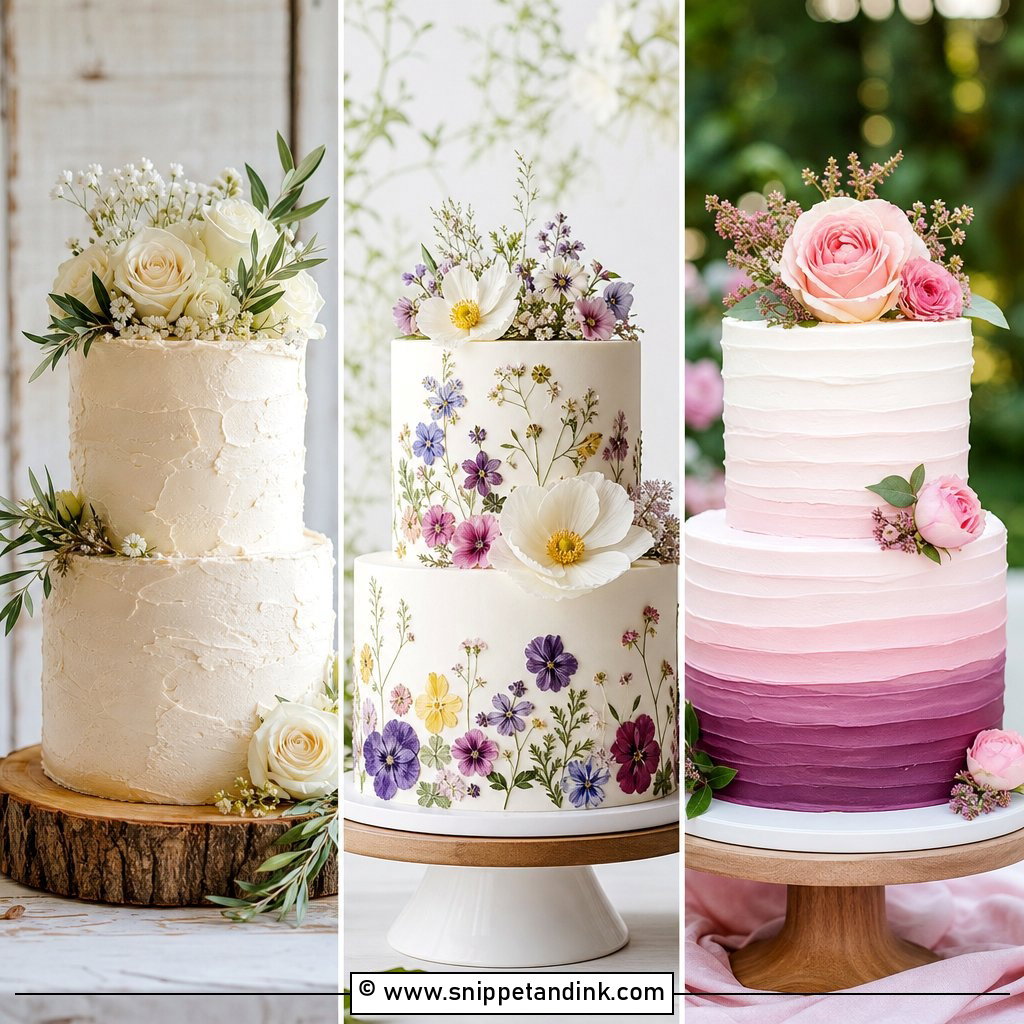
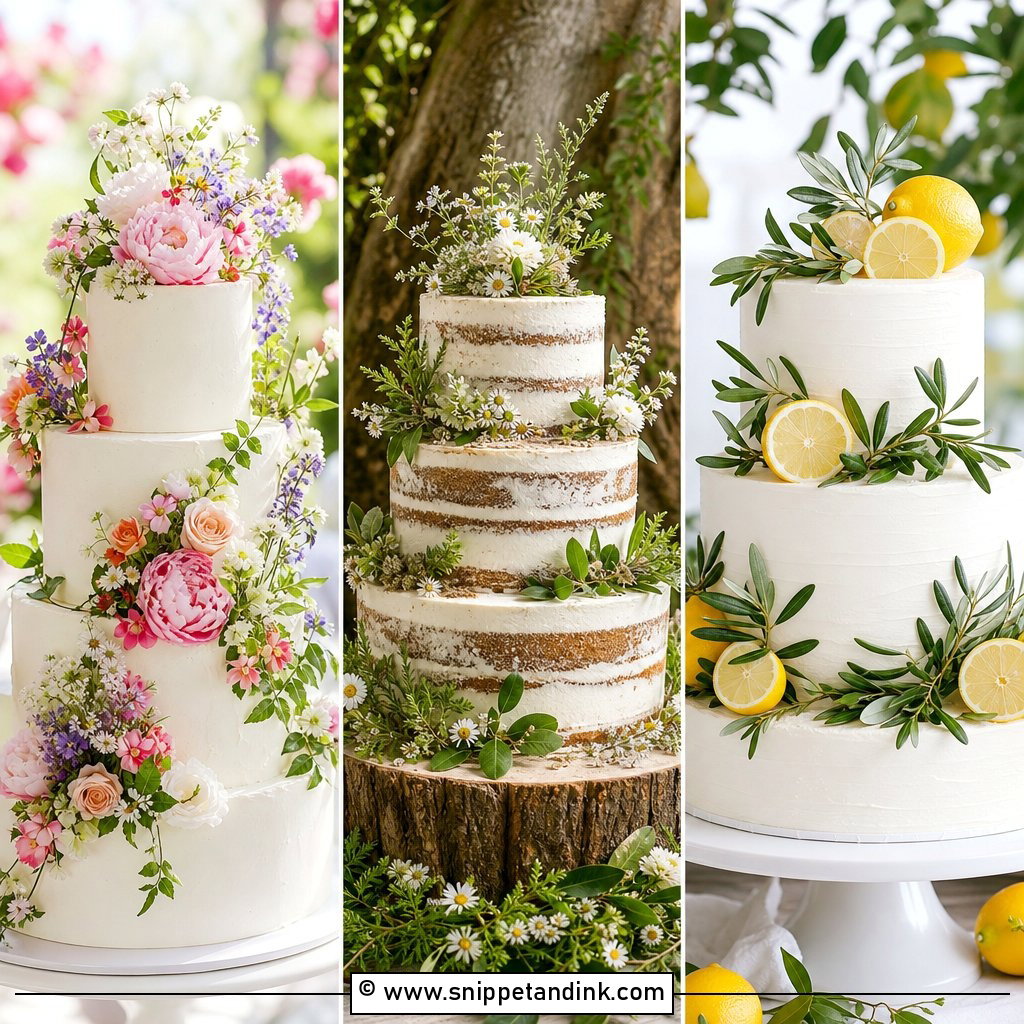
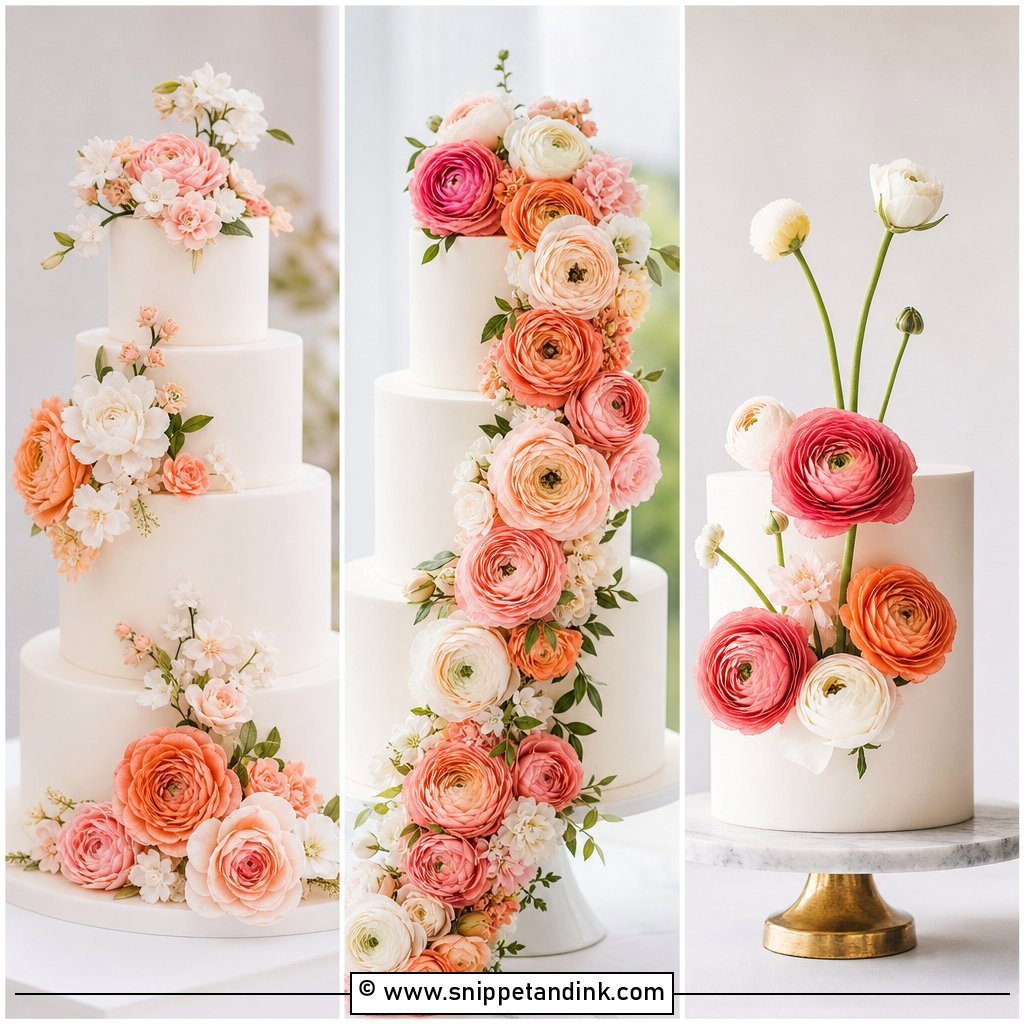
Clustering is what makes this one work. I group roses, peonies and ranunculus in two or three pockets per cake and leave the rest of the ivory frosting bare, because flowers spread evenly around every tier hide the shape you paid for. One large bloom, a few mid-sized ones and some small filler reads as a garden; nothing but large heads reads as a centerpiece someone set on top. Bring your florist’s recipe to the tasting so your baker can pull from the same stems. A plain white stand or a wood pedestal keeps the attention on the tiers.
2. Naked Wedding Cake With Berries
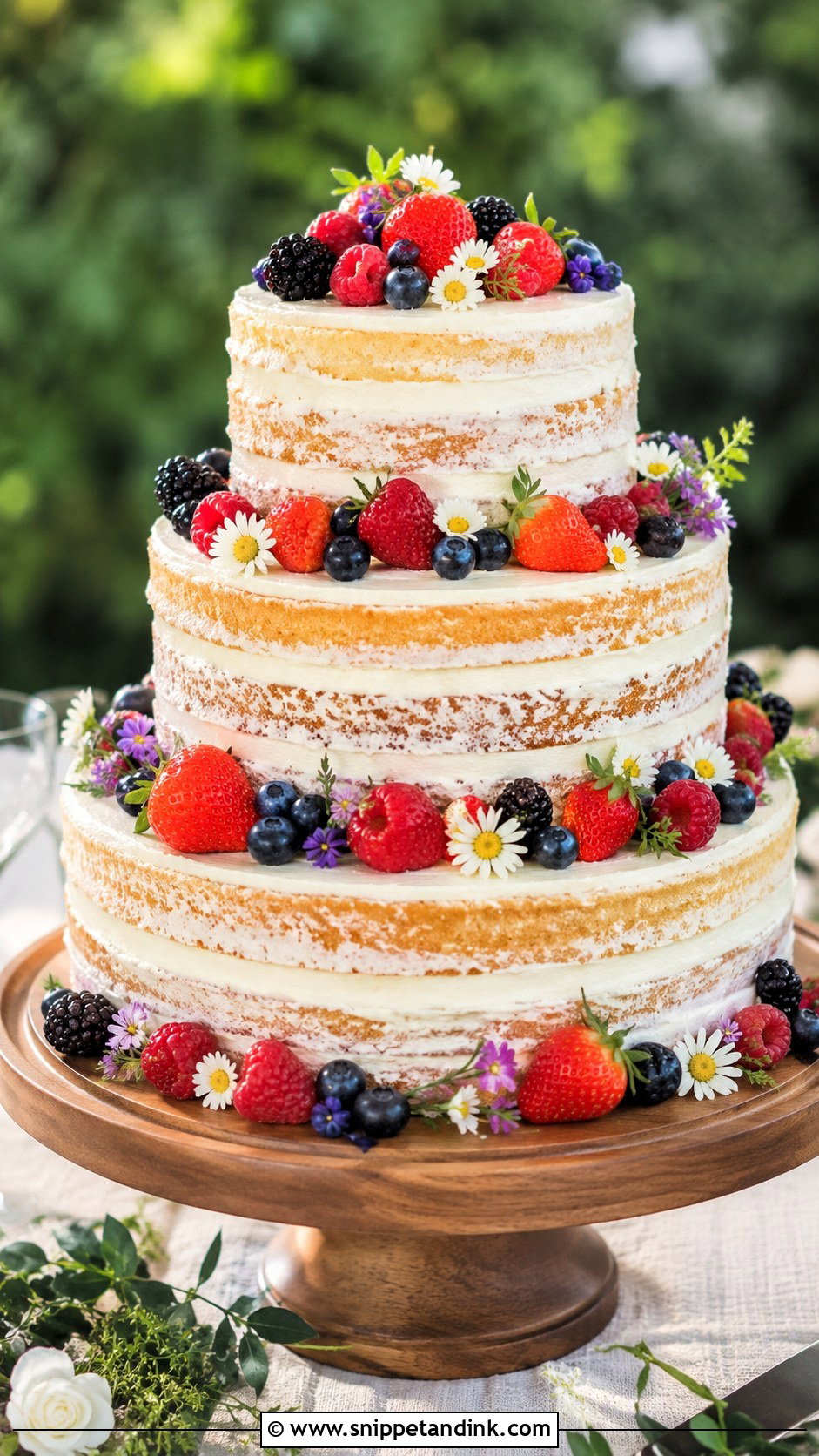
Naked cakes dry out faster than any other style I make, and that’s the honest trade-off. With no outer coat of buttercream, the exposed sponge starts losing moisture the moment it leaves the box, so I stack these as close to service as the venue allows and brush every layer with syrup during assembly. Berries go on last. Cut strawberries weep, so I use them whole beside raspberries, blueberries and blackberries, with a few mint leaves or small edible flowers tucked between. In spring and summer light, the fruit gives you color without a single line of piping.
3. Pressed Flower Wedding Cake
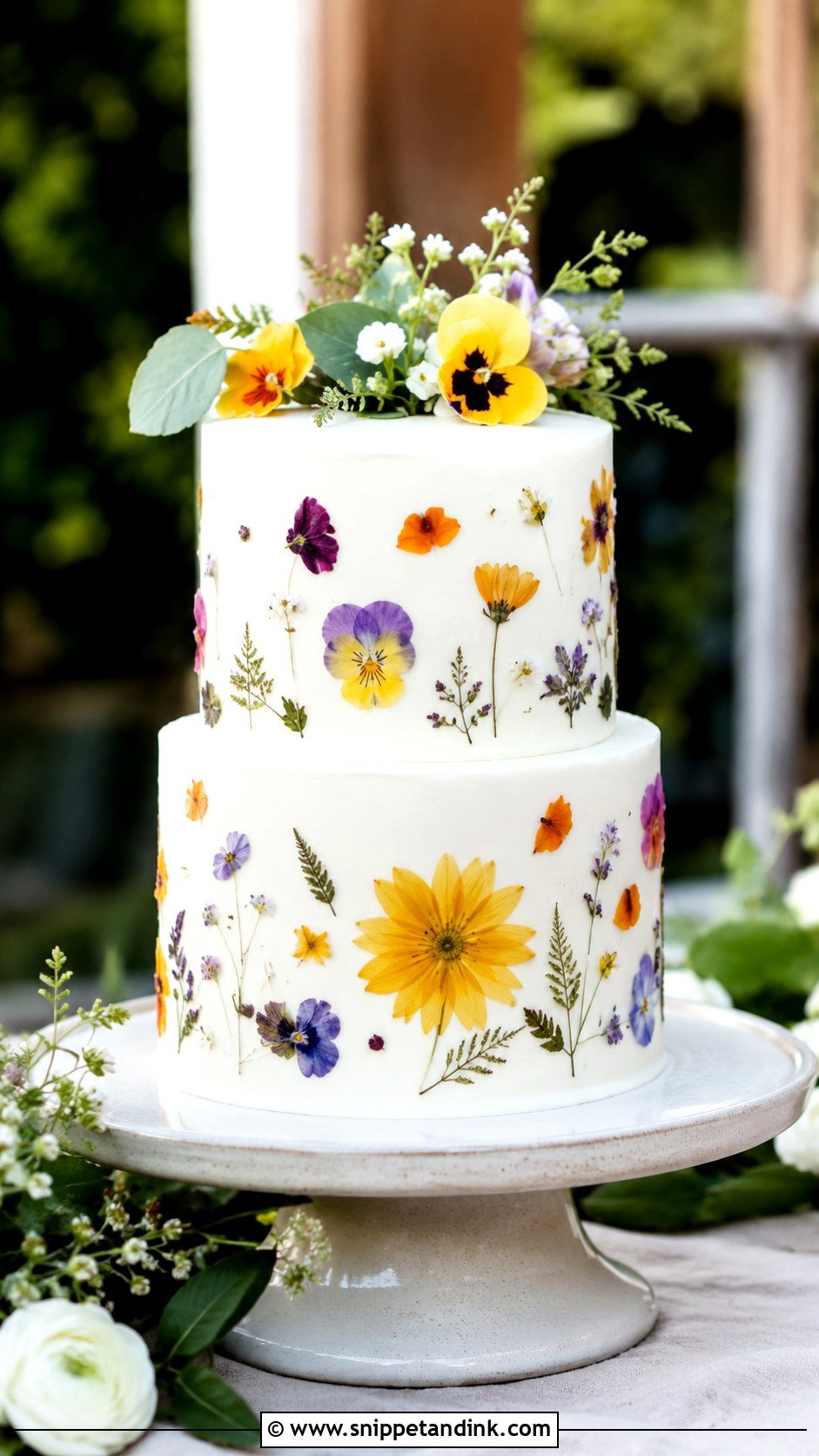
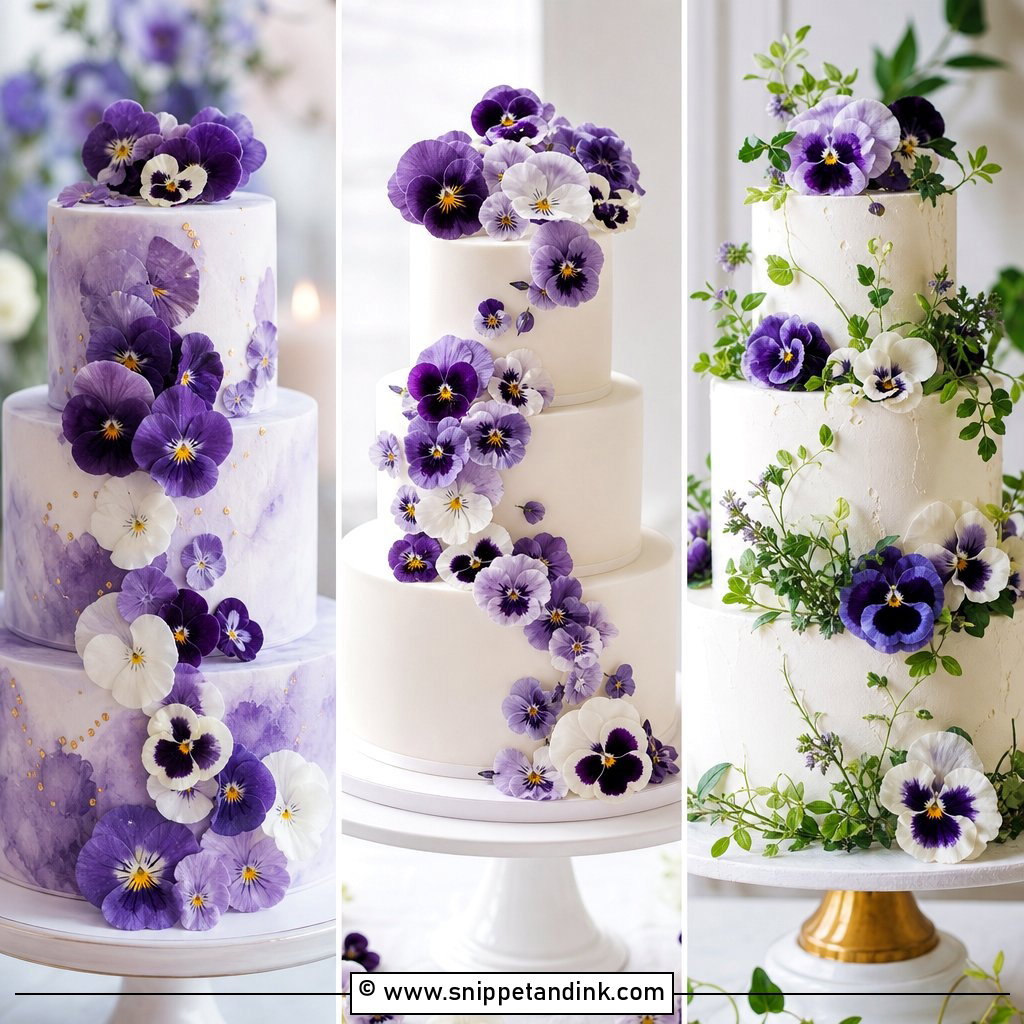
Pressed edible flowers need a smooth, firm surface, so I set them on chilled buttercream or fondant and press them in gently. Pansies and violas keep their color well once pressed; calendula petals and tiny herb leaves fill the gaps. Moisture is the enemy here. A cake that sweats after leaving the fridge turns the petals translucent and blotchy, so I let it come up to room temperature before the flowers go on. Two or three tiers give the pattern room to look placed on purpose, and the base frosting should stay plain.
4. Wildflower Wedding Cake
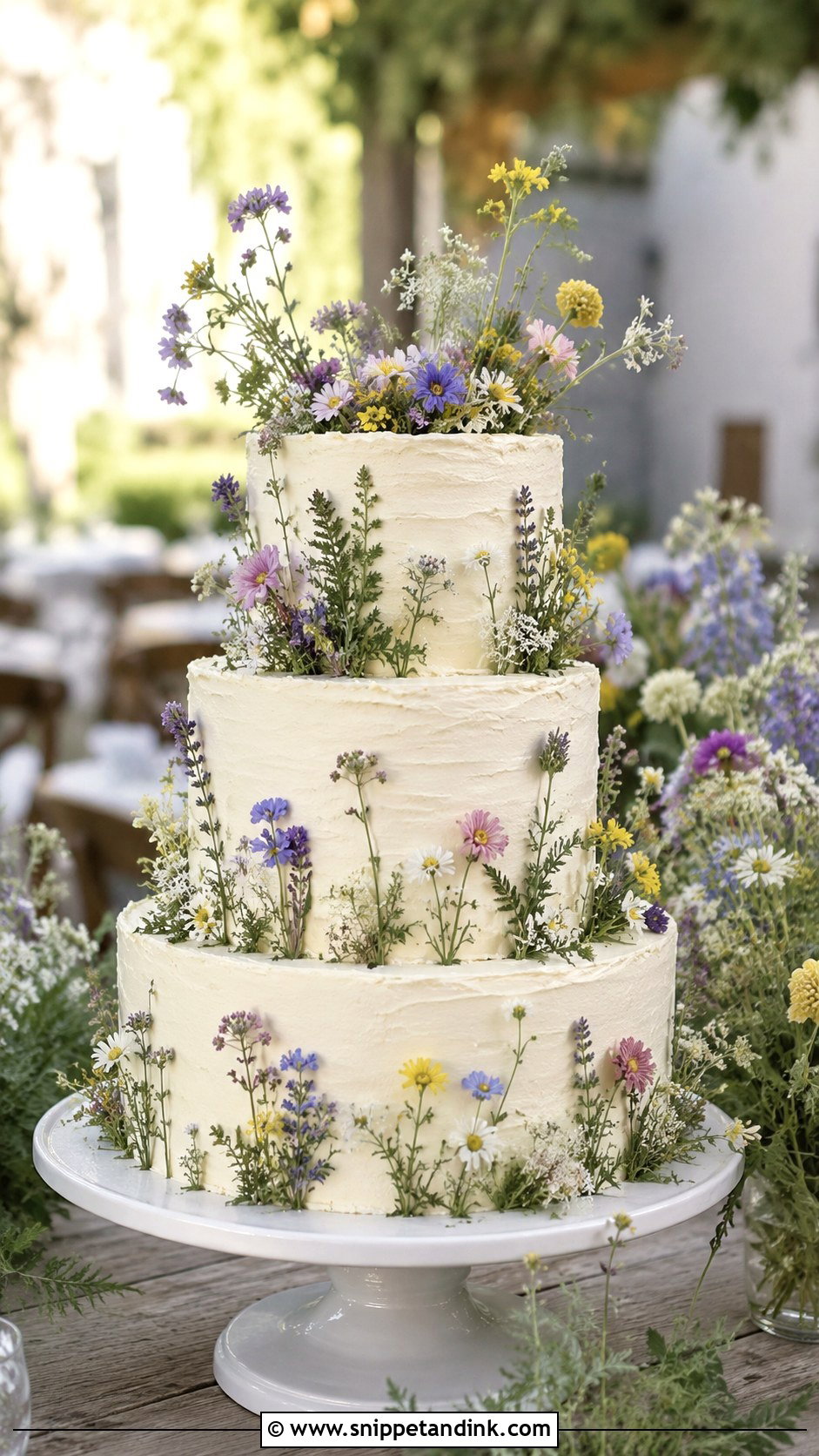
This one should look gathered, which is harder to arrange than it sounds. I work with small blooms and loose greenery at uneven heights so the tiers read like a strip of meadow rather than a matched set. Buttercream suits it far better than fondant, since a slightly soft surface fits the mood. Build the palette from what’s actually growing near your venue: lavender, yellow, blush and white with plenty of green is easy to source in early summer. Backyard ceremonies with loose centerpieces are where I’d put it.
5. Lemon Elderflower Wedding Cake
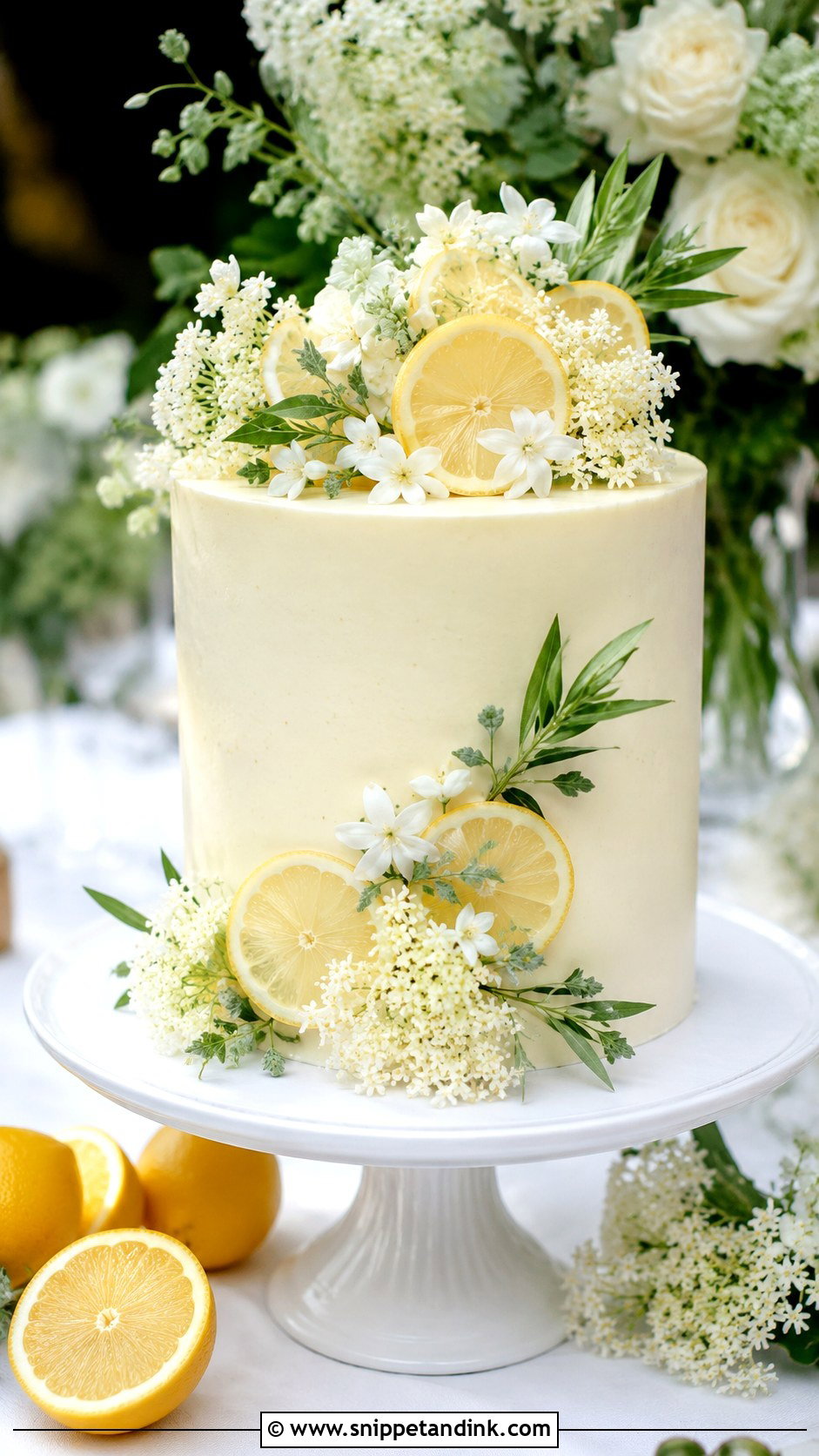
Flavor drives this design. A lemon elderflower wedding cake usually means pale lemon sponge, a curd filling and an elderflower buttercream or Swiss meringue. One caution from the kitchen side: curd is a soft filling, so I pipe a stiff buttercream dam around each layer to stop it bulging out once the tiers are stacked and the day warms up. Decoration stays light, with small white elderflowers, a few thin lemon slices and greenery placed around the tiers rather than over them.
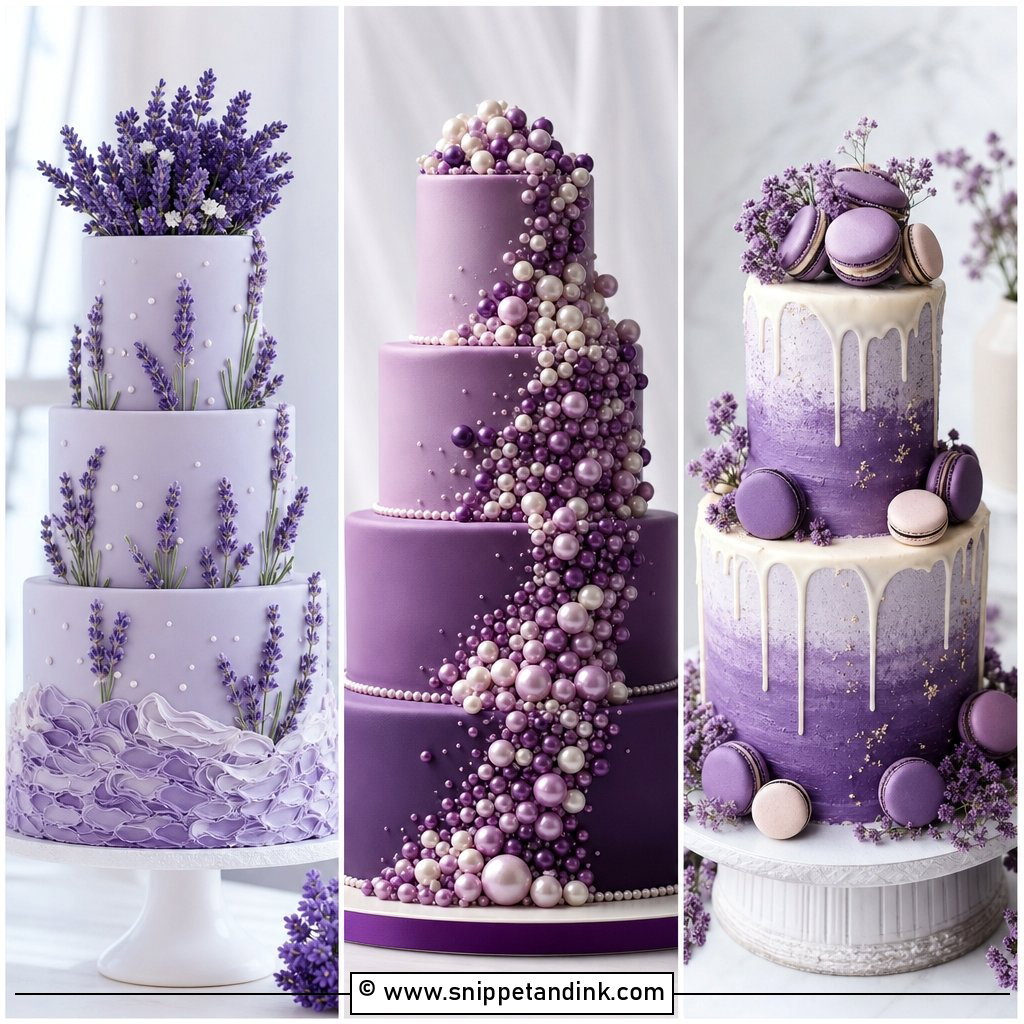
6. Lavender Wedding Cake
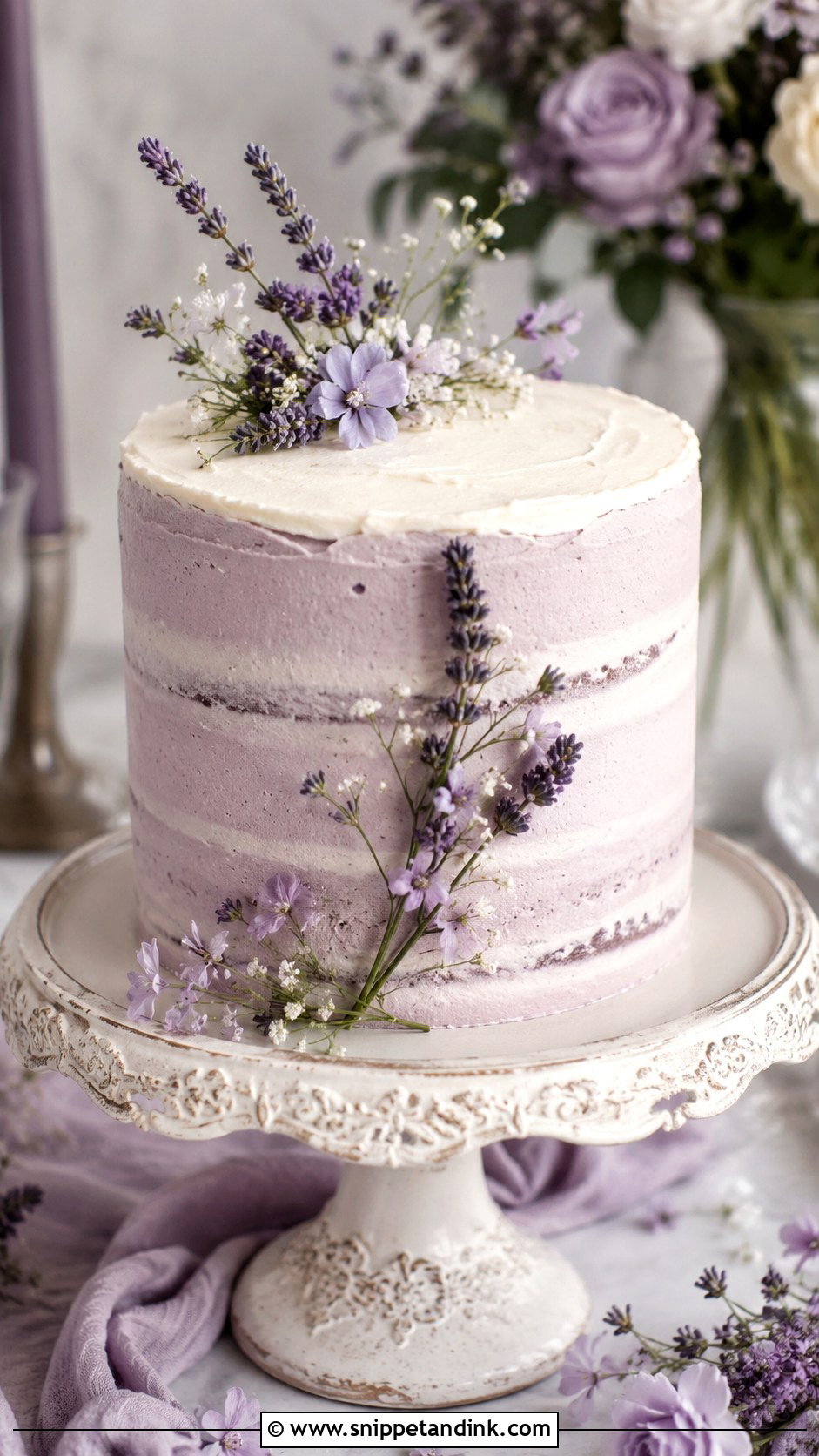
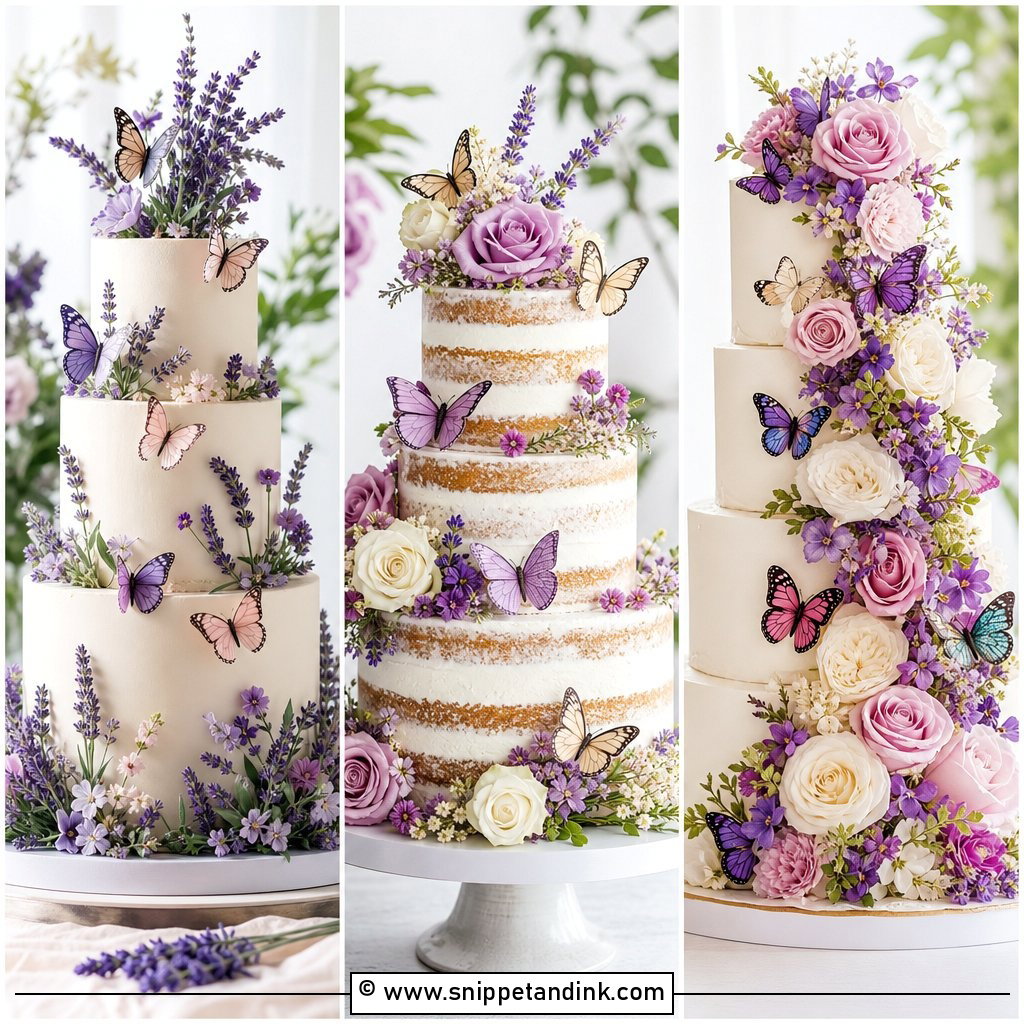
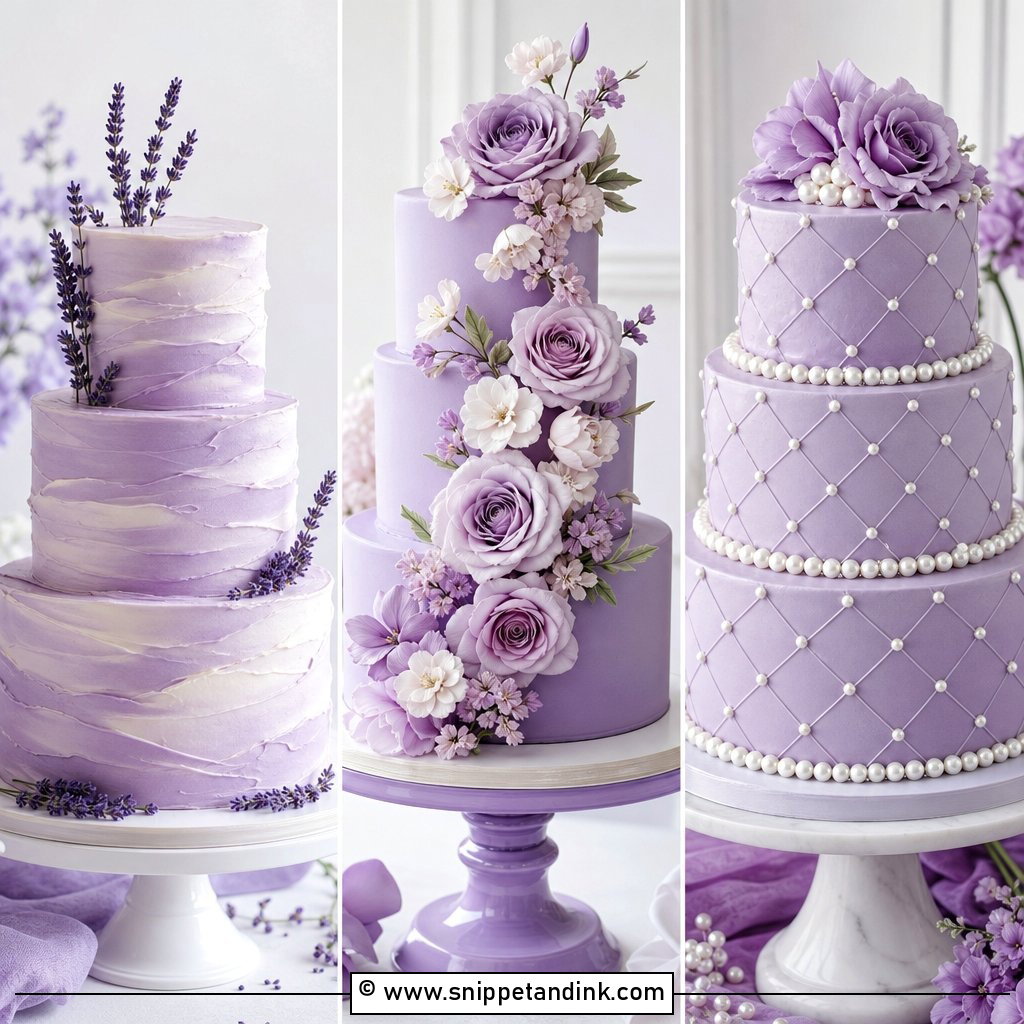
Lavender is the flavor I’m most careful with, because a heavy hand makes a cake taste like soap. I infuse it into the milk or syrup and taste as I go, and I often pair it with honey or lemon to round it off. Visually, ivory buttercream with a few sprigs, fine piping or a pale watercolor wash keeps it quiet. Only culinary lavender goes near the frosting; bunches from a florist may have been sprayed. It sits naturally beside rustic tables and pale purple arrangements.
7. Rose Garden Wedding Cake
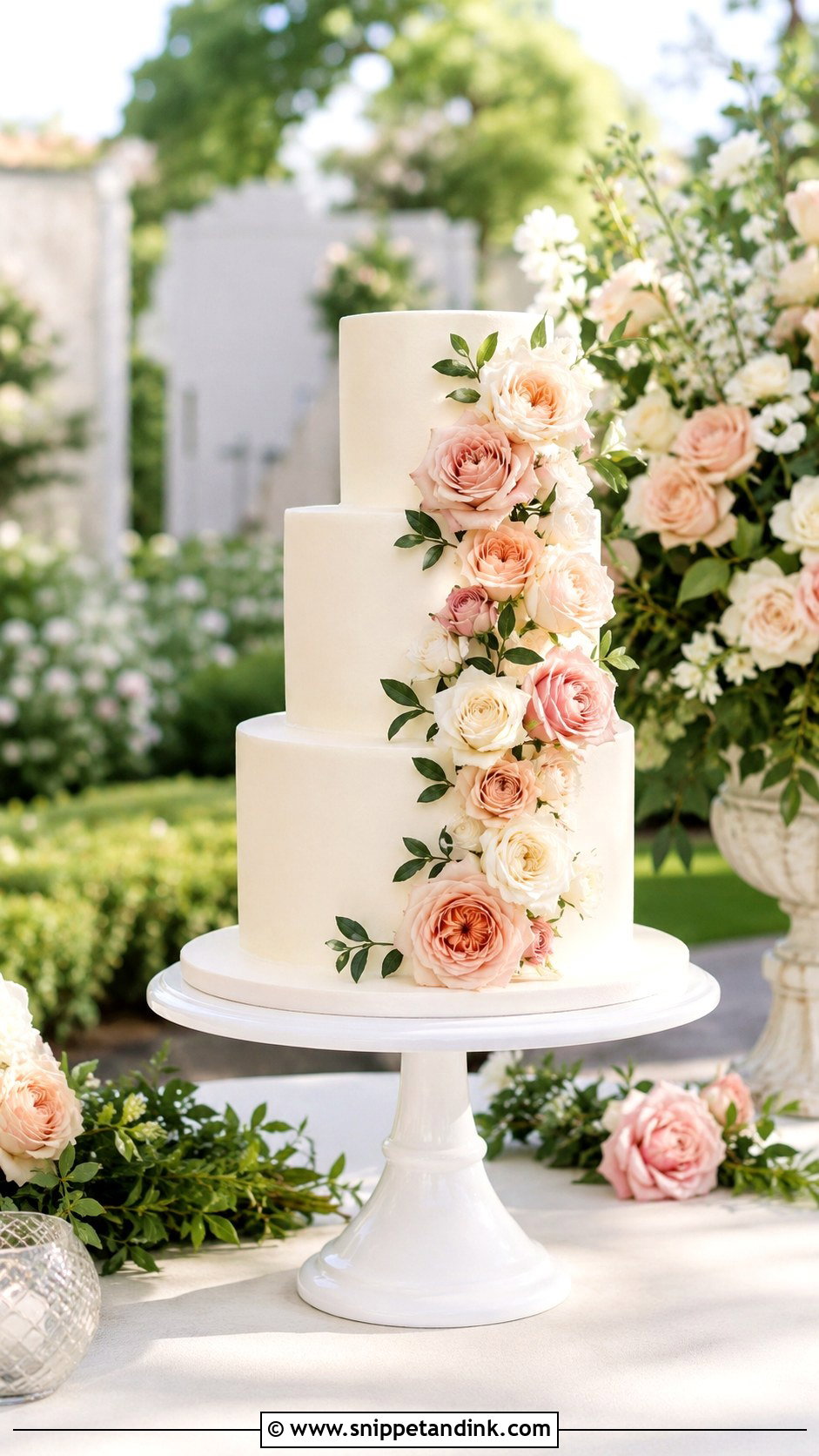
Roses are the easiest flower to match to any palette, since they come in blush, ivory, peach, mauve and white. I decide early whether they’ll cascade, sit between tiers or crown the top, because a cascade needs the stand turned so the trail faces the guests, and that affects where the table goes. Smooth buttercream or fondant gives them a clean background. Fewer blooms push the cake modern; fuller clusters push it classic. Matching the bridal bouquet ties the two together in photos, and a couple of trailing vines connect it to the lawn.
8. Peony Wedding Cake
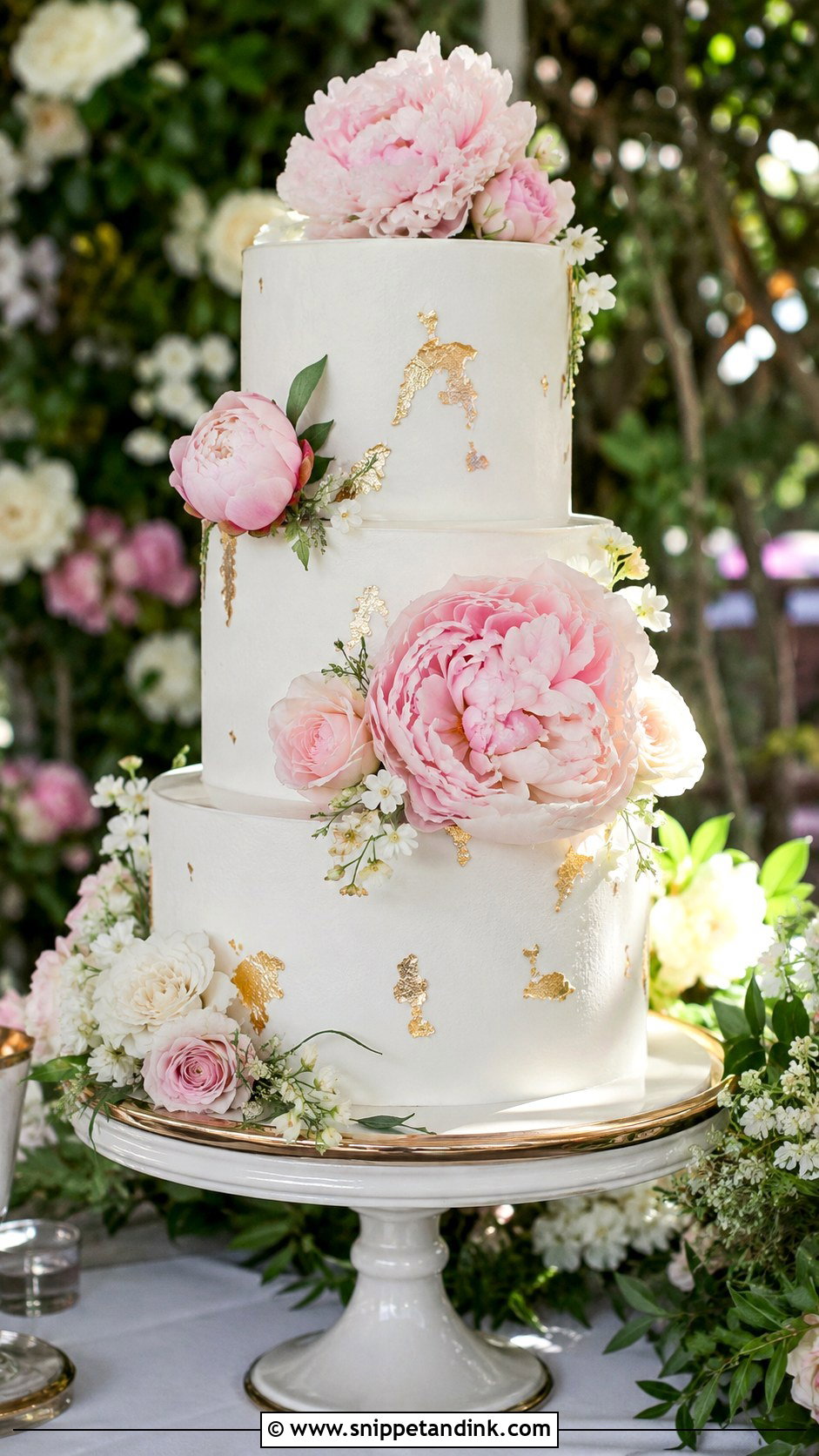
Peonies are big, so three or four heads can do the work of a dozen roses. On a three-tier cake I place one bloom on top and a cluster sweeping down one side, leaving plenty of plain buttercream showing. The catch is timing. Peonies open fast in warm air, and a bud that was tight at setup can be fully blown by the speeches, so I ask the florist for blooms that are only just opening. A thin line of gold leaf is the one accent I’d add.
9. Daisy Wedding Cake
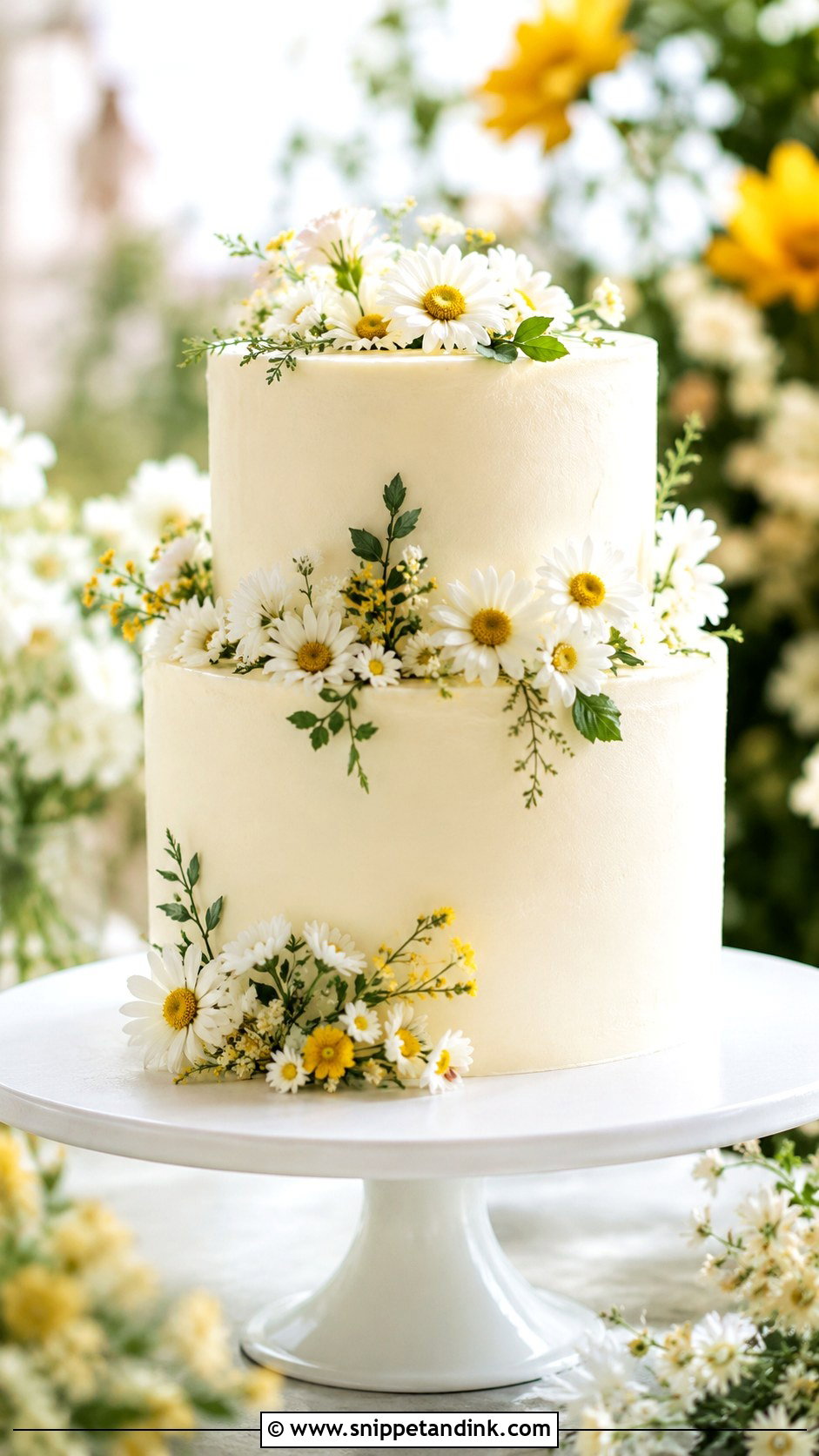
Small white daisies with yellow centers are one of the cheeriest things you can put on buttercream, and they hold up in warmth better than many fragile blooms. I place them in loose drifts rather than rows, with open frosting between the drifts so the cake doesn’t end up looking polka-dotted. A white base keeps it crisp, while a pale yellow wash on one tier warms it. Greenery and tiny wildflowers fill the gaps. This is the cake I’d suggest for a relaxed backyard spring party.
10. Greenery Wedding Cake
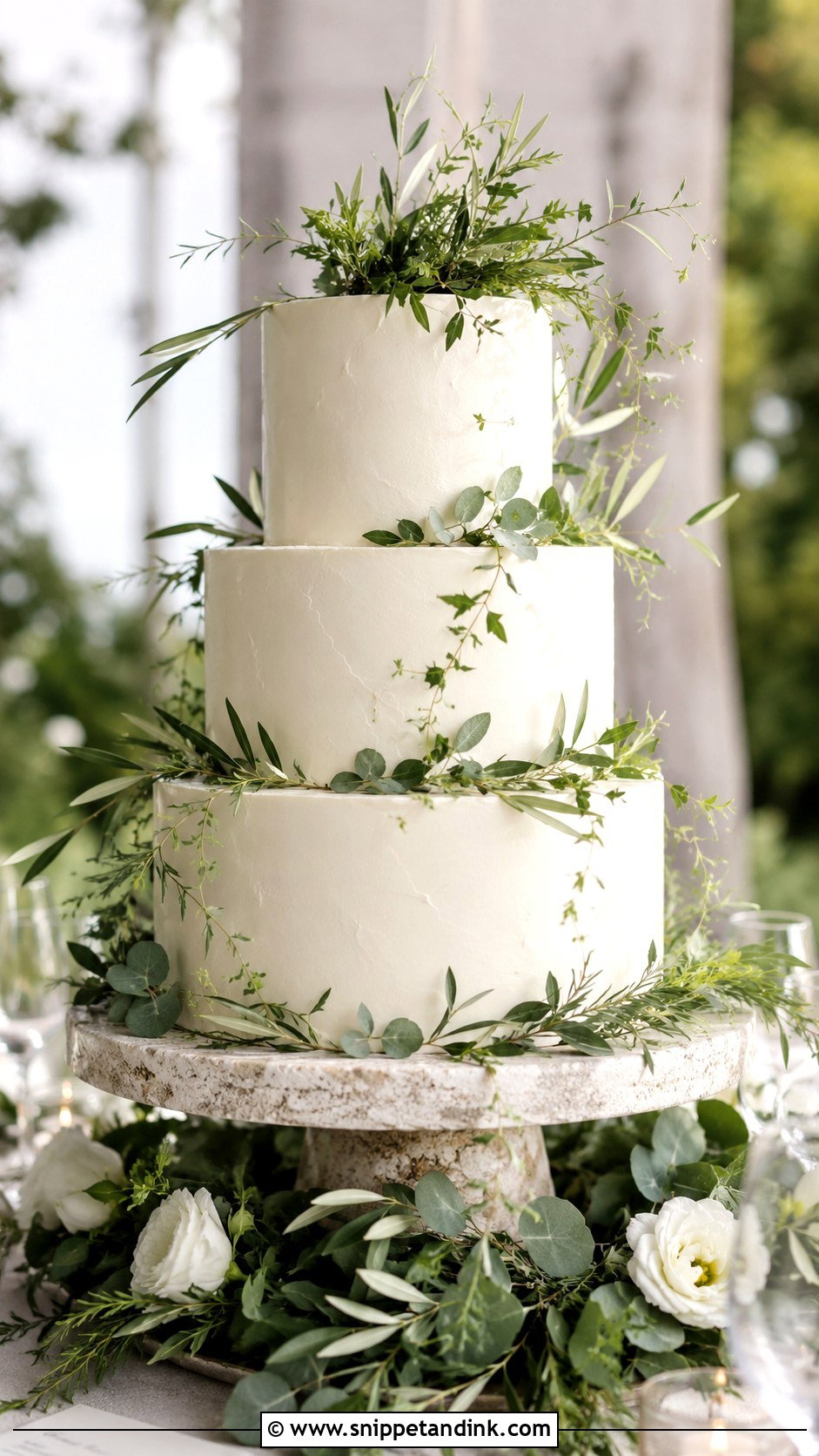
A cake with leaves and no flowers looks calm and modern against white buttercream or fondant. Eucalyptus, olive, rosemary and soft vines can wrap a tier or sit in a single cluster, and a textured finish takes it rustic. Here’s my warning, though: eucalyptus isn’t edible and is often sprayed, so it must never touch frosting directly. I either wrap the stems and set them on a barrier, or swap in rosemary and bay, which are food-safe. It suits receptions where the arch and tables are already heavy on foliage.
11. Buttercream Flower Wedding Cake
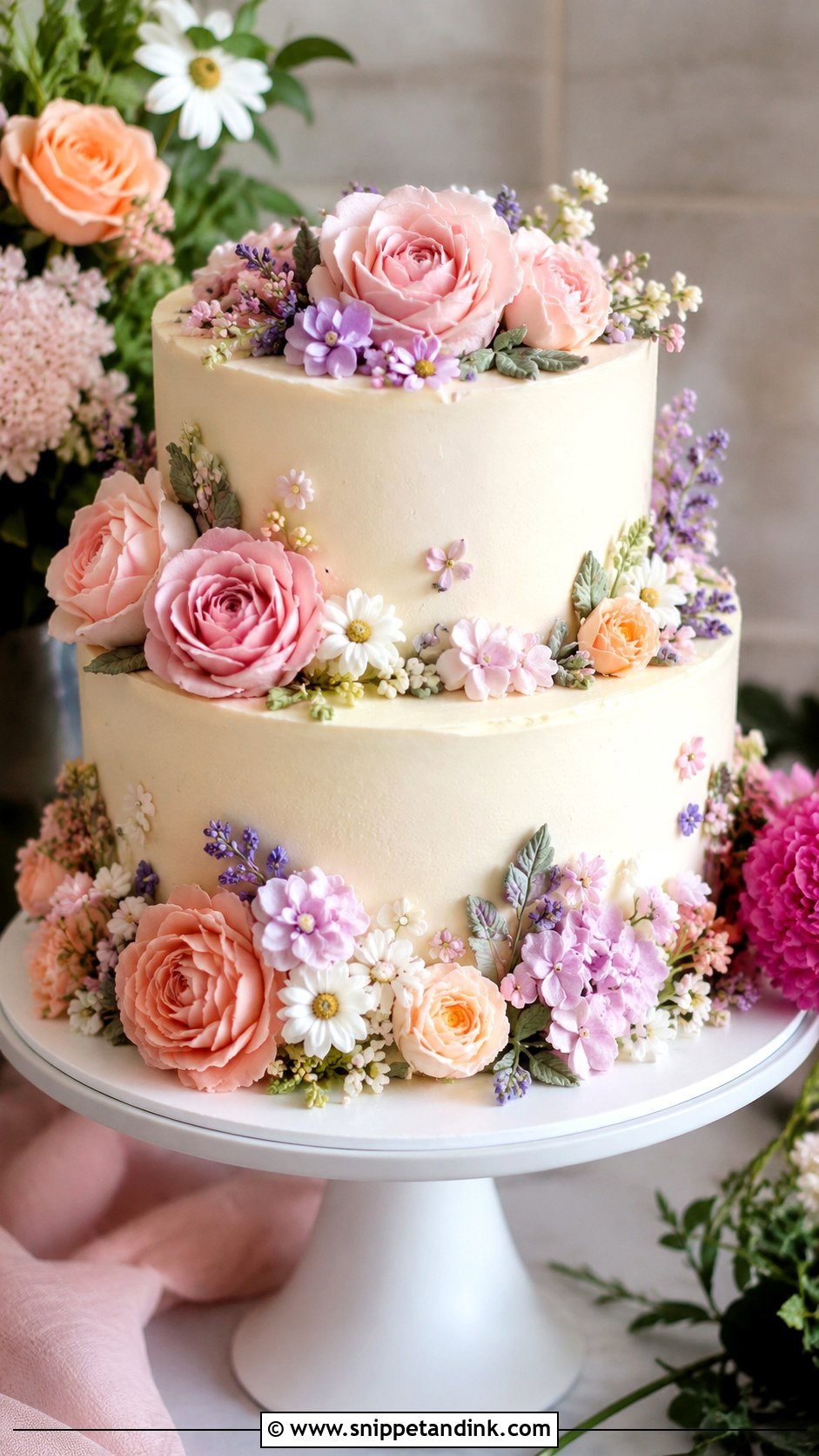
Every petal on this cake can be eaten, which settles the safety question before it starts. I pipe roses, hydrangea clusters, daisies and small blossoms in shades matched to the palette, then leave some tiers smooth so the floral sections have contrast. The weakness is heat. Piped flowers soften and droop in strong sun long before the cake inside suffers, so for outdoor jobs I use a stiffer recipe and insist on shade. Venues that don’t allow fresh florals on food are where this design earns its place.
12. Watercolor Floral Wedding Cake
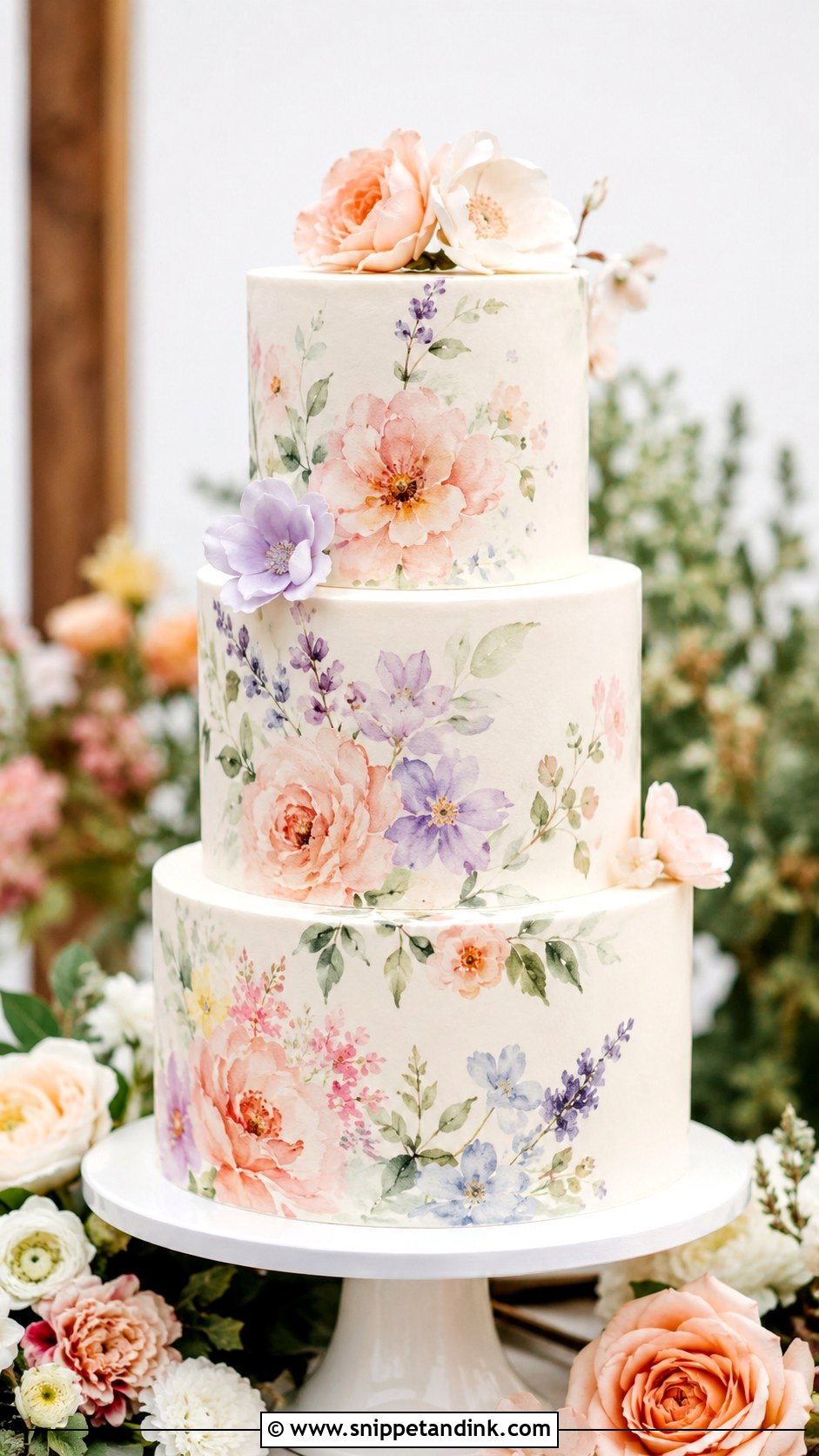
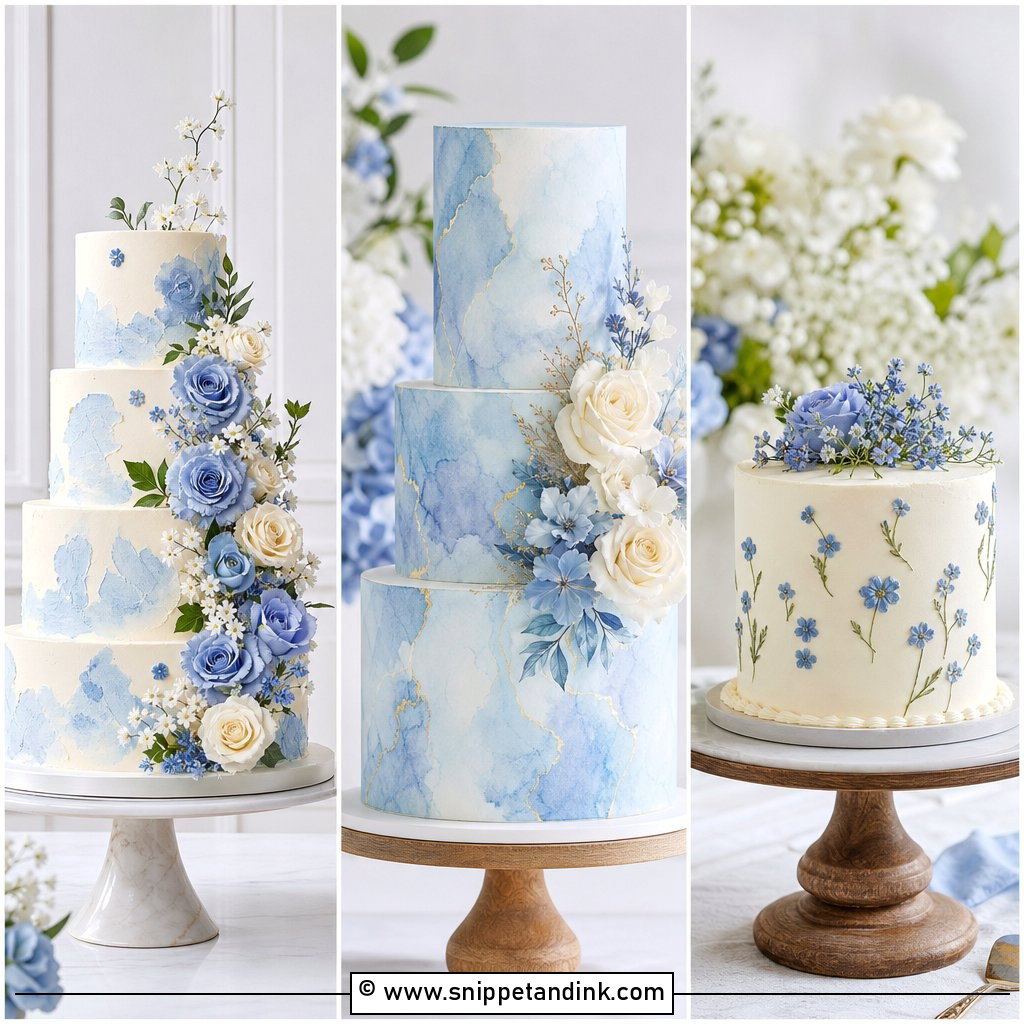
Painted cakes give you color without bulk. I paint petals and leaves onto chilled fondant or very smooth, firm buttercream with diluted gel colors, building light layers so the edges bleed softly. Blush, lavender, sage, peach and pale blue all suit an outdoor reception. One or two real or sugar flowers on top tie the painting back to your florals. I think of it as the invitation suite brought into three dimensions.
13. Semi Naked Wedding Cake
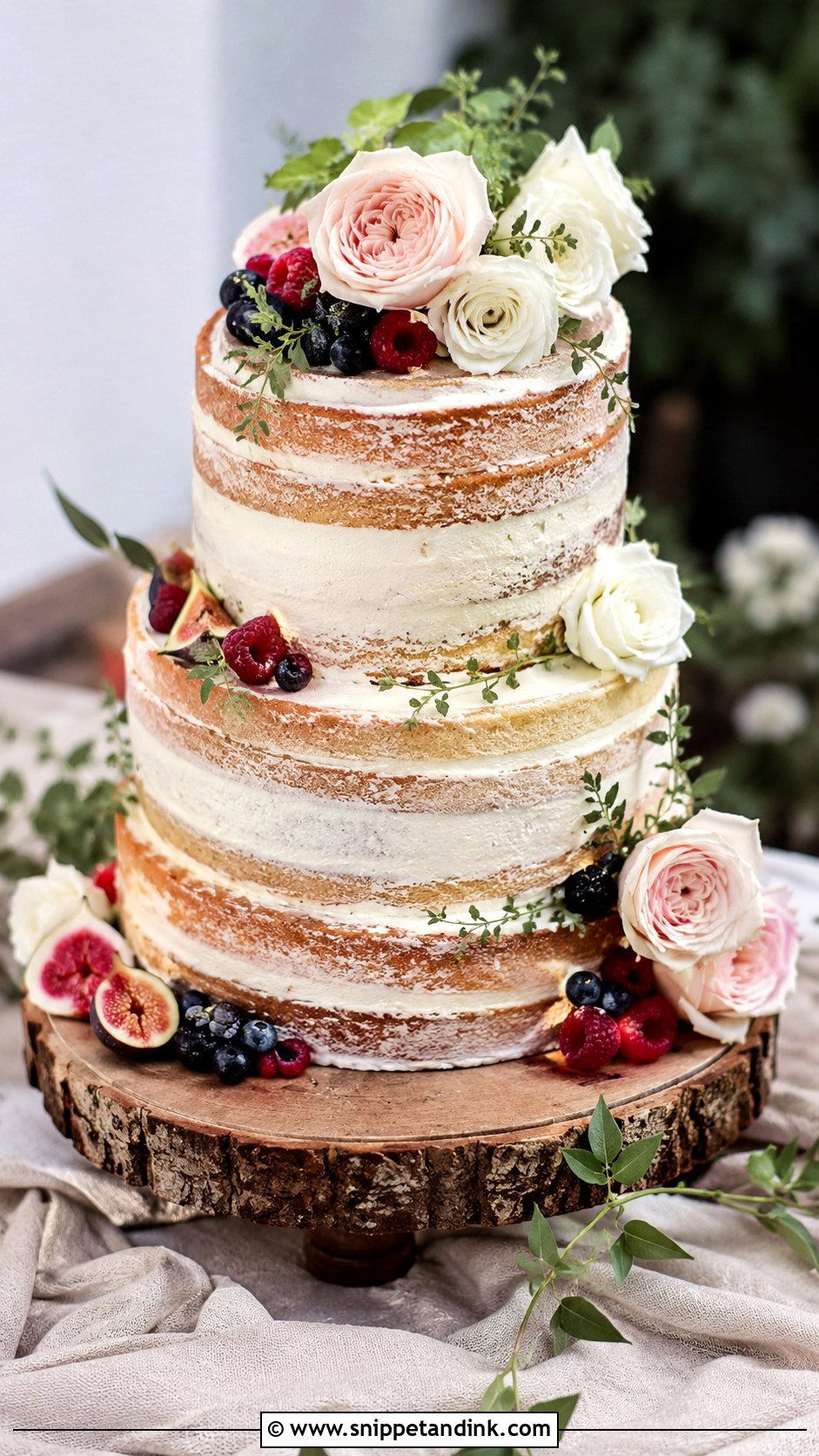
A semi naked wedding cake is a thin coat of buttercream scraped back until the sponge shows through in places. For outdoor work I prefer it to a fully naked cake, because that thin coat seals the layers and keeps them moist for longer. Fresh flowers, berries, figs or simple greenery all sit well against it. Match the flavor to the season: vanilla bean or lemon in summer, almond or spice in autumn. A wood stand or a plain ceramic pedestal suits the finish.
14. Botanical Wedding Cake
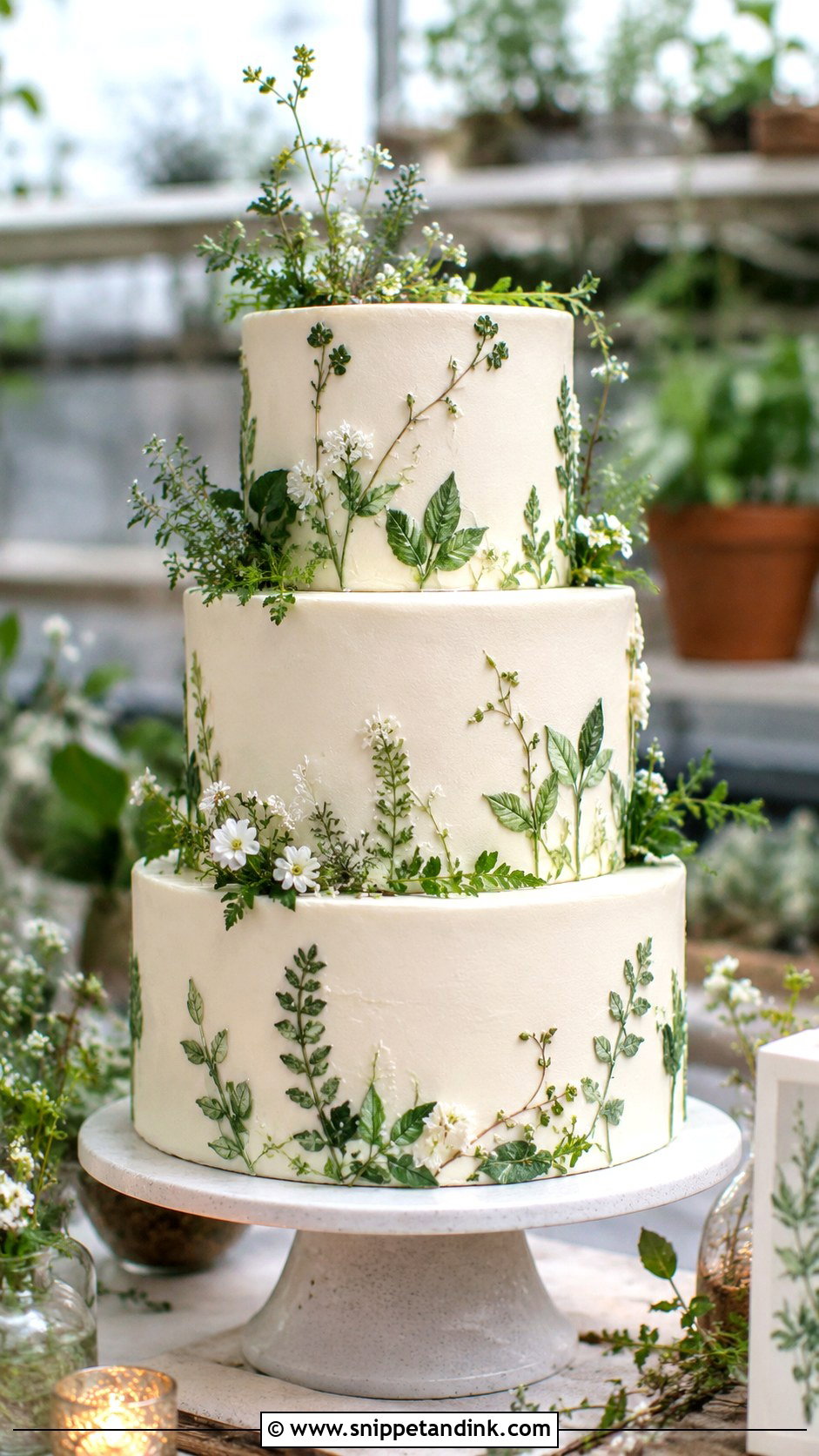
Leaves lead here. A botanical wedding cake can carry hand-painted greenery, piped vines, pressed leaves or carefully placed edible herbs, and I usually combine two of those techniques rather than all four. The palette stays narrow, mostly white, ivory, sage and soft green, with perhaps a few tiny white flowers. I reach for it at greenhouse venues and modern garden receptions. Set it near potted plants or stone urns so the details repeat around it.
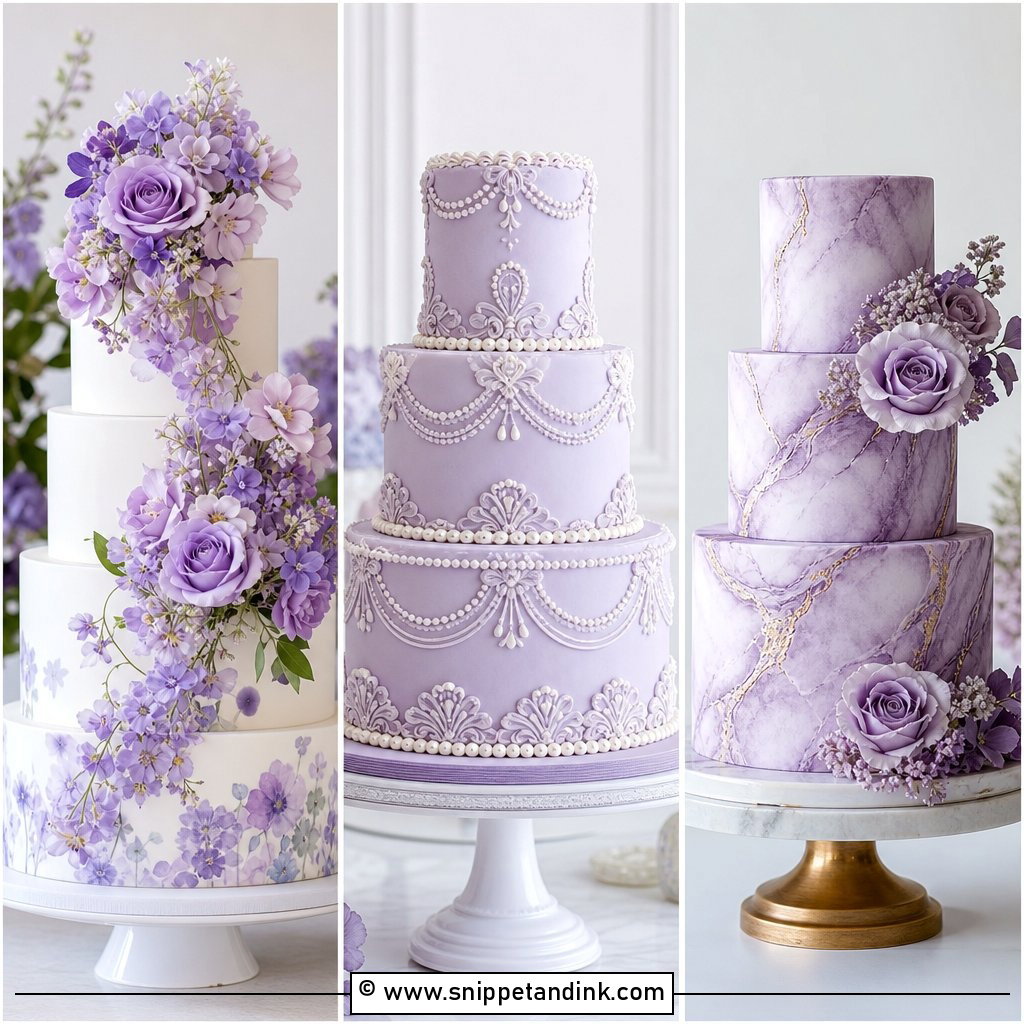
15. Vintage Garden Wedding Cake
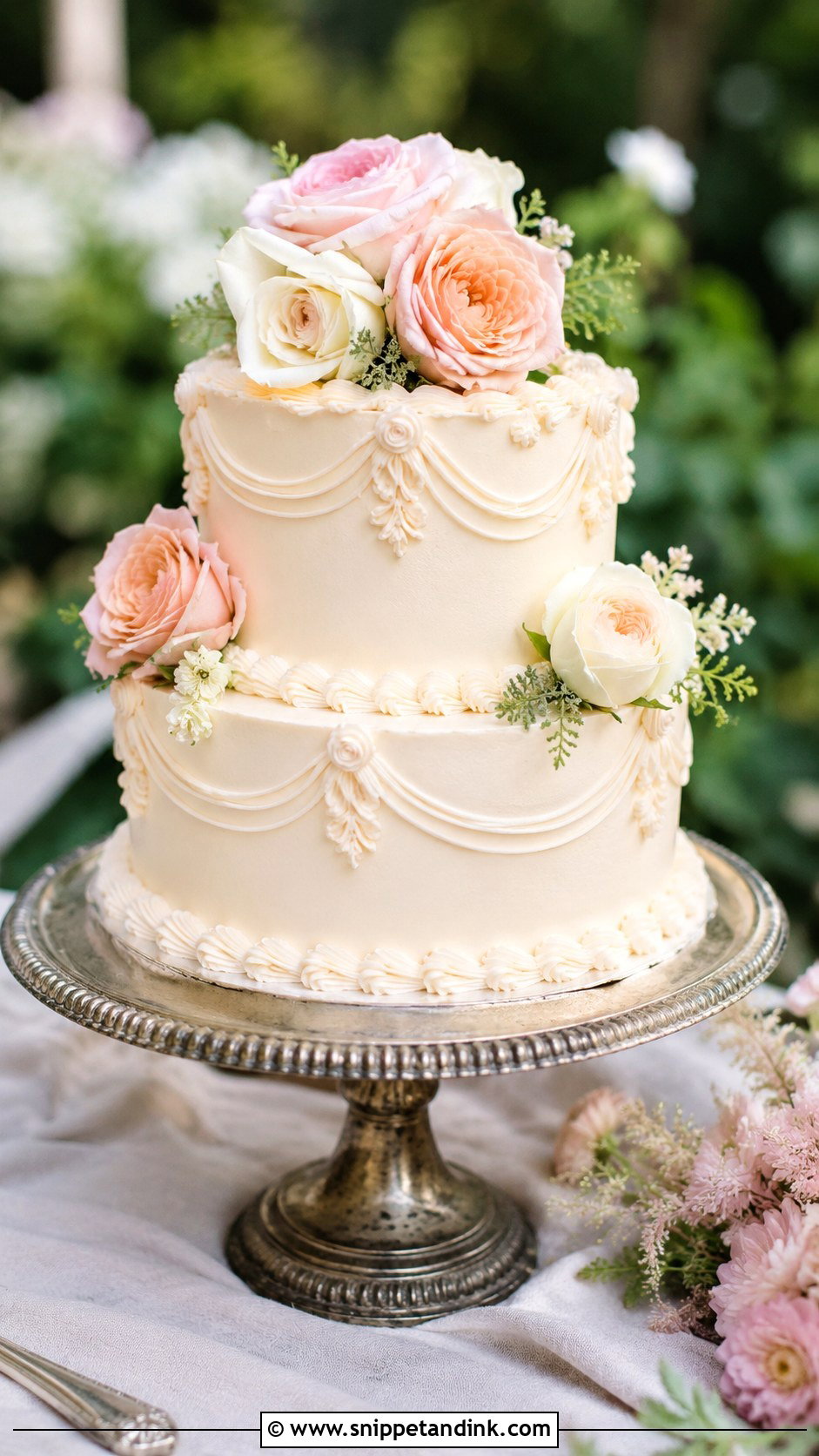
Old-style piping is a real skill test, and the more of it you ask for, the longer the cake takes to decorate. Swags, shell borders and small rosettes on pastel buttercream look nostalgic, but using every technique at once makes the cake heavy. I pick one border and one accent and repeat them on each tier. Ivory, blush, pale yellow and mint all suit it, and a pedestal stand with linen and tea roses finishes the scene.
16. Garden Wedding Cake With Fresh Fruit
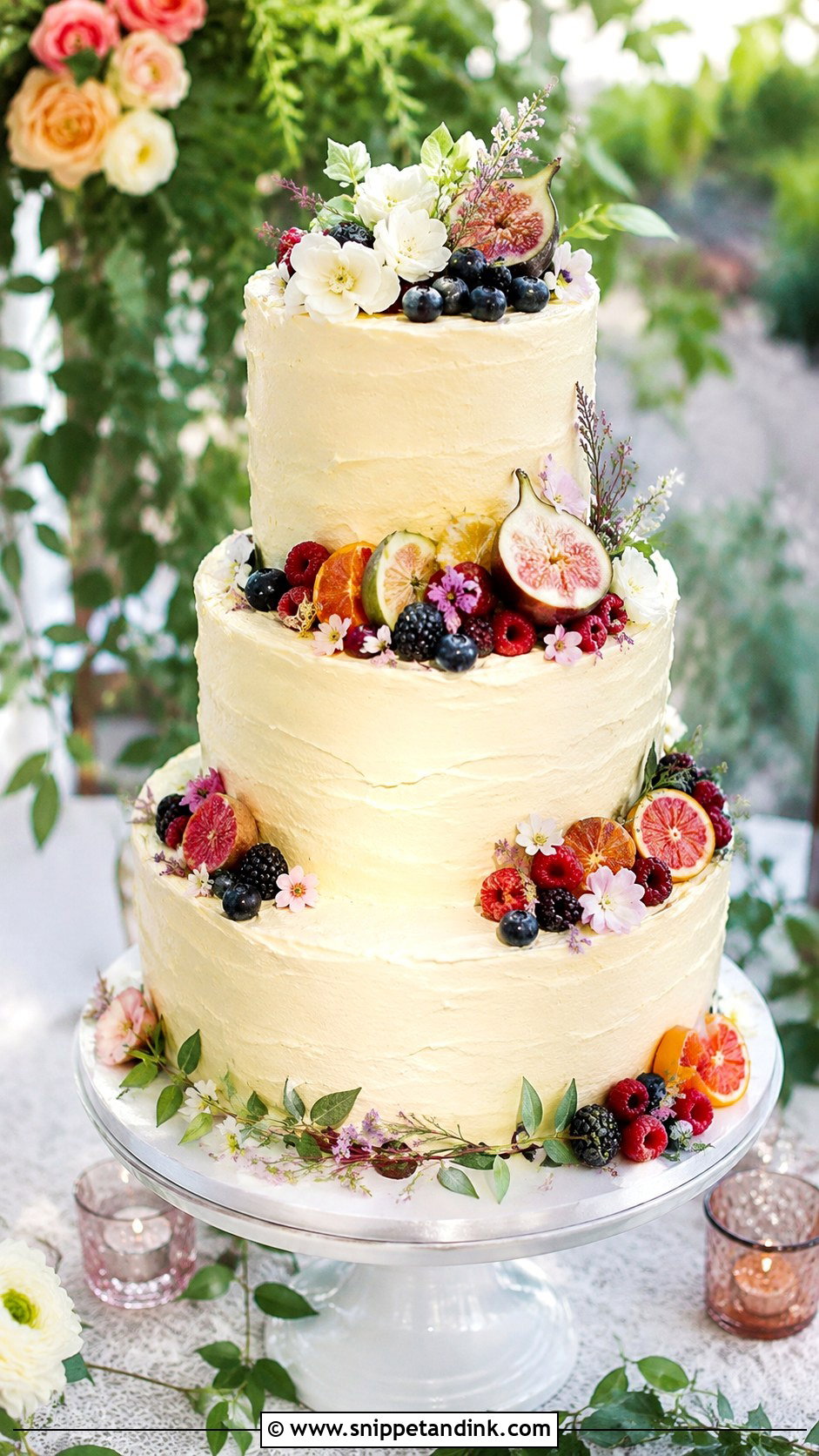
Fruit tells guests what they’re about to eat, and I like that honesty. Berries in summer, figs in early autumn, citrus in warm months, pears for a softer harvest look. Cut fruit leaks juice into frosting within a few hours, so I use whole or halved pieces, glaze them lightly and add them as late as I can. Light buttercream or a semi-naked finish keeps the look fresh. Arrange the fruit in clusters or one flowing line; scattered pieces look accidental.
17. White Garden Wedding Cake
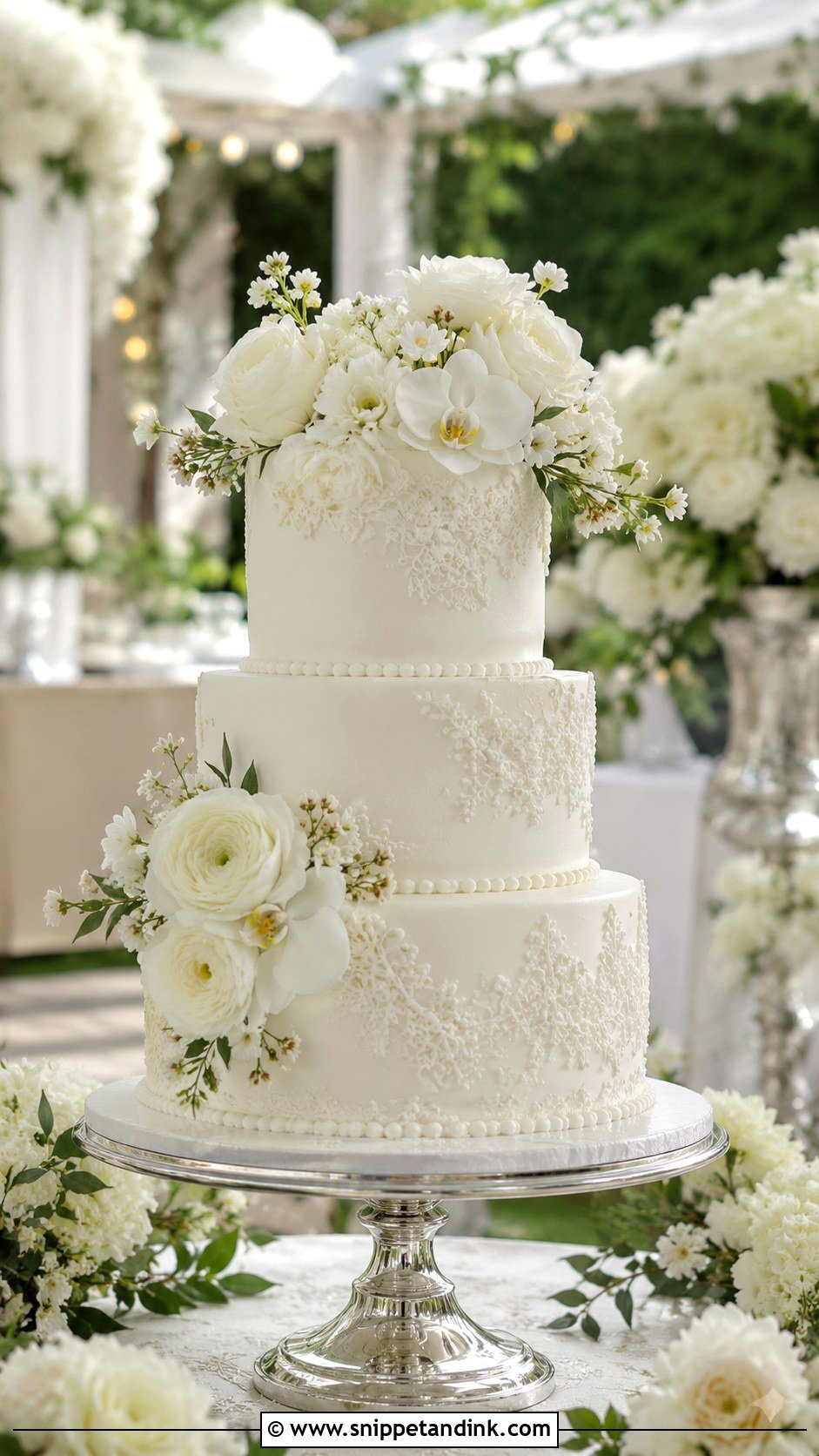
With no color to lean on, texture does all the work. Smooth buttercream, lace-like piping and soft ruffles can each take a tier, and giving every tier a different finish adds depth while the cake stays monochrome. White roses, orchids, ranunculus or small blossoms connect it to the garden. A practical note: butter makes buttercream slightly yellow, so I whiten it with a tiny touch of violet gel, and I ask about the dress shade before deciding how bright to go. Formal lawns with lots of greenery show it off best.
18. Pastel Garden Wedding Cake
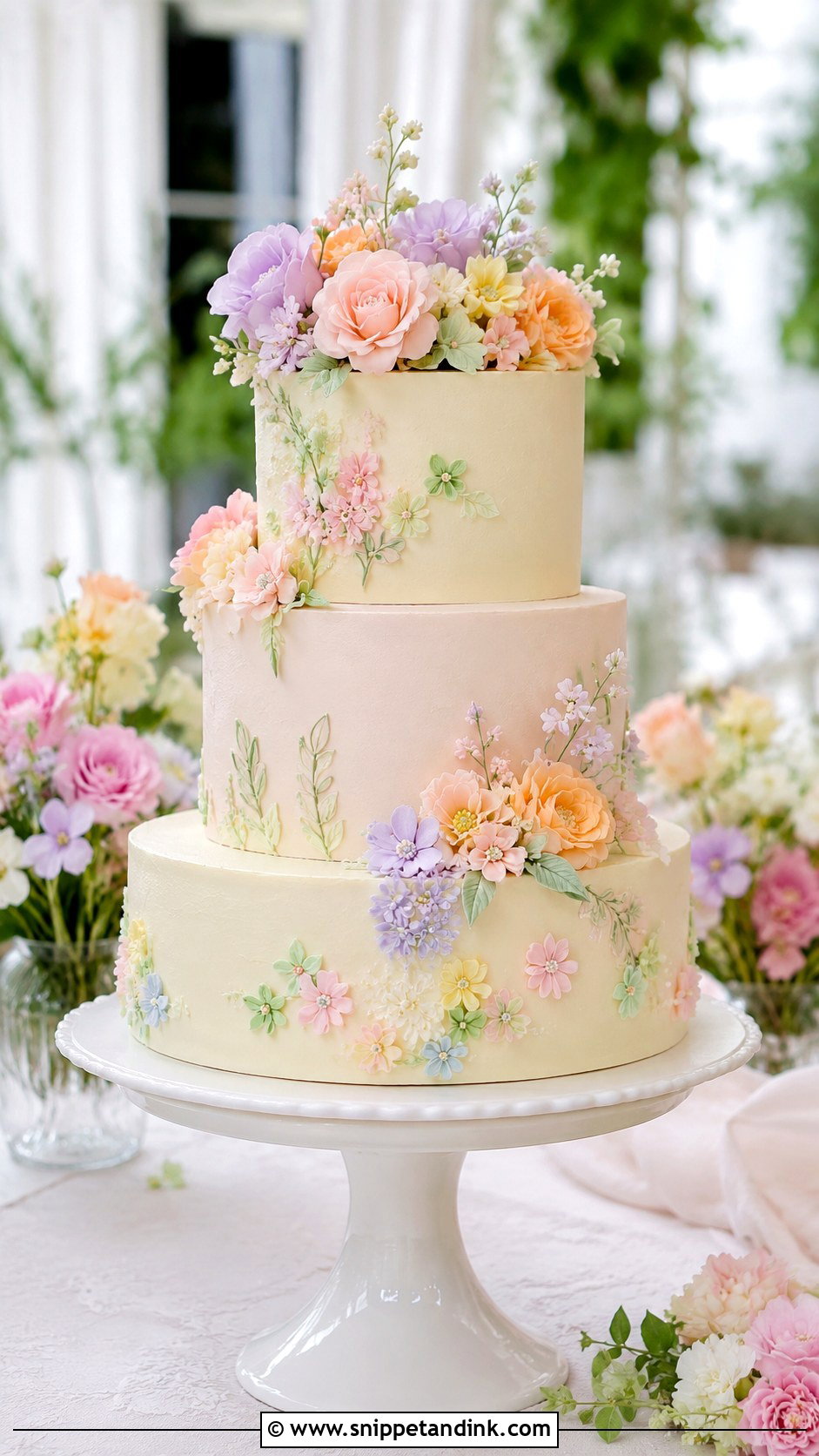
Too many pastels at once start to look like a baby shower, so I limit a cake to two or three of pale pink, lavender, peach, butter yellow and mint. The color can live in the frosting, the sugar flowers or a painted wash, but rarely all three. Pastel colors fade in strong sunlight, purples especially, which is another reason I keep these cakes out of direct sun until cutting. Simple tiers let them pick up the bridesmaid bouquets.
19. Square Garden Wedding Cake
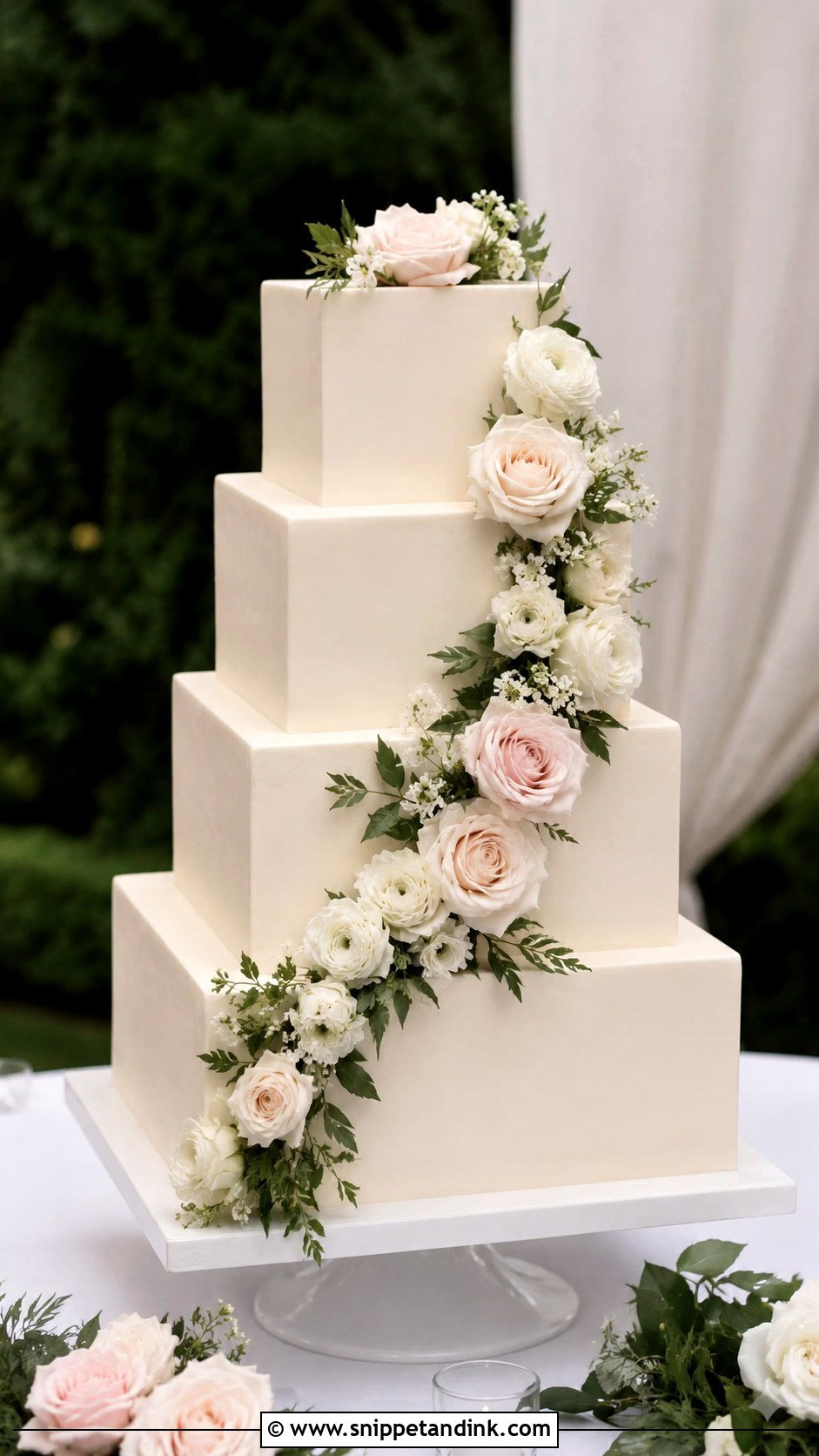
Square tiers are less forgiving to make. Every corner has to be sharp and every side straight, and buttercream shows any wobble on a square more than on a round, so I often build these over chilled ganache or cover them in fondant. Once the lines are crisp, flowers soften them: a corner cluster, a pocket between tiers or a diagonal cascade. They photograph cleanly from the front and side for detail shots. Worth knowing, too: a square tier serves more slices than a round tier of the same width.
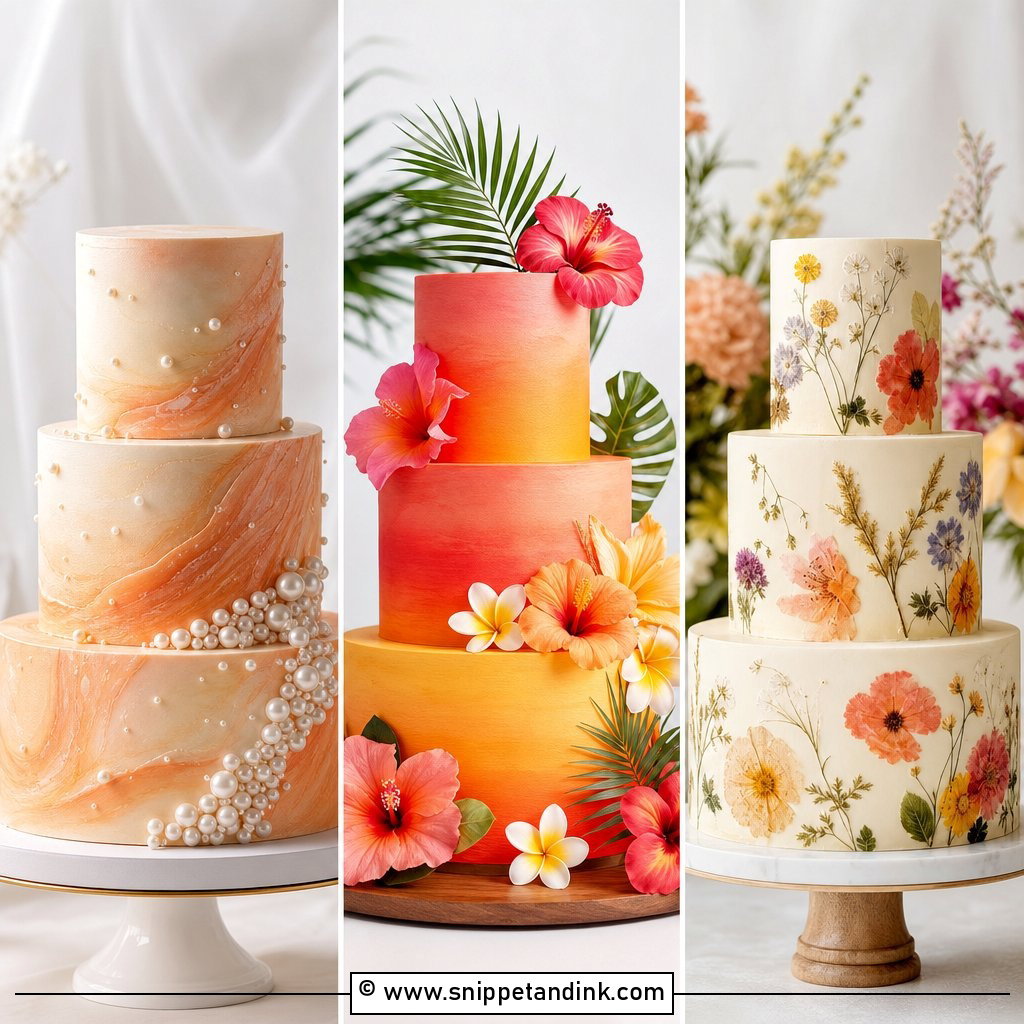
20. Small Garden Wedding Cake
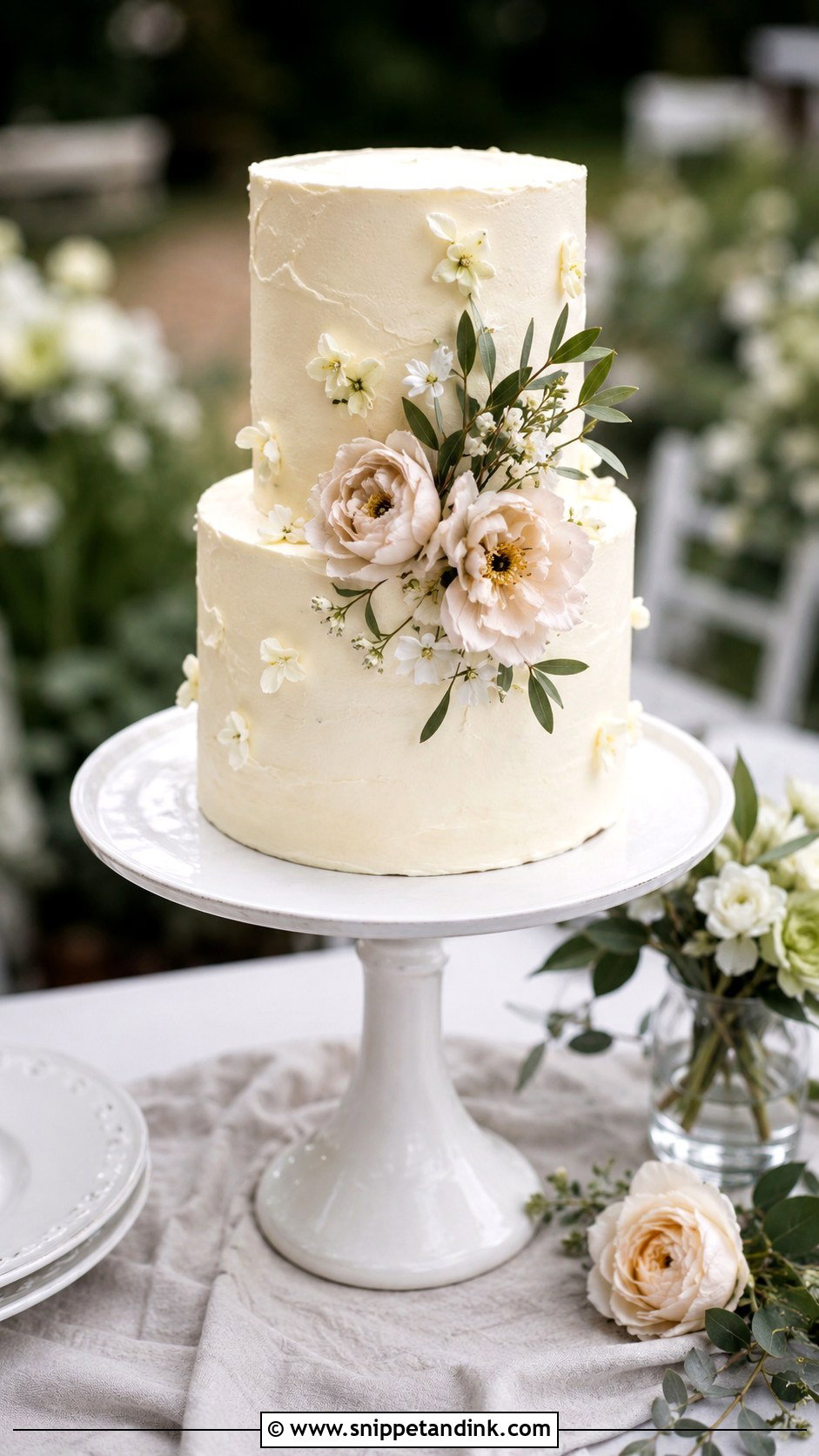
One or two tiers can carry the same detail as a towering cake, just scaled down. I shrink everything with it: smaller flowers, lighter greenery and a stand that adds height without dwarfing the cake. Finishes like smooth buttercream, a semi-naked coat, pressed flowers or a single cluster of blooms all suit a small cake. For elopements and intimate dinners it’s enough on its own. For a bigger crowd, I’d add a kitchen sheet cake in the same flavor so nobody misses out.
Which Garden Flowers Are Safe Against Frosting
Nearly every design here uses real blooms, and this is where I’m strictest. Several favorite wedding flowers are toxic, and most florist stock is grown with sprays that were never meant to meet food.
- Flowers I keep off cakes entirely: lily of the valley, foxglove, hydrangea, sweet pea, daffodil and oleander.
- Roses, pansies, violas, calendula, cornflower and chamomile are widely used on cakes, but only when grown without sprays for eating.
- Florist stems get wrapped in floral tape and set into a food-safe pick or straw so sap never reaches the sponge.
- A bloom lying flat on frosting sits on a small disc of parchment, and it comes off before the cake is cut.
Agree in advance who places the flowers and when. I prefer to do it myself on site, because a florist rushing between ceremony and reception will sometimes push a raw stem straight into a tier.
Carrying Tiers Across Grass Without a Crack
Lawns are uneven, and stacked cakes hate uneven ground. Anything over three tiers travels with the tiers boxed separately, and I stack on site using dowels under each tier and a central dowel driven through the whole cake.
Ask your venue how far the kitchen or delivery van is from the cake table, whether that table can be leveled on grass, and whether it will sit under a marquee. A table with one leg slowly sinking into soft turf tilts a cake over the course of an evening. I bring shims and a small level, and given the choice I’d rather set the cake on a hard patio than on the prettiest patch of lawn.
The Cake Belongs to the Garden It Stands In
The garden cakes I’m proudest of look like they were made for that lawn in that month. Start with your venue, your bouquet and the season, then ask how the frosting, flowers and fillings will behave outside for the full length of your reception. A baker who asks about shade, setup time and where the flowers are coming from is thinking about the right things. Get those answers settled and any style above will hold its shape until the knife goes in.
You'll Like These Ideas:





Leave a Reply