
A Japanese bridal look is built in layers, and the outer robe is only the part guests notice first. Underneath sit an inner kimono, a padded collar, an obi and small ceremonial pieces, and each one changes how the bride moves, sits and photographs. Below are 20 complete looks: all-white shiromuku, colored iro-uchikake, trailing hikifurisode, and modern gowns that borrow kimono lines. I’ve included the headwear too, from wataboshi hoods and tsunokakushi to ornamental kanzashi, because the head shapes the whole silhouette. Many couples marry in shiromuku at a Shinto shrine and then change into color or a Western gown for the reception, so I’ve noted where each piece usually sits in the day.
How a Rented Bridal Kimono Actually Gets Onto You
Most brides I work with rent their shiromuku or iro-uchikake rather than buy it. A bridal robe is heavy, hand-finished and costly to clean, and rental usually comes as a full set: kakeshita, obi, collar, small accessories, and often the wig and the dressing service too. Buying makes sense mainly when the kimono will be kept in the family and worn again.
The fitting
Reserve early, because the most popular robes for spring and autumn dates go first. Kimono are fitted by wrapping, folding and padding rather than by cutting, so the dresser mainly needs your height, your hip measurement and an honest idea of how much you’ll be walking. If you’re wearing a traditional wig, book a separate wig fitting so the hairstylist can shape it to your head before the headpiece goes on.
The morning itself
- Arrive in a front-opening top so nothing gets pulled over your face after makeup.
- The base layers go on first: a thin under-kimono and wrap skirt, then towels or padding to smooth the waist into the straight column a kimono needs. That padding is normal, not a sign of a bad fit.
- Dressing alone is reasonably quick, but hair, makeup, wig and dressing together can fill most of a morning. Ask your dresser for real timings and plan backward from the ceremony.
- Eat something and use the restroom before the obi is tied. Afterward, both become a project.
1. White Shiromuku Japanese Wedding Dress
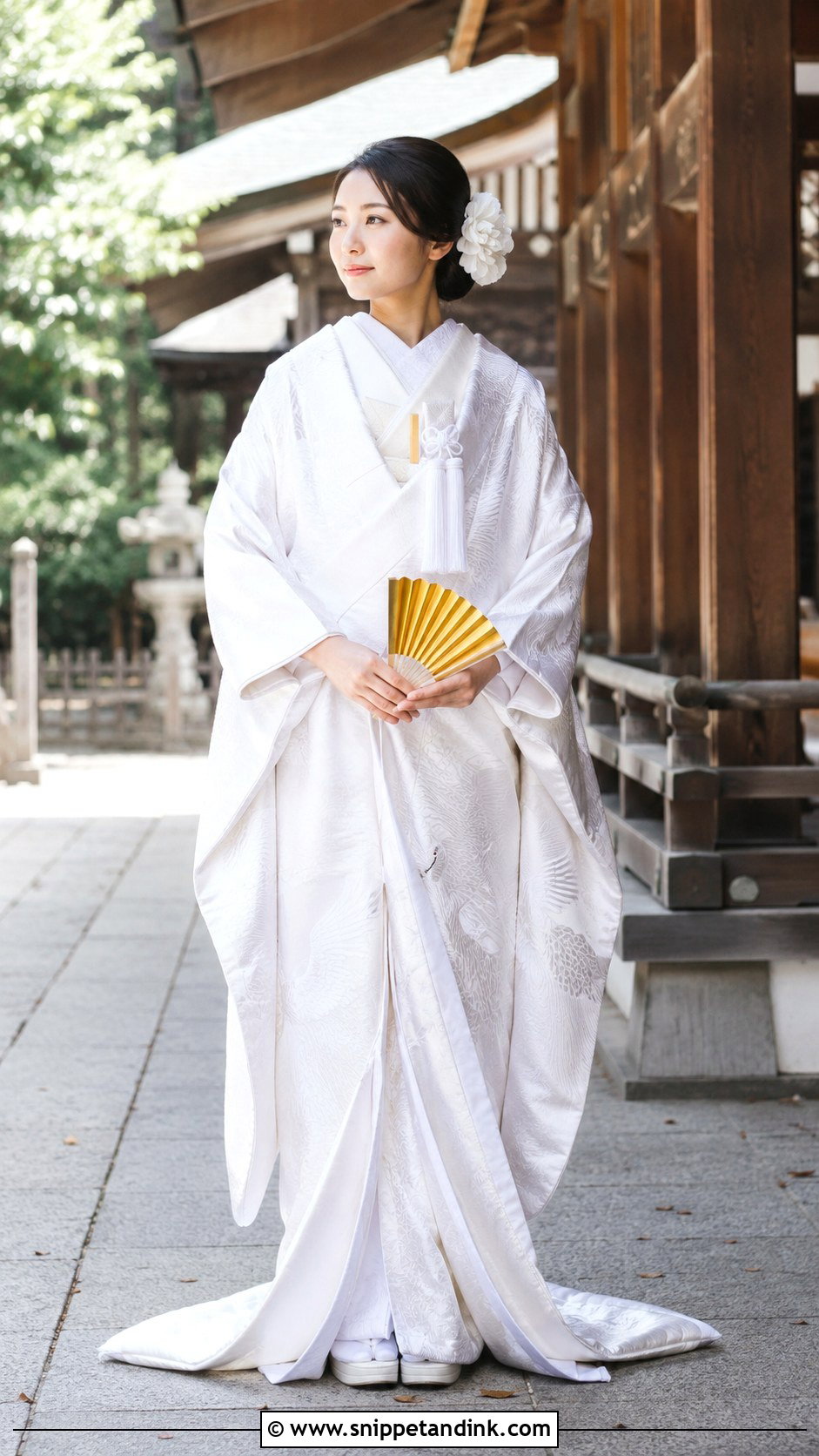
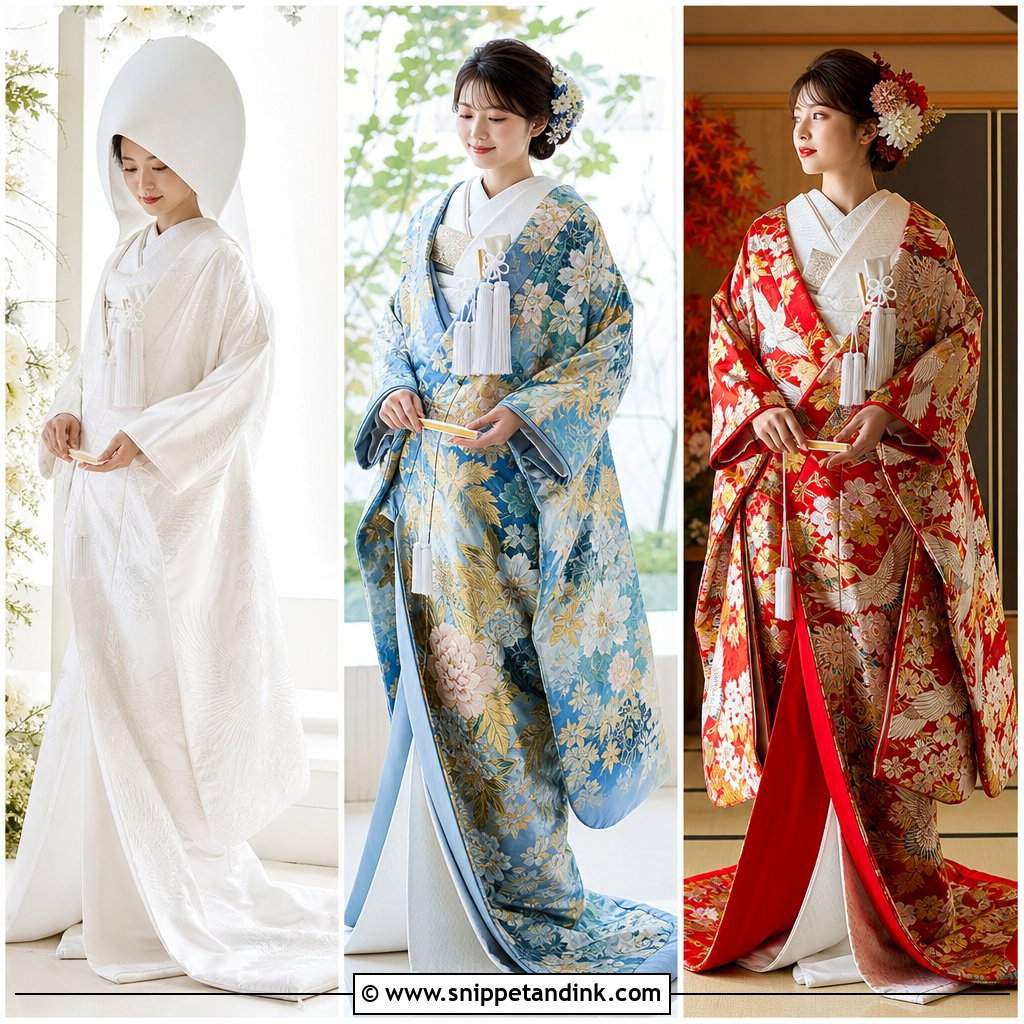
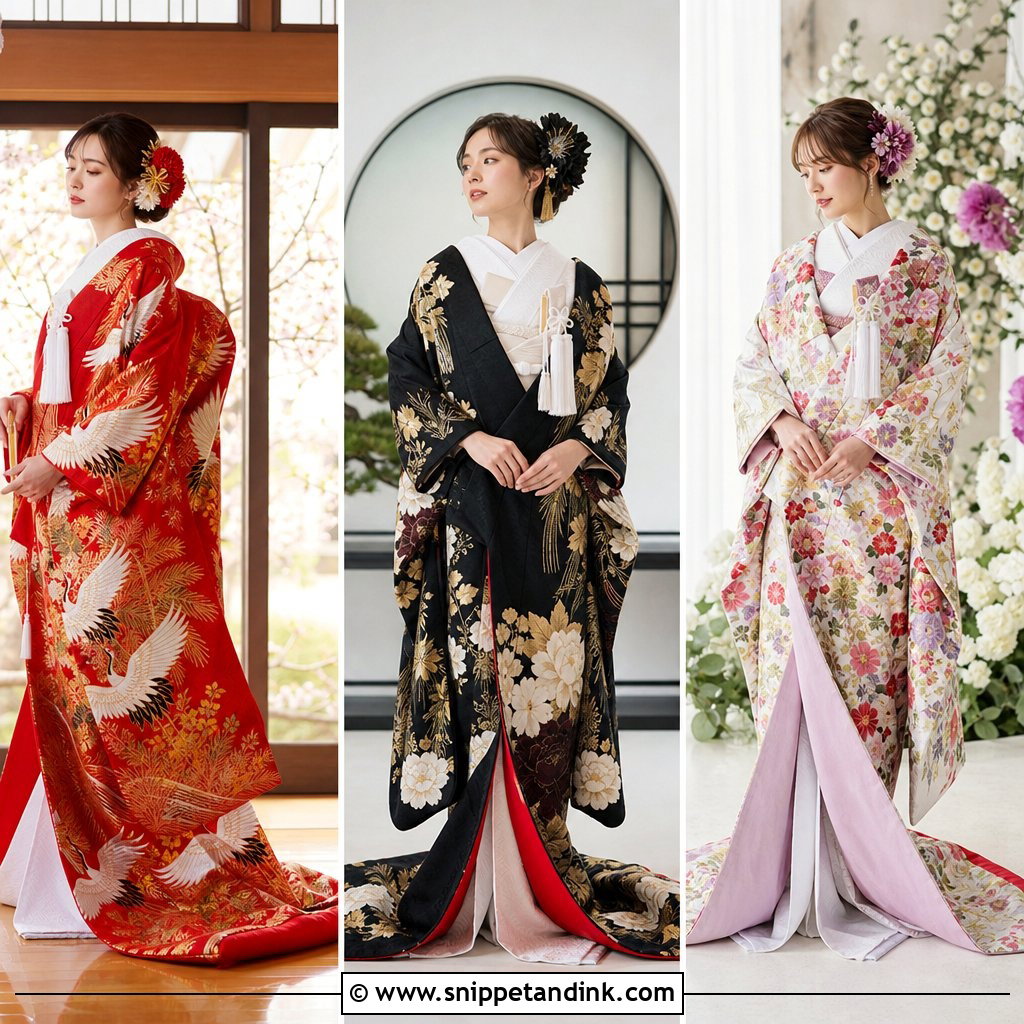
Shiromuku means white from the skin outward, and that is how it is dressed: a white kakeshita kimono, white obi, white accessories, and a long white uchikake laid over everything. The pattern is woven rather than printed, so cranes, pine or flowing water only appear when light rakes across the silk. That is why I ask photographers to shoot it with side light rather than a flat flash. White tabi and zori sit under the padded hem, and a gold-and-white folding fan is the usual thing to hold. Shiromuku belongs most naturally to a formal Shinto ceremony, and it suits a bride who is happy to let texture, not color, carry the outfit.
2. Shiromuku With Wataboshi Japanese Wedding Dress
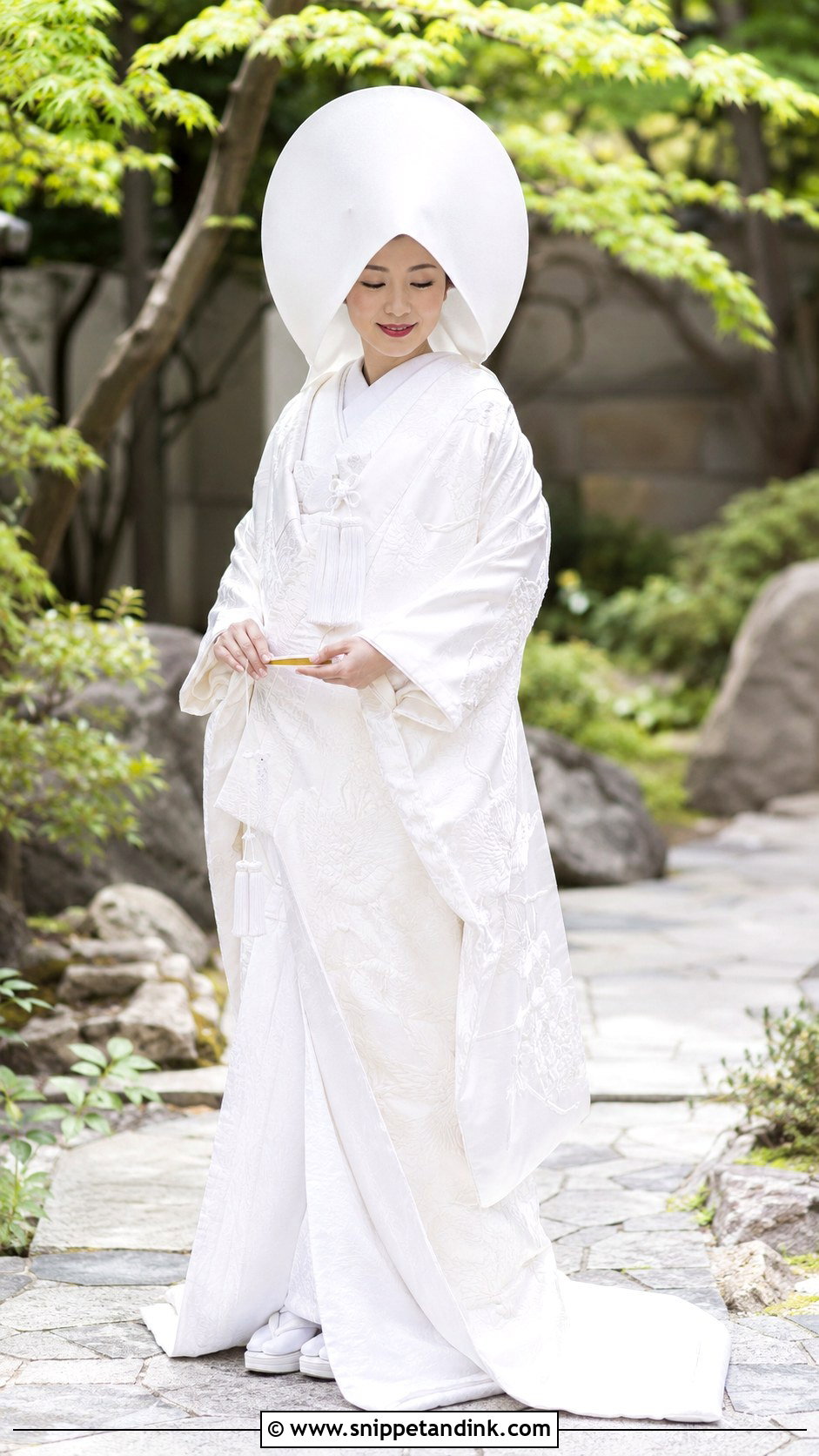
A wataboshi is the rounded white hood that sits over an all-white shiromuku, and it is the piece guests most often compare to a Western veil. It covers the traditional hairstyle completely. The catch is that the hood hides much of the face from the side, and it is traditionally kept for the ceremony itself, so plan close portraits for after it comes off. Under the uchikake go a matching kakeshita, a white obi, tabi and zori, with a folded fan and a hakoseko, a small ornamental case, tucked into the front fold. I keep the makeup clean here: smooth skin, defined eyes and a classic red lip read well inside a white frame. Shrine courtyards and plain wooden walls suit this look better than a busy backdrop.
3. Shiromuku With Tsunokakushi Japanese Wedding Dress
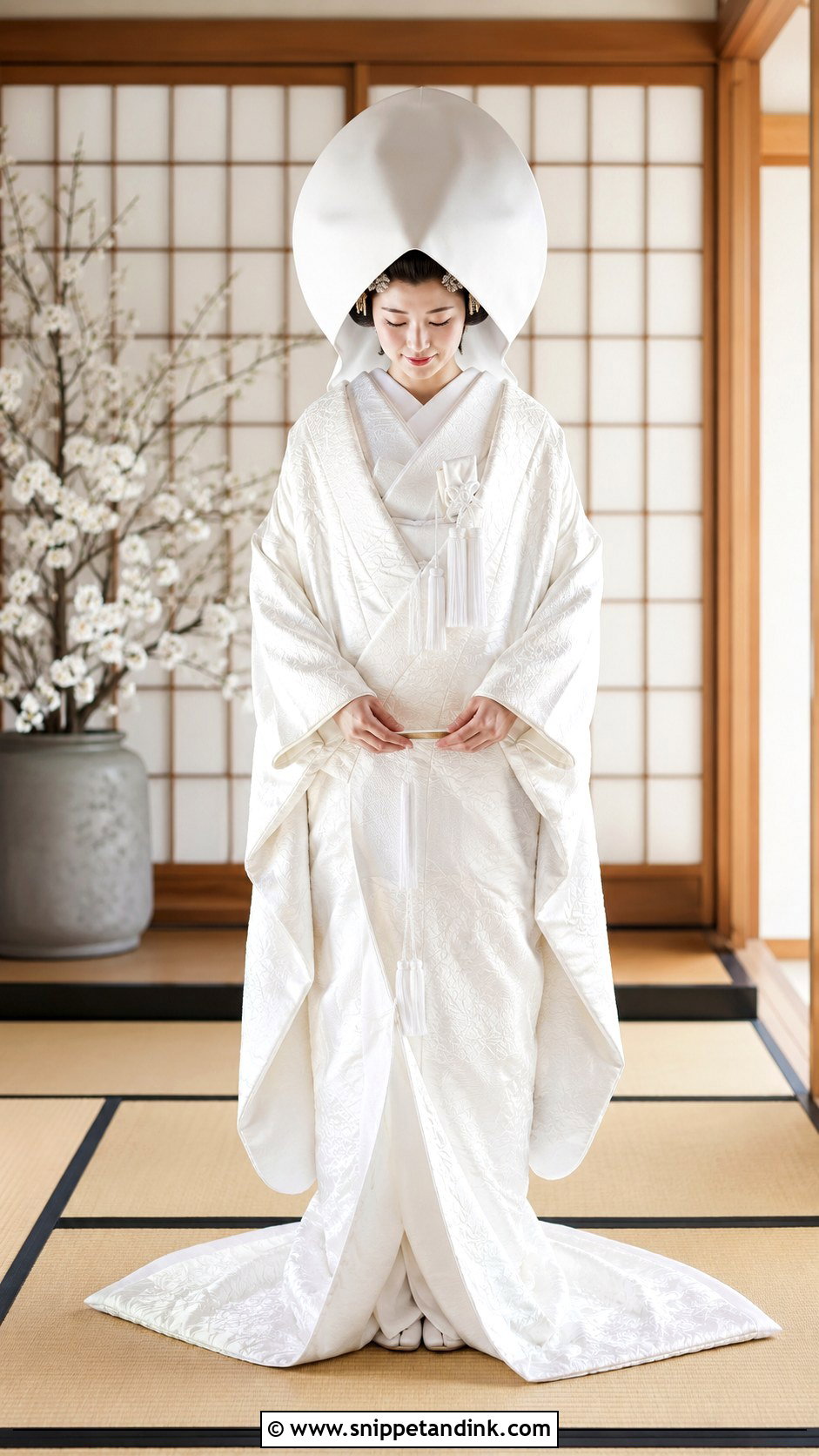
The tsunokakushi is a flat band of white silk that wraps around the front of a traditional bridal hairstyle, leaving the ornaments at the top and back on show. It needs a properly built hairstyle or a fitted bridal wig underneath, and I always recommend a separate wig fitting, because a wig that sits even slightly loose will tilt under the band by the end of the ceremony. Pair it with a white silk uchikake woven with peonies, cranes or clouds, over a matching kakeshita and obi. White tabi, platform zori and a fan with gold edging finish it. Unlike the wataboshi, this version leaves the face open, which makes portraits in a tatami room or courtyard much easier.
4. Red Iro Uchikake Japanese Wedding Dress
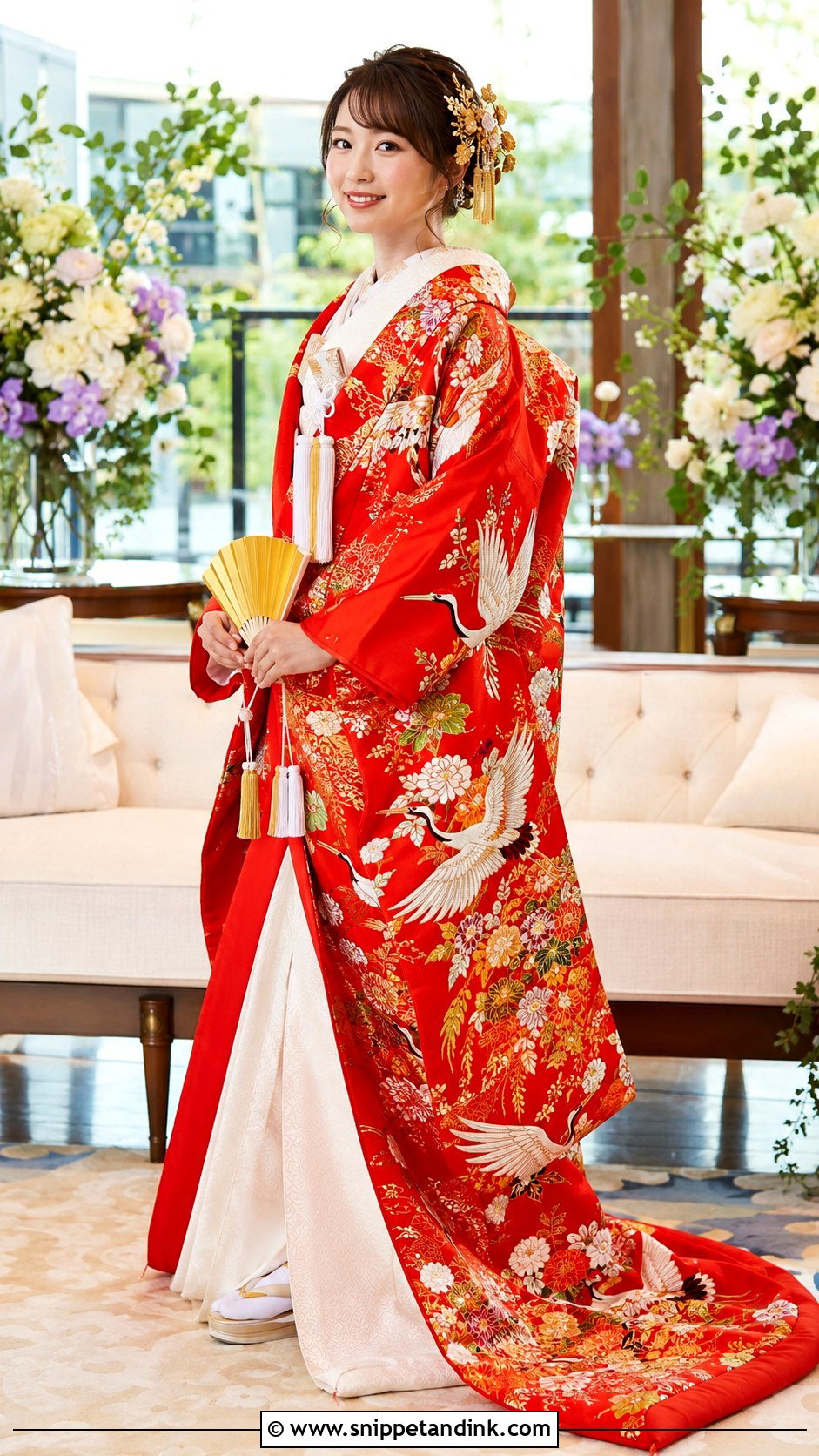
Red is the color most people picture for the outfit change, and a red iro-uchikake is often the reception robe after a white ceremony. Embroidery runs across the whole back: cranes, plum blossom, chrysanthemums, fans or water. Wear it over a pale kakeshita so the stacked collars stay crisp at the neck, then add the obi, decorative cords, tabi and zori. An uchikake is never belted on the outside, so the full design hangs open. Heavy gold embroidery adds real weight, and I’d give the dresser a few minutes to settle the robe on your shoulders before you walk in, rather than rushing from the changing room straight to the doors. Gold kanzashi can echo the metallic thread.
5. Gold Crane Iro Uchikake Japanese Wedding Dress
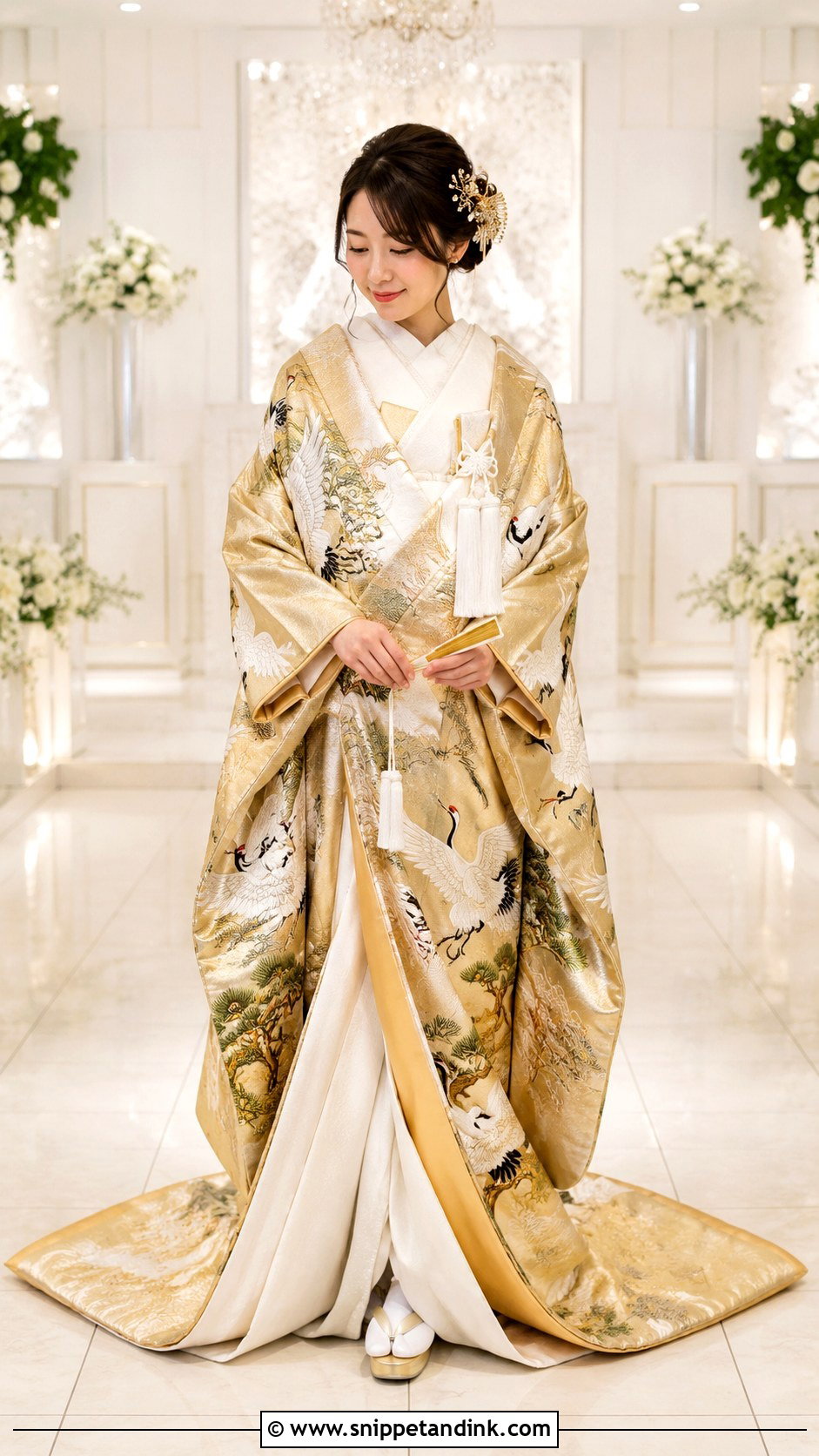
Gold thread changes how an iro-uchikake behaves under light. In shade it reads almost flat; the moment a spotlight or window hits it, the whole robe lights up. Choose an ivory, champagne or pale gold ground with flying cranes, clouds and pine. Cranes appear on so many Japanese bridal kimono because they carry wishes for a long marriage. Layer over a cream kakeshita and keep the obi restrained, since gold on gold turns busy quickly. Hair goes in a smooth updo with pearl, tortoiseshell-style or metal kanzashi. I’d save this robe for a brightly lit reception hall rather than a candlelit room.
6. Black Hikifurisode Japanese Wedding Dress
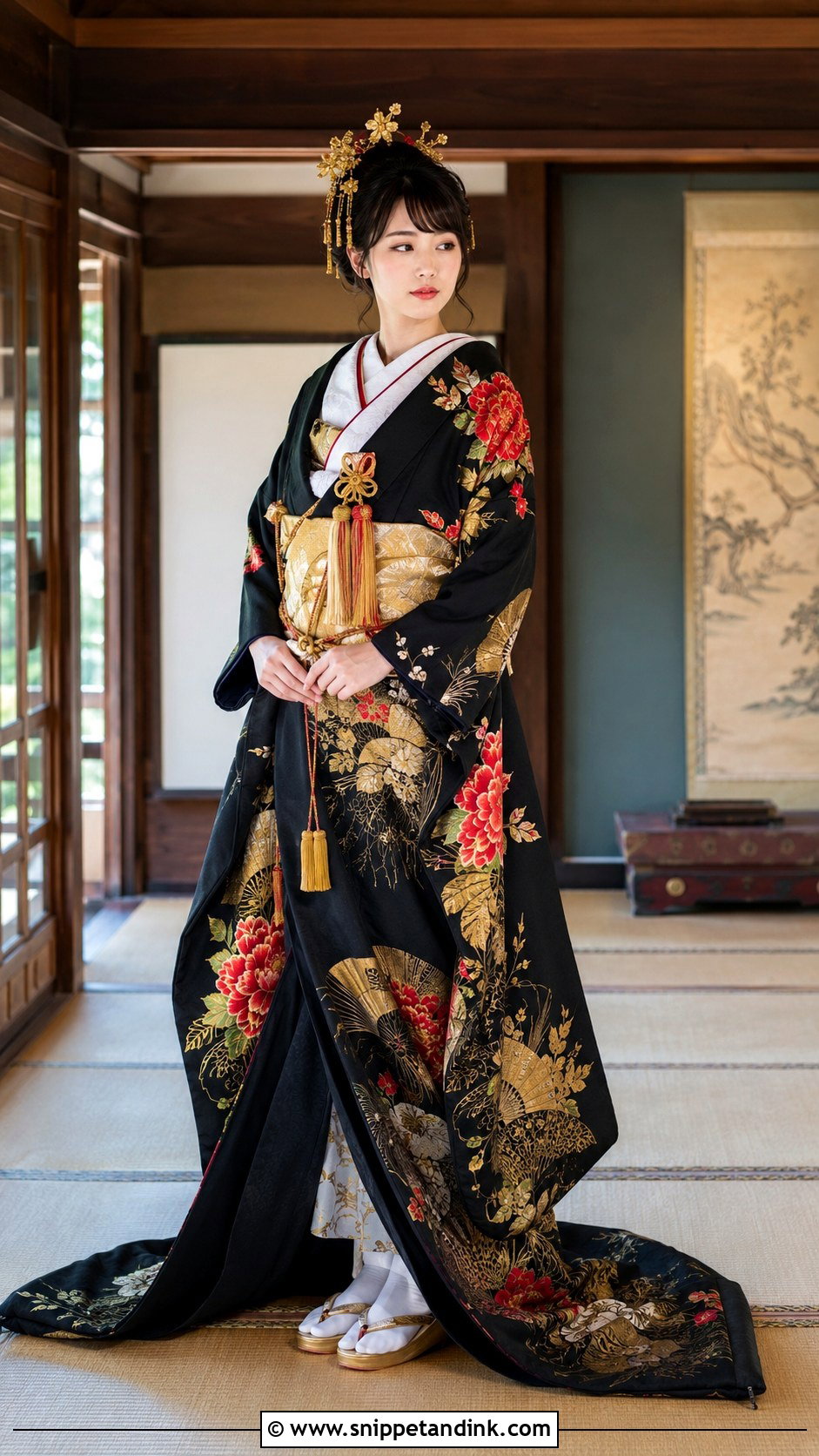
A hikifurisode is a long-sleeved kimono with a trailing hem, worn without an uchikake over it, so the obi is fully on display. Black was a common bridal color for it historically, and it still gives the strongest contrast of anything here. Choose red peonies, gold fans or cranes against the black, then build the waist with a patterned obi and colored cords. The obi for a hikifurisode is usually tied in an elaborate bow at the back, and I always check it from behind during the fitting, because that is the view guests have for most of the ceremony. Finish with white tabi, zori and a traditional updo with gold kanzashi. Without the extra robe it is lighter to wear than an uchikake, which helps over a long reception.
7. Red Hikifurisode Japanese Wedding Dress
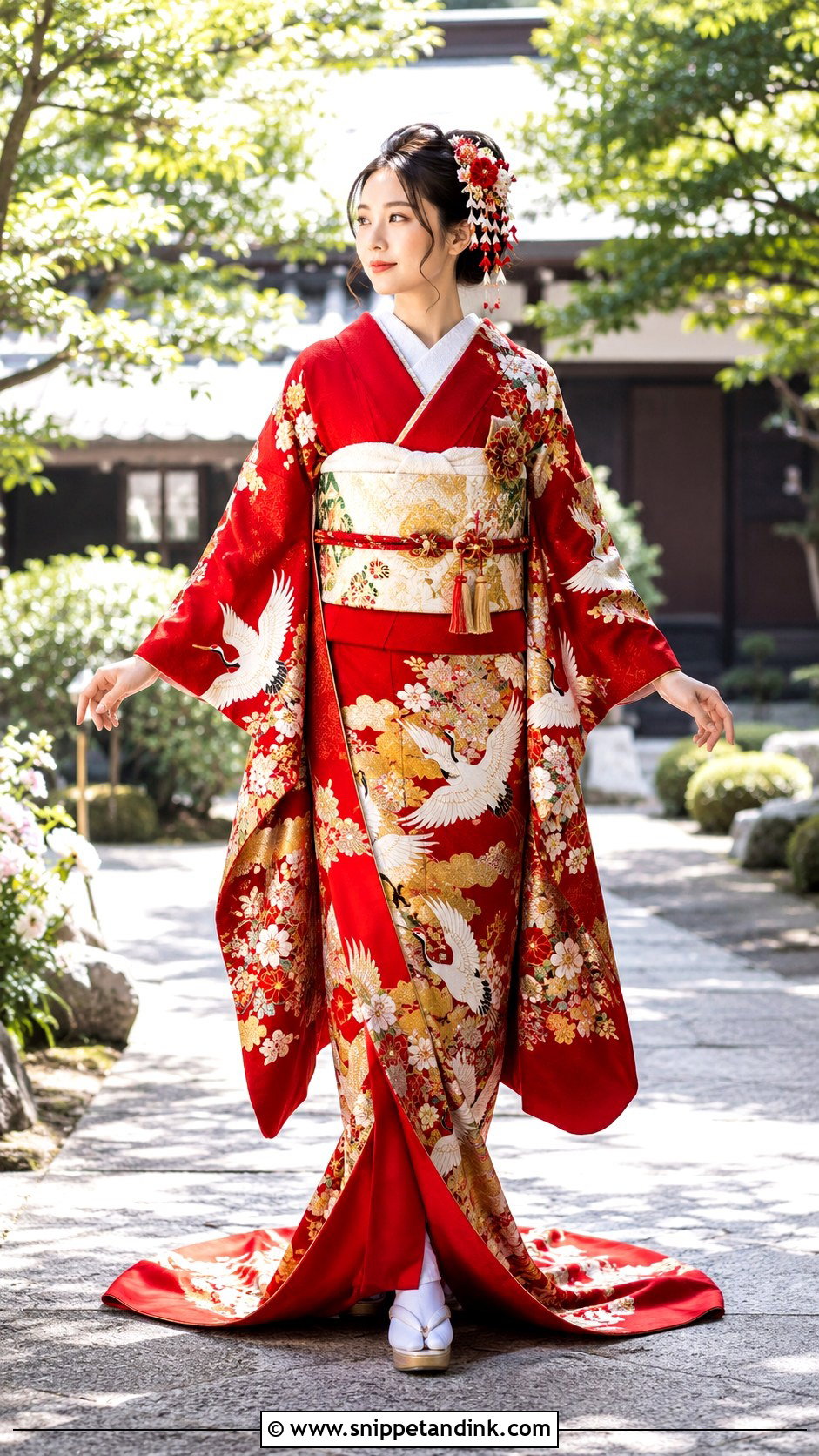
Vivid red with a trailing hem feels celebratory and is much easier to move in than a full uchikake. Look for patterns that run from the shoulders down to the skirt: white cranes, gold clouds, plum blossom or folding fans. Contrast the obi in gold, ivory or black, then pick an obijime cord in one of the smaller colors in the print. White tabi and zori keep it formal, and a sleek updo with floral kanzashi suits it, as does a low bun with gold pins at a more modern wedding. The sleeves are what brides underestimate. They hang well past the wrist, so I show every bride how to hold the sleeve edge back with her other hand before reaching for a glass or a pen.
8. Navy Iro Uchikake Japanese Wedding Dress
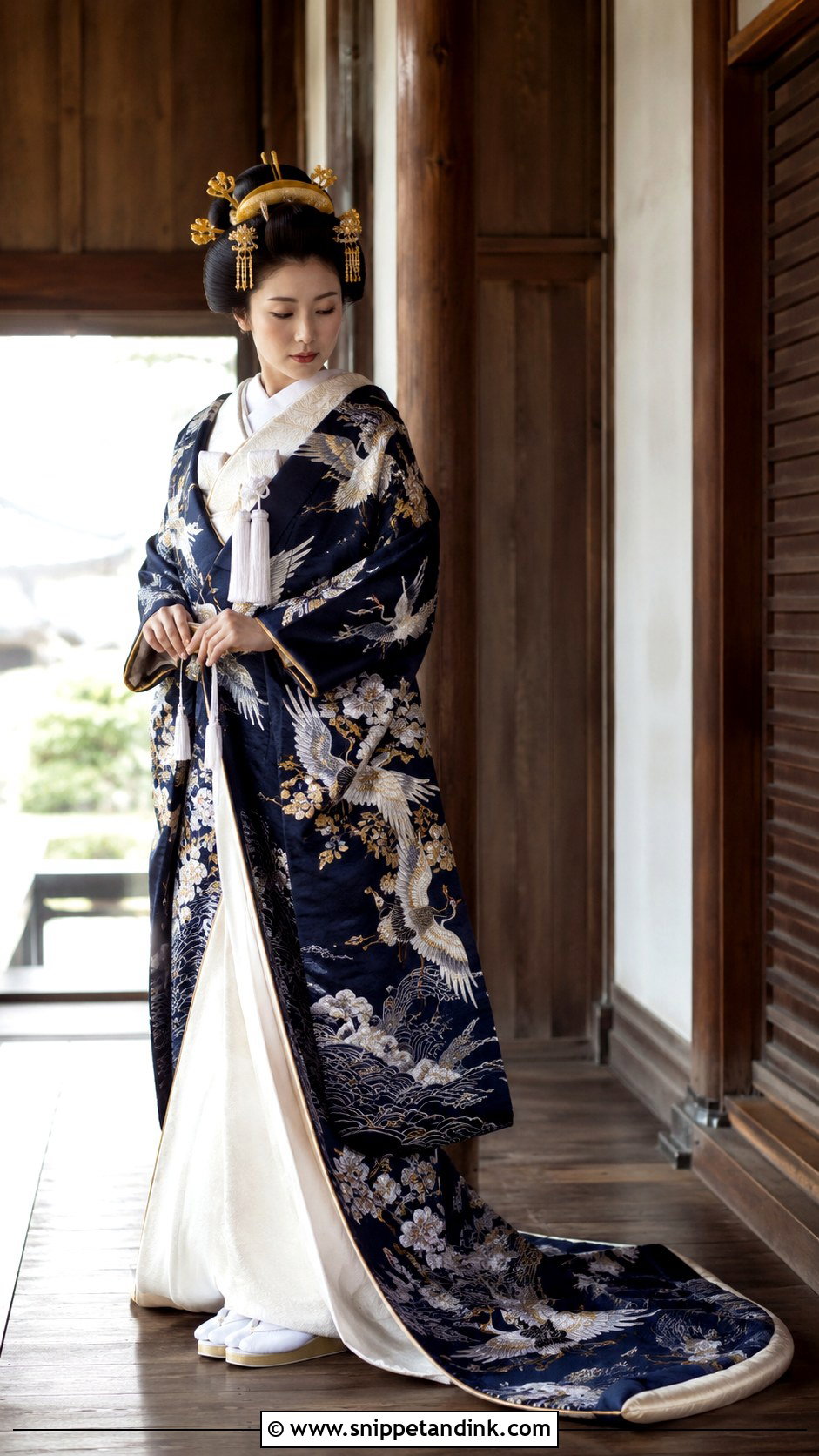
Navy is a quieter ground than red, and gold cranes, silver waves or pale cherry blossom stand out sharply against it. An ivory kakeshita underneath brings light back near the face, which matters, because dark fabric right up to the chin can make skin look tired in photos. Accessories in gold, white and navy, with white tabi and neutral zori, keep it tidy, and a polished updo with gold kanzashi supports the shape without competing. Indoors, navy can drop almost to black, so I look for a robe with plenty of metallic embroidery and ask for bright, neutral light at portraits. It keeps the full trailing shape of traditional bridal outer robes while reading more modern.
9. Pink Iro Uchikake Japanese Wedding Dress
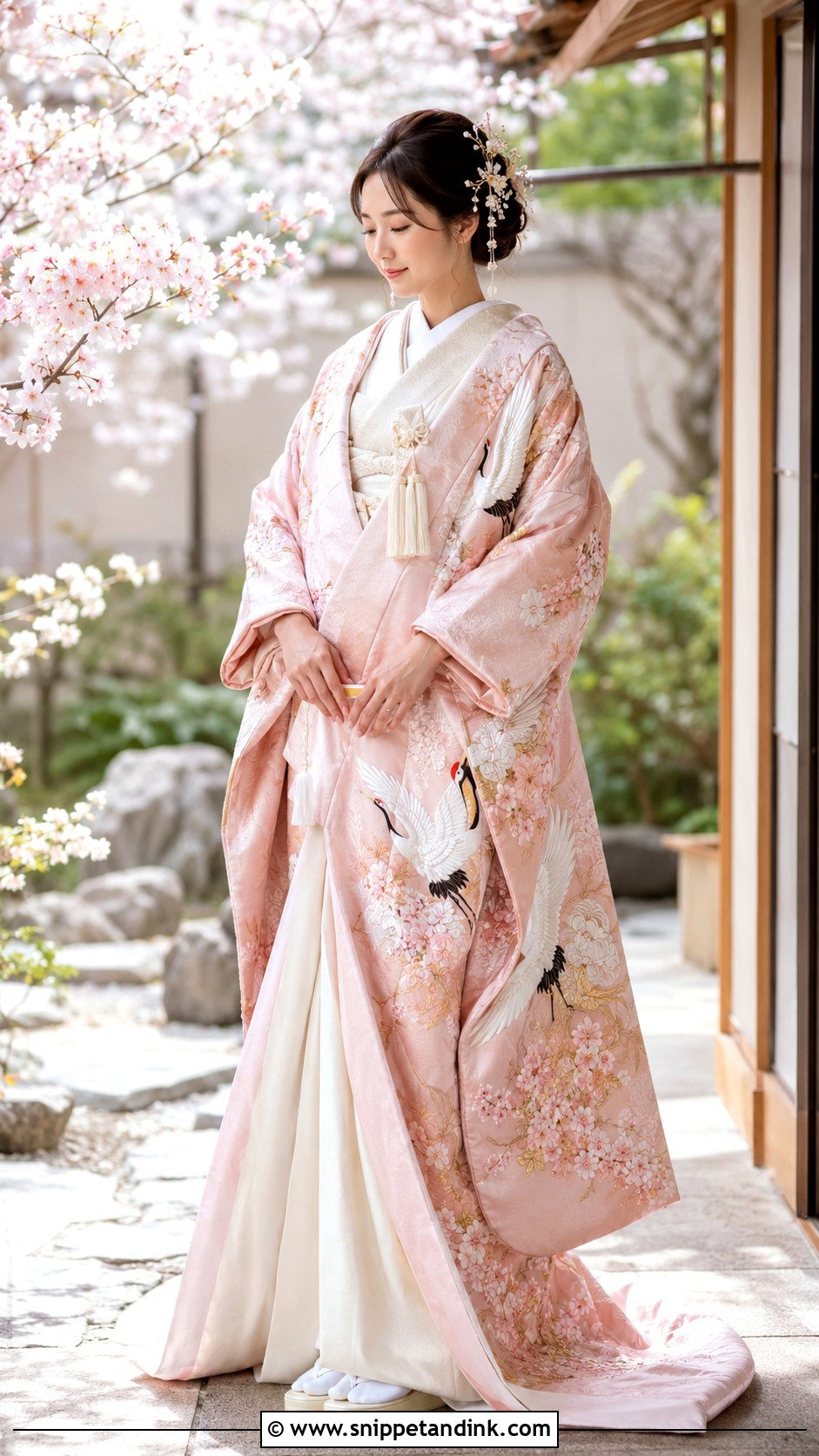
Blush, rose or soft coral softens the uchikake without making it casual. White cranes, peonies, cherry blossom or fans, outlined with a little gold, give the design definition. Keep the kakeshita white or pale cream so the pink doesn’t spread right up to the face, and pick small accessories in ivory, gold and muted red, with tabi and light zori under the padded hem. Pearl pins and small floral kanzashi suit a smooth updo. A pink that looks delicate in the shop can wash out under warm reception lighting, so I’d take a phone photo of the robe under similar light before committing. It makes a natural change after a white shiromuku, especially at a spring wedding.
10. Green Iro Uchikake Japanese Wedding Dress
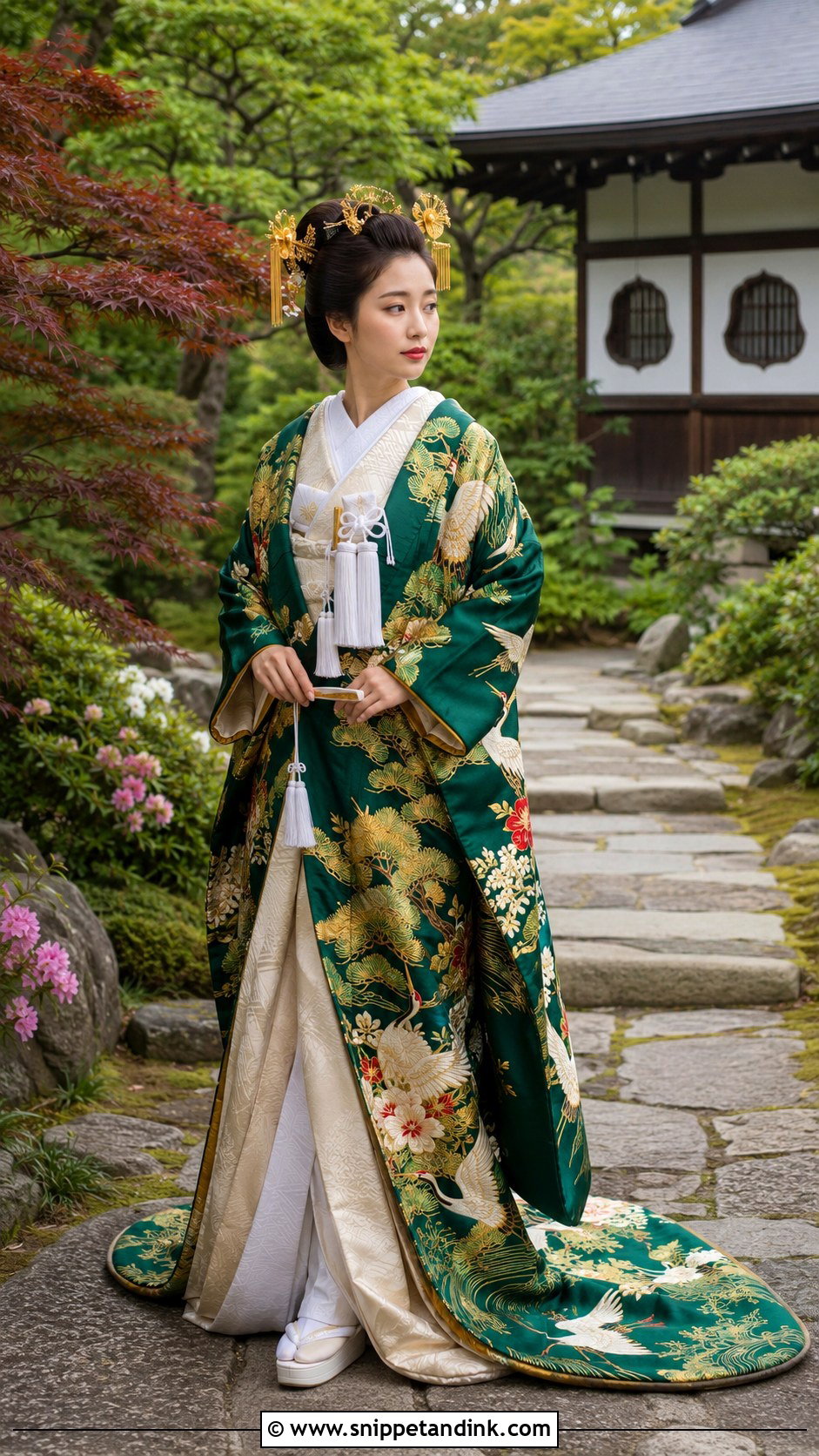
Green sits naturally against gardens and timber, which is why I reach for it for outdoor or inn weddings. Emerald, jade and forest green carry gold cranes, pine, maple leaves or water patterns well. An ivory kakeshita keeps the face bright and a gold or white obi gives the layers a formal base, followed by cords, tabi and zori. Gold kanzashi suit green, and a couple of small red floral ornaments add traditional contrast. Photograph the train from a slight side angle, where the pattern runs unbroken from shoulder to hem. In a white ballroom the same robe can look heavy.
11. Blue Floral Iro Uchikake Japanese Wedding Dress
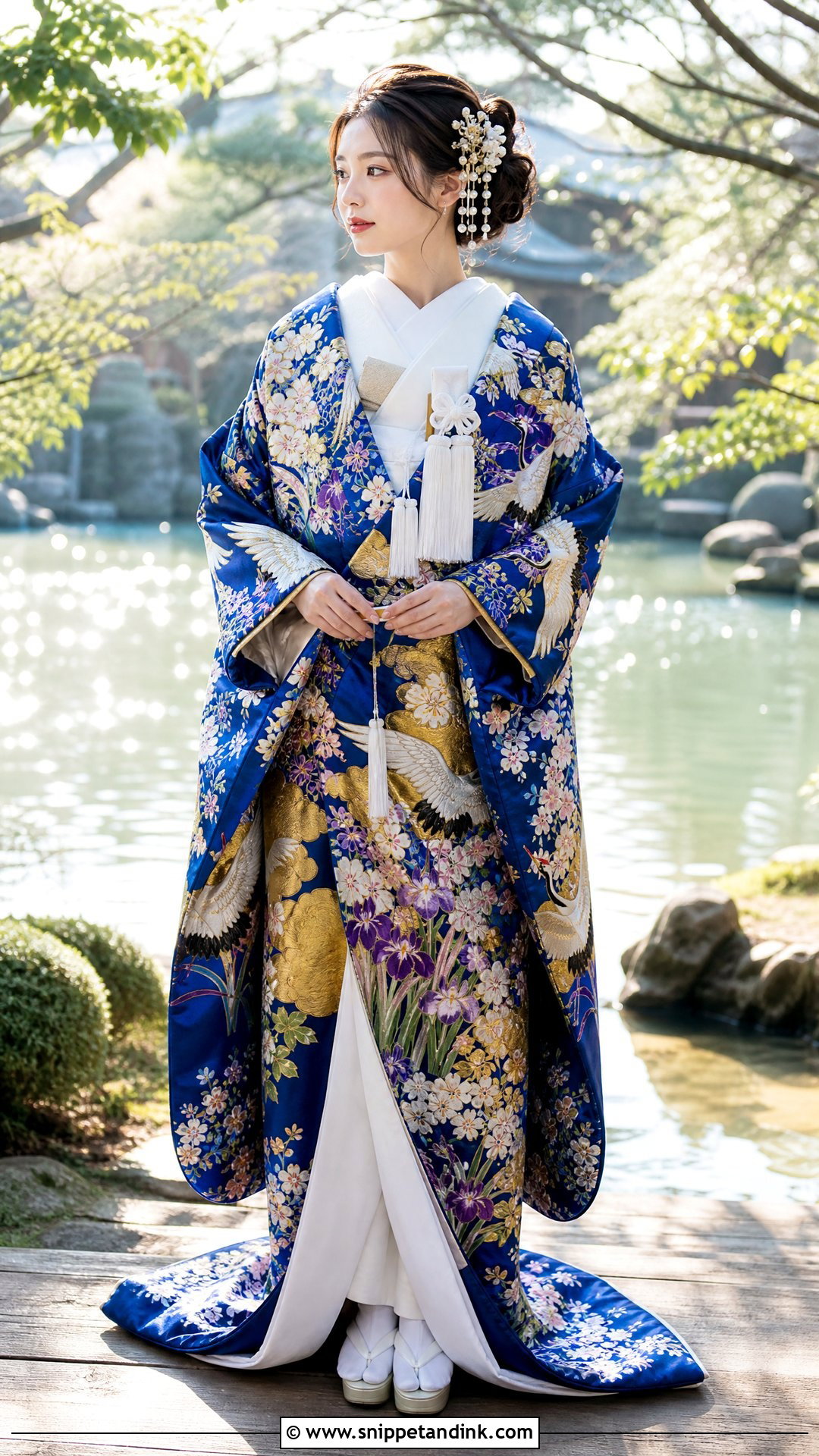
Blue is less expected than red for a reception change, and that is its appeal. Powder blue is gentle; royal blue gives stronger contrast. Cherry blossoms, irises, peonies, cranes and gold clouds can spread over the shoulders, sleeves and train, over a white kakeshita with a neatly set collar and accessories in ivory and pale gold. Silver-toned and pearl kanzashi in a low structured updo match the cooler palette better than heavy gold. Pale blue picks up color from its surroundings, so a green garden or warm wood can tint it in photographs, while stone paths, pale walls or water keep it truer.
12. Purple Iro Uchikake Japanese Wedding Dress
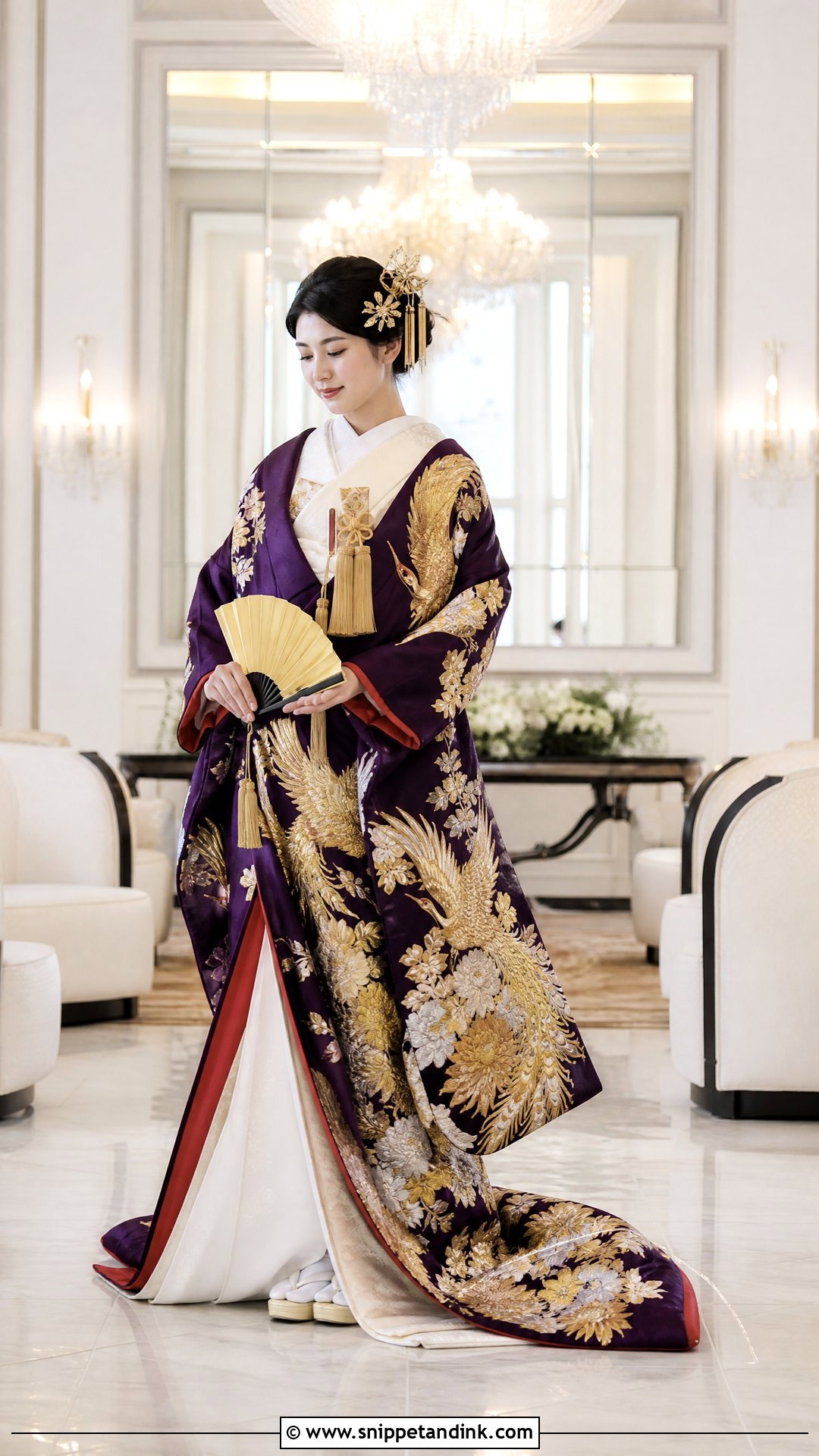
Purple, from lavender to deep plum, gives the uchikake a regal weight and carries gold phoenixes, chrysanthemums, wisteria or cranes well. Put an ivory or pale blush kakeshita underneath to soften the dark color near the face. Gold accessories, white tabi and neutral zori keep things coherent, and a few purple floral ornaments in the updo can repeat the robe’s main color. Purple is the color I’m most cautious about on camera: sensors often push it toward blue, especially under mixed lighting at an evening reception. Ask for balanced white light at portraits and check the first few frames on the back of the camera.
13. Cherry Blossom Japanese Wedding Dress
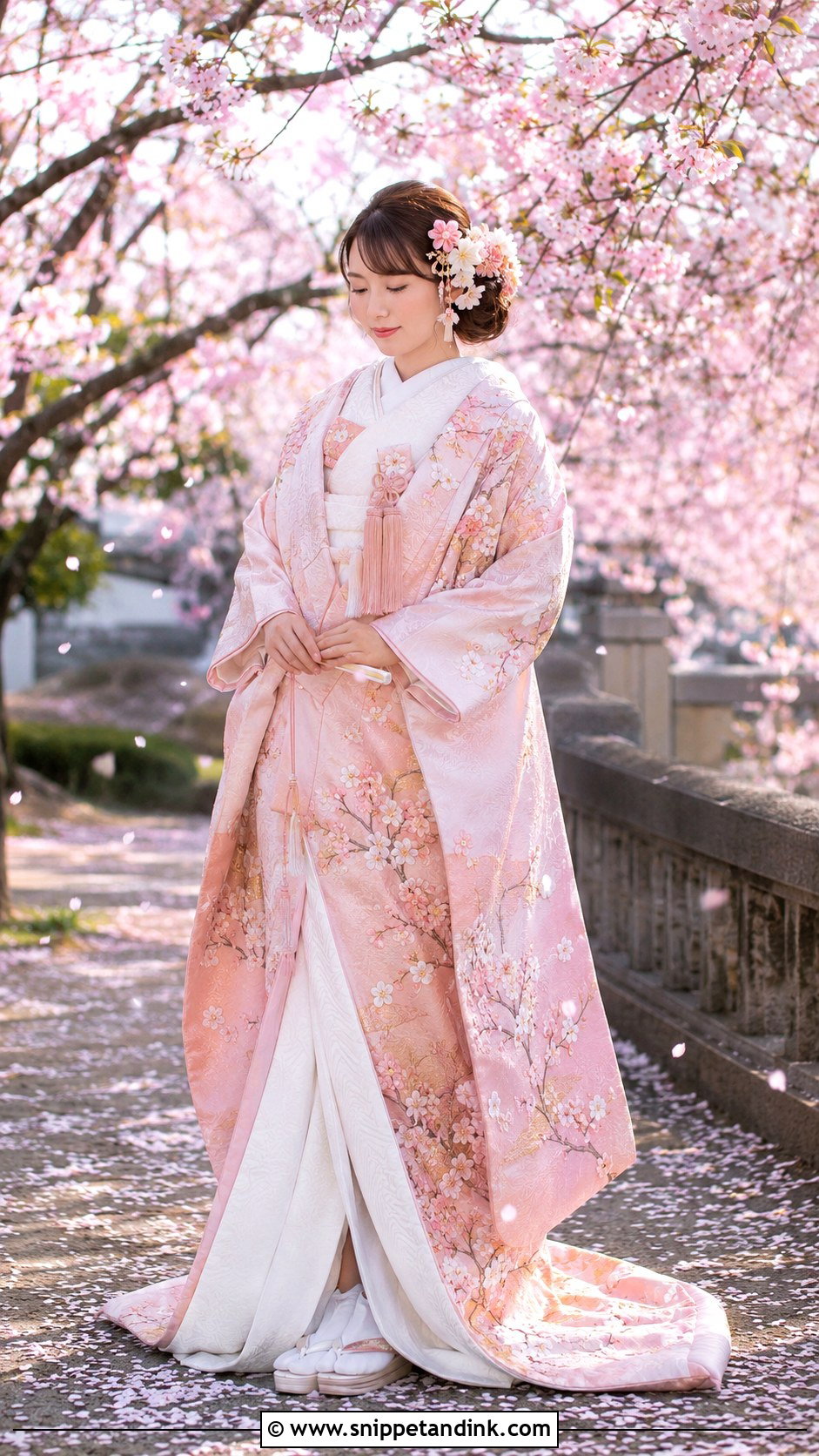
Blossom is a spring motif in kimono, so this look is strongest at a spring wedding. Start with a pale pink, ivory or soft gray iro-uchikake embroidered with cherry blossom motifs, flowering branches and drifting petals, with only a little gold. Layer it over a white kakeshita and keep accessories in blush, ivory and gold, with white tabi and light zori. In the hair I’d choose small blossom kanzashi over a big floral arrangement; the robe already carries a lot of pattern, and a large headpiece tips it toward costume. A white silk gown with blossom embroidery on the sleeves and train is the modern version of the same idea.
14. Crane Embroidered Japanese Wedding Dress
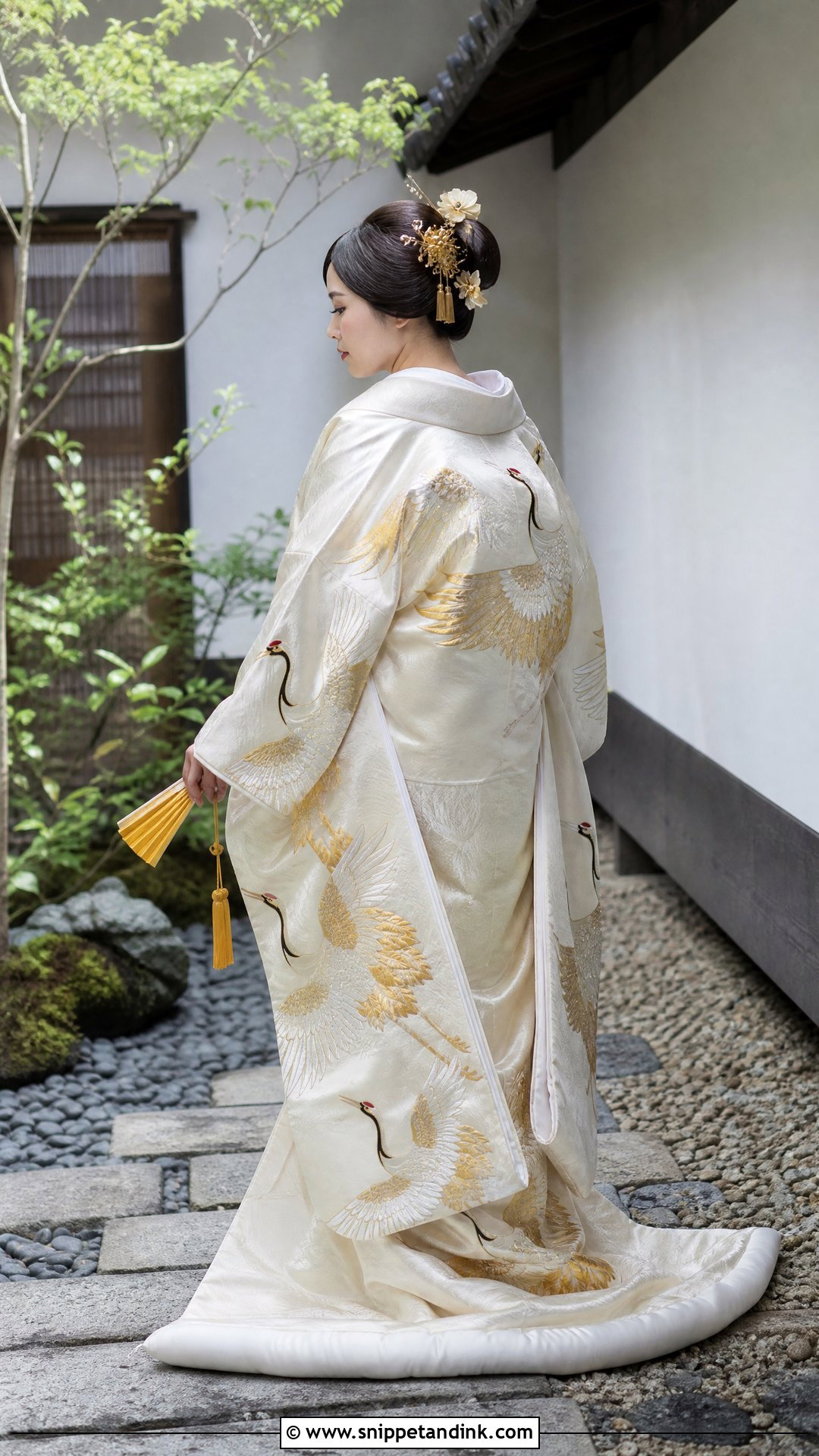
Cranes are the most familiar motif in Japanese bridal clothing, and the real decision is how visible you want them. In a white shiromuku they are woven in and only show in raking light; on a colored iro-uchikake they are embroidered in gold and white and read from across the room. Either way, the birds should travel across the shoulders, sleeves and train as one design rather than sit as scattered patches. Match the kakeshita, obi, cords, tabi and zori to the robe’s background color, then let a fan and gold kanzashi repeat the metallic thread. I always ask the photographer for a back and side view, since most of the story is on the back of the robe.
15. Phoenix Iro Uchikake Japanese Wedding Dress
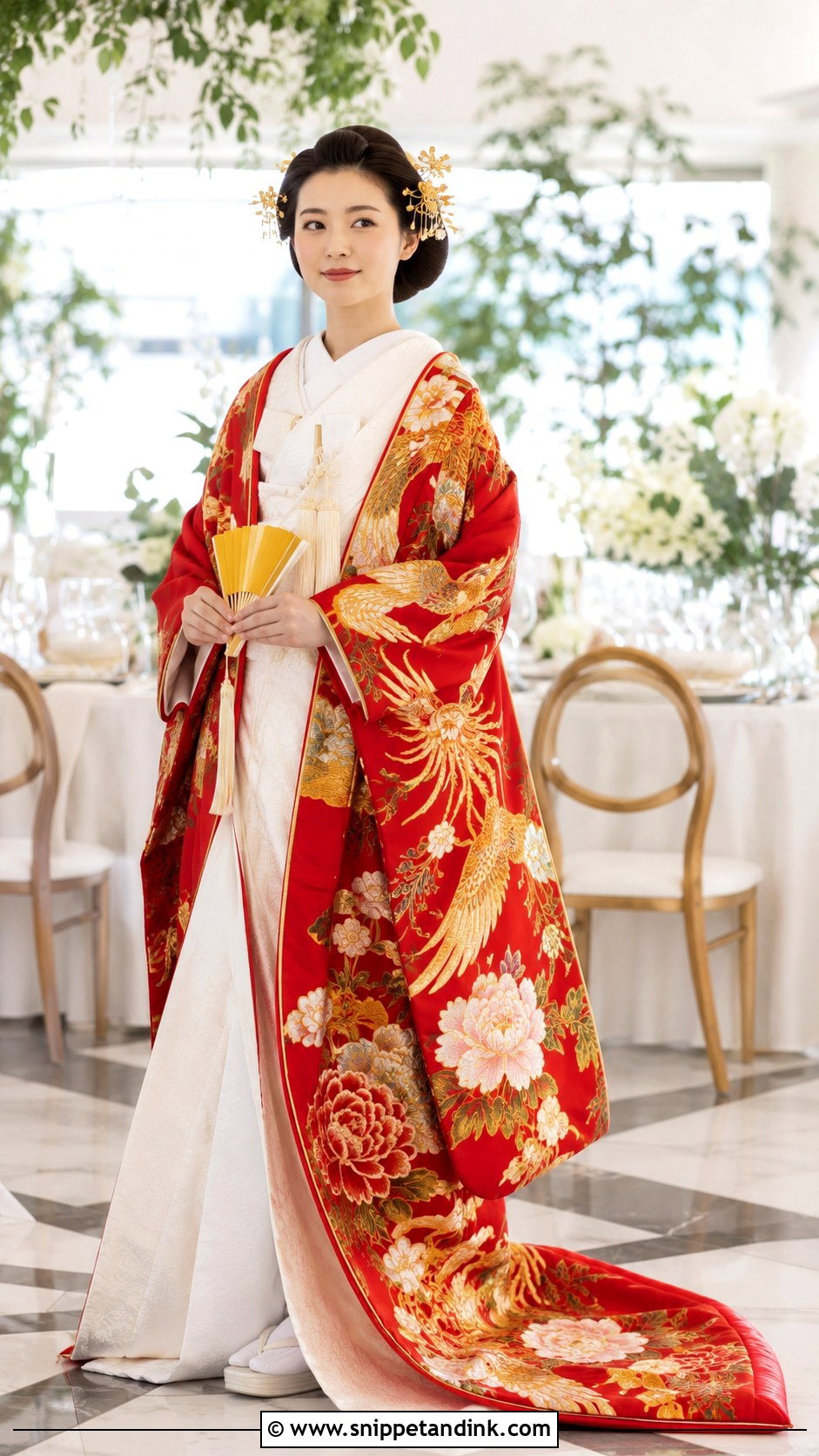
A phoenix is usually the largest single motif on a robe, often set among peonies, clouds or paulownia on a red, black, navy or gold ground. Because the bird is so dominant, I keep everything else plain: a simple ivory kakeshita, understated zori, a compact fan and a traditional updo with gold kanzashi. When you look at robes in a rental shop, ask to see the back hung out flat. The biggest embroidery often runs across the train, and the front view alone can be misleading. An open, uncluttered setting lets the whole silhouette read in one frame.
16. Modern Kimono Sleeve Japanese Wedding Dress
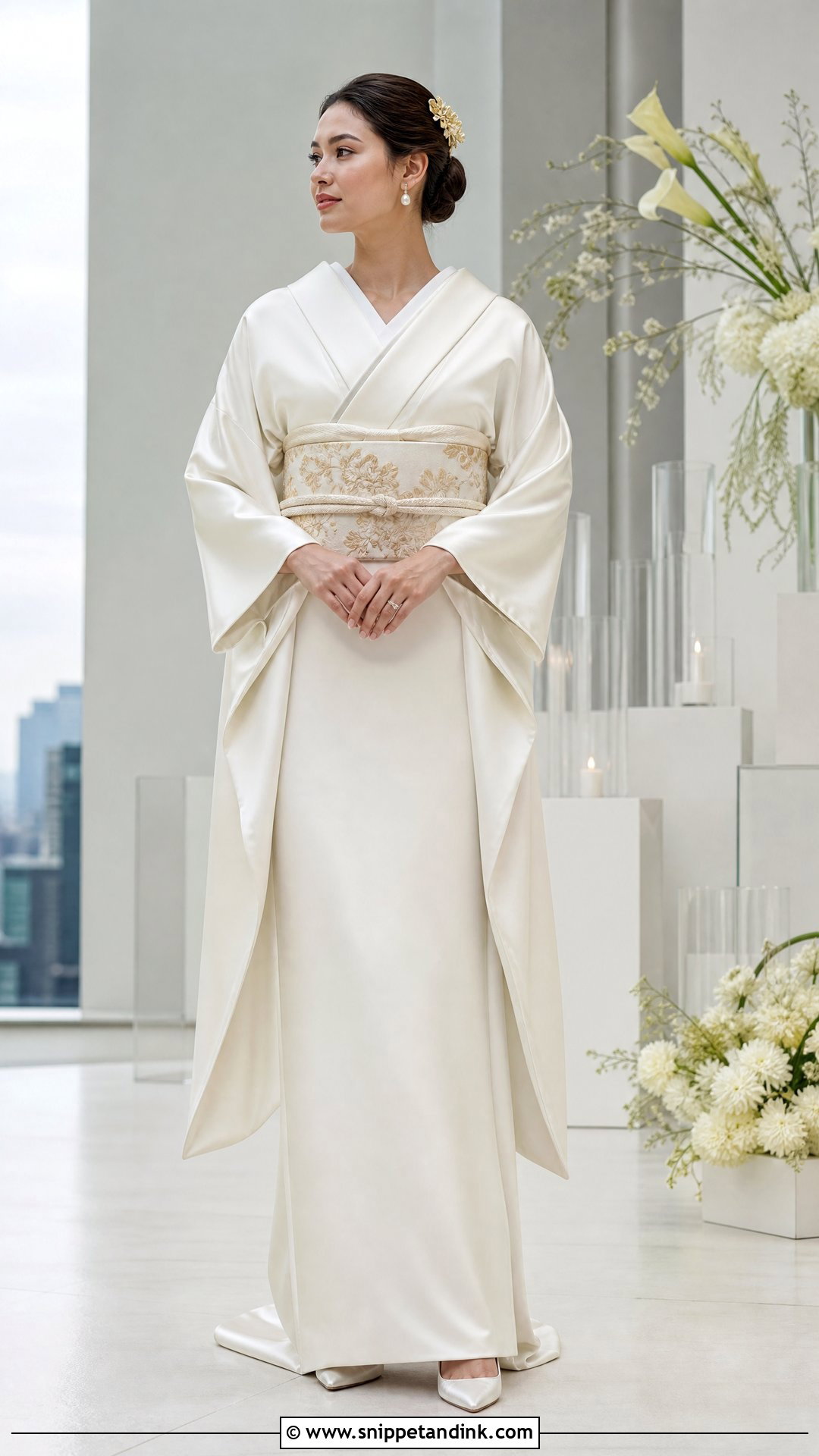
This is the gentlest way to bring kimono lines into a Western gown. Start with an ivory crepe or silk column dress with wide sleeves, a crossed neckline and a clean waist, and add a detachable sash in white, champagne or gold embroidery. Keep accessories simple: pointed satin heels, pearl earrings, a structured clutch, and one kanzashi-style ornament in a low bun. One detail I watch at every fitting is the wrap direction. The crossover should close left over right, the way a kimono is worn by the living, because right over left is how the dead are dressed. Get that right and the gown reads as a respectful reference rather than a costume, and it moves far more freely than layered silk.
17. Obi Belt Japanese Wedding Dress
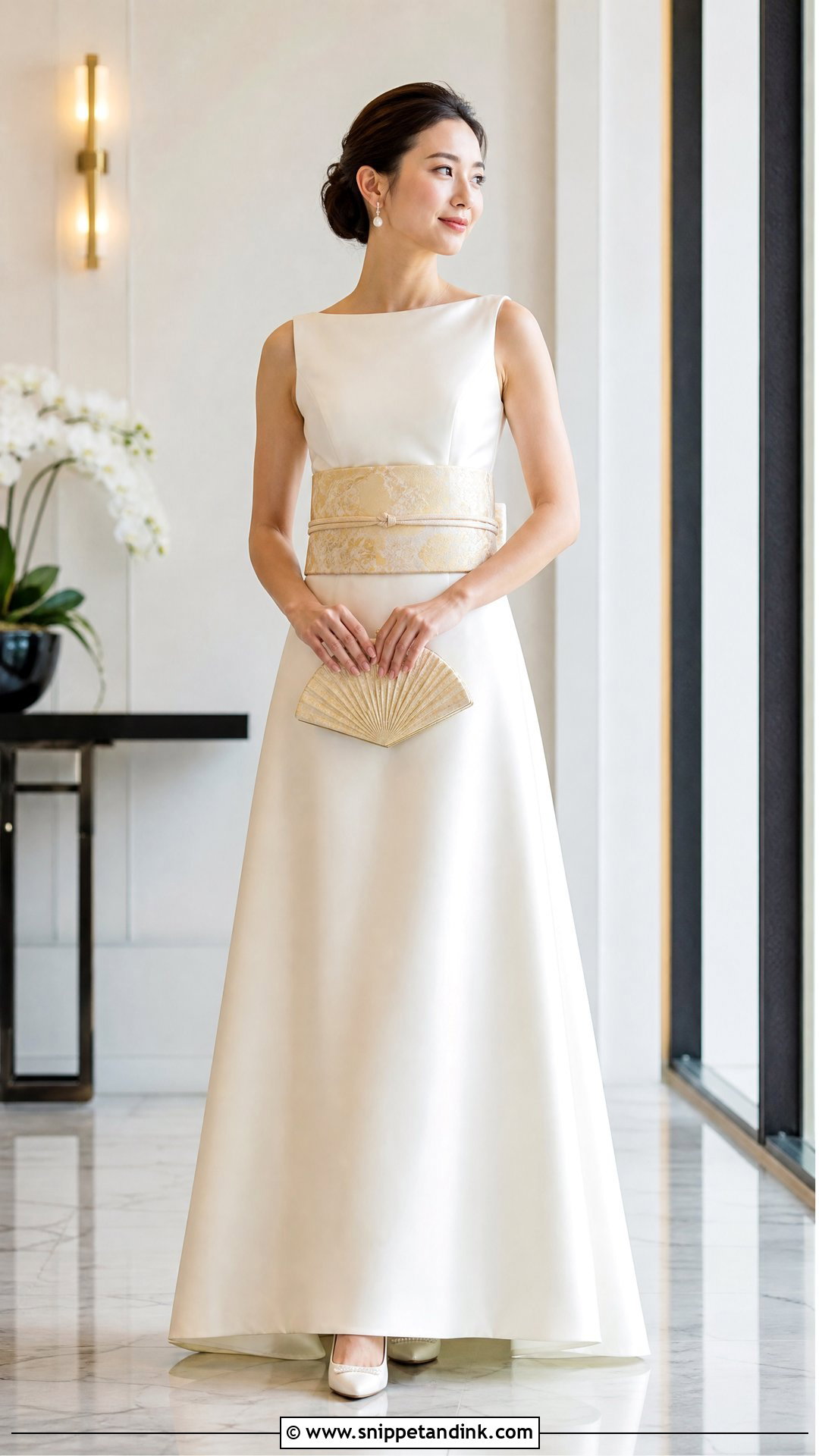
An obi-style belt is the smallest change that still reads as Japanese. Choose a plain A-line or sheath in silk, satin or crepe and add a wide sash with white-on-white embroidery, gold brocade or a restrained crane or floral motif. A real obi is stiffened with interlining, and a sash made the same way holds its shape far better than soft satin, which rolls over at the top edge as soon as you sit. Keep the neckline clean, then add closed-toe heels or bridal flats, a low chignon and pearl drops. Skip the extra themed accessories; the belt is enough.
18. Japanese Lace A-Line Wedding Dress
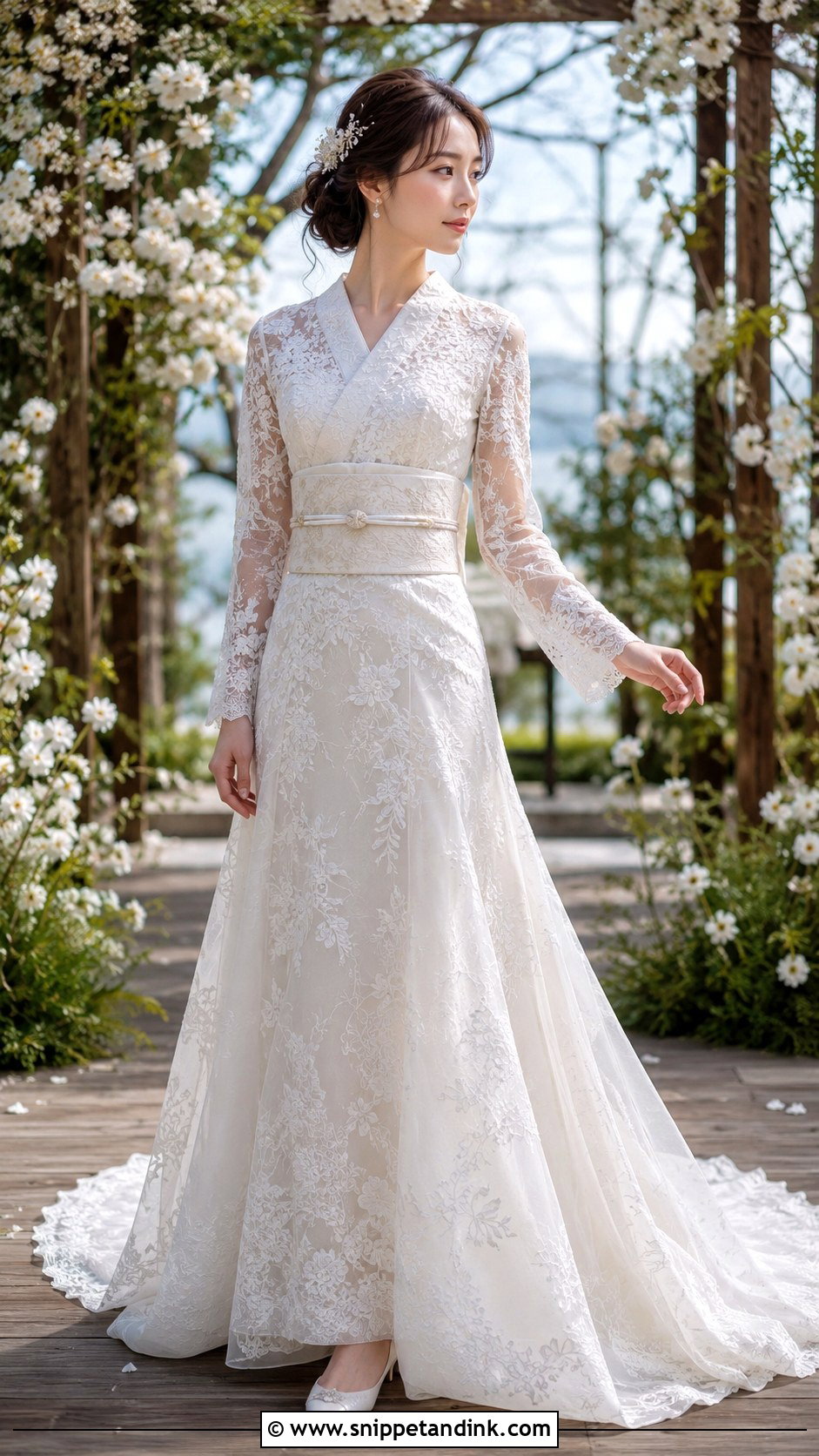
Lace and an A-line skirt are familiar shapes, so the Japanese influence here comes through motif. Look for a fitted bodice with botanical lace, a defined waist and an easy skirt, with cherry blossom, chrysanthemum or wisteria embroidery on the sleeves and train. Lace motifs can also be appliqued onto a gown that has none, which helps if you’ve found the right shape but not the right pattern. Ivory pointed shoes, pearl earrings, a small satin bag and a low bun with a slim floral comb keep it polished, and a narrow ivory obi-style waistband adds structure. Of everything in this list, I find it the easiest to wear from morning to midnight.
19. Minimalist Japanese Wedding Dress
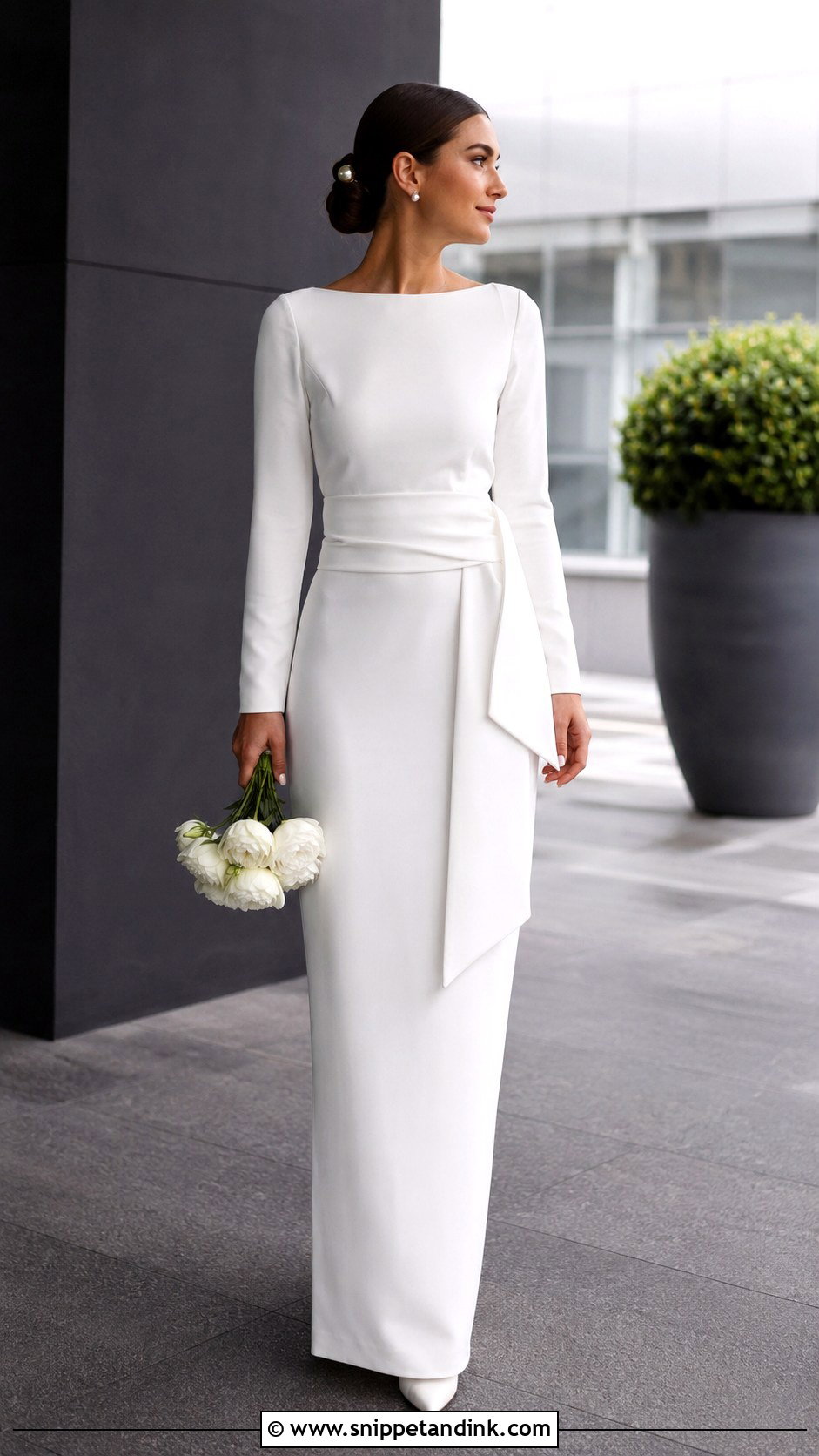
A minimalist dress has nowhere to hide, so the fit does all the work. Look for a high bateau neckline, fitted long sleeves, a defined waist and a smooth column or A-line skirt in matte silk, mikado or crepe. Mikado holds a crisp line by itself; crepe drapes and shows every seam, so I’d only choose crepe if your seamstress is confident with it. White pointed heels, pearl studs, a small structured bag, a sleek low bun and a single metallic hair ornament bring in a quiet Japanese note. A removable wide sash can be worn for the ceremony and taken off for dinner. City venues and small civil ceremonies suit it best.
20. Japanese Wedding Dress With Detachable Kimono Robe
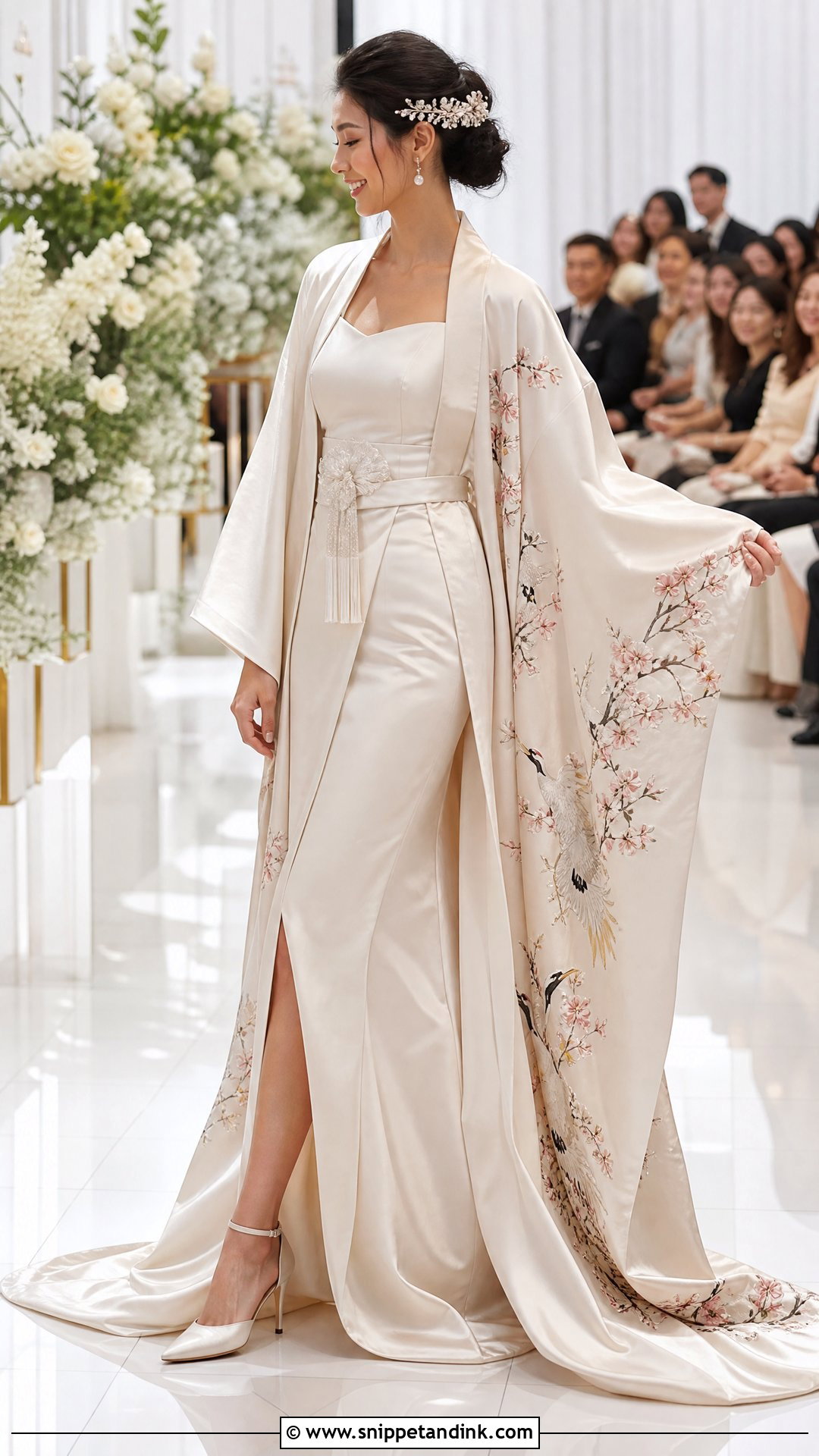
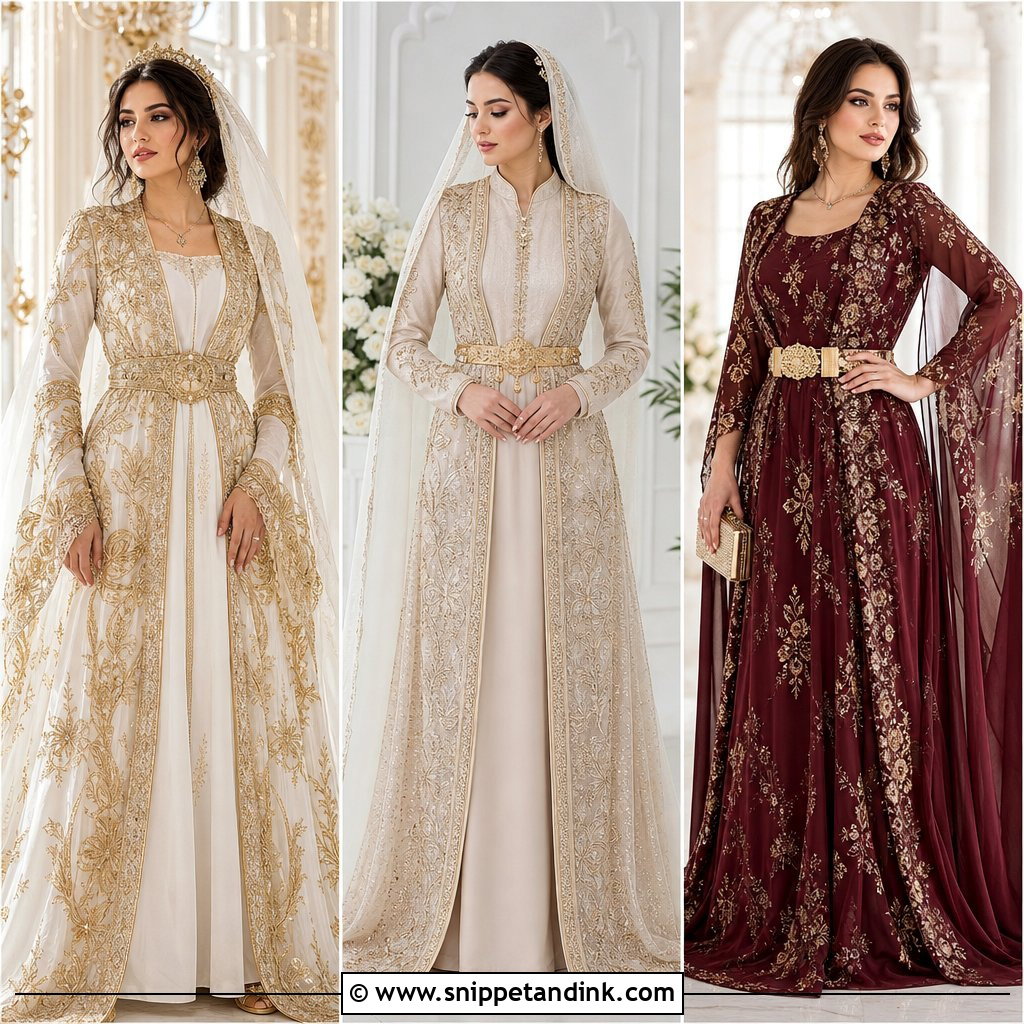
A detachable robe gives you two looks without a full change. The base is a fitted ivory slip dress or simple strapless gown; over it goes a long embroidered robe with wide sleeves and a train, worked in cherry blossom, cranes, peonies or soft waves in white, blush or pale gold thread. An obi-style belt holds the robe closed for the ceremony, and the robe comes off for the reception. I’d ask the dressmaker for discreet hooks or a hidden tie at the shoulder, because a heavy robe over a slippery dress slides backward once you start moving. Satin heels, pearl earrings and a low bun with a floral comb work for both versions.
Shrine Steps, Gravel Paths and a Padded Hem
An uchikake has a thick padded hem that weighs it down so it pools neatly when you stand still. That same weight makes stairs and gravel hard work. Lift the front edges of the robe together with one hand at about thigh height and take short steps in your zori; a long stride pulls the kimono open at the knee and drags the hem through dust. On steps, I have an attendant walk behind to lift the train.
Sitting down to eat
When you sit, someone should spread the train behind the chair so it isn’t crushed into creases. Sit forward and tall rather than leaning back, because the obi knot needs space and will press into your ribs otherwise. Hold the long sleeve back before reaching across the table; silk soaks up sauce faster than anyone expects. A napkin tucked into the collar during the meal, removed before photos, saves a lot of worry.
Timing the outfit change
Swapping only the outer robe, from shiromuku to a colored uchikake, is fairly quick because the kakeshita and obi stay on. Changing into a Western gown means unwinding everything and usually restyling the hair, which takes far longer. Ask your dresser how long your particular change needs and build that gap into the reception running order, ideally while guests are eating.
Shrine White, Reception Color, or a Gown With Kimono Lines
Ceremony dress, textile craft and contemporary bridal fashion can all sit inside one wedding day. A white shiromuku gives quiet formality at the shrine, a colored iro-uchikake makes the reception entrance, a hikifurisode puts the obi and train on show, and the modern gowns borrow kimono sleeves, embroidery or a sash in a lighter form. Start from the ceremony type and venue, then think about season, how far you’ll walk, and how the outfit reads on camera. For any traditional kimono, have it fitted and dressed by an experienced kimono dresser. I can plan the look with you, but the dressing itself is their craft.
You'll Like These Ideas:


Leave a Reply