
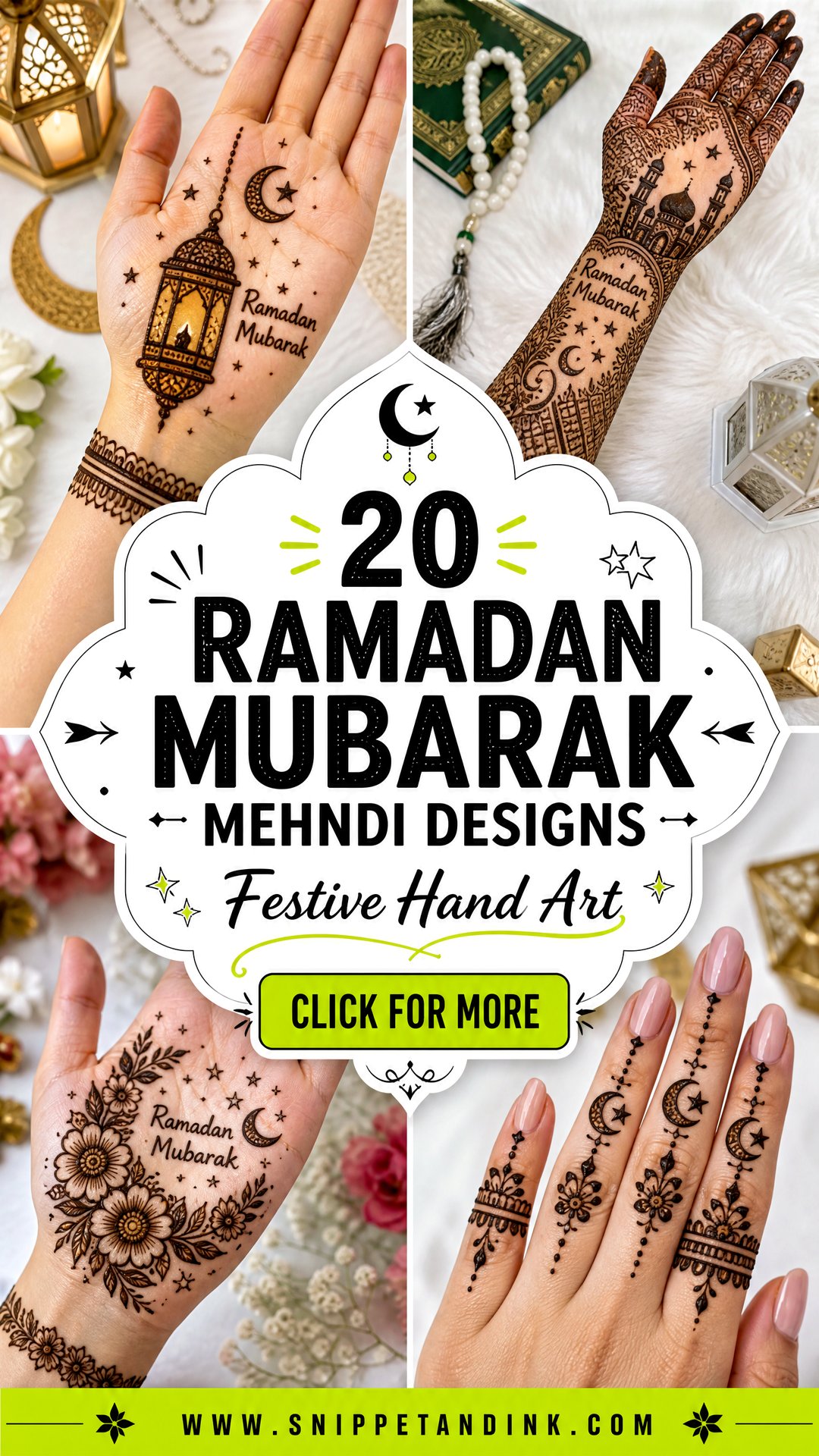
Ramadan mehndi sits in an unusual spot for a henna artist. Most appointments in the holy month come after iftar, from women who want something festive for Taraweeh, a family dinner or Chand Raat, yet still modest and quick enough to sit through while tired from fasting. The motifs below run from crescents, stars and lanterns to mosque arches, jaali and bracelet wrists, and many of them look finished with surprisingly little paste. I’ve noted where each one sits on the hand, roughly how demanding it is, and who I’d steer toward or away from it.
Fitting Henna Around Fasting, Iftar and Prayer
During Ramadan the day runs on a different clock, and good henna needs a few undisturbed hours of it. Most of my appointments this month start after iftar, once people have eaten, prayed Maghrib and had something to drink. Sitting for a long design late in the afternoon while fasting is possible, but tired, thirsty clients fidget, and fidgeting means smudged fingers.
Apply after Taraweeh, scrape off at suhoor
The routine I recommend is to apply after Taraweeh, let the paste dry, dab it with a little lemon and sugar so it stays stuck to the skin, then wrap loosely in tissue and sleep in it. Natural paste keeps releasing dye for as long as it sits on the skin, so even five or six hours until suhoor gives a much deeper result than the single hour most people manage in the evening. Scrape it off with a blunt edge or your fingernail rather than washing it, and keep water away for as long as you can afterward.
Wudu with mehndi on your hands
This comes up at almost every Ramadan appointment. Once the paste is removed, the color is in the skin itself and doesn’t sit on top as a layer, which is why it’s widely treated as no barrier to wudu, unlike nail polish. Dried paste is a different matter because it’s a coating, so the usual approach is to apply after Isha or Taraweeh and remove it before Fajr. If you follow a particular scholar’s ruling, check it, and plan the henna around your prayers rather than the other way round.
1. Ramadan Mubarak Crescent Moon Mehndi Design
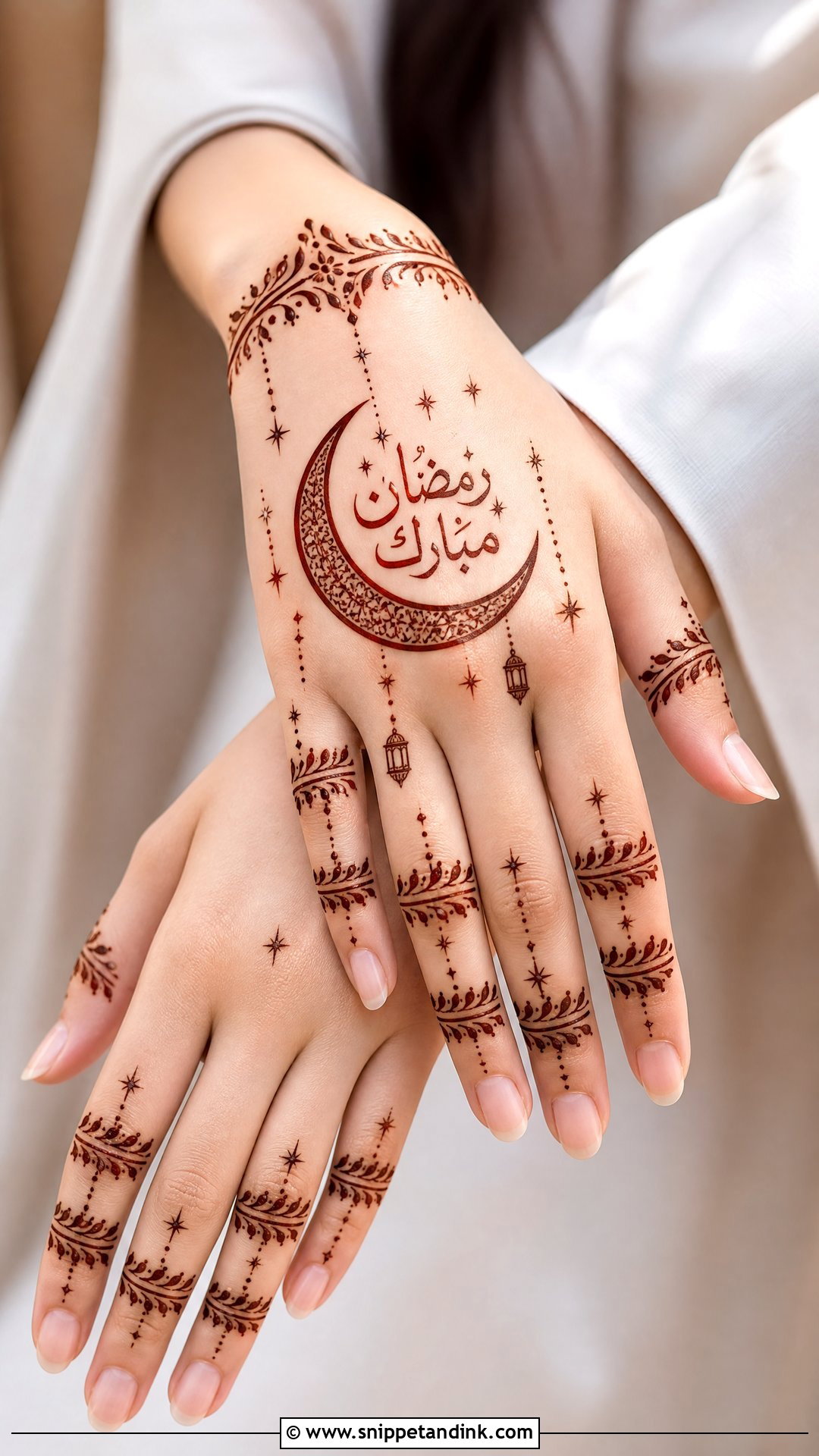
This is the motif I’m asked for most during the month, and it reads best on the back of the hand, where a bold moon can sit near the center with small stars scattered off its tips. I draw the crescent’s outer curve first in one steady line, because a moon that wobbles is the first thing people notice once the stain darkens. Keep the fingers to thin leafy lines, dots and ring bands so nothing competes with it. For something fuller, a floral wrist cuff or a short vine toward the forearm adds weight without covering the whole hand.
2. Ramadan Mubarak Lantern Mehndi Design
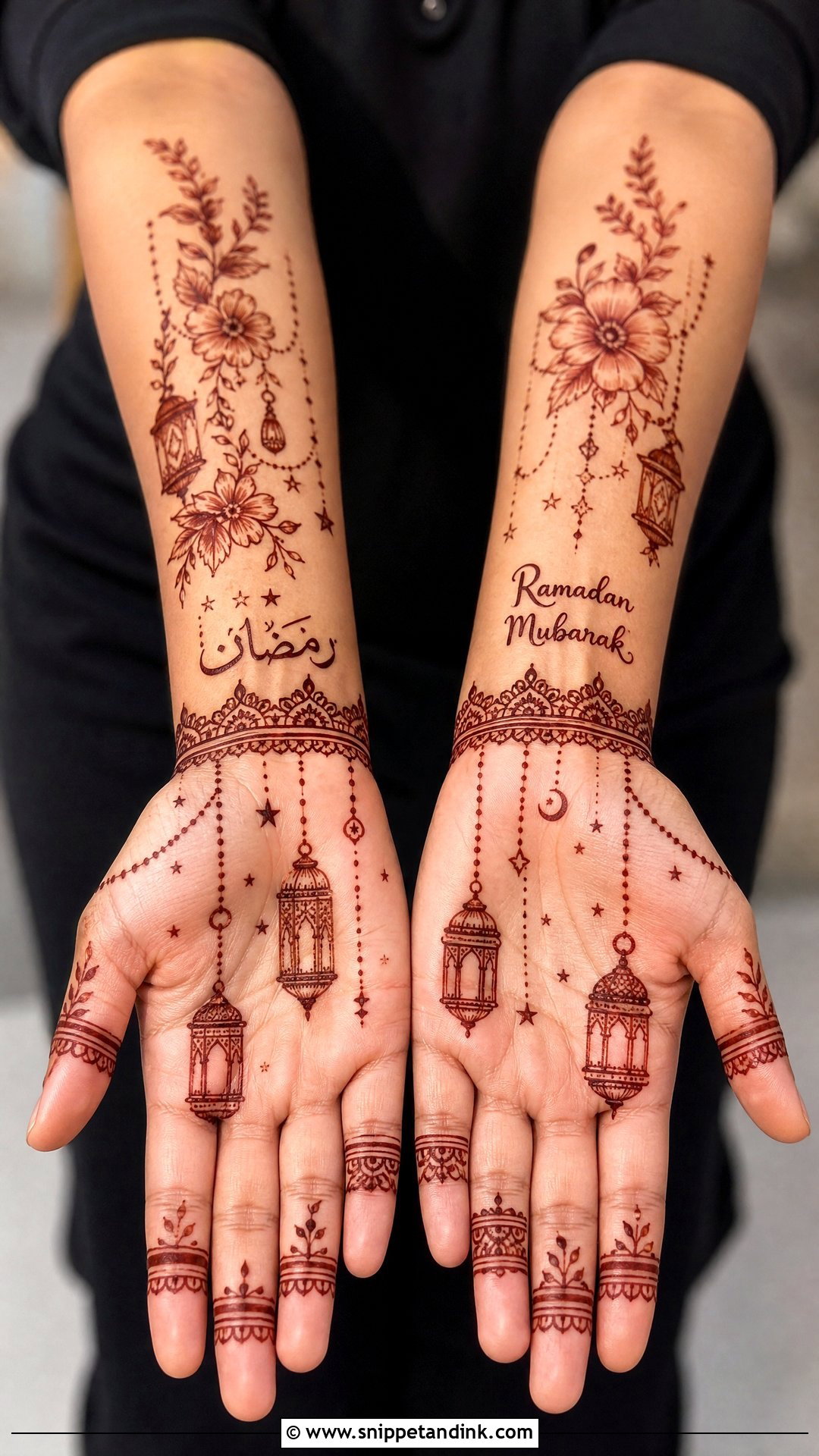
A lantern needs room. I place it on the palm or back hand with fine chains, dots and small stars hanging from it, then frame it loosely with Arabic florals. The mistake I see in home attempts is filling right up to the lantern’s edges: as the stain deepens over the next day, closely packed lines visually merge and the lantern’s outline gets swallowed. Leave a clear border of bare skin around it. Fingers can stay simple with line bands, leafy tips and dot trails, which keeps the hand light enough for an iftar party.
3. Ramadan Mubarak Arabic Mehndi Design
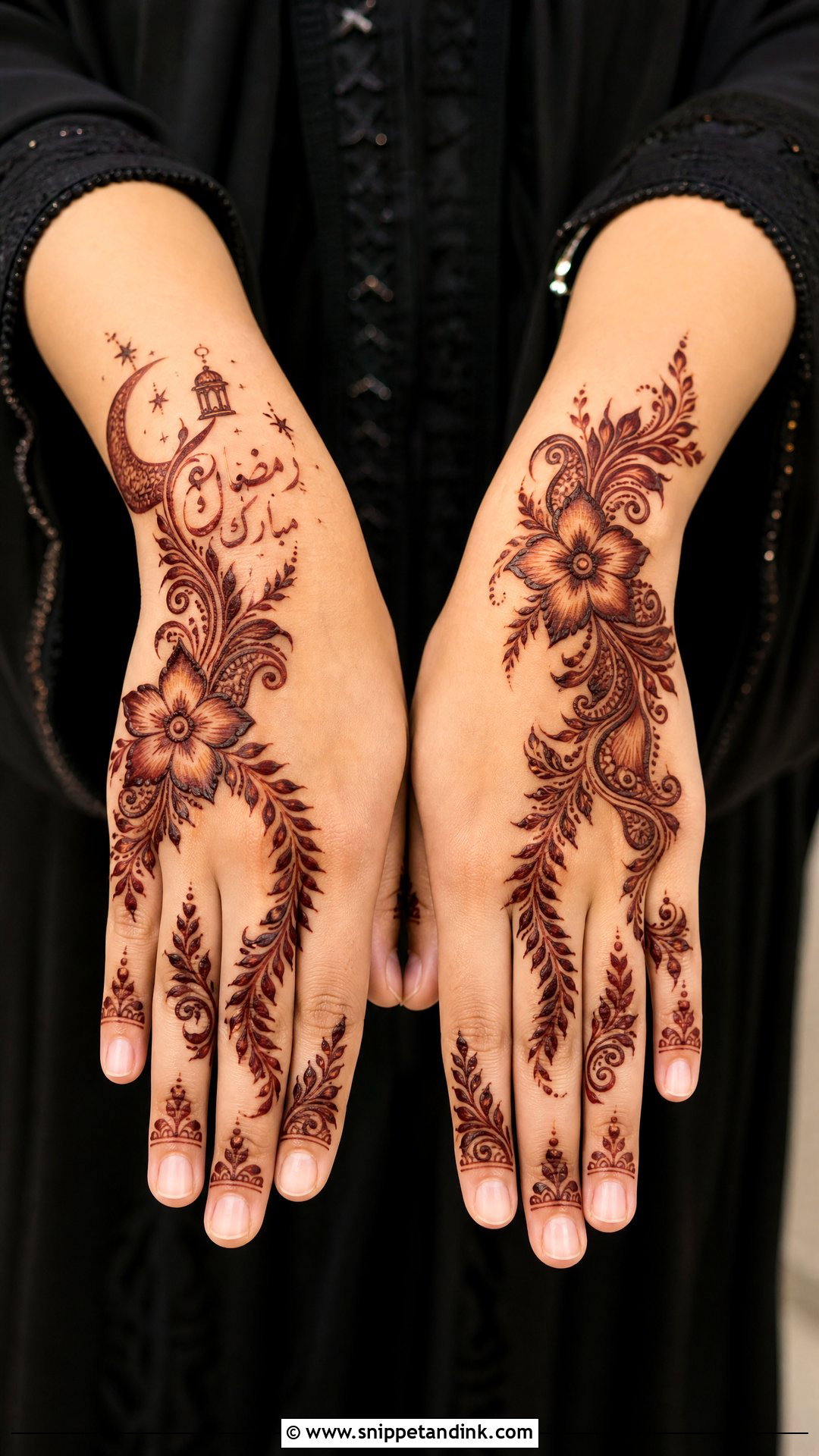
Arabic mehndi is quick, which matters when someone arrives straight from breaking her fast and wants to be home before Taraweeh. The trail usually runs diagonally from the wrist to the index finger, built from large shaded flowers, leafy vines and a few paisleys, with soft gaps of bare skin around it. Shading is where this style shows the artist’s hand. I thin the paste stroke toward each petal tip so the color fades out rather than stopping hard. Strong outlines also make it forgiving if you’re practicing on yourself.
4. Ramadan Mubarak Front Hand Mehndi Design
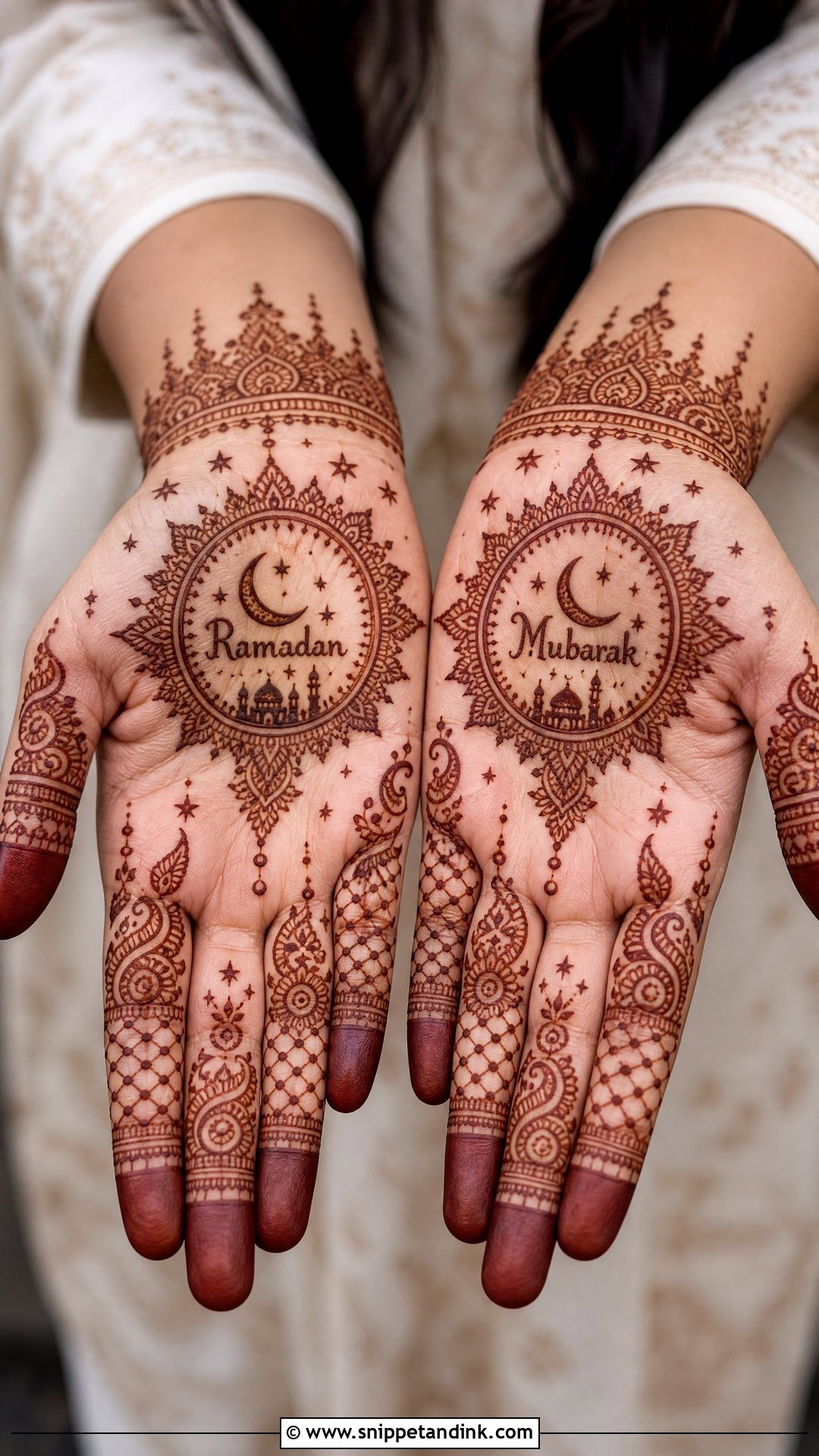
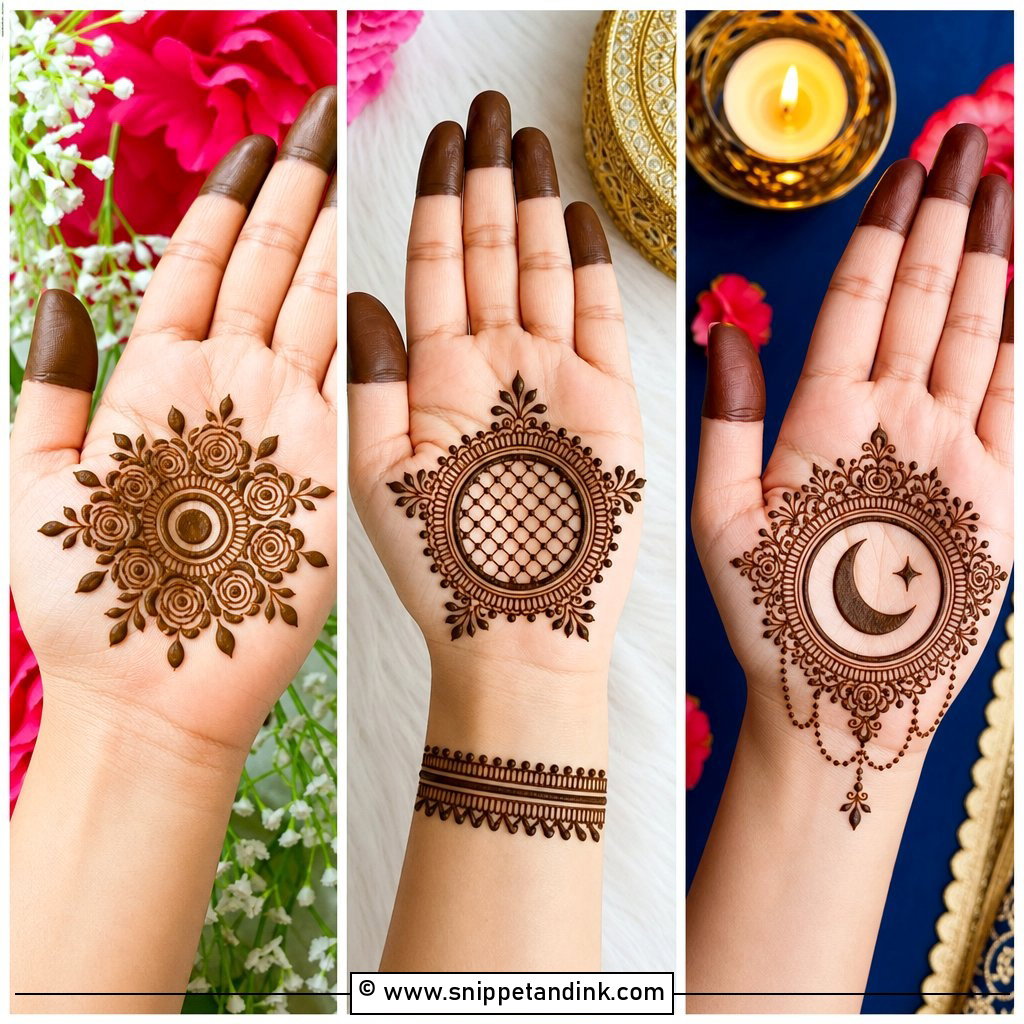
The palm gives you the most room, and it takes the darkest stain, since the thicker skin there holds dye well. I start with a central mandala or crescent, then build outward with florals, dots, paisleys and a few small stars. Fingers can carry different patterns as long as they match in weight: mesh on two, vines on two, stacked bands on the index. Hold back on the fill so every motif stays readable, and close the layout with a wrist bracelet. One practical note: a full palm means you can’t use that hand for a few hours, so plan it for after you’ve eaten.
5. Ramadan Mubarak Back Hand Mehndi Design
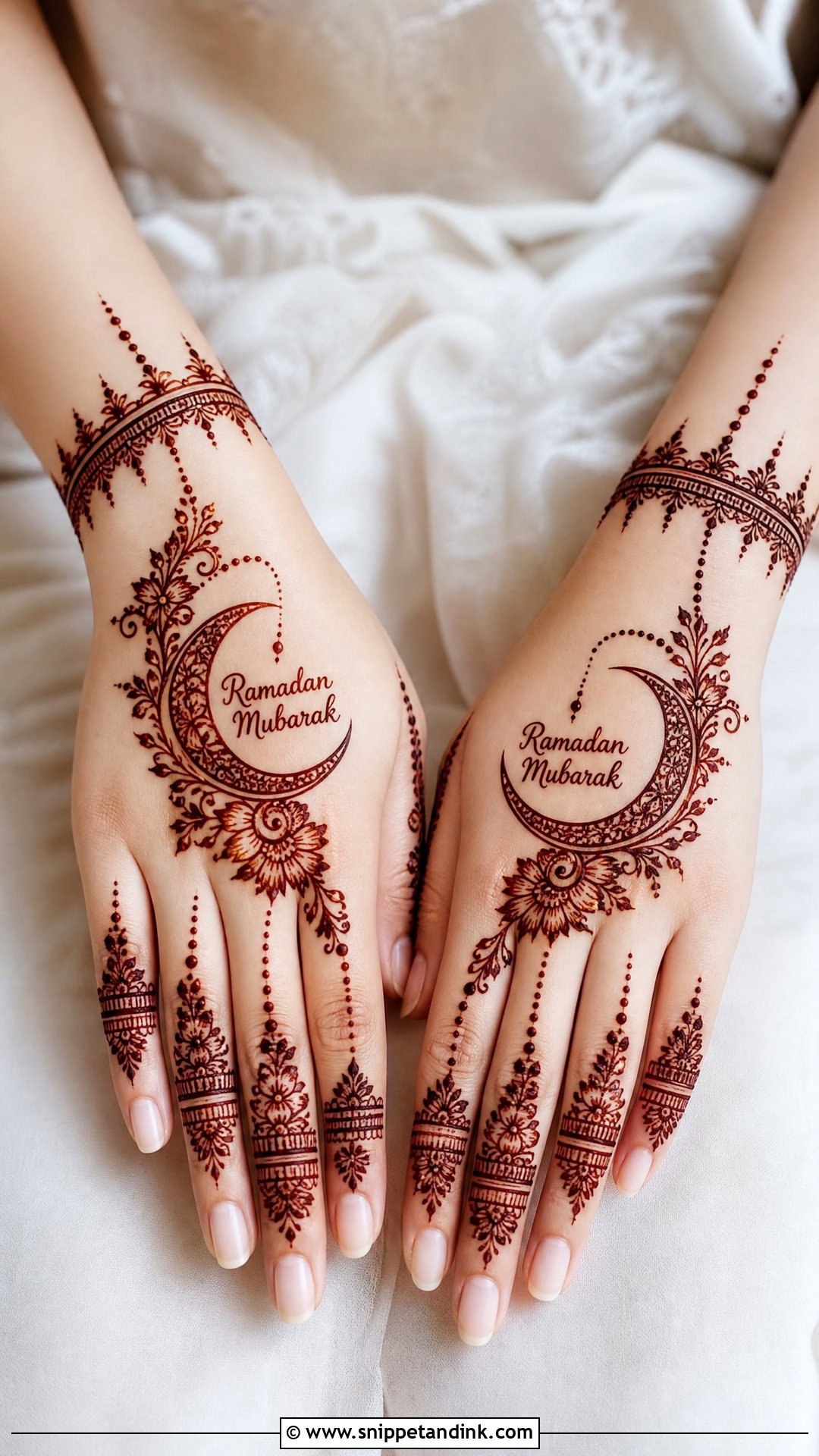
Back hand designs show best in photos, especially next to rings and bangles, and they let you keep using your palms while the paste sets. Put a crescent, lantern or floral mandala in the center, then run slim vines, dots and ring bands toward the fingers. Expect a lighter result here than on the palm, because the skin on the back of the hand is thinner and the color usually settles a shade or two paler. A bracelet pattern or small arch border at the wrist finishes it, and the sitting is far shorter than a full palm.
6. Ramadan Mubarak Simple Mehndi Design
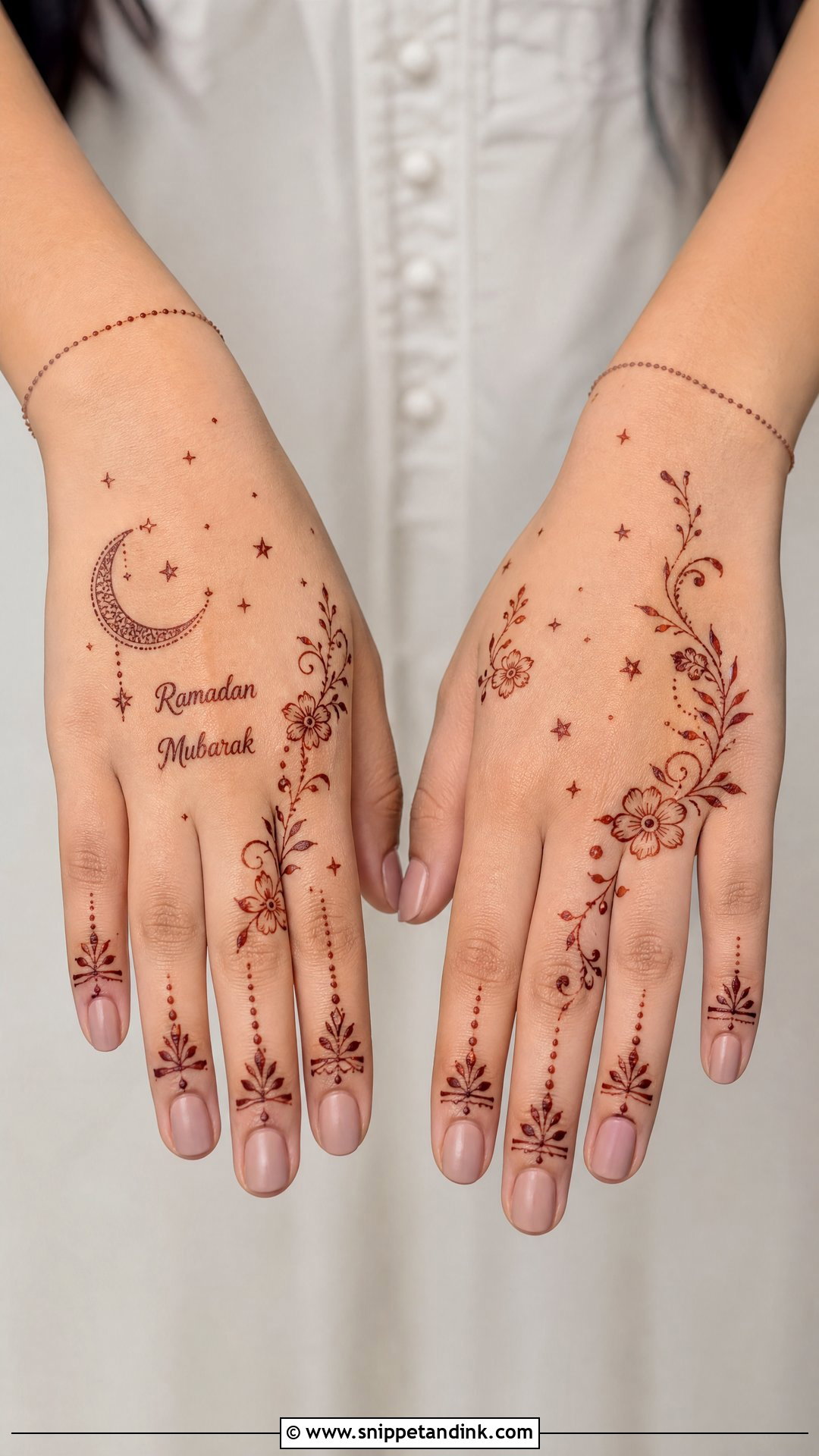
On a quiet weeknight in Ramadan, a simple design often looks the most graceful. That might be a small crescent on the back hand, one thin floral trail across the palm, or a mini mandala with a few dot accents. Fingers stay light: rings, tiny leaves, tipped fingertips. Thin lines dry within minutes, so this is what I suggest to students and working women applying at home before iftar or Chand Raat. It still stains cleanly, provided you leave the paste on for a good few hours instead of flaking it off the moment it’s dry.
7. Ramadan Mubarak Full Hand Mehndi Design
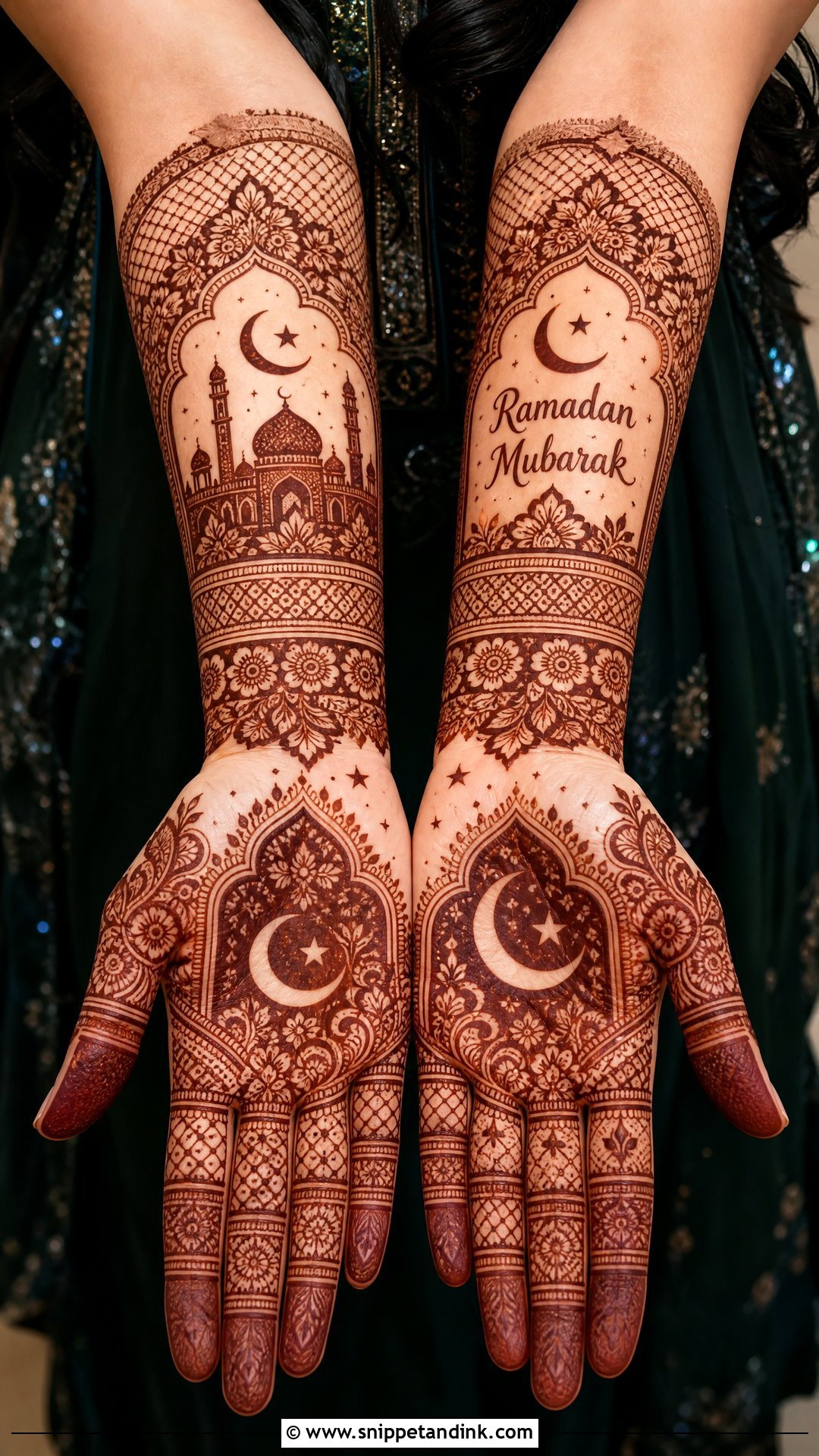
Covering the palm, fingers, wrist and lower forearm is a long sitting, often a couple of hours for one hand once you include fine jaali. It can carry crescents, mosque arches, florals, paisleys and net patterns together, but only if the hand is divided into clear zones first. I mark those zones with light dots before committing any bold line, then fill each section with finer detail. Fingers get full matching bands. I’d save this one for Chand Raat or the last nights before Eid, not an ordinary fasting day when sitting still that long is exhausting.
8. Ramadan Mubarak Mandala Mehndi Design
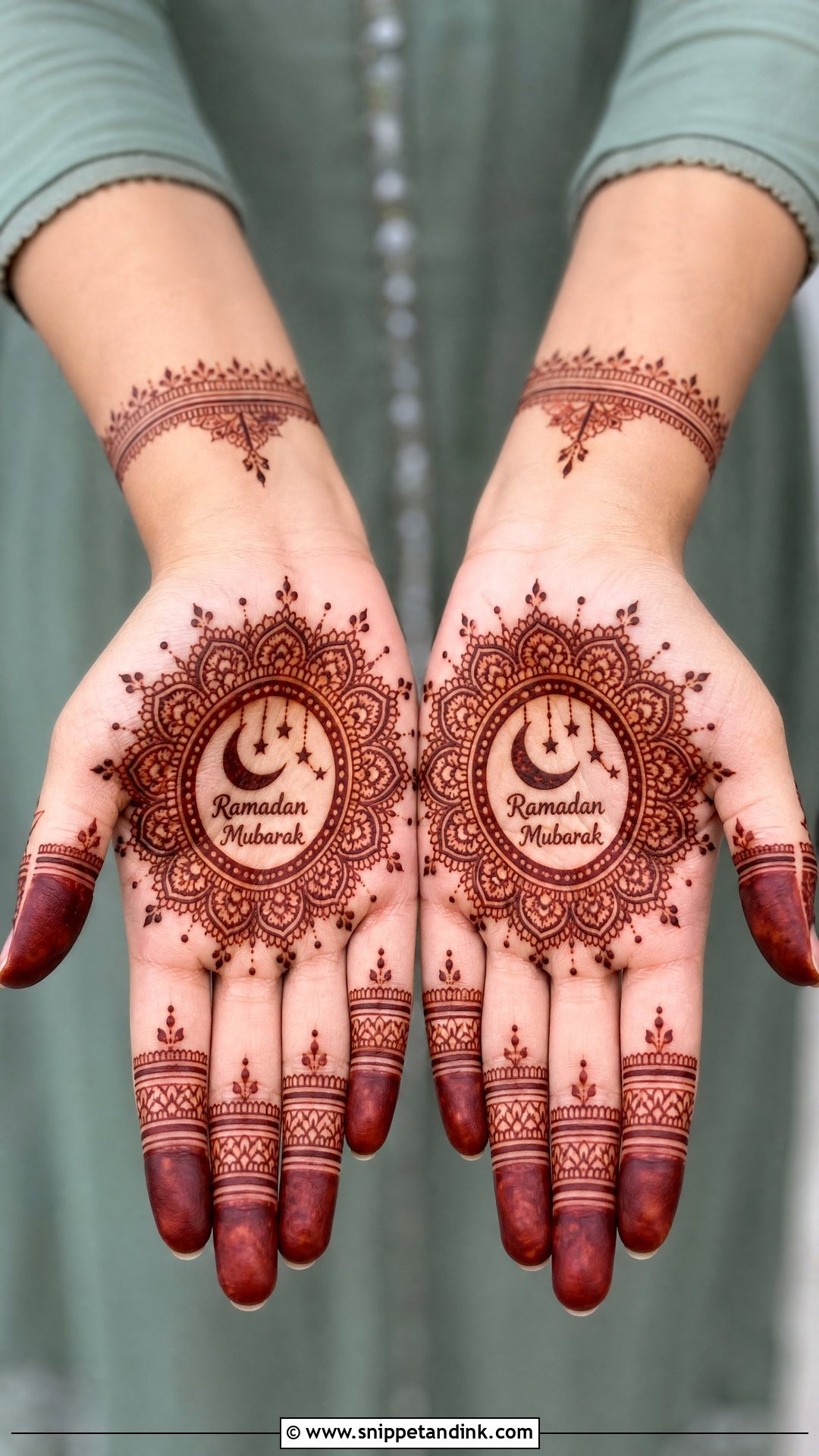
A round mandala in the center of the palm or back hand is the easiest motif to adapt for Ramadan: tuck tiny crescents, dots and floral rings into its outer circles. You can leave open space around it or carry it out into finger patterns and a wrist band. Symmetry is the whole point, so I mark the center and four guide dots before drawing the first ring. Skip that step and the circle drifts oval by the third layer. Crisp edges read as modern, softer petal rings feel more traditional, and both suit any age.
9. Ramadan Mubarak Floral Mehndi Design
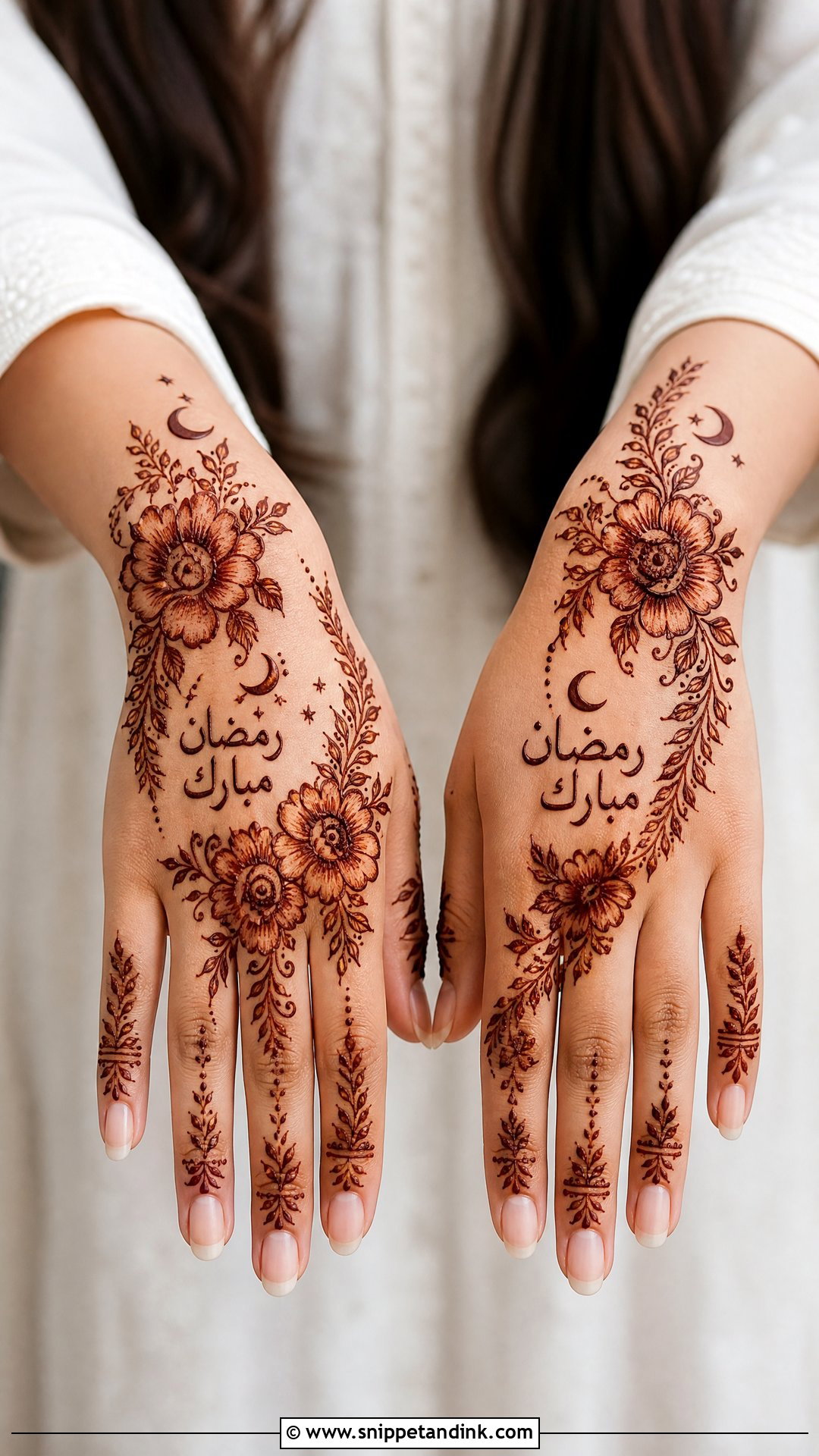
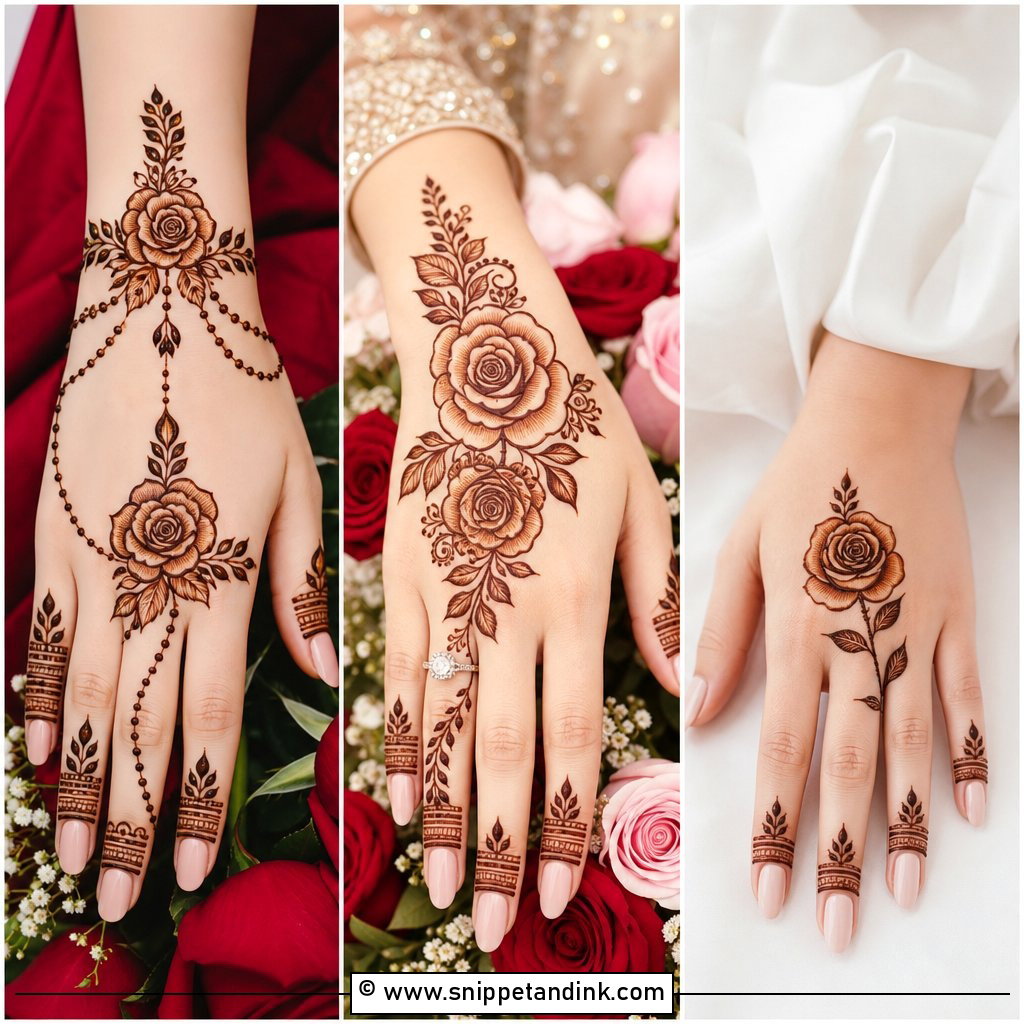
Florals are the safest place to start if you’re unsure, because a flower forgives a shaky line far more than a geometric border does. A Ramadan floral can open at the wrist with a cluster and climb across the back hand toward the middle finger, with leaves, vines and a small crescent tucked into the trail. On the palm, one larger shaded flower with thin curves around it is plenty. Space the blooms out; petals that touch turn into one dark patch once the color develops. It sits well beside plain abayas and festive suits alike.
10. Ramadan Mubarak Indo Arabic Mehndi Design
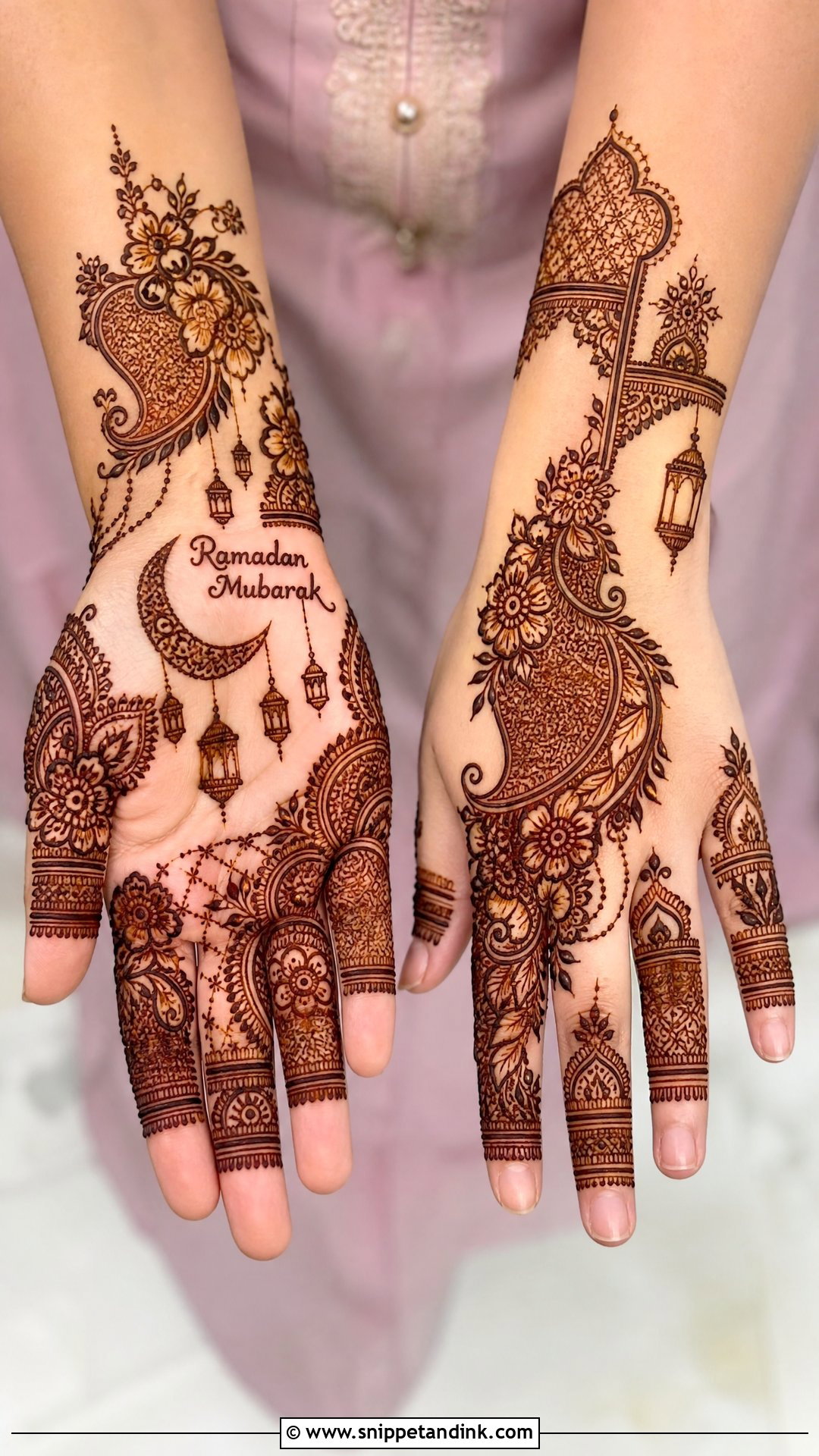
Indo-Arabic mehndi gives you the flow of an Arabic trail with Indian-style filling inside it: paisleys, dots, mesh and mandala borders. A crescent or lantern sits near the wrist or palm center while the rest travels diagonally across the hand. The risk with this blend is over-filled fingers, which look smudged in photos, so I alternate one busy finger with one plain band. It’s my usual suggestion for someone who finds plain Arabic too sparse but doesn’t want to sit for a bridal-length design before Eid.
11. Ramadan Mubarak Jaali Mehndi Design
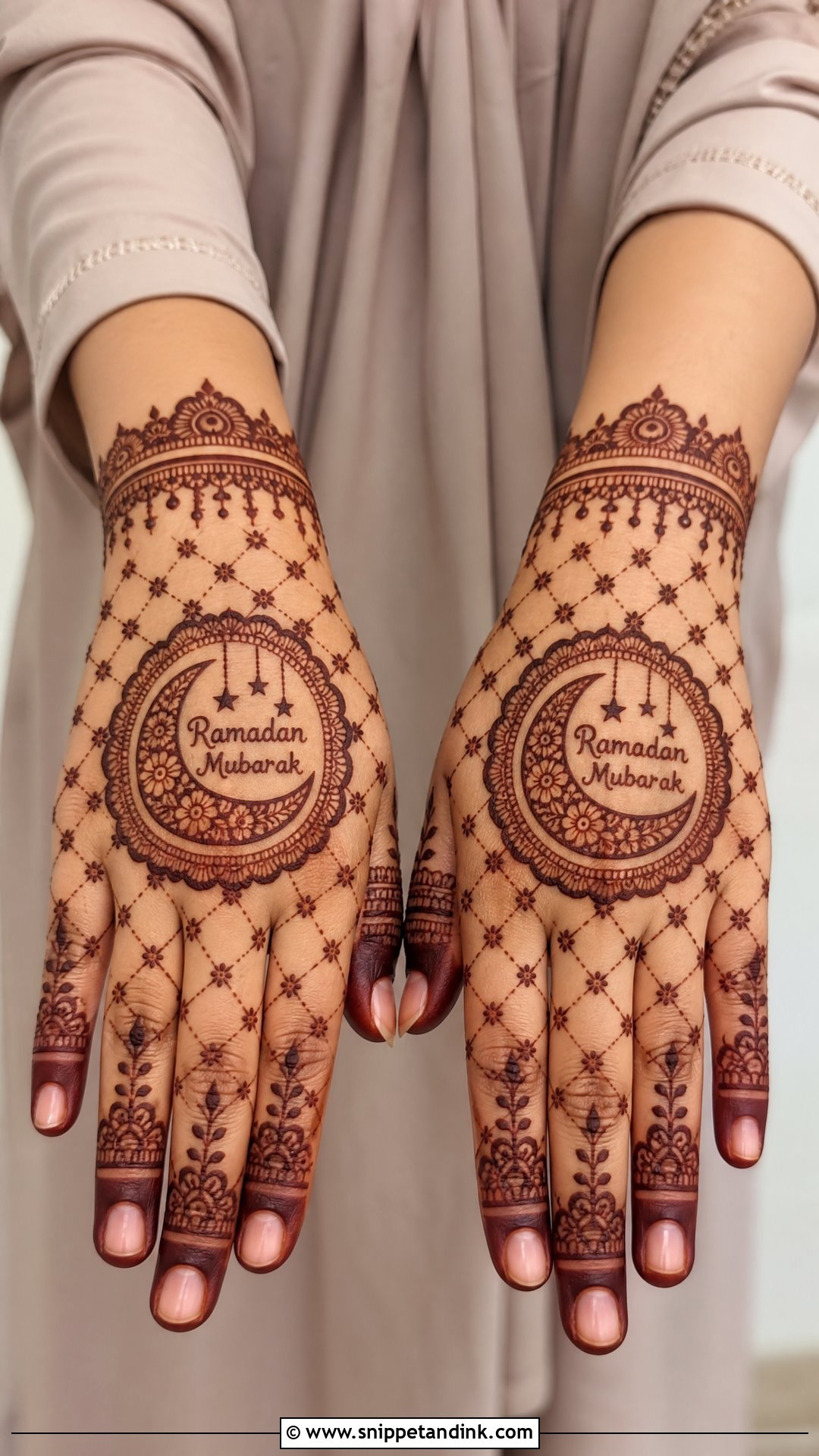
Jaali is the most demanding motif here to apply cleanly. The net only looks like lace if every line is the same thickness and evenly spaced, so I cut a finer cone tip and keep the pressure constant through each pass. A complete design covers the back hand in a diamond or net pattern around a central crescent, flower or small mandala, contained by bold borders and simple finger bands. Dots inside the net spaces add texture. If your hands shake or you’re doing your own, choose a small jaali panel rather than a whole hand of it.
12. Ramadan Mubarak Mosque Arch Mehndi Design
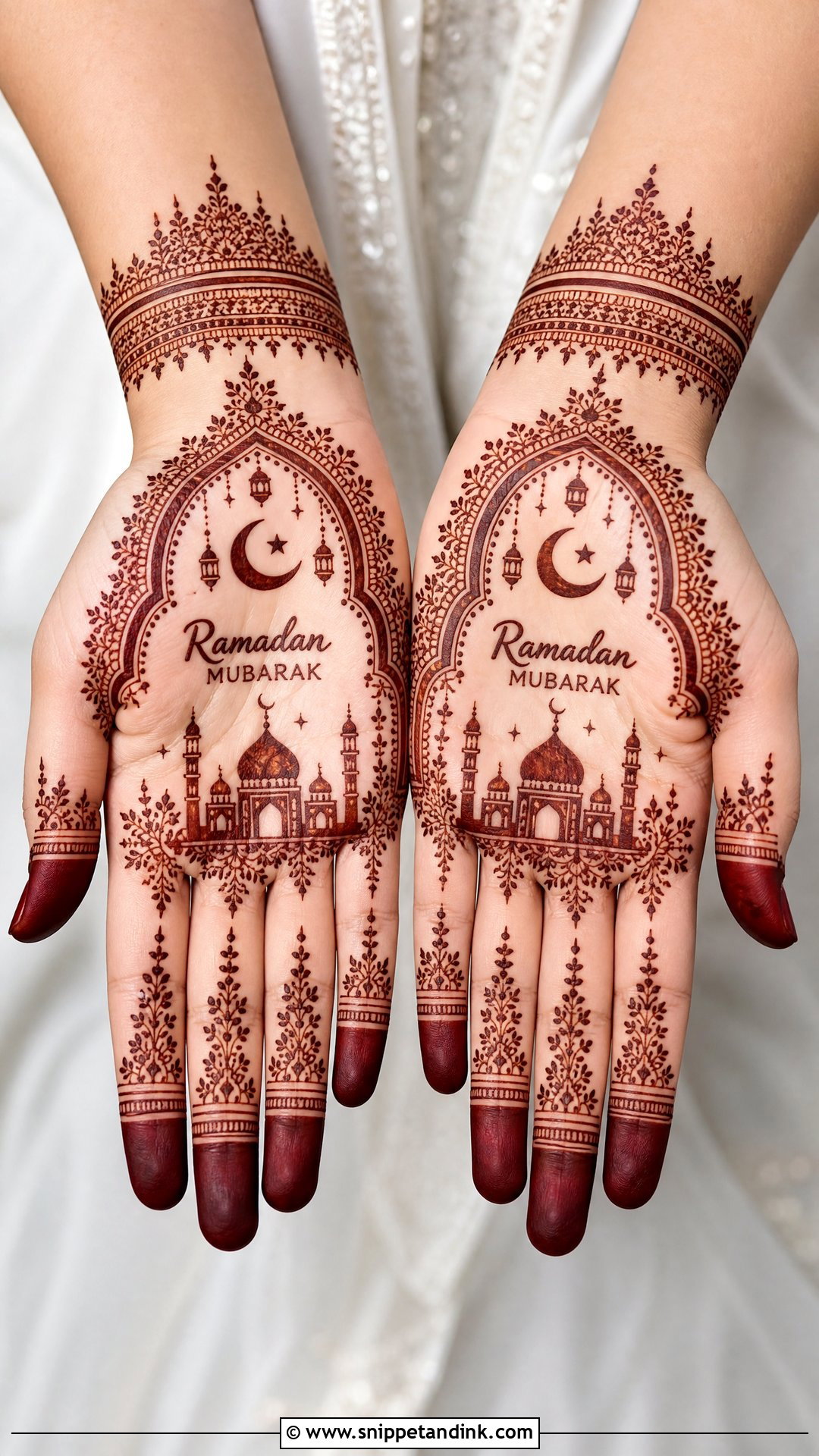
The mosque arch carries more devotional feeling than anything else in this list, and I treat it with restraint. Arches on the palm or back hand get framed with dots, florals and soft geometric borders, with a crescent just above the peak. Fingers take slim minaret-style lines, leafy bands and tiny stars. The two sides of an arch have to mirror each other, so I draw both outer curves before any detail goes inside. It pairs well with outfits in neutral, gold, green or deep jewel tones.
13. Ramadan Mubarak Star Mehndi Design
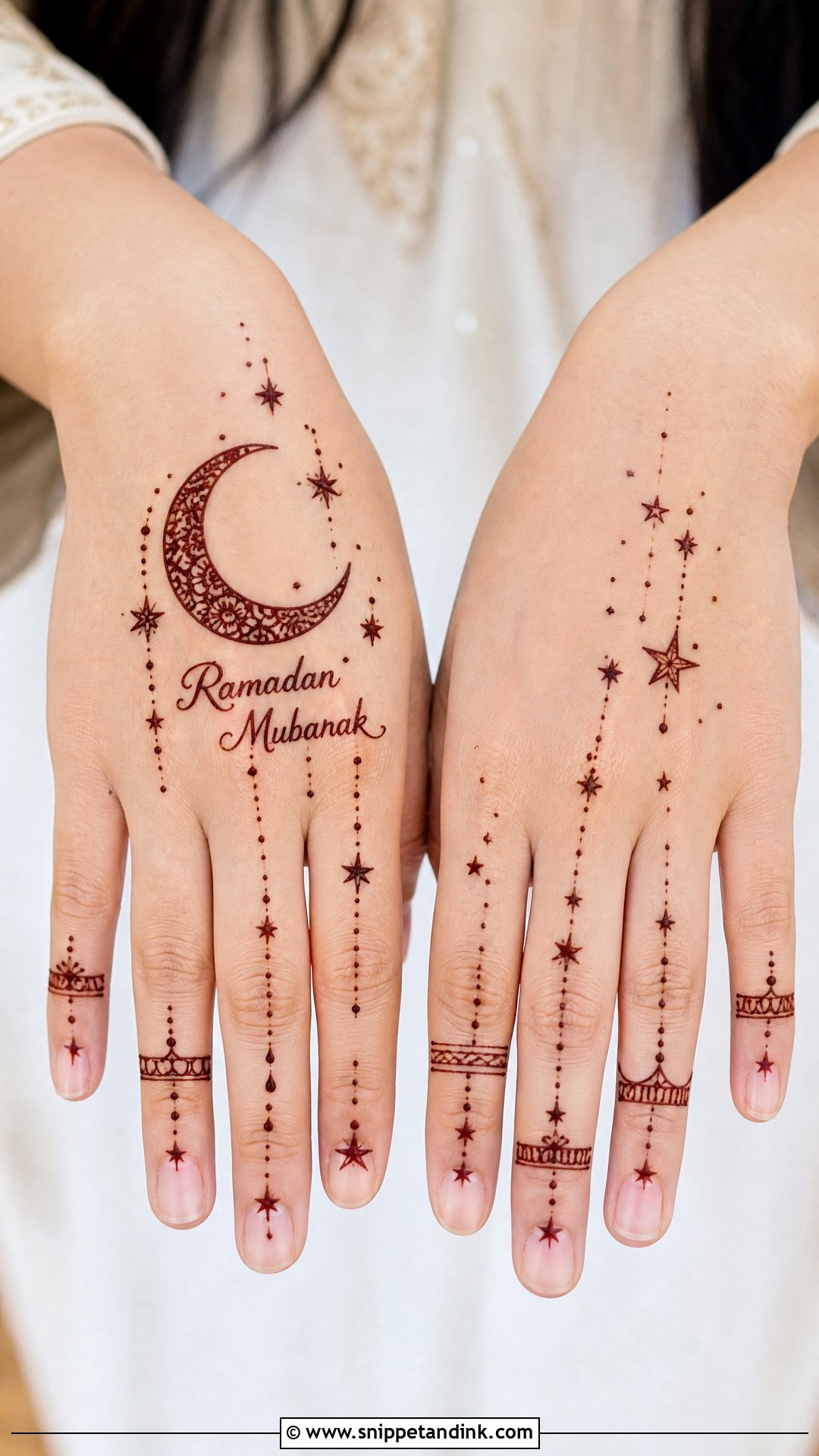
Stars are quick and light, which makes them a favorite with girls and teens on Ramadan nights. Start with a crescent on the back hand, then scatter stars toward the wrist and fingers, linking them with dot trails so the pattern looks planned rather than sprinkled. Five-point stars are harder to draw small than they look, and at fingertip size I often switch to simple four-point sparkles, which stay crisp as the stain develops. Leave the palm clean or give it one small central motif.
14. Ramadan Mubarak Bracelet Mehndi Design
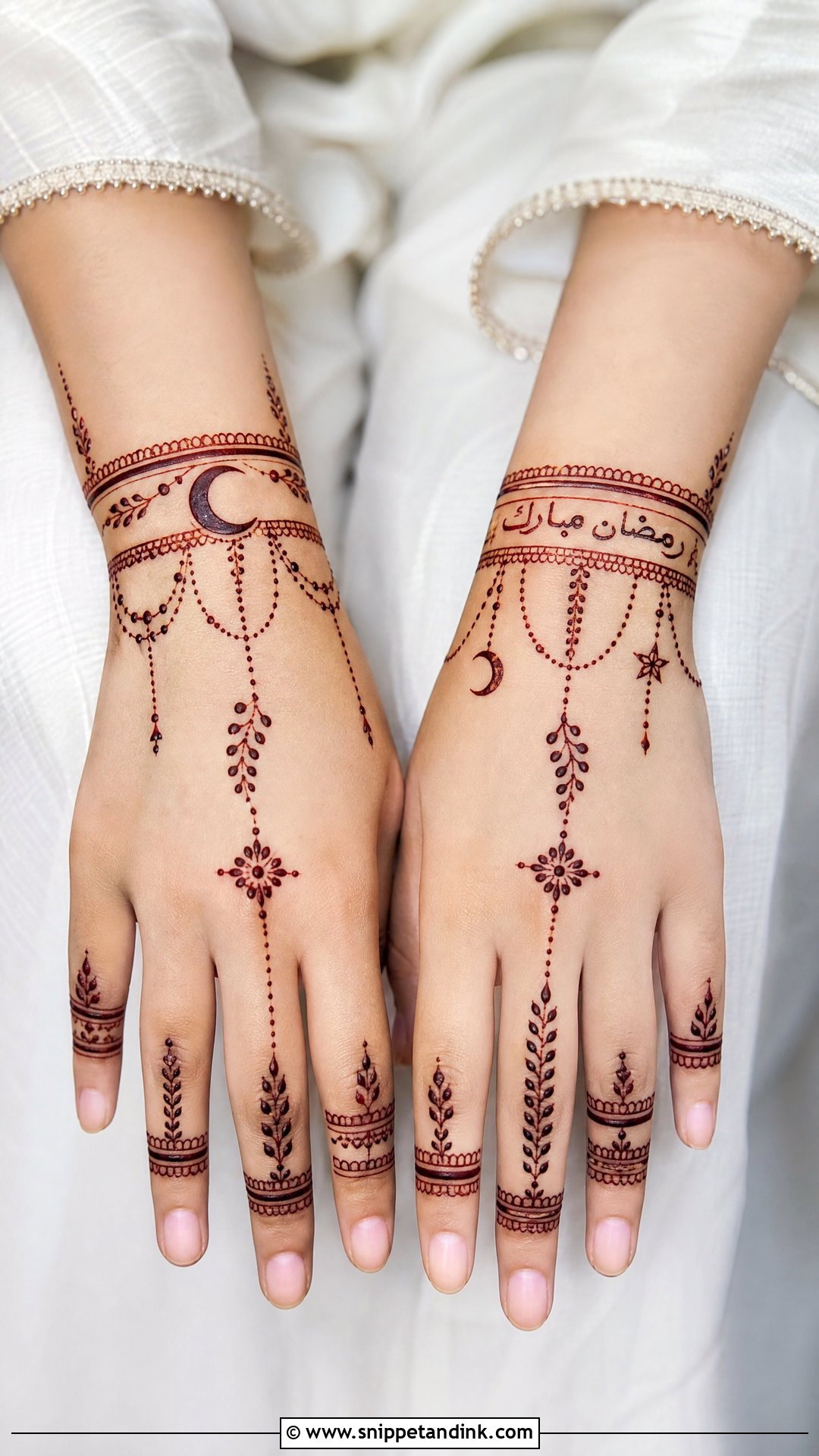
A bracelet design does the job of jewelry. I build a detailed wrist band from florals, bead-like dots and small crescents, then run one slim chain or vine to the middle finger, ending in a small mandala or flower on the back hand. Fingers stay to ring bands and tiny leaves. Because the palm stays bare, it’s practical for work, school or a casual iftar, and it’s the one I offer women who dislike palm coverage. Keep that chain line unbroken; a gap in a single thin line is very visible in the final stain.

15. Ramadan Mubarak Finger Mehndi Design
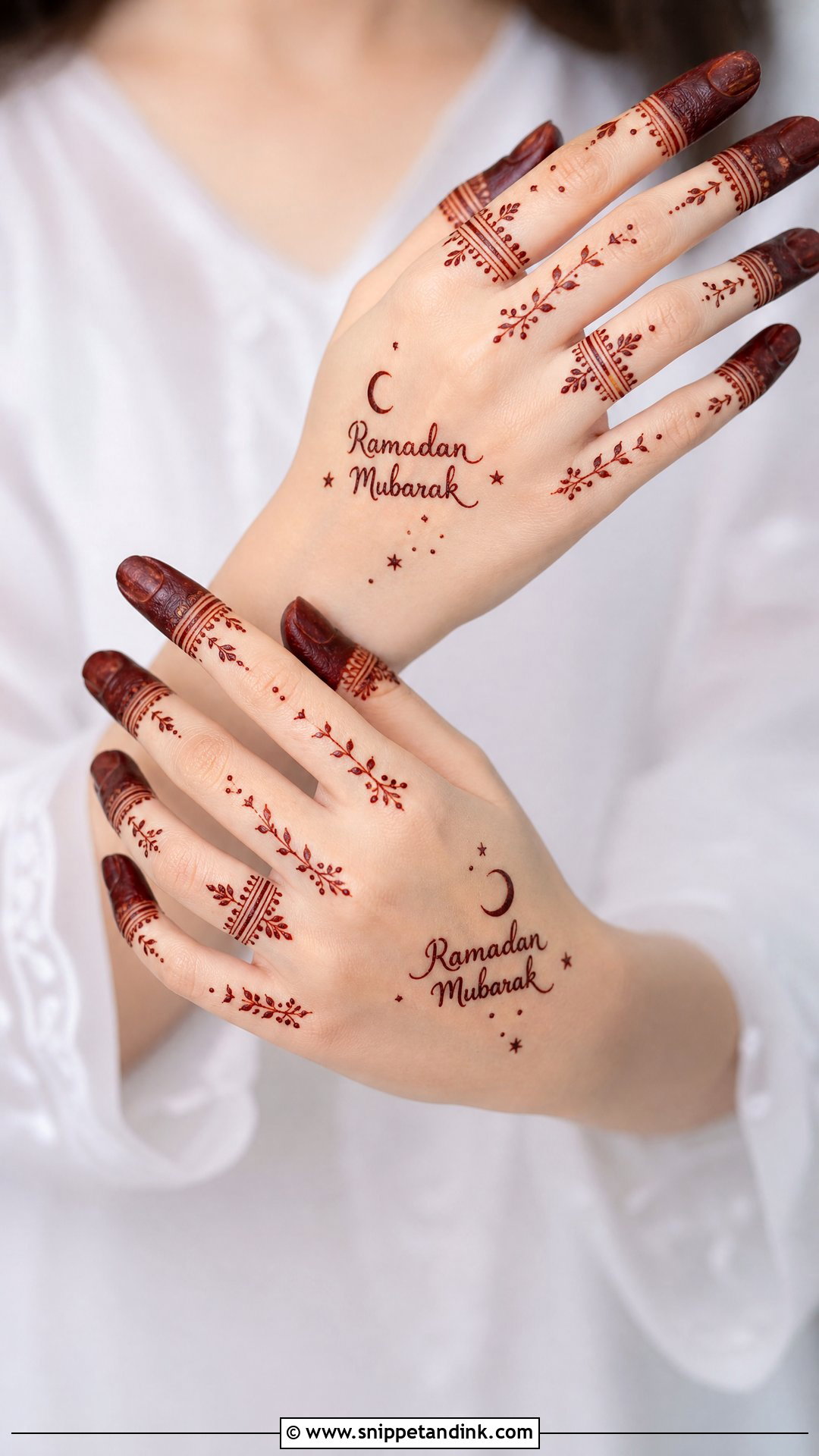
Finger designs are the fastest option here: decorated tips, ring bands, small leafy vines and a tiny crescent or star near the knuckles, with the back hand mostly open or finished by a slim wrist cuff. The trade-off is wear. Fingertips take color very well, but they’re also the part of your hand that gets washed and used most, so the design fades sooner than one on the back of the hand. Still, if an iftar invitation is an hour away, this gives you a festive finish in minutes.
16. Ramadan Mubarak Khafif Mehndi Design
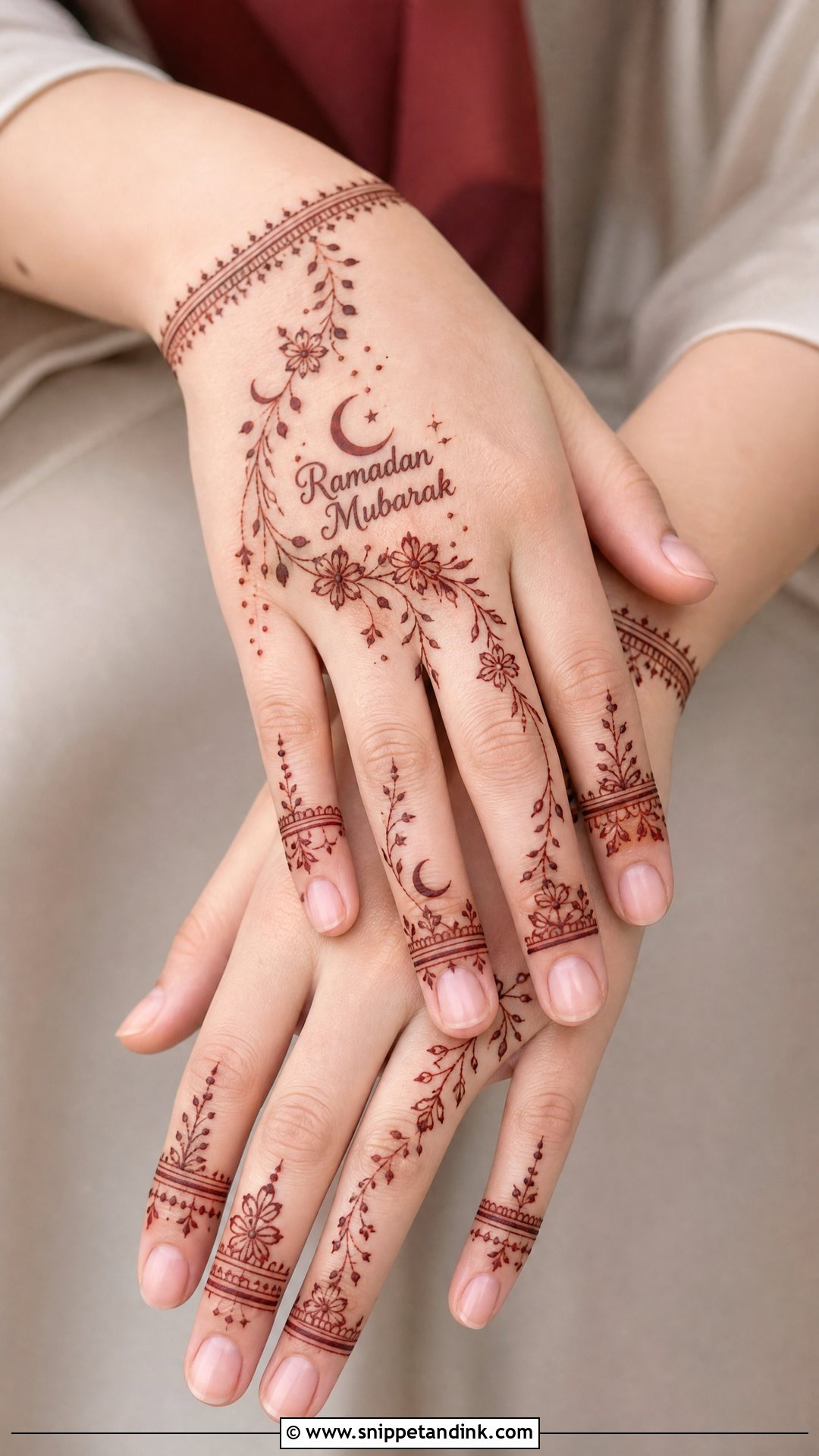
Khafif is the Gulf style built on lightness: fine floral trails, airy leaves, tiny dots and a soft crescent, with plenty of bare skin between each element. The open space is the design, so resist the urge to fill it. A thin wrist border and simple finger bands complete it. I like it for women who find dense layouts too much for an office day in Ramadan or a low-key family dinner, and since it’s quick to draw, the paste can stay on longer while you get on with your evening.
17. Ramadan Mubarak Moroccan Mehndi Design
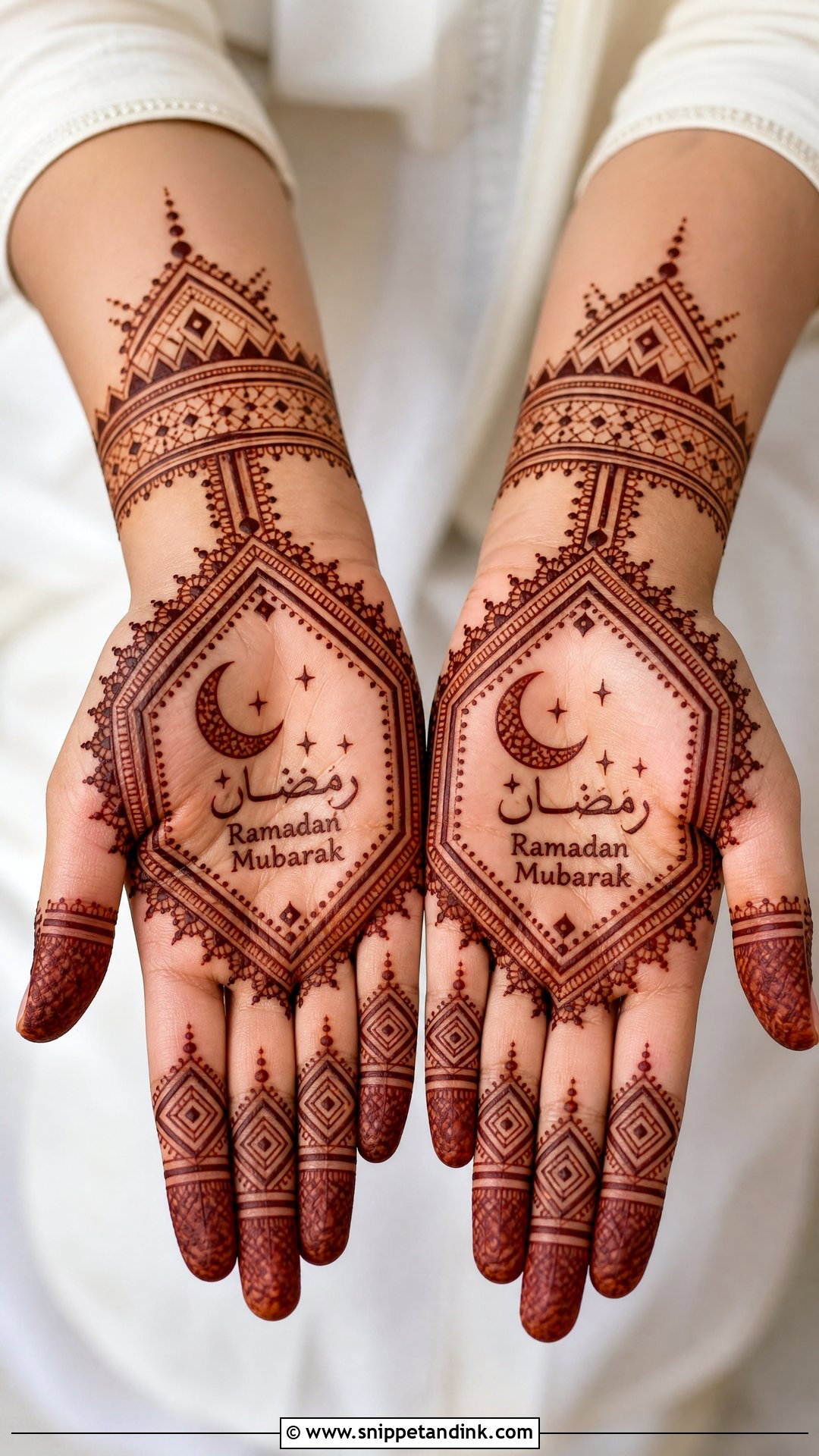
Moroccan mehndi trades florals for geometry: lines, diamonds, triangles, grids, dots and structured borders. In a Ramadan version I frame a crescent or star inside a geometric panel on the back hand, then carry patterned bands across the fingers and wrist, with a symmetrical center on the palm. Straight lines are less forgiving than curves, so I pull them in short, overlapping strokes rather than one long drag. Few people ask for it, which is exactly why it stands out at a gathering full of floral hands.
18. Ramadan Mubarak Palm Mehndi Design
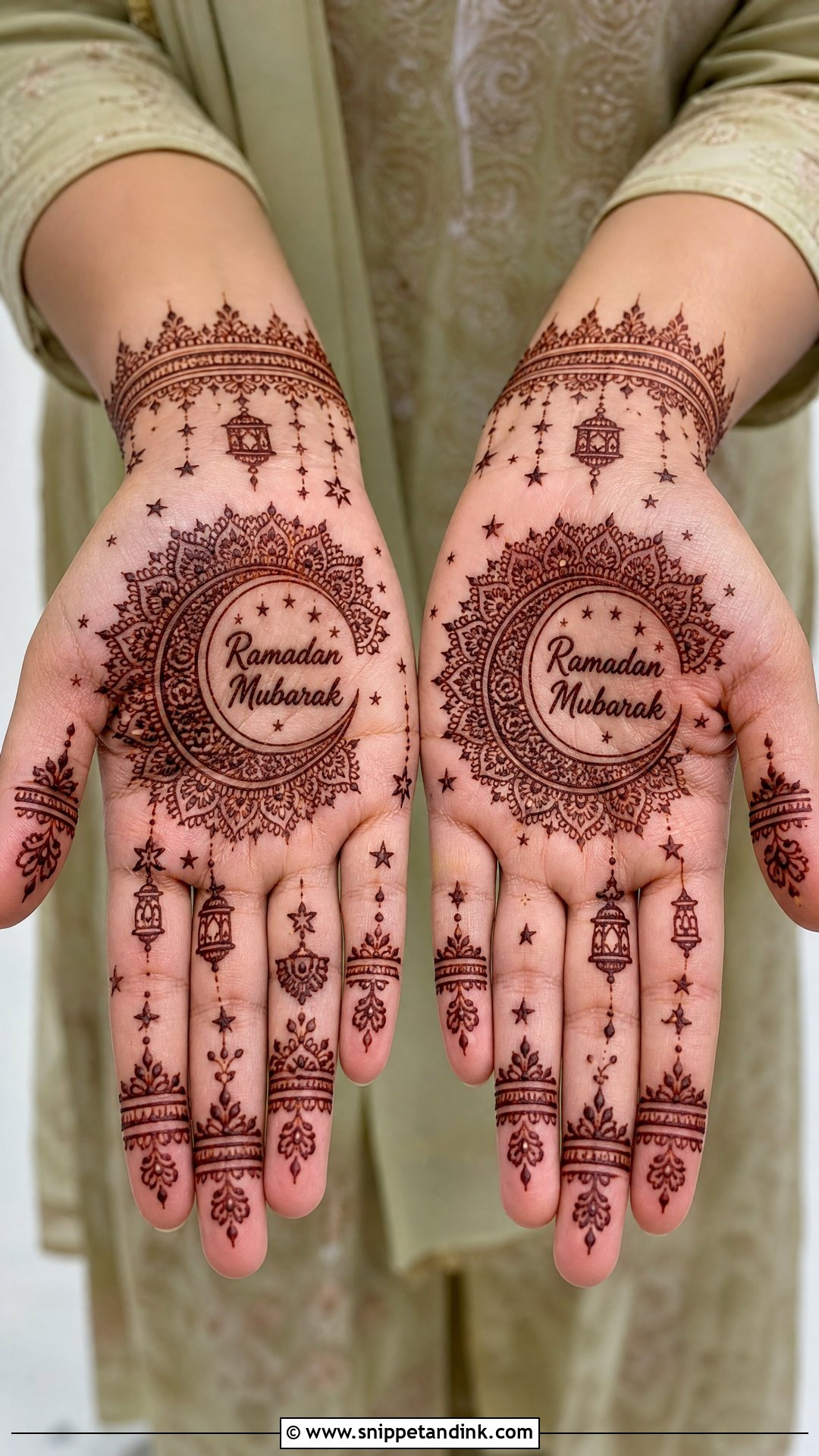
The palm takes the deepest color and gives the widest canvas. I’d fill it with a central crescent mandala, a lantern with floral borders, or a round gol tikki ringed with small stars, then keep the fingers to simple bands, dots and fine leaves. A wrist cuff or a small paisley section near the base of the palm balances the layout. It’s also discreet: close your hand and it disappears, which some women prefer during the working week.
19. Ramadan Mubarak Minimal Mehndi Design
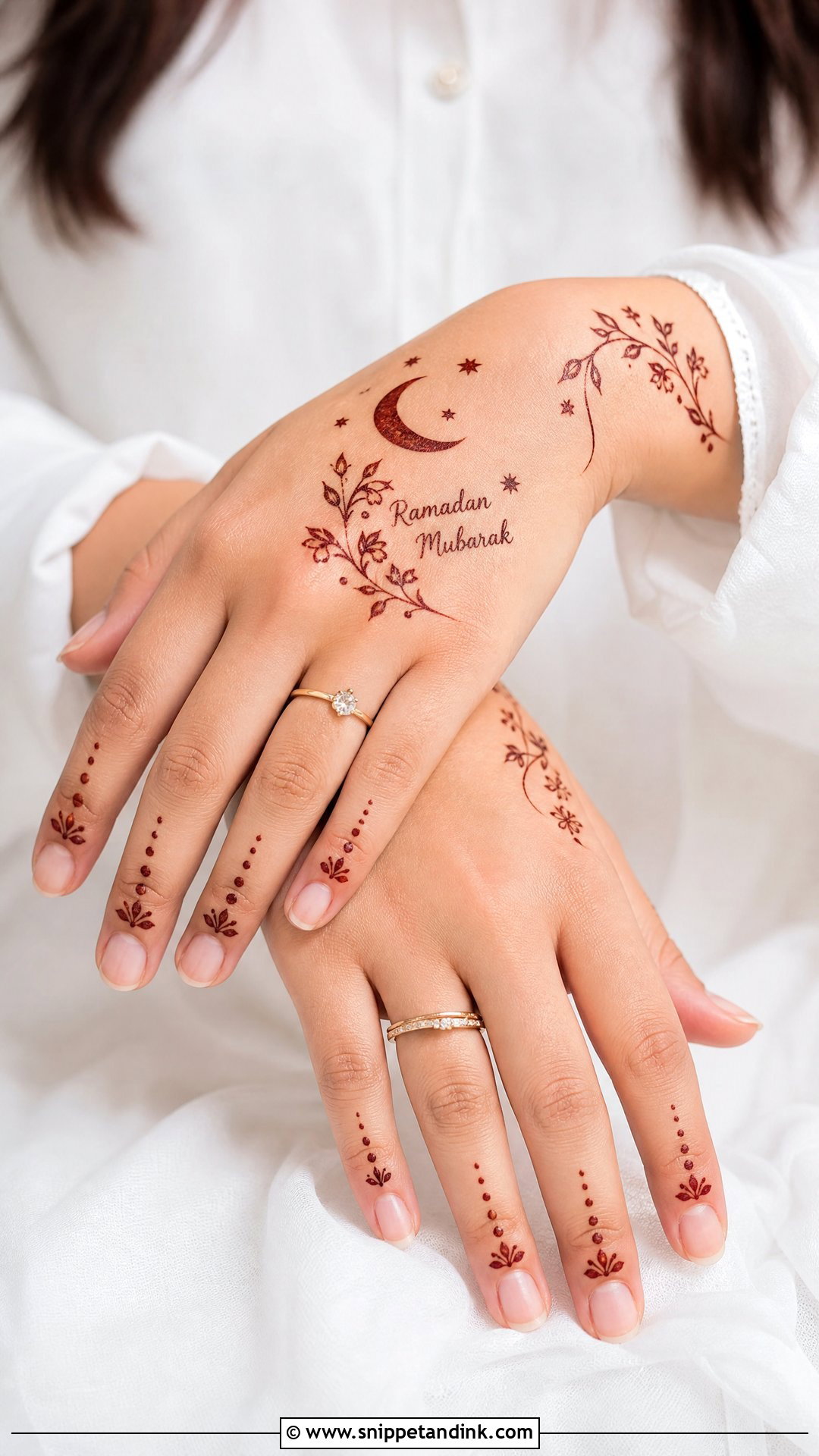
Minimal designs depend on placement more than detail. One tiny crescent, a few stars, a small floral vine and light finger bands are enough, usually on the back hand or along the side of the palm where the design has room to breathe. Don’t add filler to make it feel finished; the bare skin is part of the look. It suits beginners and children, and anyone after soft henna that doesn’t feel formal next to everyday Ramadan clothes.
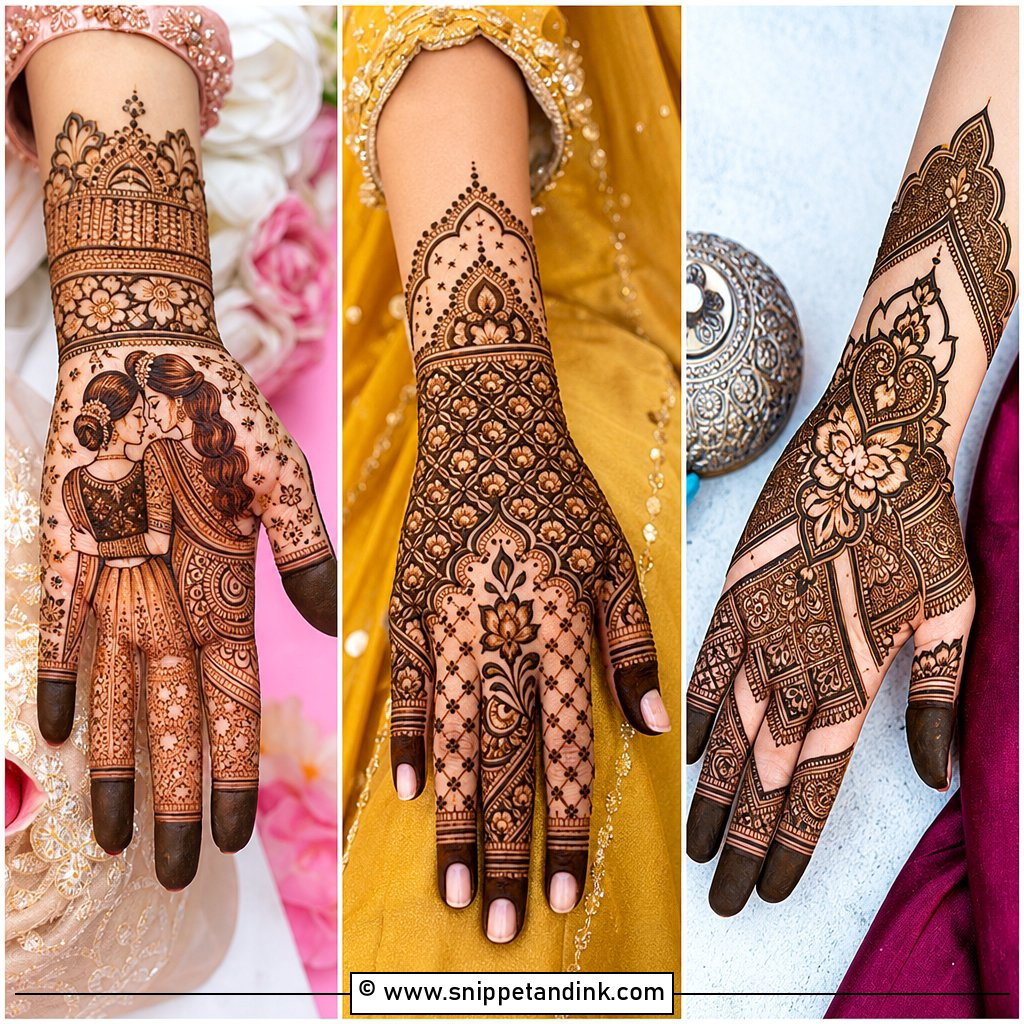



20. Ramadan Mubarak Eid Mehndi Design
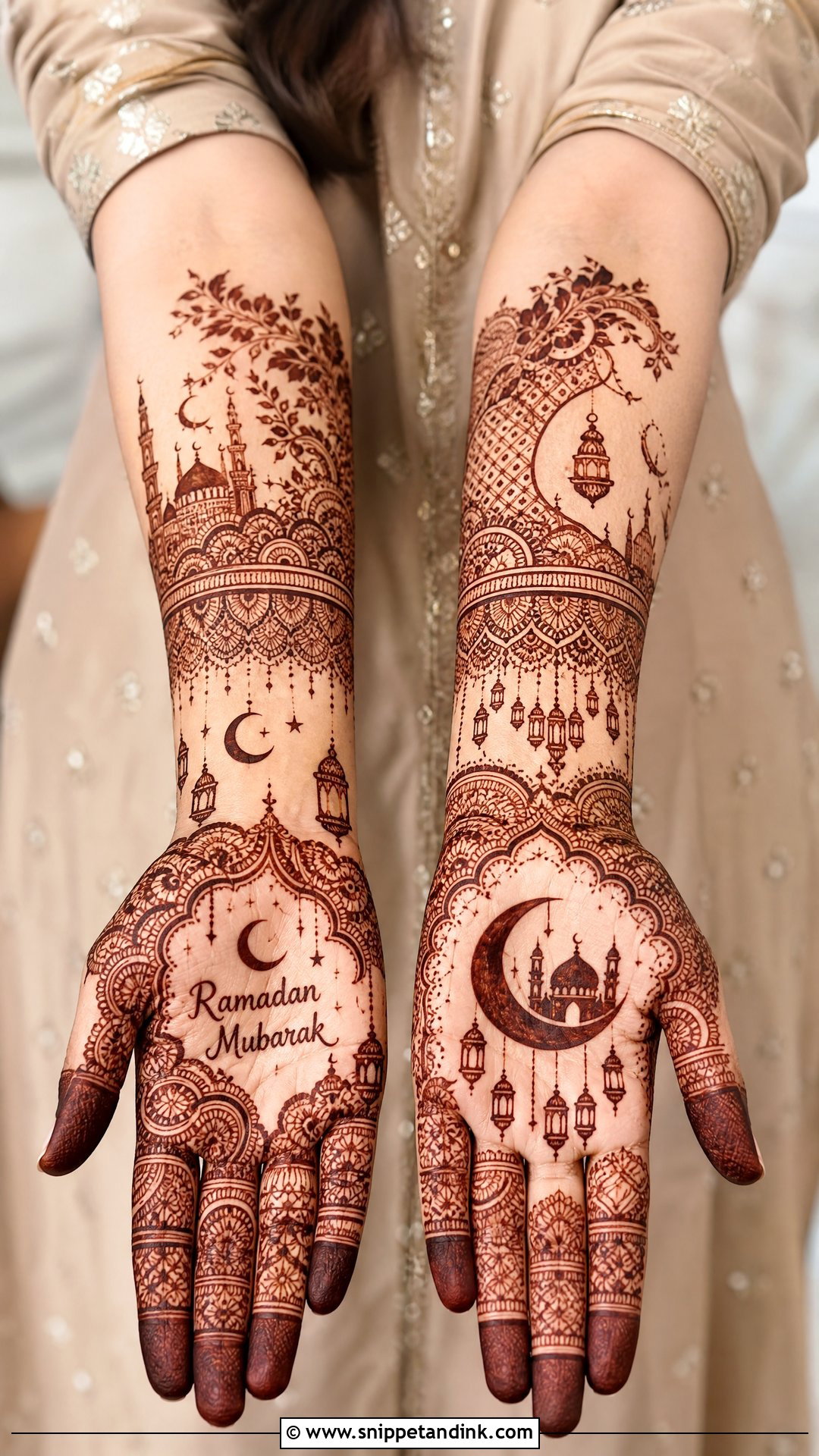
An Eid design can be fuller than anything you’d wear midway through the month while keeping its Ramadan motifs. I combine crescents, lanterns, florals, paisleys and bracelet detail across the front or back hand, with denser fingers and wrist so the hands read clearly in family photos. Even in a busy design, leave a clean margin around the main motif so the stain stays sharp. This is the one people book for Chand Raat and the final nights of the month, which is exactly when the timing of the paste matters most.
Getting the Stain to Peak on Eid Morning
Henna doesn’t show its final color when the paste comes off. It starts bright orange and darkens to a reddish brown over the next one to two days as the dye oxidizes in the skin. That’s why Chand Raat mehndi often looks orange in the first Eid morning photos and only deepens by the afternoon.
If Eid morning is what you care about, apply your main design one or two nights before Chand Raat. The moon sighting decides which night is the last, so plan around the earlier of the two possible dates. Chand Raat itself can then be for a small top-up, like fresh fingertips or a new wrist band.
- Skip soap and long hand washing for the first day; hot water and scrubbing lift color before it has settled.
- Keep your hands warm. Warmth helps the stain develop, which is why some families hold freshly scraped hands over clove steam.
- After washing, pat dry and rub in a little natural oil or balm so the newest color isn’t stripped.
- Avoid chlorine pools and bleach-based cleaners while the design is fresh; both fade it quickly.
Market Cones, Fresh Paste and the Black Henna Problem
Ramadan bazaars fill up with ready-made cones, and they aren’t all the same product. Natural henna paste is made from dried henna leaf powder, an acidic liquid such as lemon juice, sugar and essential oil, and it’s usually kept chilled or frozen because it loses strength within days at room temperature. A cone that has sat on a warm shelf for months and still stains dark brown in twenty minutes almost always has a chemical dye in it.
The one to refuse outright is so-called black henna, which is often colored with PPD, a hair dye chemical that can cause blistering and long-term skin sensitivity, particularly in children. Natural henna never stains black. If you’re unsure, ask what’s in the cone, look for an ingredient list, and test a small dot on the inner arm a day before committing to a full design.
Small Motifs for Weeknights, Fuller Hands for Eid
Across these twenty designs, the choice usually comes down to how much time and stillness you have. On an ordinary fasting evening, a crescent, a few stars or a bracelet wrist will dry before Taraweeh. For Chand Raat and Eid, full palms, jaali and Indo-Arabic layouts justify the longer sitting. Whichever you pick, keep the lines clean, leave space around the motif that matters most, and let the paste stay on long enough to do its work. A careful small design looks better on Eid morning than a rushed big one.
You'll Like These Ideas:









Leave a Reply