
Henna marks the occasion before anyone has seen the outfit. It’s on your hands at the mehndi night, during the rituals, in the ring shots and for a week or two afterward. The thirty-five designs below cover full bridal coverage, simple back hand work, Arabic trails, mandalas, jewelry-style layouts, jaali and modern minimal henna, for weddings, Eid, Diwali, Karwa Chauth, engagements and ordinary weekends. I’ve written each one the way I’d explain it across the table at a booking: how it’s built, where it stains well, which hands it suits and what I’d change.
Fitting Mehndi Into the Rest of Your Beauty Schedule
Henna doesn’t like water, scrubs or lotion in the hours after it comes off, so the order of your other appointments matters. This is the sequence I suggest for brides with mehndi one to two days before the wedding.
- Waxing, threading and any exfoliating treatment on the hands, arms or feet: a few days before the mehndi. Doing them after would scrub away fresh color.
- Manicure and pedicure: before the mehndi, not after. Soaking and cuticle work on a fresh stain fades it, and henna can tint bare nails orange. A gel or regular polish applied beforehand protects the nail plate.
- Wash and dry your hair the morning of the mehndi. You won’t want to do it for a while afterward.
- Facials and makeup trials don’t affect the hands, so those can be scheduled around everything else.
On the day itself, arrive with clean, dry skin and no lotion or oil on the areas I’ll be working on. Wear something loose with short or easily rolled sleeves, and eat before you sit down. Once both hands are covered, you won’t be feeding yourself for a while.
1. Simple Mehndi Design For Front Hand
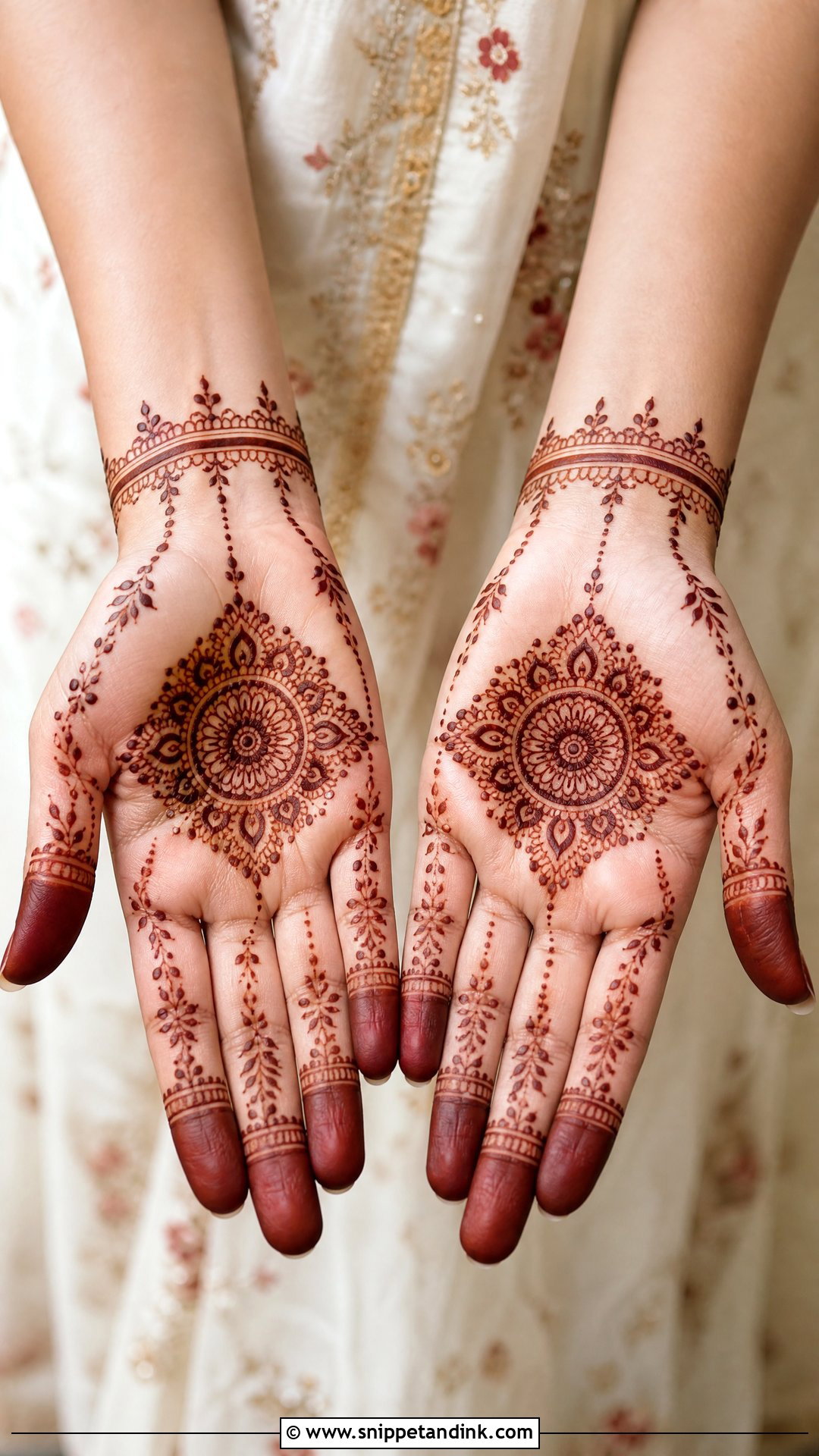
A small mandala or floral center, neat finger patterns and a light wrist border. Most of the palm stays open, which suits smaller hands, since a crowded palm makes a small hand look even smaller. I keep the lines thin and the spacing even, then cap the fingertips so it looks finished. It takes very little time, which is why it’s my default for school functions and festive mornings when everyone is rushing.
2. Simple Mehndi Design For Back Hand
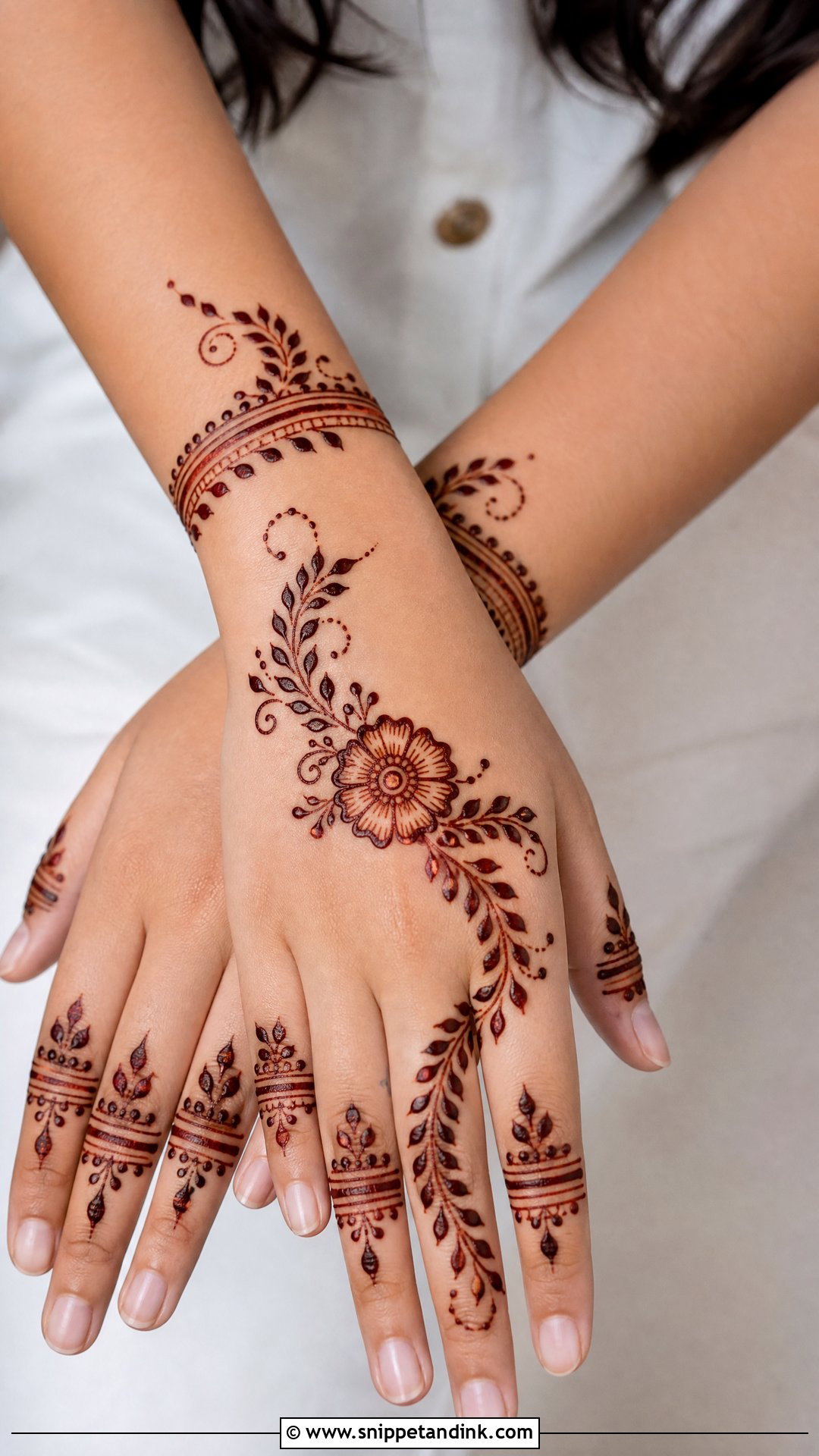
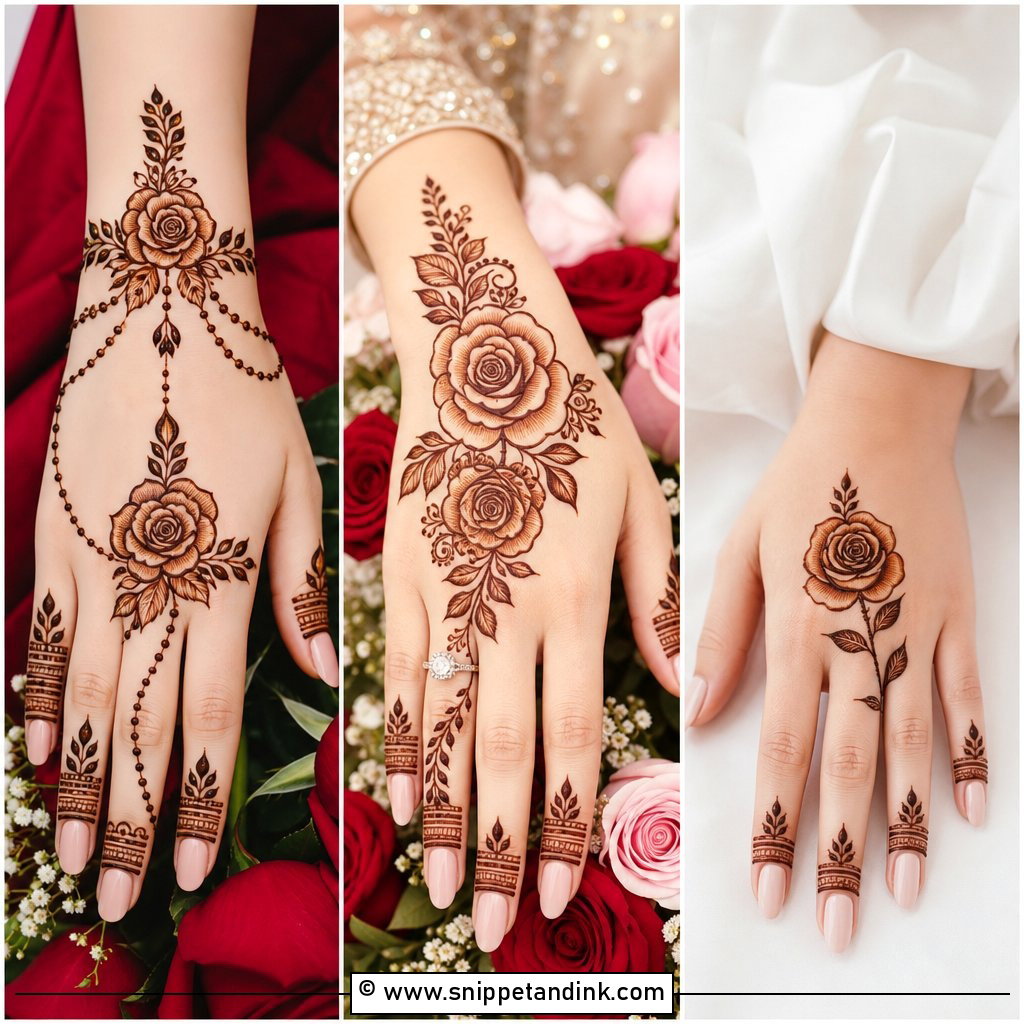
The back of the hand is the side people actually see, so even a simple design here earns its keep. One bold flower near the center, a diagonal leafy trail, light finger detail and a bracelet band at the wrist is enough. The diagonal does something useful: it draws the eye along the hand and makes short fingers look longer. Tiny dots around the flowers add finish without adding time. Expect the color to come out softer than on the palm.
3. Arabic Mehndi Design For Hands
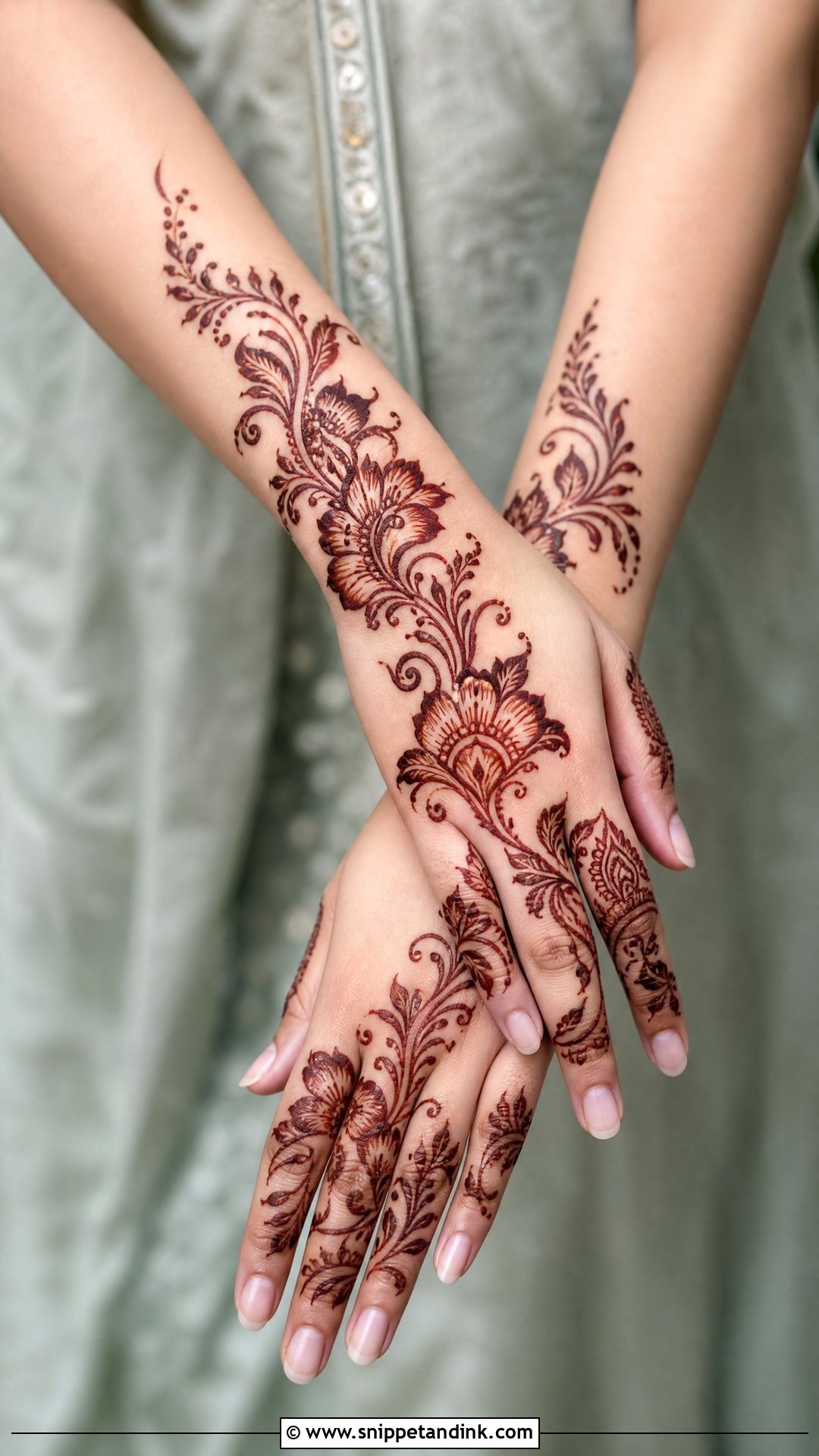
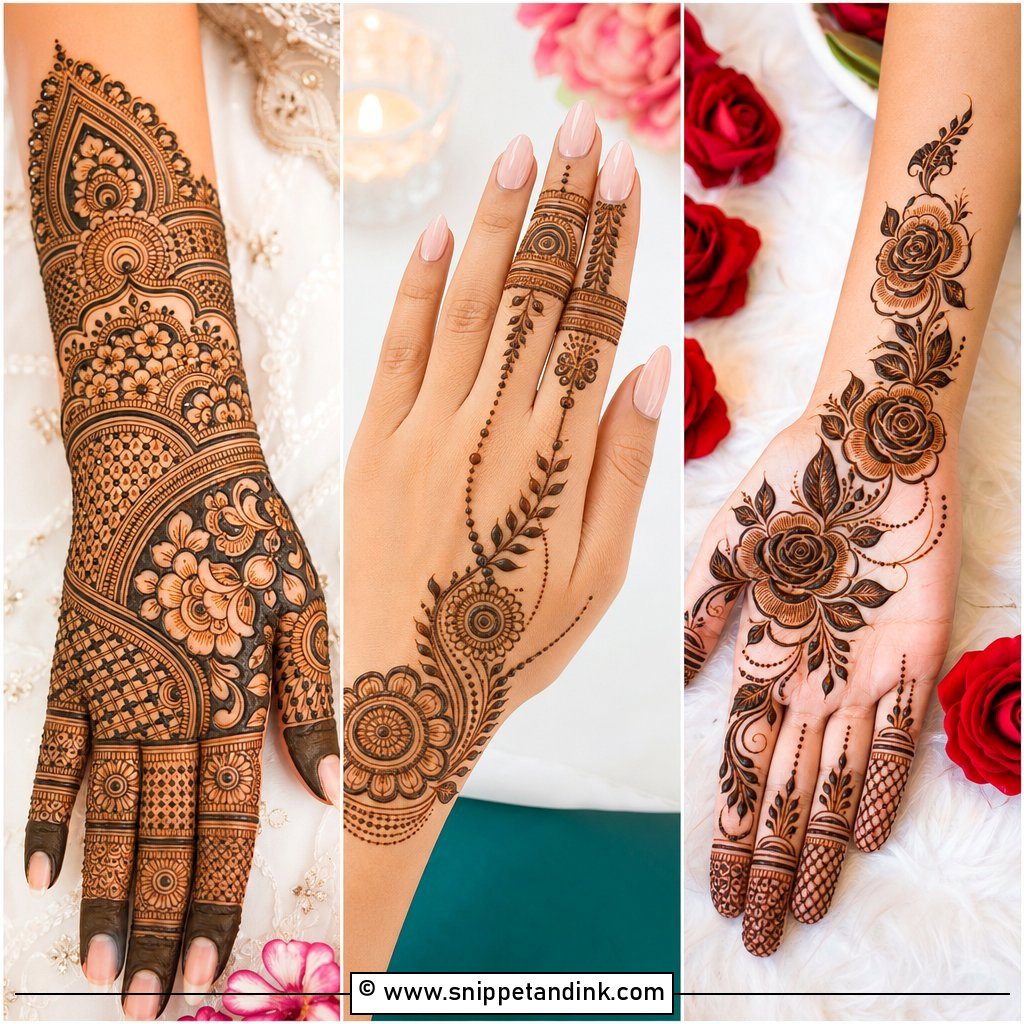
A full Arabic look starts at the wrist, crosses the back of the hand diagonally and ends on the index or middle finger, with large flowers, leafy stems, paisleys and shaded petals. The contrast does the work: thick outlines for the main motifs, fine strokes inside them, and open skin between. I switch to a slightly wider cone tip for the outlines. It’s quick enough for Eid and party season, and the open gaps let the stain stand out clearly.
4. Indian Bridal Mehndi Design
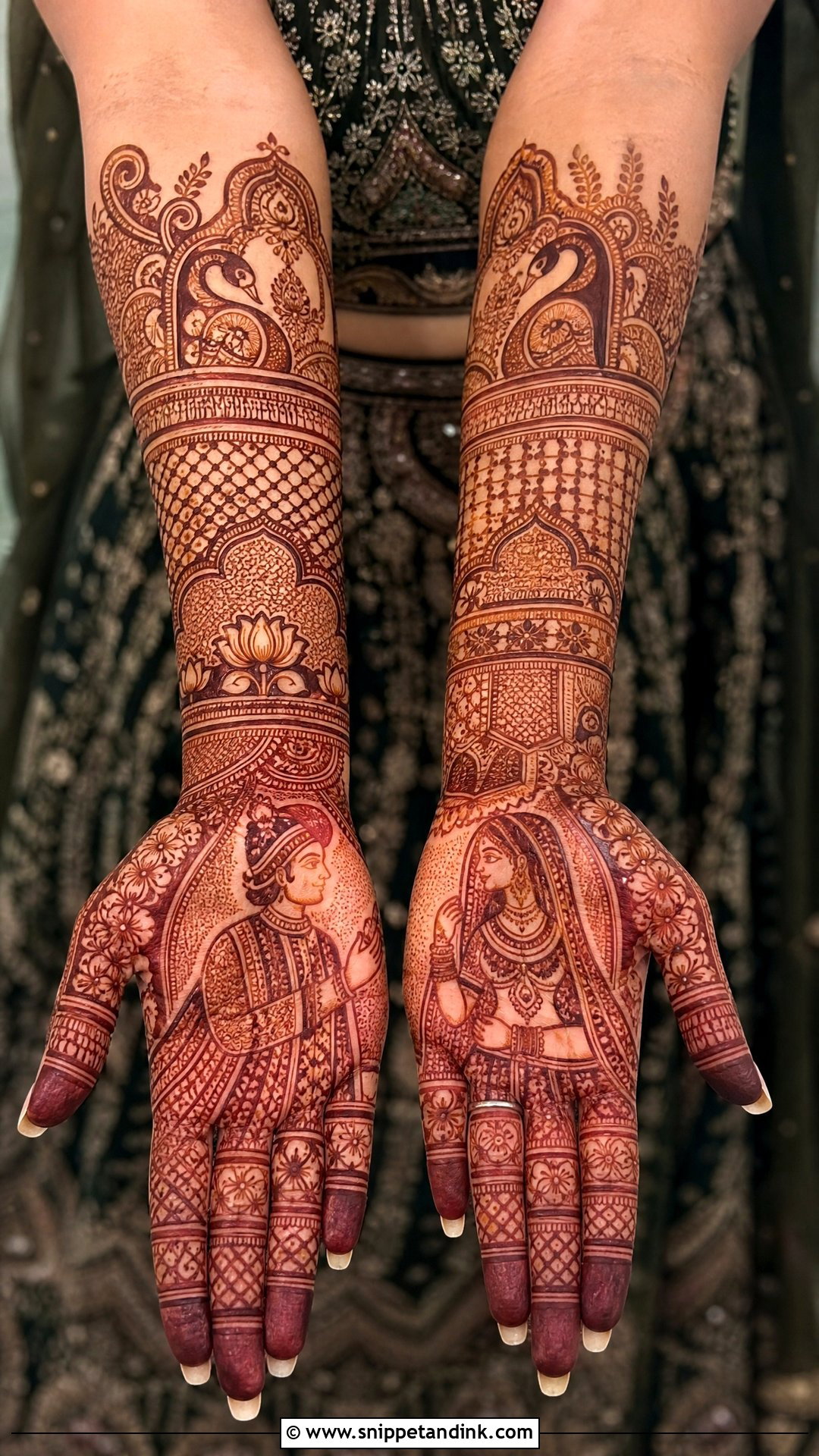
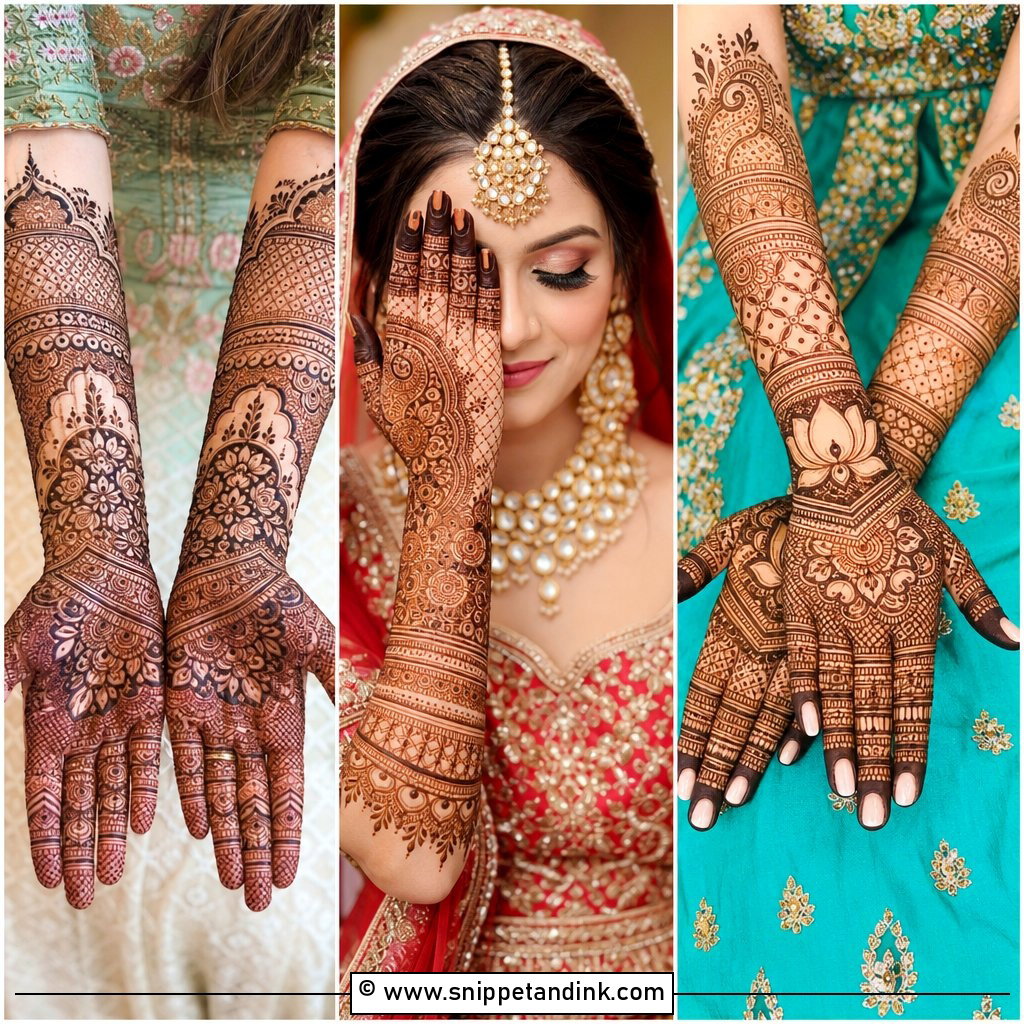
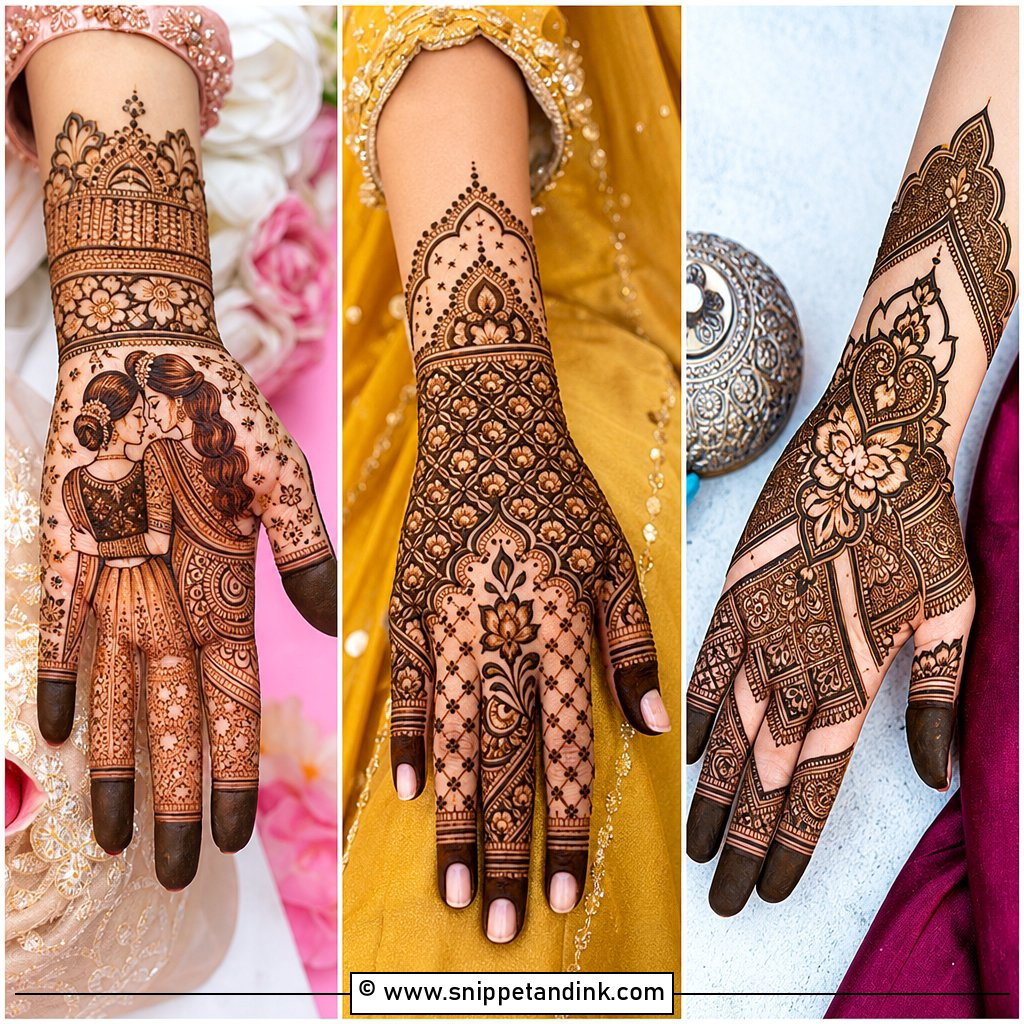
Indian bridal work covers palms, back hands, wrists and forearms with paisleys, peacocks, lotus, jaali, bride and groom figures and fine filler, often with initials or a date hidden inside. It’s a long sitting. I put the storytelling motifs on the palms, where the stain is deepest and the detail shows best, and give the back hands mandalas, jewelry patterns and finger panels. The two hands should be coordinated but not copies; small differences make it look handmade rather than printed.
5. Full Hand Mehndi Design
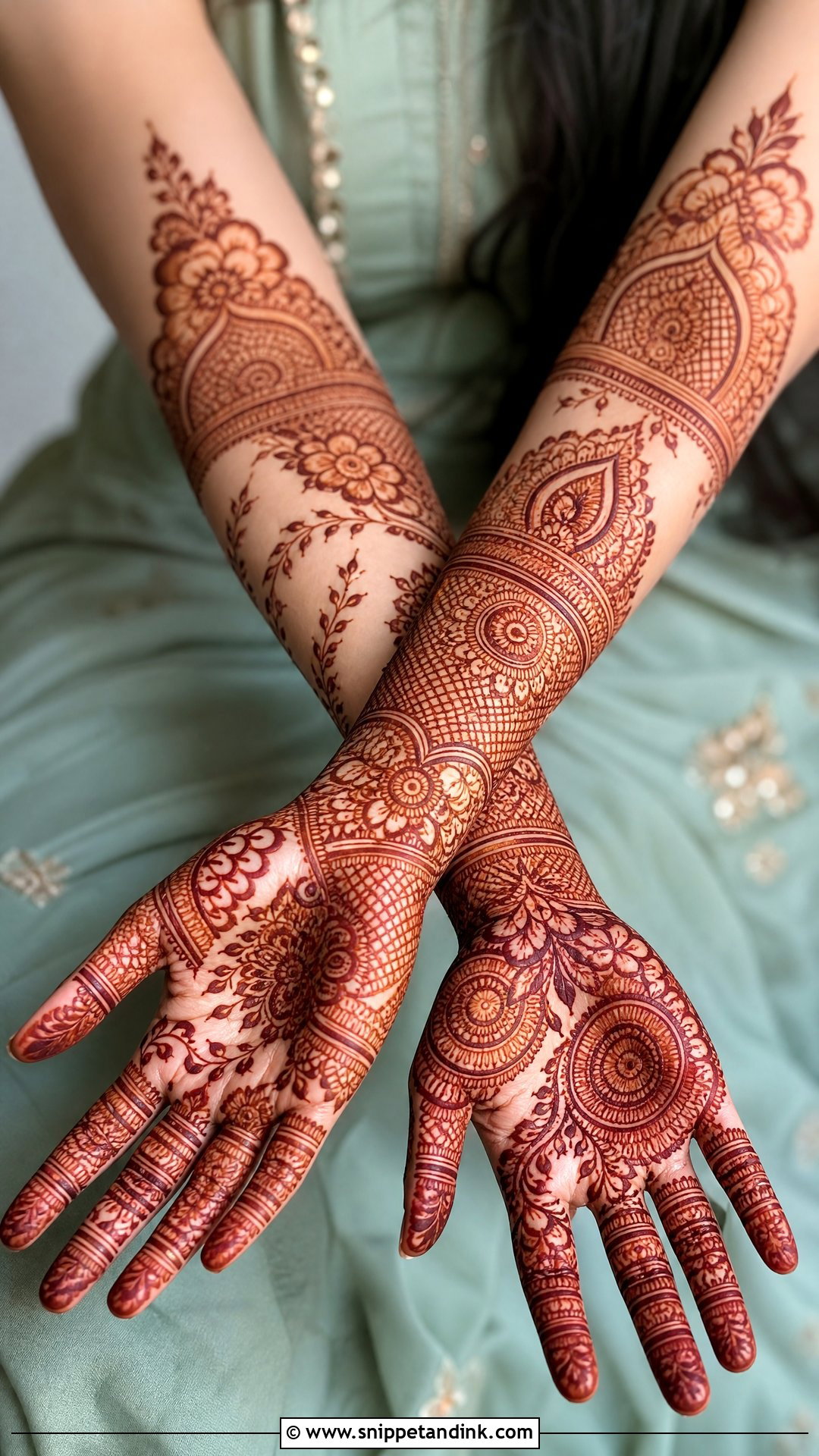
This sits between a guest design and full bridal coverage: fingers, palm, wrist and forearm in one connected flow of florals, paisleys, mandalas, leaves and mesh, arranged in clean bands. Larger motifs go on the palm and forearm, with smaller filler around them. I leave deliberate gaps between the bands. Without them, a full-hand design can stain so evenly dark that the pattern disappears from a few feet away.
6. Back Hand Mehndi Design
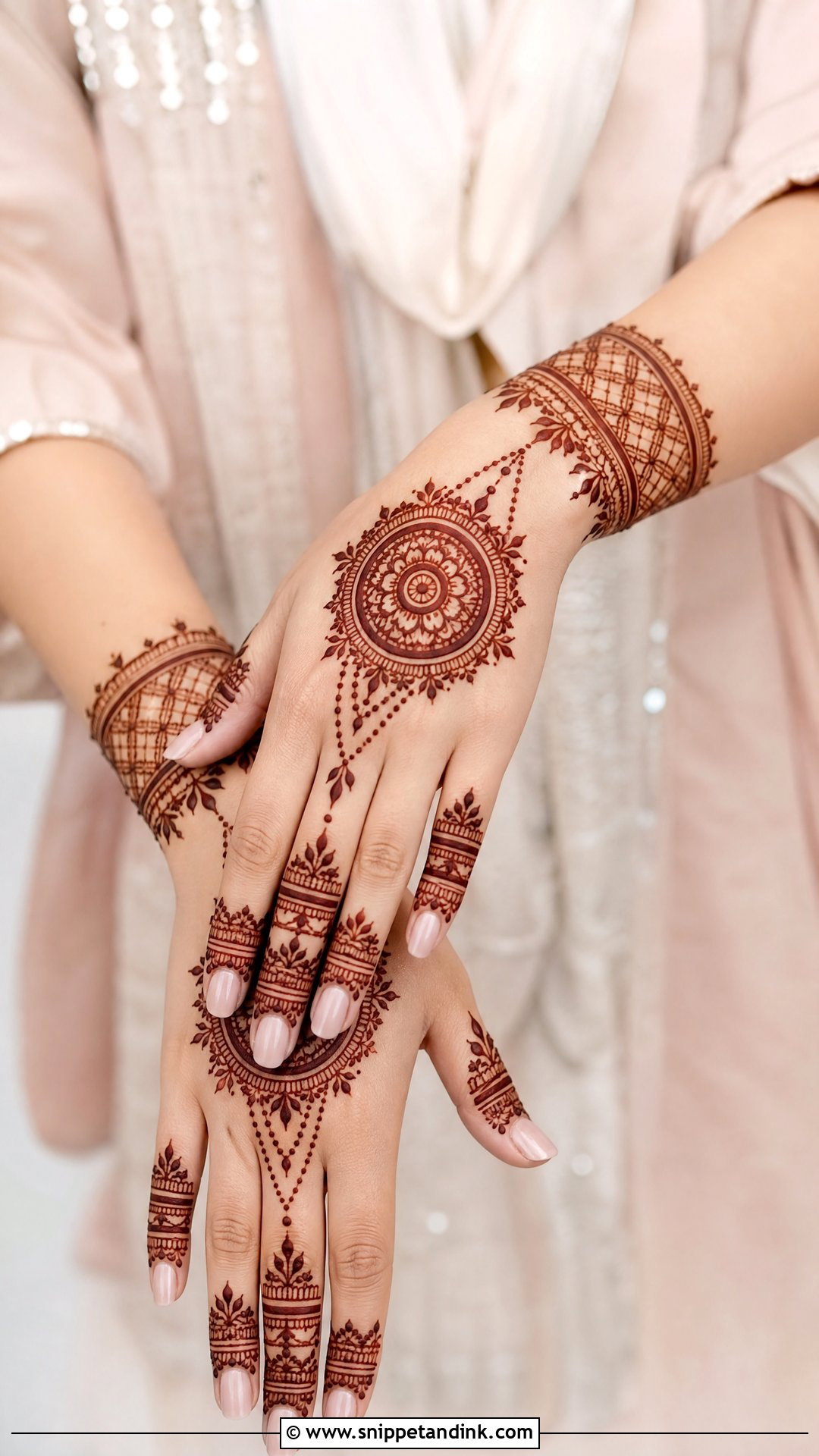
A central mandala connected to ring-style finger patterns and a wrist cuff turns the back of the hand into something like jewelry. Thin chains, dot strings, tiny leaves and curved borders tie the parts together. For a minimal version, keep the center small. For a heavier one, carry the cuff toward the forearm and fill the fingers with fine geometric detail. I draw the cuff first, since it’s the anchor everything else hangs from.
7. Front Hand Mehndi Design
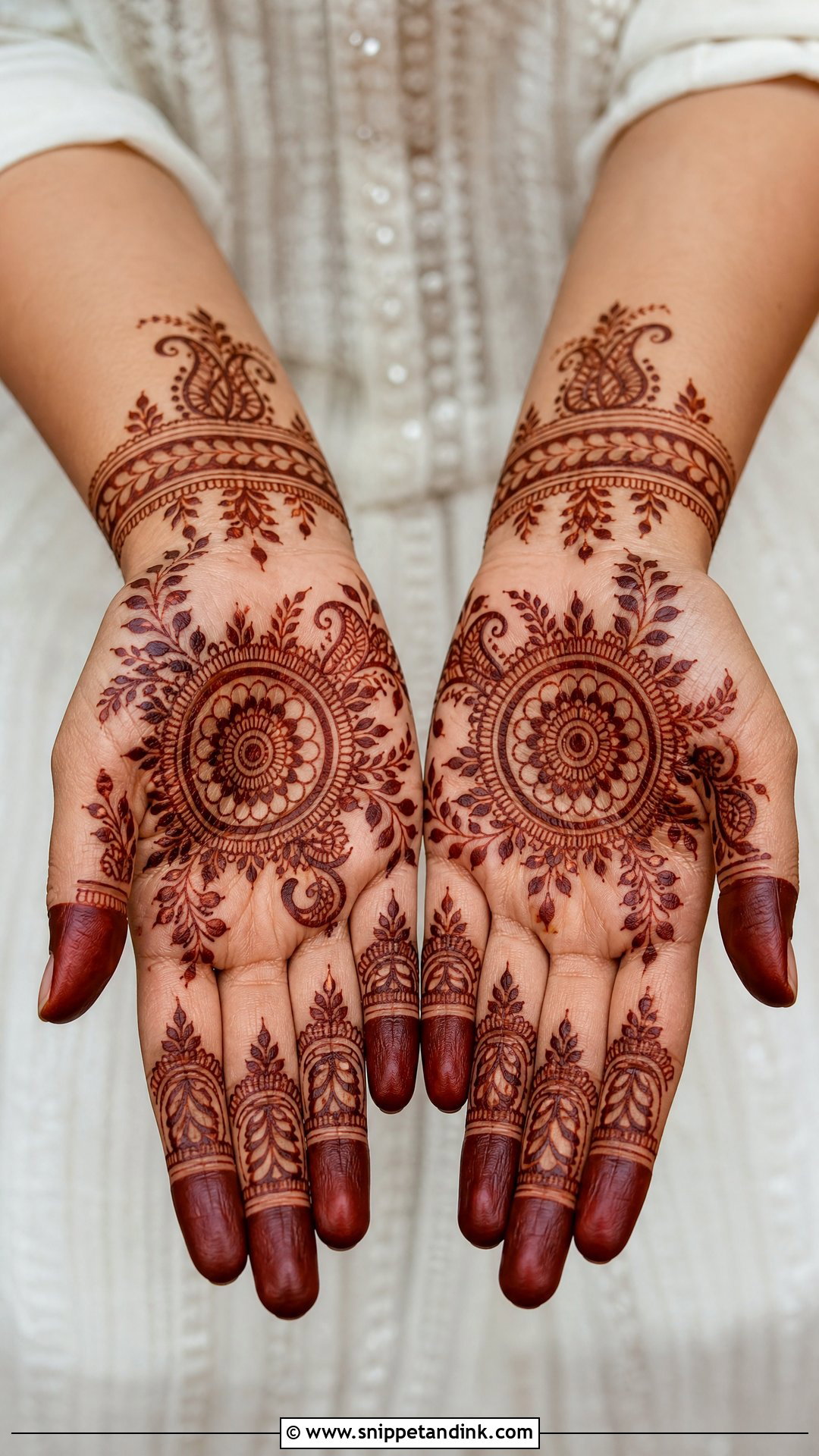
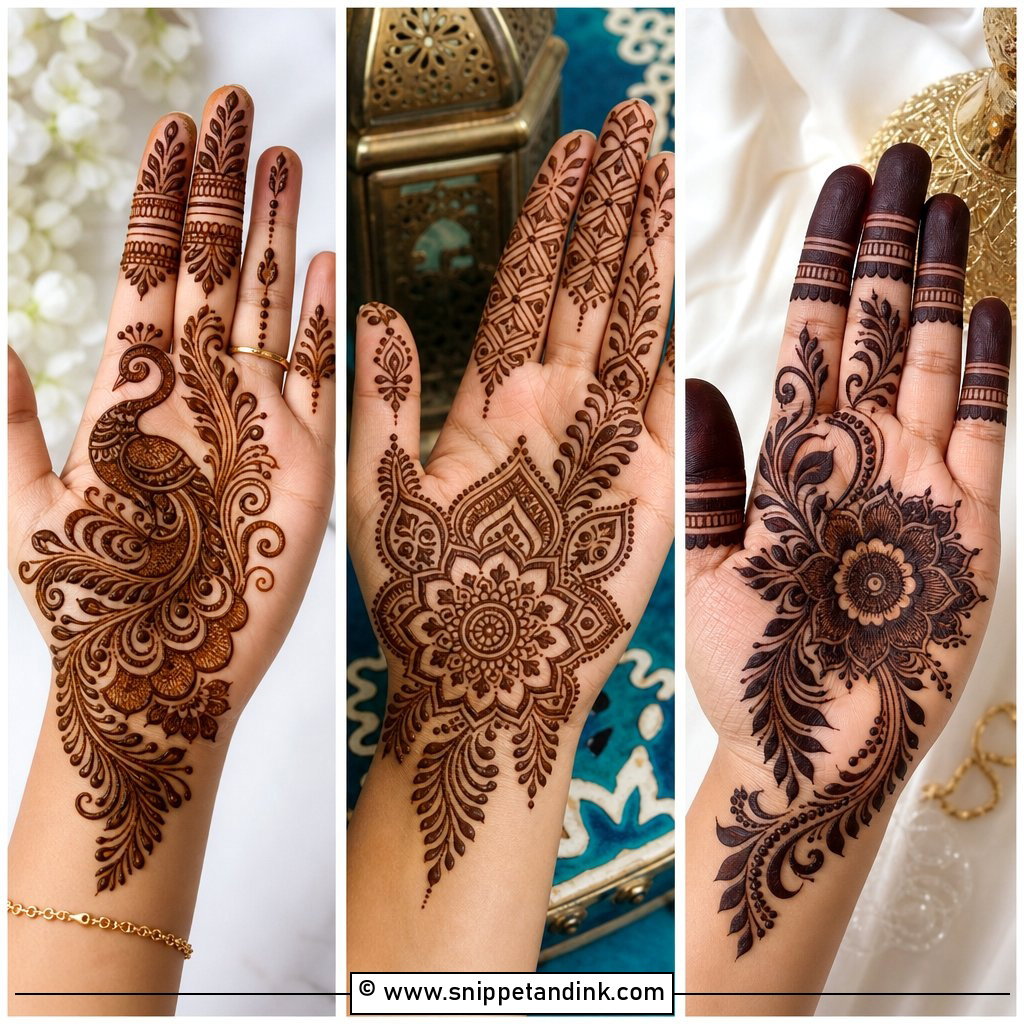
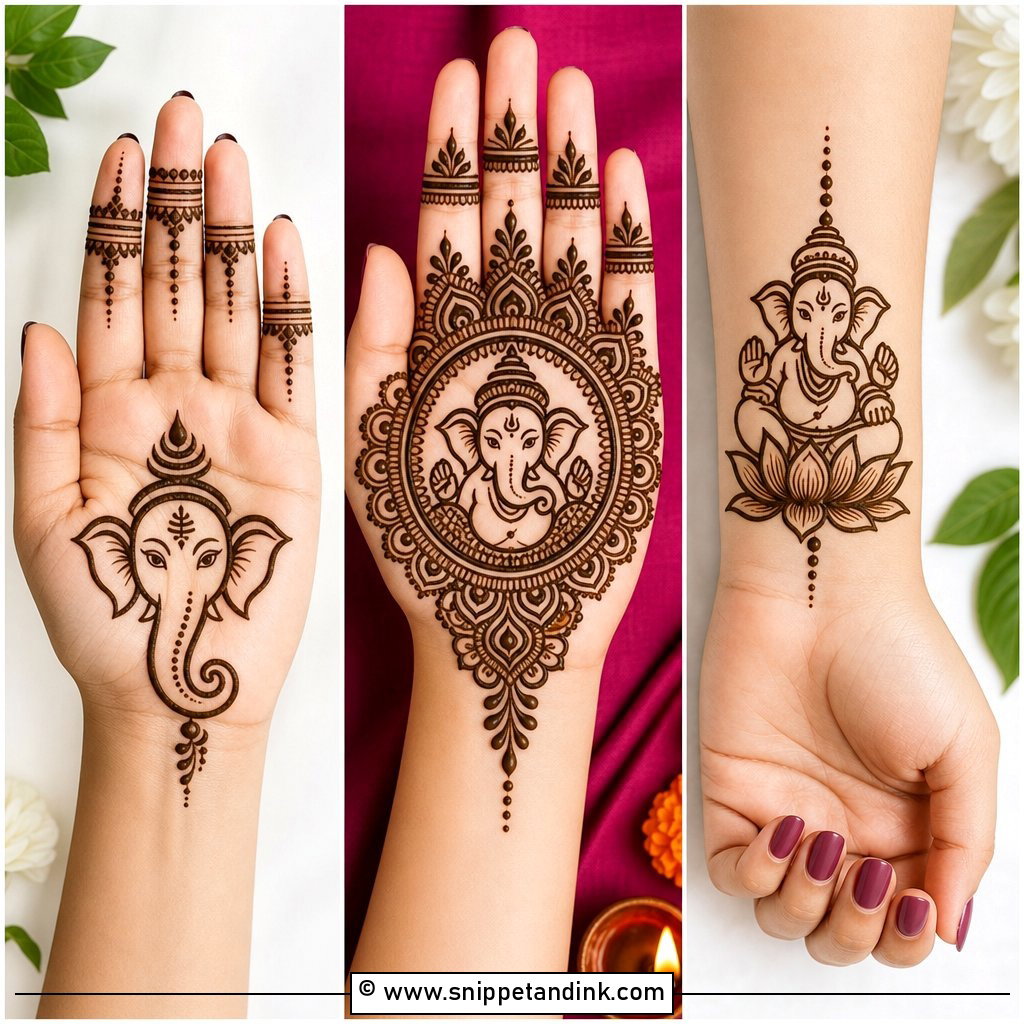
The palm gives me the widest canvas and the darkest color, so a large mandala surrounded by paisleys, vines and finger panels looks rich even when the detail is simple. Fingertips take classic henna caps; the wrist takes a bracelet border. I keep the finger patterns aligned across all four fingers and use only two or three motif sizes. Mixing too many sizes in one area is what makes a palm look messy.
8. Bridal Mehndi Design Full Hand
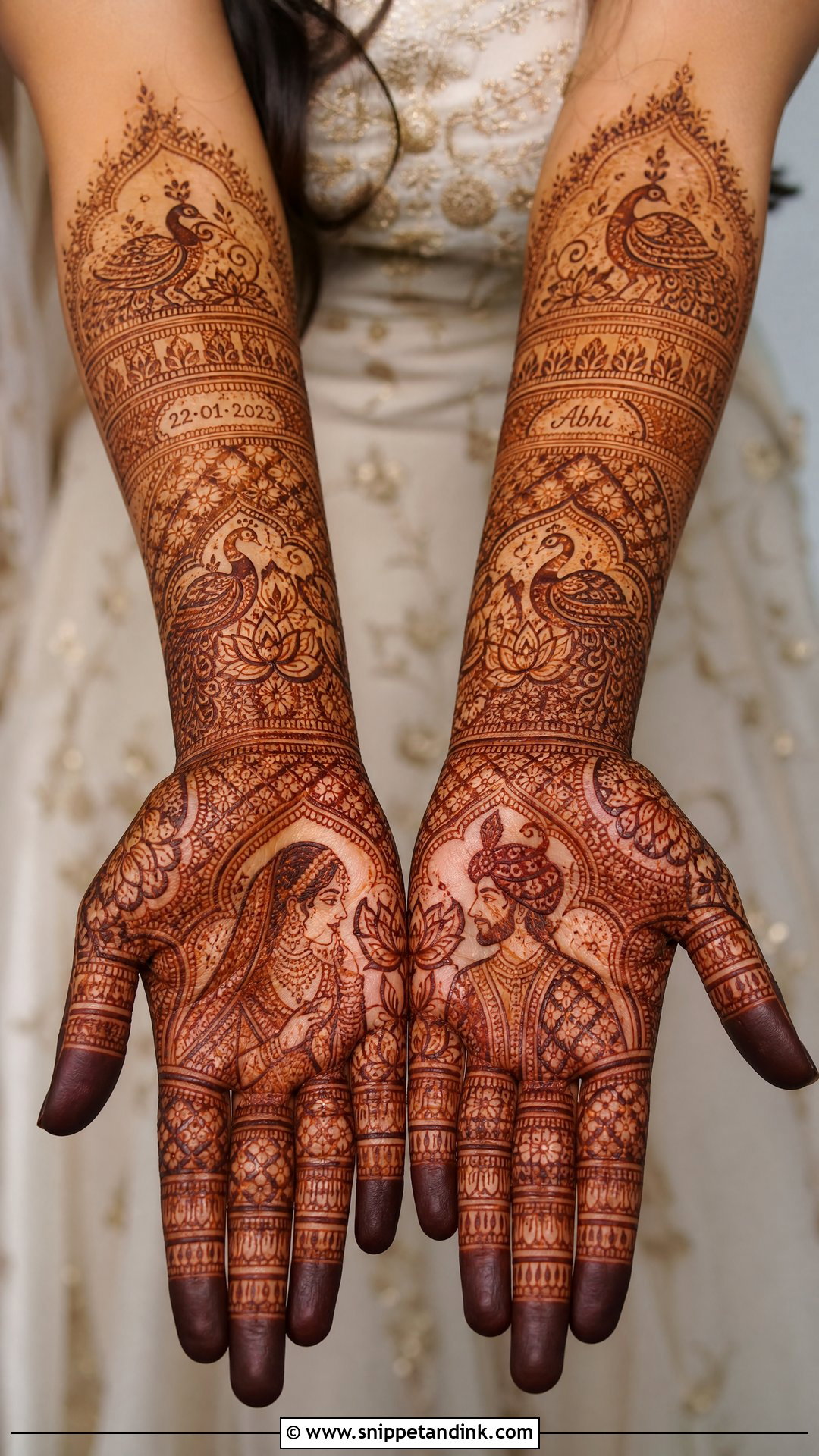
Bridal mehndi design full hand runs from fingertips to forearms, sometimes nearly to the elbow, with portraits, peacocks, lotus, paisley chains, temple borders and personal details. I plan it in sections before drawing: the palms carry the main story, the back hands carry ornamental mandalas and the forearms carry wide decorative panels. Fine filler gives depth; bolder outlines keep it readable in photos and on video, where fine detail is the first thing to disappear.
9. Modern Mehndi Design
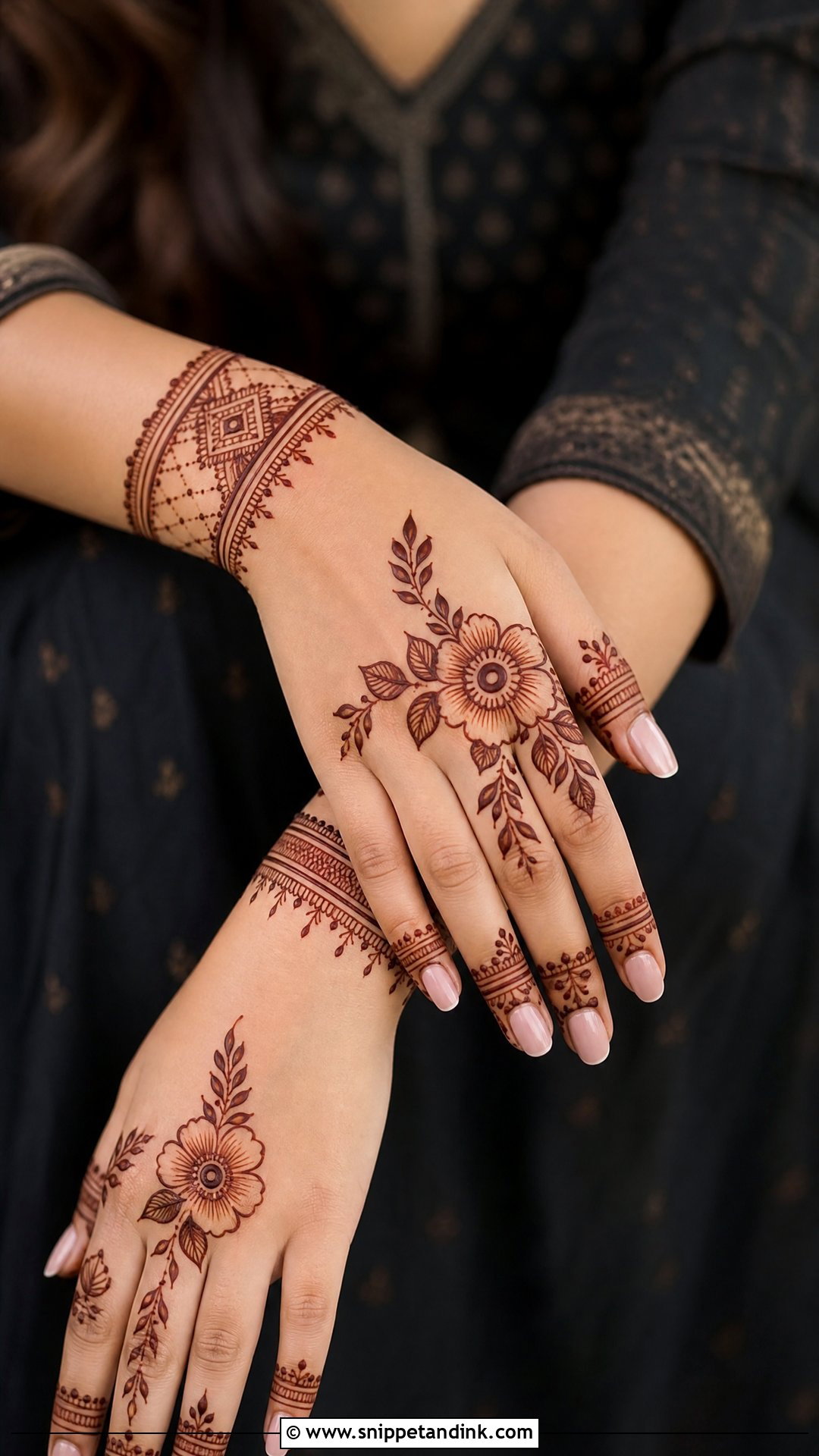
Modern designs work through placement rather than coverage: negative space, bold flowers, half-hand layouts, ring chains and geometric accents. A floral bracelet with slim finger detail and a scattered leaf trail across the back of the hand is a typical example. Slightly larger motifs and crisp lines are what make it look current. The empty space has to be planned, not leftover, so I sketch the main flow with a few guide dots first.
10. Easy Mehndi Design For Beginners
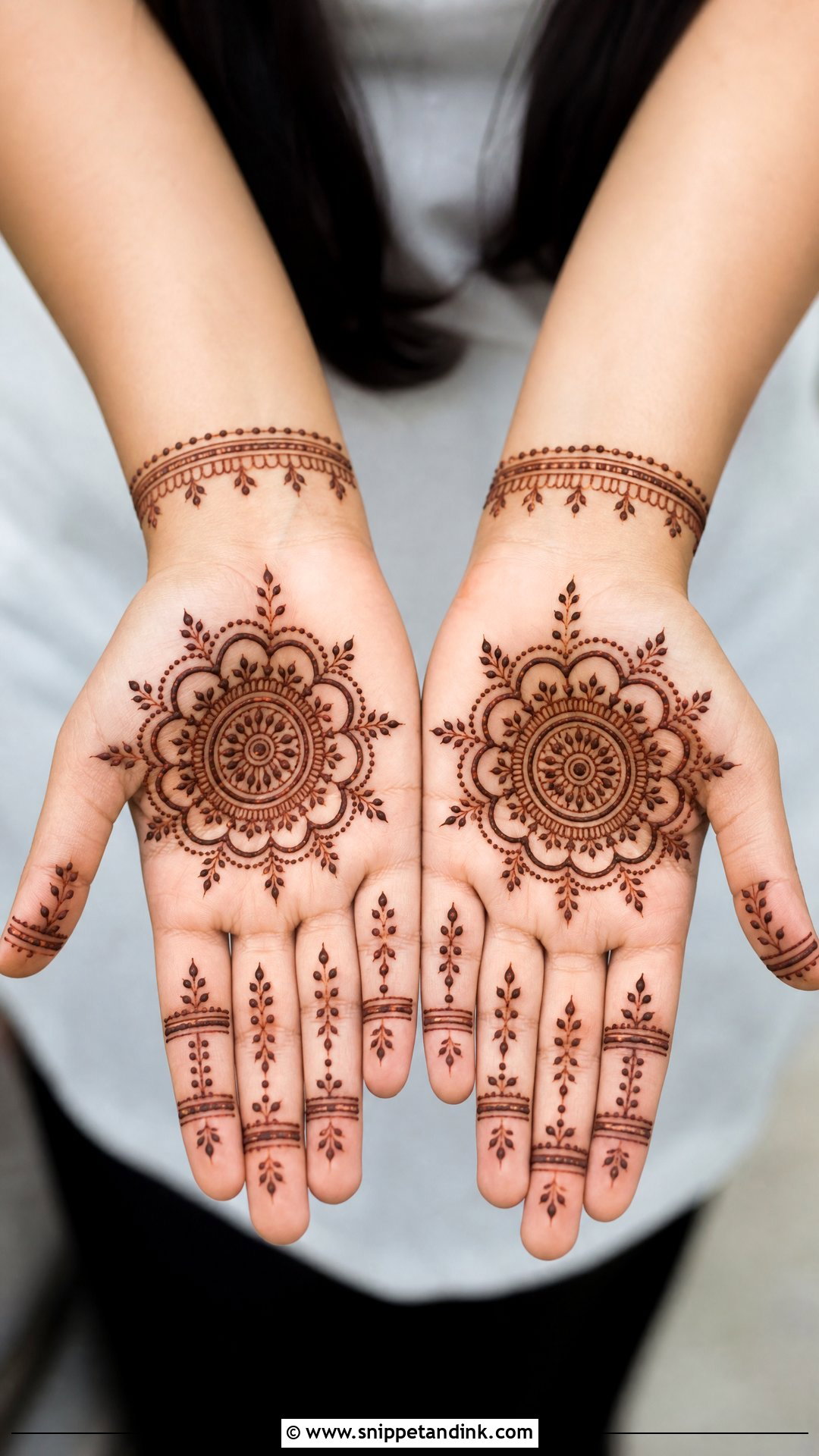
An easy mehndi design for beginners starts with a round mandala on the palm or back hand, then adds petals, dots, vines and basic finger lines, with a small wrist cuff to finish. Repeatable shapes are much easier to control than portraits or tiny filler. Keep the cone pressure steady and let the paste fall onto the skin rather than dragging the tip. If a line goes wrong, a well-placed dot or leaf will cover it.
11. Flower Mehndi Design
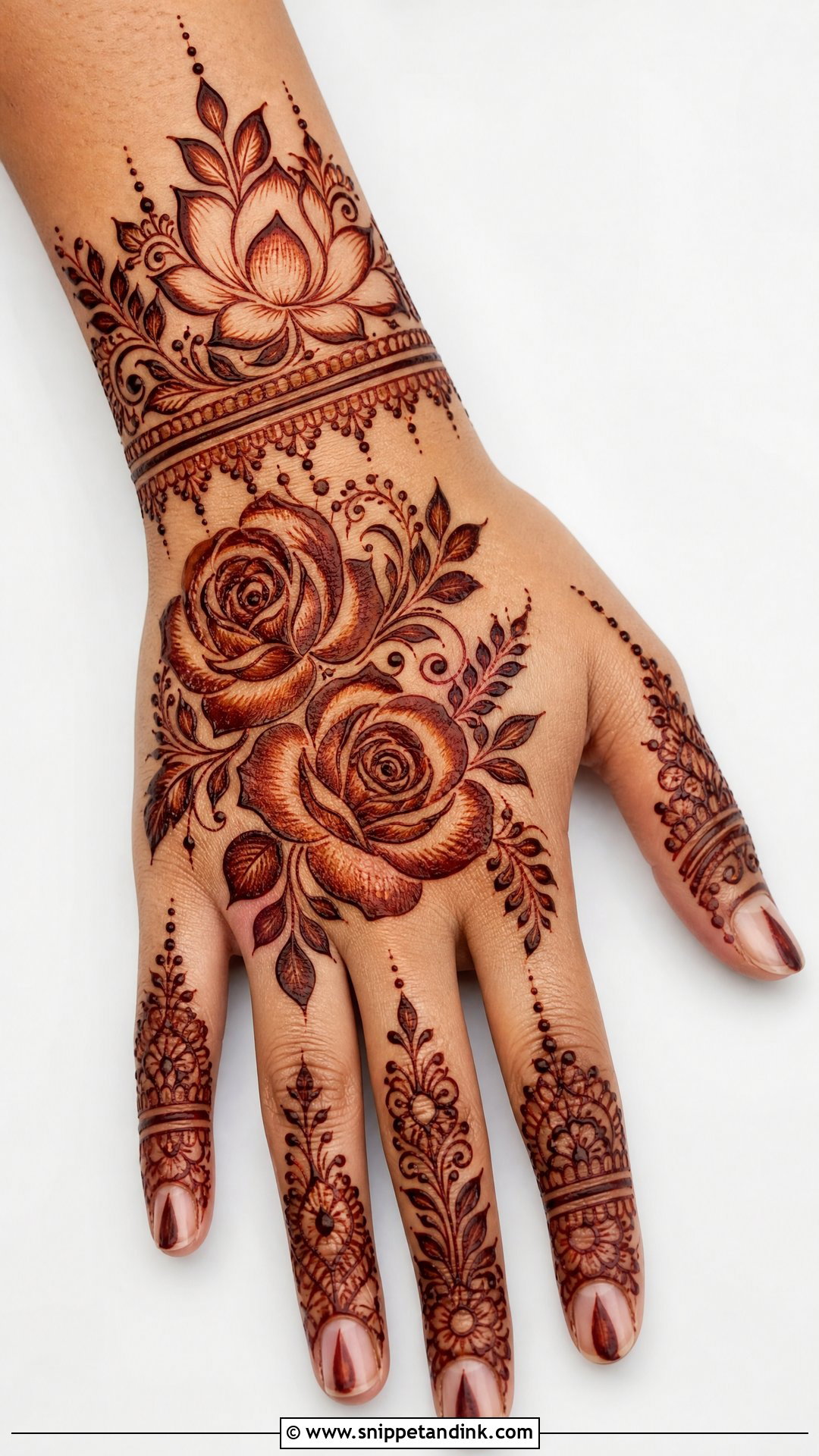
A large rose or lotus on the back hand, smaller blossoms along a curved vine, filled fingertips and a soft wrist border. On the palm, flowers pair well with leafy circles and dot clusters. The size of the flowers and the amount of shading decide whether it reads as Arabic or Indian: bold petals feel Arabic, tiny repeated flowers feel Indian. Florals suit nearly every hand shape, which makes them a safe choice if you can’t decide.
12. Mandala Mehndi Design
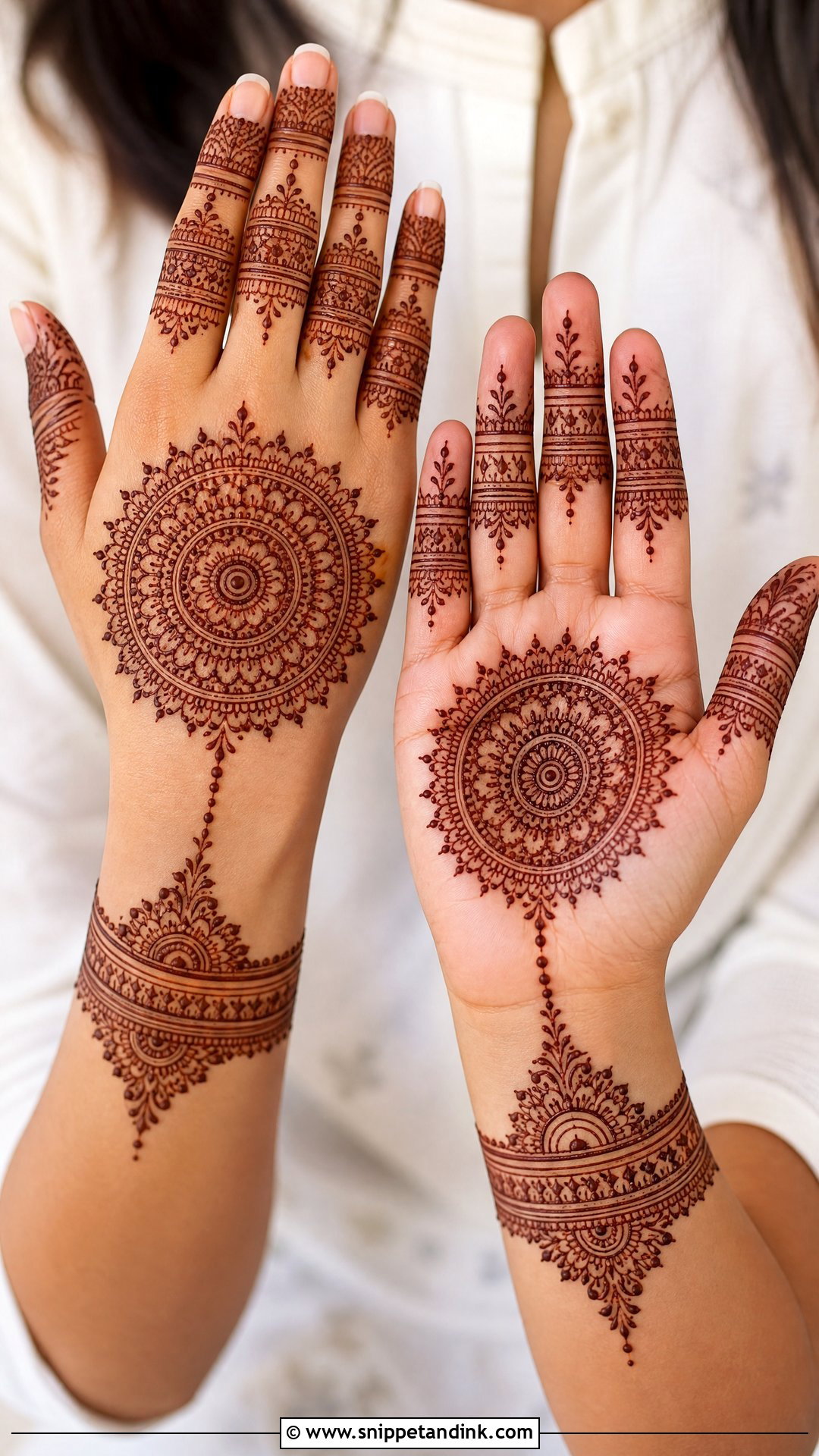
One round mandala in the middle of the palm or back hand, with finger patterns and a wrist cuff to complete it. The circle can be filled with petals, dots, rings and fine curves. A single strong center can carry a whole design, which makes it quick to apply at a busy festival. More open space around it reads modern; dense fingertips and borders read classic. I always mark the center with a single dot before drawing the first ring.
13. Indo Arabic Mehndi Design
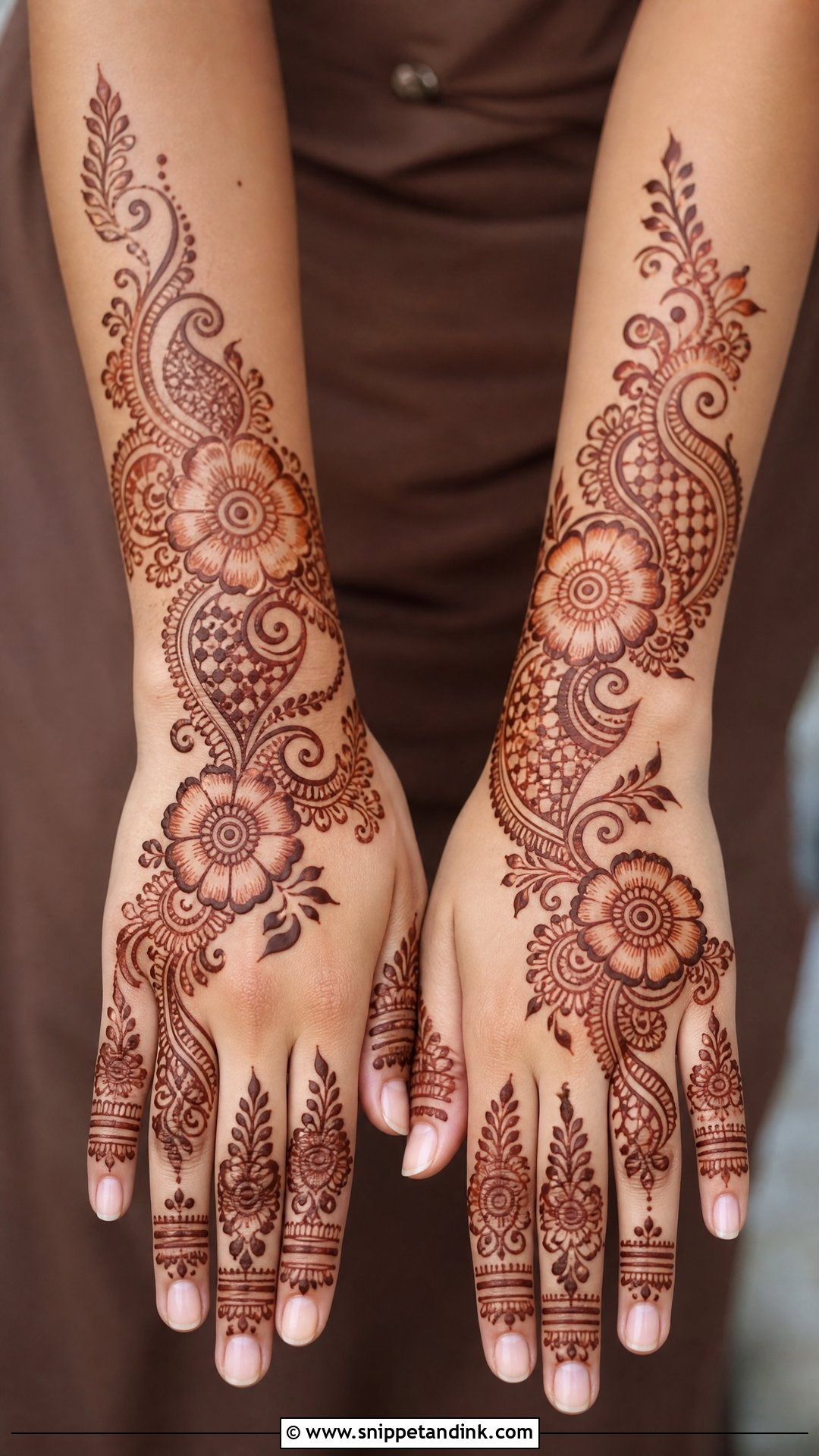
Indo-Arabic places large flowers and paisleys diagonally, then fills them with fine lines, dots, jaali and leafy filler. It feels rich without being packed, which is why bridesmaids and engagement guests ask for it so often. It shows best on the back hand, where open space highlights the main motifs. Thick outlines on the flowers and paisleys, delicate detail inside, and it works with traditional and modern outfits alike.
14. Pakistani Mehndi Design
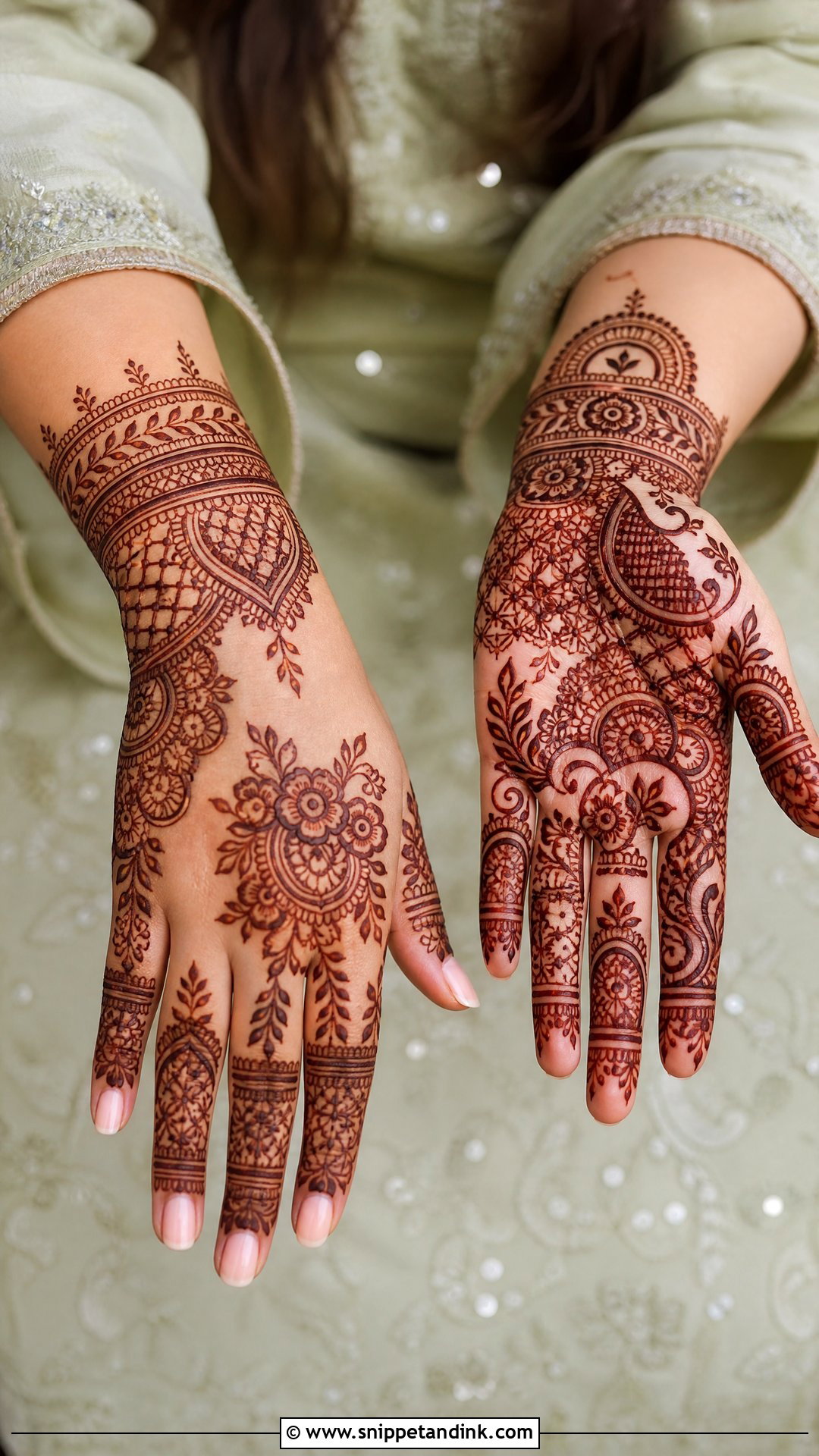
Pakistani mehndi design combines Indian detail, Arabic spacing and a little Gulf-style flow: floral vines, paisley panels, mesh, dome shapes and bracelet-style wrist details. A circular or paisley center sits on the palm, slim repeating patterns run down the fingers, and jewelry chains with bold flowers cover the back. It’s popular for nikkah ceremonies and Eid. The balance between fine lines and open areas is what keeps it from looking crowded.
15. Moroccan Mehndi Design
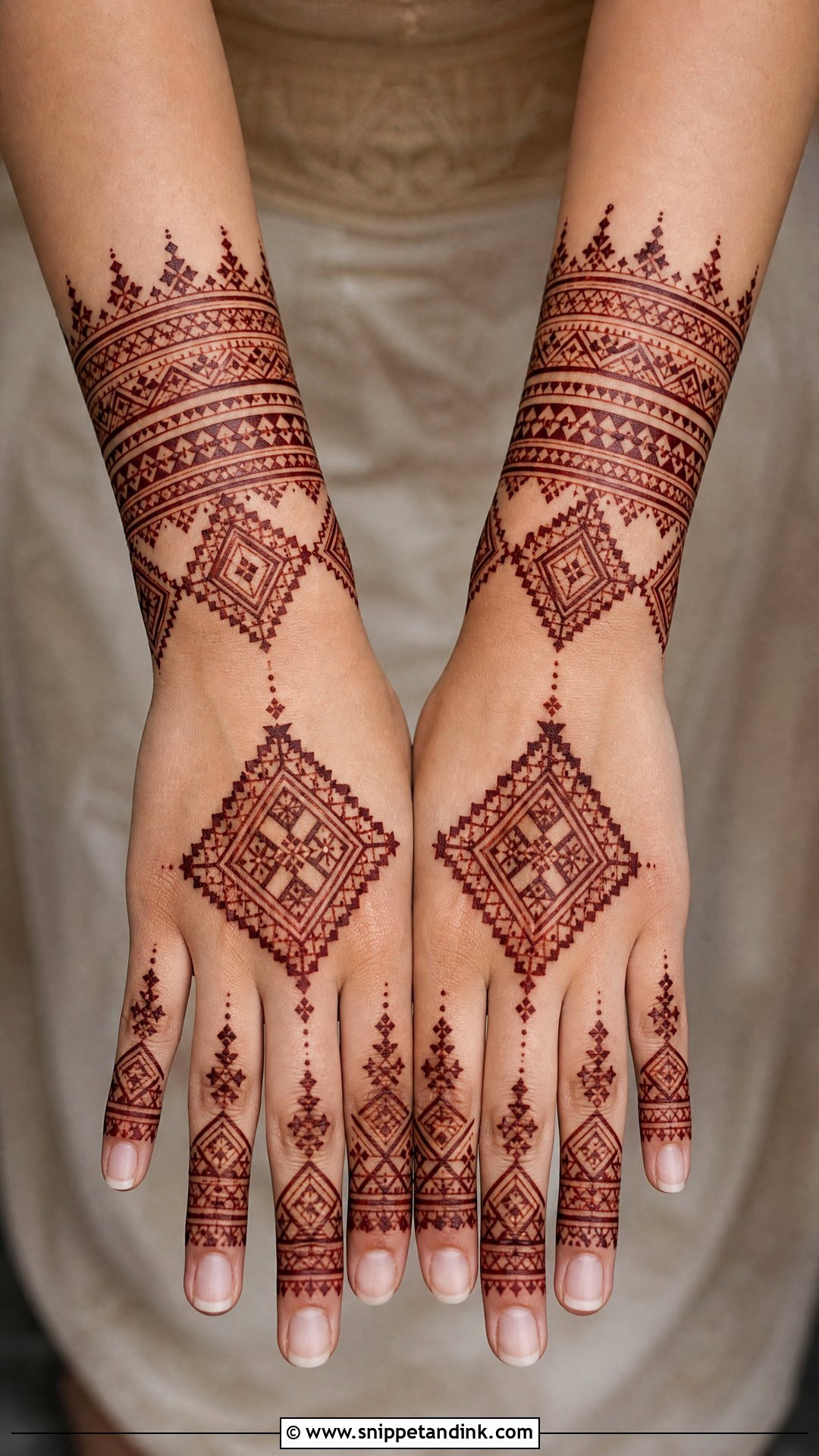
Moroccan designs use diamonds, triangles, lines, grids, dots and symmetrical bands instead of flowers. On the back hand, a central diamond grid connected to finger bands with a cuff-like border makes a complete look. Straight lines need a steady hand, so I work in short strokes and rest my wrist on the table. It pairs best with simple outfits and minimal jewelry, where the geometry isn’t competing with embroidery.
16. Gulf Mehndi Design
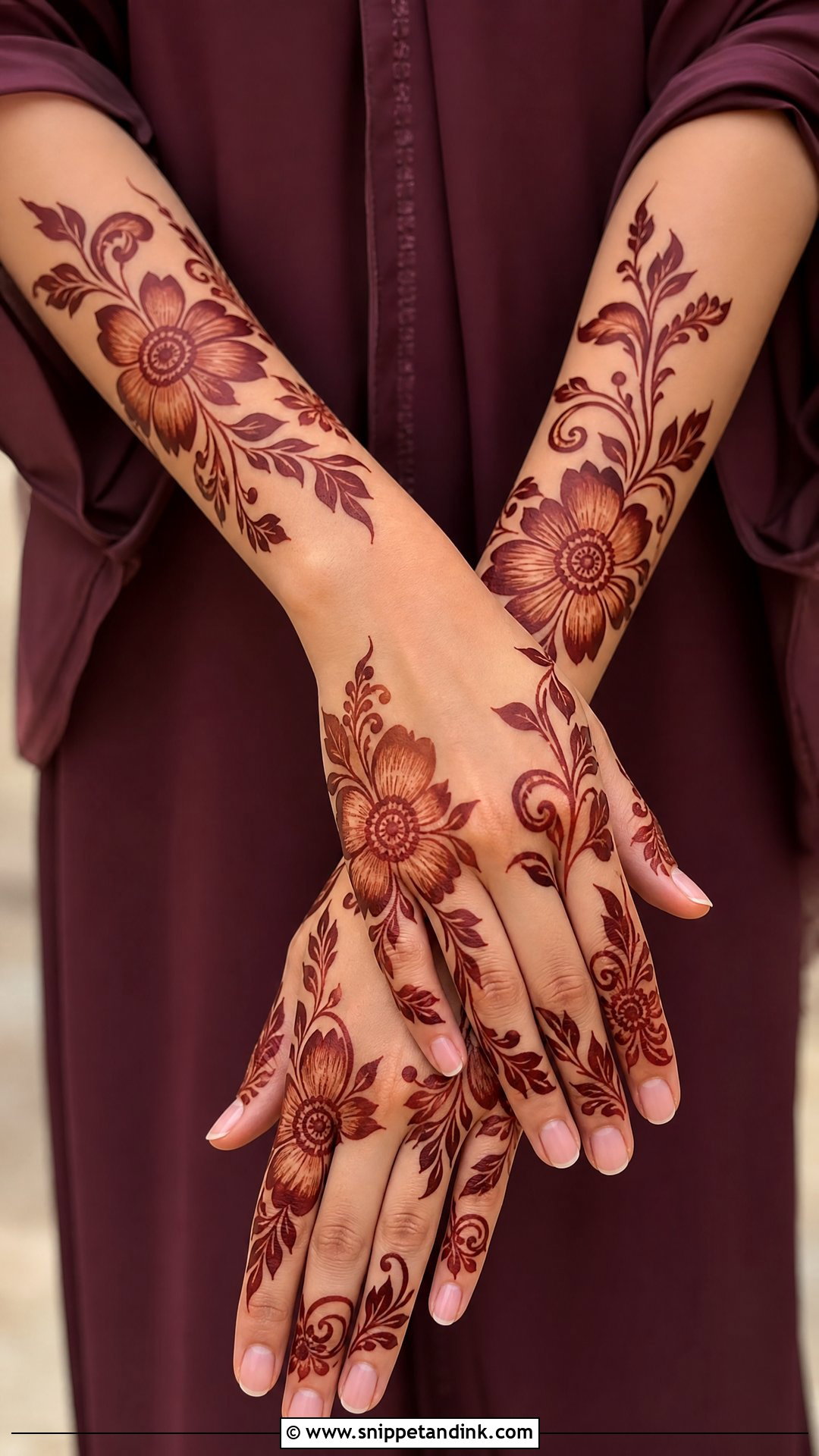
Gulf or Khaleeji mehndi covers one side of the hand with large flowers, shaded petals and sweeping leaves and leaves the other side clean. It flows naturally from the wrist to the fingers on the back of the hand. The motifs are bigger than in Indian work, so it feels less dense but reads from across a room, which suits evening celebrations. Smooth outlines and deep shading on the petals give the polished finish.
17. Minimal Mehndi Design
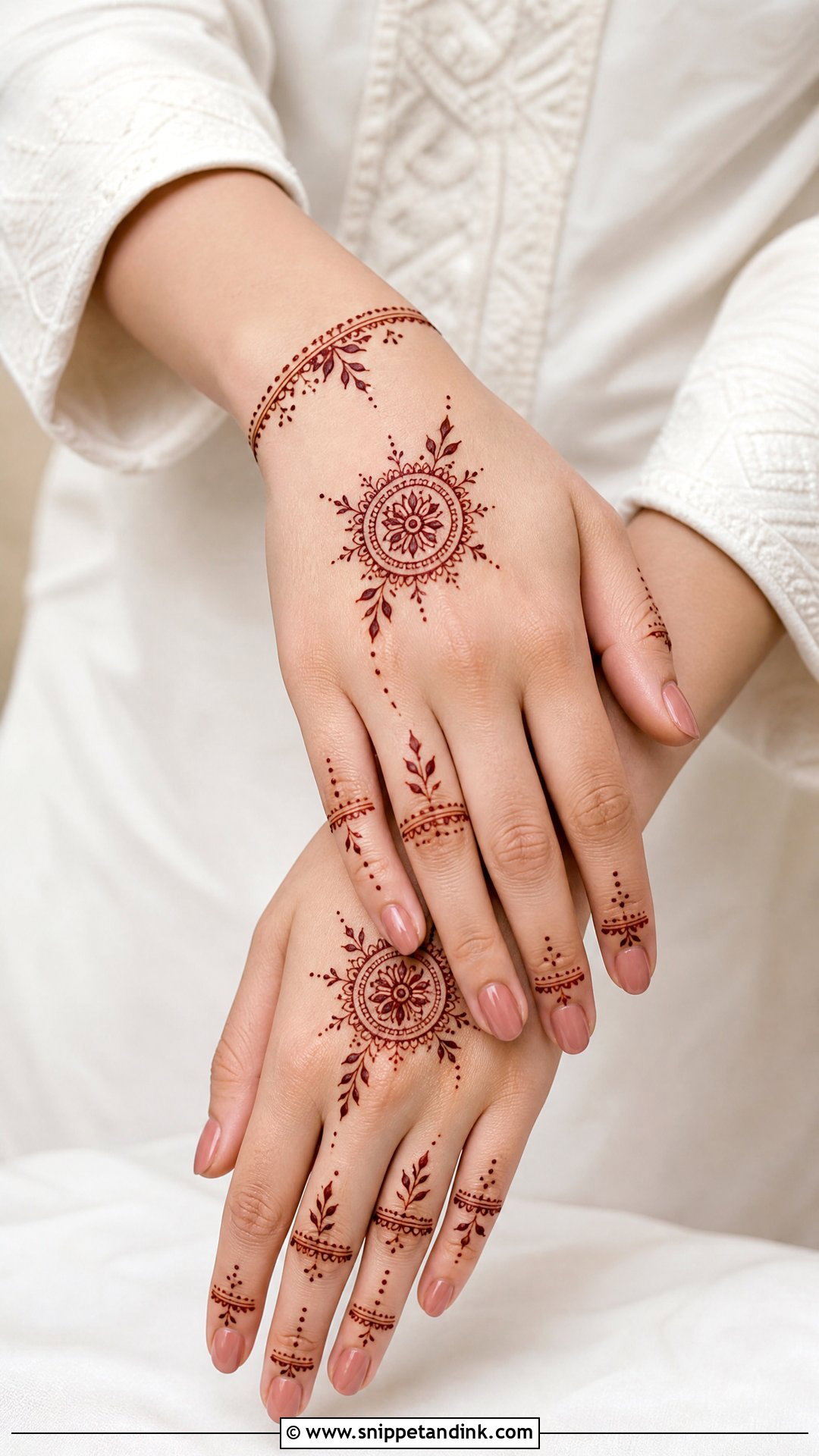
Fine finger lines, a tiny back-hand mandala, a slim wrist bracelet and a few scattered leaves. Minimal henna highlights selected areas and leaves the rest bare, which suits office events and anyone who wants something light. It sits well alongside rings and nail color. Every dot and line is visible, so neatness matters more here than in any other style. I’d rather draw fewer elements with confident lines.
18. Finger Mehndi Design
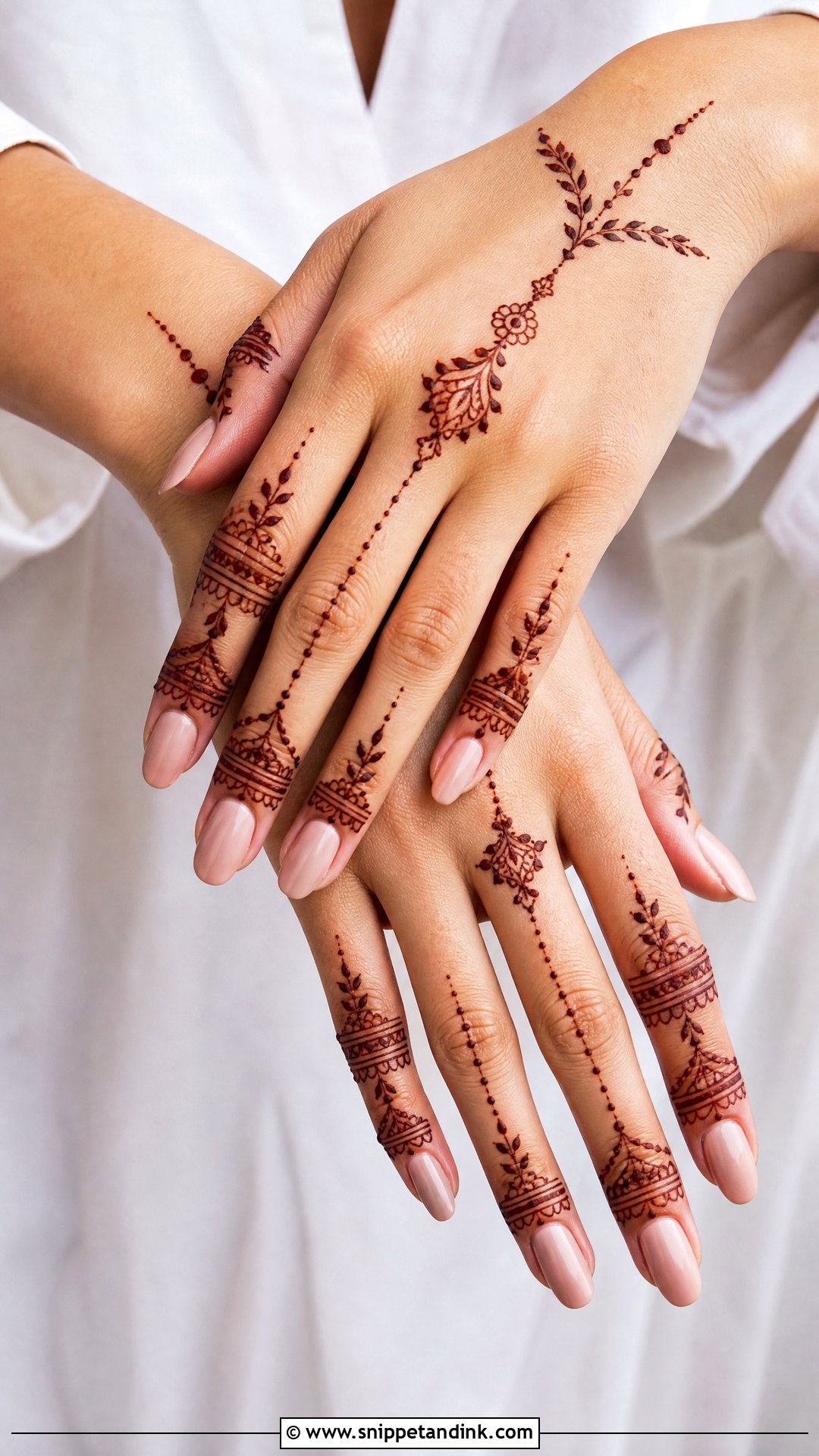
The palm stays mostly empty and each finger gets its own band, leaves, dots or small floral strip, sometimes linked by a small mandala or chain on the back of the hand. Slim, vertical patterns make fingers look longer; horizontal bands make them look shorter, so I choose depending on the hand. It frames longer nails well. A soft wrist line ties it together.
19. Bracelet Mehndi Design
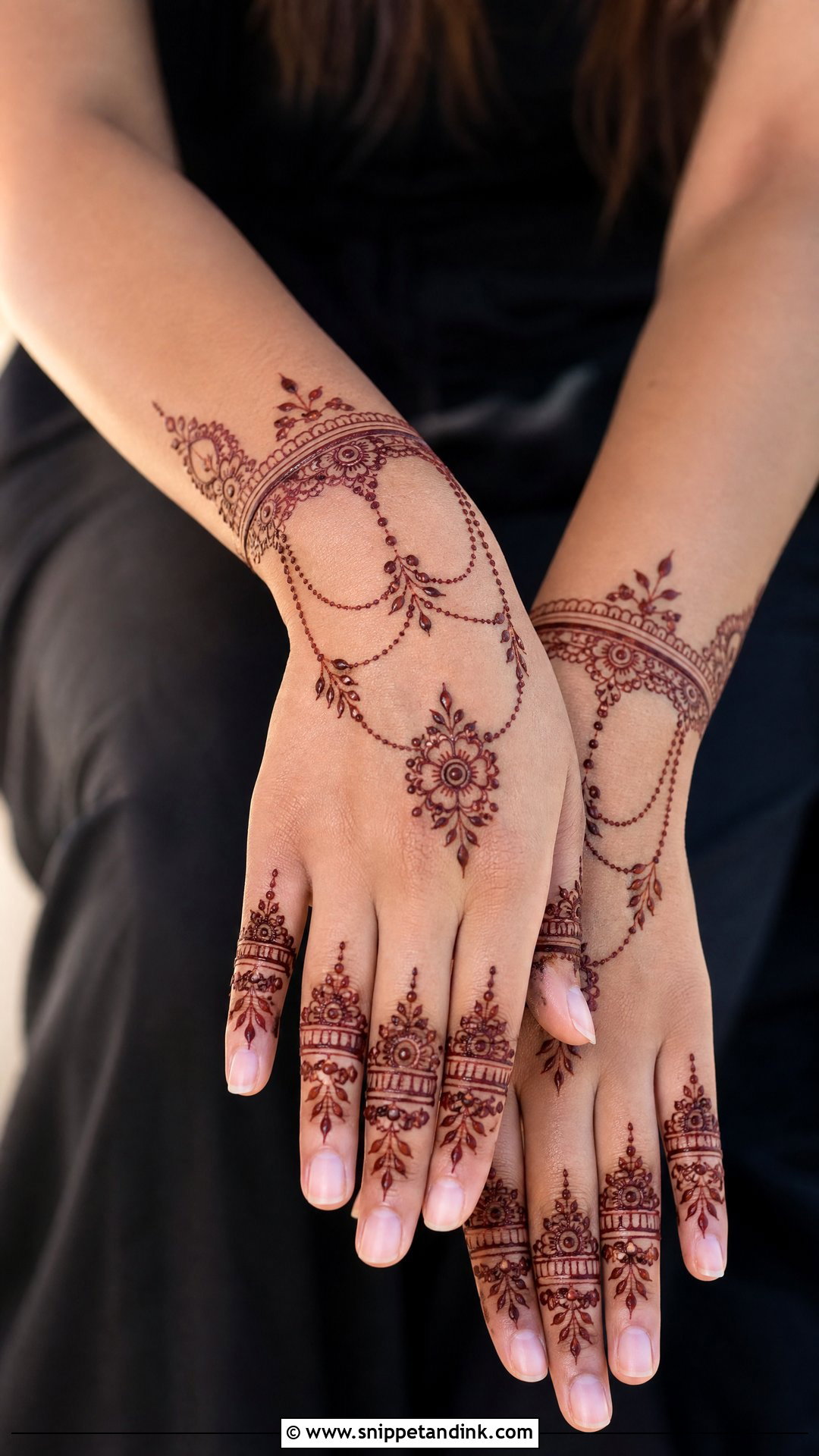
Bracelet mehndi design combines a wrist cuff, chains across the back hand, ring-like finger patterns and a small central motif. It’s decorative without heavy coverage, which suits engagement functions and bridesmaids. A thick traditional bracelet can take paisleys; a slim modern one uses dots and fine chains. I check that the cuffs sit at the same height on both wrists, because uneven cuffs are obvious when the hands are posed together.
20. Jewelry Mehndi Design
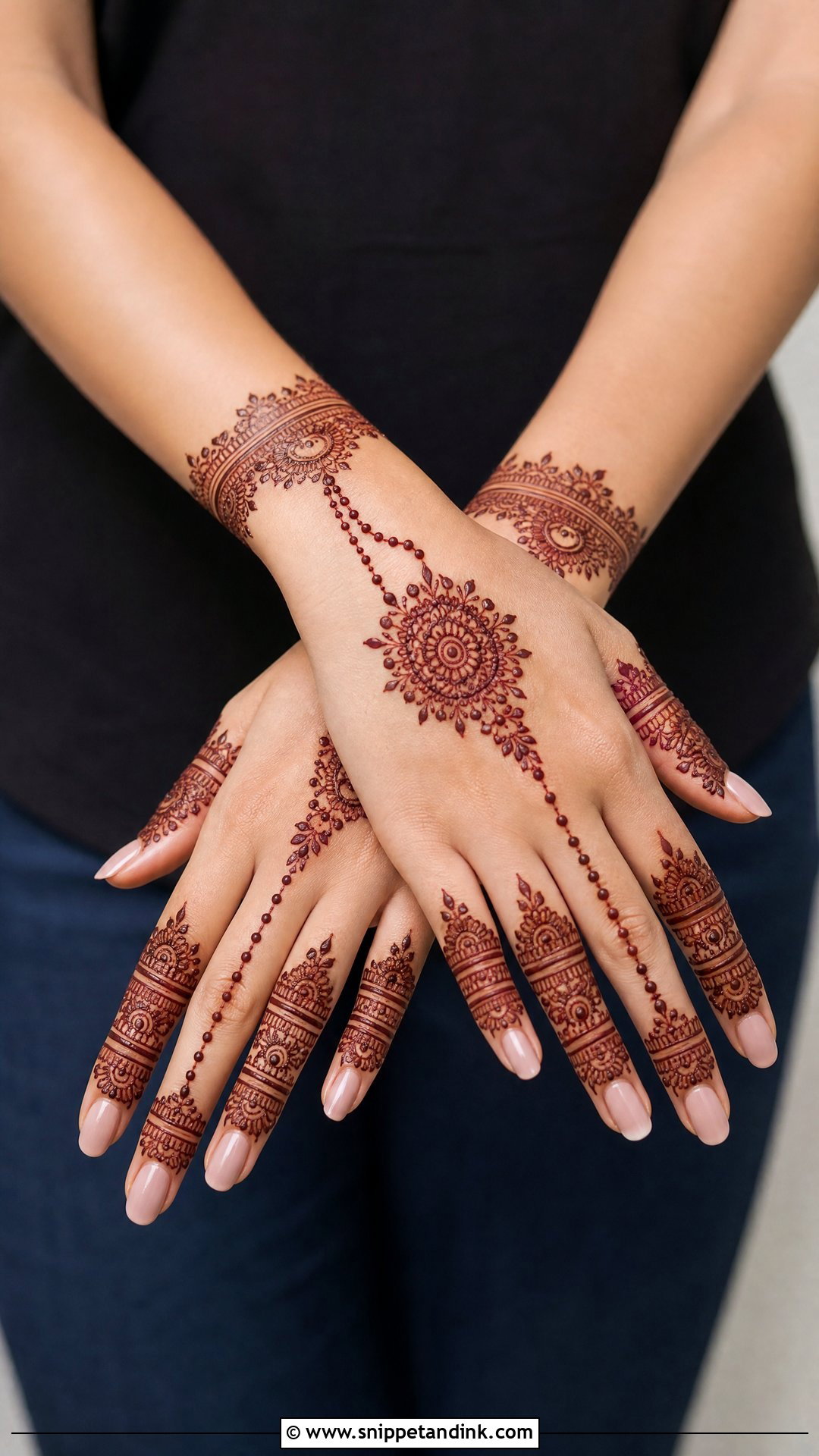
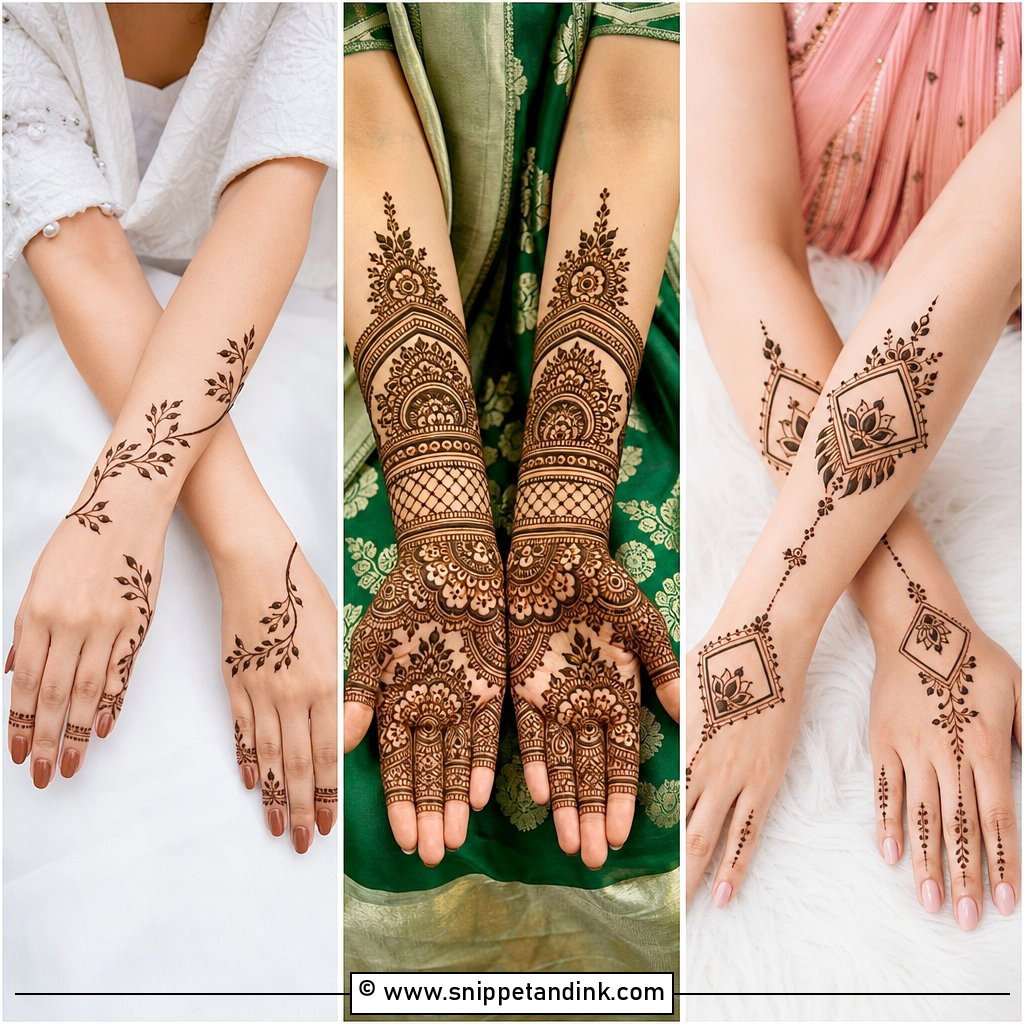
Jewelry mehndi goes further than a bracelet, imitating rings, haath phool, chains, bangles and small hand ornaments, all connected with dotted strings and floral links. One main flower or mandala in the center connects to the finger rings. I follow the line of the tendons on the back of the hand for the chains, which is where a real haath phool would rest. Thin lines and small dots keep it graceful.
21. Rose Mehndi Design
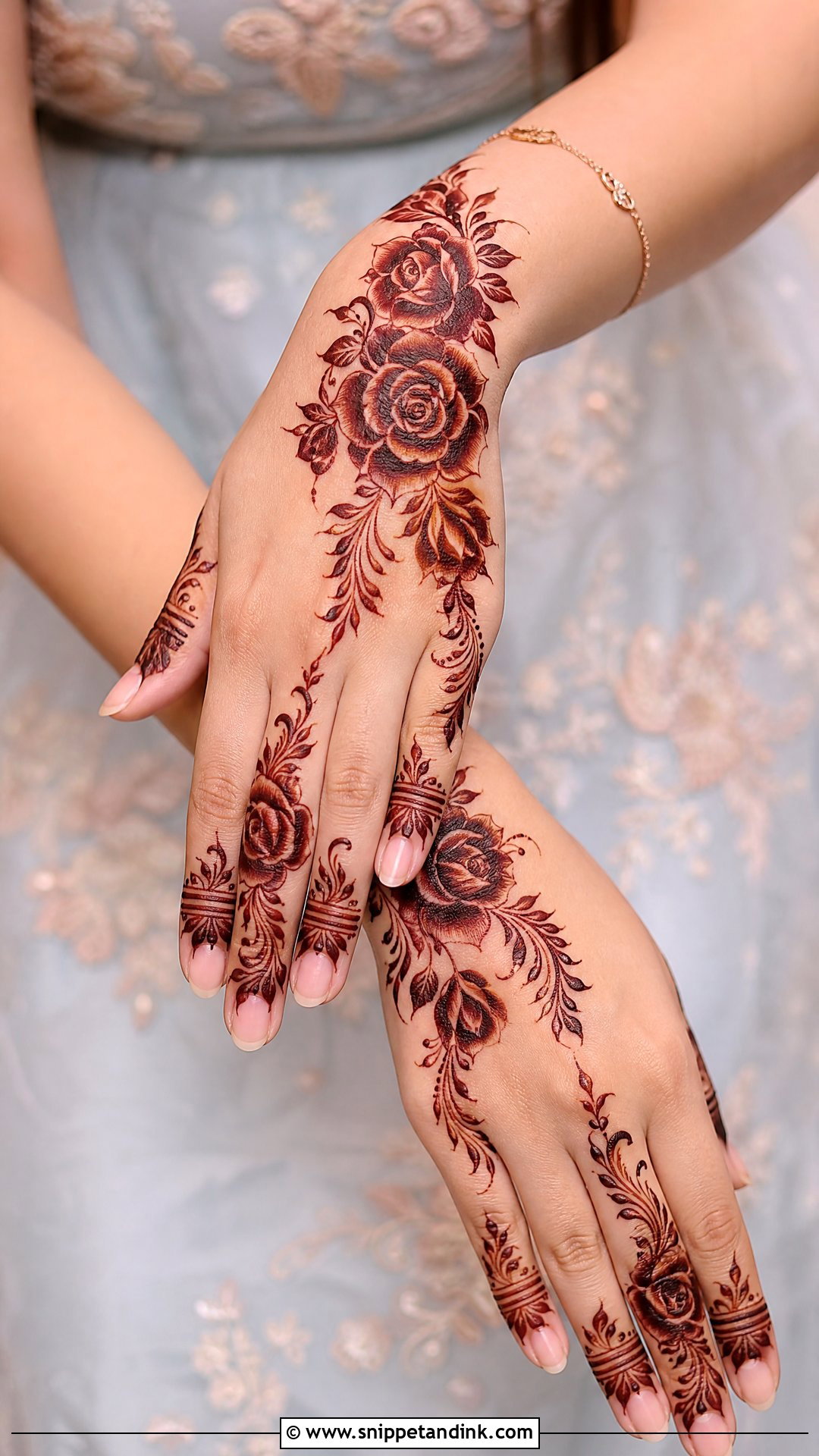
One large rose on the back hand, smaller rosebuds and leafy vines moving toward the fingers, shaded petals and a slim floral bracelet at the wrist. With open spacing it’s Arabic; with finer detail around the flowers it becomes Indo-Arabic. I outline each petal boldly and shade gently inside each layer. Heavy solid shading on roses tends to stain into a single dark shape, and the flower is lost.
22. Peacock Mehndi Design
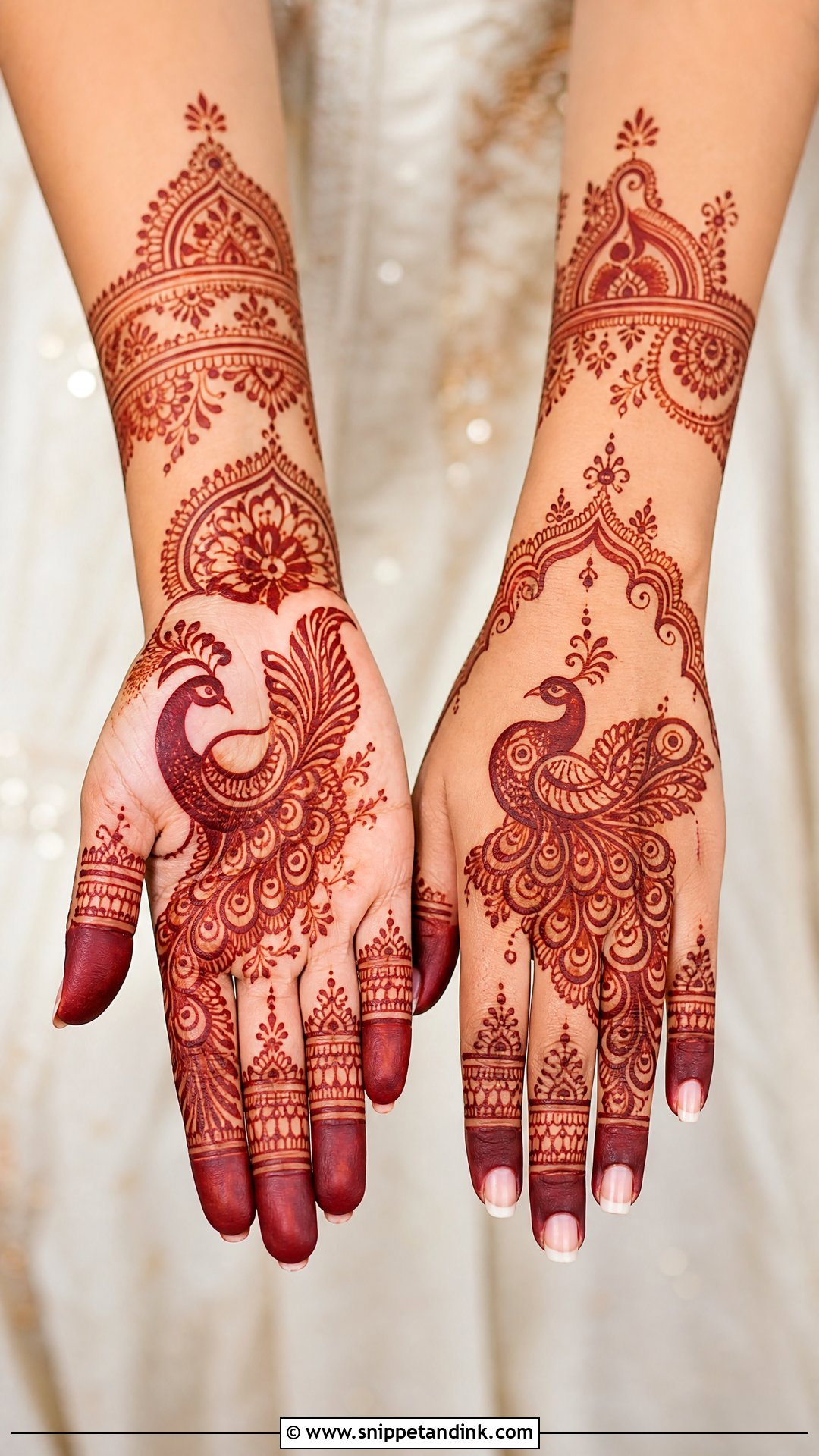
A peacock on the palm or back hand, surrounded by paisleys, feathers, flowers and fine filler, with the curved neck giving the whole hand its flow. It’s a traditional favorite for brides. Make the bird large enough to read clearly and keep the surrounding detail smaller. The fingers can echo feather lines, and the wrist border can repeat the peacock’s motifs. Overcrowding is the main way a peacock design goes wrong.
23. Paisley Mehndi Design
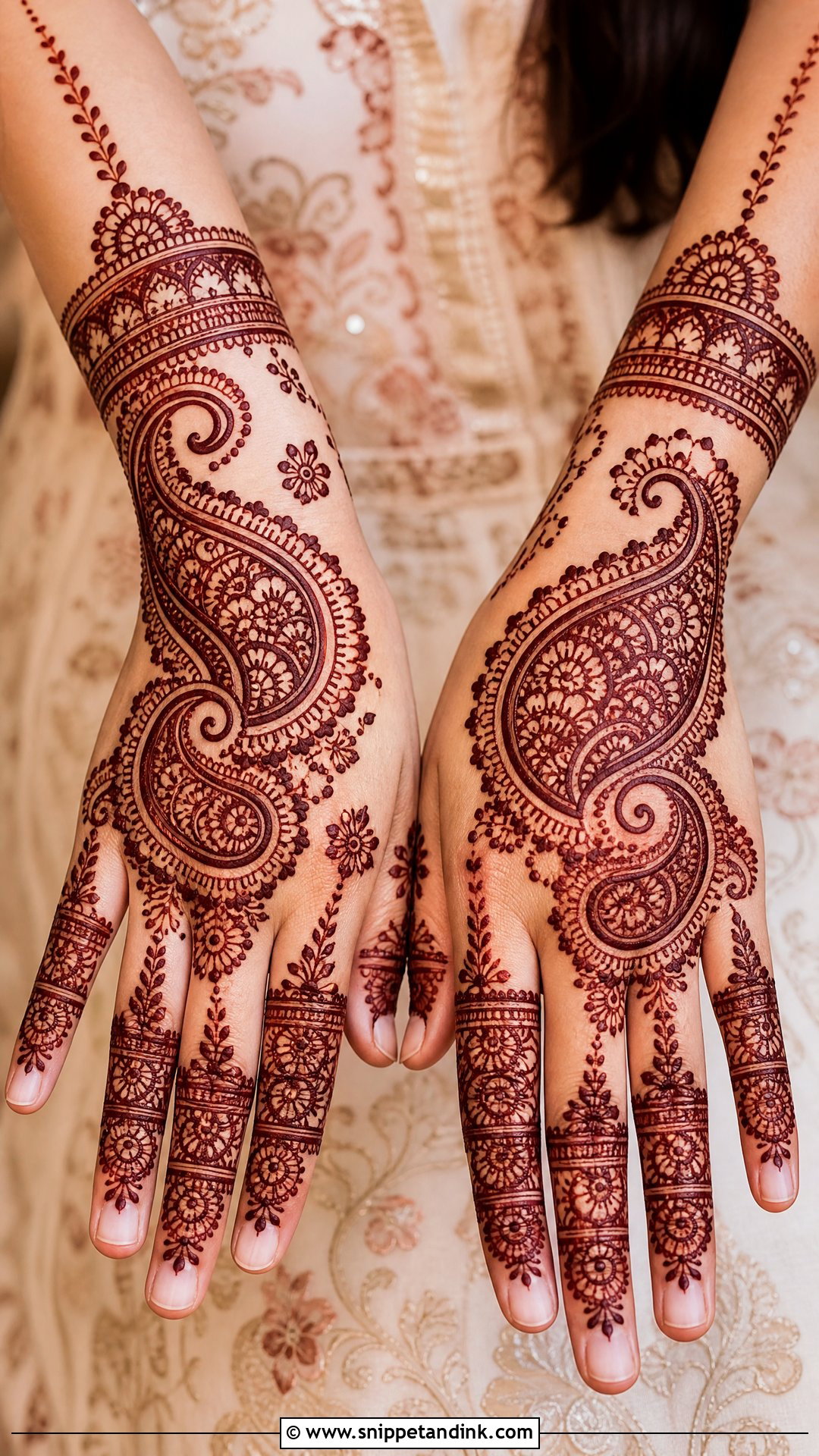
Paisleys flex between styles: large mango shapes with floral filler on the palm, or a diagonal paisley trail from the wrist to the index finger for an Arabic feel. Bold outlines with varied interiors keep a paisley design interesting. I fill some with lines, some with dots and some with tiny flowers, so the eye moves across the hand rather than seeing a repeated stamp.
24. Jaali Mehndi Design
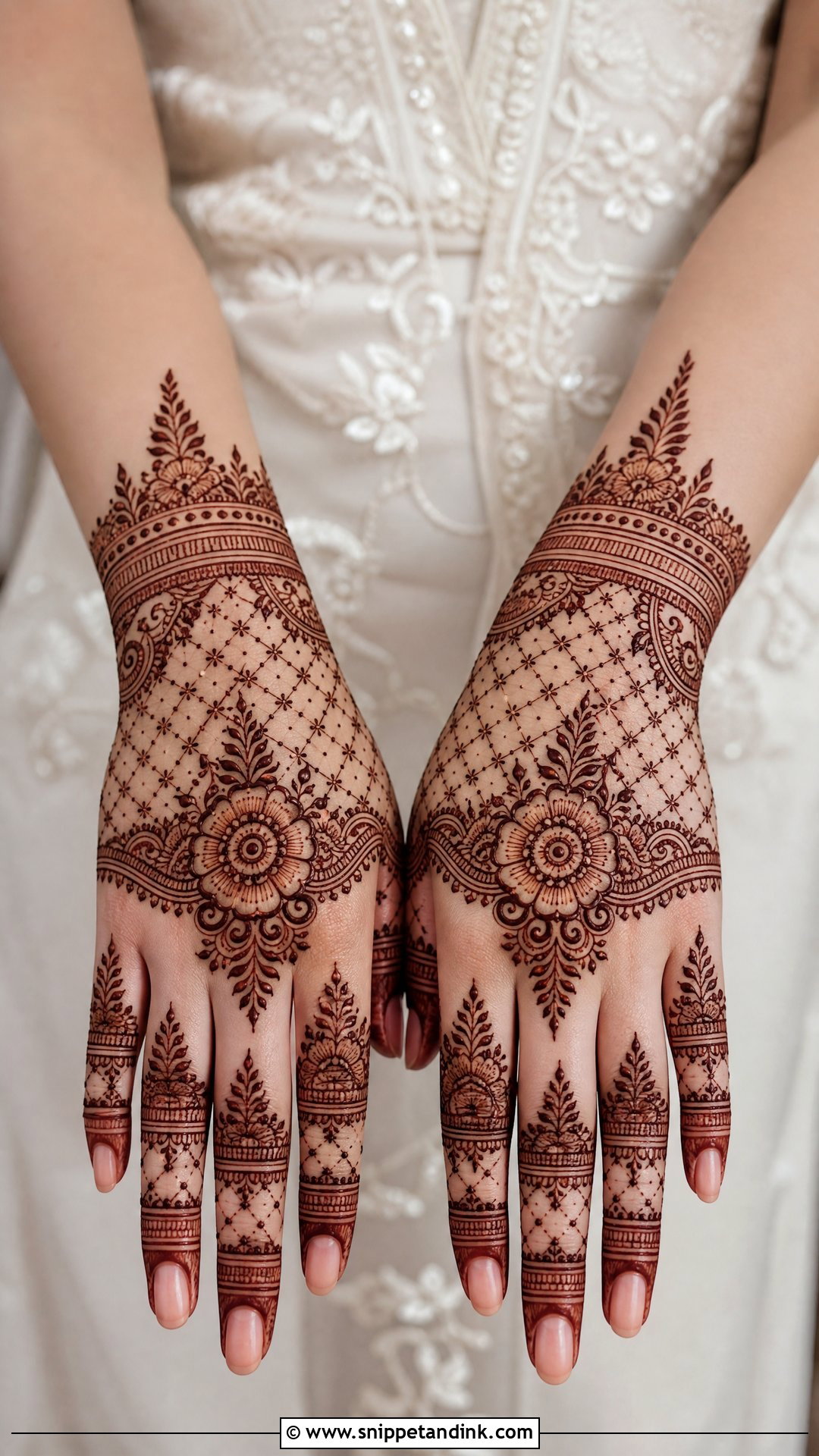
Jaali mesh around a central floral motif on the back hand, with decorated fingers and a wrist cuff, or mixed with paisleys and mandalas on the palm. It adds texture without needing lots of different motifs. The mesh has to be even, so I draw all the lines in one direction before crossing them. Tiny dots or flowers in selected squares add charm, and in close-up photos the effect reads like fine lace.



25. Lotus Mehndi Design
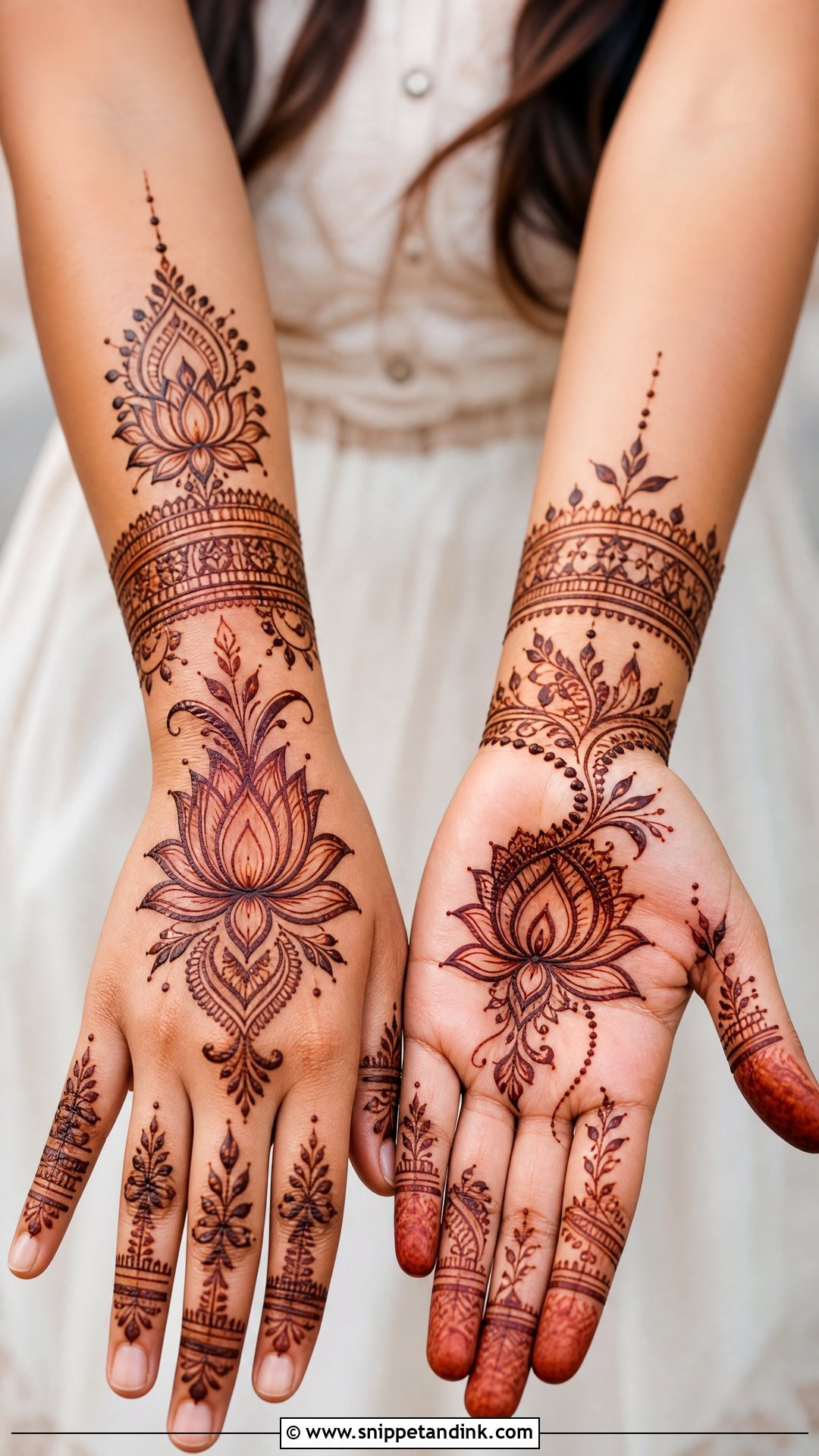
A large lotus on the palm or back hand with leaves, curved vines, dot trails and ornamental wrist borders. It’s a natural fit for bridal, Diwali, puja and engagement mehndi. One bold lotus with open spacing looks modern; repeated smaller lotuses along the fingers and wrist look heavier. Keep the petals clearly separated and layered. A lotus whose petals touch loses its recognizable pointed shape once stained.
26. Eid Mehndi Design
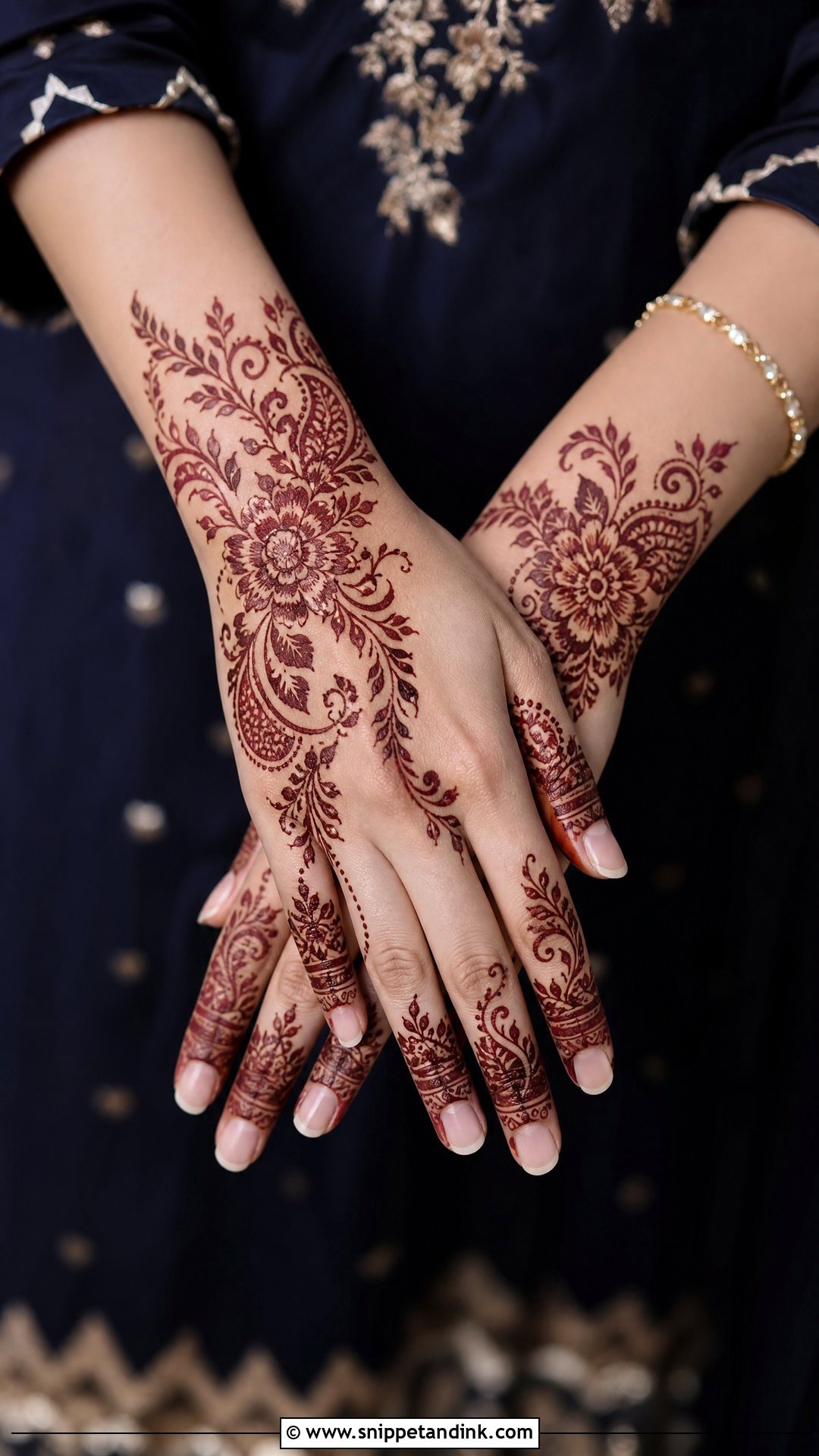
For an Eid morning, I keep the palm simple and put the work on the back of the hand, the side everyone sees: Arabic floral trails, clean finger patterns and a light bracelet. For an Eid night look, the design can extend toward the forearm. Open spaces sit well with festive outfits and jewelry. Roses, paisleys, vines or mandalas all suit it. If you apply the night before and sleep with the paste on, you’ll wake to a warmer, deeper color.
27. Diwali Mehndi Design
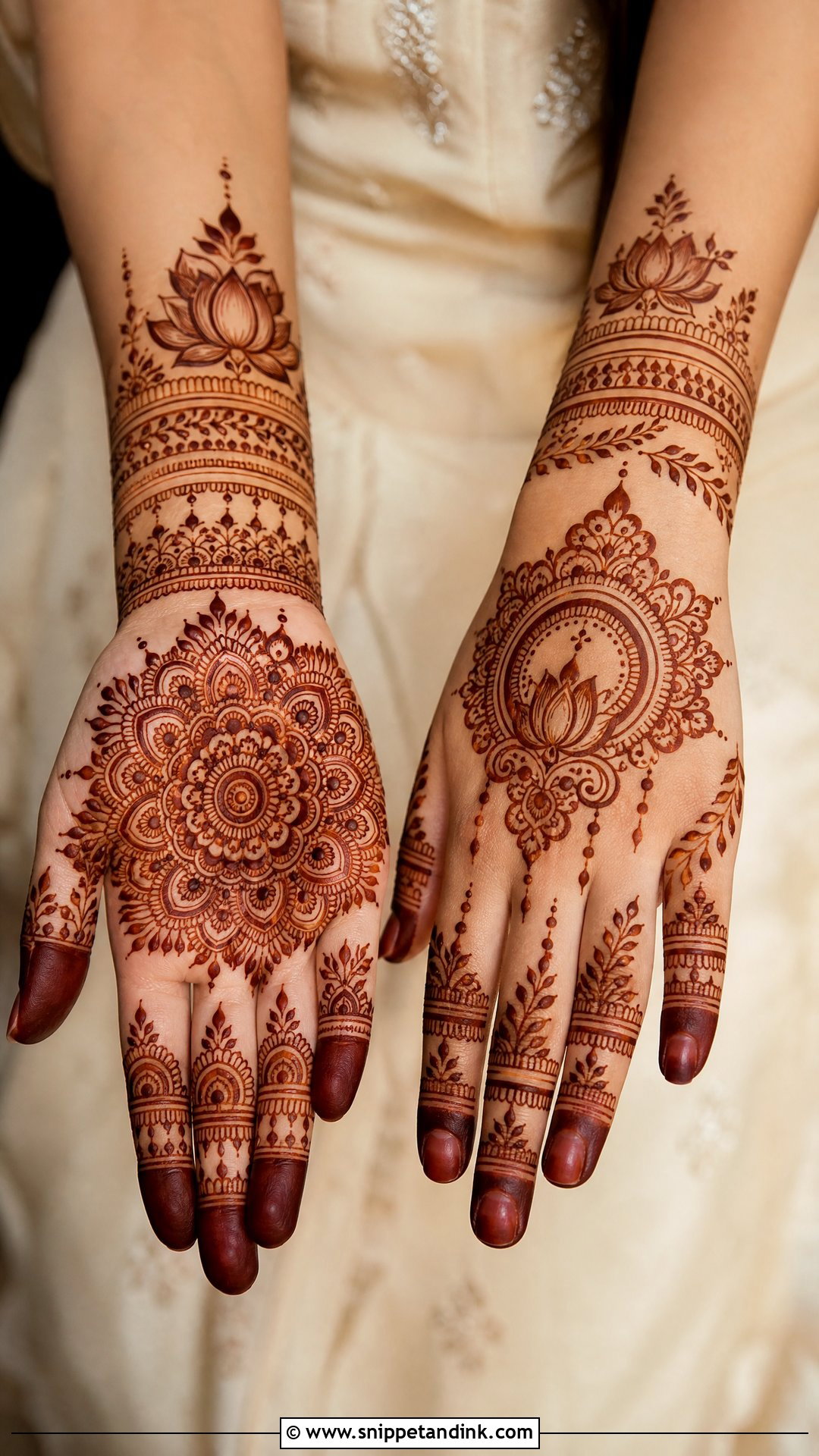
Mandalas, lotus flowers, paisleys, leafy trails and ornamental wrist borders make up most Diwali designs. A circular mandala on the palm and a jewelry-inspired pattern on the back hand pair well with bangles and festive nail colors. Family photos at Diwali are usually taken from a few steps back, so I use bold outlines for the main motifs and keep the small dots and lines secondary. Coordinate both hands so they look complete side by side.
28. Karwa Chauth Mehndi Design
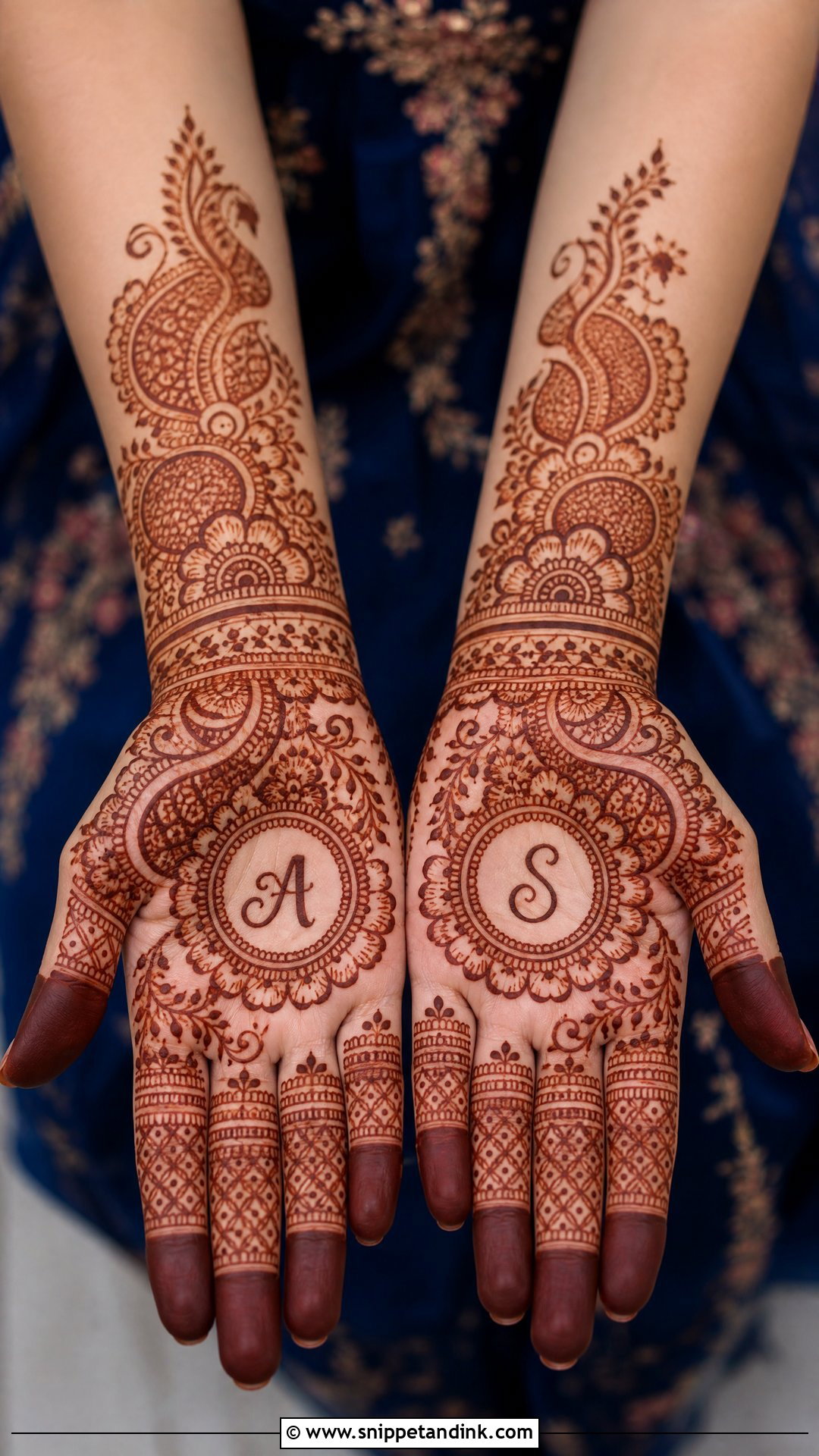
Karwa Chauth designs can be lighter than bridal but should still feel festive: full palms, decorated fingers, wrist borders and classic paisleys, flowers and mandalas, with couple initials if you like. A bold central motif on the palm and bracelet patterns or vines on the back hand make a good pairing. Filled fingertips and dense borders feel traditional; more open space feels modern. Apply it the day before so the stain has time to darken.
29. Engagement Mehndi Design
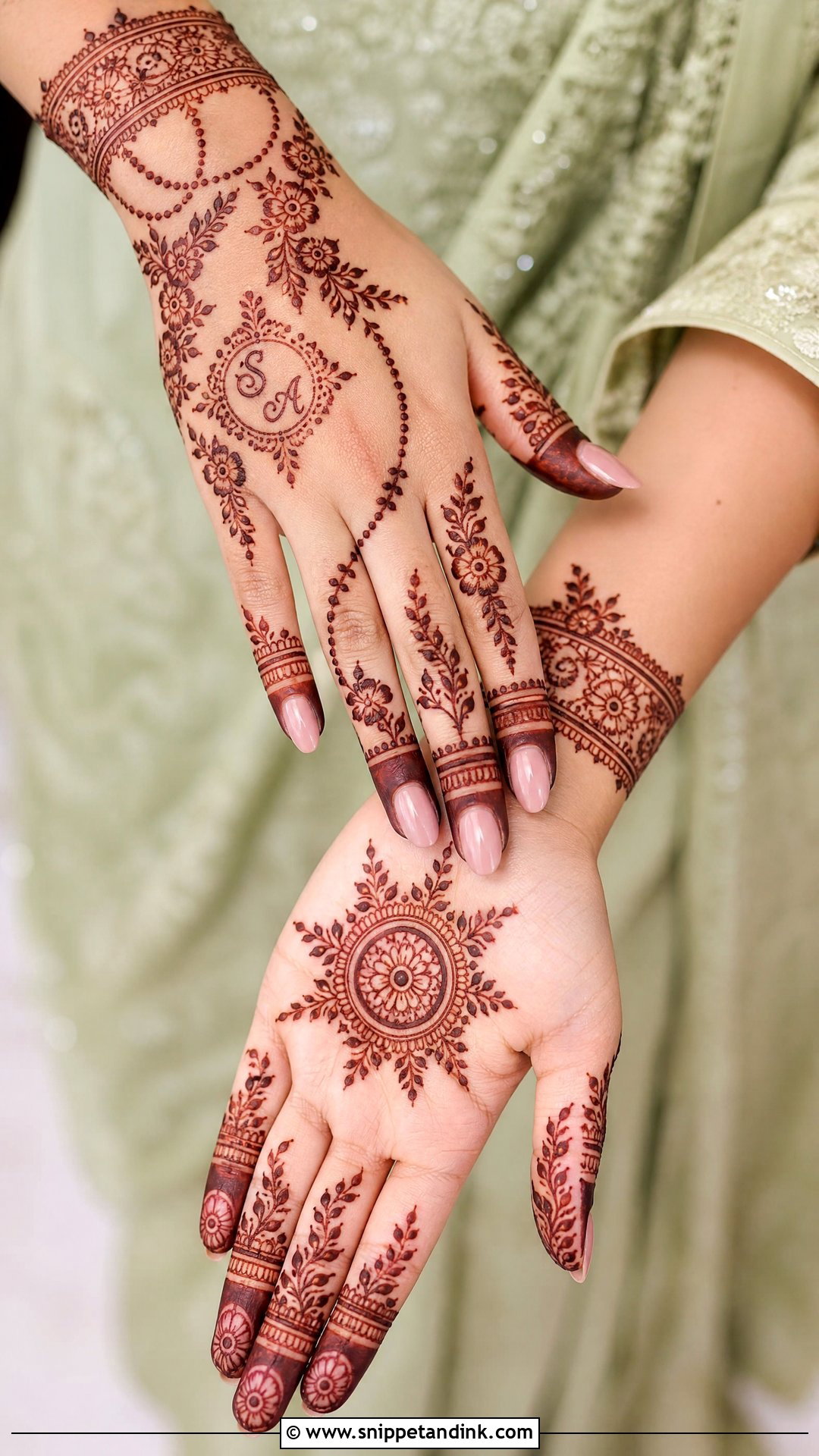
Engagement mehndi design is lighter than wedding henna: floral vines on the back hand, a delicate palm mandala, ring-style finger details and a slim wrist cuff. Initials, a ring motif or a date can be added. The design should frame the ring, not hide it, so I keep the base of the ring finger mostly clear. Arabic spacing works well for engagement photos, and fine Indian detail adds richness if you want more.
30. Kids Mehndi Design
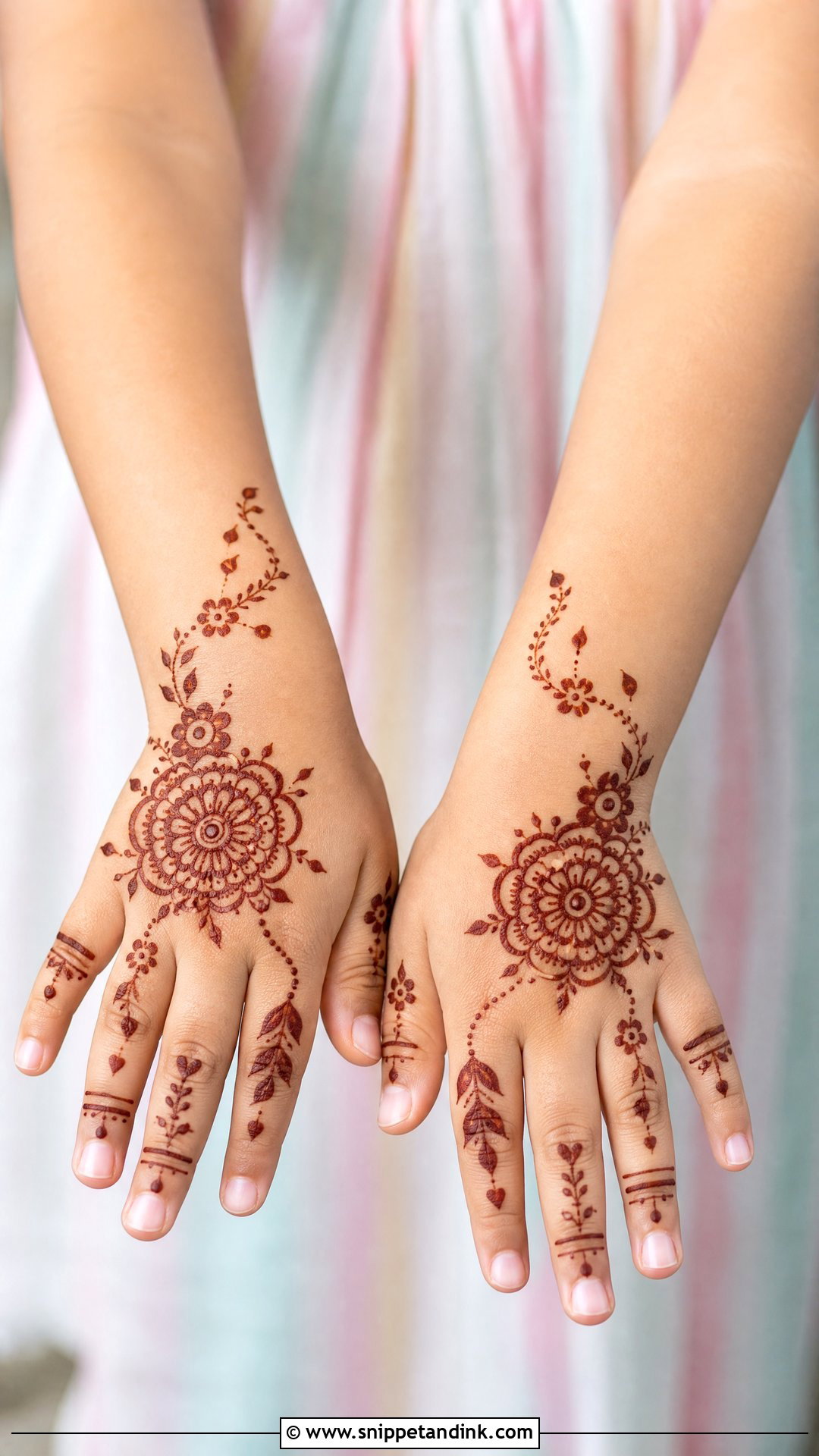
Children need short sessions: a small flower, heart-shaped leaves, a simple mandala, dotted vines and light finger lines. The back hand is easier than the palm because little palms touch everything before the paste dries. Large, clear motifs look good even when the lines aren’t perfectly fine. Use only natural henna and keep it small.
31. Feet Mehndi Design
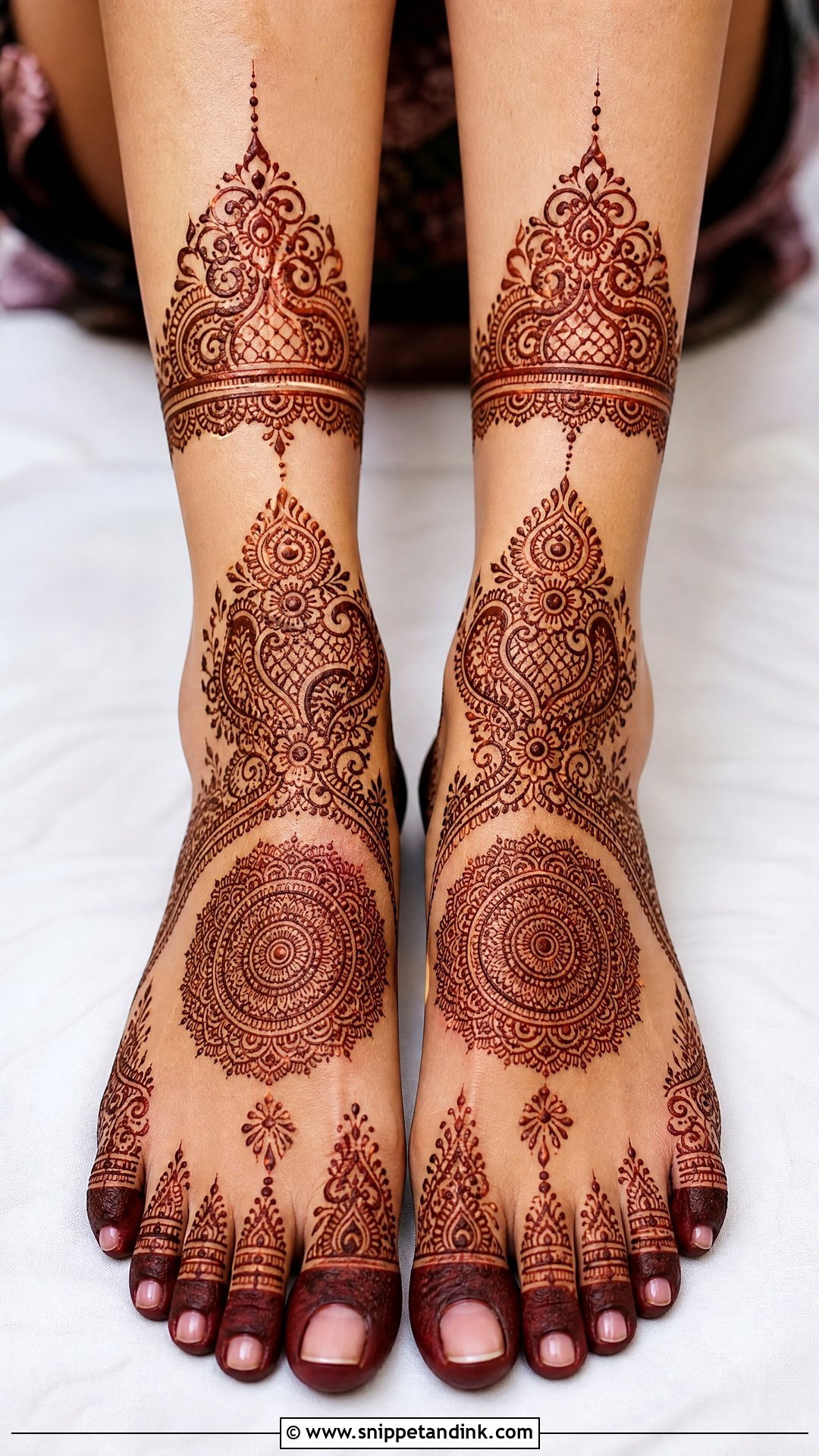
Feet mehndi design covers the toes, the top of the foot, the ankle and sometimes the lower leg with mandalas, anklet borders, florals, paisleys and jaali. Bridal feet usually match, with toe details and ankle cuffs; lighter versions use a floral trail from the big toe to the ankle. The soles and toes take a deep stain. The top of the foot is lighter, so I make the lines there a little bolder.
32. Bridal Feet Mehndi Design
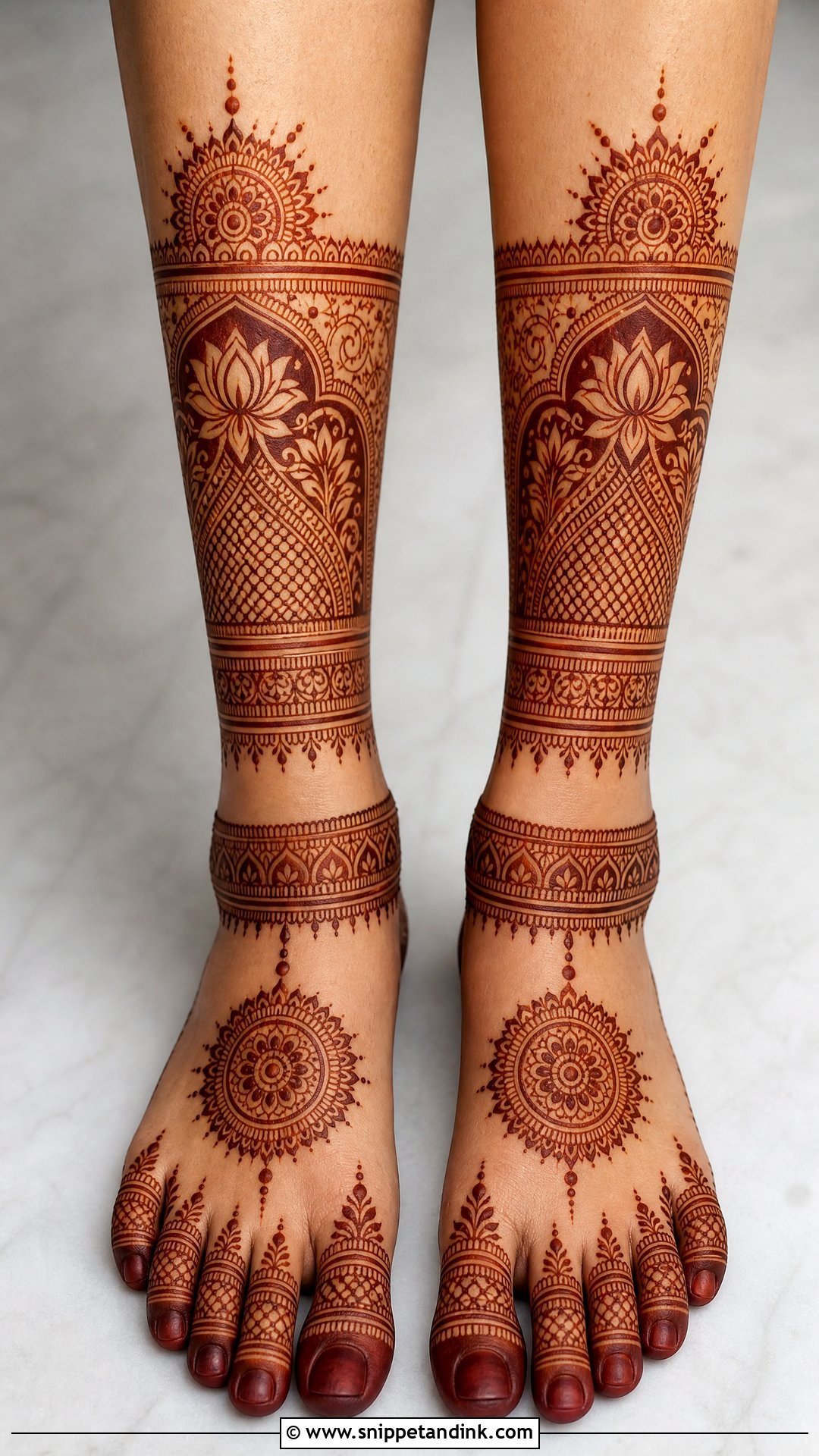
Bridal feet carry more detail: mandalas at the center of each foot, paisleys, lotus and jaali panels around them, and anklet borders to finish. Both feet should be balanced so they look symmetrical in photos with sandals. Bold outlines matter here even more than on hands, because feet are photographed from further away. You’ll need to stay seated while the paste dries, so the feet are usually done after the hands.
33. Shaded Mehndi Design
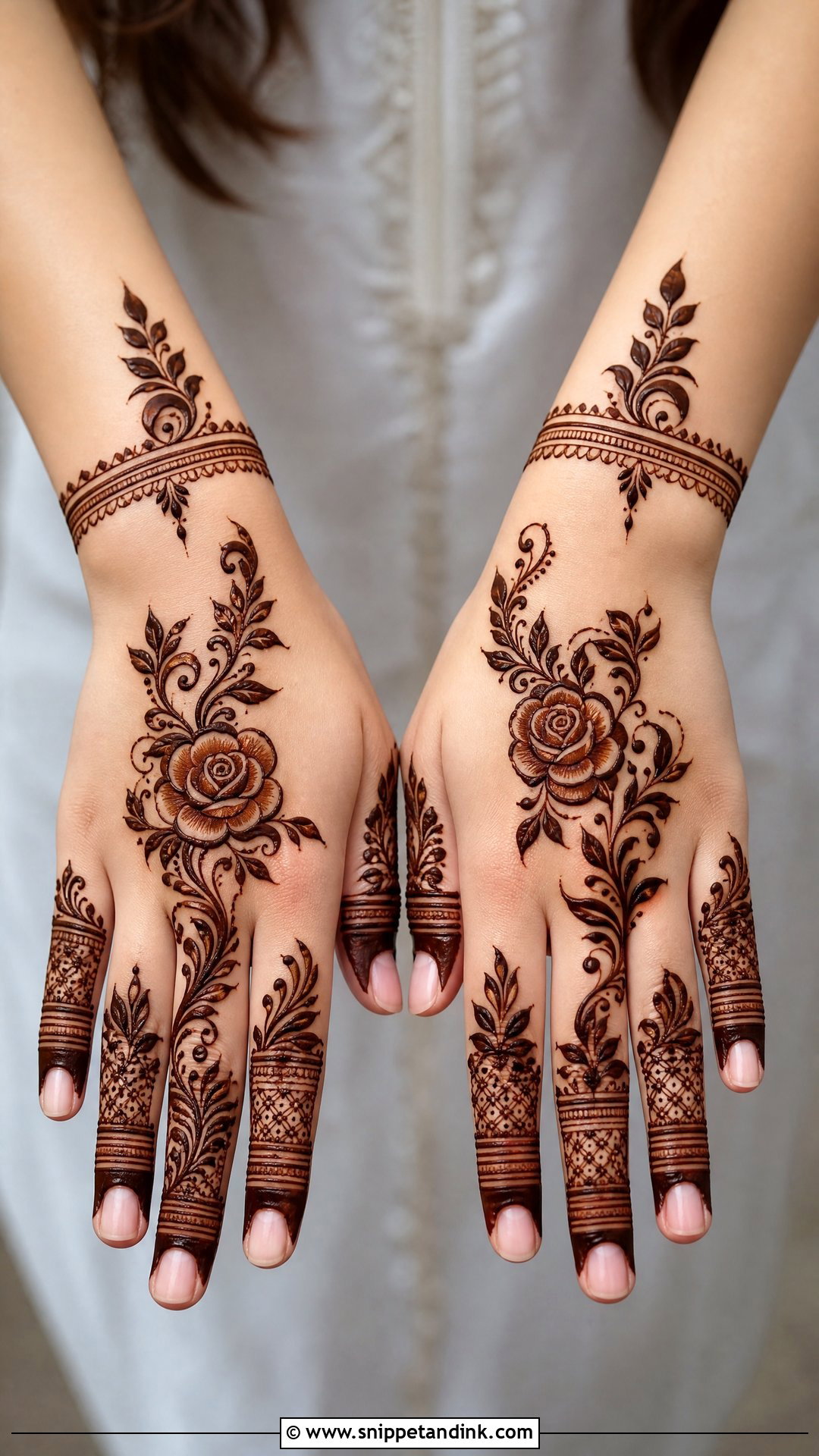
Shading adds depth to flowers, leaves and paisleys with light and dark areas. Large roses or lotus on the back hand, leafy vines across the fingers and a wrist border with soft filled sections are typical. It belongs to Arabic and Gulf styles, where big motifs leave room to shade. I shade by thinning the paste line and pulling it in short strokes from the outline inward, so the fill fades rather than ending in a hard block.
34. Royal Bridal Mehndi Design
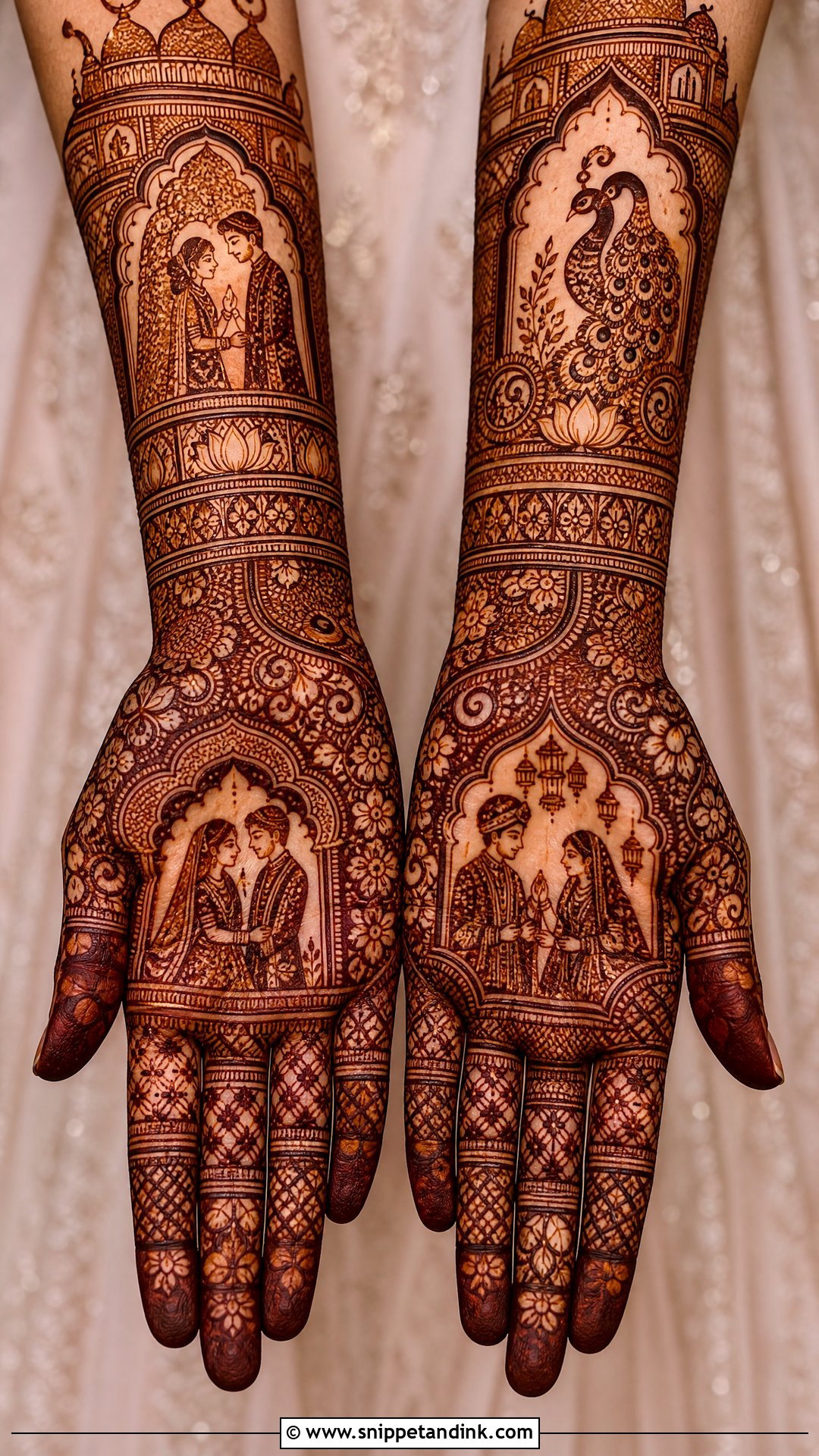
Royal bridal mehndi is the most dramatic style here: full hands and forearms with peacocks, lotus, palace arches, bride and groom portraits, paisleys and fine jaali. It has to be organized. I separate the major motifs with wide panels and then fill each panel with fine detail. The palms hold the symbolic elements, while the back hands show mandalas and jewelry patterns. Book an experienced artist and allow most of a day.
35. New Mehndi Design
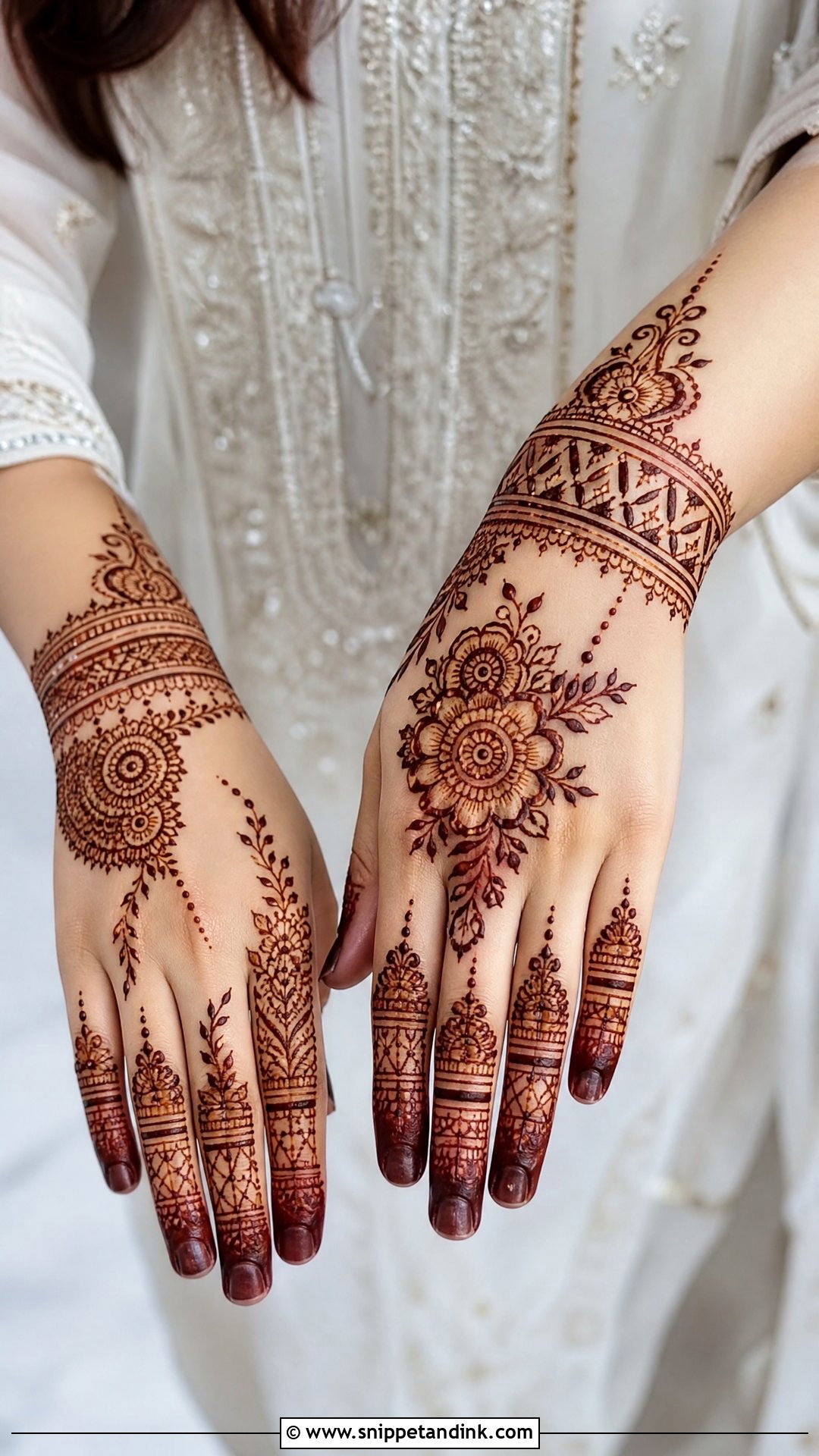
What’s new right now is mostly about composition: asymmetrical back hand florals, fine finger lines, small mandalas, geometric cuffs and plenty of negative space, focused on how the hand looks in photos rather than on full coverage. Fusion is common, with Arabic flowers, Indian filler and Moroccan wrist bands in one design. The best of these look planned and balanced, and they’re wearable well beyond weddings.
Hiding a Name for the Groom to Find
Many families still play the game where the groom has to find his name in the bride’s mehndi. It’s a lovely tradition, and it needs a bit of planning, because once the paste is on there’s no correcting a spelling.
- Write the name or initials down for your artist exactly as you want them, and say which script: English letters, Devanagari, Urdu or Arabic script all look very different.
- Choose how hard it should be to find. Inside a paisley or in the jaali on the palm is tricky; on the wrist cuff is easy.
- Keep the letters large enough to stain clearly. Very small text tends to blur as the stain darkens and becomes unreadable for everyone.
- A date, a small symbol from your story or a motif from your outfit can be hidden the same way.
I like to sketch the name lightly on paper first and show it to the bride before drawing it on her hand. It takes a minute and avoids the one mistake that can’t be scraped away.
Quick, Bridal or Somewhere in Between?
Mehndi can be simple or bold, traditional or modern, bridal or minimal. For something quick, a simple front hand, finger or bracelet design is enough. For weddings, full hand bridal, royal bridal or detailed feet mehndi carry the occasion. Arabic, Gulf, Moroccan and modern patterns suit cleaner, trendier looks. Think through placement, coverage, outfit, jewelry and drying time, then give the stain proper aftercare so it peaks on the day you’ll be photographed.
You'll Like These Ideas:










Leave a Reply