
Henna during Ramadan rarely needs to be heavy. Most of the hands I decorate in this month are for an iftar with family, a Taraweeh night or the slow build-up to Eid, and the people wearing them are fasting, washing for prayer several times a day and cooking for a crowd. So the designs here lean on symbols of the month, crescent moons, stars, lantern details, alongside Arabic florals, mandalas, bracelet bands and airy finger work. A few go further, with Indian or Indo-Arabic filling for Chand Raat and a bridal look for a nikah held during the month. Each one below comes with what I’d watch for when drawing it.
Fitting a Henna Sitting Around the Fast
In Ramadan, I book almost all my appointments after iftar. Applying henna during the fast is possible, but the person needs to sit still for a while and then protect the paste for hours, and doing that while hungry and thirsty in the late afternoon is miserable. After the meal, there is energy, time and a full night ahead for the paste to work.
Plan the evening around prayer. If you want to pray Taraweeh with wet paste on your hands, keep the design small or apply it straight after the prayer instead. My usual order is iftar, Maghrib, then henna on the hands, with paste left on overnight and scraped off before suhoor or after Fajr.
If you are the one cooking suhoor, ask for one hand to stay lighter, or do your own hands last so the paste has dried before you are back in the kitchen.
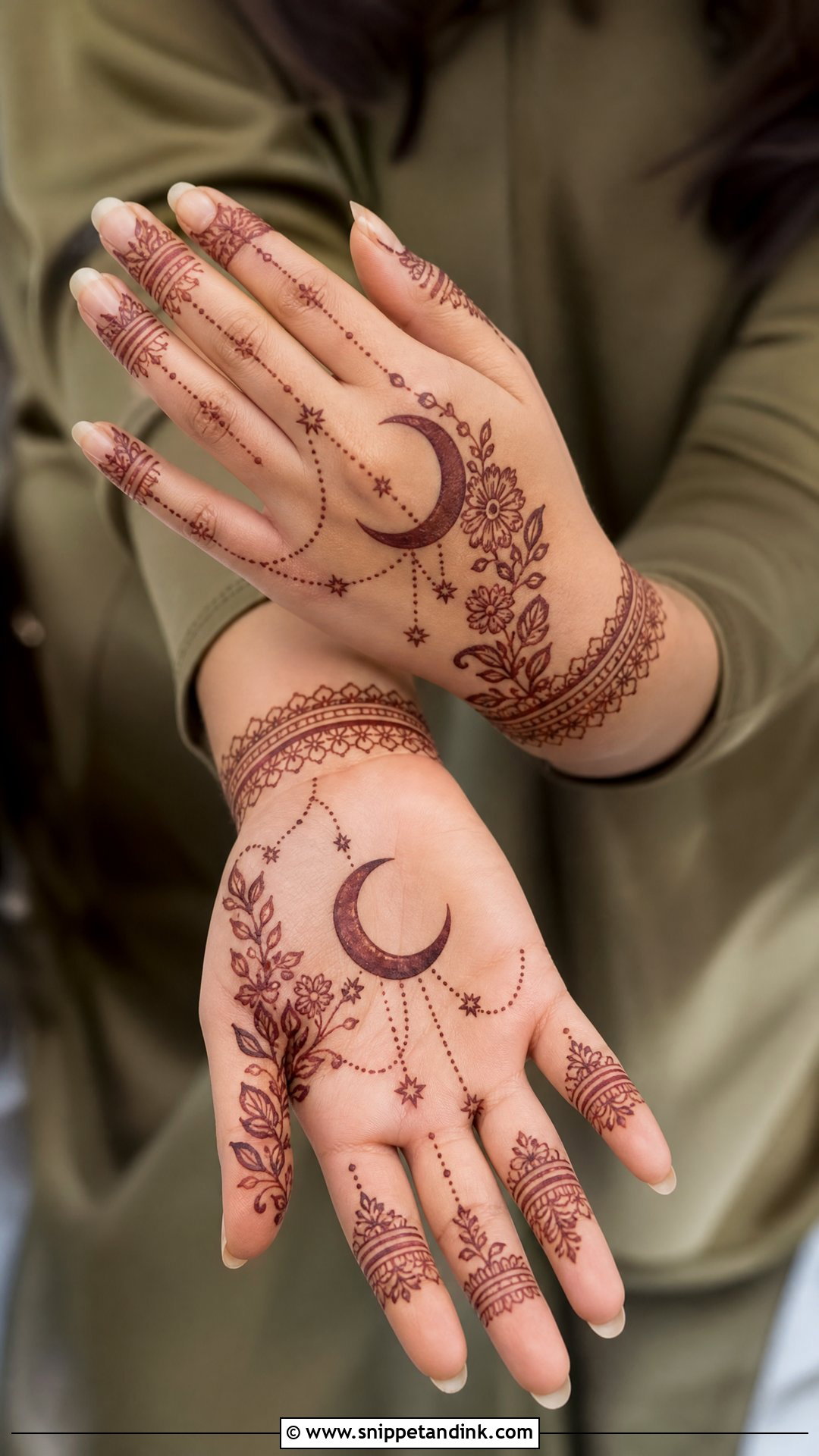
1. Ramadan Crescent Moon Mehndi Design
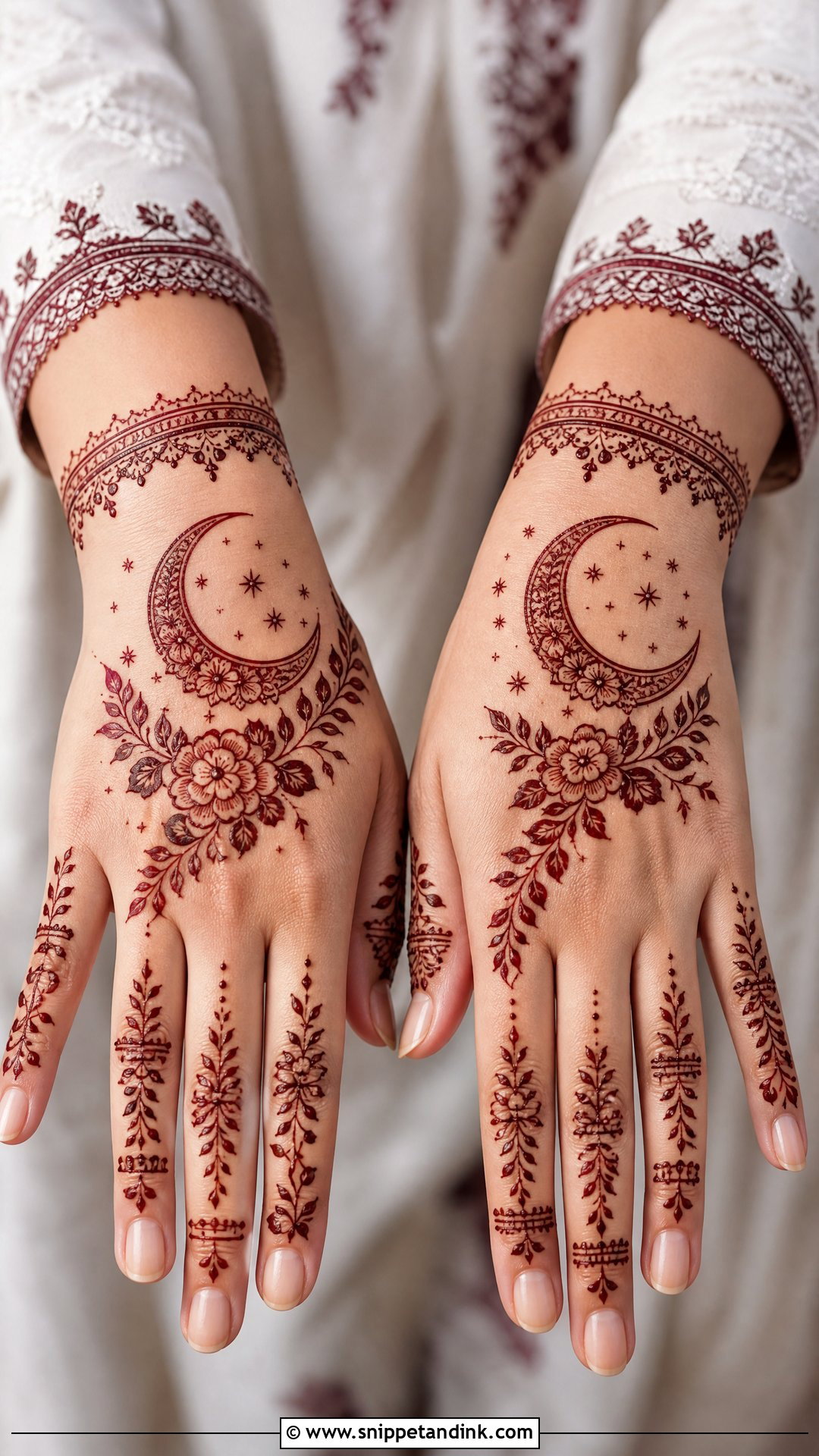
The crescent belongs to the moon sighting that opens and closes the month, which is why it is the motif I’m asked for most. I place it near the centre of the back of the hand, scatter tiny stars around it, add Arabic flowers on one side and let leafy vines run toward the fingers, finishing with a slim wrist border. A crescent only reads as a moon if the inner curve is cleaner than the outer one, so I draw the inner line first in one pull. Leave the palm bare for a light look, or repeat a small moon there.
2. Simple Ramadan Mehndi Design
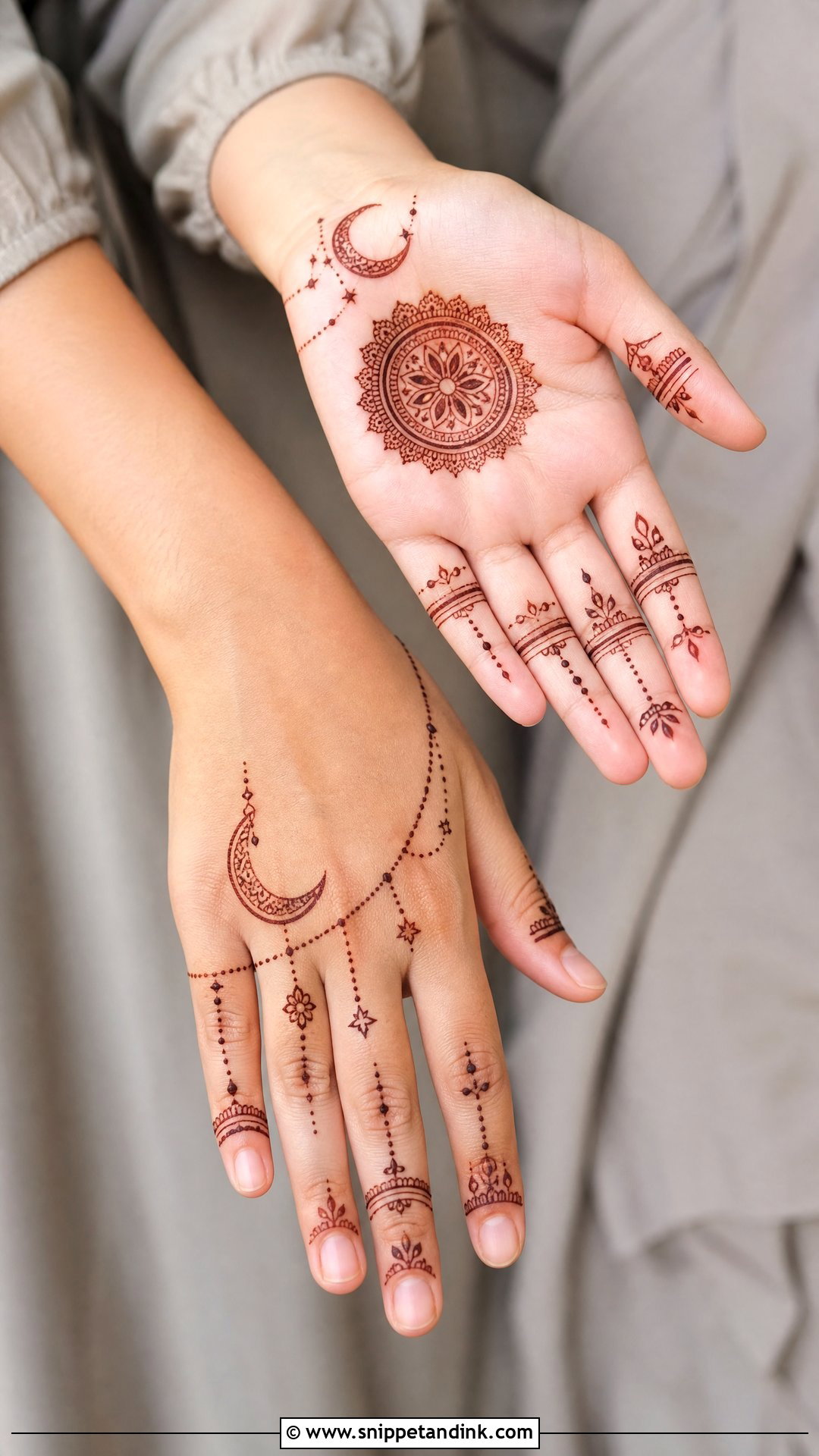
For a weekday iftar, this is plenty: a small palm mandala, thin finger lines, dotted chains and a delicate crescent near the wrist, or on the back hand a single floral trail from the index finger to the wrist. Open skin between motifs lets the stain show clearly, and that matters most on medium and deep skin tones, where fine dense filling can merge into one dark patch. It goes on quickly and survives daily routines well.
3. Arabic Ramadan Mehndi Design
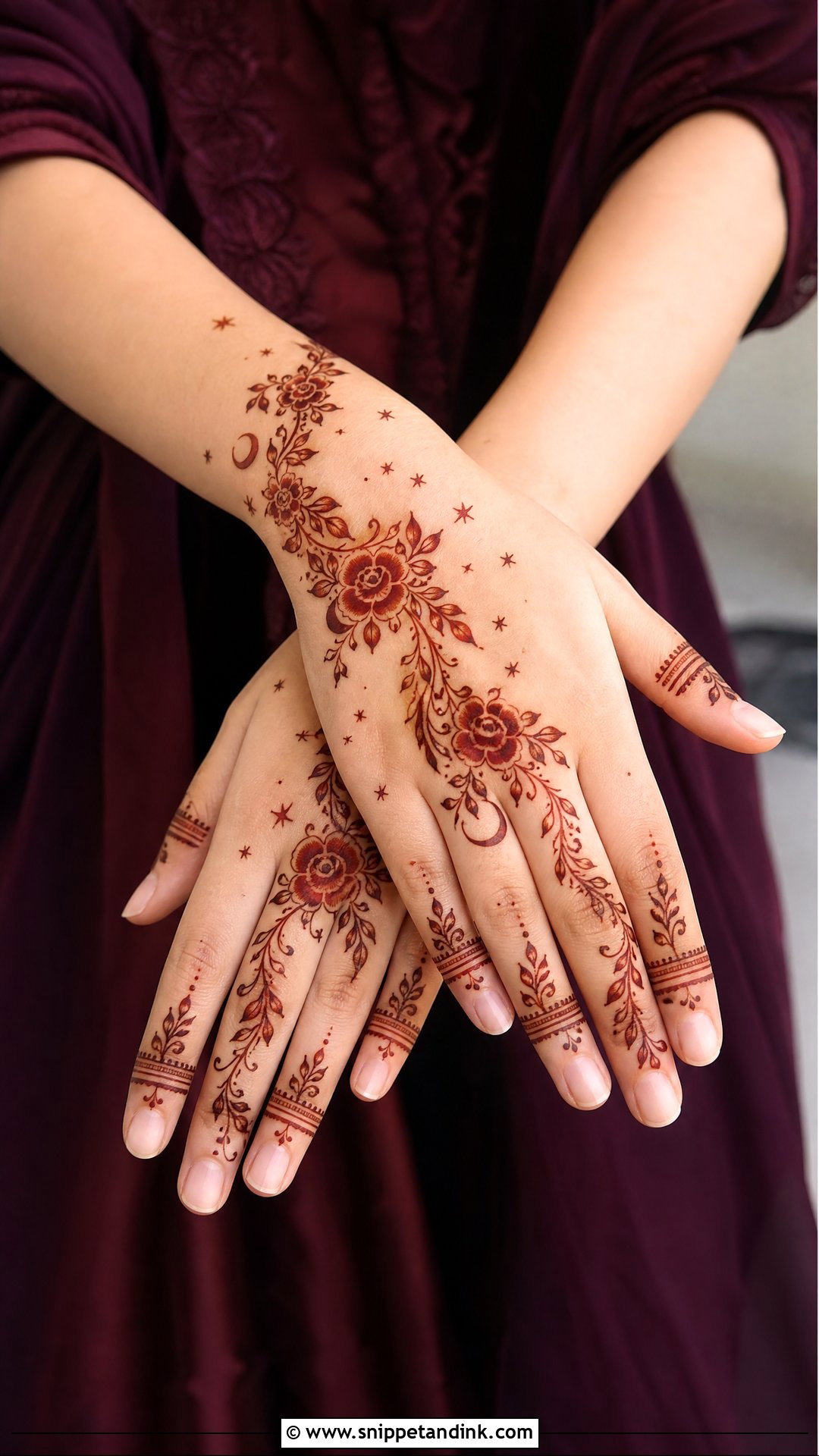
Arabic work is meant to be read from across a room. I start with large shaded flowers near the wrist and sweep leafy vines diagonally toward the middle finger, tucking a crescent or a few stars between the blooms. The fingers get half-floral tips and leaf curves rather than full coverage. Shading is done with a thinner drag of paste inside each petal, so it stains a shade lighter than the outline, which is what gives Arabic henna its contrast once it darkens. It suits evening gatherings well.
4. Ramadan Front Hand Mehndi Design
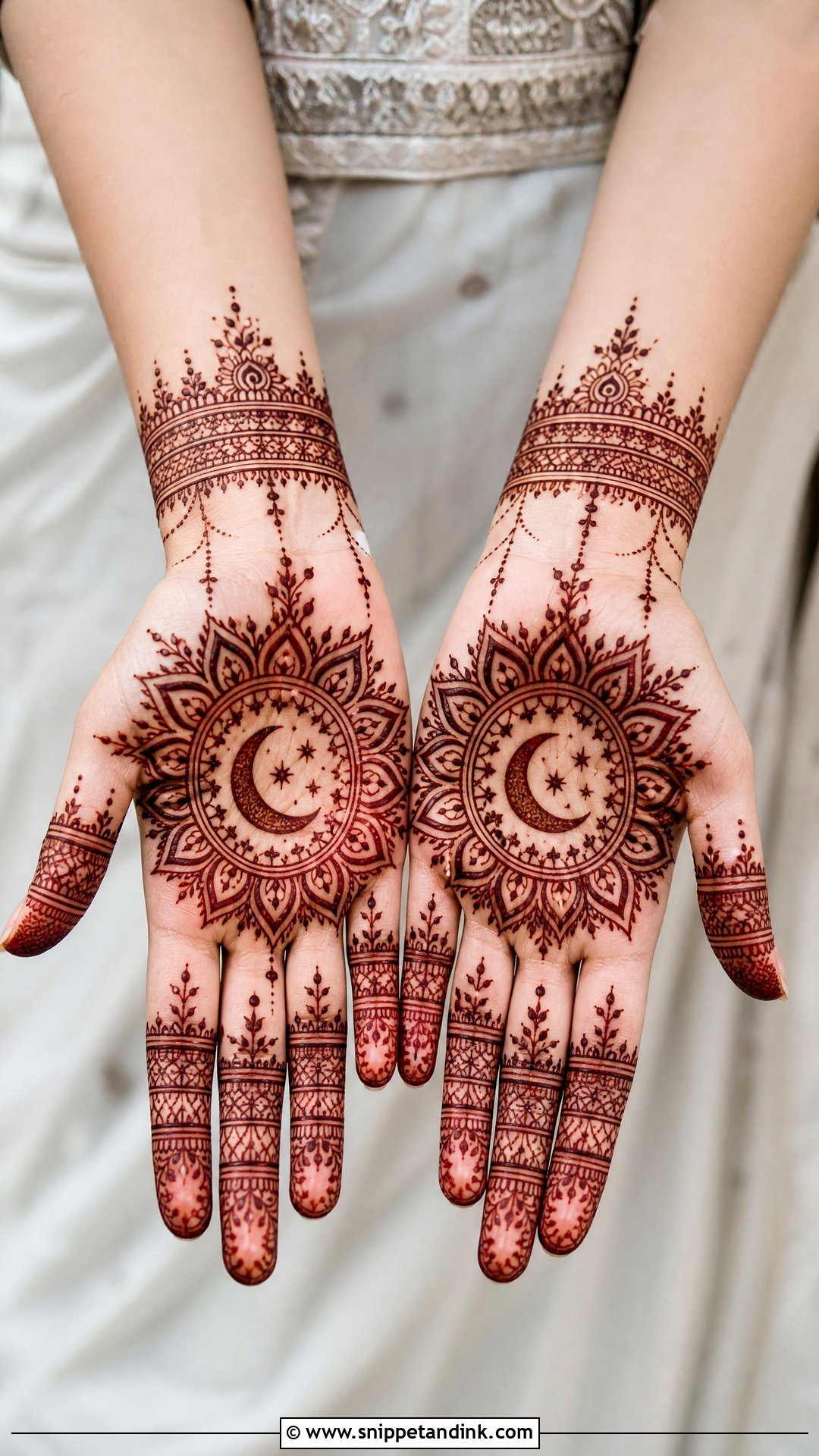
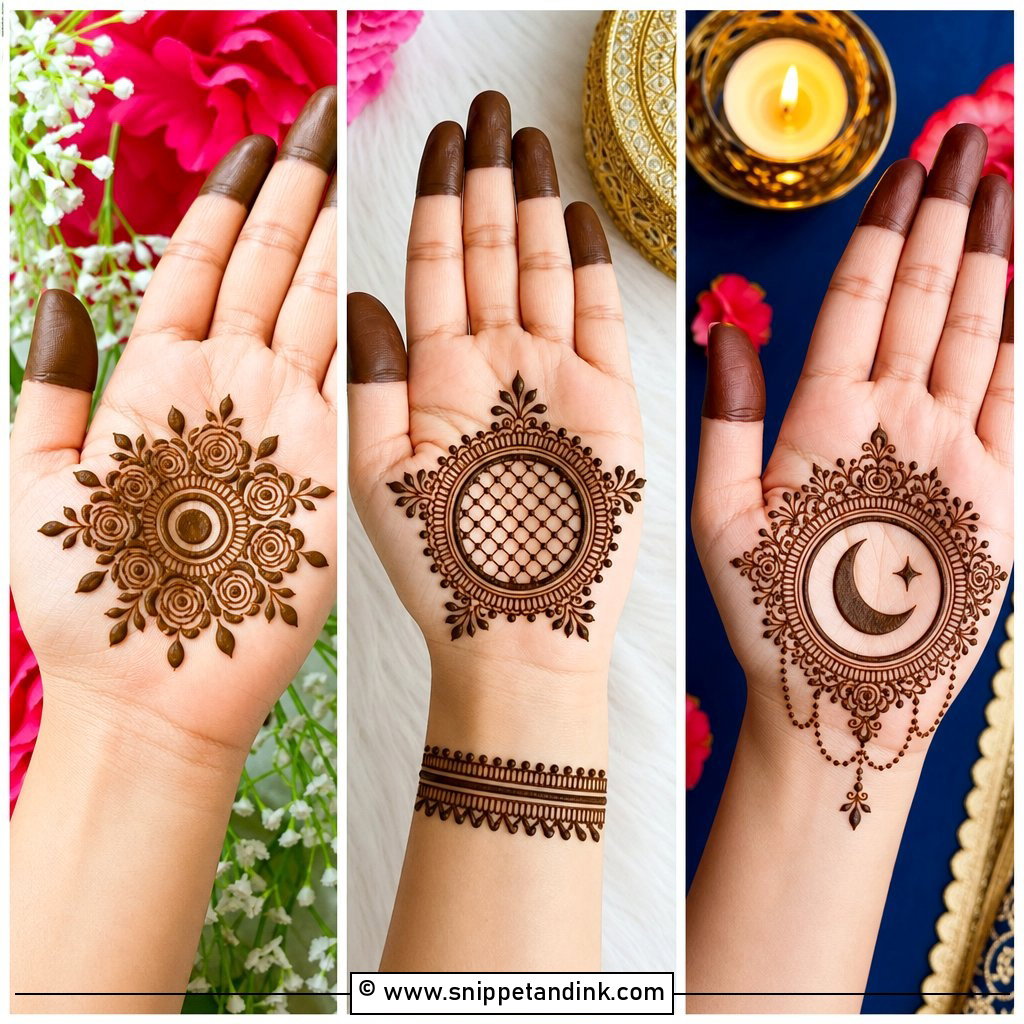
When the palm is the centrepiece, I set a crescent inside a round mandala right in the middle, ring it with dots, petals and small stars, then fill the fingers with varied bands and fingertip caps. A slim bracelet at the wrist frames it. Palms hold the darkest stain because the skin is thicker there, which suits a design meant to be seen when you raise your hands in dua or greet someone. Watch the main palm creases: motifs drawn across them distort every time the hand closes.
5. Ramadan Back Hand Mehndi Design
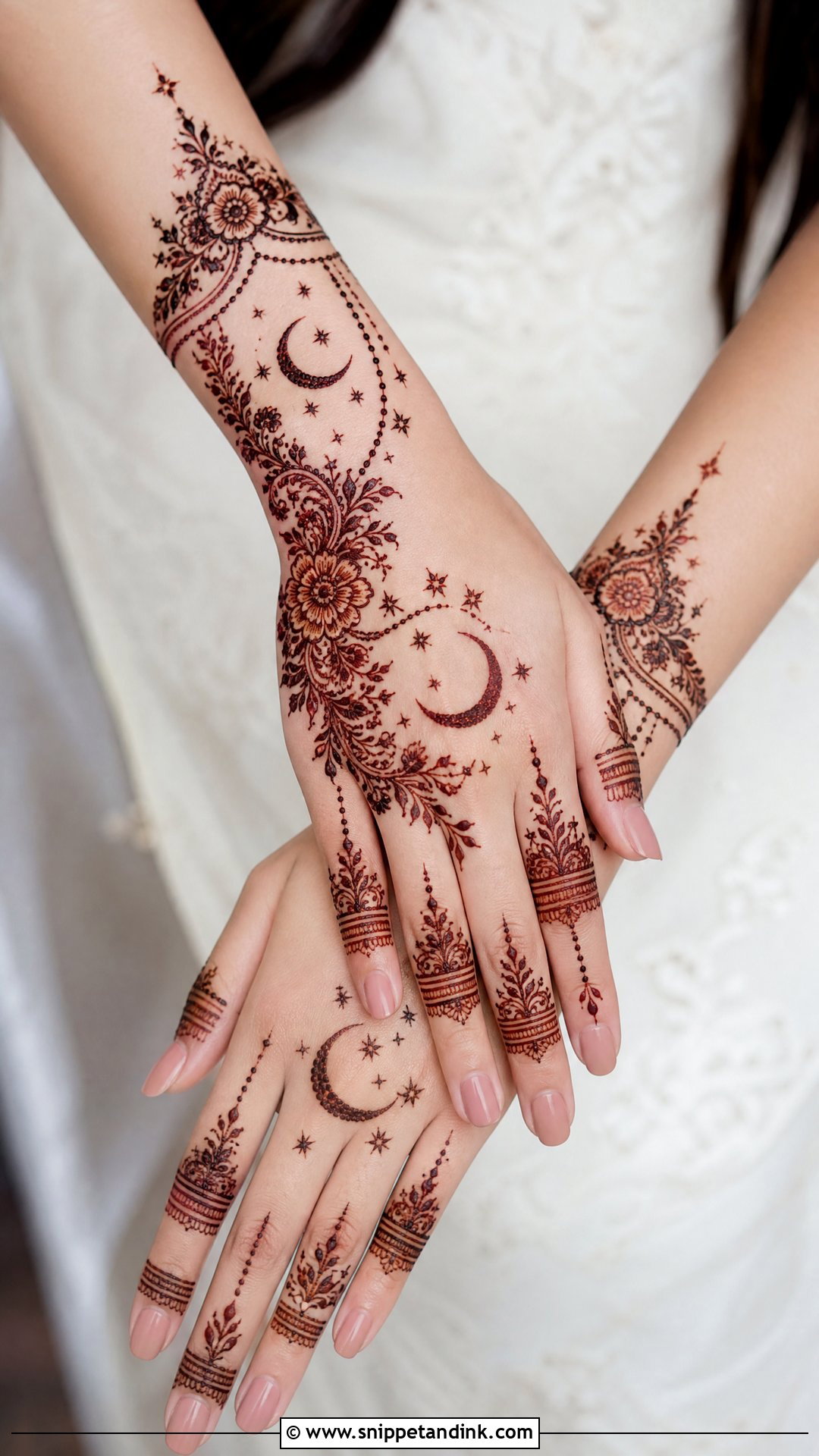
A moon and star cluster at the centre, an Arabic floral trail toward the wrist and finger vines reaching upward: this back-hand layout photographs well and keeps the palm free for daily work. The fingers get ring-like bands, tiny leaves and dotted chains instead of heavy filling, which gives a jewellery effect with bangles and modest festive outfits. Back-of-hand skin stains lighter than the palm, so I give this design an extra hour of paste time if I can.
6. Ramadan Moon And Star Mehndi Design
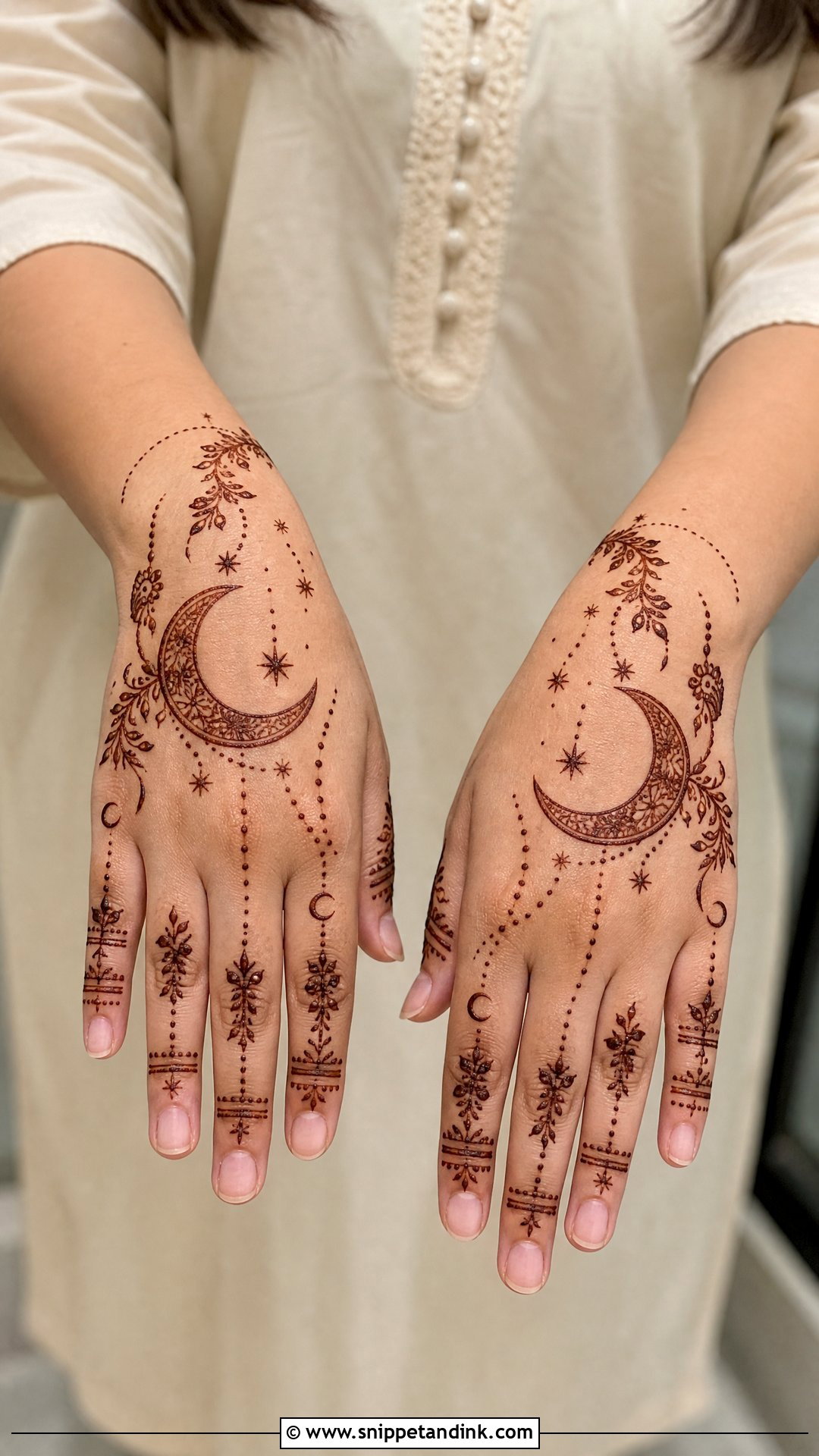
A larger crescent with tiny stars and soft, cloud-like floral curves gives the hand a night-sky feel. What makes it work is connection: delicate vines from wrist to fingers so the stars do not look like random dots. I keep the fingers simple with small star rings and thin bands. Girls like this one because it is symbolic without being solemn, and it suits Chand Raat naturally. Draw the stars as tiny five-point shapes only if your cone tip is fine; otherwise, use clustered dots, which stain more cleanly.
7. Ramadan Lantern Mehndi Design
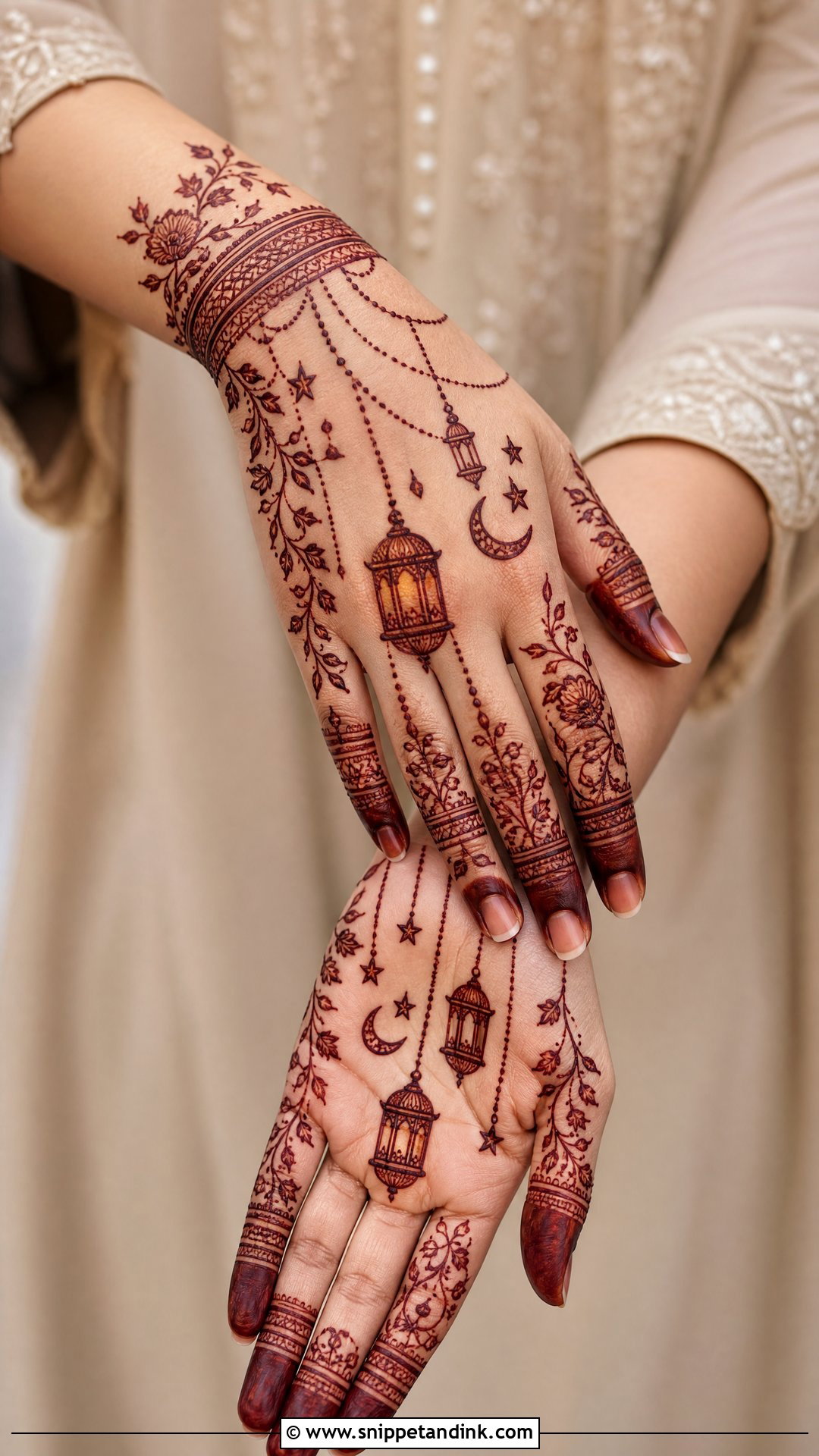
A lantern is a small motif with a lot of meaning, and it needs to stay simple to survive the stain. On the palm I frame one with a crescent, stars and fine dotted chains; on the back hand, it hangs from a bracelet-style wrist band, with florals and leaves running to the fingers. I draw the lantern’s frame with clean straight lines and keep the inner panels mostly open. Any fine lattice inside a small lantern tends to fill in and turn into a solid shape.
8. Ramadan Mandala Mehndi Design
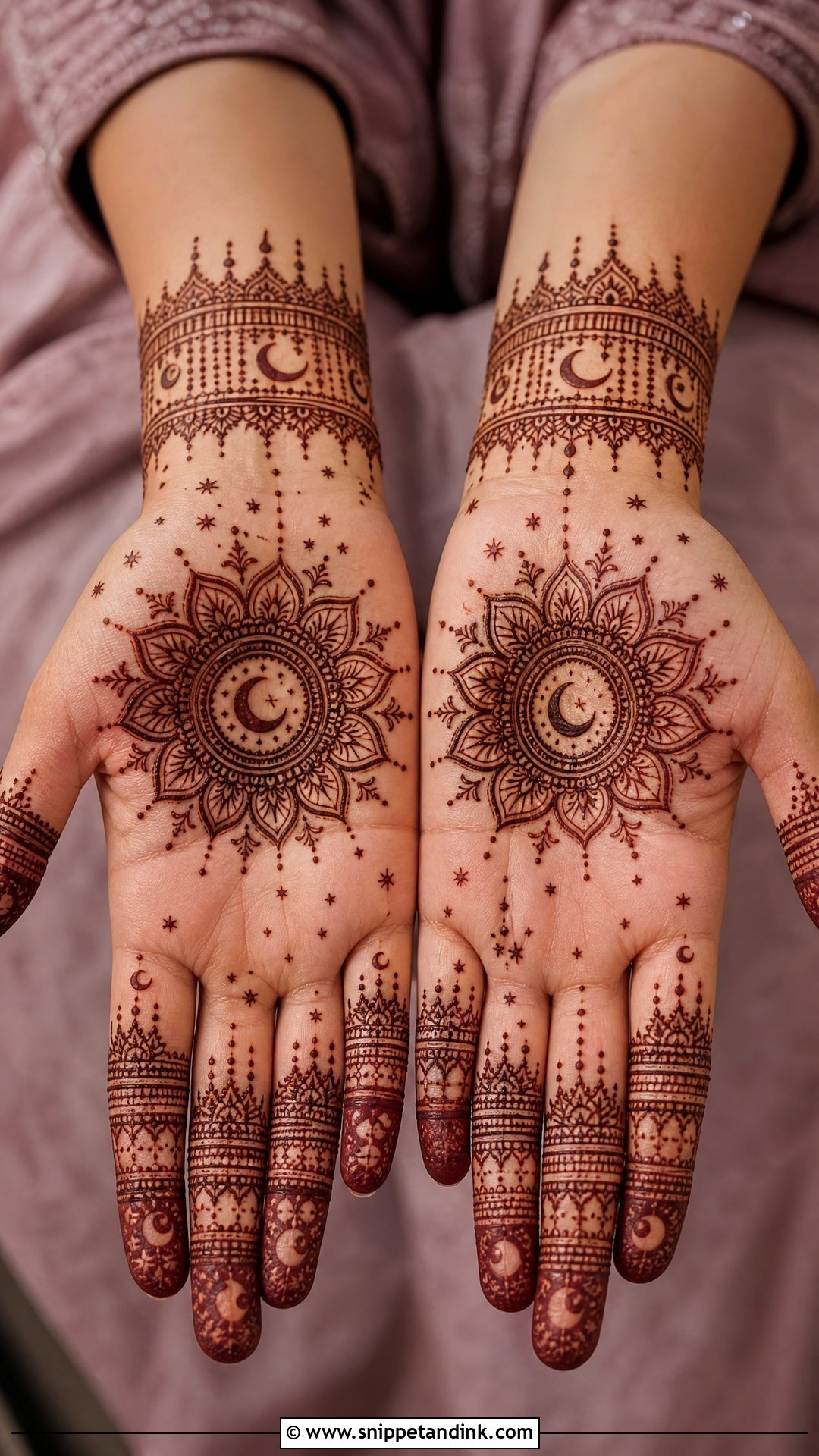
A round mandala becomes a Ramadan design the moment a small crescent sits inside it or just above it. Fine lines with dots, petals and thin bands run out to each finger, and a soft cuff with tiny stars finishes the wrist. I start every mandala from its outer guide ring and work inward, because building outward from the centre almost always ends in an oval. The circle balances any palm shape, while the finger lines make the hand look longer.
9. Ramadan Gol Tikki Mehndi Design
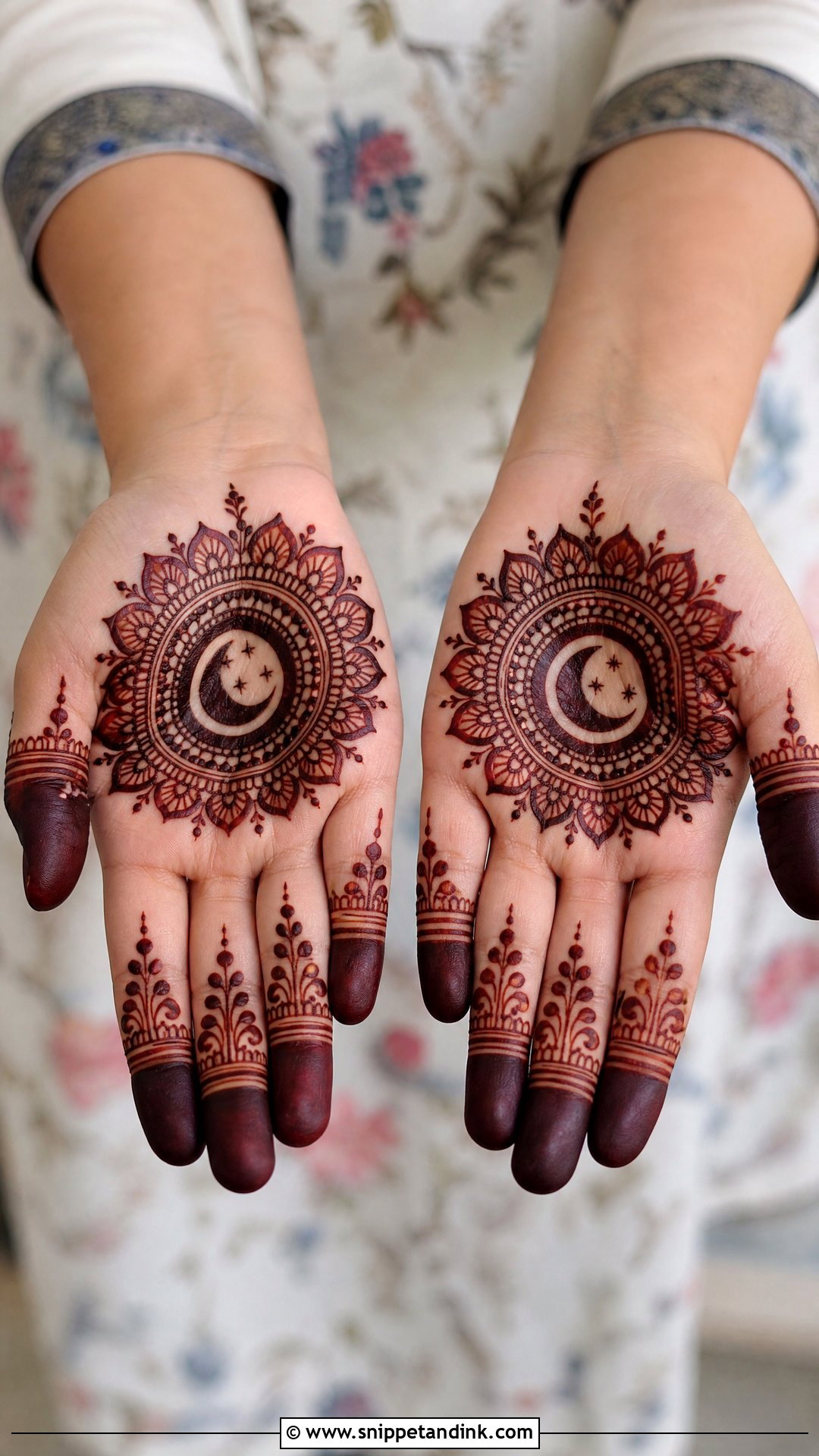
The gol tikki is the old-school round motif many of us first learned, and adding a crescent beside or inside it is all it takes to make it seasonal. Around the tikki go tiny petals, dots and fine rings; the fingers get classic caps, leafy bands and star dots; the wrist, a light border rather than a heavy cuff. The tikki itself should be filled solid with paste, not outlined, because a solid round of henna gives the deepest single patch of colour on the palm. Mothers and daughters often choose matching versions.
10. Ramadan Floral Mehndi Design
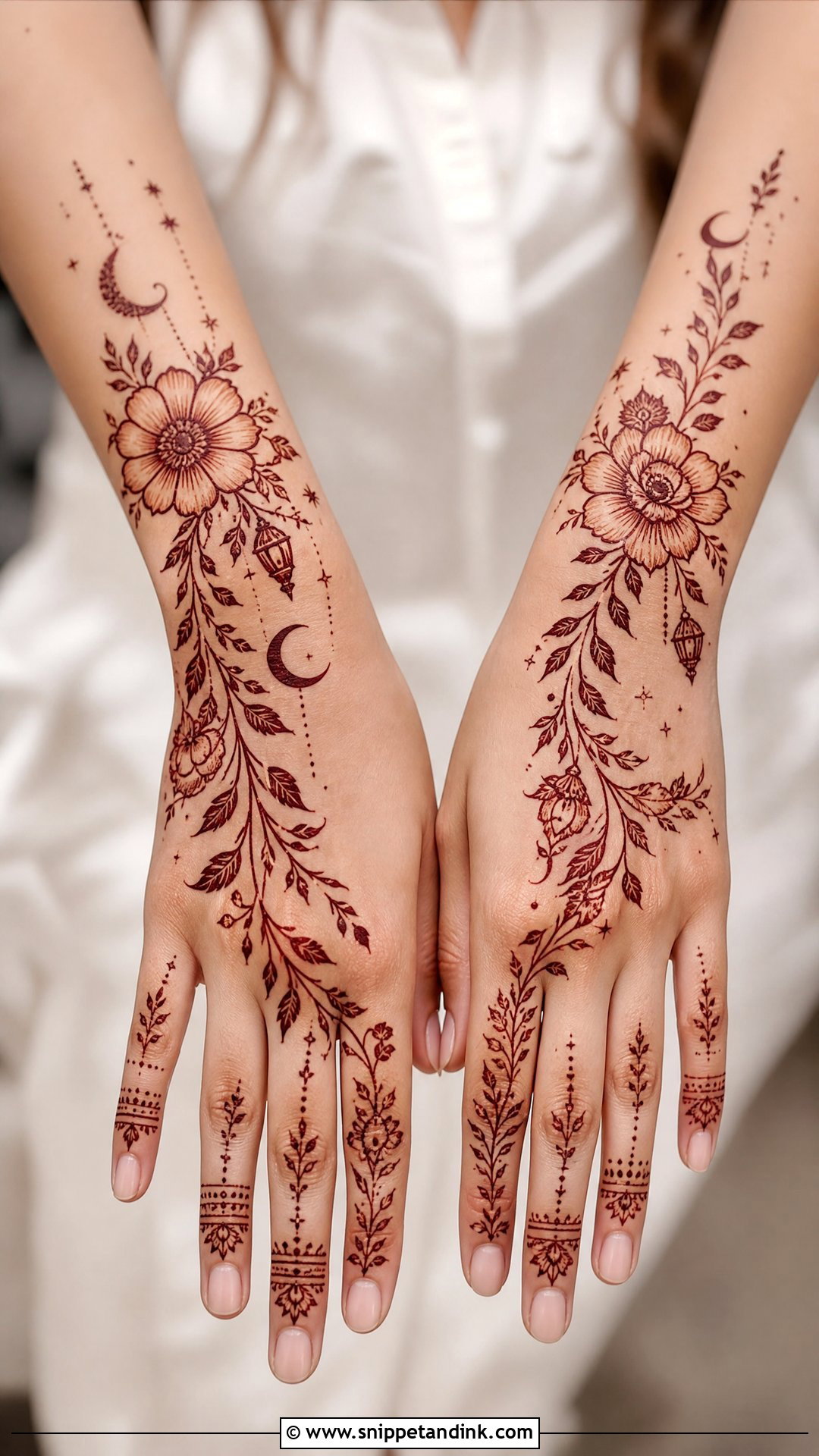
Ramadan florals look best airy. On the back hand I begin with one large flower near the wrist and let smaller blooms and leaves flow diagonally to the index finger, with a crescent tucked between them; on the palm, a soft floral mandala with simple finger strips. The mistake I correct most is cramming flowers edge to edge. Give each bloom a clear gap, because henna spreads slightly as it dries and touching petals blur into one outline.
11. Ramadan Minimal Mehndi Design
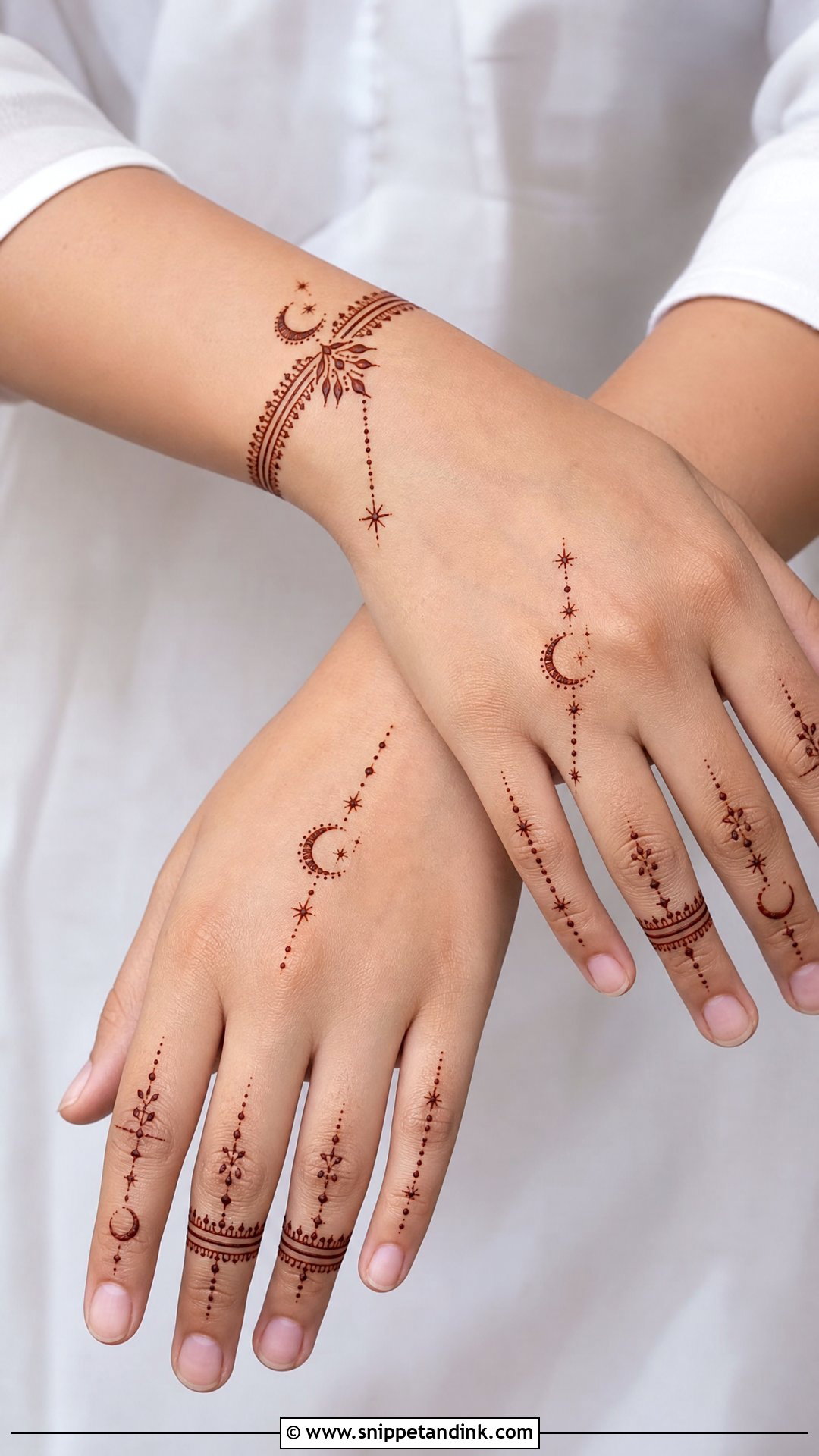
A tiny crescent on the back hand, fine dotted lines across the fingers and a slim wrist bracelet with one hanging star: minimal henna is mostly empty skin, so placement does all the work. On the palm, a small central flower with two curved moon details is enough. It is quick and suits school or work days. With so little paste on the hand, the stain fades faster through repeated washing, so expect a few days of good colour rather than a week or more.
12. Ramadan Finger Mehndi Design
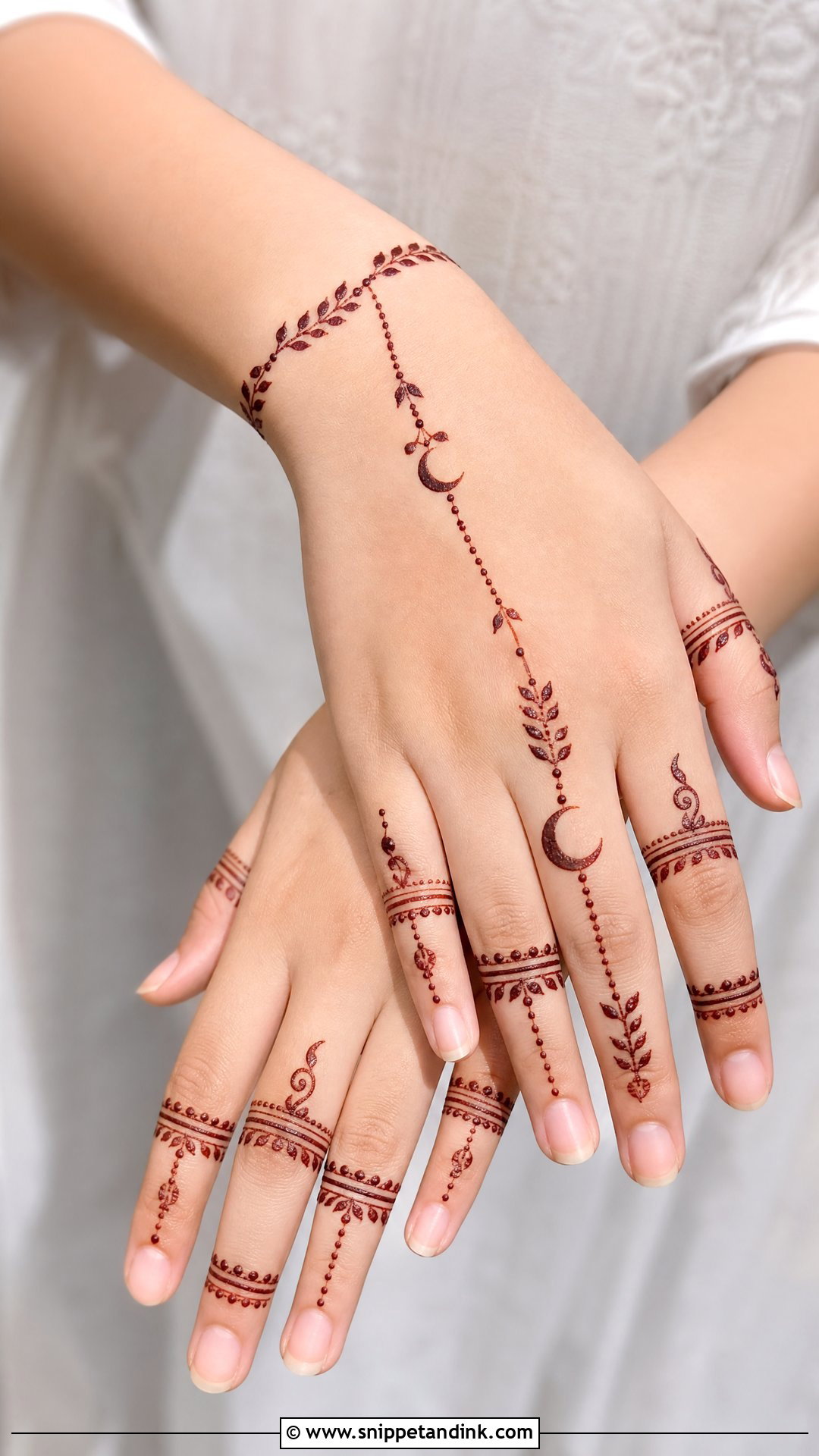
Thin bands, leafy rings, dots and tiny crescents across every finger give a jewellery look while the palm stays open. I usually run one light chain from a finger down to the wrist so the design feels joined, and place a small moon near a knuckle or at the centre of the back hand. Fingertips and the inner sides of the fingers take colour very well. Avoid putting dense filling right on the knuckle creases; it cracks off as you bend your fingers and leaves patchy lines.
13. Ramadan Bracelet Mehndi Design
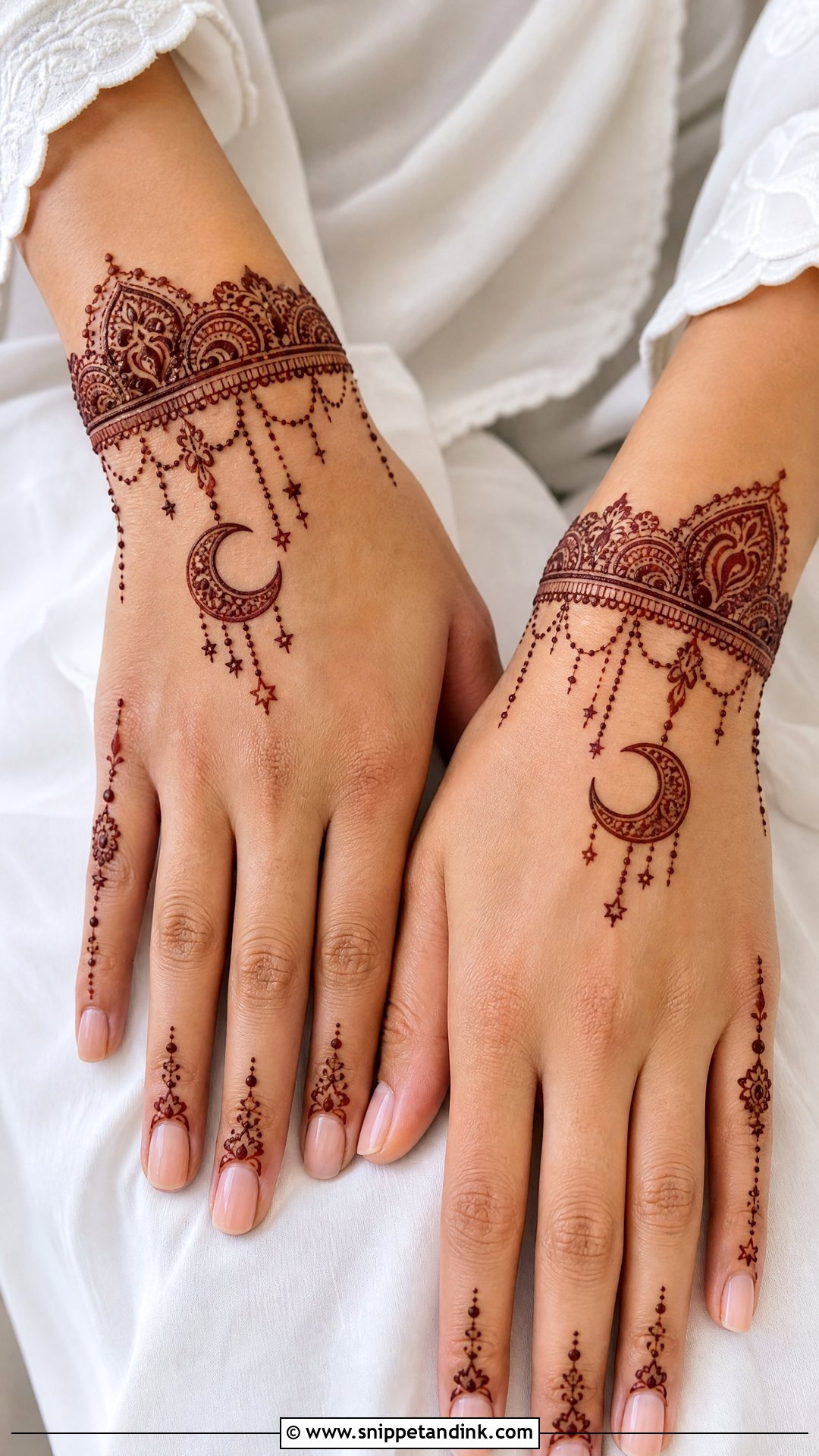
A henna cuff around the wrist with a hanging crescent charm, star drops and dotted chains reaching onto the back of the hand looks like an accessory, and it is easy to live with through the month. One or two finger trails keep it from feeling empty. The palm stays clean or gets a small moon near the wrist line. I mark the cuff’s top and bottom edges with faint guide lines first, because a band that tilts reads as a mistake once you put real bangles beside it.
14. Ramadan Indo Arabic Mehndi Design
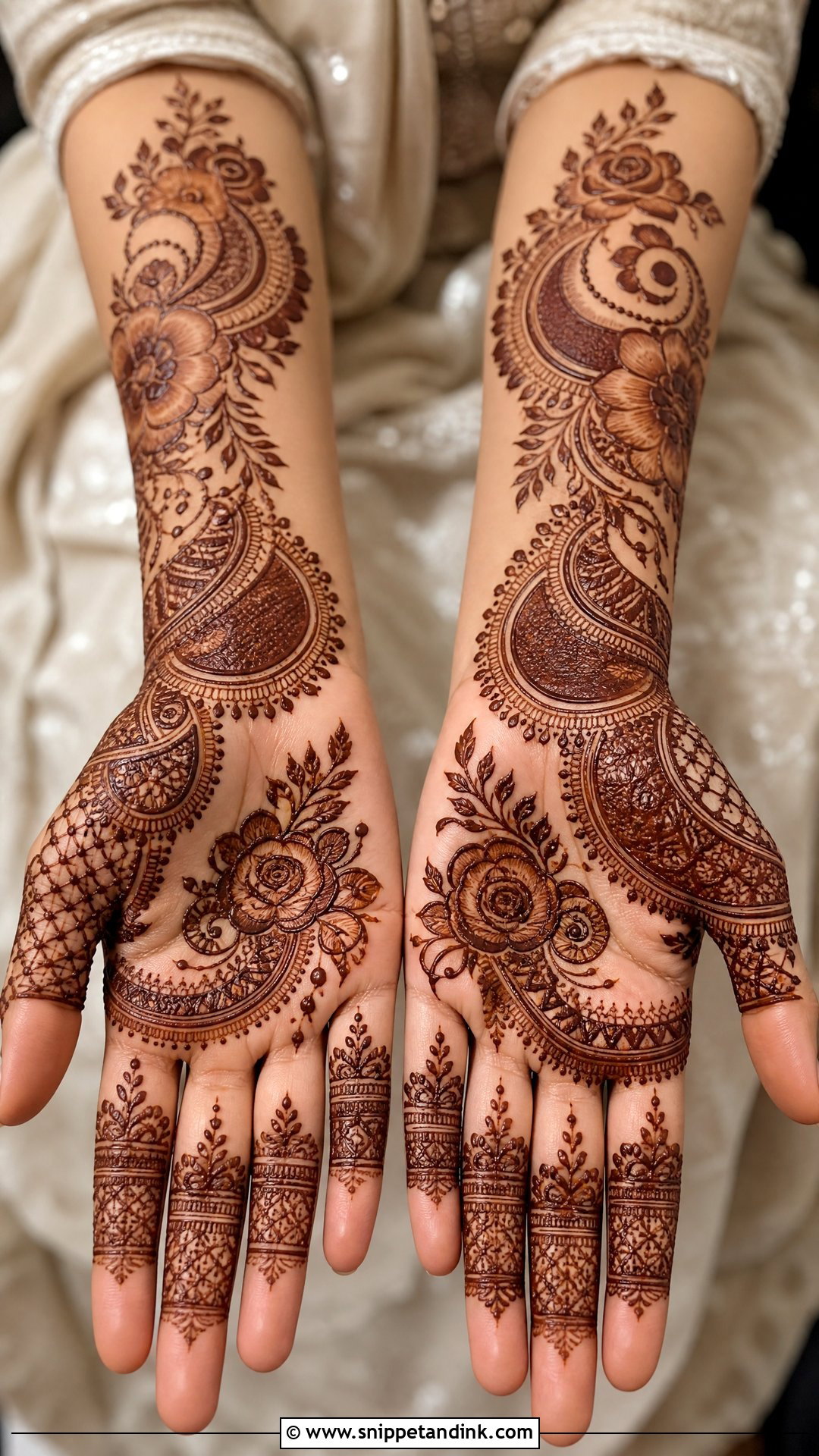
Indo-Arabic splits the hand into two moods: large Arabic flowers along one side, fine jaali, dots, small paisleys and moon details on the other. The palm can hold a crescent mandala, and the fingers mix shaded petals with clean bands. I decide which side carries the fine work before I start, so the filling does not creep across and swallow the open space. Many people book this for Chand Raat or the last ten nights, as Eid gets close.

15. Ramadan Indian Mehndi Design
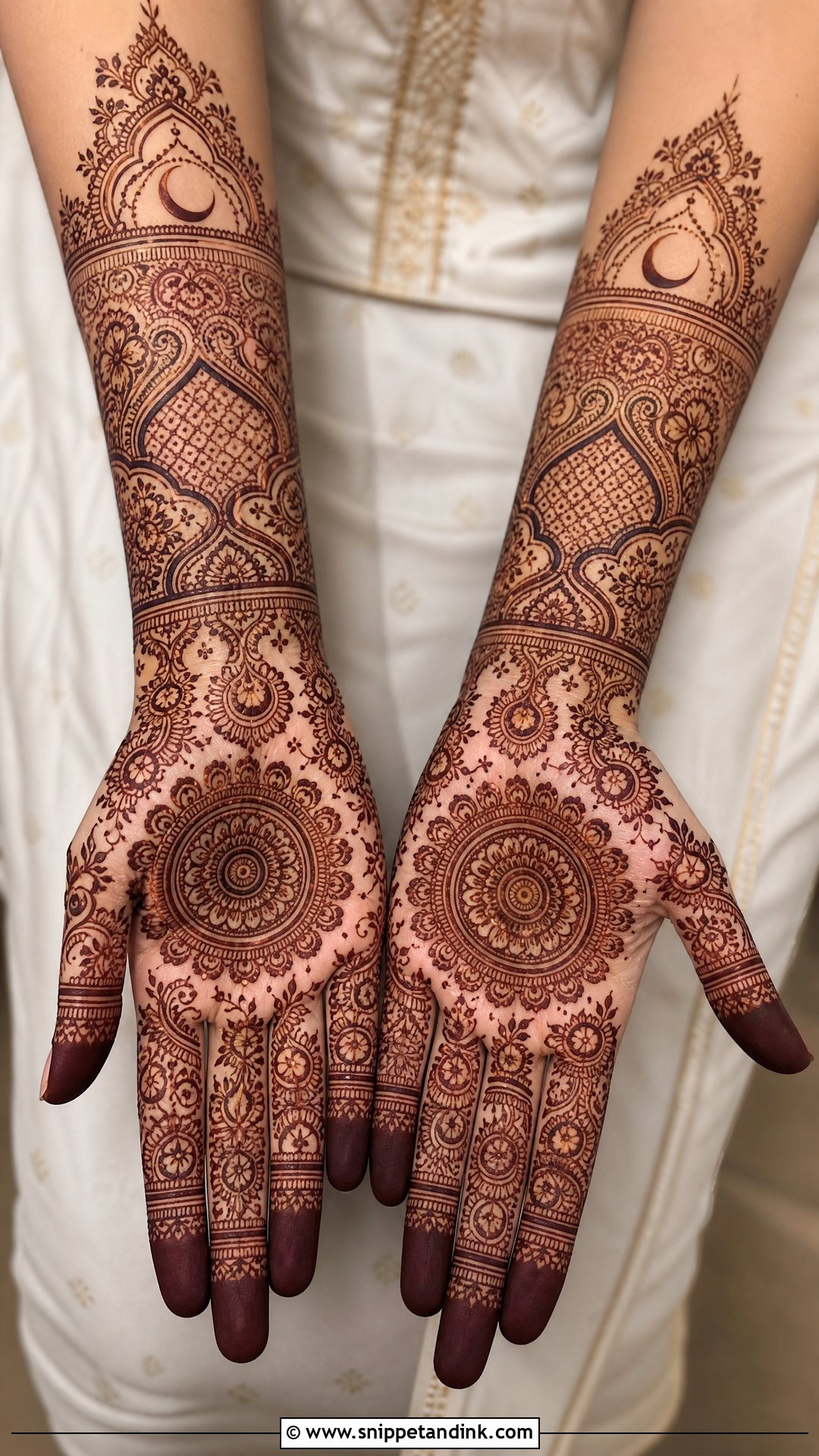
Full Indian coverage brings everything in: central mandala, paisley borders, floral vines, peacock curves, jaali panels and crescent accents, with fully detailed fingers and a wrist cuff. It is a long sitting, and during Ramadan I schedule it after iftar rather than during the fast, since the person in the chair needs to sit still for a long time and then keep the paste on for hours. If you want the deepest, most traditional stain for Eid, this is the design that delivers it.
16. Ramadan Moroccan Mehndi Design
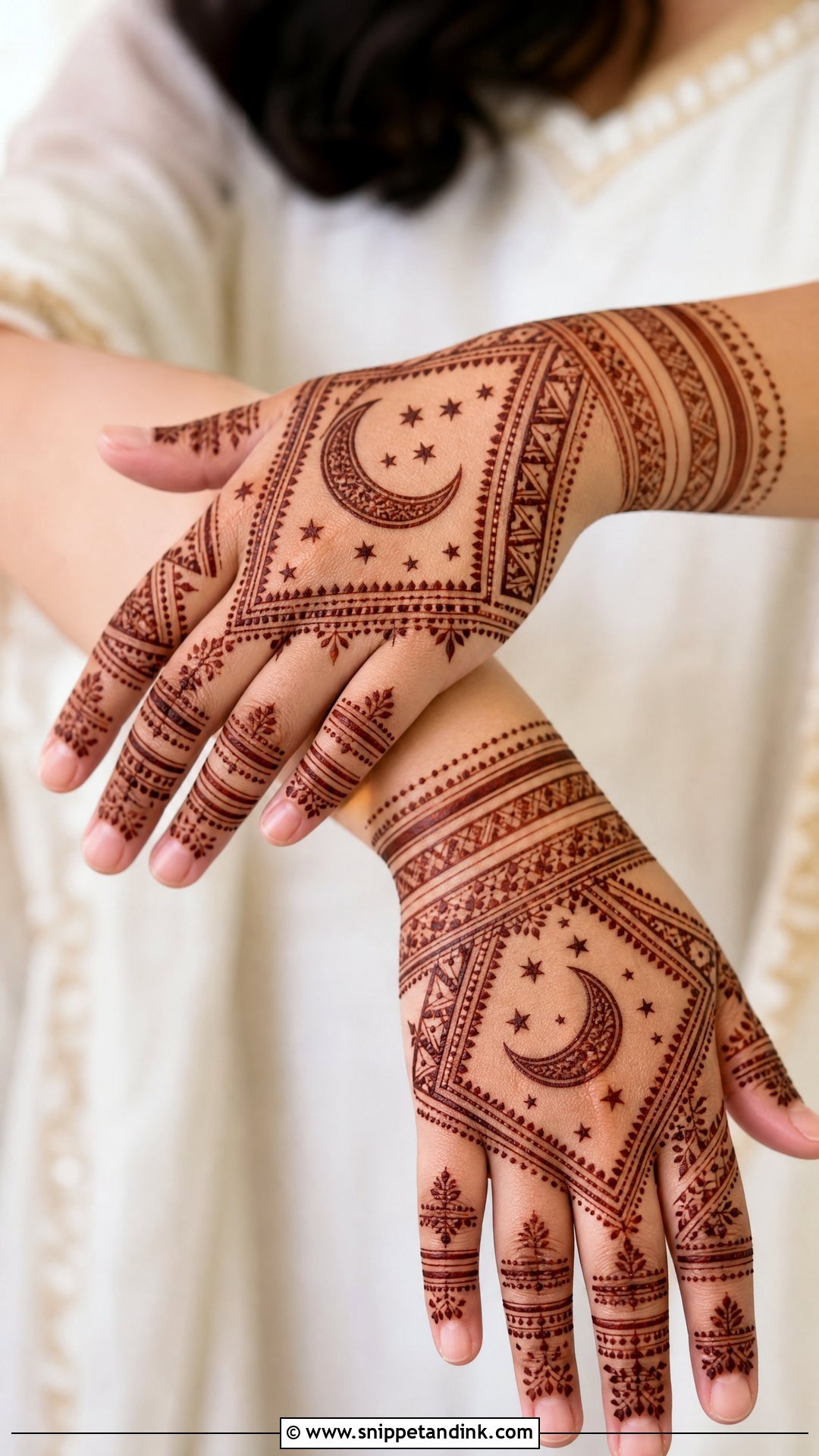
Diamond grids, triangle bands, straight-line cuffs and small star shapes give Moroccan henna its sharp, geometric look, with a crescent near the wrist or centre tying it to the month. Angular finger bands and clean tips finish it. Geometry stains clearly because the lines are strong and the spaces planned, but it is unforgiving: straight lines show every wobble. I pull each line in one smooth movement with the cone tip held just above the skin.
17. Ramadan Gulf Mehndi Design
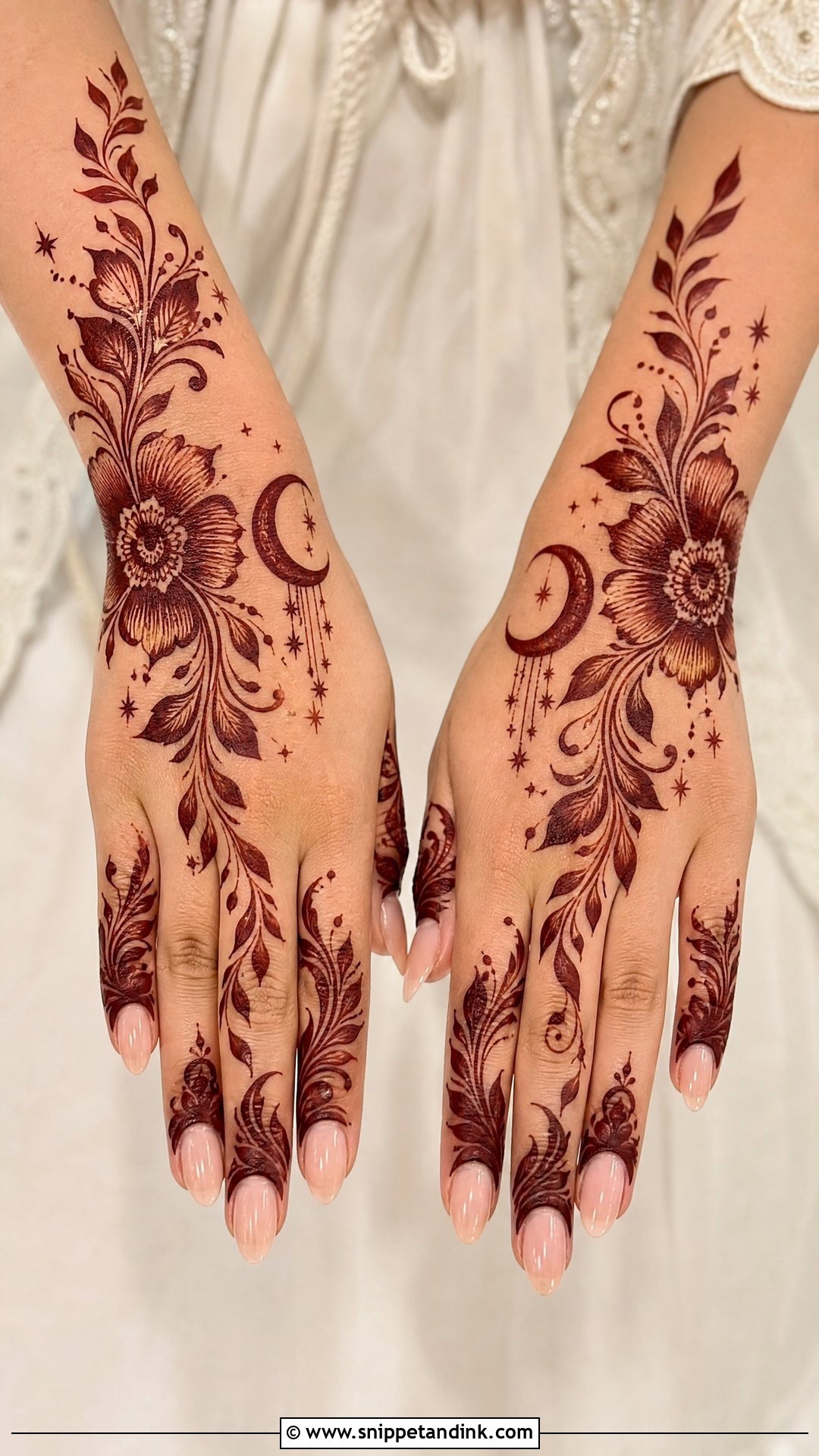
Gulf style begins at the wrist with large shaded flowers and travels across the back of the hand in a sweeping trail, with crescents, star dots and small leaf clusters between the big motifs. The fingers are decorated, not filled, with curved lines and bold tips. It looks rich without covering every inch of skin. Its bold outlines are what carry it, so this is one design where I’d use a slightly thicker paste: the darker the stain gets, the stronger those outlines read.
18. Ramadan Palm Mehndi Design
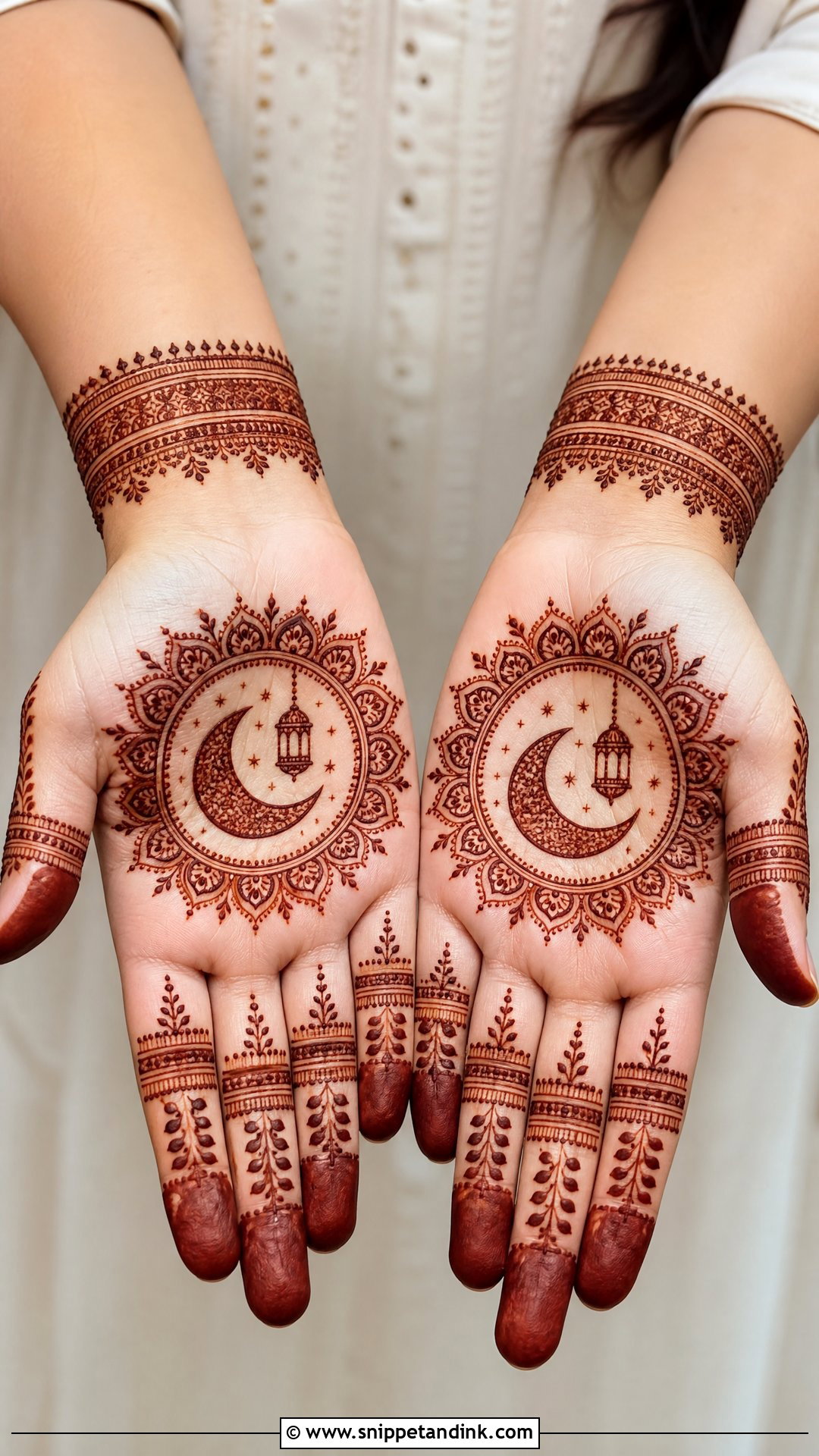
A crescent, a lantern or a mandala sits in the middle of the palm, and the design builds outward with petals, dots and small stars, then finishes with traditional finger bands, fingertip caps and a small wrist border. It shows during greetings and prayer, which is why many women prefer the palm over the back of the hand in this month. I’d keep the central motif slightly larger than you think. A small centre on a large palm makes the whole design look sparse.
19. Ramadan Full Hand Mehndi Design
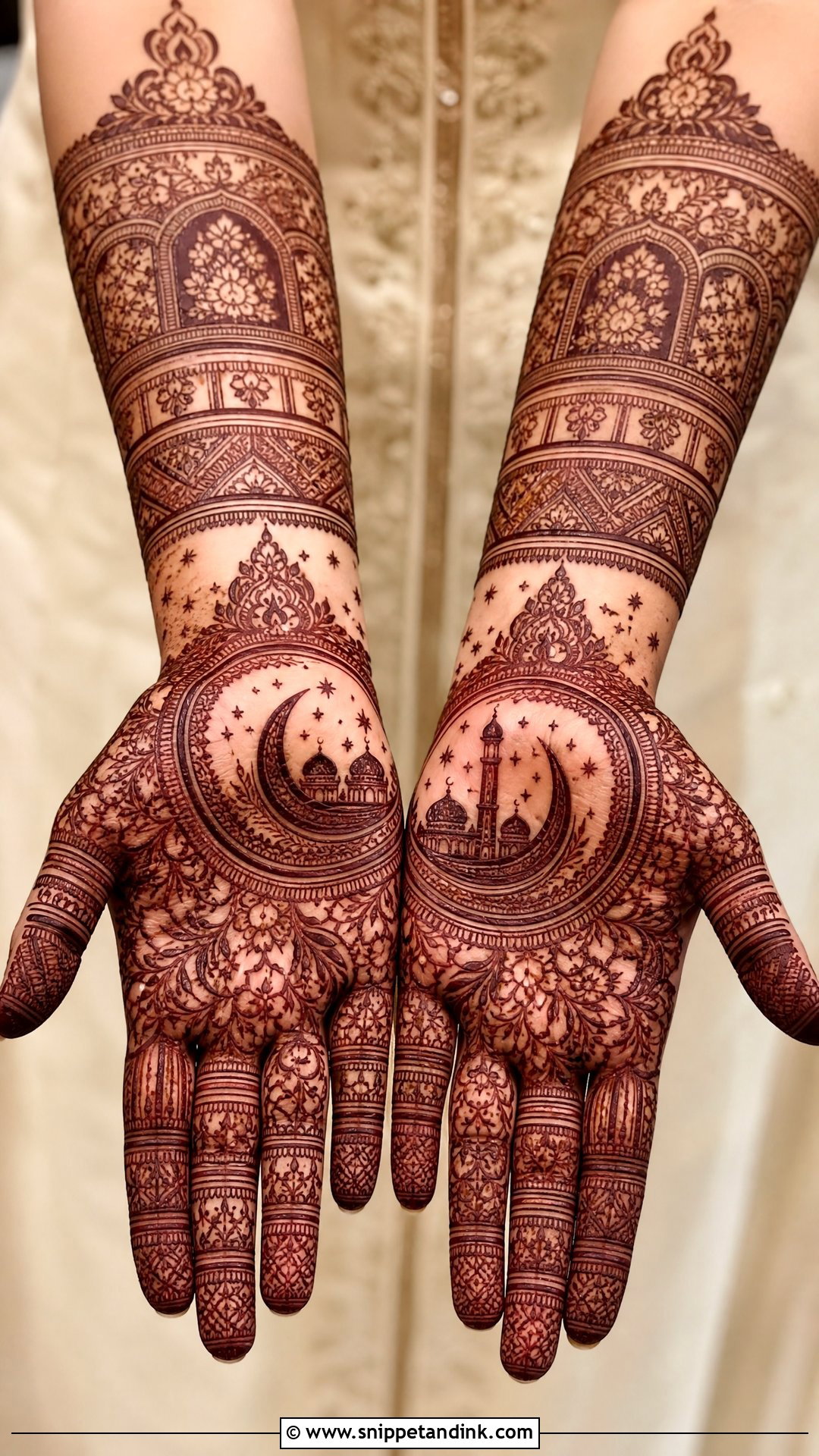
Palm, fingers, wrist and lower forearm, all connected: a crescent mandala in the palm, floral vines on the back hand, paisley fillers, jaali panels and stars throughout, with stacked bands and moon charms climbing the forearm. It suits Chand Raat, Eid preparation or a family event. This is the most time-consuming design in the list besides bridal work, and the paste needs hours afterwards, so it has to be planned around iftar, prayers and sleep rather than squeezed in.



20. Ramadan Half Hand Mehndi Design
Half coverage can mean the fingers and upper palm with the lower palm left open, or the wrist and back of the hand with lighter fingers. Either way, a crescent, a floral trail and dotted star lines carry the theme. I recommend it to beginners because the layout has a natural stopping point, and to anyone who cooks every evening, since the open part of the hand can still be used while the paste dries.
21. Ramadan Jaali Mehndi Design
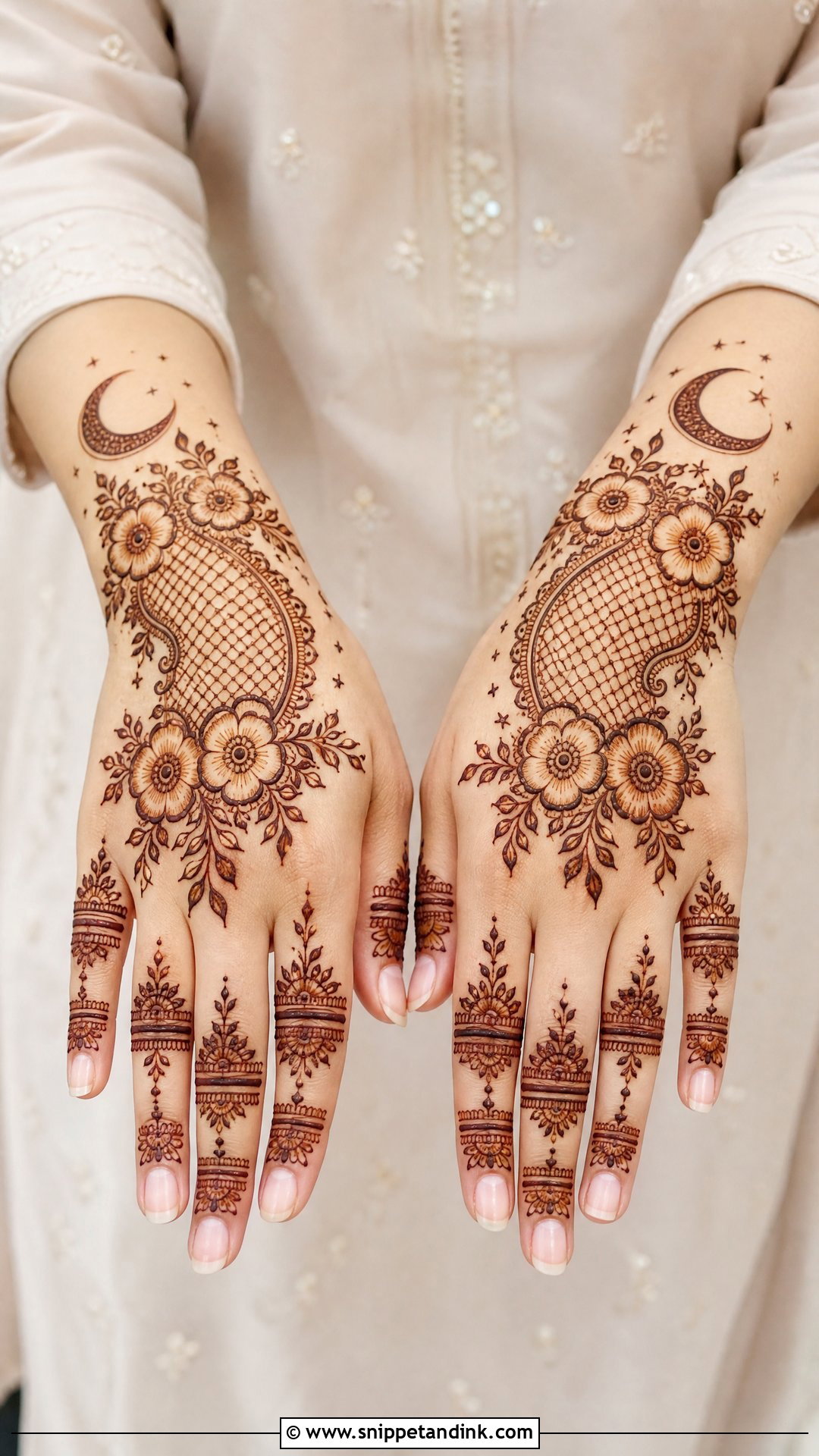
Jaali is a net pattern, and across the back of the hand it reads like lace. I frame a jaali panel with Arabic flowers on one side and a crescent near the wrist, add tiny dots inside the mesh, and keep the fingers to bands and leaf tips. On the palm, a smaller panel with a mandala or moon centre works. Even spacing is everything with mesh. If your paste is lumpy or your hand unsteady, keep the jaali section small, because uneven grids look messy once stained.
22. Ramadan Paisley Mehndi Design
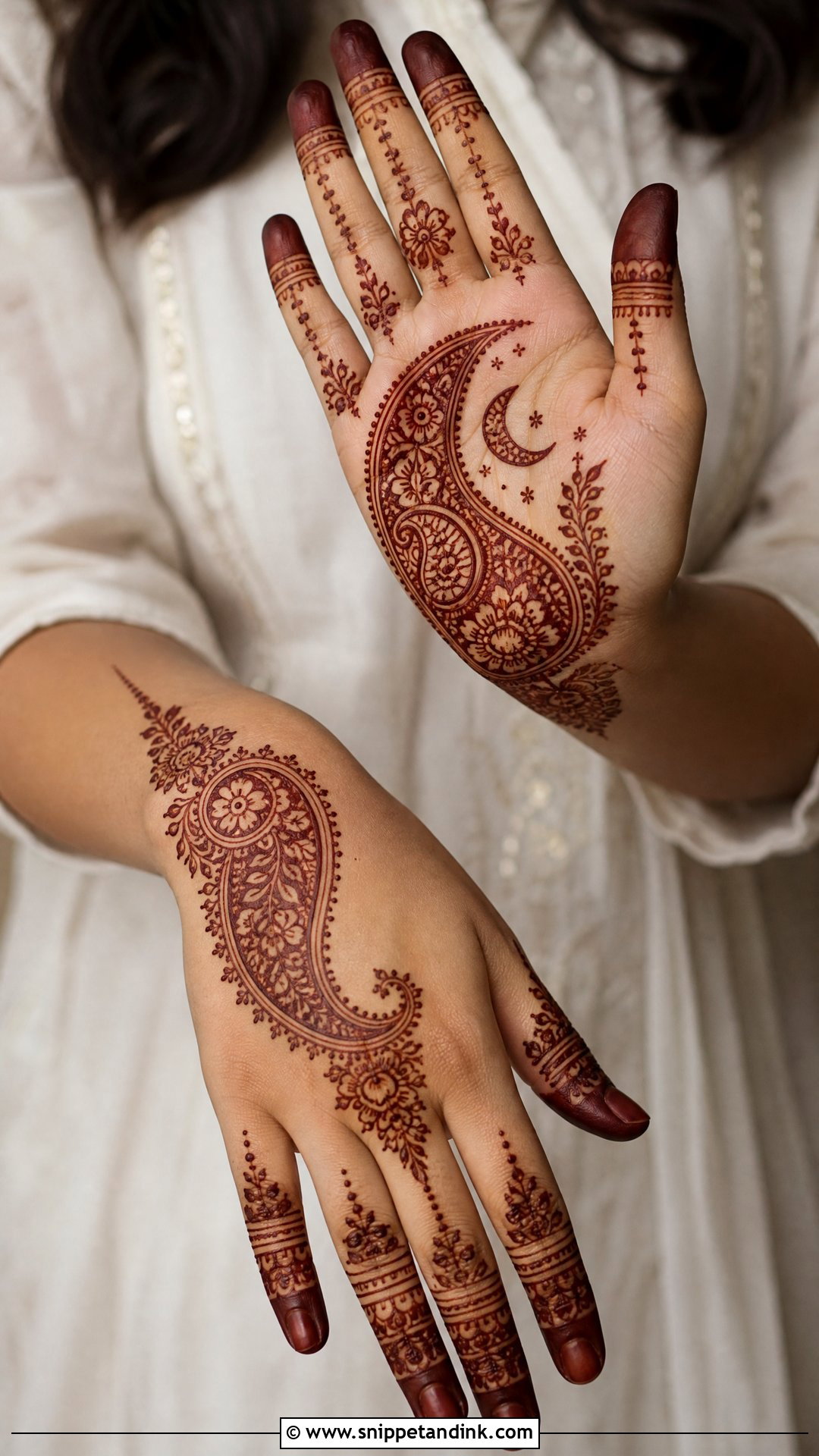
Paisley is about as classic as henna gets. On the palm, one large paisley filled with leaves, dots and tiny florals carries a crescent near its tip, with slim bands continuing into the fingers; on the back hand, two paisleys sit diagonally from wrist to finger with open space around them. The curl at the paisley’s tip is the hardest part to get smooth, so I draw it first while the cone pressure is steady. It suits almost any age.
23. Ramadan Peacock Mehndi Design
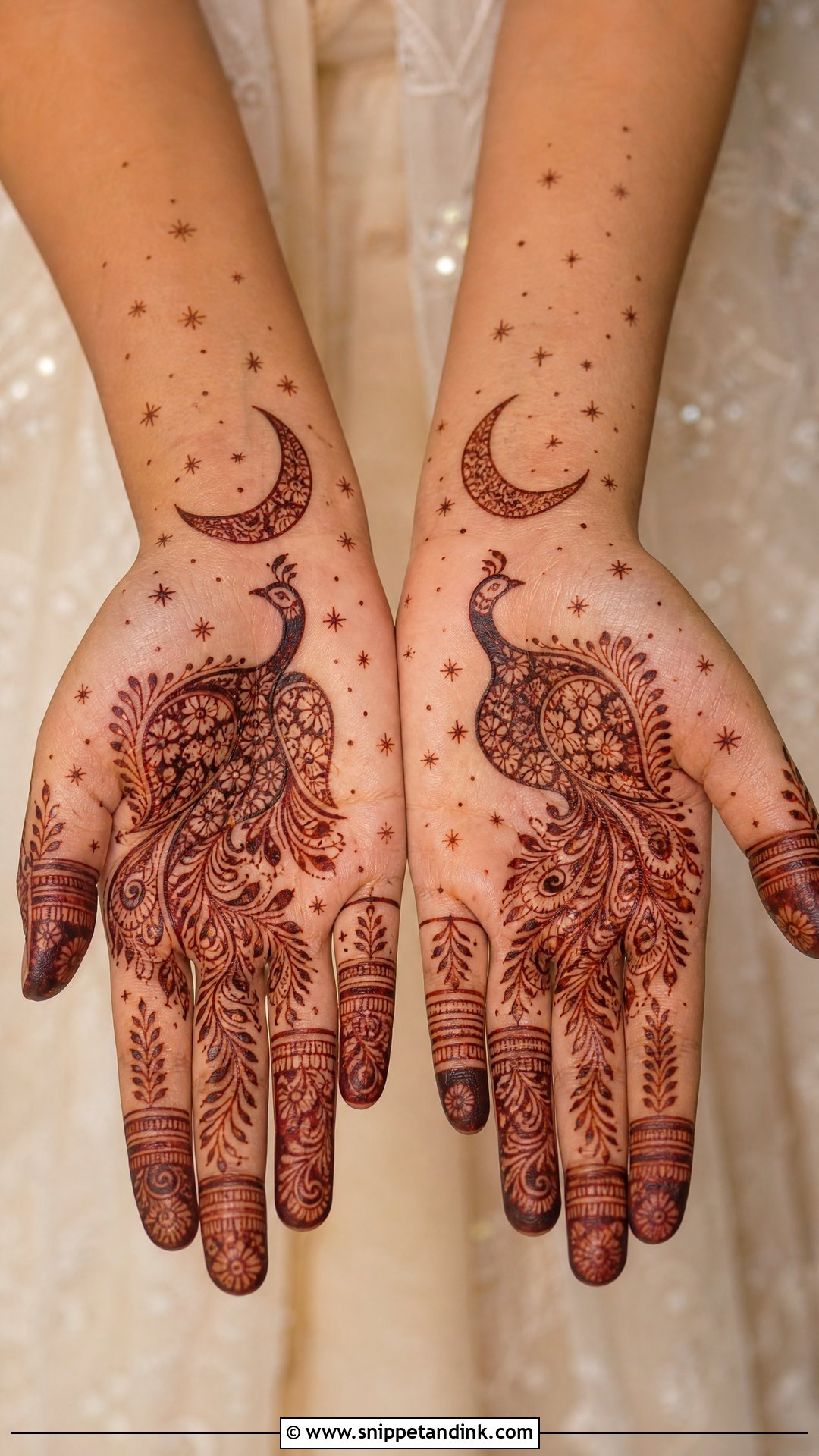
Peacocks can fit a Ramadan design if they stay small. I draw a modest peacock curve on the palm or back of the hand, flow its feathers into paisleys, flowers and dotted stars, and set a crescent above the main motif. Fine feather lines continue onto the fingers with simple bands. The body should be filled solid and bold, with feathers in single fine strokes, otherwise the bird turns into an unreadable blot after staining. Keep it smaller than a bridal peacock.
24. Ramadan Kids Mehndi Design
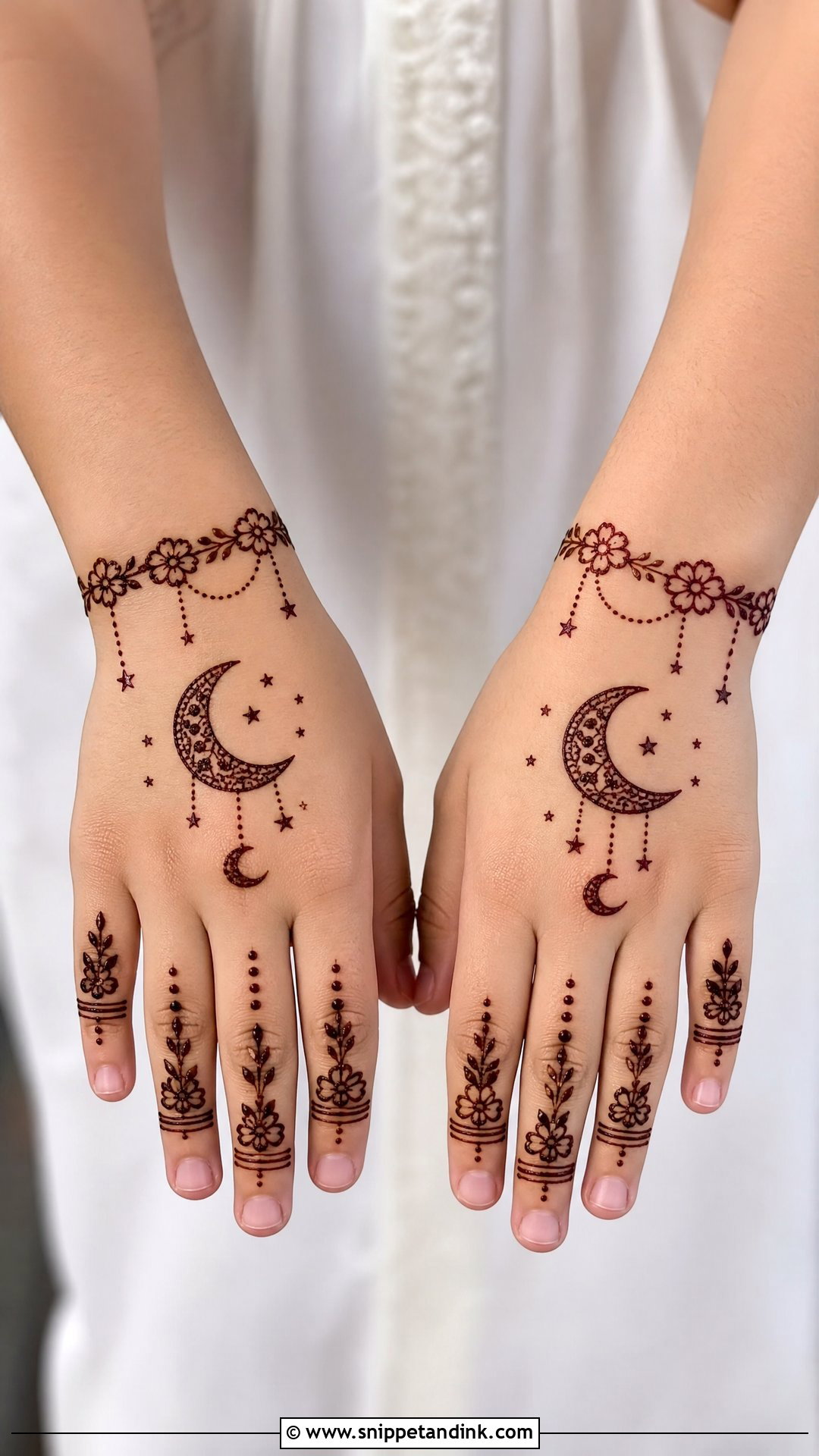
Children’s henna should be quick, cute, and comfortable. A small crescent on the back of each hand with tiny stars and simple finger dots takes a few minutes, and a mini flower bracelet with one hanging moon charm is another easy option. Kids rarely sit still for drying, so I make the lines bold enough to survive a smudge. I only use natural henna on children, never any dark instant paste, and I keep designs small so there is less to protect at iftar.
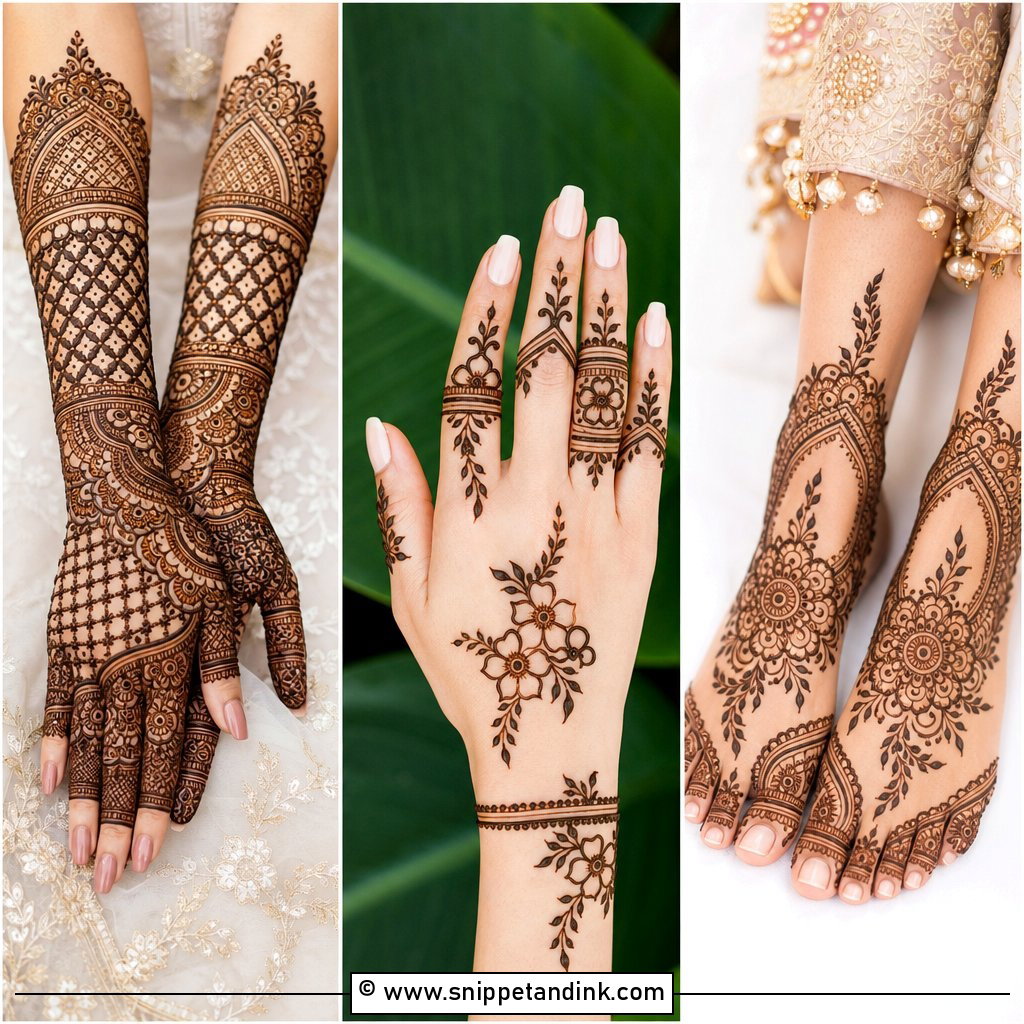
25. Ramadan Bridal Mehndi Design
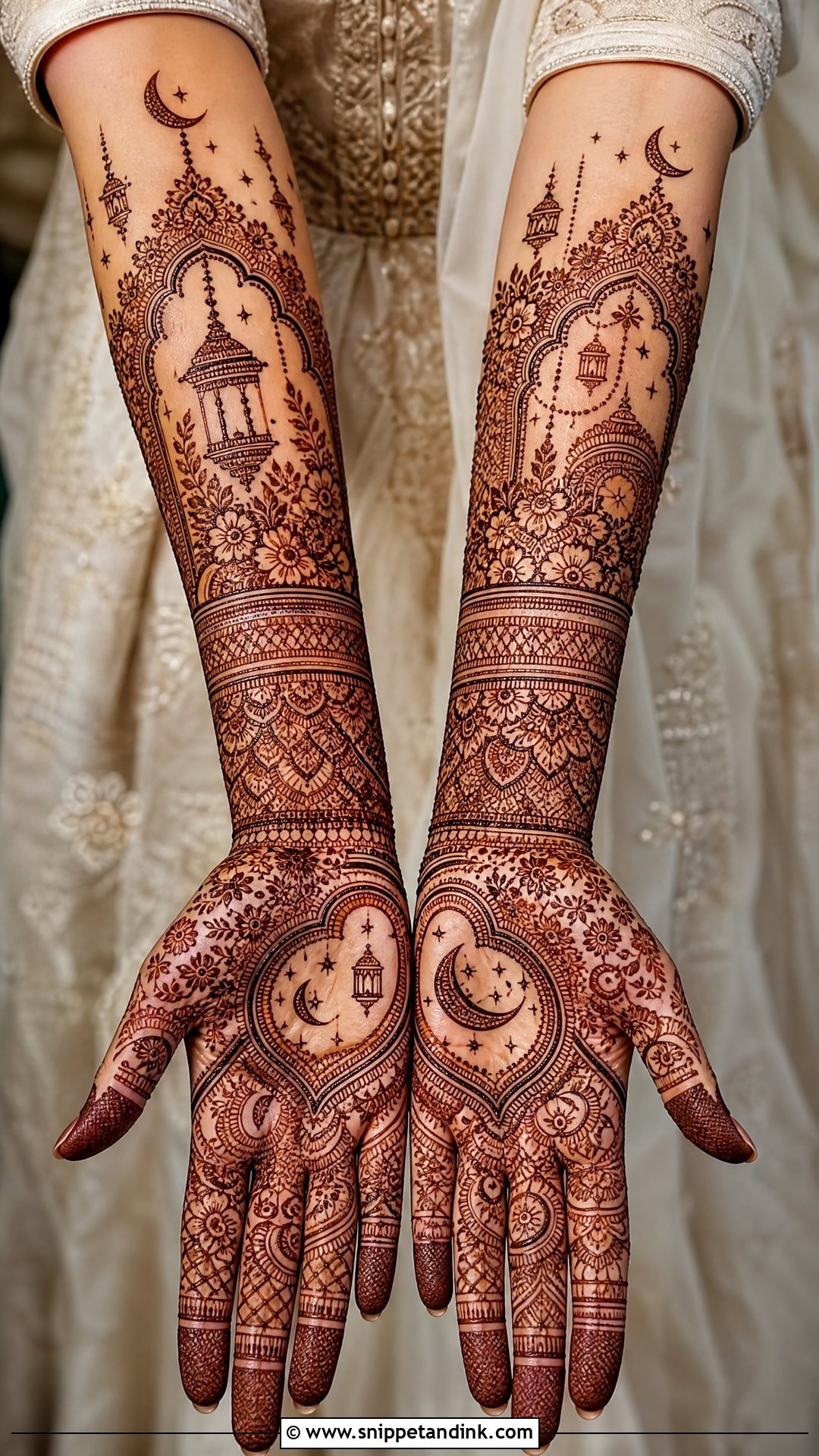
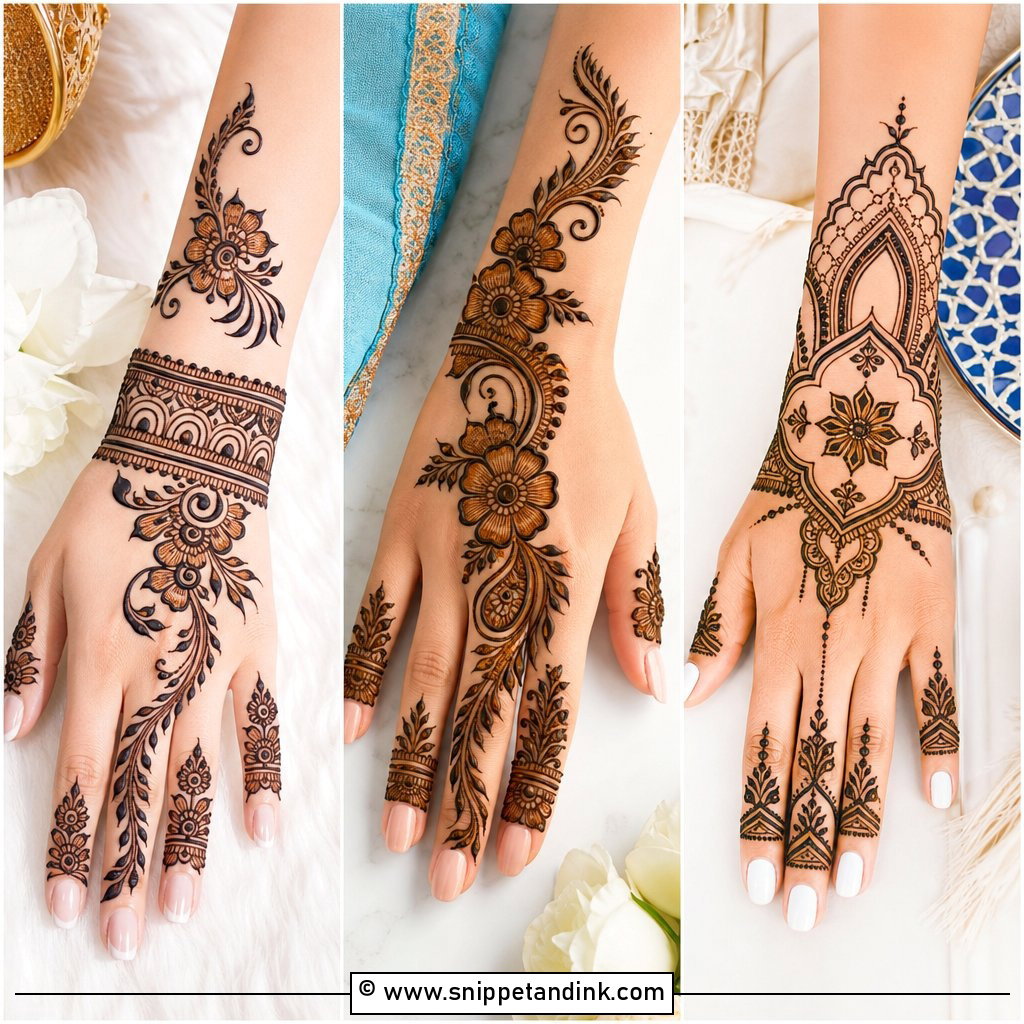
Bridal henna for a nikah or wedding during the month runs from fingertips to forearms, combining Indian mandalas, Arabic florals, paisley fills, jaali panels and crescent borders, with lanterns, stars or a mosque-arch shape worked in subtly. The palm holds a large central mandala; the back of the hand gets layered florals and wrist cuffs. For a bride marking a nikah, engagement, or wedding event during Ramadan, I’d plan the session after iftar, two days before the event, with time for the stain to deepen. It is a long sitting even for an experienced artist.
26. Ramadan Chand Raat Mehndi Design
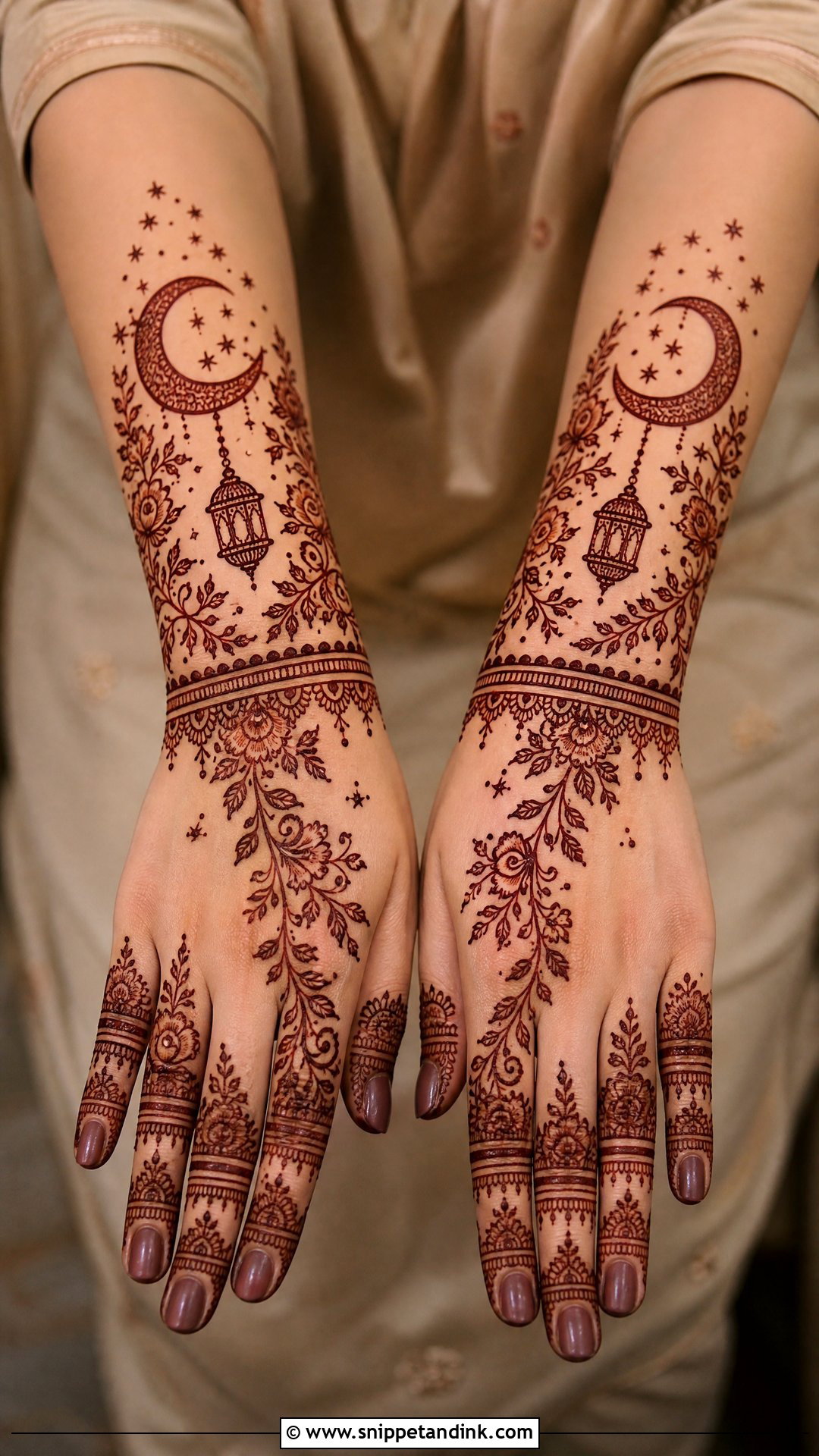
Chand Raat mehndi is the busiest henna night of the year and usually the most festive: a bold crescent, stars, floral vines, finger bands and a bracelet-style wrist border. On the palm, a moon mandala or a lantern with dotted trails; on the back hand, an Arabic diagonal trail with a crescent at the centre. One honest warning. Henna applied late on Chand Raat will still be on the orange side at Eid prayer, because the colour keeps darkening for a day or two.
27. Ramadan Eid Mehndi Design
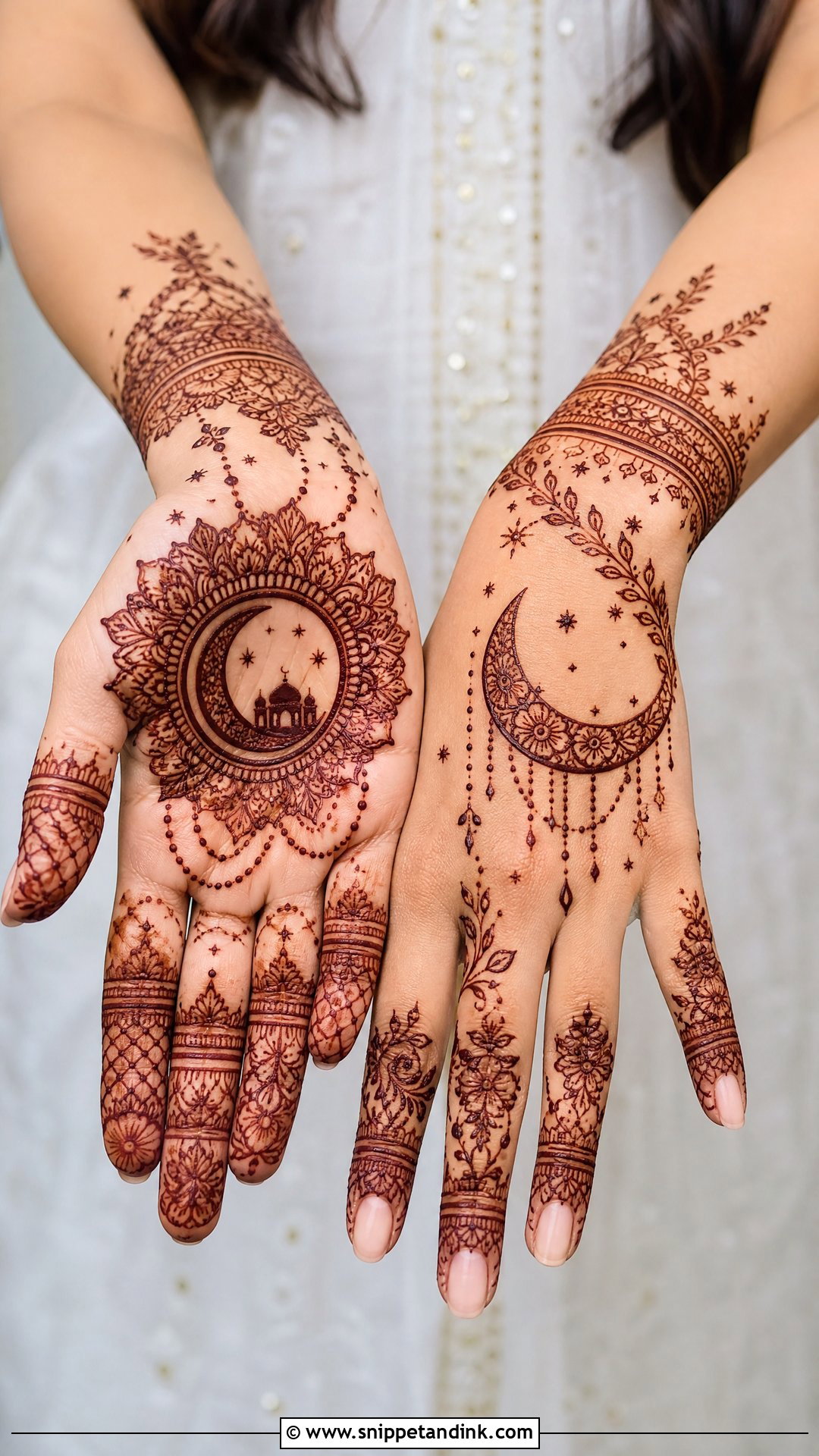
An Eid design is a step up from daily Ramadan henna and a step down from bridal: a central palm mandala, crescent details, full finger work and a floral wrist cuff, with Arabic flowers, leaf trails and star dots on the back of the hand. It suits Eid prayers, family visits and the festive meal. Its balance of filled and open areas flatters most hand shapes, short fingers included, because the open space stops the hand from looking crowded.
28. Ramadan Modern Mehndi Design
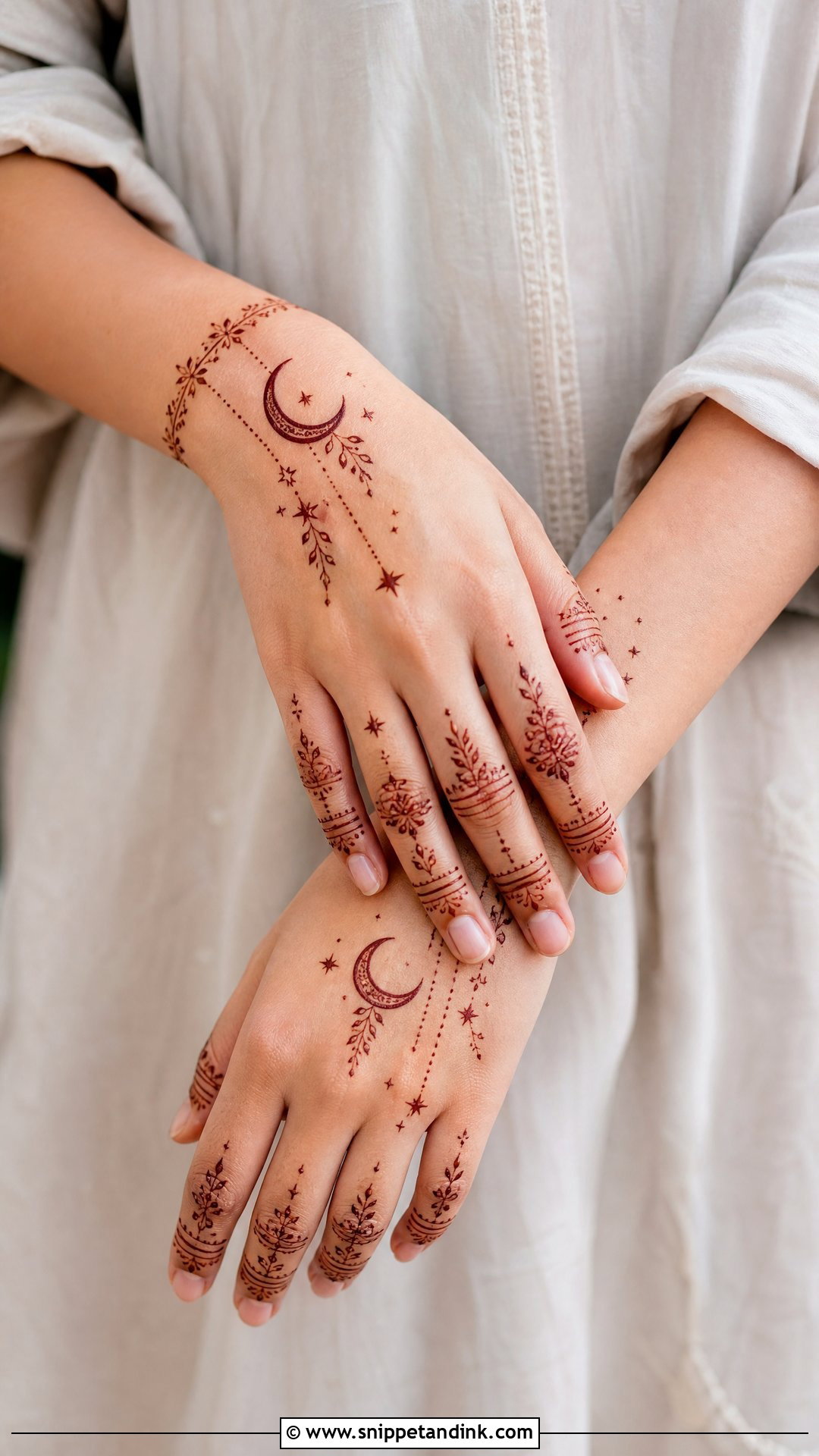
Modern Ramadan henna means thin crescent outlines, tiny stars, minimal florals and geometric finger bands, with the main motif on the back of the hand linked to a fine wrist bracelet. My favourite detail is one statement finger with full henna and the rest kept light. It works with short or long nails and any hand size. Thin outlines stain lighter than bold ones, so leave the paste on longer than you would for a filled design.
29. Ramadan Easy Mehndi Design
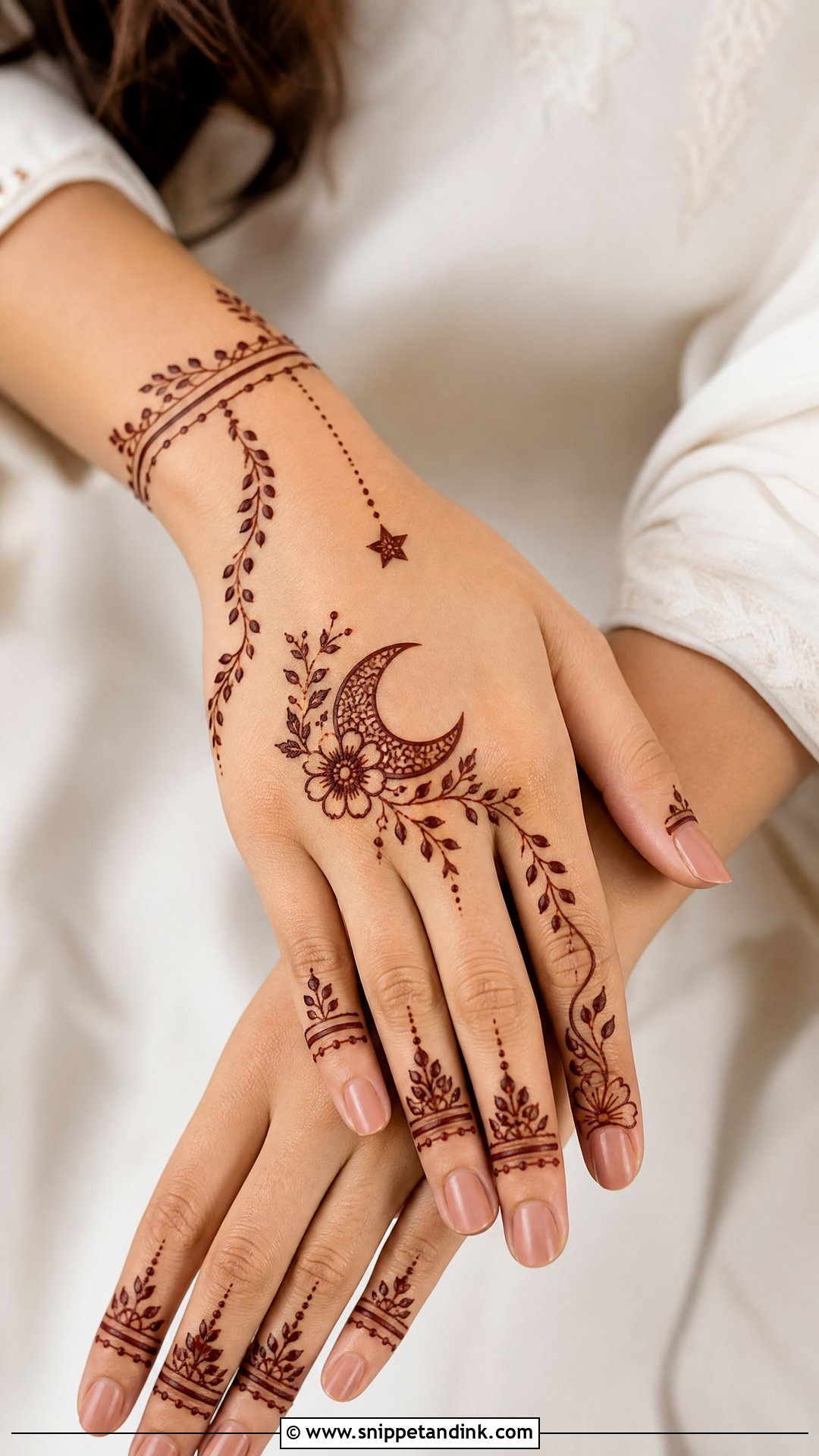
Easy henna should be simple enough for beginners and still look finished. A small flower or crescent at the centre of the back hand, a curved vine toward one finger, dots, tiny leaves and a couple of clean finger bands, then a slim bracelet line with a hanging star. If you are doing it yourself, draw on your non-dominant hand first while you are freshest, and rest your elbow on a table so your lines stay steady.
30. Ramadan Forearm Mehndi Design
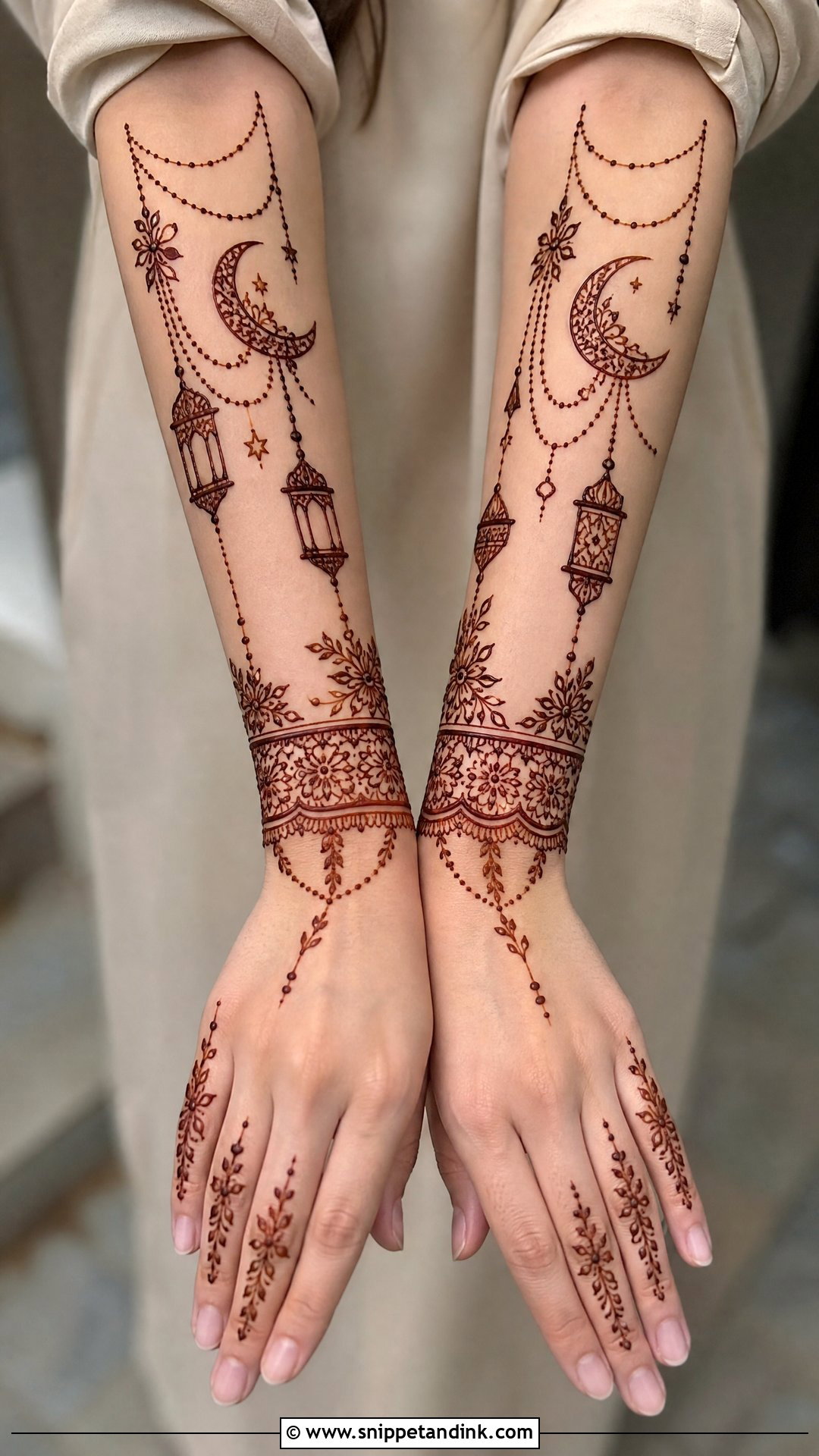
Forearm henna starts at a wrist cuff and climbs with floral bands, crescent charms, lantern shapes and dotted chains, while the hand itself stays lighter. It gives a dressed-up effect for special Ramadan events and Eid. Forearm skin stains noticeably lighter than the palm, so I plan bolder lines there to make up for it. Keep the flow continuous from the wrist upward; a gap at the wrist bone makes the forearm look like a separate design.
Wudu Five Times a Day and What It Does to Your Stain
Natural henna leaves a stain in the skin, not a coating on top of it, so once the dry paste is scraped off, it does not sit between your skin and the water. Remove all paste before washing for prayer. Products that leave a film on the skin, such as some chemical or glitter cones, are a different matter. If you are unsure what your cone contains, or how your own practice treats it, ask someone whose knowledge you trust before using it.
Frequent washing does fade henna sooner, and the fingertips and palms lose colour first. A few habits keep it going longer:
- Rub a thin layer of natural balm or oil into the design after each wudu, once the hands are dry.
- Skip scrubs, hand sanitiser and long hot-water dishwashing for the first couple of days.
- Wear gloves for cleaning and washing up, and avoid chlorine pools.
- Expect the palm to hold colour longer than the back of the hand and the forearm.
Getting Eid Colour Right Before the Chand Raat Rush
Henna comes off the skin orange and darkens to red-brown over roughly the next day or two. If you want the deepest colour at Eid prayer, have it applied a night or two before Chand Raat rather than on the night itself. Since the moon sighting can shift Eid by a day, I’d aim for two nights before the earliest possible date.
Artists fill up fast in the last ten nights, and Chand Raat queues run late. Book early, and if you are bringing several family members, agree in advance who gets the full design and who gets a quick bracelet band. A queue of full hands at midnight means the last person waits for hours.
Which Hands Suit Iftar, Chand Raat or a Nikah
Light crescents, finger patterns and bracelet bands suit daily Ramadan life. Gol tikki, mandala, paisley and full Indian designs carry the traditional feel, while Arabic trails, jaali panels, lanterns and Gulf florals give a more modern festive hand. A small crescent or a single floral vine can say as much about the month as a full forearm. I’d match the design to the night you are wearing it for, the hours you can give it after iftar and how often you will be washing for prayer.
You'll Like These Ideas:










Leave a Reply