
Henna built around Krishna gives a design something to say. The flute, the peacock feather, the matki of butter, Radha beside him, a lotus or a temple arch: each of these motifs carries a story, and clients usually come to me knowing exactly which one matters to them. Some want a full bridal pair of hands with portraits, others want one feather on the back of the hand before a Janmashtami pooja. The 30 designs below cover that whole range, from quick symbols a beginner can manage to portrait work that needs an experienced hand, with notes on how each one stains and wears.
Portrait Faces Are Where Henna Goes Wrong
Krishna and Radha’s faces are the hardest thing in henna. Paste spreads slightly as it sits, and the stain darkens for a day or two after removal, so a face that looks delicate when wet can look heavy two days later. When I draw a portrait, I use the finest cone tip for the eyes, nose and lips and leave more skin bare than seems necessary.
If you’re booking an artist for portrait mehndi, ask to see stain photos of faces they’ve drawn, taken a day or two after removal. Wet paste photos only show the drawing, not how it matured. Ask how long the design will take; full bridal portrait work can take many hours, and you’ll need to plan meals and breaks around it.
- Bring reference images of the style of faces you like, since every artist draws Krishna differently.
- Decide whether faces should be in profile or front-facing; profiles are easier to keep clean.
- Keep rings and bangles off until the stain is fully dark, so they don’t rub the paste.
1. Radha Krishna Full Hand Mehndi Design
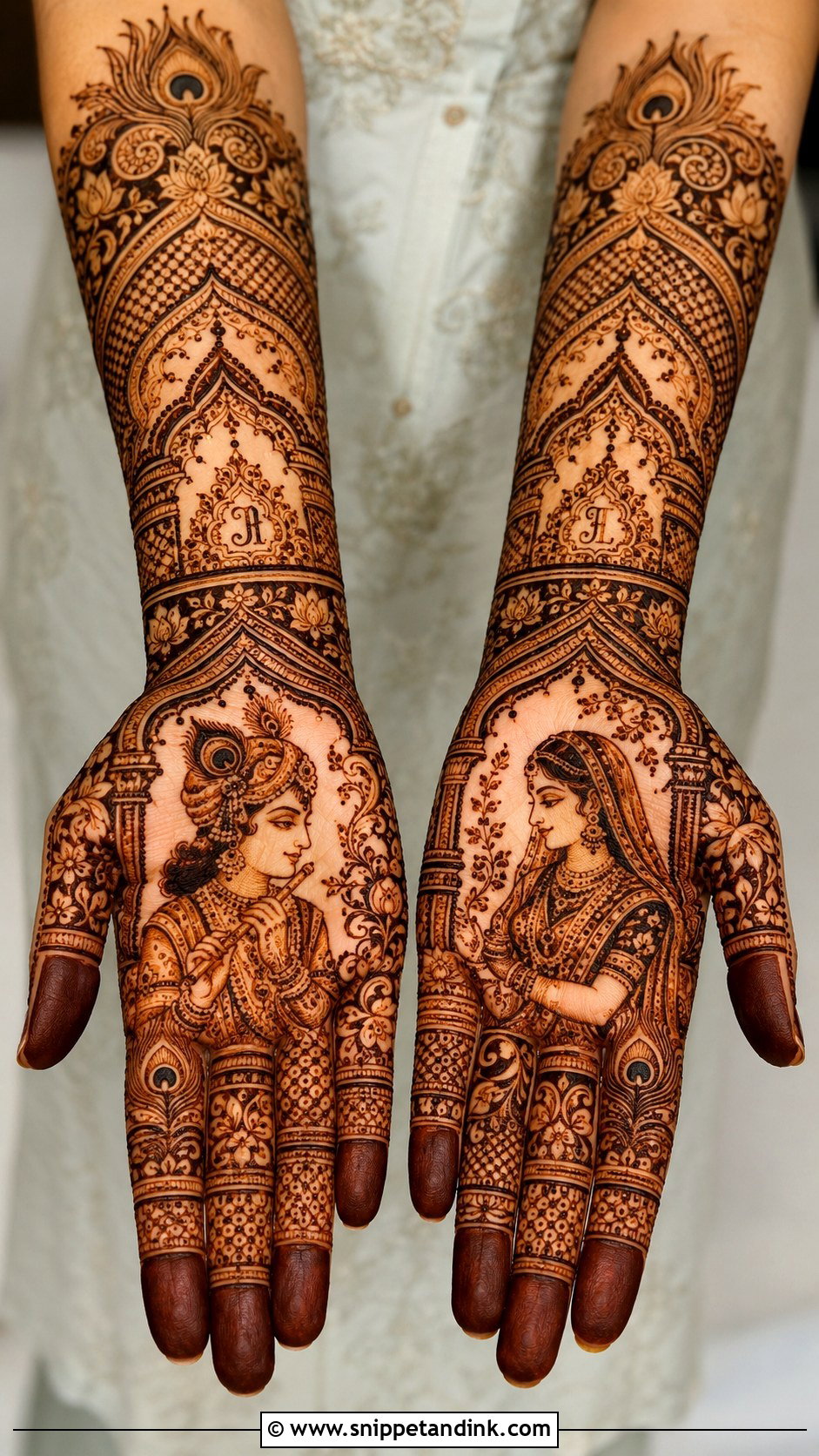
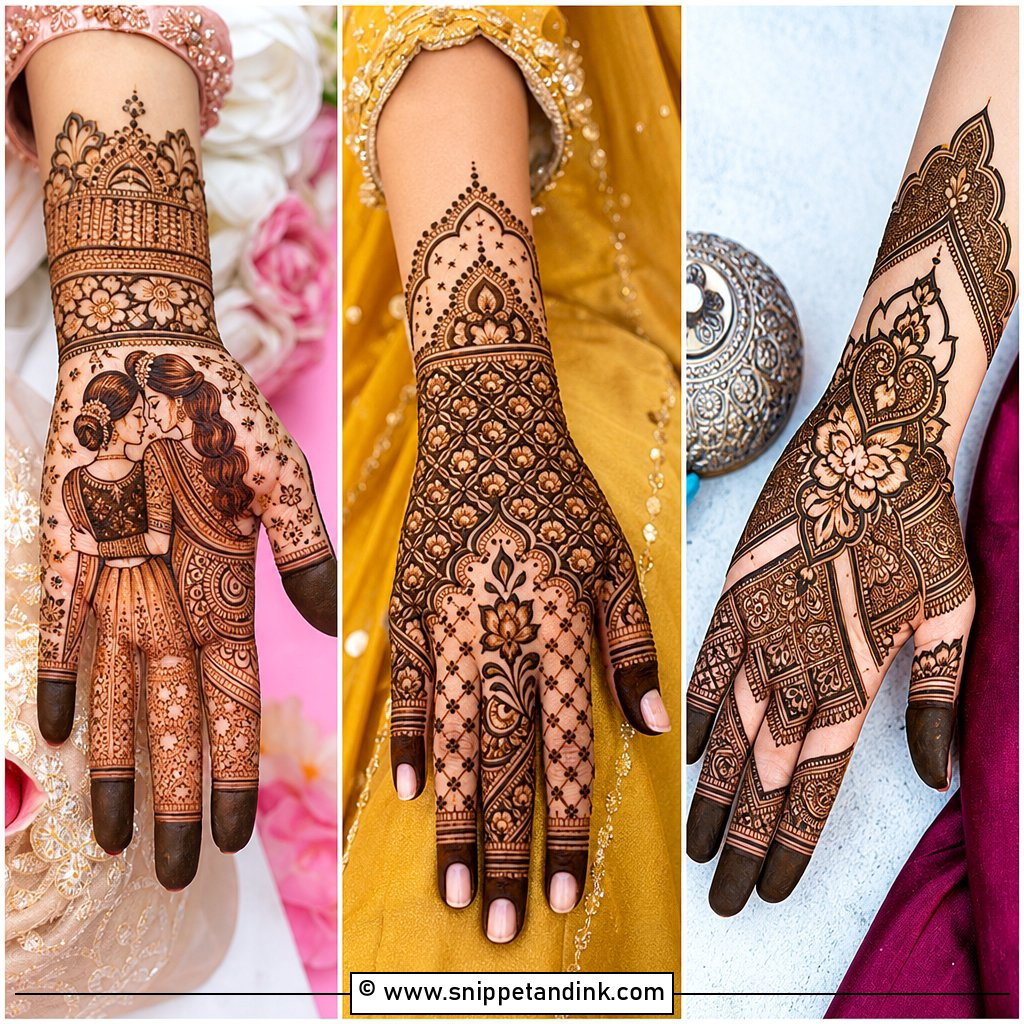
Portraits across both palms make a Radha Krishna full hand mehndi design the most traditional choice on this list. Lotus, paisley, fine vines, temple bells and small jaali fill the rest, and the forearm can carry a mandap arch. When I draw the faces, I keep them as clean outlines with only light shading, because henna darkens over two days and heavy shading around the eyes and mouth turns into a dark blur. Ask for deep, balanced spacing between the portraits and the filler work so the faces remain the first thing anyone reads.
2. Krishna Flute Back Hand Mehndi Design
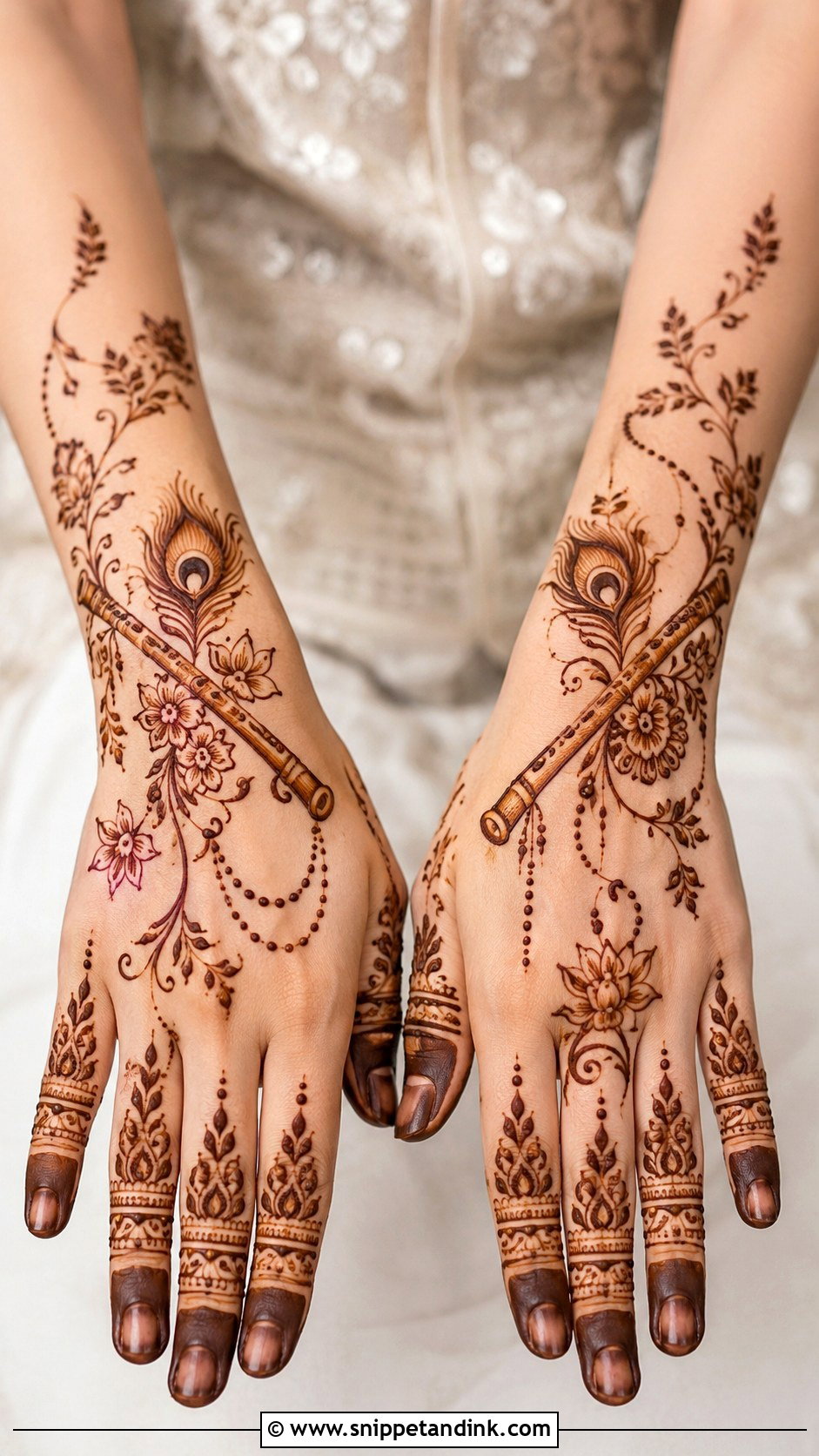
On the back of the hand, a flute running diagonally from the wrist toward the index finger follows the natural lines of the bones, so it looks graceful even on a small hand. Peacock feathers, small flowers and dotted chains sit around it. I leave a narrow band of bare skin around the flute itself; once the stain matures, that negative space is what keeps the flute from merging into the vines. It’s a good choice for teens, bridesmaids and guests who want the theme without a portrait.
3. Peacock Feather Krishna Mehndi Design
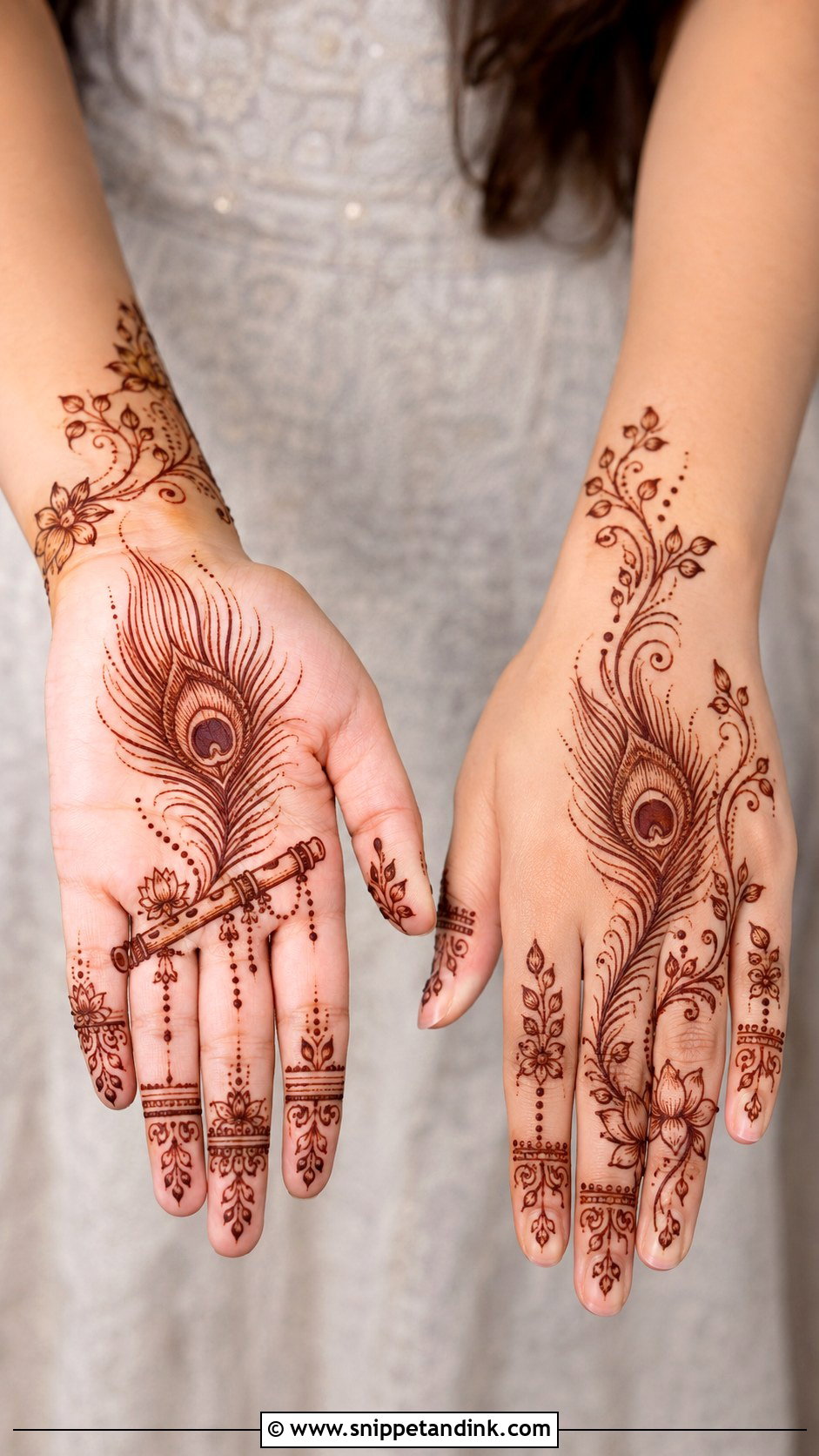
Few motifs say Krishna as clearly as the peacock feather, and few are as forgiving. A full feather can start at the wrist, curve across the palm and end near the middle finger, with a small flute, dot trails or lotus petals added beside it. I draw the outer outline with a slightly thicker line than the inner barbs, because the outline has to survive fading in the second week while the fine strokes inside are the first to go. It works on the palm or the back of the hand.
4. Simple Krishna Mehndi Design
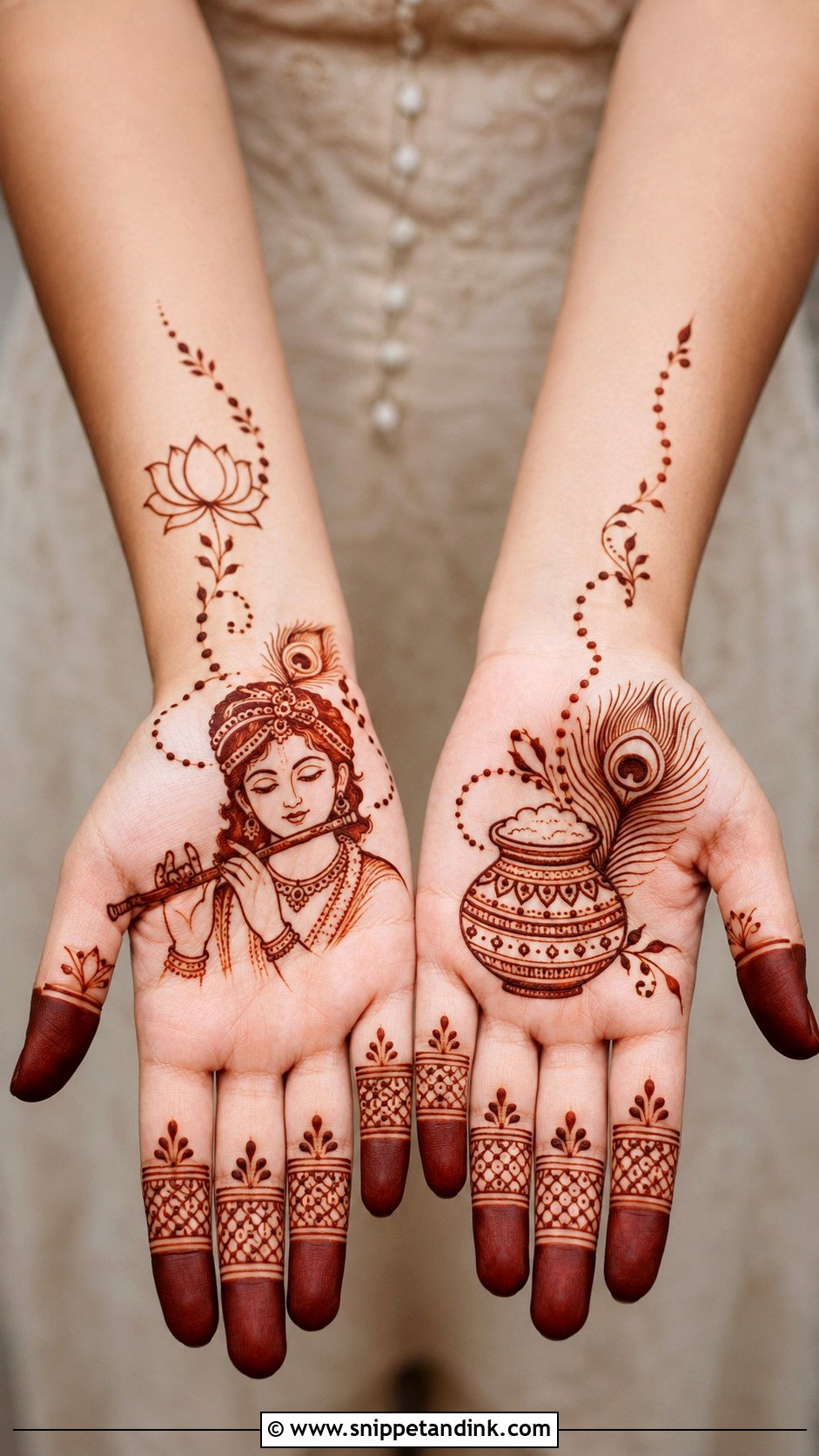
A simple Krishna mehndi design uses symbols instead of figures: a flute, a feather, a matki, a small lotus and curved vines. Place the main motif at the centre of the palm or back of the hand and extend toward the fingers with dots and leaves. If you’re applying it yourself, practise the flute shape on paper first; a wobbly straight line shows more than a wobbly curve. Neat outlines and empty space left on purpose are what make a simple design look finished.
5. Janmashtami Krishna Mehndi Design
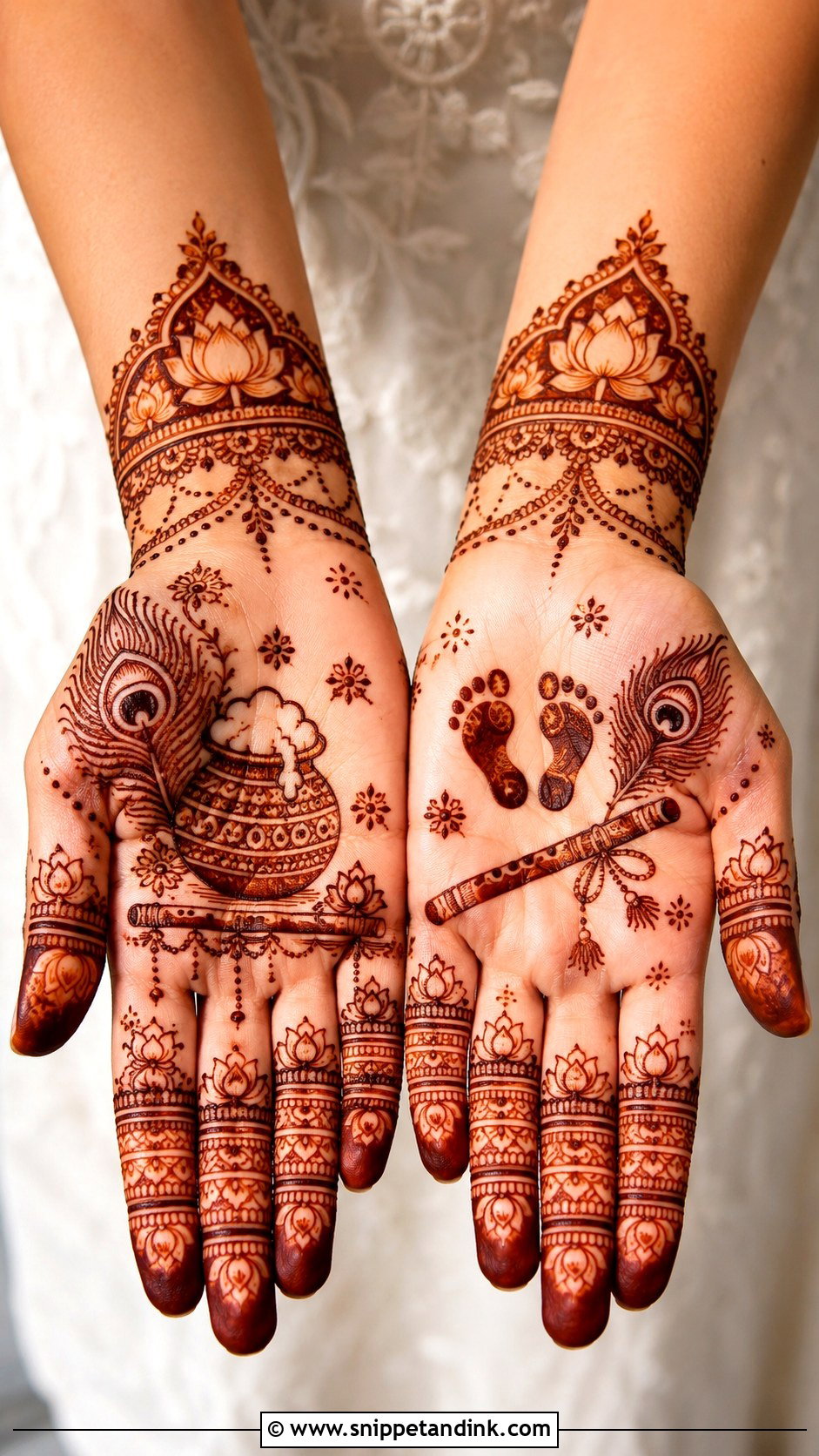
For Janmashtami I usually suggest splitting the story between the two hands: the matki on one palm, the flute and feather on the other, joined across the fingers with dotted chains and small floral bands. Keep the pattern fairly open so the motifs read in photos taken at the temple at night, when the light is dim and dense filling just looks dark. Apply it a day or two ahead, since the stain peaks around 48 hours after the paste comes off.
6. Bal Krishna Mehndi Design
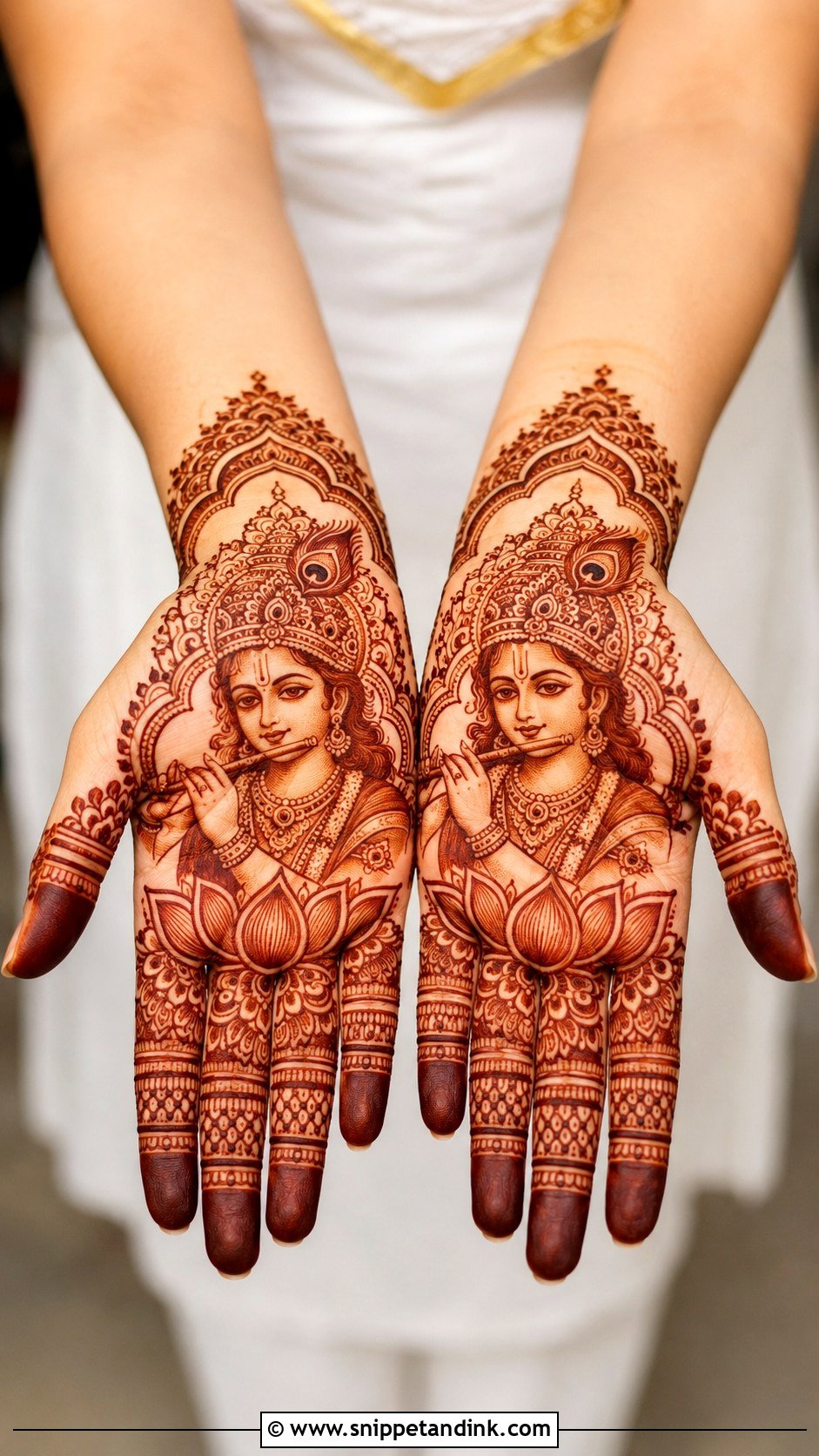
Bal Krishna sitting by a matki, surrounded by butter drops, tiny lotus flowers and playful swirls, suits Janmashtami, baby showers and family gatherings. Facial detail is difficult at the scale of a palm, so I draw baby Krishna as a simple, round outline with a few expressive lines rather than trying for realism. The wrist can take a decorative band or a small temple border. Mothers and young girls often choose this when they’d rather have something sweet than heavy bridal work.
7. Radha Krishna Bridal Mehndi Design
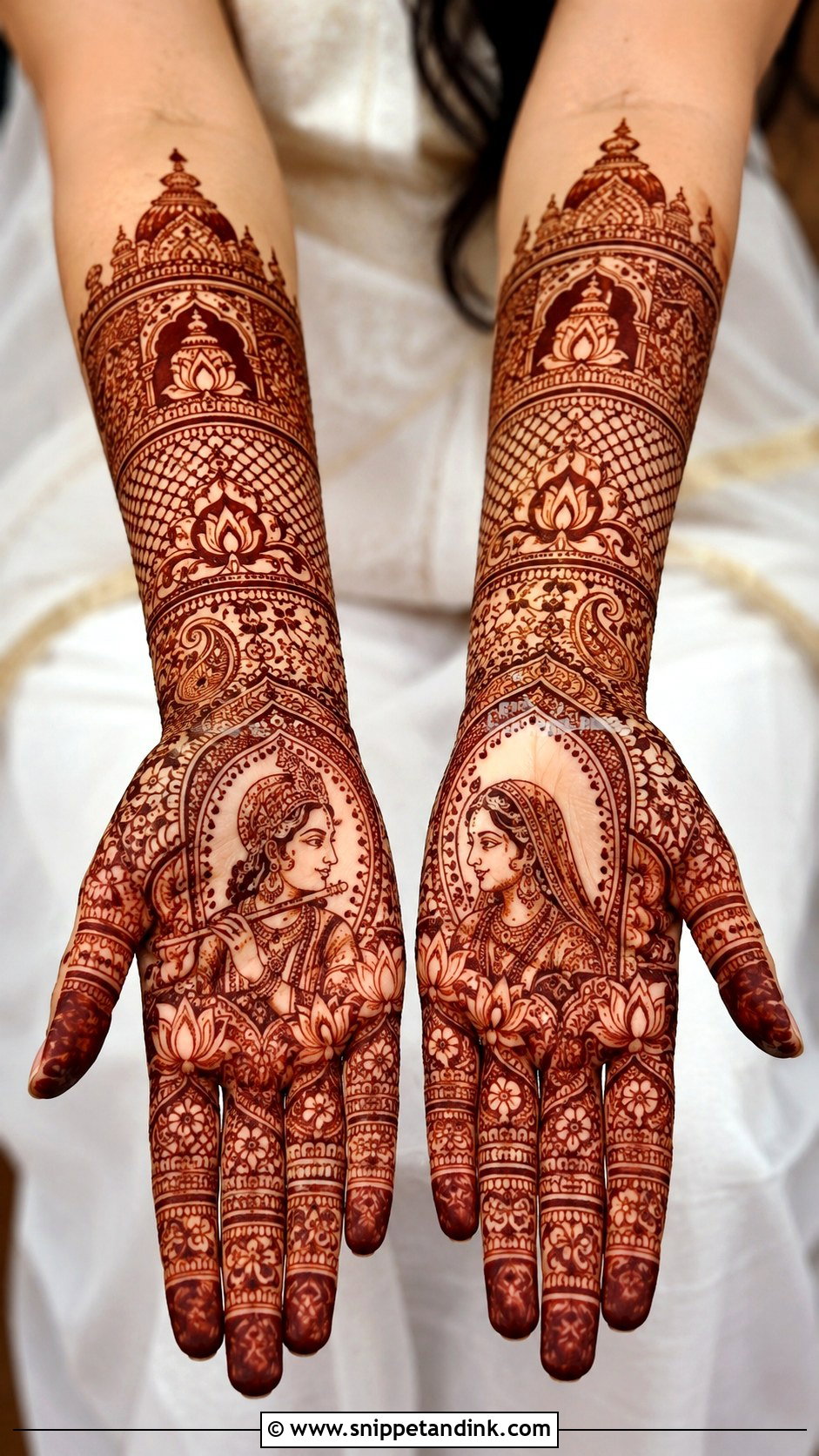
In the bridal version, Radha sits on one palm and Krishna on the other, turned so their faces meet when the bride brings her hands together. Mandap arches, lotus vines, paisley fillers, peacock detail and hidden initials fill the rest, and the forearms can carry layered bands. Drawing two faces that match in size and angle takes real skill. Before booking, I’d ask any artist to show you photos of portrait work specifically, ideally of the stain a day or two later, not only the wet paste.
8. Krishna Portrait Mehndi Design
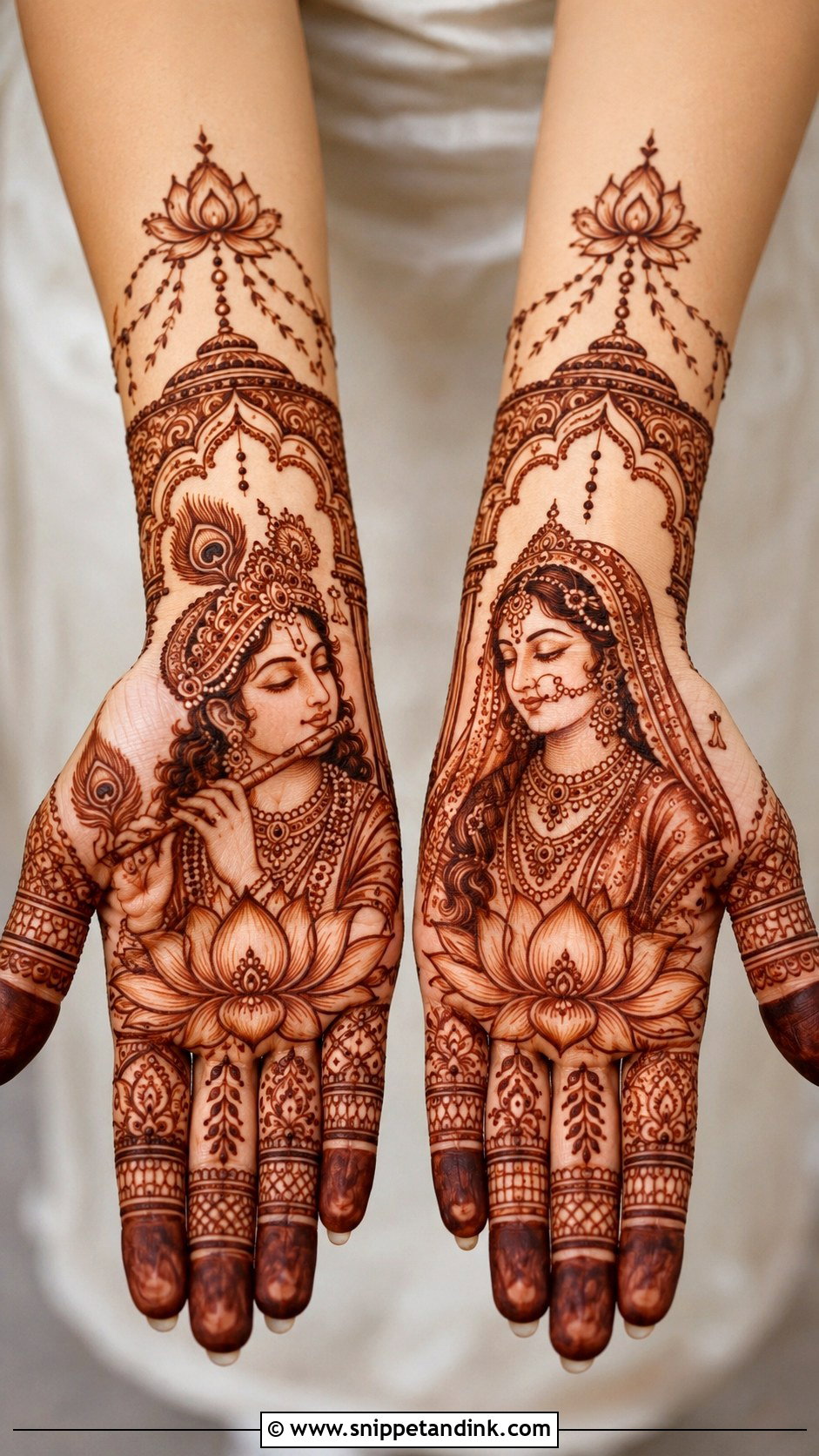
Making Krishna’s face the centre of a whole hand is ambitious, and it’s the design where artist skill shows most. The portrait sits on the palm, with the flute, peacock crown, lotus petals and a temple frame completing the layout. I keep the area around the eyes open and use my finest cone tip only for the hair, crown and jewellery lines. Too much shading near the face is the most common mistake I see. Paired with clean finger detailing, it suits someone who wants devotional art rather than a floral pattern.
9. Radha Krishna Couple Mehndi Design
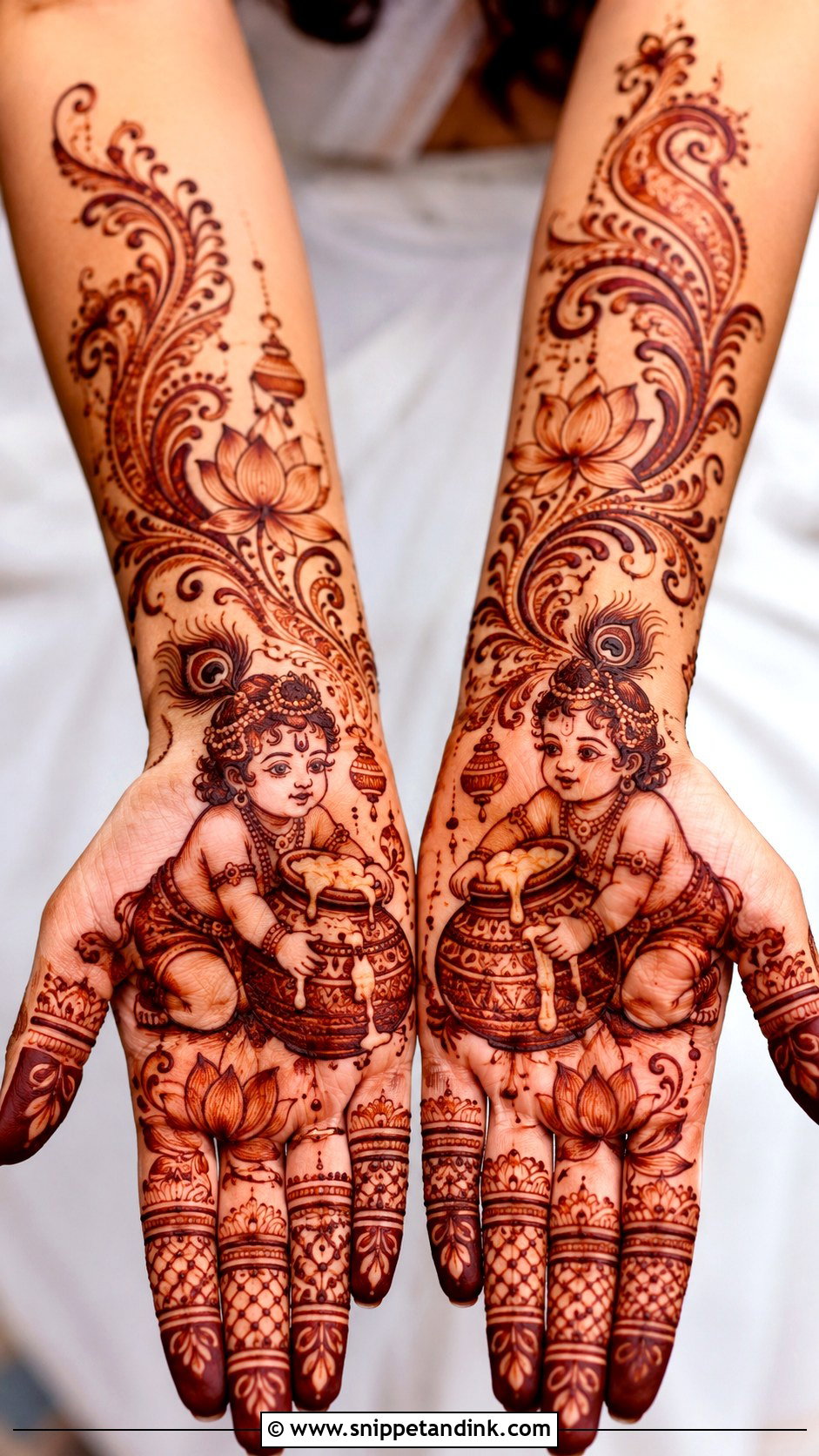
This couple design only works as a pair: Radha on one hand, Krishna on the other, complete when the hands meet. Lotus flowers, feathers, curved vines and temple arches surround the portraits, and matching floral bands on the fingers keep the two hands in balance. I sketch tiny guide dots on both hands before starting, because by the time one hand is finished it’s easy to drift on the second. It’s meaningful for weddings and anniversaries, in medium or heavy coverage.
10. Krishna Mandala Mehndi Design
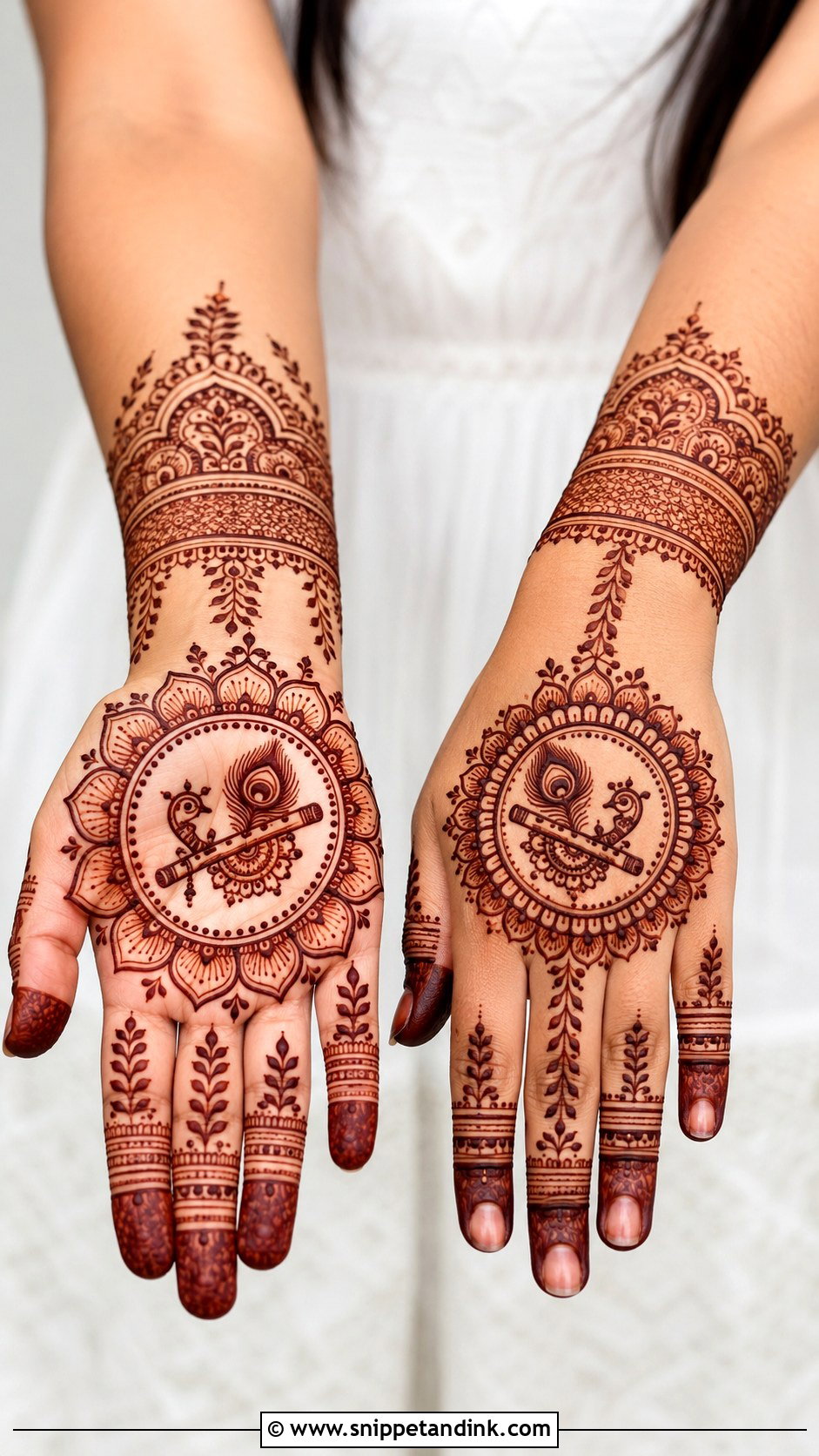
Circles are naturally balanced, so a mandala at the centre of the palm or back hand, with a small flute and feather laid across it, makes a Krishna theme feel calm and orderly. Lotus petals, dotted rings and fine borders form the outer layers, and the fingers repeat the bands. Mandalas punish an uneven hand, though. I start from a dot at the exact centre and build outward ring by ring, turning the client’s hand rather than my own wrist. It suits festivals, poojas and family functions.
11. Krishna Arabic Mehndi Design
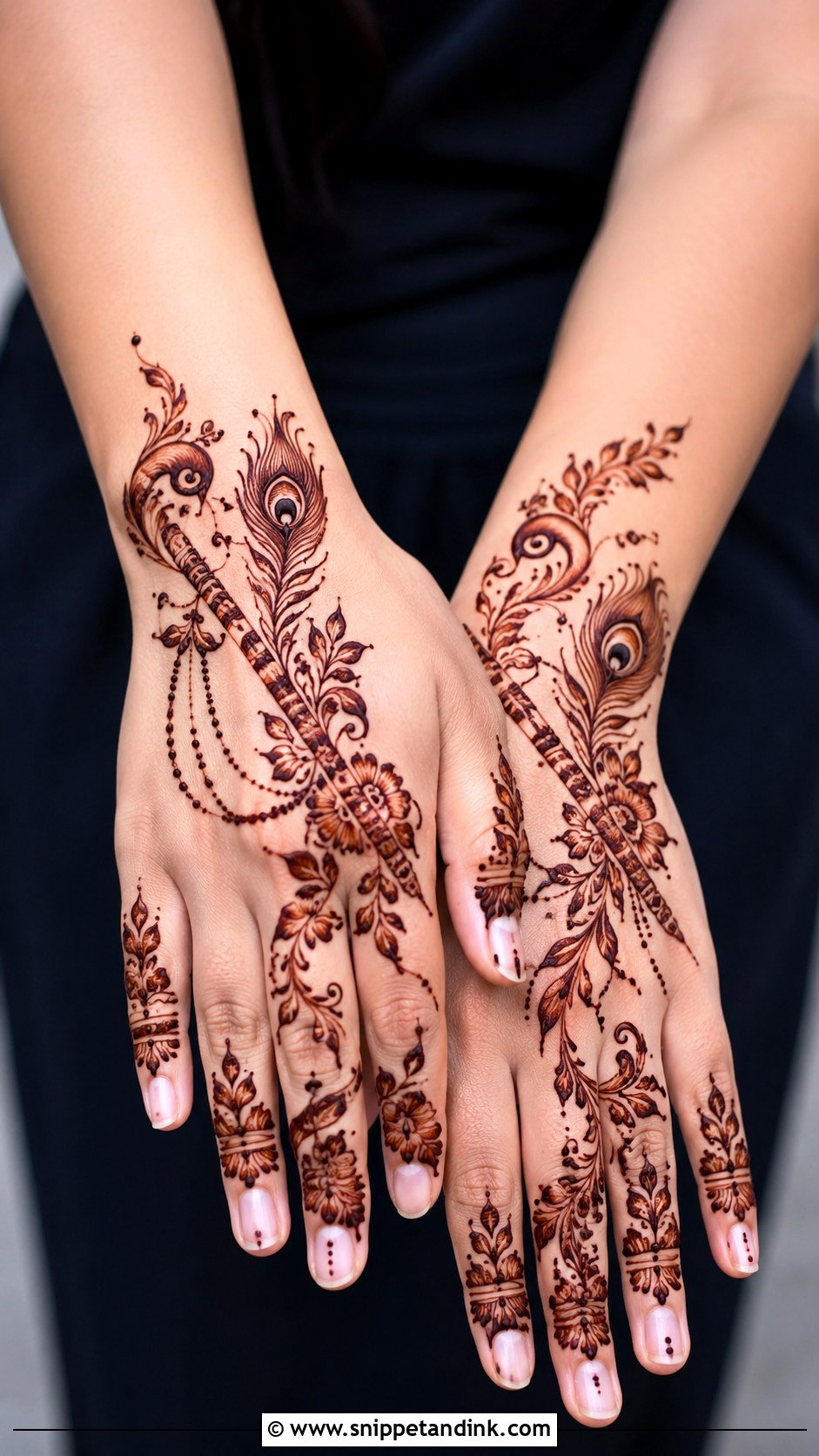
A Krishna Arabic mehndi design keeps the open spacing and diagonal flow of Arabic work: a feather and flute near the wrist, flowers trailing toward the fingers, bold outlines and much less filling. A small matki or lotus makes it more festive. Because Arabic work relies on thick, confident lines, it’s quicker to apply and also fades more evenly than dense patterns. It looks best on the back of the hand for bridesmaids and guests.
12. Krishna Indo Arabic Mehndi Design
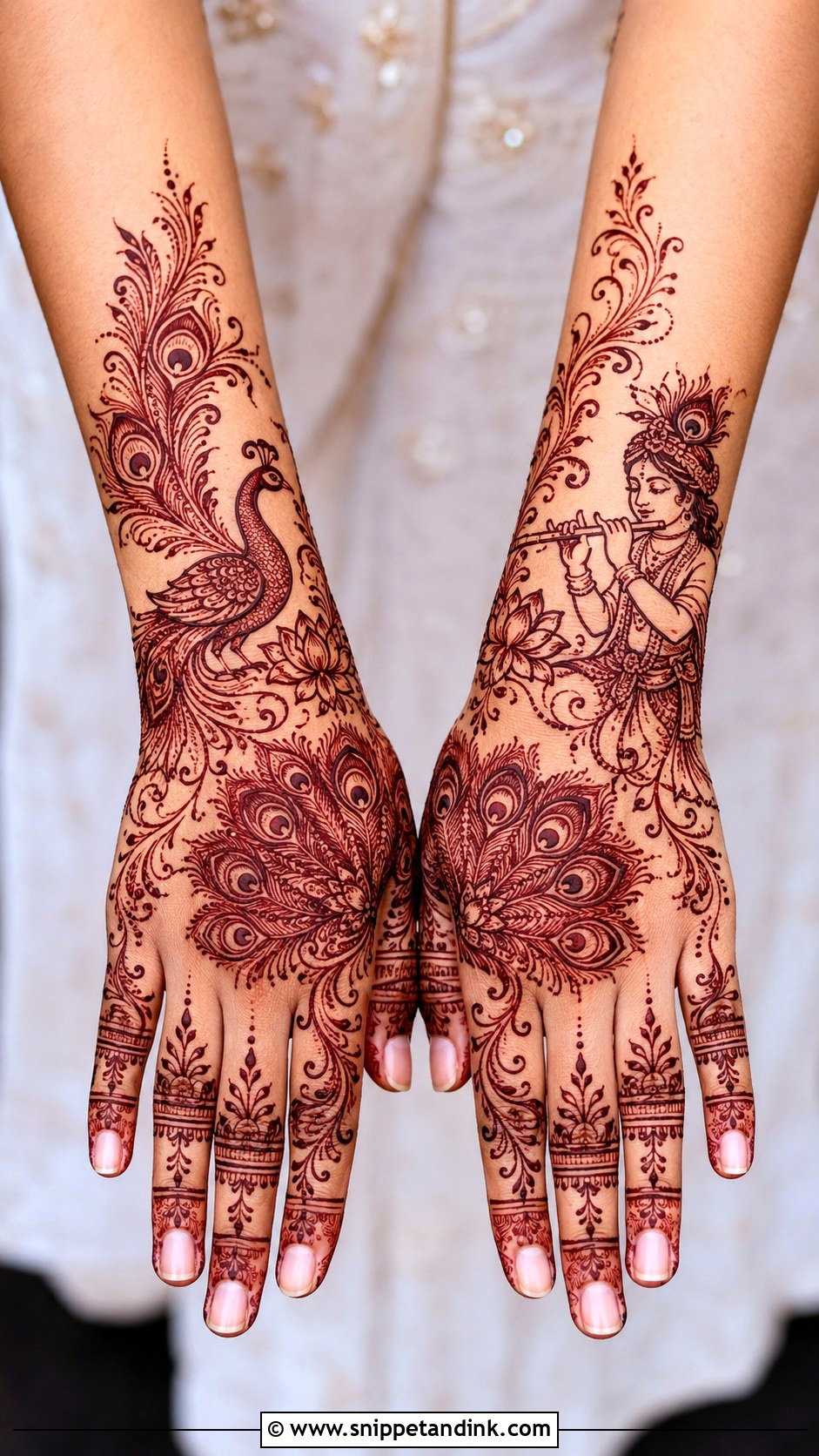
Indo-Arabic blends Indian detailing with Arabic flow, so the hand looks rich without being packed. The flute and feather go on the palm, with bold floral trails, paisleys and dotted chains moving toward the wrist and fingers, and a little jaali or mandala adds the Indian touch. I like this for clients who’ve never worn heavy mehndi, because it takes far less sitting time than bridal coverage. The open areas also let the main Krishna symbols stand out once the stain darkens.
13. Krishna Palm Mehndi Design
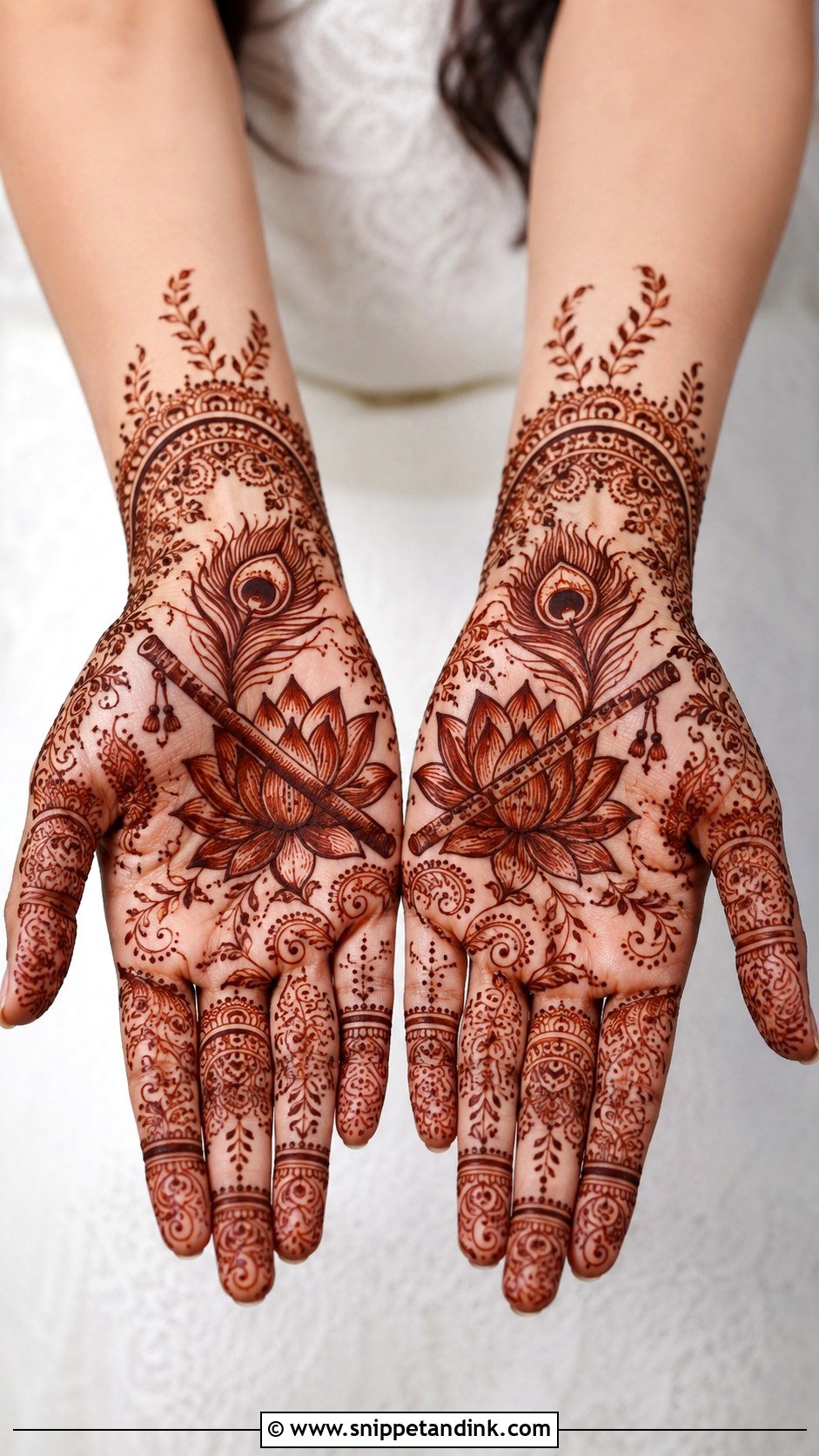
Keeping all the artwork on the palm makes sense for a pooja, since the palm is what you show when you fold your hands or receive prasad. A flute and feather sit at the centre, surrounded by lotus petals, paisleys, matki details and temple bells, with simple finger bands so the palm stays the focus. The palm also holds the darkest stain on the body because the skin there is thick. It works in medium or full coverage.
14. Krishna Back Hand Mehndi Design
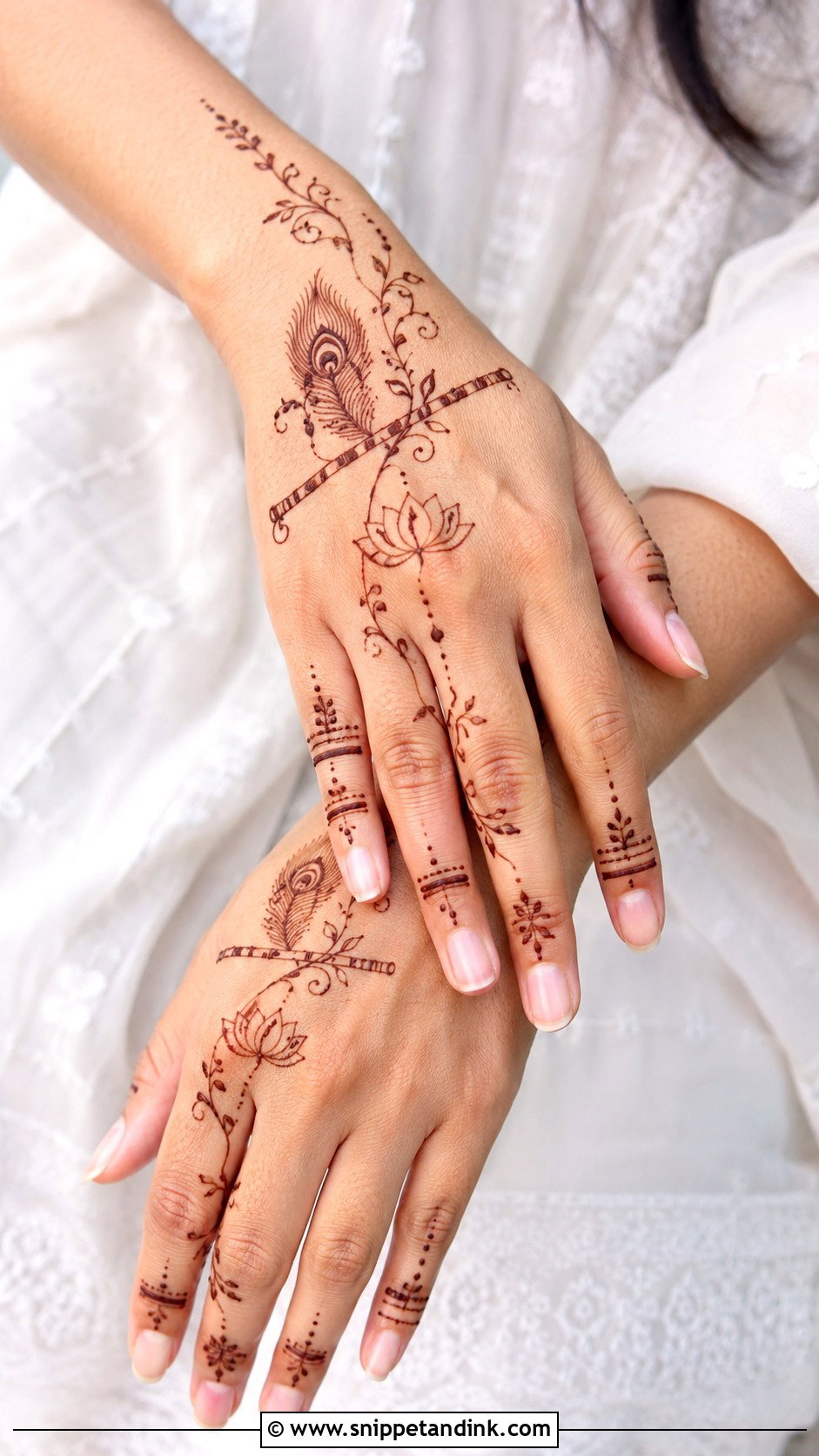
A Krishna back hand mehndi design is the one you’ll see most in photos, especially with bangles. A diagonal layout carries the flute, feather, a lotus trail and a bracelet pattern at the wrist, with an open centre or a small mandala behind the motif. Expect a lighter stain here than on the palm; the skin on the back of the hand is thinner and warmer, so I keep the lines bold. Leafy tips and thin bands finish the fingers.

15. Krishna Full Arm Mehndi Design
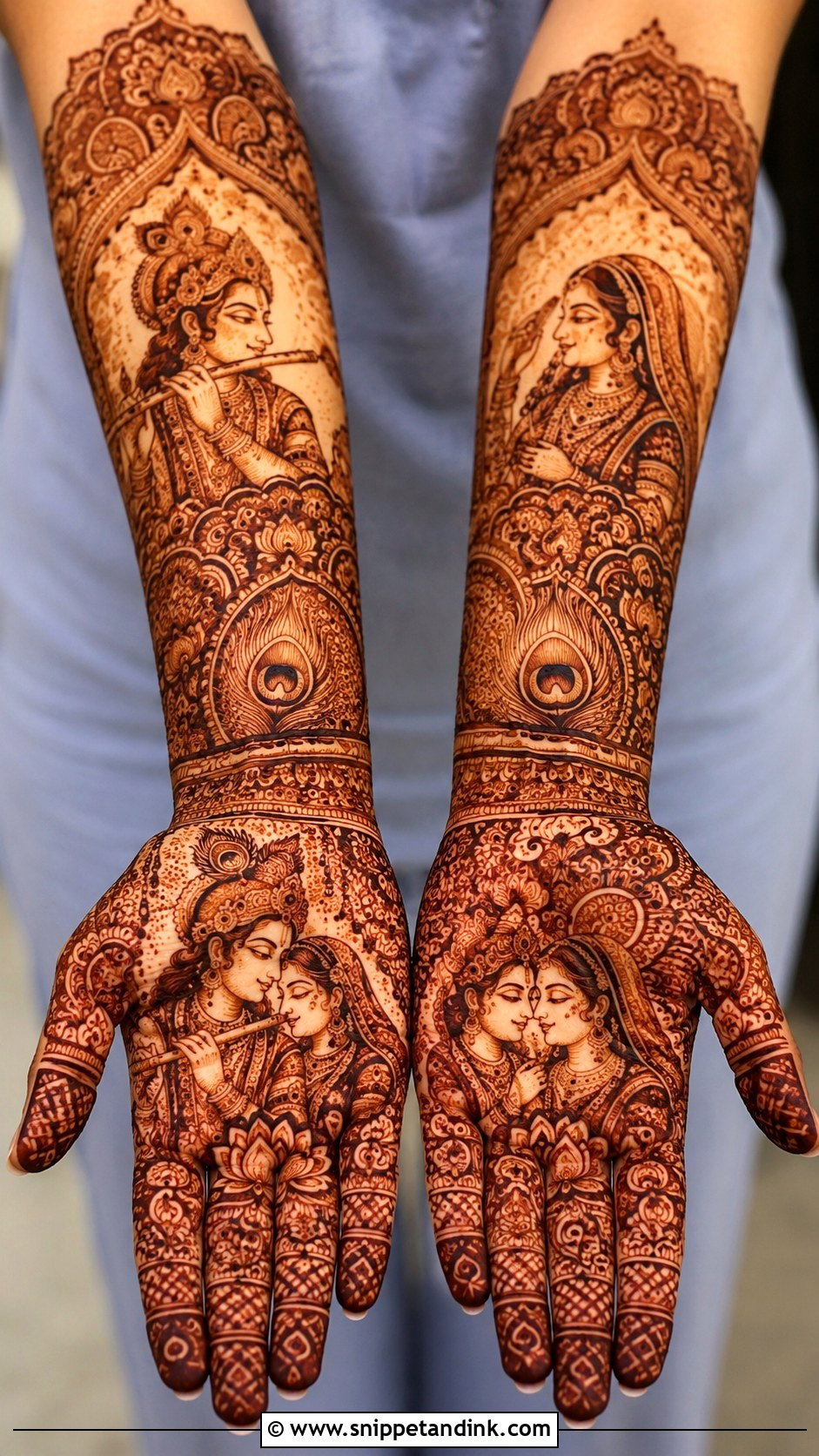
Full arm coverage is for brides and major festivals. The palms take the Radha Krishna portraits, and the arms continue with peacock feathers, temple arches, lotus vines, paisley panels and borders, with a flute near the wrist and a mandap frame on the forearm. Plan for many hours of application plus drying time, and arrange your evening so you can sit still with the paste on afterwards. The stain on the upper forearm will be lighter than the hands; that’s normal, not a sign of weak henna.
16. Krishna Minimal Mehndi Design
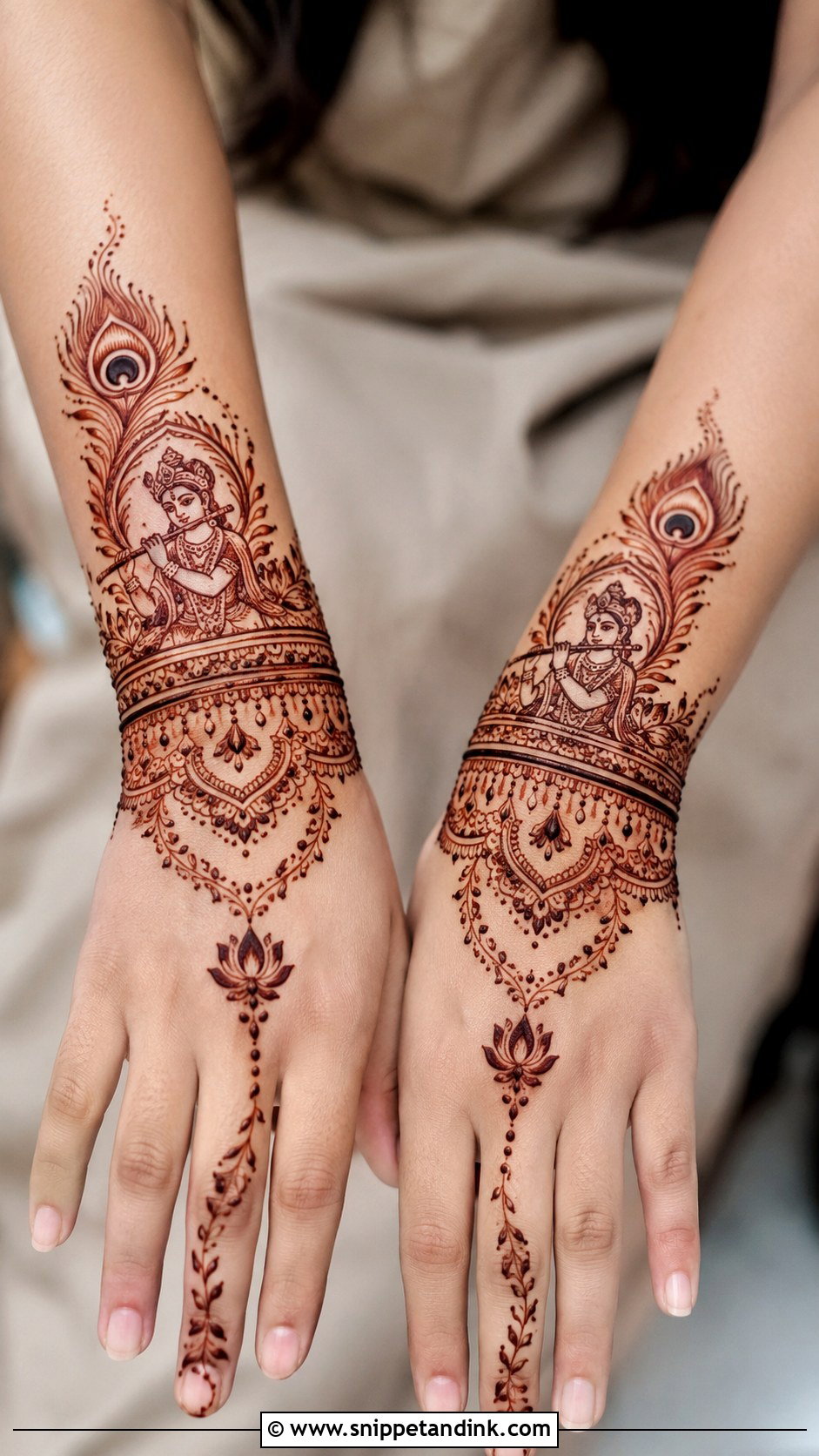
Minimal Krishna mehndi often means a small flute with one peacock feather on the back of the hand, tiny dots, thin vines and simple finger bands, perhaps a small lotus at the wrist. It takes only a few minutes and suits school events, office celebrations or anyone who dislikes heavy mehndi. Thin lines fade first, so I’d draw them slightly thicker than they look in pictures. Clean empty space is part of the design.
17. Krishna Finger Mehndi Design
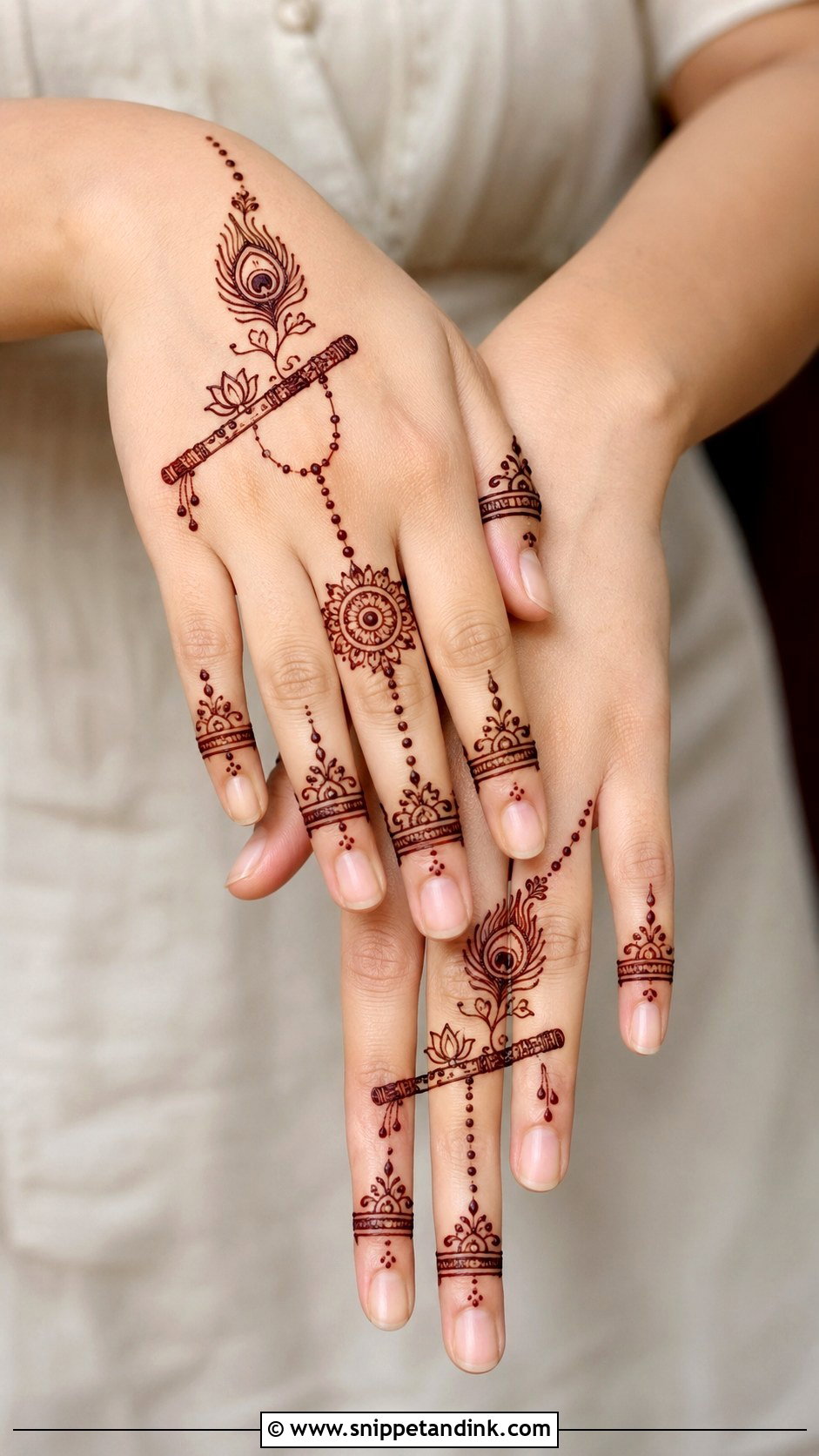
Finger-only designs need planning across all five fingers rather than one decorated finger. Small flutes, feather tips, lotus bands and dotted chains spread across the fingers, with a tiny feather or mandala near the knuckles to tie it together. Fingertips stain very dark, so I keep the tip designs simple; detailed lines there just merge. Keep the patterns slim so the fingers look long.
18. Krishna Wrist Mehndi Design
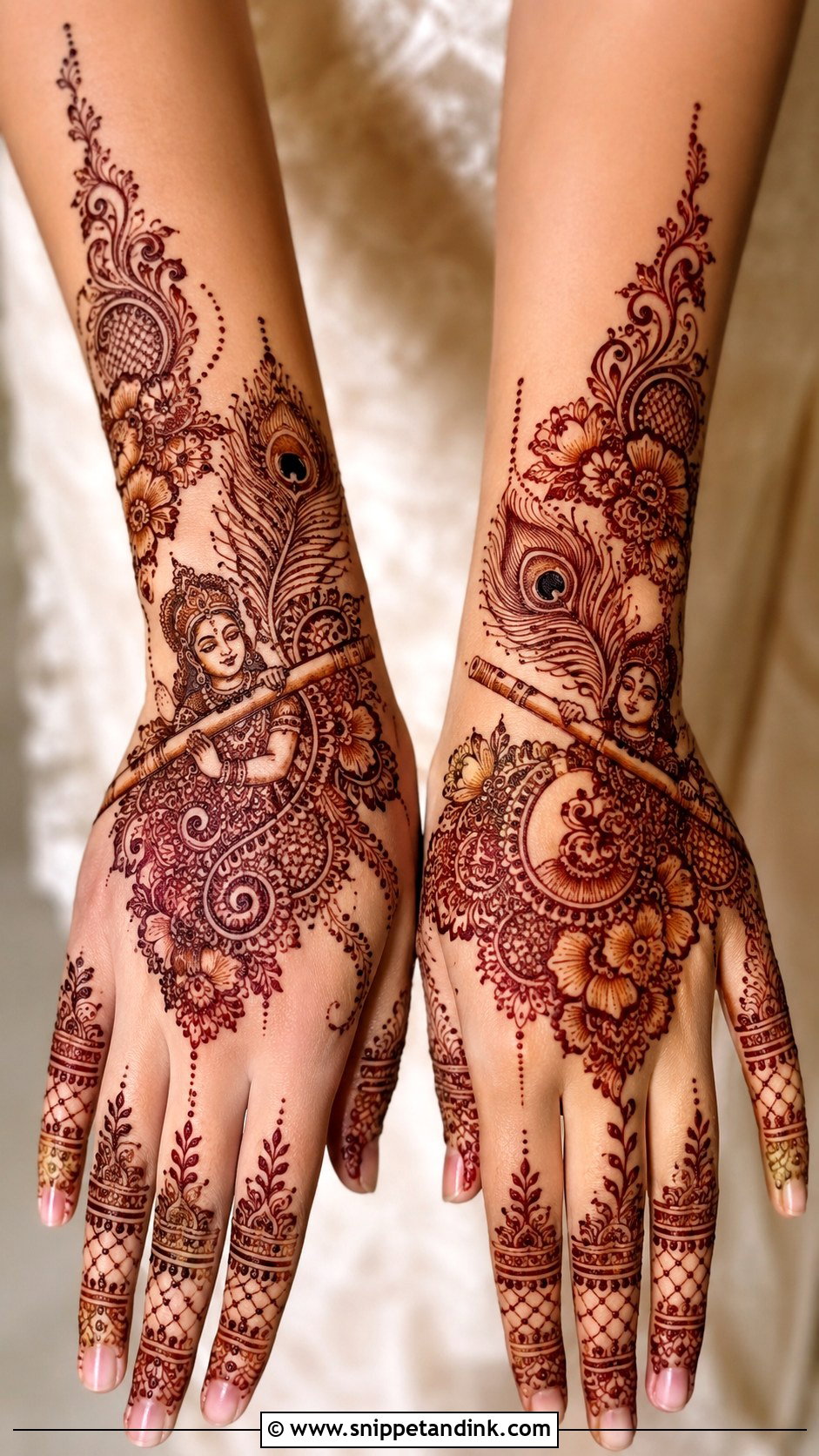
A wrist design reads like a henna bracelet: a flute wrapped around the wrist, feathers reaching toward the hand, and lotus or dot chains as bands. A thin vine running to one finger gives a hathphool look. Wrist skin creases and gets rubbed by bangles while the paste dries, so I advise clients to keep bangles off for the first few hours. Evenly spaced bands make it look deliberate rather than crowded.
19. Krishna Peacock Mehndi Design
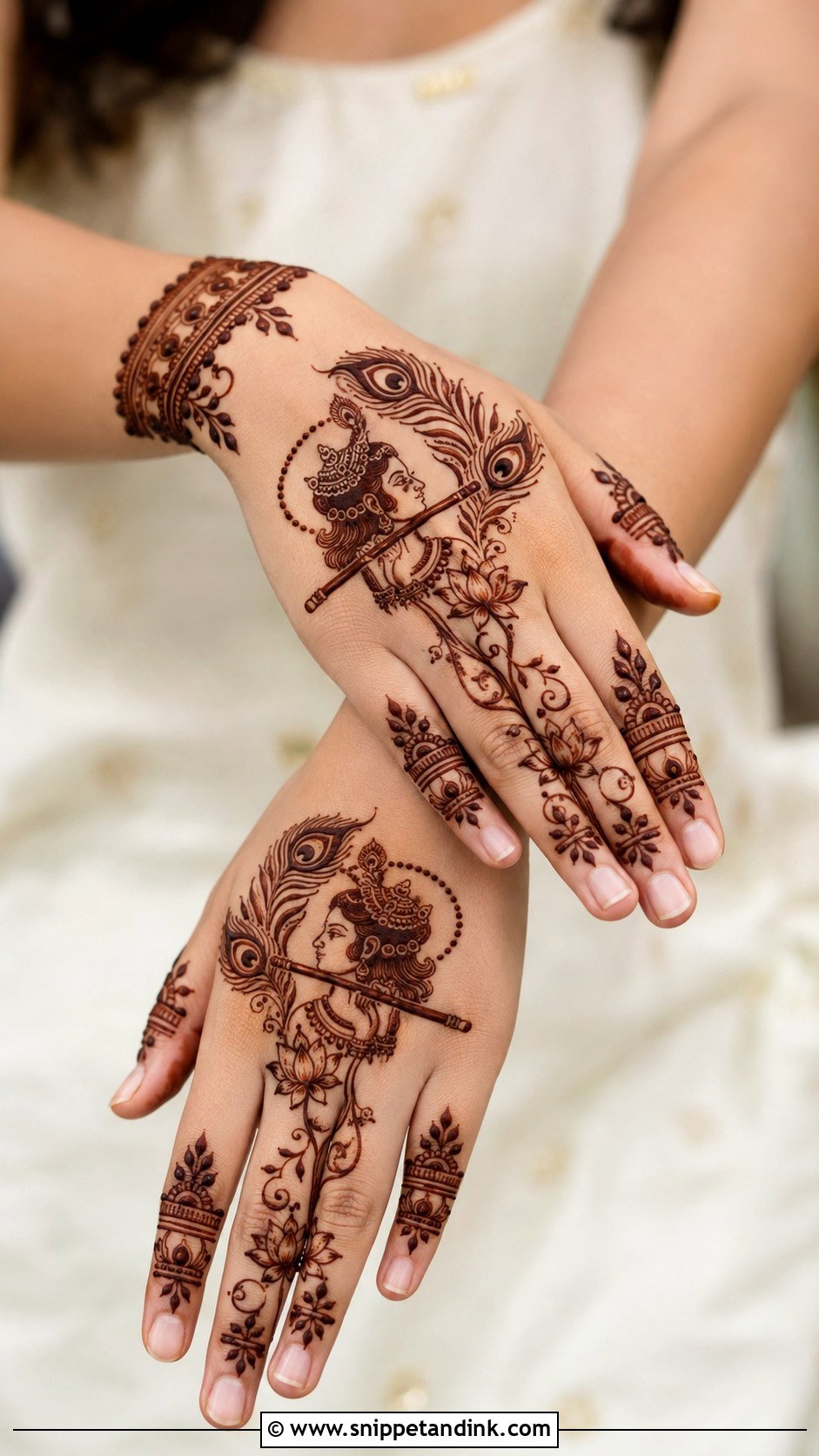
The peacock is tied to Krishna’s crown, and a whole peacock on the back of the hand or palm is a classic. I place the body near the wrist and fan the feathers toward the fingers, which follows the shape of the hand, then add a flute, lotus flowers and curved vines. The body outline needs to be bold so it stays clear as the stain darkens; the fine work goes inside the feathers. It suits weddings, sangeet and Janmashtami.



20. Krishna Lotus Mehndi Design
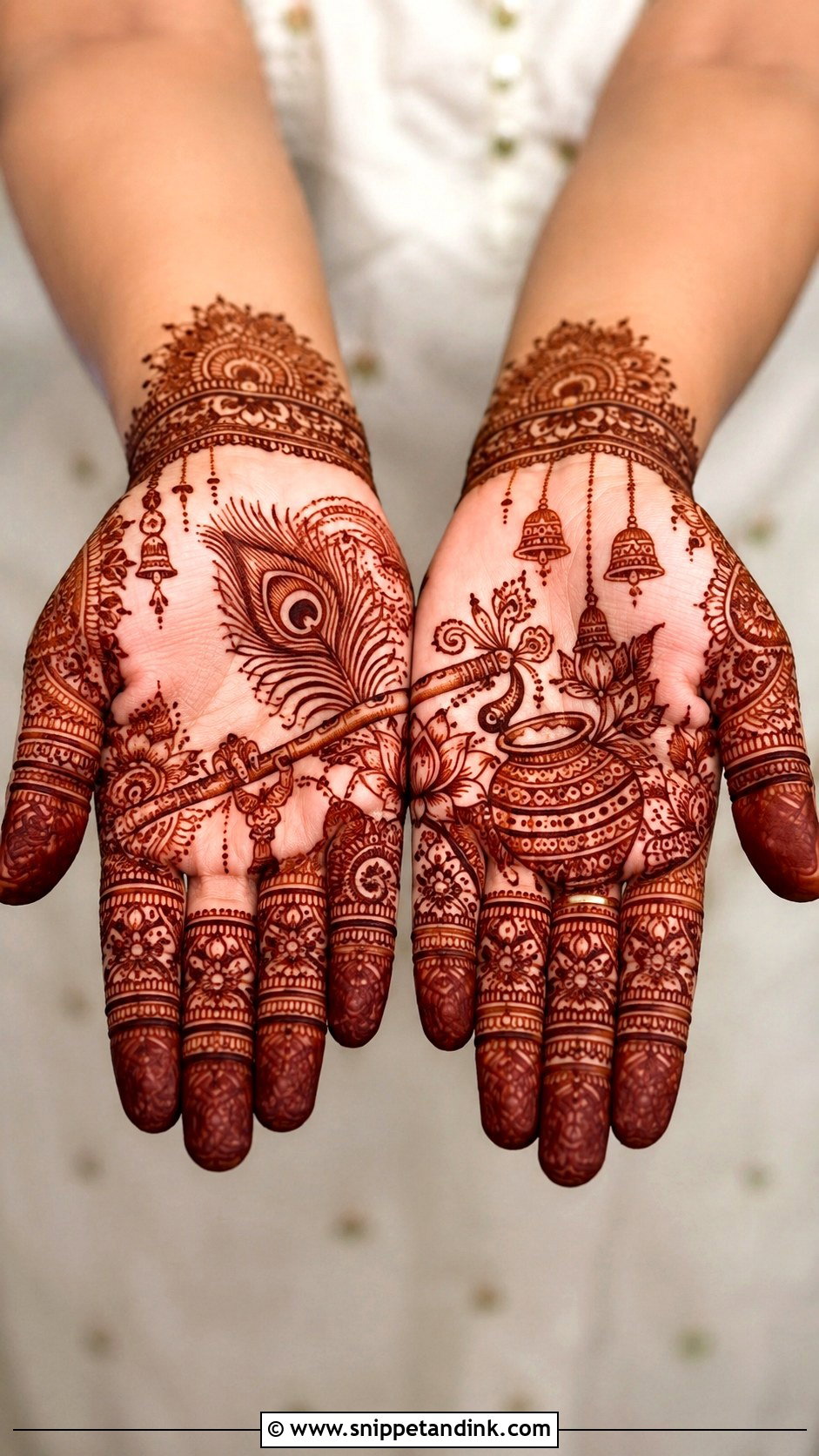
A lotus at the centre of the palm, crossed by the flute, with a feather near the wrist gives a floral design a clear Krishna connection. Leafy vines, dotted rings and small paisleys fill the space. I layer the petals in two or three rows at most; more than that and the petal lines fill in as the stain matures. It’s calm and fits engagement functions, poojas and family gatherings.
21. Krishna Matki Mehndi Design
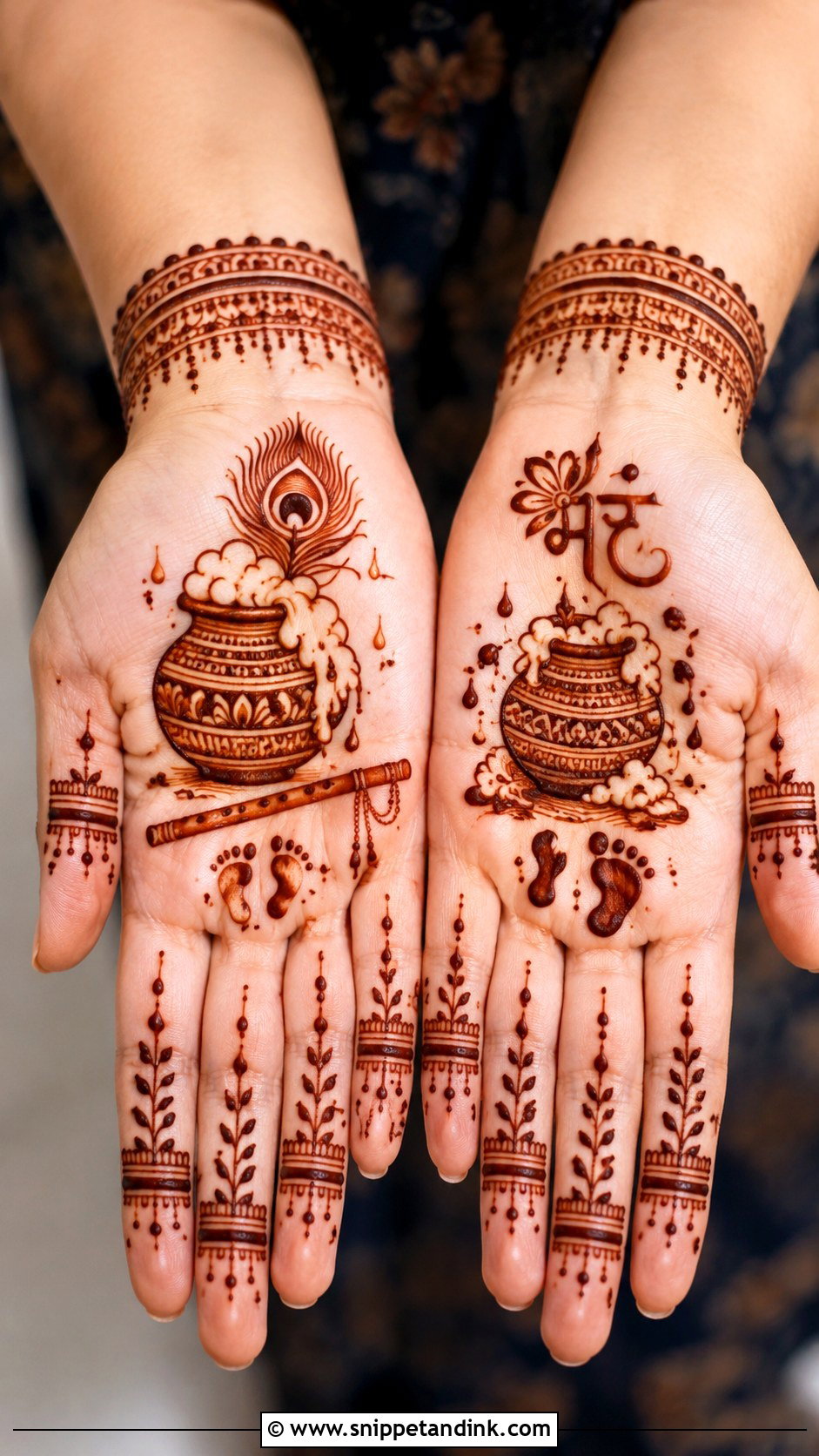
The matki, Krishna’s butter pot, is the playful option for Janmashtami and Gokulashtami. It sits at the centre of the palm with butter drops, small footprints, flute details and feathers around it, and festive borders extend to the wrist. Outline the pot strongly and keep its inner pattern lighter. It’s easy to scale: a five-minute version for a child or a fuller design if you have time.
22. Krishna Name Mehndi Design
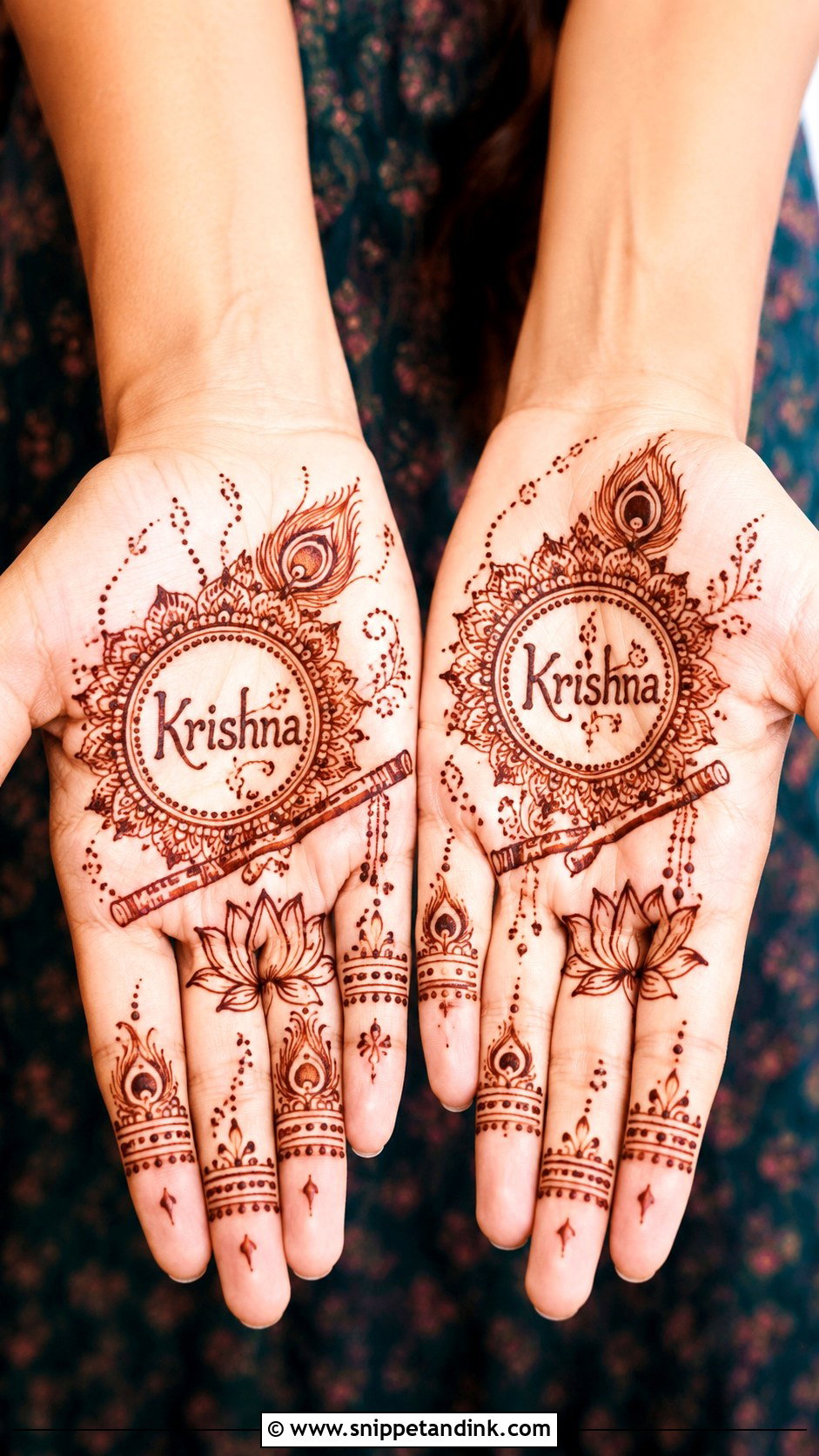
Writing the name gives a personal, devotional design without any figure drawing, so it’s a good one for beginners. The word can sit at the centre of the palm, inside a mandala or along a curved flute, with feathers, lotus petals and paisleys around it. Lettering blurs when the lines are too close, so I leave clear space between the letters and keep the filling around them sparse. It’s readable even after the stain turns deep brown.
23. Krishna Mor Pankh Mehndi Design
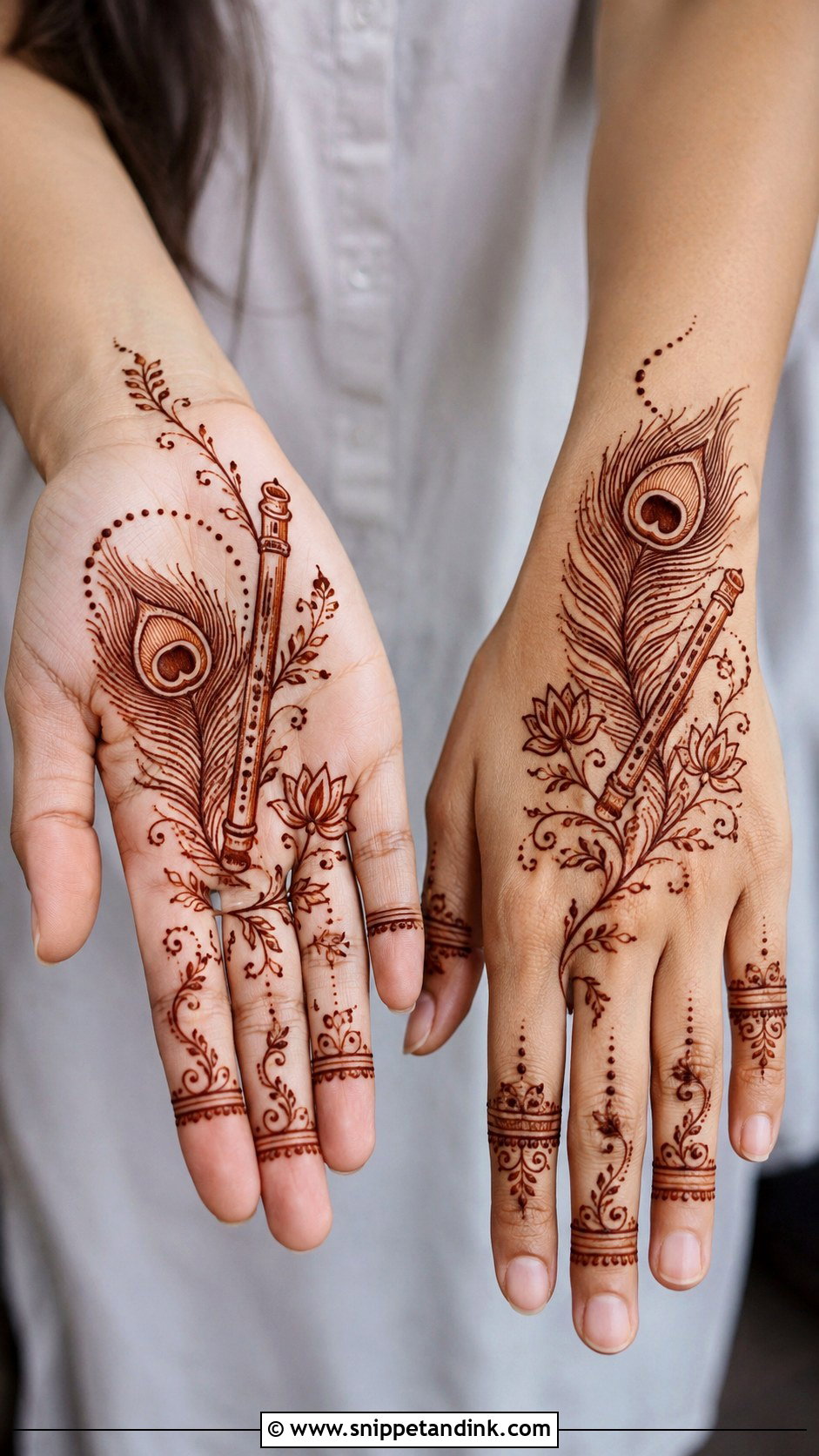
Mor pankh, the peacock feather, takes centre stage here in a more detailed form than item 3. The feather covers the palm or back of the hand, with its eye in the middle for balance, a flute beside it, and lotus vines and dots on the fingers. Beginners can manage a simple version; experienced artists can fill the barbs with very fine work. The outline should be one smooth stroke; I pull the cone rather than push it to keep that curve steady.
24. Krishna Wedding Mehndi Design
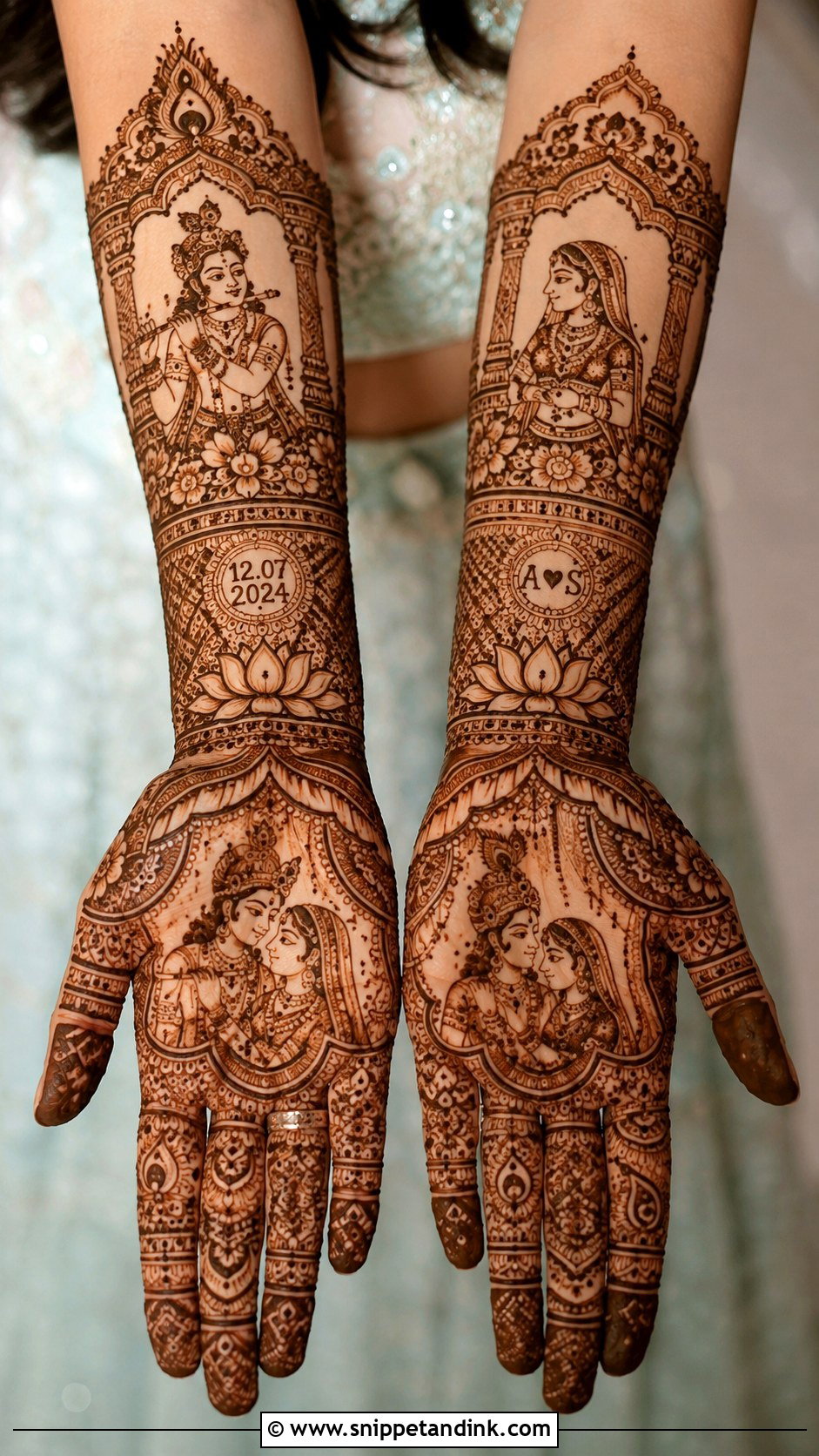
A Krishna wedding mehndi design brings portraits, lotus garlands, mandap arches, peacock feathers and paisley panels into dense bridal coverage from fingertips to forearm. Couples often hide initials or the wedding date inside it. I divide the hand into clear sections before I start, which keeps the portraits, fillers and borders from blending together. Book your artist early for this; it’s the longest application on the list.



25. Krishna Engagement Mehndi Design
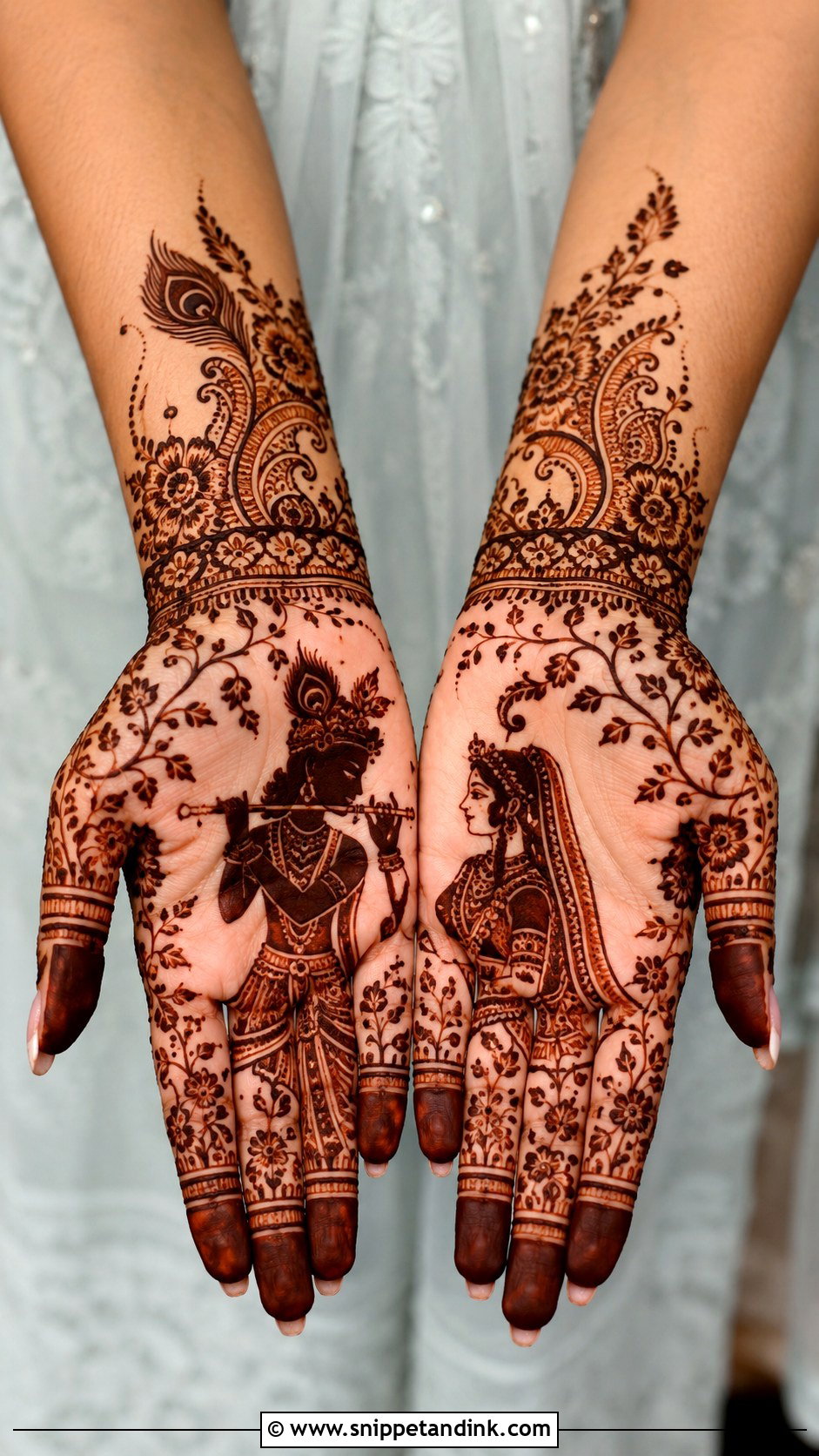
For an engagement I’d usually go lighter than bridal: Radha Krishna silhouettes on the palms, with a flute, feather and vines toward the wrists, and fingers detailed but not heavy. The ring finger is the one to think about. I leave the base of that finger fairly open, so the ring and the design don’t fight in close-up photos. Medium coverage takes far less time to apply.
26. Krishna Front Hand Mehndi Design
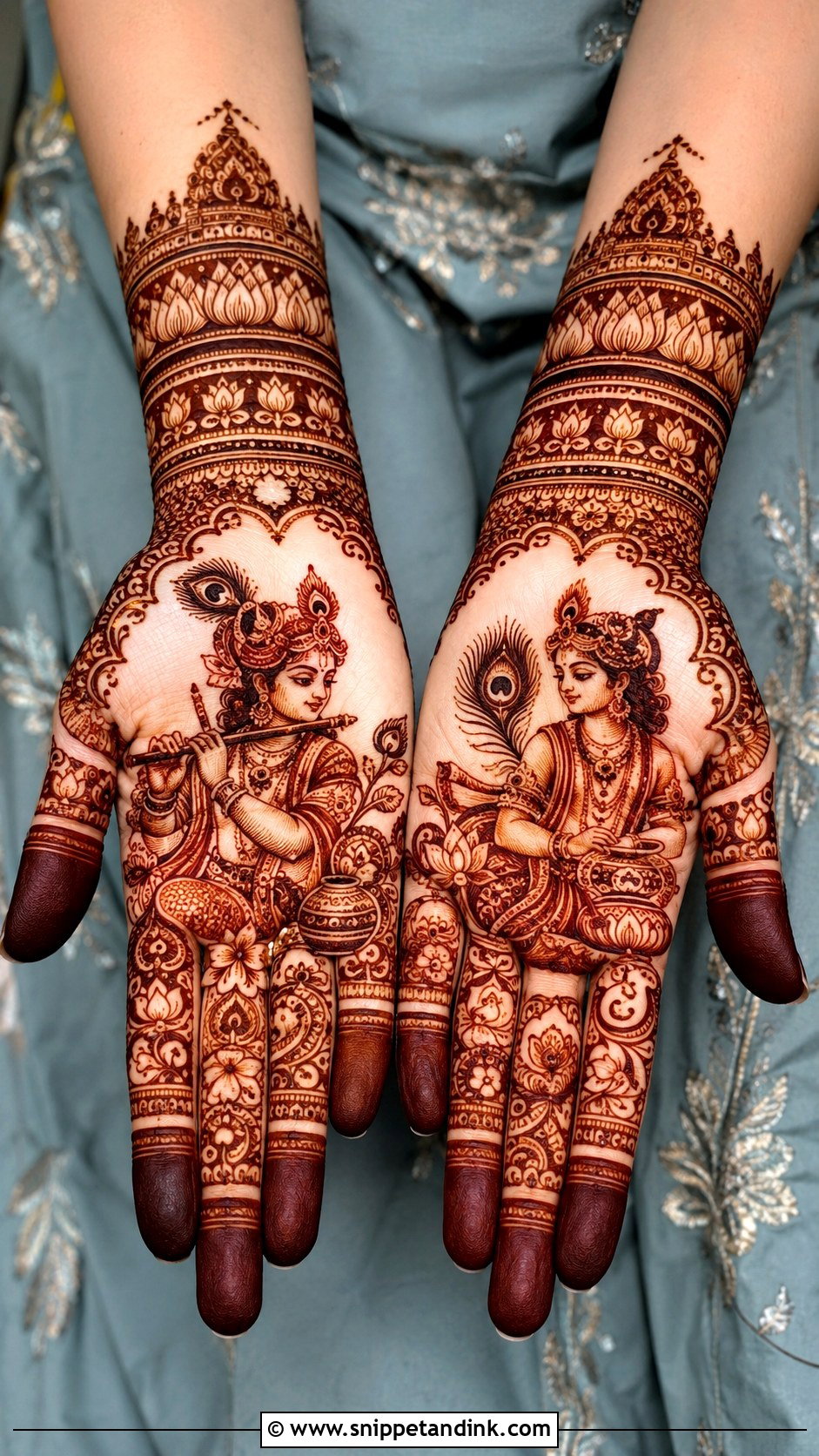
A front hand layout puts the flute and feather on the palm, lotus borders or temple bands at the wrist, and small matki elements, dots and paisleys around them. Fingers get matching leaves or simply shaded tips. The palm gives enough room for the main motif on any hand size, so this design scales well. Clean spacing is what keeps it sharp after the stain darkens.
27. Krishna Side Hand Mehndi Design
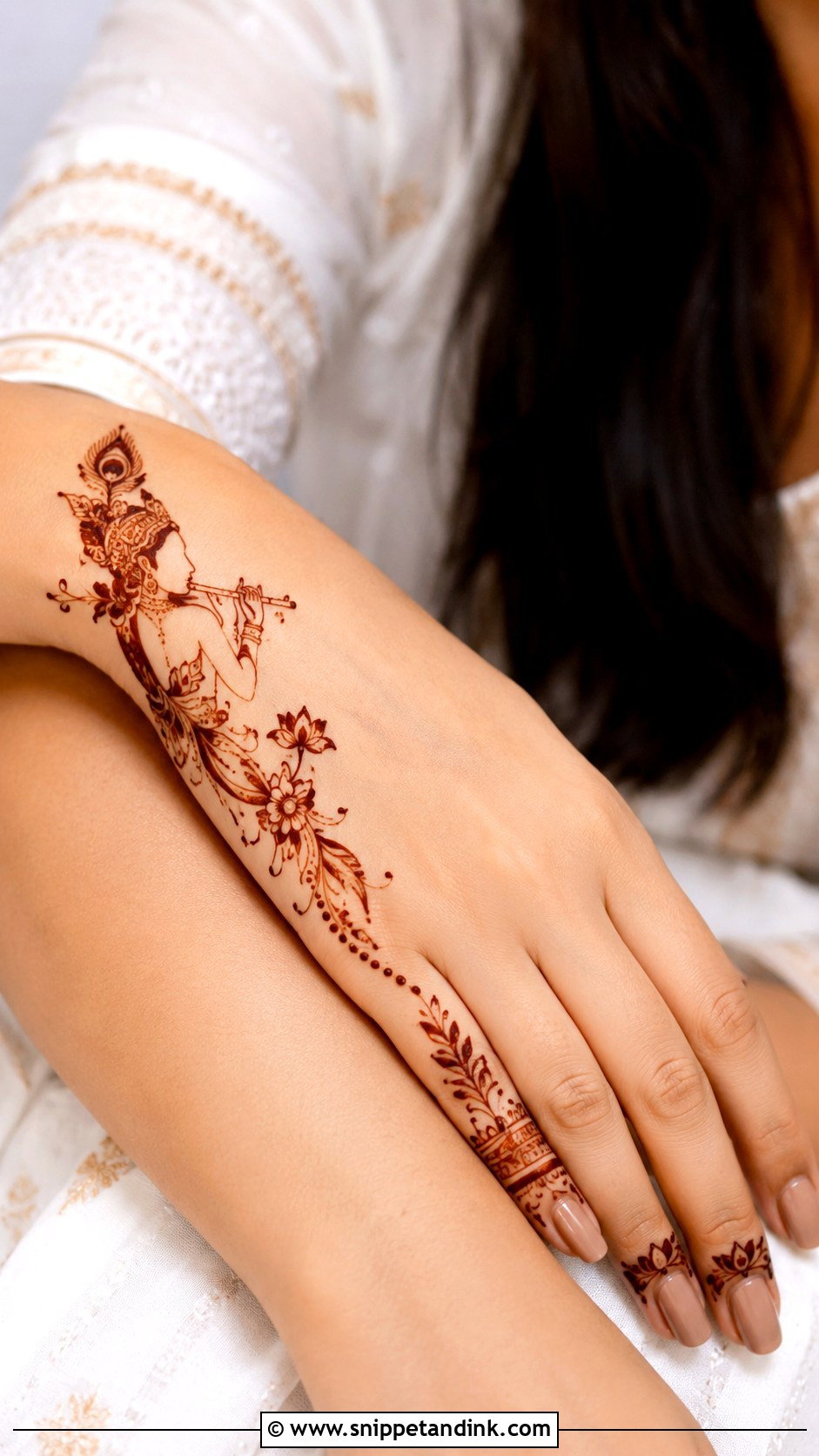
Side hand designs start at the side of the wrist with a flute and feather, travel along the outer edge toward the little finger, and leave the centre of the hand open. Small lotus flowers, dots and leafy curves complete the trail. I draw this one with the client’s hand resting on its side, because the trail looks different when the hand lies flat. It suits casual festivals, family functions and photos.
28. Krishna Jaali Mehndi Design
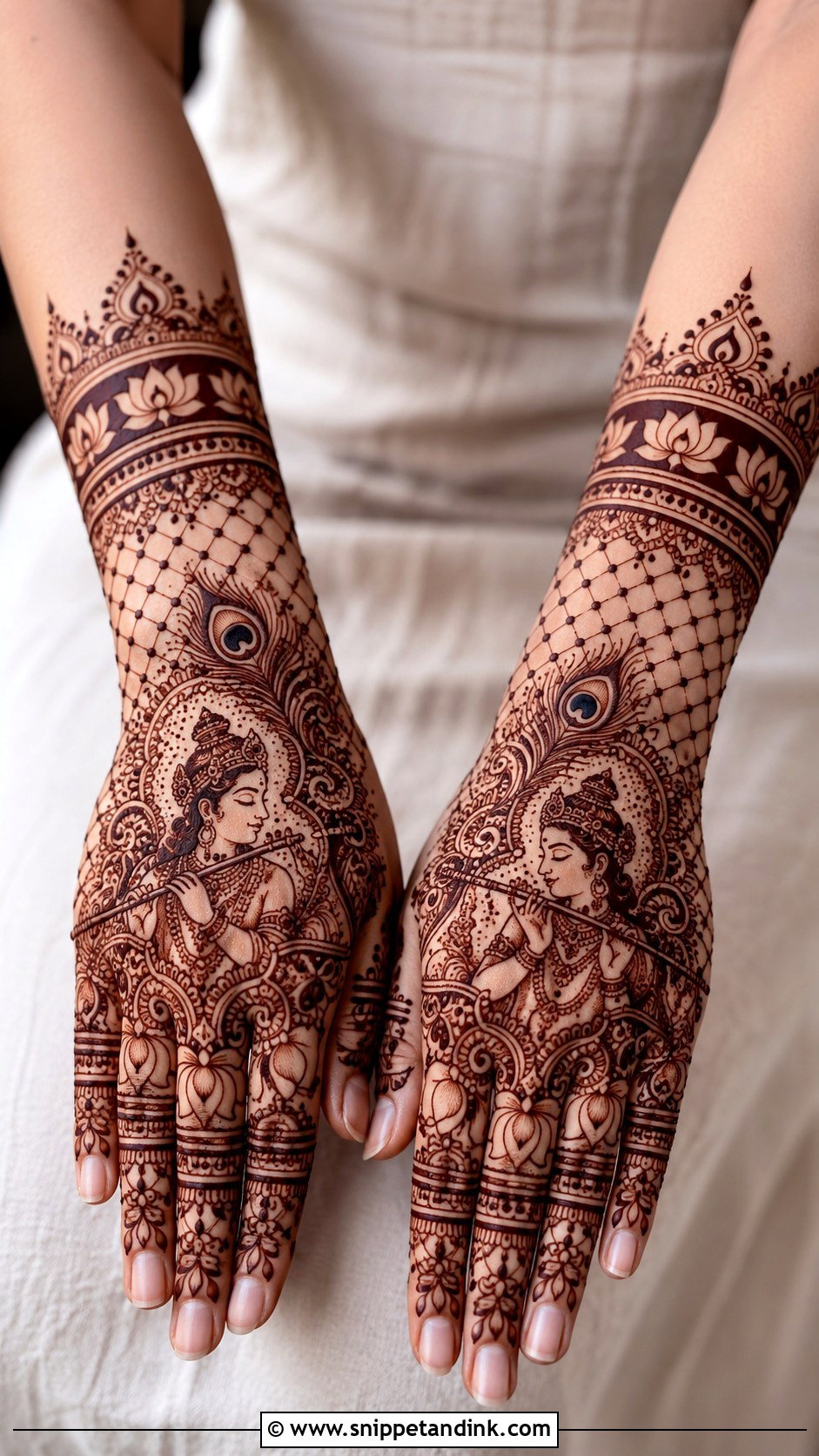
Jaali adds a lace-like mesh around a central flute and feather, with lotus borders and paisley curves. It looks especially neat on the back of the hand. The mesh is the risky part: lines drawn too close together merge into a solid patch as the stain darkens, so I keep the squares at least a few millimetres wide. Small dots inside the mesh add detail without crowding it.
29. Krishna Kids Mehndi Design
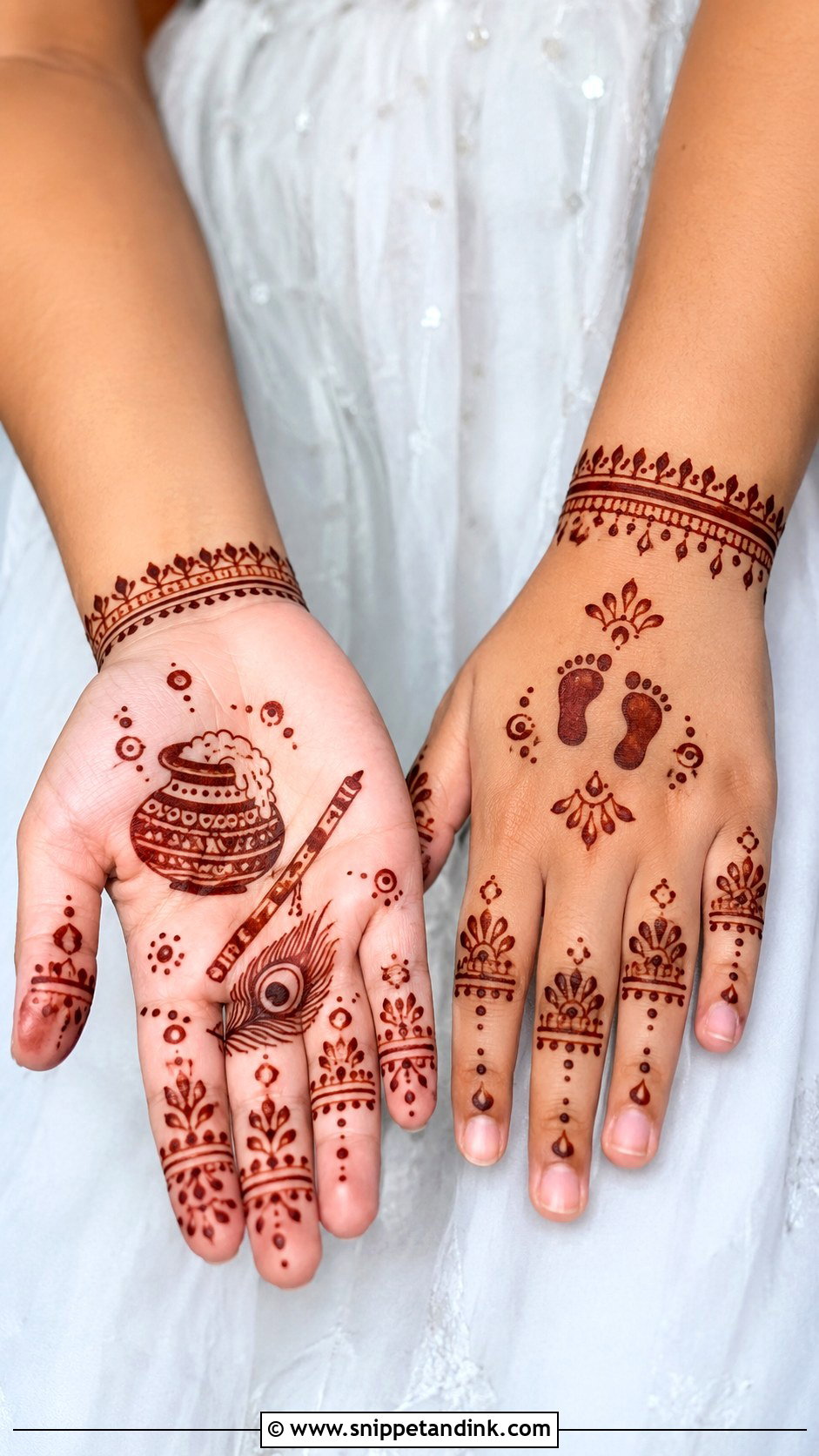
A Krishna kids mehndi design should be quick and comfortable: a small matki, flute, feather, baby footprints and simple dots on the palm or back of the hand. Light designs dry faster, and children rarely sit still long enough for fine details, so I use bold, rounded shapes. For children I only use natural henna with no added chemicals. A simple wrist band and decorated fingertips finish the design.
30. Krishna Modern Mehndi Design
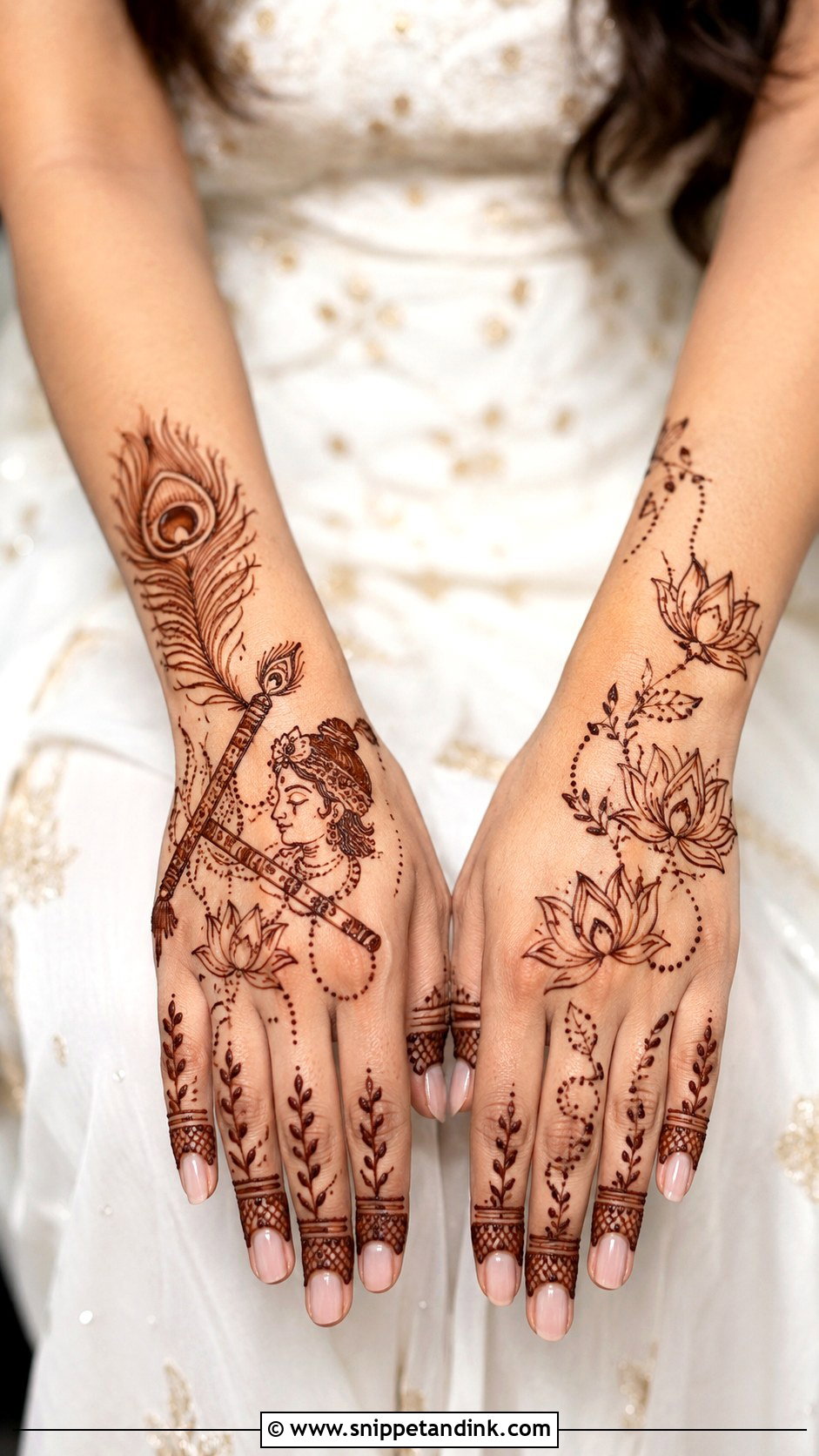
Modern Krishna mehndi swaps dense filling for negative space: a sleek flute, one large feather, open lotus outlines and fine dots. A back-hand diagonal from wrist to middle finger, or a centred feather on the palm with minimal finger bands, both work. Open designs show uneven lines more, so this is one to give to an artist with a steady hand. It suits festivals, casual weddings and photos.
Timing the Stain for a Midnight Janmashtami
Henna is orange when the paste comes off and darkens to its deepest brown over roughly two days. For Janmashtami, when the main celebration falls at midnight, I suggest applying one or two days before so the stain peaks on the night.
Leave the paste on for as long as you can, ideally six hours or overnight, and seal it with a light dab of lemon and sugar so it stays in contact with the skin. Scrape it off rather than washing it, and keep the hands out of water for as long as possible afterwards. Pooja preparations often involve washing utensils and making prasad, so if you’re doing that work, wear gloves or apply earlier.
Natural henna only for children
Black henna and instant dark cones can contain chemical dyes that cause serious skin reactions, and children are especially vulnerable. Use natural henna that stains orange first and darkens slowly, and test a small dot on the inner arm a day before if the child has sensitive skin. If a cone promises black colour within minutes, I wouldn’t put it on anyone’s hands.
A Flute for the Pooja, Portraits for the Wedding
Before booking, decide which part of the story matters to you. Portraits suit a wedding where you have the time and a skilled artist; a flute, mor pankh, matki or lotus suits a pooja, a school event or a quick Janmashtami design. Then think about your hands themselves: how much time you can sit still, how dark your stain usually goes, and whether the design should read in close-up photos or from across a room. Clean outlines and space left on purpose make the motif look devotional rather than crowded.
You'll Like These Ideas:











Leave a Reply