
Sage and burnt orange is one of the easier palettes I get to work with, because the two colors already sit on opposite sides of the warm and cool line and do the balancing for me. Sage brings the calm of greenery, and the orange brings the rich sunset color that pulls the eye to the cake table. I see it most at fall receptions, desert venues, barns and garden parties. The real decision is how much of each color goes on the cake itself and how much is carried by flowers, fruit and ribbon. Below are twenty cakes, from plain ivory tiers with orange blooms to fully tinted designs, with what I’d watch for on each.
Why Sage Buttercream and Burnt Orange Behave Differently
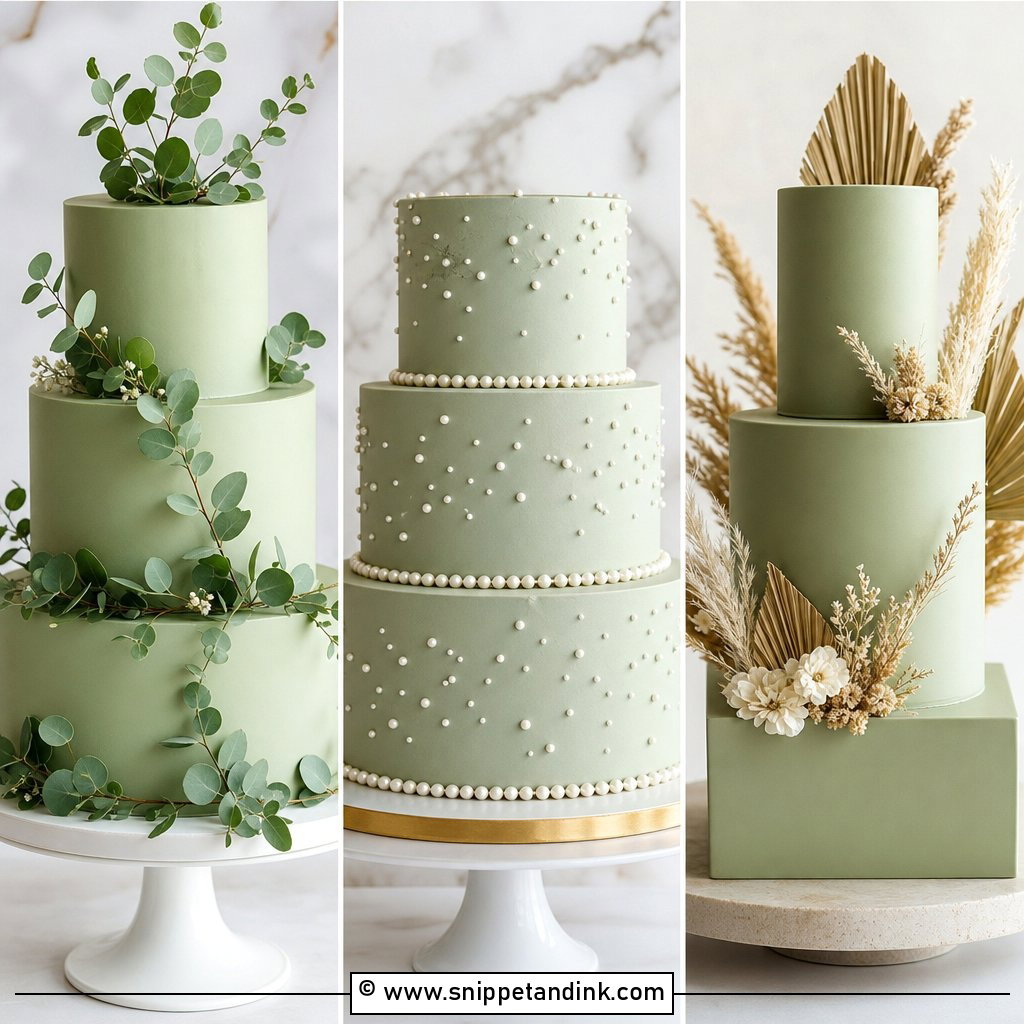
Sage is a greyed green, so I don’t mix it from green alone. A little brown or black and a touch of yellow is what stops it from looking minty, and I always mix the whole batch at once because a second batch never matches perfectly. Butter also yellows the color, so a sage in a pot of white frosting looks slightly different once it’s on an ivory buttercream cake. That’s why I show couples a swatch on the real frosting, not on paper.
Burnt orange has its own problem: strong orange and pink food colors fade in sunlight. A cake that looks perfect in my kitchen can be noticeably paler after a couple of hours on a sunny terrace. If your table is outdoors, I’d keep the orange in flowers, fruit or sugar work and leave the buttercream sage or ivory.
What to bring to the tasting
- A fabric swatch or a photo of your bridesmaid dresses taken in daylight
- Your florist’s flower list, so I can match the orange to real stems
- Whether the cake will stand indoors, under a tent or in the open
- The time it will be cut, which tells me how long it has to hold
1. Sage Green And Burnt Orange Floral Wedding Cake
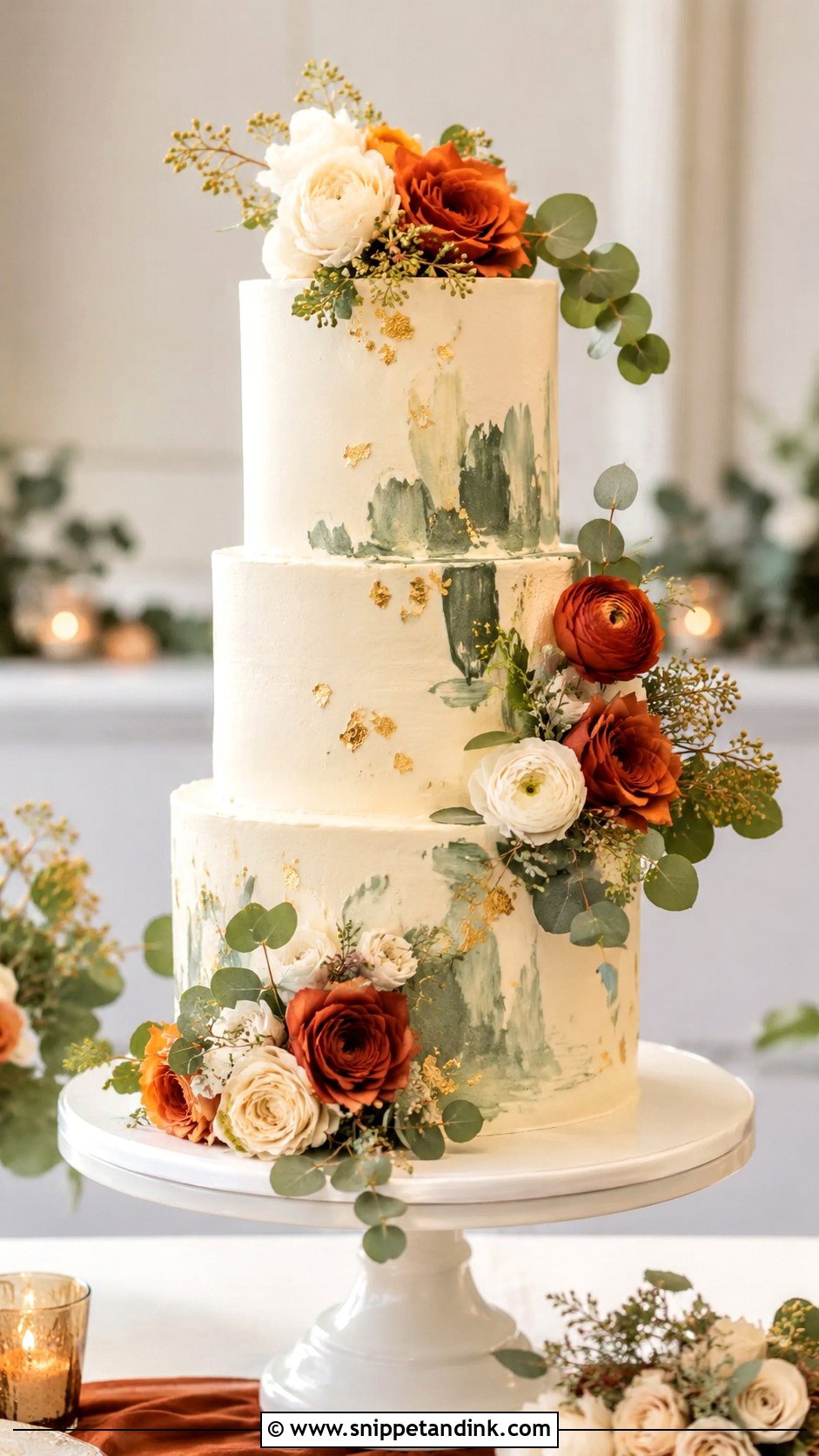
Flowers are the gentlest way into this palette, because the buttercream can stay ivory or barely sage and the blooms carry the orange. I’d group burnt orange roses, rust ranunculus, cream flowers and a little eucalyptus in two or three clusters rather than wrapping every tier. Clusters give the cake a shape; full coverage turns it into a flower tower. Ask for smooth sides and sharp top edges, because loose florals look deliberate only against a clean surface. A few flecks of gold are plenty.
2. Sage Green And Burnt Orange Boho Wedding Cake
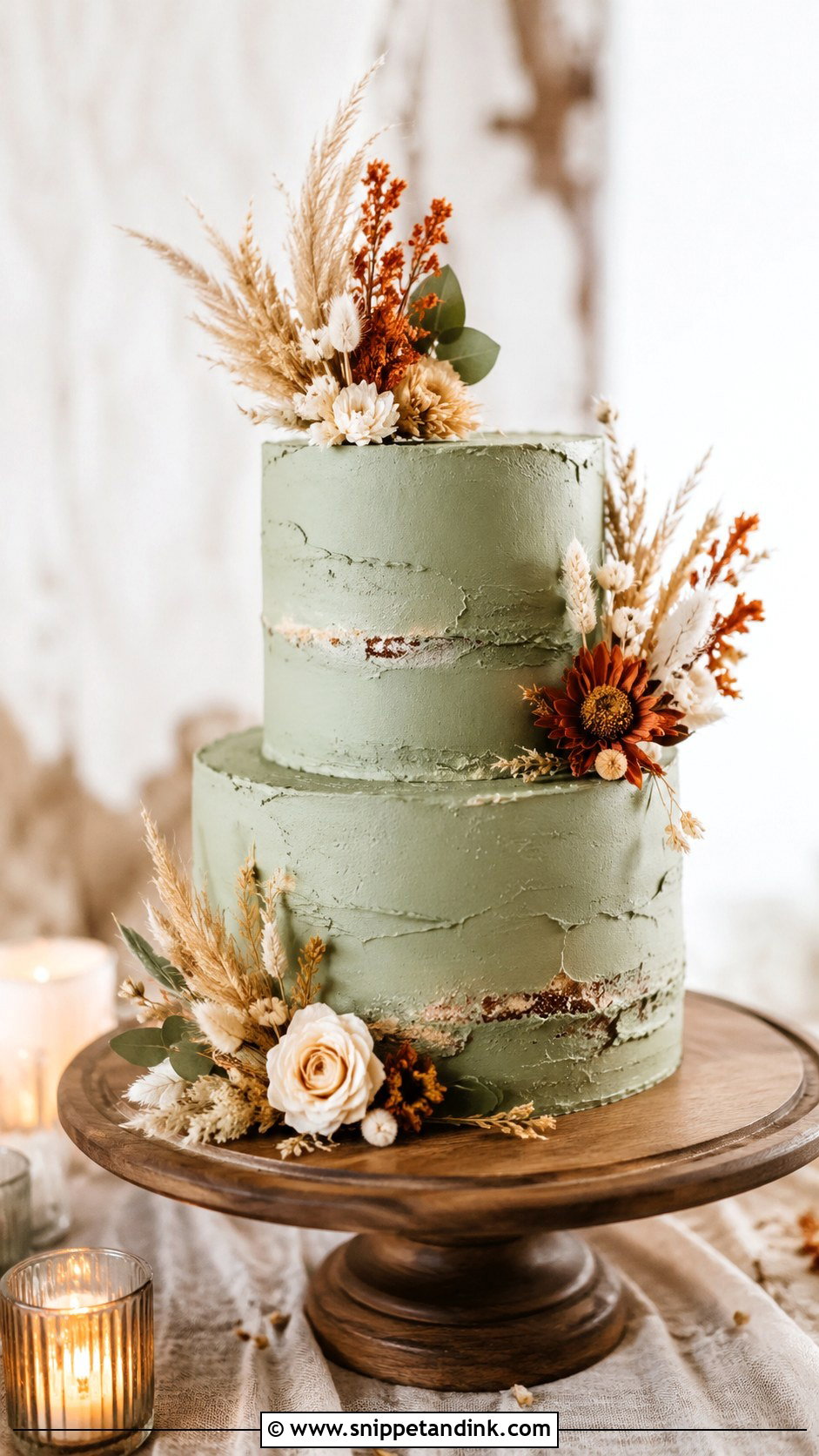
The colors for a boho wedding cake need to look earthy, never bright, so I mix sage with a touch of ivory and keep the orange in dried material: pampas, bunny tails, preserved rust blooms. Dried elements are a gift outdoors because they don’t wilt, but they shed, so I add them at the venue rather than in the van. A semi-naked or loosely textured finish suits it best. Leave space between decorations. Boho tips into cluttered faster than any other style I make.
3. Sage Green And Burnt Orange Drip Wedding Cake
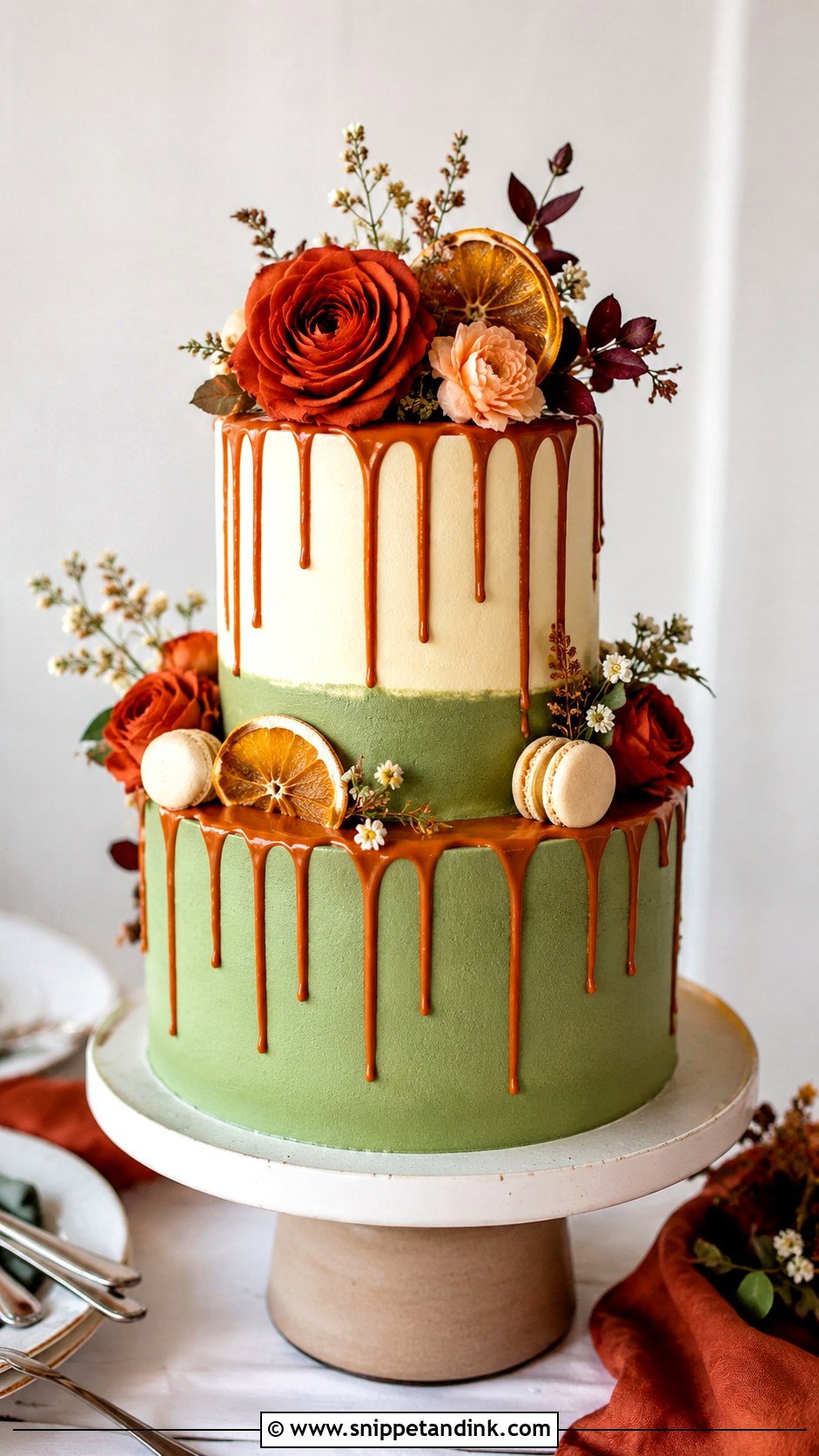
A drip adds a modern edge, and orange is a fiddly drip color. I tint white chocolate ganache with an oil-based color, because water-based gel can make the chocolate seize. The cake has to be properly chilled first so the drips stop where I want them, at uneven lengths that still look controlled. Fresh flowers, dried orange wheels or a few macarons on top tie the two shades together. Keep the tiers otherwise plain so the drip stays the feature, and expect it to read well from above as well as head on.
4. Sage Green And Burnt Orange Two Tier Wedding Cake
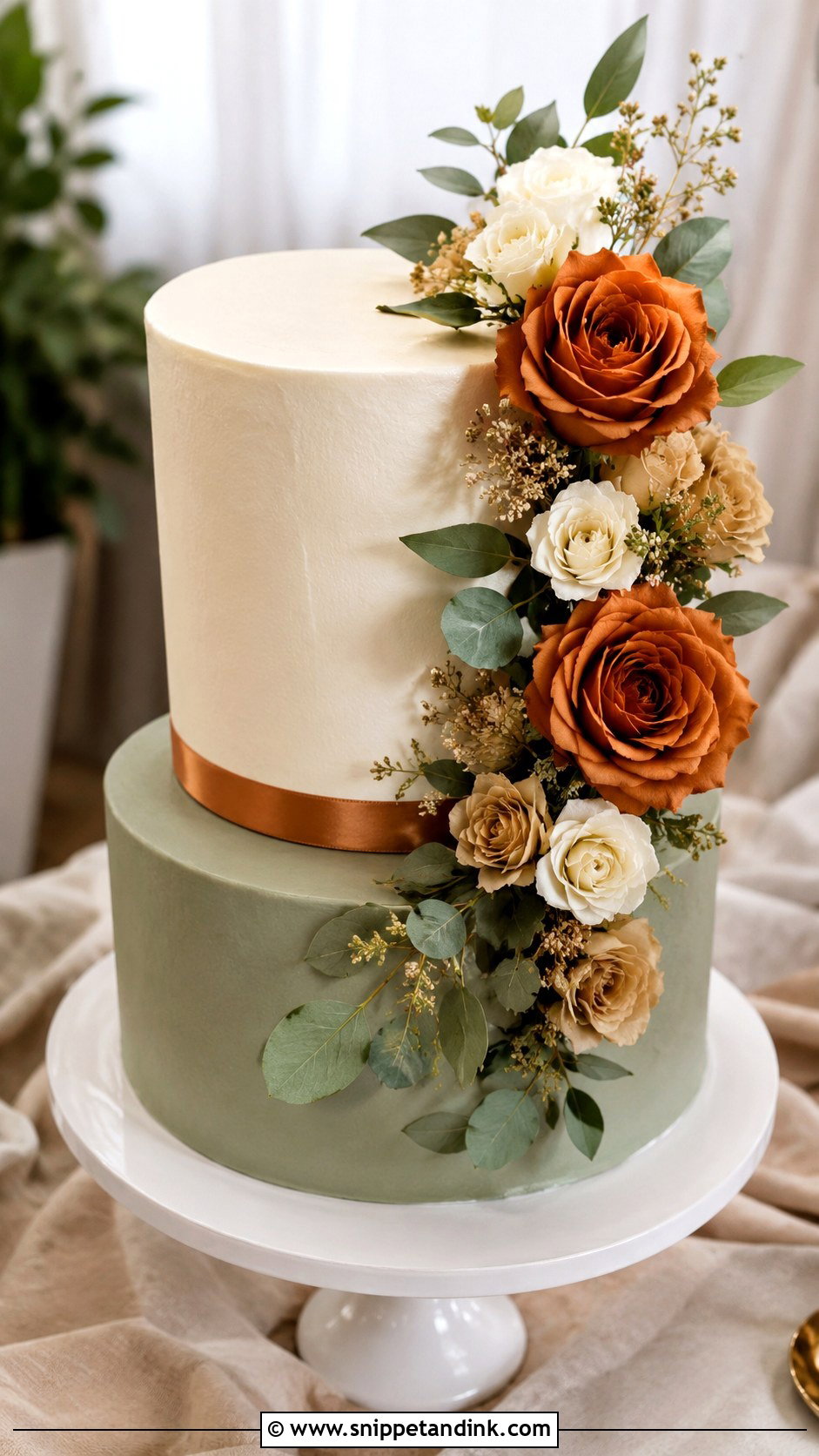
Two tiers suit small weddings and elopements, and the color placement matters more because there’s less cake to spread it across. My usual layout is a sage bottom tier, an ivory top tier and orange flowers stepping lightly down between them. Smooth buttercream reads polished; a palette knife texture reads rustic, so pick the one that matches your venue. A thin satin ribbon around one tier is a nice softener. Use a white or pale ceramic stand, since dark wood swallows the sage.
5. Sage Green And Burnt Orange Three Tier Wedding Cake
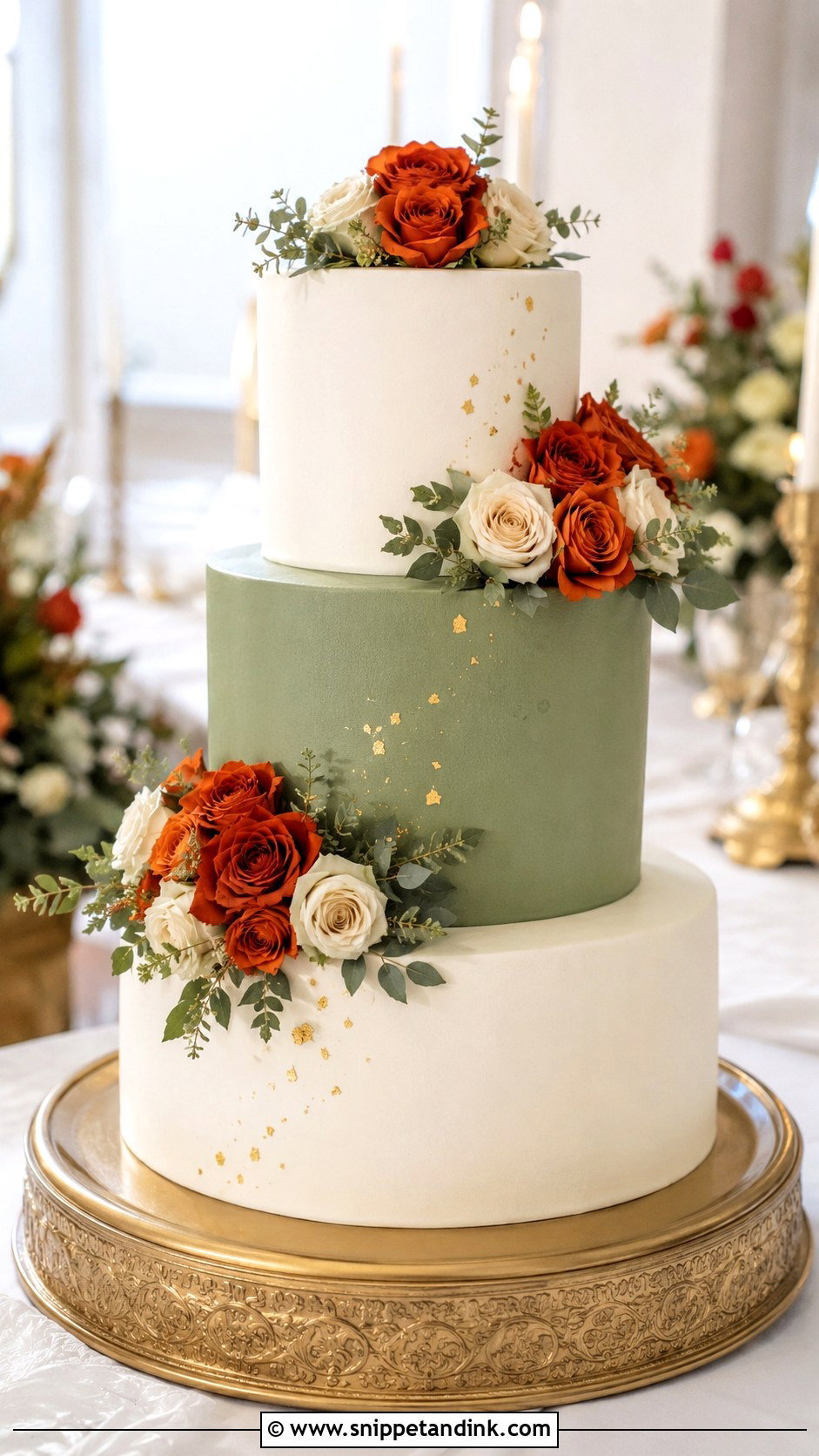
Three tiers give the palette room. The layout I return to most is an ivory base, sage green middle-tier frosting and burnt orange flowers stepping across the joins. A watercolor wash across all three tiers is the softer alternative, blending sage and orange into cream. Formal rooms call for smooth buttercream or fondant with precise edges; barns and gardens can take texture and loose stems. With this much height, I leave visible gaps of plain frosting so neither color crowds the other.
6. Sage Green And Burnt Orange Rustic Wedding Cake
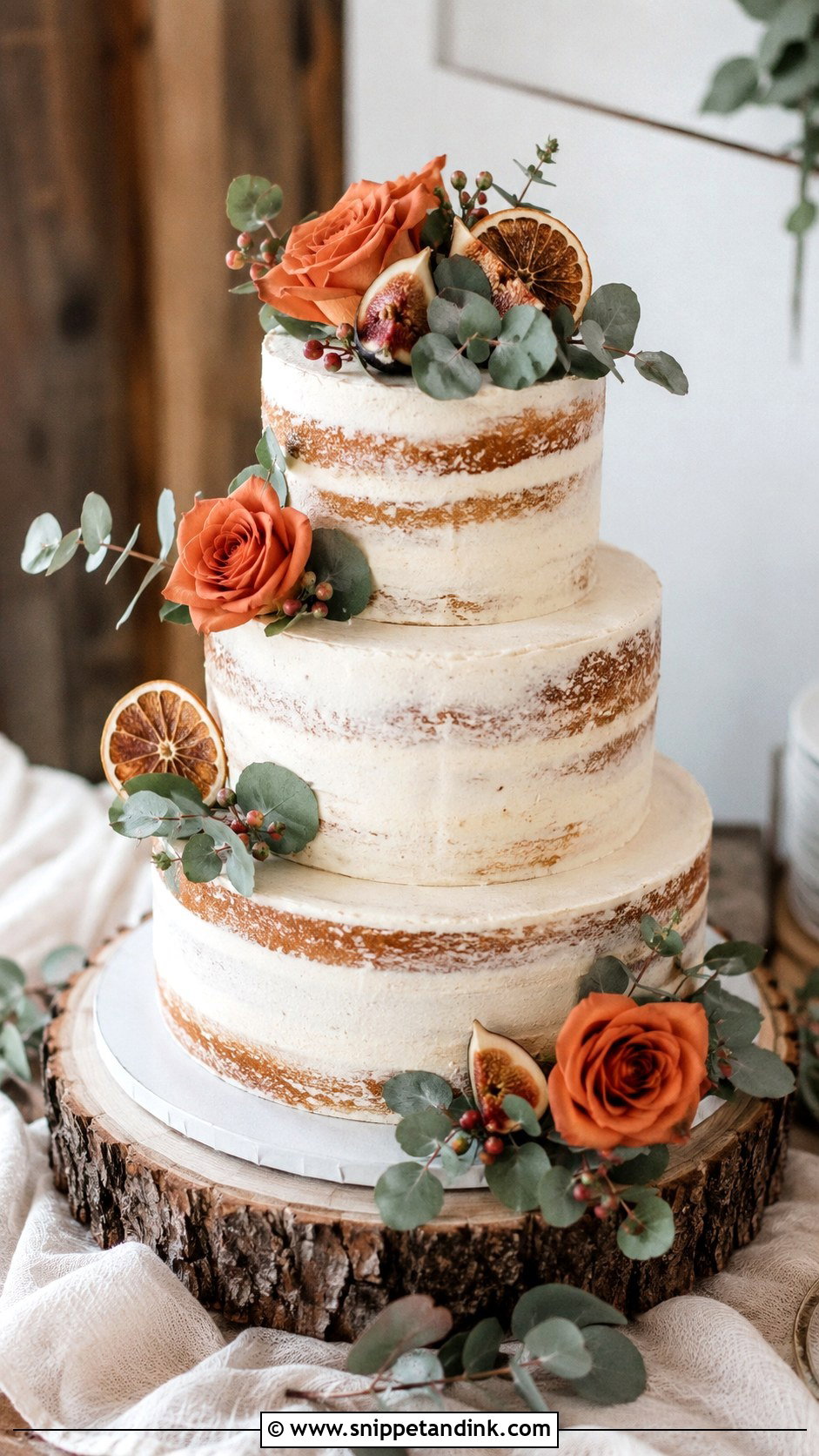
Rustic cakes go wrong when they’re made too neat. I scrape a semi-naked coat so the vanilla layers show through, then add sage leaves and burnt orange flowers where they’d naturally fall, with figs, dried citrus or small berries if you want more texture. A semi-naked cake dries out faster than a fully frosted one, so I wrap it until the last moment and brush the layers with syrup during baking. Keep the orange to a few accents. A wooden stand and a soft, uneven edge finish it.
7. Sage Green And Burnt Orange Buttercream Wedding Cake
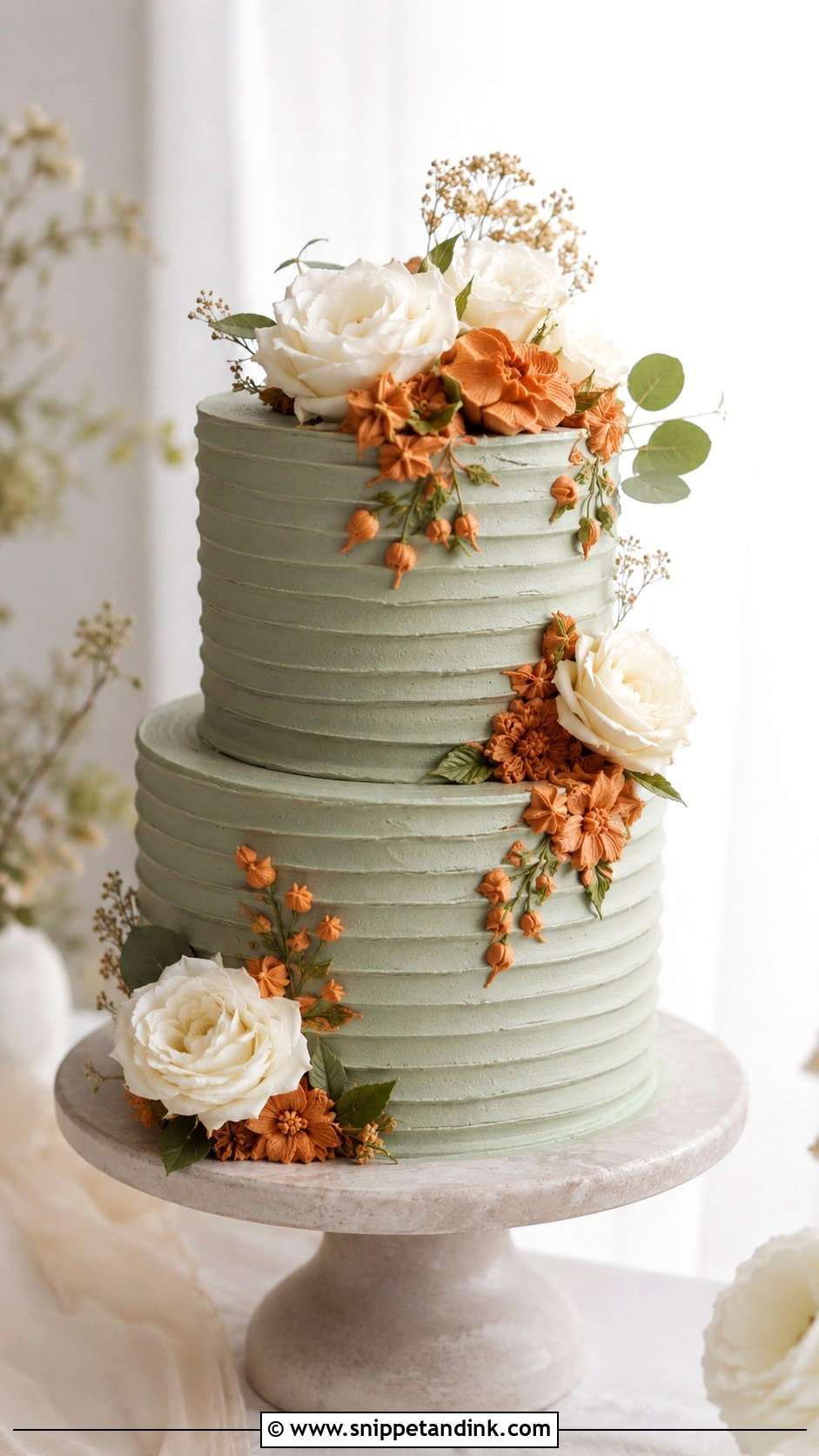
Buttercream is where sage looks most natural, because the slight ivory of the butter warms the green. I can apply it smooth, in horizontal ridges or in loose palette strokes, and the orange can come from piped flowers, painted details or real blooms. It does soften in a warm room, so for outdoor receptions I’ll suggest a Swiss meringue buttercream, which holds better than a sugary American one. Under the frosting, vanilla, almond, spice and orange-scented sponges all suit these colors.
8. Sage Green And Burnt Orange Fondant Wedding Cake
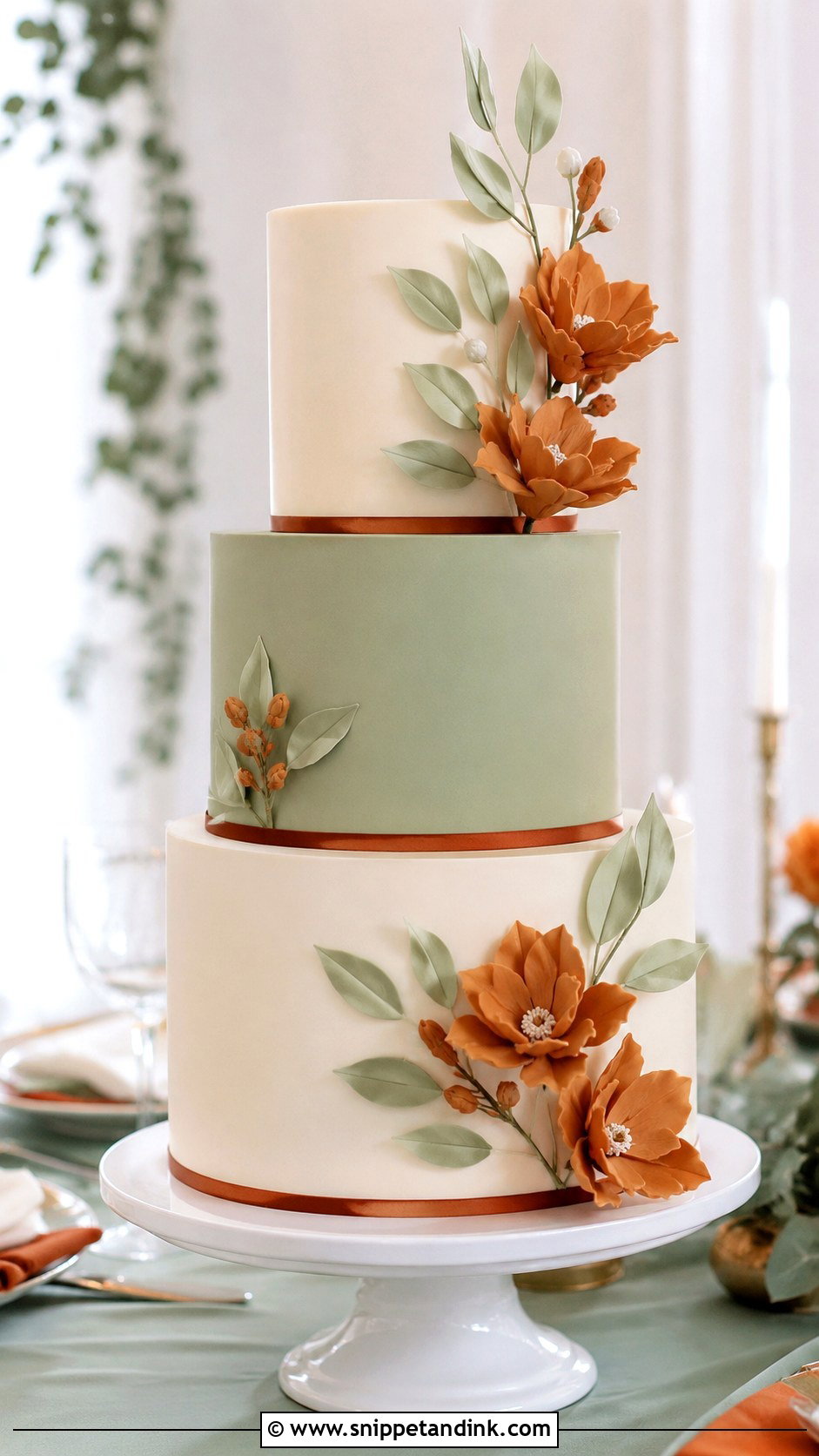
Fondant is the pick when you want crisp edges and a formal table. I knead the sage color to a matte finish, pair it with an ivory tier and add burnt orange sugar flowers, pressed fondant leaves or a thin terracotta ribbon detail. The catch is that every flaw shows on fondant, and so does every decoration, so I keep the design sparse. One thing to know before a summer booking: fondant sweats when a chilled cake moves into a humid room, so it needs time to settle before guests see it.
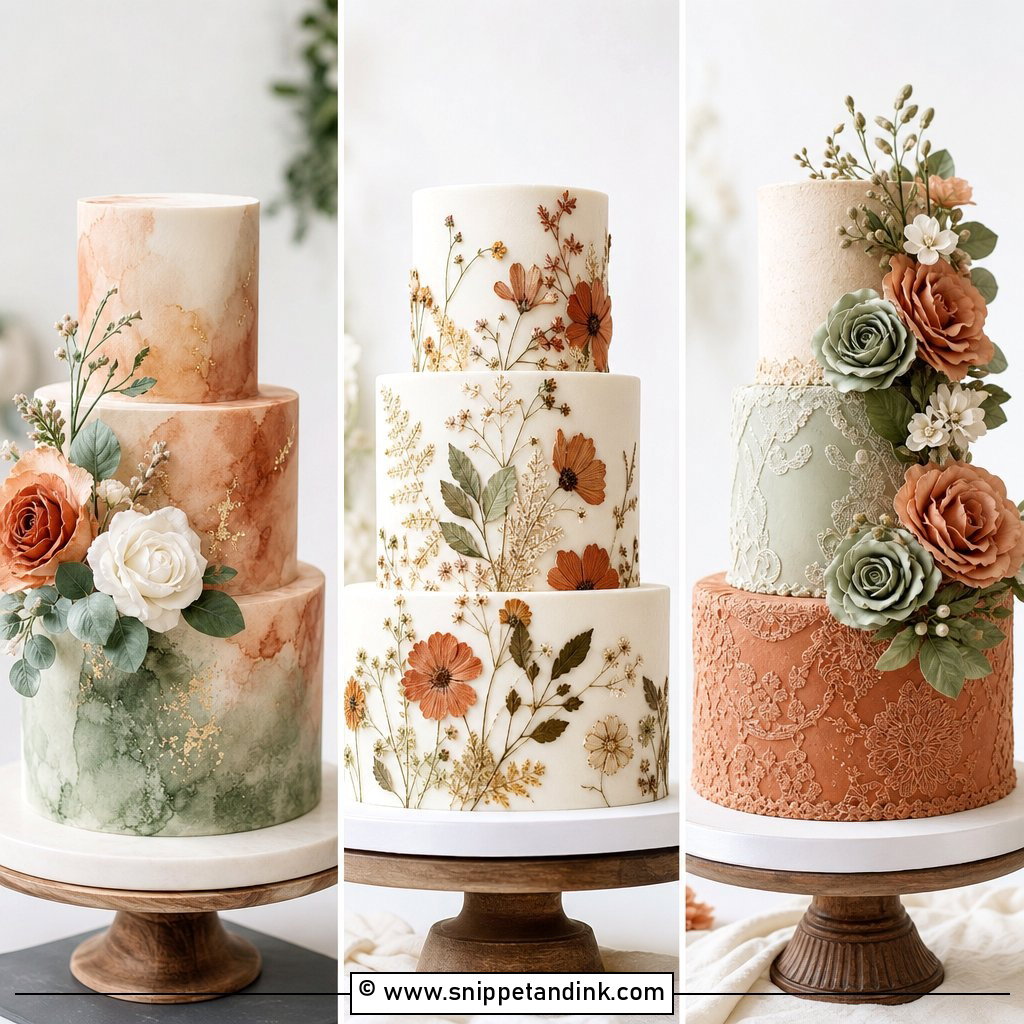
9. Sage Green And Burnt Orange Watercolor Wedding Cake
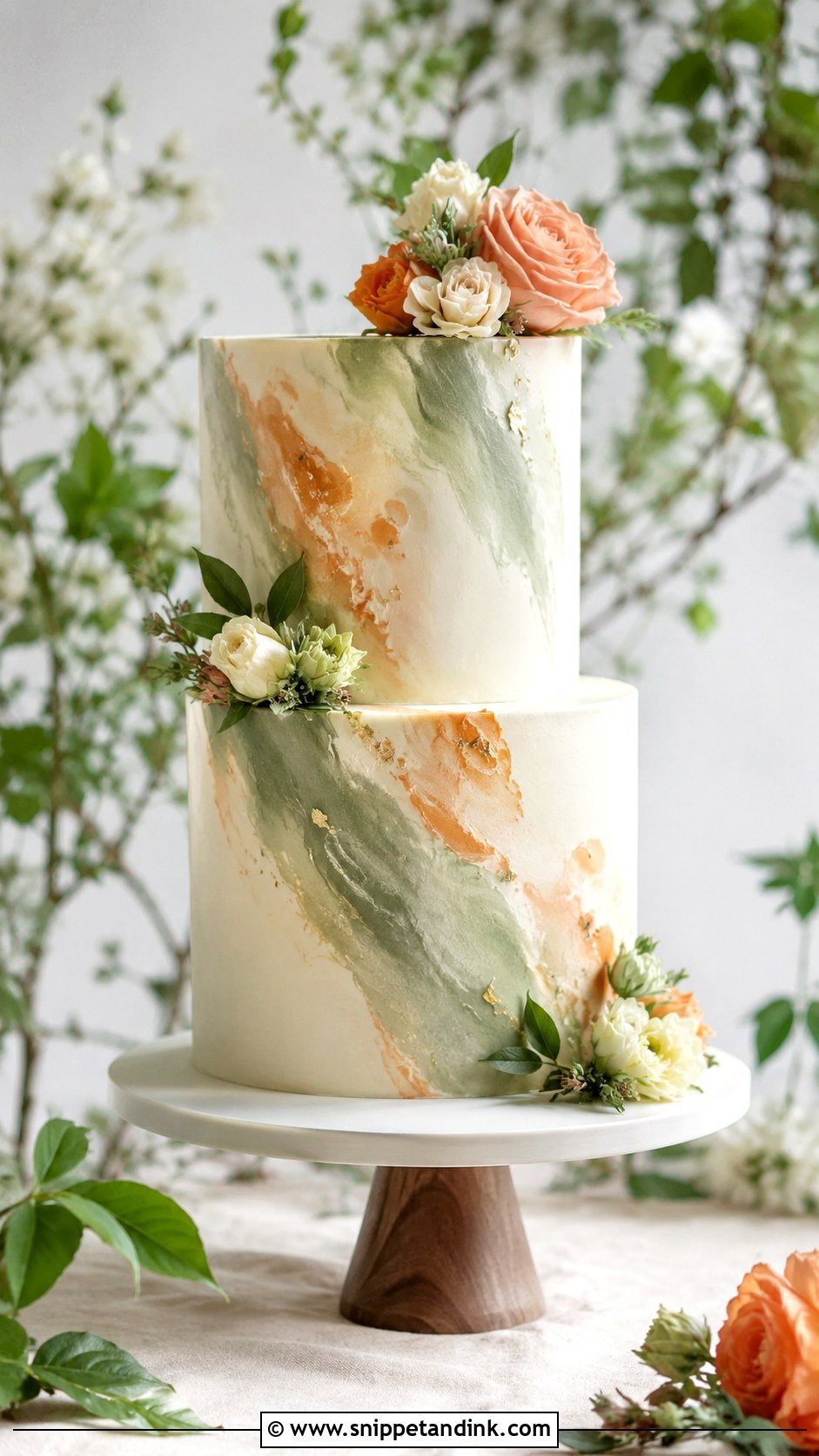
Watercolor is my favorite way to blend these two without hard blocks of color. I brush thinned sage and orange over chilled ivory buttercream with a palette knife, working fast so the tones melt into each other. You can keep it pale for spring or push the orange deeper for autumn. Flowers should stay small here; a big arrangement just covers the painting you paid for. A little gold leaf suits an evening room.
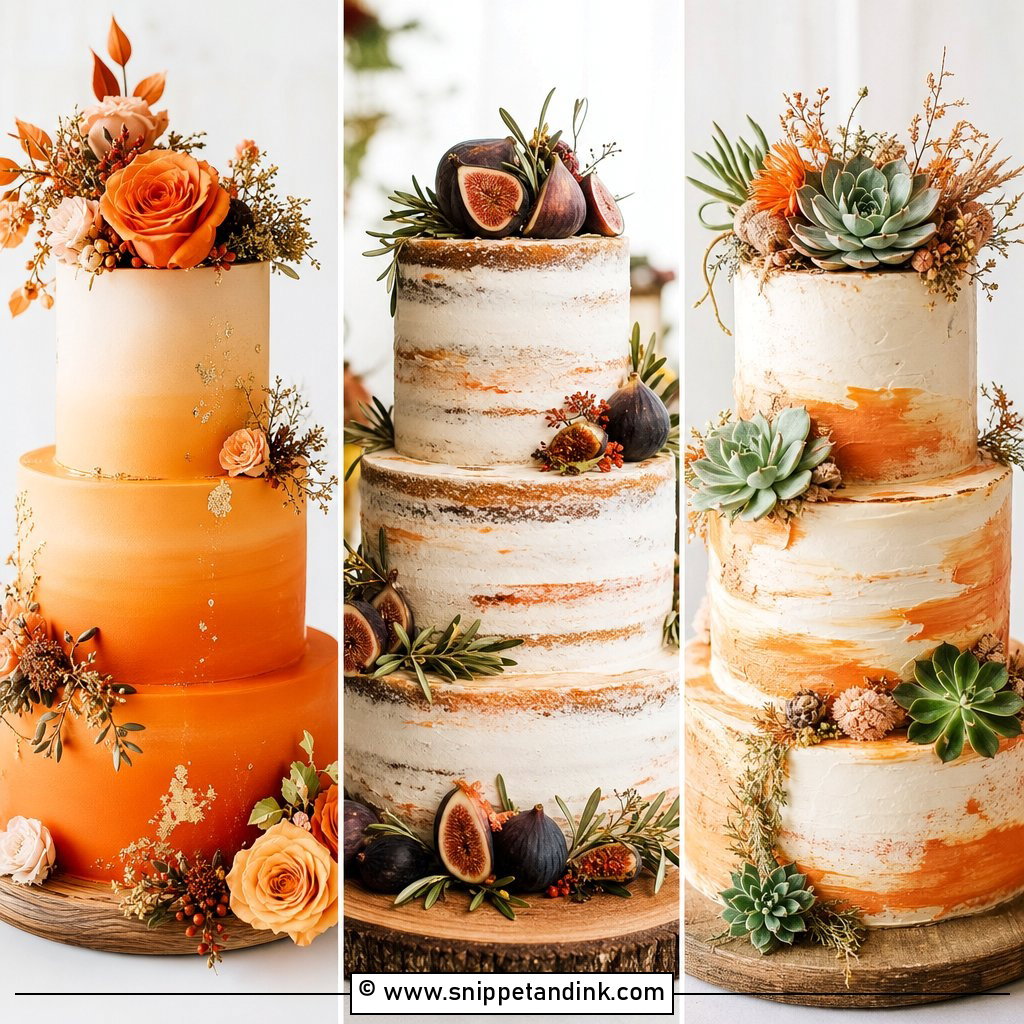
10. Sage Green And Burnt Orange Ombre Wedding Cake
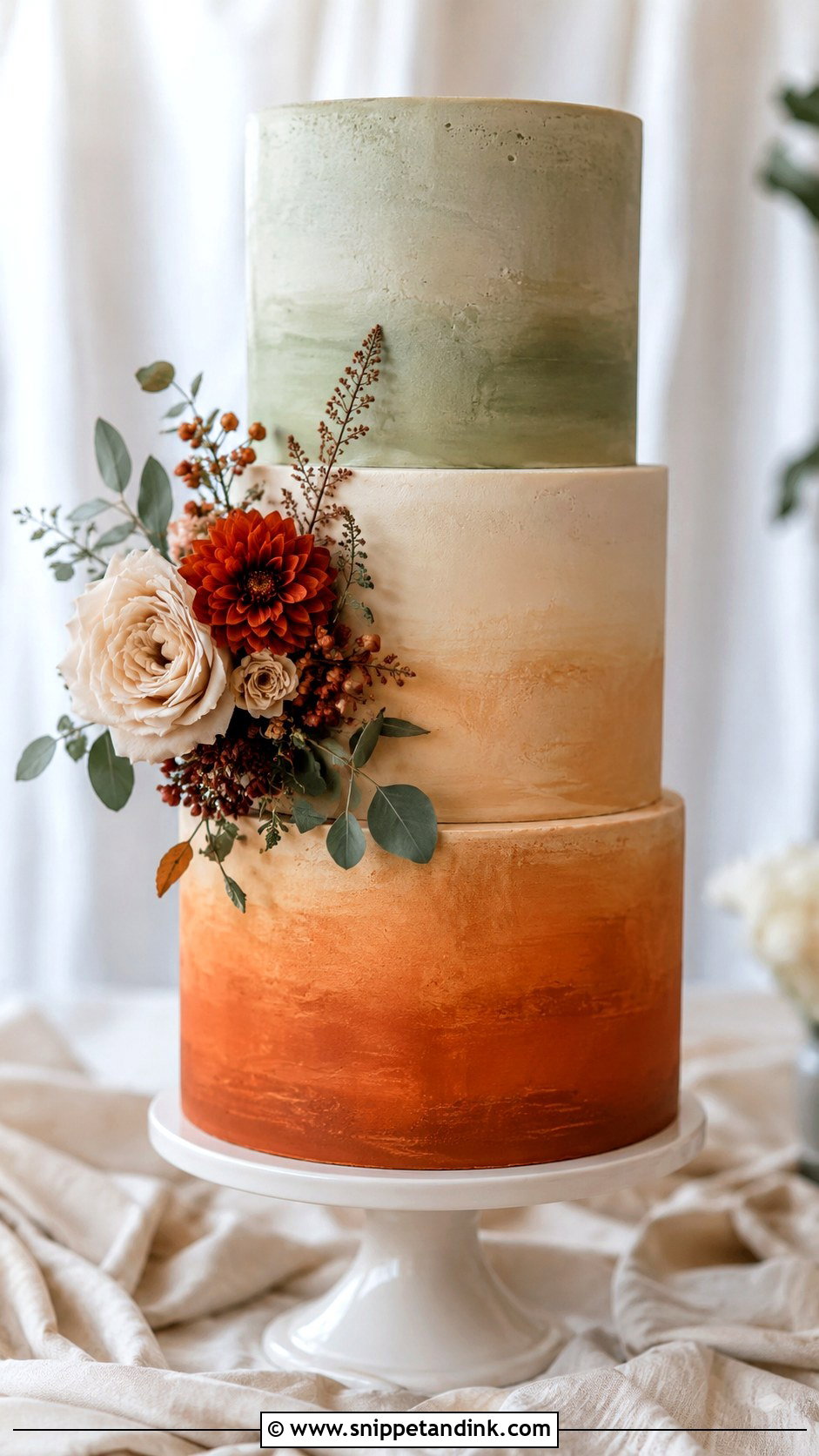
Ombre needs a careful middle. If I grade straight from sage to burnt orange, the midpoint can turn a muddy brown, because green and orange mixed together head that way. So I run pale sage at the top, ivory through the center and orange near the base, or keep the cake fully sage and shade the orange in with flowers. Smooth edges make the gradient read cleanly. One floral cluster or a simple topper is enough decoration.
11. Sage Green And Burnt Orange Naked Wedding Cake
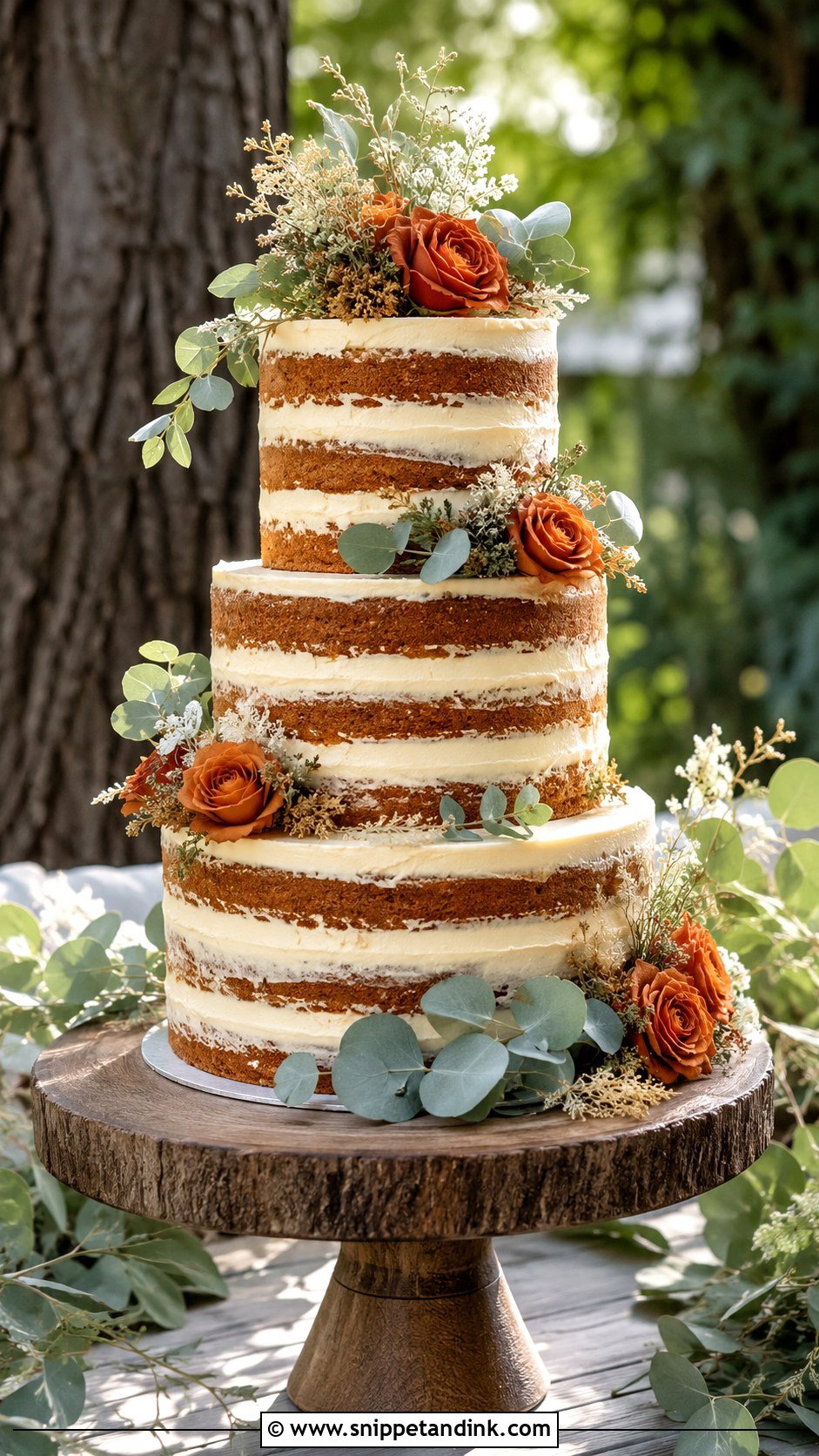
A naked cake leans on the sponge itself, so the bake has to be good. Golden spice, carrot, almond or vanilla layers sit well beside earthy colors, and a cream filling gives each band a crisp line. Decorate lightly with eucalyptus, orange roses and a few dried blooms. Naked cakes are fine outdoors only in shade and only briefly: exposed sponge dries and the filling softens in heat, so I’d plan to set it out shortly before cutting.
12. Sage Green And Burnt Orange Pressed Flower Wedding Cake
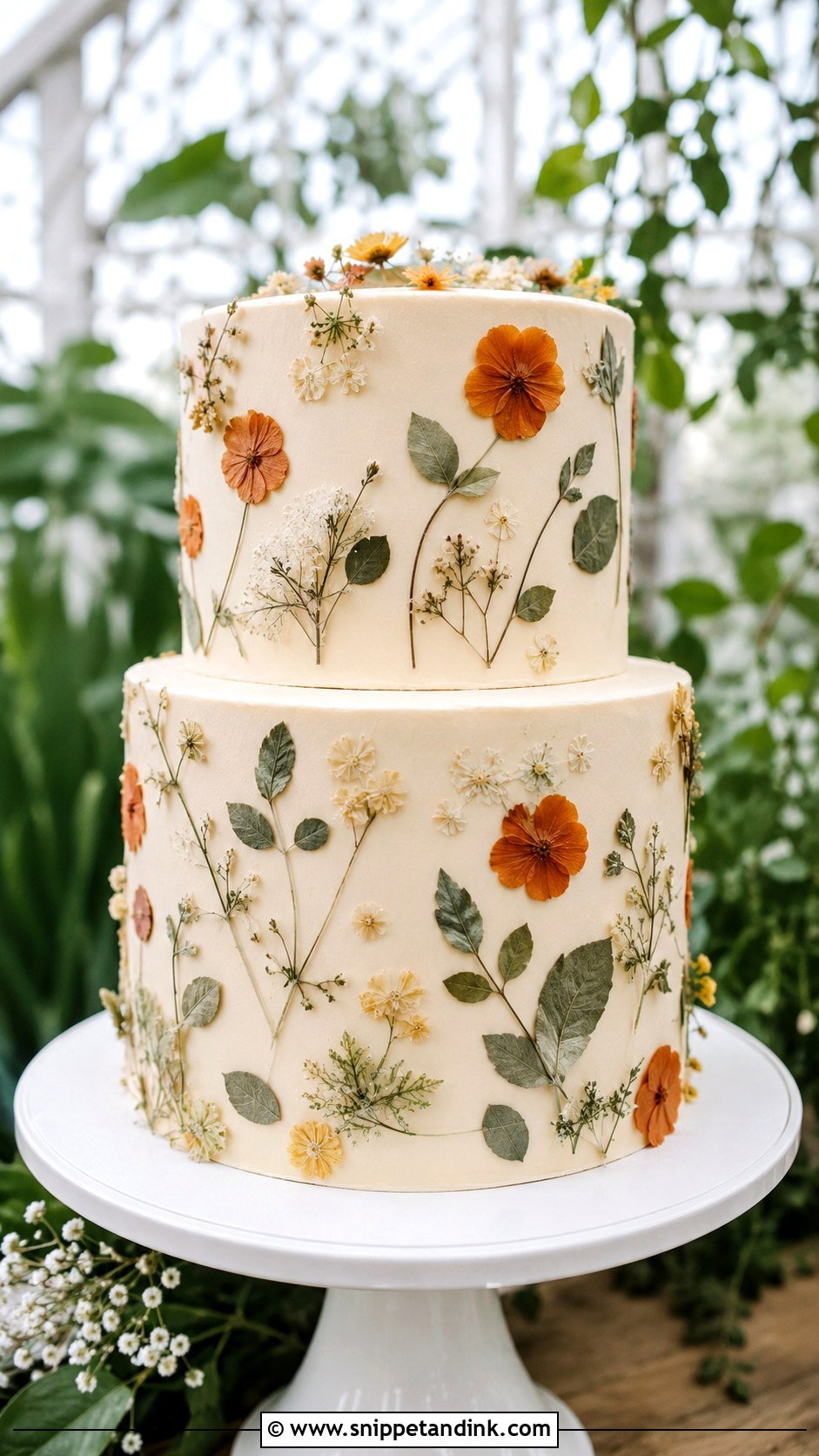
Pressed flowers lie flat against smooth ivory buttercream like a botanical print. I use edible or food-safe petals in burnt orange, cream and muted yellow, with tiny sage leaves tucked between them, and I press them onto a lightly set surface so they don’t slide. Any texture on the tier and they’ll lift at the edges. Garden weddings, greenhouses and small outdoor ceremonies suit it. Keep the piping minimal so the petals are what people notice.
13. Sage Green And Burnt Orange Gold Wedding Cake
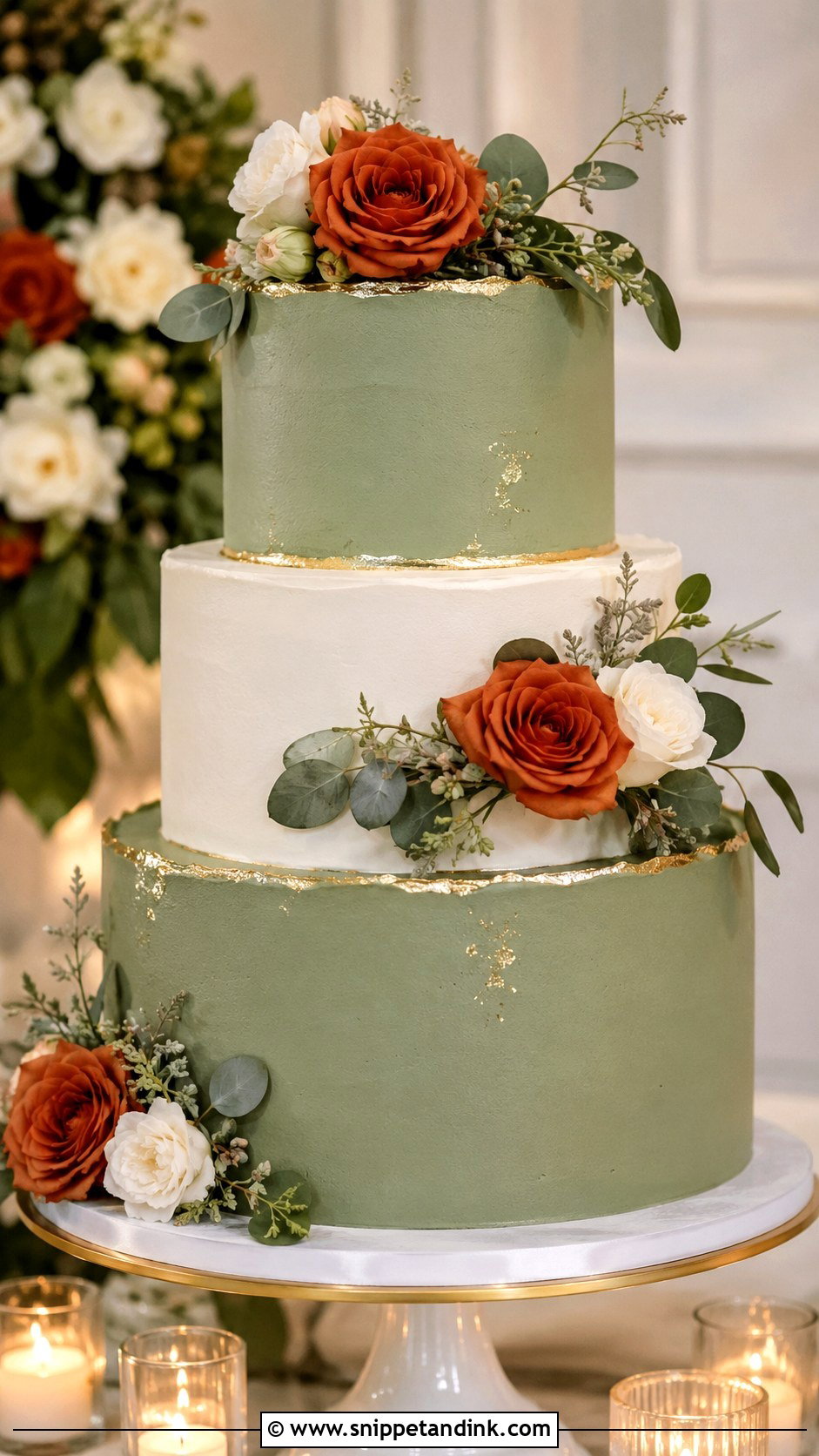
Gold works here as the bridge between cool sage and warm orange, which is why so little of it is needed. I’ll gild the top edge of a sage tier or run one fine line between tiers, then add burnt orange flowers down one side of an ivory tier. Edible gold leaf is fragile, so I apply it as the last step before delivery. Warm evening lighting suits it best. Keep the stand simple; a gold stand with gold detail is too much.
14. Sage Green And Burnt Orange Cupcake Wedding Cake
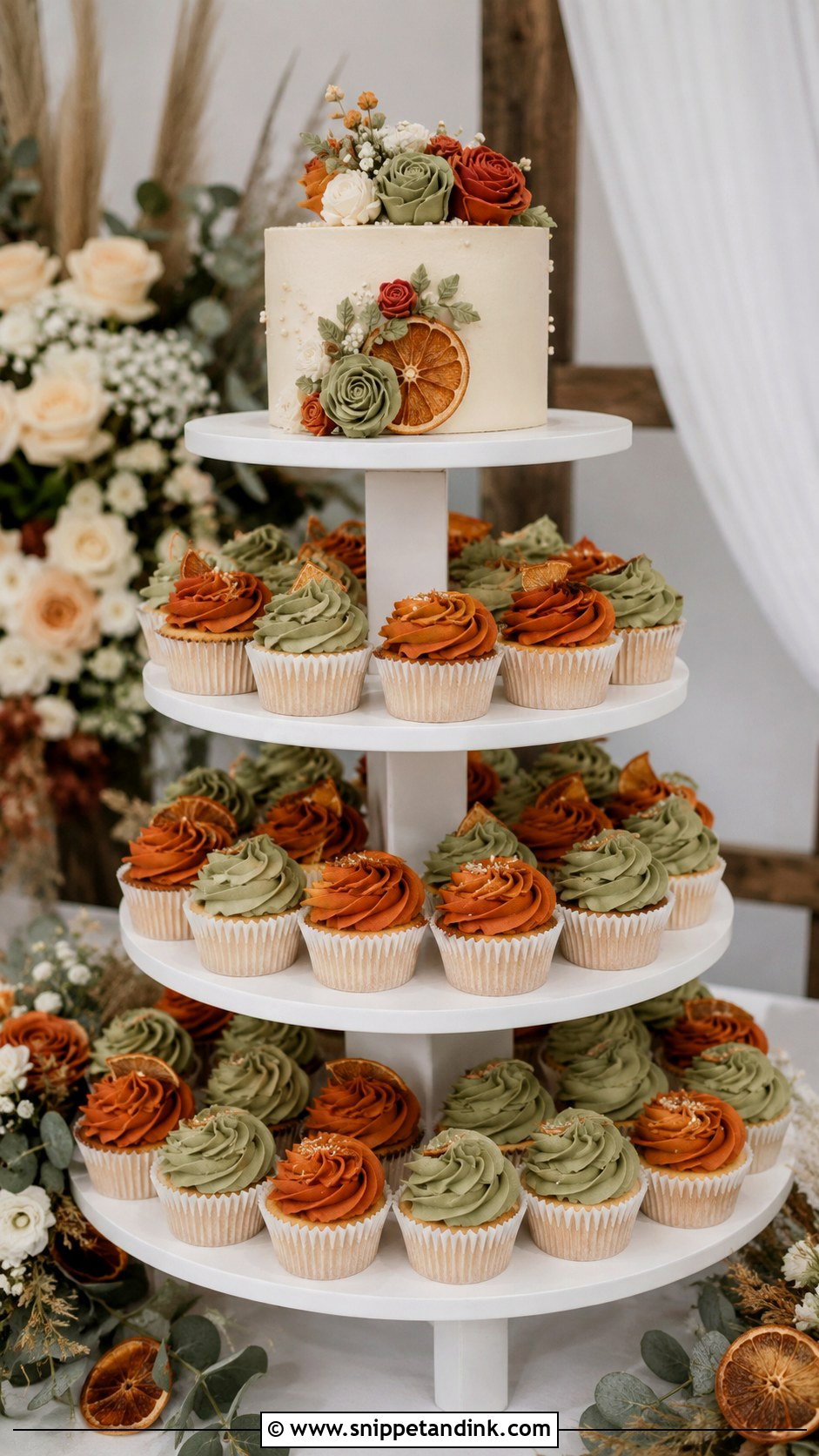
A cupcake wedding cake gives you a cutting moment and individual servings in one display. I put a small cutting cake on the top tier and alternate sage buttercream swirls with burnt orange piped rosettes below, finished with tiny sugar flowers, dried citrus or pearl sprinkles. The thing couples underestimate is setup time: placing a hundred or more cupcakes neatly takes a while, so I need access to the table early. Use the same two shades throughout, or the display stops reading as one cake.


15. Sage Green And Burnt Orange Square Wedding Cake
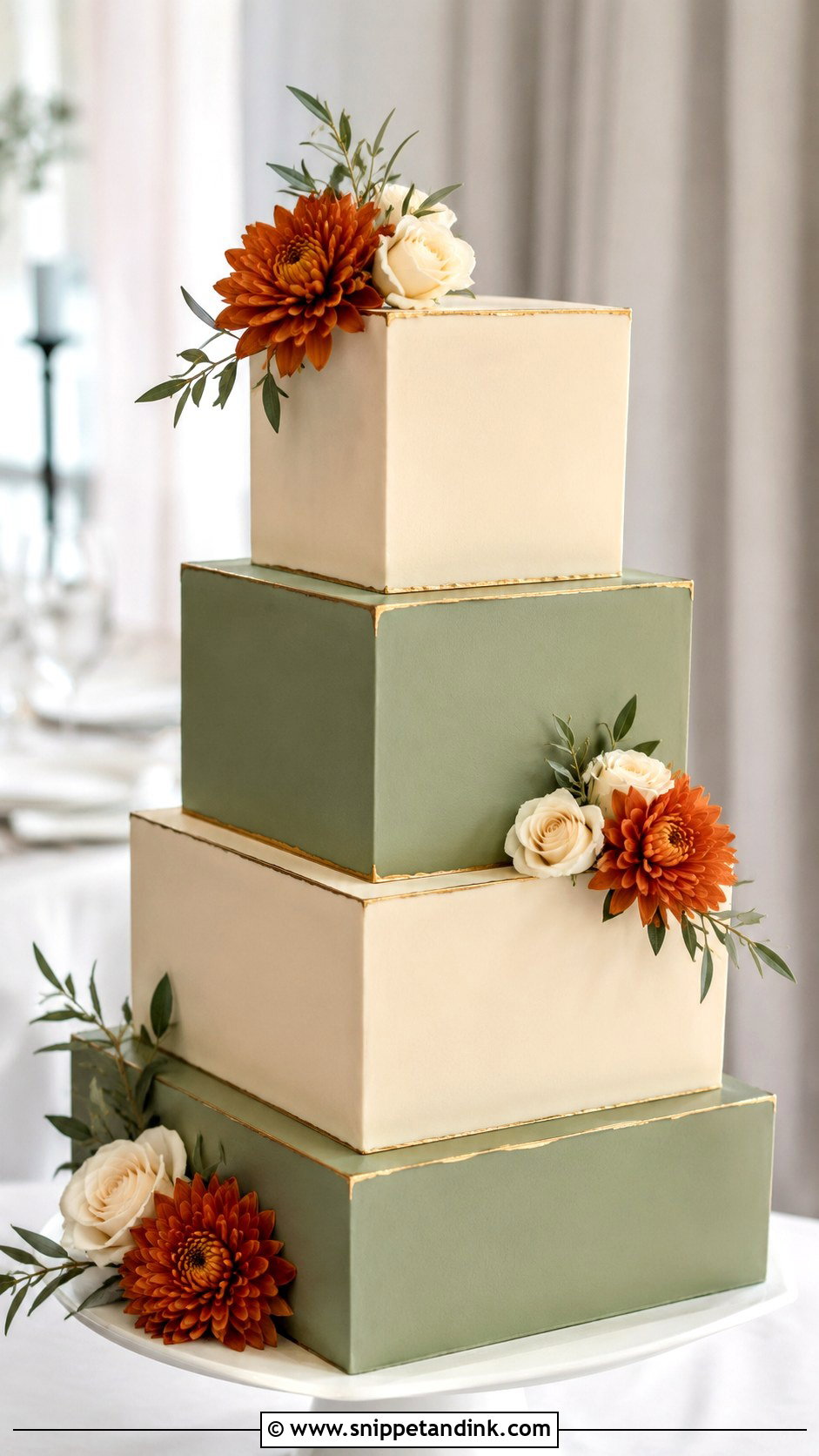
Square tiers look modern because the corners do the shaping, and sage looks sharp on them. They’re harder to frost than rounds, since the corners have to stay crisp, which is why I often cover squares in fondant. Burnt orange flowers placed at a corner soften the geometry. Stack the tiers evenly for a classic outline or rotate them slightly for something more contemporary. With a shape this strong, keep everything else minimal, perhaps a thin gold trim.
16. Sage Green And Burnt Orange Single Tier Wedding Cake
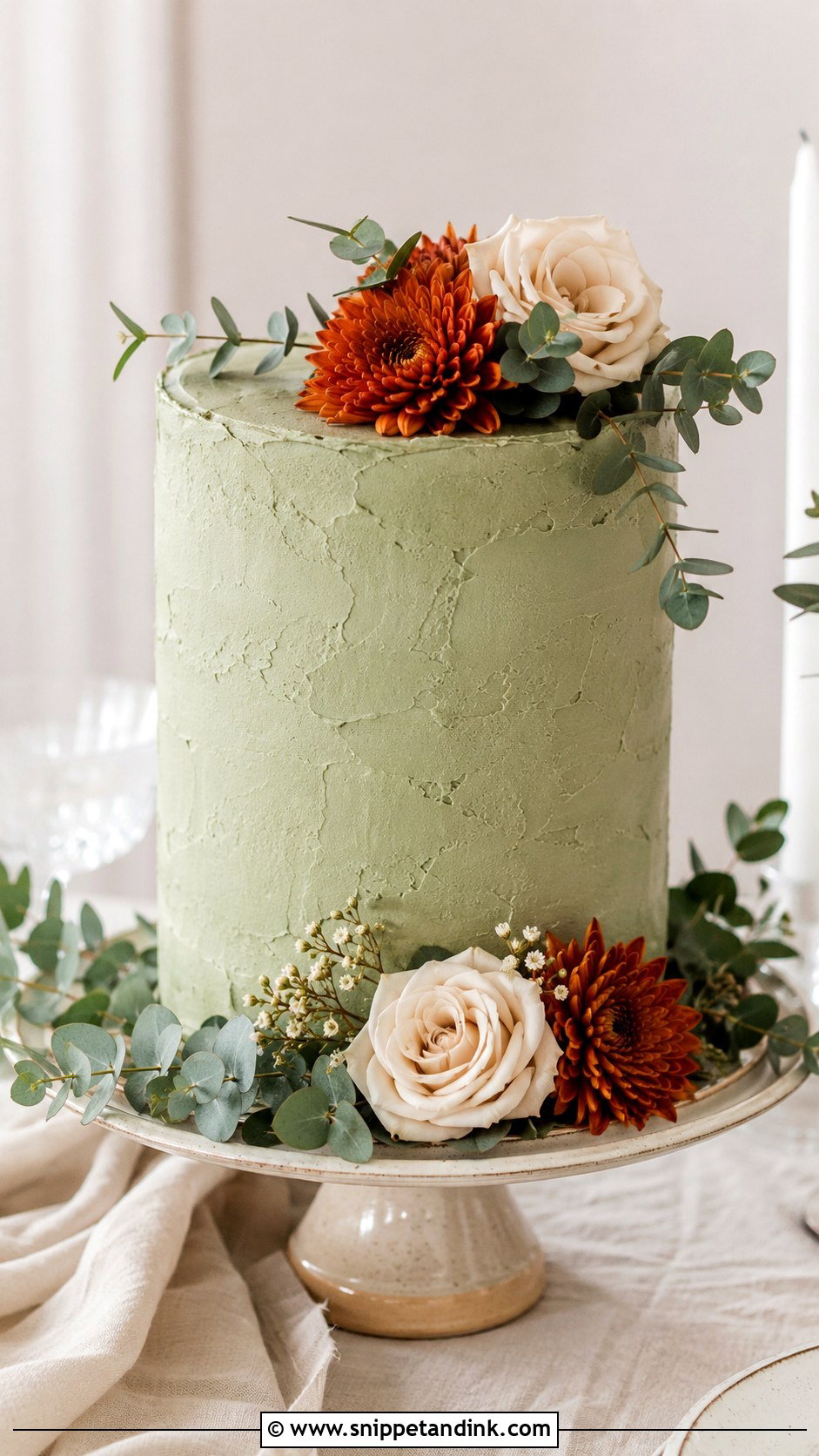
One tier can carry a whole wedding if it’s tall. I’d build it to double height, so it reads as a cake and not a dessert, then frost it sage and crown it with burnt orange flowers, cream roses and greenery. A textured finish adds interest without extra decoration. Set it on a raised stand with flowers around the base. It’s the most budget-friendly cake in the list and the easiest to serve at an elopement or micro wedding.
17. Sage Green And Burnt Orange Fall Wedding Cake
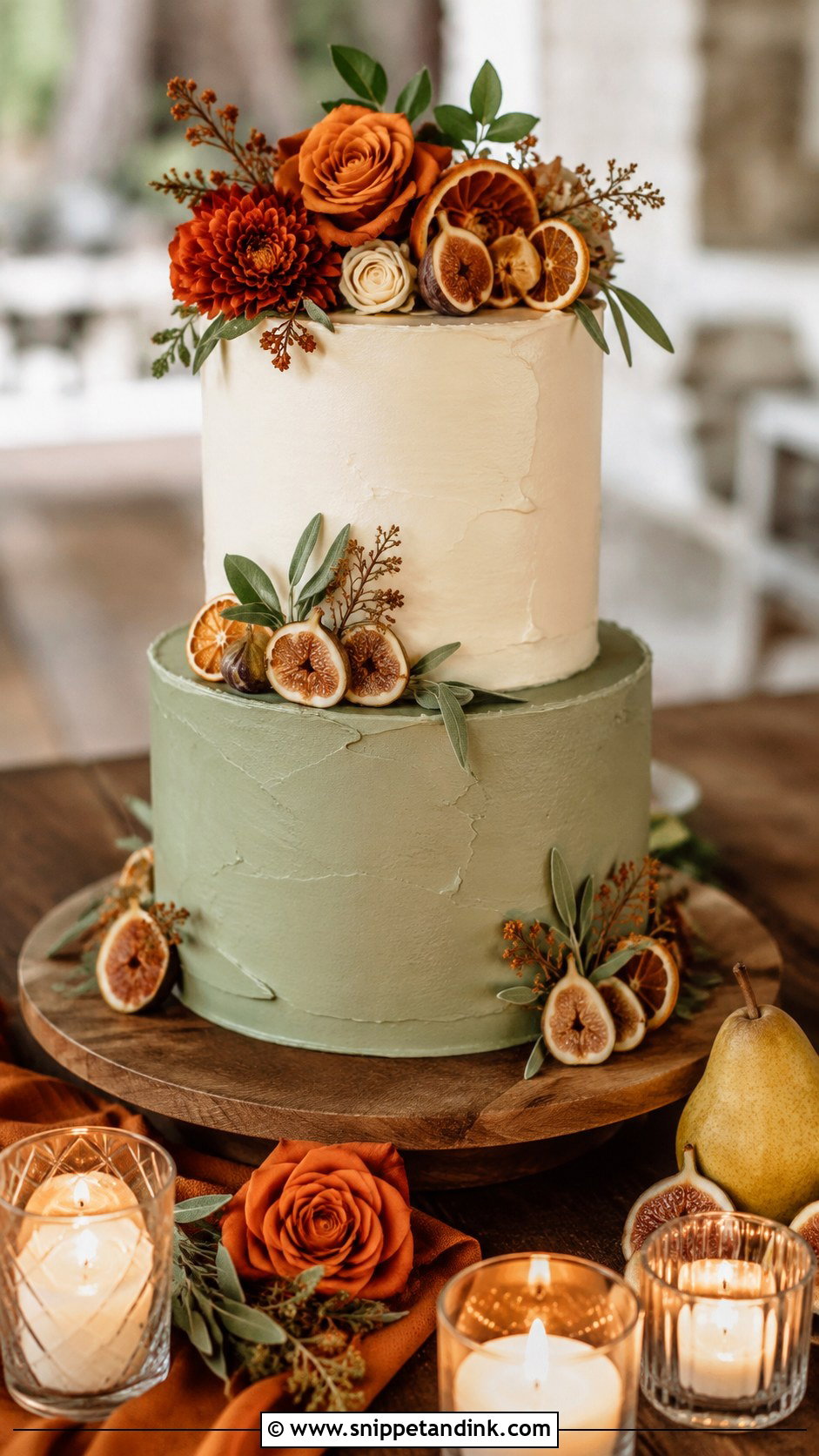
A fall wedding cake can lean into the season without looking like a harvest table. Spice sponge with cream cheese frosting is my default for this palette, finished with sage greenery and burnt orange flowers. Cream cheese frosting is soft, though, so I use a firmer version for stacked tiers and keep the cake cool until it’s set out. Dried orange slices, figs and small pears fit the colors naturally. Keep the base ivory or pale sage so the cake doesn’t read dark under candlelight.
18. Sage Green And Burnt Orange Modern Wedding Cake
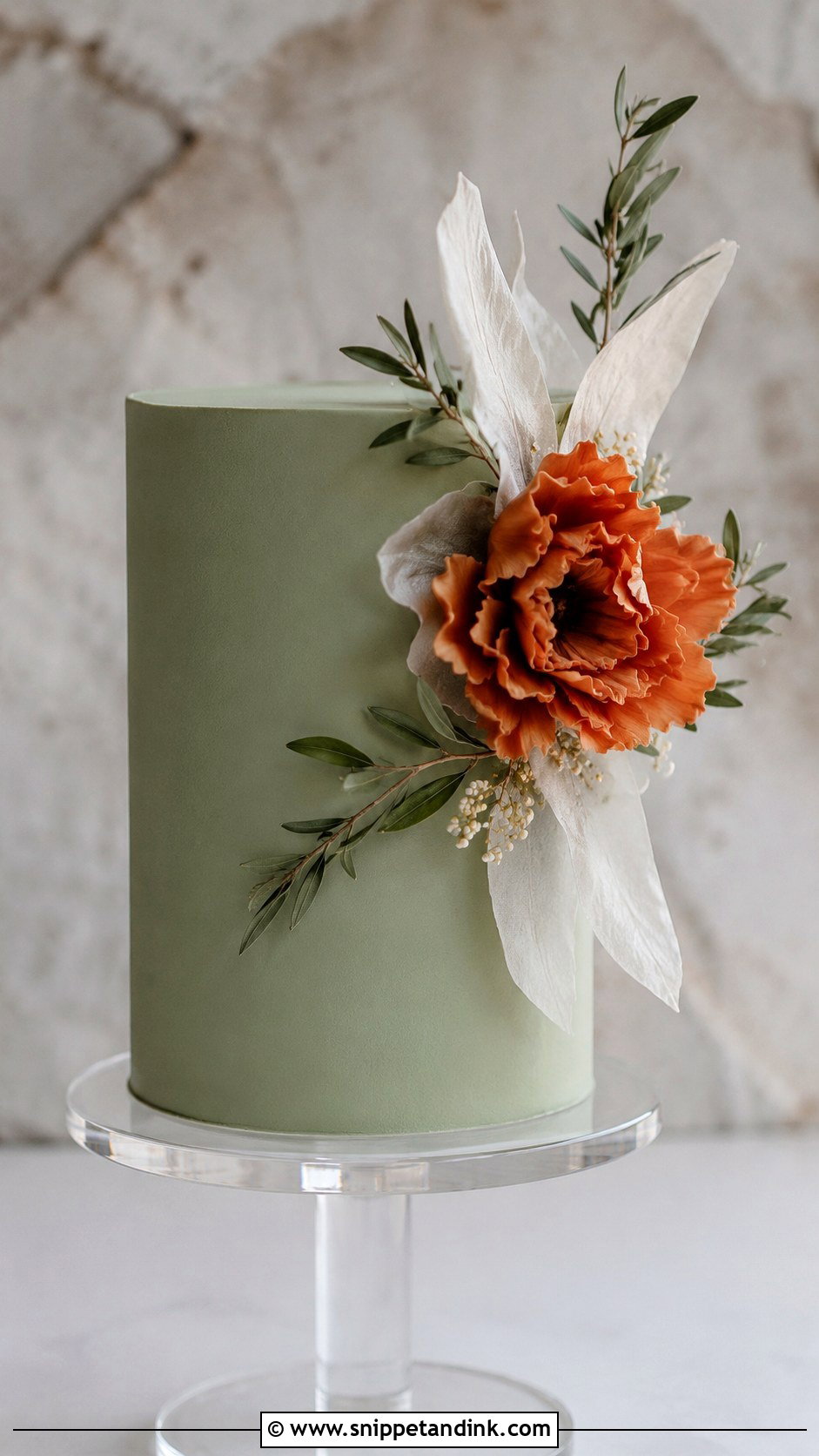
Modern cakes are about editing. I’d frost a smooth sage cake, keep sharp edges and place one burnt orange arrangement off center, maybe with a white tier or a faint abstract pattern for contrast. If you want texture, choose a single feature such as wafer paper petals or one sculptural sugar flower. Wafer paper reacts to humidity and can curl, so it’s better suited to indoor rooms. An acrylic stand and a stone or plaster backdrop keep the colors fresh.
19. Sage Green And Burnt Orange Vintage Wedding Cake
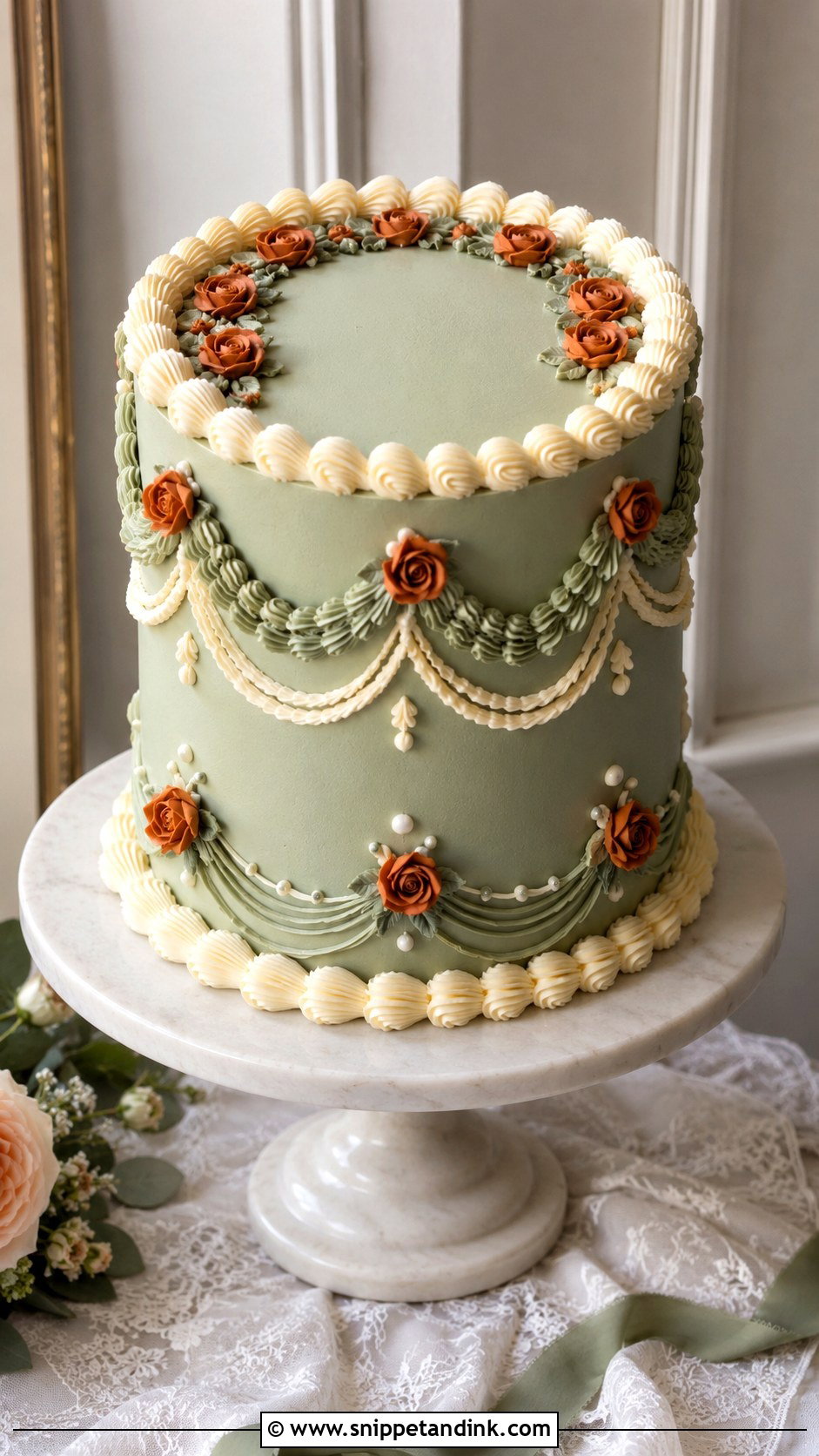
Vintage piping makes this palette feel romantic in an old-fashioned way. Picture sage buttercream with shell borders, pearl dots and burnt orange piped flowers, with ivory piping to soften the green. Heavy Lambeth-style piping takes real time on the tier, so it can raise the price compared with a plain finish. One tier gives a retro look; two give more height. Keep the tones muted, and display it on a pedestal stand with lace-style linens.





20. Sage Green And Burnt Orange Floral Cascade Wedding Cake
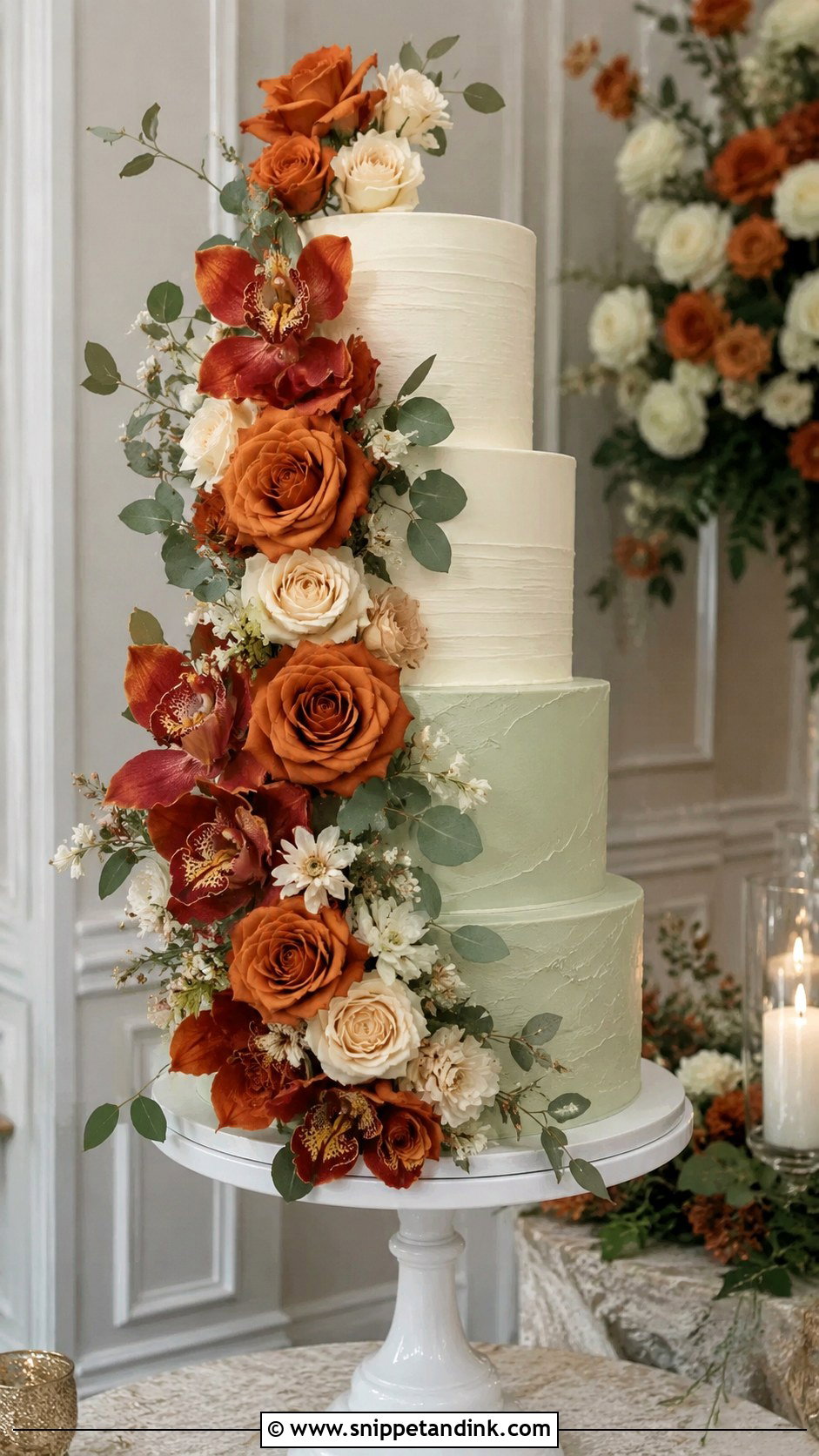
A cascade gives a large room something to look at from the far tables. I start the flowers at the top tier and let burnt orange roses, rust orchids, cream blooms and eucalyptus fall in a loose curve to the base, never a straight line. The frosting underneath stays plain. If your florist supplies the stems, I ask for them wrapped or set in picks so nothing touches the cake directly. Done well, it links the cake to the bouquets, the arch and the centerpieces.
Real Flowers on a Cake Need a Barrier
Most of the cakes above use fresh blooms, and that’s where I’m strictest. Flowers grown for florists are often sprayed, and some popular wedding stems are not safe to eat. Eucalyptus is one of them, and so are a few others that show up in autumn arrangements. I never push a raw stem into the tiers.
Instead, I wrap each stem in floral tape and set it in a plastic flower pick, or rest the blooms on a small food-safe disc so nothing touches the frosting. Sugar flowers, wafer paper and properly sourced edible blooms avoid the issue entirely, and they don’t wilt. If your florist is dressing the cake, agree in advance on who brings the picks and who removes the stems before cutting.
Autumn Heat Still Melts Buttercream
Fall weddings are not automatically cool. An early autumn afternoon can still soften buttercream, and barns and tents trap heat. I deliver chilled, set up in the shade, and ask for the cake to arrive at the table as late as the schedule allows. A fondant covering, a firmer buttercream or a smaller display cake with sheet cake in the kitchen all buy you time on a warm day.
How Much Orange Your Cake Really Needs
This palette can go rustic, modern, boho or vintage, and the finish decides which. Sage keeps the cake calm and burnt orange gives it warmth, so you rarely need both colors on the frosting. An ivory cake with the right flowers is often enough. Repeat the shades in the linens, candles or dessert table so the cake looks connected to the room. Then pick the version that suits your venue and your season, and bring your florist’s color references to the tasting.
You'll Like These Ideas:





Leave a Reply