
Daisies are one of the friendliest flowers I can put on a wedding cake. They read as cheerful from across a room, they suit a barn or a garden tent as easily as a courthouse lunch, and they come in three very different forms: fresh stems, handmade sugar flowers and piped buttercream. Each of those behaves differently in heat, on a long display and in your budget, so the same picture can turn out quite differently depending on which one your baker uses. They also sit comfortably beside the textures couples keep asking me for, like pressed flowers, palette knife buttercream, vintage piping and small cutting cakes. Below are the daisy designs I’d happily make, with notes on what each one needs to work.
Fresh, Sugar or Piped: Which Daisy Your Cake Can Carry
Before we talk about tiers or colours, I want to know three things: how hot the room will be, how long the cake sits on display, and whether you want to keep the flowers afterwards. Those answers decide the kind of daisy far more than any inspiration photo does.
- Piped buttercream daisies are the most affordable and taste like part of the cake. They hold well in a cool room but soften in heat, so in summer I keep them small and mostly on top.
- Sugar daisies look the same at midnight as they did at noon and can be matched to any colour. They need to be ordered weeks ahead, they cost more because each one is handmade, and they dislike damp air.
- Fresh daisies look the most natural and are often the cheapest, but they must be pesticide-free, wrapped or set in picks, and placed at the venue. They start to wilt within a few hours away from water.
- Pressed edible daisies suit slim, smooth tiers and modern styling. They are applied on the day and need a smooth surface to show.
Mixing is fine and often smart. A cake with sugar daisies at the top and piped ones lower down keeps costs sensible while giving you a keepsake topper.
1. Daisy Wedding Cake
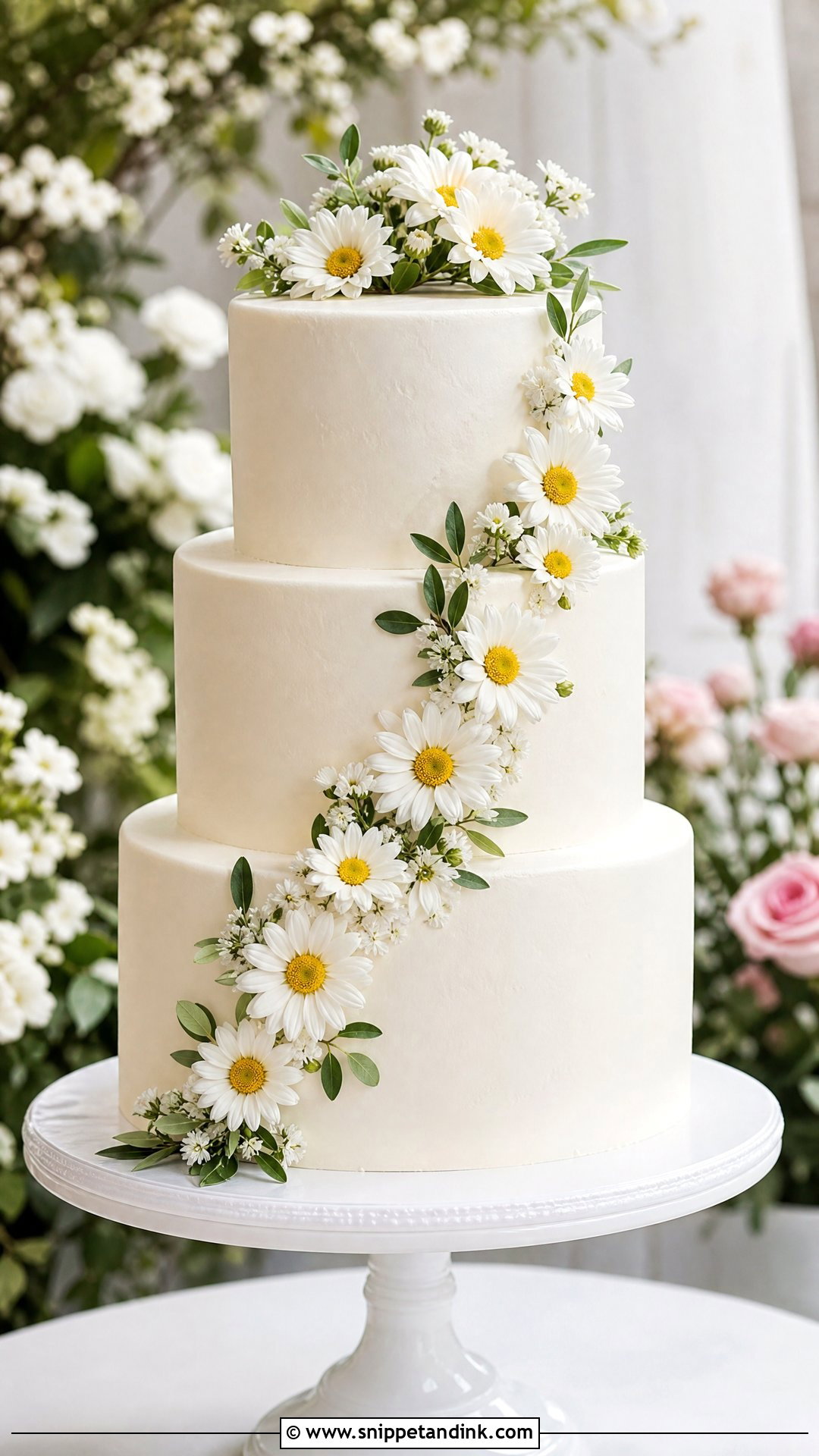
This is the design most couples picture first: white or ivory tiers with daisies ringing the base of each tier or running in a loose diagonal. I usually place the diagonal trail first and only then decide whether the base rings are needed, because doing both can crowd a cake under 8 inches wide. The yellow centres add warmth, so I keep the frosting a cool white rather than a deep ivory, which can make the yellow look muddy. Vanilla, lemon, almond and honey sponges all suit the mood. Smooth buttercream gives a softer edge, while fondant gives you the crisp corners you see in magazine shots. A plain white stand with a few matching stems on the table is all the display it needs.
2. Simple Daisy Wedding Cake
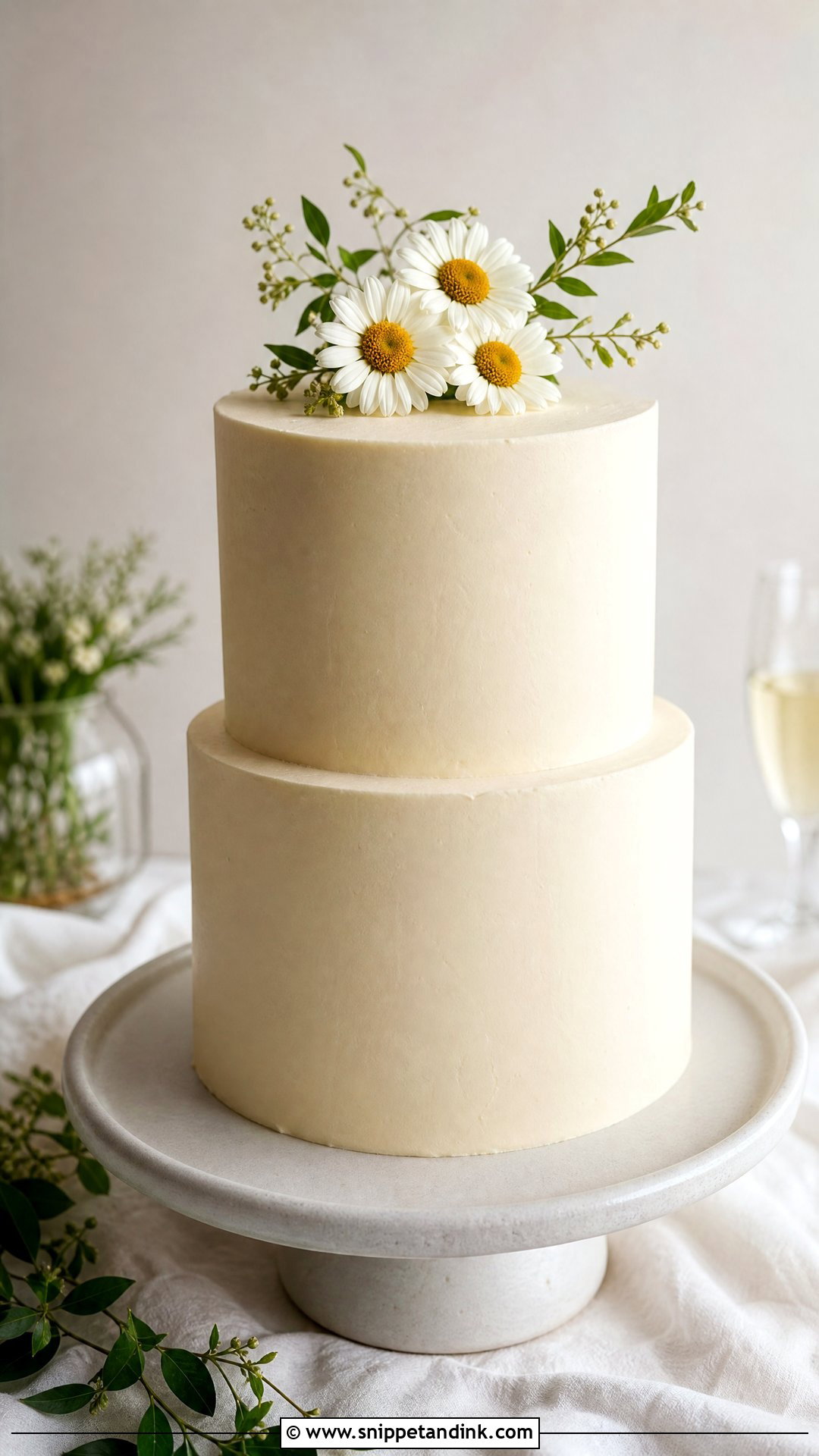
Restraint is the whole design here. Two white buttercream tiers carry only three or five small daisies on the front or the top edge, and the empty frosting does the rest. I place odd numbers because even pairs look like they were set down in a hurry. The catch is that a minimal cake shows every flaw, so the buttercream needs to be very smooth and the edges sharp; ask to see photos of plain cakes your baker has done, not just floral ones. Vanilla bean with Swiss meringue buttercream is the classic pairing, and a layer of lemon curd keeps it from tasting flat.
3. Two Tier Daisy Wedding Cake
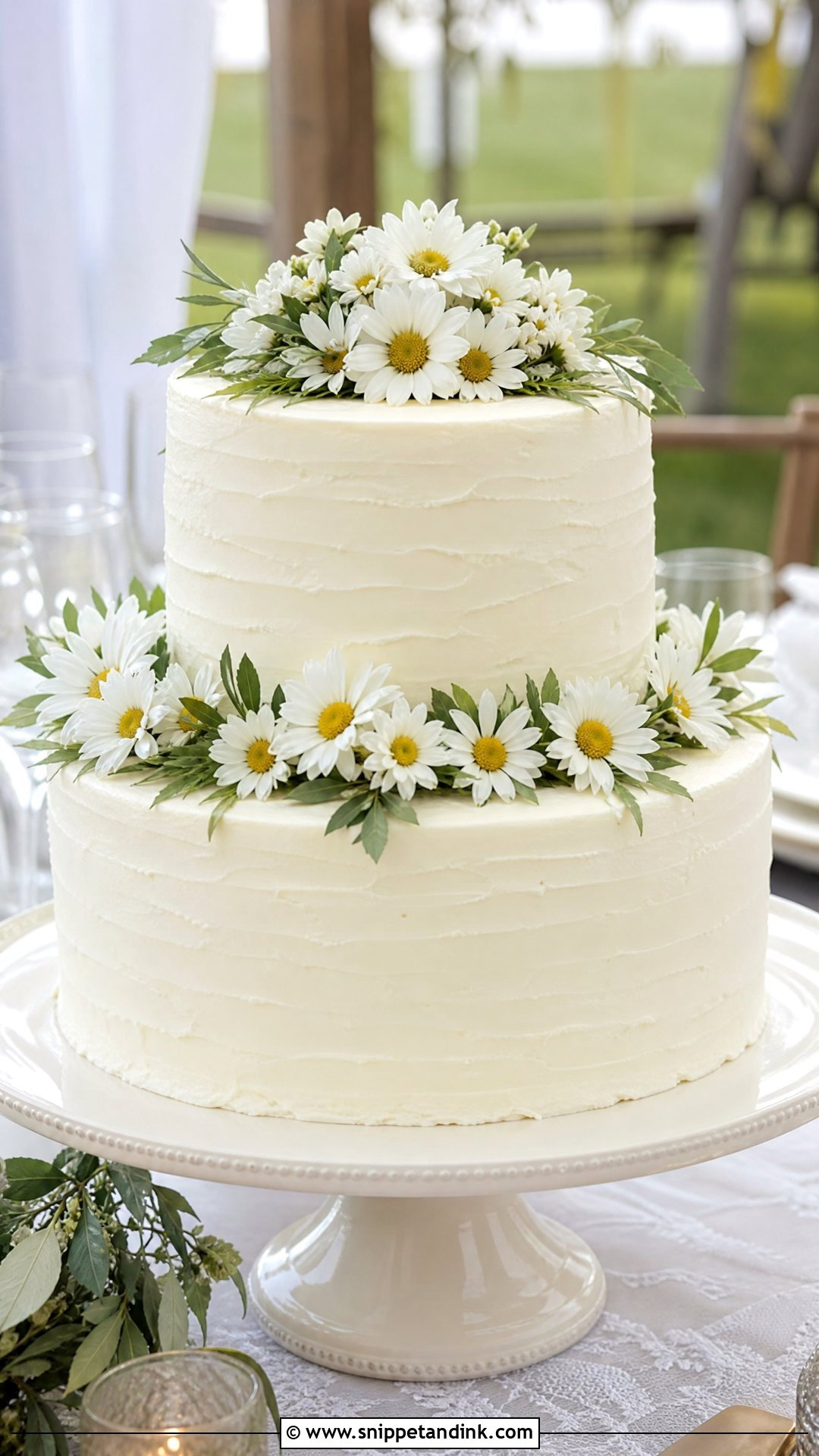
Two tiers give you enough height to photograph well without a lot of cake left over, which is why I often suggest it for smaller guest lists backed by a dessert table. My usual layout is a ring of small daisies on the lower tier and one tighter cluster on the top tier, set slightly off-centre so the eye travels upward. Lemon elderflower, vanilla raspberry and almond cream all stay light after a big meal. One practical point: if the tiers are close in size, say 6 and 8 inches, the cake can look squat, so I prefer a 6 over a 9 or a taller top tier.
4. Three Tier Daisy Wedding Cake
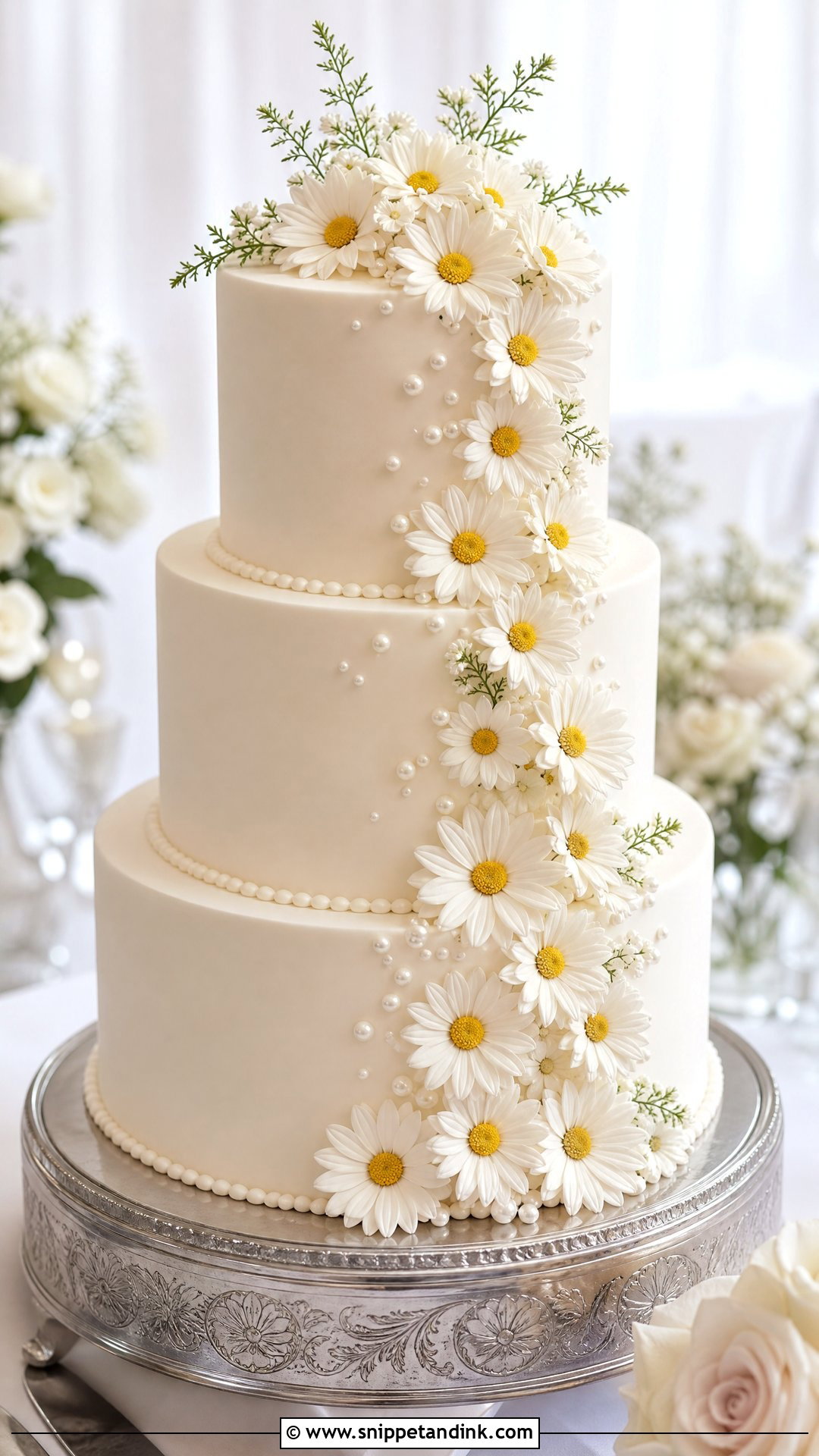
Three tiers turn the daisies into a story rather than a decoration. I like a trail that starts at the top, wraps once around the middle tier and settles in a cluster at the base, with white petals and gold centres on ivory. If you want more colour, a pale yellow ribbon or a few chamomile heads will do it without competing with the daisies. Structurally, this size needs internal dowels and a central rod for travel, and the sponge has to be sturdy enough to hold weight, which is why almond, vanilla and lemon sponges are the safer bet than very soft chiffon layers.
5. Buttercream Daisy Wedding Cake
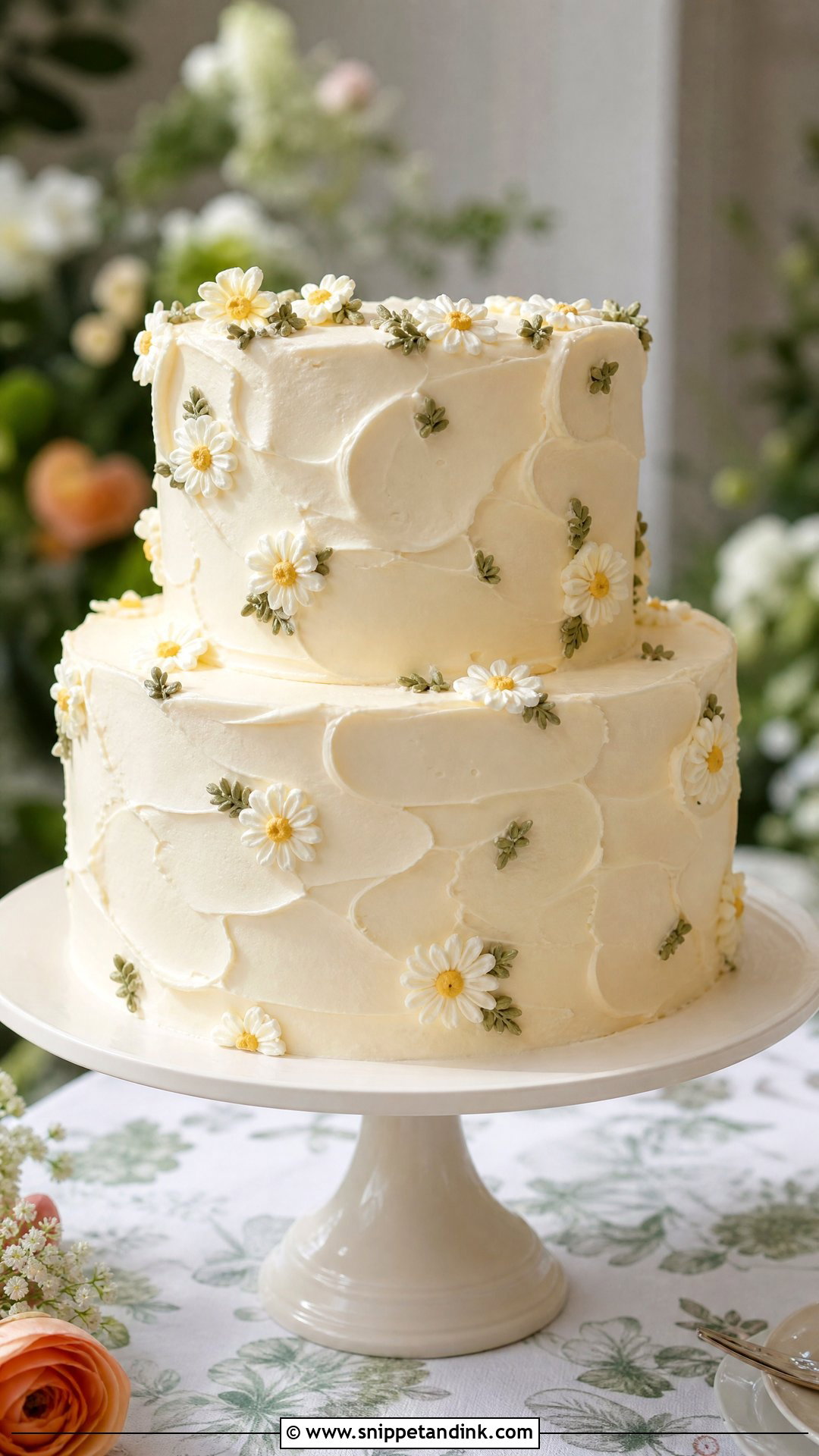
Buttercream is my favourite surface for daisies because the petals can be piped straight onto the tier with a petal tip, so the flowers look like they belong to the cake rather than sitting on it. Combed sides or loose spatula swoops suit relaxed venues; smooth sides suit formal ones. The honest trade-off is temperature. Buttercream softens noticeably in a warm room, and piped petals on the sides are the first thing to droop, so in summer I keep the side piping small and save larger flowers for the top. Lemon, honey and white almond cakes all sit happily under a vanilla buttercream.
6. Fondant Daisy Wedding Cake
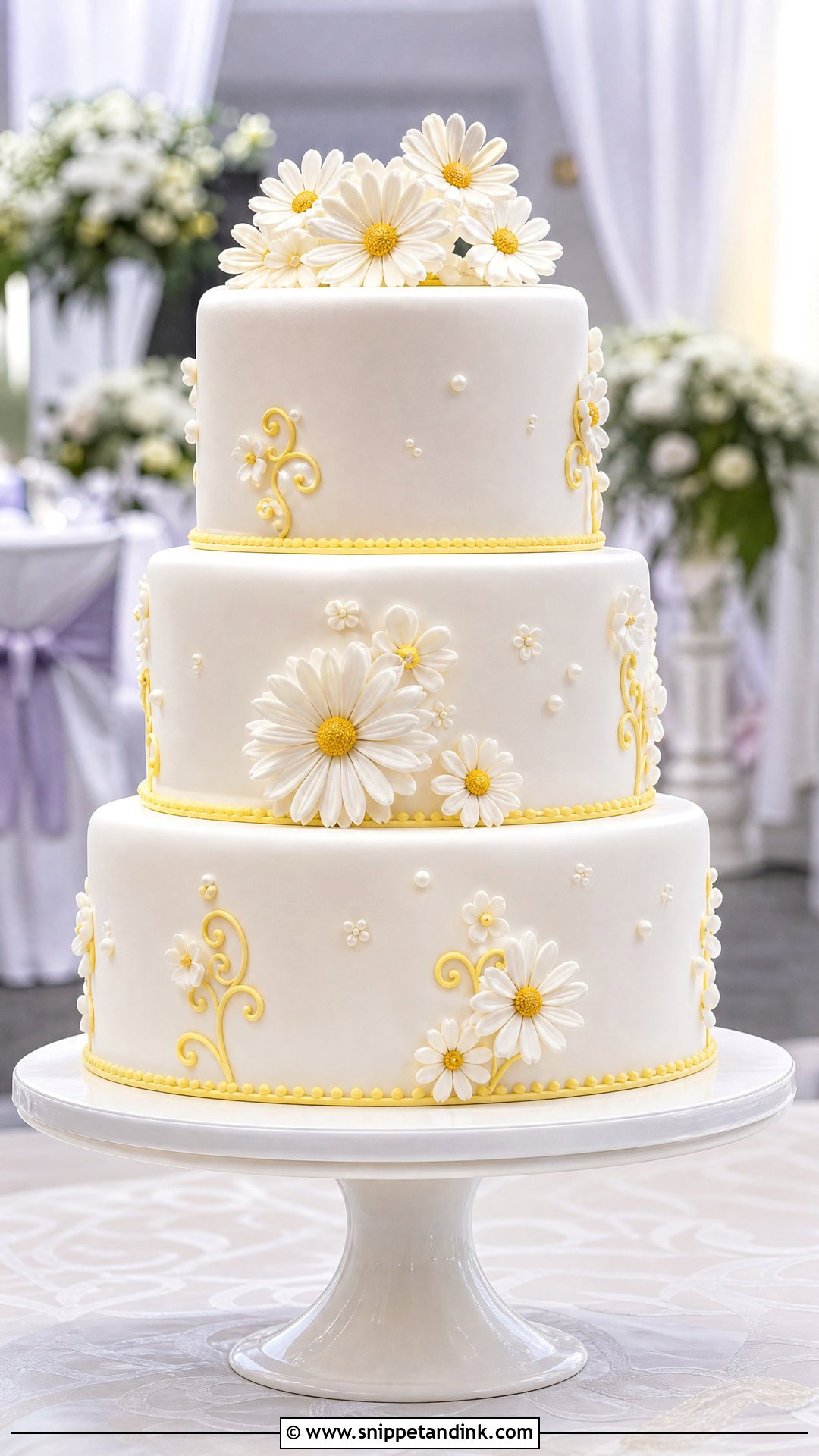
Fondant gives the cleanest canvas, and flat cut-out daisies or raised gum paste ones stand out sharply against it. I reach for it at formal venues and for couples who want pearl borders, thin yellow piping or a light embossed pattern. Fondant also protects the cake during a long display in a cool, air-conditioned room. What it doesn’t like is going from a cold fridge into humid air: it beads with condensation, so I let the cake come up to room temperature in its box before it is uncovered. Many guests peel fondant off, so the cake underneath still has to taste good on its own.
7. Fresh Daisy Wedding Cake
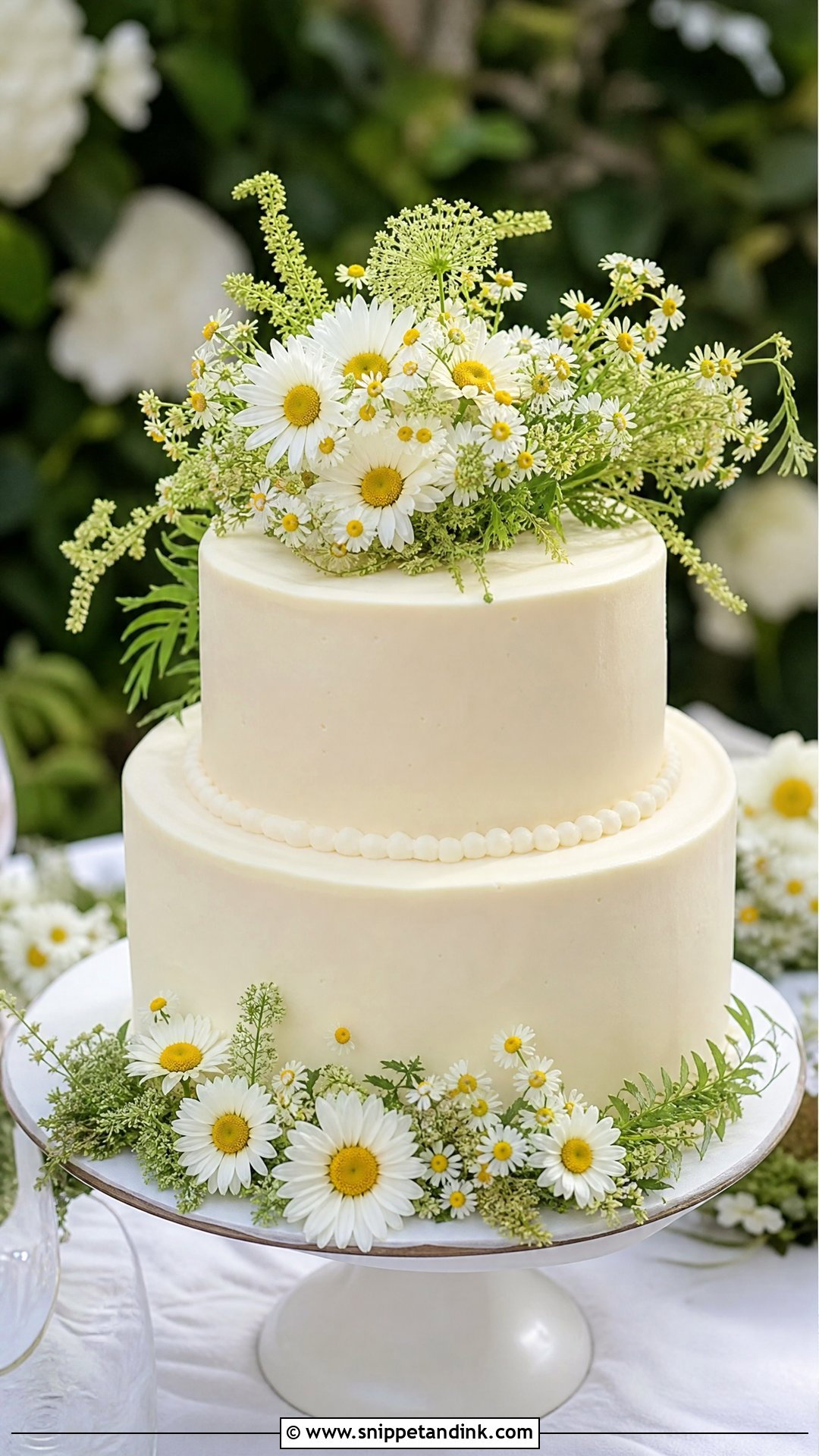
Real daisies give the most natural result, but they need the most planning. I want them from a florist who can confirm they were grown without pesticides, and I never push a bare stem into the cake; every stem is wrapped in floral tape or set into a food-safe pick first. Loose clusters, a small wreath on the top tier or a gentle cascade down one side all look right, especially with greenery and baby’s breath. Daisies wilt faster than roses once out of water, so they go on as late as possible, ideally at the venue. Keep the frosting plain and let the flowers carry the cake.
8. Sugar Daisy Wedding Cake
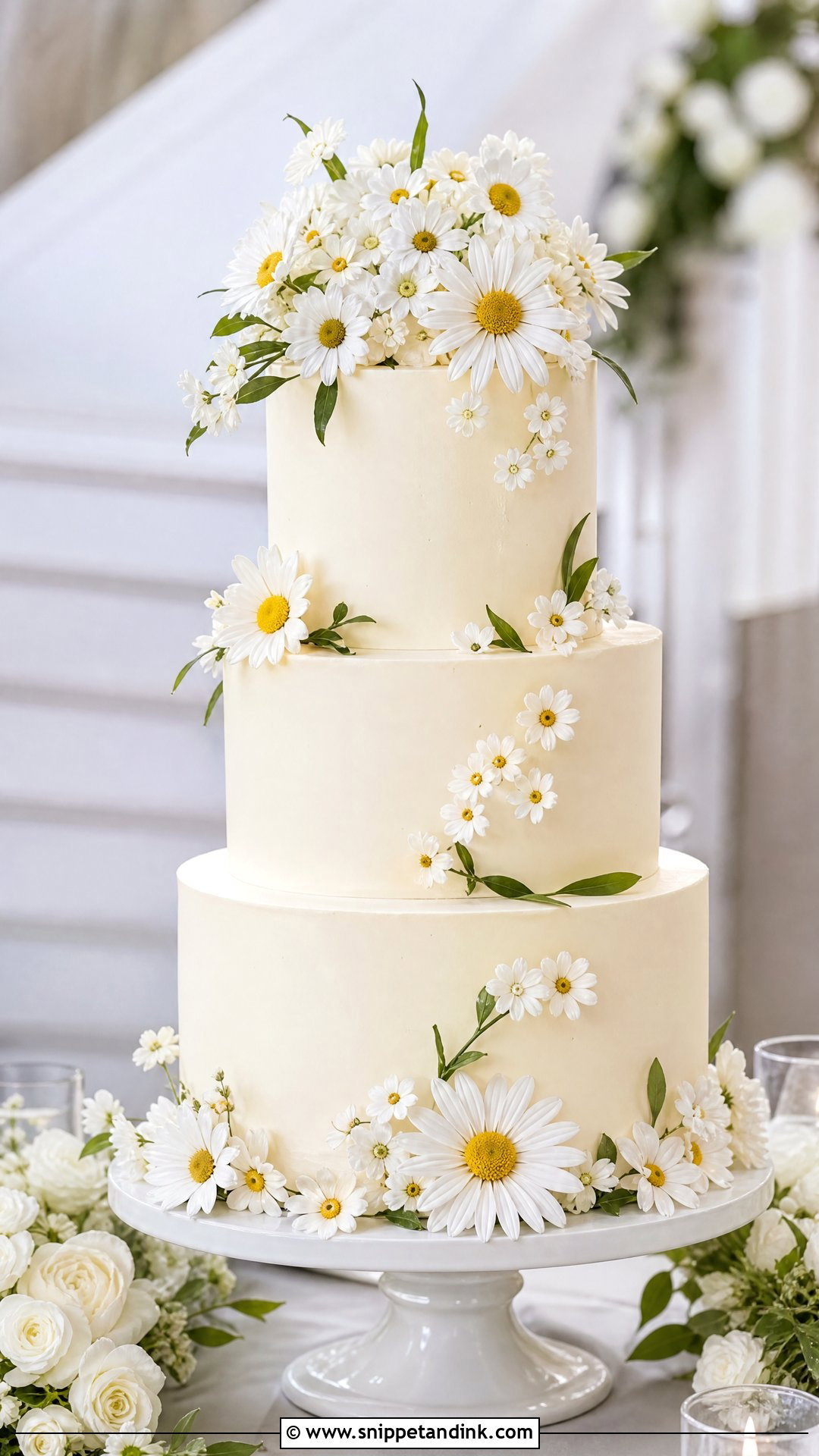
Sugar daisies are what I suggest when the cake has to look fresh for hours under lights. They can be made at any size, from tiny scattered blossoms to large single blooms, and the colour can be matched to a fabric swatch. Gum paste flowers take time, since each petal is cut, shaped and left to dry, so they need to be ordered well ahead and they add to the price. They’re a good choice when daisies are out of season, and many couples keep the topper afterwards. Humidity is their weak spot; a damp marquee can soften thin petals, so they should travel in a closed box. Vanilla bean with lemon filling is my default under them, with coconut or honey sponge as alternatives.
9. Pressed Daisy Wedding Cake
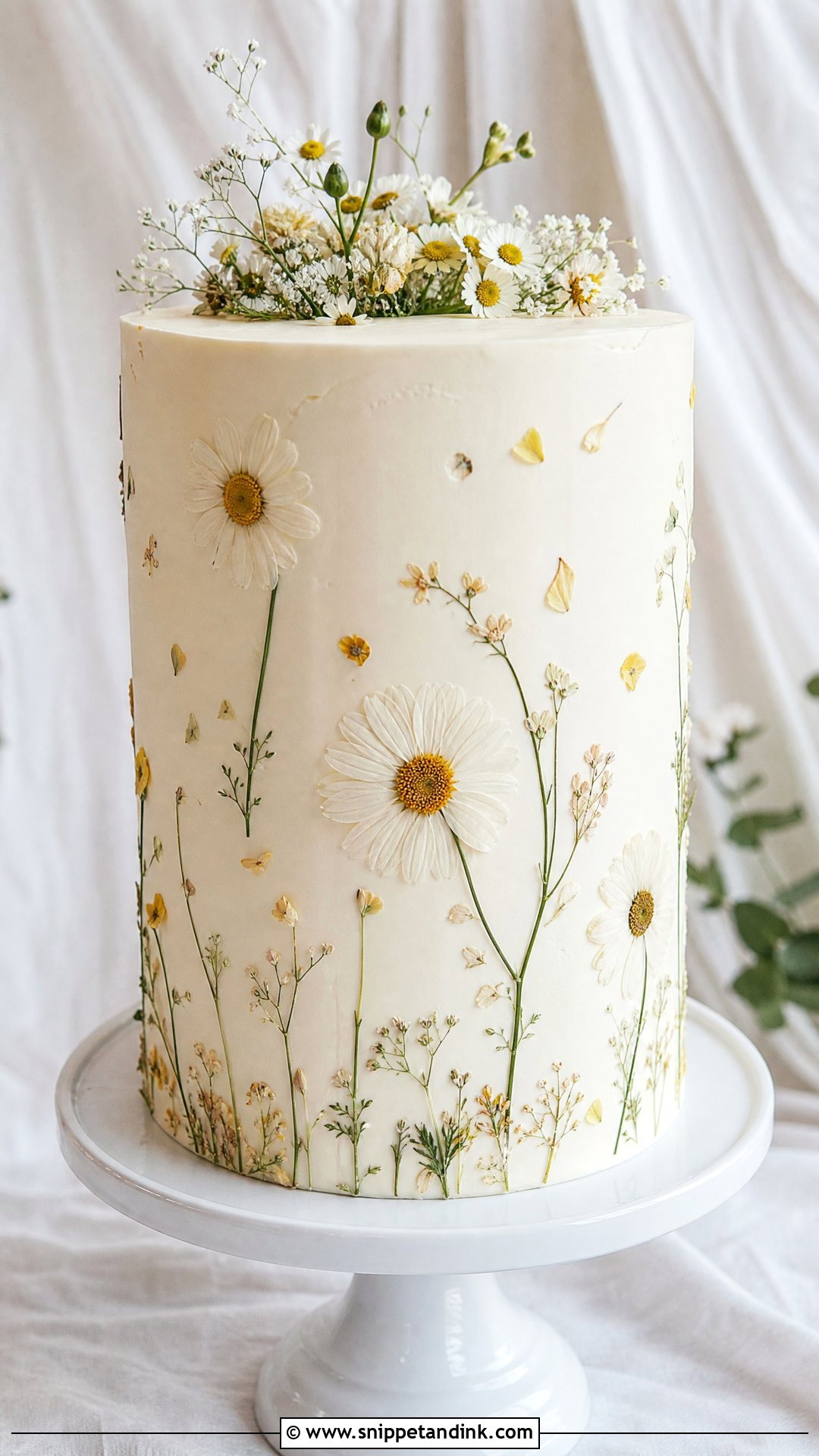
Pressed flowers turn a plain tier into something close to a botanical print, which is why this look feels so current. The petals lie flat against smooth buttercream or fondant and are held with a thin brush of piping gel or a little frosting. I only use pressed flowers that are sold as edible, and I add them on the day, because on a moist buttercream surface the petals can darken or soften if they sit overnight. Tall single tiers and slim two-tier cakes give them the most room. Lavender honey or lemon sponge underneath keeps the garden theme going.
10. Daisy Sheet Wedding Cake
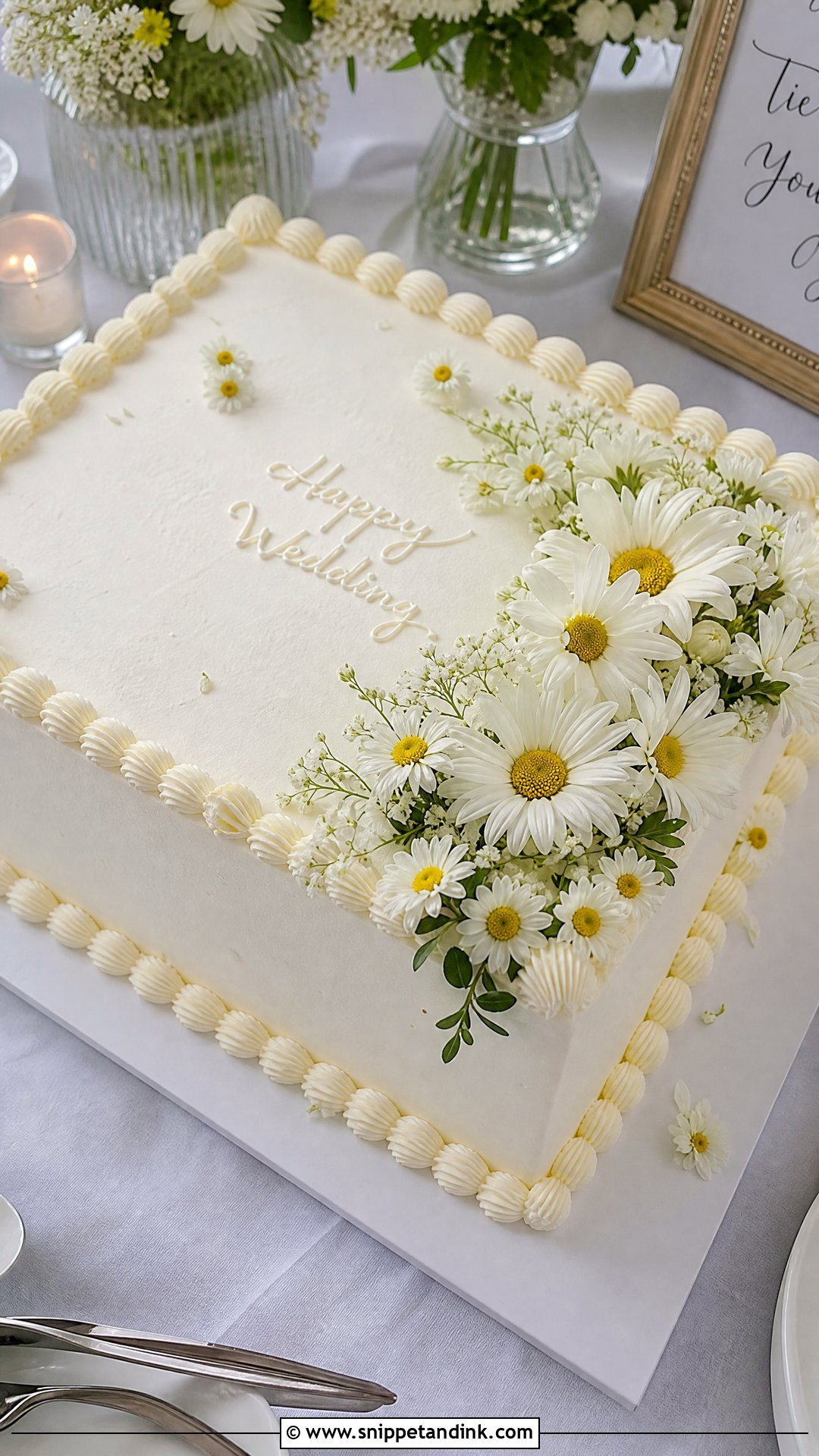
A daisy sheet wedding cake is the most practical way to feed a large guest list, and it doesn’t have to look like an office party cake. It can stay in the kitchen for slicing or sit on the dessert table as a relaxed centrepiece. I decorate the top with piped daisies along one corner and leave the rest smooth, which looks far more considered than an all-over pattern. Vanilla, lemon, strawberry and coconut are the crowd-pleasers. If you use a sheet cake as backup behind a small display cake, ask for the same sponge in both so every guest gets the same slice.
11. Daisy Heart Wedding Cake
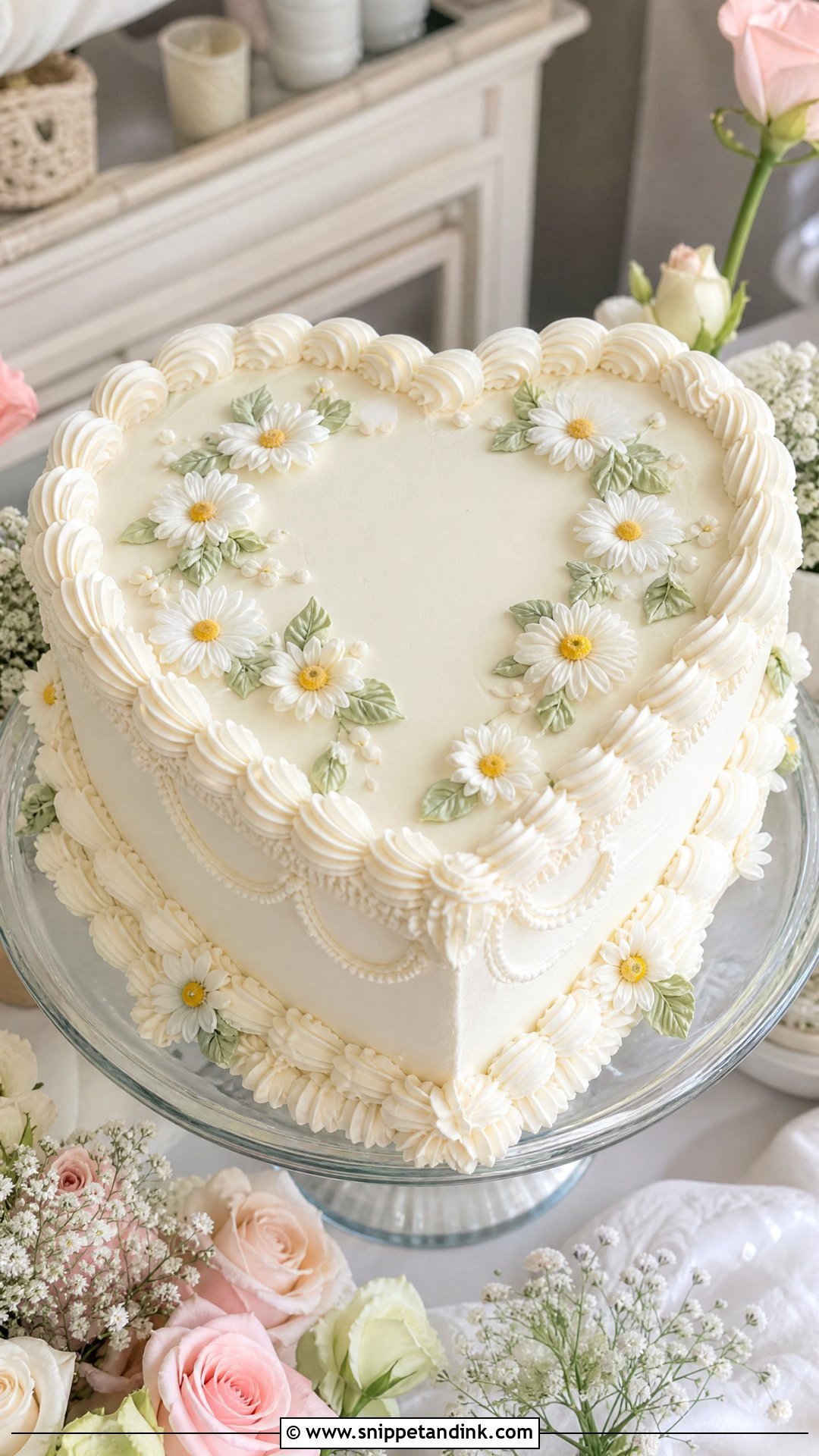
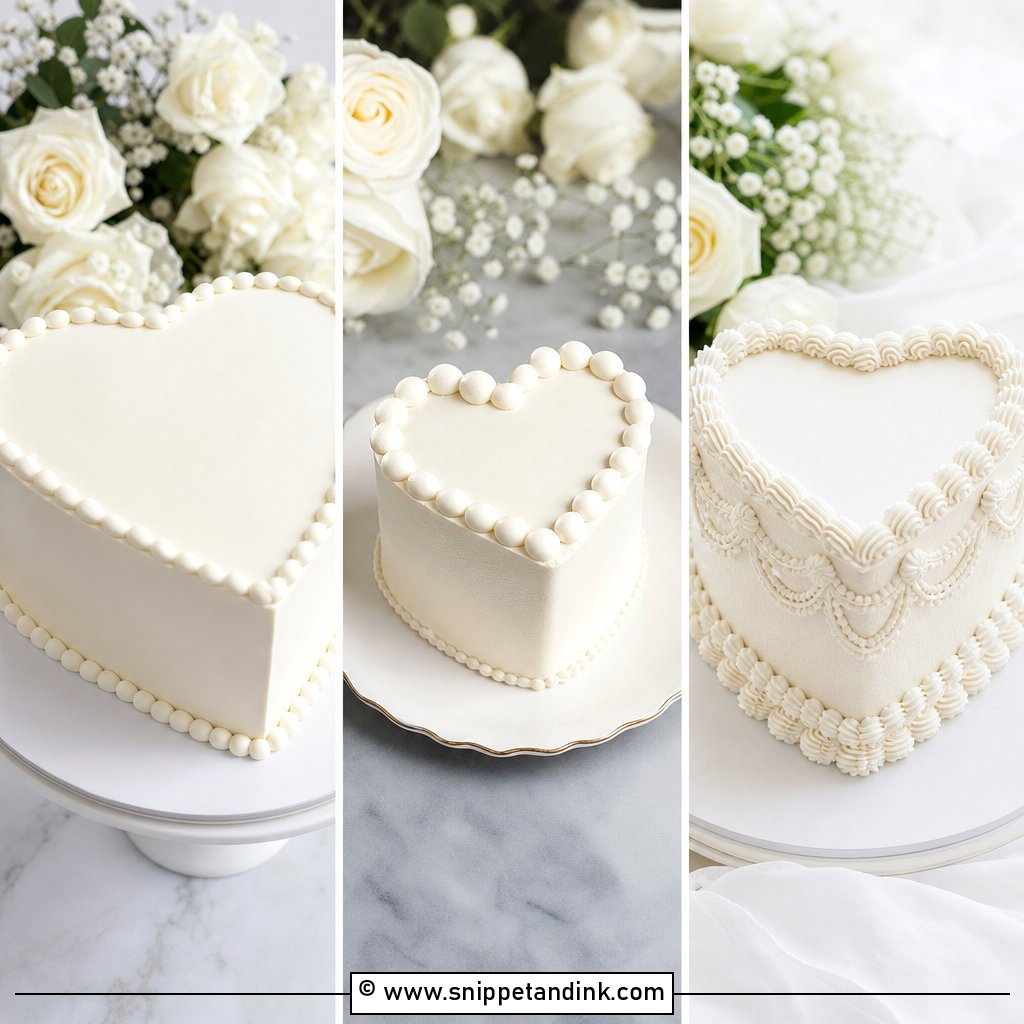
The heart shape brings in that retro, lambeth-piped mood, and daisies keep it from tipping into anything too sugary. I pipe a border first, then set small daisies around the top edge, leaving the centre either clear or carrying initials in pale yellow. A heart cake works well as a cutting cake next to a larger dessert spread. One thing couples don’t expect: heart cakes are awkward to slice into neat portions, so I treat them as a display and cutting piece and plan the real servings elsewhere. A pedestal stand shows the shape best.
12. Vintage Daisy Wedding Cake
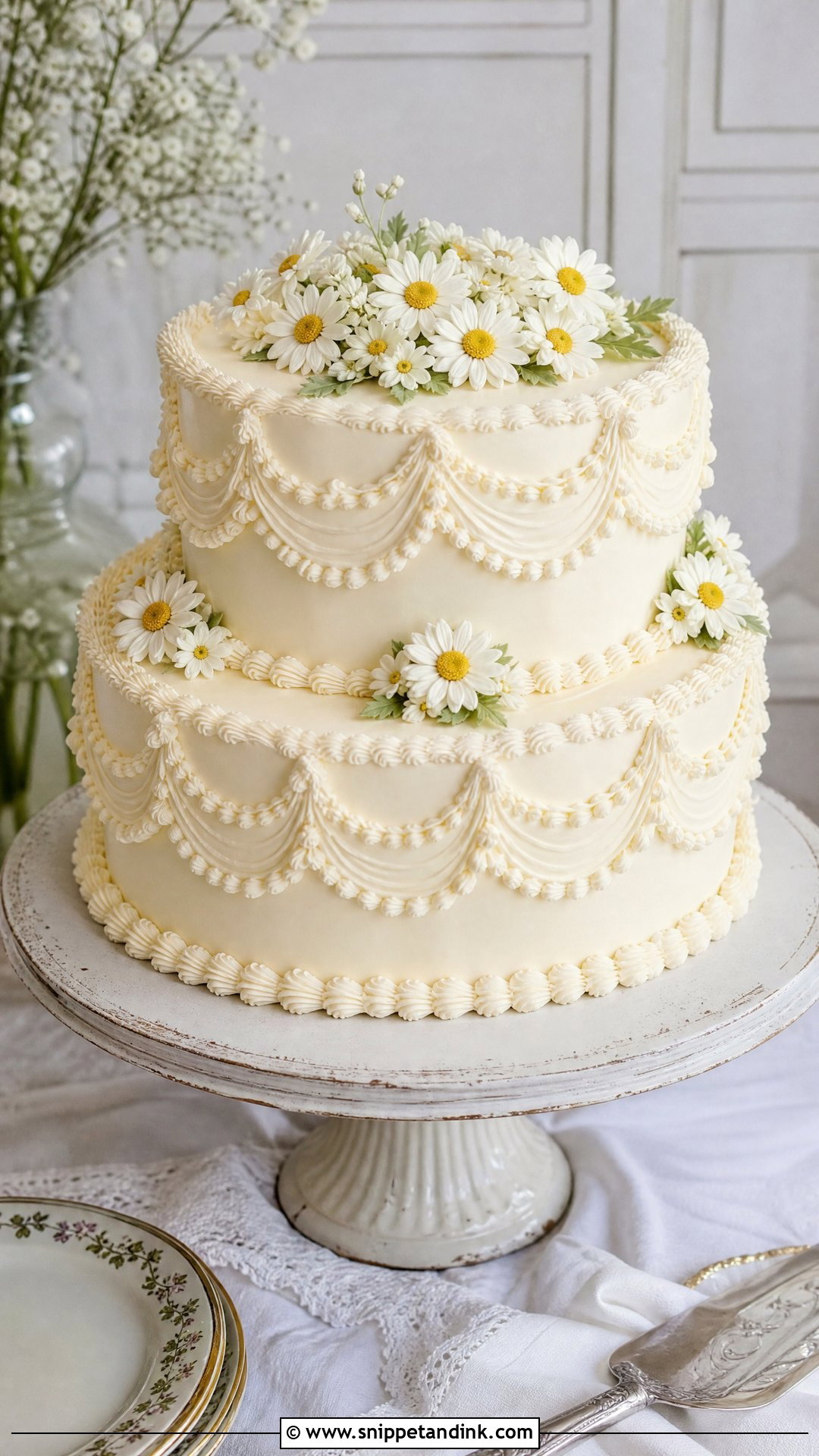
Vintage piping and daisies suit each other because both are about small repeated details. Shell borders, swags and little buttercream pearls frame the daisy clusters between them, and the cake can be round, heart-shaped or tiered depending on numbers. This style takes time, since every swag is piped by hand, so it costs more than its soft colours suggest. I’d keep it away from hot outdoor setups, because fine piping is the first thing to slump. Vanilla sponge with raspberry, lemon with cream cheese frosting and almond with apricot all fit the old-fashioned feel.
13. Rustic Daisy Wedding Cake
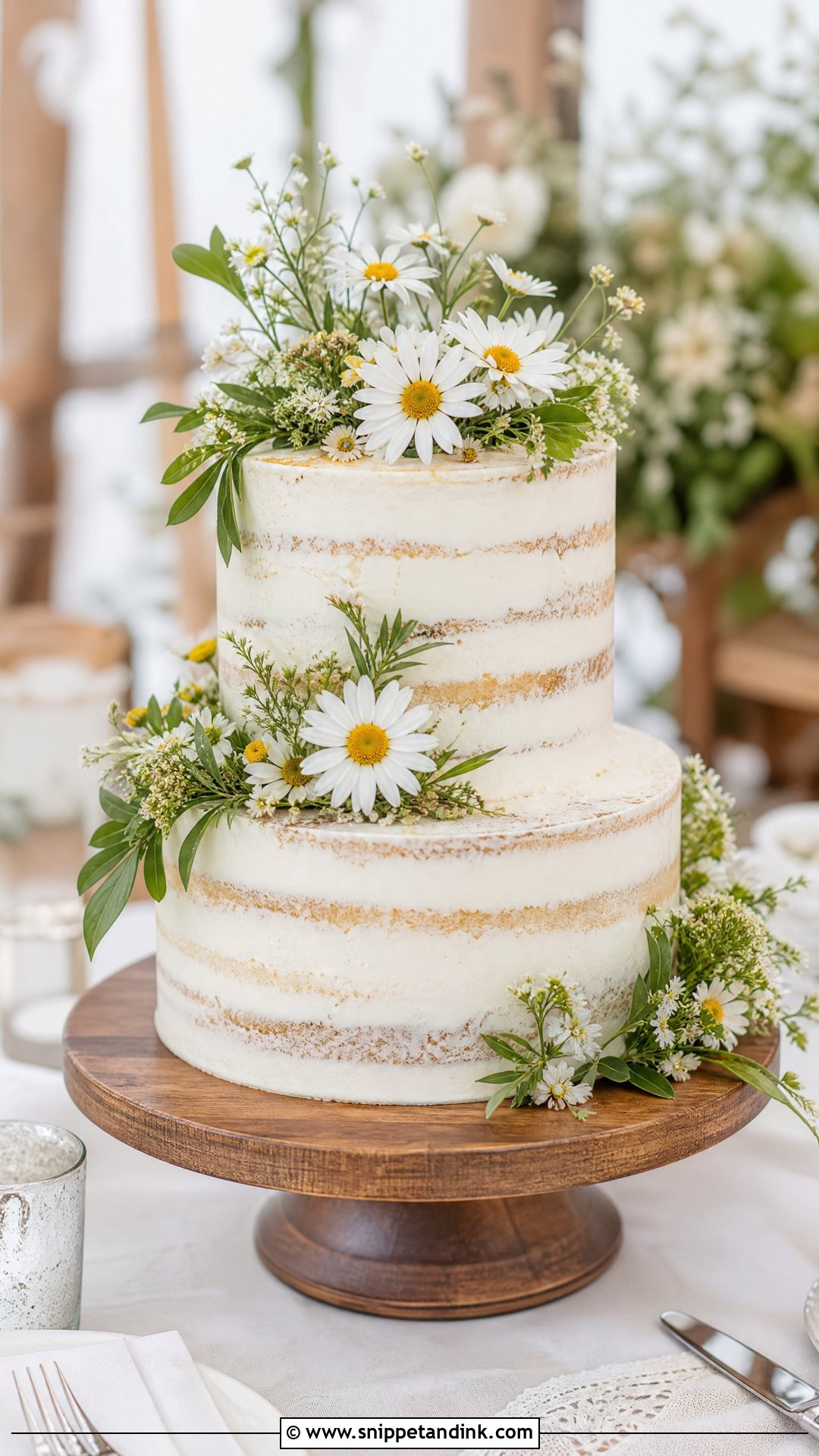
For barns and countryside venues I’d go semi-naked or lightly textured, with daisies tucked between greenery, a few wheat stems and small wildflowers. A wooden stand finishes it without anything else. The common mistake is covering every surface with flowers, which hides the cake and looks bought rather than picked; three or four natural clusters look more like a garden. Vanilla honey, carrot, lemon and brown butter cakes all suit the rustic setting. Bear in mind that wheat and dried stems shed, so I keep them away from the cutting side.
14. Naked Daisy Wedding Cake
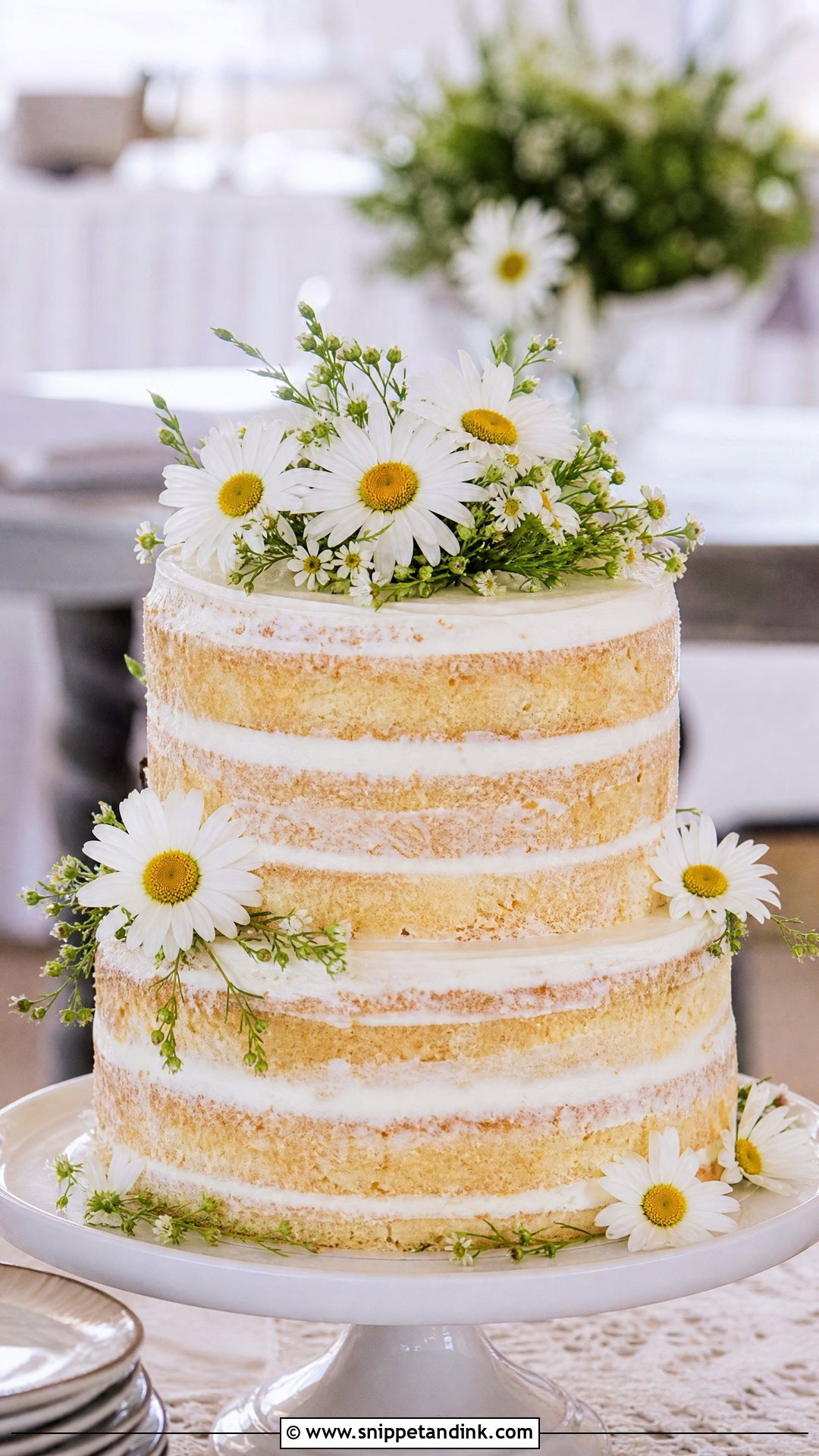
A naked cake shows its layers, so the sponge and filling have to be neat and even, because there is nothing to hide behind. I use a thin buttercream between layers and only a scraped veil on the outside, just enough to anchor the daisies and greenery around the base and top. Vanilla, lemon, almond and light honey sponges look and taste right here. The exposed sponge dries out quickly, so this cake is best for cooler indoor displays or short outdoor setups, and I’d assemble it on the day rather than the night before.

15. Lemon Daisy Wedding Cake
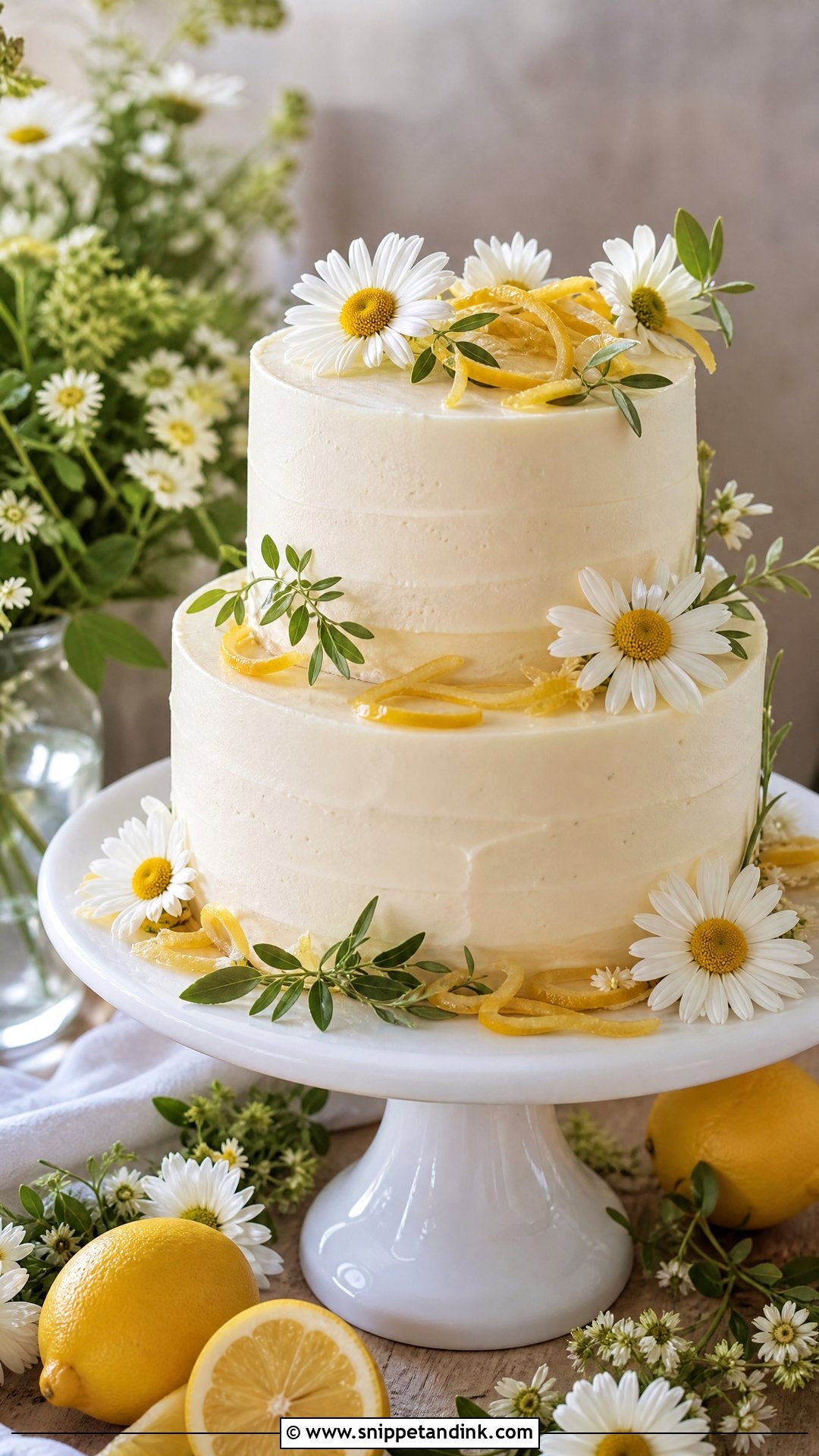
Lemon is the flavour I pair with daisies most often; the two simply belong together. The cake can wear pale yellow buttercream, or stay white outside with a lemon curd filling hidden inside. A two-tier version with daisies on top and around the base is the version I’d recommend. Thin lemon slices and candied peel add texture, but fresh slices weep onto buttercream after an hour or two, so I use candied peel for anything on display for long. Keep the decoration tidy so the cake reads as a wedding cake and not a birthday one.
16. Strawberry Daisy Wedding Cake
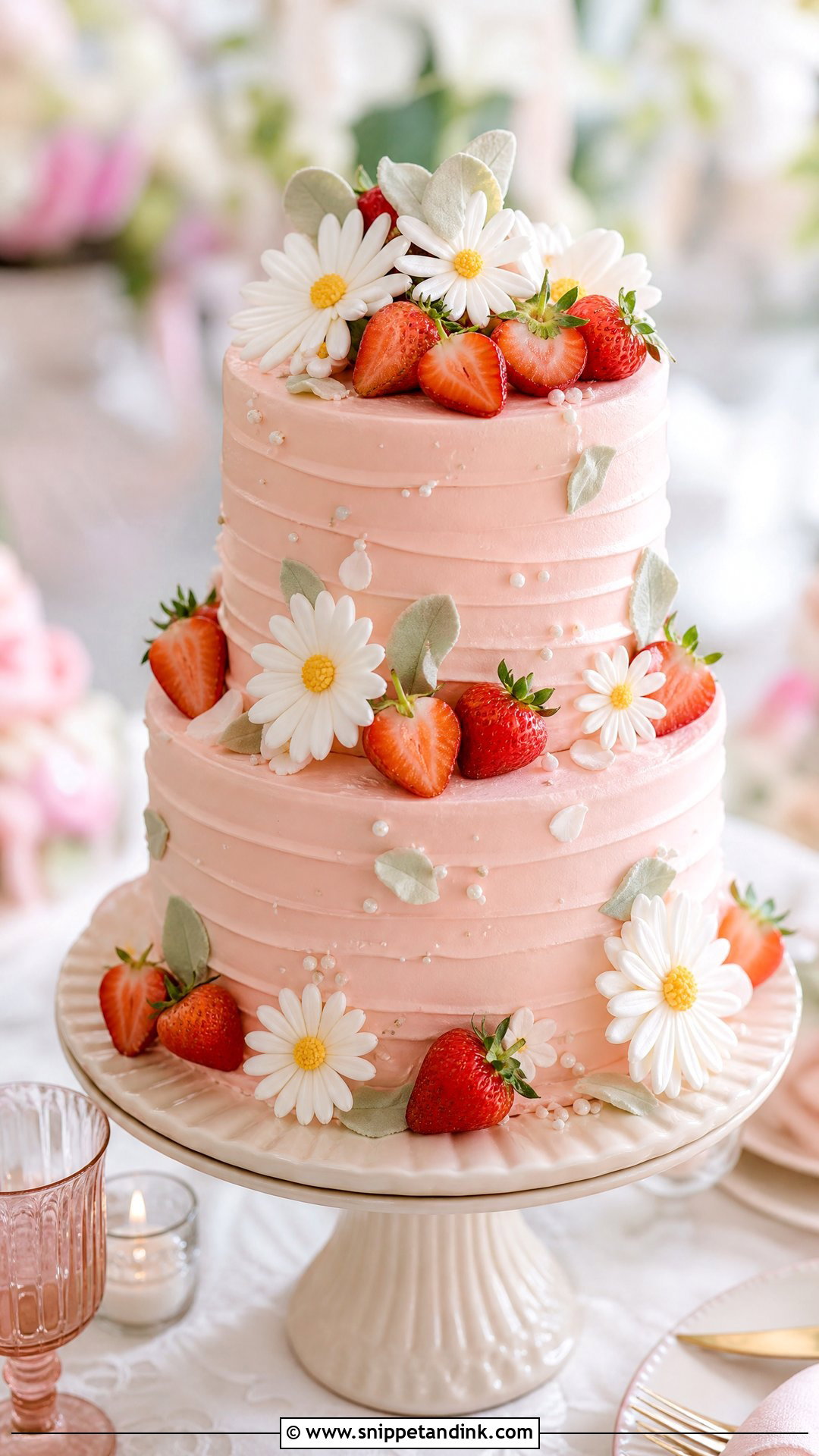
Strawberry brings a hint of colour inside and out, which makes this a strong pick for warm-weather weddings. The sponge can be strawberry itself, or vanilla layered with strawberry compote or filling. On the outside, white or blush buttercream lets tiny white daisies stand out. I’m cautious with fresh berries on display: cut strawberries bleed juice into frosting, so I use whole small berries around the base and place them as late as I can. A few pale green leaves finish it.
17. Chamomile Daisy Wedding Cake
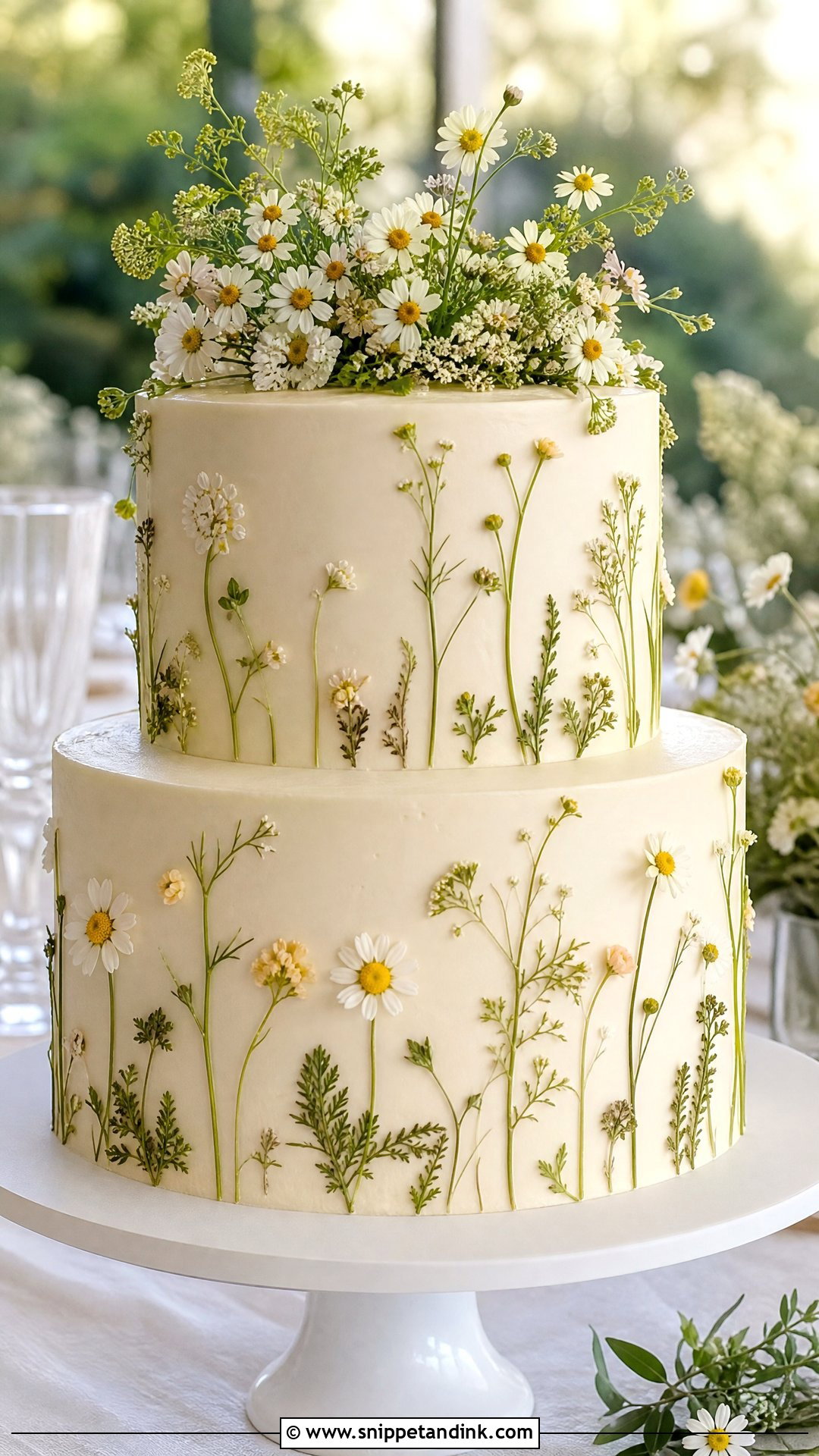
Chamomile looks like a miniature daisy, and on cake it gives a delicate meadow effect. I scatter tiny chamomile heads with white daisies over a smooth ivory base, sometimes as a thin wreath around one tier. The flavour can follow the flowers: chamomile-infused milk in the sponge or a honey buttercream works surprisingly well. Because the flowers are so small, a large cake swallows them, so this design suits a simple shape and an afternoon garden wedding. Chamomile is also an edible flower, which makes it easier to source for cake than many garden blooms.
18. Wildflower Daisy Wedding Cake
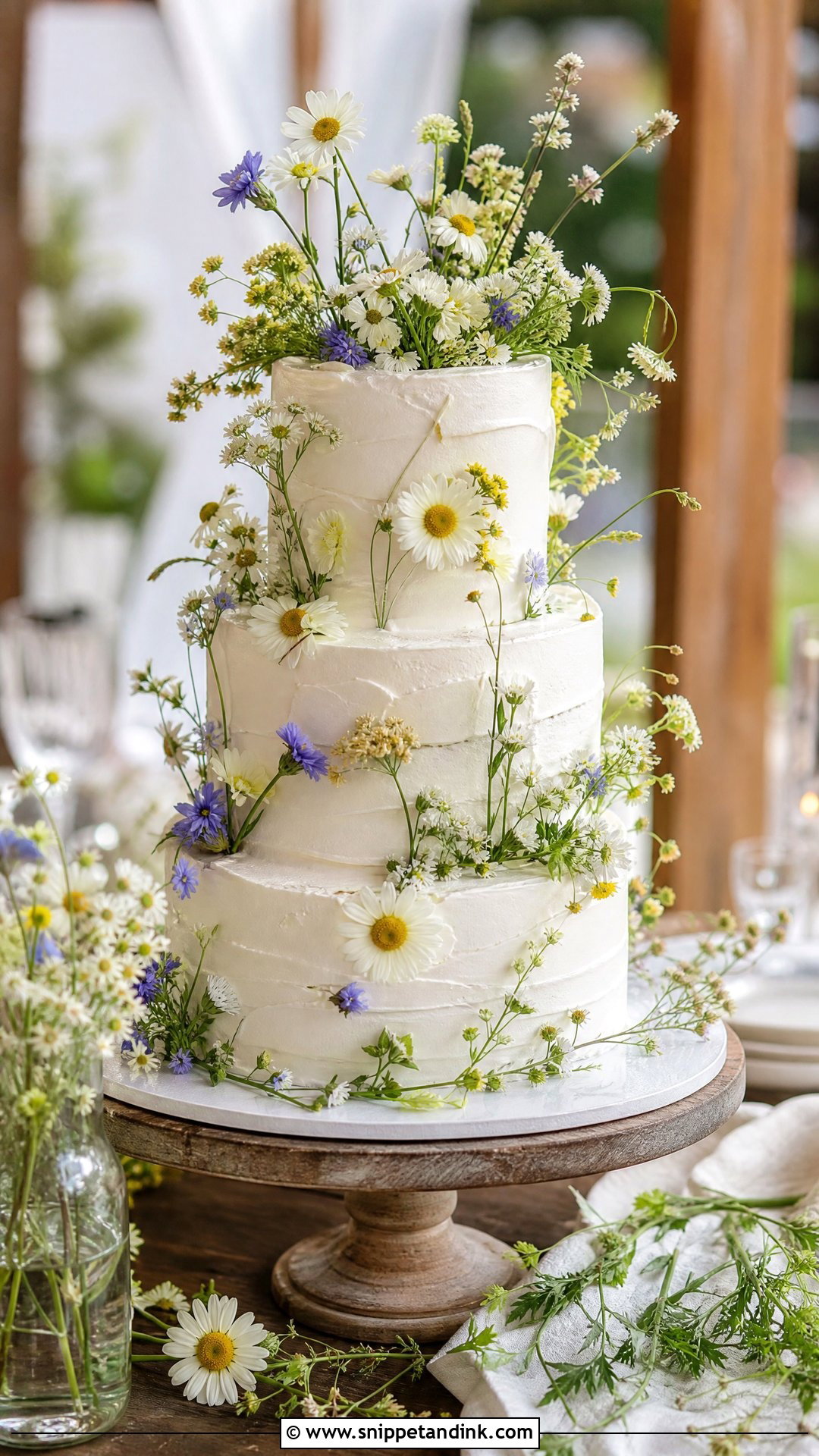
A wildflower daisy wedding cake should look picked that morning, but there is a fine line between loose and messy. I keep it controlled by limiting the palette to white, yellow, green and one or two accent shades, and by grouping flowers rather than dotting them everywhere. A semi-naked or lightly textured finish supports the natural style. Vanilla honey, lemon blueberry, almond and lavender vanilla all fit. If any of the flowers come from a garden rather than a florist, check that nothing toxic, such as foxglove or lily of the valley, has crept into the mix.
19. Yellow Daisy Wedding Cake
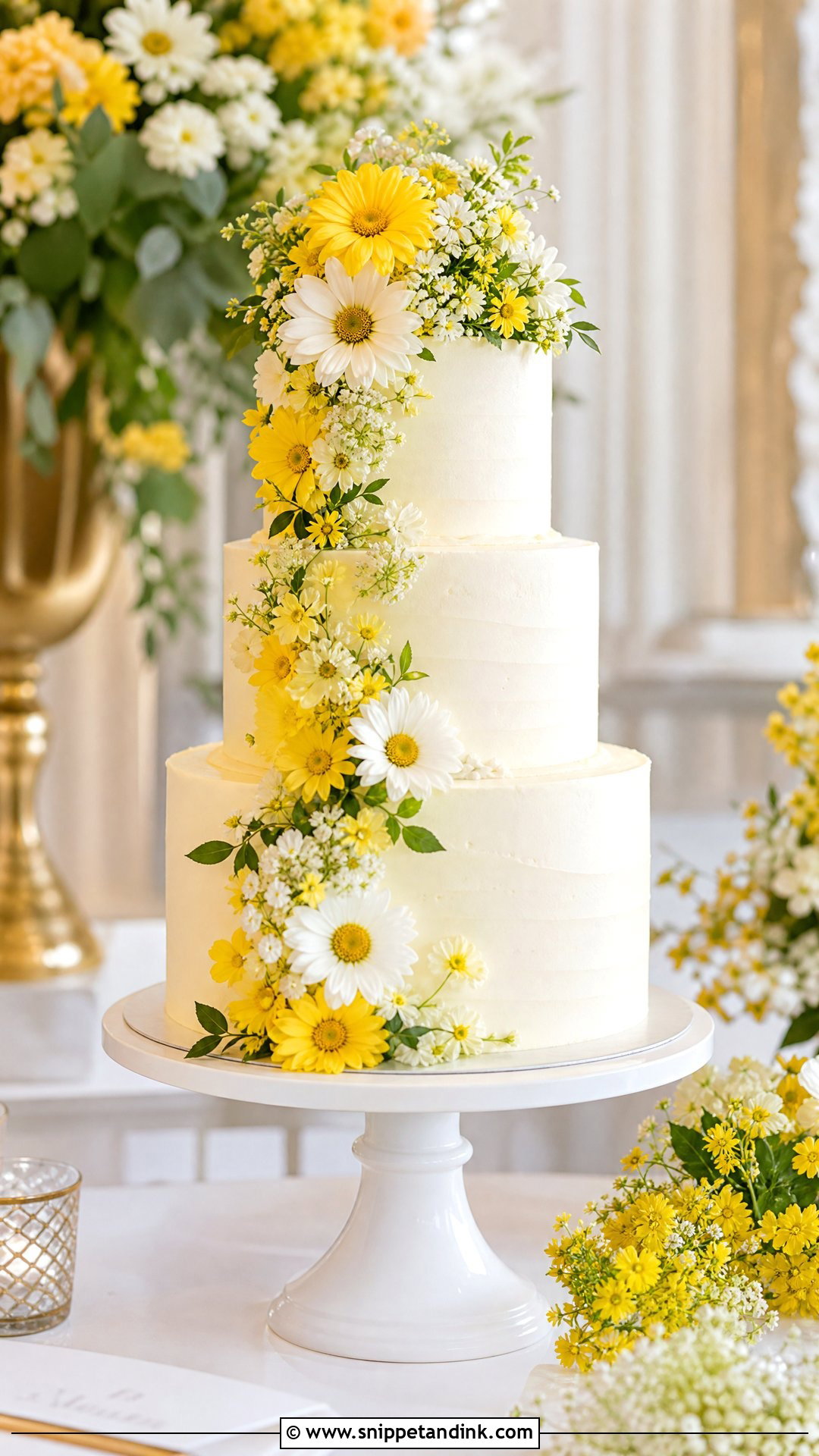
Yellow daisies bring more colour while staying soft against white tiers. Pale yellow buttercream petals read gently; full yellow gerbera-style daisies are much bolder. For a quieter result I cluster small yellow daisies around the bottom tier, and for a livelier one I run a cascade down one side. Yellow food colouring can drift towards a greenish tone in some buttercreams, so I tint a small test batch and look at it in daylight before piping. Lemon, honey and coconut cakes all match the sunny mood, and a white stand keeps the yellow crisp in photos.



20. Pink Daisy Wedding Cake
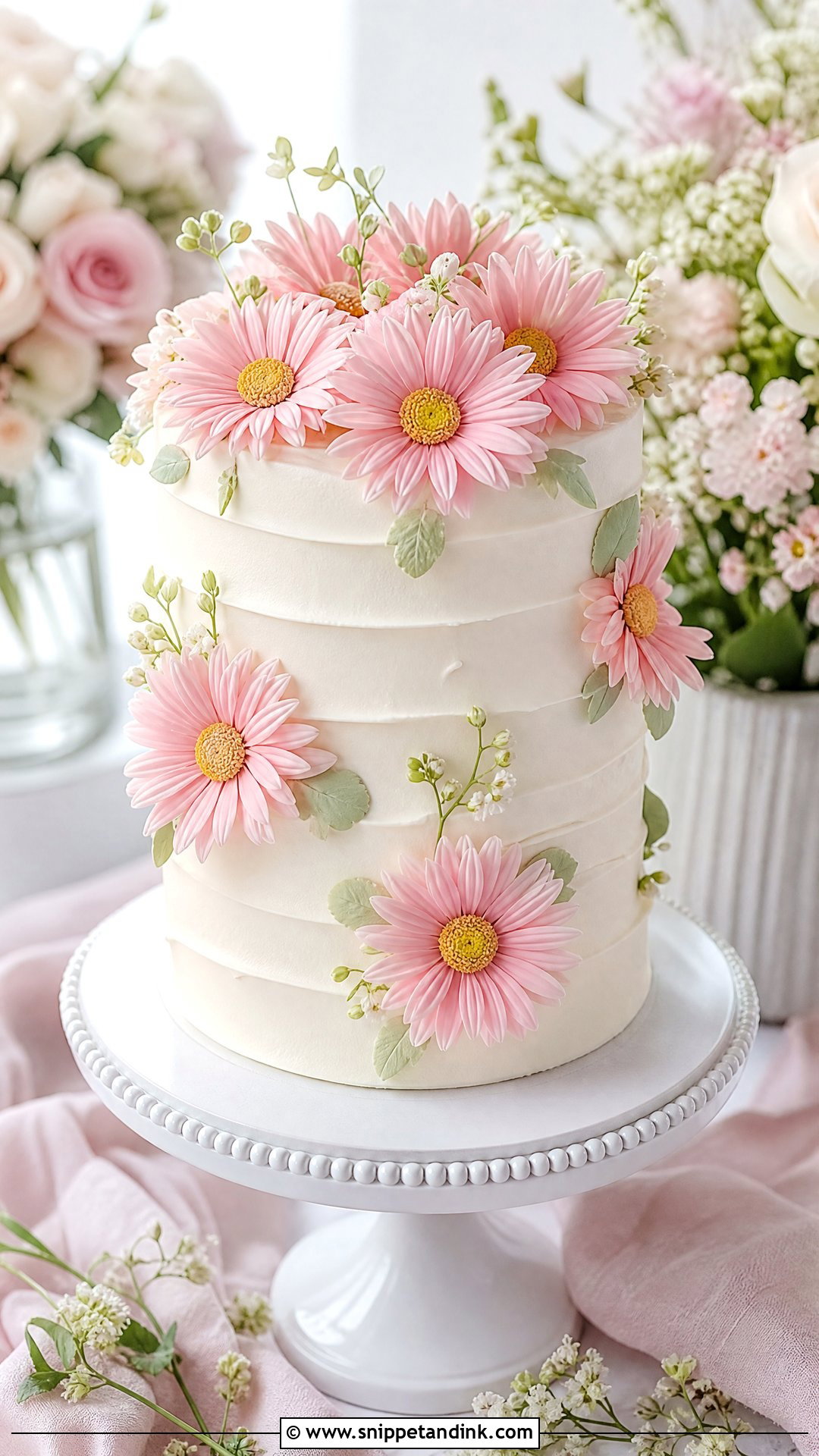
Pink daisies make the cake softer and a little playful, which suits spring weddings and pastel palettes. I use blush buttercream with white daisies, or white frosting with pink daisy accents, and choose small sugar daisies for a delicate look or pink gerberas for more impact. Strawberry, raspberry vanilla and rose vanilla cakes all fit. The detail I watch is the centre: a bright yellow eye can fight with pink, so I tone it down to a buttery gold. A few pale green leaves stop the whole thing looking too sweet.
21. Blue Daisy Wedding Cake
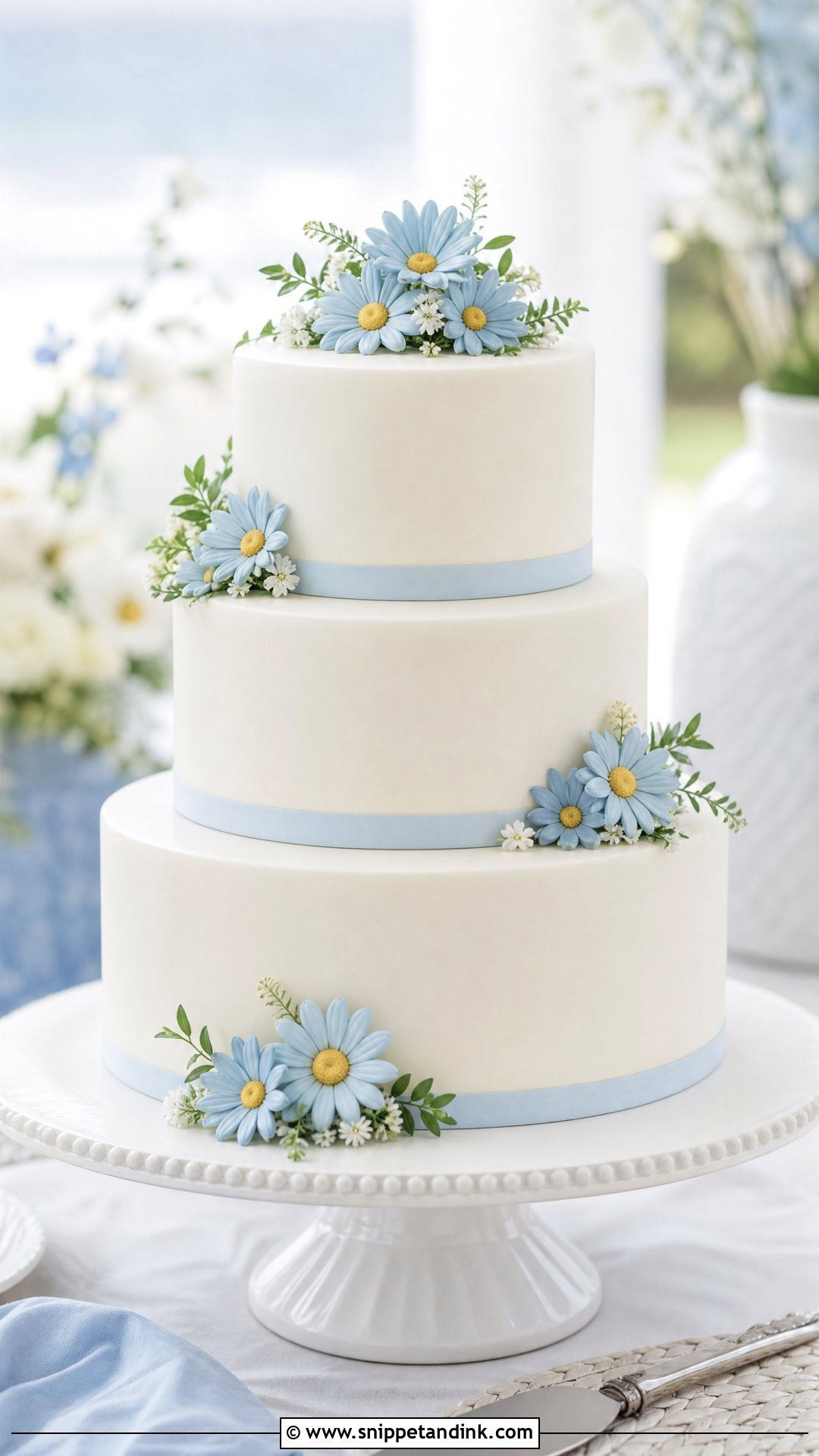
Blue is an unusual daisy colour, which is exactly why it catches people’s eye. I keep the base white or ivory and bring the blue in through pale sugar daisies, buttercream florals or a ribbon at the base of each tier. Powder blue and cornflower are the shades I’d use; anything brighter starts to look artificial on cake. Blue buttercream is also tricky because the natural yellow of butter pushes it towards green, so a white-based frosting gives a truer colour. It suits coastal venues and dusty blue palettes, with lemon, almond or coconut sponge underneath.
22. Green Daisy Wedding Cake
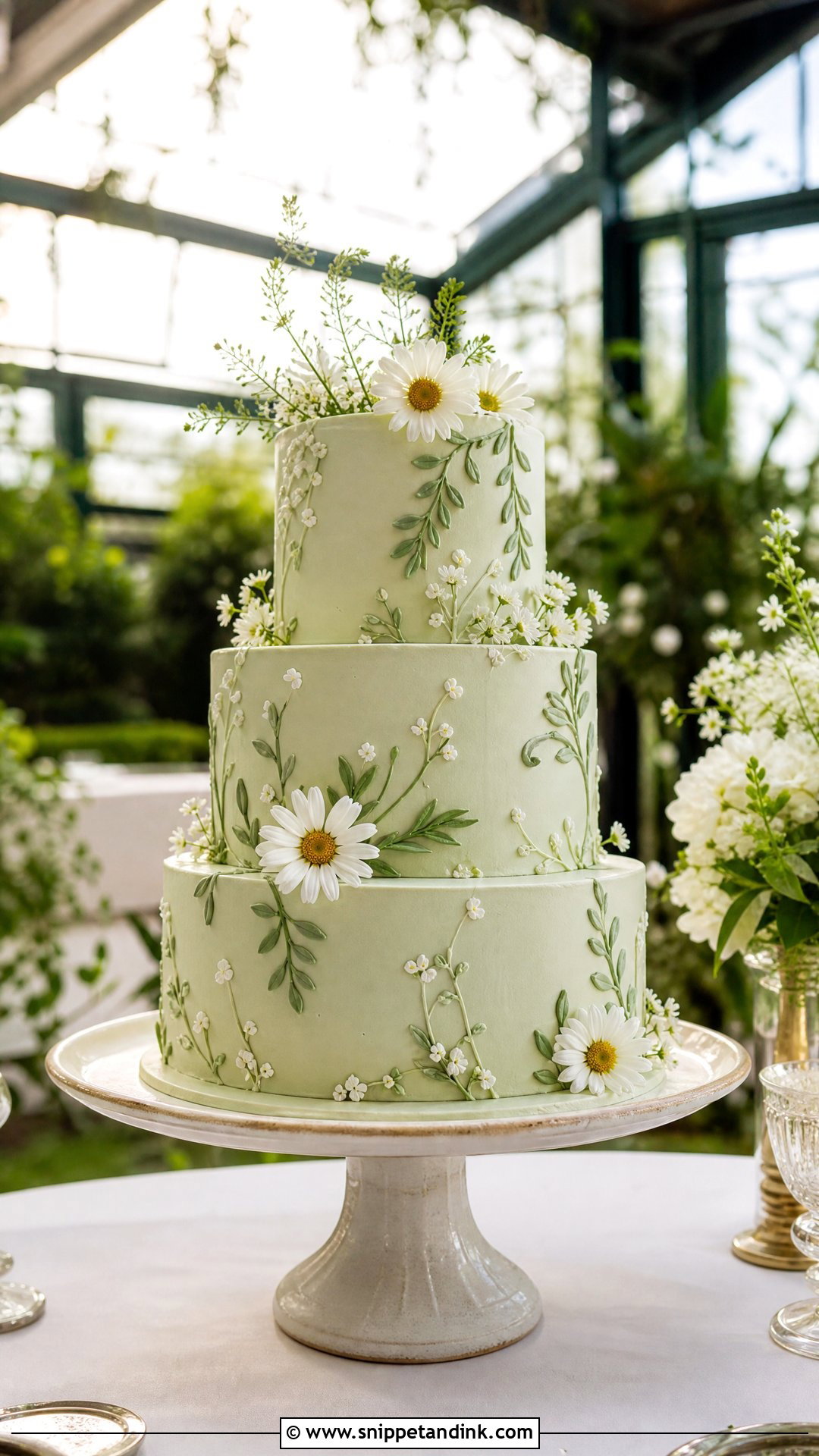
Rather than making the whole cake green, I use sage buttercream on one tier or green leaf work around white daisies. That gives a botanical look while keeping the daisies recognisable, since green petals would simply disappear. Sage pairs well with ivory, yellow centres and a wooden or ceramic stand. Pistachio and matcha vanilla sponges echo the colour inside the cake, though matcha’s bitterness isn’t for everyone, so I suggest it as one tier rather than the whole cake. Greenhouse and outdoor venues suit this style.
23. Daisy Cupcake Wedding Cake
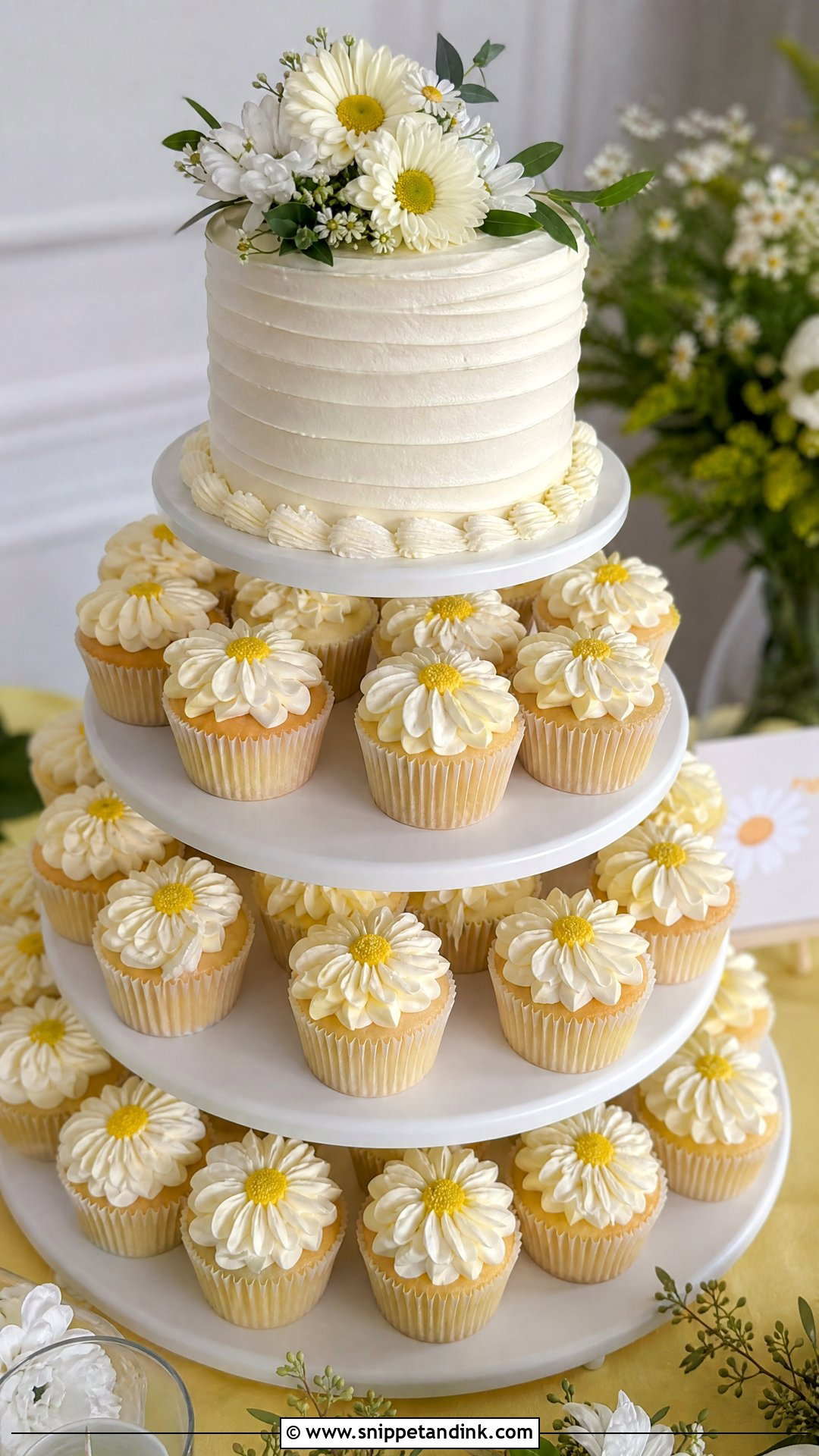
Cupcakes make dessert service very easy because there is nothing to slice. I set a small cutting cake on top of a tiered stand and surround it with cupcakes decorated with piped daisies, so you still get a cake-cutting moment. Guests can choose between vanilla, lemon, strawberry, coconut and almond. Keep every cupcake in the same narrow palette of white, ivory, pale yellow and soft green, and give the top cake the largest daisy cluster to tie it together. Cupcakes do dry out faster than a whole cake, so I bake them as close to the day as possible.
24. Daisy Mini Wedding Cake
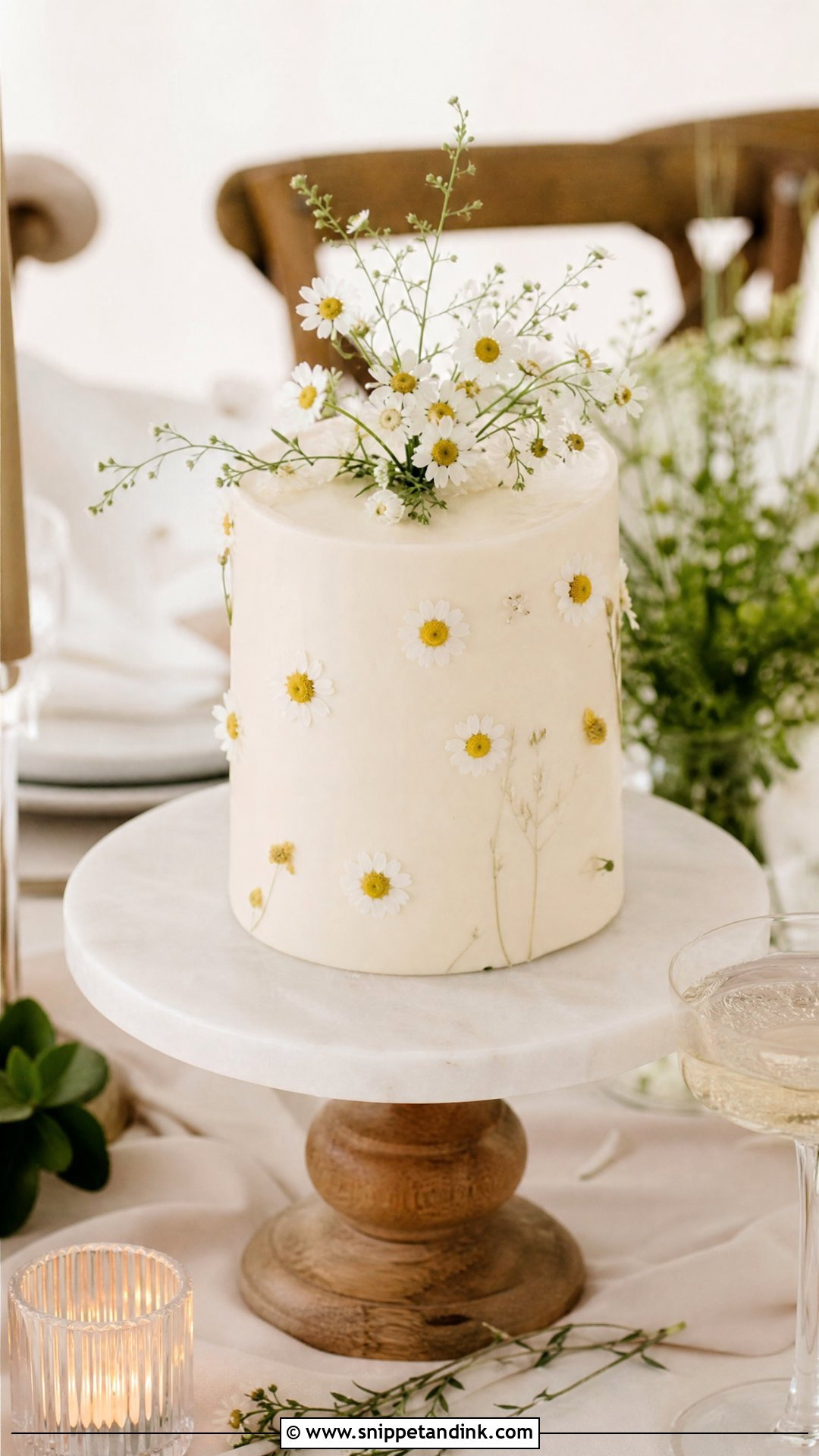
A single tall tier or a mini heart cake is enough for an elopement or a micro wedding, and a small cake can still look special if the decoration is scaled to it. That is where most mini cakes go wrong: one oversized bloom hides the shape entirely. Tiny sugar daisies, a few pressed ones or a small fresh cluster sized to the top surface look far better. With so little cake, choose a flavour you really love, whether that is lemon, vanilla raspberry, almond or honey.


25. Daisy Dessert Table Wedding Cake
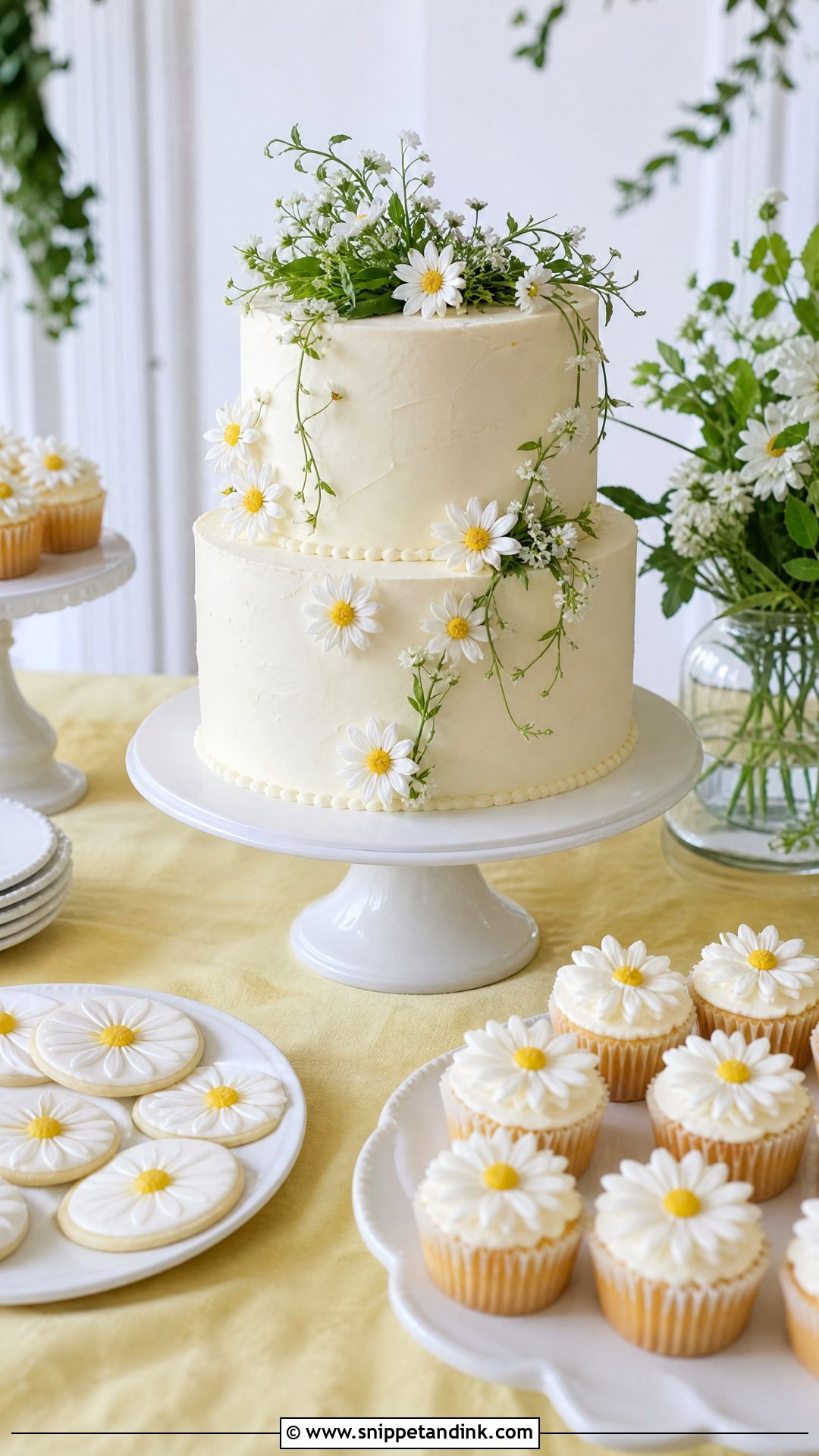
Here the main cake sets the theme and the smaller treats fill out the table. I’d make a two-tier daisy cake the centrepiece, then surround it with daisy cupcakes, iced cookies, lemon bars and mini cakes. The cake should be the tallest item on the table so it anchors the display; if it isn’t, raise it on a stand. Keep the palette tight with white, pale yellow and soft green on wood or linen, and repeat the daisy motif across the sweets while varying their shapes. Guests at long receptions tend to come back to a dessert table, so plan more pieces than you have guests.
How I Get Real Daisies Onto a Cake Safely
Fresh flowers on cake cause more last-minute worry than any other detail, mostly because nobody agreed in advance who was responsible for them. Settle that at the tasting. Either the baker sources and places the flowers, or the florist supplies them prepared for cake and the baker or venue places them. Someone has to own it.
This is the routine I follow:
- Order the cake flowers separately from the bouquets, from a grower who can confirm no pesticides or floral preservatives were used.
- Rinse and dry them gently, then trim each stem short.
- Wrap every stem in floral tape or seal it with a dab of wax, or set it into a food-safe flower pick. Nothing bare goes into the sponge.
- Place the flowers once the cake is on its stand at the venue, not before transport, so nothing shifts in the van.
- Tell the catering team which pieces to lift off before slicing.
Shasta and ox-eye daisies are fine as decoration but are not food, so they come off before serving. If you want flowers guests can actually eat, chamomile and some daisy-like edible blooms are sold specifically for cakes.
Daisy Cakes in Summer Heat and Long Outdoor Receptions
Most daisy weddings are spring and summer weddings, so heat is the real test. Buttercream starts to soften once a room gets warm, and direct sun will slump piped petals within the hour. I ask for the cake table to be in shade, away from glass walls and heaters, and I prefer it set up as close to the cutting as the timeline allows.
If the reception is in an open tent in July, a ganache layer under the buttercream or a fondant finish buys you a lot of stability, and sugar daisies will outlast fresh ones by hours. Fresh daisies can still go on at the last minute for that natural look. For the drive, the cake travels chilled, on a flat surface, with the air conditioning on, and the tiers are often stacked on site rather than in the kitchen.
Four Facts Your Baker Needs Before the Daisies Go On
Daisies adapt to almost any cake style, which is their real strength. For a cake that holds up through a long day, white buttercream with small sugar daisies is the safest choice. For an outdoor wedding in a cooler season, fresh daisies and a textured finish look the most natural. Pressed flowers, a heart cake or a tall mini cake bring in a current feel. Before you settle on a design, tell your baker the venue, the guest count, the likely temperature and how long the cake will be on display, because those four facts decide which kind of daisy will still look fresh when you cut it.
You'll Like These Ideas:




Leave a Reply