
Leg mehndi tends to be decided in a rush, after hours spent on the hands, and it shows. Yet your feet and ankles are in the photos of the pheras, the sitting portraits and every shot of payal and sandals. Today’s bridal leg designs range from dense dulhan coverage to open Arabic trails, and from calf-length panels to a single ankle band. Below I walk through twenty of them, with what each one asks of you in sitting time and how it holds its colour on skin that walks, sweats and rubs against fabric all week.
Should Your Feet Match Your Hands?
Brides often ask me whether the leg design has to copy the hands. It doesn’t, but the two should clearly belong together. In photos where you’re seated with hands resting on your knees, both appear in the same frame, and a dense Rajasthani palm above a sparse Arabic foot looks like two different weddings.
My approach is to repeat one or two motifs and one density level rather than the whole layout. If the hands carry paisleys and a lotus, the feet get a lotus on top and paisley trails at the ankle. If the hands are open Arabic work, the feet stay open too. Line weight should match as well; fine Indian filler on the hands paired with thick Gulf outlines on the feet feels mismatched even when the motifs agree.
When to break the match on purpose
Long functions on your feet, a sensitive-skin history or a short session are all good reasons to keep the legs lighter than the hands. In that case I keep the motifs linked and simply reduce coverage, so it reads as a lighter echo of the hands rather than an unrelated design.
1. Full Leg Bridal Mehndi Design
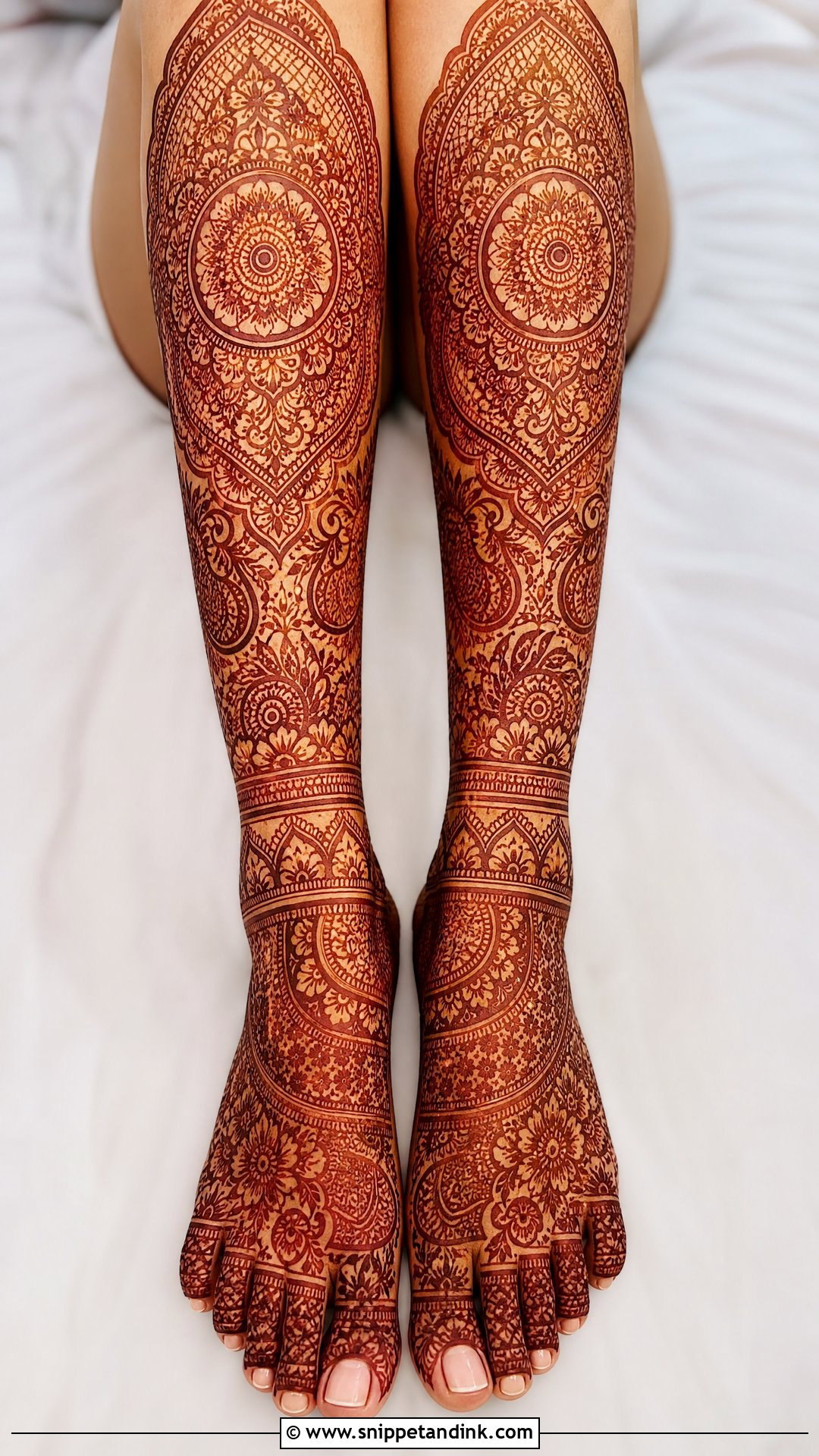
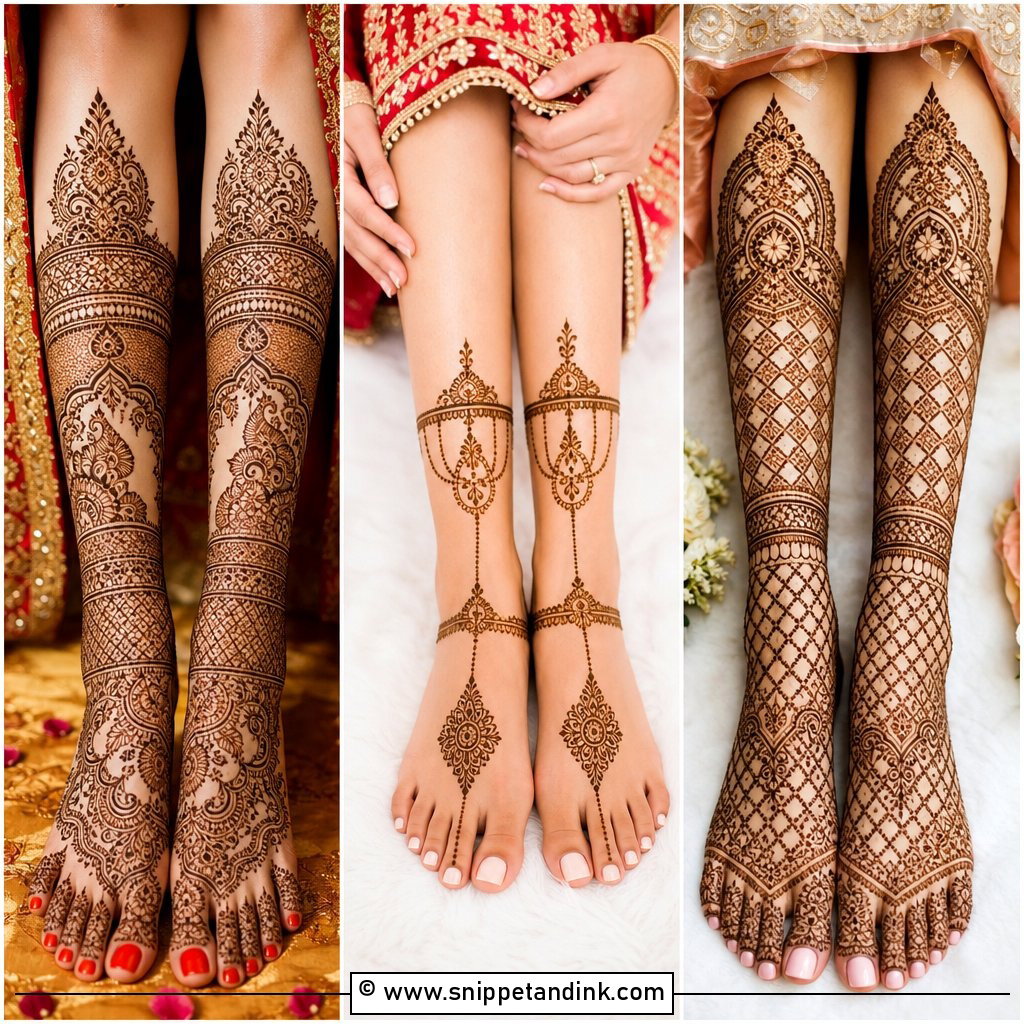
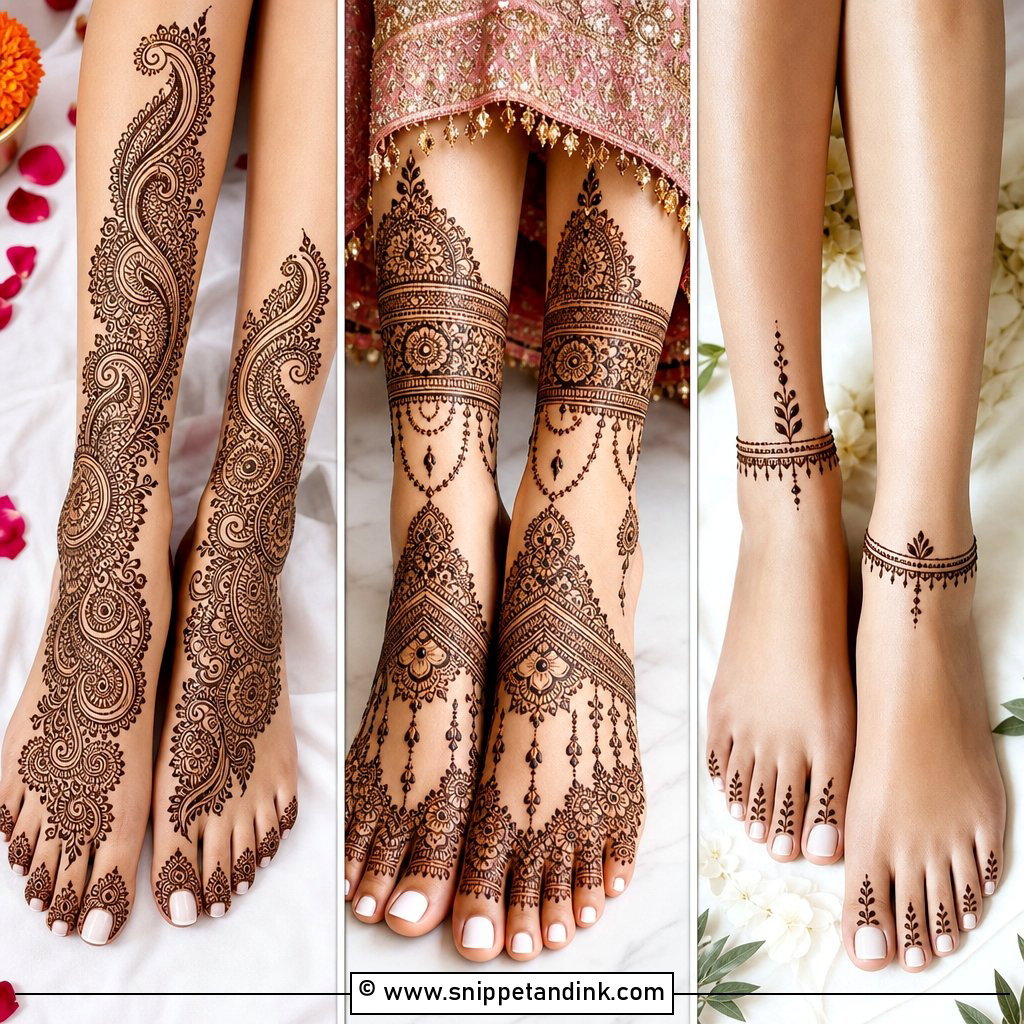
Full leg work dresses the feet, ankles and lower legs in dense paisleys, flowers, vines, mandalas and fine filler, so the legs look finished even before jewellery goes on. I keep the toes detailed and the centre of the foot balanced, then scale the calf motifs up so they read in photos. It’s a long session, and the calf is the hardest area for a bride to hold still because she’s sitting with her knee bent. Heavy lehengas, sarees and classic bridal outfits are where it makes sense.
2. Indian Bridal Leg Mehndi Design
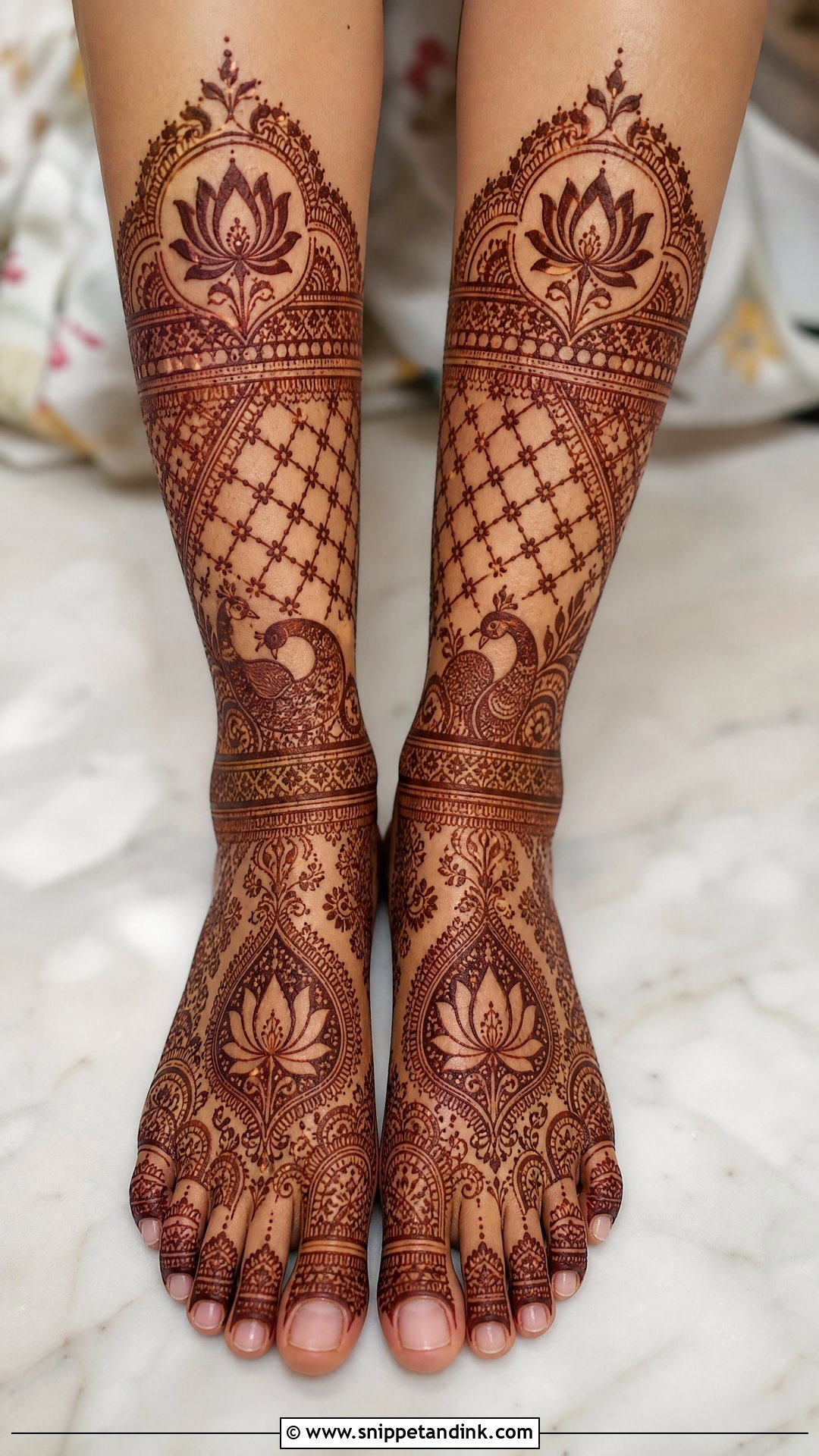
Classic Indian leg mehndi is symmetrical and full of symbols: lotus, peacocks, kalash, paisleys, jaali and bride-inspired details, starting at the toes and building over the foot, round the ankle and up toward the shin. Pick one clear central pattern for the top of the foot and let the denser fillers surround it. Without that anchor, a full Indian leg can turn into an even texture with nothing for the eye to land on. It wears well with anklets and traditional footwear.
3. Arabic Bridal Leg Mehndi Design
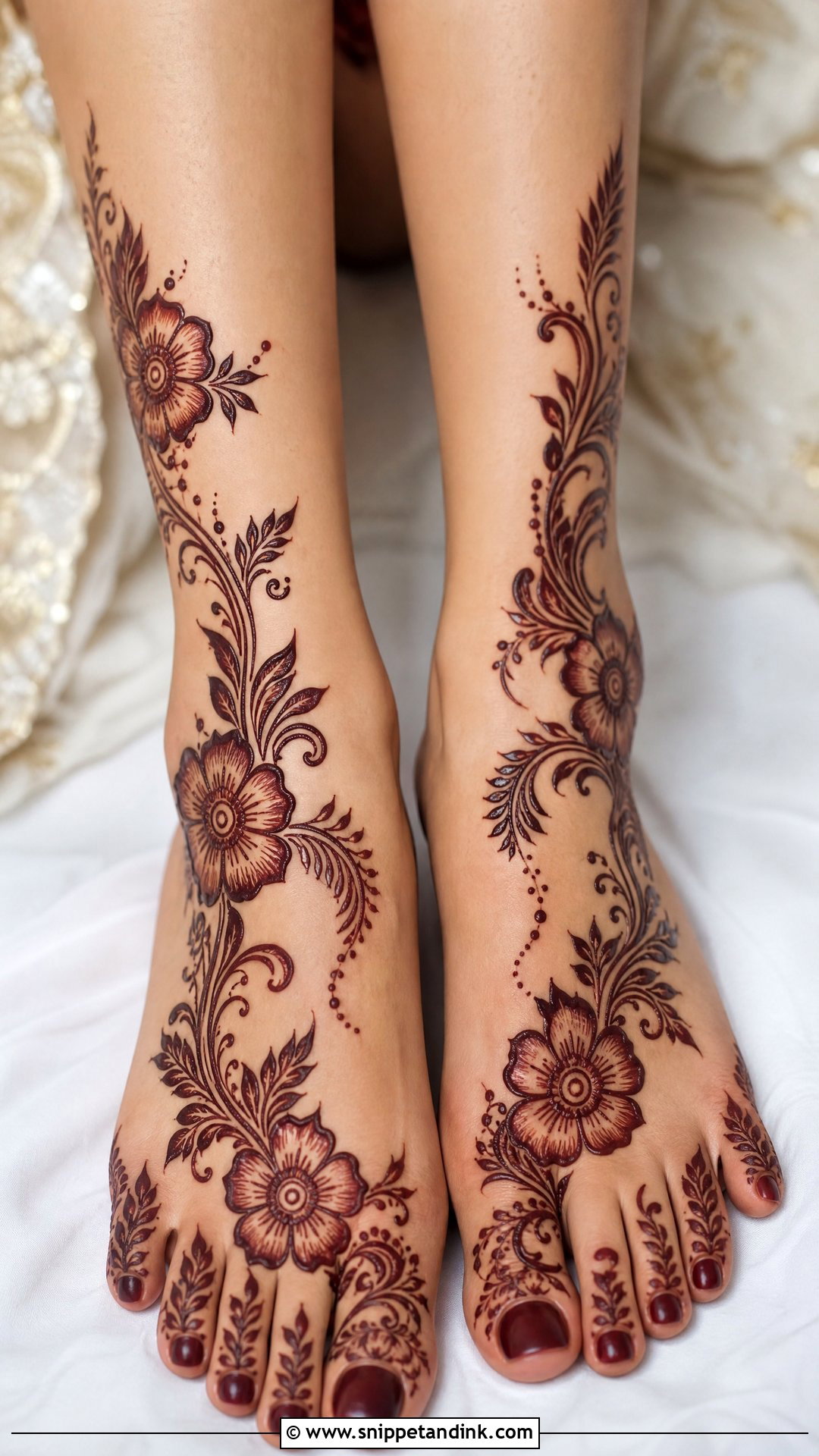
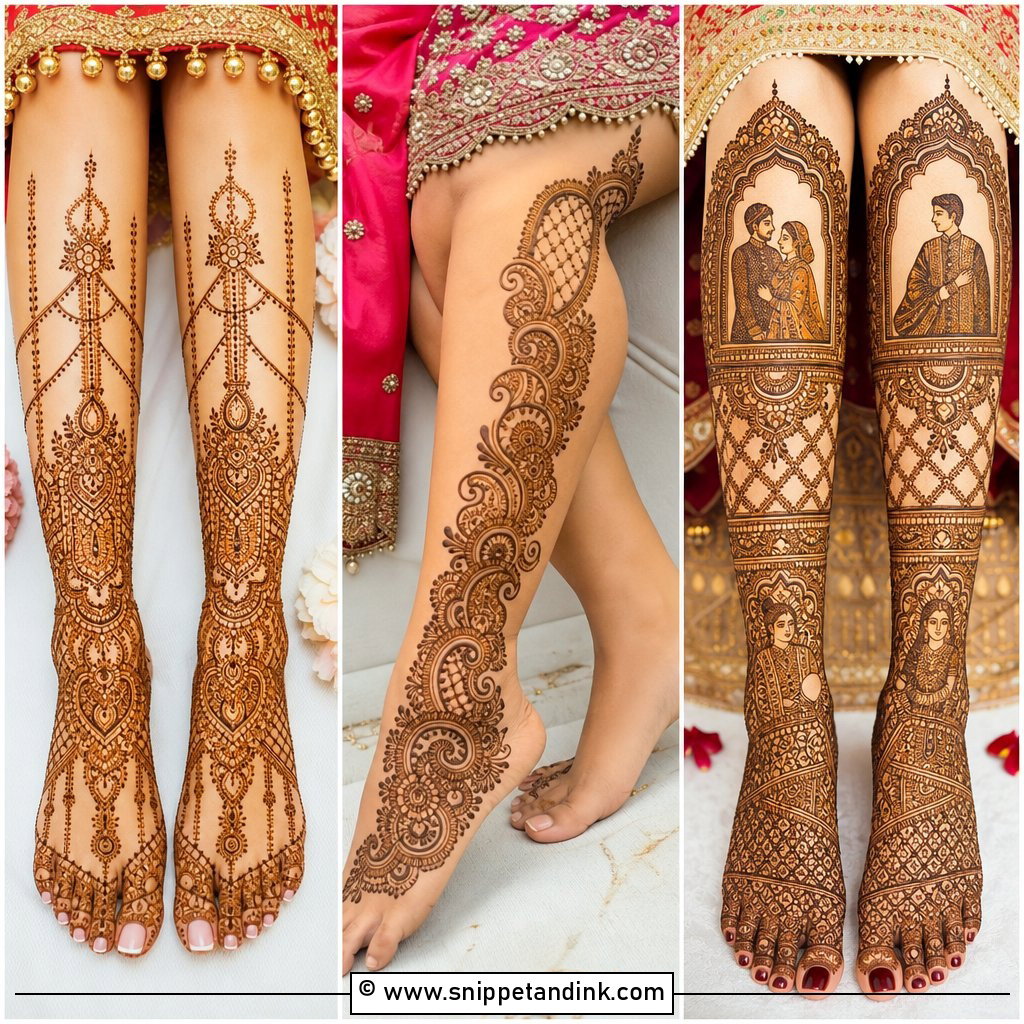
Arabic leg designs move diagonally from the toes to the ankle in flowing floral trails, leafy vines and bold petals, then climb lightly up the leg with curved gaps of bare skin. Application is noticeably quicker than full Indian coverage, which matters on a busy mehndi night. The open gaps make the stain pop. I’d ask for thicker outlines, soft shading inside the petals and even spacing between each cluster; crowd the clusters and you lose the whole point of the style.
4. Indo Arabic Bridal Leg Mehndi Design
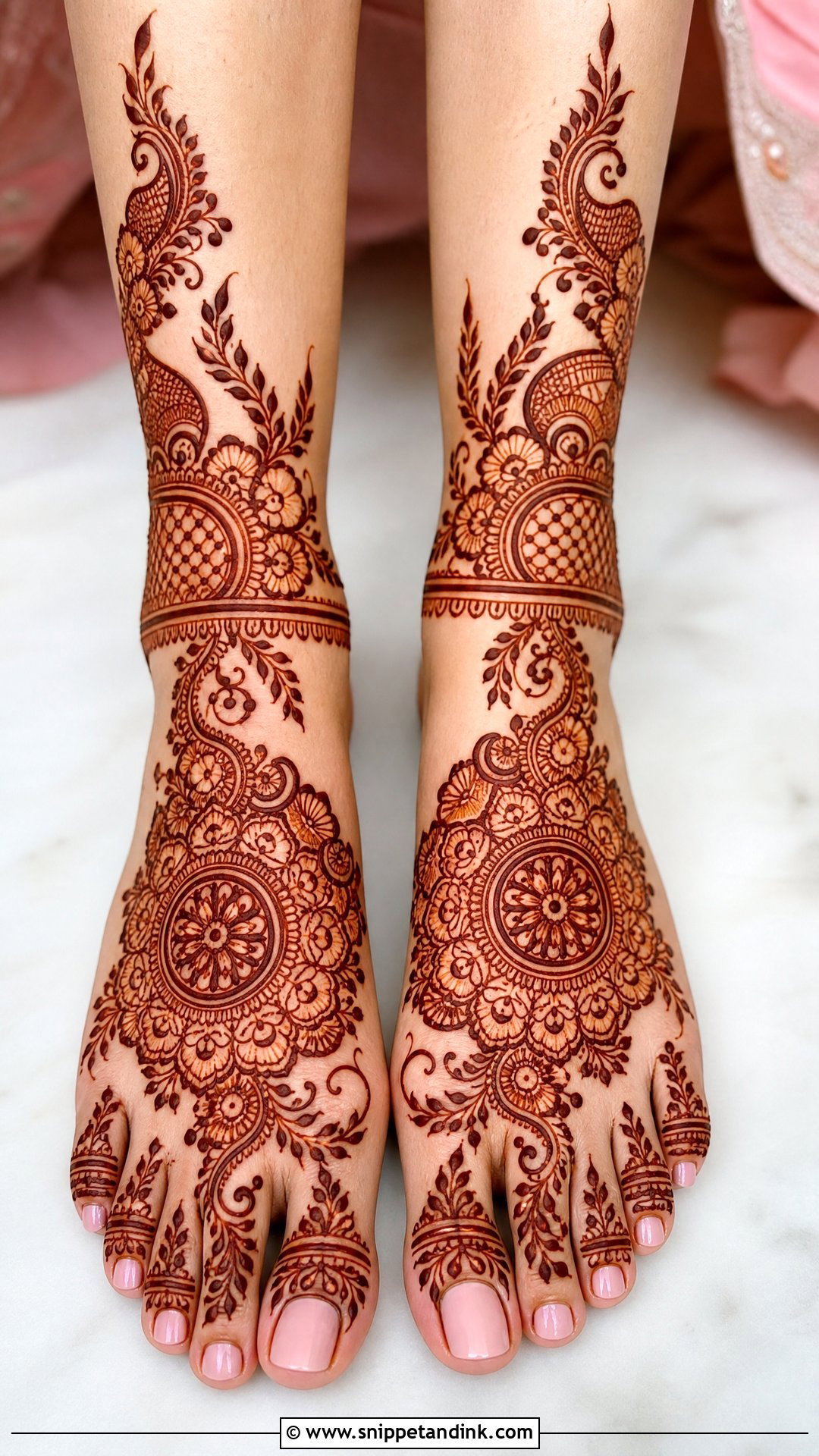
Indo Arabic bridal leg mehndi mixes Indian richness with Arabic airiness: a mandala on the foot, paisley trails near the ankle, floral vines up the shin and jaali placed only where it earns its spot. Indian sections bring tradition, Arabic spacing lets it breathe. It carries across engagement, nikah, sangeet and wedding looks. For a formal finish I make both legs symmetrical; for something softer, I mirror the trails so they flow outward from the centre.
5. Bridal Foot And Ankle Mehndi Design
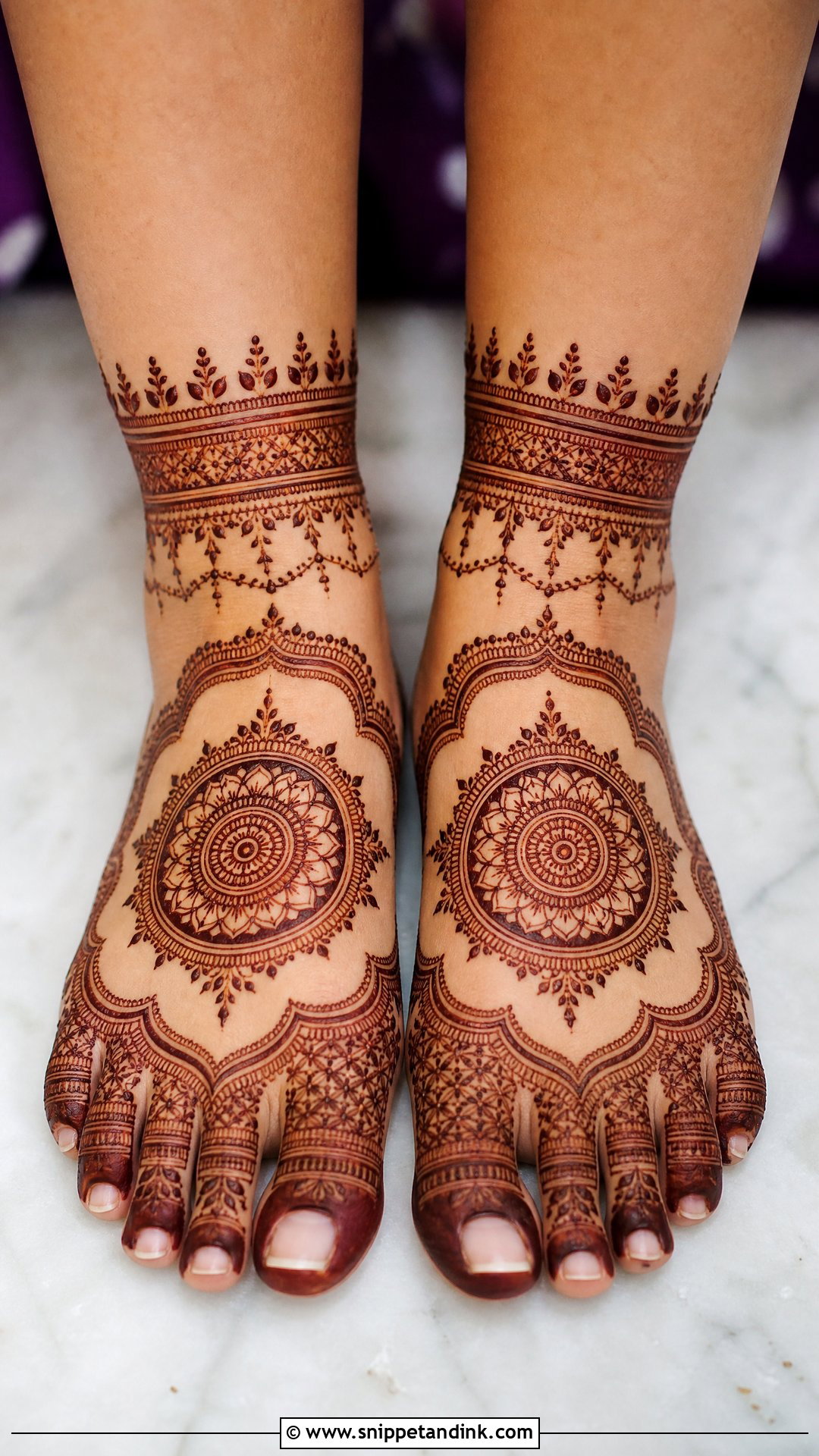
A bridal foot and ankle mehndi design keeps everything between the toes and the ankle bone. I usually build a central mandala or floral medallion on the top of the foot, anklet bands around the ankle, and fill the toes with tiny leaves, dots, net or mini florals. Open sandals and payal show it off. It is a much easier sitting than full legs, and honestly, most of what the camera catches during rituals is in exactly this area.
6. Peacock Bridal Leg Mehndi Design
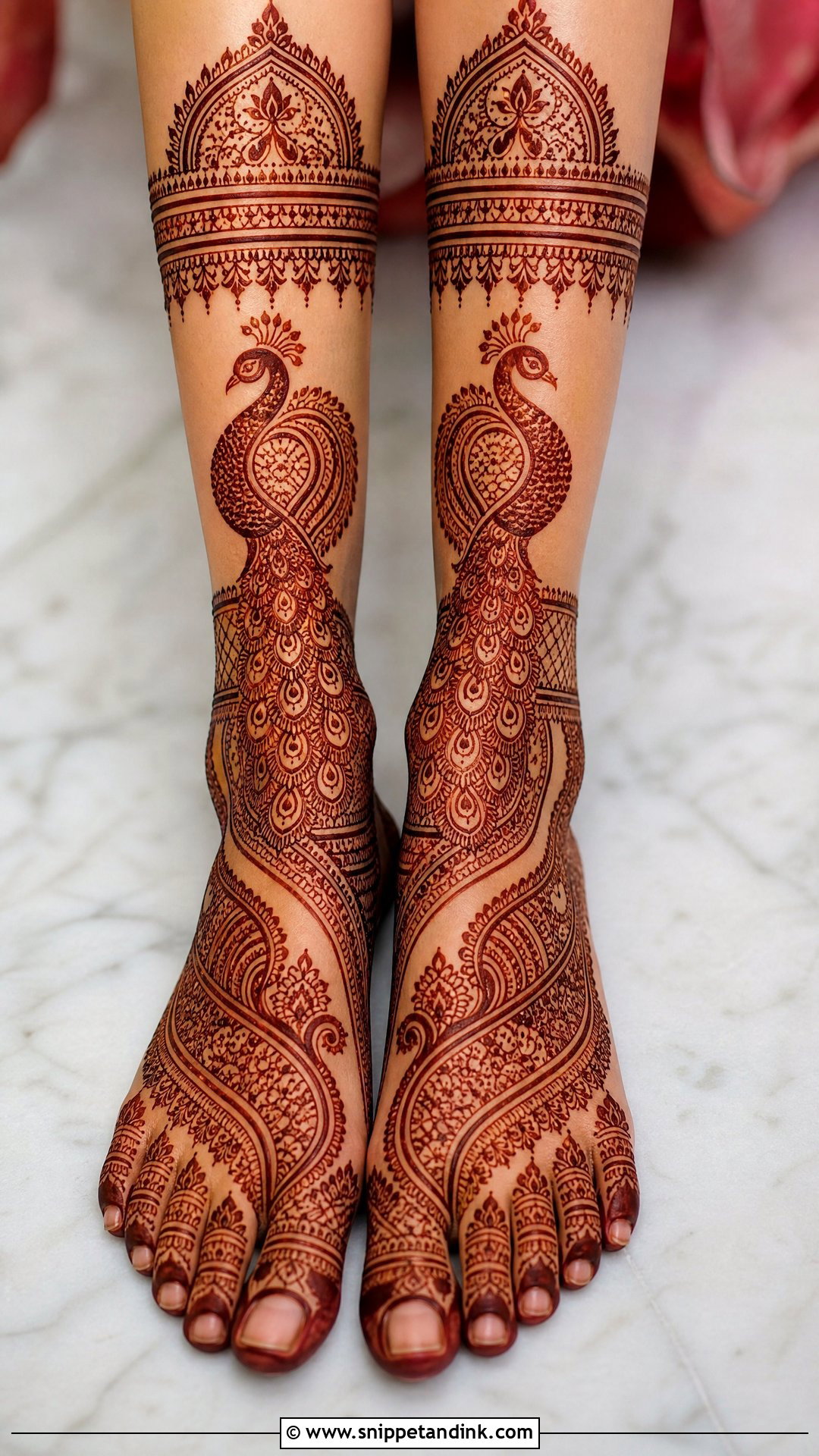
Peacocks follow the curve of the foot and calf naturally, so I place them on the top of the foot, near the ankle or along the side of the calf, surrounded by paisleys, feathers, florals and curved vines. The feathers leave room for fine lines, dots and shading. The common mistake is one leg ending up much heavier than the other because the bird takes up more space on one side. Coordinate both legs from the start. Temple jewellery and embroidered lehengas sit well with it.
7. Mandala Bridal Leg Mehndi Design
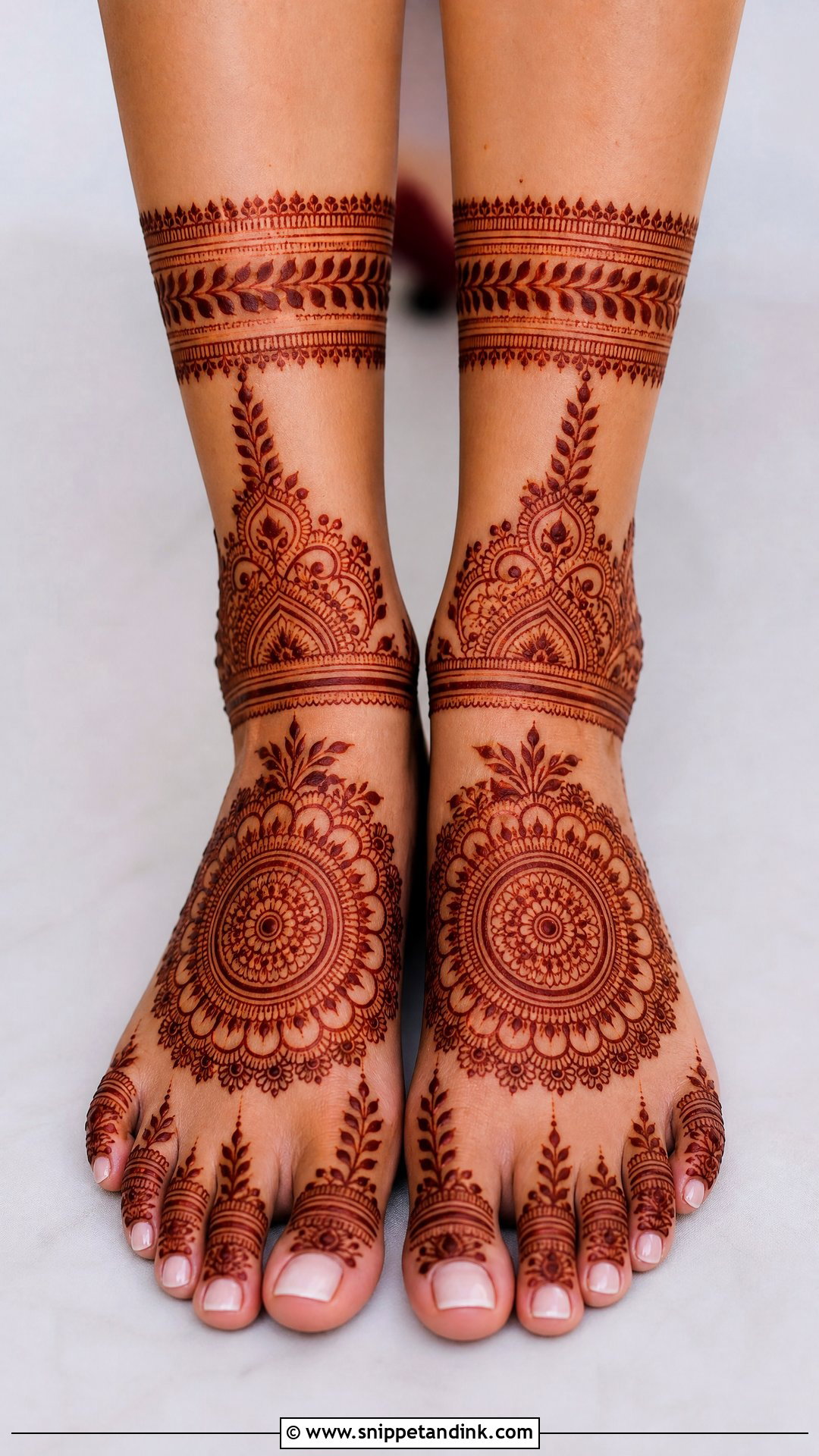
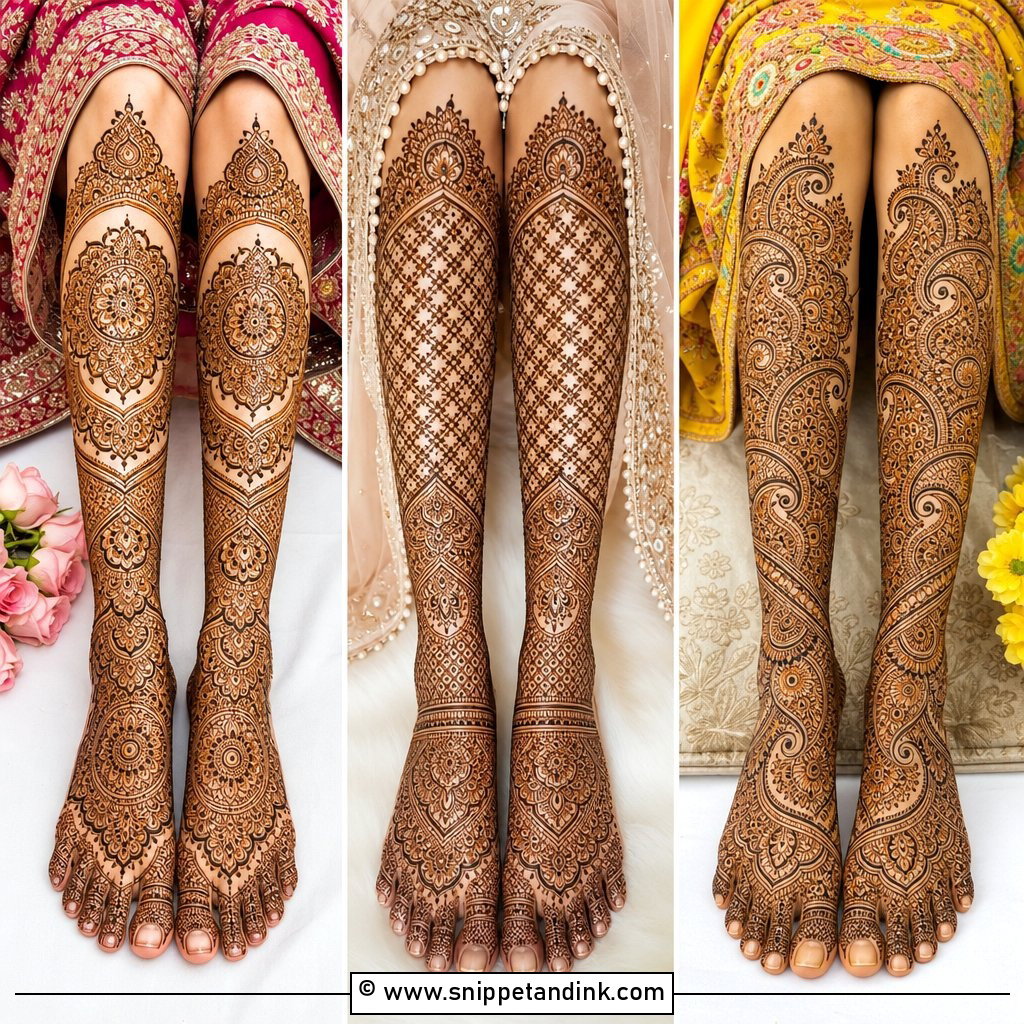
Mandala leg work centres a circle on the top of the foot and echoes smaller circles near the ankle or lower shin, finished with petals, dots, leafy bands and fine borders. It keeps leg mehndi looking organised, and it works under both simple and heavy outfits. Bony ankles can distort a circle, so I place the ankle mandala on the flatter outer side rather than over the bone itself. Detailed toes and anklet bands turn it into a bridal piece.
8. Jaal Bridal Leg Mehndi Design
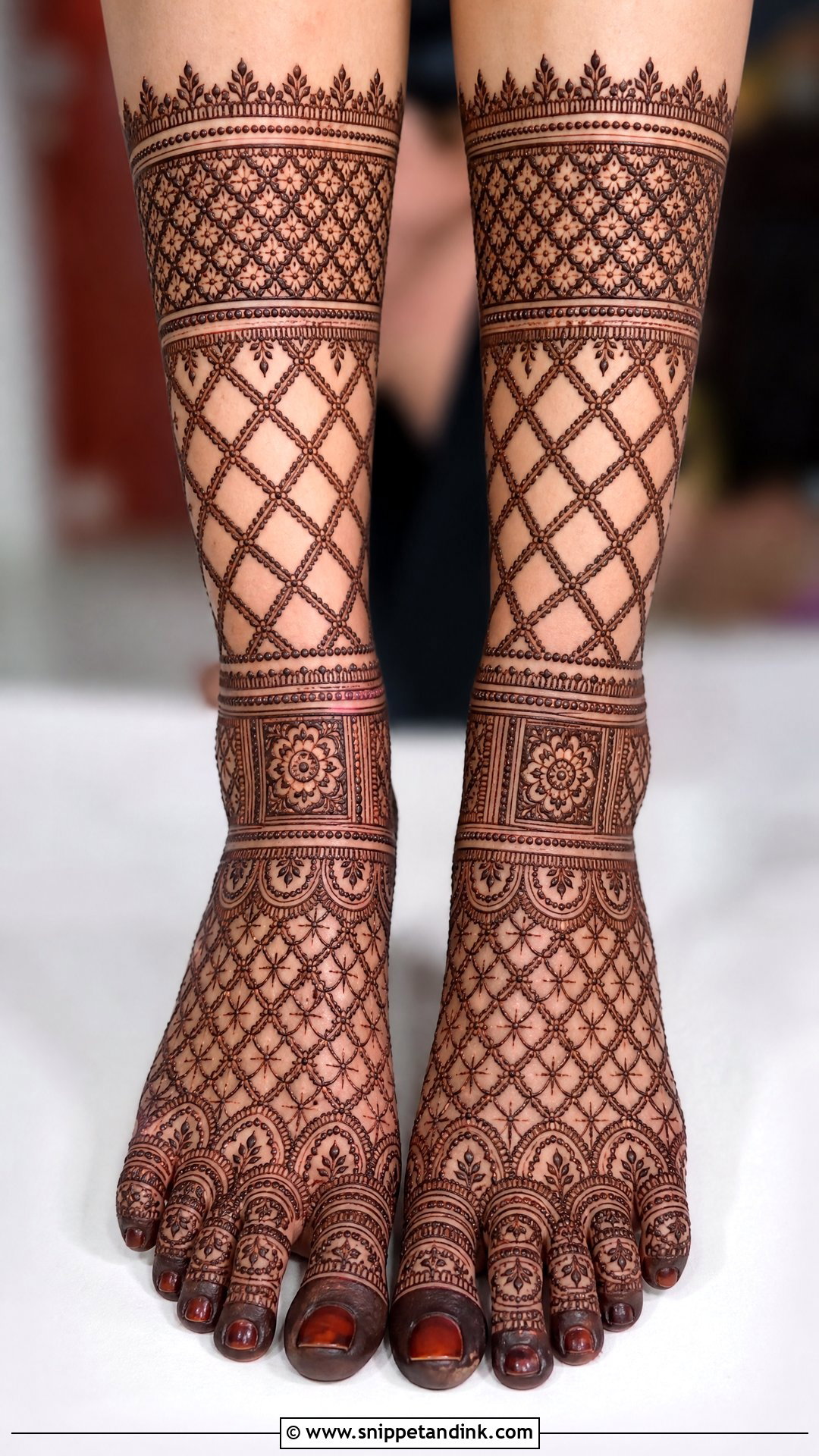
Jaal is mesh: diamonds, squares, curved nets or lace grids across the feet, ankles or lower legs, with small dots, flowers or leaves set inside the cells. It looks like jewellery, and next to an embroidered outfit it reads almost like fabric. Spacing is the make-or-break detail. Henna lines spread slightly as they dry and stain, so a net drawn too tight closes up into a dark patch. I leave the cells a little wider than they look like they need.
9. Floral Bridal Leg Mehndi Design
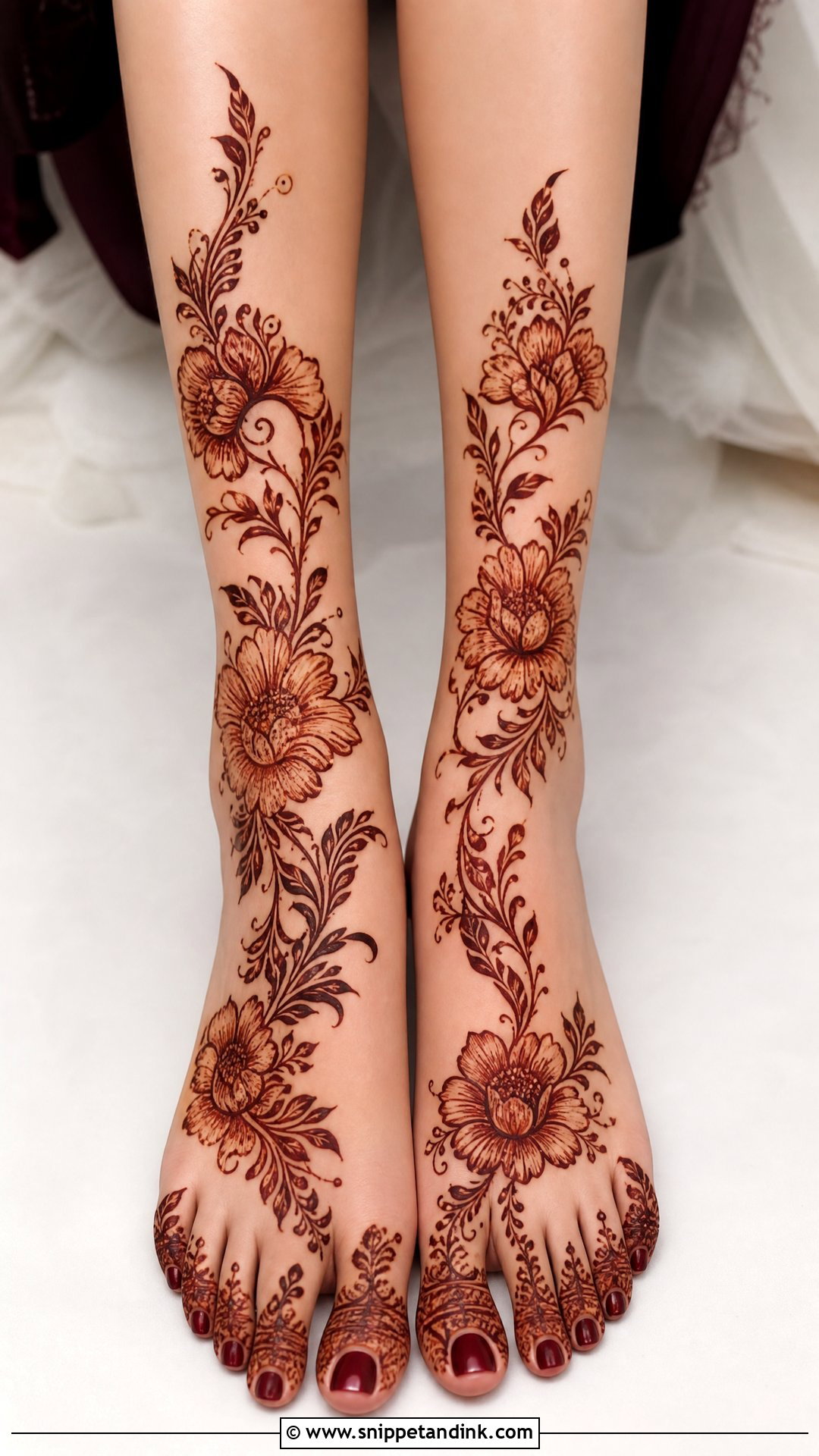
Soft petals, leafy stems and blooming vines can be drawn light and Arabic or dense and Indian, depending on the coverage you want. Large flowers sit on the foot or ankle while smaller vines travel toward the calf. Roses, lotus motifs, sunflowers or traditional henna florals all work. What I do every time is pair bold flower outlines with fine inner detail, because outline alone looks unfinished up close and fine detail alone vanishes from across a room.
10. Paisley Bridal Leg Mehndi Design
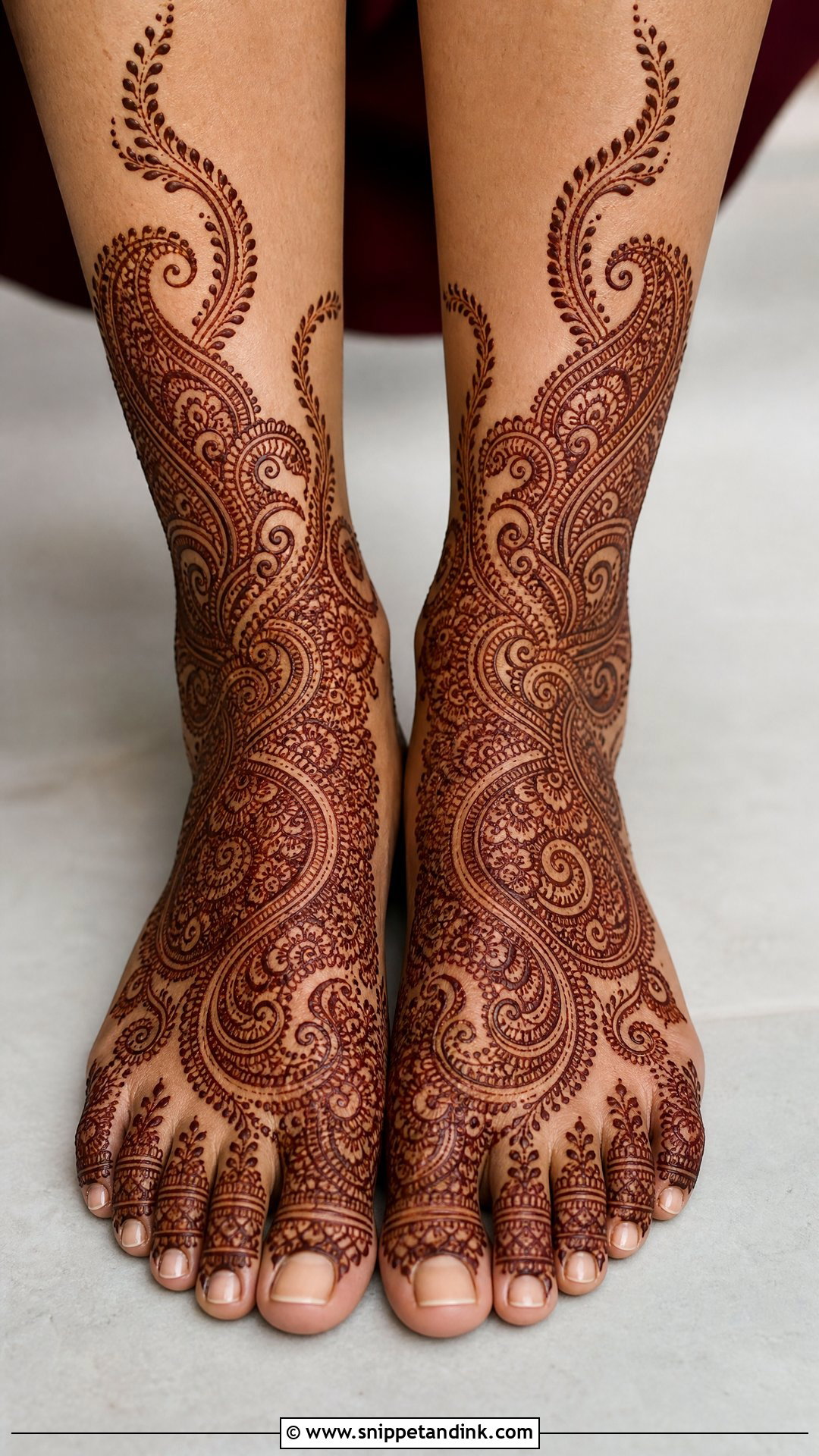
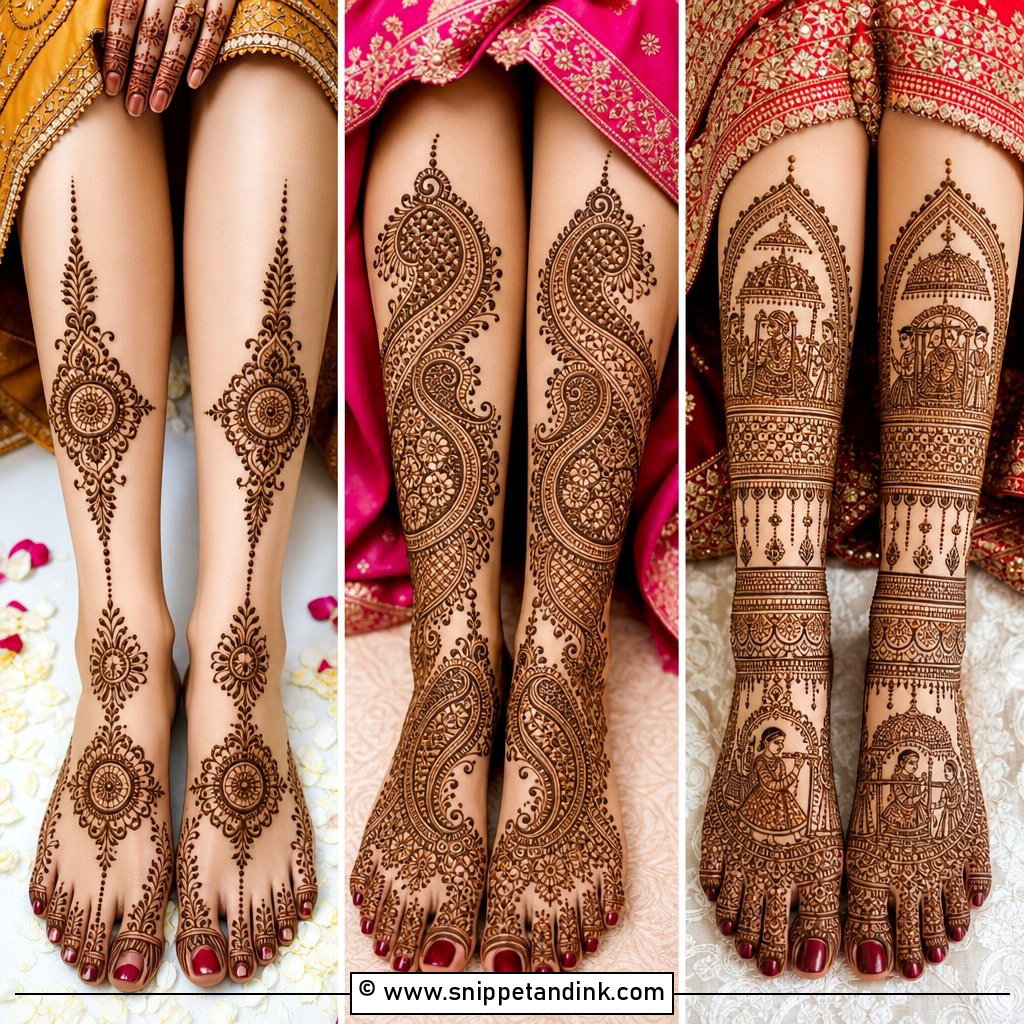
Paisleys flow naturally over curves, so the top of the foot, the side of the ankle and the shin all take them well. Large paisleys filled with tiny flowers, dots, spirals and fine lines become the main shapes, while smaller ones link the pattern from toes to ankle. No portraits or modern elements are needed for it to look rich, and it sits easily alongside full-hand work. Vary the sizes, or the design reads flat.
11. Minimal Bridal Leg Mehndi Design
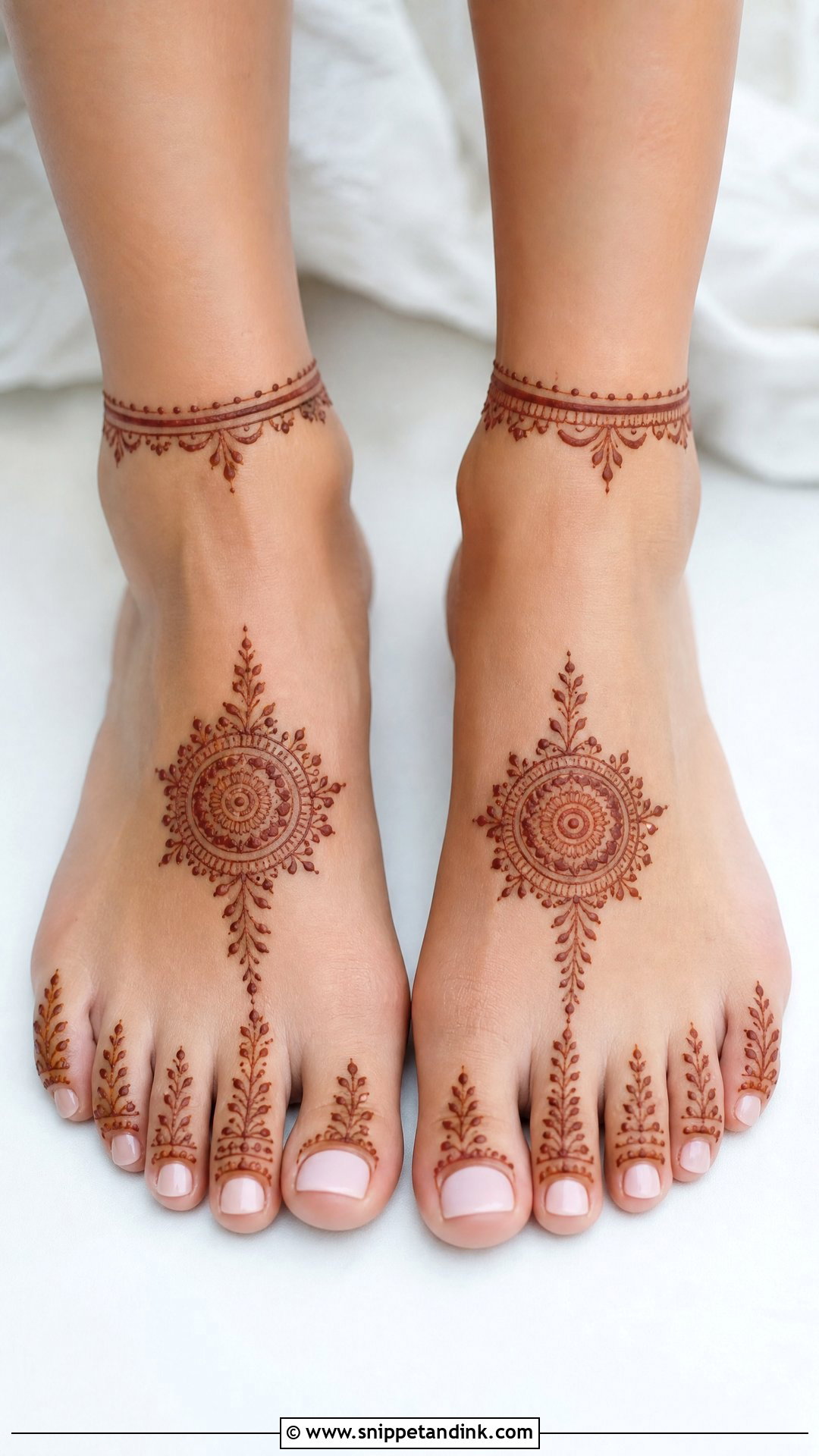
Minimal leg mehndi picks a few elements: a clean motif on the foot, a slim ankle band, a delicate vine and a couple of small florals. It suits intimate weddings, court weddings, destination ceremonies and lighter outfits, and it keeps attention on your jewellery or embroidery. With so few lines, each one shows. I’d rather draw a small mandala and a fine ankle chain perfectly than a crowded design quickly.
12. Heavy Bridal Leg Mehndi Design
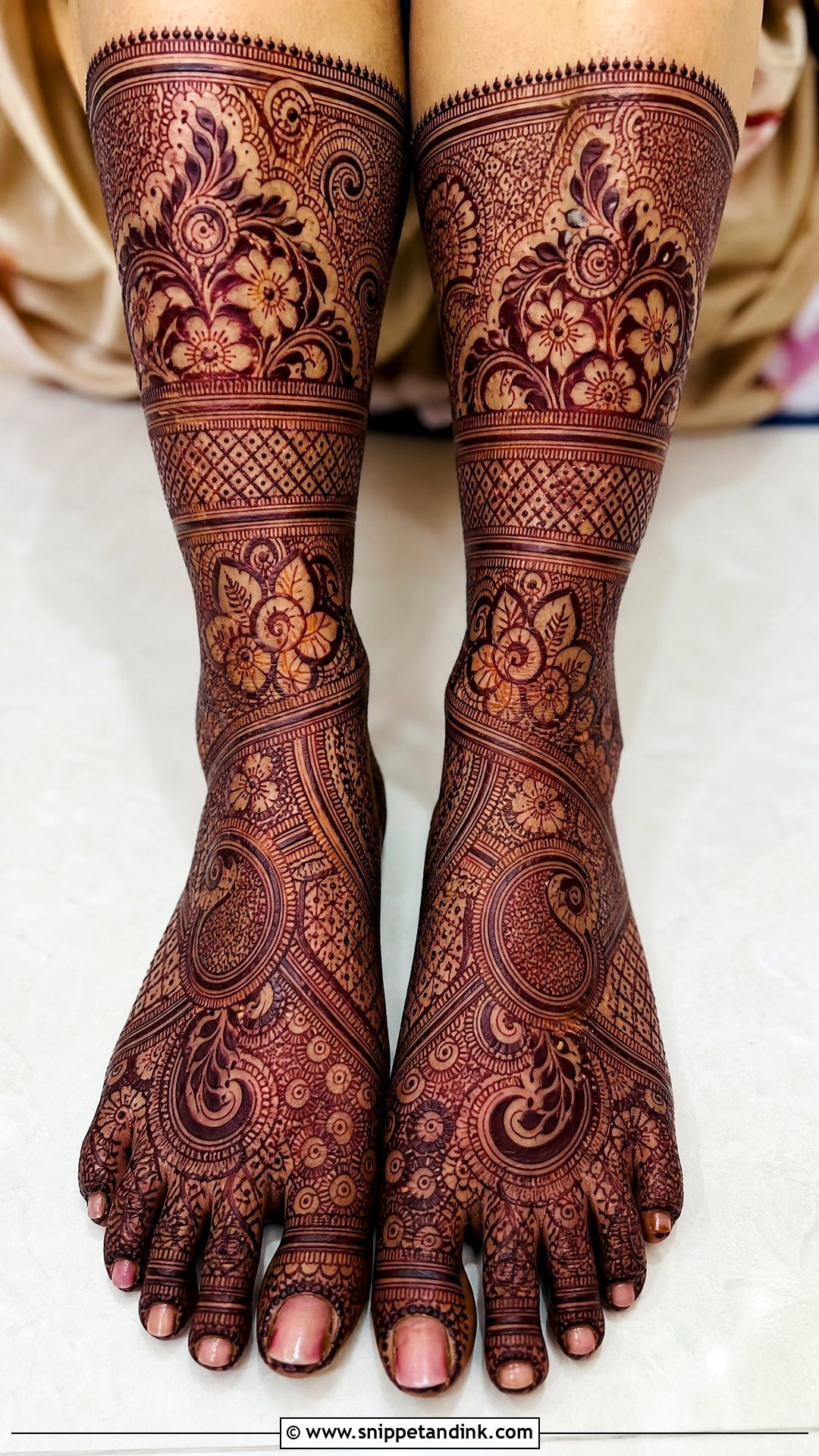
Heavy bridal leg mehndi fills from toes to calves with almost no empty space: paisleys, lotus, peacock feathers, jaali, vines and bold borders. It shows up in sitting poses and lehenga shots. Density without structure looks messy, so I divide the leg into clear sections with strong outlines before filling anything. Plan the session early in the day, wear something comfortable, and expect to stay seated for a long while afterward.
13. Simple Bridal Leg Mehndi Design
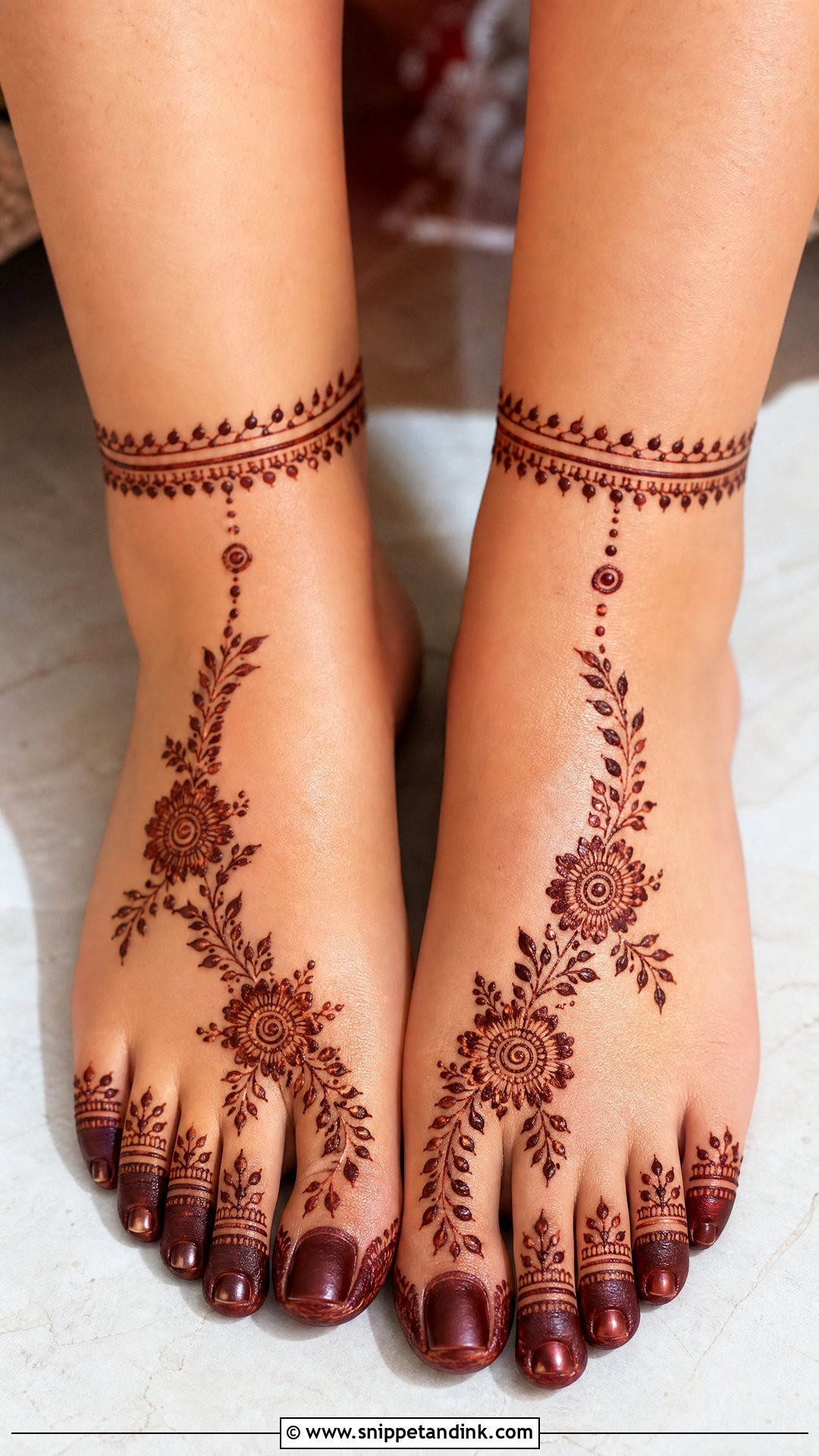
Simple bridal leg mehndi isn’t plain; it’s open. A floral foot, a neat ankle band, a few leafy trails and light toe detail can be done quickly, which helps when you have several functions in one week. The same layout suits bridesmaids and family, so if you want yours to stand apart, I add deeper detail to the bride’s feet only. Keep both legs balanced.
14. Dulhan Leg Mehndi Design
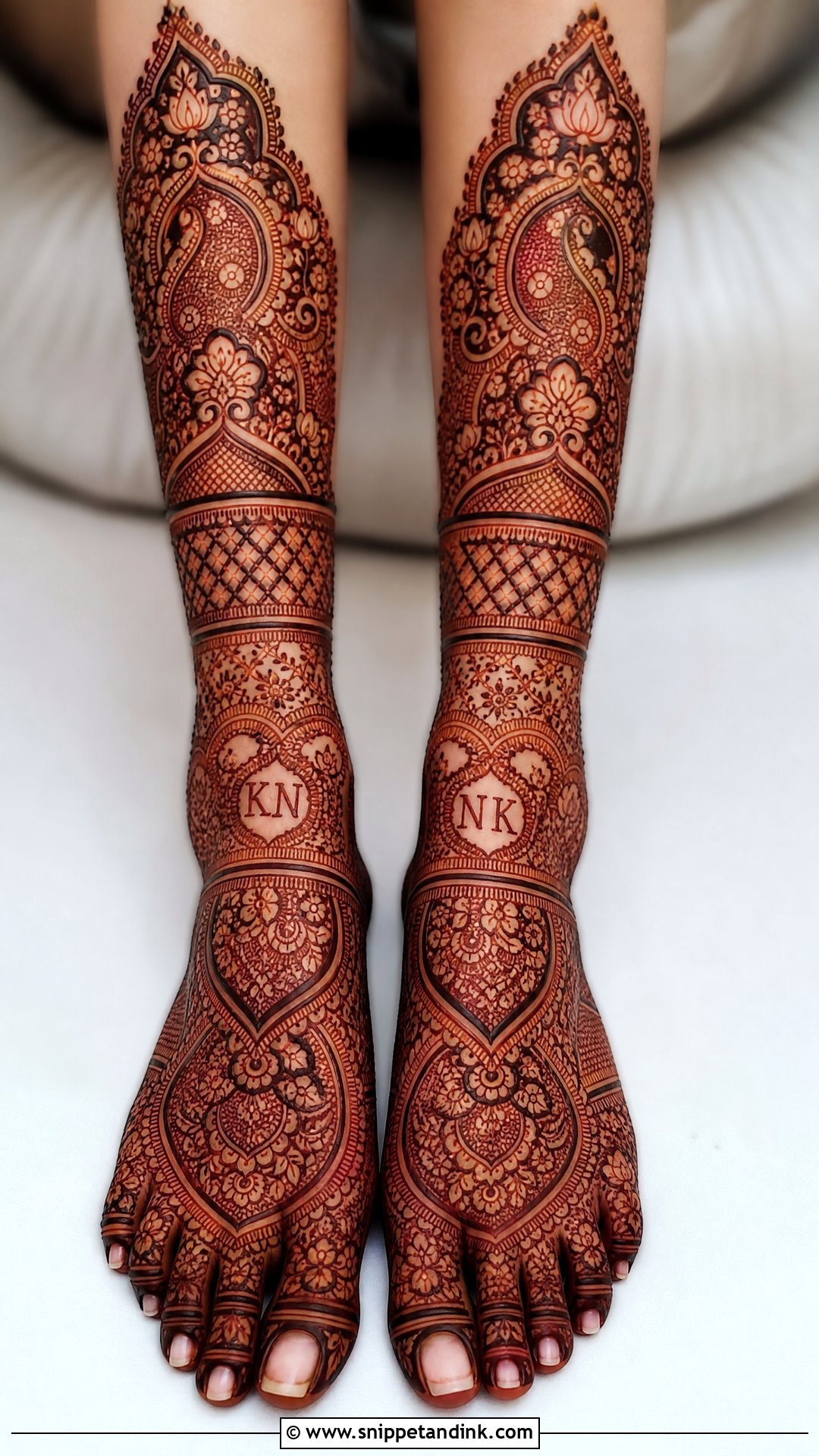
A dulhan leg design is drawn as a partner to the bridal hands. Traditional symbols, detailed foot coverage, anklet borders and motifs climbing the legs are typical, and some brides add initials, dates, small bride and groom figures or family patterns. I keep the heaviest work near the feet and let it soften as it rises, which looks deliberate and also stops the upper leg looking patchy where the stain is naturally lighter. It completes the hands-to-feet bridal look.
15. Rajasthani Bridal Leg Mehndi Design
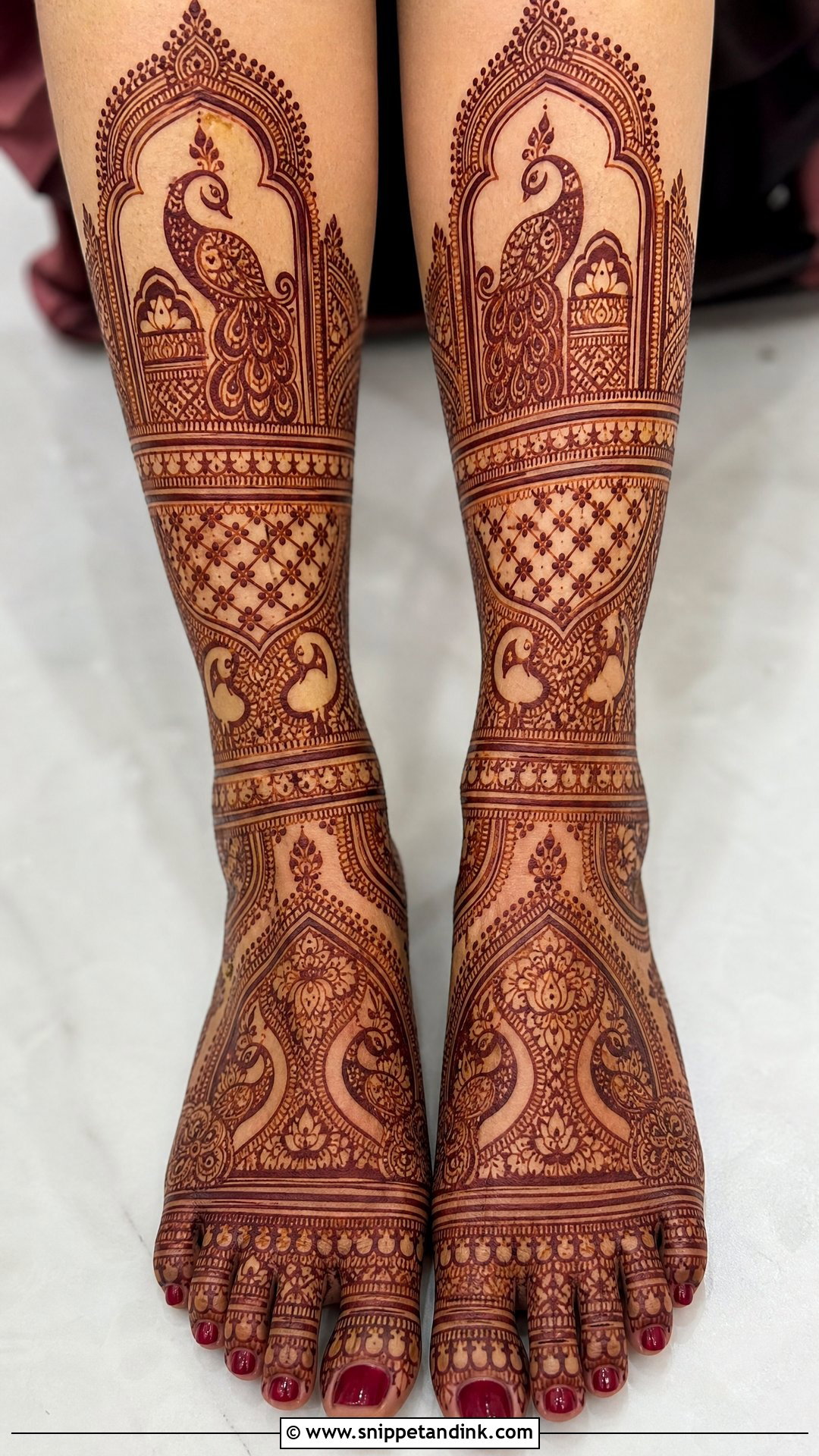
Rajasthani leg mehndi brings fine lines, mirror symmetry, peacocks, paisleys, royal patterns and sometimes tiny wedding scenes, with the feet fully covered and organised panels rising toward the calf. It needs a very steady hand and a lot of patience from both of us. It suits lehengas in bandhni or gota patti and heavy jewellery. Large central motifs with detailed fillers around them keep the legs regal instead of packed.
16. Pakistani Bridal Leg Mehndi Design
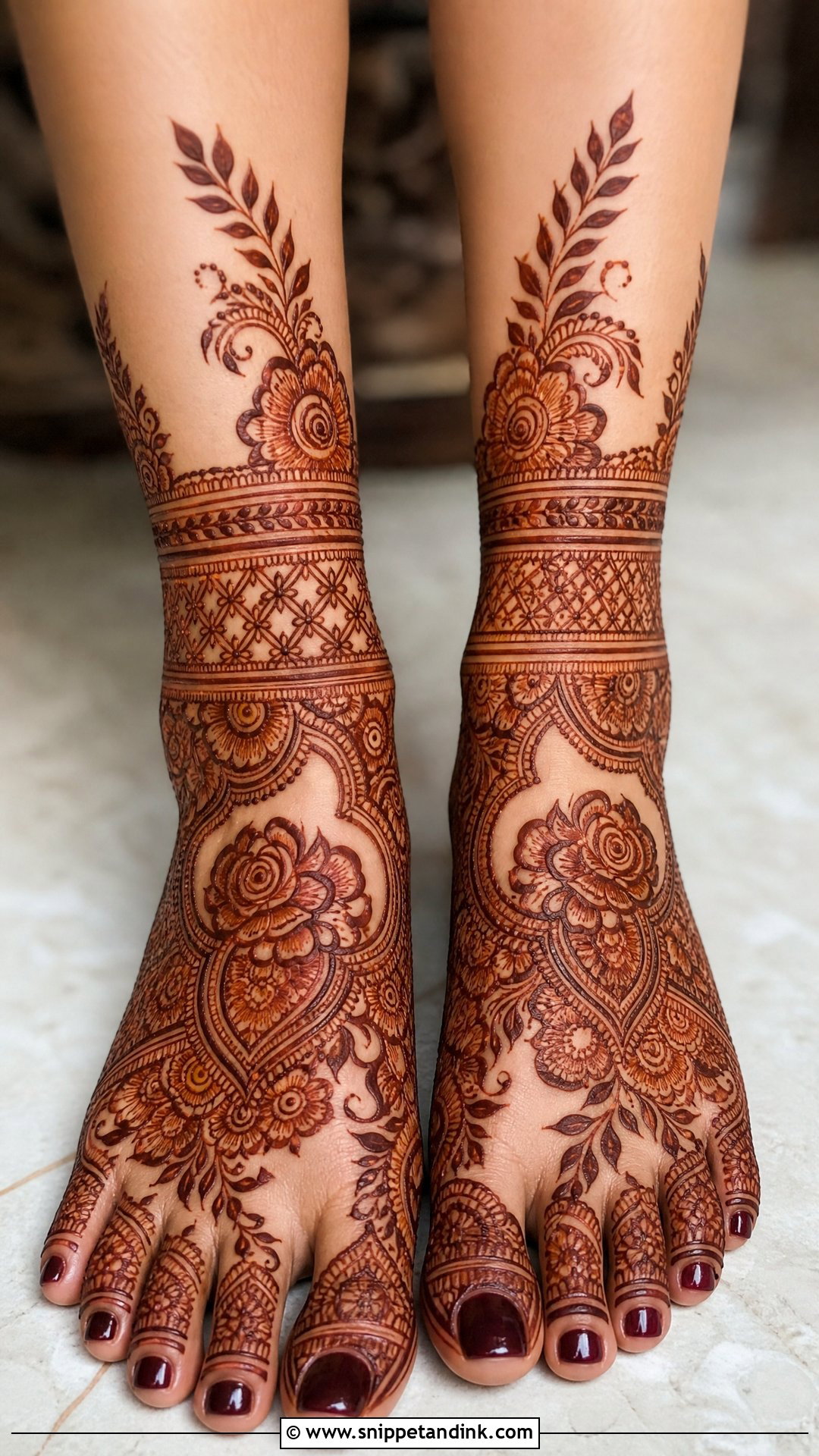
Pakistani leg designs balance bold florals, fine Indian-style detail and Arabic spacing. Expect beautifully covered feet, decorated toes, anklet bands or flowing vines around the ankle, and sometimes paisleys, jaali and shaded florals up to the lower calf. Ghararas, shararas, lehengas and long bridal dresses all suit it. I keep the negative space properly clean here; a stray dot or smudge in an open area is far more visible than in a dense design.
17. Moroccan Bridal Leg Mehndi Design
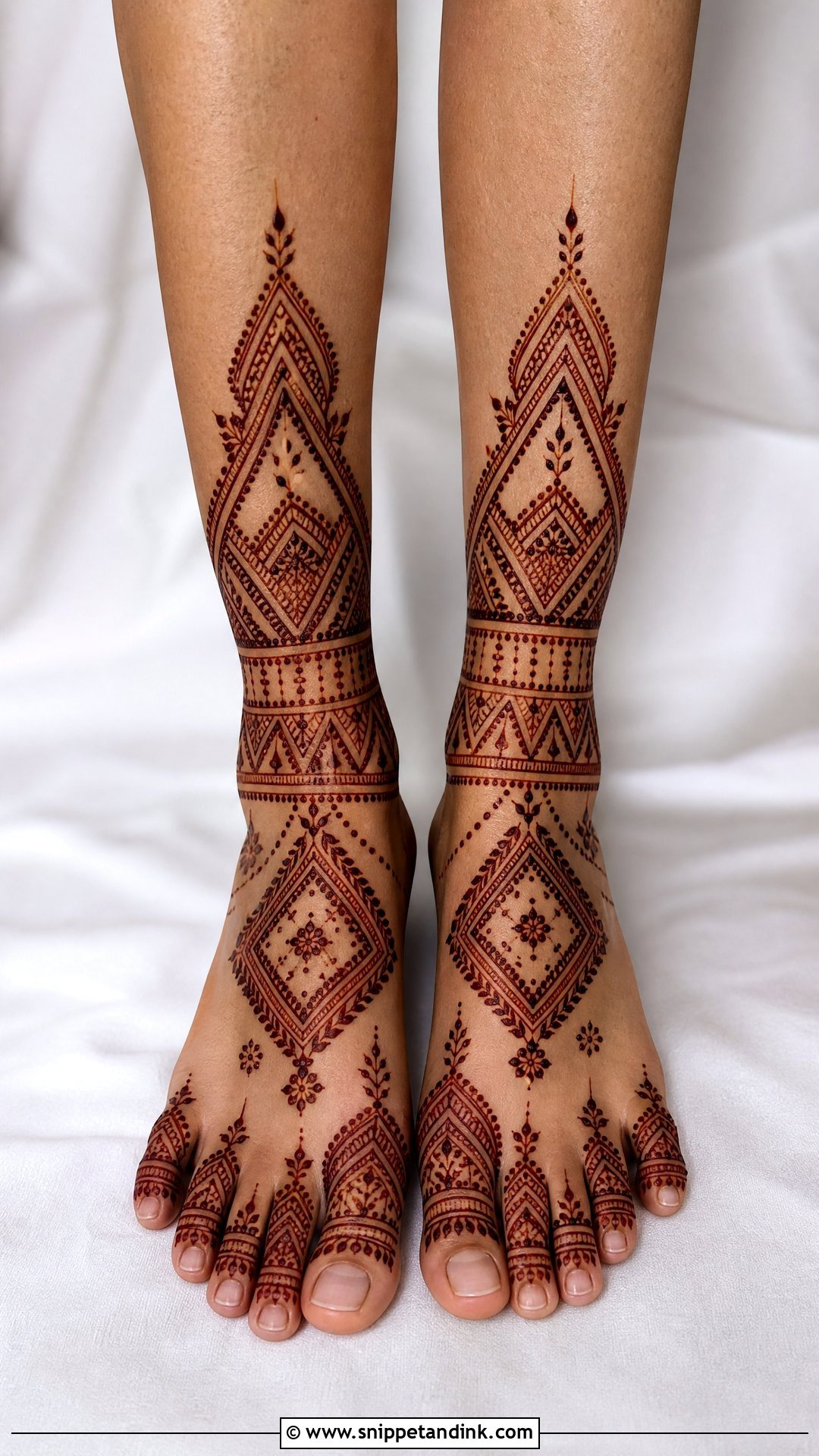
Moroccan bridal leg mehndi uses diamonds, triangles, lines, grids and structured bands rather than vines alone. Geometric toe detail, a patterned panel on the foot and bands from ankle to shin give a modern, graphic result that sits well with contemporary and fusion outfits. I scatter small florals or dots between the geometric sections to make it feel bridal without losing the Moroccan character.
18. Gulf Bridal Leg Mehndi Design
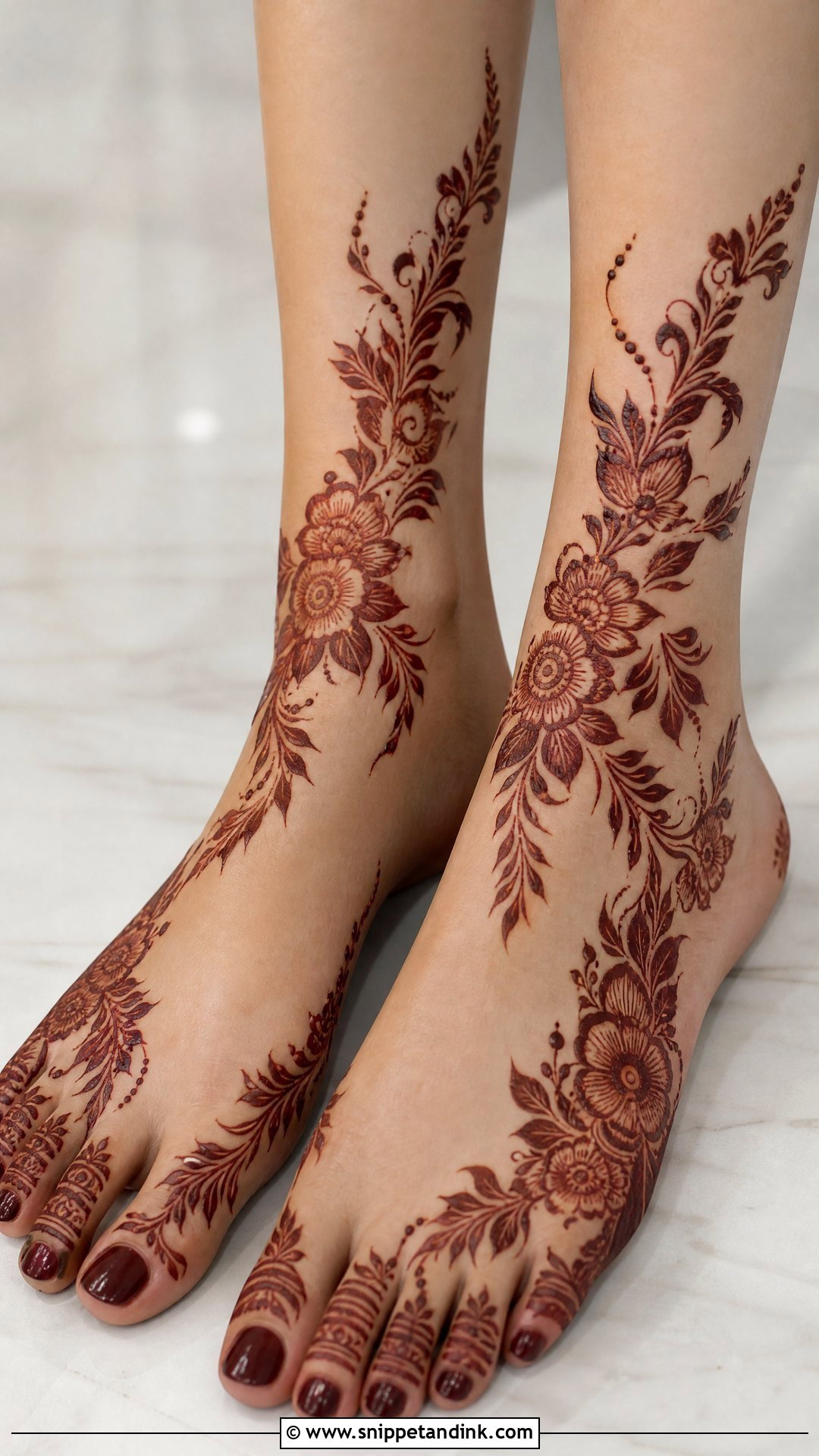
Khaleeji-inspired Gulf mehndi relies on bold florals, leafy sprays and dramatic spacing, leaving plenty of skin bare. On the legs I usually run it as a trail from foot to calf or as a pattern down the outer side of the leg. Large flowers, curved stems and shaded leaves create movement, and the thick outlines stain deep. Smooth shading is the detail to ask about; blotchy shading is the first thing that looks amateur in close-ups.
19. Bridal Ankle Band Mehndi Design
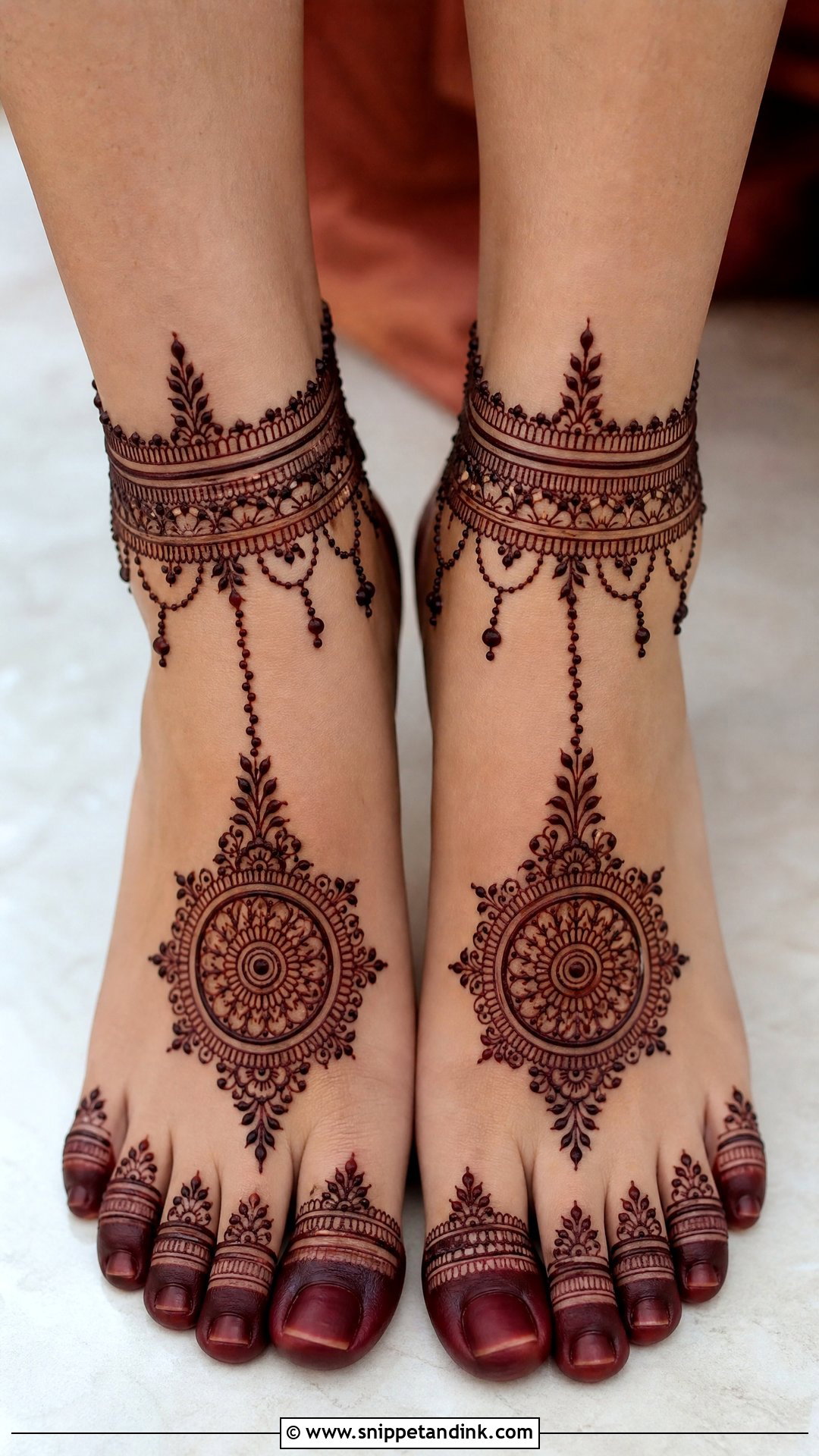
An ankle band is henna jewellery: simple, layered, floral, jaali-based or detailed like a payal, circling the ankle and joined to a foot motif with chains, dots, vines or hanging drops. It frames real anklets instead of hiding under them, and it shows with open sandals and any outfit that lifts at the hem. Add filled toes and a central foot mandala for a bridal version. Bands take a lot of rubbing from straps and fabric, so I draw them with a slightly bolder line than the foot work.
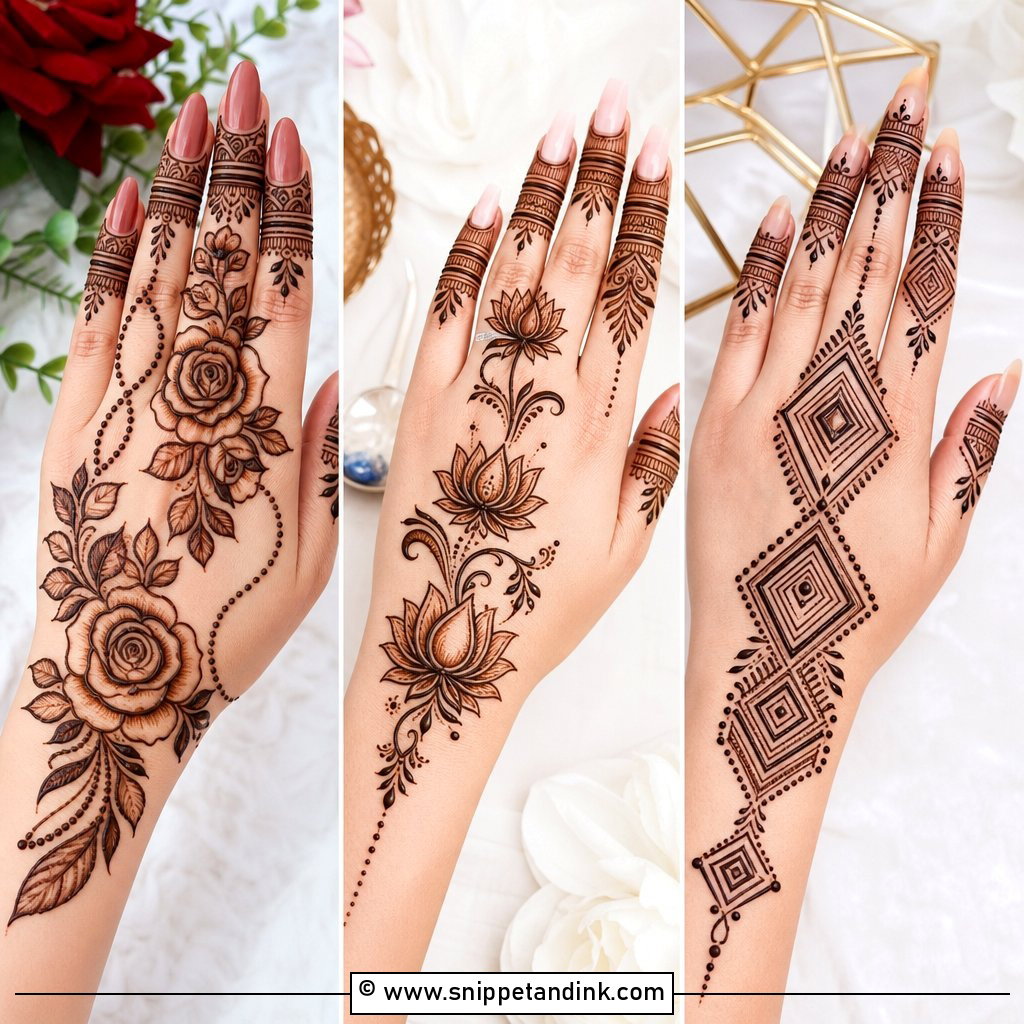
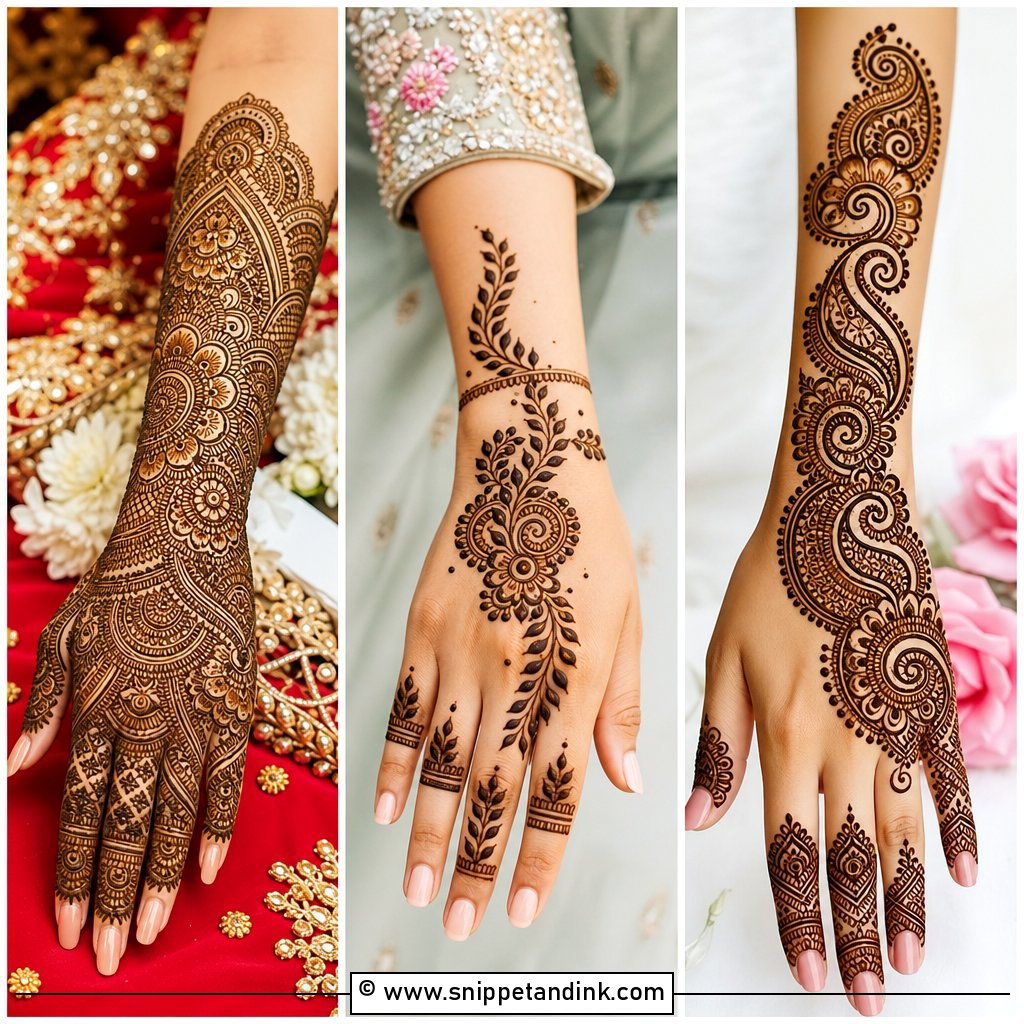
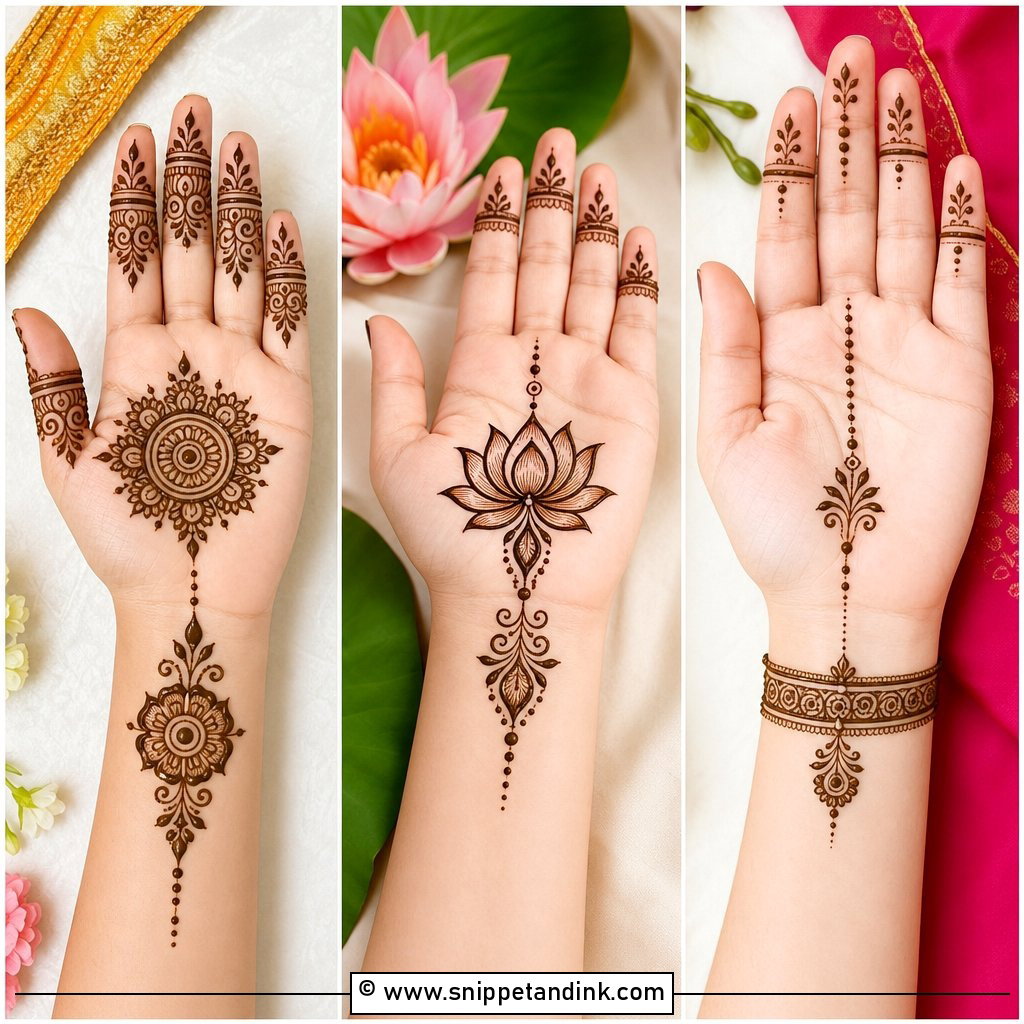
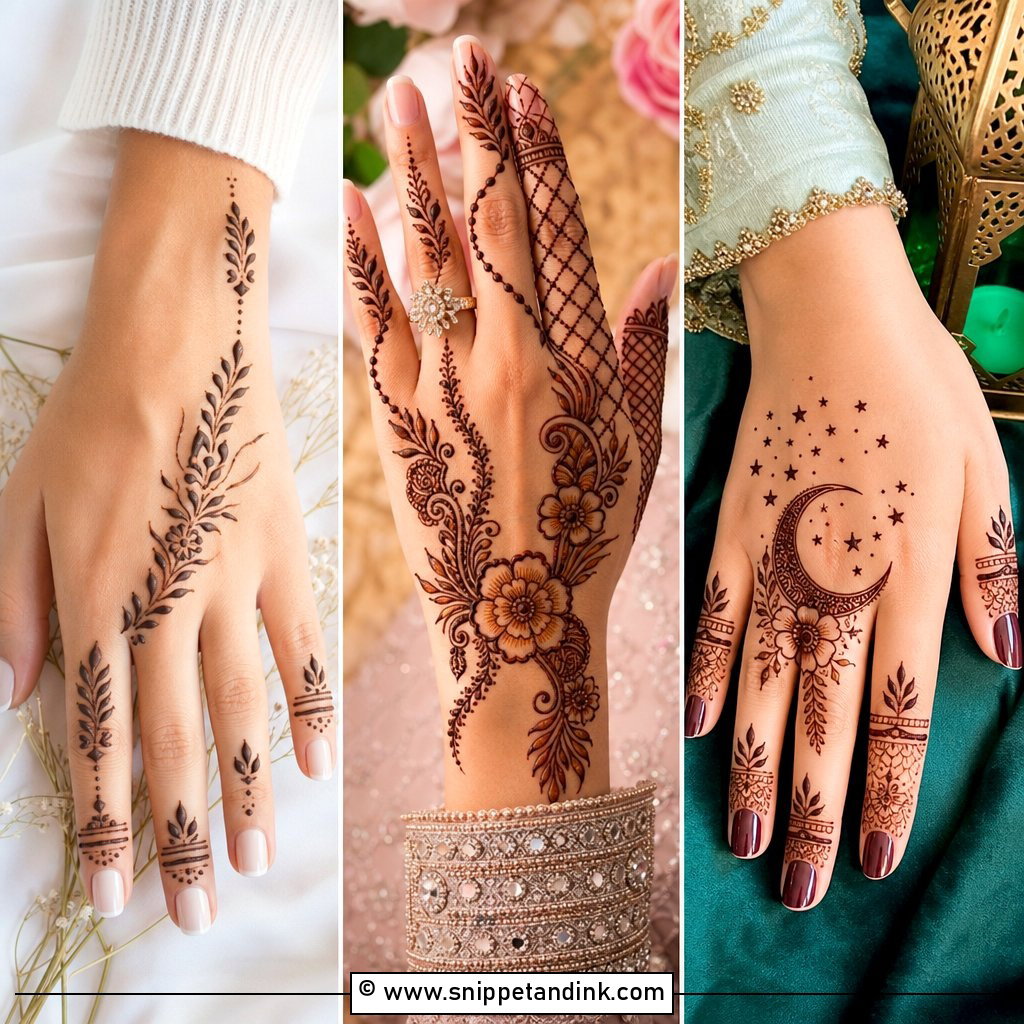
20. Knee Length Bridal Leg Mehndi Design
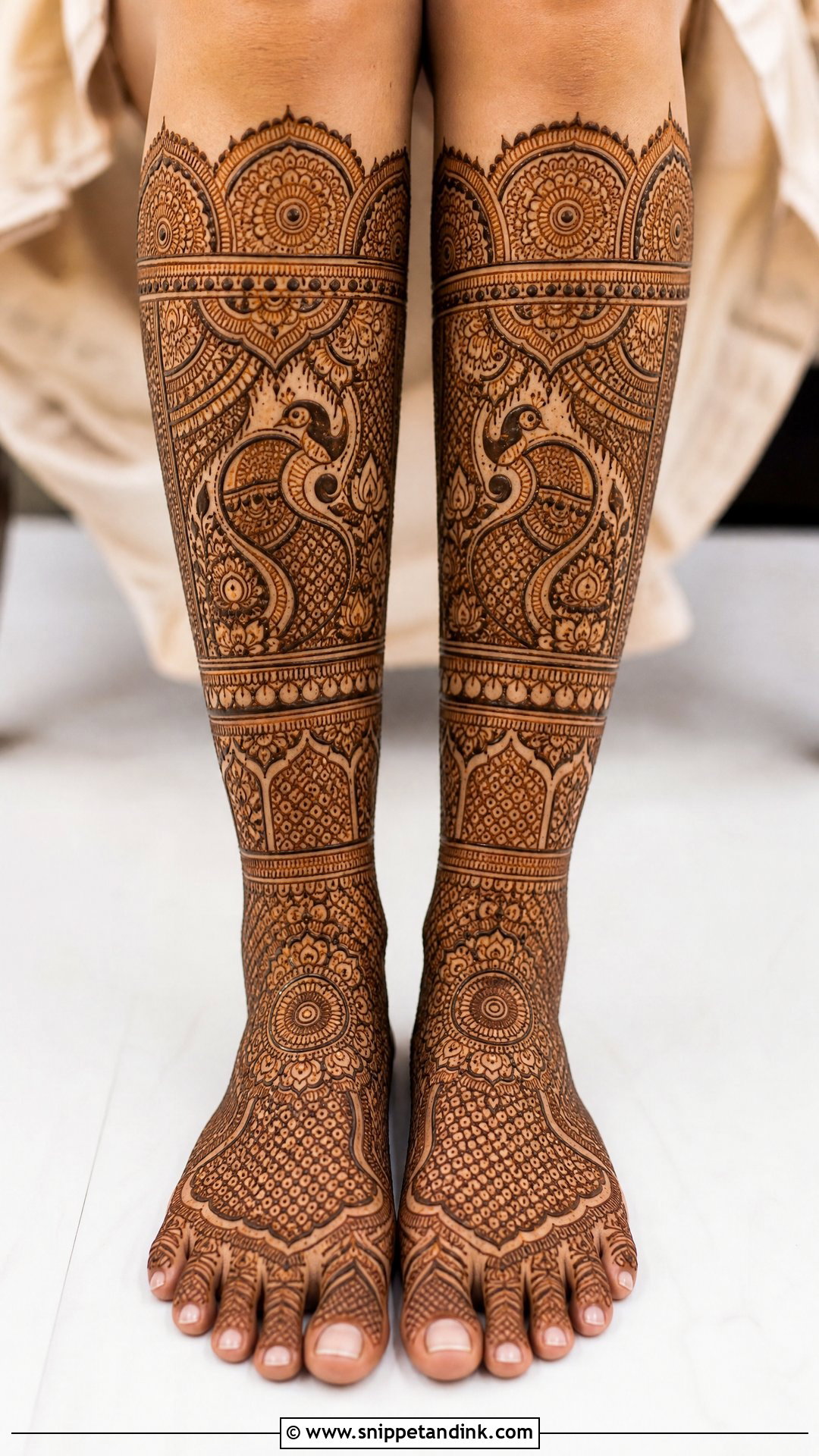
Knee length mehndi covers the feet, ankles, shins, calves and up toward the knee. With that much skin, I plan it in sections: dense mandalas or paisleys on the feet, bands at the ankles, then larger florals, peacocks or jaali panels on the calves so the design doesn’t repeat itself. It makes a strong statement in bridal portraits. It is also the longest sitting on this list, and the back of the calf is awkward to reach, so you’ll be shifting position several times.
Pale or Patchy Leg Stain, and What Helps
Leg stains disappoint more often than hand stains, and the reasons are usually predictable. The skin on the shins and calves is thinner and holds less colour than the soles. Feet that get washed, scrubbed or walked on soon after the paste comes off lose depth. Lotion or body oil applied before the session blocks the dye, and leftover hair stops paste touching the skin evenly.
- Keep the paste on overnight if you can, and keep your feet warm under a light blanket rather than a fan.
- Scrape the dry paste off; don’t rinse it. Then keep water off the area for as long as possible.
- Rub a little oil over the design before every bath for the first few days, so soap doesn’t strip the surface.
- Give it time. A stain that looks orange at removal often turns a deep red-brown by the next evening.
If a section still looks faint a day later, a careful artist can retrace thin lines with fresh paste, though the new colour won’t match perfectly. What I’d never do is reach for a dark “instant” cone to cover a pale patch. Those can contain chemical dyes that blister skin, and a reaction on your feet the day before the wedding is far worse than a light stain.
Dense Calves or Bare Shins, Both Can Read as Bridal
Start from your outfit and the photos you want. Full-leg and knee-length designs feel grand and traditional; Arabic, minimal and ankle-band designs are lighter to wear. Indian, Rajasthani, Pakistani, Moroccan and Gulf patterns each have their own character, so there isn’t one right answer. What does matter is clean placement, coverage that’s balanced between the two legs, and motifs that suit you. Settle those with your artist and the leg design will hold its own next to your hands.
You'll Like These Ideas:


Leave a Reply