
A wrist design is the henna I apply most often outside of bridal bookings. It takes a fraction of the time of a full hand, it sits where bangles and bracelets already draw the eye, and it suits Eid, a cousin’s sangeet or an ordinary weekend just as well. The shapes below range from a single dotted band to a full jaali cuff, with Arabic, Indian, Gulf and Moroccan styles in between. One thing to know before you pick: skin on the wrist stains lighter than the palm, so the strongest wrist designs rely on clear outlines and open space rather than dense filling. I’ve added notes on which patterns hold their colour and which ones fade first.
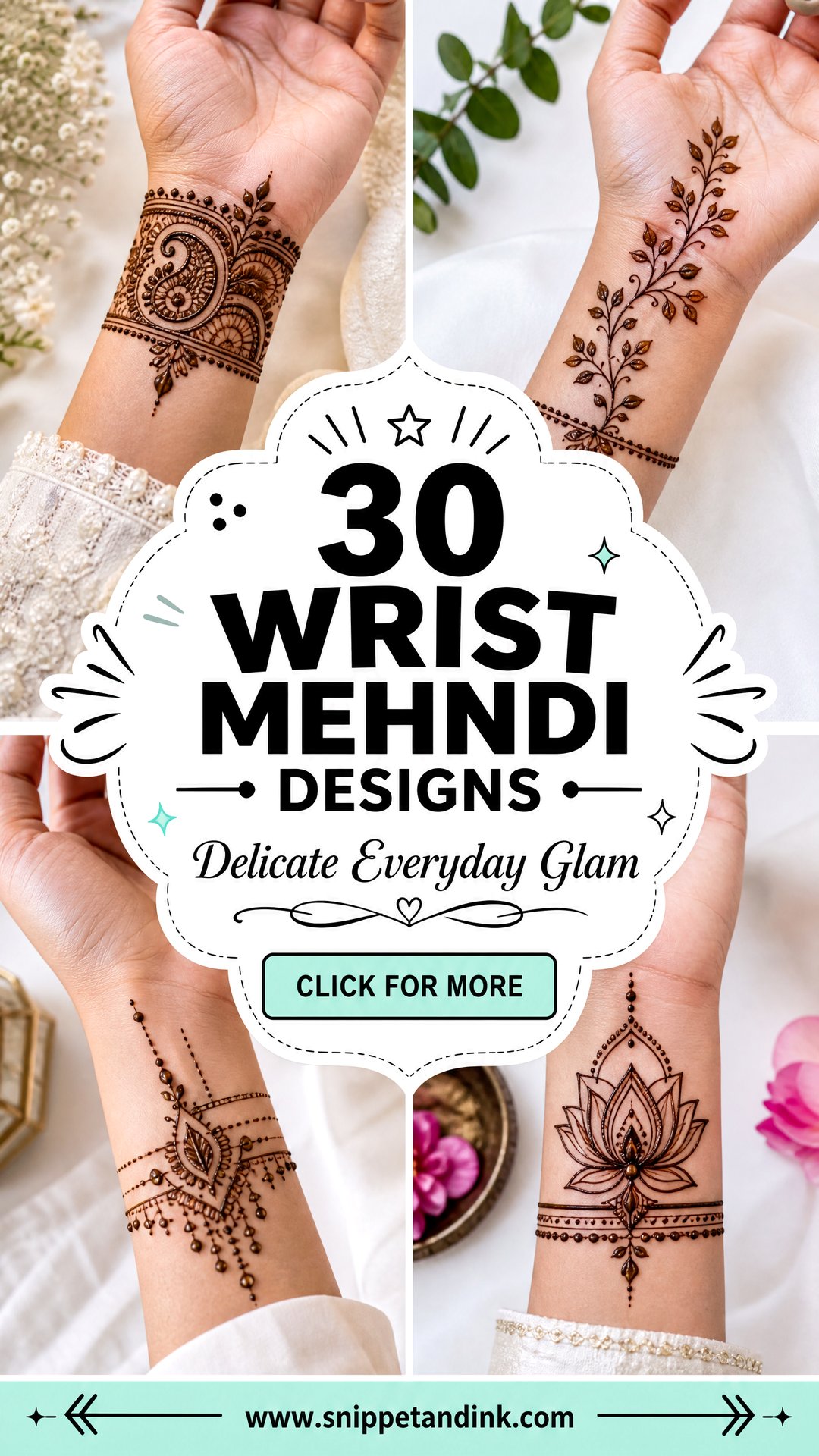
Where on the Wrist the Band Should Sit
Placement decides more than the pattern does. Before I start, I ask what will be worn on that arm, because a design hidden under a sleeve or a stack of bangles is wasted work.
- Bangles and kade: put the band just below the wrist bone, toward the hand, so it shows between the bangles and the knuckles.
- Watch or bracelet on one side: put the detailed side of the design on the other arm, or keep that wrist to a narrow line that the strap won’t cover.
- Three quarter or full sleeves: let the design climb onto the back of the hand. Anything above the wrist bone will be hidden.
- Sleeveless or short sleeves: a forearm extension is worth the extra time, since it will actually be seen.
I also check the wrist crease. Lines laid straight across it crack when the wrist bends while the paste is wet, so a band either sits clear of the crease or the client keeps that arm straight for the first twenty minutes.
1. Simple Bracelet Wrist Mehndi Design
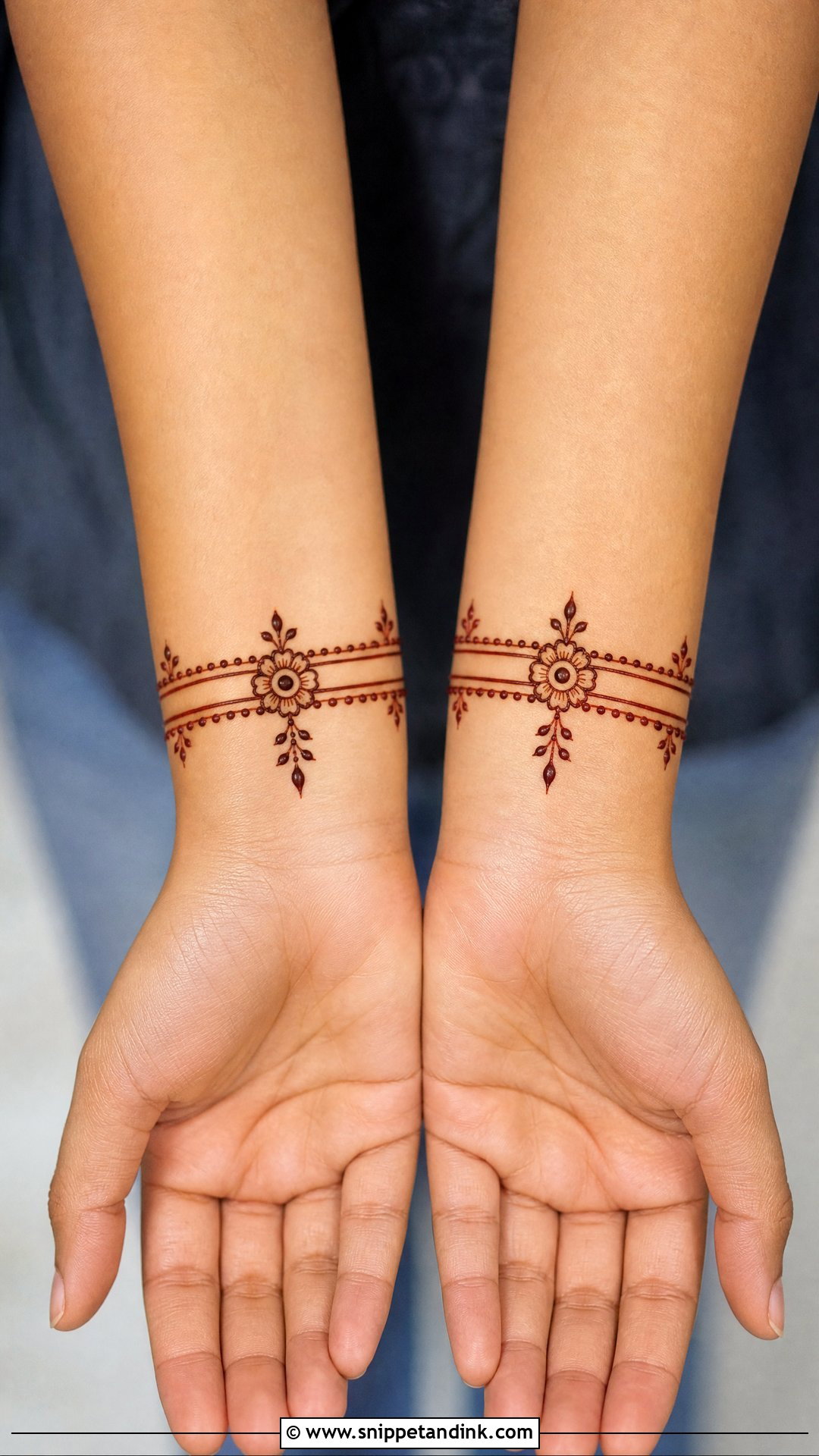
Start here if you have never had henna before. One neat band wraps the wrist like a thin bangle, built from dots, curved lines, small leaves and a little centre flower. Spacing is the whole design, so I mark the centre point first and work outward to each side to keep it even. It needs no filling and dries quickly. Leave the hand bare or add a dot on each fingertip.
2. Arabic Floral Wrist Mehndi Design
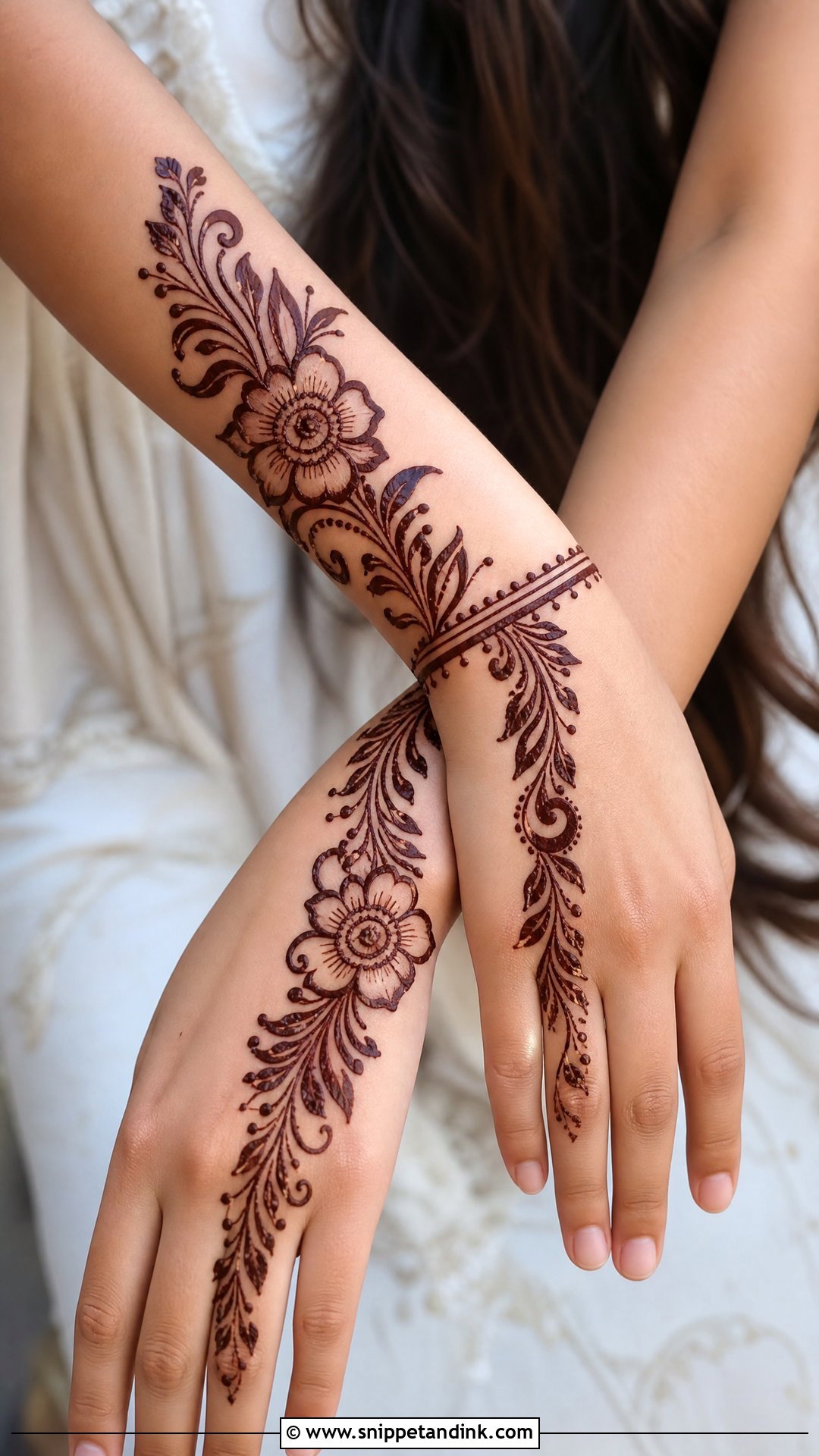
Arabic florals use big open petals and leafy trails that start at the wrist and drift onto the back of the hand or up the forearm. The open space is what makes the stain look rich: thick petal outlines hold more paste, and more paste means a darker result. It is quick for the amount of impact you get, which is why I suggest it for Eid and engagement parties. Keep the trail going one direction; Arabic flow looks wrong when it doubles back.
3. Indian Cuff Wrist Mehndi Design
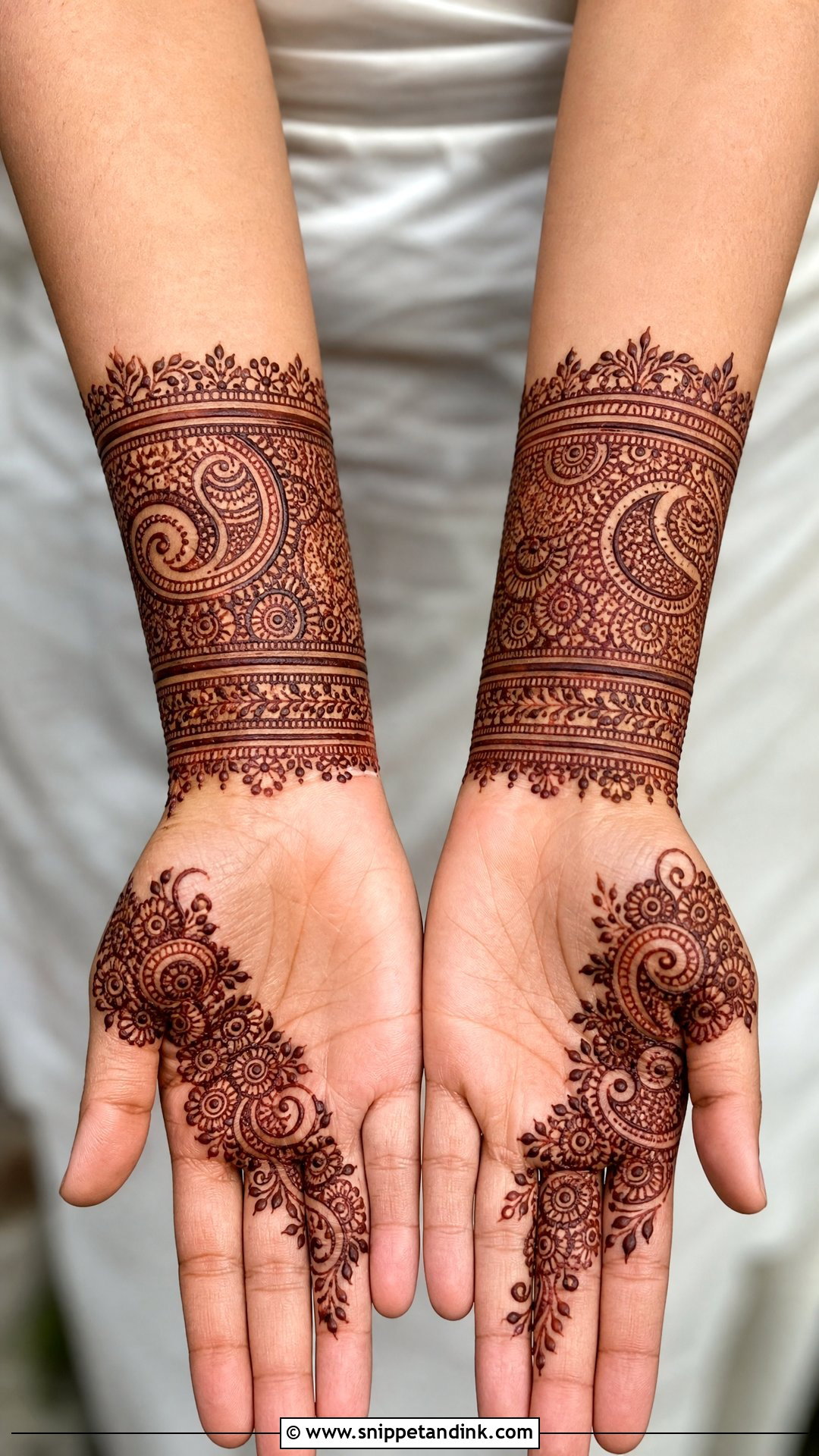
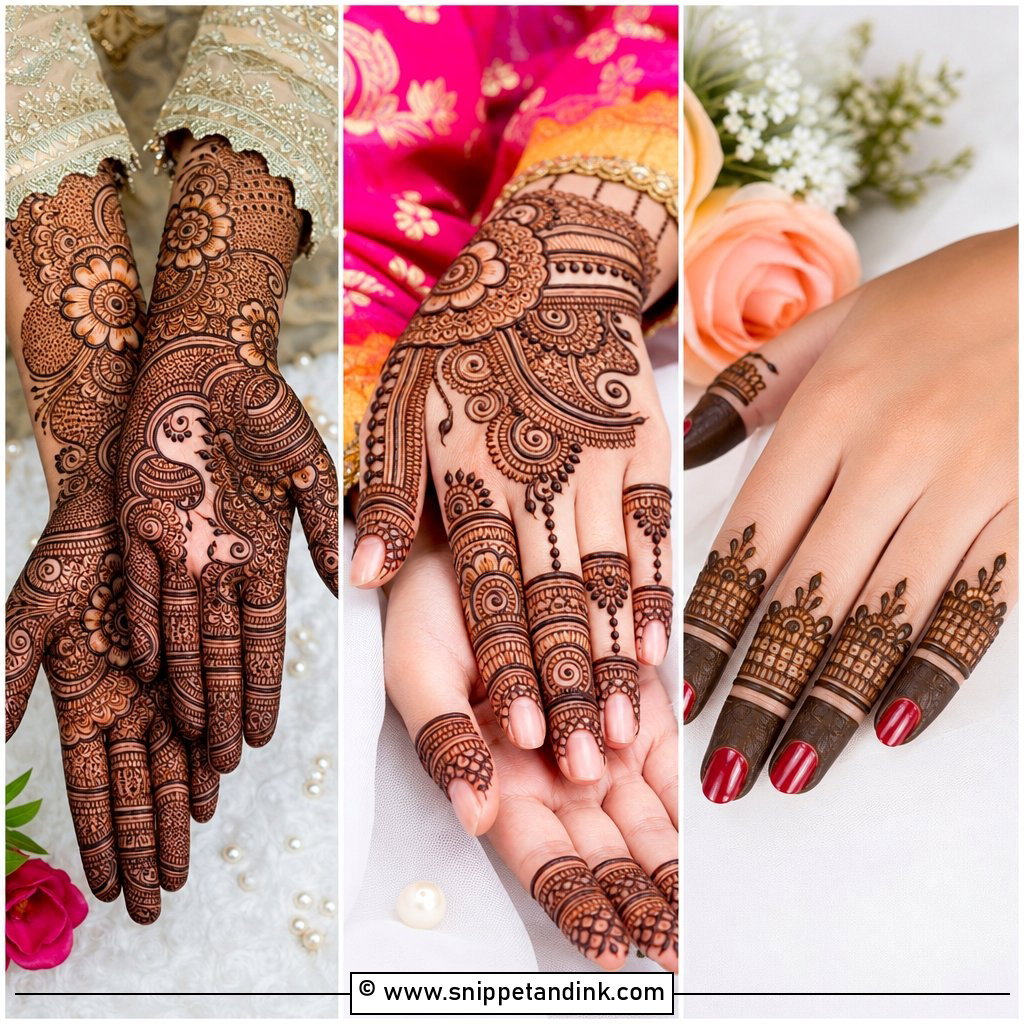
An Indian cuff is a wider band packed with paisleys, small flowers, leaf borders and fine line filling. It can stop at the wrist or run a little up the forearm. The fine filling is the tricky part: thin lines on the wrist stain lighter than on the palm, so I thicken them slightly here compared with bridal palm work. Clean, matching top and bottom edges make the cuff look deliberate. Bridesmaids and wedding guests ask for this one most.
4. Minimal Wrist Mehndi Design
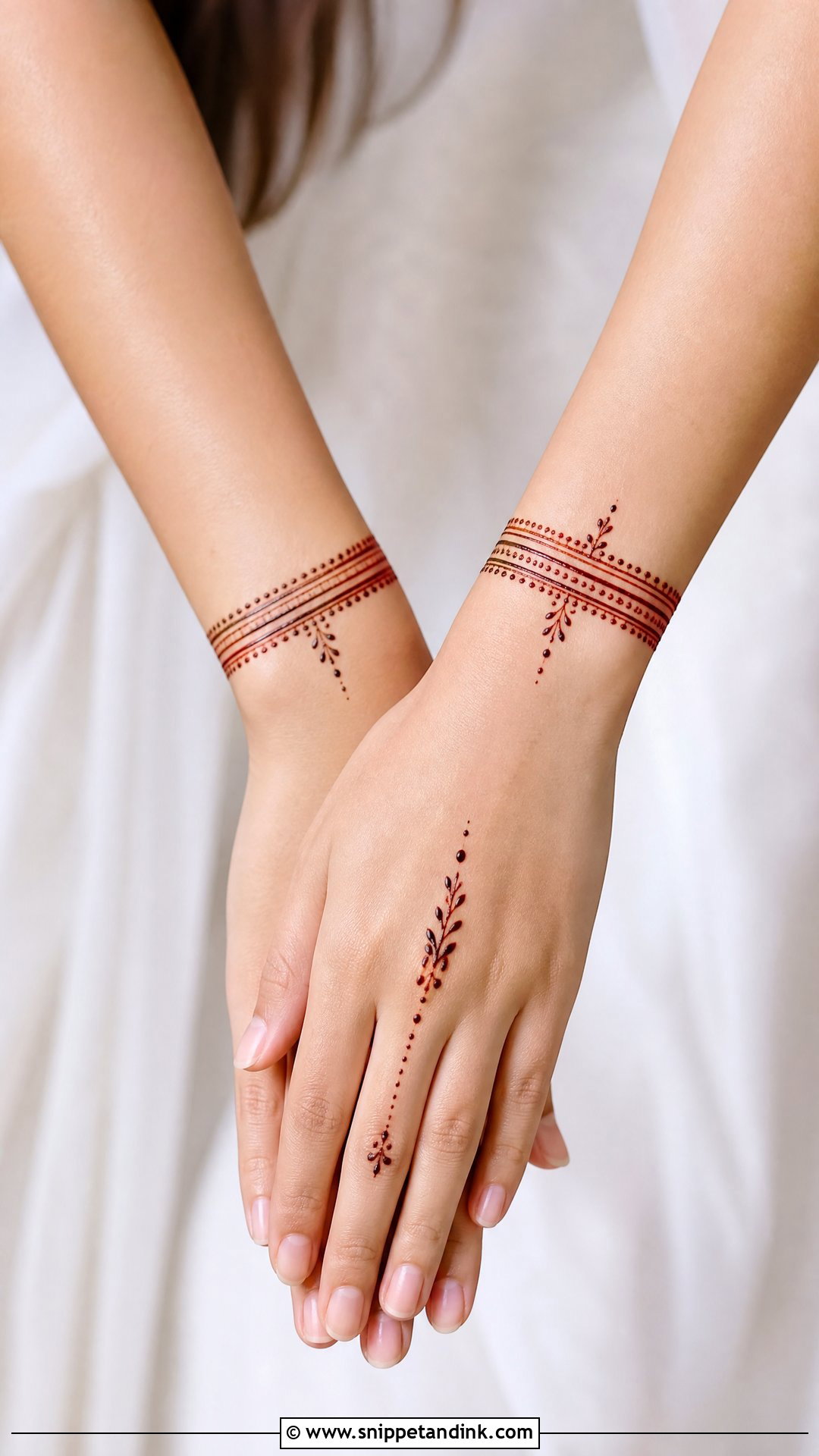
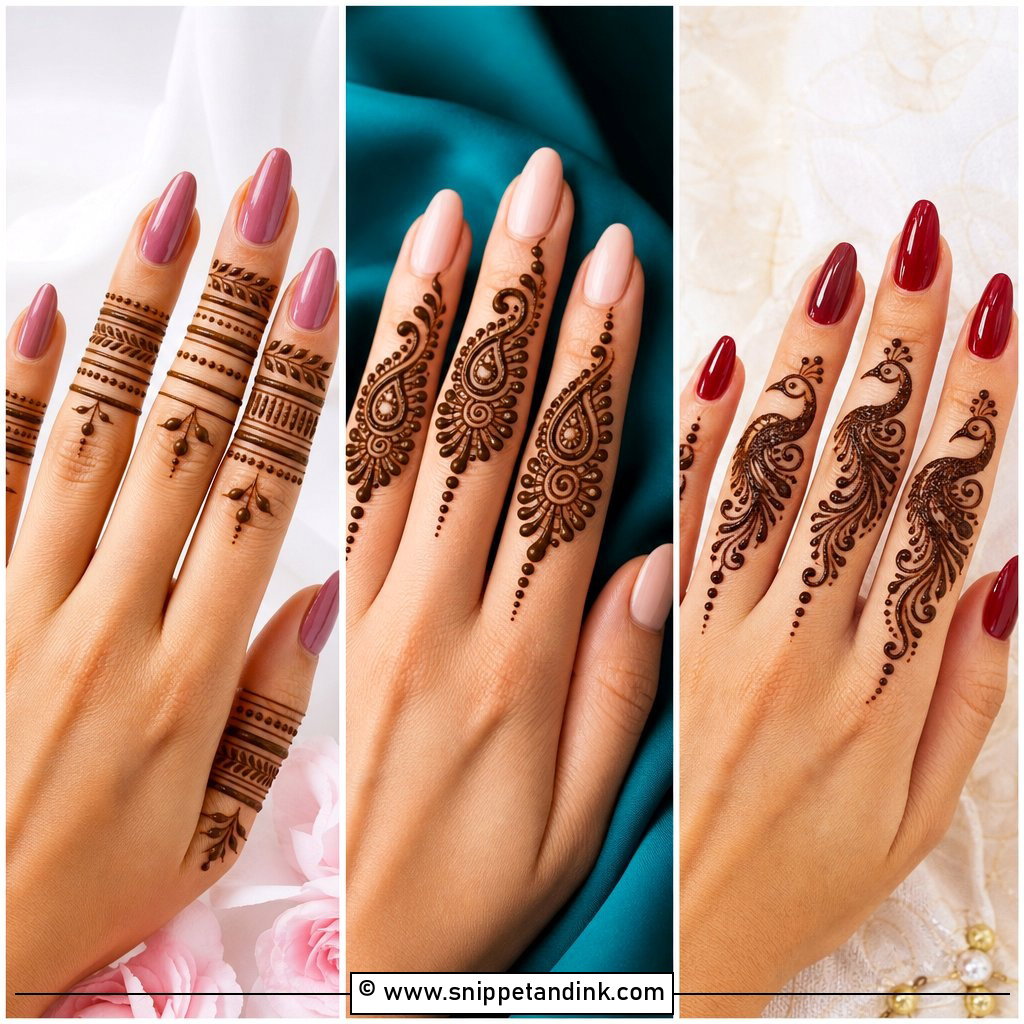
Minimal designs are one thin band with tiny dots, a few leaves or a single flower. Two parallel lines read like stacked bracelets. They suit office weeks after a festival, younger girls and anyone who finds full henna too much. The risk with minimal work is a wobbly line, because there is nothing else to hide it. I ask clients to rest the forearm flat on a cushion so the wrist doesn’t move while I pull long lines.
5. Mandala Wrist Mehndi Design
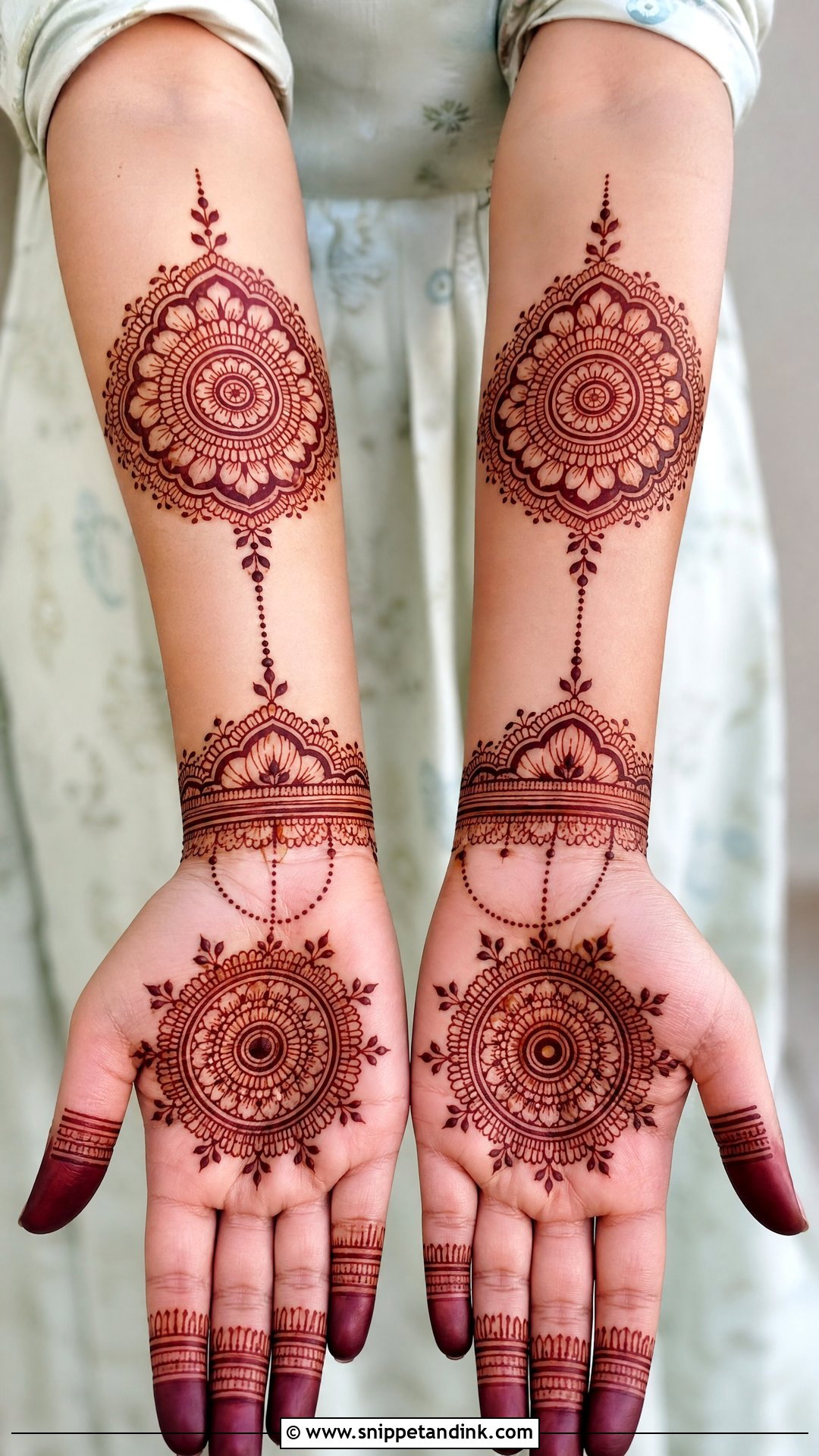
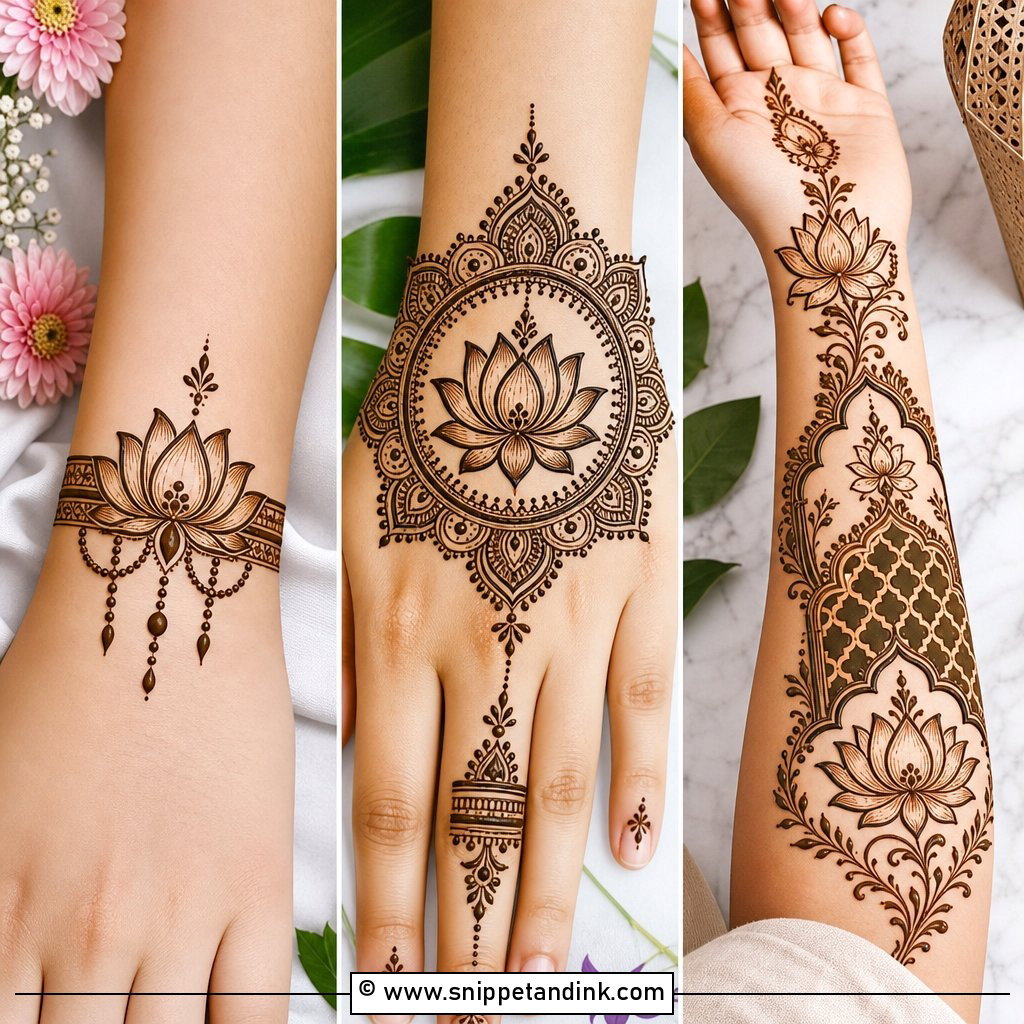
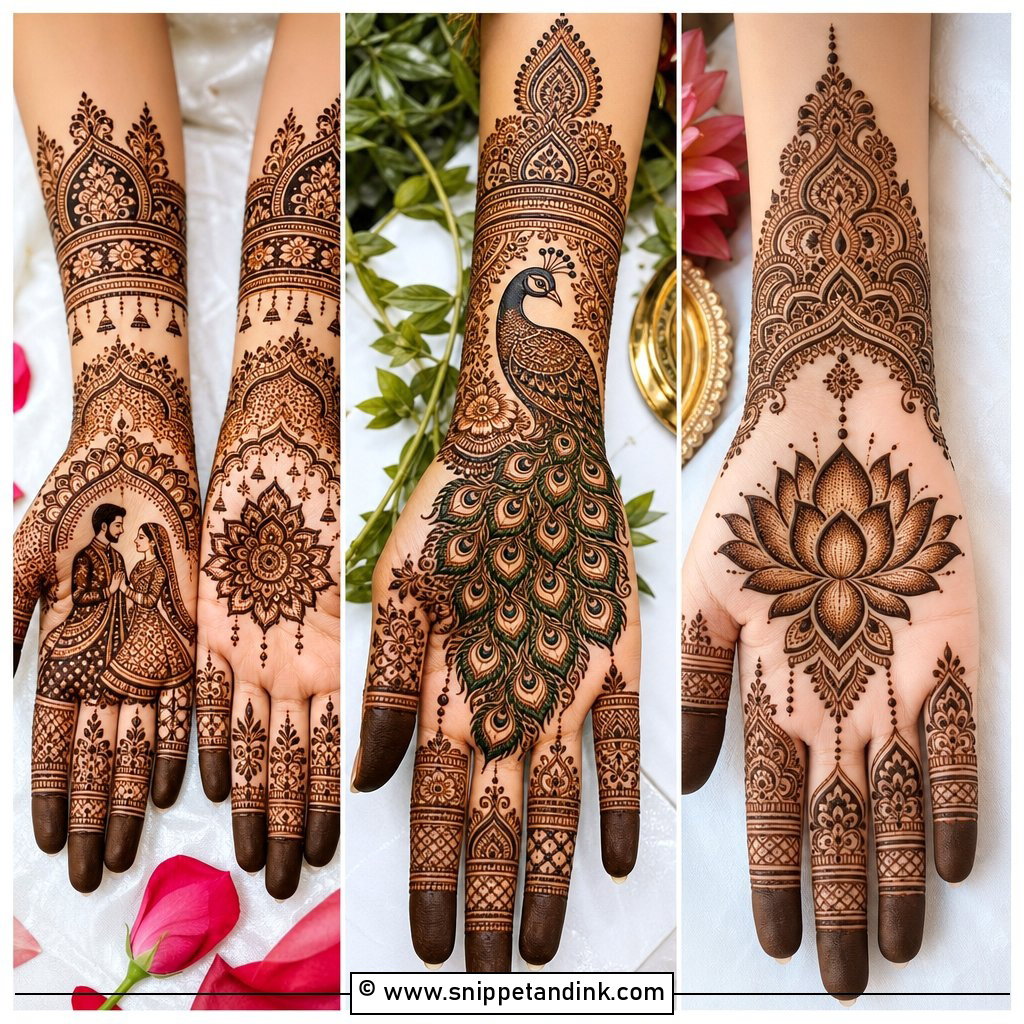
A mandala gives the wrist a single round focal point, joined to bands, chains or leafy borders. It can sit on the inner wrist, the outer wrist or just above it on the hand. Petals, dots, scalloped edges and small paisleys build out the circle. My only rule is to leave clear skin around it. A tightly filled mandala with no breathing room turns into a dark smudge once the stain deepens over the next two days.
6. Back Hand Wrist Mehndi Design
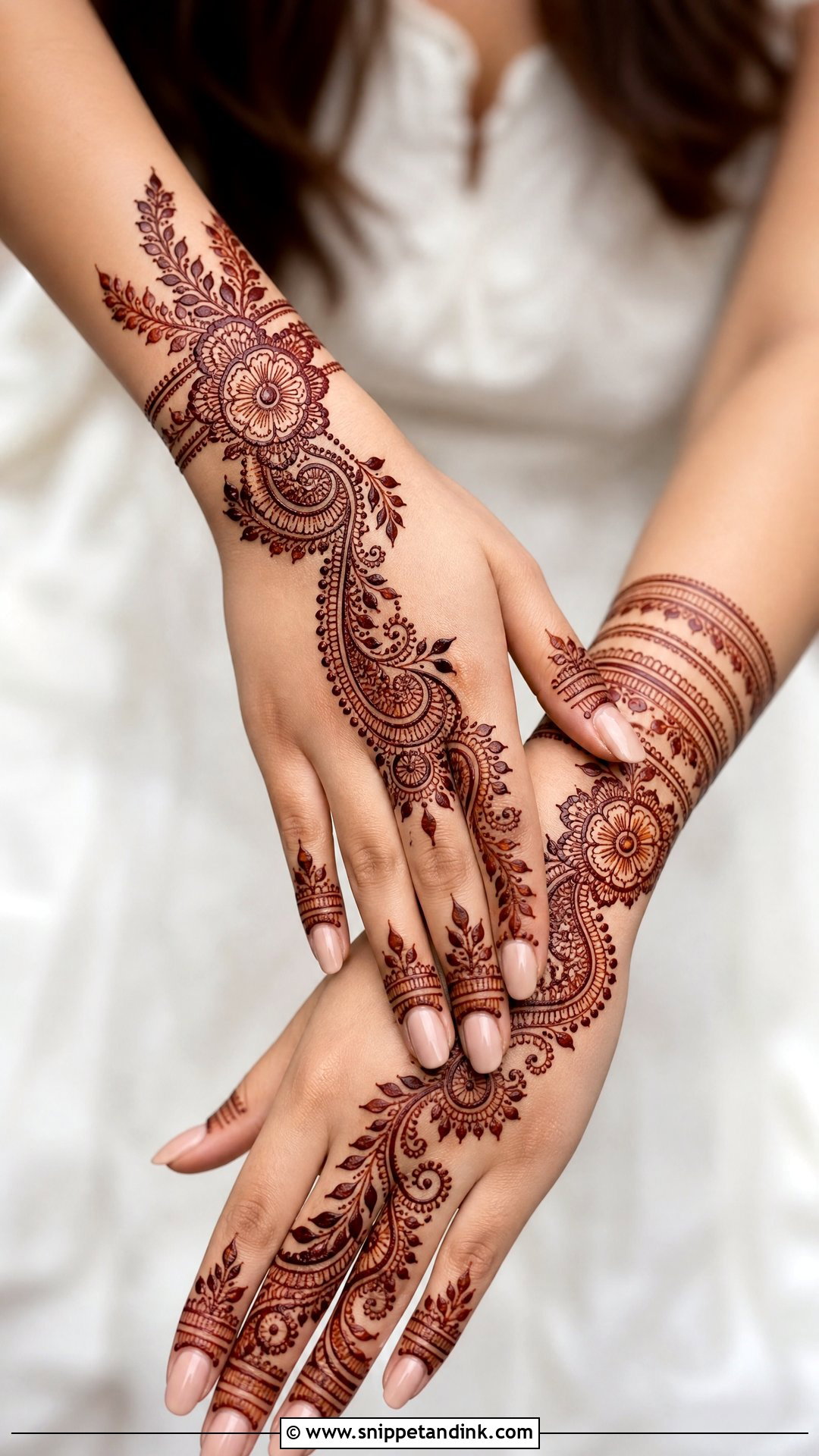
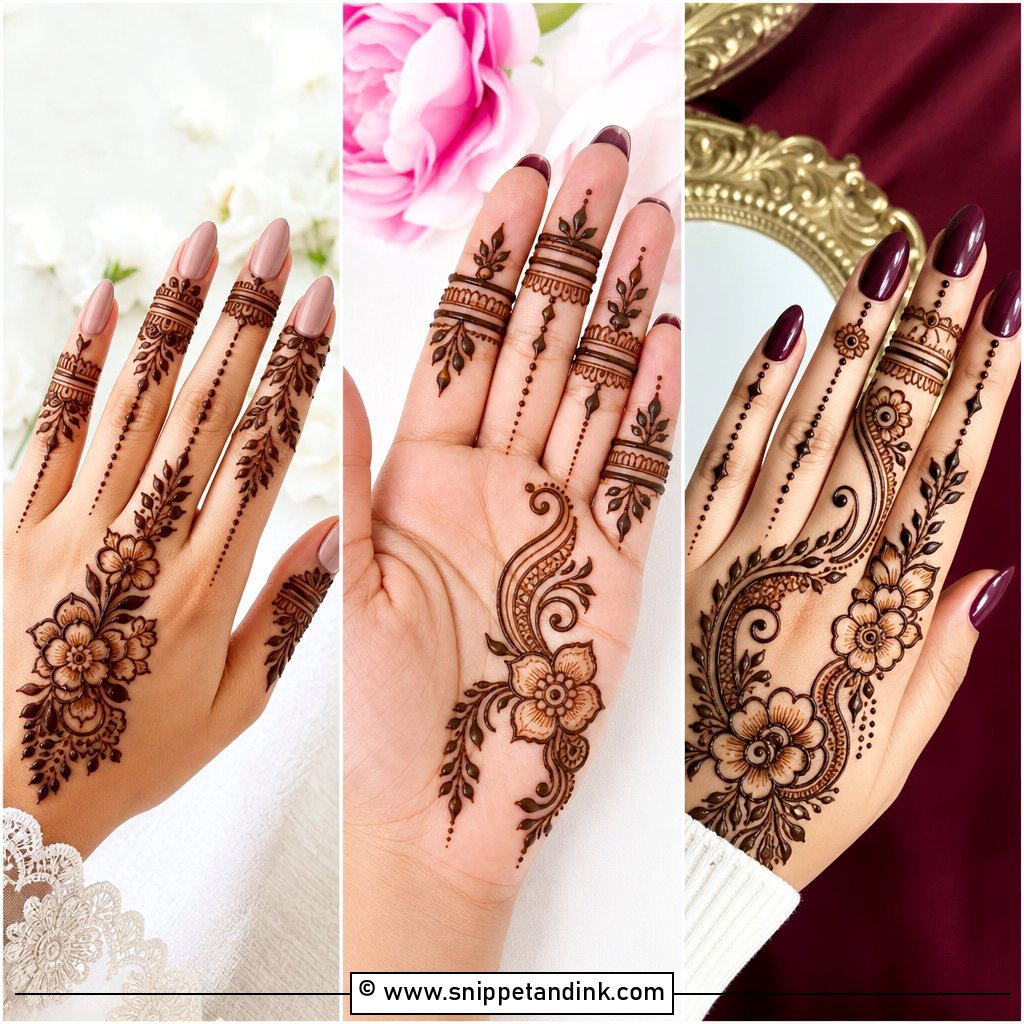
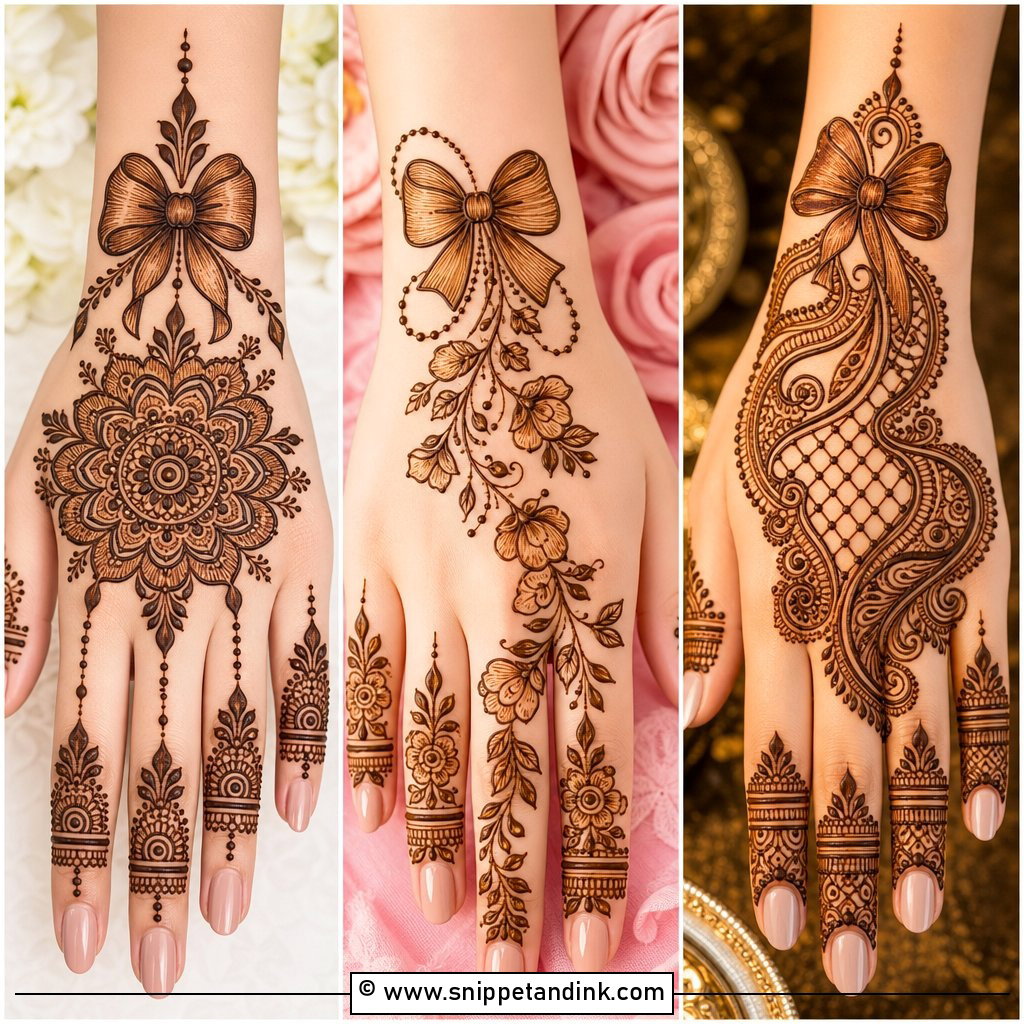
This layout starts with a bracelet band and runs a flower, paisley or vine toward the middle finger, so the design follows the length of the hand. A back hand wrist mehndi design stains noticeably lighter than palm work because the skin there is thinner, so I make the wrist band the boldest part and keep the hand trail finer. Arabic and Indo-Arabic versions suit it best. Push bangles above the design until the paste is off, or they will rub it away.
7. Front Hand Wrist Mehndi Design
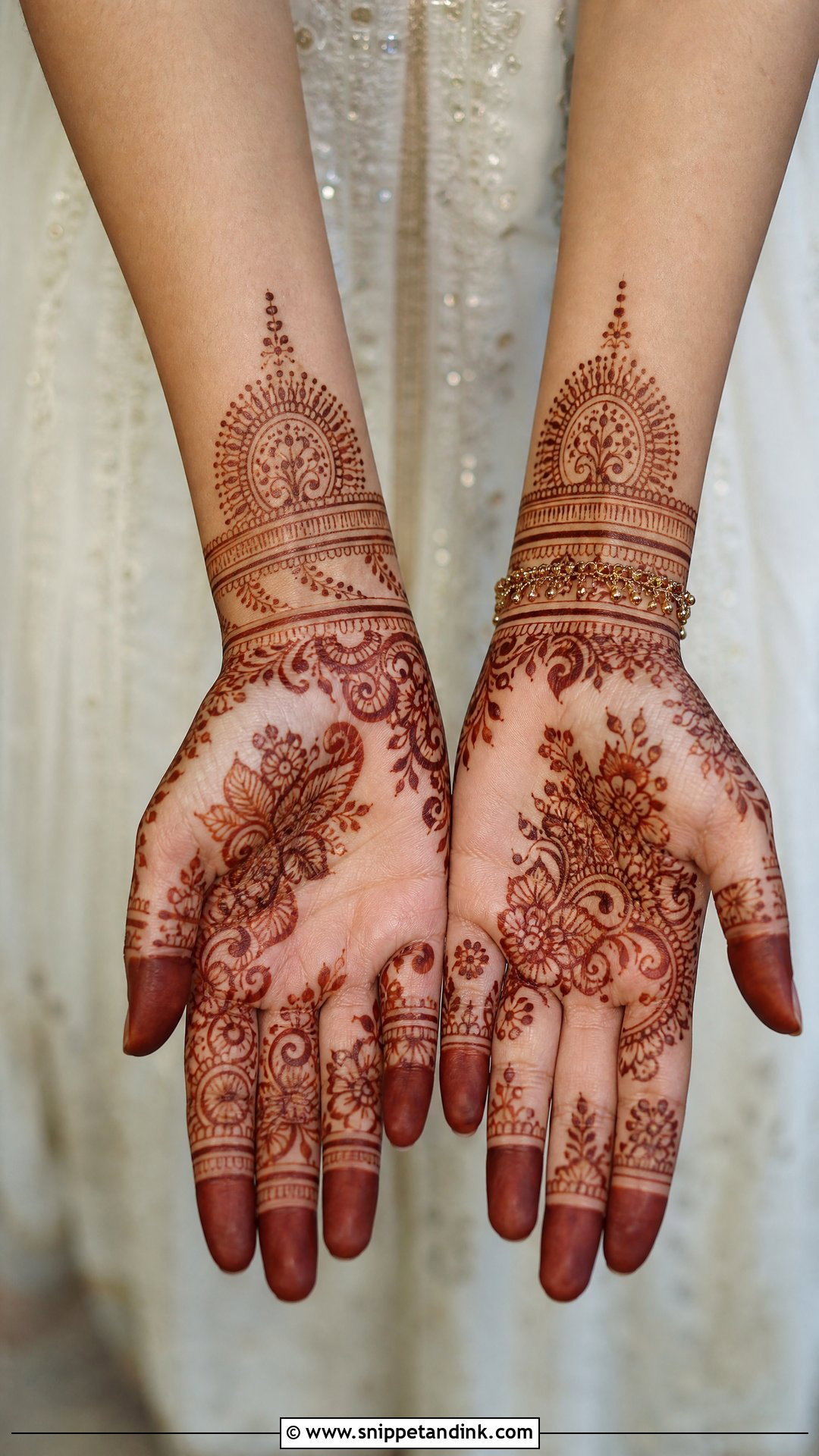
Palm-side wrist designs often join onto the lower palm with a small mandala, a flower cluster or a curved bracelet. Of all the placements in this list, this one gets the darkest stain, because palm skin takes henna more deeply than anywhere else on the arm. It shows when you greet guests or hold gifts. The one place I’m careful with is the wrist crease itself. Paste laid across it cracks as soon as the wrist bends, so I either stop a band just short of the crease or tell the client to keep that hand straight until it dries.
8. Paisley Wrist Mehndi Design
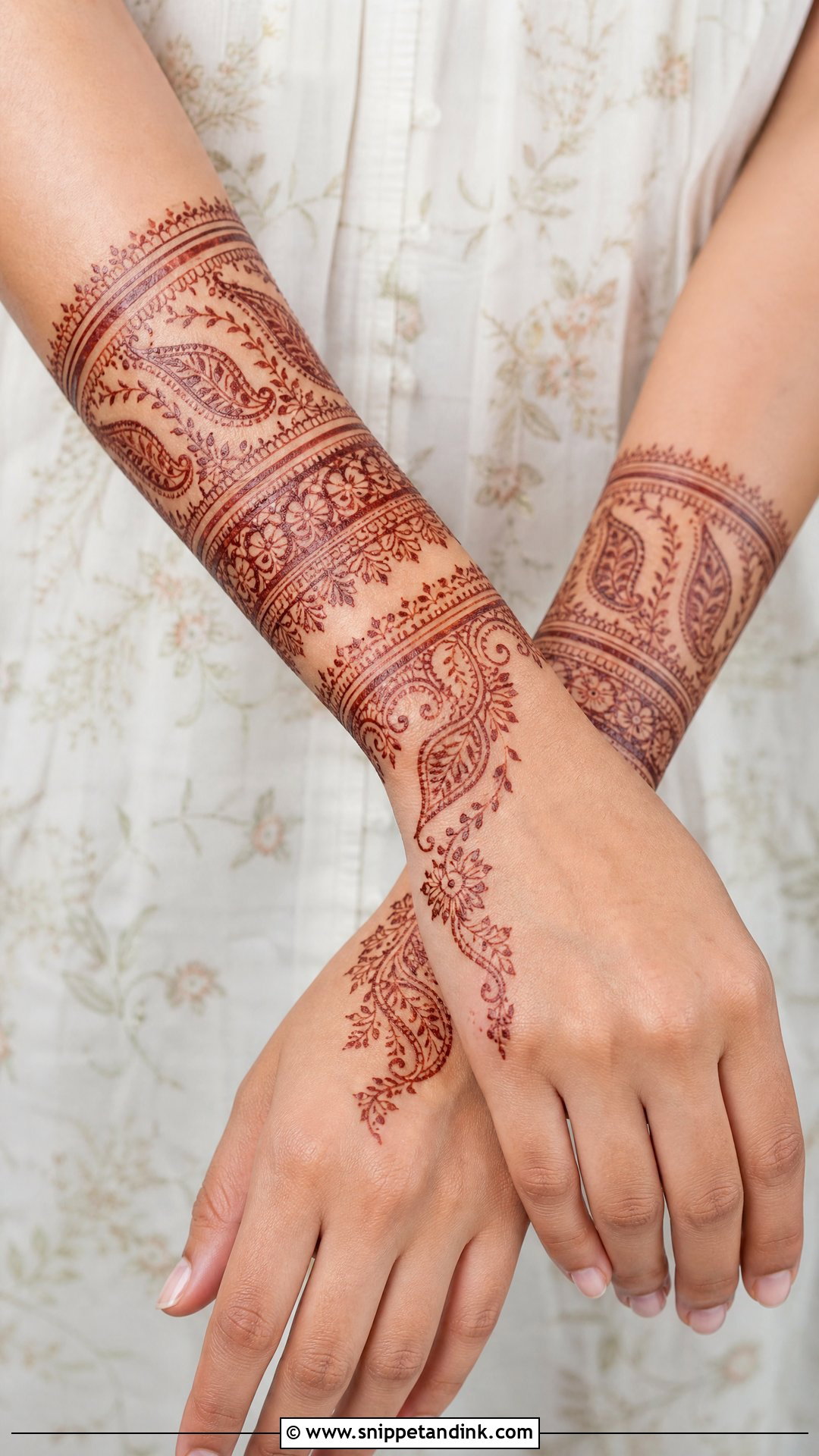
Paisley is the most traditional shape here, and it works either as a centre motif or repeated around the wrist like a border. Filling each paisley with tiny lines, dots and leaves gives depth. For a classic finish, frame the paisleys with floral edges and dotted chains. For a cleaner modern look, draw one large paisley with nothing around it. It suits weddings, Karwa Chauth, Teej and Eid equally.
9. Flower Bracelet Wrist Mehndi Design
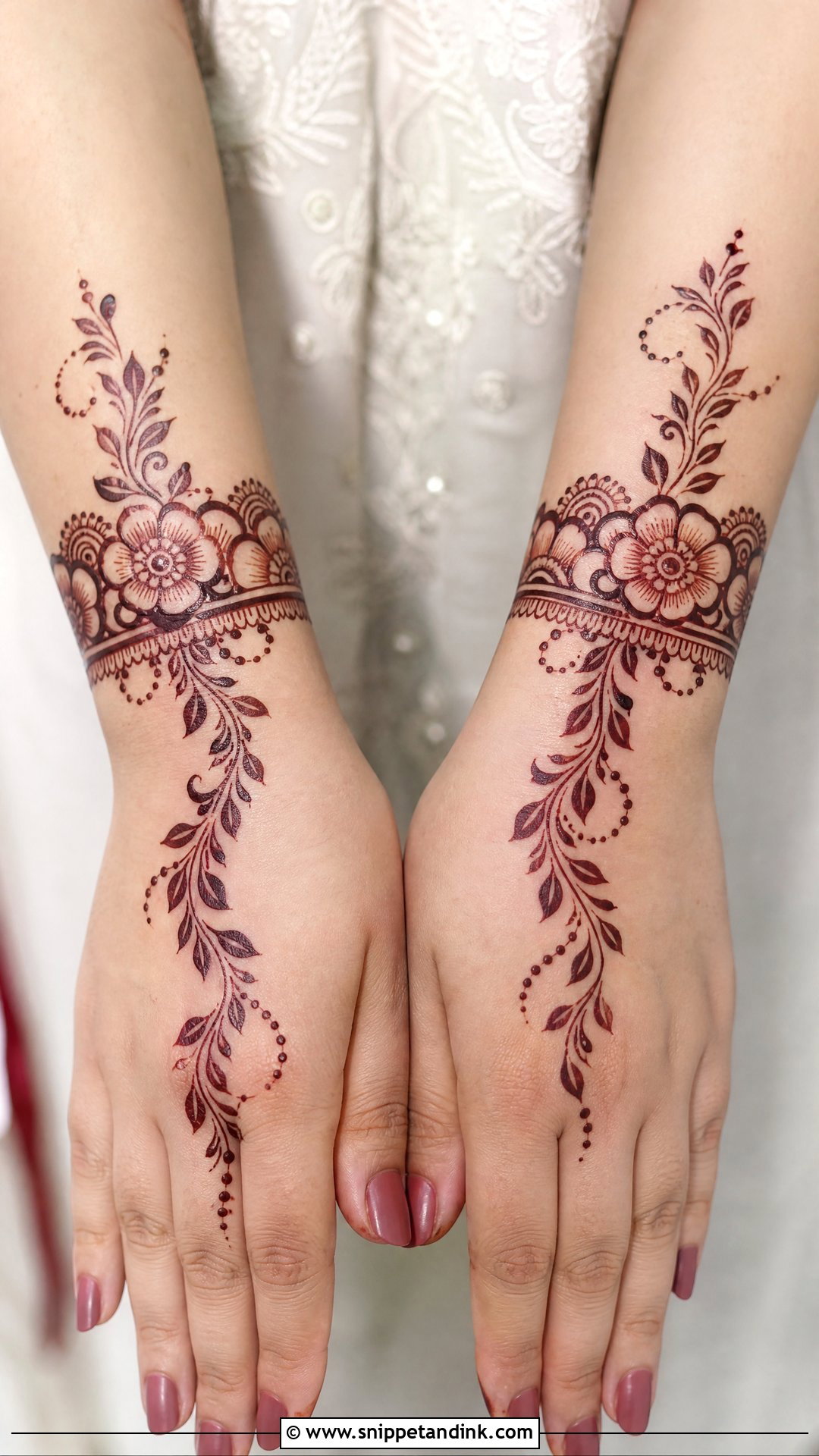
Blooms wrapped around the wrist make a handmade floral bangle. They can be small and repeating, or one large flower can sit at the centre with vines curling round. I adjust the number of flowers to the wrist size rather than squeezing a set pattern onto a slim wrist. Keep petals bold so they stain clearly and save the fine work for the leaf veins. It works on the front or back of the wrist.
10. Leafy Vine Wrist Mehndi Design
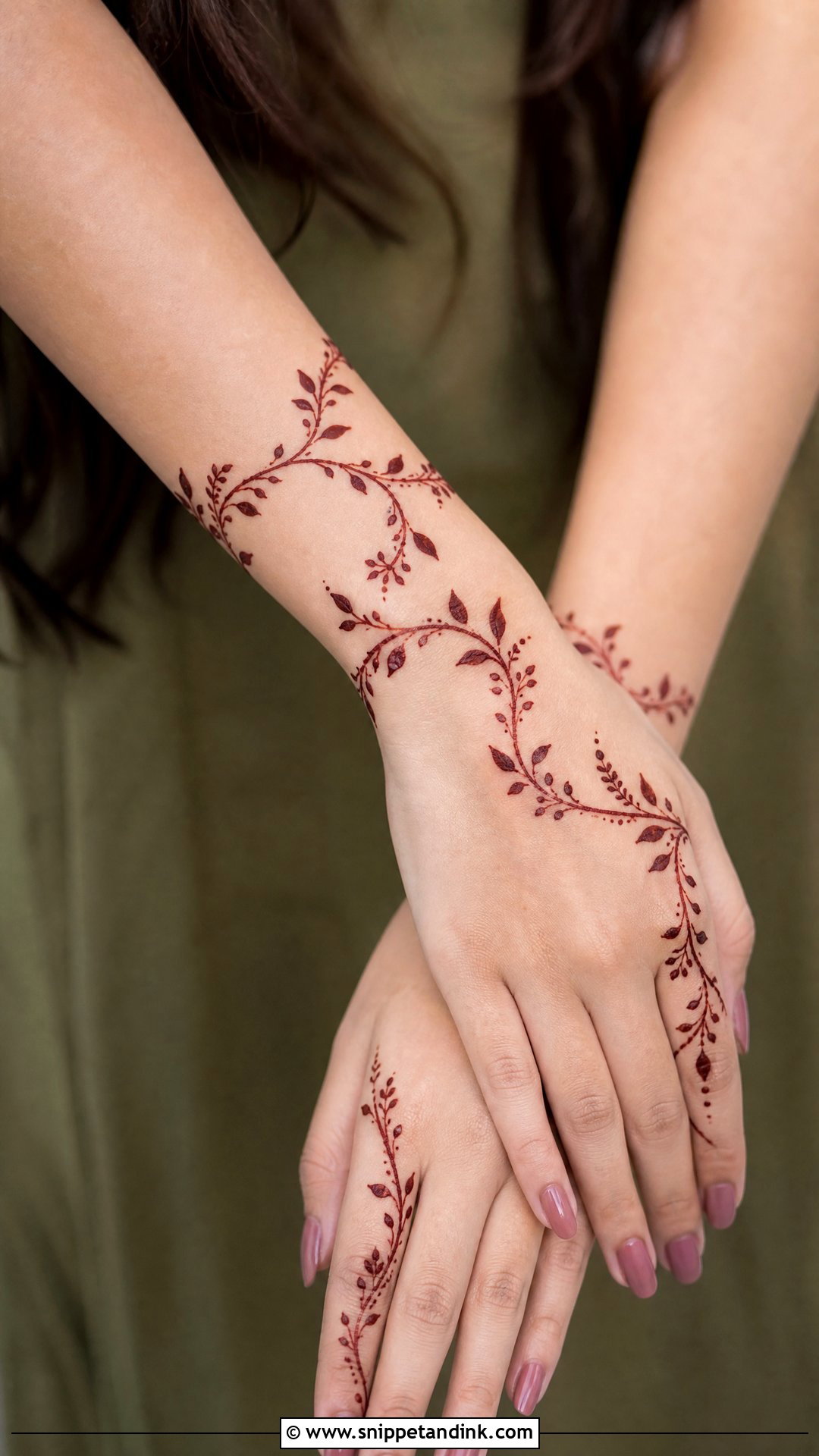
Vines are the most forgiving shapes in henna, which is why I teach them first. A stem wraps the wrist or runs diagonally toward the hand, with small leaves and tiny dots along it. A slight wobble in a vine just looks natural. The mistake people make is crowding too many leaves on one stretch. Space them, alternate the sides, and the pattern looks polished on any outfit, from a sundress to a kurta.
11. Jaali Wrist Mehndi Design
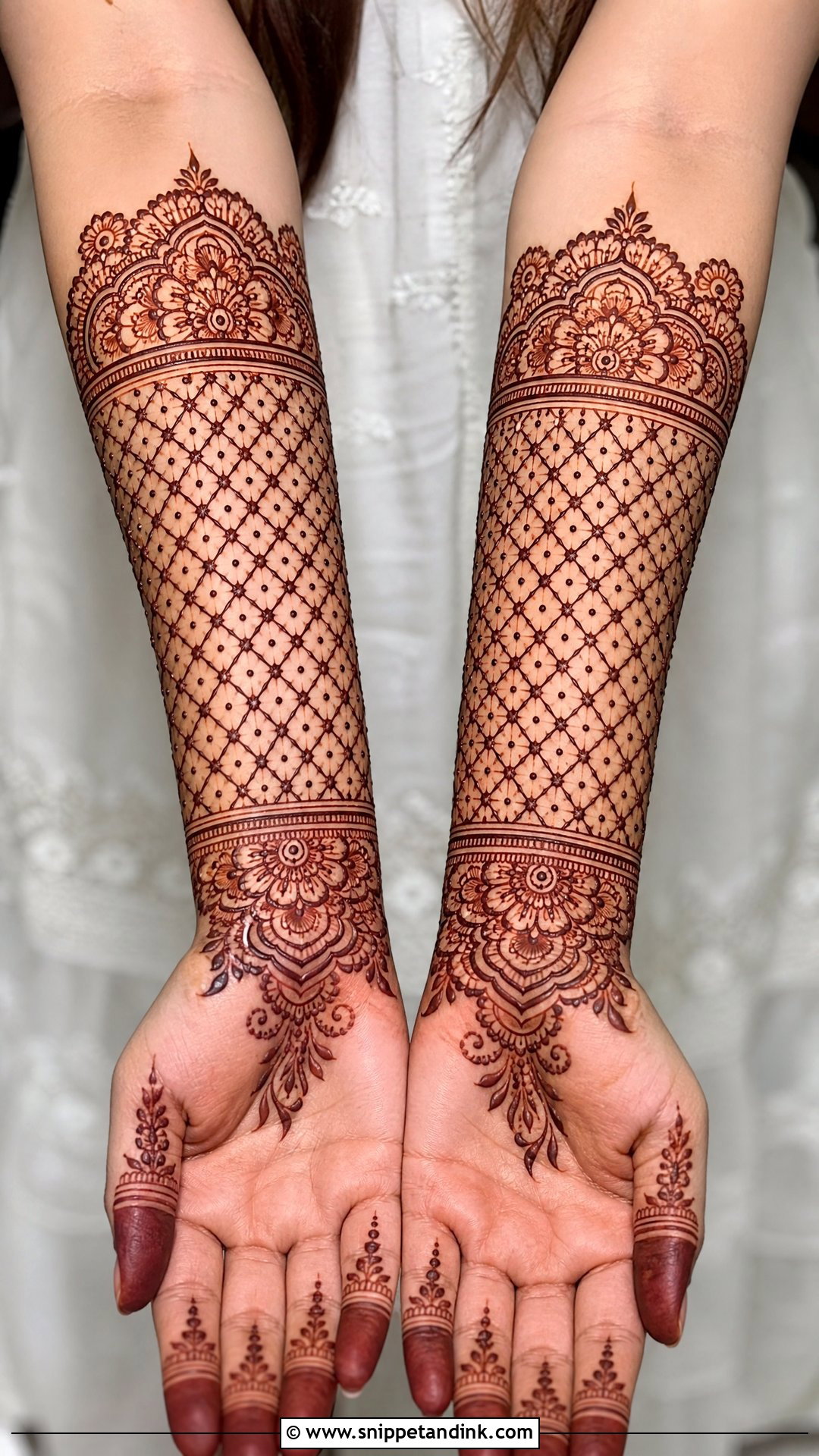
Jaali is a net of crossing lines, usually with a dot in each diamond, framed by floral borders on both sides. It reads as rich texture without covering the whole hand. The lines need to be very thin and very even, and I keep the cone tip fresh for jaali because a blunt tip makes lines that merge into each other once the paste spreads slightly. Make the borders a touch heavier than the mesh so the cuff has a clear frame.
12. Bangle Wrist Mehndi Design
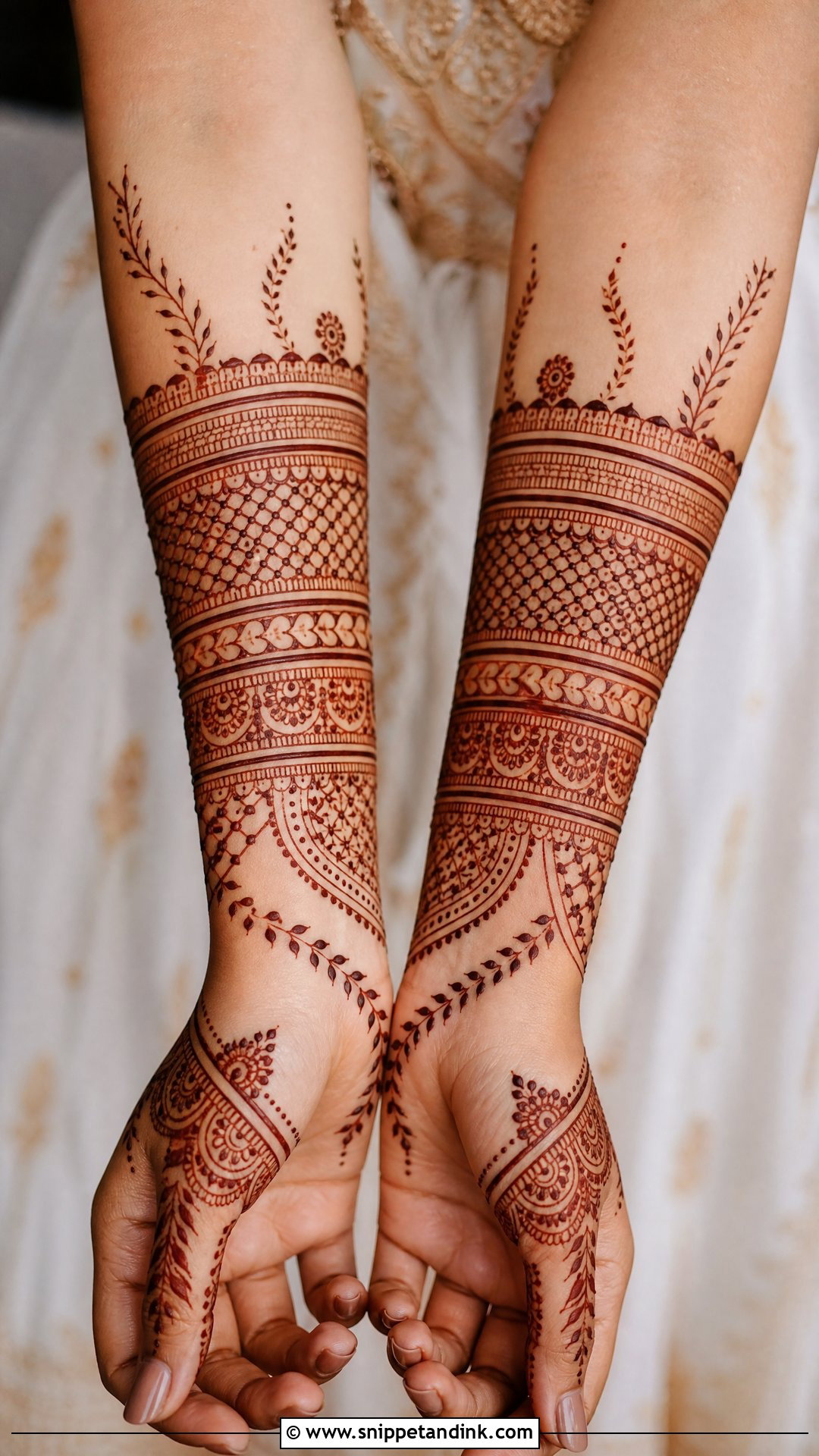
A bangle wrist mehndi design stacks several henna bands, each with its own pattern: dots, scallops, leaves, checks or tiny flowers. Even with a plain hand, the stack looks festive. The spacing between bands matters more than the patterns inside them. Leave a clean line of skin between each band so they read as separate bangles once the stain develops, rather than one dark blur. A small hanging chain toward the hand finishes it.
13. Modern Wrist Mehndi Design
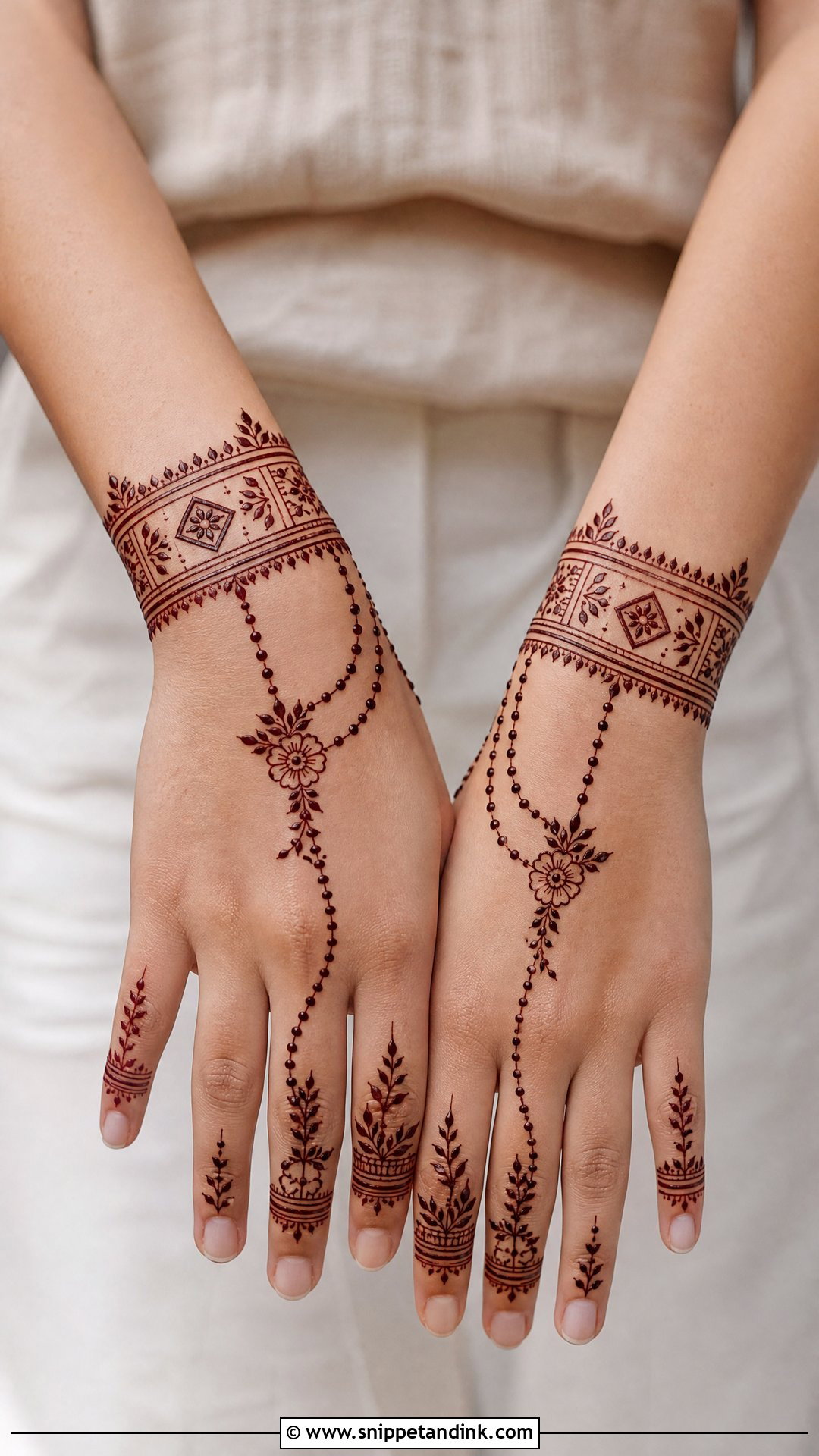
Modern wrist work means slim lines, clean spacing and shapes instead of heavy traditional filling. Think geometric cuffs, a dotted chain or a sleek connection up one finger. It sits easily with western clothes as well as ethnic wear. The temptation is always to fill the gaps. Don’t. Bare skin is part of this style, and it is also why the shapes look so clear in close-up photos.
14. Indo Arabic Wrist Mehndi Design
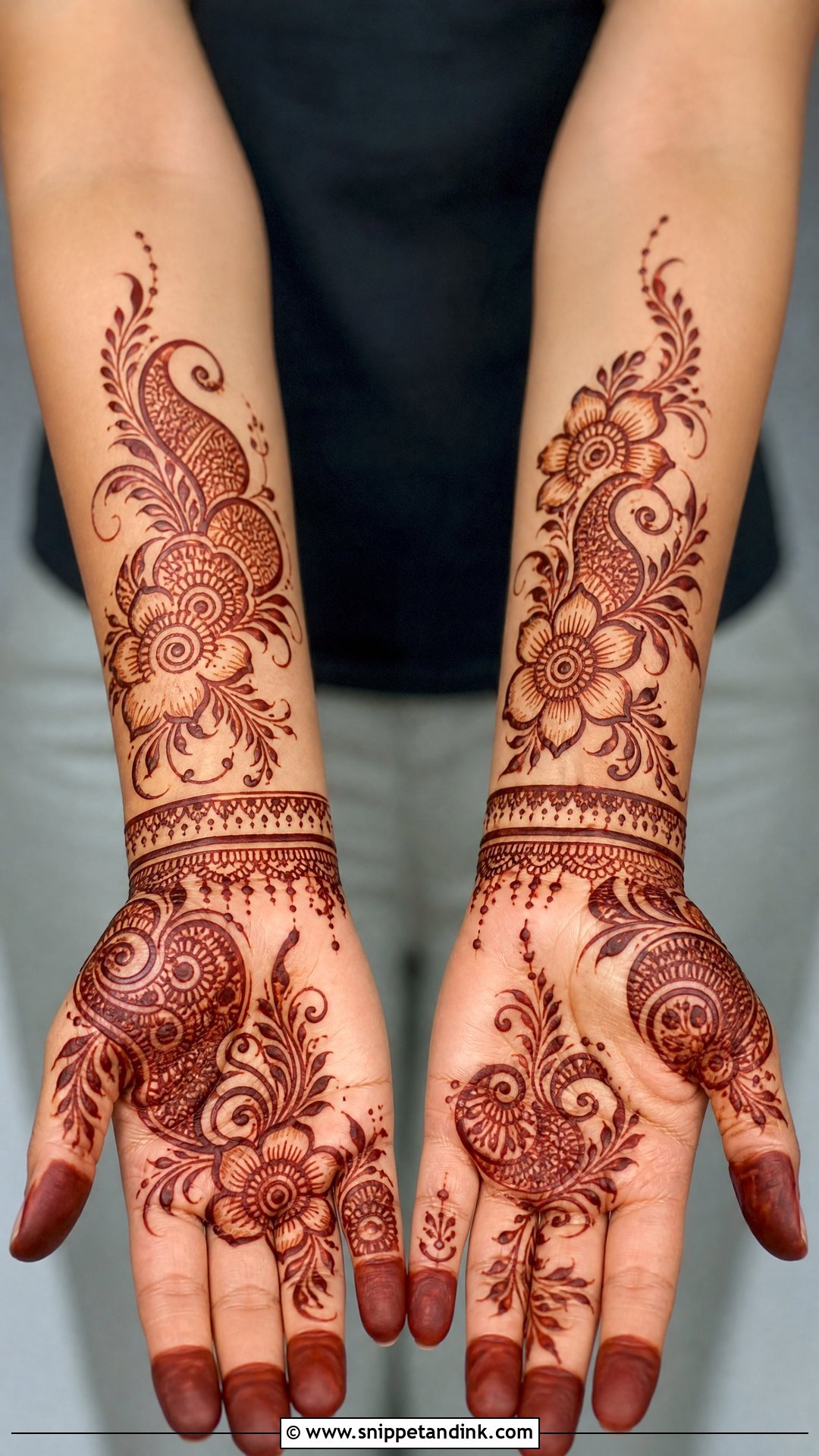
An Indo Arabic wrist mehndi design combines bold Arabic flow with pockets of fine Indian filling. The wrist usually carries a floral or paisley cuff, with a trail of leaves and swirls toward the hand. I decide where the detailed pockets go before I start, normally inside the two or three largest flowers, so the eye has a few places to rest. It suits weddings, Eid and engagements, and it is a good middle ground for bridesmaids.
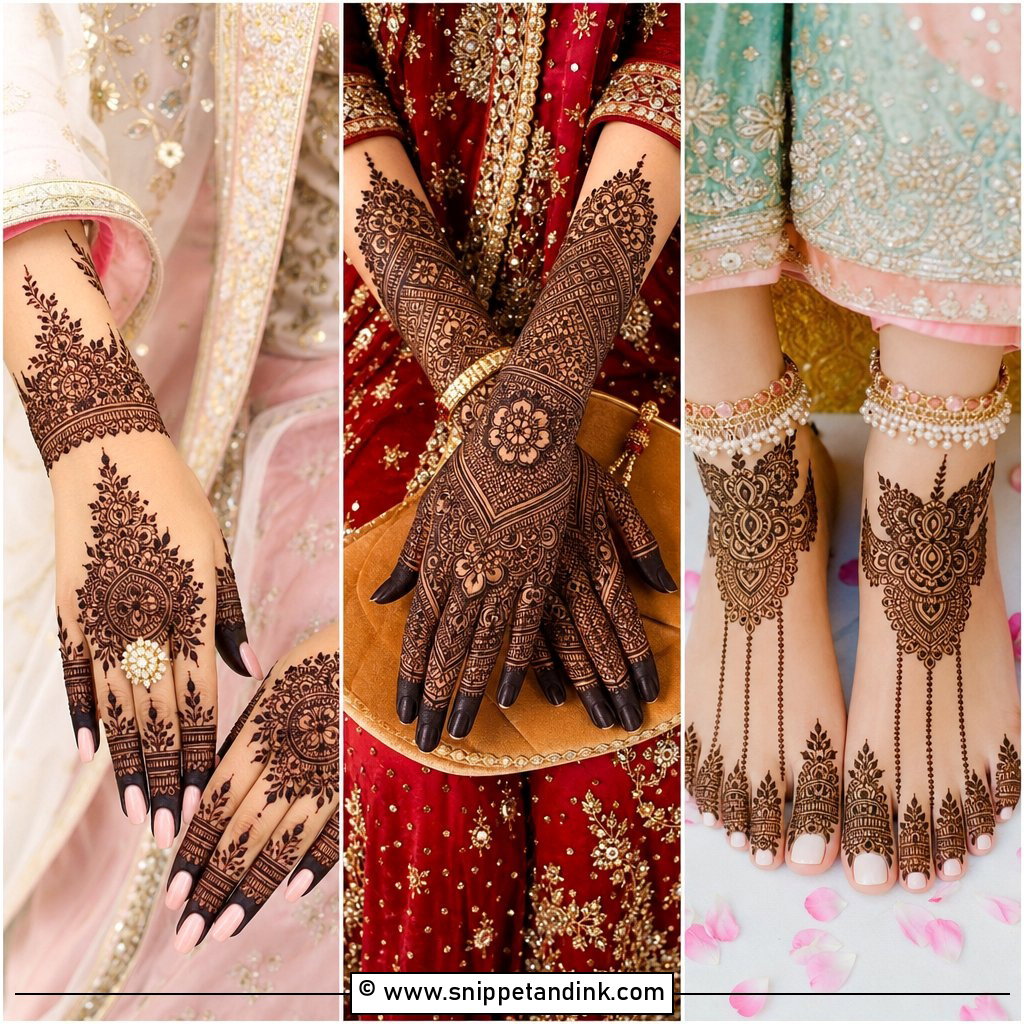

15. Moroccan Wrist Mehndi Design
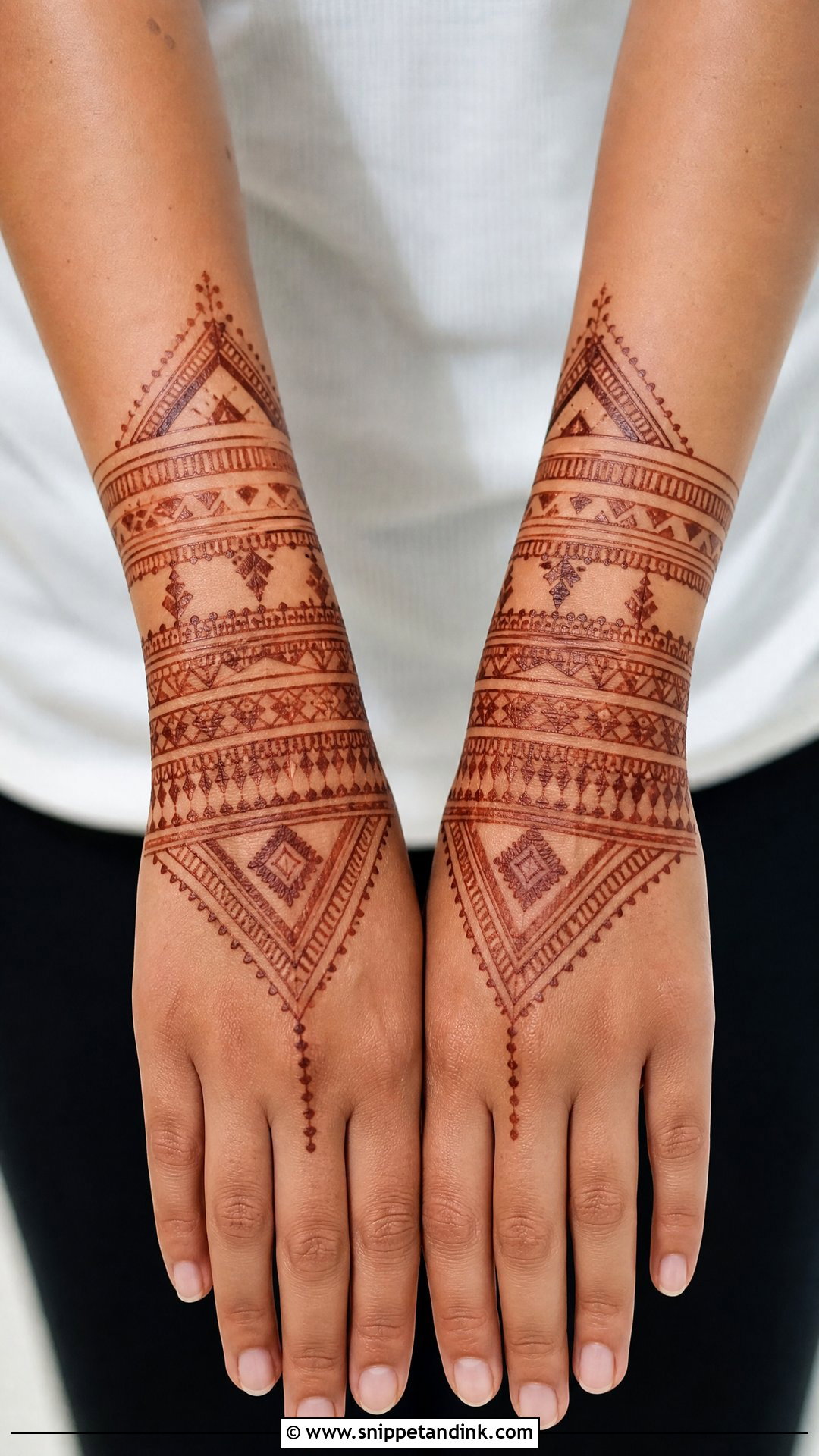
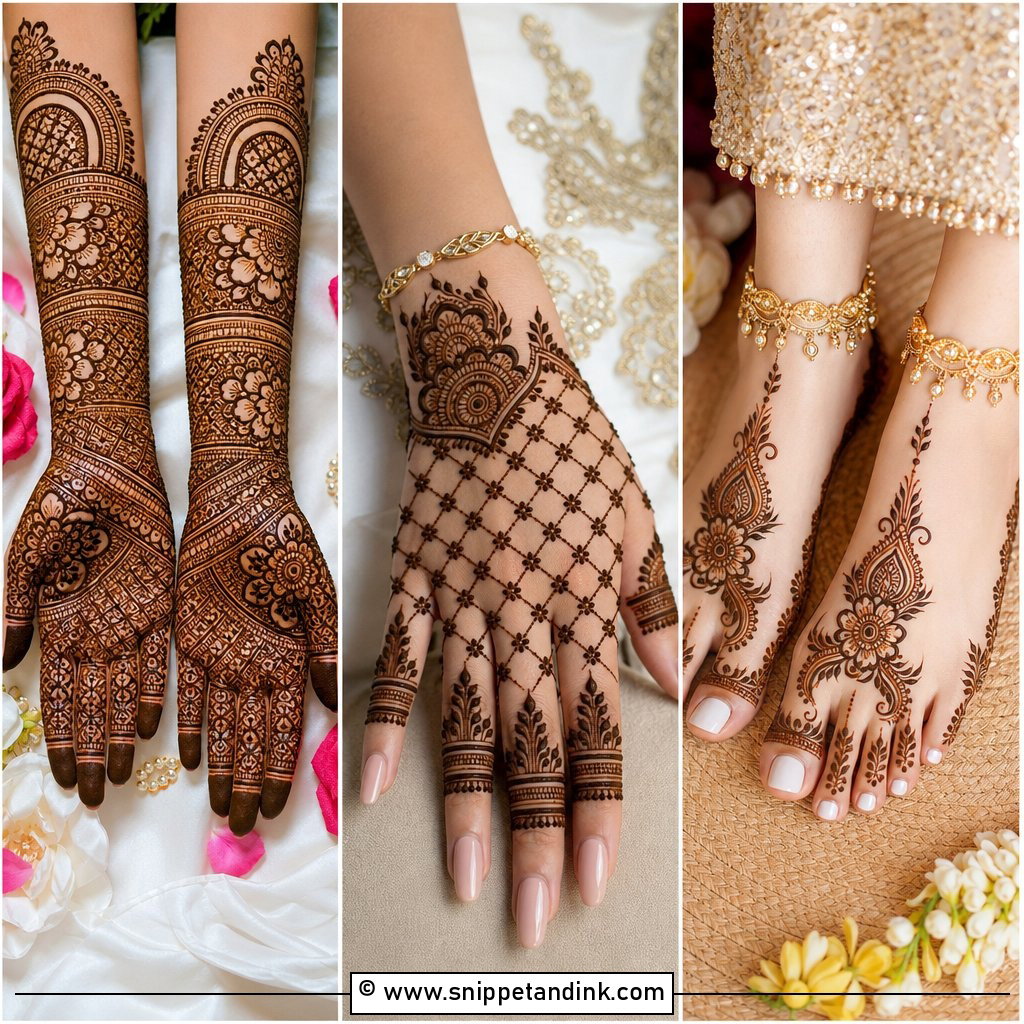
Moroccan patterns swap flowers for triangles, diamonds and structured bands, and the result is graphic rather than floral. A full cuff of repeated shapes or one narrow band both work. Straight lines are harder to pipe than curves, so this is not the style to try for your first time at home. The balance of the design also makes it a comfortable choice for men who want something at a wedding or festival.
16. Gulf Wrist Mehndi Design
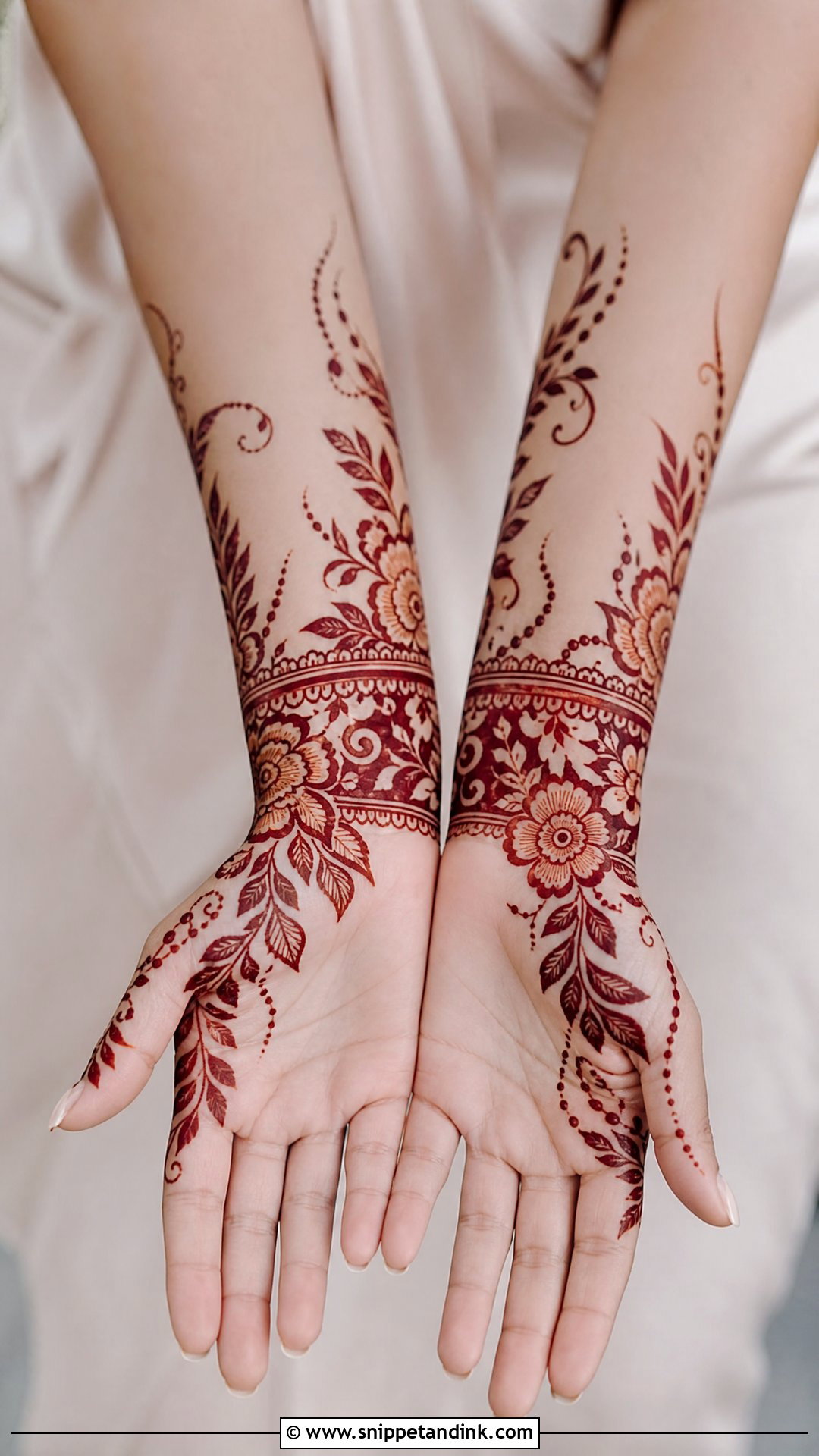
Gulf style is about confidence: large rounded flowers, bold leaves, wide open spaces and very little filling. The wrist often carries a thick band with big blooms spilling toward the hand or forearm. Because the shapes are so large, this style tends to give the darkest stain on the back of the hand, where finer work would look washed out. Fine dots along the edges soften it. Thick, smooth paste matters here; grainy paste leaves ragged petal edges.
17. Bridal Wrist Mehndi Design
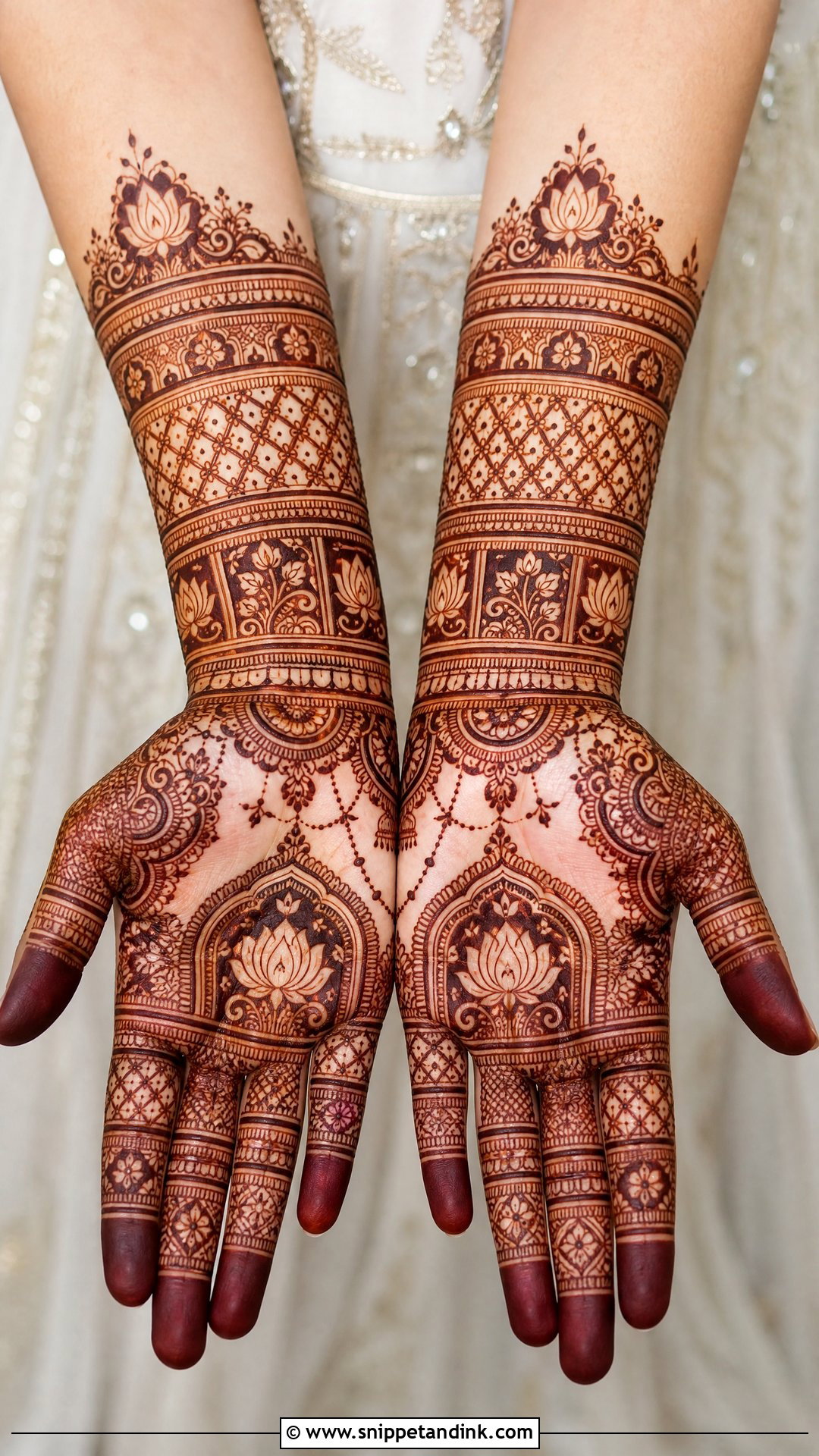
Bridal wrist work joins up with a full hand or forearm design, so the wrist has to carry its share of detail: a wide cuff, paisley borders, jaali, lotus motifs, initials or chains. Plan it around the jewellery. A bride wearing a full set of bangles or kaleere will hide most of the wrist, so I put the richest detail just above and below where the bangles will sit. Bold borders frame it and fine filling adds depth, and it needs to read well from every angle in close-ups.
18. Eid Wrist Mehndi Design
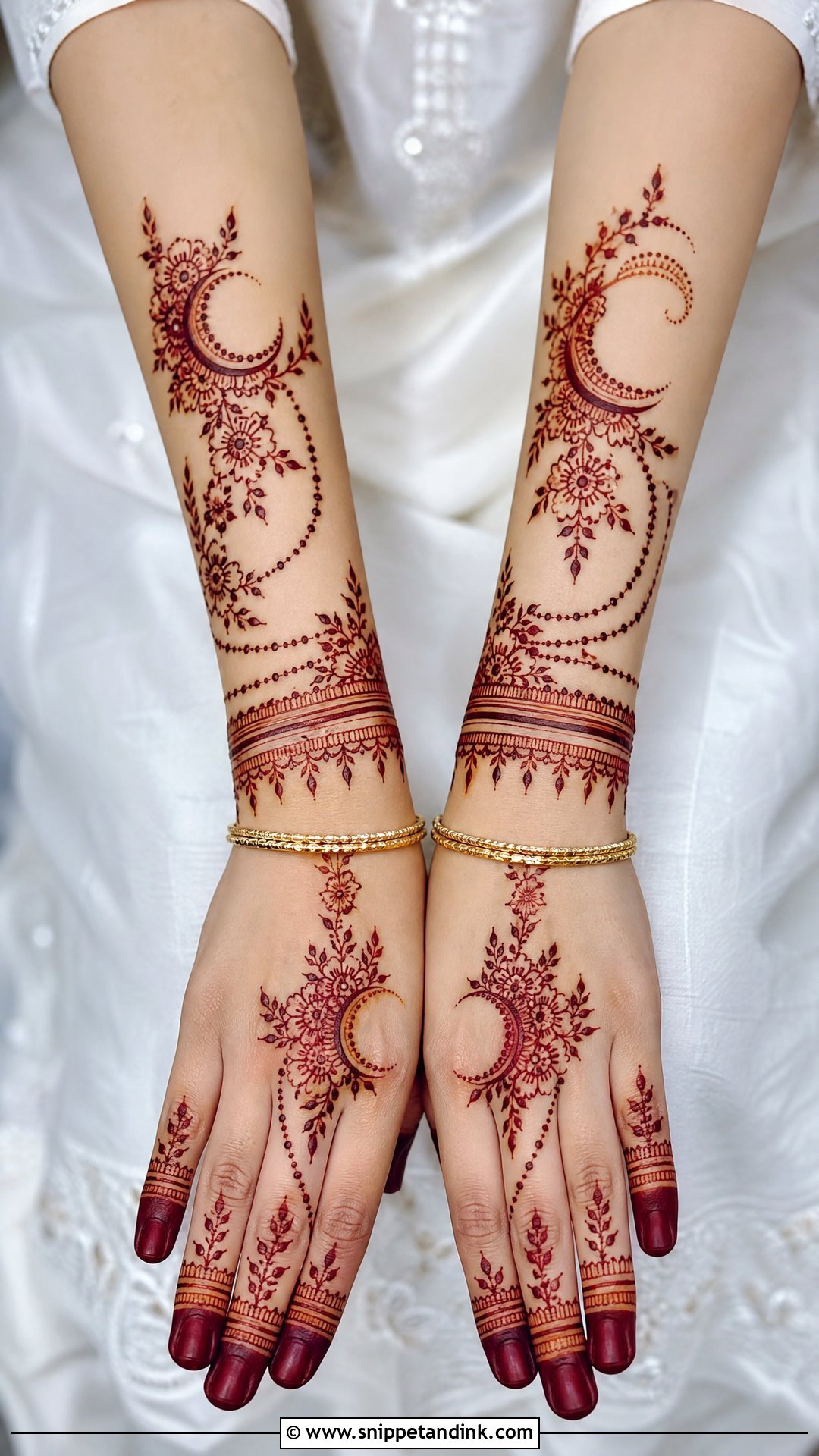
Eid henna often happens at home on Chand Raat, late at night, with the whole family in a queue. So the wrist design should be quick to draw and quick to dry: a bracelet band, Arabic flowers, a crescent curve or a dotted chain, with one statement motif near the hand. Keep it simple for daytime visits, fuller for evening outfits. Leaving the paste on overnight is the easiest way to get a deep colour for the morning.
19. Wedding Guest Wrist Mehndi Design
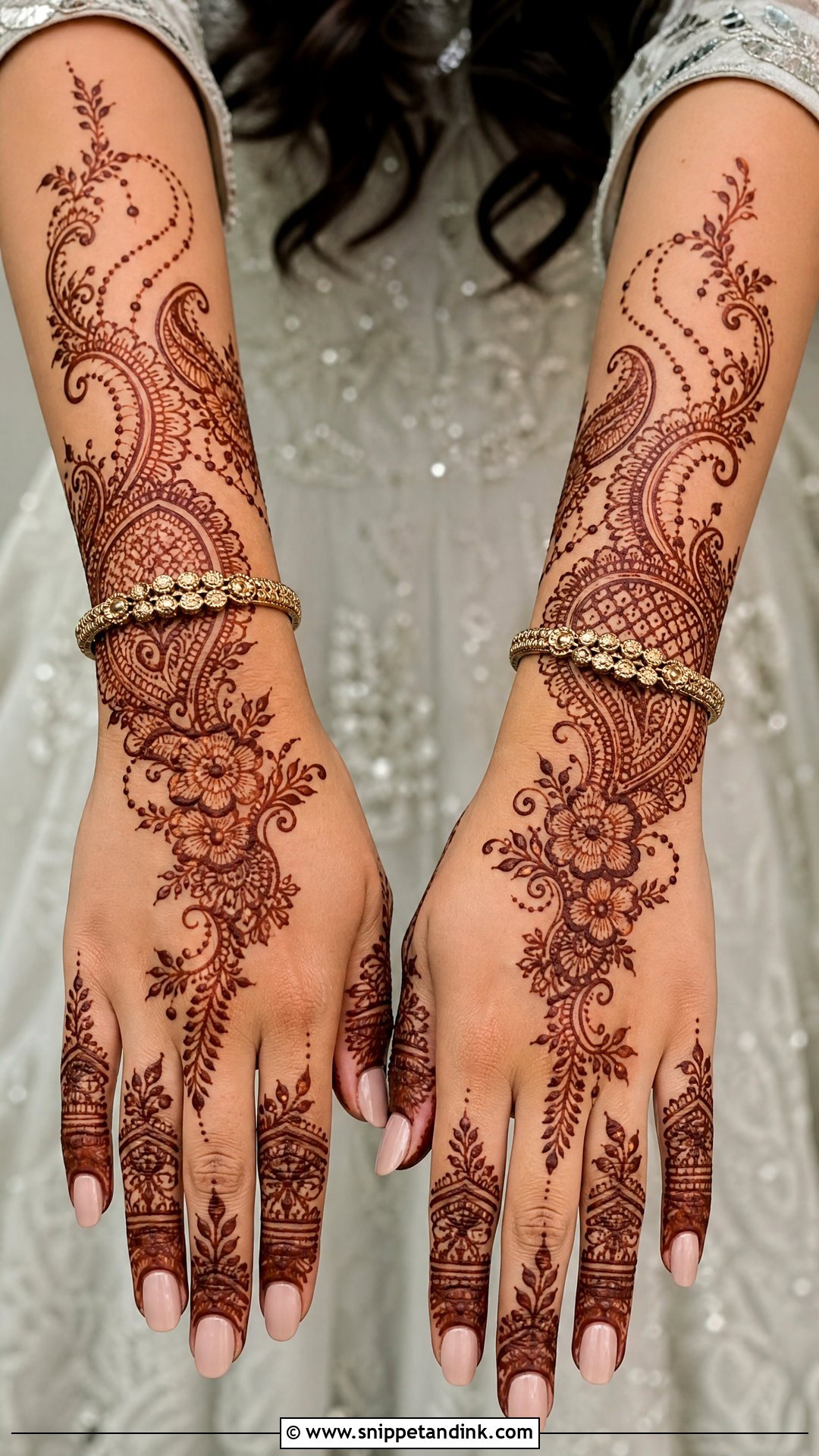
As a guest you want to look dressed up without competing with the bride. A medium cuff, a floral bracelet or a short Indo-Arabic trail is right. Decorate the wrist and one or two fingers and leave the rest open. I’d steer guests away from heavy bridal filling and full forearm coverage unless the family has asked everyone to go big. It also keeps the application short, which matters when twenty guests are waiting for the artist.
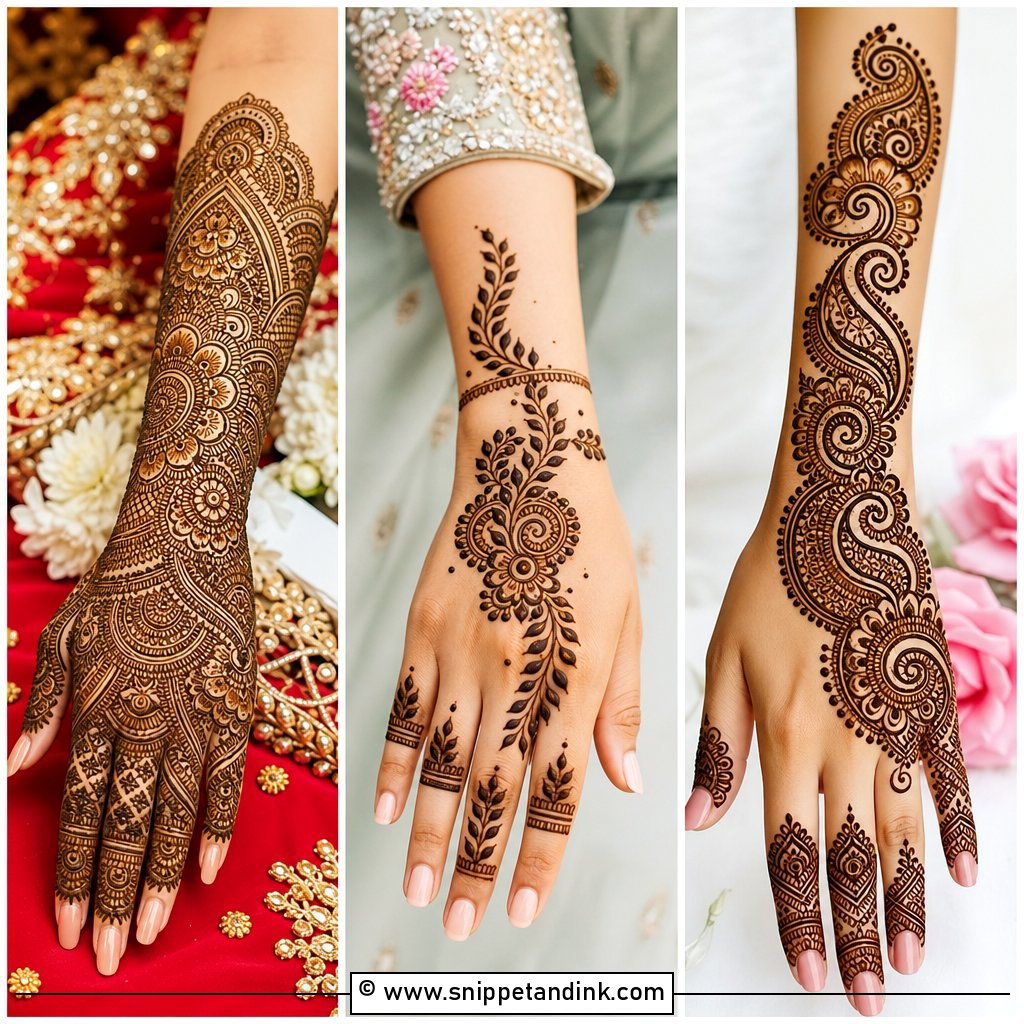


20. Haath Phool Wrist Mehndi Design
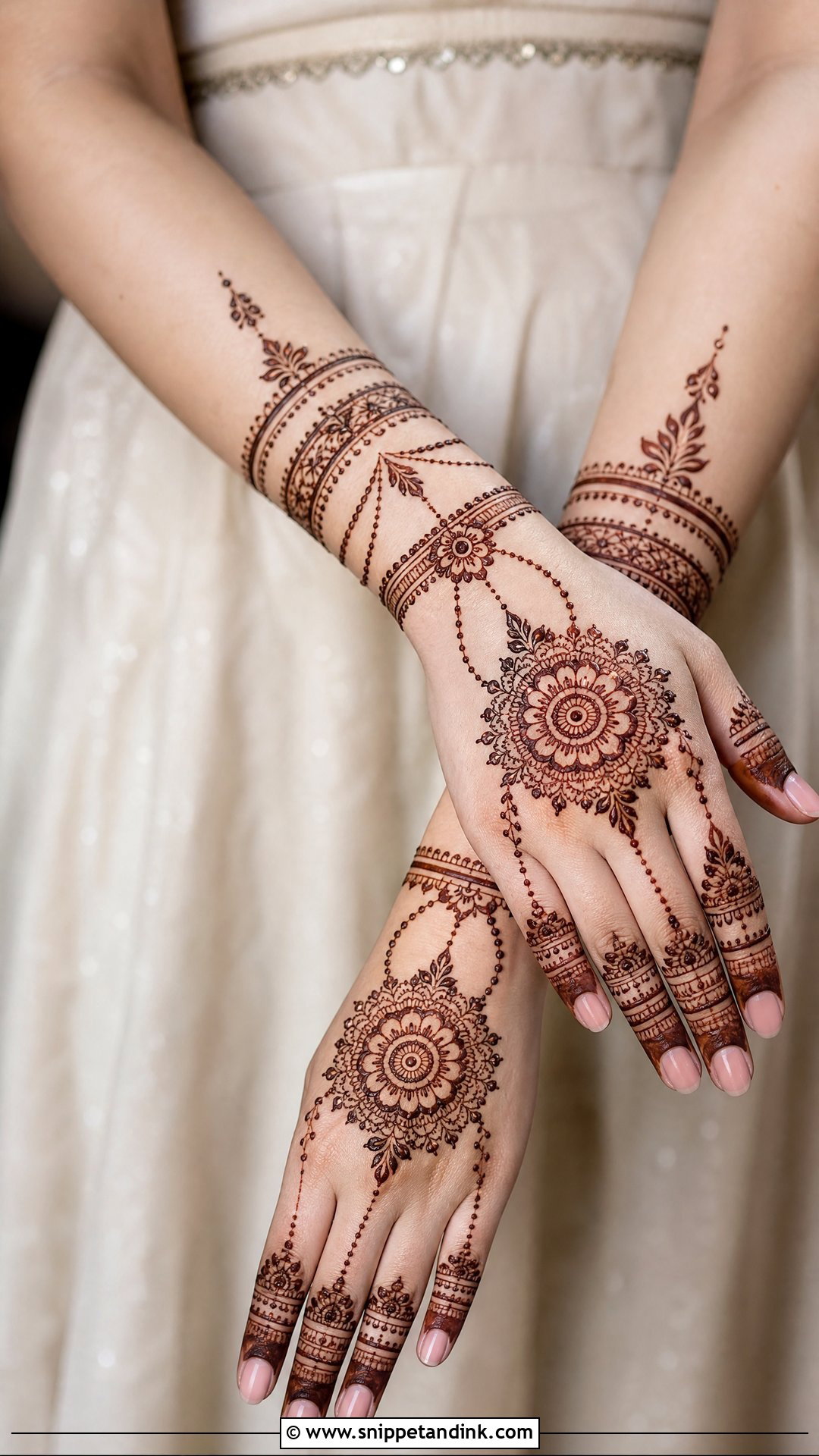
Haath phool means hand flower, the traditional jewellery piece of a bracelet chained to a ring. In henna, the wrist band links to a central motif on the back of the hand and then to one or more fingers. Flowers, mandalas, paisleys and dotted chains all fit. The connecting lines must be thin and meet the motifs cleanly; a chain that misses its join by a millimetre is very visible. Bold band, fine chain, that’s the balance.
21. Finger To Wrist Mehndi Design
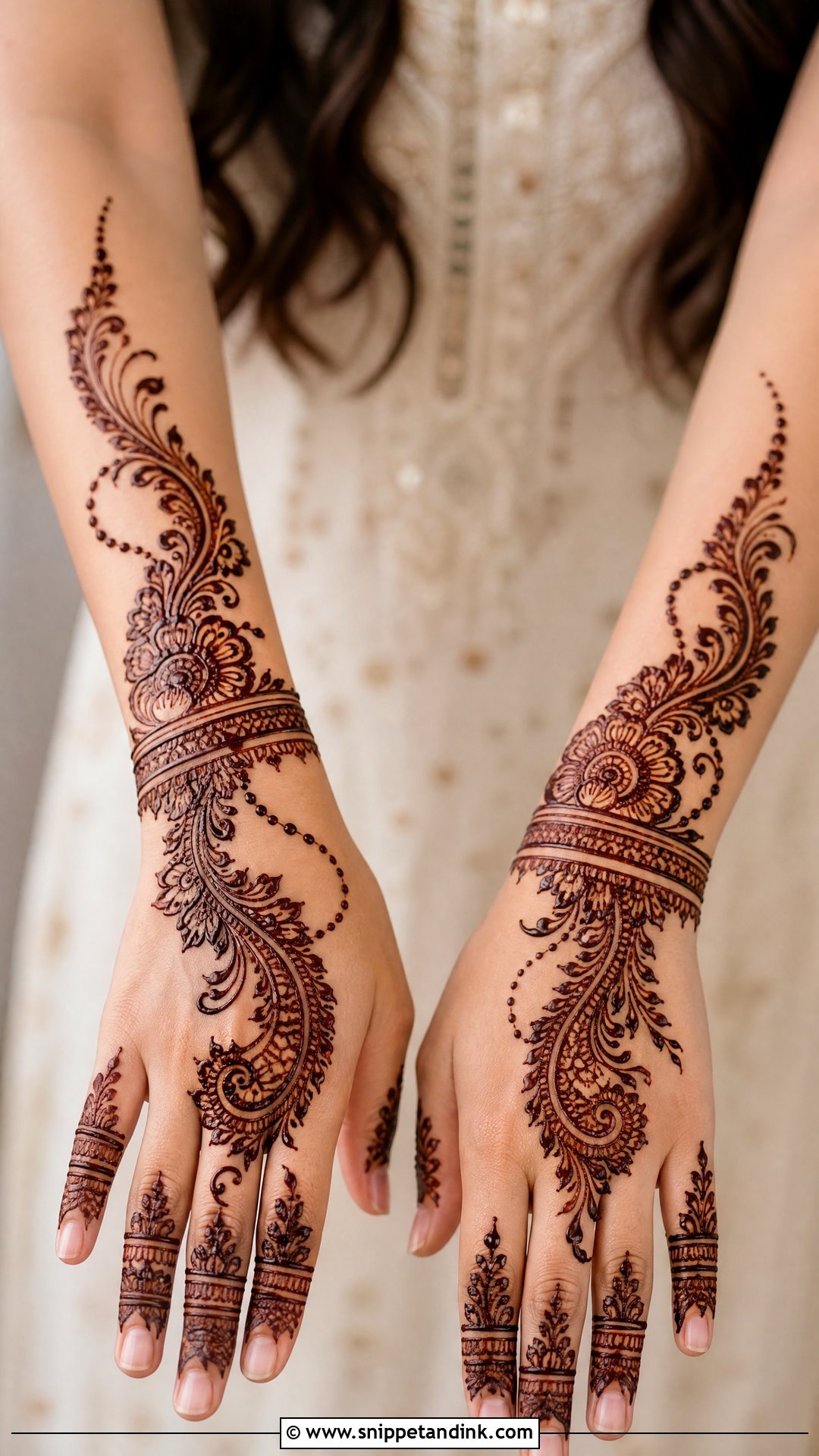
Here the design runs from one decorated finger down to the wrist, through a floral vine, paisley trail or dotted chain that meets a bracelet band. The diagonal line makes the hand look longer. Arabic styles suit it because they already move on a slant. It is beginner friendly, since one continuous trail is easier to control than a symmetrical pattern. Just keep the wrist end light so the eye travels the whole length.
22. Full Wrist Cuff Mehndi Design
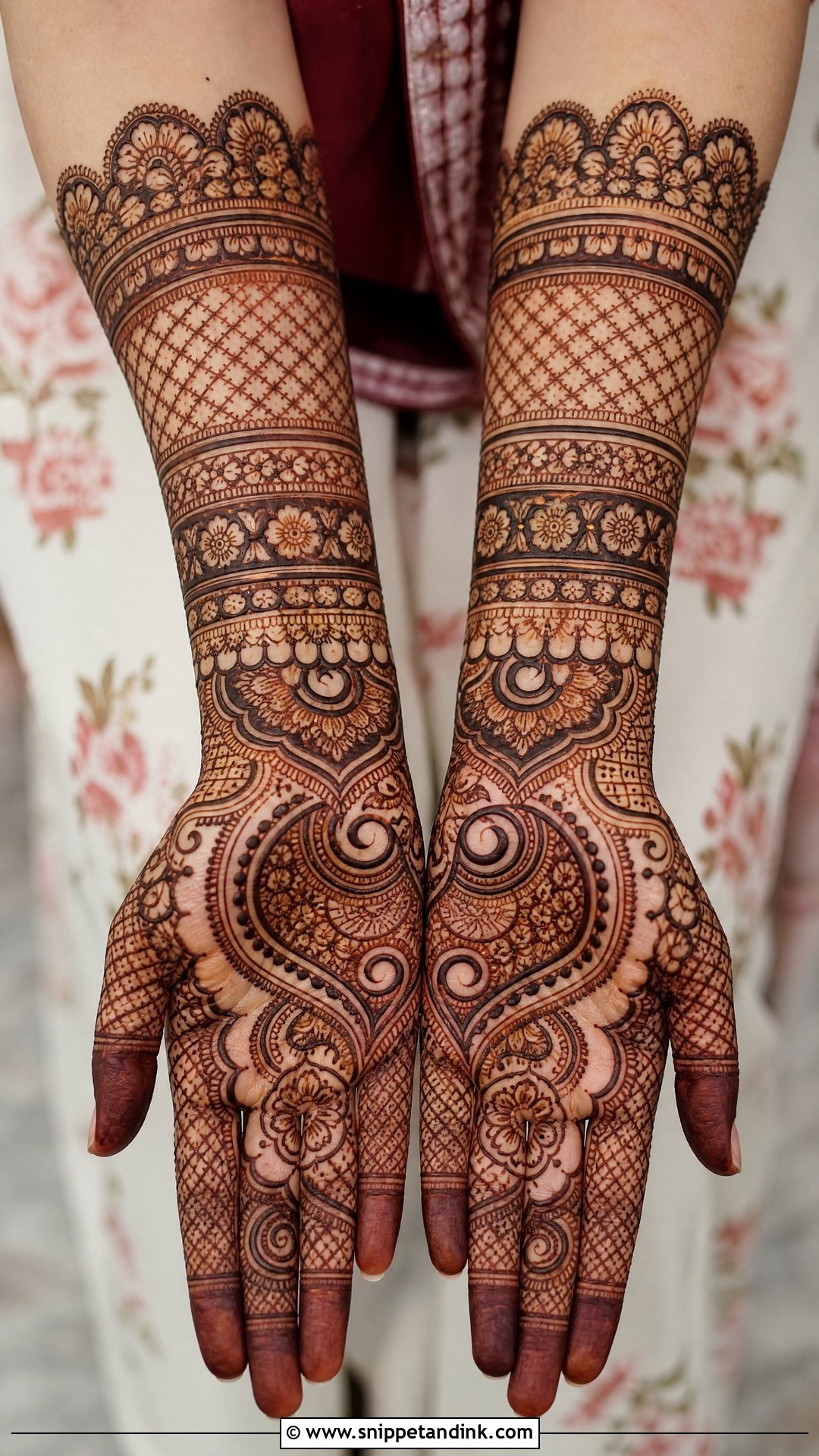
A full cuff covers the wrist with a wide band of jaali, paisleys, flowers, scalloped borders and leaf rows. It gives you the feel of heavy henna limited to one area, which is useful if you have a busy week and don’t want stained palms. Clear top and bottom borders are essential; a cuff that fades out unevenly looks unfinished. Keep the hand plain or add light finger tips.
23. Round Tikki Wrist Mehndi Design
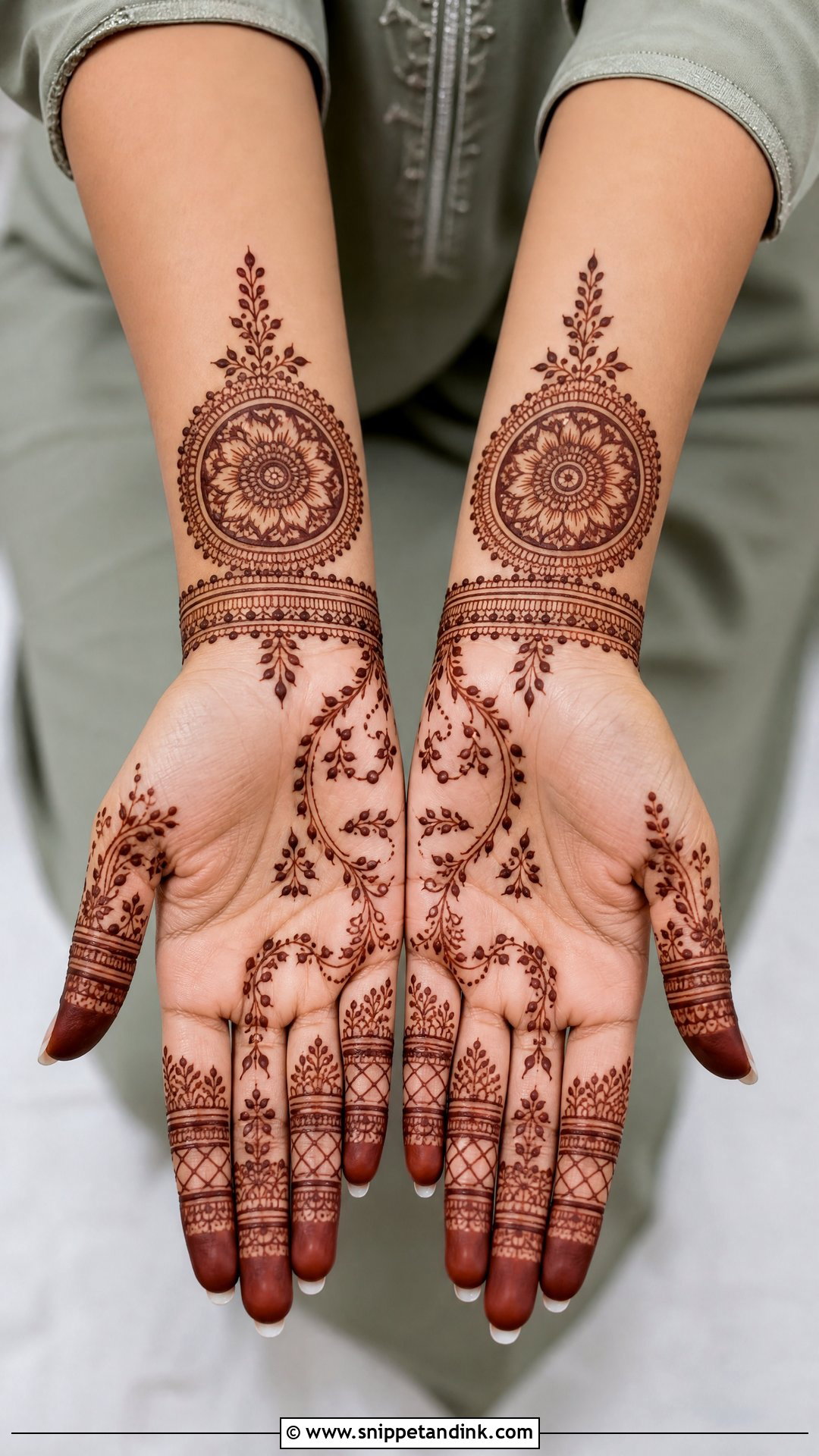
Tikki is a round motif, filled with petals, dots, spirals or fine lines and framed by bracelet bands or small vines. It looks traditional when surrounded by detail and modern when given open space. It fits the front wrist, back wrist or lower palm. For a festive version, add matching fingertip dots and slim finger bands. On a lighter day, wear only the tikki and one line.
24. Peacock Wrist Mehndi Design
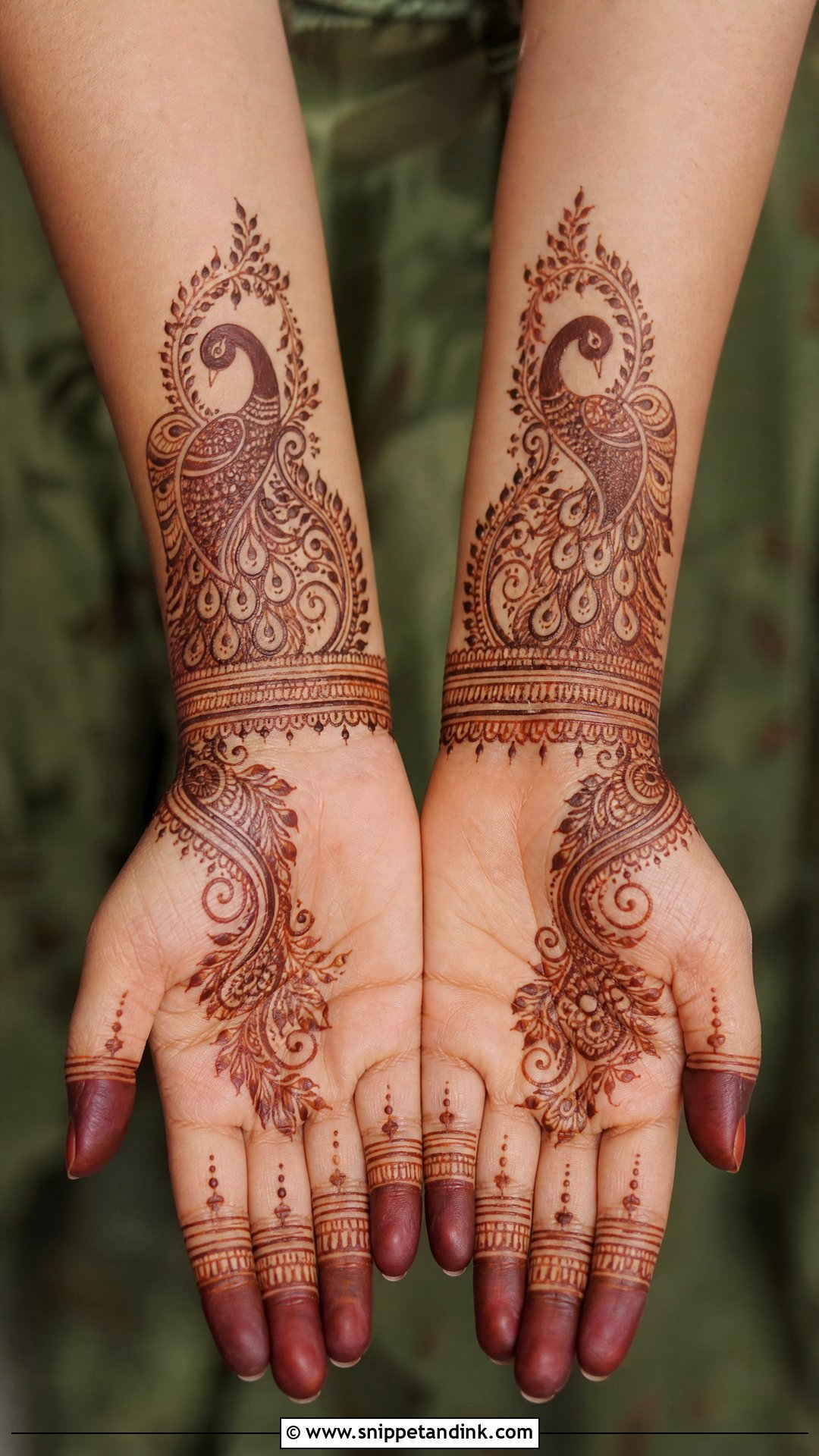
A peacock needs space, so it usually sits at the centre of a cuff with the feathers sweeping around the wrist or up the forearm. Paisleys, leaves and dotted borders complete it. The body and neck should stay readable: I draw a bold outline first and fill only the feathers, because an overfilled peacock looks like a blob once the stain darkens. It is the most artistic motif in this list, and it takes longer than it looks.
25. Lotus Wrist Mehndi Design
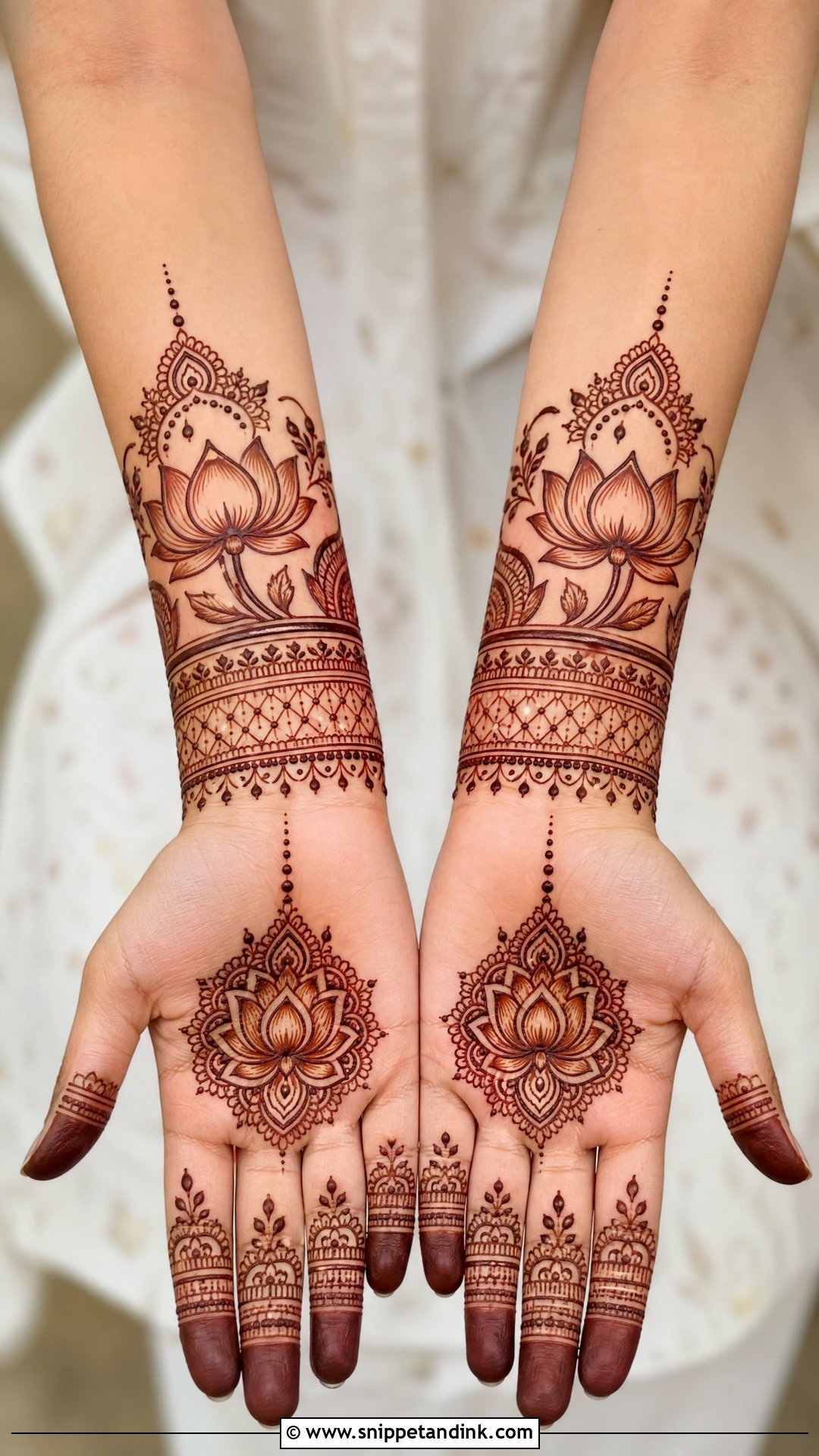
The lotus is a calm, symmetrical flower that suits a bracelet band with one bloom at the centre or a cuff of several. Curved leaves, fine dots and soft petal shading fill it out. Symmetry is the whole point, so I draw the centre petal first and mirror each pair outward. It pairs well with mandalas and jaali, and it is popular with brides and bridesmaids for festival looks.
26. Chain Bracelet Wrist Mehndi Design
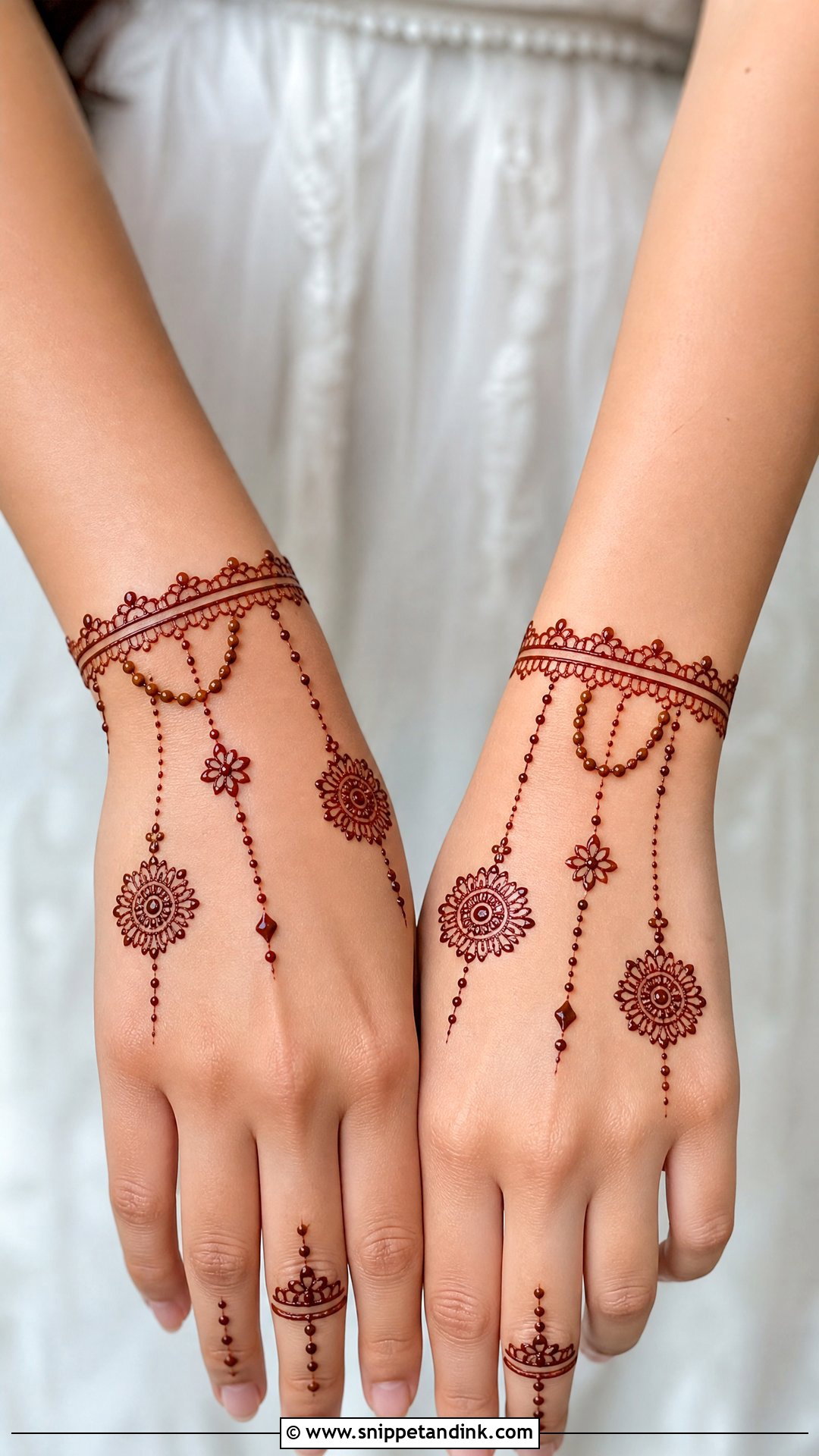
This design copies fine hand jewellery: a slim wrist band, small hanging chains, dotted strings and a charm shaped like a flower or mandala. It looks best on the back of the hand. Thin chain lines and evenly spaced dots carry the jewellery effect. You can connect it to a ring pattern on one finger for a haath phool look. It is quick to apply, which makes it a favourite for younger girls.
27. Shaded Wrist Mehndi Design
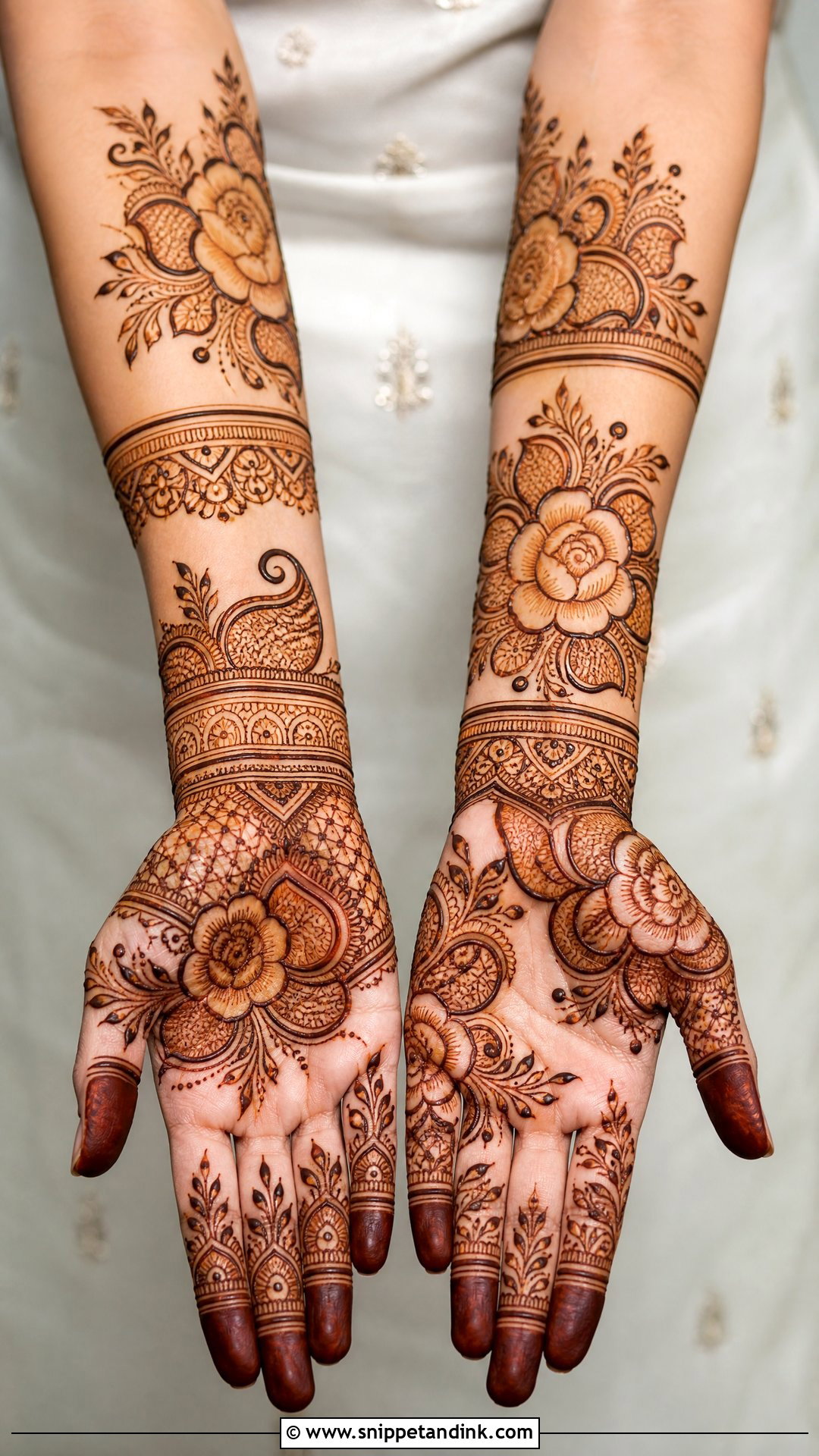
Shading fills flowers, leaves or paisleys with thin parallel lines, light crosshatching or filled edges to add depth. Arabic and Indo-Arabic patterns take shading well because their large motifs leave room for contrast. Overdo it and the stain goes muddy, since shaded areas darken together and lose their edges. Strong outlines, lighter inner lines. Done well, it photographs with real dimension.
28. Geometric Wrist Mehndi Design
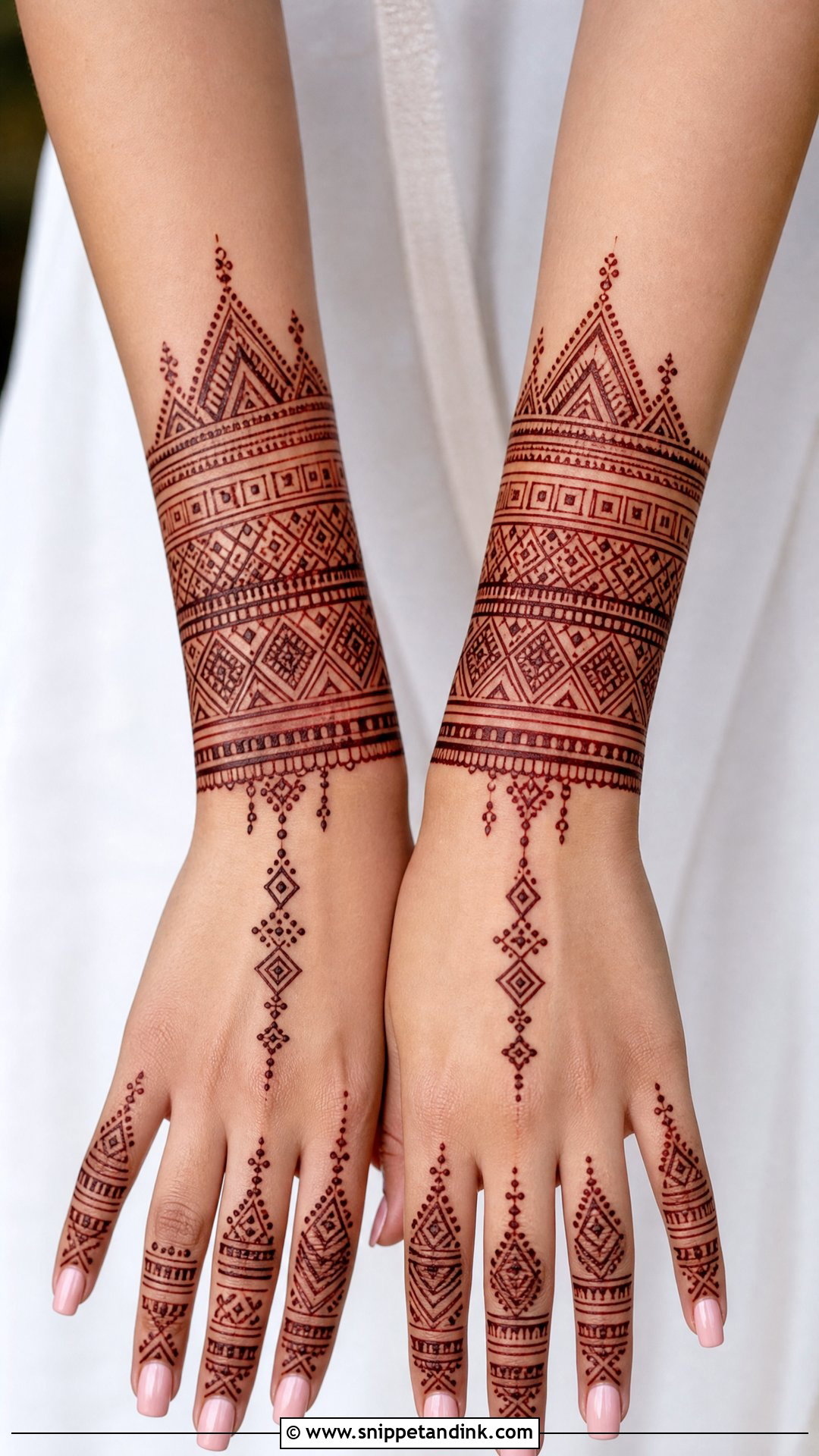
Triangles, diamonds, chevrons, straight bands and dot grids give a geometric wrist a clean, structured look. It sits naturally with minimal outfits and can borrow Moroccan details for a stronger cultural reference. Precision is everything: equal spacing, straight lines, neat borders. If you are drawing it yourself, a fine cone and steady breathing help more than any template. Keep the hand plain or add a single matching finger band.
29. Kids Wrist Mehndi Design
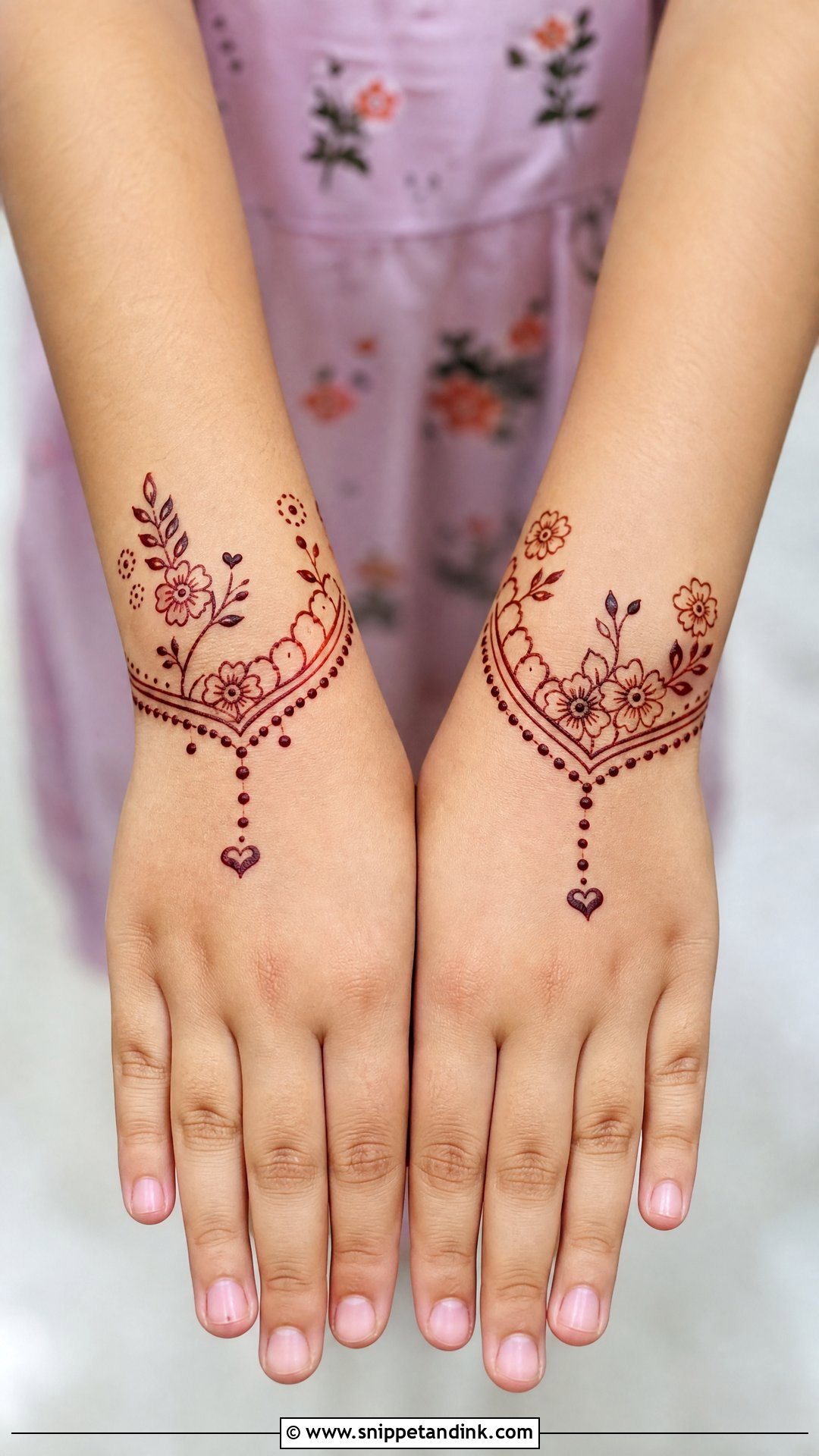
Children need a design they can sit still for: a small flower, a tiny heart, a dotted bracelet or a vine. Avoid very fine detail, which smudges the moment a child moves. Use only natural henna, which stains reddish brown. Anything sold as black henna, or that stains black in an hour, can contain chemicals that cause serious skin reactions, and I never use it on anyone, least of all children. A small band with one flower charm is usually plenty.
30. Easy Wrist Mehndi Design For Beginners
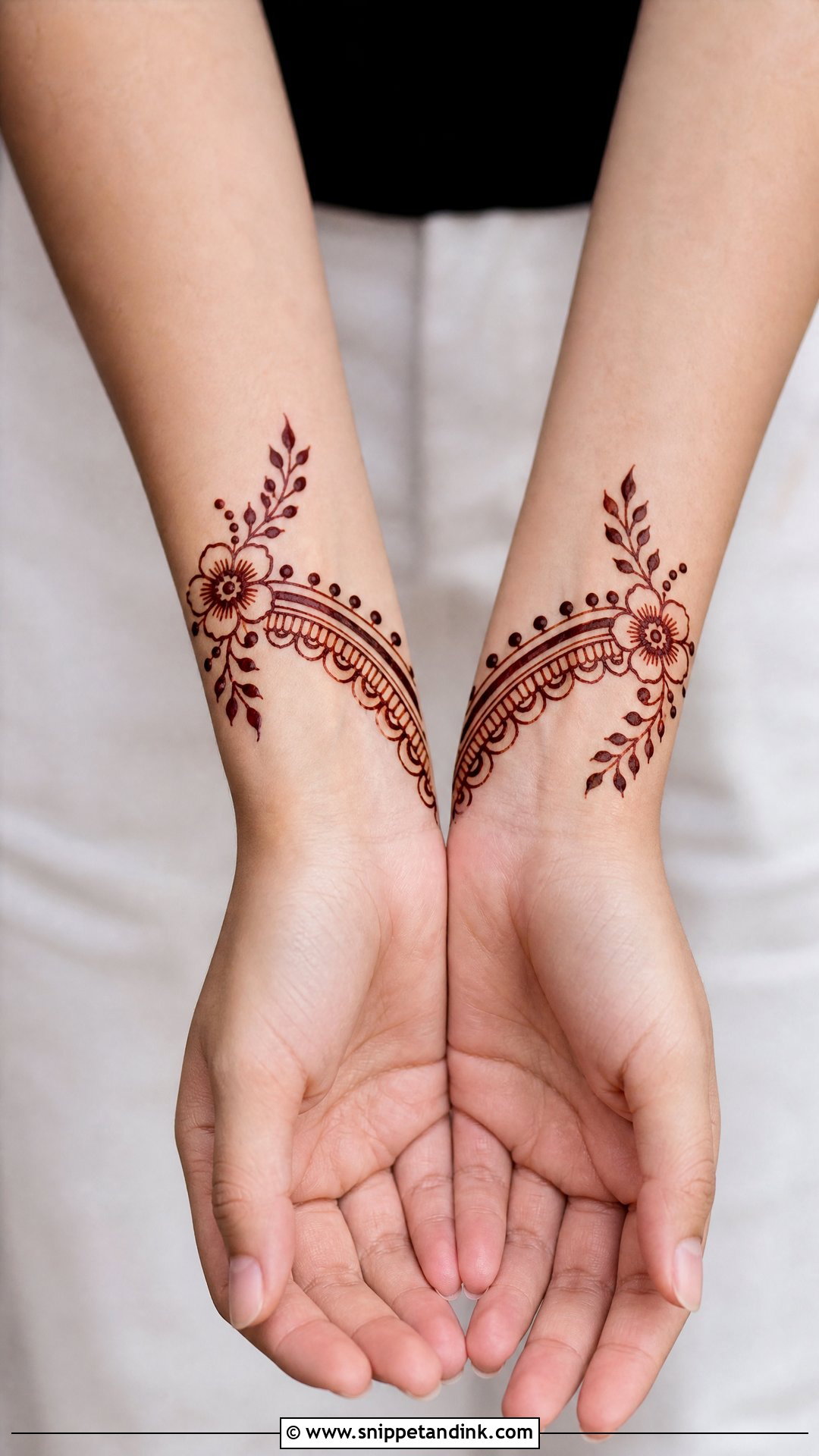
An easy wrist mehndi design for beginners starts with two curved lines around the wrist, then dots, small leaves, scallops or a centre flower between them. A short vine toward the back of the hand adds detail once you feel steady. The two lines give structure, so small mistakes inside disappear. Practise cone pressure on paper first; most wobbly lines come from squeezing unevenly, not from a shaky hand. Leave jaali and bridal filling until you’re confident.
Why Wrist Henna Fades Faster, and How to Slow It Down
When the paste comes off, every stain is bright orange. It darkens to reddish brown over the next one to two days, and that is normal, so don’t judge the colour on the first evening. What surprises people is how quickly a wrist design wears compared with a palm. The skin is thinner there and takes less dye, and it is constantly rubbed by bangles, watch straps and sleeves.
- Leave the paste on for as long as you can, ideally six hours or overnight. A dab of lemon and sugar keeps it stuck to the skin as it dries.
- Scrape the dried paste off with a blunt edge or your fingernail. Don’t wash it off.
- Keep water away from the design for the rest of the day, and avoid soap, sanitiser and swimming pools on that area for a couple of days if you can.
- Wear bangles and watches loose, or move them to the other arm, while the stain is still developing.
- Rub a little natural oil or balm over the design before handwashing. It slows the scrubbing that takes the stain off the wrist first.
Even with good care, expect a wrist stain to look its best for about a week and fade from the edges after that. If you have two events a few days apart, time the henna for roughly two days before the one that matters most to you, since that is when the colour peaks.
A Wrist Design for Every Sleeve Length and Occasion
A wrist design gives you henna without committing your whole hand, and it moves with the jewellery you already wear. Simple bracelets, leafy vines, bridal cuffs, jaali bands, paisleys and haath phool layouts can all be made bolder or quieter to suit the event. Choose the pattern by your outfit and sleeve length first, then by how long you can sit. And remember the wrist stains lighter than the palm: clear outlines, a well placed band and two days of patience will give you more colour than extra filling ever will.
You'll Like These Ideas:



Leave a Reply