
Leg mehndi is the part of bridal henna people forget to plan, then notice in every photo where the hem lifts: on the steps, during the pheras, in the shot of your feet beside the groom’s. I usually design the legs after the hands are settled, because the feet should answer the hands rather than compete with them. Below are thirty layouts I get asked for, from full-leg Indian mehndi to Arabic trails and anklet bands. How high you go should come down to your hemline, your sandals and how long you can sit with your legs stretched out.
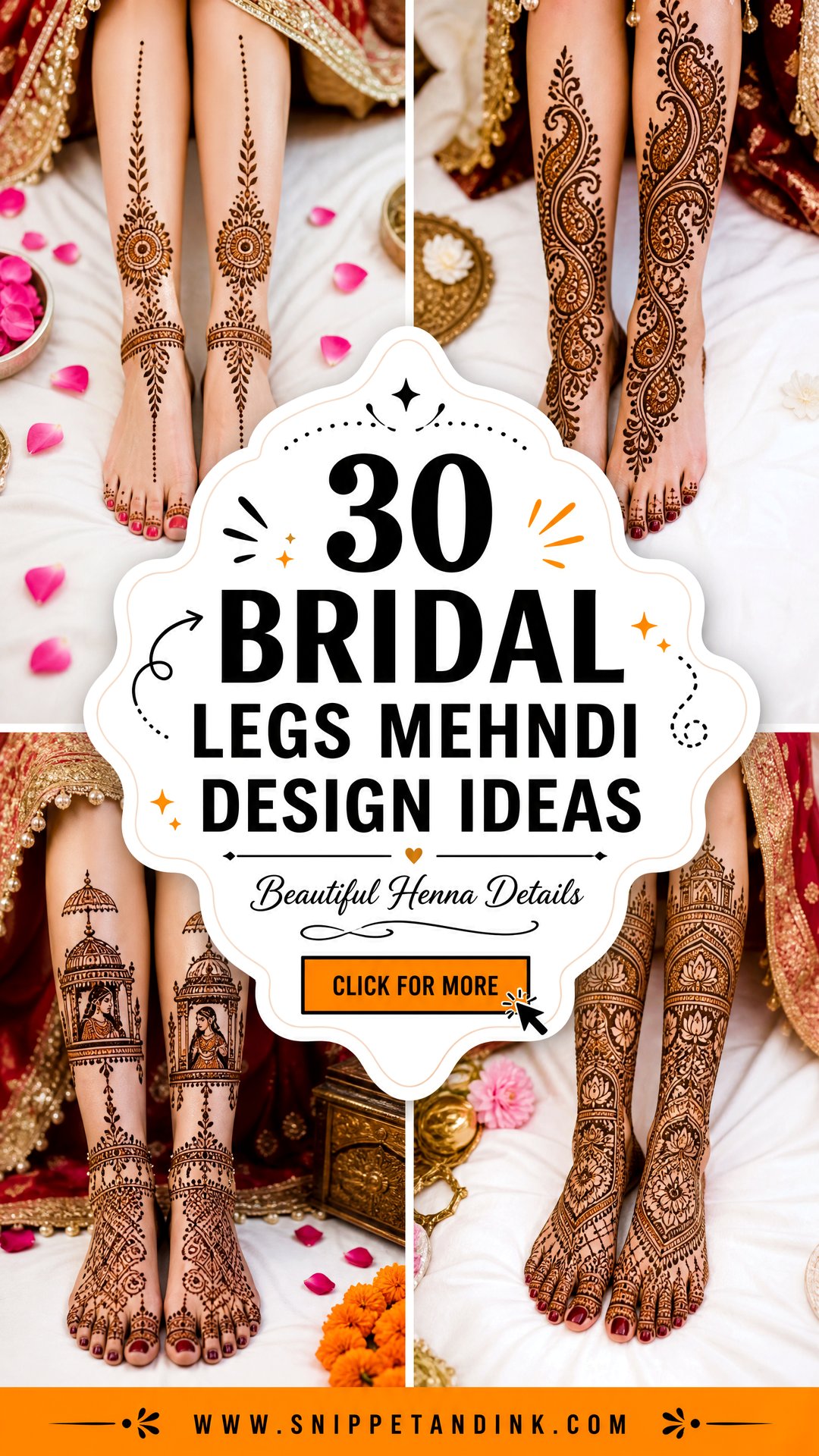
How High Should the Henna Climb on Your Legs?
Before I sketch anything for the feet, I ask to see the outfit, or at least a photo of you standing in it. The hem tells me how much leg anyone will see. A floor-length lehenga that only lifts when you walk needs strong feet and ankles, and anything above the ankle is mostly for you. A sharara, a high-low cut or a saree draped higher at the front makes the shin and calf part of the picture.
Footwear comes next. Straps cross the top of the foot exactly where the main motif usually goes, and they rub. I either design around the strap lines or keep the motif lower toward the toes. Closed juttis hide almost everything except the ankle, so a payal band is often the smartest spend there.
Coverage and sitting time
- Toes and top of the foot only: the quickest bridal option, ideal when the hands are already very heavy.
- Feet plus ankle band: adds the anklet look with little extra time.
- Toes to mid calf: a long session, and you will need help to move while it dries.
- Knee length: plan for a seriously long sitting, often split across two artists or done while the hands dry.
Times vary a lot between artists and designs, so ask yours for an estimate per leg rather than guessing.
1. Full Leg Bridal Mehndi Design
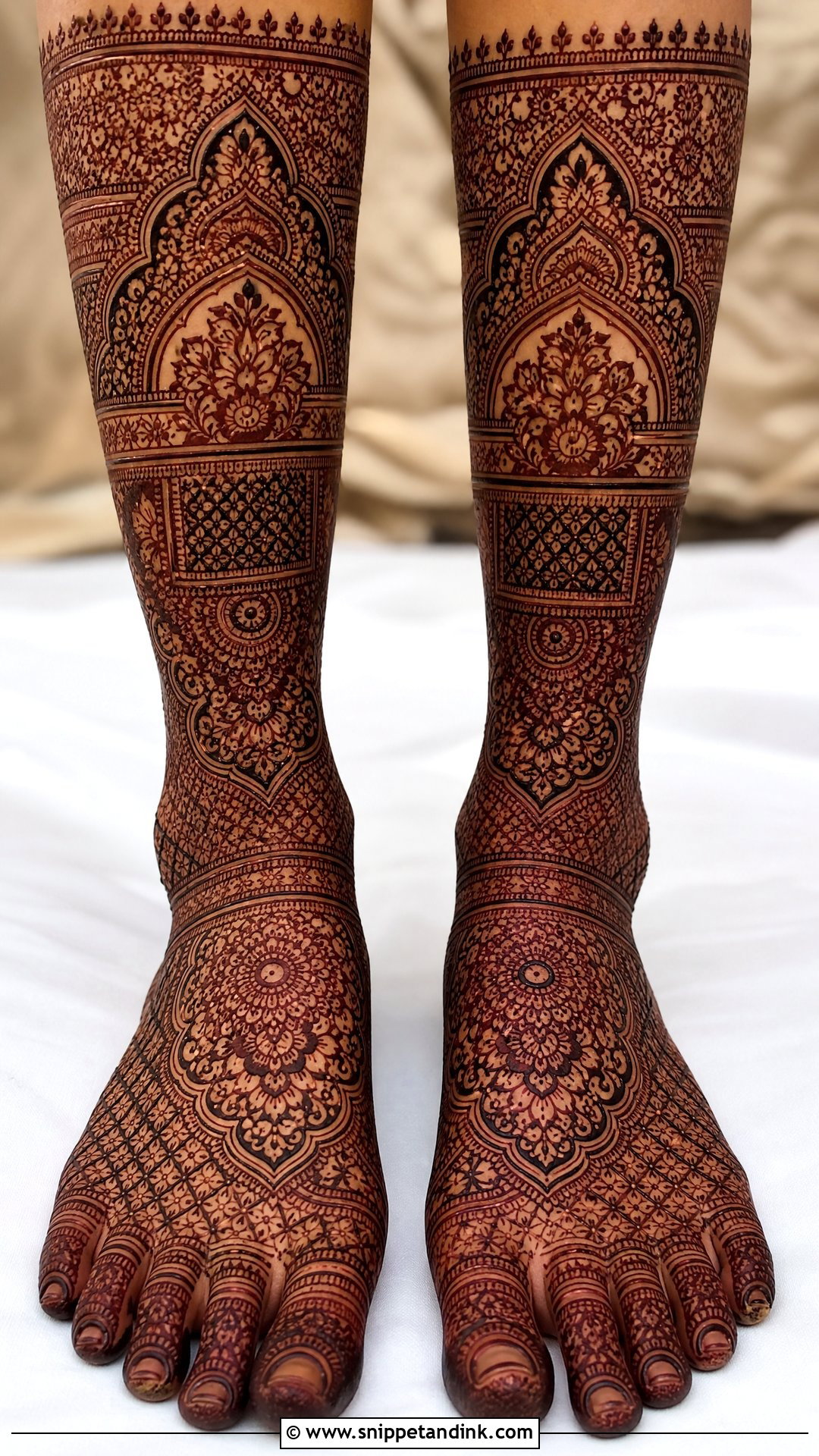
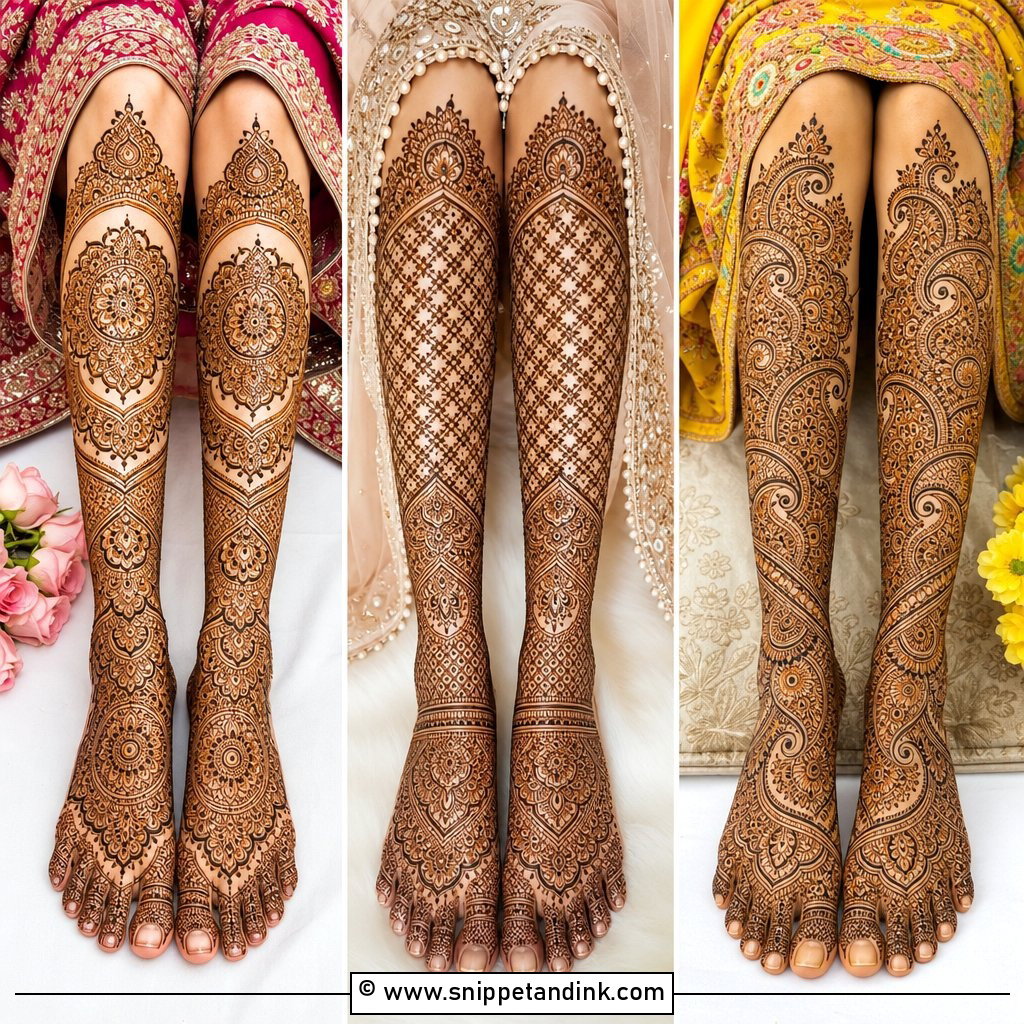
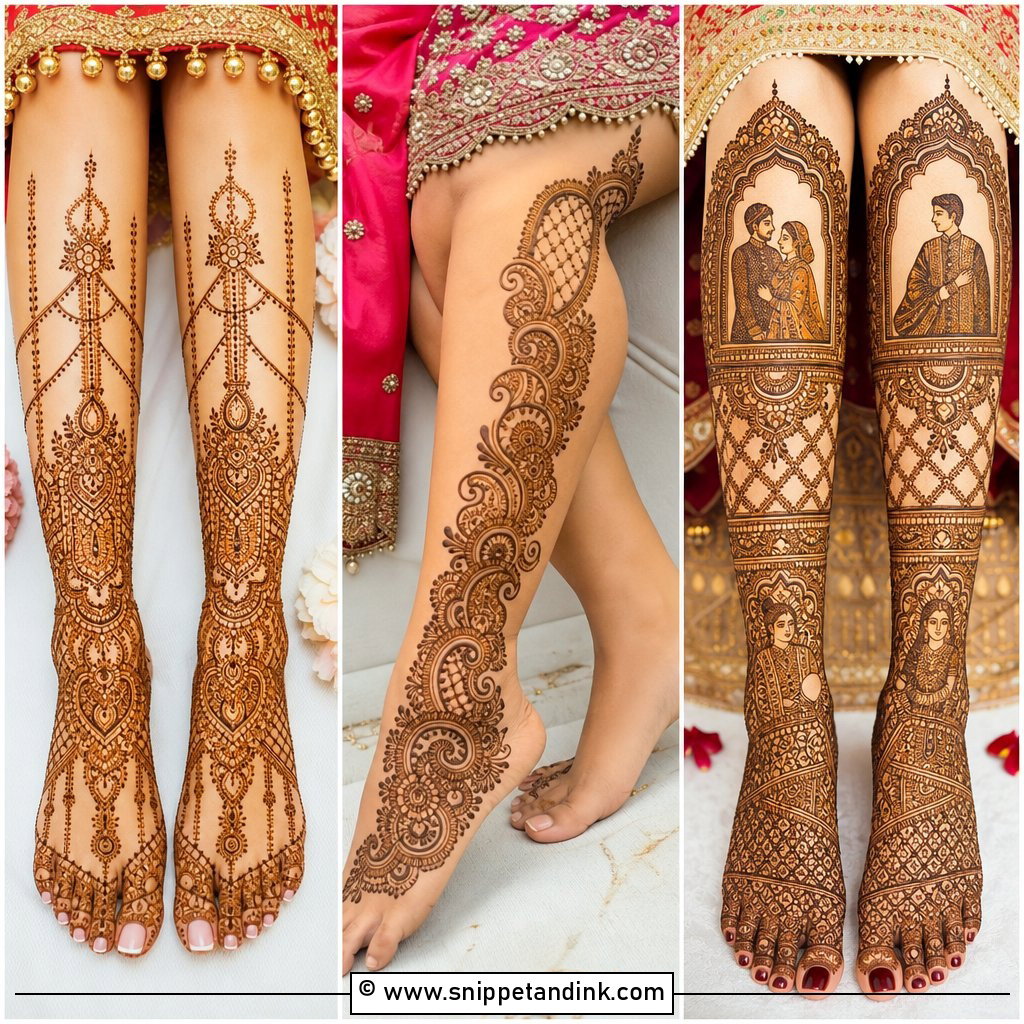
This is the traditional dulhan foot: toes capped, a mandala or paisley field across the top of the foot, a band at the ankle, and then florals and jaali climbing toward the knee. The thing I watch on a full leg is density. Paste laid too close on the shin bleeds into the next line as it dries, and after a dark stain the whole area reads as one brown patch, so I break it with small windows of bare skin every few inches. Expect a long sitting, and expect the calves to stain a shade lighter than the feet.
2. Indian Bridal Leg Mehndi Design
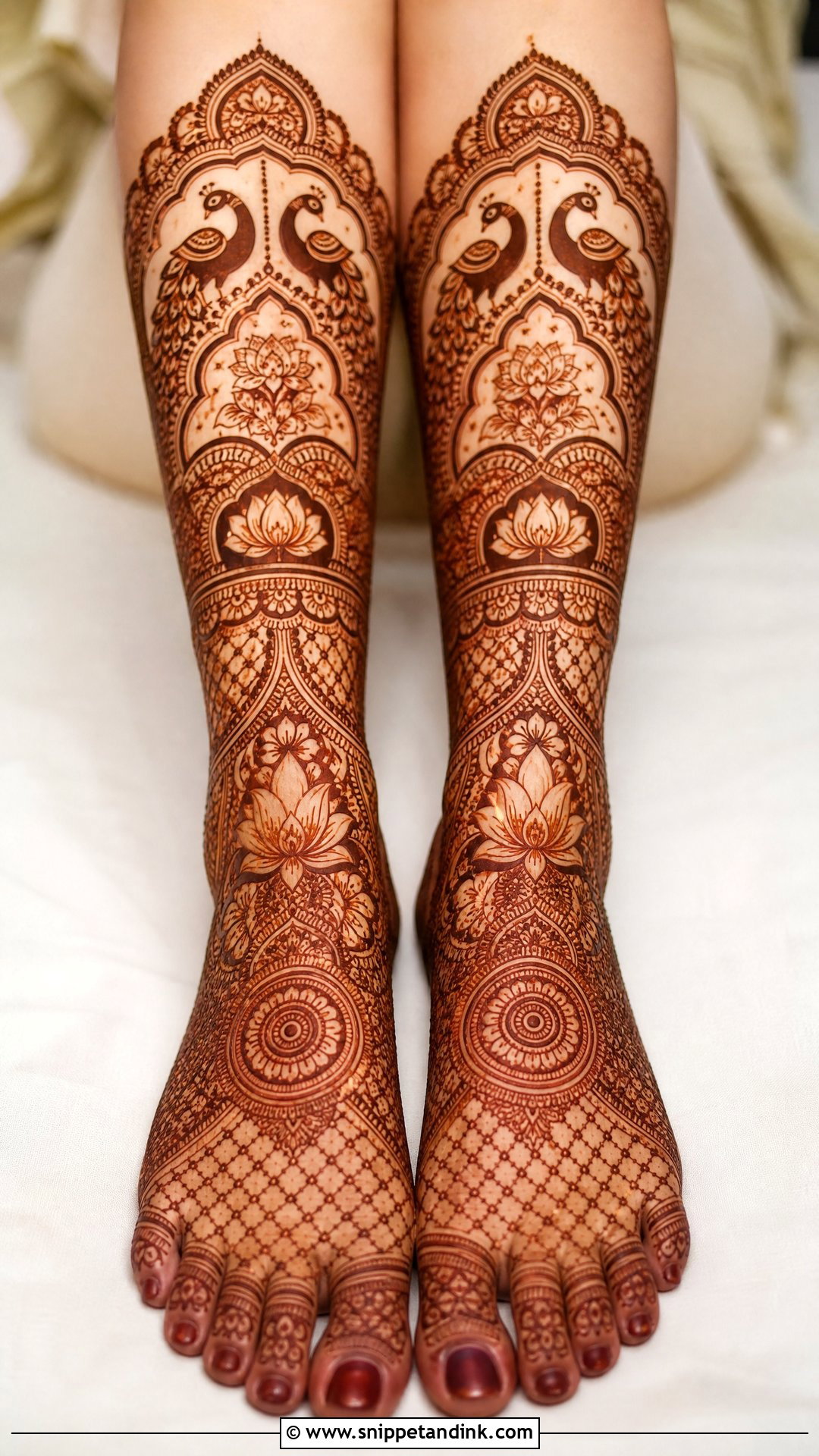
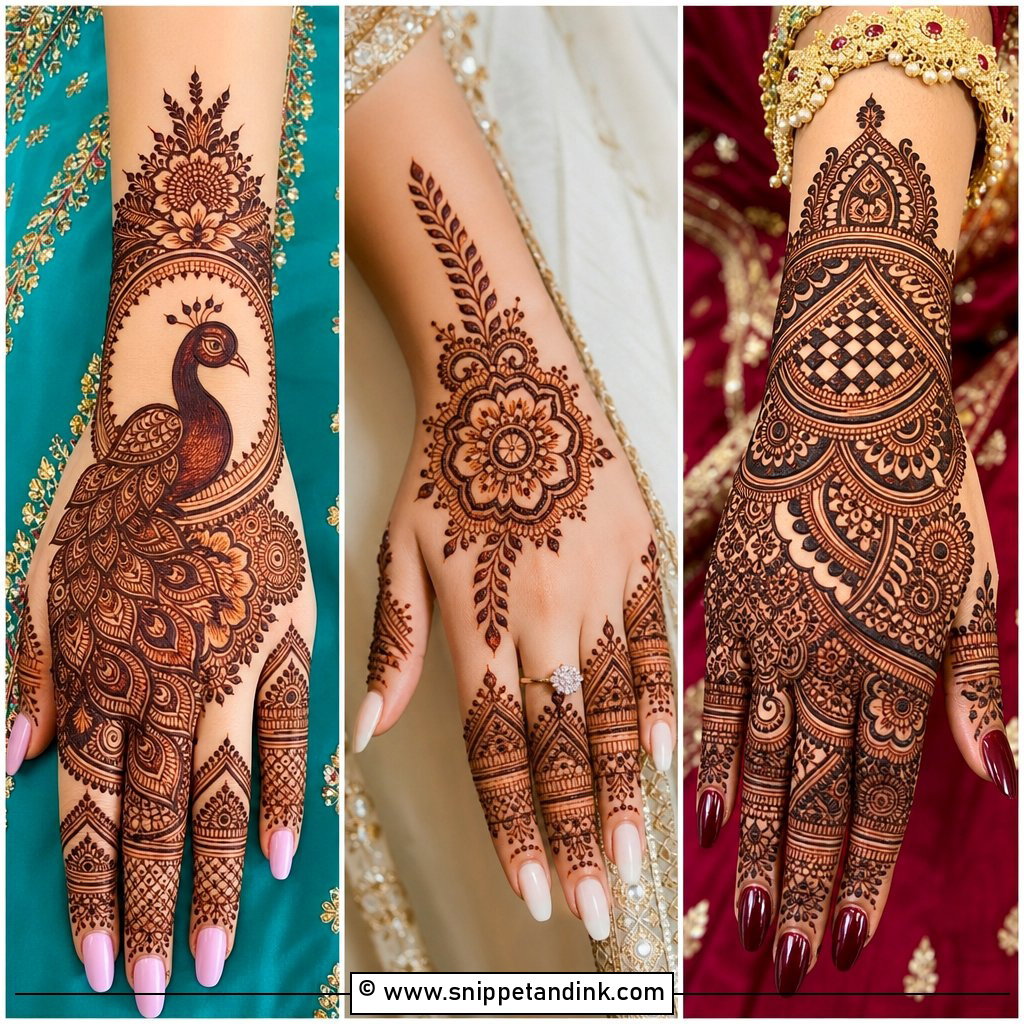
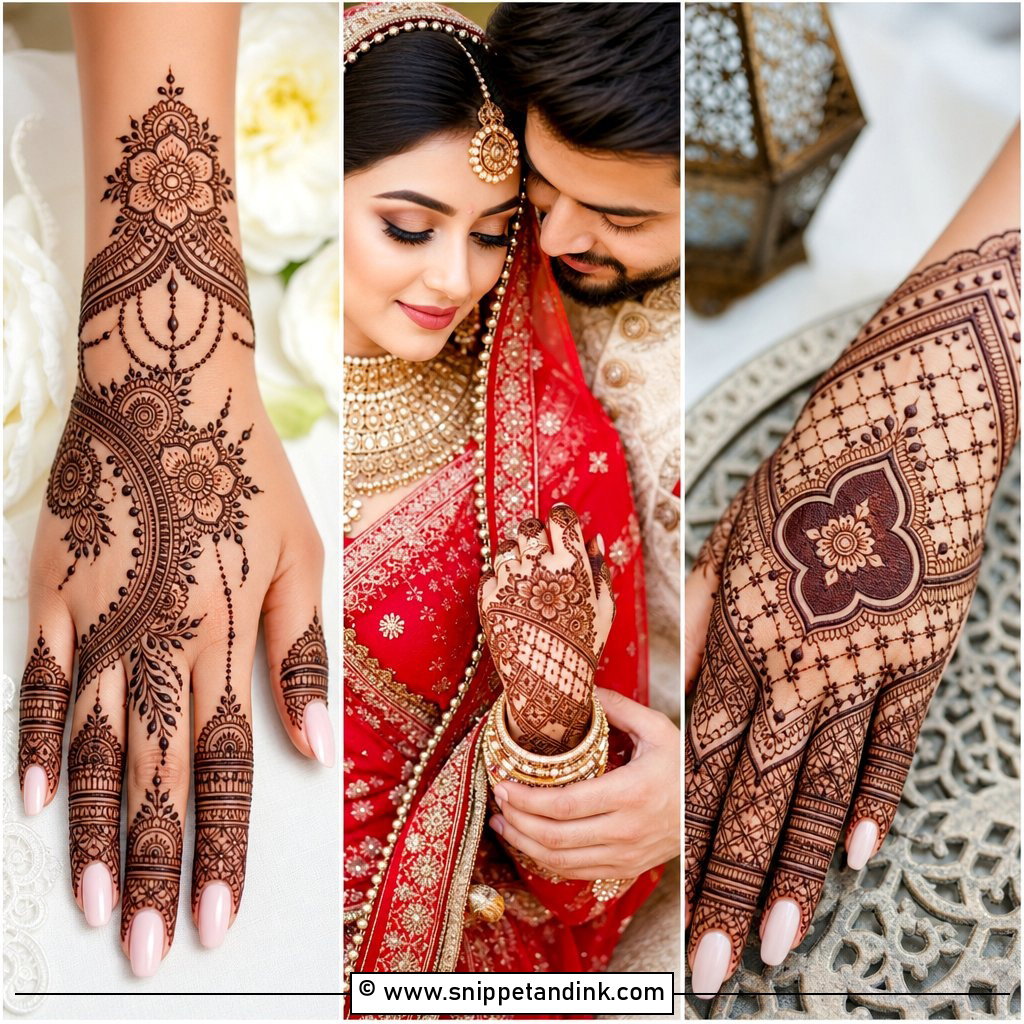
An Indian leg design tells a story in layers: paisleys, lotus, peacocks, kalash shapes, mandalas and the tiny fillers that tie them together. I keep the large motifs on the top of the foot, where skin stains deepest and the camera lands most often, and save the fine work for the calf where people look closely rather than from a distance. Initials or the wedding date can hide in here too. It suits a bride whose hands are fully filled, because a sparse foot under heavy hands looks unfinished.
3. Arabic Bridal Leg Mehndi Design
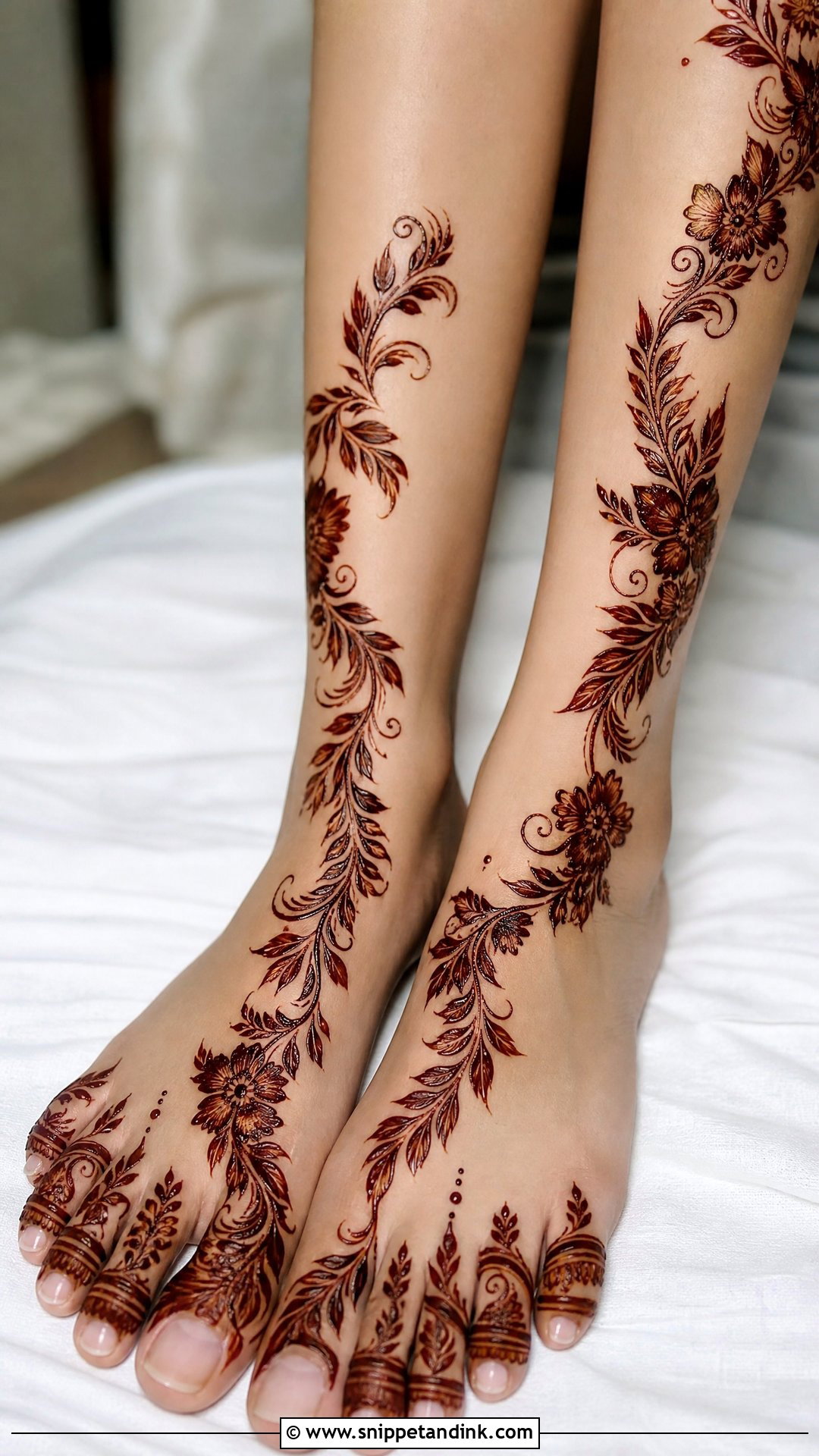
Arabic work leaves skin showing on purpose. Arabic bridal leg mehndi runs on a diagonal: it starts near the big toe, sweeps across the foot, loops the ankle and climbs the calf in bold flowers and leafy vines. Because the strokes are thicker, it is quicker to apply than dense Indian filling, which matters when your mehndi night is already packed with family waiting their turn. The thicker lines also hold their shape when sandal straps rub across them.
4. Indo Arabic Bridal Leg Mehndi Design
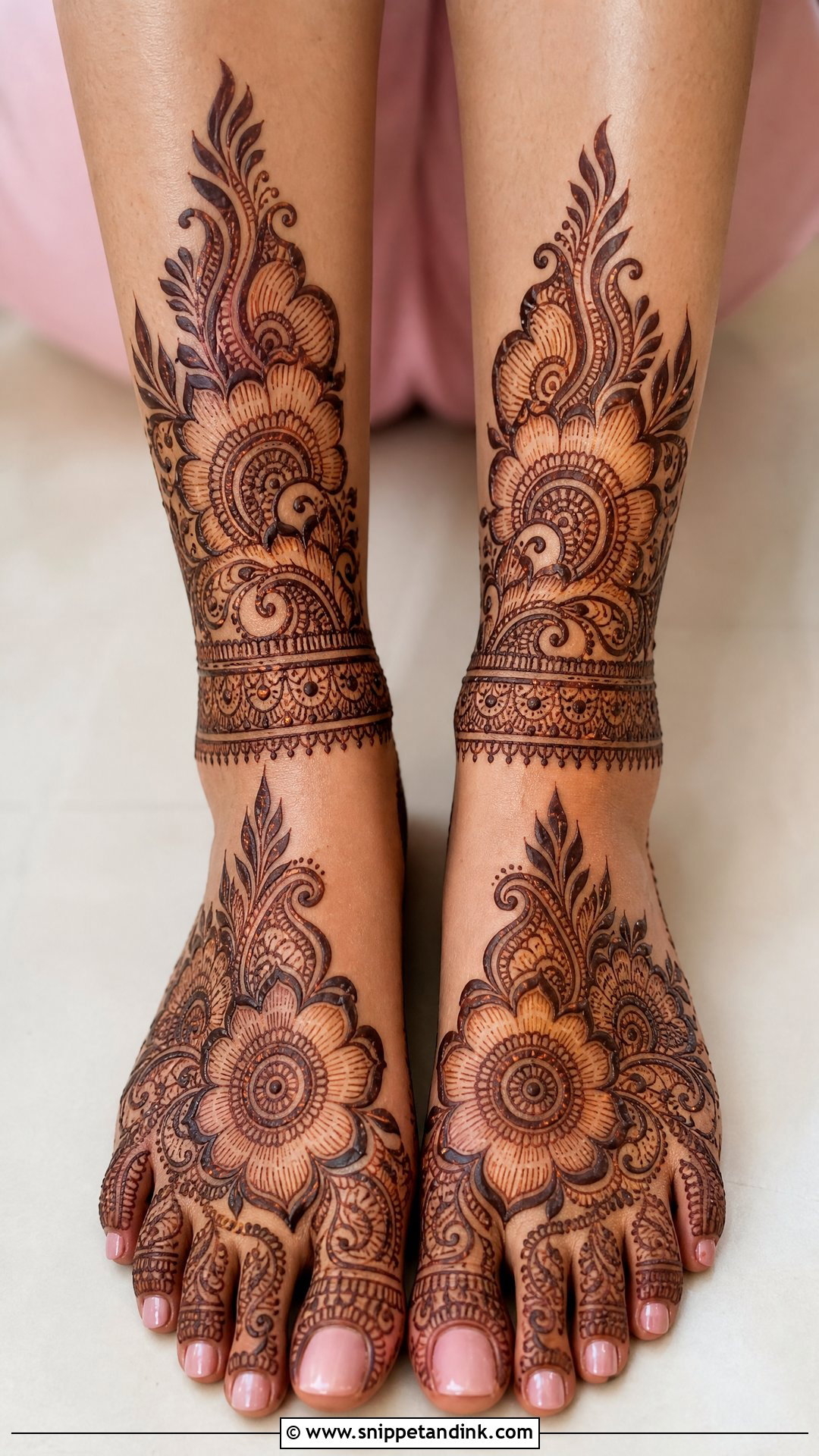
Indo Arabic gives you the Arabic flow with pockets of Indian detail inside it: big flowers and paisley trails, but a shaded mandala centre or a small jaali square where the eye rests. I like it on feet because the open spaces keep contrast once the stain turns maroon. To make it read as bridal rather than party henna, I add an anklet band, finished toes and slightly more weight on the calf than on the foot.
5. Simple Bridal Leg Mehndi Design
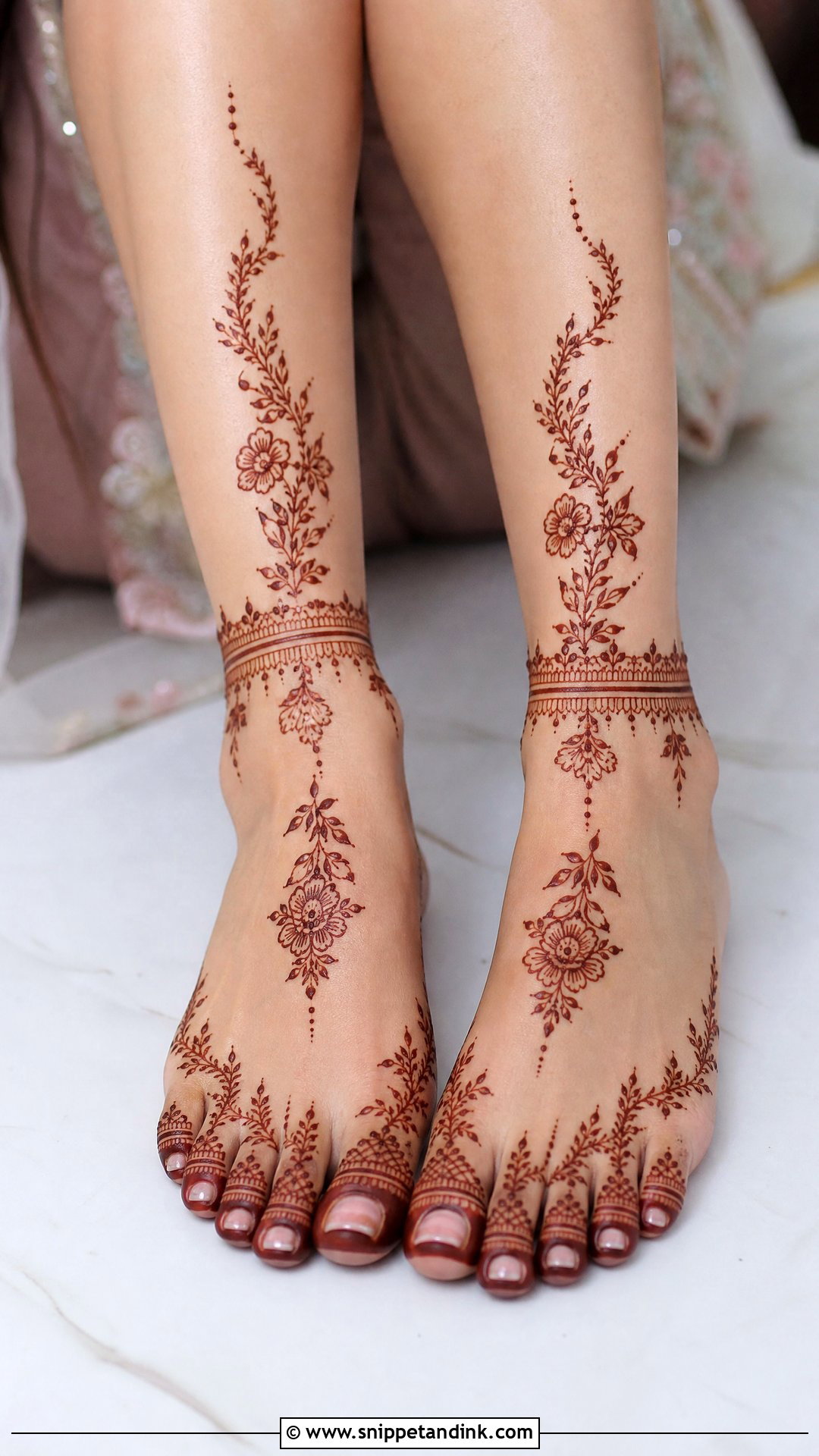
Simple leg henna is where neat hands matter most, because there is nowhere for a wobbly line to hide. Simple bridal leg mehndi usually means clean toe caps, one central motif on the foot, a few vines and a fine anklet, ending just above the ankle bone. I suggest it for destination weddings, embellished footwear, or a bride whose hands are so heavy that matching feet would be overkill. It is also kind to anyone who cannot sit still for hours.
6. Full Feet Bridal Mehndi Design
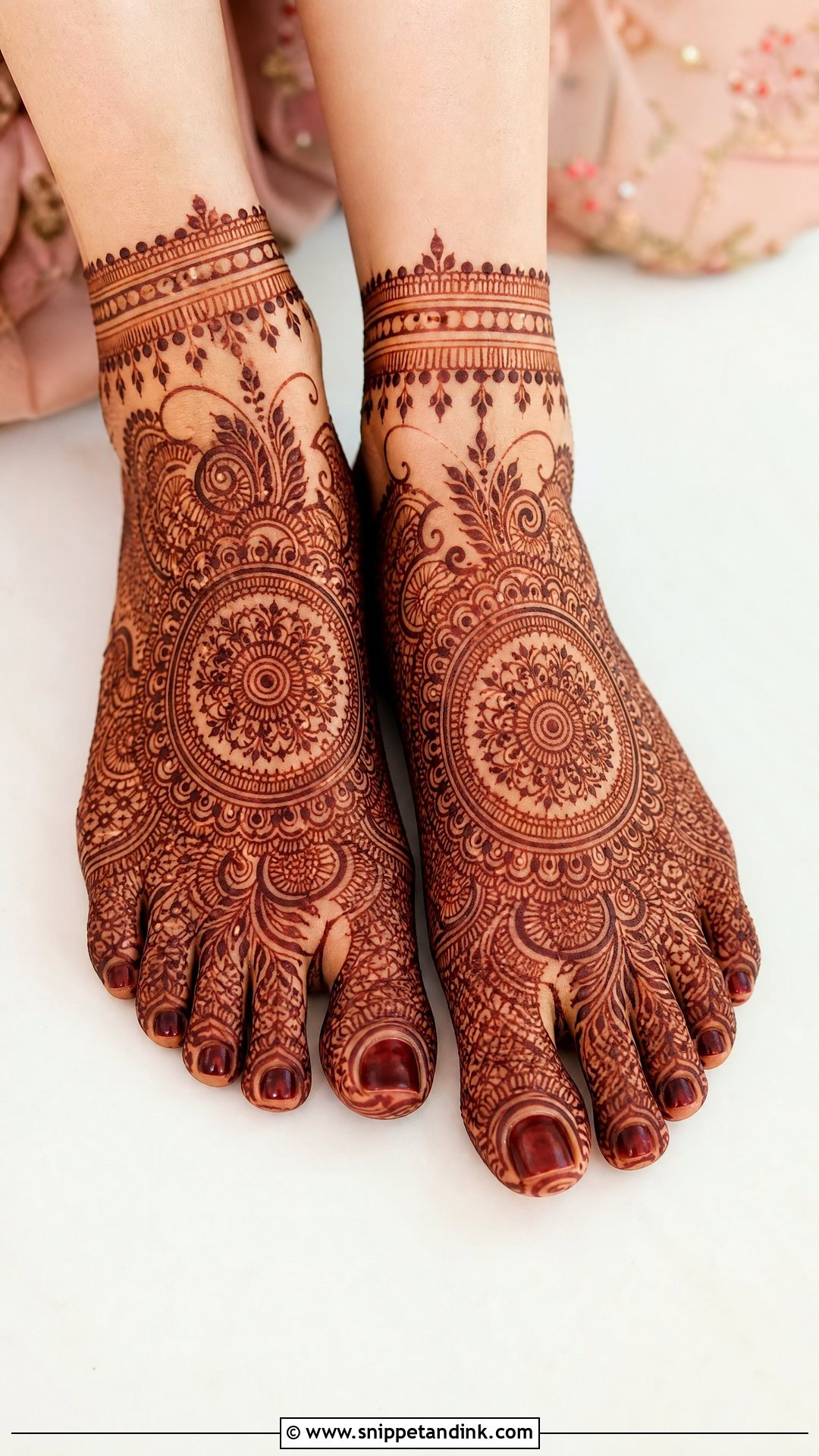
Full feet means the whole top of the foot is covered and the design stops at the ankle. It is the layout I recommend most often, honestly, because the top of the foot takes a deep stain and you avoid the long, fiddly calf work. Symmetry is the hard part. Both feet sit side by side in photos, so I draw the centre mandalas first on each foot before filling anything, and only then add paisley borders and corner florals.
7. Bridal Foot And Ankle Mehndi Design
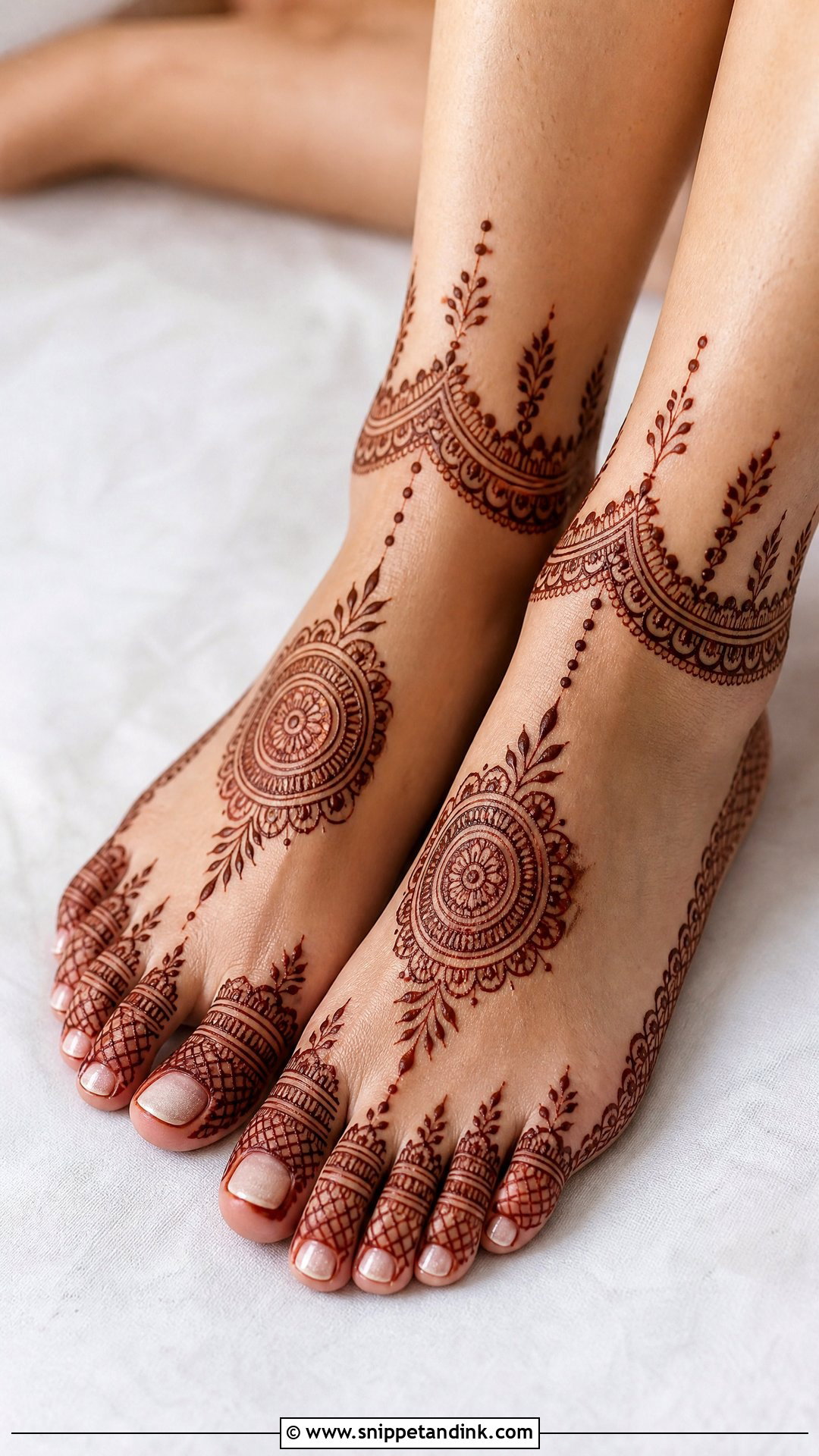
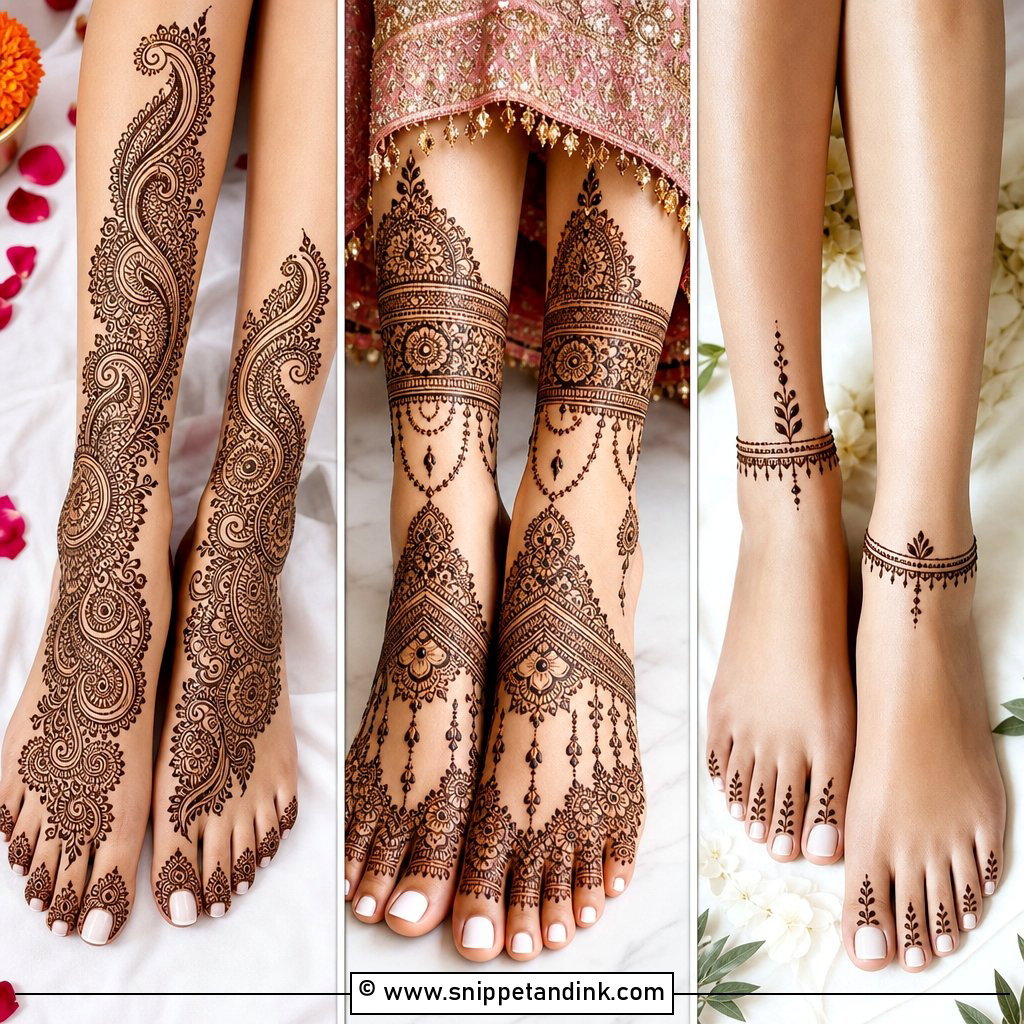
Here the ankle band does the job of a payal, with tiny dots, scallops and hanging drops below it, while the foot carries one main motif. I place the band just above the ankle bone rather than on it, because paste on the bone cracks and flakes first when you flex your foot. It keeps you comfortable and needs no calf work, which makes it a sensible match for open sandals or a lehenga that only shows the ankle.
8. Bridal Payal Mehndi Design For Legs
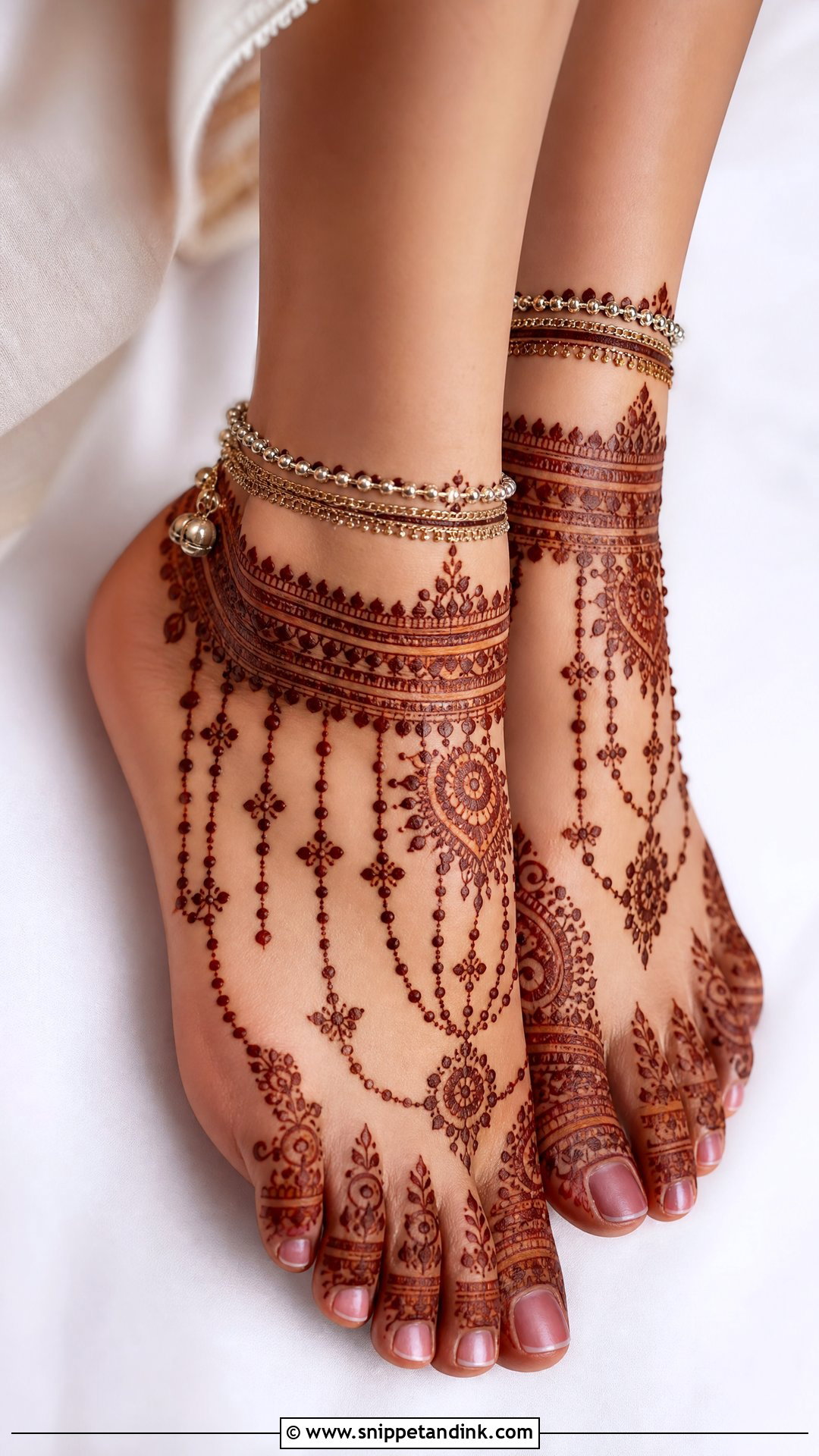
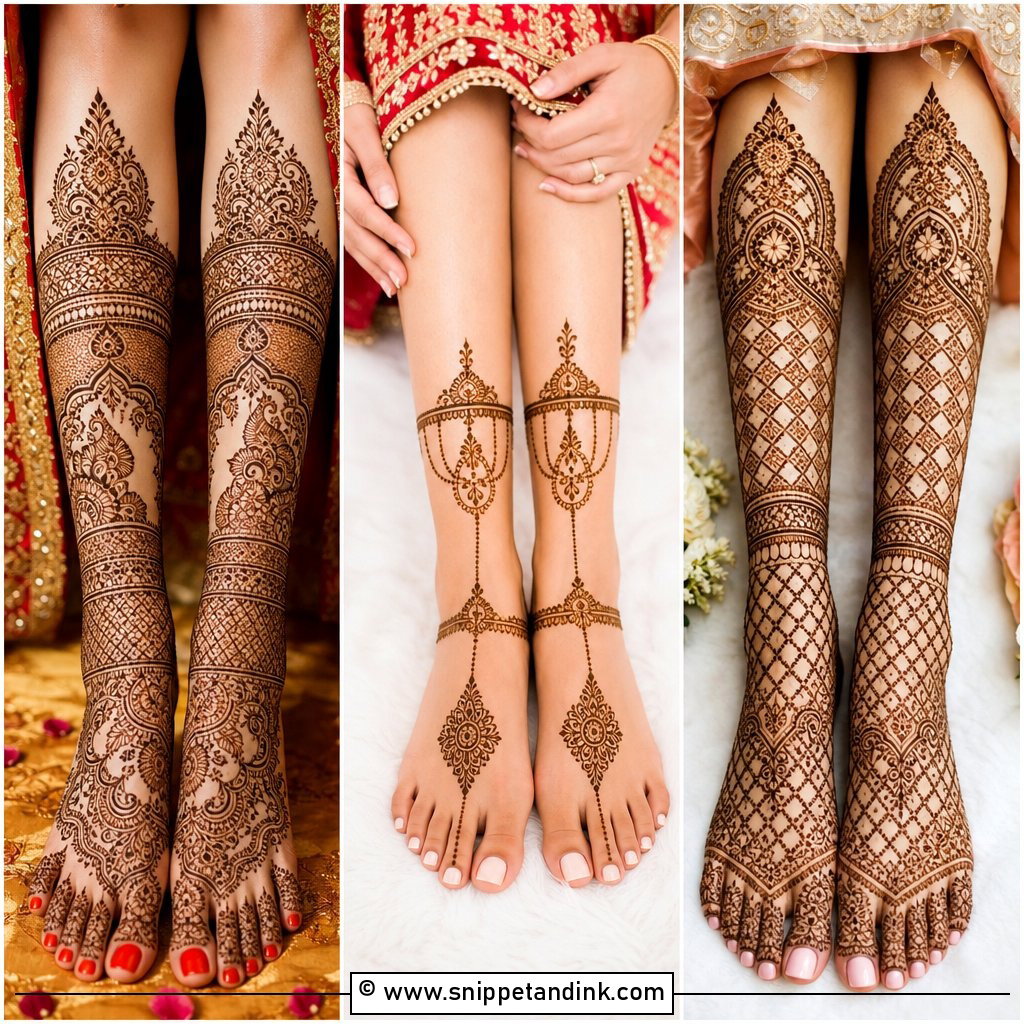
A henna payal is the leg design I see photograph most reliably, because the bands give the camera a clear shape. It is built from layered lines, bead dots and little hanging charms, then joined to decorated toes and a light foot motif. You can wear real anklets over it; just ask your artist to keep the bands slightly higher or lower than where the metal sits, or the jewellery will cover the best part. Crisp, evenly spaced bands are what make it look like an ornament instead of a doodle.
9. Bridal Mandala Leg Mehndi Design
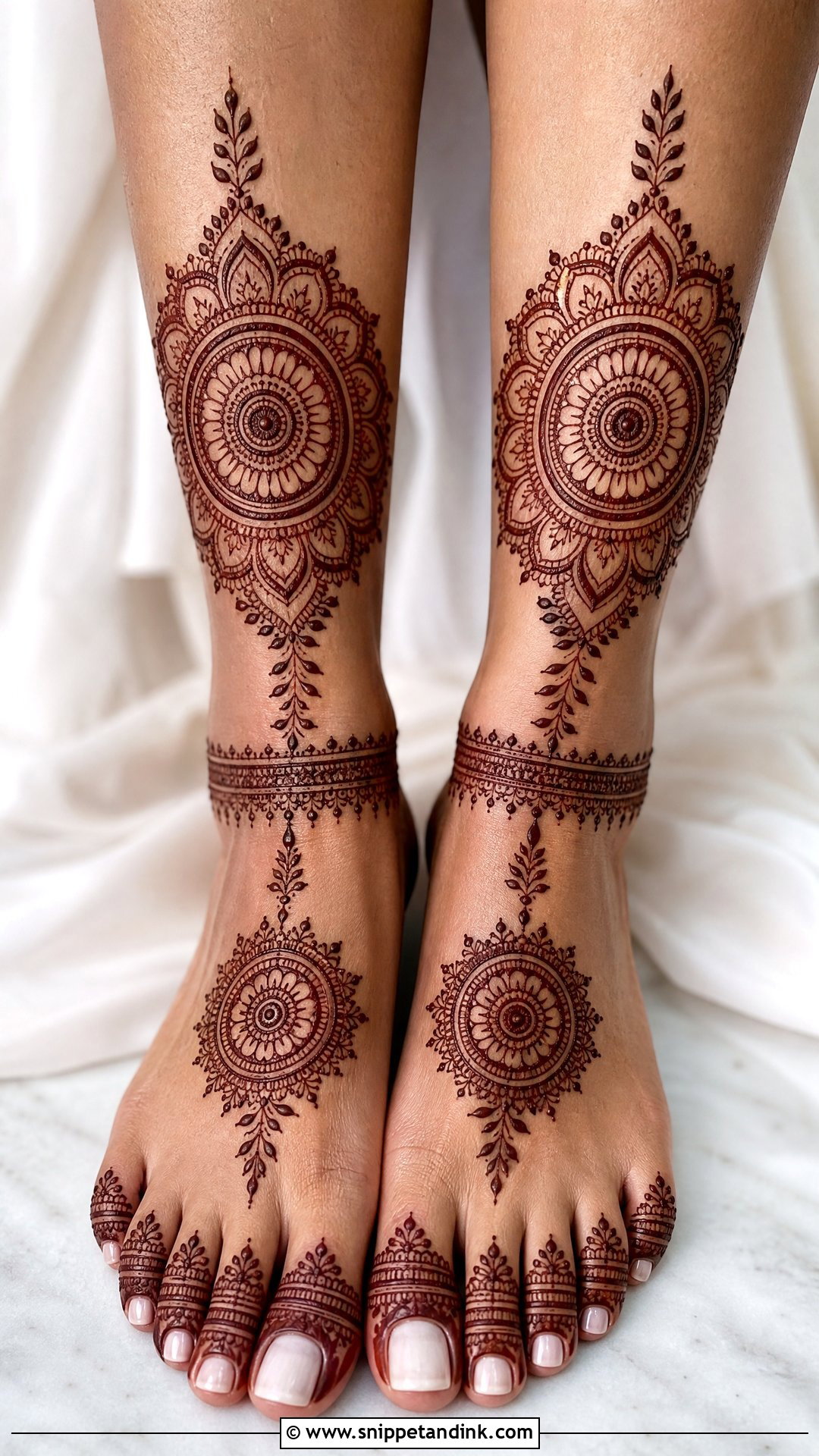
A mandala gives the leg a centre of gravity. It can sit on the middle of the foot, at the ankle or on the lower calf, ringed with lotus petals, dot borders and vines. My rule is to draw the main circle with a thicker line than everything around it, because as the stain darkens over the next two days the fine rings close in and a thin outline gets lost. It sits comfortably inside Indian or Indo-Arabic layouts.
10. Bridal Peacock Leg Mehndi Design
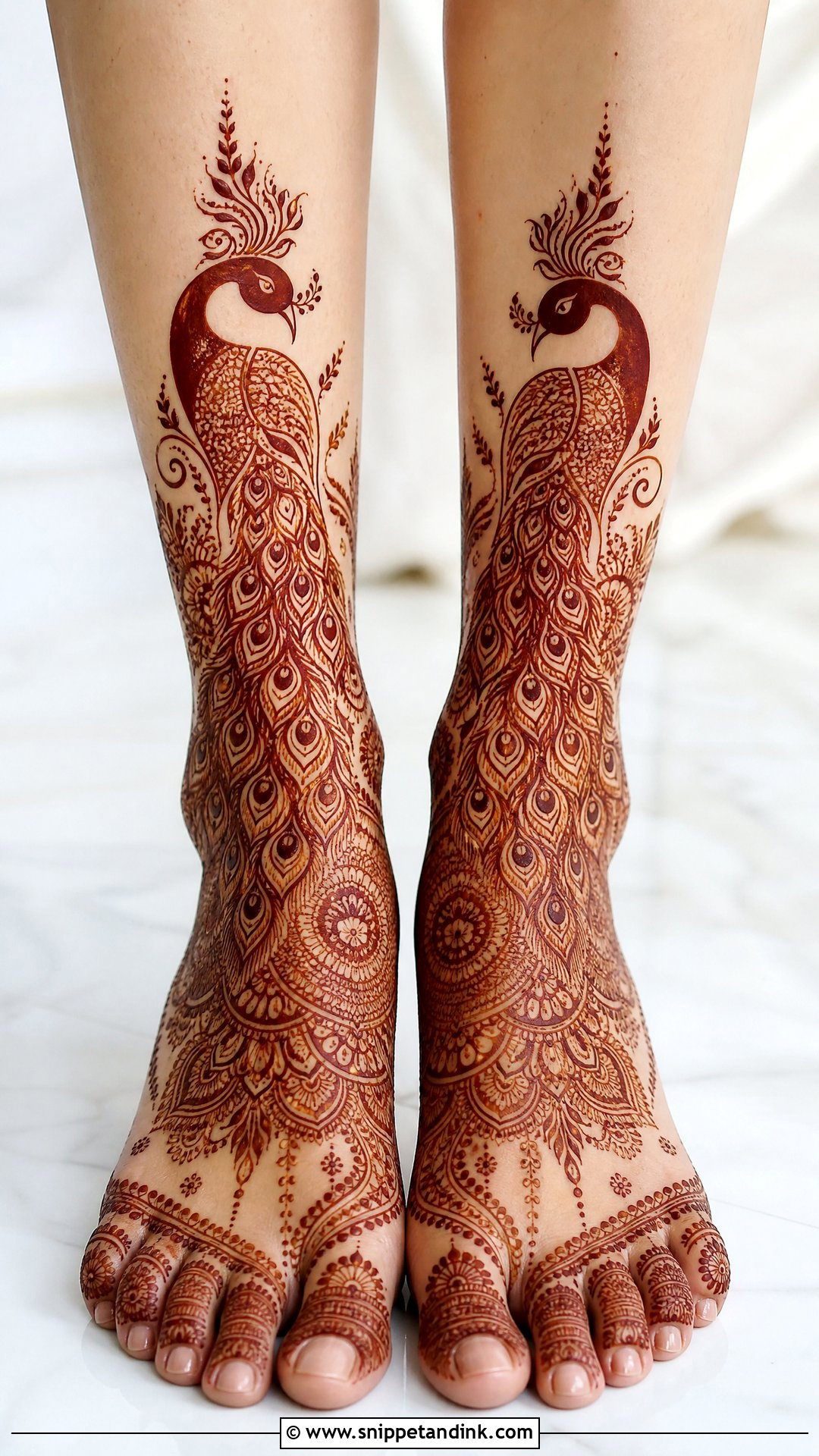
Peacocks are drawn on the foot, the ankle or the calf, with the tail feathers spilling into paisleys and curved lines. Mirrored peacocks, one facing in on each foot, look balanced when you stand with feet together. I keep the body outline clean and do all the texture in the feathers with checks, dots and swirls. This motif sits naturally with temple jewellery and heavier anklets, and it does not need every inch filled to look rich.
11. Bridal Lotus Leg Mehndi Design
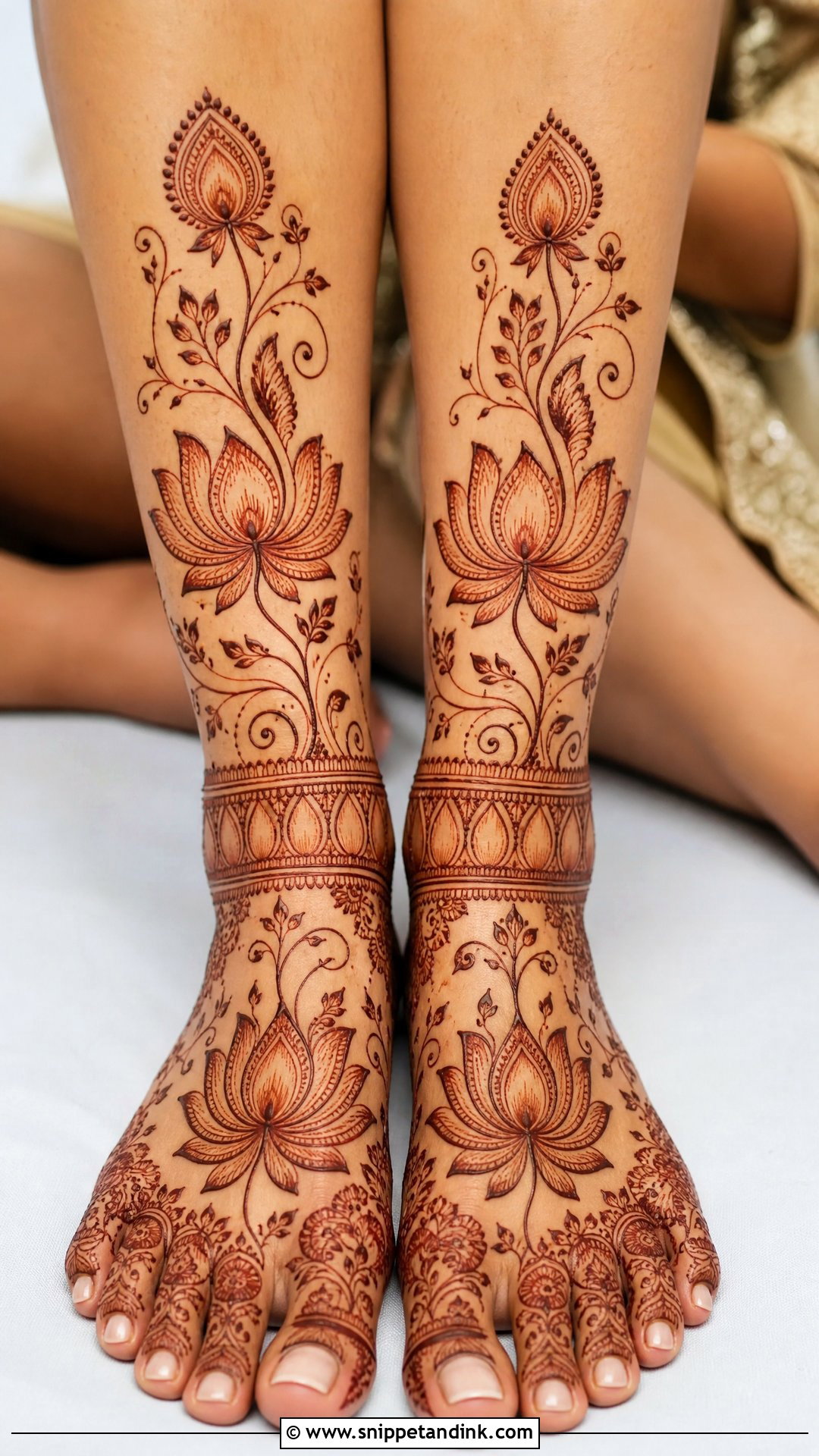
Lotus petals are easy to read from across a room, so this motif holds up in wide shots where finer patterns blur. I put large blooms on the top of the foot, petal bands at the ankle and smaller buds on the calf, then join them with dots and vines. Shading inside the petals rather than solid filling keeps it from going dark and heavy. It can be dense or airy depending on how much of the leg you want covered.
12. Bridal Rose Leg Mehndi Design
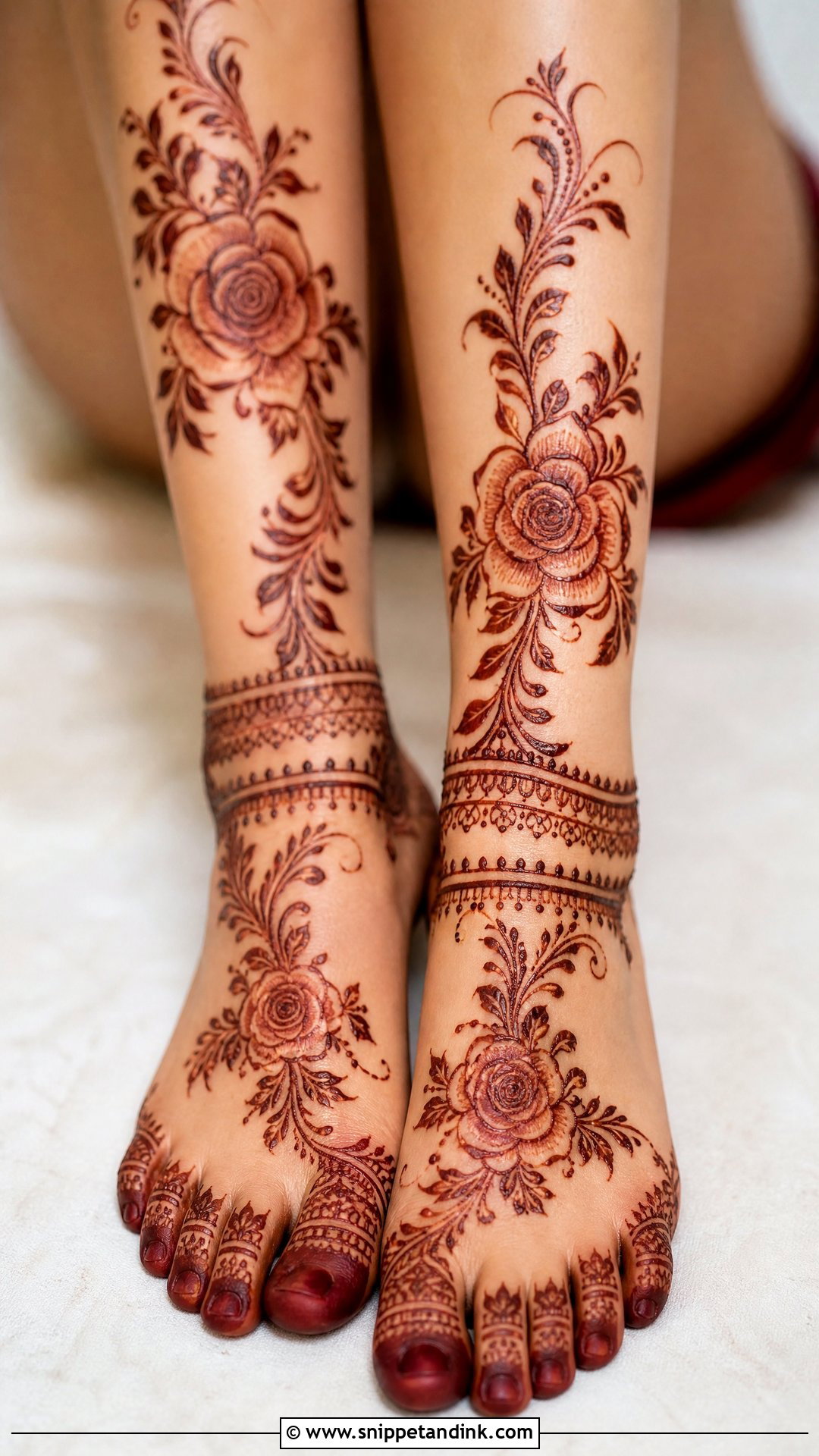
Roses suit Arabic and Gulf layouts because the petals can be large, shaded and spaced apart. A cluster usually sits near the toes or on the outer edge of the foot, then leaves trail around the ankle and up the calf. I size each rose bigger than looks necessary on the day of application, because the inner petal lines close up as the stain deepens. Pair it with lace bands and fingertip-style toes if your outfit has floral embroidery.
13. Bridal Paisley Leg Mehndi Design
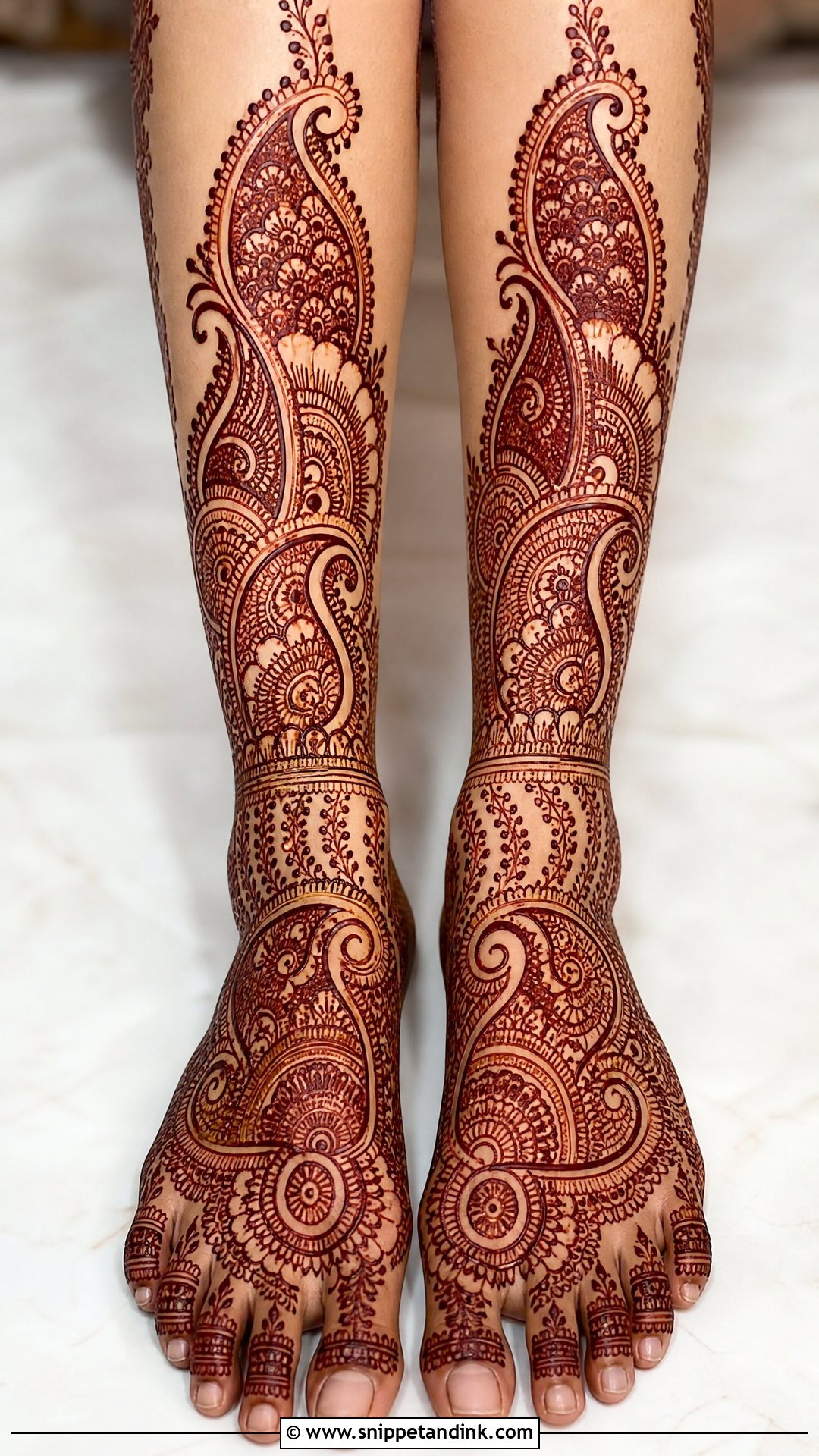
Paisleys bend the way a foot bends, which is why I reach for them so often on the instep and around the ankle. Large ones go on the foot, smaller paisley vines climb the calf, and the gaps take dots, checks and mini leaves. The same layout scales from light to heavy coverage by changing how much filler goes inside each shape. Keep the outlines bold and the inner work fine; if both are thin, the paisley shape disappears.
14. Bridal Jaali Leg Mehndi Design
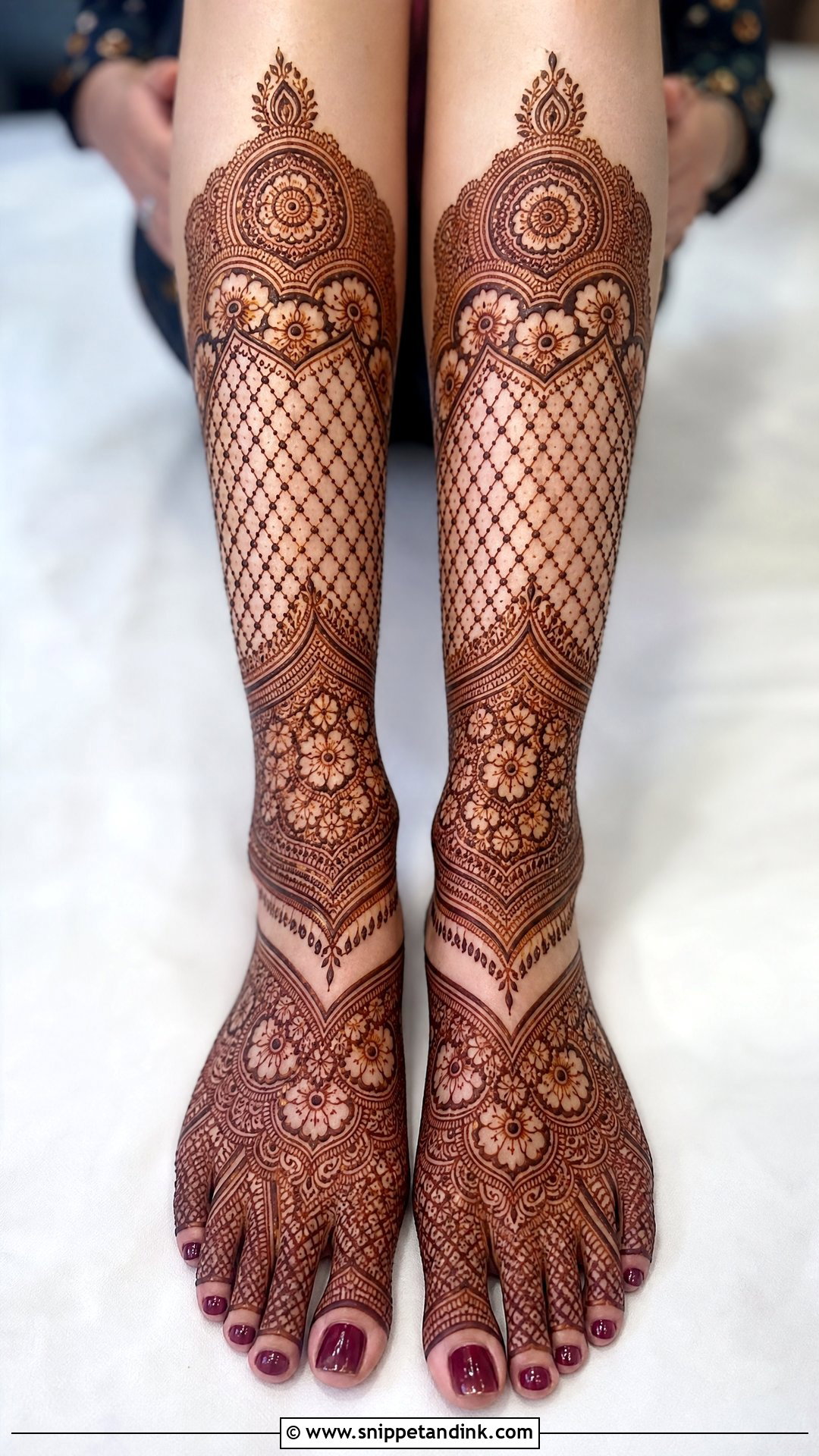
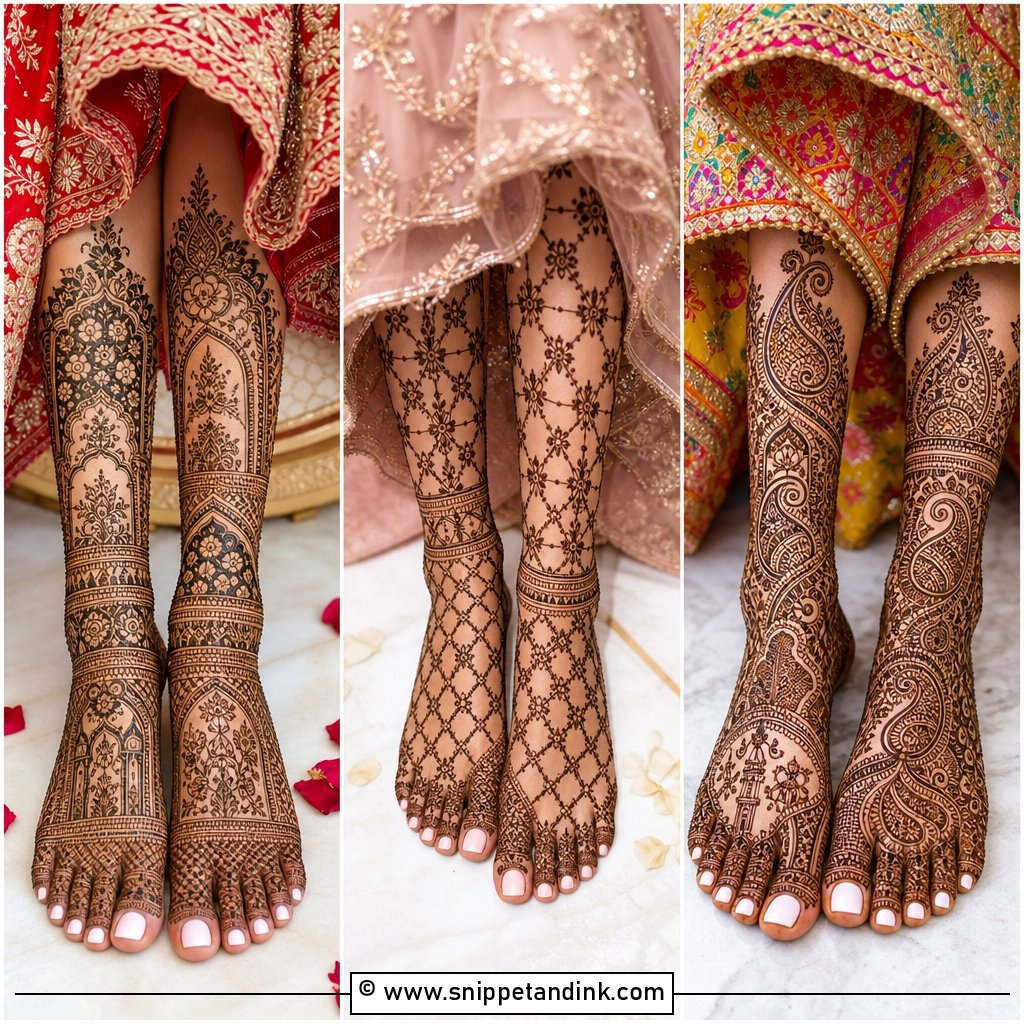
Jaali is a mesh pattern, and on the foot it looks like a lace panel. It can cover the top of the foot, wrap the ankle or climb the calf in sections, and it needs a bold border or flower beside it so the eye has something to land on. The mistake I see is mesh drawn too tight: henna lines swell slightly as they settle, and squares smaller than a few millimetres fill in completely. Wider, even squares stain cleanly.
15. Bridal Moroccan Leg Mehndi Design
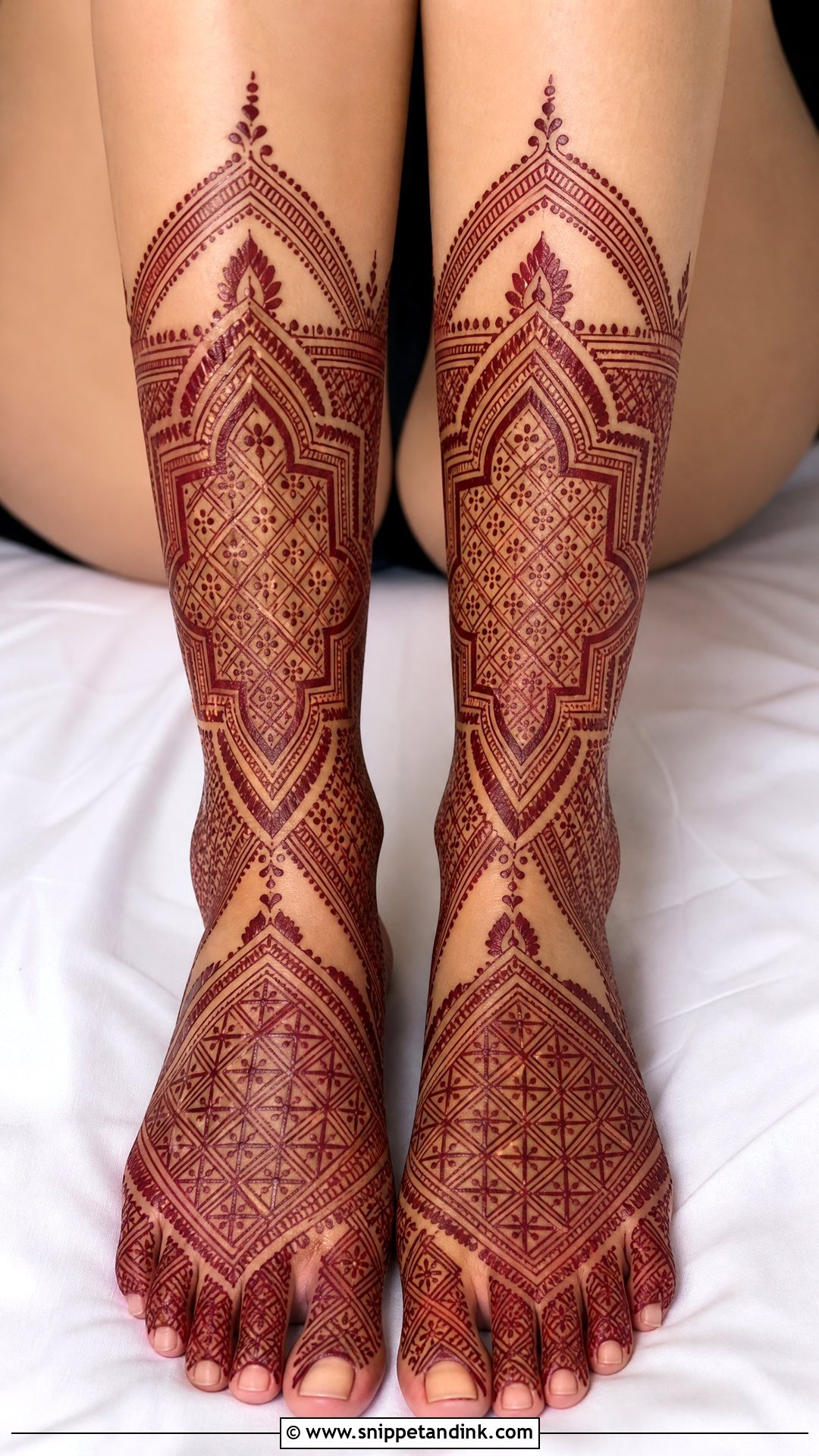
Moroccan designs swap florals for diamonds, triangles, grids and stacked border panels running up the shin. They are cleaner and less crowded, so they suit a fusion lehenga or minimal jewellery. Straight lines are less forgiving than curves, and the shin is a hard surface to draw on because the bone is right there with no padding. I ask brides to keep the leg completely still for these panels, and I add a few dots or tiny florals so it still feels bridal.
16. Gulf Bridal Leg Mehndi Design
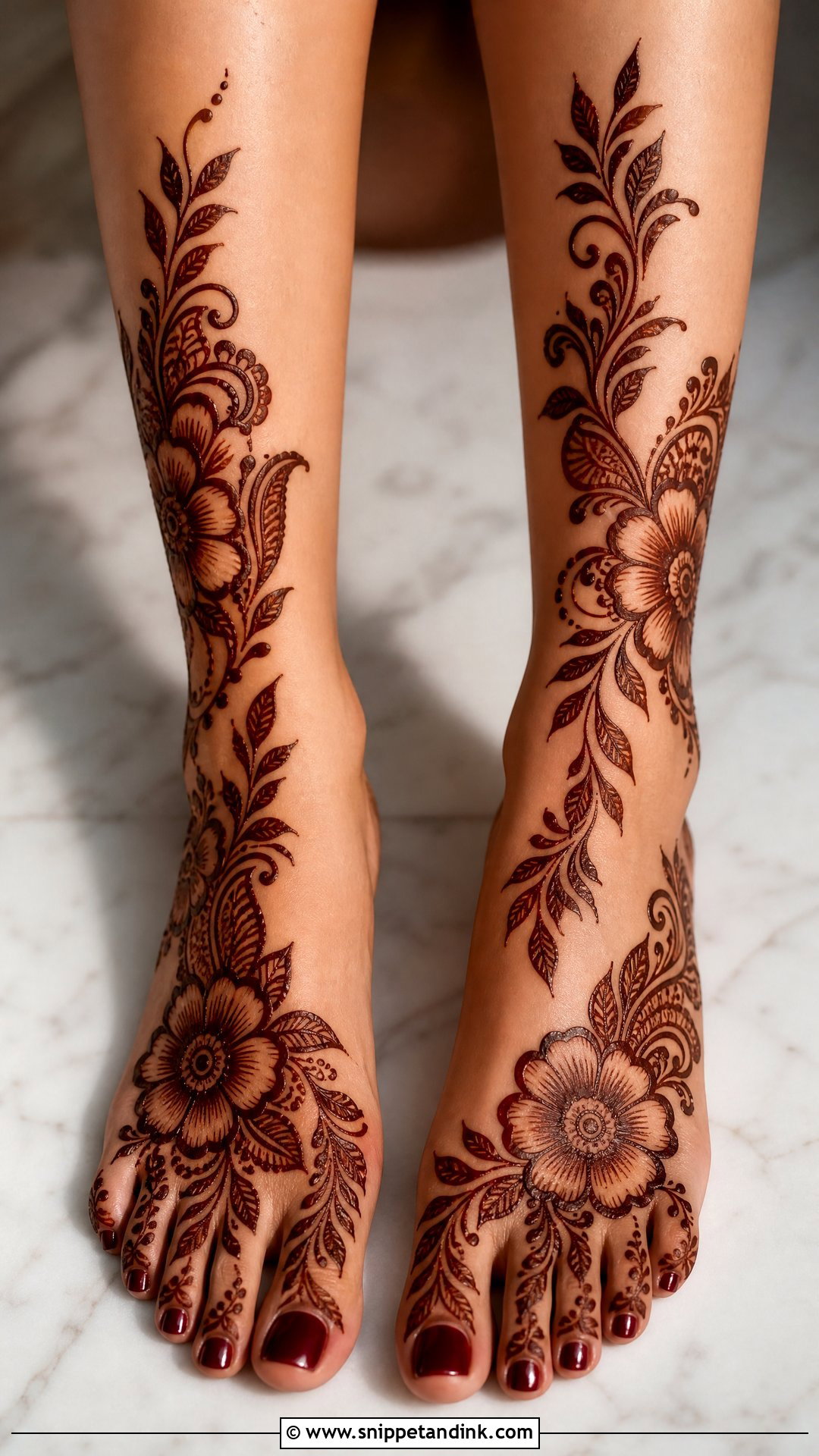
Gulf or Khaleeji henna works in large shaded flowers, leafy sprays and plenty of bare skin, usually as one sweeping trail from the toes to the ankle and up toward the calf. Because the motifs are bigger, it stays legible after the stain matures and doesn’t fight a heavily embellished outfit. The shading is done by thinning the paste stroke rather than adding more lines, which is why a good Khaleeji petal looks soft at one edge and bold at the other.
17. Bridal Leg Mehndi With Name
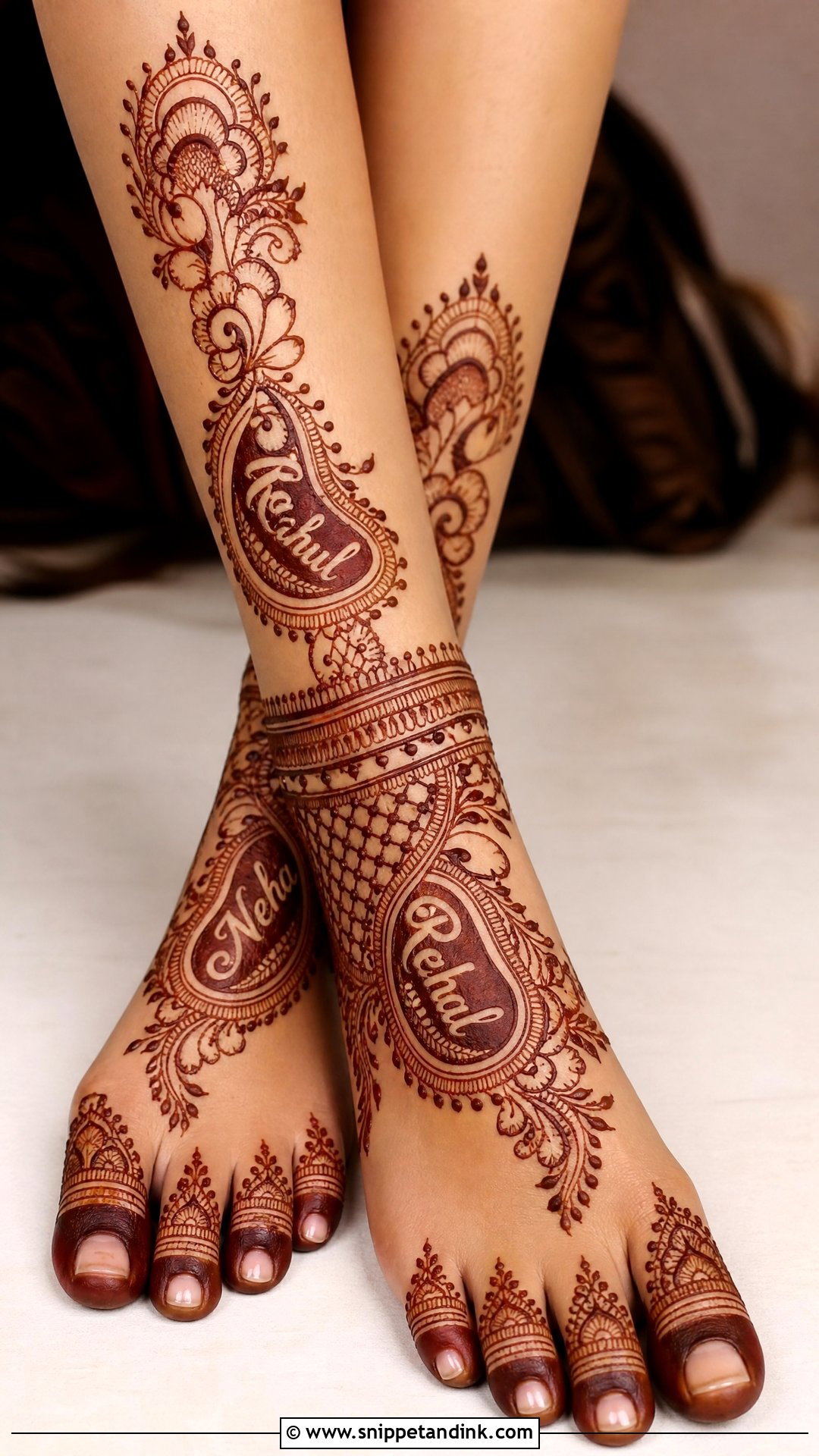
Names hide well in leg henna: inside a paisley, along an anklet band, woven into a vine. Some brides add initials or the date as well, and it makes a fun game for the groom later. The catch is letter size. Fine script blurs as the stain darkens and spreads a fraction, so I write letters larger than you would expect and in a simple hand. Put the name somewhere the photographer can reach for a close-up, like the side of the foot rather than under the sole.
18. Bridal Love Story Leg Mehndi Design
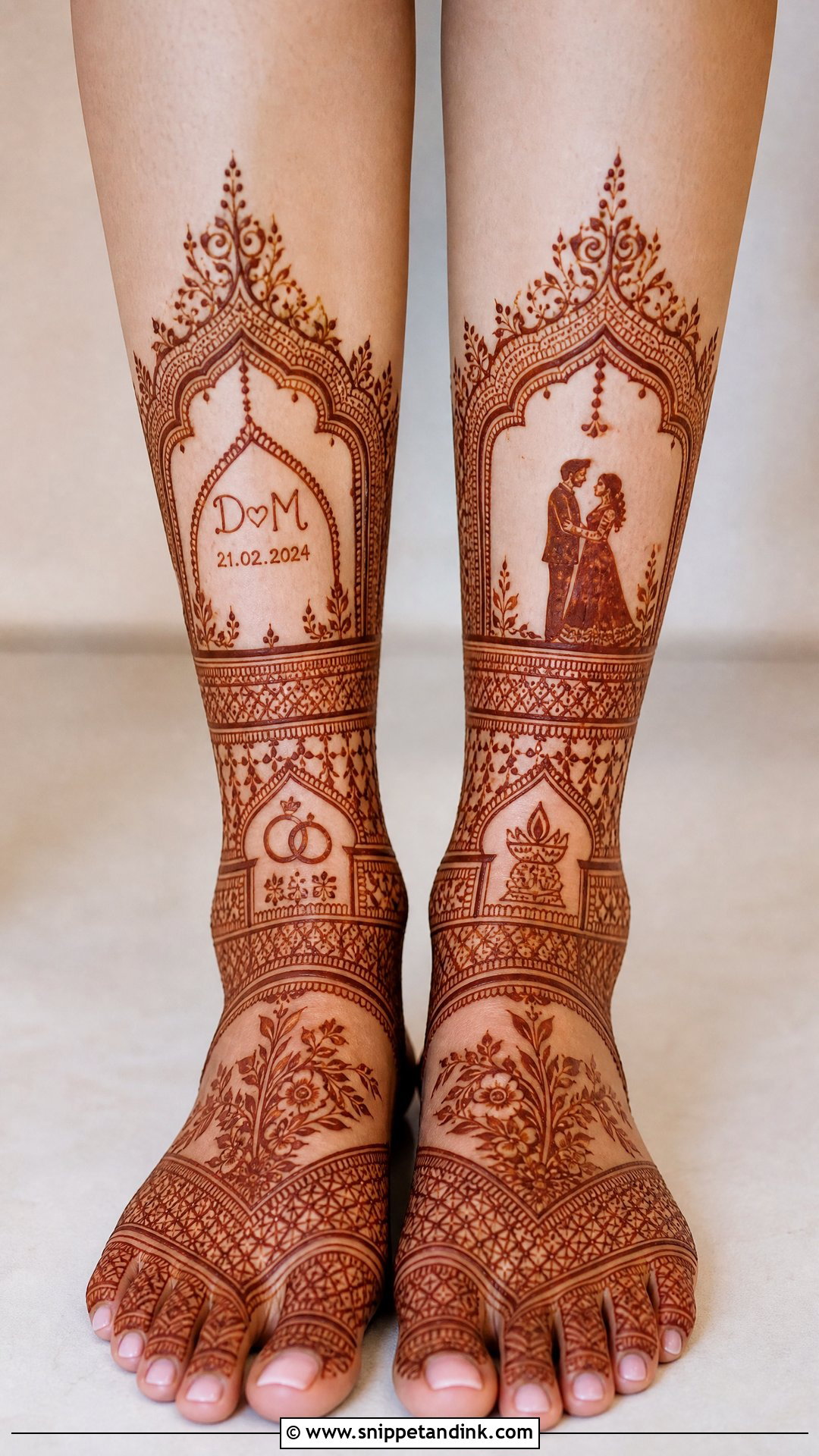
A story design trades some florals for small symbols of the couple: initials, a proposal detail, a travel motif, the date. The leg has less flat space than a forearm, and the shin curves away from view, so I ask brides to pick two or three elements, not ten. Each one gets framed with an arch or a mandala border, and vines and anklet bands hold the whole thing together so it still reads as bridal henna rather than a sticker sheet.
19. Bridal Dulha Dulhan Leg Mehndi Design
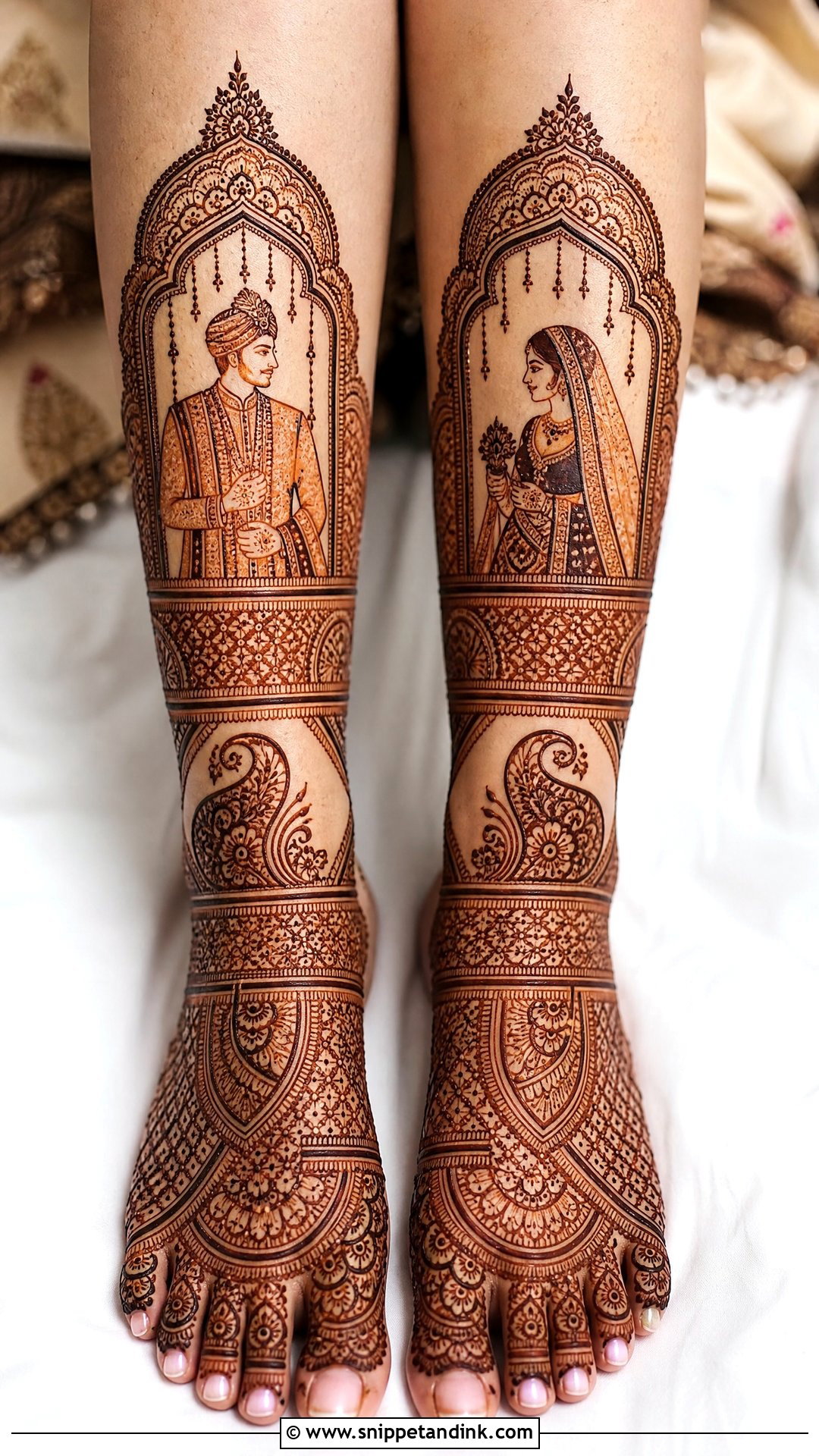
Bride and groom figures belong to classic Indian mehndi, and dulha dulhan leg mehndi puts them on the feet or lower legs inside palace frames or arches. I draw the faces simply, with a few clear lines, because detailed features smudge into blobs once the stain darkens. Figures need room, so this only works with medium or full coverage. It is the natural match for hands that already carry the same figures.
20. Bridal Elephant Leg Mehndi Design
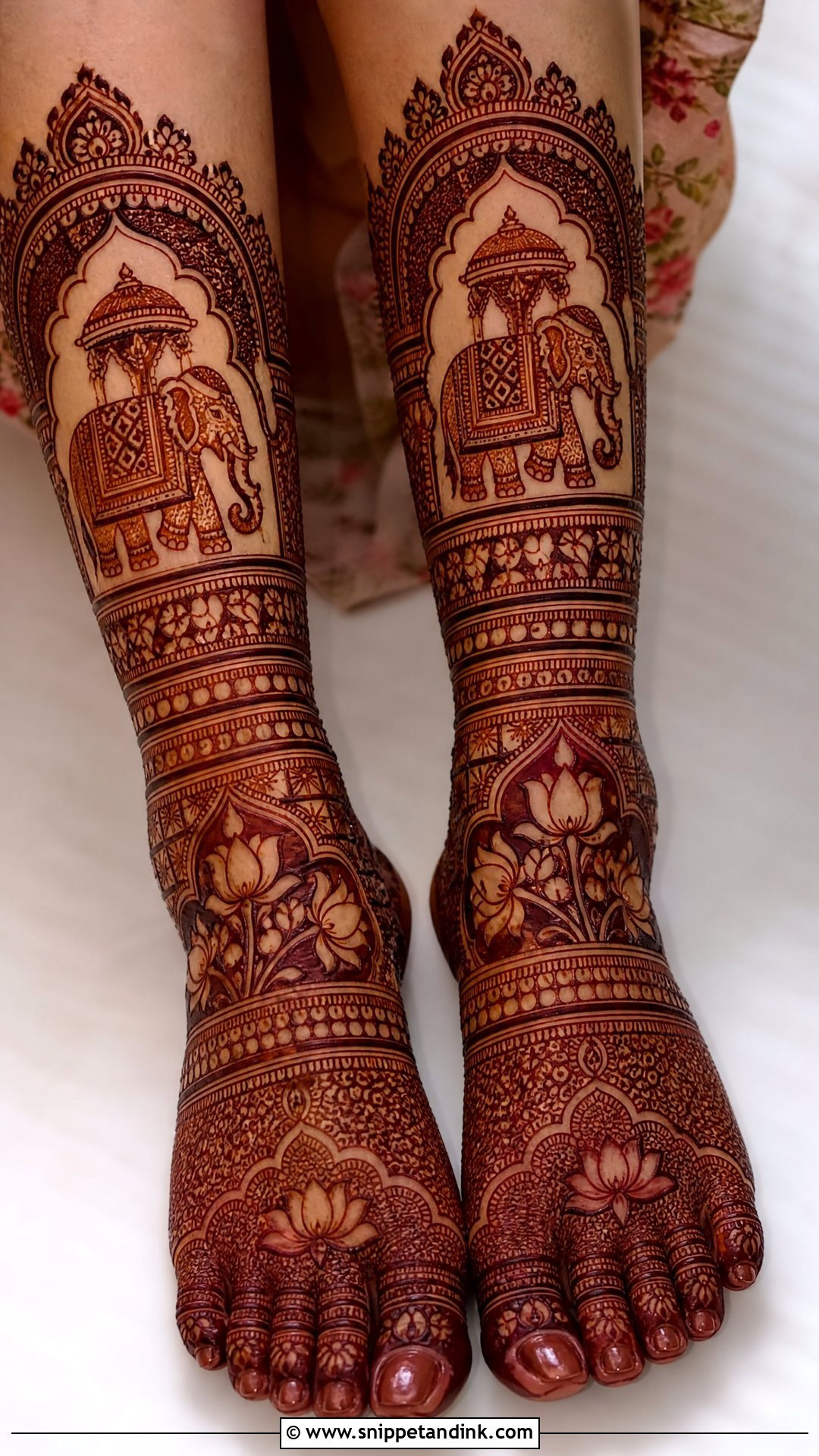
Elephants bring a royal, Rajasthani feeling. Bridal elephant leg mehndi places the animal near the ankle, on the lower calf or along the side of the foot, surrounded by arches, paisleys and lotus. The elephant is a big, simple shape, so it reads well without much micro-detail. I keep the outline heavy and the decorated saddle cloth as the place for fine work, then finish with toes, a foot panel and an anklet band so the leg feels complete.
21. Bridal Doli Leg Mehndi Design
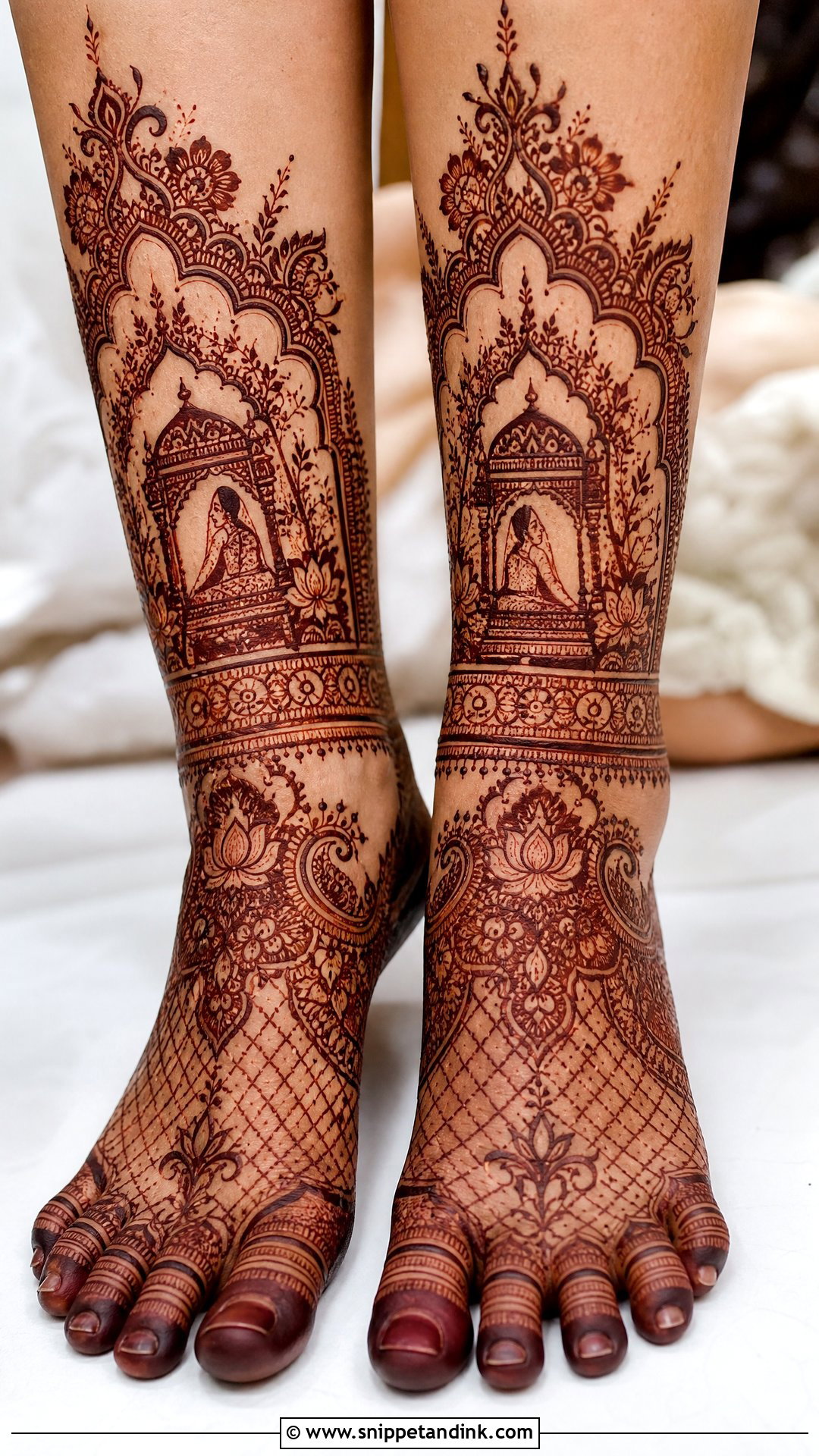
The doli motif shows the bride being carried away, and it is one of the most emotional things I draw. It sits on the foot or calf under a floral arch with paisley corners. The palanquin needs straight lines and clear poles to be recognisable, so it suits medium or full leg coverage rather than a small ankle design. Around it I keep to anklet bands, vines and a little jaali so the doli stays the focus.
22. Bridal Baraat Leg Mehndi Design
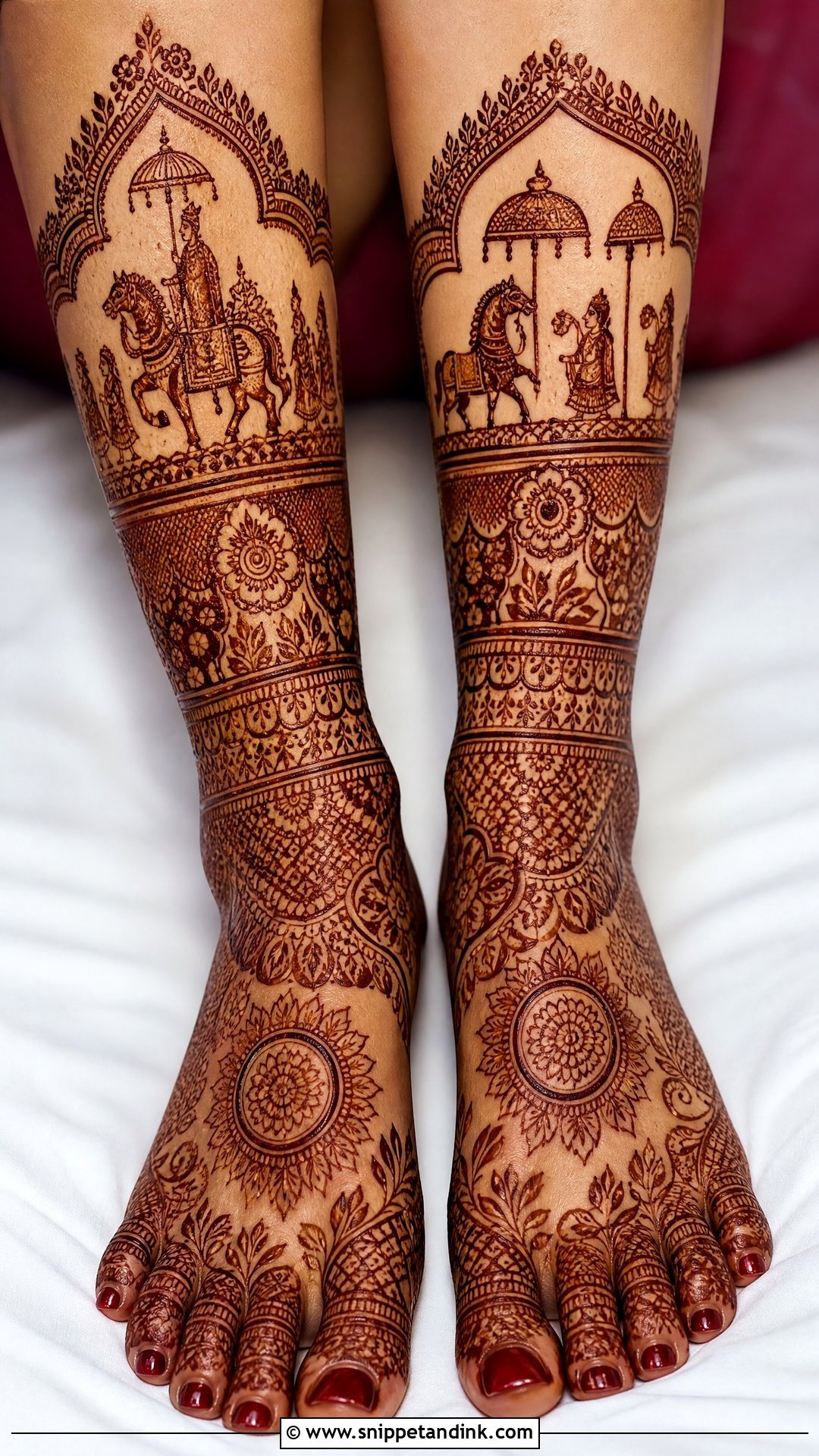
Baraat designs squeeze a procession onto the leg: musicians, a horse, umbrellas, arches. These figures need space, so I plan them on the calf where there is more length, and leave the foot to paisleys and floral bands. Overcrowding is the usual problem. If every figure touches the next, nobody can tell a drummer from a horse once the stain darkens, so I leave a clear gap around each scene.
23. Bridal Calf Mehndi Design
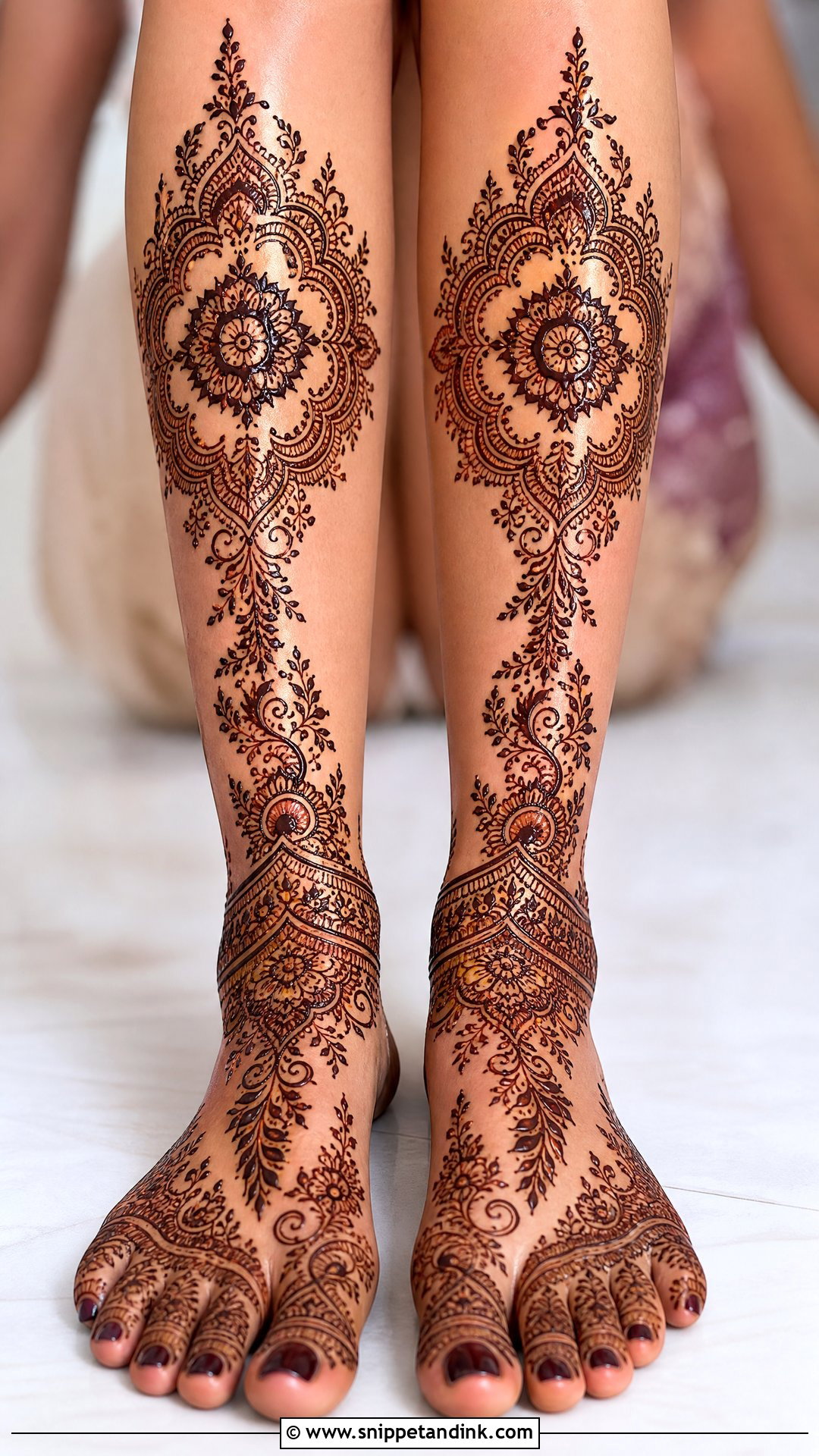
Calf henna shows when the outfit has a higher hemline or the lehenga moves at the side. The design rises from the ankle into a mandala, bouquet, peacock or jaali panel. Calves have softer, thinner skin than the feet and usually stain a little lighter, so I lean on bolder motifs there. I always connect it back to the foot with a vine or band, because a calf design floating by itself looks like a separate tattoo.
24. Bridal Knee Length Mehndi Design
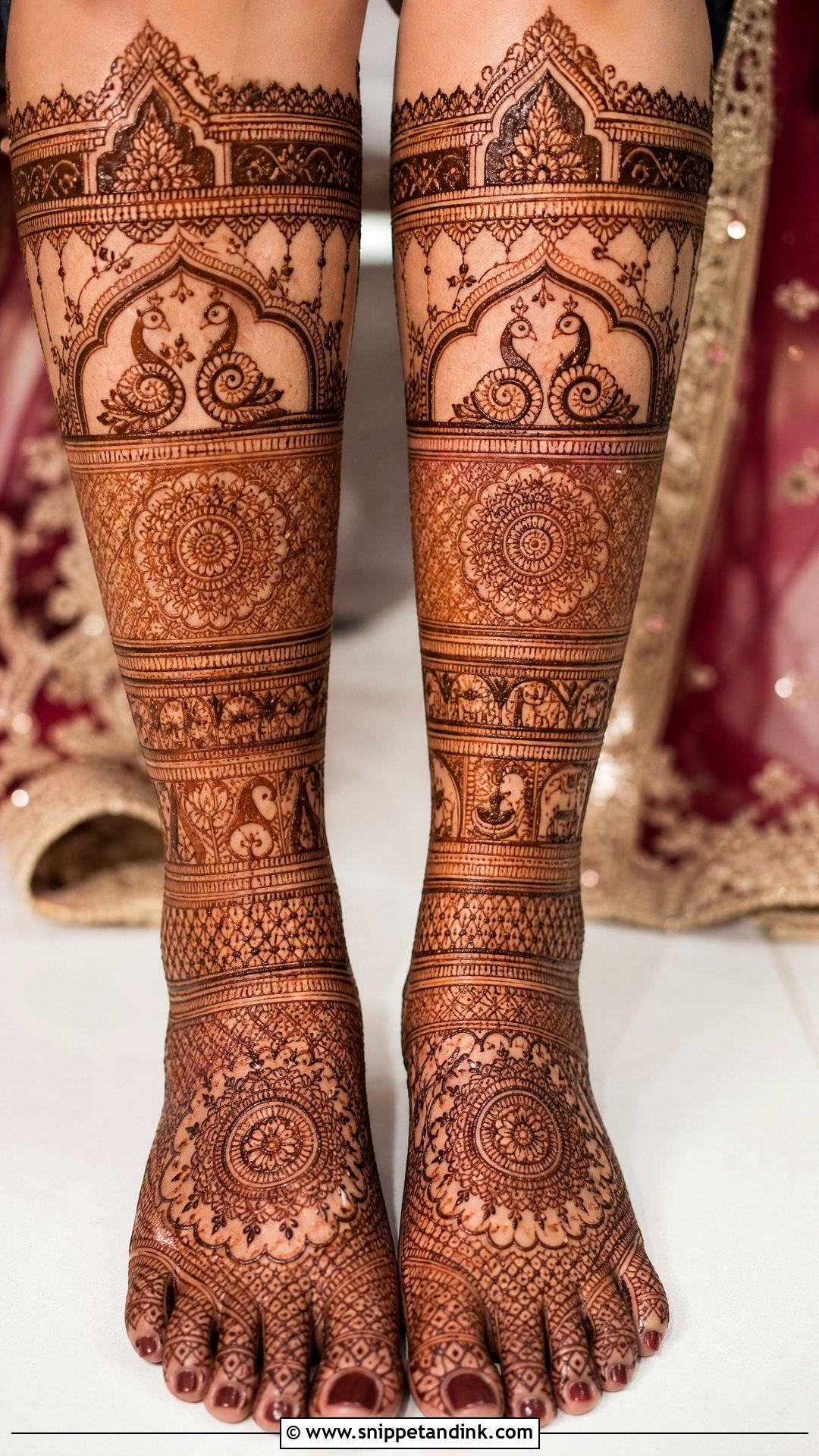
Knee length is the most elaborate leg henna there is, covering feet, ankles, shins and calves up to the knee. It can carry mandalas, peacocks, arches, jaali and personal details, and it is impressive in seated poses and getting-ready photos. It also means a long session where you cannot stand or walk until the feet dry, so book an artist who has done full legs before and schedule it so you are not rushing to the next event. Larger motifs in a few places stop the shins from looking cluttered.
25. Bridal Side Leg Mehndi Design
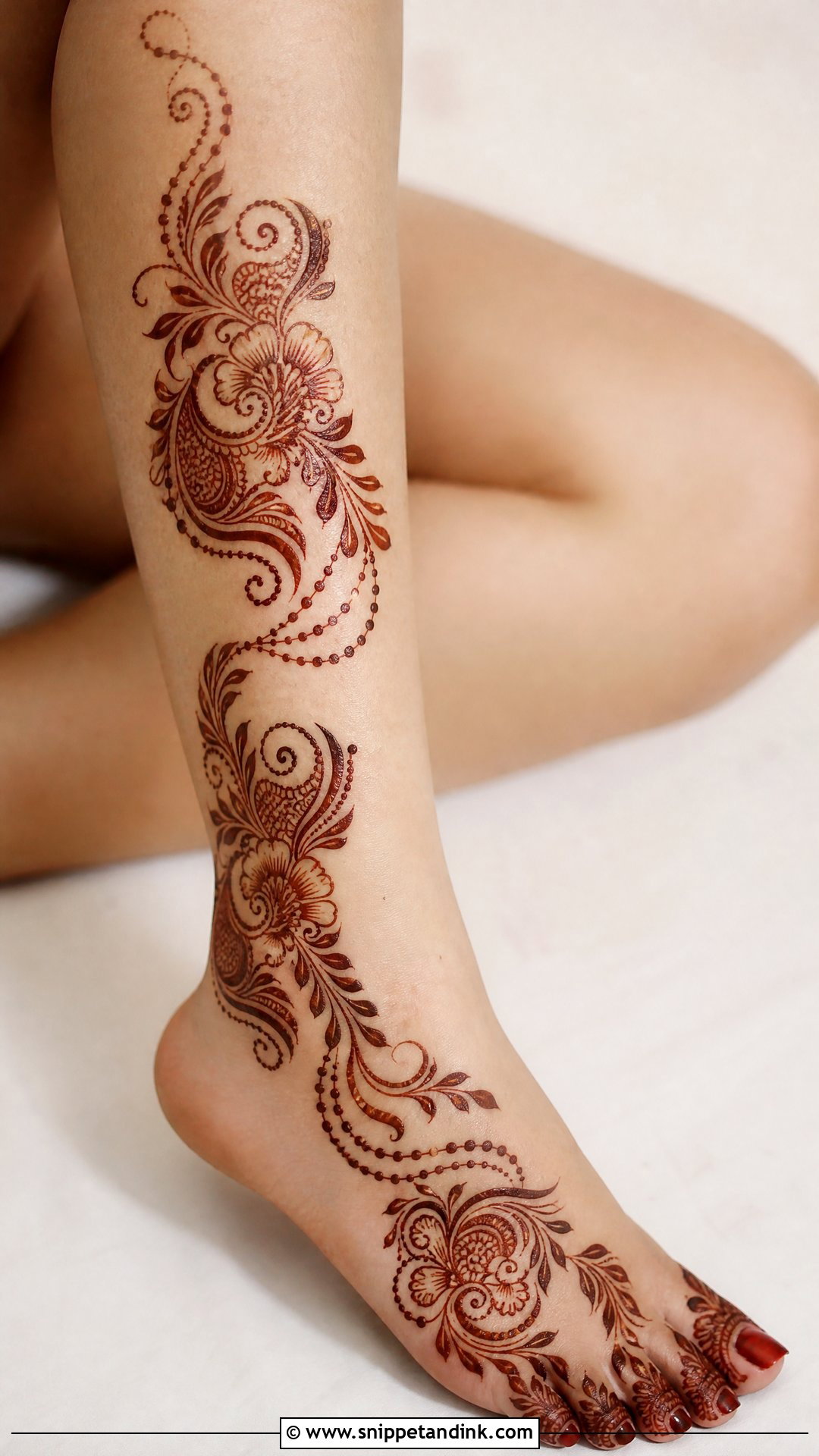
Instead of covering the front, this design runs down the outer or inner side of the leg from the foot to the calf, in Arabic florals, paisleys and dot chains. A long side trail lengthens the leg in photos taken from an angle and shows through a slit or side drape. It is lighter coverage, so it dries faster. Make sure the foot section flows into the side trail without a gap; that connection is what makes it bridal.
26. Bridal Back Foot Mehndi Design
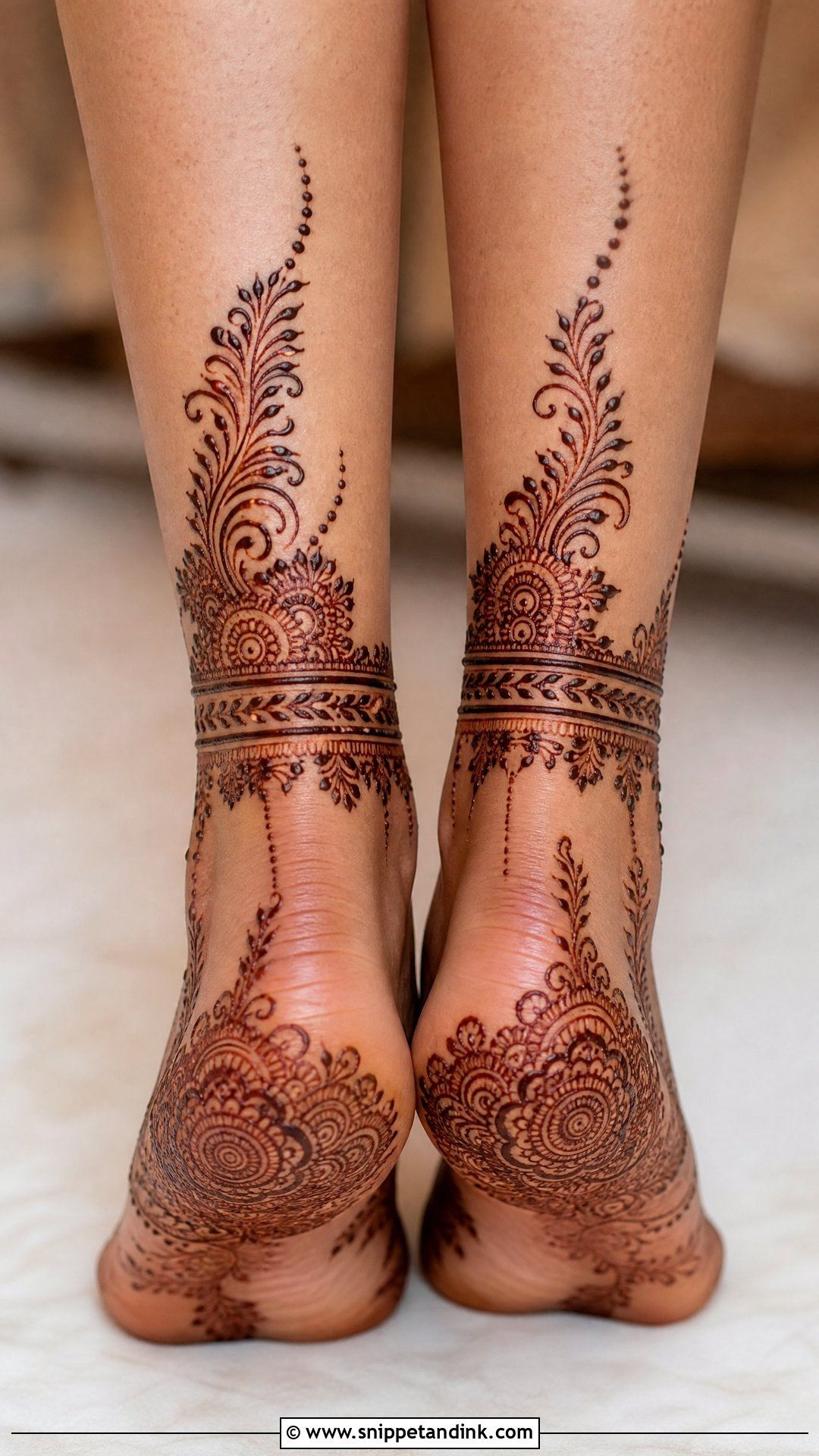
The back of the foot is a surprise for anyone walking behind you: a mandala on the heel, vines around the back of the ankle, a few motifs rising up the leg. It shows during barefoot rituals and with open-back sandals. Heel skin is thick and curved, and it stains well, but tiny fillers there tend to crack off as you put weight on it. I use clear motifs and pair it with front detailing so the foot looks finished from every side.
27. Bridal Minimal Leg Mehndi Design
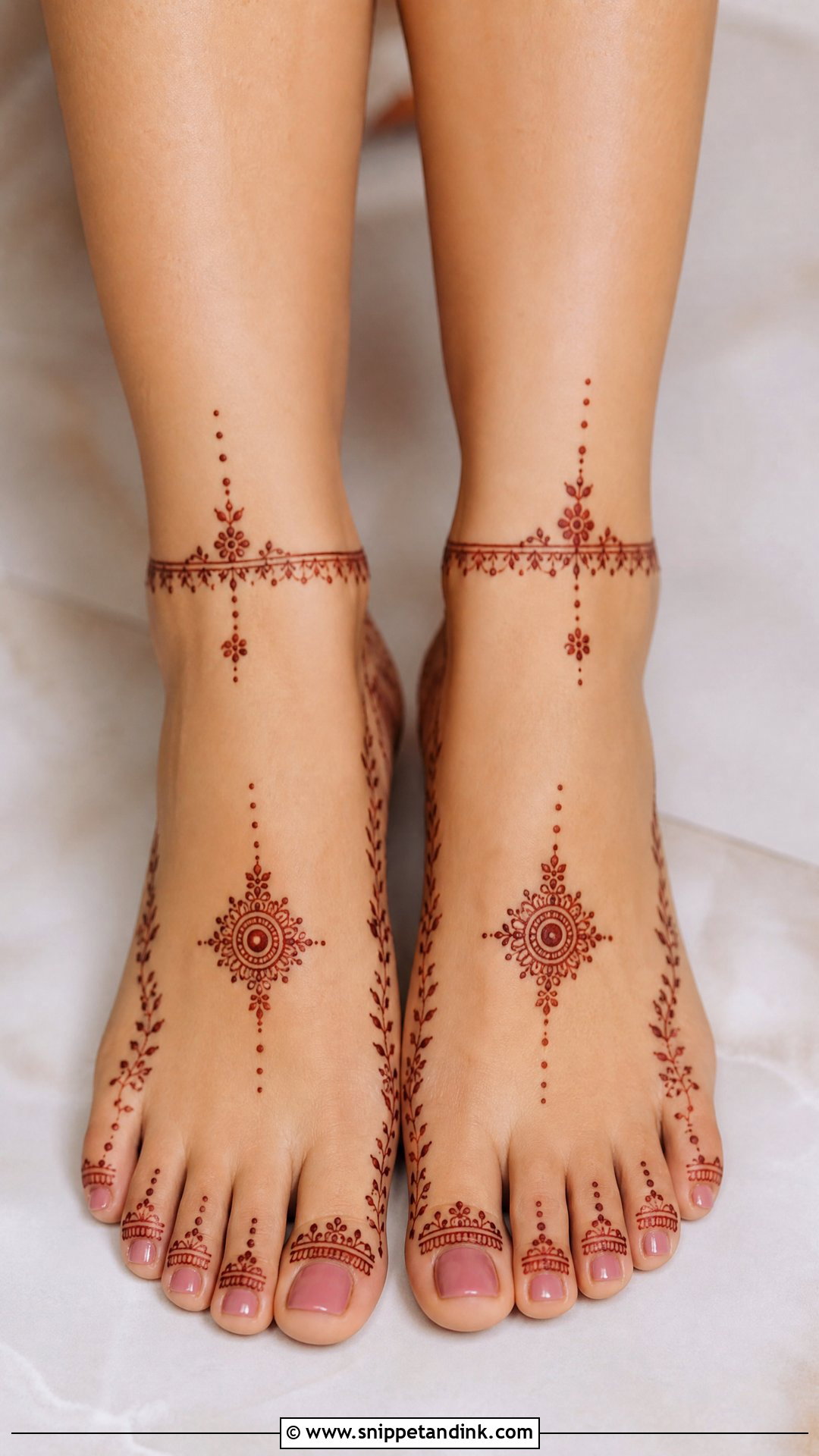
Minimal leg henna is a few elements done with care: toe details, one small motif on the foot, a fine anklet line, maybe a short vine. It suits courthouse ceremonies, fusion outfits and brides who dislike the feel of heavy paste. Precision is everything. With so little on the skin, an uneven line or a blob from a cone that pushed too hard shows immediately, so I take this one slowly despite its size.
28. Bridal Heavy Leg Mehndi Design
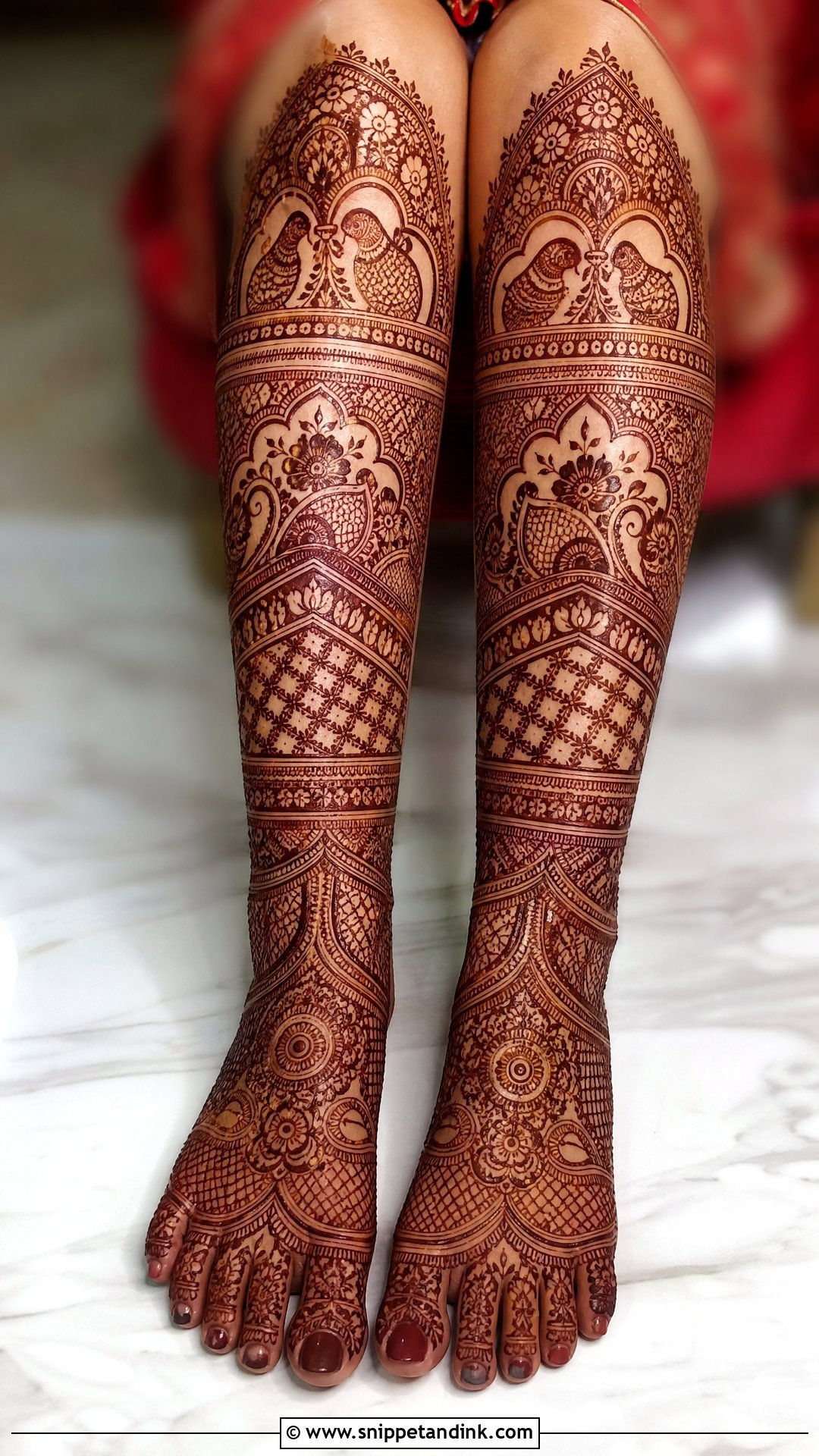
Heavy leg henna fills the feet and legs with paisleys, mandalas, peacocks, jaali and dense fillers, and it is the natural partner to fully covered bridal hands and a heavy lehenga. Crowding is the danger. I split the leg into sections before starting, a foot panel, an anklet band, a shin motif and a calf border, so each area has its own frame. Sections give the eye somewhere to rest, which is what separates rich henna from a muddy one.
29. Bridal Modern Leg Mehndi Design
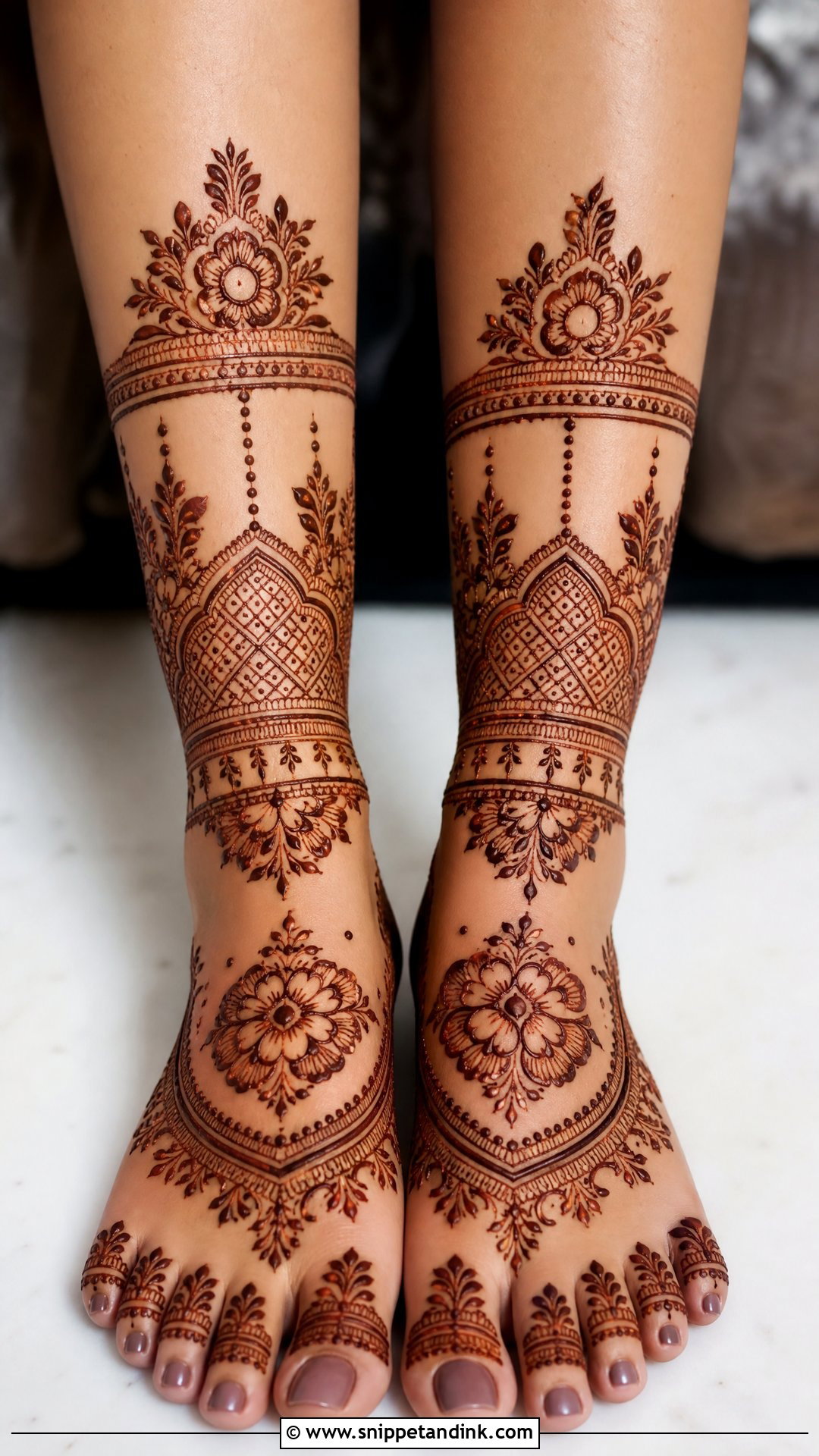
Modern leg henna keeps the bridal motifs but leaves more skin bare: bold florals, a geometric panel, fine anklet lines, a partial foot. A diagonal trail from toes to calf or an open-bordered mandala reads well with pastel and contemporary lehengas. Natural henna will always mature to a reddish brown or deep maroon, and I would avoid any paste promising instant black, because those often contain PPD, a dye that can cause serious skin reactions.
30. Bridal Toes To Calf Mehndi Design
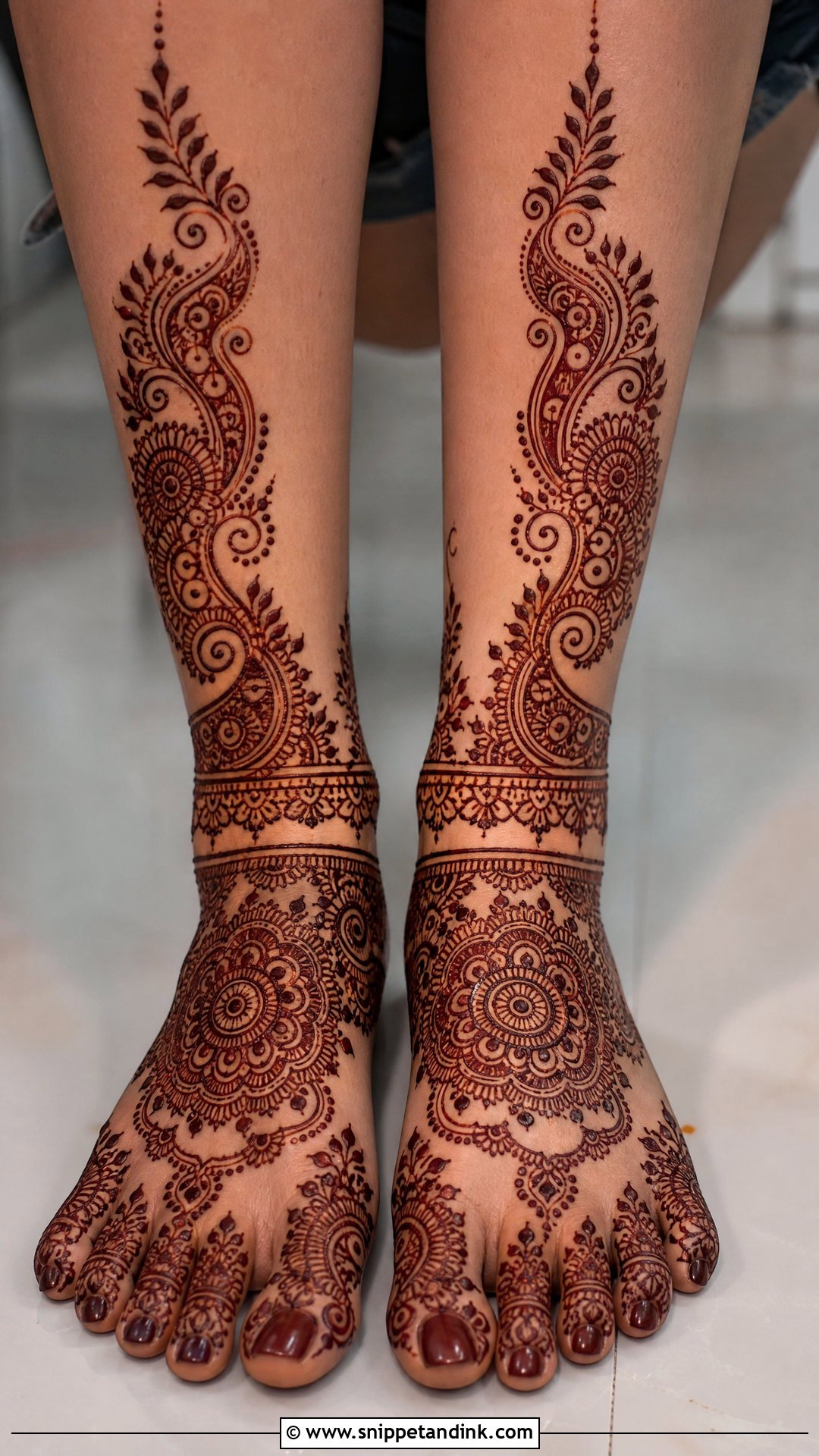
Toes to calf sits between full feet and knee length. Bridal toes to calf mehndi starts with detailed toes, covers the top of the foot, wraps the ankle and climbs into the calf with vines, paisleys or a mandala. It takes noticeably less time than a full leg but still shows when you walk and sit. I ask brides to pick one theme before I start, lotus, peacock or jaali, so the foot and calf feel like one drawing.
Shave, Pedicure, Then Paste: The Order That Protects Your Stain
Anything that scrubs the top layer of skin also scrubs off henna, so the grooming has to happen first. I ask brides to shave or wax their legs a day or two before the mehndi, not the night of, so the skin has settled and isn’t irritated. A pedicure, including any foot scrub, goes before application too. Do it after, and you are paying someone to lift your stain.
On the day, come with clean, dry skin and no lotion, since oil stops the dye from reaching the skin. Wear loose clothes you can roll above the knee.
The hours after application
Feet are the hardest part of a bride to keep still. You can’t walk until the paste is dry, so have someone ready to help you to the bathroom and to bring food. Once it has dried, I dab on a lemon and sugar mix to keep the paste stuck down, and I suggest wrapping the feet loosely or wearing old cotton socks overnight so the paste stays warm and in contact longer.
Scrape the dried paste off rather than washing it, and keep water away for as long as you can, ideally until the next day. The stain starts orange and deepens over roughly two days, which is why I prefer mehndi a day or two before the wedding rather than the evening before.
Why Your Ankles Will Look Darker Than Your Calves
Henna stains darkest on the thickest skin, and on the leg that means the soles, heels and top of the foot. As the design climbs toward the knee the skin gets thinner and the colour comes up lighter. That is normal, and I plan for it by using bolder shapes higher up rather than fine filler that will look faint.
Feet also take more wear than hands. Sandal straps, socks and walking barefoot during rituals all buff the stain. Break in your wedding shoes before the mehndi, avoid hot soaks and chlorinated pools for the first few days, and a little balm or coconut oil before showering helps the colour hold. If you have sensitive skin, a patch test with your artist’s paste a week or so ahead is worth the effort.
Let the Feet Answer the Hands
Leg henna works best when it is planned with the rest of the look. Knee length and full leg layouts feel royal; Arabic trails, payal bands and minimal designs feel lighter. Motifs such as lotus, doli or a hidden name add meaning, but only if they are drawn large enough to survive the stain darkening. Think about your footwear, the poses you’ll sit in and the hours you can give the artist, and choose the design with room to breathe over the one with the most detail.
You'll Like These Ideas:


Leave a Reply