
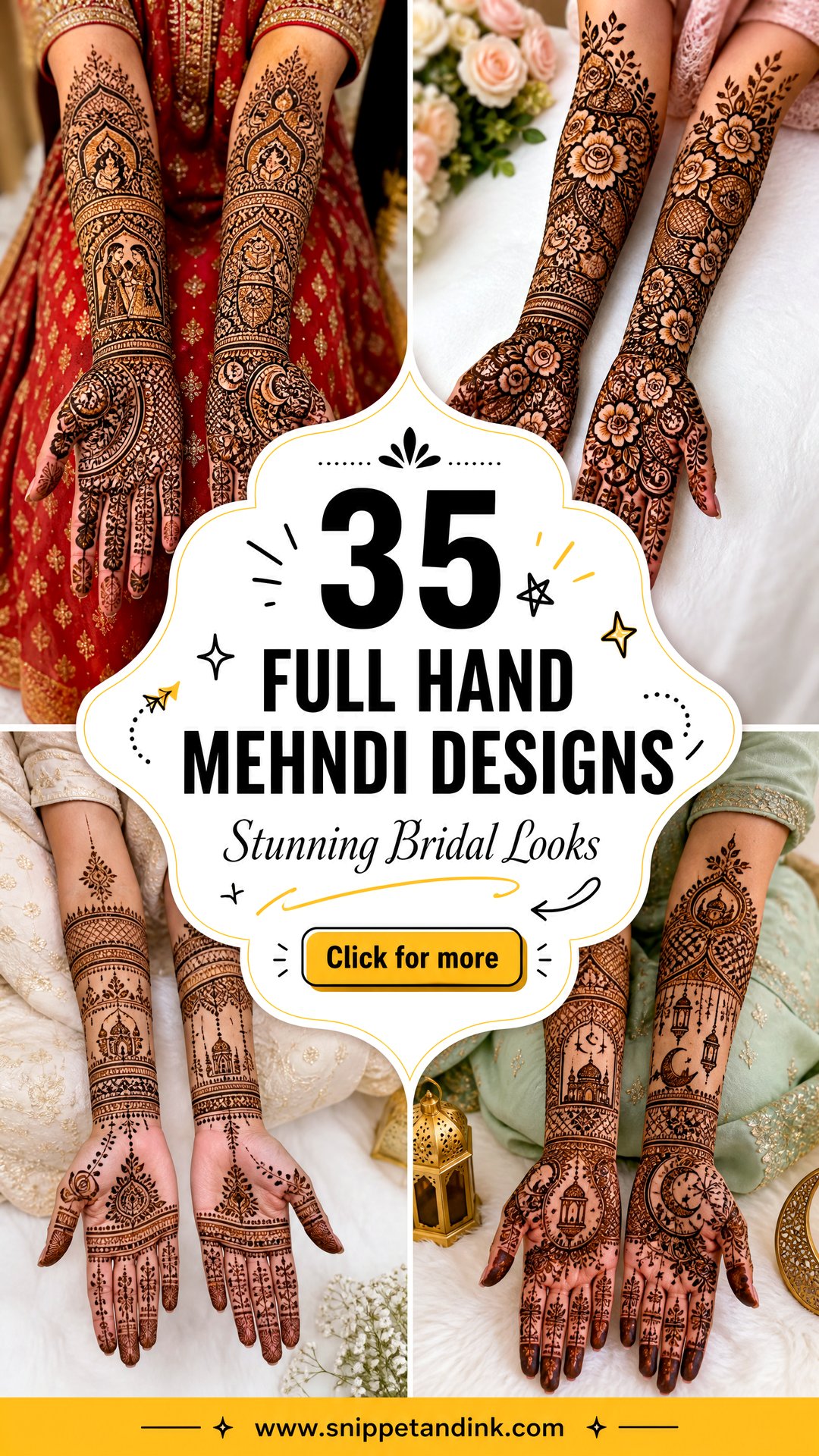
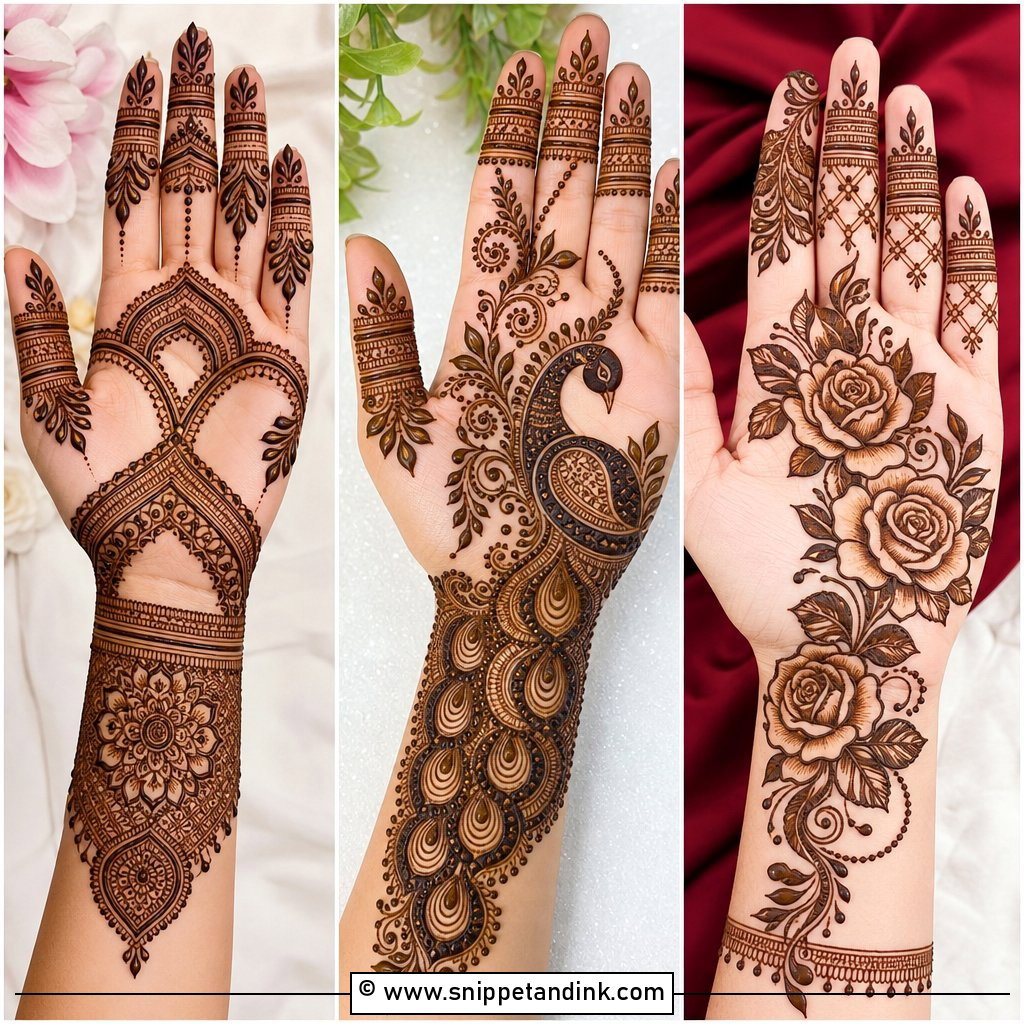
Covering a whole hand is a different job from decorating a palm. The pattern has to travel from fingertips over the wrist, sometimes up the forearm, and still read as one piece when you turn your hand over. In my experience the layouts that work best at this scale borrow from several traditions at once: Indian detail where the eye lands, Arabic spacing where it would otherwise get crowded, a little Moroccan geometry on the fingers. Below are 35 complete layouts, with notes on how each one is built, how long it asks you to sit and who I would or wouldn’t suggest it for.
How Long a Full Hand Takes, and How to Sit Through It
People book a full hand thinking about the design and forget about the sitting. A guest-weight design on both sides of both hands is a solid stretch of time; a bridal set that runs to the elbows can take most of an afternoon or evening, depending on detail and the artist. After that, the paste needs to stay on for hours. You can’t use your hands for much during any of it.
What makes the session easier
- Eat properly beforehand and use the bathroom just before we start.
- Bring someone who can feed you, hold your phone and adjust your dupatta.
- Wash and dry your hands and arms first, with no lotion or oil, so the paste grips clean skin.
- Wear something with sleeves that push well above the elbow and won’t slide down.
- Sit in a chair with an armrest or a firm cushion. A hand propped on your knee wobbles.
I usually do the less used hand first, so it has a head start on drying while I work on the other. For brides, I finish the palms before the backs: once the backs are done you can rest your hands palm-down, but a wet palm leaves you holding them up in the air.
1. Full Hand Bridal Mehndi Design
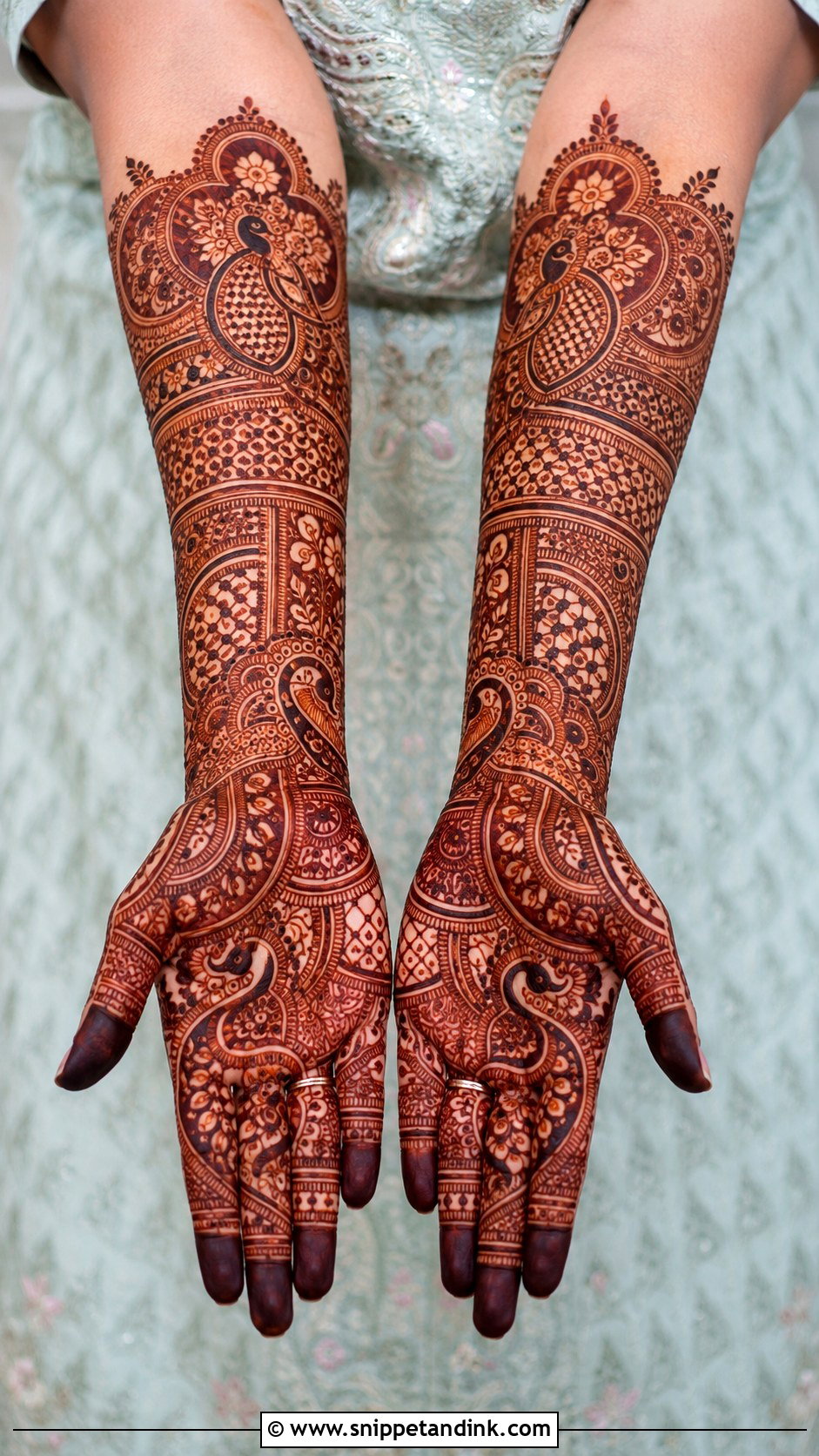
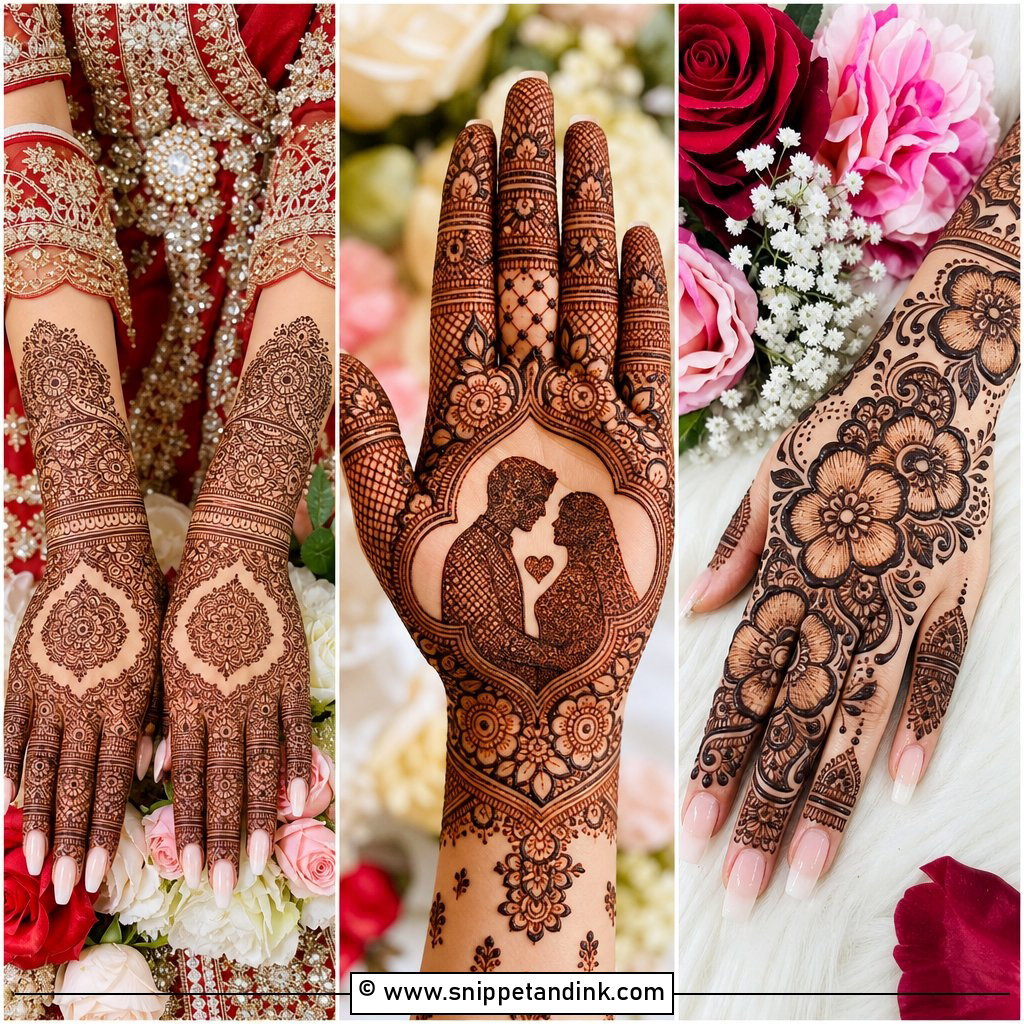
This is the heaviest work I do. Fingers, palms, wrists and forearms fill with paisleys, florals, mandalas, peacocks, jaali and tiny fillers, often with initials, the wedding date or bride-groom figures tucked in. Nothing is left empty, but every section has a plan before I start. I keep the main motifs bold and the fillers fine, because on a bride the stain will go very dark and fine filler is what stops it closing into a solid patch. On a long arm the design can run to the elbow; on a shorter one I stop around mid-forearm so the proportions stay right.
2. Arabic Full Hand Mehndi Design
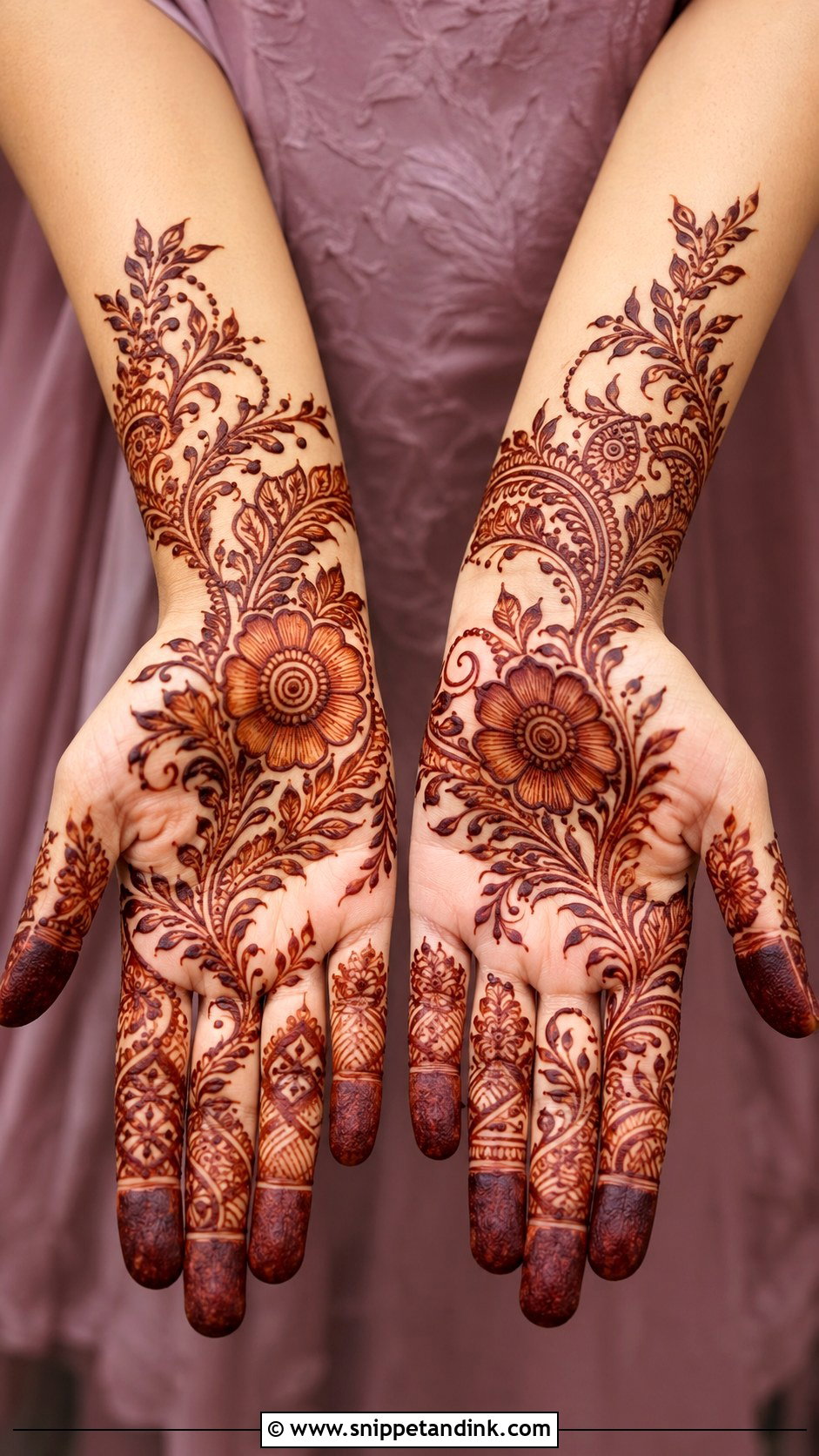
Full coverage without crowding: that’s what Arabic gives you. The pattern travels diagonally from one side of the wrist to the opposite fingers, built from large flowers, leafy vines, bold outlines and shaded petals, with clear skin between them. It goes on much faster than dense Indian bridal work, which is why I reach for it at engagements and Eid when there’s a queue. Fill the fingertips and let the floral trail find its own route across the hand rather than forcing it straight.
3. Indian Full Hand Mehndi Design
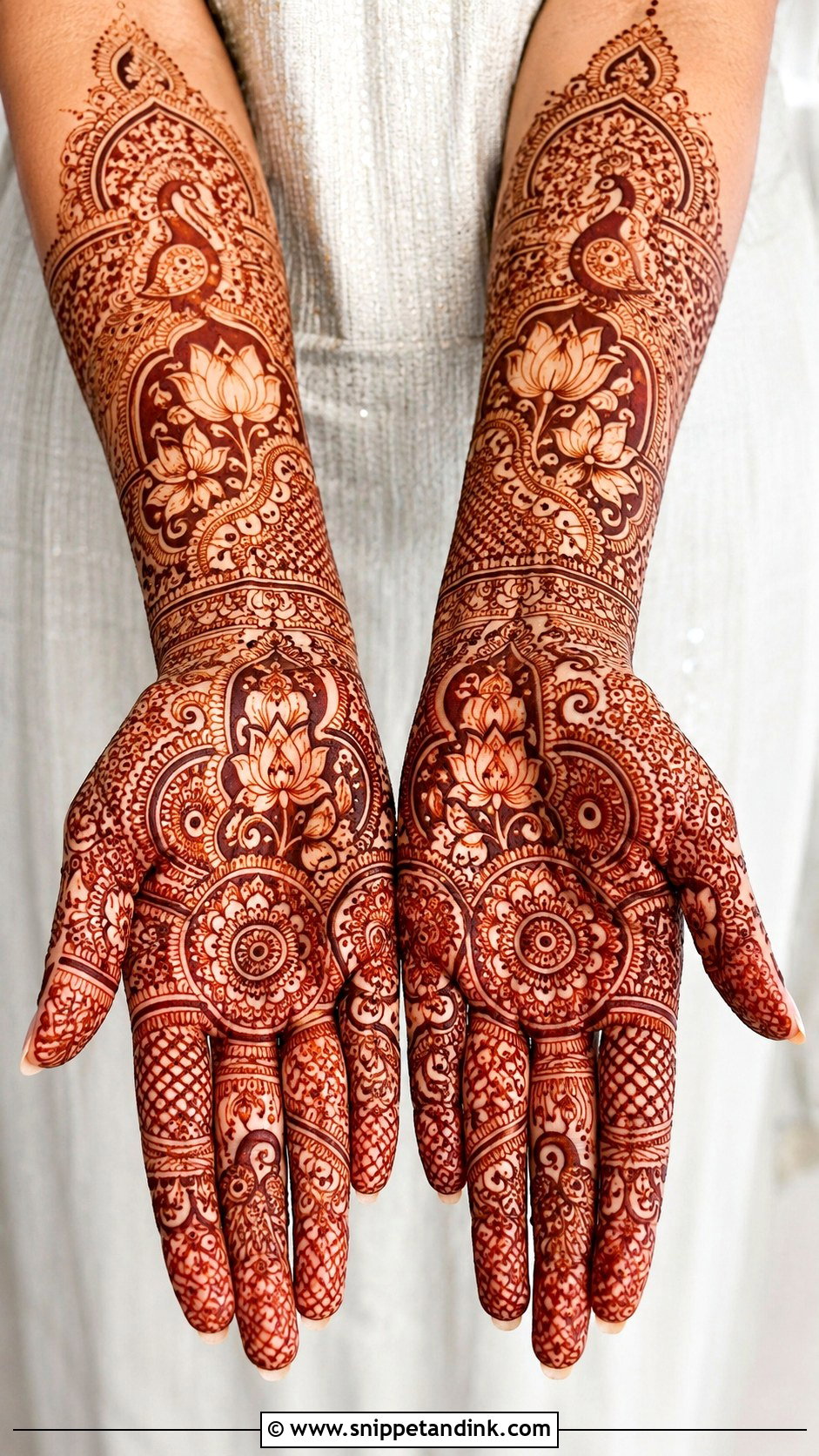
Indian work is about symmetry and density. Palm and back hand carry paisleys, flowers, peacocks, lotus, mandalas and ornamental borders, and the fingers get bands, dots, vines or net patterns. I divide each hand into sections around one main center motif before any filler goes down. That planning is what you see in close-up photos after the stain deepens: crisp contrast between paste lines and bare skin. Without it, Indian mehndi turns muddy.
4. Indo Arabic Full Hand Mehndi Design
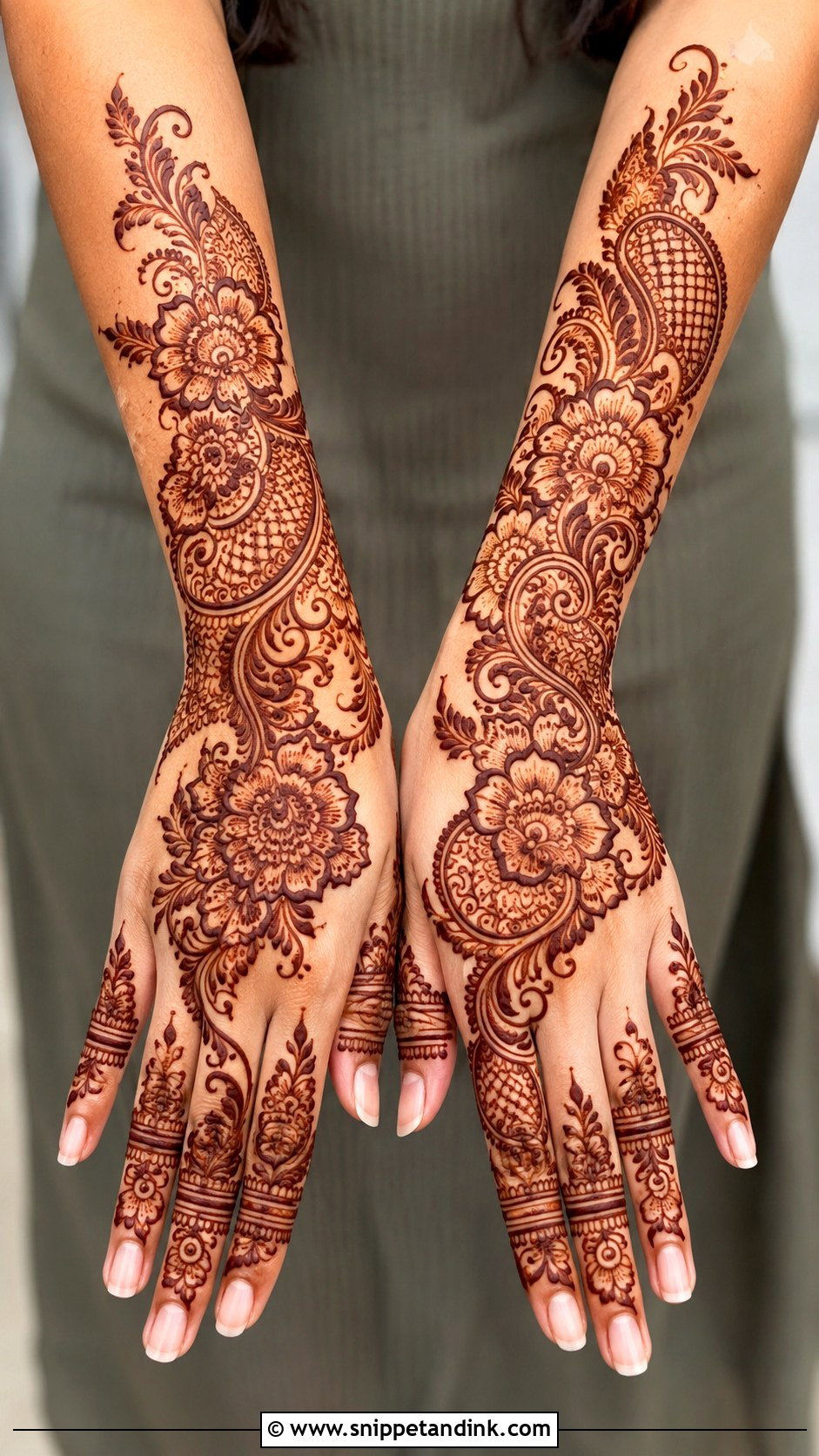
Indo Arabic sits between the two. You get Arabic’s bold spacing with Indian fine detail inside it: large floral vines, paisley curves, shaded leaves and filler bands running from wrist to fingers. Sisters of the bride ask me for this more than anything, because it looks dressed up without the hours of dense coverage. One trick I like is keeping one side of the hand more open and the other more detailed. It flatters most hand shapes, long or short.
5. Full Hand Mehndi Design Front Side
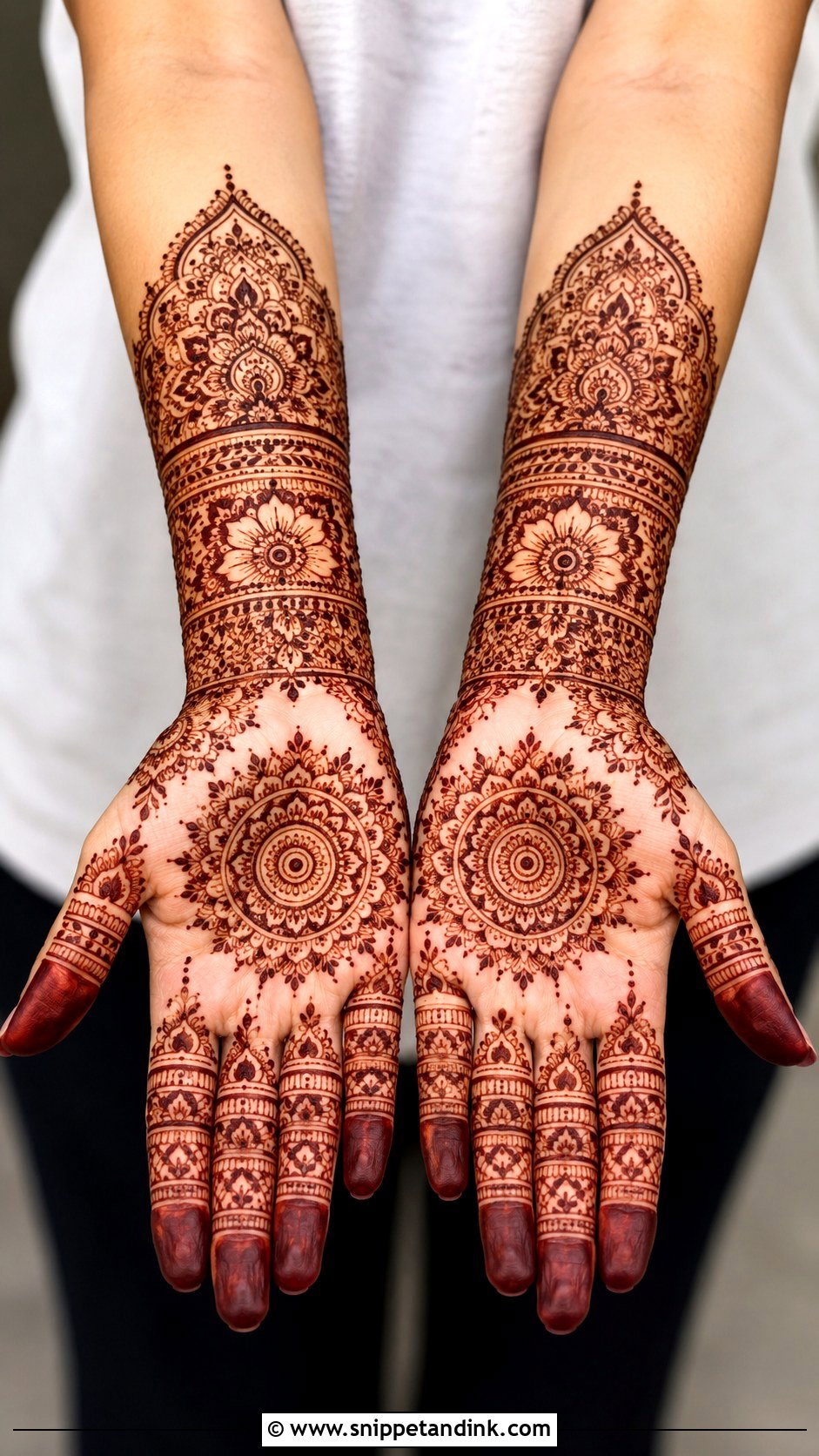
The front side covers the palm, inner fingers, wrist and forearm. Palm skin holds stain better than anywhere else, so this side always comes out darkest. I start with the palm centerpiece, usually a mandala, and build outward with paisleys, florals, wrist cuffs and finger caps. Brides sometimes want portraits or initials here. If so, I place them in the palm hollow where they won’t stretch when the hand opens and closes.
6. Full Hand Mehndi Design Back Side
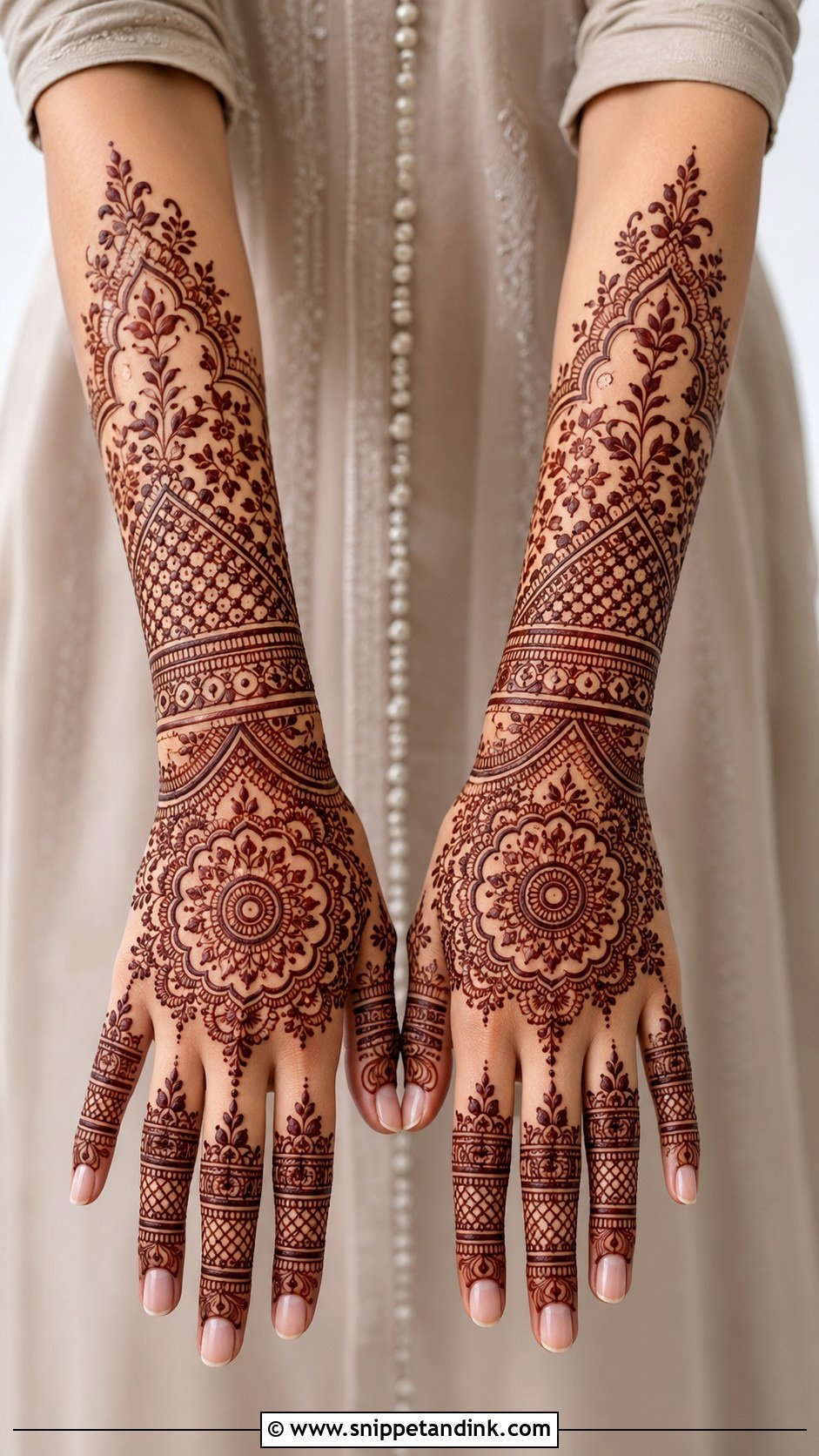
The back of the hand is what people actually see: when you gesture, hold a glass, show off a ring. It has knuckles, tendons and visible veins, so it is less forgiving than the palm and stains a little lighter. I use clear spacing and bold outlines here and leave small gaps over the knuckles, because skin creases there and a dense pattern breaks up when you make a fist. Bracelet cuffs, finger bands, floral trails and a small mandala all suit this side.
7. Full Hand Mandala Mehndi Design
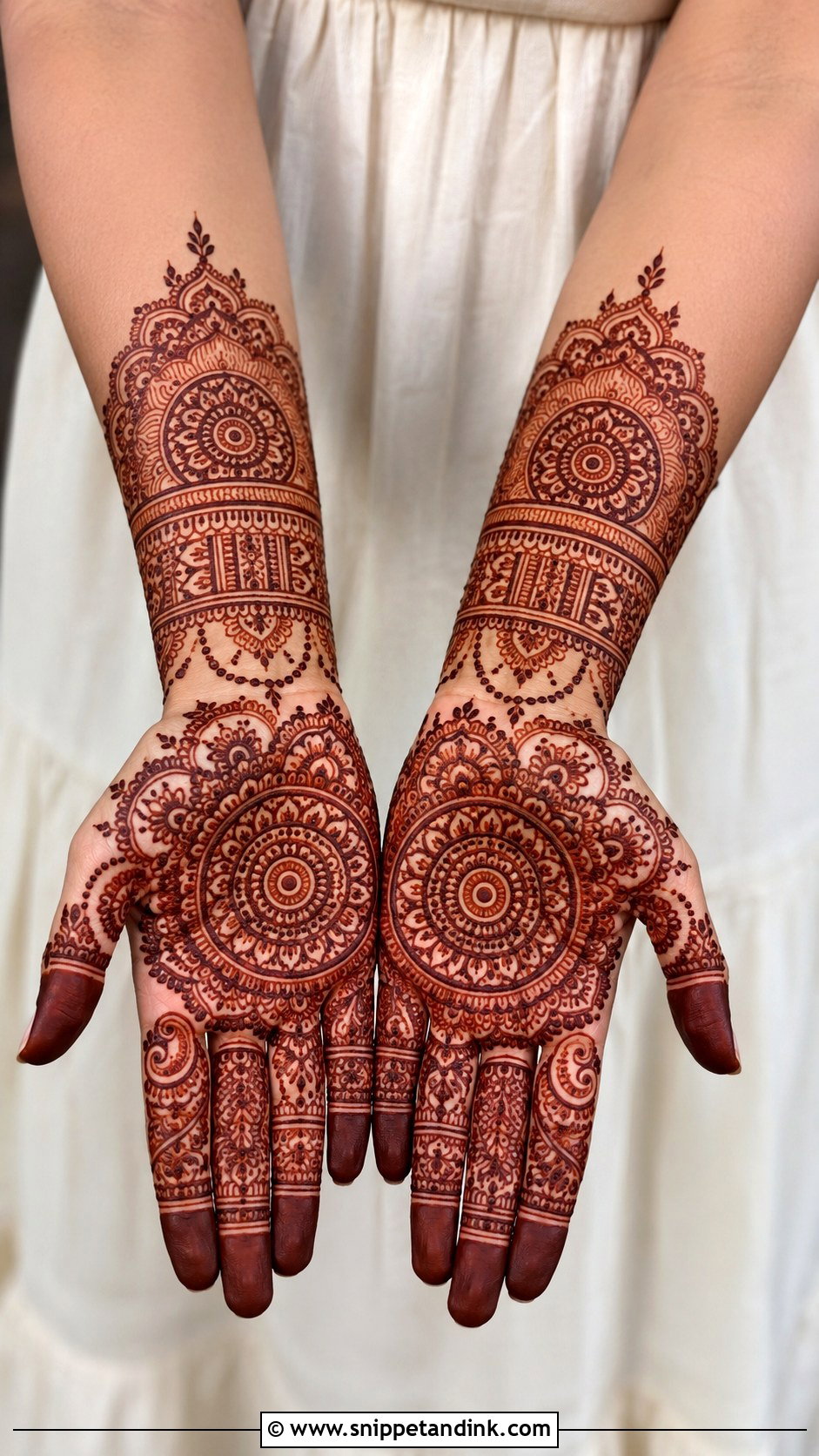
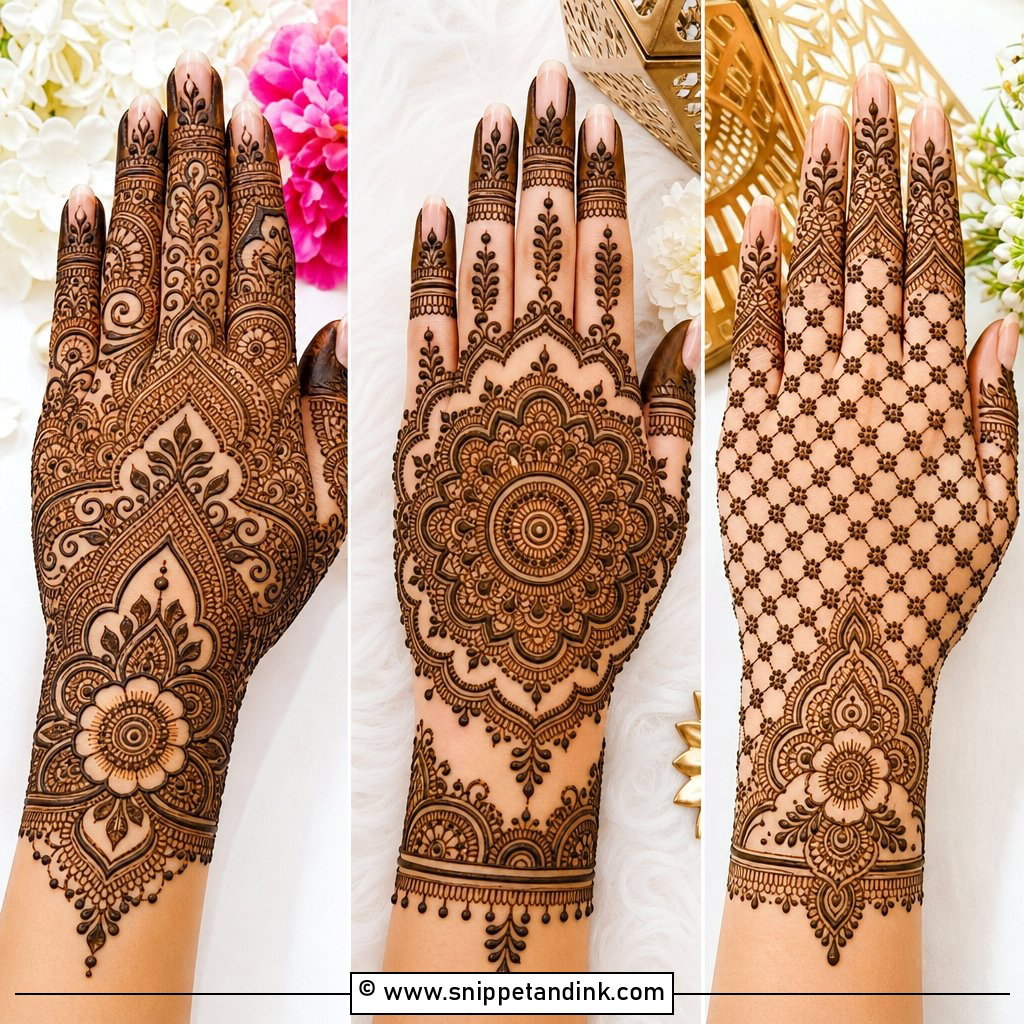
One large circular mandala at the center of the palm or back hand, then bands, petals, paisleys, dots and vines spreading out to the fingers and wrist. It suits people who like order. A mandala on the palm becomes a strong focal point; on the back hand it reads almost like a brooch. I draw the innermost ring first and then check that the outer rings stay round as they cross onto the curved sides of the hand, which is where they tend to flatten.
8. Full Hand Floral Mehndi Design
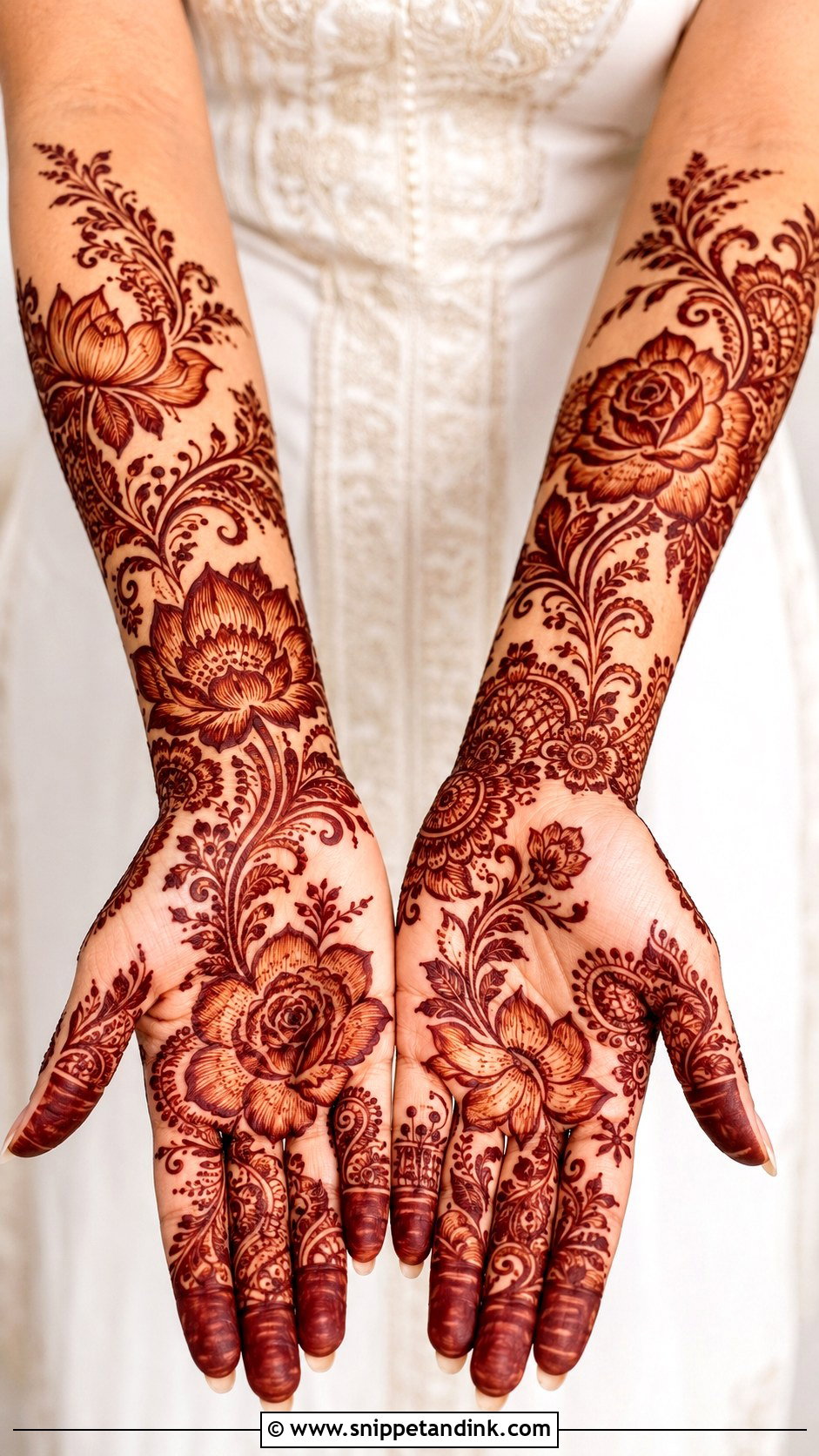
Floral layouts can go bold or intricate, which is why they show up in Arabic, Indian and Indo-Arabic work alike. For full coverage I place larger flowers around the wrist and palm and use smaller blooms to link up to the fingers and forearm. Grading the size like that stops the hand looking flat. Shading gives depth, open skin keeps it fresh. Florals are what I suggest most for guests at engagements, Eid and Diwali.
9. Full Hand Peacock Mehndi Design
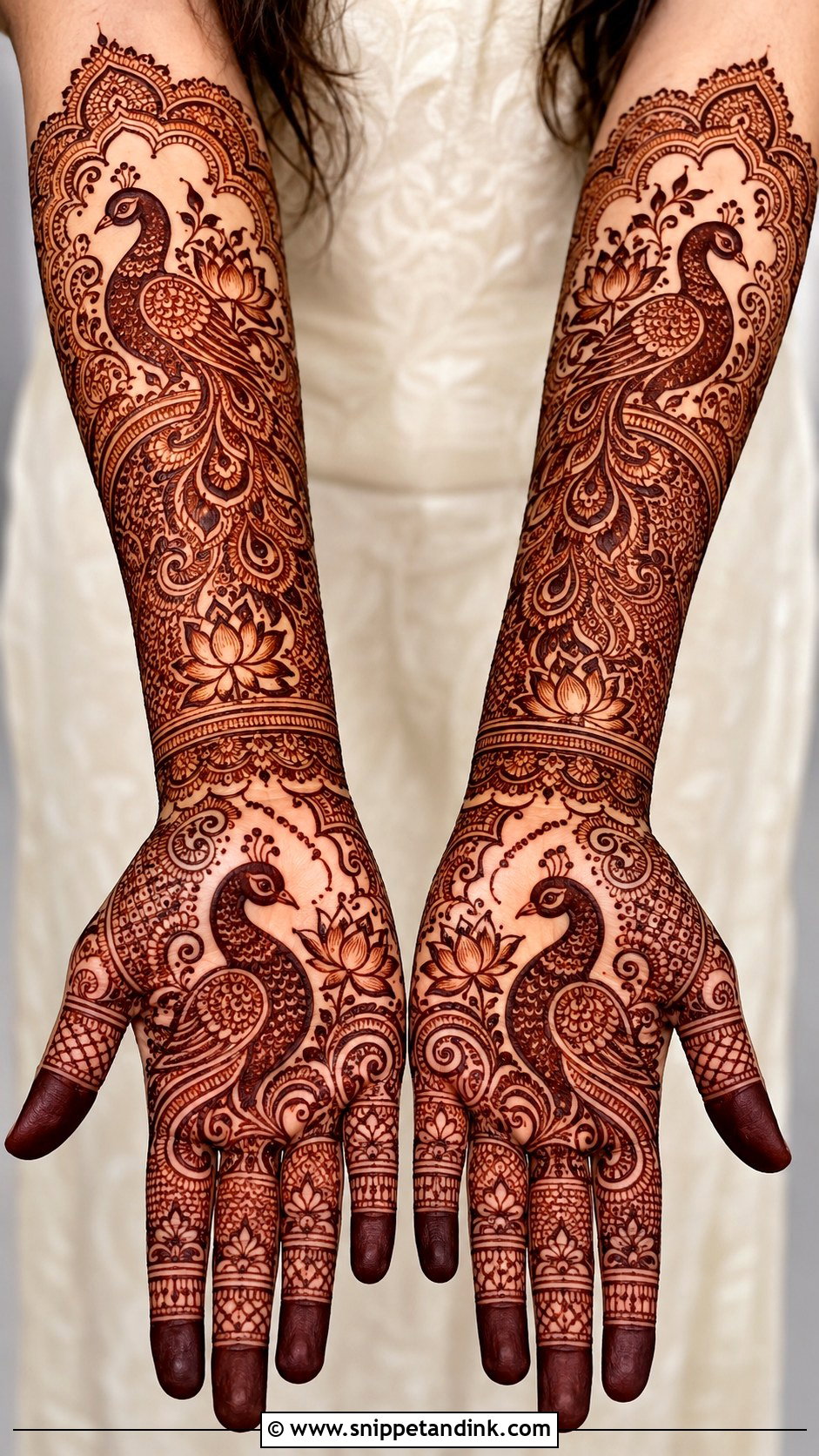
A full hand peacock mehndi design carries a lot of weight in a bridal set. The bird can sit on the palm, wrist or forearm, with feathers spreading into paisleys, florals and fine curves. The outline of the peacock has to be stronger than everything around it, or the jaali and lotus you add next will swallow it. If a bride wants it lighter, I use one large peacock per hand and pull the surrounding detail back.
10. Full Hand Paisley Mehndi Design
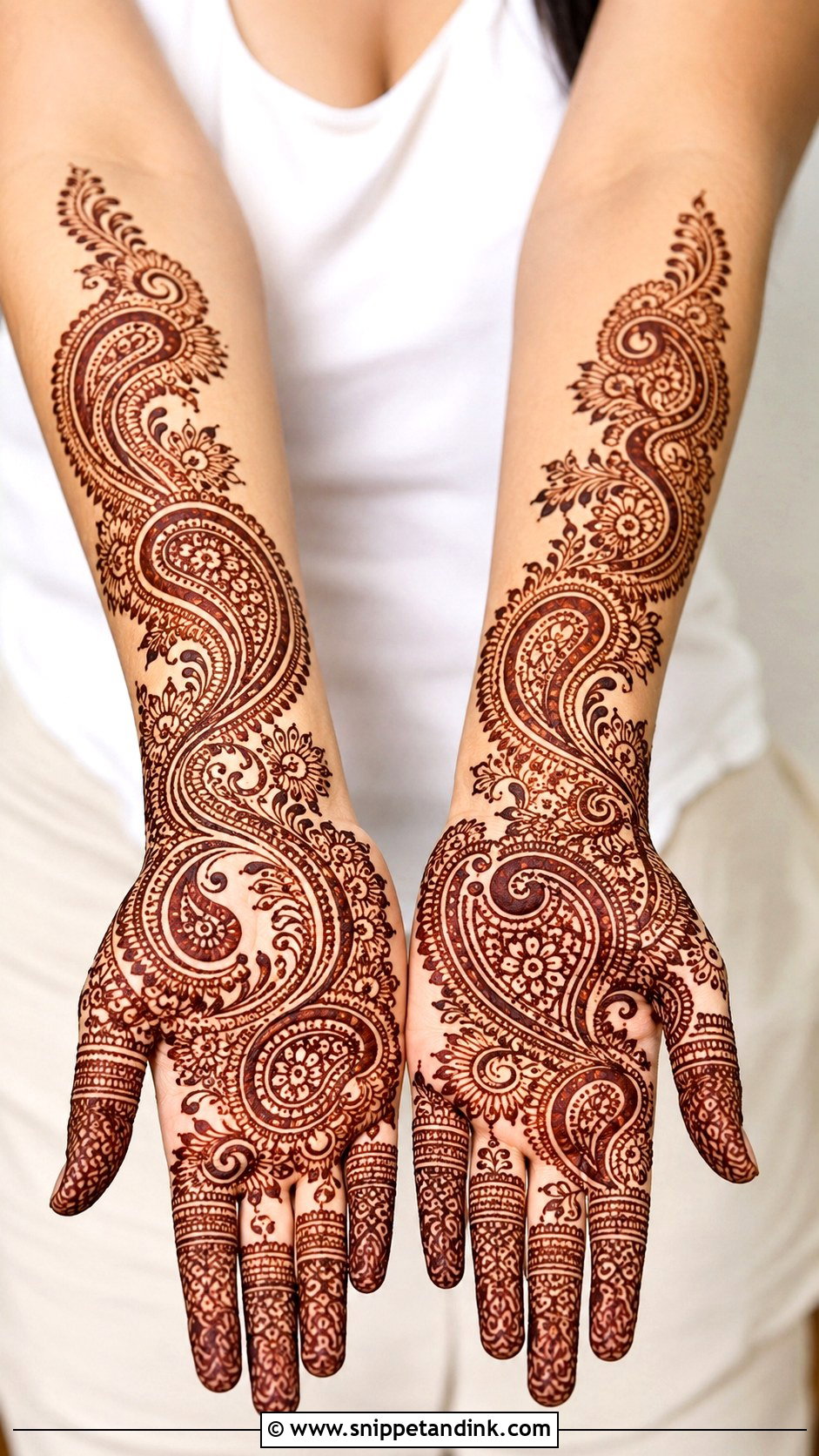
Paisleys follow the curve of the hand naturally, which is why they’ve lasted so long. I usually anchor a large paisley on the palm or wrist and grow smaller ones, florals, leaves, dots and curved fillers around it. Dense paisley work gives a bride that traditional richness; for festivals, a medium version with more skin showing is enough. Finger bands and wrist cuffs close the design off neatly at each end.
11. Full Hand Jaali Mehndi Design
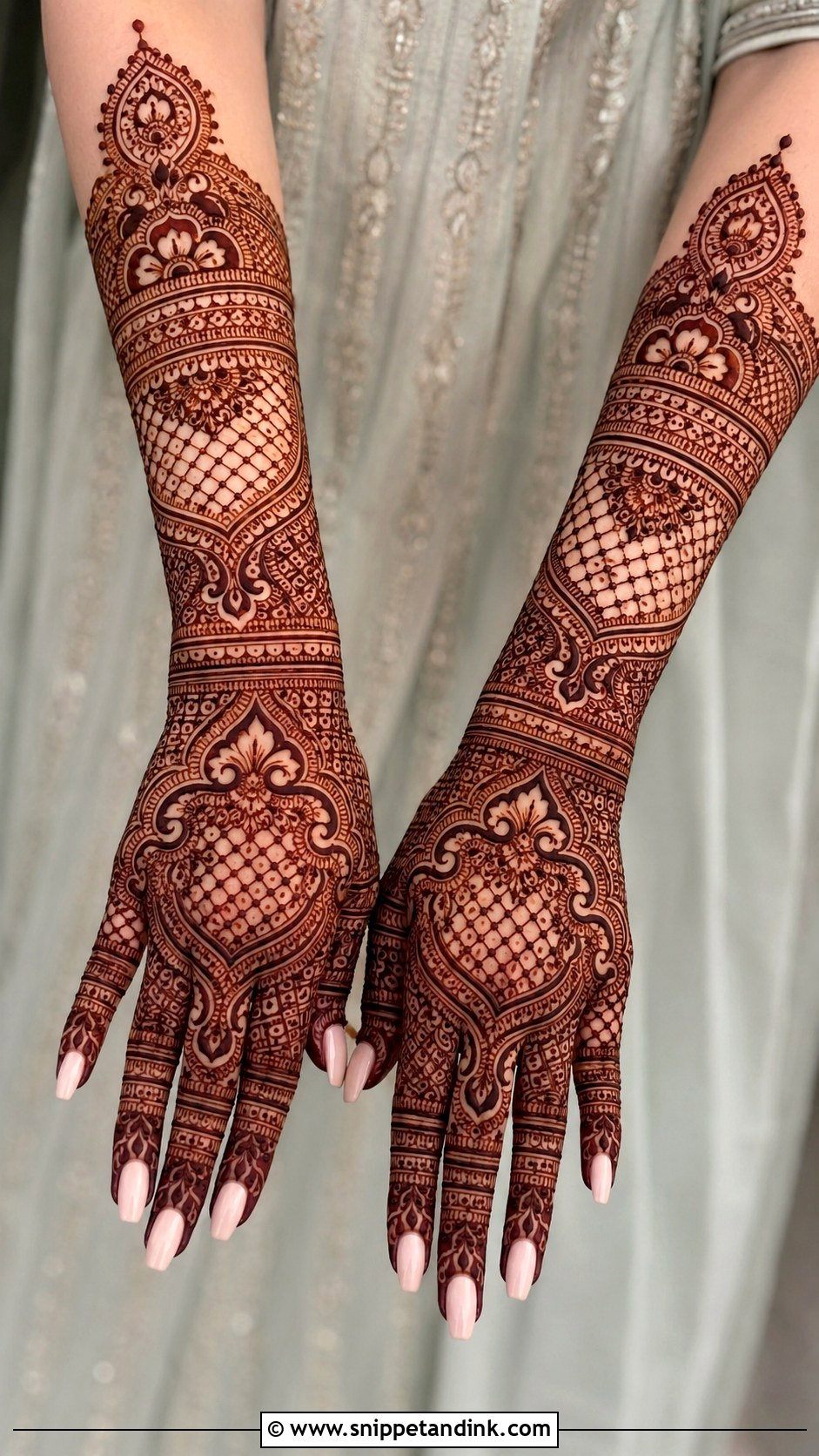
Jaali, the net pattern, adds texture without asking for more motifs. It can fill palm, back hand, fingers or forearm, framed by florals, paisleys and borders. The risk is monotony, so on a full hand I break large jaali sections with a bold flower or mandala. Thicker borders keep the sections clear, and a tiny dot inside each square gives the net some sparkle. Keep the grid lines thinner than everything else on the hand.
12. Full Hand Simple Mehndi Design
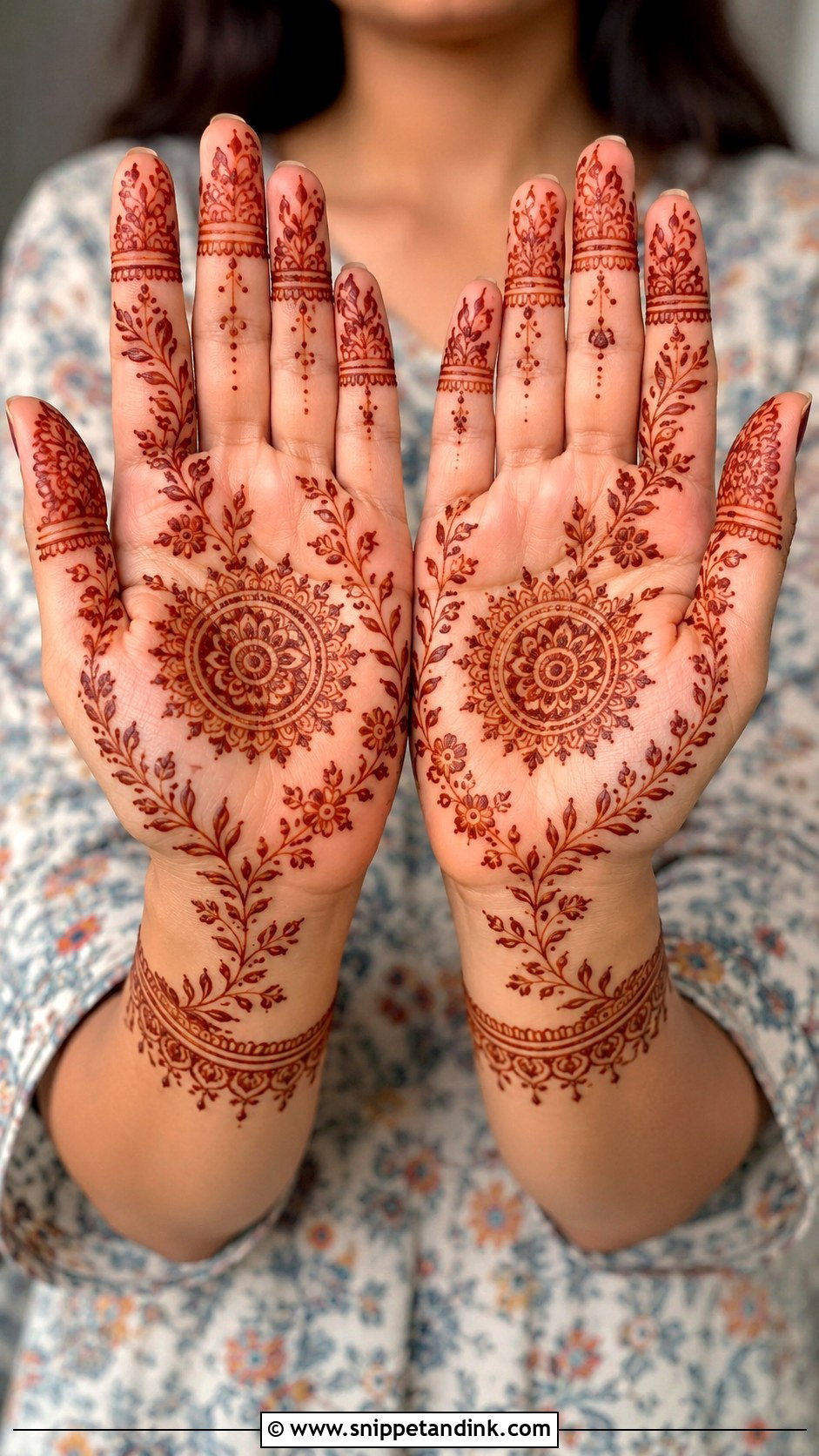
Simple doesn’t mean empty. You still cover the hand, but with clear motifs, open spaces, easy floral trails, leaves, finger bands and neat wrist details instead of dense fillers. A palm mandala or a single flower anchors it. This is where I send teenagers and anyone who can’t sit for hours. The one rule: don’t fill the gaps afterward because they look bare while wet. Once the stain develops, those gaps are what make it look finished.
13. Full Hand Modern Mehndi Design
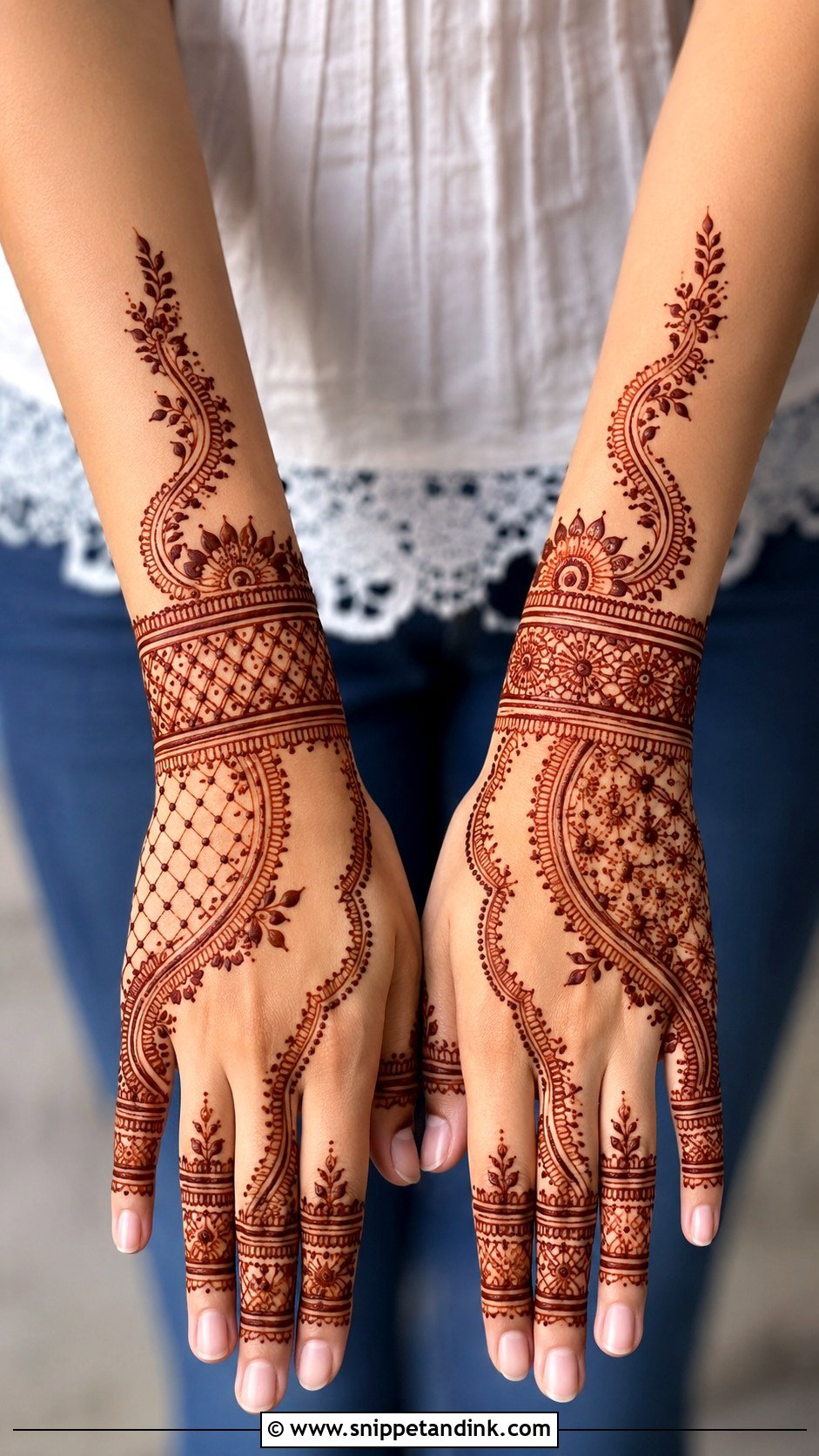
Modern full-hand work is coverage by sections instead of continuous filling. A bold palm mandala, a wrist cuff and detailed finger bands, with skin between them, read as complete because each section is finished. Negative space, clean lines, grids and abstract curves all belong here. Brides wearing pastel lehengas and minimal jewelry often prefer it, as heavy traditional coverage can look darker than the outfit.
14. Full Hand Minimal Mehndi Design
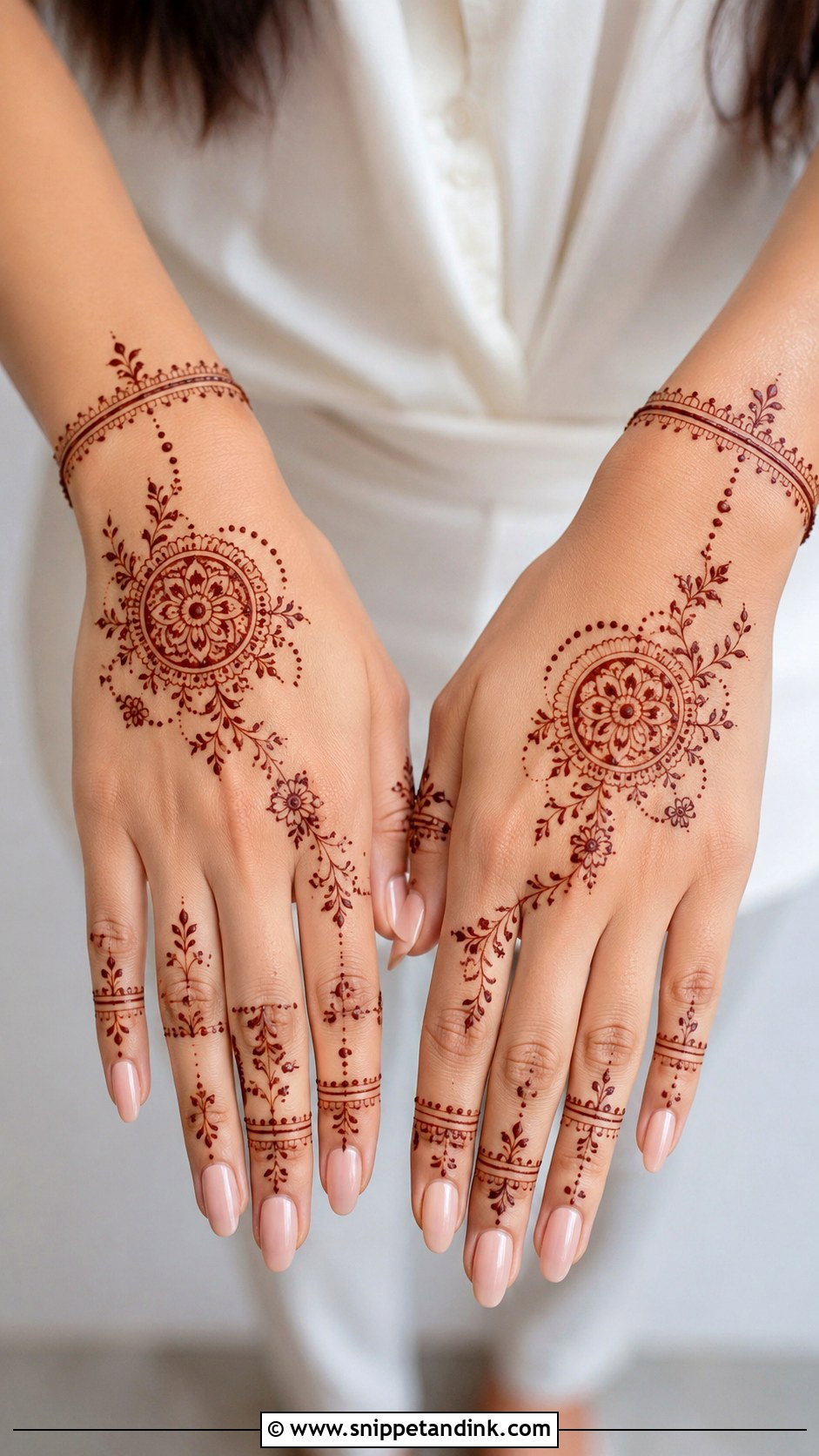
Minimal full-hand mehndi spreads thin floral vines, small mandalas, delicate finger lines and light wrist bands across the whole hand without heavy filling. It looks airiest on the back hand. Precision is everything. With so little on the skin, an uneven line has nowhere to hide, so I work slower on minimal designs than on dense ones. It fades out evenly too, which suits anyone returning to work a few days later.
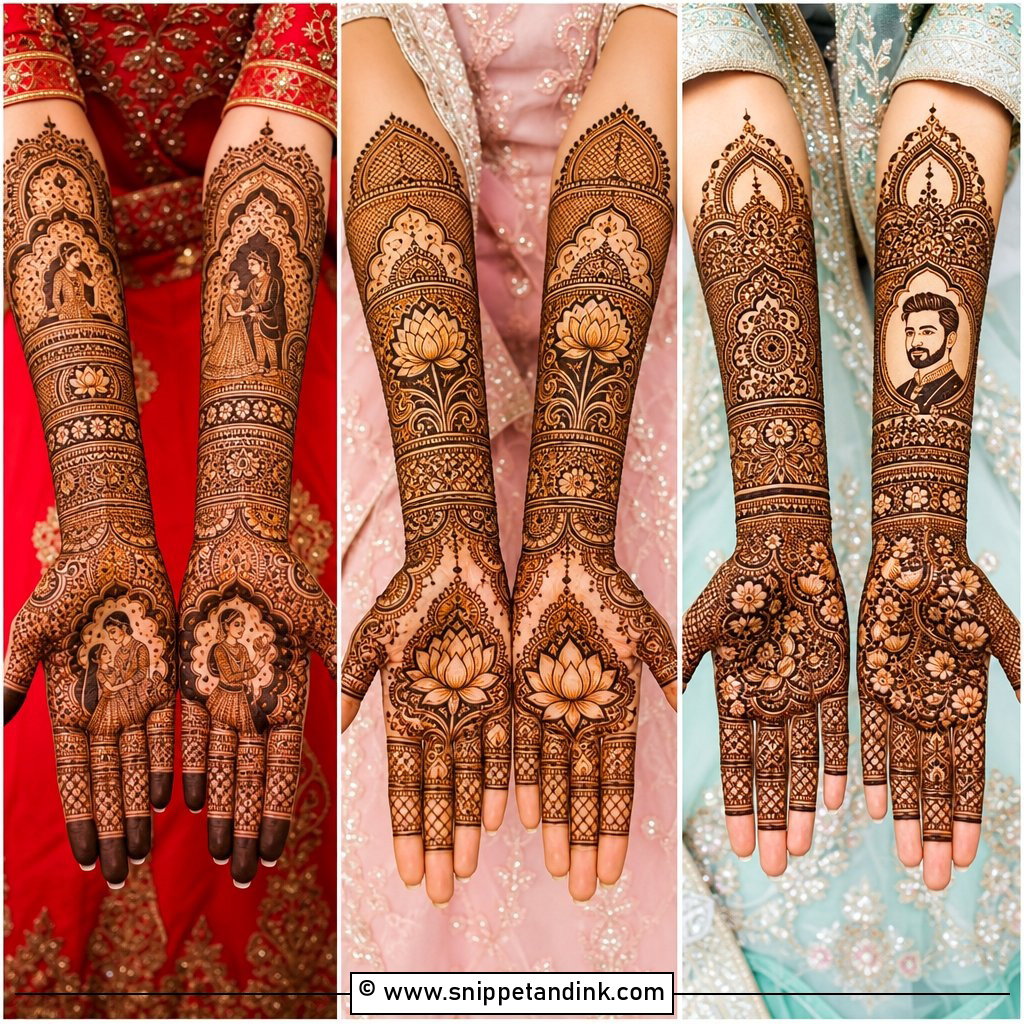
15. Full Hand Heavy Mehndi Design
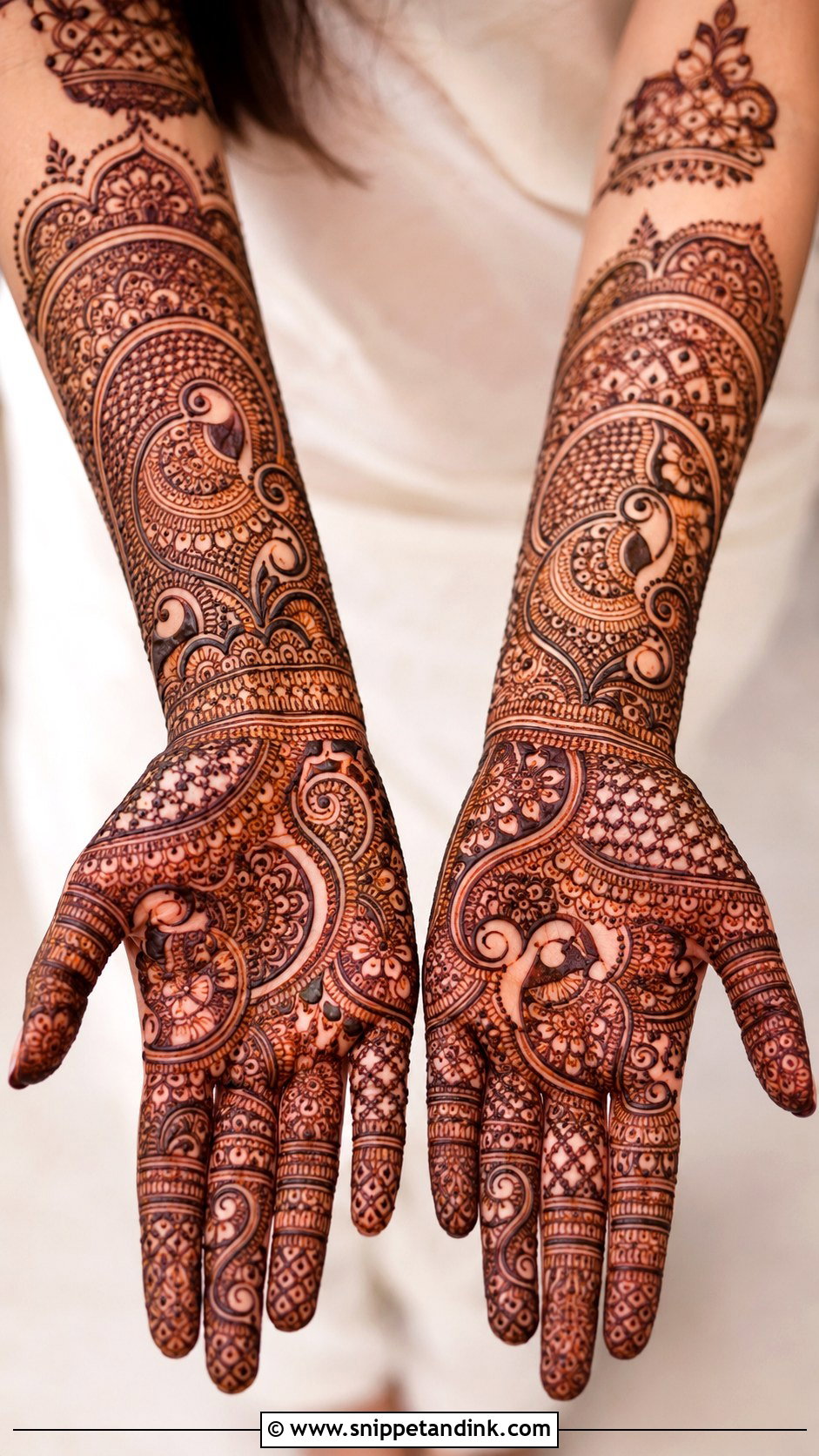
Heavy mehndi covers almost every visible area from fingertips to forearm with layered motifs, shaded sections and ornamental borders: paisleys, mandalas, peacocks, bride-groom elements, florals, jaali and fine fillers. It is the look that gives the deepest overall stain and the most drama in photos. It also takes the longest, so plan for an afternoon, not an hour. I break heavy designs into themed sections so the eye can rest. Filling everything with the same pattern makes it look like printed fabric rather than a drawn design.
16. Full Hand Dulhan Mehndi Design
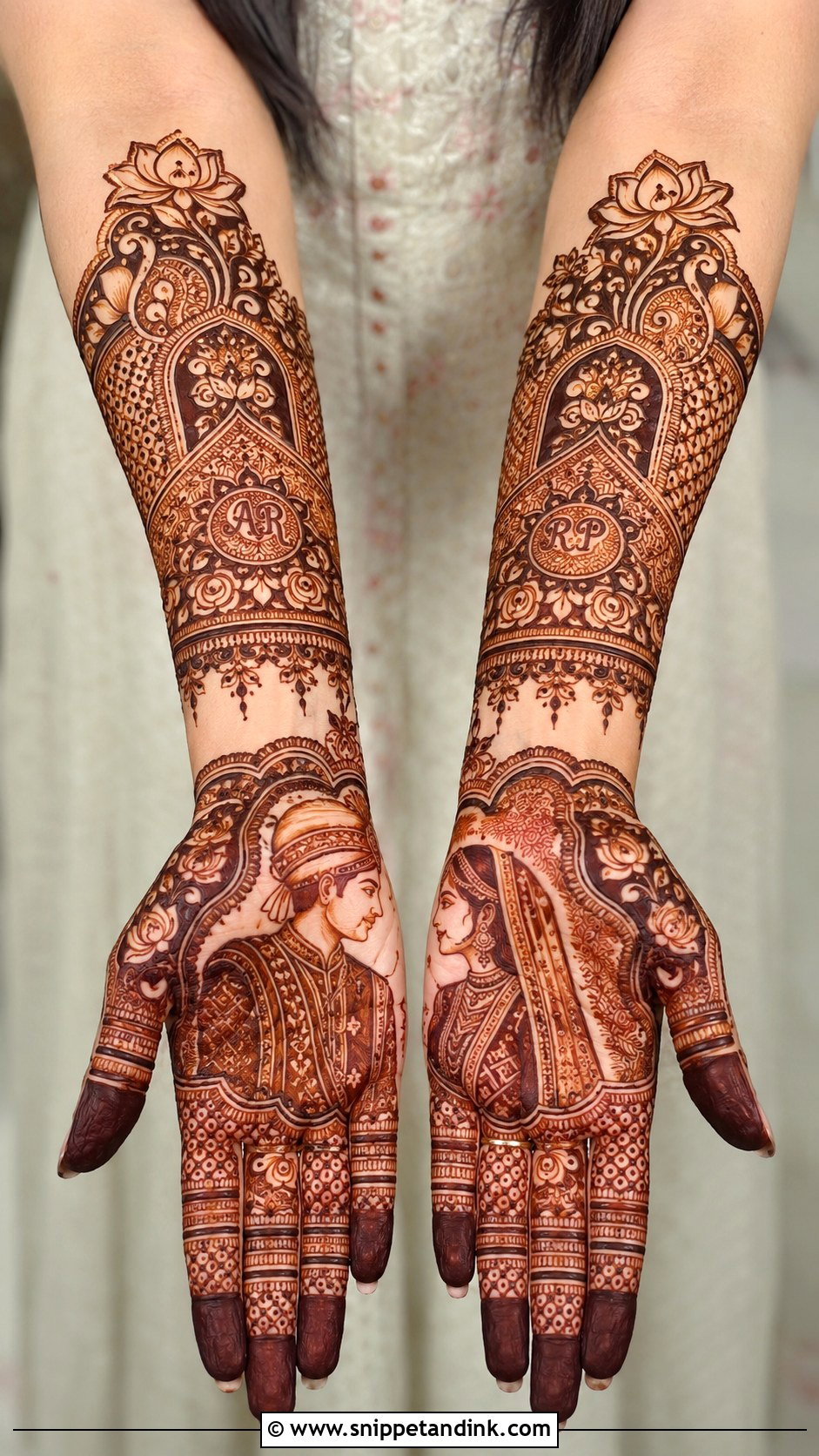
A full hand dulhan mehndi design tells the wedding’s story. Palms may hold bride-groom portraits, kalash and doli motifs, lotus flowers or hidden initials, with paisleys, jaali, floral bands and fine curves on the fingers and forearms. I always ask the bride to list the personal elements that matter most before mehndi day, because there’s only so much palm. Trying to fit every symbol in squeezes each one too small to read once it stains.
17. Full Hand Rajasthani Mehndi Design
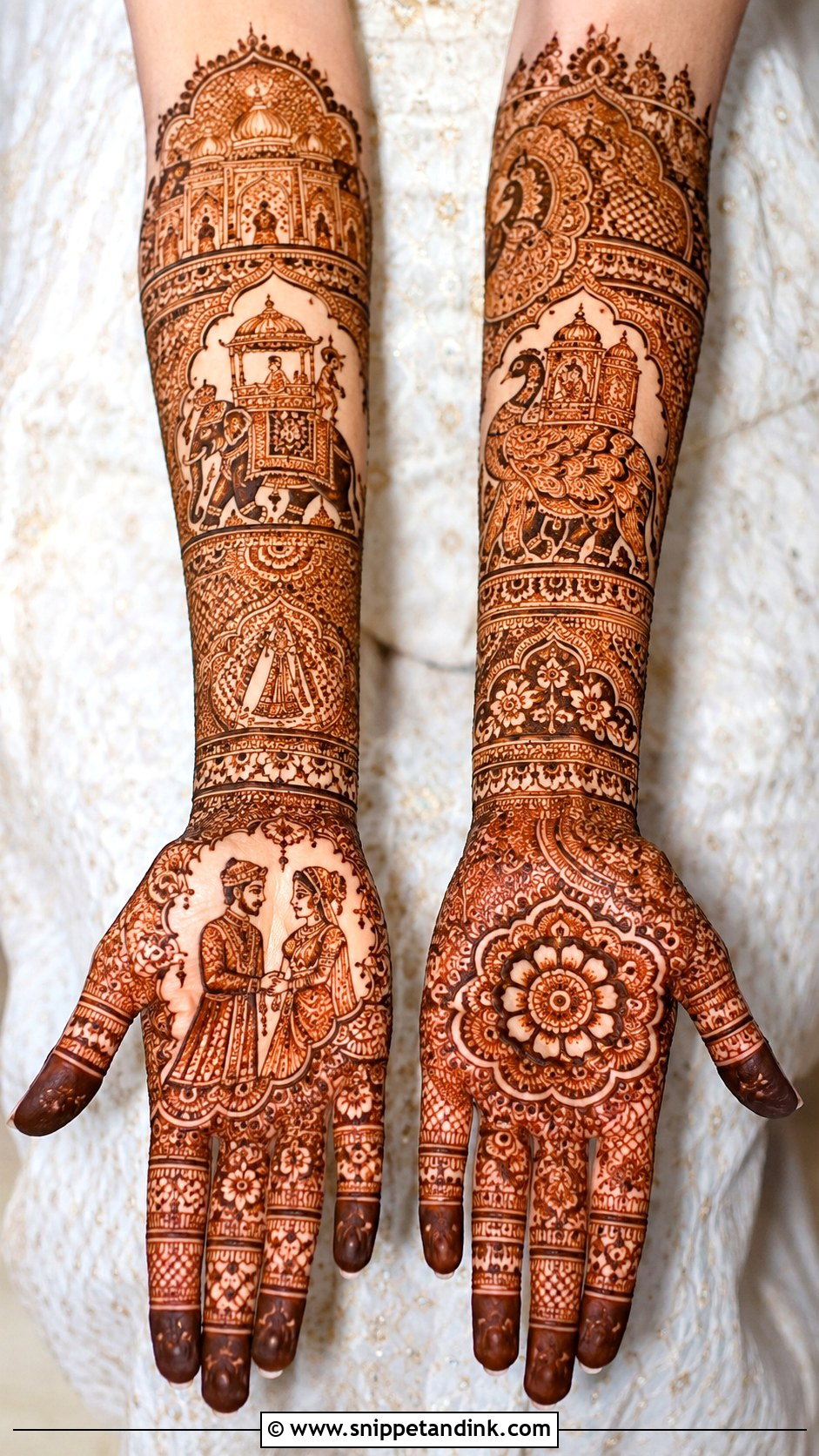
Rajasthani mehndi is storytelling in panels: royal motifs, bride-groom figures, elephants, peacocks, doli scenes and mirrored symmetry, packed densely over hand and forearm. Each section needs its own theme. I’ll put the bride and groom scene on the palm, then paisleys, jaali and palace-style borders on the forearm, with fine repeating lines filling the fingers. Figure work needs a very fine cone tip, as faces blur first when the stain darkens.
18. Full Hand Marwari Mehndi Design
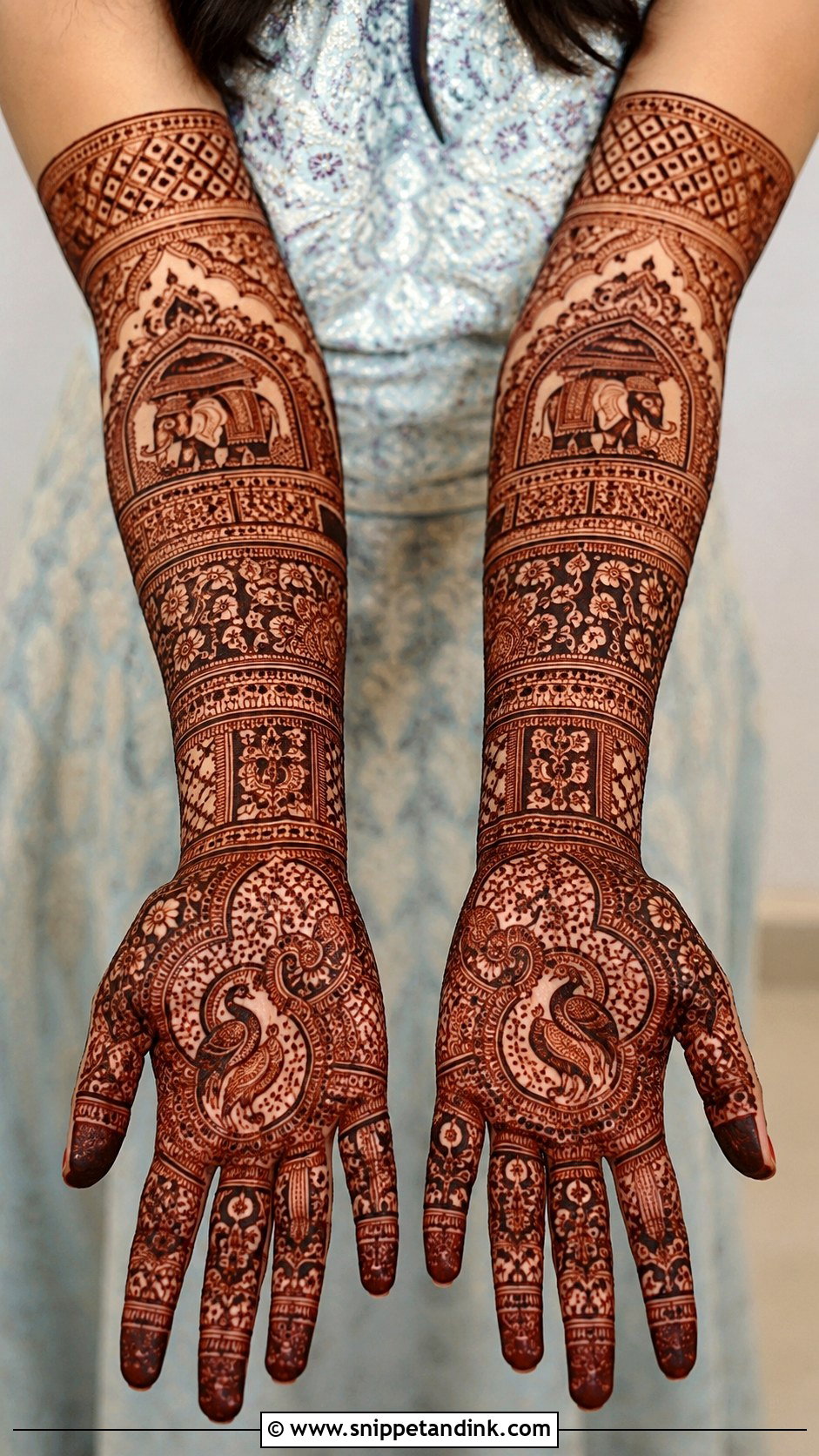
Marwari designs are ornamental and dense, drawn from traditional wedding art: paisleys, floral panels, bride-groom motifs, elephants, peacocks, mandalas and layered borders. The palm holds the main motif and the wrist and forearm carry repeating bands and royal details. Brides who choose Marwari usually pair it with heavy bridal bangles, and that’s worth planning for. The bangle stack will cover part of the wrist, so I keep the most detailed bands just above where the chooda ends.
19. Full Hand Pakistani Mehndi Design
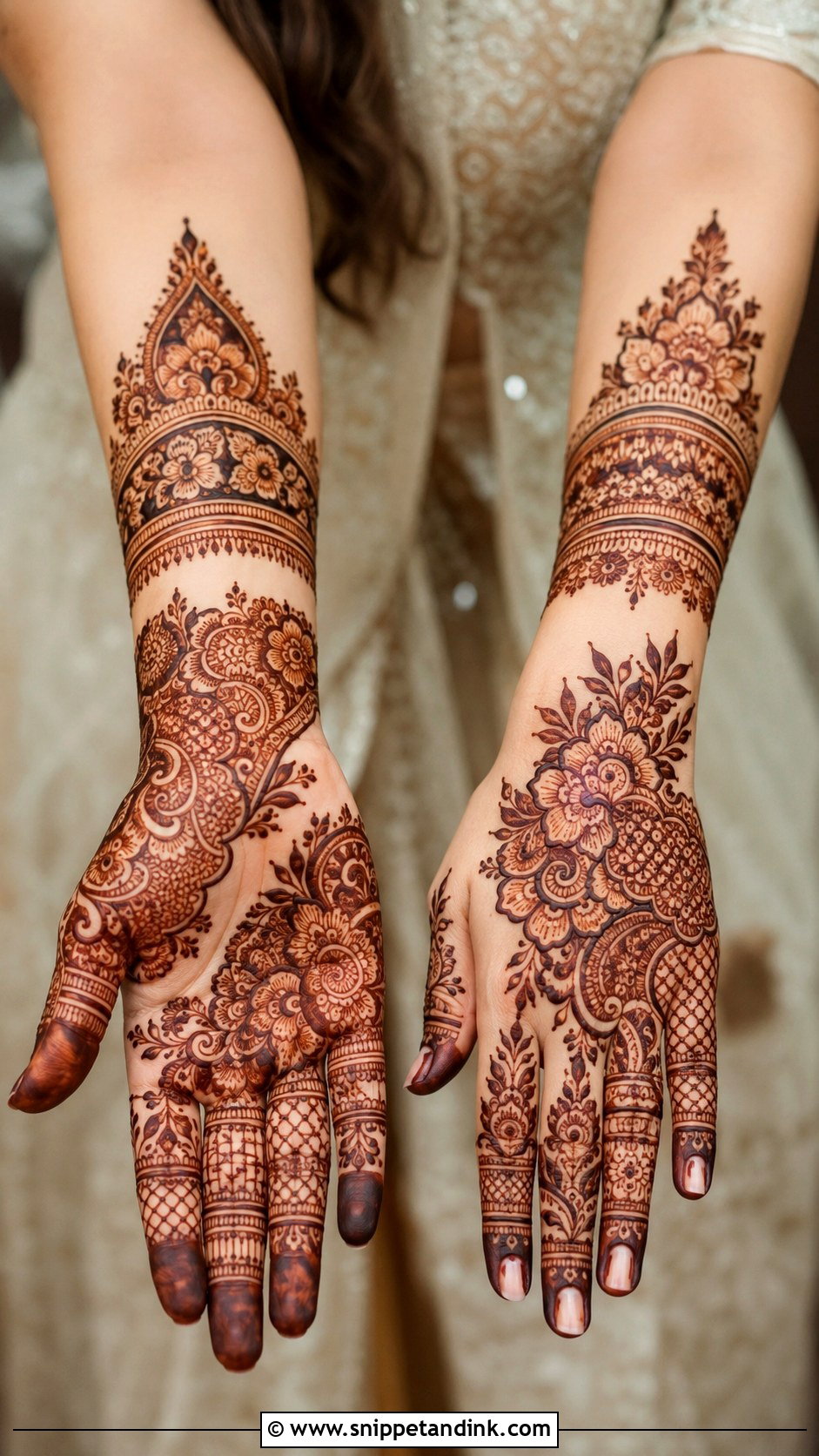
Pakistani mehndi balances Indian detail with Arabic flow and generous floral placement. Brides tend to go heavy, with paisleys, flowers, jaali and decorative wrist cuffs; for Eid and family events I open it up with bold florals and fine fingers. The signature is that balance of filled areas and skin. Soft shading on petals and leaves gives it dimension. It works equally well on palms and back hands.





20. Full Hand Moroccan Mehndi Design
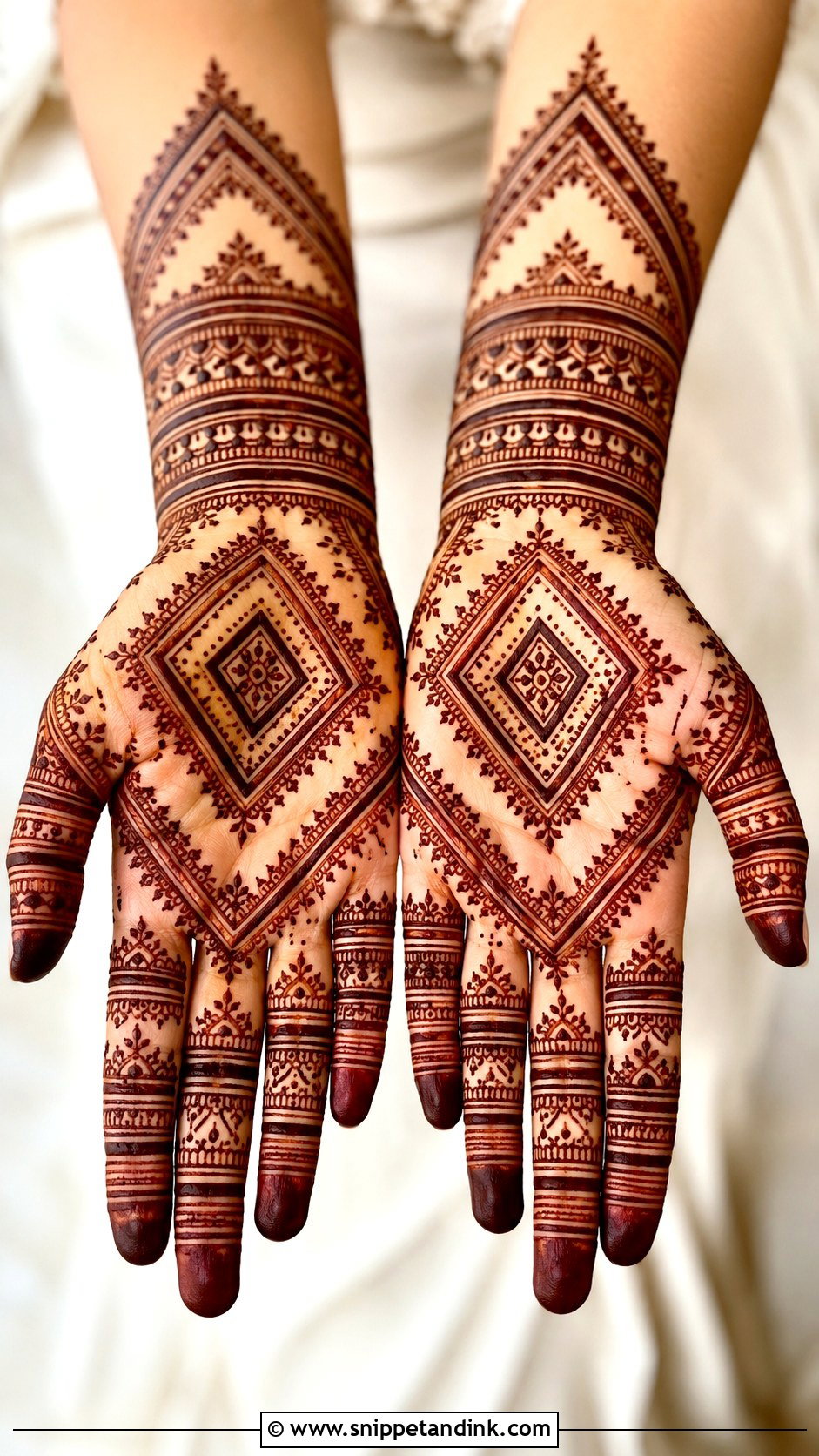
Moroccan work swaps flowers for lines, diamonds, triangles, grids, dots and bold mirrored shapes. On a full hand that might mean banded fingers, a central geometric panel on the palm and cuff-like sections at the wrist. It’s sharp and graphic, a good choice if you want something unlike the traditional bridal look. Even spacing is the whole game. I measure spacing by eye against the first band and recheck after every few lines, since a grid that drifts is obvious.
21. Gulf Full Hand Mehndi Design
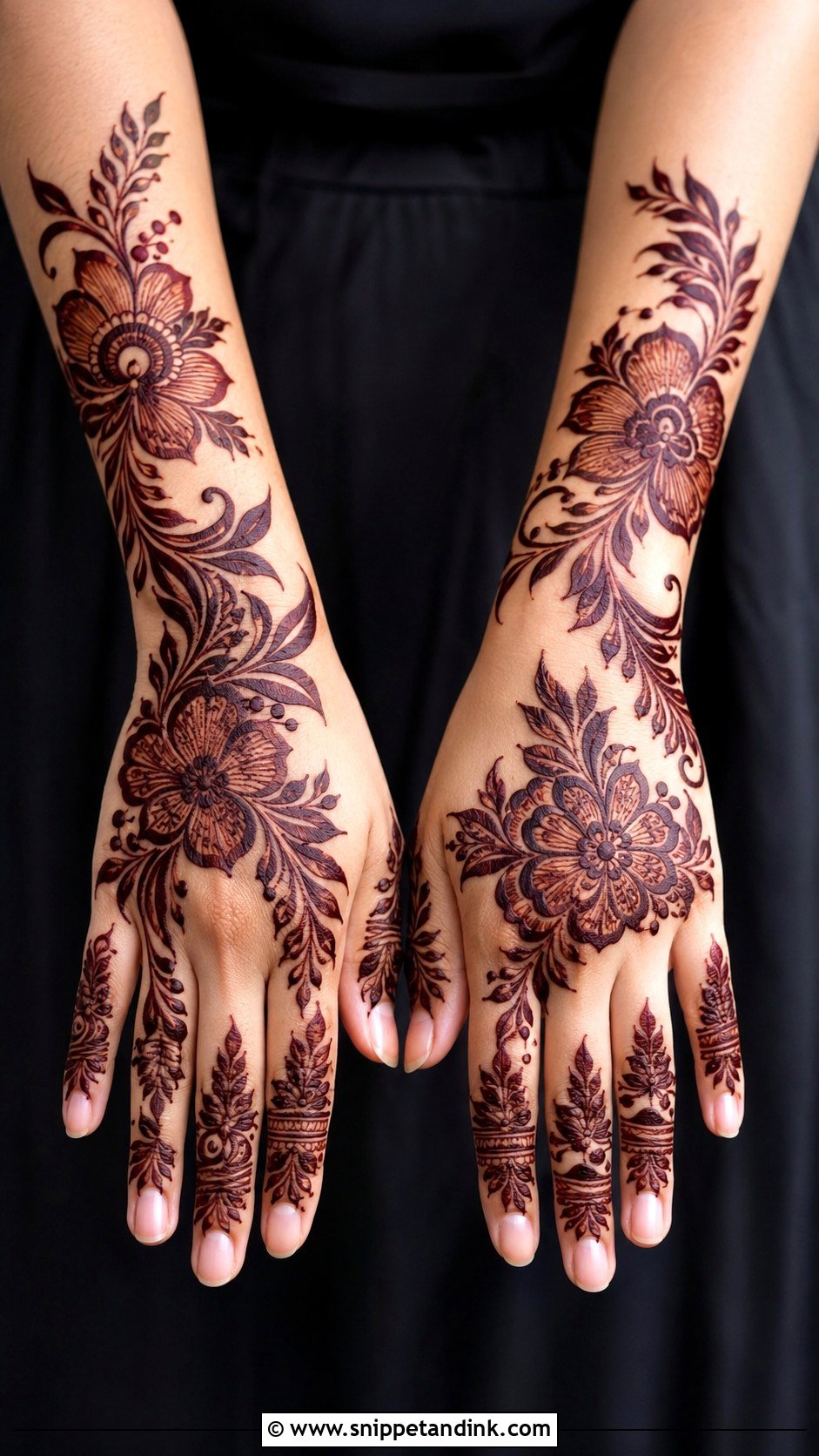
Gulf, or Khaleeji, mehndi is bold and floral: large blossoms, leafy trails, shaded petals, thick outlines and plenty of negative space. It’s not as packed as Indian bridal work, yet it still reads as strong coverage from fingers to wrist or forearm. The thick outline is applied with more paste than usual, and I warn clients to keep the hand still longer, since those raised lines take a while to dry and smudge easily. Leafy bands on the fingers finish it. A deep reddish-brown stain makes the big shapes come alive.
22. Full Hand Khafif Mehndi Design
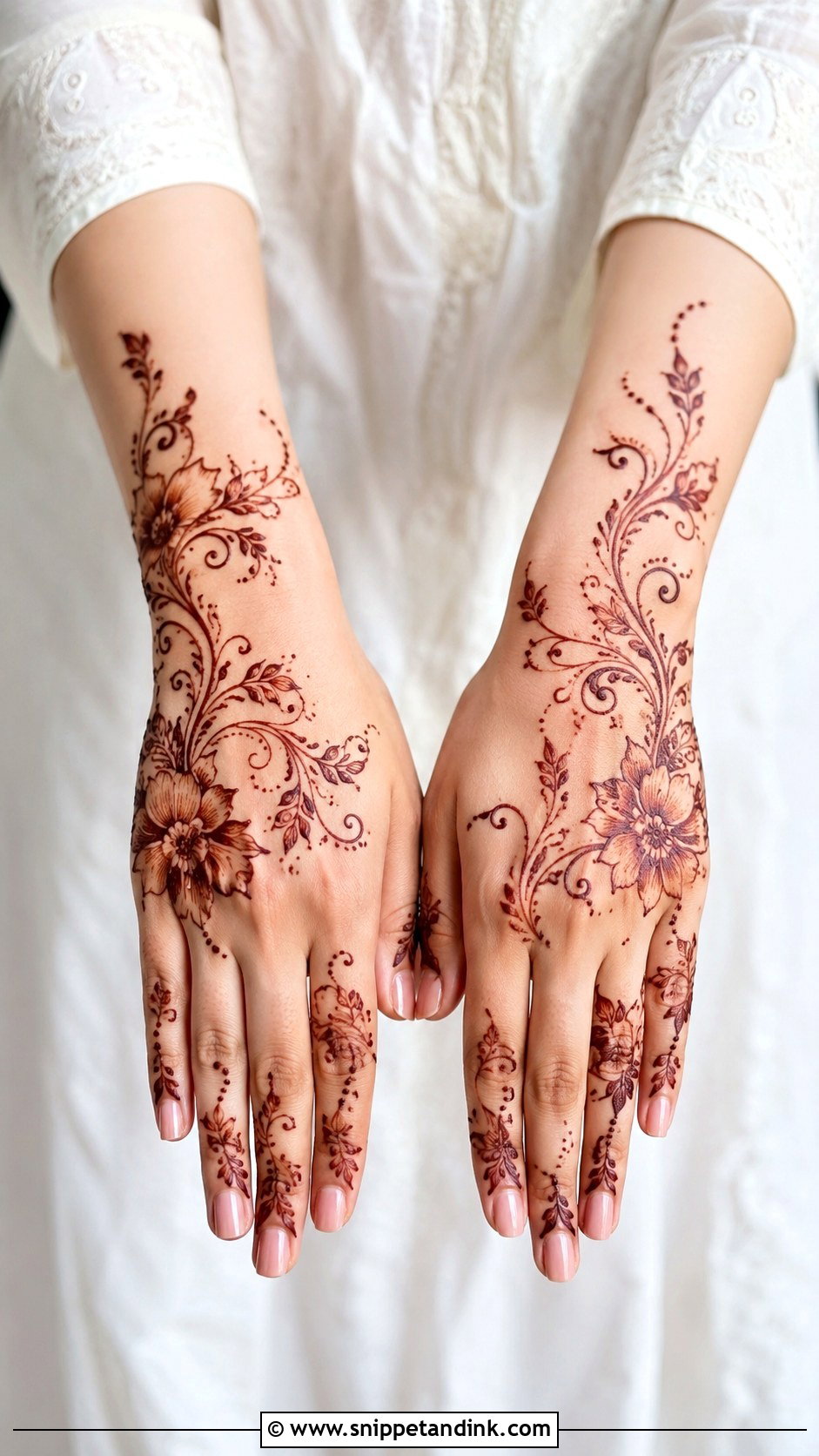
Khafif is the lightest way to cover a full hand: fine lines, small florals, light shading, leafy vines, dots and soft spacing. It usually starts at the wrist with a floral vine, crosses the palm or back hand and finishes on detailed fingers. The linework must stay thin and even from start to end, so I use a fine-tipped cone and refill it often rather than squeezing a nearly empty one, which is when lines start to thicken and break.
23. Full Hand Finger Mehndi Design
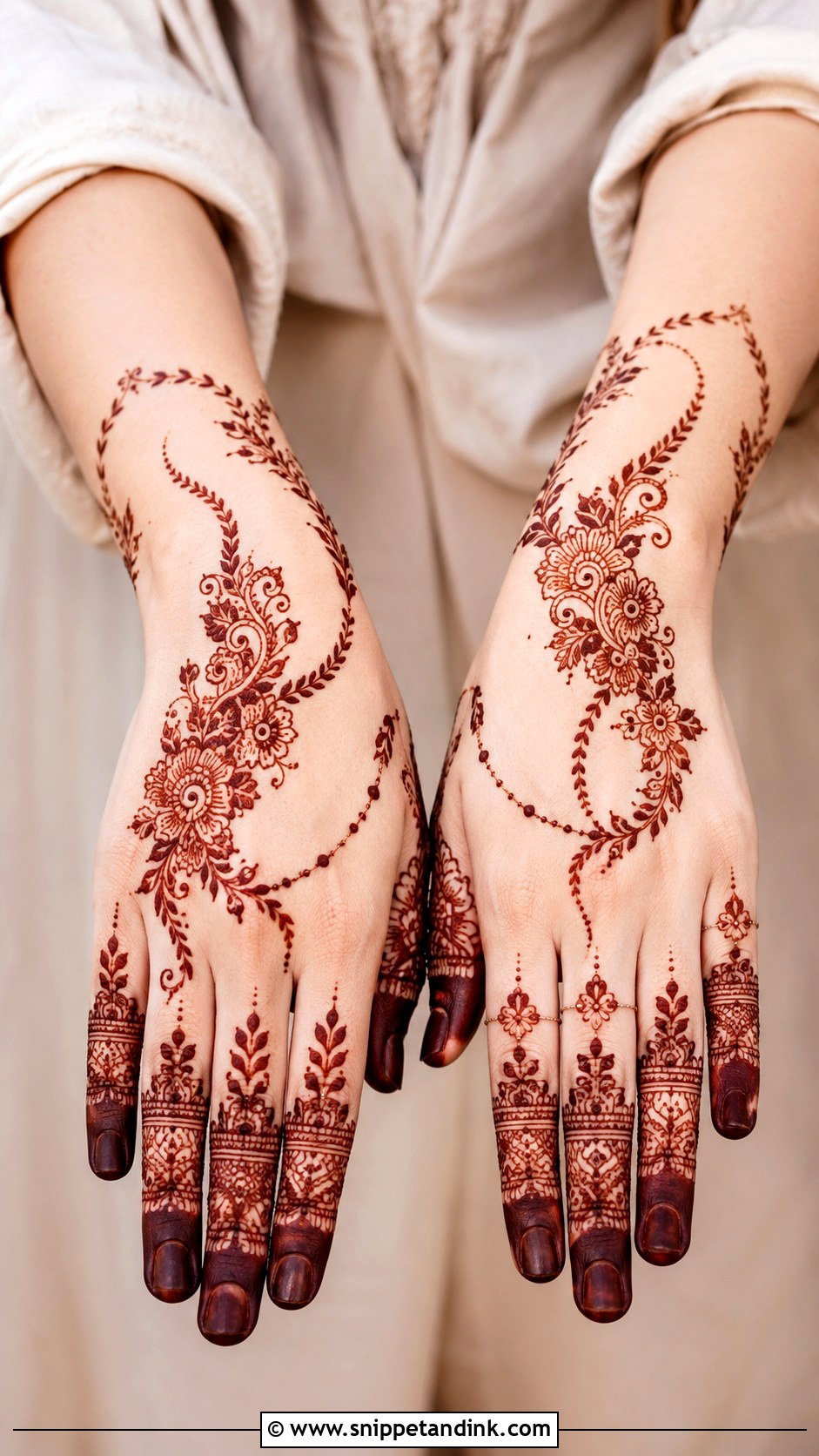
Here the fingers take center stage: filled tips, ring-style bands, leafy chains, fine lines, dots and tiny florals, all connected to a wrist detail. The palm or back hand stays lighter, linked by a mandala or floral trail. Vertical detail on the fingers makes hands look longer. Watch the balance, though. Heavily decorated fingers above a near-empty hand look unfinished, so tie them together with a cuff, a small palm motif or a diagonal trail.
24. Full Hand Bracelet Mehndi Design
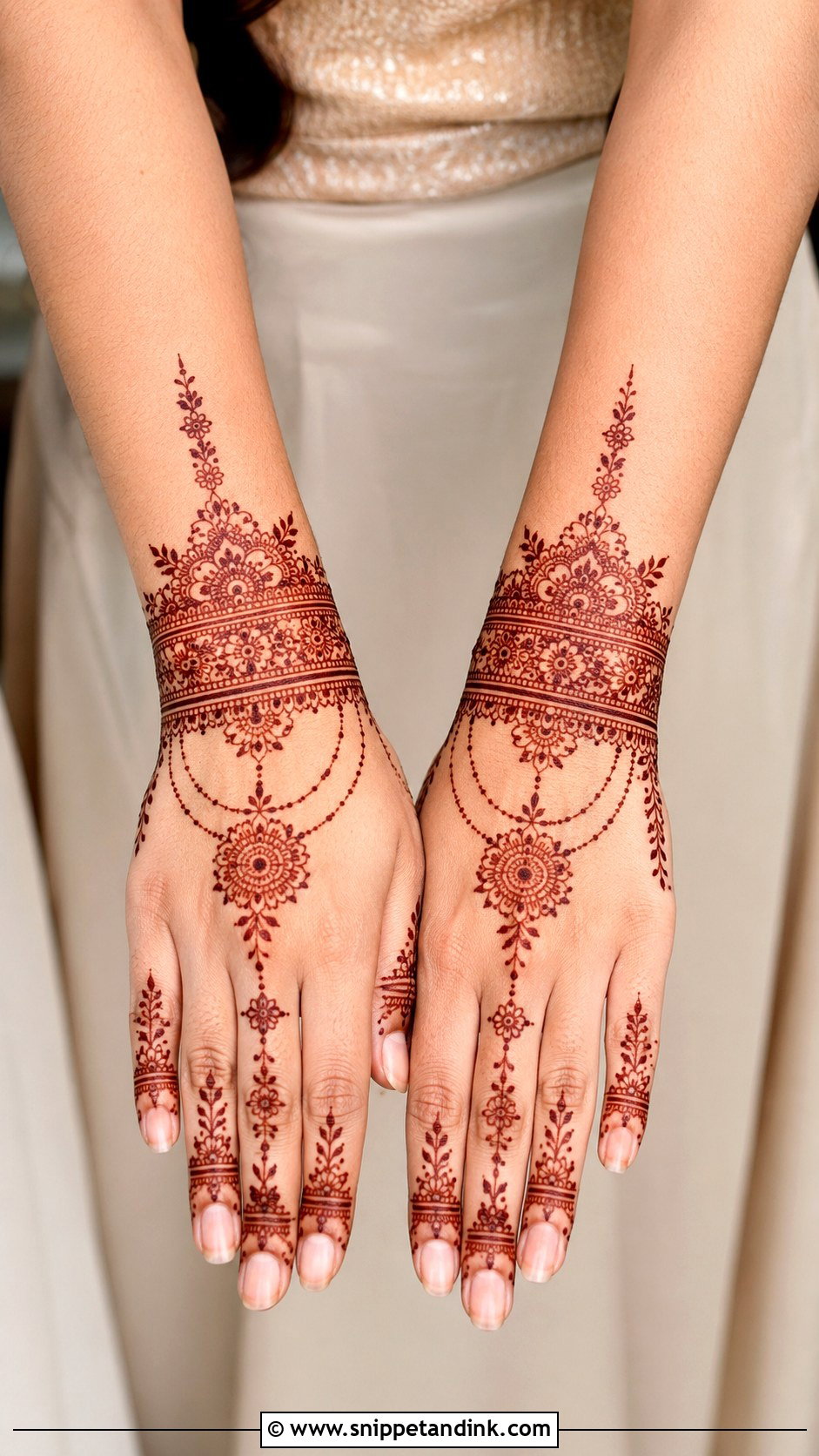
Bracelet mehndi draws jewelry onto the skin: cuffs, chains, ring connectors, little florals, beads and dots, often starting with a bold wrist bracelet and reaching the fingers through fine chains. It shows best on the back hand. I keep the bracelet section strictly symmetrical and let the connecting lines go lighter. If you’re also wearing real bangles, decide where they’ll sit first so the drawn cuff isn’t hidden behind them.
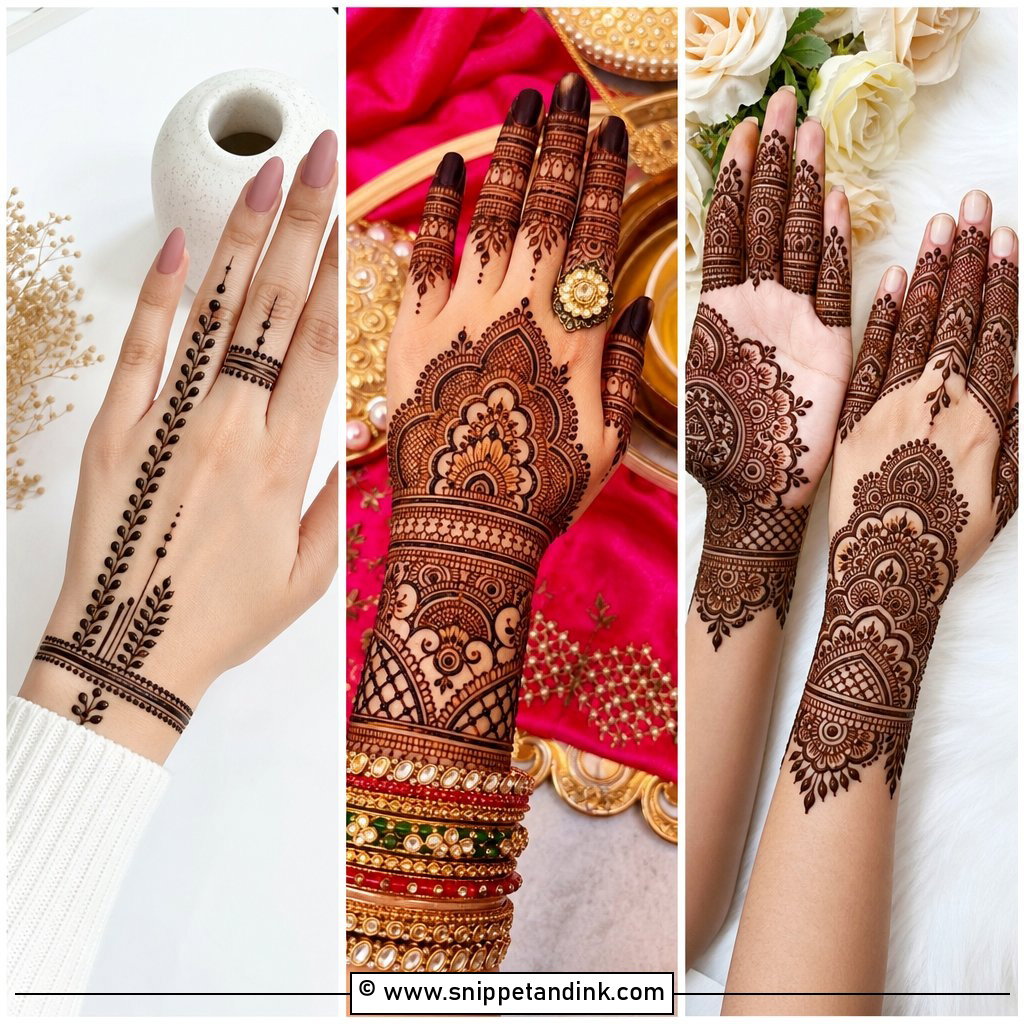


25. Full Hand Lotus Mehndi Design
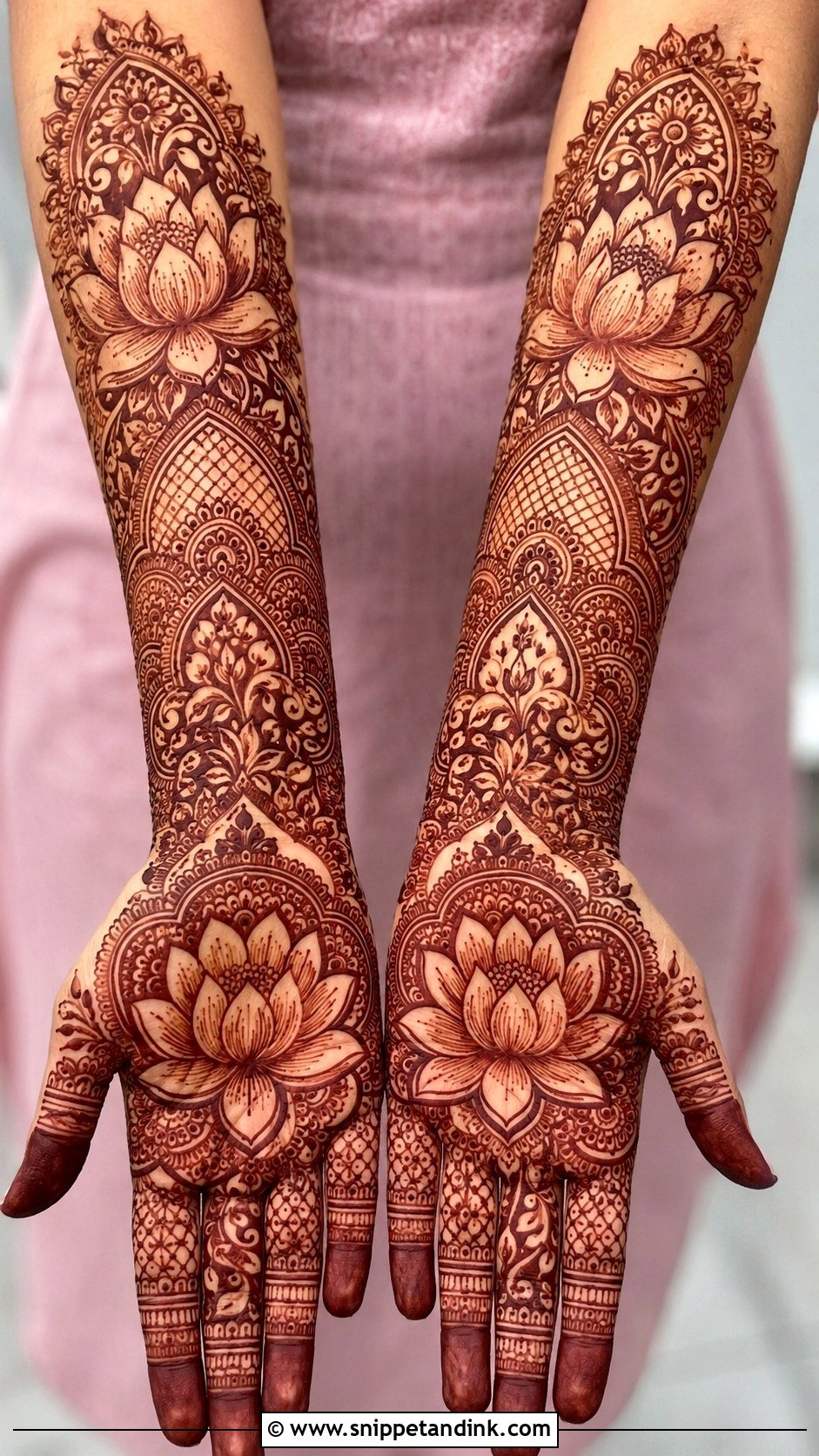
The lotus can anchor the palm center, the wrist or the forearm, surrounded by paisleys, mandalas, leaves, jaali, dots and filler curves. A large lotus on the palm gives a clear focal point; smaller ones can echo it toward the wrist and fingers. Shaded petals add dimension. I build each lotus from its middle petal outward so it stays symmetrical, then frame it with clean borders and balanced spacing.
26. Full Hand Rose Mehndi Design
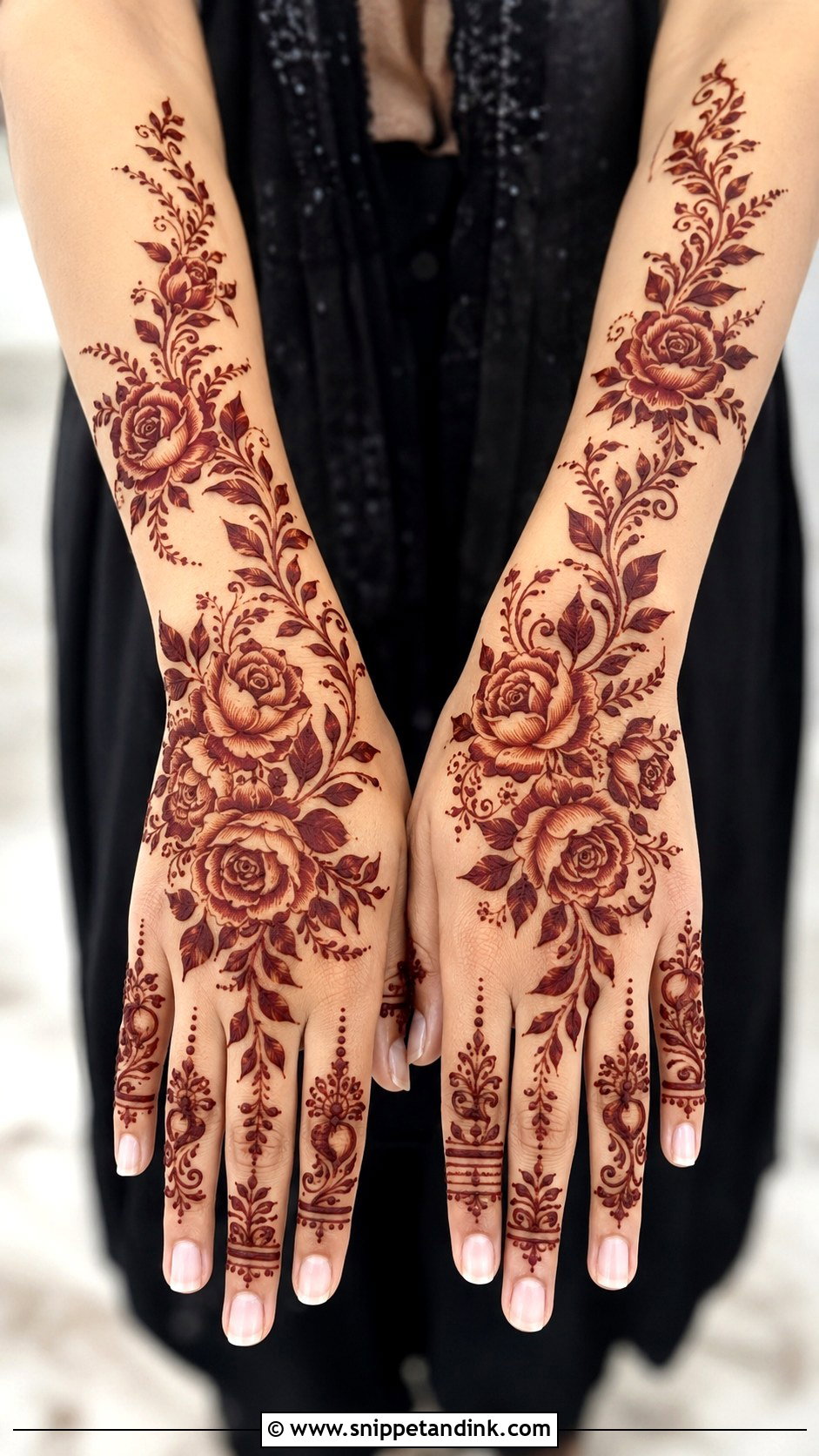
Roses are made for Arabic and Indo-Arabic layouts because their rounded, shaded petals hold their shape at any size. A full design might put large roses near the wrist, smaller ones across the palm, leafy vines on the fingers and curved trails onto the forearm. For a bride, add jaali, paisleys and cuffs; for a lighter look, leave open space around each bloom. The rose must stay distinct from the filler, so I never let filler touch the outer petals.
27. Full Hand Bangle Mehndi Design
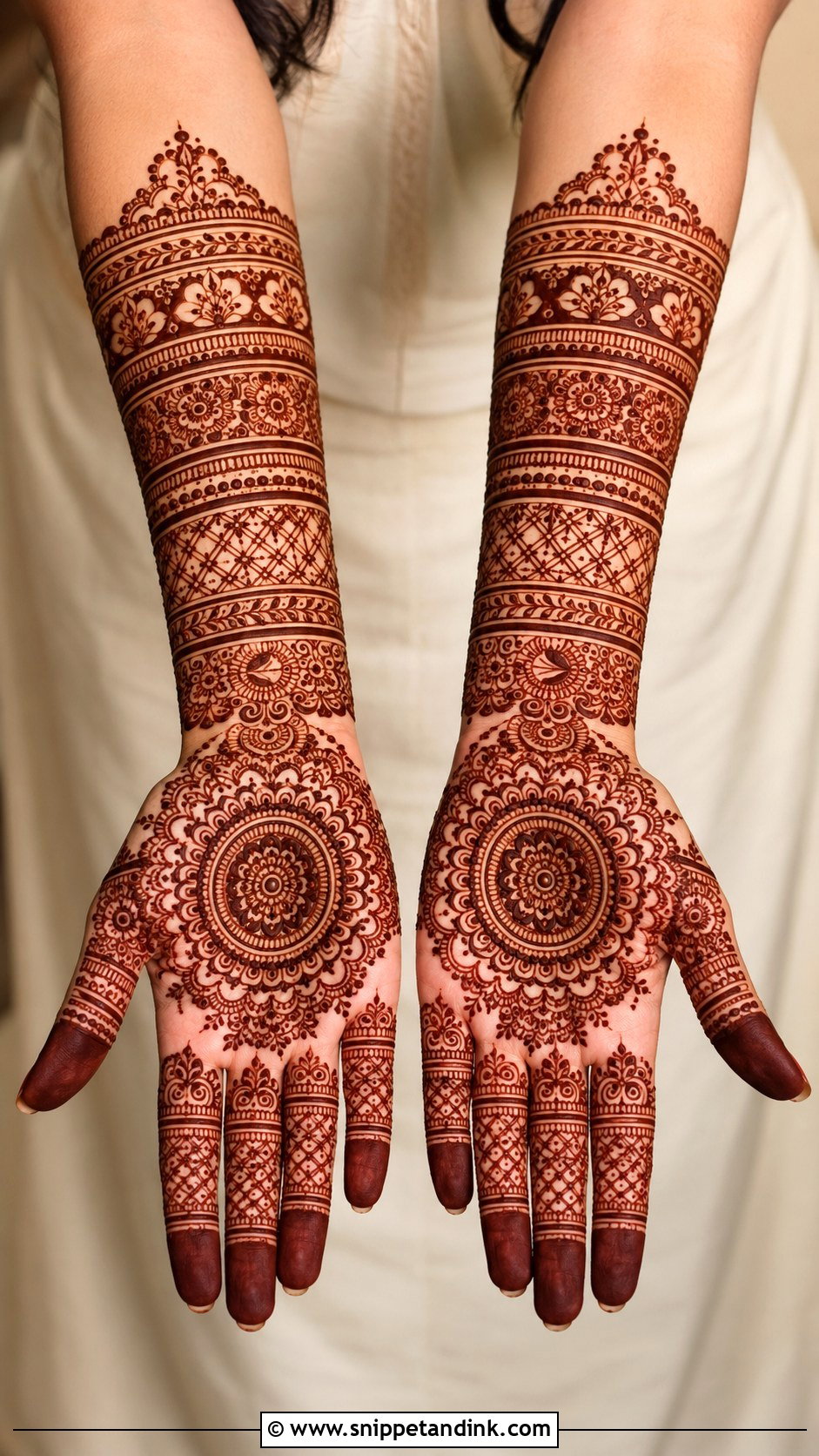
Bangle mehndi fills the wrist and lower forearm with circular bands, lace-like borders, dots and geometric strips, so it looks like a stack of bangles. The palm or back hand carries a mandala or floral centerpiece with chains running up to the fingers. It shows off best with short sleeves. I make each band different but related, mixing florals, jaali and fine lines, so the stack looks varied instead of copied.
28. Full Hand Engagement Mehndi Design
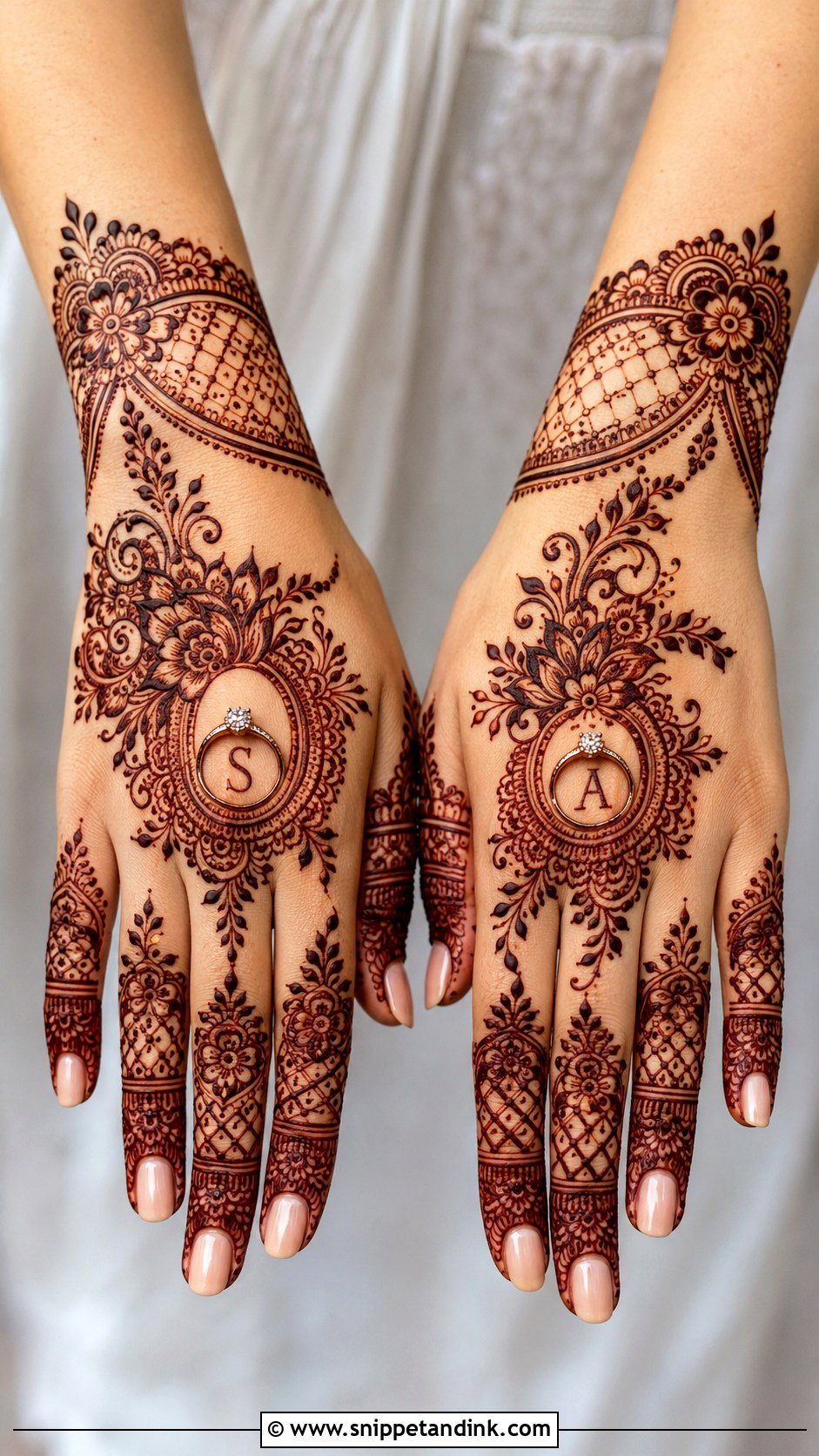
A full hand engagement mehndi design should sit a step below bridal. Floral trails, ring motifs, initials or a date, delicate jaali and stylish cuffs all fit. Ring shots matter most at an engagement, so I give the back hand and fingers more attention than the palm, and keep the base of the ring finger fairly clear. Indo-Arabic and khafif layouts work well because they cover without hiding the shape of the hand. A small heart frame is fine if the rest of the design is soft enough to carry it.
29. Full Hand Eid Mehndi Design
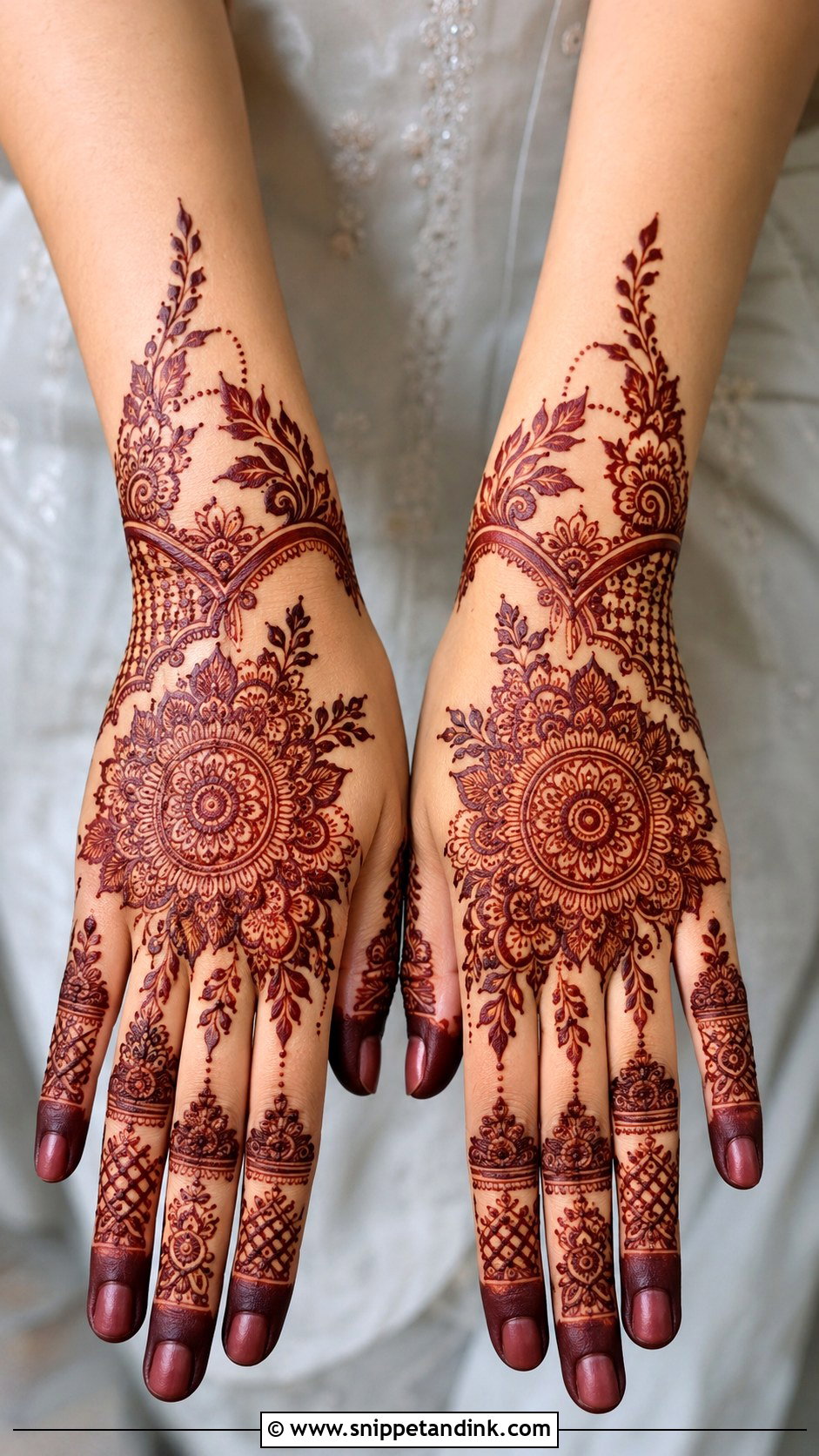
Eid designs need to be done quickly and worn comfortably through a long day. Arabic floral trails, khafif vines, mandalas, jaali sections, shaded leaves and detailed fingers can all cover the hand while still leaving room to breathe. Think about your sleeves and jewelry first. A back-hand floral trail with finger bands feels modern; a palm mandala with wrist detail feels more traditional. Put it on the night before and the stain will be at its richest by morning prayers.
30. Full Hand Diwali Mehndi Design
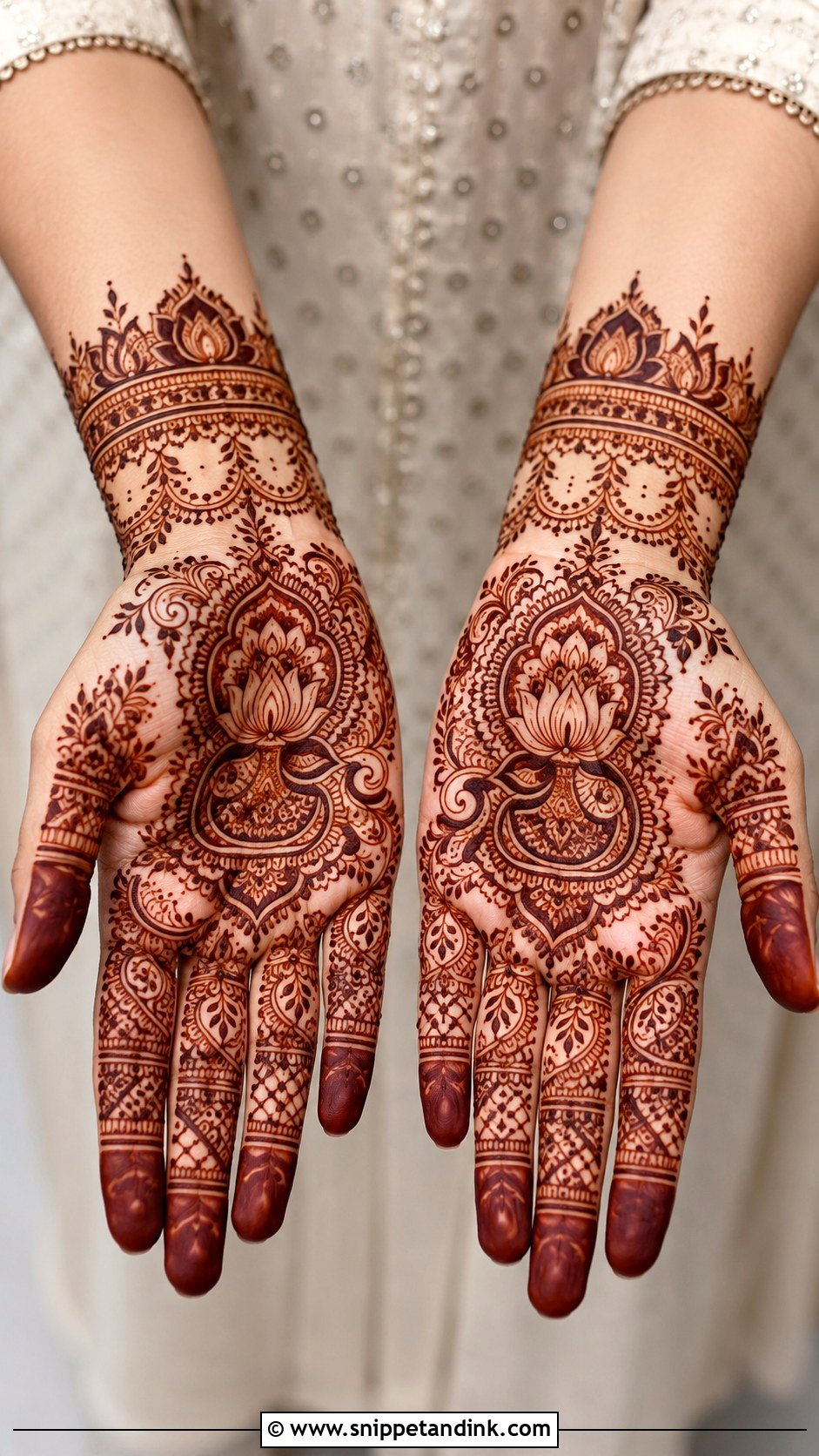
A full hand Diwali mehndi design should feel festive without tipping into bridal. Mandalas, lotus flowers, paisleys, diya shapes, leafy vines and clean wrist borders fit the season, with moderate spacing for comfort while you’re cooking, lighting lamps and hosting. A central mandala is my usual starting point. Small floral bands on the fingers and a cuff at the wrist finish it. Keep the hand mostly symmetrical and it will hold up in family photos.
31. Full Hand Karwa Chauth Mehndi Design
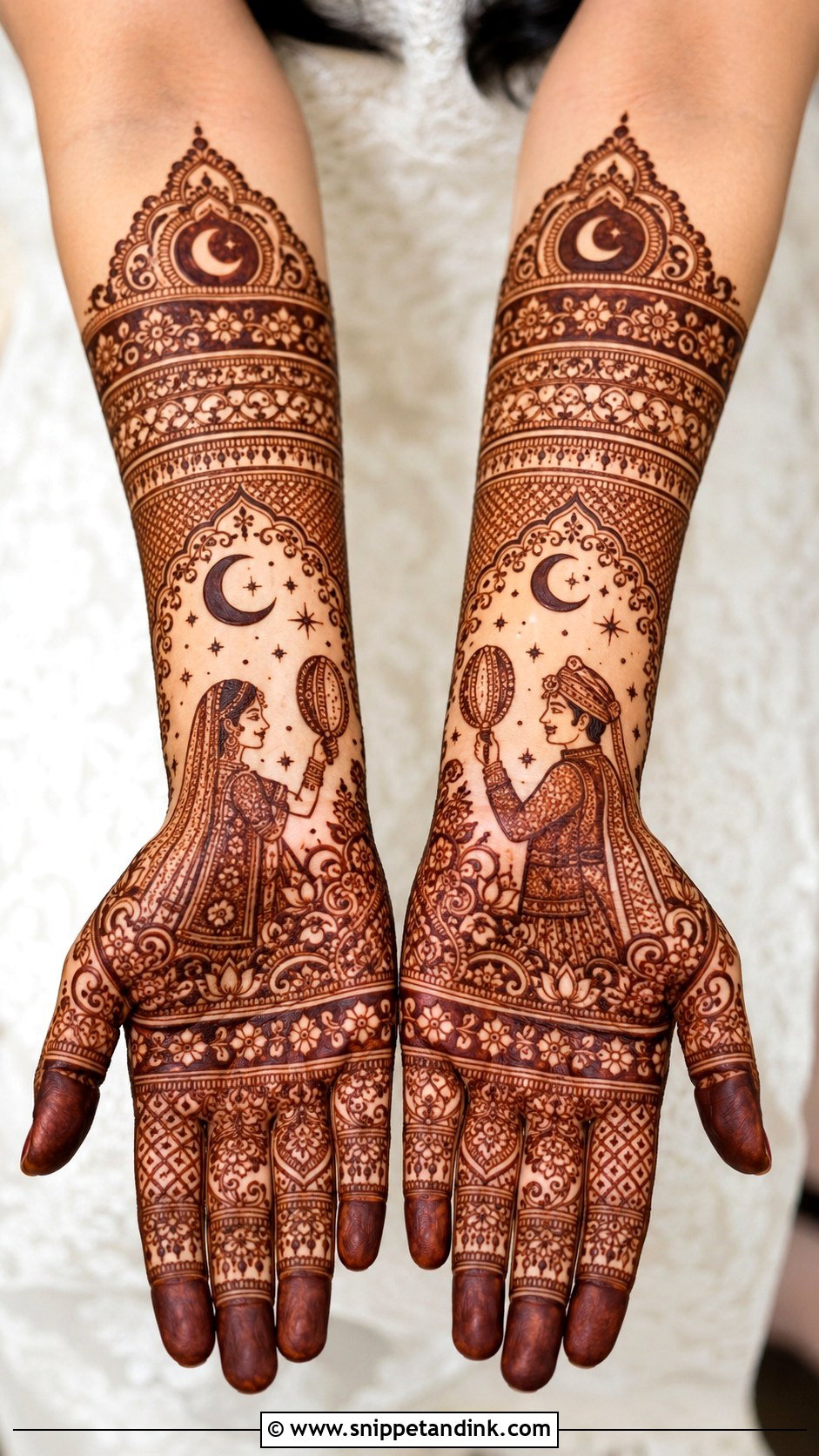
Karwa Chauth designs lean traditional and romantic: moon motifs, sieve patterns, paisleys, florals, mandalas, bride-groom figures and ornamental wrist sections. Many women add initials or small personal symbols. Because you’ll be holding the sieve and thali for close-up photos, the palm detail matters more here than for most festivals, so I keep the motifs clear and the lines neat. A dense palm with a softer forearm keeps it wearable for the full day of fasting.
32. Full Hand Teej Mehndi Design
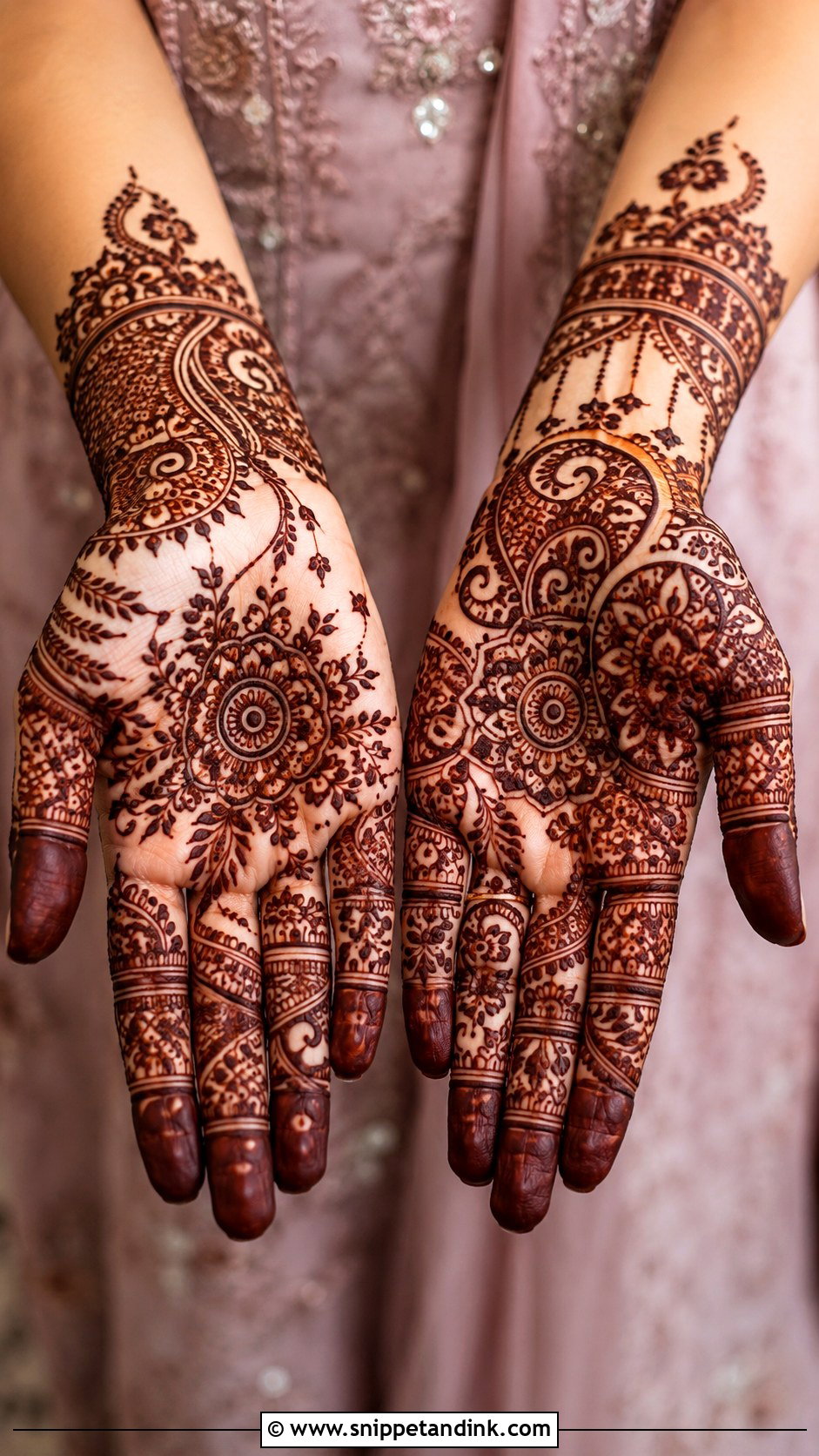
Teej mehndi celebrates the monsoon, so greenery leads: leafy vines, flowers, paisleys, mandalas, swing-shaped curves and detailed finger work. For a classic version I do a full palm mandala with paisleys and floral borders up to the wrist. For a modern one, an Indo-Arabic floral trail with open spaces. Monsoon humidity slows drying, so expect to sit with wet paste longer than usual, and don’t rush the lemon-sugar coat.
33. Full Hand Back And Front Mehndi Design
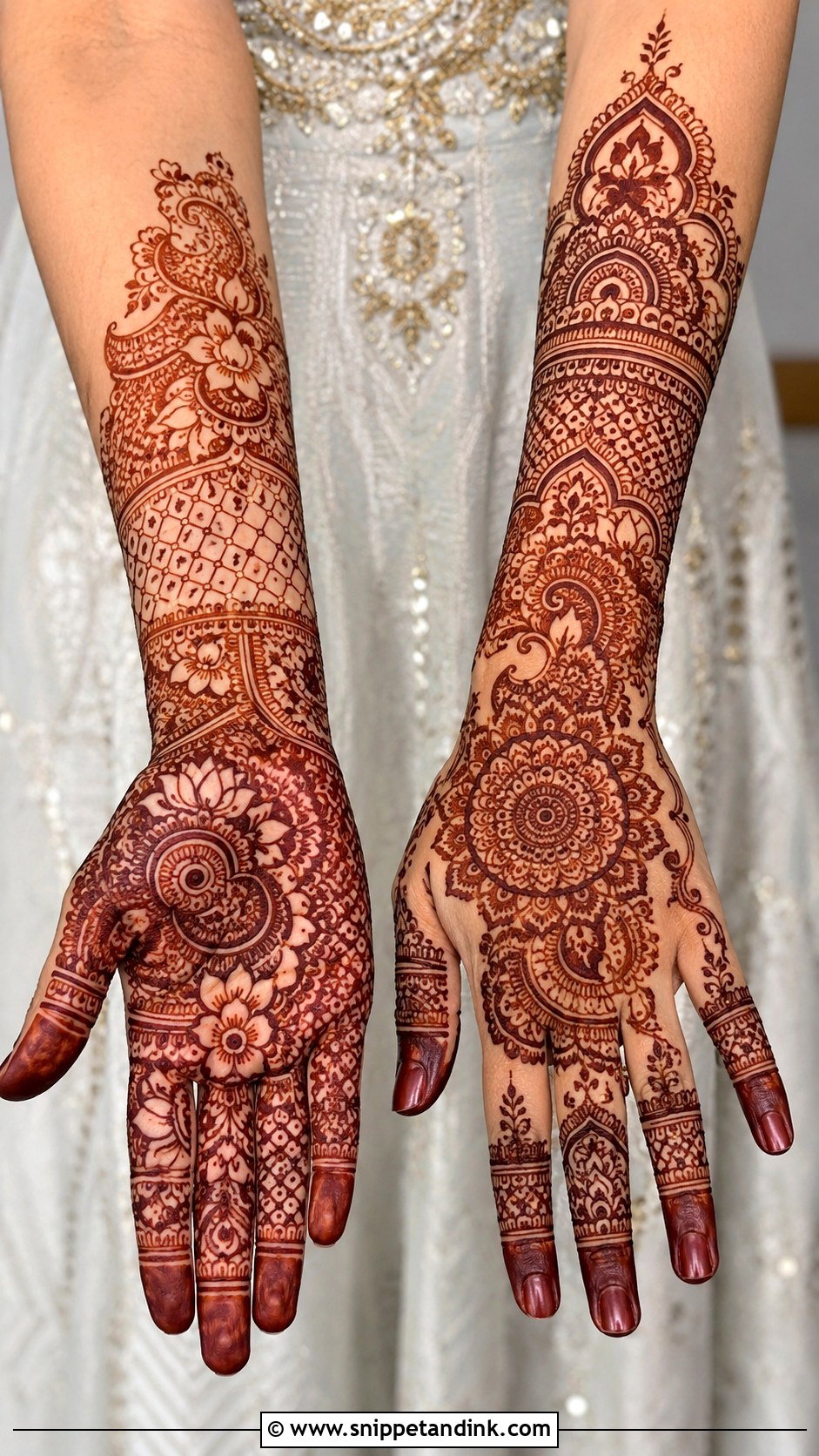
Covering both sides is the full commitment, usually for brides and close family. The palm can be more detailed because it holds color so deeply, while the back gets jewelry-like florals, jaali or bracelet work. To make both sides belong together, I repeat one or two motifs, a lotus or a paisley, on each side. Two completely unrelated themes look like two different artists unless that contrast is intentional. Ask your artist to finish one side fully before starting the other, so you can rest that hand while it dries.
34. Full Hand Forearm Mehndi Design
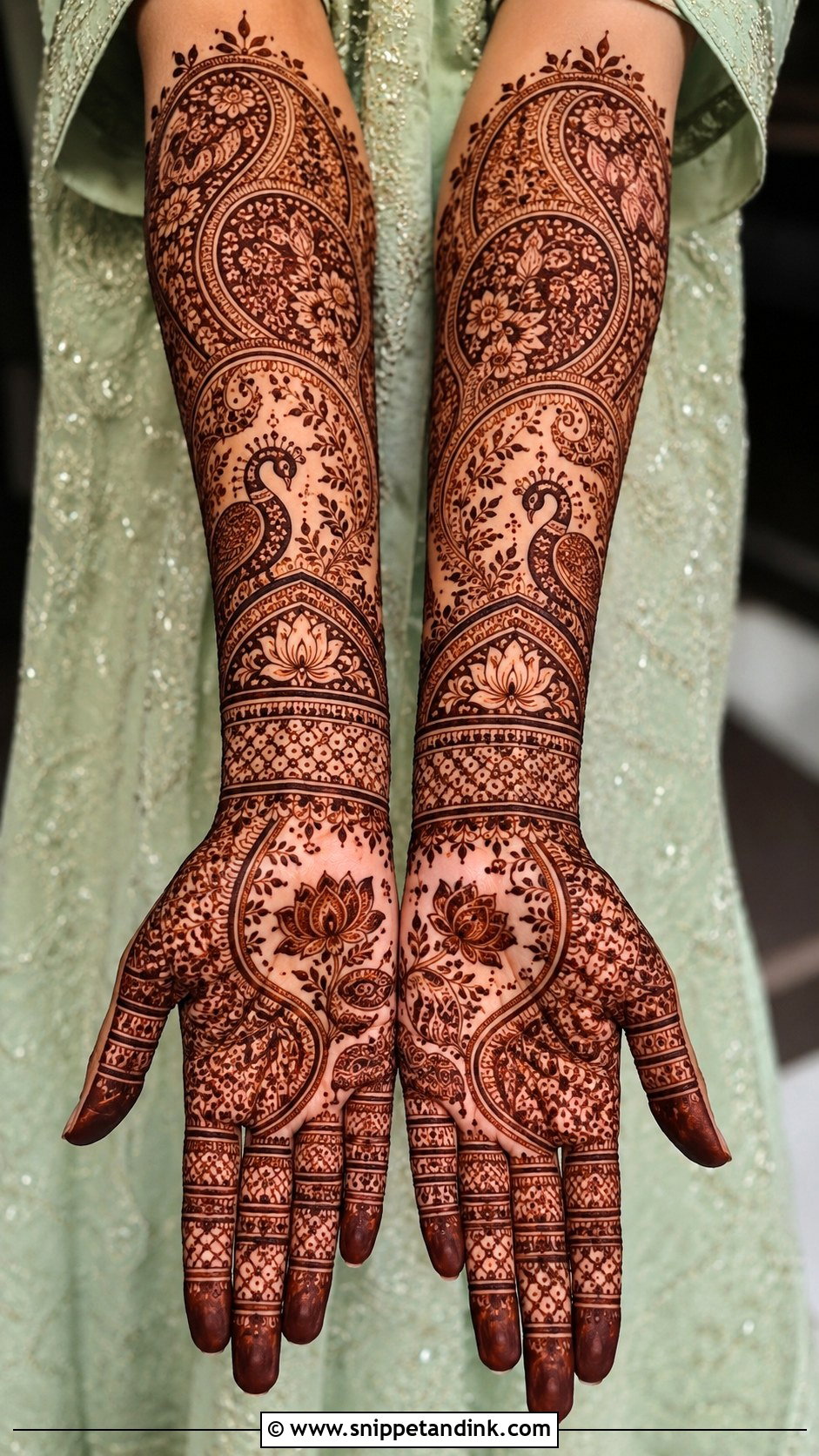
Extending past the wrist makes the whole arm part of the design. It’s standard for brides and can work for festivals in a lighter version. The forearm can hold paisley chains, floral panels, peacocks, lotus vines, jaali bands or bangle cuffs. The join at the wrist is where forearm designs most often fail, so I draw the connecting element before either section. Long arms suit vertical trails; shorter ones look better with balanced sections and more open space.
35. Full Hand Wedding Guest Mehndi Design
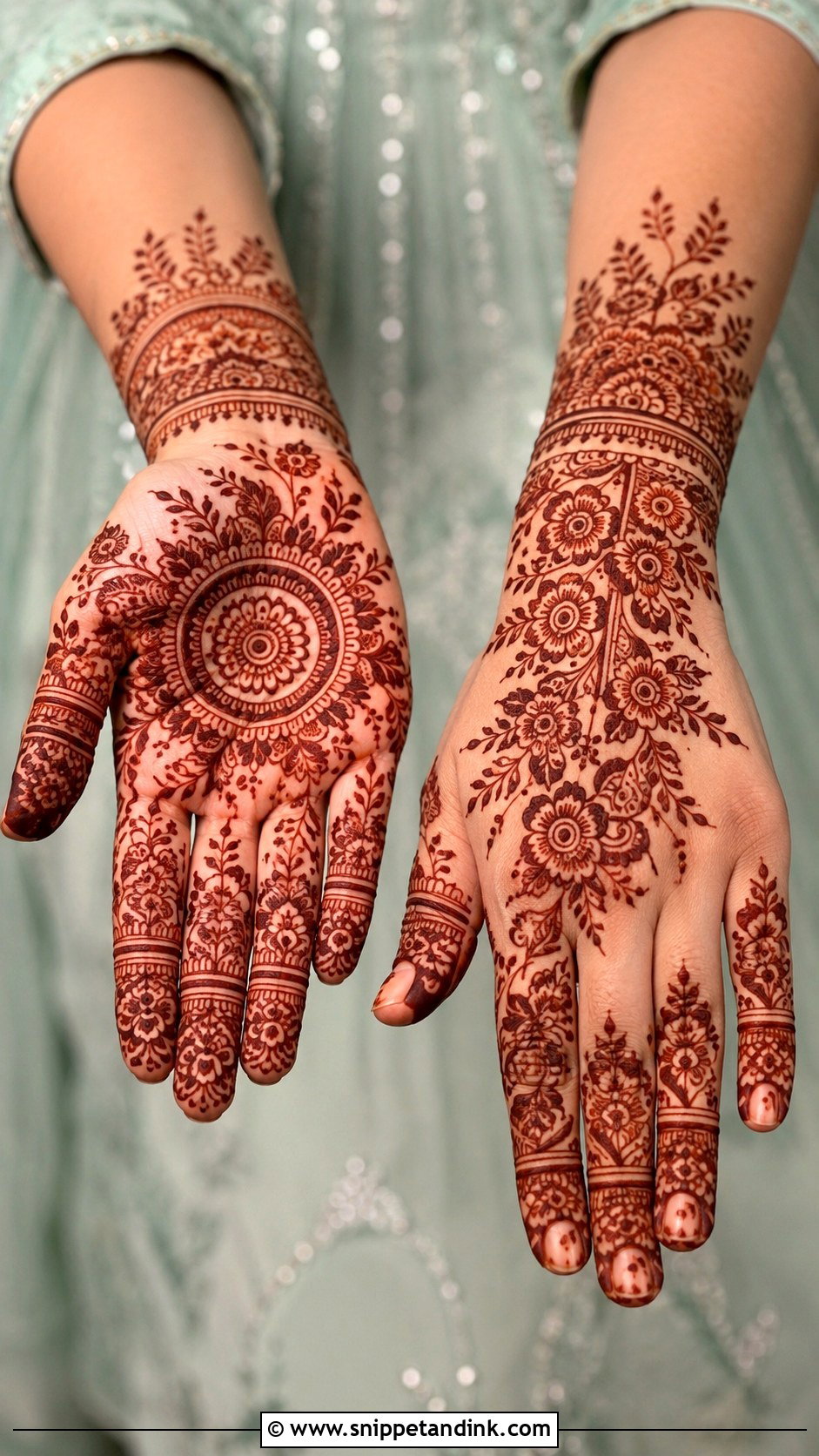
Guests should look festive, a clear step lighter than the bride. A medium Arabic, Indo-Arabic or floral layout does that well: a back-hand trail, a palm mandala, detailed fingers and a neat wrist cuff. On a busy mehndi night I prefer designs that dry quickly, because guests want to get back to dancing and eating. Clear motifs and polished fingers count for more than coverage. Sisters, cousins and friends can share one style with small variations so the group photos look coordinated.
Will Your Sleeves and Bangles Hide Half the Work?
Before you choose how far up the arm to go, look at what you’ll wear on top of it. A full-sleeve kurta or a lehenga blouse with long sleeves covers everything above the wrist, so forearm detail only shows during the mehndi night itself. A bridal chooda or a big bangle stack sits right over the wrist, which is often where the most intricate band of a design lives. I’d rather move that band a little higher than draw it and have it disappear.
- Short or elbow sleeves: forearm coverage is worth the extra time.
- Full sleeves: put the effort into palms, backs and fingers instead.
- Heavy bangles or chooda: keep the detailed cuff just above where the stack ends.
- Rings and hand chains: leave the ring finger base and the back of the knuckles lighter.
How a full hand fades
A good stain usually stays strong for about a week and then fades over the next week or two as skin renews itself. The backs of the hands and the parts you wash most fade first, while palms and fingertips tend to hold on longer. To keep it even, avoid scrubbing, harsh soaps and chlorine pools for the first few days, and moisturize daily. If you need it gone sooner, gentle exfoliation in the shower speeds things up more evenly than scrubbing one spot.
Dense, Airy or Somewhere in Between
Full coverage comes in many weights. Dense Indian, Rajasthani and Marwari work belongs to brides; Arabic, khafif and minimal layouts suit guests and festivals; mandalas, florals, paisleys, jaali, peacocks, lotus and bracelets each set a different mood. Decide how heavy you want to go before you choose a motif, because density changes how long you sit, how dark the hand reads and how the stain fades. Then show your artist two or three favorites from this list and let her adapt them to your hand and your sleeves.
You'll Like These Ideas:











Leave a Reply