
Bridal leg mehndi finishes the look from the ankle bells up to wherever your lehenga hem falls, and it’s the part of the henna that gets the least planning. Brides spend weeks on their hand design and decide the legs on the day. The options run from full-leg Indian work to airy Arabic trails, anklet-style bands, mandala feet, jaali and small personal motifs that echo the hands. A good leg design has to sit with your footwear, jewelry and outfit, and it has to survive being walked on. Below are twenty layouts, with what I watch for in each.

How Much Leg Will Your Outfit Actually Show?
Before we talk motifs, I ask a bride to put on her wedding outfit, or at least think hard about it, and notice where her legs show. That decides the coverage more than any photo.
- A floor-length lehenga shows little more than the feet and ankles while you walk, so heavy calf work mostly appears in posed shots when the skirt is lifted.
- Seated rituals are different. Sitting cross-legged in the mandap, your feet and ankles face the guests for a long time, and that’s where detail pays off.
- A saree or sharara with a straight hem shows the top of the foot most. A strong foot design with a neat ankle border makes sense there.
- Bengali brides often pair mehndi with alta, the red dye painted along the edges of the feet. If you’re wearing alta, keep the henna off the outer rim of the foot so the two don’t fight.
If you’re unsure, go one level of coverage lighter on the legs than on the hands. Legs take longer to dry and keep you seated, and the extra calf detail is often hidden under fabric for most of the day.
1. Full Leg Bridal Mehndi Design
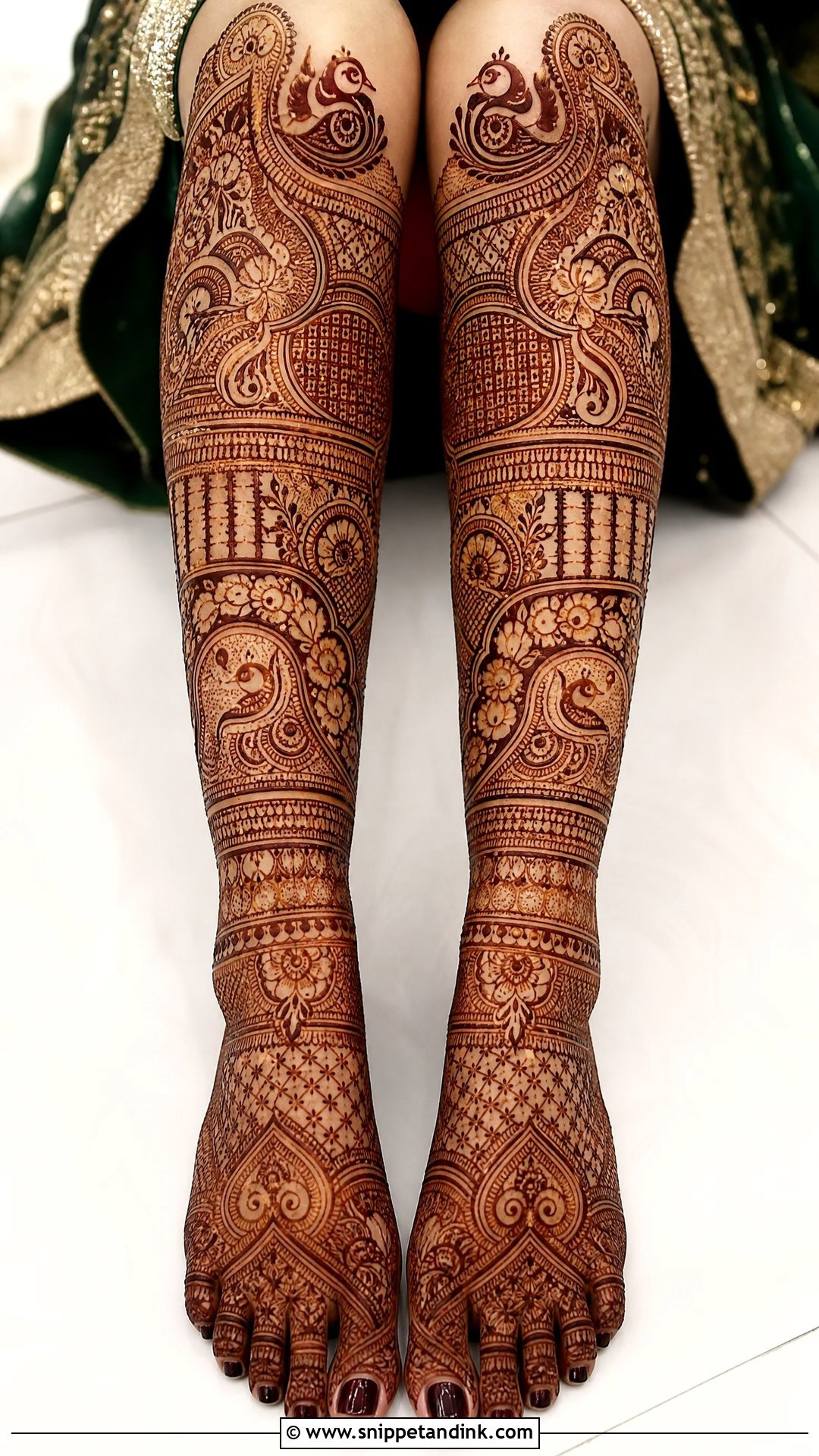
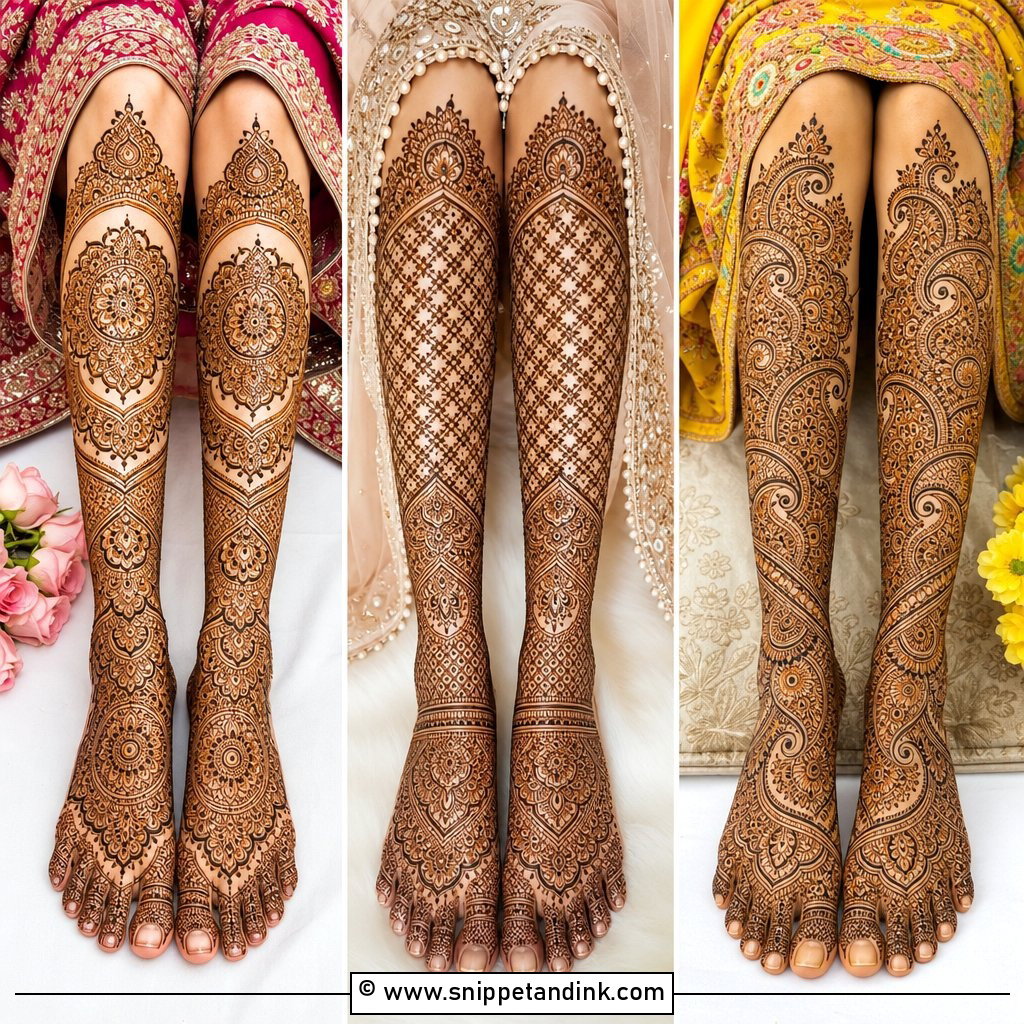
Full-leg work runs from filled toes over bold floral borders on the feet, then up through paisleys, peacocks, mandalas, vines and jaali to just below the knee. A calf is a big, gently curved surface, so motifs that look large on paper shrink once they wrap around the leg. I draw the main shapes noticeably bigger than I would on a forearm. Both legs should mirror each other closely, with small differences allowed in the fillers. It earns its sitting time if your lehenga shows the ankles and lower legs as you walk.
2. Indian Bridal Leg Mehndi Design
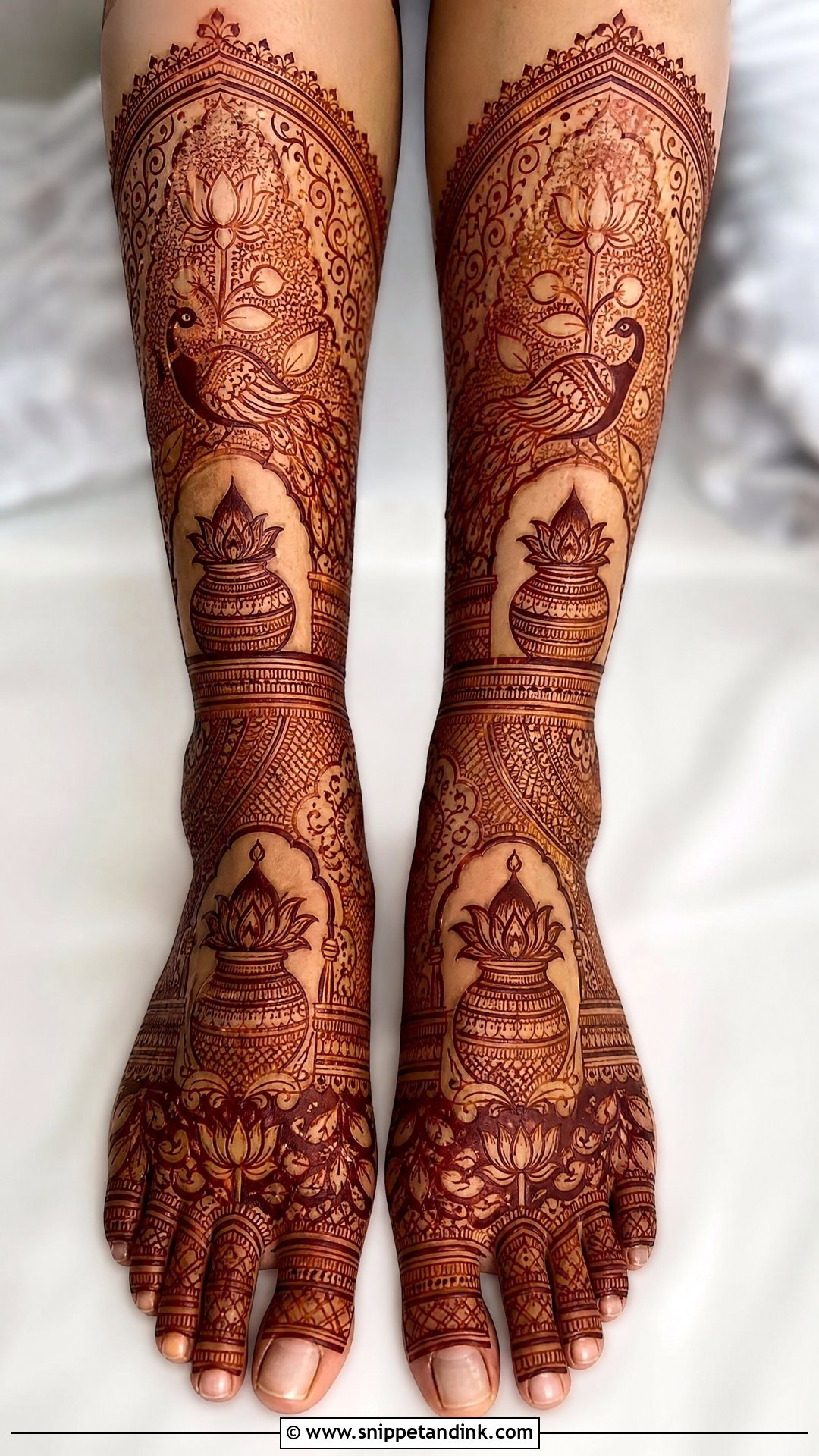
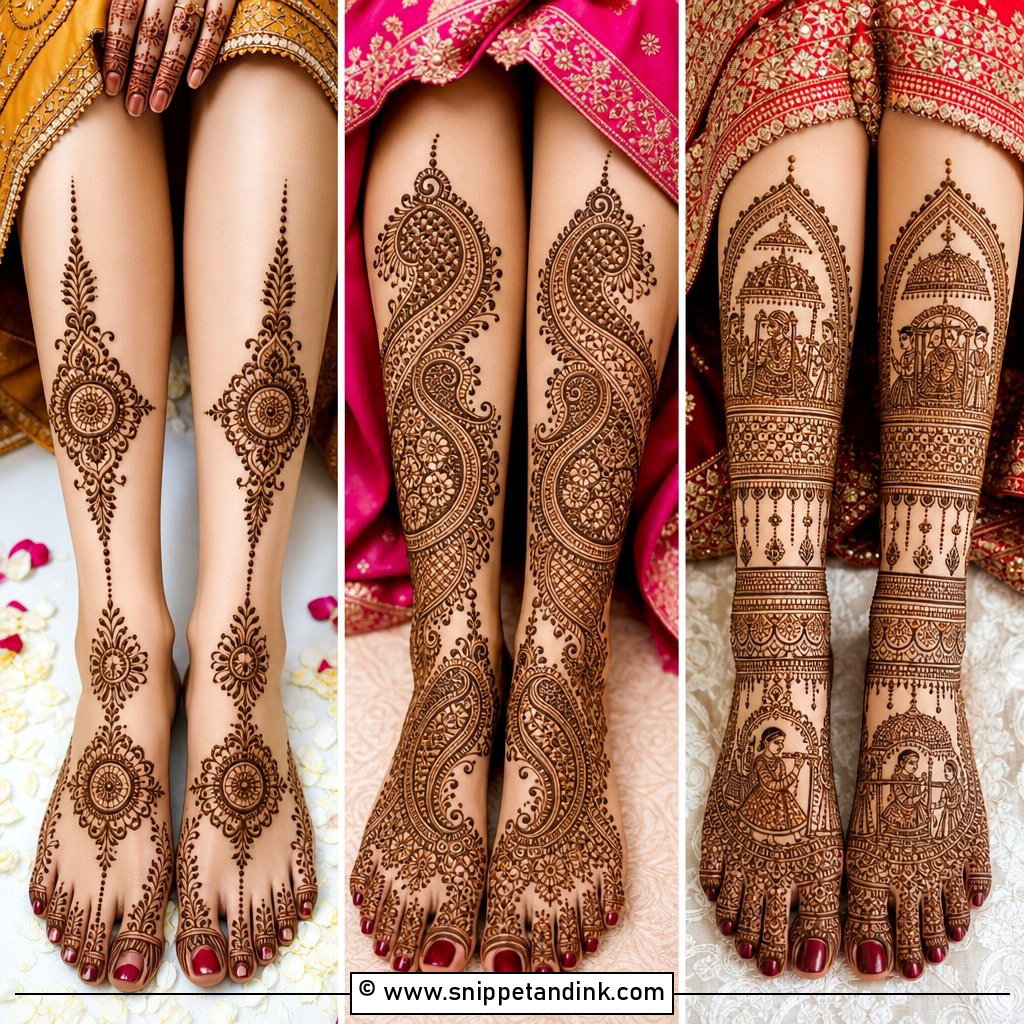
Indian leg designs carry heavy detail and cultural motifs: peacocks, lotus flowers, paisleys, kalash patterns, dulha-dulhan figures and fine shading. Coverage usually takes in the feet, ankles and calves, sometimes up to the knees. Density is the risk. On the top of the foot, where skin creases with every step, tightly packed fillers blur into each other, so I leave small breathing gaps around mandalas and floral bands. Red or maroon outfits, gold payal and heavily embroidered lehengas suit it.
3. Arabic Bridal Leg Mehndi Design
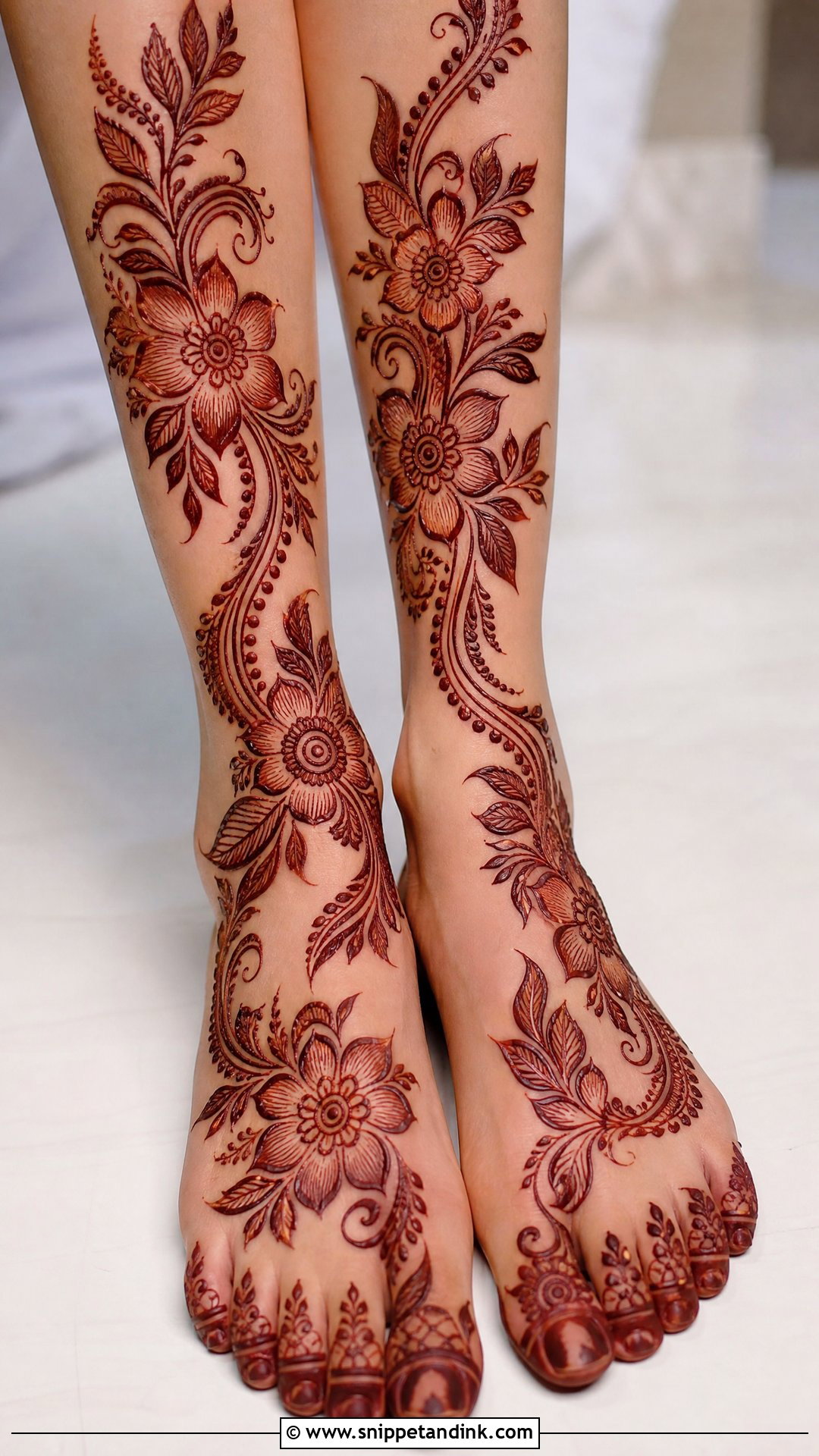
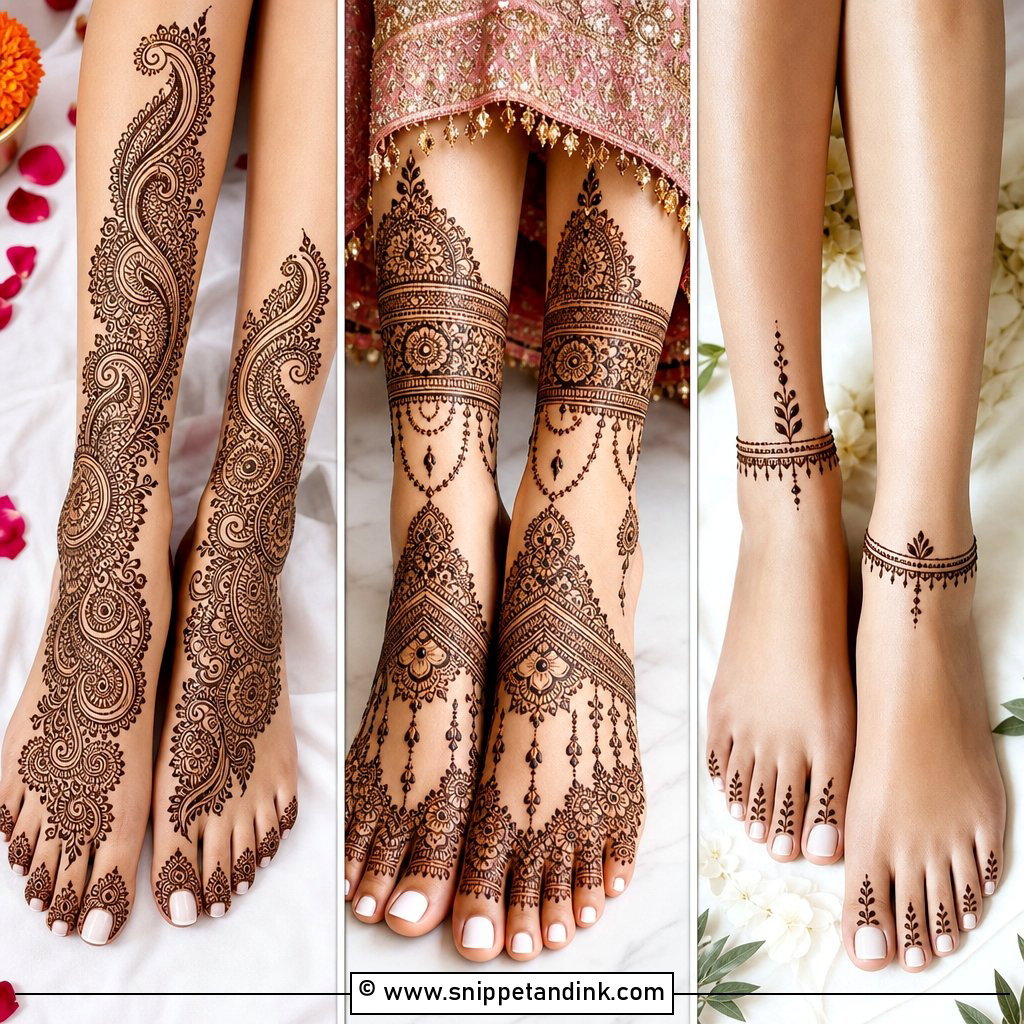
Arabic leg henna follows a diagonal path of floral trails, leafy vines, bold petals and shaded paisleys, with open skin around them. It usually starts at the toes and curves across the foot, ankle, and calf. The bold outlines keep it bridal even though it’s lighter than full Indian work, and it goes on much faster, which matters when your legs come after a long hand session. I start the trail on the outer edge of the foot, where it shows while you’re standing. Sandals, anklets and pastel outfits pair naturally with it.
4. Indo Arabic Bridal Leg Mehndi Design
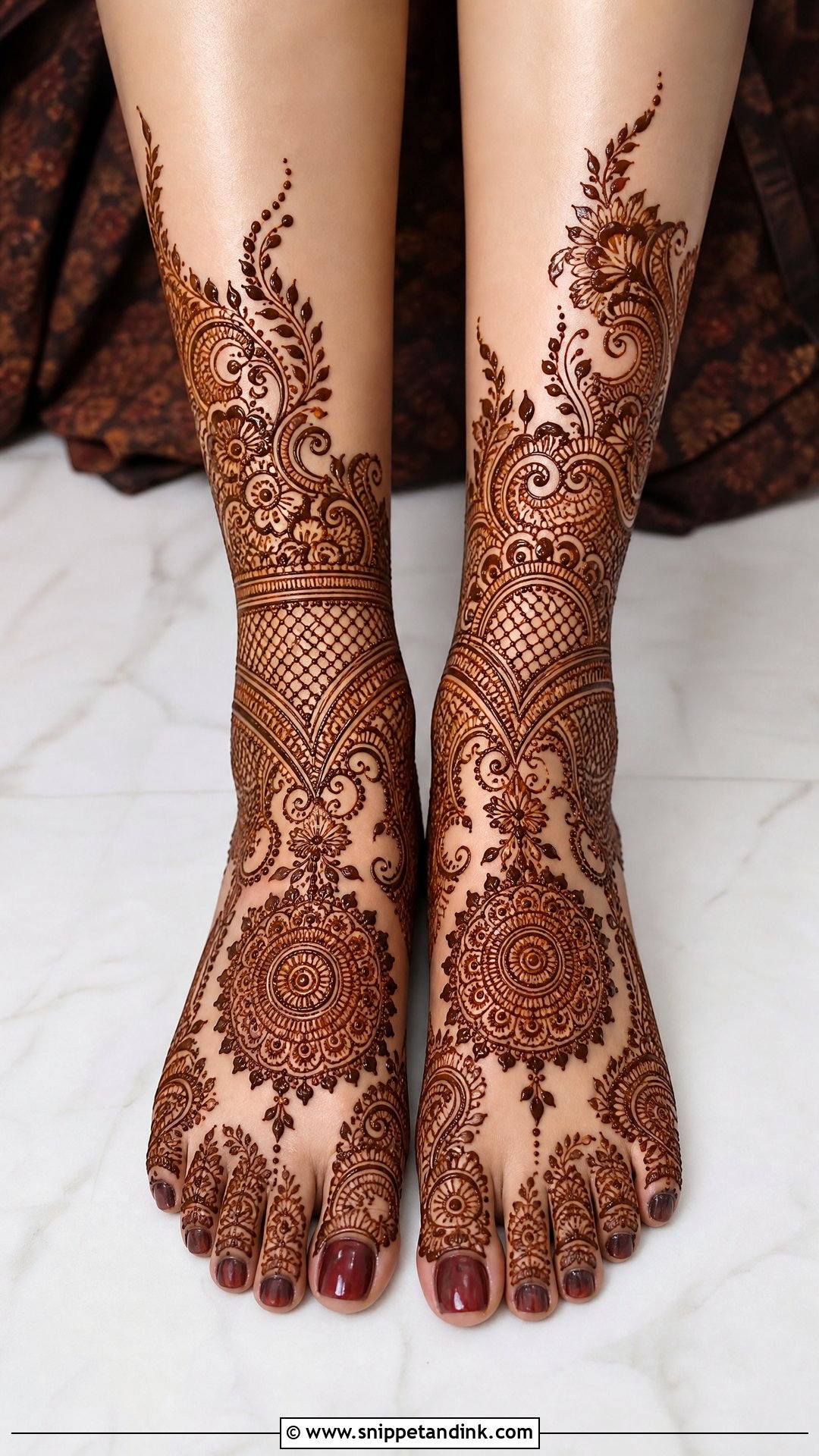
This style blends Indian mandalas, paisleys and jaali with Arabic vines and floral trails, so the legs look detailed without crowding. My rule for it is a density gradient: busiest on the feet, then lighter as the design climbs the calf. That follows how henna behaves anyway, since feet stain darker than shins and calves, and it keeps the leg from looking top-heavy. It sits comfortably with traditional and modern outfits alike.
5. Bridal Foot And Leg Mehndi Design
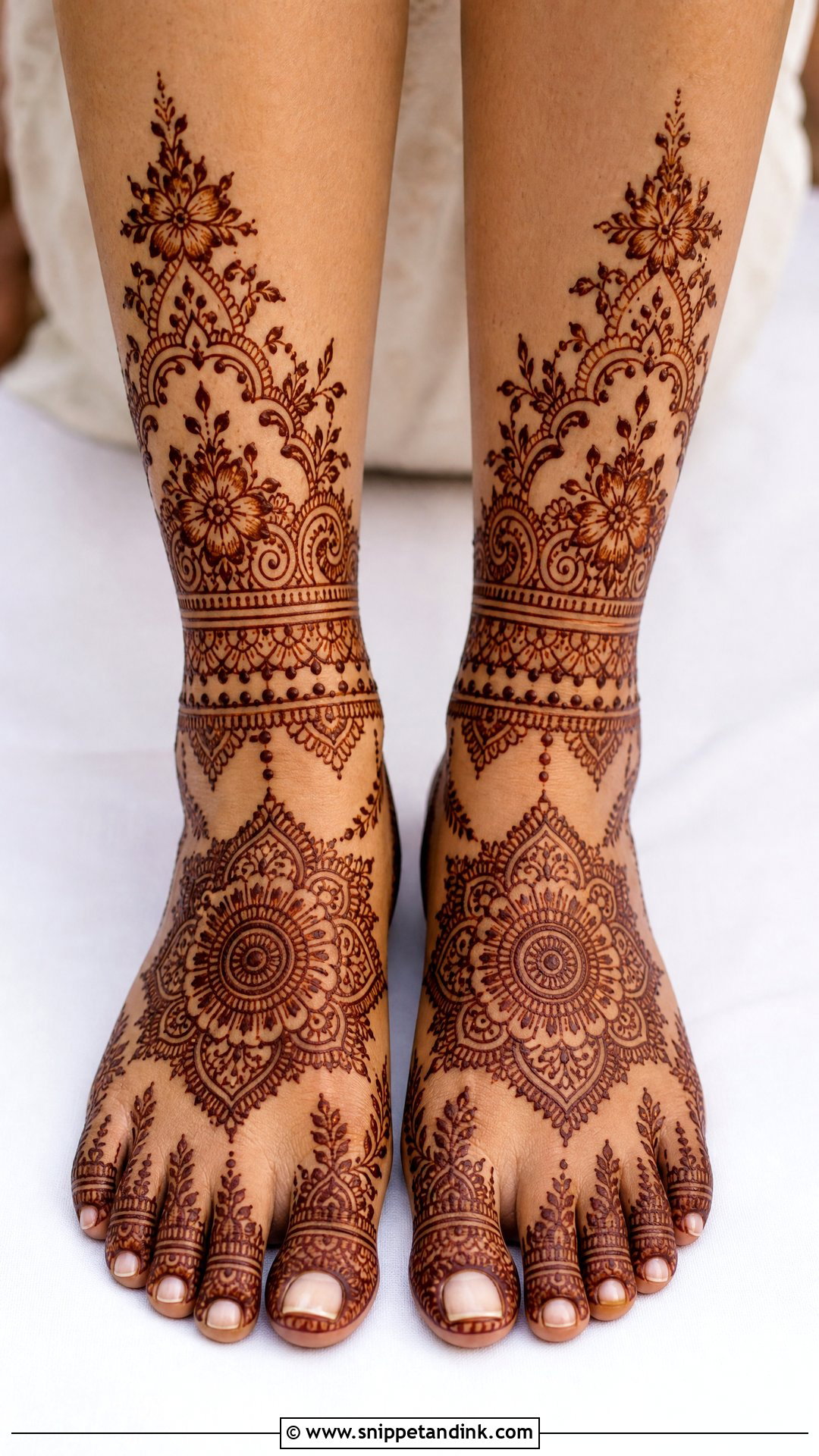
A bridal foot and leg mehndi design concentrates on the feet and stops just above the ankle. Decorated toes, a central foot mandala, side vines and an anklet-style band are the usual elements. It’s the practical pick with heels or open sandals, because everything visible is covered and nothing is wasted under the hem. Straps matter, though. I always ask about footwear so I don’t put a fine detail exactly where a strap will rub it pale over the evening.
6. Heavy Bridal Leg Mehndi Design
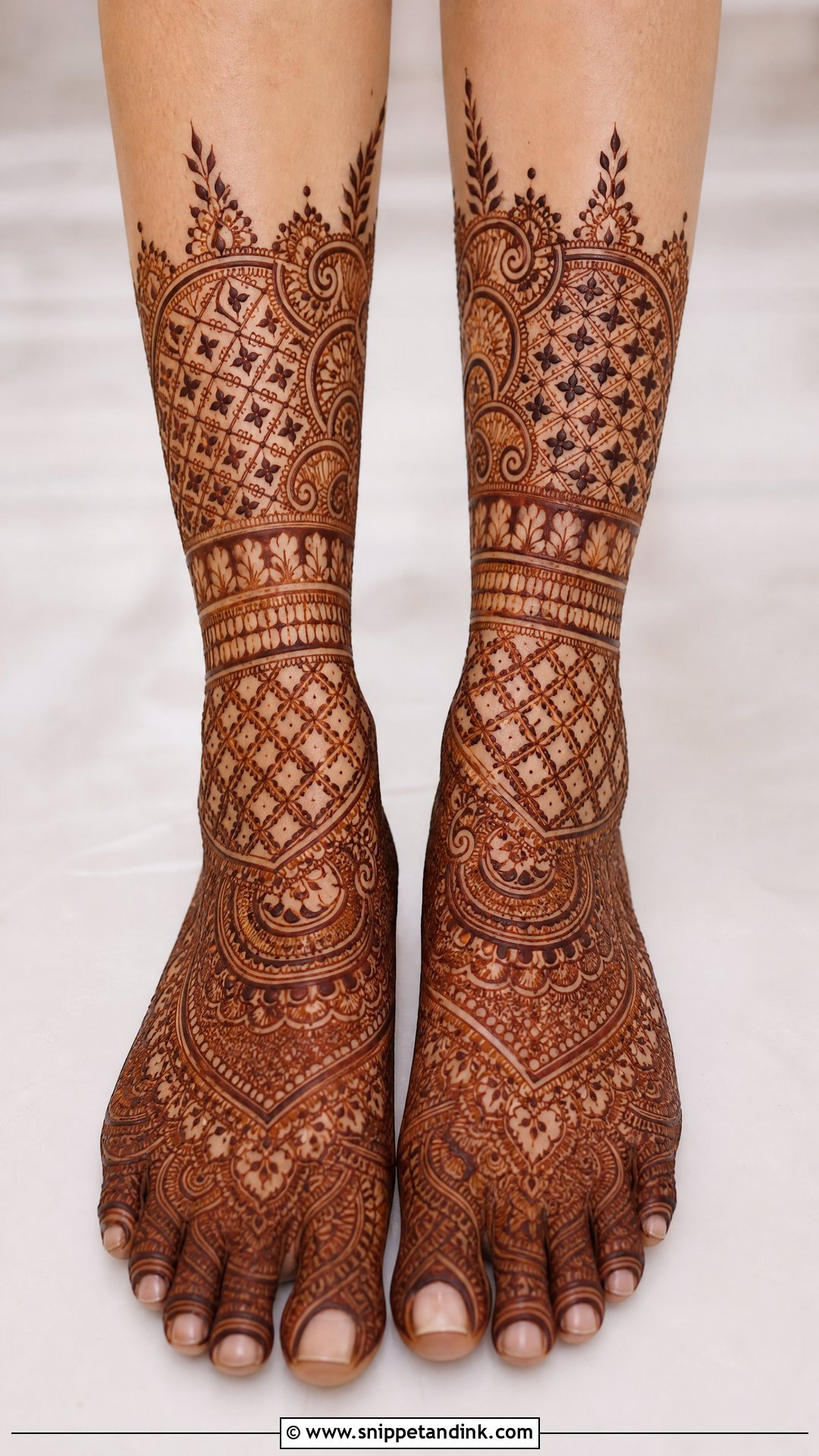
Heavy leg mehndi covers nearly every visible area with mesh, paisley chains, floral grids, peacock feathers, mandala bands and tiny filler strokes. It looks royal, and it takes a long time and an experienced hand, so schedule it a day or two before the wedding for the stain to deepen. What brides underestimate is the drying. You can’t walk on fresh leg paste, so a heavy set means hours sitting with your legs out after the artist finishes. Silk, velvet, brocade and heavy embroidery match its weight.
7. Simple Bridal Leg Mehndi Design
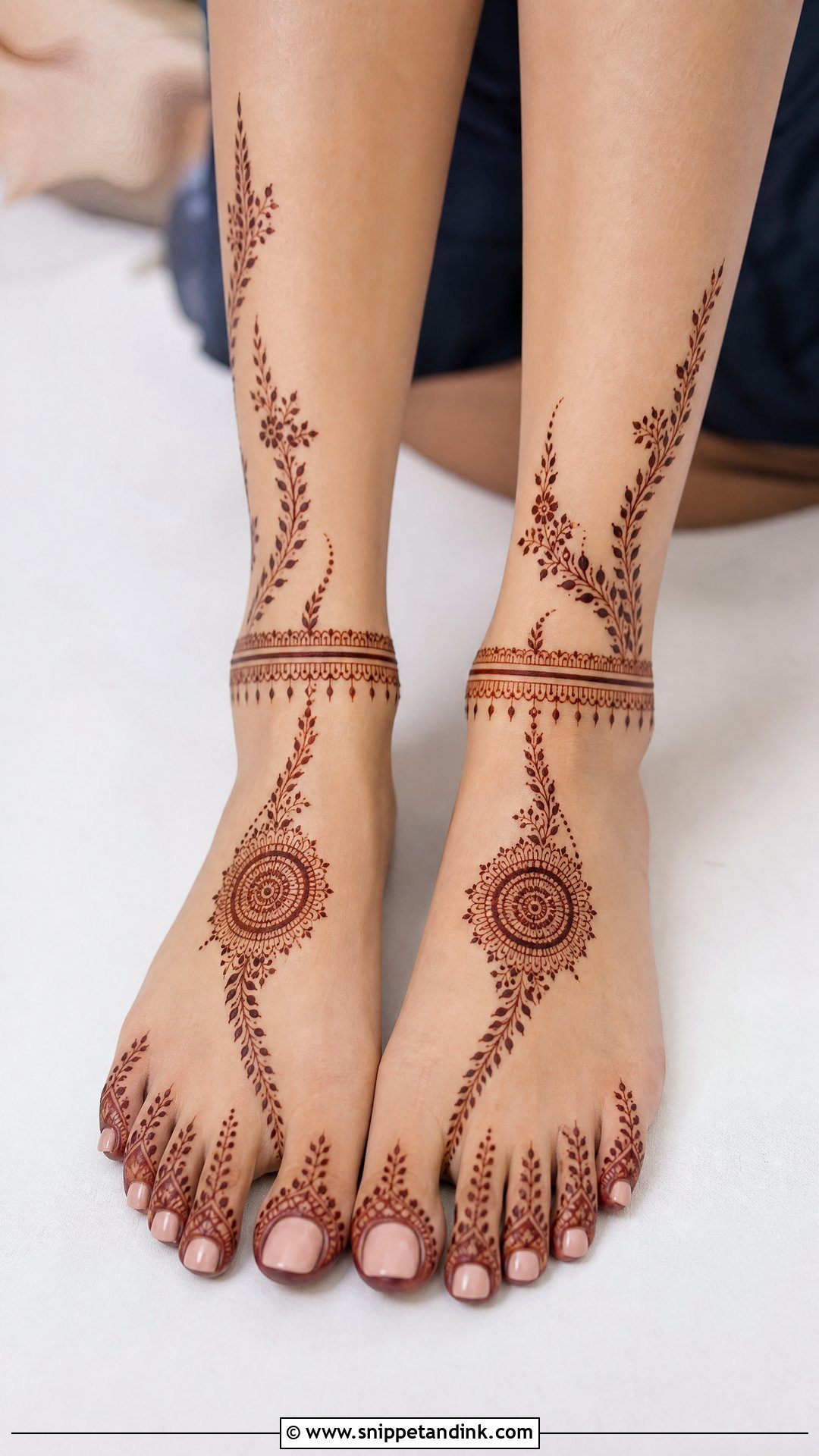
Simple leg designs rely on clean motifs: a central mandala on the foot, thin anklet bands, leafy vines and small floral clusters around the ankle. Placement does the work, not coverage. The shorter session is a genuine relief when hands and legs are done on the same day. Court and destination weddings and lighter outfits suit it. Ask for crisp outlines, even spacing and matching toe details, because with so little pattern, any wobble shows.
8. Bridal Anklet Mehndi Design For Legs
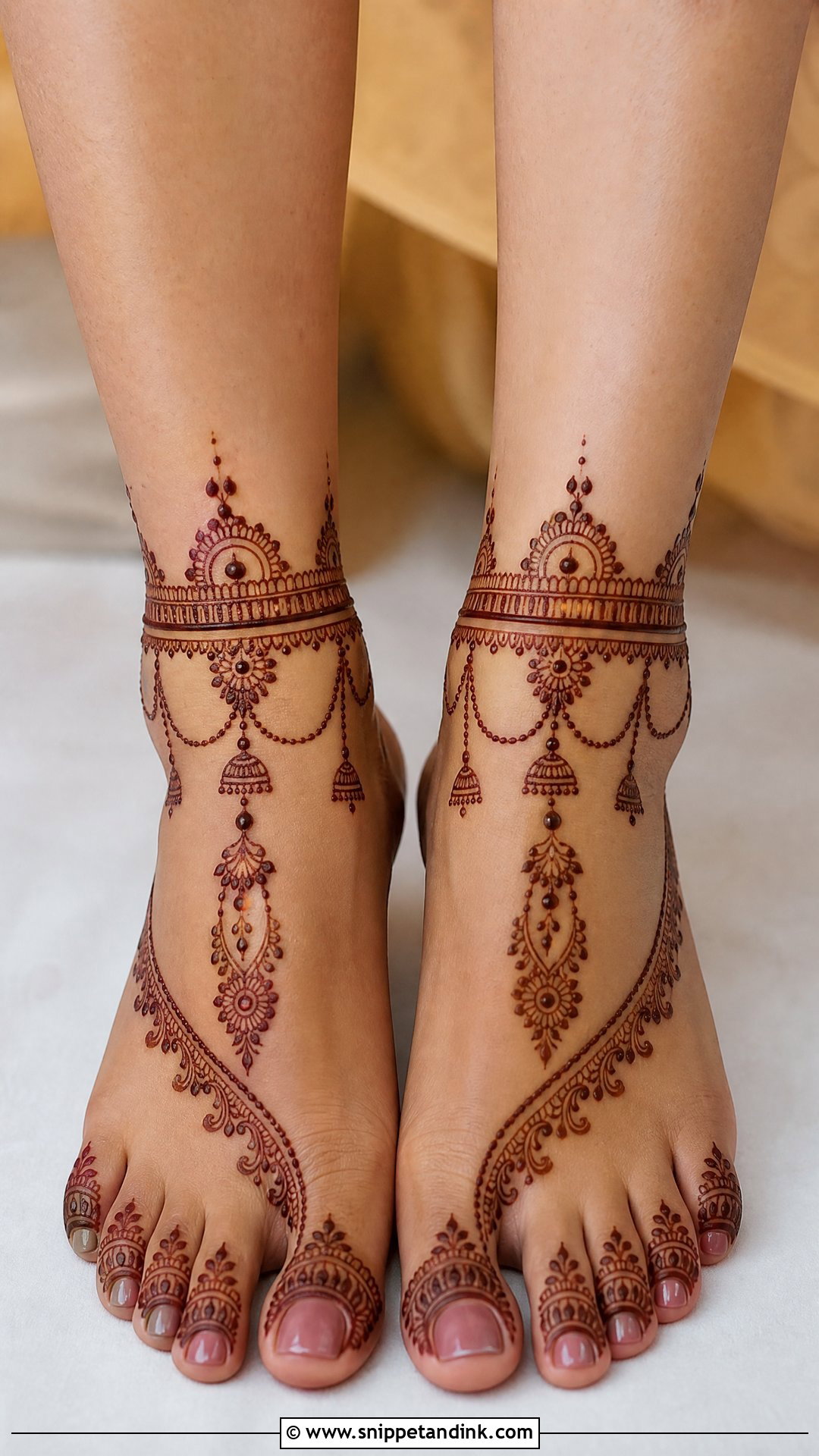
Anklet mehndi draws jewelry in henna: a payal wrapped around the ankle, with chains, dots, small florals, bells and jhumka-style drops running onto the foot. Some brides add a delicate calf band. It’s handy if your real anklets are minimal. If you’ll wear heavy silver payal, a drawn anklet in the same spot simply gets hidden, so I move the henna band a little higher or lower. Thicker bands and more drops make it heavier; thin ones keep it light.
9. Bridal Mandala Leg Mehndi Design
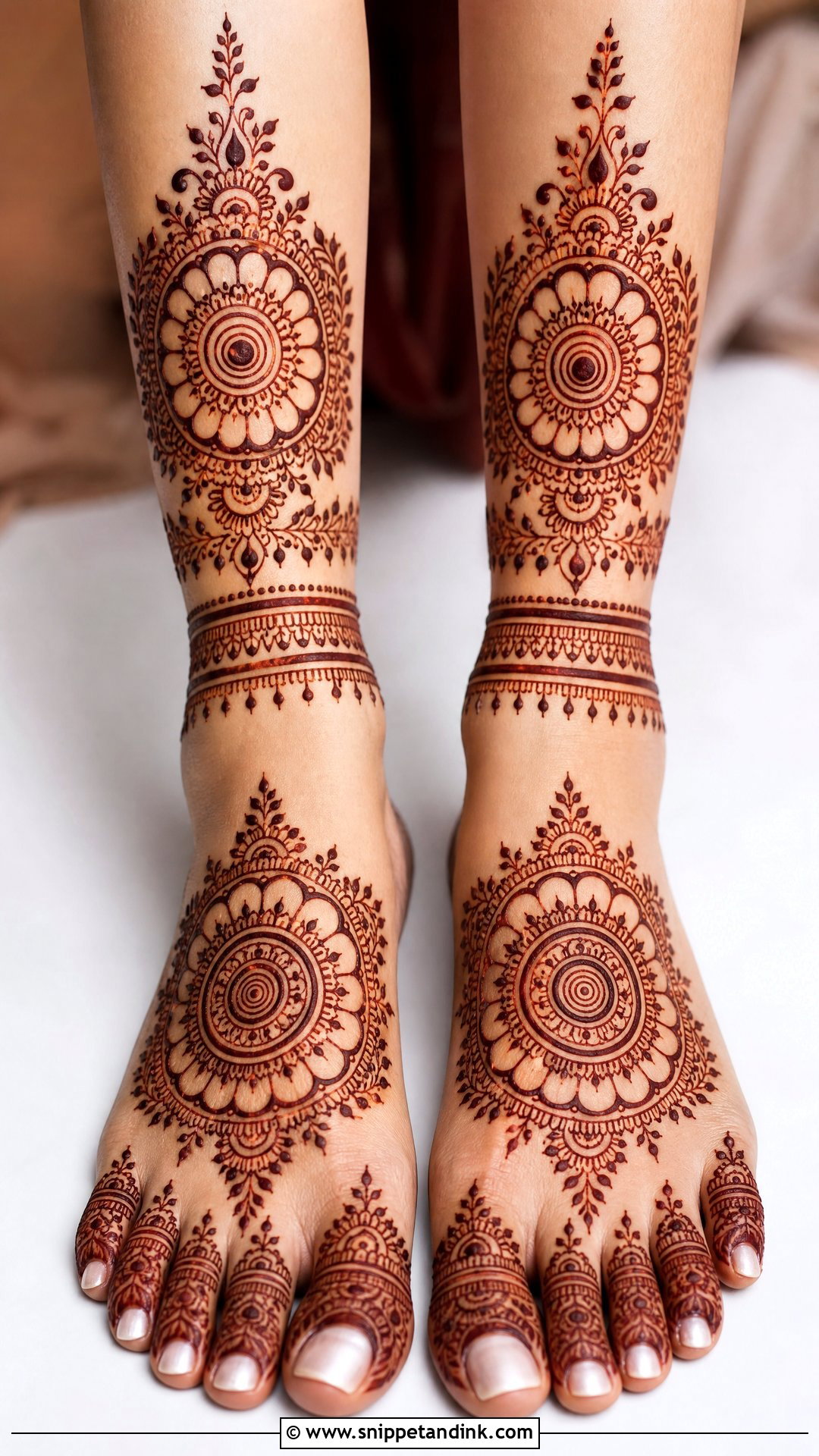
The main mandala usually sits on the top of the foot, around the ankle or on the lower calf, with petals, dots, leafy borders and fine rings around it. On the foot I center it slightly toward the toes. The tendons near the ankle stretch and bend the circle every time you flex, and an off-round mandala is the first thing people notice. One large mandala per foot or a connected series climbing the leg both look good. Decorated toes, ankle bands and side vines finish it.
10. Peacock Bridal Leg Mehndi Design
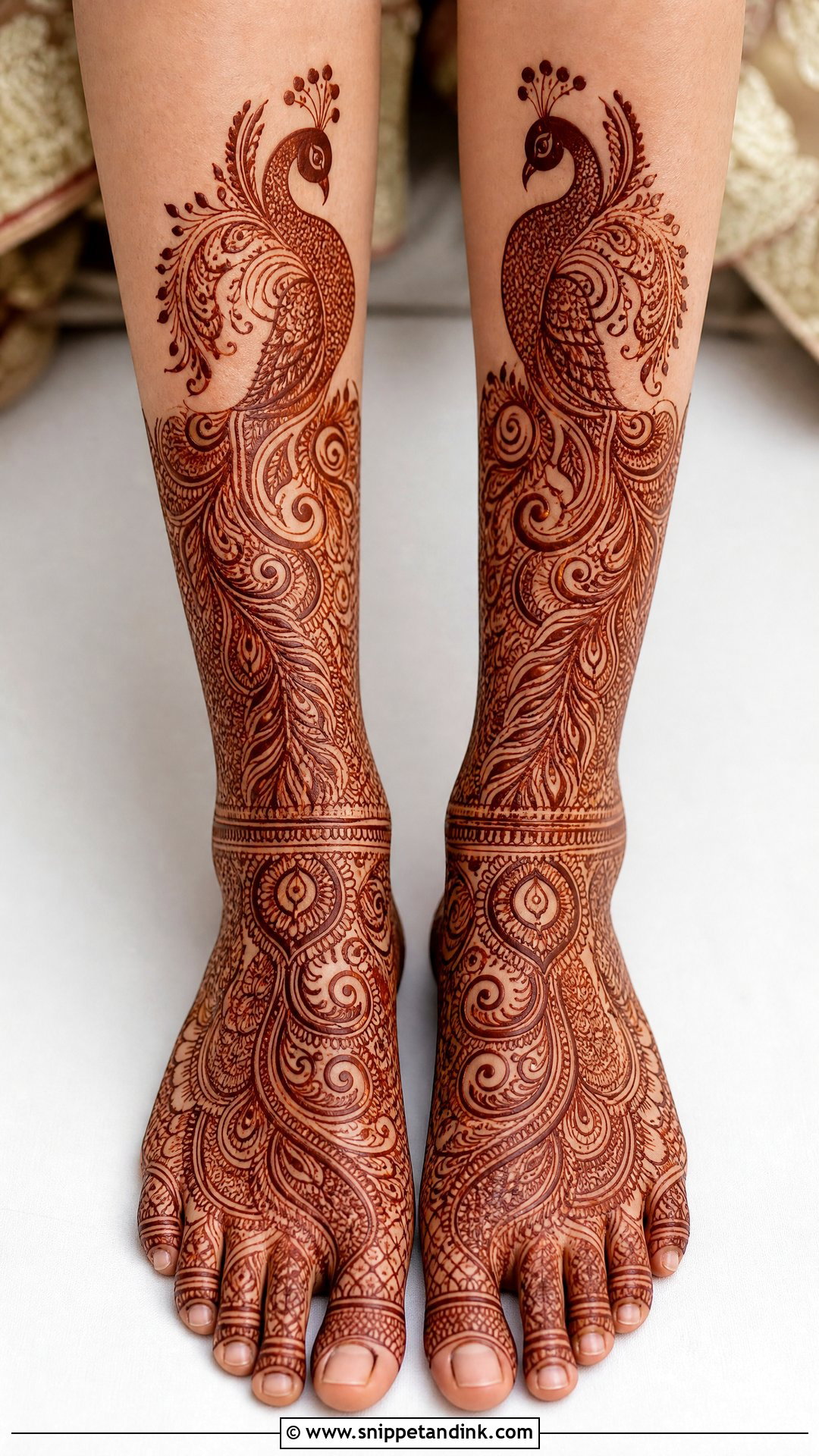
A peacock on the calf, ankle or outer foot, its feathers spilling into paisleys, florals and vines, follows the leg’s natural line well and gives you drama without names or portraits. One main peacock per leg is plenty. Add a second and they crowd each other until neither body reads. I place the bird on the outer side of the leg, which is the side guests and the camera actually see when you’re seated or walking.
11. Floral Bridal Leg Mehndi Design
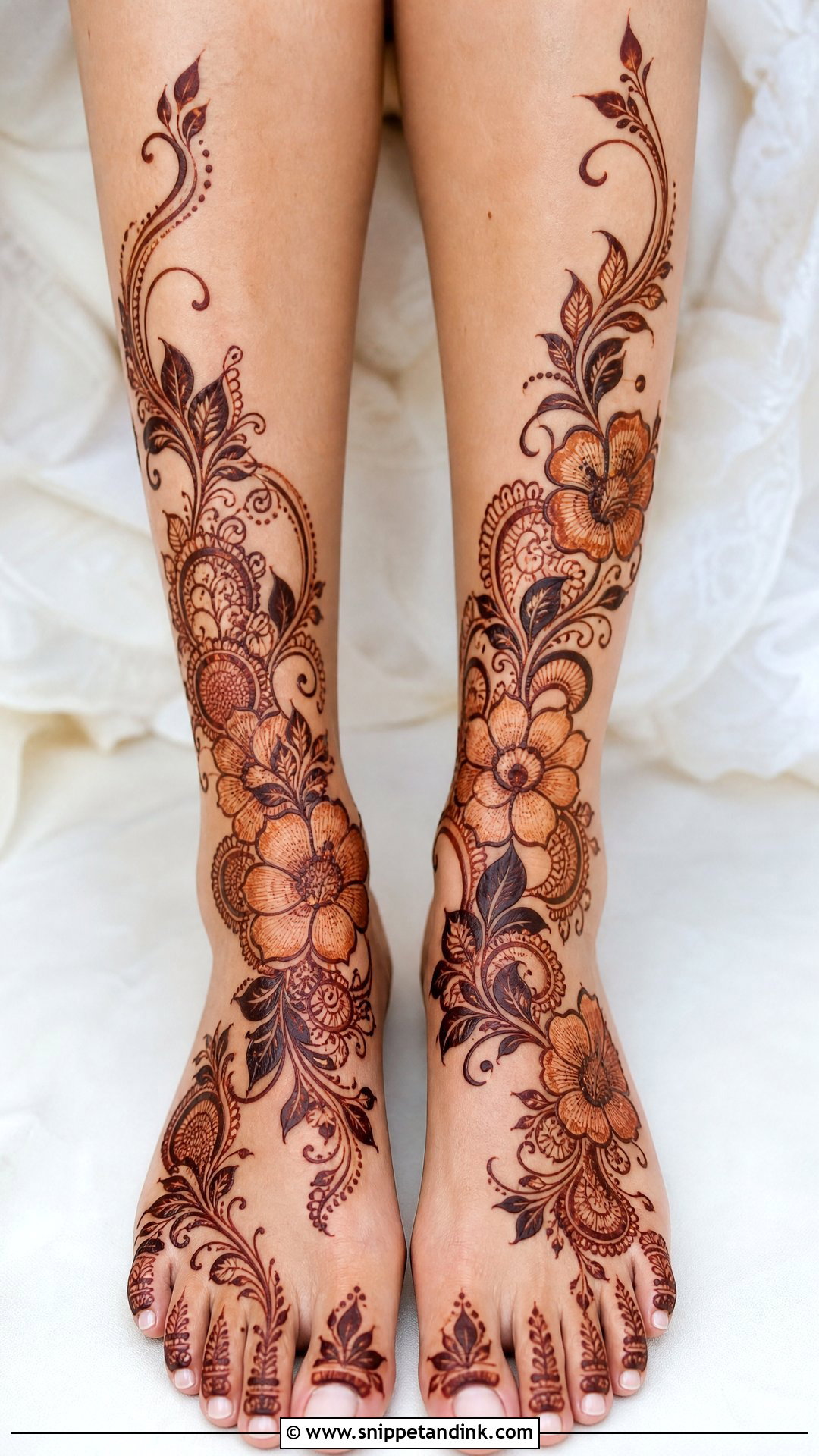
Floral leg henna can be bold and Arabic or dense and Indian. Big flowers suit feet and calves because they stay visible in photos and don’t blur after staining, while smaller ones fill around paisleys, anklet bands or mandalas. Florals work with almost any outfit color, from red to blush to green. If your hands already carry floral work, a floral leg design ties the whole look together without copying it motif for motif.
12. Jaali Bridal Leg Mehndi Design
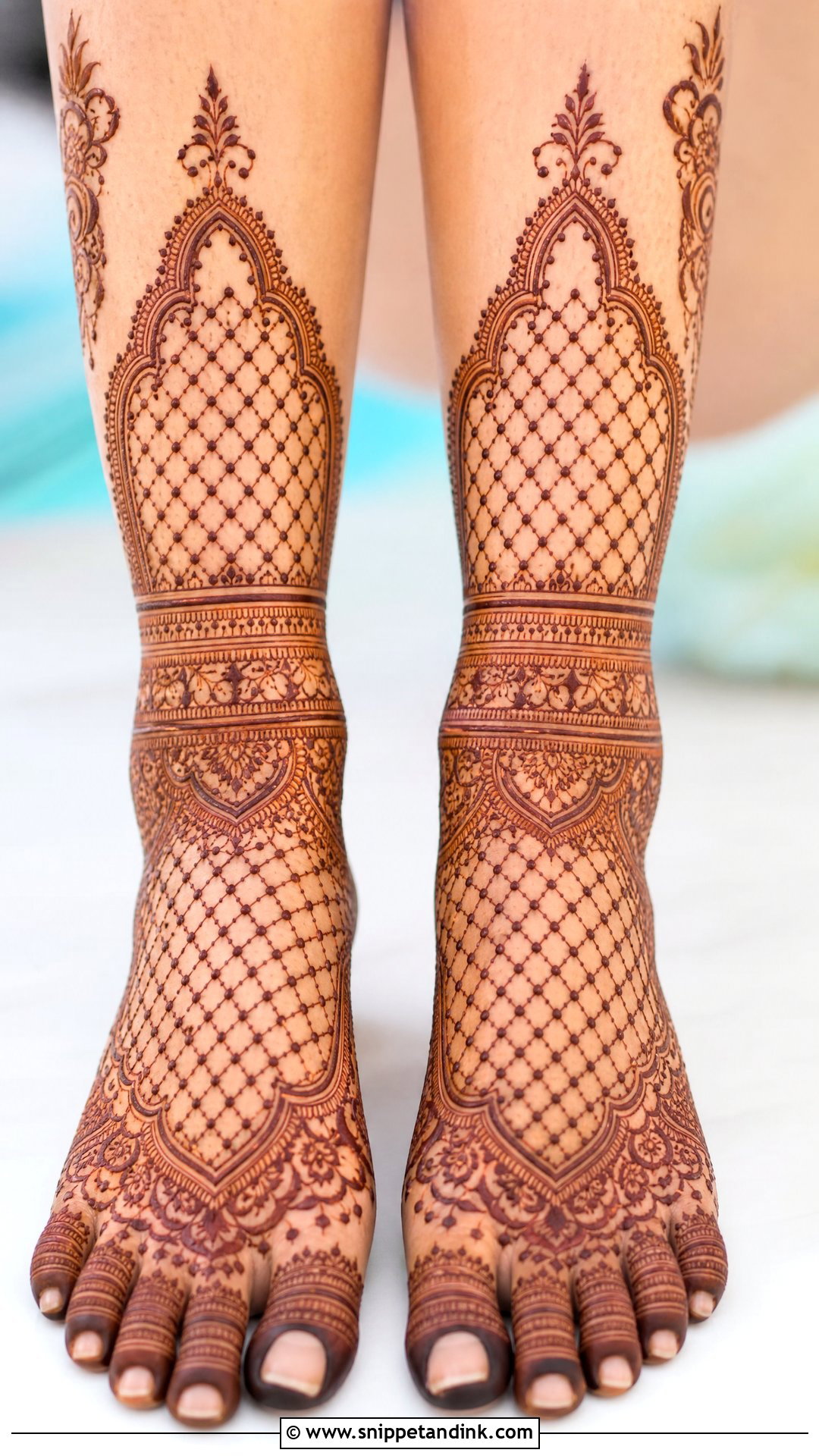
Jaali gives legs a lace effect, like embroidered fabric, covering the feet, wrapping the ankle or sitting in sections between flowers and paisleys. Clean, evenly spaced mesh is everything. For a modern look, keep the grid large and open; for a traditional one, make it finer and frame it with heavy borders. The top of the foot is where fine mesh is most likely to blur as the skin flexes, so I draw the grid a touch wider there than on the calf.
13. Paisley Bridal Leg Mehndi Design
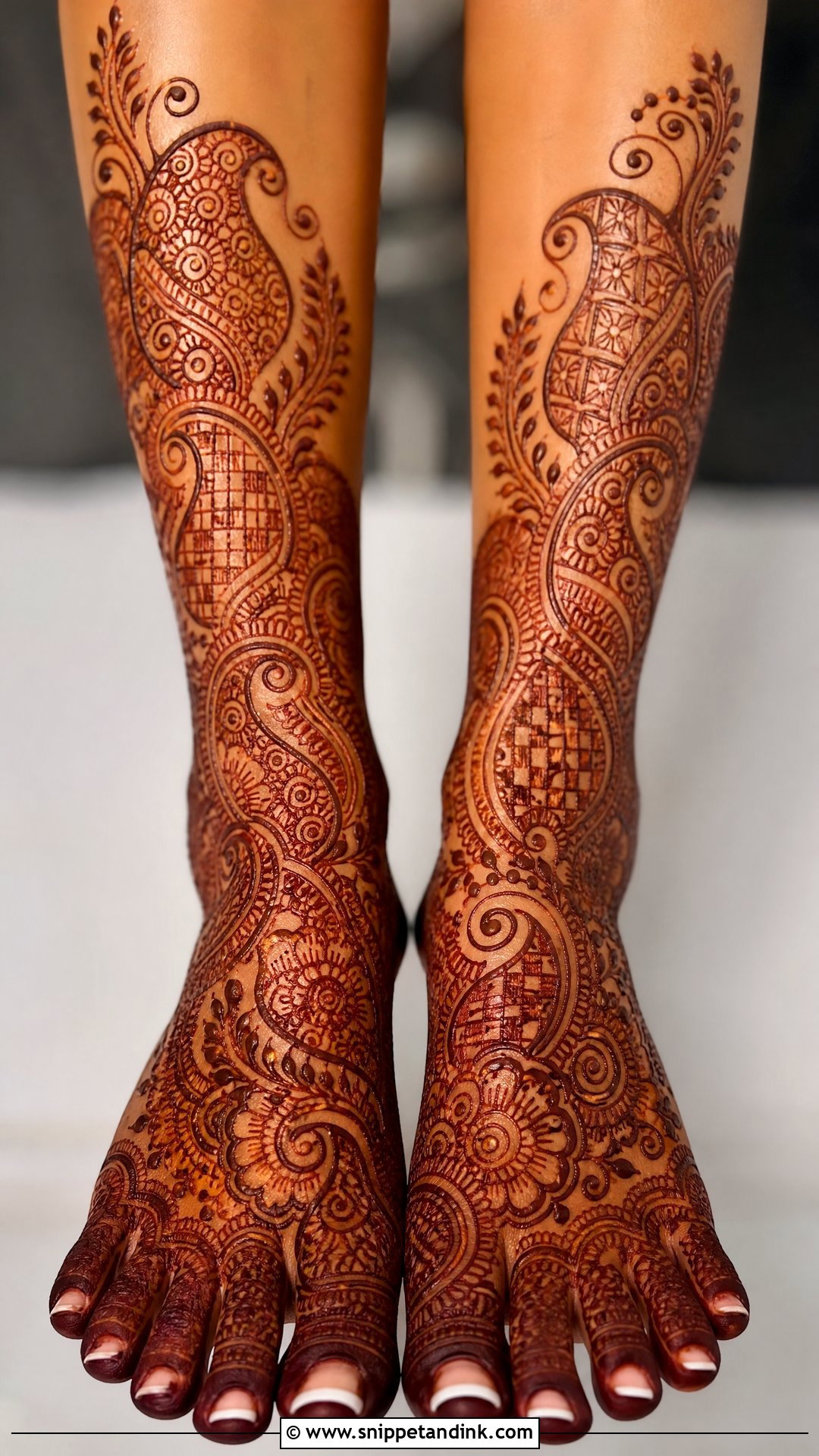
Paisleys follow the line of the foot, ankle and calf naturally, which is why they’re my default motif for legs. A bridal version uses large paisley clusters filled with tiny florals, checks, dots, swirls and leaves, starting at the toes and growing upward, and they mix easily with peacocks, mandalas and jaali. Keep the main paisleys bold and put fine filler only inside them. Filler crammed between paisleys is what makes legs look muddy from a distance.
14. Minimal Bridal Leg Mehndi Design
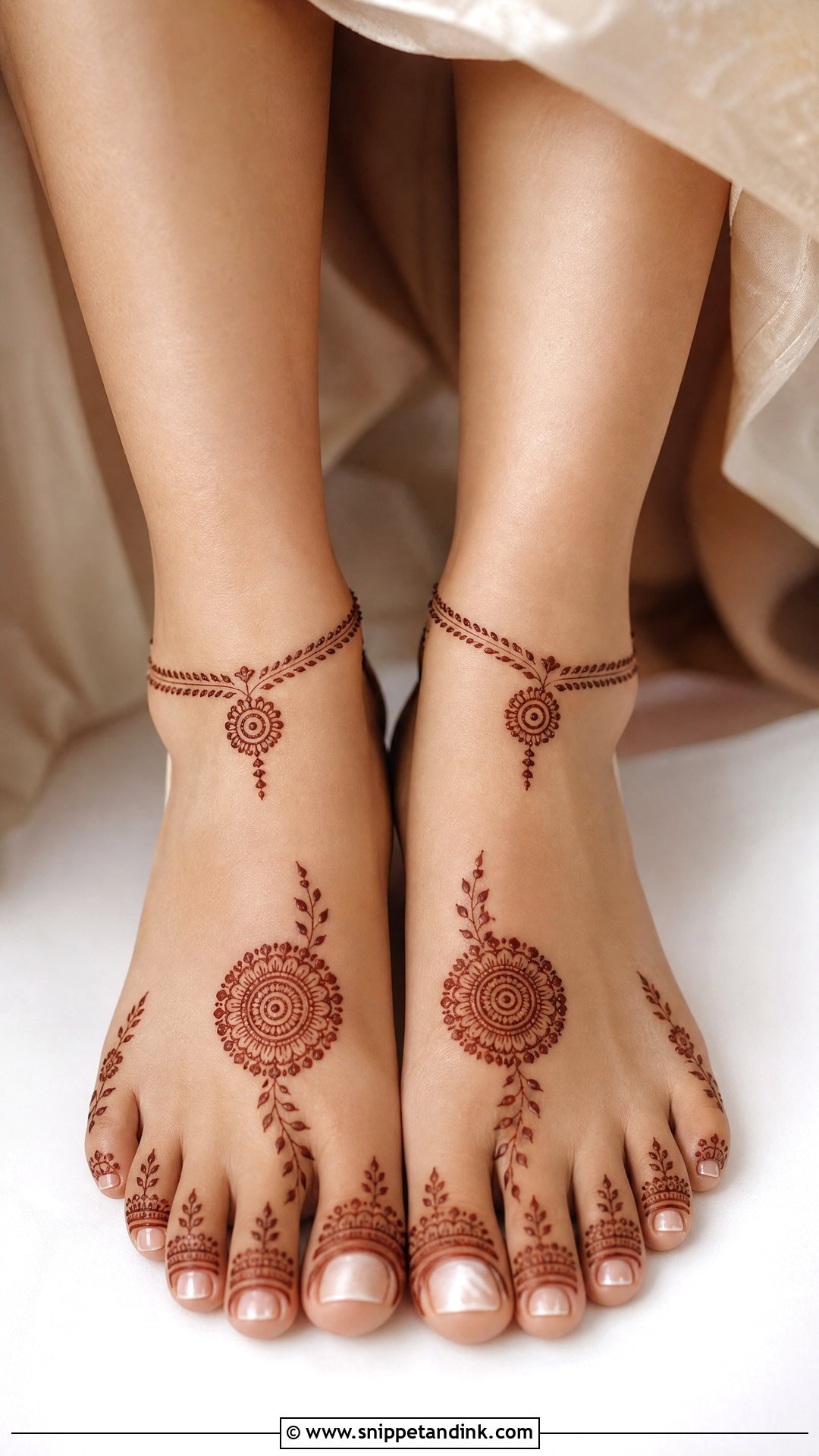
Minimal leg henna means fewer motifs and more bare skin: a slim anklet band, a small mandala on the foot, a leafy side trail and lightly decorated toes. Crisp lines and tidy symmetry are what keep it bridal. Beach and civil weddings, simple sarees, gowns and pastel lehengas suit it, and so do brides who want their footwear or payal to do the talking. Natural henna gives a warm brown-to-maroon stain, usually darkest along the edges of the feet.
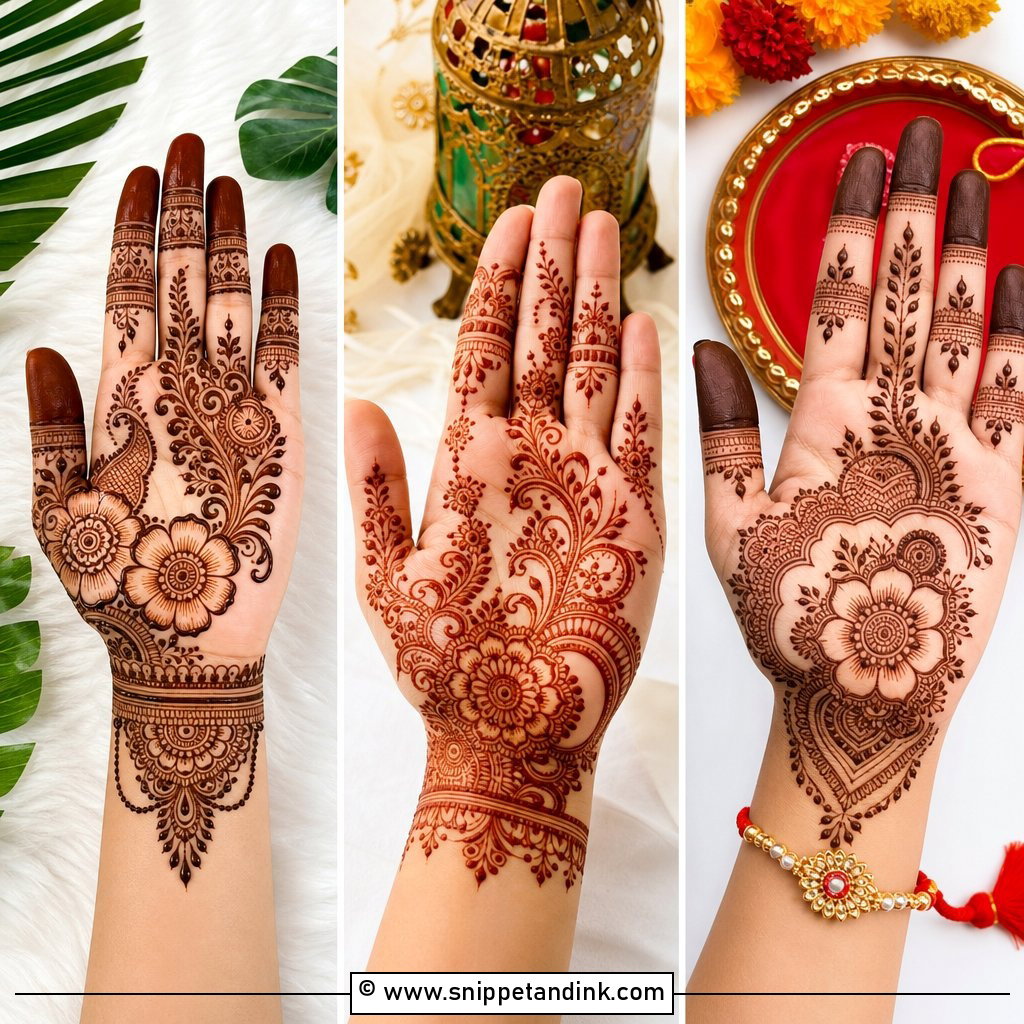
15. Half Leg Bridal Mehndi Design
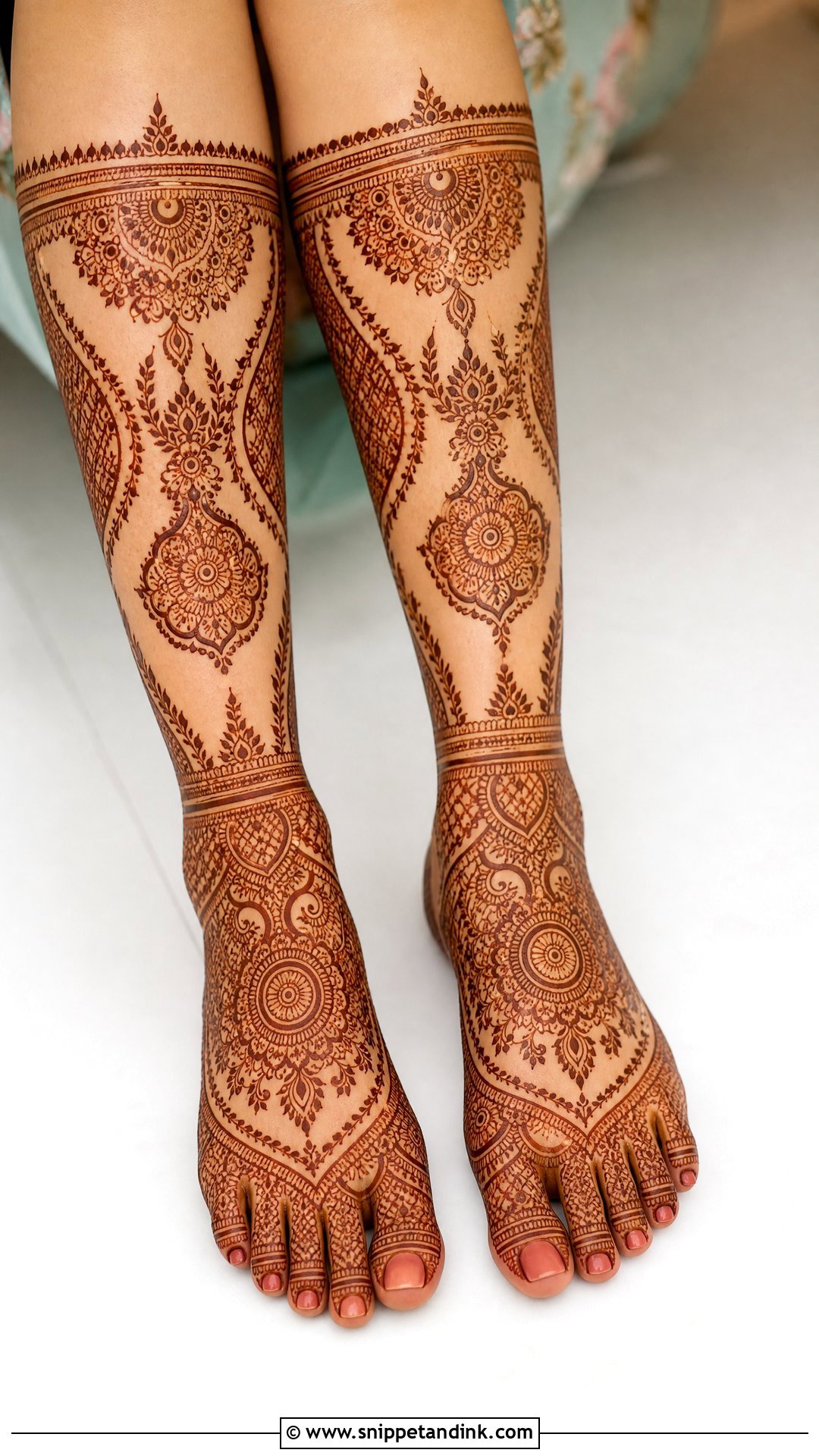
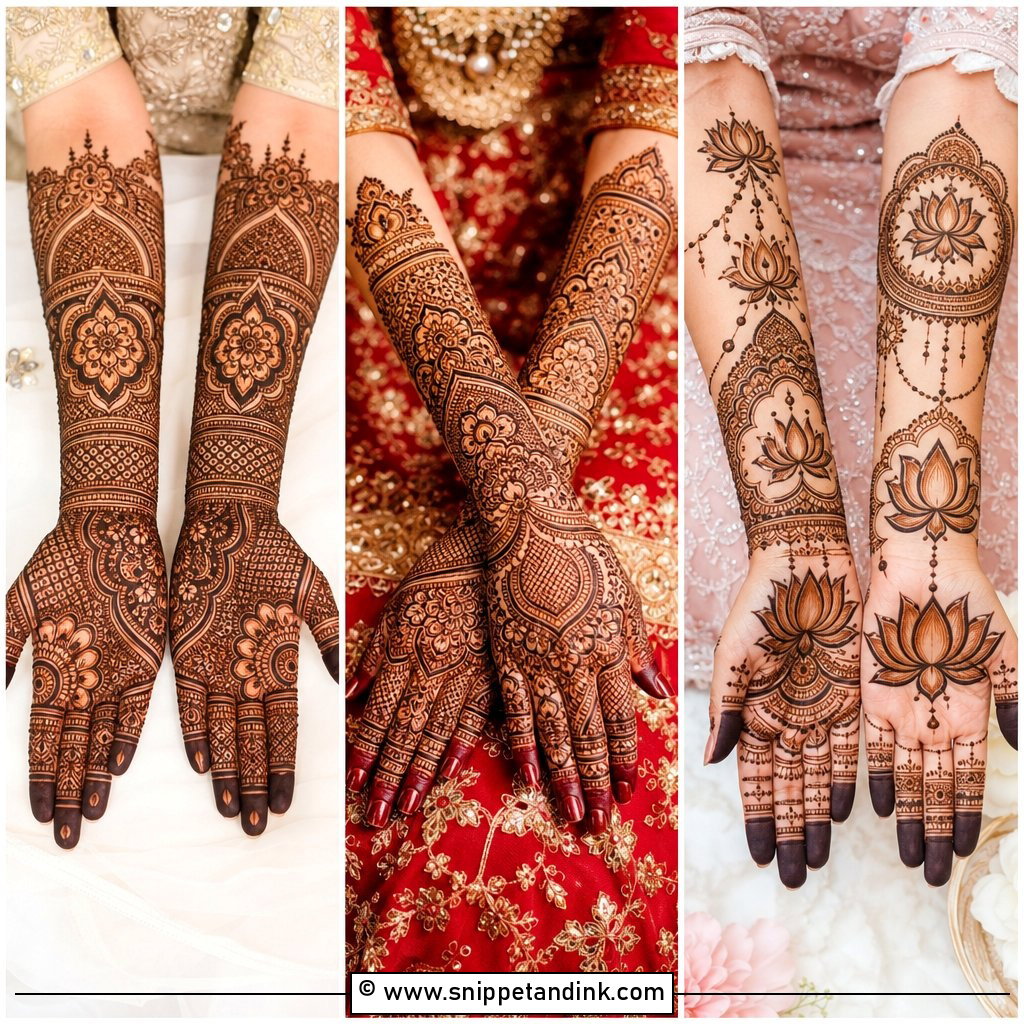
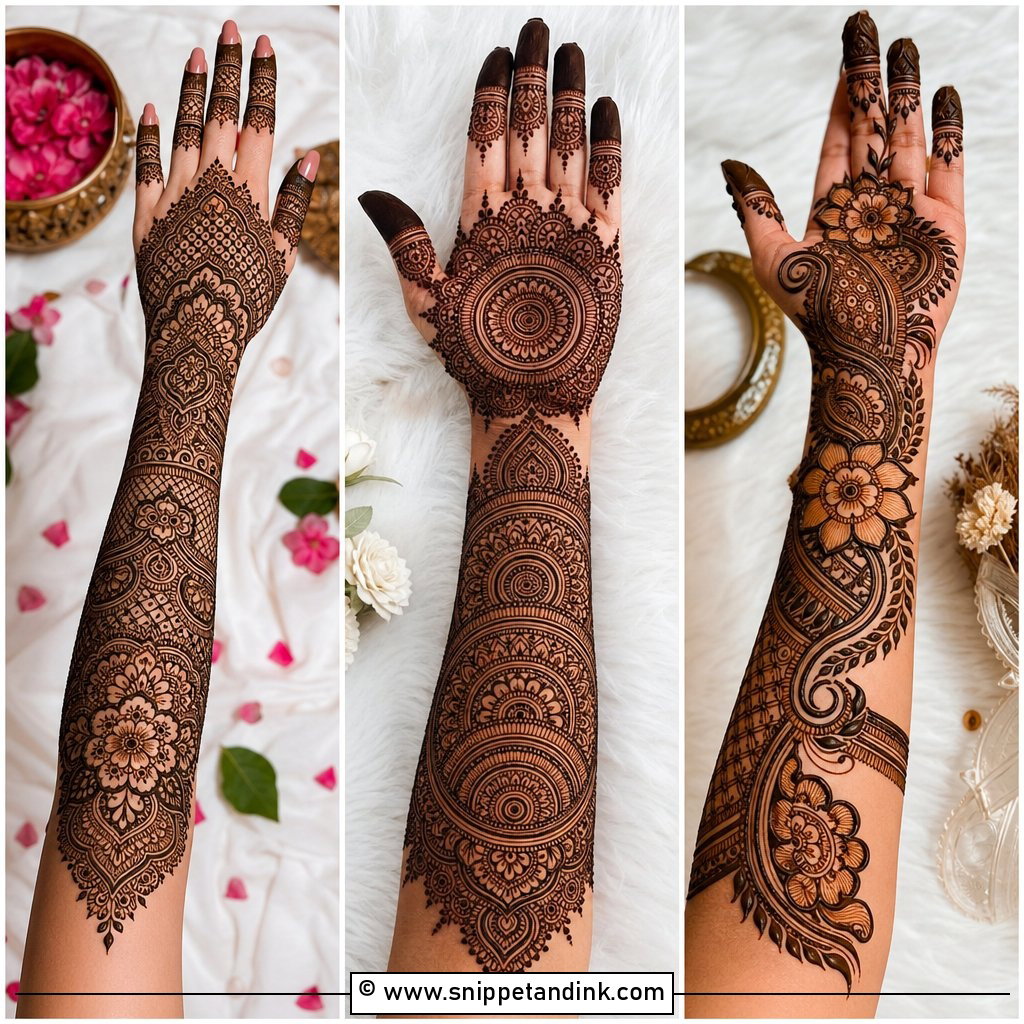
Half-leg coverage takes in the toes, feet, ankles and lower calf, which gives strong detail without the hours a knee-length design needs. Mandalas, florals, jaali patches, paisleys or anklet bands fill the lower area. The top edge needs a deliberate finish, such as a floral bracelet, scalloped band or leafy cuff. A design that just fades out at mid-calf looks abandoned. It makes the most sense when your outfit hides the upper leg anyway.
16. Moroccan Bridal Leg Mehndi Design
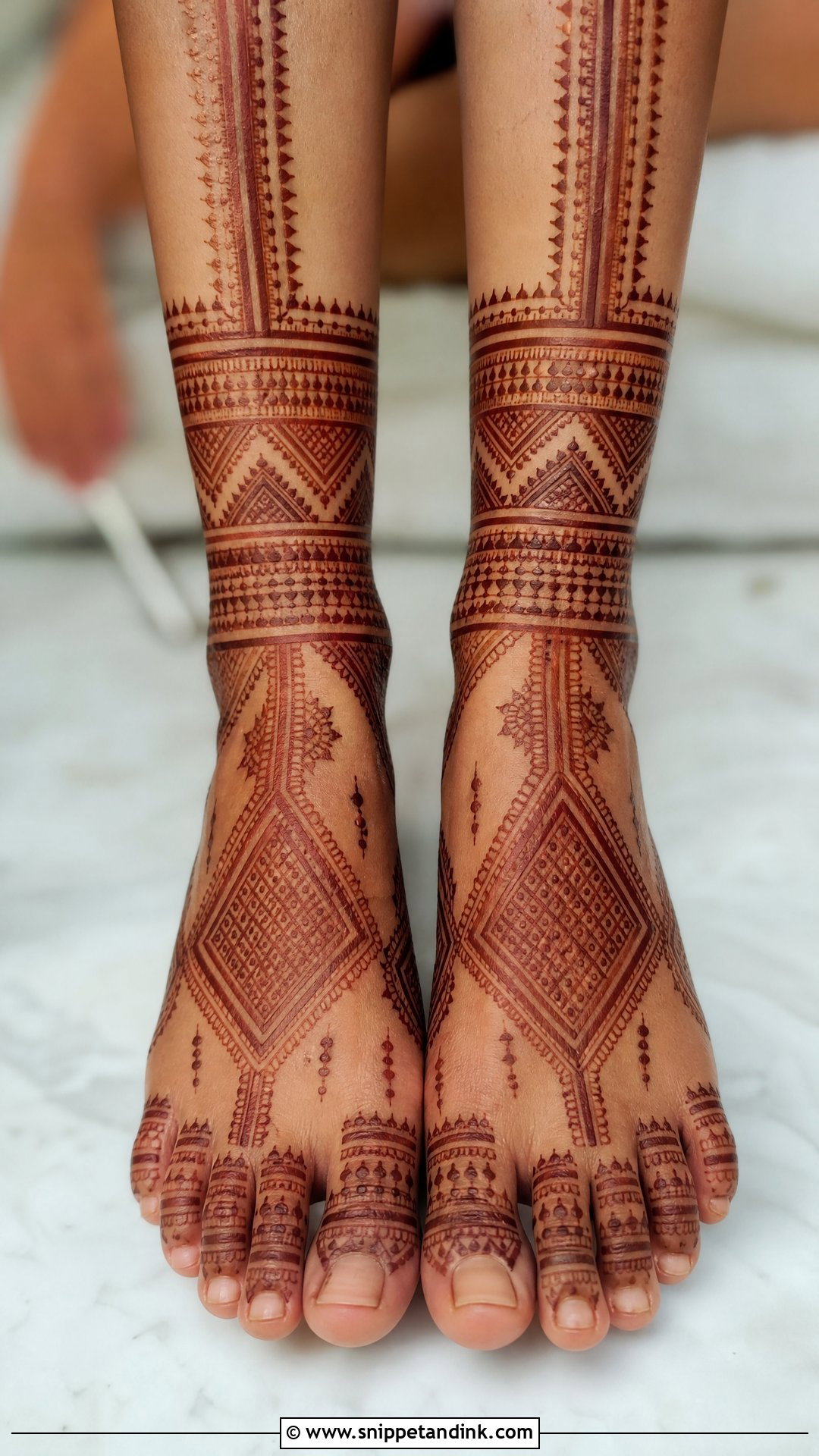
Moroccan bridal leg mehndi design swaps vines and paisleys for diamonds, triangles, lines, grids and sharp symmetrical borders. On legs it suits an anklet-to-calf layout or a full foot of repeated geometric blocks. It’s less filled than Indian work yet still has strong impact, and it fits fusion outfits well. Straight lines on a curved calf are tricky. A line drawn while the leg is stretched out on a stool can bow once you stand, so I map the grid with the leg resting in a natural position.
17. Gulf Bridal Leg Mehndi Design
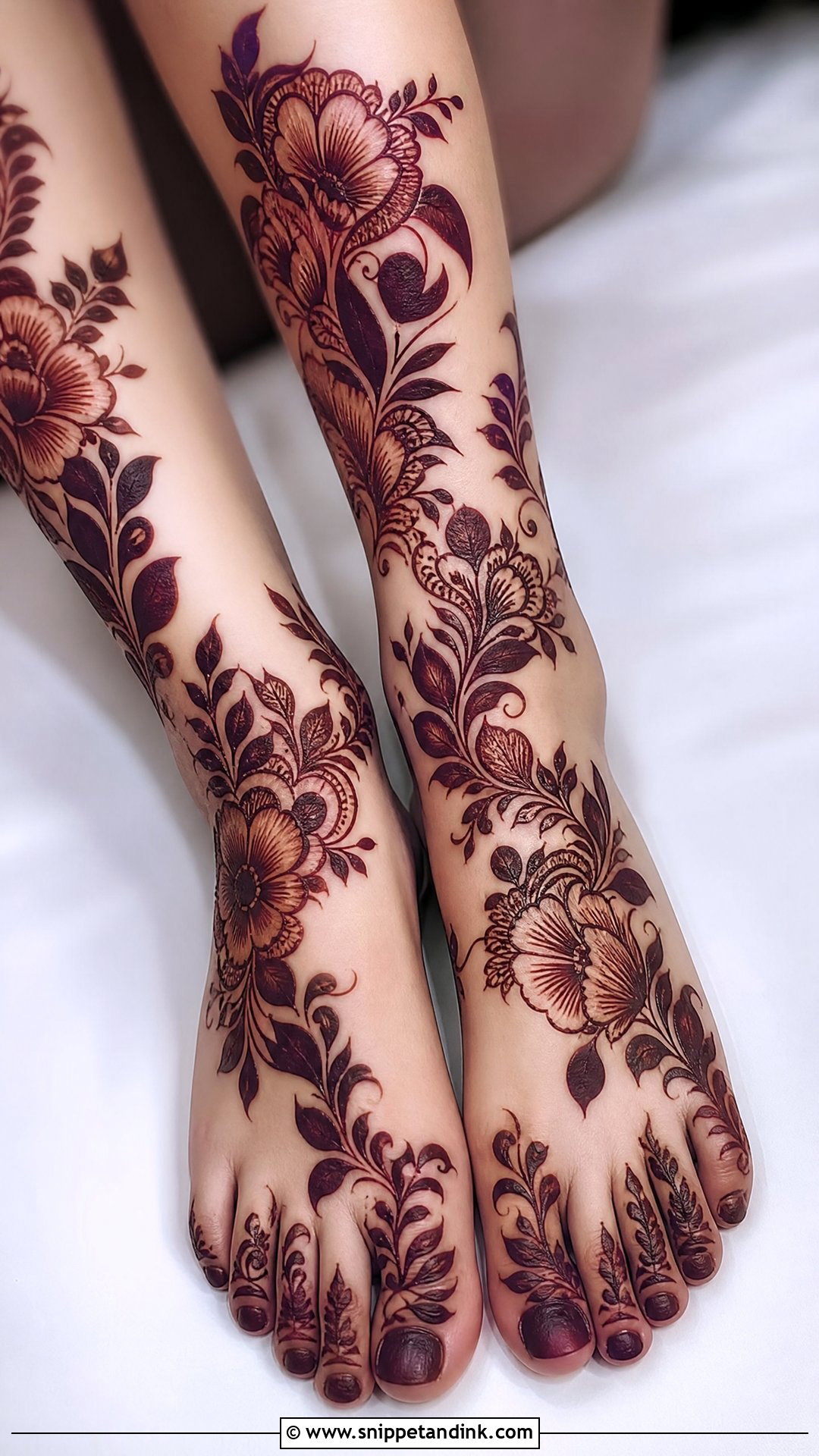
Gulf bridal leg mehndi design, the Khaleeji style, is bold floral spacing, leafy movement and plenty of negative space. It usually starts with heavy flowers on the foot and sweeps across the ankle and calf. Thick outlines, shaded petals and big leaves stay readable after the stain darkens, so it holds up in wide photos where fine work disappears. Pair it with Arabic back-hand henna so hands and legs speak the same language.
18. Personalized Bridal Leg Mehndi Design
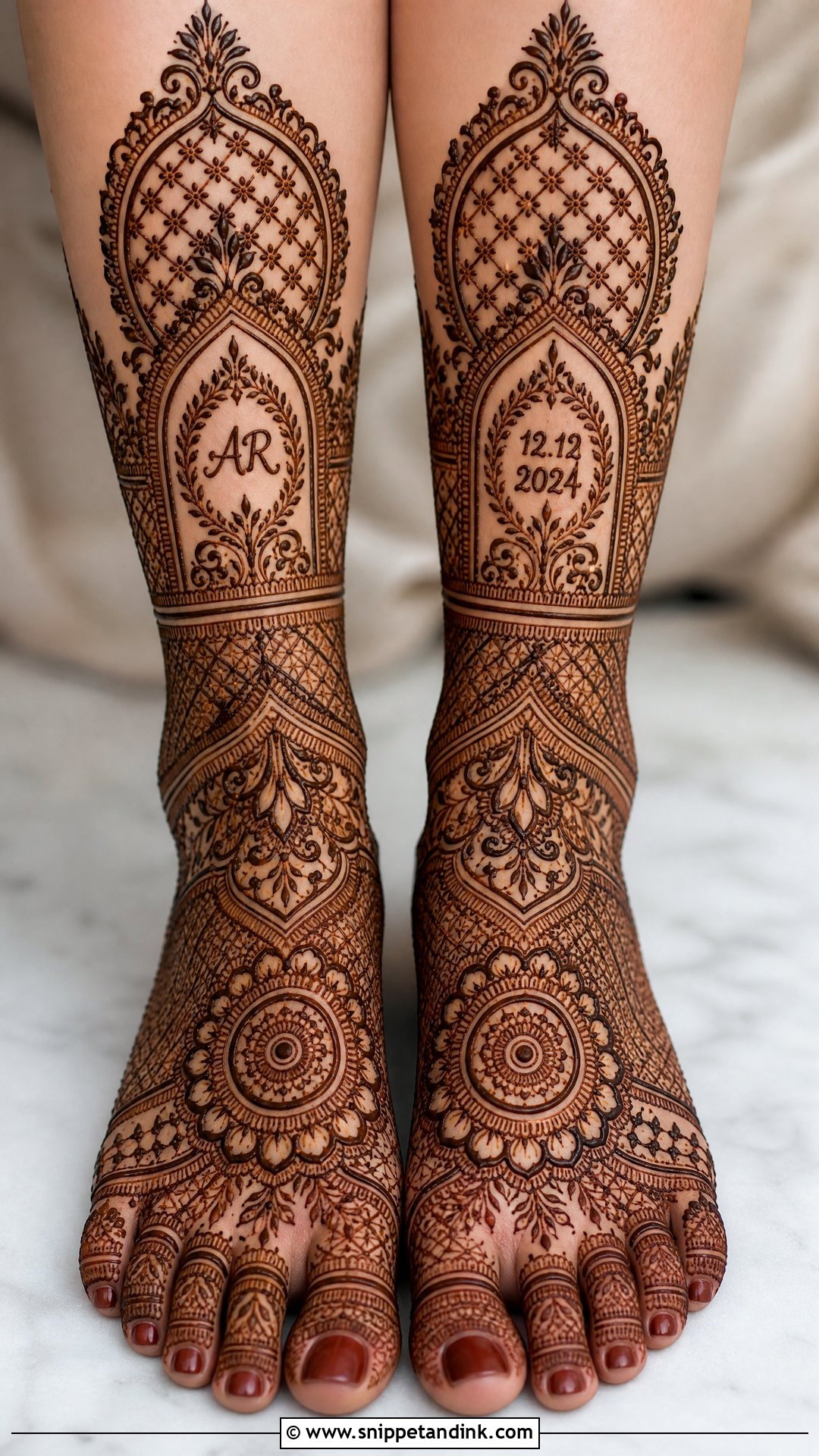
Personalized bridal leg mehndi design hides meaningful details among the standard patterns: initials, the wedding date, a small symbol or a story detail tucked into a paisley. On legs it reads best near the ankle, on the calf or along the outer foot; avoid the sole and anywhere a strap will sit. Neat borders, florals, mandalas or jaali should support it rather than compete. Lettering on the curve of a calf needs to be a little larger than on a palm to stay legible.
19. Lotus Bridal Leg Mehndi Design
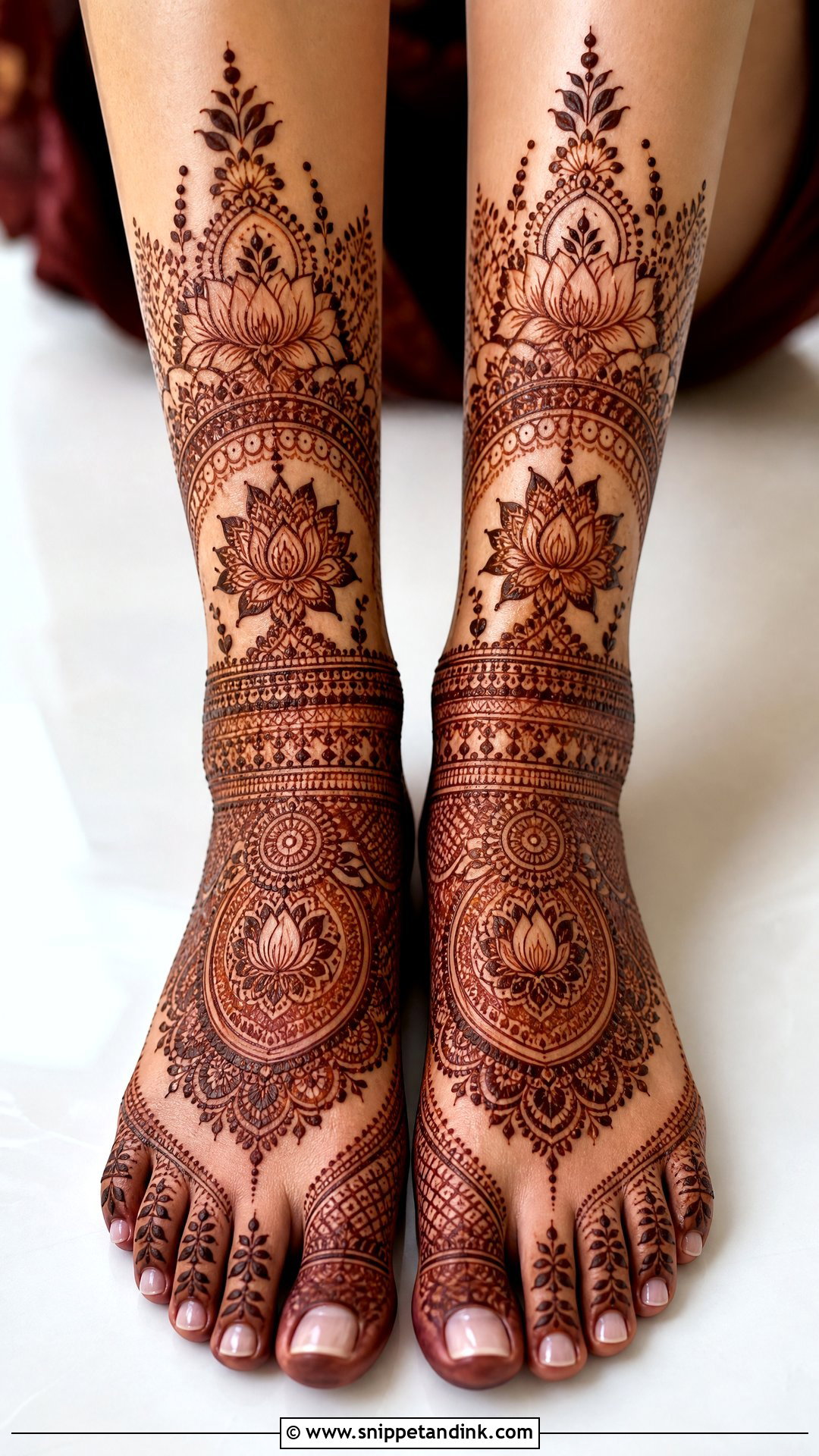
A large lotus on the top of the foot, or lotus borders circling the ankle and calf, gives the legs a calm, rounded balance, with fine inner detail adding richness. It suits a bride who wants meaning without crowding. Mandalas, paisleys, dots and temple-style borders combine with it easily. For a more bridal finish, I layer the petals on both feet and link them to the ankle bands with leafy vines.
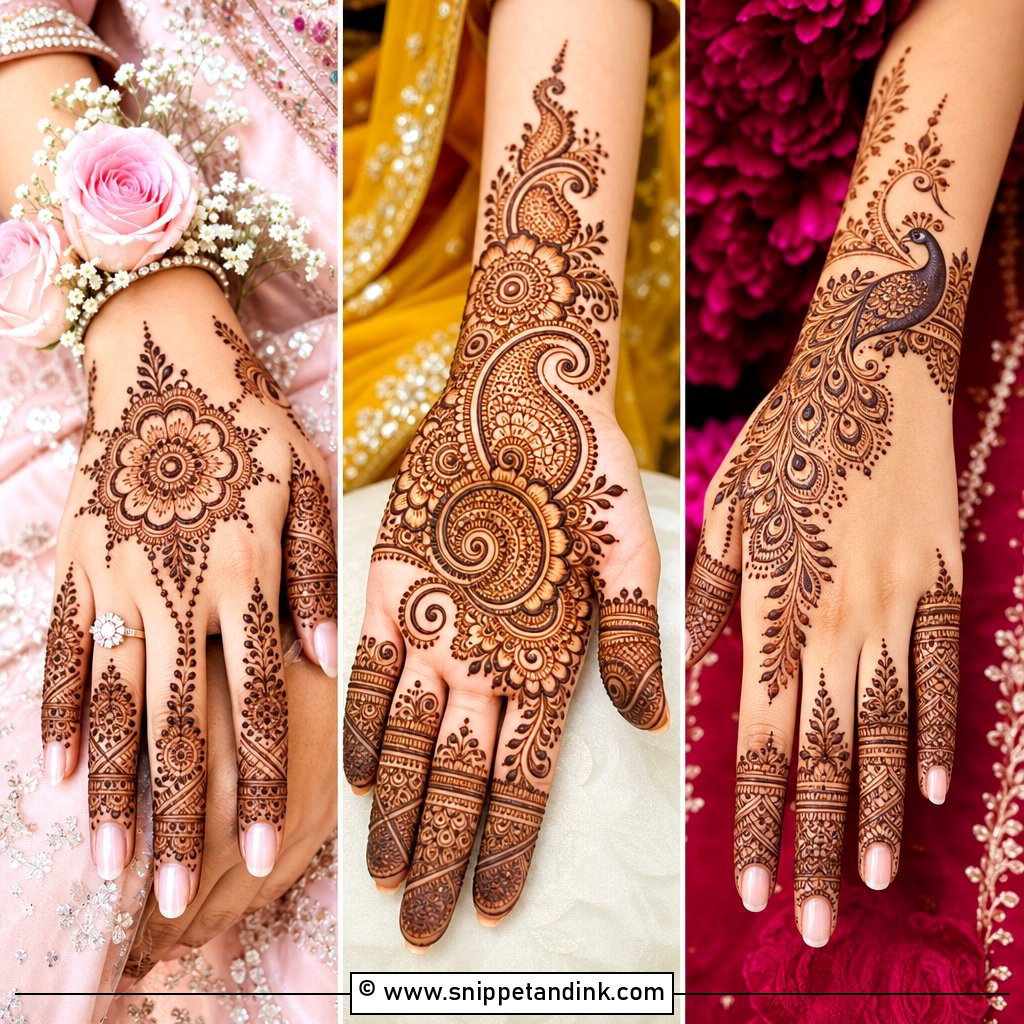
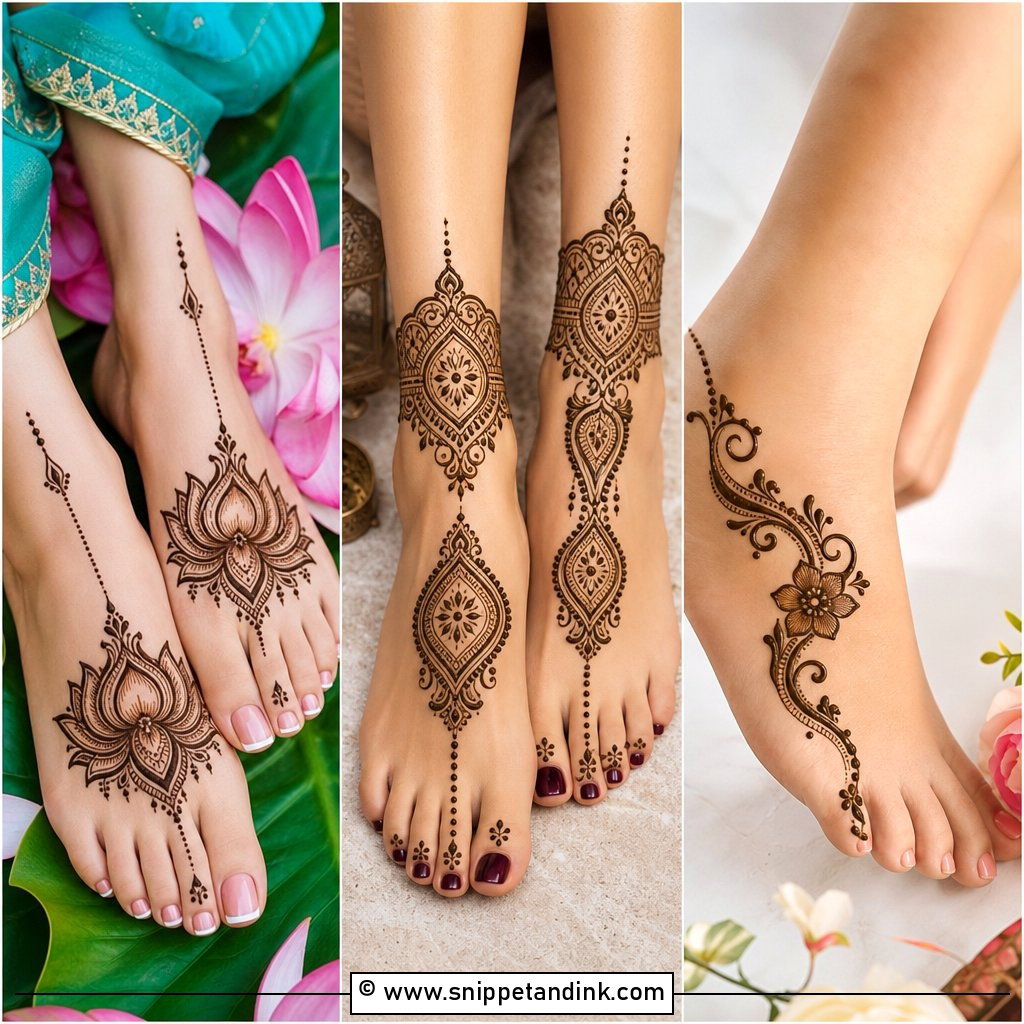
20. Knee Length Bridal Leg Mehndi Design
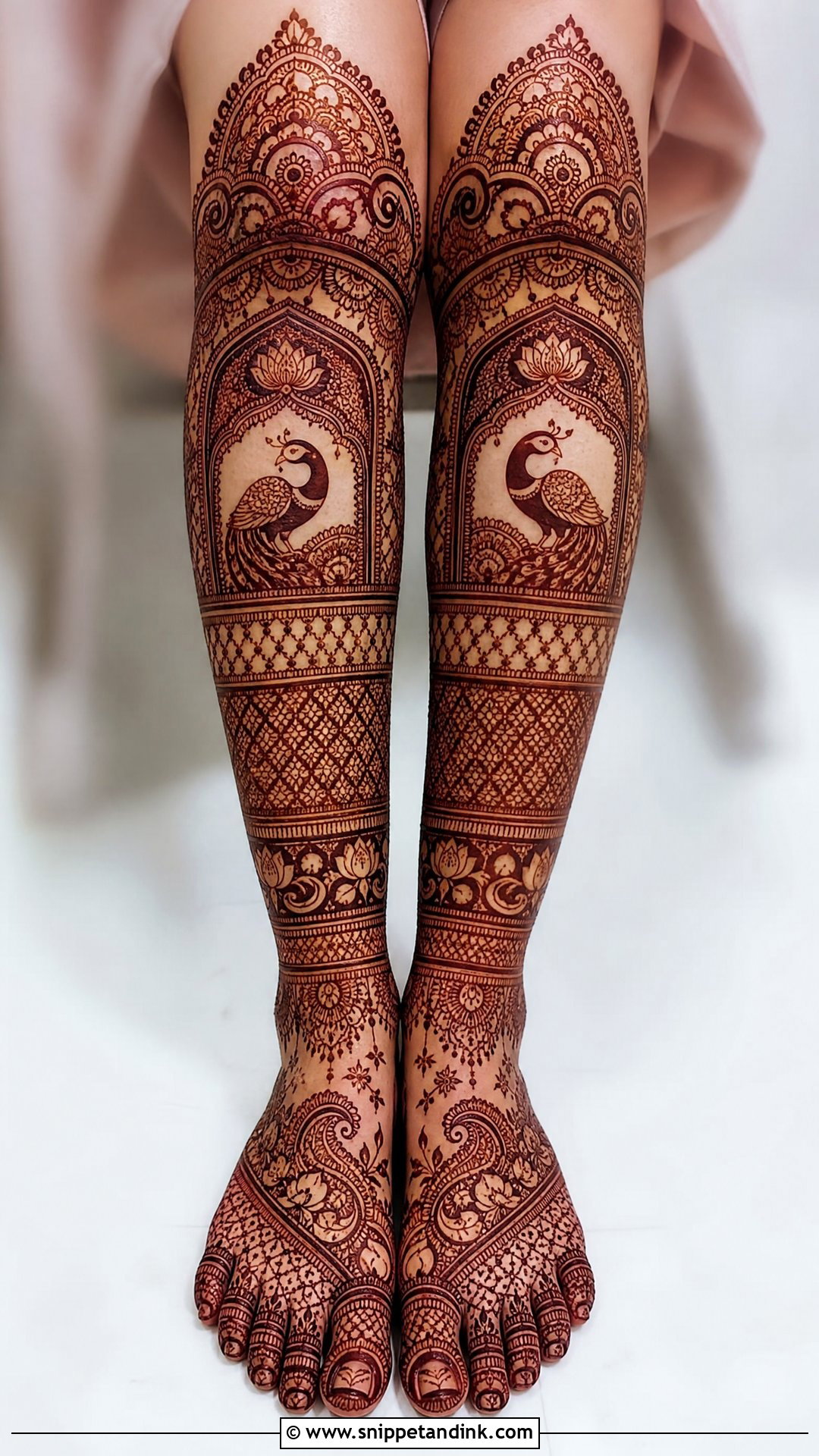
Knee-length is the most complete coverage there is: toes, foot, ankle, calf and a bold border just below the knee. It shows in mehndi portraits when the lehenga is lifted for the photo. A surface that large needs a plan, so I mark the main motifs on both legs first and fill afterward, mixing big shapes with smaller fillers so it doesn’t look flat. Peacocks, mandalas, florals, paisleys, jaali and symmetrical bands all appear. Allow plenty of time, a skilled artist and a long rest afterward while it dries.
Getting Through the First Night With Paste on Both Legs
Hands dry while you chat. Legs ground you. Once the paste is on your feet you can’t walk without cracking it or leaving prints on the floor, so plan the evening around staying put.
Before the appointment
- Remove leg hair a day or two ahead. Hair holds the paste away from the skin, leaves patchy color underneath, and pulls when the dry paste comes off.
- Have a pedicure before, not after, since soaking and scrubbing fade a fresh stain.
- Wear a loose skirt or shorts you can sit in for hours with your legs uncovered.
Once the paste is on
Sit with your legs stretched out on an old towel and let the paste dry fully before anything touches it. If you want to keep it on overnight, wrap it loosely in tissue and pull on old cotton socks or loose cotton pants. In the morning, scrape it off gently instead of washing, and keep water off for as long as you can.
Why your calves won’t match your soles
The soles and sides of the feet stain very dark, the top of the foot a little lighter, and the shins and calves lighter again. That’s normal skin behavior, not a bad batch of paste. For the first day, skip tight closed shoes and snug straps, because friction on a developing stain leaves pale streaks that last for the whole function.
Feet, Ankles or Up to the Knee?
Leg mehndi should suit your outfit, jewelry, ceremony, comfort and how much skin will actually show. Full-leg and knee-length designs feel royal, while Arabic, anklet and minimal patterns are lighter and more modern. Indian, paisley, peacock, lotus and mandala layouts keep it classic; personalized motifs or Moroccan geometry set it apart. Save your favorites, talk placement through with your artist, mention your footwear, and leave enough time for a deep stain before the first function.
You'll Like These Ideas:


Leave a Reply