
Karva Chauth mehndi carries more weight than party henna. You wear it through a full day of fasting, it sits in your lap during the katha, and it is the first thing you look at when the moon finally comes up. The moon, the sieve and the karwa pot give the festival its own vocabulary, and I build almost every design for this night around one of them. Below are 35 layouts I draw for the occasion, from a fifteen-minute back-hand cuff to forearm portraits that need a whole evening. Some suit a bride on her first fast; others are kinder to a woman who has to cook, pray and still keep the paste on overnight.
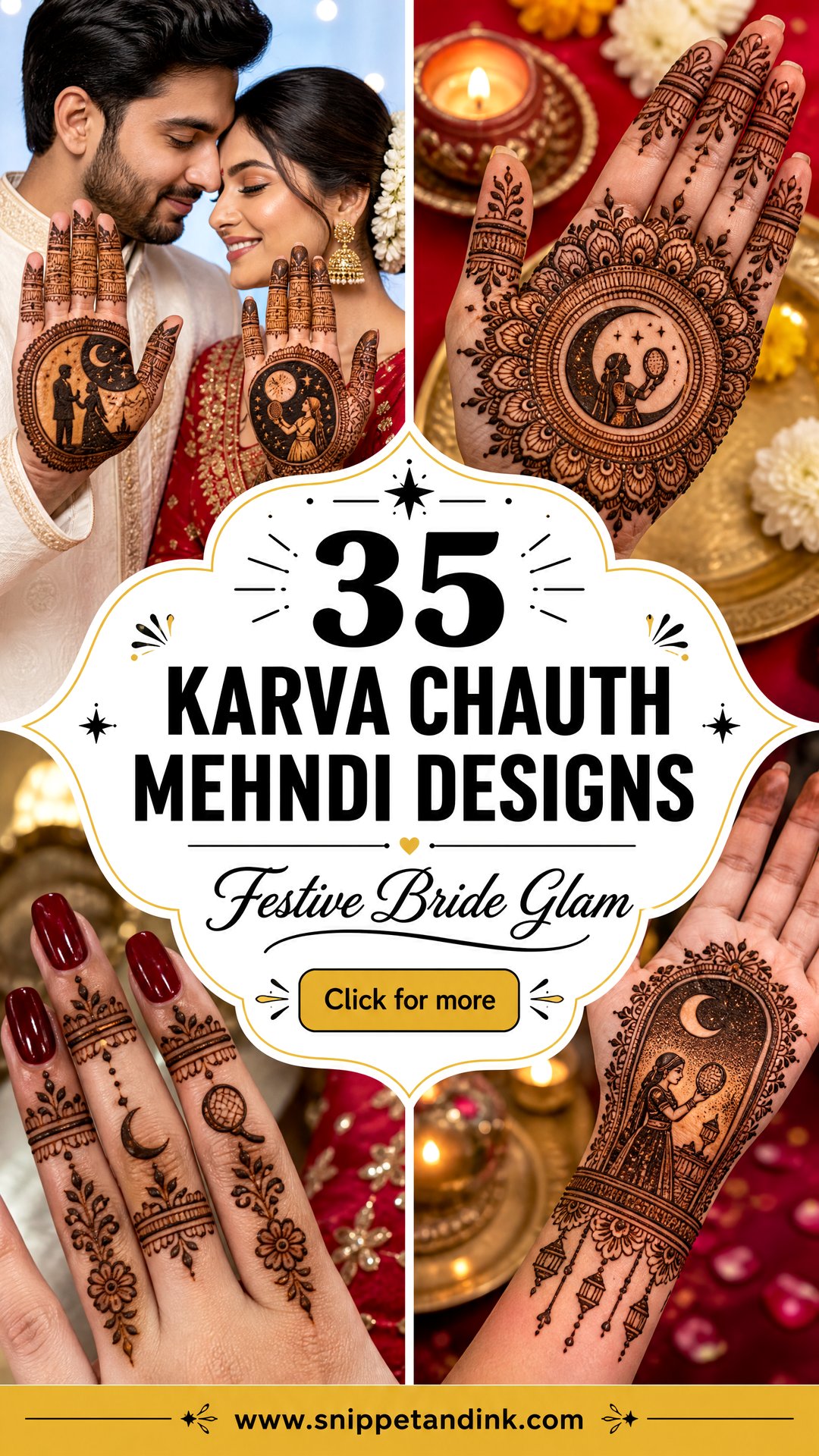
Applying Henna the Evening Before the Fast
Most of my Karva Chauth appointments happen the day before the festival, in the afternoon or evening. That timing is not just habit. Natural henna stains orange when the paste comes off and keeps darkening for a day or two, so paste applied the evening before reaches a deep reddish brown right around moonrise the next night.
The challenge is that you then wake early for sargi with paste still on your hands. Here is how I tell clients to plan the night:
- Eat, change and handle anything fiddly before I start. Once the paste is on, you will not be using your hands for hours.
- Let the paste dry until it no longer feels tacky, then dab on a little lemon and sugar to keep it stuck to the skin.
- Sleep with the paste on, hands loosely wrapped in tissue or an old cotton cloth to protect the bedding.
- Scrape the dried paste off with a blunt edge or rub it away with your fingers in the morning. Do not wash it off.
- Keep water away from the design for as long as you can on the day. A little mustard or coconut oil before you wash helps protect it.
If you apply it on the morning of the fast, it will still stain, but you will be watching the moon with a lighter orange-brown that has not had time to mature.
1. Full Hand Karva Chauth Mehndi Design
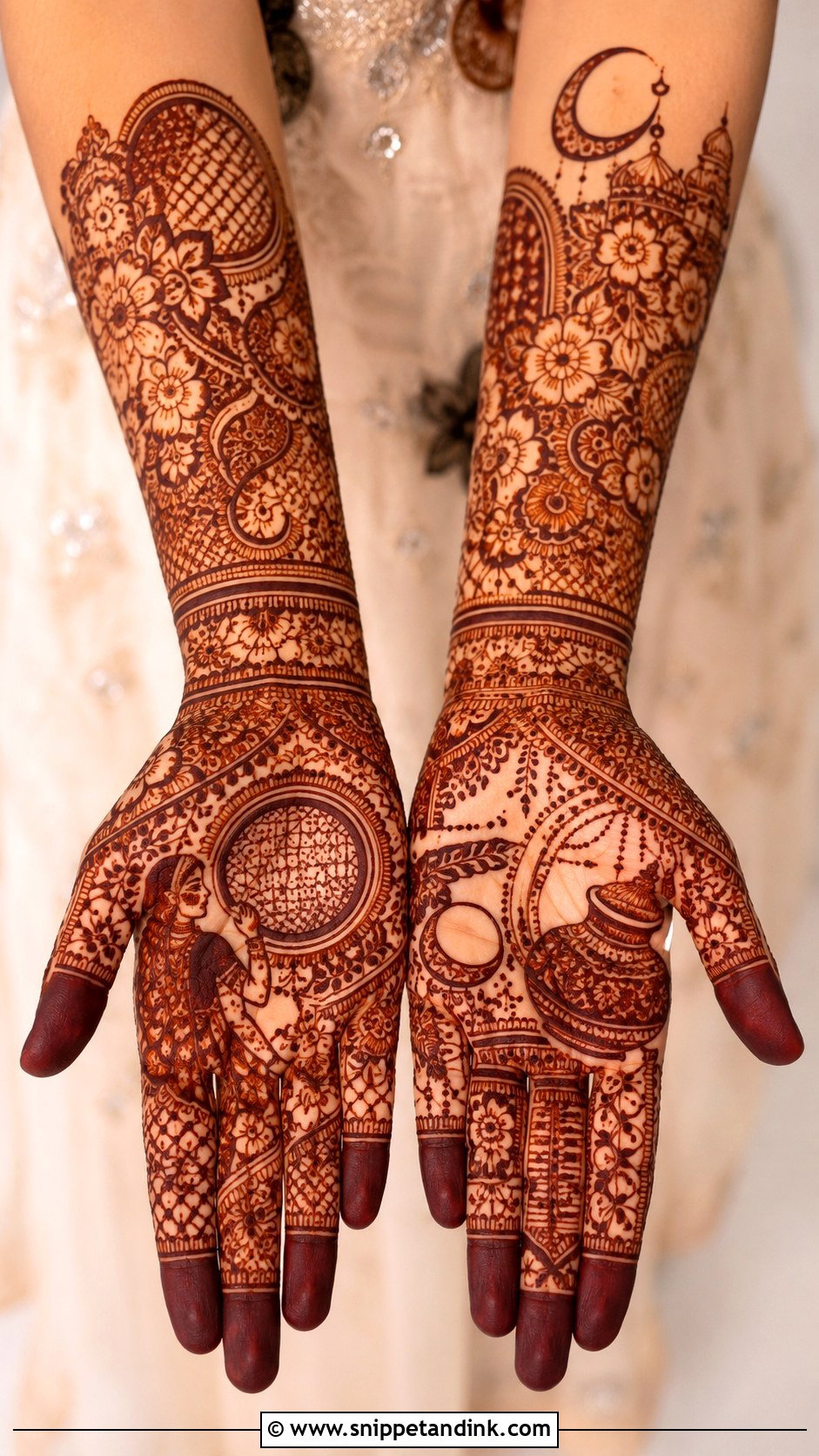
Full coverage from fingertips to wrist reads as celebration from across a room, which is why first-year brides ask for it most. I fill the palm with florals, paisleys and jaali, and leave a clear circle in the centre for a moon, sieve or karwa pot so the meaning is not lost under filler. The fingers are where full hands go wrong: if every phalanx is packed, the stain merges into one dark block. I alternate a dense band with an open one on each finger. Expect to sit for two to three hours per pair of hands, and plan the evening around it.
2. Simple Karva Chauth Mehndi Design
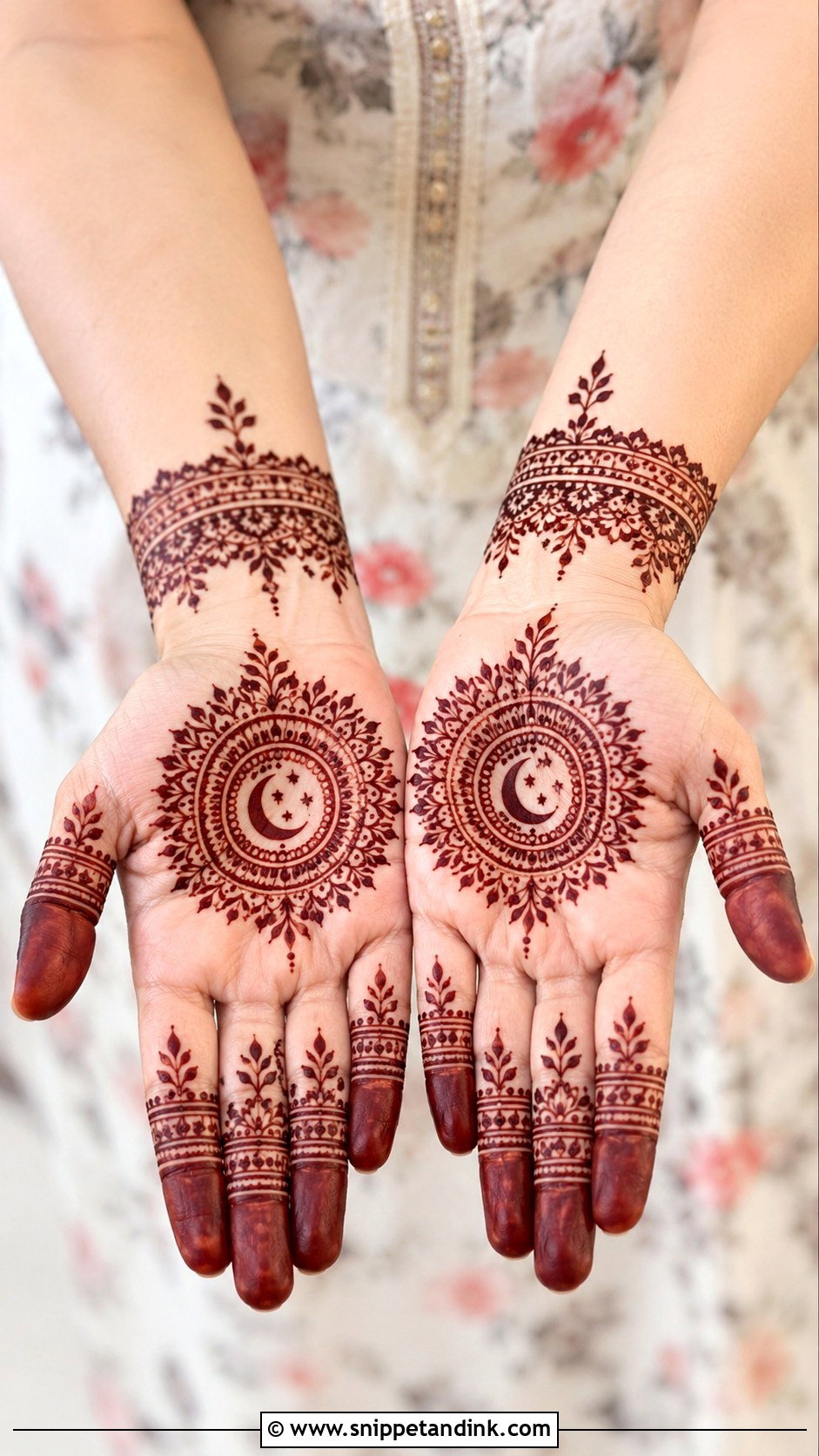
A simple palm is what I recommend to anyone applying her own cone. A clean mandala in the centre, filled fingertips and a wrist band give a finished hand with only a handful of motifs to control. Open spacing actually helps the stain, because thick lines with skin around them come up crisp instead of blurring together. If you want the festival in it, put a small moon or karwa pot at the wrist rather than squeezing it into the mandala, where it tends to disappear.
3. Arabic Karva Chauth Mehndi Design
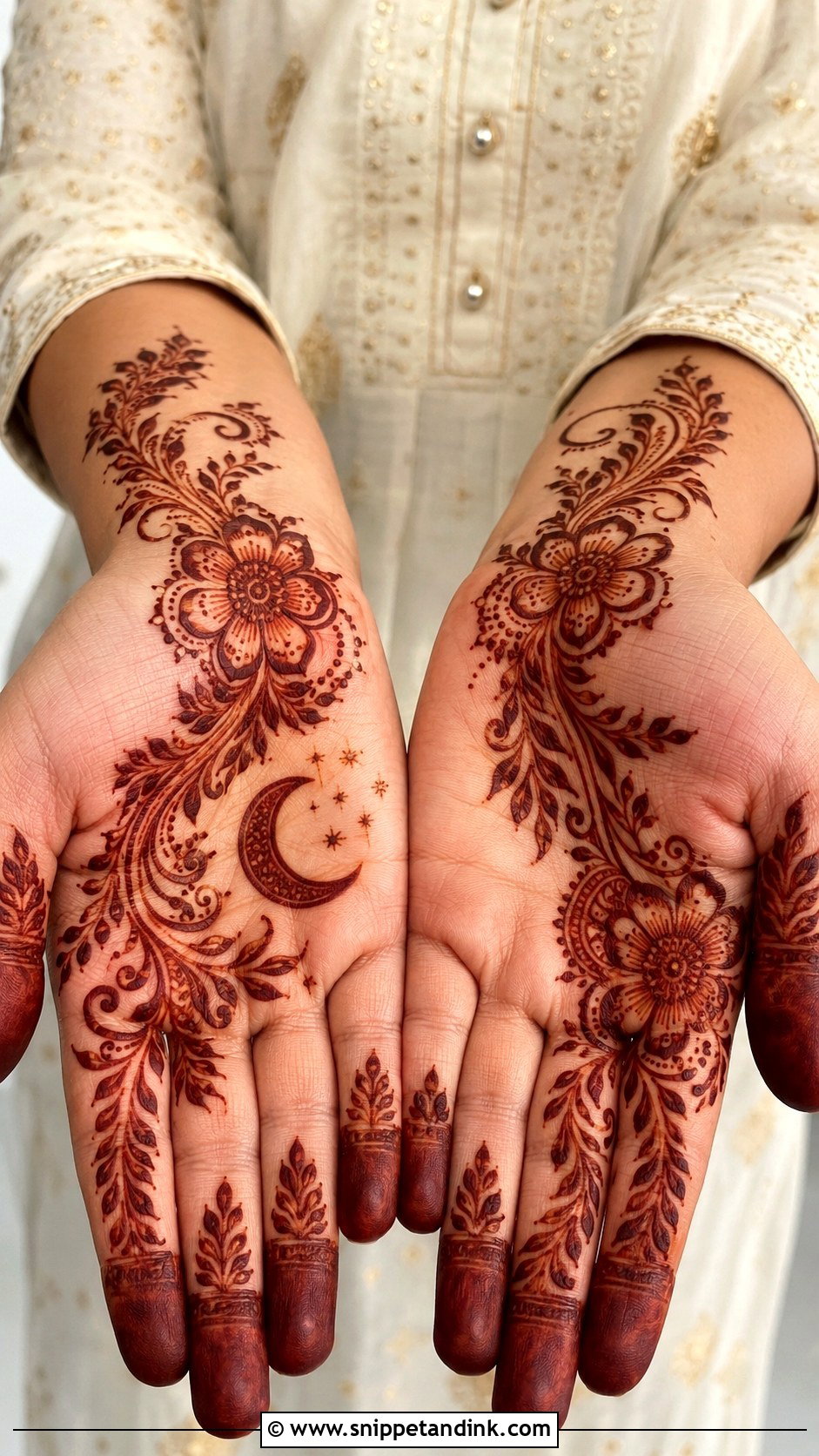
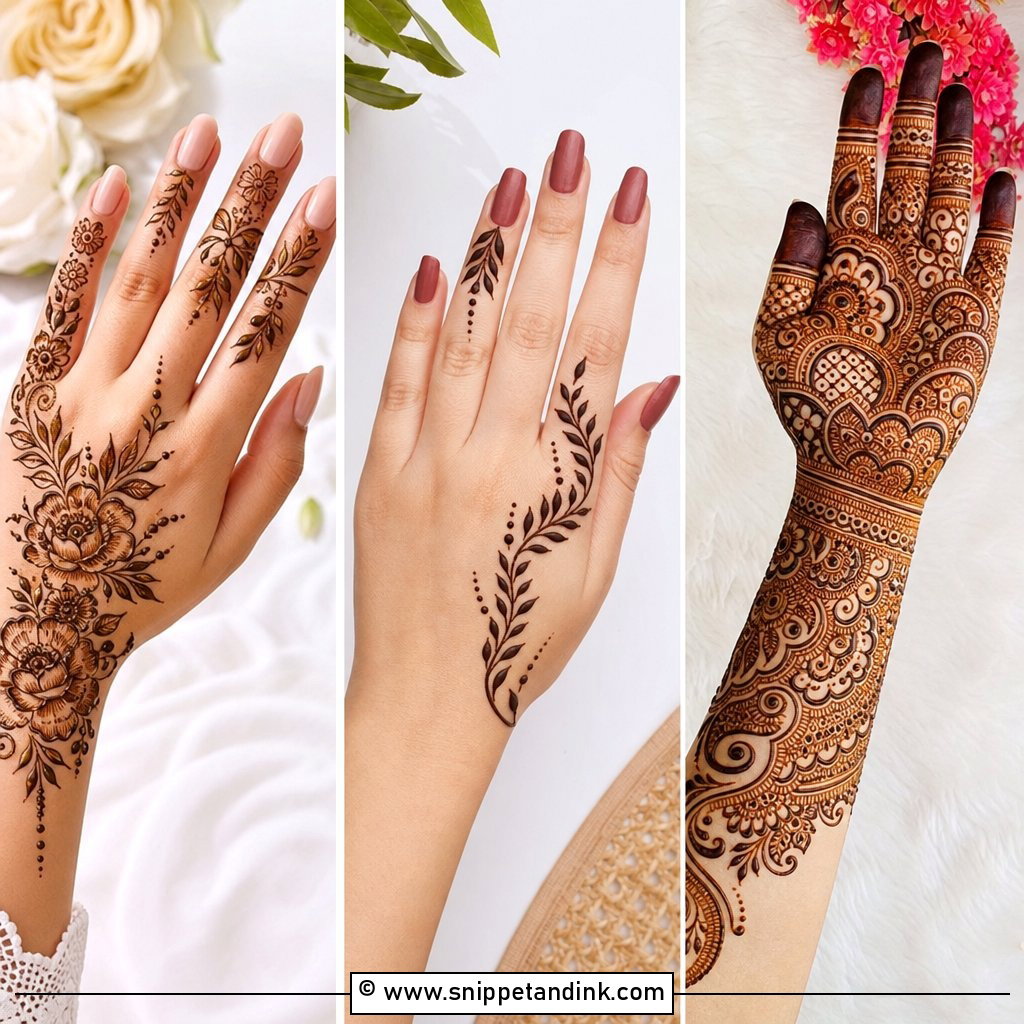
Arabic layouts run diagonally from the index finger toward the opposite side of the wrist, leaving bare skin around big flowers and leafy vines. That bare skin is the point, so I resist the urge to fill it. The style sits well on the front or the back of the hand and usually takes me half the time of a bridal palm. For the festival, I tuck a tiny moon or a couple symbol inside one paisley along the trail. Use a firm, thick outline here; thin Arabic lines look weak once the paste flakes off.
4. Back Hand Karva Chauth Mehndi Design
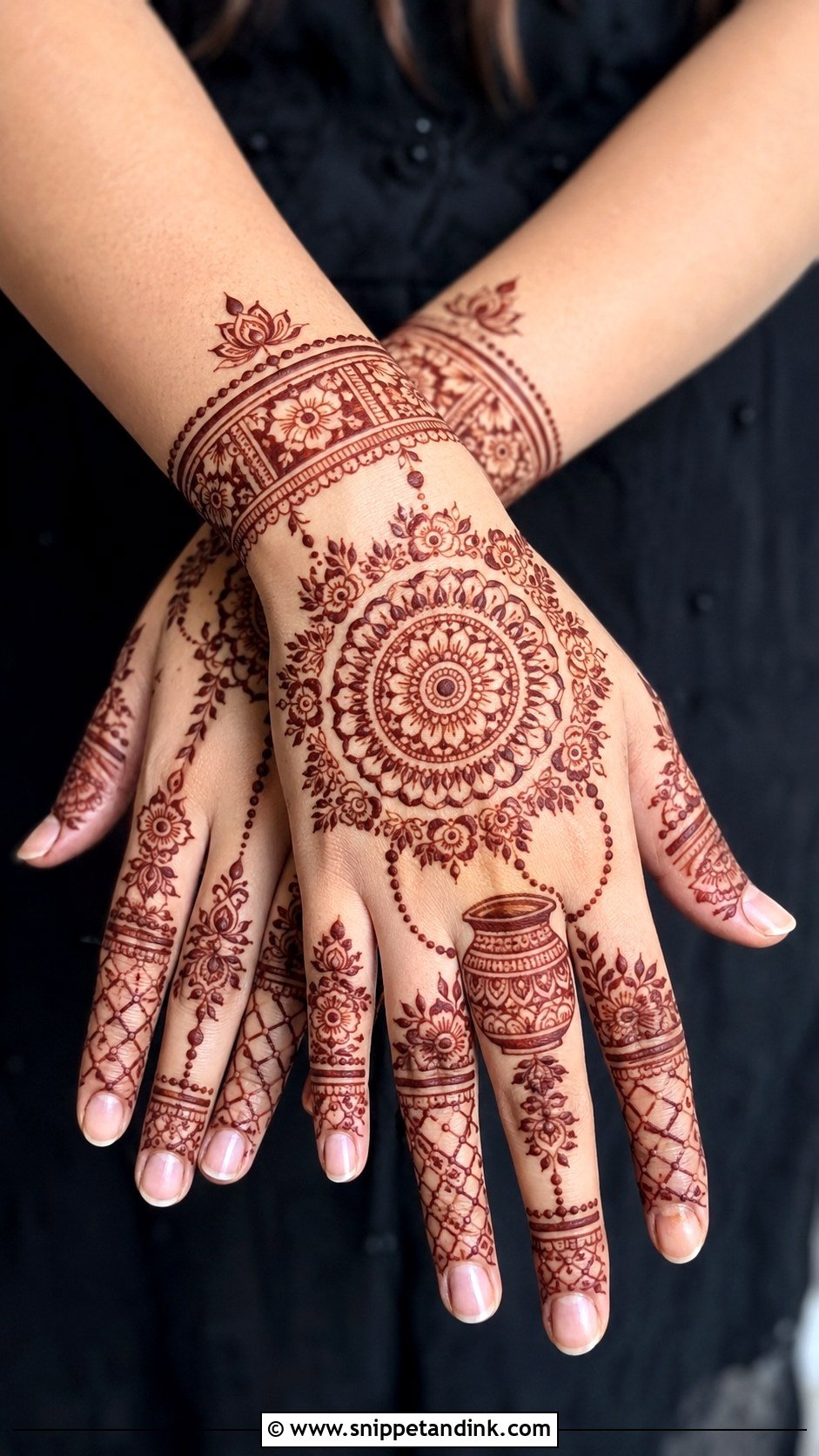
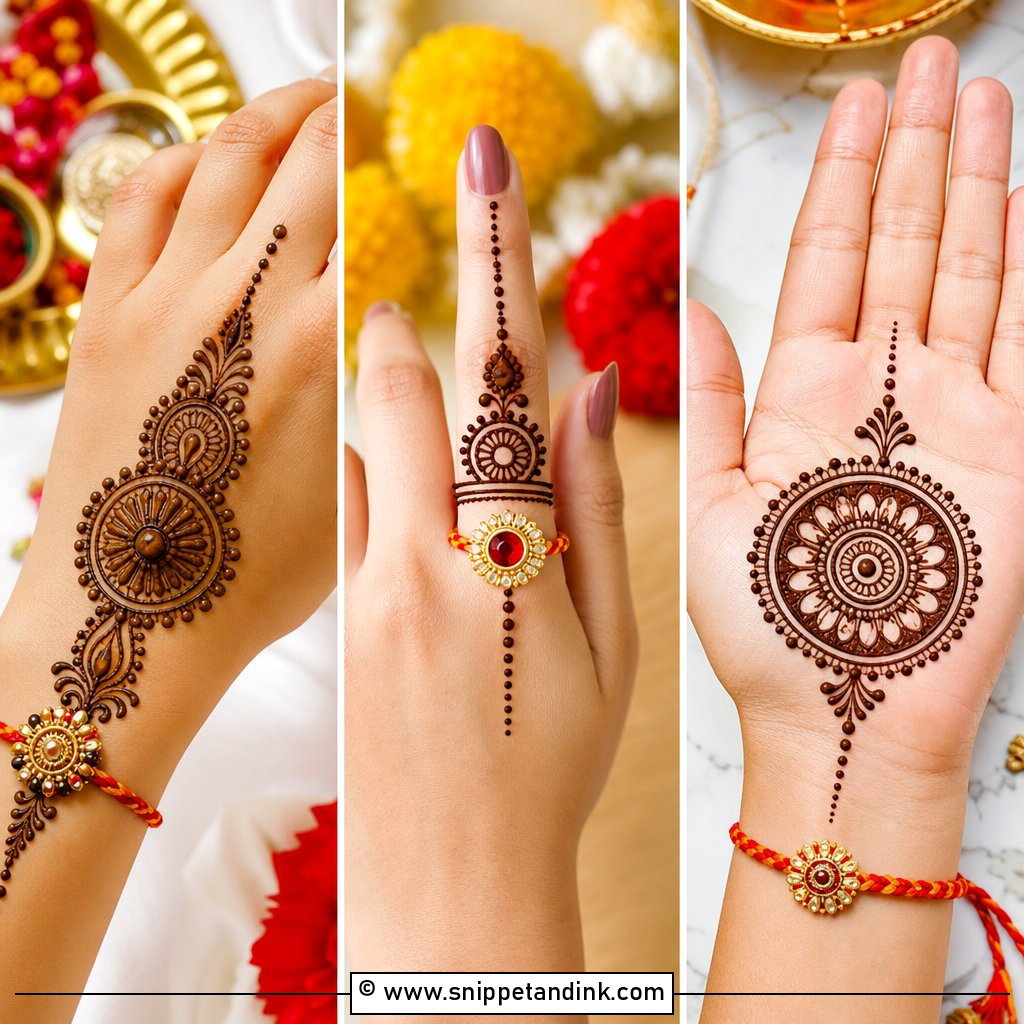
The back of the hand is what everyone sees while you hold the thali, adjust a dupatta or pass the sieve, so it deserves more care than people give it. I usually centre a mandala or a floral circle just below the knuckles and run a chain effect down each finger to a cuff at the wrist. One thing to know in advance: the back of the hand has thicker, drier skin and stains a shade or two lighter than the palm. I go slightly bolder with the lines to compensate. A small moon near the wrist bone keeps it tied to the night.
5. Front Hand Karva Chauth Mehndi Design
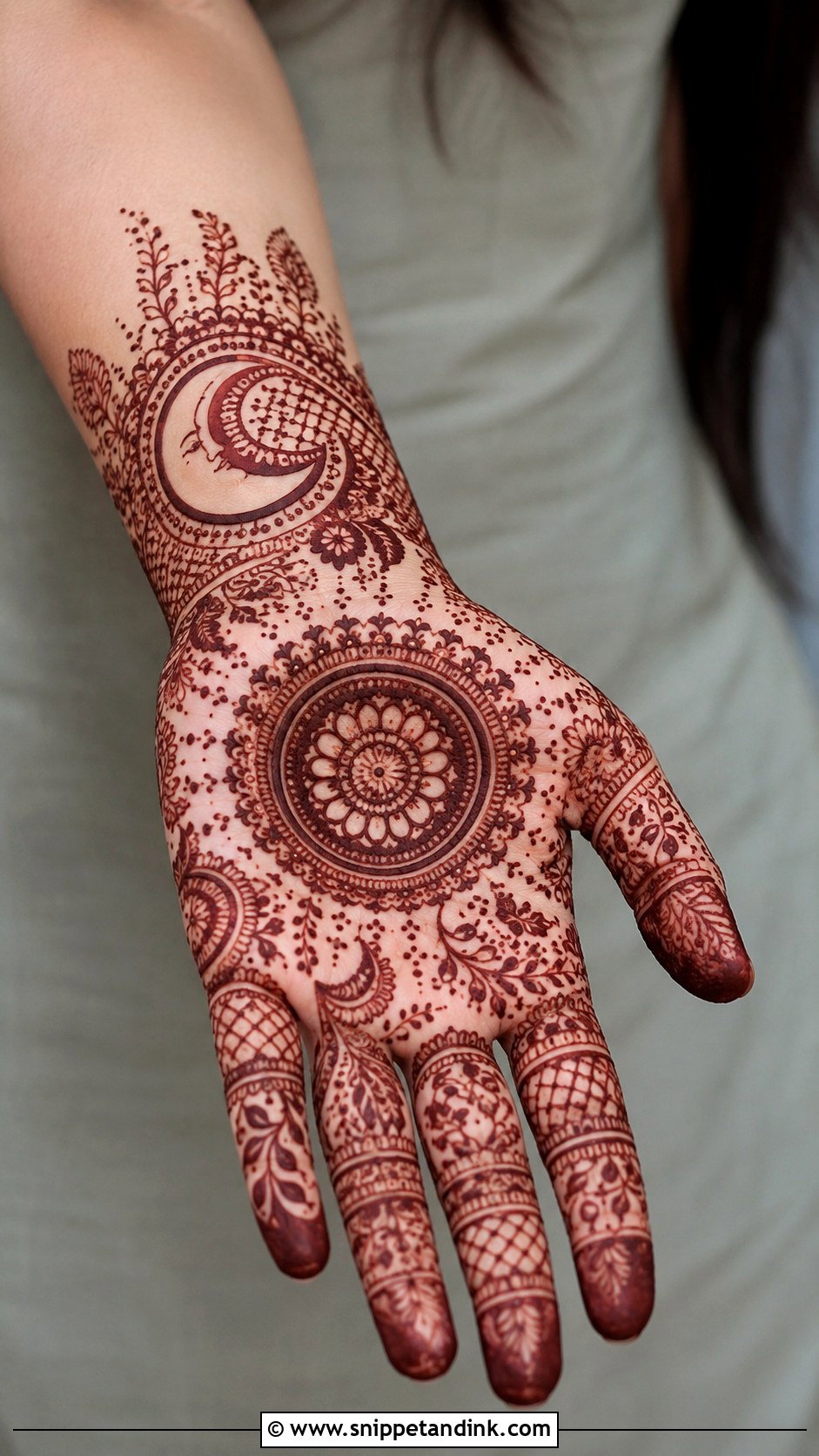
The palm is the traditional canvas, and it is also where henna stains darkest because the skin there is thin and warm. I place a round mandala in the centre, wrap paisleys and leaves around it, and save the base of the palm, just above the wrist crease, for a moon, sieve or tiny couple figures. That spot stays visible when your hands are cupped during the puja. Leave a little breathing room around the central motif for a cleaner hand, or pack it with jaali and dots for a bridal finish.
6. Bridal Karva Chauth Mehndi Design
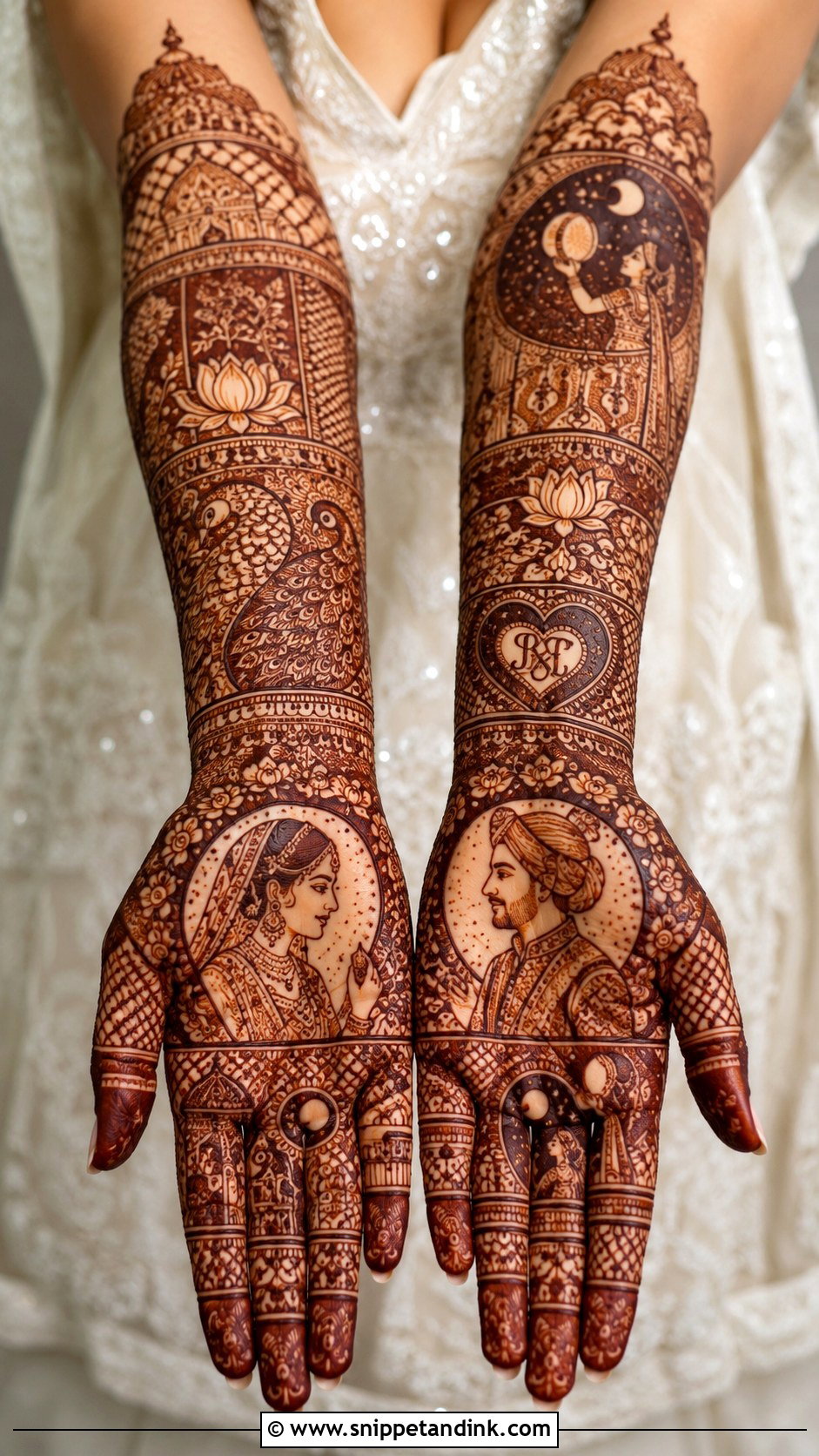
Bridal coverage on a first Karva Chauth usually runs from fingertips to mid-forearm, with portraits, kalash, lotus, peacocks and sometimes the couple’s initials. I sketch the story first: who sits where, where the moon rises, which panel holds the karwa. Without that plan, a forearm full of motifs turns into noise. Keep the figures large and the fillers small around them. With chooda and heavy bangles covering part of the wrist, I leave the band just above the bangle line plain so the design does not vanish under the metal.
7. Karva Chauth Couple Mehndi Design
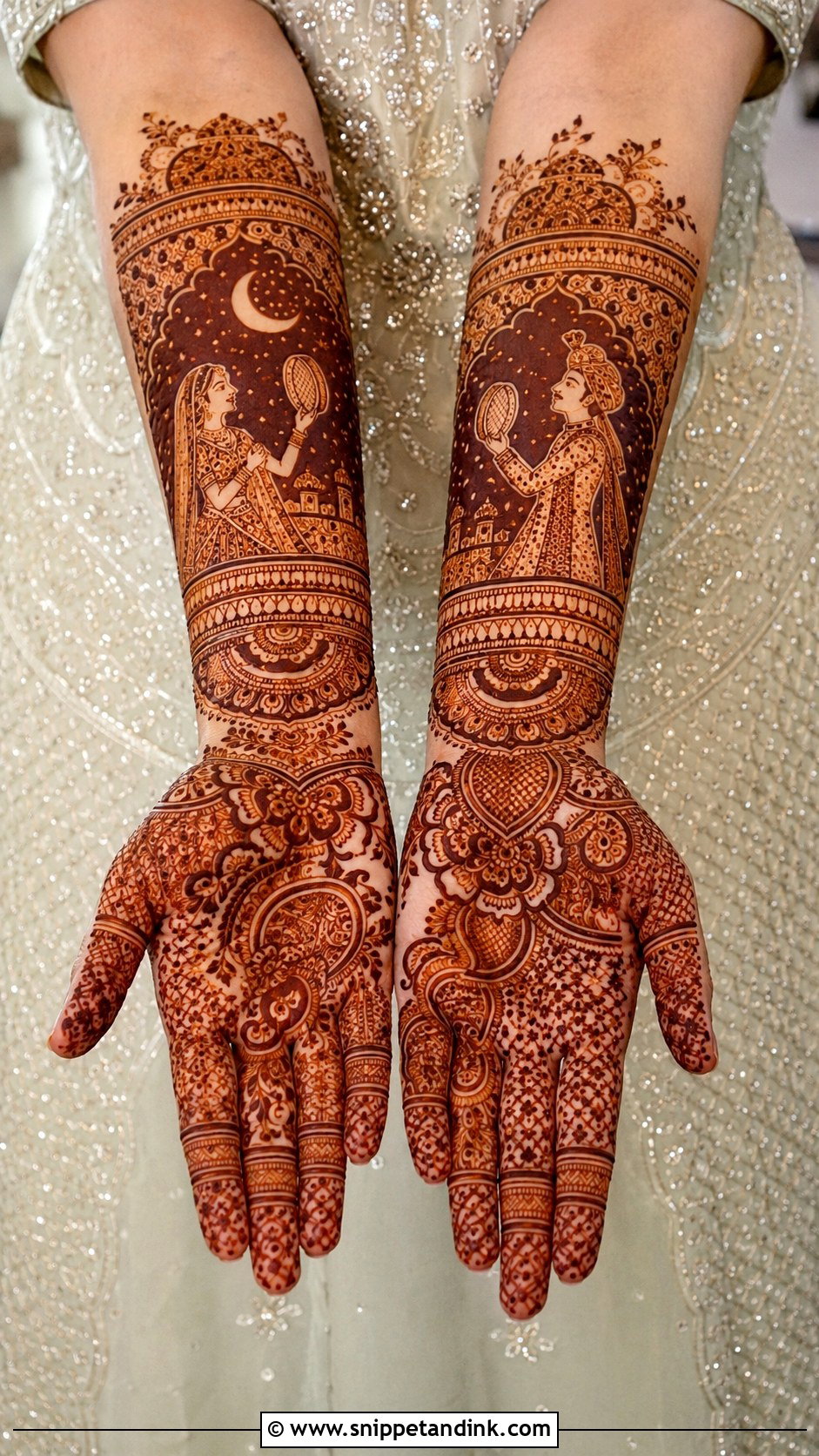
Couple designs put the festival’s story in your hands: a bride and groom facing each other, a pair under the moon, or one figure on each palm so the scene completes when you join them. I draw these on the palm only. The back of the hand stains too lightly for faces to read. Keep the features to a few strokes; an eye, a nose line and a bindi are enough. Every extra line inside a face spreads slightly as the stain develops and turns the expression muddy.
8. Karva Chauth Moon Mehndi Design
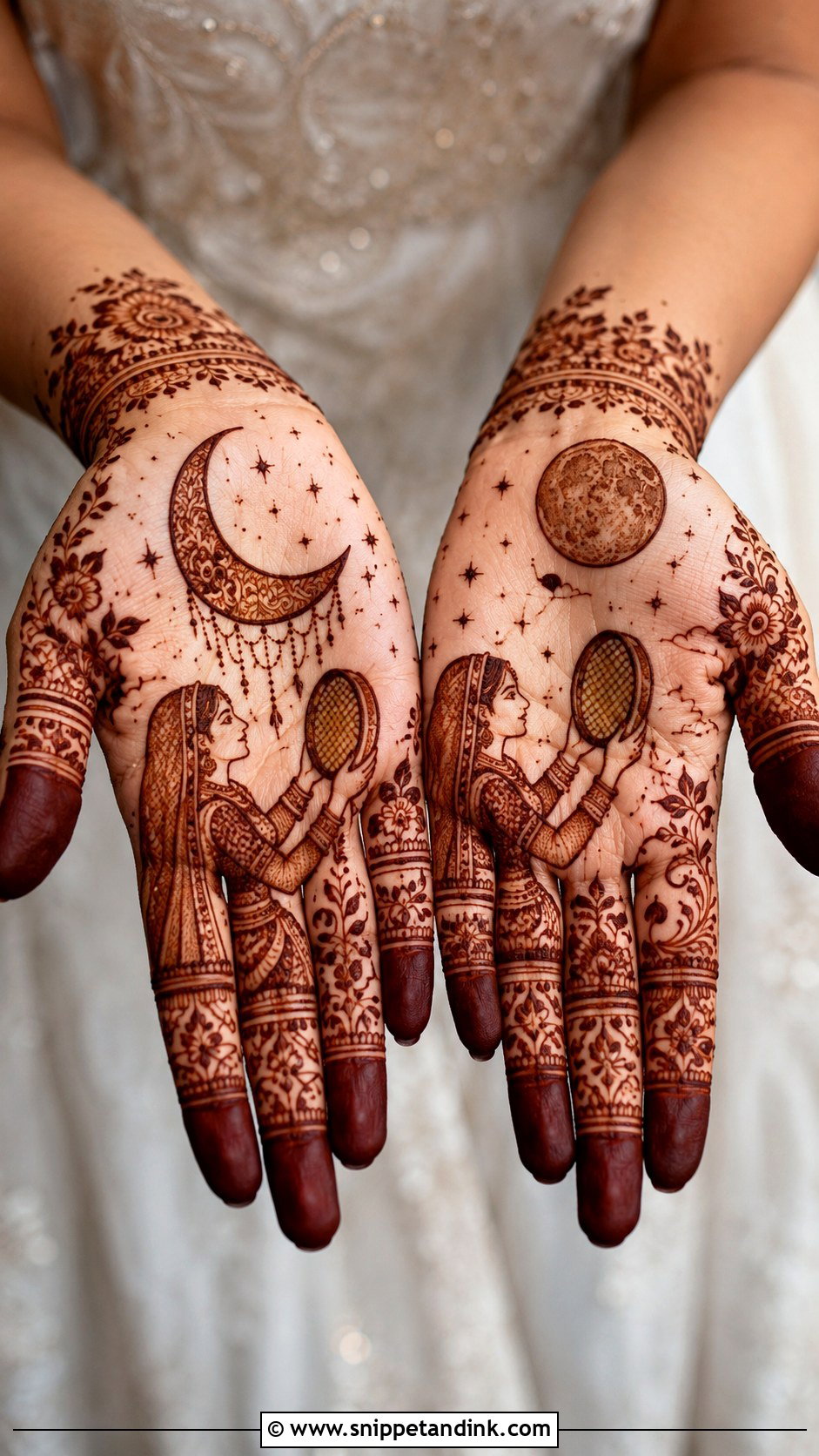
The moon is the motif I am asked for most on this night, and it can sit almost anywhere: centre palm, just above the wrist, or as a crescent border across the back of the hand. A crescent works better than a full disc, because a filled circle stains as a heavy dark blot. I like it paired with a few stars and a sieve outline. Draw it with negative space around it for a modern hand, or tuck it among paisleys for something more traditional.
9. Karva Chauth Sieve Mehndi Design
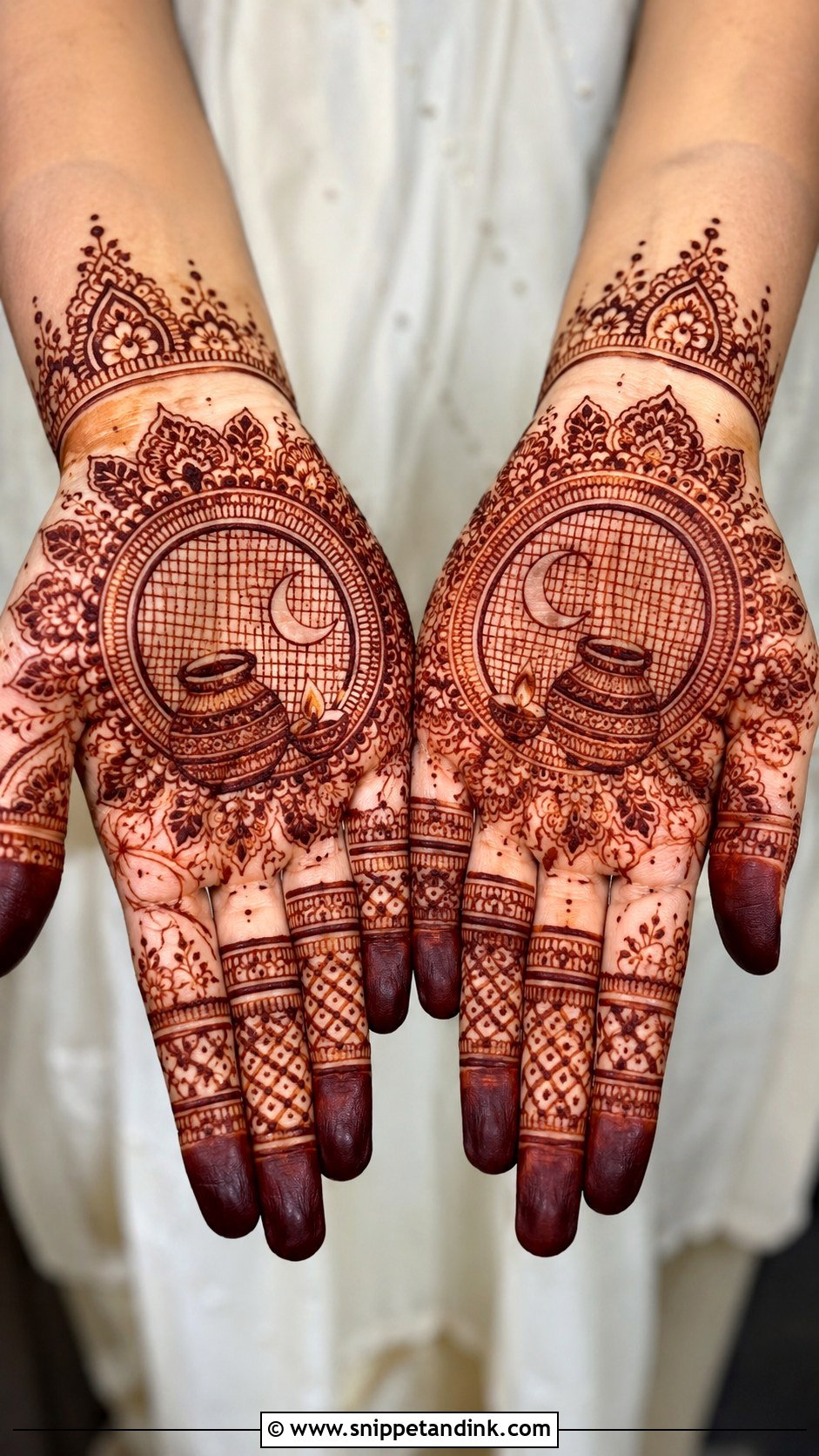
The sieve, or channi, is the object you look through at the moon and then at your husband, so it is the most ritual-specific element you can wear. I draw it as a circle with a fine crosshatch inside, usually on the palm or wrist, and I keep the mesh lines further apart than you might expect. Tight mesh fills in as the stain darkens and reads as a solid disc. Placing the sieve inside a mandala is a natural fit since both are circular. Finish with filled fingertips so the hand does not look top-heavy.
10. Karwa Pot Karva Chauth Mehndi Design
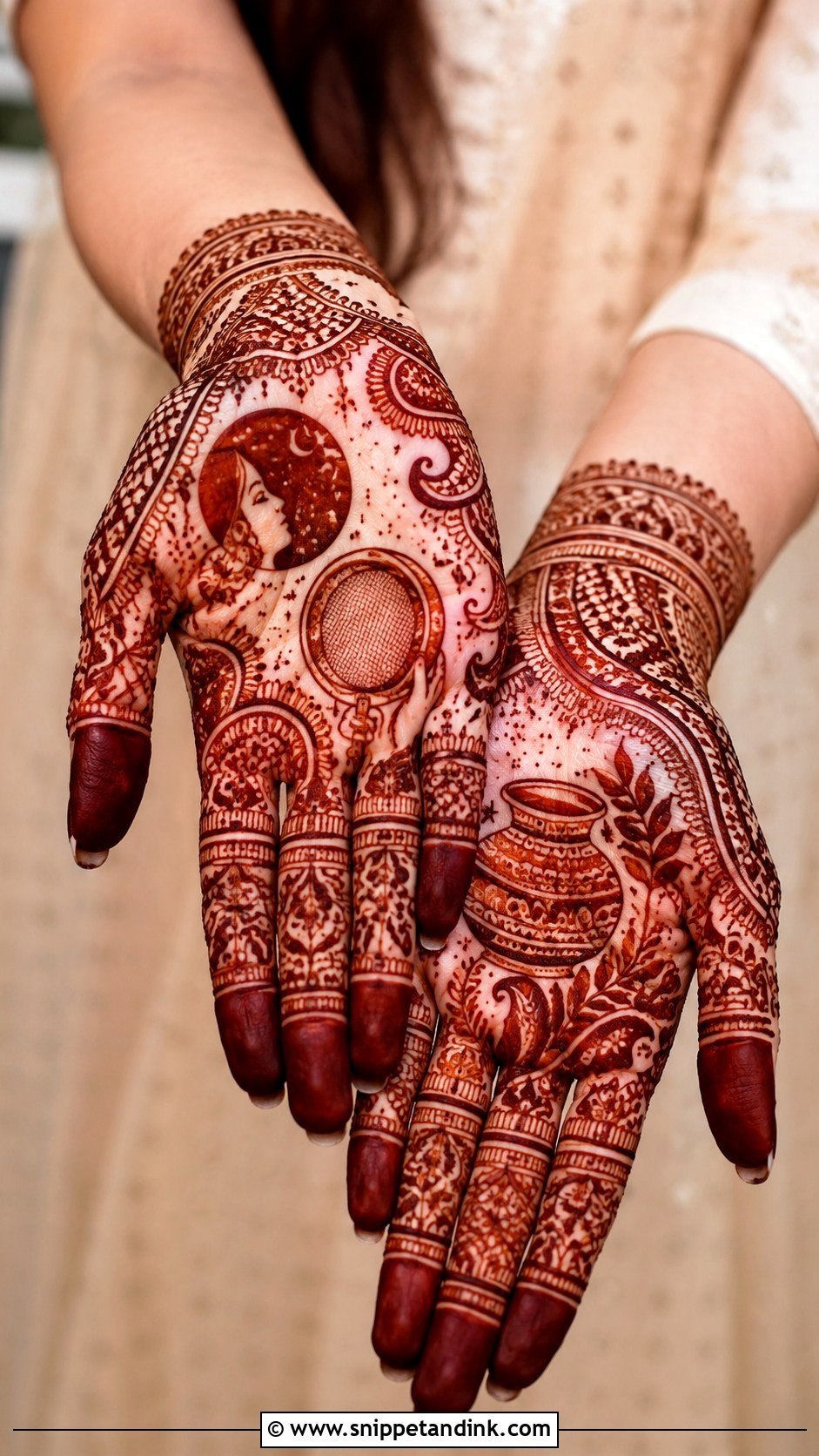
The karwa, the clay pot used in the puja, is a strong silhouette and easy to recognise even at a distance. I place it at the base of the palm or in the centre, frame it with mango leaves and small flowers, and sometimes stack the moon and sieve above it so the hand reads like a short scene. Draw the pot’s outline thick and its decoration fine. If you reverse that, the pot loses its shape once the paste comes off.
11. Mandala Karva Chauth Mehndi Design
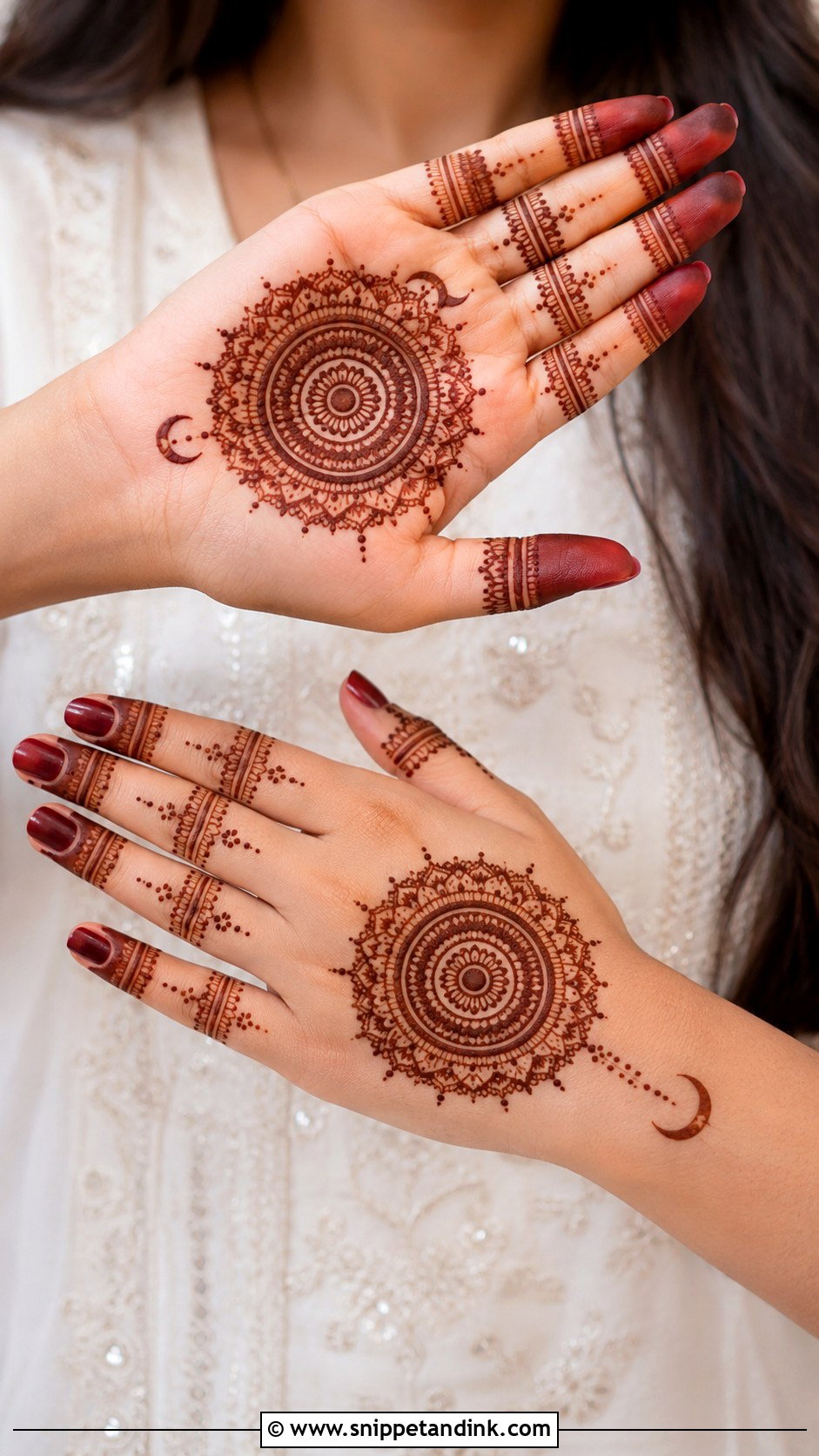
Mandalas are forgiving, which is why I suggest them to clients who are nervous about a busy hand. The circle sits in the middle of the palm or back hand with petals, dot rings and fine borders radiating out, and the fingers carry matching bands. A tiny moon or sieve can go inside the innermost ring. The one thing I check is placement: on a narrow hand, a mandala centred too low runs into the wrist crease, so I lift it slightly toward the fingers.
12. Indo Arabic Karva Chauth Mehndi Design
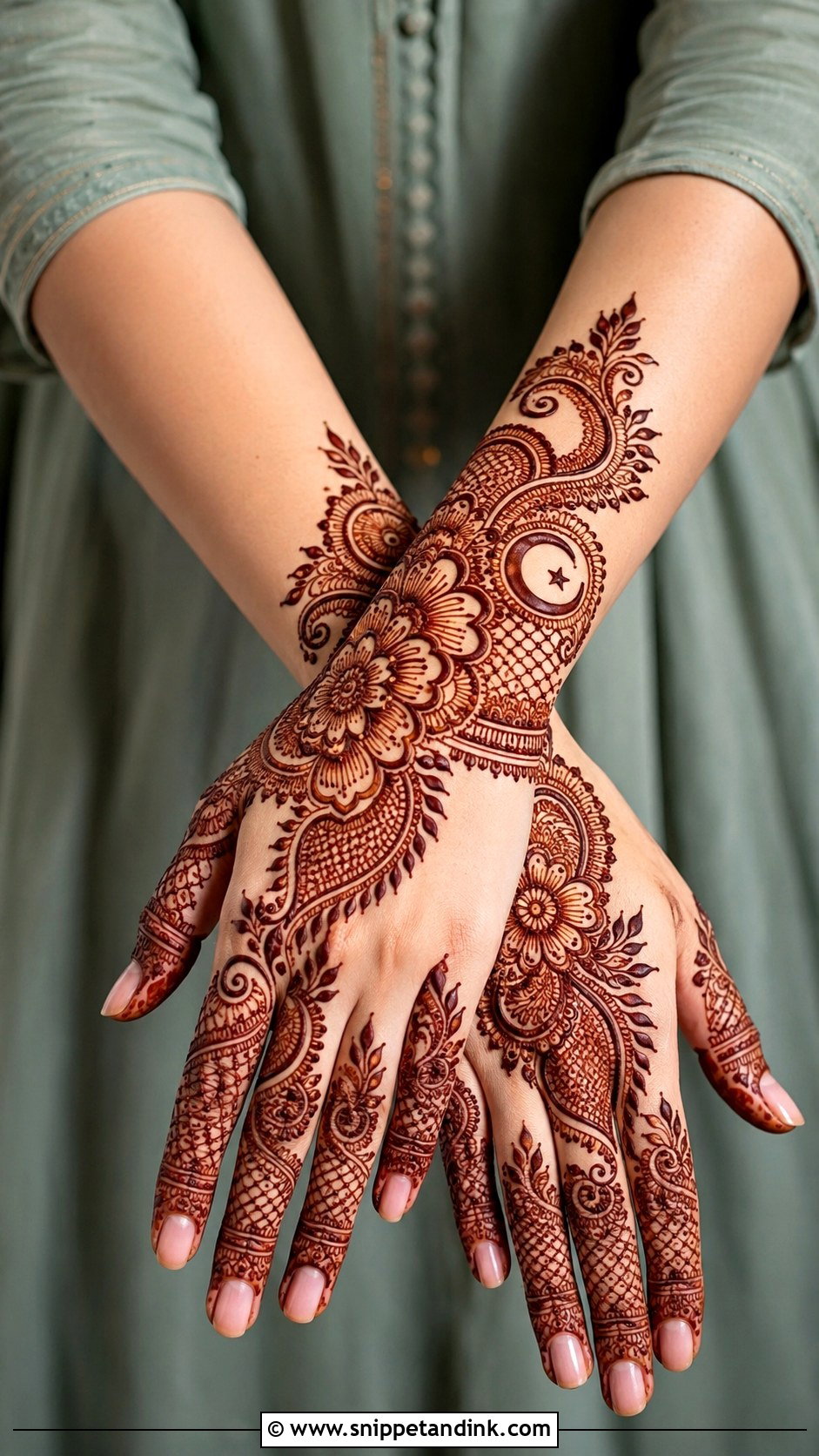
Indo-Arabic is my middle path for women who find Arabic too sparse and full Indian too heavy. The big flowers and diagonal trails come from Arabic work; the gaps between them get jaali, dots and small spirals from the Indian side. The result looks full without the four-hour sitting. I put the moon or karwa inside a large paisley or a wrist panel so it has its own frame. It suits both sides of the hand.
13. Minimal Karva Chauth Mehndi Design
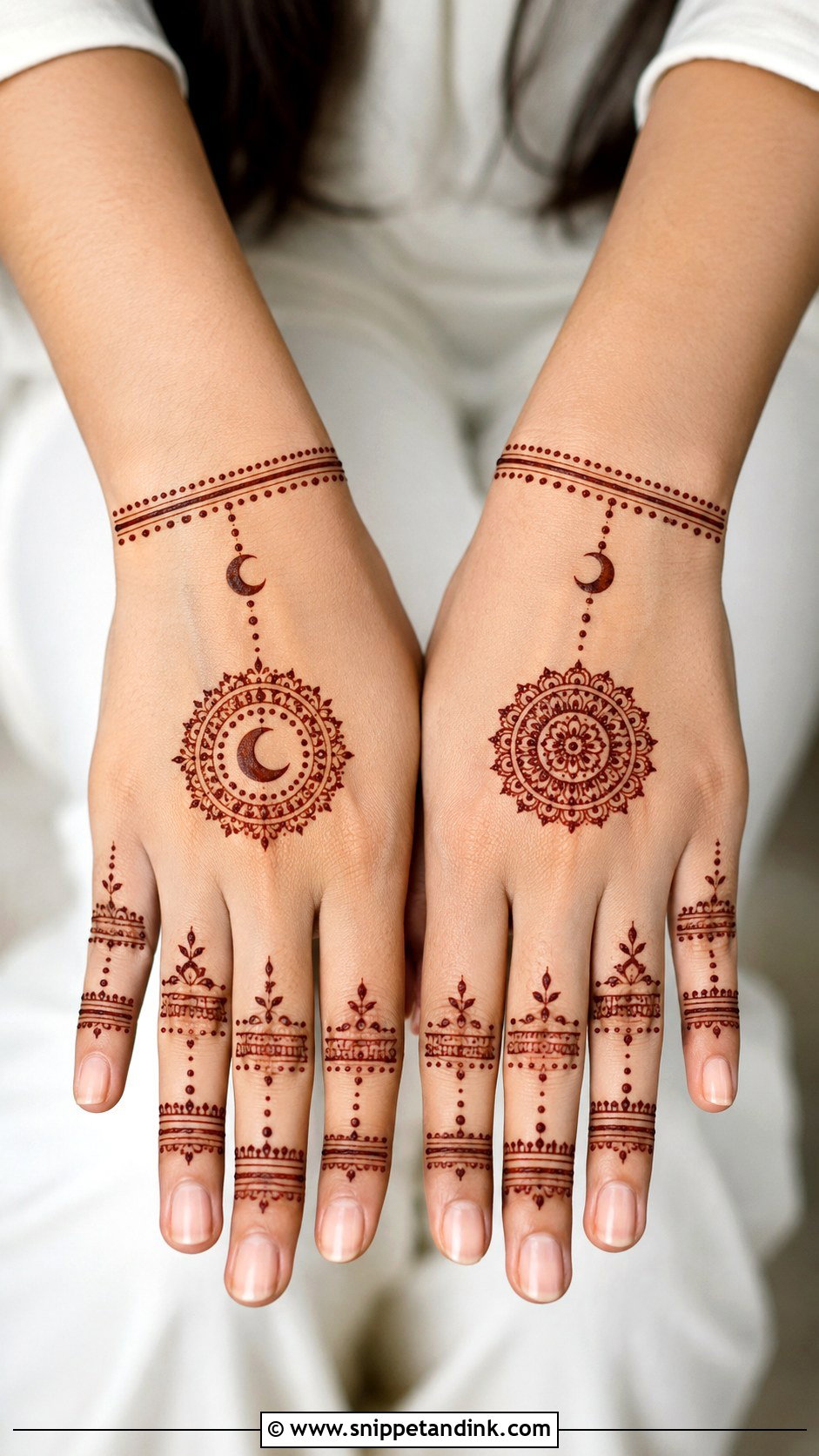
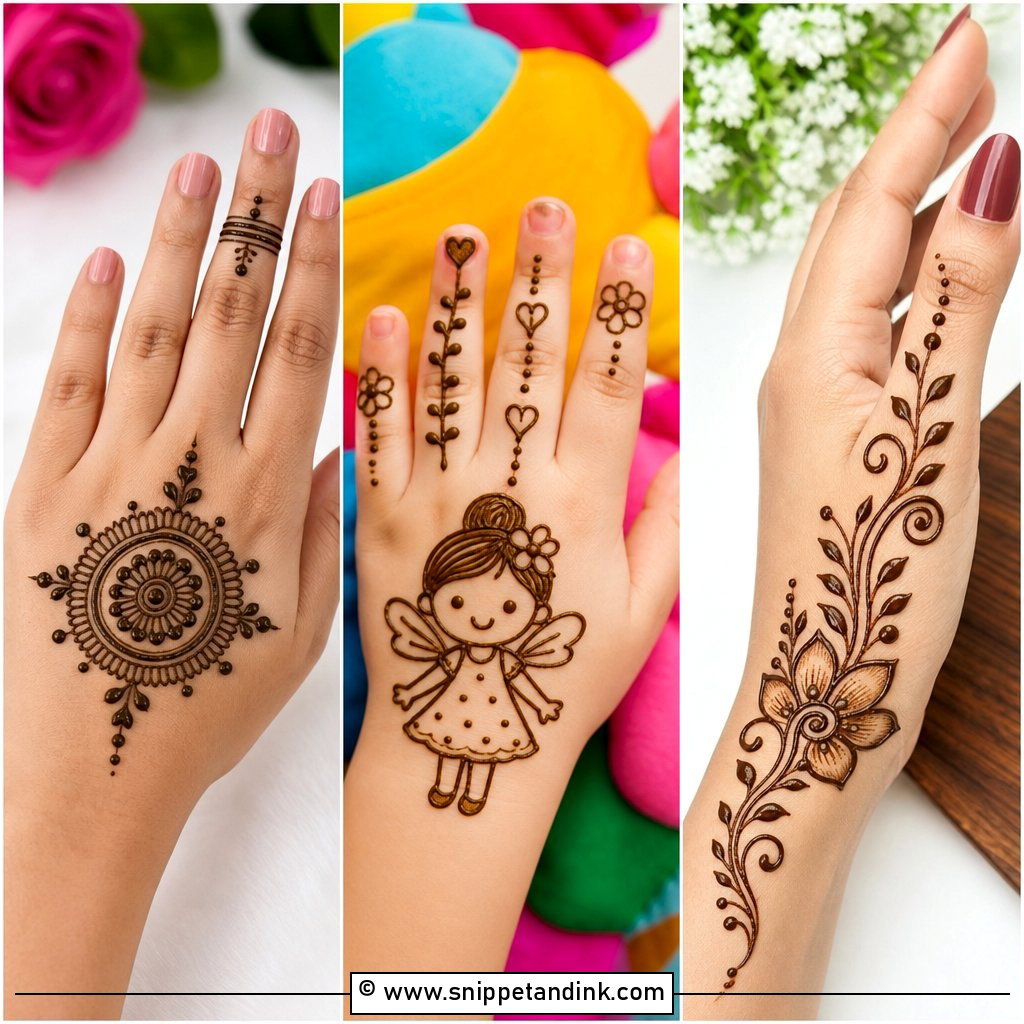
Minimal does not mean careless. With so few elements, a single wobbly line shows, so I slow down on these more than on dense work. A small moon, one clean mandala, thin finger bands and a delicate wrist bracelet are usually enough. This is the hand I draw for women heading to the office the next morning or anyone who cannot sit still for long. Add one symbolic detail, a tiny sieve or a single initial, and stop there.
14. Easy Karva Chauth Mehndi Design
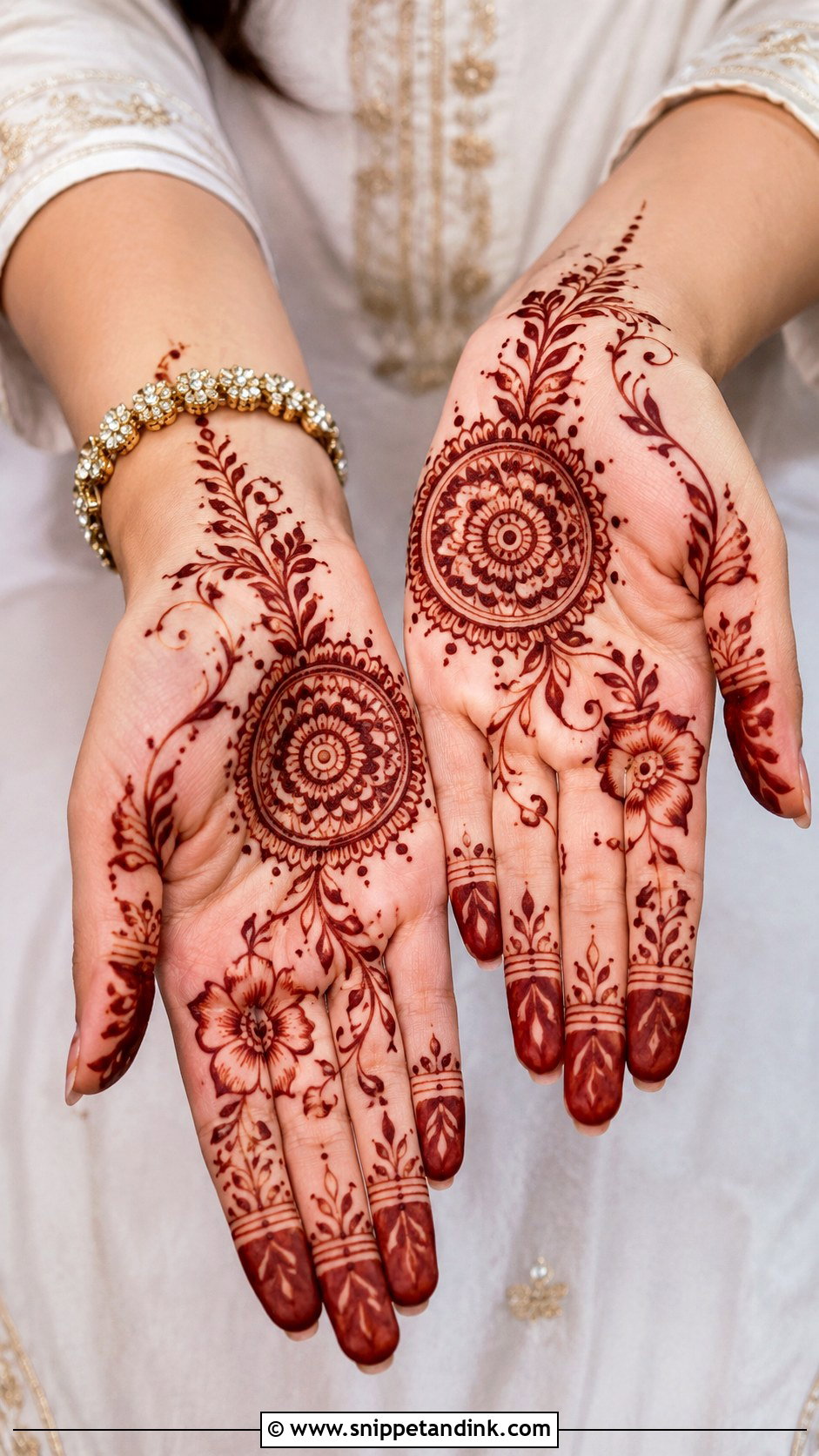
If you are drawing on yourself, design for your non-dominant hand’s ability, not your dominant one’s. Start with a round palm mandala or a diagonal floral trail, add leaves and dots, then close it with a wrist band. Big motifs are easier to control than fine filler and far less likely to smudge while you work. Practise the moon shape on paper three or four times before it goes on skin; crescents are harder to draw evenly than they look.


15. Modern Karva Chauth Mehndi Design
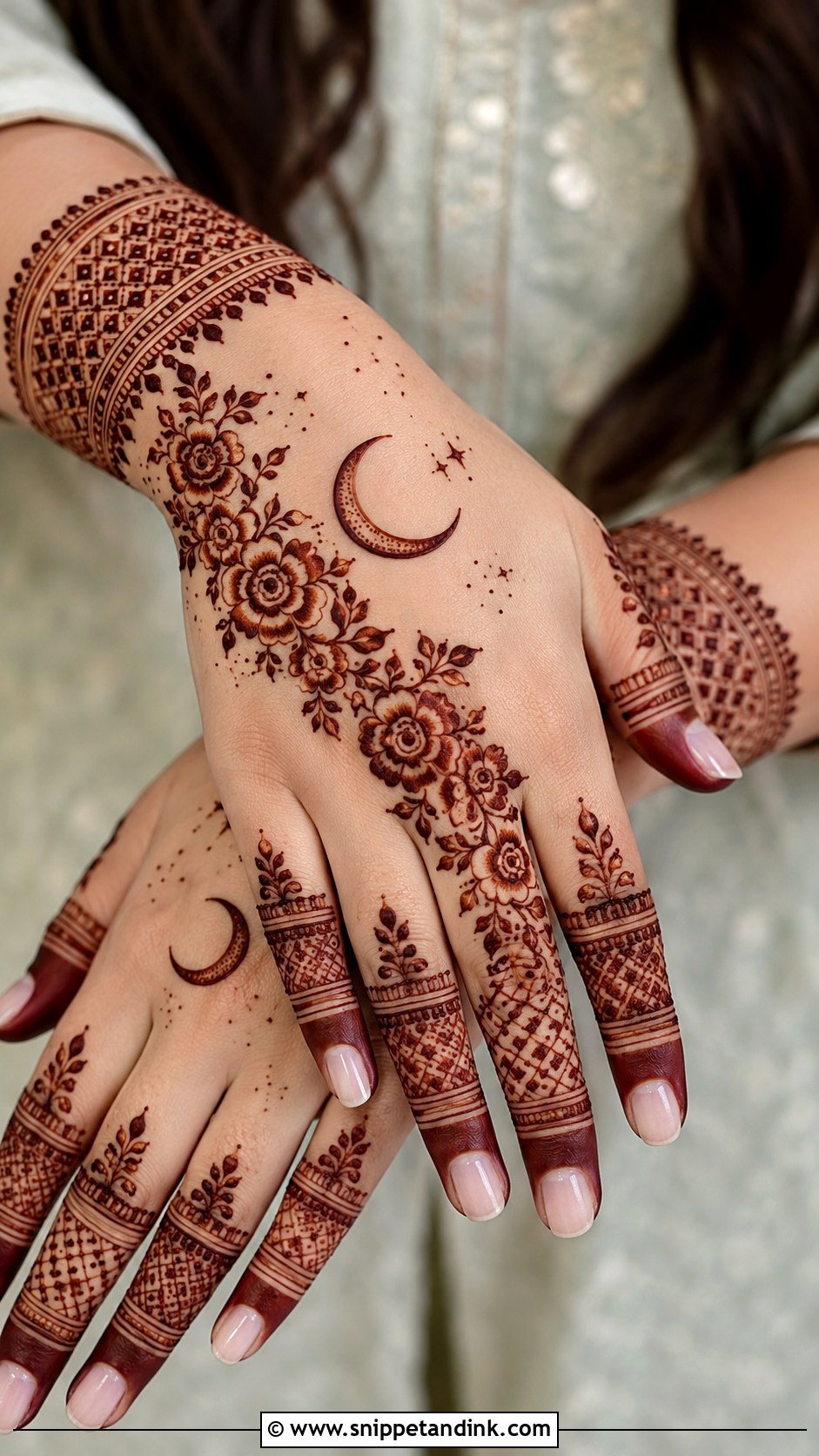
Modern layouts trade coverage for placement: a side trail along one edge of the hand, a geometric cuff, spaced florals and fine finger lines. The moon or sieve stays small and slightly off-centre rather than dominating the palm. I find this style suits fusion outfits and lighter sarees, where a fully packed hand can feel heavier than the clothes. Keep the lines crisp; with this much bare skin, there is nowhere to hide an uneven stroke.
16. Traditional Karva Chauth Mehndi Design
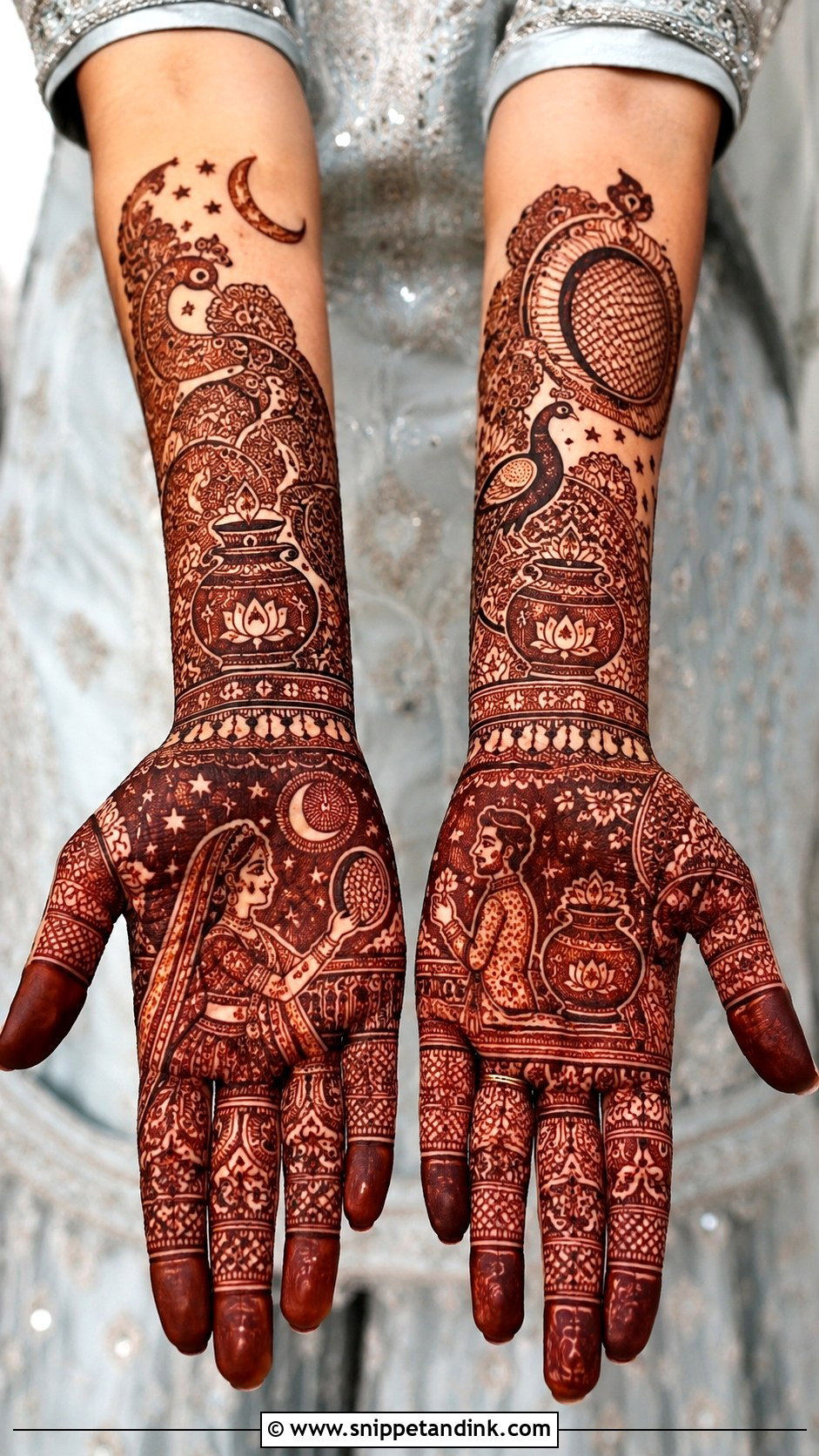
Traditional hands are dense with paisleys, peacocks, lotus, vines, mandalas and jaali, with the moon, sieve and karwa woven in. Coverage usually runs over the palm, fingers and wrist, sometimes up the forearm. If you love classic Indian mehndi, this is the style that will feel like home. My rule for keeping it legible is a clear focal motif in the centre with every filler around it smaller. When everything is the same size, a dark stain flattens it into texture.
17. Rajasthani Karva Chauth Mehndi Design
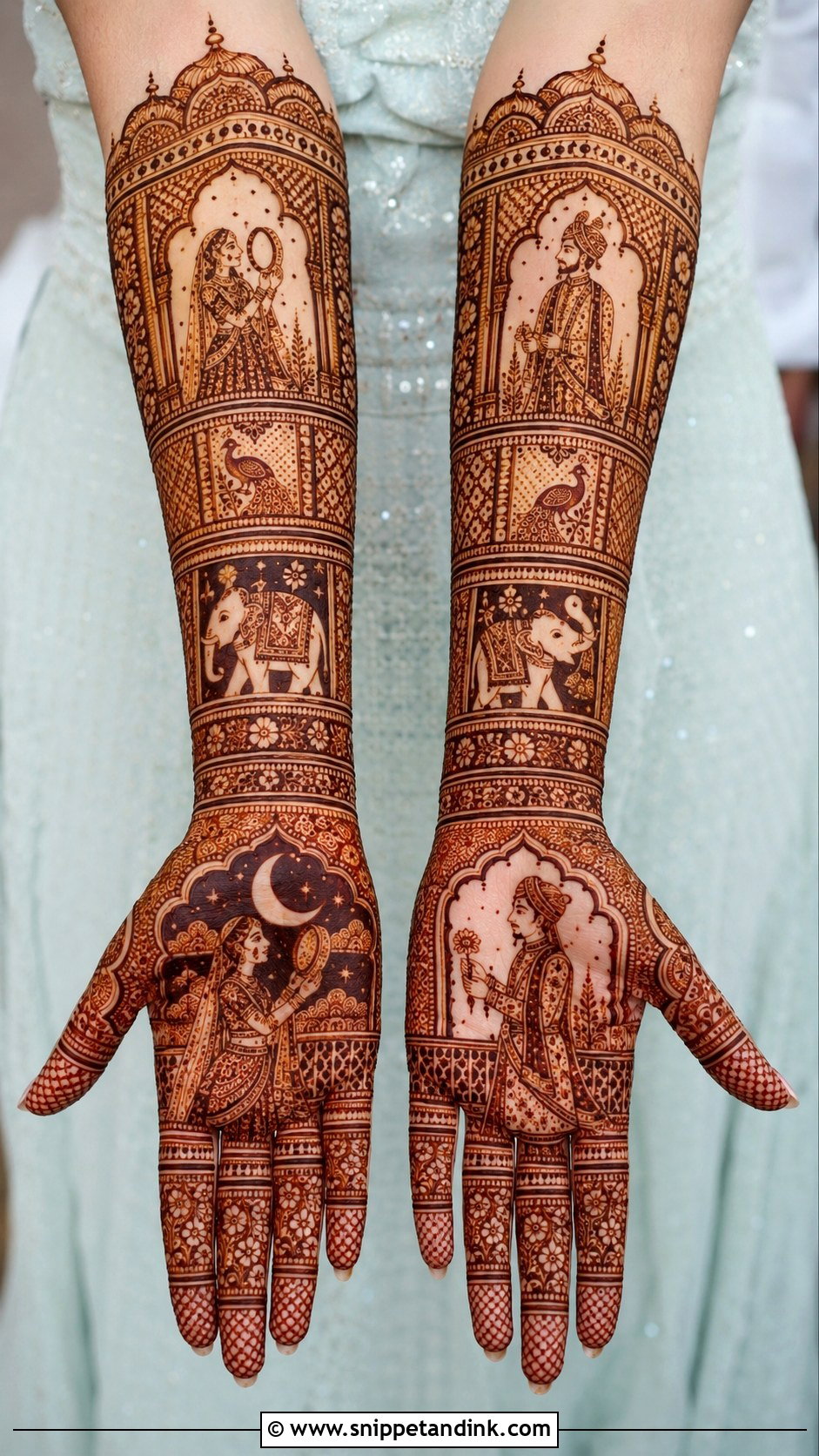
Rajasthani work tells a story in small panels: bride and groom, royal arches, peacocks, elephants and tiny borders between them. For Karva Chauth, I draw the moon-viewing scene or a couple with a karwa in the main palm panel. It needs full-hand coverage to breathe, and it needs time. Ask your artist how long she expects it to take before you book, because these designs are slow and you do not want to be rushed at midnight before a fast.
18. Marwari Karva Chauth Mehndi Design
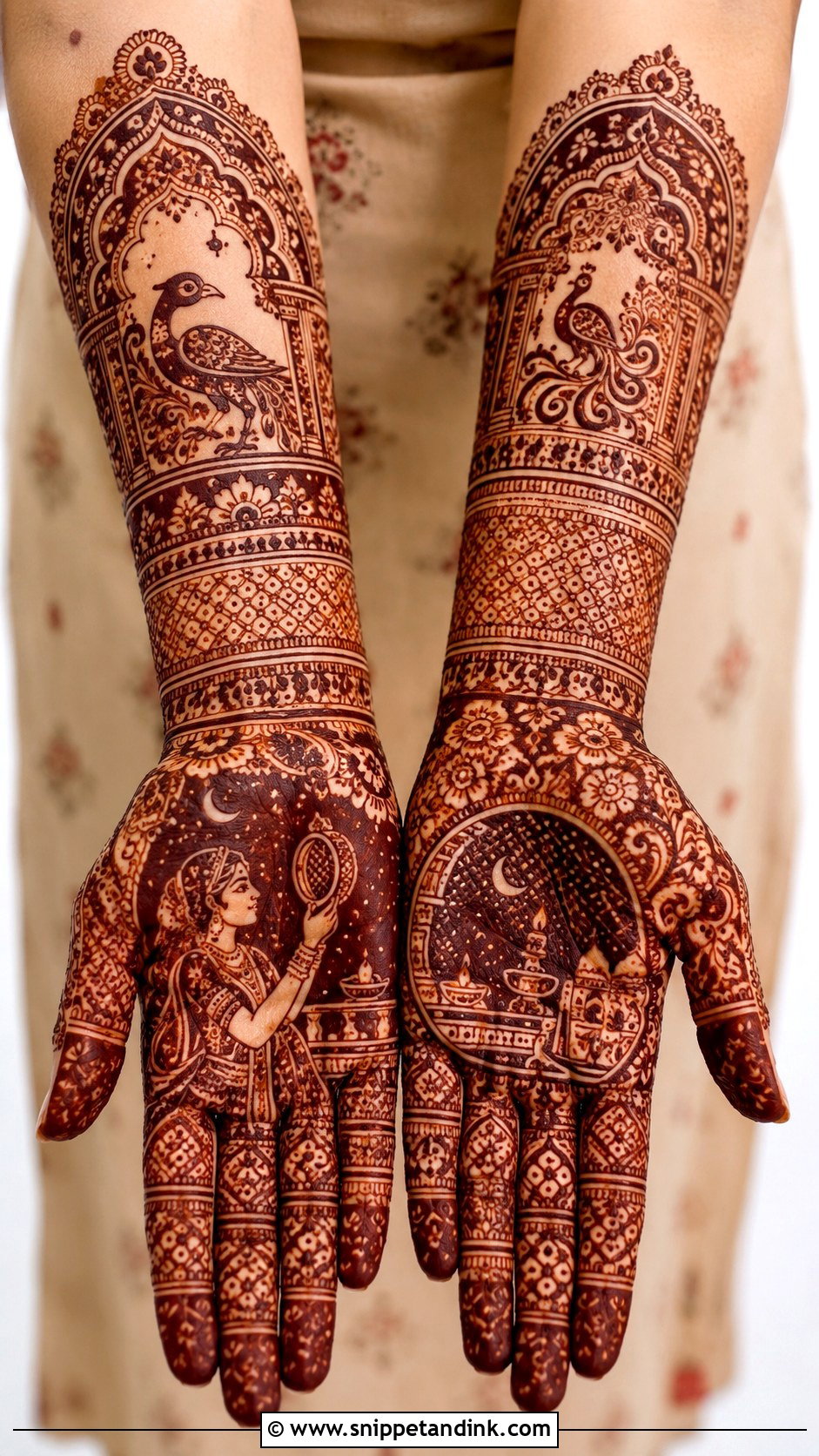
Marwari designs are the densest on this list, with heavy fillers, mirrored panels from wrist to forearm, fine vines and very little bare skin. I put a moon and sieve scene in the palm and frame it with floral bands. Fingers can be filled solid or alternated for rhythm. Fair warning: dense filler is slow to dry and easy to smudge, so plan to sit still with your hands up for a good while afterwards. It pairs naturally with heavy bangles and a traditional saree or lehenga.
19. Peacock Karva Chauth Mehndi Design
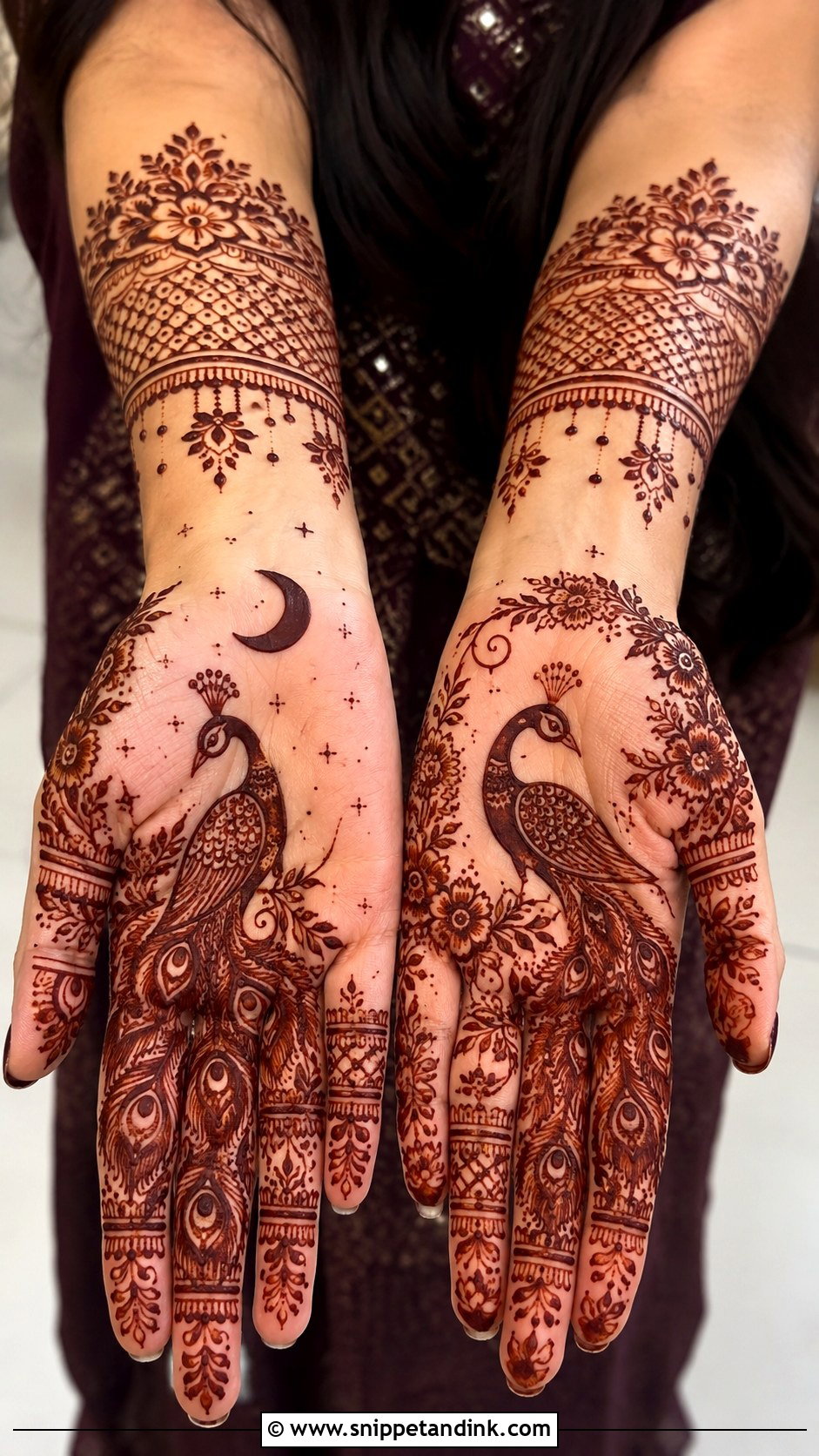
A peacock gives the hand movement. I draw the body clean and narrow, then let the tail feathers spread across the palm or down the wrist, and that is where the fine detail lives: small curves, dots and paisley eyes. For the festival, the moon or a karwa sits near the wrist so it does not compete with the bird. Keep the neck and head simple. A detailed head is the first thing to blur.
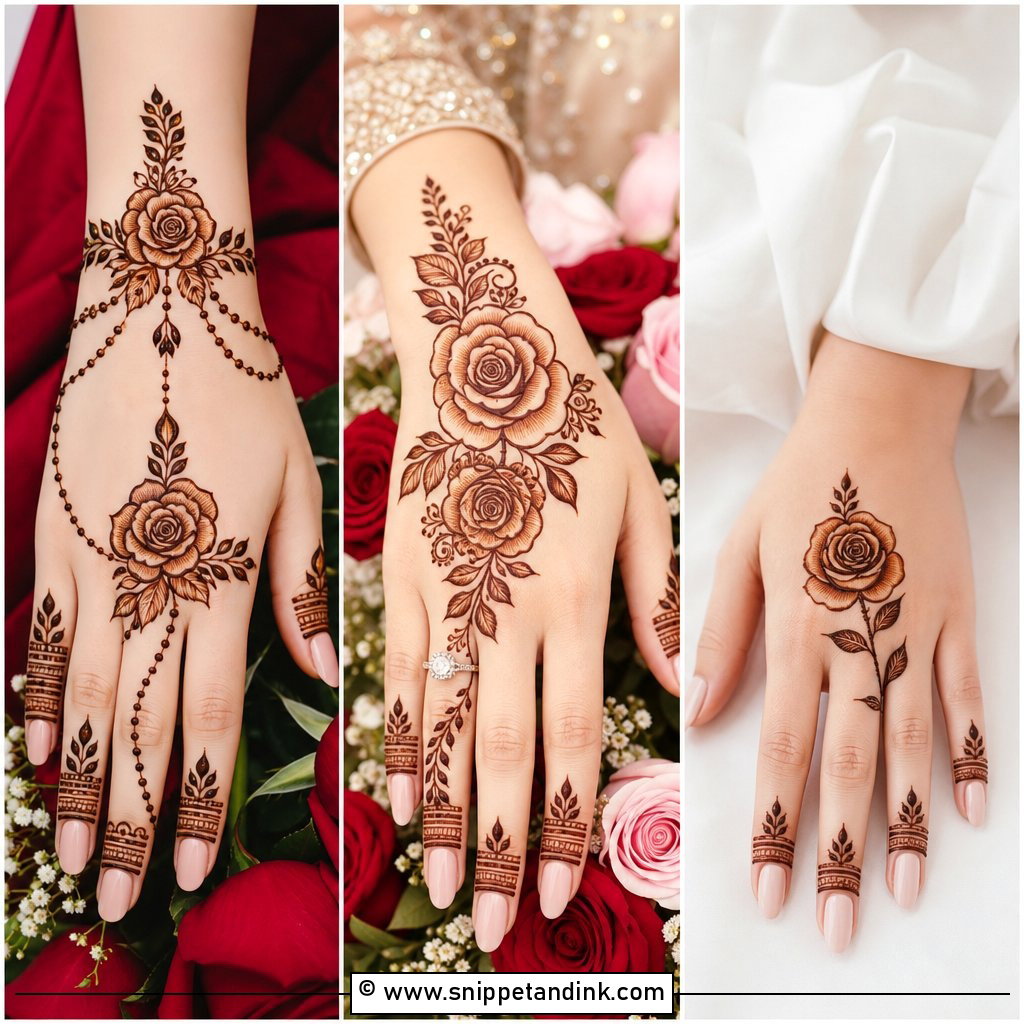
20. Floral Karva Chauth Mehndi Design
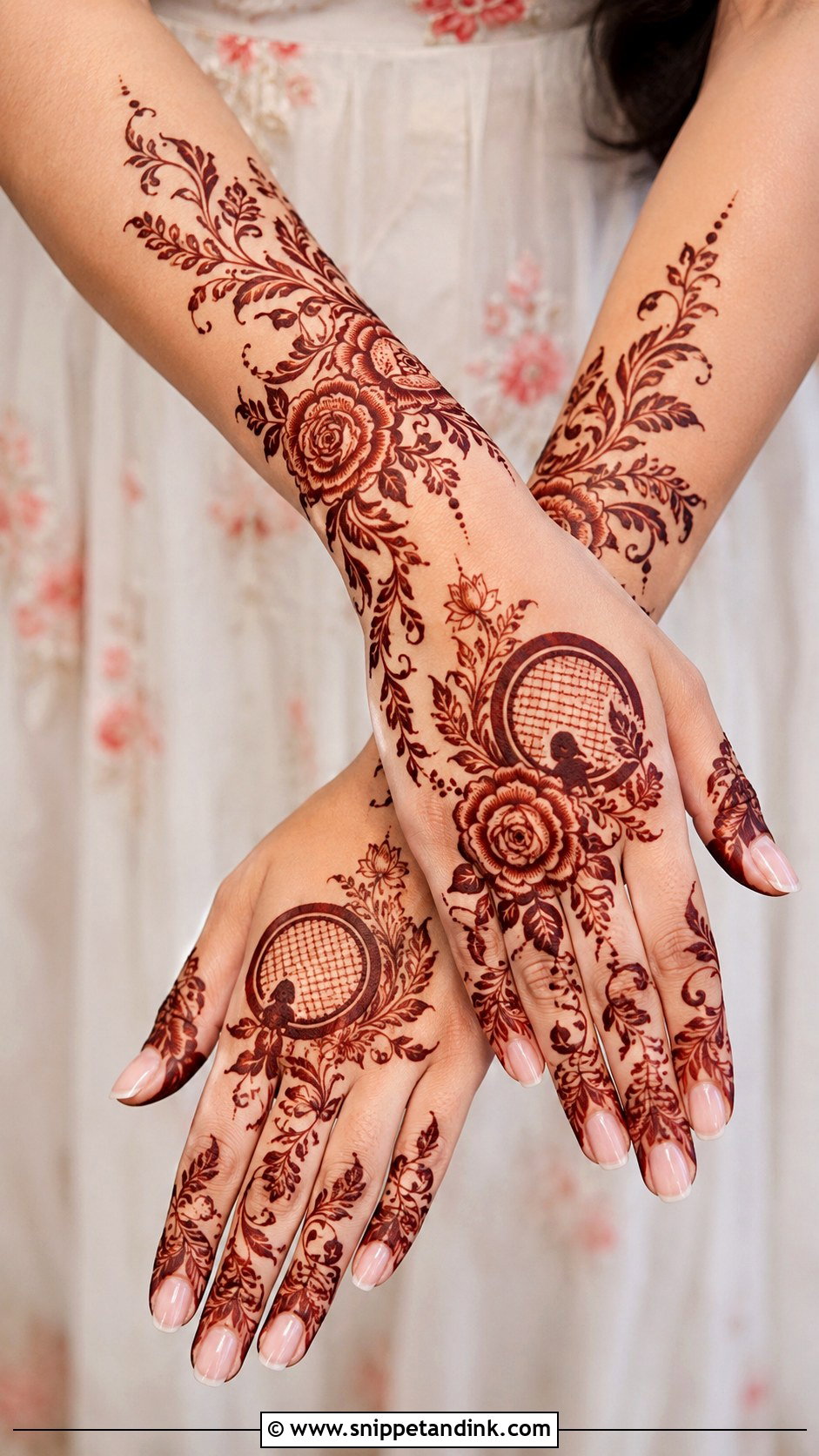
Florals adapt to any hand size because flowers can grow or shrink to fit. I use roses and lotus as anchors with smaller blossoms and leafy vines trailing toward the wrist, and I outline the main flowers boldly with finer detail inside the petals. To make it belong to Karva Chauth, a small moon or sieve sits among the flowers. On a short palm, use fewer, larger flowers rather than many small ones.
21. Paisley Karva Chauth Mehndi Design
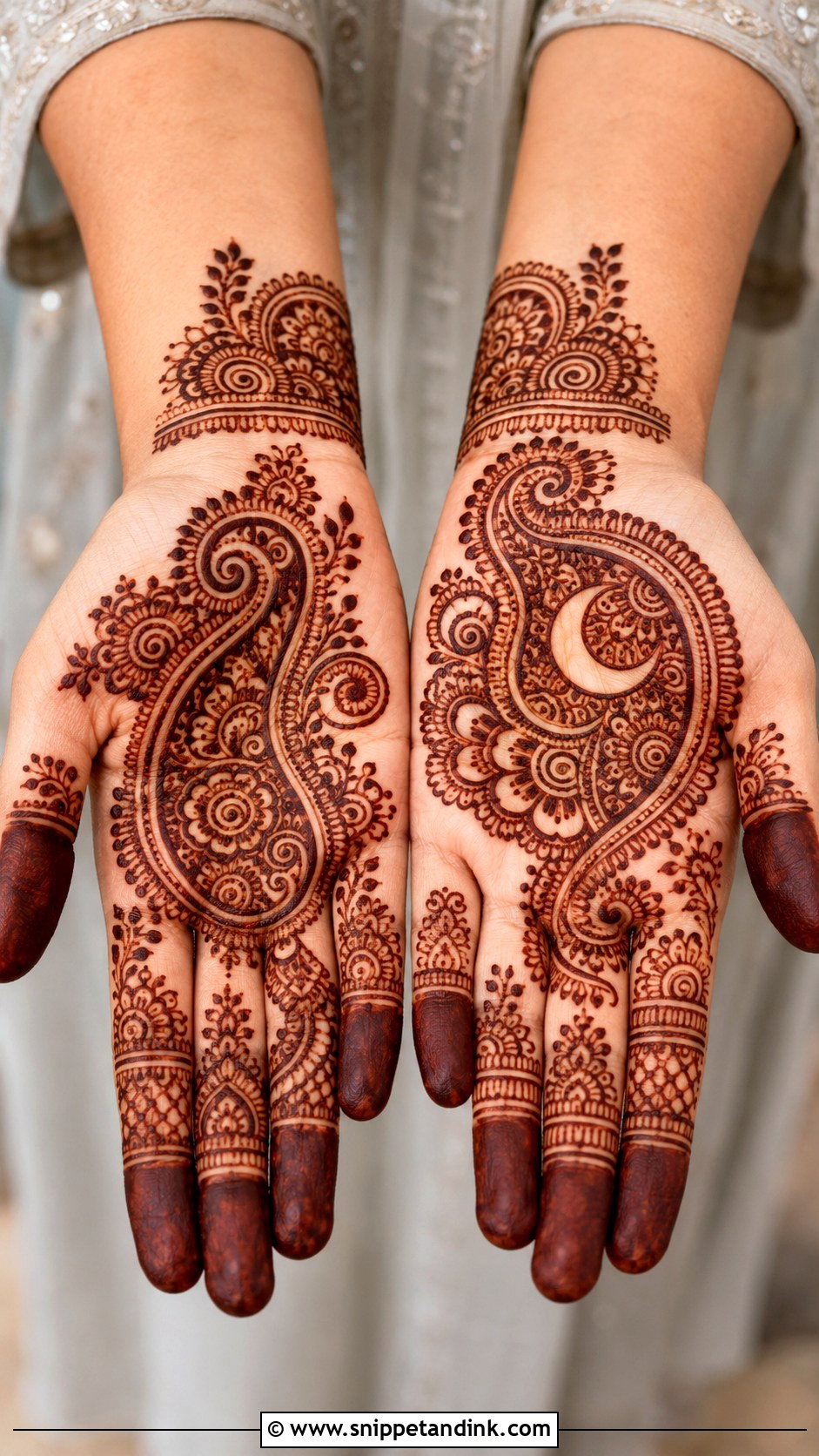
The paisley, or mango shape, fills space better than almost any other motif, which is why it shows up in nearly every traditional hand. I arrange them in curved chains across the palm and fingers, then fill each one with dots, petals or fine mesh. One oversized paisley in the centre of the palm is a natural frame for a moon, karwa or initials. On the front hand there is room for large ones; on the back, I scale them down by about half.
22. Jaali Karva Chauth Mehndi Design
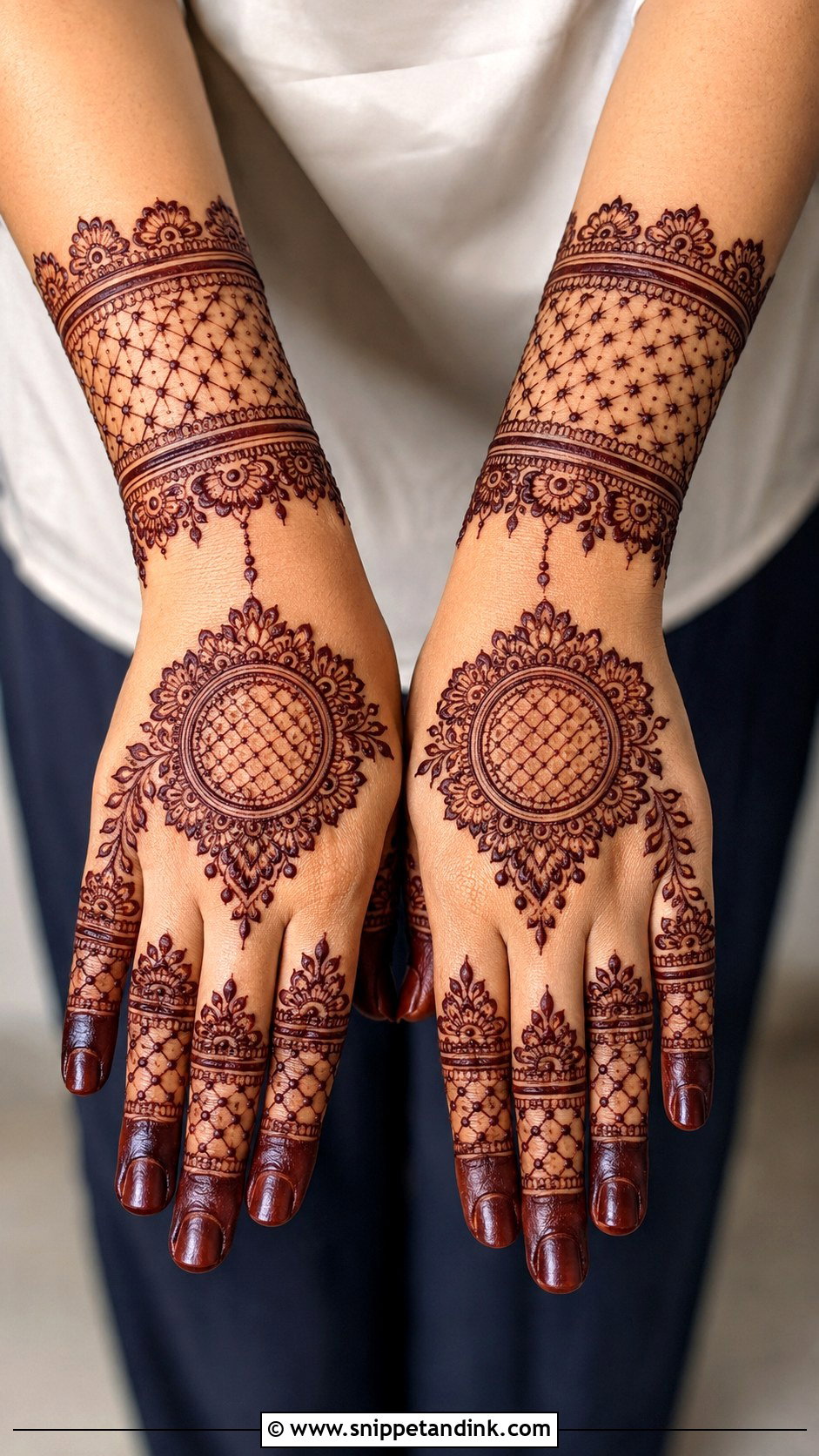
Jaali is net work, and it reads like lace or fine jewellery when done well. I use it on the back hand, along the palm edges, on fingers and in wrist cuffs, with a dot at each crossing point. The grid is where cone control is tested: uneven spacing shows immediately. If you are booking someone for this, ask to see close-ups of their mesh before anything else. A moon inside a circular frame surrounded by jaali makes a quietly festive hand.
23. Finger Karva Chauth Mehndi Design
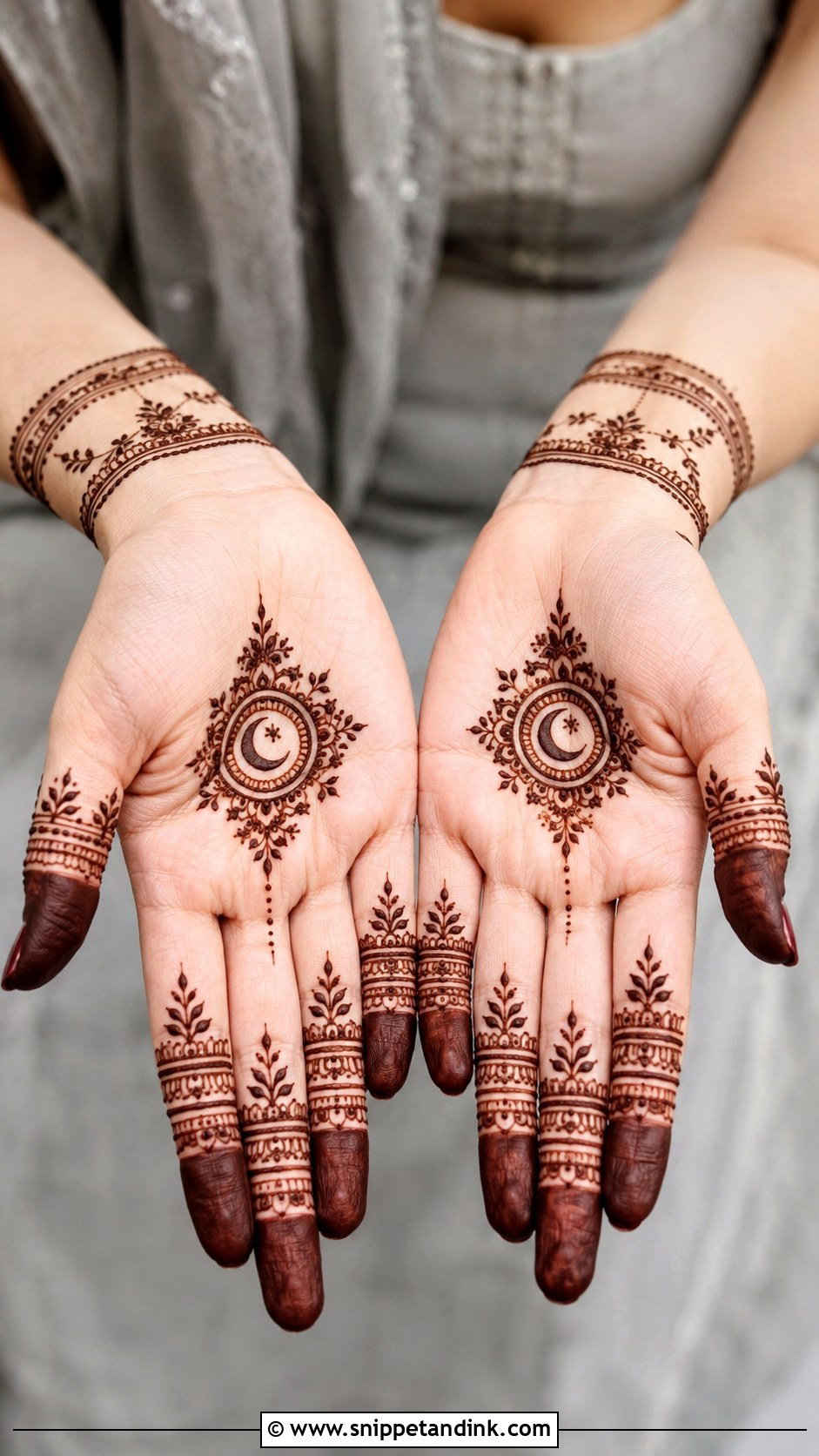
Finger-focused designs keep most of the decoration on the fingers, with a lighter palm or back hand carrying a small mandala or moon. Fingertips stain deeply, so even a light design comes up strong. Less paste on the hand also means it dries faster and is easier to protect overnight. I check that all five fingers carry equal weight; one heavy finger next to light ones makes the hand look lopsided.
24. Bracelet Karva Chauth Mehndi Design
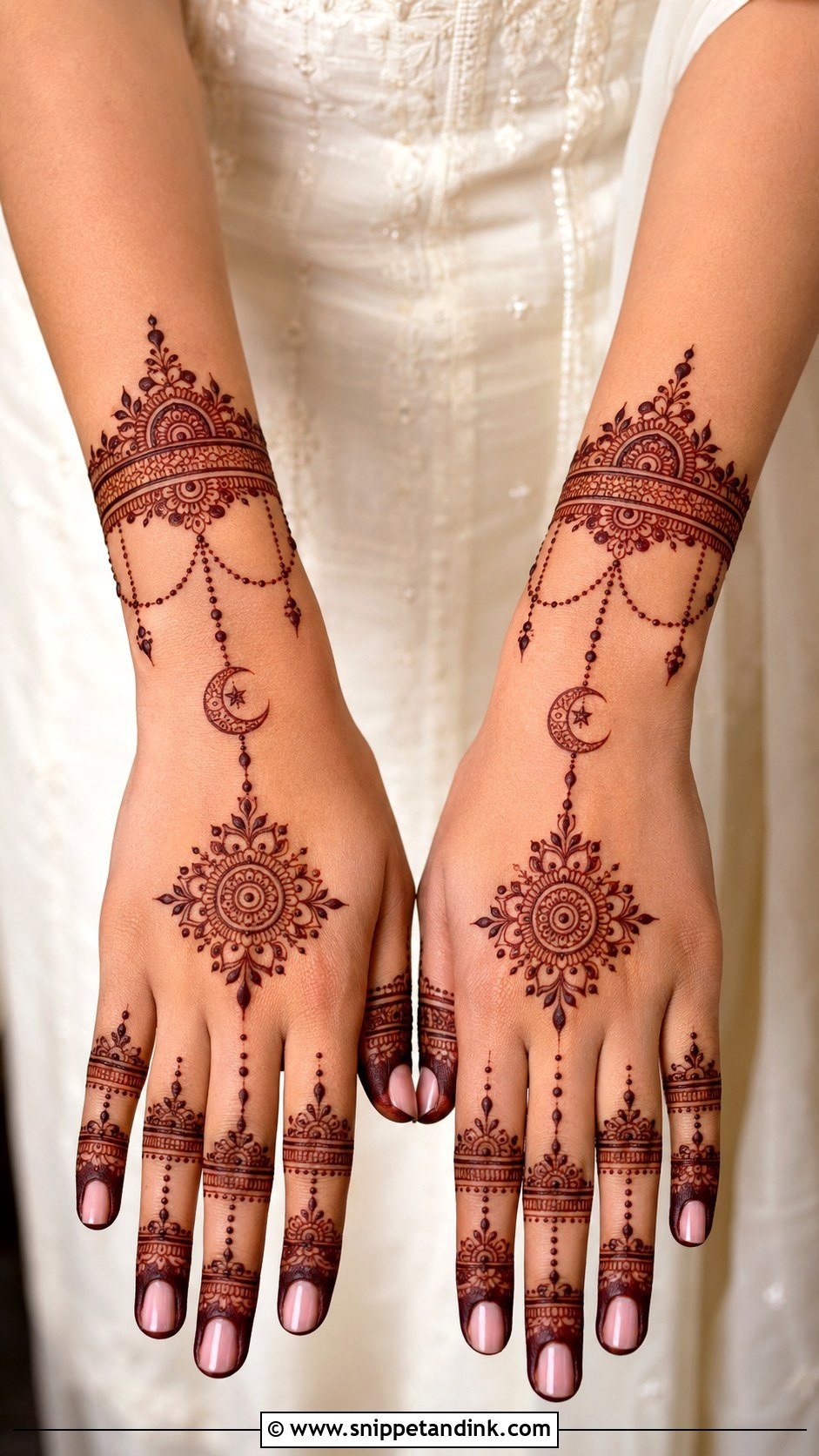
Bracelet mehndi imitates hand jewellery: a wrist cuff, chains running up to the fingers, ring bands and a central motif on the back of the hand linking them. I add a tiny moon as if it were a charm hanging from the chain. This sits on the back hand, where the effect is visible, and it looks like an extension of your bangles. The wrist band needs to be symmetrical. I mark its edges with dots before drawing, because a slanted cuff is obvious once you put bangles next to it.
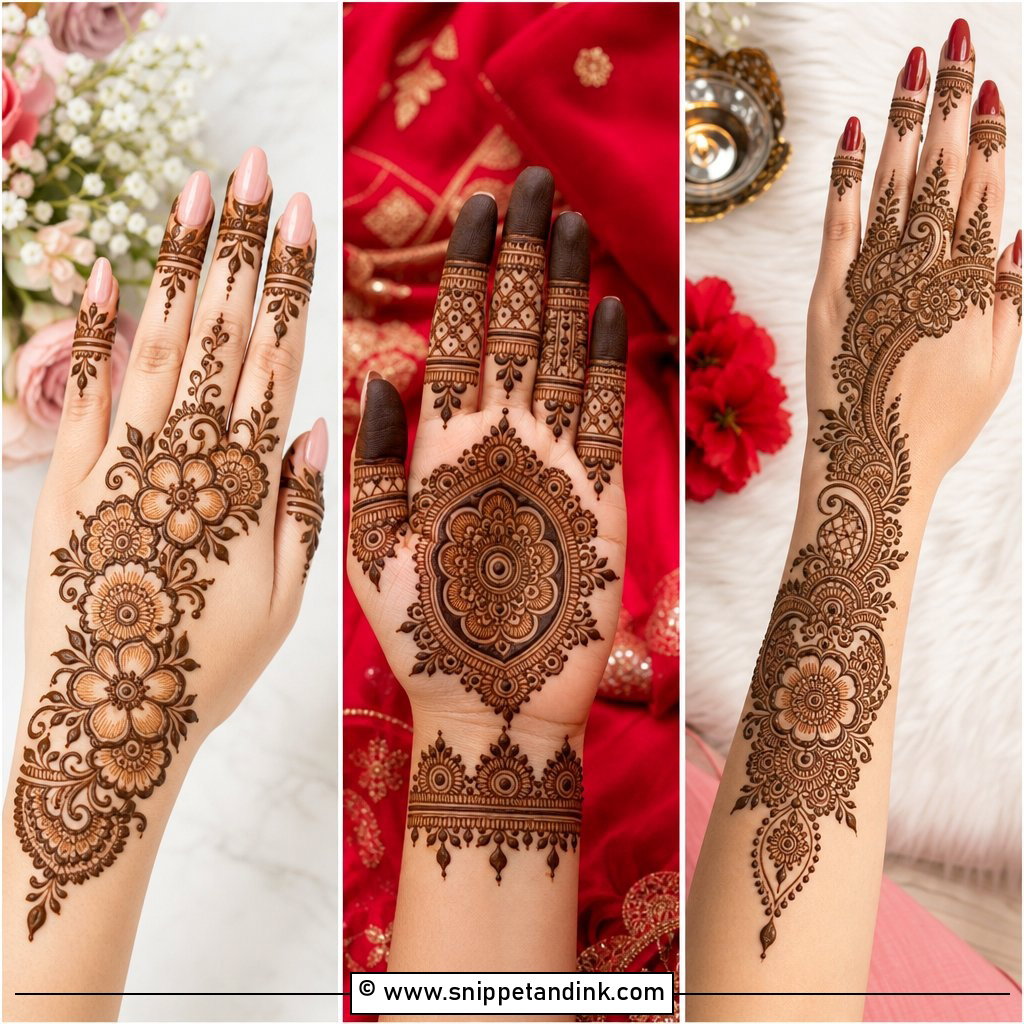
25. Half Hand Karva Chauth Mehndi Design
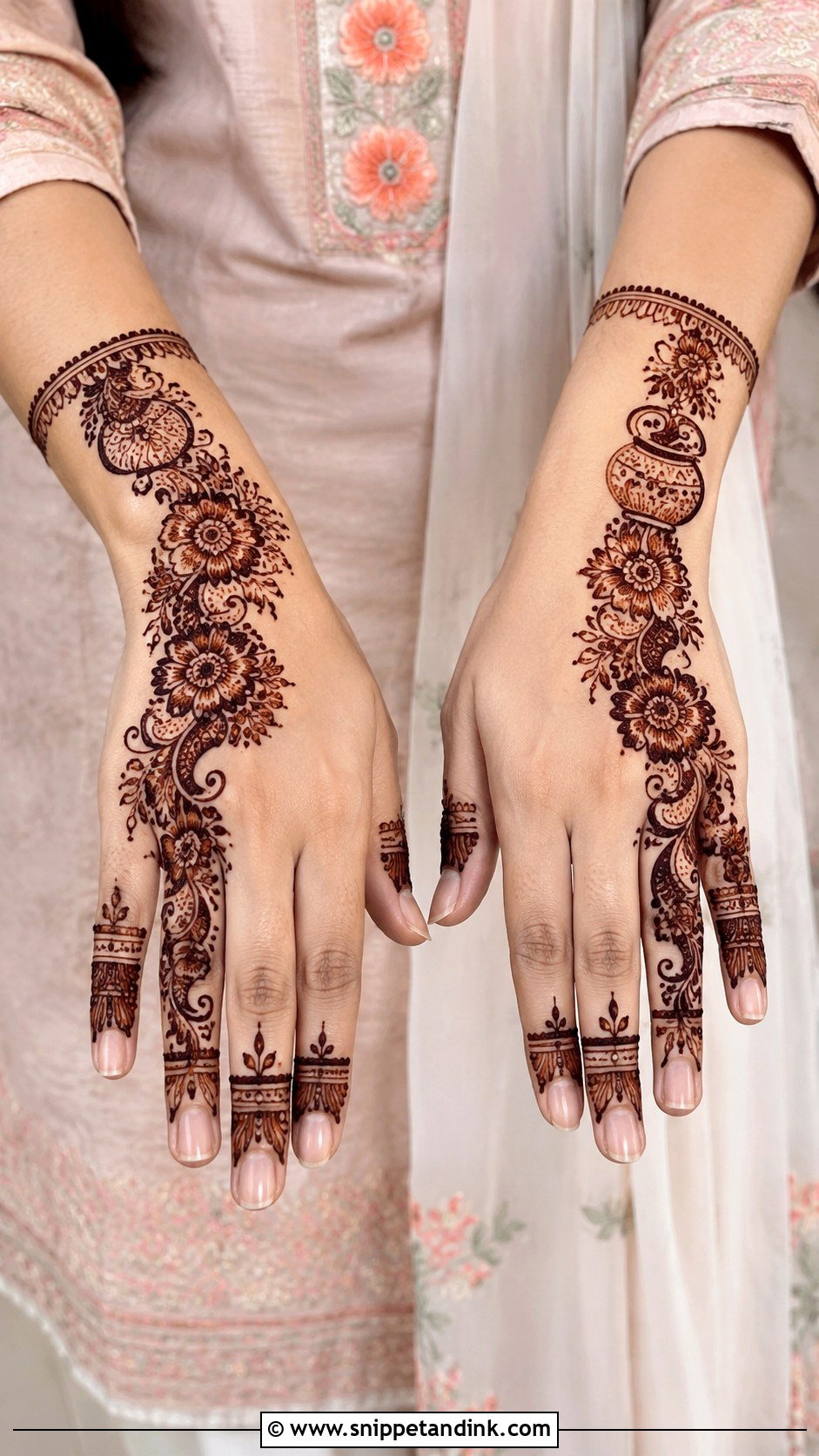
Half-hand designs stop at the middle of the palm or partway up the forearm. I like them for women who are also cooking for the evening, because there is less paste to protect and you can still use part of your hand. Choose a diagonal Arabic trail, a palm mandala or a back-hand floral chain, and add one moon, sieve or karwa. The border where the design ends must be finished deliberately, with a clean scalloped edge or a band, otherwise it looks like the artist ran out of time.
26. Full Arm Karva Chauth Mehndi Design
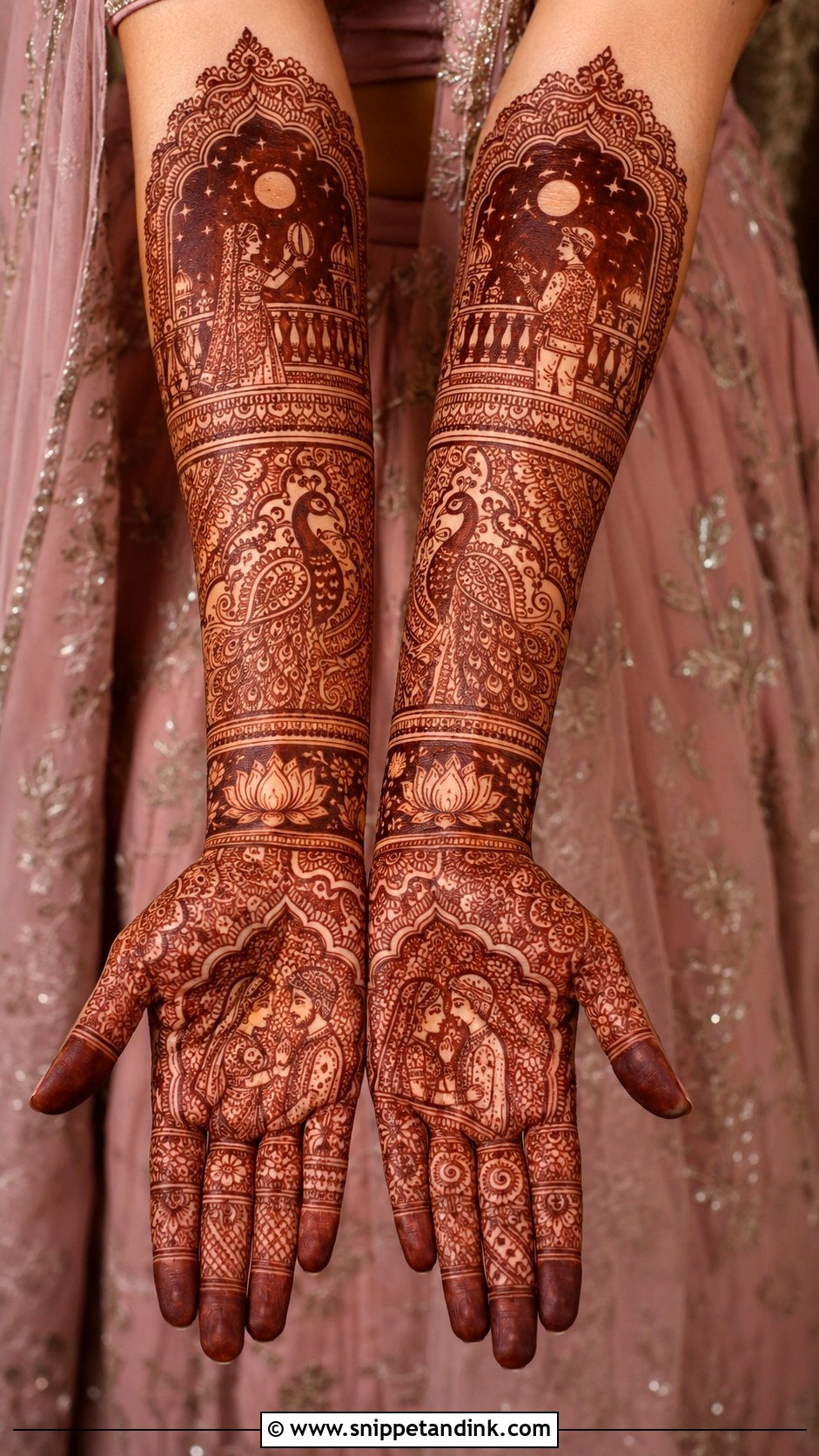
Full arm coverage goes past the wrist and up the forearm in panels of florals, paisleys, peacocks and festival scenes: a moon-viewing moment, a couple, a karwa, sometimes palace-style arches. Expect the forearm to stain noticeably lighter than the palm; that is normal and I design the panels with bolder lines to compensate. Large coverage also needs open spaces between panels or the stain goes muddy. Short or sheer sleeves show the work best.
27. Portrait Karva Chauth Mehndi Design
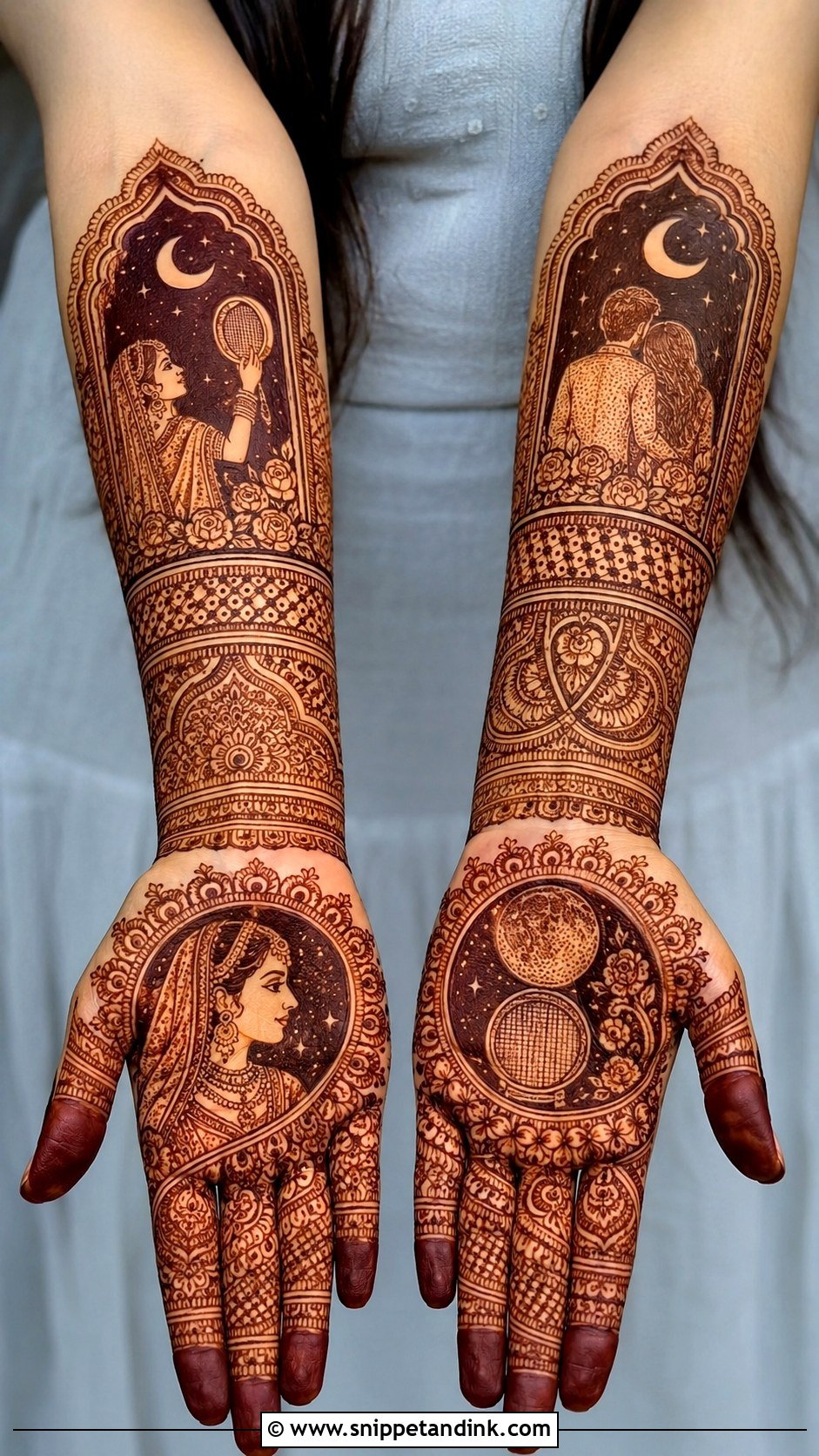
Portraits are the hardest thing I draw. A bride looking at the moon, a couple facing each other, or the husband offering water after moonrise all depend on faces staying readable after the stain spreads. I keep each face at least the size of a thumbprint and limit the features to the essentials. Book an artist whose portfolio shows stained portraits, not just fresh paste photos, because dark brown paste hides mistakes that the stain later reveals. The rest of the hand stays in supporting paisleys and borders.
28. Love Story Karva Chauth Mehndi Design
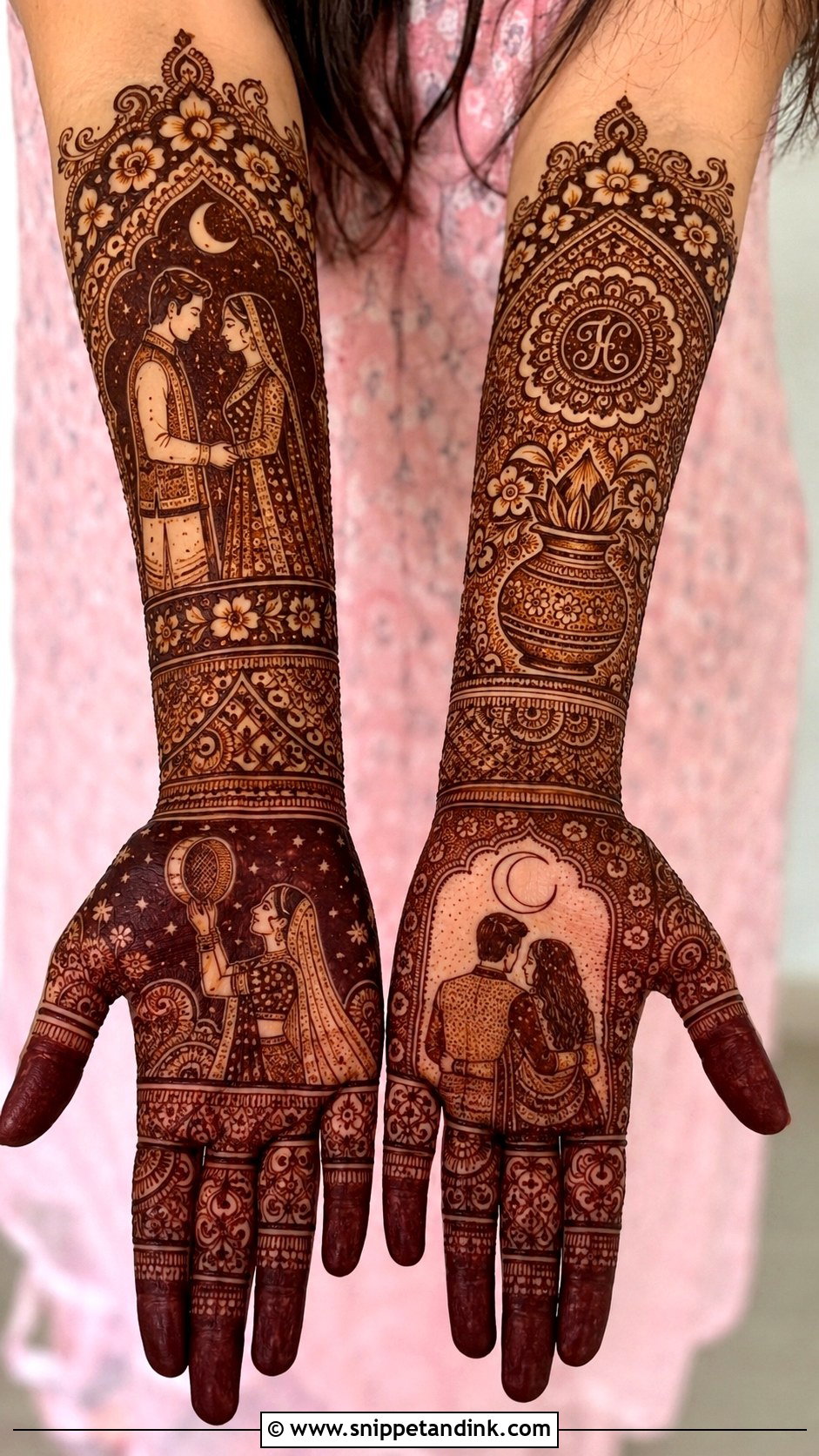
A love-story hand is a small scene: the couple, the moon, the sieve, the karwa and decorative frames. Some women add the wedding date or a tiny hidden name for their husband to find. It needs a full hand or wrist-to-forearm space. My advice is one main scene, supported by smaller florals and borders; two or three scenes on a single palm compete with each other and none of them reads clearly.
29. Name Karva Chauth Mehndi Design
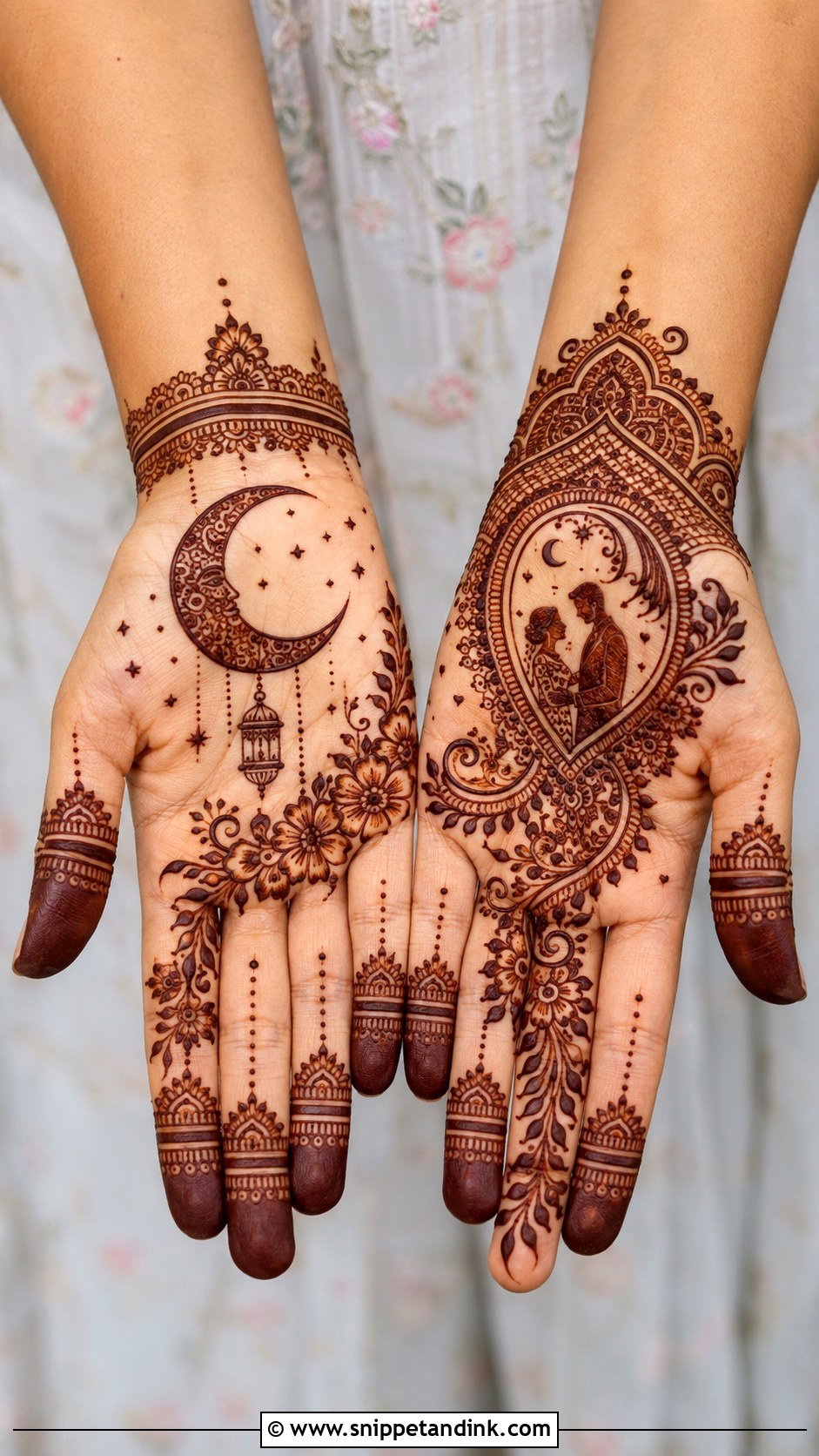
Names and initials are the most personal detail you can add. I hide them in a paisley, along a wrist band, beside the moon or inside a floral trail, and the game of your husband searching for his name is part of the fun. Write the letters bigger than feels natural. Henna lines thicken slightly as they stain, and small lettering closes up, especially letters like a, e and o. Surround the name with leaves and dots so it sits inside the design rather than on top of it.
30. Lotus Karva Chauth Mehndi Design
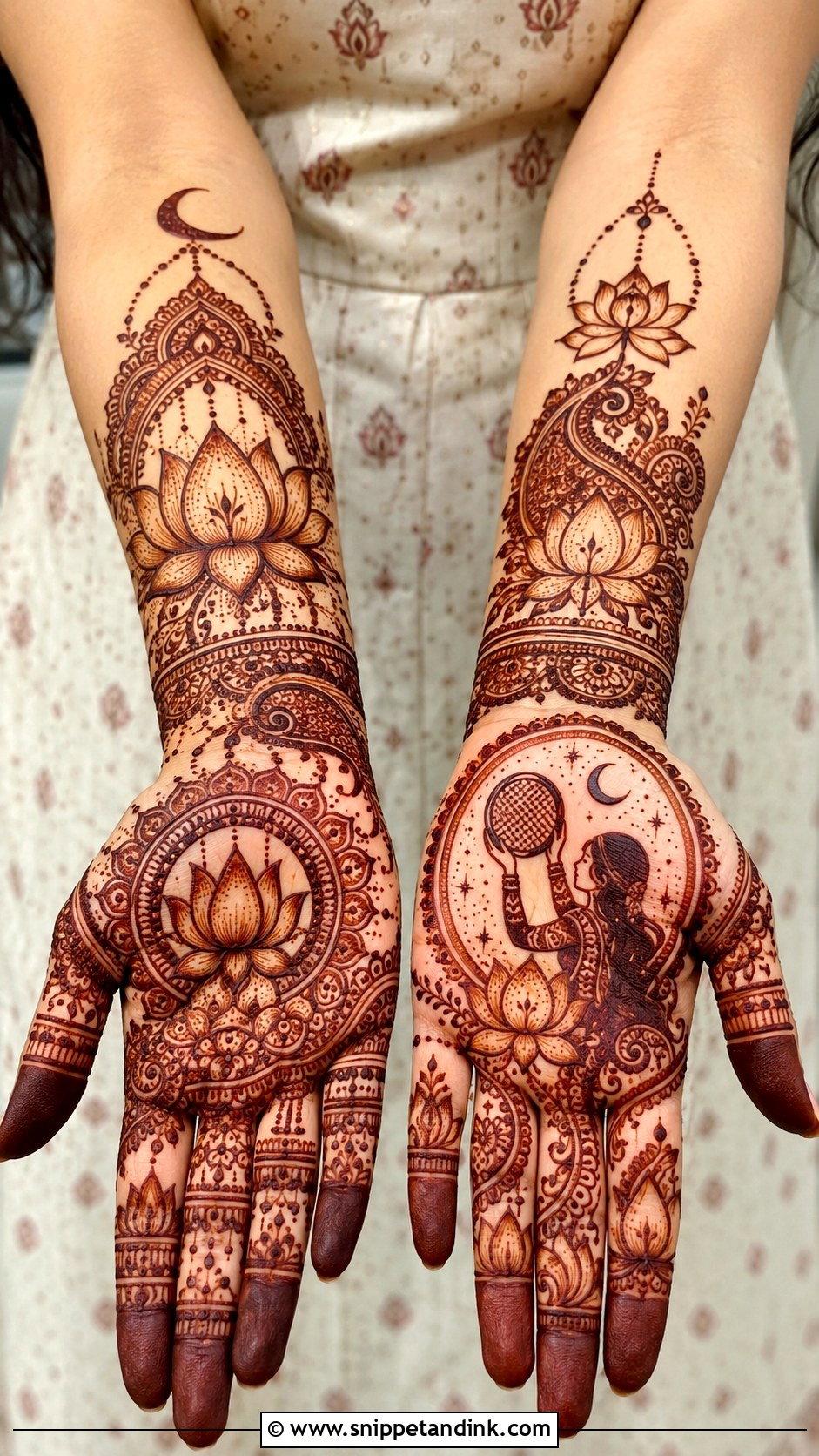
Lotus motifs suit the devotional mood of the evening. I place a lotus in the centre of the palm, along the wrist cuff or as part of a back-hand trail, and use the petals for fine line work and shading. A moon above the flower is a quiet way to tie it to the festival. The lotus can stay open and minimal or sit inside dense Indian filler. I find it pairs especially well with silk suits and sarees in single, solid colours.
31. Moroccan Karva Chauth Mehndi Design
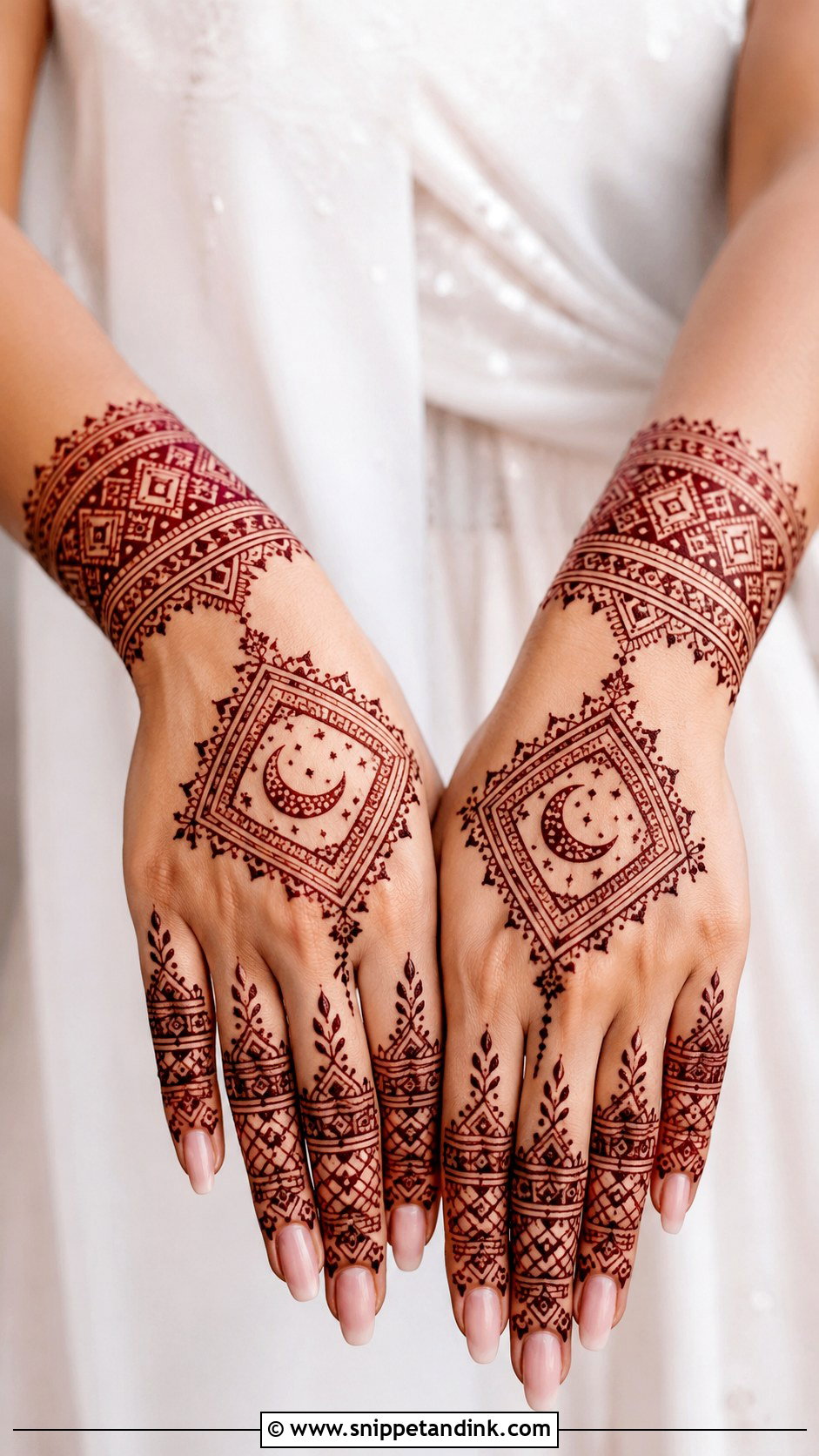
Moroccan henna is geometry rather than flowers: diamonds, triangles, grids, dots and cuff-like bands. It is less traditional for this festival, so I set a small moon or karwa inside one geometric frame to anchor it. The style suits the back of the hand and fingers, where straight lines sit naturally on the bones. Spacing must be even and lines sharp; I sometimes plot the grid with dots first. It is my suggestion for women who want something different that still goes with contemporary outfits.
32. Gulf Karva Chauth Mehndi Design
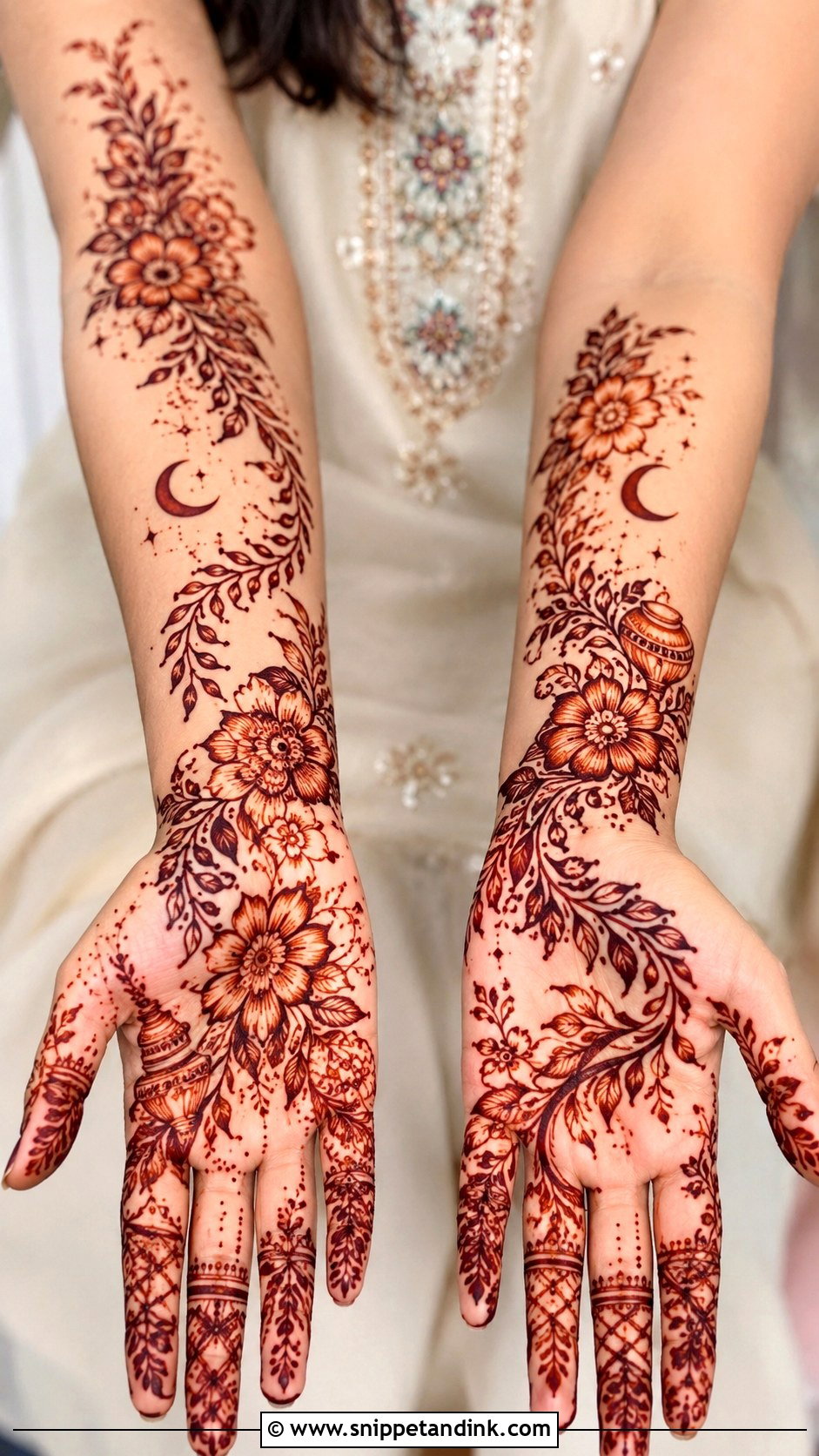
Gulf (Khaleeji) designs use big shaded florals, leafy curves and lots of open skin, often running from the wrist along one side of the hand. The shading is done by filling petals with a thin wash of paste rather than solid lines, which gives a two-tone stain. A small moon or sieve slips into the trail without breaking its flow. Bold outlines keep it visible even as the stain fades over the following week. A few rings and bangles finish it.
33. Negative Space Karva Chauth Mehndi Design
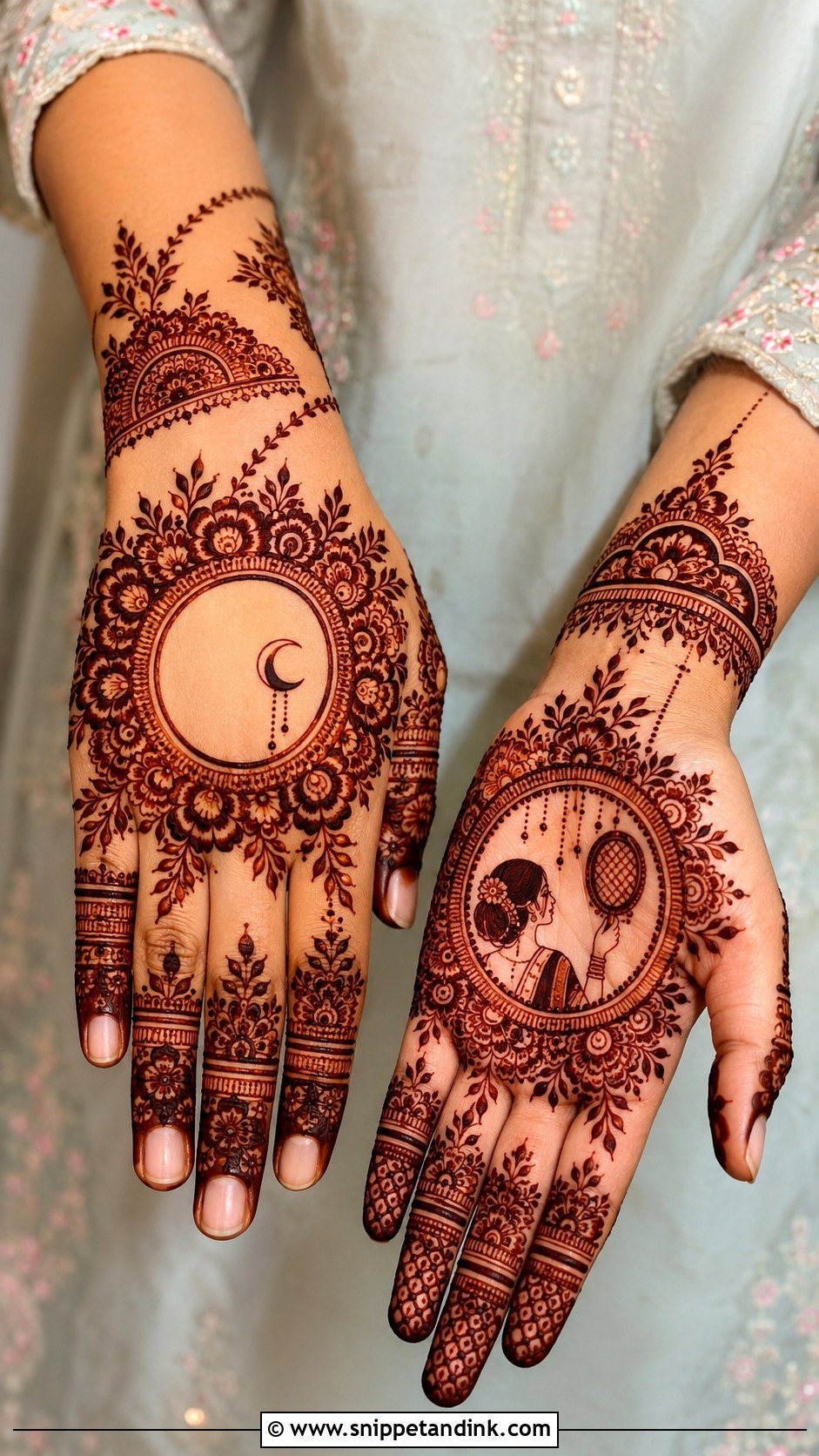
Negative space designs treat bare skin as part of the pattern. I outline florals, mandalas or geometric frames and deliberately leave clean channels between them. For the festival, a moon or sieve sits inside a clear circle, framed by dots. Planning matters more than speed here: I map the empty areas before drawing anything, since you cannot fix a gap once paste has filled it. Close-up photos show this style at its best.
34. Quick Karva Chauth Mehndi Design
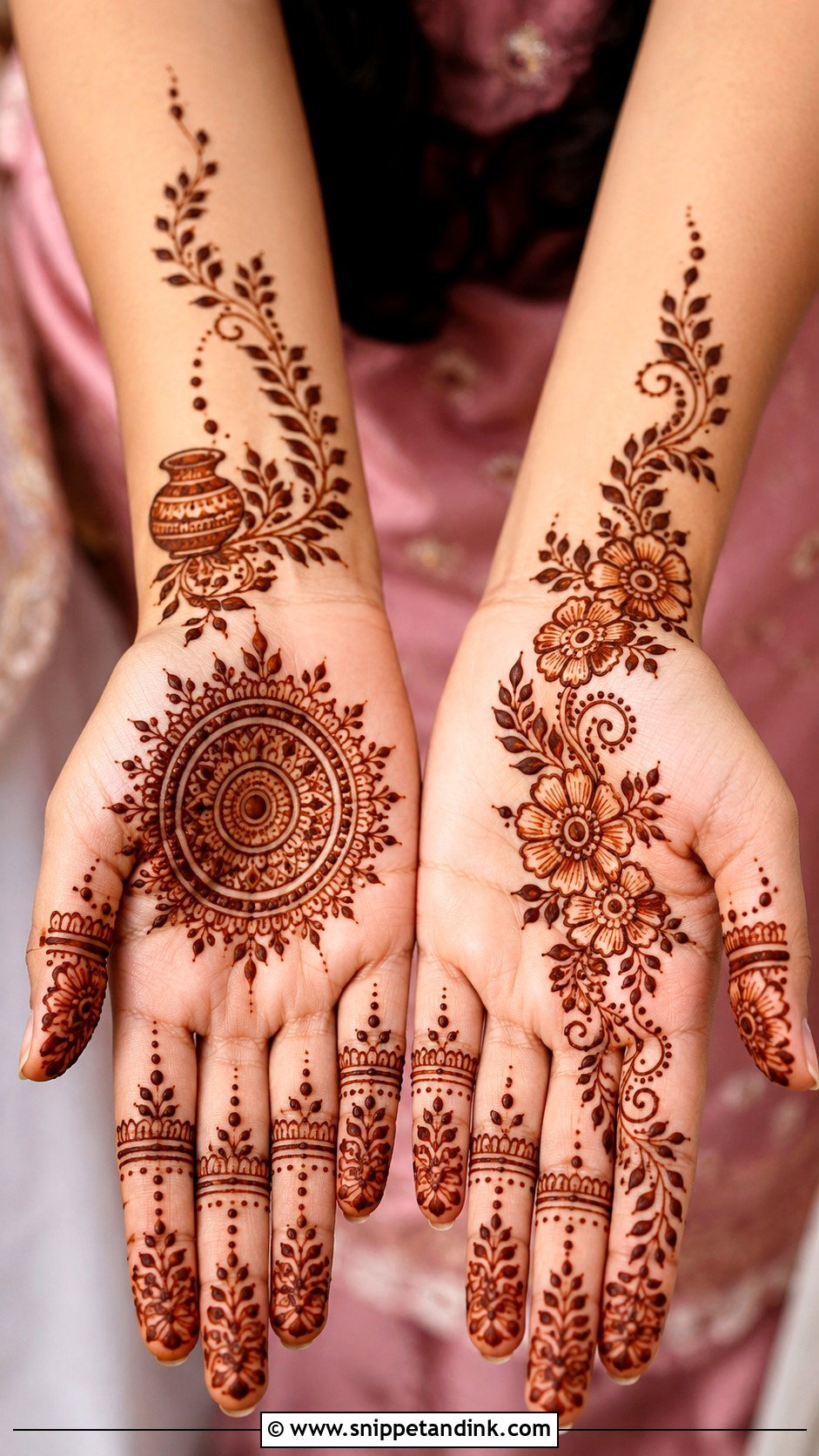
When time is short, the trick is fewer, bigger shapes. A mandala, a flower trail, a wrist bracelet or a simple paisley layout can all be drawn quickly and look intentional. Add finger bands and leafy curves, then a tiny moon or karwa. Skip the fine filler; it is slow, and hurried filler smudges. This is the approach for last-minute plans, first-timers or busy festival days, and with steady outlines it still looks finished.
35. Matching Karva Chauth Mehndi Design
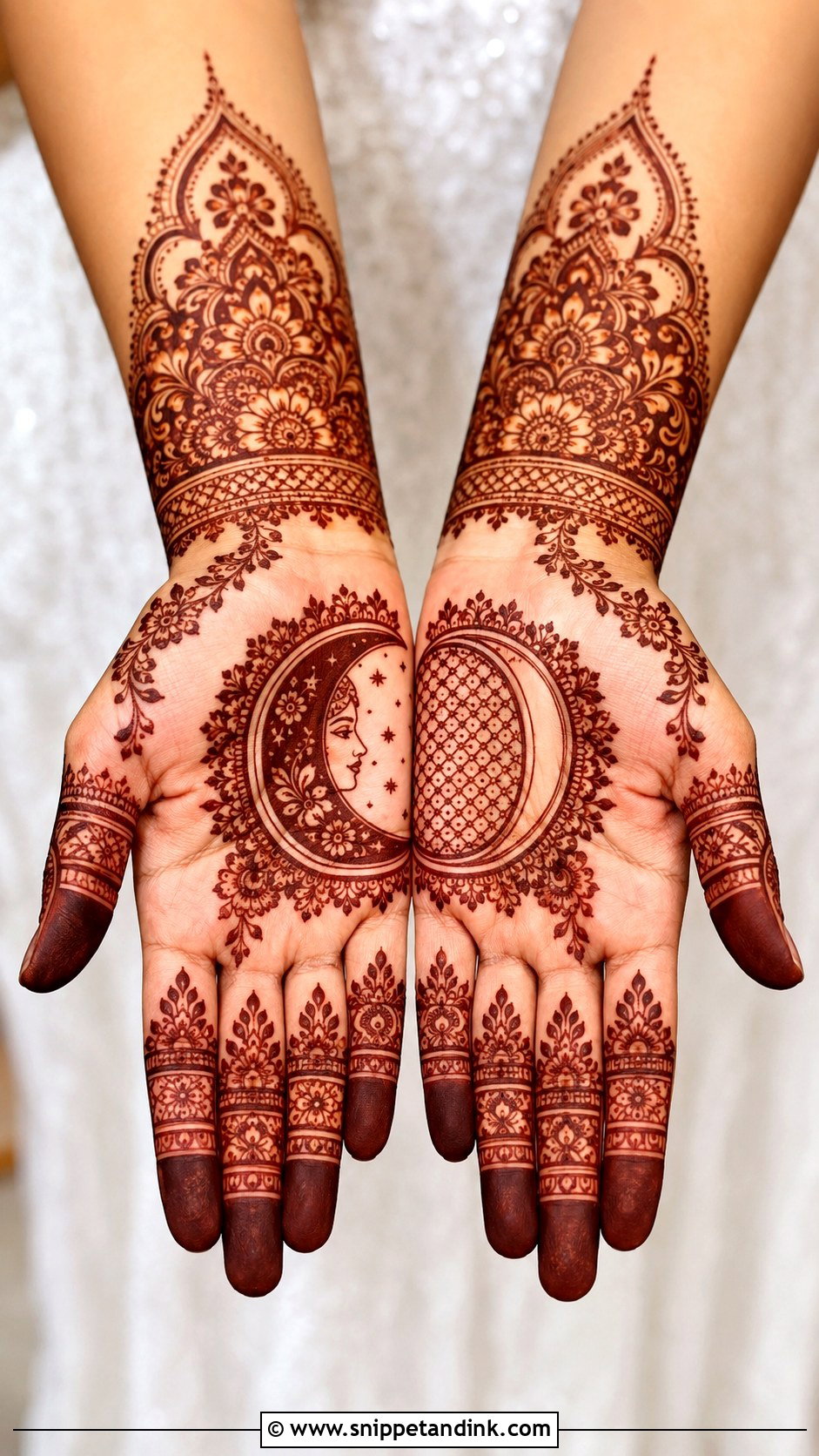
Matching hands are designed as a pair. The palms carry similar mandalas or moon motifs, and fingers and wrists mirror each other. My favourite variation splits the story: the moon on one palm, the sieve on the other, so the scene only completes when you bring your hands together for the puja. Keep the main motifs the same size on both hands. I finish the dominant hand last, so you keep it free for as long as possible.
Why Your Palm Comes Up Darker Than Your Wrist
Clients often worry when the back of the hand or the forearm stays lighter than the palm. That is how henna works, not a sign of bad paste. The dye binds to the outer layer of skin, and it stains most deeply where skin is thick-layered and warm: palms, fingertips and the soles of the feet. As you move up the wrist and arm, the colour fades a shade or two.
I plan around this rather than fight it. Fine detail and faces go on the palm. Back-hand and forearm work gets slightly thicker lines so it still reads. Warmth helps the colour too, so on a cold evening I suggest holding your hands near a warm stove or a heater for a few minutes after the paste dries, or sleeping in a warm room. Cloves warmed over a tawa, letting the smoke drift over your hands, are an old trick some families still use; it adds warmth more than anything magical.
Read the Cone Label Before It Touches Your Skin
This is the part I care about most. Natural henna paste is made from henna powder, a liquid such as lemon juice or water, sugar and an essential oil. It goes on green-brown and stains orange first. Any cone that promises a black or deep red stain within an hour, or that stains dark the moment you wipe it, almost certainly contains added dyes. Black ones often contain PPD, a hair-dye chemical that can cause blistering and lasting allergy.
- Ask your artist what is in her paste. A real henna artist will tell you happily.
- Check the box of a shop-bought cone for an ingredient list and an expiry date. Natural paste spoils, so it should be refrigerated or frozen until use.
- Avoid any cone with no ingredients listed, a chemical smell, or instructions to remove it within minutes.
- If you have sensitive skin or have reacted to hair dye before, do a small test on your inner arm a couple of days ahead.
A slower, natural stain is worth the wait. It deepens in time for the moon and fades gently over one to two weeks, without any risk to your skin.
Start With the Symbol, Then Choose the Coverage
Every design here works best when you decide two things first: which festival symbol you want to carry, and how many hours you can actually sit. The moon, sieve, karwa or couple gives the hand its meaning; coverage, from a bracelet cuff to a full arm, decides how the evening before your fast will go. First-year brides tend to choose portraits and forearm work, while women applying their own cone do better with mandalas and Arabic trails. Book early, use a natural cone, keep the paste on overnight, and let the colour deepen through the day so it is at its richest when the moon comes up.
You'll Like These Ideas:









Leave a Reply