
Legs are the part of bridal henna that brides plan last and regret rushing. Once the lehenga, sharara or saree is chosen, the hemline decides how much of the leg anyone will ever see, and that should shape the design more than any photo. Full-leg mehndi can run from the toes past the ankle and up the calf, sometimes to the knee, using paisleys, jaali, mandalas, peacocks and lotus work. Below are twenty layouts I’d actually put on a bride, with notes on how each one sits, stains and wears through a long wedding week.

Sitting Through Full-Leg Henna Without Smudging It
Legs take longer than most brides expect. A heavy design on both legs can run several hours on its own, and that is before hands. I always ask brides to plan it as a separate session, ideally two days before the wedding, so the stain has time to darken and the paste has time to set without being rushed off.
- Shave or wax your legs a day or two before, never after. Hair removal on top of fresh stain scrapes it away.
- Skip lotion and oil on your legs that morning. Clean, dry skin takes the paste far better.
- Wear loose shorts or a skirt you can hitch to the knee, and bring a dupatta for modesty while you sit.
- Use the bathroom right before we start. Once both legs are wet, you can’t walk for a while.
- Sit on a low stool with your feet up on a towel. I work on one leg while the other one dries.
One honest note about stain color. The soles and the tops of the feet usually stain darkest, and the color gets lighter as the design climbs toward the knee, because skin on the calf is thinner and cooler. That isn’t a bad batch of henna. It’s how henna behaves on every bride, so I plan the boldest motifs low and keep finer work for higher up.
1. Indian Bridal Full Leg Mehndi Design
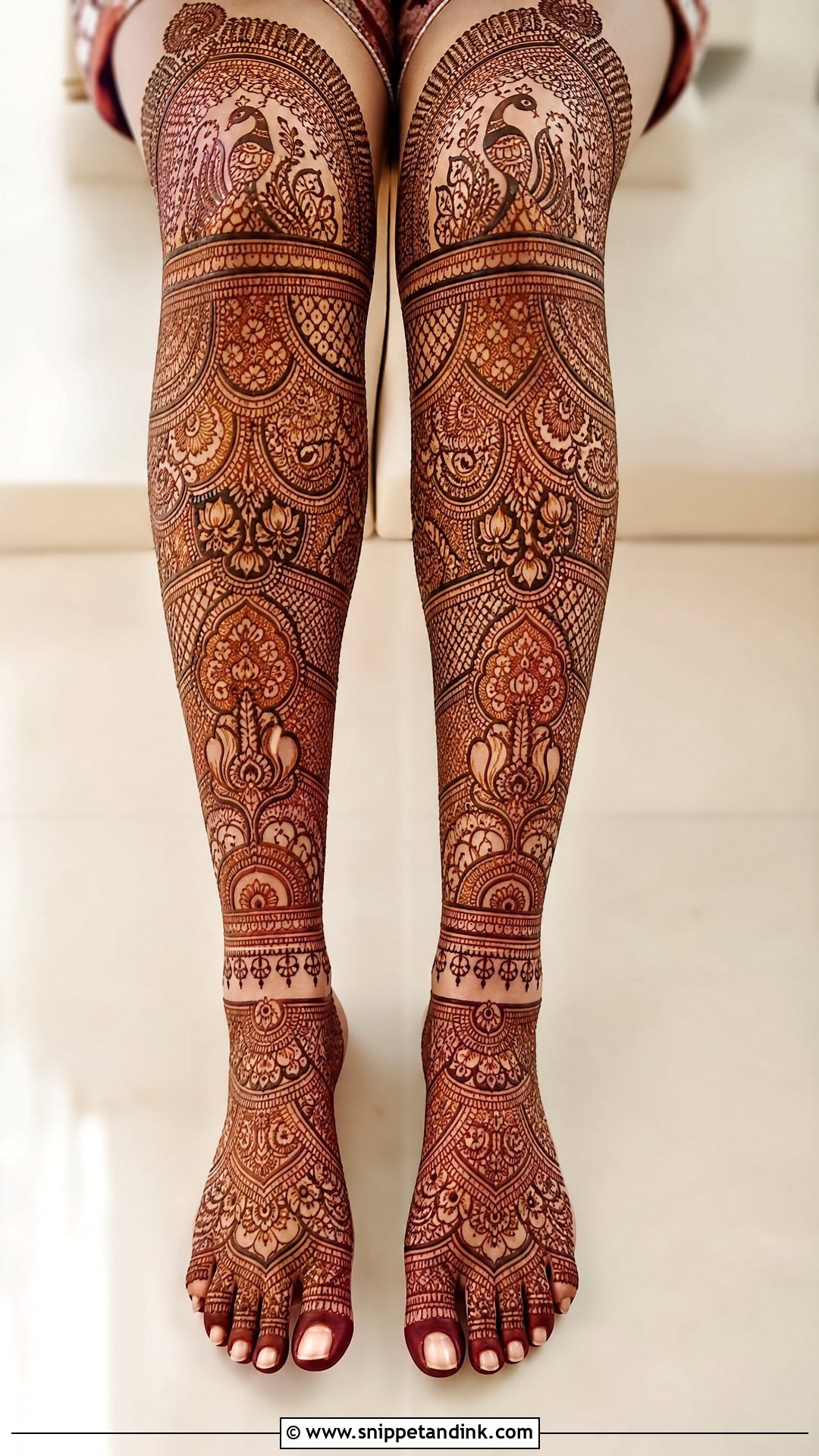
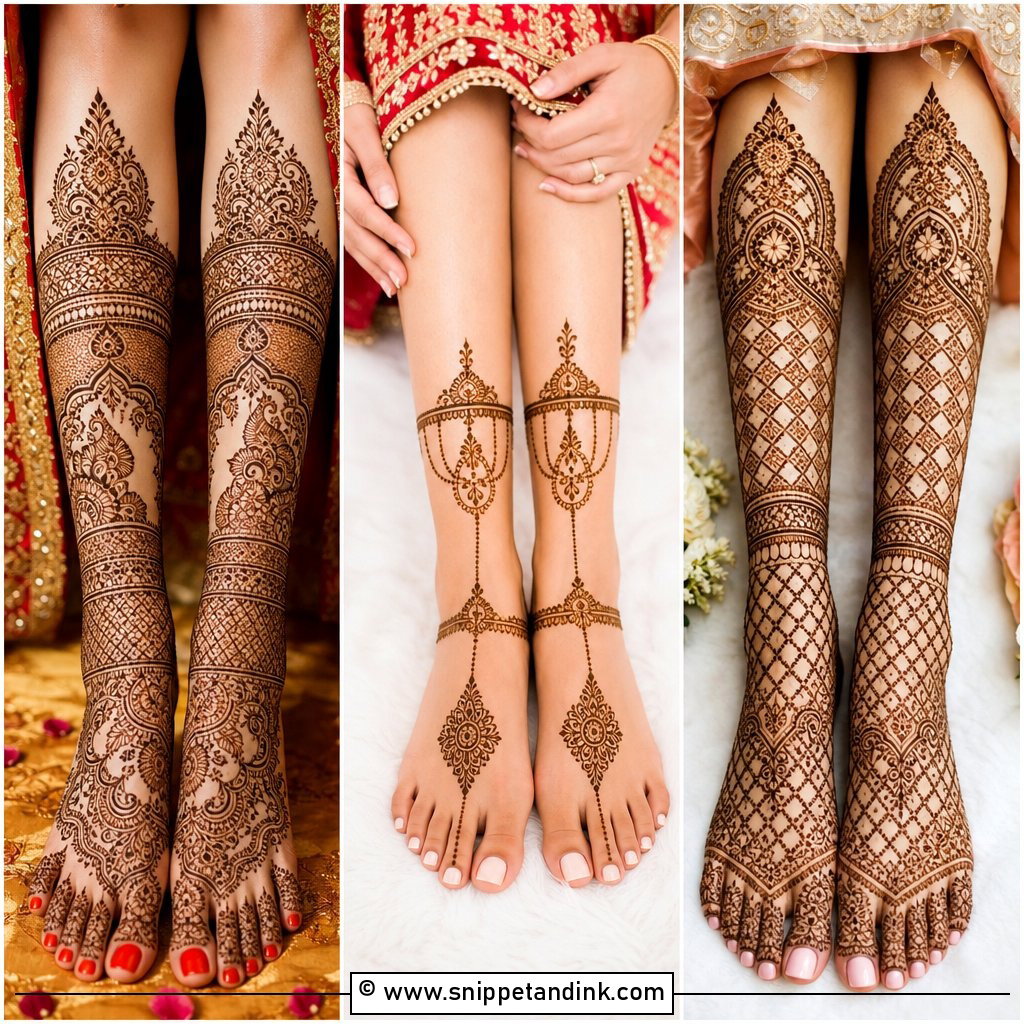
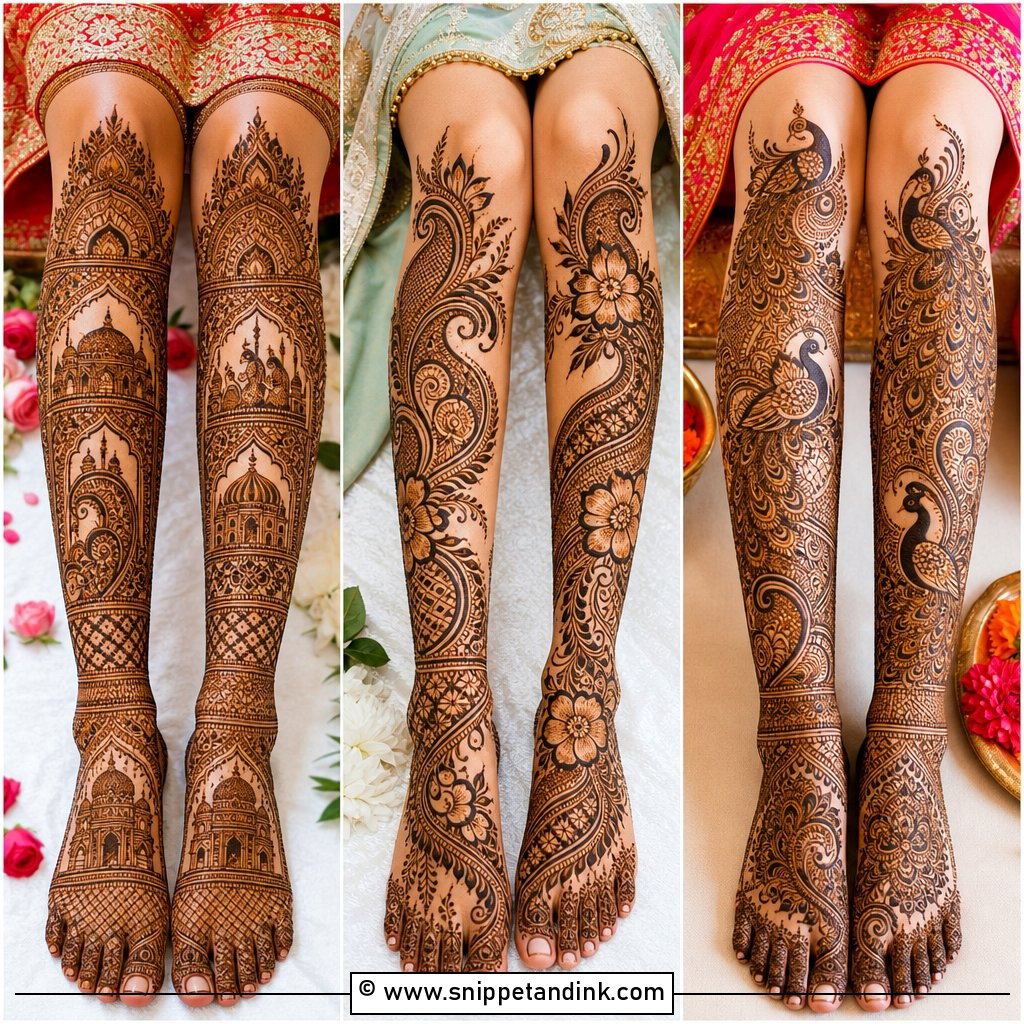
This is the classic dulhan leg: toe caps, a solid anklet band, a filled foot, then paisleys, lotus and peacocks climbing to the knee with almost no bare skin left. Density is the whole point, so I keep my lines fine and my paste thin here, because heavy strokes packed this close tend to blur into one dark patch. Expect a long sitting. Ask for both legs to mirror each other, and if you want bride and groom figures, the inner calf gives them room without crowding the foot.
2. Arabic Bridal Full Leg Mehndi Design
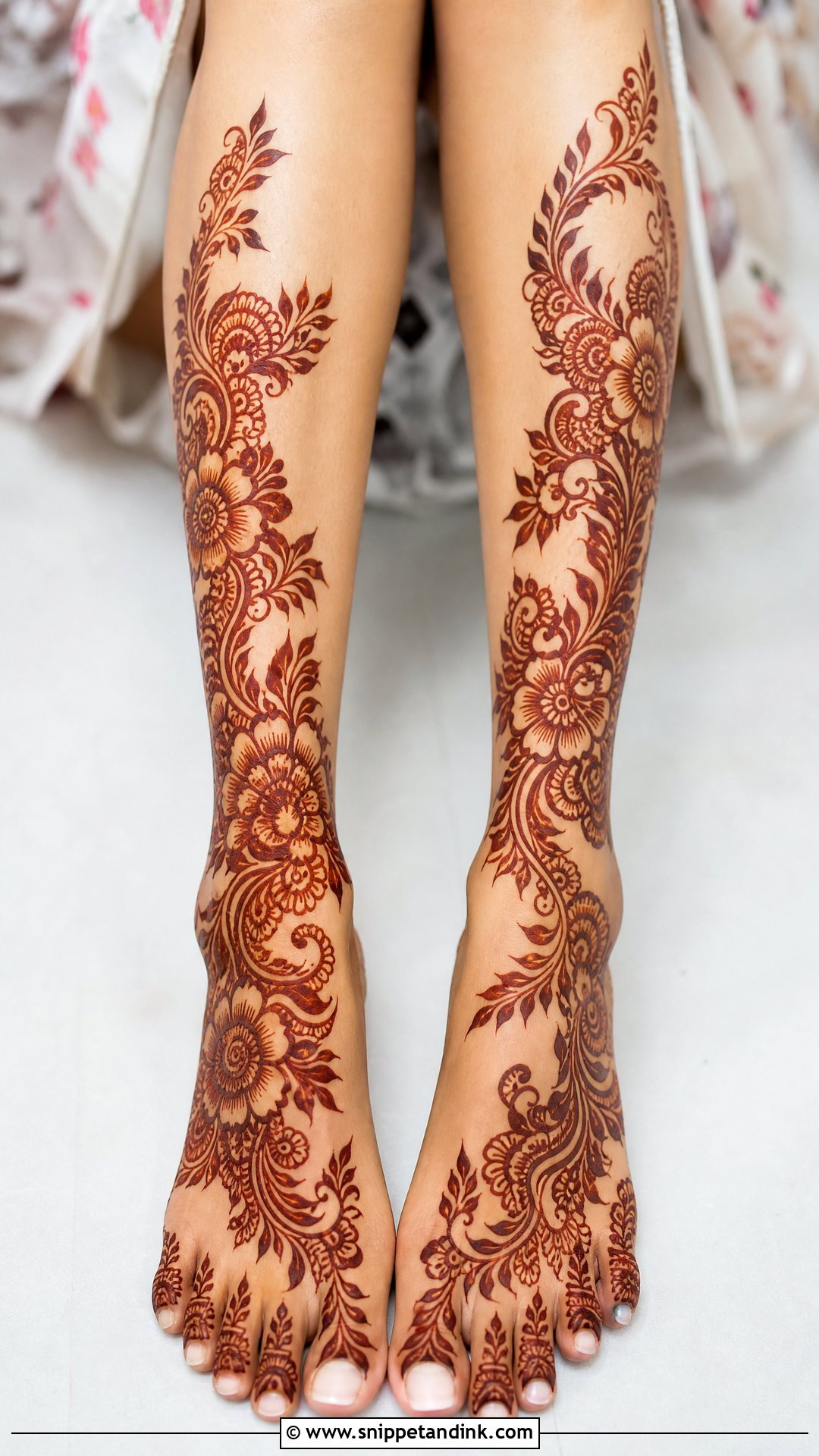
Arabic leg work is built on bold floral trails and open skin, usually starting at the toes, wrapping the ankle once, then climbing diagonally toward the calf. Because there is so much breathing room, the strokes themselves have to be confident; a shaky line has nowhere to hide. I like it for brides who can’t sit still for hours, since a full Arabic leg goes much faster than a packed Indian one. From a distance, the thick outlines read clearly in photos, which dense filler often doesn’t.
3. Indo Arabic Bridal Leg Mehndi Design
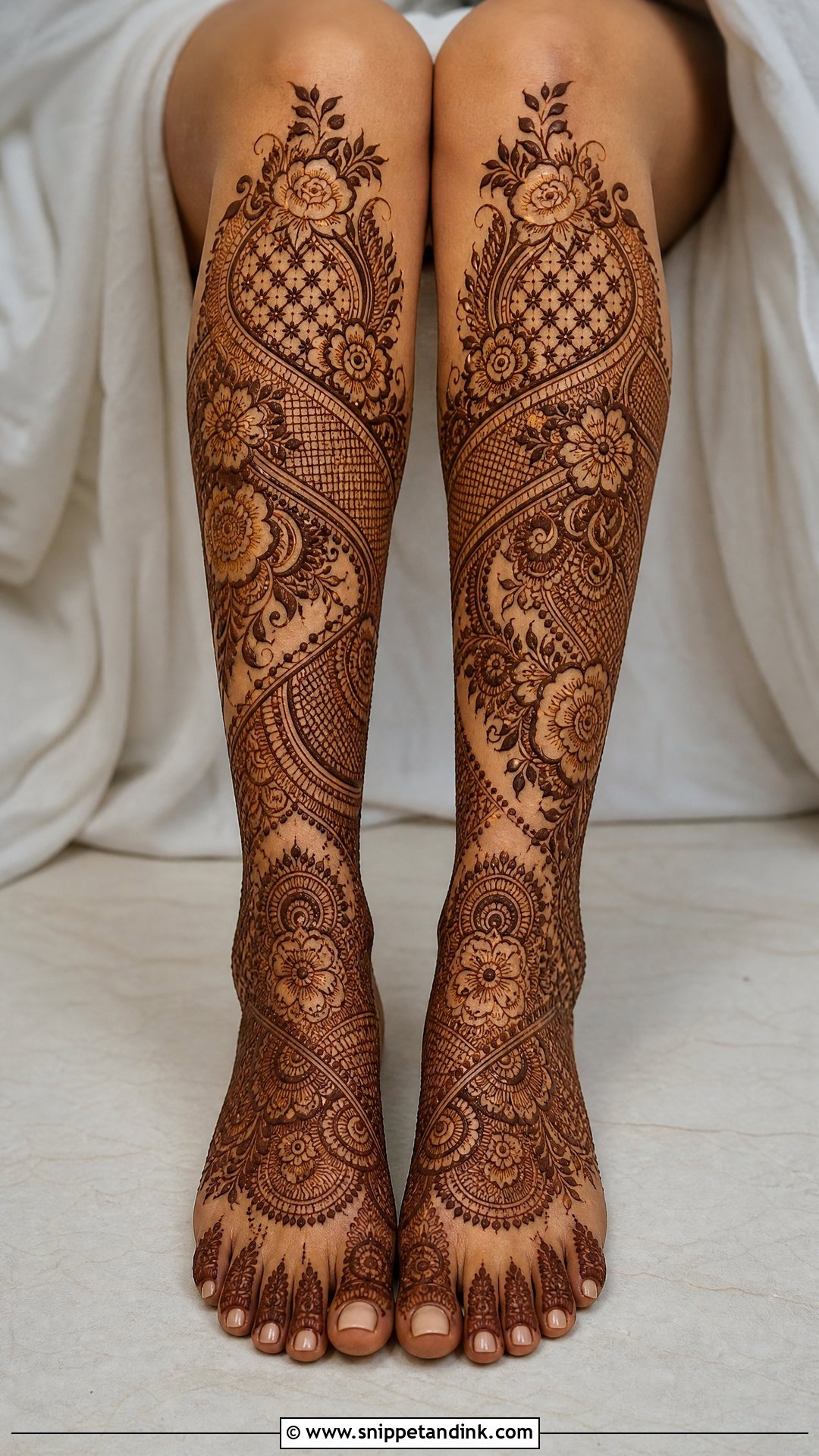
Indo-Arabic is the layout I end up drawing most when a bride can’t decide. Bold Arabic trails run down the sides of the leg while the center carries Indian mandalas, jaali and dotwork. The trick is deciding where the detail stops. I usually keep the feet fully worked and let the calves open up, so the leg doesn’t look like two different artists did the top and bottom. Thick outlines against fine inner work show up well with open footwear.
4. Full Leg Bridal Mehndi With Peacock
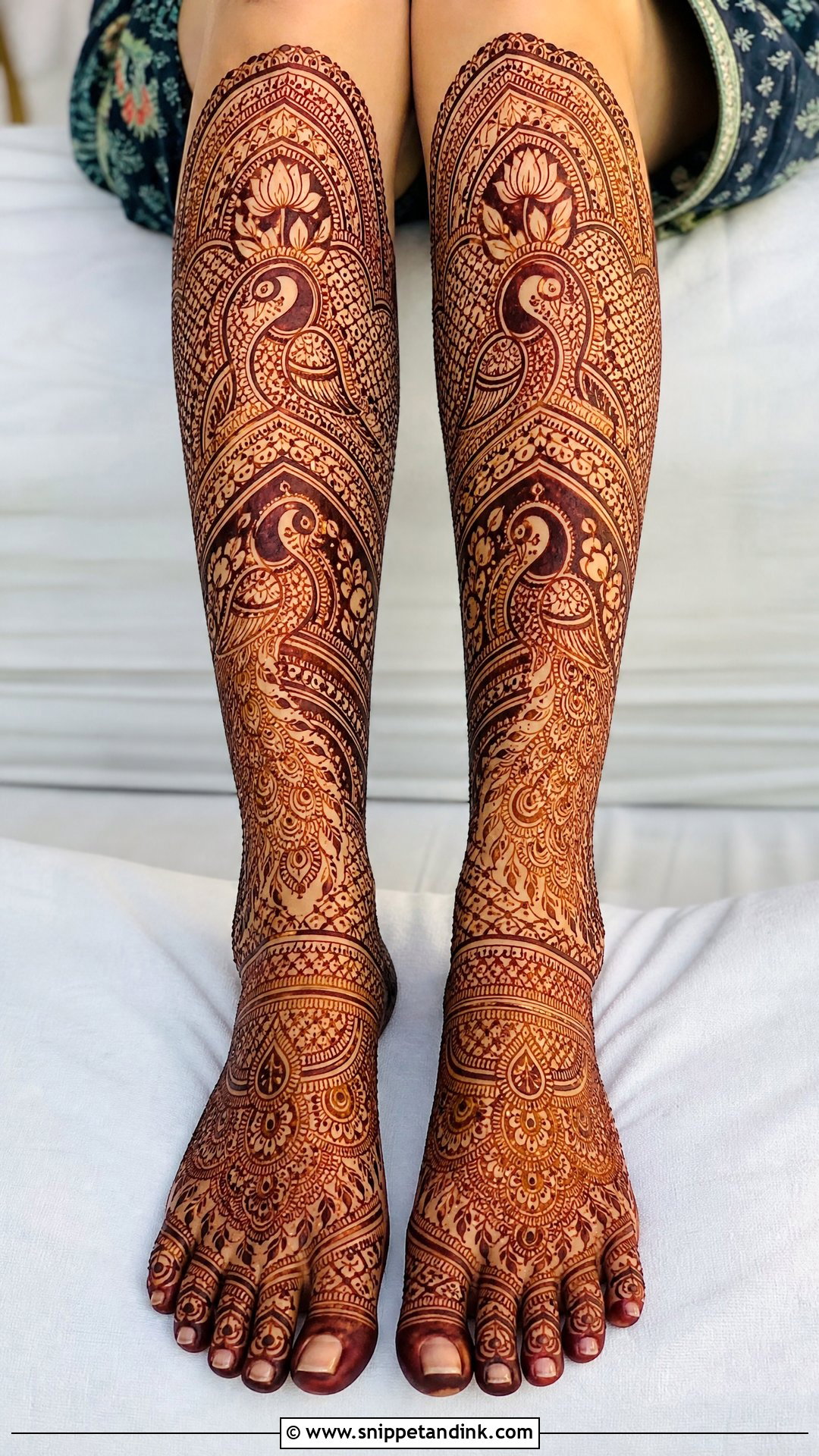
The peacock motif can sit at the ankle, on top of the foot, on the calf or near the knee, and where you put it changes the whole mood. My one rule: draw the peacock big. Brides often ask for it and then let me surround it with so much feather and jaali filler that, once stained, the bird disappears. I sketch its body and neck first, then build feathers and paisleys outward so the focal point stays readable.
5. Full Leg Bridal Mehndi With Lotus
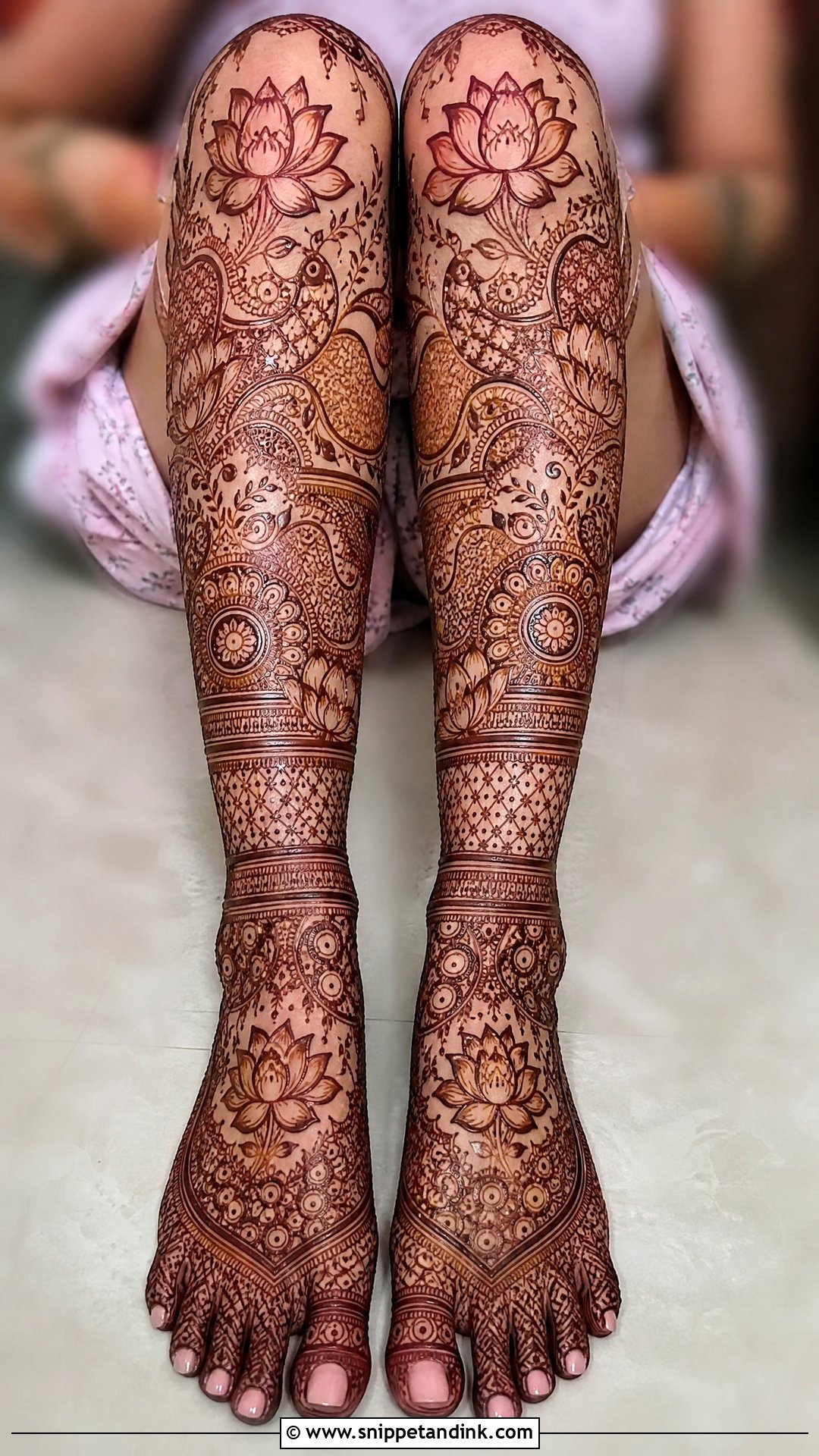
Lotus petals give a leg design structure because each petal is a clean, closed shape that stains evenly. I usually place one large lotus on the top of the foot and repeat smaller ones up the calf. Left open with a single outline, the flower looks modern; filled with shading and tiny lines, it turns traditional. It sits nicely next to temple jewelry and silk, and it’s one of the few motifs that works as well on pastel outfits as on red.
6. Full Leg Bridal Mehndi With Mandala
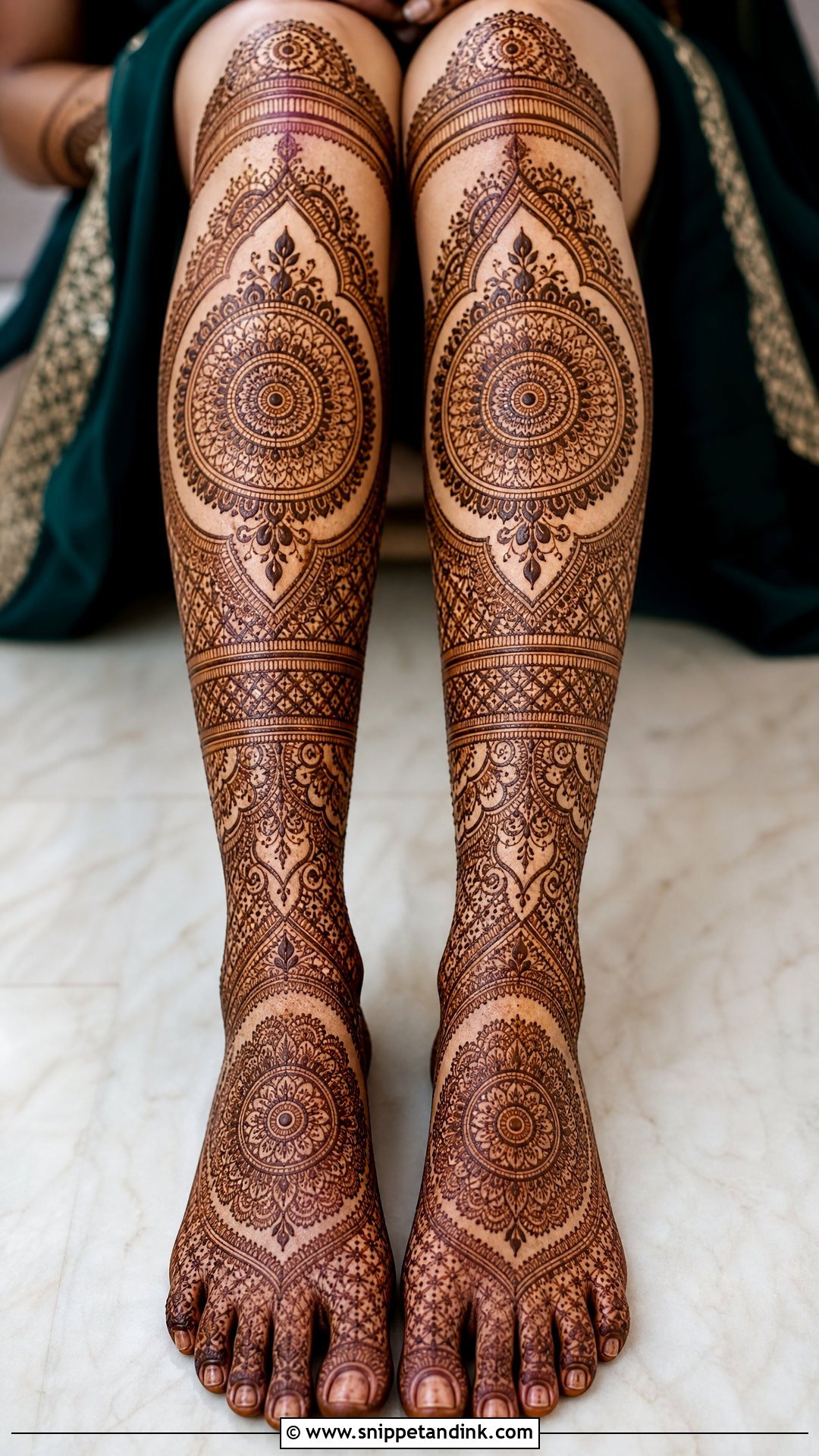
Mandalas suit the bride who likes things centered and even. A large mandala on top of the foot, smaller rounds at the ankle and calf, then vines and jaali to connect them. Circles are less forgiving than they look, though. The curve of the ankle bone distorts a mandala drawn straight onto it, so I place them just above or below the bone and let a band carry the line across the joint. Works at heavy or medium coverage.
7. Full Leg Bridal Mehndi With Jaali
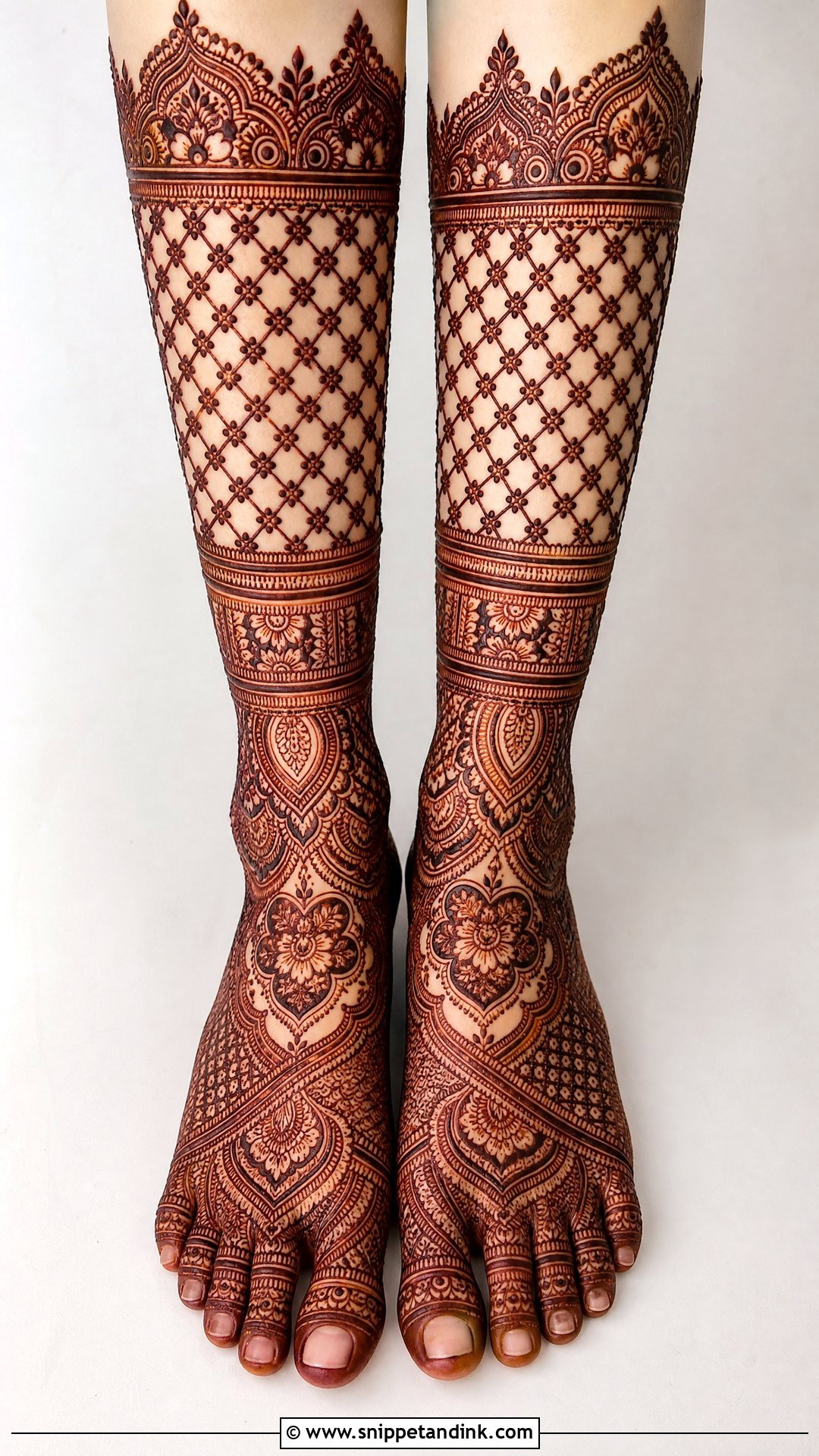
Jaali is the net pattern, crisscross lines with tiny dots, floral corners and bracelet bands. Brides like it because it covers a lot of skin without making the leg look dark, and that’s true, but only if the grid lines stay thin and evenly spaced. Thick jaali lines close up as the paste spreads slightly and the mesh turns into a smudge. I break the net with roses, paisleys or a lotus every few inches so the eye has somewhere to rest, and the mesh tends to echo lace or zari on an embroidered outfit.
8. Full Leg Bridal Mehndi With Paisley
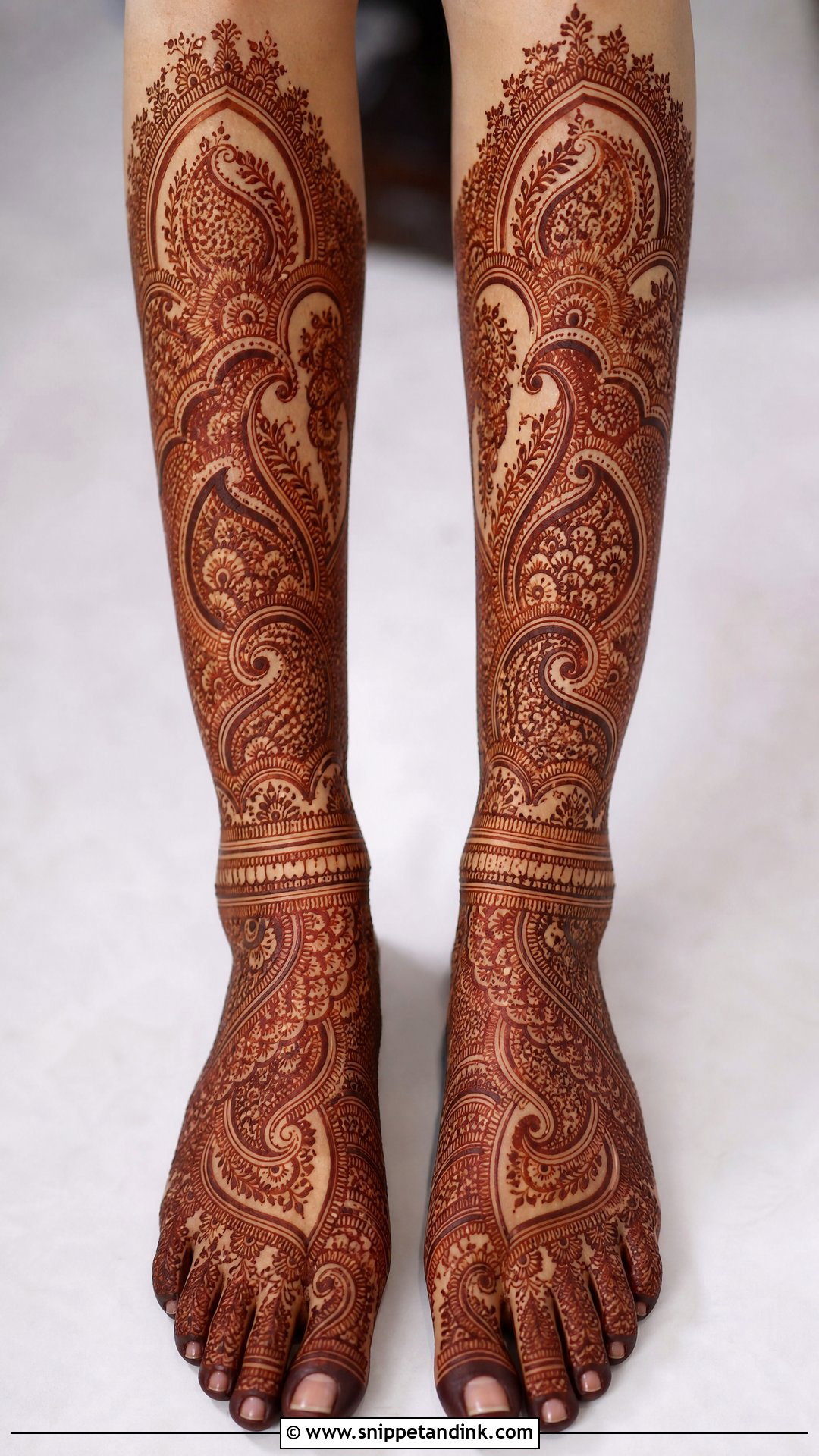
Paisleys follow the body better than almost any other shape. Their curve sits naturally along the arch of the foot, around the ankle and up the calf, which is why they’ve lasted as a bridal staple for so long. I start heavy on the feet and stretch the paisleys longer as they climb, which makes the leg read taller. Their bold outlines also take a deep stain, and they slot into Indian, Arabic or Indo-Arabic layouts without fuss.
9. Full Leg Bridal Mehndi With Floral Trail
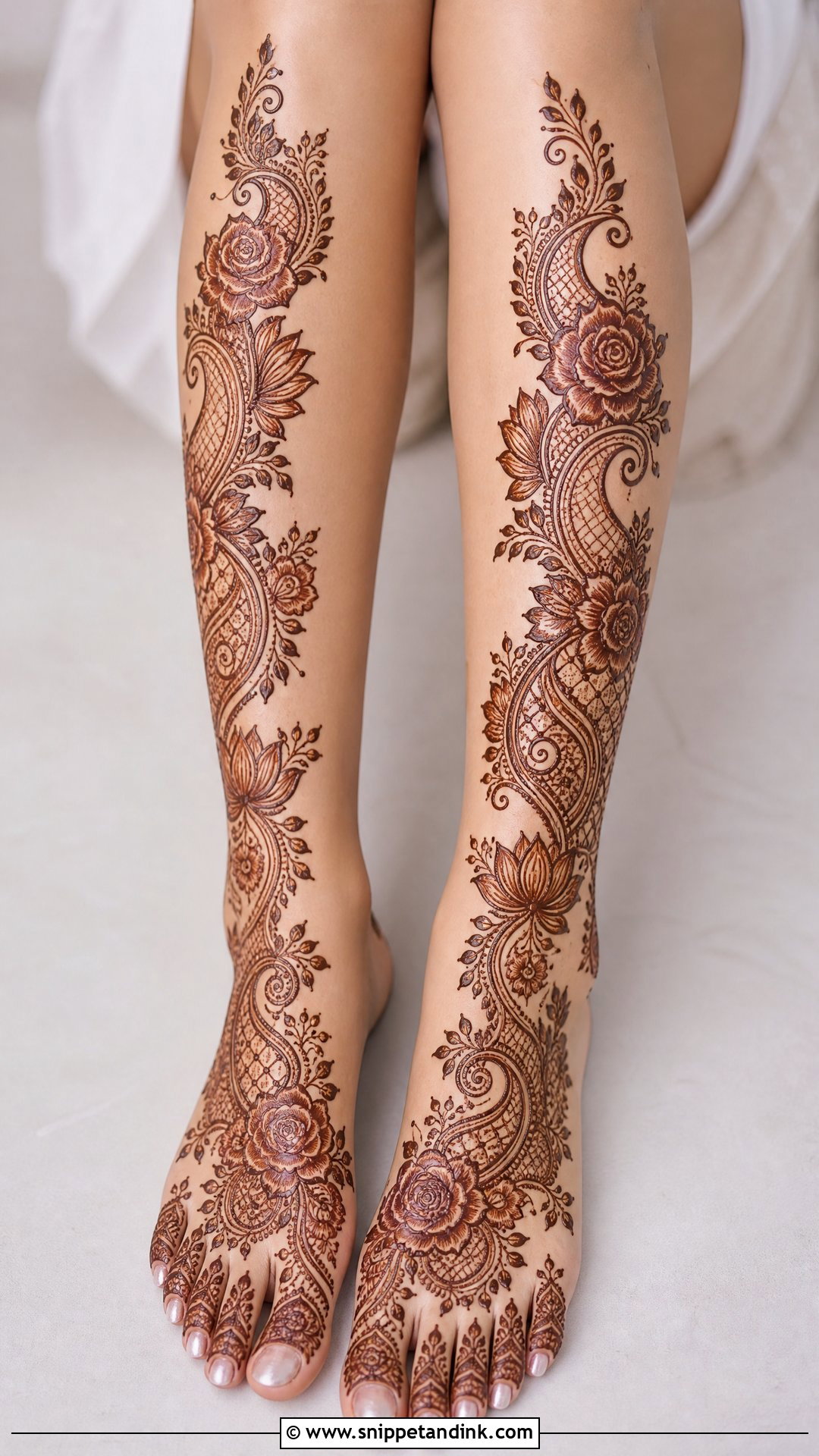
A floral trail uses roses, lotus buds, small blossoms and leaves in one path from toes to calf, running down the side, diagonally or wrapped like a vine. It looks complete while leaving most of the leg bare. I map the path with a few light dots before committing, because a trail that drifts off line halfway up the shin is hard to correct. It suits daytime functions, pastel outfits and floral jewelry.
10. Full Leg Bridal Mehndi With Anklet Pattern
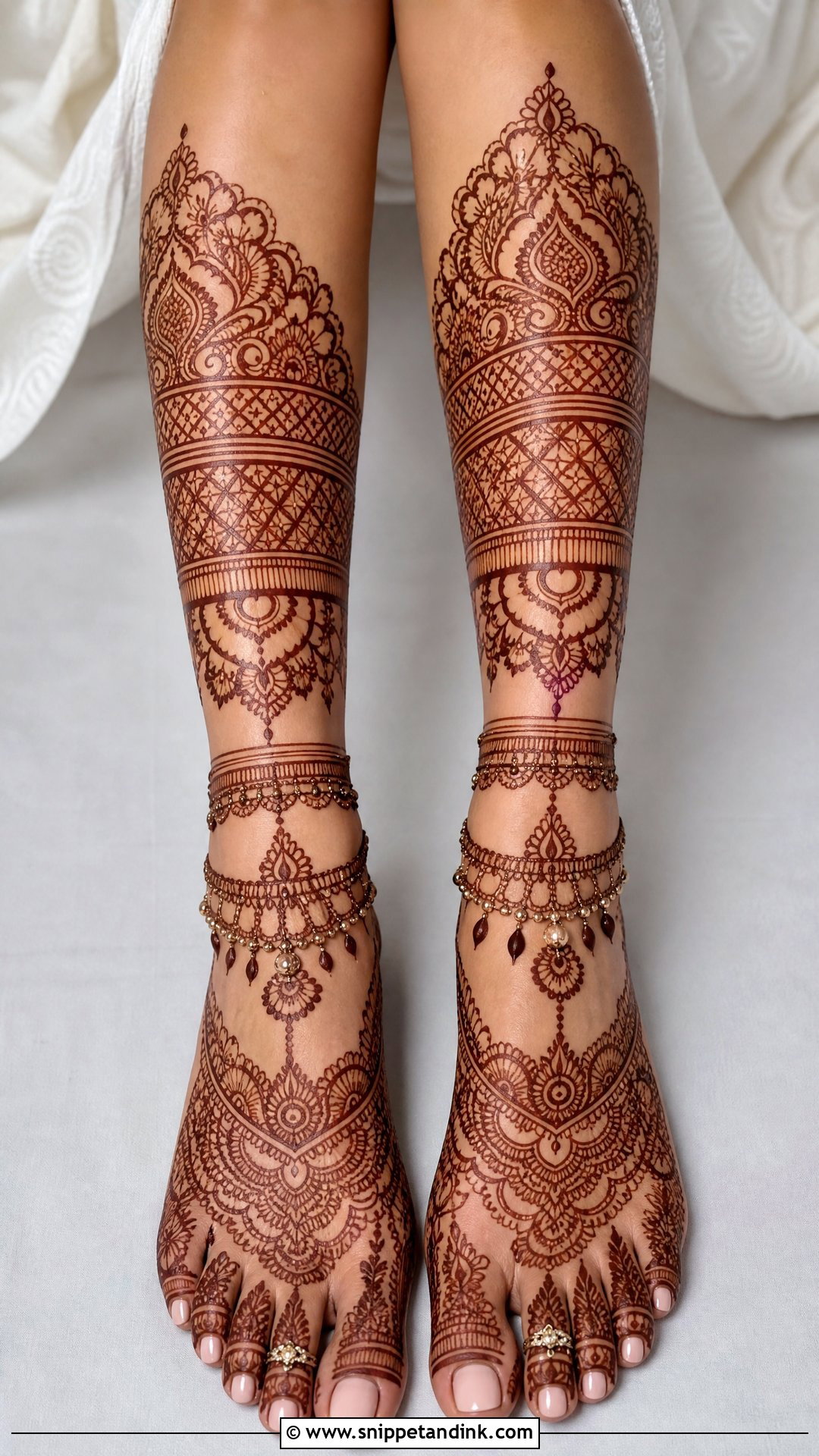
Henna jewelry on the ankles means your feet look dressed even before the payal goes on. The design centres on detailed anklet bands, hanging bead chains, toe rings and ornamental cuffs, then repeats those motifs up the leg. Practically, it puts the finest work at the feet and ankles, where bridal photographers tend to aim anyway. I’d suggest wearing your real anklets to the appointment so I can line the henna chains up under them instead of fighting them. Pairs well with open heels, juttis or barefoot portraits.
11. Full Leg Bridal Mehndi With Dulha Dulhan
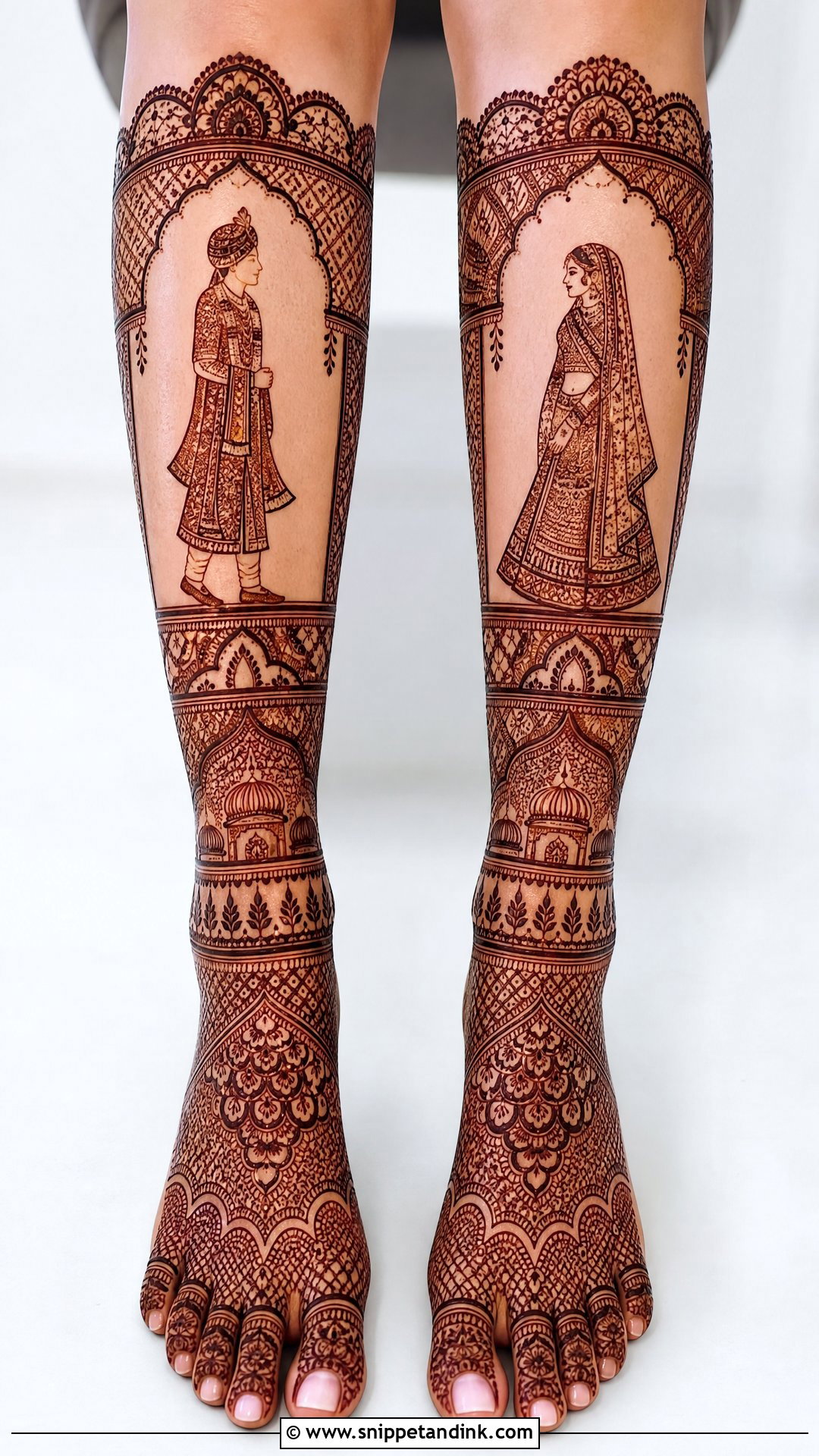
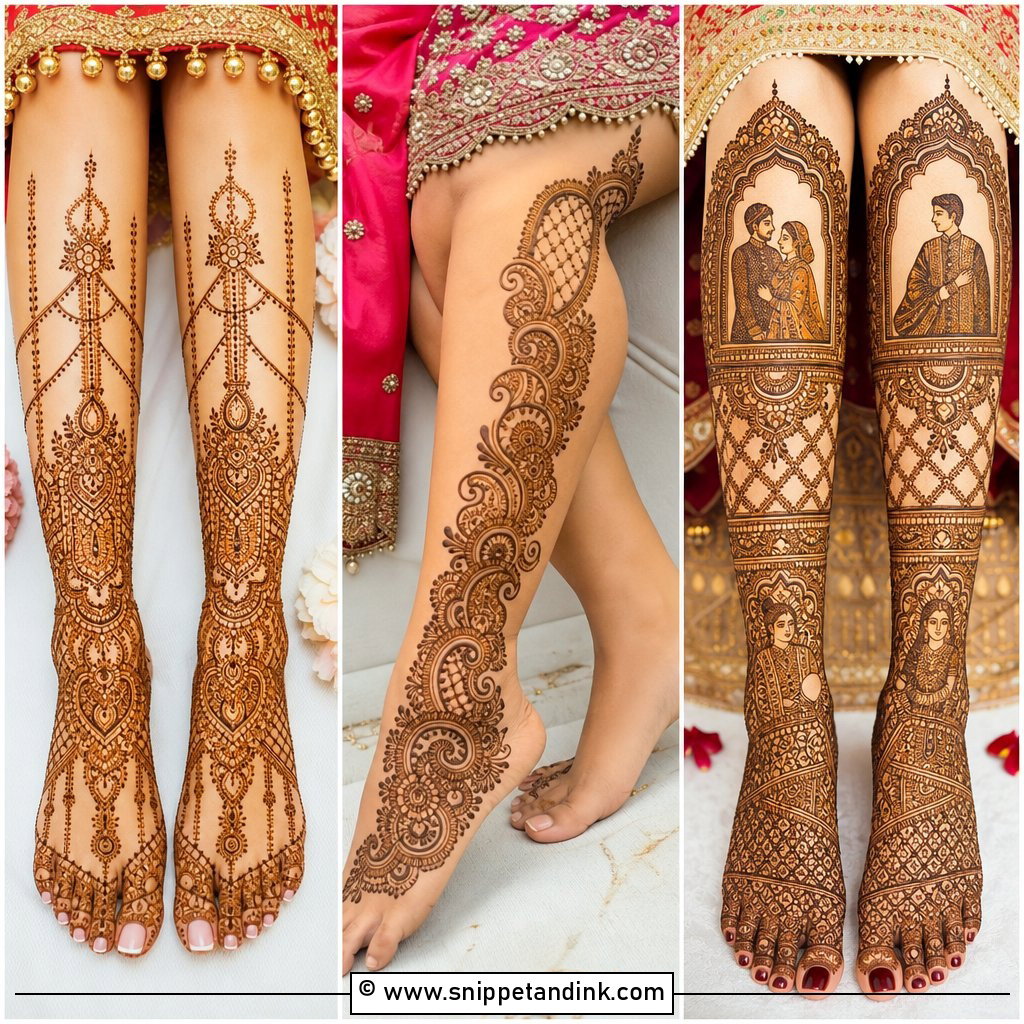
Figures need space, and legs have more of it than hands. I usually put the bride and groom figures on opposite calves, or framed in panels just above the ankles, with doli, kalash, mandap borders and musical motifs around them. Faces are the hardest part; at that scale a single wobbly line changes an expression, so this is a design for an artist whose figure work you’ve seen in close-up stained photos, not only fresh paste. Budget extra sitting time.
12. Full Leg Bridal Mehndi With Name
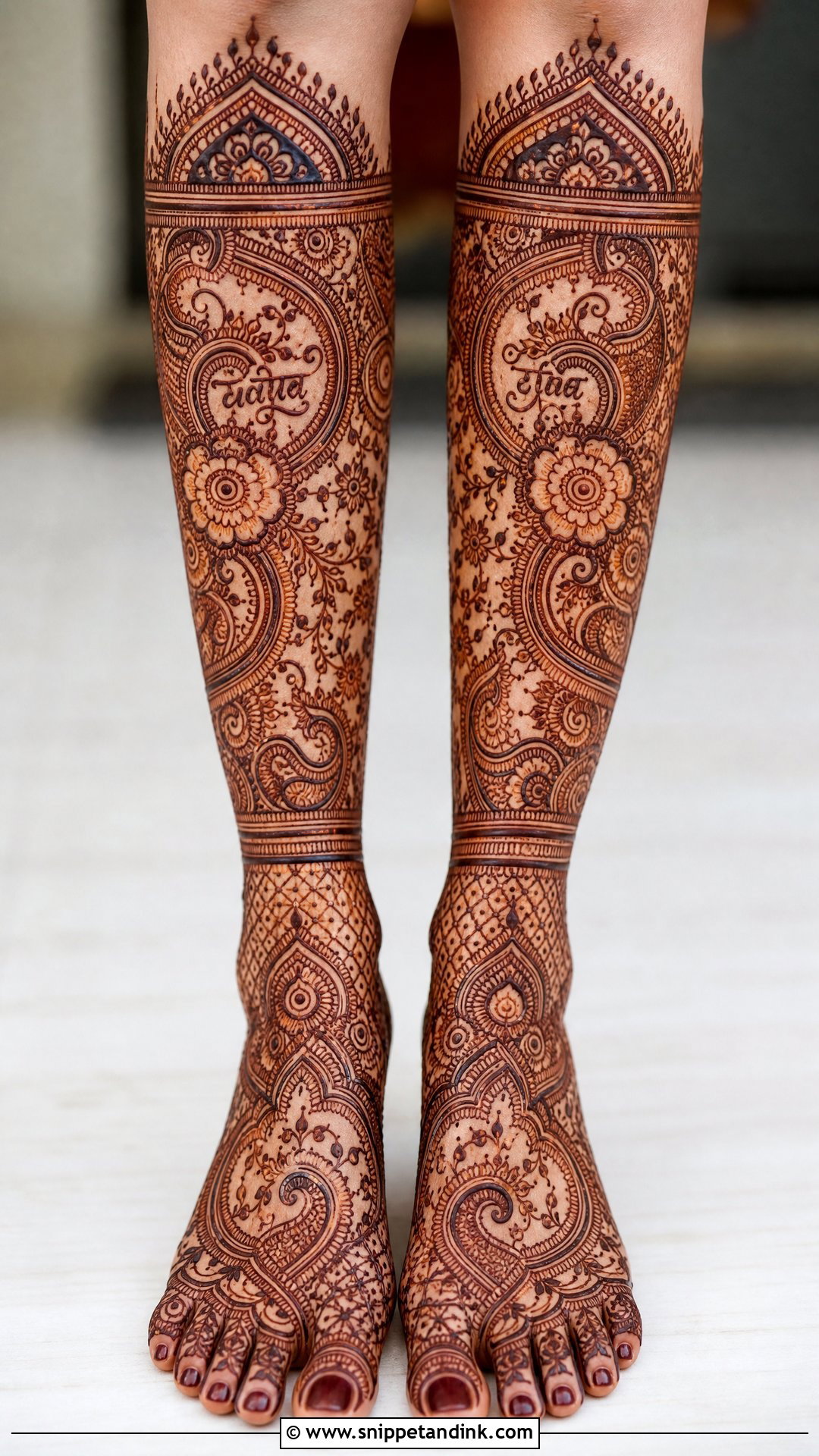
A name, or just initials, can hide inside a paisley, a jaali panel, a mandala or the ankle band. Full legs give me plenty of room to tuck it in without breaking the flow. Tell me how hard you want the search to be. I’ll place it where it can be found but isn’t obvious, so the “find the name” moment still has some fun in it. Initials hide more cleanly than long names, which tend to bend awkwardly around a curve. The surrounding design can go Indian, Arabic or Indo-Arabic.
13. Full Leg Bridal Mehndi With Wedding Scene
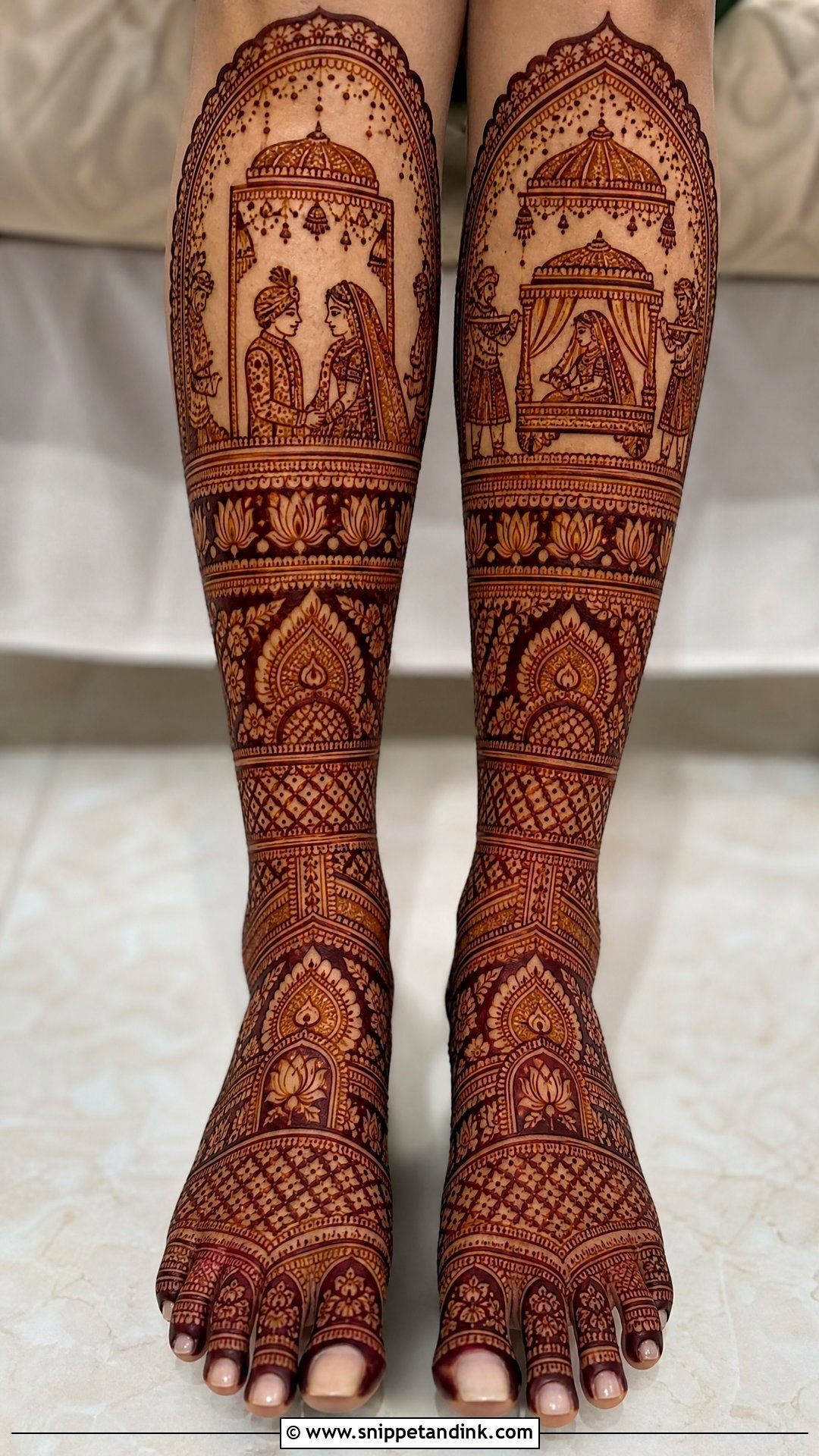
A full wedding scene on the legs, with a mandap, bride and groom, doli, baraat, instruments, elephants and lotus borders, is the most ambitious design on this list. It only works with a planned layout. The flat front of the shin and the calf hold the big scenes; the feet carry paisleys, florals and jaali, because a scene drawn across the curve of the foot warps the moment you stand up. Agree on the layout before the cone touches skin, and come prepared for the longest sitting of your henna week.
14. Full Leg Bridal Mehndi With Elephant Motif
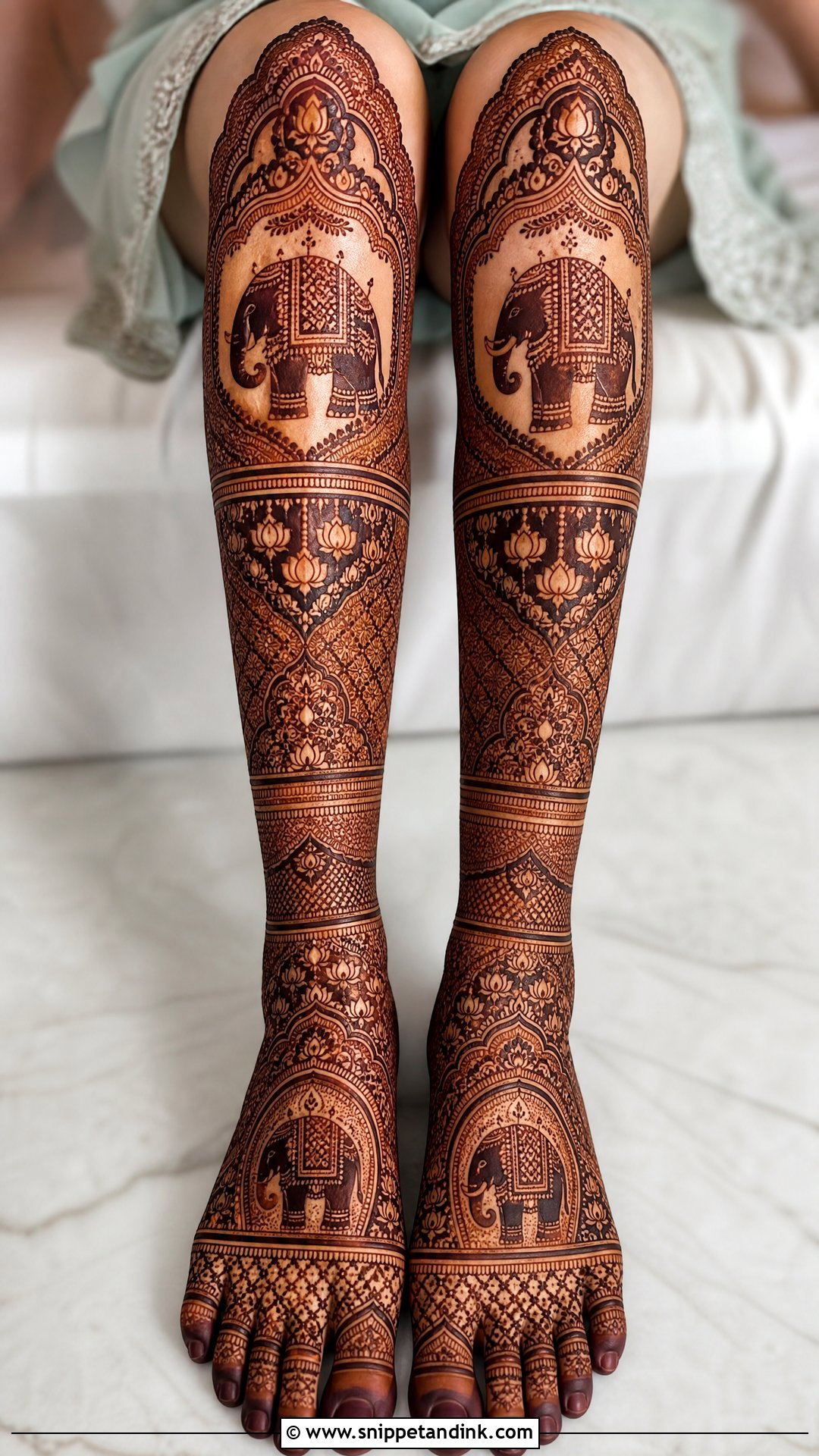
An elephant drawn in wedding dress, with a patterned blanket, small florals, arches and borders, gives the leg a festive, royal feel. I place it on the calf or lower leg and frame it with mandalas and paisleys. The common mistake is letting the frame swallow the animal, so I outline the elephant first and keep the jaali and lotus chains around it lighter. It suits traditional Indian weddings and anyone who wants something other than flowers.



15. Full Leg Bridal Mehndi With Moroccan Pattern
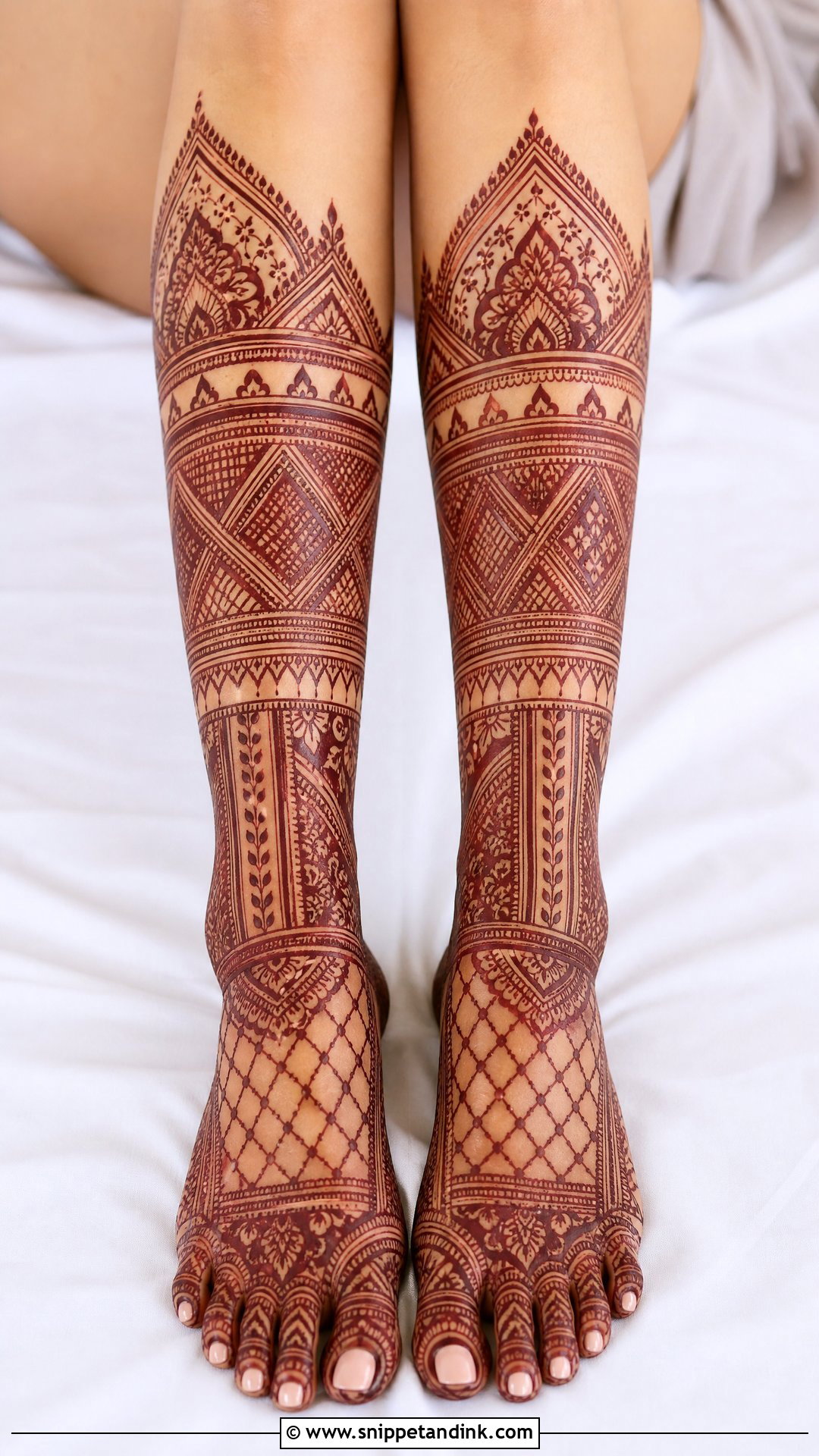
Moroccan work trades florals for diamonds, grids, triangle borders and angular bands. On a full leg it reads organized and sharp. Straight lines are less forgiving than curves, so this needs a steady artist and a bride who can keep her leg still for long stretches. I like softening it with a lotus or a leafy trail so it still feels bridal, and the geometry stays legible in photos even at full coverage.
16. Gulf Bridal Full Leg Mehndi Design
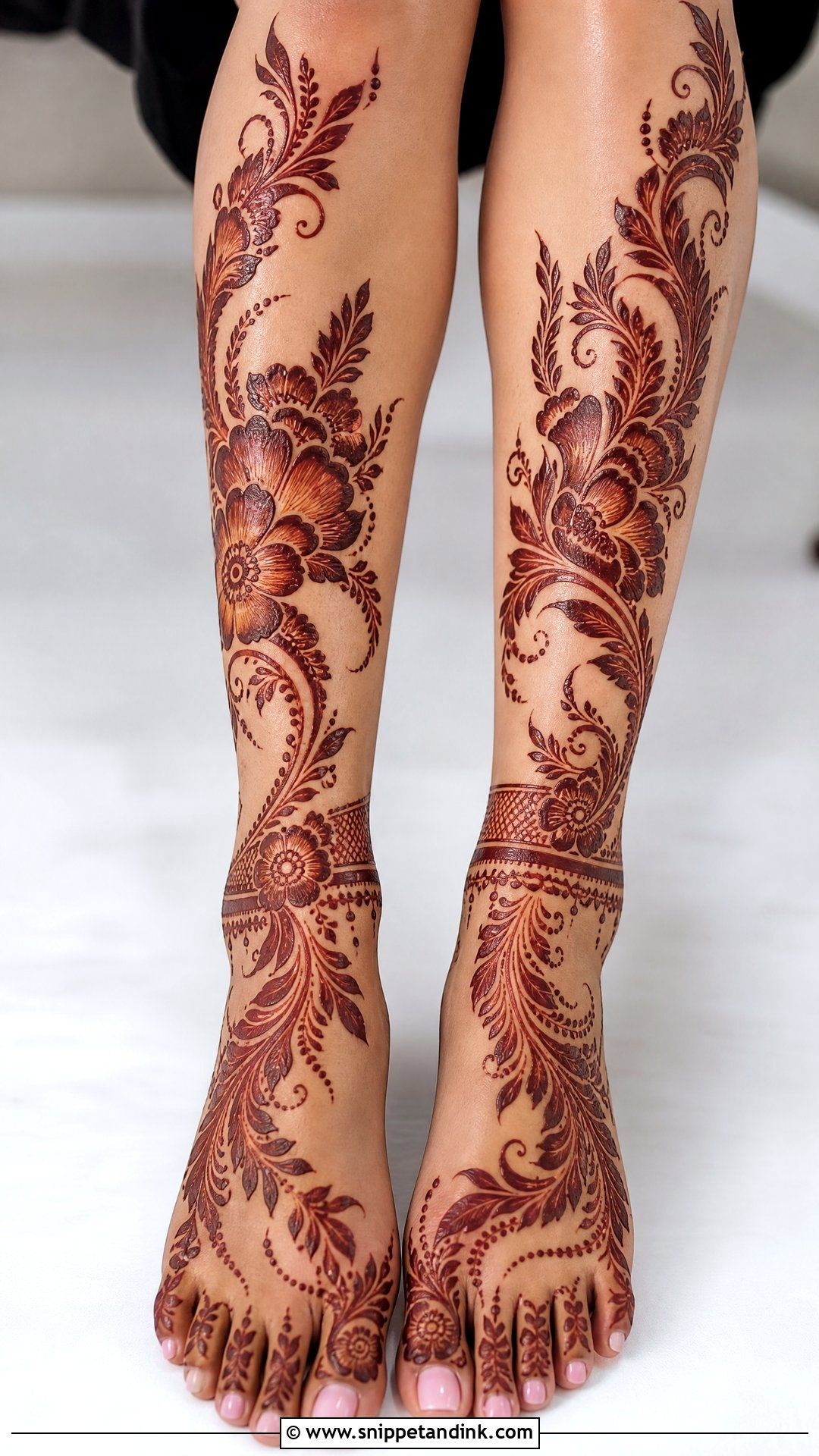
Khaleeji, or Gulf-style, henna uses bold floral clusters, leafy vines, sweeping curves and generous open skin. It usually favours one side of the foot and leg, wrapping gently around the ankle or calf, which draws the eye upward and lengthens the leg. Gulf-inspired mehndi relies on strong outlines, so I use a slightly wider cone tip for it than for fine Indian work. Bracelet bands, dots and swirls fill it out for a full-leg version, and it sits well with shimmer fabrics, embroidered gowns and shararas.
17. Minimal Bridal Full Leg Mehndi Design
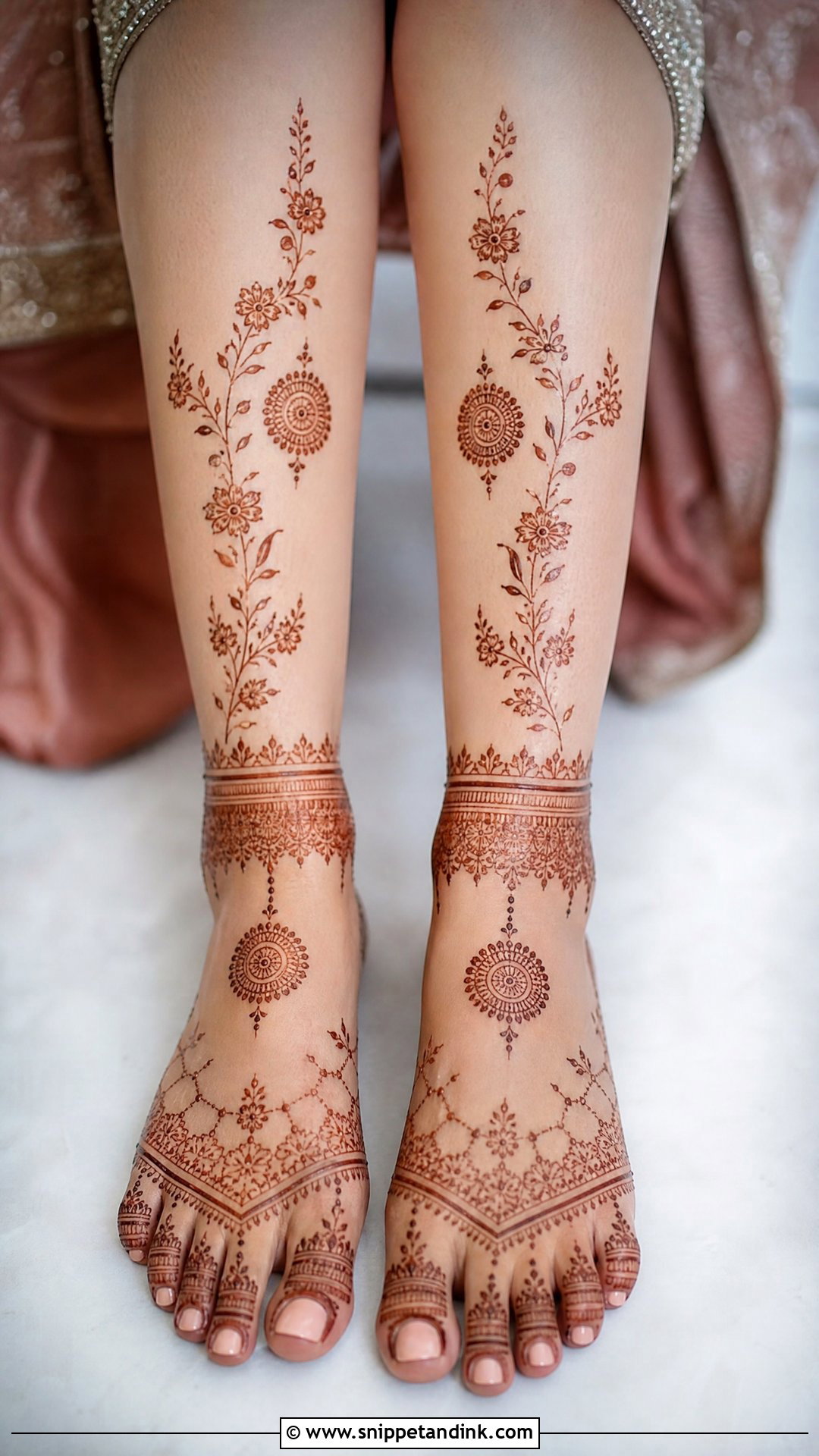
Minimal doesn’t have to mean short. The design can still reach the calf or knee, just with slim anklet bands, a small foot centerpiece, a few mandalas and a single vine. Placement does all the work here, since there’s no filler to disguise a line that wanders. I often recommend it for destination weddings, early functions or outfits with heavy embroidery that shouldn’t compete with the henna. Shorter sitting, too.
18. Modern Bridal Full Leg Mehndi Design
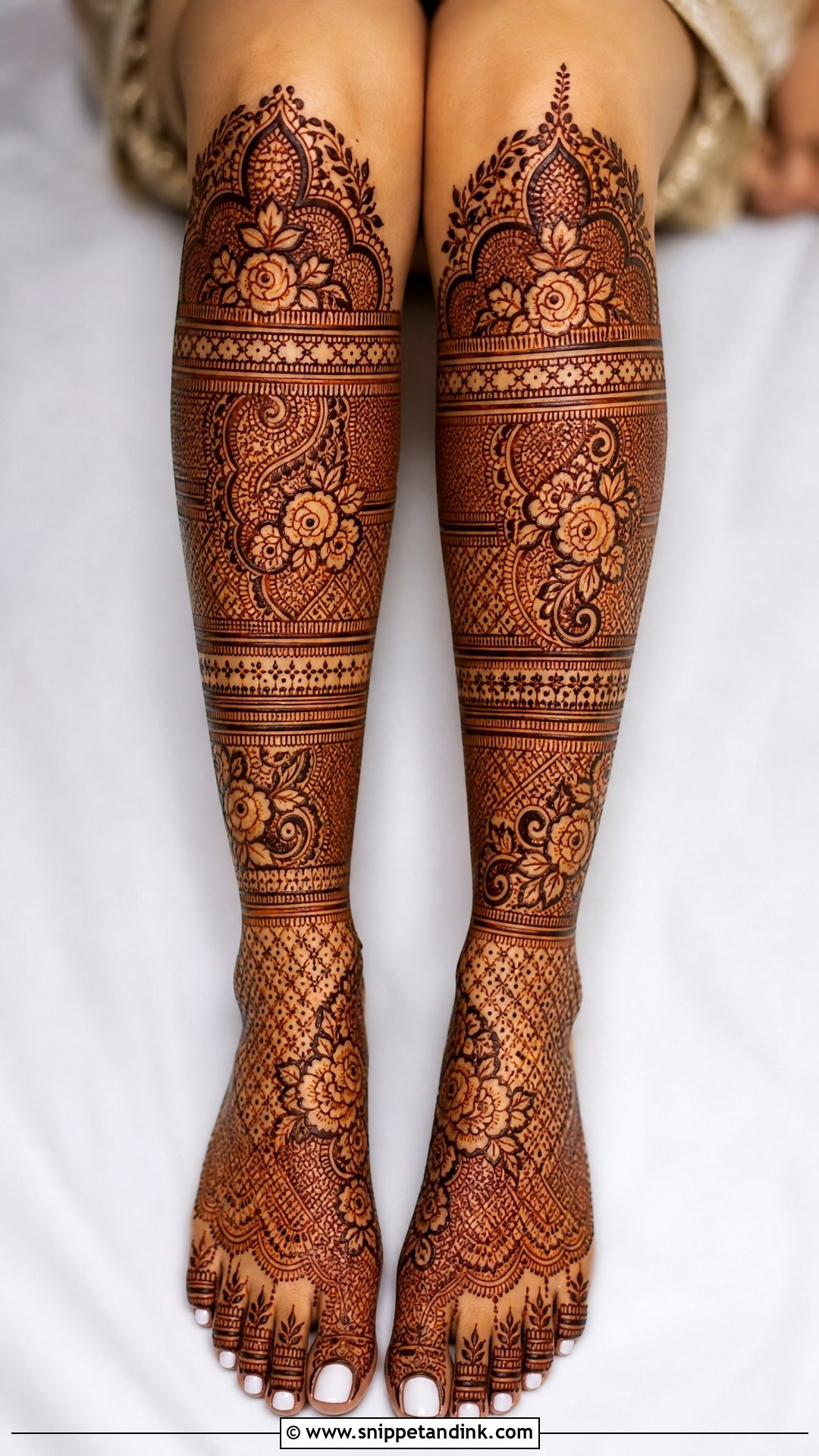
Modern layouts take the traditional vocabulary and rearrange it: asymmetrical trails, half-and-half panels, geometric borders, henna jewelry bands and clean empty space. I still keep the feet detailed so the look stays bridal, then let the motifs grow larger as they climb. Bring a photo of your outfit’s embellishment, mirror work or pearls for instance, and I’ll pull a shape from it so the design feels made for you rather than lifted from a feed.
19. Simple Bridal Full Leg Mehndi Design
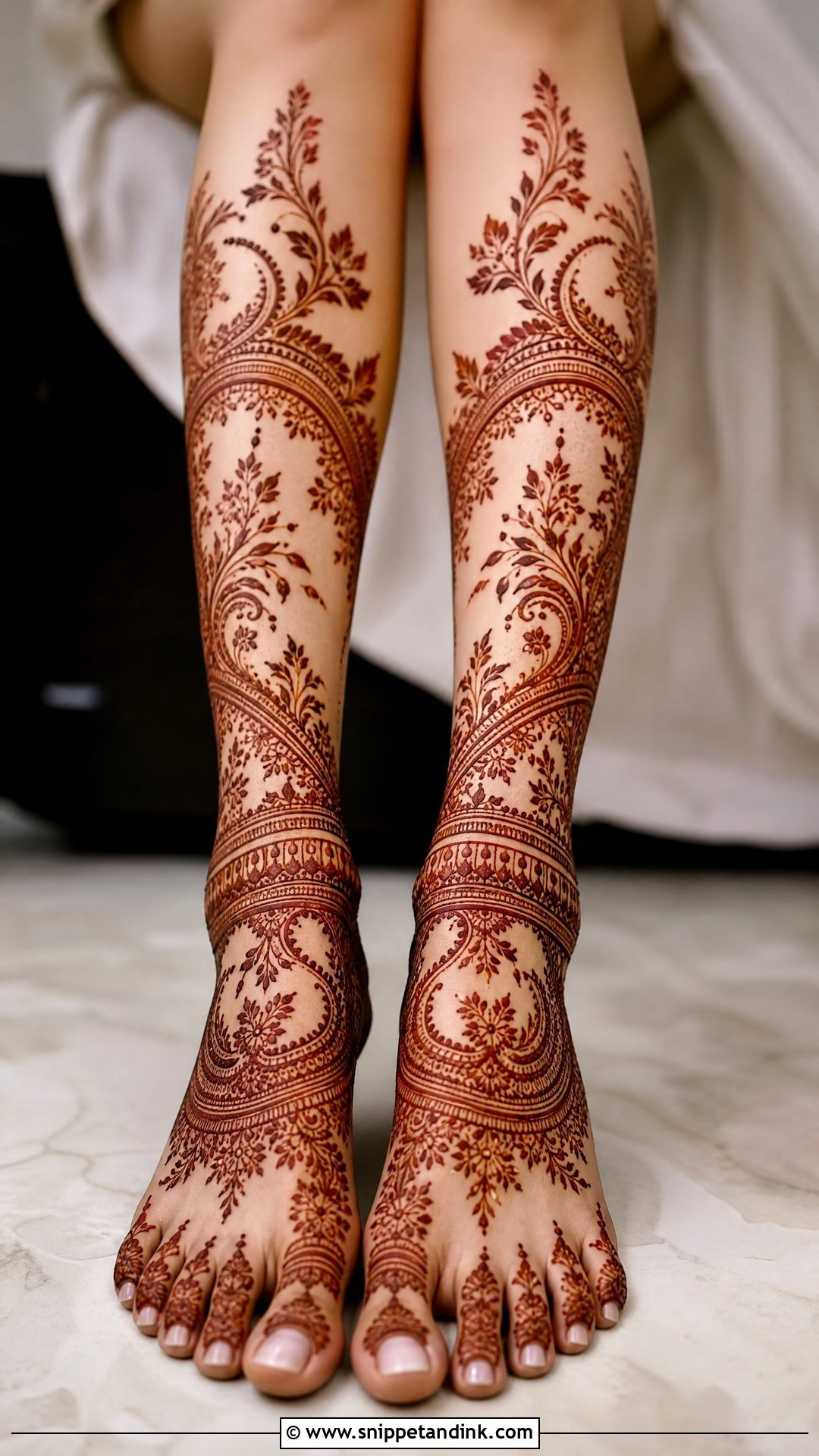
Simple full-leg mehndi covers the same area with vines, paisley bands, toe details and anklet shapes, minus the tiny fillers. It applies faster and carries more easily through a busy week. With good placement, a few bold flowers and curved vines look properly bridal. I suggest it for brides with sensitive skin, a packed schedule, or a preference for a softer stain that won’t fight the outfit.

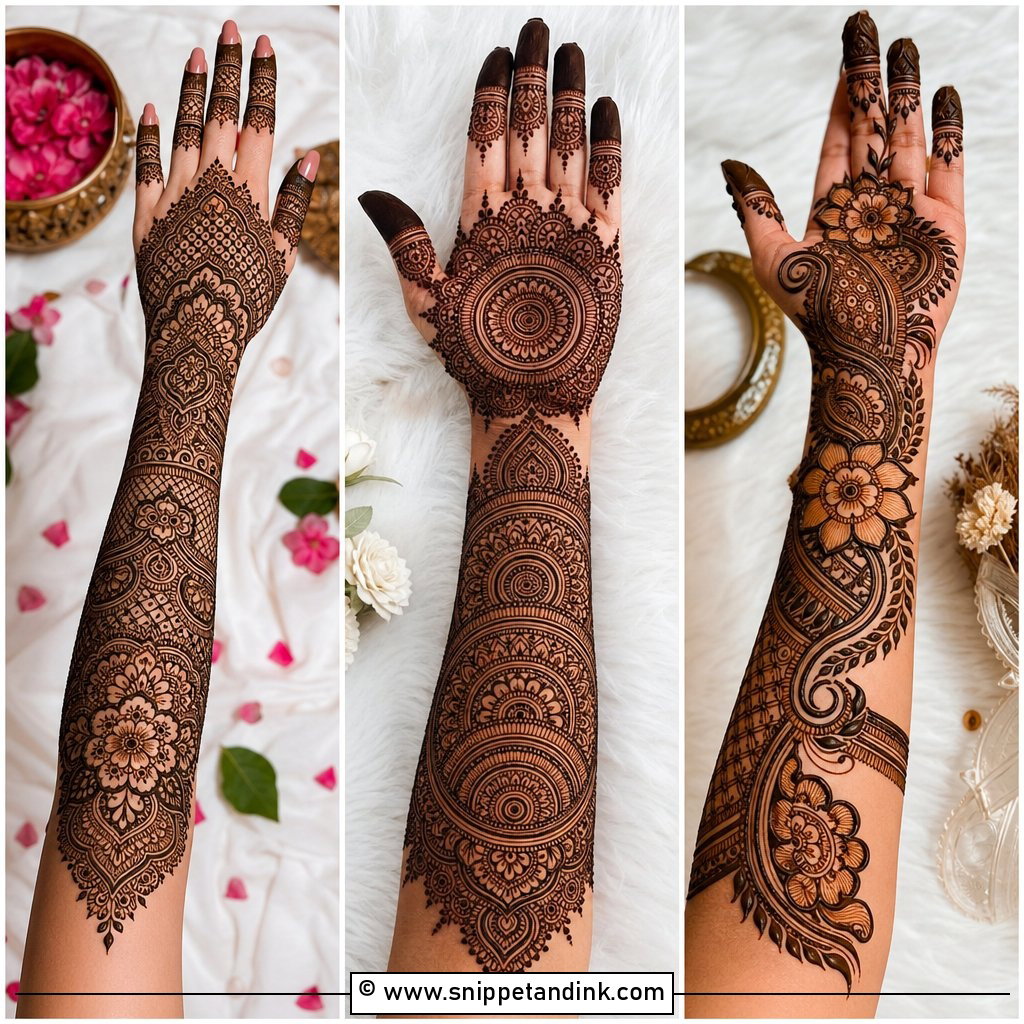


20. Heavy Bridal Full Leg Mehndi Design
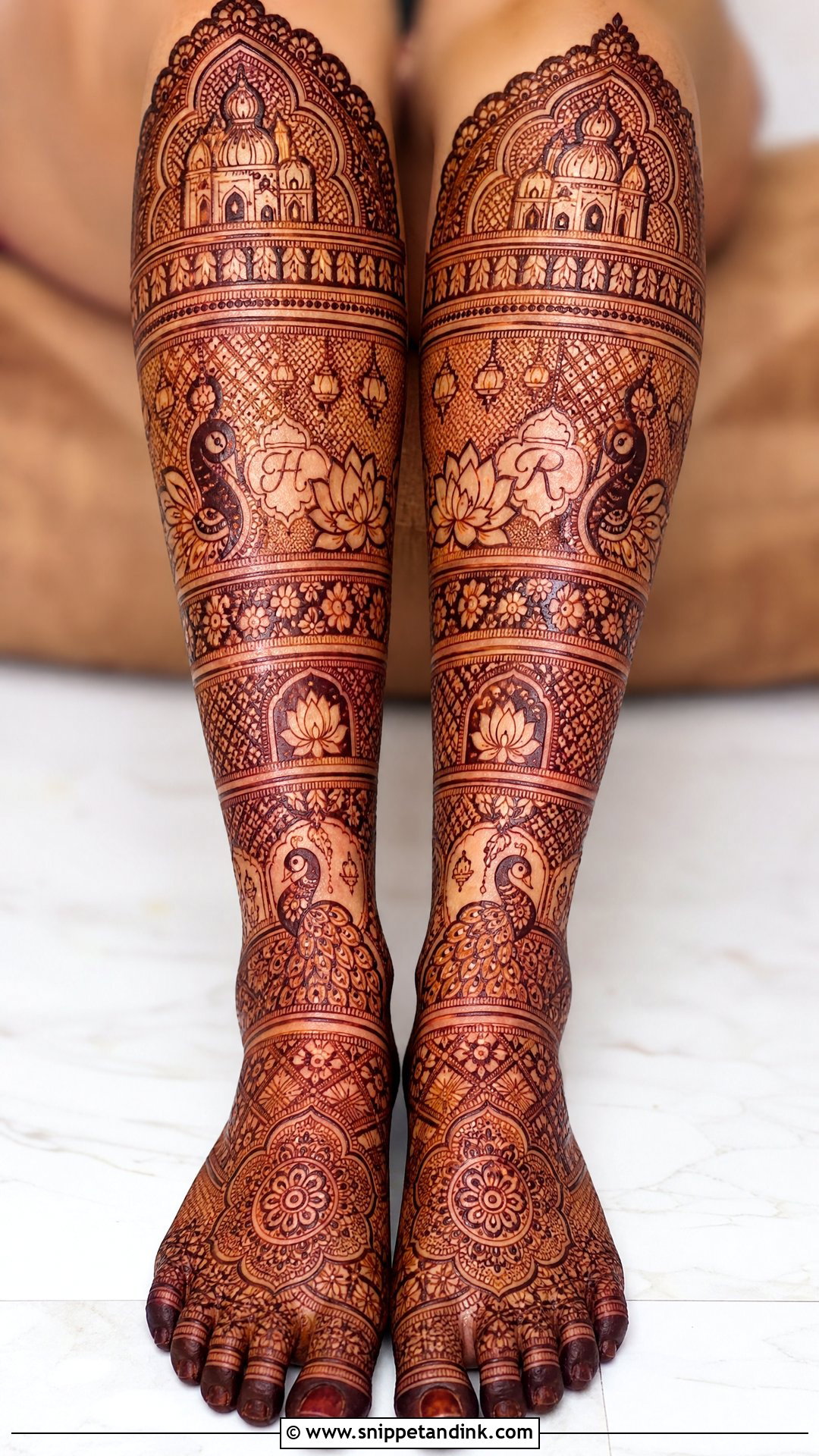
The heaviest version covers feet, ankles and calves almost to the knee with peacocks, lotus, paisleys, jaali panels, mandalas, jewelry bands and personal details. It’s the longest sitting on this list, so I’d book it as its own session rather than squeezing it in after hands. Done well and left on long enough, it gives a deep, rich stain that finishes a head-to-toe bridal look. Traditional red, maroon, gold and jewel tones carry it best.
Why Feet Fade First and How to Slow It Down
Feet take a deep stain and then lose it fastest, because you walk on them, they rub against shoes, and they meet water every time you wash. A little care in the first day makes the difference between a design that lasts through the reception and one that is patchy by the last function.
The first 24 hours
Keep the paste on as long as you can, overnight if possible. I seal it with a light dab of lemon and sugar so it stays stuck to the skin. To sleep, wrap the legs loosely in tissue and slip on old socks, not tight ones, and keep the room warm. When the paste is dry and flaking, scrape it off with a blunt edge or rub on a little oil. Avoid washing your legs for the rest of that day.
Through the wedding week
- Expect orange when the paste comes off. It deepens to its darkest over the next day or two.
- Pat the legs with a little natural oil before showers so water beads off the design.
- Avoid scrubs, pumice stones and hot soaks on the feet until after the main functions.
- Skip pedicures that week. Exfoliation removes the outer stained layer first.
- Choose cushioned footwear for long dancing nights; friction against straps wears lines thin.
If a section comes out lighter than the rest, don’t try to darken it with anything sold as instant black henna. Those products often contain chemical dye that can burn and scar. A pale patch on a calf is barely noticed in photos; a blister is.
Matching the Henna Line to Your Hemline and Sandals
Start from what will show. A floor-length lehenga hides everything above the ankle except when you sit or dance, so a heavy calf design may only appear in a handful of photos, while a sharara or a saree draped higher shows far more. Dense Indian work feels royal, Arabic and Gulf layouts feel airy, and Indo-Arabic, Moroccan or modern designs sit in between. Names, figures and wedding scenes add meaning if you have the time to sit for them. Before your appointment, try on the outfit with your wedding footwear and jewelry, and show me where the hem lands. That one detail decides more about your design than anything else.
You'll Like These Ideas:




Leave a Reply