
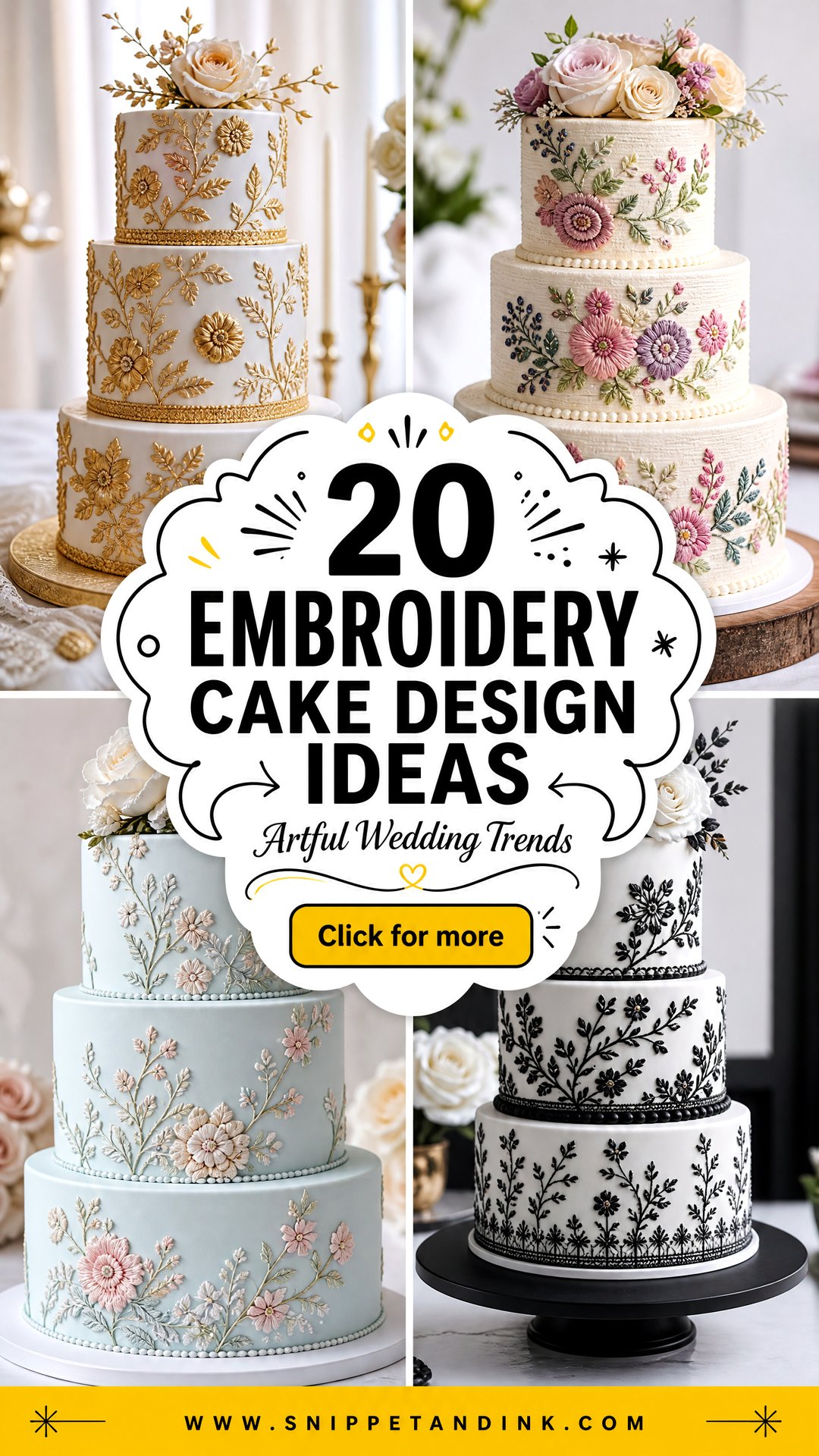
Embroidered cakes are the ones I spend the longest leaning over with a piping bag, and they reward it. The pattern can echo lace from a gown or veil, the florals on your invitations or the edge of a table linen. On sugar, embroidery is made in several ways: raised royal icing piping, brush embroidery, molded edible lace, hand painting, or pearls and sugar flowers layered on top. Each technique behaves differently in heat and humidity and suits a different look, from white-on-white to garden color. Here are 20 versions, with my notes on how each is made and what to ask for.
Royal Icing, Buttercream or Edible Lace? How Each Holds Up
The look you pick in a photo is really a choice of material, and each one has limits.
- Royal icing piping dries hard and gives the sharpest, most raised detail. It hates humidity: in a damp room or a sweating fridge it softens and can start to sag, so it’s best on fondant at an indoor venue.
- Buttercream piping is softer in look and taste, but it starts to slump in heat. Fine stitch lines lose their edge first.
- Edible lace is cast in silicone mats and dries flexible, so it wraps a tier smoothly. It can go limp in high humidity, and it looks more uniform than hand piping.
- Stenciled lace is quick and even, but flat. It suits a background pattern under a few piped highlights.
For an outdoor summer reception I steer couples toward fondant with royal icing kept under cover, or toward a design that uses less fine piping. For a cool indoor winter wedding, almost any of these will behave.
1. White Embroidery Wedding Cake
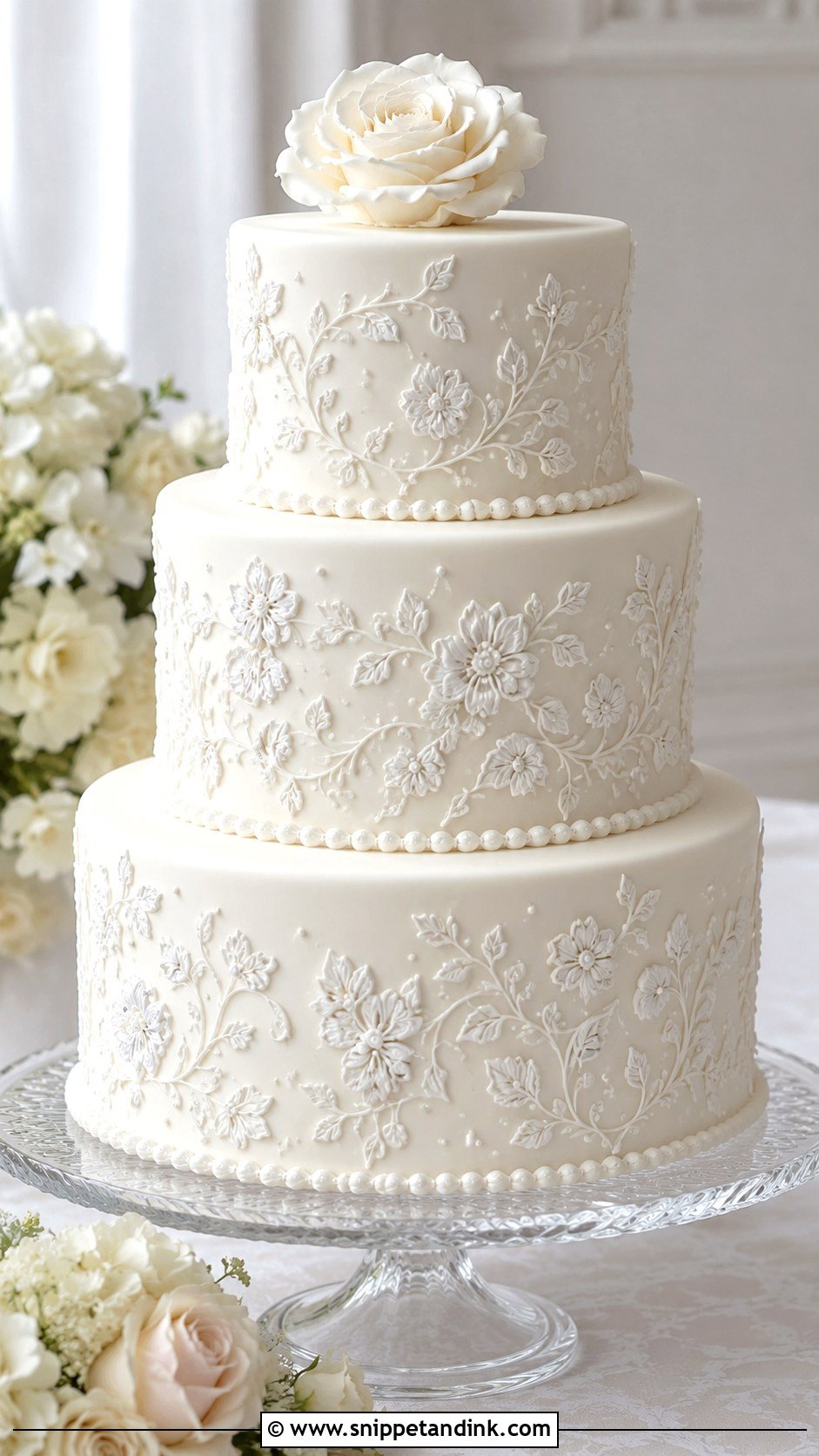
White on white is the purest version, and it relies entirely on shadow. I cover the tiers in smooth ivory fondant or buttercream, then pipe raised white vines, scalloped borders and tiny dots that read as stitching when light hits them from the side. It suits a two-tier or three-tier cake where the pattern can wrap each tier. Keep extra decoration to a few pearls or one white sugar flower. One thing to know: under flat overhead lighting, white piping can almost disappear in photos, so place the cake where window or side light reaches it.
2. Floral Embroidery Wedding Cake
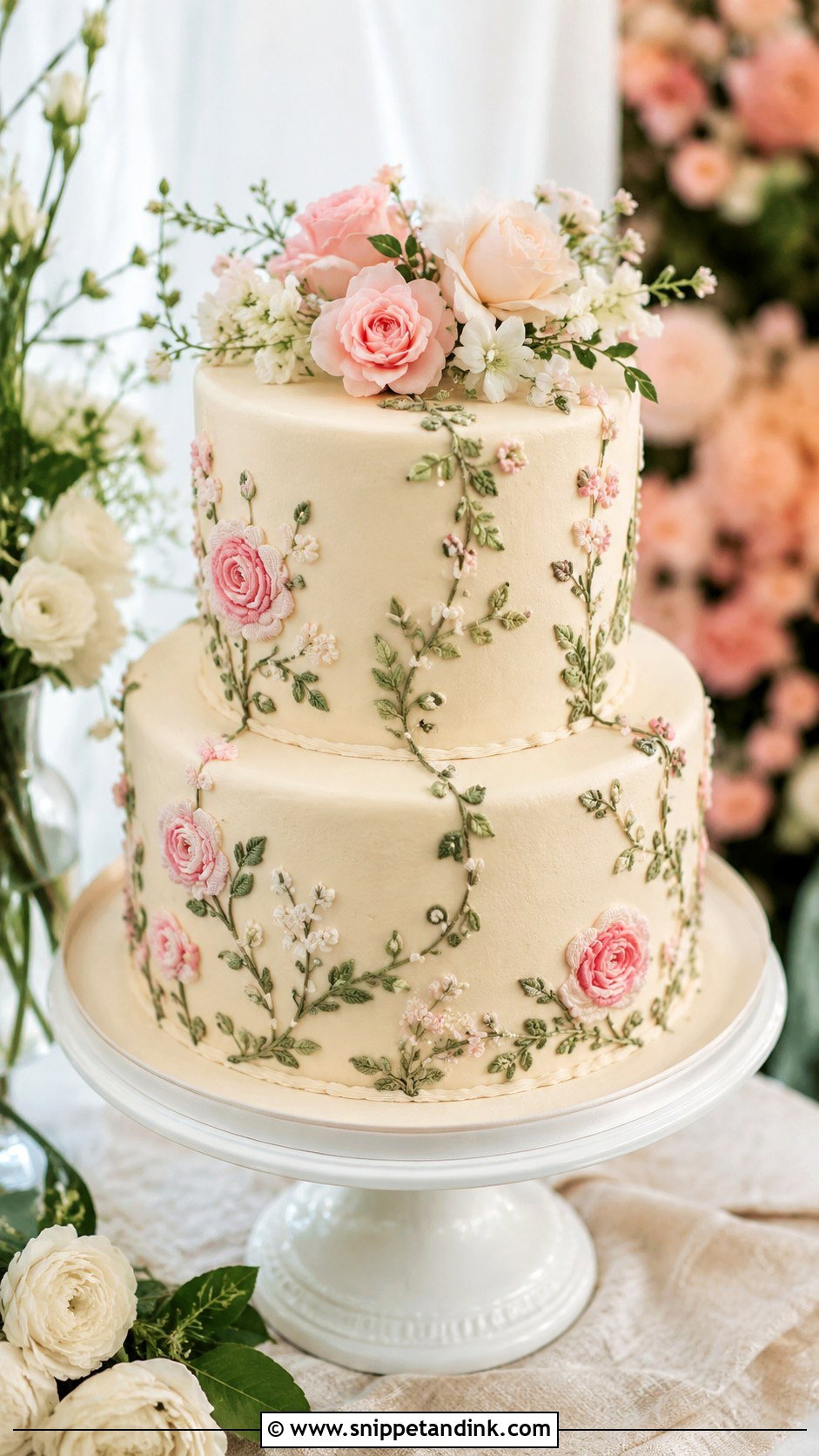
Here the cake itself becomes the flower bed: piped roses, leaves, curved stems and small blossoms spread over smooth fondant. All white is quiet; pastel pink, sage, lavender or dusty blue icing looks like colored thread. I keep the motifs small near the top tier and let them grow larger toward the base so the eye travels down. A few dimensional sugar flowers at the bottom join the flat embroidery to the table. Spring and summer weddings suit it best.
3. Brush Embroidery Wedding Cake
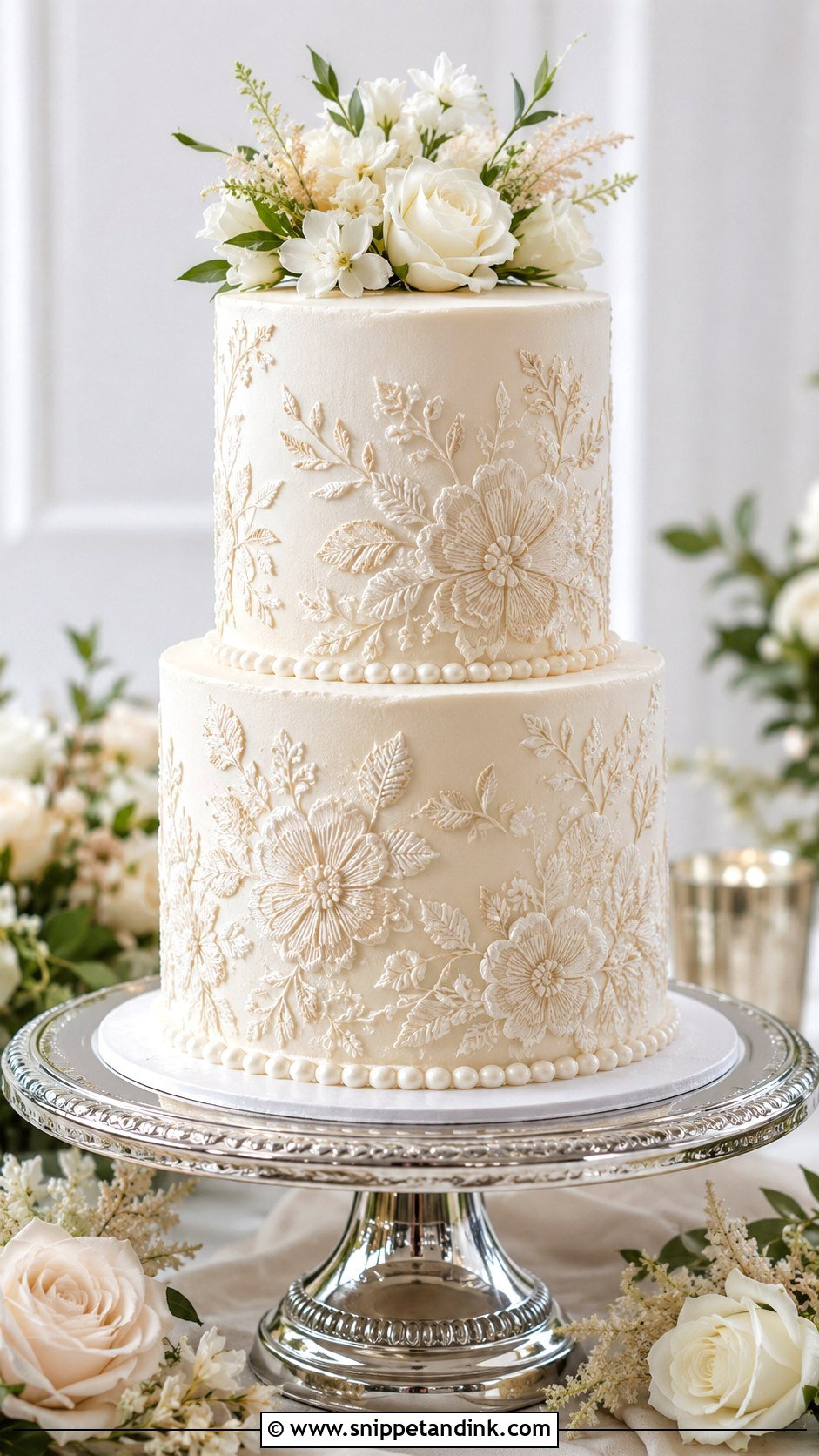
A brush embroidery wedding cake is made one petal at a time. I pipe the outline of a petal or leaf in royal icing, then while it’s still wet, drag a damp brush from the edge toward the center so it thins into feathery strokes. Work too slowly and the icing crusts and won’t brush; use too wet a brush and it dissolves. Floral outlines, lace panels and trailing vines suit the technique. White-on-white is subtle, and champagne, blush or ivory shows the texture a little more. Thin pearl borders and a simple topper finish it.
4. Lace Embroidery Wedding Cake
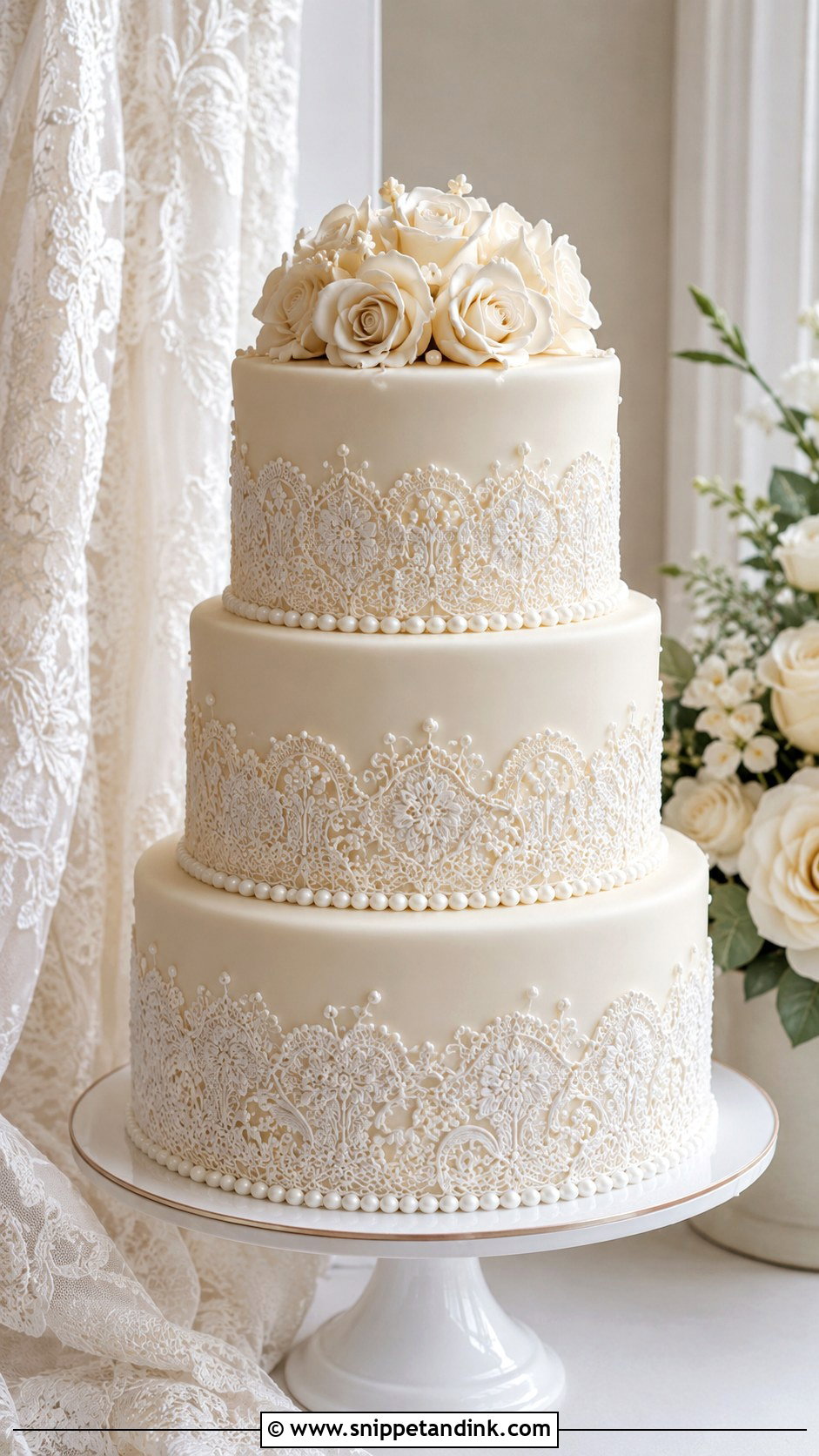
Brides often bring me a photo of their dress lace, and I treat it as a reference, not a blueprint. Copying a lace pattern exactly onto a curved tier rarely looks right; picking out two or three motifs and repeating them works better. I build it with piped royal icing, edible lace panels or fondant appliqués. Tall tiers give the pattern room. A lace band on every tier feels classic; lace on one side only feels more current. Pearl beads, satin ribbon and ivory sugar roses suit it.
5. Pearl Embroidery Wedding Cake
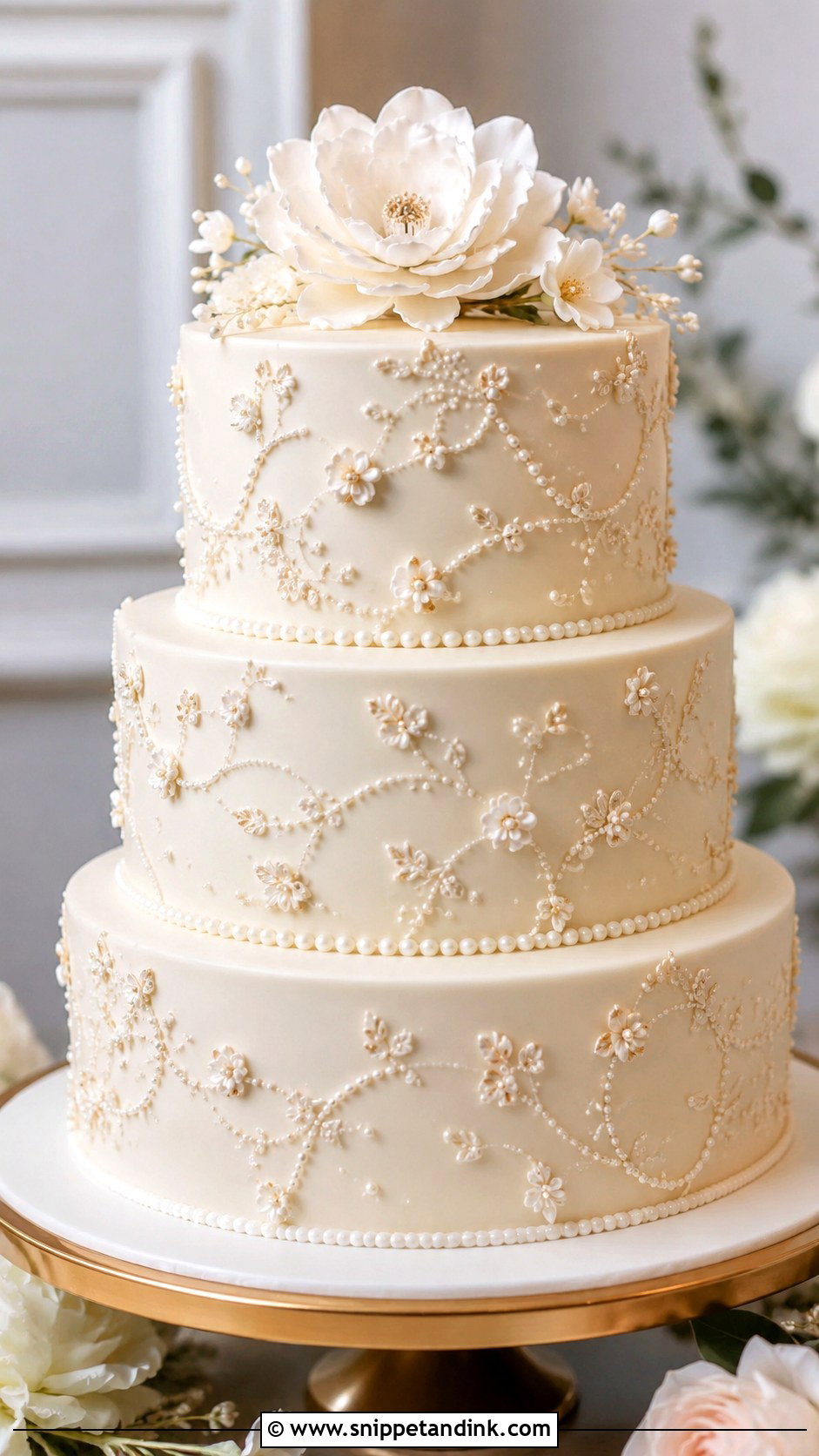
Pearls catch light where piping alone can’t. I set them along floral vines, around lace borders or in the center of small piped flowers, pressing each into the icing while it’s still soft so it sets in place. A mix of small and medium pearls looks more like real beadwork than one size everywhere. White, ivory or champagne keeps it formal. I’d leave the top tier plain so the cake doesn’t read as a beaded dress from top to bottom.
6. Vintage Embroidery Wedding Cake
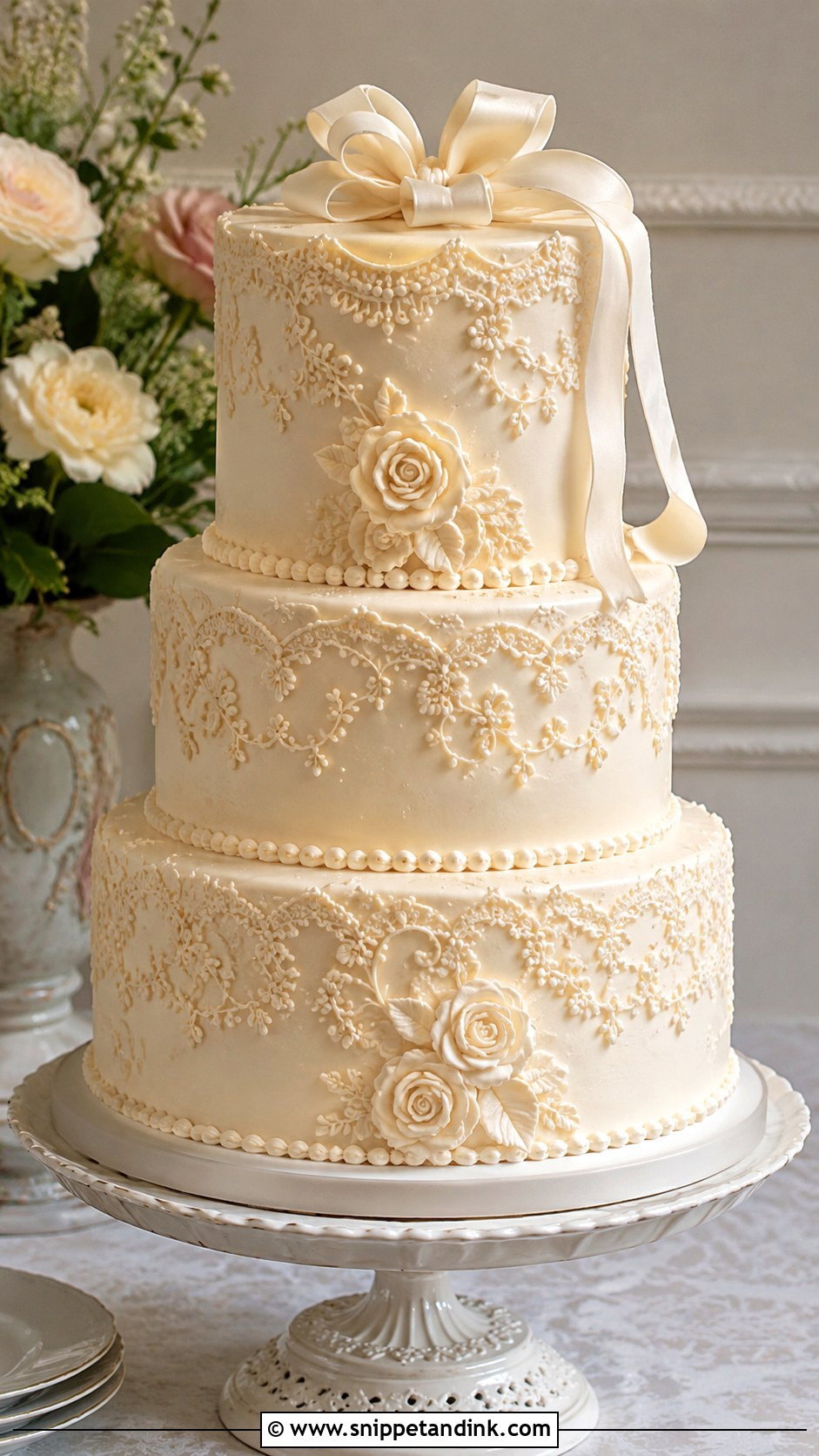
Vintage embroidery means piped lace, scalloped edges, scrolls and soft buttercream borders, the kind of overpiped work you see on mid-century cakes. Ivory, cream, blush and pale gold stop it feeling theatrical. For the full effect I’d choose a round three-tier with an embroidered panel on each tier and small piped borders hiding the seams. Garden venues, historic homes and ballrooms all suit it. A few sugar roses or a delicate monogram make it personal. Expect this one to need a long lead time; heavy overpiping is slow work.
7. Blush Embroidery Wedding Cake
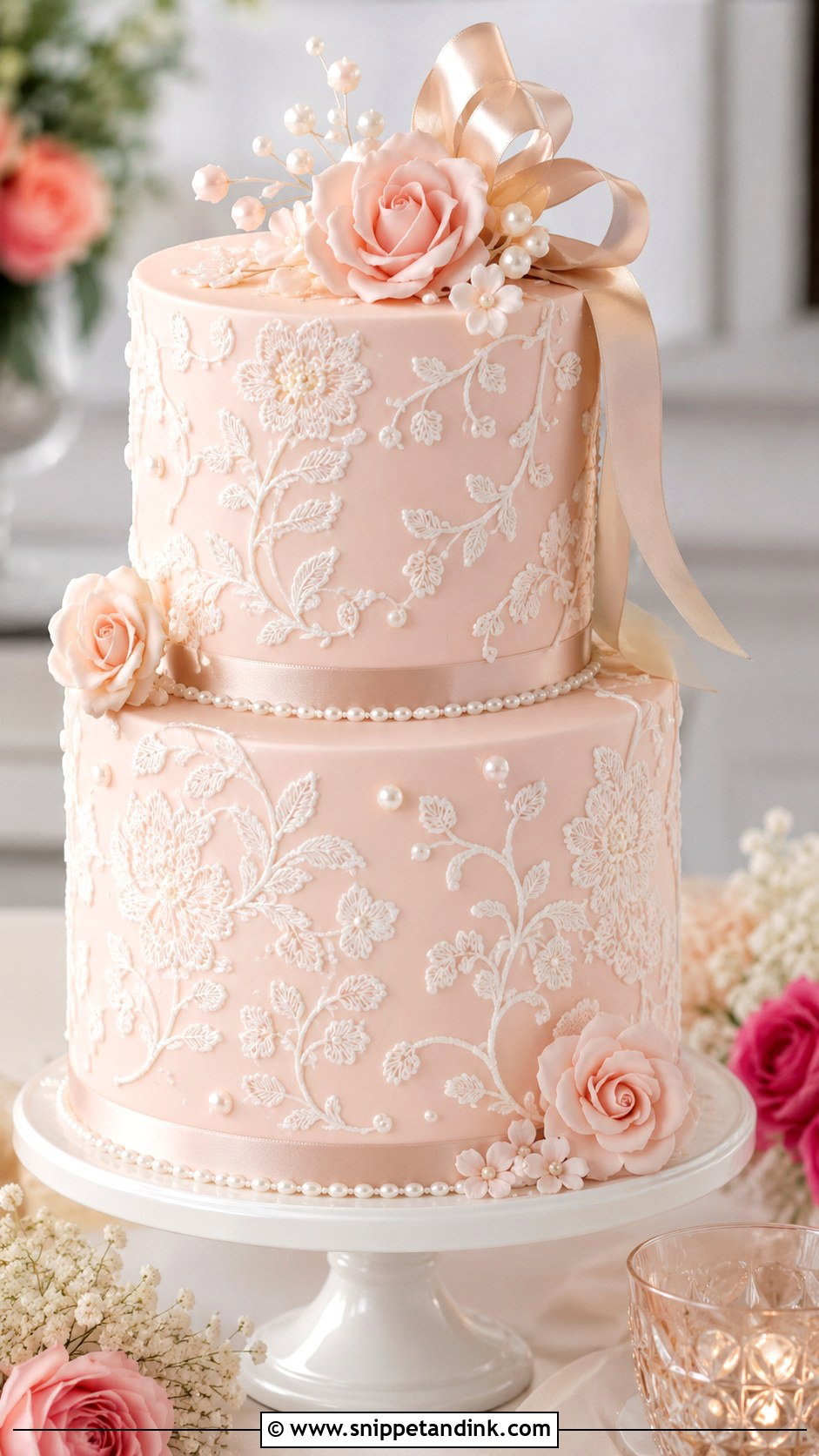
On a blush base, white embroidery suddenly becomes easy to see, which solves the white-on-white photo problem. The base can be pale blush, ivory with blush accents or a gentle ombre from pink to cream. Floral motifs, lace swirls and stitched leaves all work on it, finished with blush sugar roses, ivory pearls or a champagne ribbon. Pink coloring in fondant can fade under strong light, so I keep these cakes out of direct sun until they go out.
8. Gold Embroidery Wedding Cake
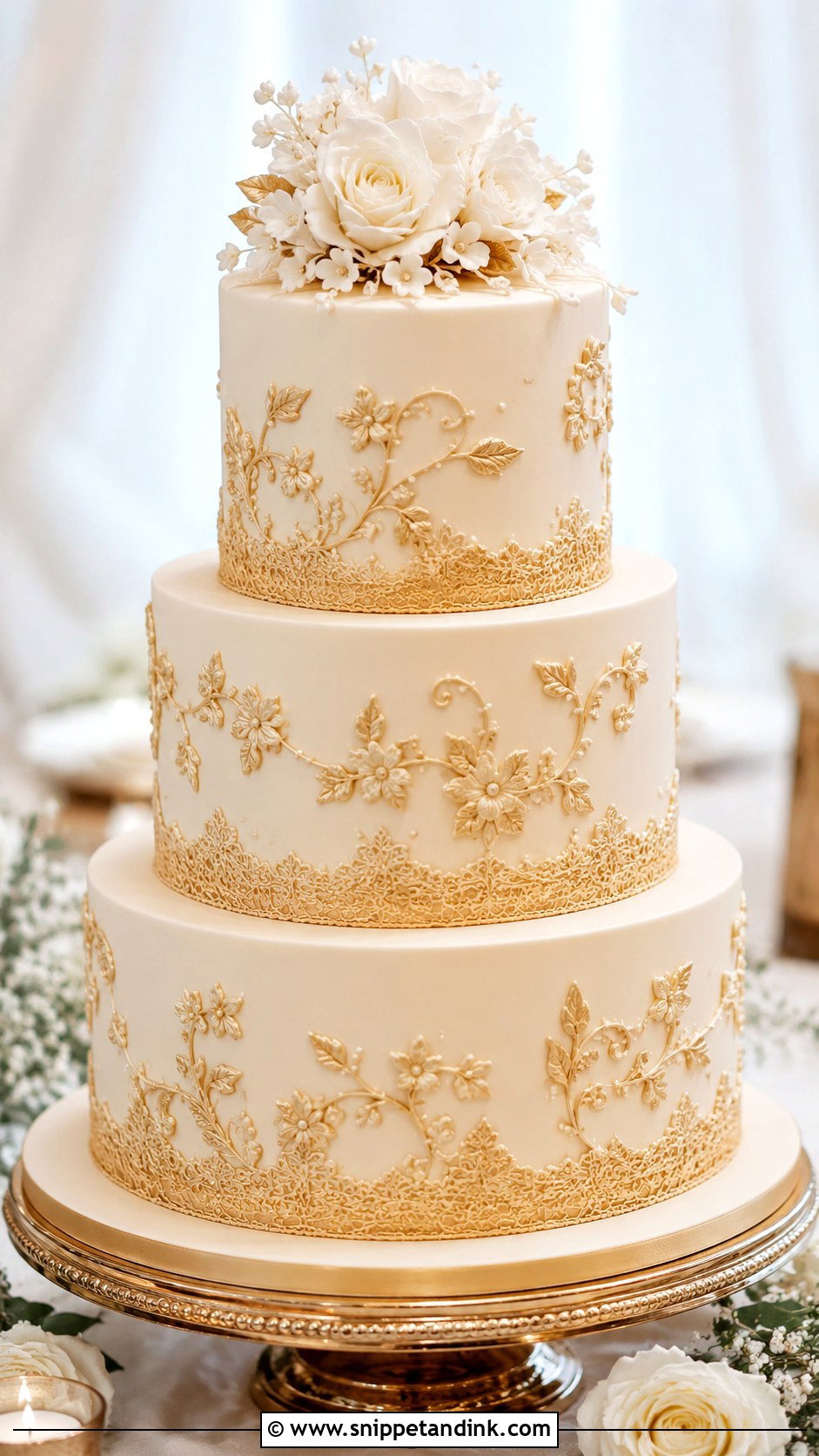
Gold works best as an accent. I usually pipe the embroidery in white, let it dry, then paint selected lines with edible gold. Covering every line hides the stitched texture you’re paying for. A white or ivory base, gold vines, lace borders and small painted dots catch candlelight at an evening or ballroom reception. Pair it with white sugar flowers, pearl trim or a gold monogram. Ask your baker to confirm the gold is sold as edible, since some decorating dusts are labeled non-toxic only, which means decorative use, not eating.
9. Blue Embroidery Wedding Cake
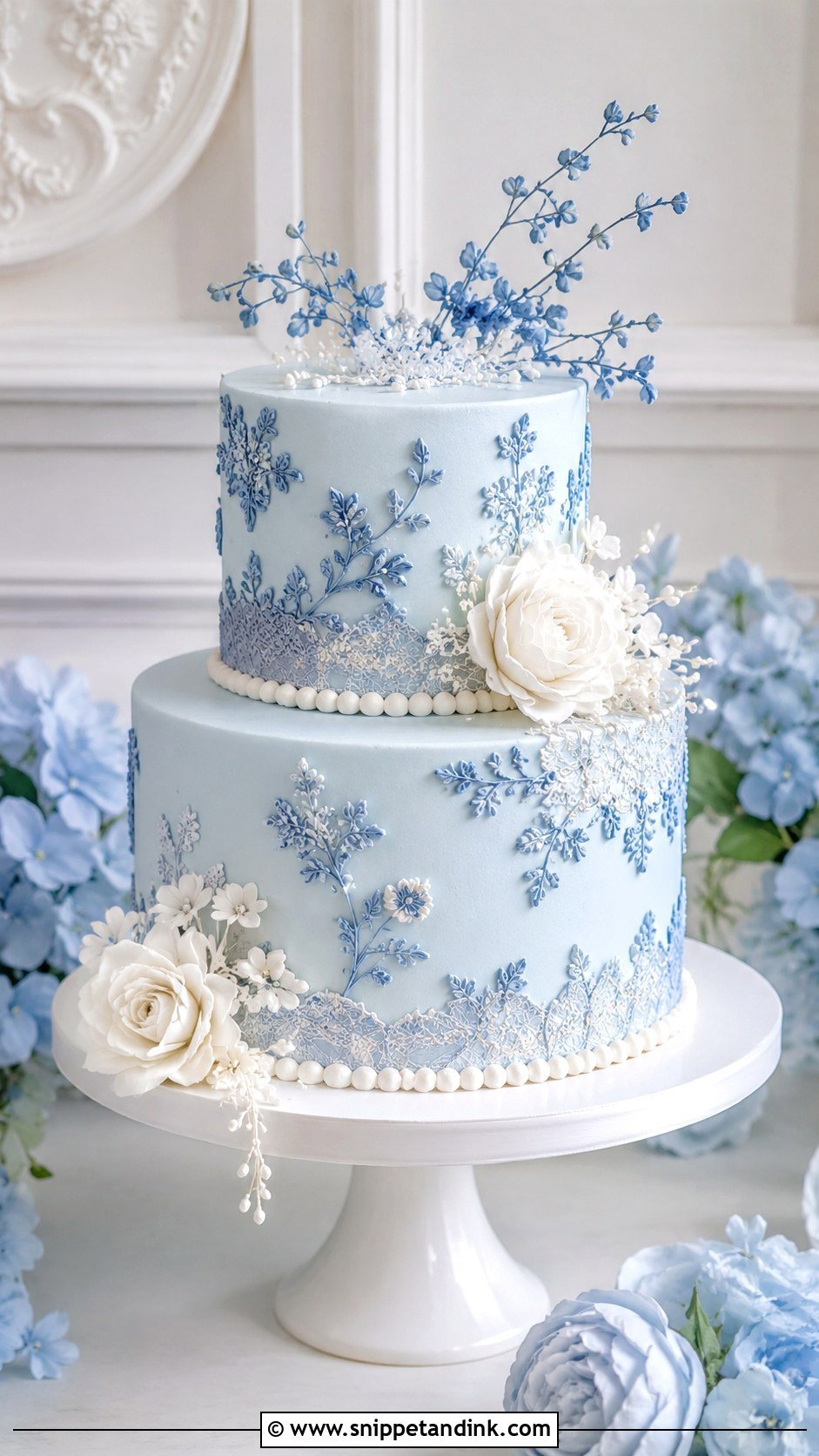
Blue embroidery is a neat way to bring your something blue into the dessert. Dusty blue, powder blue and pale French blue look most bridal. White piping on a blue tier gives contrast; blue on blue gives quiet texture. Vines, toile-style flowers and lace bands all suit it, kept light with ivory frosting, white sugar flowers and small pearls. If your invitations or linens are blue, bring a sample to the tasting. Blues are tricky to match in icing, and I’d rather mix against the real thing than a screen.
10. Green Embroidery Wedding Cake
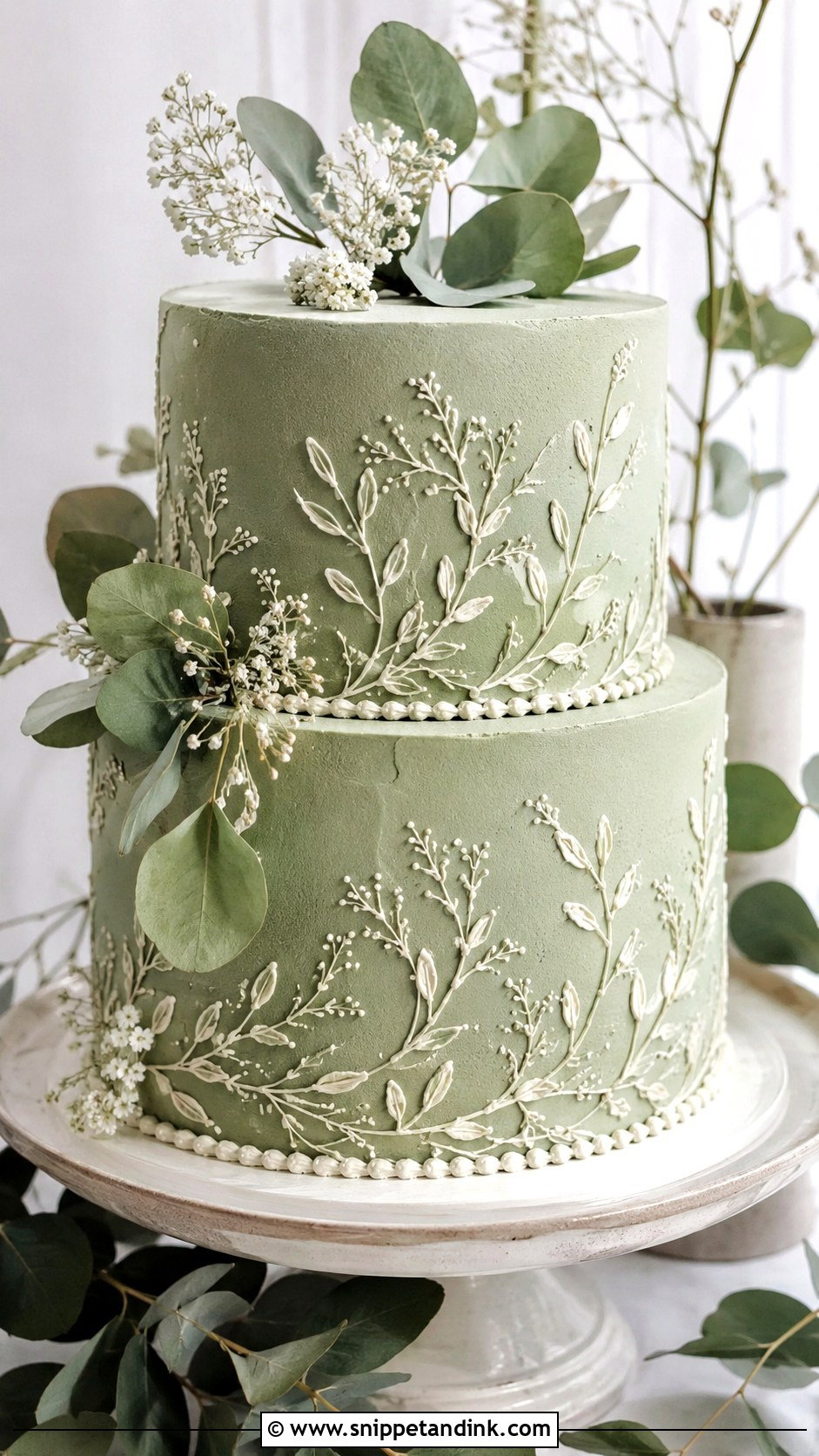
Sage green, eucalyptus or pale olive tiers with white or ivory embroidery over the top look natural without a single fresh flower. Stitched vines, leaf patterns and botanical borders are the obvious motifs, with small sugar leaves and white flowers rather than big blooms. Greenhouse venues and outdoor weddings suit it. Muted greens can drift toward grey in buttercream, so I’d make sure you see a color swatch on the actual frosting before the cake is made.
11. Monogram Embroidery Wedding Cake
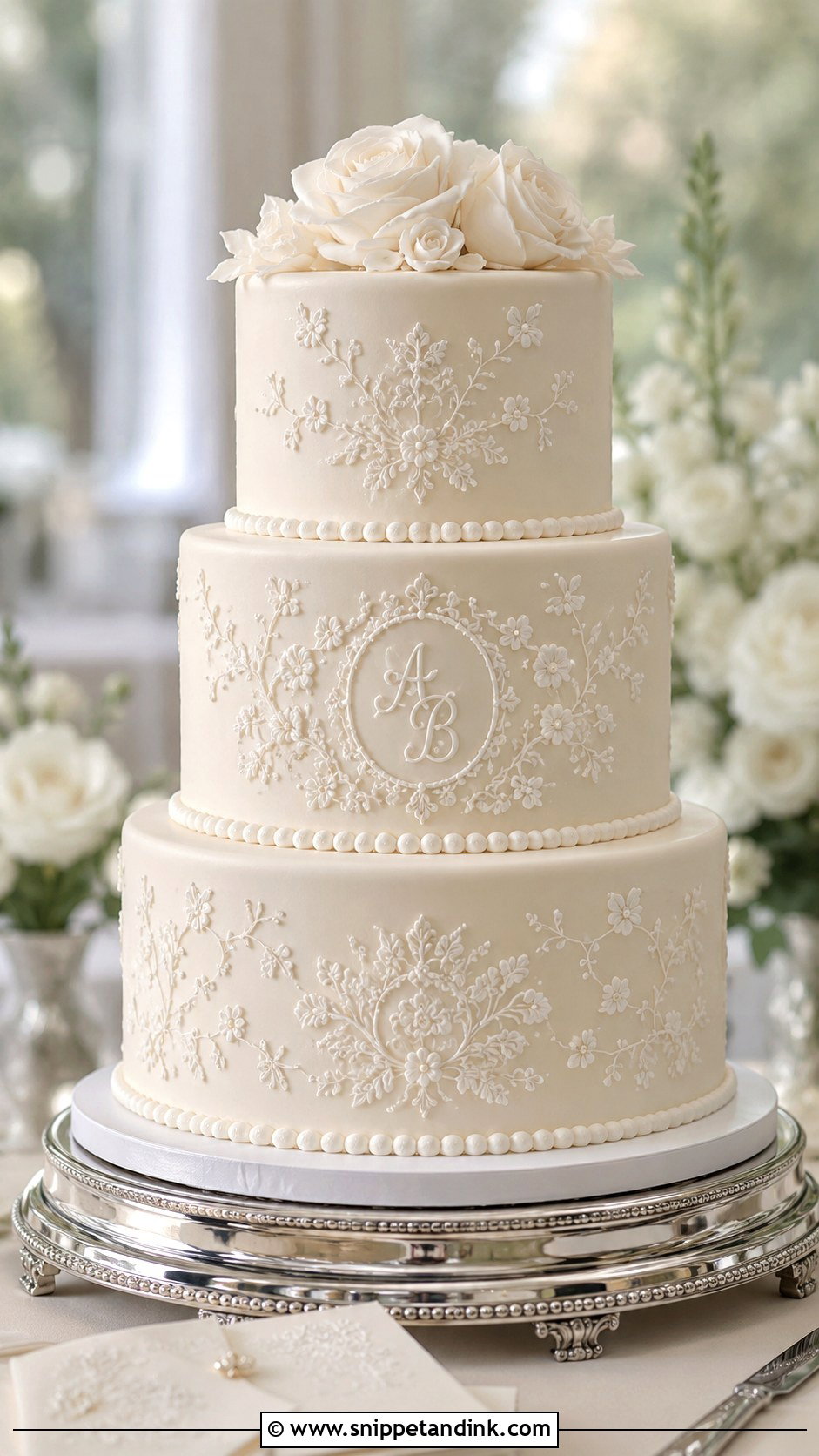
With a monogram, the initials are the focus and everything else steps back. I center them on the middle tier, at eye level, and frame them with piped floral embroidery or lace scrolls. Ivory, white, champagne or soft blush keeps it classic, and a thin pearl border around each tier finishes the edges. Bring your invitation or crest so I can copy the letterforms. Script fonts with very thin strokes are hard to pipe crisply, so a slightly bolder letter often reads better on sugar.
12. Garden Embroidery Wedding Cake
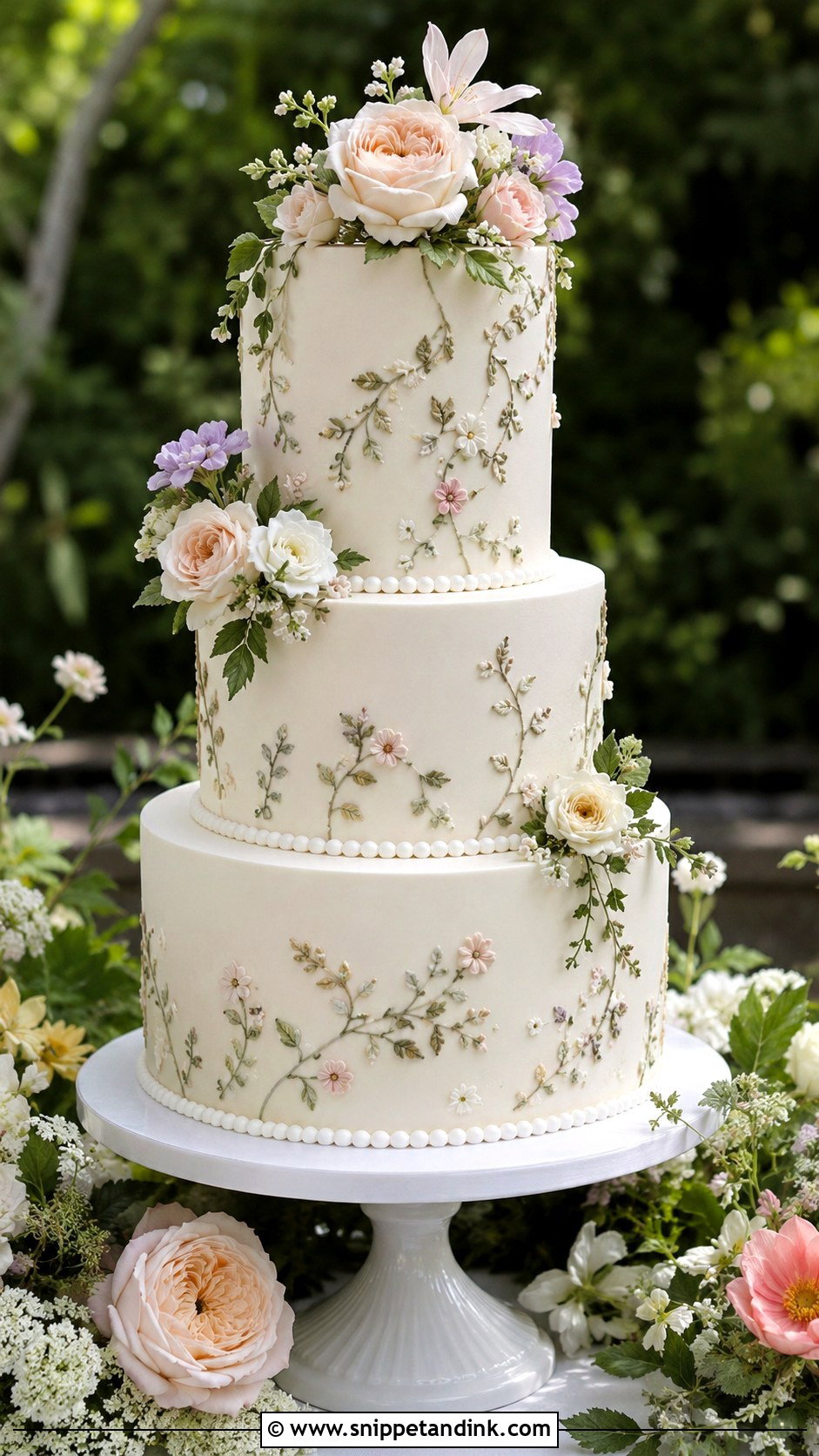
A garden embroidery cake should look as if the vines grew up it. I start the stems on the bottom tier and let them climb unevenly toward the top, leaving plenty of bare space so it reads as a path rather than wallpaper. Tiny flowers and leaves fill in along the way, in ivory, blush, sage or pale yellow. Fresh or sugar flowers can sit at the base, along one side or on top. Tented and outdoor receptions suit it, with the caveat that piped work needs shade on a hot day.
13. Pastel Embroidery Wedding Cake
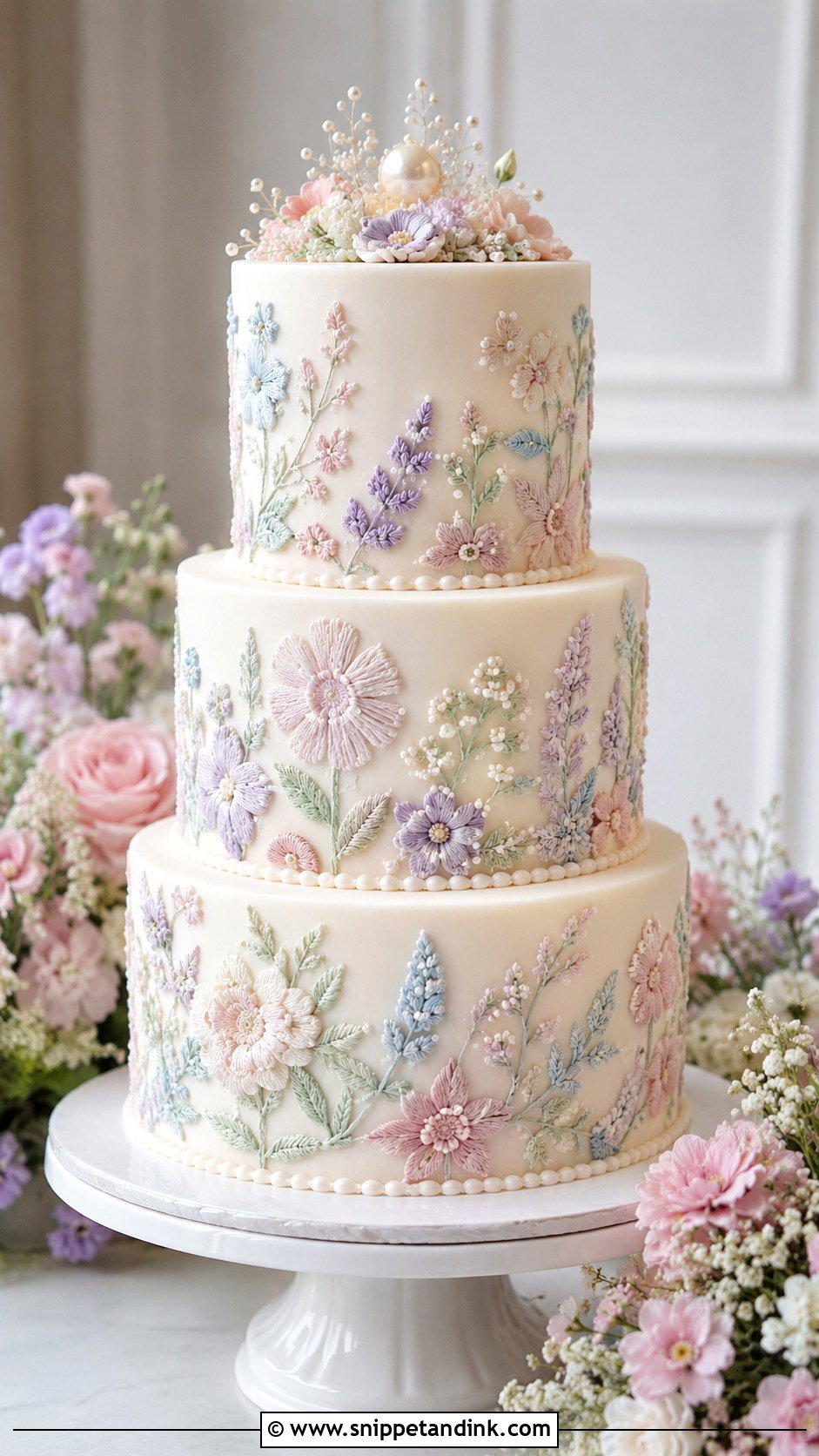
Pastel embroidery is the sweetest version. The base can stay ivory with pink, lavender, blue, peach and mint piping, or each tier can be its own pastel with white embroidery over it. Small florals, dotted borders and stitched leaves keep it light. The trap is too many colors at full strength. I limit it to three shades and knock each one back with white until the palette sits close to your flowers.
14. Buttercream Embroidery Wedding Cake
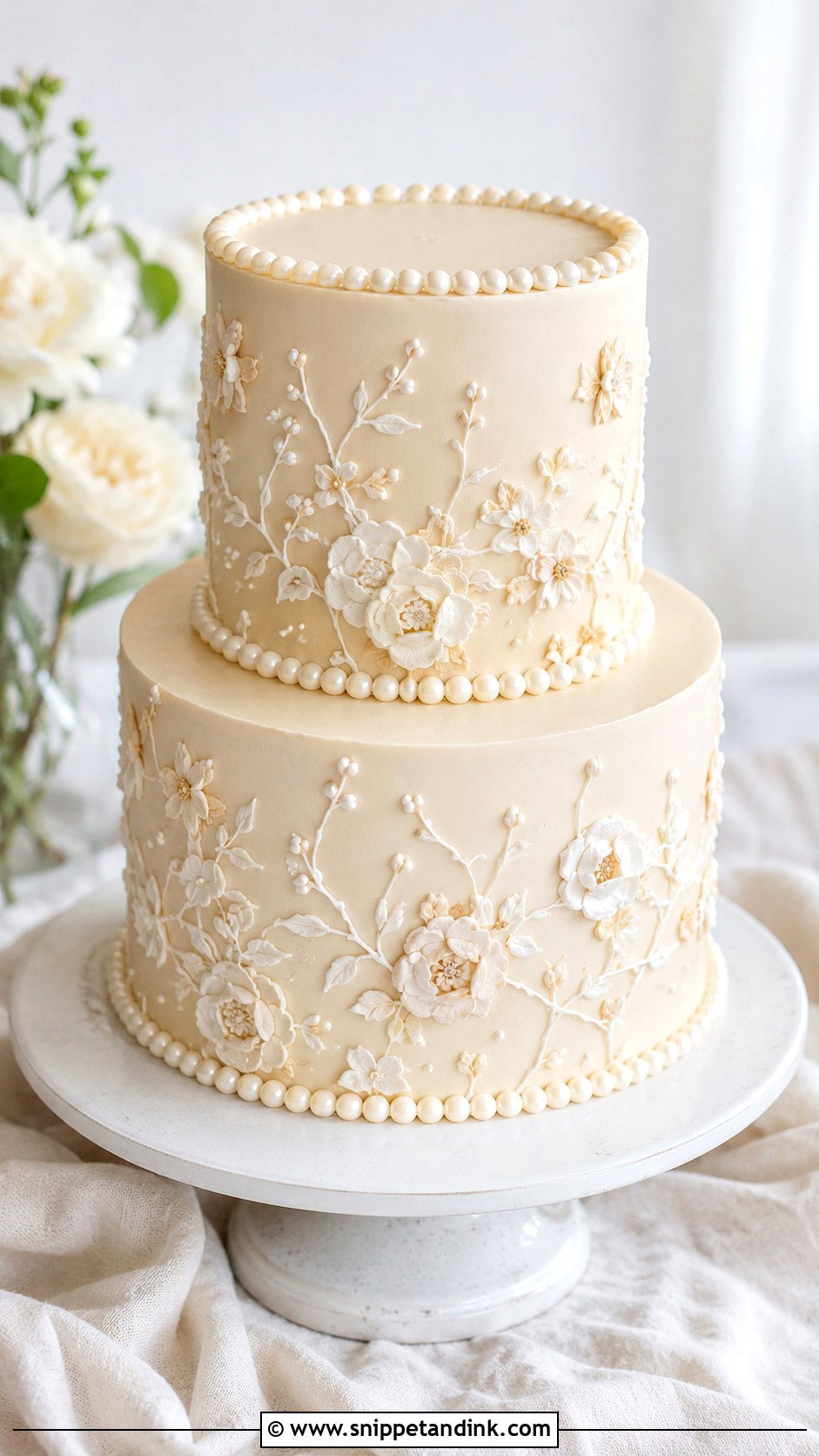
Buttercream gives a softer, warmer surface than fondant, and it suits rustic, garden and smaller weddings. I pipe the embroidery onto a well-chilled cake with a firmer icing, because a soft surface lets the piping tip drag. Floral vines, lace borders and stitched dots all hold well. Choose Swiss meringue or American buttercream with your baker based on venue and season: Swiss meringue tastes lighter but softens sooner in heat, while American buttercream crusts and holds detail longer. I’d avoid this style for a summer cake sitting outdoors for hours.
15. Fondant Embroidery Wedding Cake
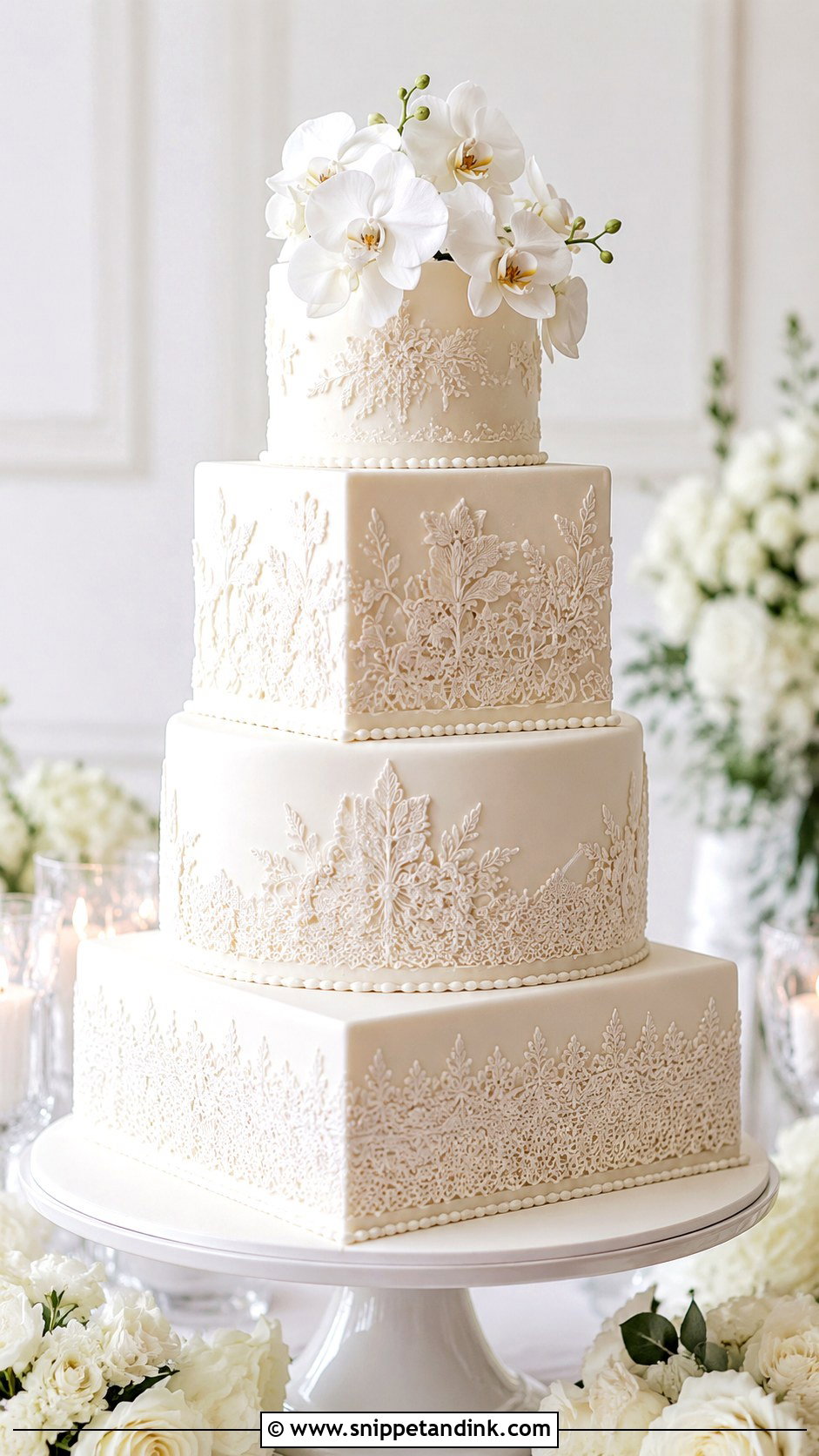
Fondant is the cleanest canvas I have for fine embroidery. Its smooth surface makes white-on-white and ivory-on-ivory work show clearly, and it suits monograms, lace panels and dress-inspired motifs. Round, square and mixed-shape tiers all work. Thin fondant ribbons, sugar flowers or pearls finish it. In warm weather fondant keeps the cake looking crisp longer than buttercream, but don’t let anyone move it straight from a fridge into a humid room, or it will bead with condensation and the piping can soften.
16. Watercolor Embroidery Wedding Cake
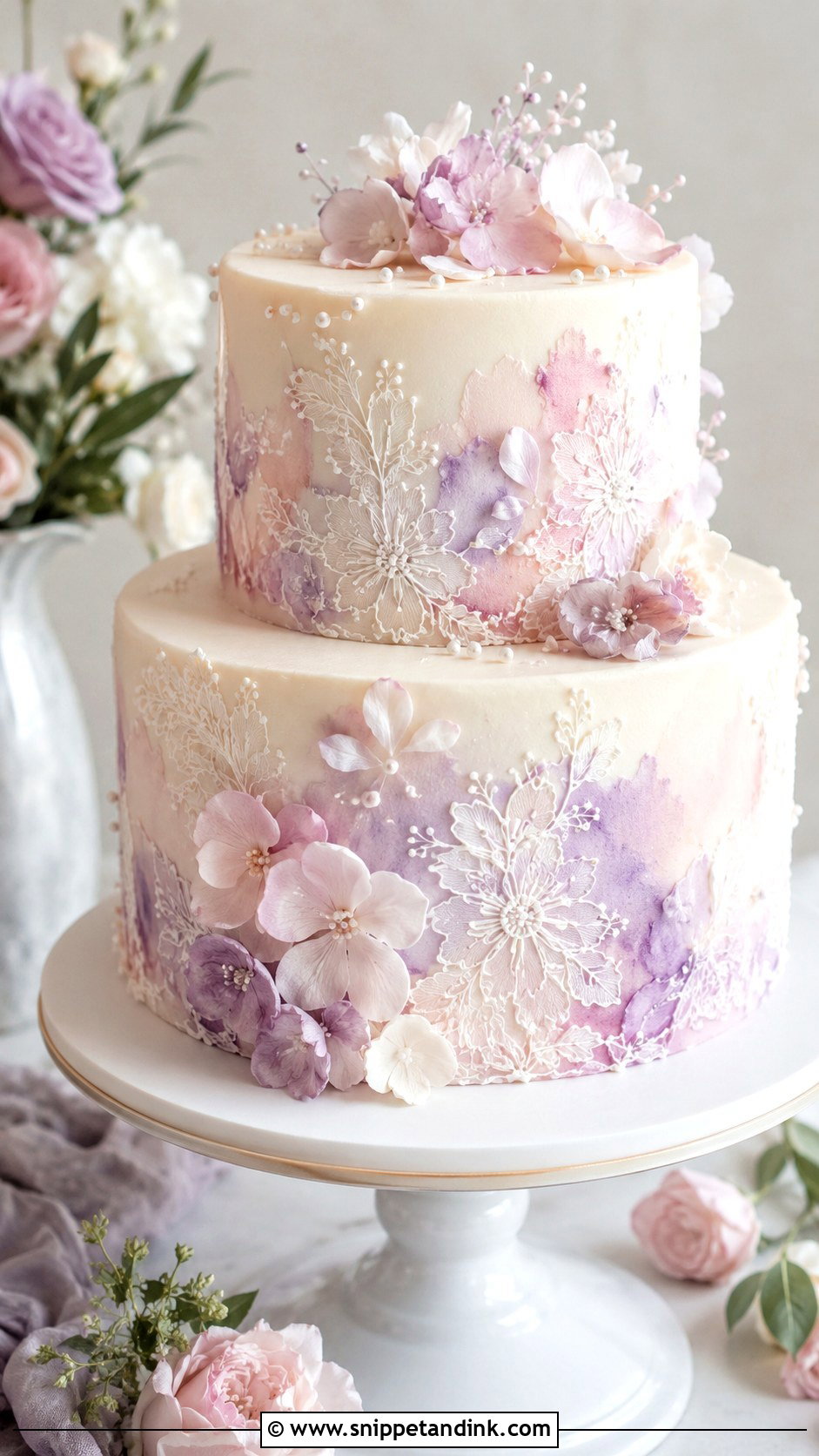
Watercolor embroidery layers two crafts. I paint a pale wash of blush, blue, lavender or peach onto the fondant with diluted food color, let it dry fully, then pipe white embroidery over it so the color sits behind the petals like a shadow. Painting on buttercream is much harder, so this is mostly a fondant style. Keep the wash light or it competes with the piping. A few sugar flowers, pearl dots or painted leaves are plenty for an artistic, romantic cake.
17. Black And White Embroidery Wedding Cake
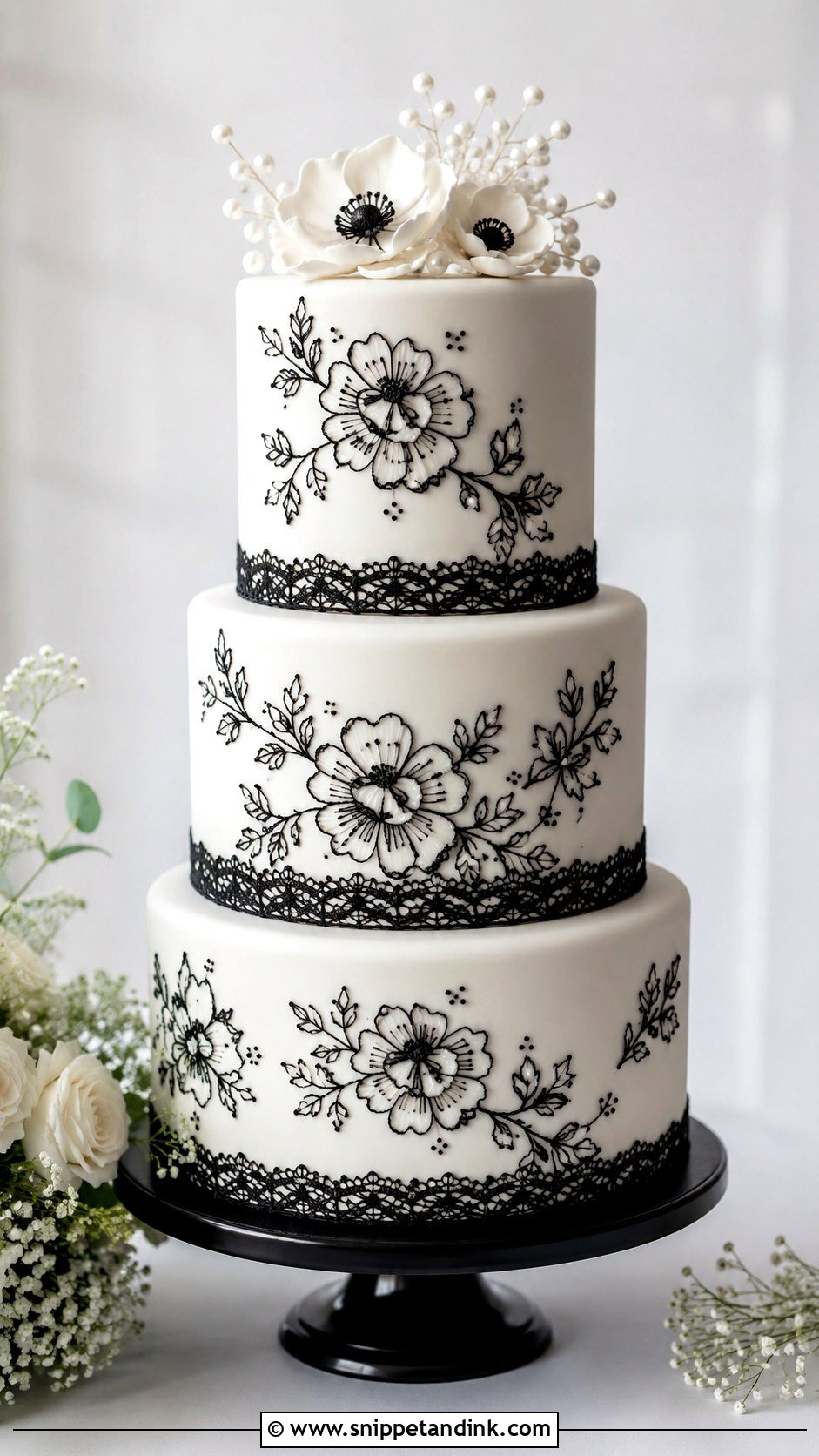
Black embroidery on a white cake is graphic and modern. I’d keep the cake white or ivory and use black only for the vines, lace panels or floral outlines, so it looks like stitching on a gown or tuxedo rather than a dark cake. White sugar flowers, pearls or a black ribbon balance it. On the practical side, true black icing takes a lot of coloring and can stain lips and teeth, so I start from a cocoa-based icing to cut the dye. Modern and evening receptions suit it best.
18. Square Embroidery Wedding Cake
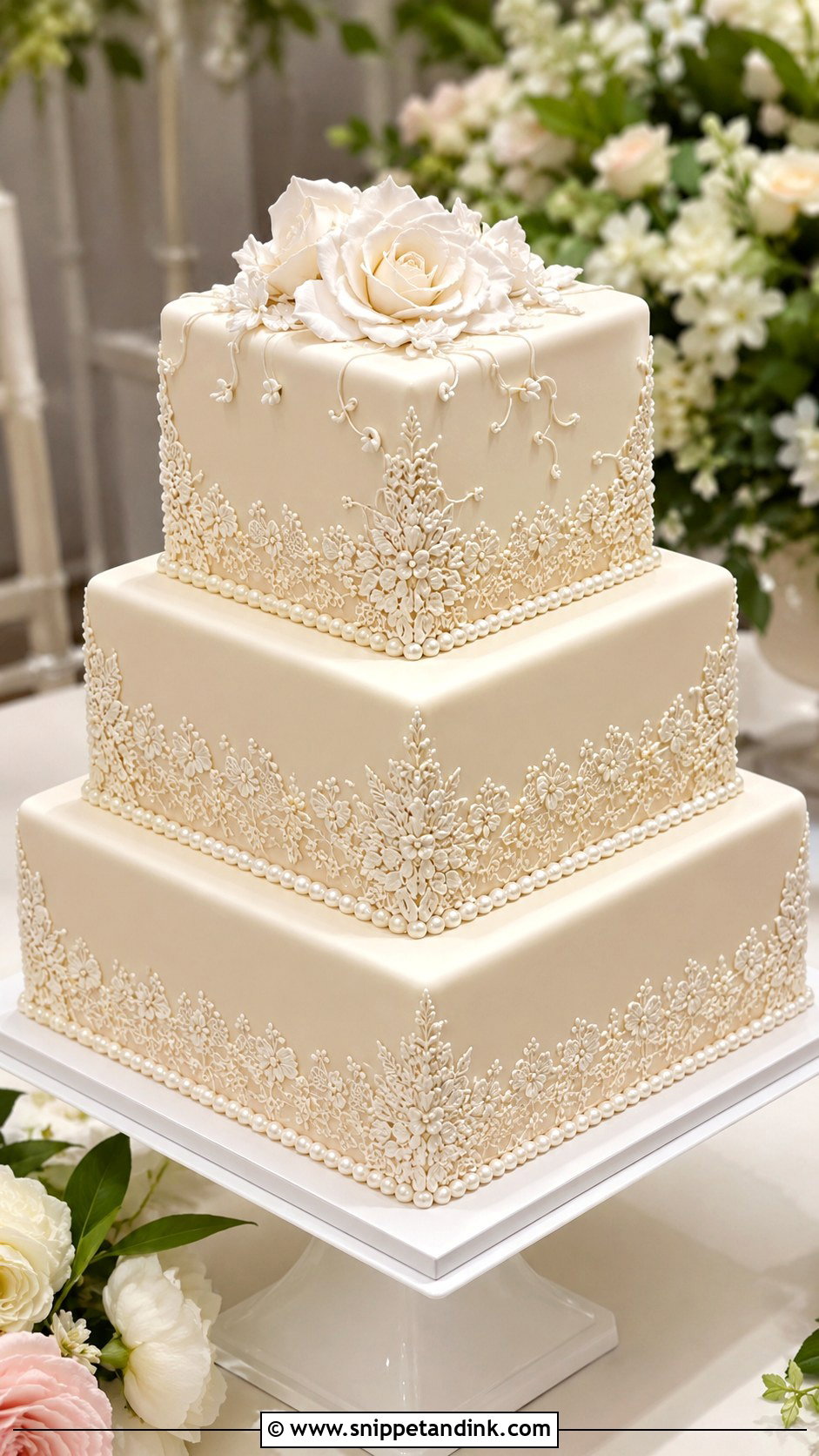
Square tiers give embroidery a tailored frame. The flat faces take lace panels and borders cleanly, and you can place the work on the front face, wrap it around the corners or run a cascading floral down one edge. White, ivory or champagne with pearl trim looks crisp. Square cakes are less forgiving to cover than rounds; the corners need to be sharp, so choose a baker whose portfolio shows square work. A floral cluster on one corner softens the geometry.
19. Tiered Embroidery Wedding Cake
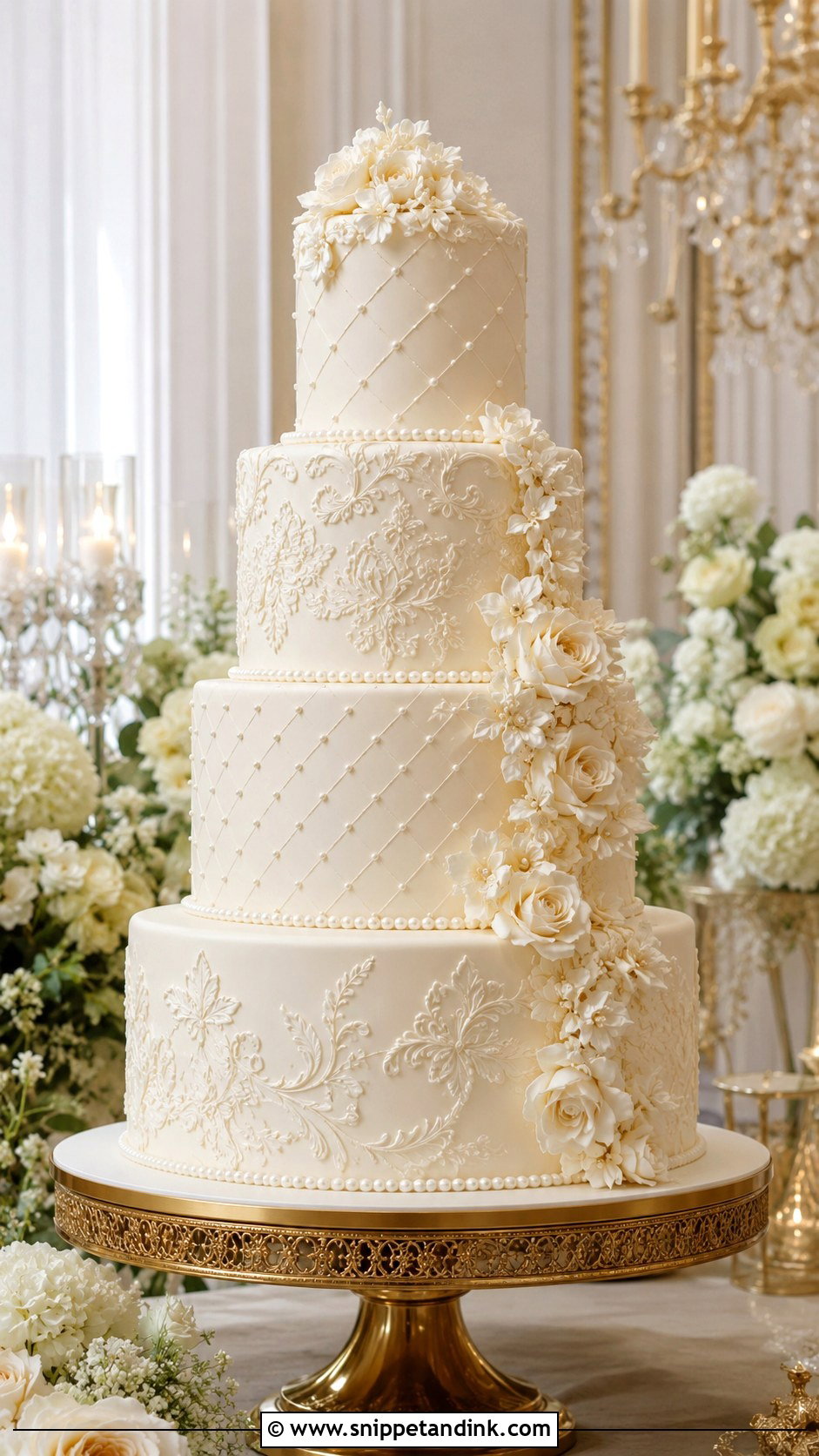
A tall tiered cake lets your baker combine several embroidery styles, and the risk is that it becomes busy. My rule is to give each tier one job: lace panels on one, floral embroidery on the next, a smooth tier with just a border in between to rest the eye. A four-tier ivory cake with white piping and soft sugar flowers is classic and sits easily in most decor. Tall cakes also need internal supports in every tier, which is worth confirming at your tasting.

20. Simple Embroidery Wedding Cake
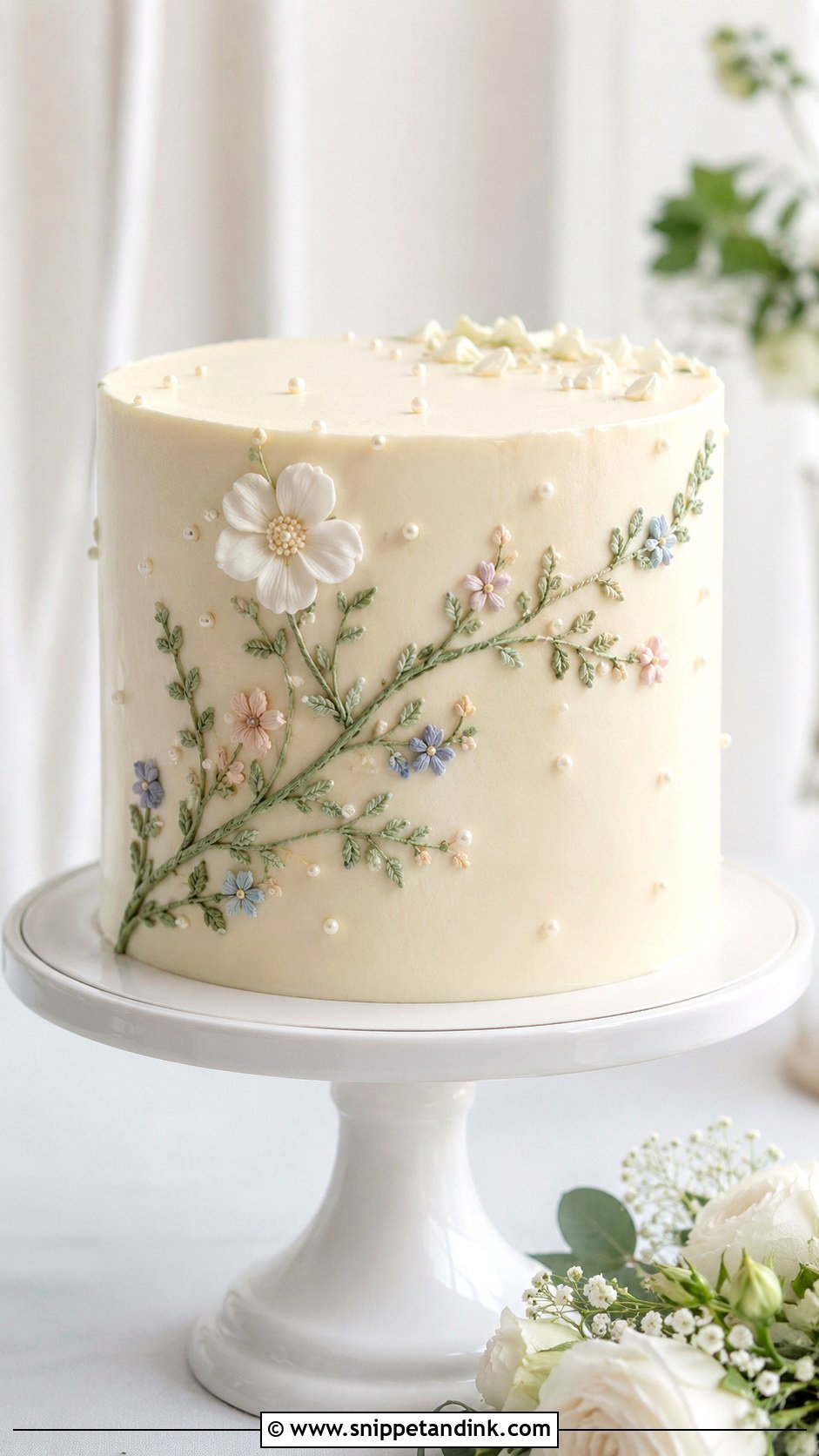
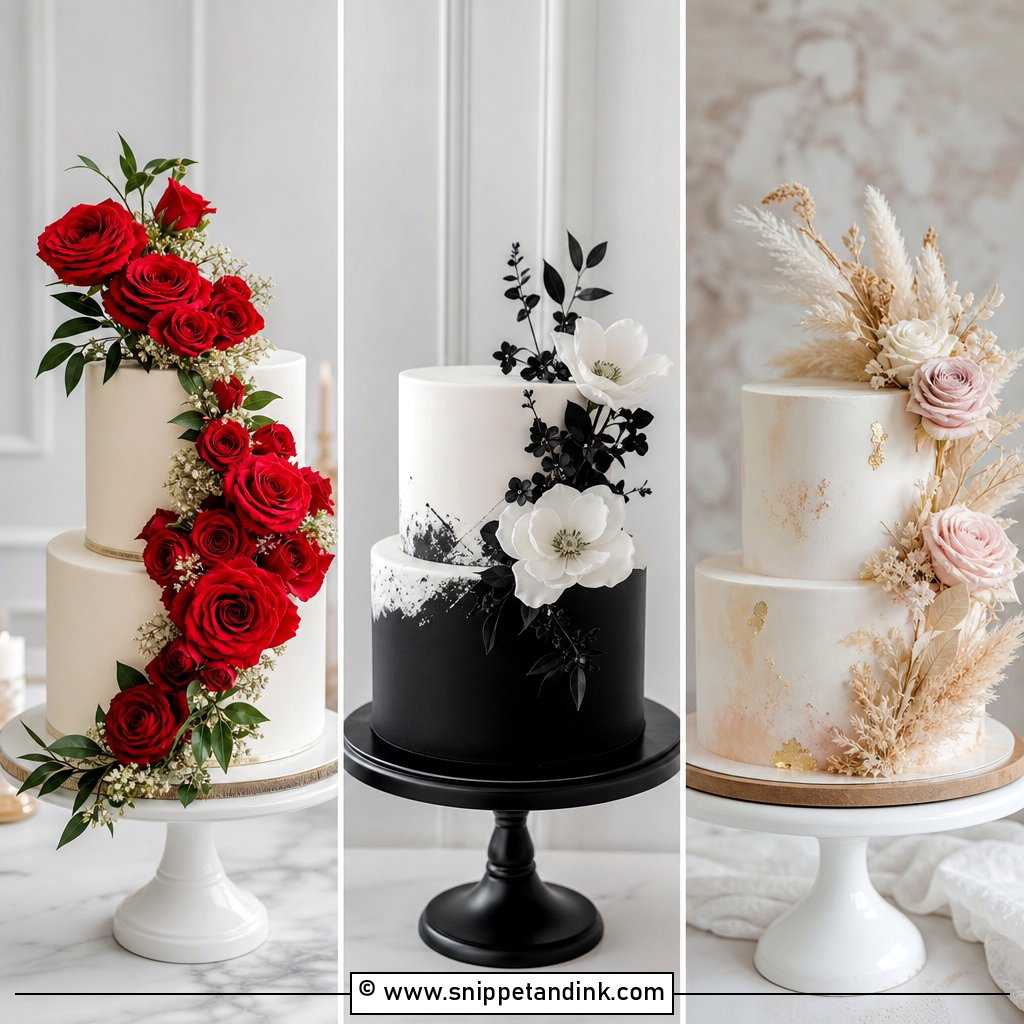
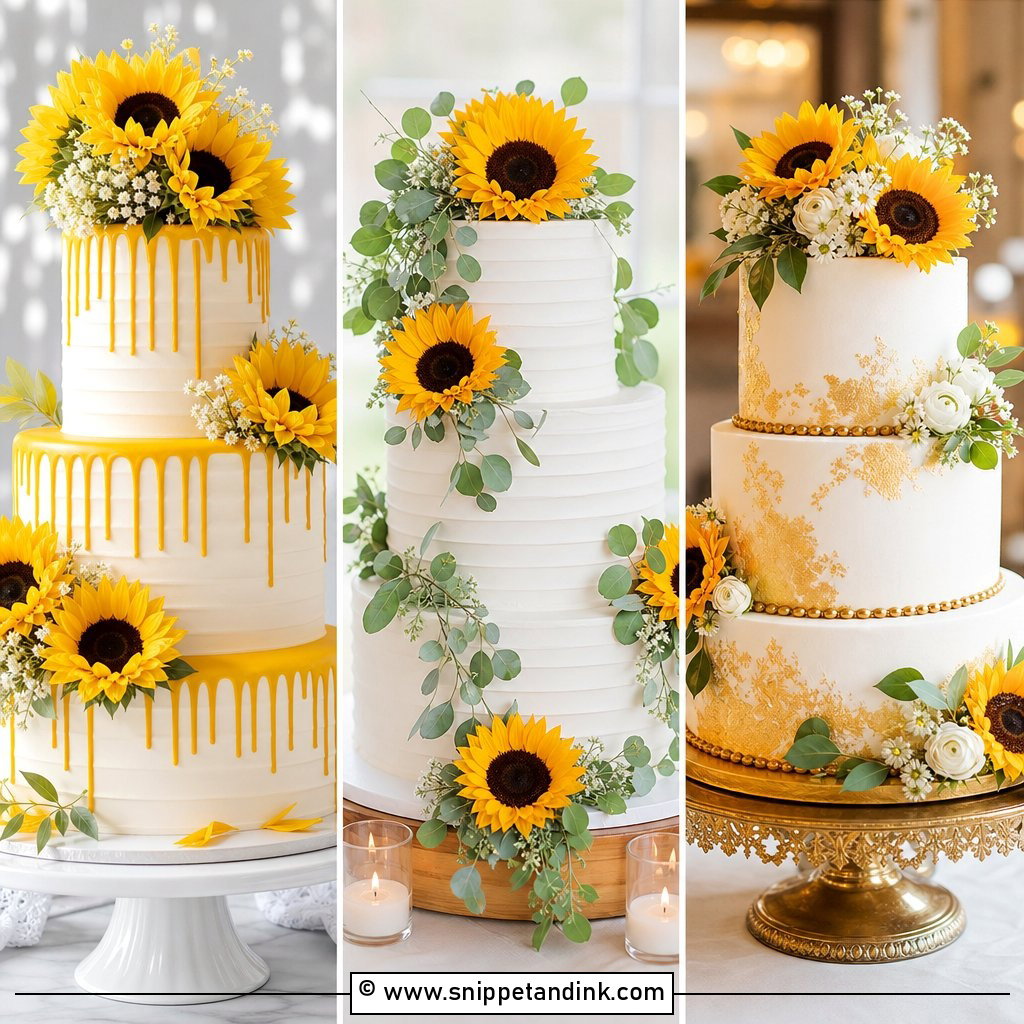
Not every embroidered cake needs four tiers of piping. One or two tiers with a smooth white finish, a single floral vine and a clean border can be enough for an intimate wedding, a courthouse celebration or a bridal lunch. Placement is the whole decision here: put the vine where people stand, on the front or around the top edge. Add one small sugar flower, a few pearls or a ribbon. It’s also the most budget-friendly way to have hand-piped work, since there’s far less of it.
Bring the Veil Swatch: How I Turn Your Lace Into a Cake Pattern
The most useful thing you can hand me is a real piece of the lace, or a close, sharp photo of it taken in daylight. Full-length dress photos don’t show the motif.
What happens next
- I pick out the two or three motifs that read clearly at cake scale, usually a flower, a leaf and an edge scallop, and simplify the fine filler stitches that would turn to blur.
- I sketch where the pattern sits on each tier and send it for approval, so you can see whether it’s front-only, a band or an all-over pattern.
- We agree the color on the real icing, not a screen. Ivory icing and ivory lace are rarely the same shade.
- I plan the piping schedule. Hand embroidery on a large cake takes many hours, so it’s often done across several days, which is one reason detailed designs need a longer lead time.
If the budget is tight, the easiest saving is placement. Full embroidery on the front face only, with simple borders around the back, looks the same in almost every photo and takes much less time to pipe.
Lace in Sugar, From Across the Room and Up Close
Embroidery on a cake can echo your dress, your flowers, your linens or your invitations without copying any of them literally. The decisions that matter most are technique and surface: royal icing on fondant for the finest detail, buttercream for a softer look, brush embroidery for texture, and color only where it helps the pattern show. Pick one clear direction, bring real samples to your tasting and talk through flavor and stability for your venue and season. The best embroidered cakes read as one shape from across the room and reveal the stitching when someone leans in.
You'll Like These Ideas:






Leave a Reply