
Gingerbread houses come out every winter in my studio, and couples who ask for one as a wedding cake usually say the same thing: it has to look grown-up, not like a kit from the supermarket. That’s very doable. White royal icing, a frosted roof, pearl piping, tiny windows and a few flowers carry the theme while keeping it bridal, and a lodge reception or a snowy garden ceremony gives it the right backdrop. Some of the cakes below lean rustic, others clean and modern. All of them share one tricky material, gingerbread, which behaves differently from sponge, so I’ve added notes on how each design is built and what can go wrong with it.
Real Gingerbread Walls or a Cake Dressed as a House?
Before we sketch anything, I ask couples which of two cakes they’re picturing, because they’re built differently and taste differently.
A constructed house uses flat panels of firm gingerbread, baked harder than the cookies you’d eat and glued with royal icing. It’s light, strong and holds a crisp roofline, which is why it works as a topper or as a village of minis. It’s edible, but it’s crunchy and better broken than sliced, so it’s rarely the part guests are served.
A carved cake house is spice sponge stacked, carved into a cottage shape and covered in ganache, buttercream or fondant. Everyone gets a soft slice, but the shape needs internal supports, and a pitched roof made of sponge is heavy and prone to sagging in a warm room.
Most of the designs in this list mix the two: sponge tiers for serving, real gingerbread for the house details. That mix is what I’d recommend for any reception over a few dozen guests.
1. Gingerbread House Wedding Cake With White Icing
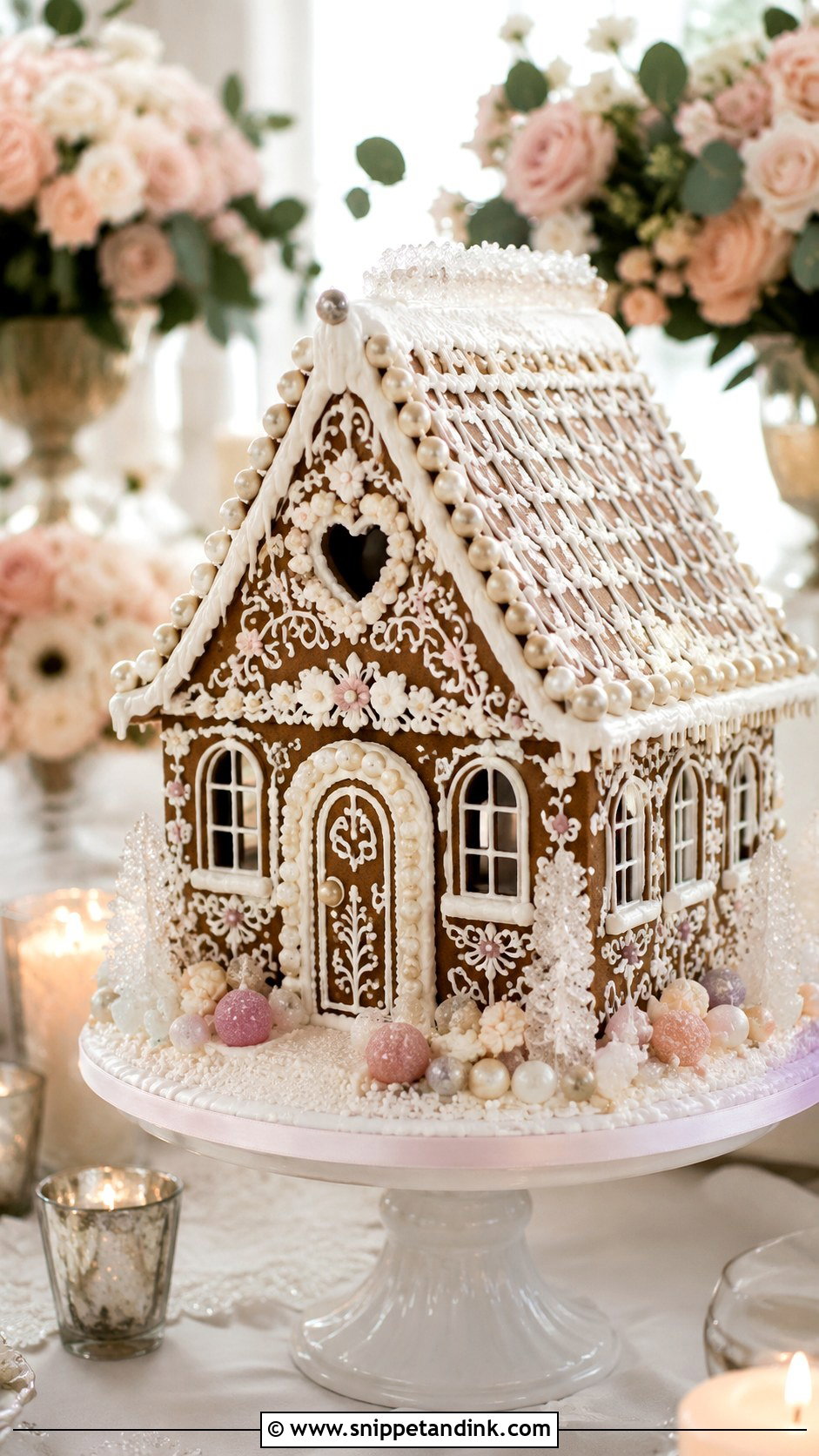
Brown walls with crisp white icing are where most couples start. The contrast makes every window, roofline and doorway read from across the room. For a wedding, I keep the piping detailed but sparse: lace-style lines, scalloped roof edges, pearl dots and framed windows rather than every surface covered. A tiered version suits a reception best, with a house-shaped bottom tier and smooth ivory buttercream above. Small sugar flowers or white berries at the base soften the hard lines of the house.
2. Gingerbread House Wedding Cake With Snow Roof
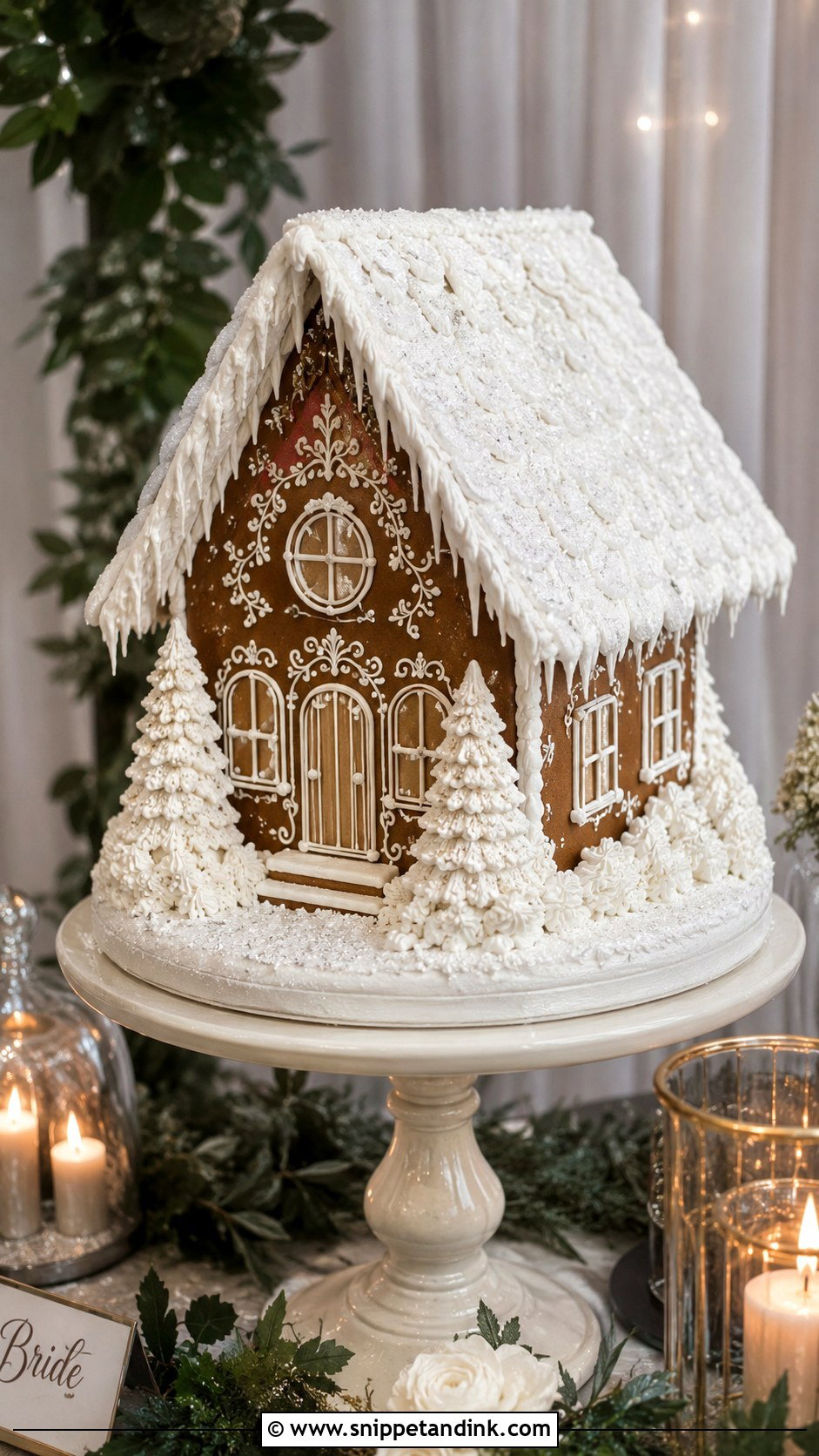
A snow roof needs only two colors to work. The cottage is usually a spice or chocolate gingerbread cake, with thick white buttercream or royal icing piled on the roof and pulled down at the edges into icicles. To make icicles hang rather than slump, I pipe them in stiff royal icing and let them dry before the cake leaves the studio. A touch of edible shimmer on the roof catches candlelight. Keep the walls neat with piped windows, small shutters and a plain door, and set it on a white stand among candles and pale flowers.
3. Gingerbread House Wedding Cake With Mini Houses
Surrounding a smooth buttercream wedding cake with tiny gingerbread houses lets the main cake stay elegant while the village tells the theme. Vary the heights of the minis but keep the icing color identical; mixed whites look like a mistake once photographed side by side. Piped roofs, edible pearls and tiny sugar windows give each one character. The minis are baked from firm construction gingerbread, which keeps for days, so they can double as edible accents or guest favors wrapped in cellophane.
4. Gingerbread House Wedding Cake With Gold Details
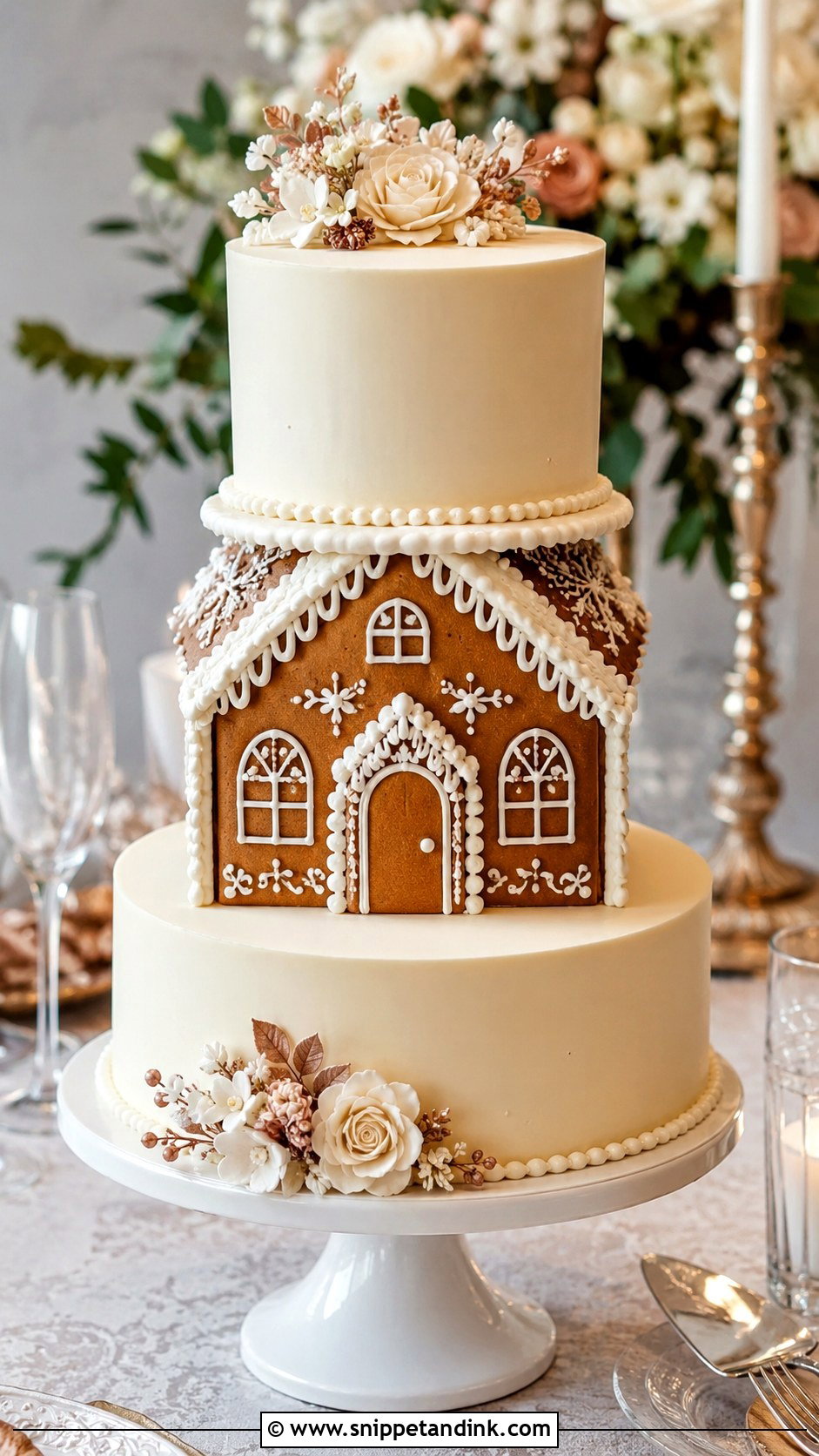
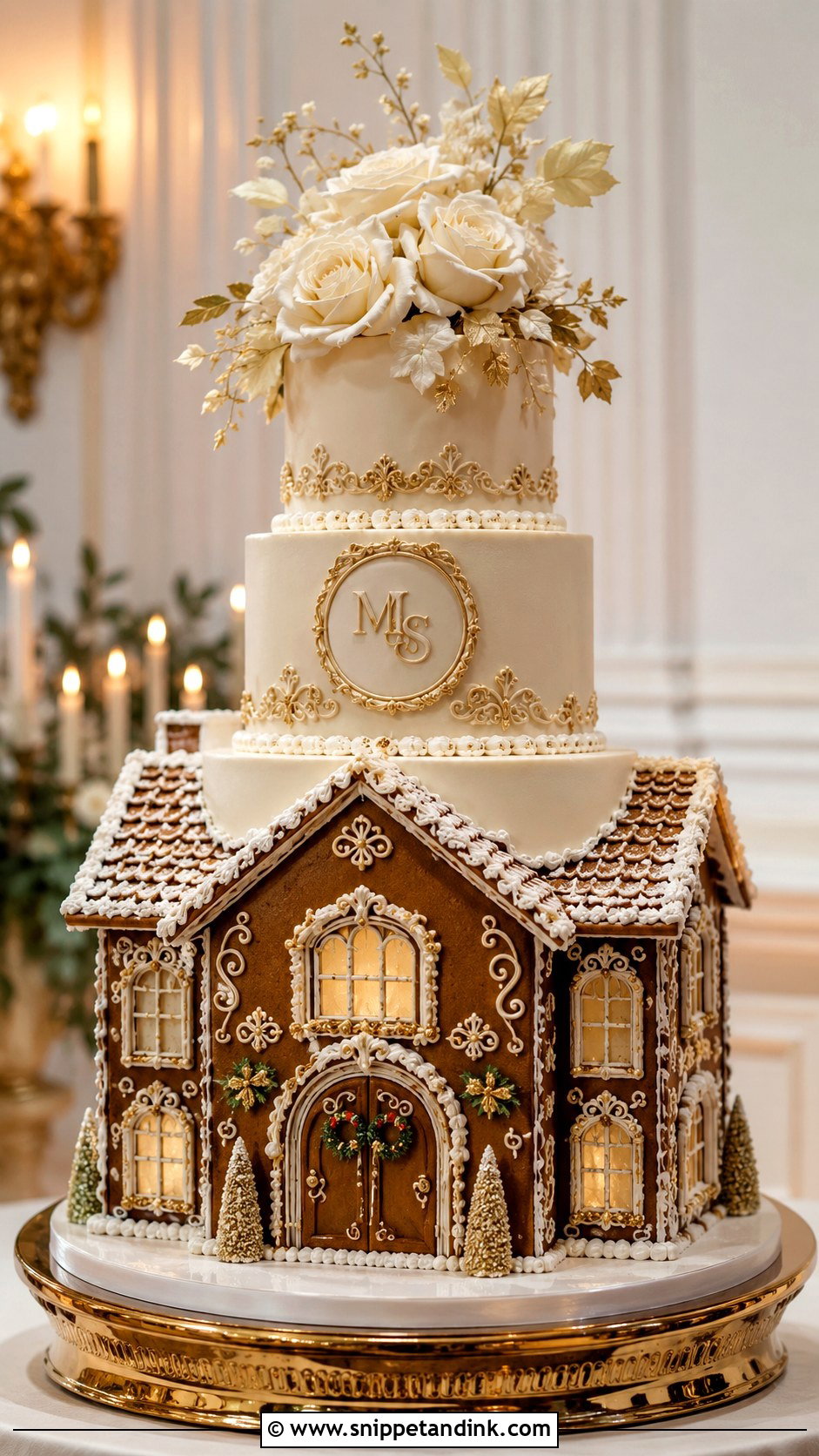
Gold turns gingerbread formal, but only in small doses: the door handle, window trim, roof edges or a line of edible pearls along the base. Brown, ivory and a little metallic shine make a rich, quiet palette. In a two or three tier cake, I’d make one tier the house and give another smooth tier a band of gold piping. Check that every gold product on the cake is sold as edible, not just non-toxic. Ballrooms and candlelit evening venues suit it, with cream flowers and simple greenery.
5. Gingerbread House Wedding Cake With Fresh Flowers
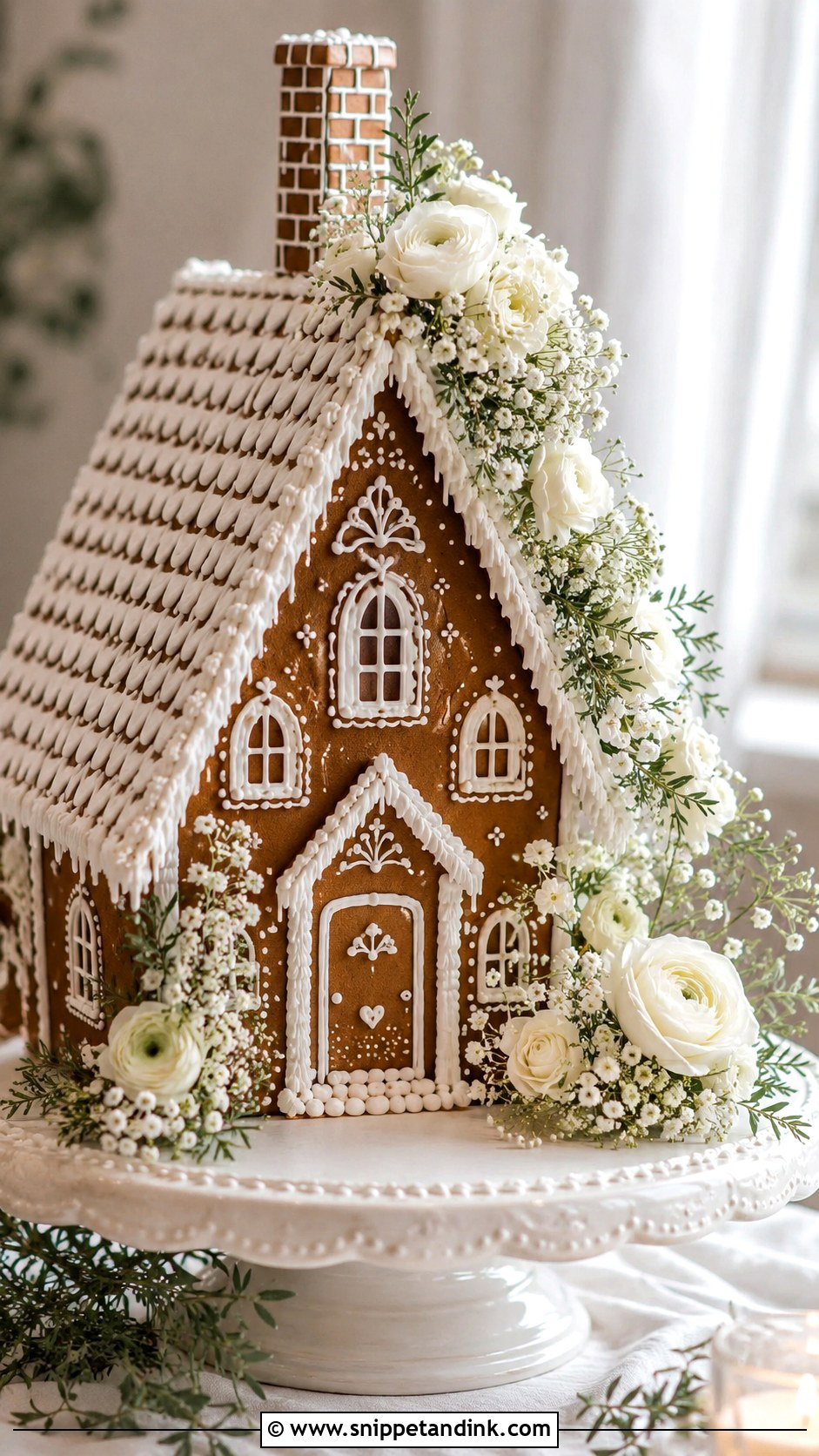
Flowers instead of candy make the house soft and modern. White roses, ranunculus, baby’s breath and small sprigs of greenery work well against warm brown, placed along the roofline, around the door and at the base like a garland. Fresh stems need a barrier: wrapped stems, picks or a layer of wax paper underneath, and only flowers grown without sprays. Baby’s breath is one I’d keep off any surface people will eat, so ask for sugar sprigs if it’s sitting on the cake itself.
6. Gingerbread House Wedding Cake With Buttercream Tiers
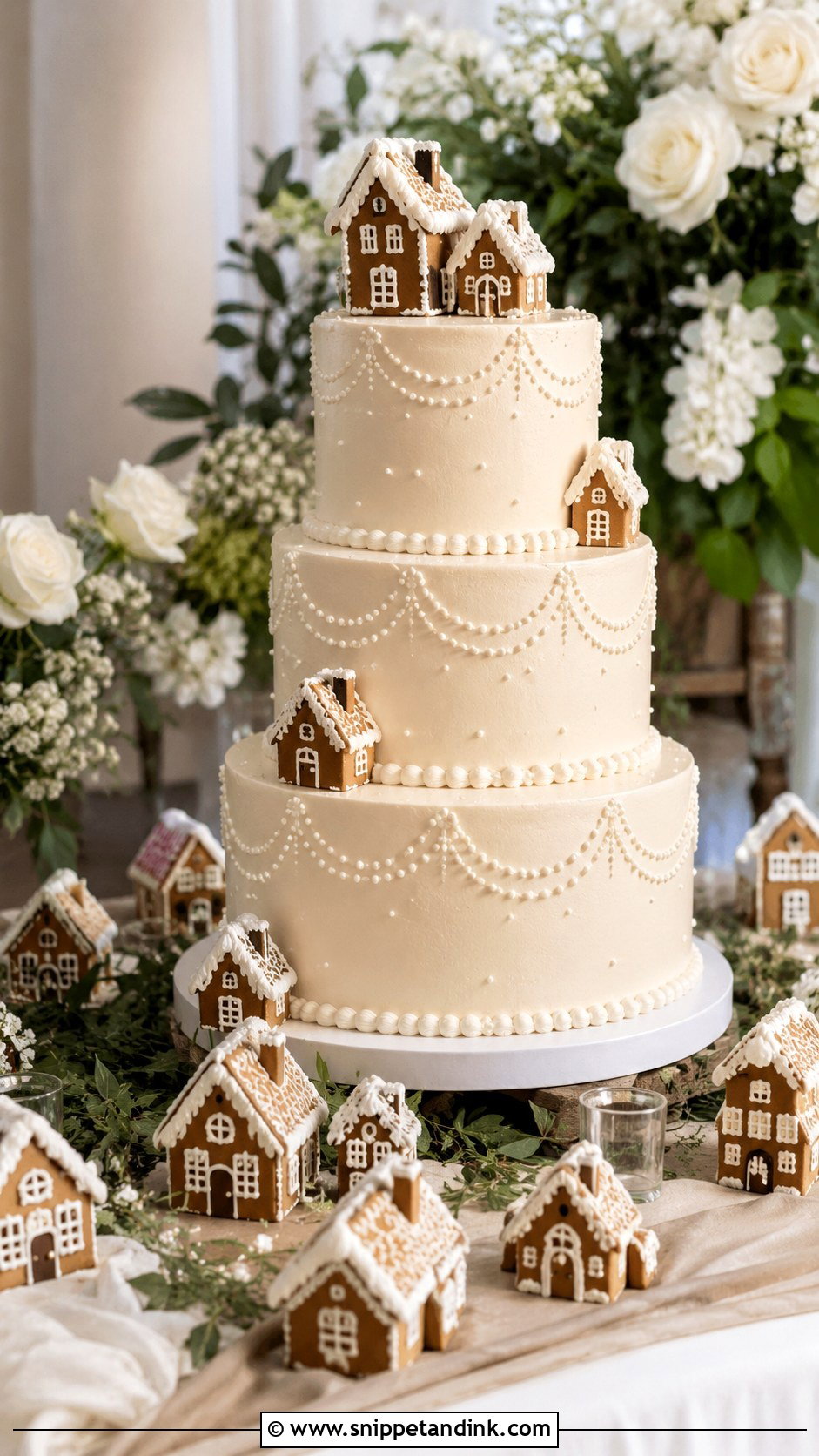
A single house tier on top of smooth, round buttercream tiers is the design I steer most couples toward. The round tiers are simple to cut and portion, and the house becomes the decoration rather than the bulk of the cake. Spiced gingerbread layers pair well with vanilla, cinnamon or cream cheese buttercream. Pipe the windows, roof and front door on the house tier only, and keep the others plain with pearl borders or a soft texture.
7. Gingerbread House Wedding Cake With Candy Accents
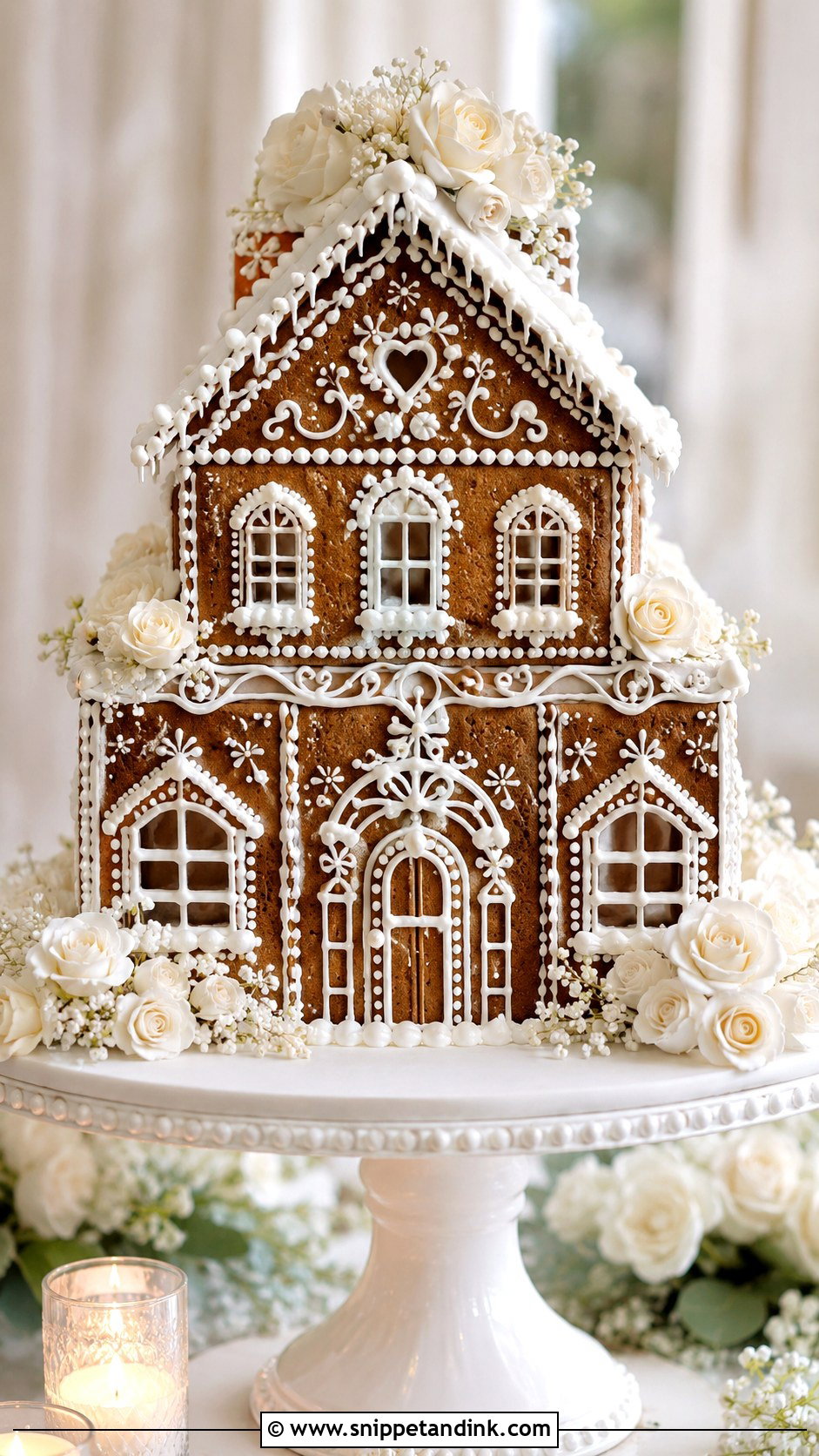
Candy is where gingerbread tips from bridal to children’s party, so the palette has to be controlled: ivory, blush, soft green, champagne and clear sugar. Candy pearls trim the roof, pastel sweets fill the window boxes and rock candy makes a frosted path. One thing I warn about: brightly colored candies bleed their dye into white royal icing when the room is damp, leaving pink halos around each sweet. Paler candies, or ones with a sugar shell, behave much better.
8. Gingerbread House Wedding Cake With Greenery
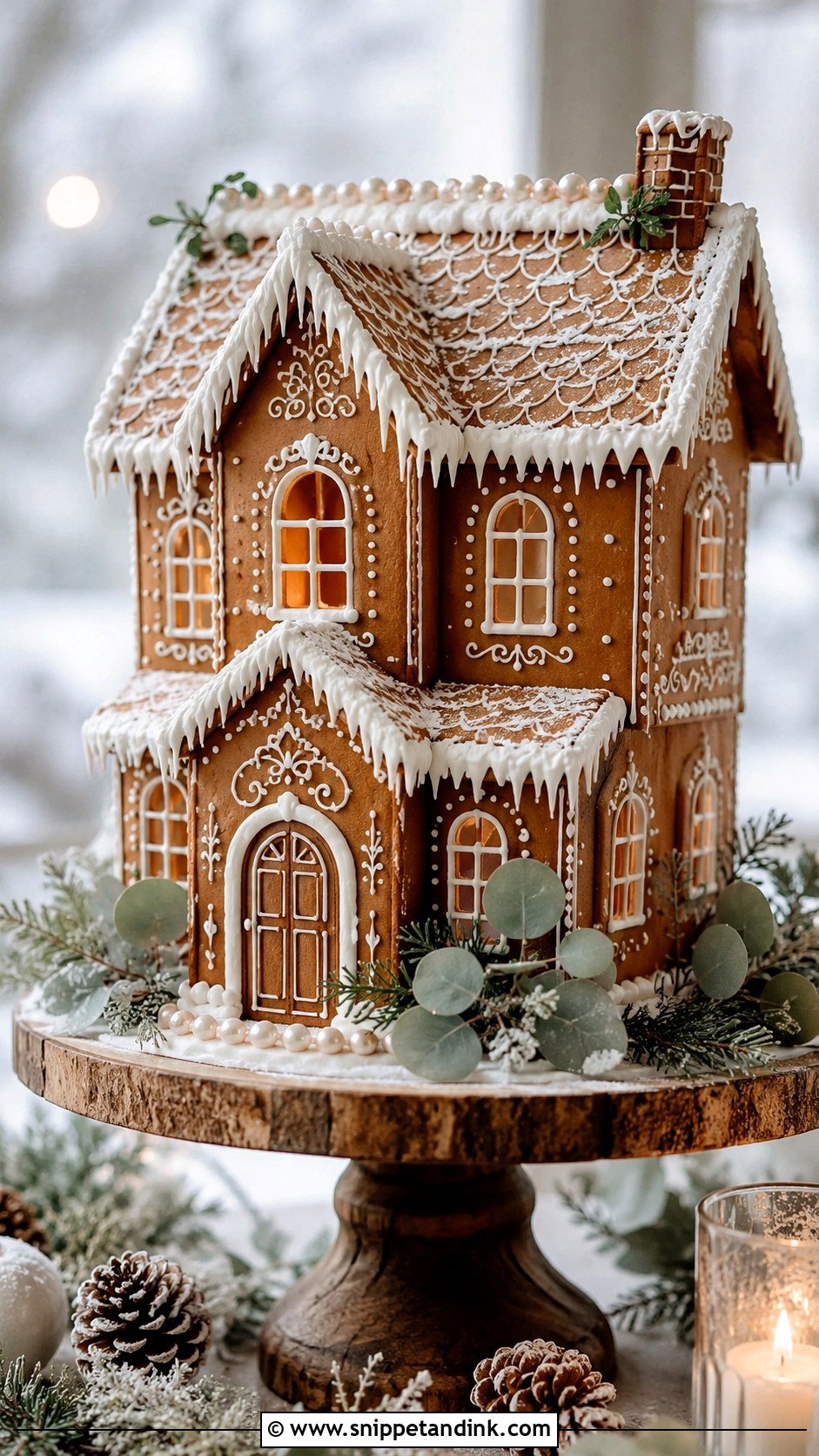
Greenery gives the house a woodland feel. Eucalyptus, rosemary, olive leaves or sugar evergreen sprigs pair well with warm brown. Rosemary and olive are culinary, which makes them easy choices; decorative eucalyptus I only use with a barrier and nowhere near a slice. Let the greenery frame the base and climb up one side of a house with white piping and a frosted roof. Lodge and barn receptions suit it. Keep flowers minimal so the leaves stay the texture.
9. Gingerbread House Wedding Cake With Pearl Piping
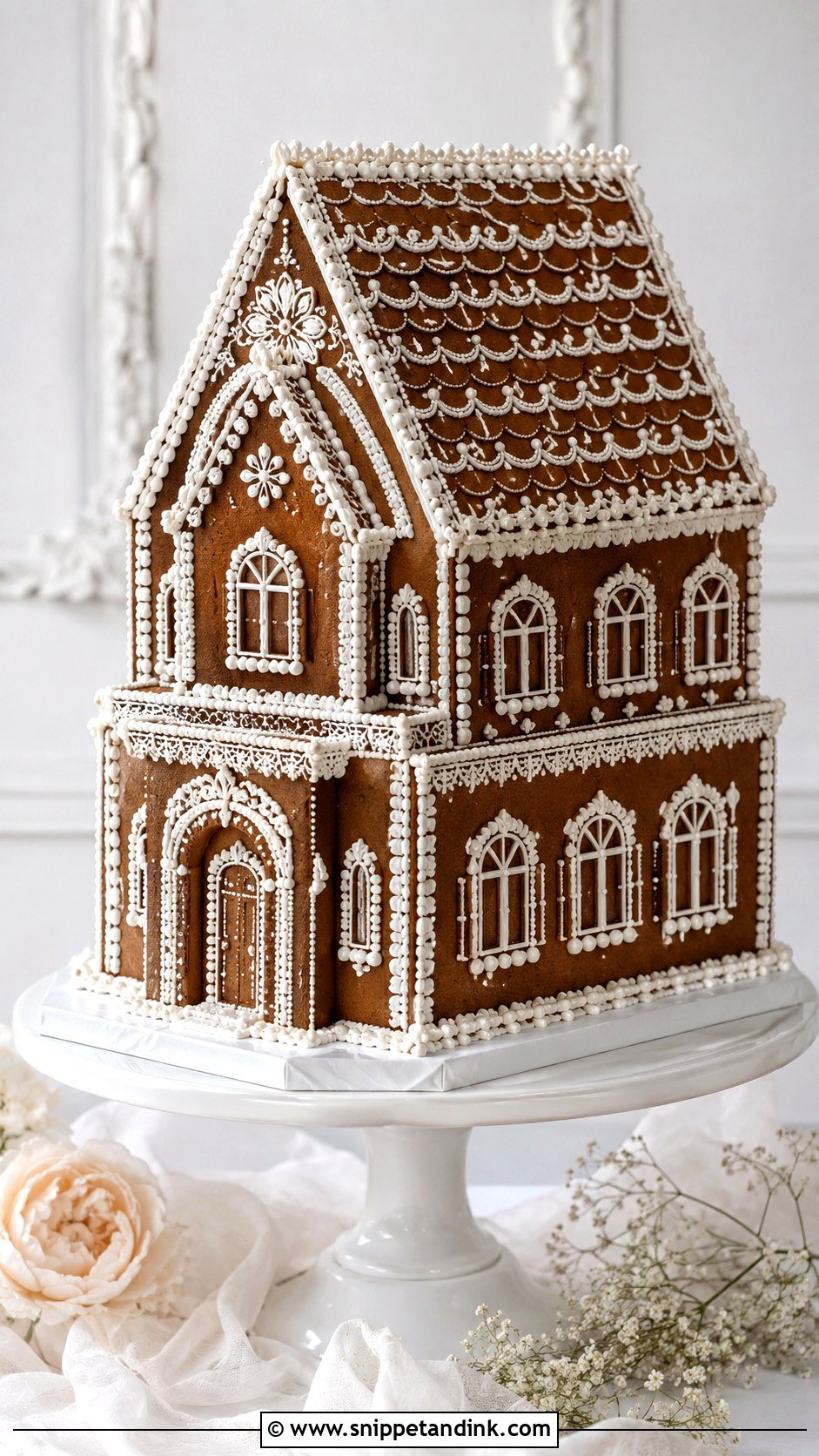
Pearl piping is just tiny dots of white icing, repeated along the roof, windows, door, corners and tier borders until it reads like lace. It’s slow work and very revealing: one wobbly line of dots is obvious, so this is a design to give to a decorator with a steady hand. It suits a darker gingerbread, where the white dots stand out clearly. Mix in a few ivory sugar pearls for depth, and keep everything else small.
10. Gingerbread House Wedding Cake With Bride And Groom Toppers
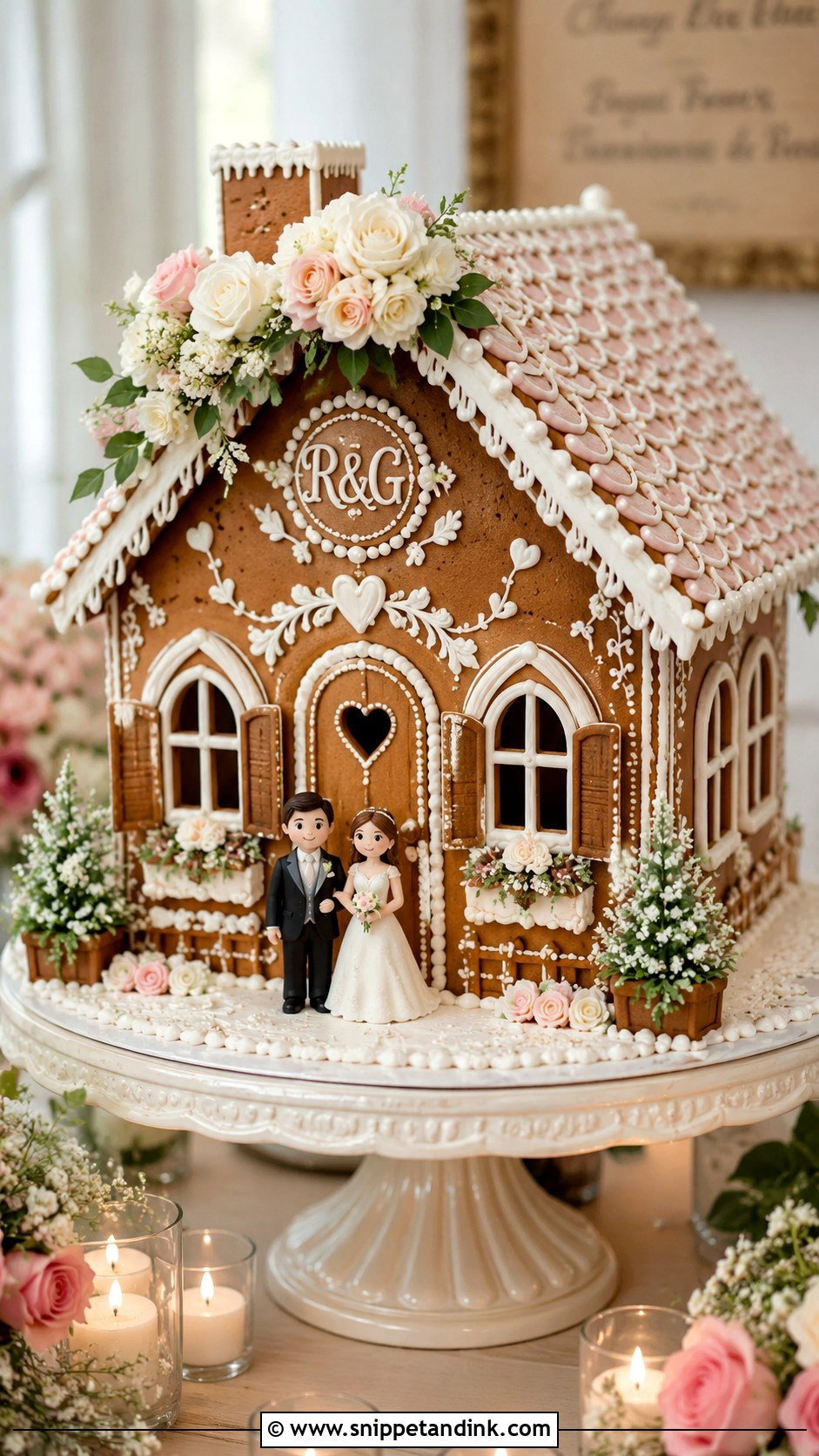
Bride and groom toppers can stand at the door, perch on the roof or sit beside a piped doorway. Simple fondant figures or silhouette toppers keep it elegant; gingerbread couple cookies iced in wedding clothes are more playful. A tall figure on a sloped roof is a balance problem, so I set toppers on a small flat ledge or anchor them with a hidden pick. Keep the rest of the cake classic with white icing and very little candy, and pipe the couple’s initials above the door.
11. Gingerbread House Wedding Cake With Rustic Wood Stand
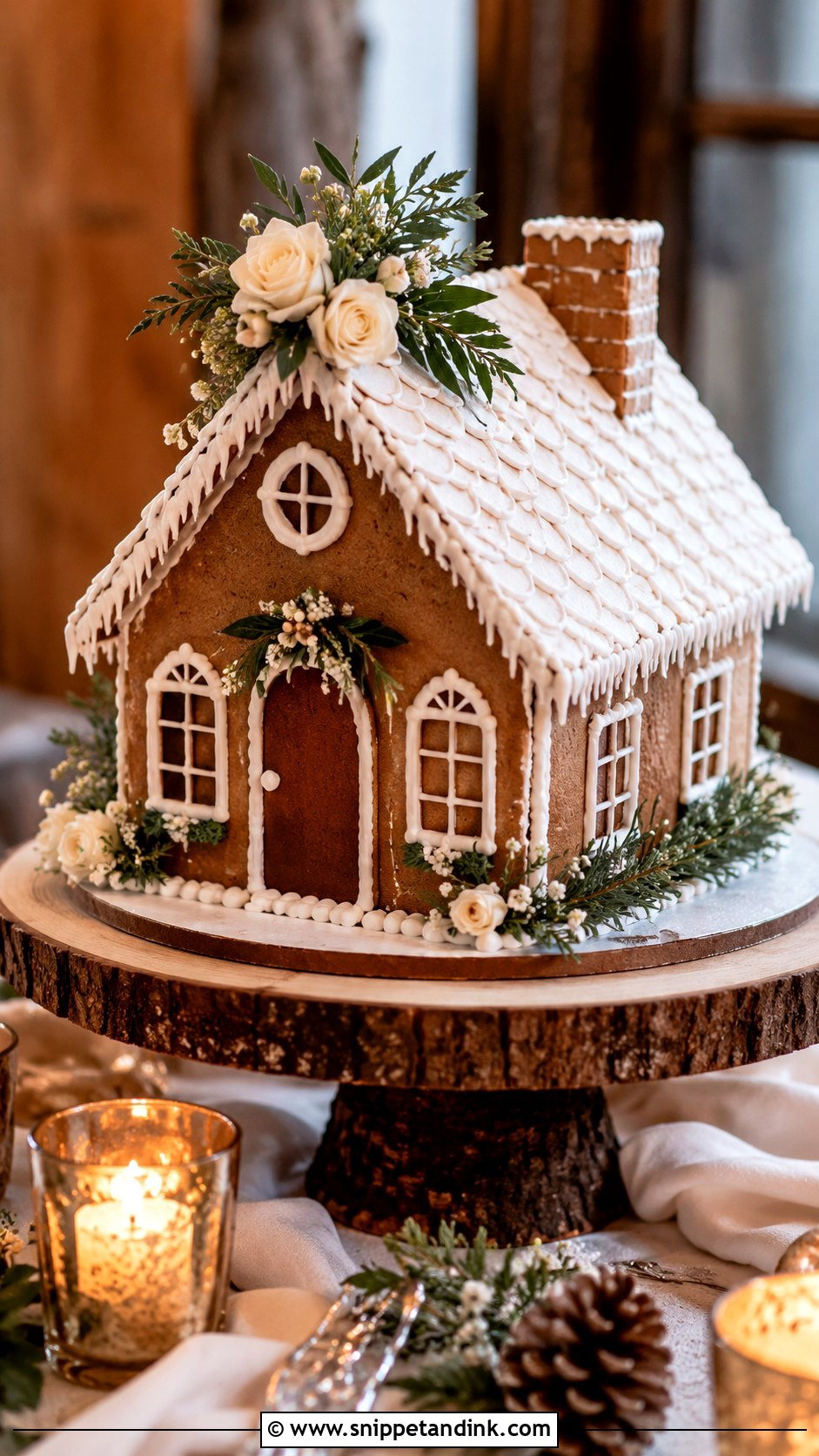
A thick wood slice or a natural wood stand grounds the house for barn, cabin and lodge weddings. The cottage can be warm brown fondant or buttercream textured to look like gingerbread, trimmed in white icing. Wood slices are rarely perfectly flat and often aren’t sealed, so I put the cake on its own food-safe board first and level the slice before anything heavy goes on it. Simple greenery around the base finishes it. Keep the windows clean and the roof softly frosted so the rustic setting doesn’t make the cake look careless.
12. Gingerbread House Wedding Cake With Modern White Tiers
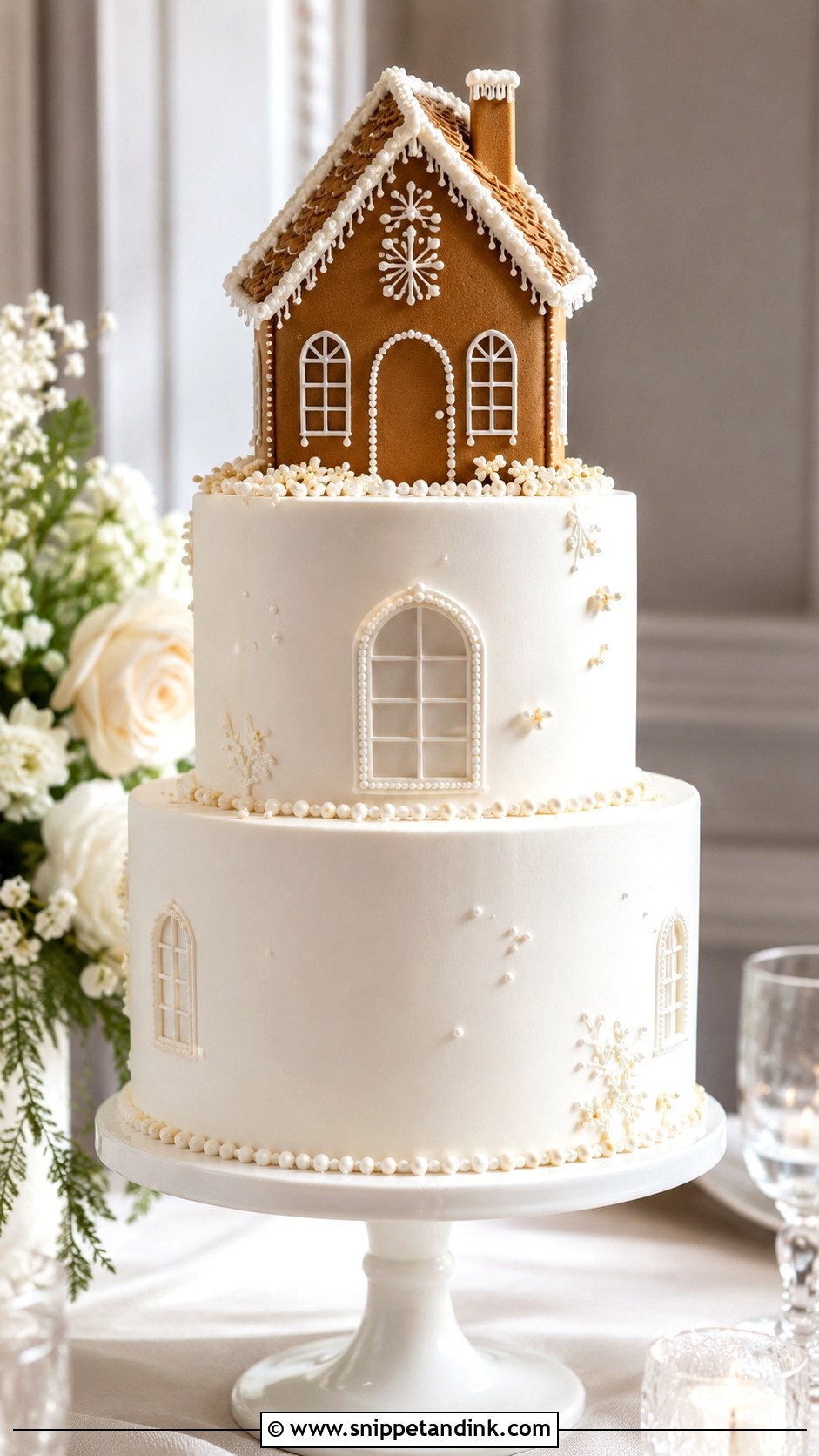
Smooth white tiers with one gingerbread house as the focal point feel fresh and upscale. The house can be built into the side of a tier or sit on top as an architectural topper. Clean lines, very little piping and a palette of brown, ivory and champagne keep it modern. A topper house made from real gingerbread is light and strong, which is why I prefer it over a carved cake house up there. Small sugar windows and a touch of shimmer on the roof are enough.
13. Gingerbread House Wedding Cake With Lace Icing
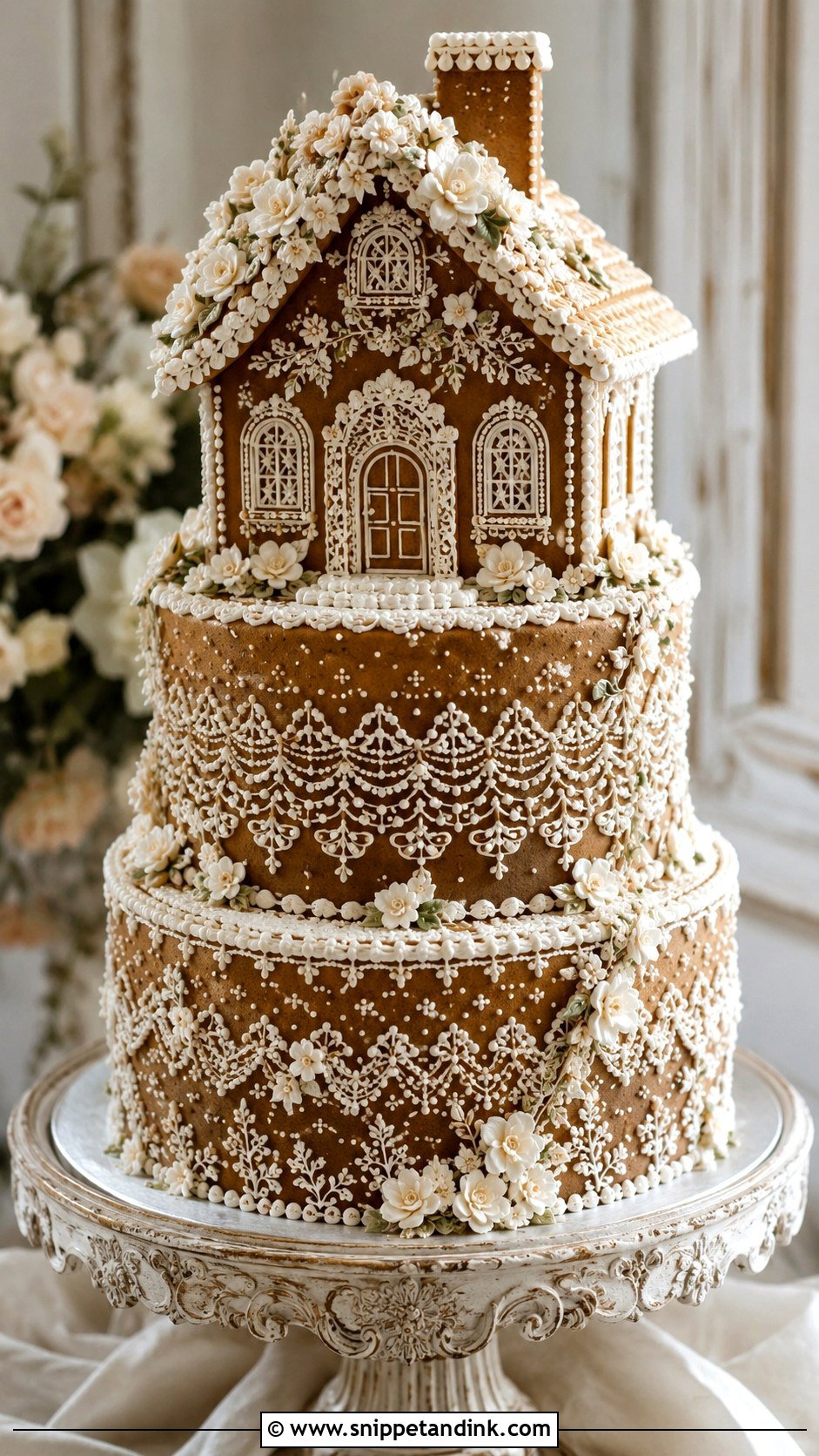
Lace icing ties the cozy theme to bridal detail. Instead of plain lines, the icing traces lace patterns around the windows, roof trim and door frame, and a round tier can echo the same pattern. Ivory on warm brown, with almost no other color, looks delicate and handmade. Piped lace on gingerbread is unforgiving to fix, since scraping icing off a biscuit surface leaves a mark, so the pattern is usually sketched lightly first. It suits vintage-inspired weddings and couples whose dress has lace sleeves or embroidery.
14. Gingerbread House Wedding Cake With Red Accents
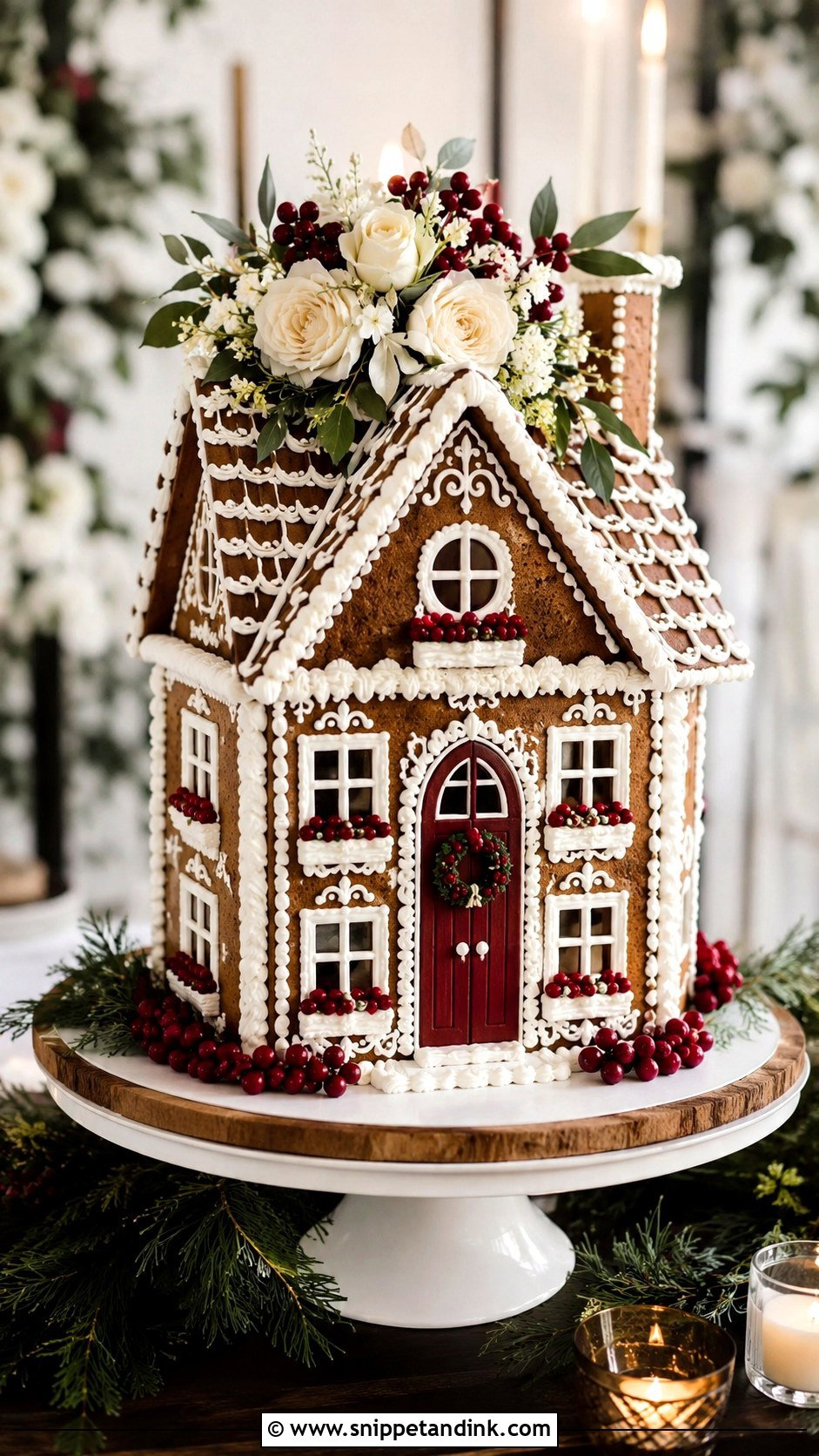
Red warms the house, but the shade decides whether it looks festive or bridal. Deep cranberry, burgundy or berry red sit better at a wedding than bright candy red. Bring it in through sugar berries, tiny hearts, window flower boxes or a ribbon-style buttercream border, against white icing and a frosted roof. Deep red buttercream takes a lot of coloring and can taste bitter, so I keep red to small accents and sugar pieces. Ivory flowers and dark greenery around it make the red look rich rather than seasonal.



15. Gingerbread House Wedding Cake With Chocolate Ganache
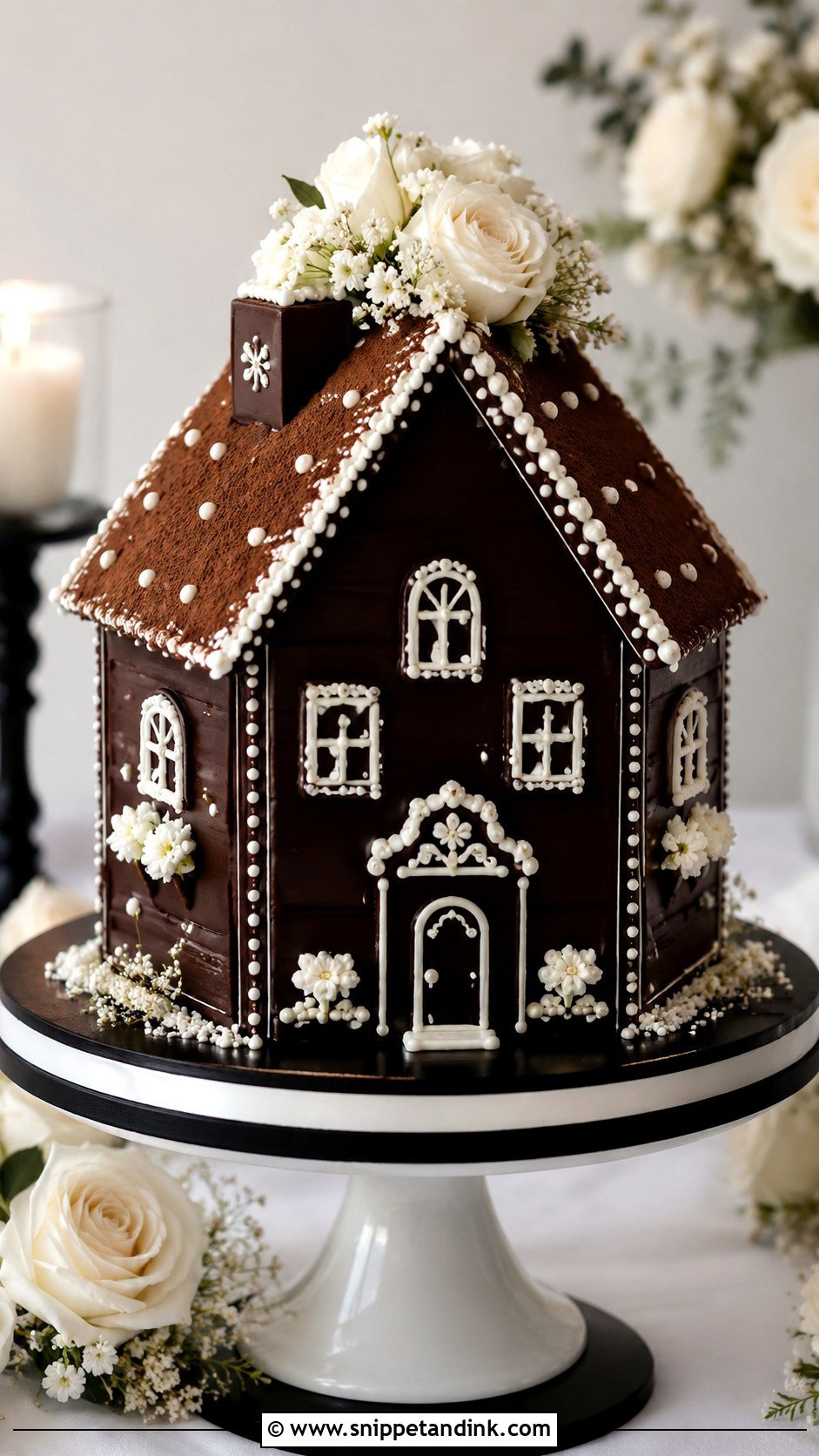
Chocolate ganache gives the house a deep brown exterior over gingerbread spice layers with chocolate filling. From a decorator’s side, ganache is a gift: it sets firm, holds sharp corners and copes with a warm room better than buttercream, which matters on a house with straight walls and a pitched roof. White icing details stand out sharply against it. A soft drip on one tier works with a house-shaped topper. Finish with sugar pearls, a cocoa-dusted roof and cream flowers.
16. Gingerbread House Wedding Cake With Cream Cheese Frosting
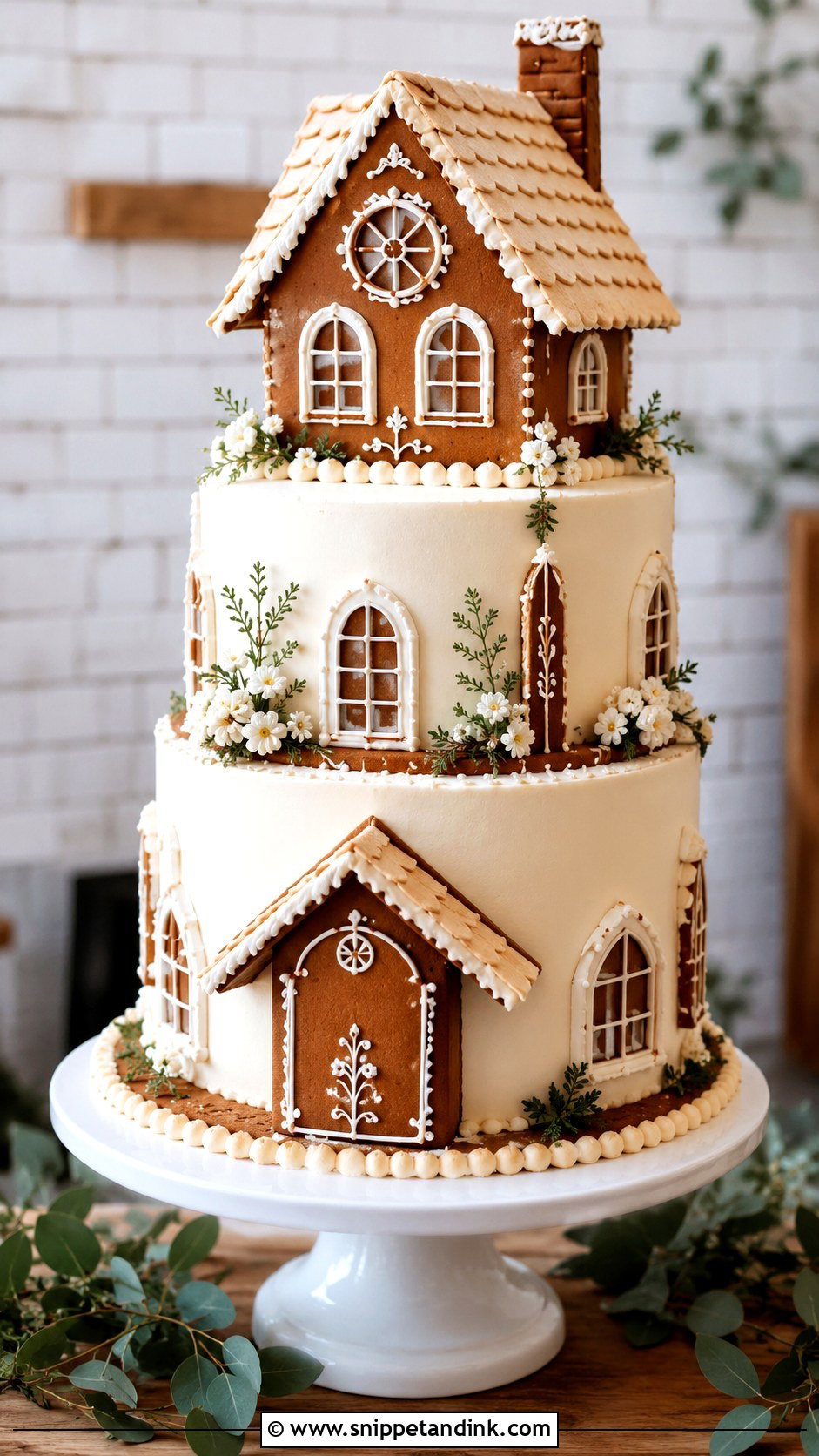
Cream cheese frosting and gingerbread spice are a natural pairing; the tang cuts through the molasses. Its weakness is structure. It’s soft, it needs to stay cool, and it can’t hold sharp edges or support much weight, so I smooth it over round tiers and do the windows, rooflines and door in firmer royal icing. Plan for the cake to come out of the fridge shortly before display rather than sit for hours in a warm room. Simple decoration suits it: white piping, a few tiny sugar flowers and a lightly textured roof.
17. Gingerbread House Wedding Cake With Window Lights
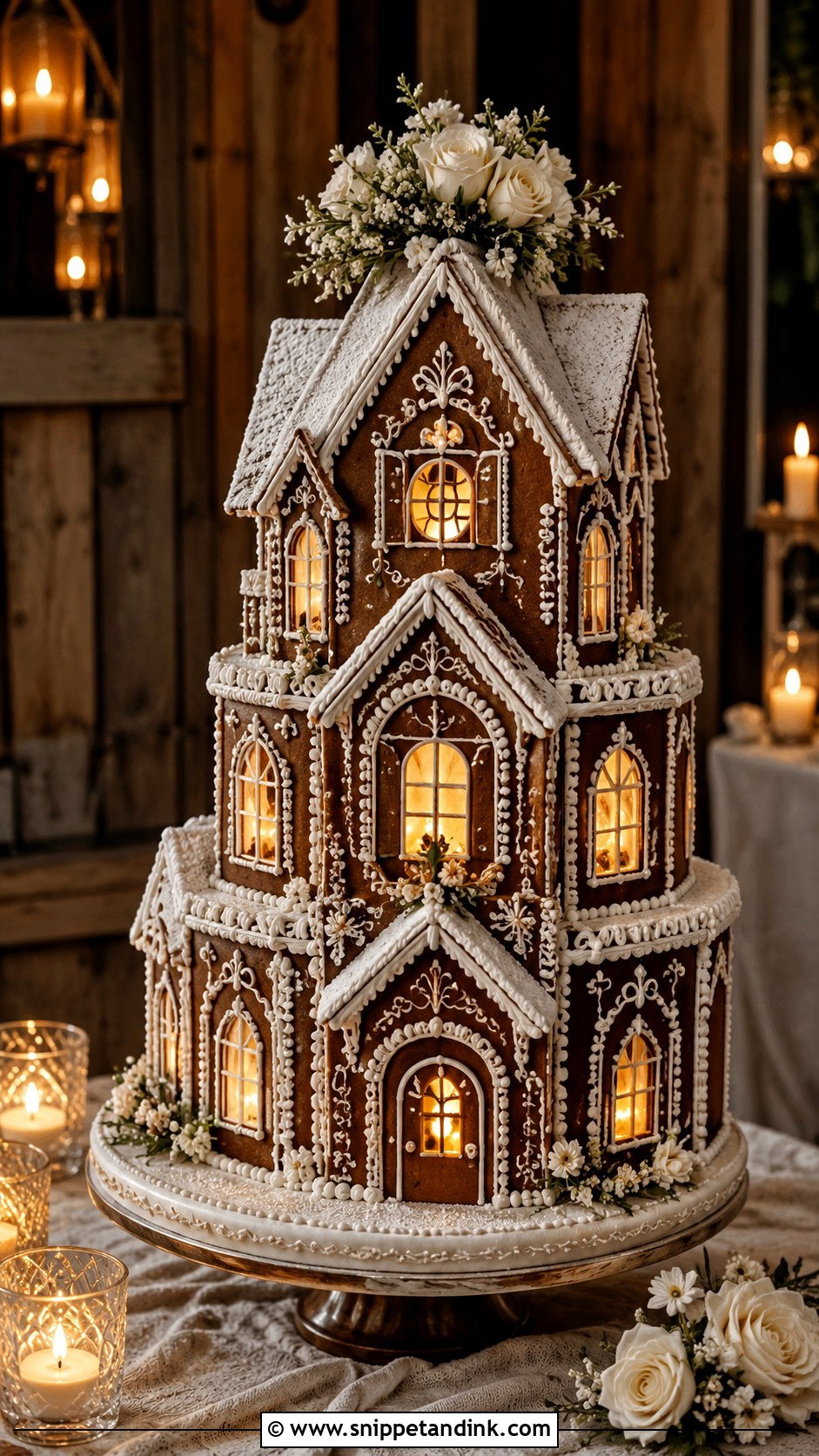
Window lights make the house glow at an evening reception. The lights are tiny battery LEDs, placed by the designer behind translucent sugar panes or in a hollow display section, never touching the edible parts, and removed before cutting. Isomalt or poured sugar makes the clearest panes; it softens and clouds in humidity, so these panes go in close to the event. When the room dims, the windows look like a storybook cottage. Keep the rest simple, with ivory icing and minimal flowers.
18. Gingerbread House Wedding Cake With Sugar Snow
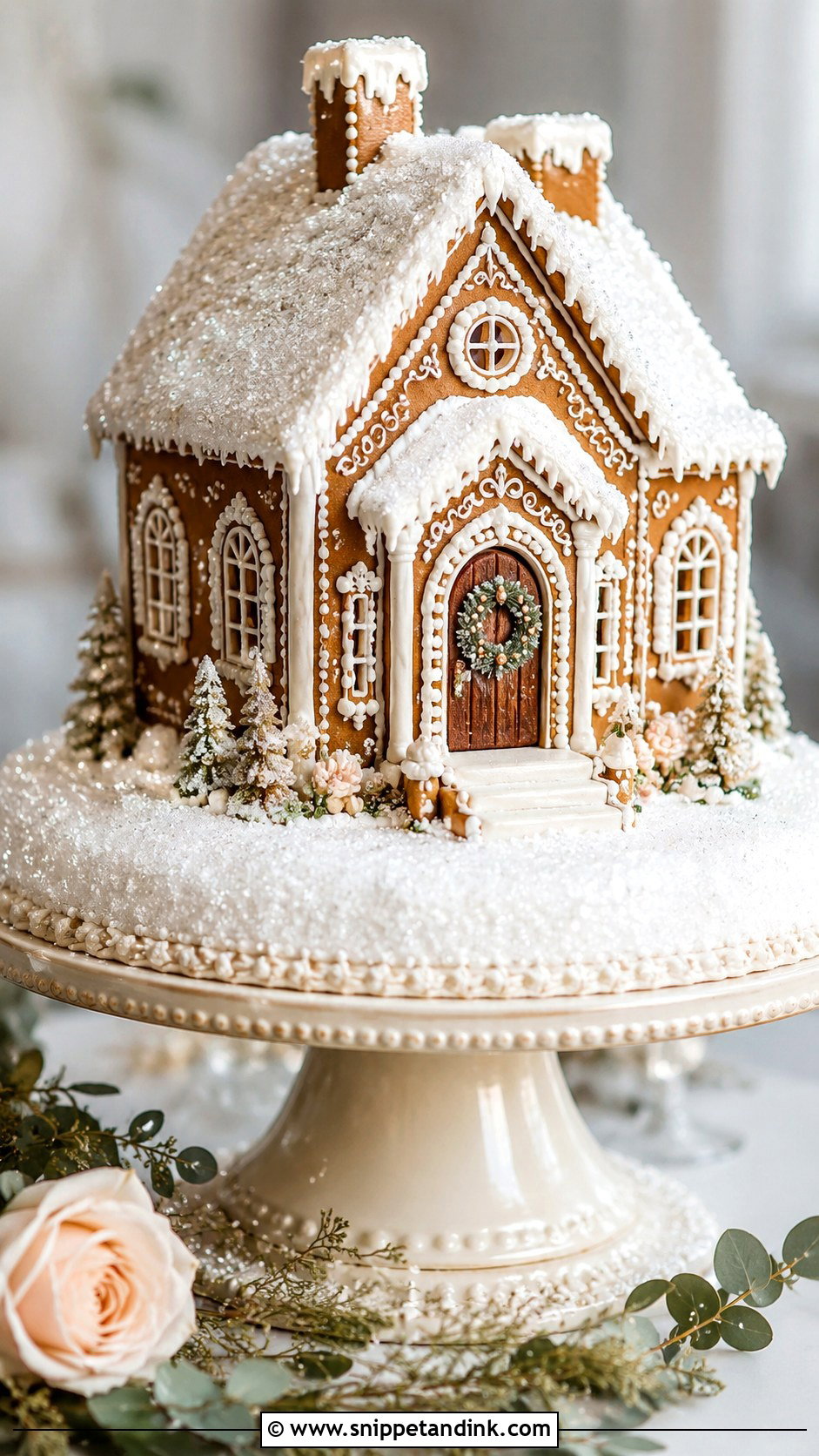
Sugar snow gives a soft winter finish. Fine sanding sugar, white sprinkles, coconut flakes or edible shimmer can all make the effect, dusted along a textured buttercream roof, the edges and the base. Sanding sugar draws moisture from buttercream and starts to dissolve after some hours, so it goes on as late as possible. Coconut also deserves a label on the cake table, since some guests avoid it. A frosted walkway, tiny piped windows and pearl trim complete a quiet, sparkly cake.
19. Gingerbread House Wedding Cake With Cinnamon Spice Layers
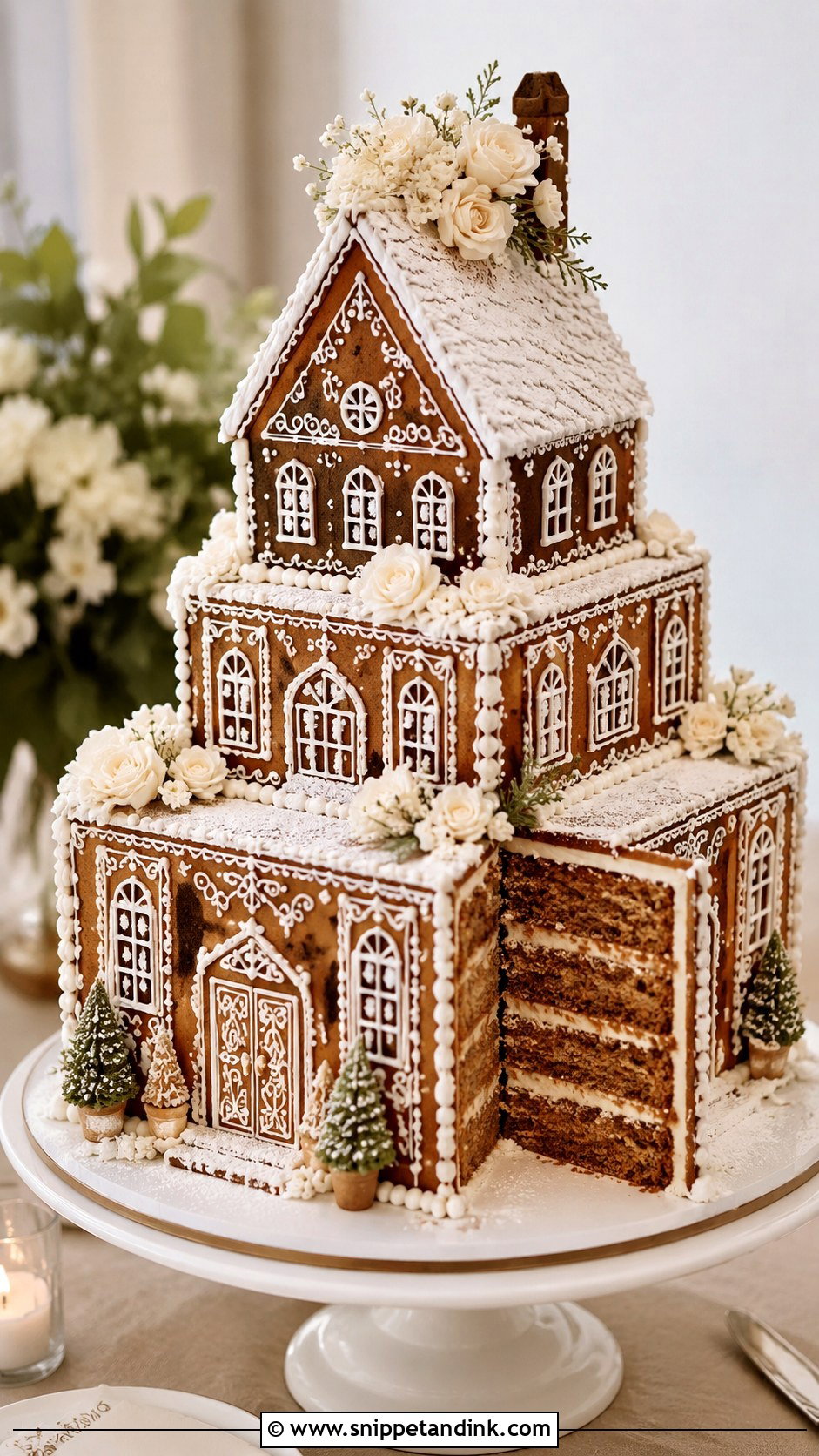
Spice layers carry the theme inside, so the slice tastes like the house looks. Ginger, cinnamon, nutmeg and molasses go into the sponge, with a vanilla or cream cheese filling between layers, and smooth buttercream tiers with a gingerbread facade outside. A good slice shows warm golden-brown cake against pale frosting. Molasses keeps the crumb moist, which helps a cake that’s been decorated a day ahead. Couples who care more about flavor than spectacle tend to pick this one.


20. Gingerbread House Wedding Cake With Village Display
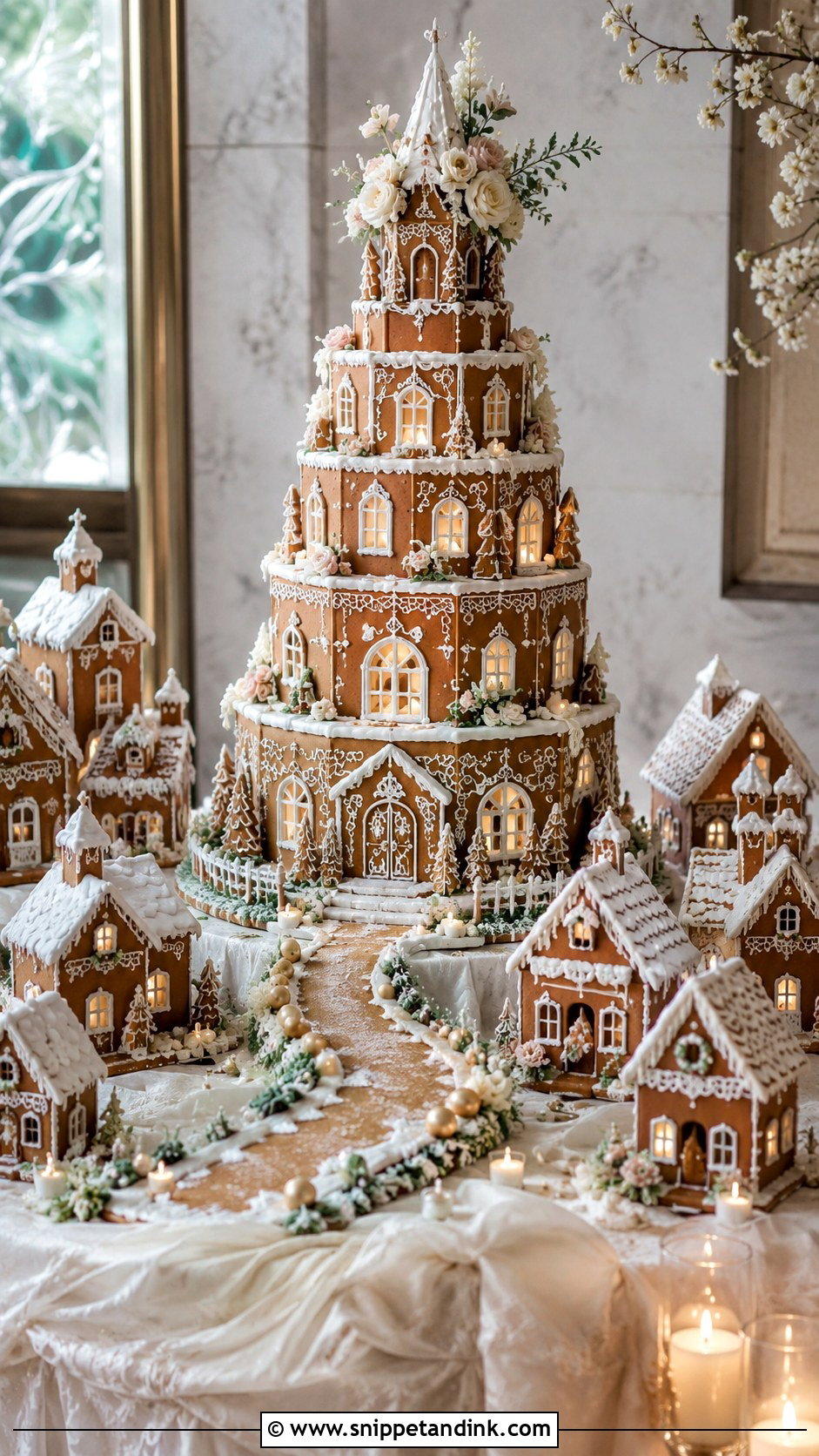
A village display turns the dessert table into a full scene, with the main cake in the center and smaller cottages, cookie trees, sugar paths and white frosting snow around it. It suits large receptions because it looks good from every side of the table. Plan the table depth before ordering, since a village needs more room than people expect and a crowded one looks messy. A coordinated palette of ivory icing, warm brown, muted candy and small florals keeps it elegant, and your photographer gets a centerpiece shot.
Why Gingerbread Hates a Damp Room
Gingerbread and royal icing are both mostly sugar, and sugar pulls water out of the air. In a humid room, construction gingerbread softens, joints glued with royal icing weaken and roofs can slide. Warm, steamy receptions after a snowy ceremony are a classic setup for it. Panels are baked and left to dry for a day or more before assembly, and royal icing needs hours to set properly, so a house cake is never a last-minute order. Ask that it be displayed away from kitchen doors, heaters and fogged windows, and kept in its box until it’s needed.
Serving a Cake Shaped Like a House
Guests often hesitate to cut into a house, and caterers who haven’t served one sometimes hack straight through the roof. A short plan helps:
- Remove any lights, toppers, picks and fresh flowers before the knife comes out.
- Lift off a constructed gingerbread house whole and set it aside; it can be broken into pieces for the table later or boxed for the couple.
- Cut the sponge tiers as you would any wedding cake, starting from the bottom tier.
- If the house itself is carved sponge, take the roof off first, then slice the body like a sheet cake.
Spice, Icing and a Cottage on the Cake Table
The appeal of a gingerbread house cake is that it feels handmade and warm in a season when receptions can feel formal. It can go rustic or modern depending on the piping, the colors and how much of the cake is house versus tier. Keep the theme clear, keep the palette restrained, and let one detail lead, whether that’s pearl piping, glowing windows or a whole village. Then trust your decorator on structure and timing, because gingerbread rewards a plan made weeks ahead.
You'll Like These Ideas:







Leave a Reply