
Bees on a wedding cake sound playful, but the theme slips into something quietly formal very easily. Honeycomb texture, a few small bees and honey-gold tones sit naturally with garden flowers, which is why I see it most for spring and summer receptions in barns, greenhouses and gardens. Below are twenty designs, from plain white fondant with gold bees to naked cakes with a honey drip and full beehive tiers. With each one I’ve added what it’s like to make, how it holds up on the day and which flavors I’d put inside.
Baking With Honey Changes the Cake Itself
Honey isn’t only a decoration on these cakes. It often goes into the sponge and the frosting, and it behaves differently from sugar. It holds moisture, so honey cakes stay soft longer, and it browns faster, so I bake honey sponges at a slightly lower temperature to keep the crust pale. Flavor varies a lot by type too. A mild clover or acacia honey sits quietly under vanilla, while a dark buckwheat honey can taste almost like molasses.
What the little bees are made from
Most cake bees are modelled from fondant or gum paste with striped bodies, and the wings come in one of four materials. Each has a weakness worth knowing before you pick a design.
- Gum paste wings dry hard and survive travel, so they’re the safe choice for stacked tiers.
- Wafer paper wings look fine and translucent but curl or dissolve wherever they touch damp buttercream.
- Isomalt wings look like glass and go tacky in humidity, so for summer weddings I fit them at the venue.
- Chocolate bees are fully edible, which matters on a cake that children will be eating.
If babies under a year old will be at the wedding, mention it to your caterer. Honey in any form, including frosting and drips, isn’t recommended for infants, so they’ll need a separate treat.
1. Honey Bee Wedding Cake
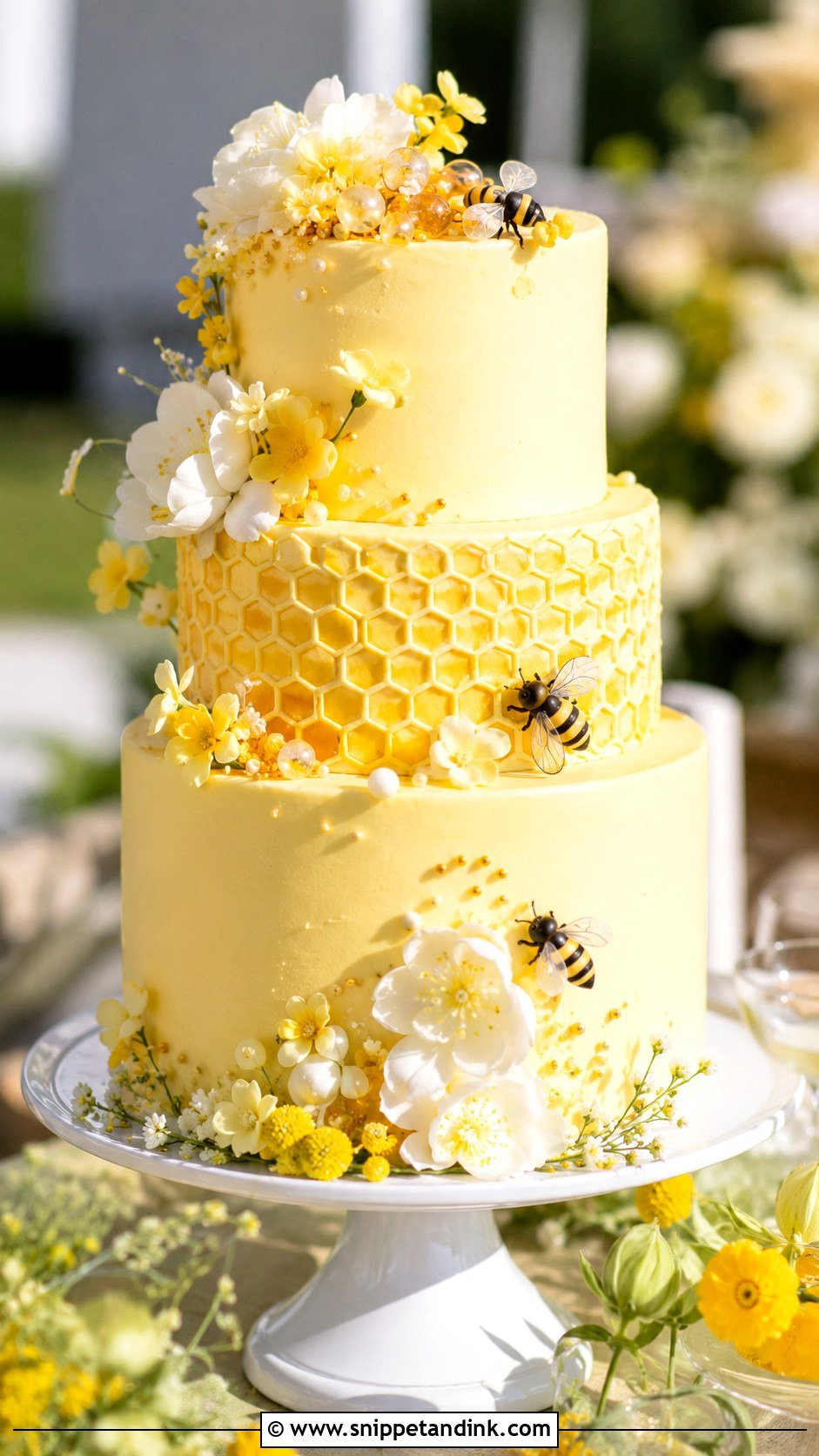
This is the version I show a couple who likes the theme but worries it’ll look cute. A white or ivory tiered cake carries small gold bees, soft honeycomb embossing and a few sugar flowers. I place the bees in odd numbers and at different heights so they look as if they’ve landed, not as if they’ve been lined up. A touch of pale yellow or champagne warms it. Inside, vanilla, honey almond, lemon or lavender sponge all sit well with the look, and neutral linens with beeswax candles keep attention on the cake.
2. Honeycomb Wedding Cake
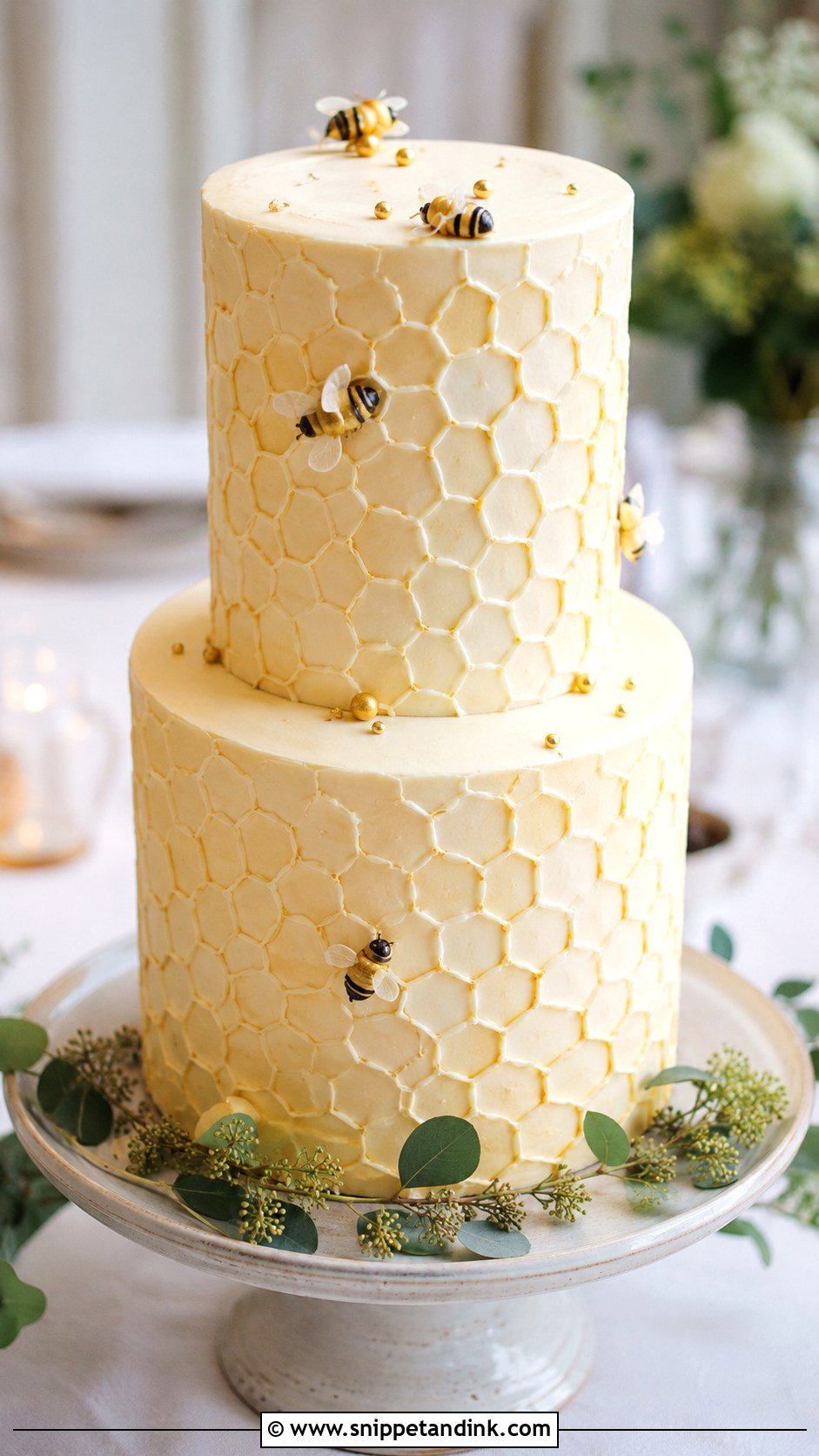
A honeycomb wedding cake is about texture more than color. The hexagons can be pressed into fondant with an impression mat, piped in royal icing or cut from edible wafer paper, and each method behaves differently. Embossed fondant is the crispest. Piped royal icing gives raised lines that catch light. Wafer paper is the lightest, but it softens if it sits directly on damp buttercream. Keep the base white, ivory or soft yellow so the pattern reads, then add a few fondant bees and a thin gold edge.
3. Beehive Wedding Cake
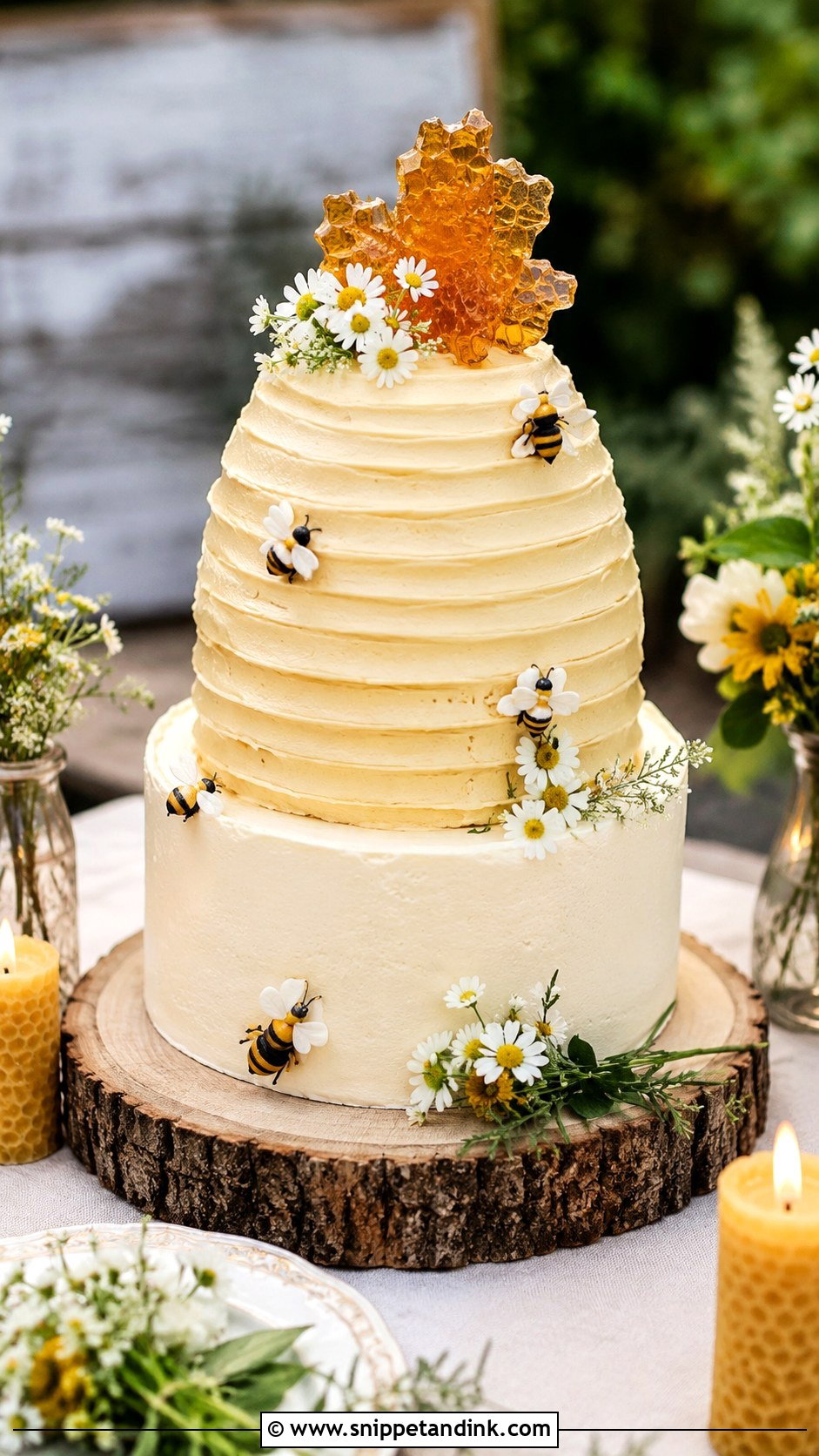
A beehive tier is a carved dome with soft horizontal ridges, and it’s the heaviest design here, in every sense. I usually build the hive from cake on its own board and supports, or from rice cereal treats covered in fondant when the couple wants it lighter. Keep it light honey, pale gold or warm ivory so it still reads as a wedding cake. Sugar bees circle the hive and flowers sit at its base. The other tiers should stay plain, because the hive already does all the talking.
4. Gold Honey Bee Wedding Cake
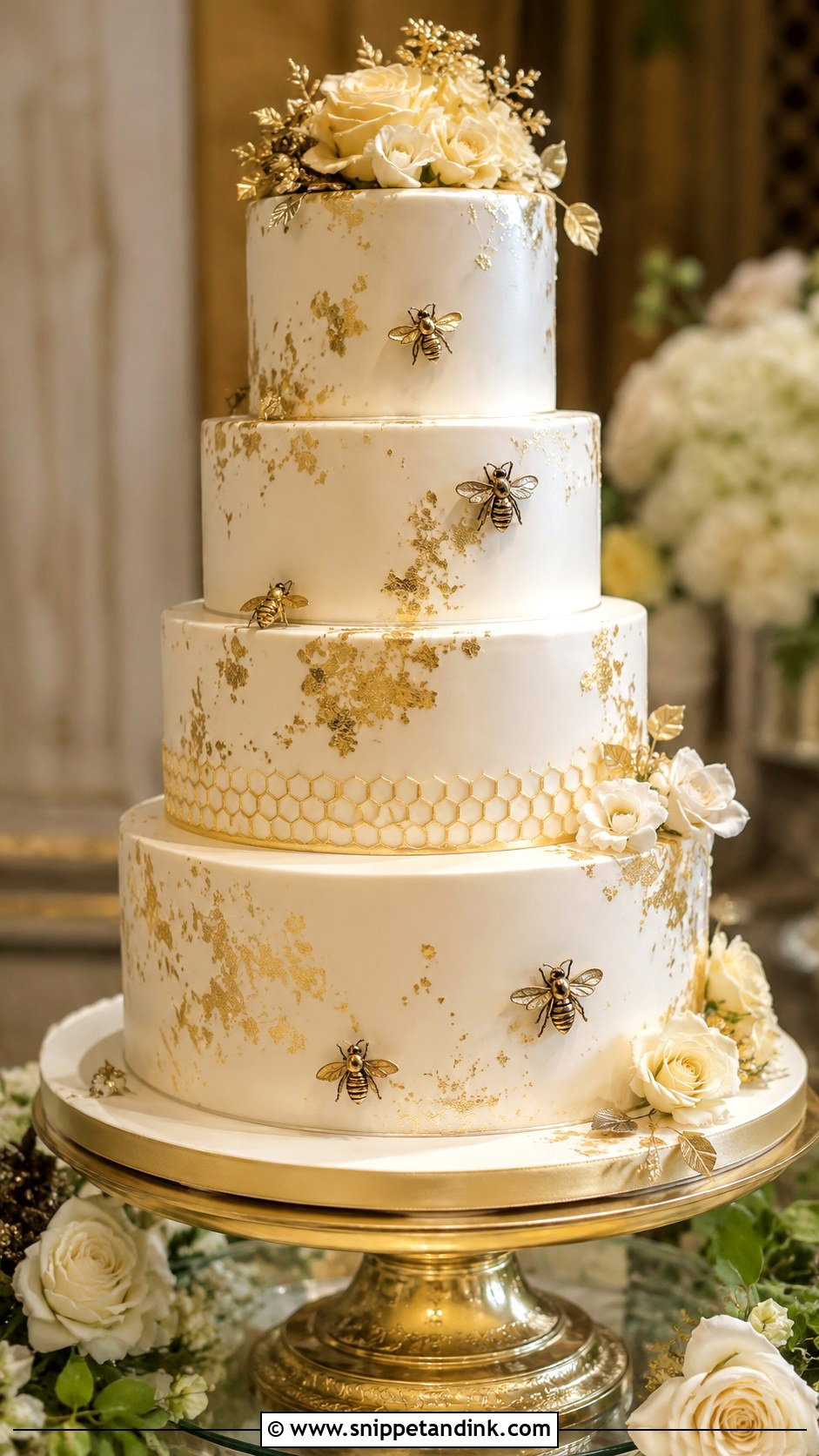
Gold is the detail I most often talk couples down from. A mostly white cake with metallic bees, a little gold leaf and a couple of honeycomb panels looks expensive; gold on every tier looks heavy. Ask your baker whether the gold is edible, too. Edible gold leaf is fine to eat, but some shimmer dusts are only labelled non-toxic and are meant for decorations that get removed. Honey vanilla, champagne, almond and lemon elderflower all suit this cake, and a gold stand ties the display together.
5. Rustic Honey Bee Wedding Cake
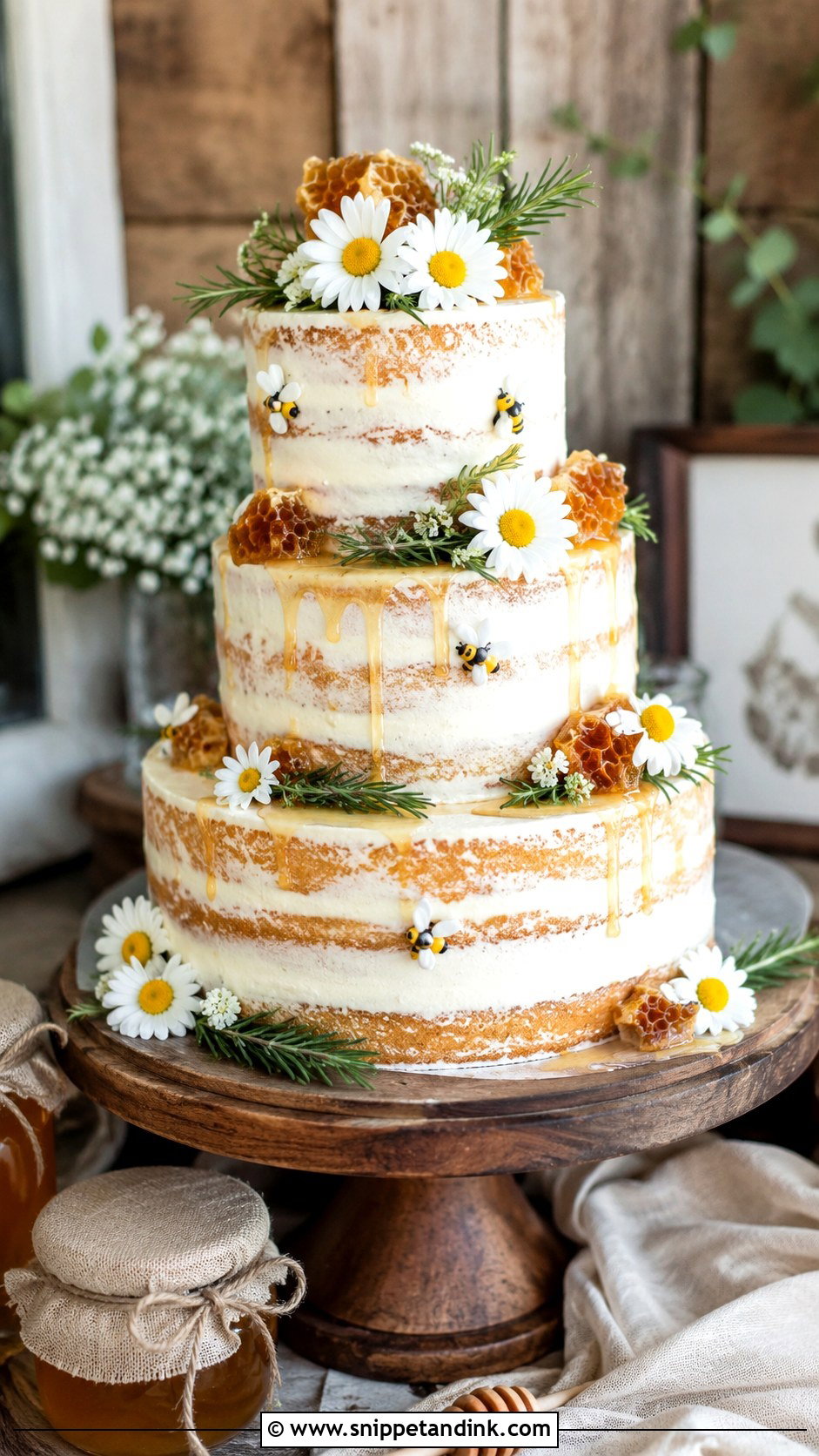
Rustic here means semi-naked buttercream, visible layers and a golden drip, finished with tiny bees, honeycomb candy, fresh herbs and small flowers like chamomile or daisies. Handmade texture takes more control than people expect, because a scraped coat that’s too thin lets the sponge dry out at the edges. Honeycomb candy goes on last, at the venue, since it pulls moisture from the air and turns sticky within hours. Bake honey spice, vanilla bean or lemon inside, then set it on a wood slice or ceramic stand with small jars of honey or beeswax candles around it.
6. Floral Honey Bee Wedding Cake
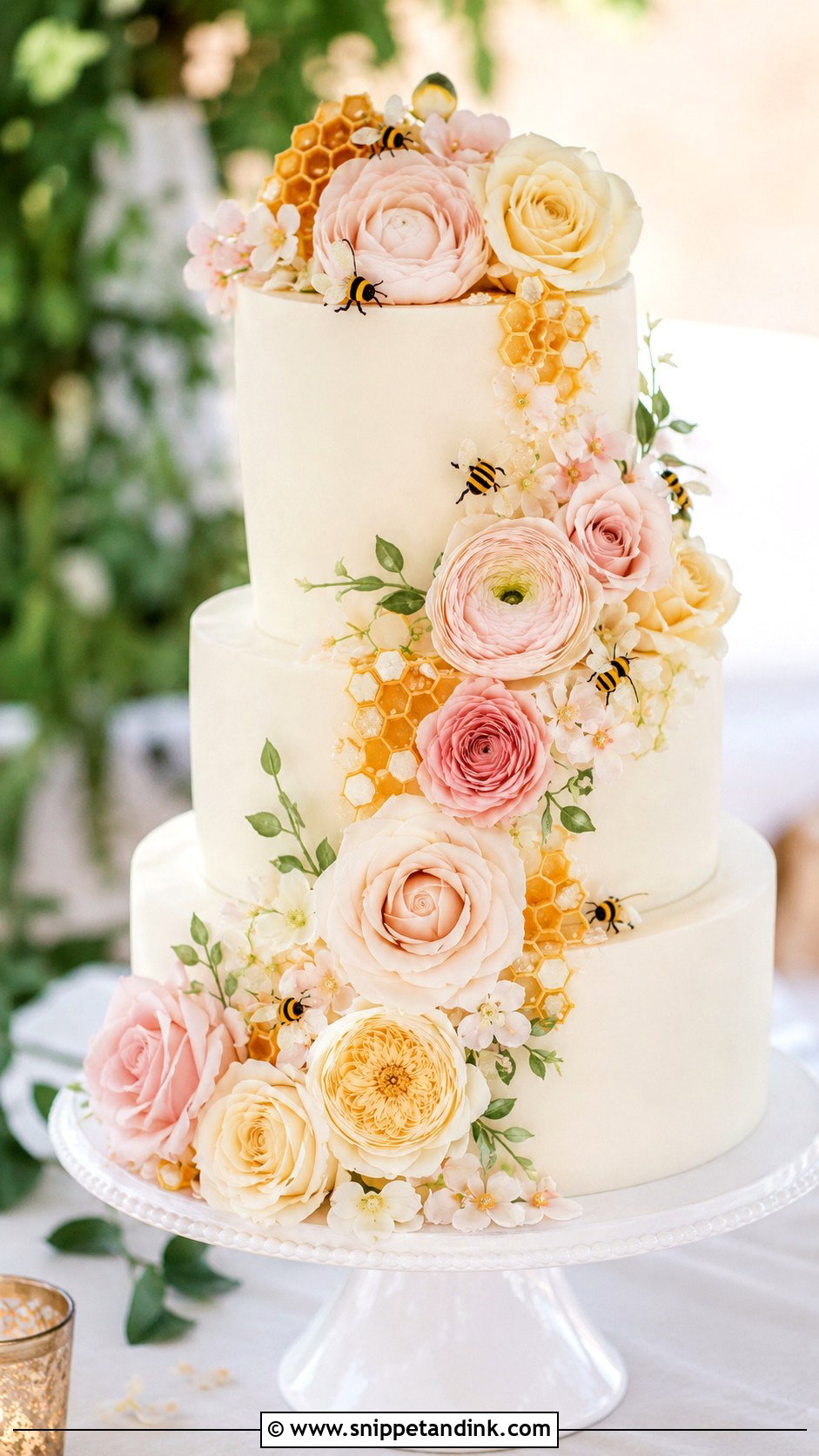
Flowers make the bee theme feel natural instead of novelty. An ivory buttercream or fondant base takes blooms in cream, blush, yellow and soft green, with tiny bees tucked between petals or beside a honeycomb panel. Fresh flowers on a cake have to be non-toxic and grown without pesticides, and I wrap or tape every stem before it goes near the frosting. Roses, ranunculus, chamomile, lavender and edible pressed flowers all suit it. I’d keep the shape to two or three round tiers so the flowers carry the design.
7. Naked Honey Bee Wedding Cake
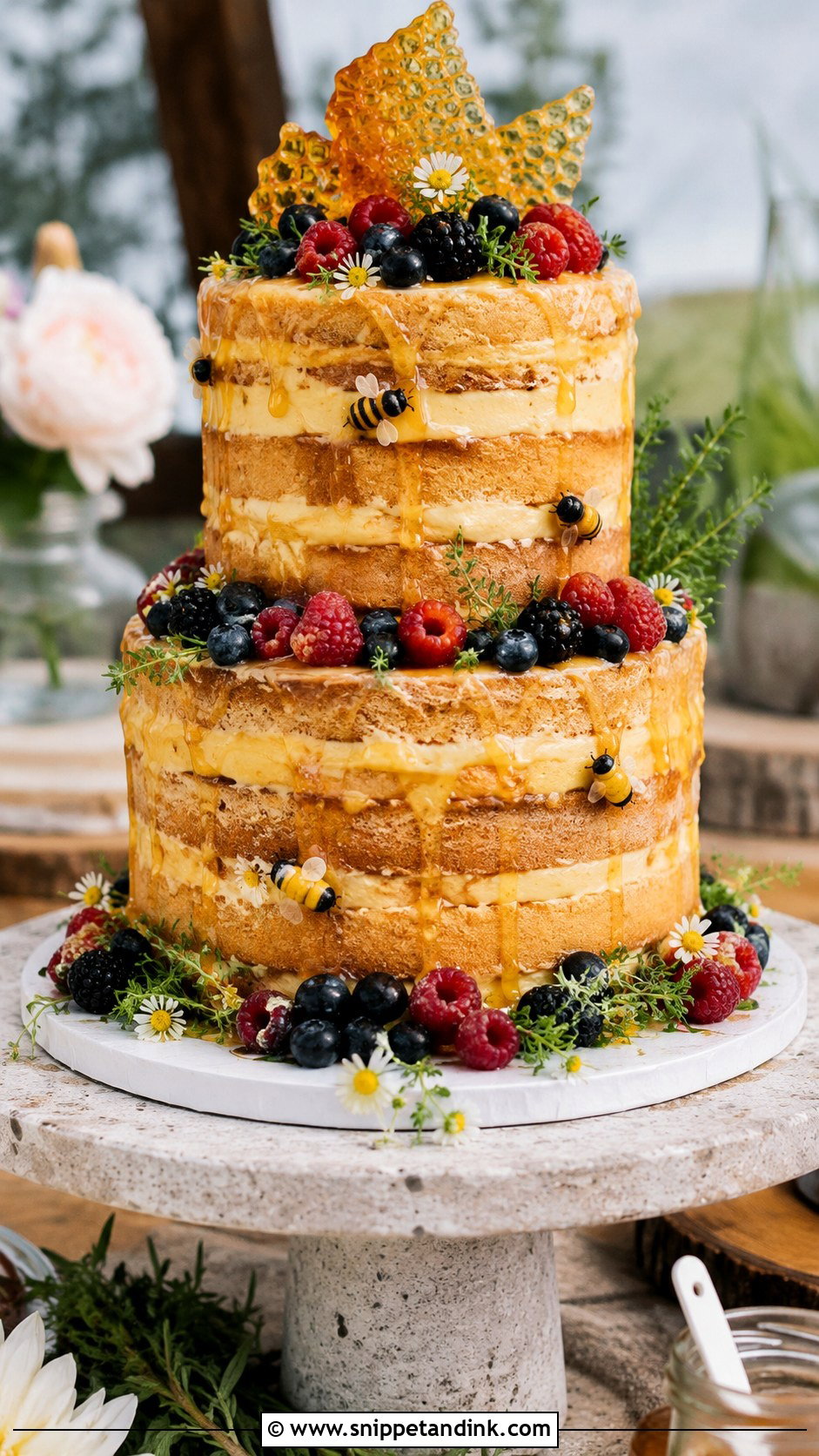
A naked cake shows its layers, so the bake has to be level and the filling neat; there’s nothing to hide behind. Honey buttercream between the layers, a light drip, a few sugar bees and pieces of honeycomb candy make the theme clear, with herbs and berries for color. The honest drawback is that an unfrosted cake dries out faster, so I assemble it as close to the event as I can and brush each layer with syrup. It suits a relaxed reception, with honey vanilla, almond or spice cake on a wooden or stone stand.
8. White Honey Bee Wedding Cake
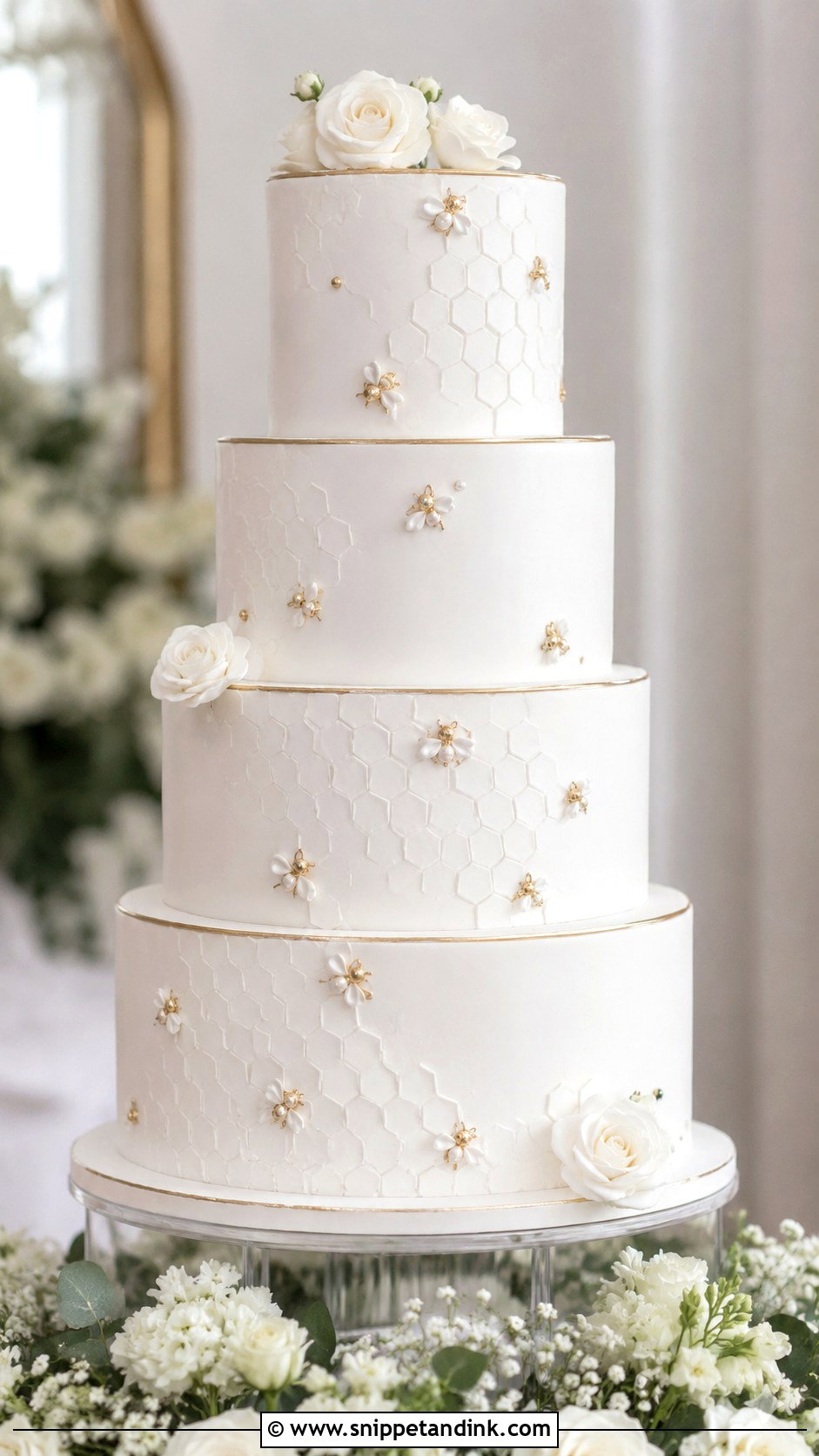
White-on-white honeycomb is the quietest way to carry the theme. The texture only shows when light falls across it from the side, so where the cake stands in the room matters almost as much as the design. Gold or pearl bees bring in the motif without taking over. I suggest it for formal weddings, and for couples whose palette isn’t settled yet, since white goes with anything. White roses, sugar blossoms or a little greenery add depth.
9. Yellow Honey Bee Wedding Cake
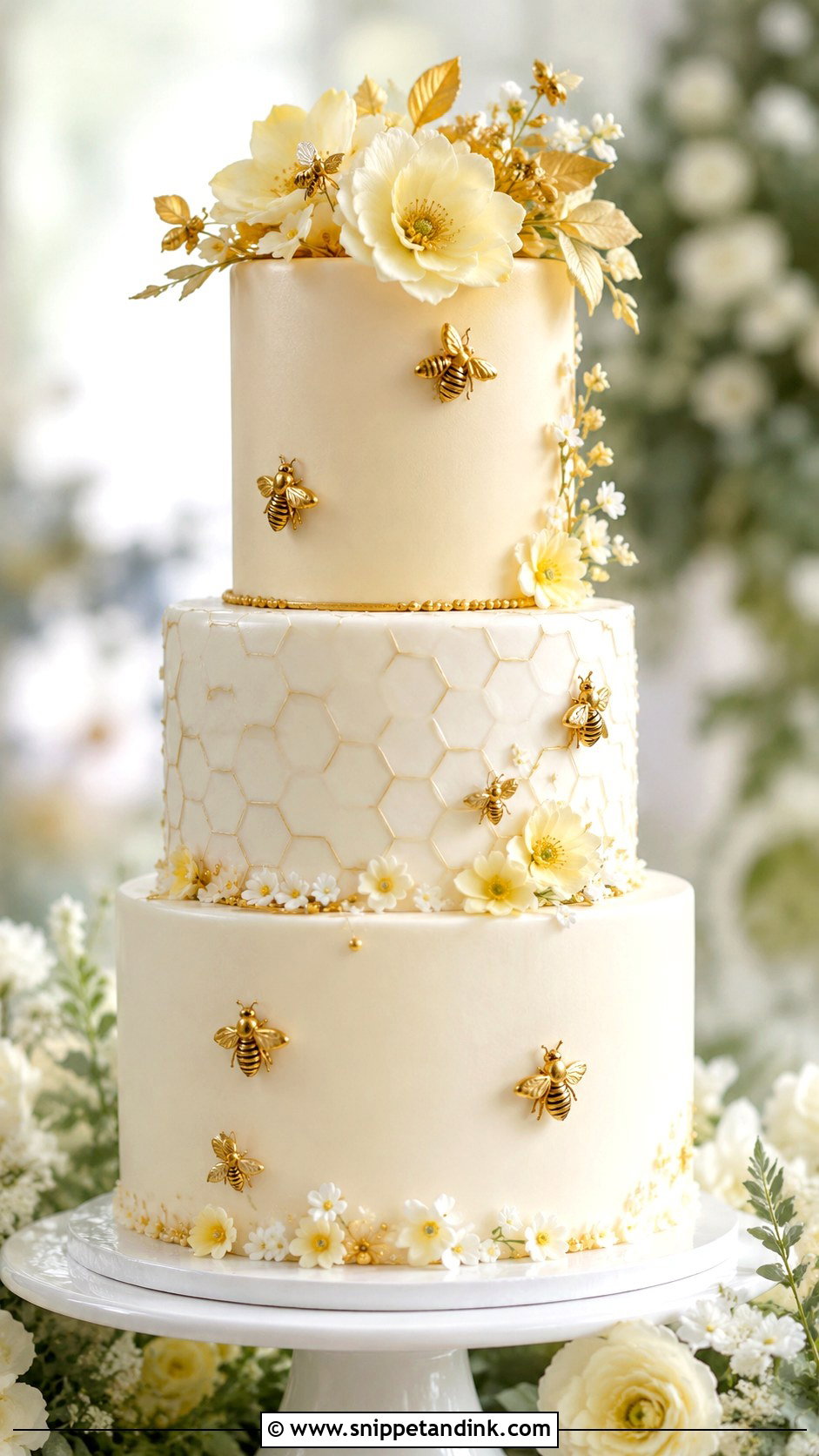
With yellow, shade is everything. Soft butter yellow, honey gold or pale marigold reads as wedding, while bright lemon yellow starts to look like a children’s party. Some yellow colorings also fade in direct sun, so a cake standing in a bright tent can look paler at cutting time than it did at delivery. Smooth buttercream, small black-and-gold bees and white flowers balance it, with honeycomb on just one tier. Lemon, honey, vanilla or passion fruit flavors follow the color naturally.
10. Hexagon Honey Bee Wedding Cake
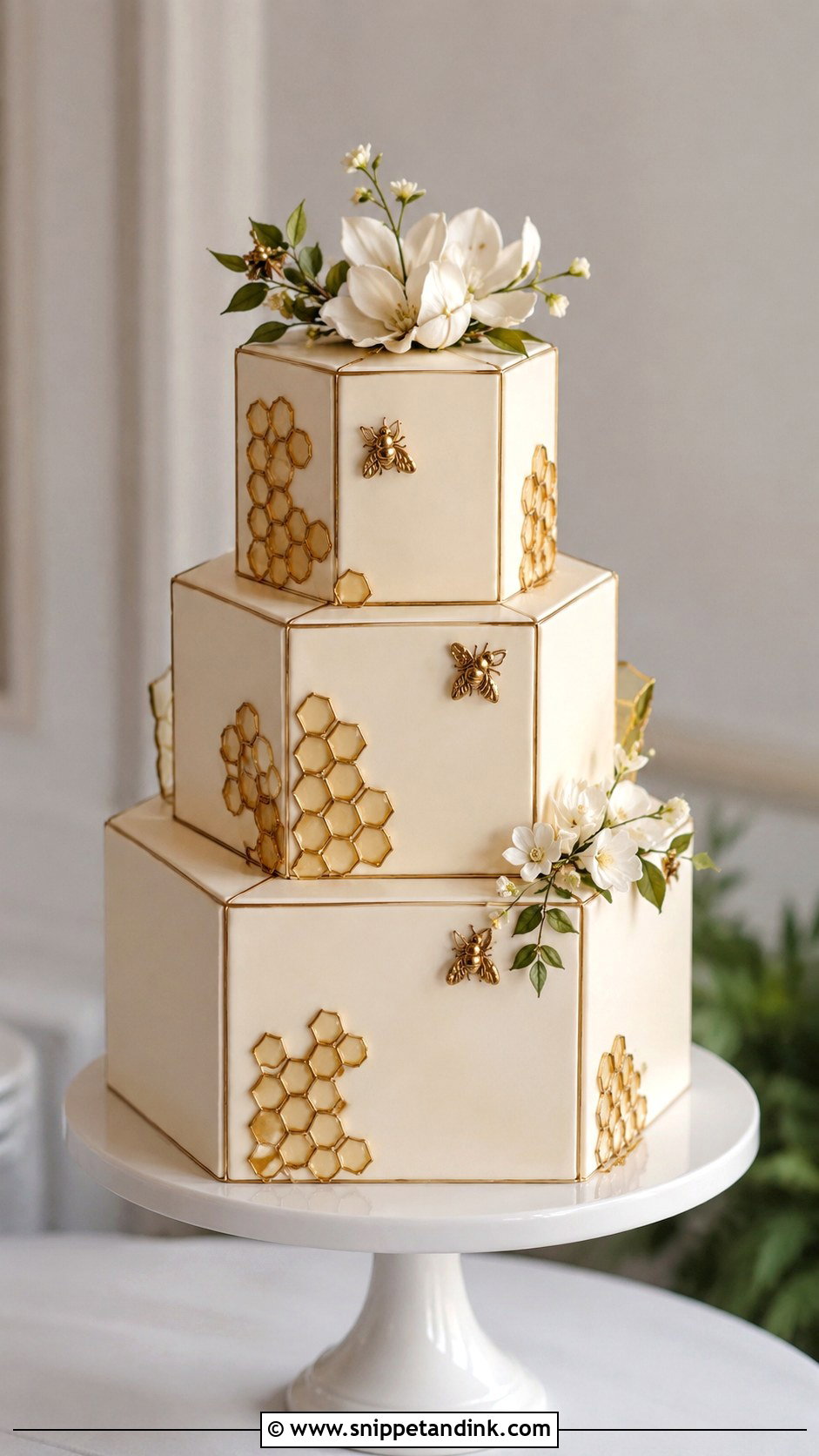
Making the whole tier hexagonal turns honeycomb from a pattern into the structure itself. Six flat sides need sharp corners, which is far easier in fondant than in buttercream, and the stack needs careful dowelling because there’s no curved edge to disguise a lean. Smooth ivory fondant, thin gold lines and a few bees keep it elegant. Mixing hexagon tiers with round ones softens the geometry if a full hexagon stack feels too architectural. Contemporary venues and gallery spaces suit it best.
11. Honey Drip Wedding Cake
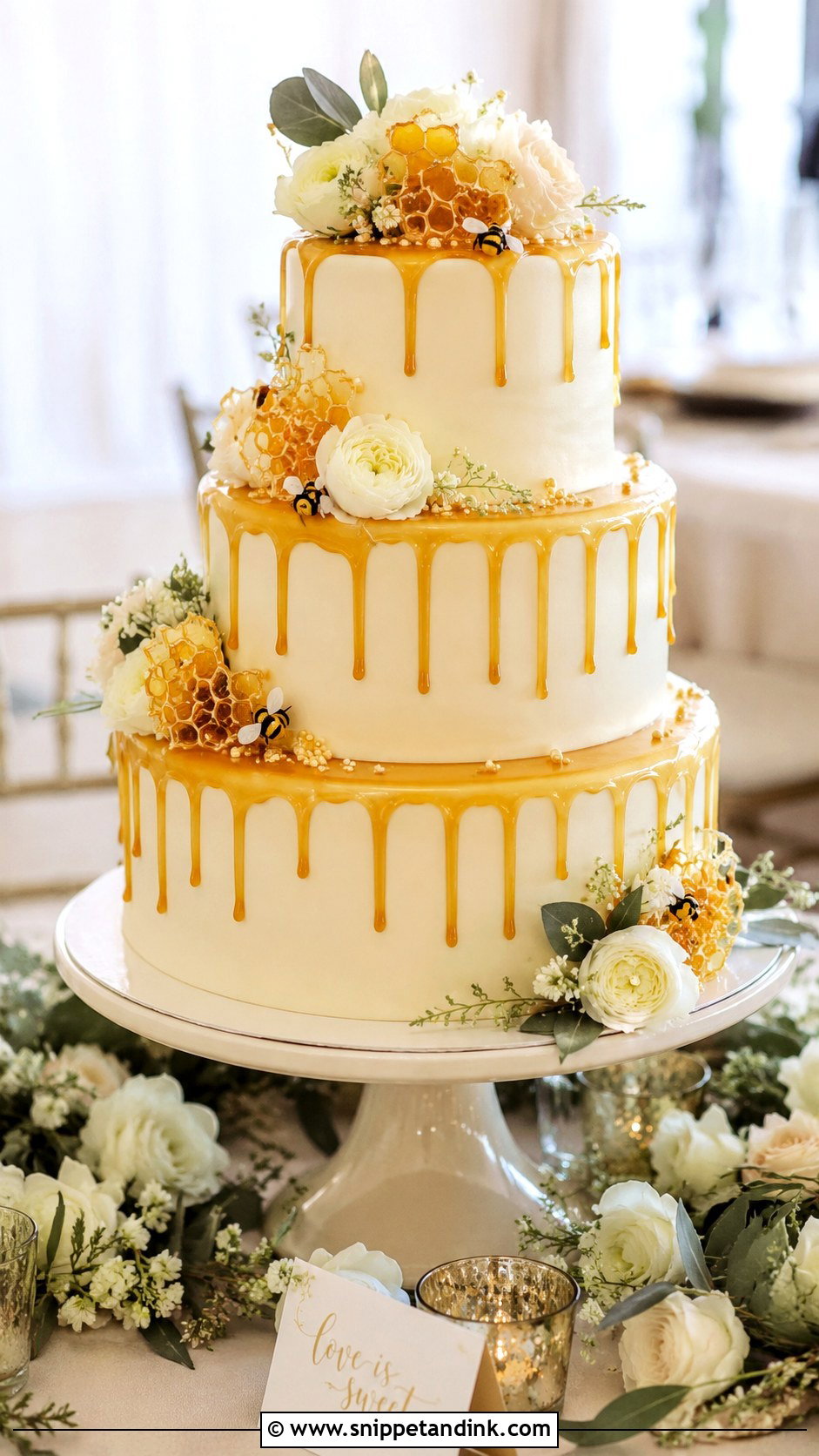
The drip should run partway down the side, not flood the cake. Real honey looks right but is the hardest to control: it never sets, keeps sliding through a warm afternoon and can soak into the frosting. For anything outdoors I switch to a honey-colored white chocolate ganache, which firms up and holds its shape, and put the honey flavor in the sponge instead. White buttercream, honeycomb candy, small bees and flowers finish it on one to three tiers, with honey vanilla or lemon inside.
12. Buttercream Honey Bee Wedding Cake
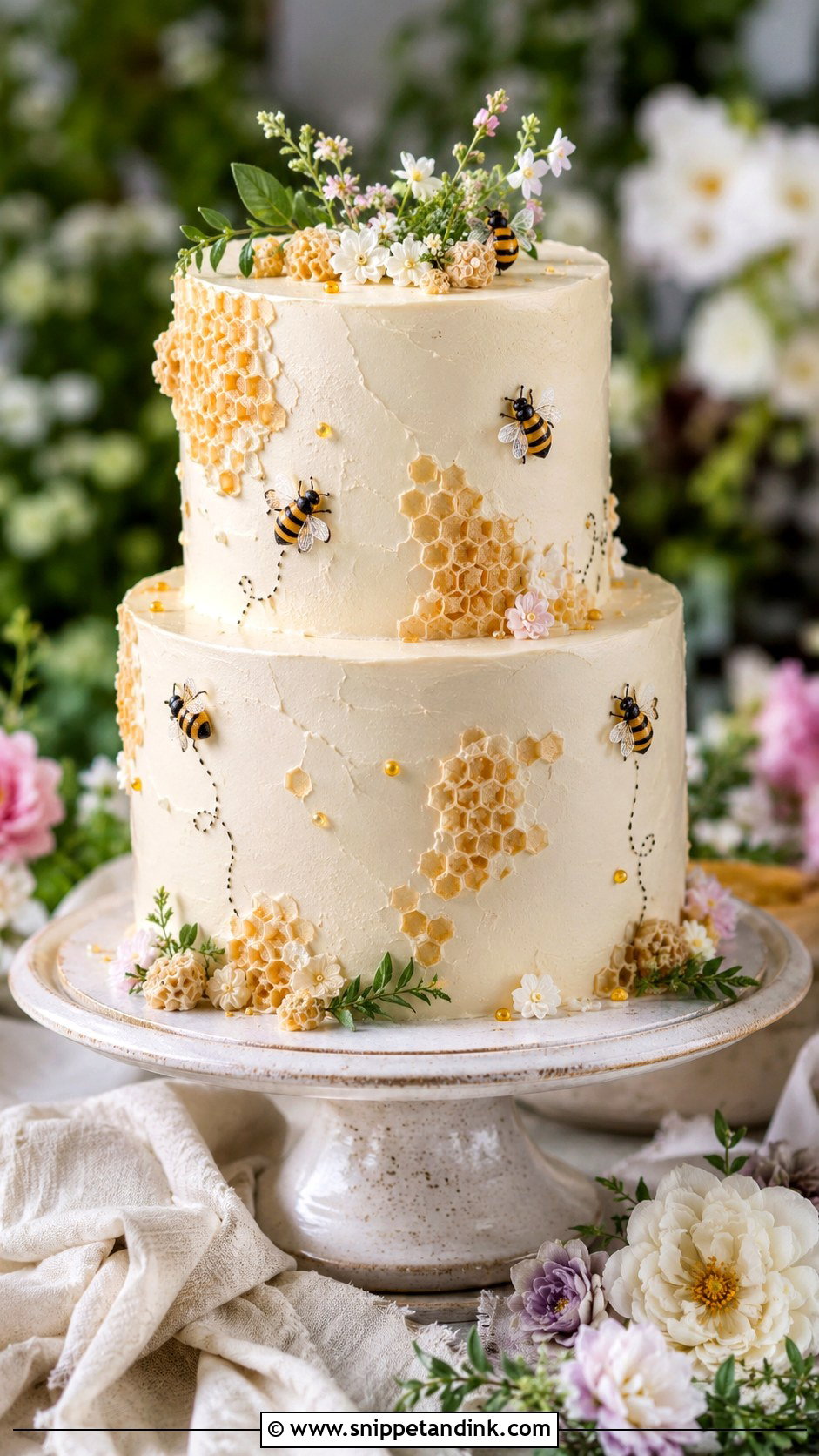
Buttercream gives you two finishes from one medium. Smoothed, it looks clean and formal; textured with a palette knife, it becomes a garden cake. Piped honeycomb patches, tiny fondant bees and small flowers carry the theme, and the frosting takes flavor easily, from honey and lemon to lavender and spice. The thing I plan around is temperature. Crusting American buttercream holds better in warmth, while silky Swiss meringue softens sooner, so for a summer marquee I pick the frosting before the design.
13. Fondant Honey Bee Wedding Cake
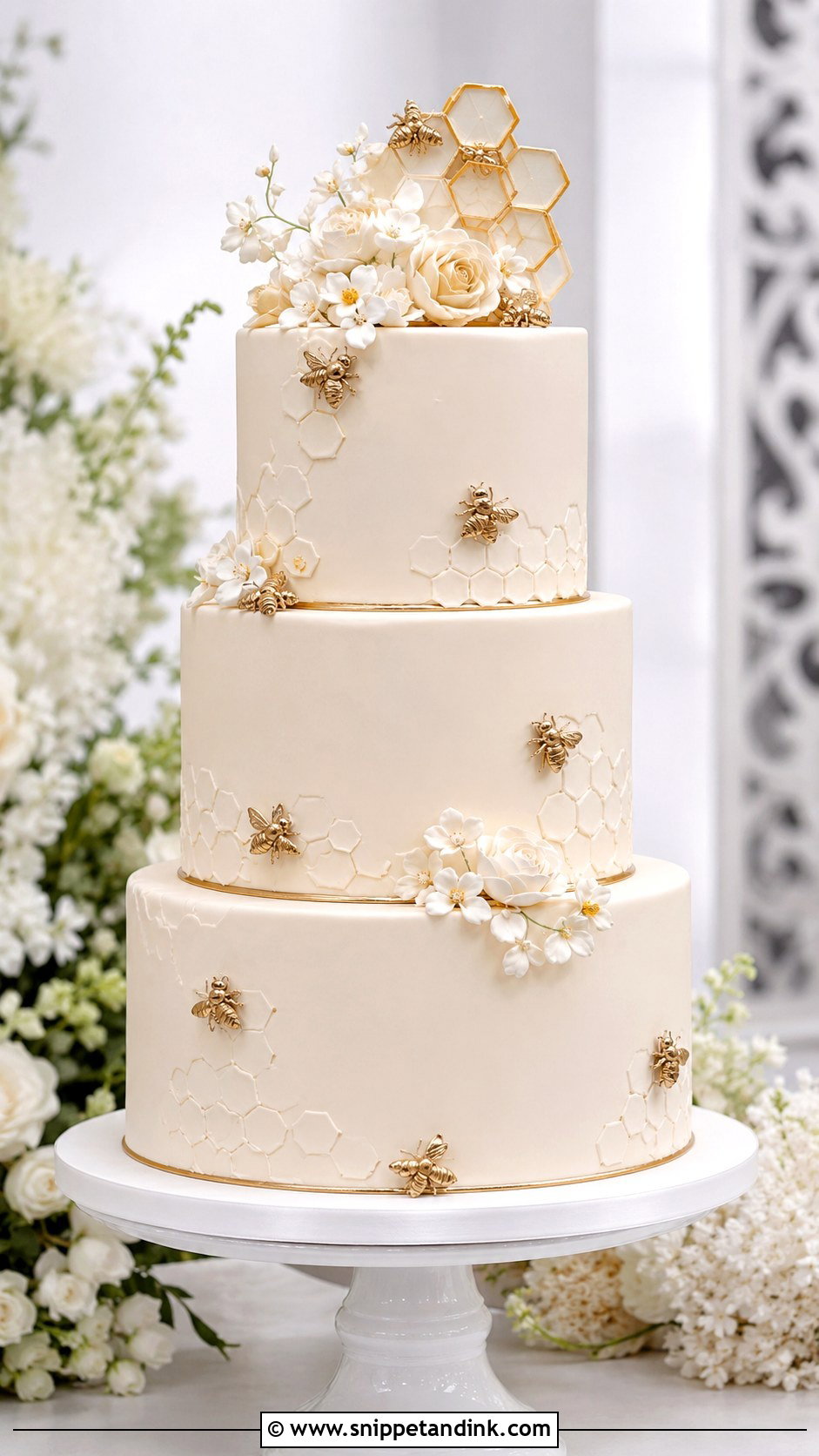
Fondant gives the sharpest edges and the smoothest surface, which suits embossed honeycomb, sculpted bees and formal tiers in ivory, white, pale yellow or champagne. Gold-painted bees read as luxe, soft yellow ones as sweeter. One thing couples don’t expect is condensation. A fondant cake moved from a cold fridge into a warm room beads with moisture, so I let it come up to room temperature boxed and leave it untouched until the surface dries. Keep the decoration focused, because that smooth surface shows every detail and every flaw.
14. Sugar Flower Honey Bee Wedding Cake
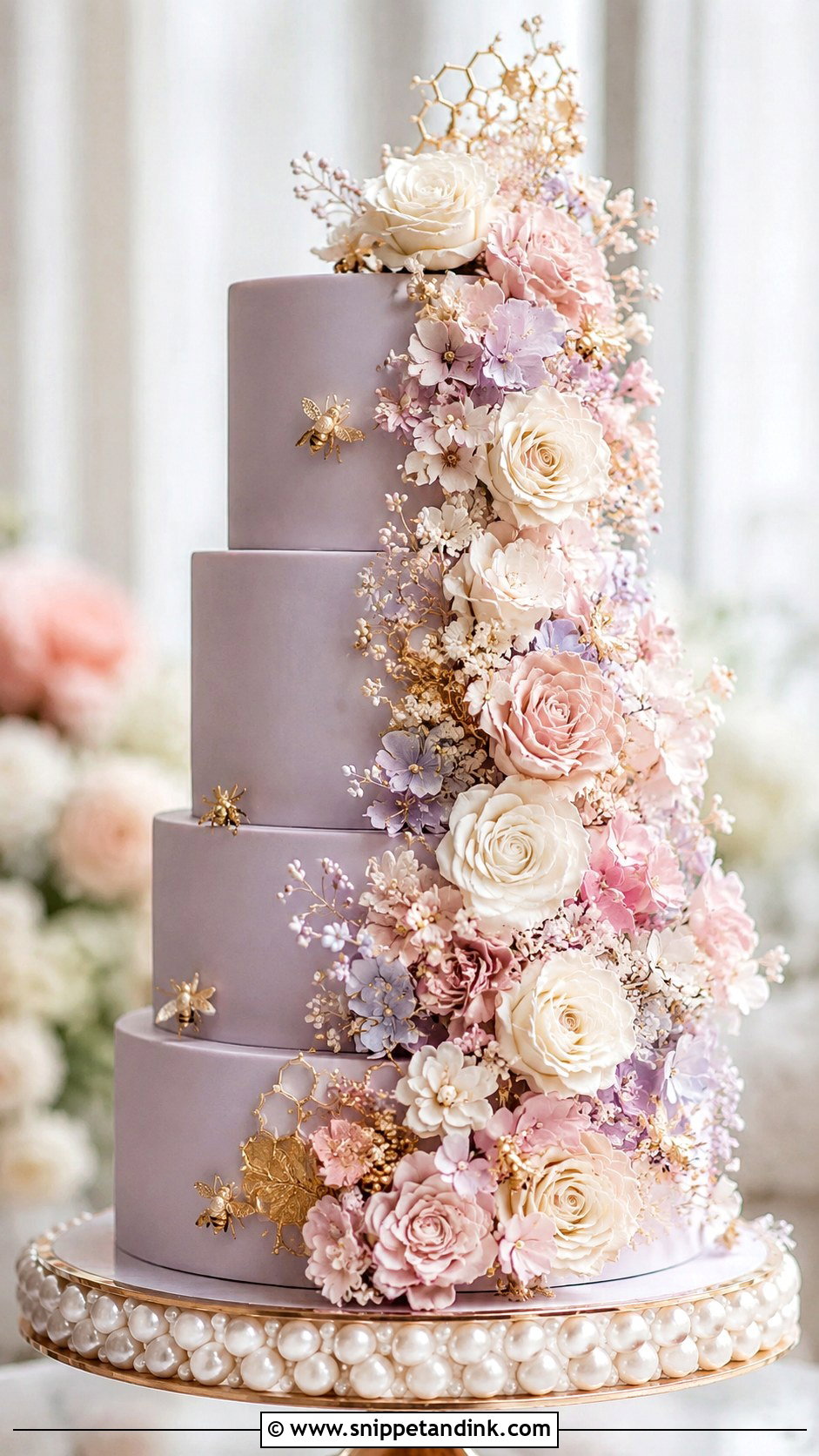
Sugar flowers are made petal by petal on wires, so they can match the bridal bouquet exactly and be kept long after the wedding. Because of those wires they’re decorations, not food, and come off before the cake is cut. Keep the bees subtle here, a few resting near petals or a honeycomb panel behind the cascade. White, blush, yellow and soft green suit the style. A large sugar cascade takes many hours of work, so order this design well ahead.

15. Garden Honey Bee Wedding Cake
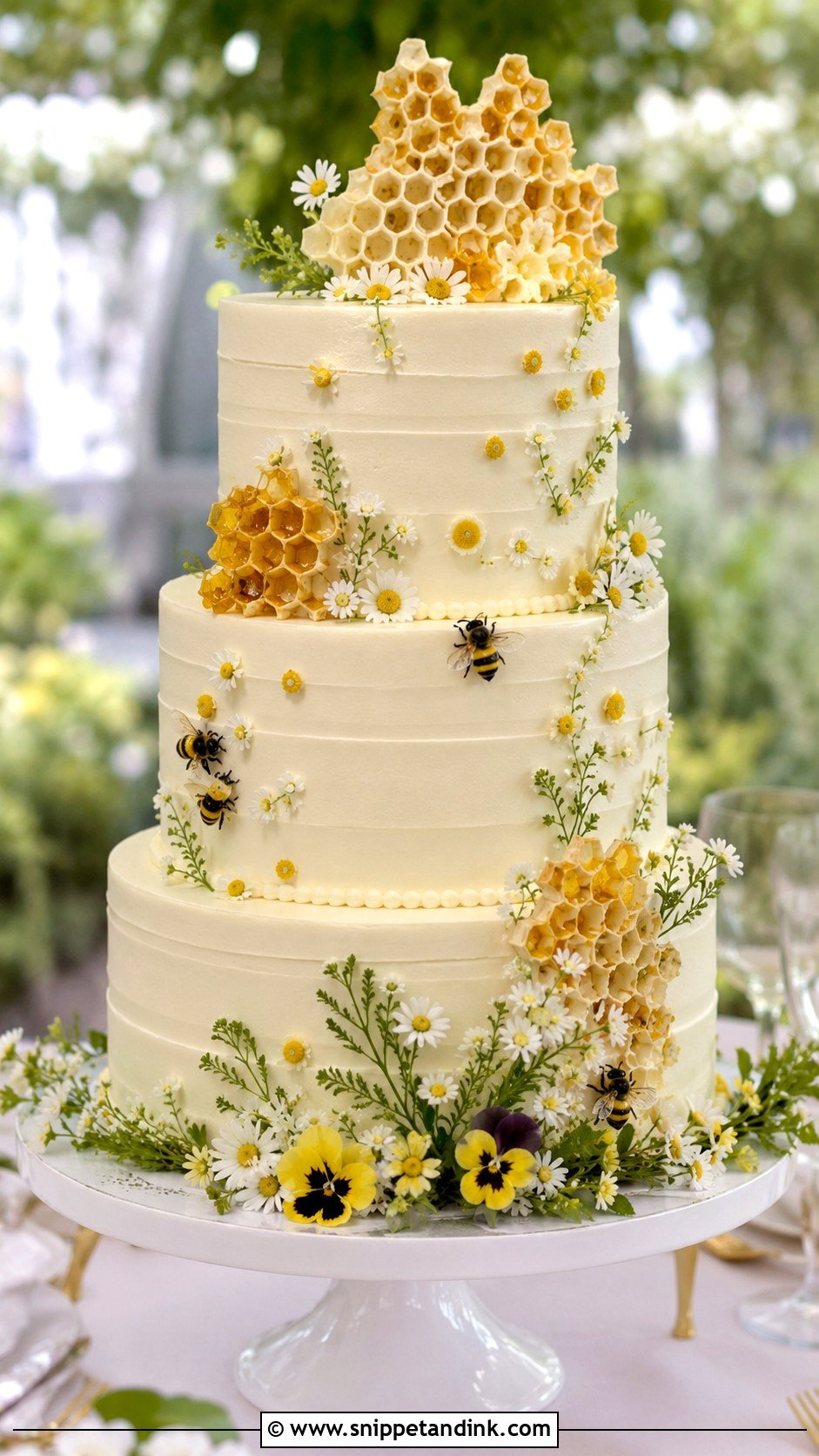
This one should look as if it grew among the flowers. Buttercream or fondant carries edible flowers, herbs, tiny bees and honeycomb accents, climbing the tiers or gathered at the base. Chamomile, lavender, pansies and roses link back to bees without any explaining. Outdoors, a garden cake is exposed to the actual garden, so I keep it in shade and away from the open sides of a tent. A soft palette of ivory, yellow, green and blush stops it looking crowded.
16. Minimal Honey Bee Wedding Cake
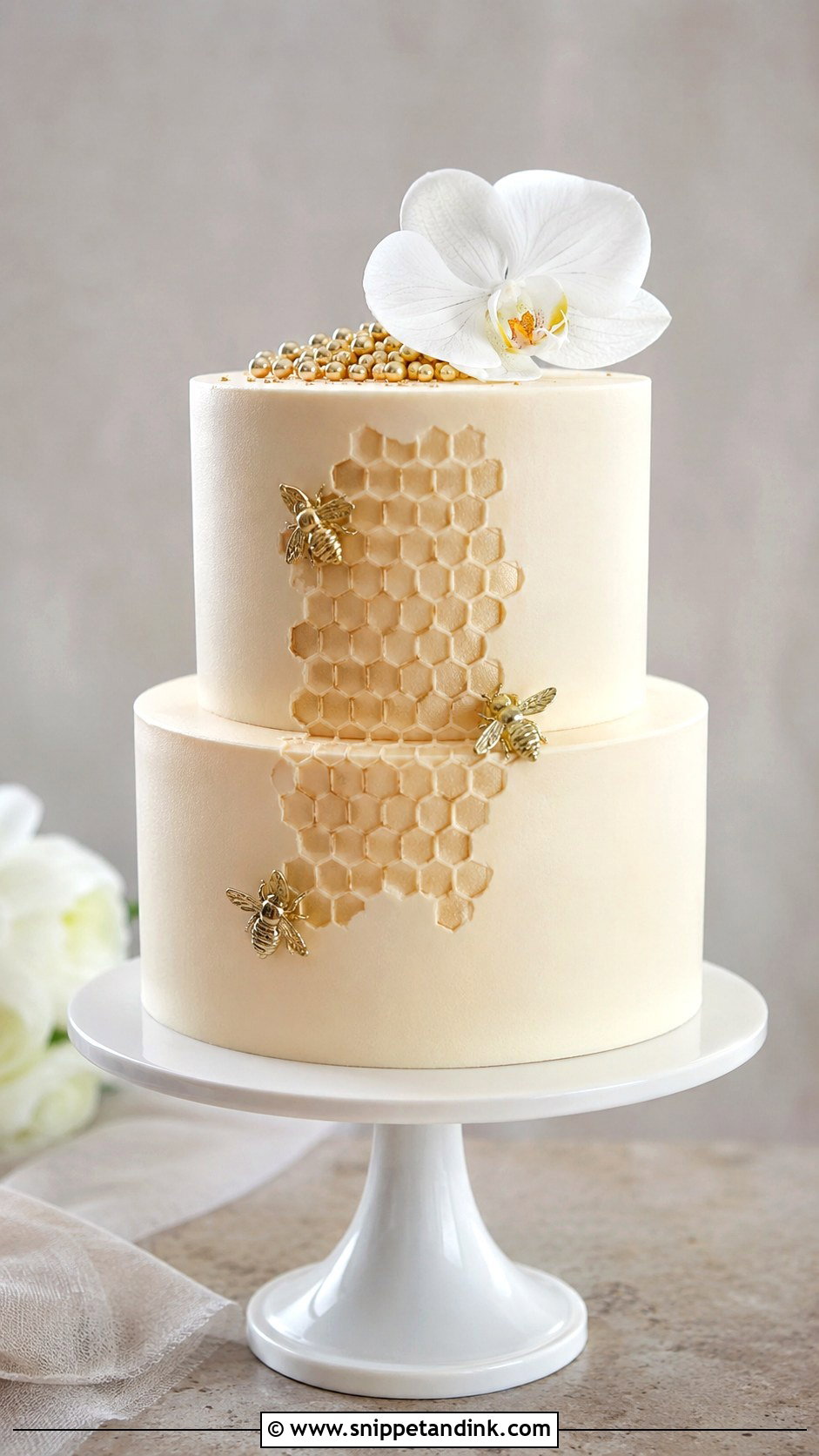
Restraint is the design. A smooth white or ivory cake gets one small honeycomb panel, a few gold bees and perhaps a single cluster of flowers, with empty space around each detail. Because there’s so little decoration, the finish has to be flawless, since any bulge or air bubble shows. Two tiers is usually enough for a micro wedding or a city venue. Put it on a slim stand against a plain backdrop.
17. Black And Gold Honey Bee Wedding Cake
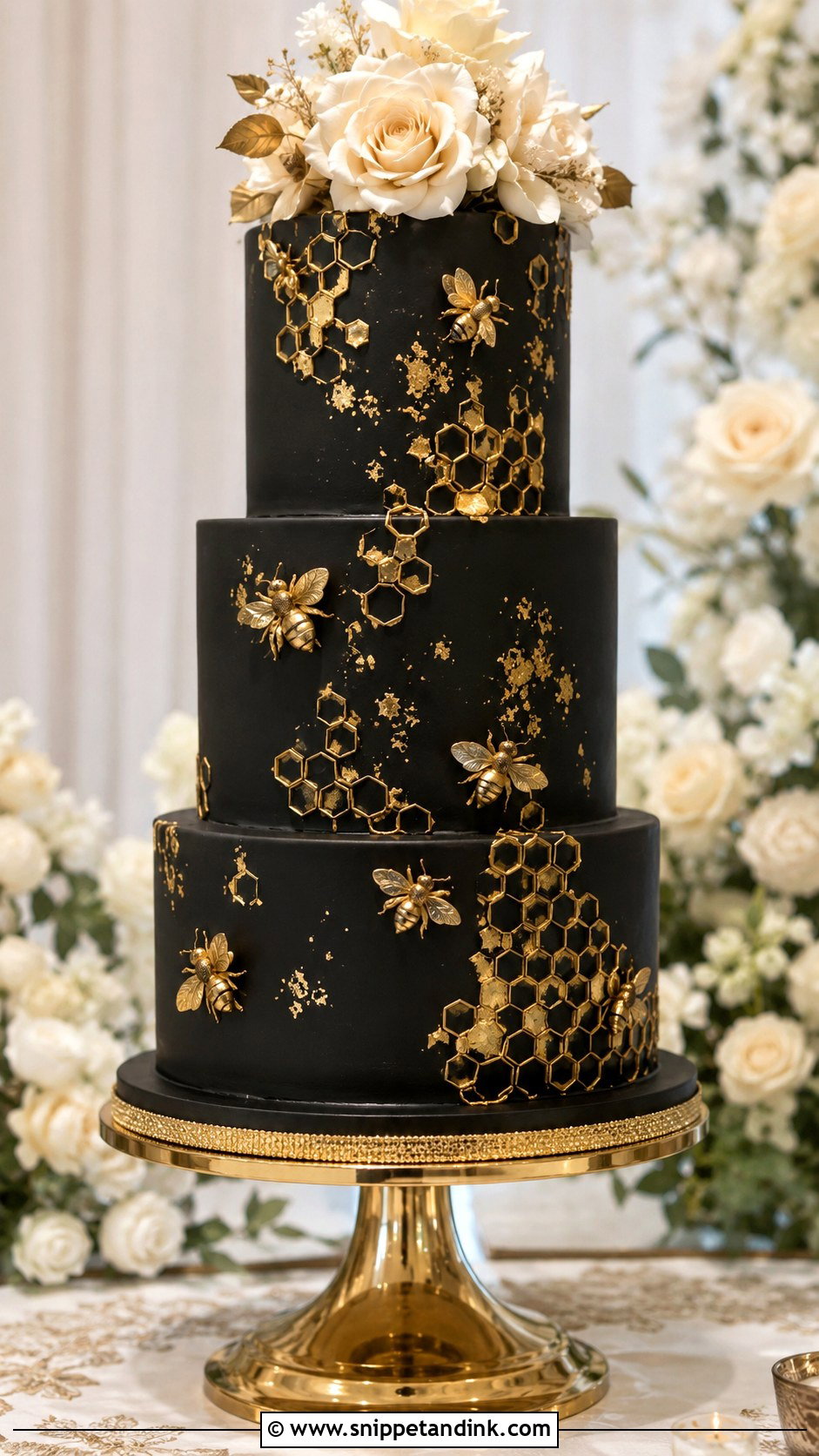
Black is dramatic and harder to get right than it looks. Matte black fondant or dark chocolate buttercream makes the base, with metallic gold bees and honeycomb over it. A true black takes a lot of coloring, which can stain mouths and leave a slightly bitter taste, so I start from dark chocolate whenever I can. Ivory flowers or one white tier keep it reading as a wedding cake. Chocolate, espresso, honey caramel or dark vanilla suit the mood of an evening reception with black in the palette.
18. Lemon Honey Bee Wedding Cake
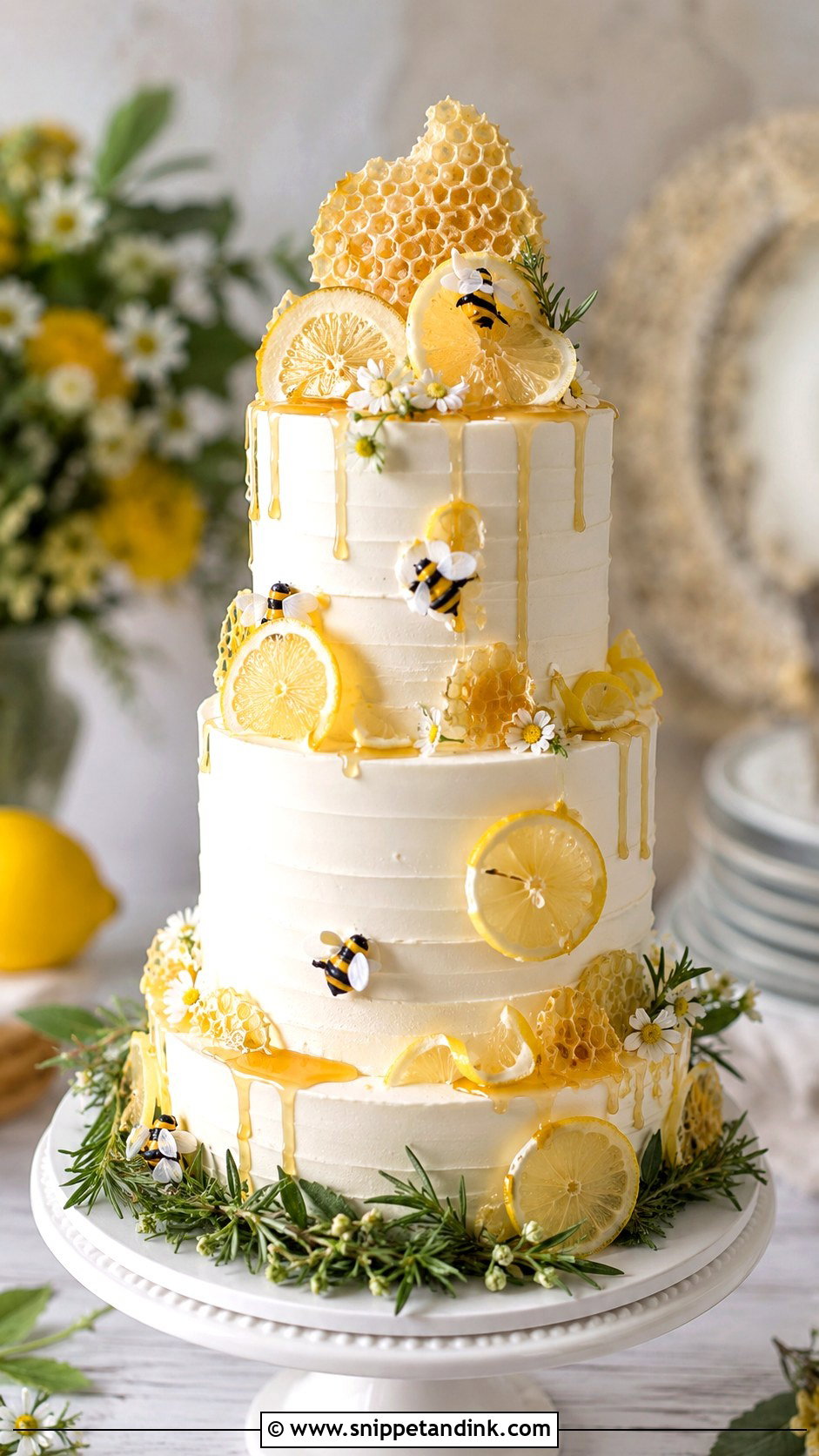
Lemon and honey are an easy pairing, sharp against sweet, which is why this cake suits warm weather. I use lemon sponge with honey buttercream, a light drip, tiny bees and citrus slices or flowers. Fresh citrus weeps juice into the frosting after a few hours, so candied or dried slices are safer if the cake will stand for long. Ivory or pale yellow frosting keeps it from looking casual at a brunch or spring reception, and small sprigs of thyme finish it.
19. Lavender Honey Bee Wedding Cake
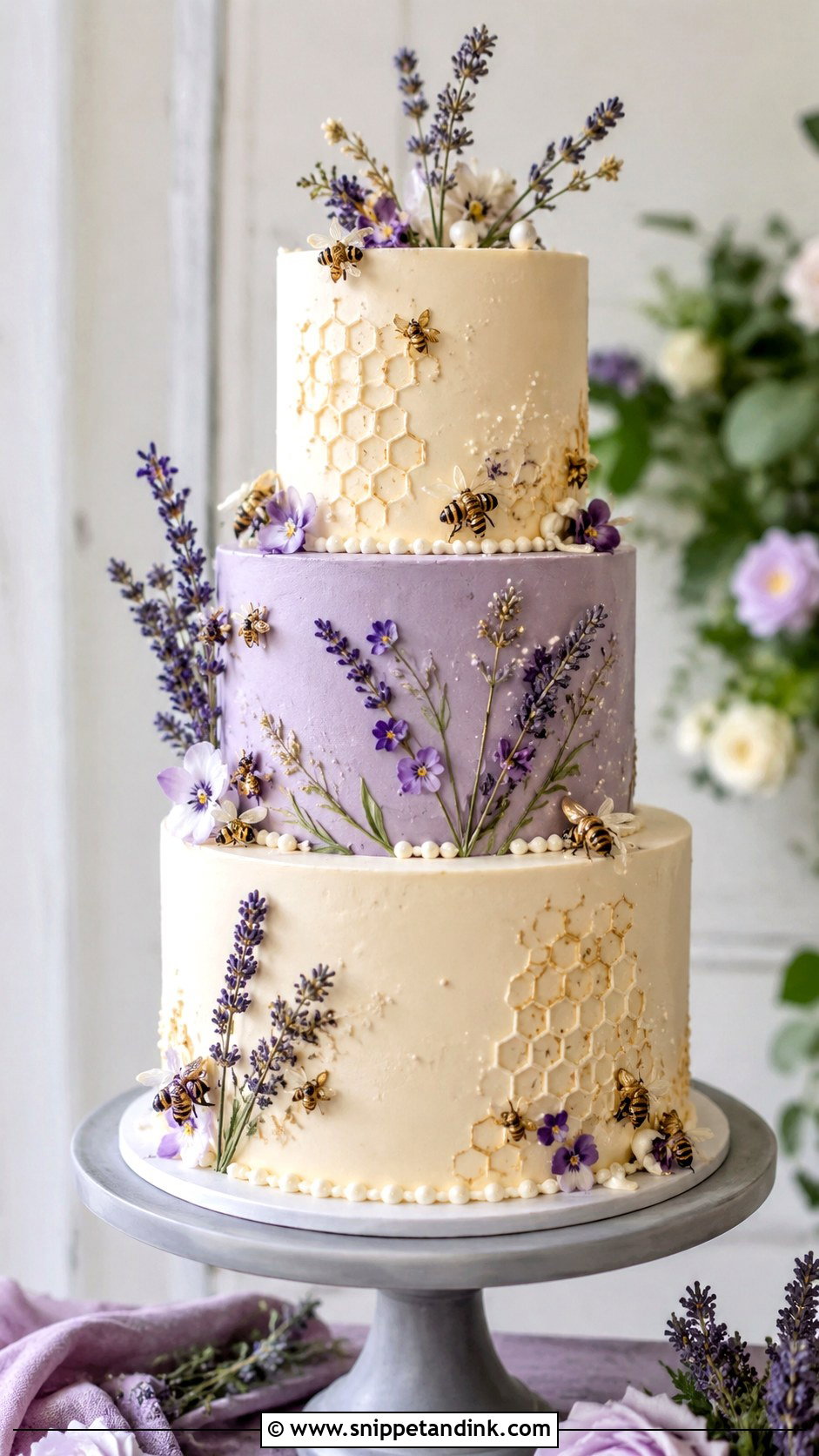
Lavender and honey are both floral, so the flavor needs a light hand; too much lavender tastes like soap, and I’d always arrange a tasting first. Ivory buttercream with muted lavender accents, tiny gold bees and small honeycomb details carry the look. A few lavender sprigs, sugar flowers or pressed edible flowers finish it. Keep the purple dusty, because bright purple pulls focus from the bees. Lavender honey sponge, vanilla lavender or lemon lavender all suit an outdoor spring reception with a pastel palette.


20. Two Tier Honey Bee Wedding Cake
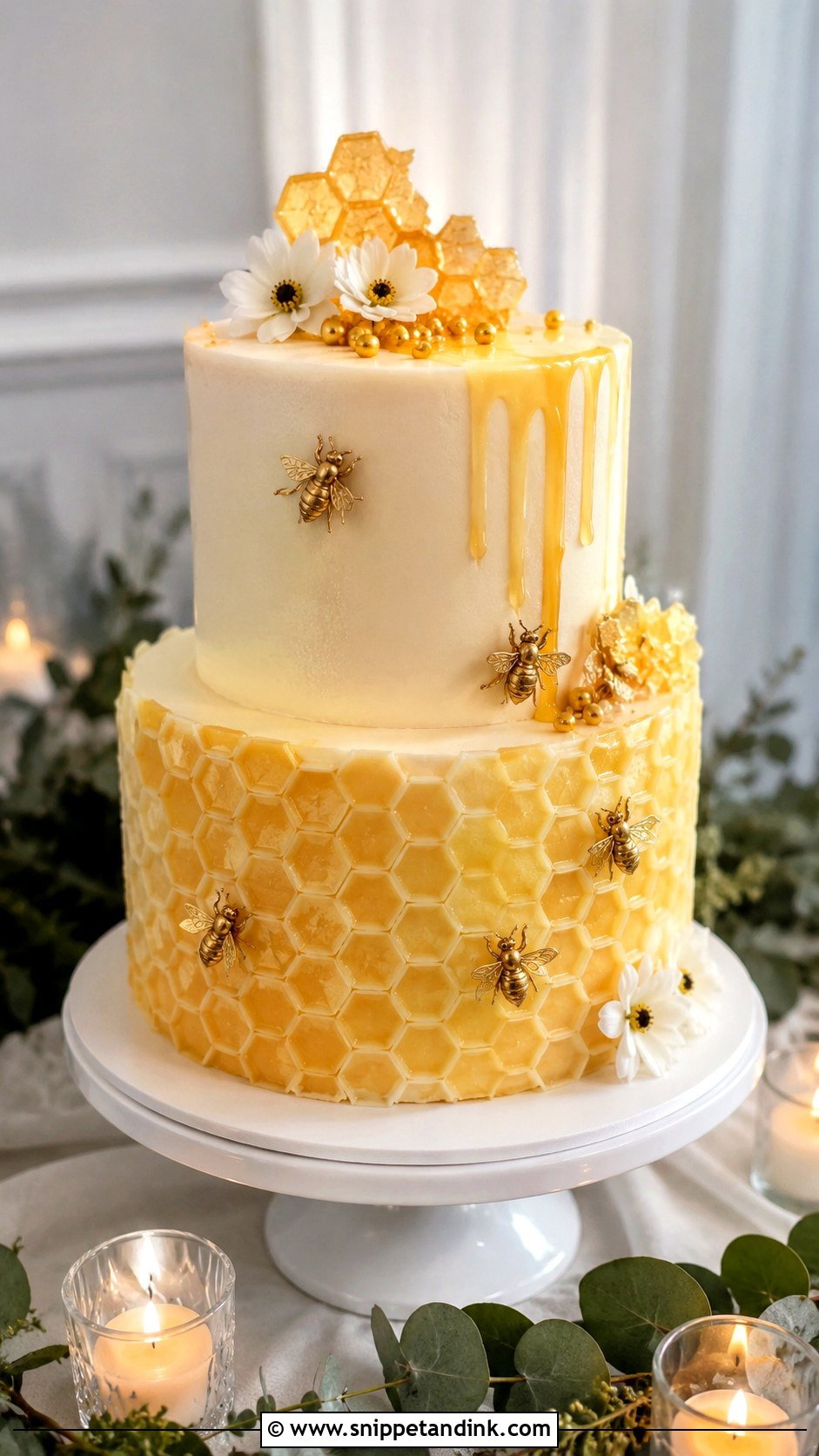
Two tiers give enough height for decoration at a smaller wedding, an elopement or a dessert table shared with other sweets. I like one smooth ivory tier against one honeycomb-textured tier, with tiny gold bees, a small drip and a cluster of flowers on top or at the side. It costs less than a tall cake, and if you need more servings, a plain kitchen cake in the same flavor can be cut behind the scenes. Honey vanilla, lemon and almond are safe choices for a mixed crowd.
A Honey Cake Outdoors Will Attract Real Bees
It sounds like a joke until it happens. Honey drips, honeycomb candy and sugary flowers draw bees and wasps at summer receptions, and a cake on a garden table can become the busiest spot at the party. I plan for it from the start.
- Keep the cake indoors or under a clear cover until the cutting, and display it in shade.
- Add the drip and honeycomb candy as late as possible, at the venue rather than in the kitchen.
- Ask the caterer to cut and serve soon after the cake moment instead of leaving it out all afternoon.
- Skip open jars of honey as table decor when the tent sides are rolled up.
Getting a sculpted cake there in one piece
A tiered cake with modelled bees and sugar flowers travels flat in an air-conditioned car, each tier on its own dowels with a central rod through the stack. The bees, wings and flowers ride separately in a box and go on during setup. Ask who sets up, how long it takes and when the cake table at the venue will be clear, because a rushed setup is where wings snap.
Let the Venue and Season Pick Your Bee Cake
The honey bee theme stretches further than most. Honeycomb texture gives you a clean geometric cake, golden bees add a small refined detail, and drips with flowers make a soft garden one. Let the venue decide first: a warm outdoor reception points to ganache drips and sturdy frosting, while a cool ballroom can take fondant and fine sugar work. Bring your photos and your date to the tasting, and your baker can tell you which details will last the whole day.
You'll Like These Ideas:










Leave a Reply