
Mehndi for kids has one job: look cheerful and be finished before the child gets bored. Small hands don’t need bridal density or tiny packed fill. Open spacing, rounded flowers, stars, butterflies, a simple mandala or a leafy trail all dry quicker and still read as festive in family photos. I only use fresh natural paste on children, which stains reddish brown to maroon. Everything below suits Eid, Diwali, weddings, birthdays and school events, and most can be drawn in a few minutes per hand.
Is Henna Safe on a Child’s Skin?
Natural henna is generally gentle, but I’m stricter with children than with adults. The paste I use for kids is plain henna powder, lemon juice or water and sugar, with very little essential oil, because some oils can irritate young skin.
- Never let anyone put black henna on a child. It often contains PPD, a hair-dye chemical that can cause blistering and a lifelong allergy.
- Children with G6PD deficiency should not have henna at all; the dye can trigger a serious reaction in them. If you aren’t sure, ask your child’s doctor first.
- I don’t apply henna to babies, and I skip any hand with eczema, cuts or a rash.
- Avoid shop cones that promise a dark colour in minutes or have no ingredient list.
- If your child has sensitive skin, try one small dot on the inner arm a day ahead and watch for redness or itching.
1. Simple Flower Mehndi Design for Children
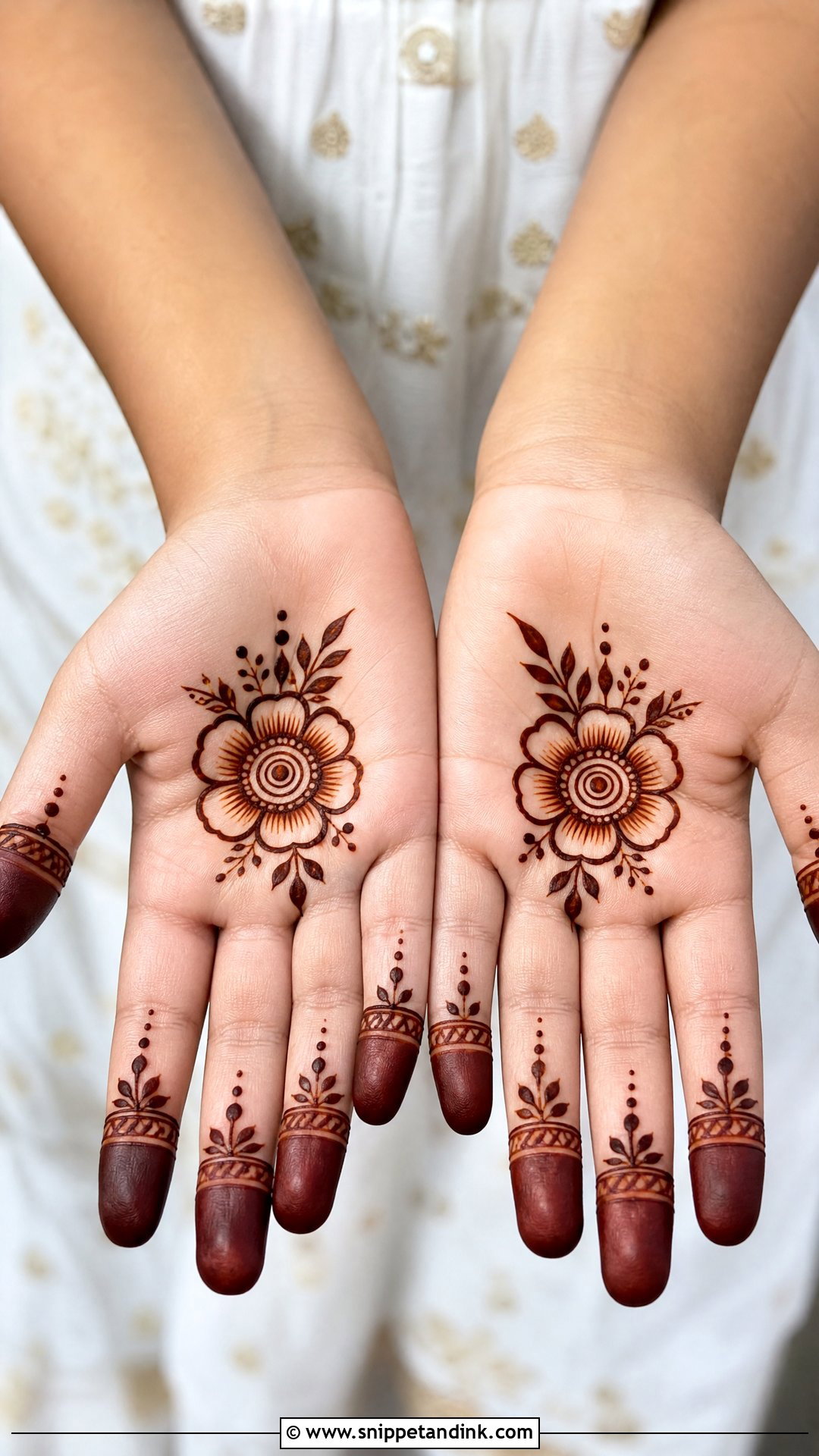
One round flower in the centre of the palm or back of the hand, a few leaves, dots and two or three curved lines around it, and dotted tips on the fingers. That’s it. I start almost every first-time child with this, because I can finish it in the time it takes them to lose interest. The empty space around the flower is doing real work on a small hand; it’s what lets the flower stand out. Finish with a light curve at the wrist instead of a heavy bracelet.
2. Butterfly Mehndi Design for Children
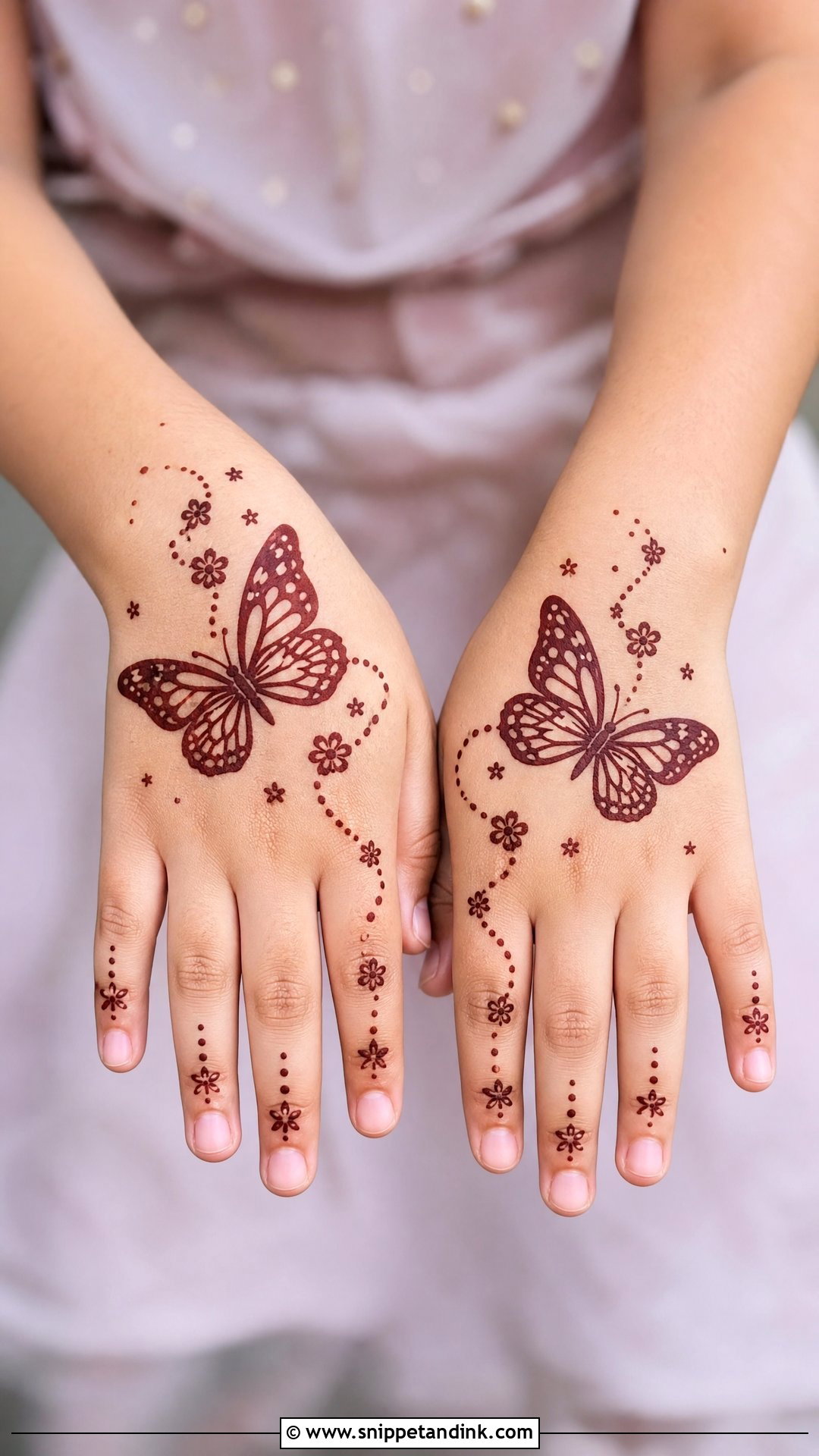
Kids recognise a butterfly instantly, which makes them proud to show it off. I place one on the back of the hand with the wings spread across the centre and dotted trails heading toward the fingers, then fill the wings with a few small flowers or circles. Resist packing the wings. A bold outline with simple inner detail keeps it clear in party photos, and a couple of stars or leaves near the wrist finish it.
3. Heart Mehndi Design for Children
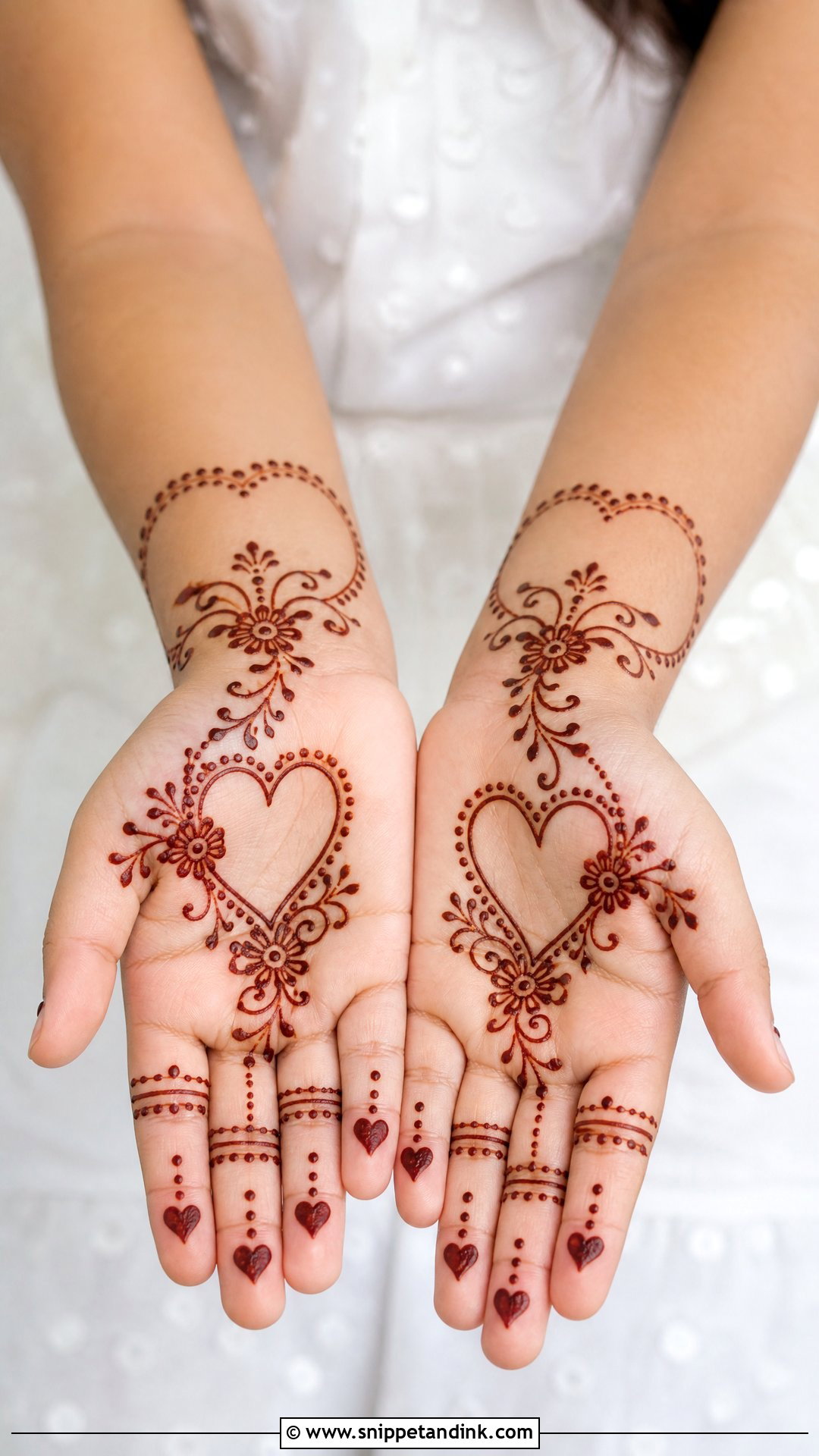
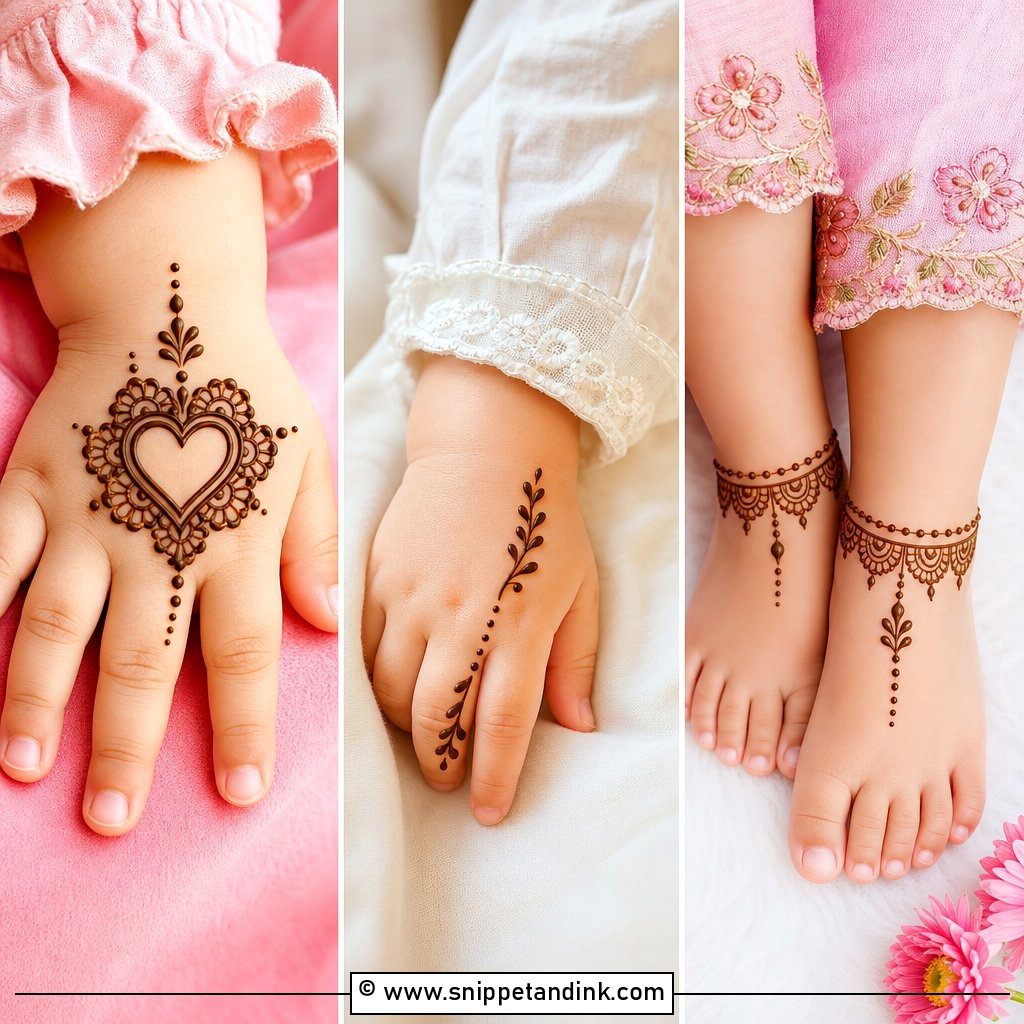
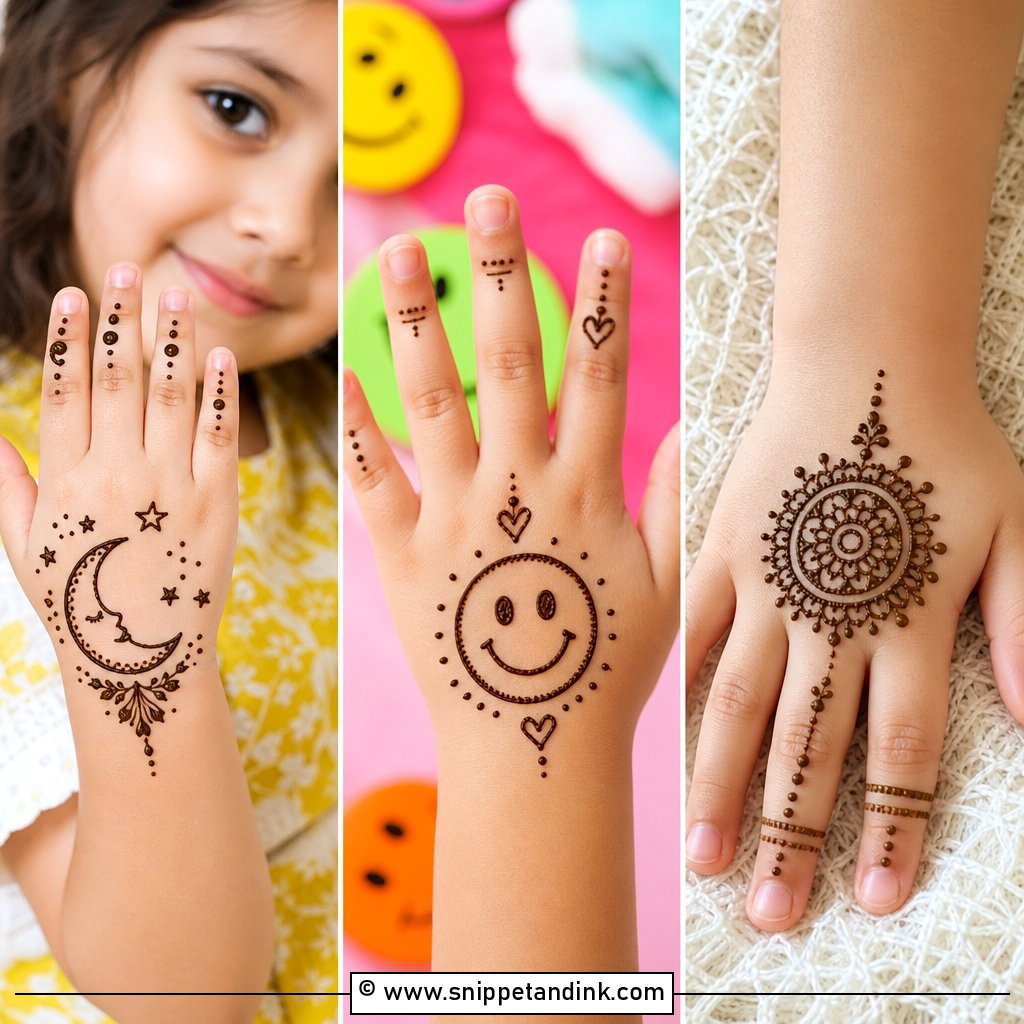
Draw a medium heart on the palm or back of the hand, ring it with dots, small flowers and curved vines, and give the fingers little heart tips or line bands near the knuckles. It needs no dense filling, so it’s fast. I keep the heart outline a touch thicker than my usual line, because thin outlines on young skin stain faint. A dotted wrist band rounds it off.
4. Star Mehndi Design for Children
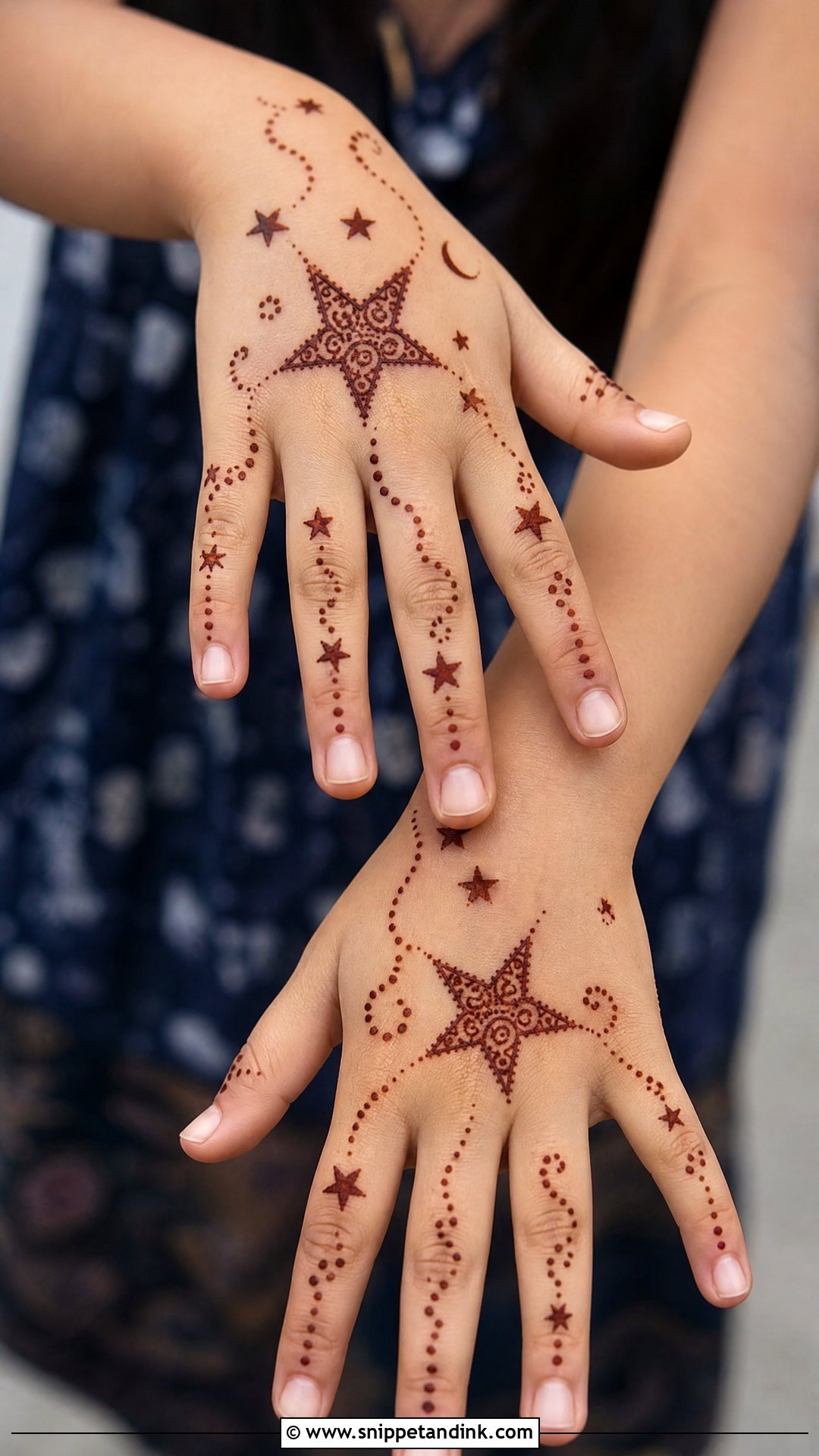
Stars are the easiest motif for me to draw at speed and the easiest for a child to love. One larger star sits in the centre, smaller ones scatter around it, and a dotted line joins a few of them into a trail from wrist to finger. Children who aren’t keen on flowers usually say yes to this. Keep enough gap between stars that each stays distinct, and tuck in a tiny moon or two if it’s for a festival.
5. Moon Mehndi Design for Children
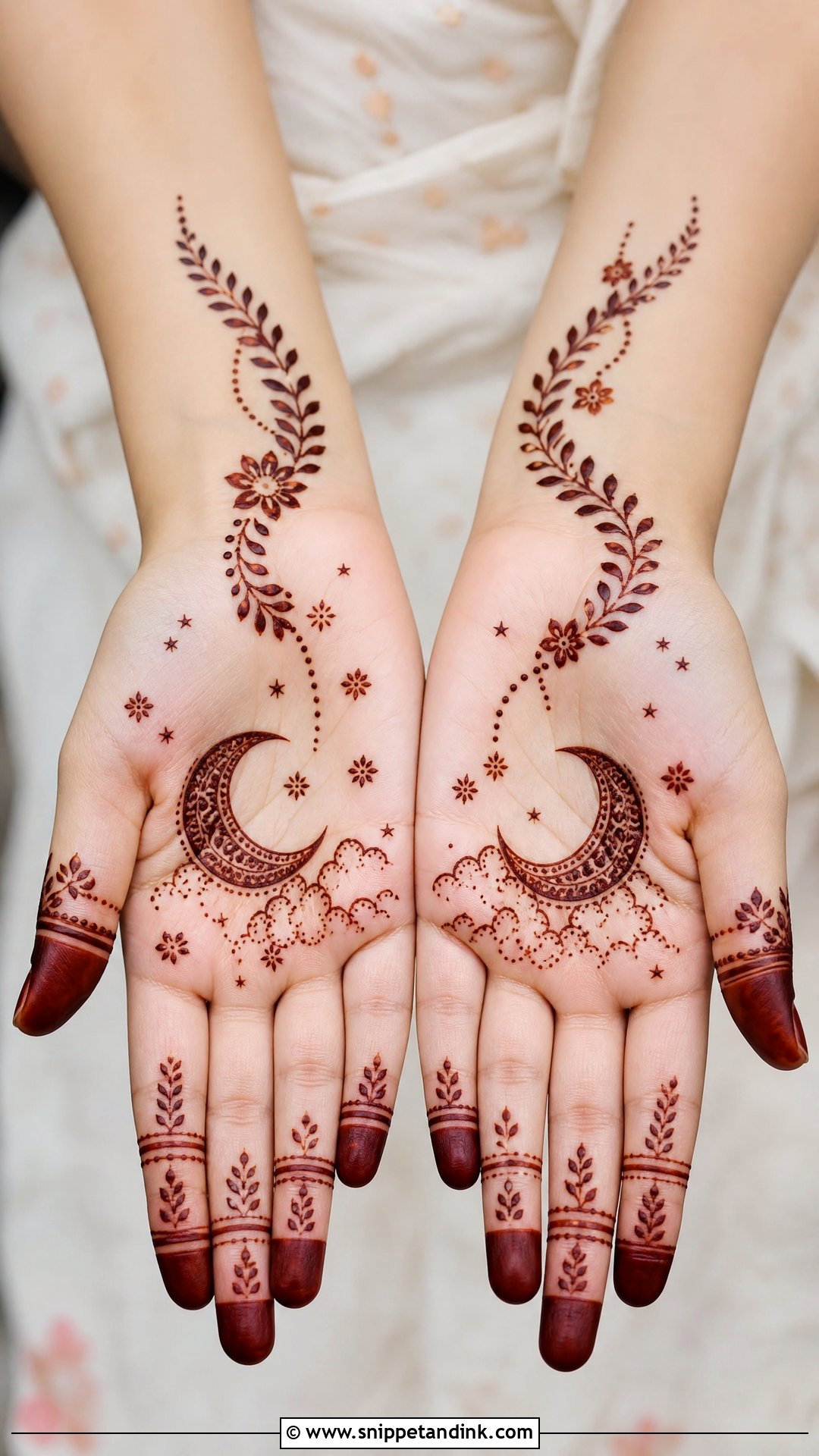
A crescent moon on the palm or back of the hand, surrounded by stars, dots and tiny flowers, with a short leafy trail rising from the wrist. It’s a favourite for festivals and sits well on either side of the hand. I draw the crescent in one smooth sweep with a bold line; a moon built from short strokes looks lumpy once it stains. Dots or small rings on the fingers balance it.
6. Arabic Mehndi Design for Children
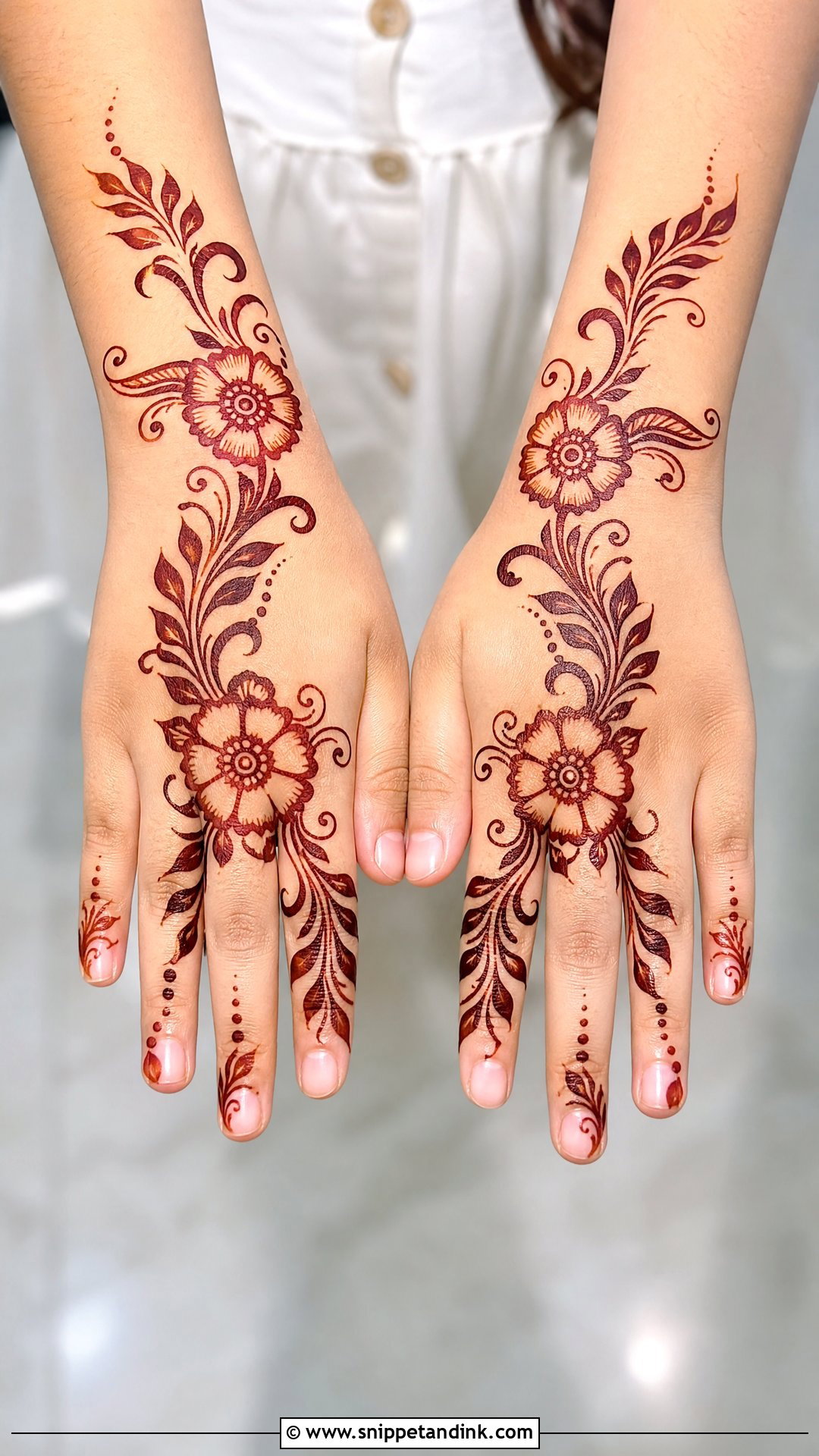
Arabic work for a child is a lighter version of the adult style: one diagonal floral trail from the wrist to the index finger with bold flowers, leaves and curved vines, and open space between each motif. I skip the heavy shading I’d use on an adult hand; on small skin it just reads as smudge. Leafy strokes and dots on the fingers are plenty. It’s the style I suggest for older girls at weddings and Eid who want to look a little grown up.
7. Back Hand Mehndi Design for Children
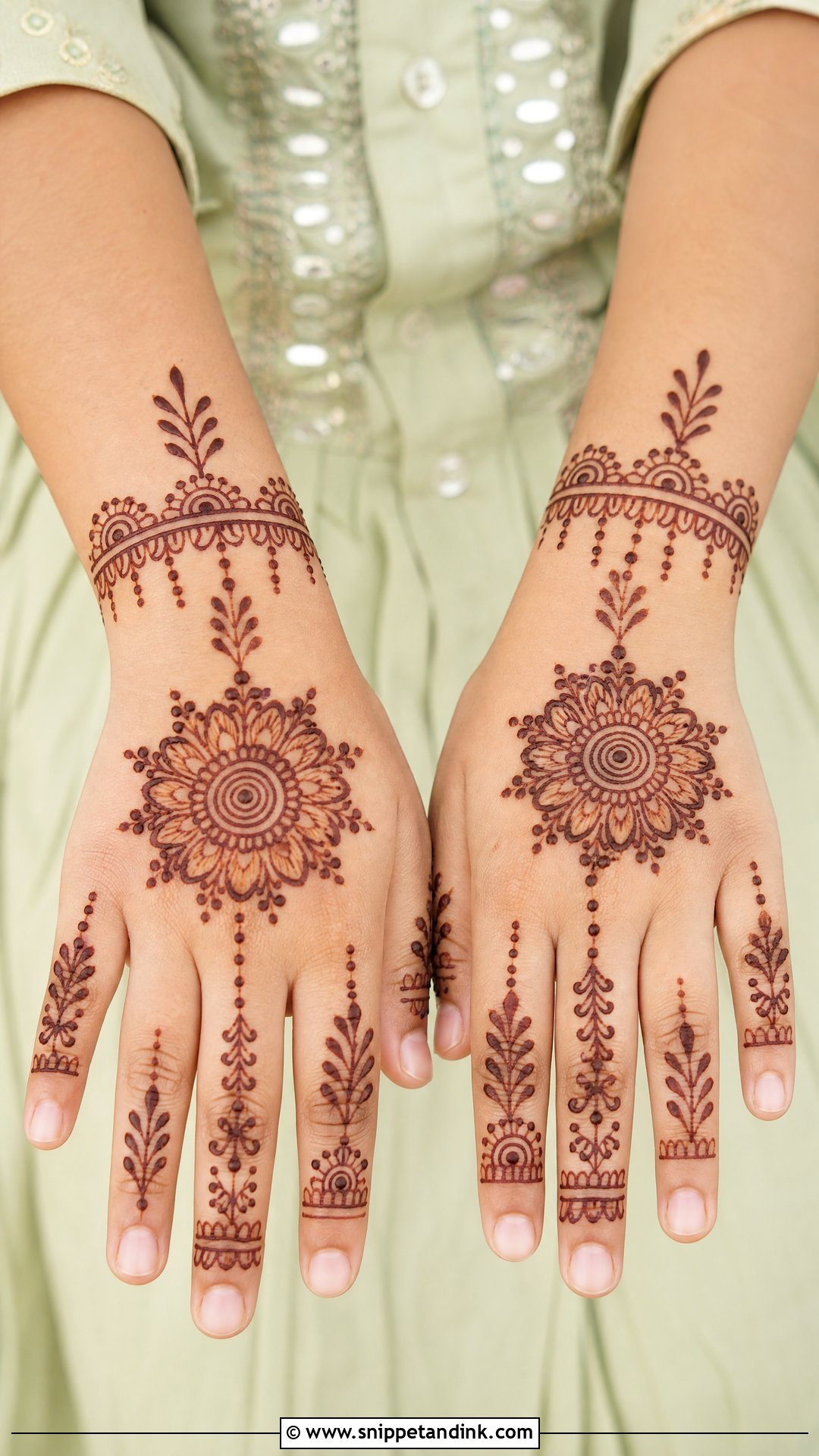
Back hand mehndi is the easiest placement for me on a wriggly child. The back of the hand is flatter than the palm, it doesn’t fold when they clench a fist, and they can see the design while it dries, which helps them keep still. A small mandala or flower in the centre, leafy lines toward the fingers and a light wrist bracelet make a complete look. Bold outlines and minimal fill keep it neat.
8. Front Hand Mehndi Design for Children
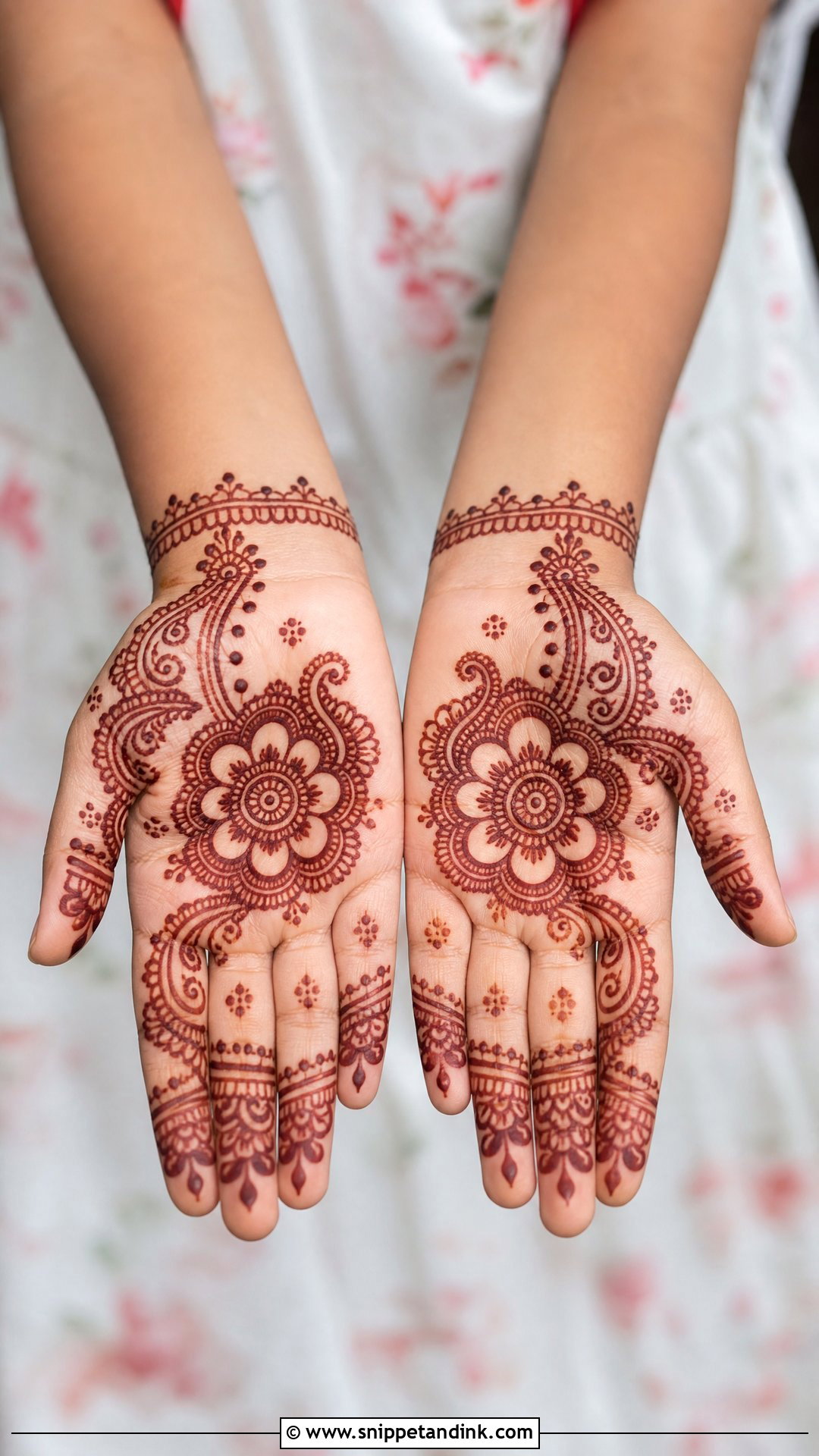
Palms give the darkest stain, which is why children often ask for them. The catch is that palms sweat and fold, and a child will grab things the moment you look away. I keep the palm design simple, a central flower, a small paisley or a round mandala, with dots around it and light fingers. A tiny wrist border finishes it. Leave room around everything so a little smudge doesn’t ruin the shape.
9. Finger Mehndi Design for Children
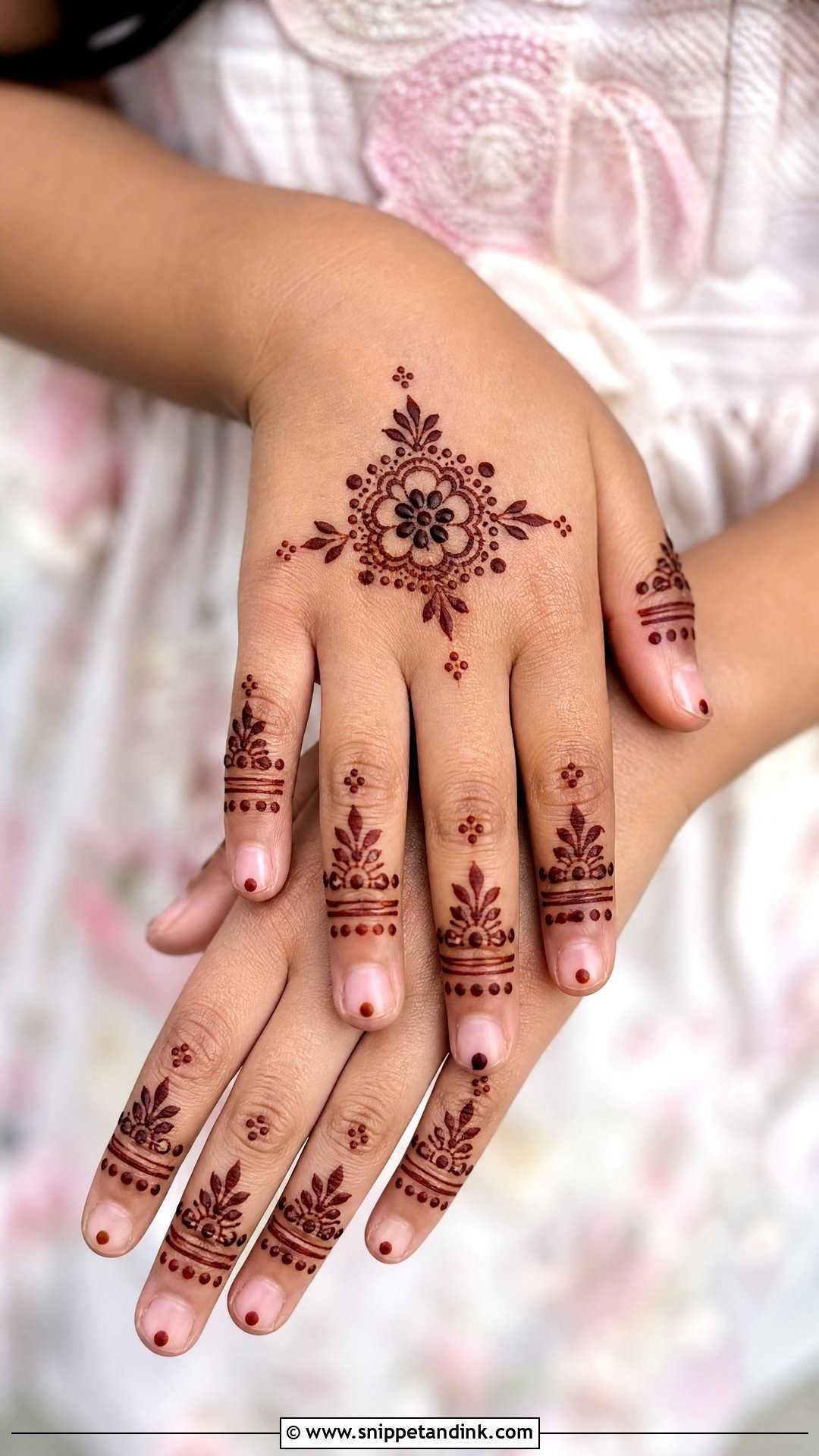
For toddlers and anyone with a short attention span, I’d skip the palm and decorate just the fingers: tiny flowers, dots, leafy lines and ring bands, plus one small motif near the wrist or the centre of the back of the hand to tie it together. Fingers dry fast and the child can still use their hand. Make each finger a little different but keep the same weight of line across all of them, or the hand looks random.
10. Bracelet Mehndi Design for Children
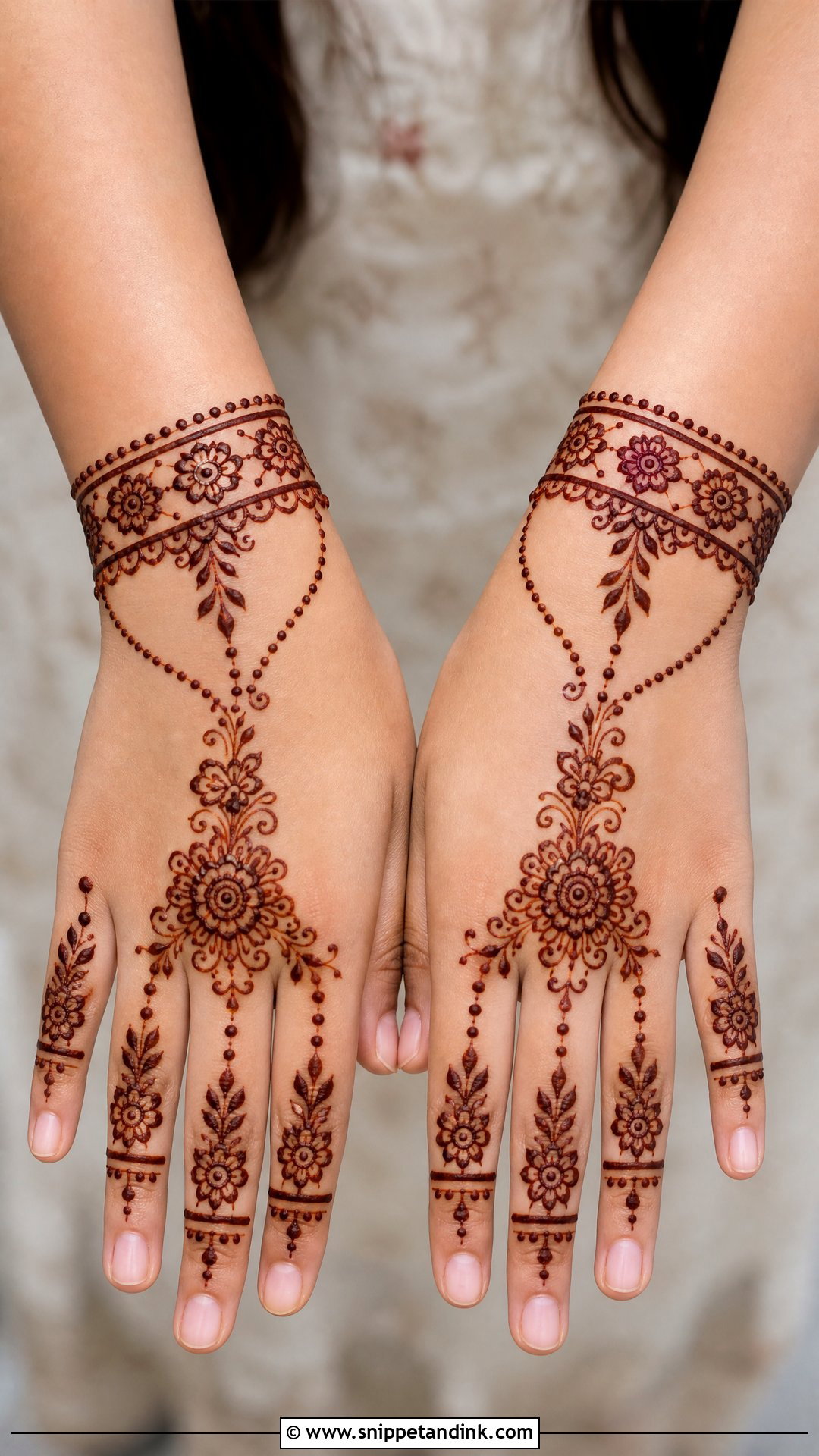
A henna bangle around the wrist, a chain of dots leading up to a flower or heart on the back of the hand, and light finger details. Most of the work sits at the wrist, which is the part of the hand children use least, so it’s one of the more smudge-proof options. Fill the bracelet with flowers, leaves and dots rather than dense mesh. It matches festive outfits easily and looks right for any age.
11. Mandala Mehndi Design for Children
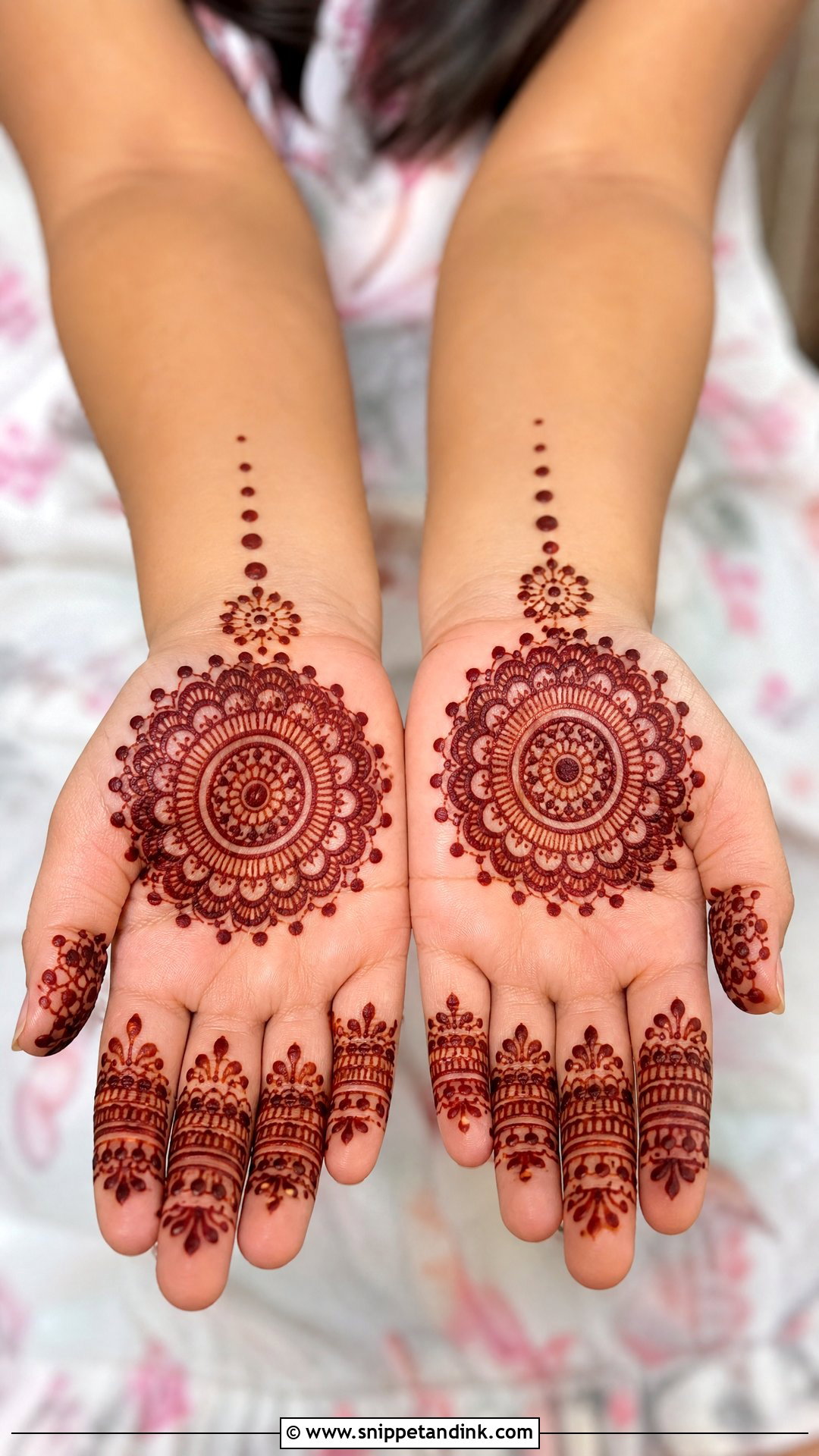
Mandalas look balanced on small hands as long as I stop at two or three rings. A round centre on the palm or back of the hand, small dots and petals around it, curved outlines, and matching dots or tiny half-mandalas at the fingertips. Every extra layer adds sitting time and blurs the circle on a little palm. Keep it clear and it works for family dinners and traditional events alike.
12. Peacock Mehndi Design for Children
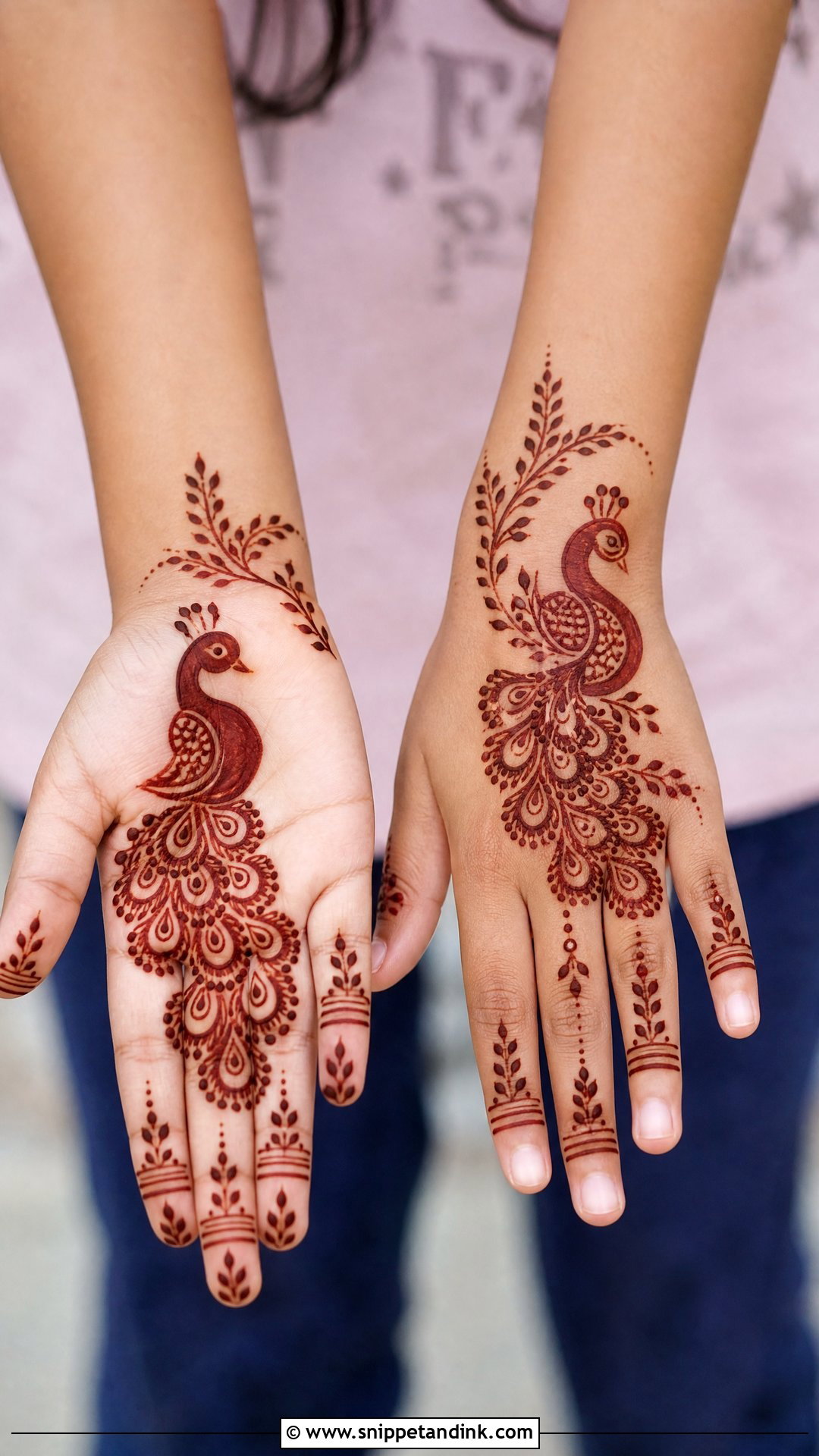
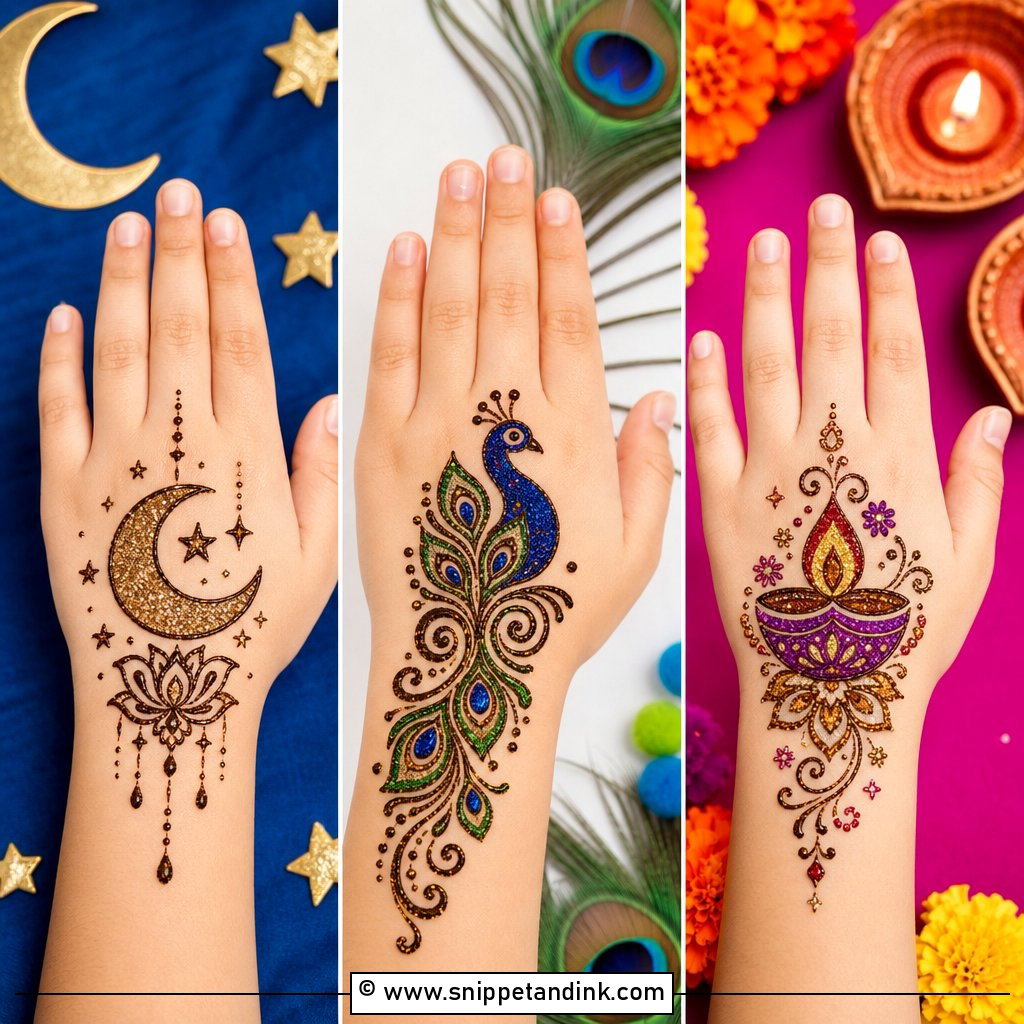
One small peacock instead of a full feathered scene: a curved neck, a simple eye and rounded feather shapes filled with dots and short lines, placed on the back of the hand or the palm. Small leaves at the wrist and light fingers finish it. I make the feathers rounder and more open than I would for an adult, since tight feather fill turns into a dark blob on a child’s hand. Weddings, Diwali and cultural programmes all suit it.
13. Paisley Mehndi Design for Children
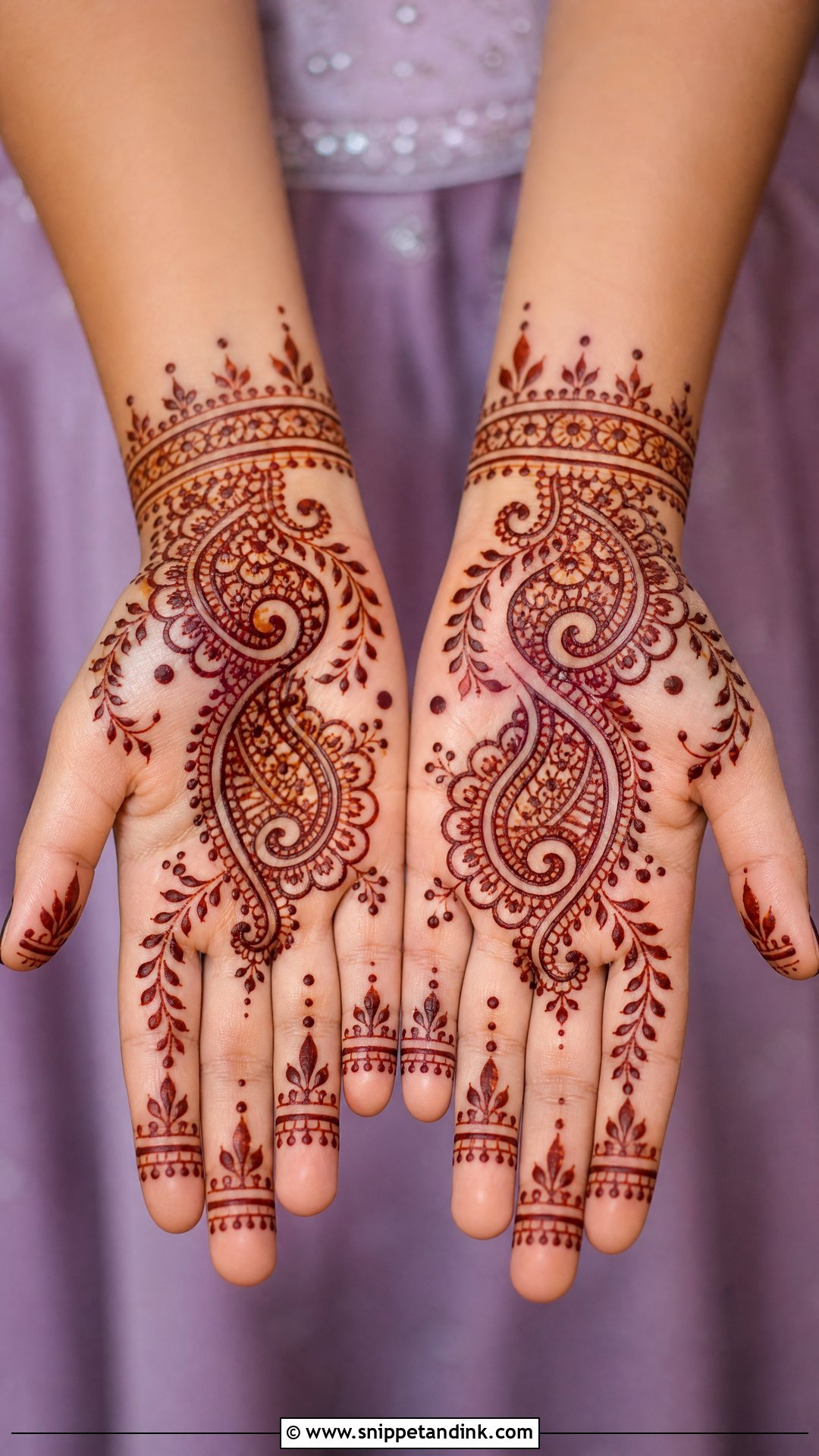
Paisleys soften easily for children. I use one or two medium ones on the palm or back of the hand, decorate them with dots, petals and simple curves, and connect them with a leafy vine from the wrist. Size matters more than detail here. A paisley that’s too small on a child’s hand can’t hold any fill, so draw it large enough to read and let the open skin do the rest. It’s a good one for sibling sessions at family weddings.
14. Floral Trail Mehndi Design for Children
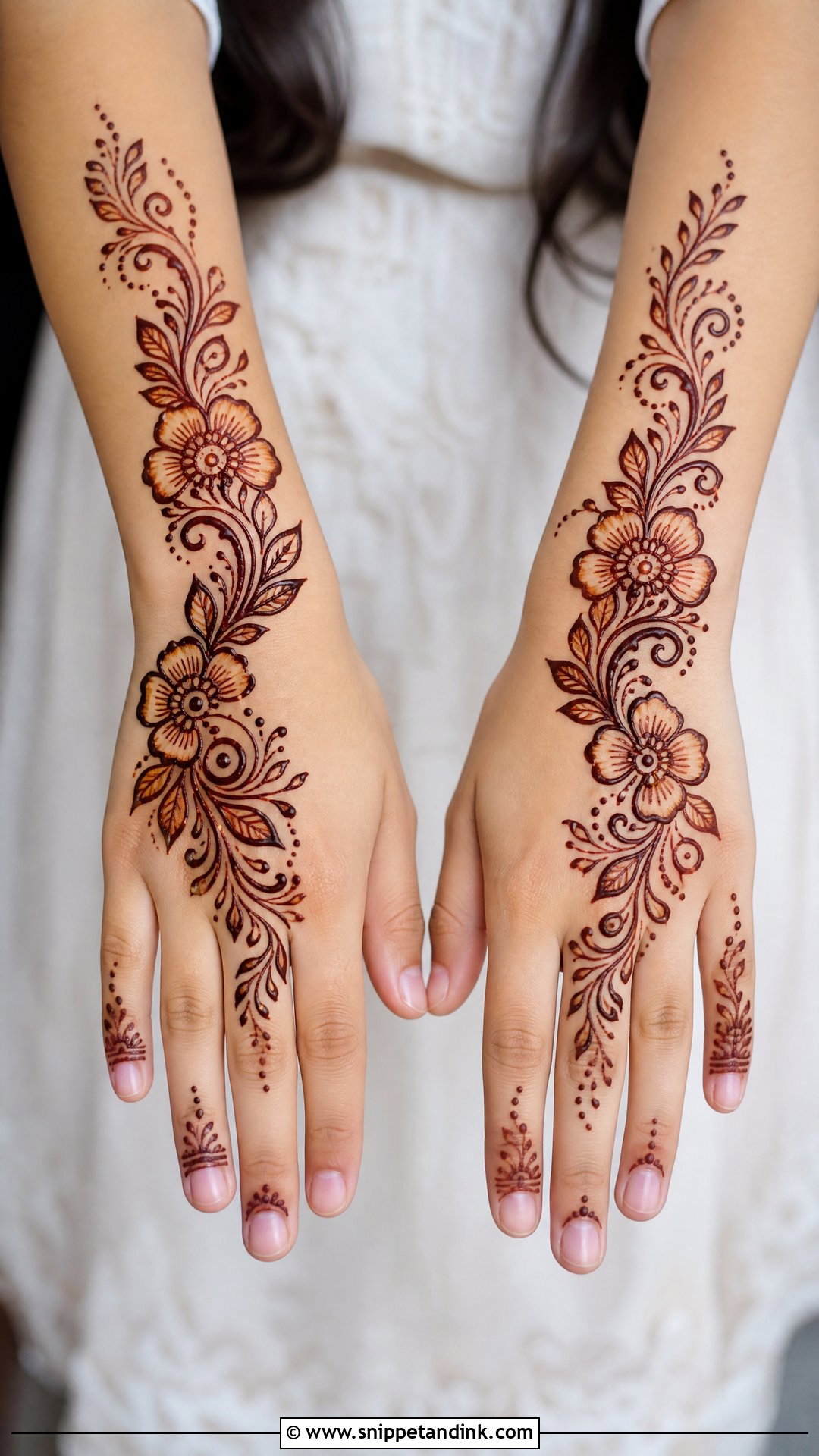
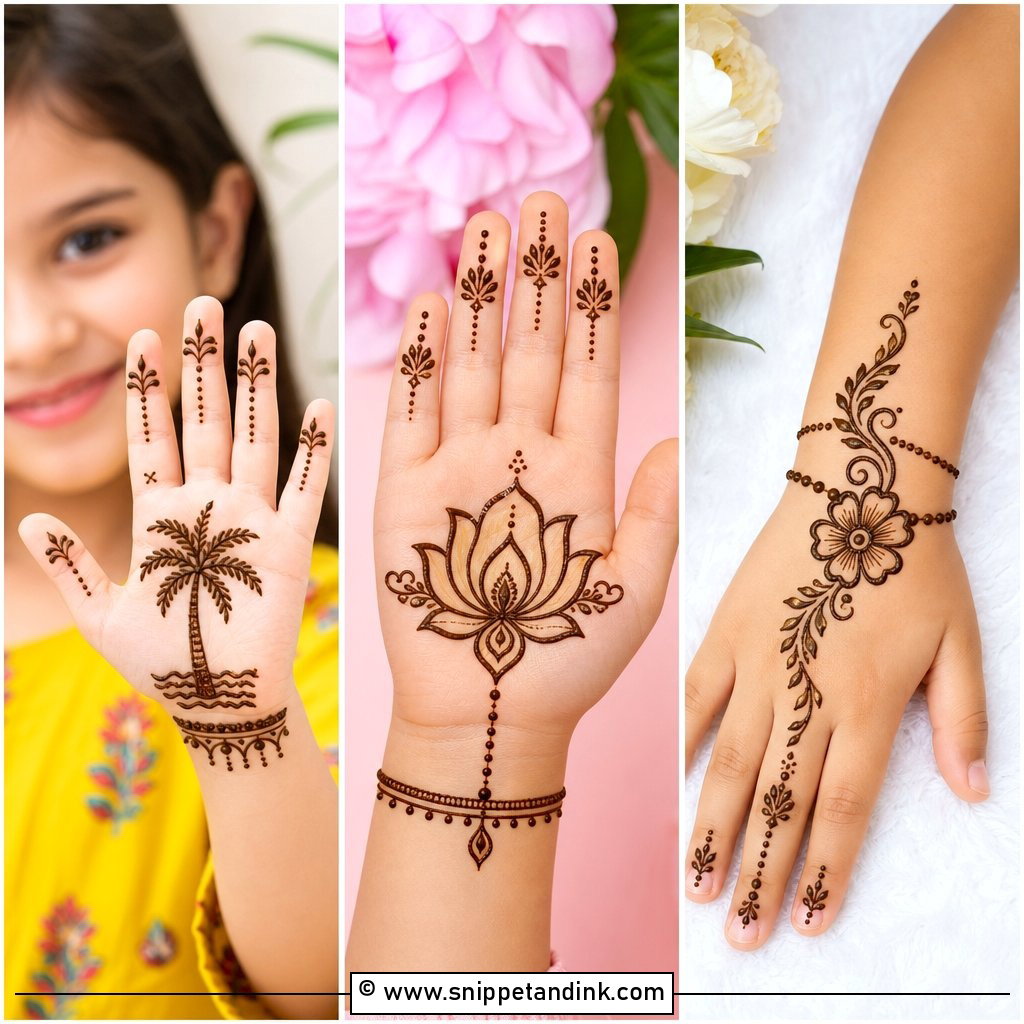
A floral trail mehndi design curves from the wrist up to one finger with small flowers, leaves, dots and swirls, and leaves the rest of the hand bare. It borrows from Arabic style but stays gentler. On the back of the hand the trail can follow the natural line from wrist to knuckles, which makes it look planned even when drawn quickly. For younger kids, I use fewer flowers with bigger gaps.
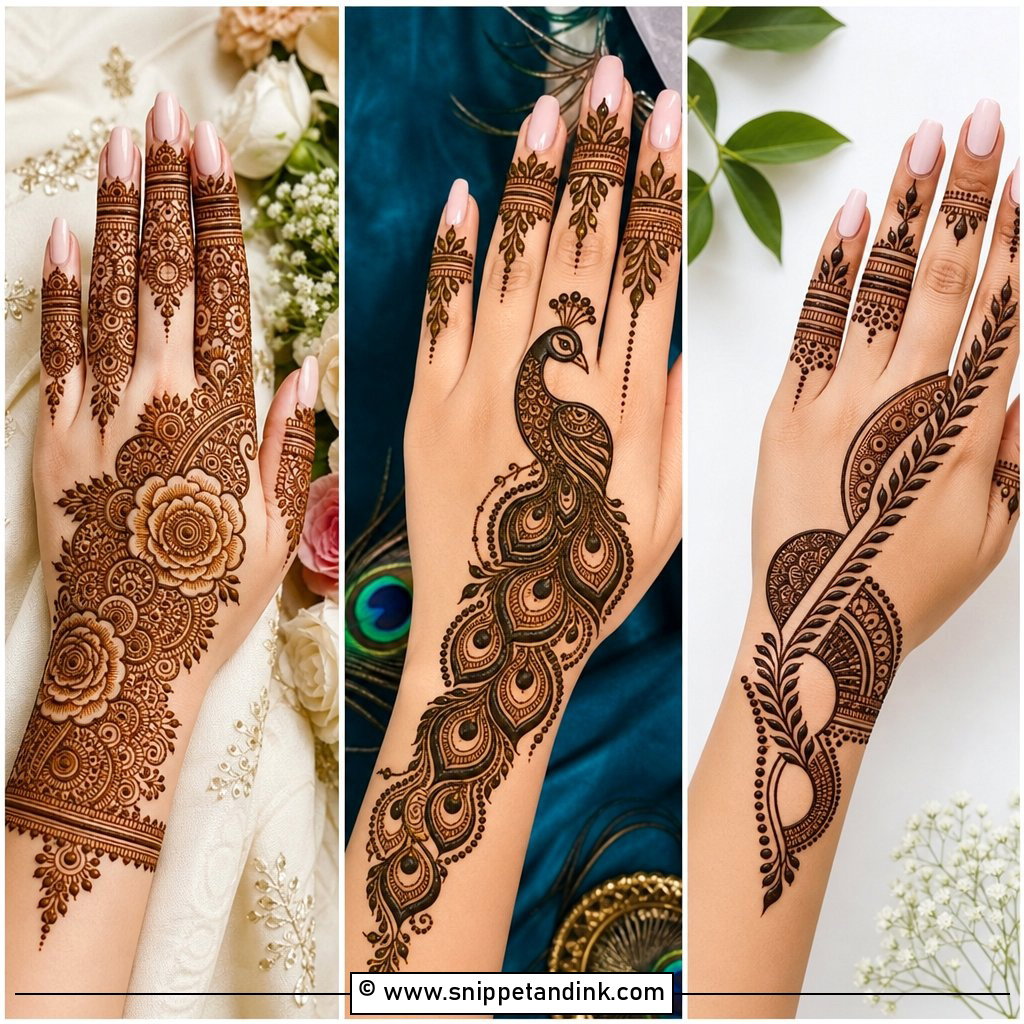

15. Minimal Mehndi Design for Children
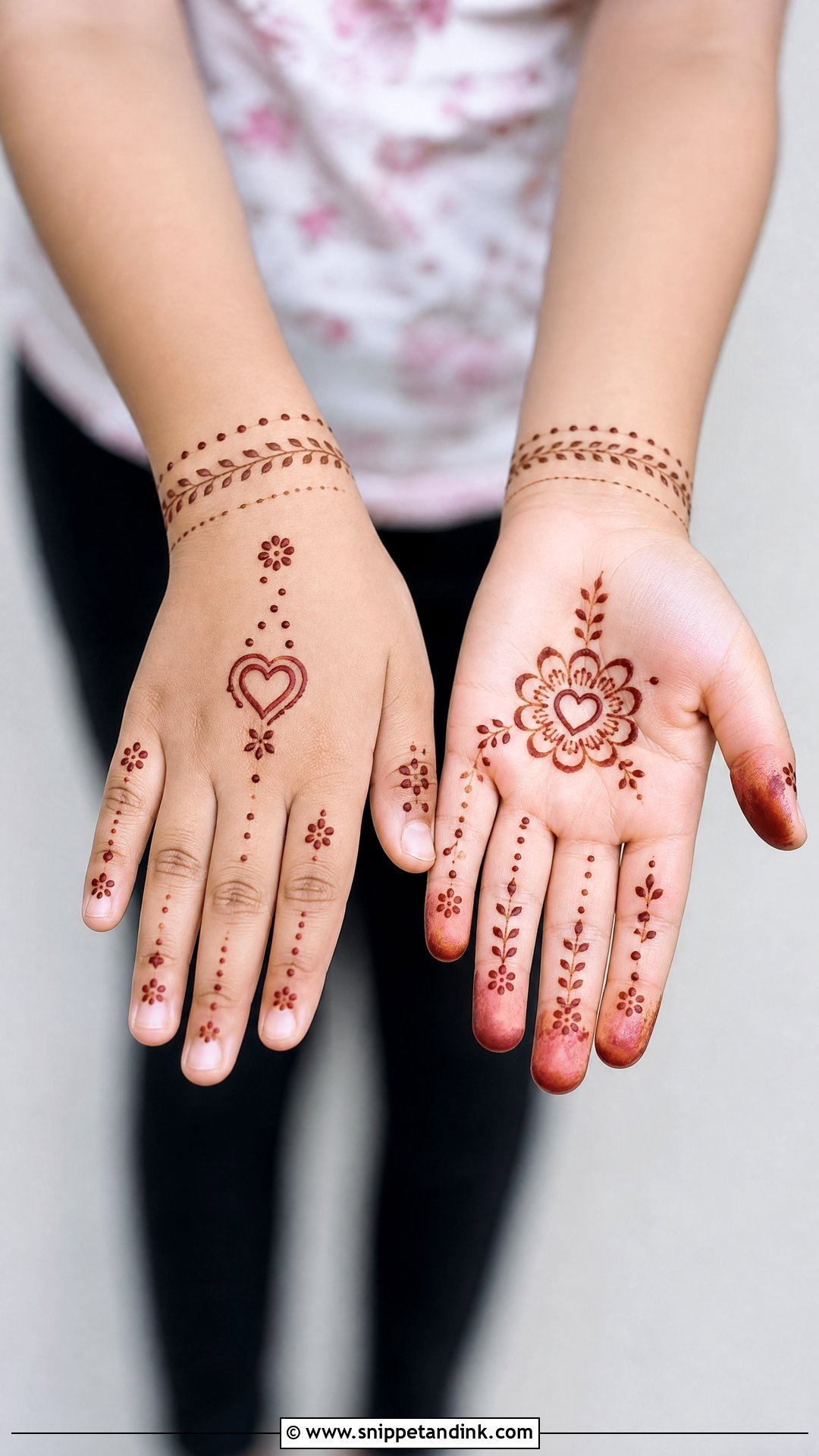
One small motif, a flower, heart, star or tiny mandala, on the back of the hand or the palm, with dotted fingertips and a light line at the wrist. That’s all a toddler or a first-timer needs. Fewer wet lines also means fewer chances to smudge. The shapes should be bold and evenly spaced; with so little on the hand, any wobble shows.
16. Full Hand Mehndi Design for Children
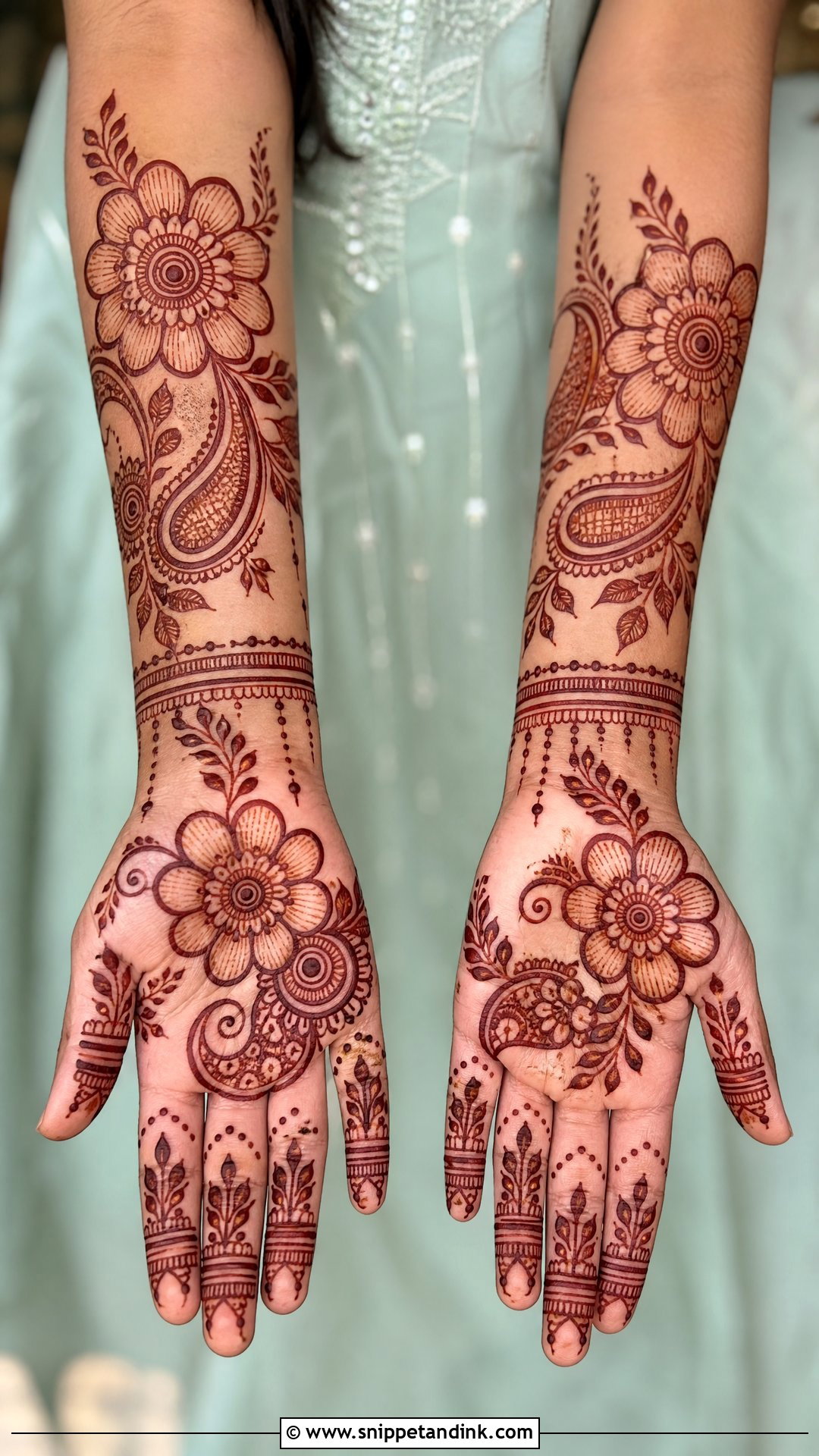
Full coverage for a child still has to stay light: larger flowers, simple paisleys, dots, leaves and open bands from fingers to wrist, with none of the dense bridal fill. I only offer this to older children who can sit for a while, because even a light full hand takes several times longer than a single motif. Organise the hand in sections, use bold outlines with simple fill, and it comes out neat enough for wedding photos.
17. Half Hand Mehndi Design for Children
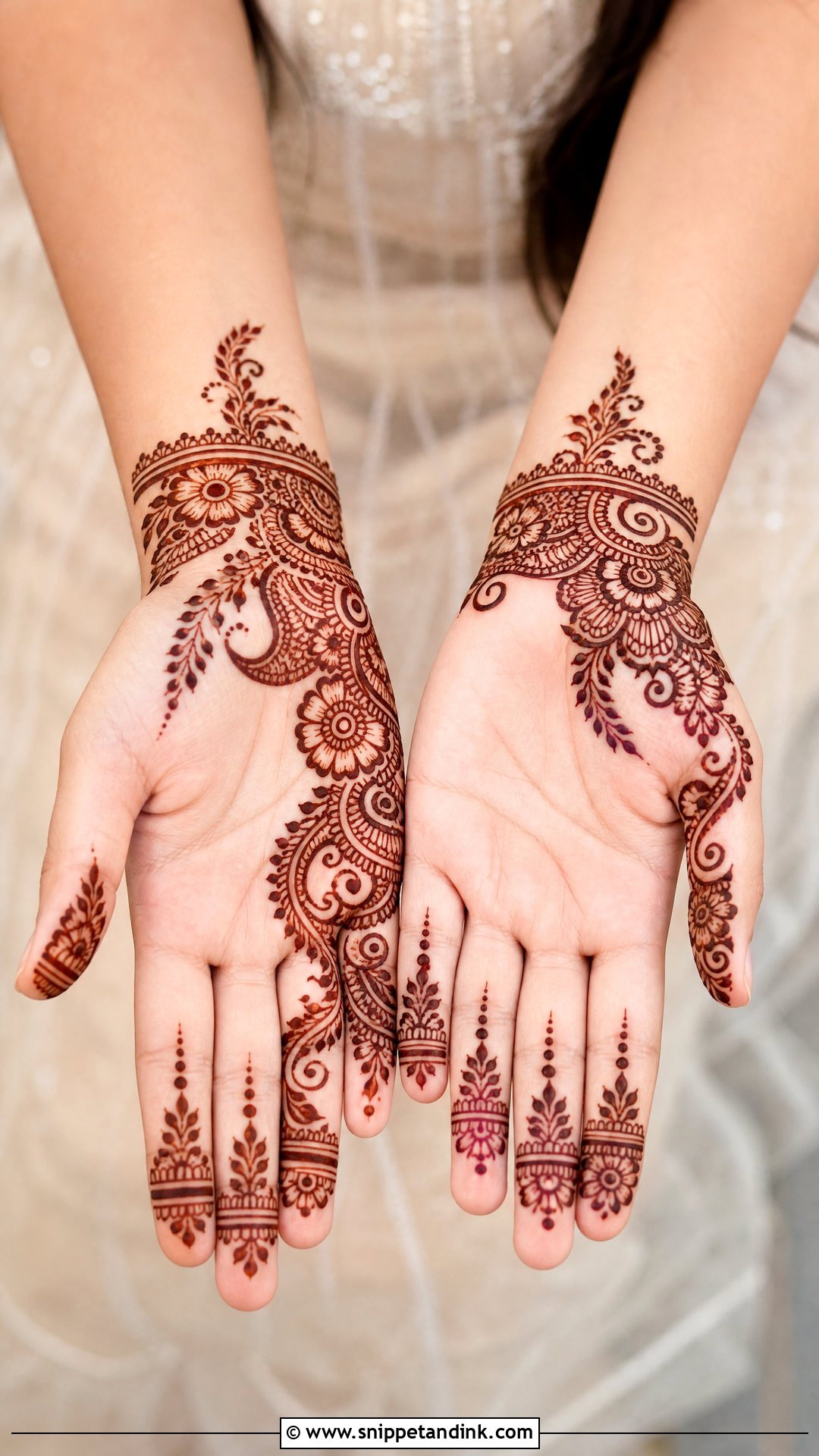
Half hand means starting at the wrist and stopping around the middle of the palm or back of the hand, or doing just the fingers and upper hand. Flowers, dots, vines and small paisleys with open space between them make it complete. It’s the step up for a child who wants more than one motif but can’t manage full coverage, and it suits Eid, Diwali and family weddings. Finish the edge with a deliberate line, otherwise it looks like I ran out of time.
18. Cartoon Mehndi Design for Children
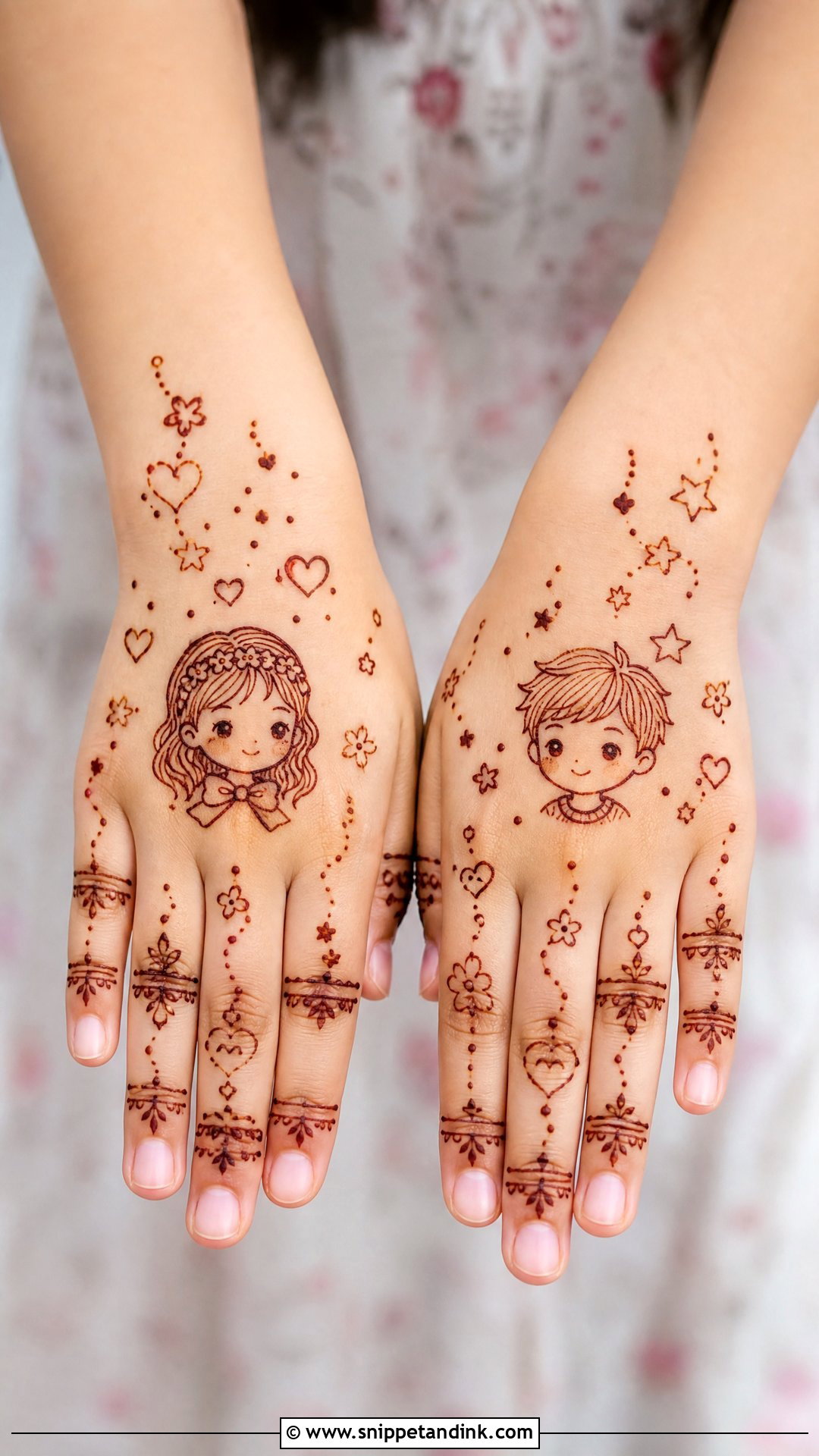
Children love seeing a character on their hand, and I’m happy to draw one as long as it stays simple: a cute face, a small animal, a teddy shape. Detailed features blur as henna dries and stains, so I use a bold outline and two dots for eyes rather than trying to copy a cartoon exactly. Stars, hearts and small flowers around it turn it into a full hand. Keep the fingers to dots or rings so the character stays the star.
19. Animal Mehndi Design for Children
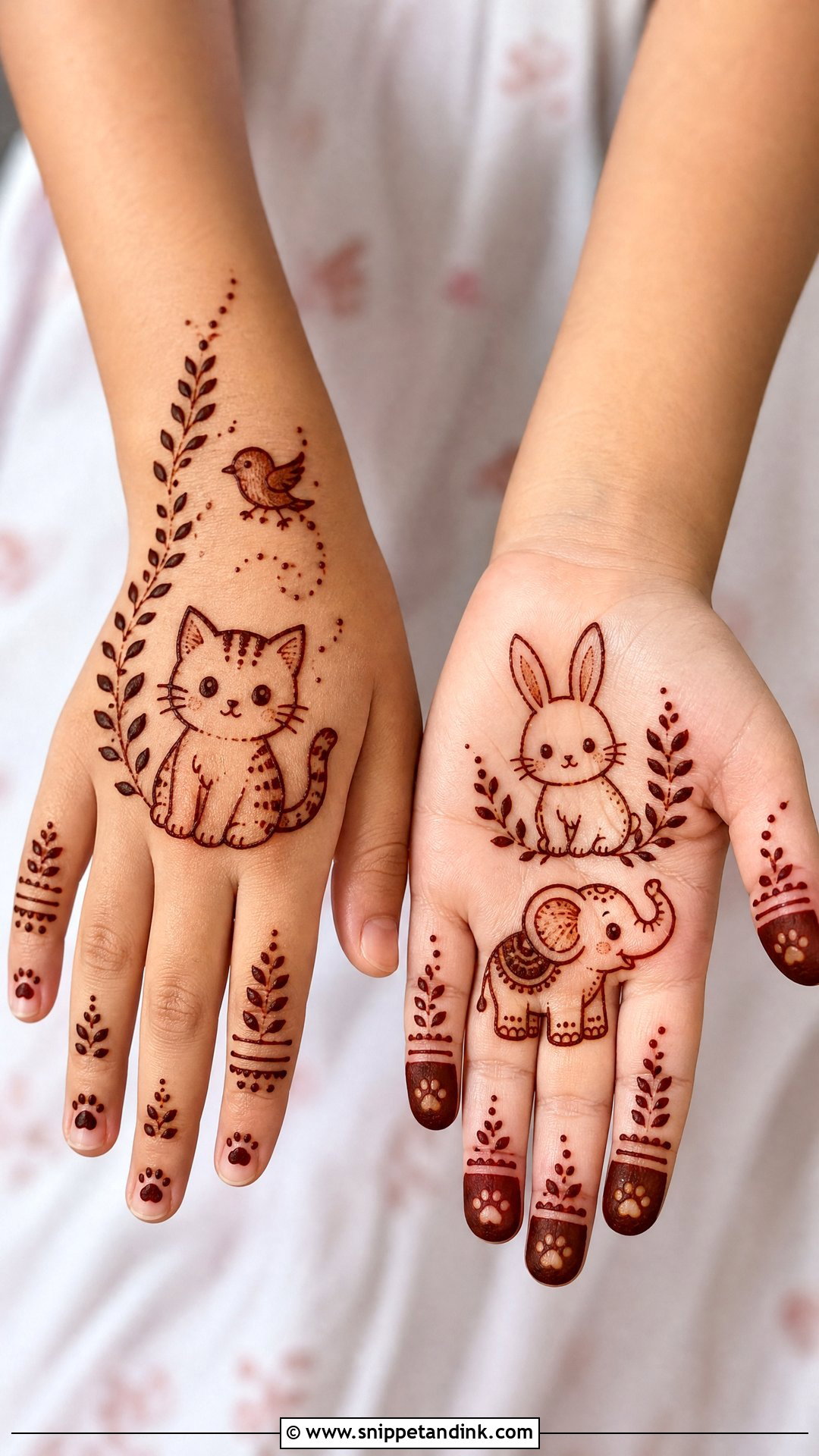
A small cat, bunny, bird, elephant or fish outline on the palm or back of the hand, ringed with dots, flowers and leafy trails. Rounded animals read better than spiky ones; a cat with soft round ears is recognisable from across a room. Paw-like dots on the fingers are a fun touch younger children enjoy. Birthdays and casual family events are where these shine.
20. Leaf Mehndi Design for Children
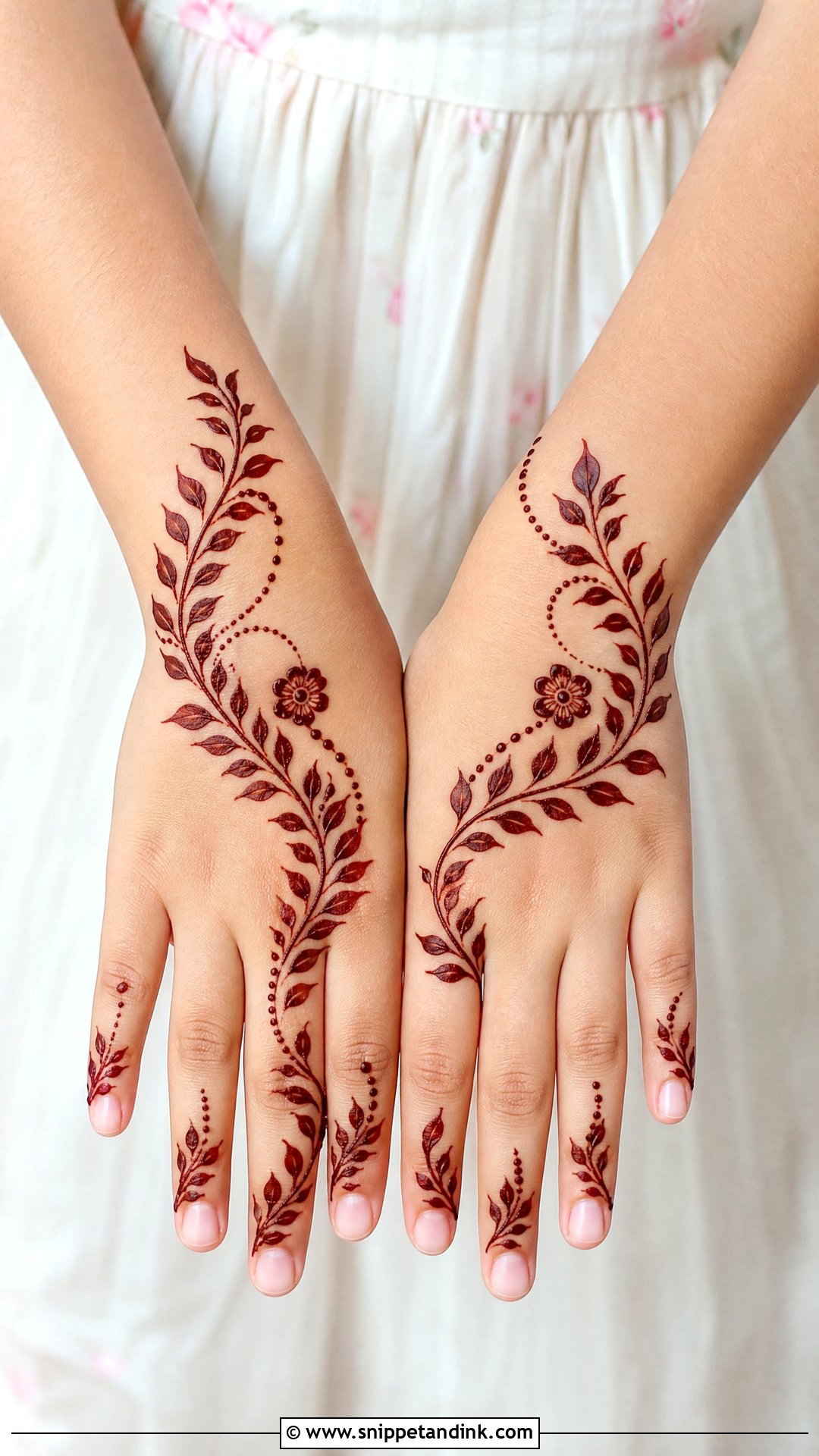
Leaves suit every age and are a good fallback when a child can’t decide. A vine runs across the back of the hand from the wrist toward one finger, or wraps a central flower on the palm. I keep the leaves medium-sized; tiny leaves are fiddly to draw quickly and smudge easily. Dots along the vine soften it. It looks right with everyday clothes and festive ones.
21. Rose Mehndi Design for Children
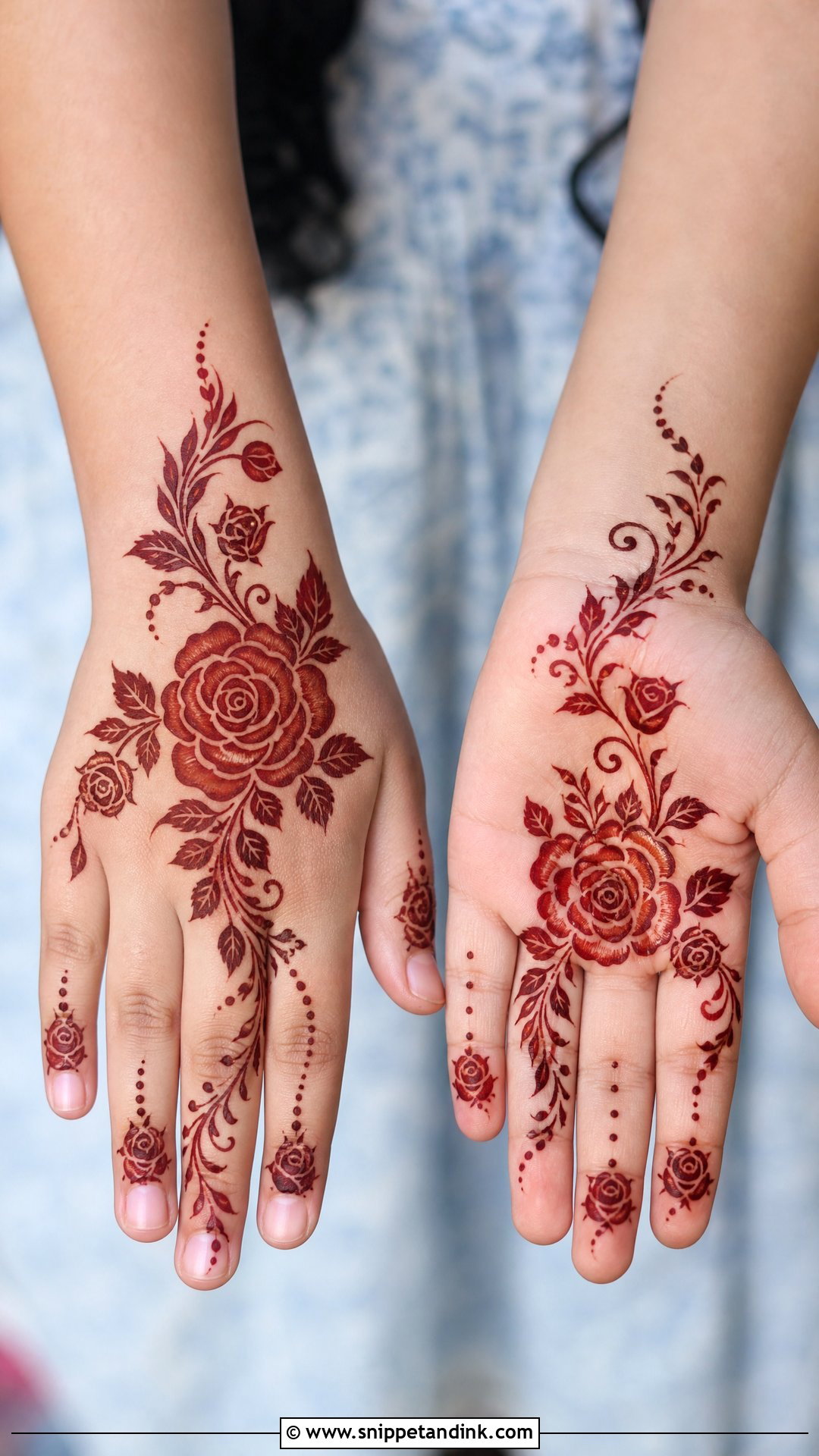
I draw roses for children in a rounded, simple style: open petals, few inner lines, one bloom on the back of the hand or the palm, with leaves, dots and a short vine. A detailed rose spiral is too tight for a small hand and closes up as the stain darkens. Tiny buds or dotted tips on the fingers echo the main flower. One rose is enough for little ones; older kids can carry a short rose trail.
22. Lotus Mehndi Design for Children
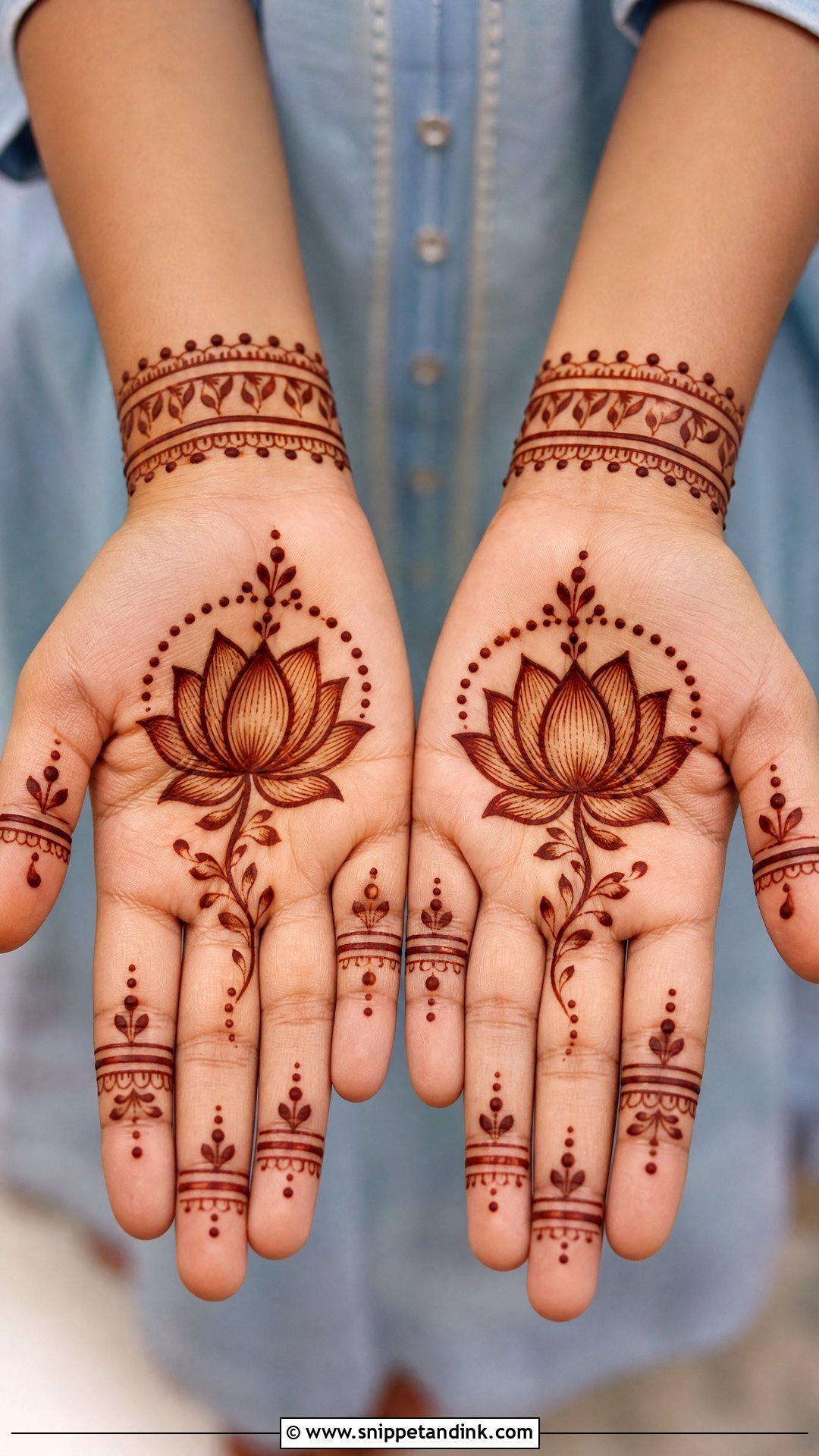
A single lotus with wide, rounded petals on the palm or back of the hand, a few dots around it, a short leafy stem toward the wrist and light finger bands. I draw it wider than I would for an adult so each petal still reads once the paste comes off. It suits festivals and family functions and looks traditional without seeming too old for the child.
23. Indo-Arabic Mehndi Design for Children
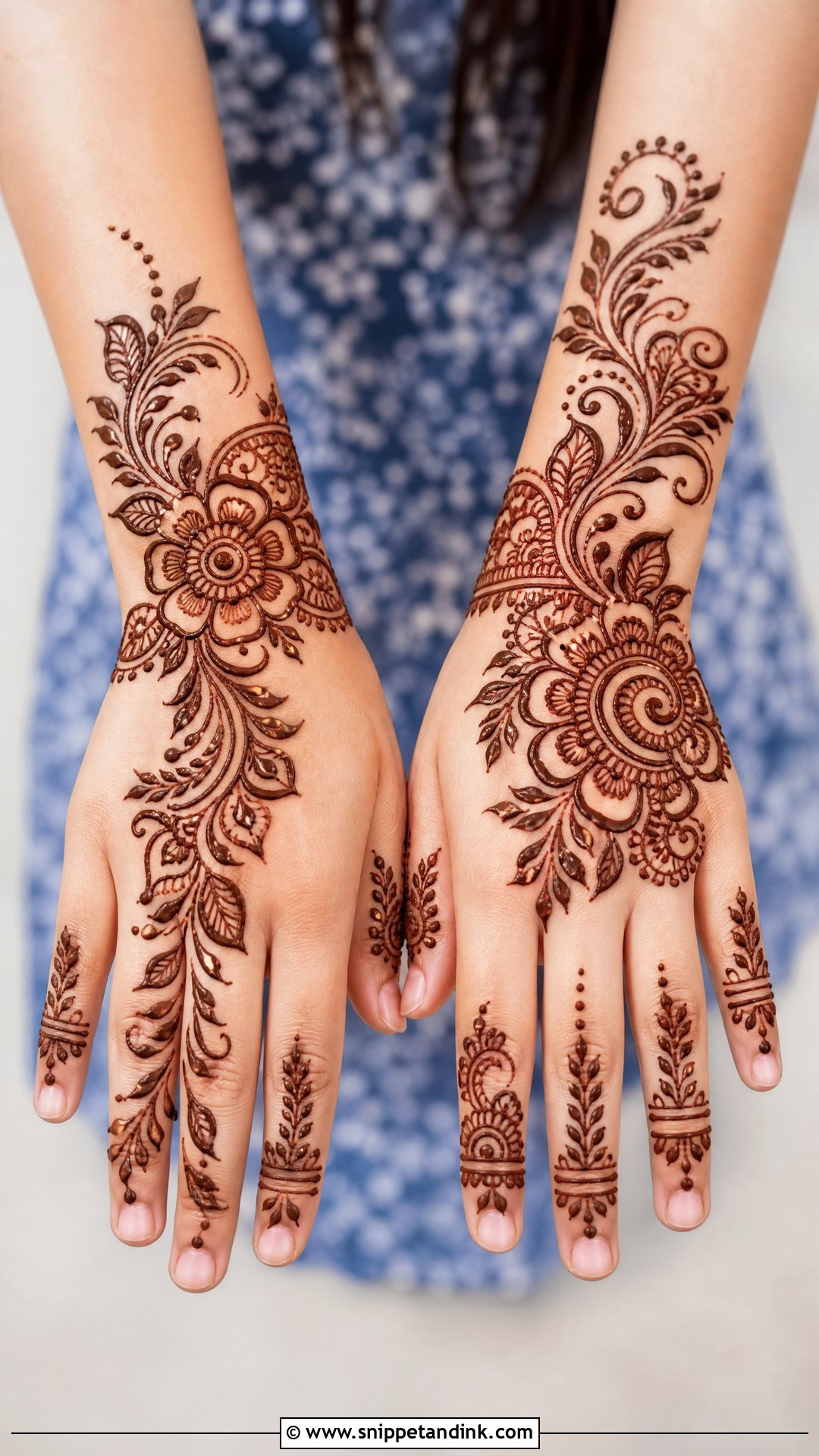
Indo-Arabic for children mixes bold Arabic spacing with a few small Indian details. A diagonal trail of flowers and paisleys with dots, a small mandala and leaf fill works well, kept to the back of the hand or one side of the palm so it doesn’t drag on. Open spaces dry quicker. I’d keep the fingers to vines or dotted bands; older children at weddings tend to like this one most.
24. Moroccan Mehndi Design for Children
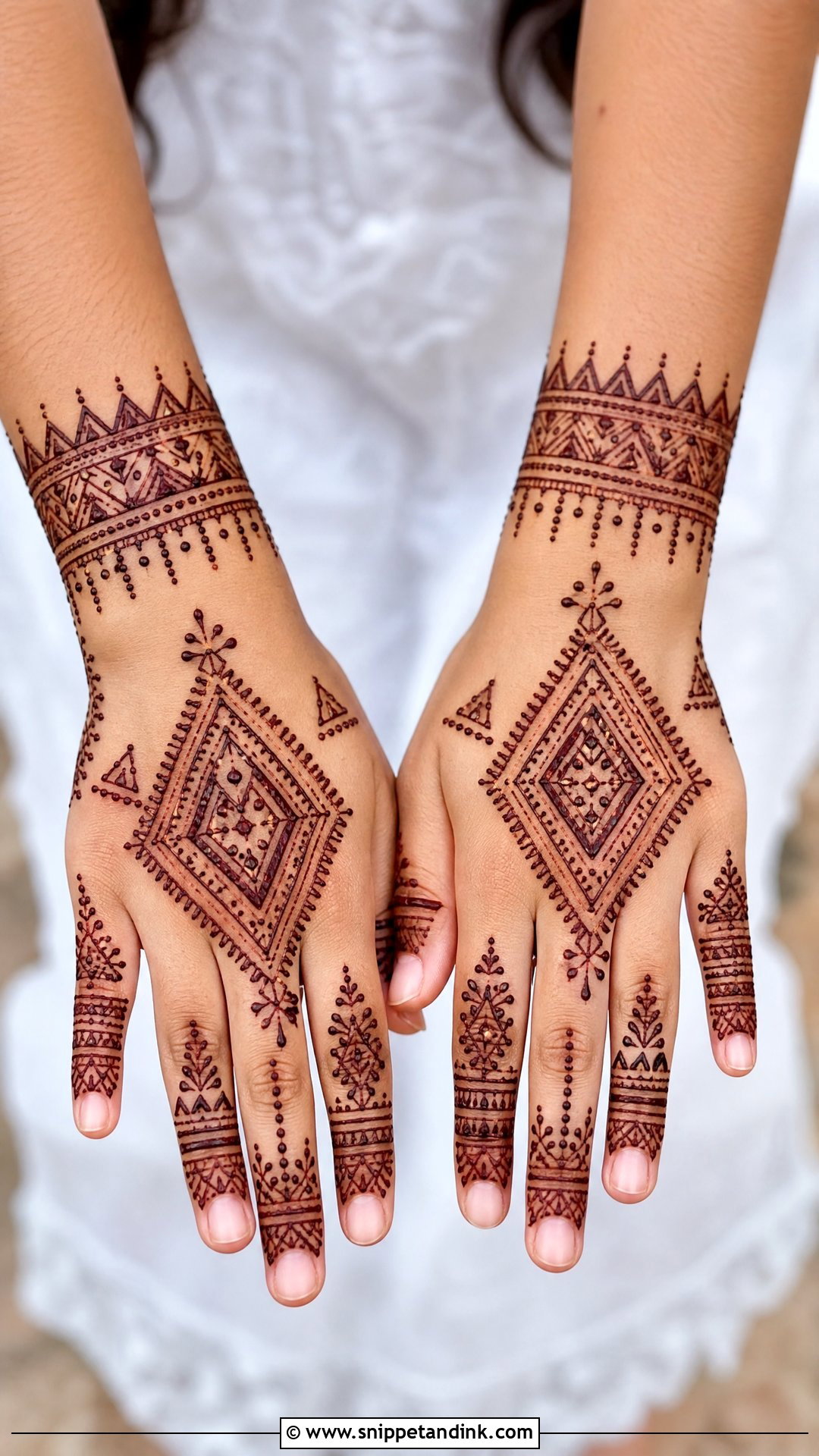
Simple diamonds, triangles, dots and straight-line bands across the back of the hand or the palm, with a light wrist cuff and matching finger bands. Repeated geometric shapes are quick for me to draw and appeal to kids who like tidy patterns. Even spacing is everything; a crooked line is obvious on such a small canvas. It fits older children, school cultural days and simple festive looks.

25. Gulf Mehndi Design for Children
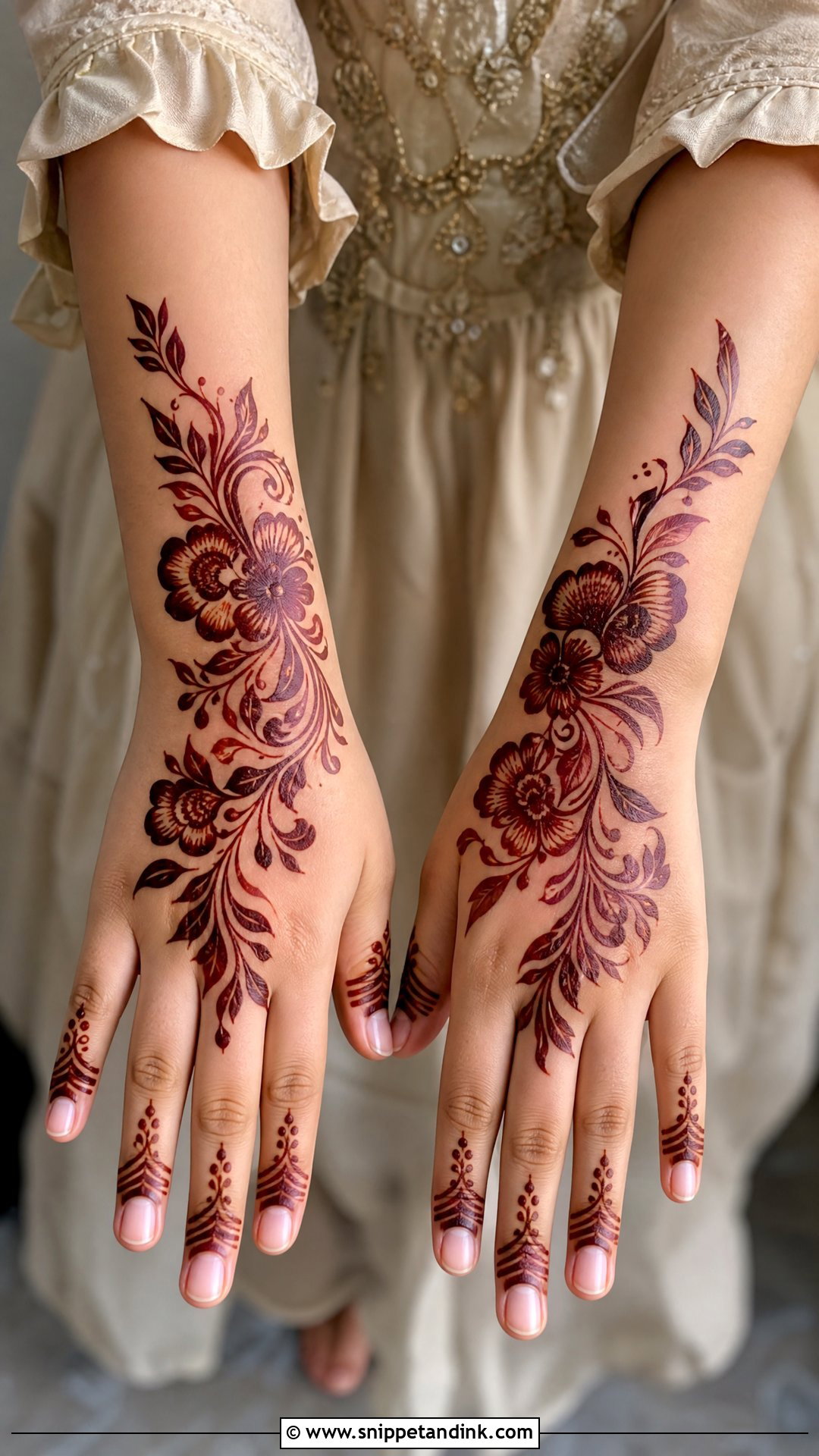
A large floral cluster near the wrist or the centre of the back of the hand, a few wide leaves flowing toward the fingers, light finger detail and plenty of open skin. That’s the Gulf style scaled down for a child. Because it needs no dense fill, it feels rich without a long sit. I use thicker outlines on the flowers so they stain clearly on young skin. Good for Eid, weddings and gatherings where a child wants a grown-up look.
26. Eid Mehndi Design for Children
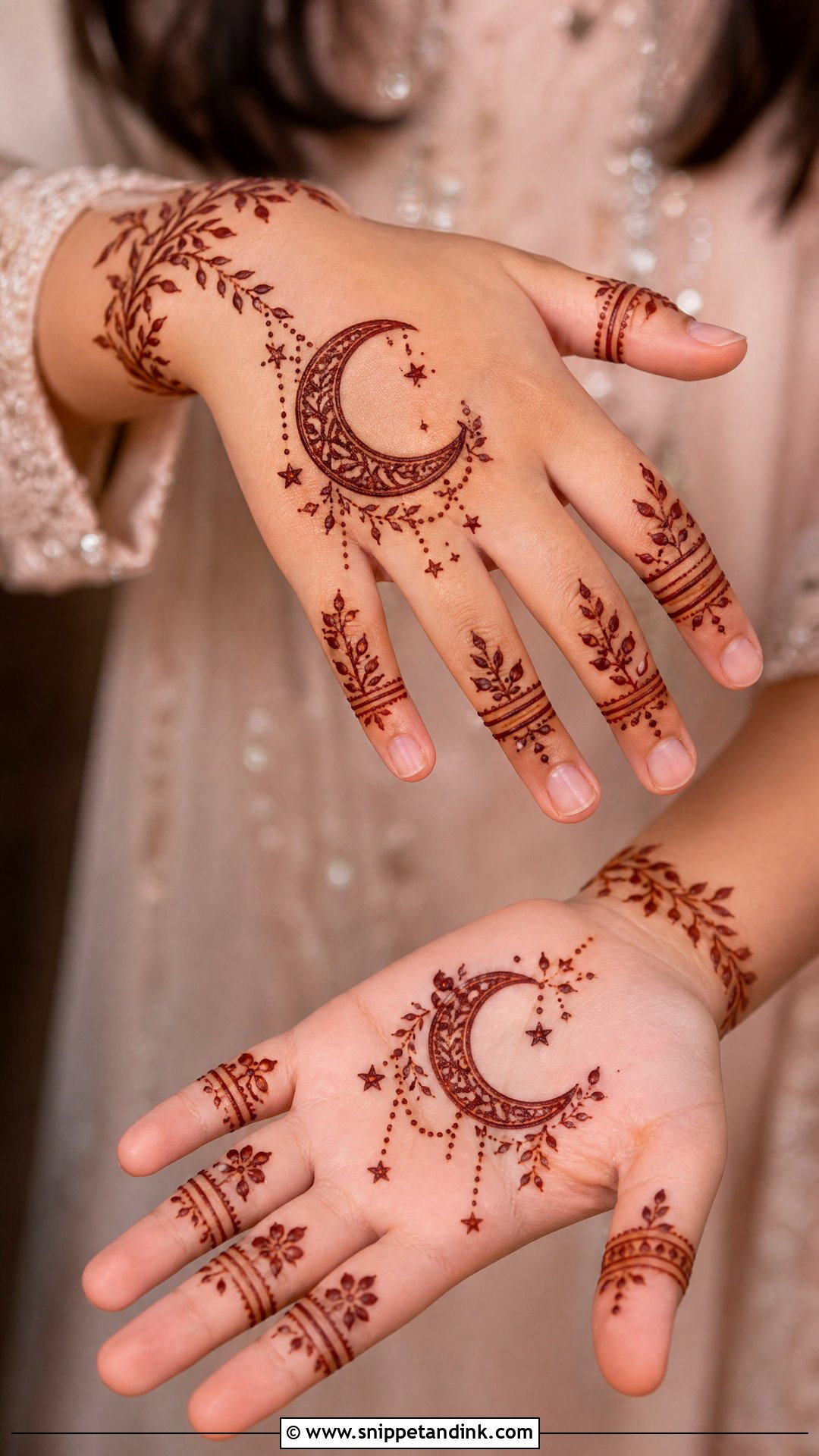
Eid mehndi for children usually means a crescent moon on the back of the hand or palm, small stars and dots, and a vine from the wrist, with simple rings or leafy tips on the fingers. The night before Eid is busy, so I keep it quick and open-spaced to dry fast. A small flower or bracelet near the wrist balances the moon.
27. Diwali Mehndi Design for Children
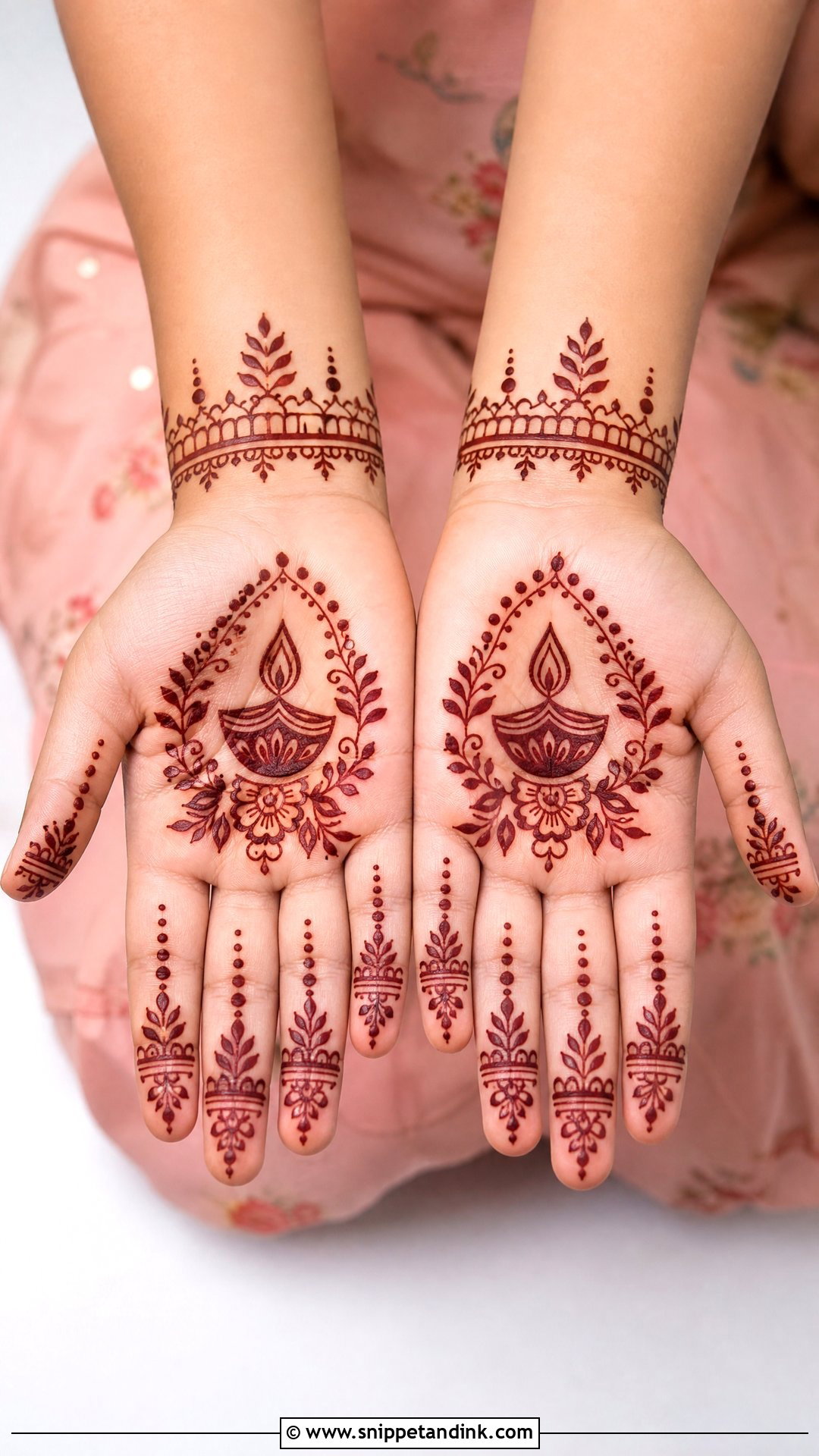
A diya shape on the palm or back of the hand is festive and instantly recognisable to a child at Diwali. I surround it with dots, small flowers and leaves and keep the fingers light, so the lamp stays the focus. Children will be lighting real diyas and handling sweets, so a design that dries fast matters here. A small wrist border or dotted trail finishes the hand.
28. Wedding Mehndi Design for Children
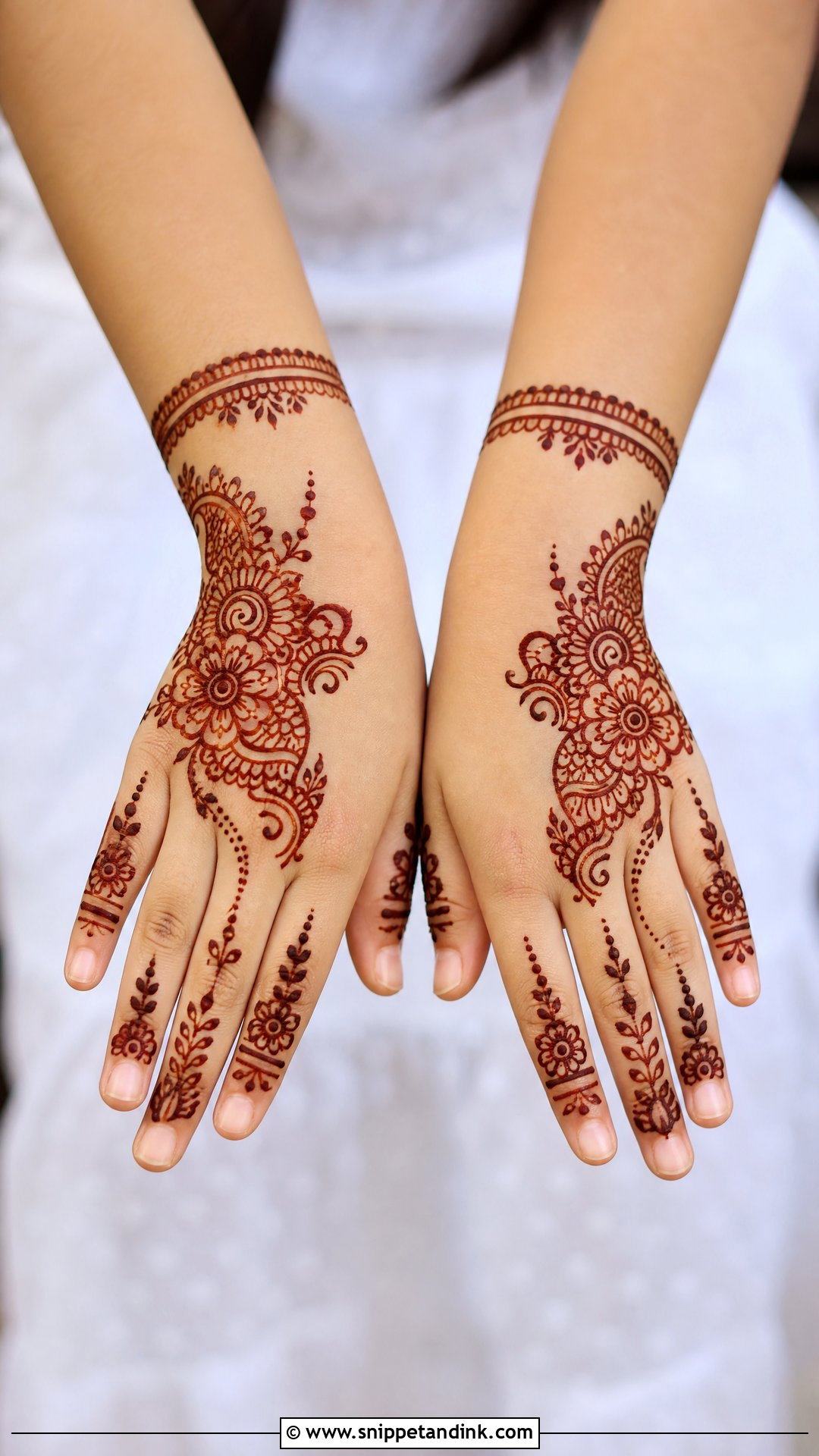
For a family wedding, children want to match the celebration without sitting through a bridal-length session. I give them a half-hand or back-hand pattern with flowers, paisleys, dots, a small bracelet at the wrist and simple finger vines. Flower girls, cousins and siblings of the couple all fit this. Larger, less crowded motifs survive an evening of running around far better than fine work.
29. Birthday Mehndi Design for Children
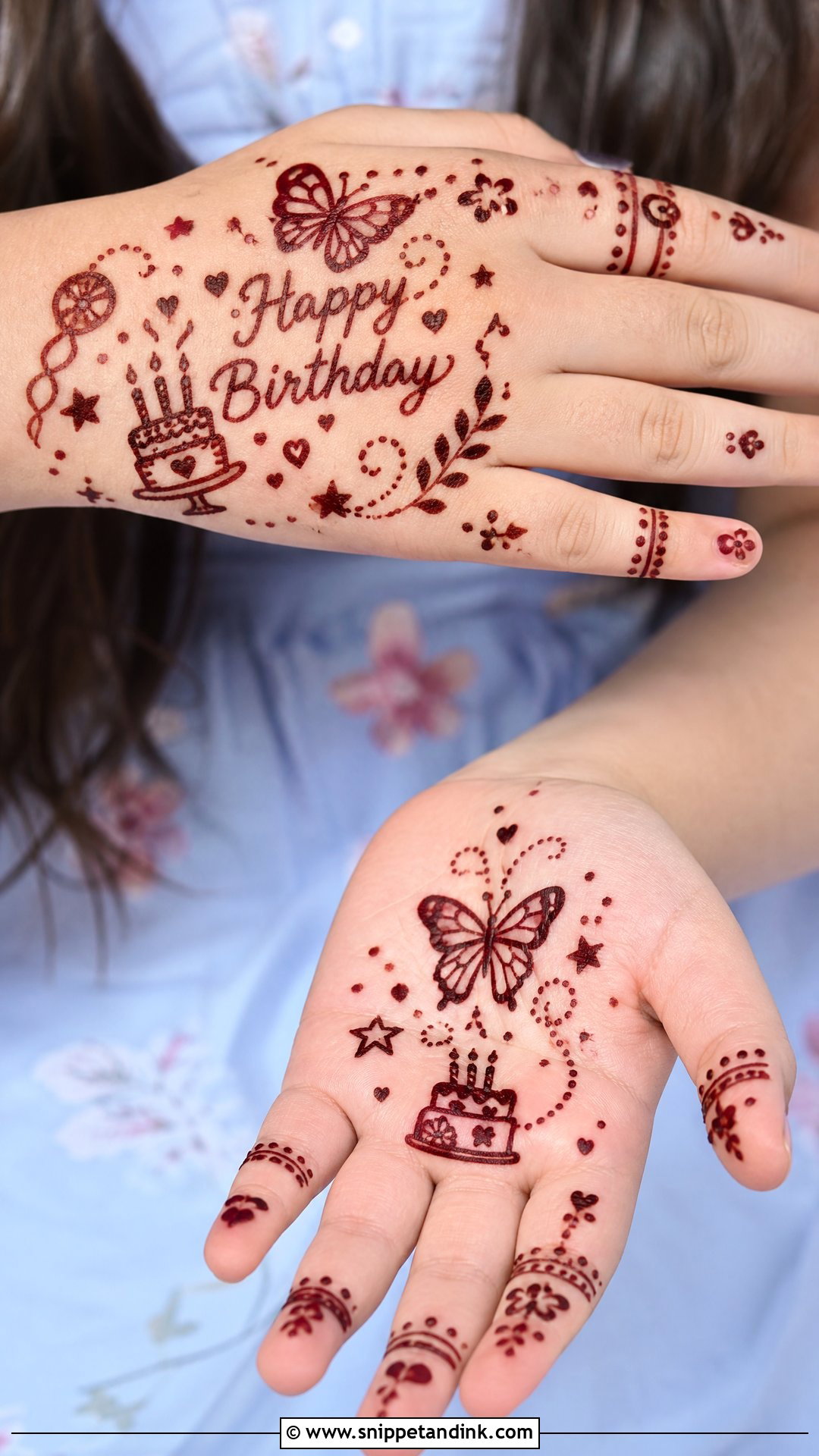
Birthday mehndi can be playful, cute, and very quick: hearts, stars, butterflies, flowers or a little cake shape on the back of the hand or palm, with dotted trails and simple finger rings. Party games and snacks are the real threat, so I keep it bold and simple and apply it early enough to dry before guests arrive. A small wrist bracelet adds a festive touch.
30. Glitter Mehndi Design for Children
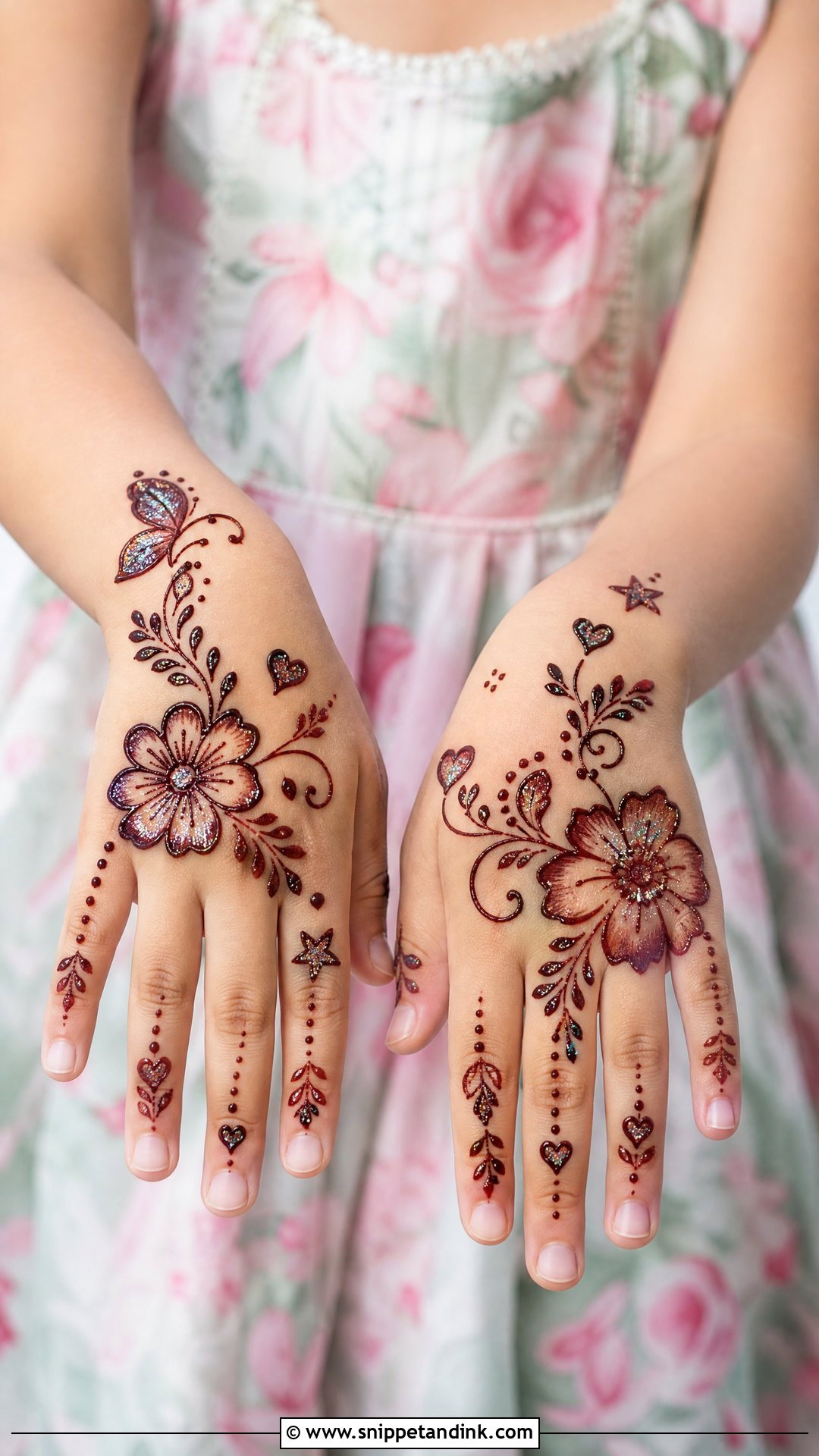
Glitter is a topping, not the design. I start with a simple natural henna flower, butterfly, heart or star on the back of the hand, let it dry fully, then add a small amount of cosmetic-grade glitter gel to a few areas. Never use craft glitter on skin. Covering the whole design in sparkle hides the henna underneath. It’s popular for birthdays and parties, and it washes off long before the stain fades.
Getting a Wriggly Six-Year-Old Through the Drying Time
With children, the drawing is the easy part. The hard part is the twenty minutes to an hour after, when wet paste meets a child who wants to play. A few things help:
- Feed them and take them to the toilet before I start.
- Seat them at a table with the hand resting flat, and put a show on for the other eye.
- Do one hand only for younger children. They keep a free hand to use and will sit far more calmly.
- Let the paste dry fully before they move about. Once it’s dry and crusty, it’s much harder to smudge.
- At bedtime, slip a loose cotton sock over the hand if the paste is still on.
Why a child’s stain looks lighter
Expect a softer orange-brown on children, not the deep maroon you see on brides. Kids rarely keep the paste on for hours, and their skin renews faster, so the colour is lighter and fades within about a week. That’s normal. Keeping the hand dry for a few hours after the paste comes off is the simplest way to get a bit more depth.
Small Hands, Short Sittings, Plenty of Open Skin
Children’s mehndi works when it is simple, clear, quick and comfortable. Bold outlines, open spacing and friendly motifs such as flowers, butterflies, stars, moons, hearts, mandalas, paisleys and light Arabic trails all suit small hands. For a wedding or big festival you can go fuller, as long as it stays age-appropriate and dries fast. Use natural henna only, and for Eid, Diwali, a family wedding or a birthday, pick the design your child can sit still for, not the one you’d choose for yourself.
You'll Like These Ideas:





Leave a Reply