
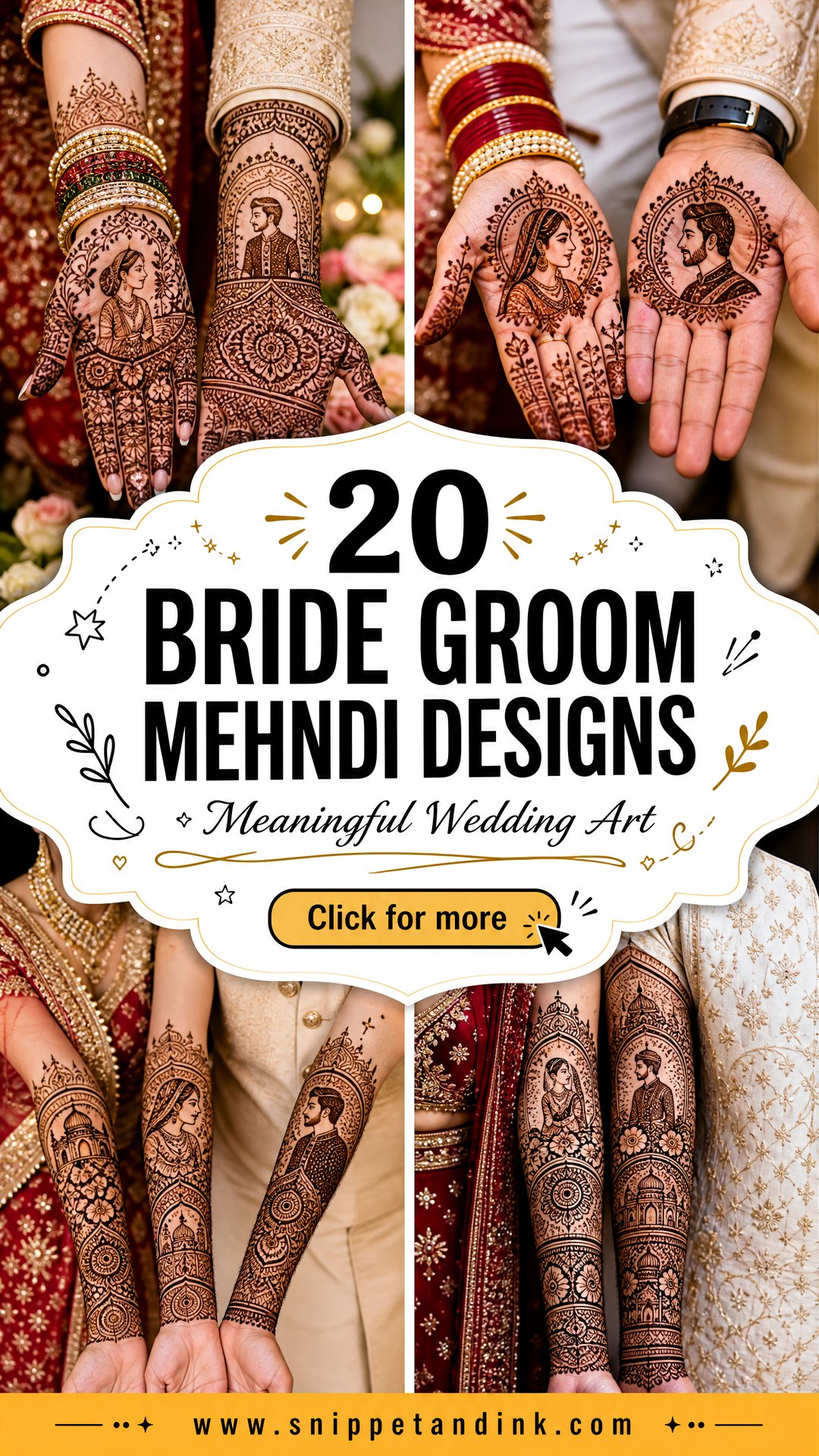
The mehndi I enjoy drawing most is the kind that carries a couple’s own story: dulha-dulhan portraits, a hidden name, a jaimala scene, a wedding hashtag, a groom’s palm that answers the bride’s. These can be traditional, modern, minimal or built entirely around one idea. What makes them work is clarity: the story has to read in a photo, and the hand still has to look like bridal mehndi. Below are twenty layouts I draw for brides and grooms, with notes on spacing, placement and what I’d change for each.
What I Need From a Couple Before the Cone Touches Skin
Couple designs fail most often because of decisions left until the appointment. Portraits, names and story panels all have to be planned for the space on each hand, and once henna is on skin there’s no eraser. A short message a week before saves a lot of compromise on the day.
- Both names, spelled exactly as you want them, plus initials and the date in the format you prefer.
- Which hand gets the bride figure and which gets the groom, so the scene faces the right way when you hold them together.
- Photos of your outfit sleeves and jewellery, so coverage stops where the sleeve or bangles start.
- How long each of you can realistically sit. Grooms often want half an hour, not three.
Timing the appointment around the stain
Natural henna doesn’t reach its darkest colour straight away. It goes on as a bright orange stain once the paste comes off and deepens to reddish brown over the next one to two days. That’s why I book bridal mehndi one or two days before the wedding. Done the morning of, you’ll have orange hands in the ceremony photos.
Ask your artist whether she mixes her own paste from henna powder, oils and lemon or sugar. Avoid anything sold as black henna. It usually contains a hair-dye chemical that can cause serious skin reactions, and real henna never stains black.
1. Bride Groom Portrait Mehndi Design
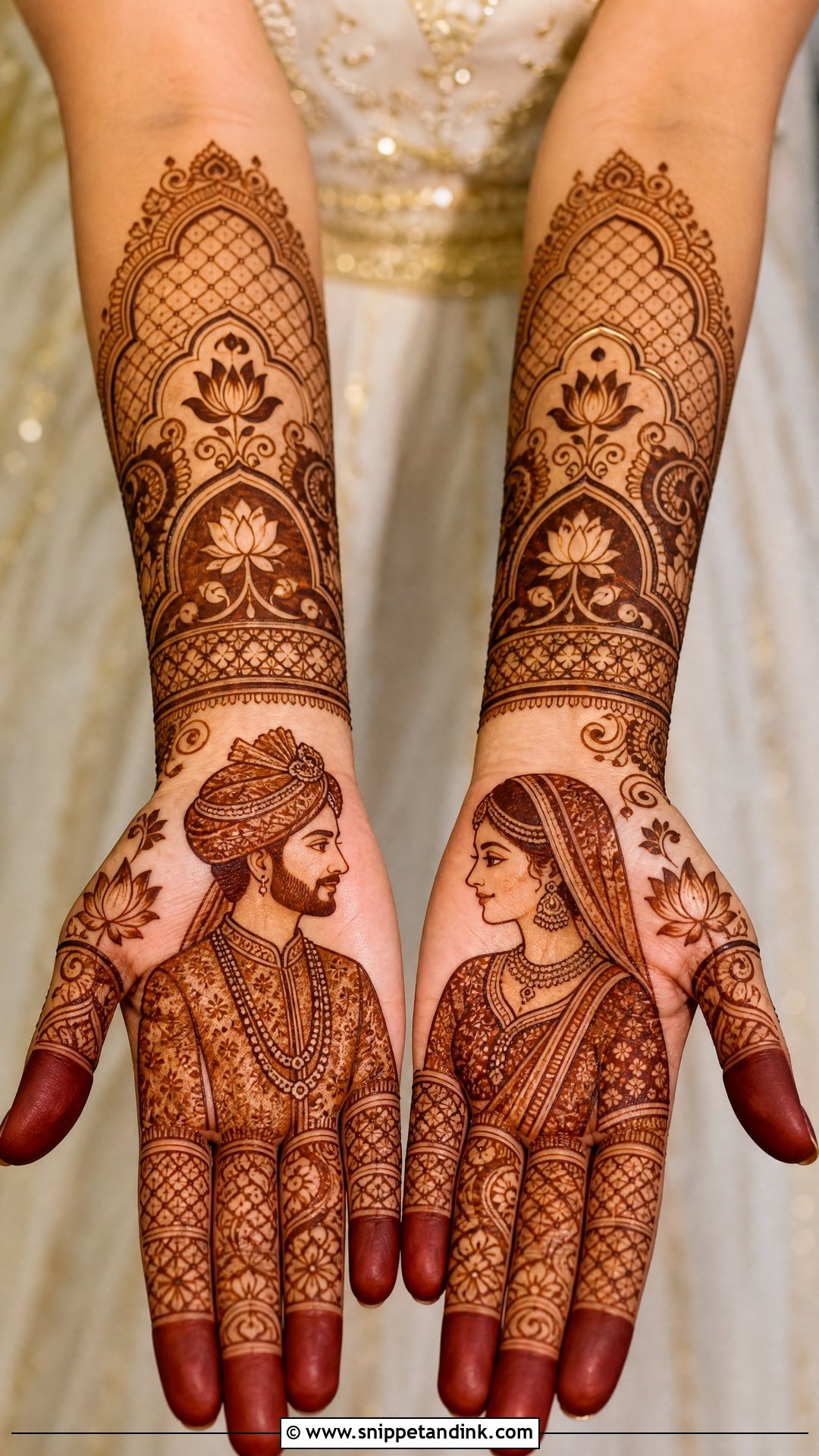
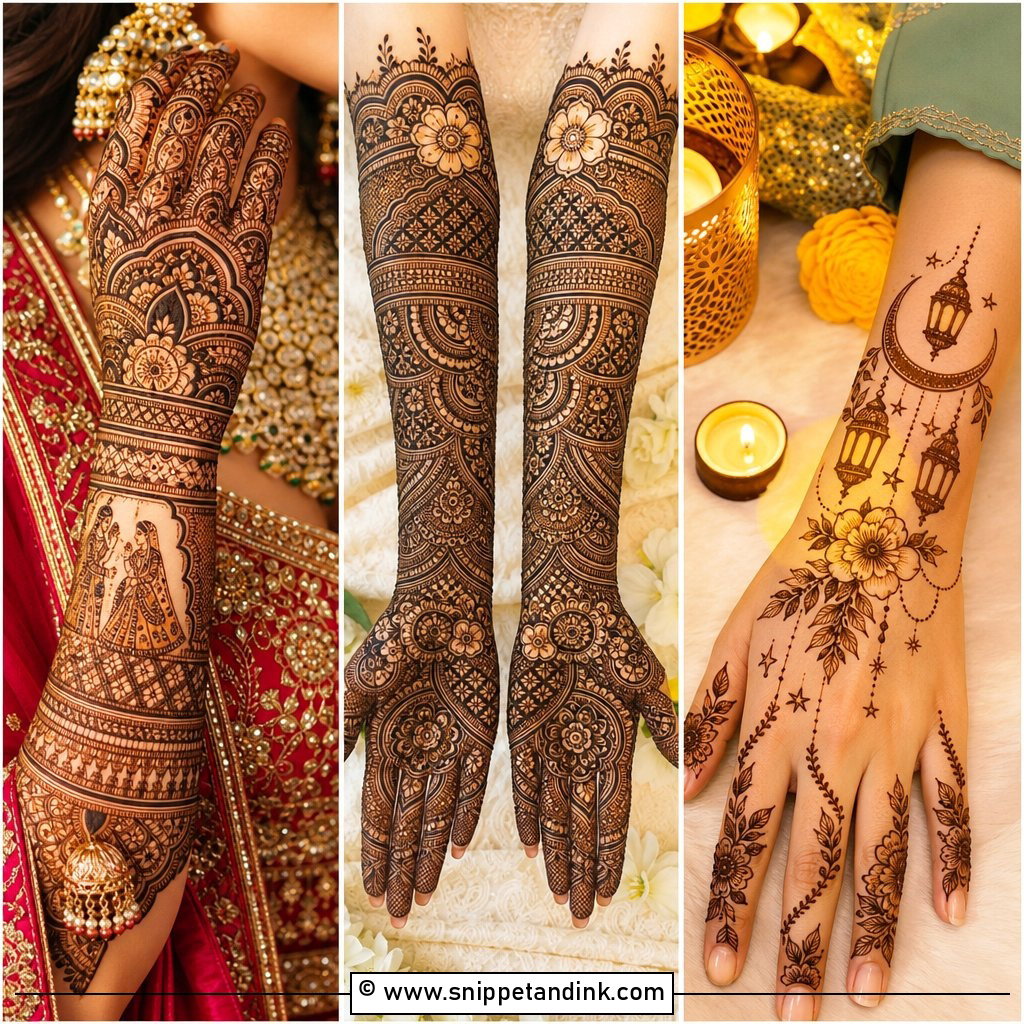
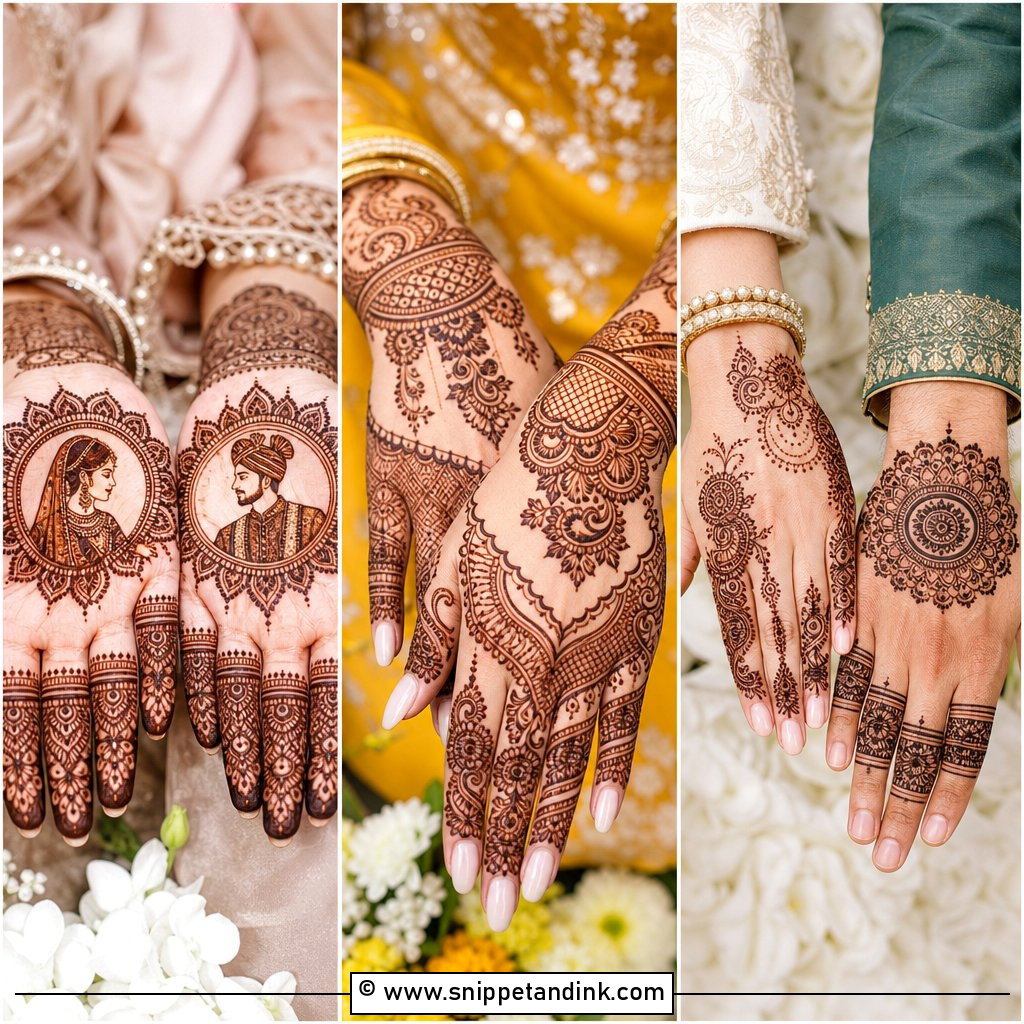
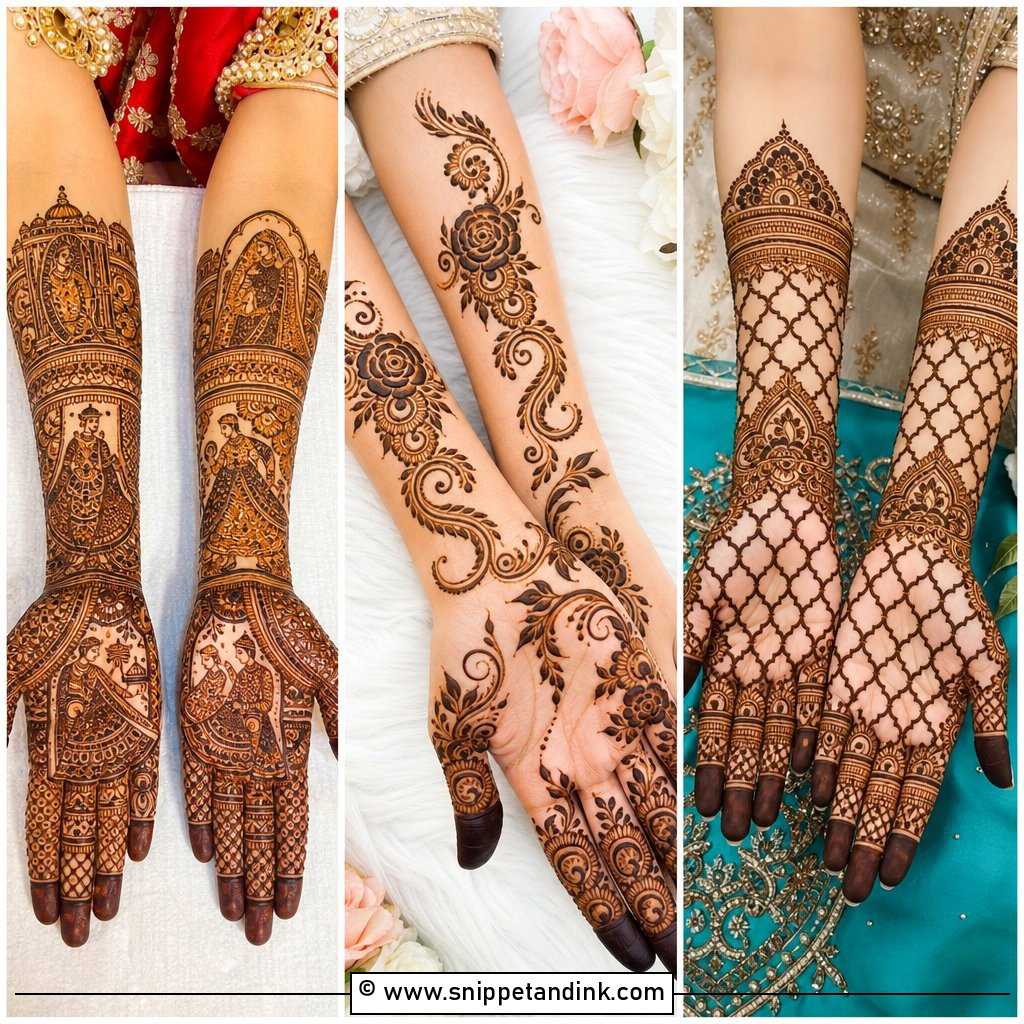
Portrait mehndi turns the hands into a keepsake: the bride’s face on one palm, the groom’s on the other, framed by paisleys, lotus and jewellery borders. Faces are the hardest thing I draw in henna, because the paste spreads slightly as it sits and tiny features blur into each other. So I make them bigger than most couples expect, roughly the size of the palm centre, and keep the eyes and lips to a few clean lines. Brides need wrist-to-forearm coverage to give the portraits room. Grooms suit one simpler palm portrait with a plain wrist band.
2. Dulha Dulhan Full Hand Mehndi Design
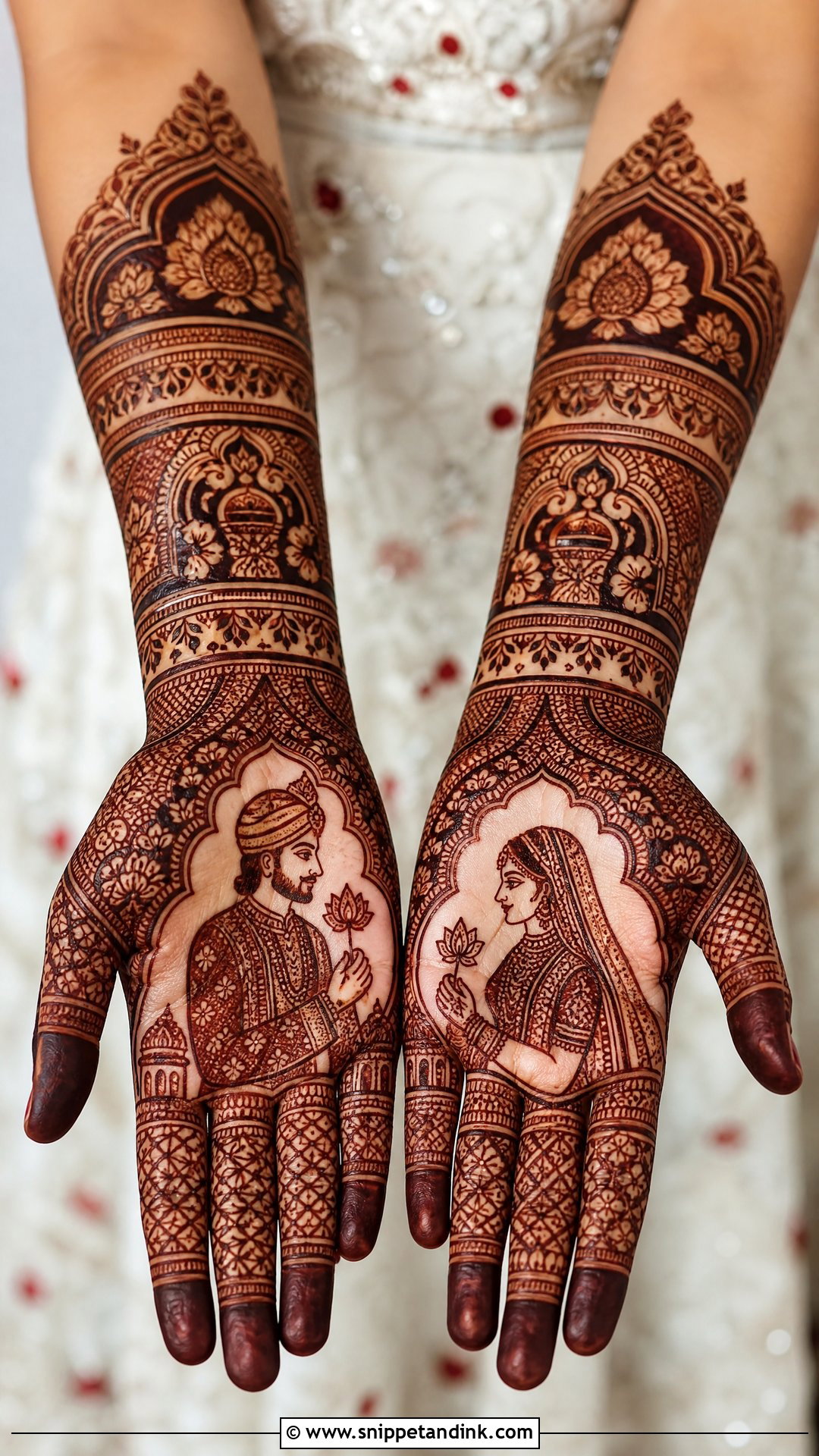
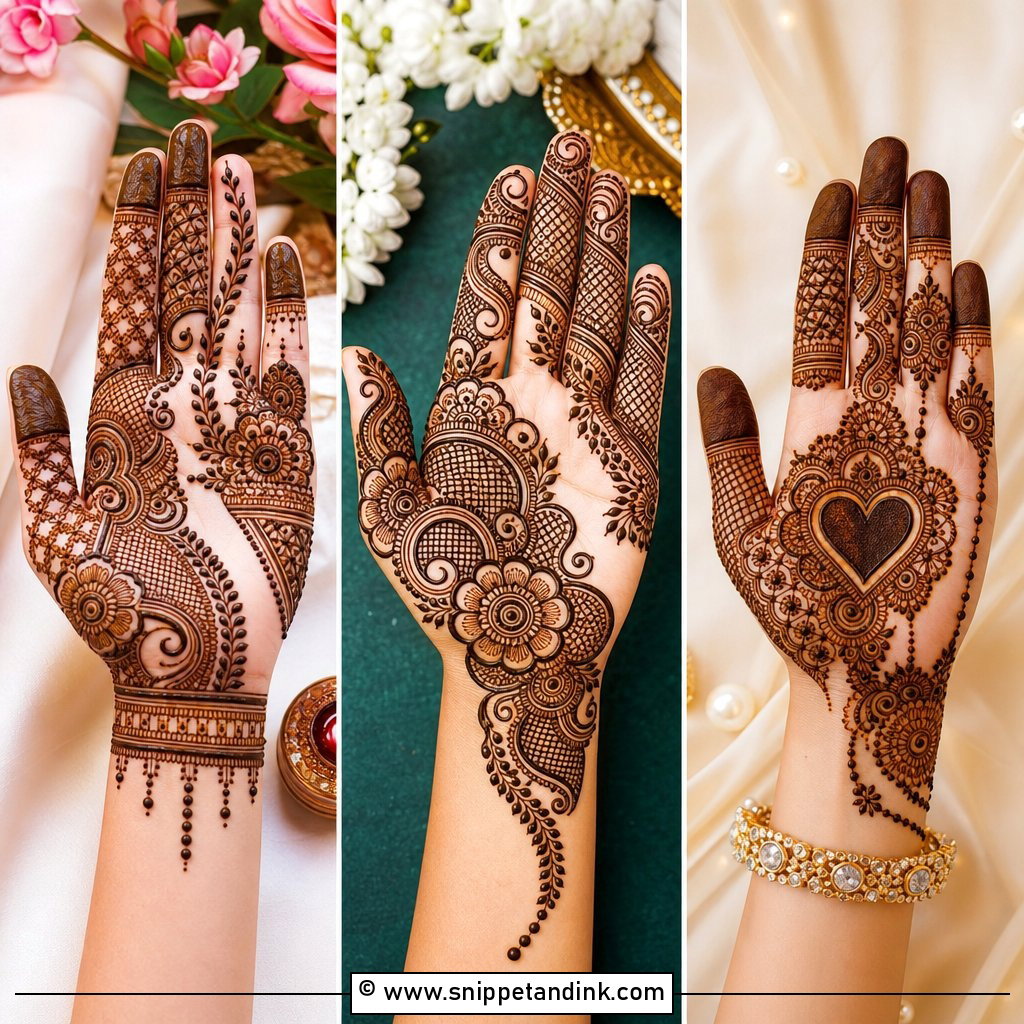
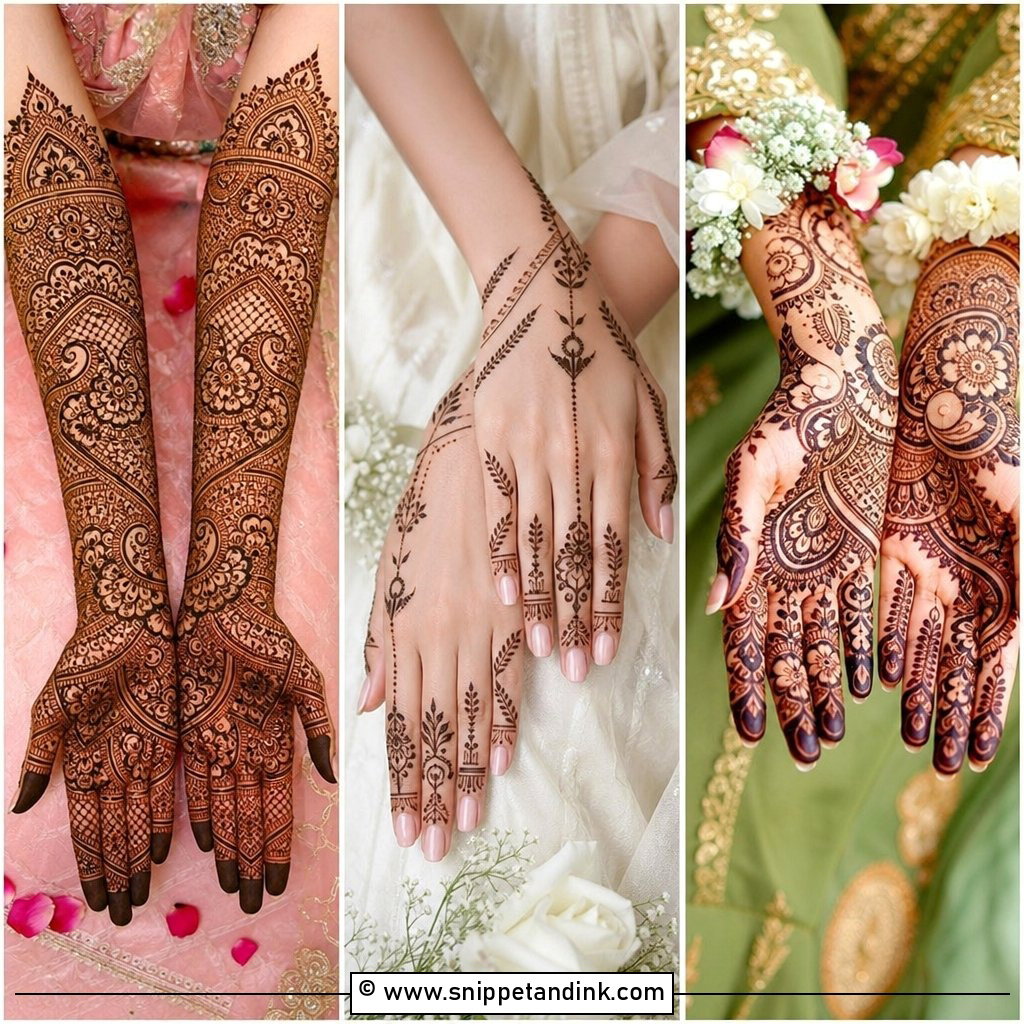
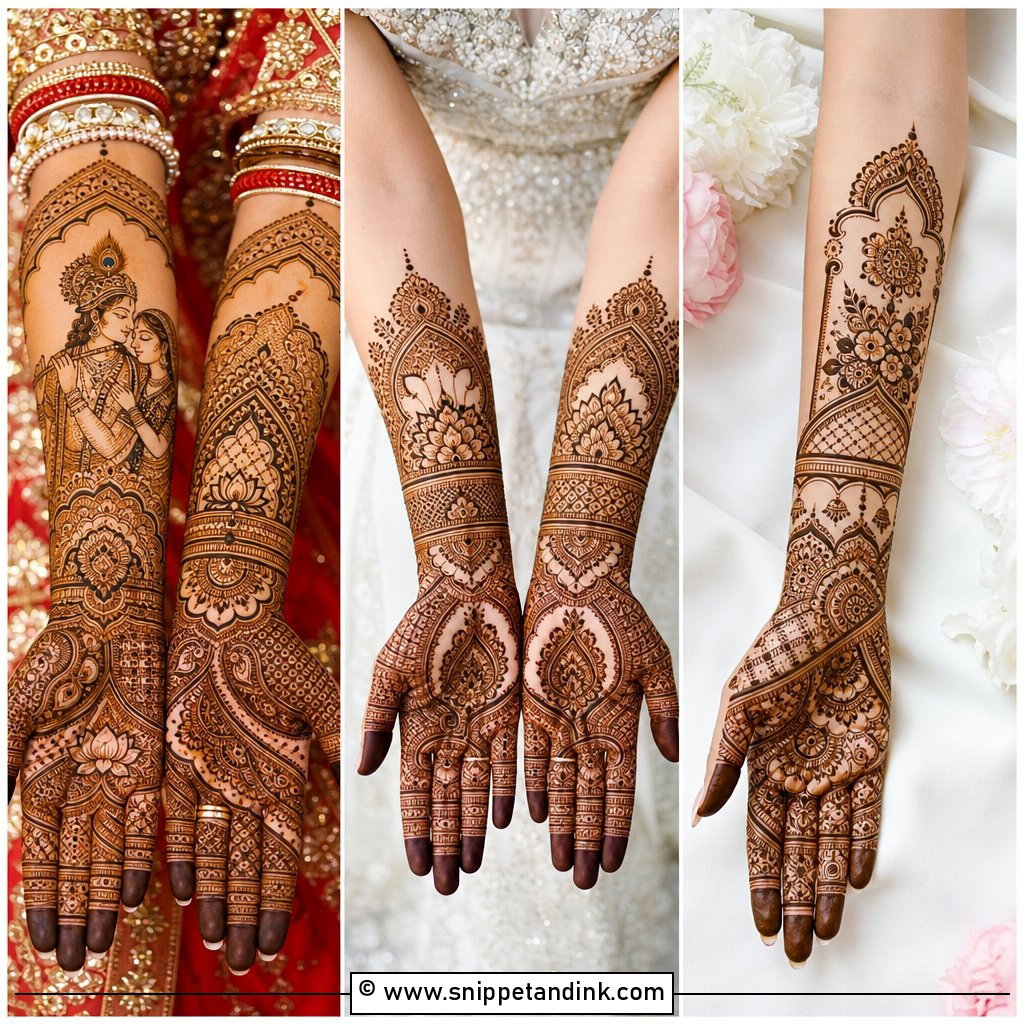
Dulha dulhan full hand mehndi design puts the couple at the centre of a full traditional layout covering palms, fingers, wrists and forearms. Around them I fill in peacocks, kalash, jaali, lotus chains and curving paisleys. It balances a heavily embroidered lehenga, where lighter mehndi would look lost. I outline the two figures with a slightly thicker line than the filler so they stay the focal point once the stain darkens. The groom can answer it with a smaller dulha motif or a name on one palm.
3. Bride Groom Name Mehndi Design
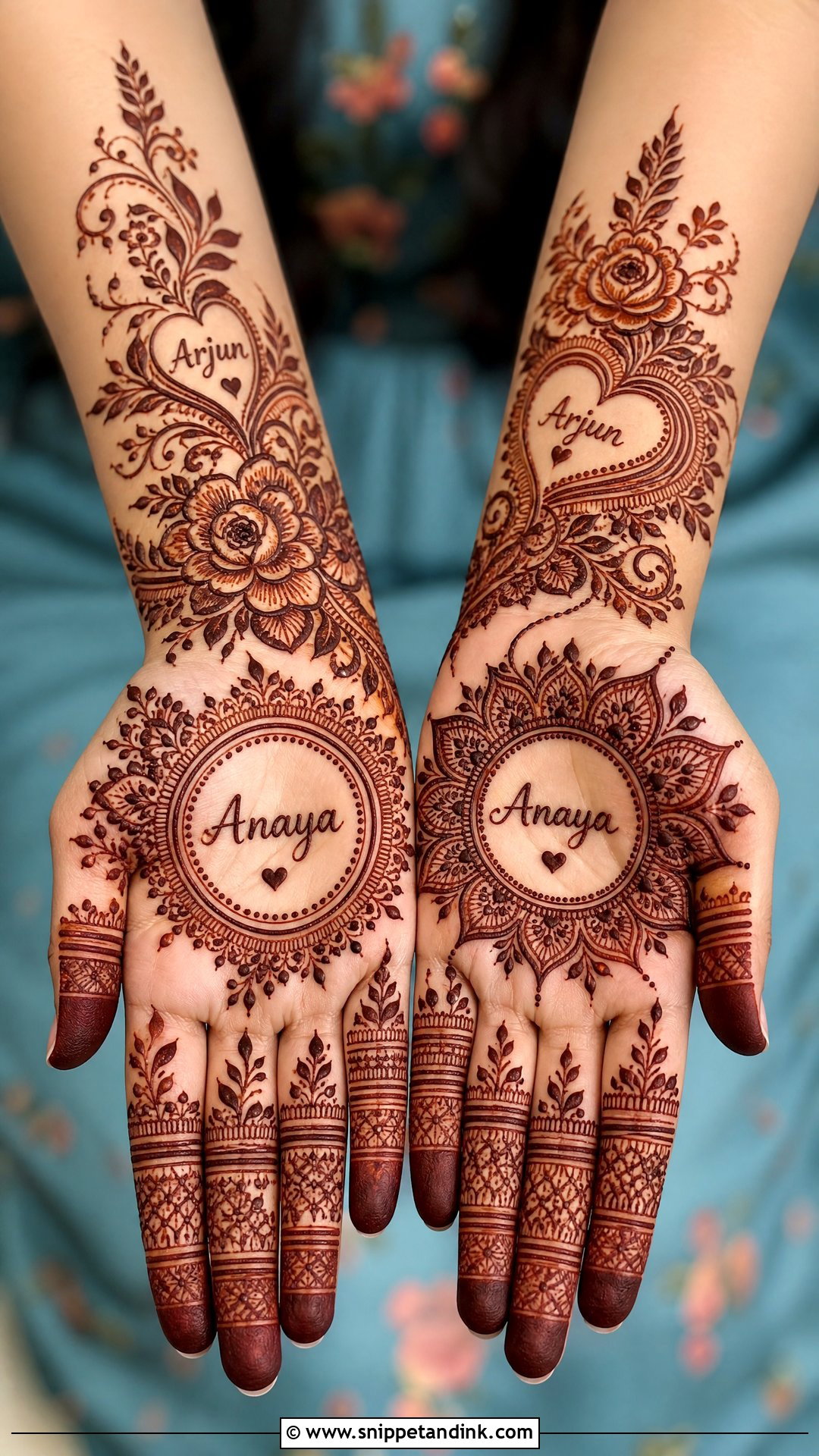
Hiding the groom’s name in the bride’s mehndi is an old tradition, and the hunt for it is part of the fun at many weddings. I tuck it into florals, paisleys, a mandala or a bracelet band. For the groom, the bride’s name goes in a circular palm design or along a finger-to-wrist trail. If you want it readable, I’ll put it inside a heart, lotus or central mandala; if you want it properly hidden, I’ll break the letters across a vine. Either way, write the spelling down for me before I start. Lettering can’t be corrected once the cone touches skin.
4. Bride Groom Jaimala Mehndi Design
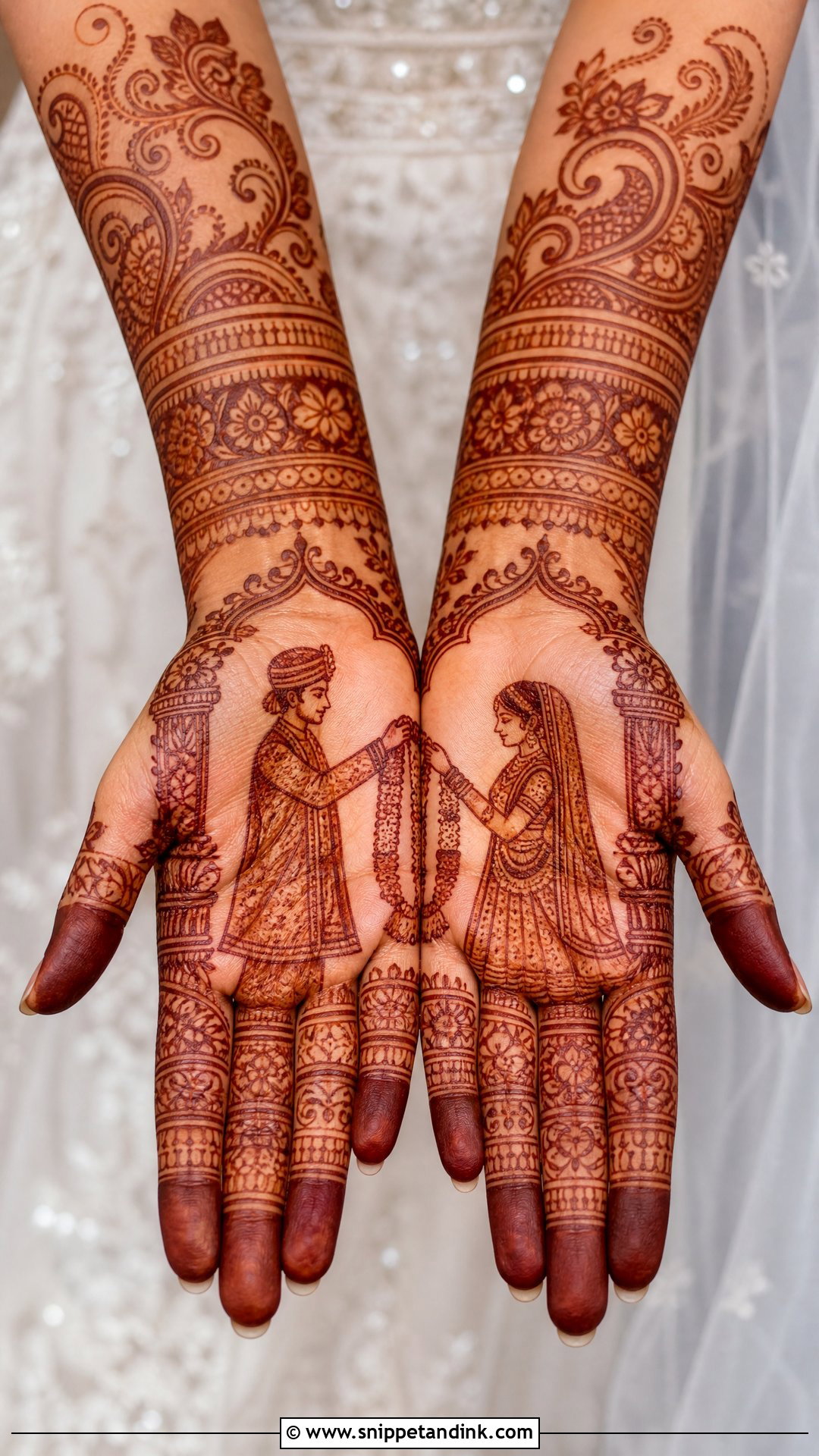
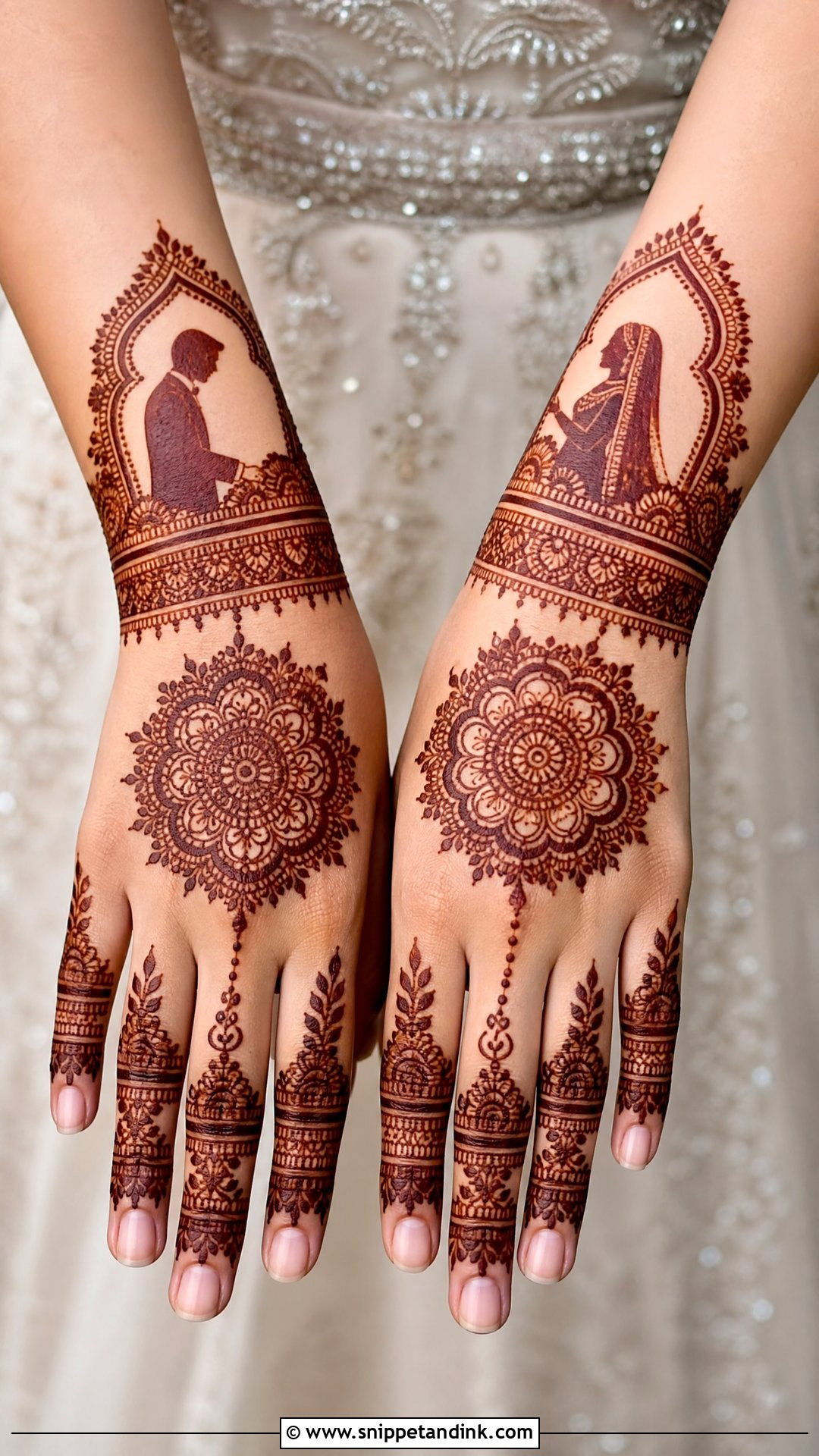
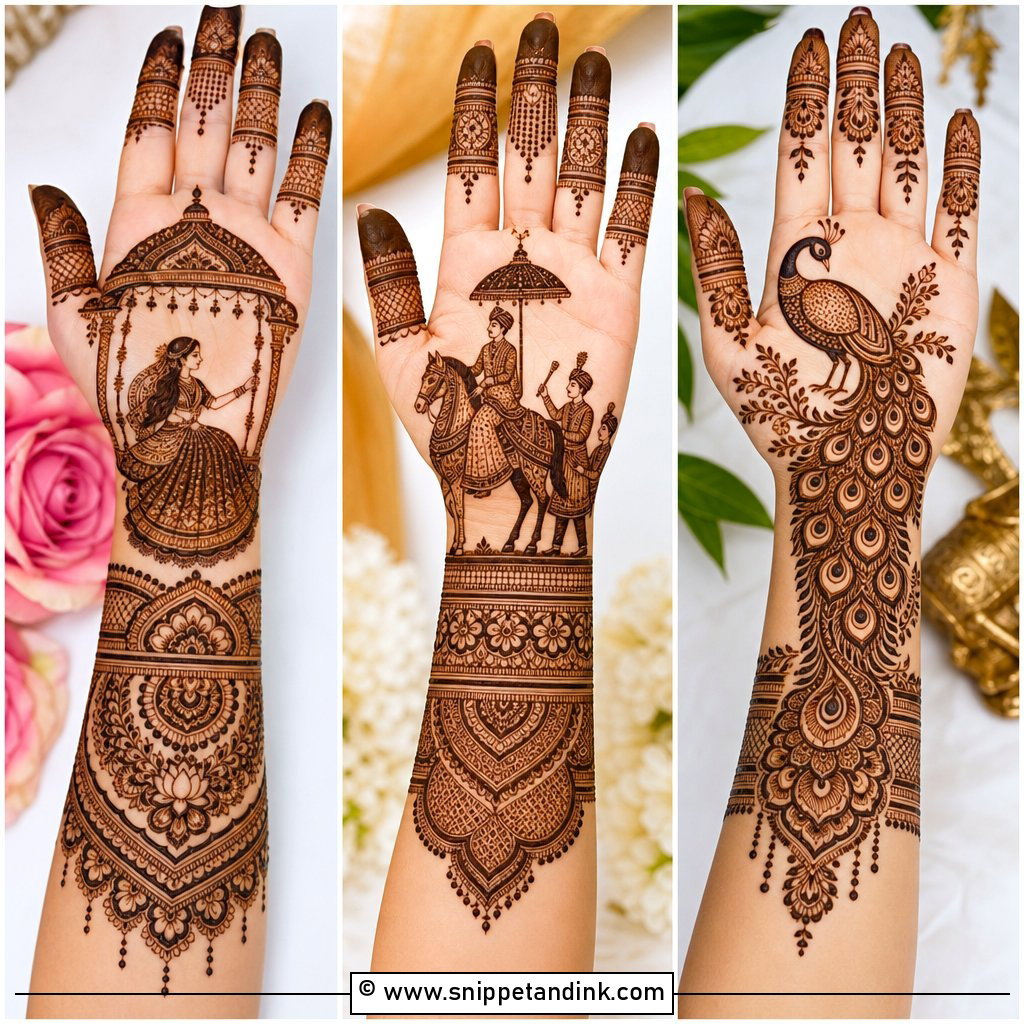
A jaimala scene shows the couple exchanging garlands, framed by arches, floral pillars, temple lines or palace curtains. I draw it so the two palms come together to complete the scene, which makes for one of the nicest hand photos at the mehndi. It’s a good pick if you want storytelling but not detailed faces, since the figures can be shown from the side or in silhouette. The rest of the hand carries lotus borders, paisley vines and shaded fingertips. Grooms can wear a single garland motif with initials.
5. Bride Groom Mandala Mehndi Design
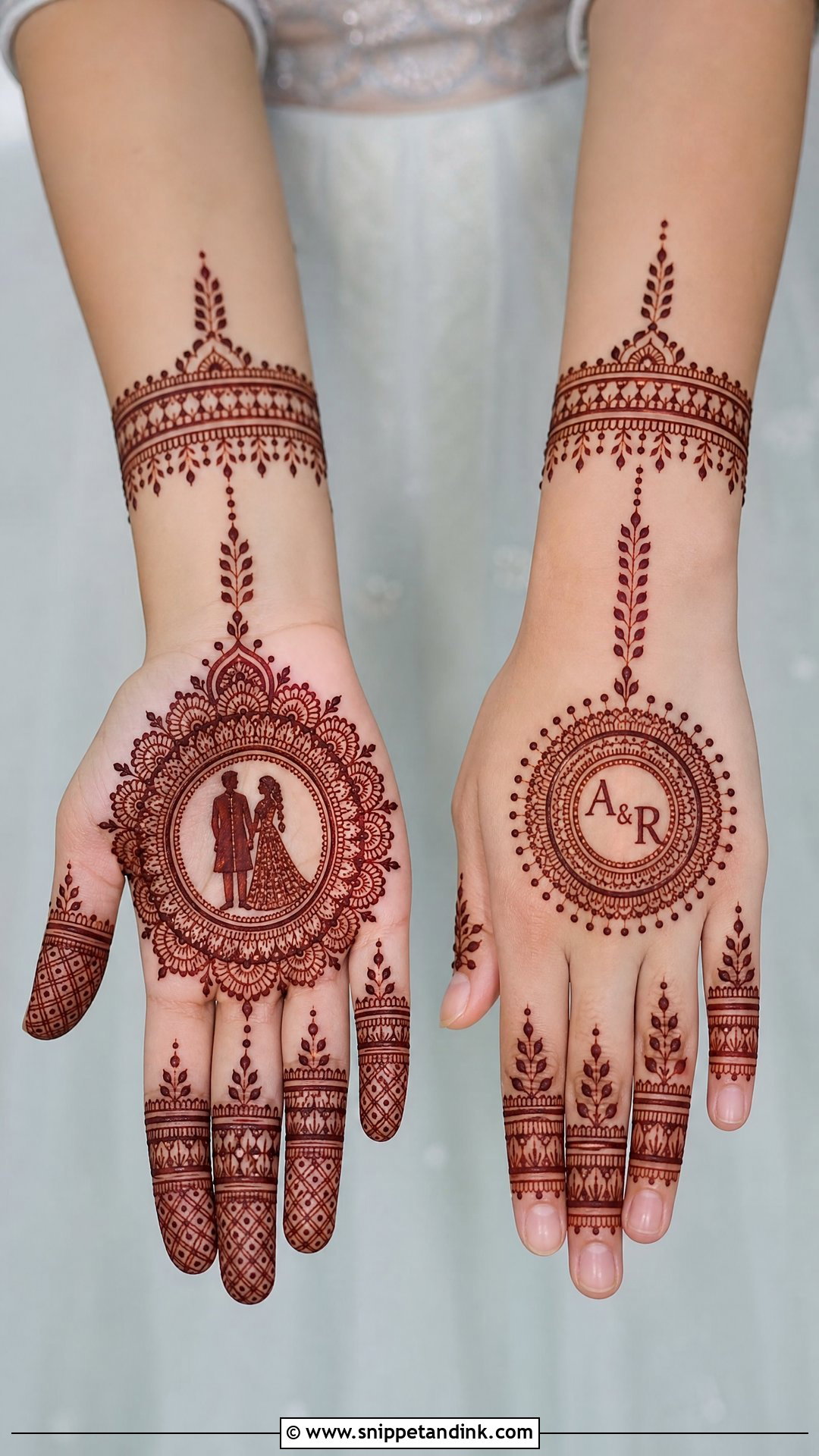
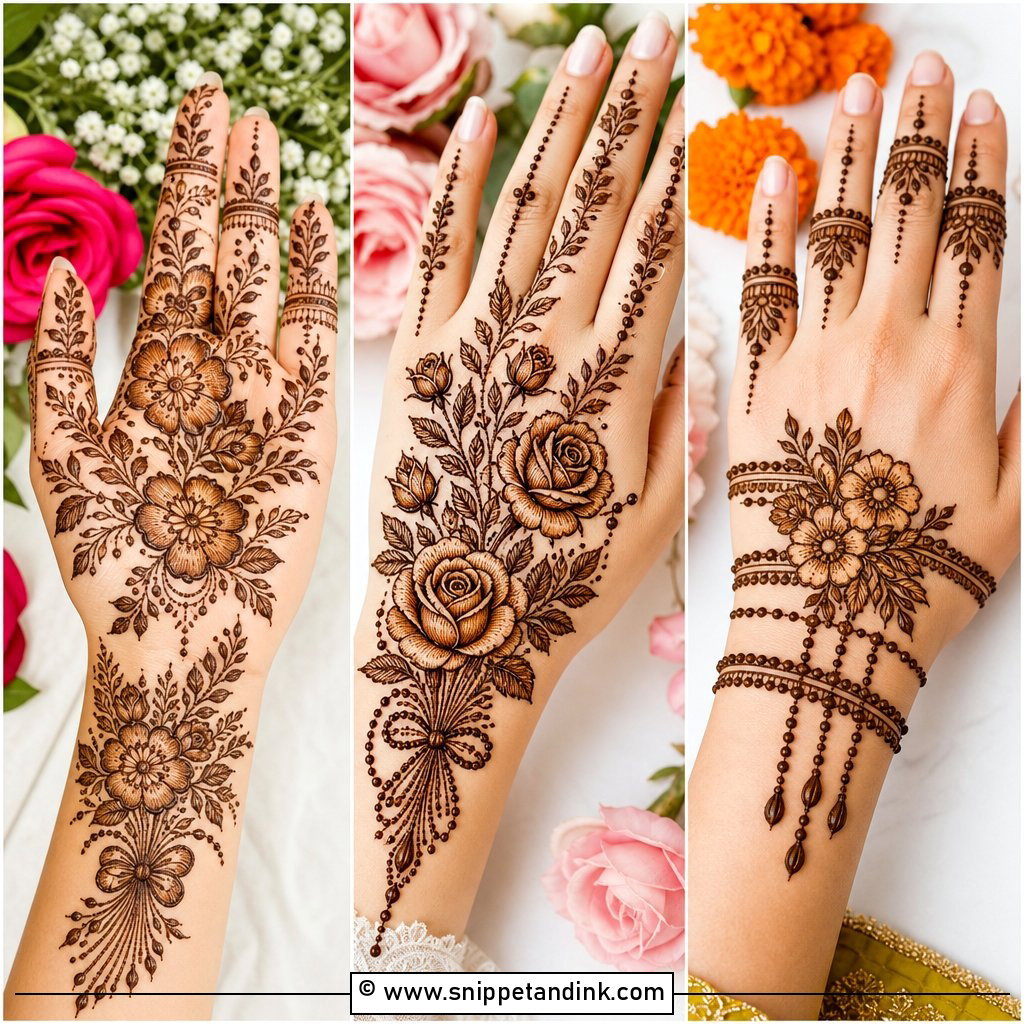
A central palm mandala with tiny bride and groom figures inside or around it gives a cleaner layout than full traditional coverage. Fingers get leaf trails, dotted lines and small geometric bands, and a matching mandala with initials can sit on the back of the hand. I draw the mandala freehand from the centre outward, ring by ring, because starting from the edge always ends up lopsided. It suits brides who like symmetry and grooms who don’t want a crowded hand.
6. Arabic Bride Groom Mehndi Design
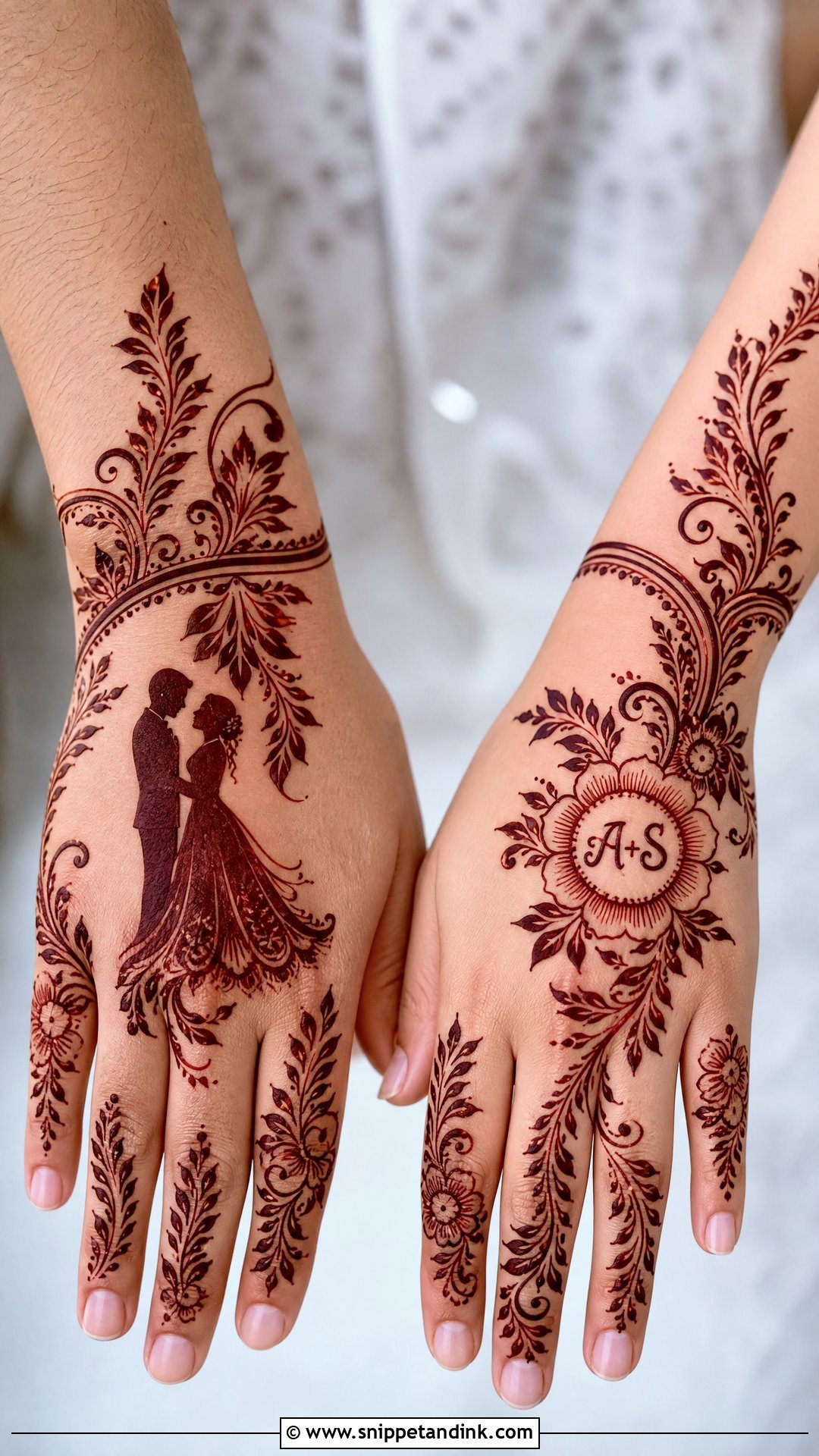
Arabic layouts use bold floral vines, leafy trails and open skin instead of dense filling. The couple detail can be a small portrait, a silhouette or initials inside a large flower. It’s lighter to wear and quicker to apply, and it suits grooms well because the lines can stay sharp and sparse. The open spacing actually helps the stain: thick Arabic lines hold more paste, so they stain deeper than fine filler. I like to run the design diagonally from the fingers to the wrist so it moves across the hand.
7. Indo Arabic Bride Groom Mehndi Design
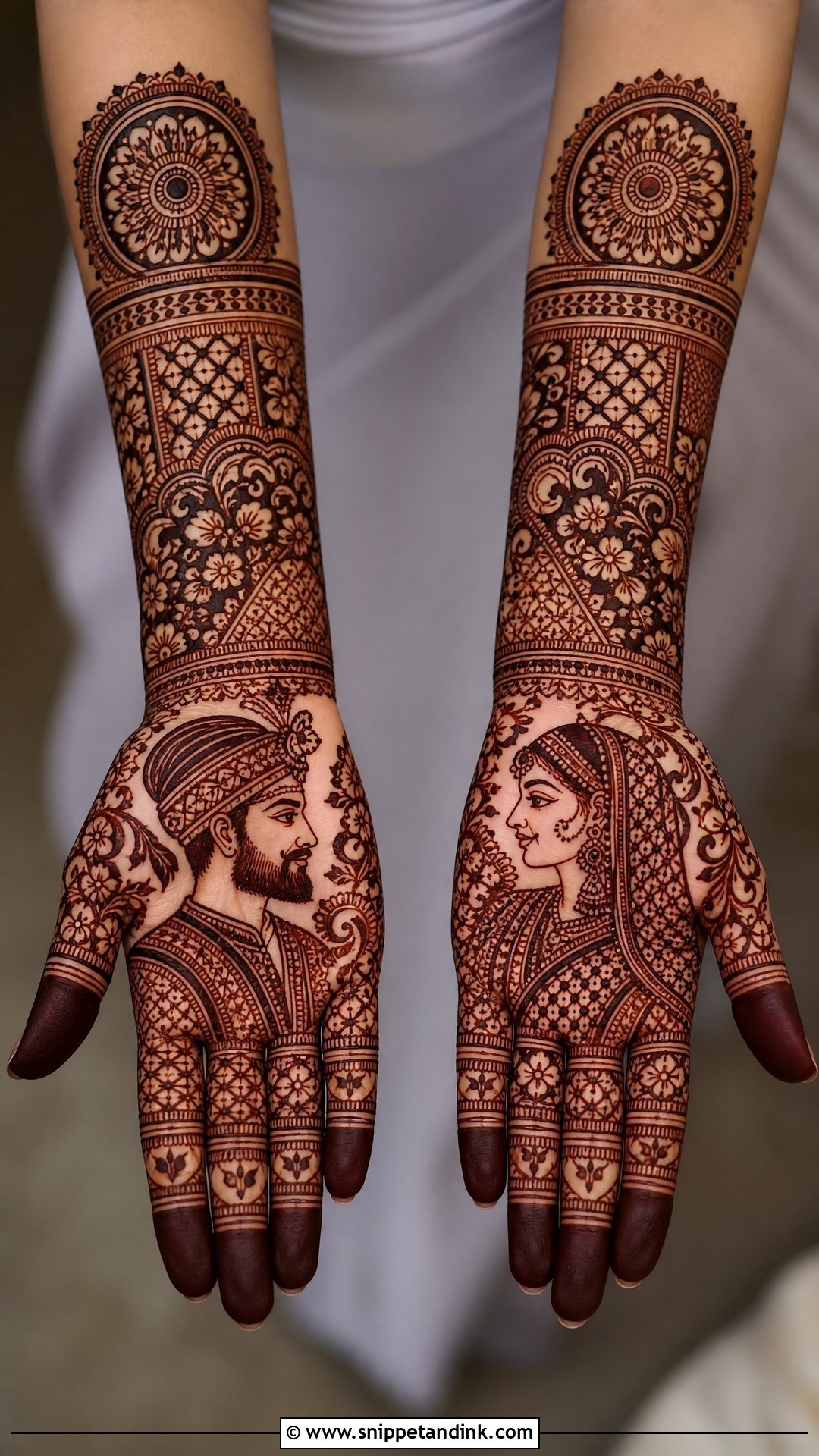
Indo-Arabic mixes the bold Arabic flow with Indian bridal detail: heavy fingertips, jaali checks, floral chains and paisleys, with a bride motif on one hand and a groom motif on the other. The forearm can carry mandala bands or dhol, kalash and lotus borders. It suits a bride who wants a modern layout that still feels traditional. For the groom, I repeat the same floral trail with a single name panel, which ties the two sets together without making him sit through hours of work.
8. Minimal Bride Groom Mehndi Design
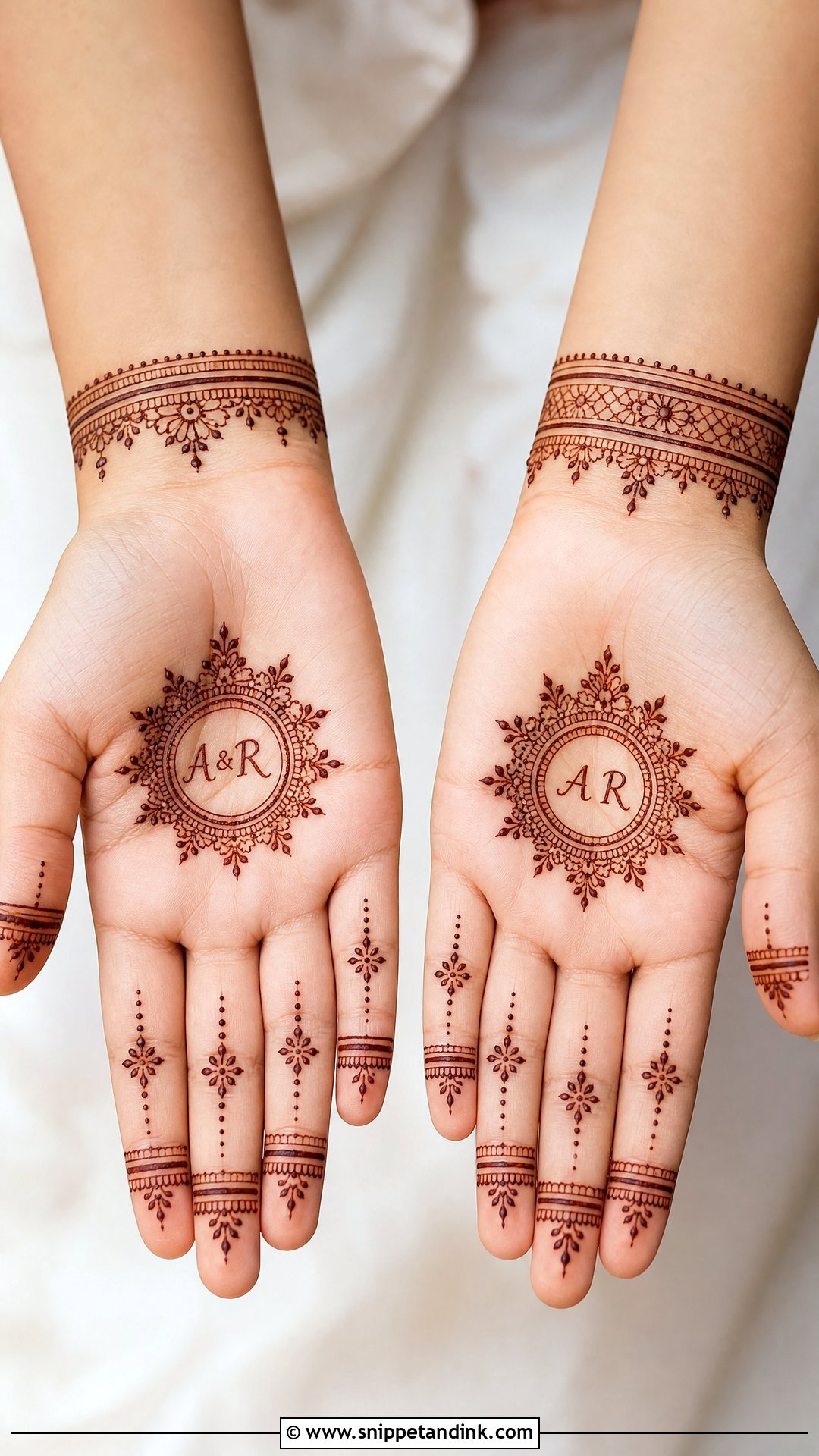
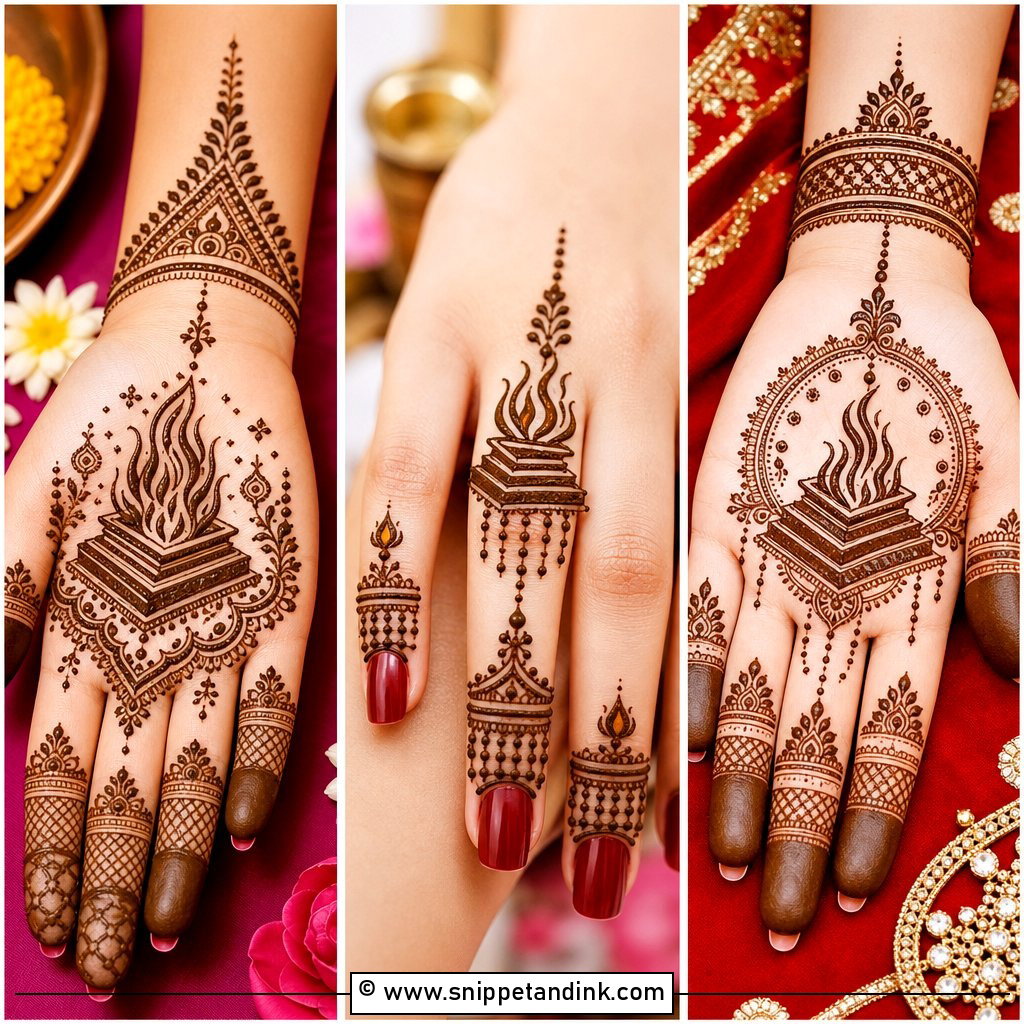
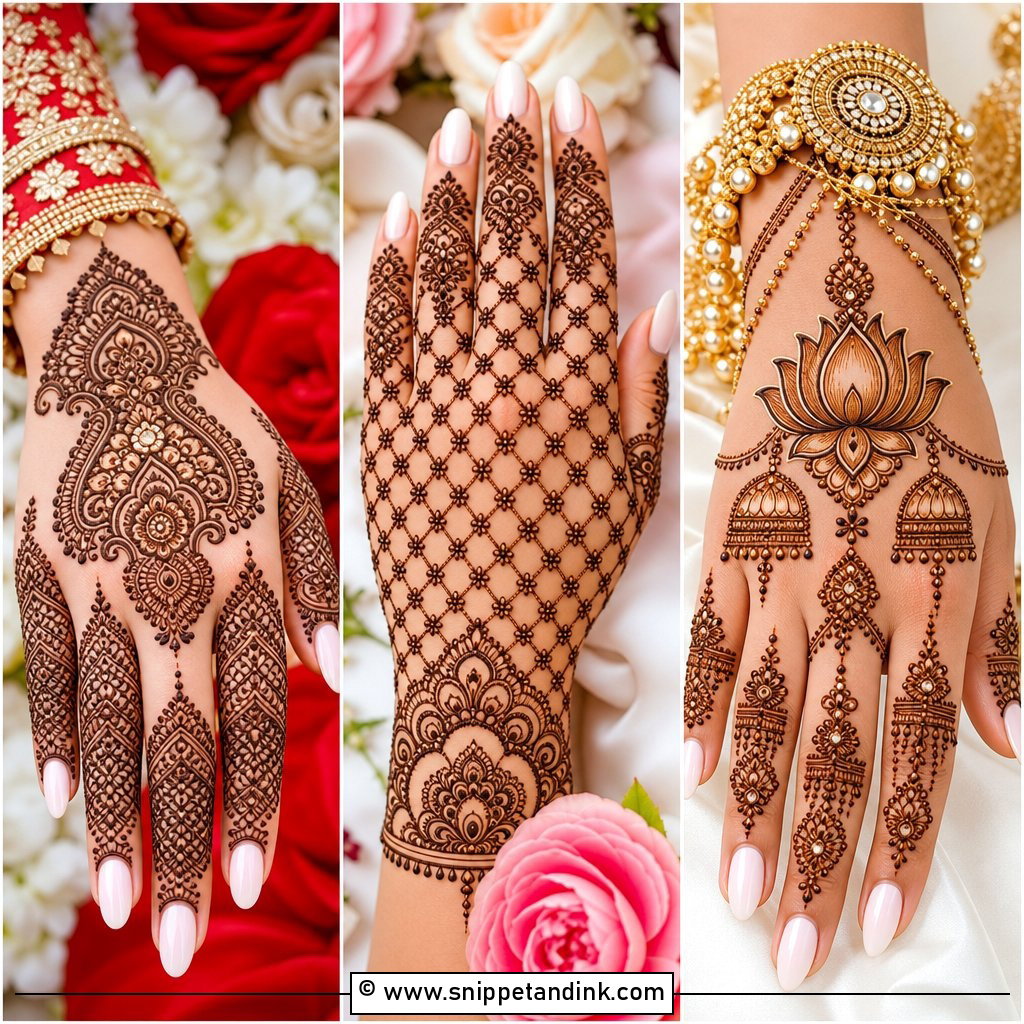
Not every wedding hand needs heavy coverage. A minimal bride groom mehndi design relies on placement and empty skin: a palm mandala with tiny initials, light finger patterns and a fine wrist cuff for the bride; a name, date or small circle for the groom. It suits engagements, civil ceremonies and small weddings. The catch is that minimal work shows every wobble, so I slow down here more than on dense designs. Fewer fillers, crisper lines.
9. Royal Bride Groom Mehndi Design
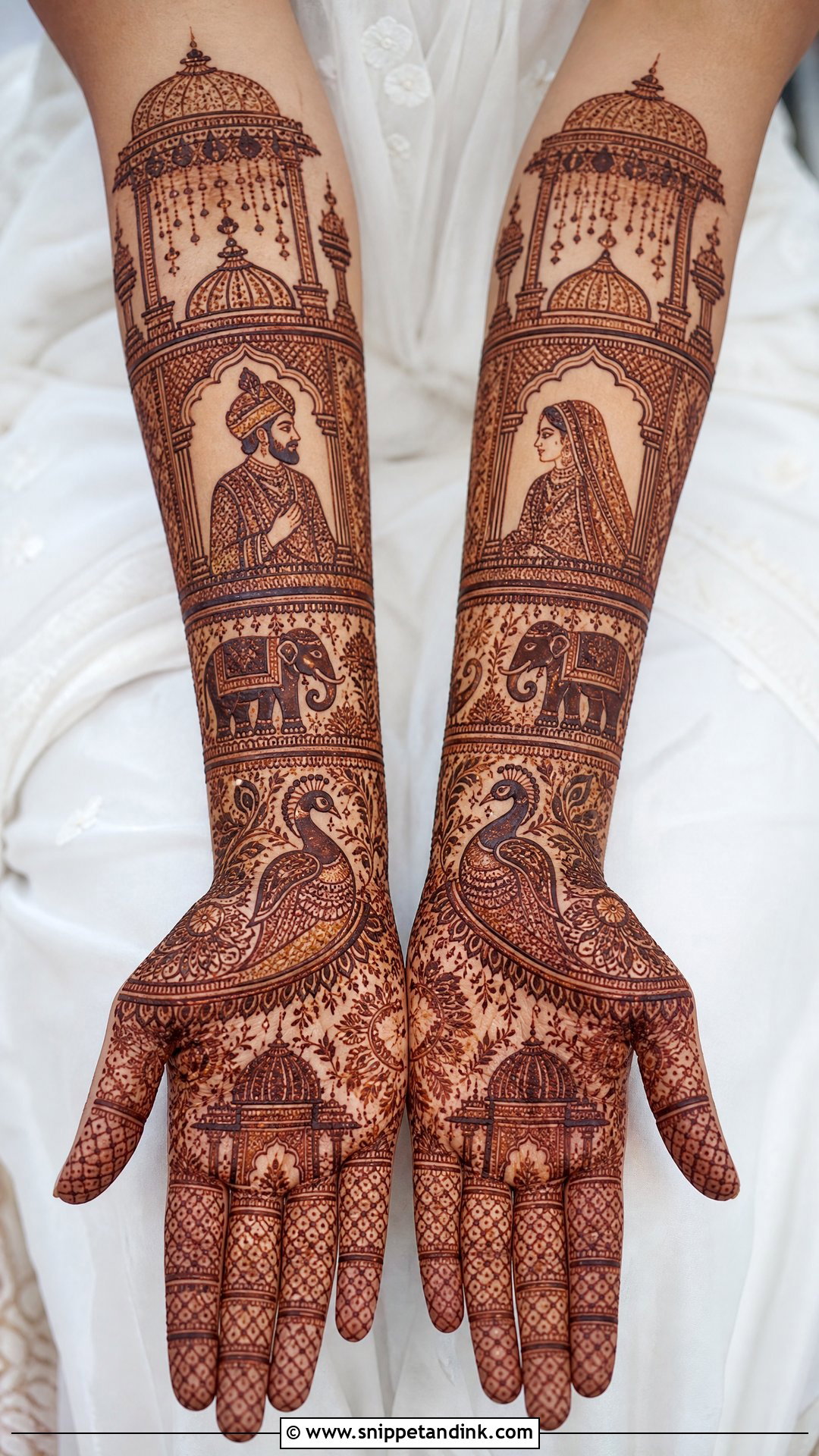
The royal layout is palace-inspired: the couple inside arched frames on the palms, with elephants, peacocks, domes, chandelier drops and layered borders up the forearms, and fine jaali on the fingers. It belongs with a traditional lehenga, sharara or heavily worked saree. The groom can match with a turban motif, initials or an elephant border. Because there’s so much detail, this is where an experienced artist really matters: the borders have to stay evenly spaced, or the whole arm looks uneven once it stains.
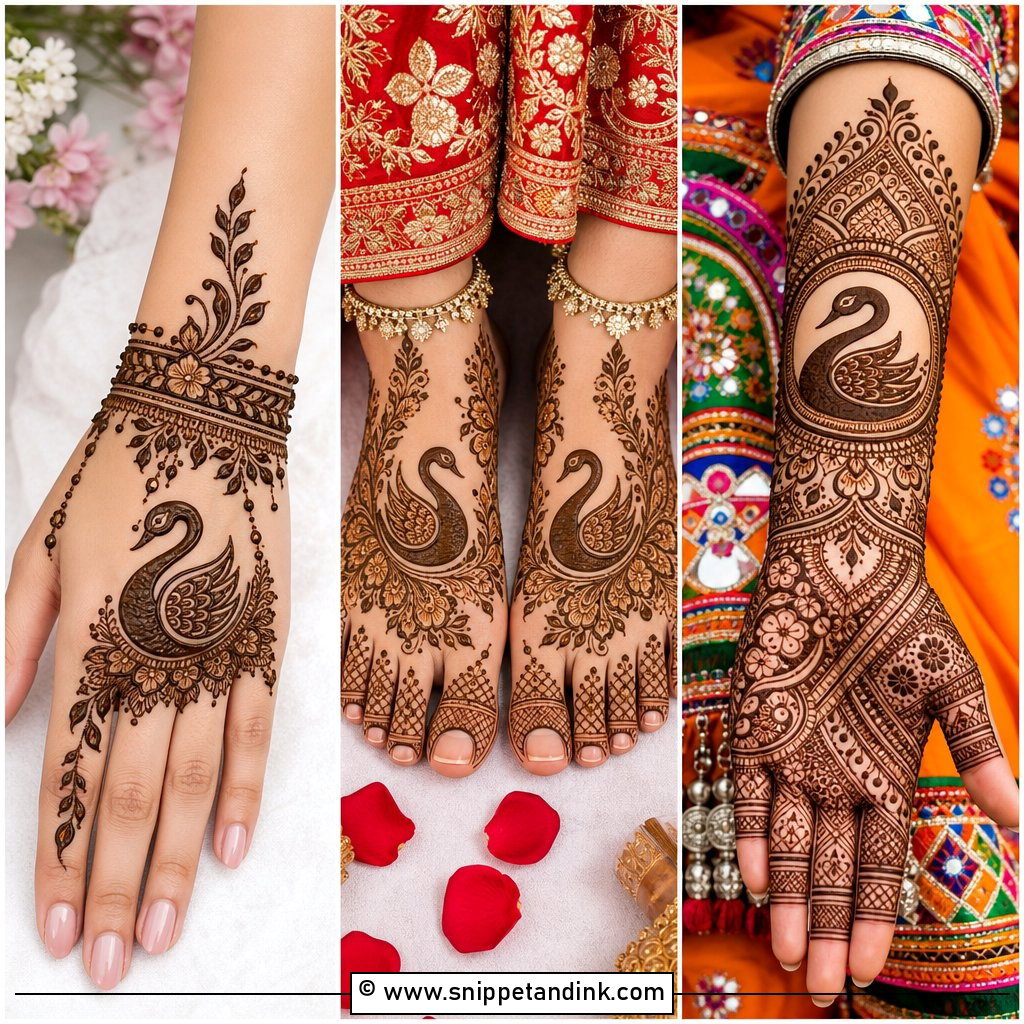
10. Peacock Bride Groom Mehndi Design
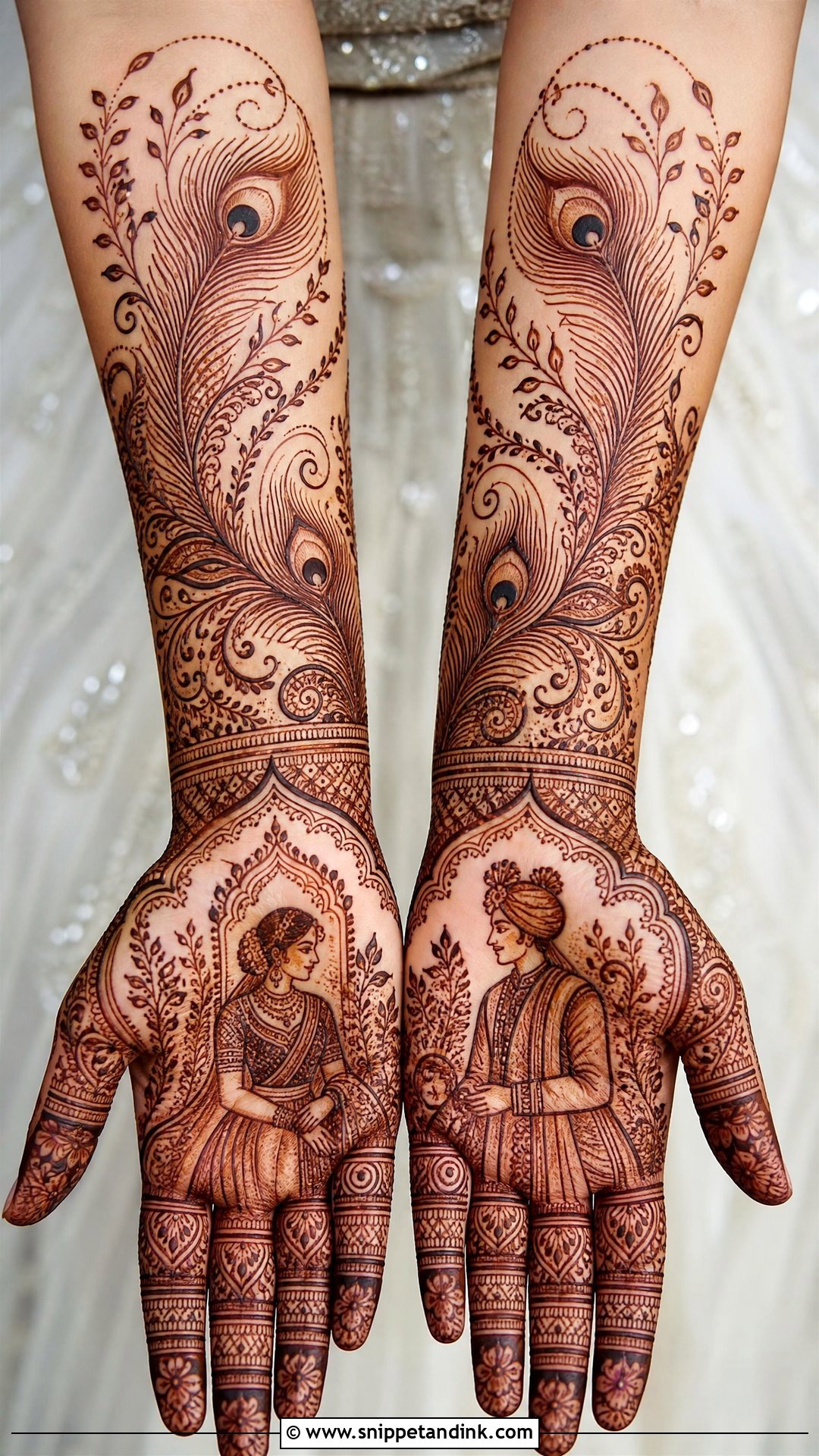
Peacocks fill large areas naturally because the curve of the neck and the fan of the feathers follow the shape of the palm and wrist. I often place the couple figures inside the feather flow or near the wrist, with paisleys, lotus petals and dotted chains around them. Bold outlines with fine inner feather lines keep the bird readable after the stain deepens. Grooms can wear one smaller feather with the bride’s initial. It’s one of the most forgiving full-hand designs for a first-time bride.
11. Bride Groom Wedding Date Mehndi Design
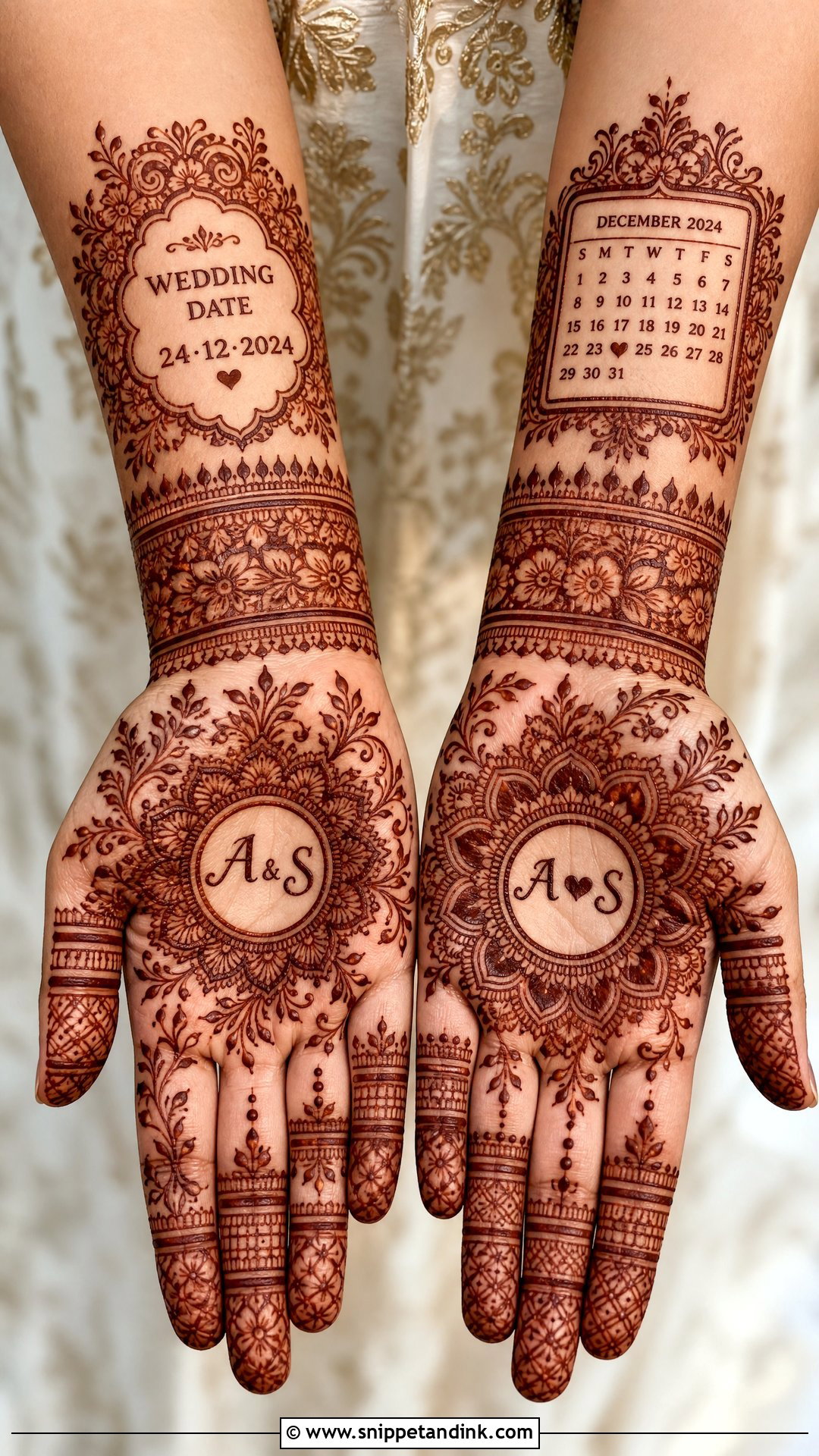
Putting the wedding date into the mehndi is a small, personal detail that combines easily with Indian, Arabic or minimal patterns. It can sit in a wrist bracelet, a mandala centre, a floral frame or a small box. The bride’s version can surround it with portraits and initials; the groom’s keeps it to a simple palm or wrist design. Numbers are where I’m most careful with spacing. An 8 next to a 0 can merge into one blot as the paste swells, so I leave a little more room between digits than looks necessary.
12. Bride Groom Hashtag Mehndi Design
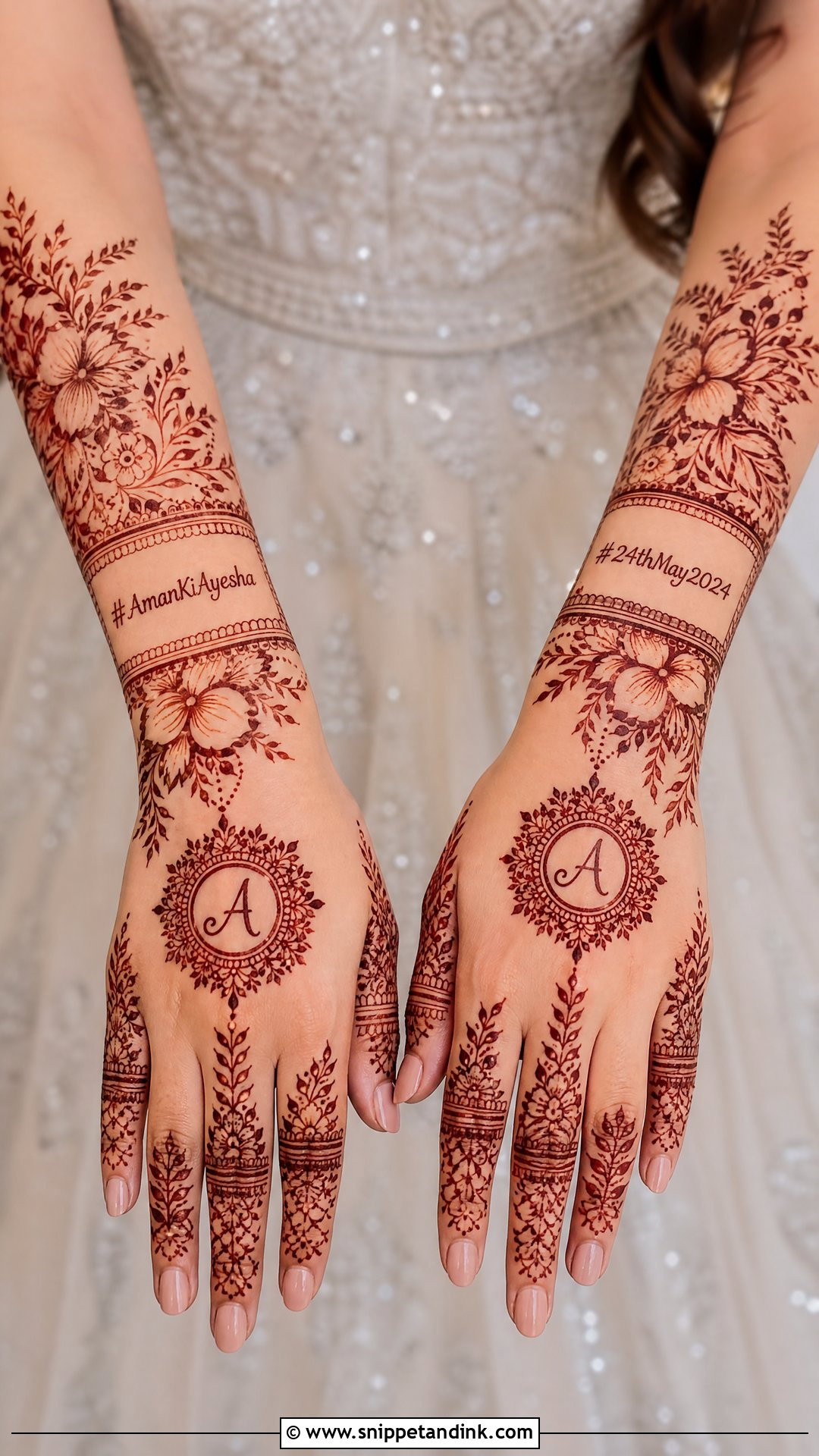
A hashtag along the wrist, inside a floral panel or between finger patterns is a modern detail guests spot straight away in mehndi photos. Brides can surround it with portraits, mandalas and vines; grooms can keep it to a wrist band and initials. The shorter the hashtag, the better. Long ones need a flat, smooth area of skin, so I place them on the inner forearm or across the palm rather than over the wrist crease, where letters fold and break when you move.
13. Bride Groom Engagement Mehndi Design
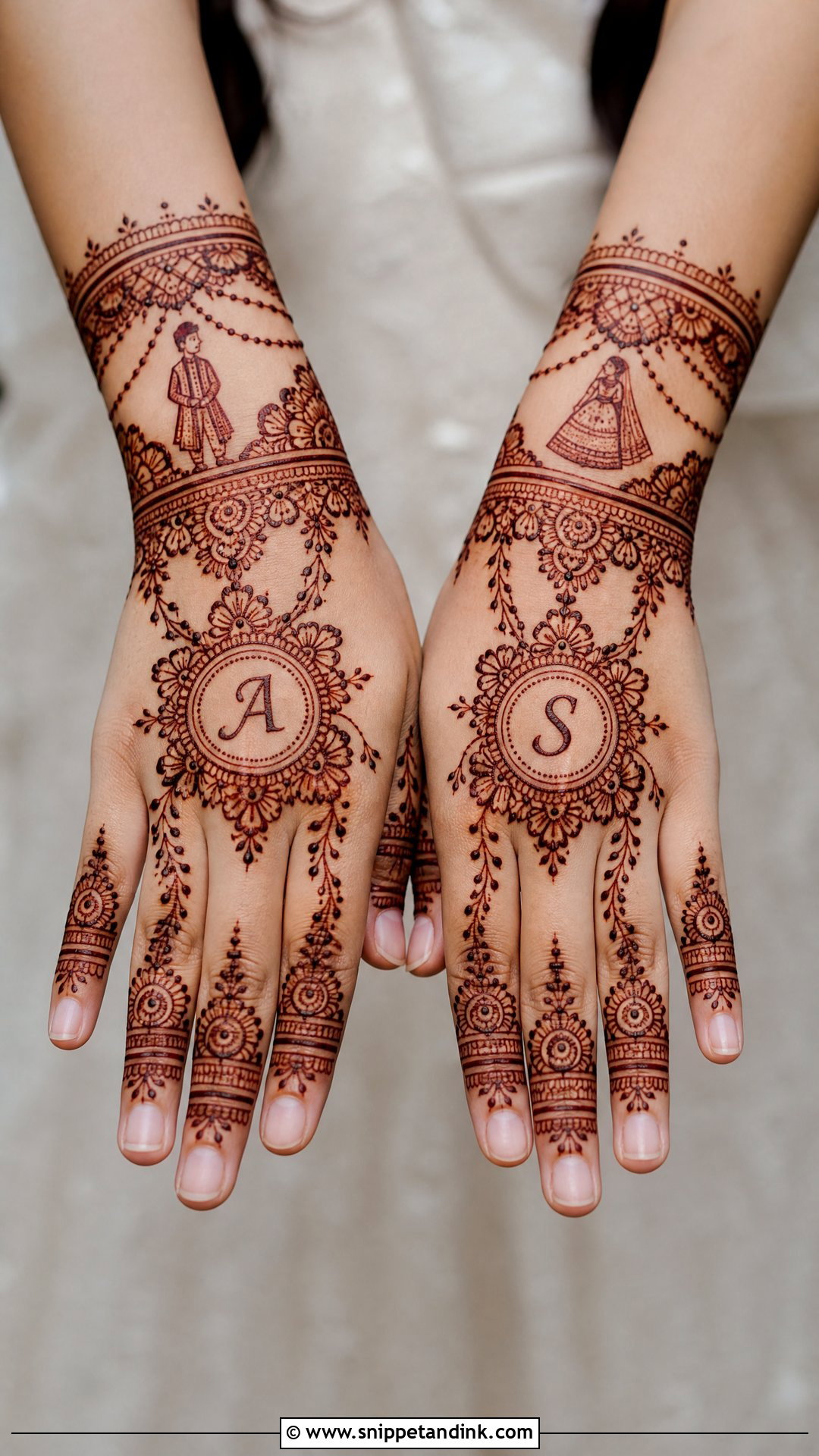
A bride groom engagement mehndi design should be lighter than full bridal work. For the bride, I usually do back-hand coverage with a ring motif, initials, floral trails and a bracelet wrist; for the groom, a small ring symbol, initial or palm mandala. Because engagement photos focus on the ring, I keep the ring finger and the area around it fairly open so the stone isn’t lost in pattern. A tiny dulha-dulhan figure near the wrist adds a traditional note if you want one.
14. Bride Groom Back Hand Mehndi Design
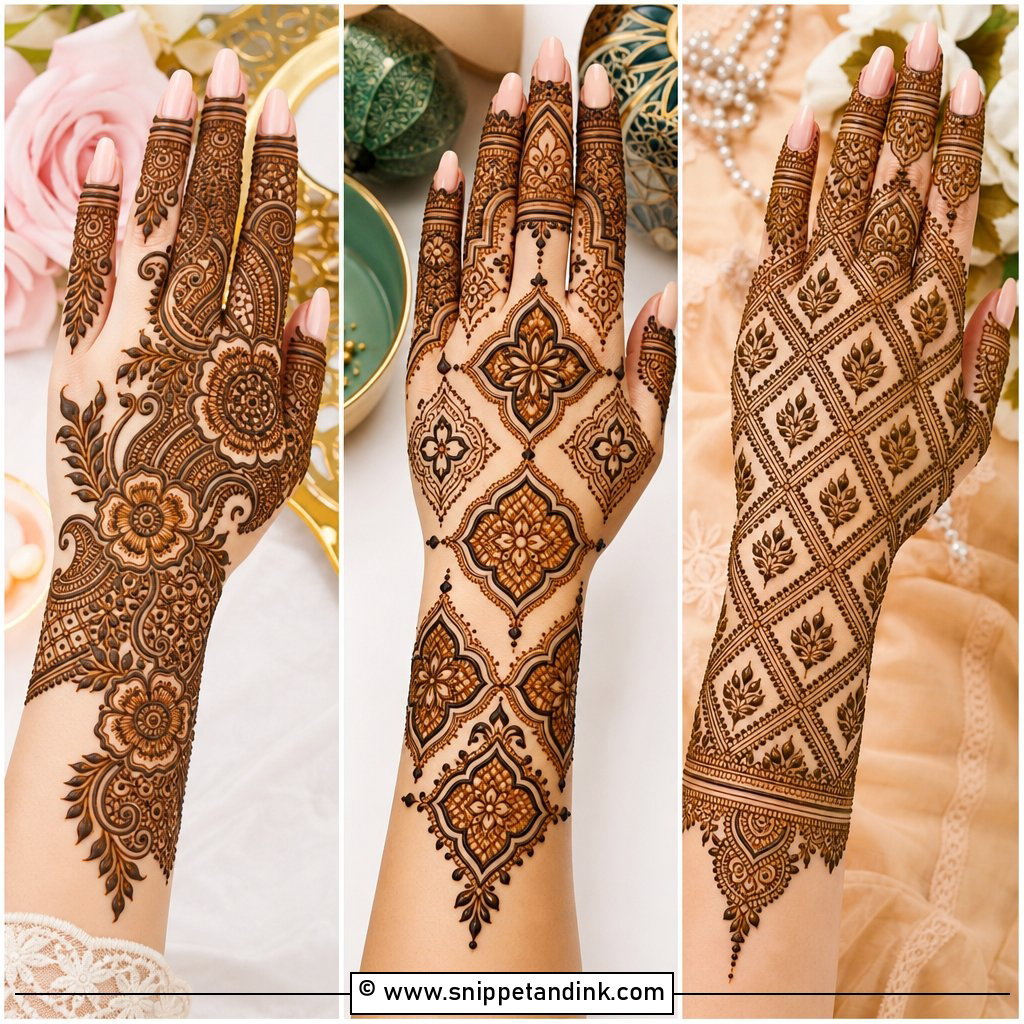
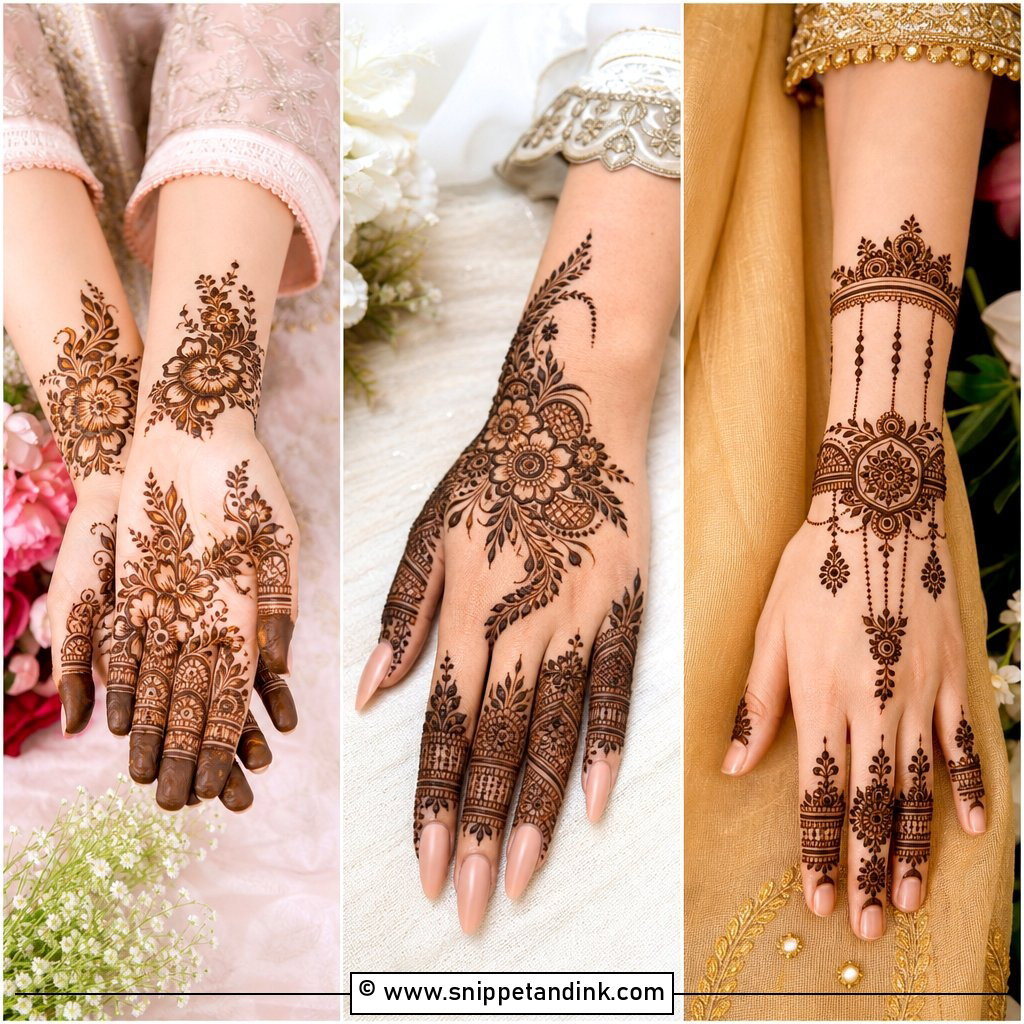
The back of the hand is what shows in ring and jewellery photos, so a couple design placed there gets seen. I usually start from a central mandala or floral frame, extend leafy vines and chains toward the fingers, and tuck initials or a small bride-groom silhouette near the wrist. One thing to know: the back of the hand stains lighter than the palm, because the skin is thinner and drier. Expect orange-brown rather than deep maroon there. A bracelet cuff at the wrist finishes it, and it suits bridesmaids or grooms too.
15. Bride Groom Palm Mehndi Design
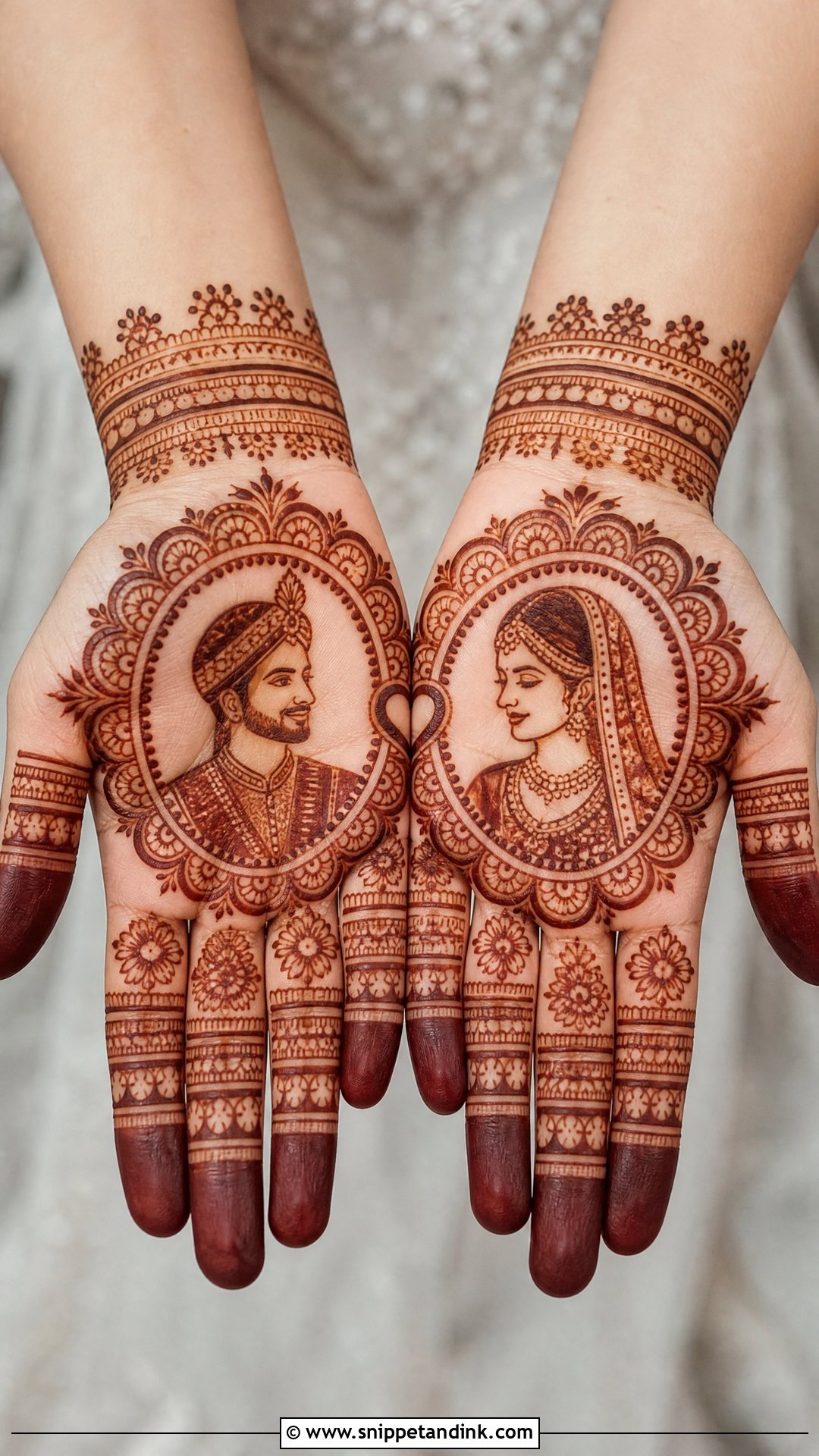
Palms take the darkest stain on the body, so a palm-centred design shows the story most clearly. One palm can hold the bride and the other the groom, or both can sit together inside a heart, mandala or arch. I keep the fingers simpler, with tips, paisley strips and floral rows, and the wrist light so the palm is the focus. It’s the most comfortable option for grooms, who often don’t want to sit for hours, and it gives you a clear photo moment at the ceremony.
16. Bride Groom Half Hand Mehndi Design
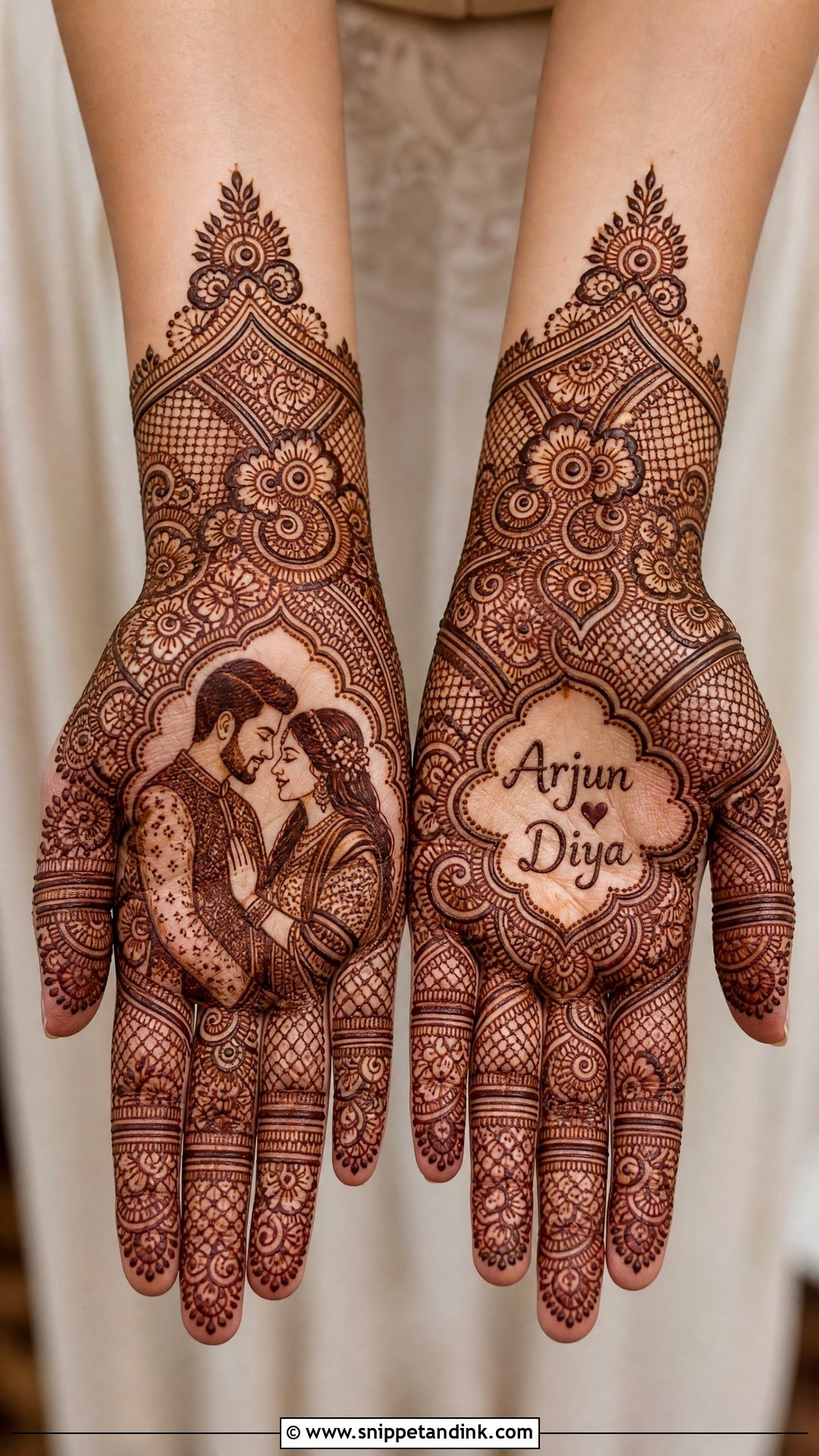
A half-hand layout covers the palm, fingers and wrist and stops before the mid-forearm. When I map one, I end the pattern just past the wrist crease with a clean border, because a design that trails off in the middle of the forearm looks unfinished. The couple element can be a small portrait, name frame or symbolic scene, with florals, paisleys and mesh around it. It’s much easier to sit through than full bridal coverage and suits destination and smaller weddings. The groom can match with initials on half the palm.
17. Bride Groom Full Arm Mehndi Design
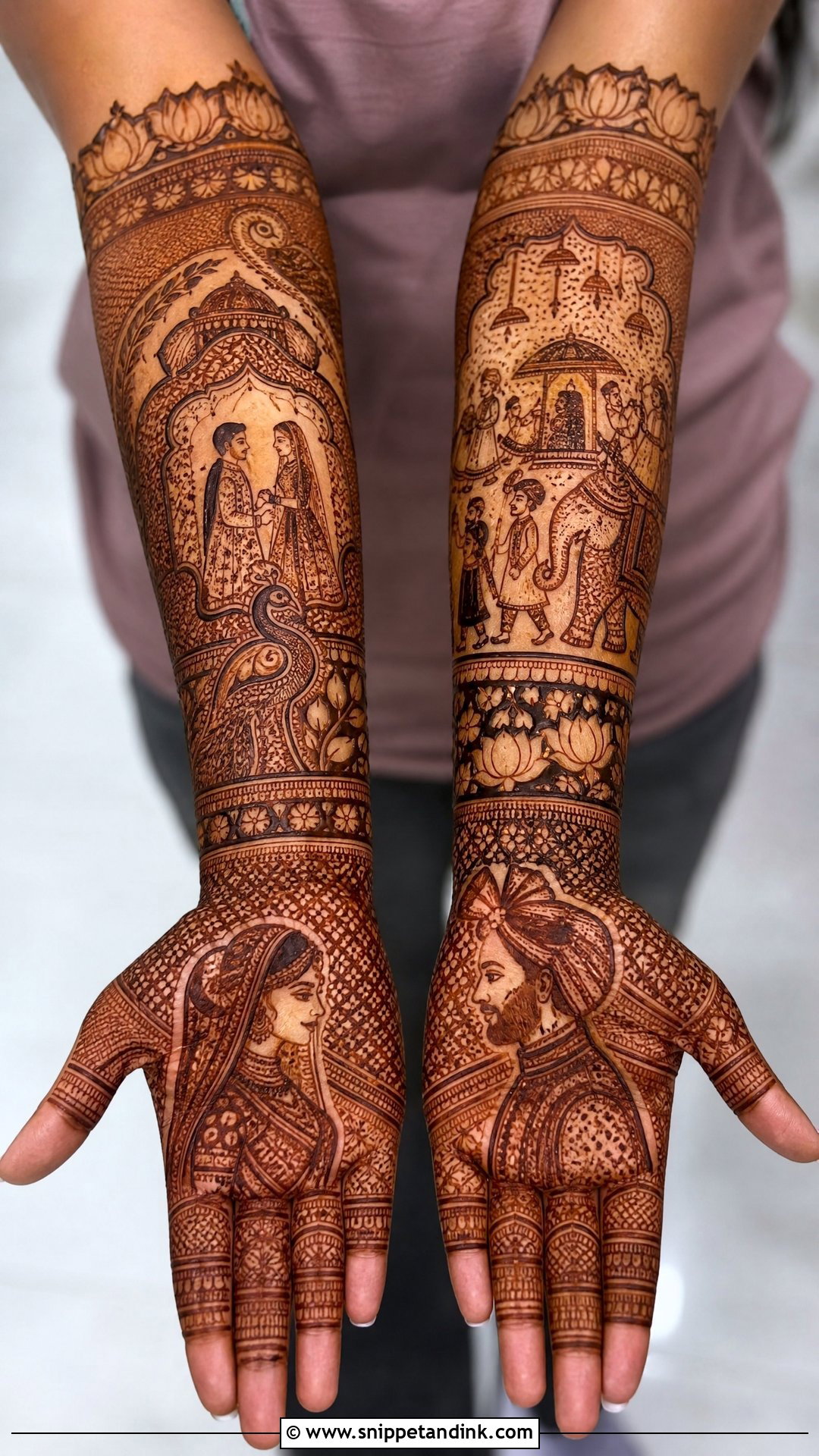
Full arm mehndi runs from fingertips to elbows with portraits, peacocks, lotus borders and procession scenes. The couple figures need a clear area, usually the palm or lower forearm, or they vanish in the density. This takes many hours, and the bride’s arms have to stay still while the paste dries, so I schedule breaks and have someone ready to feed her. I deliberately alternate heavy and open sections along the arm; that contrast is what stops a full arm looking like one flat dark sleeve in photos.
18. Bride Groom Couple Story Mehndi Design
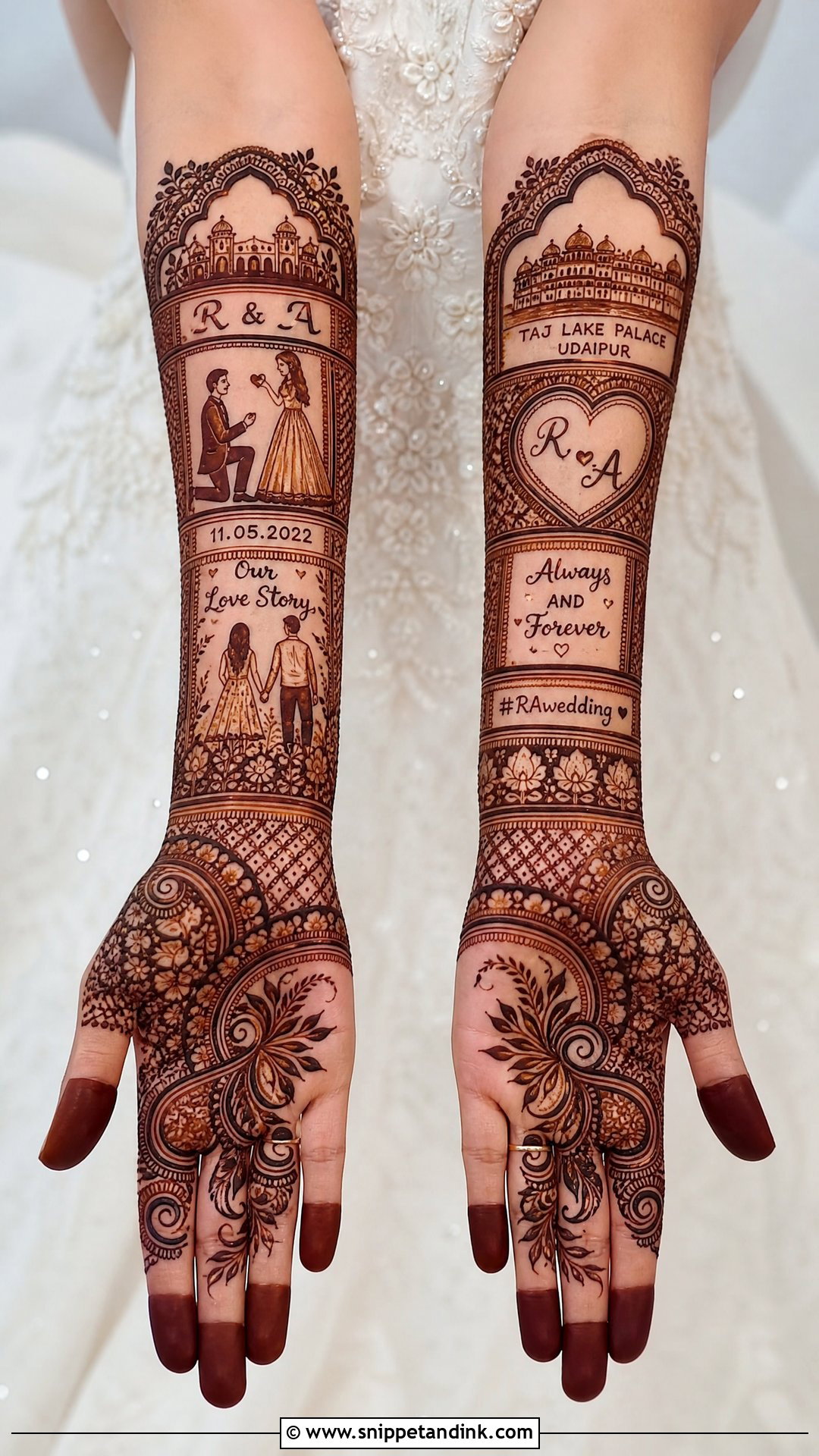
A couple story design goes beyond portraits to show small moments: a proposal symbol, a shared hobby, the venue’s outline, initials or a city skyline. I place them in panels across the palm, wrist and forearm and link them with florals, vines and jaali. The groom can carry one matching symbol. Plan this one before the appointment, not on the day. Send your artist reference images a week ahead so she can sketch the panels, because inventing six story elements while the paste is in the cone rarely looks clean.
19. Bride Groom Matching Mehndi Design
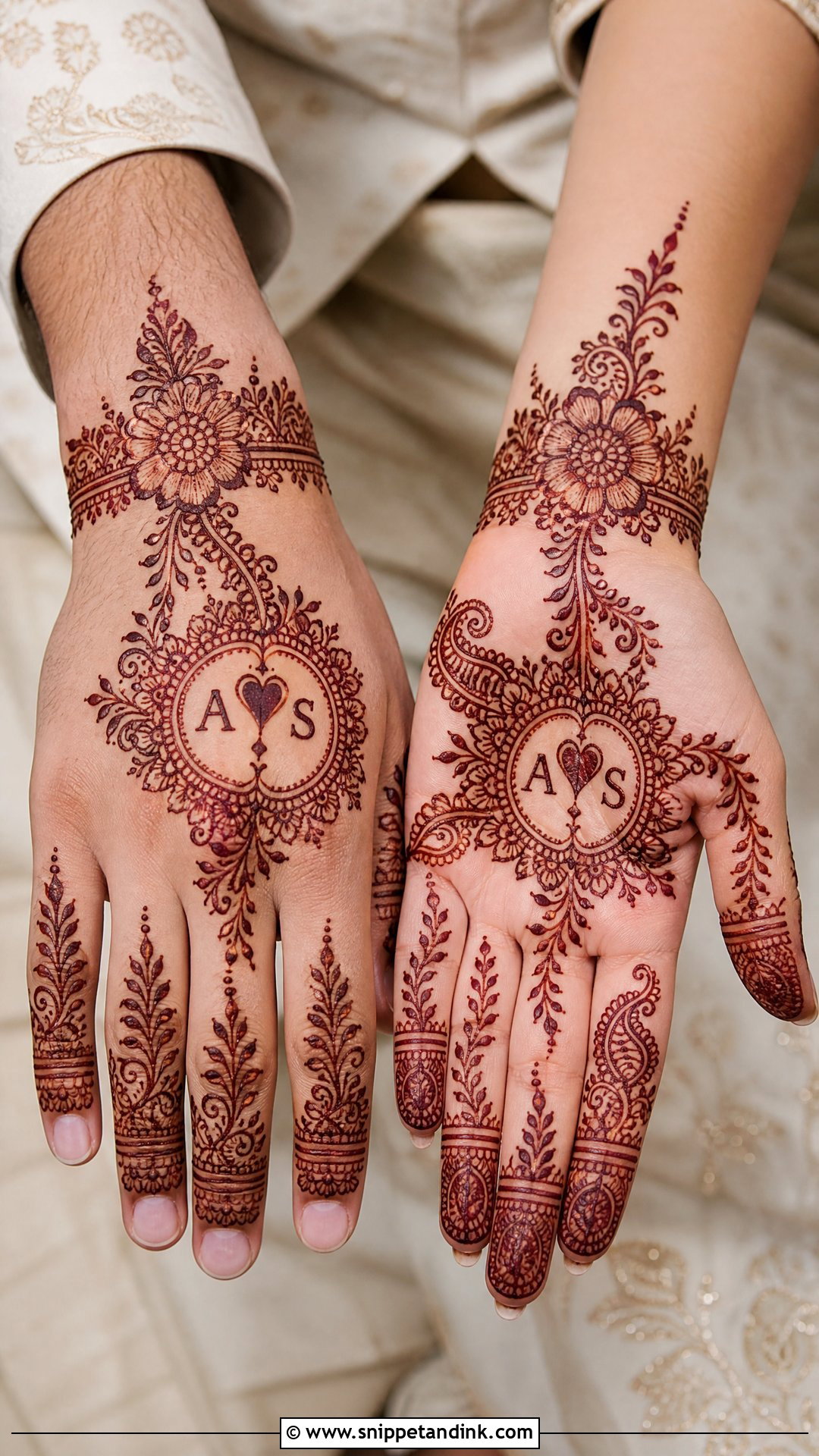
Matching doesn’t mean identical. I usually give the bride the fuller version with florals, mandalas, paisleys and hidden names, and the groom a simpler version built on the same central motif, initials or symbol. Matching wrist bands look neat in couple photos. You can also split one design across both partners’ hands: half a heart each, half a mandala, or connected initials that only join when you hold hands. Keep the shared motif bold so the match reads at a glance.
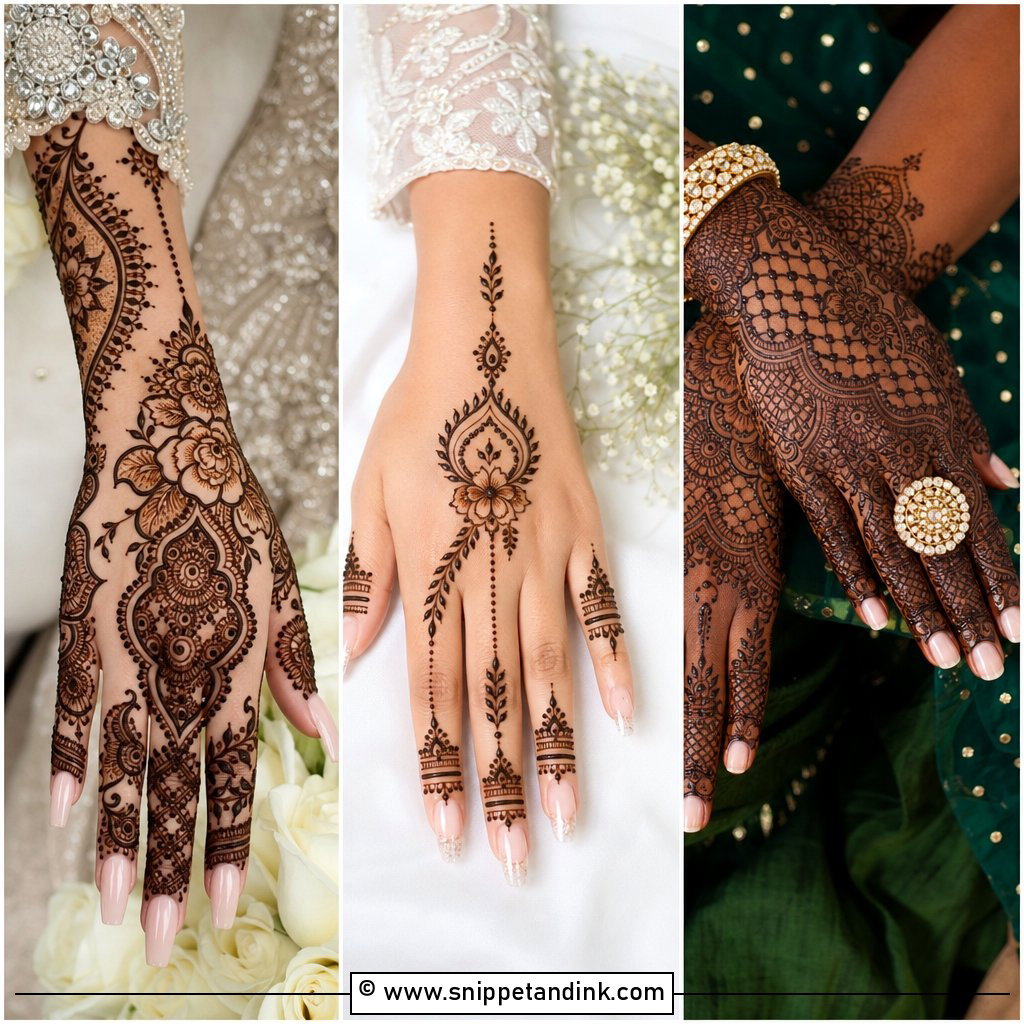
20. Groom Mehndi Design With Bride Name
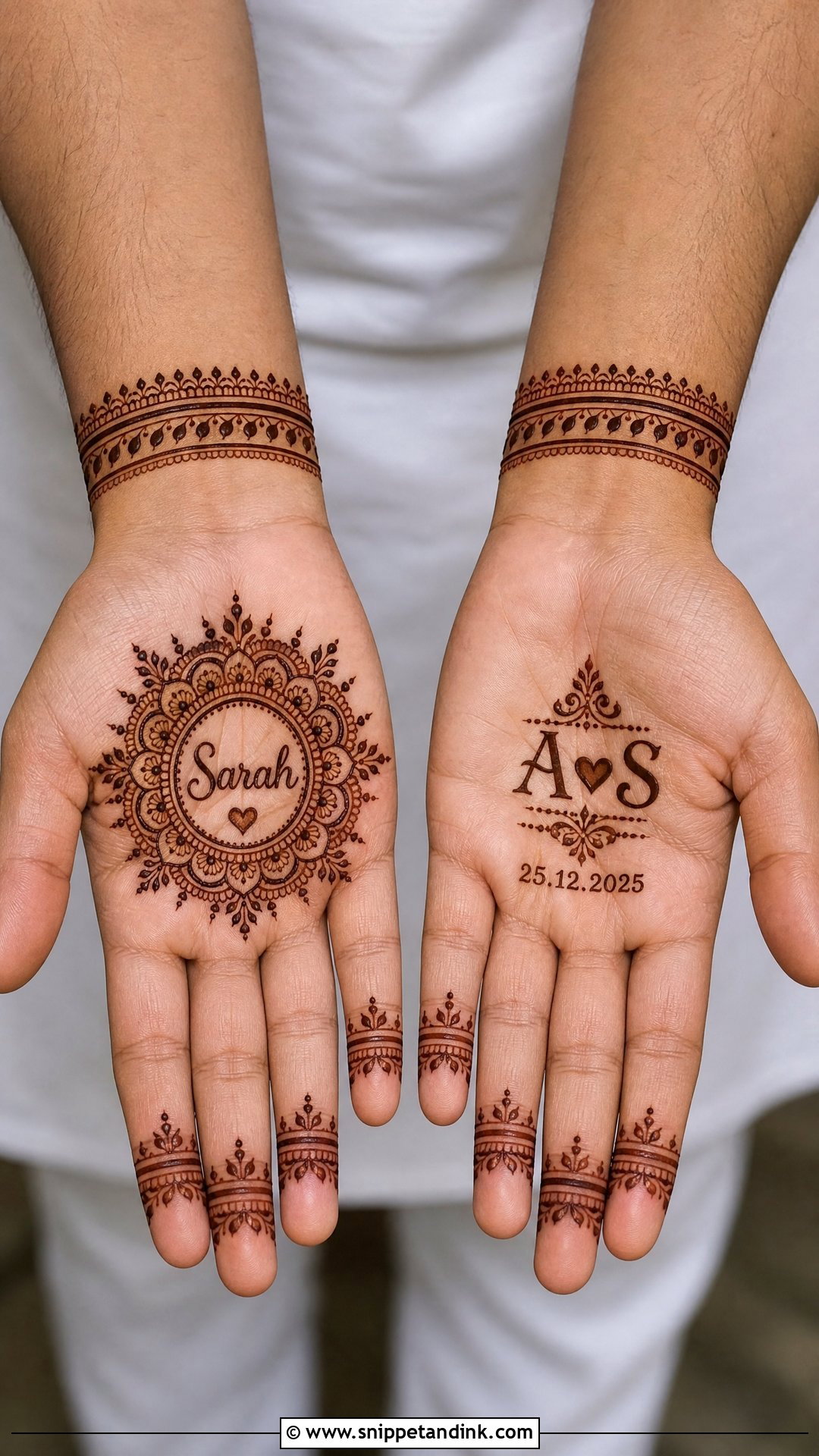
The groom’s palm with the bride’s name is simple and personal. The name can sit in the palm centre, inside a mandala, along a wrist band or in a small floral frame; some grooms do one hand, others both with initials, a date and a light border. It answers the bride’s hidden groom-name design nicely. I use cleaner lines and wider spacing for grooms who want something subtle. Palm skin on most men is thick and stains well, so even a light design develops a strong reddish-brown.
Getting a Deep Stain on Both of You, Groom Included
The longer the paste stays on, the darker the stain. I ask brides to keep it on for at least six to eight hours, and overnight if they can. Once it’s dry to the touch, I dab on a lemon and sugar mix so the paste stays stuck to the skin instead of cracking off. Wrapping the hands loosely, or keeping them warm, helps the dye release.
Grooms are usually the weak link here. They wash their hands after an hour because the paste feels strange, and then wonder why the bride’s name is pale orange in the photos. If you only have a small palm design, it still needs the same care to stain well.
- Scrape the dry paste off with a blunt edge or your fingers. Don’t wash it off.
- Keep water off the design for as long as you can, ideally the rest of that day.
- Rub a little natural oil or balm over the area before showering for the first couple of days.
- Skip hand sanitiser, scrubs and bleach-based cleaners until after the wedding; they fade the stain fast.
A good stain lasts one to three weeks, fading as the top layer of skin renews. Palms and fingertips hold it longest; the back of the hand and forearms fade first.
Two Sets of Hands, One Story Told in Henna
Couple mehndi can hold names, portraits, promises and cultural meaning in a few hours of work. Full traditional coverage, Arabic trails, matching designs or one name on the groom’s palm can all be right, depending on how much hand space you have, how heavy your outfit is, the ceremony and how long you can sit. Bring your spelling, references and timing to the artist in advance, and these designs become part of the wedding’s story rather than decoration on top of it.
You'll Like These Ideas:





Leave a Reply