
Some designs I’ve been drawing for as long as I’ve held a cone, and they still get requested every season. Traditional mehndi turns up at weddings, festivals, family gatherings, Eid, Karwa Chauth, Diwali, sangeet nights and quiet celebrations at home. It balances old motifs with coverage you can actually live in: paisleys, mandalas, lotus blooms, peacocks, jaali, leafy vines, bold Arabic trails and dense Indian bridal filling. A few of the 35 below are ceremonial and take an afternoon; others are neat enough for a first-timer or a guest. For each one I’ve noted what it asks of you and how it wears.
What the Old Motifs Stand For, So You Can Pick Them on Purpose
Brides and their mothers often ask me what a motif means before they agree to it. The readings vary between families and regions, and nobody owns a single definition, but these are the meanings I hear most often at the chair.
- Paisley (keri or mango): fertility and abundance, which is why it fills so much bridal work.
- Peacock: beauty, love and grace; often paired with a second peacock across the other hand.
- Lotus: purity and new beginnings, a natural choice for pooja and wedding rituals.
- Kalash and diya: prosperity and light, common at Diwali and in Hindu wedding designs.
- Elephant and doli: royalty, good fortune and the bride’s journey to her new home.
- Hidden initials: the groom’s name tucked into the filling, for him to search for later.
If you’re mixing traditions, tell your artist. Some families prefer to avoid figures or certain religious symbols, and it’s far easier to plan around that before the first line than to cover something afterwards.
1. Full Hand Indian Bridal Mehndi Design
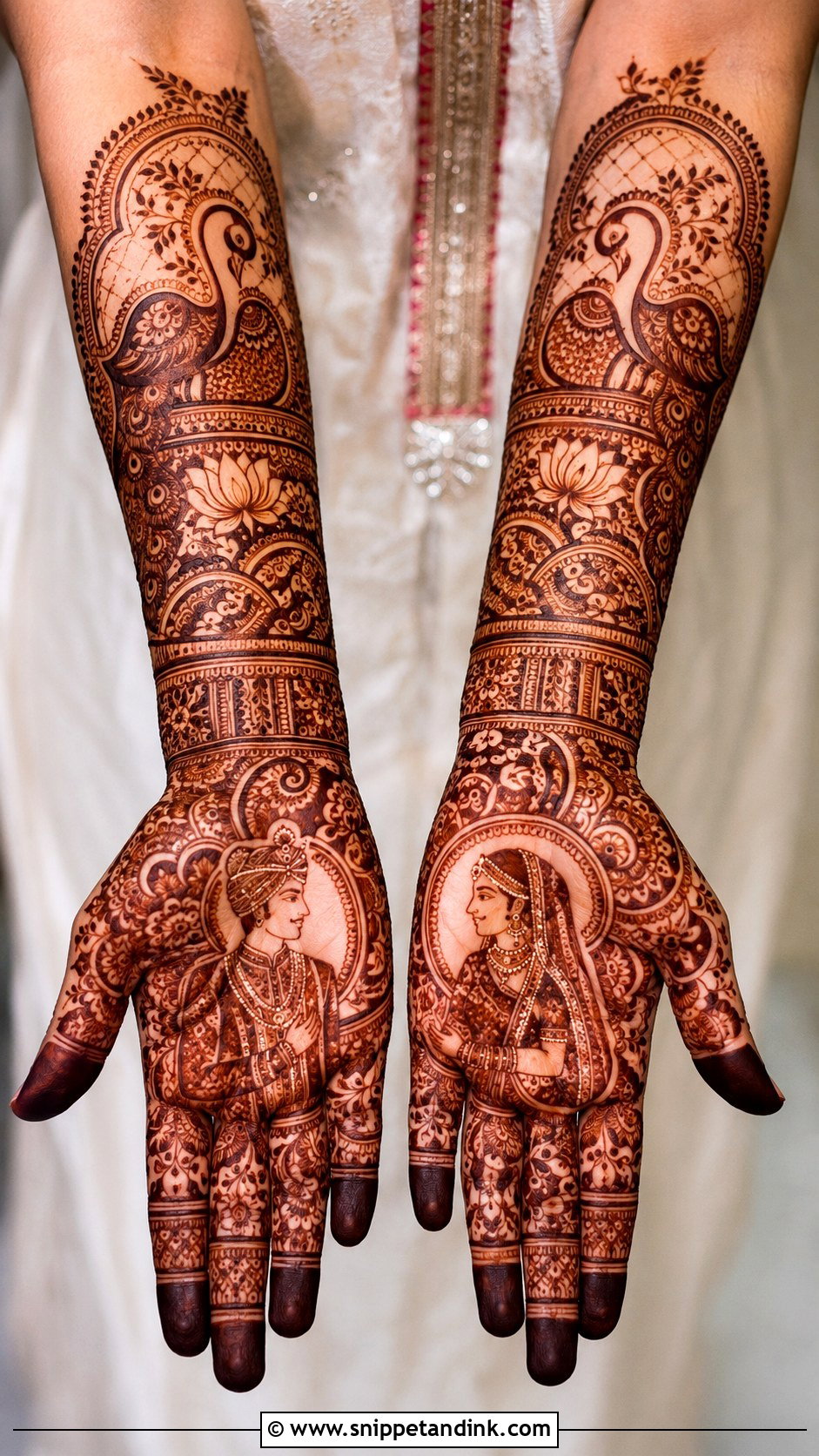
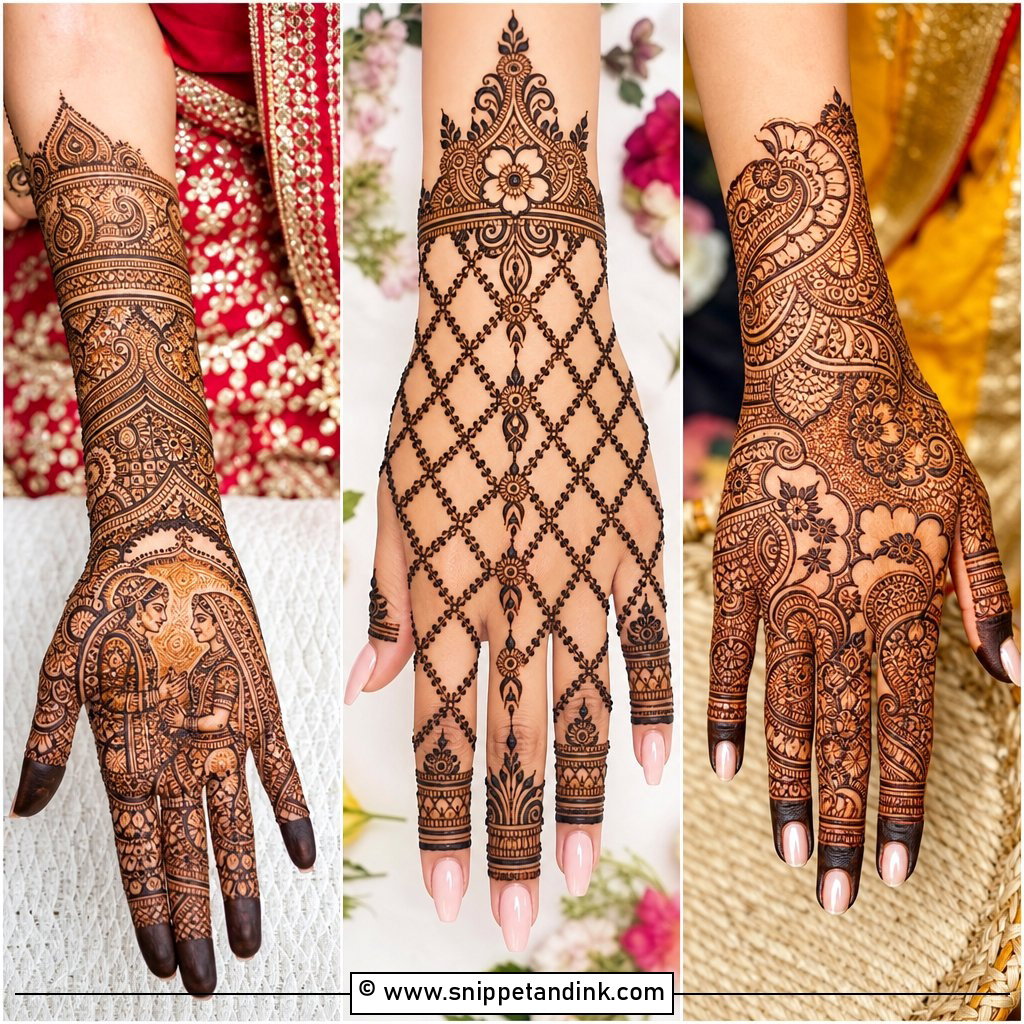
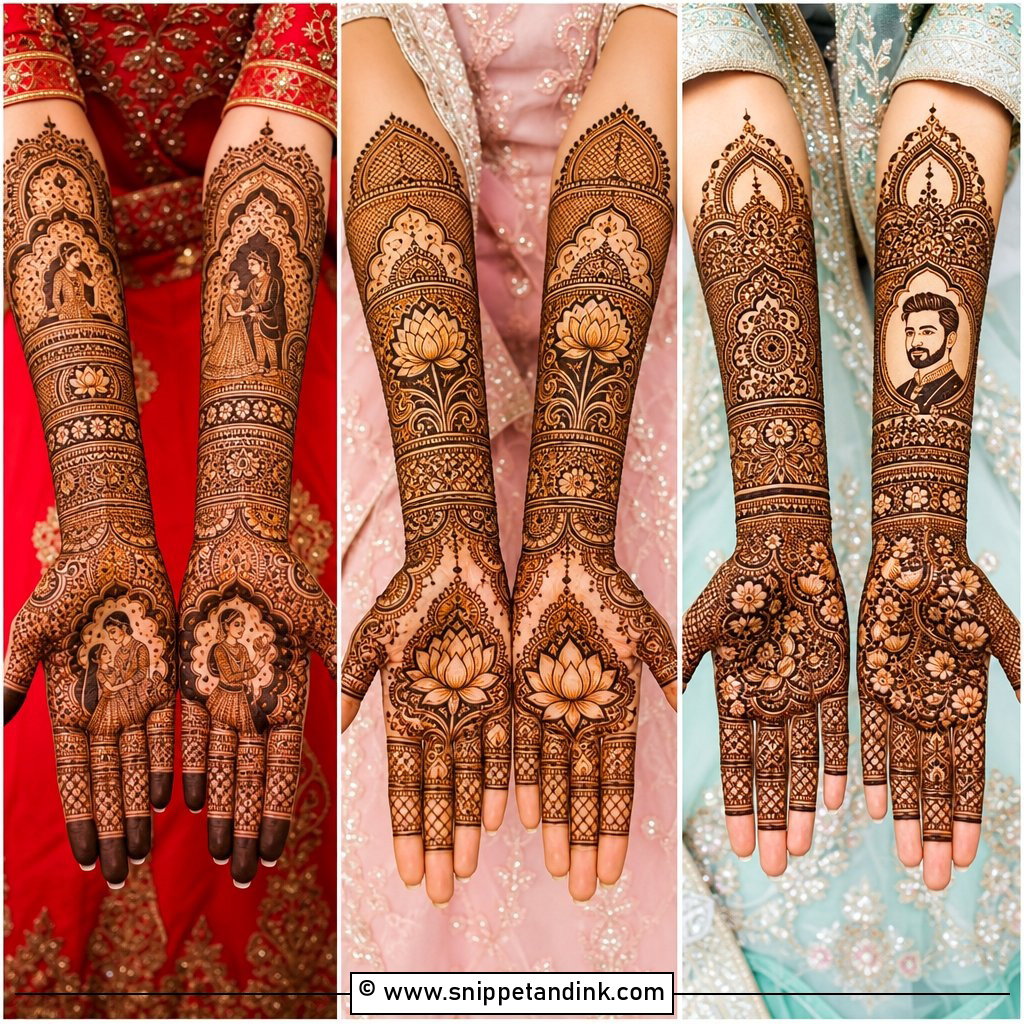
Dense detail from fingertips to forearm, with paisleys, peacocks, lotus motifs, bride and groom figures, fine dots, leafy borders and layered bands all working as one story. There’s very little empty skin, which gives the deepest overall stain. I keep the palm centre bold and let the forearm grow gradually through vines, arches and ornamental borders. Expect a long sitting. Most brides I work with have this done a day or two before the wedding so the colour peaks on the day.
2. Traditional Arabic Mehndi Design
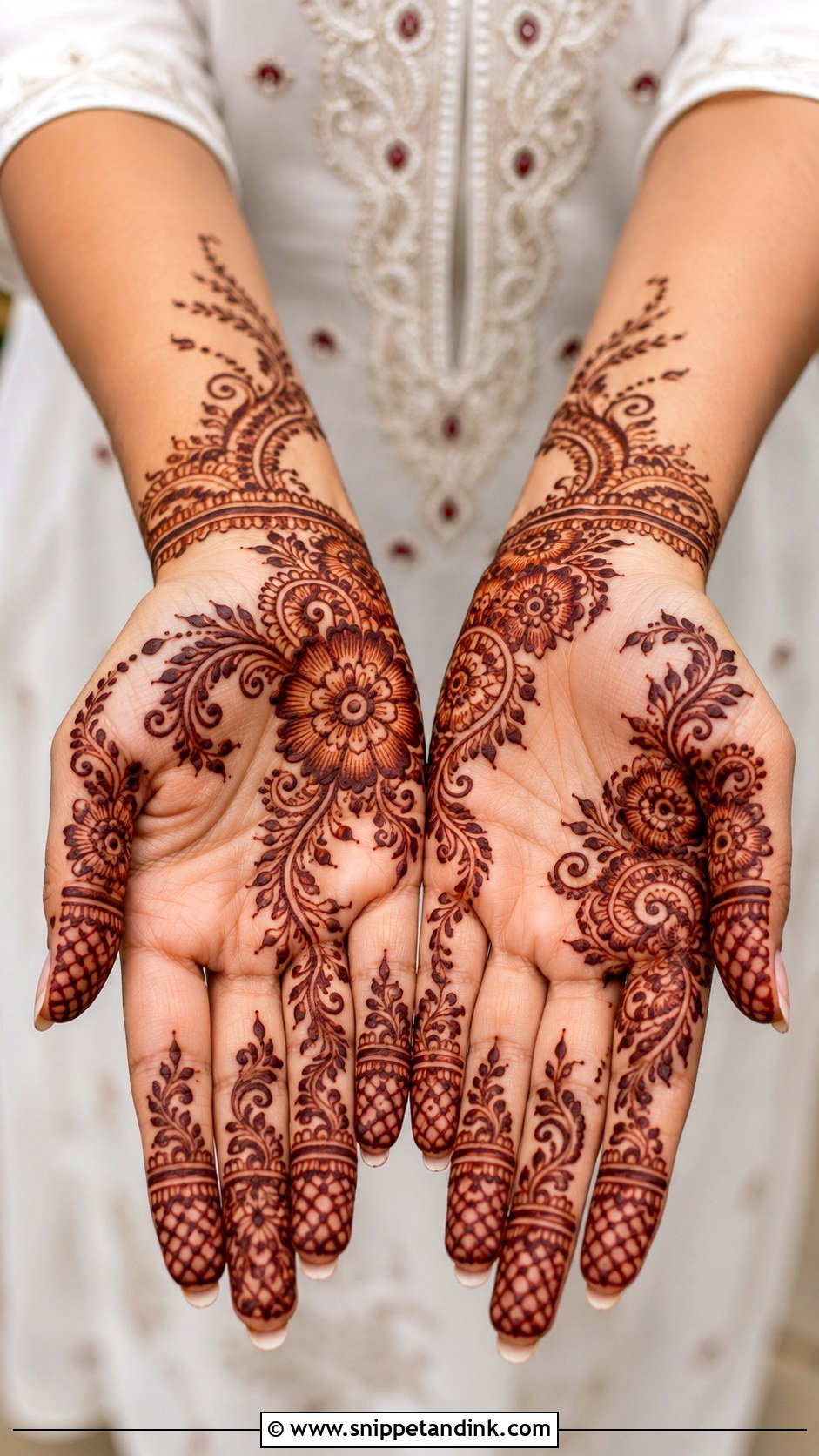
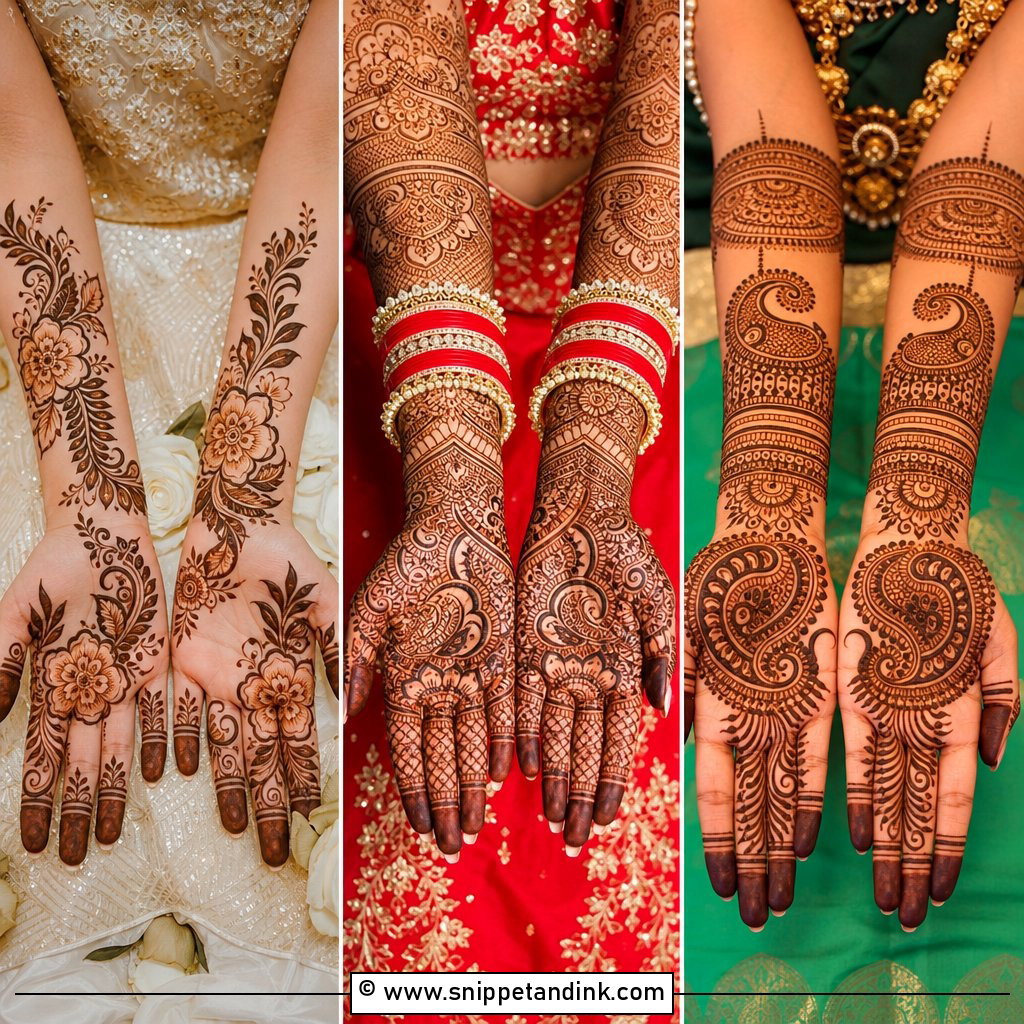
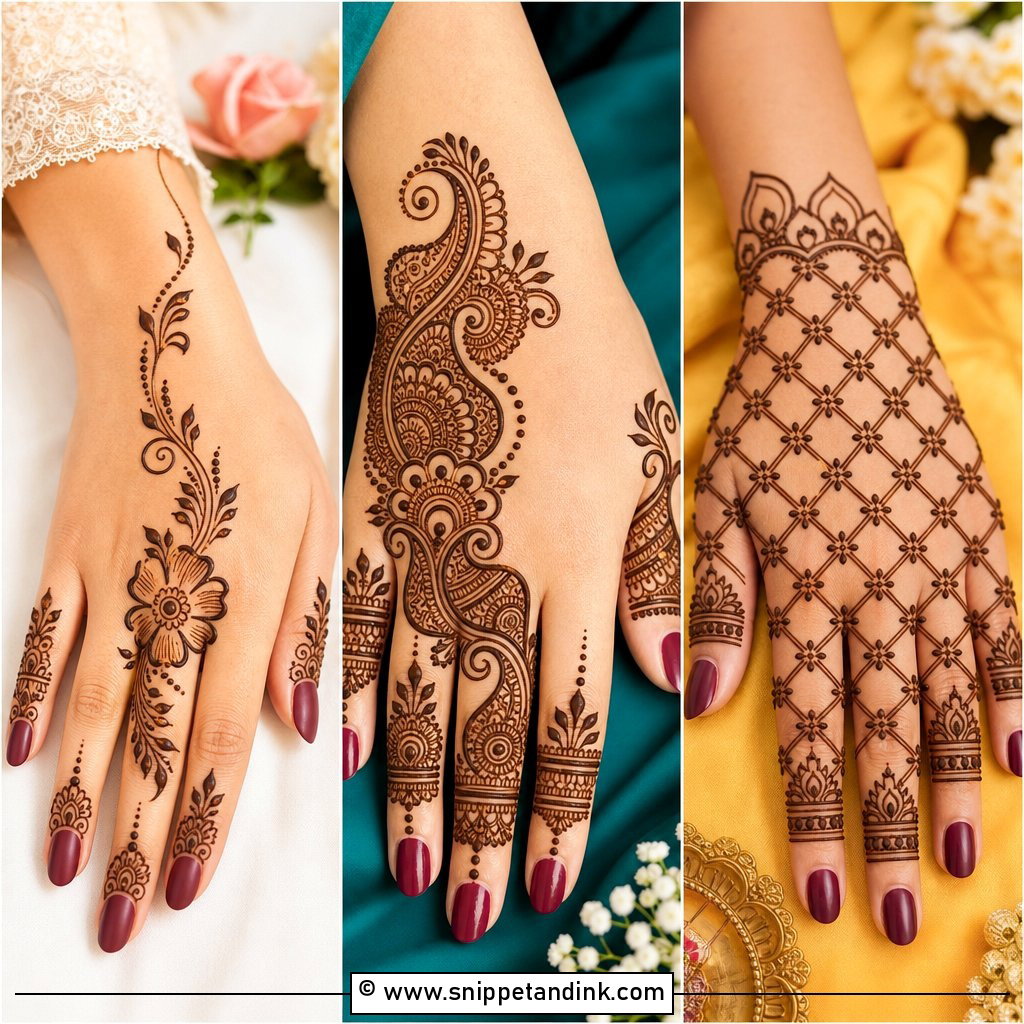
Arabic henna has its own tradition, built on large flowers, leafy trails, paisley curves and open skin rather than tiny filling. The pattern usually runs diagonally from one side of the palm toward the wrist or forearm, with slim leafy bands, dots or half florals on the fingers. Guests love it because it looks festive in a fraction of the time. The open spacing is also why its stain looks so crisp: thick lines on bare skin read darker than fine lines packed together.
3. Indo Arabic Mehndi Design
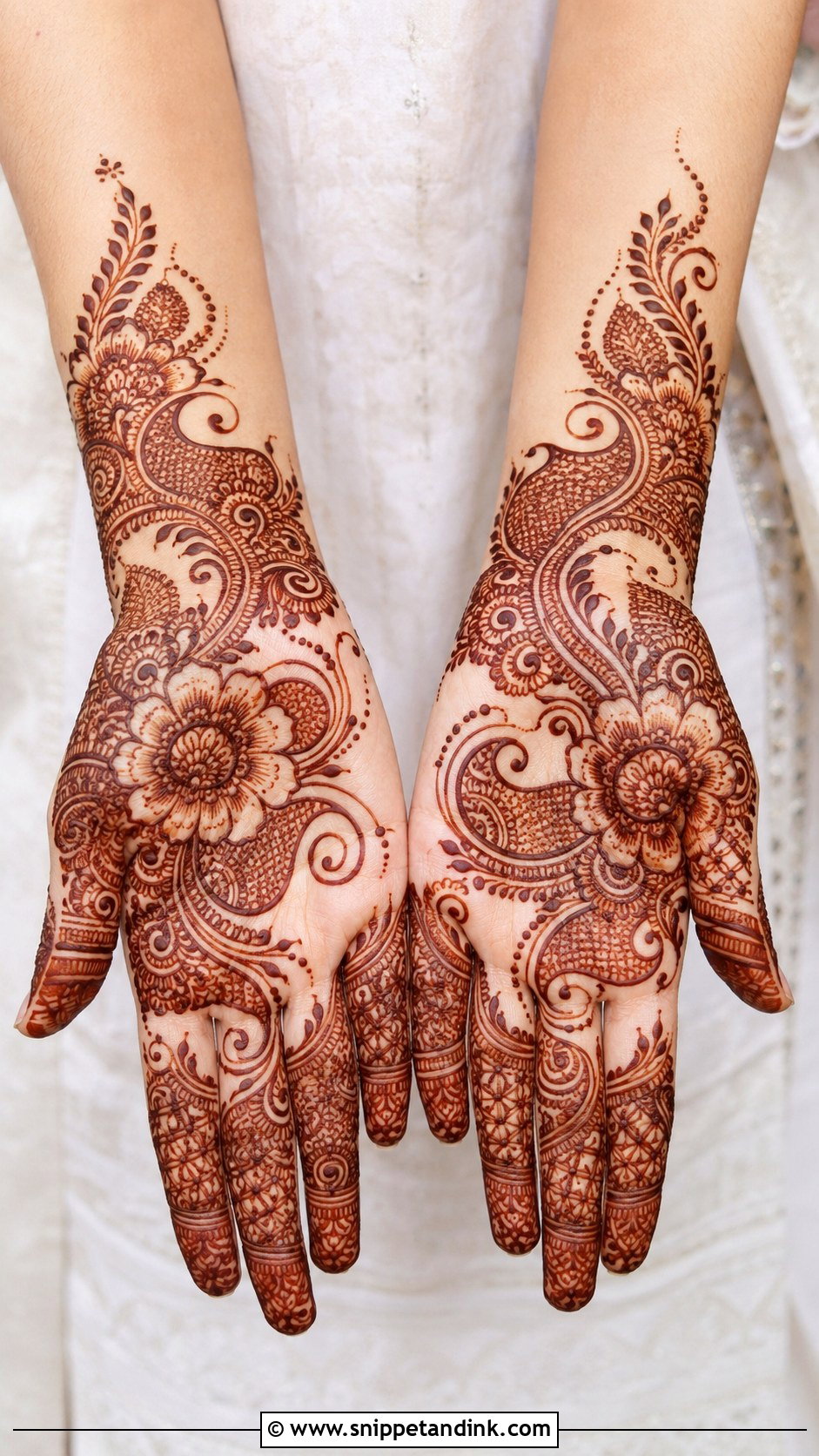
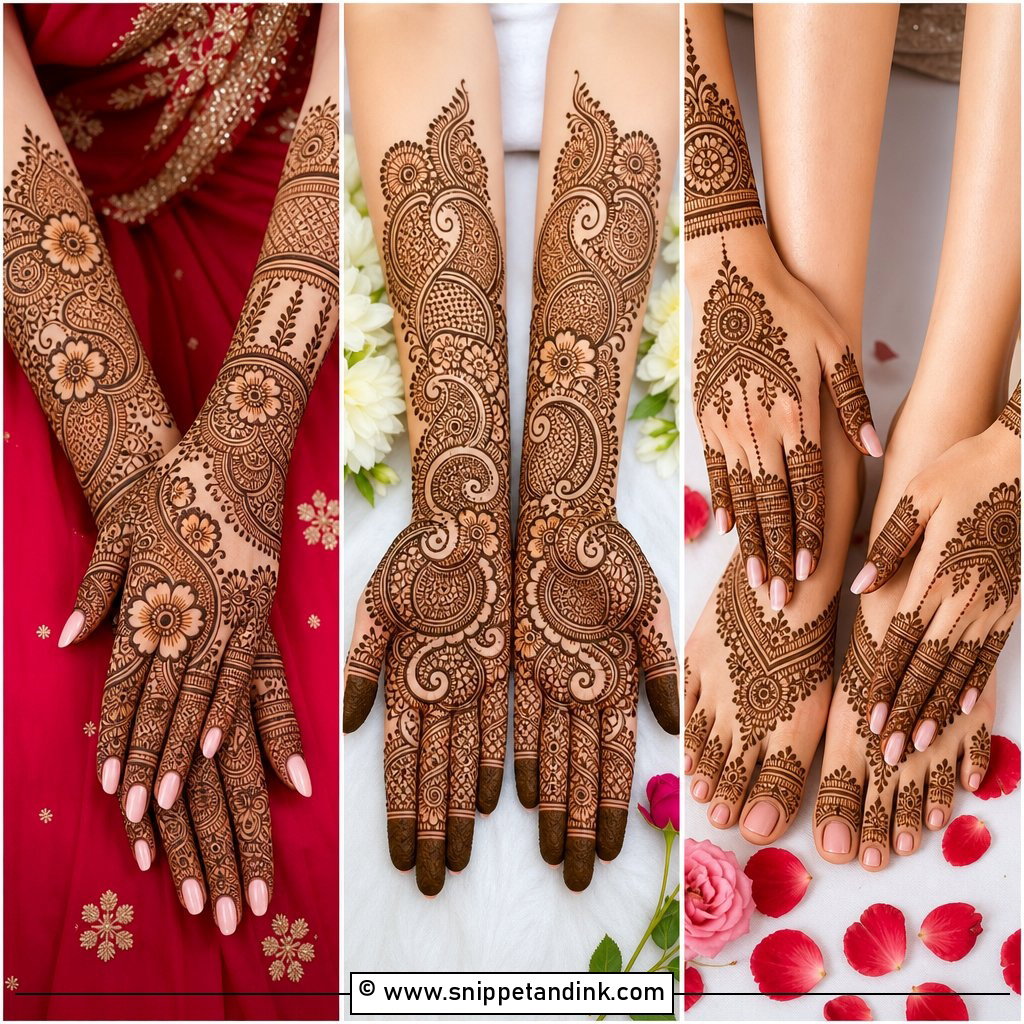
Indo-Arabic borrows the flow of Arabic work and fills it with Indian detail: large flowers, paisleys, curved trails and vines, with dots, checks, swirls and tiny petals inside. You get richness without crowding. I place one bold motif on the palm, extend it to the wrist with matching bands, and leave the fingers semi-filled. It’s a popular middle ground for bridesmaids and engagement ceremonies, and it applies noticeably faster than full Indian coverage.
4. Front Hand Mandala Mehndi Design
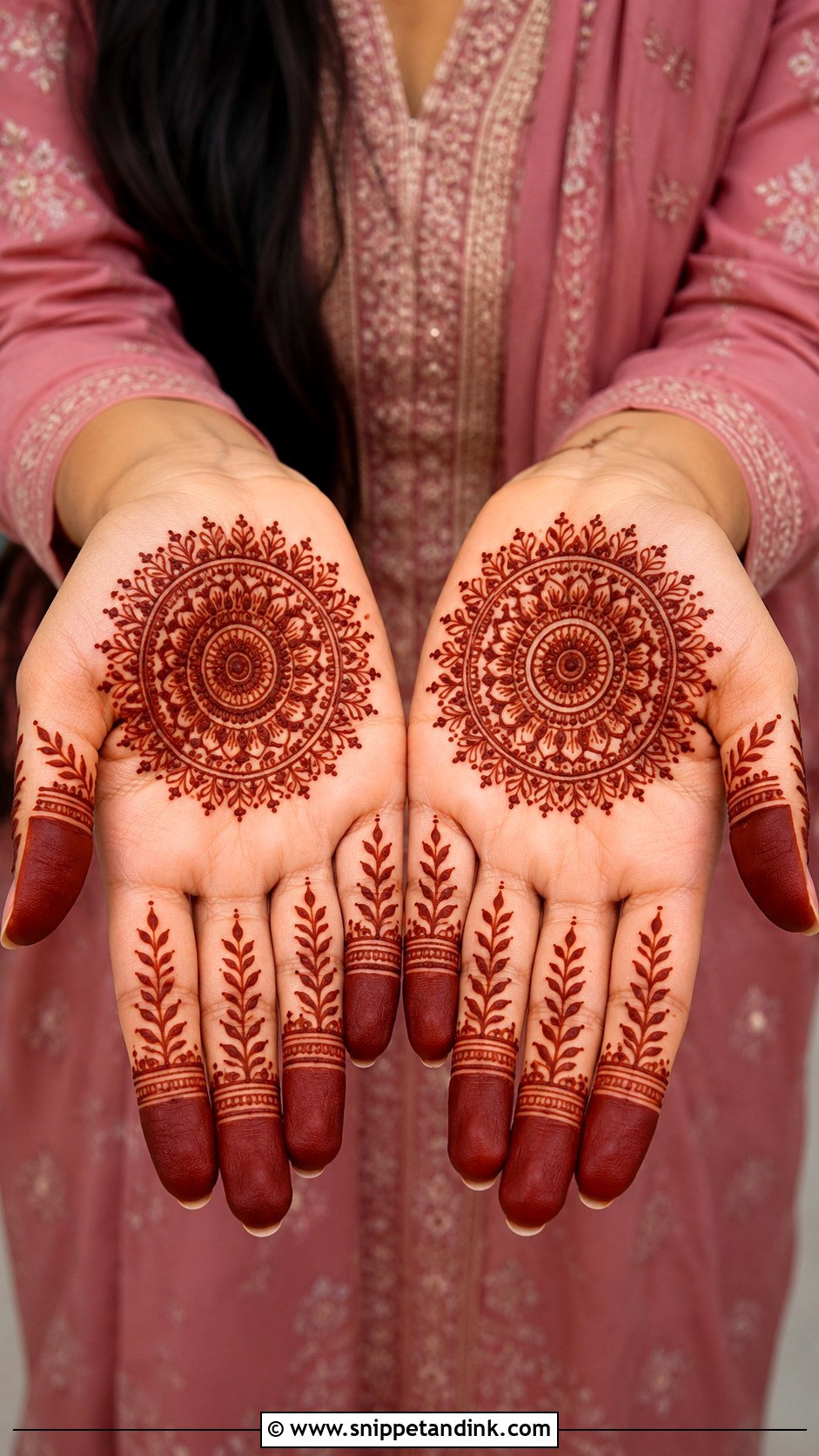
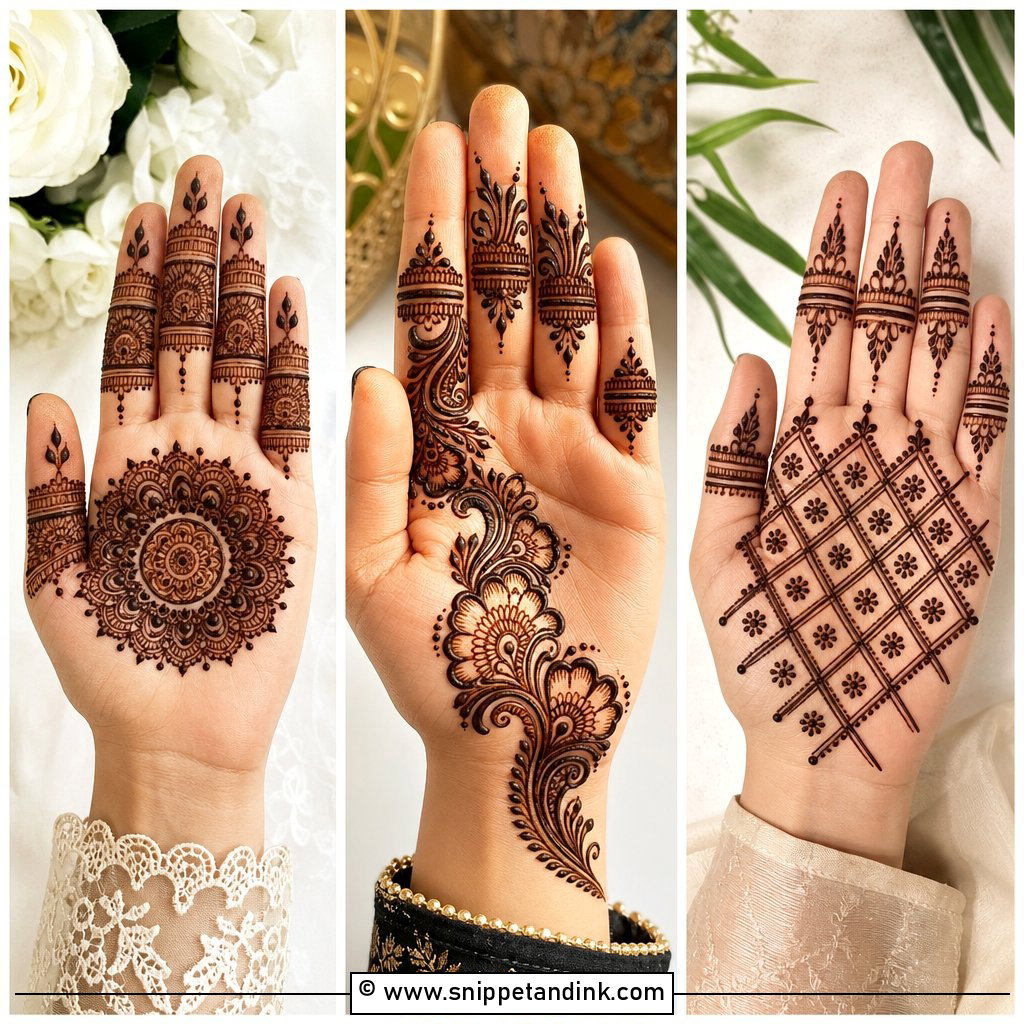
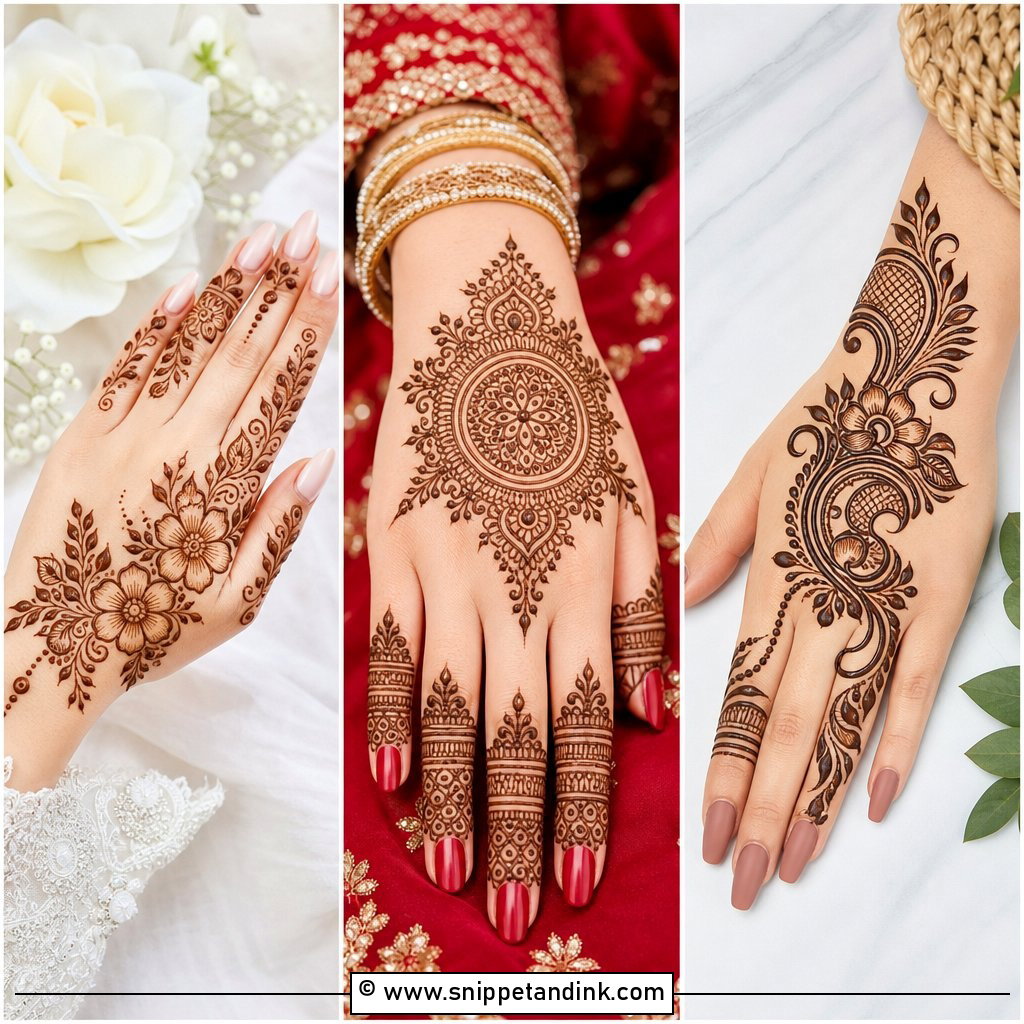
The palm mandala is about as traditional as henna gets: a circle in the centre ringed by small petals, dots, leafy rings and fine borders, with matching tips, slim lines, tiny flowers or net on the fingers. It’s easy to follow, which is why I teach it first, and it suits puja, Eid, Raksha Bandhan and Diwali equally. Leave a clean band of skin around the circle. When fillers press right up against a mandala, the centre gets lost once the stain darkens.
5. Back Hand Mandala Mehndi Design
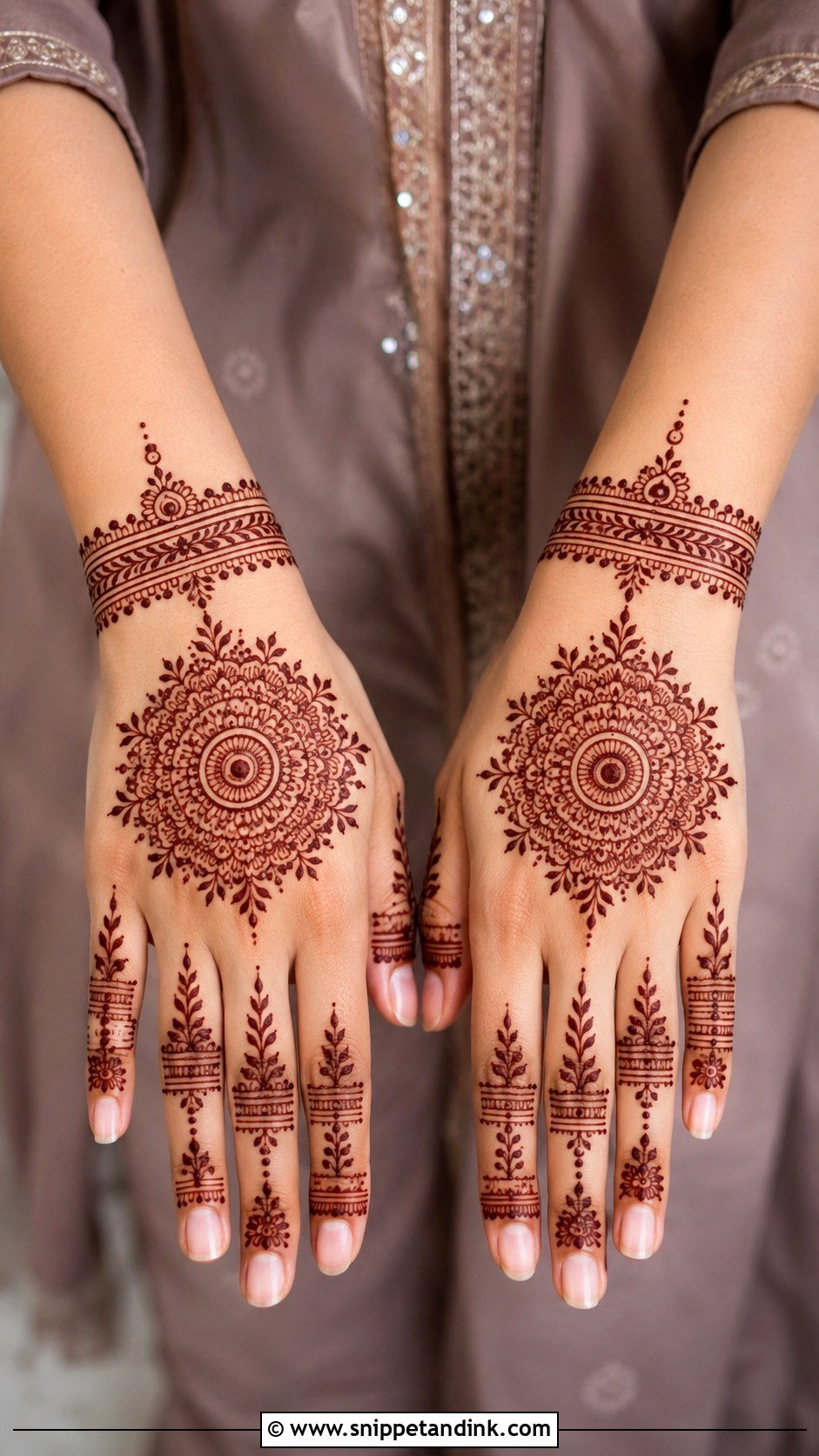
On the back of the hand, a mandala looks neat without full coverage. The circle sits in the middle, the fingers get small bands, dots, leafy tips and curves, and some versions link to a bracelet pattern at the wrist. Sisters of the bride, teens and guests ask for it often. The back of the hand stains paler than the palm, so I thicken the outer ring slightly to hold the circle’s shape in photos.
6. Peacock Mehndi Design
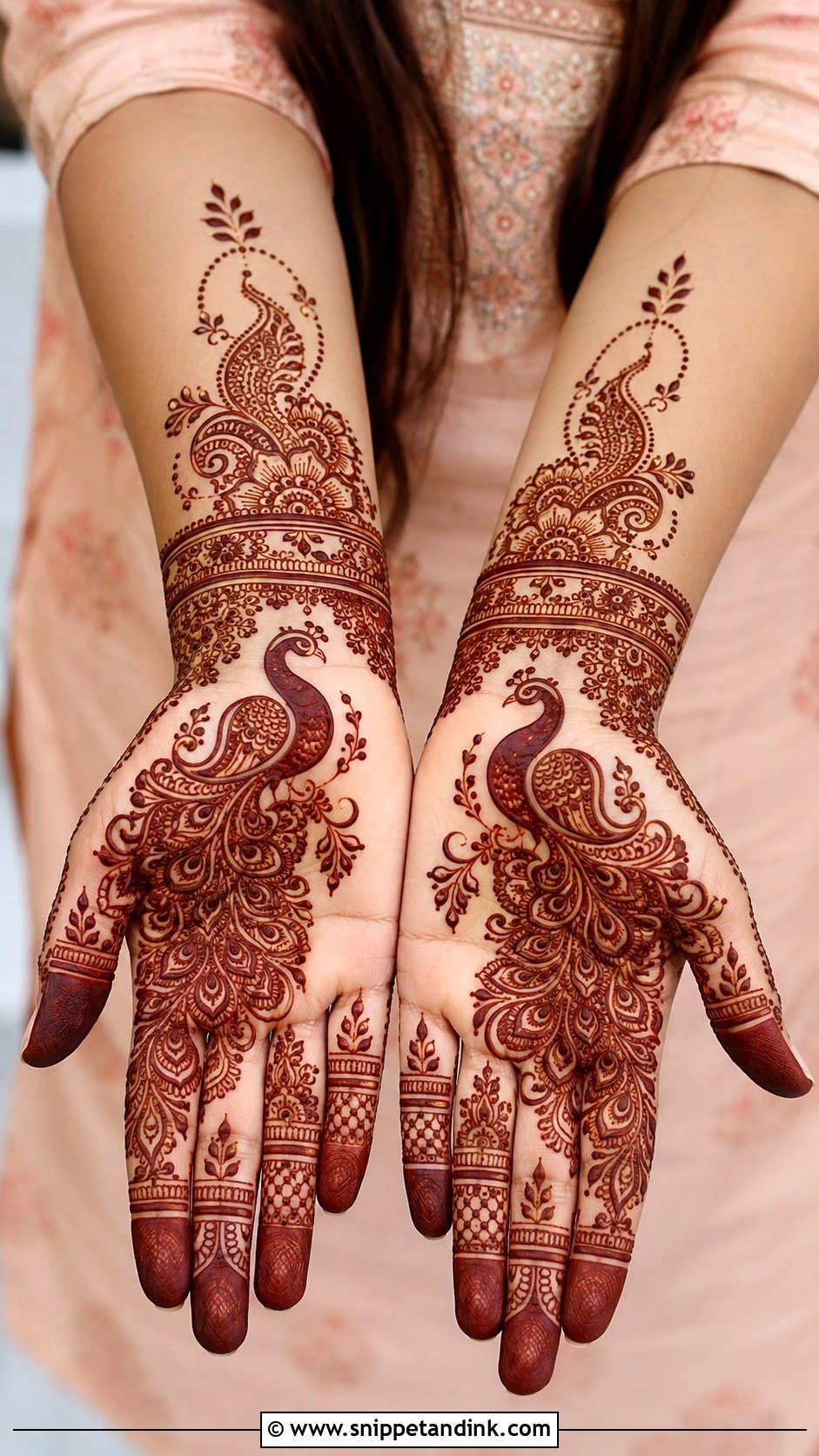
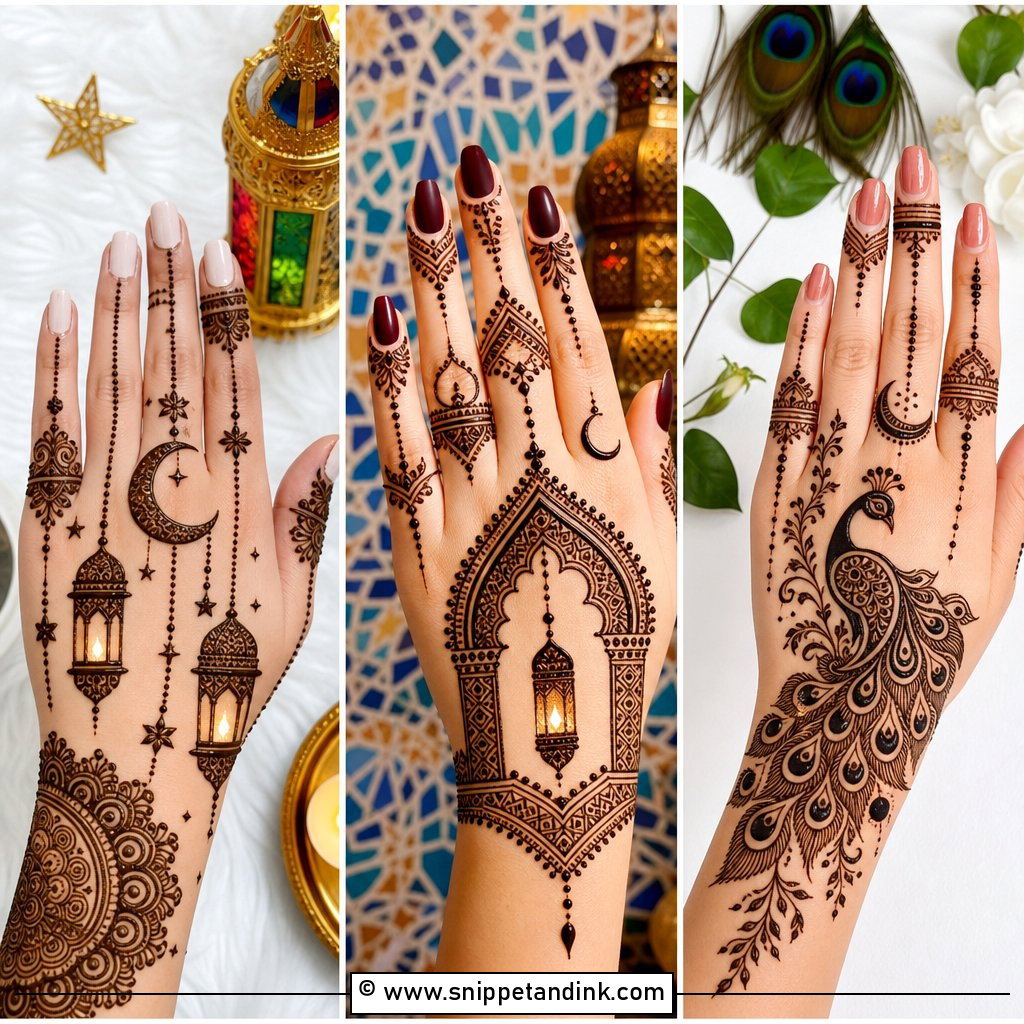
Peacocks have a long place in Indian henna. The bird can sit on the palm, wrist or forearm, its feathers spilling into paisleys, curves, dots and leafy filling, framed by floral borders and fine mesh. For a lighter version, one peacock on the palm and feather-like lines on the fingers is enough. The neck is where peacocks go wrong. I draw it in one smooth S-curve before anything else; a broken neck line makes the whole bird look awkward.
7. Paisley Mehndi Design
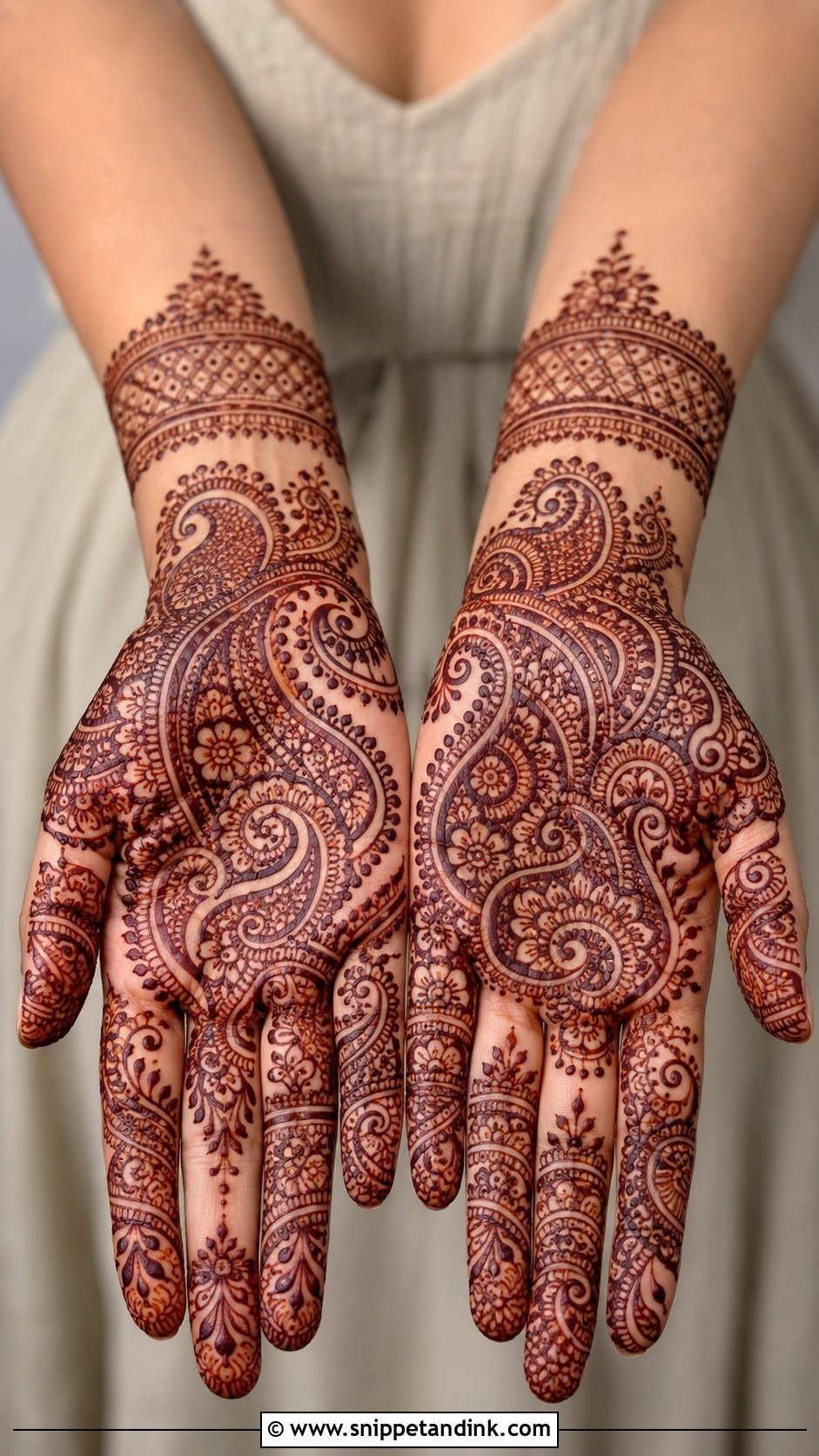
The paisley, the mango or keri shape, is probably the most recognisable traditional motif of all. It can be small, large, stacked, shaded or filled with flowers and dots, usually starting with one bold paisley on the palm that expands into vines, leaf trails and wrist bands. Add jaali and spirals for richness, or use fewer paisleys with more open skin for something cleaner. On long fingers, the curves soften the hand nicely.
8. Lotus Mehndi Design
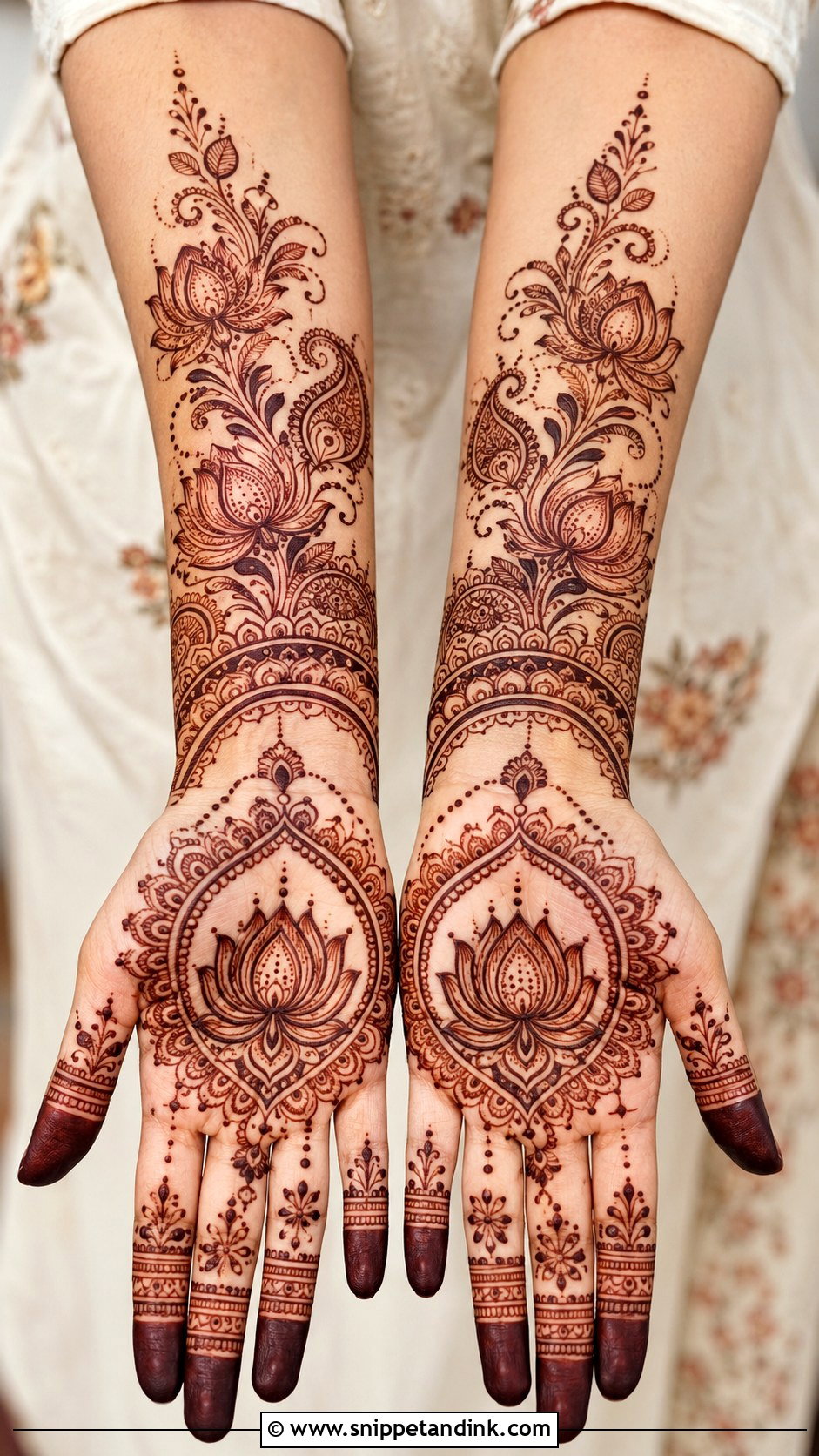
Lotus motifs carry an auspicious feel that makes them a natural fit for weddings and pooja. The flower can sit in the palm centre, near the wrist or inside a bigger bridal layout, its layered petals forming a base for mandalas, paisleys, dots and borders. A simple version is one large lotus with clean finger patterns. I space the petals evenly and shade only the inner edge of each one, which gives depth without darkening the whole flower into one shape.
9. Jaali Mehndi Design
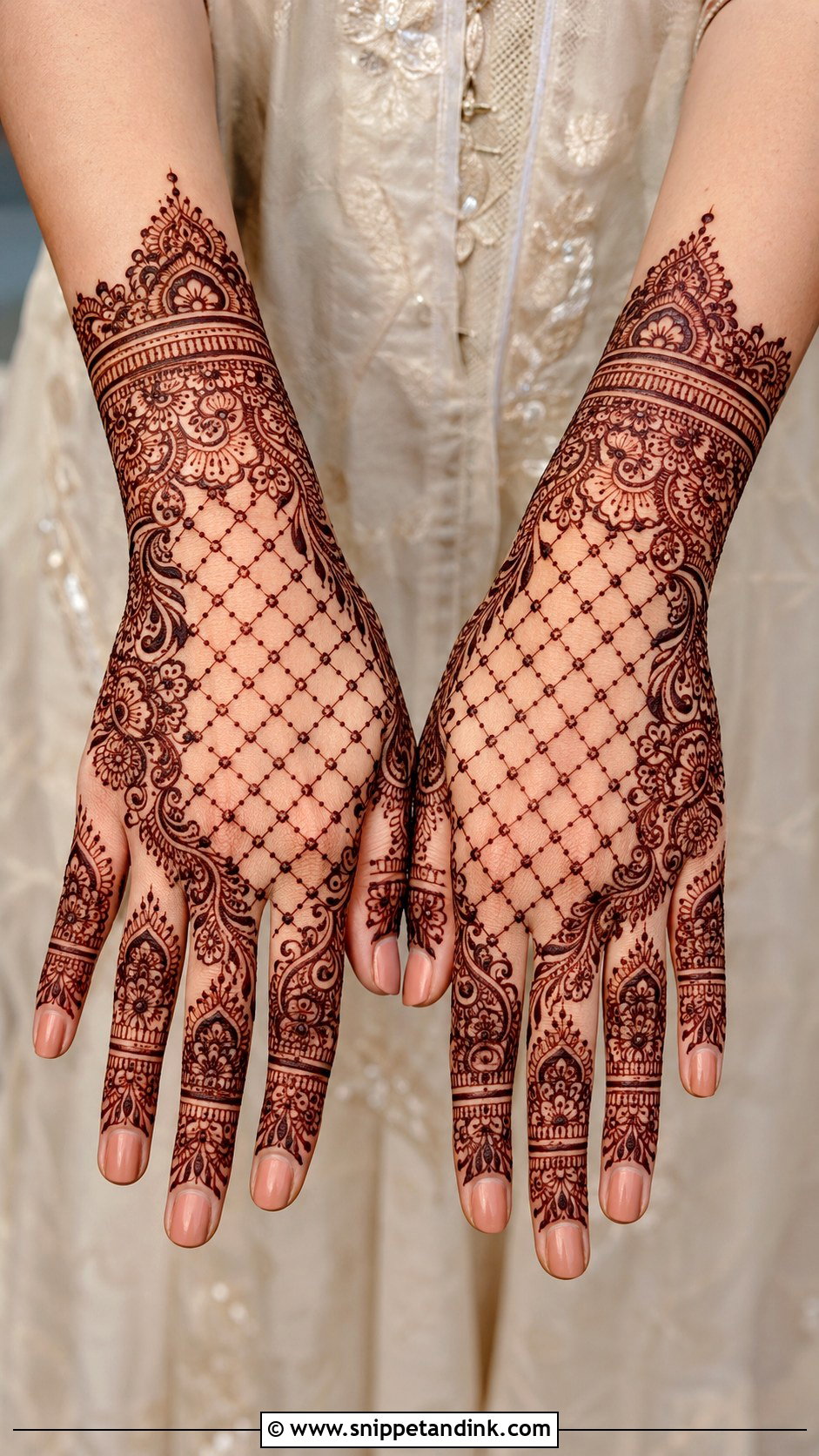
Jaali is net: diamonds or squares laid across the back of the hand, palm sections, fingers or wrist bands. It turns up in bridal and Indo-Arabic work, framed by flowers, paisleys or mandalas so each area stands out against the mesh. Plain mesh on its own looks unfinished, so borders, dots, small petals and curves are part of the design. Even spacing is the whole skill. I pipe every line in one direction first, then every crossing line, so the cells stay the same size.
10. Simple Traditional Mehndi Design
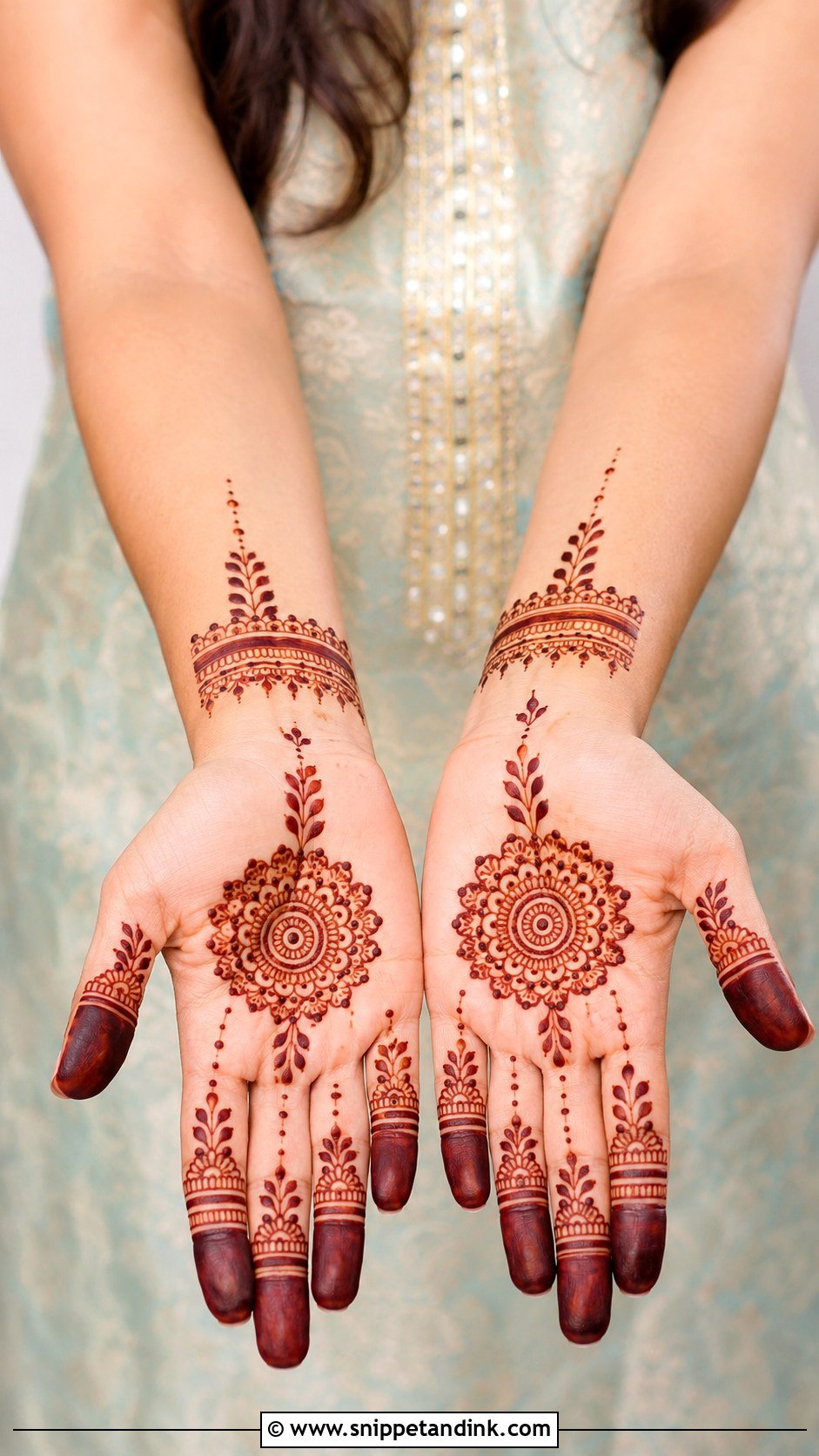
A palm motif, easy finger detail, small flowers, dots, leaves and a light wrist border make up a simple traditional hand. It goes on quickly and still looks classic. The easiest version is a palm mandala with leafy fingers; a small paisley trail from palm to wrist gives a more flowing one. Overfilling is the mistake. Keep the lines clean and stop before the hand feels busy.
11. Heavy Bridal Mehndi Design
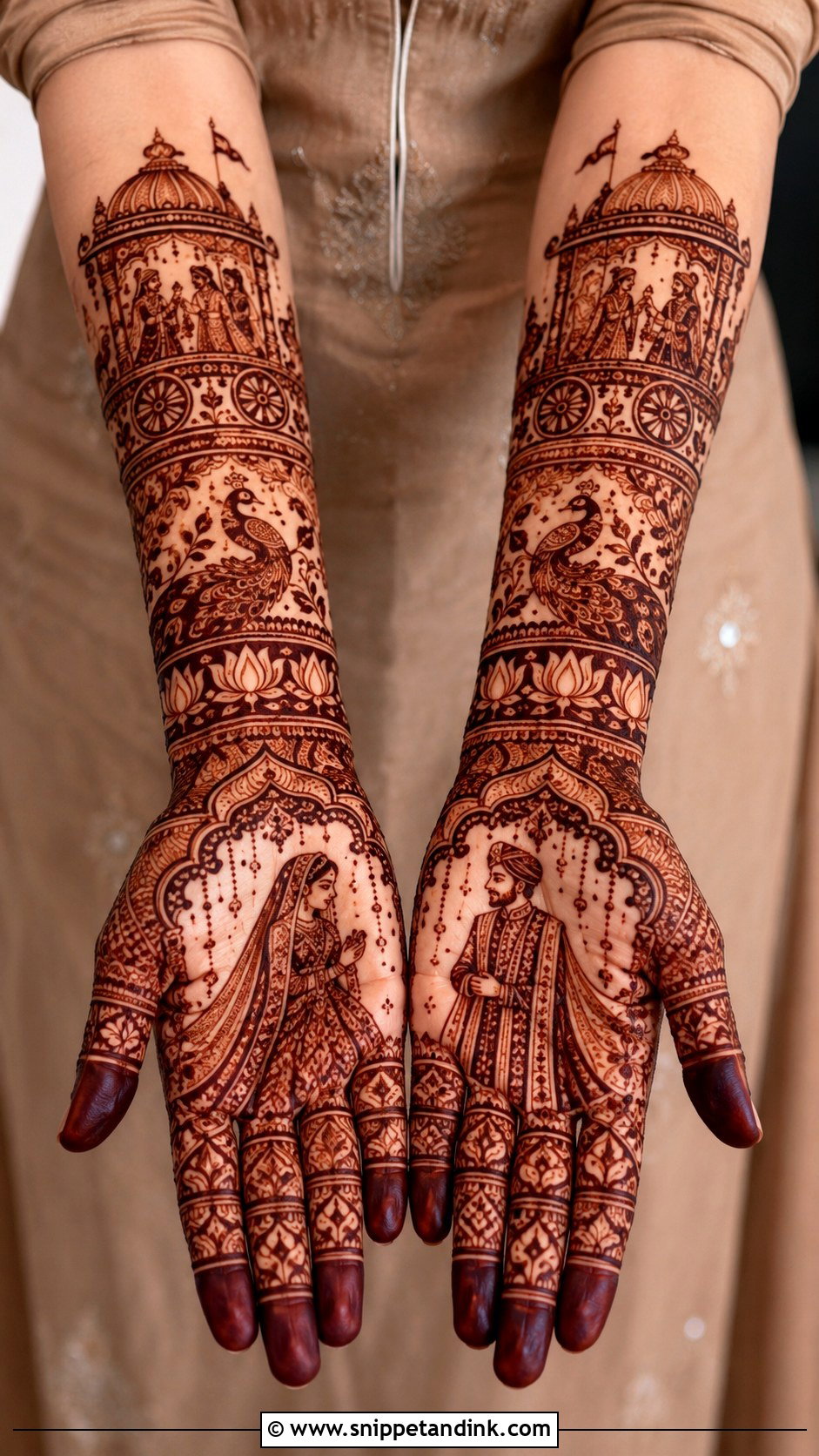
Heavy bridal henna runs from fingertips to elbows: detailed palms, wrists and forearms with bride and groom portraits, mandaps, peacocks, lotus motifs, paisleys, kalash, fine shading and hidden initials. It takes hours. What keeps it from turning into a dark mess is clear sectioning, bold borders between motifs and fine filling inside each one. Plan for someone to feed you and hold your phone; once both arms are done, you’re out of action until the paste sets.
12. Dulhan Mehndi Design
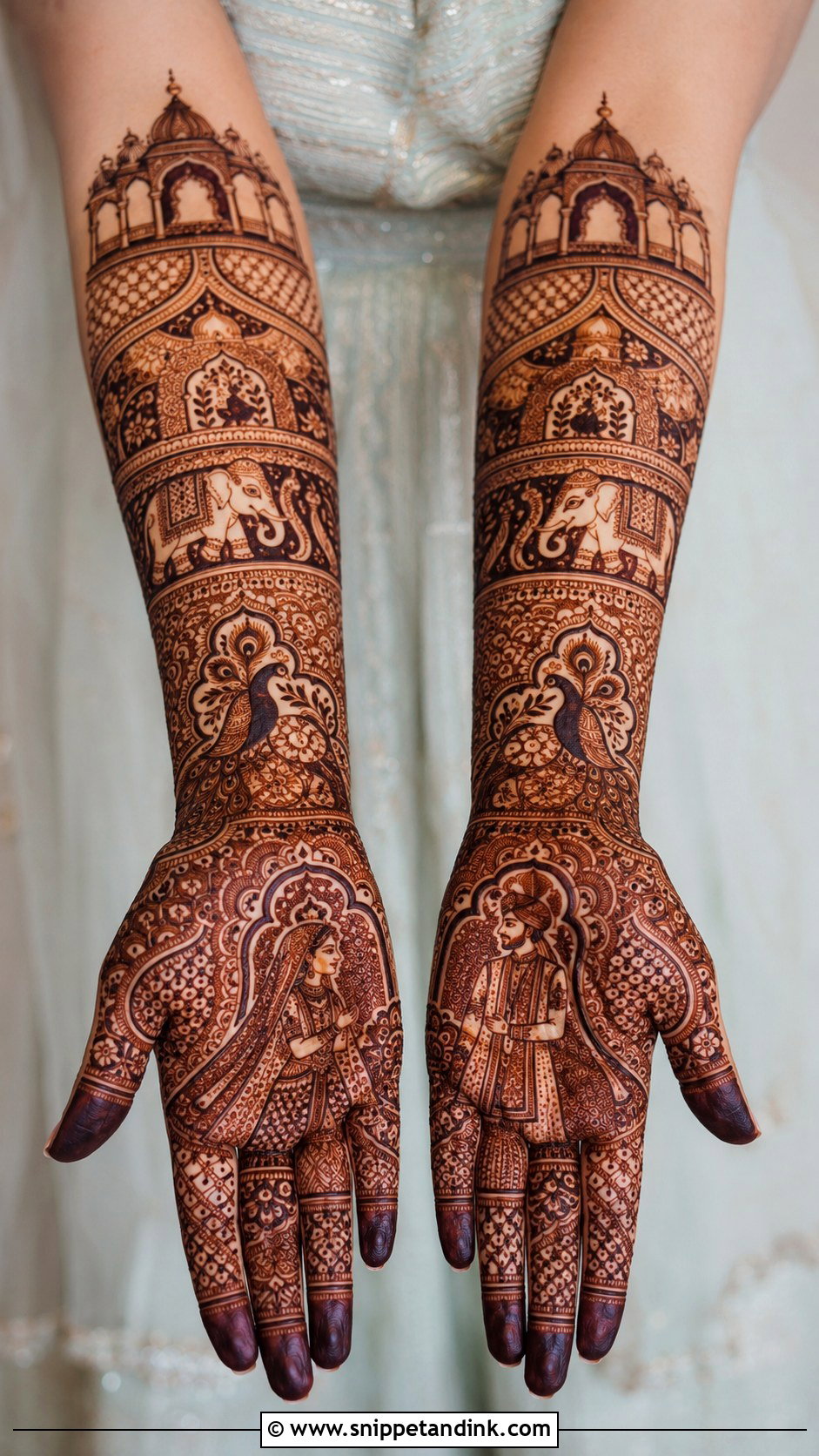
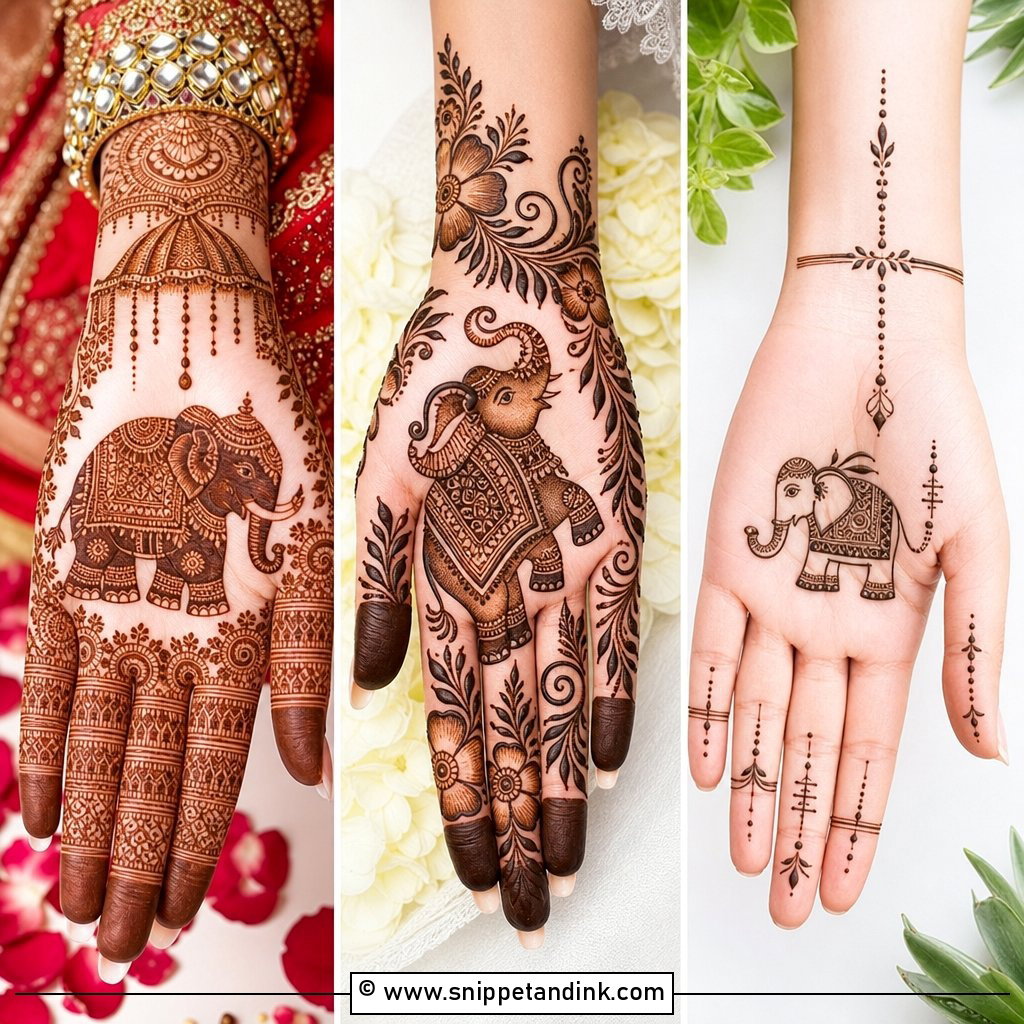
The dulhan design is the bride’s own story, told with bride and groom figures, the doli, a mandap, elephants, peacocks, flowers and initials, usually in the palms, with ornamental bands and floral extensions on the wrists and forearms. Each palm can show a different scene and still balance as a pair. I keep the figures’ outlines bolder than the filling around them, because faces and hands drawn in the same weight as the background vanish once the stain matures.
13. Rajasthani Mehndi Design
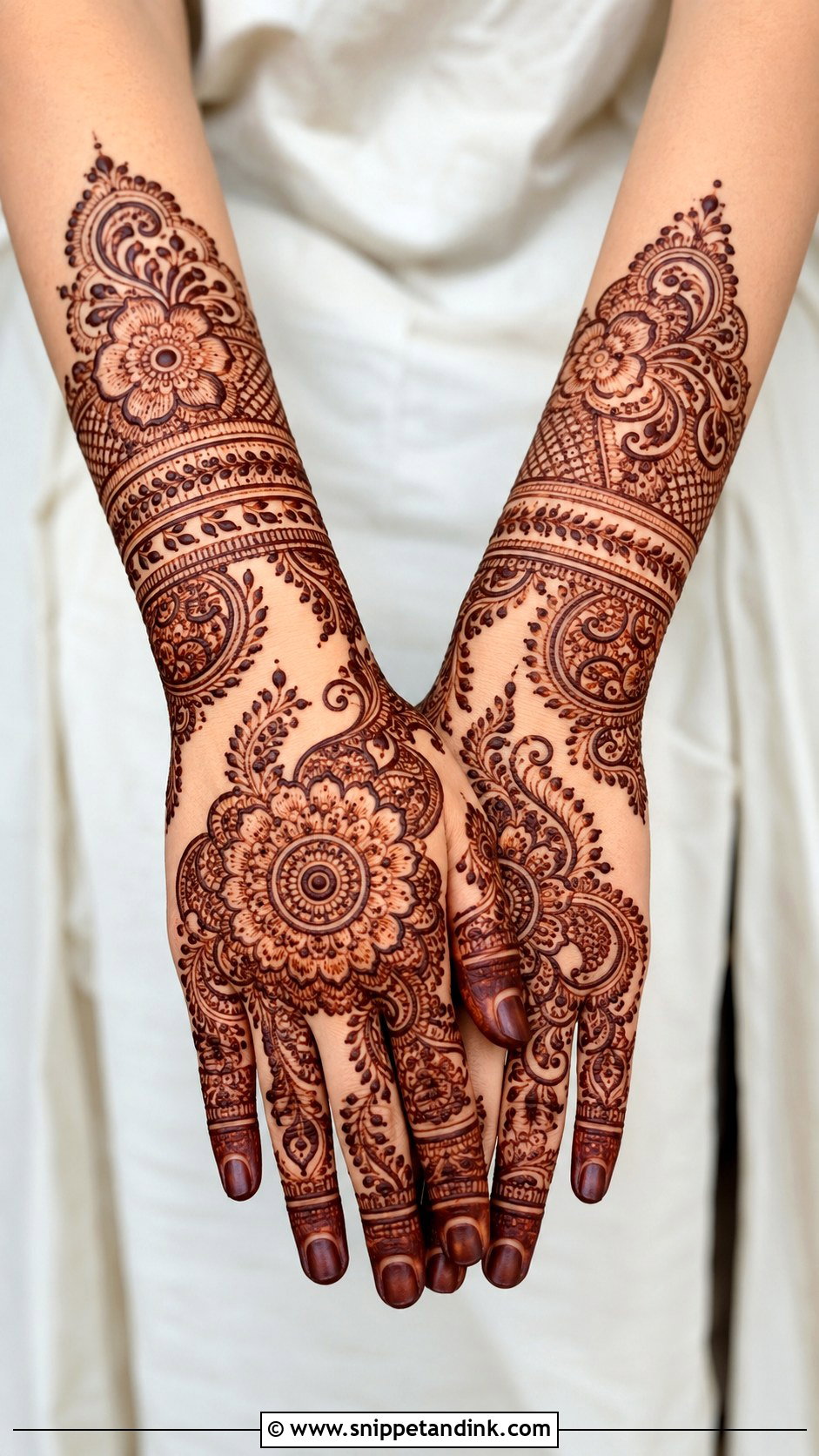
Rajasthani work is detailed and heritage-heavy: royal motifs, bride and groom art, elephants, peacocks, mirrored symmetry, paisleys and dense ornamental fills, with arches, floral borders and fine checks running up the forearms. The two hands are designed together, matching or complementary. With so much detail, spacing and clean outlines are what keep it readable. I draw the main figures first with a thicker line, then fill around them.
14. Marwari Mehndi Design
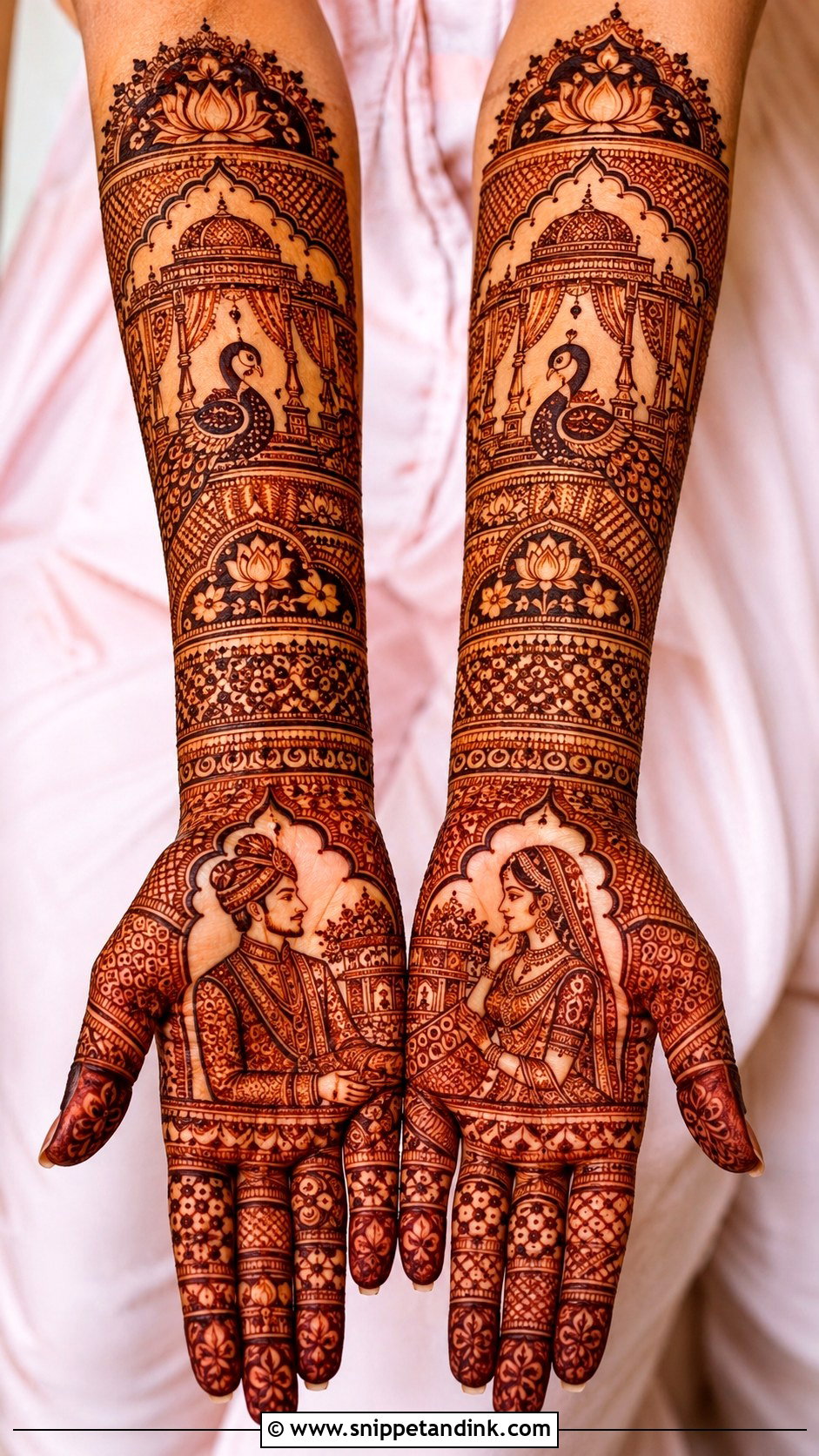
Marwari henna is chosen for weddings and pre-wedding ceremonies: fine detailing, symmetrical layouts, paisleys, flowers, peacocks and bridal motifs, often covering the full hand and forearm with little bare skin. Fingers are filled with detailed bands, dots and curves. Clear sections on the palm and wrist stop it from blurring together, and arches or bracelet-like bands keep the forearm flowing. Book well ahead in wedding season; artists who do this level of detail fill up fast.
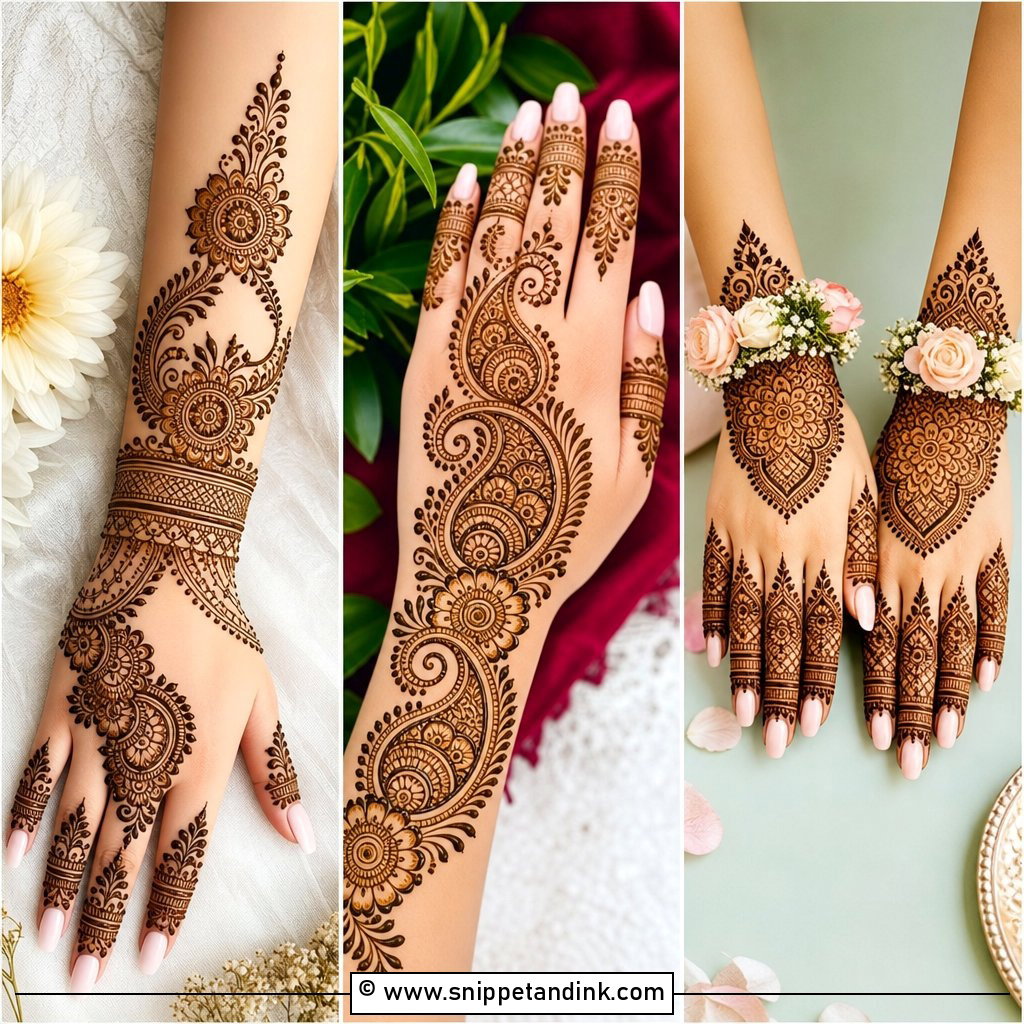
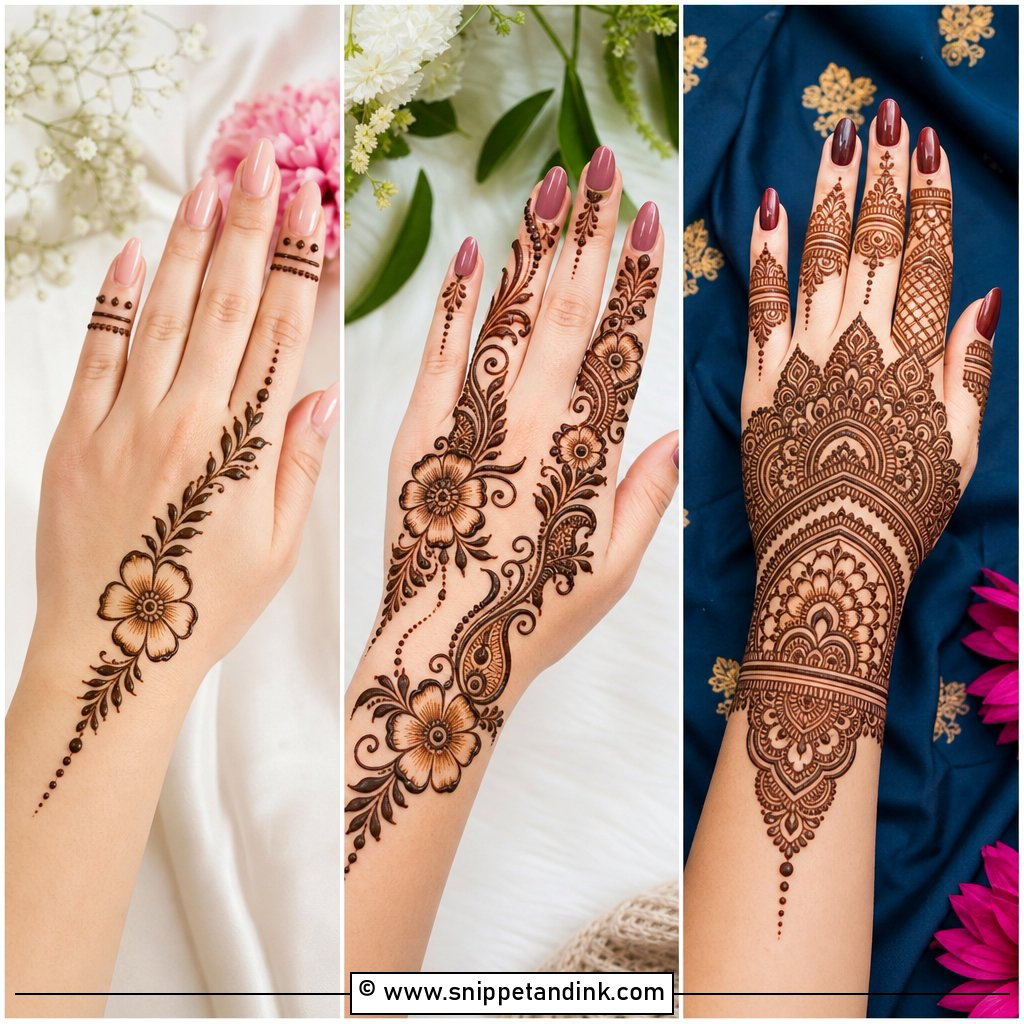
15. Gujarati Mehndi Design
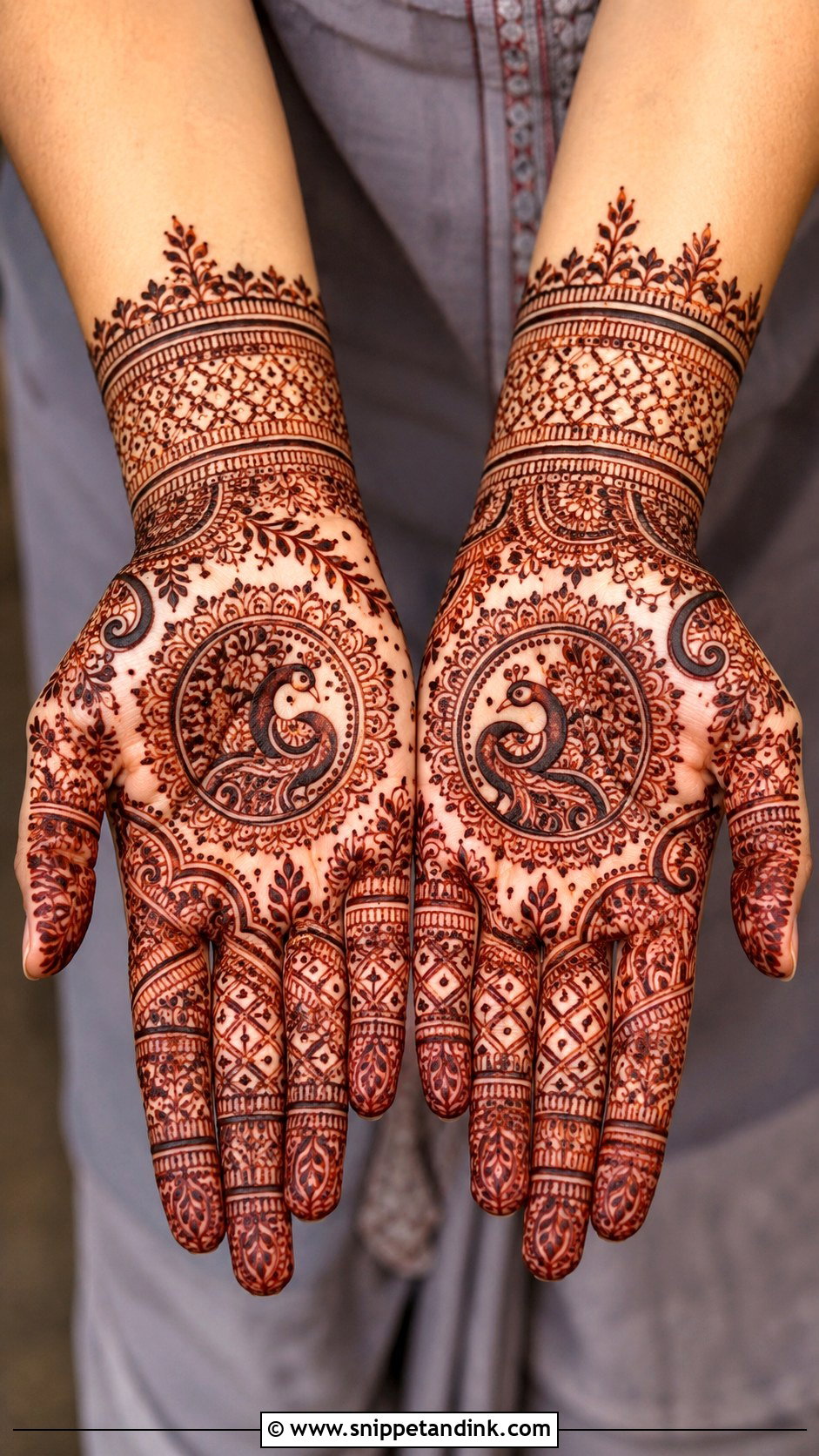
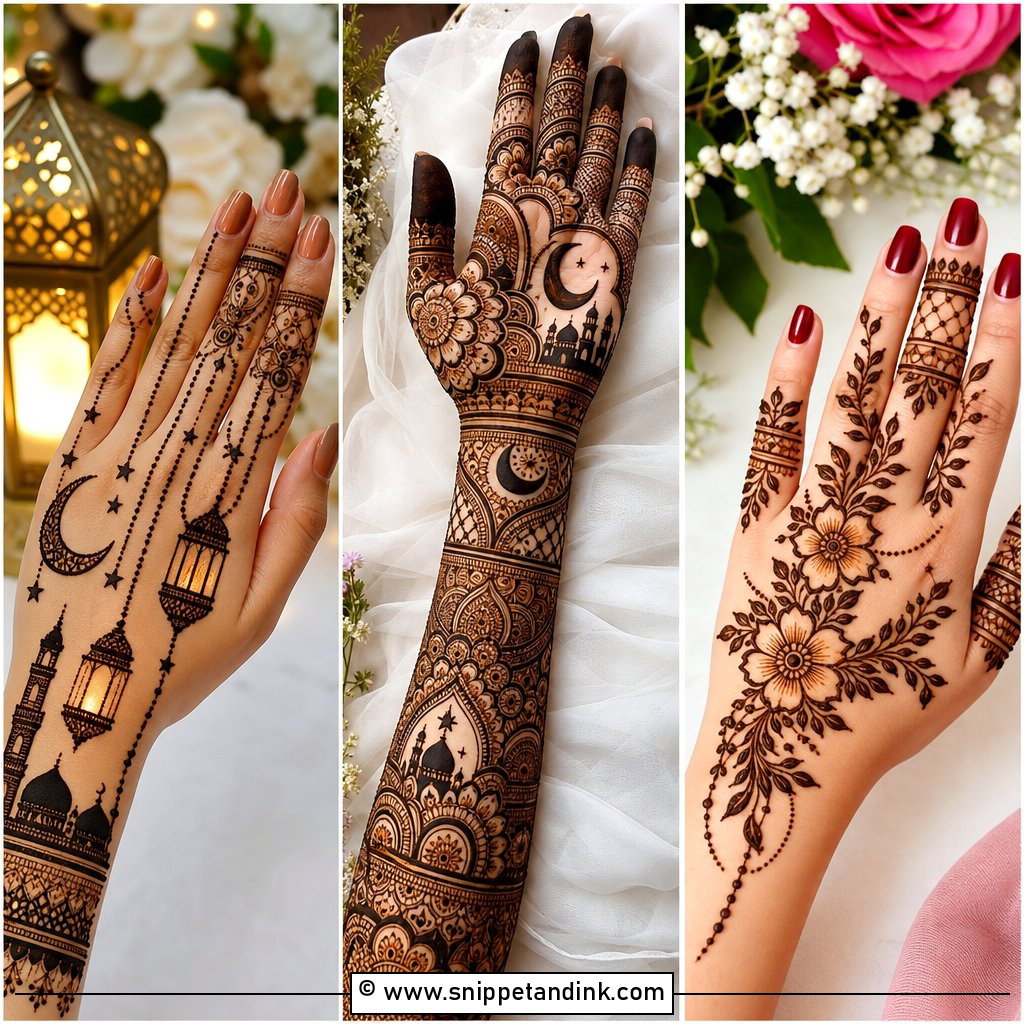
Gujarati designs feel lively: peacocks, flowers, dandiya shapes, paisleys, grids and circular mandalas, usually with a bold centre spreading toward the wrist and fingers. It suits weddings, garba nights and Navratri. For a bride I go heavier with fine filling and hidden initials; for guests I keep it open with simple vines. If you’ll be dancing garba the same evening, have it done earlier in the day so the paste is dry and off before the clapping starts.
16. Pakistani Mehndi Design
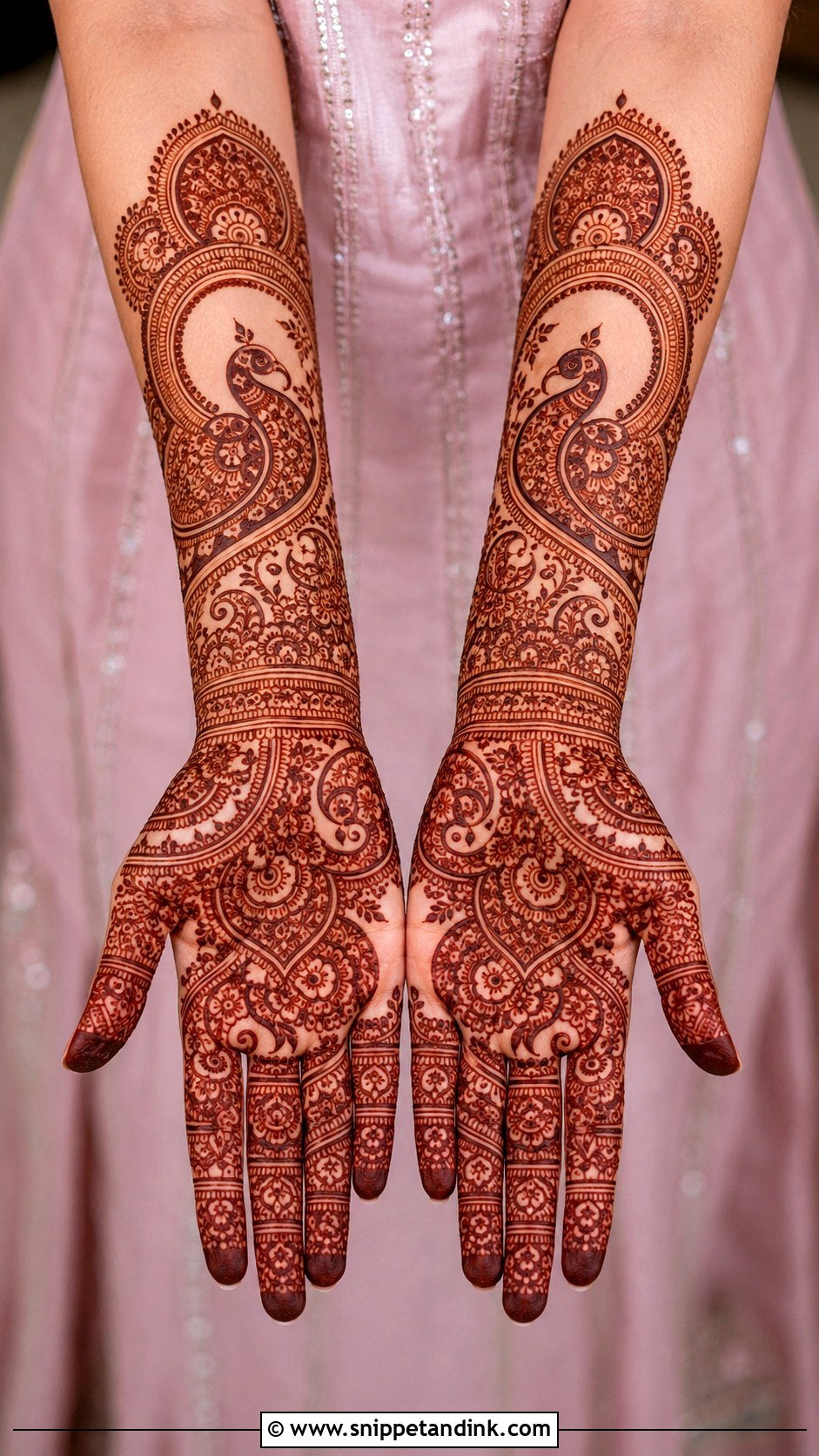
Pakistani mehndi combines Indian intricacy with Arabic flow: bold flowers, paisleys, leafy trails, jaali, mandalas and detailed fingers. Bridal versions go dense and full-hand; festive ones leave open spaces. A strong palm design connects to wrist cuffs and forearm patterns, and the back of the hand often becomes henna jewellery with chains, rings and bracelets. Bold outlines around fine inner detail are the signature, and they’re what make it hold up in group photos.
17. Gulf Khaleeji Mehndi Design
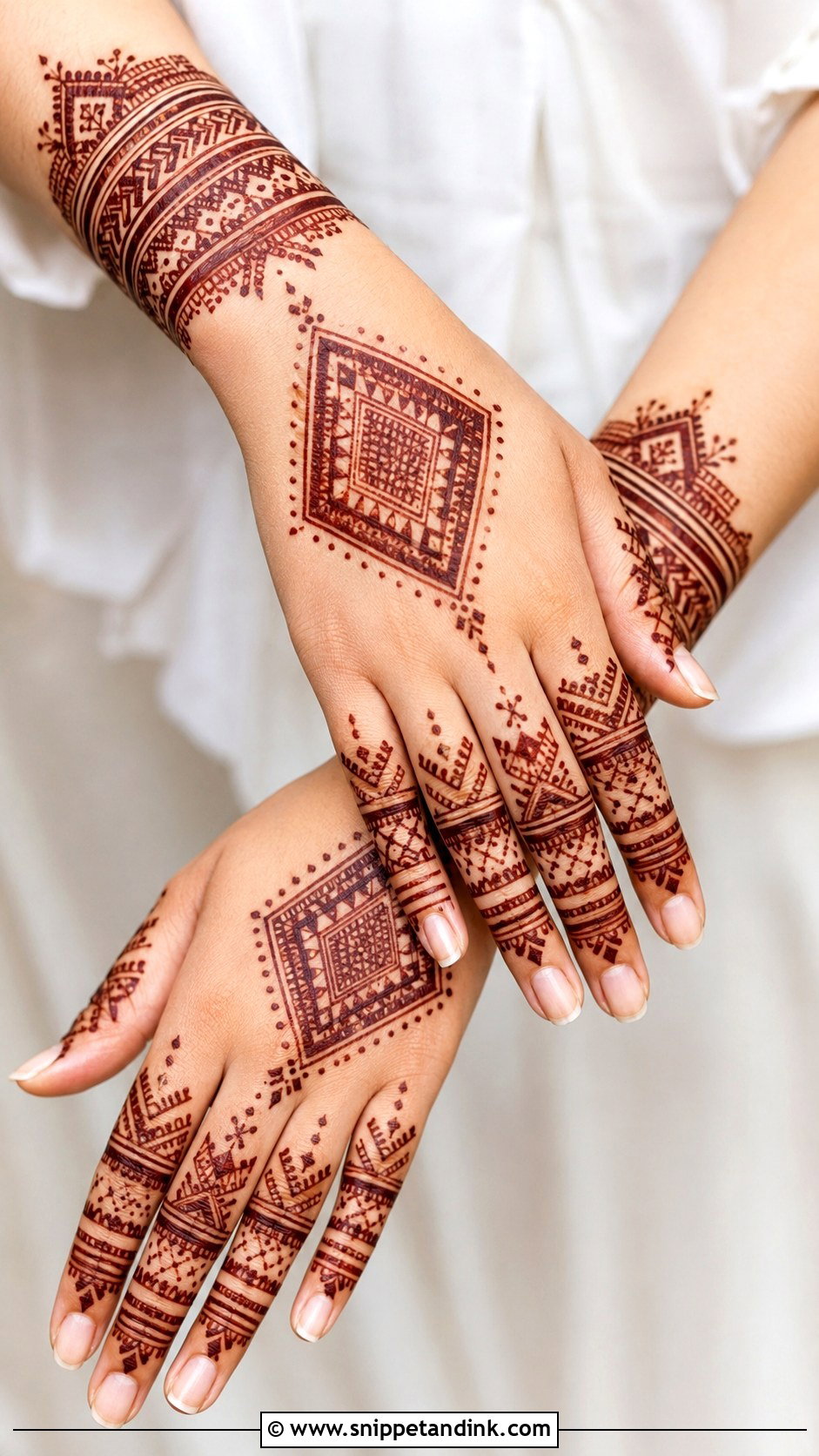
Khaleeji henna from the Gulf uses large florals, sweeping leaves, soft curves and wide negative space. It feels lighter than dense Indian work but still dramatic, covering the back of the hand, the fingers, the wrist or one side of the palm. Scattered motifs don’t suit it; it needs one flowing structure, usually large flowers near the wrist with vines reaching toward the fingers. All that open skin makes the reddish-brown stain look darker and sharper.
18. Moroccan Mehndi Design
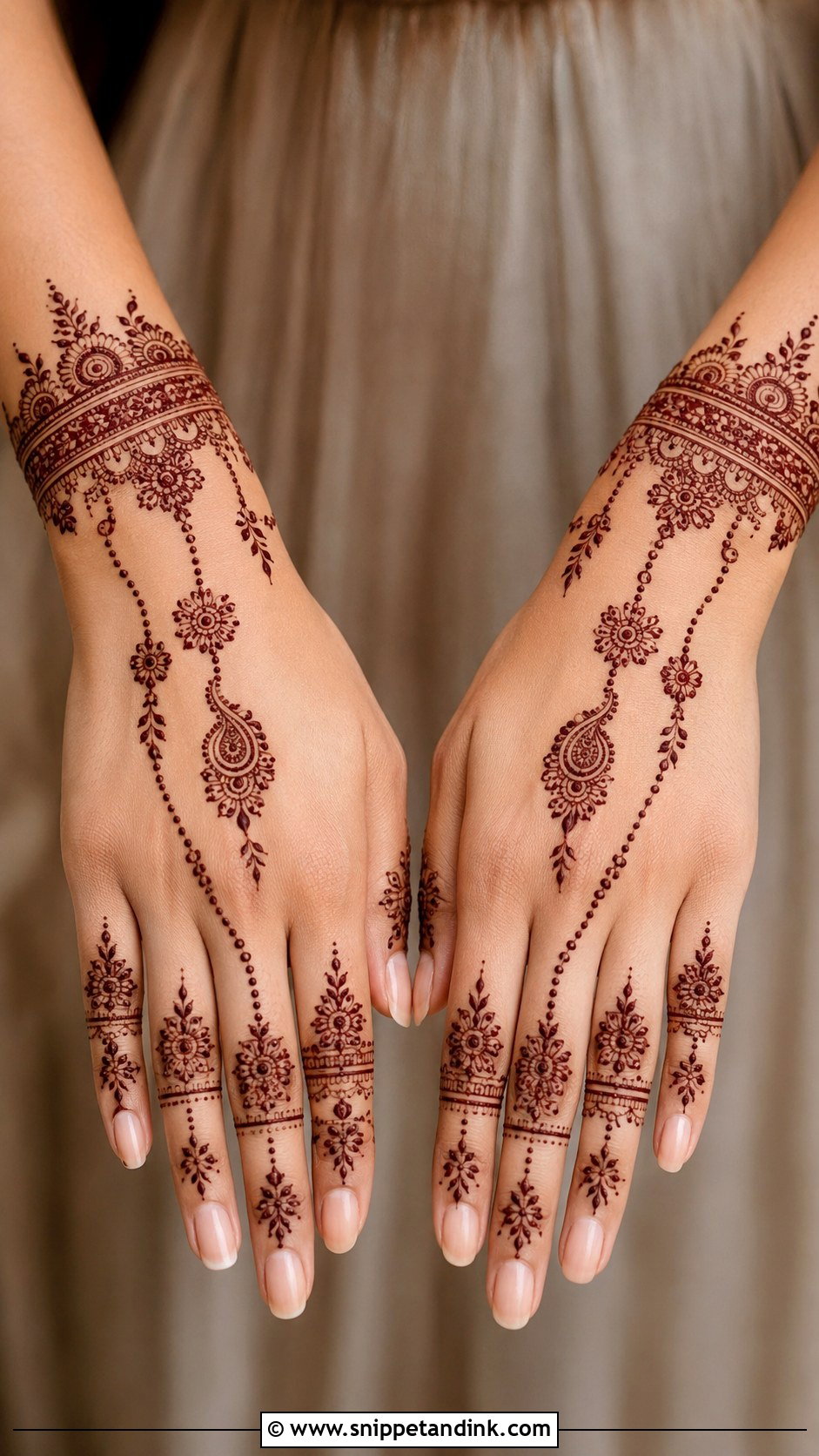
Moroccan henna swaps florals for geometry: diamonds, triangles, straight lines, grids, zigzags, dots and bold bands across the palm, back of the hand, fingers and wrist. Its structured look suits anyone who wants traditional henna without flowers, and it’s one of the few styles men often ask me for. Straight lines are less forgiving than curves, so this is slow, careful work. Paired with deep maroon colour and filled fingertips, a wrist-to-finger layout is very striking.
19. Finger Mehndi Design
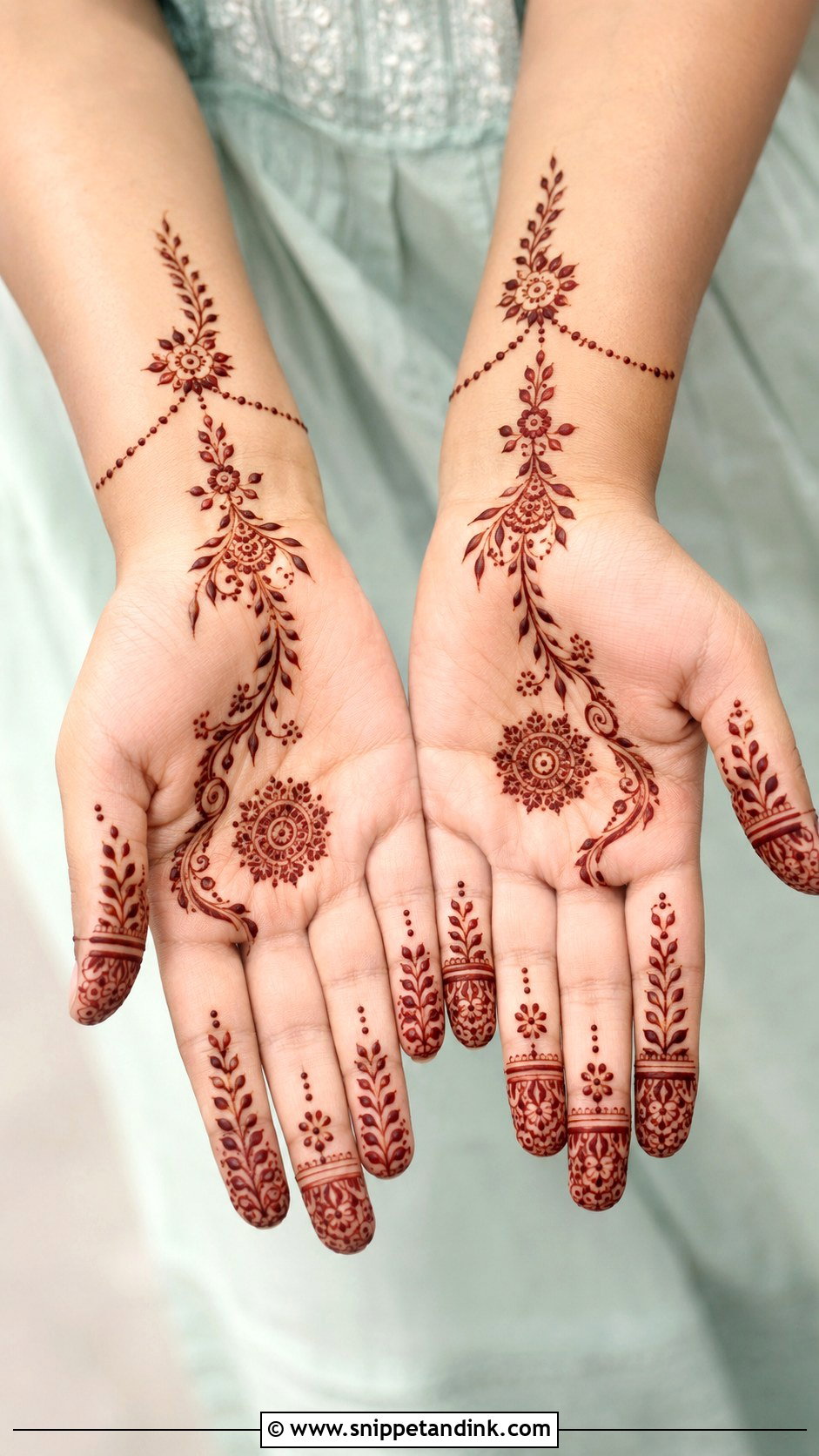
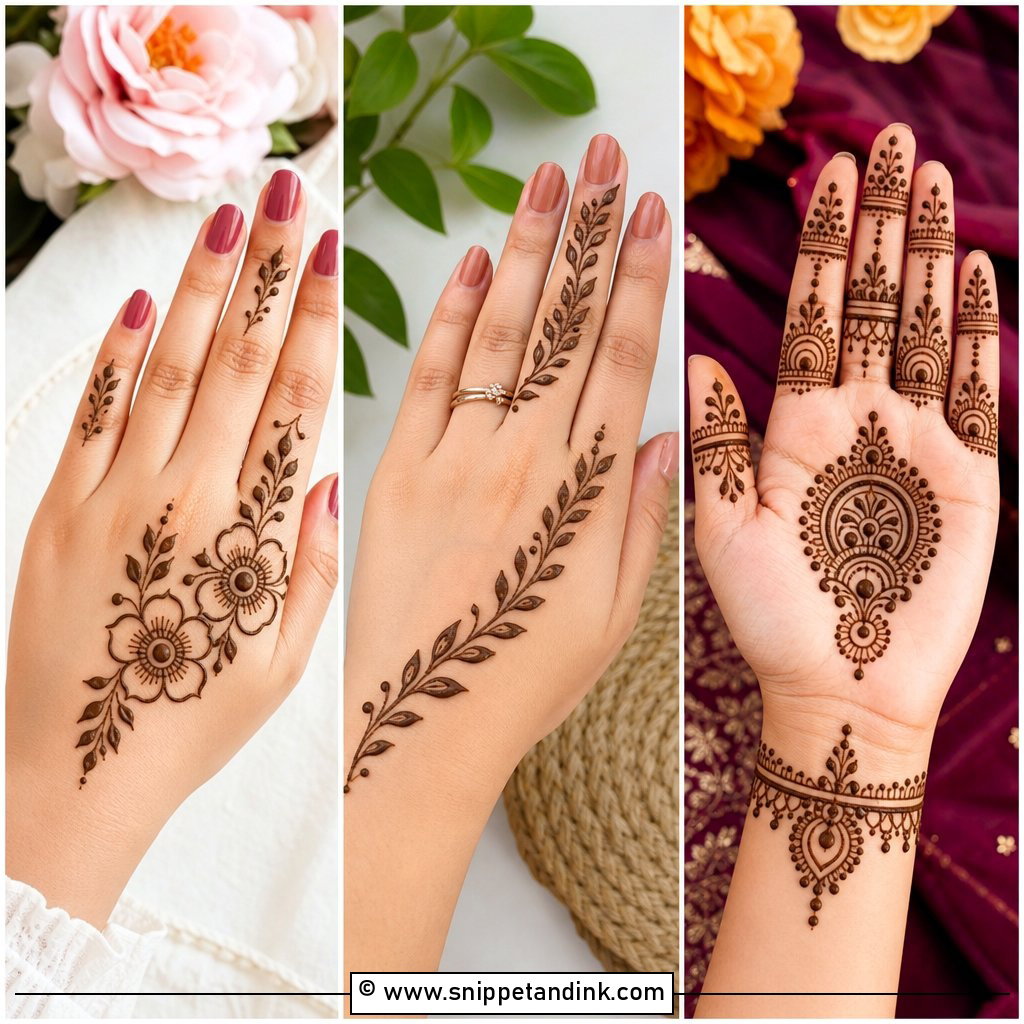
Finger designs can still feel traditional if they’re planned as a whole hand rather than a few random marks. I link the fingers with a small palm motif, a wrist band or a back-hand chain, and use leafy tips, ring patterns, dots, tiny florals, checks and slim paisley lines. It’s a sensible choice for office celebrations or a quick Eid or Diwali. Fingertips hold colour longer than most of the hand, so this design tends to look tidy for days.
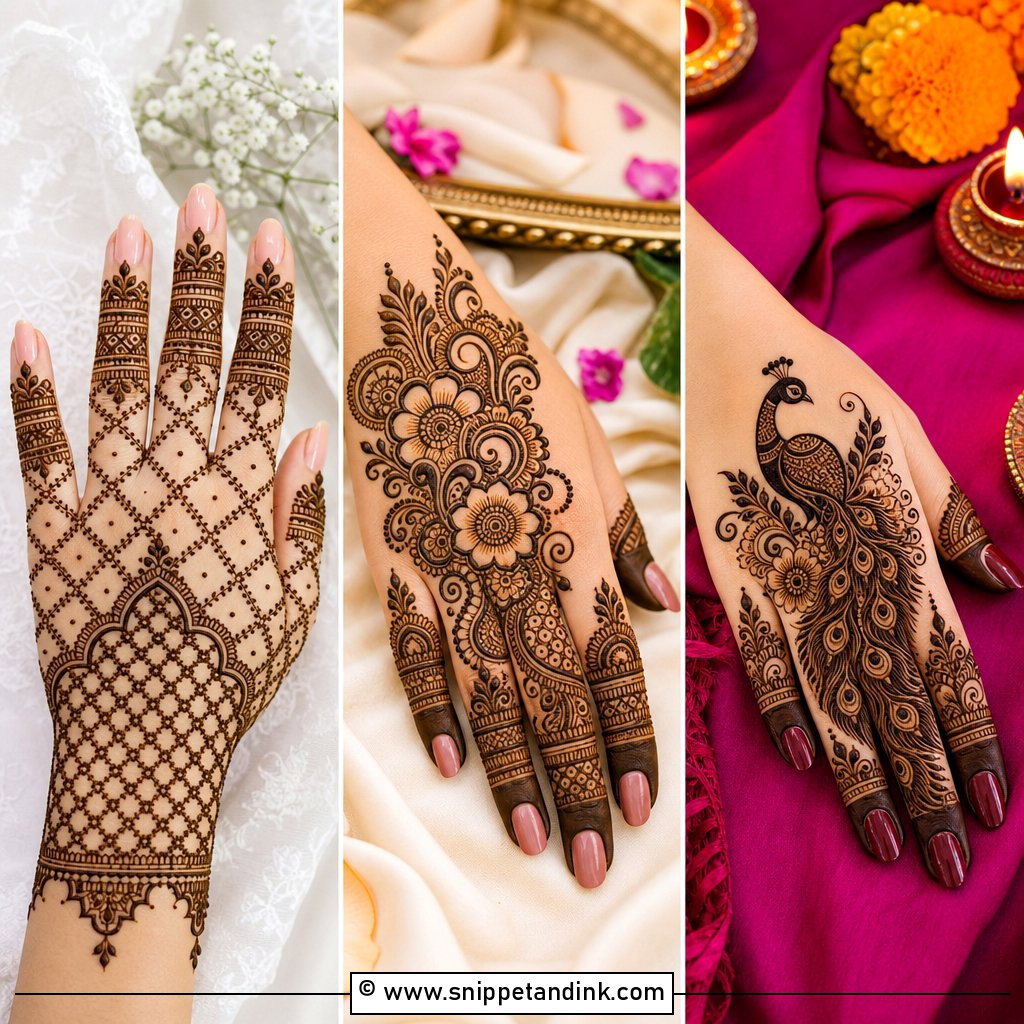
20. Back Hand Bracelet Mehndi Design
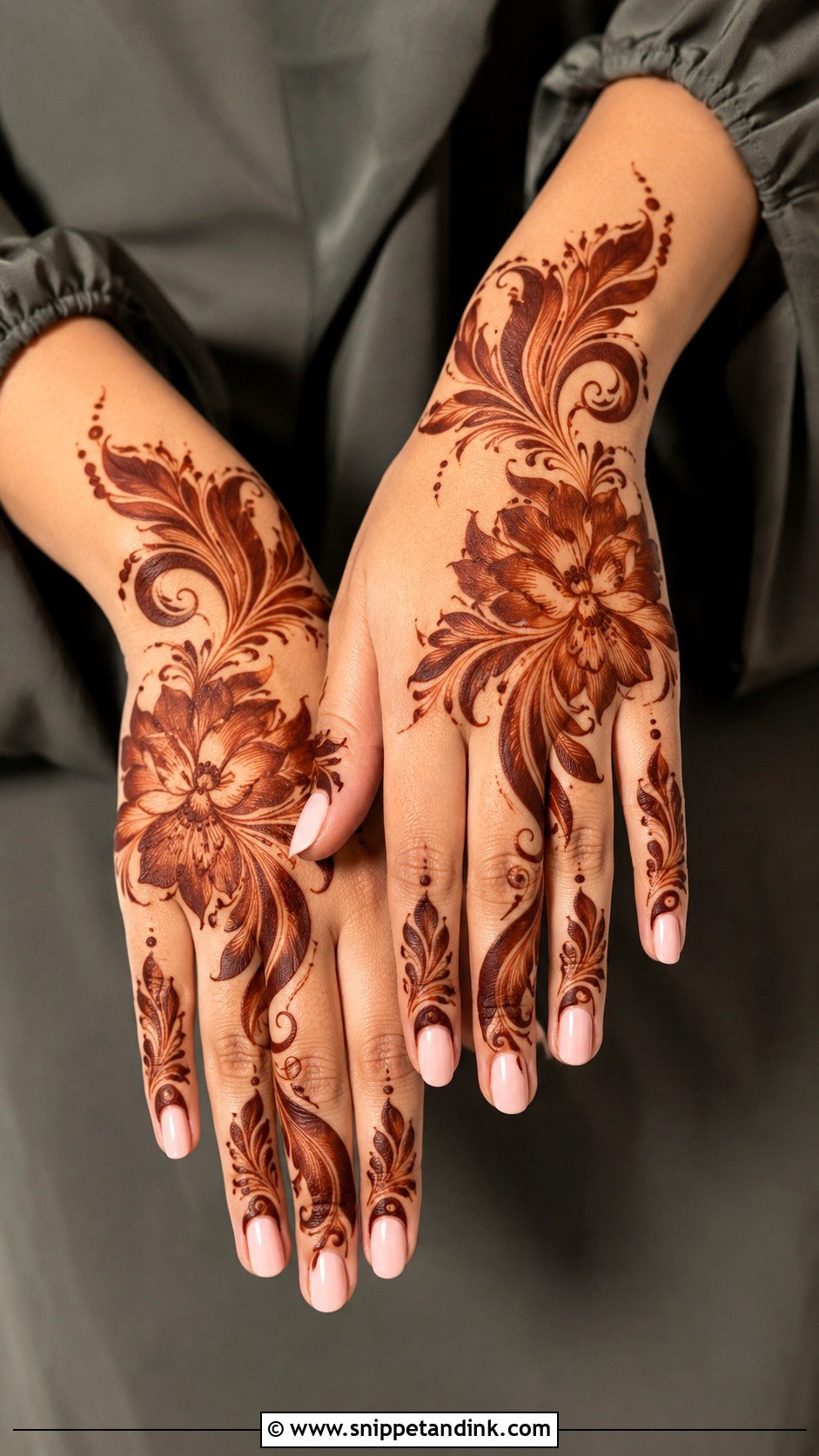
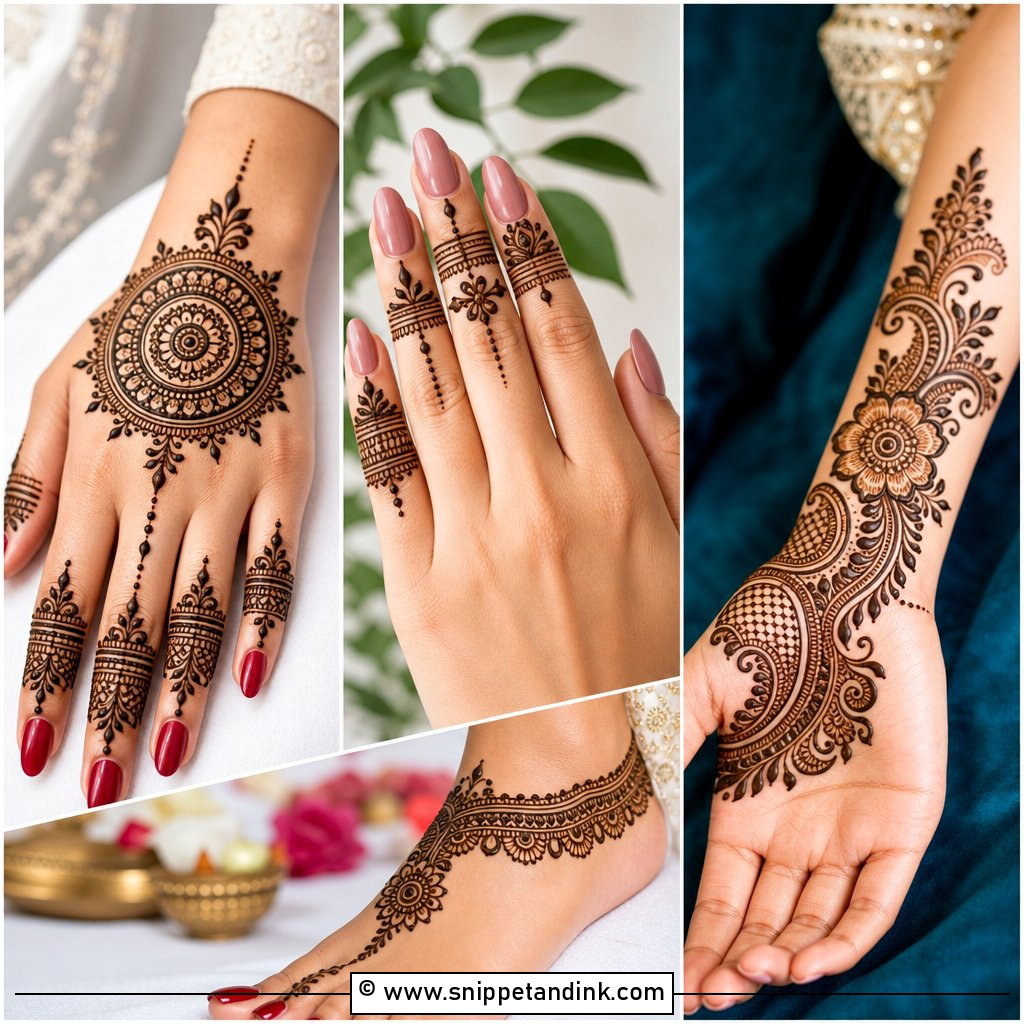
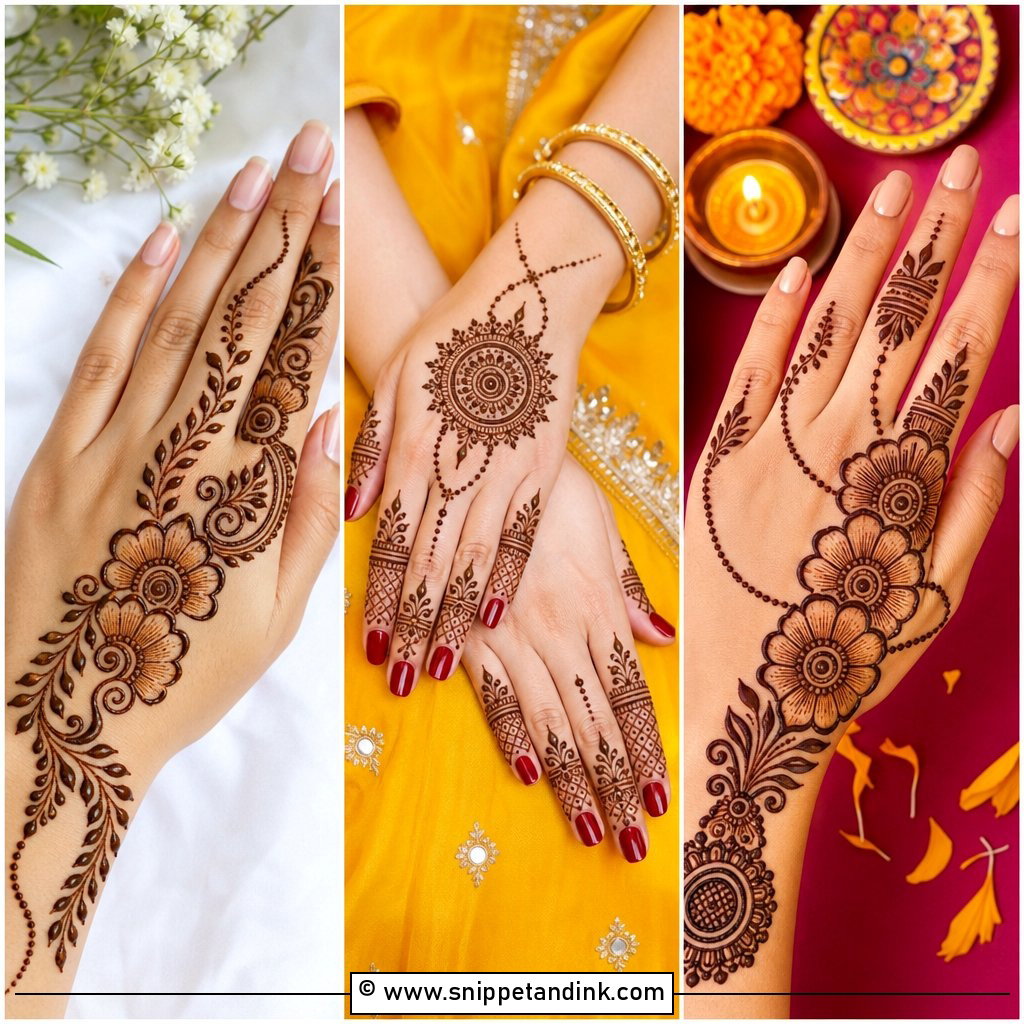
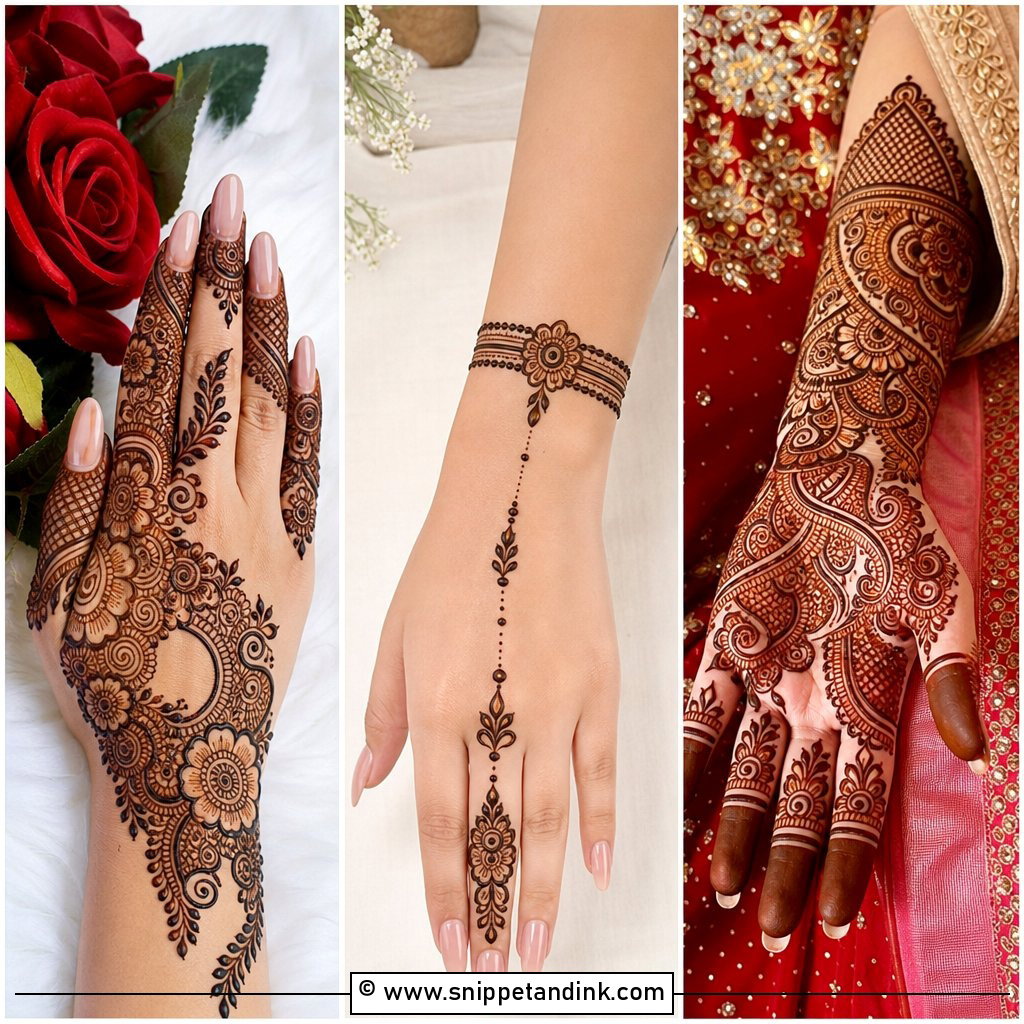
A wrist cuff, ring-style finger details and delicate chains between them: henna jewellery for the back of the hand, with small flowers, paisleys, dots, leaves or mandala accents. It suits engagement parties and festive outfits because it looks ornamented without heavy coverage. I keep the chain lines thin and the wrist band slightly bolder. That contrast is what makes it read as jewellery rather than a random pattern.
21. Front Hand Floral Mehndi Design
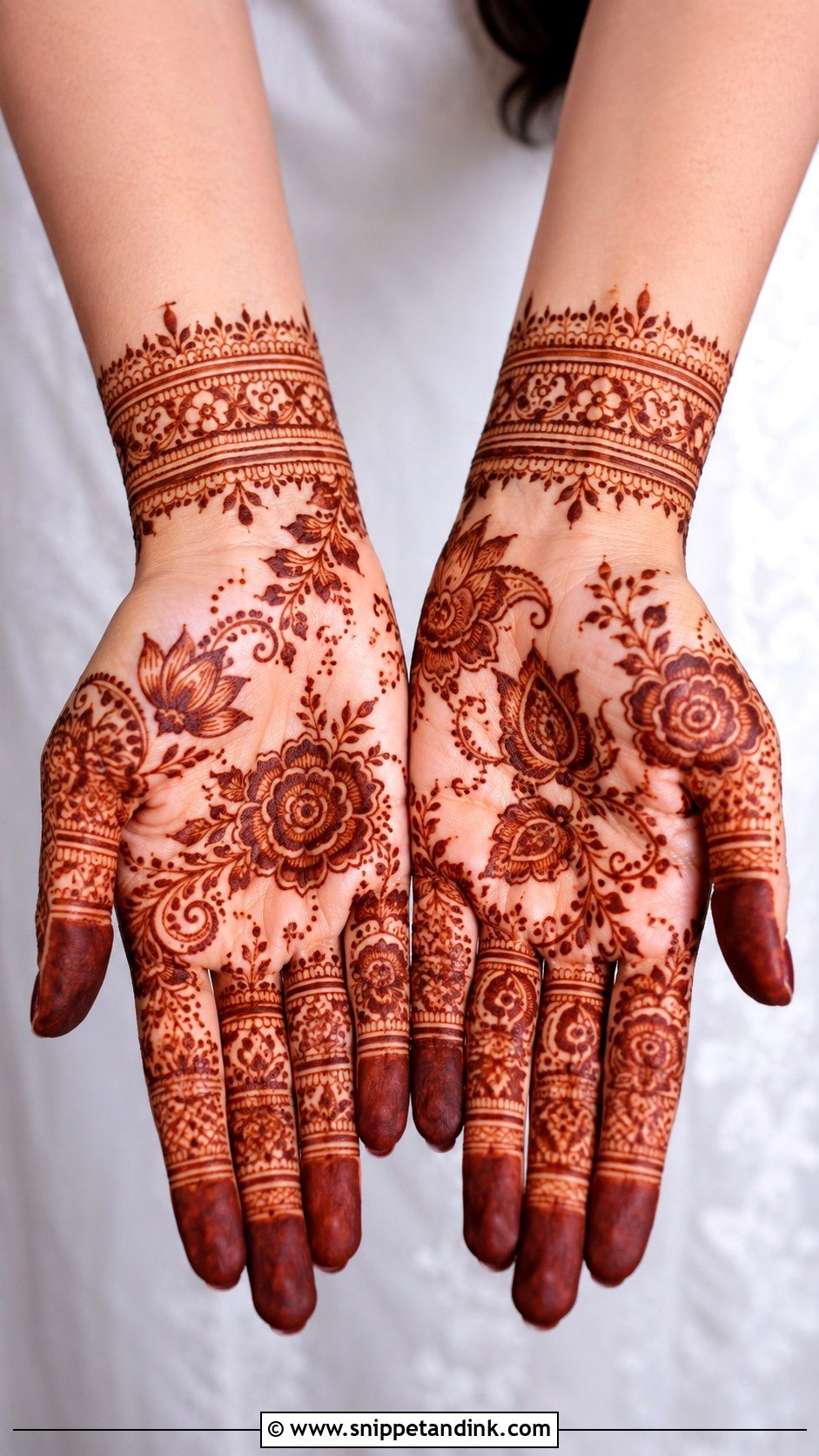
Roses, lotus petals, simple blossoms, leafy vines, dots and curved borders, usually starting with one large flower on the palm and flowing toward the wrist and fingers. Combining the flowers with paisleys or mandala rings pulls it toward tradition. Don’t make every flower the same size. One main bloom with smaller ones around it gives depth; identical flowers in a row look like a stamp.
22. Back Hand Floral Mehndi Design
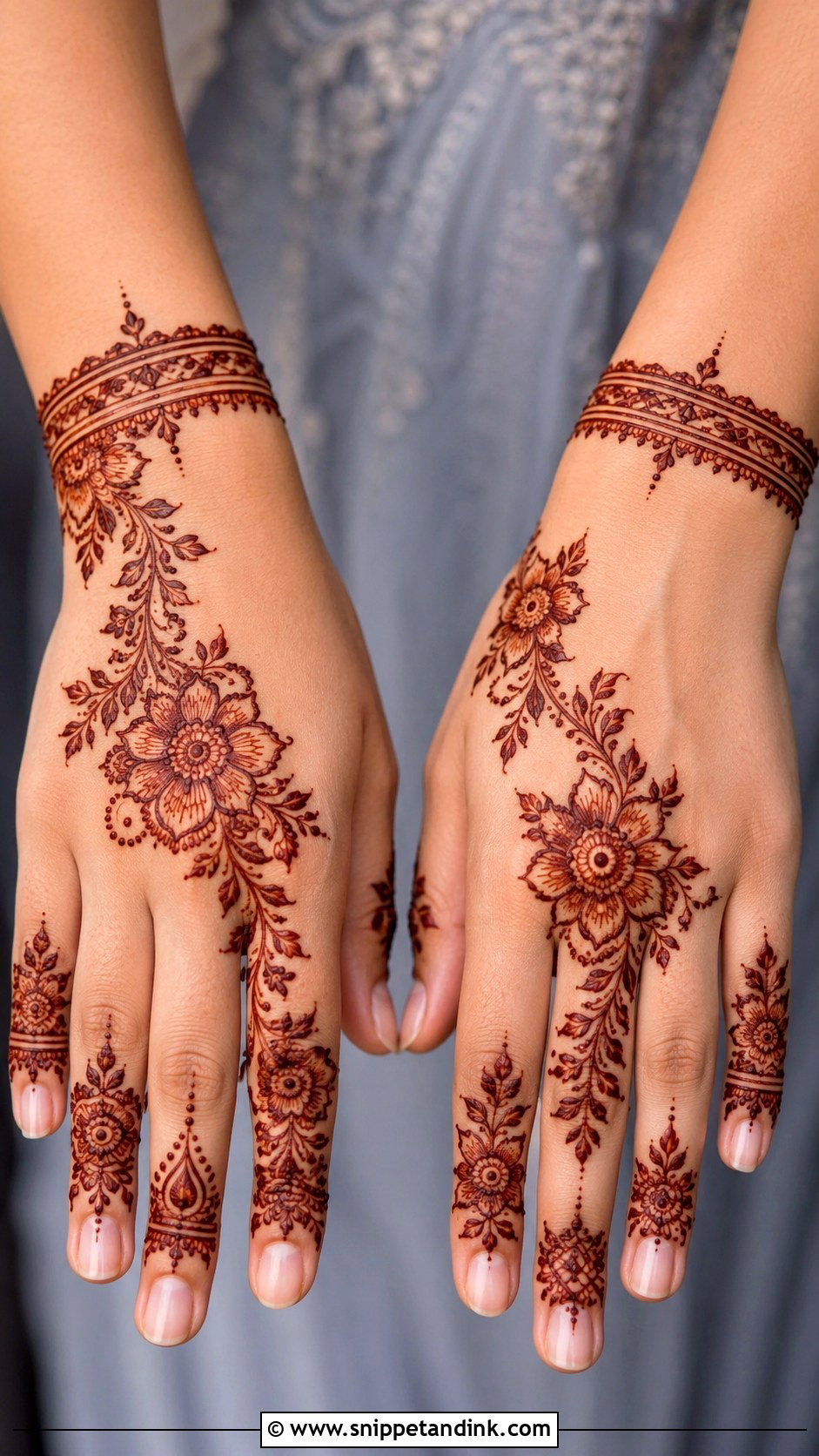
Flowers on the back of the hand sit right where people look, near the wrist or in the centre, with vines moving toward the fingers and dots, leafy curves, small paisleys and bracelet borders finishing them. Coverage can be light or medium depending on how many blooms you want. Leave open skin around each flower. On the thinner skin of the back of the hand, crowded flowers stain into a blur, while spaced ones stay defined.
23. Traditional Eid Mehndi Design
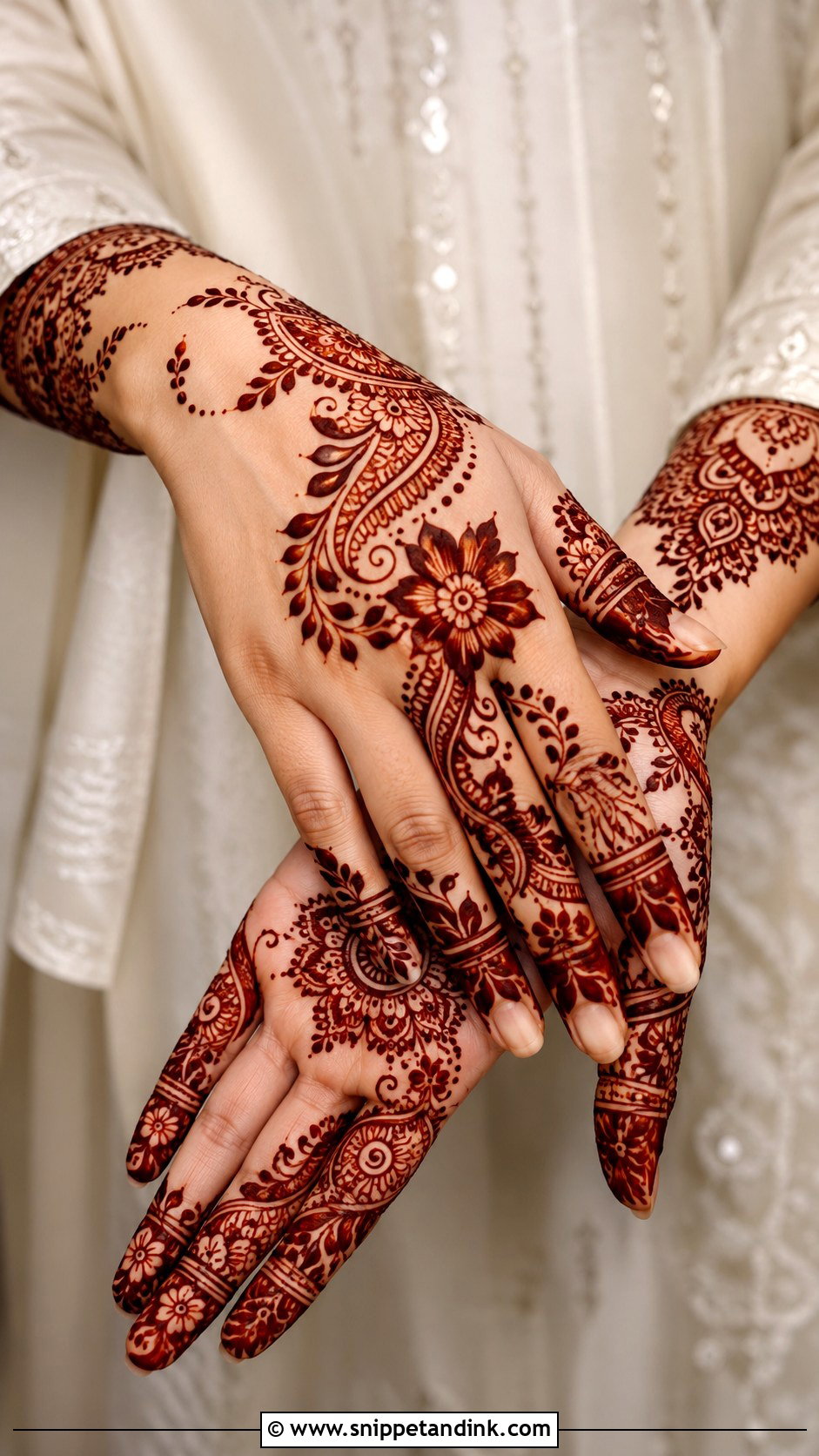
For Eid, a traditional Eid mehndi design is usually an Arabic floral trail, a mandala palm, a back-hand bracelet or Indo-Arabic vines, covering fingers, palm and wrist without going heavy. Between prayers, family visits and photos, nobody wants to sit for hours, so bold outlines and open spaces that dry quickly make sense. I apply most Eid henna on Chand Raat, the night before, so it has the whole night to darken. Both hands can match or complement each other.
24. Karwa Chauth Mehndi Design
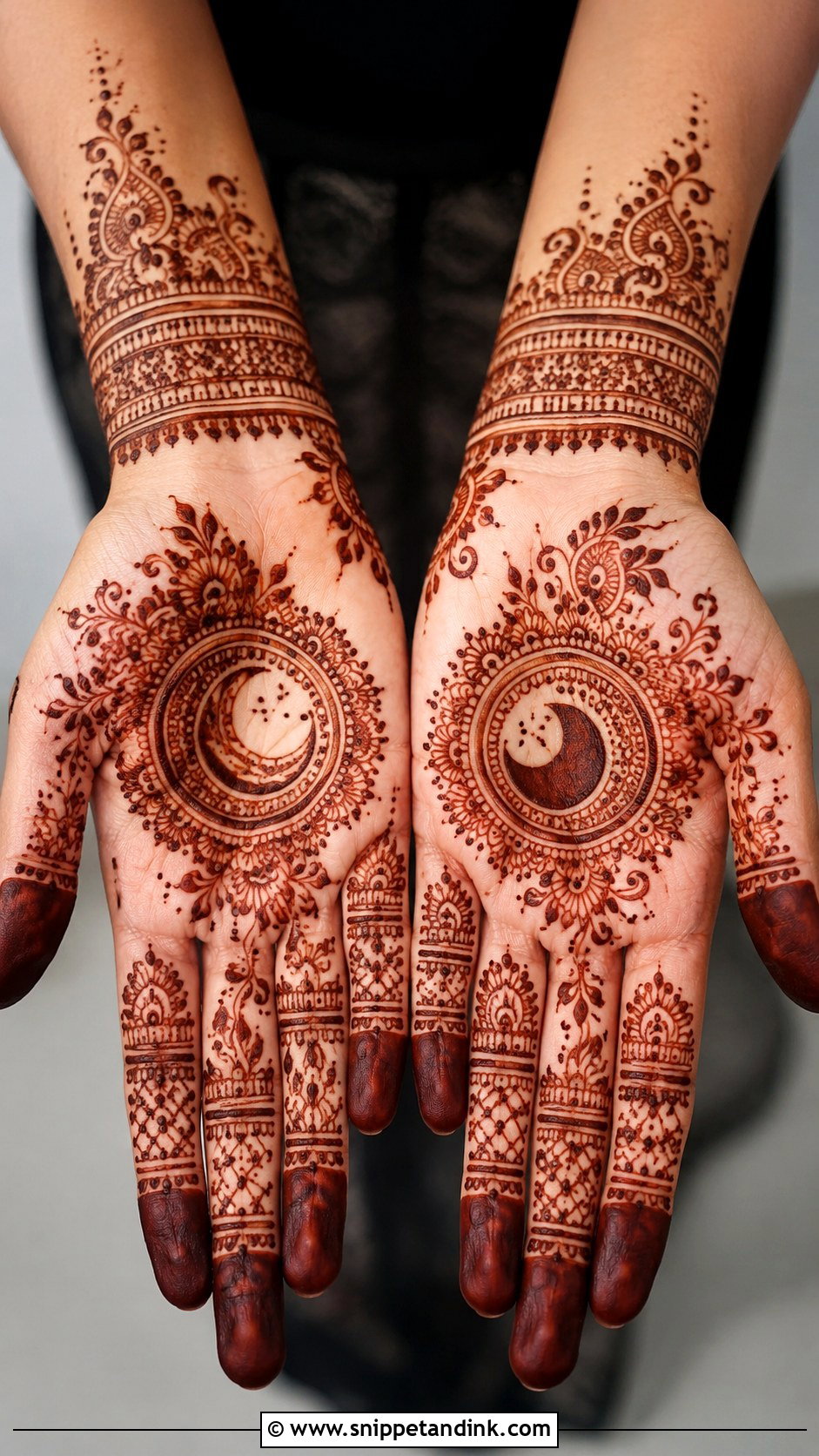
Karwa Chauth henna is festive without being bridal-heavy: mandalas, paisleys, moon curves, leafy vines and fine wrist bands, as full palms or as front- or back-hand patterns. A circular palm motif with florals around it and detailed fingers is the classic. Because the fast starts at dawn, I book clients the evening before; it’s easier to sit for henna after a meal, and the stain gets a full night to develop.
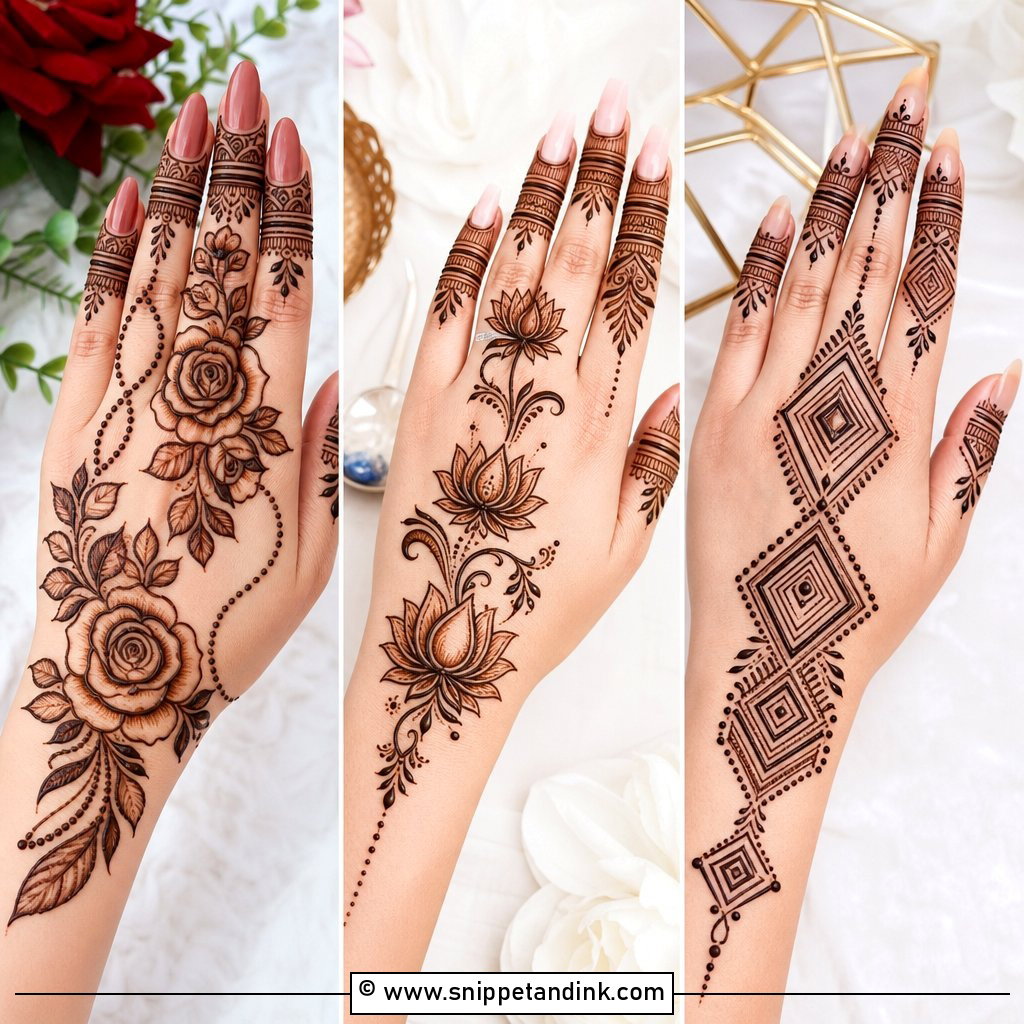
25. Diwali Mehndi Design
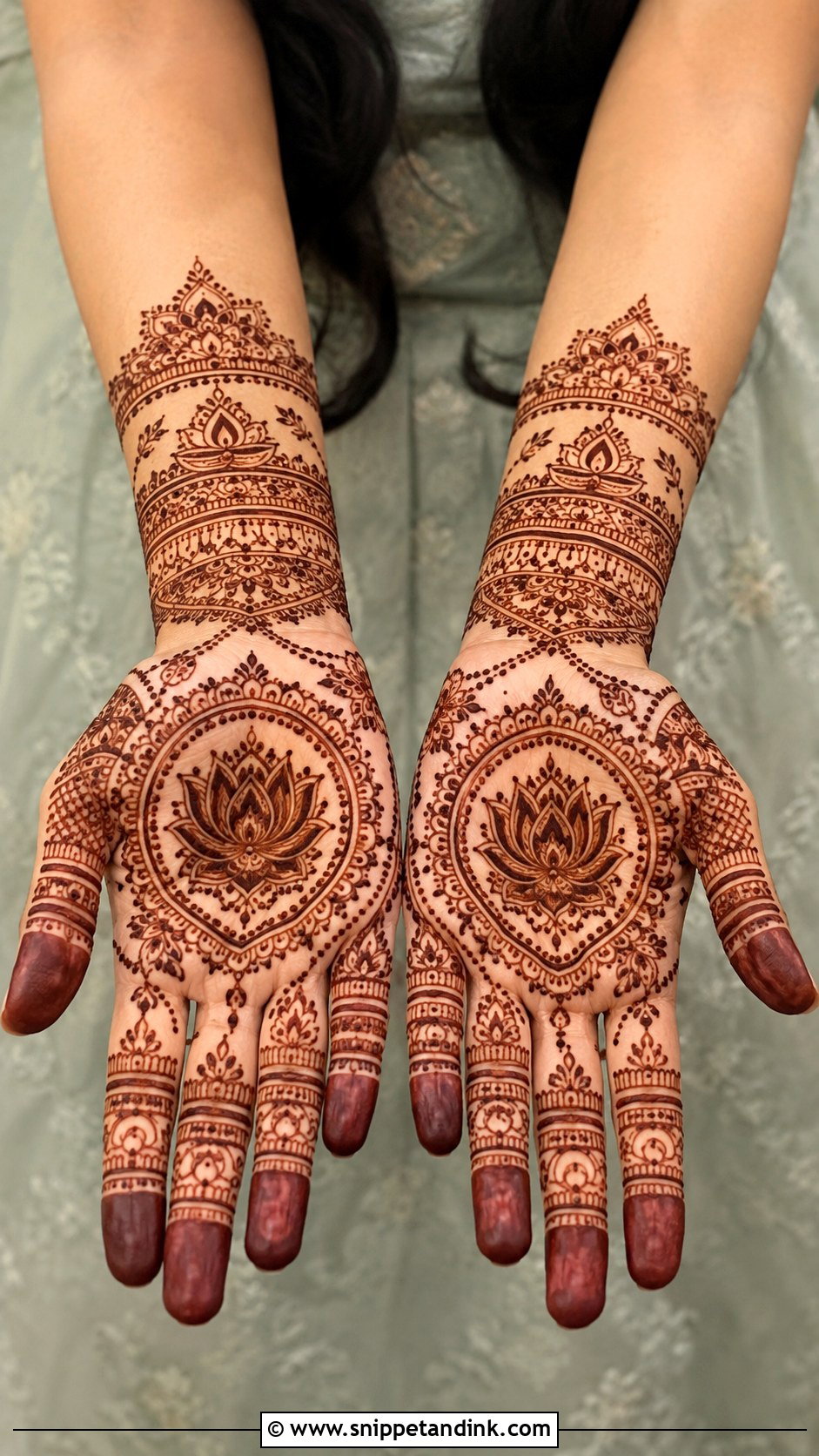
Diwali henna borrows from the festival itself: mandalas, lotus flowers, paisleys, diya curves, dots and decorative borders, usually at medium coverage. A mandala or lotus on the palm, a neat wrist band and fine finger patterns are enough, and a floral bracelet on the back of the hand works too. Keep it symmetrical. Have it done a day ahead so your hands are dry before you start lighting diyas.
26. Teej Mehndi Design
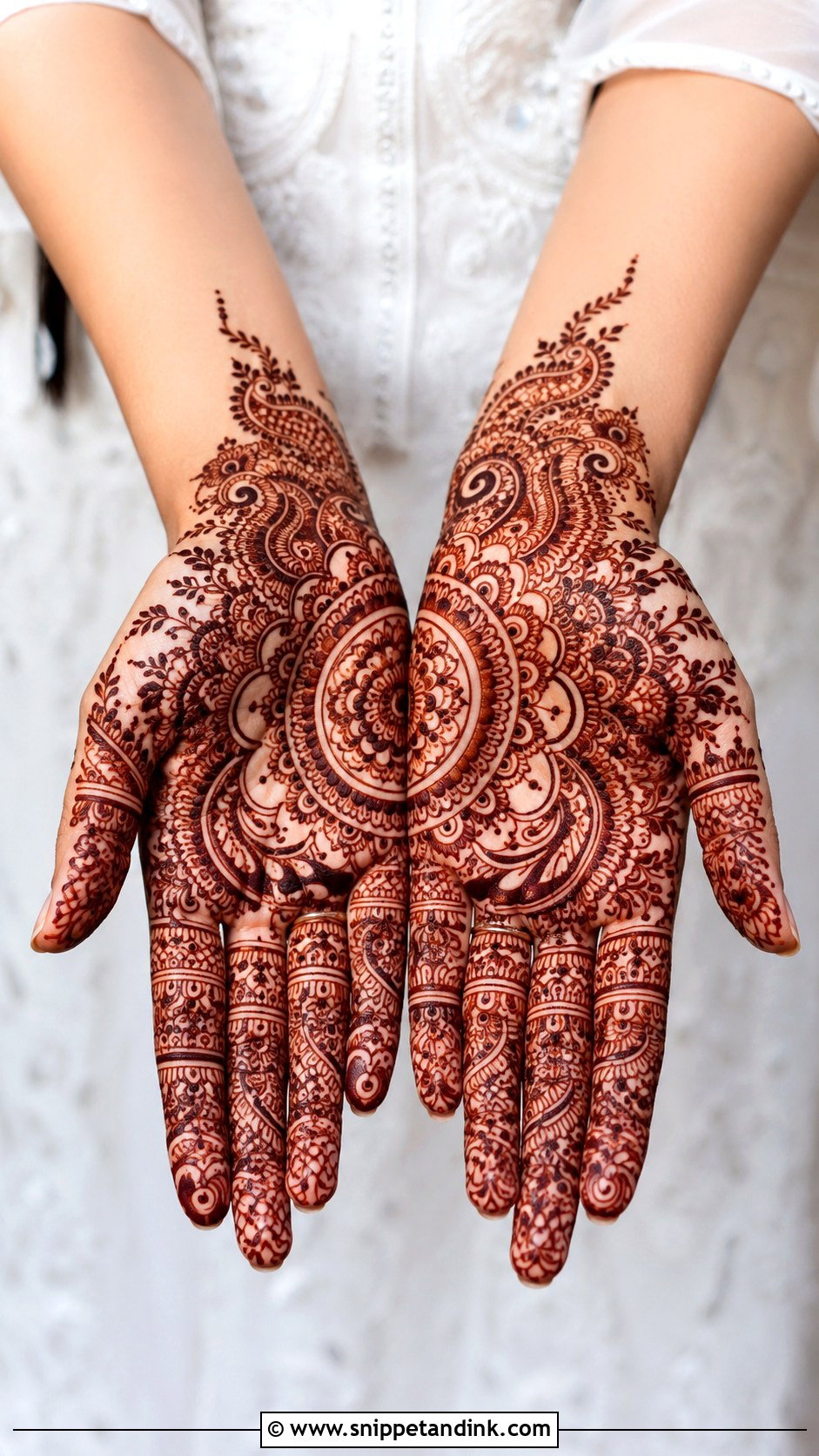
Mehndi is part of the Teej celebration itself, so many women choose medium to heavy front-hand designs, with floral vines, peacocks, paisleys, mandalas, leafy borders and full finger patterns. A bold palm motif can continue into a wrist cuff or forearm trail. For something simpler, a mandala palm with decorated fingers and a small wrist border. Teej falls in the monsoon, and humid air actually helps paste stay moist and stain well, though it also takes longer to dry.
27. Engagement Mehndi Design
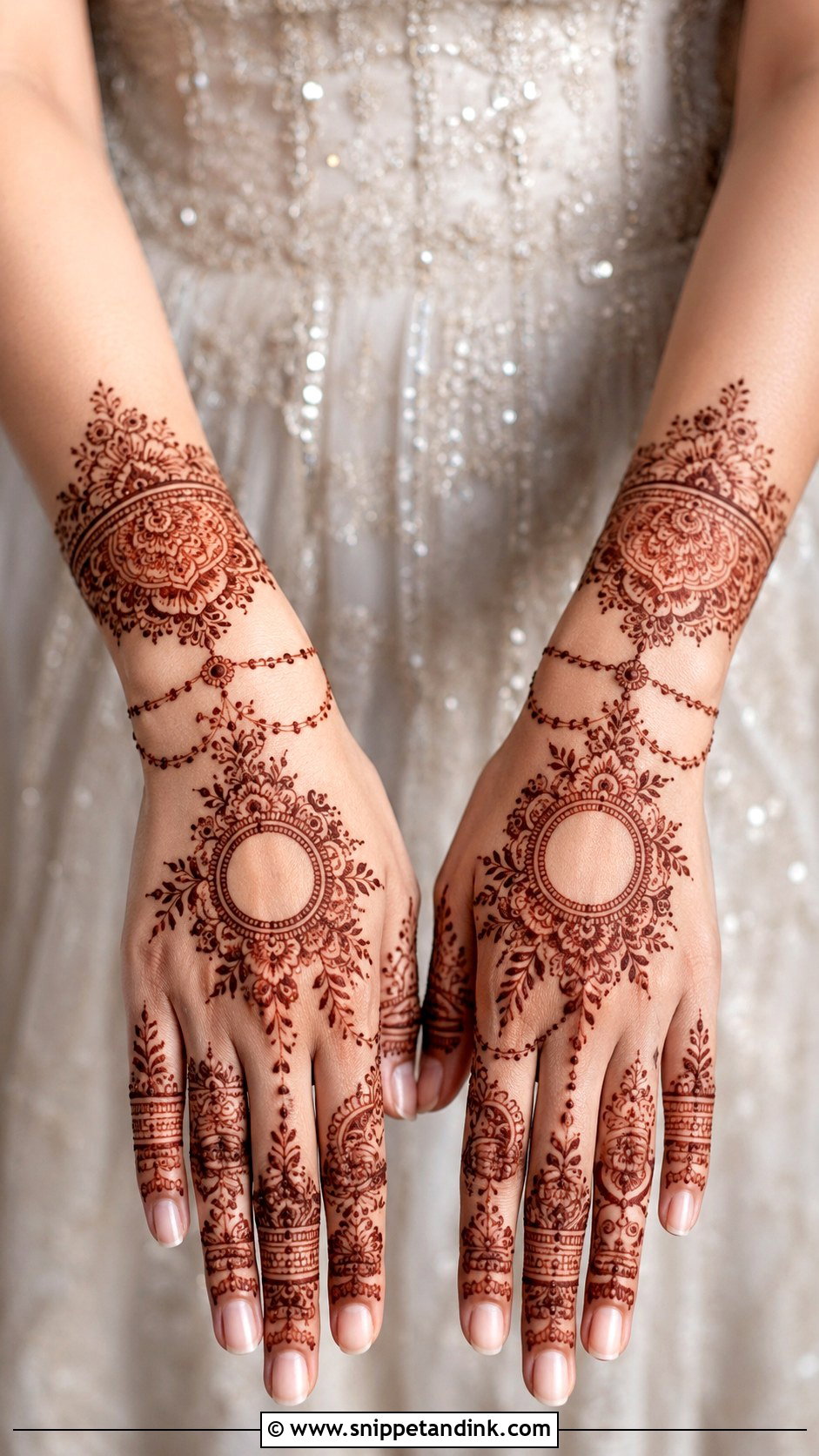
Engagement henna sits between festival and bridal: floral trails, mandalas, paisleys, bracelet patterns and neat finger detail. Many brides choose back-hand jewellery designs so the ring area stays visible, though a centred palm mandala works too. I always leave clear skin around the ring finger. Small paisleys or lotus motifs near the wrist add a traditional touch without competing with the ring in close-ups.
28. Wedding Guest Mehndi Design
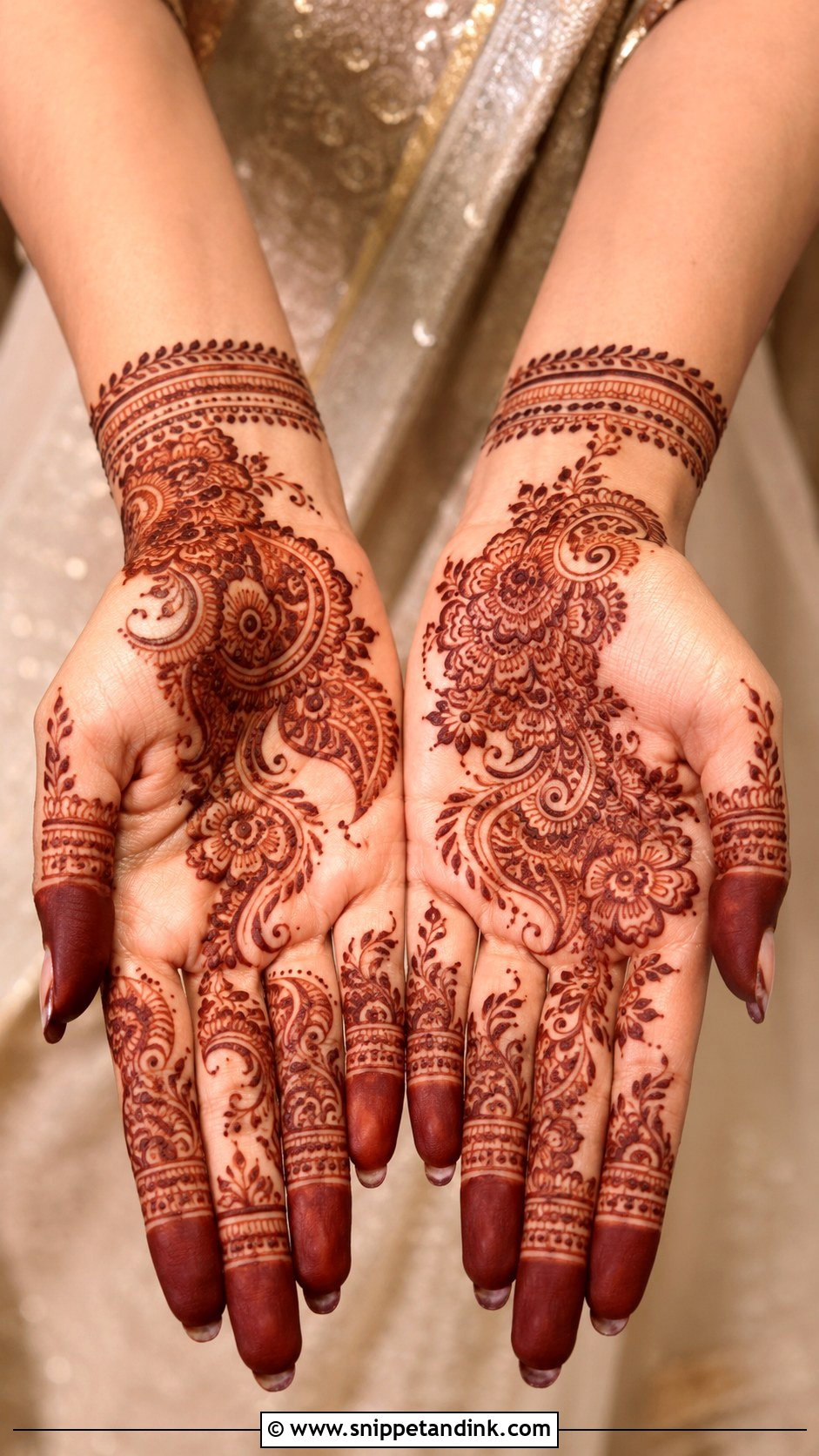
Guests need a finished look that goes with festive outfits and doesn’t take bridal time. Arabic floral trails, back-hand mandalas, paisley palms, bracelet designs and Indo-Arabic layouts all work, covering either the palm and fingers or the back of the hand and wrist. Medium-light coverage dries faster, which matters when you’re eating and greeting people that same evening. Neatness matters more than detail here.
29. Minimal Traditional Mehndi Design
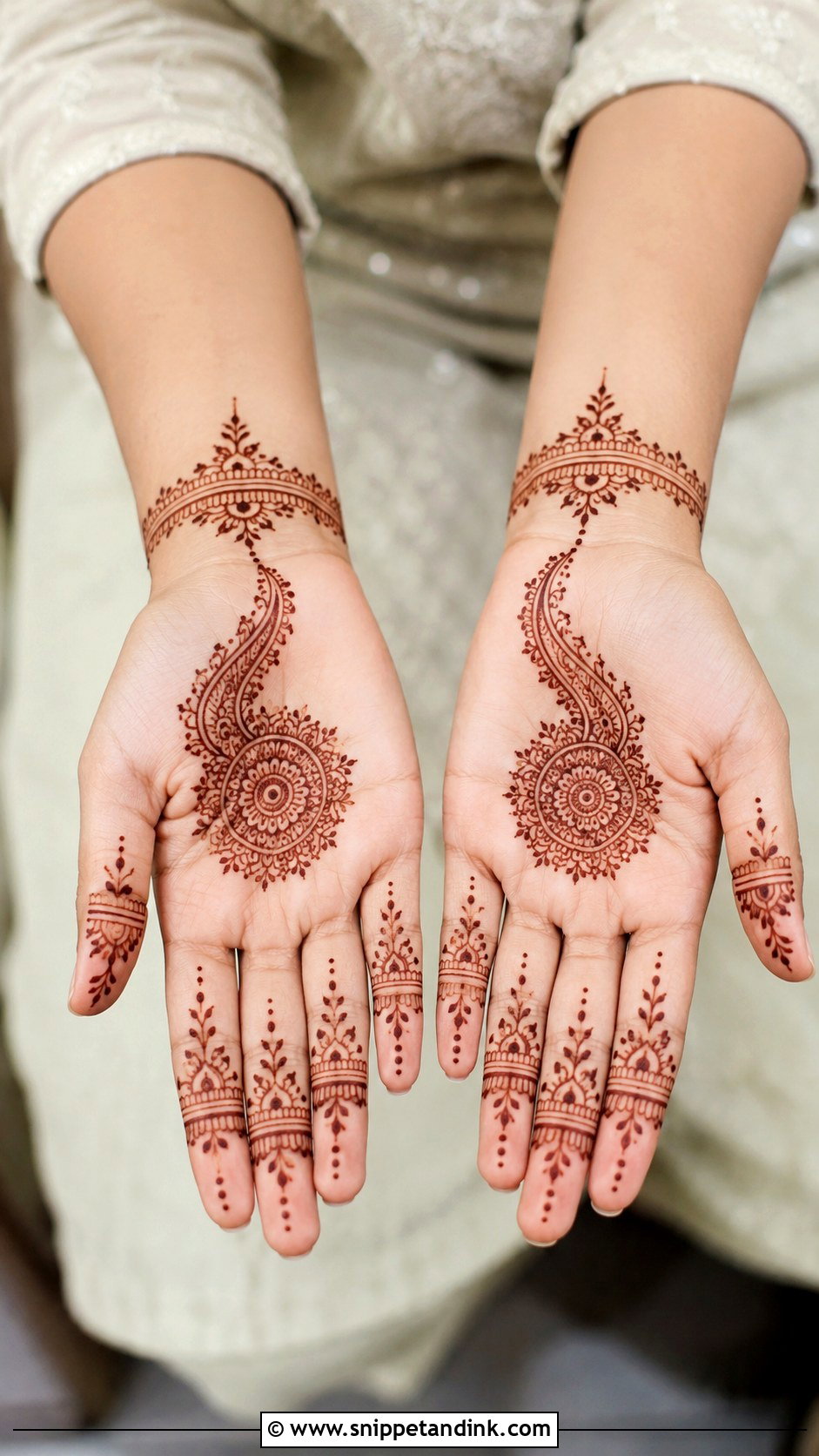
One mandala, a small paisley trail, simple finger bands, leafy tips and a delicate wrist border. Minimal traditional henna still has to feel complete, so I repeat one detail across palm, fingers and wrist to tie them together. It suits teens, office celebrations, small pujas and first-timers. Use natural henna and skip tiny fillers; open skin is part of how this one works.
30. Full Palm Mehndi Design
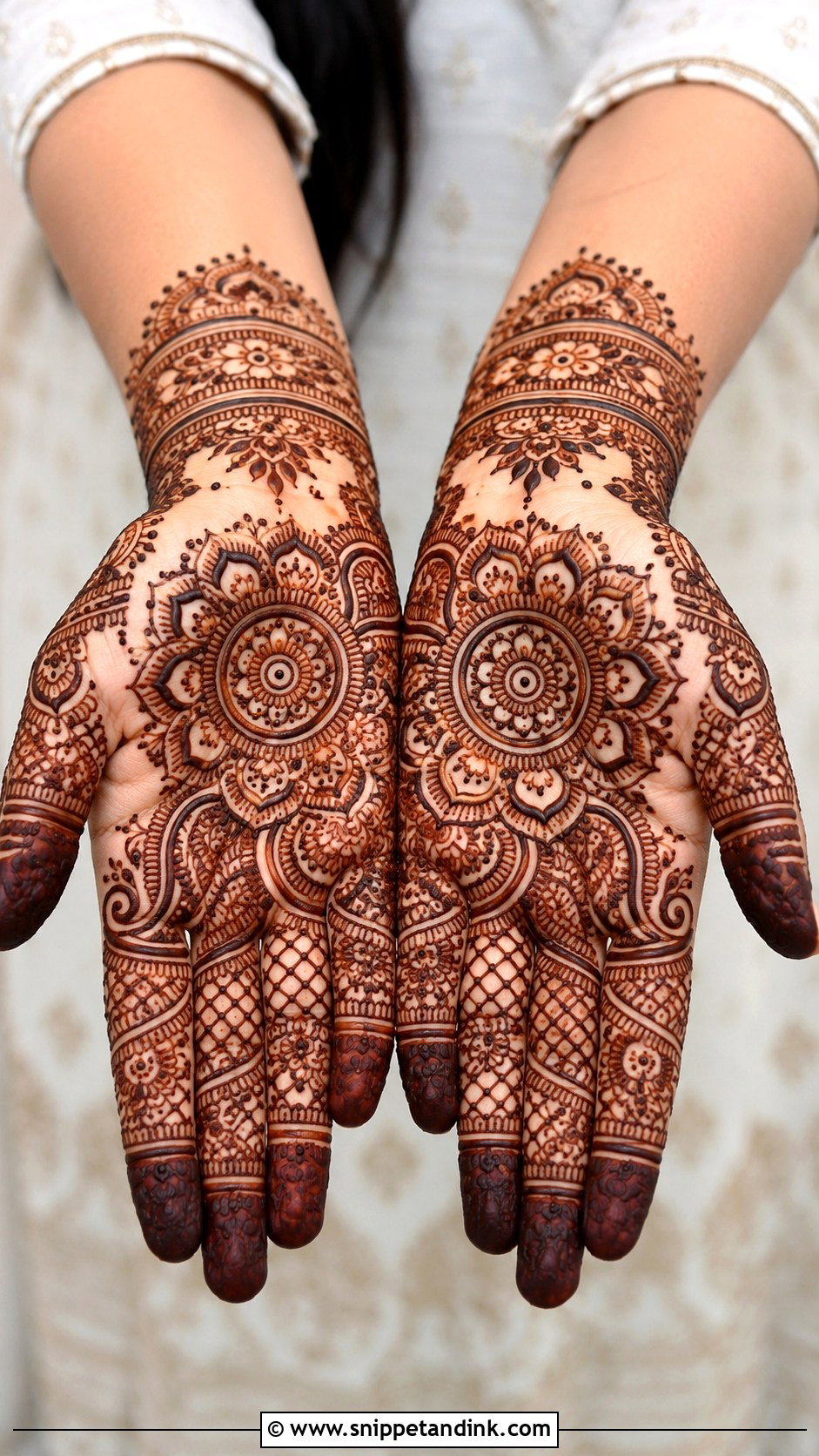
The palm holds henna colour better than anywhere else on the body except perhaps the soles of the feet, so a full palm design tends to stain richest. Mandalas, paisleys, peacocks, lotus flowers, jaali and dense fingertips are the usual motifs. I separate the centre, the finger base and the wrist area with borders so it doesn’t clutter, then fill the fingertips fully and add small dots around the main motifs. The result is usually deep and dark.
31. Wrist To Forearm Mehndi Design
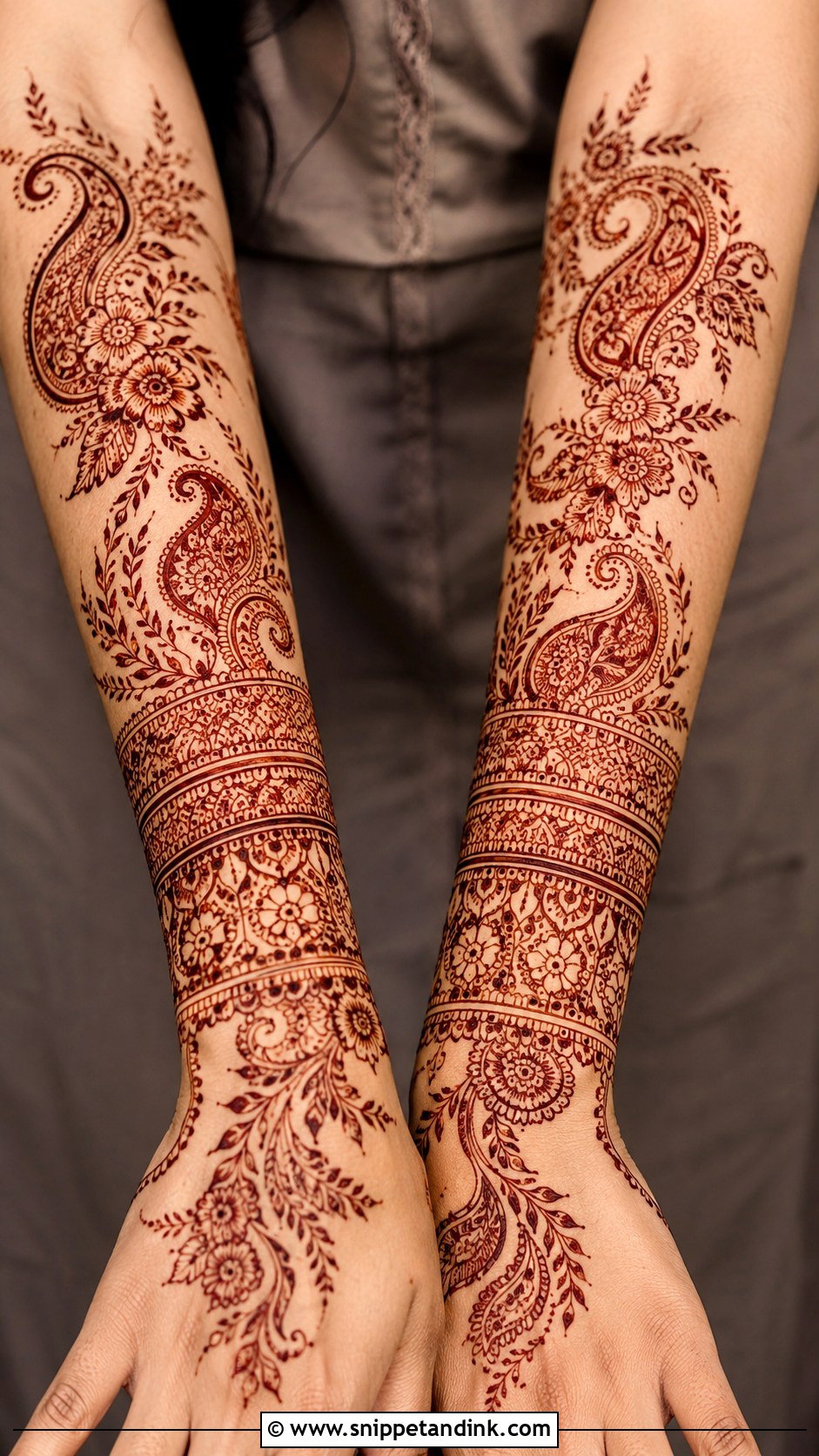
Starting with a bracelet band at the wrist, this one climbs upward with flowers, paisleys, mandalas, vines or geometric borders like an armlet. It suits brides, bridesmaids and festive occasions where sleeves let it show, so check your outfit before you book. Wrist, hand and arm should flow through matching motifs and repeated borders. Forearm skin stains lighter than the palm, so expect a softer brown there and keep the paste on longer.
32. Traditional Foot Mehndi Design
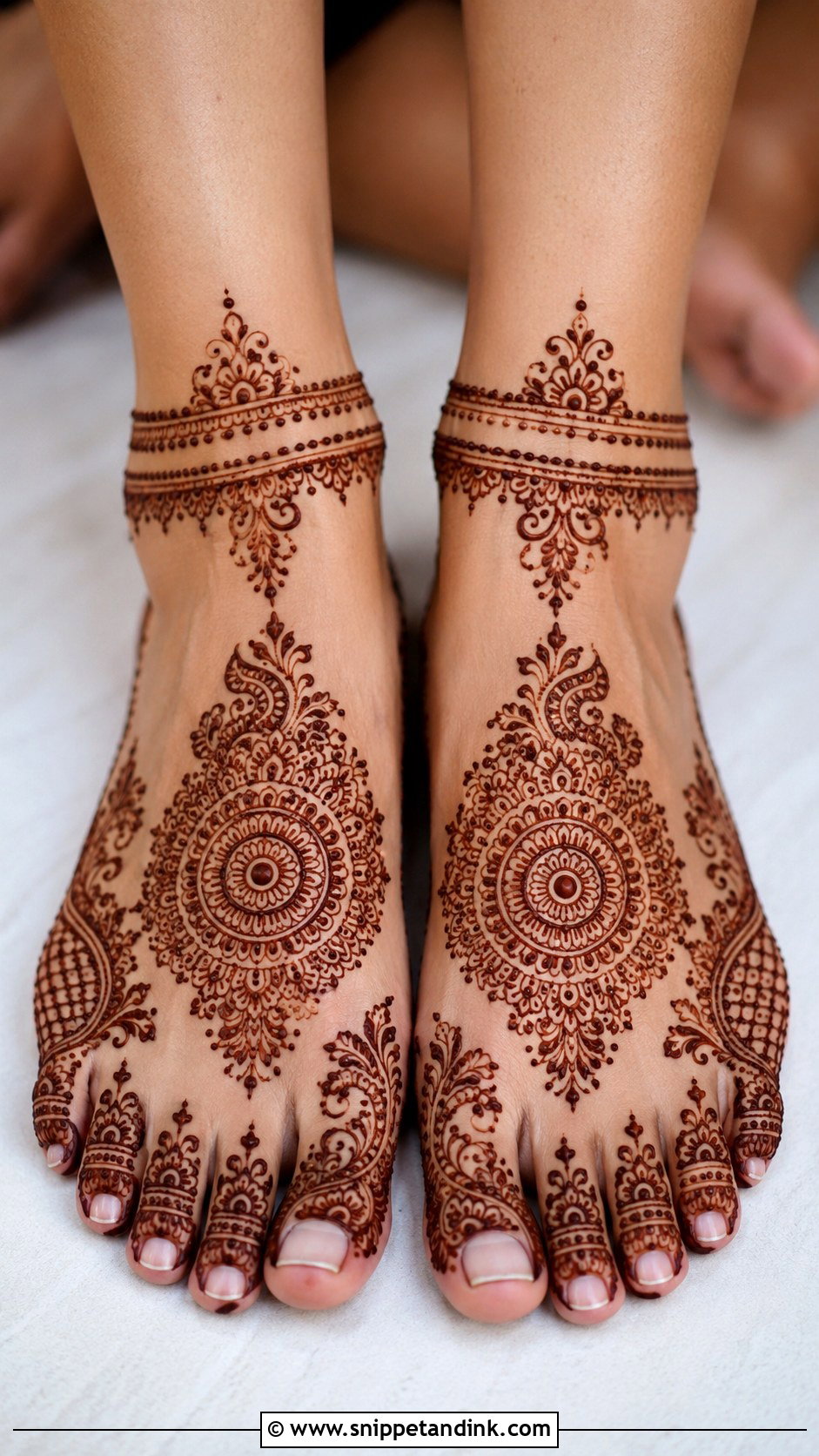
Brides traditionally have their feet done too: toes, the top of the foot, the ankle and sometimes up the shin like an anklet, using flowers, paisleys, mandalas, vines, jaali and dotted chains. A bold motif near the centre with smaller detail moving toward the toes and ankle follows the foot’s shape. Feet stain very deeply. They also take longest to dry and get smudged easily, so I do them last and ask the bride to keep them raised.
33. Anklet Mehndi Design
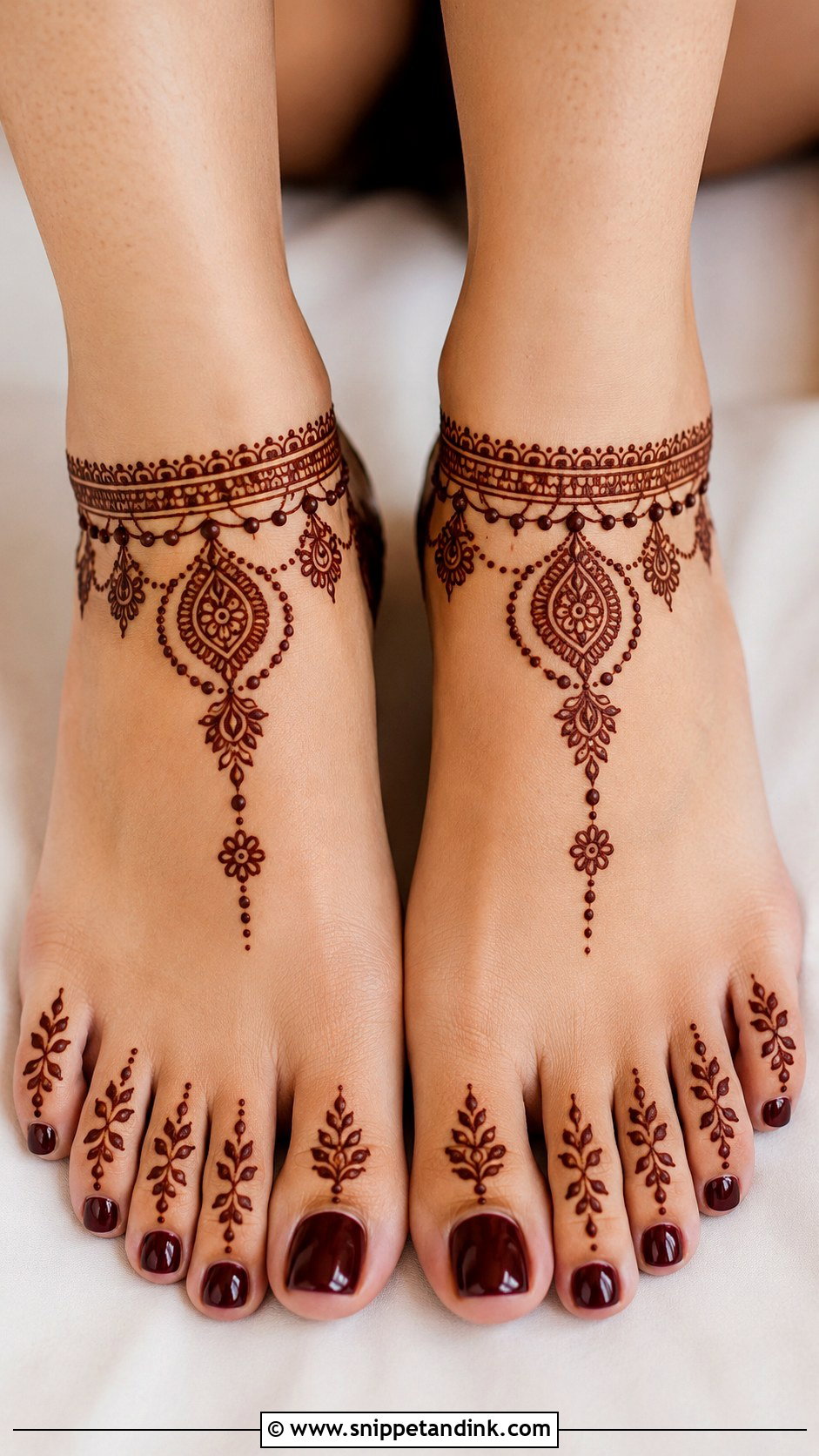
Around the ankle, an anklet mehndi design draws jewellery in henna: thin chains, floral bands, paisley charms, dots, leaves and toe details. It’s lighter than full foot coverage. The band alone looks unfinished, so I connect it to a small pattern on the top of the foot or the toes, and add a central drop motif like a real payal charm. Keep the band level all the way round; ankles aren’t round, so this takes checking from several angles.
34. Kids Traditional Mehndi Design
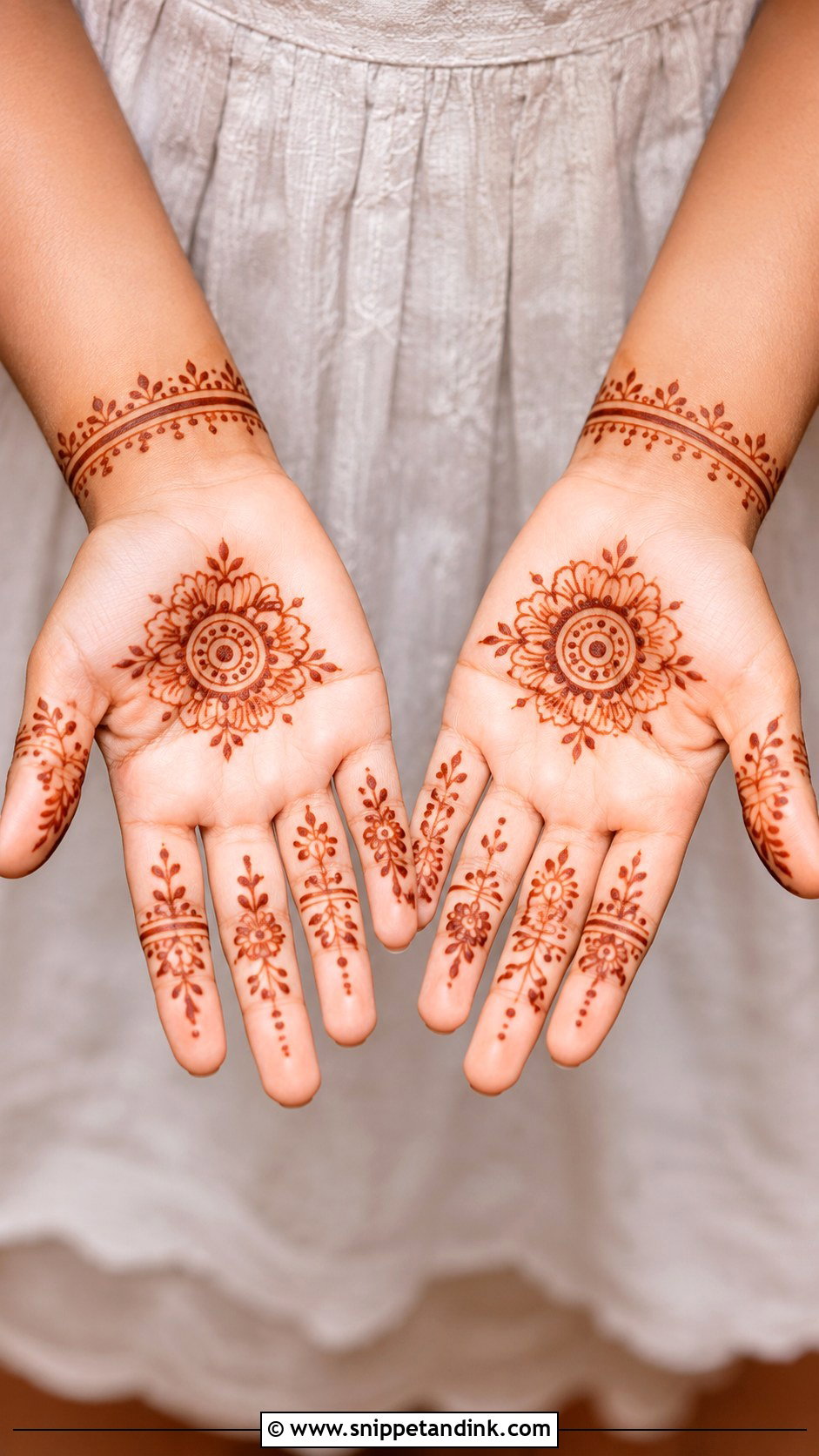
Children need a quick, comfortable design: a small mandala, a flower, a heart-shaped paisley, leafy fingers, dots and a tiny wrist border. The palm is often easiest because it dries evenly and looks clear, while older kids may prefer a back-hand floral trail. I keep it simple and rounded, and I use only natural henna on children. A short sitting keeps everyone happy.
35. Matching Both Hands Mehndi Design
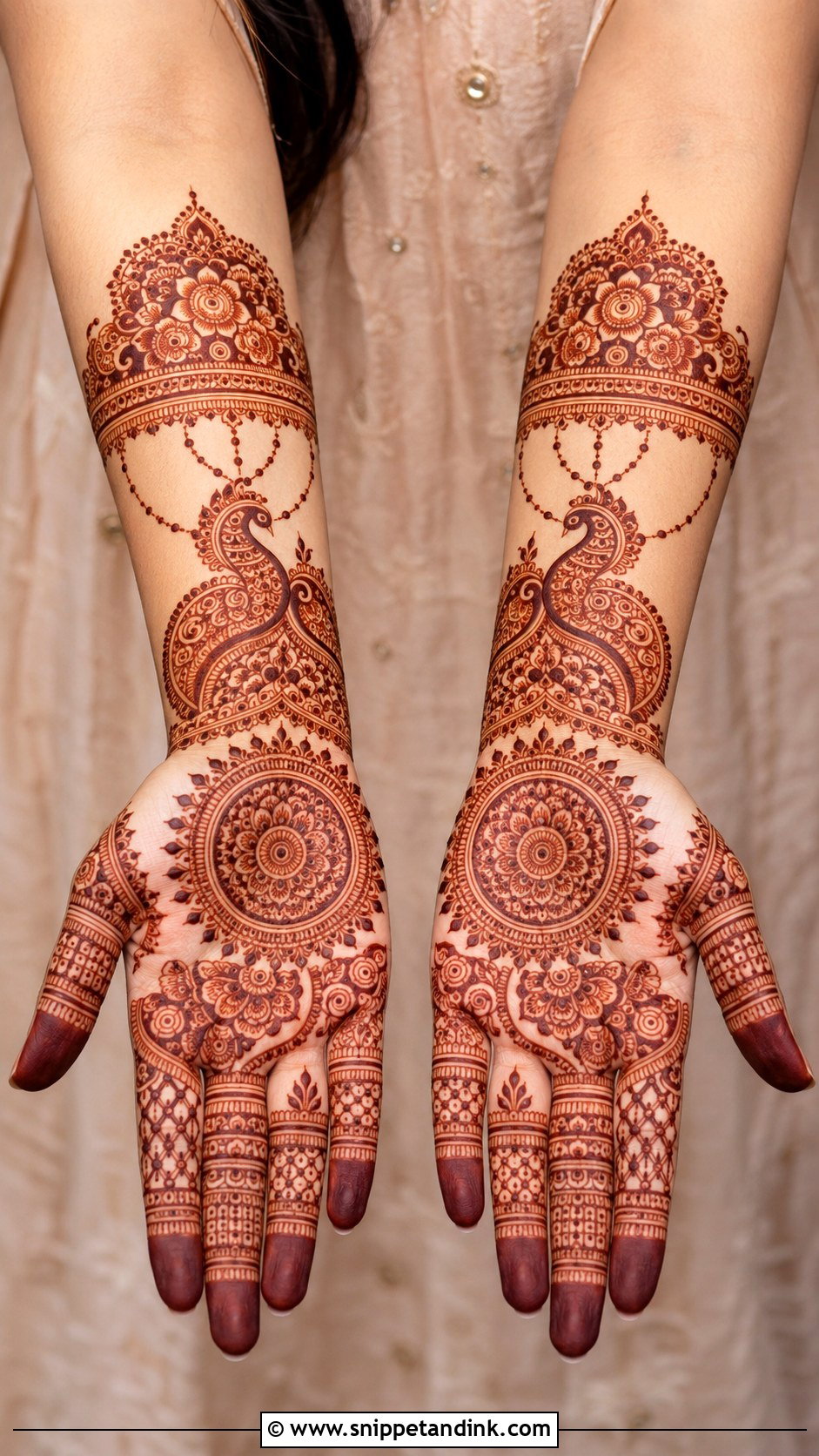
Matched hands can mirror each other exactly or complement each other, so that a split mandala, mirrored paisleys or a pair of peacocks only completes when the palms are held together. Brides often want storytelling motifs across both hands; festive versions use matching mandalas and decorated fingers. Alignment is everything. I mark the height of the main motif on both palms before drawing, so the halves meet cleanly in that palms-together photo.
Running a Mehndi Night With a Long Queue of Hands
Traditional designs come with traditional gatherings, and on a mehndi night the artist is usually the bottleneck. A bride’s full hands and feet can take most of an evening on their own, so I suggest families book extra artists for guests rather than expect the bride’s artist to do everyone.
- Start the bride first, ideally a day or two before the wedding, so her stain peaks on the day.
- Seat people at a table with good light and a cushion or armrest. Steady hands make cleaner lines.
- Keep spare cones in a cool box. Fresh henna paste is perishable and loses strength in heat.
- Give guests a time slot and a coverage limit, such as one hand front or back, so the queue keeps moving.
- Have tissues, cotton buds and lemon-sugar mix ready, plus somewhere for people to sit while their paste dries.
After the paste comes off
Every guest leaves with the same advice from me: scrape the dried paste off instead of washing it, keep the hands dry for as long as you can that first day, and don’t judge the colour until two days later. The orange you see at first turns reddish brown as it oxidises.
Meaning, Coverage and Comfort, in That Order
These motifs have lasted because they carry meaning and suit so many occasions, from full bridal hands to a single mandala palm. Some are dense and ceremonial; others are light enough to wear to work. When you book, decide first which motifs mean something to you or your family, then how much coverage your time and the event allow, and finally what you’ll be comfortable doing with your hands for the next few hours. Get those three right and the design follows.
You'll Like These Ideas:


Leave a Reply