
Most brides I sit with already know whether they want their hands packed or airy. What they haven’t thought about yet is how the design will read once the stain darkens and the jewelry goes on. Some come in asking for dense Indian full-hand patterns with peacocks and paisleys, others want an Arabic trail, a single clean mandala, portrait work or a bracelet design on the back of the hand. I plan every one of them the same way: fingertips to wrist as one composition, both hands checked side by side, and enough contrast that the pattern still reads after two days of darkening. Below are thirty bridal layouts I’d happily draw, with notes on what each one asks of your time, your hands and your outfit.
Planning Mehndi Night Around How Henna Darkens
Fresh henna comes off the skin bright orange. Over the next 24 to 48 hours it oxidizes to reddish brown and then, on most skin, to maroon. That curve decides the whole schedule. I like to apply bridal mehndi one to two days before the main ceremony so the color is close to its peak when the photographer arrives. Apply it the morning of the wedding and you’ll be walking in with orange hands.
How long a bridal sitting really takes
Time depends on coverage and on the artist, so treat these as rough guides. A minimal or Arabic pair of hands might take an hour or two. Full Indian hands to the elbow often need several hours, and adding feet stretches it further. Eat, charge your phone and visit the bathroom before the cone touches skin, because once both hands are wet you can’t do anything for yourself.
Prep in the two days before
- Exfoliate gently, and finish any waxing, threading or manicure beforehand, never after the henna goes on.
- Skip lotion, oil and sunscreen on your hands and arms on application day; they sit between the dye and your skin.
- Ask for a patch test if you’ve never worn henna, and refuse any paste sold as black henna. Natural henna is never black, and dark pastes can contain PPD, a chemical that causes serious skin reactions.
1. Full Hand Bridal Mehandi Design
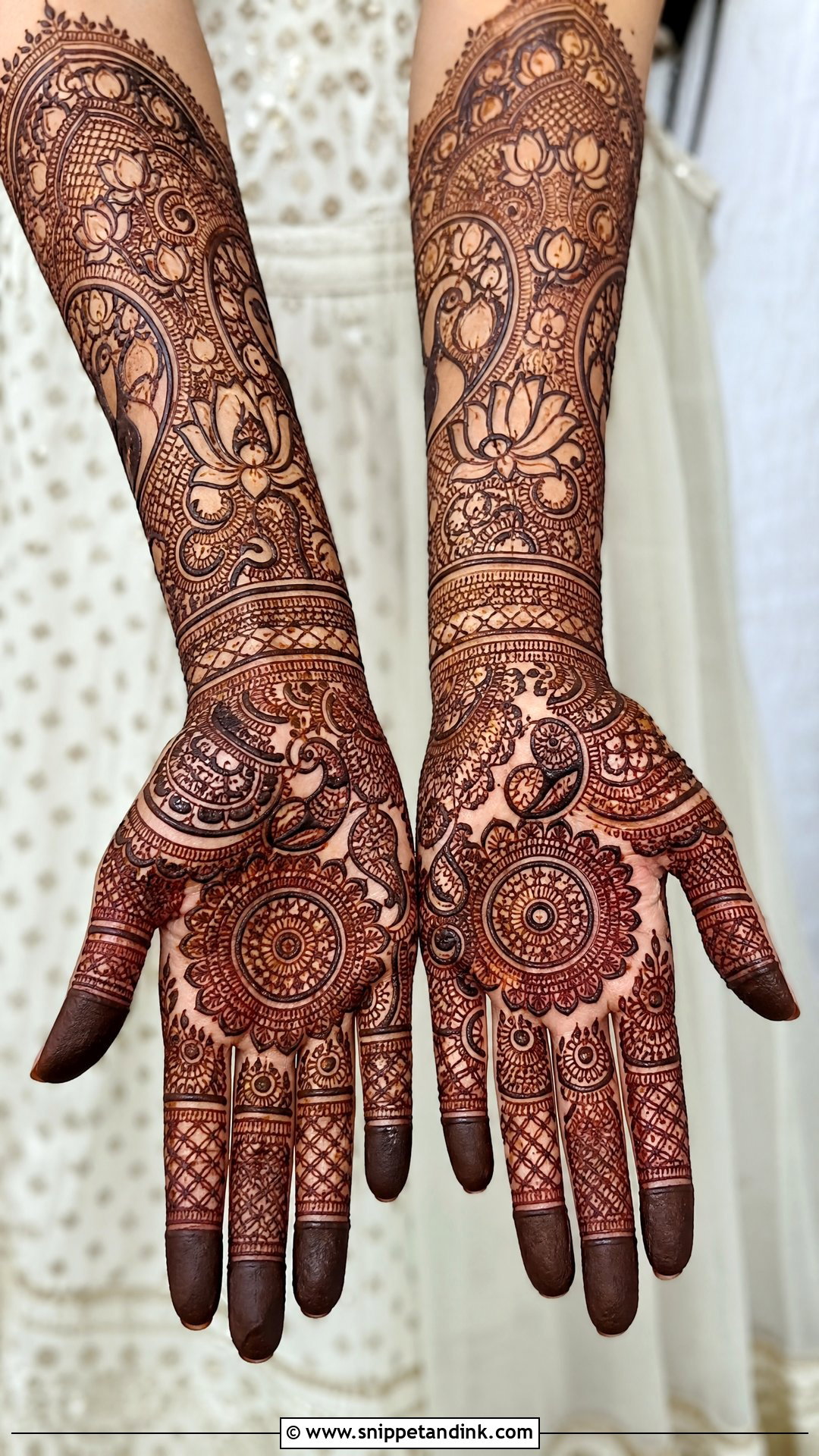
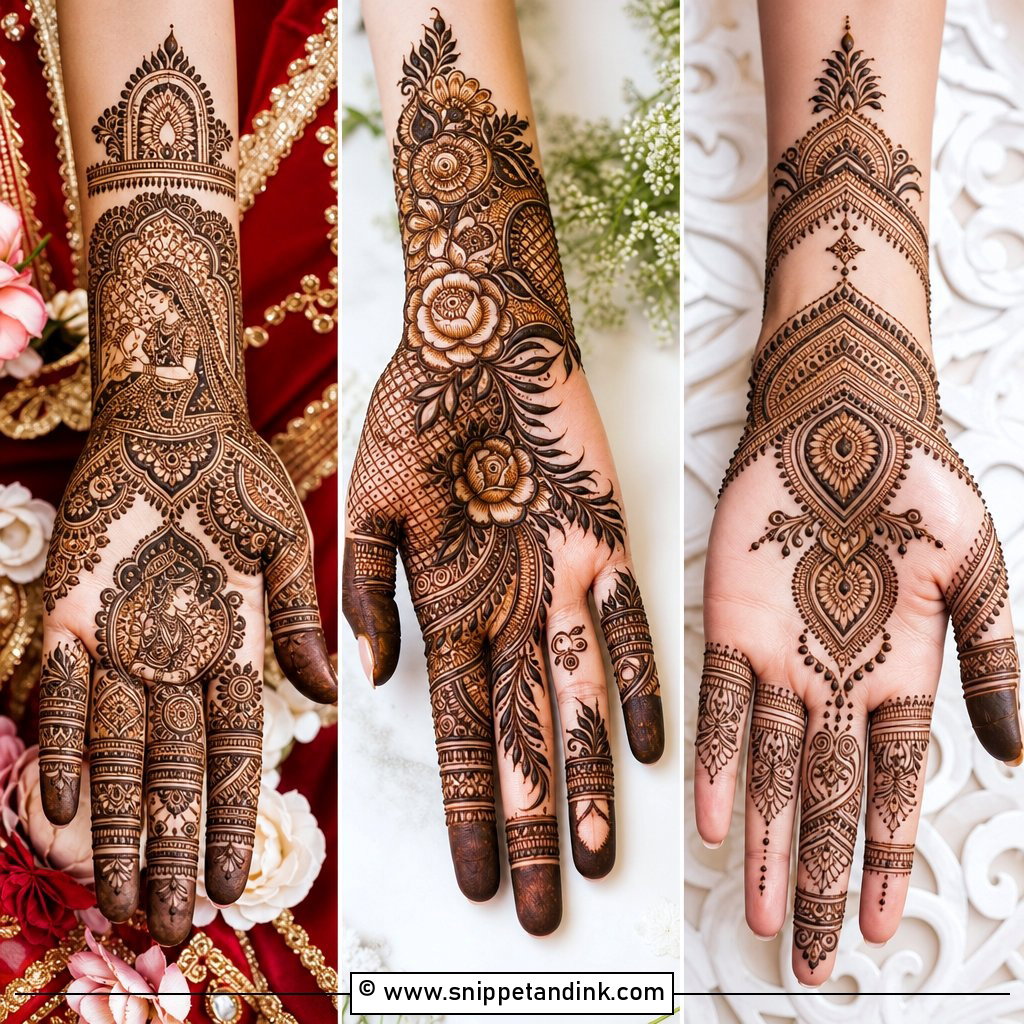
Coverage from fingertips to forearms is the classic bridal brief, and it needs the most planning. I map the palms first, because that is where the main motif sits and where the stain comes up darkest, then build the backs and arms around it with paisleys, lotus, peacocks, jaali and fine filler lines. The trap is filling every gap at the same density, which turns into a brown blur in photos once the color deepens. I leave small breathing lines between sections so each motif stays legible. It carries heavy lehengas, Kanjivaram sarees and classic gold jewelry well, but budget a long sitting and a quiet evening afterwards.
2. Indian Bridal Mehandi Design
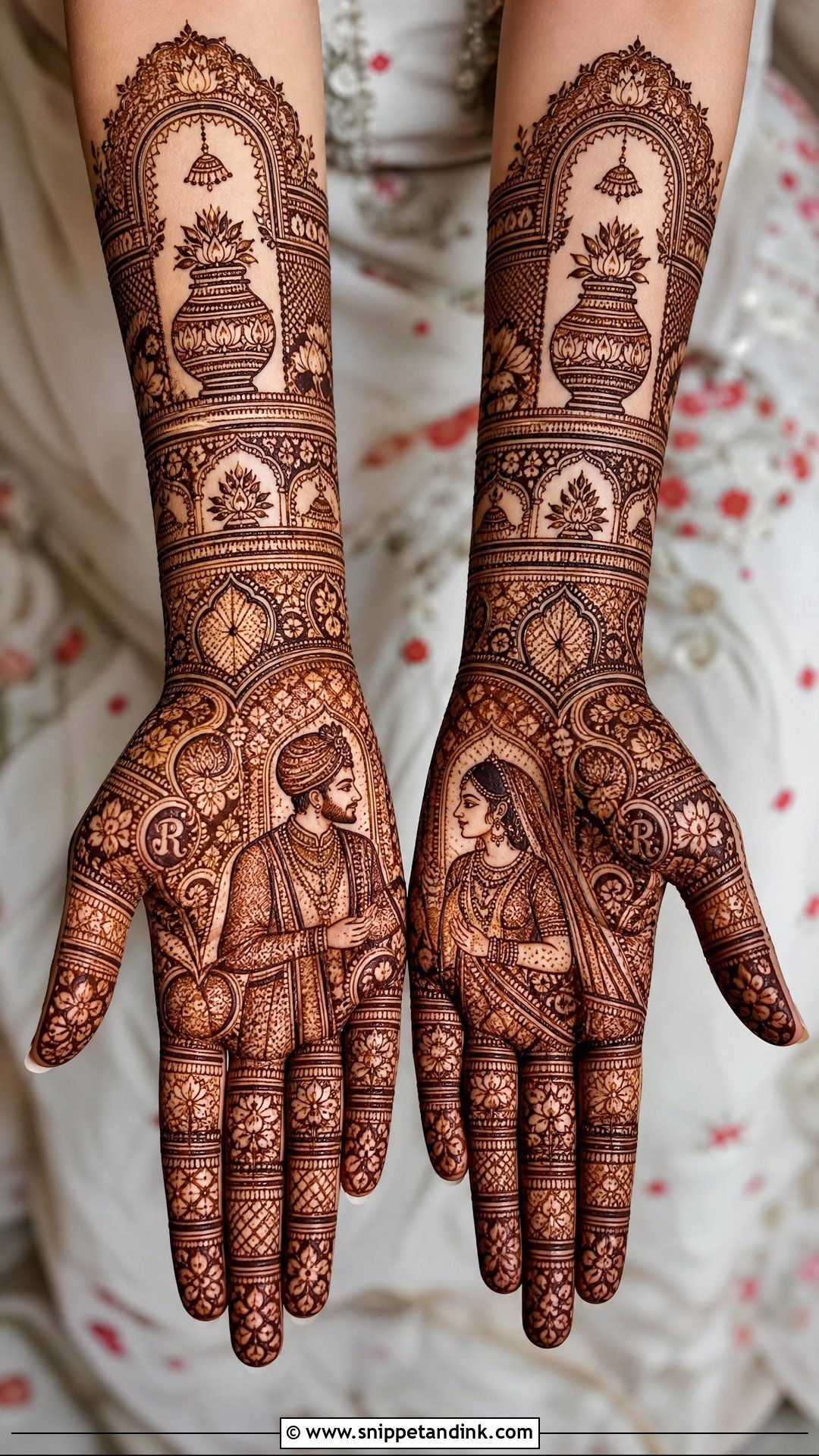
Traditional Indian work is where I get asked for stories: bride and groom figures, a kalash, elephants, a doli, lotus flowers and the groom’s initials tucked somewhere. I keep the layout symmetrical so the two hands complete each other when you hold them together for photos. Fingers get tiny checks, leaves and bands, while the palm carries the feature. What people underestimate is the time. Figures need a steady cone and clean outlines before any filling goes in, so I only take this on when the bride can sit for it without being rushed toward the next ritual.
3. Arabic Bridal Mehandi Design
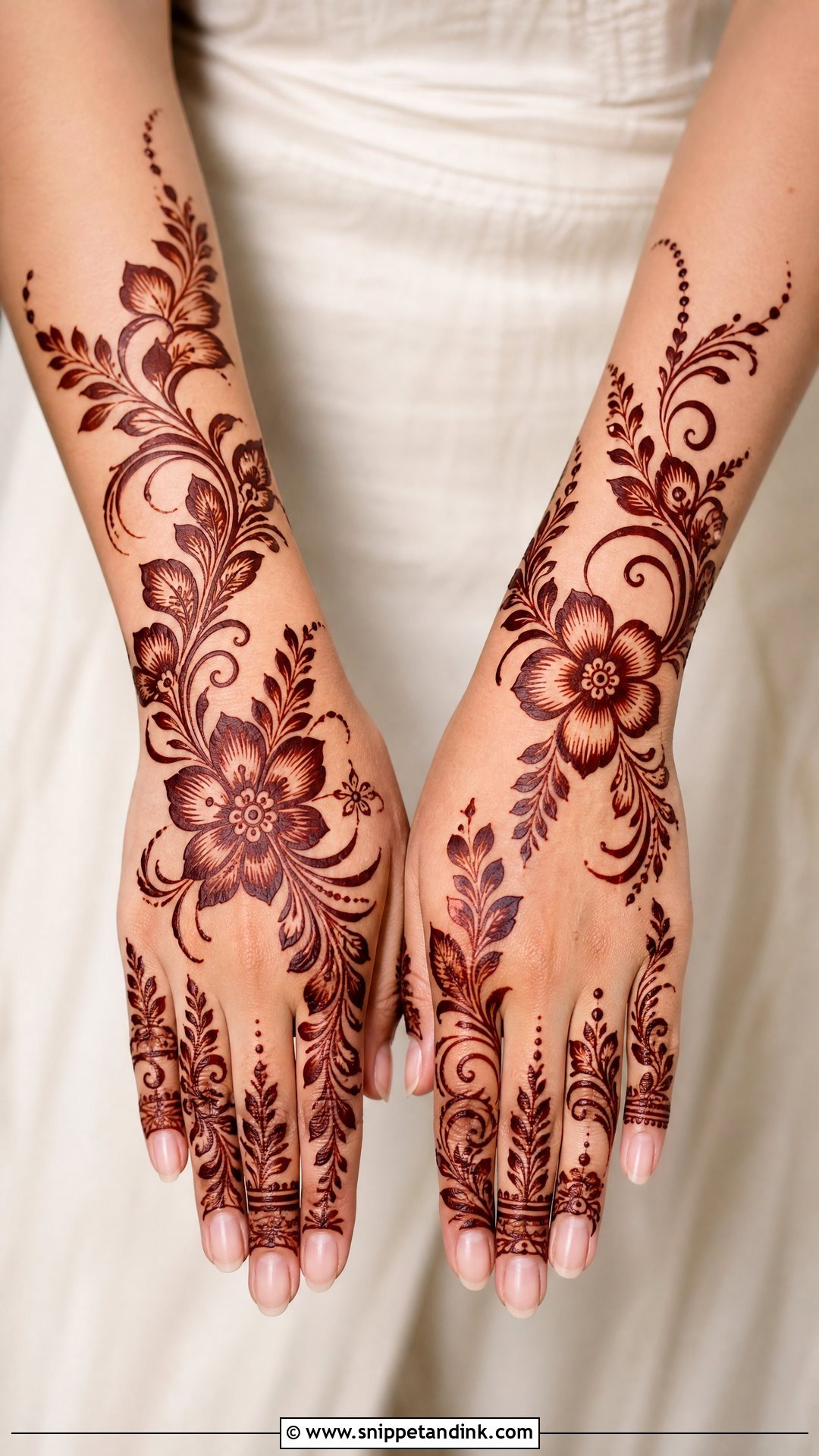
Arabic layouts leave skin showing on purpose. The design runs diagonally across the hand in bold flowers, vines and shaded petals, and the open spaces are what make it readable from across a room. Shading is done by easing pressure on the cone so the paste sits thinner, and thin paste stains paler, so those shaded petals will always look softer than the outlines. You can stop the trail at the wrist or carry it up the forearm. I suggest it for pastel lehengas, destination weddings and brides who can’t give up a whole day to sitting still.
4. Indo Arabic Bridal Mehandi Design
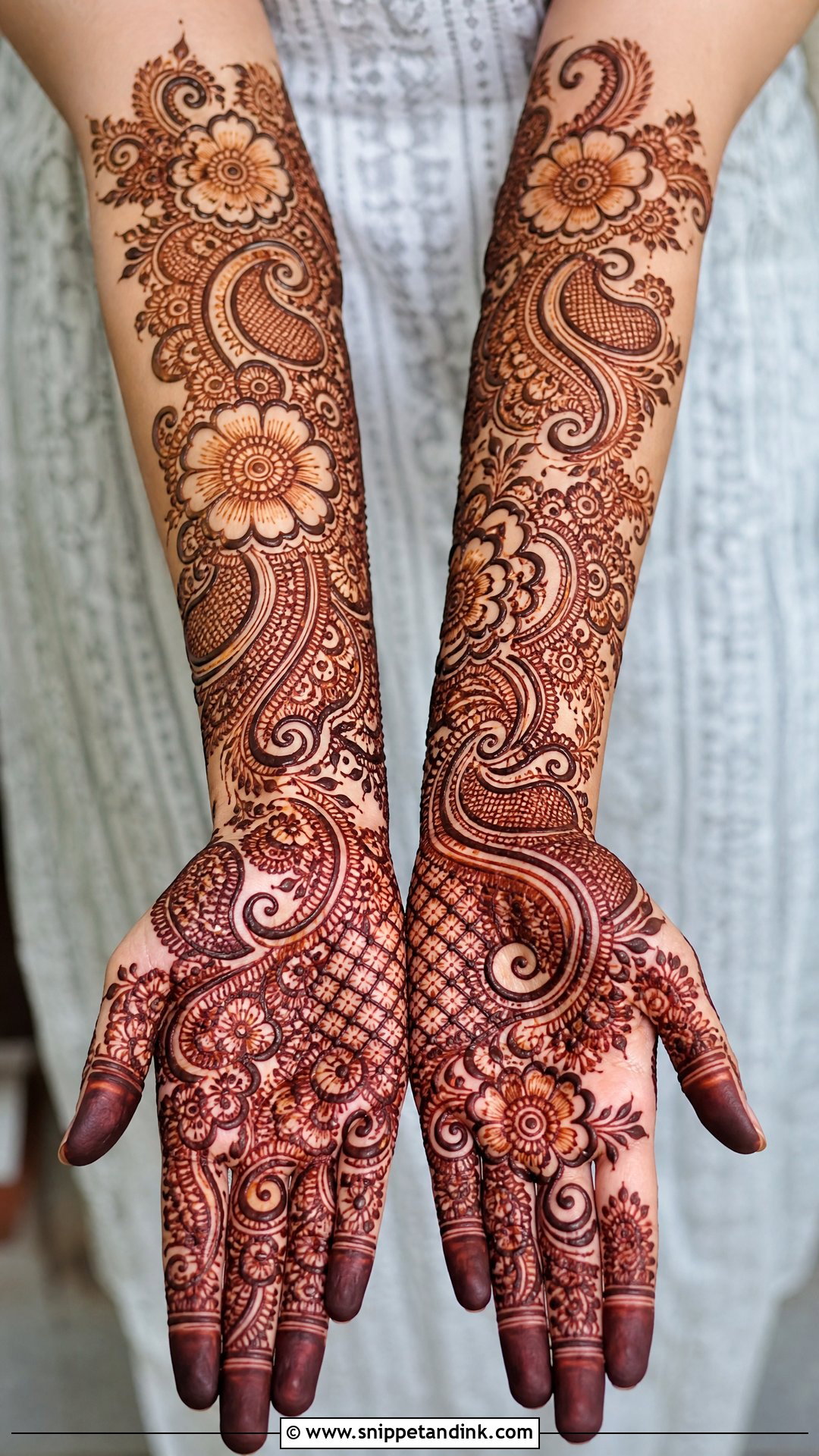
Indo-Arabic is the compromise I recommend most often when a bride says she wants something heavy but is nervous about the hours. The bold Arabic flow sets the direction, usually from one side of the palm toward the wrist, and then I fill selected flowers and paisleys with Indian mesh while leaving the gaps open. That diagonal pull makes the hands look longer. It reads clearly in photos at a distance, and brides often repeat a lighter version of it for the engagement, nikah or sangeet.
5. Rajasthani Bridal Mehandi Design
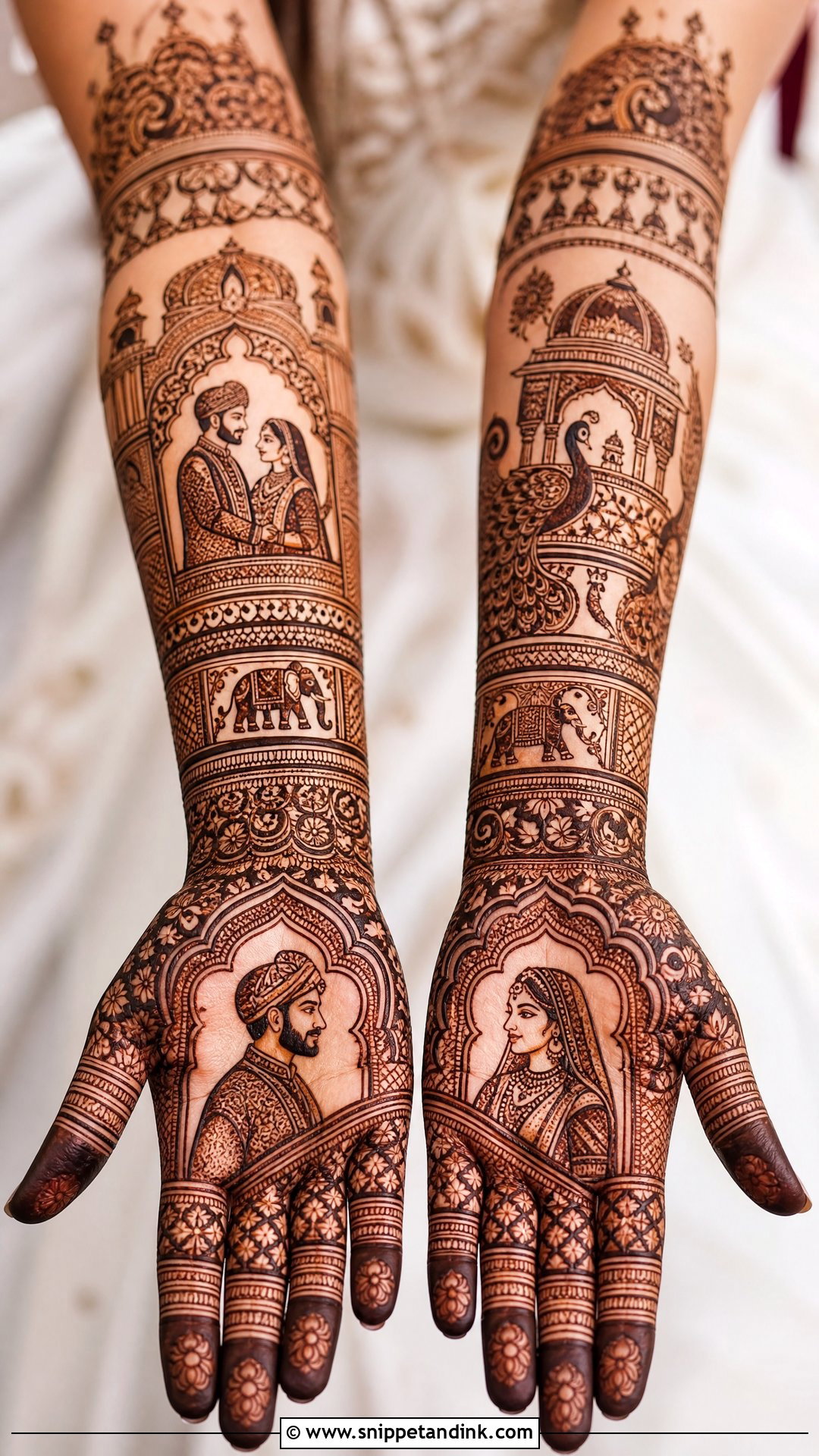
Rajasthani bridal mehandi design is the most detailed work I do. Portraits, palaces, elephants, peacocks and doli scenes sit inside layered paisleys, often with jharokha frames and royal borders running up the forearms. When both hands come together the scenes should read as one wedding story, so I sketch the joining edge before anything else. Expect a very long sitting. The density also means a small smudge is hard to hide, so I ask brides to have their phone away and someone else holding their water. It belongs with red and gold heritage outfits.
6. Marwari Bridal Mehandi Design
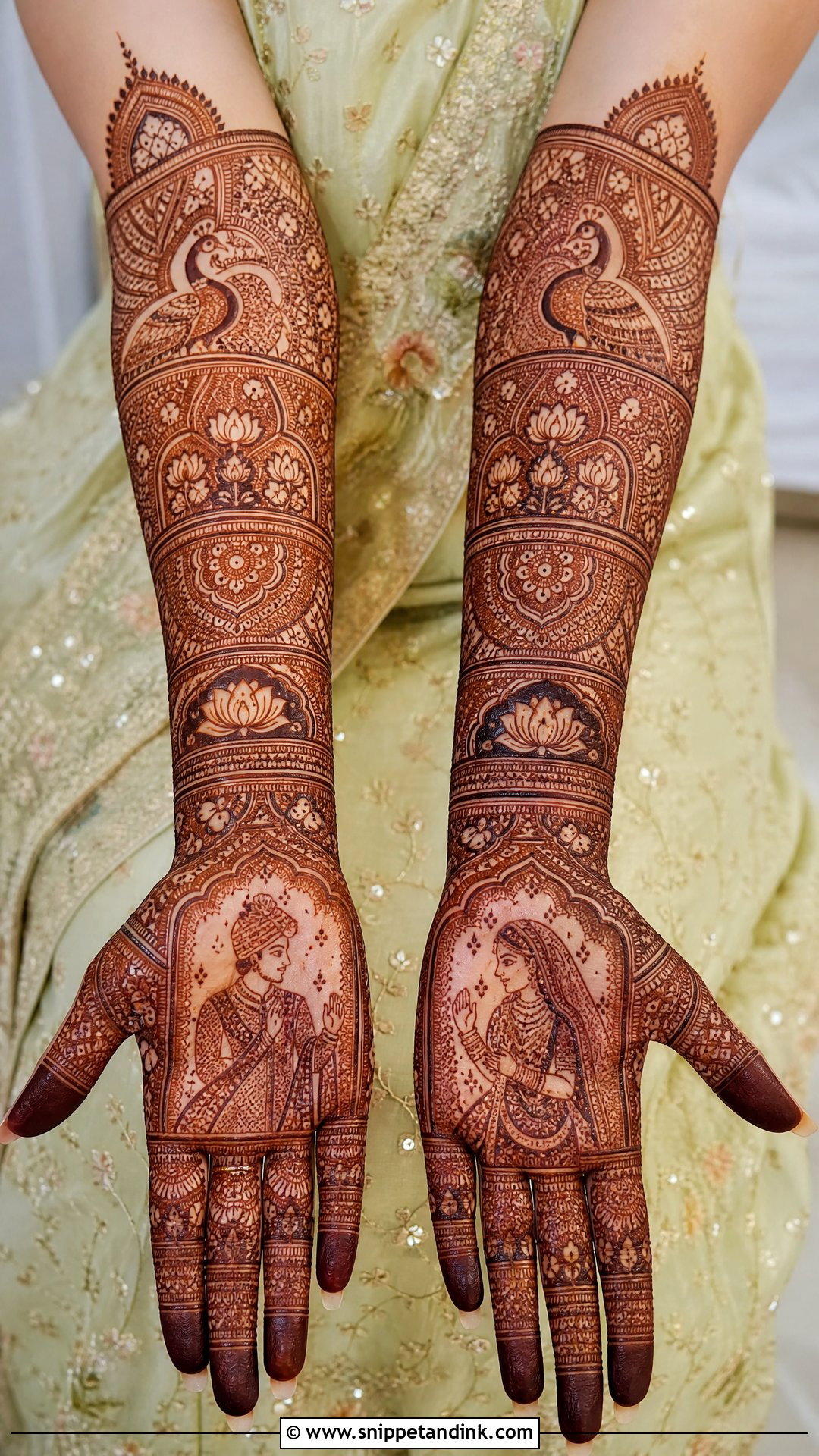
Marwari work overlaps with Rajasthani but leans harder on micro-patterns: elaborate paisleys, peacocks, lotus and ornamental borders, with fine lines layered so tightly that the stain looks almost textured. Full hands and long arm coverage are standard. Because so much of it is hairline detail, paste consistency matters more here than anywhere else. A cone mixed too thick closes up the gaps, and the whole arm stains as one dark sleeve. Bandhani, gota patti and mirror work sit naturally beside it. I wouldn’t suggest it for a bride who wants a quick evening.
7. Pakistani Bridal Mehandi Design
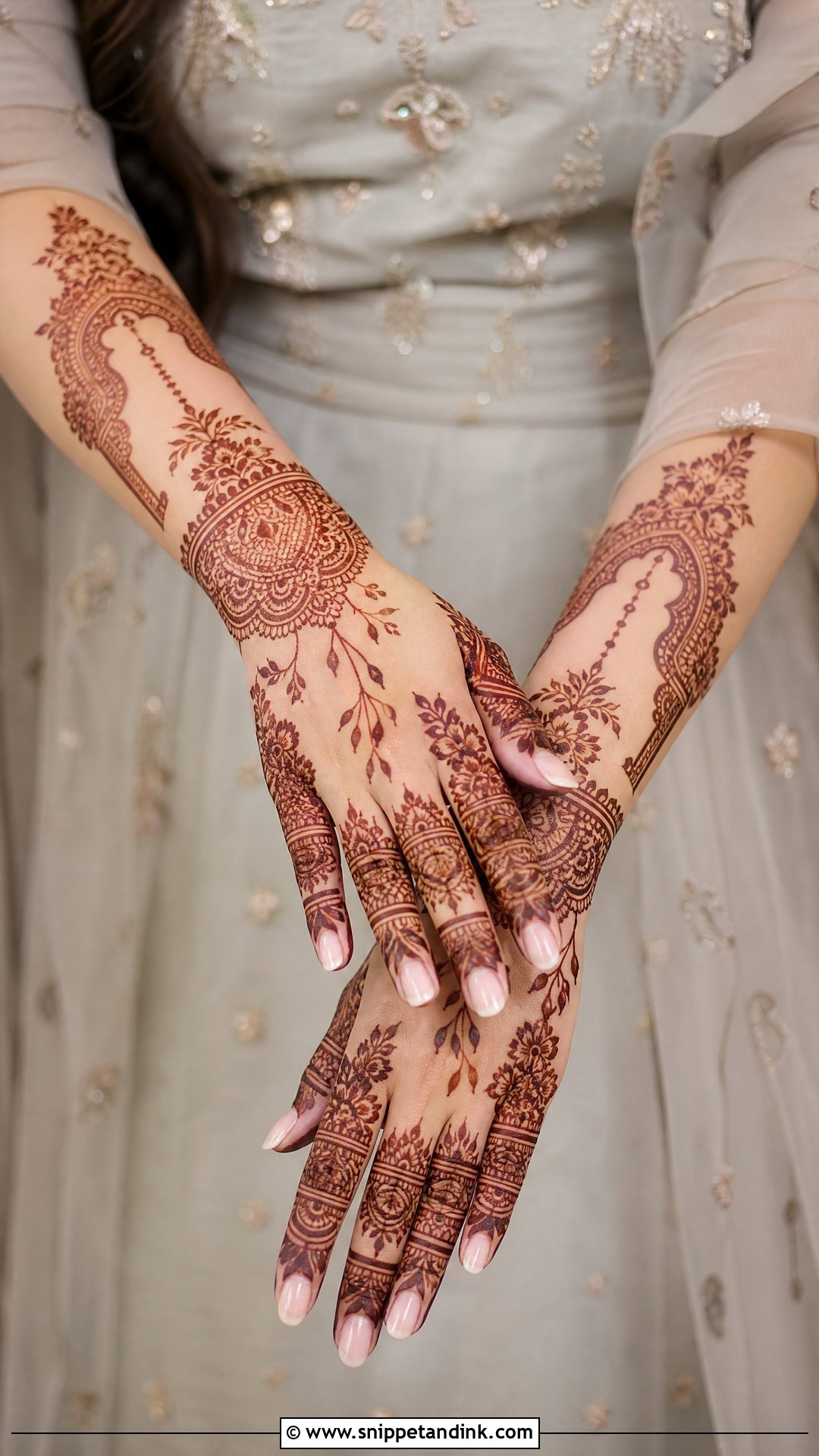
Pakistani bridal mehandi design tends to be softer than very dense Indian work, with floral vines, delicate paisleys, a palm mandala and jewelry-like bands at the wrist and fingers. Some brides want full coverage; others keep wide open spaces around a few bold motifs. Since the nikah, mehndi, baraat and walima often fall across several days, I think about what the stain will look like on the last day too. Fine finger detail fades first as the skin renews, while the palm holds longest. Long sleeves on shararas and ghararas will cover the forearms, so I put the effort where it will show.
8. Gulf Bridal Mehandi Design
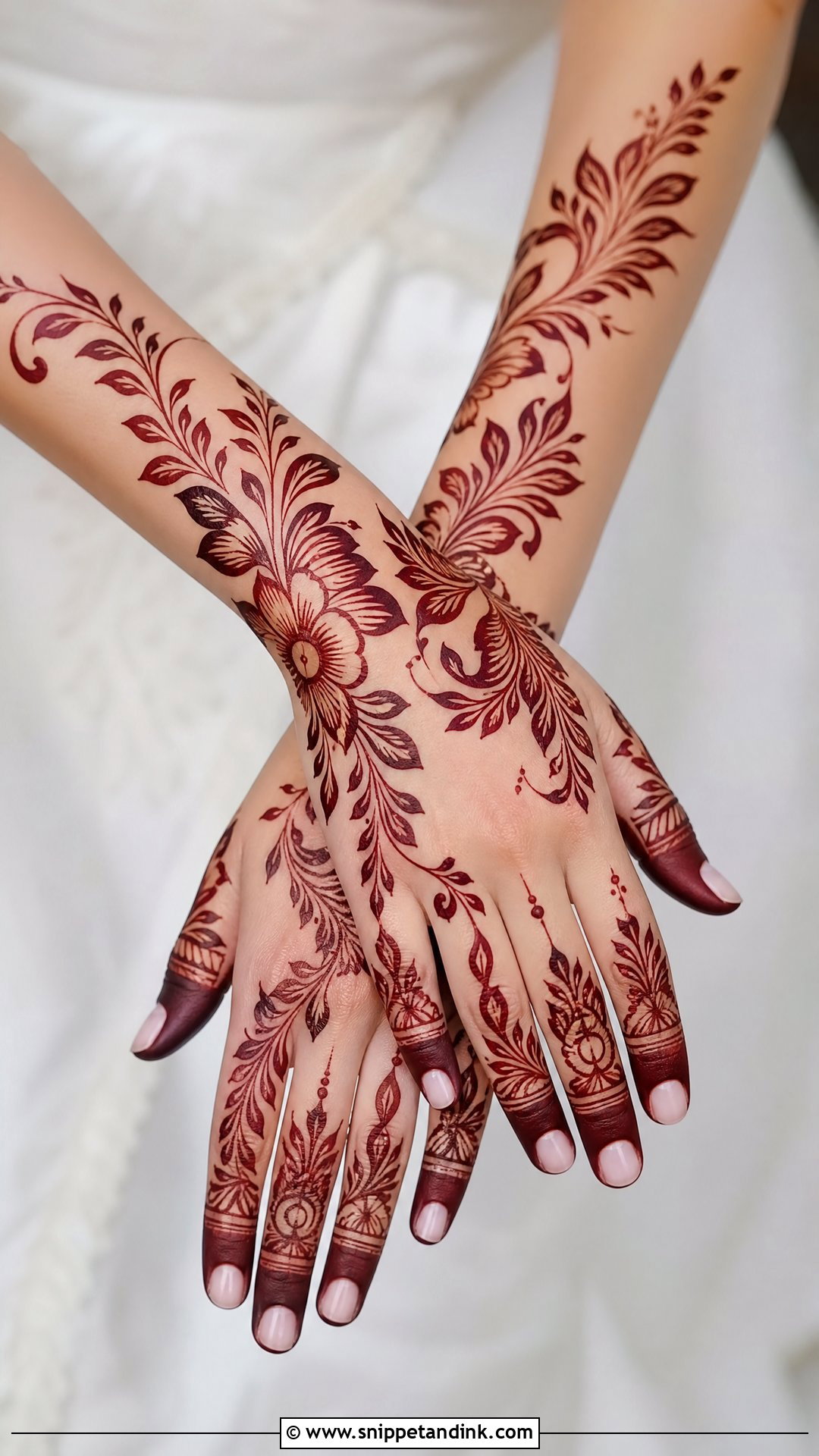
Khaleeji work is about big, confident shapes: large flowers, leafy vines and generous spacing, usually traveling from the fingers across the back of the hand to the wrist. The bold outlines and filled petals take paste thickly, so they stain dark and solid, which is exactly the effect you want here. Where it goes wrong is proportion. A single huge rose on a narrow hand looks swollen, so I scale the flowers to the hand in front of me. It sits well with embellished abayas, modest gowns and contemporary lehengas.
9. Moroccan Bridal Mehandi Design
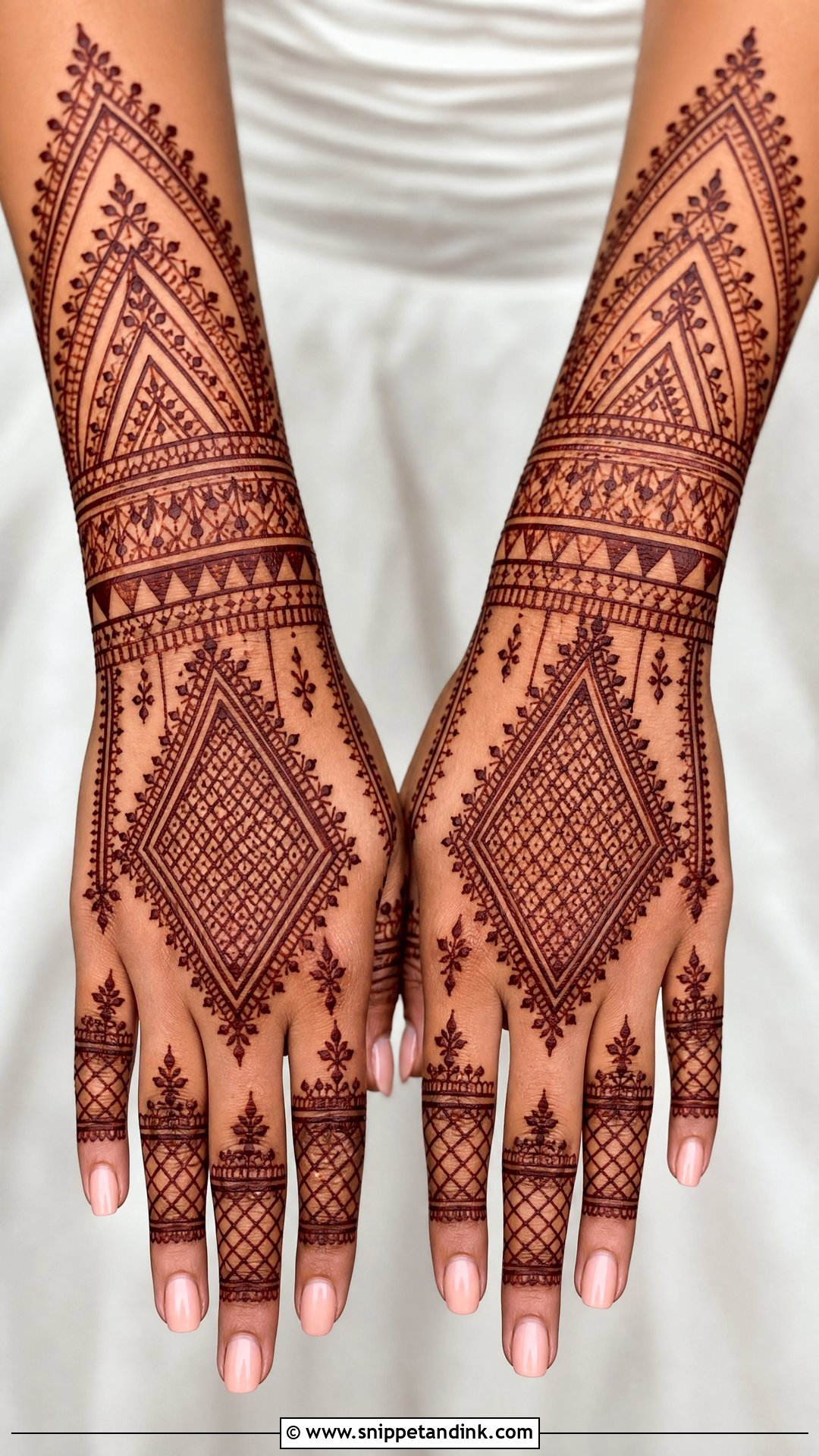
Moroccan bridal mehandi design swaps florals for geometry: diamonds, grids, triangles and structured bands. It is less forgiving than paisley work, because a grid that drifts off line is obvious to everyone, so I draw faint guide lines before committing and use a fine tip throughout. The result is crisp in close-ups. Pairing it with an Indian mandala on the palm or an Arabic floral on the back softens it if the full geometric look feels too stark.
10. Minimal Bridal Mehandi Design
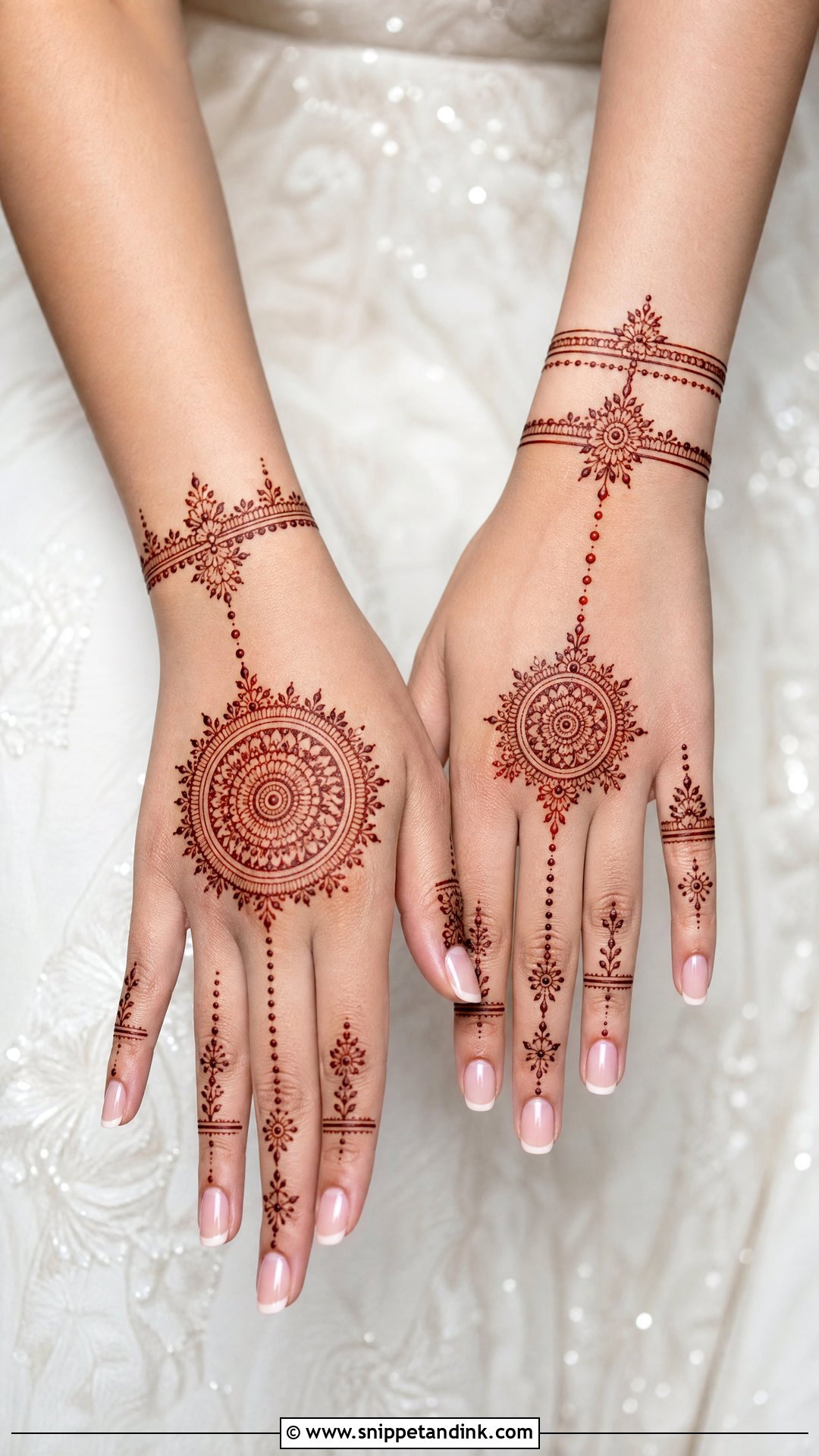
Minimal doesn’t mean careless. A central mandala, detailed fingers, a slim wrist band and plenty of bare skin can still look bridal, but only when the empty space is planned rather than leftover. I treat minimal designs as a jewelry placement problem: where your rings and bangles sit decides where the henna stops. It’s quick to apply, which is why I see it so often for intimate weddings, civil ceremonies and destination trips. The trade-off is the stain. Thin lines carry less paste, so follow the full aftercare routine if you want the color to show.
11. Modern Bridal Mehandi Design
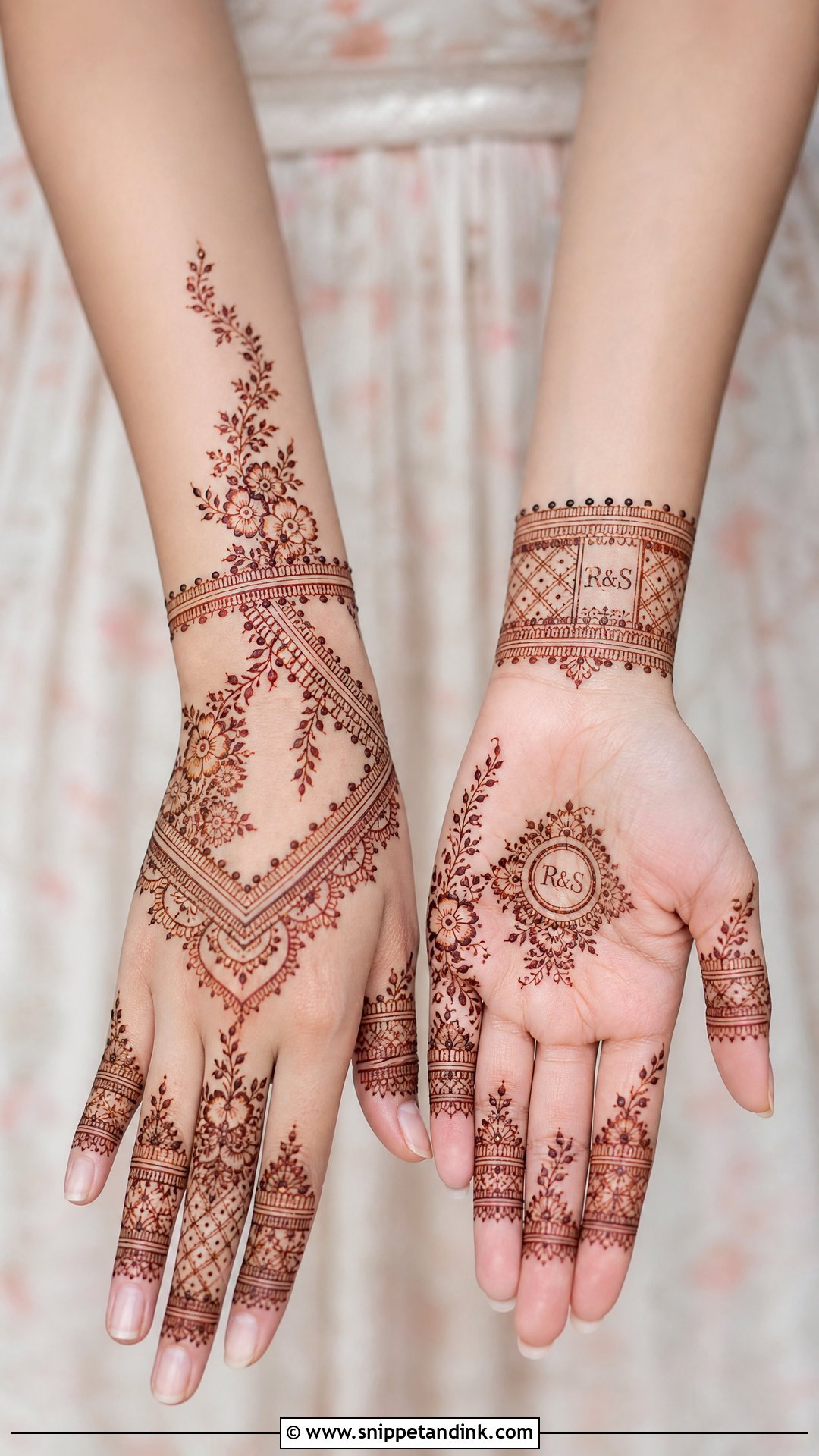
Modern bridal mehndi is really an edit of the traditional vocabulary. Fine lines, open spaces, bracelet bands, geometric sections and maybe a pair of initials stay; the heavy filling goes. It sits easily next to pastel outfits, pearls and a sleek bun. The palm often gets a neat mandala or a half-floral frame and the back of the hand a chain detail. A wedding date tucked into a wrist band is a small touch I like, as long as the numbers are drawn large enough to survive the stain spreading slightly.
12. Portrait Bridal Mehandi Design
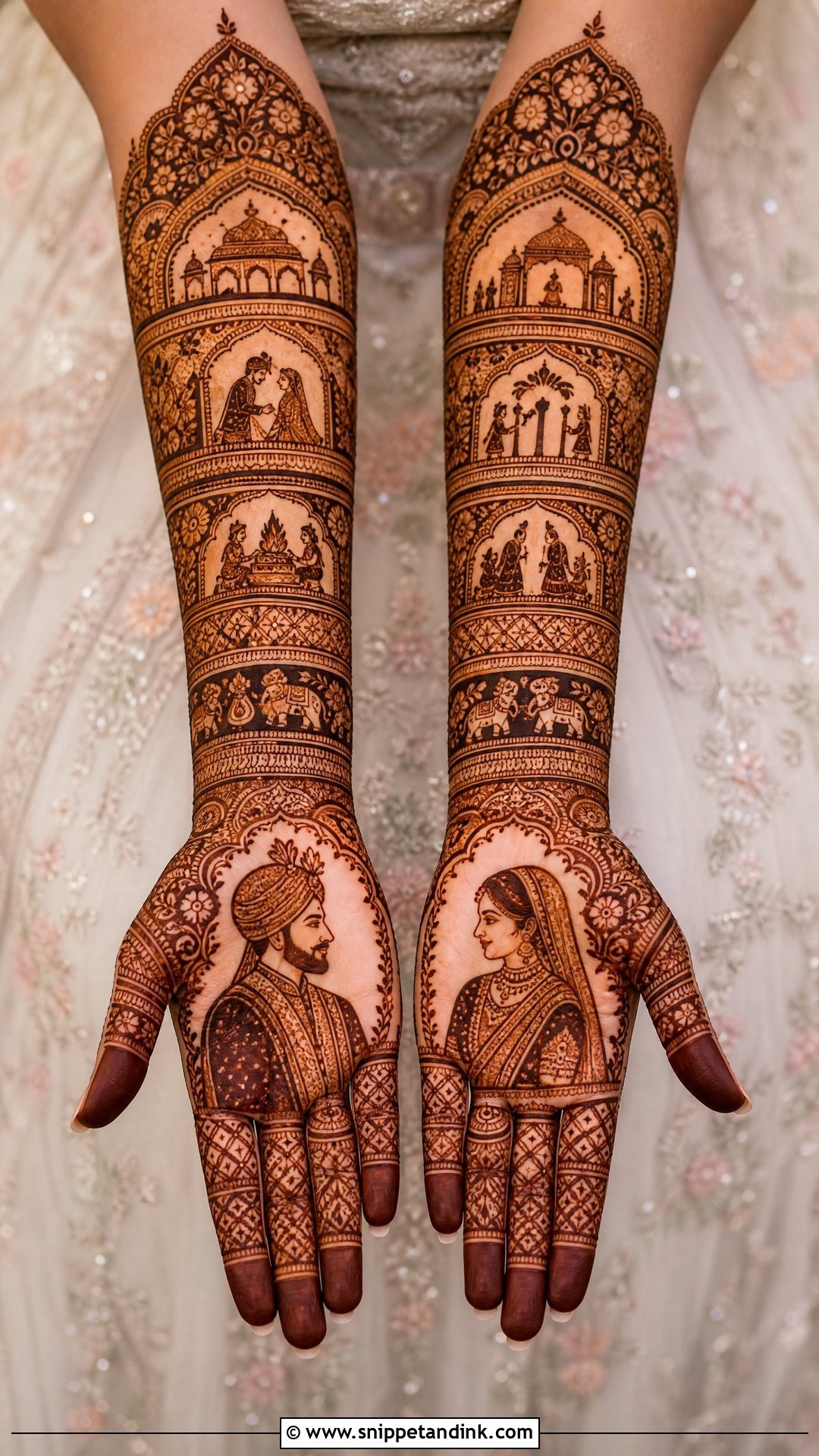
Faces are the hardest thing to draw in henna, so ask to see an artist’s previous portrait work before booking this one. The palm is the only place with enough flat space for a bride and groom, a wedding scene or a silhouette, and the frame around it has to stay lighter so the faces don’t drown in paisleys and jaali. Fine facial lines also stain paler than solid fill, which is why I outline features with a little more pressure. Done well, it’s the design guests ask to see up close.
13. Personalized Bridal Mehandi Design
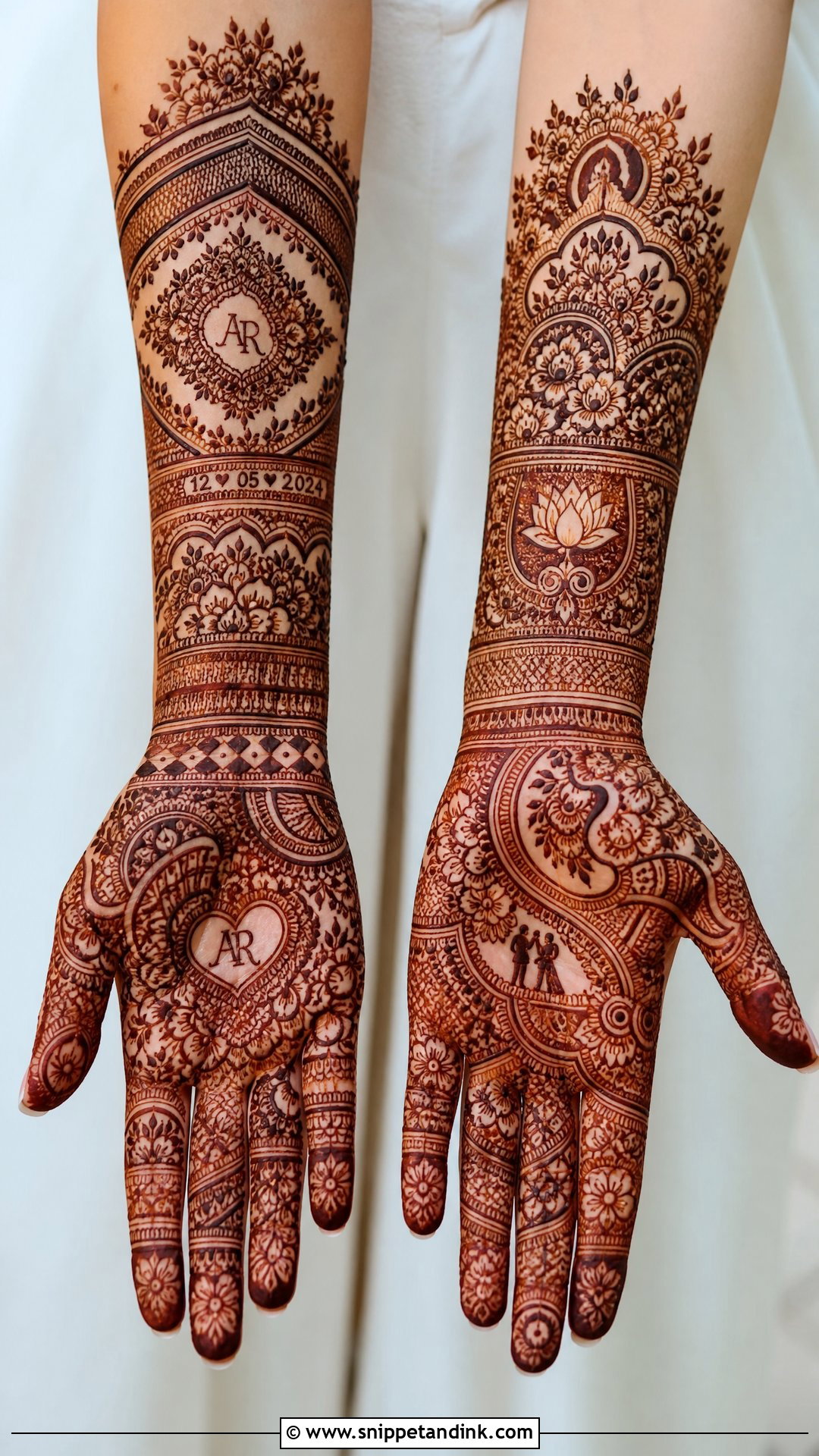
Personal symbols are the part brides enjoy planning most. Initials, the date, the place he proposed, a pet’s name, a travel icon or a favorite flower can all hide inside paisleys, mandalas and wrist bands without breaking the pattern. Send me the list before the day, not while I’m drawing, so I can place each one where the line work naturally allows it. Hiding the groom’s name is a long-standing tradition, and watching him search for it during the ceremony never gets old. Keep the list short, though. A handful of hidden details is a game; a dozen is clutter.
14. Mandala Bridal Mehandi Design
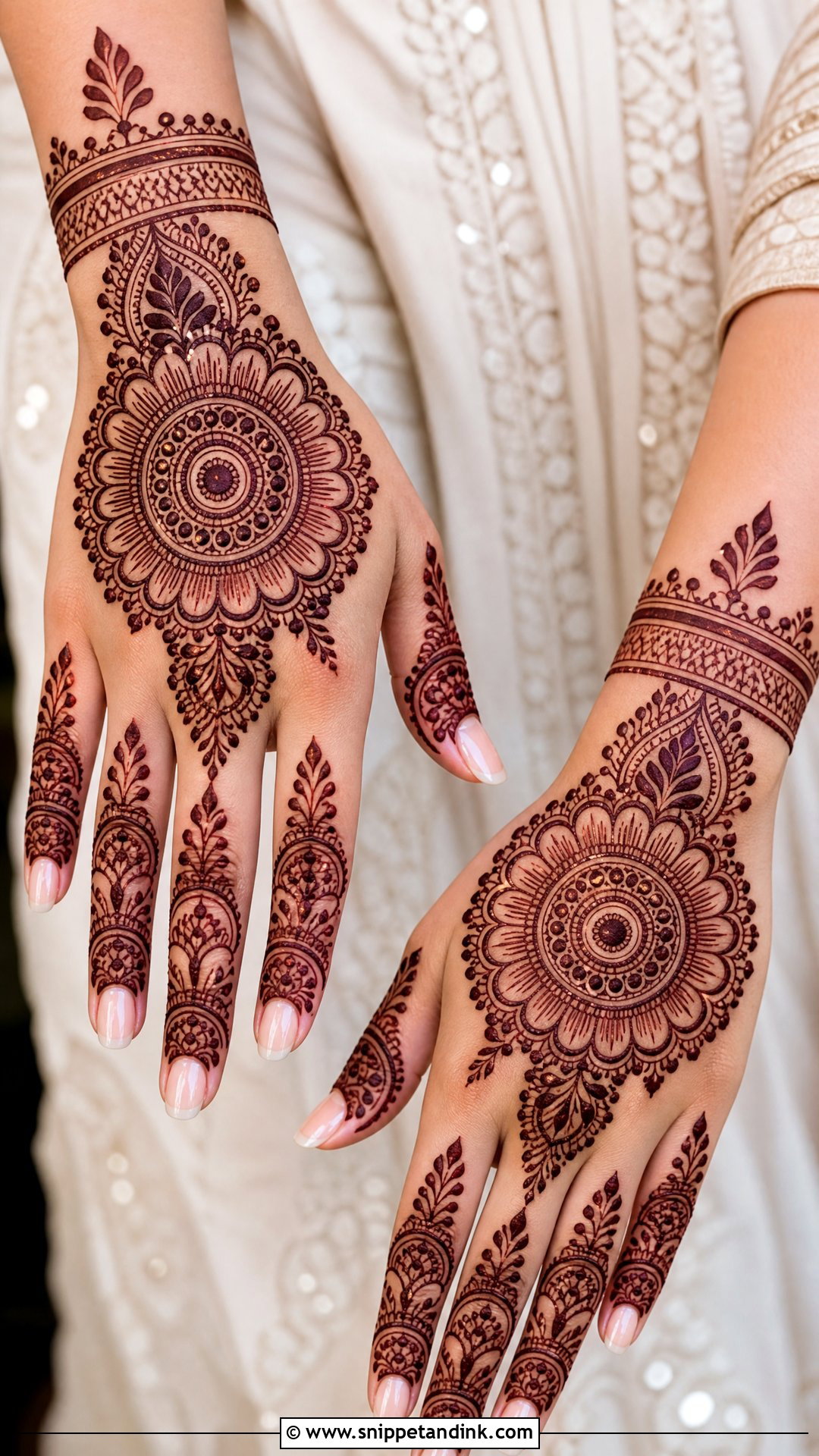
A mandala lives or dies on its center point. I place it in the middle of the palm or the back of the hand, then build rings of dots, leaves and petals outward, checking symmetry after each ring because small errors compound as the circle grows. For a bridal version the circle extends into detailed fingers, a wrist cuff and a forearm trail. It’s the design I suggest to brides who like order and want something that looks calm in close-up. A bold center with lighter surrounding detail keeps it from feeling busy.


15. Peacock Bridal Mehandi Design
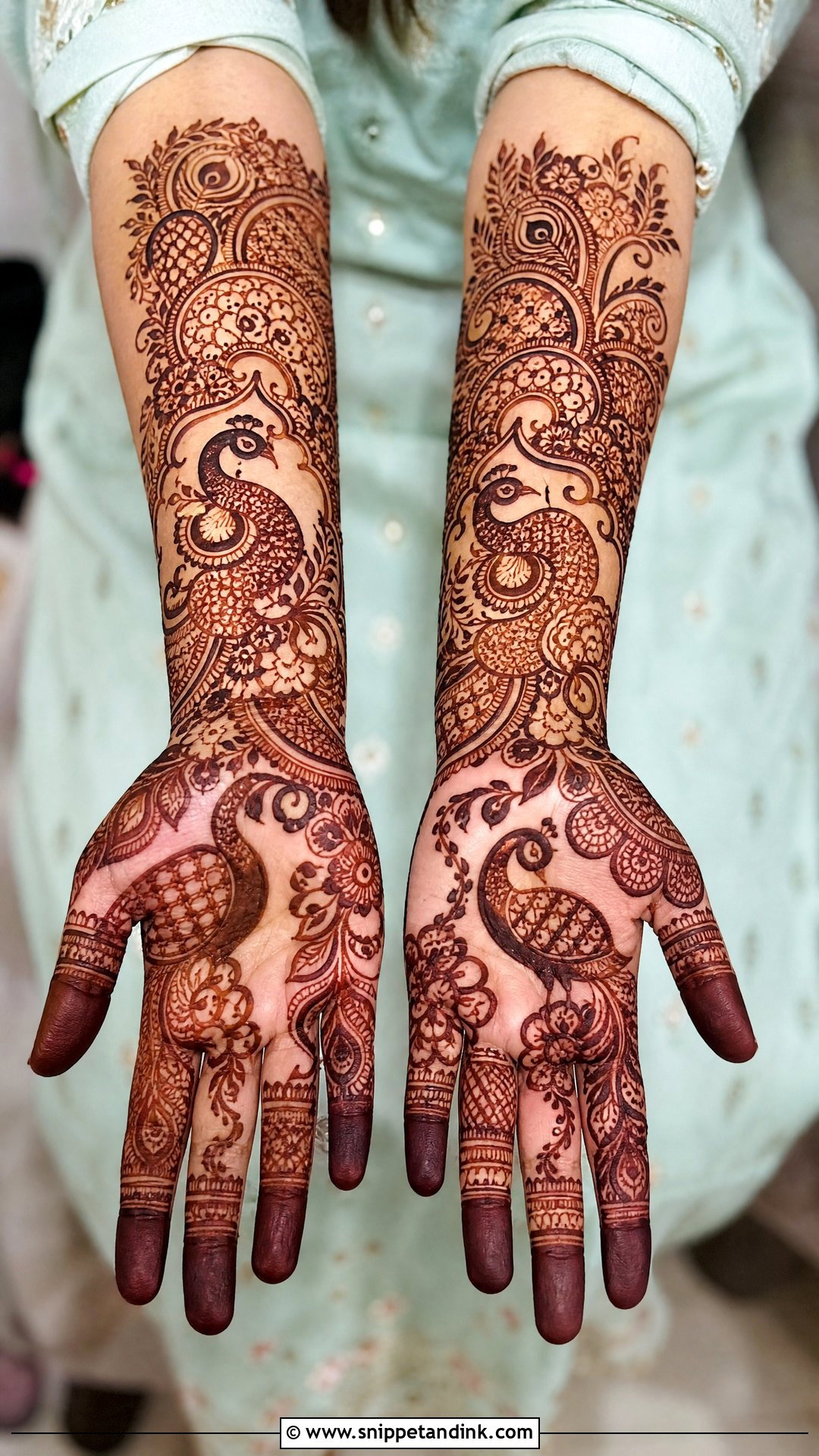
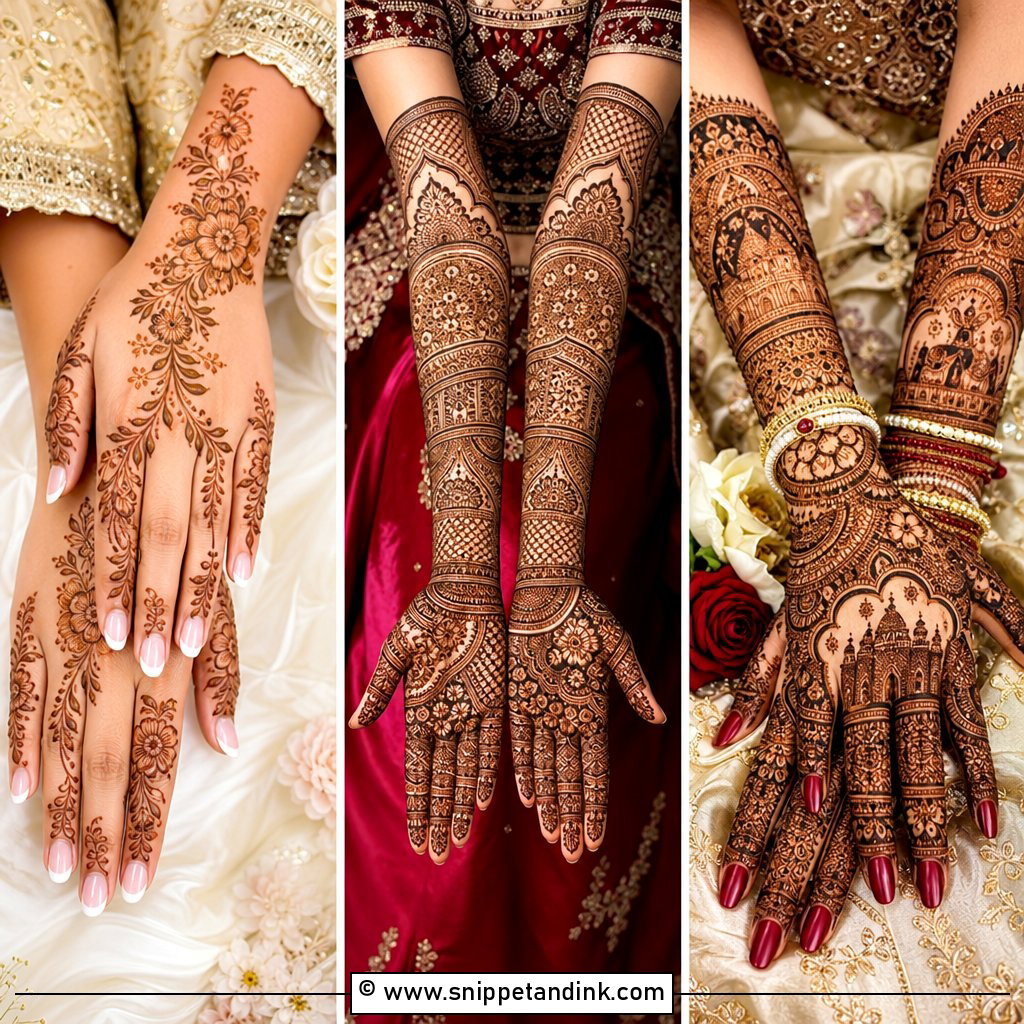
The peacock is one of the oldest bridal motifs, a symbol of beauty and celebration, and it gives a design movement because the tail can curve wherever the hand needs it. I usually put the body on the palm or the back of the hand and let the feathers sweep toward the wrist, filled with tiny checks, dots and shading. You can mirror two birds across both hands or use one large feature peacock with floral sections around it. Watch the feather density. Packed too tightly, the feather eyes merge into dark blobs once the stain matures. Silk sarees and temple jewelry are its natural partners.
16. Lotus Bridal Mehandi Design
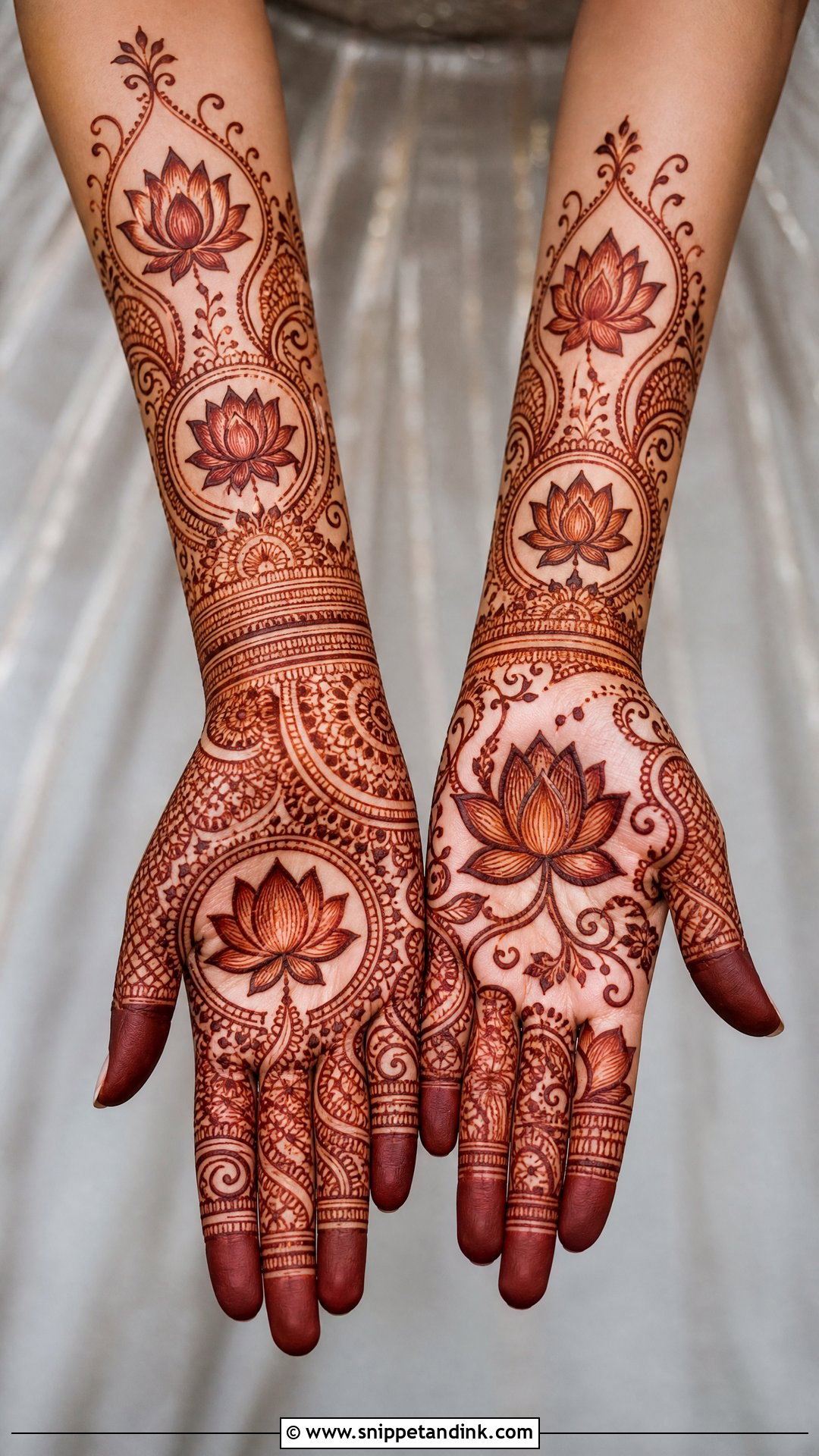
Lotus works as a palm centerpiece, a repeated forearm motif or a frame on the back of the hand, and its rounded petals soften a layout that might otherwise feel sharp. I pair it with paisleys, fine vines and wrist bands. Often I draw the petals as outlines with a single inner line instead of solid fill, which keeps the design light against ivory, blush or pastel outfits. It suits a daytime ceremony, and it frames a ring nicely in close-ups.
17. Paisley Bridal Mehandi Design
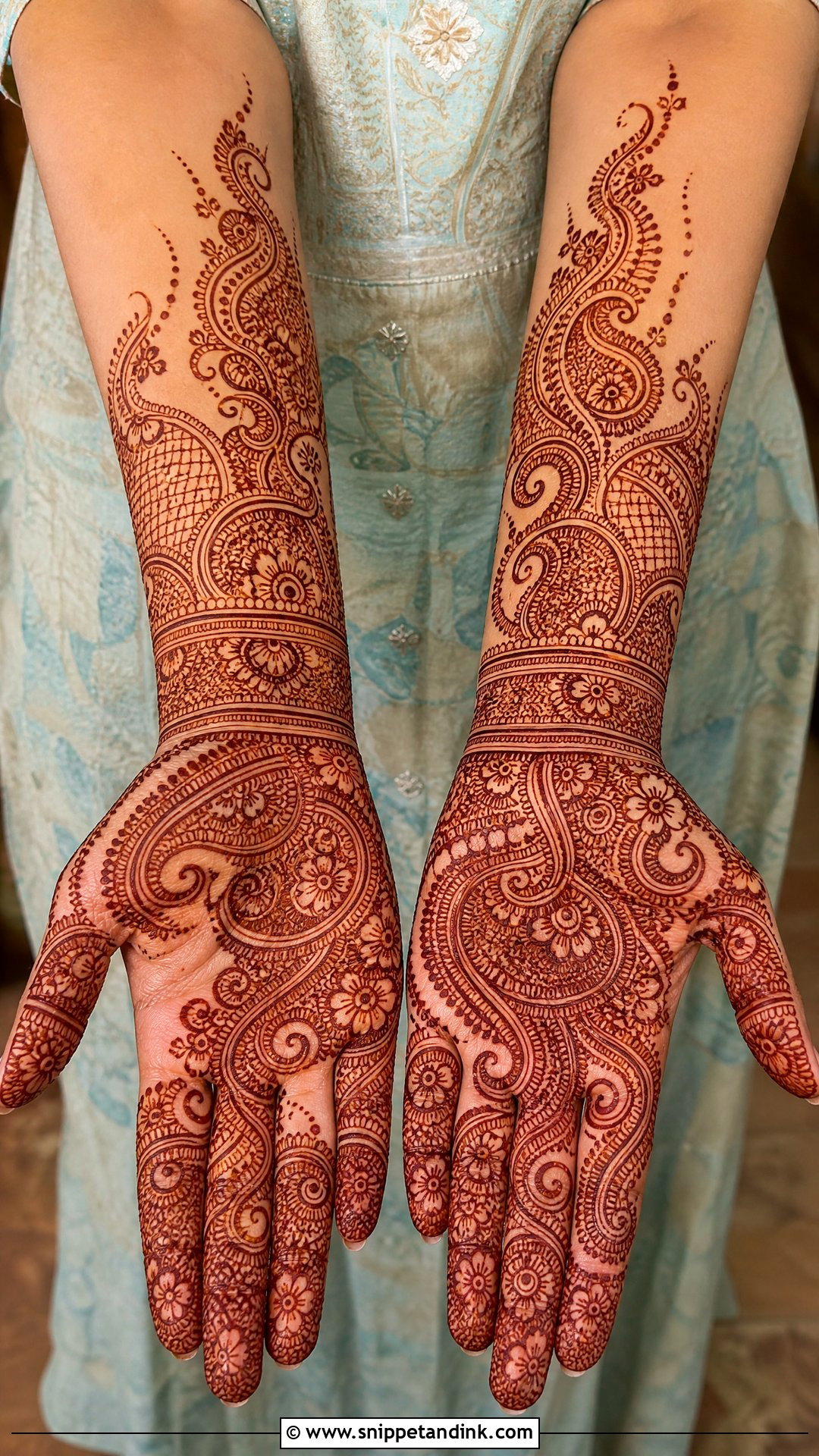
If I had to name the most dependable bridal motif, it would be the paisley. It can be large or small, layered or shaded, filled with tiny florals or mesh, and its teardrop shape flows across a palm or forearm without forcing anything. A typical bridal layout starts near the wrist and curves toward the fingers, often framing a bride-and-groom panel or a peacock. The mix of bold outlines and fine filling also gives a reliable stain, since the thicker areas hold more dye. It suits almost any hand shape, which is why I fall back on it when a bride can’t decide.
18. Jaali Bridal Mehandi Design
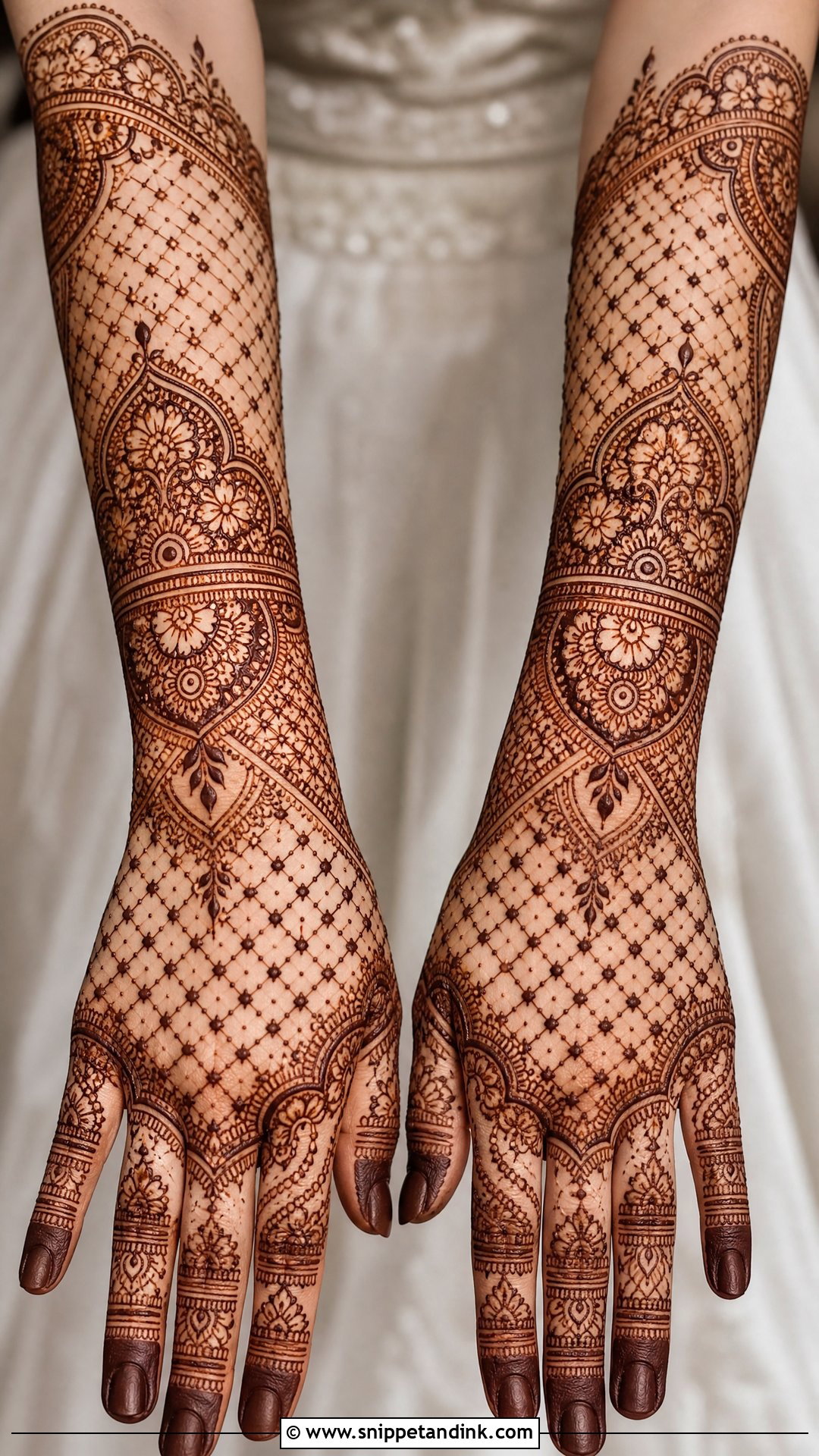
Jaali is a mesh of crisscross grids with tiny dots at the crossings, floral corners and fine outlines, and once stained it looks like lace. I place it on the back of the hand, fingers, wrists or forearms, and break it up with mandalas, paisleys or bracelet bands so it doesn’t run on too long. The grid needs a fine, even line. If paste blobs at the crossing points, those spots stain darker and the lace turns spotty. Brides wearing net dupattas or lace sleeves tend to love how it echoes the fabric.
19. Jharokha Bridal Mehandi Design
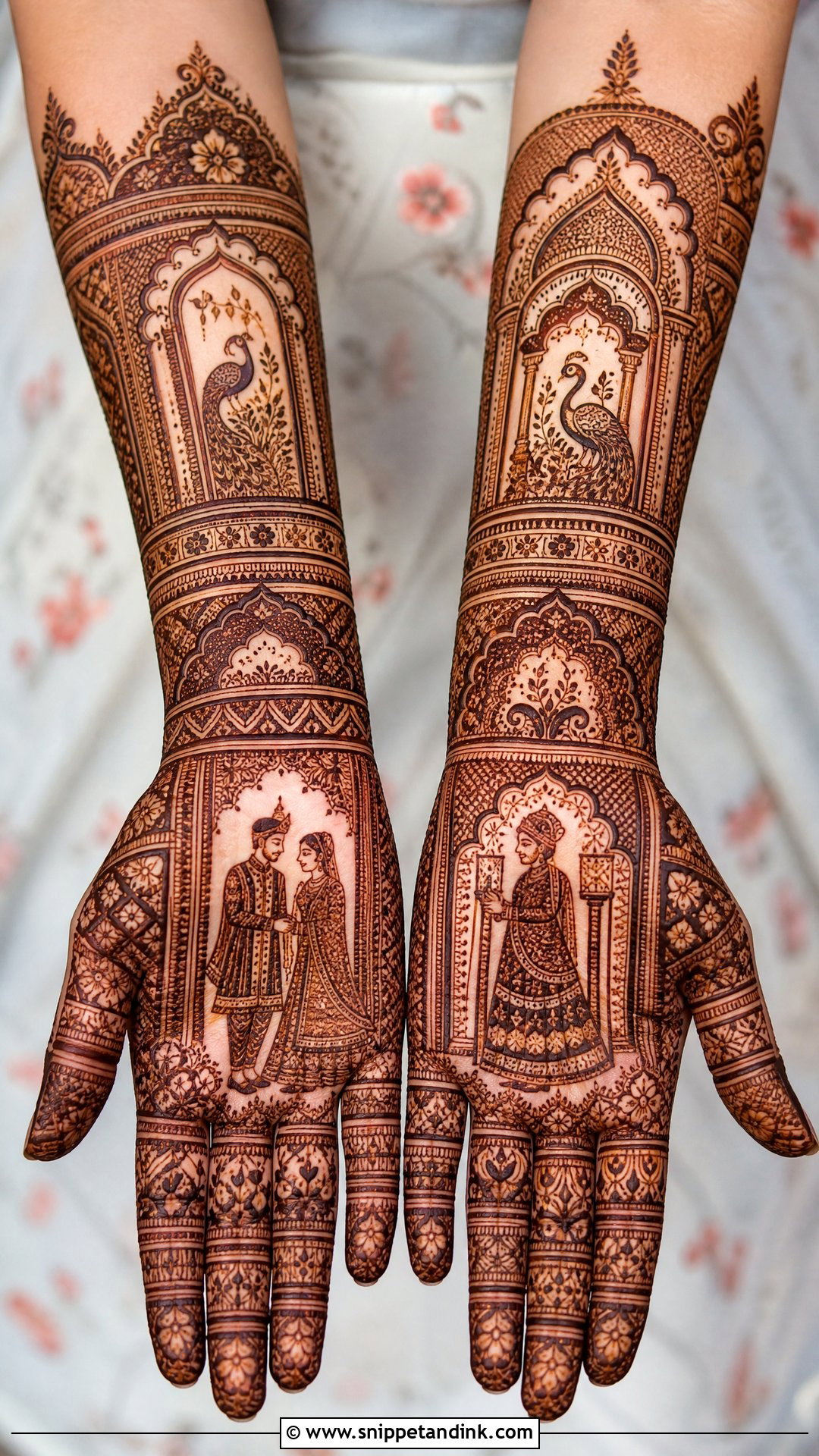
Jharokha designs borrow the carved arched windows of Rajasthani palaces. I draw the arch first as a frame on the palm or forearm, then fill it with a peacock, florals, a bride-groom figure or fine geometry, and surround it with paisleys, dots and vines. You can mirror the arches on both hands or keep one as a feature panel. The arch line itself must be bold and even, because it holds the whole composition together. Heavy dupattas and antique gold jewelry are a natural match.




20. Hathphool Bridal Mehandi Design
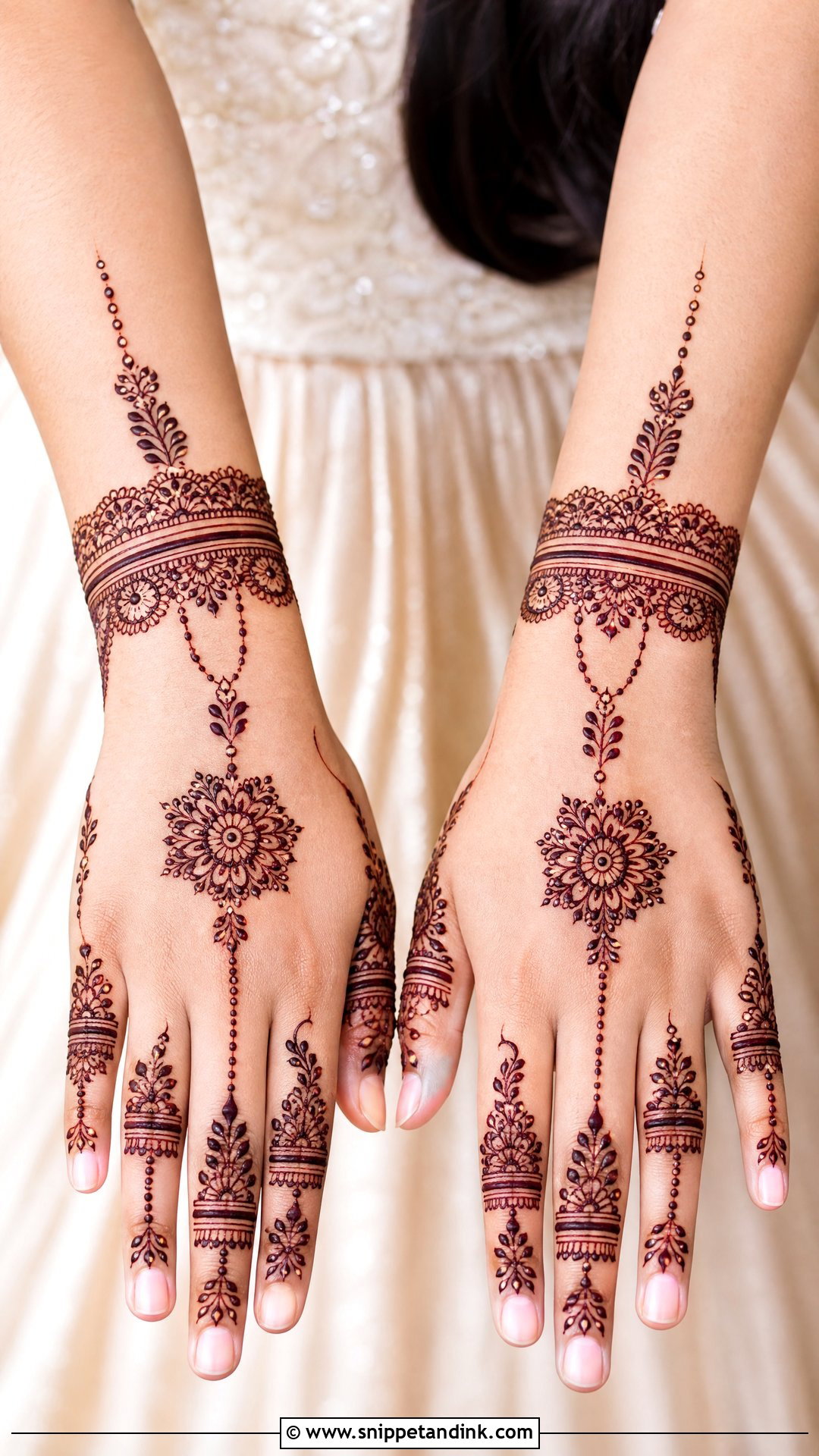
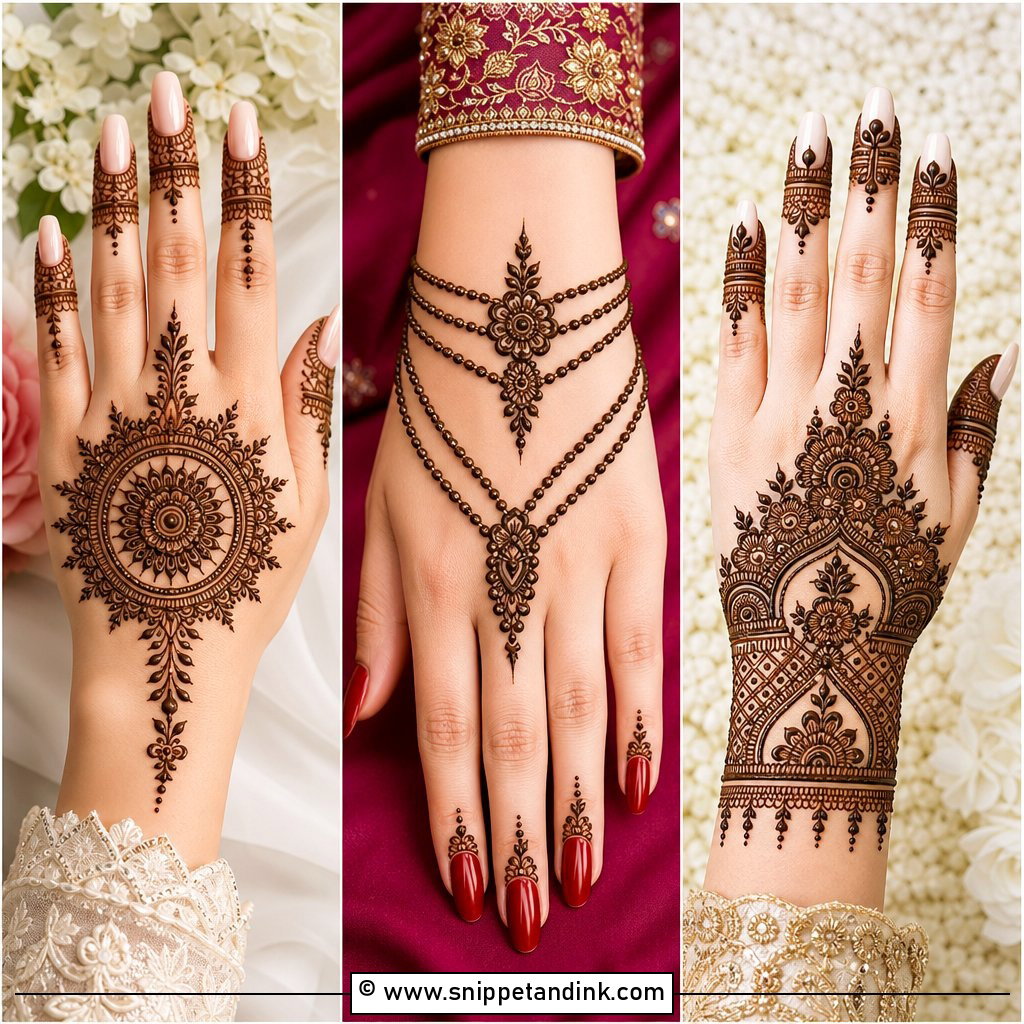
Hathphool bridal mehandi design imitates the hand ornament of the same name: finger rings connected by chains to a central back-hand motif and then to a wrist bracelet. Because it reads as jewelry, I always ask what real pieces the bride will wear. Drawing a henna ring on the finger that will carry the engagement ring wastes the detail. The palm can stay light while the back of the hand carries the focus, which works well for engagement and ring portraits. It can be airy or densely filled.
21. Bracelet Bridal Mehandi Design
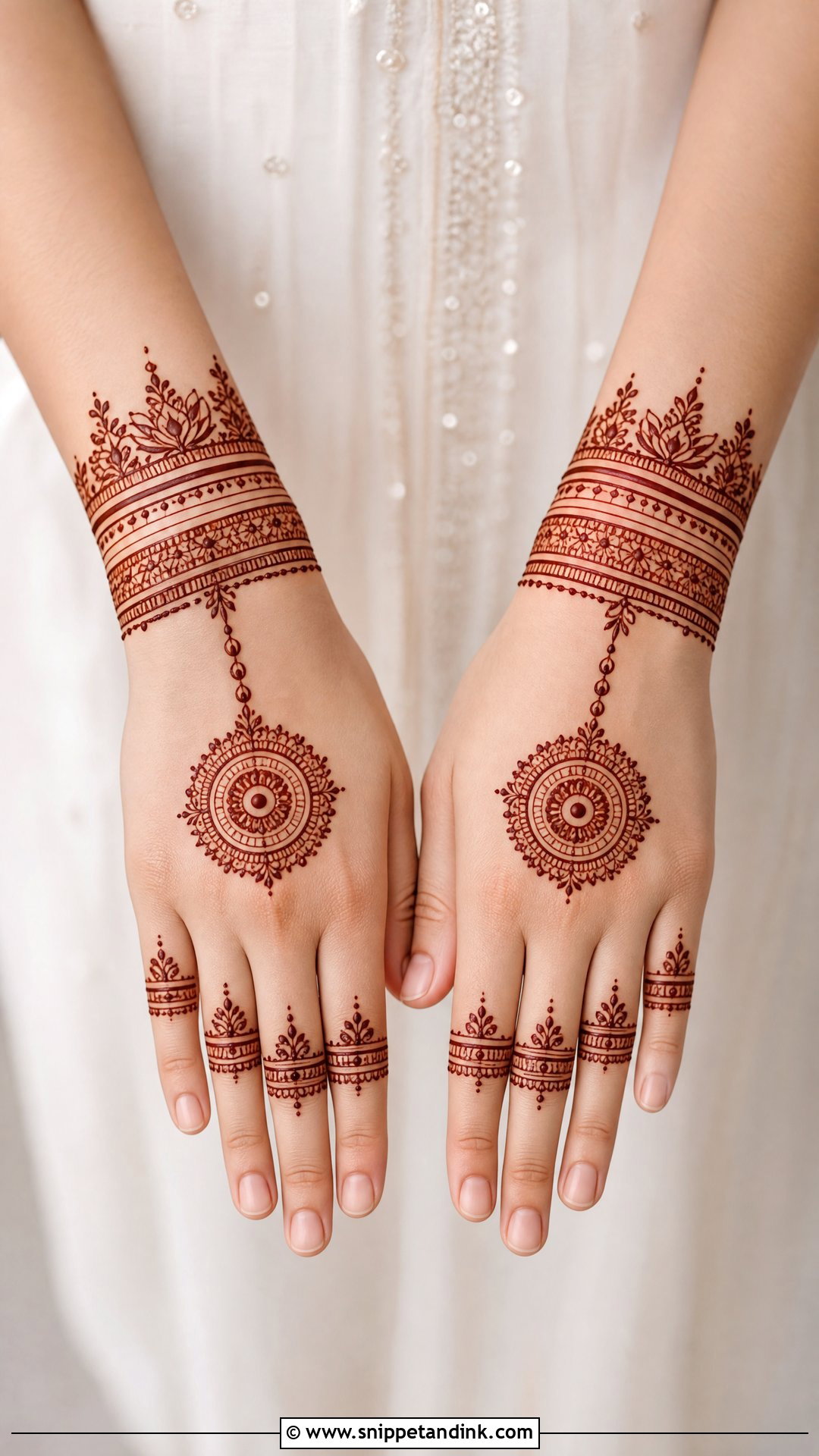
Bracelet designs concentrate on the wrist: stacked bands, floral cuffs, chain detail, finger rings and one central motif on the back of the hand. They make sense when the outfit has heavy sleeves that would hide forearm work anyway, or when you’d like the palm left simple. My one caution is bangles. Many brides wear a chooda or a heavy bangle stack, which covers exactly the area the bands are drawn on, so I place the cuffs slightly above or below where the bangles will sit.
22. Back Hand Bridal Mehandi Design
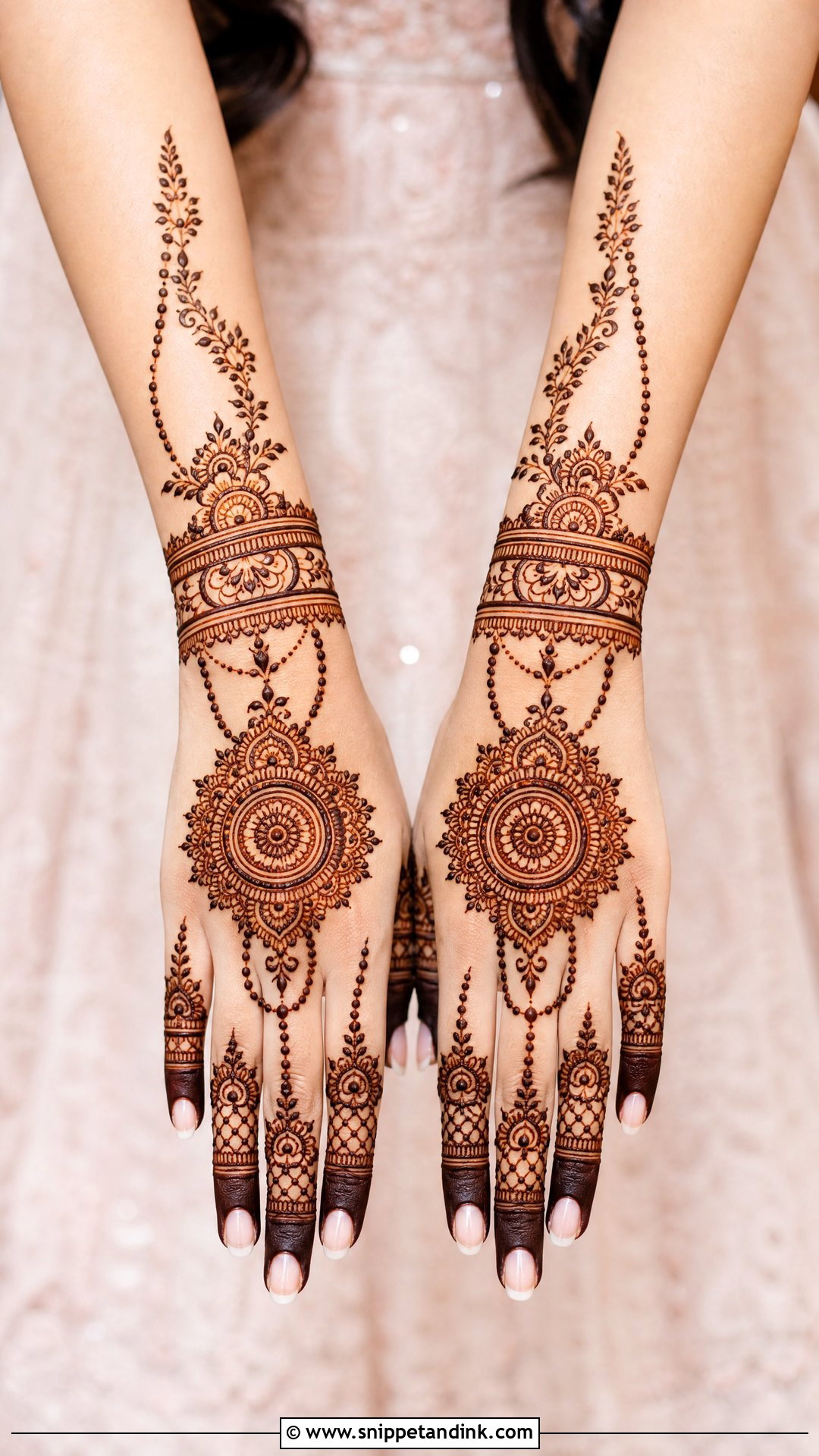
The back of the hand is in every ring shot, bouquet photo and jewelry portrait, so it deserves as much planning as the palm. Know going in that it stains lighter than the palm, because the outer layer of skin there is thinner and takes up less dye, so I lean on bolder outlines on this side. A complete layout might hold a central mandala, hathphool chains, floral trails, finger detail and a wrist cuff. Balance is the rule I follow. Heavy fingers call for a more open center; a big central mandala calls for lighter fingers.
23. Front Hand Bridal Mehandi Design
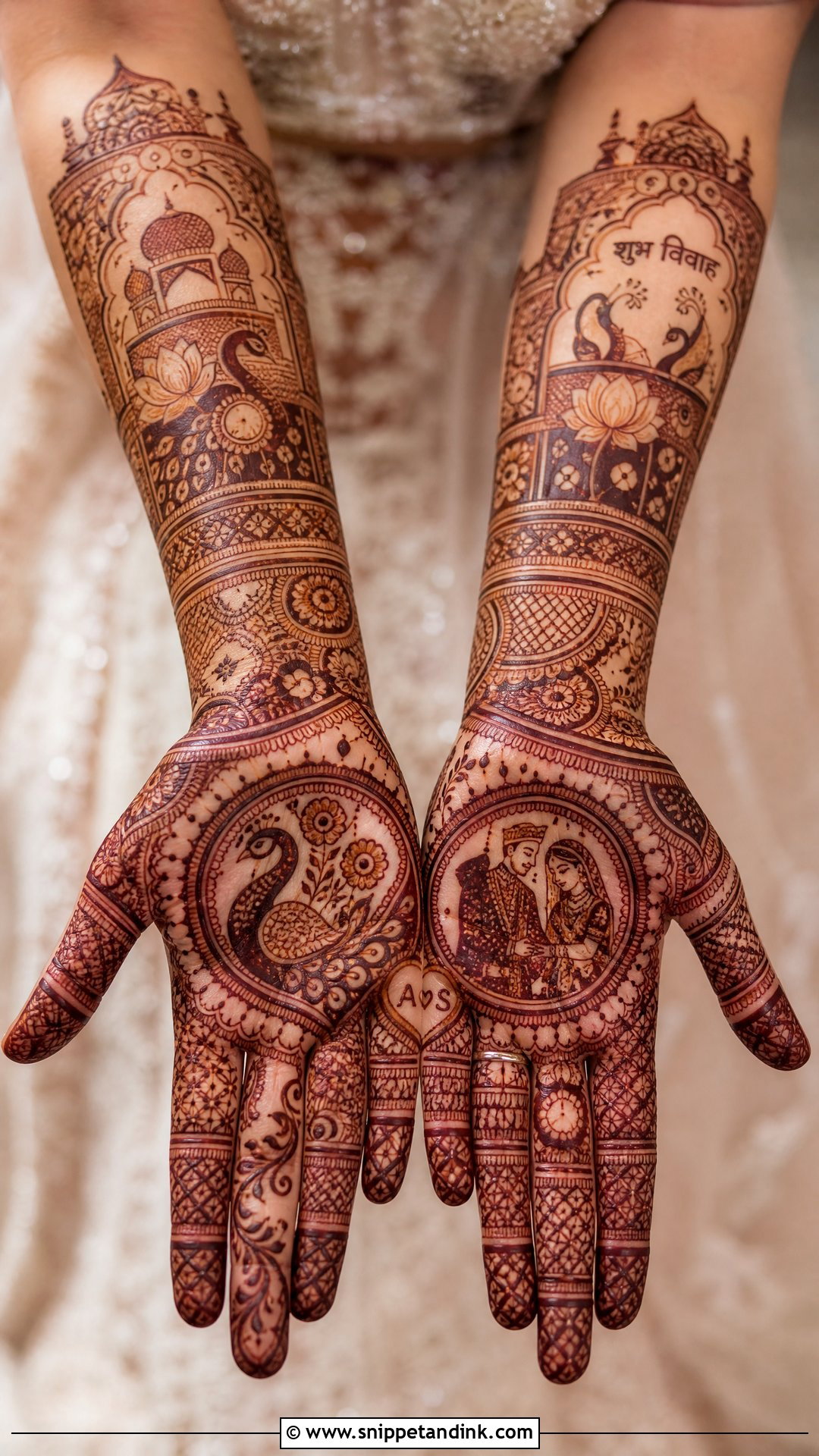
The palm is where henna stains deepest, since its thick outer skin layer absorbs more dye, so it’s the best spot for detailed storytelling: mandalas, portraits, paisleys, lotus, peacocks, wedding symbols and hidden names. It is also the side guests and photographers see during rituals, when the bride’s palms are held open. I continue the palm design into the fingers, wrist and forearm so it reads as one piece rather than a stamp in the middle. If deep color matters to you more than coverage, concentrate the detail here.
24. Finger Bridal Mehandi Design
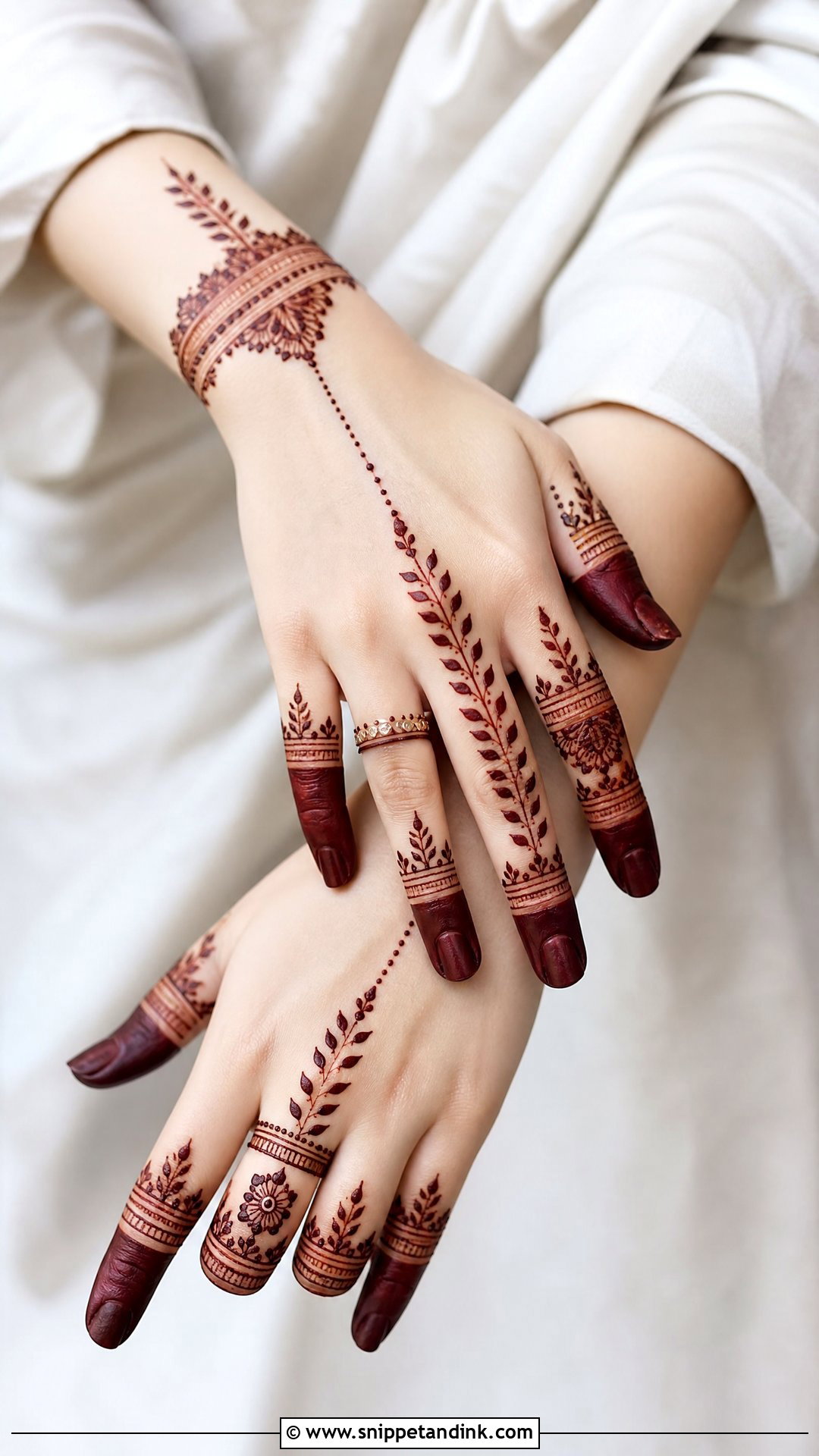
Fingers can make or break a bridal hand. Filled fingertips, ring bands, leafy vines, dotted lines and small florals all have to line up across five fingers and then match the other hand. I connect them to the main motif, whether that’s a palm mandala, a hathphool or a wrist bracelet. Fully filled fingertips stain darkest of all, which looks rich, but that color also wears off fastest with handwashing in the days after. Keep your nail color and rings in mind when deciding how far up each finger to go.
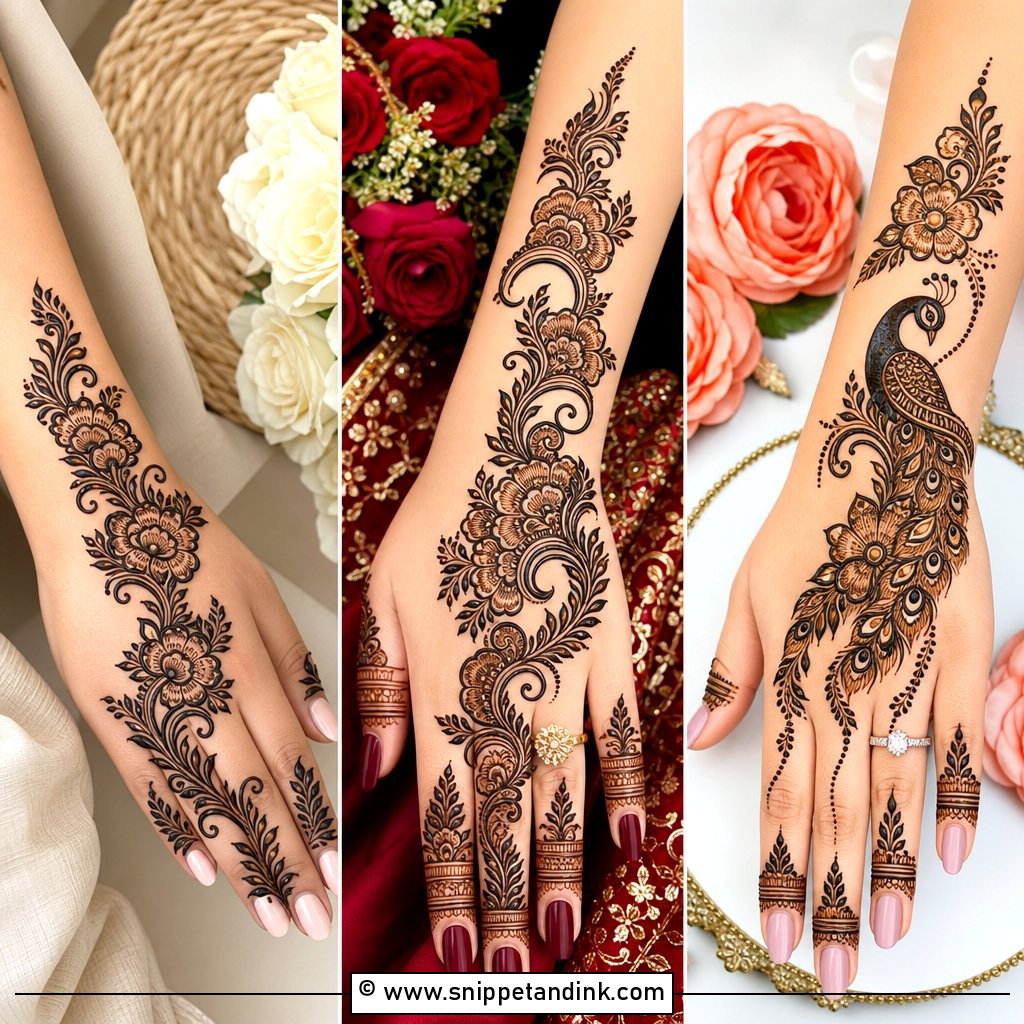




25. Forearm Bridal Mehandi Design
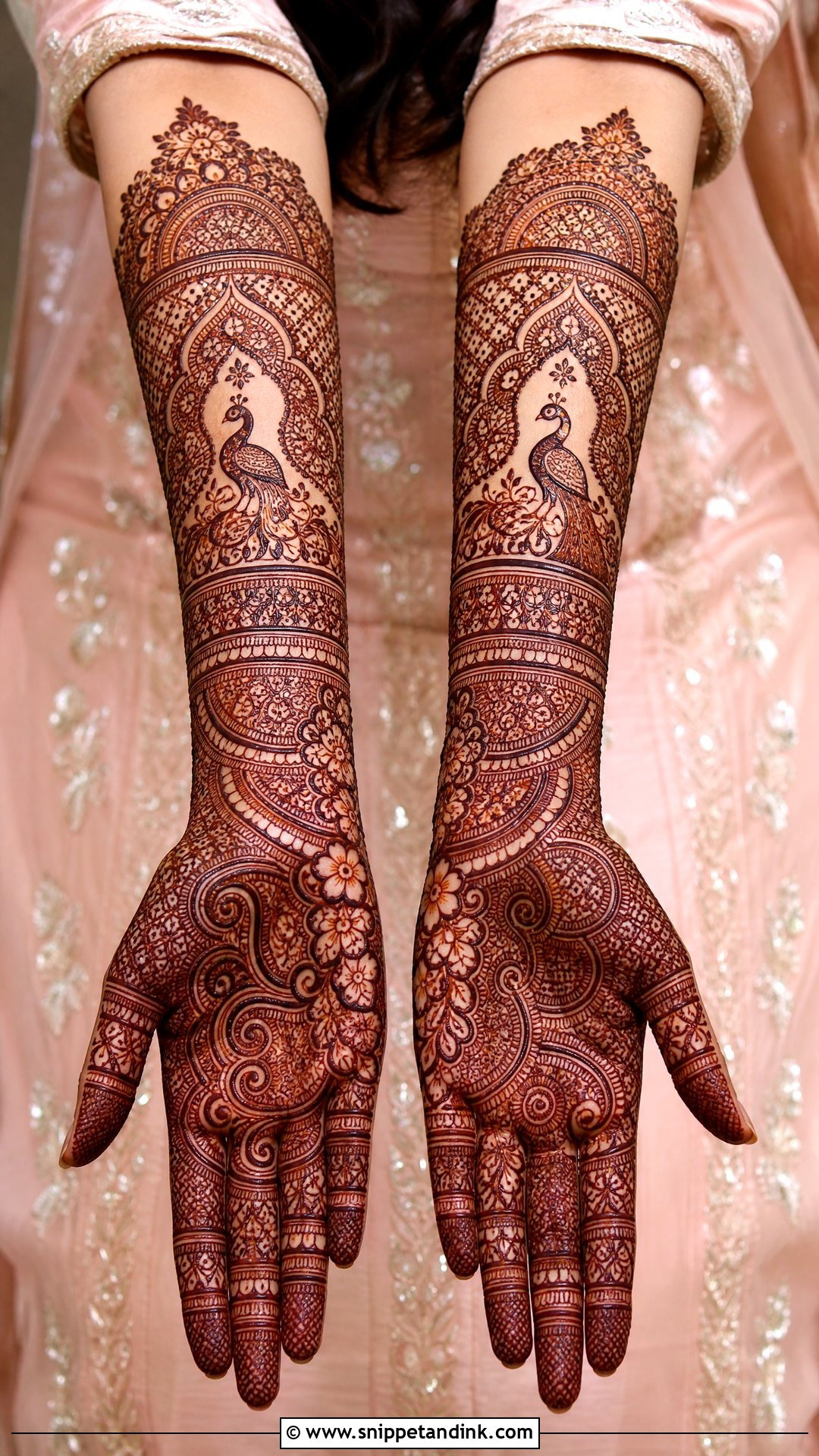
Forearm bridal mehandi design extends the look from the wrist toward the elbow with paisleys, floral panels, jaali, mandalas or portrait frames. It matters most if you’re wearing short or half sleeves or a traditional lehenga blouse. Stain on the upper forearm comes up noticeably lighter than on the hand, so I use bolder motifs there to compensate. The biggest mistake I see is a forearm pattern that looks like a separate sleeve. It should grow out of the hand design, with the wrist acting as a bridge rather than a hard border.
26. Bridal Mehandi Design For Small Hands
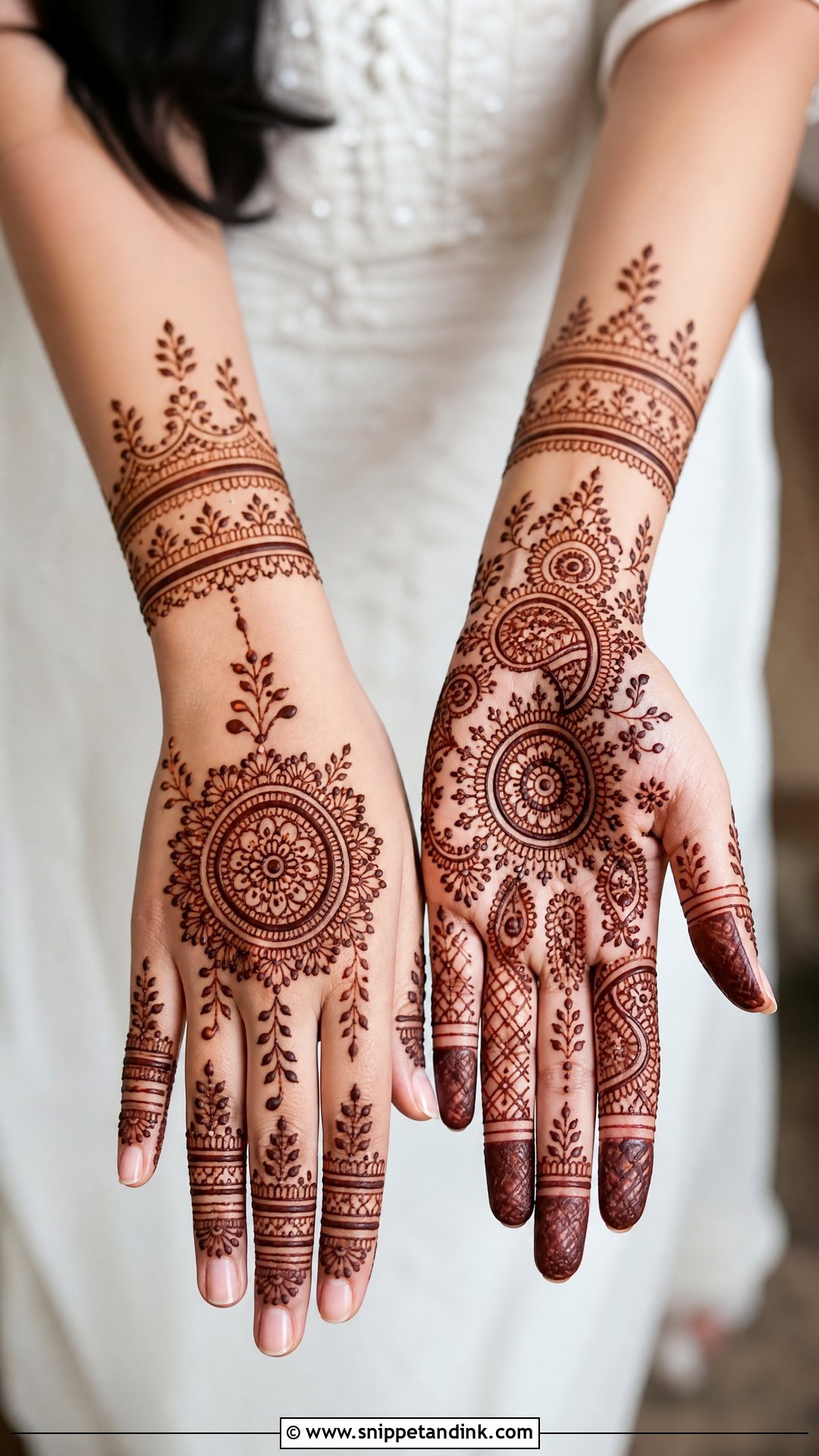
Small hands need proportion more than restraint. Medium motifs, slim borders, fine finger work and generous spacing let a petite hand carry full bridal coverage, while oversized mandalas and big paisleys crowd it immediately. I usually set a central palm motif with fine vines around it, and on the back a hathphool or a diagonal floral trail, because a diagonal line makes the hand look longer. Avoid heavy blocks of solid fill concentrated in one spot.
27. Bridal Mehandi Design For Dark Skin
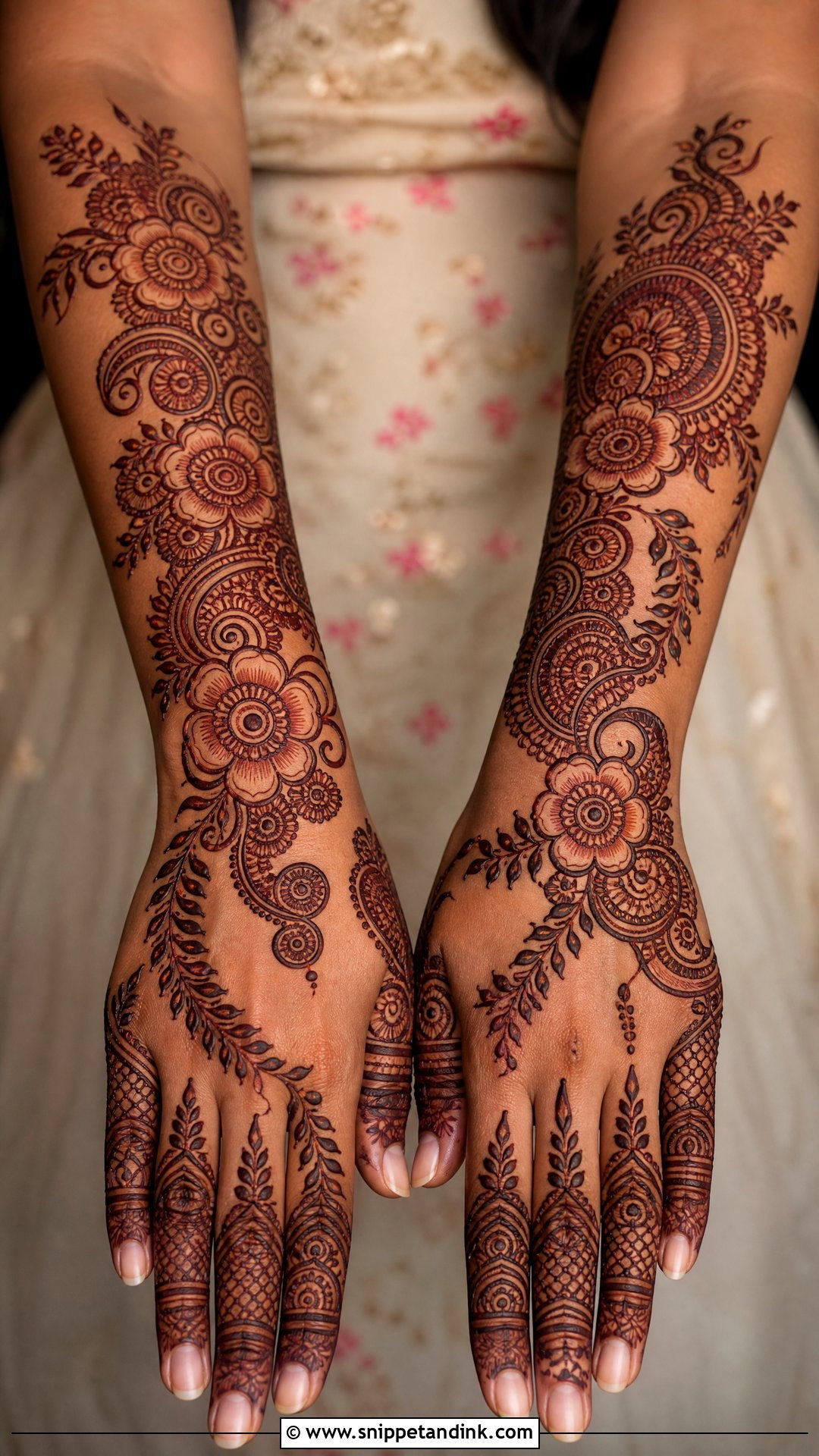
On deeper skin tones, contrast does the work. I use bolder outlines, medium-sized motifs and clear open areas so the deep maroon stain stands out against the skin. Micro-detail can still go in, balanced against larger flowers, paisleys or jaali panels, because hairline work on its own disappears in photos. Arabic, Indo-Arabic, lotus and bracelet layouts all suit this approach. Natural henna with patient aftercare is what gets you to the darkest color; there’s no safe shortcut.
28. Bridal Mehandi Design For Fair Skin
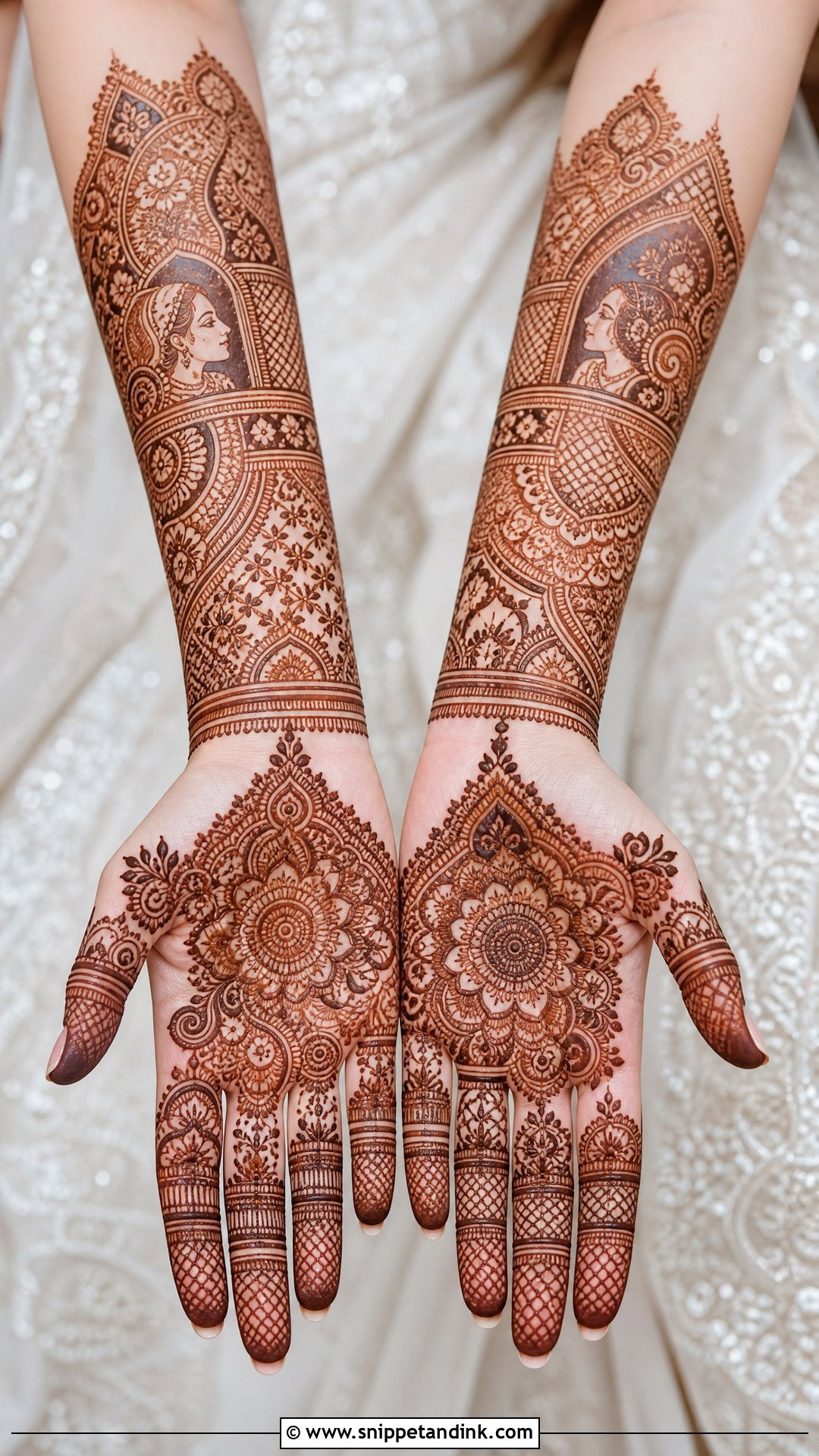
Lighter skin shows every hairline, so this is where the finest jaali, tiny florals, portrait work and mandala shading really come through. The flip side is that wobbly lines are just as visible, and the orange stage looks very bright for the first day. A reddish-brown to maroon finish gives strong contrast without looking harsh. With a heavily embellished outfit, I keep the design detailed but well spaced; with a simple outfit, full traditional coverage brings the drama.
29. Simple Bridal Mehandi Design
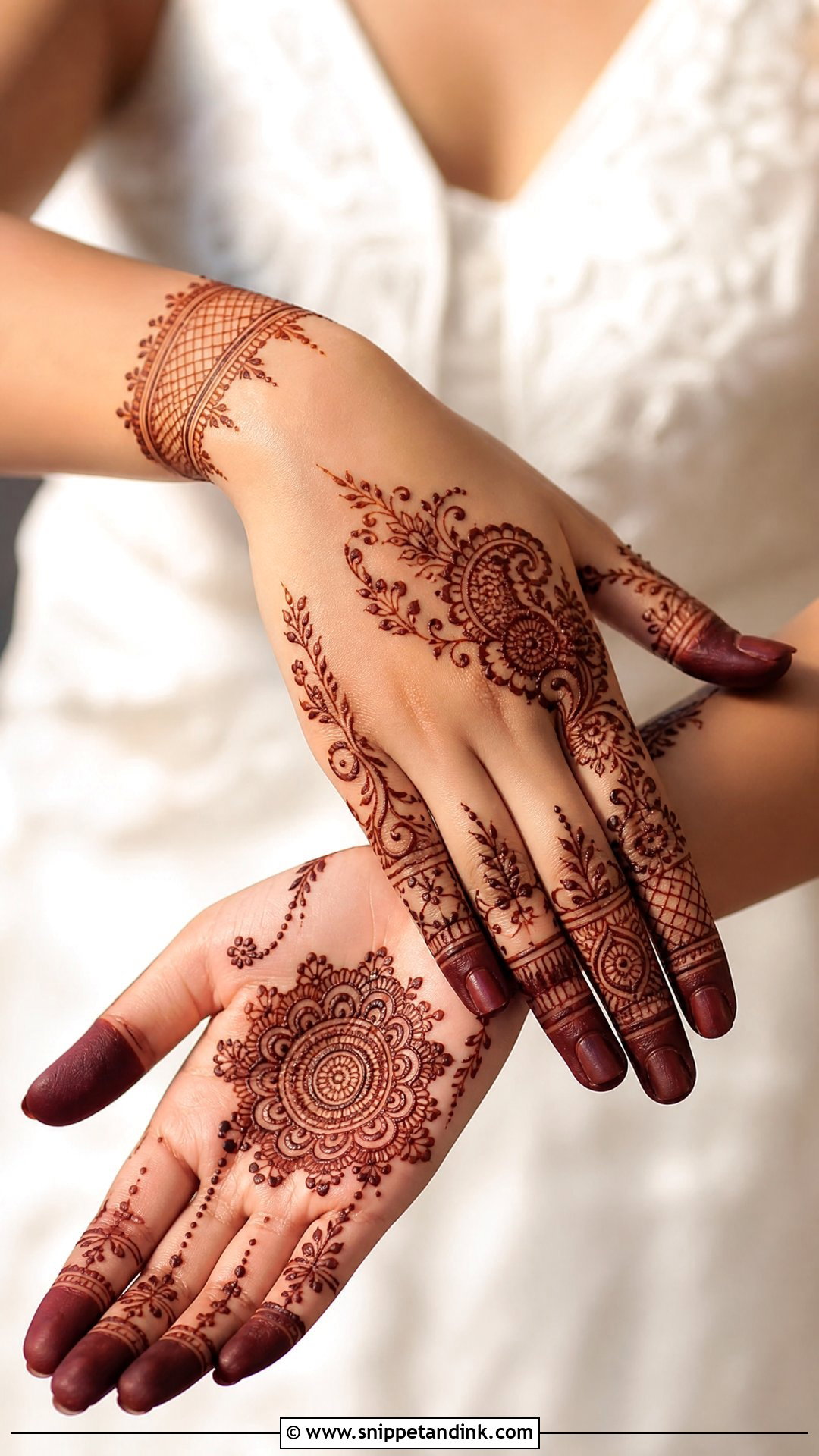
A simple bridal set might be a palm mandala, leafy fingers, slim wrist bands, a few small paisleys and a soft trail on the back of the hand. It still feels bridal when both hands are planned as a pair. Neatness carries it: every line has to look intended, and the empty skin has to frame the motifs. I suggest it for intimate and court weddings, pre-wedding shoots, or when jewelry, sleeves or nails are meant to take the focus.
30. Heavy Bridal Mehandi Design
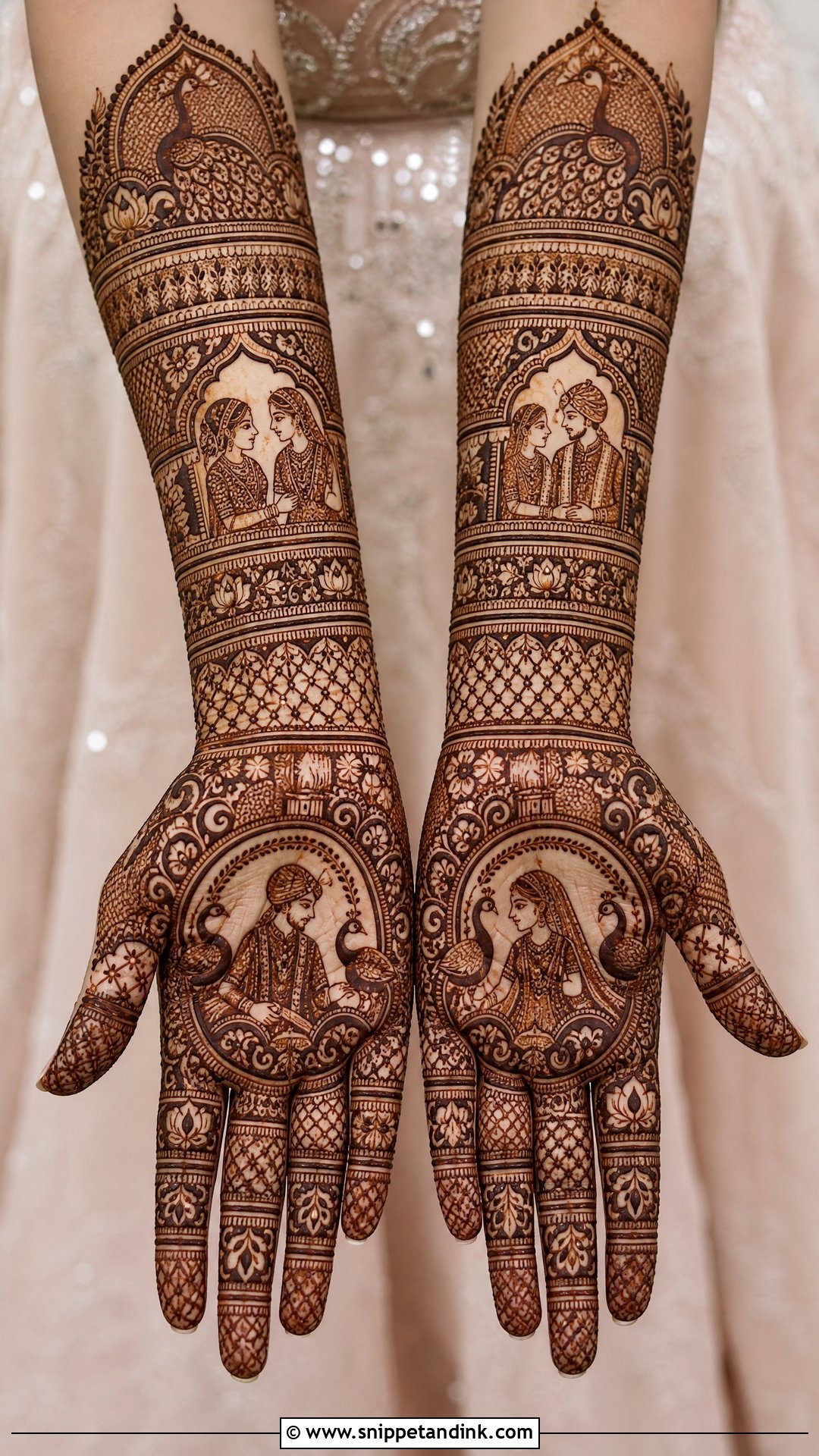
Heavy coverage leaves very little bare skin, with peacocks, paisleys, mandalas, bride-groom figures, jaali, lotus and layered borders packed across hands and arms. It takes the longest of anything here, and it shows best against red, maroon, emerald or gold outfits. Dense designs do give a strong overall stain, but density is also the risk. Without clear sections and varied motif sizes, the arm reads as a solid brown glove in photos. I divide it into panels before starting so each one has its own focus.
Aftercare That Decides How Dark the Color Gets
Most disappointing stains come from what happens after I pack up, not during the application. The paste needs time on the skin, and it needs to stay moist enough to keep releasing dye. This is the routine I give every bride.
- Leave the paste on for at least six to eight hours, or overnight if you can sleep with your hands loosely wrapped.
- Dab on a lemon and sugar mix once the surface dries; it keeps the paste stuck to the skin and slightly damp.
- Scrape the dried paste off with a blunt edge instead of washing it away.
- Keep water off your hands for as long as you can on the first day, and stay warm, since cold air slows the darkening.
- Avoid chlorine pools, sanitizer and bleach-based cleaners until after the wedding.
When the Stain Comes Up Patchy or Light
Uneven color usually has a simple cause. Spots where lotion was rubbed in, areas where the paste cracked and fell away early, and thin shaded lines will all stain paler. The upper forearm and the backs of the hands always come up lighter than palms and fingertips, so some variation is normal rather than a fault.
If the color looks weak the morning after, give it time; it often keeps deepening through the second day. What I ask brides not to do is trace fresh paste over the design at the last minute. New lines rarely sit exactly on the old ones, and the doubled areas go much darker than everything around them.
Taking a Short List to Your Mehndi Artist
Start with your hands and your schedule, then look at patterns. Hand shape, outfit, rituals, jewelry and how many hours you can actually sit all narrow the field before style comes into it. Full Indian designs feel royal, Arabic and Gulf work looks airy, and mandalas, jaali, lotus, peacocks, portraits and personal details each carry their own mood. Minimal, bracelet and hathphool layouts keep things light, while heavy forearm coverage brings the drama. Bring two or three photos from this collection to your artist and talk through how each one will look on your own hands once the stain has deepened.
You'll Like These Ideas:











Leave a Reply