
A castle cake turns the dessert table into the room’s focal point, and at a wedding the challenge is keeping it romantic rather than childish. Most of that comes down to restraint: ivory or muted color, sugar flowers, pearl trim, a little gold and towers that are slim rather than chunky. Some designs are a full castle; others just borrow a turret, an arch or a crown-shaped top. These are twenty approaches I’d consider, along with how each is built and where castle cakes tend to go wrong.
What’s Inside a Turret?
Couples are often surprised to learn that much of a castle cake isn’t cake. Tall, thin towers can’t be made from sponge alone; they’d crush under their own weight and lean within hours. Here’s what bakers usually use, and what it means for you.
- Crisped rice treats molded around a support and covered in fondant: edible, light and firm, a common choice for chunky towers.
- Styrofoam or other dummy forms: not edible, but very stable, which is why the tallest spires are often dummies.
- Gumpaste or modeling chocolate: used for roofs, cones, battlements and small detail pieces. Edible, though hard once dry.
- Real cake tiers: these form the base and the servings, supported by dowels and boards inside.
Ask which parts are edible and which aren’t before you sign off on the design. It affects servings, it matters for anyone with allergies, and it tells the caterer what to lift off before slicing.
1. Fairytale Castle Wedding Cake
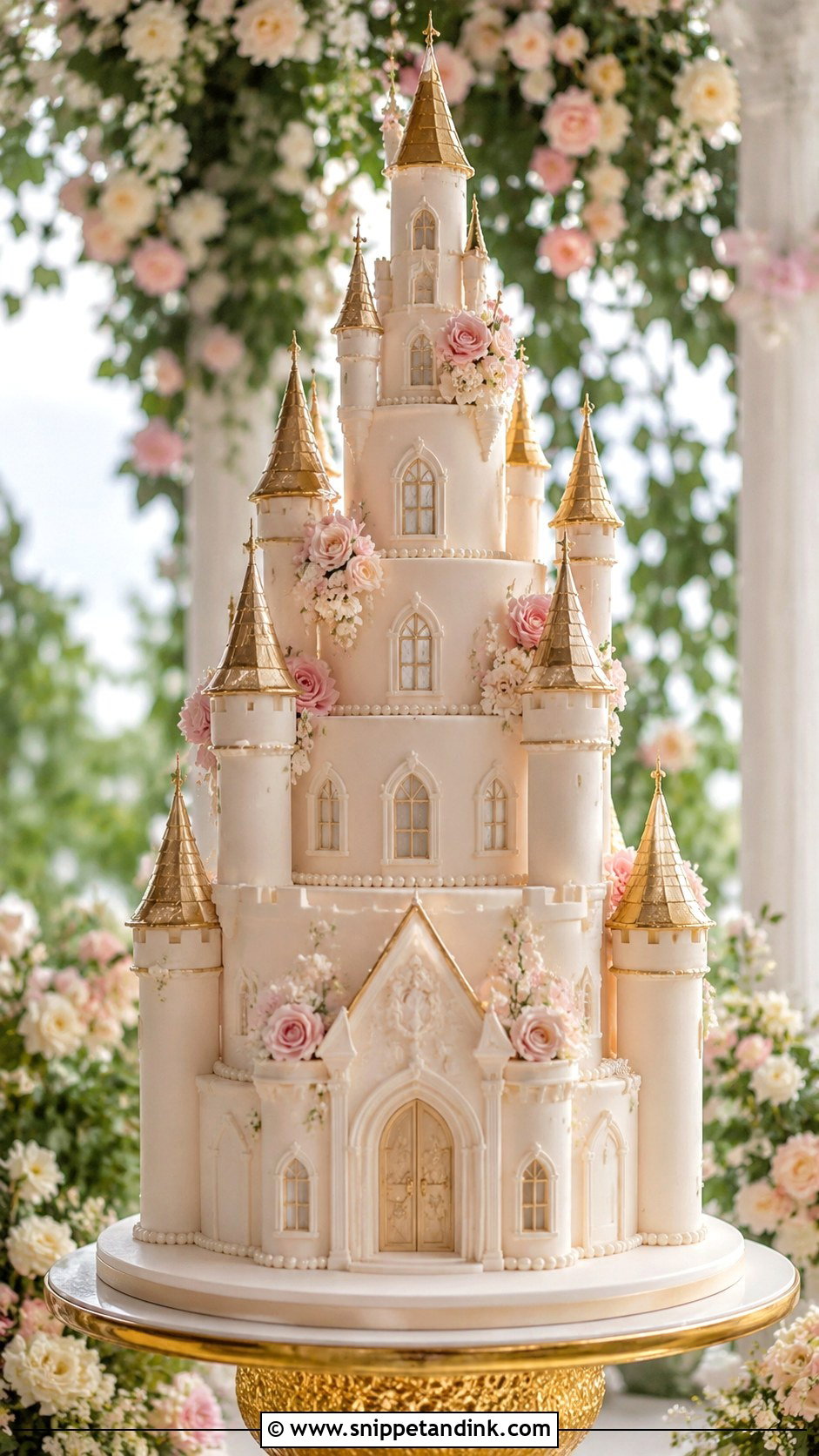
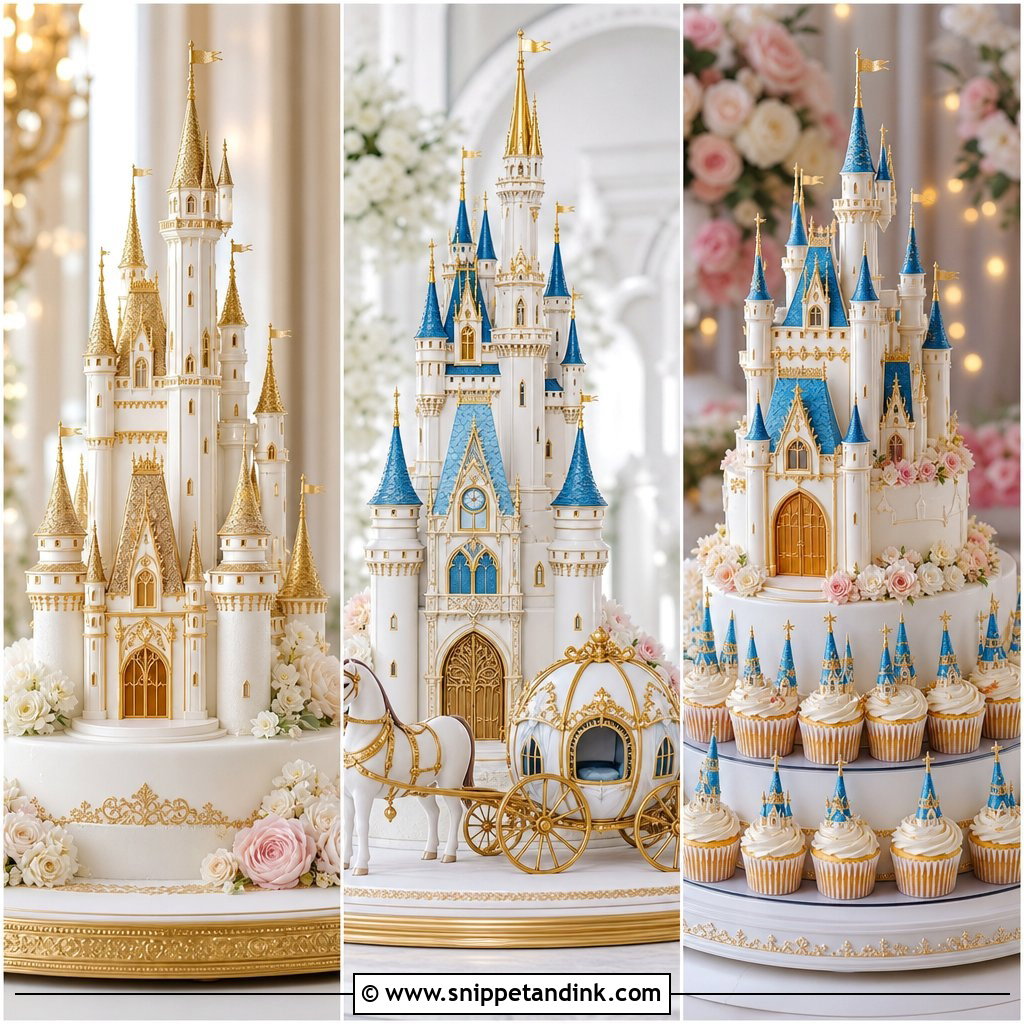
Tall tiers in ivory or blush, rounded towers with pointed roofs and a little gold: this is the version most people picture. What keeps it bridal is color. Pale pink roses, pearl borders and small sugar windows read as wedding; saturated pink and purple read as a sixth birthday. The towers are the engineering problem. Each one needs its own support running down into a board, not just a skewer into soft cake, or it will lean by the time dinner ends. Display it raised, with flowers around the base.
2. White Castle Wedding Cake
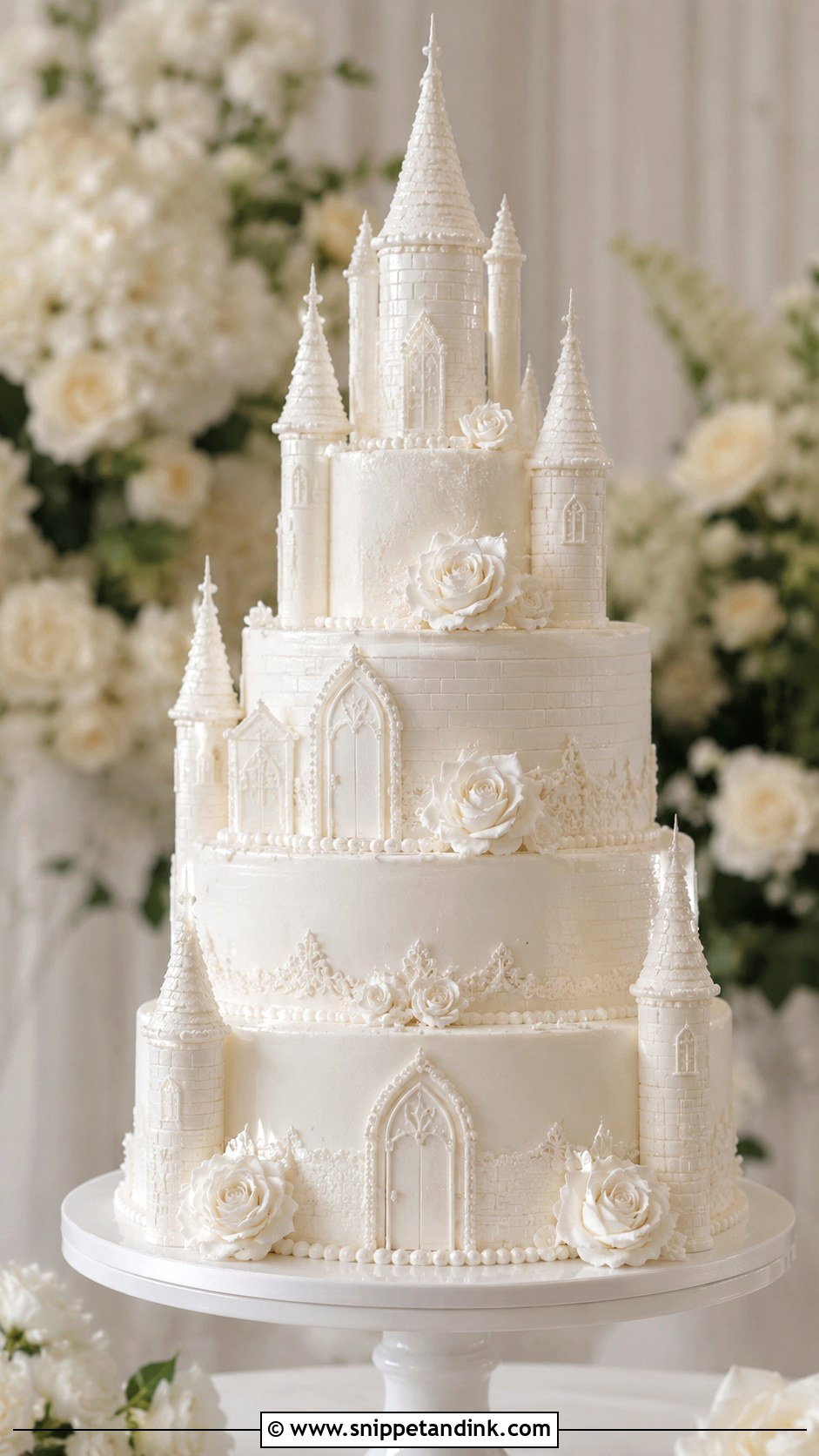
All-white castles rely on shape and shadow instead of color. Smooth white fondant or buttercream gets subtle stone lines, arched windows and tower details, then white sugar roses, edible pearls or a little piped lace. The risk is flatness. A white cake under bright venue lights can lose its detail in photos, so I carve the stone lines a bit deeper than seems necessary and vary tower heights. A faint pearl shimmer helps the edges catch light. It suits formal and chapel-style weddings.
3. Gold Castle Wedding Cake
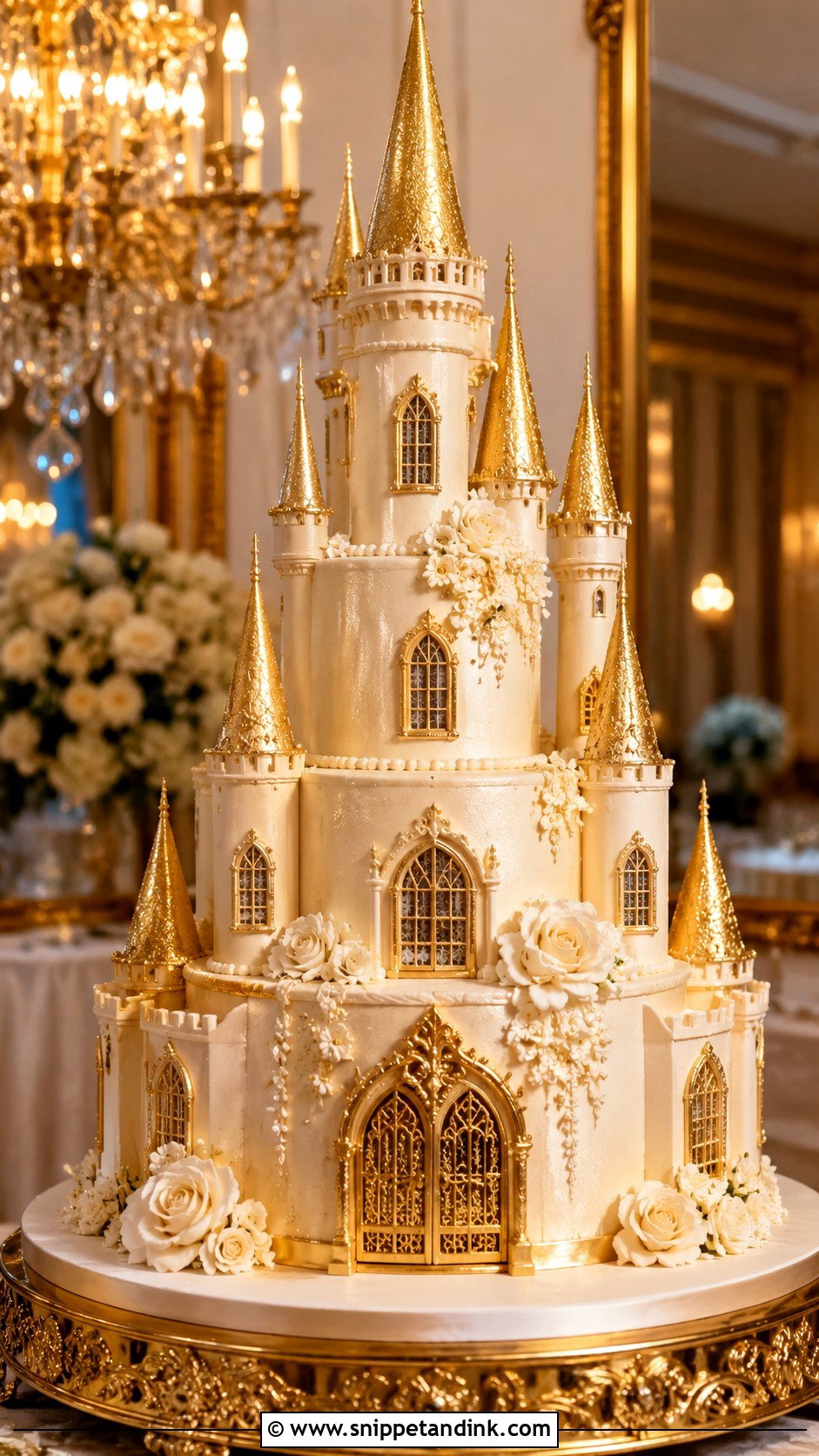
Gold makes a castle regal, and it needs a plan. I put it on roofs, window frames, gates and trim rather than whole tiers, against ivory or champagne frosting. Edible gold leaf, painted lines and a crown topper are all options. Hand-painted gold on fondant takes time to dry and can’t be touched afterward, so heavily gilded castles have to be finished a day early. Under chandeliers and warm candlelight it glows. Keep the flowers simple.
4. Pink Castle Wedding Cake
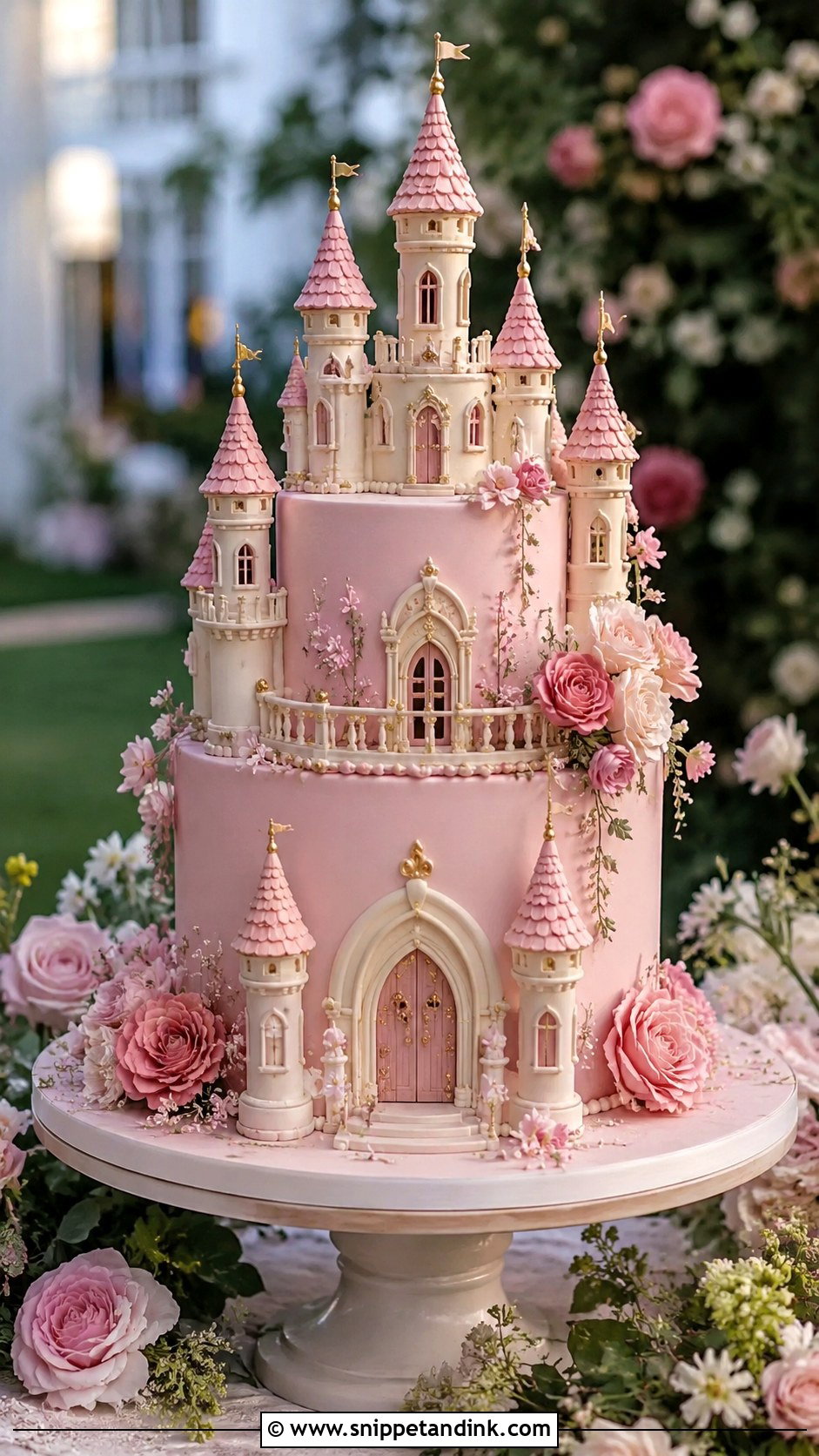
Dusty rose, mauve and pale blush are the pinks that stay grown-up; candy pink is where castle cakes start to look like a party for a child. A blush buttercream base with ivory towers works well, finished with sugar roses, tiny pearls and gold-tipped turrets. Pink buttercream colored with gel can fade on the side facing a sunny window, so I’d keep the display out of direct light. Spring weddings and garden receptions suit it. Clean piping and muted flowers keep it refined.
5. Blue Castle Wedding Cake
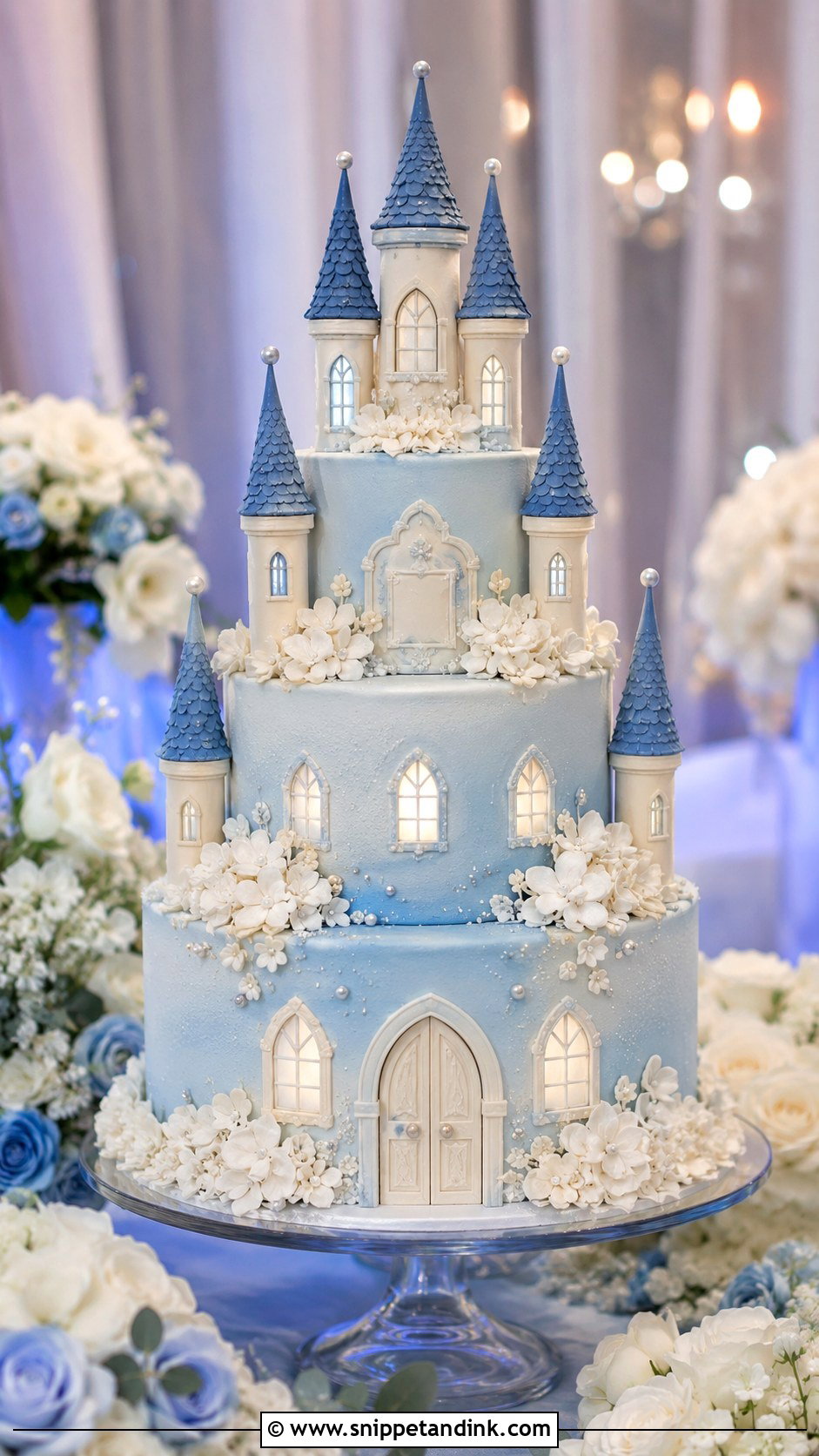
Blue castles feel cool and calm, which is why they show up at winter and evening weddings. Powder blue, dusty blue and slate all work; bright royal blue rarely does. Pair the color with ivory frosting, pearl accents, silver details or white sugar flowers, and consider an ombre so the tiers deepen toward the base. Blue is one of the trickier colors to match to a swatch because it shifts under warm light. I’d check the sample under the kind of lighting your venue has. Hydrangeas and glass candleholders around the base finish it.
6. Ivory Castle Wedding Cake
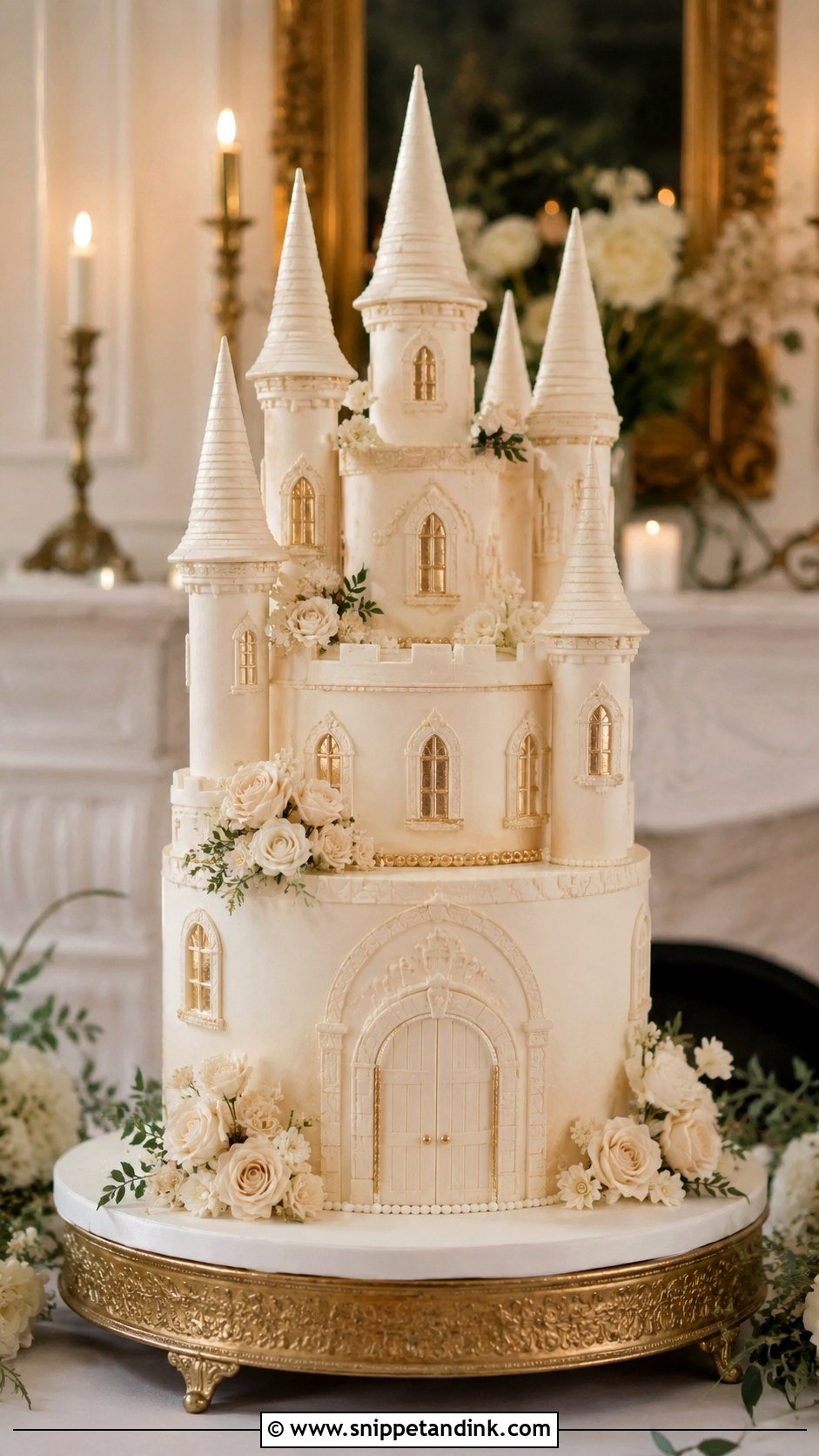
Ivory is softer than pure white and sits more comfortably next to a vintage dress or candlelight. It pairs with champagne gold, antique-toned pearls, cream roses and soft greenery. The walls can be smooth or lightly textured as stone. Towers don’t need to be large; slim turrets and arched windows are enough to read as a castle. Warm evening lighting suits ivory better than any other color here. Put it on a raised stand so the structure has presence.
7. Gothic Castle Wedding Cake
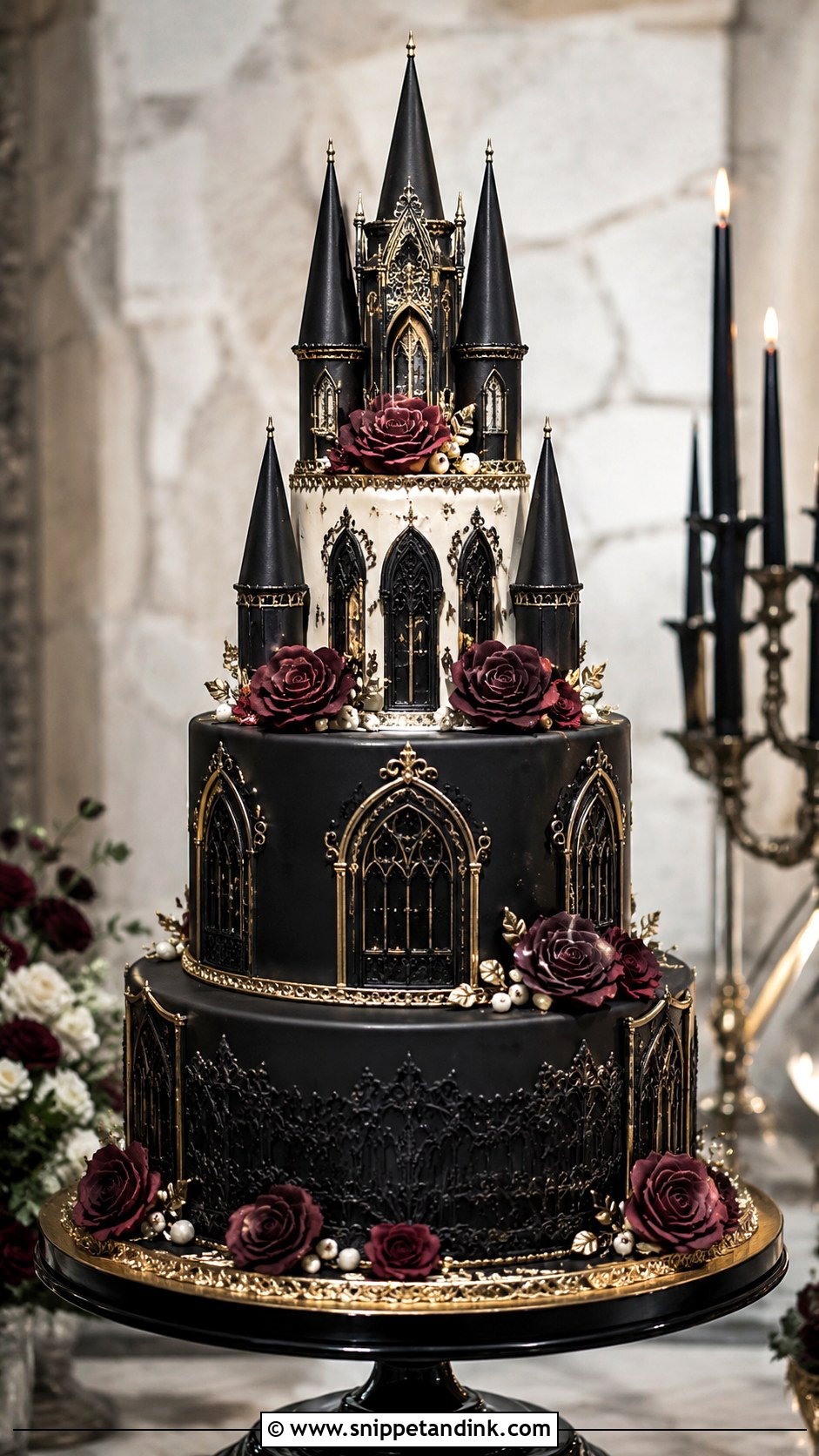
A gothic castle wedding cake can be dramatic without being spooky, and the line between the two is detail quality. Charcoal, black, ivory, burgundy and antique gold make the palette, with tall towers, pointed arches, lace-like piping and deep-toned sugar flowers. Black fondant shows every fingerprint and crack, so it needs to be handled with gloves and dusted lightly with cornstarch. Balance dark walls with gold windows, or keep the tiers ivory and use dark flowers. Historic venues and fall weddings are its home.
8. Vintage Castle Wedding Cake
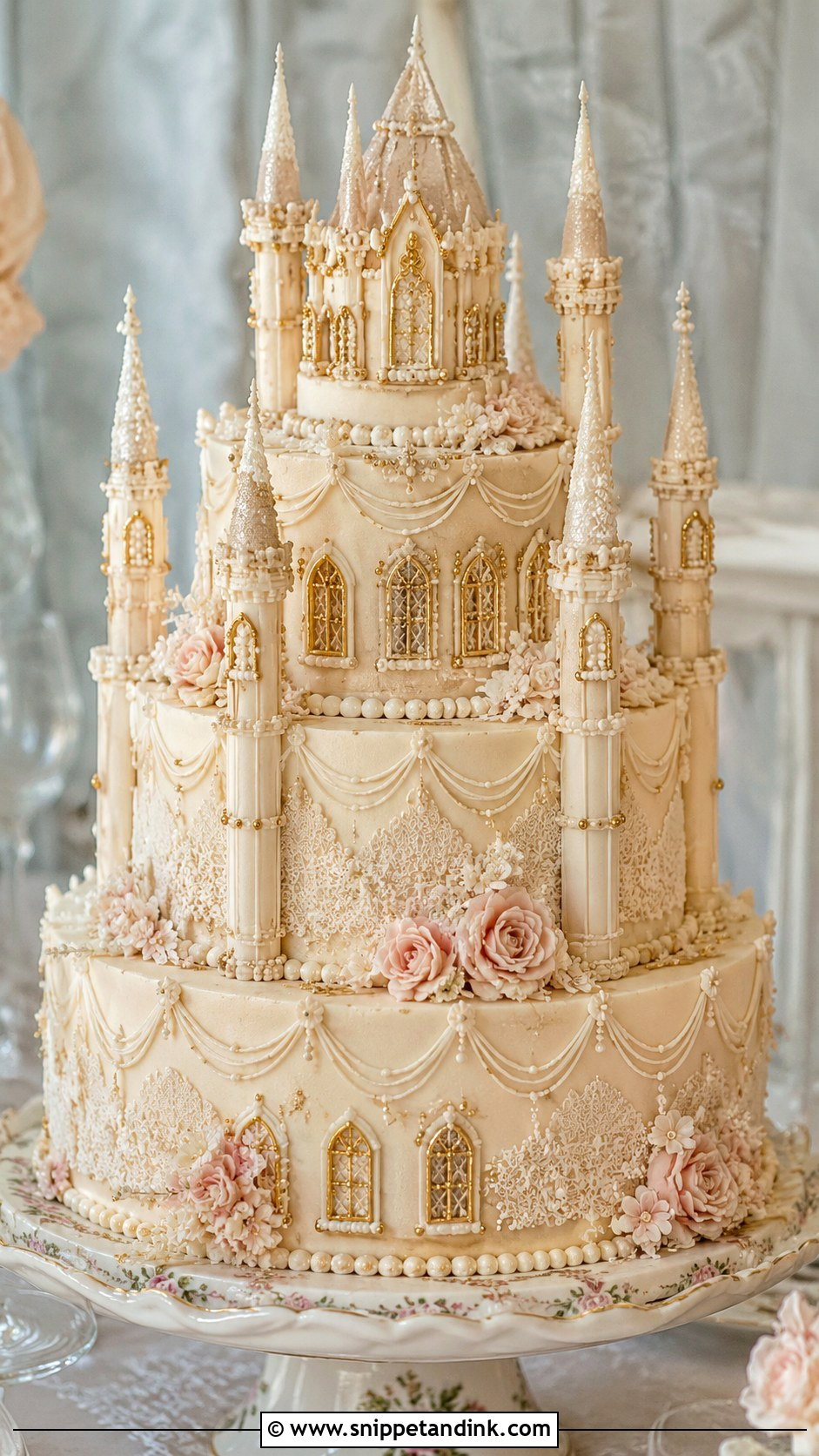
Swags, pearl borders, lace textures and small columns bring old-fashioned charm to a fairytale shape. I’d use ivory buttercream or fondant as the base with pale gold and blush details. The castle elements stay small here: modest towers, a little balcony trim and arched windows. Oversized turrets fight the delicate piping. It sits well among candles, antique decor and vintage china.
9. Medieval Castle Wedding Cake
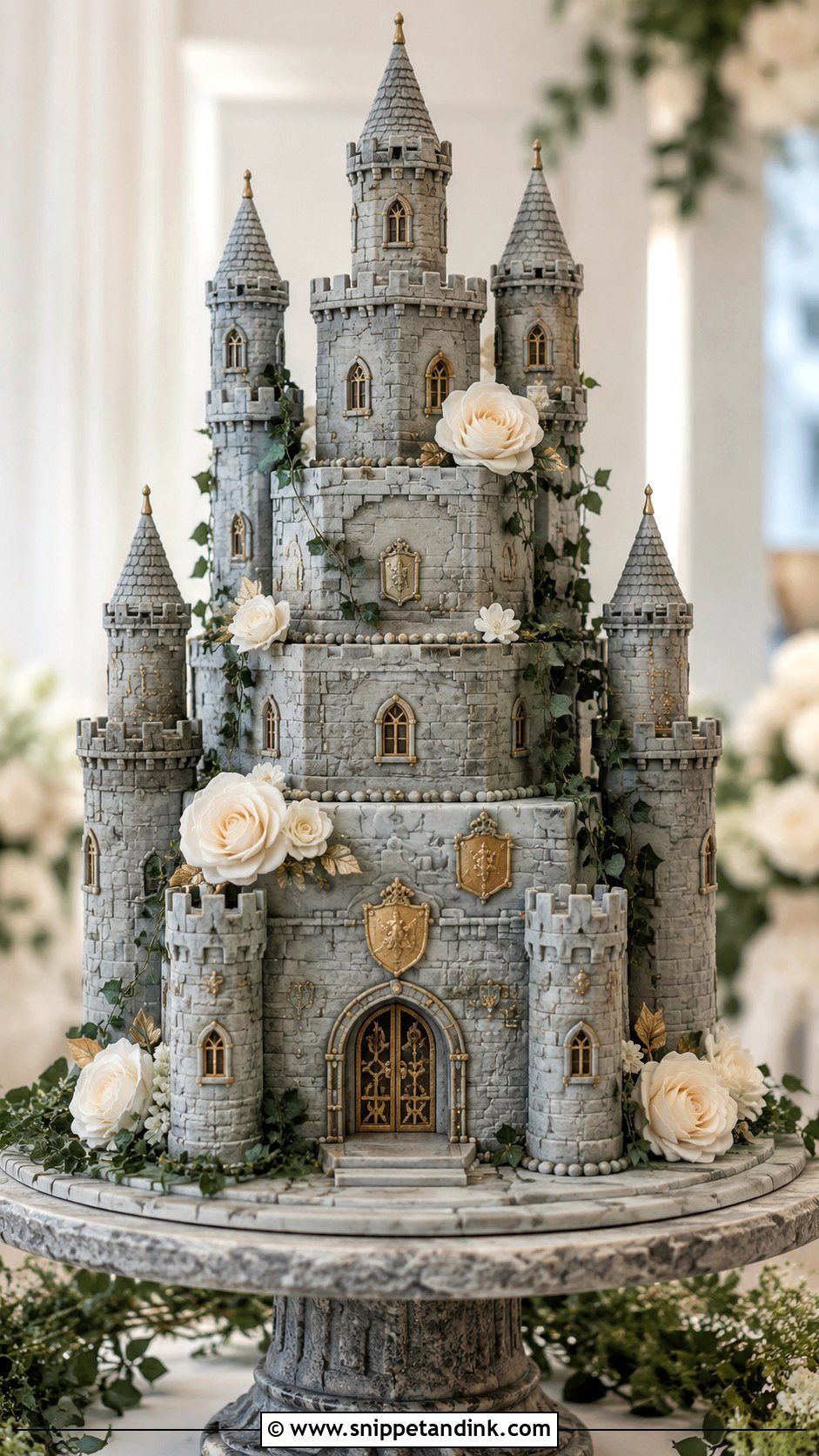
Square towers, battlements, stone walls and arched entryways give this the strongest architectural feel of the twenty. It makes the most sense at an actual castle venue, a historic estate or a rustic hall. The palette is gray, ivory, taupe or muted brown. Buttercream can be textured into stone, while fondant gives clean walls and crisp battlements. Gray cake can look heavy on a dessert table, so I’d soften it with white roses, trailing ivy and maybe a small monogram. Note that real ivy isn’t food-safe, so any that touches the cake should be sugar or wrapped.
10. Royal Castle Wedding Cake
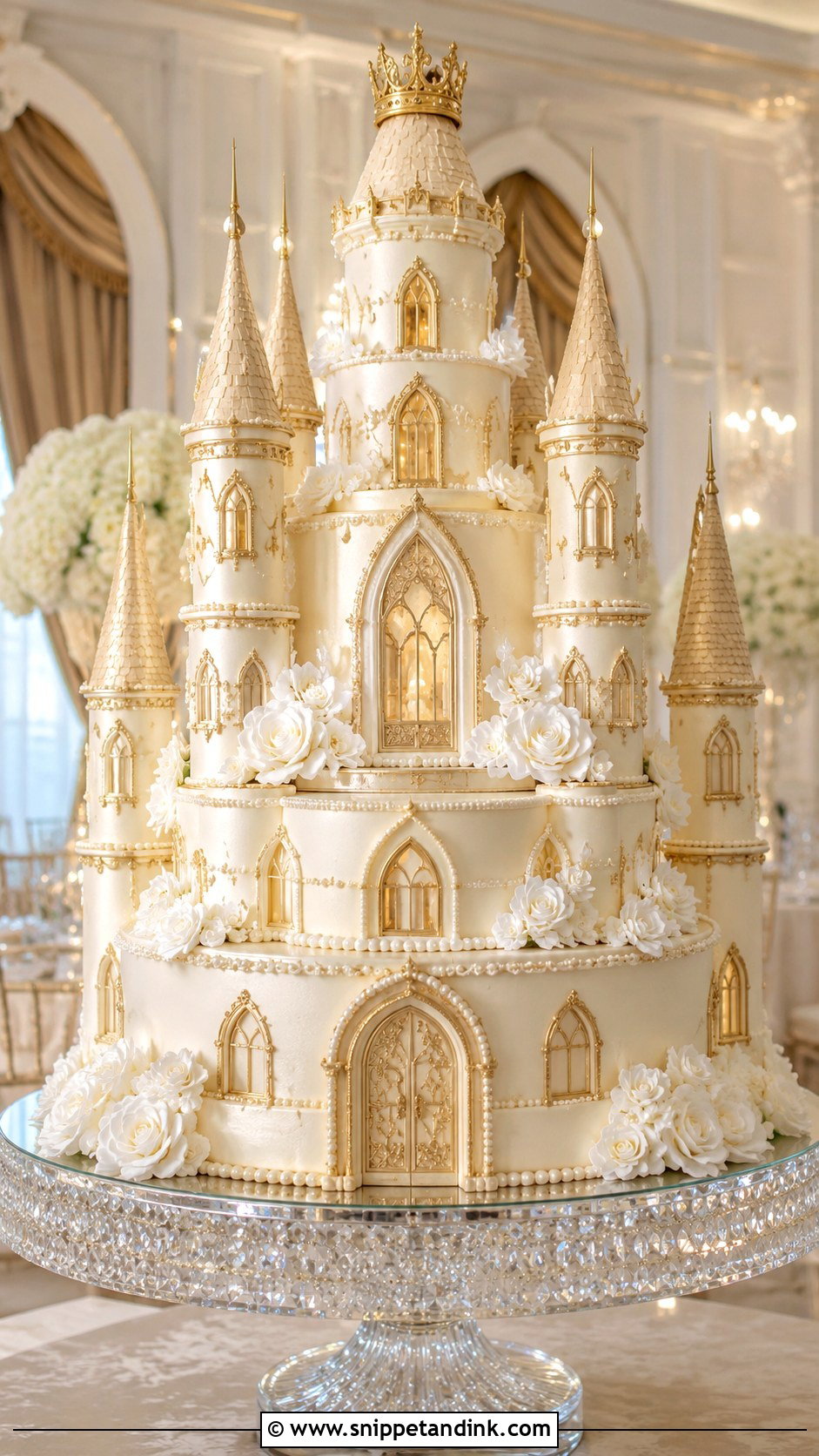
Height, symmetry and formal piping define the royal version. Several tiers, grand towers, crown accents and smooth fondant in ivory, white, champagne and gold. Edible pearls and sugar lace add detail, and a small crown topper adds drama. Symmetry sounds simple and isn’t: every tower has to match its partner in height and lean, which means measuring each one against a template. This size of cake belongs at a large reception. A tall gold or crystal stand lets guests see the whole structure.
11. Princess Castle Wedding Cake
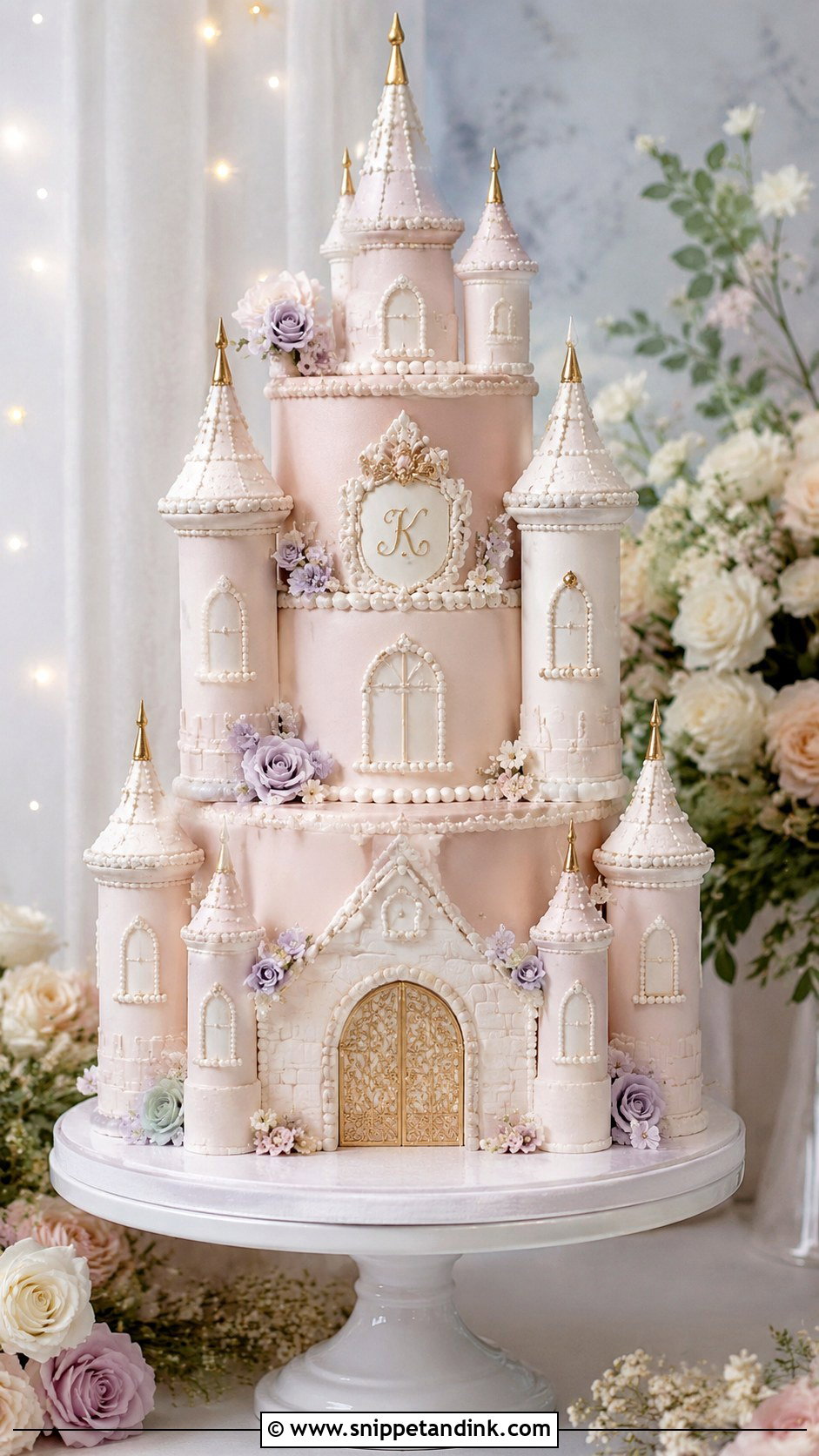
The princess look turns grown-up through color. Blush, ivory, lavender and champagne keep it bridal; bright cartoon colors don’t. Rounded towers, pearl borders, sugar roses and a little sparkle complete it, and it matches a ball gown and fairytale reception decor. Fondant handles the turrets and windows, with buttercream flowers to soften the shape. For a sentimental detail, a tiny sugar carriage, a monogram crest or a heart-shaped gate near the entrance is plenty. Pick one, not all three.
12. Enchanted Castle Wedding Cake
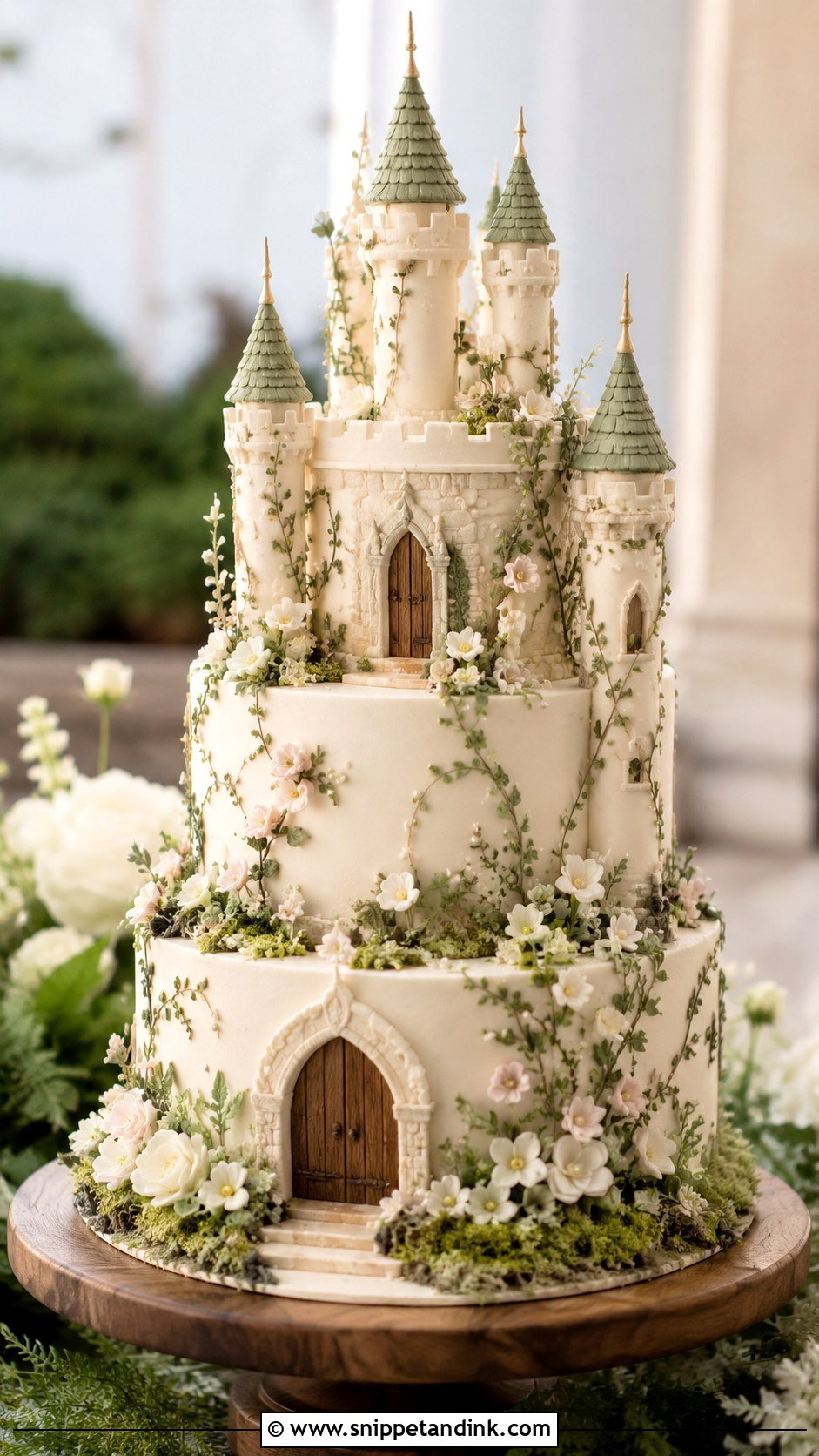
An enchanted castle wedding cake looks half-hidden in a garden, with sugar vines climbing the towers, edible flowers, moss-like texture and a curved path to the door. Soft ivory, sage, blush and pale gold work together. Moss texture is usually made from cake crumbs or tinted sugar, and it is the kind of detail that makes a sculpted cake look real. Ask for gentle texture on the frosting so the walls don’t look flat. Woodland venues and outdoor weddings suit it.
13. Stone Castle Wedding Cake
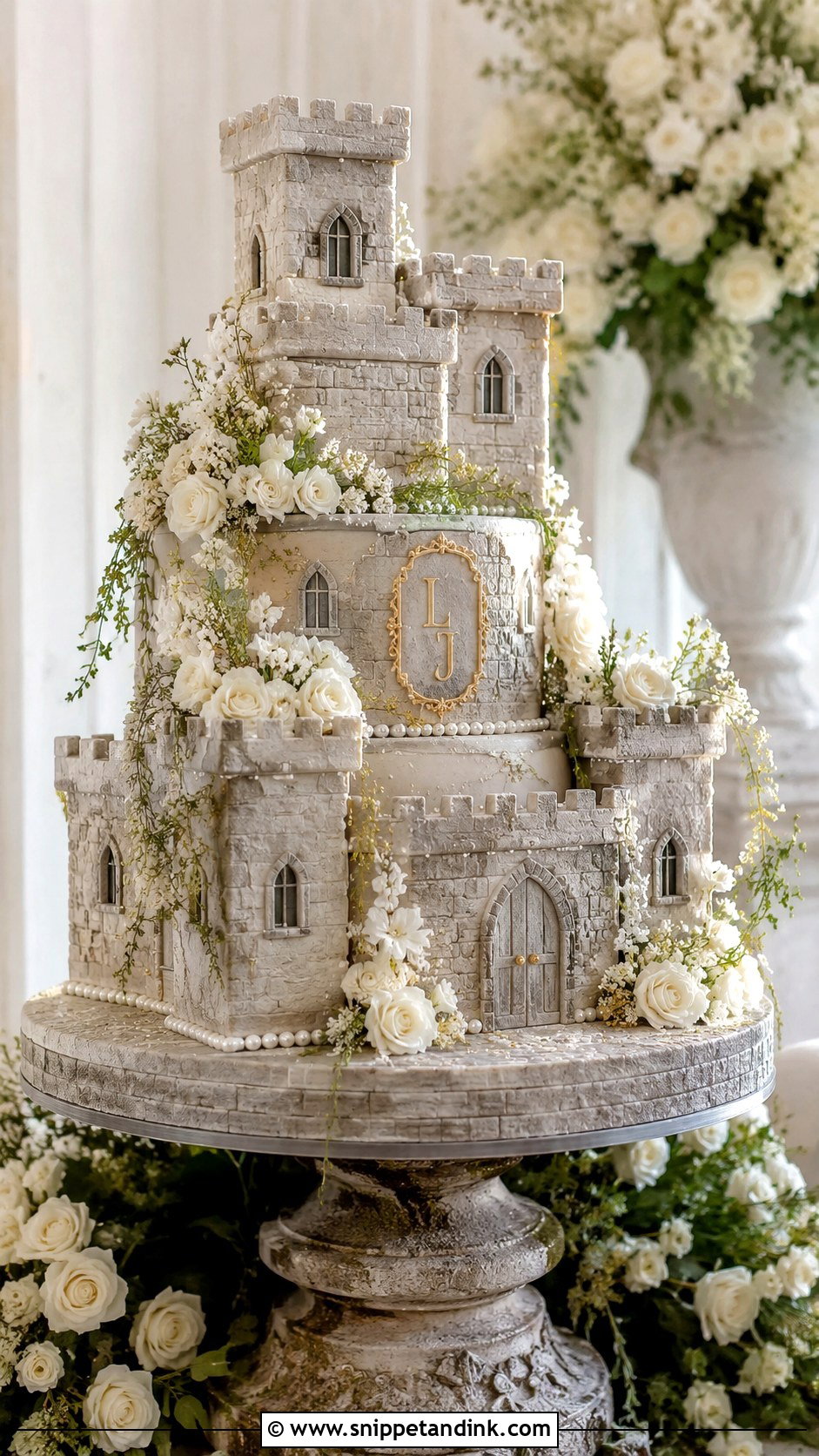
For realism, stone is the finish. The tiers are covered in gray or taupe fondant with hand-painted blocks, textured buttercream or airbrushed shading. Airbrushing gives the most convincing depth, because it lets me darken the mortar lines and lighten the face of each stone. Leave some smooth areas so the eye has somewhere to rest, especially if a monogram or flowers will go on top. White flowers or trailing greenery keep it bridal at historic venues, mountain lodges and estates.
14. Floral Castle Wedding Cake
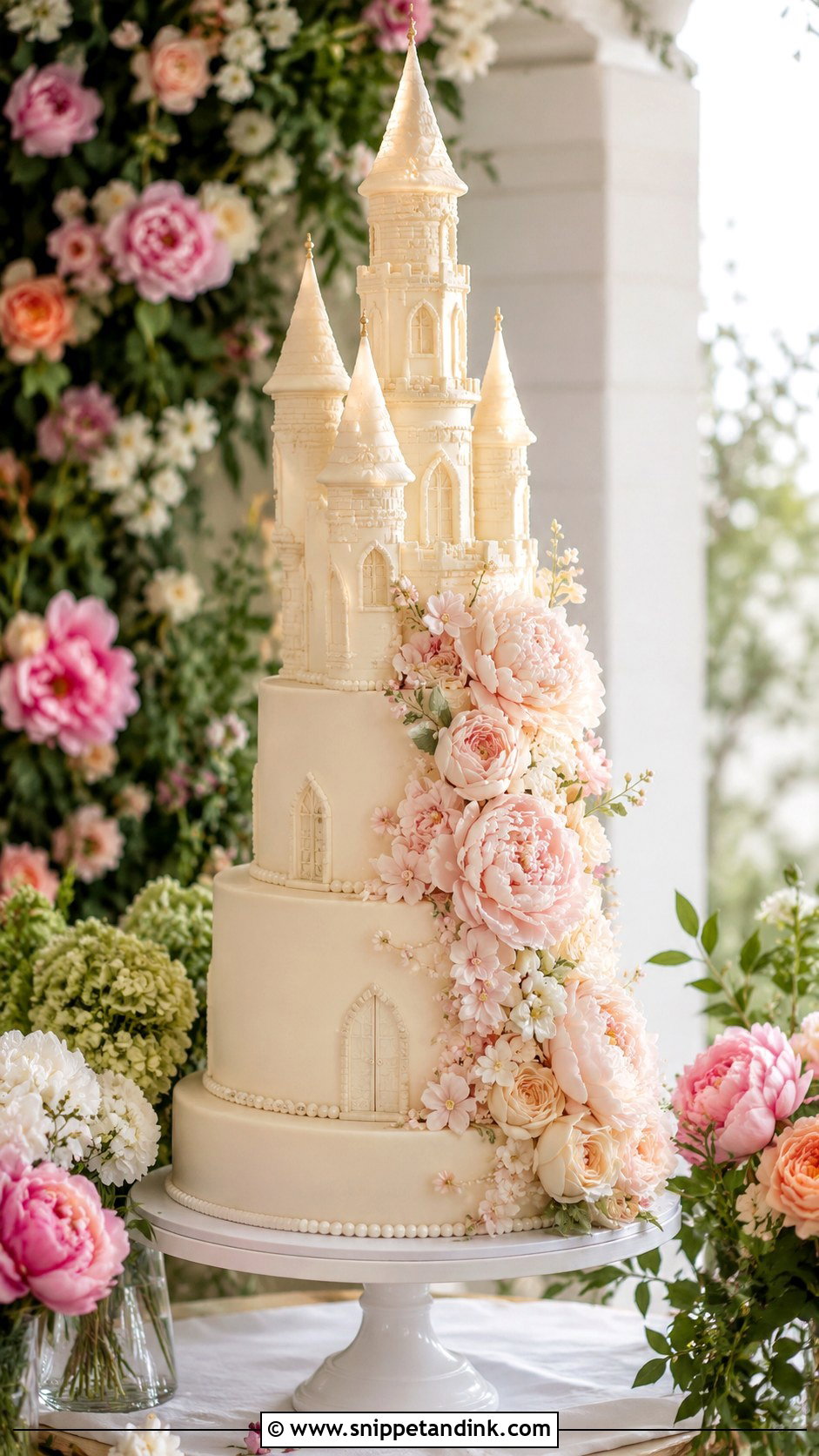
Flowers are the quickest way to stop a castle cake looking heavy. Keep the structure simple, white or ivory tiers with slim turrets, and let garden roses, sugar ranunculus, peonies and small blossoms bring the color. A cascade down one side ties tiers and towers together. Peonies open fast in a warm room, so fresh ones should be added on site, while sugar peonies stay put all evening. Pare back the windows and trim so flowers and architecture aren’t competing.
15. Buttercream Castle Wedding Cake
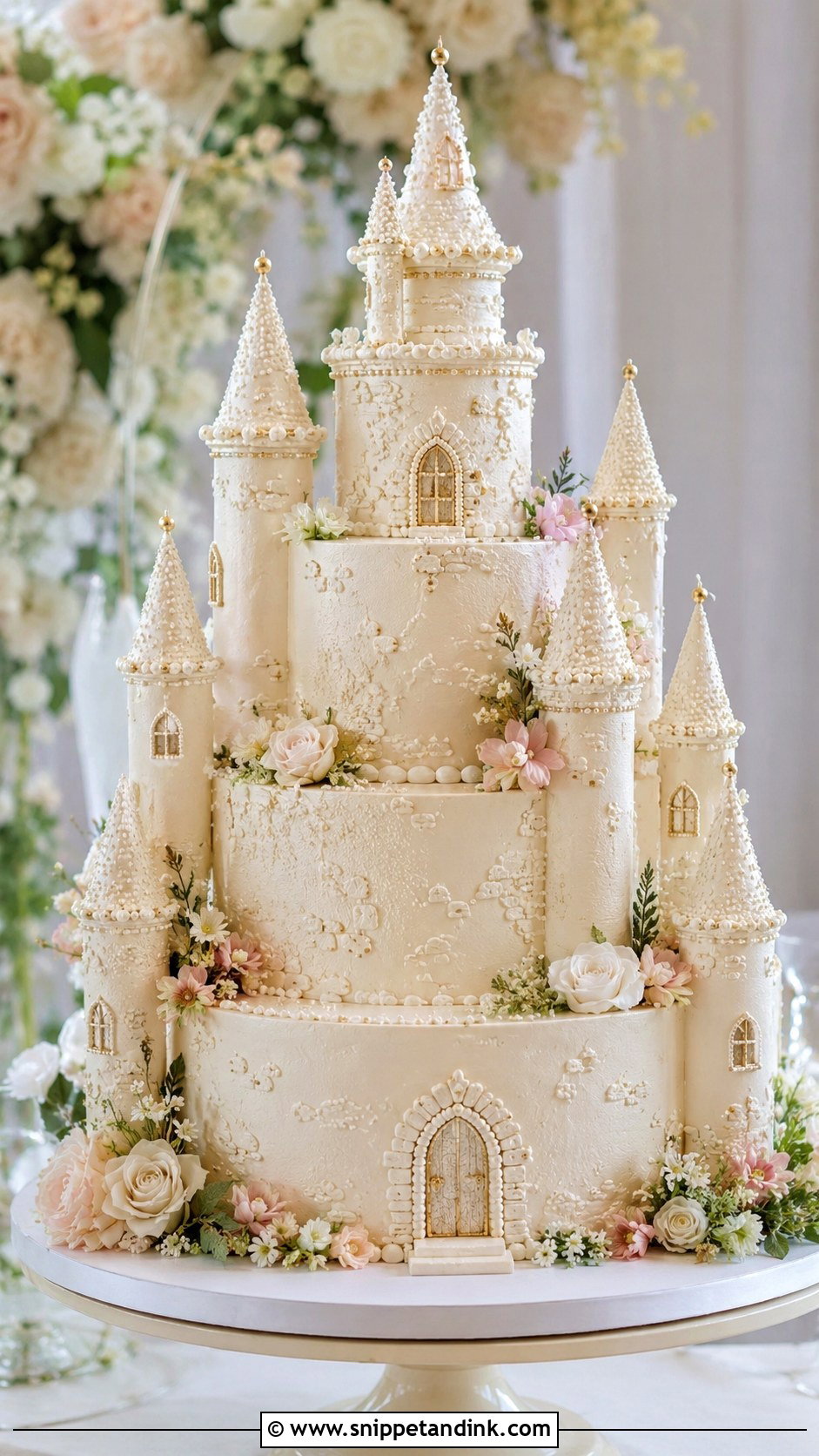
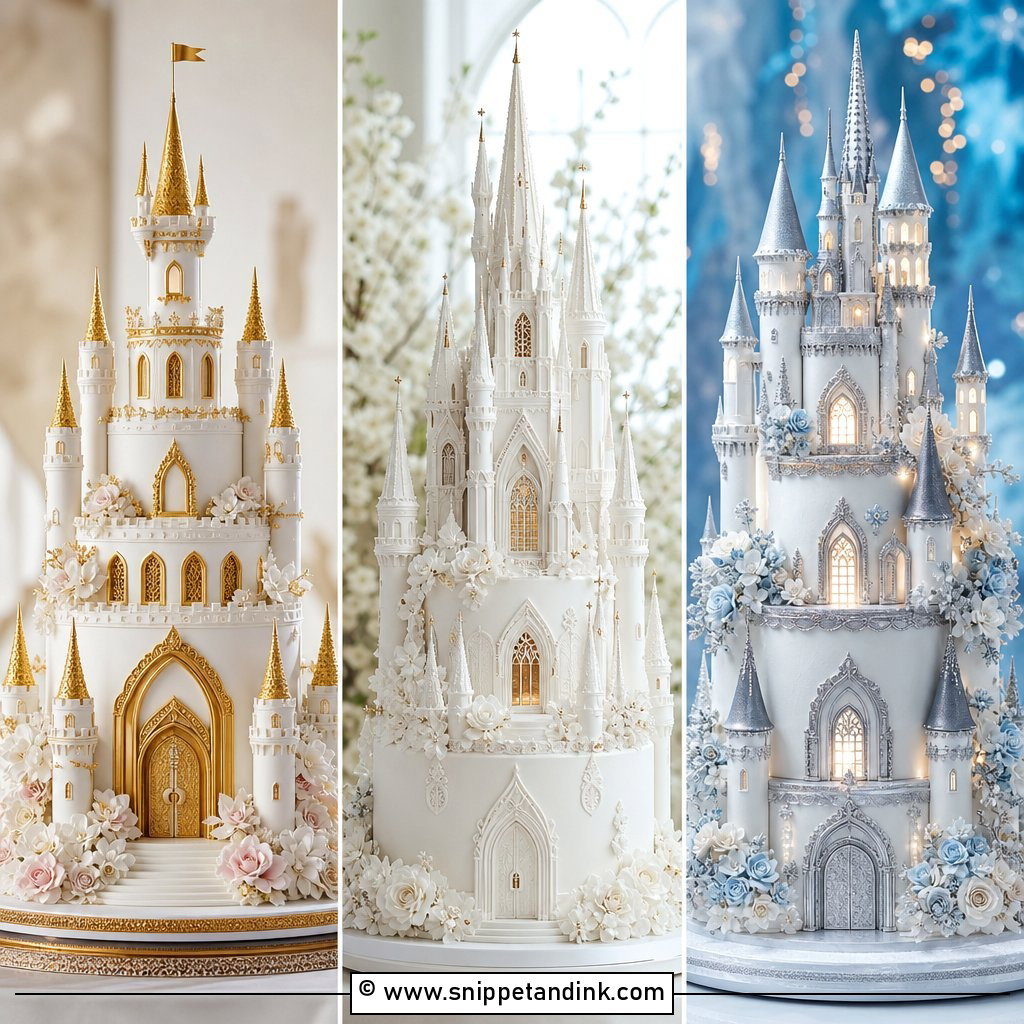
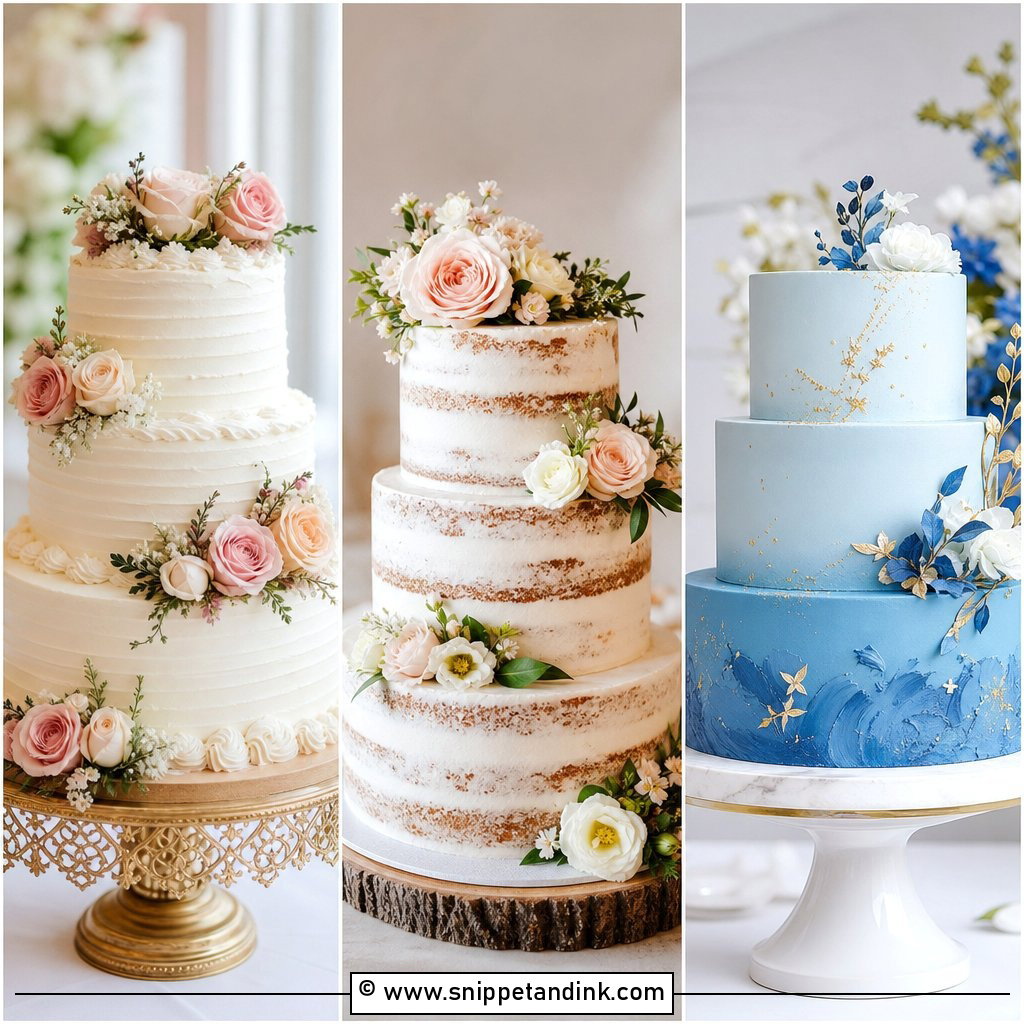
Buttercream tastes better than fondant to most guests and gives a warmer, handmade look. It can be smoothed, textured, piped into stone lines or shaped into ruffles. The towers, though, almost never stay buttercream. They need fondant, wafer paper or modeling chocolate over a firm core, or they slump. Ivory or pale champagne buttercream with pearl piping and fresh flowers is the classic finish. Ask your baker how a tall buttercream structure will cope with your venue temperature, because heat is its weak point.
16. Fondant Castle Wedding Cake
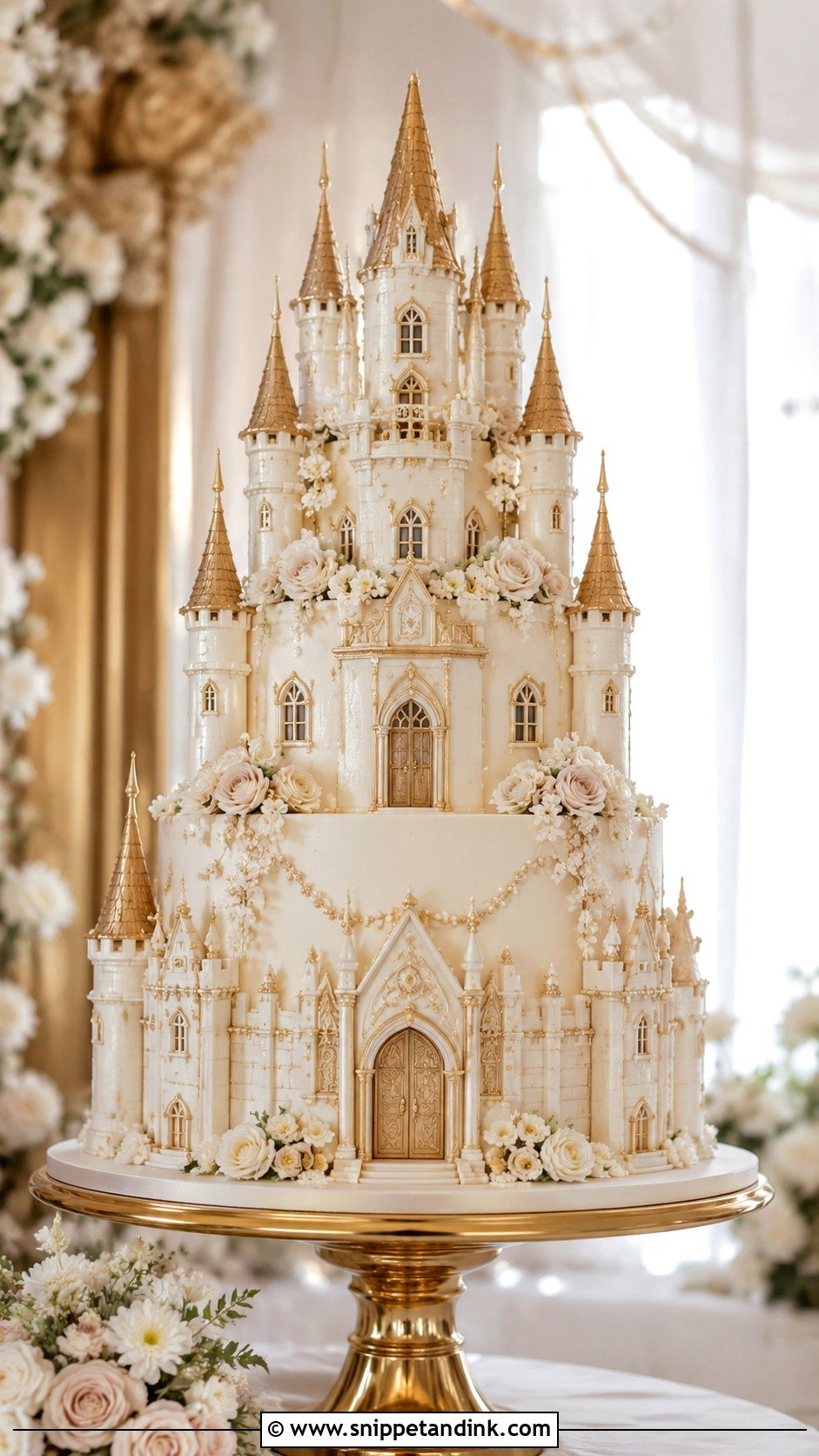
Sharp towers, crisp windows, roof tiles, banners and tiny architectural details all come easiest in fondant. It’s the right choice for a highly sculptural cake. Keep the palette refined, ivory, white, blush, champagne or soft gray, with sugar flowers, edible pearls or gold paint. Structured fondant pieces also travel better than soft buttercream ones. If guests aren’t fond of fondant, a thin coat peels off easily on the plate, so put the effort into the fillings underneath.
17. Two Tier Castle Wedding Cake
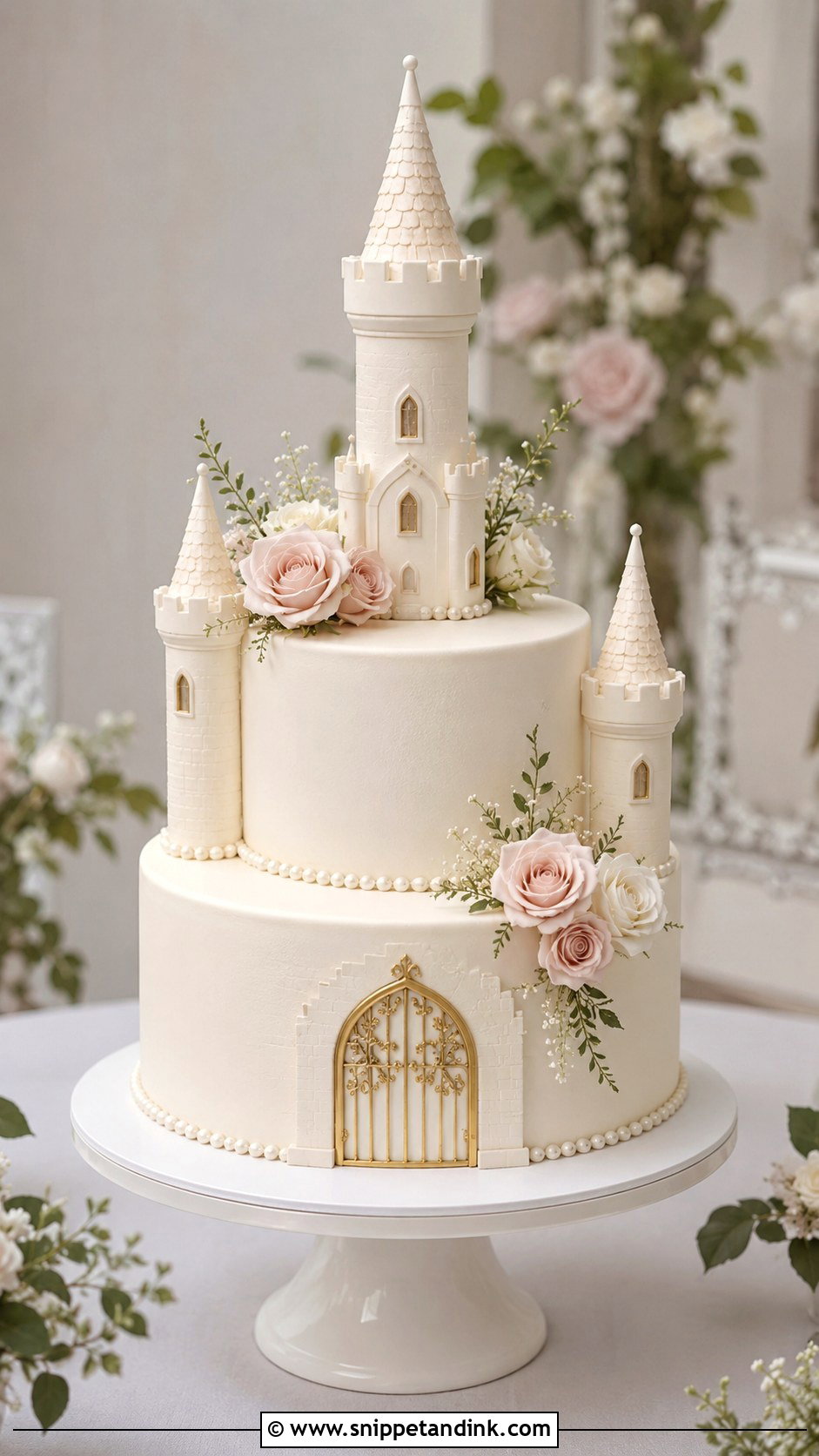
Smaller weddings and elopements can still have a castle. One main tower, a couple of small side turrets, arched windows and a few flowers are enough. A two tier cake also works as a cutting cake next to sheet cakes or a dessert table. Ivory buttercream with blush flowers keeps it calm. On a small cake every detail is seen up close, so choose a single strong feature, such as a gold gate, a crown topper or a sugar flower cascade, and let it carry the design.
18. Three Tier Castle Wedding Cake
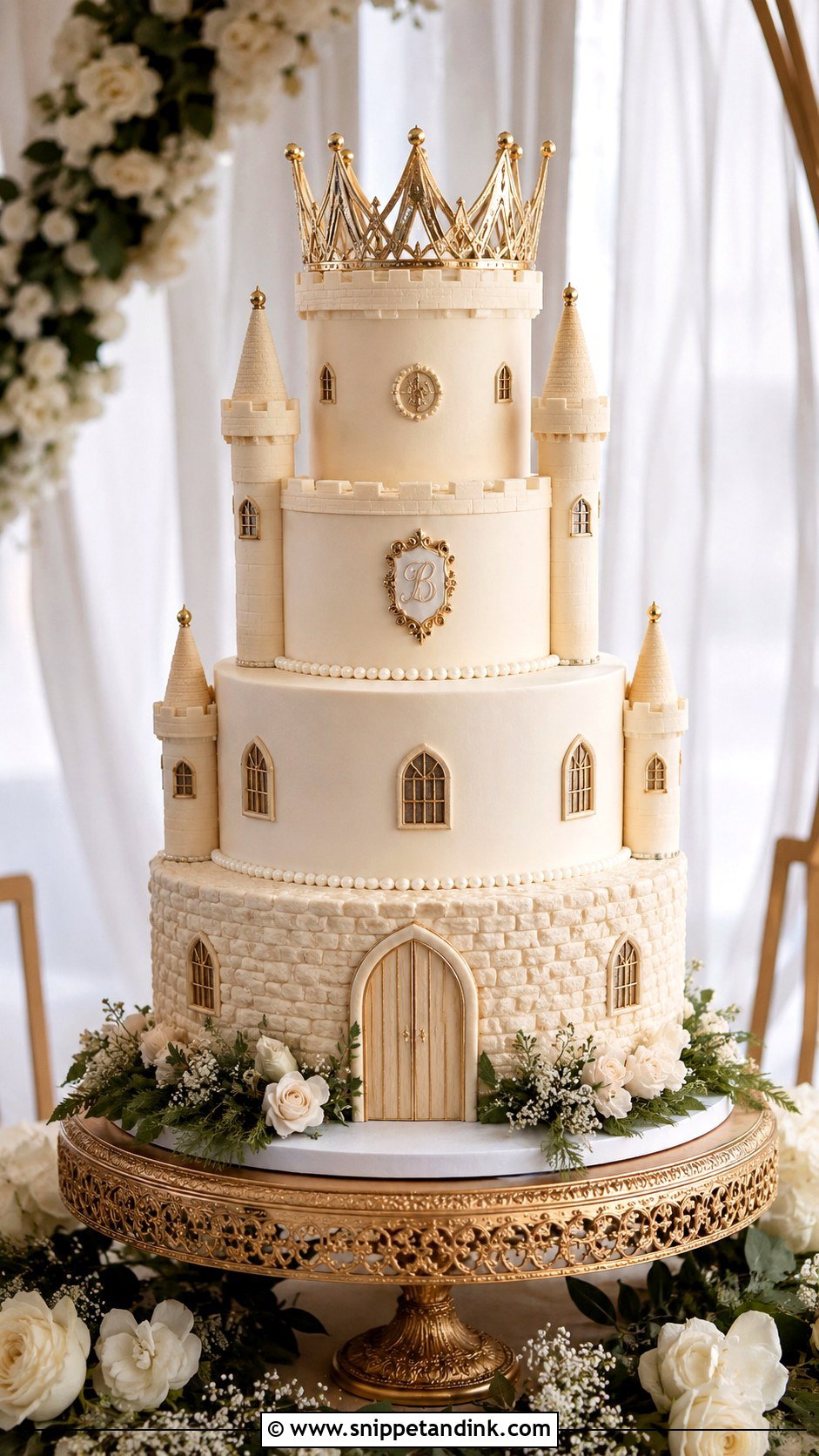
Three tiers is the size I’d suggest for most castle cakes: tall enough for towers and flowers, still manageable to deliver. The bottom tier can show stone texture, the middle hold arched windows and the top support the main turret or crown. White, ivory, blush and gold are dependable colors at this size. It gives a real centerpiece without a cake that needs two people and a van ramp. A floral base or a low meadow of flowers around the stand makes the display look fuller.
19. Luxury Castle Wedding Cake
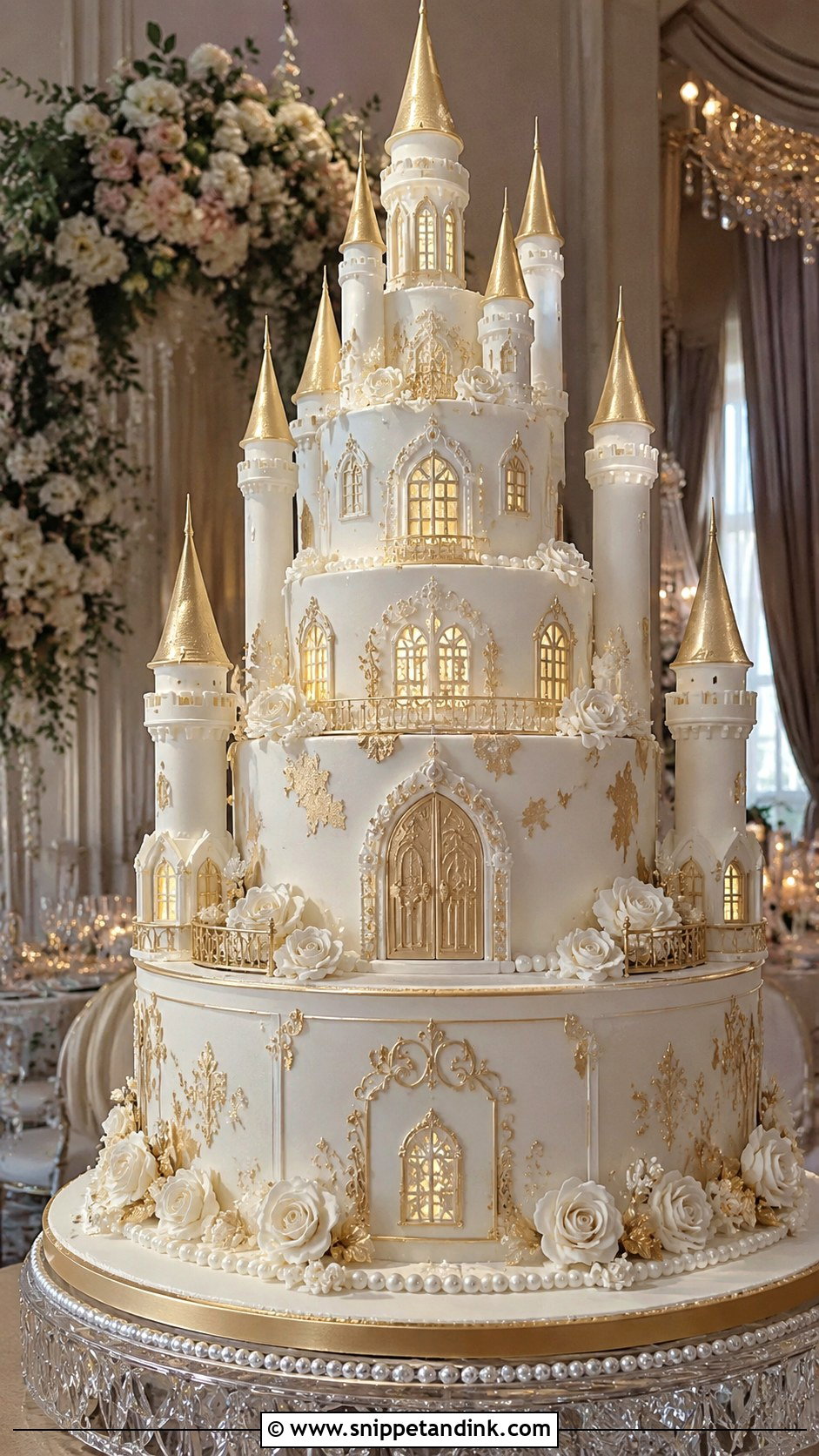
Luxury means fewer details done flawlessly, not every detail at once. Clean fondant walls, realistic sugar roses, precise piping and glowing edible accents in ivory, pearl, champagne, gold and soft blush. Symmetrical towers and a dramatic stand complete it. A cake like this is judged from every side, so I finish the back as carefully as the front in case it ends up in the middle of the room. Grand ballrooms and formal evening receptions suit it. A spotlight on the cake table makes the metallic details glow.


20. Simple Castle Wedding Cake
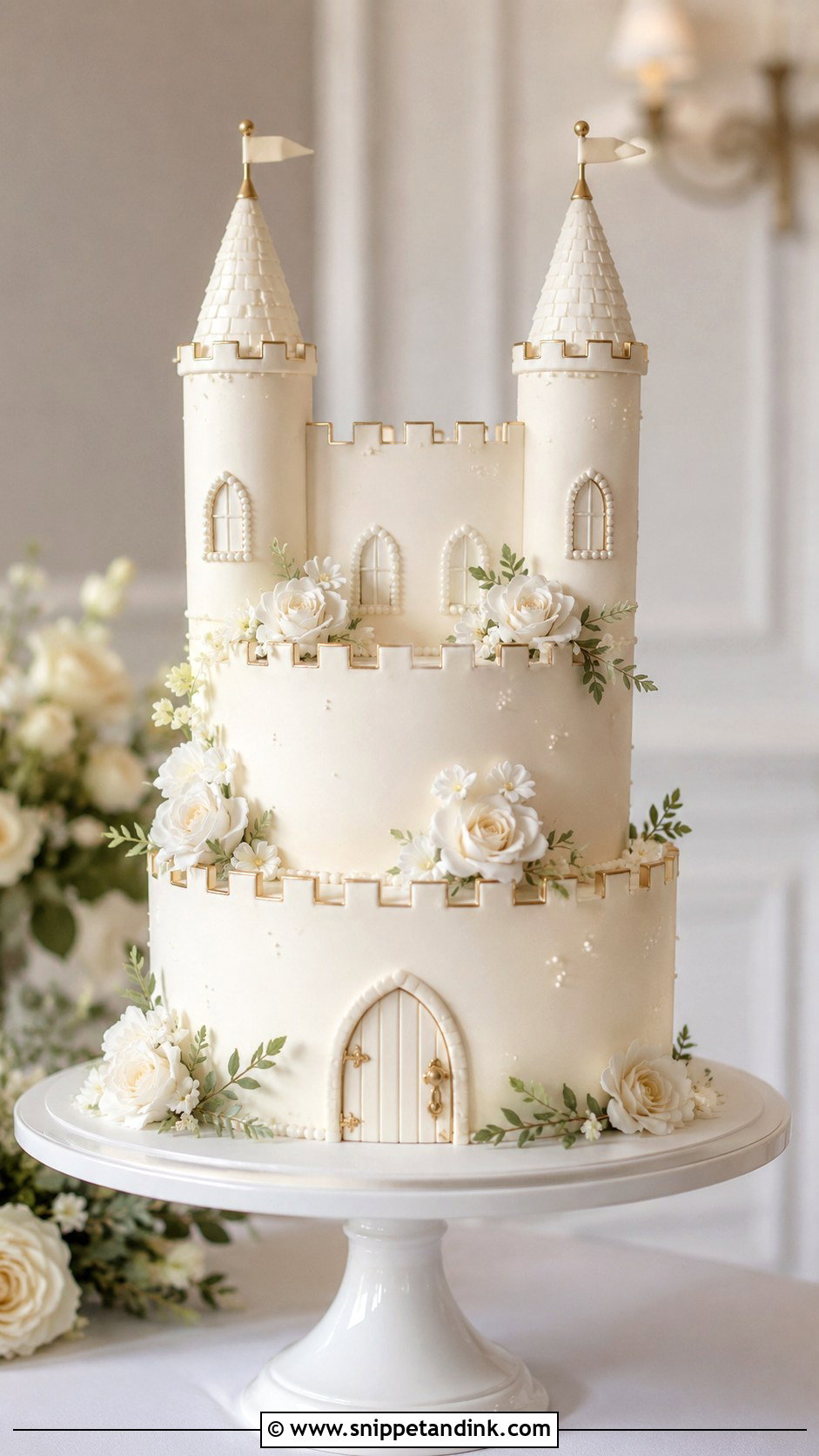
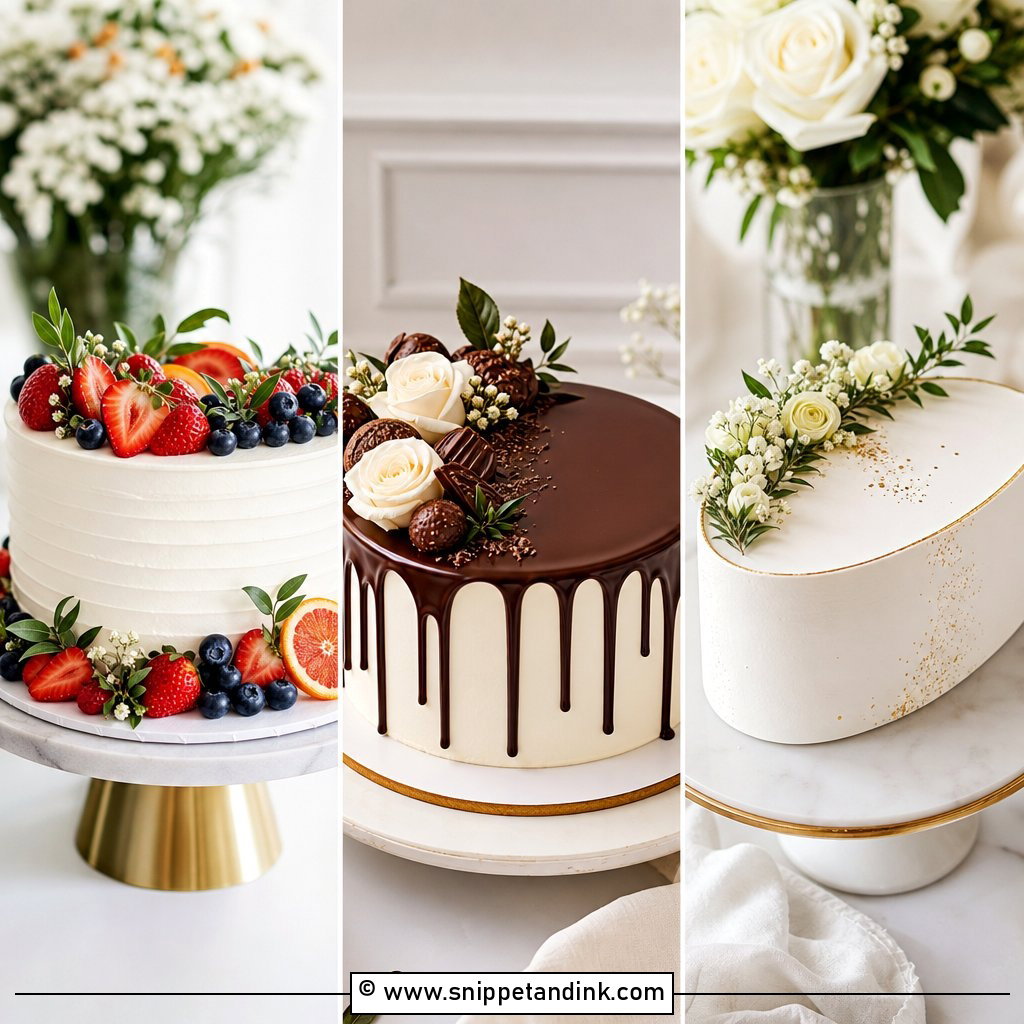
Not every couple wants a sculpture. One or two slender turrets, a small arched door and a few flowers on smooth ivory or white tiers are enough to say castle. Minimal pearl trim or a light gold outline makes the theme clear. Simple isn’t plain; with less on the cake, each detail has space to be noticed. It suits modern weddings and intimate receptions, and it’s usually the most affordable way to get the theme, since the sculpting hours are what drive castle cake prices up.
Delivery Day for a Cake With Towers
A castle cake rarely travels in one piece. I deliver the tiers stacked or in sections, with towers, roofs and fragile pieces boxed separately, then attach them at the venue. That means setup takes longer than a standard cake, often an hour or more for a large design, and the timeline needs to allow it.
The cake table matters more than people think. It needs to be sturdy, level and away from the dance floor, because vibration from speakers and dancers travels up tall towers. A wobbly folding table is the most common reason a tall cake leans. Once it’s assembled, nobody should move it, not even a few feet for a better photo.
Cutting a castle cleanly
Before anyone cuts, the towers and any non-edible pieces come off. Your planner or caterer should know which pieces those are and have a tray ready for them. The couple usually makes a ceremonial cut on the bottom tier at the back, then the cake is taken to the kitchen for slicing. Count servings only from the real cake tiers; towers and dummies don’t feed anyone, so a large castle can serve fewer guests than its size suggests.
Is a Castle Cake Right for Your Reception?
Castle wedding cakes range from bold and gothic to soft, vintage, royal or nearly plain. Venue, guest count and palette decide most of it, along with how strongly you want the fairytale to show. Formal receptions suit height, gold and smooth fondant. Outdoor weddings suit vines, textured buttercream and greenery. A two-tier castle can still feel magical on the right stand. Save the shapes and colors you love, and bring them to your first consultation along with the venue details.
You'll Like These Ideas:











Leave a Reply