
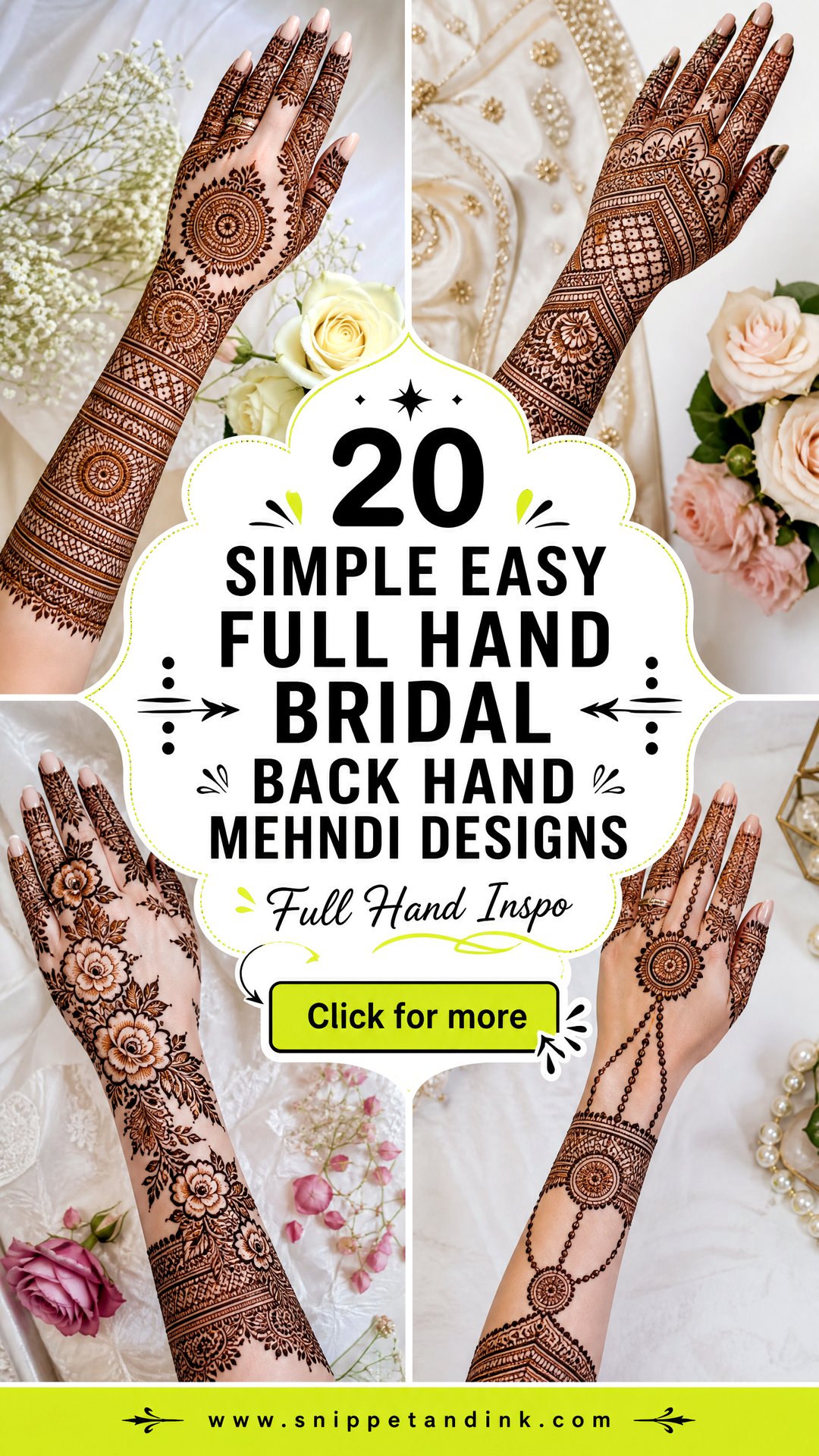
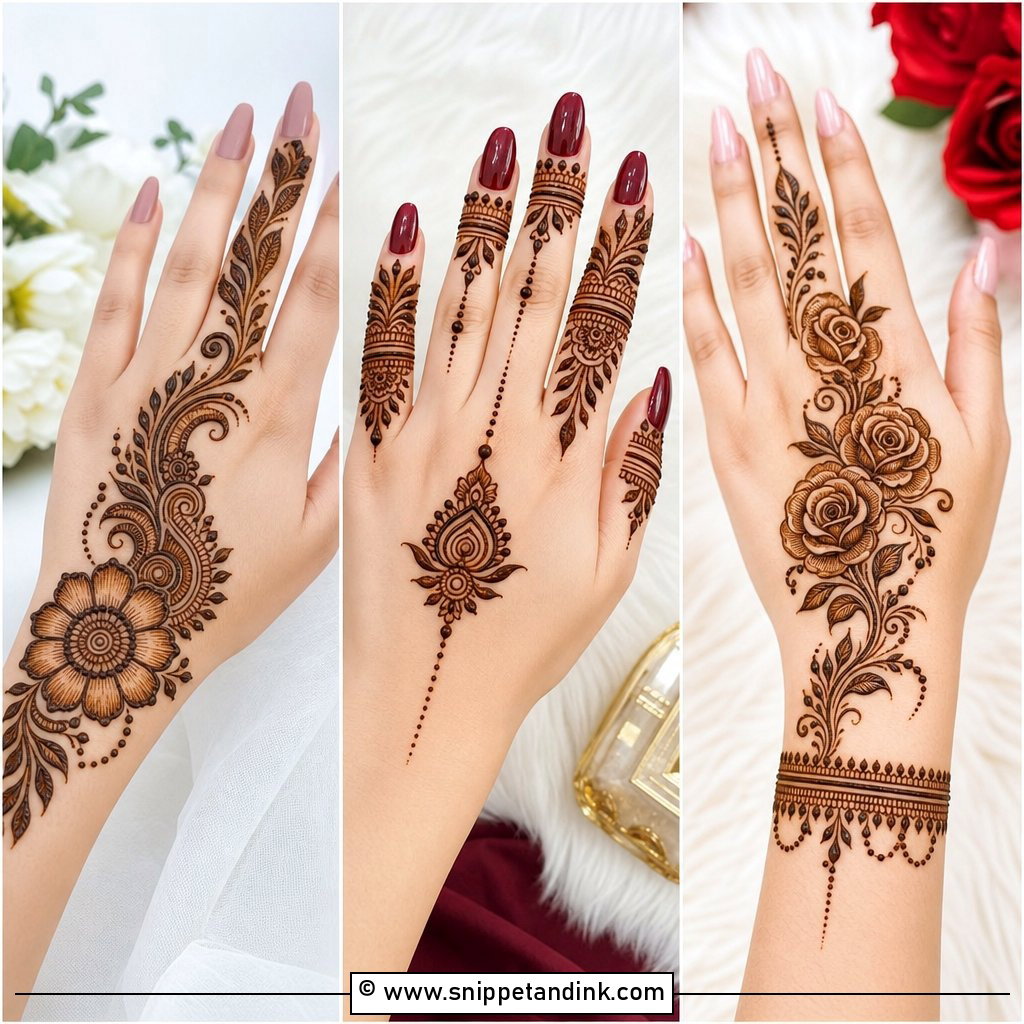
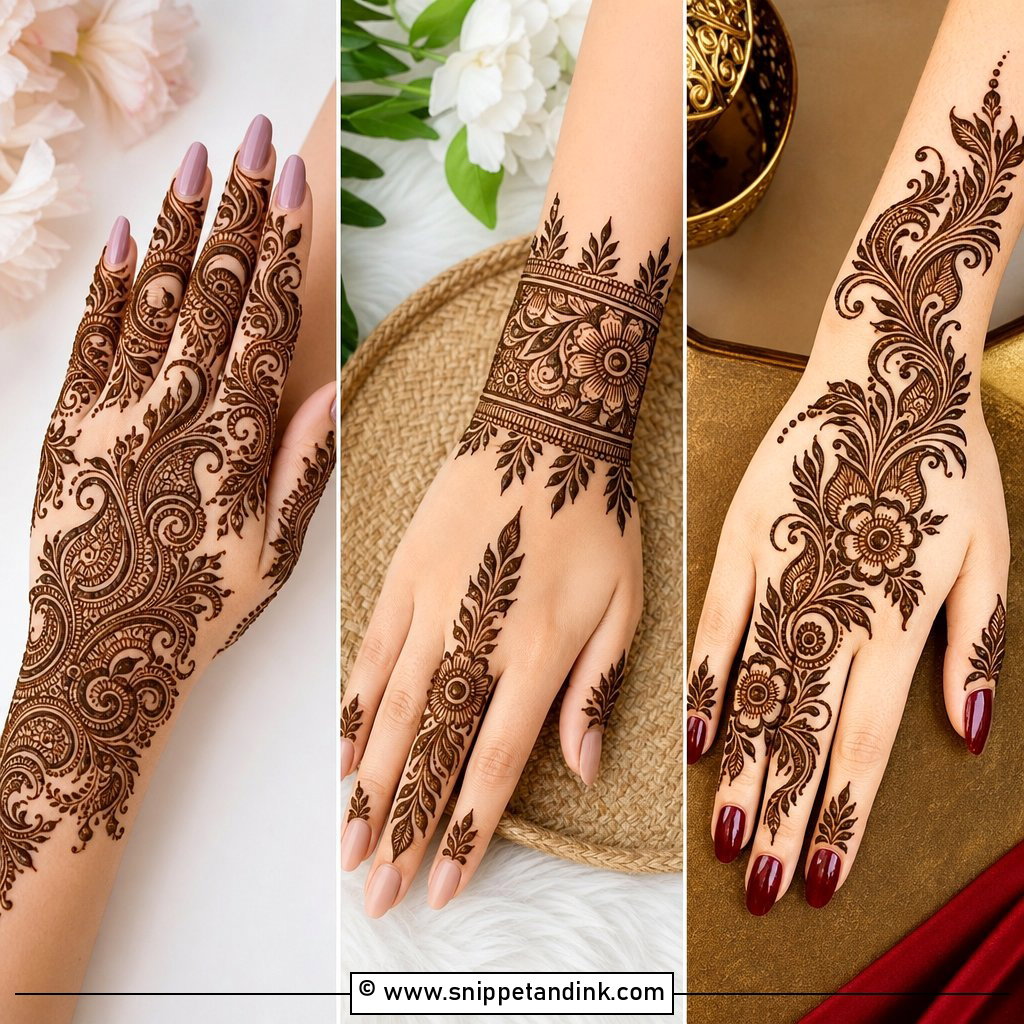
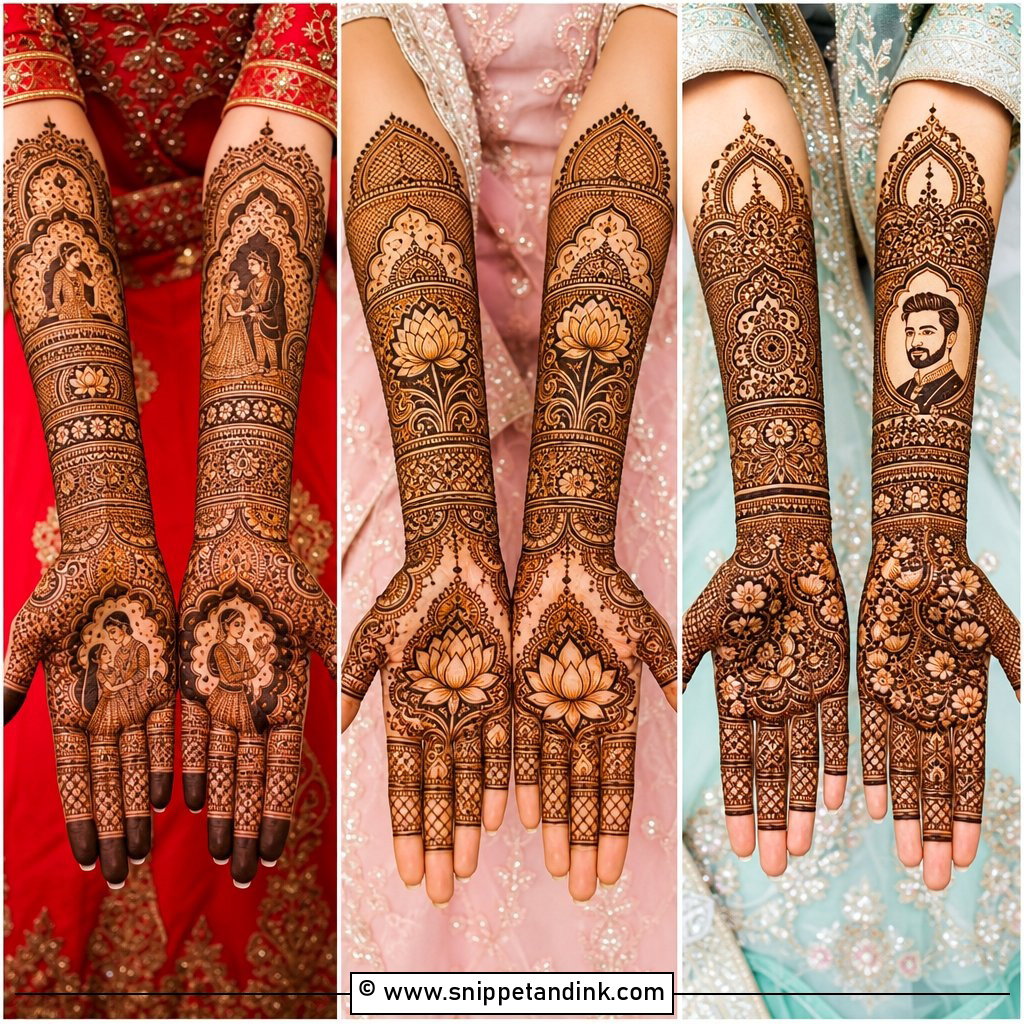
Simple bridal mehndi on the back of the hand can still look complete if the layout is planned before the cone touches skin. Full coverage doesn’t have to mean hours of dense filling. Bold florals, a neat mandala, paisleys, bracelet bands and finger detail, separated by open skin, make a balanced bridal hand. The back is also the side everyone sees: in ring shots, under bangles, when the kaleere are tied and in almost every portrait. The designs below keep the patterns readable and the sitting time reasonable, and I’ve noted how each one behaves once the stain develops.
Long Fingers, Wide Palms and How a Layout Should Follow Them
The same design can look elegant on one bride and crowded on another, and the difference is usually the hand itself. Before I draw anything, I look at the length of the fingers, the width across the knuckles and how far the forearm will show below the sleeve.
Long, slim fingers suit vertical patterns: leafy lines running down the finger, long diagonal trails and finger bands spaced well apart. Shorter fingers look longer with fewer bands, a filled tip and a vertical motif, while horizontal stripes across every joint can make them look stubbier.
Wide hands carry a large central mandala or bold Gulf florals comfortably. Narrow or small hands do better with a smaller focal motif and more open skin, or the design swallows them. If you’re unsure which you have, send your artist a photo of the back of your hands laid flat before the booking; it saves a lot of guessing on the day.
1. Simple Full Hand Bridal Back Hand Mehndi
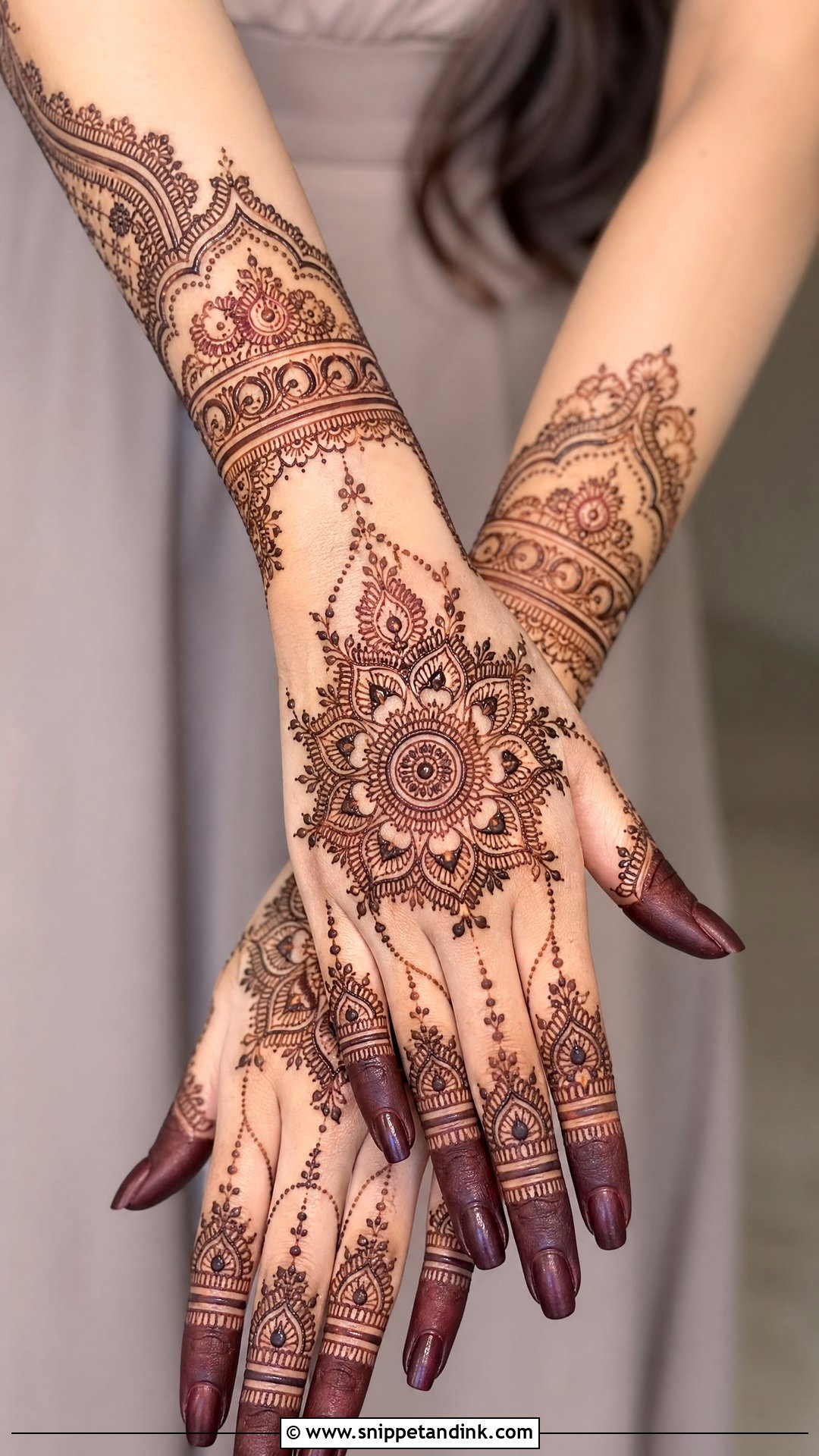
This is the layout I sketch first when a bride says she wants something traditional but not heavy. Filled fingertips, then slim leafy lines down each finger, a round mandala in the center of the back, small flowers and curved vines around it, and bracelet bands with tiny paisleys and scalloped borders at the wrist. It feels complete because the order repeats on every finger. Filled fingertips are worth keeping even in simple work; they stain the darkest part of the hand and frame it neatly against bangles.
2. Easy Bridal Back Hand Mehndi Full Hand
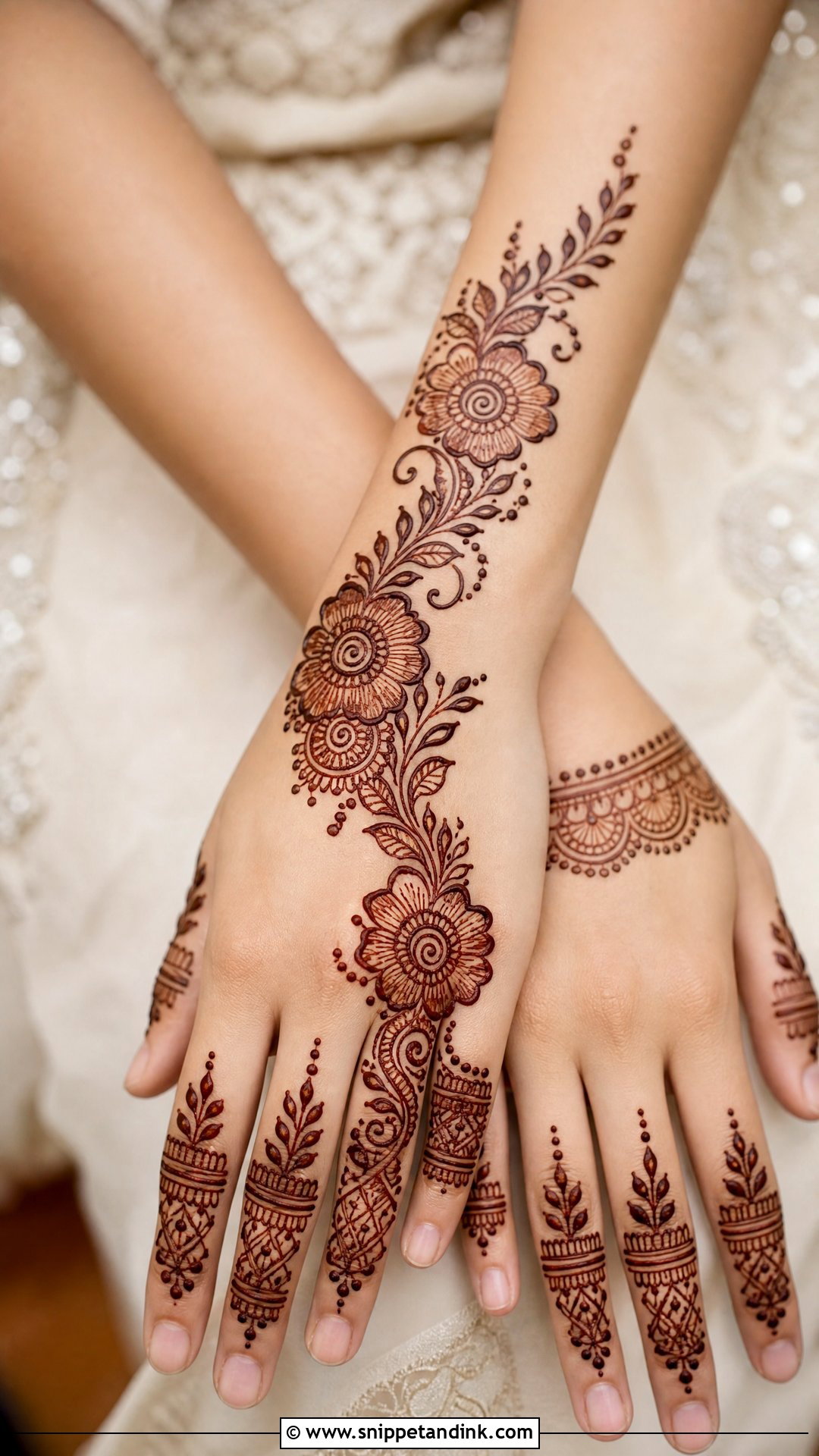
A diagonal trail is the quickest way to fill a back hand without filling it. I run simple finger sections of lines, dots and leaf strokes, then lead a floral trail from the index finger down toward the opposite side of the wrist, with a soft cuff near the wrist to make it bridal. Leaving skin around each flower keeps the design crisp. The direction matters: I usually run it toward the outer wrist, so the trail shows when the hands are clasped in photos.
3. Full Hand Arabic Bridal Back Hand Mehndi
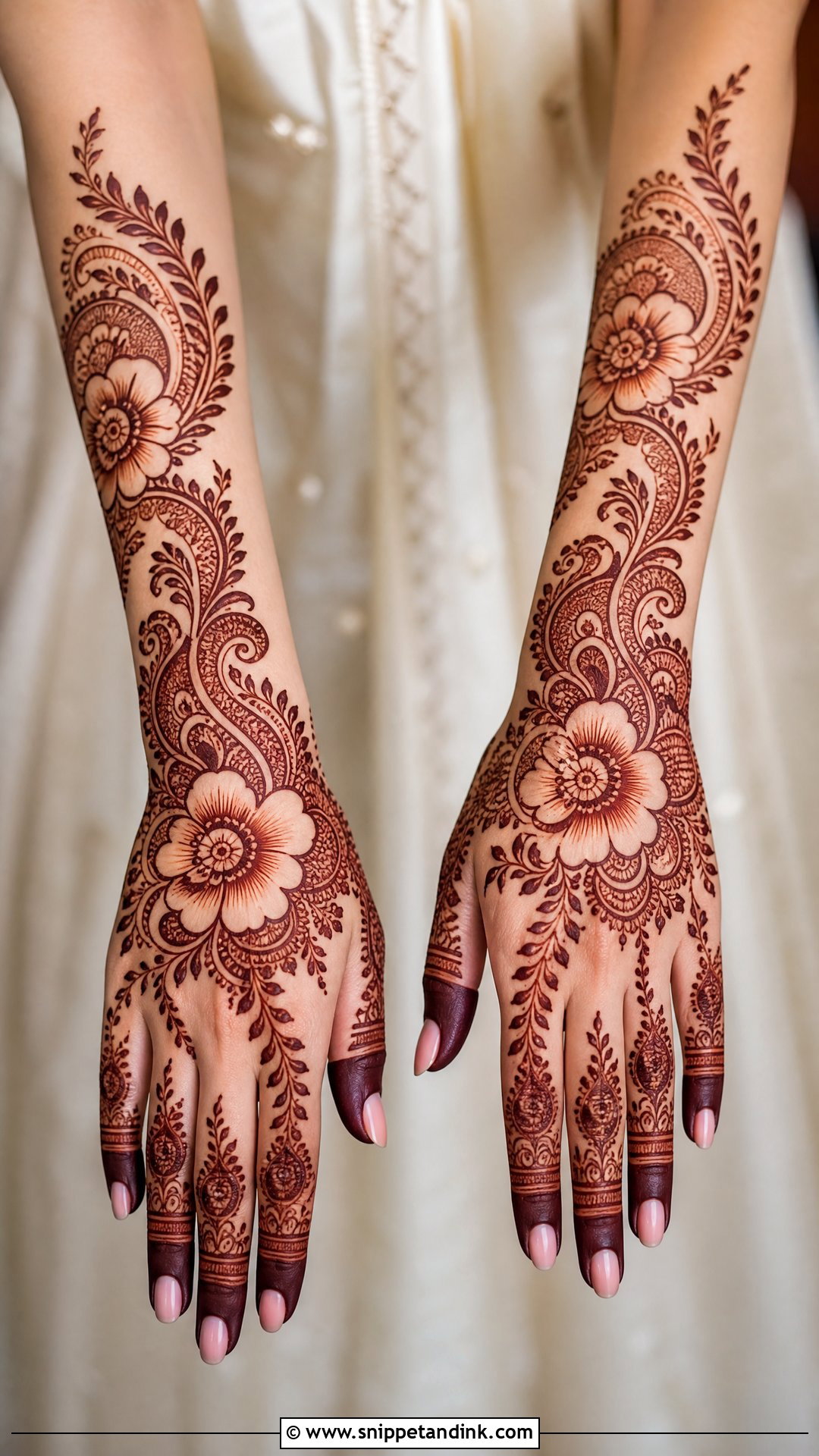
Arabic back-hand work uses big shapes: large flowers, paisleys and leafy vines traveling across the hand, matched by leafy fingertips and dotted lines on the fingers. A curved band with shaded petals at the wrist and forearm ties it together. Bold strokes need a steady, even squeeze on the cone; a thick outline that thins halfway through looks unfinished once stained. It’s light and festive, and the open spaces keep it modern.
4. Full Hand Indian Bridal Back Hand Mehndi
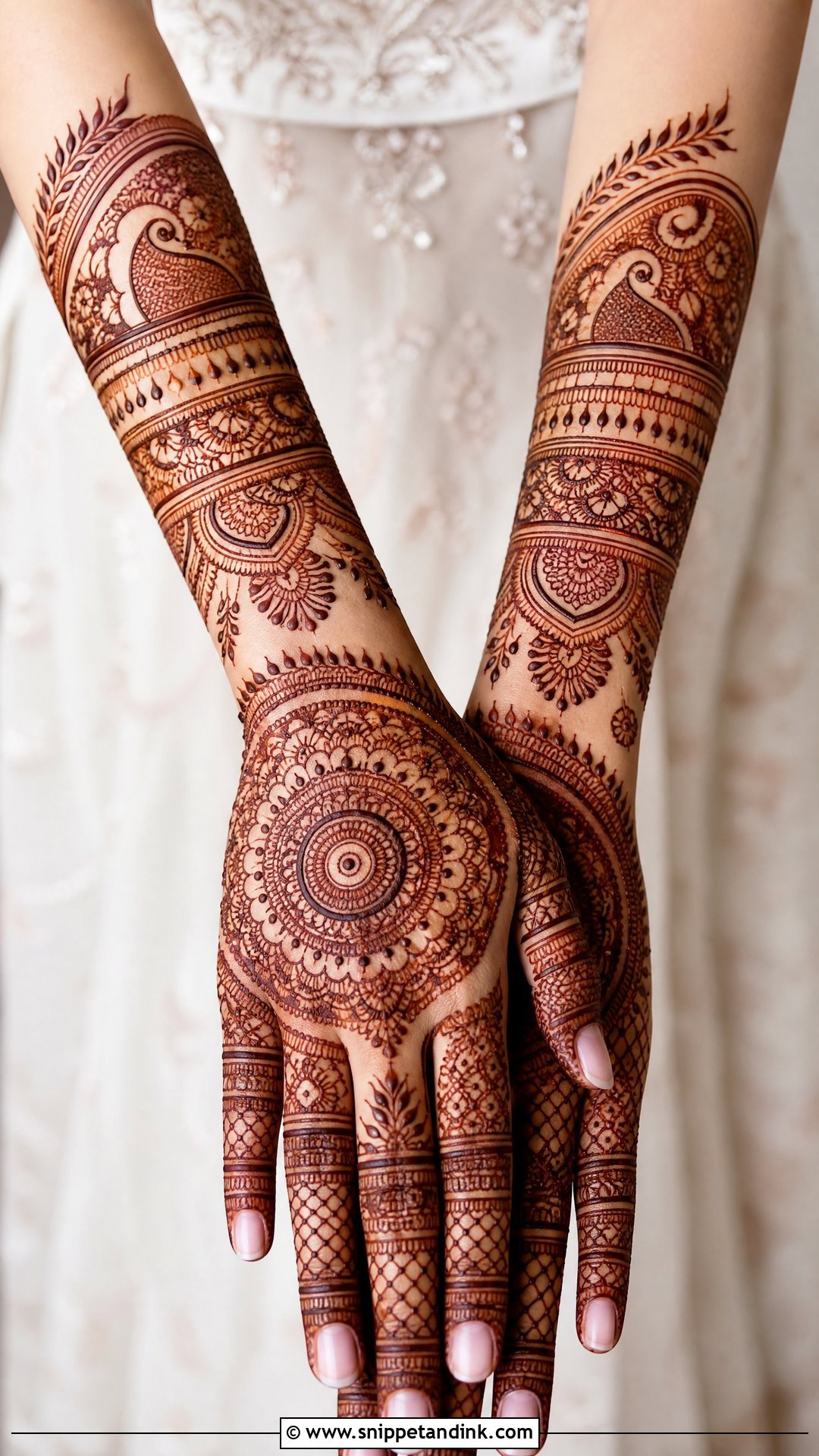
Indian back-hand mehndi feels fuller, but it stays simple if the sections are organized. I put a central mandala in the middle, build paisleys, small flowers and curved leaf borders around it, then add fine lines and small checks on the fingers and stacked bangle bands at the wrist. The trick is repeating the same motifs rather than introducing new ones in every gap. It carries more visual weight than Arabic work, which suits red, maroon, gold and ivory bridal outfits.
5. Indo Arabic Bridal Back Hand Mehndi Full Hand
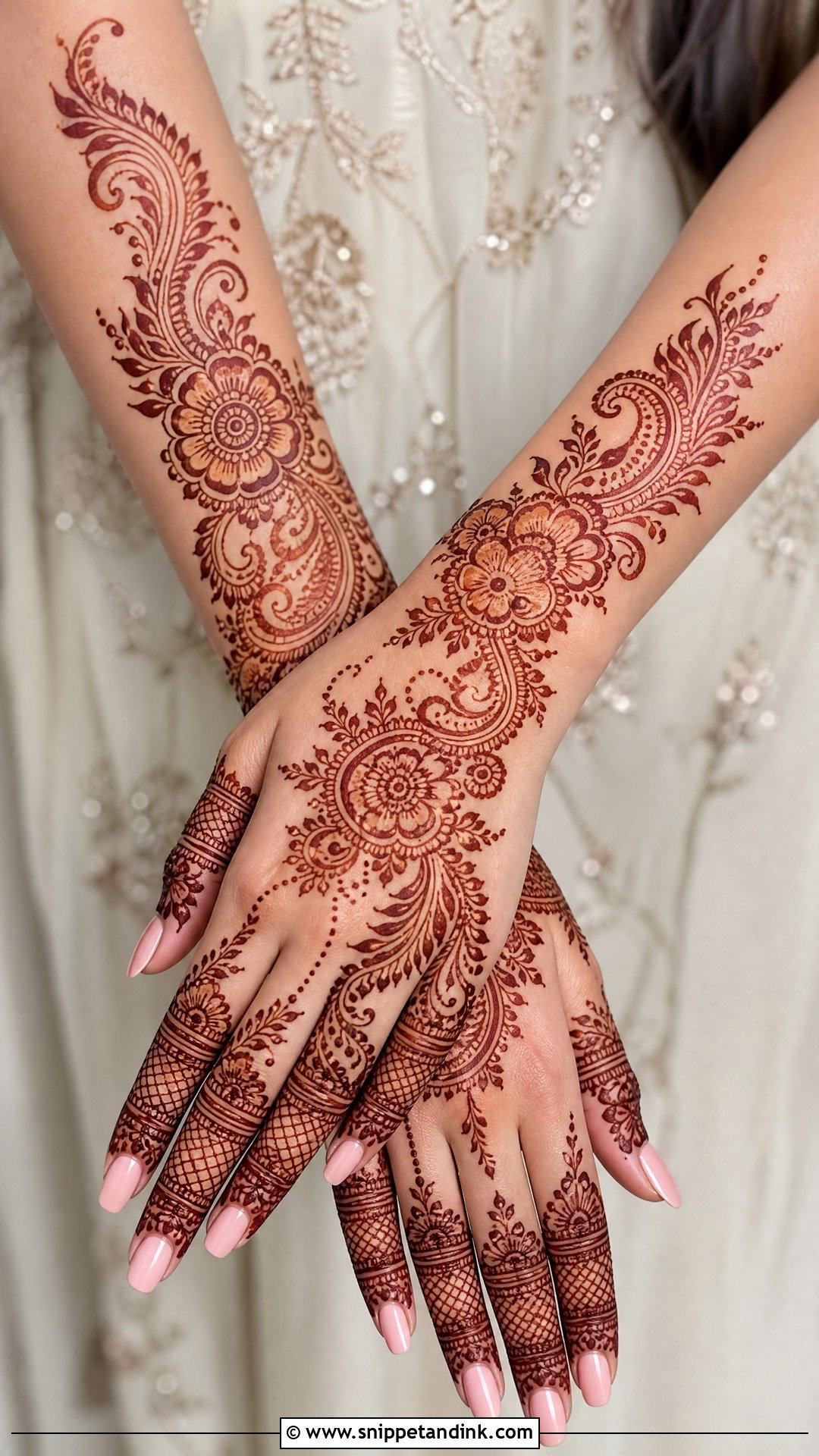
Indo-Arabic designs take the flow and spacing of Arabic mehndi and add the structure of Indian work. I start a large floral trail at the wrist and carry it toward the middle finger, with small paisleys, dotted vines and fine filler around it, leaving one side of the hand slightly open so it breathes. The fingers get Indian-style bands with Arabic leaf strokes between them. Long, narrow hands carry the trail especially well; on a wide hand I bring it closer to center.
6. Mandala Bridal Back Hand Mehndi Full Hand
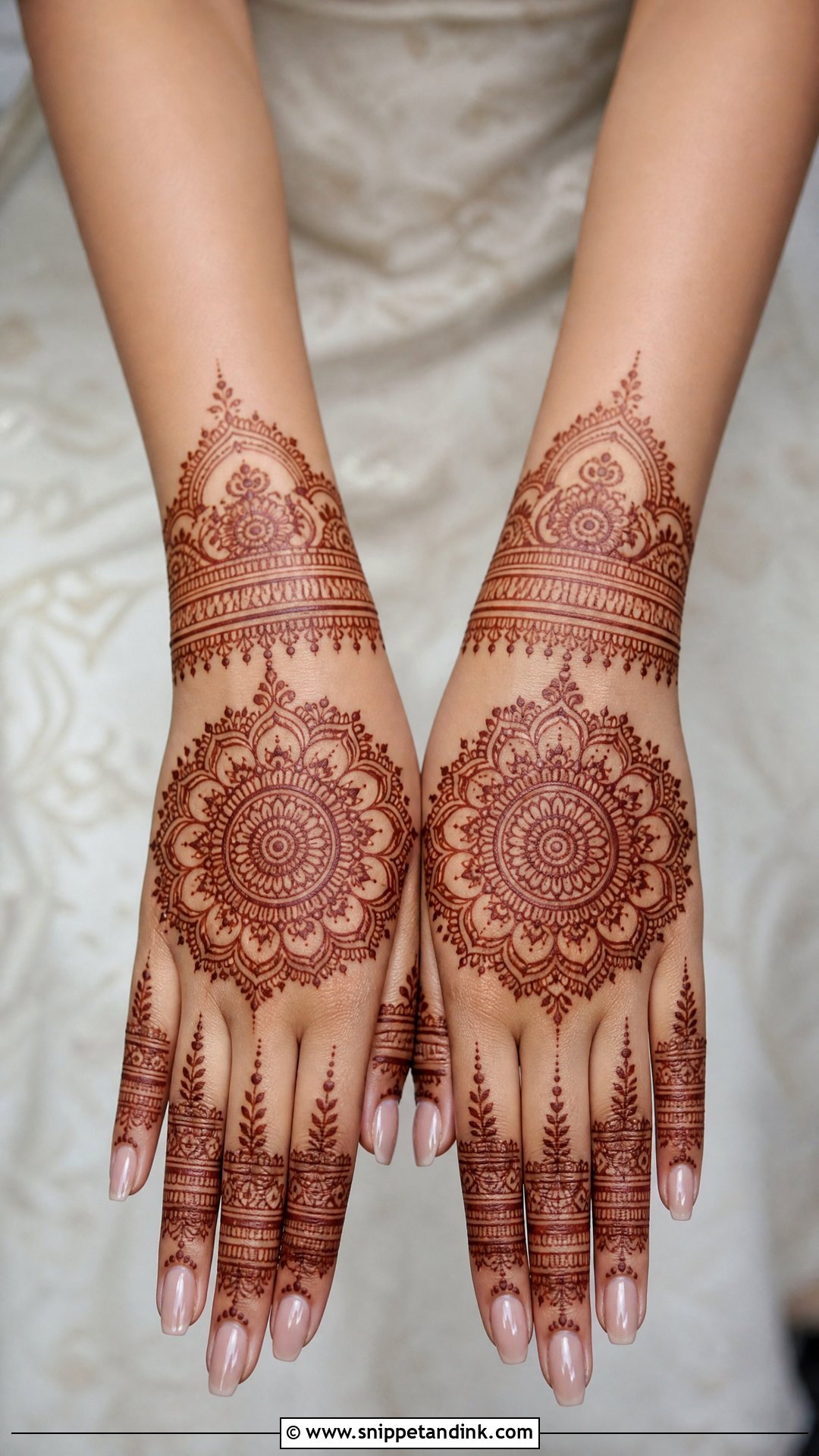
A mandala anchors the back hand so the rest can stay light. I draw the center point first, then petals, dots and thin circular borders outward. Fingers get straight bands, leaf tips and small florals, and the wrist and forearm carry bracelet patterns that echo the mandala’s curves. The back of the hand isn’t flat, and the knuckles and tendons distort a circle when the hand moves, so I place the mandala a little lower than center, where the skin is flattest.
7. Floral Bridal Back Hand Mehndi Full Hand
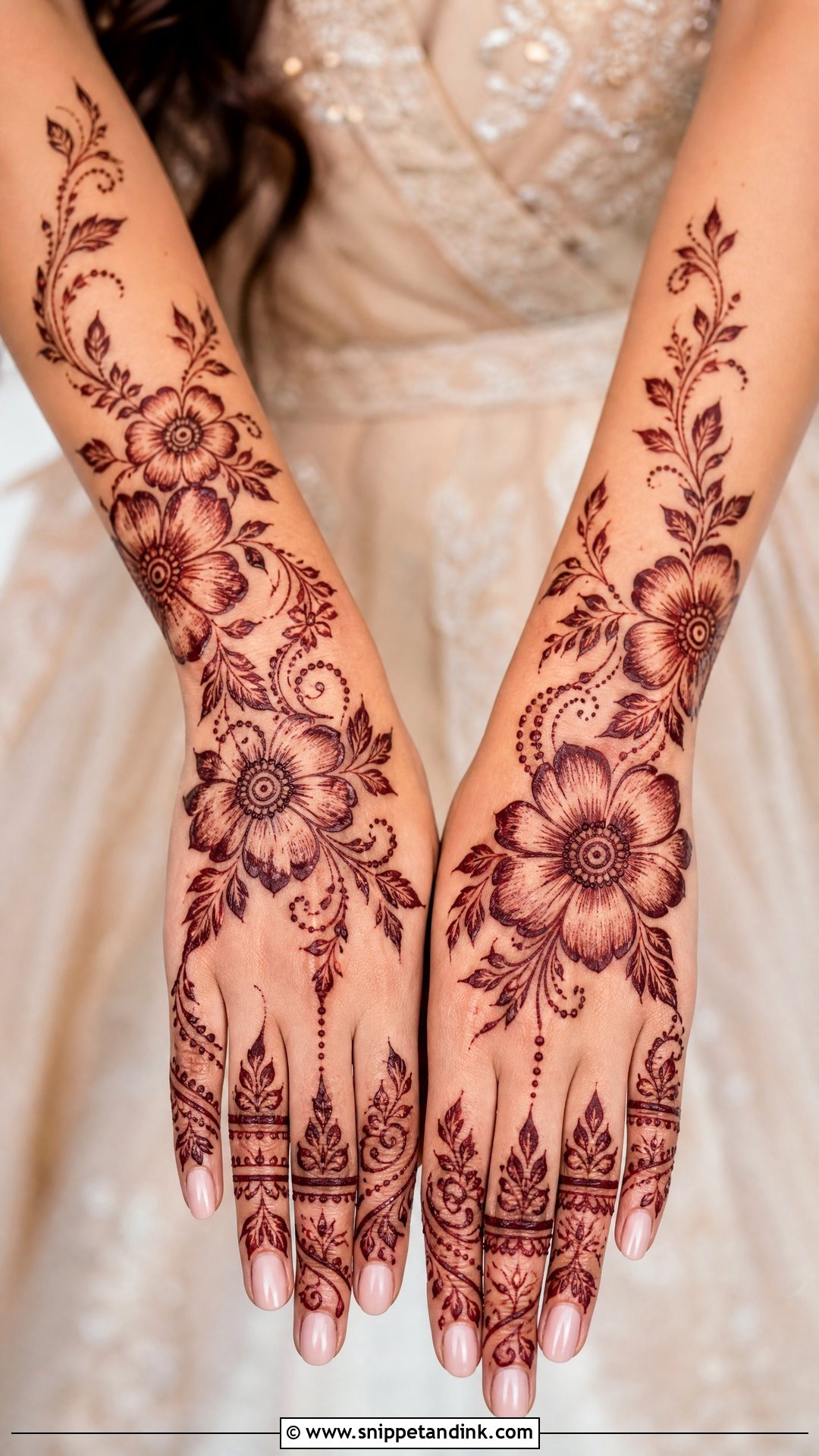
Florals read clearly on the back of the hand when they’re graded in size: large blooms near the wrist, medium ones across the back, small blossoms on the fingers, all joined by leafy vines. Light shading inside the petals adds depth, and the background stays open with dots and small curved lines. It suits engagements, nikahs, receptions and daytime events. Shaded petals on the back come out lighter than on the palm, so I shade only the larger blooms where it will still show.
8. Paisley Bridal Back Hand Mehndi Full Hand
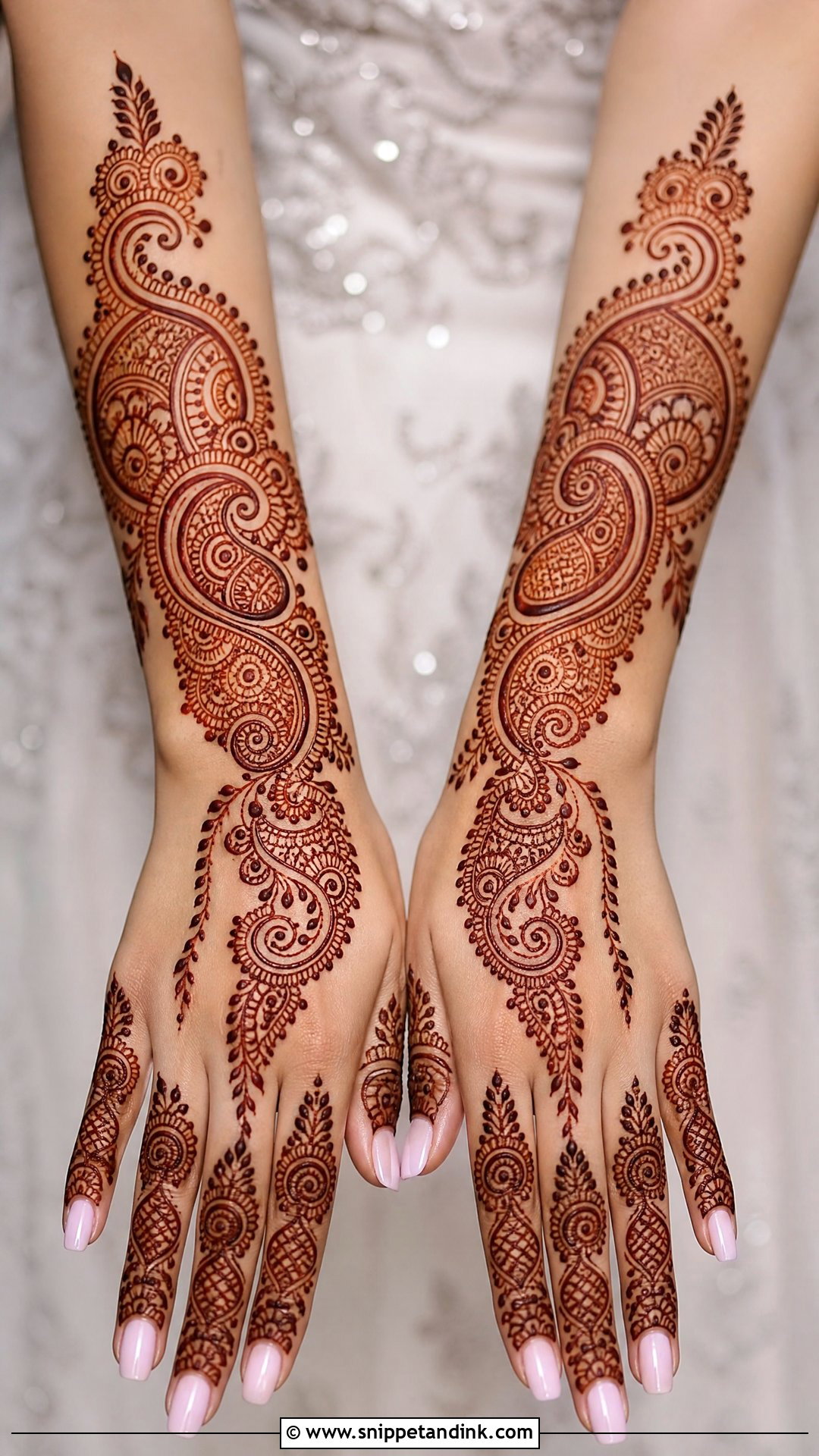
Paisleys follow the curve of the hand naturally, so they flatter almost every hand shape. I start with one large paisley near the wrist and step down to smaller ones toward the fingers, filling each with lines, dots and small leaves and joining them with curved vines. Fingertips can carry tiny paisleys or half-flower bands. Keeping the fills simple stops the motifs from crowding as the stain darkens.
9. Jaali Bridal Back Hand Mehndi Full Hand
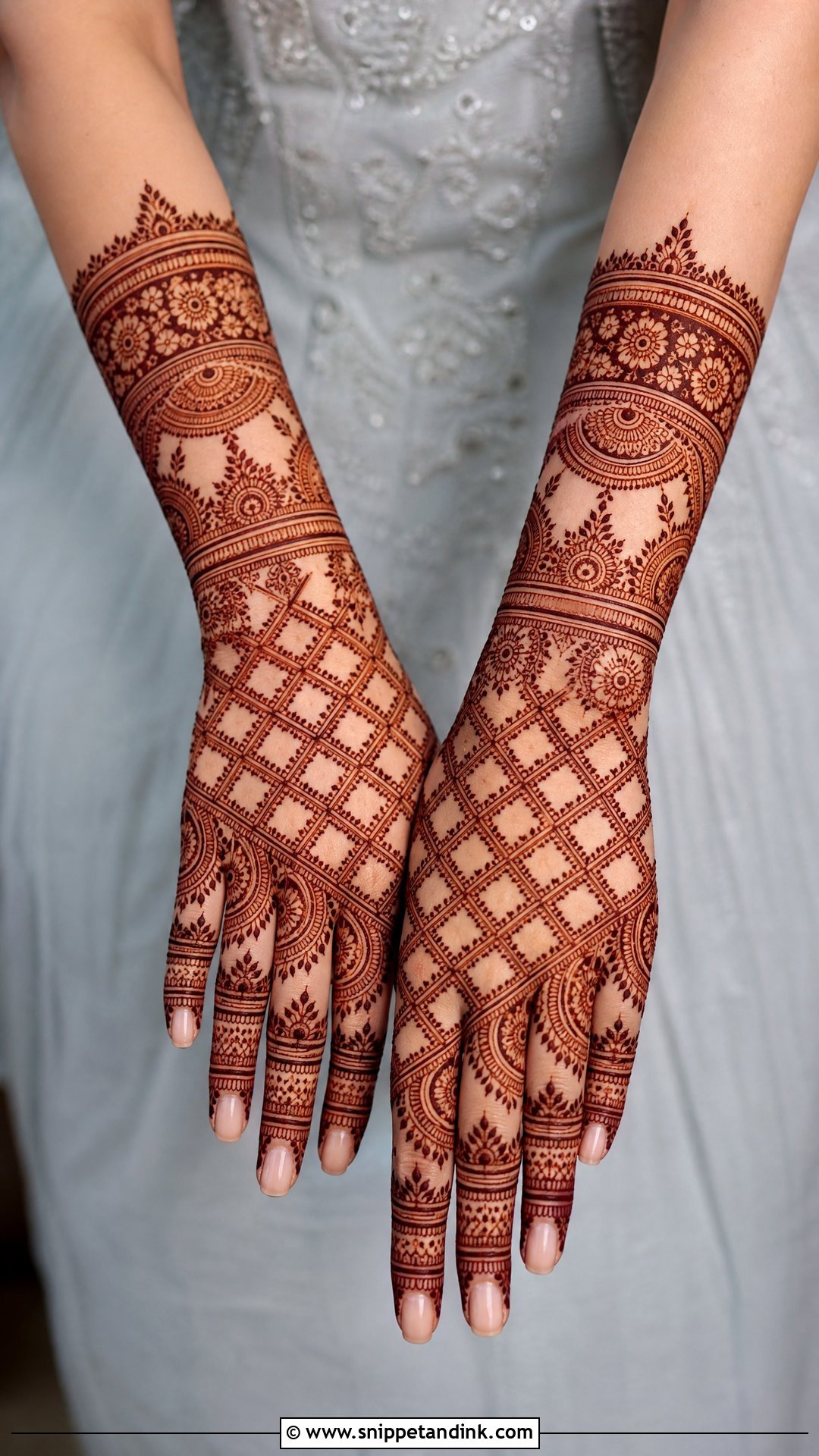
A jaali bridal back hand mehndi full hand design uses a mesh in the center of the hand framed by flowers and paisleys. Mesh lines spread slightly as the paste sits, so I keep the diamonds medium-sized; a tight grid often stains as one dark patch. Dots in alternate spaces soften it. Matching mesh tips on the fingers and a bracelet band at the wrist complete it. It suits brides who like structure and detail in equal measure.
10. Bracelet Bridal Back Hand Mehndi Full Hand
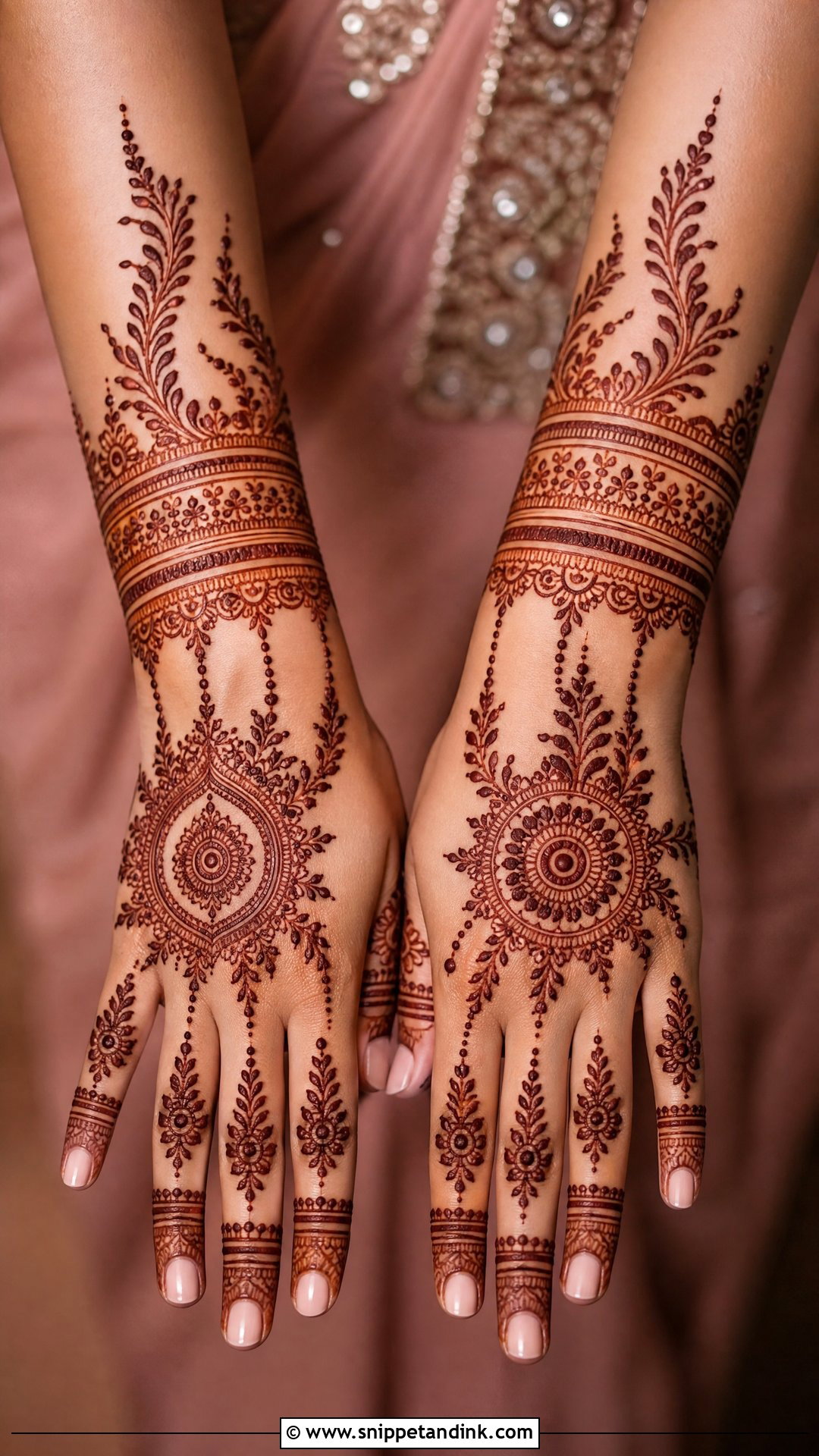
Bracelet designs put the most work at the wrist: layered bangle bands, scalloped edges, small flowers and dotted chains. Slim vines run from the bracelet across the back toward the fingers, with a small mandala or flower in the center so the hand doesn’t look empty, and ring-like bands on the fingers. It’s quick because the wrist pattern repeats. Before I start, I ask what bangles or chooda she’ll wear, since a full stack can cover the very part of this design that does the most work.
11. Finger Heavy Bridal Back Hand Mehndi Full Hand
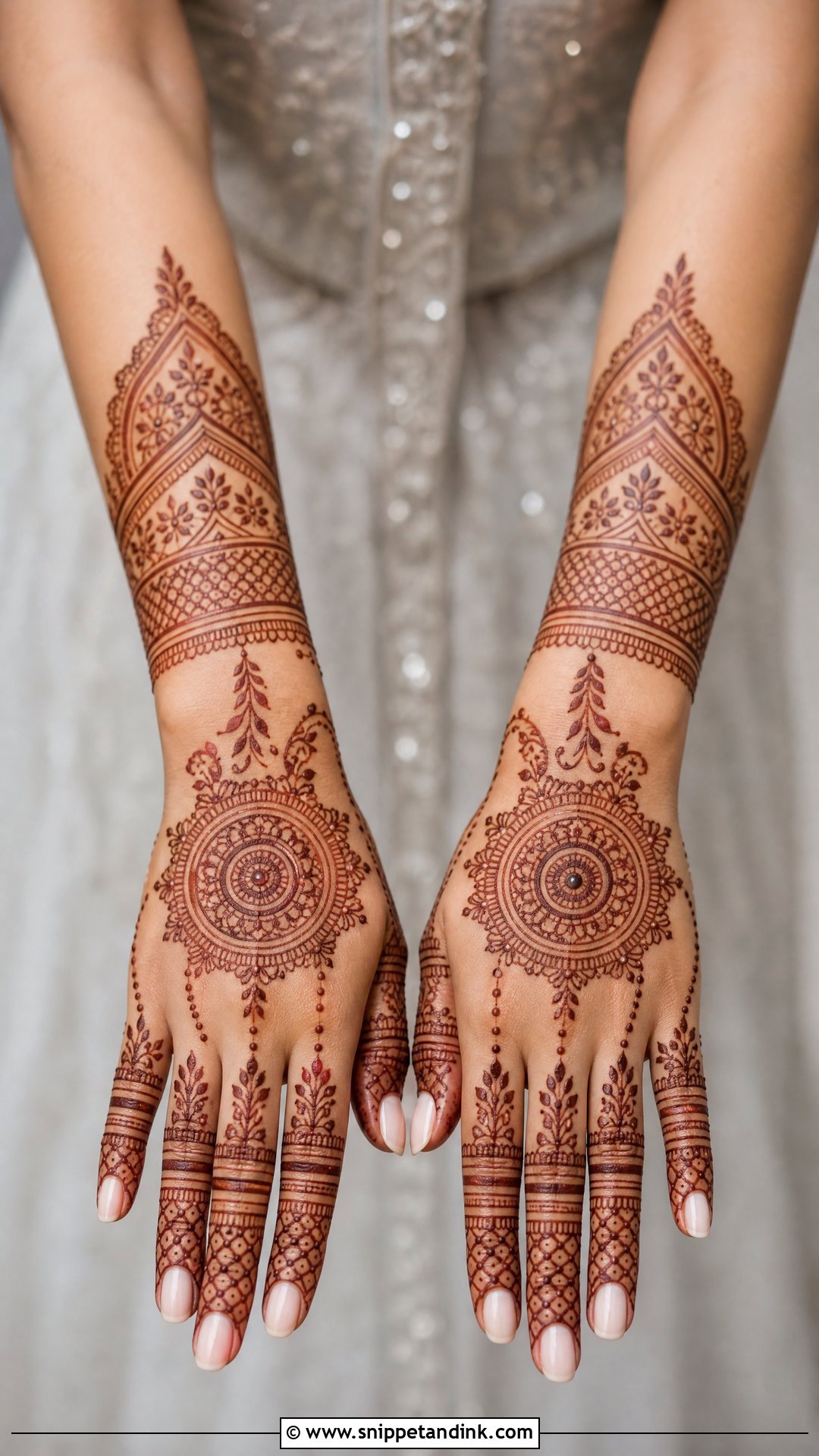
Detailed fingers with a cleaner center give a balanced back hand. I decorate each finger with different simple patterns, leaves, dots, checks, half flowers and curved bands, then keep the back focused on one mandala or floral motif, connected by thin chains or dotted lines, with a soft cuff at the wrist. Fingers are built one small section at a time, which makes this easy to apply. Because the fingers frame the ring, this is the design that shows most in ring-exchange close-ups.
12. Minimal Bridal Back Hand Mehndi Full Hand
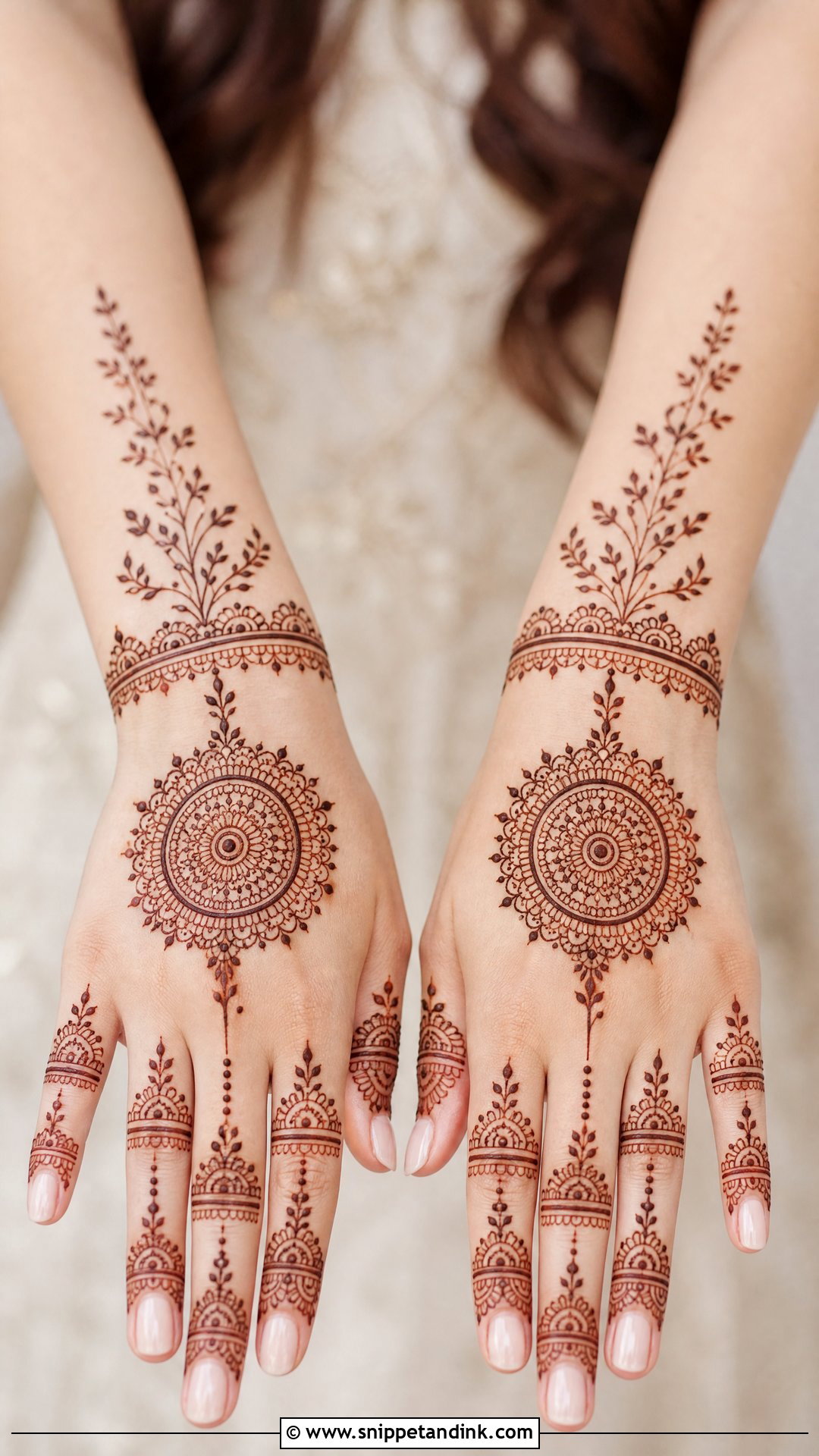
Minimal back-hand work is one central mandala, slim floral vines along the sides, simple finger bands and a thin bracelet border at the wrist. Visible skin between motifs is the design, not a gap in it. Small hands suit it especially well, since a fuller layout can overwhelm them. Every line is visible, so I’d only choose this if your artist’s linework is clean; minimal designs hide nothing.
13. Peacock Bridal Back Hand Mehndi Full Hand
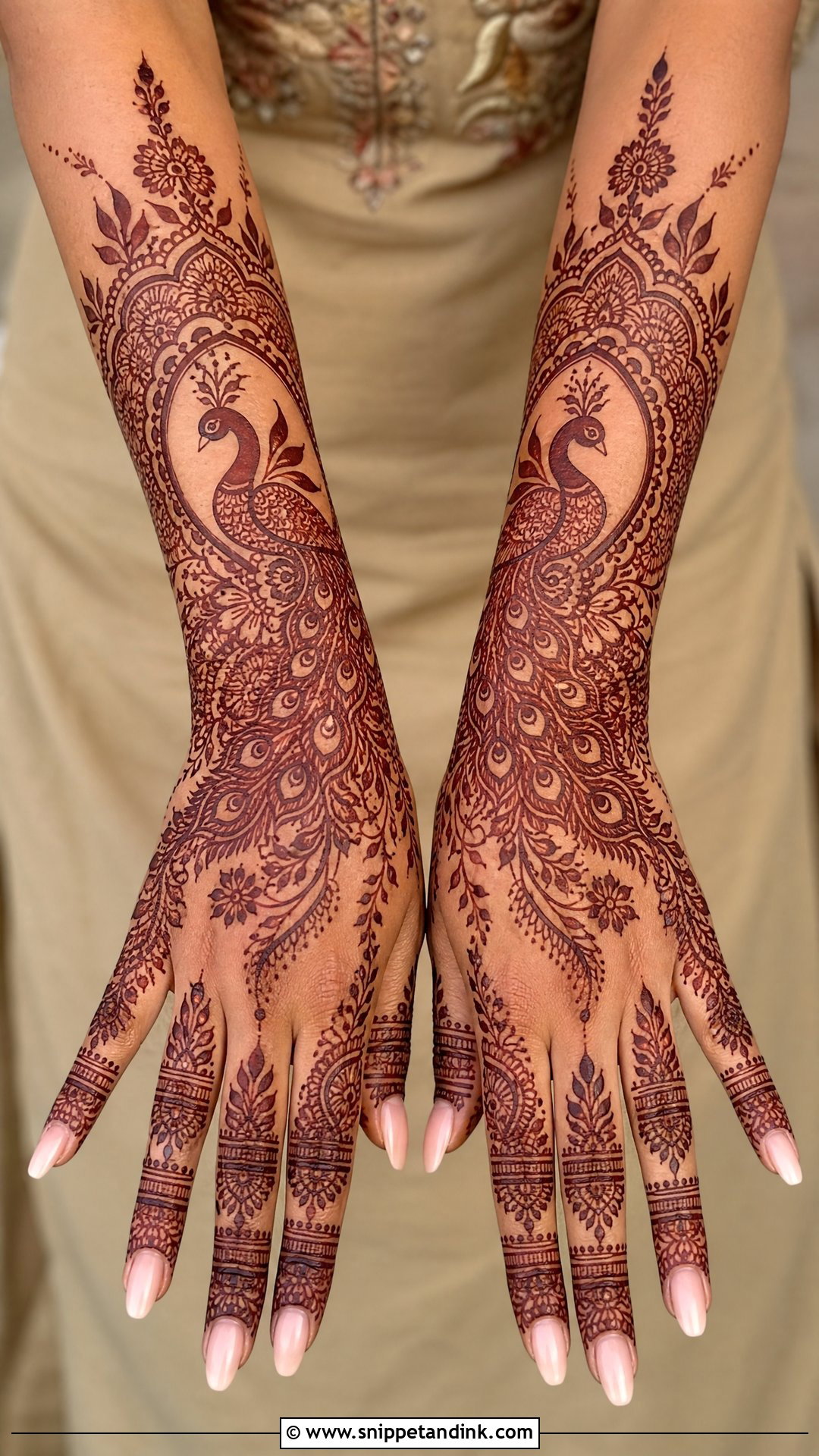
One peacock gives the back hand a traditional focus. I place a simplified bird near the wrist or along the side of the hand and let its feathers extend into leafy curves and floral lines, keeping the feather detail bold and spaced. A few small flowers soften it, and the fingers get slim feather strokes, dots and curved borders. The mistake I see most is fine feather filling packed into a small bird; it blurs once stained, so clear and clean beats detailed.
14. Moroccan Bridal Back Hand Mehndi Full Hand
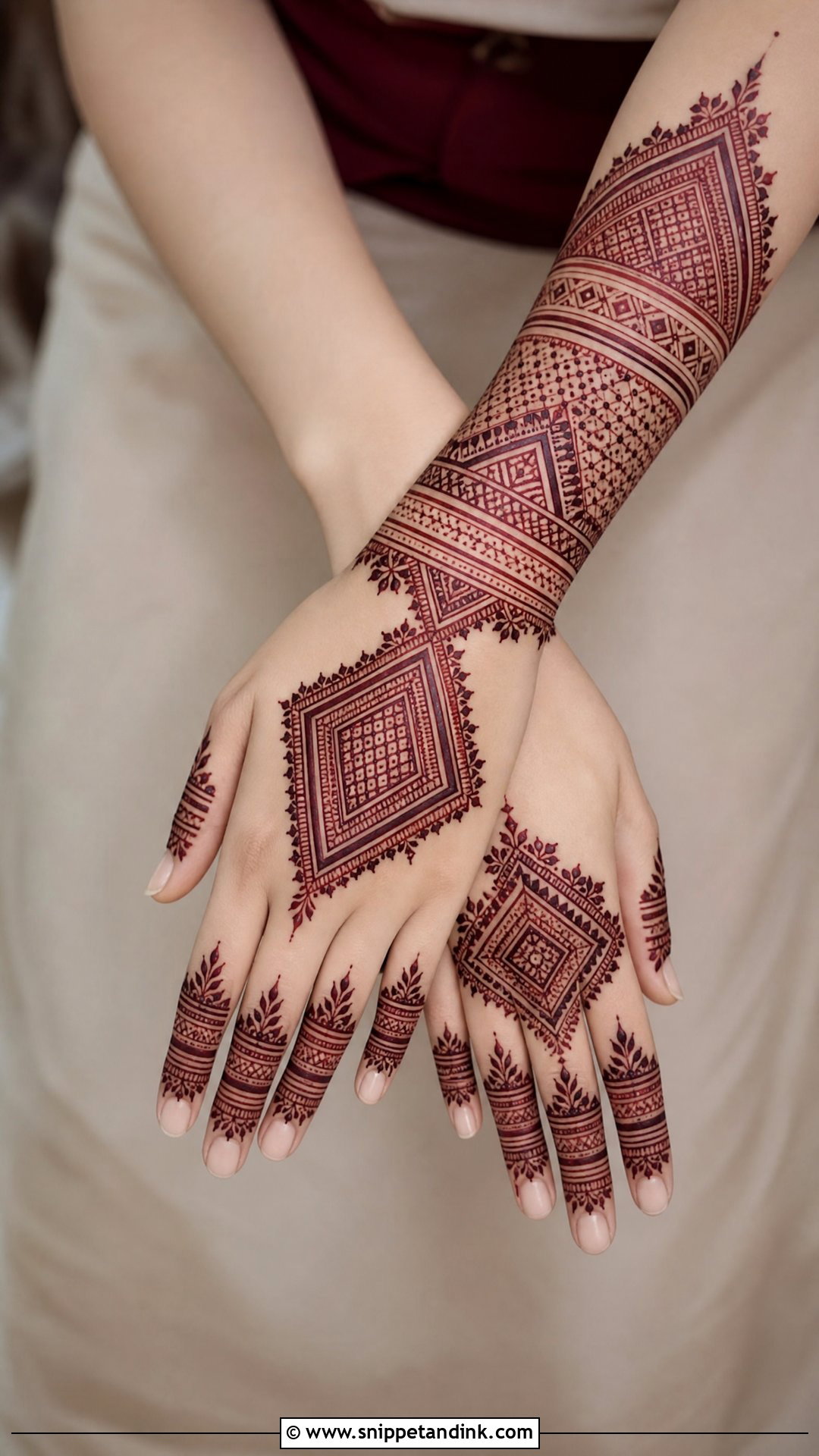
Moroccan back-hand designs suit brides drawn to geometric beauty. Diamonds, triangles, lines, dots and clean borders replace most florals. I run a geometric panel down the center of the hand, then add matching finger bands and wrist cuffs, with a few small floral accents or dotted chains so it still feels bridal. Straight lines need a steady hand and even paste flow, since a wobble shows on geometry in a way it never does on a flower. It’s a modern alternative to the usual floral layouts.
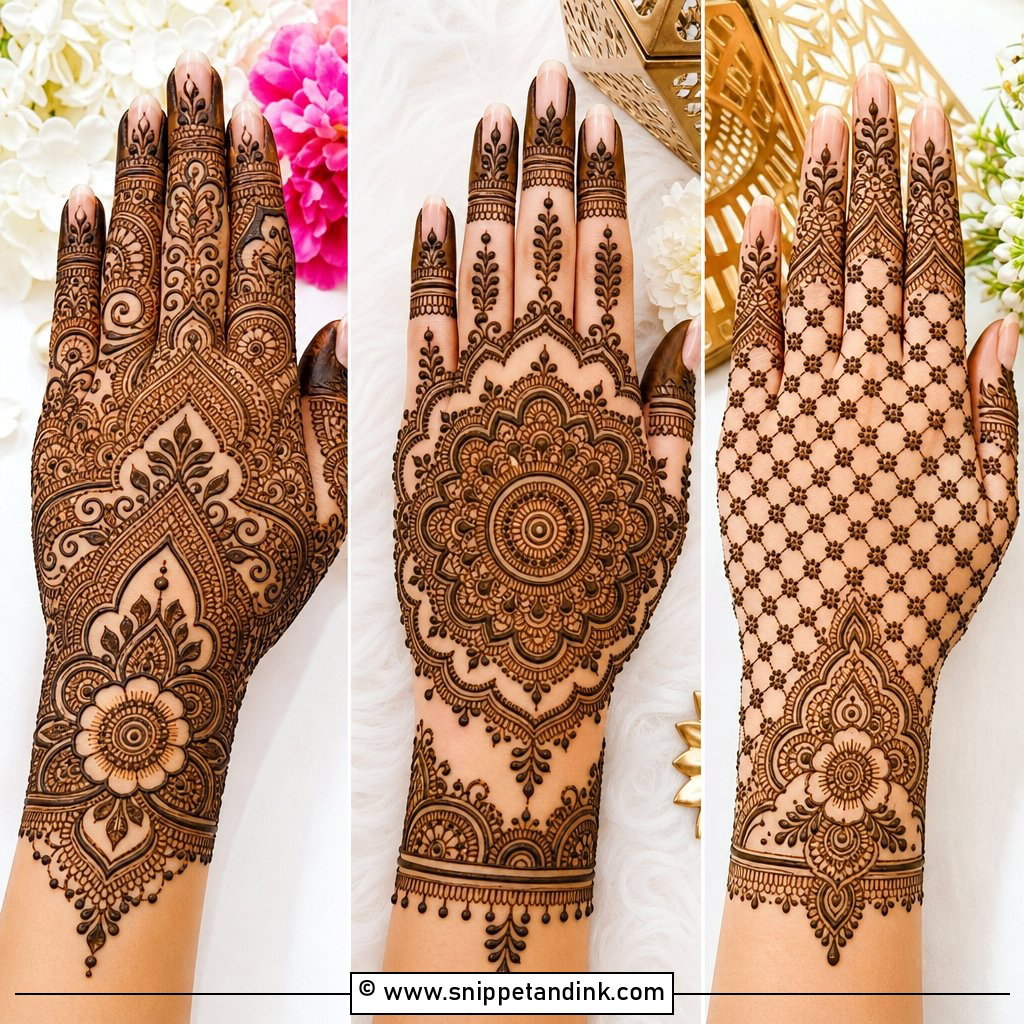
15. Gulf Bridal Back Hand Mehndi Full Hand
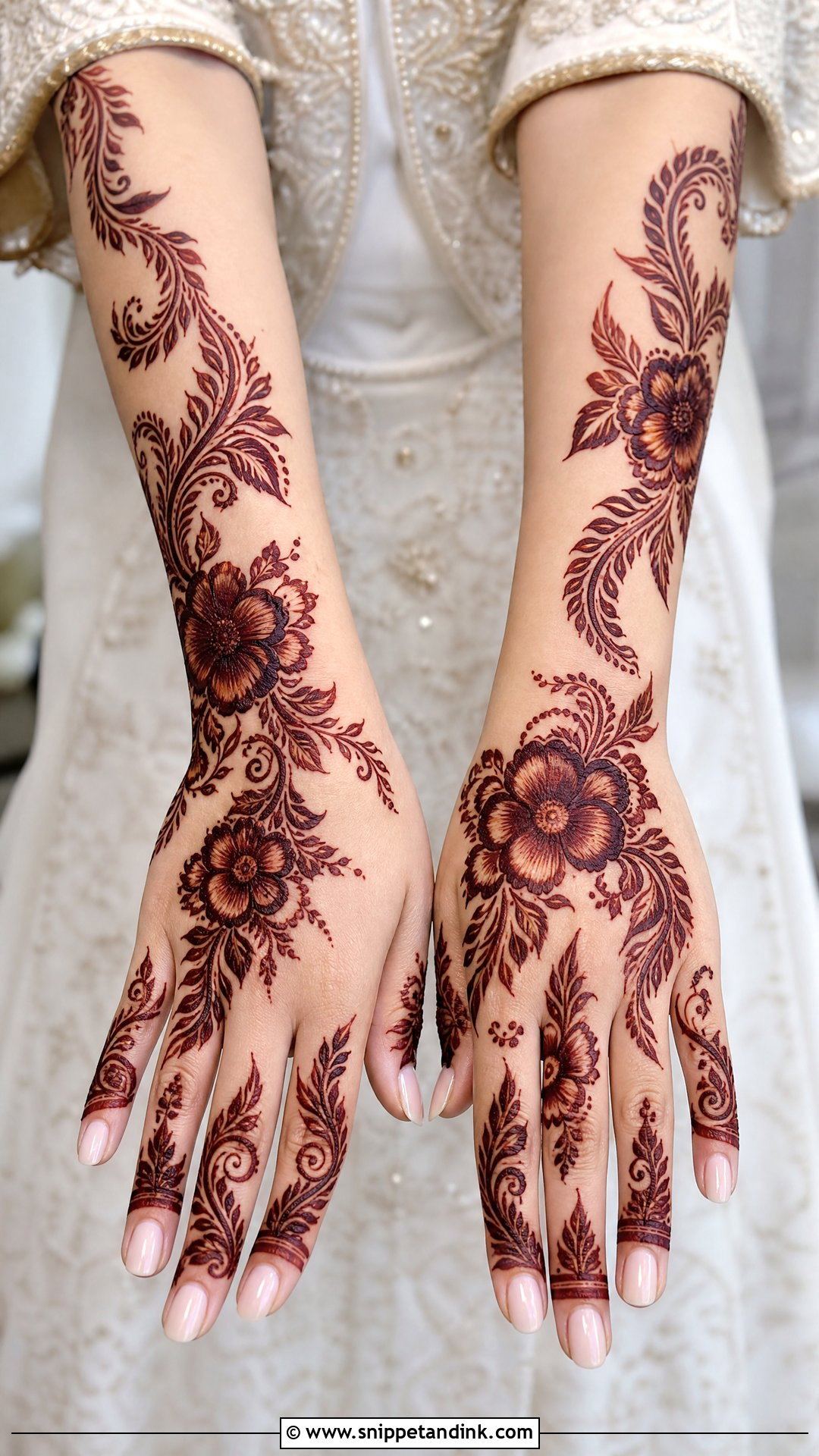
Gulf-style work uses large flowers, leafy curves, thick outlines and soft shading. For a simpler version I place big floral motifs from the wrist to the middle of the hand, join them with sweeping vines and keep one side more open, with leafy trails and shaded tips on the fingers. The bold outlines are what make it so readable once the stain turns deep maroon on the wedding day. Paste for this needs to be smooth and slightly thicker so the outline doesn’t feather.
16. Shaded Bridal Back Hand Mehndi Full Hand
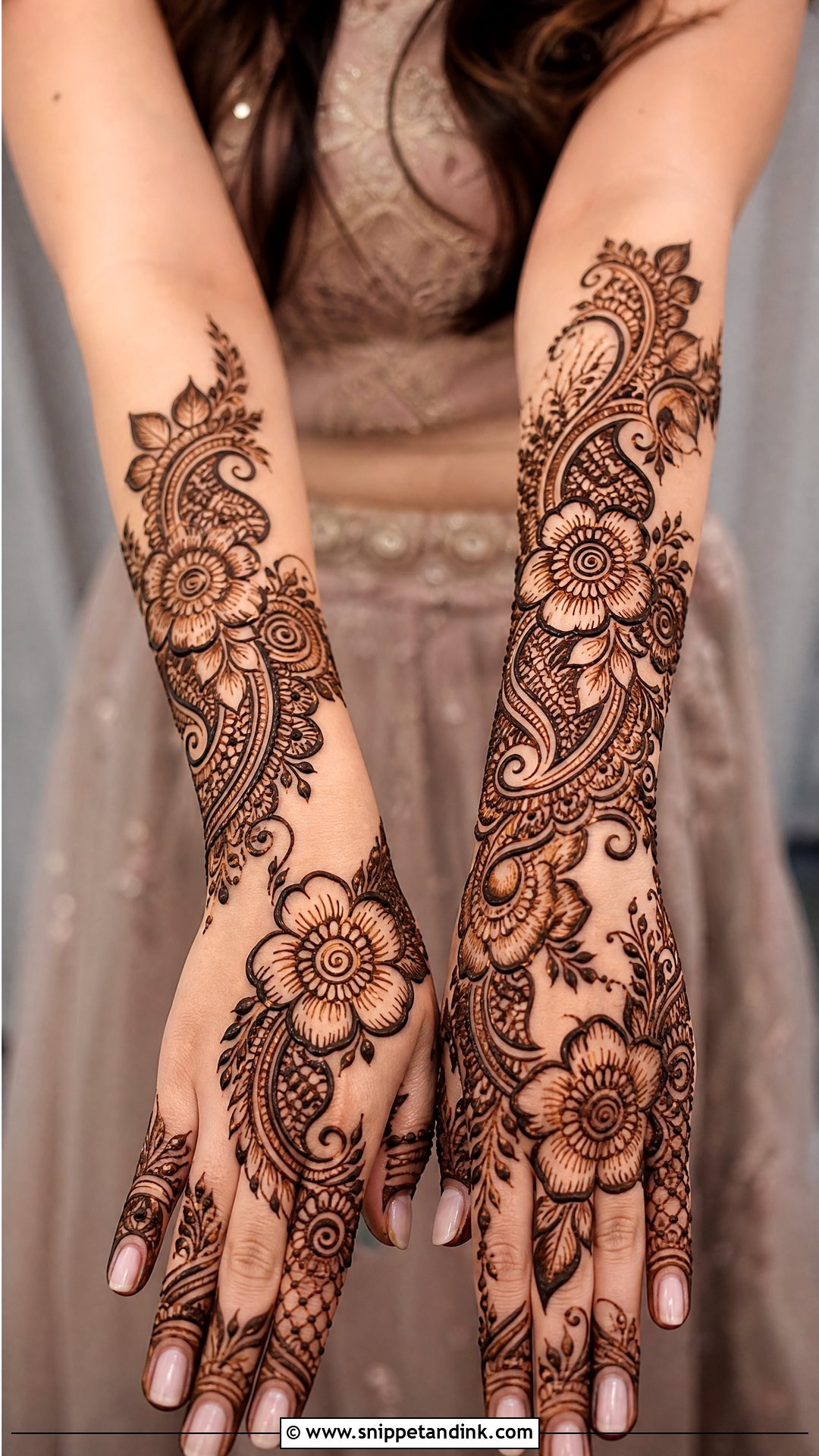
Shading adds depth, but it’s also where simple designs most often get messy. I pipe bold outlines first, let them set for a few minutes, then shade inside selected petals, paisleys and leaf tips only, never everywhere. The main pattern flows diagonally from the wrist to the fingers, with half-shaded flowers and slim bands on the fingers. Restraint keeps it artistic rather than muddy.
17. Lotus Bridal Back Hand Mehndi Full Hand
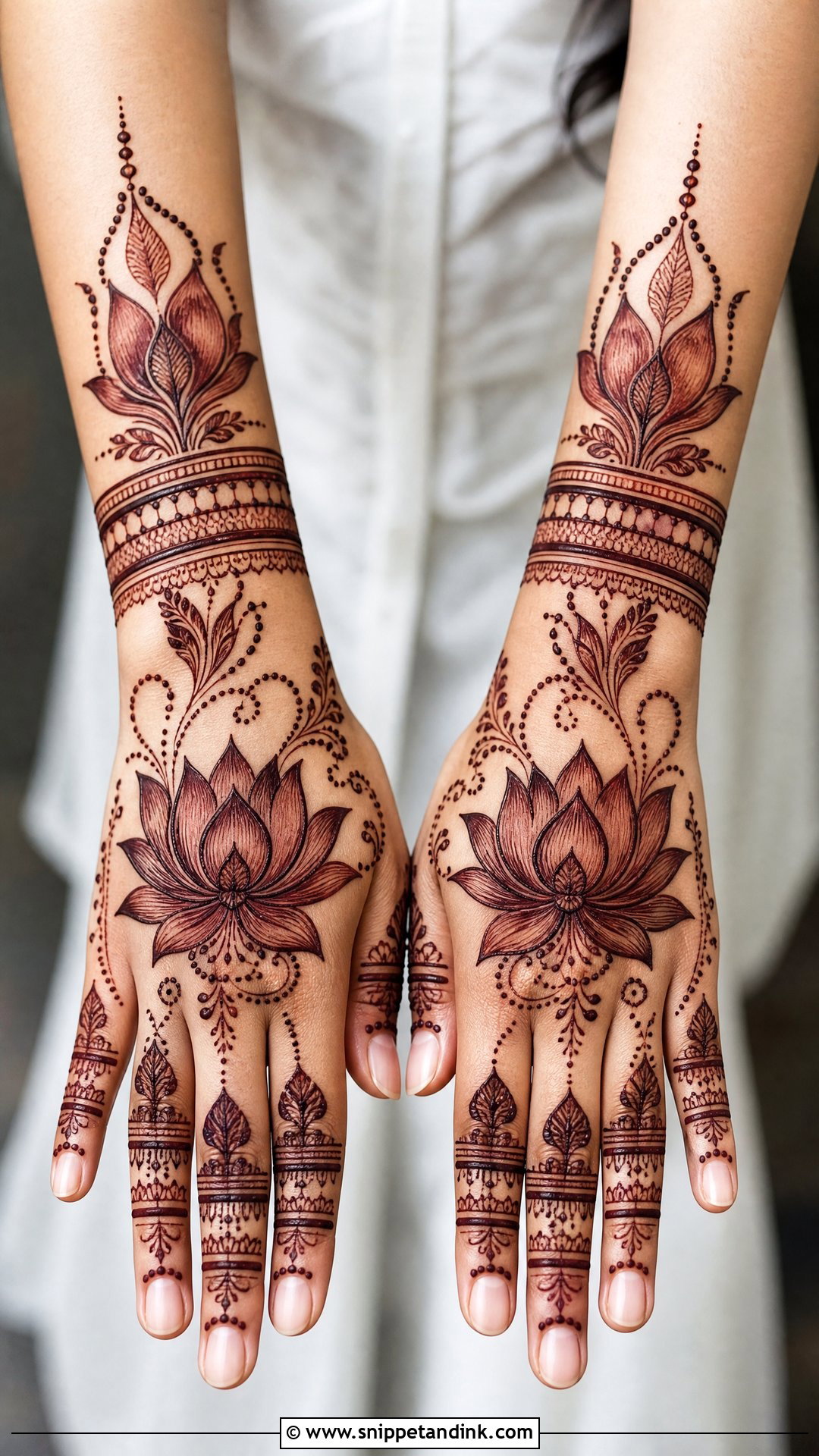
Lotus motifs carry a calm, traditional meaning, and they sit well on the back of the hand with clean spacing. I place a large lotus near the center with small leaves, dots and curved borders around it, then extend toward the wrist with bracelet bands and toward the fingers with slim floral lines. Petals drawn bold are easy to recognize once stained. A little shading inside the petals finishes it for rituals and portraits.
18. Ring Chain Bridal Back Hand Mehndi Full Hand
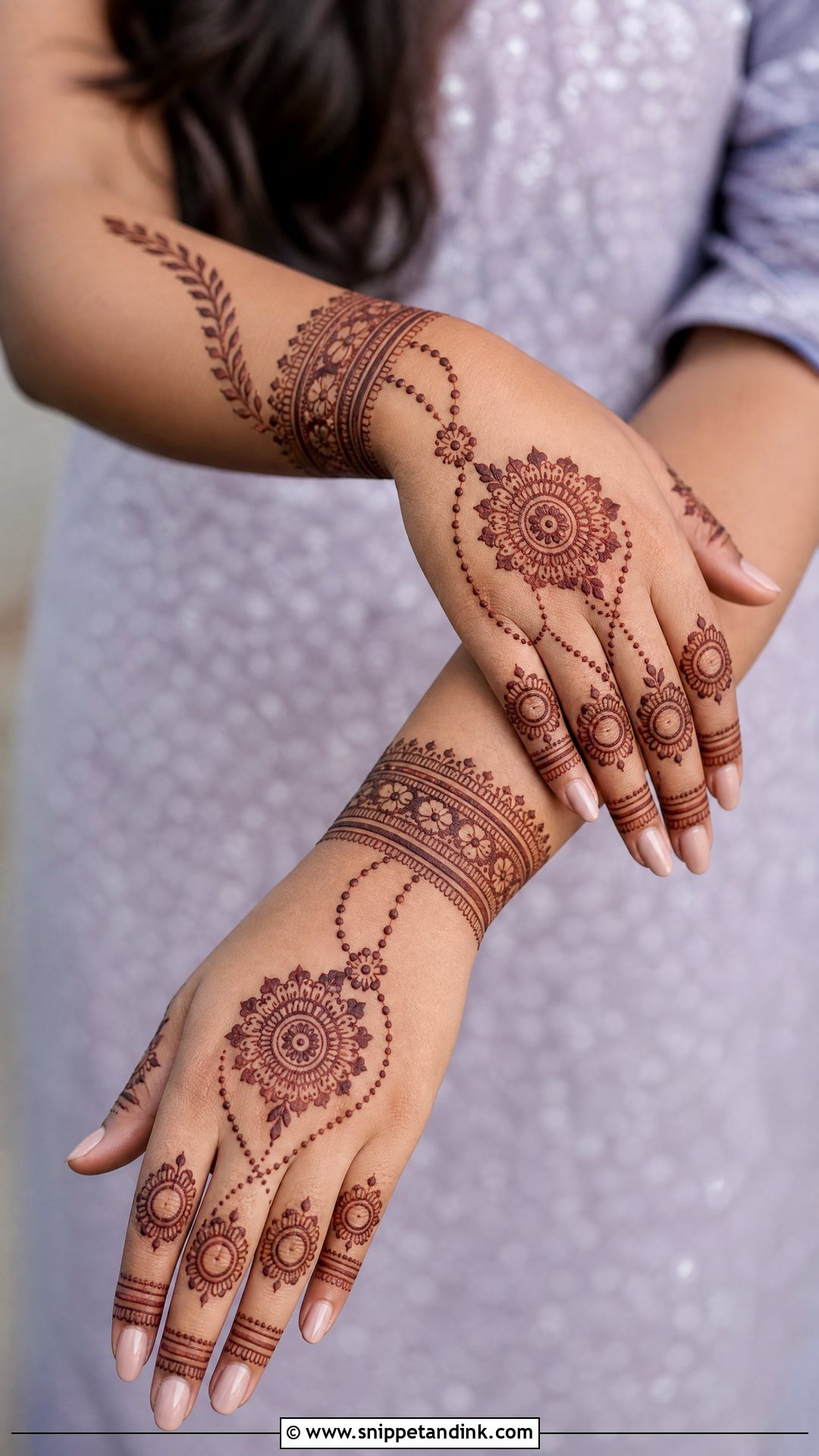
Ring chains turn mehndi into hand jewelry. I draw small ring circles around each finger, connect them with dotted chains and fine lines to a mandala, flower or paisley in the center, and match a bracelet cuff at the wrist. Leafy vines and small borders toward the forearm make it full-hand. The chains repeat easily, so it’s quick. Draw the rings slightly below the knuckle; drawn on the knuckle crease, they crack and break up as the fingers bend while the paste dries.
19. Rajasthani Bridal Back Hand Mehndi Full Hand
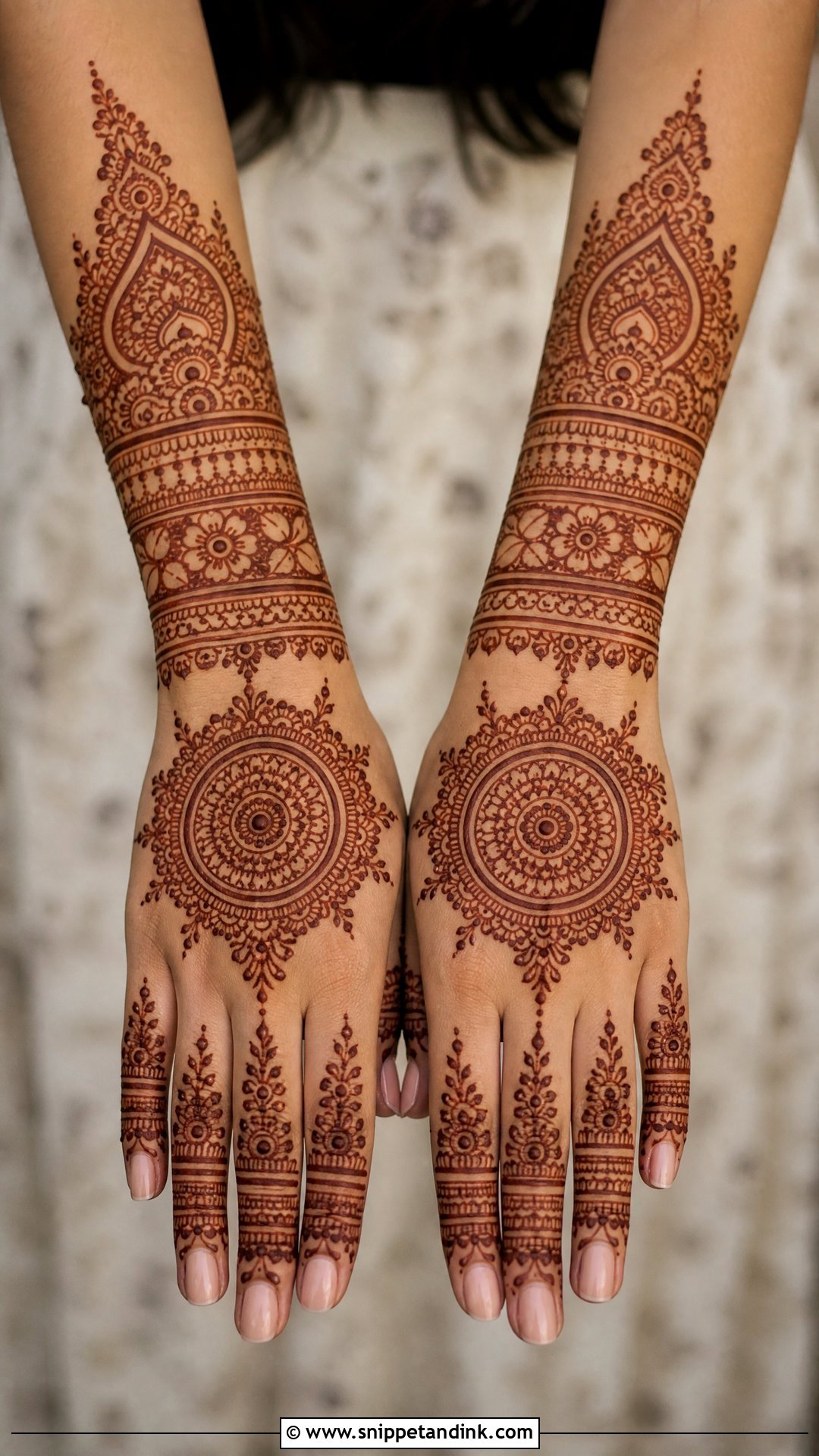
Rajasthani mehndi can be simplified and still feel royal. I keep its paisleys, mandalas, small florals and decorative bands but draw the elements larger, with a central motif on the back of the hand, paisley panels around it and bangle-style borders near the wrist, plus neat lines, dots and mini floral bands on the fingers. Tiny figure work is what usually makes Rajasthani designs slow, so I leave it out for a simple version. It’s rich and festive without the full sitting time.



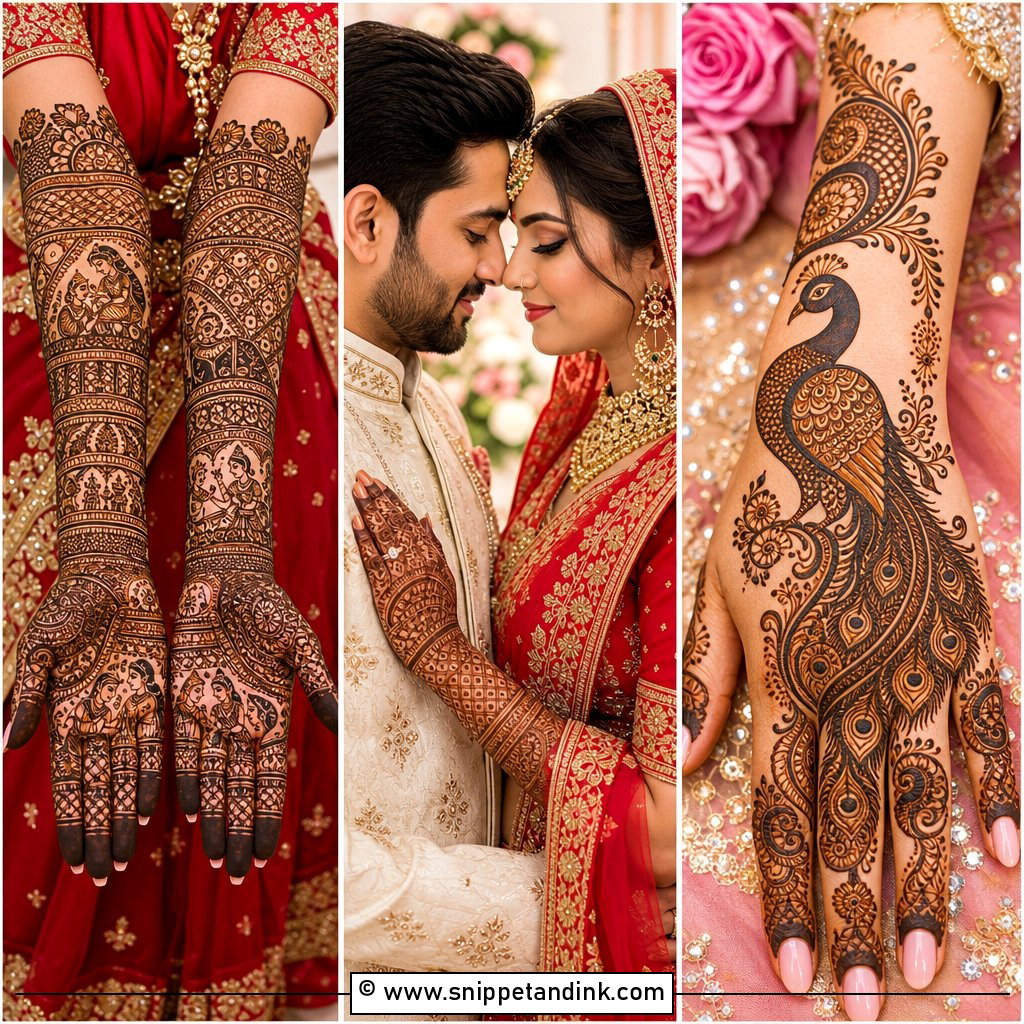

20. Modern Bridal Back Hand Mehndi Full Hand
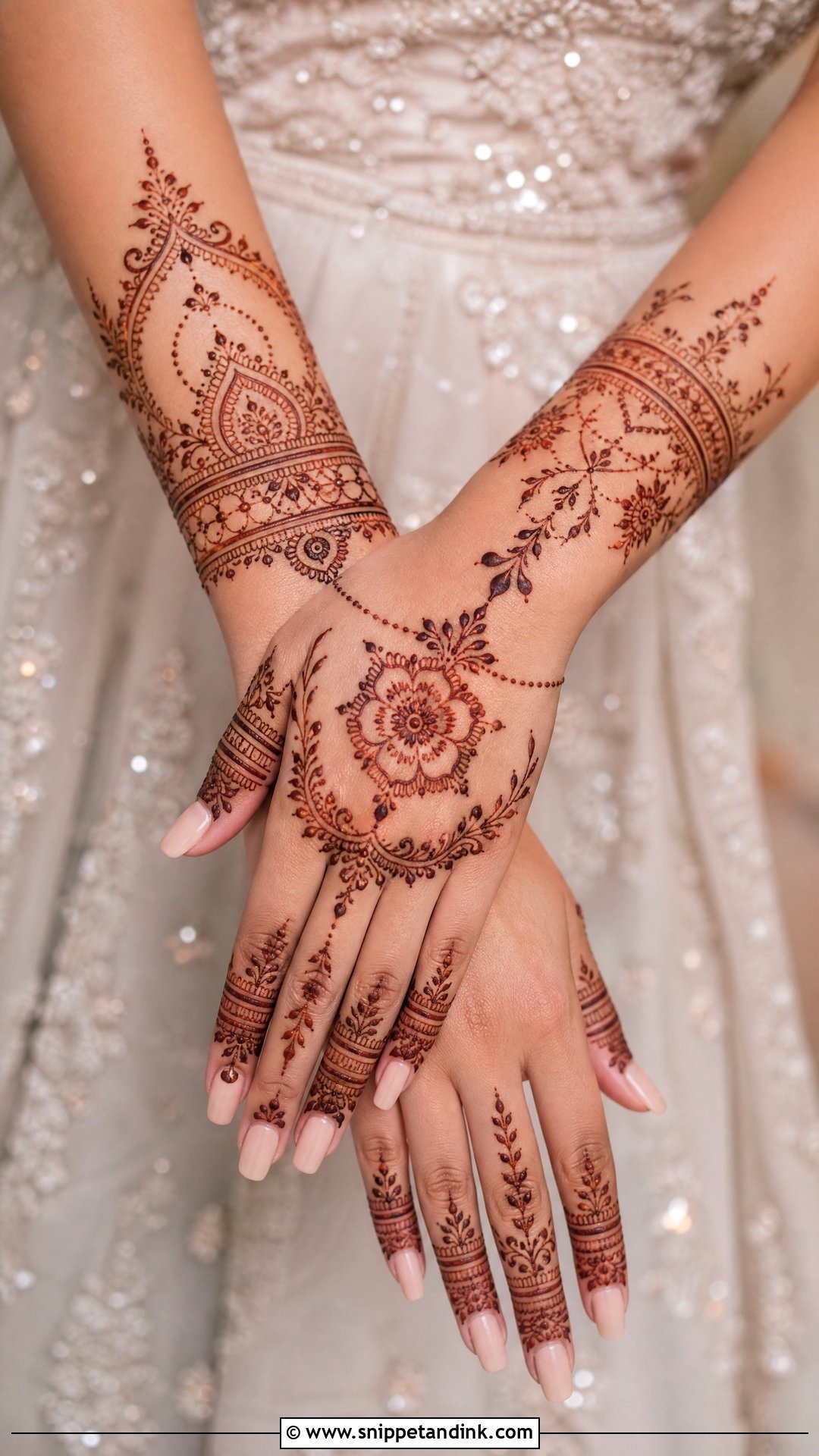
Modern back-hand mehndi relies on structure and spacing: a central flower, geometric borders, slim vines, minimal finger patterns and a simple wrist cuff with dotted chains. Negative space lets each motif stand out instead of dense filling. It suits pastel lehengas, modern outfits and lighter bridal looks while staying traditional enough for the wedding itself. It’s also the easiest layout to scale: I can add a band or two for a fuller look, or remove them if you’d prefer less.
Where Your Chooda, Kaleere and Rings Will Sit
Back-hand mehndi shares space with more jewelry than any other part of a bride’s body. A Punjabi bride’s chooda covers much of the forearm, kaleere hang from the bangles over the back of the hand, and a haath phool chain runs across the very center. Henna under all of that is rarely seen.
So I plan around it. If you’ll wear a full chooda, I keep the forearm light and put the detail on the hand and fingers. If you’re wearing a haath phool, the central motif can sit slightly off the chain line so both show. Bring photos of your jewelry to the booking, or better, wear it for a minute while I sketch.
Smudges, Pale Patches and What Can Still Be Fixed
Accidents happen, usually when a bride reaches for her phone. A few things are fixable and a few aren’t:
- A smudge in wet paste can be lifted straight away with a cotton bud or toothpick before it stains. Leave it a few minutes and it’s there for good.
- A cracked or flaked line while drying usually still stains, just more faintly. Dabbing a little lemon and sugar keeps the remaining paste in contact.
- The back of the hand always stains lighter than the palm. That’s skin, not a failed design, and it evens out as the color deepens over the next day or two.
- Avoid re-applying over a pale area after removal. Fresh paste starts orange while the rest has darkened, so the patch shows more, not less.
Why the Back of the Hand Earns the Most Thought
The right bridal mehndi isn’t the most complicated one. A clean layout, balanced coverage and repeated motifs make a simple design look as considered as heavy work. Full back-hand designs earn extra planning because they show in nearly every photograph and sit right beside your jewelry. Arabic florals, Indian mandalas, paisleys, jaali, bracelets and modern open layouts all have a simple version. Share your outfit and your bangle plan with your artist, and choose the layout that stays visible once everything is on.
You'll Like These Ideas:










Leave a Reply