
A full Dubai hand takes the open spacing of Arabic work and the Khaleeji boldness of Gulf henna, then carries it across the palm, fingers, wrist and forearm. The trick is restraint. Even at full coverage, the best of these leave clear channels of bare skin so each motif reads on its own. Below are twenty full-hand layouts, from airy to dense, with my notes on how long each takes, where it tends to go wrong, and what to tell your artist so you get the version you’re picturing.
Sitting Through a Full Hand and Forearm Without Smudging It
A full hand to the elbow, front and back, is a long appointment. A light Arabic version on both hands can take about an hour; a dense bridal pair often takes several hours, and very detailed work can run most of the day. People underestimate this more than anything else, so here is how I set up a long sitting.
- Wash your hands and arms with plain soap beforehand and skip lotion, oil or sunscreen. Anything on the skin acts as a barrier and weakens the stain.
- Wear a loose, short-sleeved or sleeveless top you can take off over your head without touching your arms.
- Eat first and use the bathroom right before we start. Once both hands are wet, you can’t do either easily.
- I usually finish the backs of both hands before the palms, so you still have usable palms for most of the session.
- Keep the room comfortably warm. Cold air dries the paste fast and it starts flaking before it has done its work.
Have someone with you for the drive home and for feeding you dinner. That isn’t a joke; a smudged palm on the evening of a wedding mehndi is very hard to fix.
1. Dubai Arabic Full Hand Mehndi Design
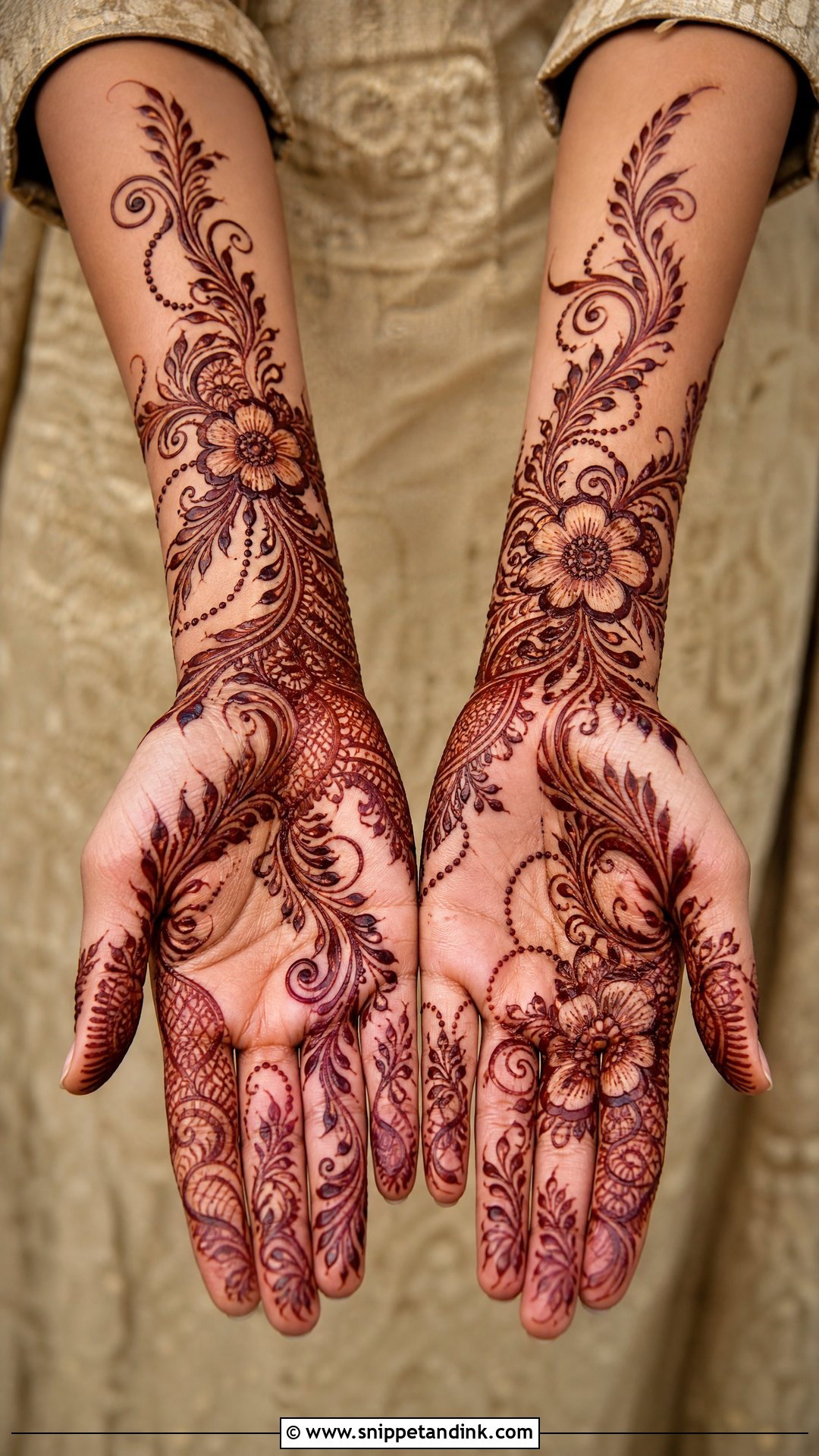
Of all the layouts here, a Dubai Arabic full hand mehndi design is the one I’d recommend to someone who wants coverage without heaviness. Large florals on the palm open into a diagonal trail toward the wrist; fingers get leafy lines, dots and shaded tips; the forearm repeats the flowers along a curved vine. Everything depends on the gaps. If an artist starts filling them to make the hand look ‘finished’, ask her to stop. The open skin is the design.
2. Dubai Bridal Full Hand Mehndi Design
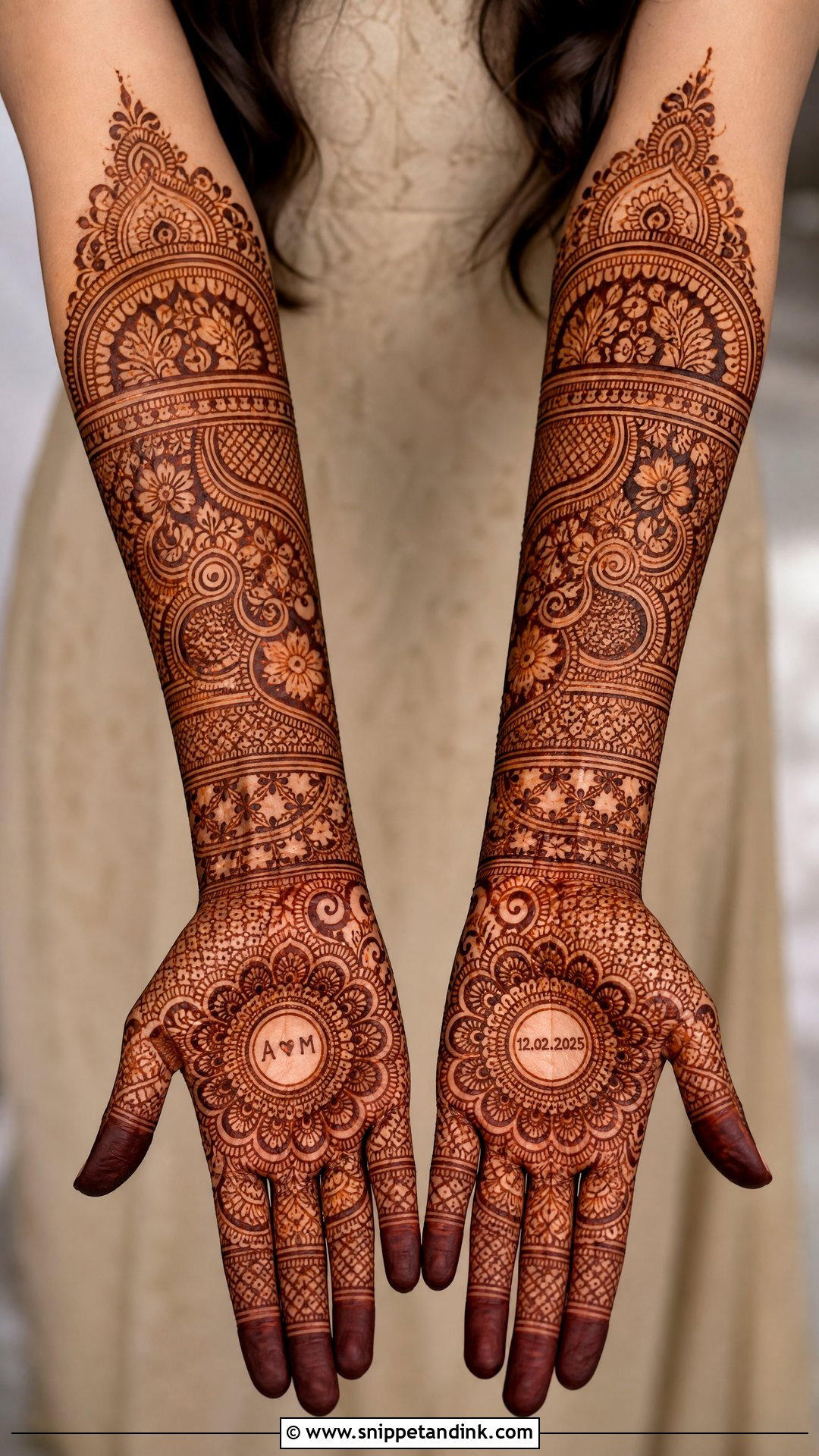
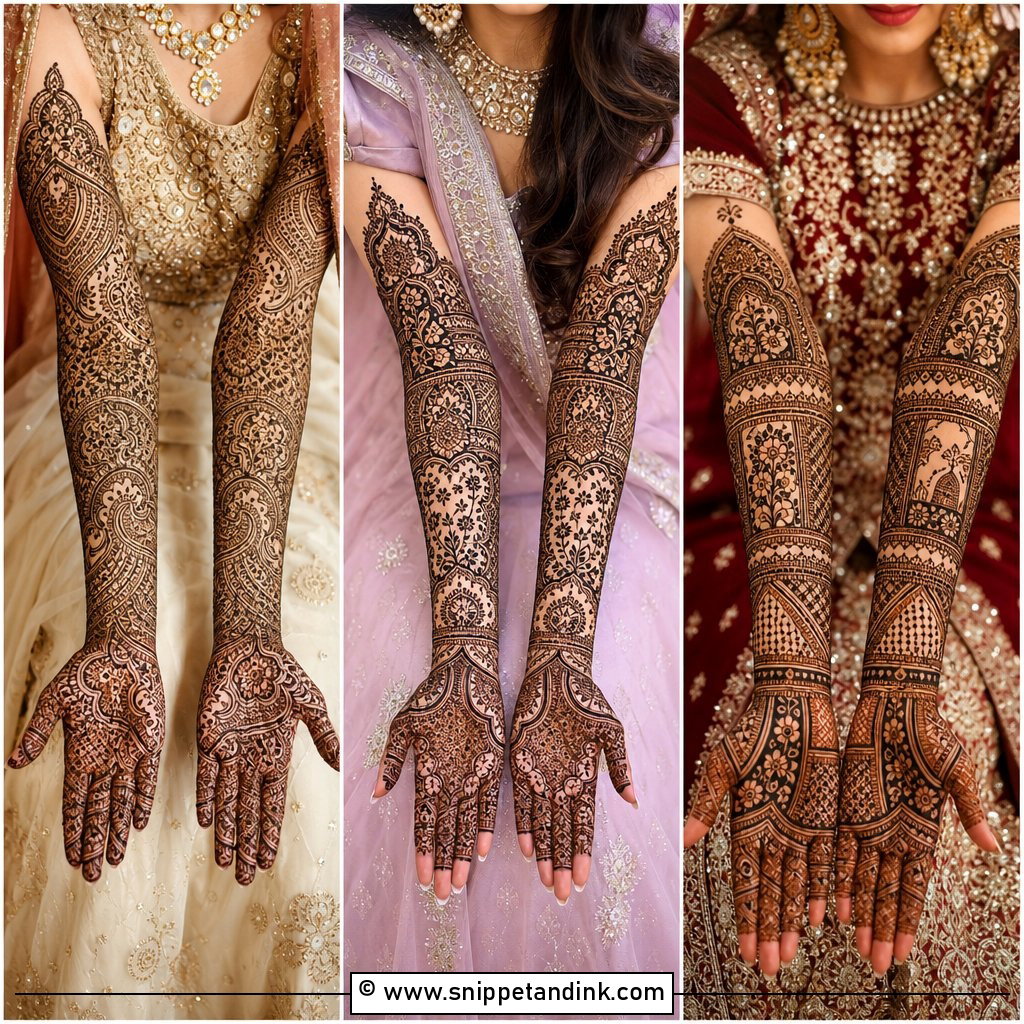
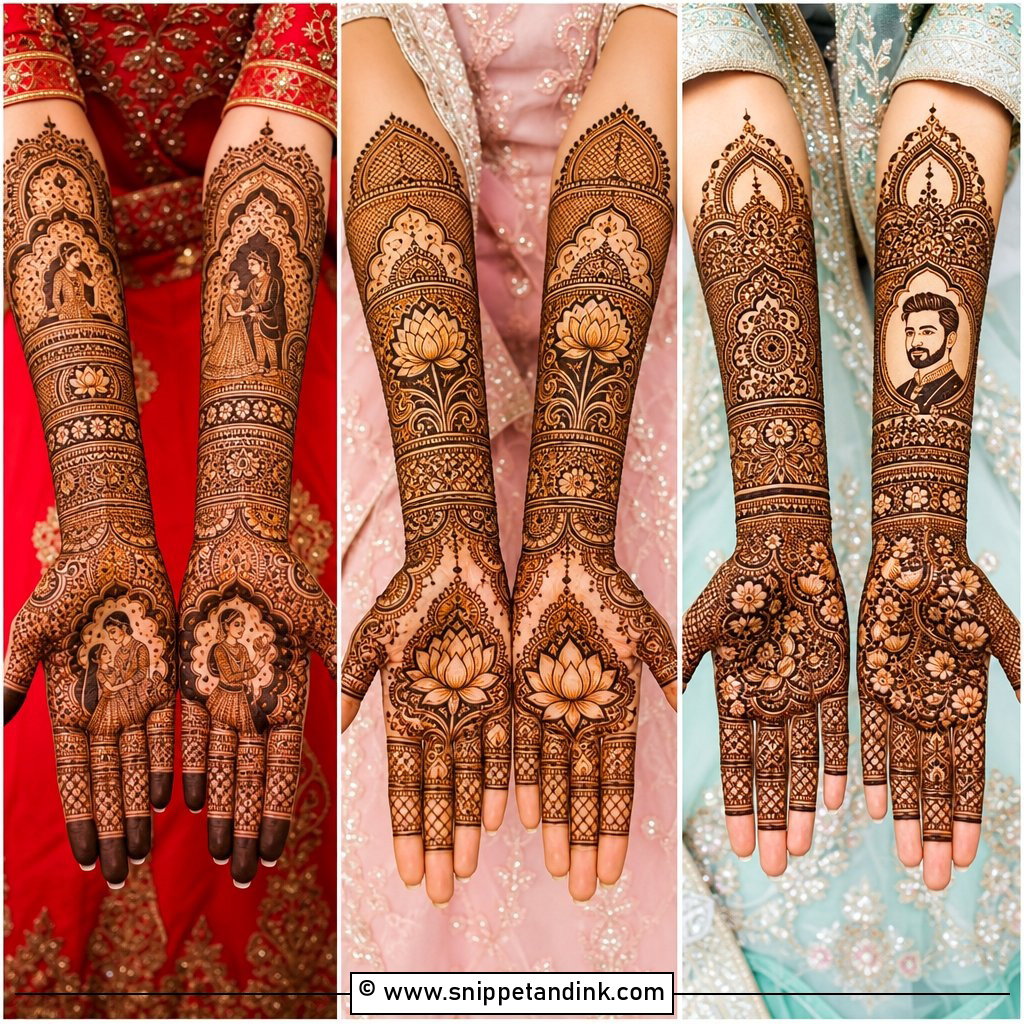
Bridal Dubai work covers palms, fingers, wrists and forearms with florals, paisleys, mandalas, net panels and fine filler, yet it should still look organised. I usually plan the two hands as a matched pair with small deliberate differences, such as a different motif in each palm or the groom’s initial hidden on one side only. Bold outlines with fine inner filling matter more here than anywhere, because dense filling with weak outlines stains into an unreadable dark mass. Book a trial on one hand if you can; you’ll see your own stain colour before the wedding.
3. Dubai Khaleeji Full Hand Mehndi Design
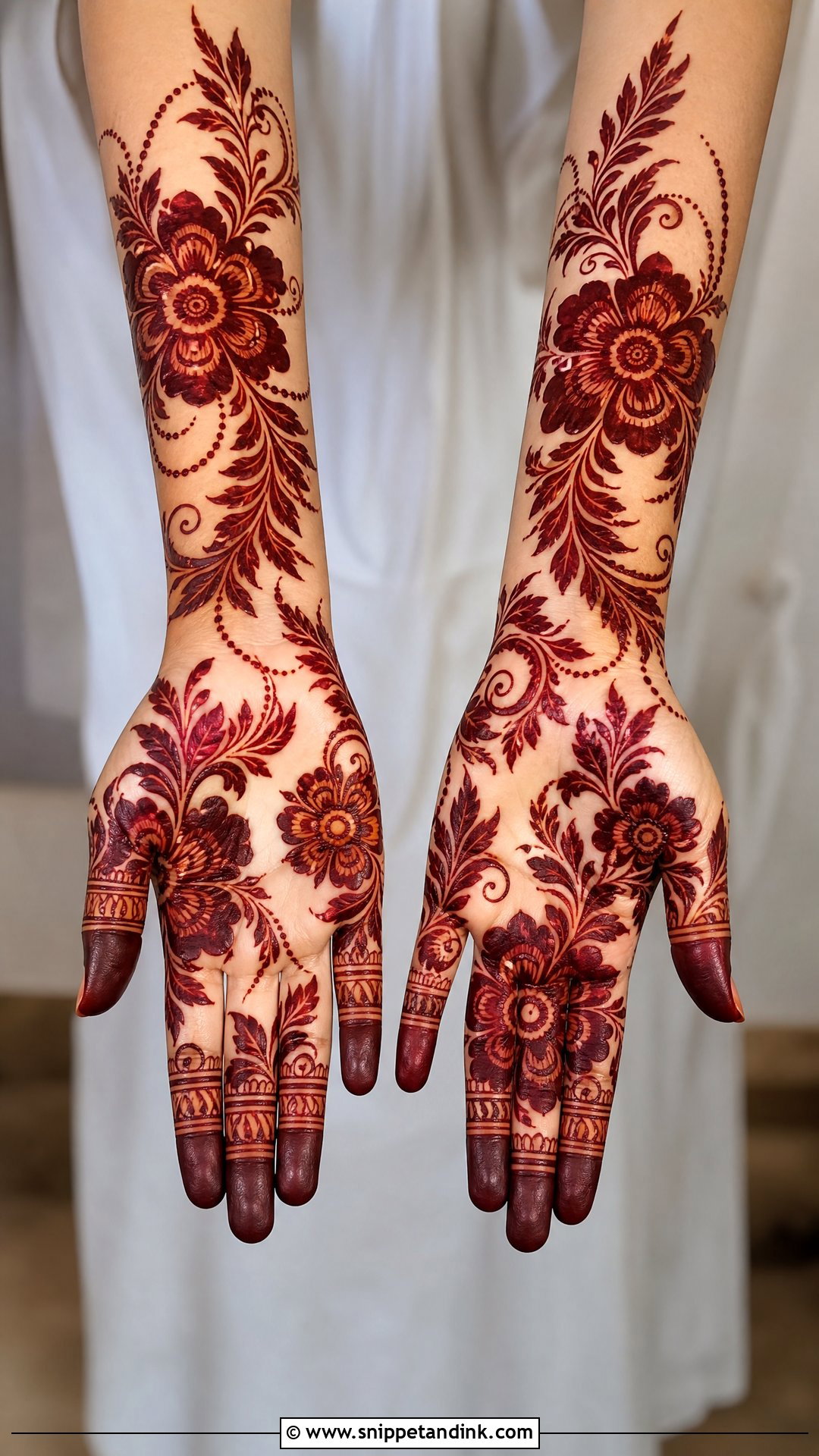
Khaleeji work uses bigger motifs than Indian bridal mehndi, and it should be drawn with a thicker cone line to match. Oversized roses or lotus-style flowers sit on the palm, sweeping vines run across the back of the hand toward the forearm, and fingers carry strong bands, leafy tips and dotted chains. Because the shapes are large, this layout reads from across a room, which is why it’s a favourite for Eid and wedding receptions. It’s also faster to apply than a dense bridal hand of the same coverage.
4. Dubai Indo Arabic Full Hand Mehndi Design
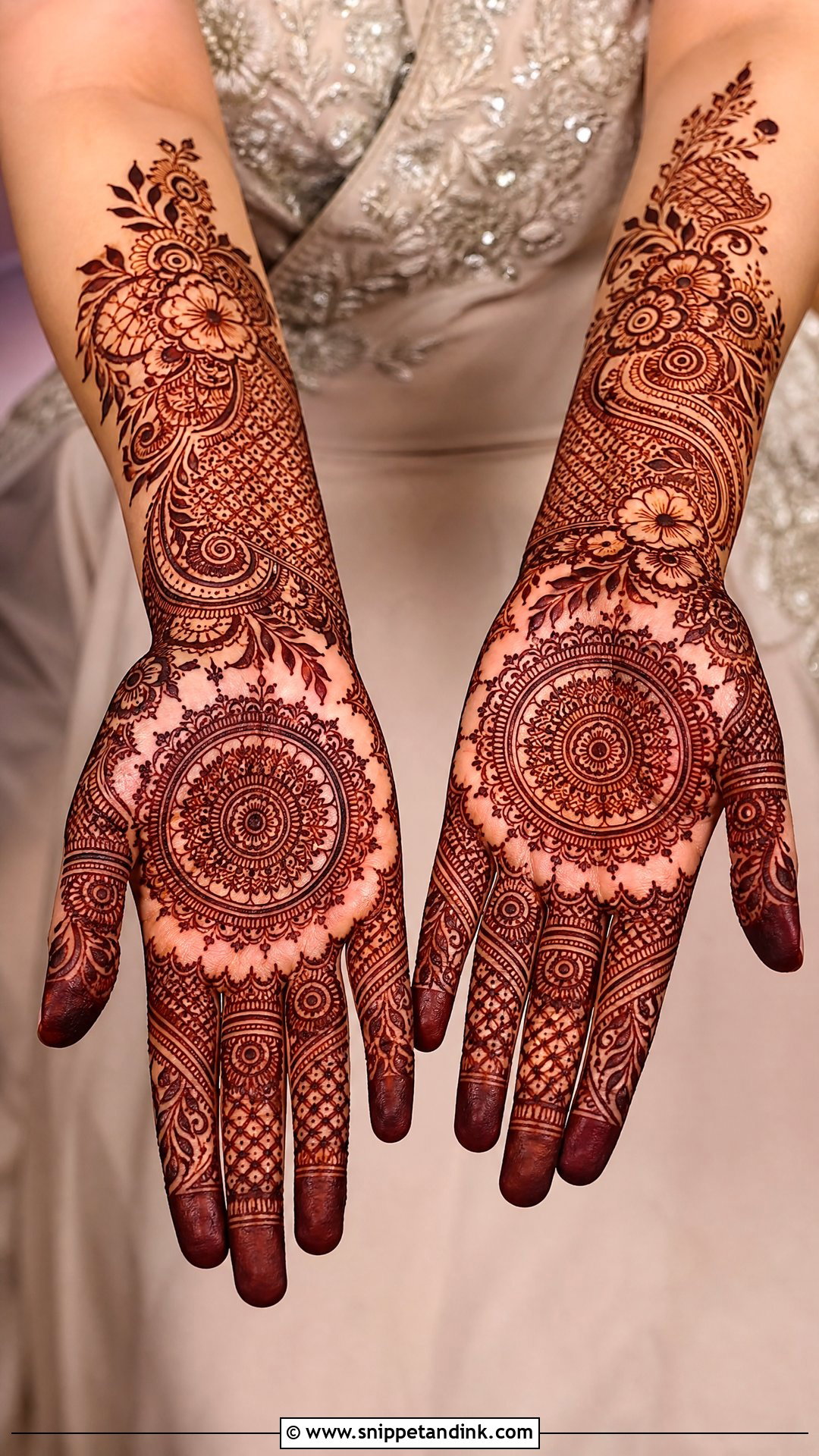
Indo-Arabic is a compromise that genuinely works. I put the Indian detail where people look closely, the palm and fingers, with a mandala or paisley cluster and fine filling, and let Arabic trails carry the wrist and forearm with looser leaves and curved strokes. That split keeps the sitting shorter than a fully Indian hand. Sisters of the bride and bridesmaids often choose it so they look dressed up without competing with the bride’s hands.
5. Dubai Floral Full Hand Mehndi Design
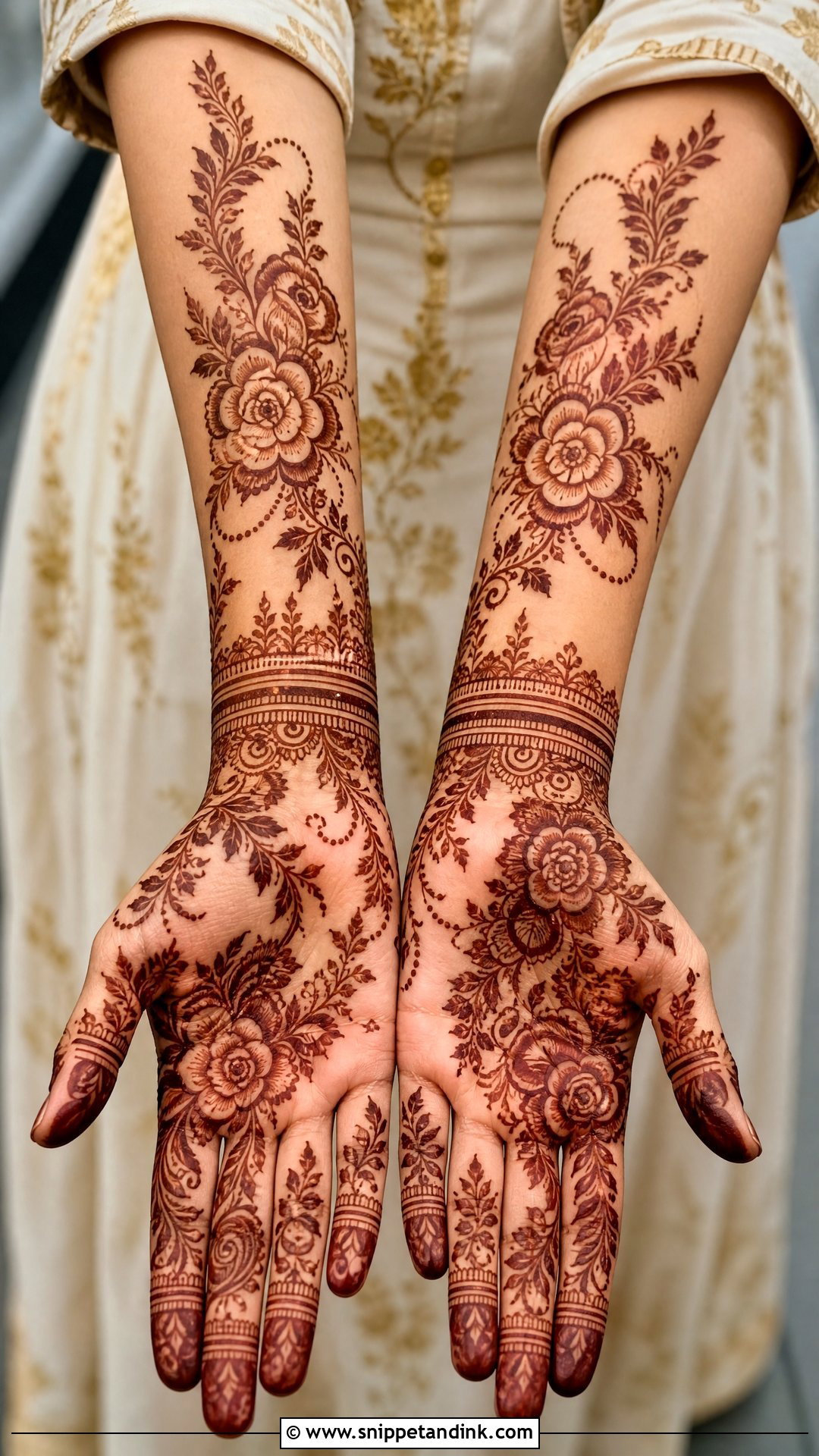
Flowers scale more easily than any other motif, so a floral full hand can be pitched light or heavy. Layered blooms fill the palm, the fingers carry vines, leaves, and tiny bud patterns, and the wrist and forearm take flower chains, bracelet bands and a little shaded petal work. Large flowers give the modern Gulf look; smaller ones push it toward a delicate bridal finish. One caution from experience: shading every petal adds time and can flatten the stain, so I shade only the outer petals of the biggest blooms.
6. Dubai Mandala Full Hand Mehndi Design
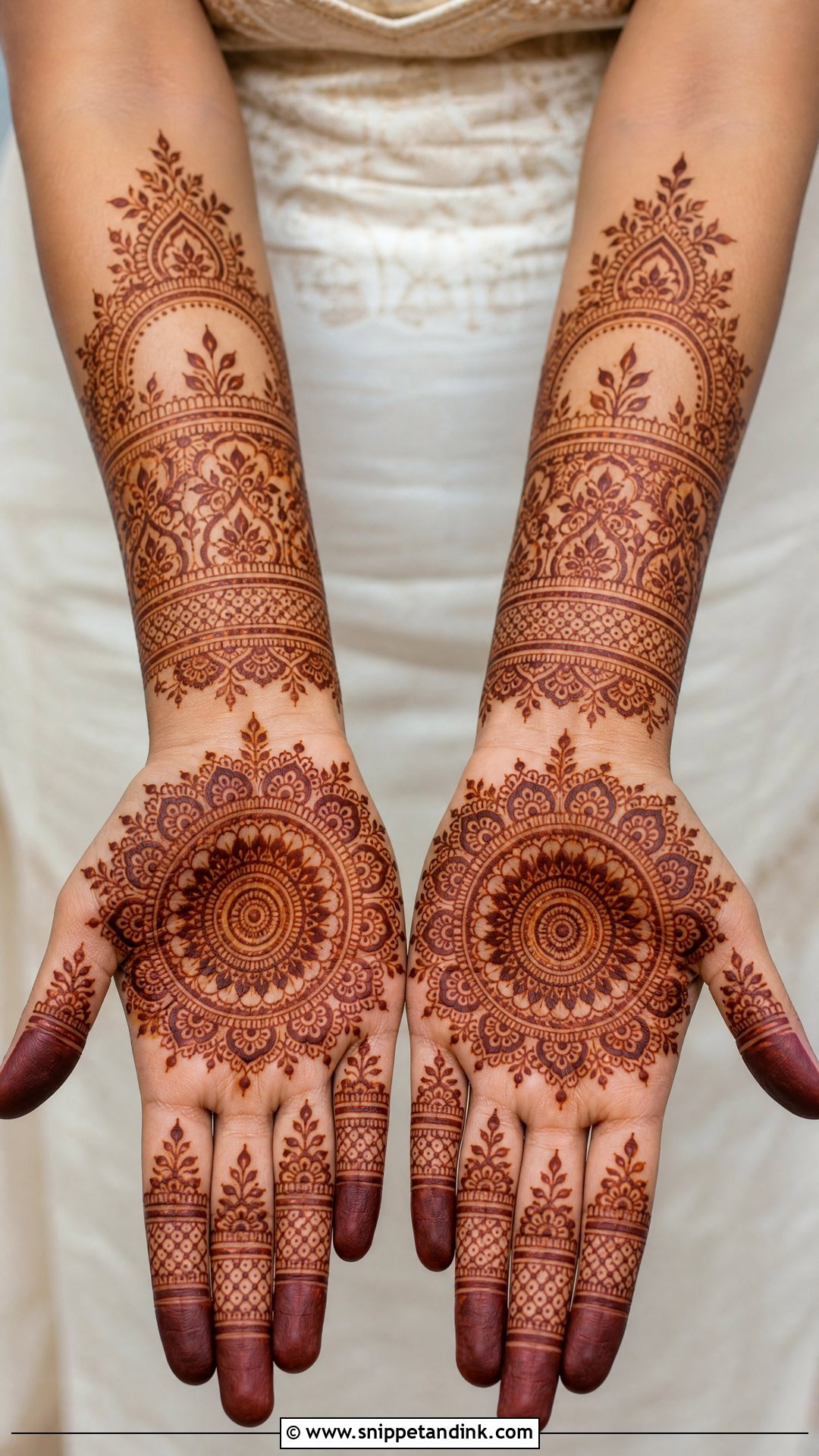
Symmetry is the selling point and the risk. A centred palm mandala ringed with dots, petals and circular detail has to be drawn on a flat, relaxed hand, so I prop the hand on a firm cushion and work the outer rings first. Matching finger bands and a bracelet border or light jaali up the forearm make it a full-hand design. Keep it open for a nikah or Eid; fill it densely for a bridal evening.
7. Dubai Jaali Full Hand Mehndi Design
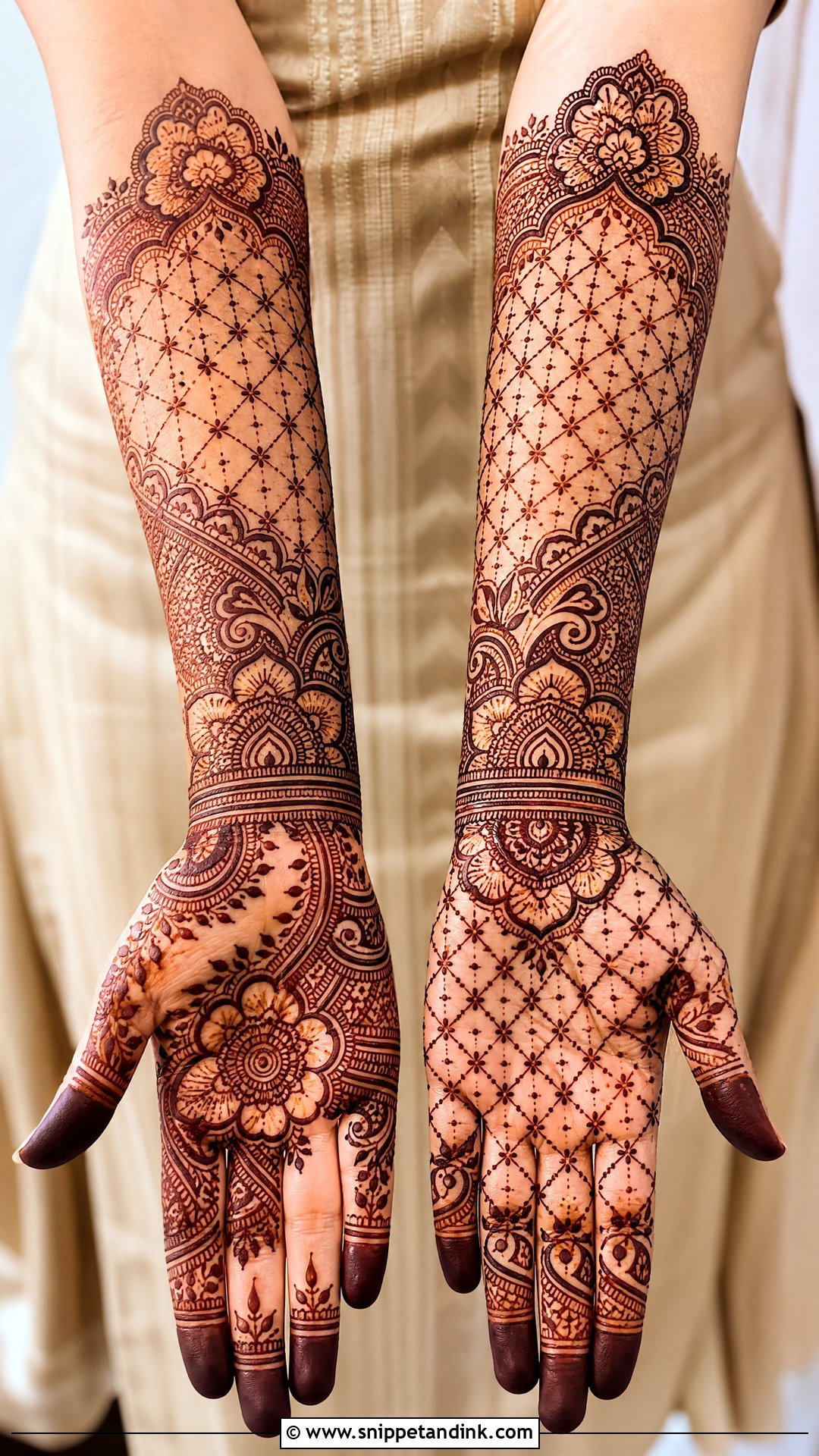
Jaali looks like lace on skin, and like lace it shows every flaw. The mesh can run over the palm, back hand, wrist or forearm, but the lines must be even in weight and spacing, which is slow work. I pair grids with flowers, paisleys and bracelet bands so the hand doesn’t look flat, and sometimes drop a tiny dot into alternate squares for texture. If you’re short on time, limit jaali to a few panels rather than asking for a rushed full grid.
8. Dubai Peacock Full Hand Mehndi Design
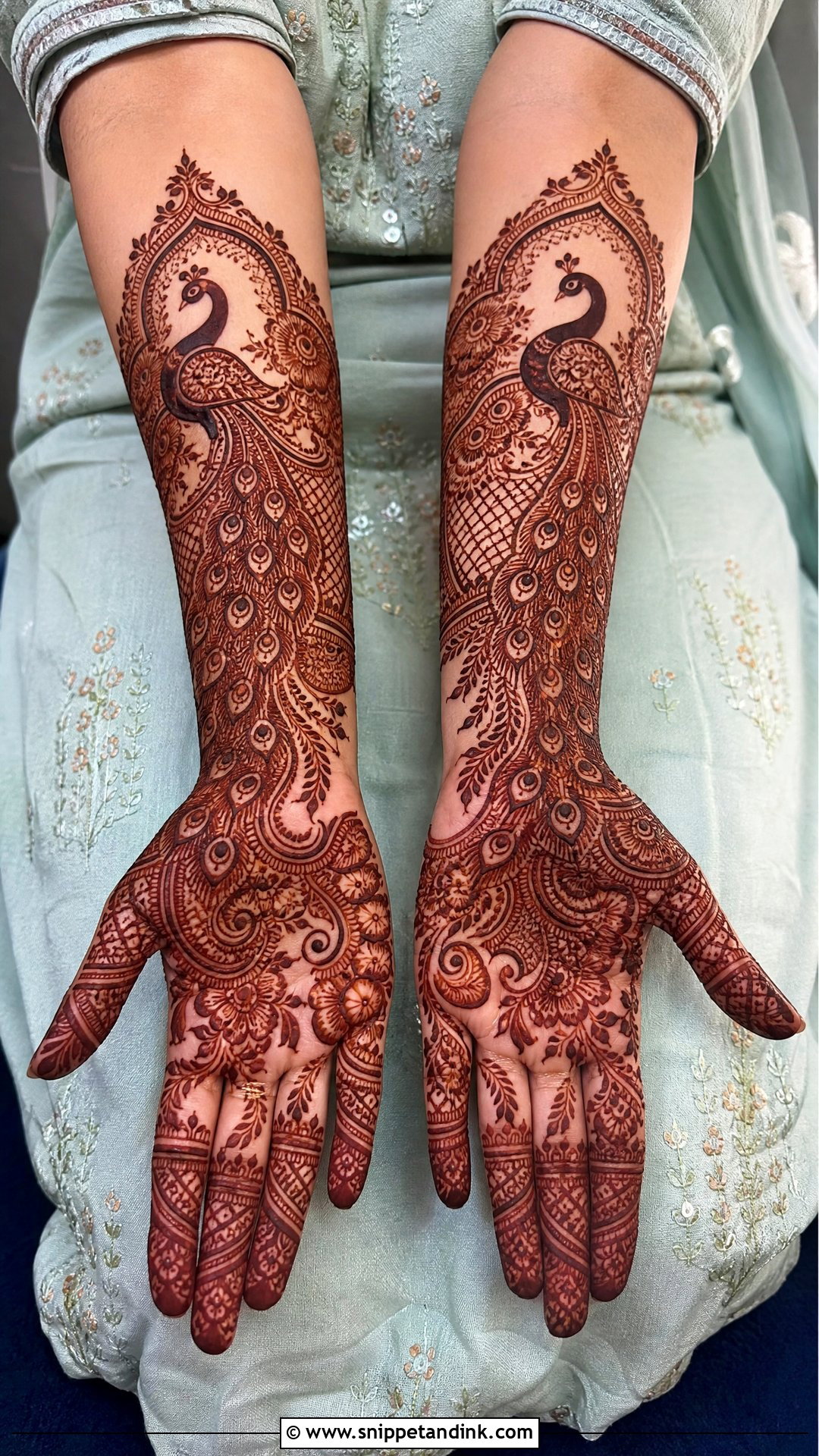
The peacock is a traditional motif, so in a Dubai layout I give it room. It usually sits on the palm, wrist or lower forearm with its feathers spilling into paisleys, florals and leafy curves, and the area around the bird is left more open than it would be in an Indian bridal hand. Fingers take feather lines, dots and curved bands. Ask to see the artist’s peacocks before you book; the neck and head are tricky, and a clumsy one is the first thing people notice.
9. Dubai Paisley Full Hand Mehndi Design
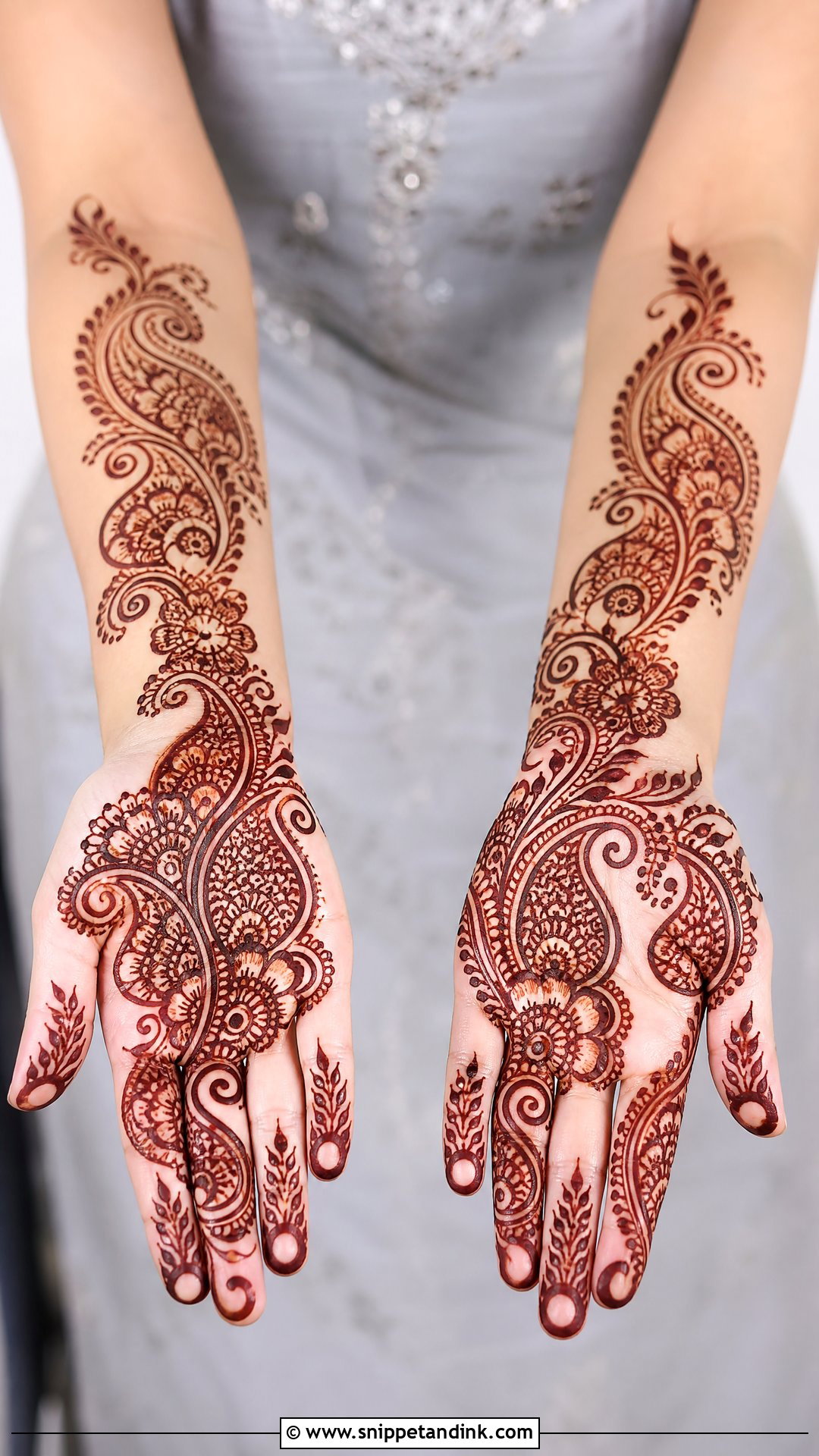
Paisleys are the most flexible shape in henna: large or small, shaded, floral-filled or linked into trails. A cluster on the palm, small leaves and curls on the fingers, and a paisley vine or bracelet band on the forearm makes a complete hand that suits nearly any event. The curve of the paisley follows the hand naturally, so placing the tips toward the fingers lengthens them visually. It’s a safe choice if you’re unsure what you want.
10. Dubai Jewelry Full Hand Mehndi Design
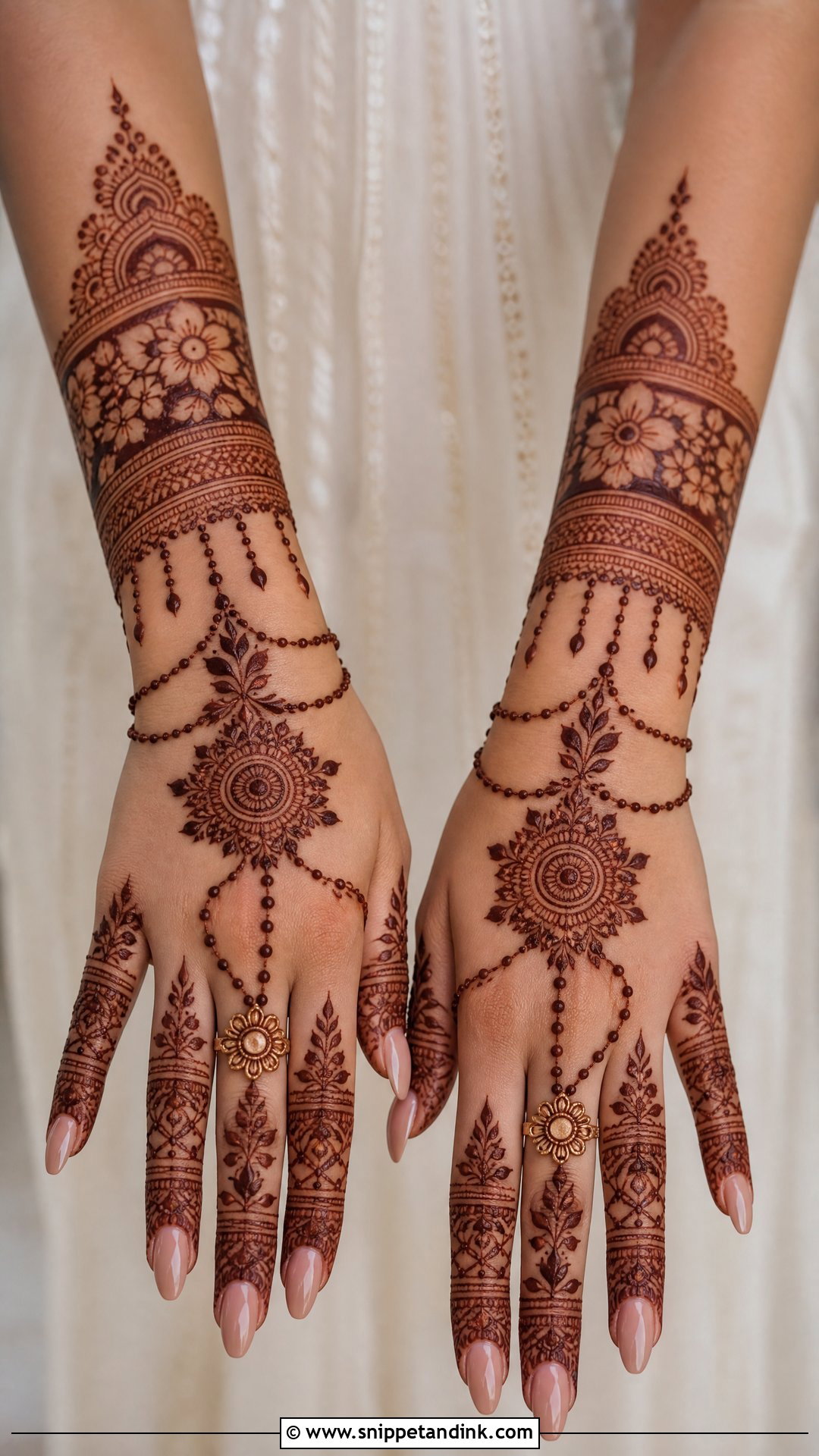
Think of this layout as hand ornaments drawn with henna: ring chains, bracelet bands, wrist cuffs, finger bands and small hanging details, usually built on the back of the hand in a haath phool shape, with a floral or mandala centre on the palm. The chains need perfectly steady lines, so this is not a design for a rushed booth at a busy event. If you’ll wear real rings or a haath phool, I leave space where they sit so the drawn and real jewelry don’t clash.
11. Dubai Back Hand Full Mehndi Design
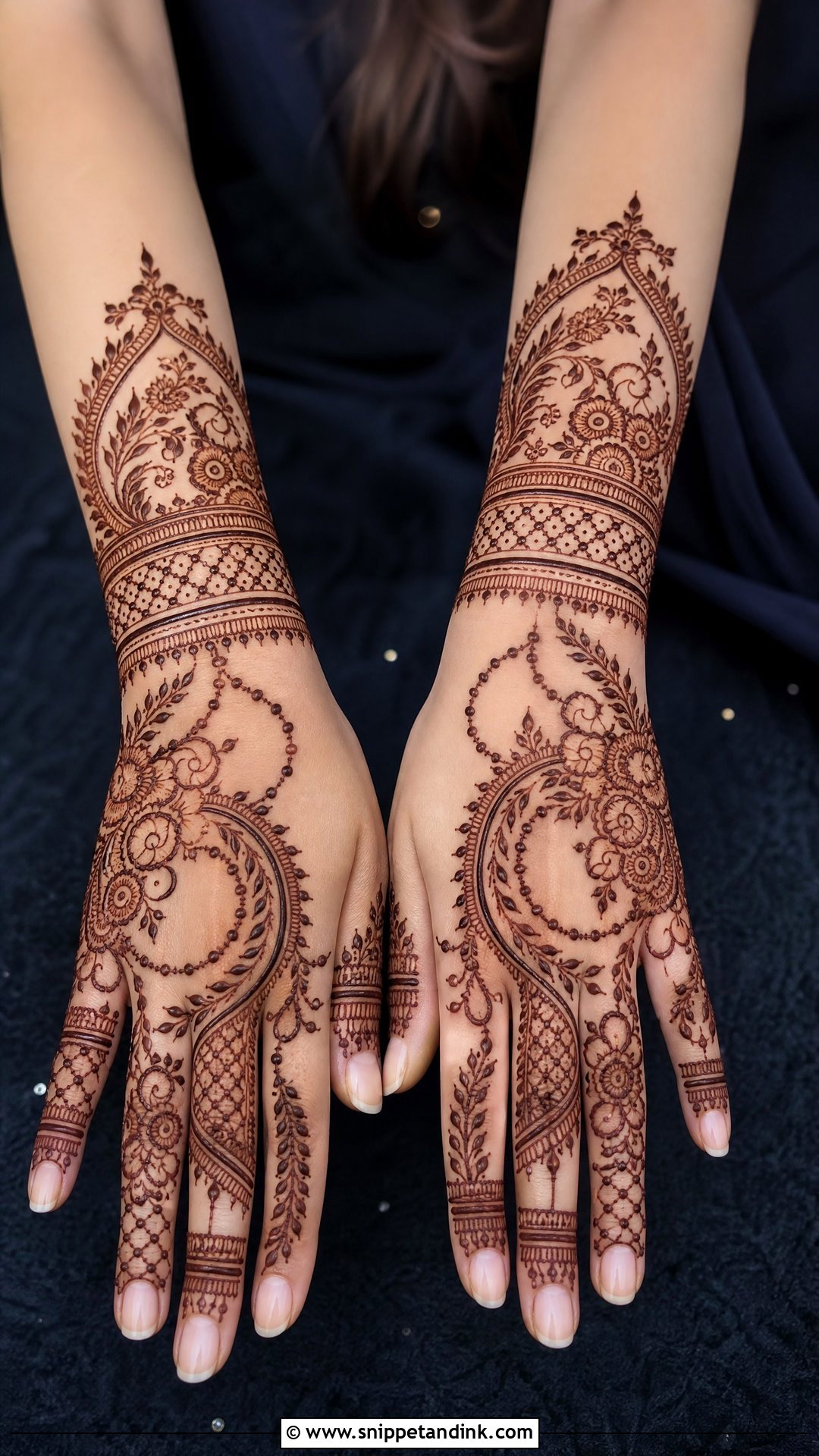
If people will mostly see the back of your hands, put the effort there. Detailed finger bands lead into florals, vines, jaali or jewelry chains across the back hand, finishing with a bracelet border or Arabic trail up the forearm. The palm stays lighter. One trade-off worth knowing: the back of the hand has thinner skin than the palm, so the same design will stain a shade lighter there. I draw outlines a little bolder on this side to compensate.
12. Dubai Front Hand Full Mehndi Design
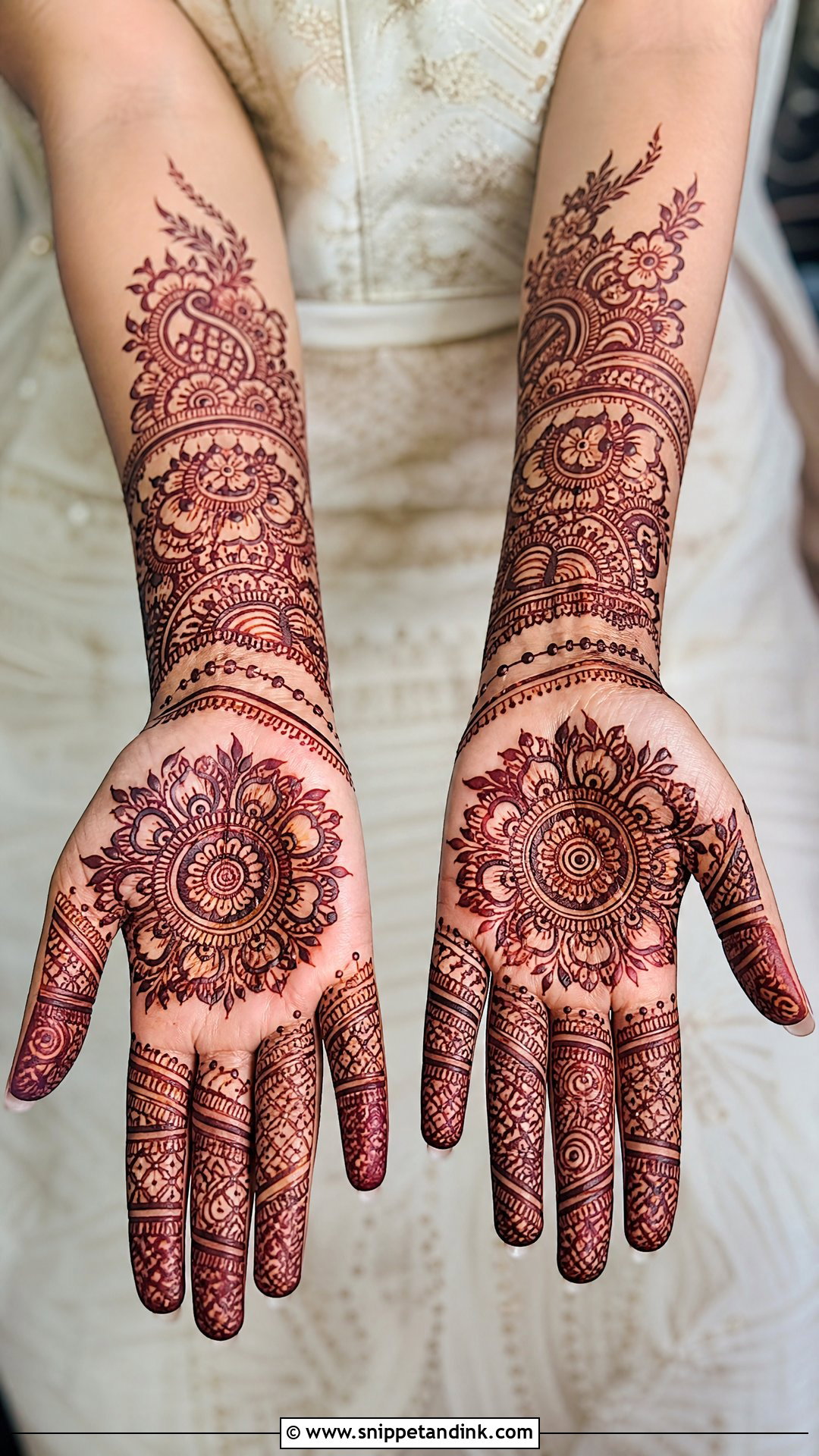
Palm-focused full hands are for moments when the hands are held open: rituals, greetings, close-up photos. A mandala, floral cluster, paisley layout or geometric centre anchors the palm; fingers are filled more densely; the wrist and forearm continue with vines, cuffs and Arabic borders. Palms stain darkest of all, so this layout gives the richest colour. I keep the spacing a little cleaner than a heavy traditional hand so that colour stays readable.
13. Dubai Minimal Full Hand Mehndi Design
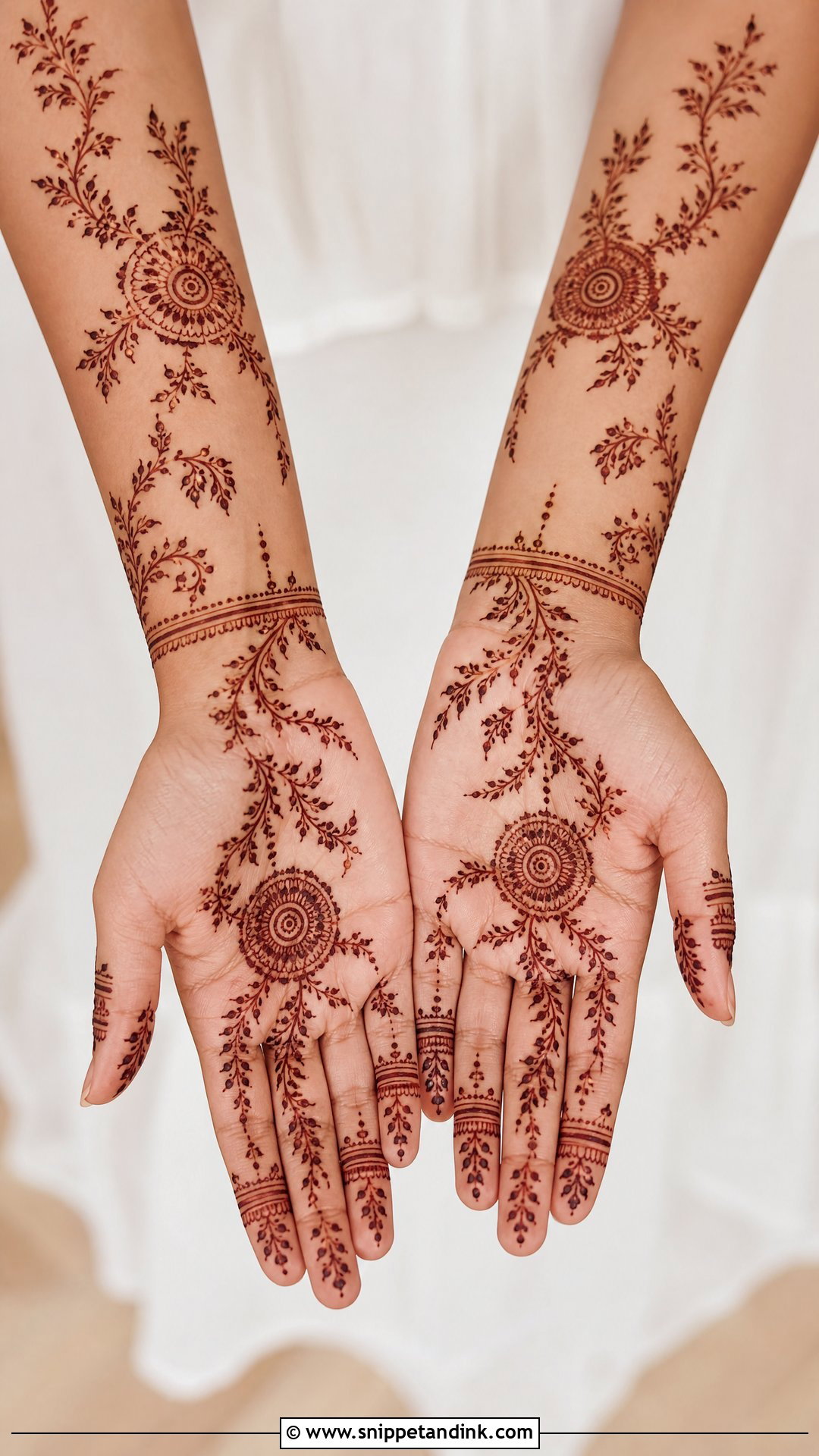
Full coverage can still be light. Slim trails, clean bands, small flowers and generous spacing run across the whole hand; the palm takes a simple mandala or floral vine; and the wrist-to-forearm area ends in a thin bracelet pattern or a soft Arabic trail. This is what I suggest for daytime Eid gatherings, younger wearers, or anyone who works with their hands and doesn’t want dense colour for a fortnight. It’s also the quickest full hand on this list.
14. Dubai Heavy Full Hand Mehndi Design
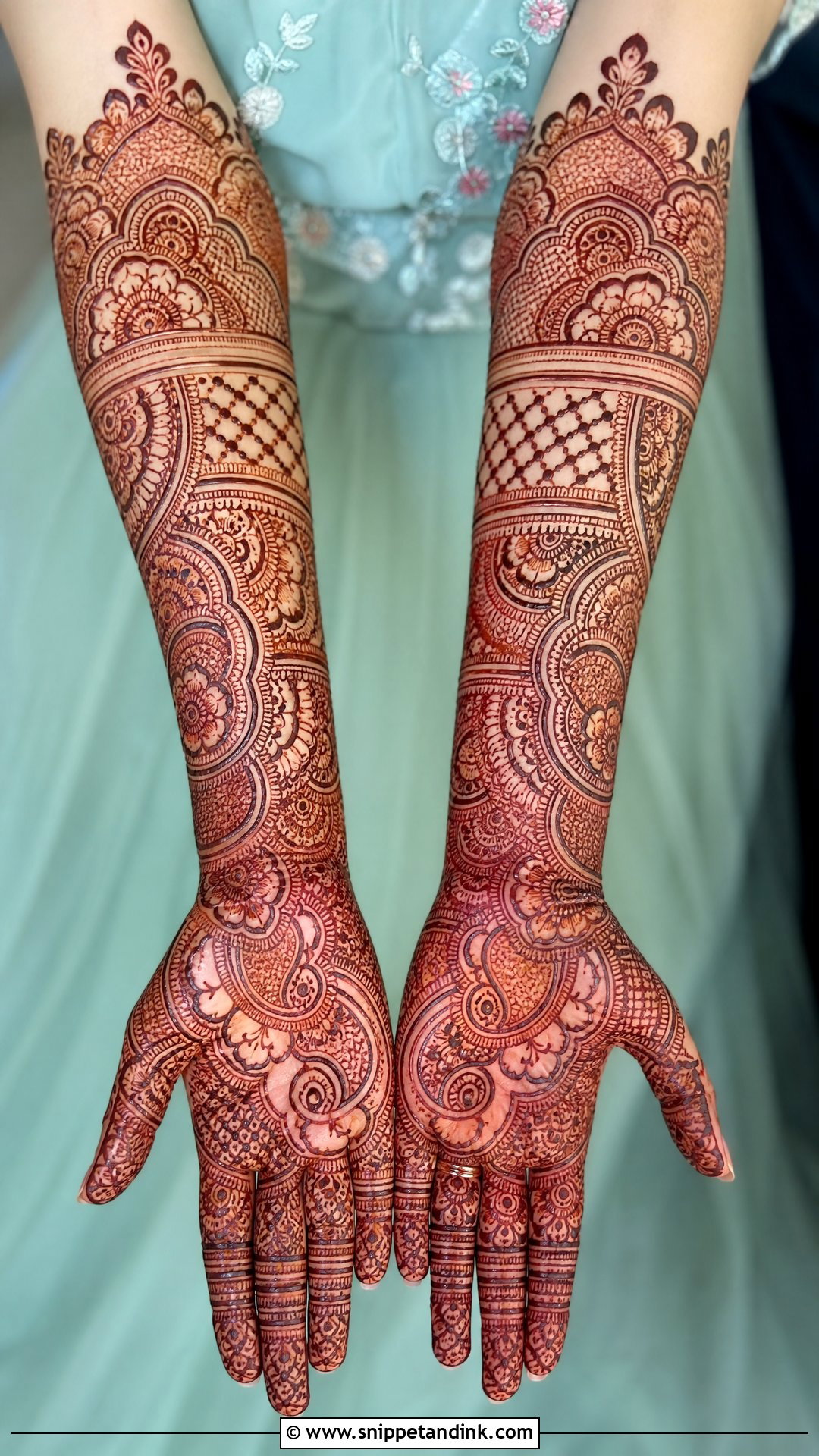
Heavy Dubai mehndi only works when the main motifs stay distinct. Flowers, paisleys, mandalas, jaali, shading and fine filler can cover nearly the whole hand and forearm, but I divide the space with bold outlines first and fill second. Skip that and the stain turns into one dark block by day two. Plan a long sitting with breaks, and don’t book it for the same day as another event.

15. Dubai Eid Full Hand Mehndi Design
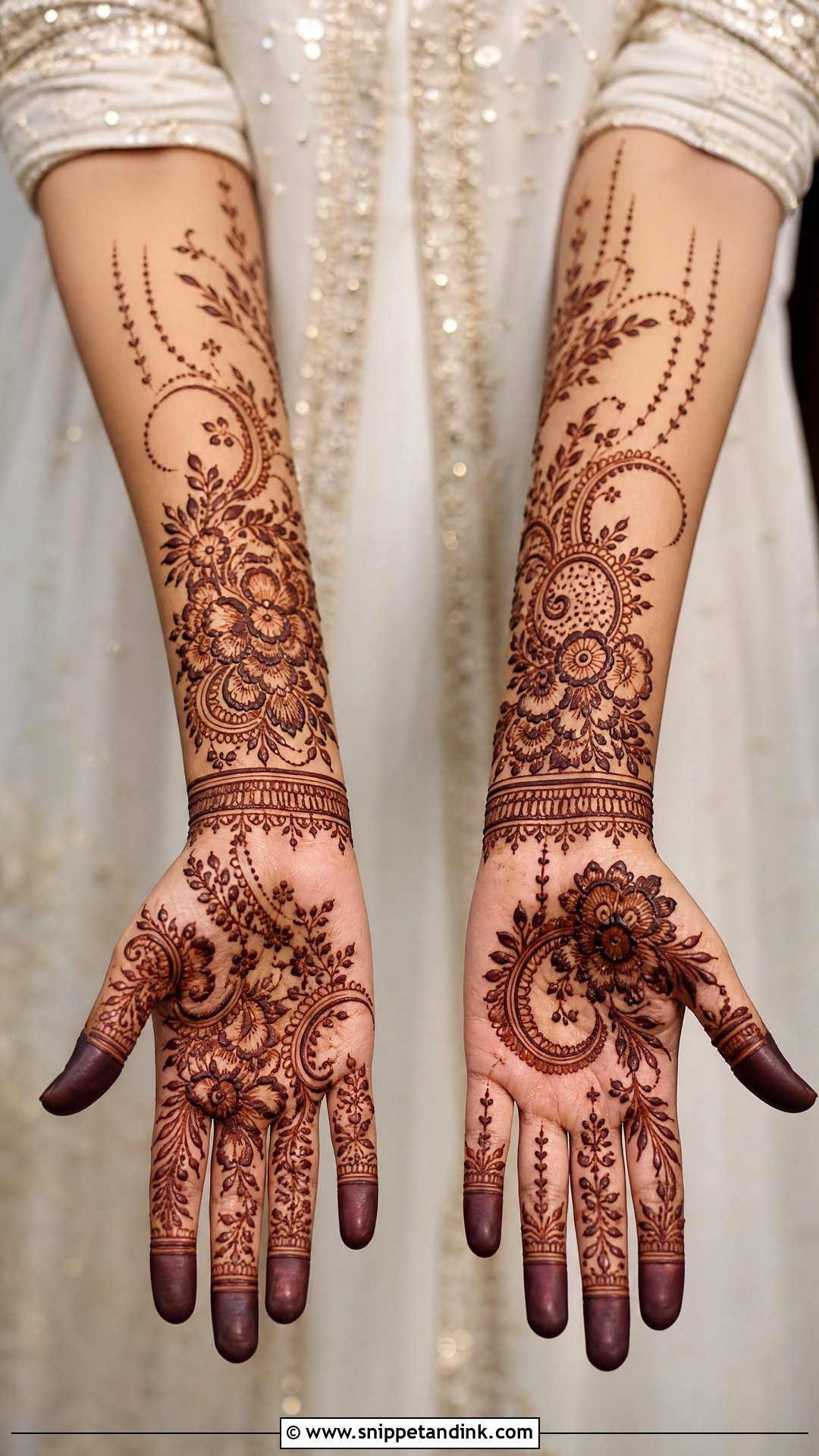
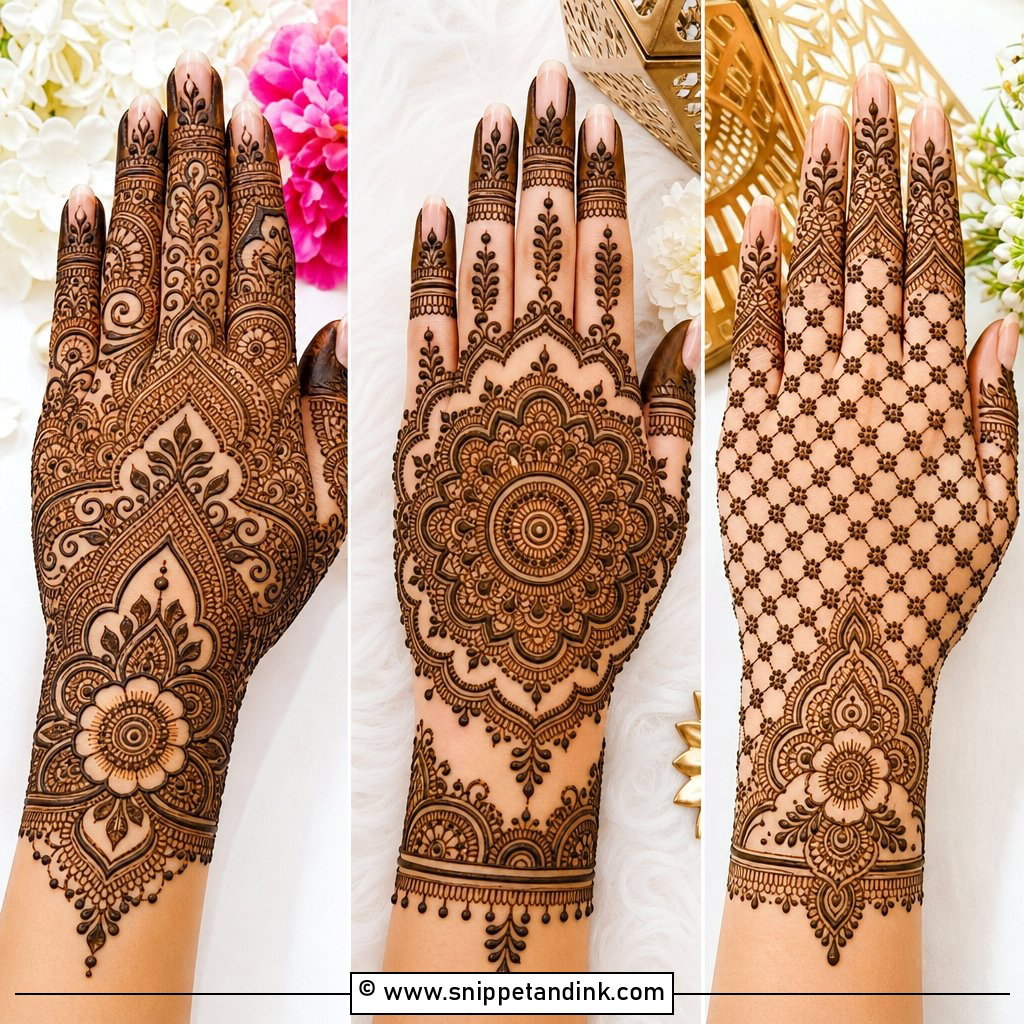
On Eid, the hours before prayer are busy, so I keep this one realistic. Arabic florals, crescent-inspired curves, leafy trails, dotted chains and a bracelet border give a full-hand effect without a full-hand sitting. The palm stays moderately filled while the back hand and wrist get more visible detail, since that’s the side seen in photos and when greeting people. Bold fingertips and slim bands finish it. It sits comfortably with abayas, kaftans, salwar suits and modern festive dresses.
16. Dubai Engagement Full Hand Mehndi Design
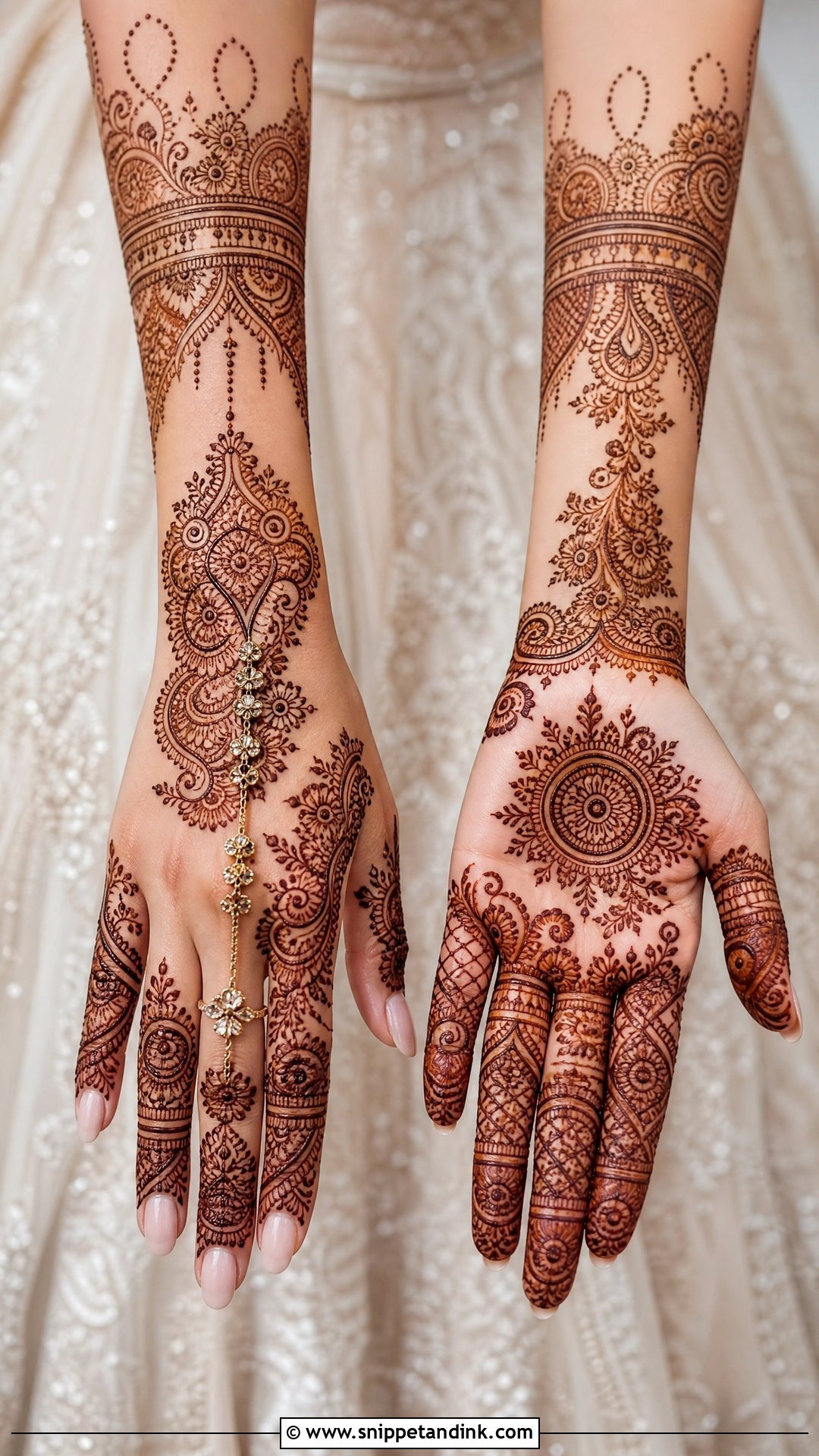
An engagement hand should look polished in ring photos without the weight of bridal mehndi. Jewelry chains, floral trails and ring-like finger details go on the back hand; a soft mandala or paisley arrangement on the palm; bracelet cuffs, leaves and fine dots on the wrist and forearm. I leave a clear space around the ring finger. A stone sitting on top of dense filling disappears in close-ups.
17. Dubai Simple Full Hand Mehndi Design
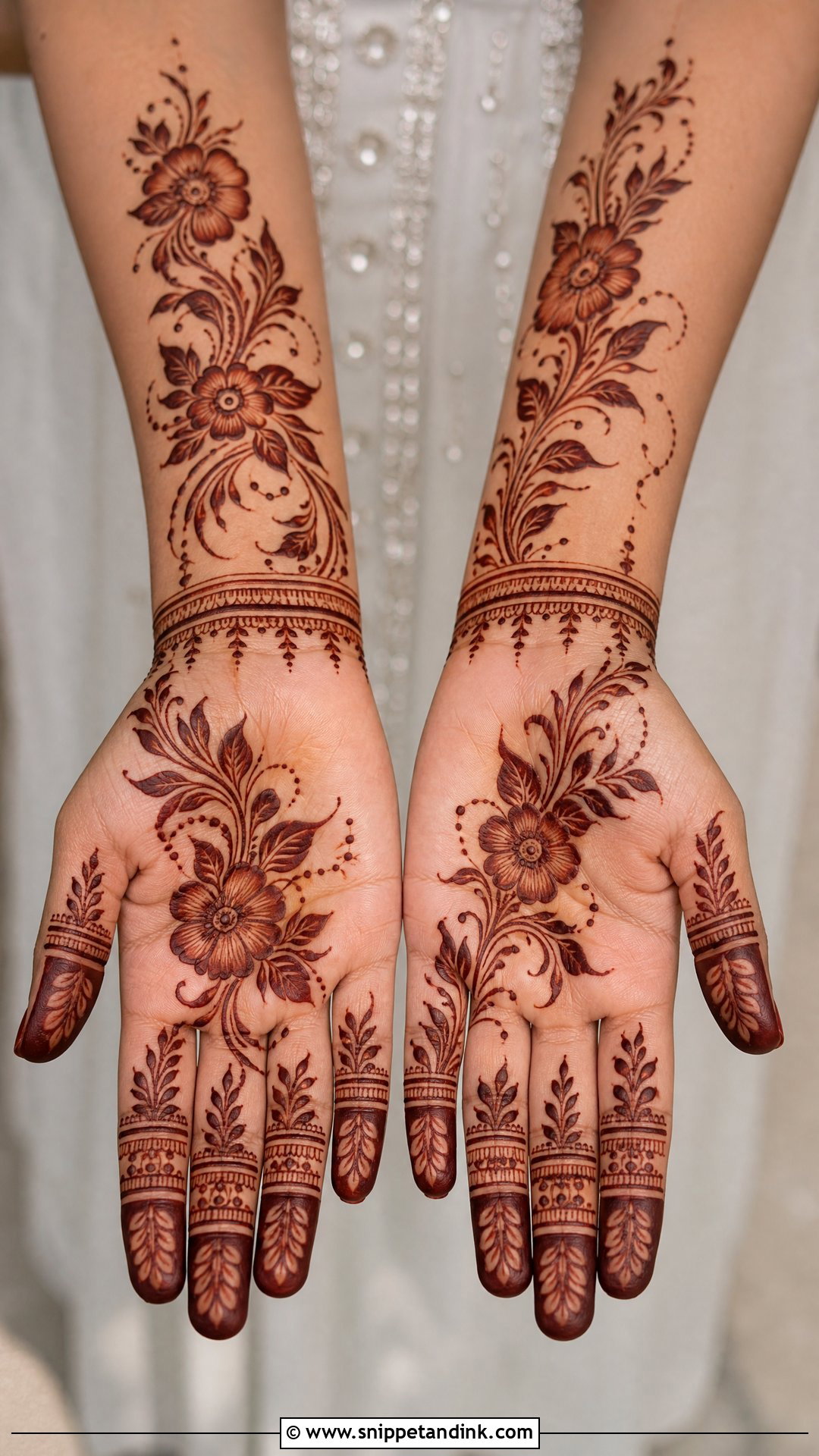
A simple full hand still has to cover the whole hand evenly, which is harder than it sounds. With fewer motifs and wider spacing, an uneven gap looks like a mistake rather than a choice. One floral cluster or mandala on the palm, vines to the wrist and forearm, repeated bands and small petals on the fingers. I recommend it for beginners and teenagers sitting for full-hand mehndi for the first time, because it’s short enough that nobody gets restless.
18. Dubai Modern Full Hand Mehndi Design
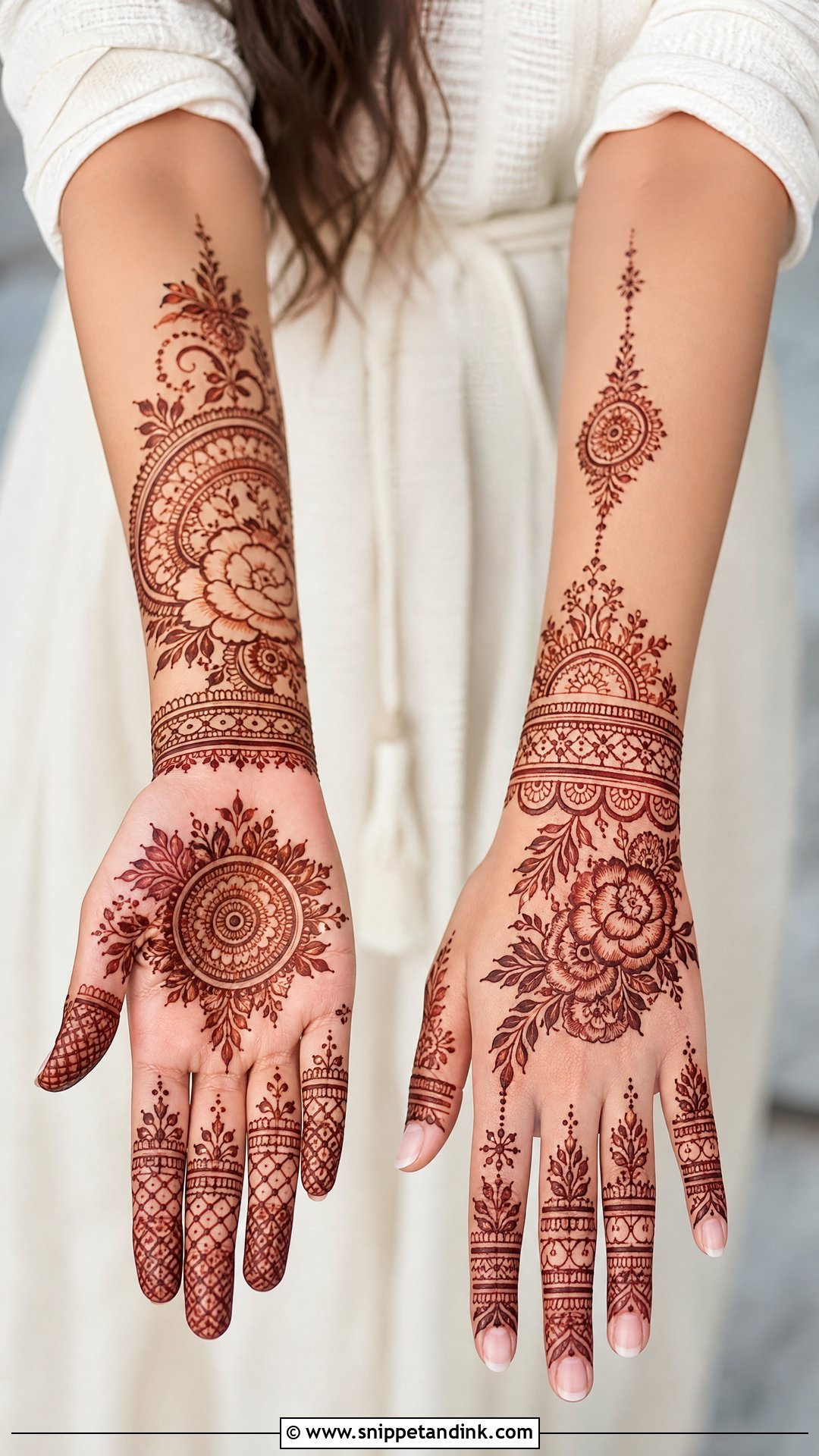
Modern layouts work with negative space, bold florals, geometric lines, bracelet cuffs and sharp finger detailing, and they deliberately leave large areas bare. A half-mandala, a floral corner or an abstract Arabic trail on the palm, with slim bands and structured motifs on the wrist and forearm, makes the hand look long and lean. It suits contemporary outfits and modern bridal functions. Ask your artist to show you the placement in pencil-thin dots first, since the empty areas are as planned as the drawn ones.
19. Dubai Moroccan Full Hand Mehndi Design
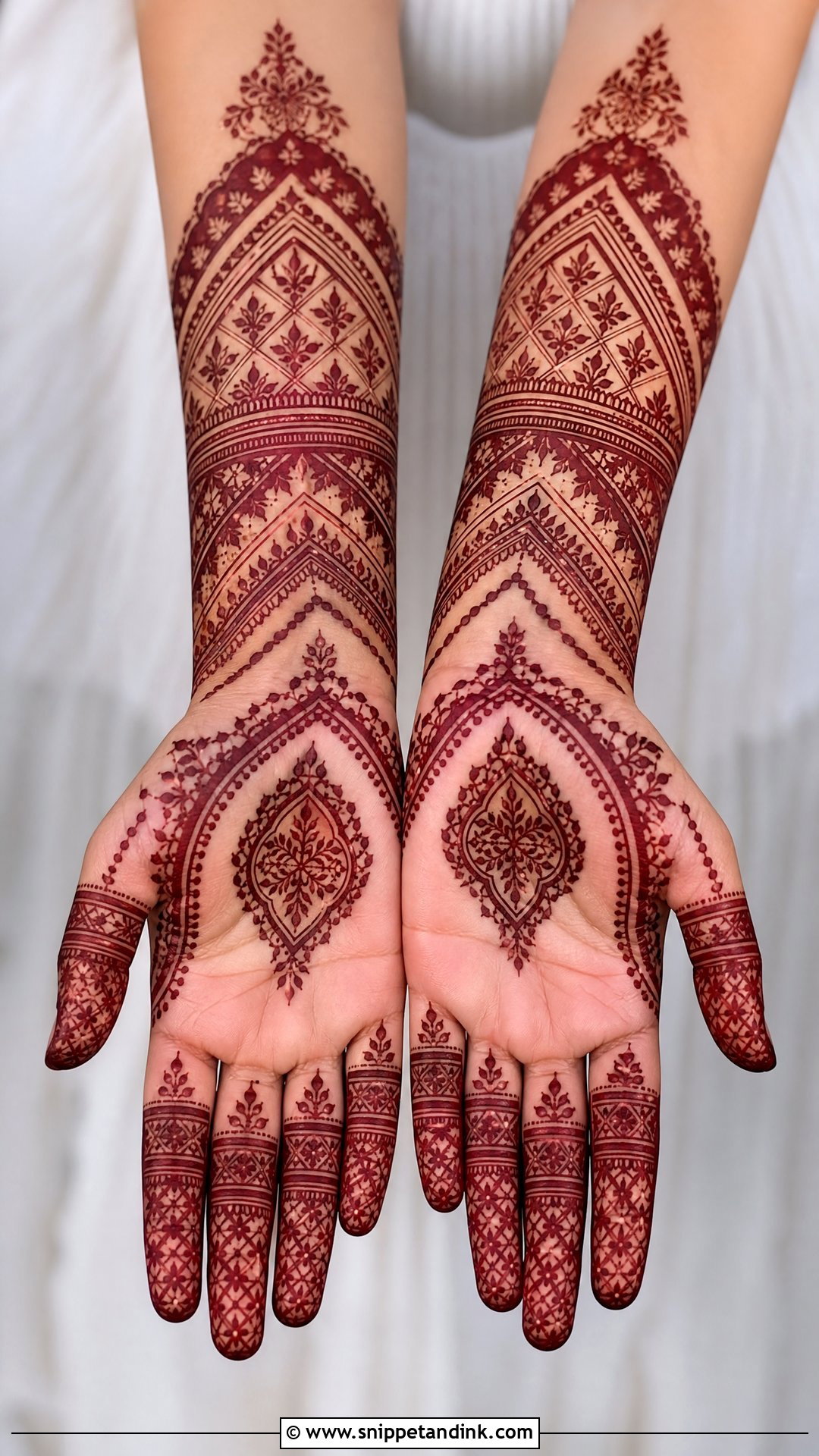
Moroccan-style henna replaces flowers with diamonds, lines, grids, dots, triangles and banded sections across the palm, fingers, wrist and forearm. A Dubai-leaning version softens the geometry with a few small flowers or leafy borders. The fingers are where it shines, with repeated geometric bands ending in pointed tips. Straight lines on a curved forearm are hard to keep straight, so choose an artist who already draws geometric work, not one who mainly does florals.




20. Dubai Glitter Full Hand Mehndi Design
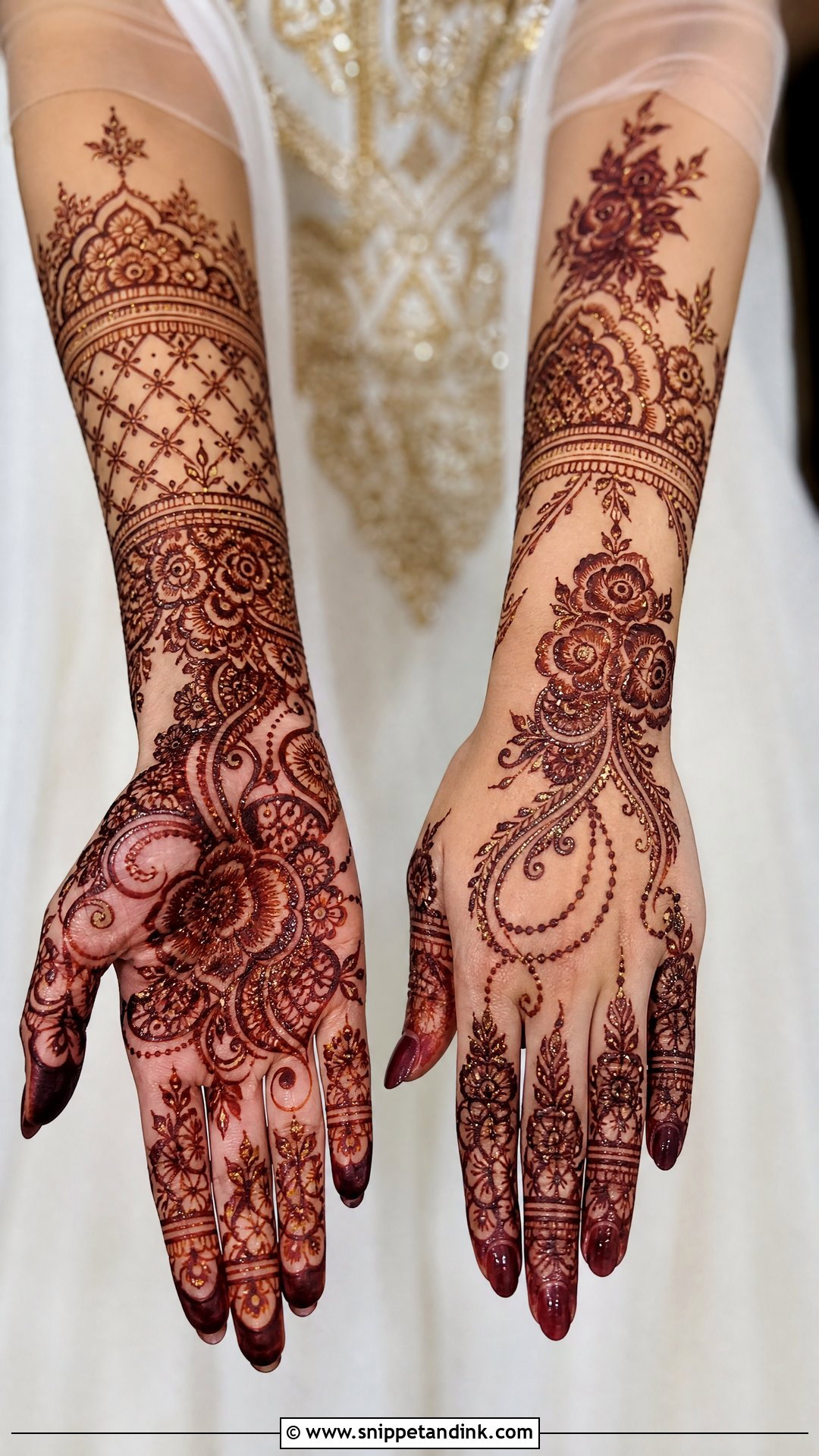
Glitter is a party add-on, not a substitute for henna. I draw the full design in natural henna first, with Arabic flowers, paisleys, vines and bracelet patterns, and only add glitter along selected outlines, dots or gaps afterwards, using cosmetic-grade glitter and a skin-safe adhesive. Gold, bronze and maroon sit best with Dubai patterns. Use it lightly. Too much glitter hides the line work, and it all comes off within a day anyway, leaving the henna stain underneath.
Why the Forearm Never Matches the Fingertips
Once a full hand stains, you’ll see a gradient: fingertips and palms darkest, the back of the hand a little lighter, and the forearm lightest of all. That’s not a bad batch of henna. Thicker, warmer skin takes the dye more deeply, and the inner forearm has the thinnest skin on the arm.
I plan full-hand designs around that gradient rather than fighting it:
- Bolder shapes higher up. Fine jaali on the forearm can fade to a faint orange, so I use larger flowers and thicker lines above the wrist.
- Longer paste time. Leaving the paste on the forearm overnight, sealed lightly, gives it the best chance of catching up.
- Gentle heat. Warming the arms afterwards, by sitting near a heater or wearing a loose cotton layer, helps the colour develop.
Fading follows the same pattern in reverse. Palms and fingers lose colour soonest through washing, while the forearm usually holds on longest even though it started lighter. Expect a full-hand design to look its richest two days after application and to soften gradually over the following week or two.
Which Hand Gets the Most Detail?
These full-hand layouts range from Arabic flowers and bold Khaleeji vines to bridal paisleys, mandala centres, jaali, jewelry chains and Moroccan geometry. The right one depends on your outfit, how much time you can give the sitting, and how you’ll use your hands that week. For a wedding, fuller patterns with strong outlines photograph well and last. For Eid or a party, airy florals, bracelet layouts or modern trails are quicker and easier to live with. Give your artist one or two clear reference photos rather than twenty, and tell her honestly how long you can sit still.
You'll Like These Ideas:










Leave a Reply