
Full back hand mehndi designs are the side guests actually see. Palms take the darker stain, but the back of the hand is what rests on a lap in photos, holds a bouquet and sits under every ring and bangle. That changes how I plan a layout: the wrist has to meet the bangles cleanly, the knuckles have to bend without cracking the paste, and the fingers need enough open skin for the stain to read from across a room. Below are thirty layouts, from dense Rajasthani bridal work to open Arabic trails and Moroccan geometry, with notes on how each one behaves once it’s on skin.
Why Your Knuckles Will Never Match Your Palms
Almost every bride notices it on day two: palms turn deep maroon while the backs of the hands settle a shade or two lighter. Henna stains the outer layer of skin, and the palm and fingertips have a thicker, warmer outer layer that holds more dye. The back of the hand is thinner, cooler and moves more, so the same paste gives a softer colour there. That isn’t a fault in the cone, and it shapes how I design.
On the back I use firmer outlines and more contrast between filled and open areas, and I never rely on hairline filler to carry the design. A layout that looks rich on a phone screen can come out grey and blurry on skin if every line is thin.
Prep that helps the colour
- Wax or shave hands and fingers a day or two before, never after. Hair removal over a fresh design strips the stained top layer and fades it.
- Arrive with clean, dry hands and no lotion, oil or sunscreen. Anything left on the skin sits between the paste and the dye.
- Keep your hands warm. Cold hands stain weakly, so I’d rather you sit somewhere cosy with a hot drink before we start.
- Book any manicure before mehndi day. Acetone and long soaks will lighten fresh colour on the fingertips.
1. Full Back Hand Bridal Mehndi Design
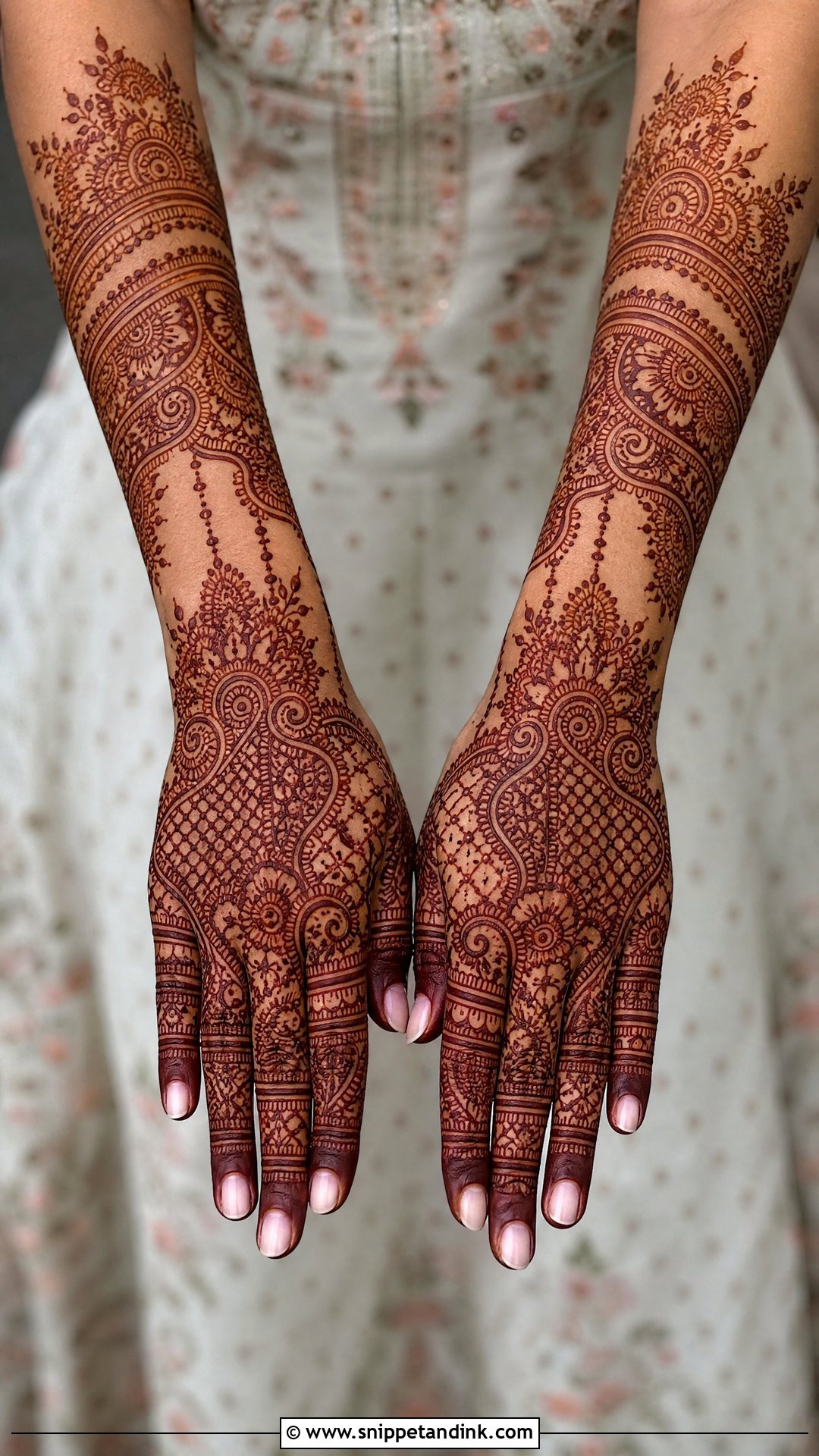
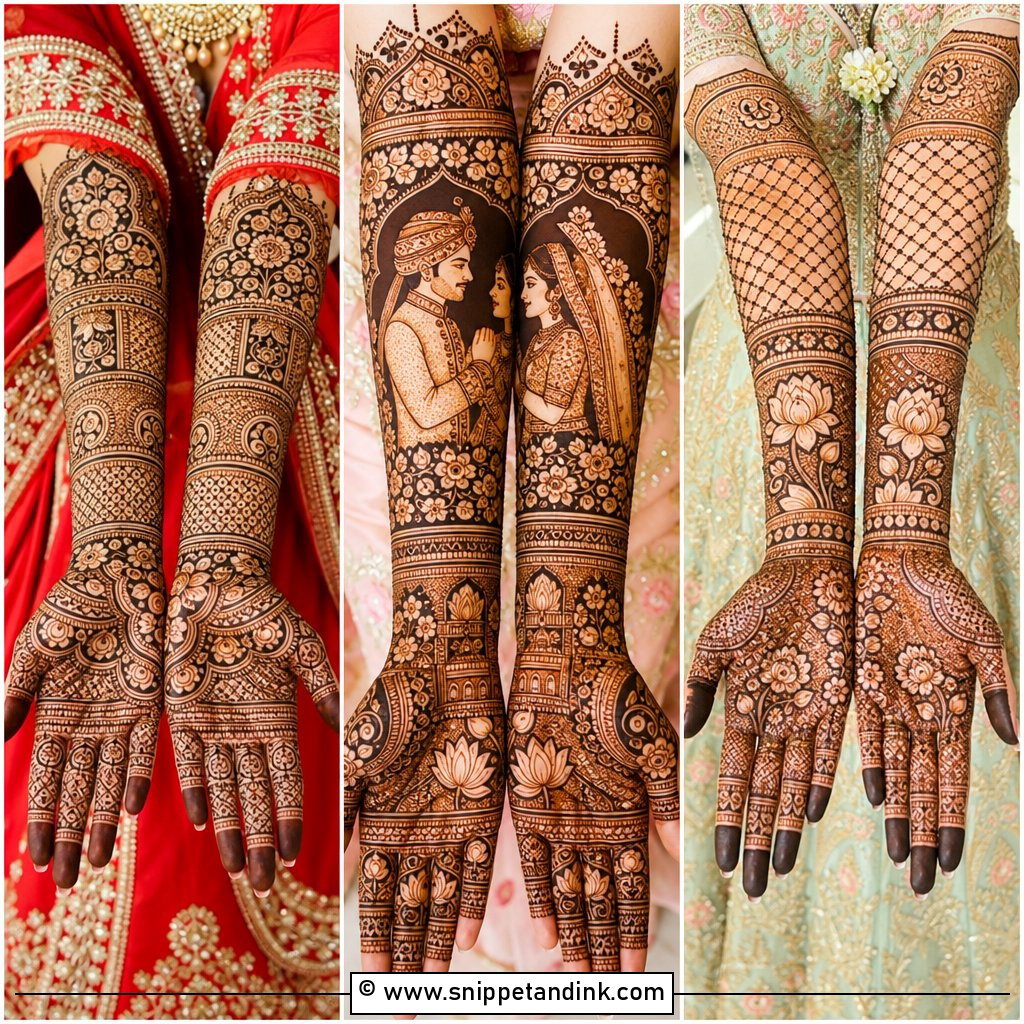
Dense bridal back hands are where planning matters most. I start with the wrist cuff, set the central motif on the flat area just above the knuckles, and only then fill the fingers, because the fingers decide how tall the whole design can go. Paisleys, small leaves, jaali and shaded bands all fit here, but I leave thin channels of bare skin between the big shapes. Without them, a deep maroon stain merges into one dark patch and the detail you sat for disappears in close-ups.
2. Full Back Hand Arabic Mehndi Design
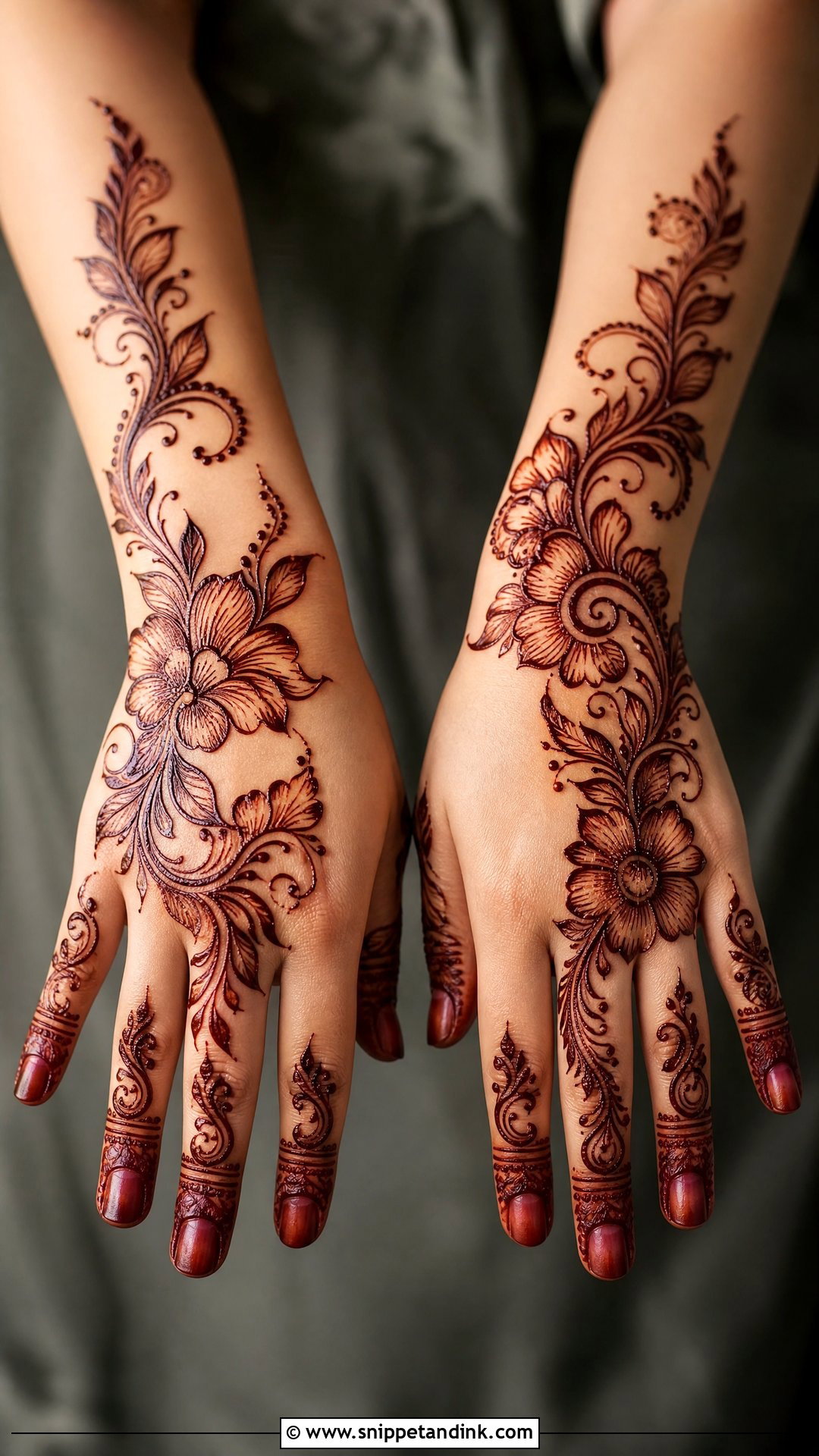
Arabic work is all about the diagonal. One trail of large flowers and leaves runs from the outer wrist toward the index finger, and the rest of the hand is left open on purpose. Because the shapes are bigger, I lay the paste a little thicker, which helps on the back of the hand where skin takes colour less readily than the palm. It’s my usual suggestion for anyone who wants full visual coverage in a short sitting, and it carries just as well to Eid and festive gatherings as to a wedding.
3. Full Back Hand Indian Mehndi Design
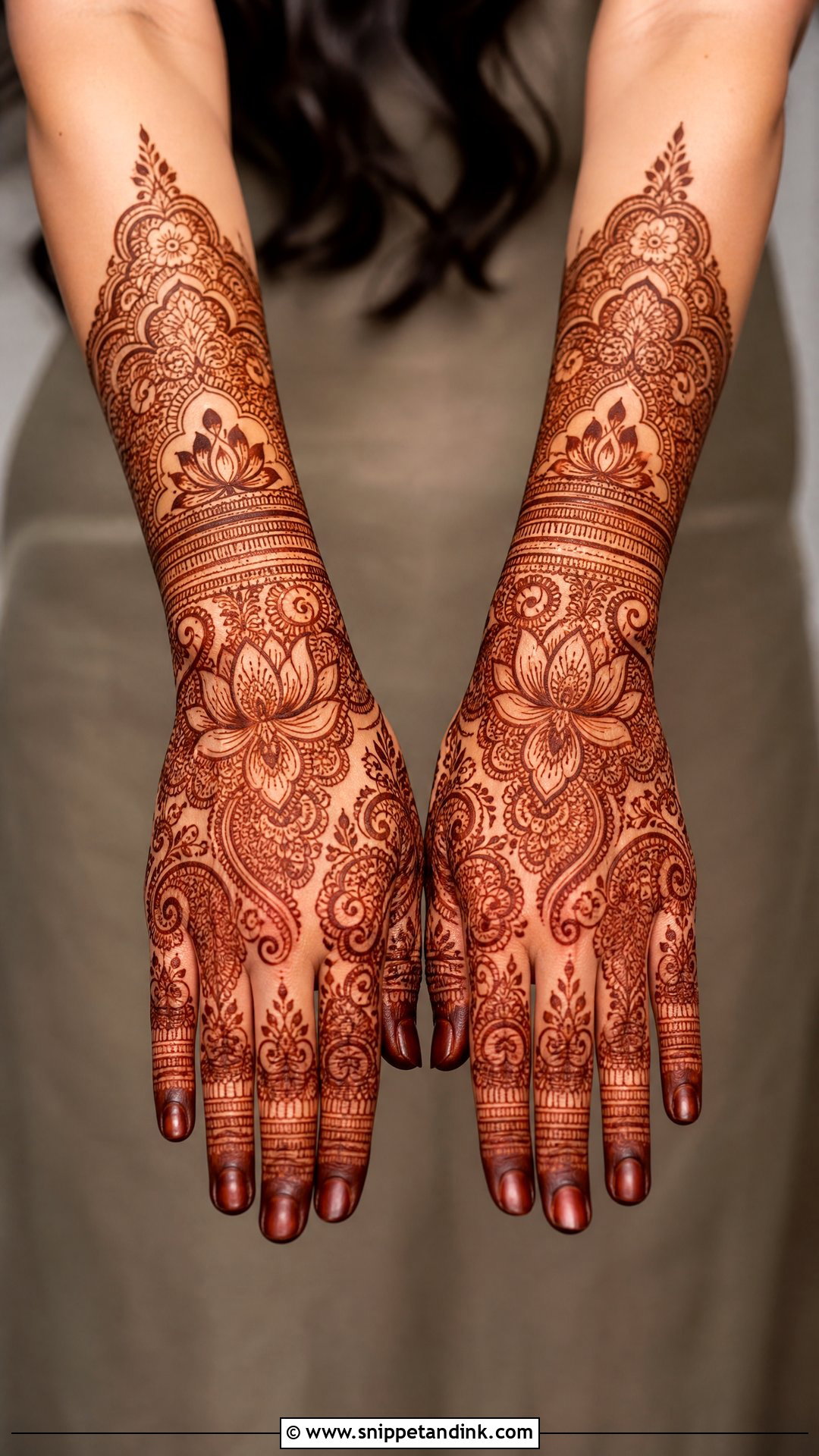
Indian back hands are built in layers from the wrist up: a border, a band of paisleys or lotus forms, a central circle or peacock, then the fingers. The risk is giving every layer equal weight. I pick one bold element and keep the rest in fine filler strokes so the eye has somewhere to land. On the fingers I go slightly sparser than on the hand itself, since fingertips stain darkest of anywhere and dense work there can turn almost black.
4. Full Back Hand Indo Arabic Mehndi Design
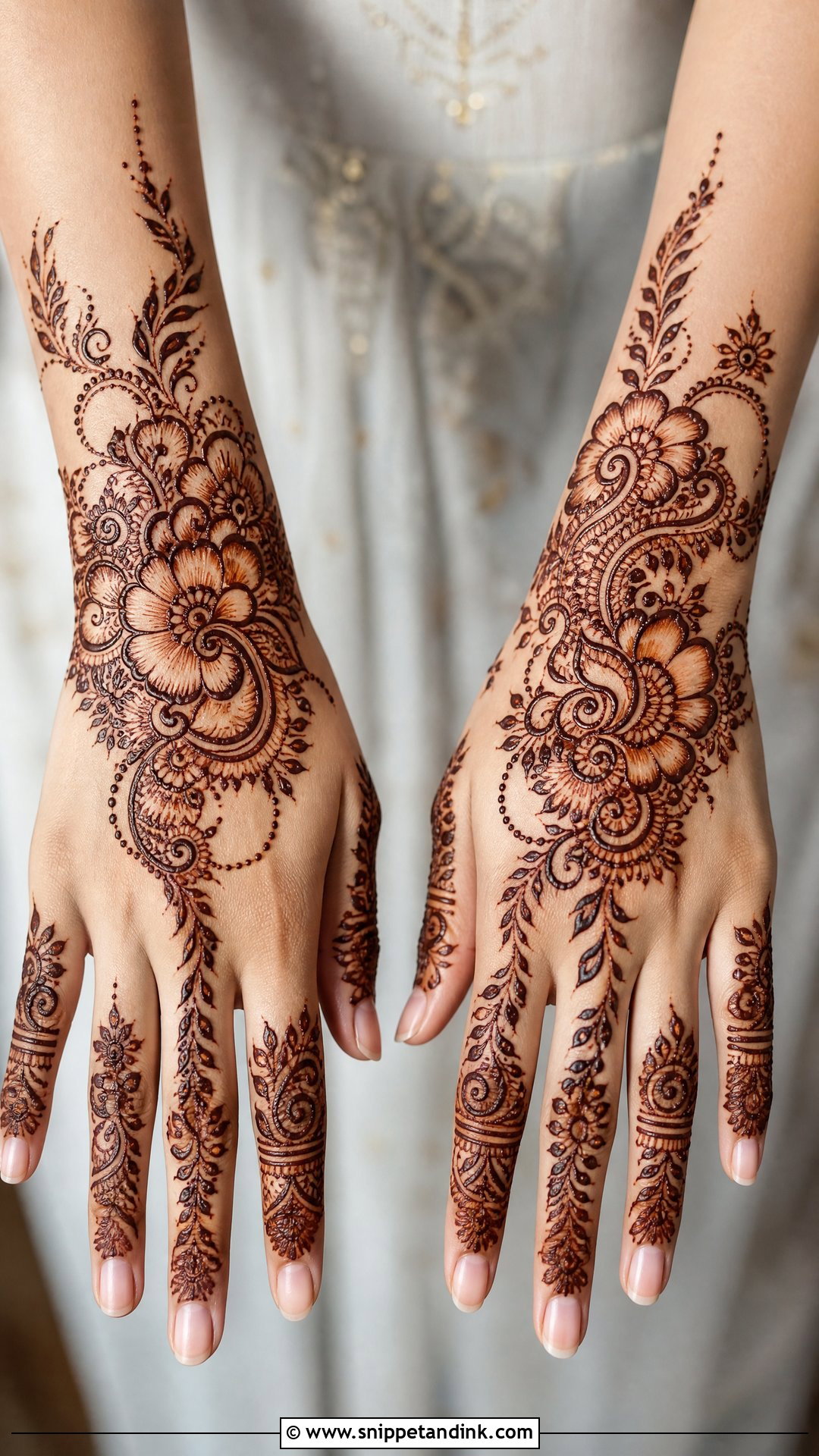
Full back hand Indo Arabic mehndi borrows the fine fillings of Indian work and the open skin of Arabic trails. In practice that means a flowing floral path with paisley clusters along it, each one filled with detail, and clear gaps around them. I like it for sisters of the bride and bridesmaids, because it looks festive next to a heavily covered bride without competing with her. A bracelet-like cuff and coordinated finger bands are what make it read as a full hand rather than a single trail.
5. Full Back Hand Mandala Mehndi Design
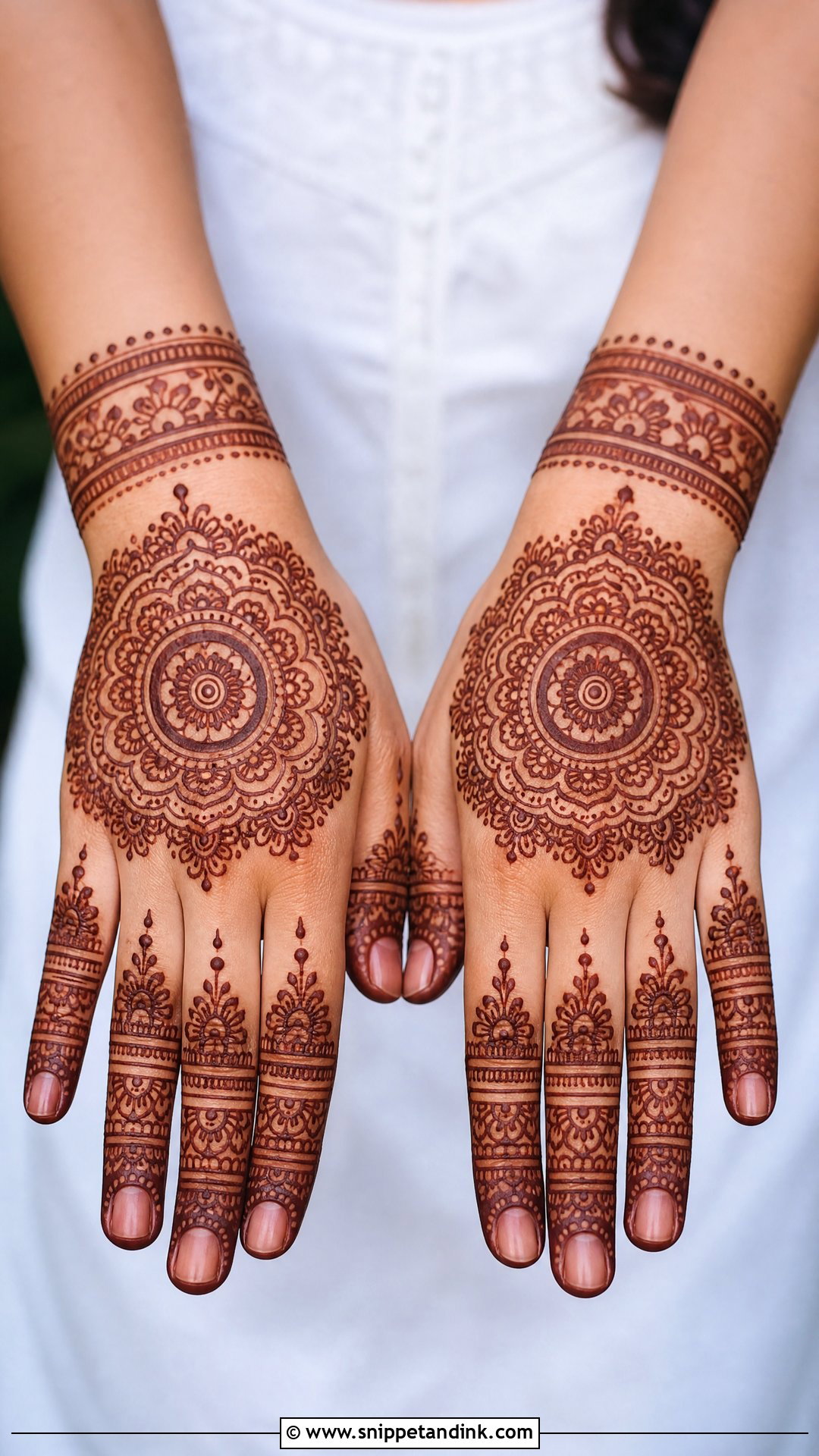
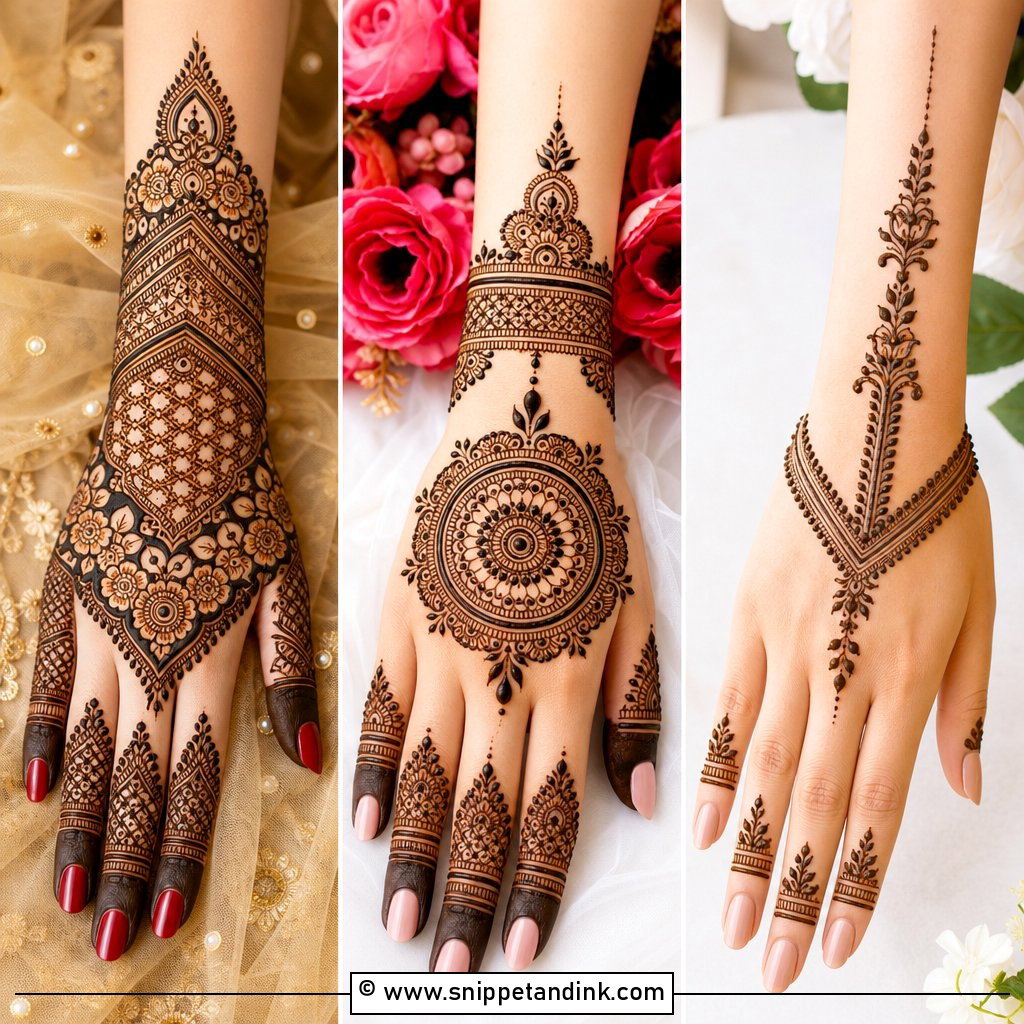
A mandala sits naturally on the back of the hand because the area between the wrist bone and the knuckles is close to flat. I place its centre a little toward the knuckles rather than dead middle; when the hand relaxes and curves slightly, that’s where the circle looks round instead of stretched. On its own a mandala looks unfinished, so I always carry it into a wrist cuff and the fingers. Brides who prefer symmetry over storytelling motifs tend to gravitate to this one.
6. Full Back Hand Floral Mehndi Design
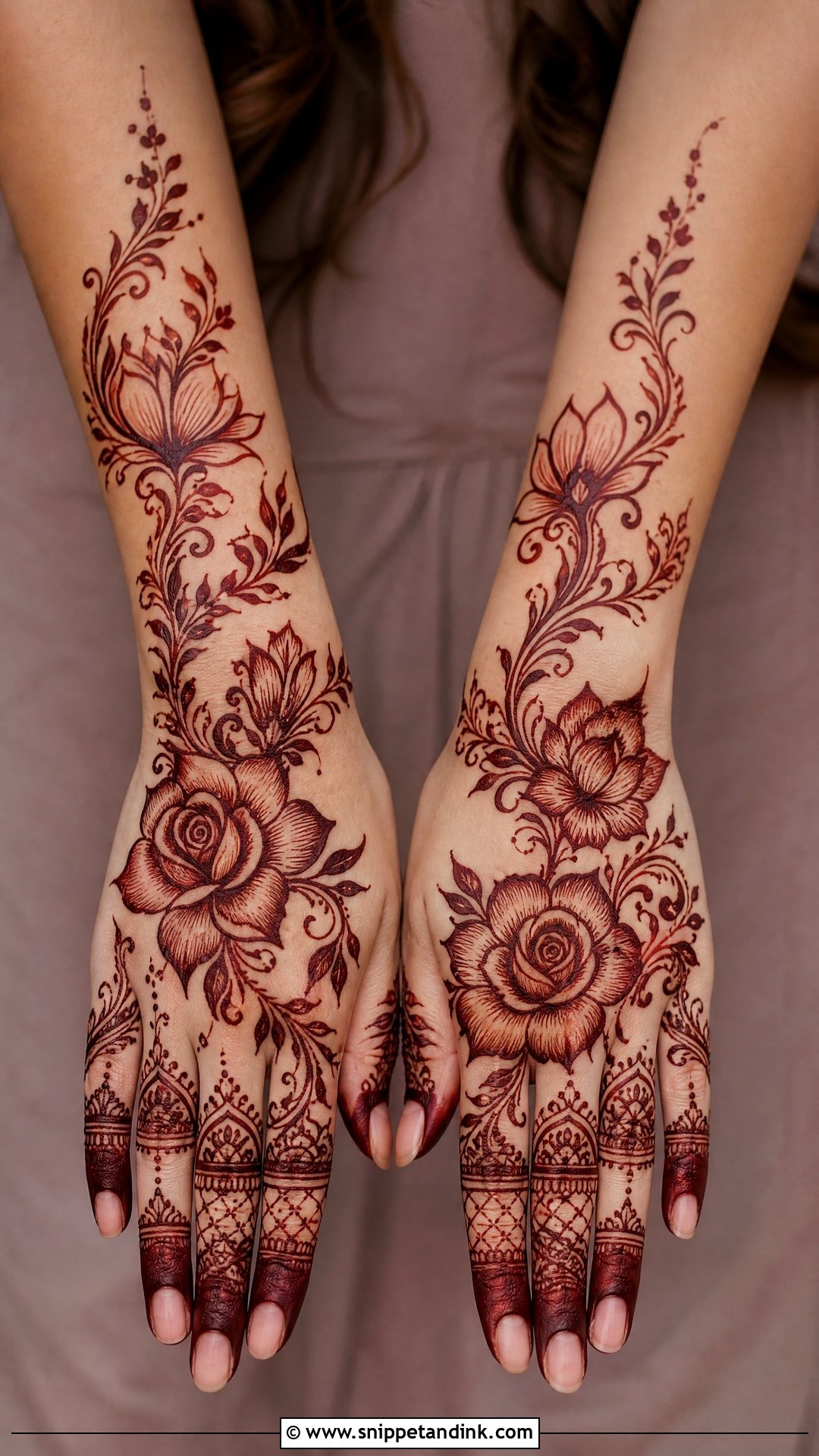
Florals scale better than any other motif, which is why I reach for them when hands are small or fingers are short. On a petite hand I draw fewer, larger roses or lotus blooms. On a long hand I add a trailing vine toward the index finger to fill the length. Narrow gaps between petals give a modern feel, while paisley fillers and dots pull it back toward tradition.
7. Full Back Hand Paisley Mehndi Design
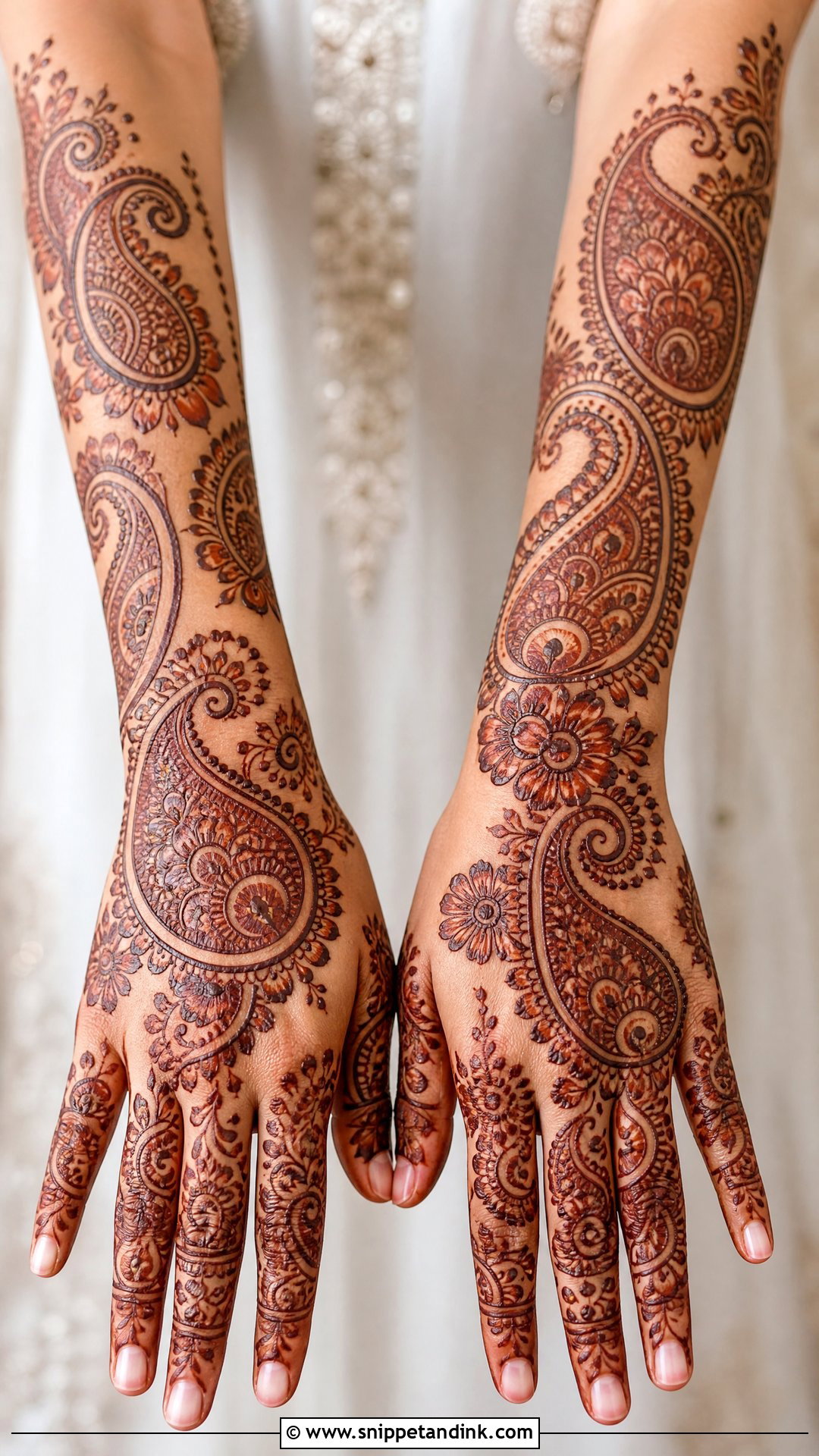
Paisleys, often called mango or keri motifs, follow the curve of the hand, so they never fight its movement. My usual full version opens with one large paisley near the wrist and shrinks the shapes as they travel toward the fingers, which visually lengthens the hand. I keep each outline slightly thicker than its filling. Fine lines dry and flake first, and a firm outline holds the shape even if some of the filler stains faintly.
8. Full Back Hand Jaali Mehndi Design
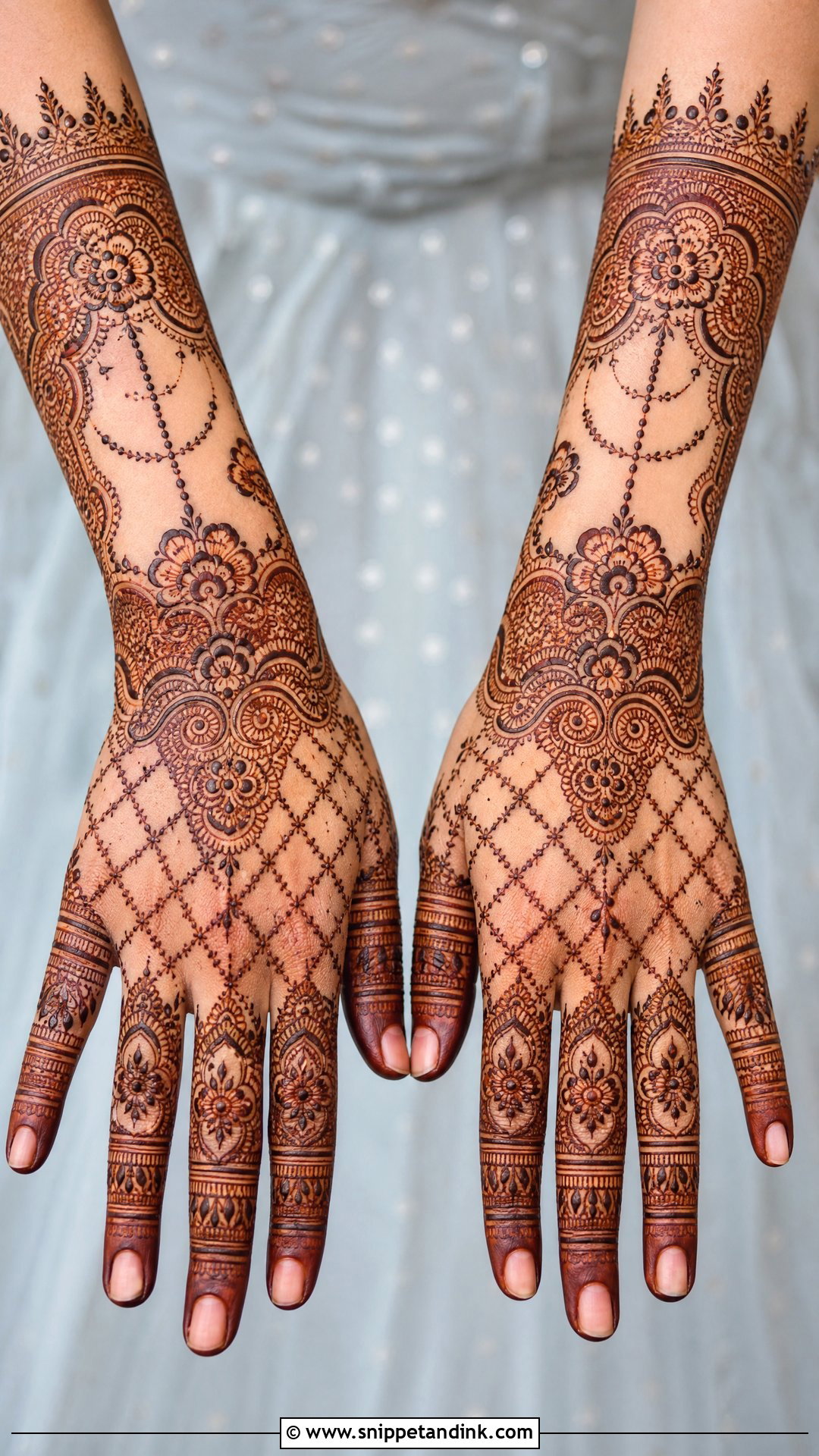
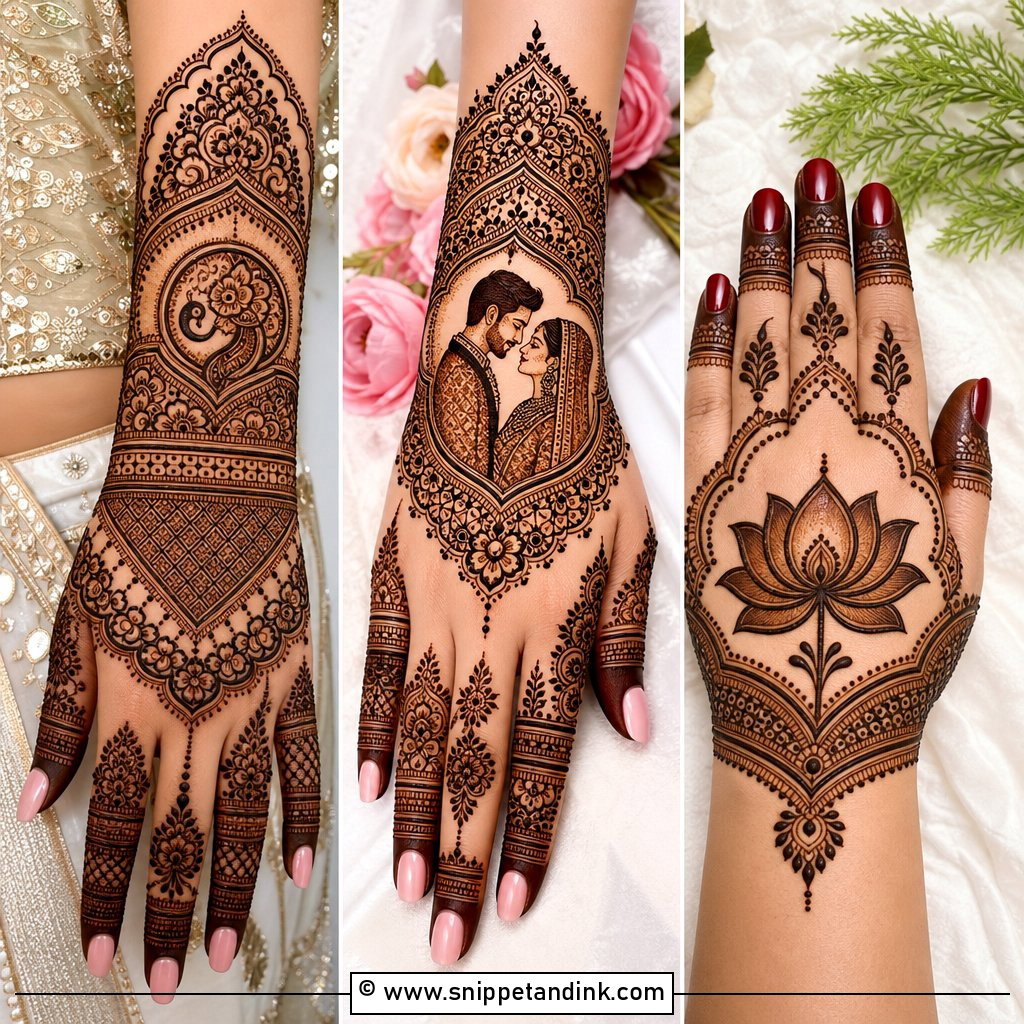
Jaali is the least forgiving pattern on this list. A net only looks crisp when the lines are evenly spaced and the same thickness, and one wobbly cross-line shows straight away in a close-up. I keep jaali to defined panels, such as the centre of the hand, the cuff or alternate finger sections, and frame each panel with florals or paisleys. With rings on, the mesh reads almost like lace. If your artist works fast and loose, I’d pick a floral layout instead.
9. Full Back Hand Peacock Mehndi Design
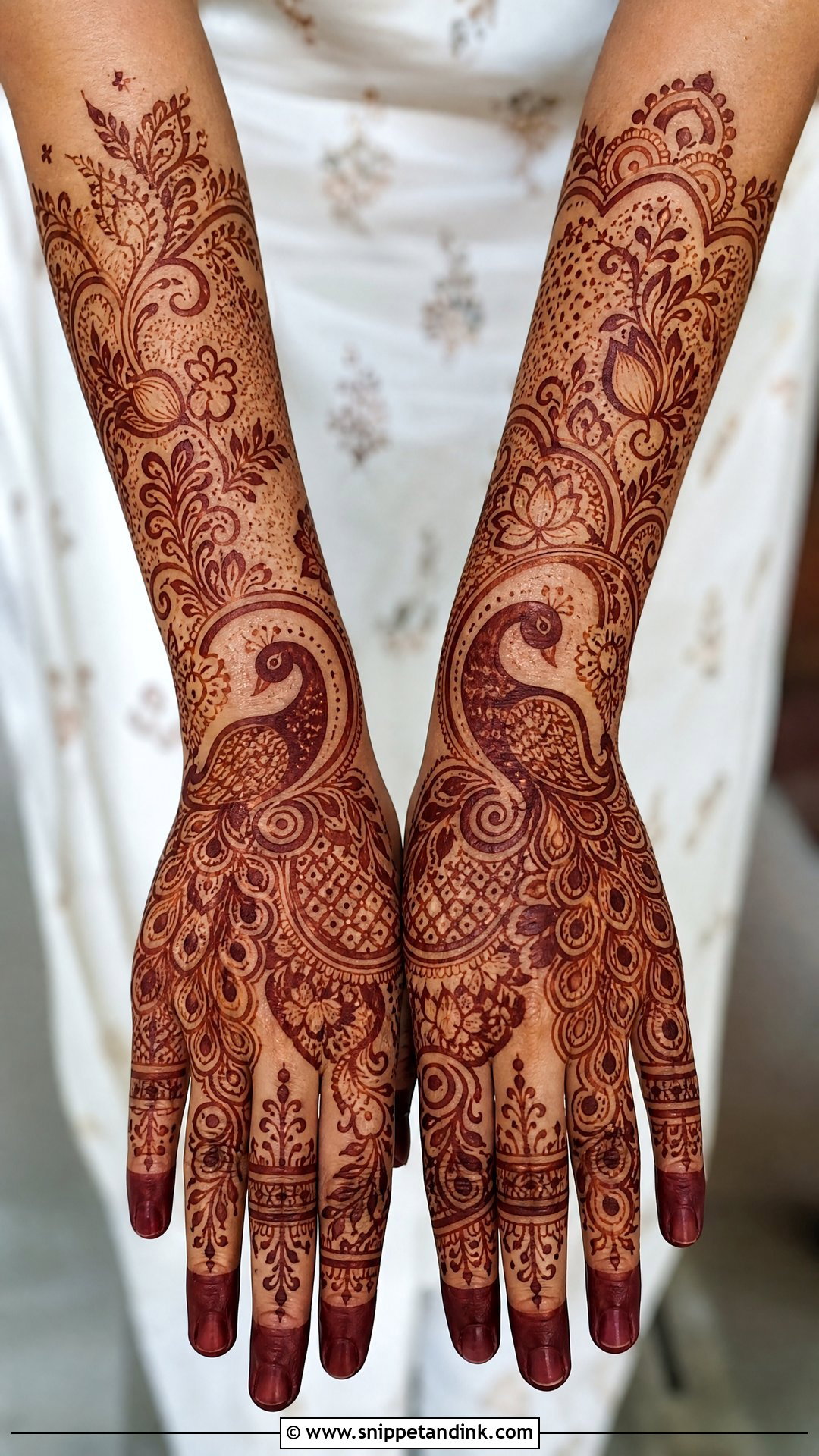
A peacock needs room for its neck and tail, so I decide early whether it sits at the wrist, along the outer edge of the hand or in the centre with feathers fanning toward the fingers. The body outline should be bold and the feather eyes delicate; reverse that and the bird turns into a blob once it stains. I tie the tail into floral vines and paisley borders, then finish the fingers with small feather strokes so the motif never floats on its own.
10. Full Back Hand Rose Mehndi Design
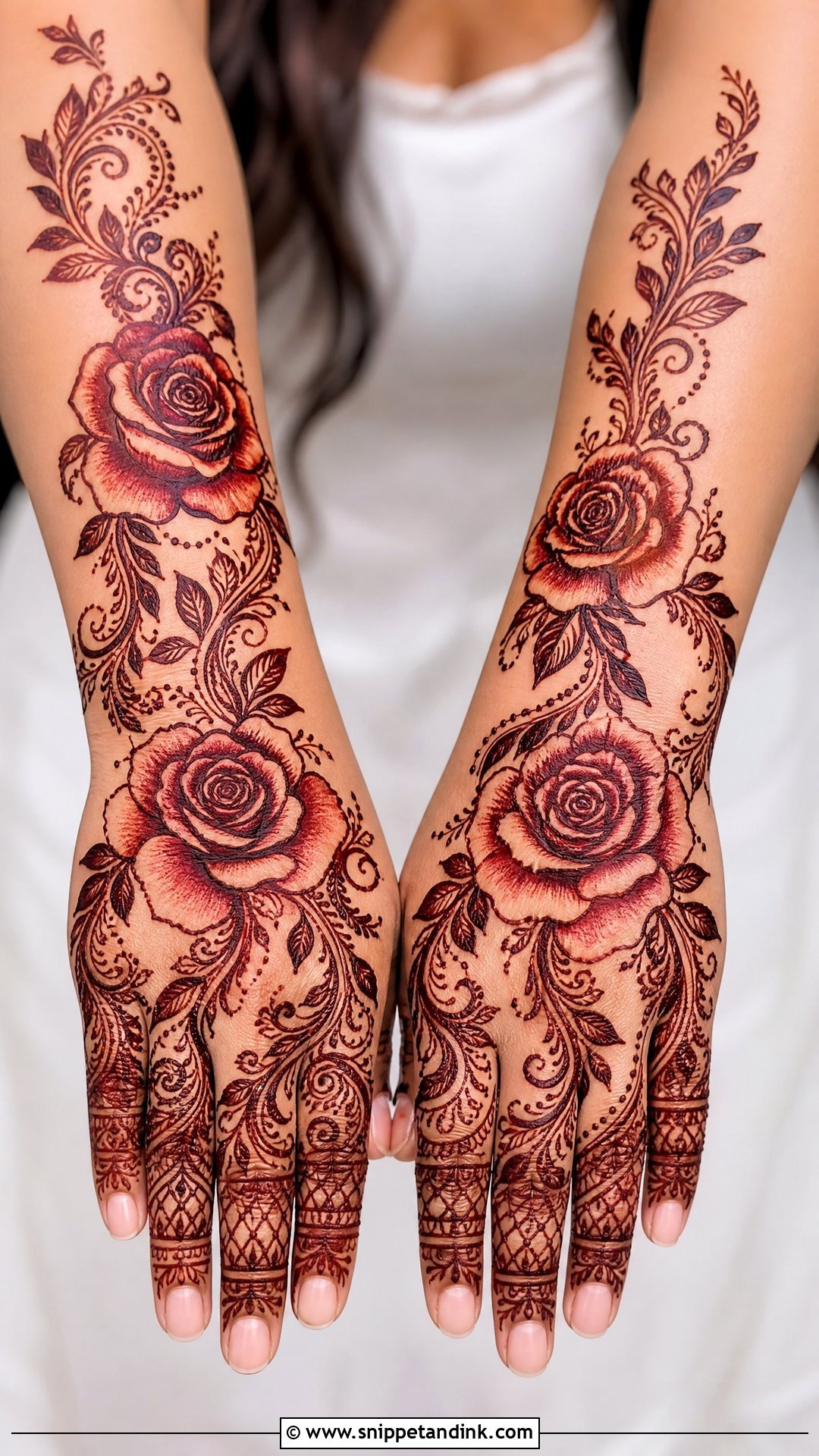
Roses live or die by shading. A flat outlined rose looks like a plain circle after staining, while a few strokes of thinned paste at the base of each petal give it depth. I put two or three large roses across the centre, trail smaller buds and leaves toward the wrist and fingers, and stop there. The rounded petals soften an angular or bony hand, so I often suggest it to younger brides and bridesmaids who want florals rather than dense traditional work.
11. Full Back Hand Lotus Mehndi Design
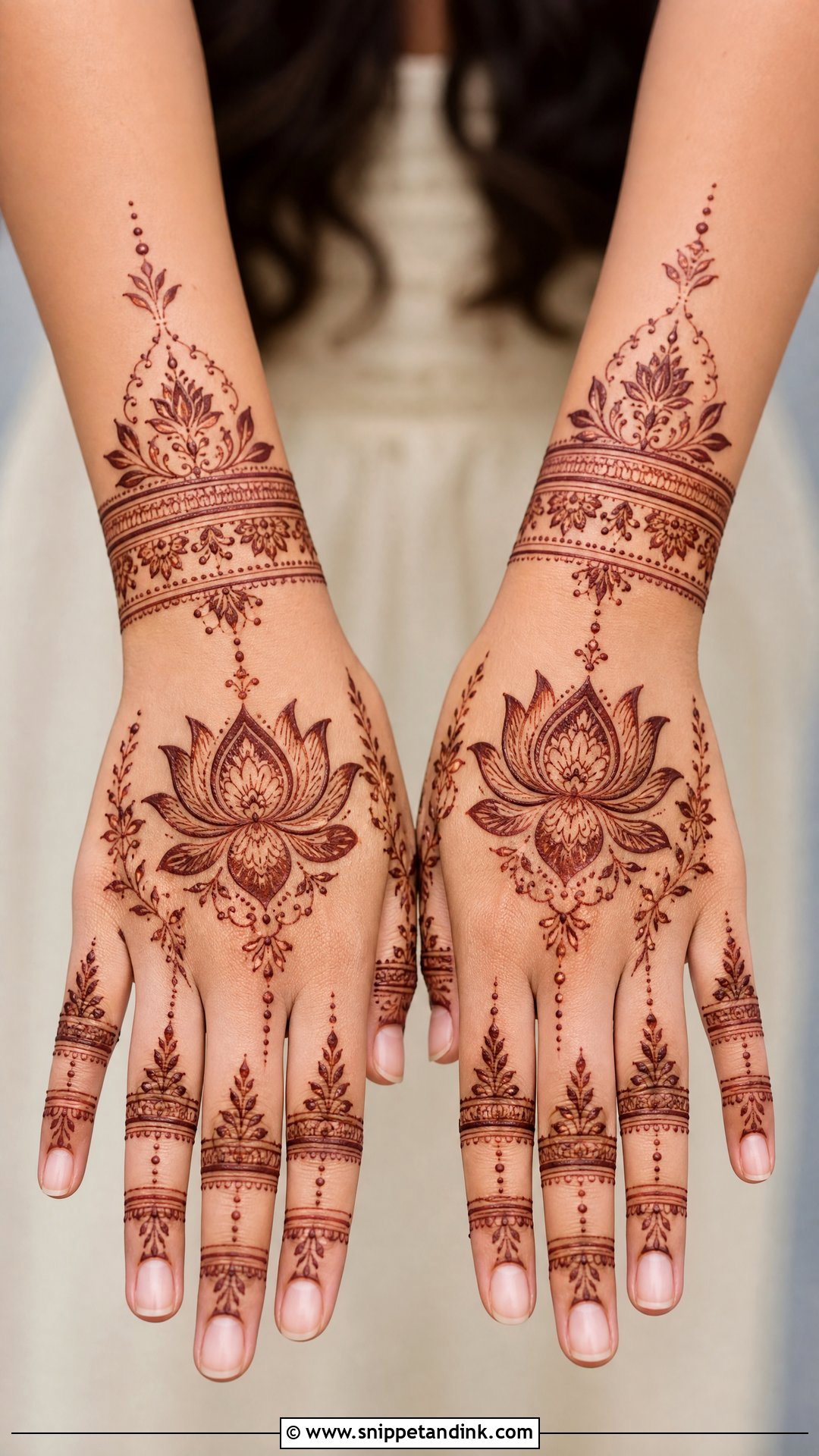
Layering is how I approach a lotus mehndi design on the back of the hand: an open lotus at the centre, half-open buds stepping up toward the fingers, and a cuff below. Lotus petals are long and pointed, so they stretch nicely along the length of the hand. I add fine lines inside each petal and a dotted outline instead of heavy filler, which keeps it light. It carries real cultural weight at weddings, pujas, Diwali and Karwa Chauth.
12. Full Back Hand Jewelry Mehndi Design
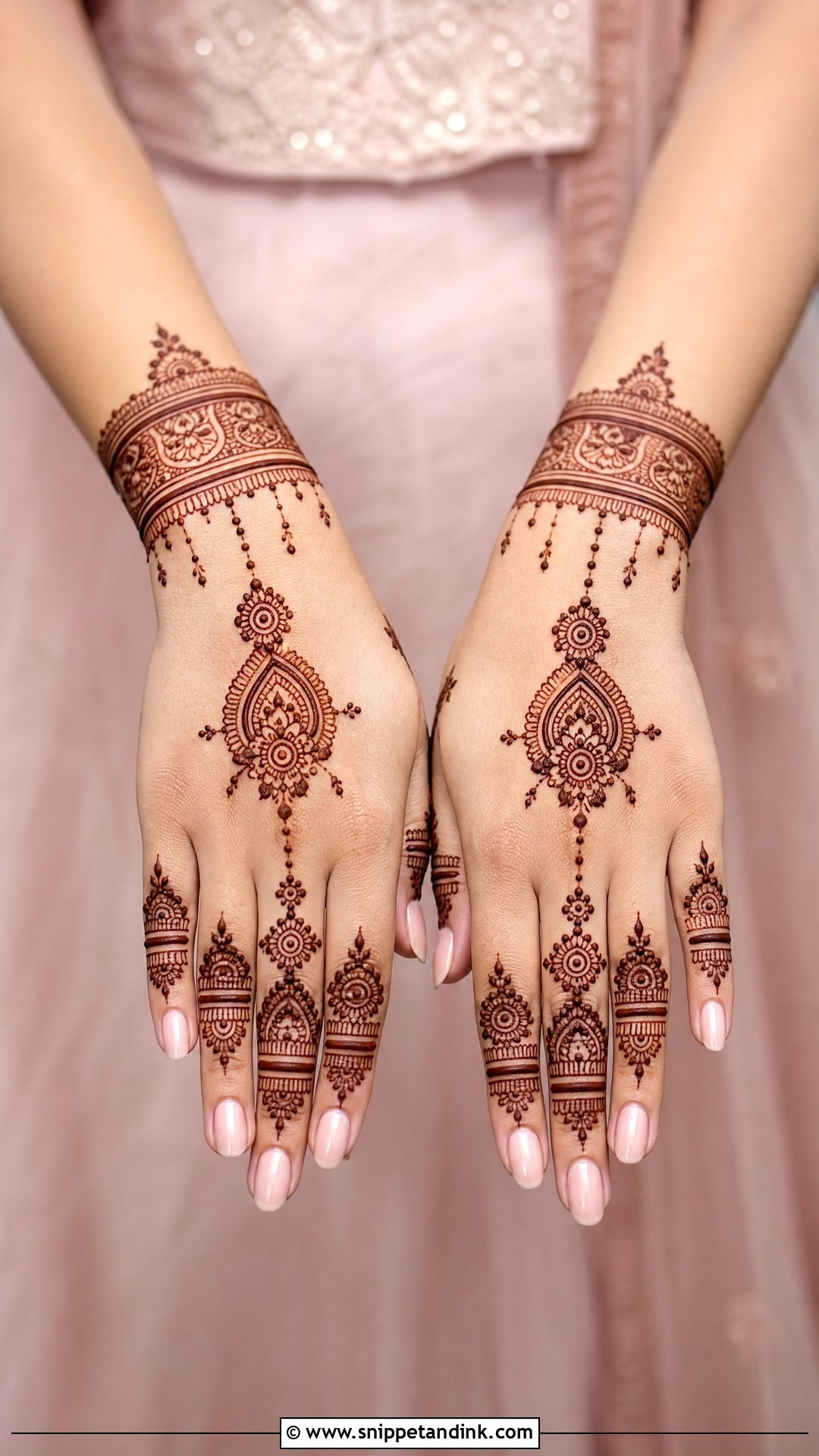
Jewelry mehndi imitates a hathphool: a ring on each finger, chains running to a pendant in the centre, and a bracelet cuff at the wrist. Spacing the chains evenly is the whole skill, because one chain drifting a few millimetres makes the hand look crooked. I fill the leftover skin lightly with dots or fine mesh so it stays a drawn ornament and not a crowded pattern. It sits naturally under real bangles at engagements and sangeet nights.
13. Full Back Hand Bracelet Mehndi Design
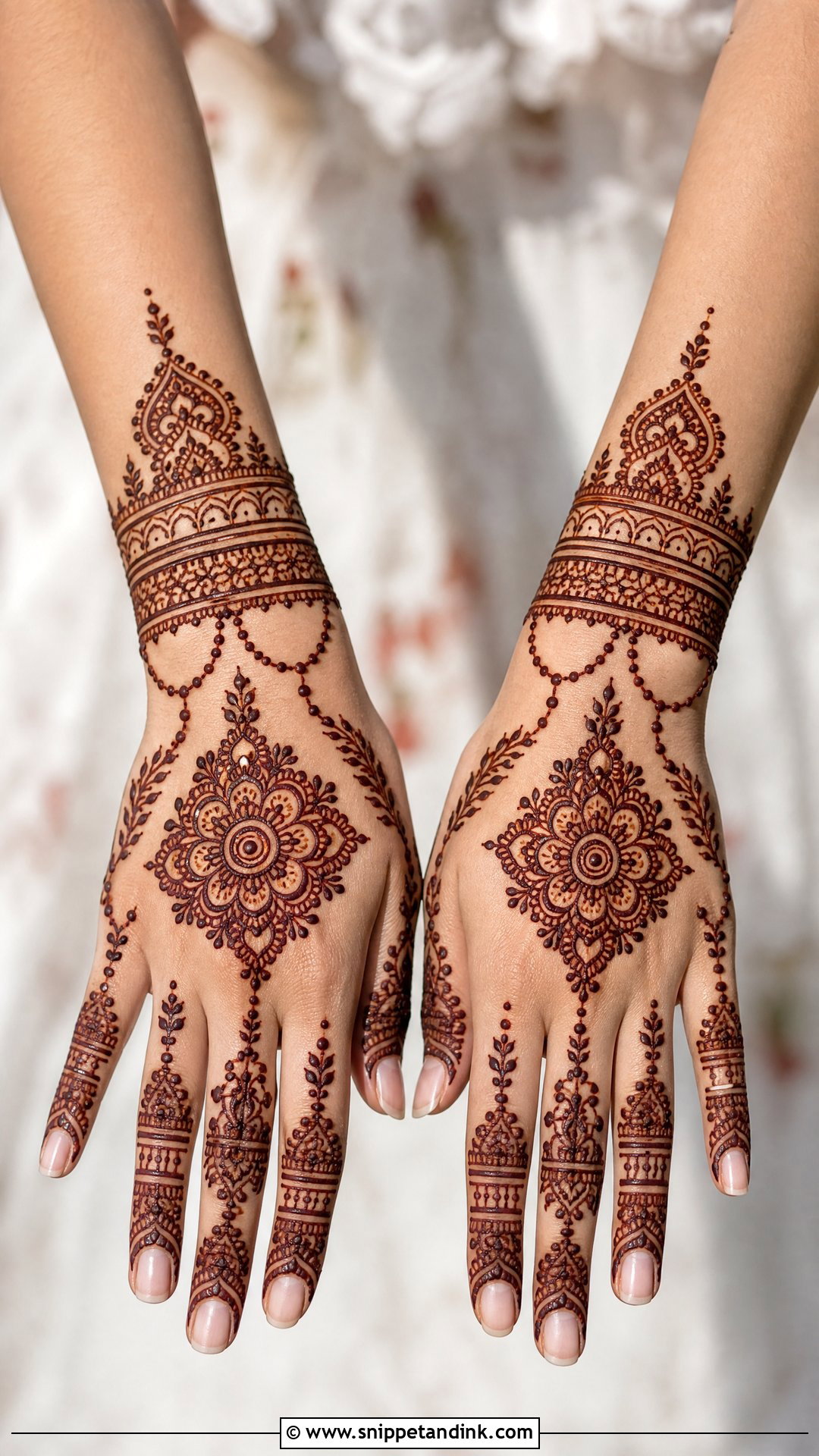
Here the wrist is the star. I draw the cuff to look like a bangle, a lace band or stacked bracelets, then connect it to a mandala, flower or paisley cluster on the hand with dotted chains. One practical point: if you’ll wear a lot of glass or metal bangles, the cuff ends up partly hidden under them, so I make it a little wider than usual so some of it shows past the stack. Matching finger bands or leafy tips finish it off.
14. Full Back Hand Finger Mehndi Design
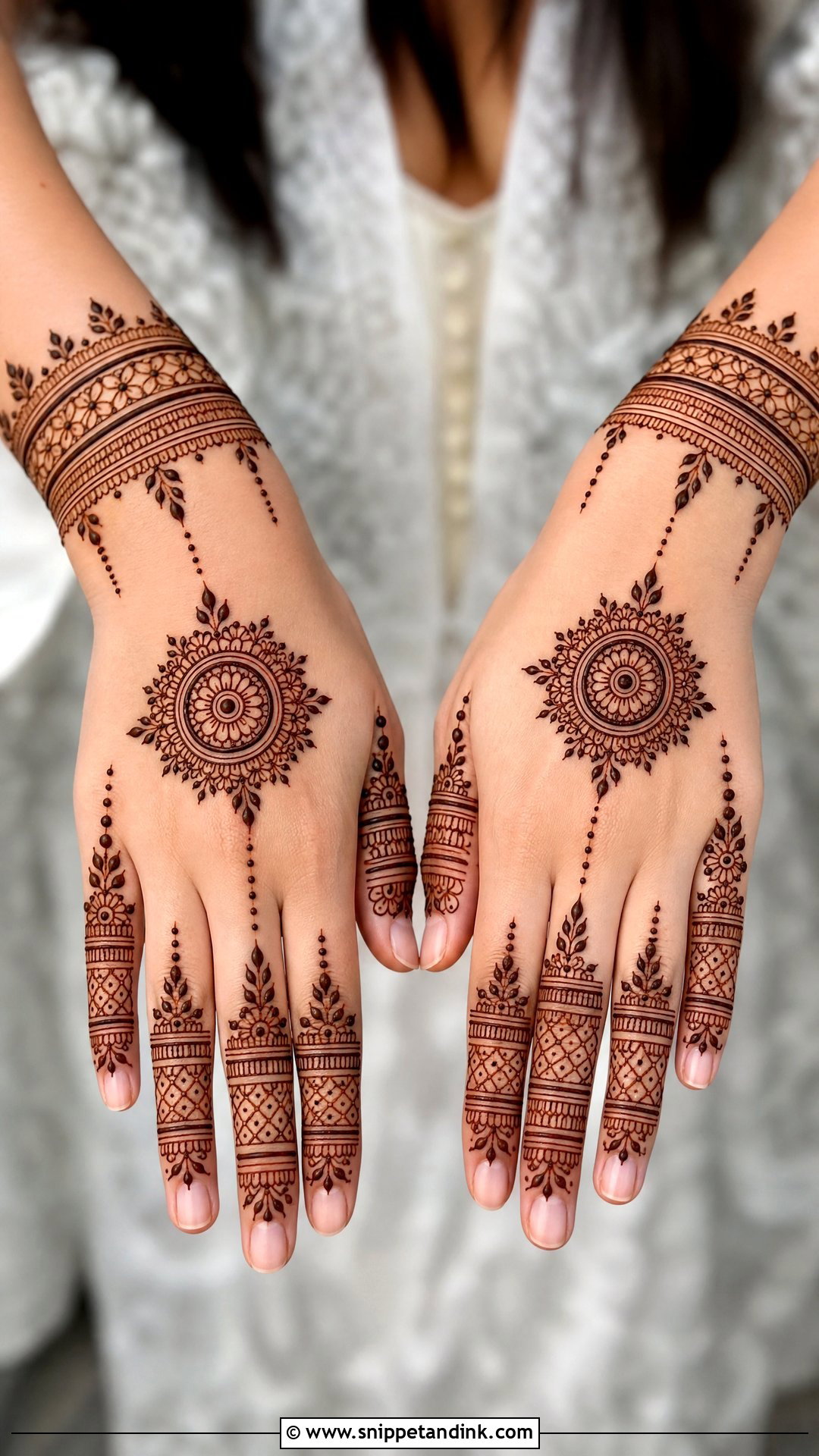
Most of the detail in this layout goes on the fingers: bands, leafy trails, small geometric sections, mesh and shaded tips. The centre of the hand stays lighter or carries one mandala or flower. Fingers bend constantly, so I avoid heavy filled blocks right over the knuckle creases, where dried paste cracks and flakes first and leaves gaps in the stain. Fine connecting lines down to the wrist keep it reading as one piece in ring photos.



15. Full Back Hand Simple Mehndi Design
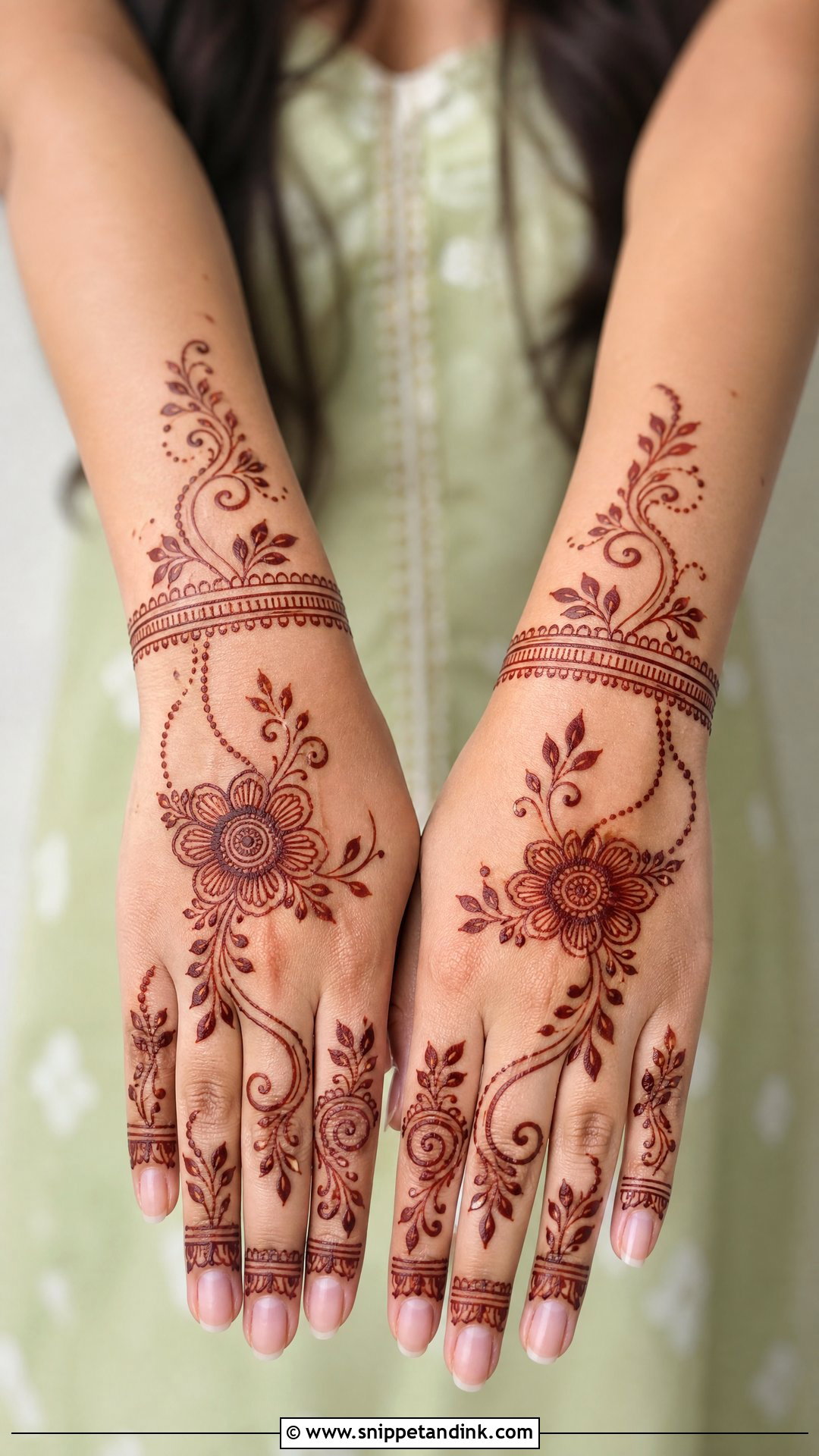
Simple doesn’t mean sparse. A central flower, curved vines, finger bands, a dotted trail and a small wrist cuff still cover the visible hand; they just leave more open skin. I keep outlines bold and drop most of the tiny fillers, because on the back of the hand fine filler often stains faint and makes a simple design look unfinished. It’s what I suggest for college events, small family functions and anyone short on sitting time.
16. Full Back Hand Easy Mehndi Design
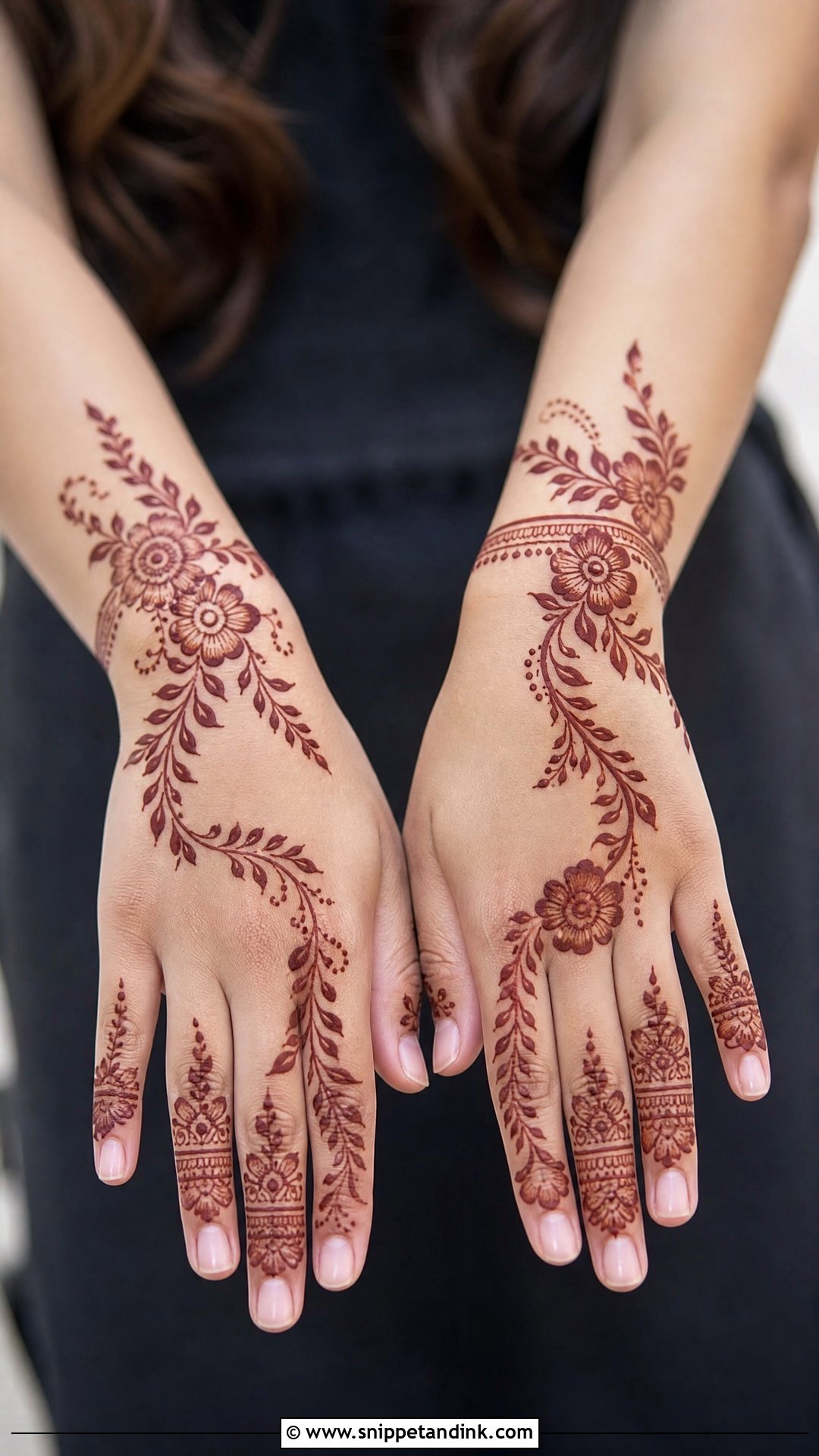
Easy layouts rely on shapes you can repeat without thinking: a five-petal flower, a teardrop leaf, a row of dots, a curved line. If you’re applying at home, start with a small cuff, run a floral trail through the centre, then give each finger the same simple detail. Keep motifs medium-sized, since tiny ones need a fine cone tip and steady pressure, and that’s exactly where beginners smudge. Self-applying, I’d do the hand you don’t write with first while your drawing hand is fresh, then keep the second hand’s design even simpler.
17. Full Back Hand Modern Mehndi Design
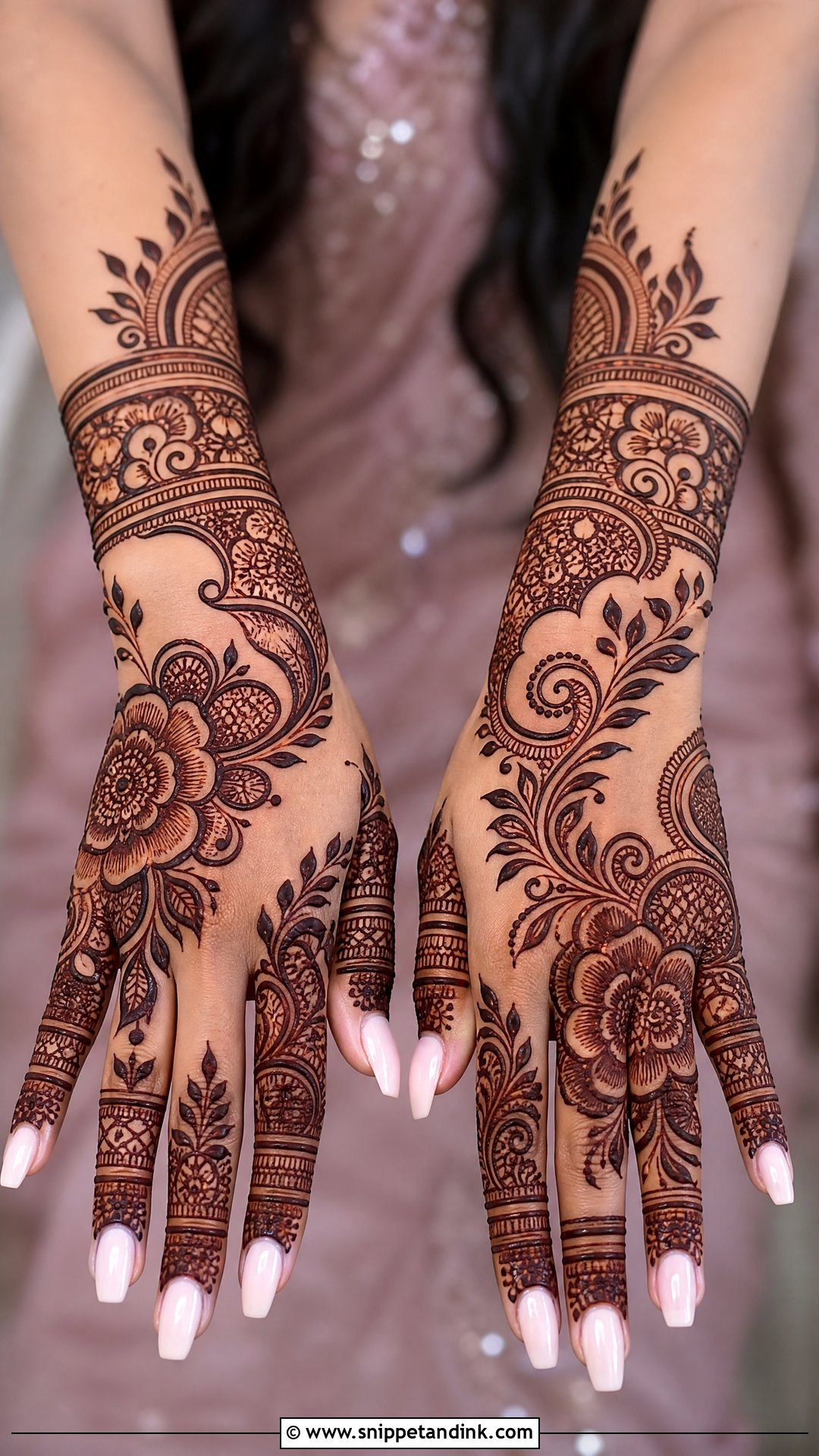
Modern back hands treat bare skin as part of the design. Abstract curves, large florals, a sharp cuff and finger bands sit around deliberate open stretches. One strong focal point is enough, with everything else flowing away from it toward the wrist and fingers. I keep the lines smooth and confident, because a shaky line is far more obvious in an open layout than buried in dense filler.
18. Full Back Hand Minimal Mehndi Design
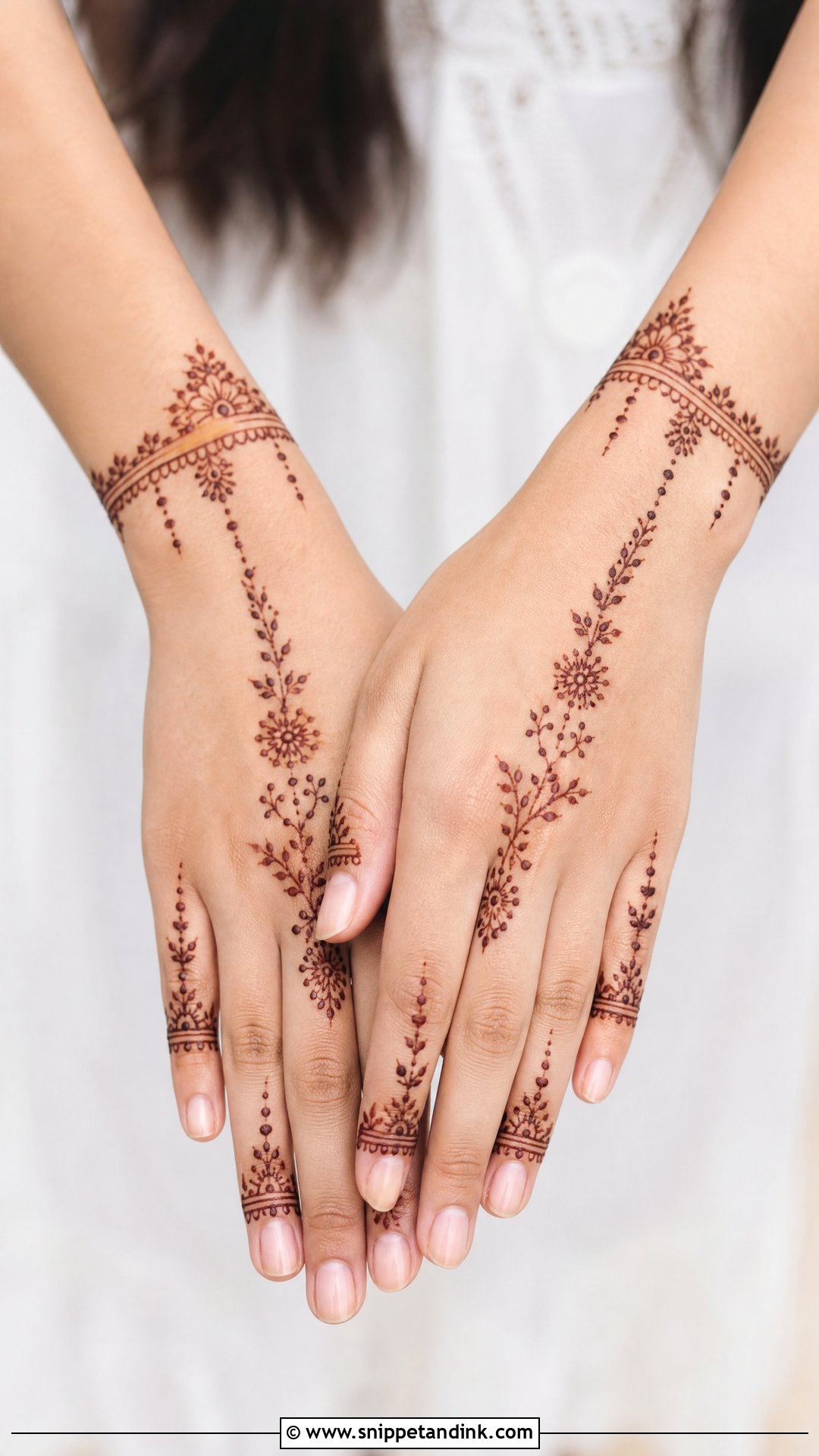
Minimal designs show every line, so each stroke has to look intended. Fine vines, small florals, slim finger bands and a light wrist border are usually all I use. The catch is colour: thin lines on the back of the hand can come out pale orange, so I ask clients to keep the paste on as long as they can and avoid washing for the first day. Shorter hands carry minimal work well because it doesn’t swamp the fingers.
19. Full Back Hand Heavy Mehndi Design
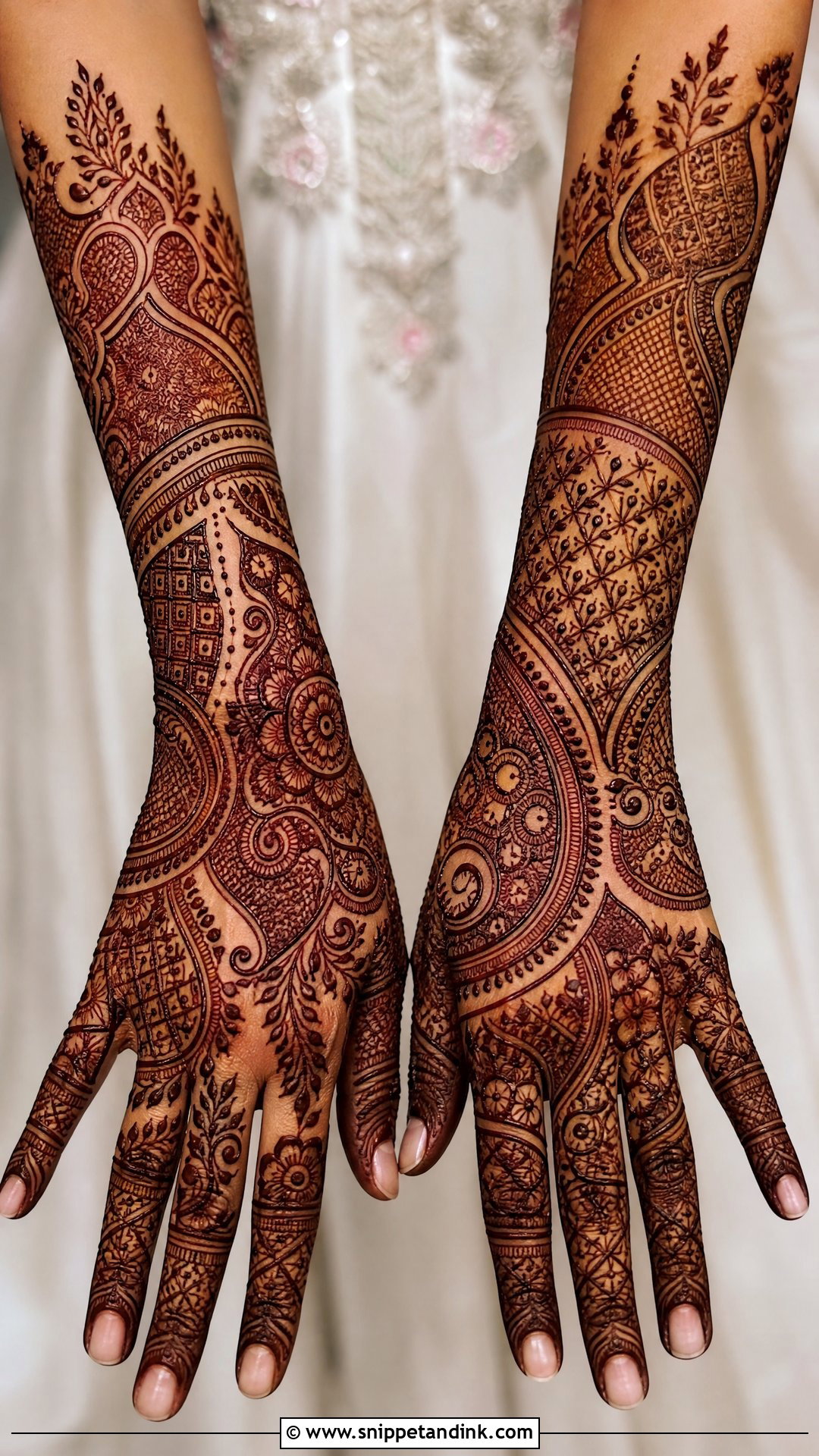
Heavy back hands cover everything, from dense paisleys and jaali to fully worked fingers, often running into a forearm cuff. This is where I see the most disappointment, and it’s rarely the henna’s fault. Without bold outlines around the main motifs and small pockets of bare skin, a dark maroon stain flattens the whole hand into one colour. Expect a long sitting for both hands, and don’t plan anything else for that afternoon.


20. Full Back Hand Shaded Mehndi Design
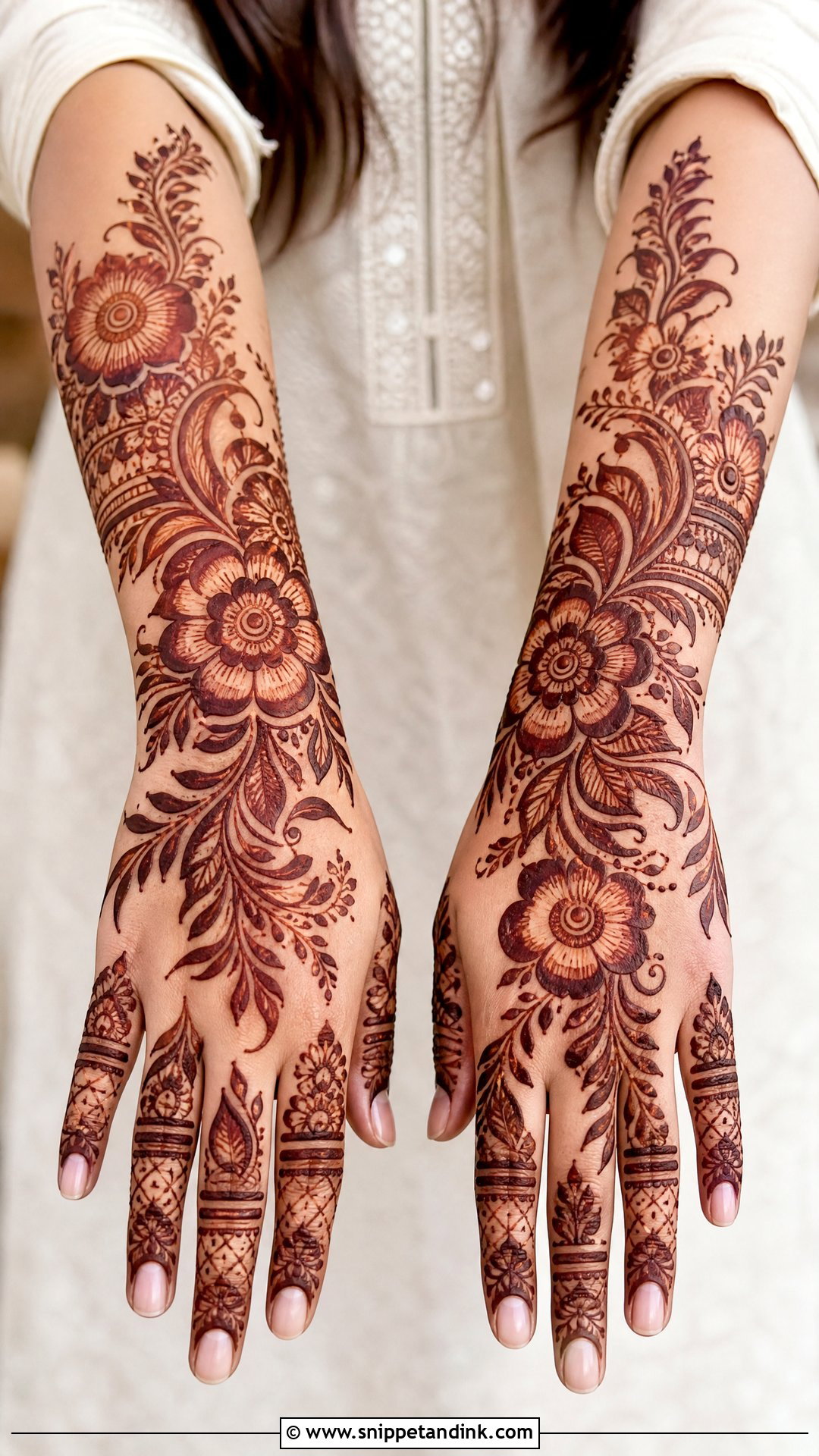
Shading uses thinner paste or a lighter stroke inside petals and leaves so the stain develops in two tones. Done well, it adds depth without filling every gap. The outline still has to be firm, because shaded areas stain lighter by design. On the back of the hand I let shaded flowers travel diagonally from wrist to fingers, then add slim finger patterns and a few dotted accents. Cameras pick up that two-tone effect better than flat filling.
21. Full Back Hand Gulf Mehndi Design
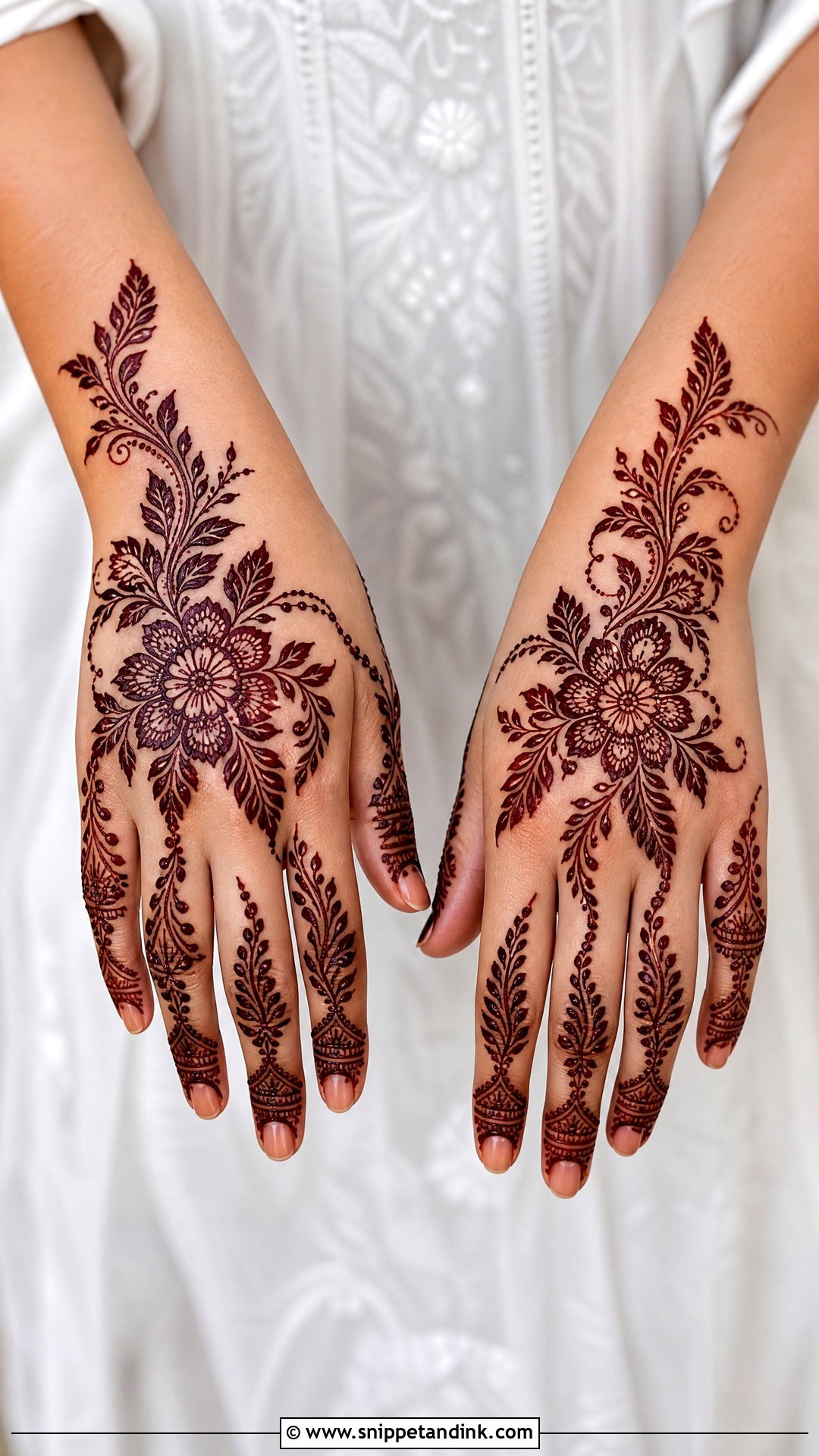
Gulf or Khaleeji style is bolder than standard Arabic: bigger flowers, leafy sprays and thick sweeping vines with generous open skin between them. That open skin is the point, since it lets a deep stain contrast sharply. I keep the finger work to matching leaves and petal tips so nothing crowds the main spray. It elongates the hand visually, and I see it requested most for Eid and formal receptions.
22. Full Back Hand Moroccan Mehndi Design
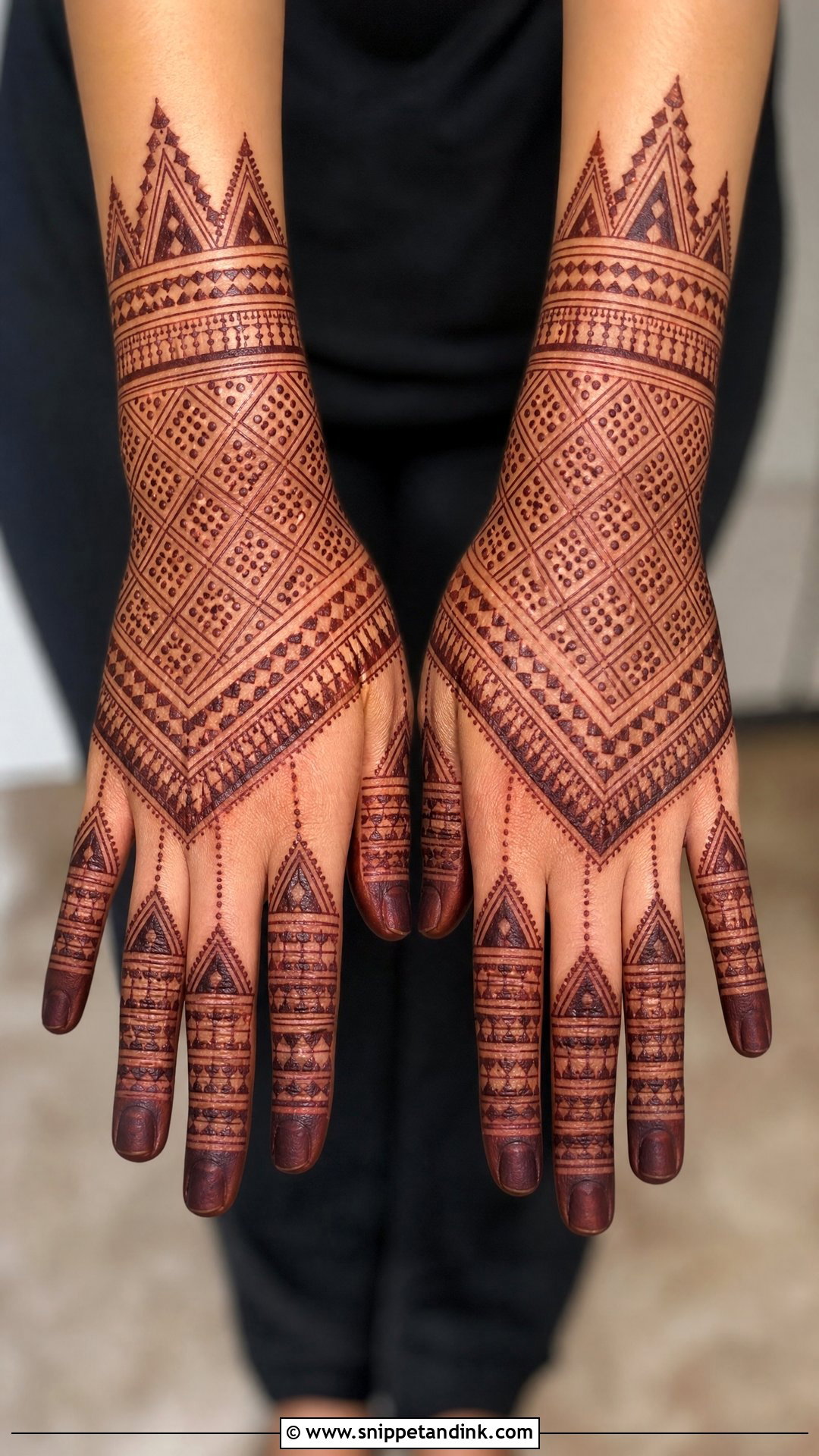
Moroccan patterns are pure geometry: diamonds, grids, triangles, dots and repeating borders. There’s no hiding a mistake in geometry, so I sometimes mark key points with tiny dots before drawing the lines between them. A geometric wrist cuff, a central diamond panel and patterned fingers make up the full version. It looks sharp with plain outfits and statement jewelry. If your artist mostly does freehand florals, ask to see her geometric work before you book this one.
23. Full Back Hand Rajasthani Mehndi Design
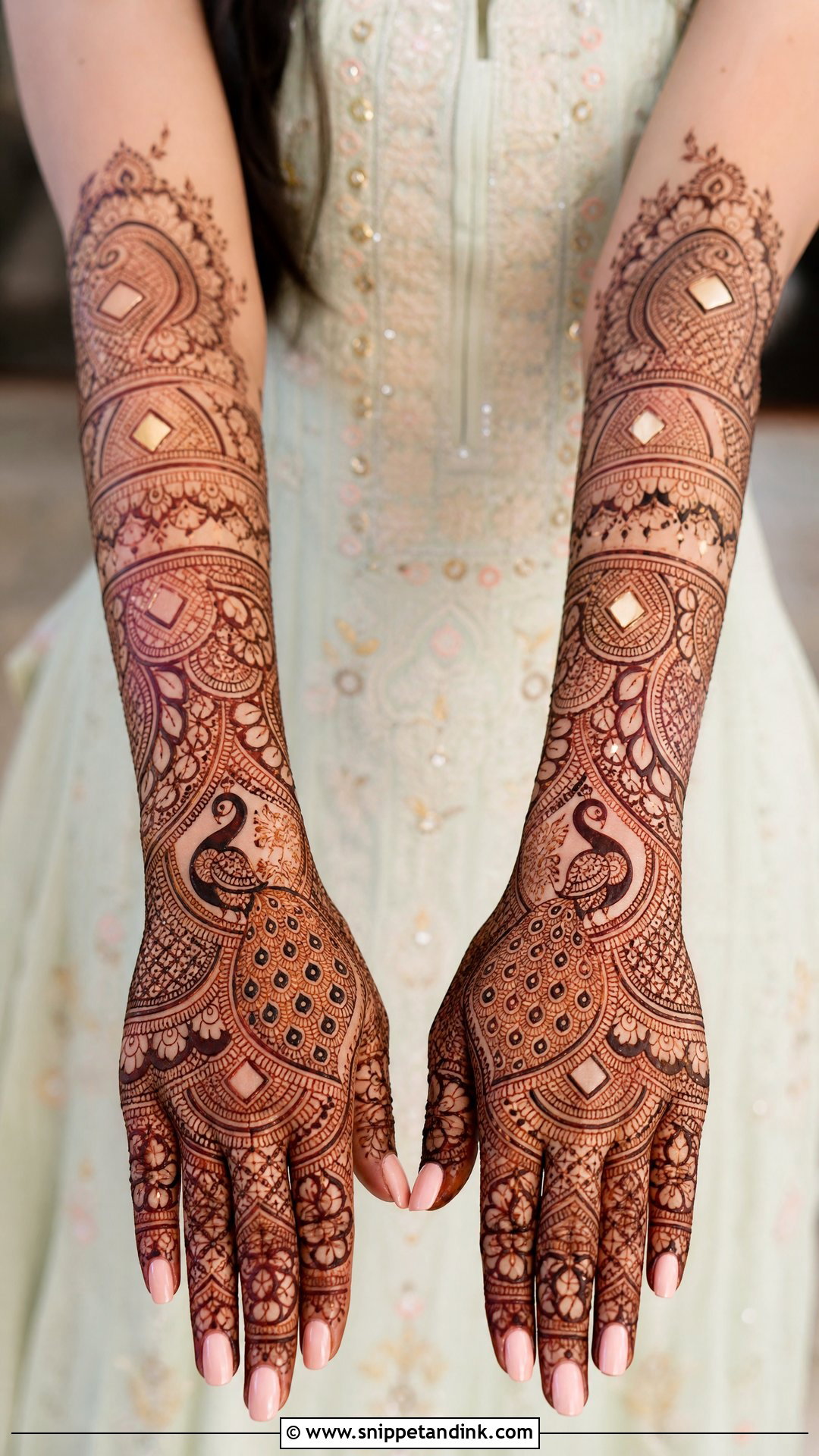
Rajasthani work is dense and deeply traditional, with peacocks, paisleys, flowers, small mirror-like shapes and fine borders. Some bridal versions tuck in symbolic figures, though the back of the hand is usually kept ornamental. I join wrist, hand and fingers with layered bands so nothing looks disconnected. Because the detail is so tight, the main shapes need firm outlines; that’s what keeps the final stain rich rather than muddy. Teej, Karwa Chauth and traditional weddings are its natural home.
24. Full Back Hand Marwari Mehndi Design
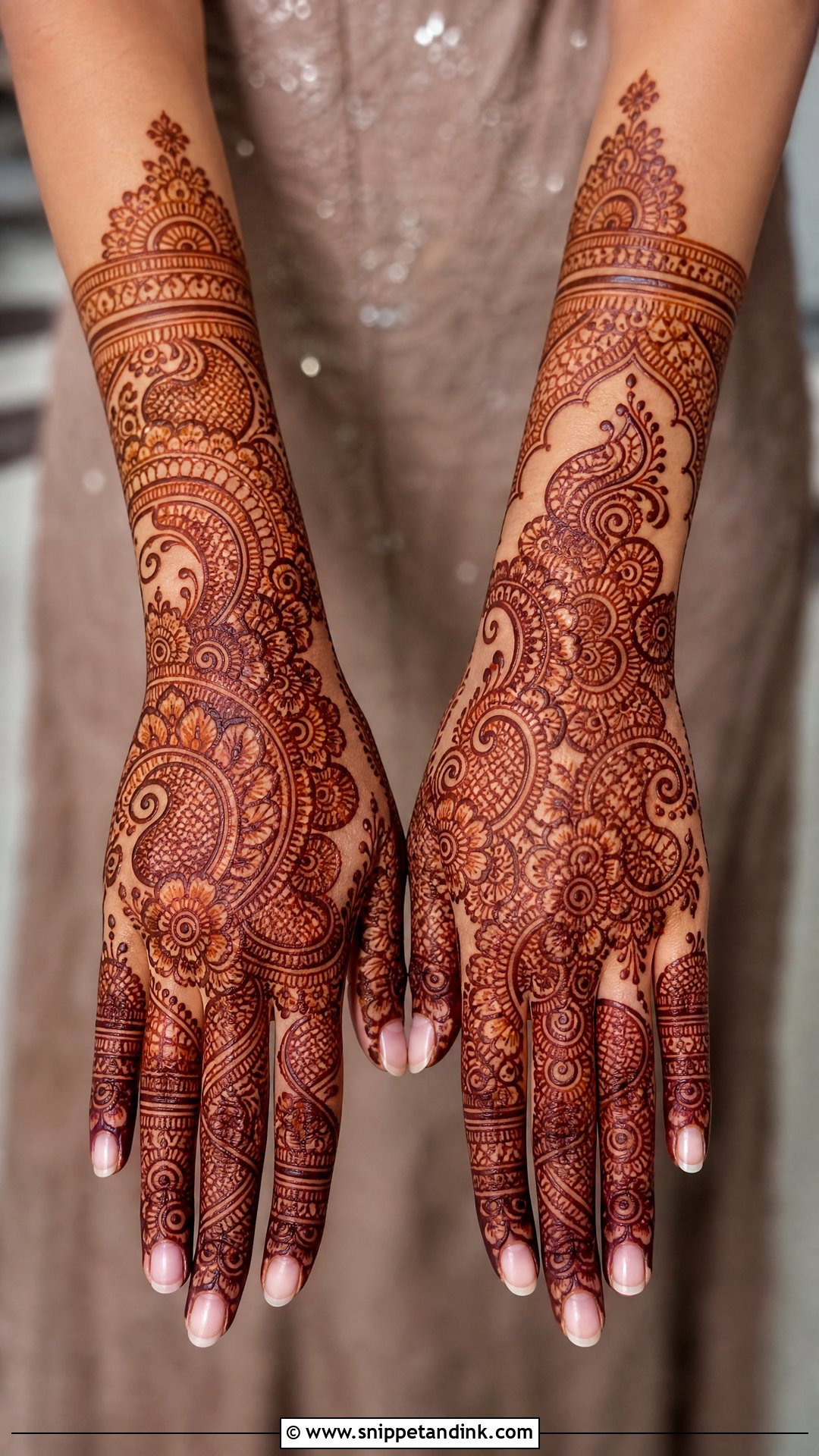
Marwari designs aim for grandeur over modernity: paisleys, floral clusters, fine line work and ornamental borders. I usually take the design slightly past the wrist bone so it finishes below the bangle line instead of stopping right underneath it. Fingers get repeated bands, small leaves and dotted lines. Ask for a mix of dense and open sections, because a fully packed hand darkens into a flat surface by the second day and the pattern is lost.




25. Full Back Hand Mughlai Mehndi Design
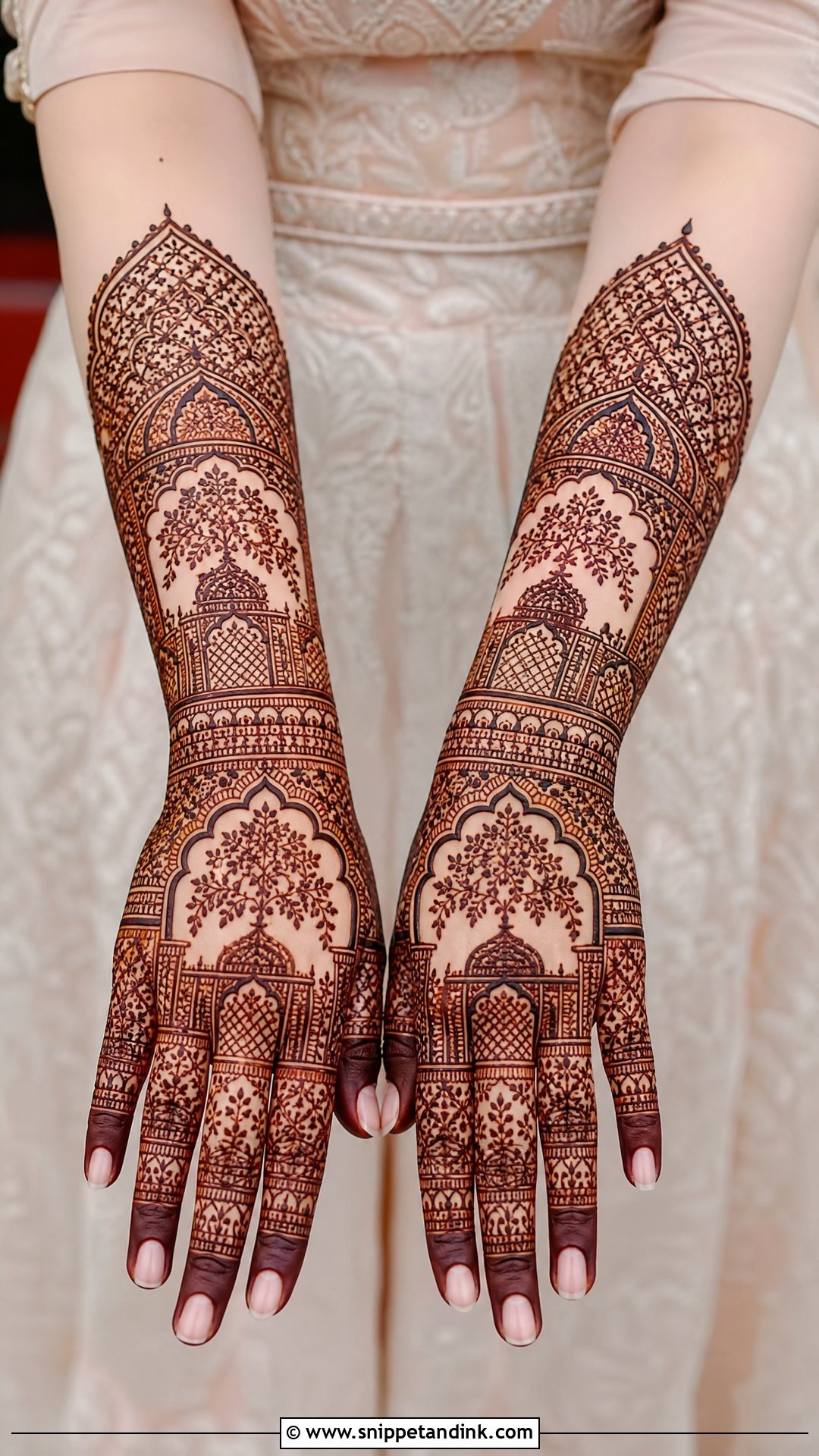
Mughlai designs borrow from architecture: arches, domes, jaali panels and symmetrical borders. On the back of the hand I set an arch over the centre, add panels on each finger and draw a cuff that looks carved. It reads more mature than floral trails and gives a traditional bride something different from the usual vines. Crisp edges matter most here, since one soft or smudged arch loses the architectural effect.
26. Full Back Hand Diwali Mehndi Design
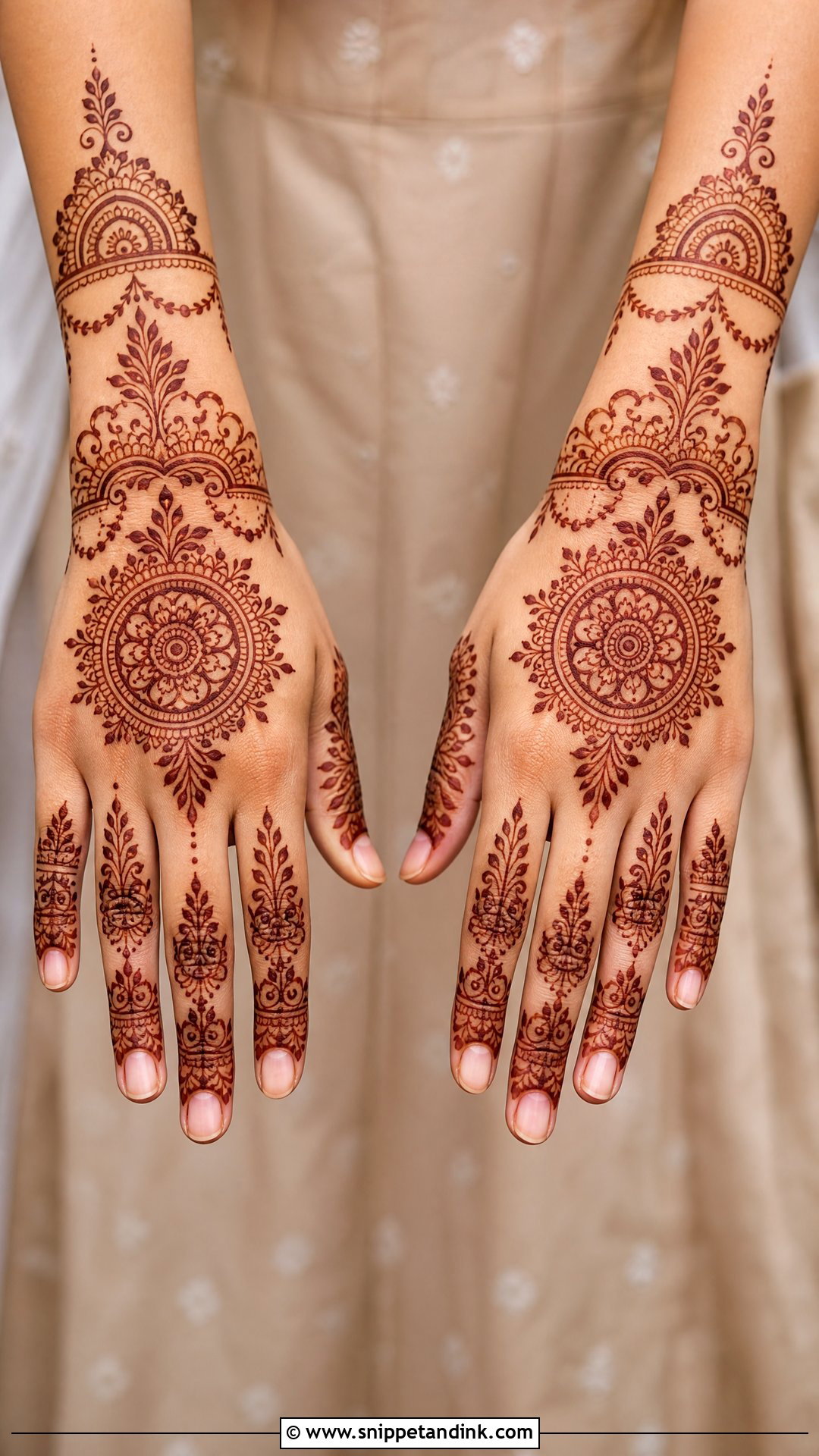
For Diwali I lean toward medium density: a central flower or mandala, leafy trails, fine dotted borders and slim finger bands with leaf tips. Festival days mean cooking, lighting diyas and greeting family, so the design has to dry quickly and survive being used. Applying it the evening before gives the stain a night to deepen before the celebration starts. Natural henna settles into a warm reddish-brown that sits well against festive outfits.
27. Full Back Hand Eid Mehndi Design
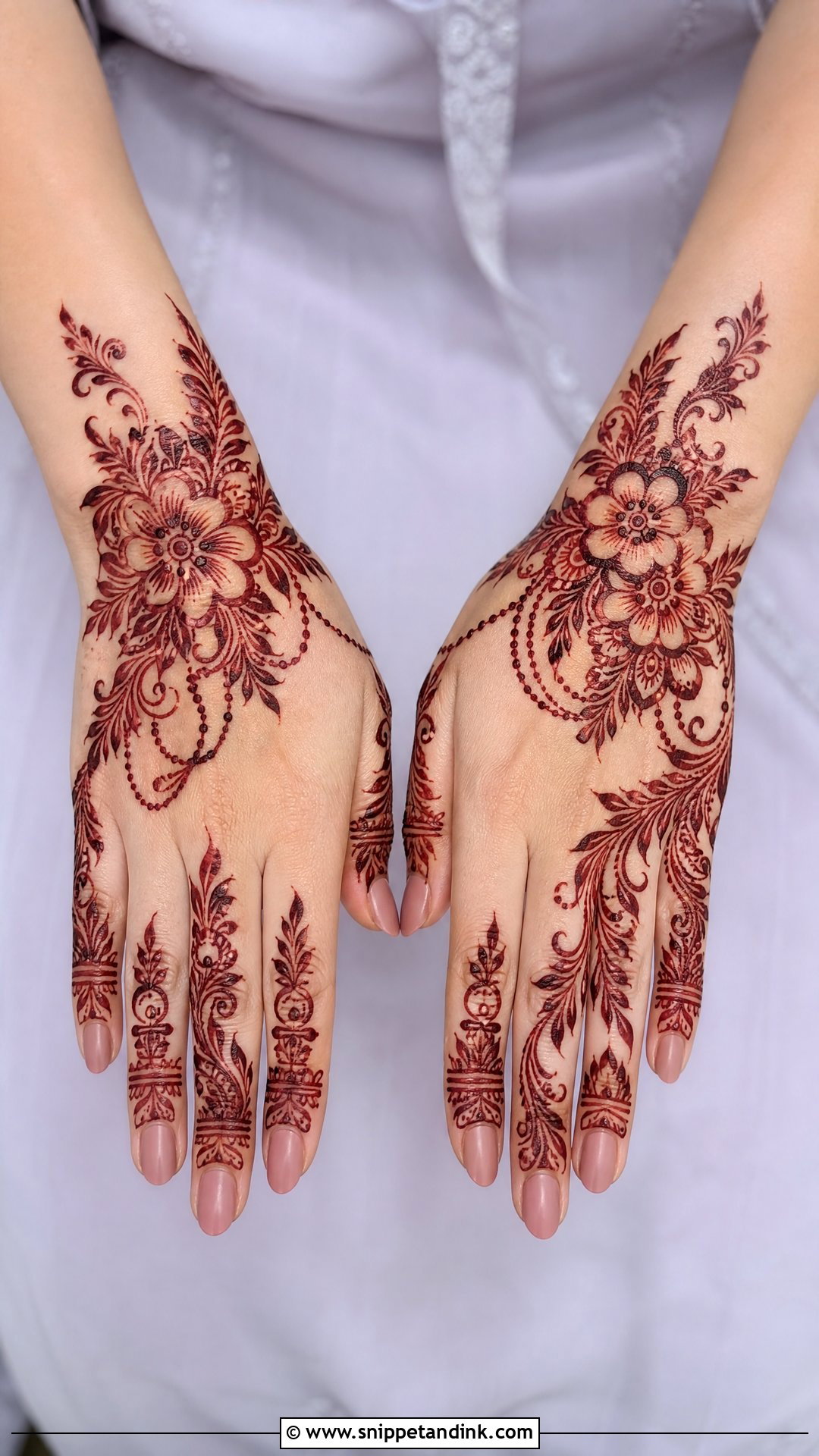
Eid mehndi usually leans Arabic, Gulf or Indo-Arabic, with bold flowers, flowing vines, shaded leaves and decorated fingers. The back of the hand is what people see during greetings, so I keep the layout clean, starting at the wrist and moving diagonally across. Open space around the motifs makes the stain stand out. Chand Raat is the traditional night for it, so I keep the design quick enough to finish while the queue is long.
28. Full Back Hand Karwa Chauth Mehndi Design
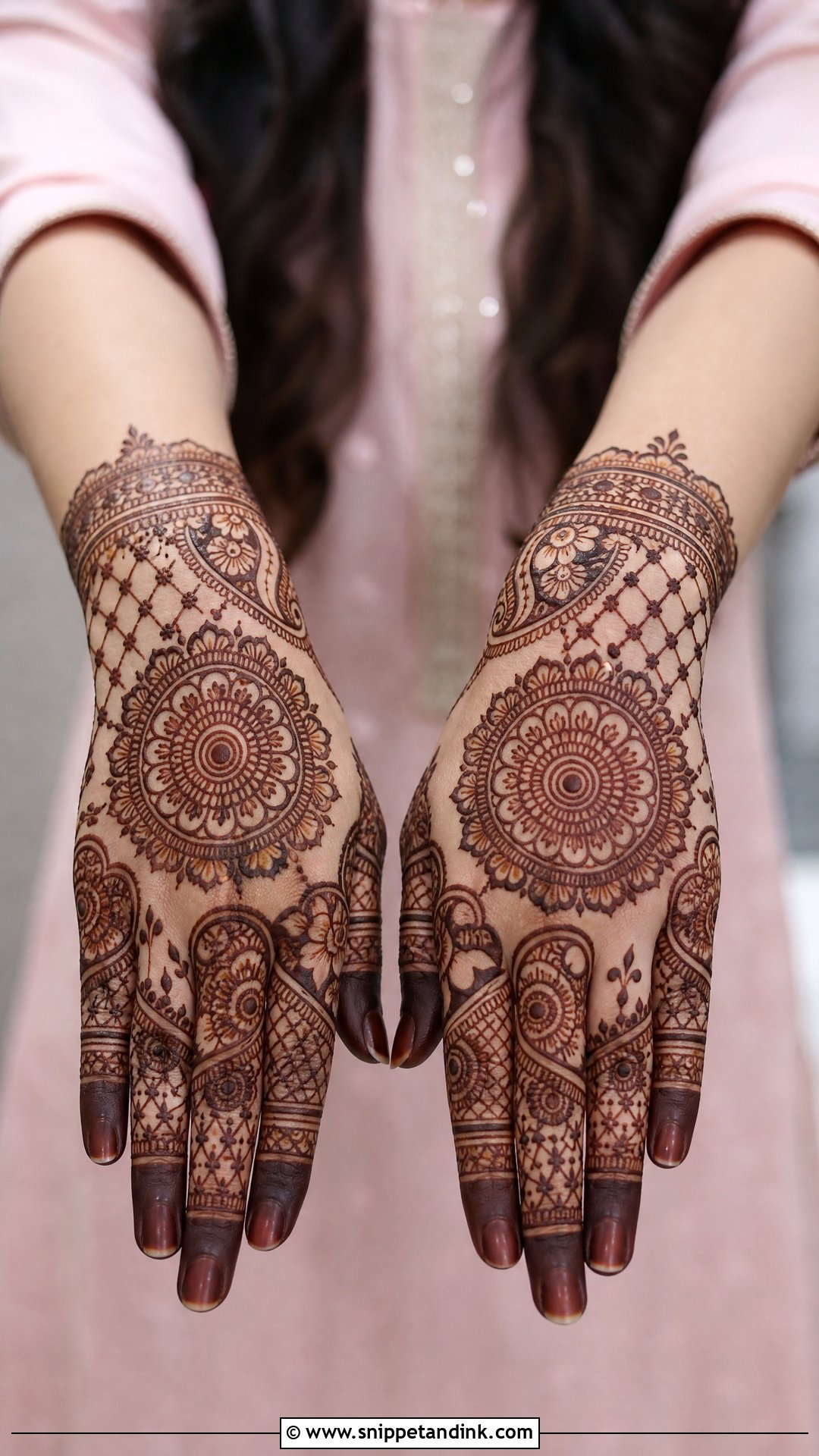
A Karwa Chauth mehndi design on the back of the hand is usually traditional and full, with paisleys, mandalas, jaali panels and bracelet-style wrist borders. Applying it a day ahead means the colour is close to its deepest by the evening puja. I give extra attention to the wrist and fingertips, because bangles and the puja thali frame them in every photo. A central mandala with surrounding paisleys makes the fuller version; an Indo-Arabic floral trail suits a lighter one.
29. Full Back Hand Engagement Mehndi Design
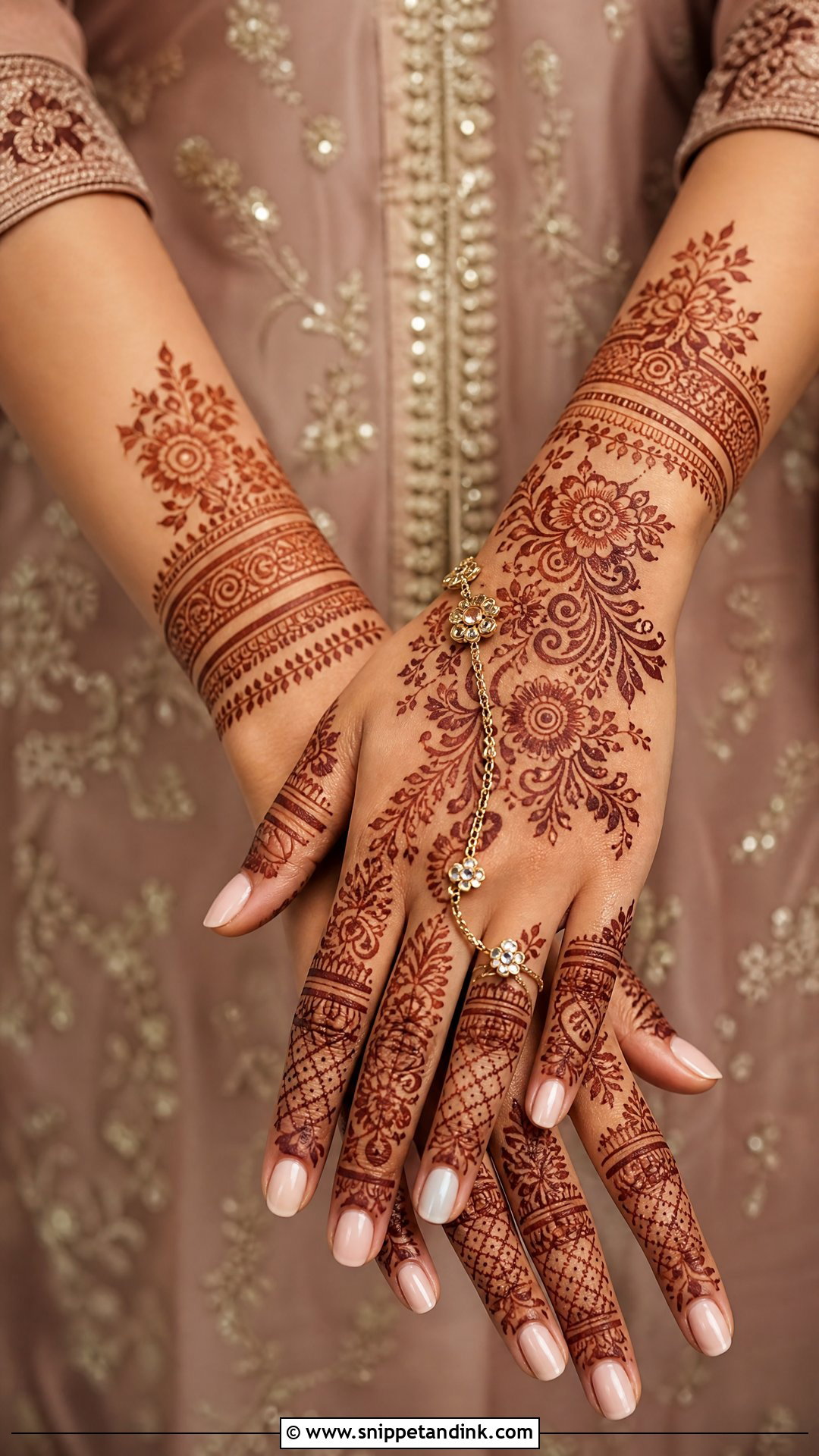
Engagement mehndi should sit a step below bridal density. Ring photos are the priority, so I keep the ring finger neat and partly open, letting the band show against skin instead of getting lost in pattern. Delicate chains leading toward that finger, or a floral frame with breathing room around the jewelry, both work. You get something special without using up the heavy bridal design before the wedding itself.
30. Full Back Hand Wedding Guest Mehndi Design
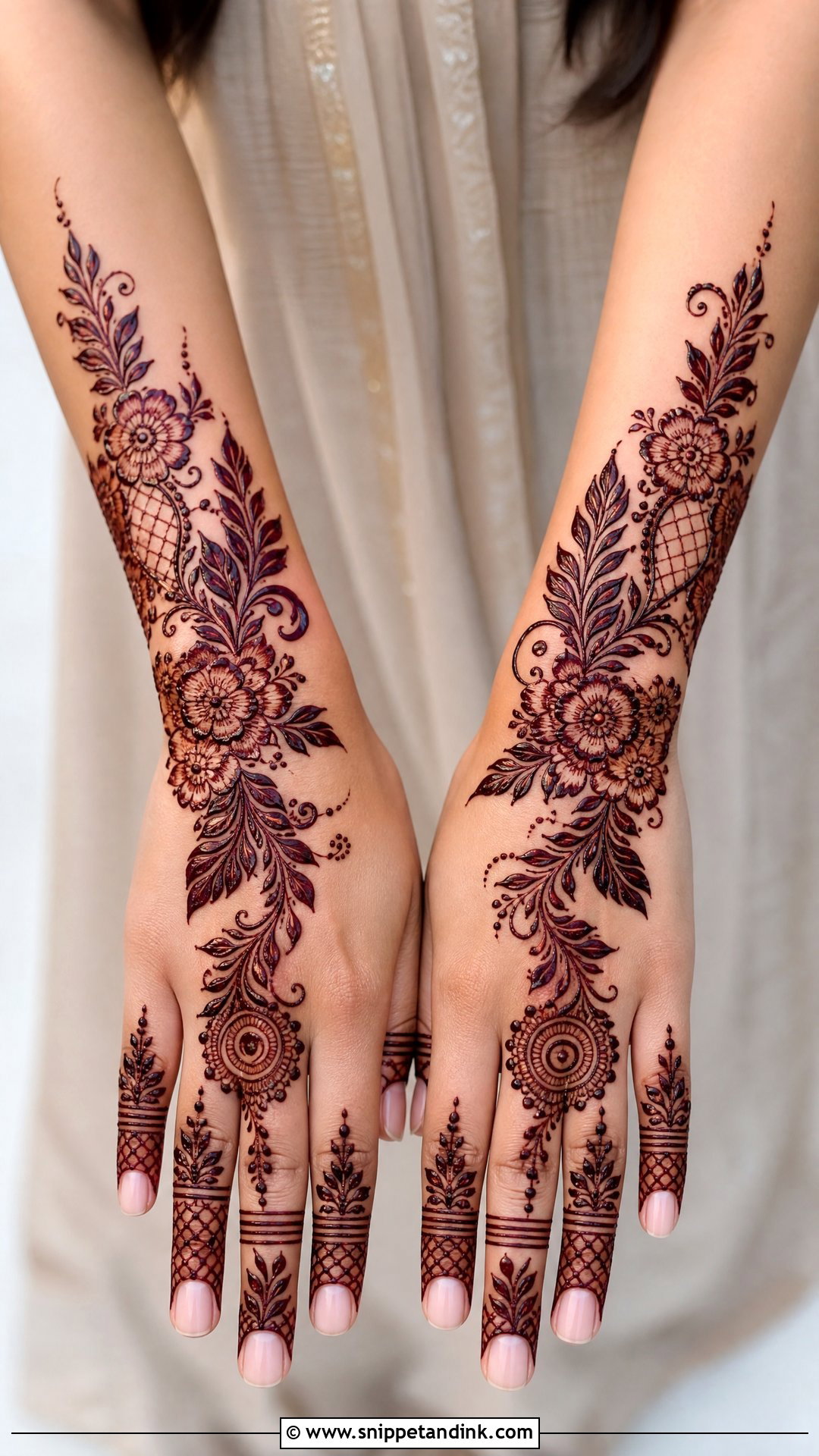
For guests, the aim is festive but clearly not bridal. Arabic floral trails, mandala-centred layouts, bracelet cuffs, shaded leaves and small jaali sections all fit. Sisters, cousins, friends and guests attending mehndi nights, sangeet events, receptions or traditional ceremonies can all wear this level of coverage. Match density to your outfit: light pastel fabrics look better with open designs, while heavily embroidered outfits can carry richer patterns. When the bride has a heavy back hand, I keep the guests noticeably lighter so her hands stay the focus.
How Long a Full Back Hand Keeps You in the Chair
Time depends on density far more than on the number of hands. An open Arabic back hand can be finished on both hands in well under an hour, while full bridal coverage with worked fingers and forearm cuffs can take several hours for the backs alone, before anyone touches the palms. Send your artist the exact reference and ask for her own estimate, because speed varies a lot from one artist to the next.
For a wedding, I’d book bridal mehndi one to two days before the ceremony. The stain is bright orange when the paste comes off and darkens over the next 24 to 48 hours, so a morning-of appointment means orange hands at the altar. Eat first, use the bathroom, and have someone ready with a straw for water.
Scrape-Off to Day Two, Hour by Hour
- Leave the paste on for at least six to eight hours. Overnight is better, wrapped loosely so it can’t smear on the sheets.
- Once it’s dry to the touch, I dab on a little lemon and sugar so the paste stays stuck to the skin instead of flaking early. Dab it; don’t soak it.
- Scrape the dried paste off with a blunt edge or your fingers, not water, and keep the hands dry for as long as you can, ideally until the next morning.
- For the first couple of days, avoid chlorine, hand sanitizer and harsh soap. A thin layer of natural oil or balm before washing protects the colour.
- Be wary of any paste that turns black within an hour. That almost always means PPD, a chemical dye that can cause serious skin reactions; natural henna never goes straight to black.
Let the Occasion Set the Density
Start with the event and work backward. A wedding or Karwa Chauth can carry Indian work, Rajasthani, peacock, or paisley work; a sangeet or Eid gathering often looks better in Arabic, Gulf, modern or minimal layouts; Indo-Arabic and jewelry-style designs sit comfortably between the two. Whatever you pick, I’d judge an artist’s portfolio on clean fingers, a strong wrist finish and visible spacing between motifs. Get those right, use natural henna, and give the stain its full two days to deepen.
You'll Like These Ideas:












Leave a Reply