
Full-hand bridal mehndi carries a lot: family tradition, the excitement of the night before, and a design you’ll see in every photo of the rings and bangles. The work I’m proudest of balances dense artistry with clear flow, so the hands look rich and still readable. Brides come to me wanting anything from classic Indian dulhan mehndi and Rajasthani story panels to Arabic trails, jaali, mandalas, peacocks, portraits and modern open layouts. Whatever the style, a full hand should suit your hand shape, sit well with your outfit and hold together from palm to forearm. Below are the full-coverage designs I’d talk a bride through, with the practical detail behind each.
Should Your Mehndi Stop at the Wrist or the Elbow?
“Full hand” means different things to different families. For some it stops at the wrist; for many brides it runs to the elbow, front and back. I settle the height first, because it changes the time, the cost and the whole composition.
A common custom is for the bride’s mehndi to go noticeably higher and denser than anyone else’s, so hers stands out in group photos. If your sisters and cousins are being done the same day, agree that difference in advance, and get the bride’s hands done first while the artist is fresh and the paste is newest.
- Wrist height: quickest, suits short sleeves and lots of bangles.
- Mid-forearm: a balanced choice under three-quarter sleeves; the design ends in a clean border just below the hem.
- Elbow height: traditional bridal coverage; plan a long session and a helper for the rest of the evening.
Whatever height you pick, I finish with a deliberate border rather than letting vines fade out. A clean edge looks finished in photos, while a trailing end looks as if the artist ran out of time.
1. Indian Bridal Full Hand Mehndi Design
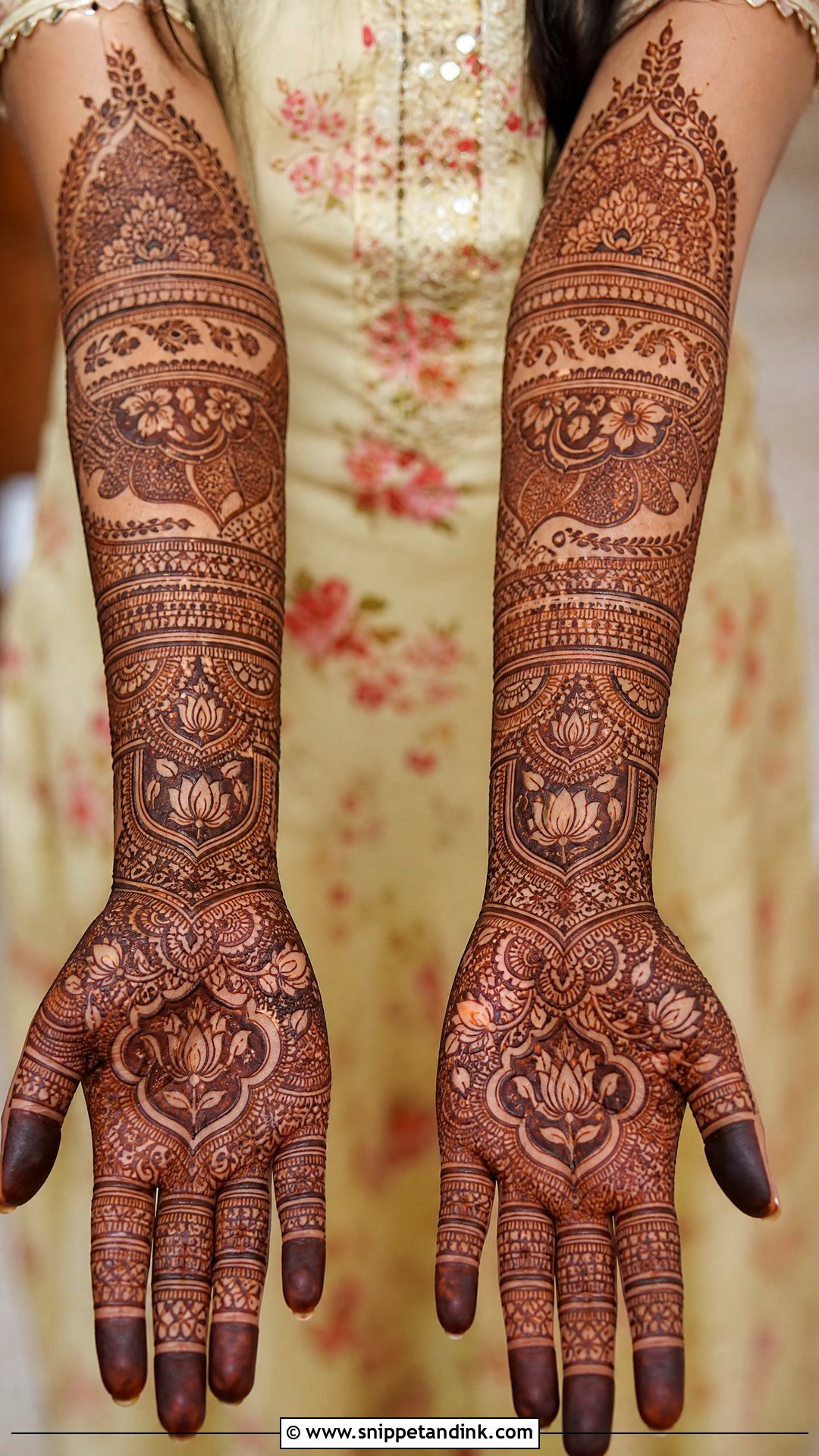
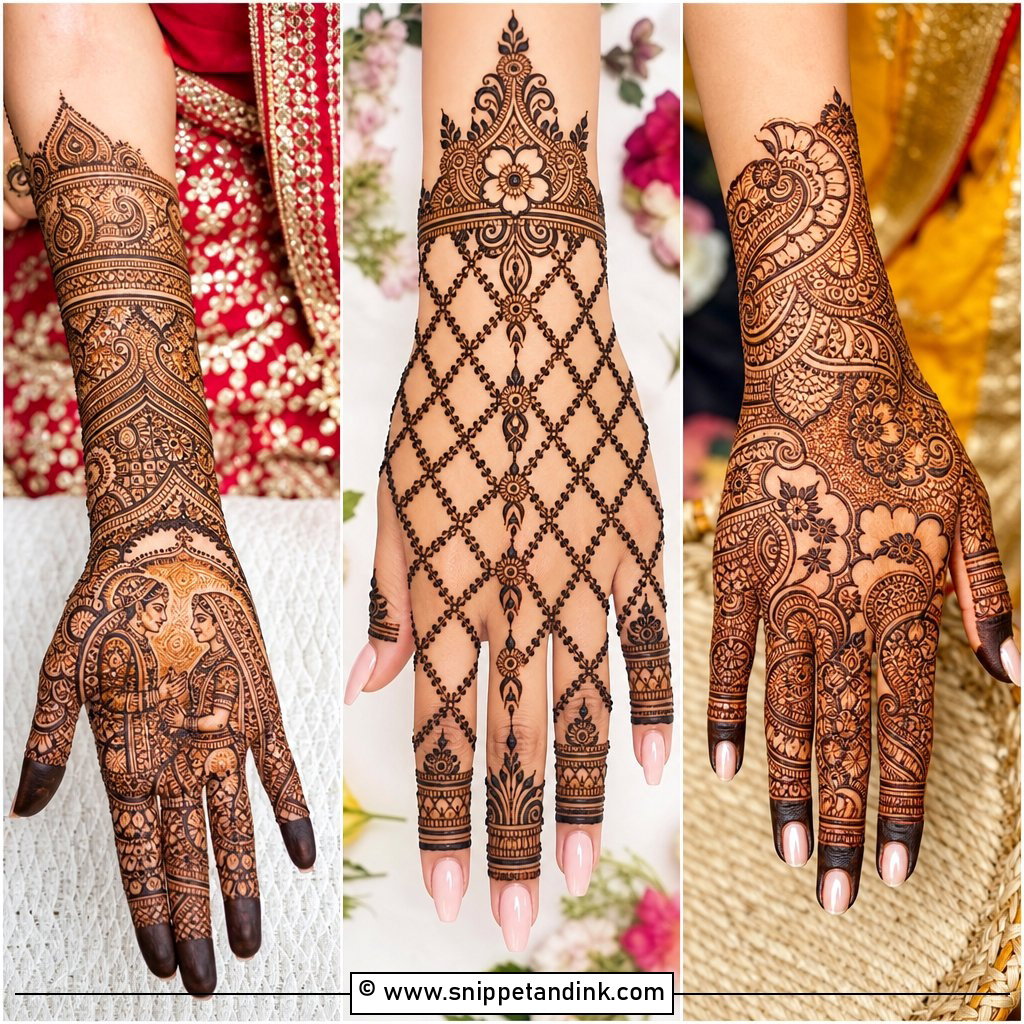
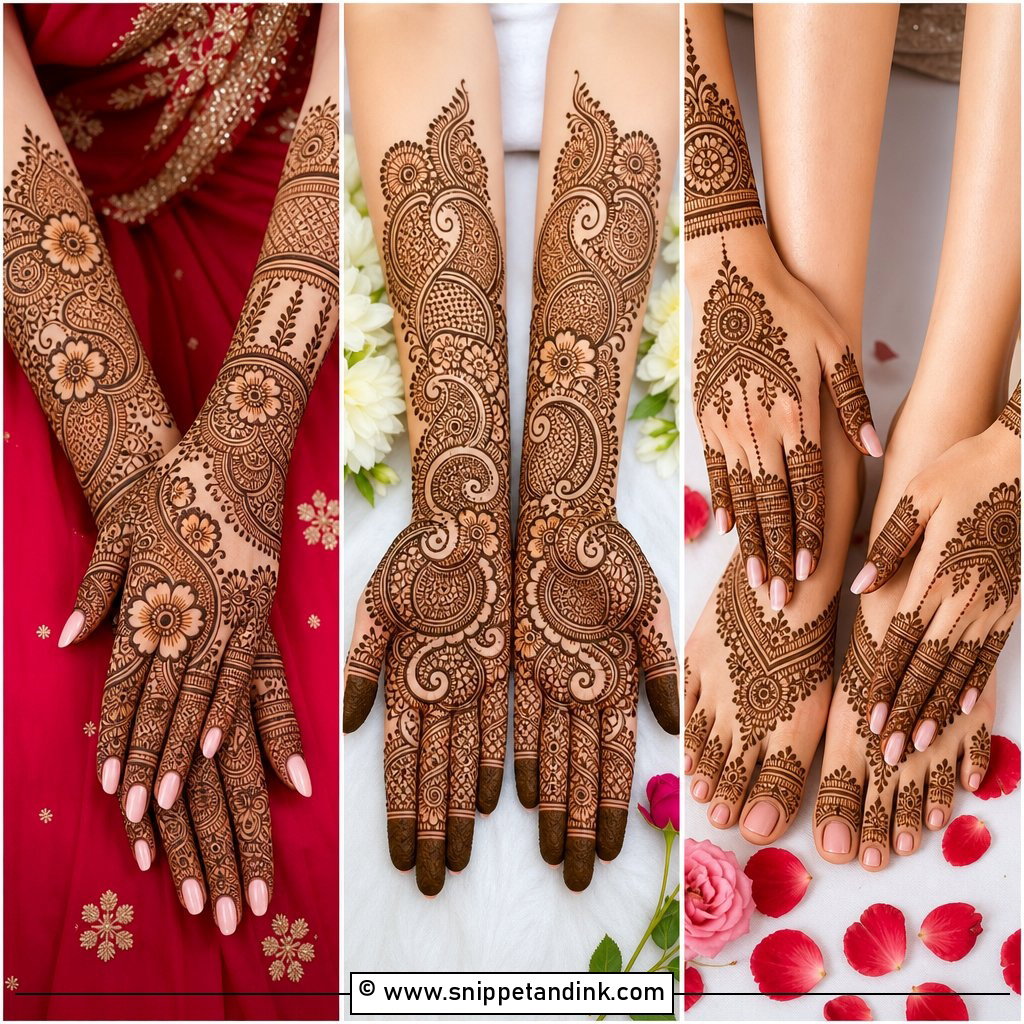
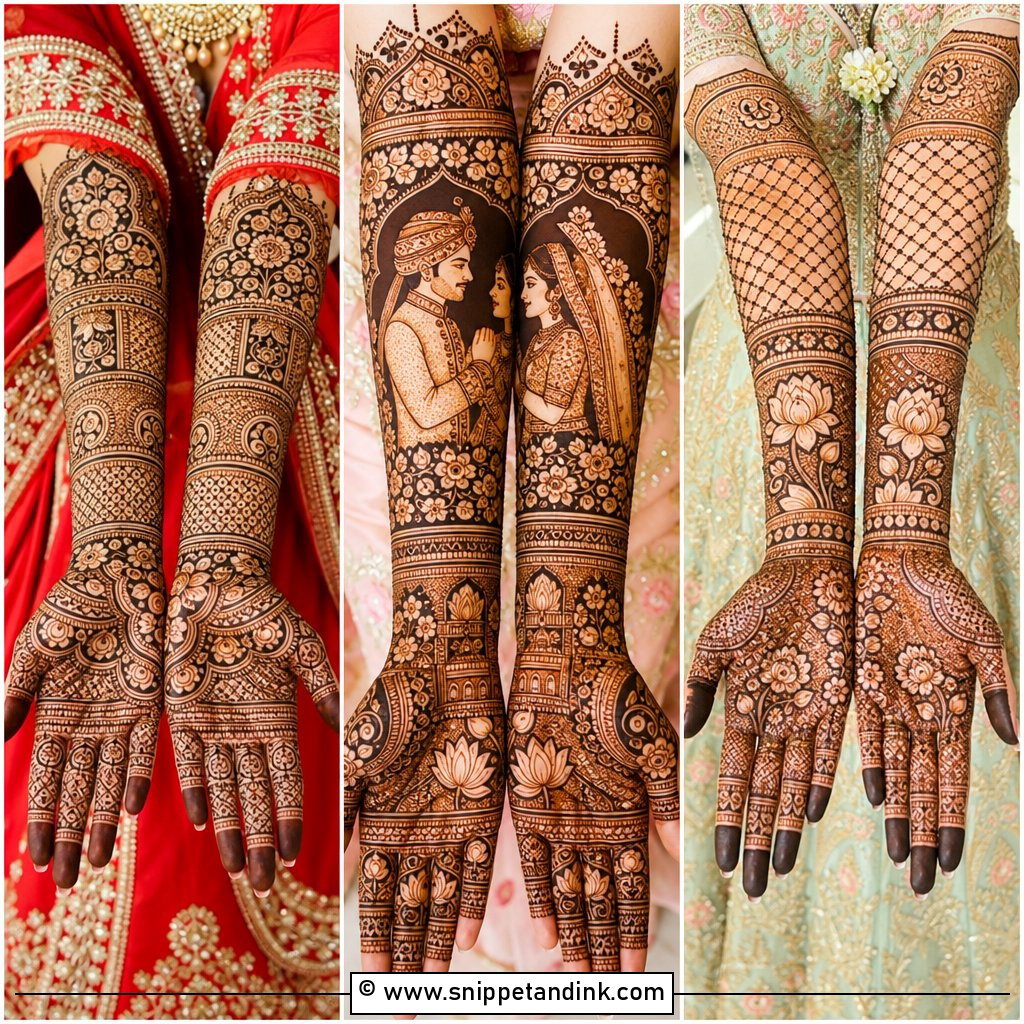
Traditional Indian coverage wraps palms, fingers, wrists and forearms with almost no gaps: paisleys, lotus, vines, mandalas, dots and curved borders in one layout. Its appeal is depth. In skilled hands it still looks organized, because every section has an edge you can follow. It suits lehengas, sarees, shararas and classic jewelry, and it makes for rich close-ups. My one rule with dense work is to finish each zone before starting the next, so the paste in one area isn’t drying while I’m still building the area beside it.
2. Rajasthani Bridal Full Hand Mehndi Design
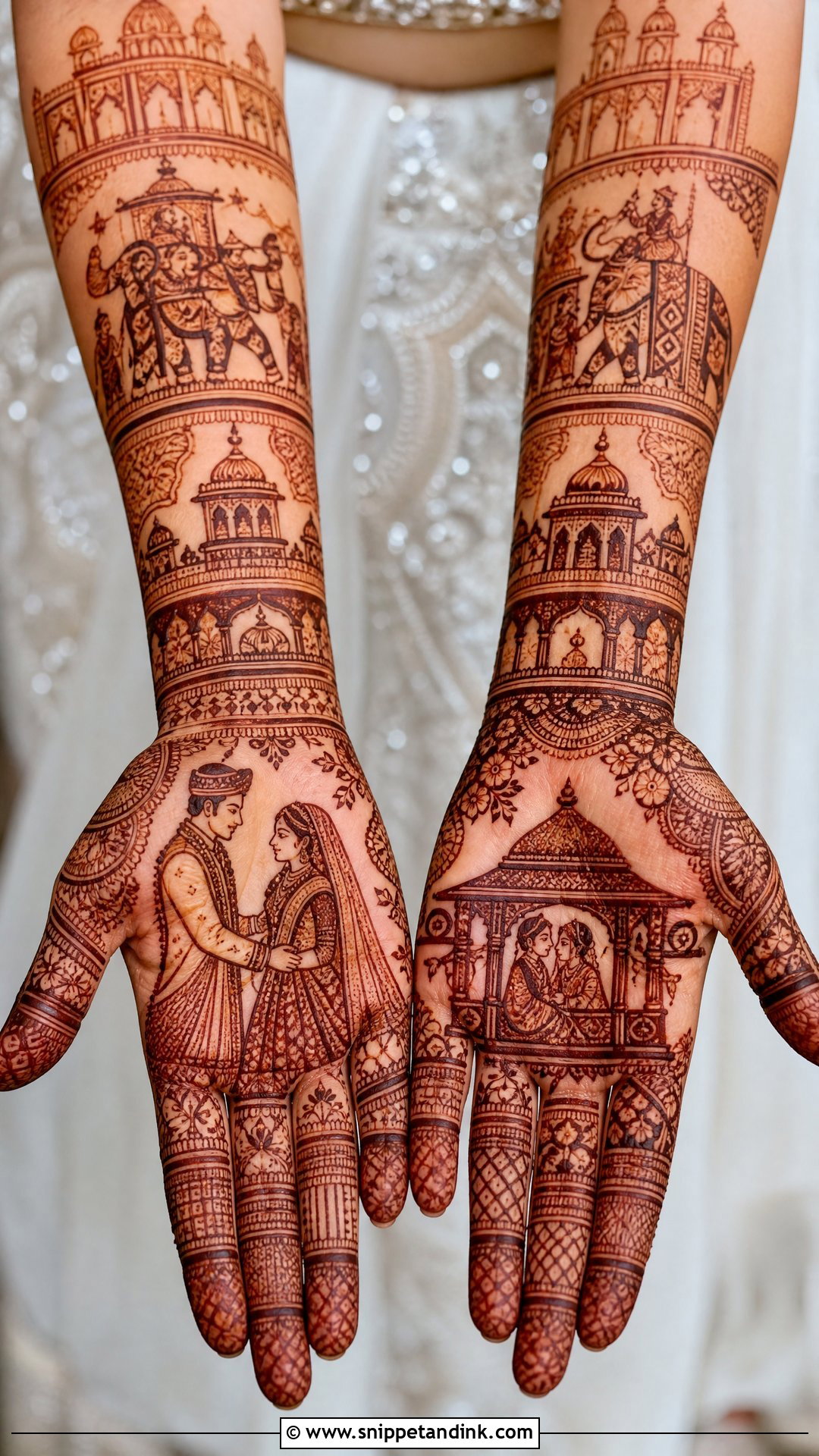
Rajasthani mehndi tells a story with figures rather than only flowers: bride and groom, elephants, palaces, doli scenes, kalash and wedding symbols, from fingertips to forearm. Spacing is the hard part. I place the main figures on the palms first, give them clear borders, then fill around them with smaller patterns. Without that order, the people disappear into filler. It’s at home at traditional weddings with heavy embroidery and regal outfits.
3. Arabic Bridal Full Hand Mehndi Design
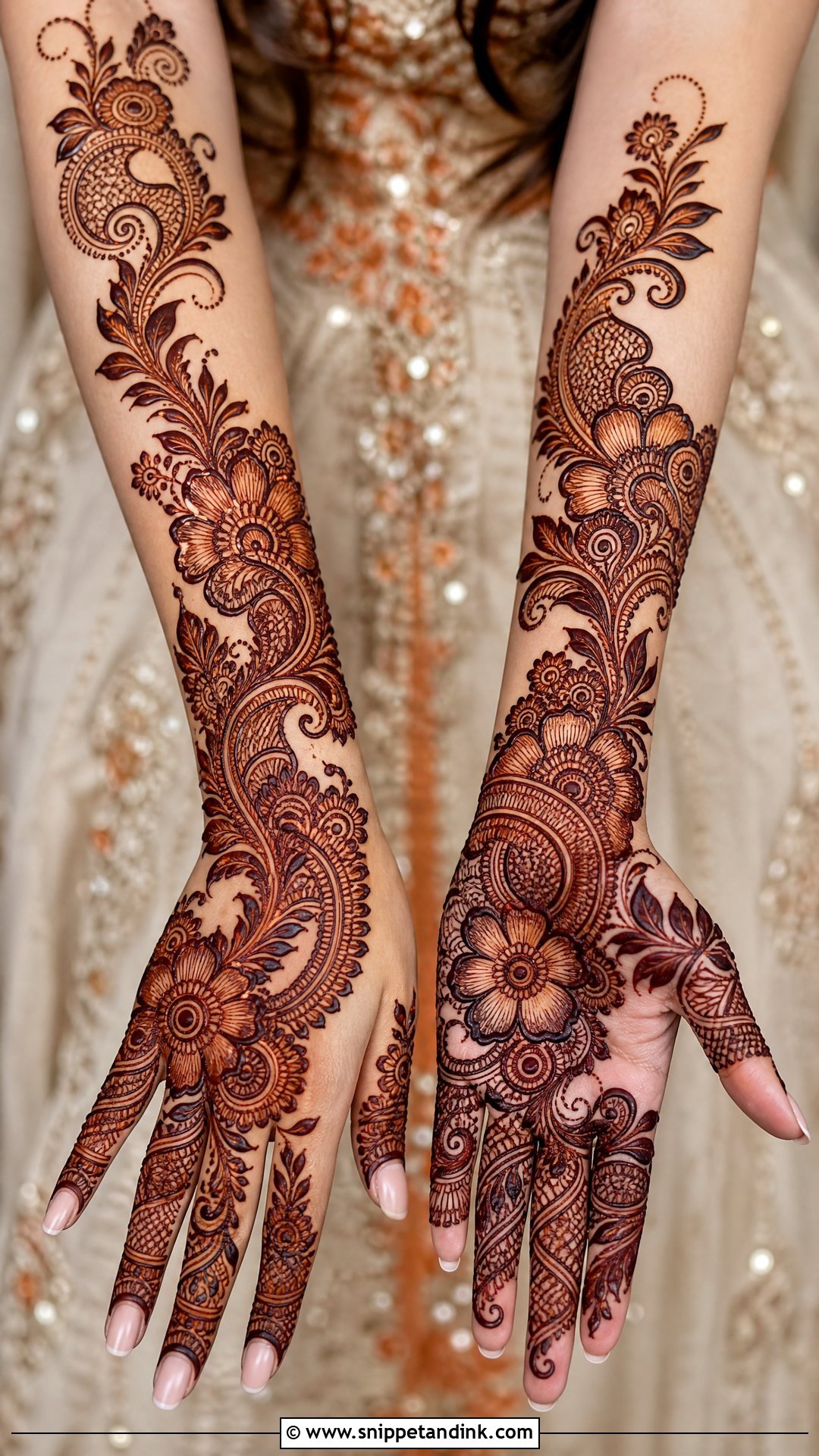
Arabic full-hand work moves diagonally with big flowers, leaves, paisleys and shaded vines, carried from fingertips to forearm with open skin between motifs. It looks airy and it’s faster to apply than heavy traditional coverage, which matters on a packed prep day. The shading is done by dragging a thinner line of paste to a fade, and it stains lighter than solid fill, which gives the design depth. Pastel outfits, modern lehengas and minimal jewelry suit it.
4. Indo Arabic Bridal Full Hand Mehndi Design
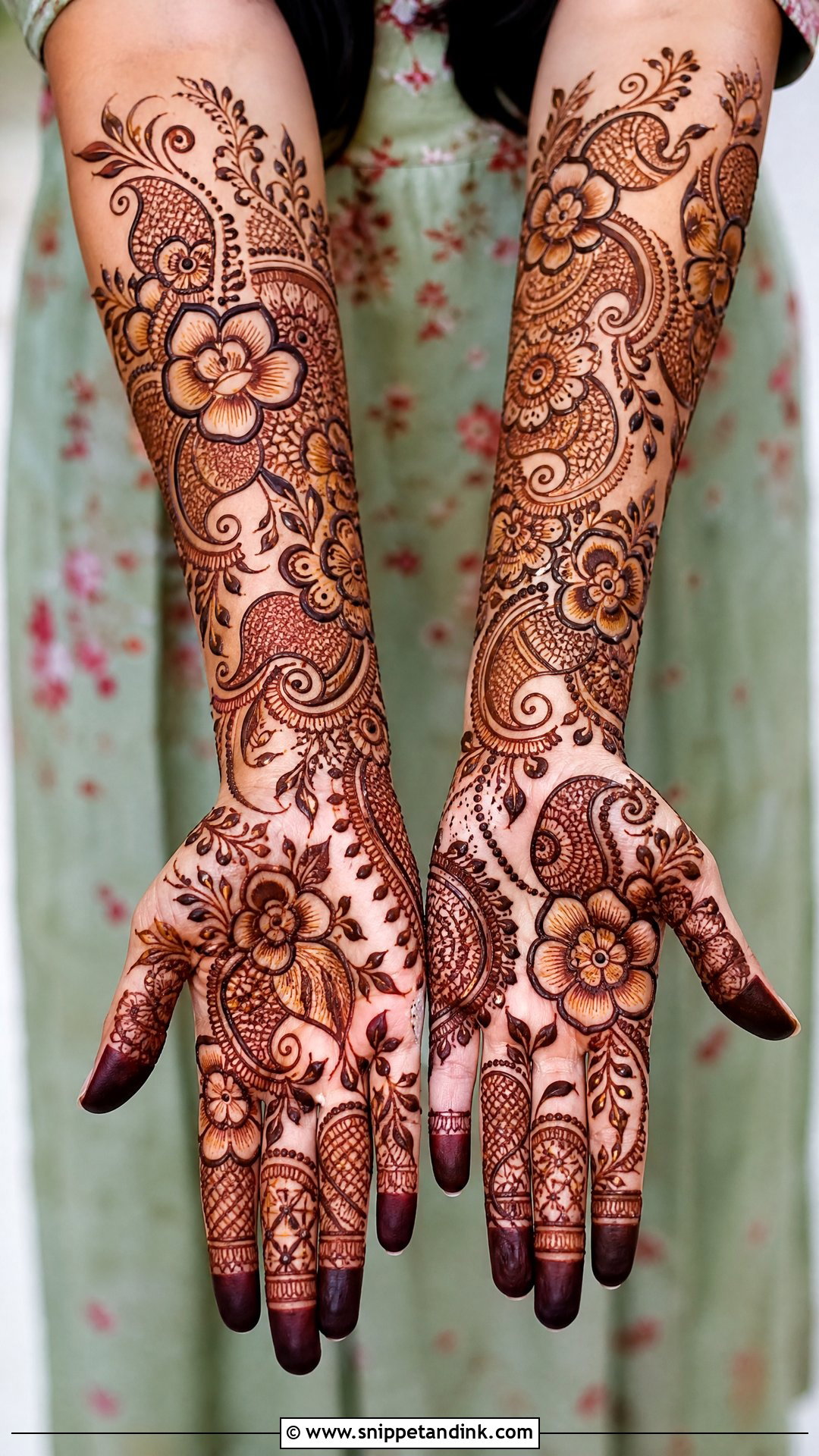
Indo-Arabic pairs bold Arabic florals with Indian filler and symmetry: big flowers, paisleys and leafy trails form the frame, and grids, dots, swirls and shaded lines add the bridal detail. It looks rich up close and clear from across a room. If you don’t want completely packed hands but still want an obvious wedding look, it’s a strong middle ground. The bold outlines stay visible as the stain deepens to maroon, which is why it photographs so well.
5. Full Hand Bridal Mehndi With Portrait
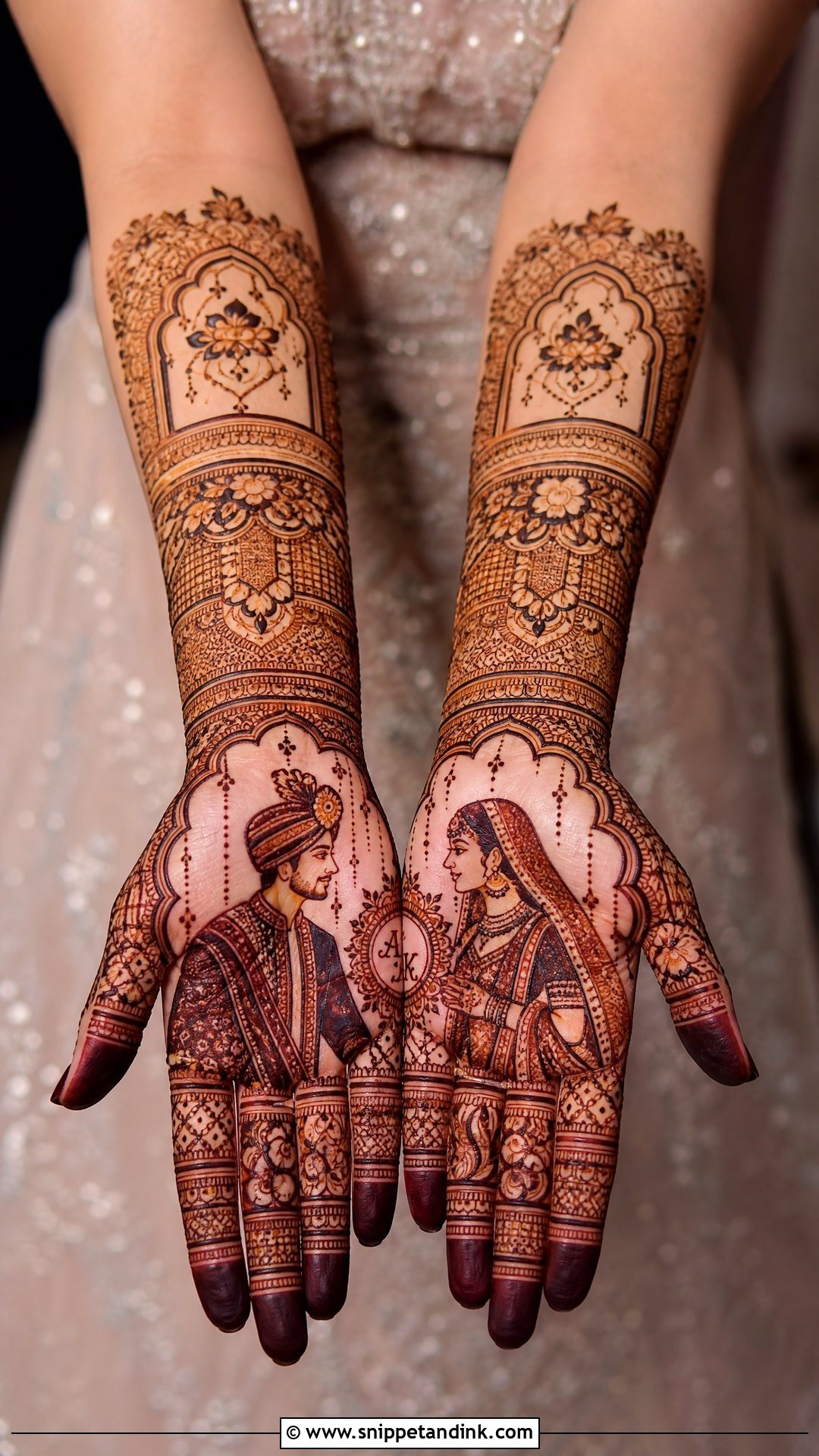
Small portraits of the bride and groom on the palms, with florals, paisleys, jaali and borders around them, turn the hands into a keepsake. Faces must stay clear after the paste dries and stains, which takes a very fine cone and an artist who has drawn many of them. Silhouettes are more forgiving than detailed faces if your artist is less experienced with portraits. Names, initials, dates or small symbols can be added. I always ask brides to look at photos of an artist’s stained portraits, not fresh ones.
6. Peacock Bridal Full Hand Mehndi Design
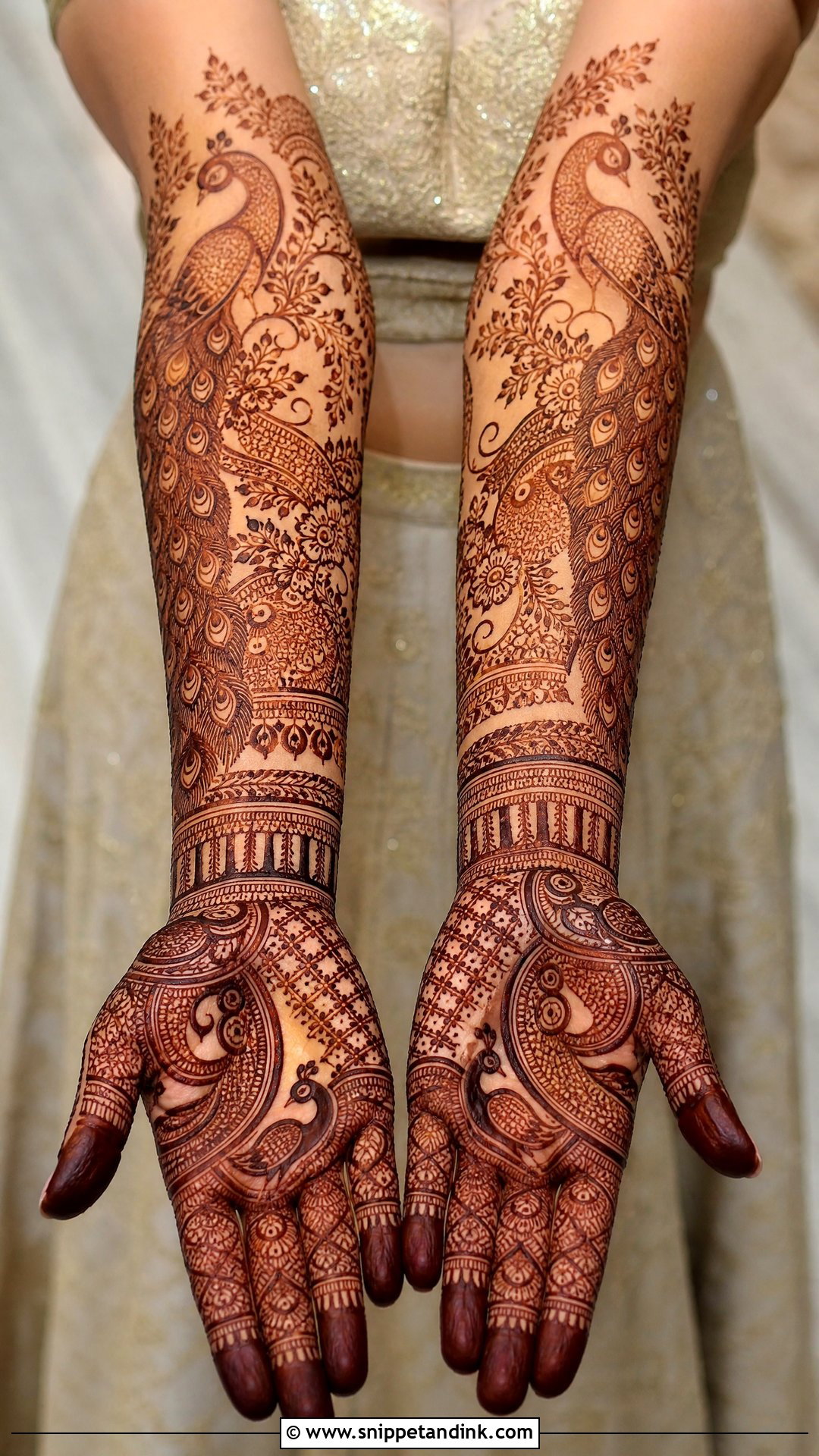
The peacock’s curved neck, fanned feathers and flowing body blend naturally into full-hand vines and paisleys. A large bird on the palm or forearm, with feather motifs repeated across the fingers, is the classic layout. It can be dense or semi-open. I draw the body and neck first in one confident line, then build the feathers outward; going back to fix a neck curve leaves a thickened, smudgy line. It suits traditional outfits, gold and colorful bangles.
7. Mandala Bridal Full Hand Mehndi Design
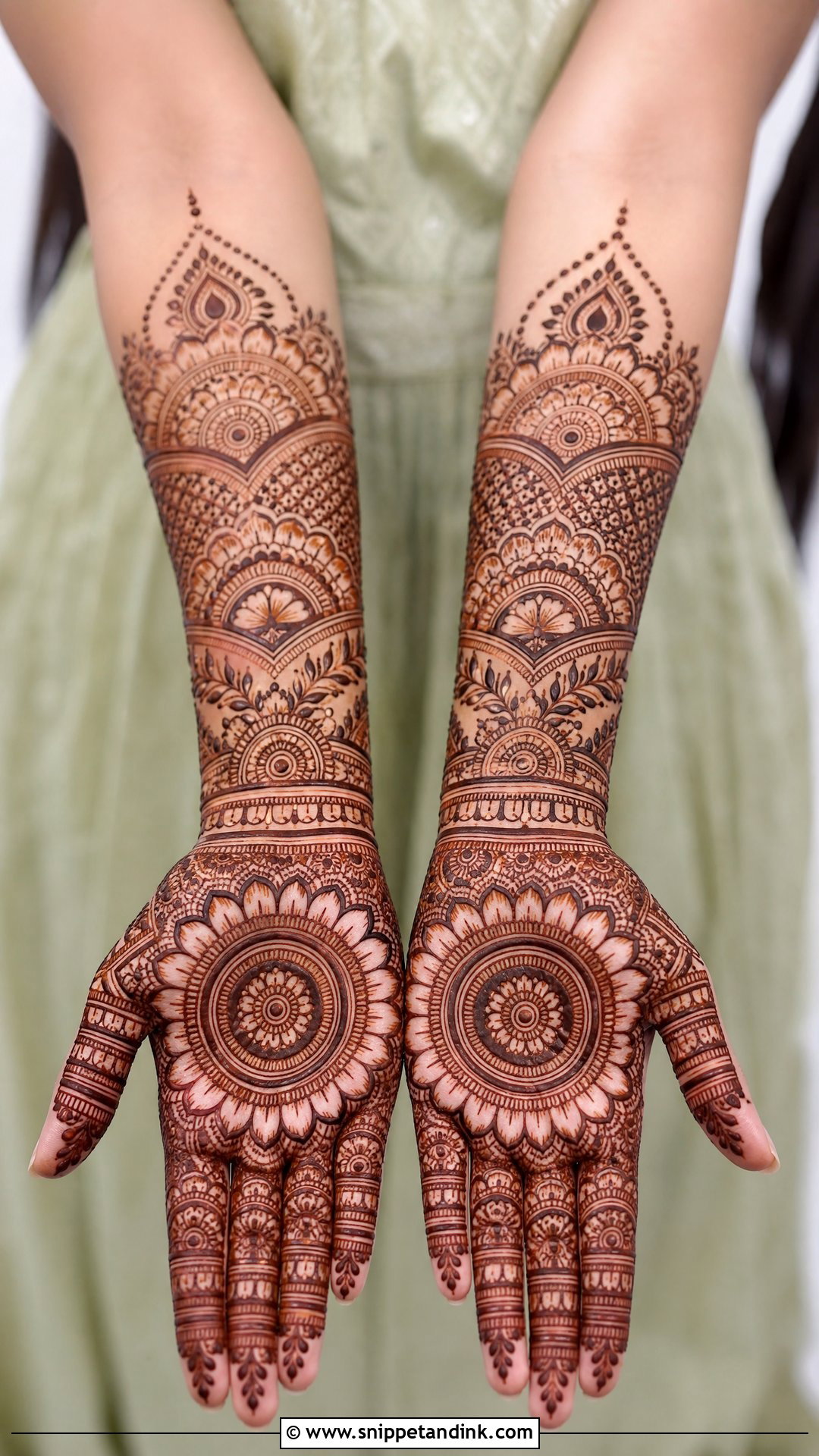
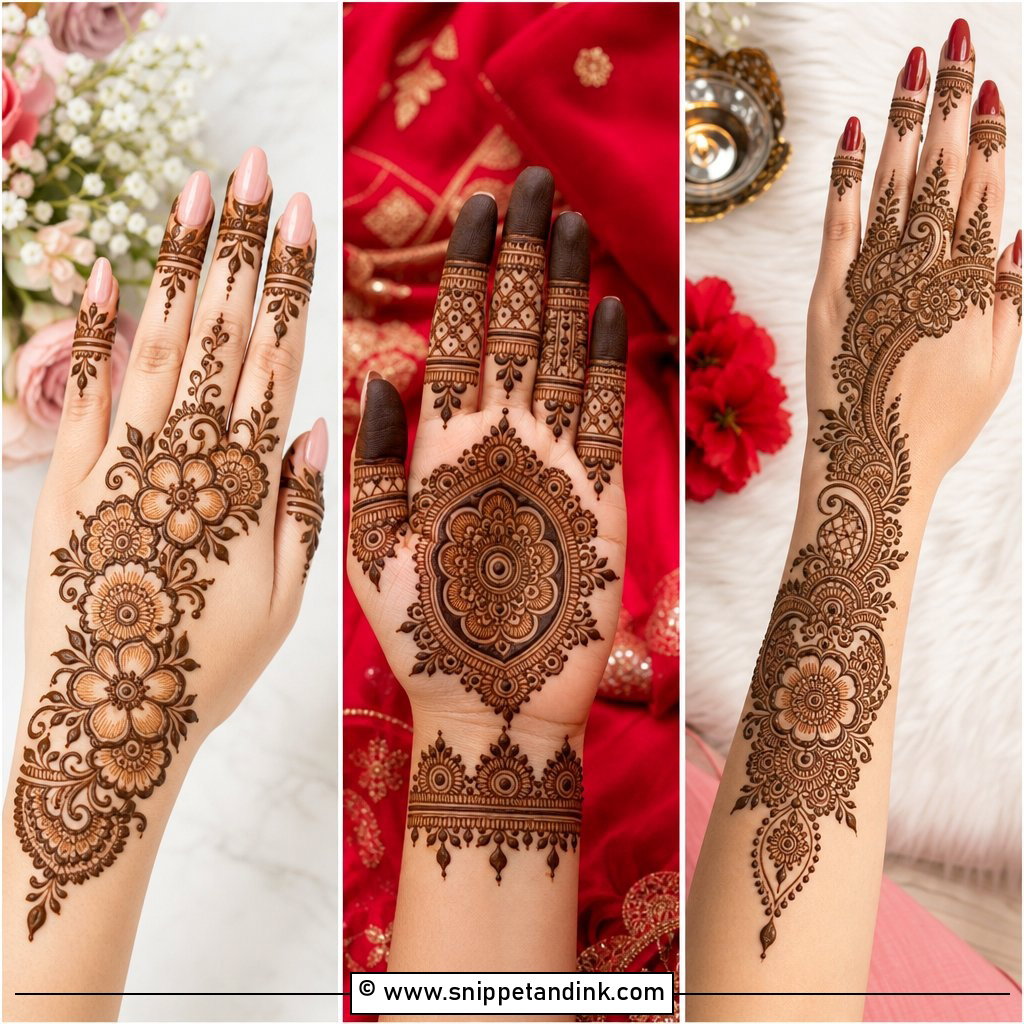
A palm mandala grows outward in rings of petals, dots, lines and small shapes, then links to wrist bands, finger patterns and forearm detail. The effect is calm and balanced, traditional without heaviness. Mandalas flatter many hand shapes because they draw the eye to the middle of the palm. Brides who want neat, photogenic hands often choose them for engagements as well as weddings. I keep the rings evenly spaced by eye and check from arm’s length every few rings.
8. Jaali Bridal Full Hand Mehndi Design
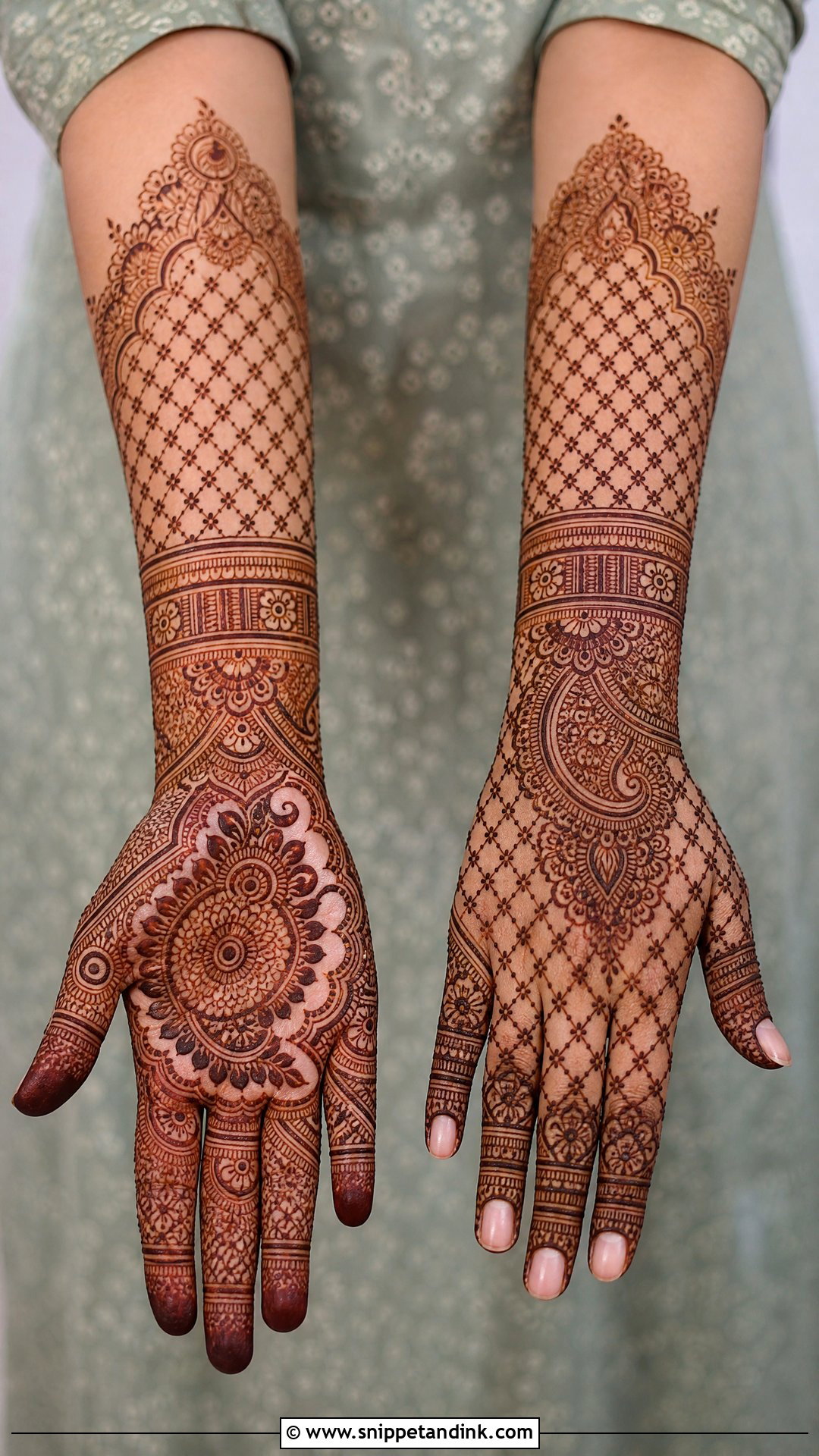
Jaali creates a net-like, fabric texture with diamond grids, floral mesh and dotted intersections, mixed with bold borders, paisleys, flowers and bands so it doesn’t look flat. On the back of the hand it reads like lace gloves; on the palm it looks refined. It’s a good match for embroidered sleeves and outfits with geometric or lace detail. The mesh must be drawn a touch wider than seems necessary, since paste lines spread slightly and close up small gaps as they dry.
9. Lotus Bridal Full Hand Mehndi Design
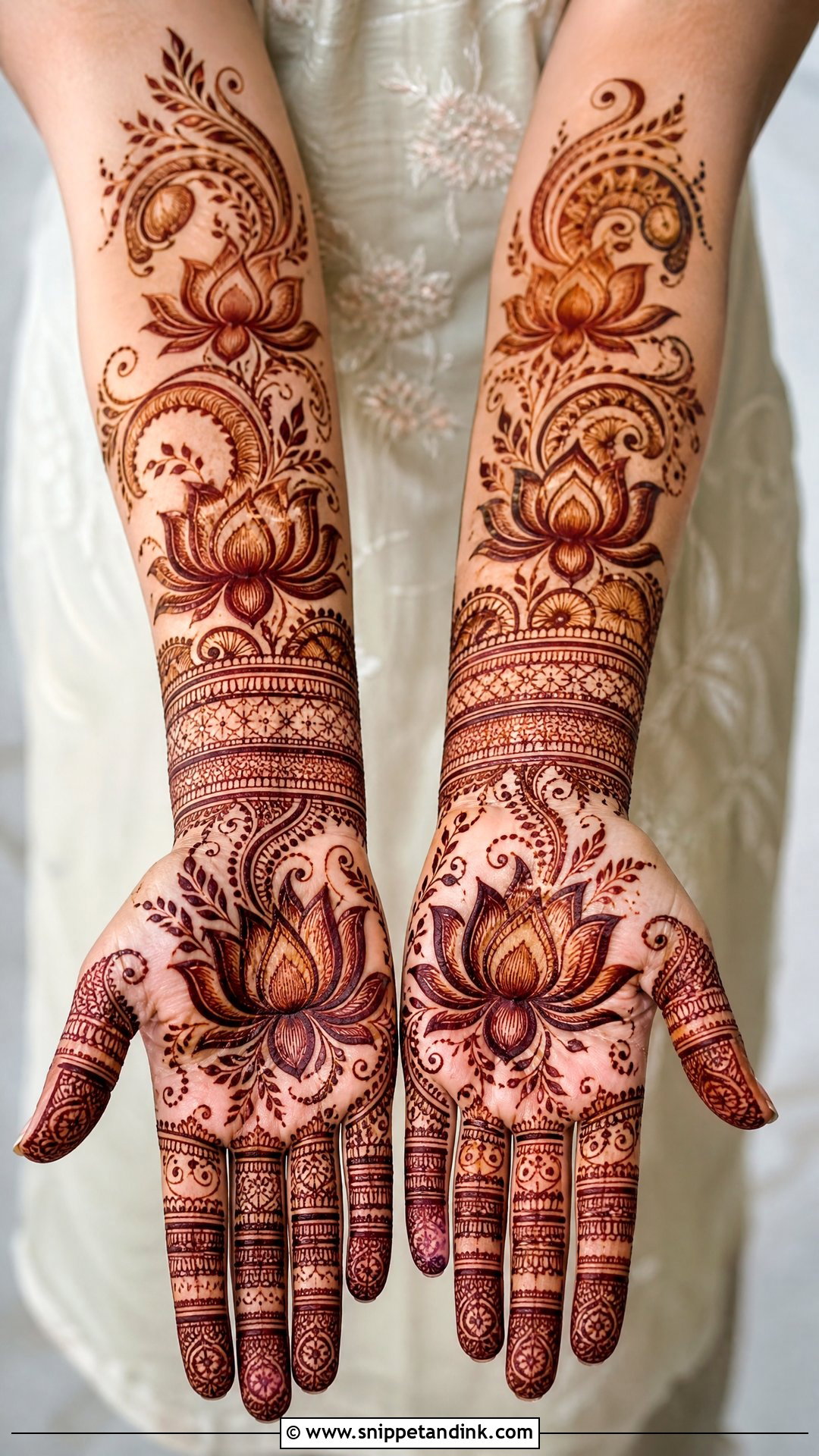
Layered lotus motifs on the palm, wrist or forearm, surrounded by petals, leaves, paisleys and curved borders, give a blooming effect. Fingers can carry small petal bands and the forearm bigger lotus clusters. It feels a little cleaner and calmer than heavy traditional work. I fill lotus petals with fine lines rather than solid paste, because large solid shapes stain unevenly. It pairs with temple jewelry and pastel outfits.
10. Paisley Bridal Full Hand Mehndi Design
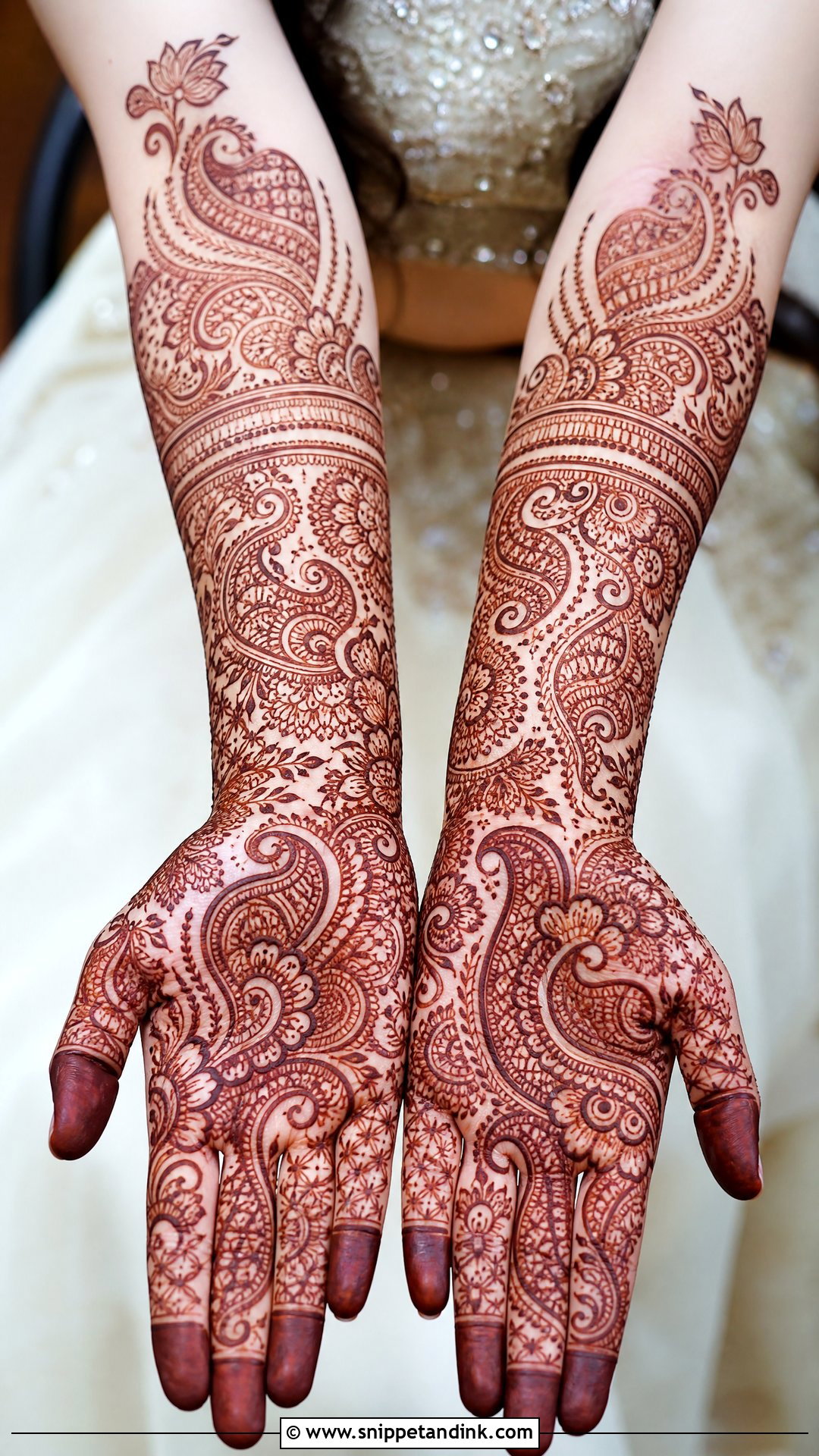
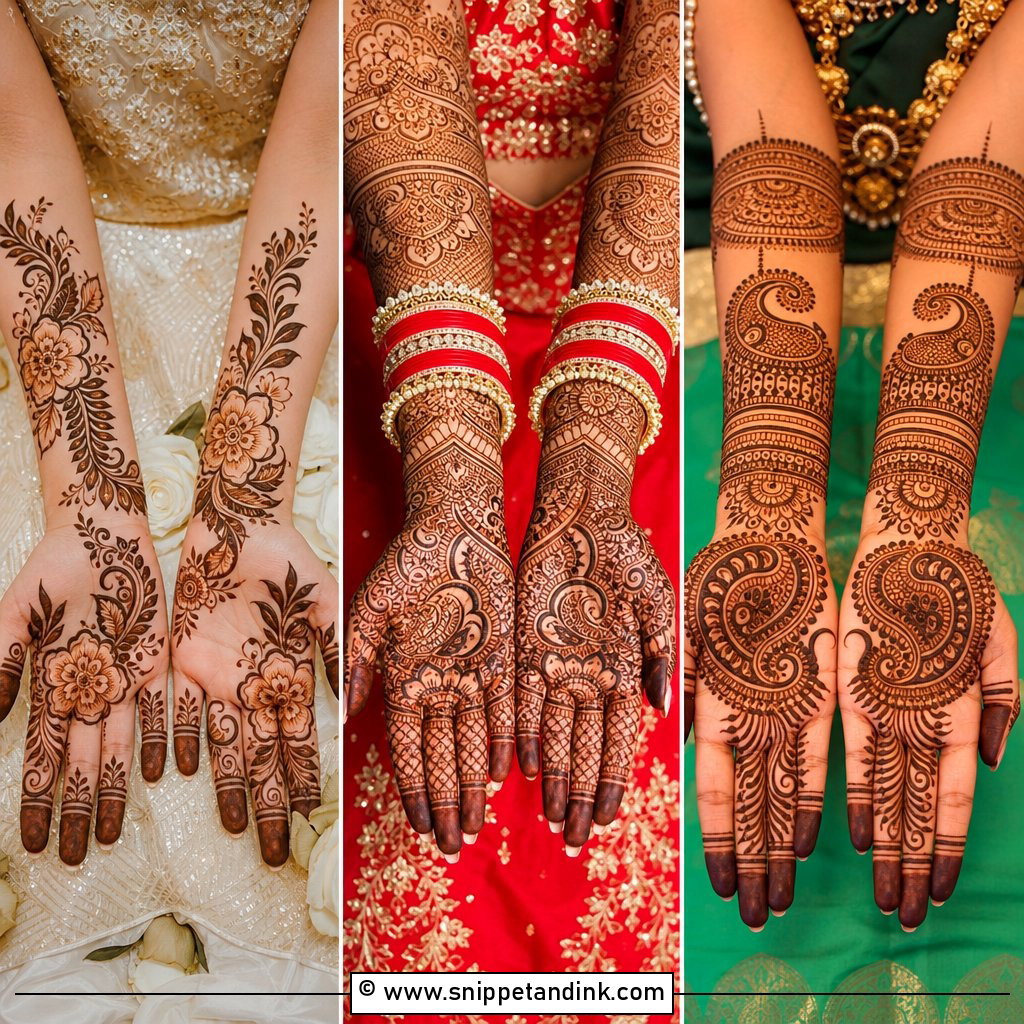
Paisleys work at every scale, as focal shapes or tiny filler, so they suit full-hand layouts naturally: bold paisleys on the palm, floral vines over the wrist, patterned bands on the forearm, mini paisleys and dots on the fingers. It’s rich without portraits or heavy storytelling. If you want a safe, traditional option that works with nearly any outfit and hand shape, I’d start here. Keep the paisleys pointing in a consistent direction so the hand flows.
11. Floral Bridal Full Hand Mehndi Design
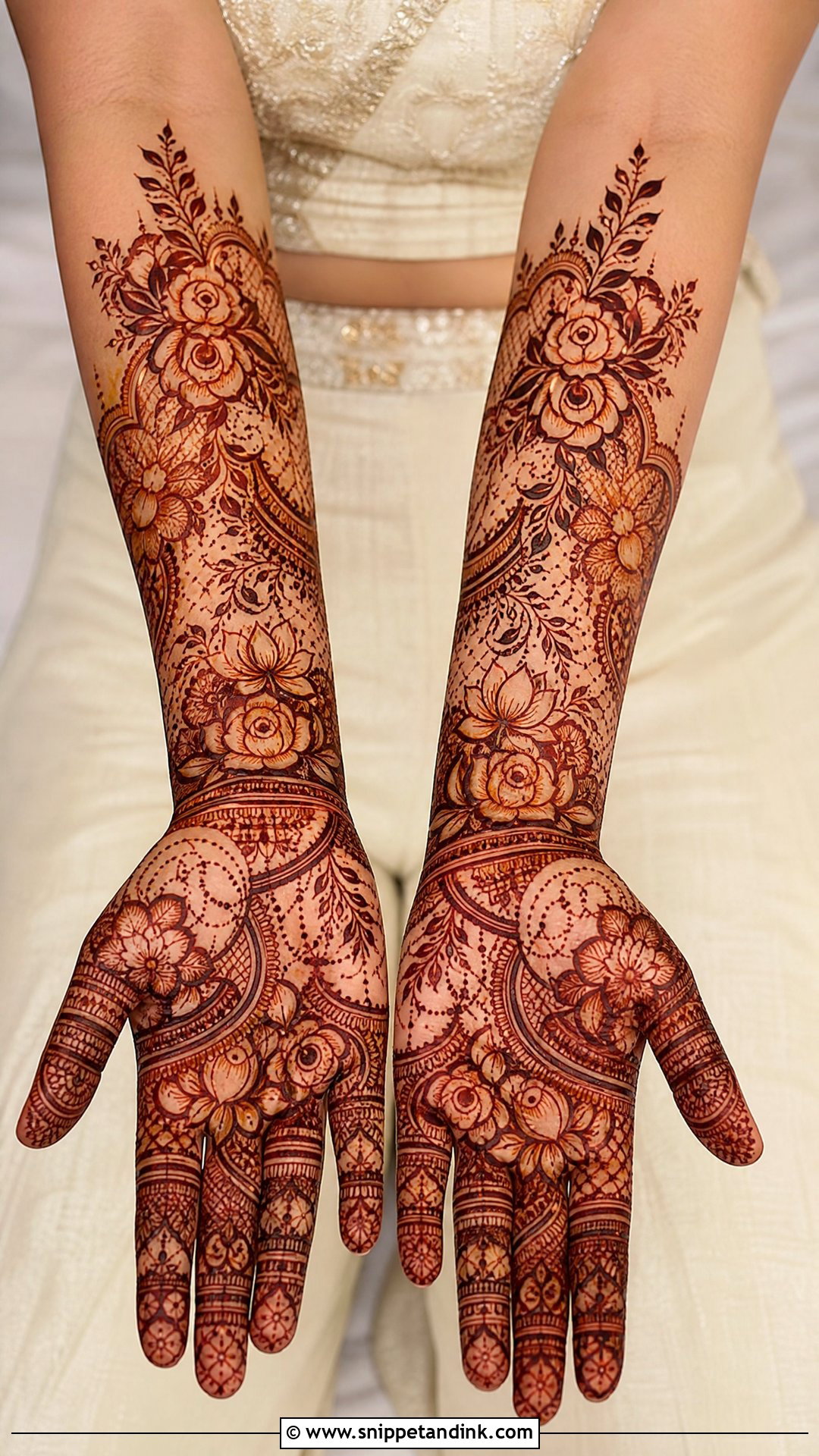
Roses, lotus petals, small blossoms, leafy trails and shaded clusters can run from fingertips to forearm with enough spacing to show each flower’s shape. Fine line filling, dotted borders and bracelet-style wrists make it bridal. It suits daytime weddings, garden themes and pastels, and gives full coverage with a softer feel than dense traditional work. I outline every flower before shading any of them, so I can see the composition and adjust spacing before committing.
12. Minimal Bridal Full Hand Mehndi Design
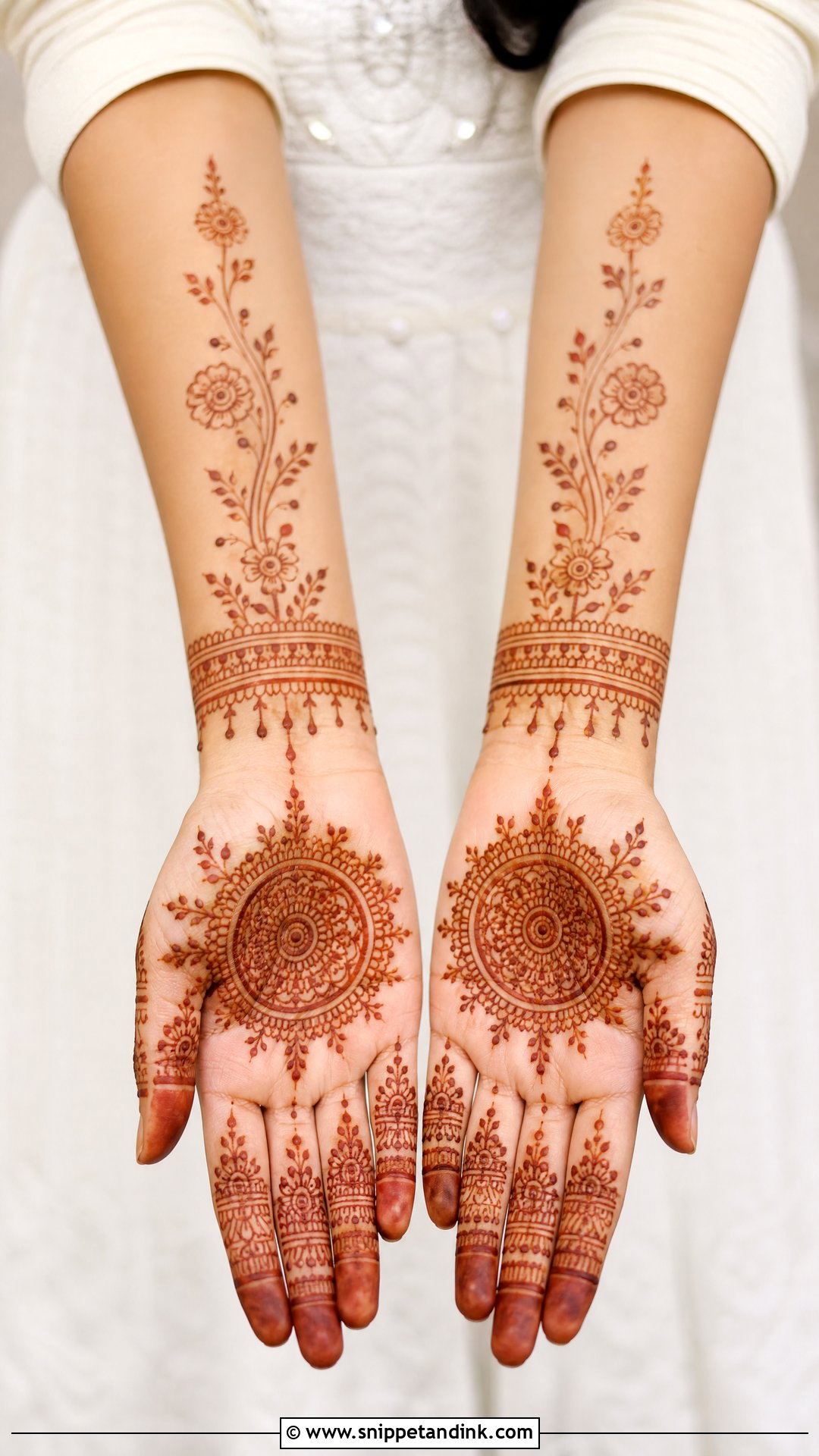
Minimal full-hand work isn’t simplistic. It relies on spacing: clean lines, delicate mandalas, light floral trails and thin wrist bands, with detailed fingers and more open skin on palms and forearms. It suits lightweight outfits, subtle jewelry and destination weddings, and the sitting is far shorter. Each motif has room to stand out in photos. The downside is that a single shaky line is visible, so I’d only book this with an artist whose clean linework you’ve seen.
13. Heavy Bridal Full Hand Mehndi Design
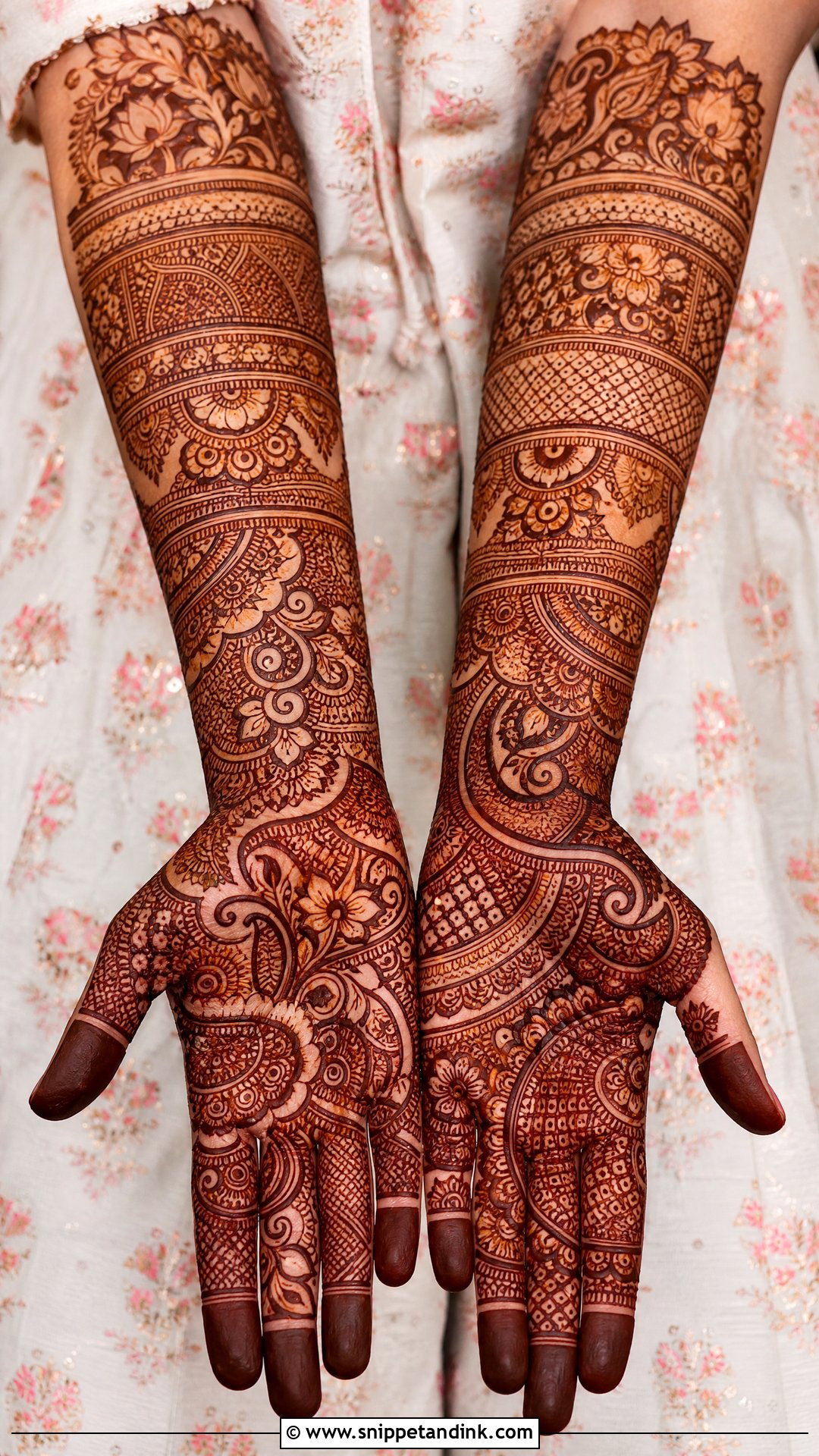
Heavy dulhan mehndi covers fingertips to forearms with dense motifs, fillers and layered borders, leaving almost no blank skin: paisleys, florals, mandalas, peacocks, jaali, tiny leaves and dotted shading. Balance makes it work. Large motifs need clear placement, and fillers should support rather than crowd. It takes a long time to apply, and that’s where it pays to plan your day around it. It suits heavily embroidered lehengas, deep colors and statement jewelry.
14. Back Hand Bridal Full Hand Mehndi Design
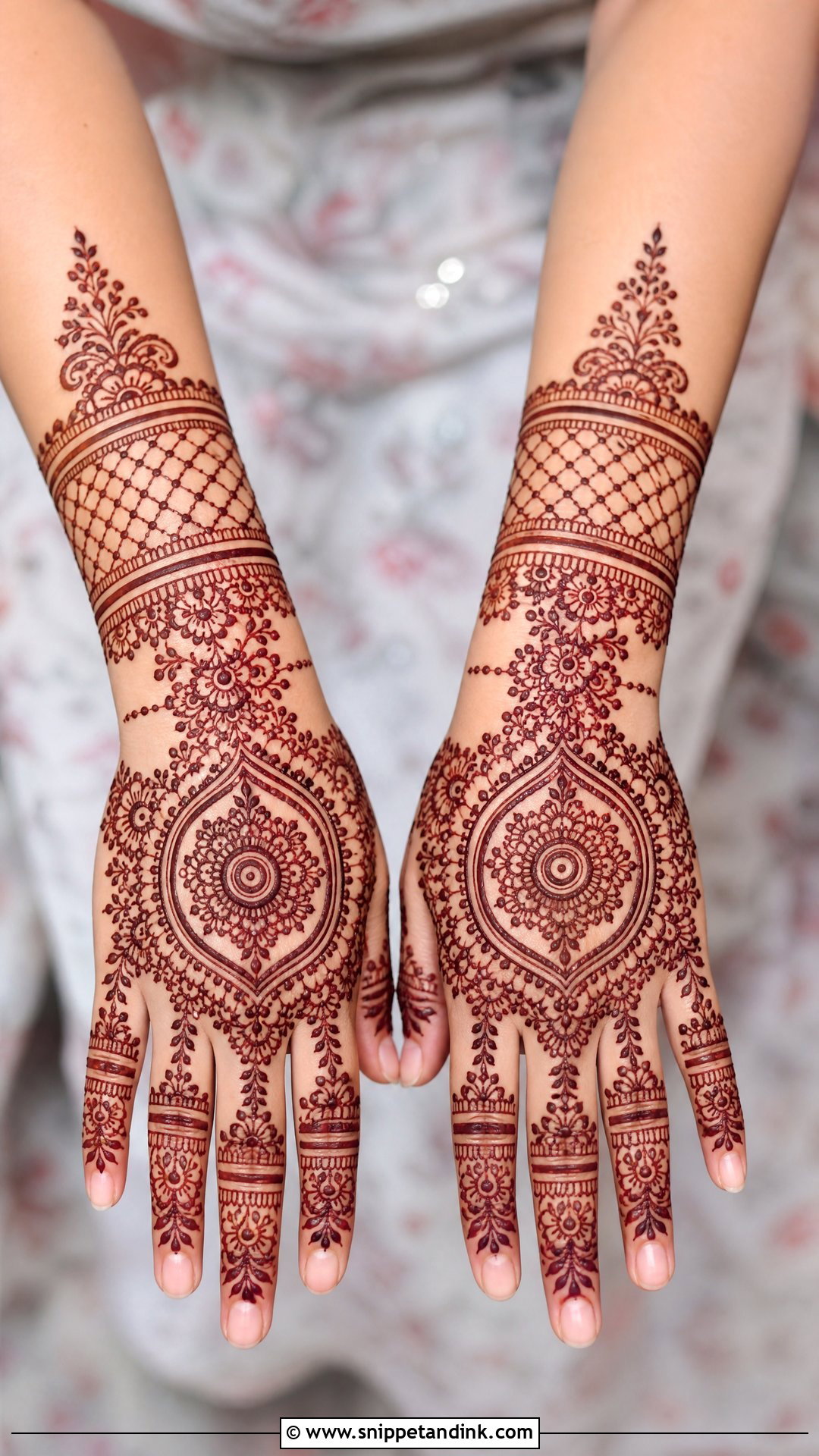
Backs of the hands get seen in nearly every ring, bangle and portrait shot. Coverage usually runs over fingers, back of hand, wrist and forearm, with central mandalas, lace jaali, floral trails, bracelet bands and finger chains. Symmetry matters more here than on the palm because both backs are often in the same frame. Back-of-hand skin is thinner, so expect a lighter stain than your palms. That’s normal, not a sign of bad paste.

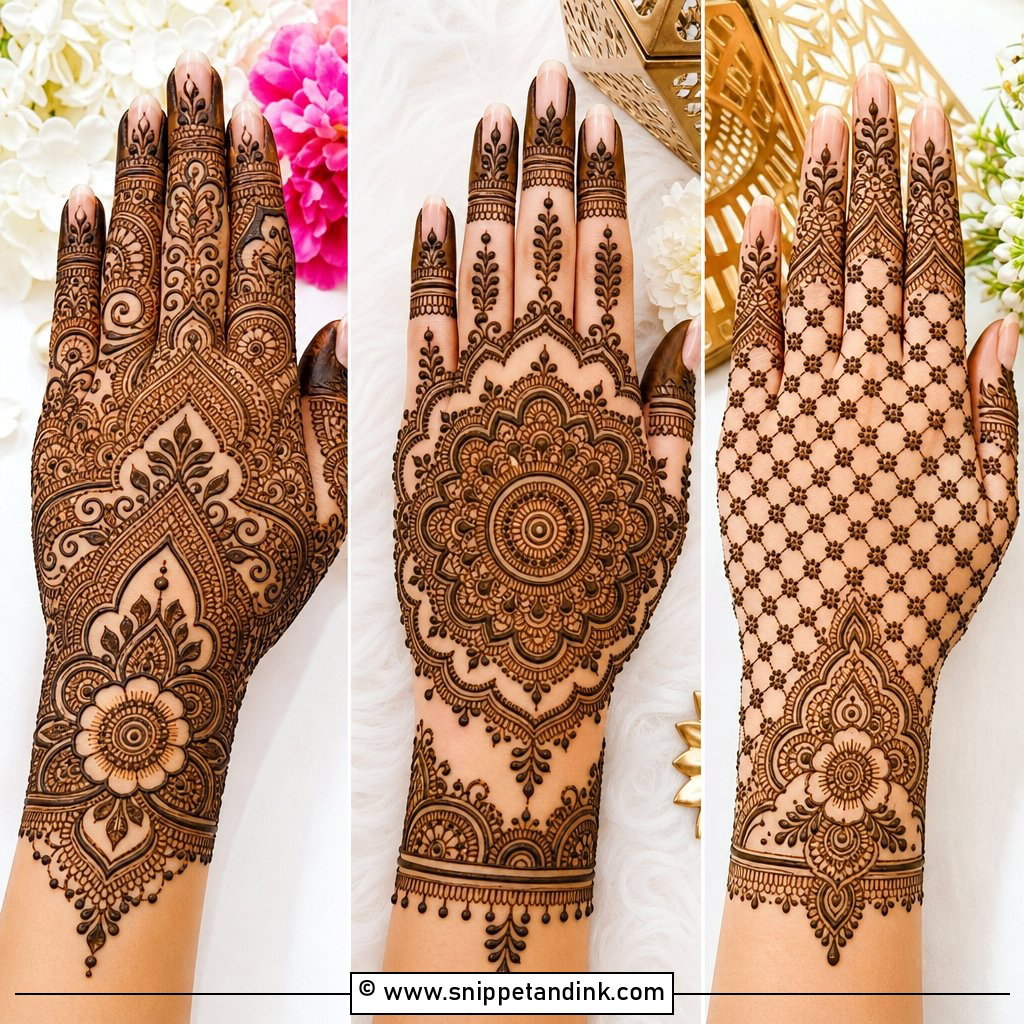
15. Front Hand Bridal Full Hand Mehndi Design
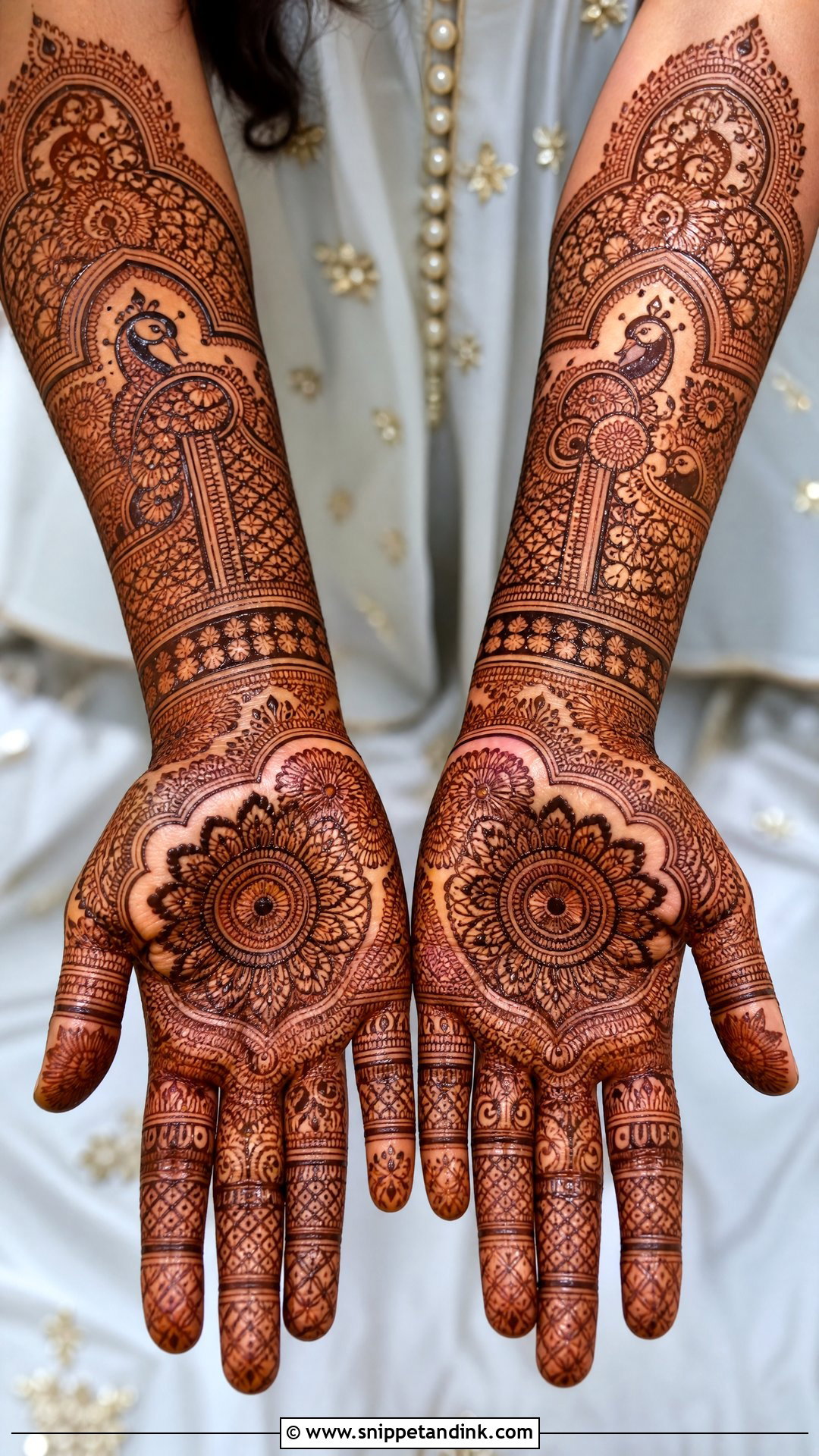
The palms carry the most meaningful parts of bridal henna: mandalas, portraits, wedding scenes, peacocks, lotus or hidden initials, continued through fingers, wrists and forearms. A strong palm design should look right when you open your hands for photos and rituals, which means clear central motifs, not tiny filler everywhere. Palms stain the darkest of anywhere on the body, so this is where fine detail has the best chance of staying crisp.
16. Bracelet Bridal Full Hand Mehndi Design
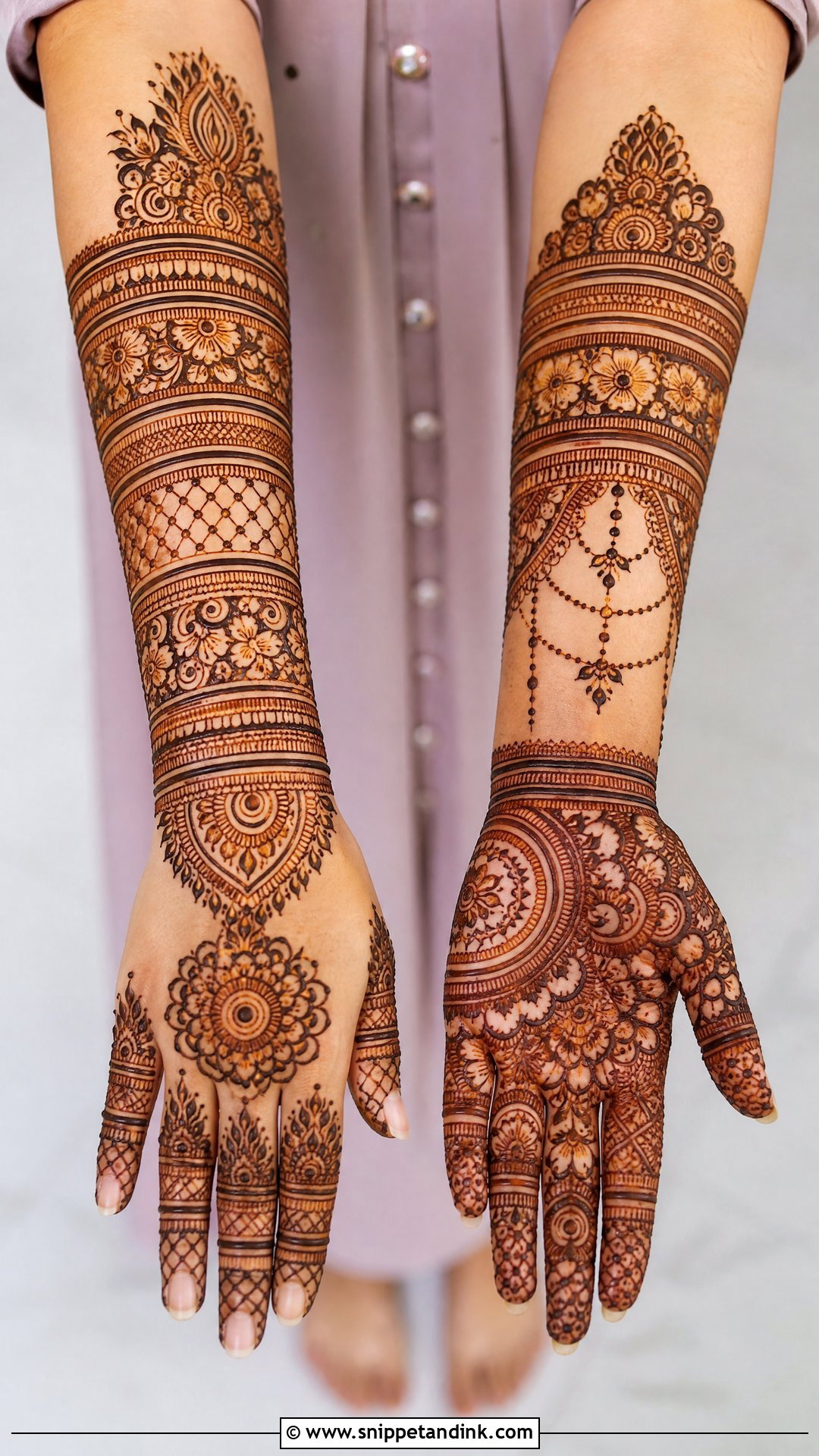
Stacked bangle bands, chain details, floral cuffs and ornamental borders decorate the wrist and forearm, connected to palm motifs and finger designs so it reads like henna jewelry. It works in dense or semi-open layouts. I ask brides to bring their bangles, kaleere or haath phool to the session; seeing exactly where the metal sits lets me put the drawn cuffs where they’ll actually show. It gives the hand a neat, framed finish.
17. Mughal Bridal Full Hand Mehndi Design
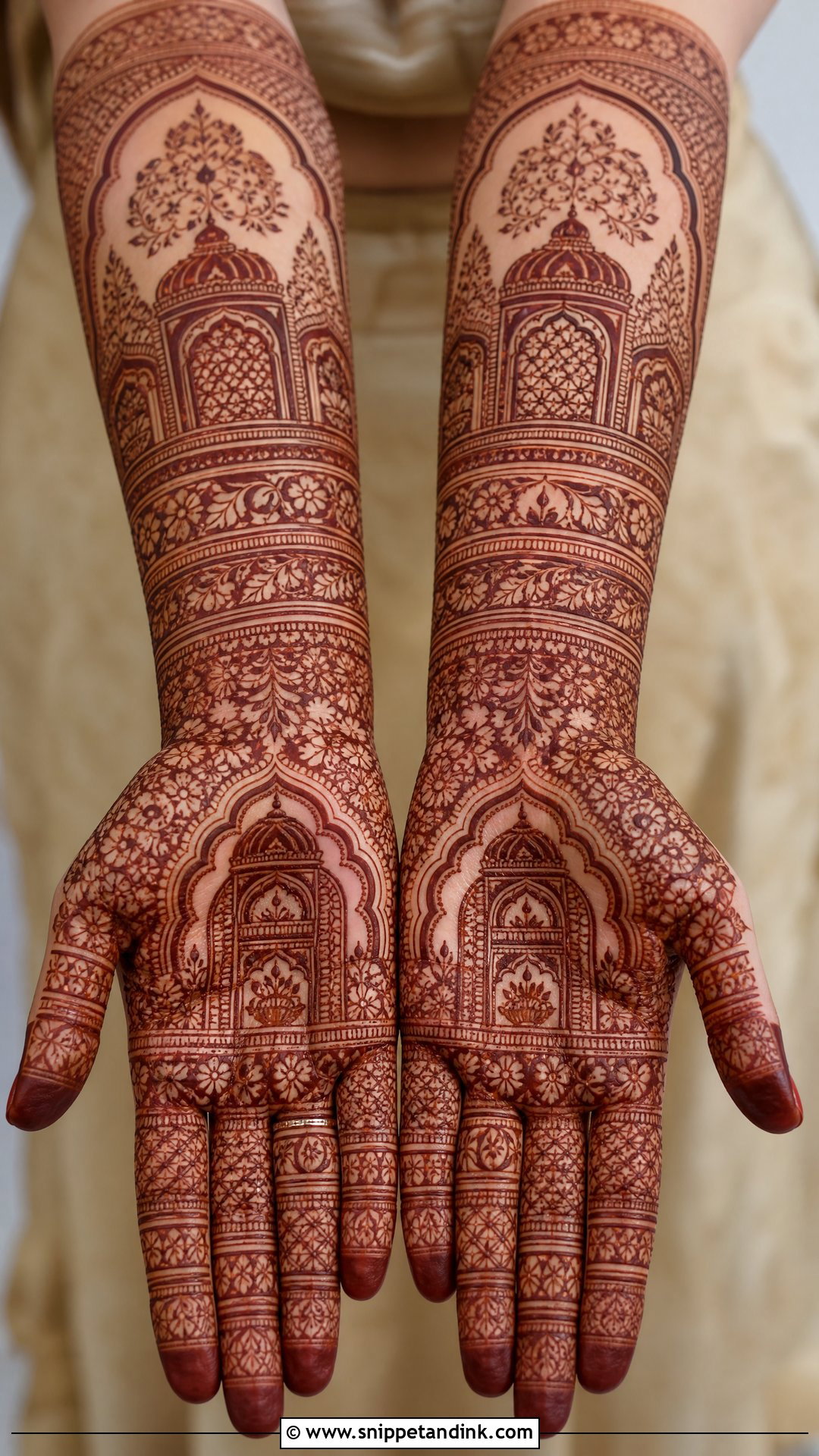
Domes, arches, floral panels, jaali windows, vines and symmetrical borders give Mughal-inspired mehndi an architectural feel. Arched frames on the palms hold flowers or symbols, and the forearms carry palace-style panels. It’s regal without heavy figures, and it suits zardozi, velvet and heritage embroidery. The clean panels make it easy to read in photos. I mark a center line on each palm before drawing arches, since a lopsided arch is obvious.
18. Moroccan Bridal Full Hand Mehndi Design
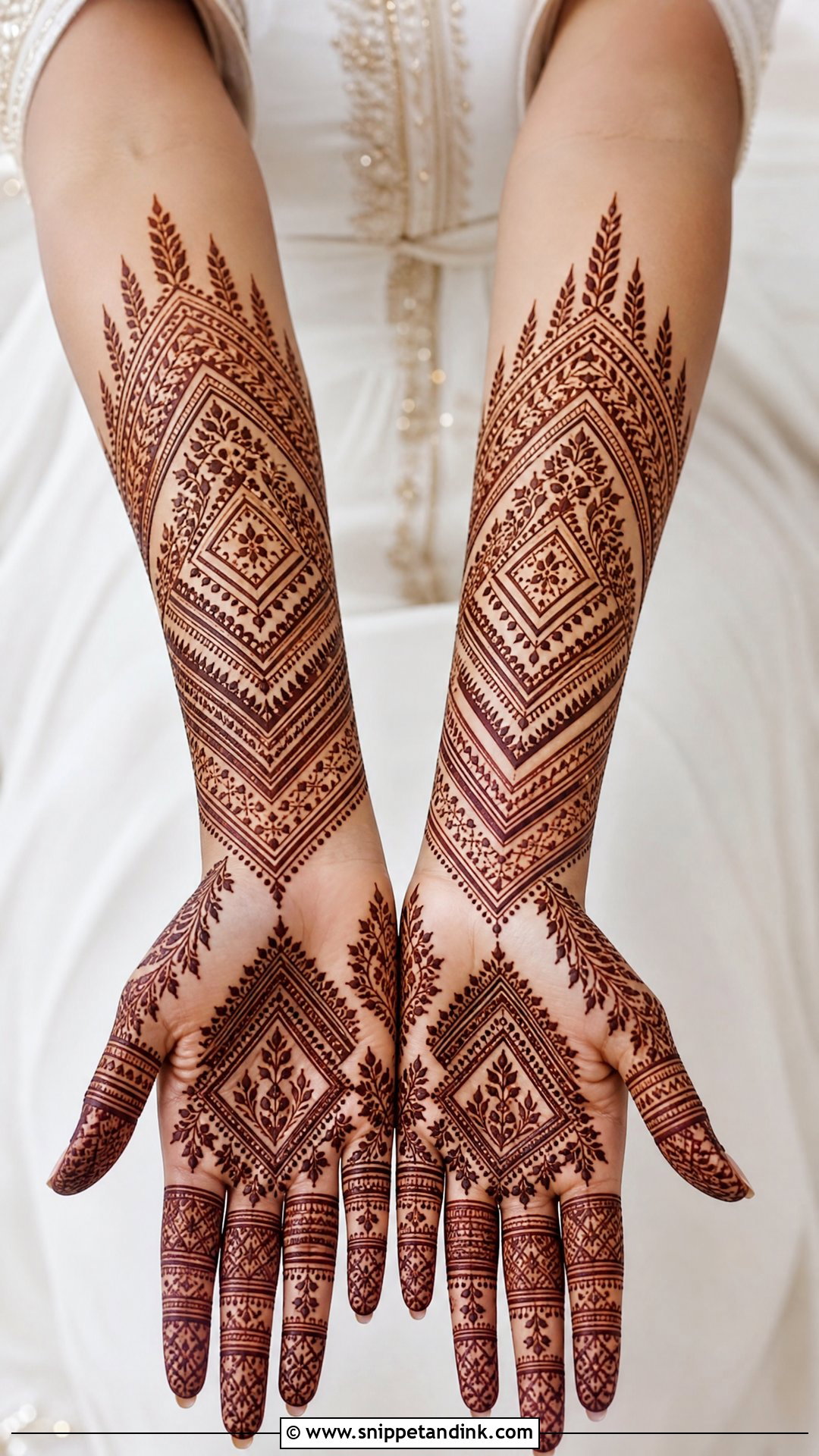
Diamonds, triangles, grids, straight lines, chevrons and bold symmetrical shapes make Moroccan-inspired mehndi strikingly different from paisleys. Small florals, dots and wrist bands soften it for a bride. Straight-line work flatters long fingers and clean nail looks, because it follows and emphasizes the shape of the hand. Neat application is everything; I steady the bride’s hand on a firm cushion and draw lines in one pull rather than in short strokes.
19. Gulf Bridal Full Hand Mehndi Design
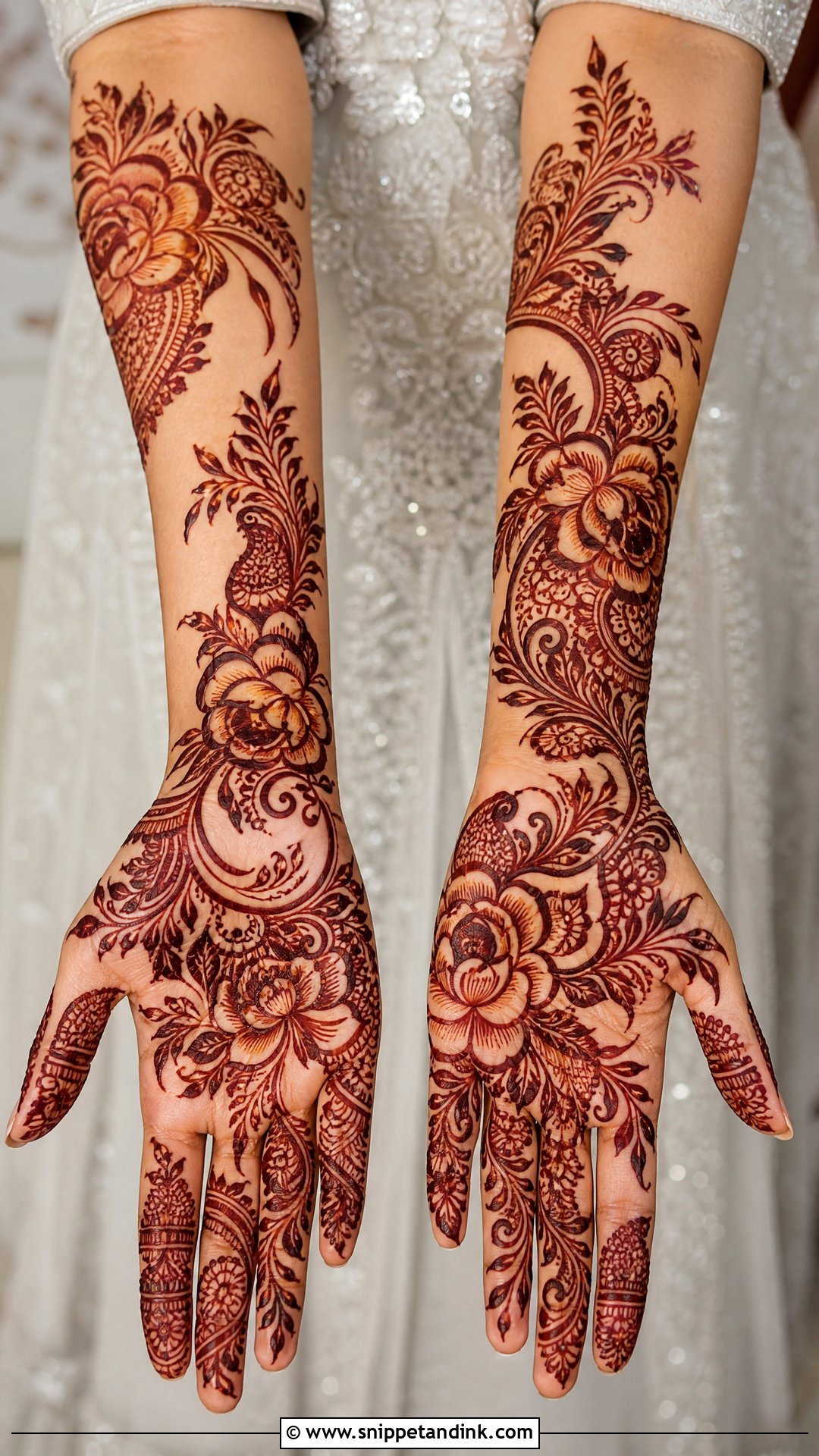
Khaleeji-inspired mehndi uses bold florals, leafy strokes and open spacing, with motifs larger than traditional Indian work. For full coverage, vines flow from fingers to forearms with shaded petals, thick outlines and delicate fillers. It’s luxurious without covering every inch. Those bold areas take extra paste and stain deep, so the finished hands look dramatic. It pairs with Arabic bridal outfits, modern lehengas and simple jewelry.




20. Symmetrical Bridal Full Hand Mehndi Design
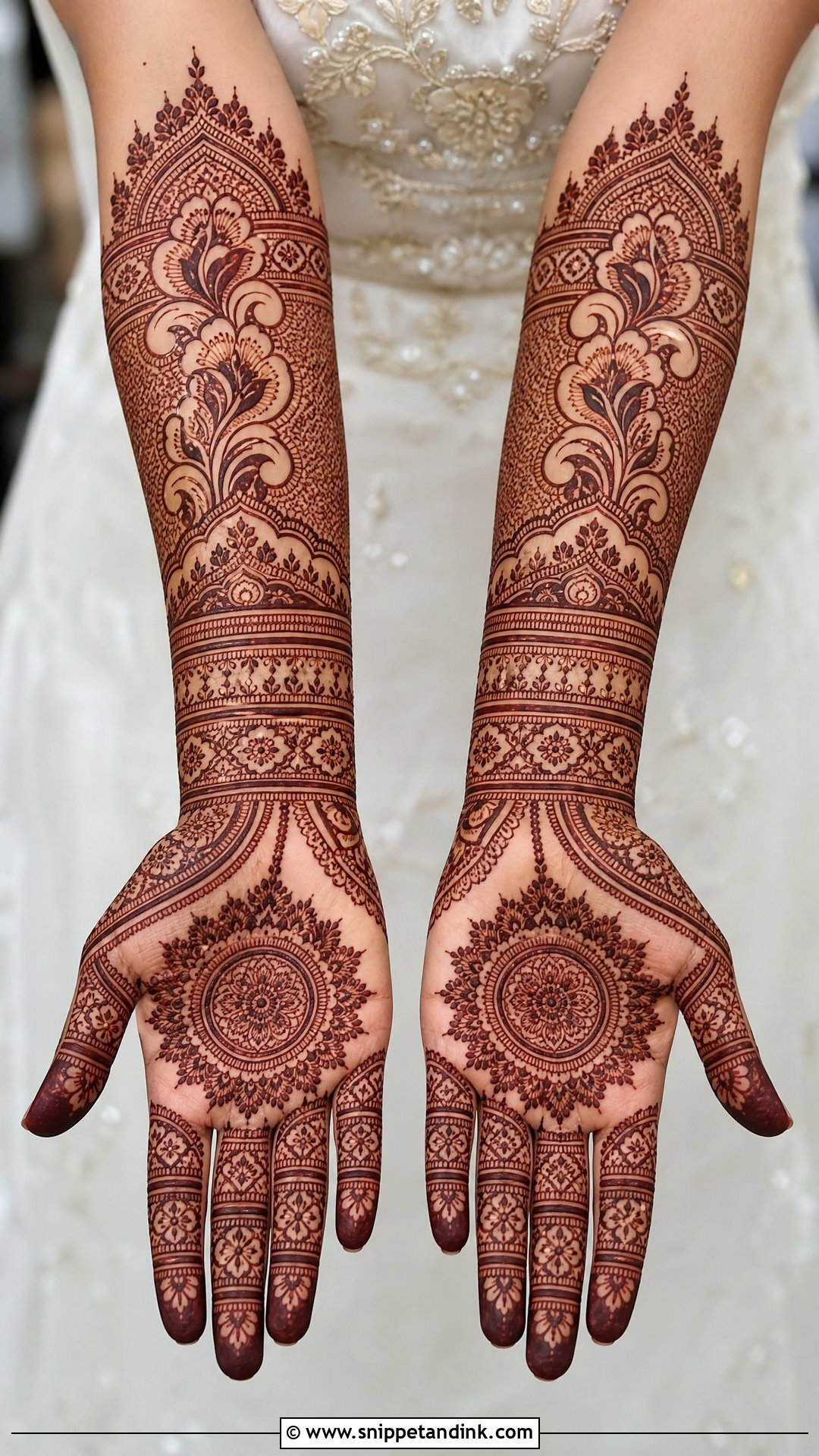
Mirrored mandalas, paisleys, florals, borders and finger patterns on both hands make the set calm, even when the detail is dense, and look polished when both palms are shown together. Hands are never quite the same size, so I adjust spacing slightly between them to make the designs look identical rather than measuring them identically. It suits heavy and minimal layouts alike, which is why it’s one of the most reliable full-hand approaches.
21. Asymmetrical Bridal Full Hand Mehndi Design
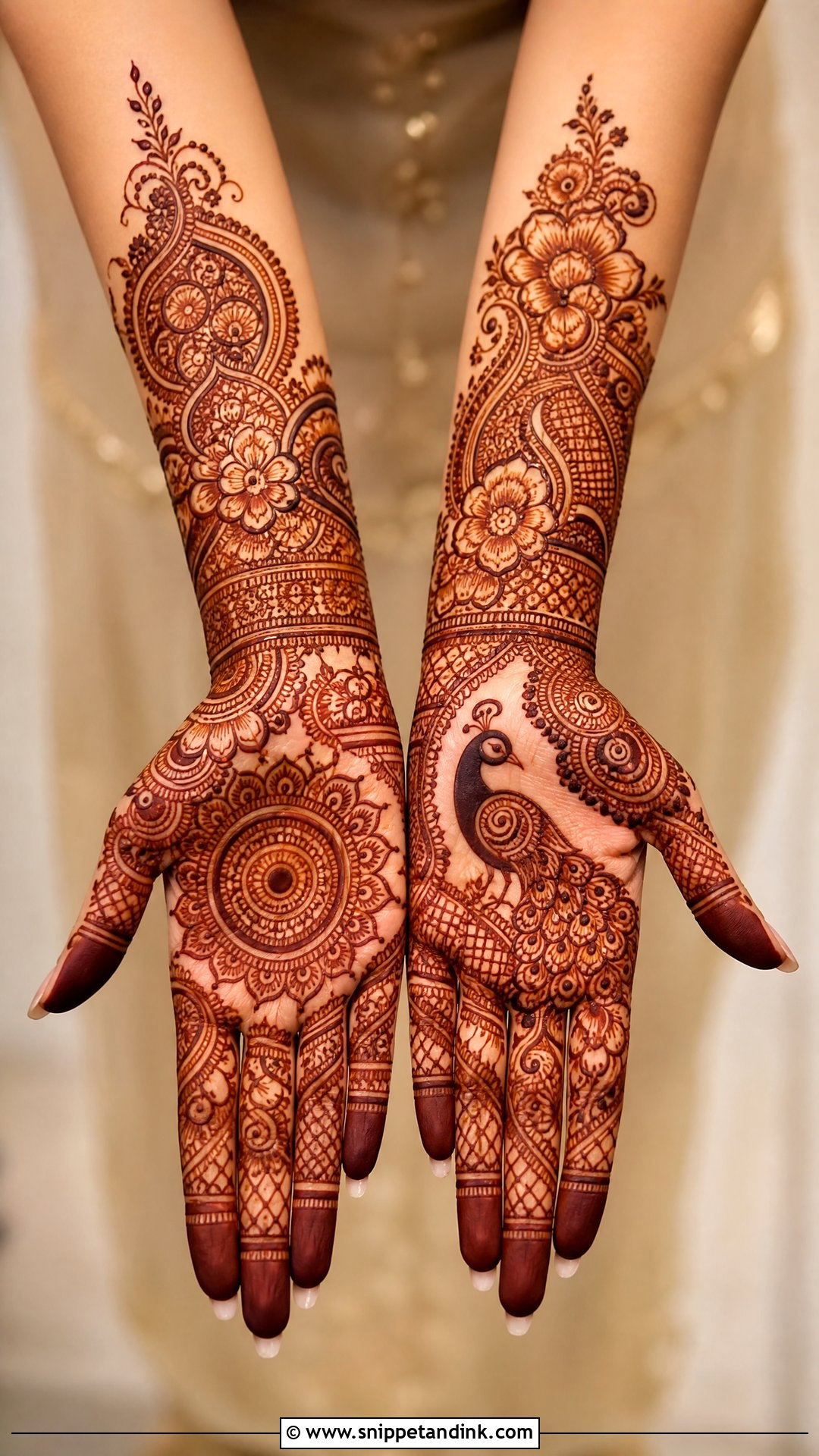
Different but related designs on each hand feel modern: a mandala on one palm and a peacock or portrait on the other, floral bands on one forearm and jaali or paisley panels on the other. The secret is connection. Both hands need the same line weight, spacing and motif language, otherwise they look like two different artists’ work. It suits brides who want something custom and less predictable.
22. Bridal Full Hand Mehndi With Groom Name
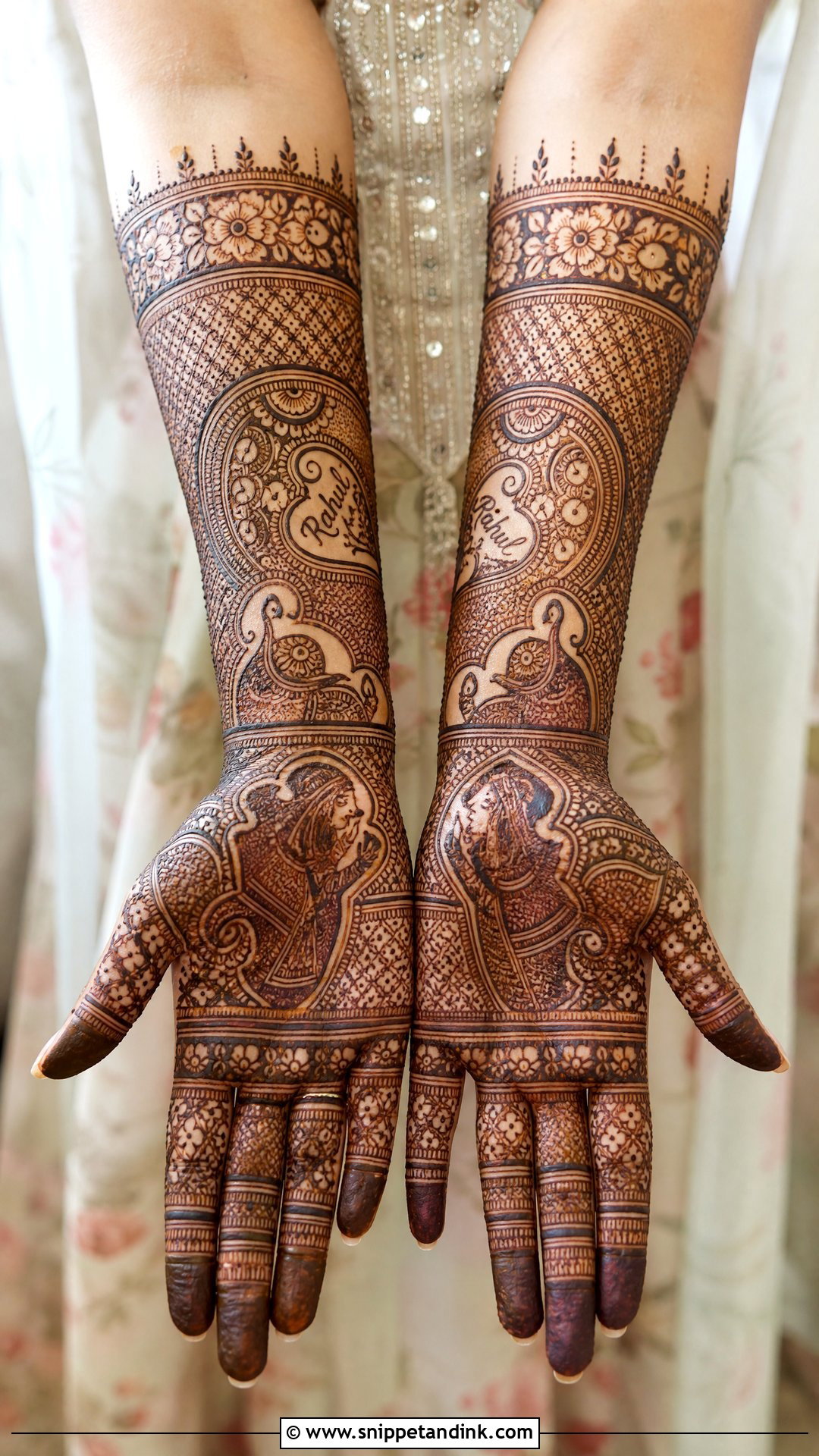
Hiding the groom name inside a paisley, a floral band, the jaali or the forearm pattern turns the mehndi into a playful moment when he searches for it. The surrounding design can be Indian, Arabic, Indo-Arabic or Rajasthani. Readable but not obvious is the aim. I write the name slightly smaller than feels natural and use the same line weight as the filler around it, which is what makes it hard to spot. Please give me the spelling in writing.
23. Bridal Full Hand Mehndi With Wedding Scene
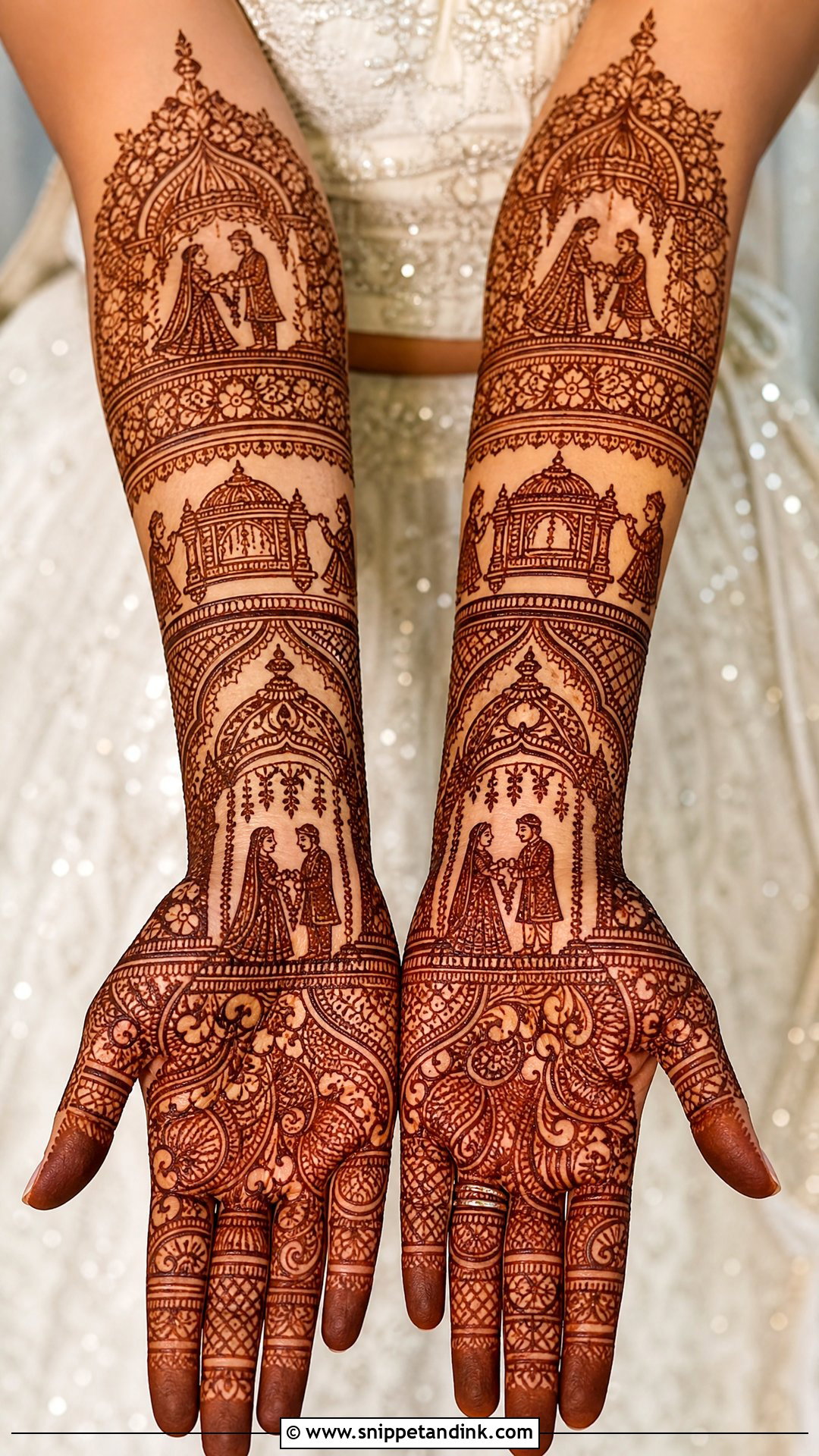
Varmala, doli, baraat, couple silhouettes, mandap art and ritual motifs can fill the palms, with paisleys, florals, jaali and borders on the fingers, wrists and forearms. It needs planning so the scene isn’t swallowed by filler. I keep figures clean, sized for the palm and surrounded by smaller patterns for balance. If family elders love cultural storytelling, this is the design that gets talked about at the wedding.
24. Modern Bridal Full Hand Mehndi Design
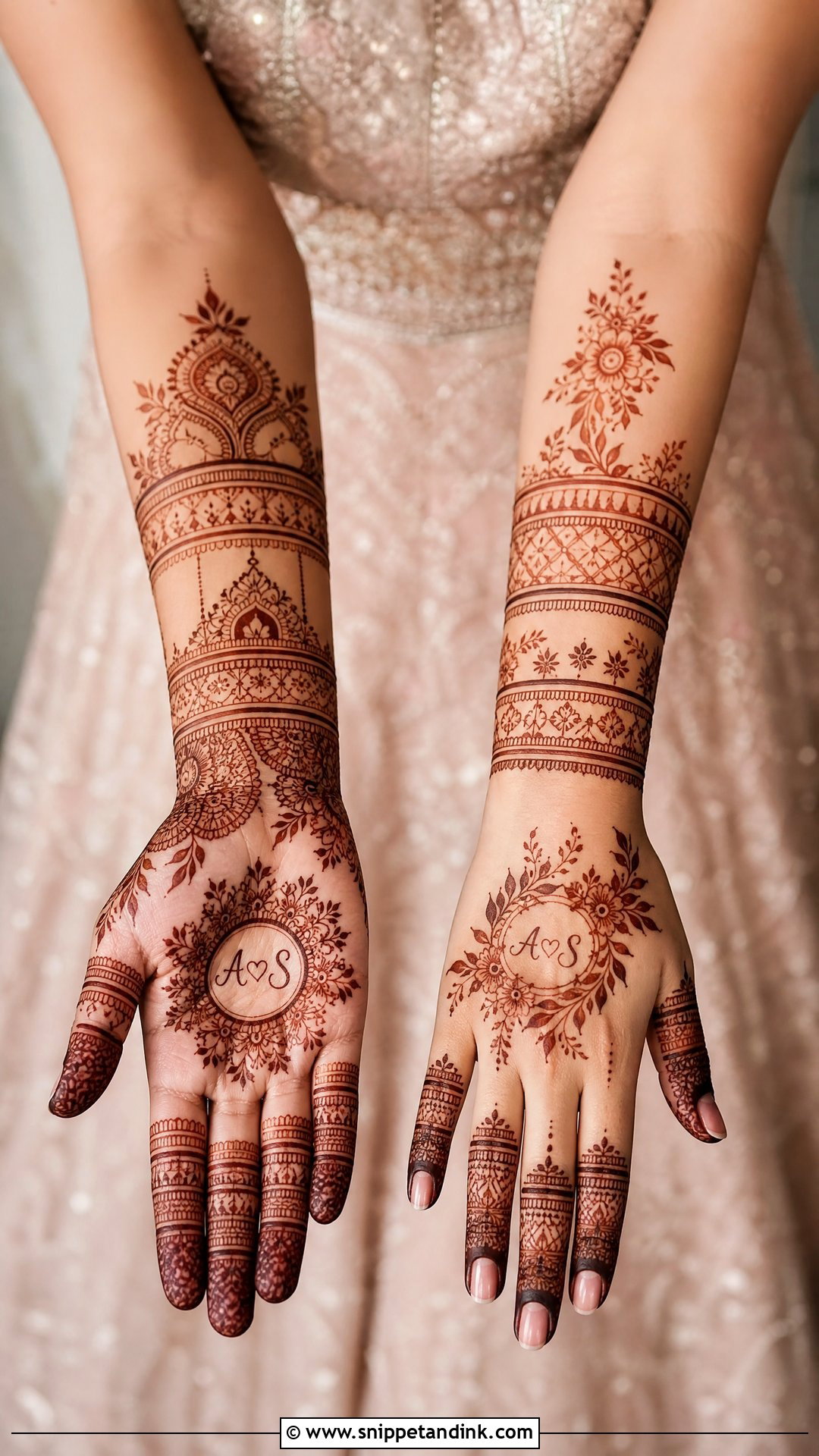
Modern full-hand layouts mix traditional motifs with updated spacing: slim mandalas, bold floral trails, geometric bands, negative space, fine-line leaves and stylish fingers. The hand is covered, but it doesn’t feel packed. It works with contemporary outfits, lighter dupattas and fusion styling. It’s easy to personalize with initials, dates, symbols or a motif borrowed from your outfit’s embroidery, which I like to sketch from a photo of the fabric.
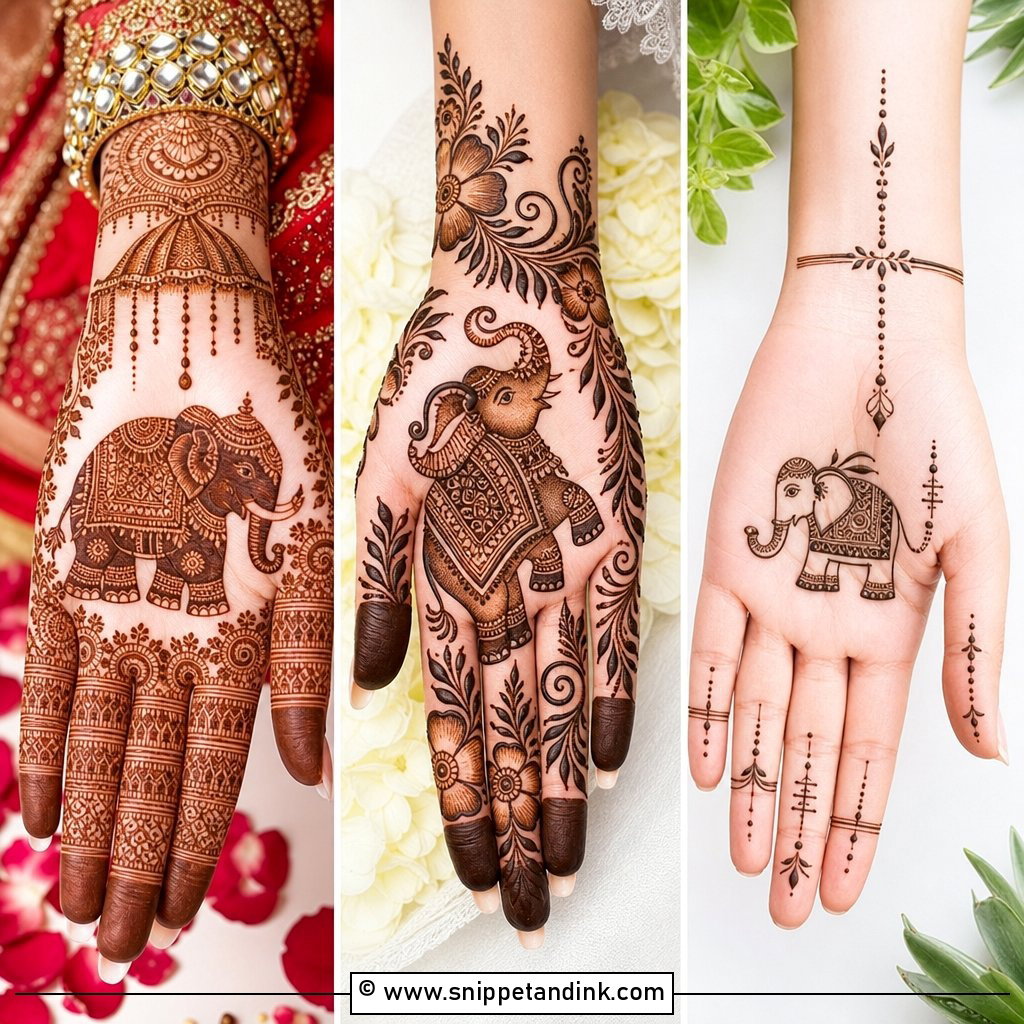
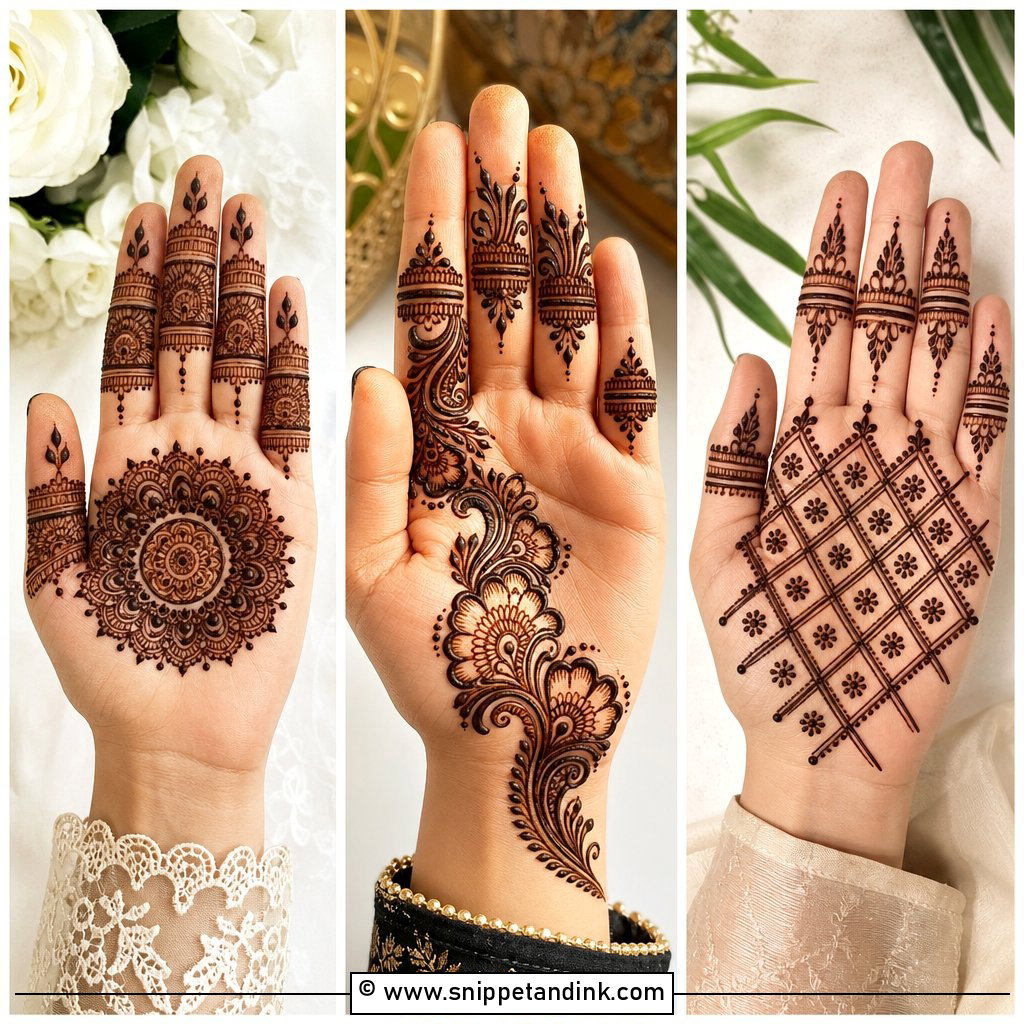
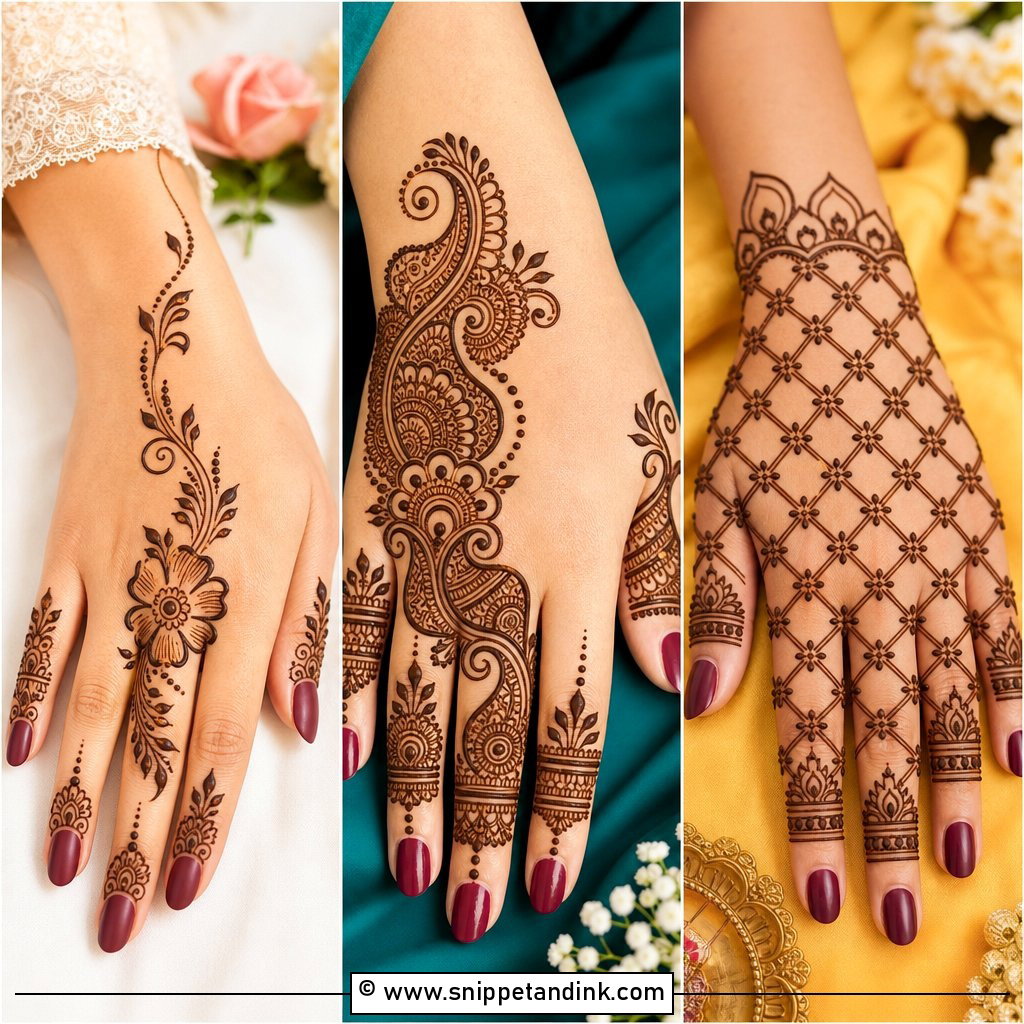
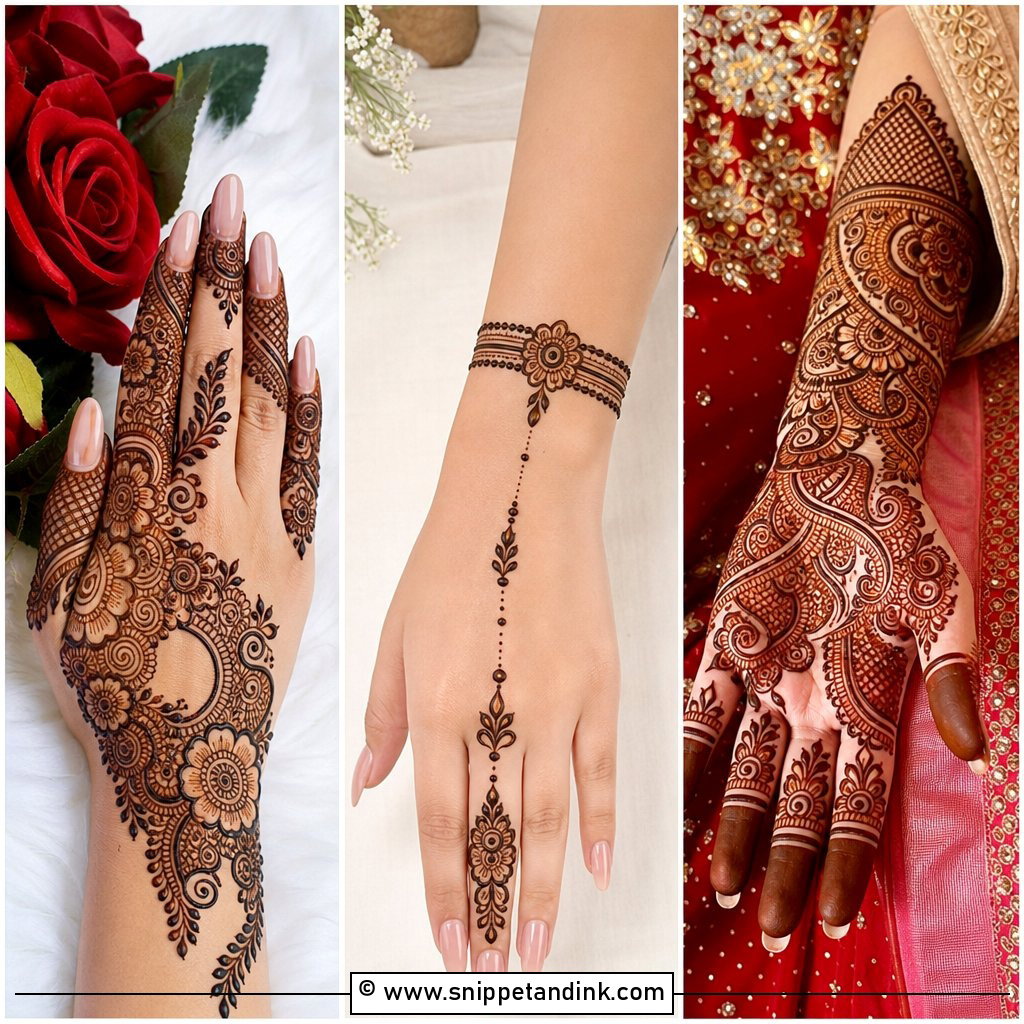
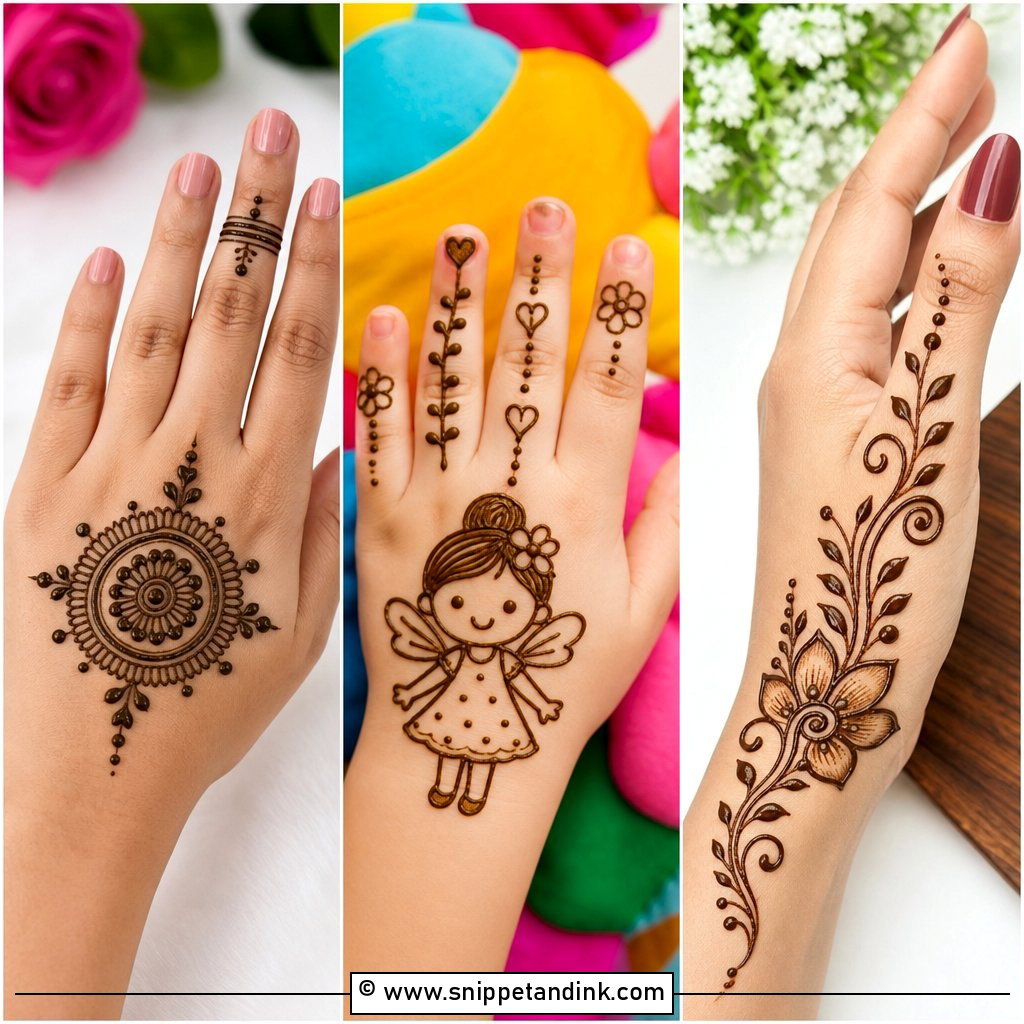
25. Simple Bridal Full Hand Mehndi Design
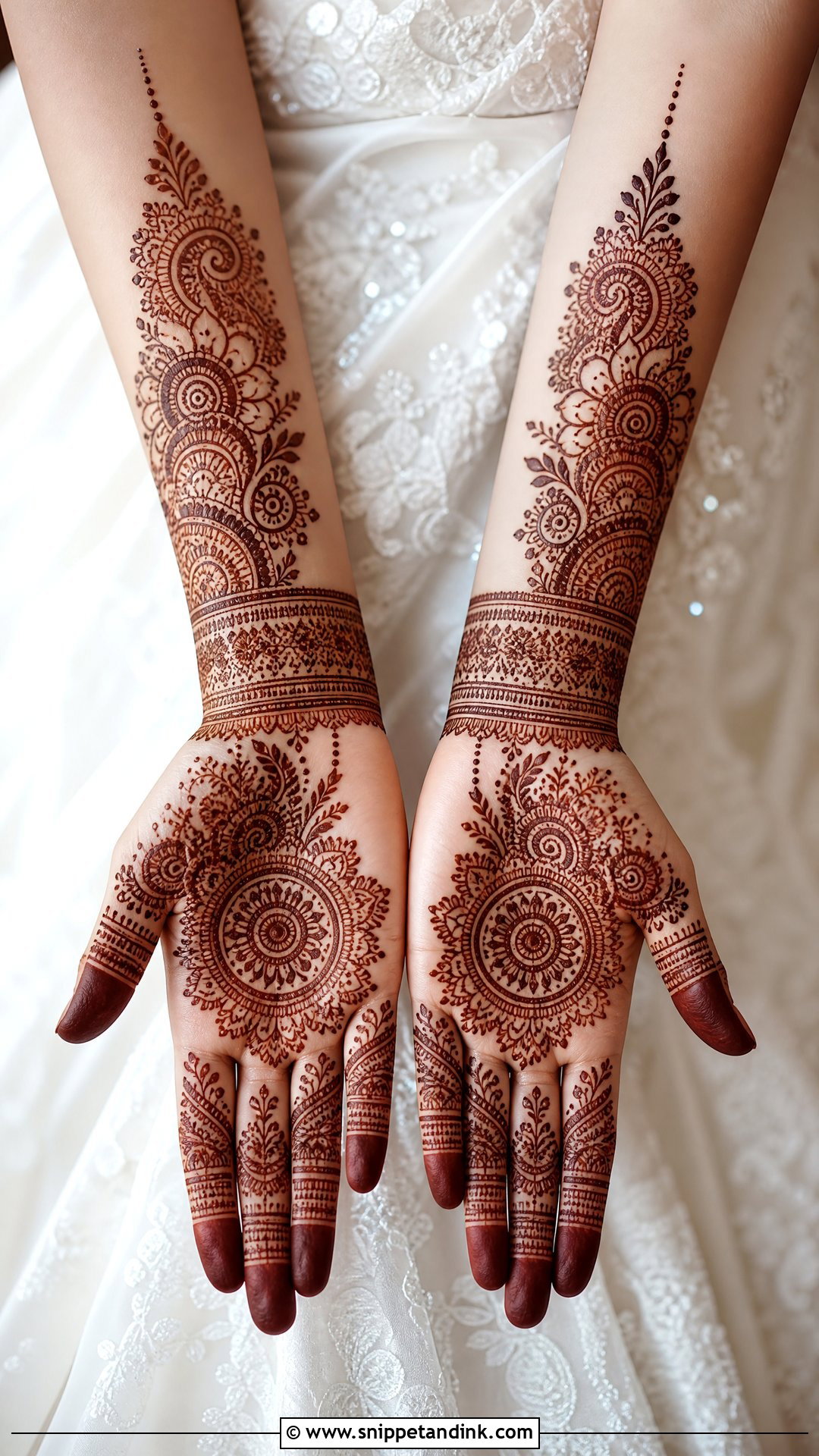
A simple full hand uses fewer heavy fillers and focuses on readable motifs: flowers, paisleys, mandalas, leaves and bracelet bands, with one strong palm centerpiece. It’s still full-hand mehndi but lighter to wear. It’s especially kind to smaller hands, where heavy detail can look crowded. Intimate weddings, civil ceremonies and engagements suit it. Larger, simpler motifs also tend to stain more evenly than micro filler.
Getting Through a Long Sitting Without Smudging Anything
Full-hand bridal work can take most of an afternoon or evening. The brides who have the easiest time are the ones who prepare for it like a short flight.
- Eat a proper meal and use the bathroom right before I start.
- Wear a loose top with sleeves that push above the elbow, or a sleeveless one.
- Wash your hands and arms with plain soap beforehand; skip lotion, because oil blocks the stain.
- Sit somewhere warm. A fan aimed at wet paste can crack it, and cold skin stains lighter.
- Keep fingers spread and still while the paste sets. Most smudges happen when a bride absent-mindedly scratches her nose.
Sleeping in the paste
If you can, keep the paste on overnight. Let it dry completely first, then wrap each hand loosely in cotton or soft tissue and secure it gently, never tight. Rest your arms on a towel over a pillow. In the morning, flake the dried paste off with your fingers instead of washing it, and enjoy watching the color deepen over the next day.
Ask for a Rough Layout Before the First Line Goes On
Start with your outfit, ceremony, jewelry, hand shape and how long you can comfortably sit. Heavy Indian and Rajasthani work feels grand; Arabic, Gulf and modern layouts leave more open skin. Portraits, groom names and wedding scenes make it personal, while mandalas, paisleys, jaali, florals and peacocks keep it classic. Before the day, ask your artist for a rough layout so the palm, fingers, wrist, and forearm flow together. With that planning done, the design you end up with will feel like yours.
You'll Like These Ideas:









Leave a Reply