
The palm side of the hand gives me the biggest single canvas I get to work on, from fingertips over the palm and wrist into the forearm. It’s also the side that stains darkest, so whatever goes there will be the boldest thing on your hands. The designs below range from dense Indian filling to open Arabic trails, jaali mesh, mandalas, paisleys and modern layouts with a lot of bare skin. Some are bridal; plenty suit Eid, Diwali, an engagement or a cousin’s wedding. What decides the right one is how much coverage you want, how dark you’d like it to read and how long you can keep your palms still. Here are 30 Latest Front Full Hand Mehndi Designs, with my notes on each.
Mapping a Pattern Onto the Creases of Your Palm
A palm isn’t flat paper. It folds along three main creases every time you close your hand, and the skin at the base of the fingers bunches as you grip. Before I draw anything, I ask you to open and close your hand a few times so I can see where it folds. I avoid putting a face, a lettered name or the center of a mandala right on a deep crease, because it will look bent in every photo where your hand isn’t fully stretched.
Finger length matters too. Long fingers can take three or four bands each; short fingers look better with one long vertical motif that runs toward the tip. And I measure the palm before choosing a centerpiece size, since a motif that fits one sister’s hand can swamp another’s.
Your hands are out of action while it dries
This is what people forget with palm designs. A back-of-hand pattern still lets you hold a cup; a full palm doesn’t. Once the paste is on, you can’t eat, scroll, fix your dupatta or use the bathroom easily until it has dried and set, and you’ll want to keep it on for hours after that. Arrange someone to feed you and hold your phone, and wear something that doesn’t need adjusting.
1. Front Full Hand Bridal Mehndi Design
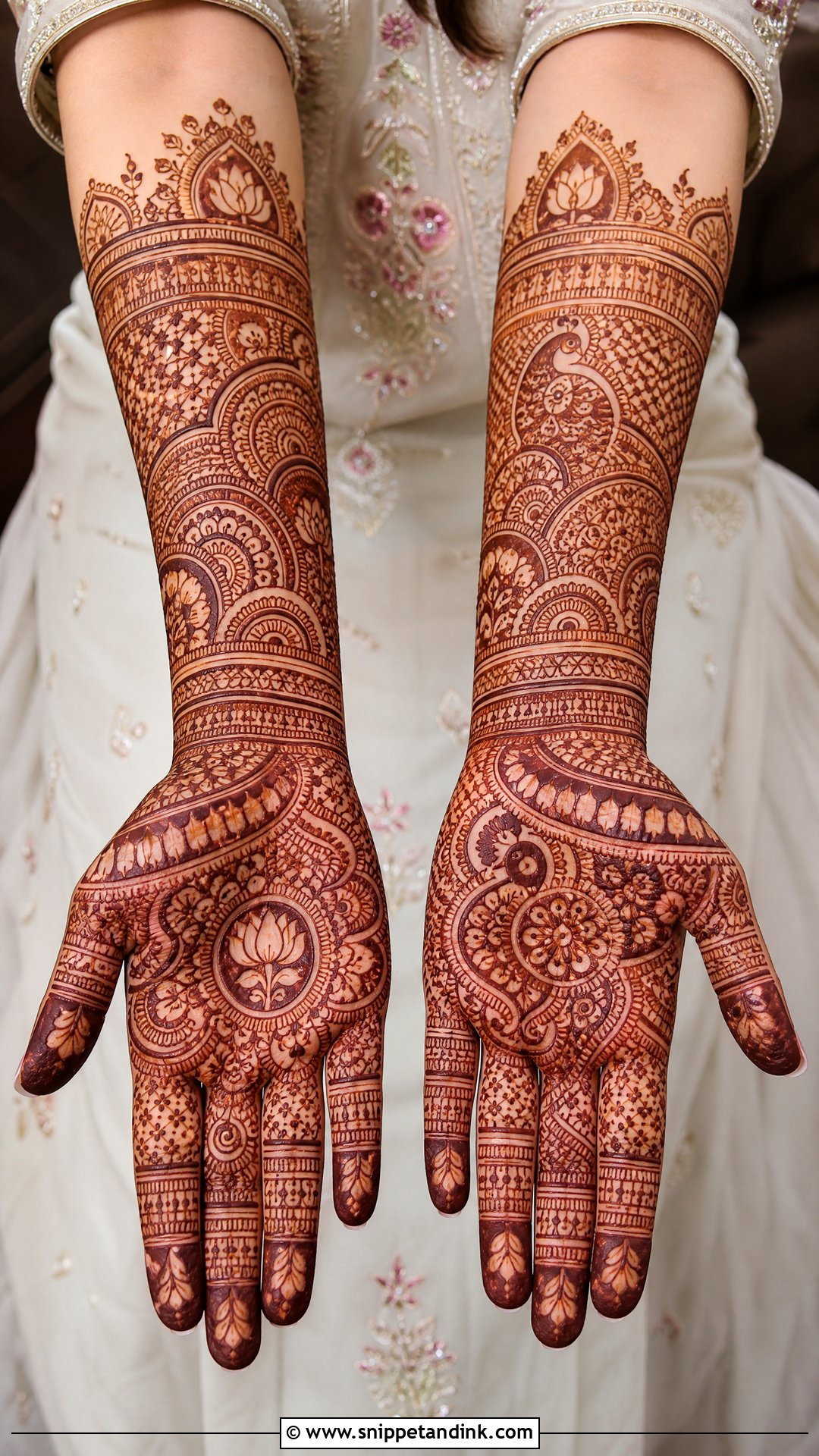
For a bride, the palm is where the main story goes: a central mandala, a peacock, bride and groom figures, a lotus or a paisley layout, all tied together with tiny leaves, dots, curls and fine mesh. I keep the fingers heavily worked so the hand reads as finished when it’s held up beside the other one. The risk with this much detail is losing the centerpiece, so I outline the main motif with a slightly thicker line than the filler around it. That one change keeps it visible once the whole palm has darkened to maroon.
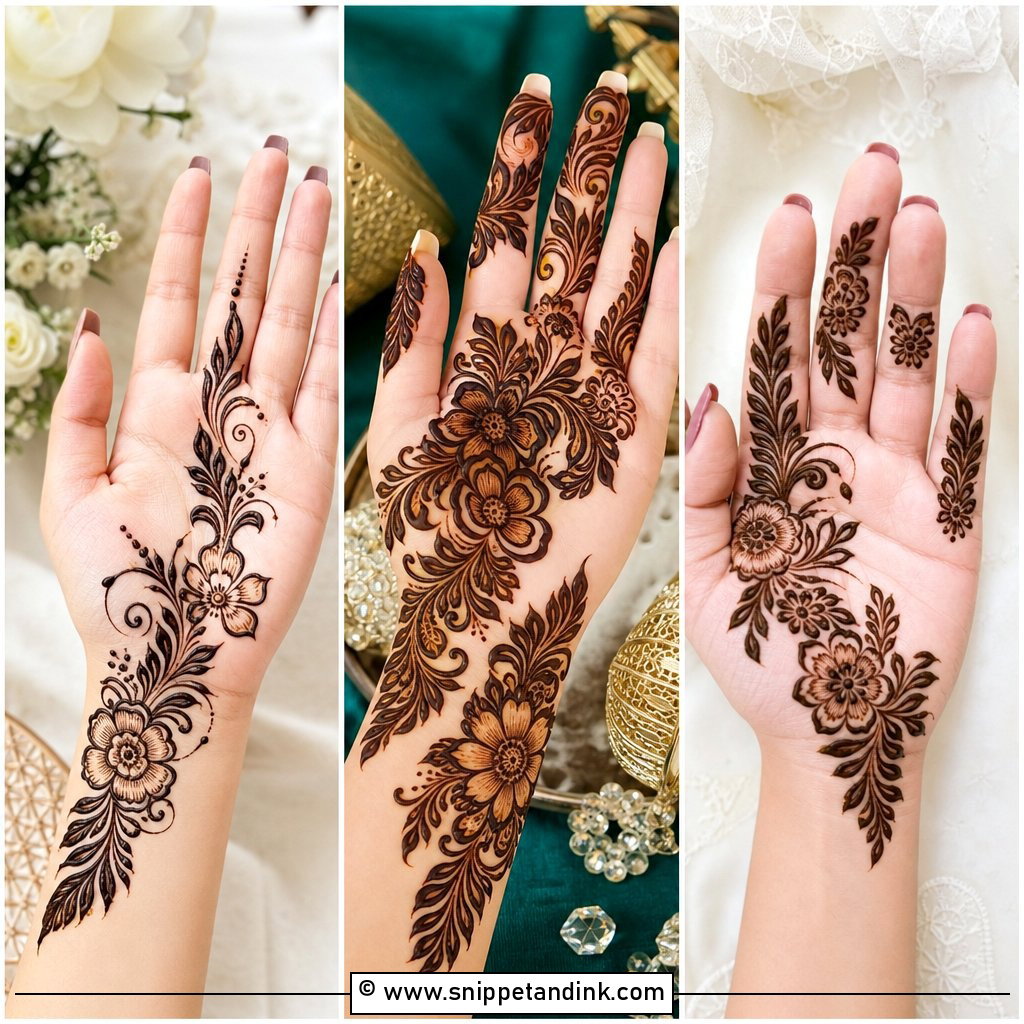
2. Front Full Hand Arabic Mehndi Design
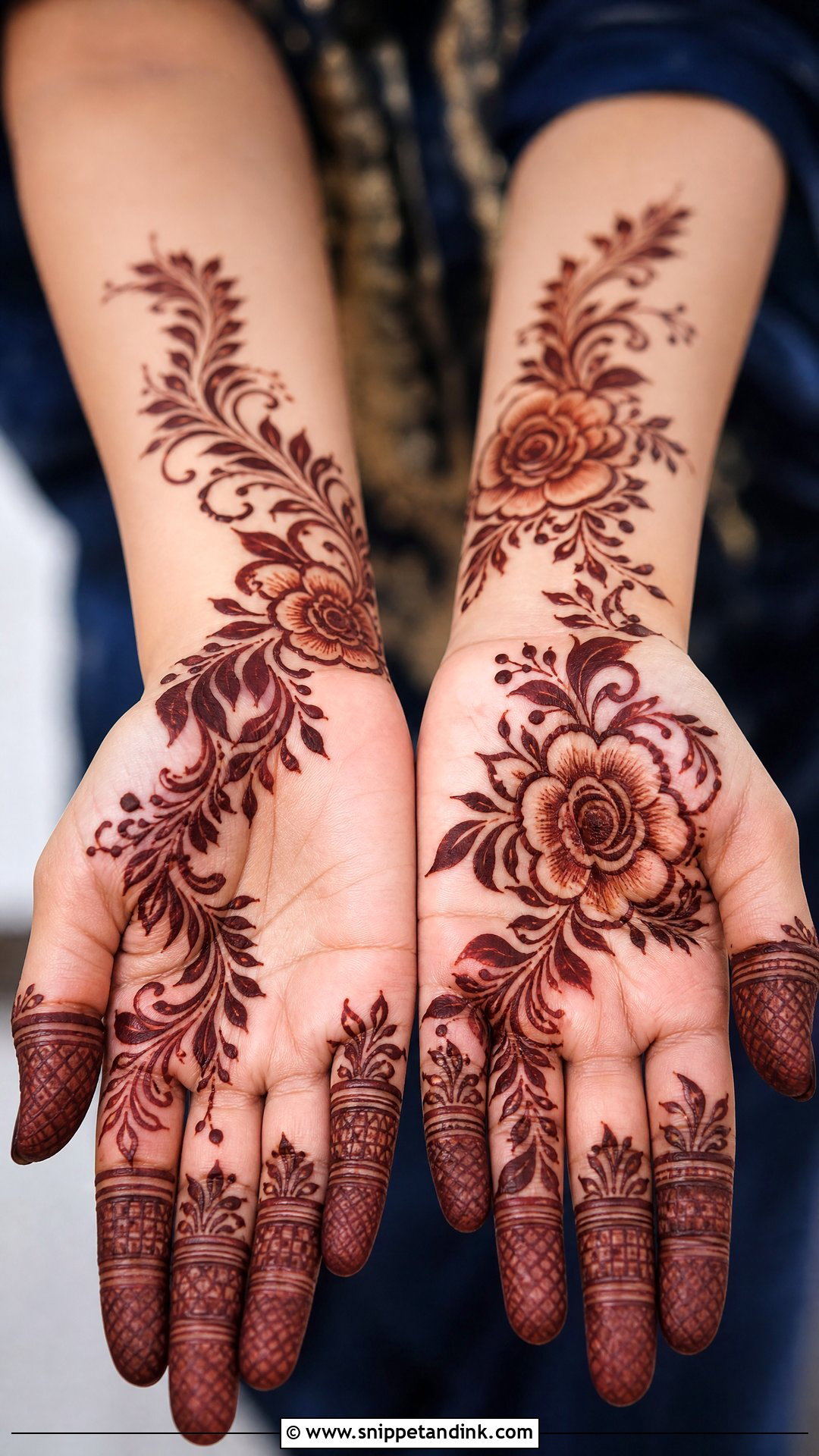
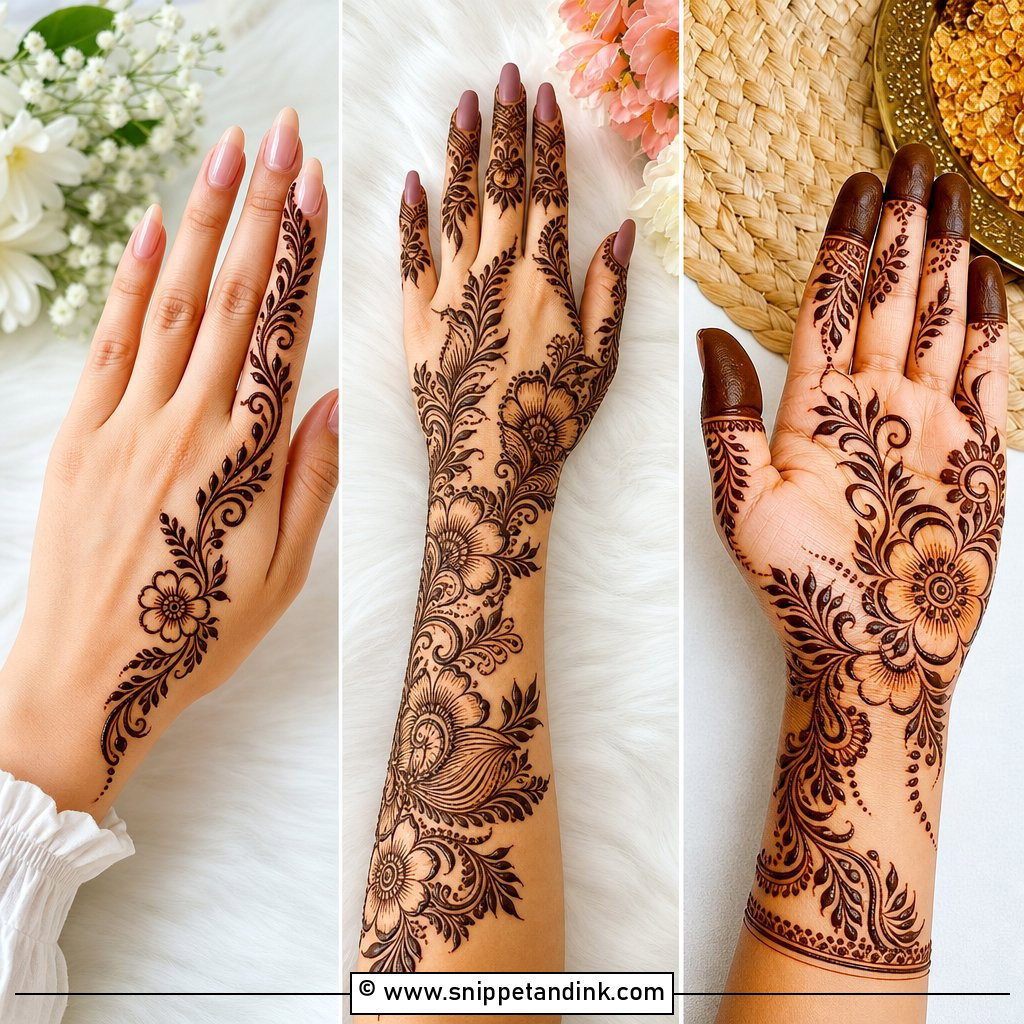
Arabic work on the palm usually starts at one side of the wrist and travels diagonally to the fingers in bold flowers, leafy vines and shaded petals. The skin left open between them is deliberate. I draw the outlines with a firm, steady pressure so they stand proud of the skin, because a raised line of paste stays in contact longer and stains deeper than a flat one. It’s my usual suggestion for someone who wants a full hand but hates feeling covered. It fits Eid, engagements and family weddings equally well.
3. Front Full Hand Indian Mehndi Design
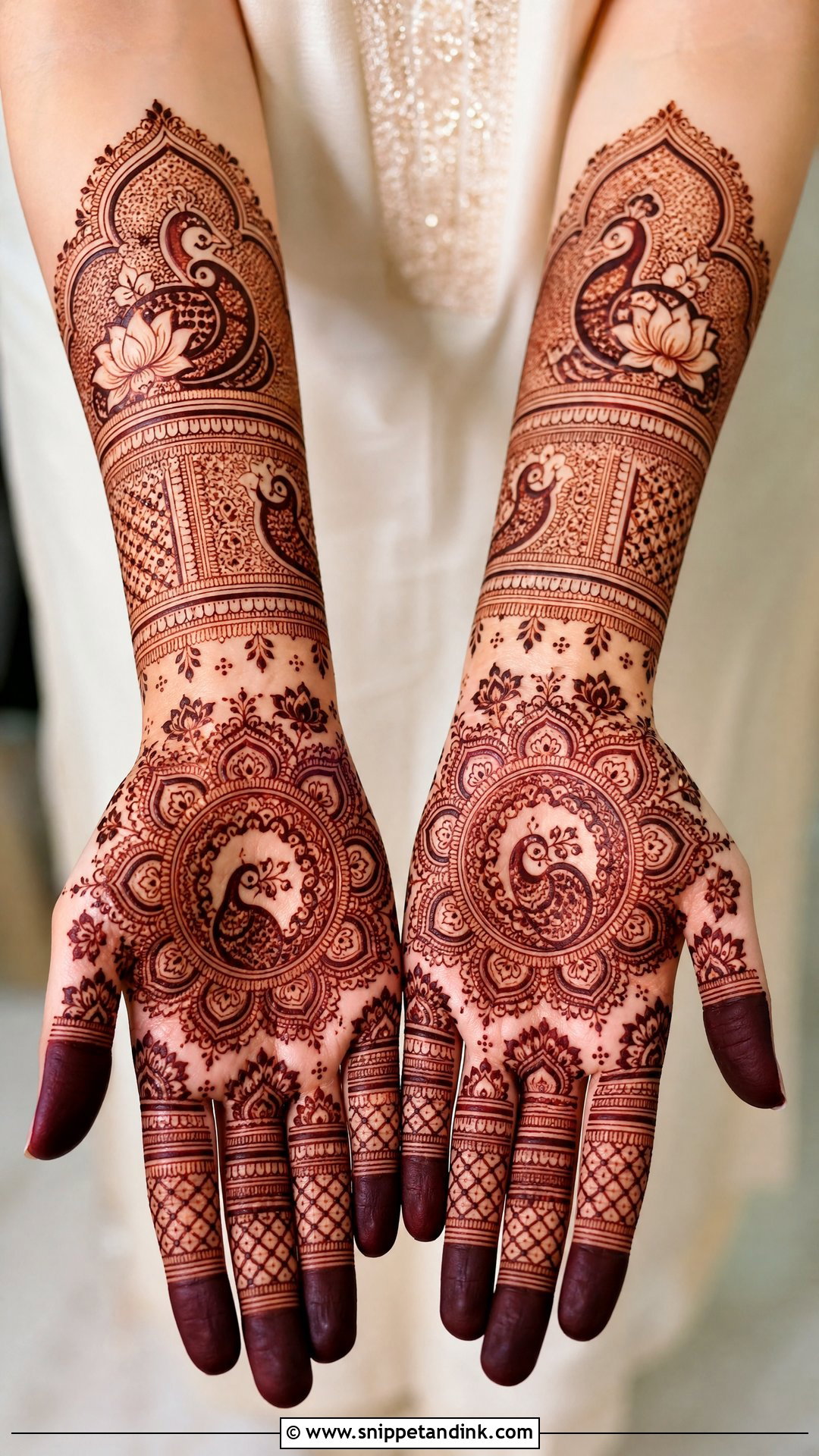
Indian palm work is all filling and balance. Peacocks, lotus, paisleys and mandalas carry the main structure, then tiny leaves, spirals, lace lines and checks fill every gap. Fingers get bands, florals and shaded tips; the wrist becomes a cuff. It’s slow. A full Indian palm takes far longer than an Arabic one of the same size, because every filler has to sit evenly or the stain looks blotchy. I’d book it for the bride, her sisters and anyone close enough to the family to sit through it.
4. Front Full Hand Indo Arabic Mehndi Design
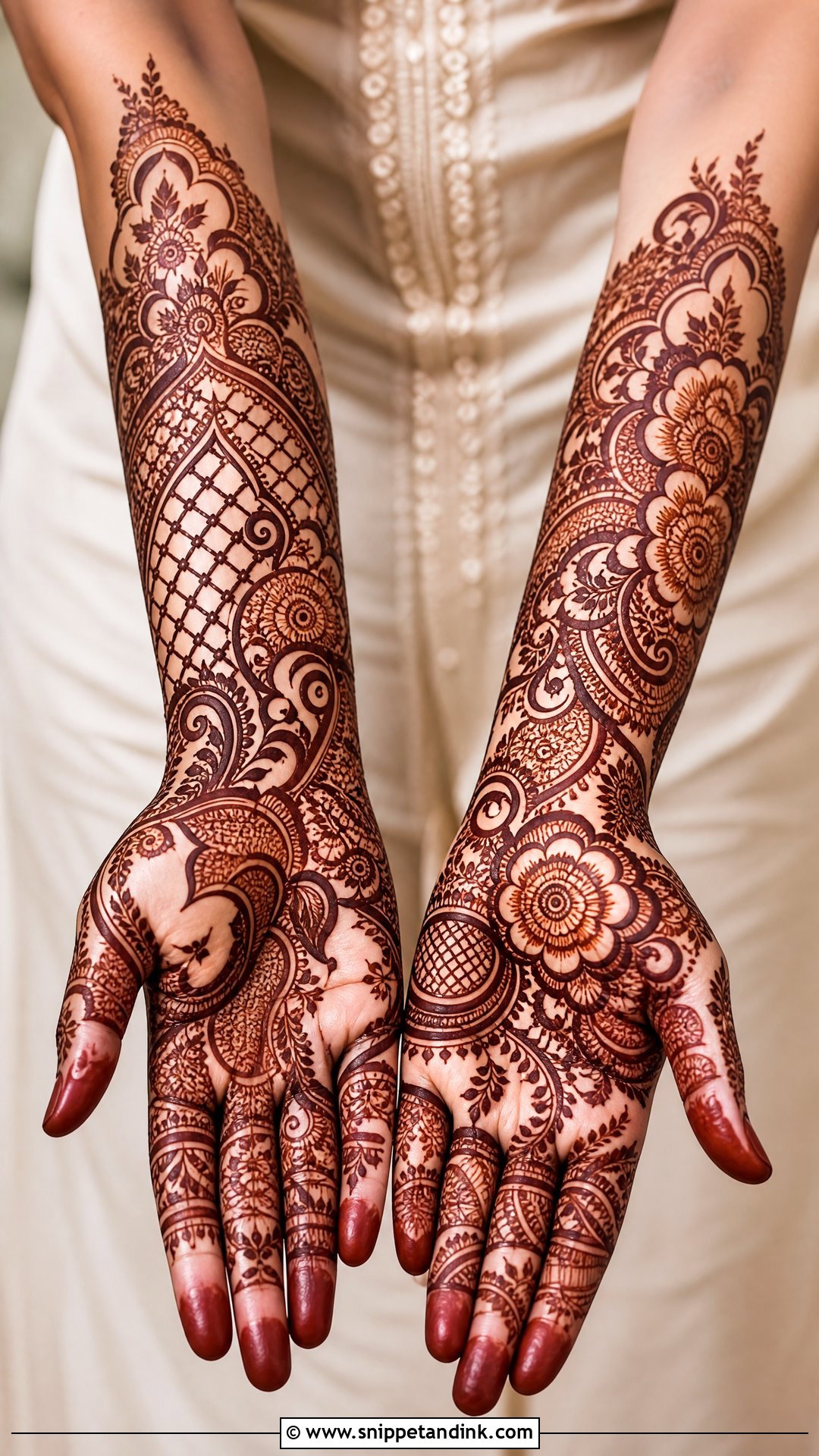
Detail without heaviness is the whole point of Indo-Arabic. Bold Arabic flowers set the shape, and I fill only the important parts of the palm and wrist with Indian paisleys, jaali and mandala work while leaving the rest open. From across a room it reads clearly; up close you still get the fine work. Mixing thick and thin lines also gives a layered stain, since the heavier strokes come up darker than the fills. I suggest it to bridesmaids and engagement guests most.
5. Front Full Hand Mandala Mehndi Design
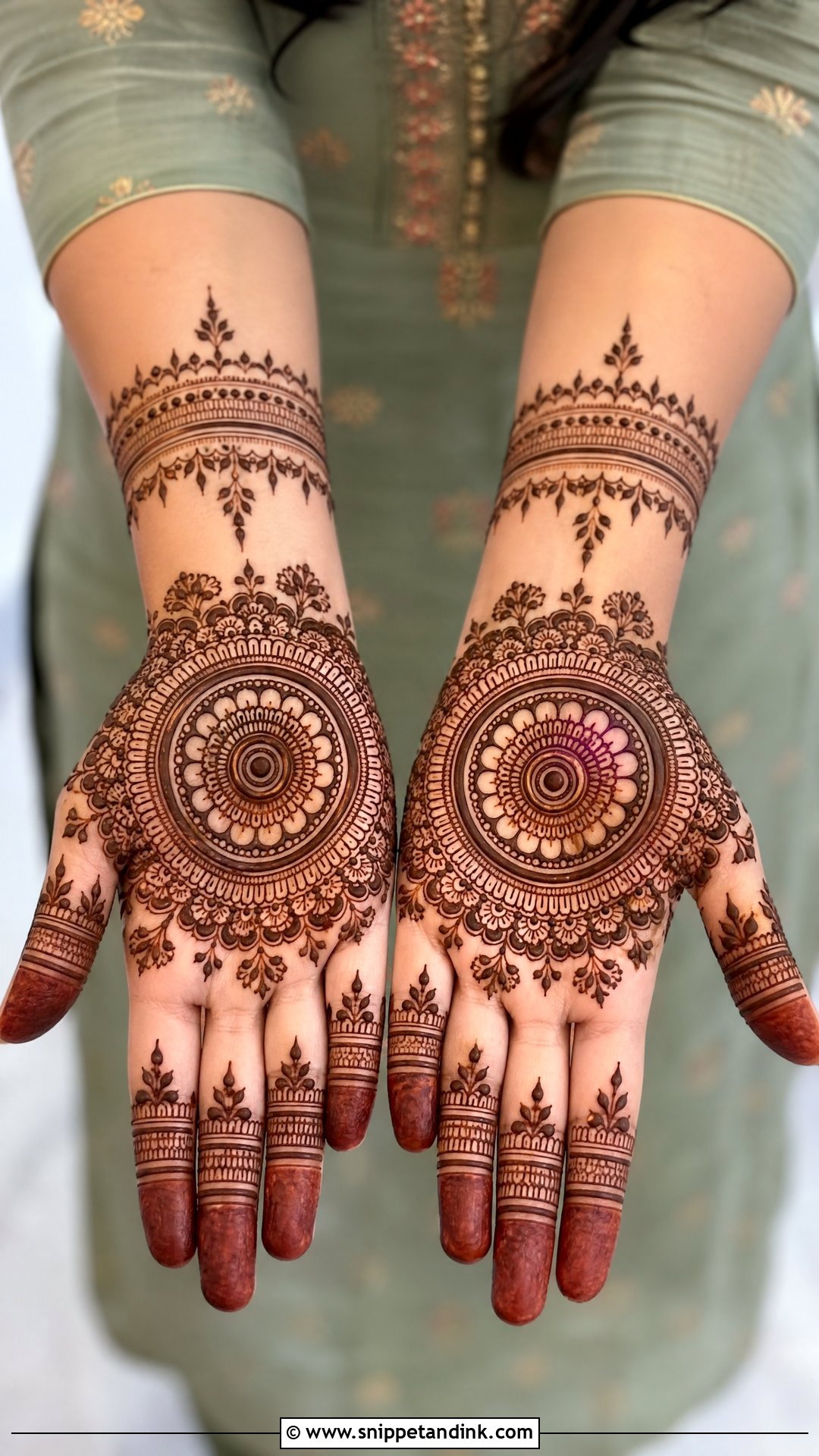
Mandalas are the most forgiving palm layout for hand shape, because a circle can be scaled. On a small palm I draw a medium mandala with light fillers so the fingers don’t look crowded. A wide palm can carry a larger one with layered borders. The circle then expands outward in petals, dots and half-circles, with patterned finger bands and a bracelet border or floral cuff at the wrist. The one place I’m careful is centering: I line the middle up with the center of your palm when it’s relaxed, not stretched flat, or it slides off-center the moment you hold your hand naturally.
6. Front Full Hand Floral Mehndi Design
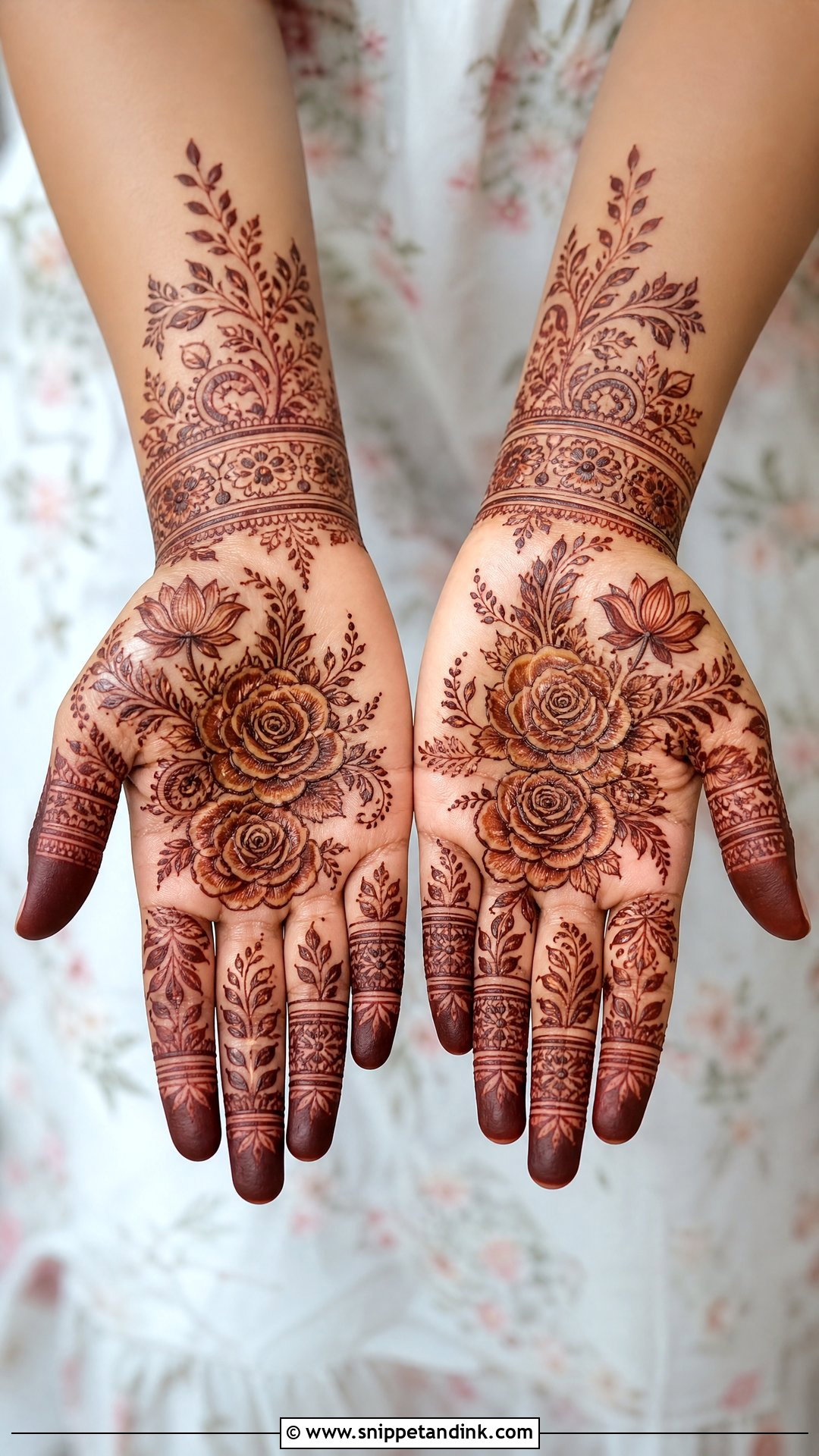
Flowers spread across the palm are the most adjustable design I offer. Roses, lotus blooms, jasmine clusters, leafy stems and shaded petals can run diagonally like Arabic work or sit in a balanced Indian layout, and the coverage can go from light to heavy just by changing how much filler goes between them. For a modern finish, leave negative space around the flowers. For a bridal one, I fill those gaps with dots, swirls and fine lace. Florals sit happily at daytime events like an engagement or Eid lunch.
7. Front Full Hand Paisley Mehndi Design
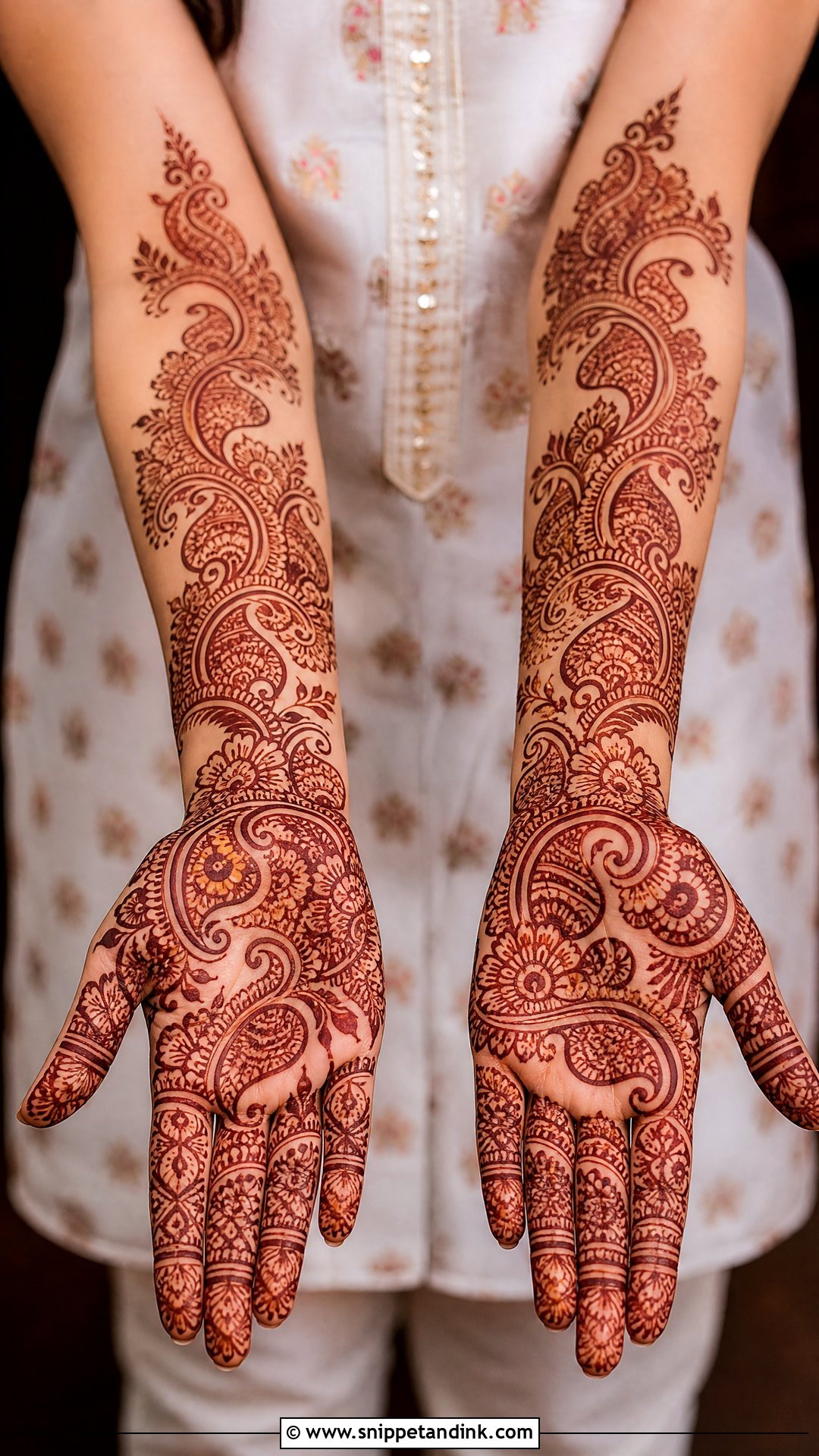
Paisleys earn their place on the palm because they point somewhere. A large bold one on the palm with smaller repeats along the fingers and wrist draws the eye from wrist to fingertip, which makes the hand look longer. I fill them with flowers, leaves, dots and fine shading. They sit between a dense bridal layout and a light festive one, so a paisley palm works for weddings, cultural events and family celebrations without anyone mistaking you for the bride.
8. Front Full Hand Peacock Mehndi Design
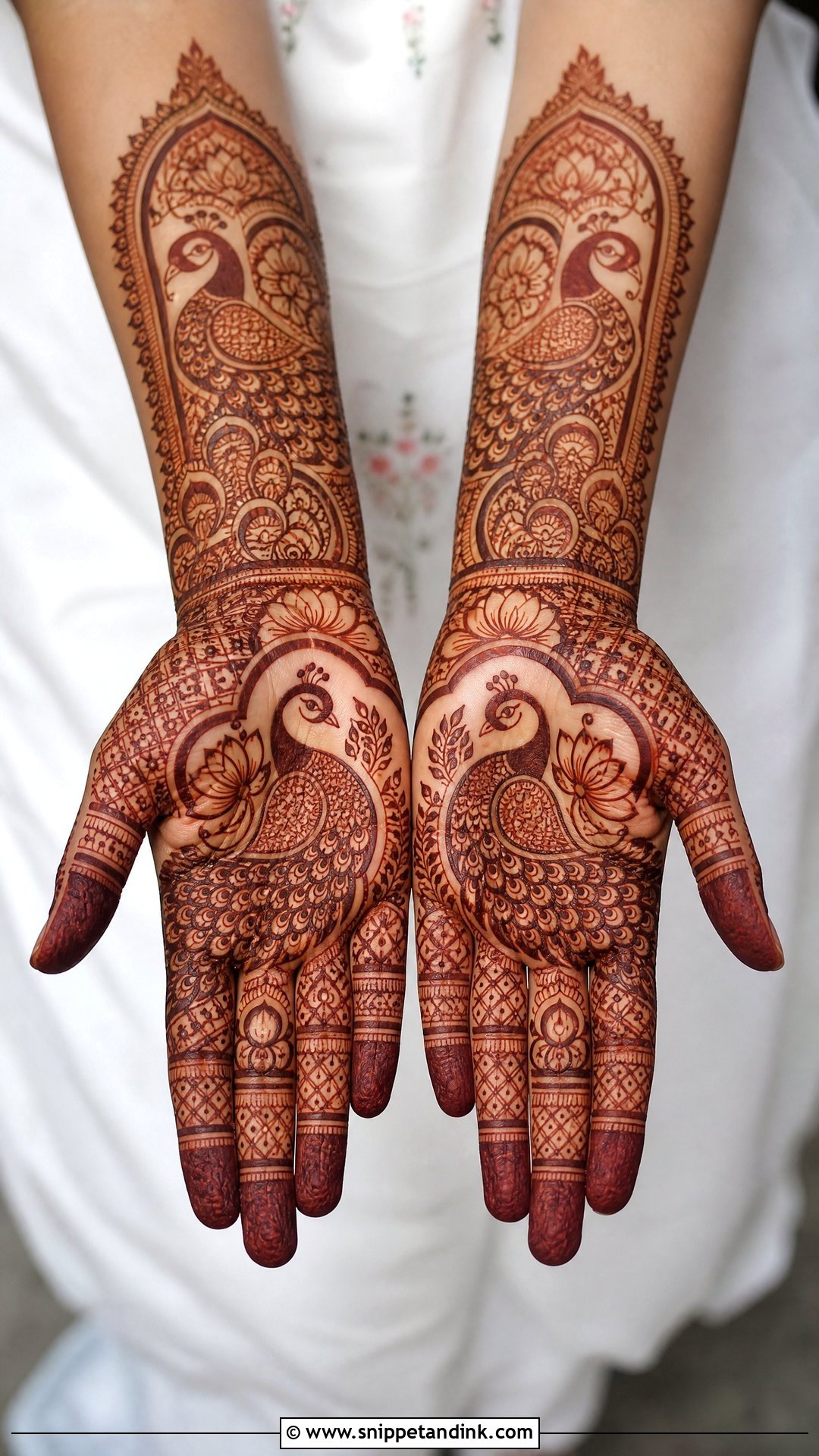
A peacock turns a palm design royal in a single motif. It can sit in the center, stretch from wrist to hand, or appear as a mirrored pair, with feathers, paisleys, lotus petals, jaali and dots around it. Fingers often get feather-inspired bands. My advice is one strong bird rather than several small ones. Small peacocks lose their beaks and eyes once the stain spreads slightly, and then they just look like squiggles. Brides and close family tend to choose this one.
9. Front Full Hand Jaali Mehndi Design
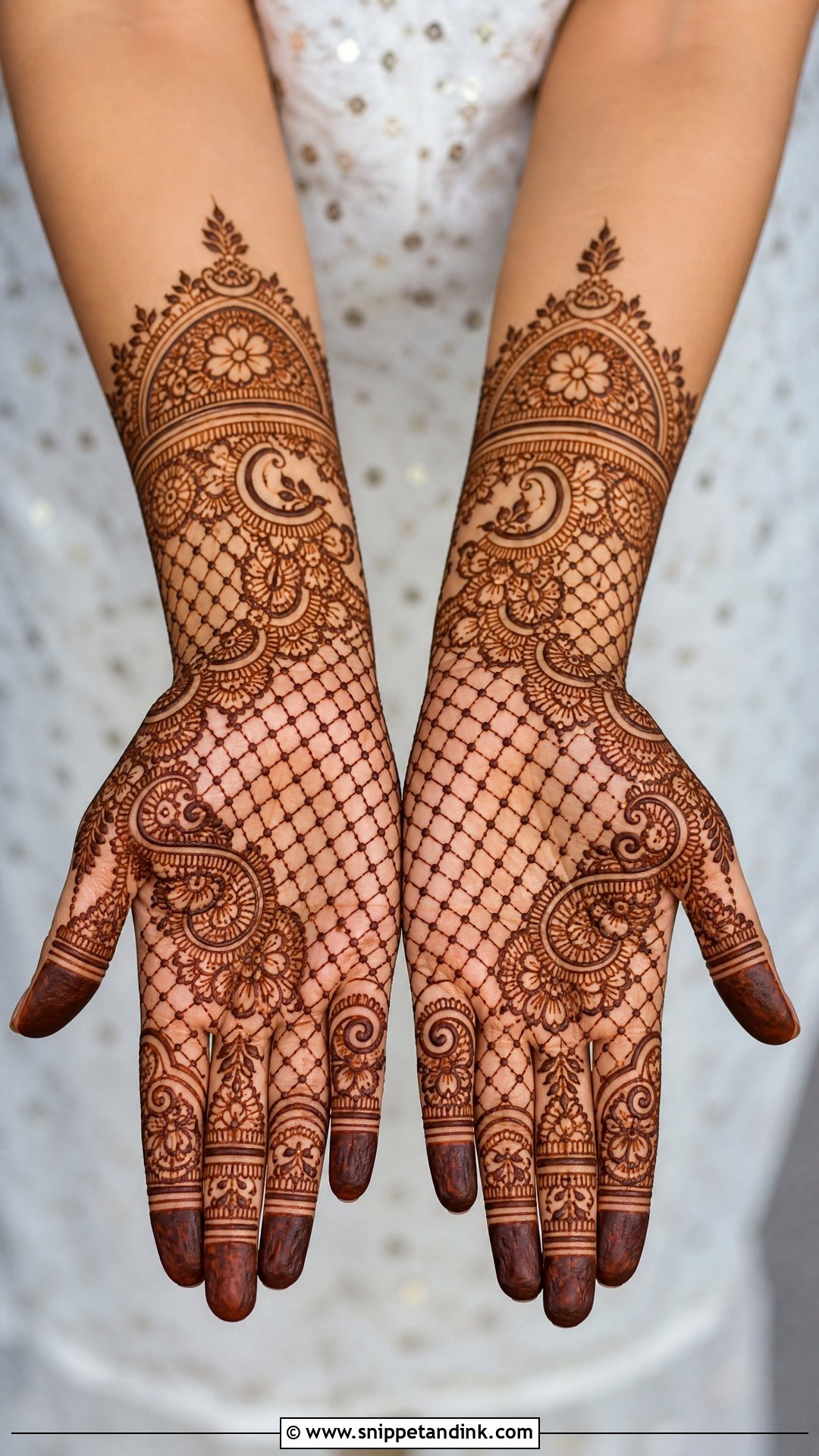
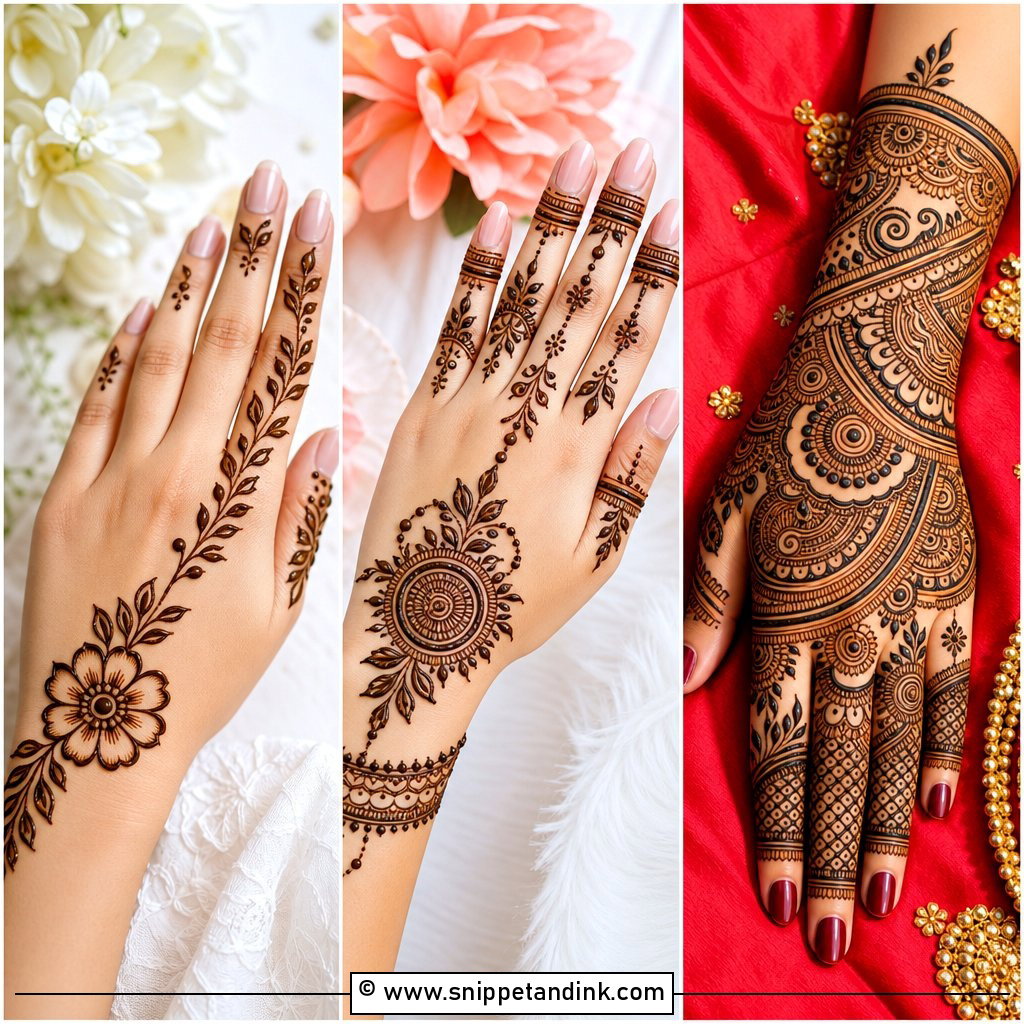
Jaali fills big areas of the palm without looking messy, which is exactly why I use it in full-hand work. The mesh can cover the palm, fingers and wrist, or just the spaces between flowers and paisleys. Pair it with a mandala for symmetry or an Arabic floral for a softer diagonal. Even lines are everything here. I keep the grid size consistent from start to finish, and I don’t add extra dots inside every square, because overfilled mesh stains into a solid patch and loses the lace effect.
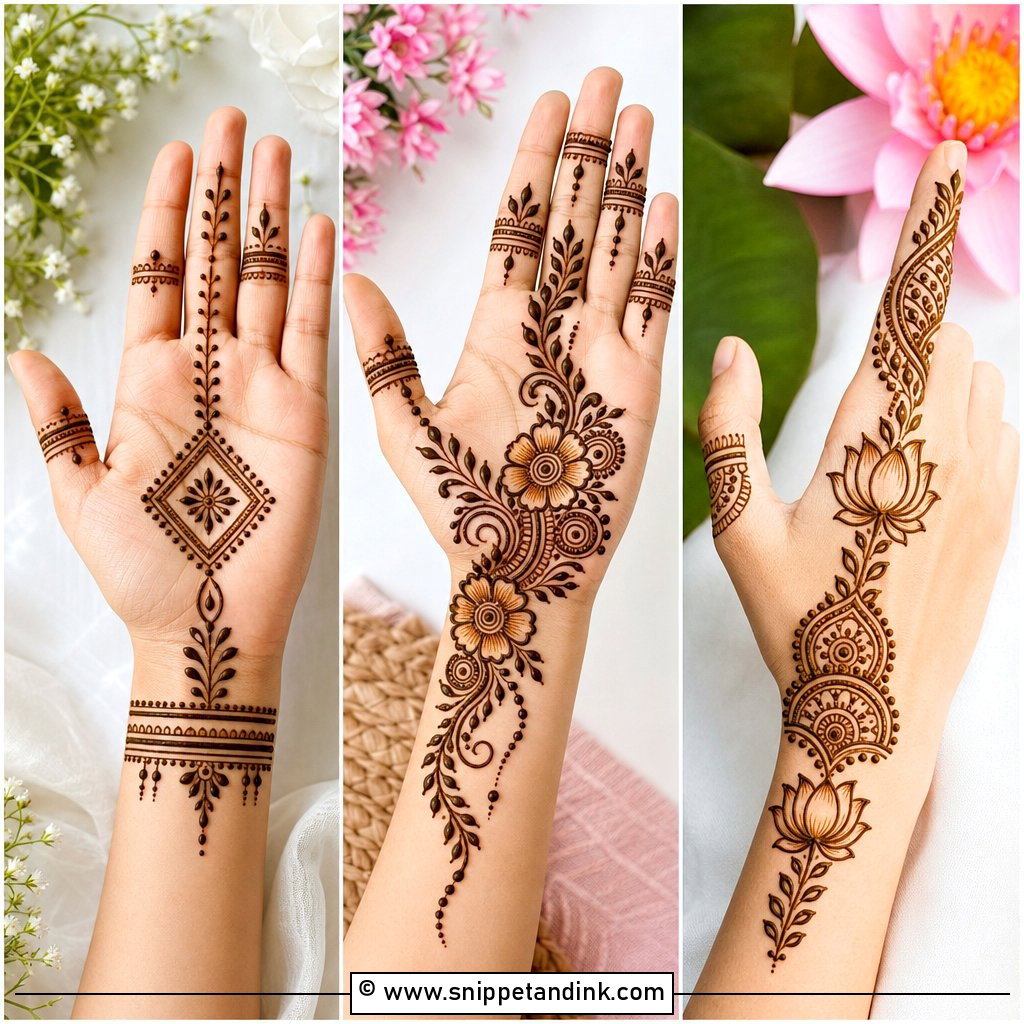
10. Front Full Hand Simple Mehndi Design
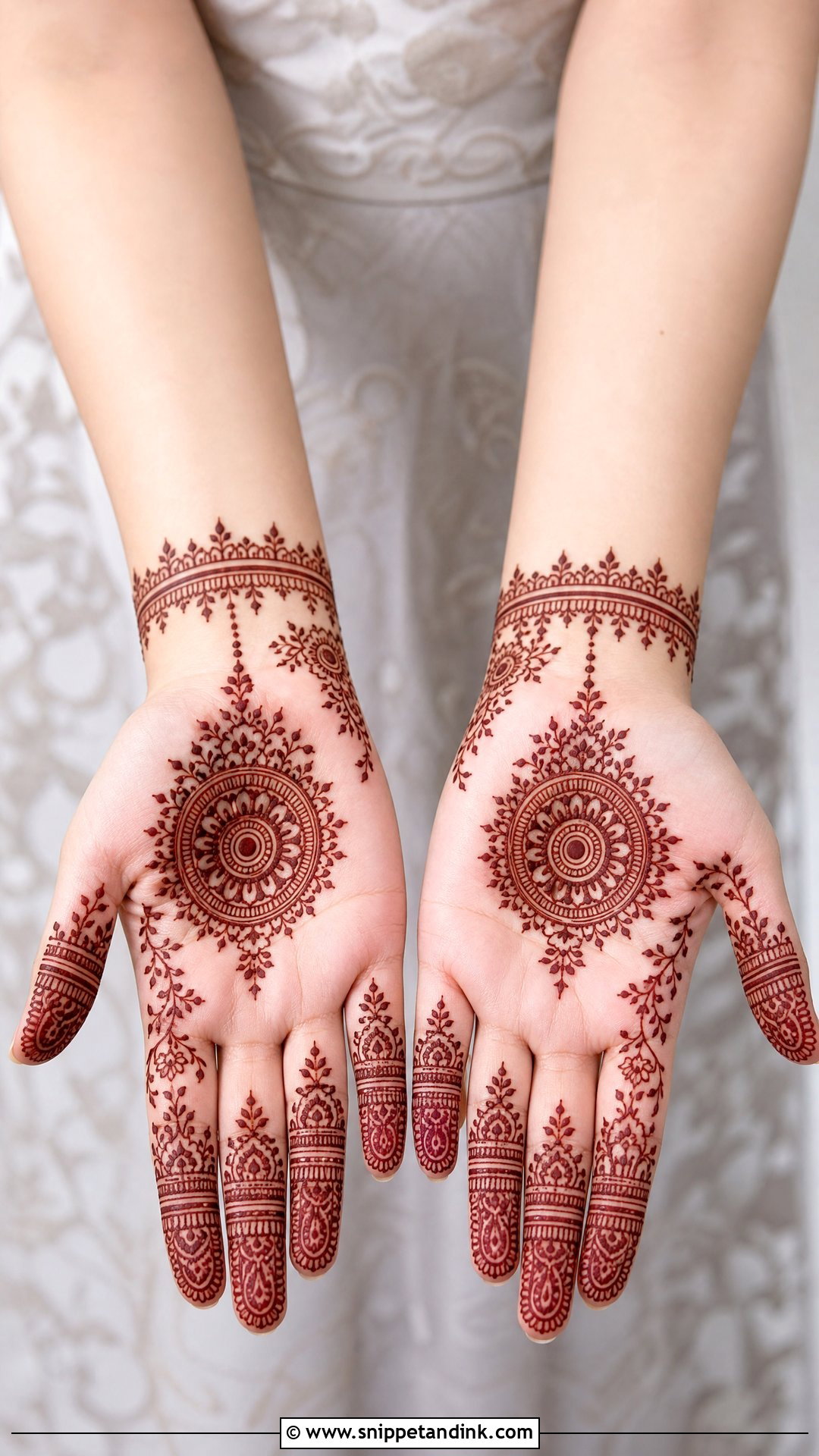
Coverage without complexity is what a simple palm gives you: a clean mandala, a few floral vines, basic paisleys, dotted chains and neat finger bands, with a slim bracelet border instead of a dense cuff. It’s quick to apply and light enough for a casual celebration. It’s also a good starting point for anyone trying a full hand for the first time. Keep the motifs large enough to read, and leave small gaps so the whole hand doesn’t look busy.
11. Front Full Hand Heavy Mehndi Design
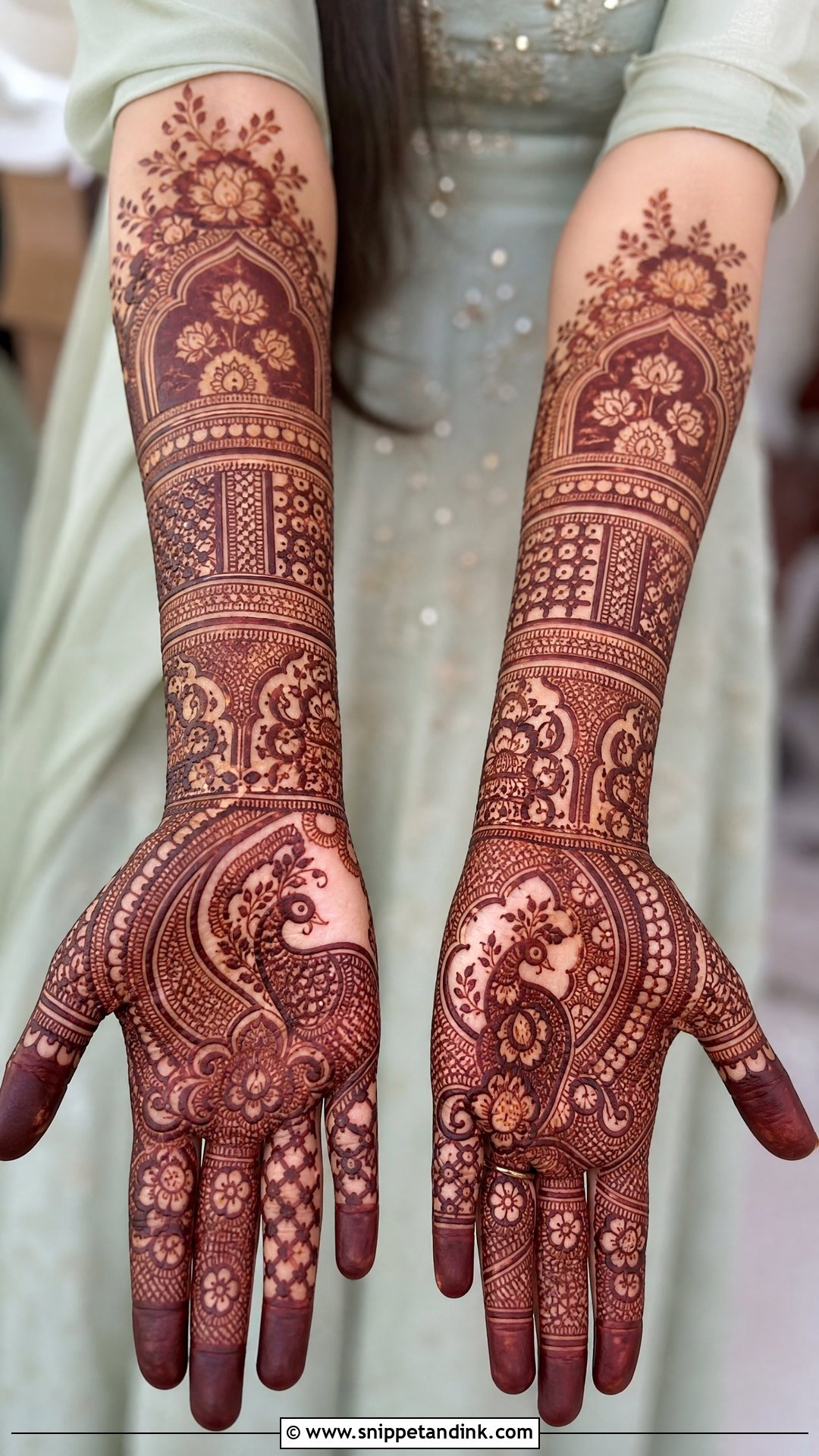
Heavy palms are for people who want the deepest possible color and don’t mind a long sit. Very little skin is left open across the palm, fingers, wrist and forearm, with peacocks, florals, paisleys, mandalas, lace borders and net patterns. Plan time for the application and the aftercare, because a heavy design that’s washed off early looks worse than a light one left on properly. Structure still matters. I set a strong center motif first and divide the rest into sections so the hand looks detailed rather than crowded.
12. Front Full Hand Royal Mehndi Design
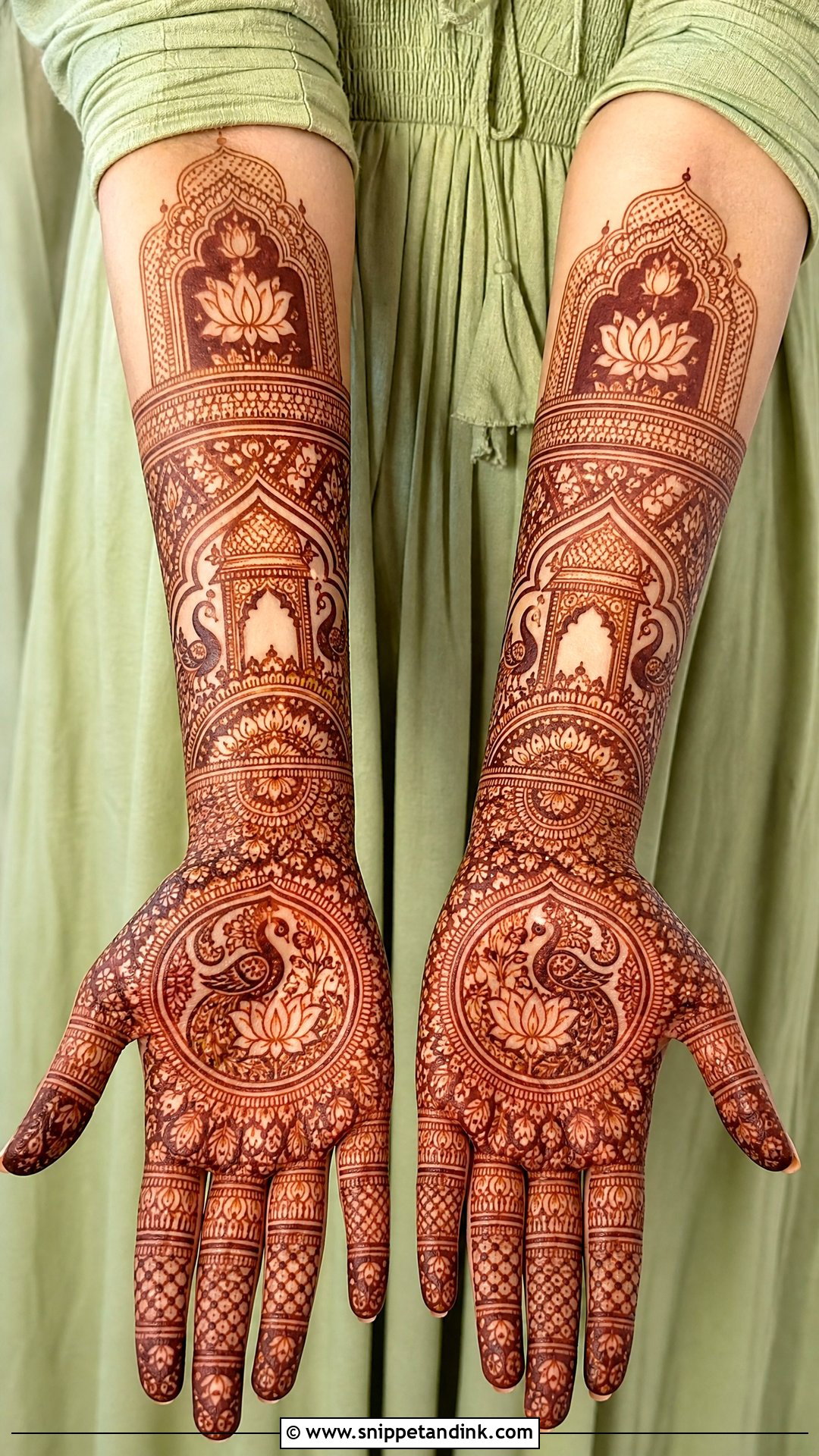
Royal palm designs borrow from architecture and jewelry: palace arches, ornamental cuffs, lotus, peacocks, layered mandalas and bold wrist borders. The palm usually becomes one complete decorative frame, with matching bands on the fingers. I keep the major motifs symmetrical and treat the wrist cuff as if it were a real bangle, slightly bolder than the palm detail. It belongs with rich outfits at engagements, weddings and formal celebrations.
13. Front Full Hand Modern Mehndi Design
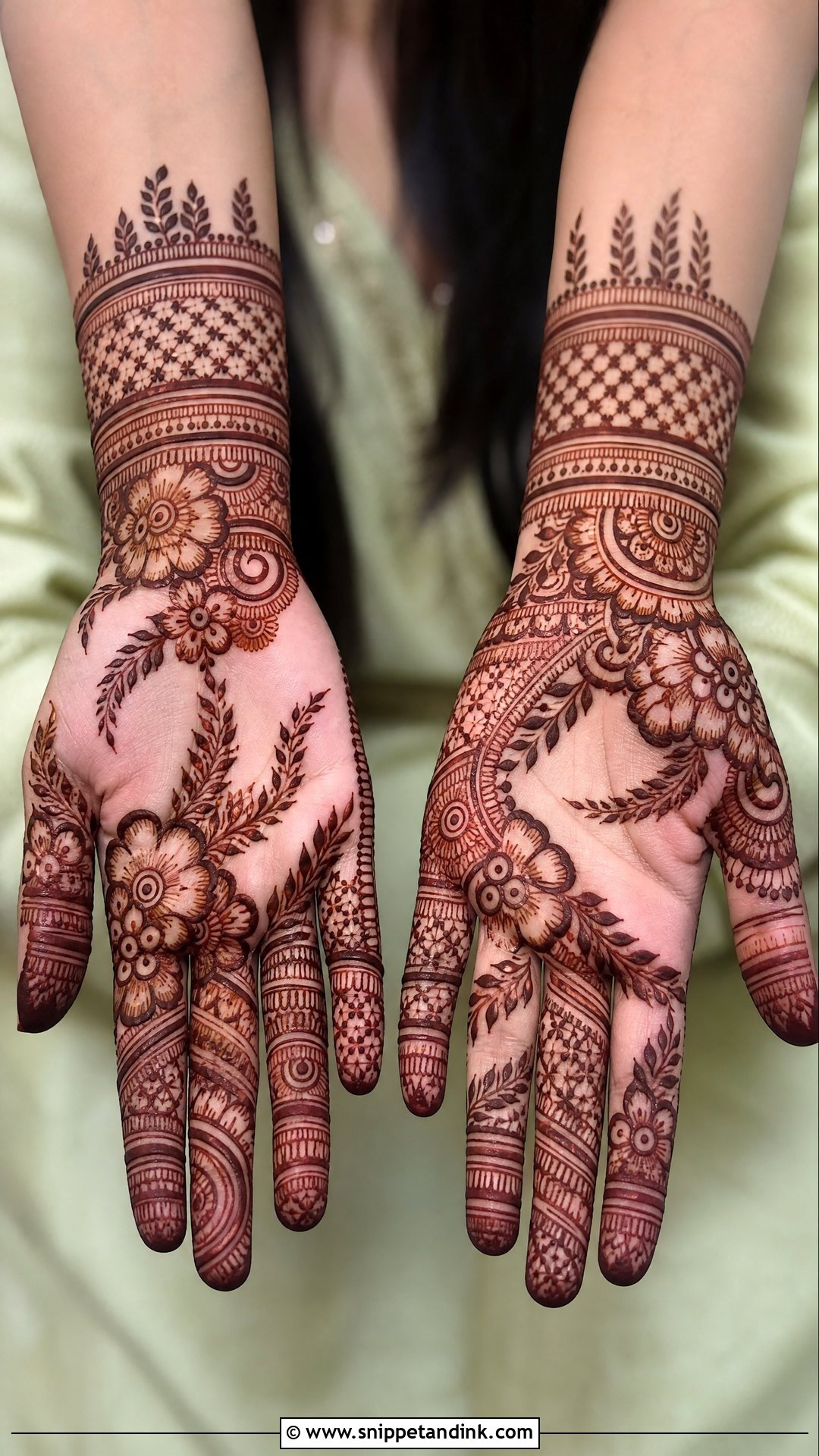
Modern palm work keeps the traditional motifs but stops filling every space. Bold outlines, negative space, geometric bands, leafy trails and softer finger work do the talking, with a mandala, a floral cluster or a few paisleys in the center. The wrist often becomes a clean cuff with open gaps. Younger brides and bridesmaids ask for this most. Sharp lines are non-negotiable, since there’s no filler to hide a wobble.
14. Front Full Hand Minimal Mehndi Design
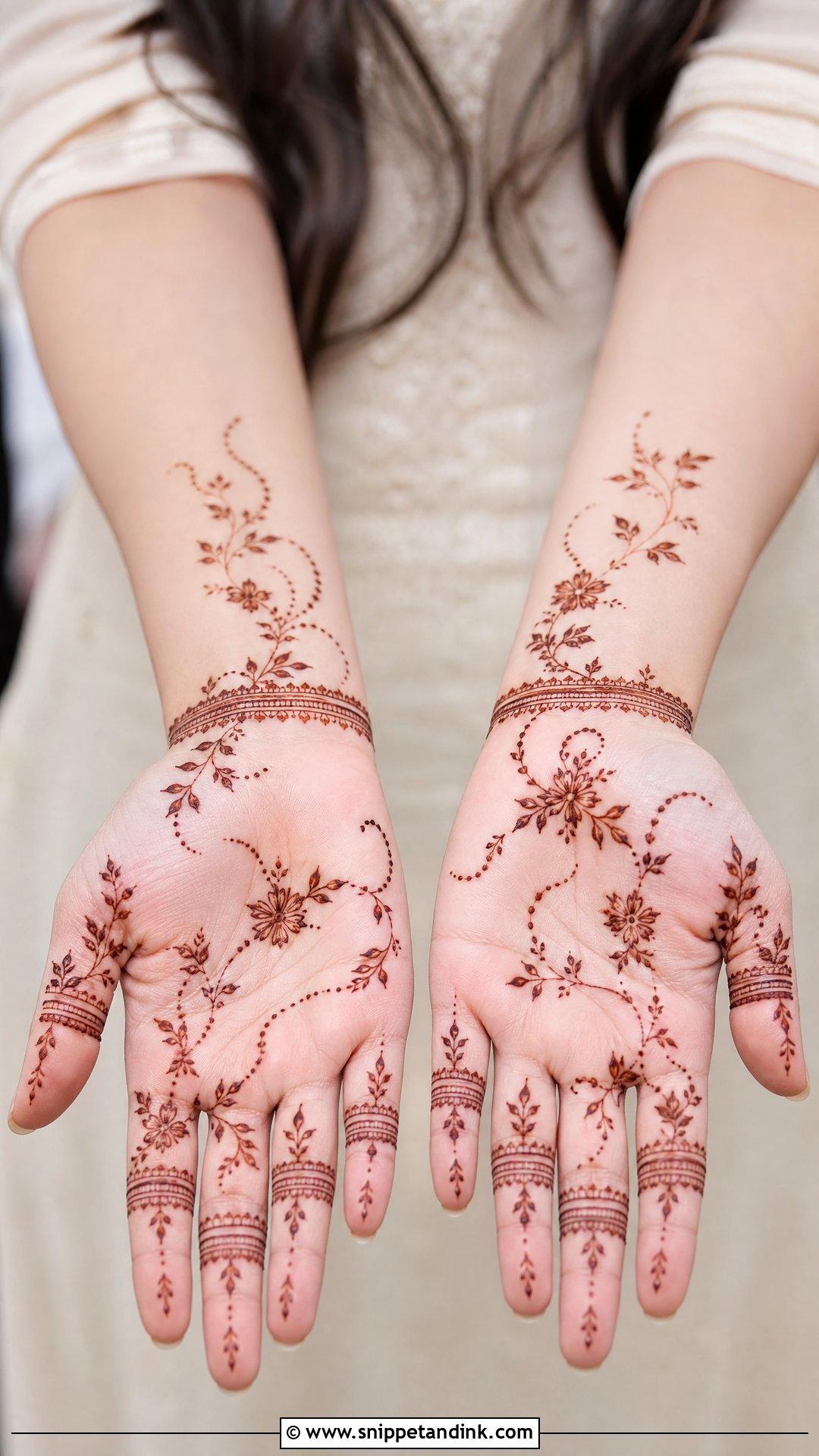
Can a full hand still be minimal? Yes, if the spacing is planned. Thin vines, small flowers, dots and simple bands can cover the palm and fingers while plenty of skin stays visible, finished with a slim bracelet or a soft floral chain at the wrist. It’s comfortable for office parties, small festivals and family functions, and it dries faster because there’s less paste on the hand. The temptation is to keep adding fillers. Resist it, or the minimal look disappears.



15. Front Full Hand Lotus Mehndi Design
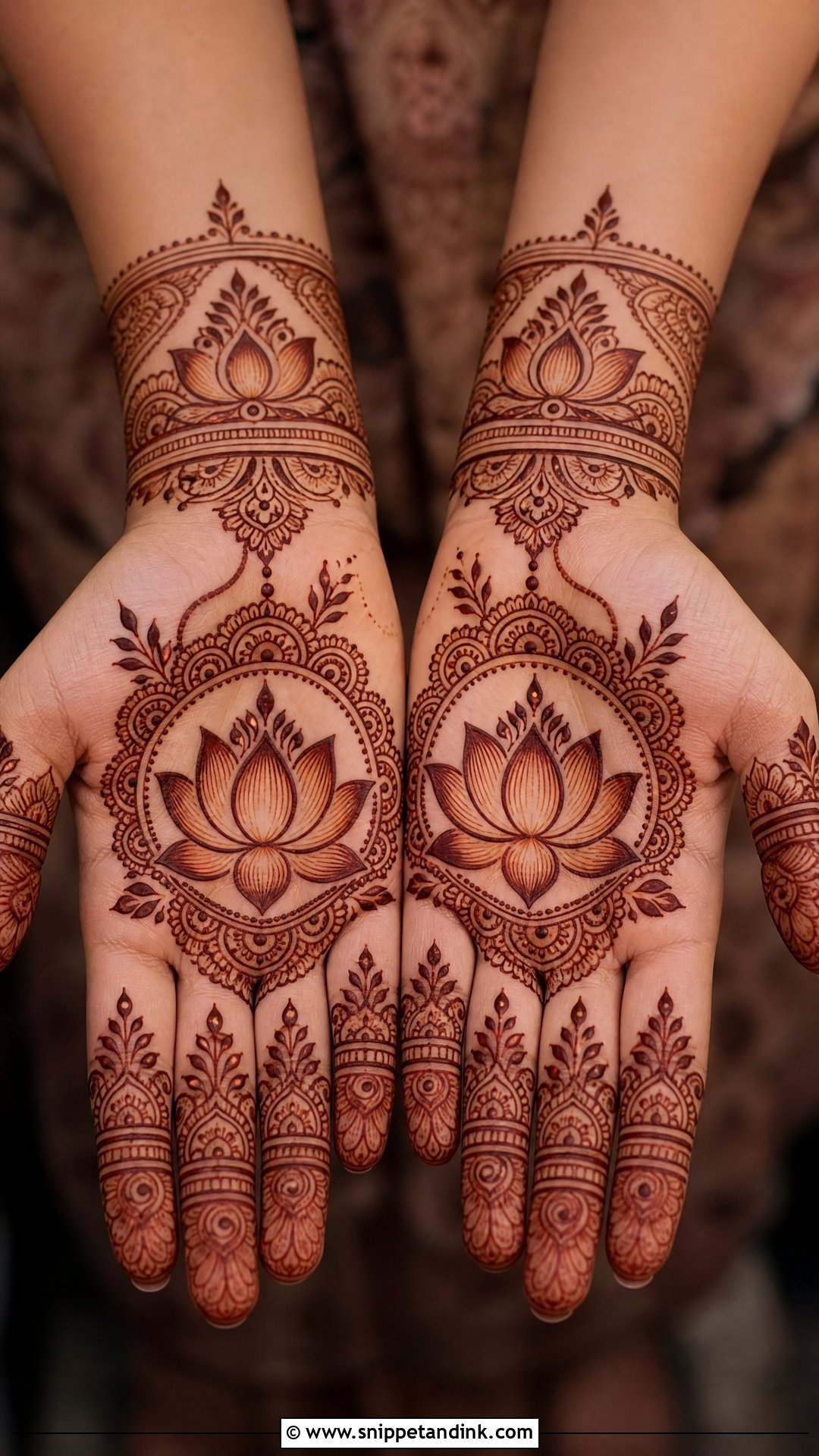
Lotus gives a palm a calm, rounded rhythm. It can sit in the center, appear in layered rows or flow from the wrist toward the fingers, with mandalas, paisleys, dots, leafy stems and fine shading around it. For full coverage I repeat the petals in different sizes across the palm and wrist, so it feels connected without turning heavy. The fingers get petal bands and tiny dots to tie in. It suits brides and festive occasions alike.
16. Front Full Hand Rose Mehndi Design
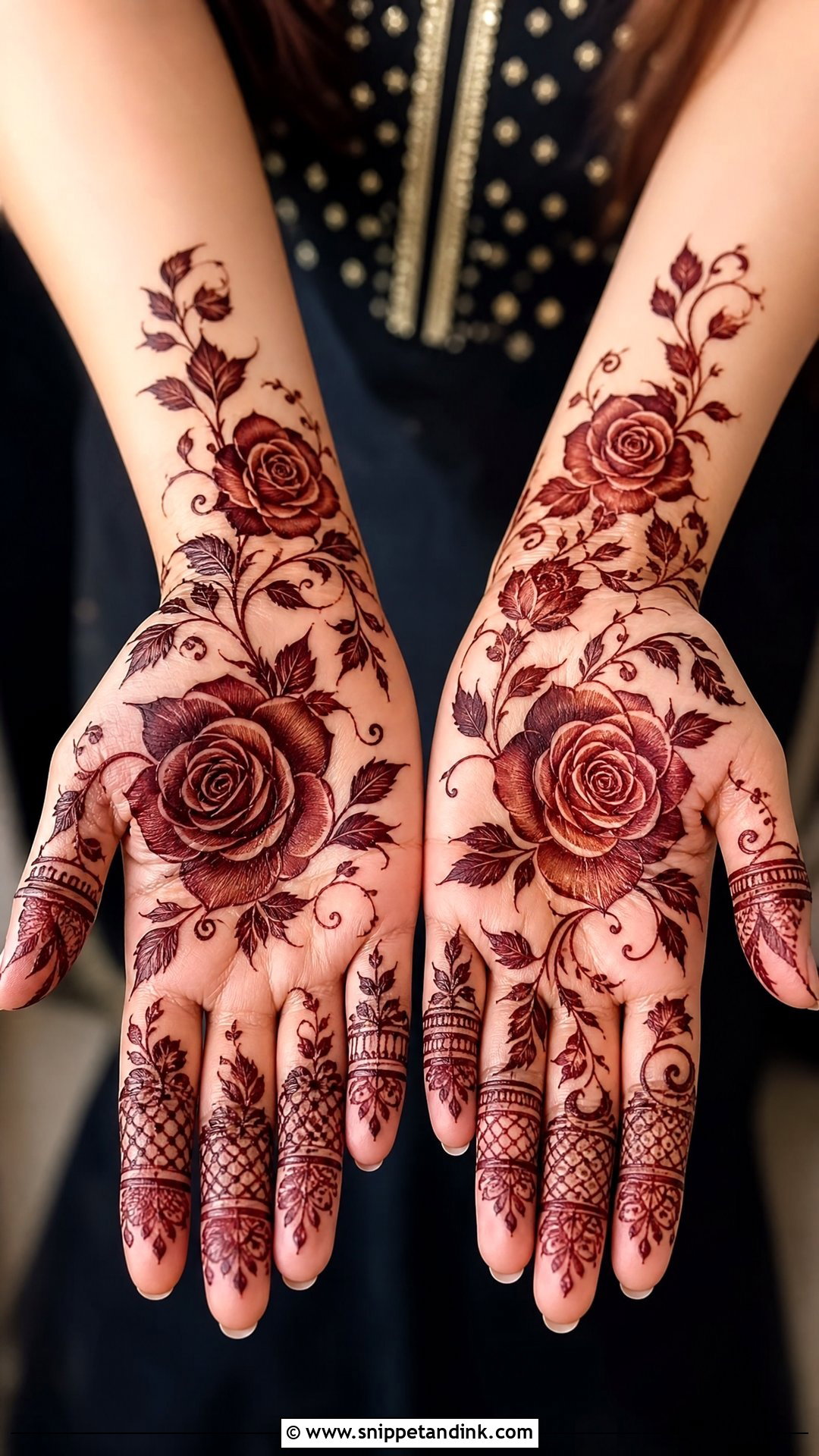
Roses are the easiest flower for anyone to recognize, so they photograph clearly even at a distance. Large ones sit on the palm and wrist, with smaller buds running along the fingers, shaded petals and curved vines giving depth. I keep the outlines bold and the inner petal lines fine, because that contrast is what makes a rose look like a rose once stained. Medium coverage suits bridesmaids; add jaali and paisley fillers and it’s heavy enough for a bride.
17. Front Full Hand Bracelet Mehndi Design
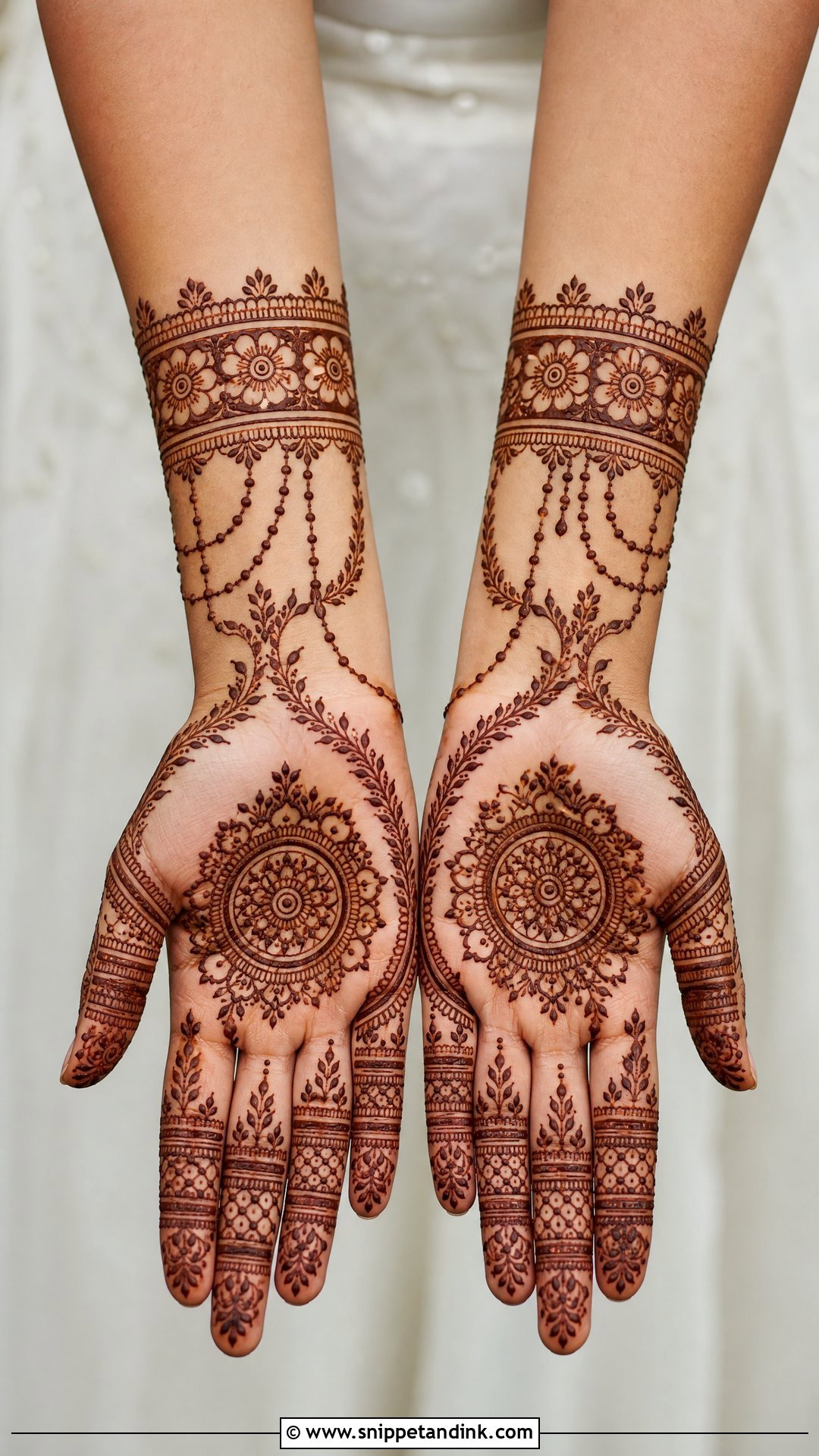
This layout connects the palm pattern to a jewelry-like wrist cuff made of bands, beads, florals, small mandalas, leaf chains or lace. From the wrist it climbs into the palm and fingers so the whole hand looks ornamented. I draw the bracelet part symmetrical and a touch bolder than the palm detail, so it reads as jewelry before you’ve put on a single bangle. Engagement functions, Eid, Diwali and wedding guests all suit it.
18. Front Full Hand Finger Mehndi Design
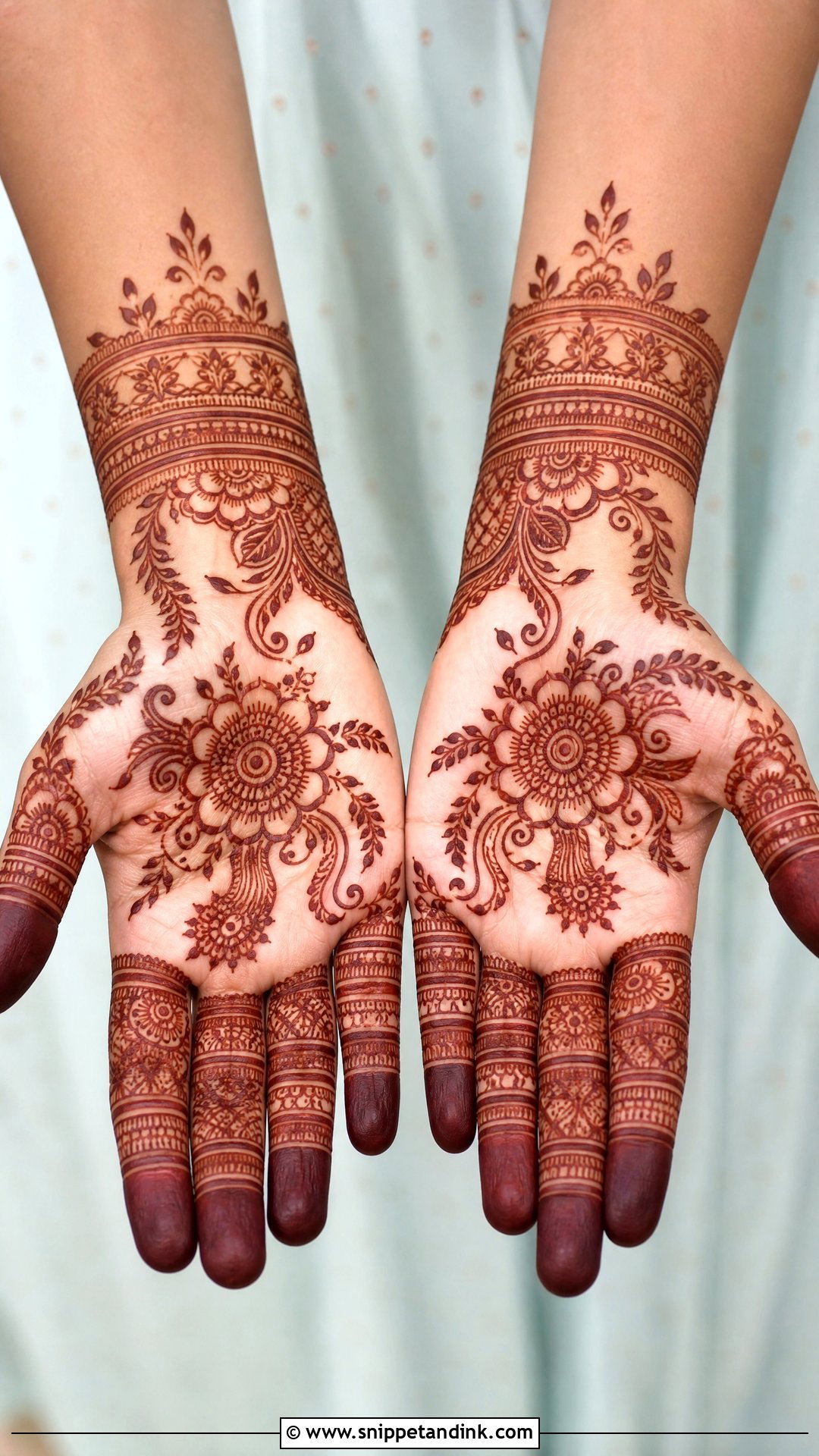
Here the fingers carry most of the detail: bands, leafy chains, mini mandalas, lace strips, shaded tips or fine geometry, with the palm and wrist still decorated but quieter. Long, vertical finger patterns lengthen short fingers noticeably, which is why I suggest this layout to people who feel their hands look stubby. To stop it looking cluttered, I give every finger the same theme. Repeated motifs make the set look organized, especially in ring-ceremony close-ups.
19. Front Full Hand Eid Mehndi Design
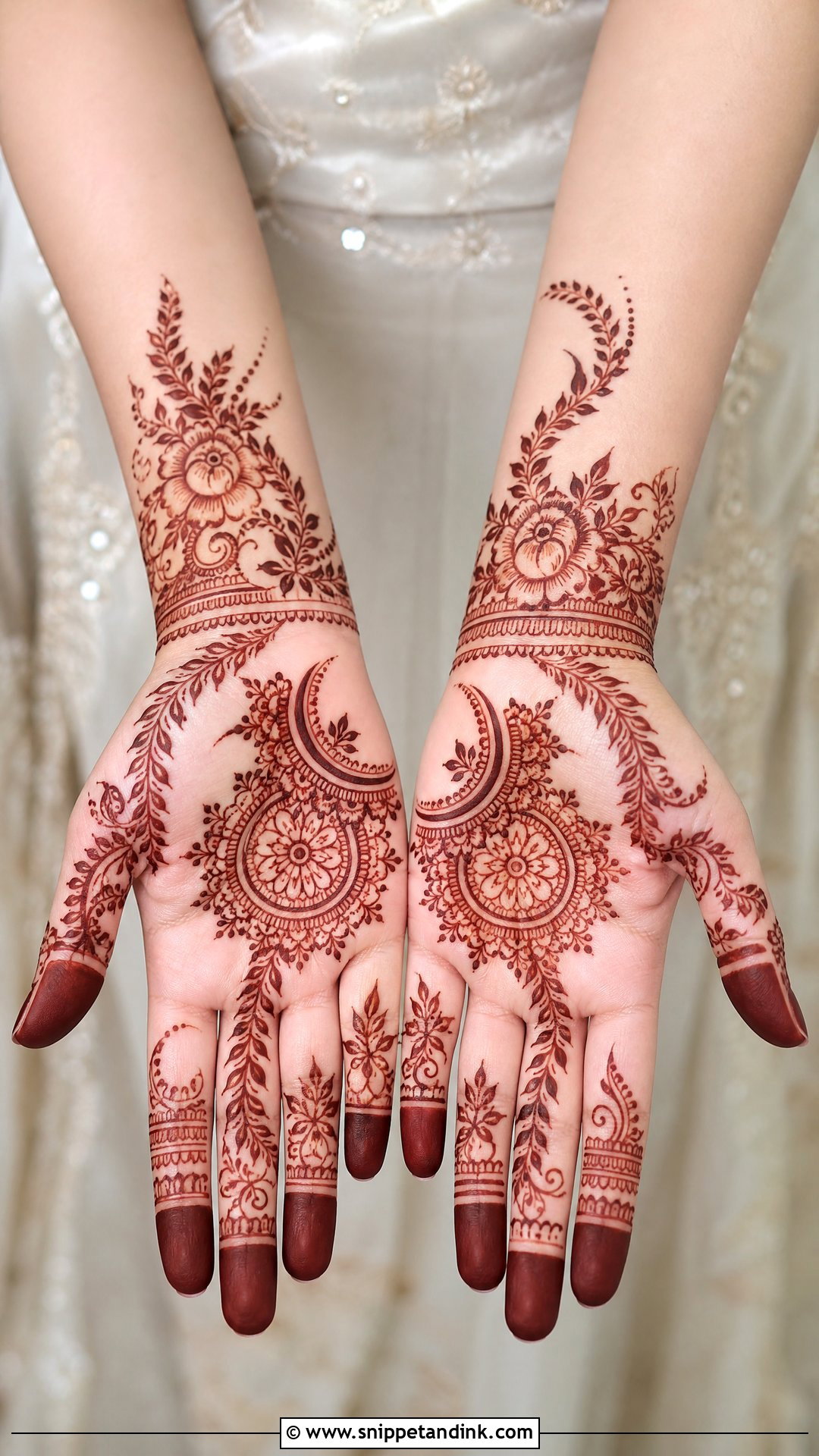
Eid mehndi is often done on chand raat, the night before, so it has to be festive but quick enough that a whole household can get through the queue. Arabic floral trails, crescent curves, leafy vines, mandala palms and bold fingertips are the usual choices. Open spaces keep the stain clean and bright by morning. A diagonal floral trail with patterned fingers is the safe favorite; a full palm mandala feels more traditional.




20. Front Full Hand Diwali Mehndi Design
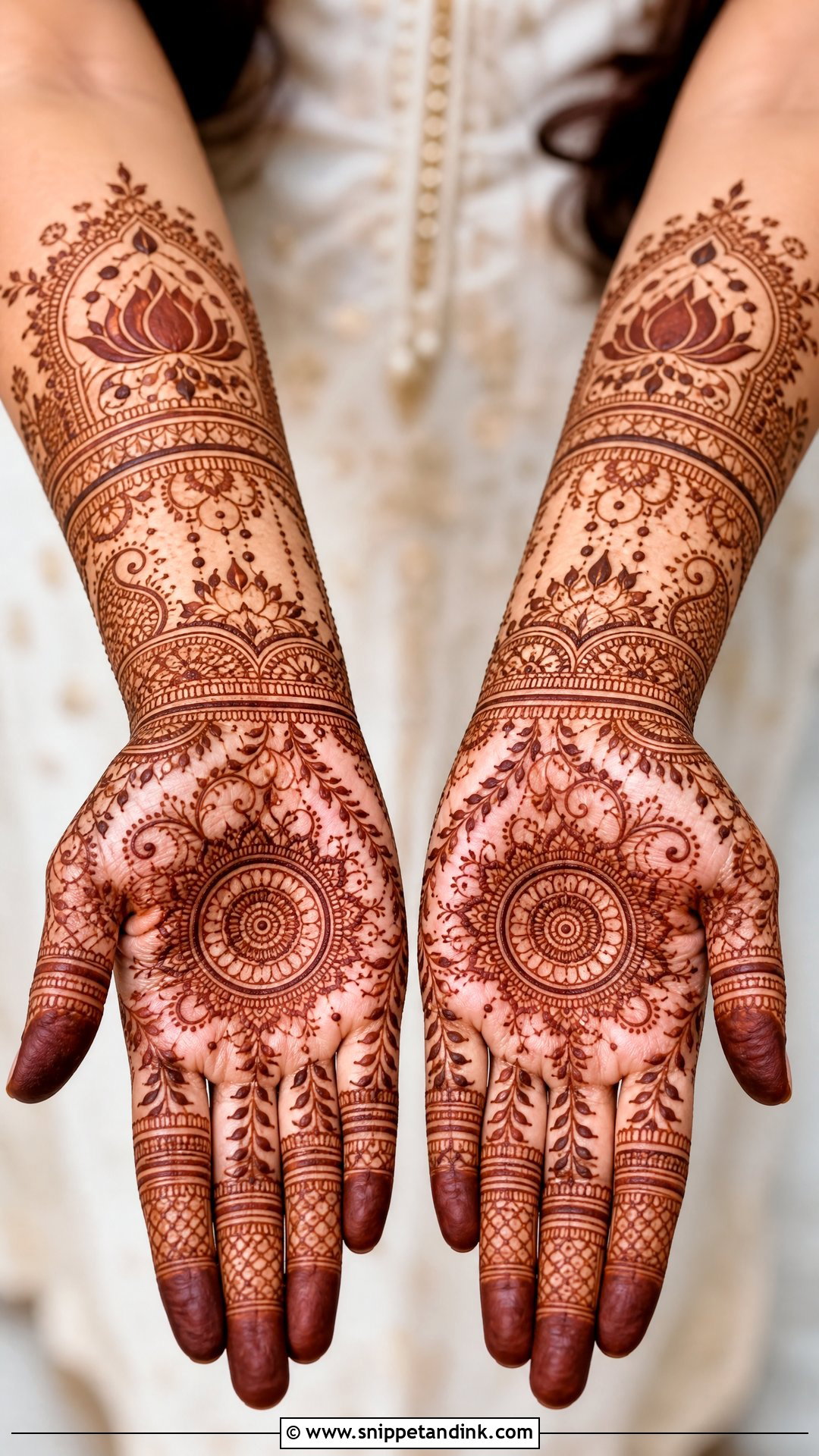
Diwali designs sit beside bright clothes and a lot of bangles, so I keep them joyful rather than bridal unless someone asks for heavy coverage. Lotus, mandalas, leafy borders, paisleys, dotted chains and bracelet cuffs are the vocabulary. Mandala and lotus pairings are popular because they look symmetrical when you hold your palms together for a diya or a photo. Open spaces around the main motifs give a modern feel; filling the palm with paisleys and lace makes it traditional.
21. Front Full Hand Engagement Mehndi Design
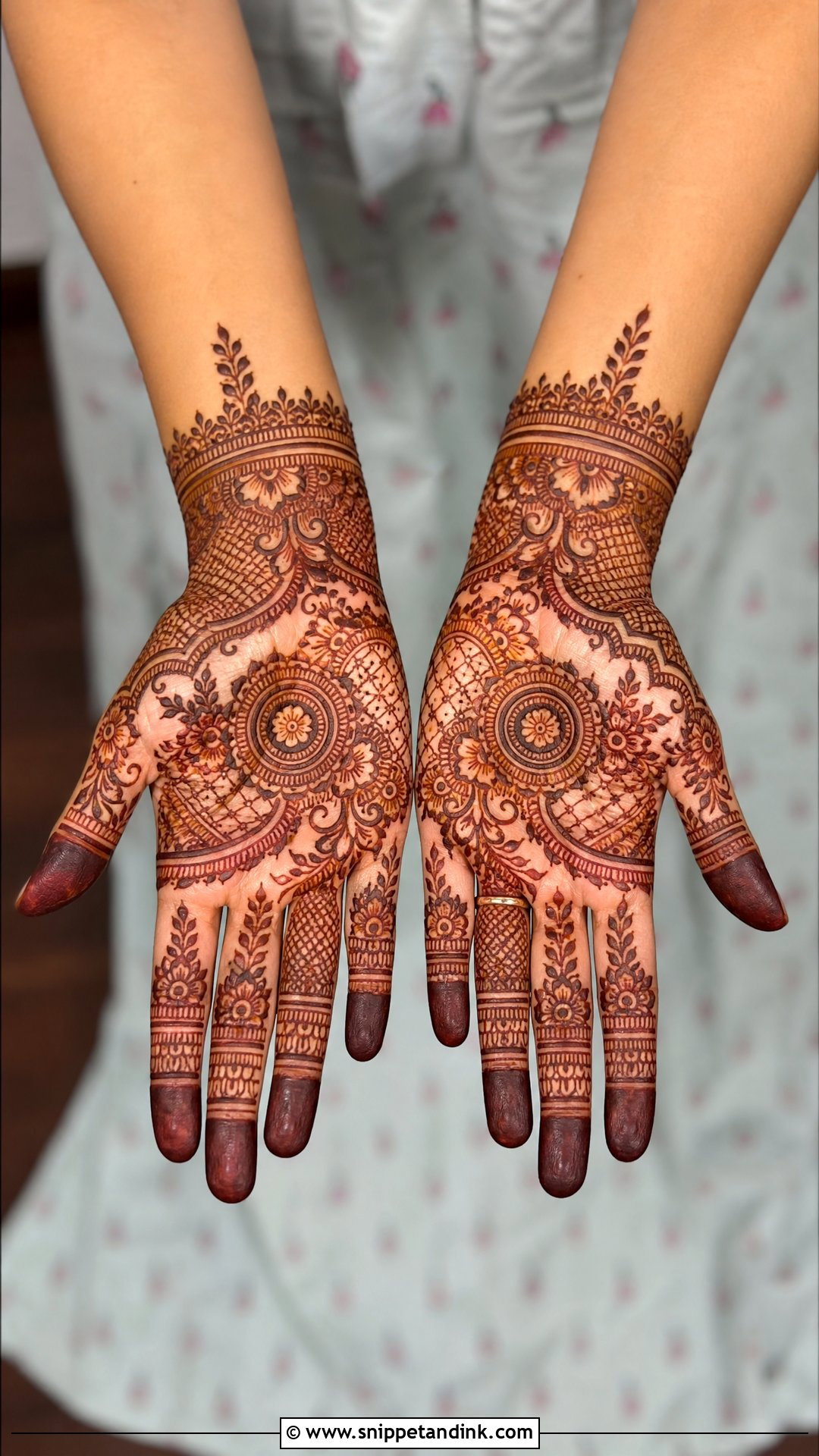
Ring photos decide the engagement design. I keep the palm medium-heavy with floral trails, mandalas, a bracelet cuff and detailed fingers, but I leave the ring finger lighter around the base so the band isn’t lost against dark stain. The fingers get the neatest work, because they’re in most close-ups. Indo-Arabic suits the day well: more detail than a party design, less weight than the bridal one. Soft flowers, delicate jaali and slim wrist bands keep it refined.
22. Front Full Hand Wedding Guest Mehndi Design
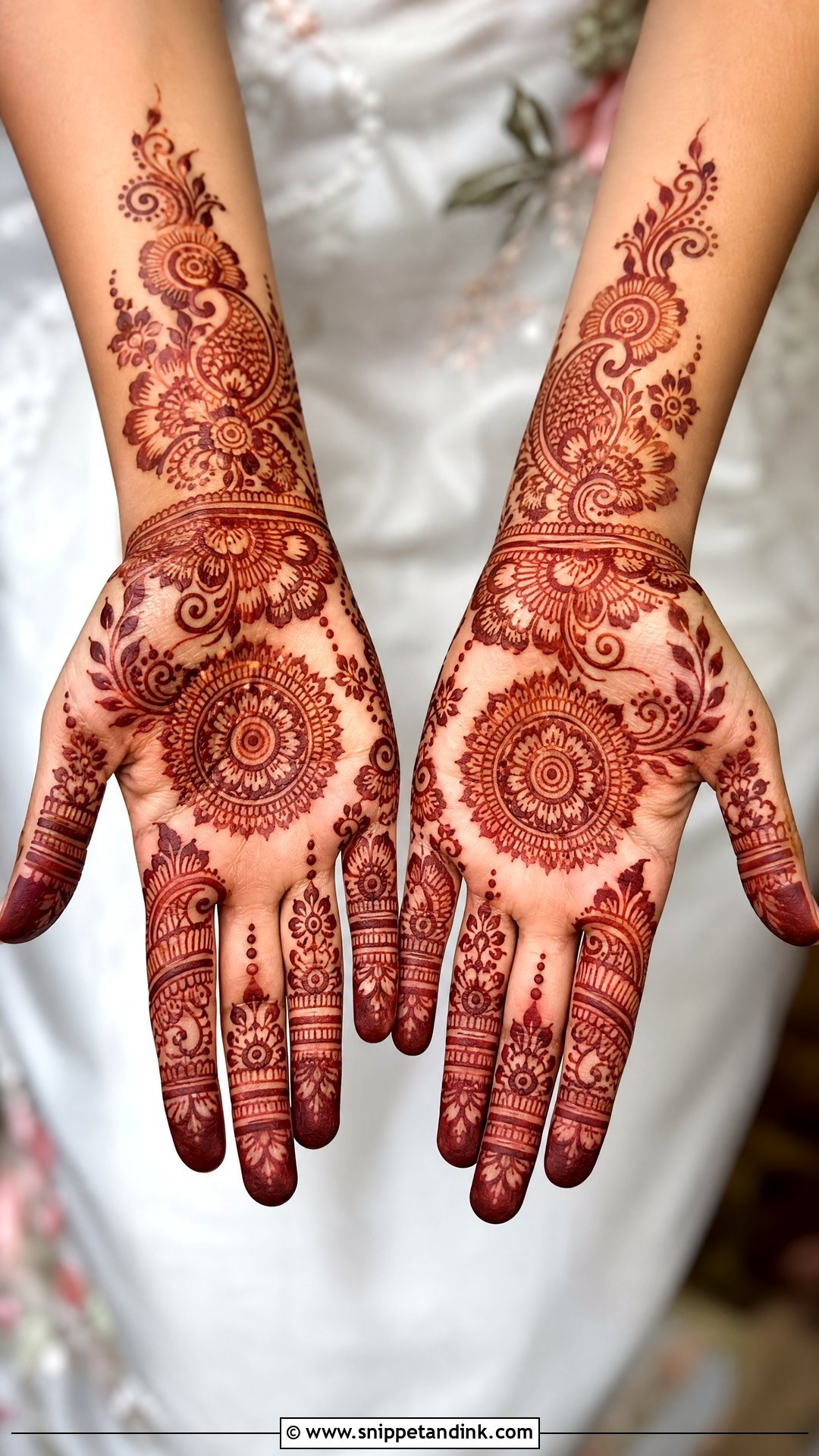
Guests should aim for festive but clearly lighter than the bride. Medium coverage is right. An Arabic floral trail, a palm mandala with finger bands, a paisley layout or a bracelet-style wrist all look dressed up while keeping each guest’s turn short, which matters when one artist is working down a long line. This is what I usually draw for sisters, cousins, friends and other family. One strong palm motif with lighter fillers sits well with bangles and colorful outfits.
23. Front Full Hand Karwa Chauth Mehndi Design
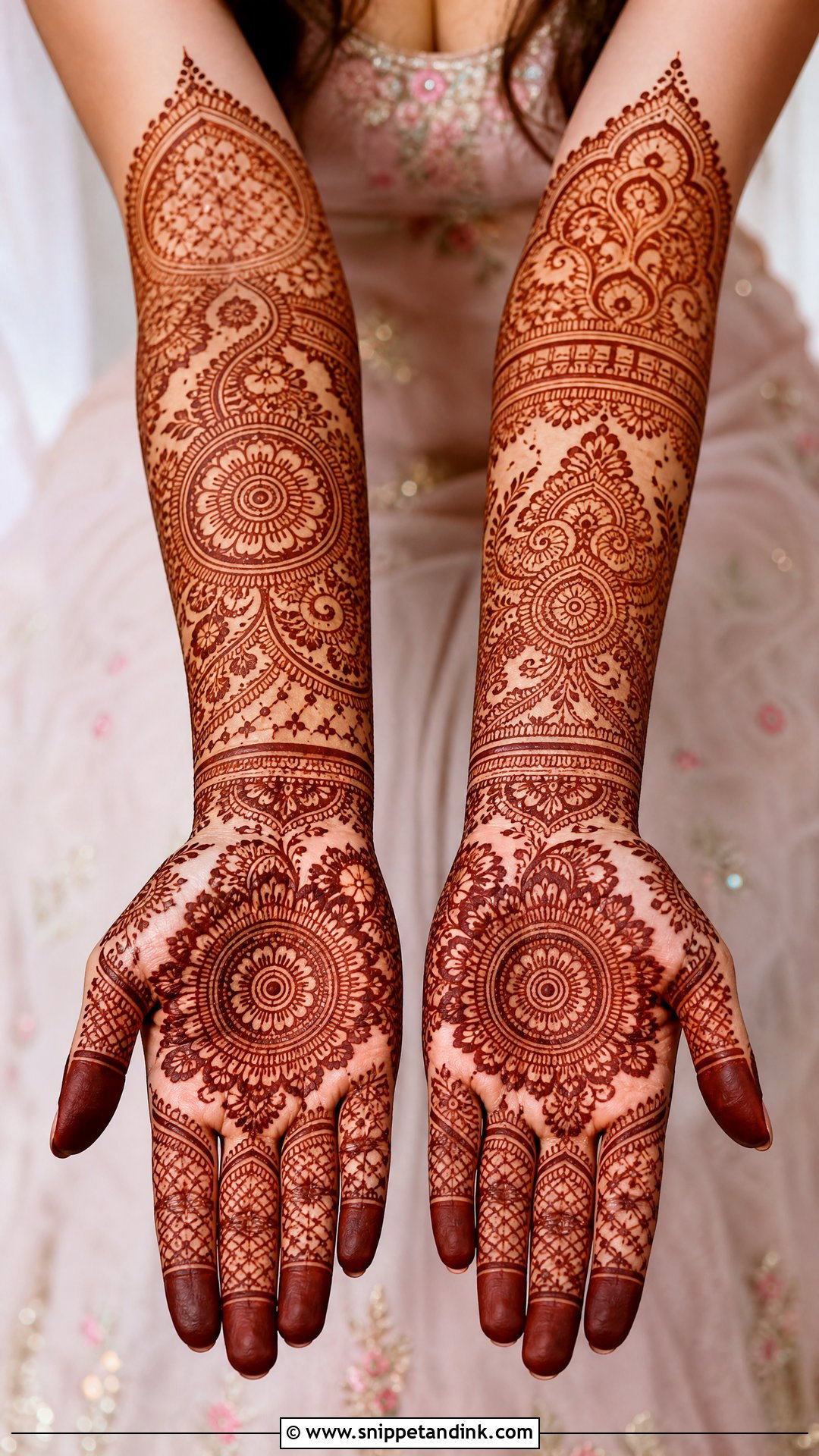
For Karwa Chauth, mehndi is part of the ritual itself, so most women want full palms and detailed fingers, usually applied the day before. Mandalas, paisleys, bridal-style motifs, floral vines and decorative wrist cuffs are the classics. Indian filling keeps it traditional; Indo-Arabic spacing lightens it. A central palm motif is the strongest choice here because the hands are often held together and shown during the evening, and a centered design lines up when they meet.
24. Front Full Hand Rajasthani Mehndi Design
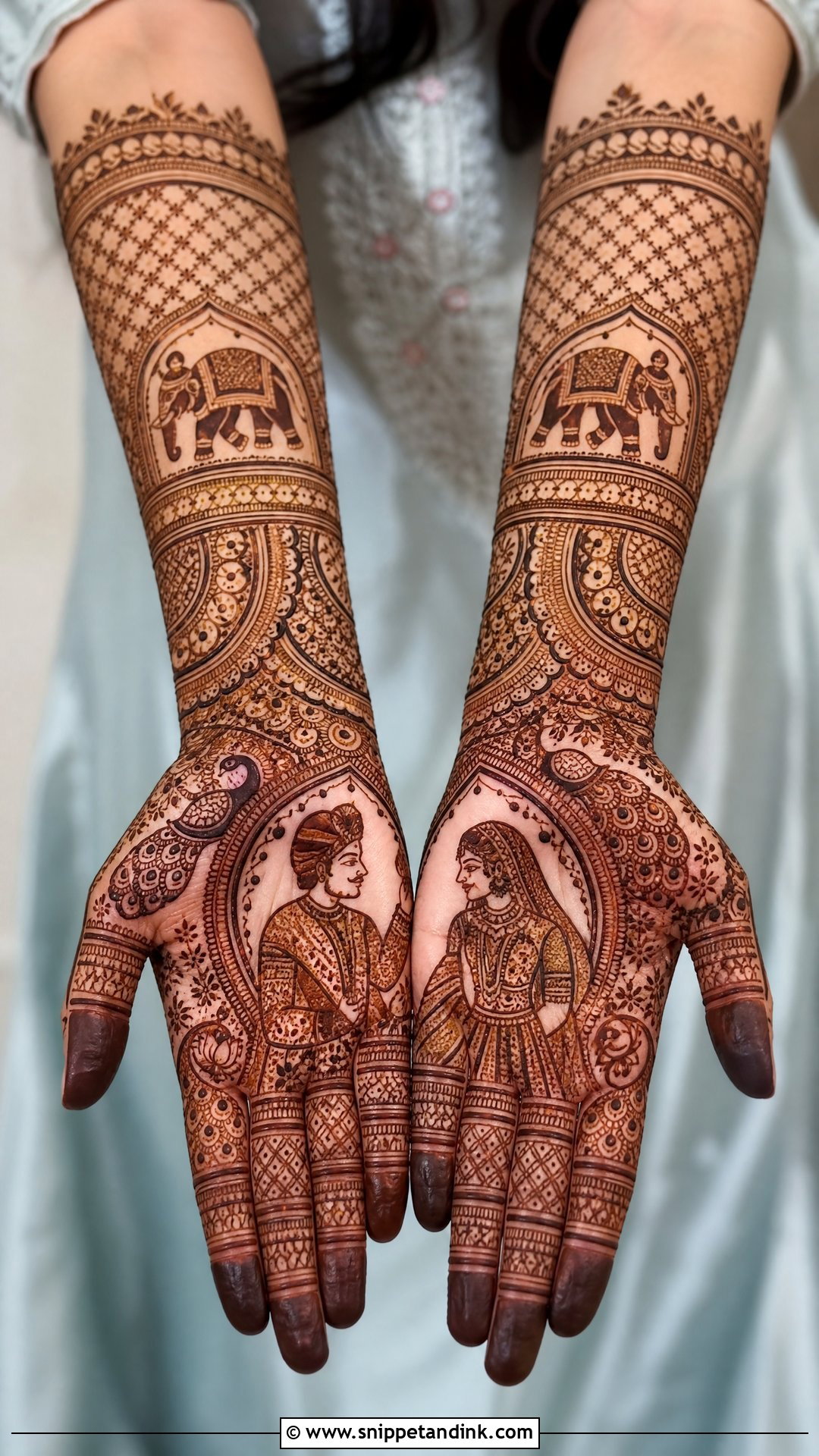
Rajasthani palms tell stories: peacocks, bride-groom figures, elephants, lotus, paisleys and fine mesh, usually around a rich central scene with detailed bands on the fingers and wrist. It’s heritage work and it takes time. Without structure it reads as noise, so I divide the palm into framed sections with borders before filling anything. That way each motif gets its own space and the eye can actually find the elephant.


25. Front Full Hand Pakistani Mehndi Design
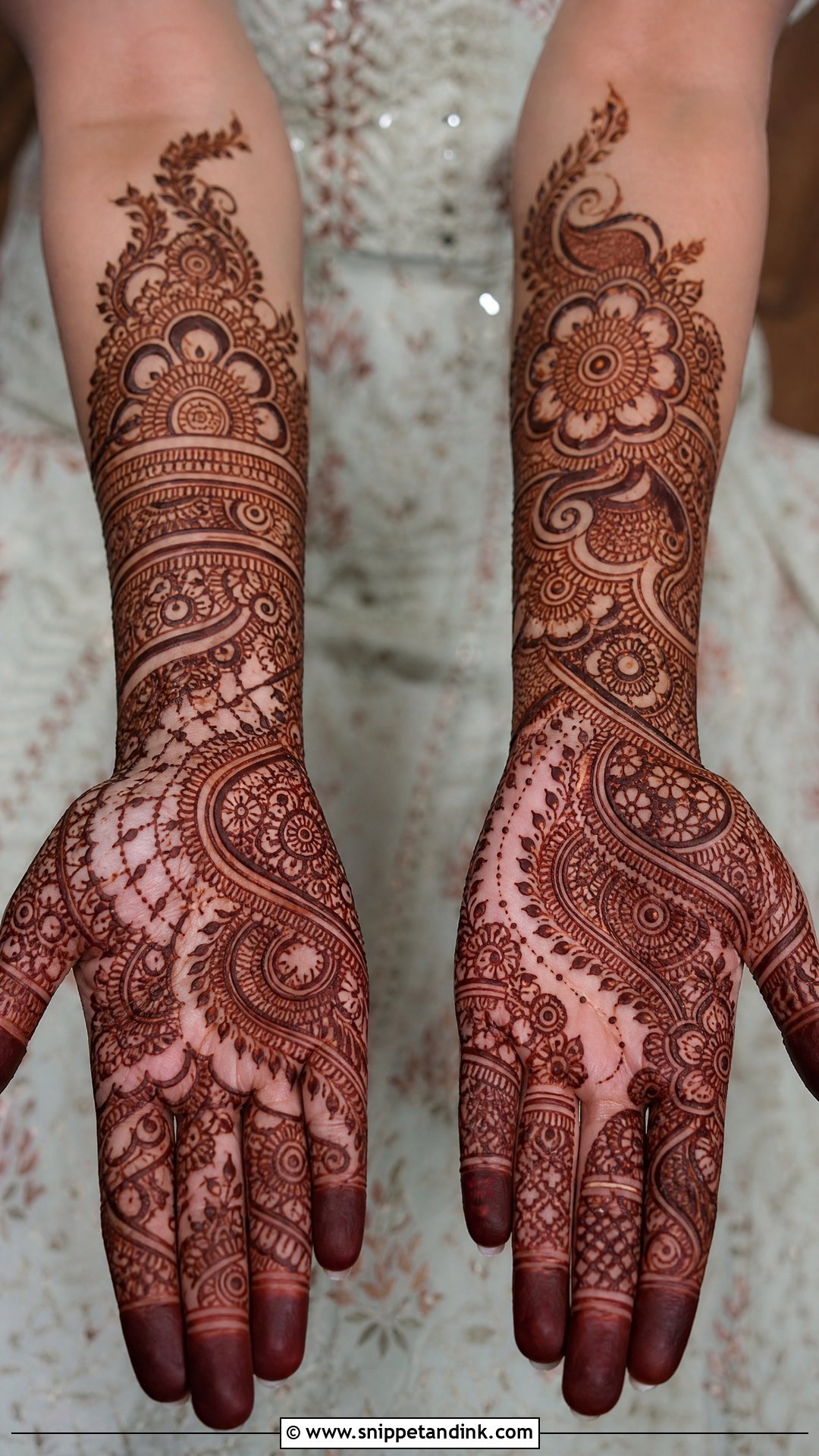
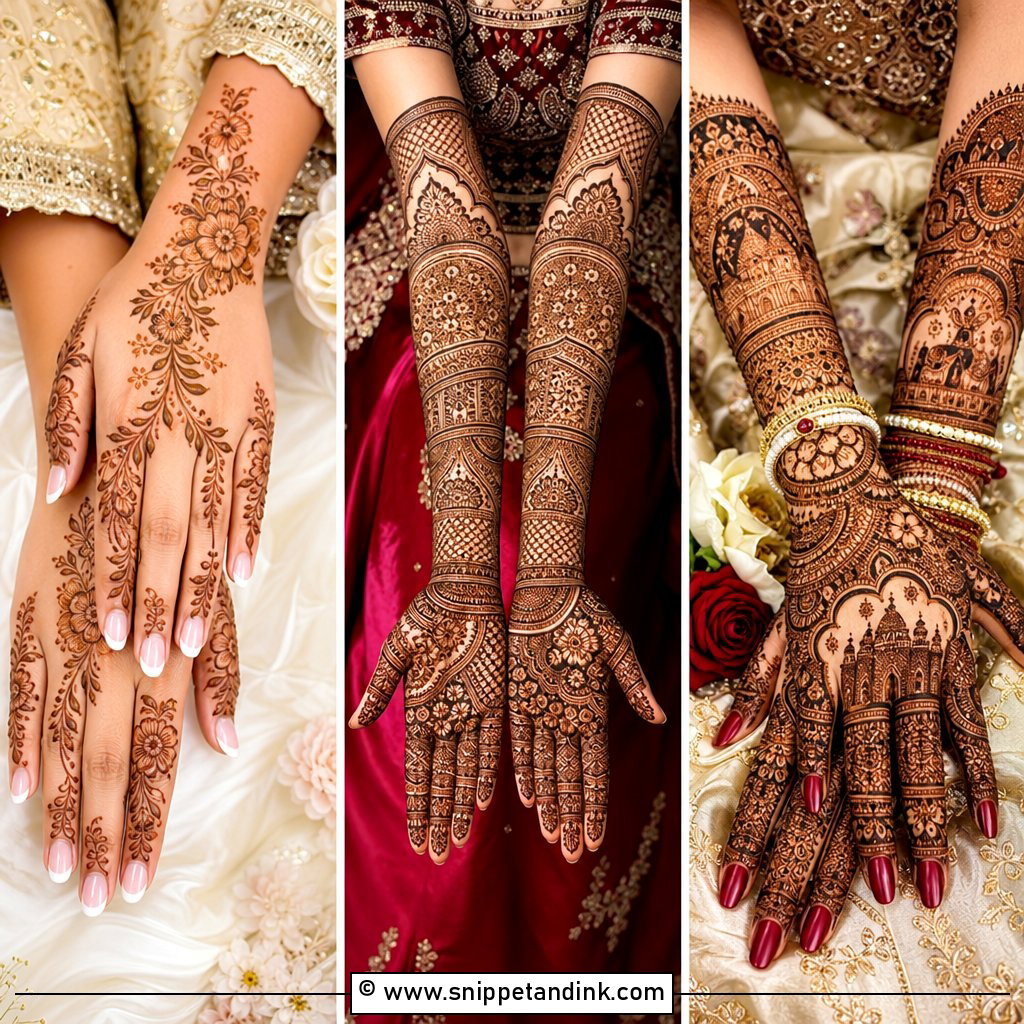
Pakistani palm designs often blend Indian detail with Arabic flow, giving you rich coverage with a softer shape. Expect bold flowers, paisleys, mandalas, leafy trails, shaded petals and fine inner filling. The palm can be dense while the wrist and forearm keep flowing vines or bracelet patterns. What makes it work is the gap between bold motifs and detailed areas, so I always ask for space there rather than more filler. It suits weddings, Eid and formal family events.
26. Front Full Hand Moroccan Mehndi Design
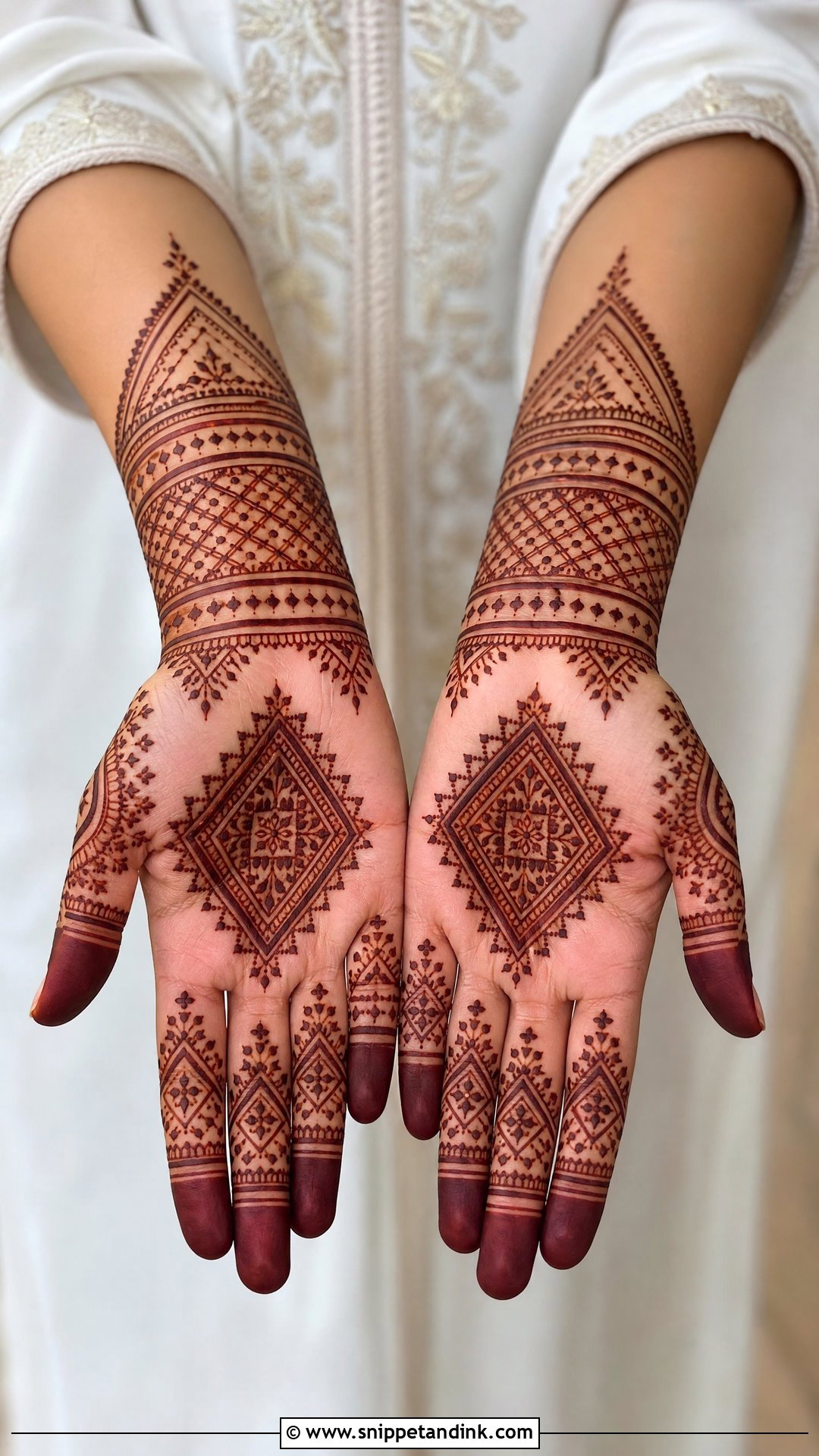
Moroccan palms swap flowers for geometry: diamonds, triangles, grids, lines, dots and structured borders, often around a central geometric medallion with linear bands on each finger. It’s one of the few full-hand styles that scales easily to a small palm, since geometric repeats can simply shrink. The trade-off is precision. Uneven spacing in a grid is obvious, so I work slowly and keep the lines evenly spaced to stay crisp after the stain develops.
27. Front Full Hand Gulf Mehndi Design
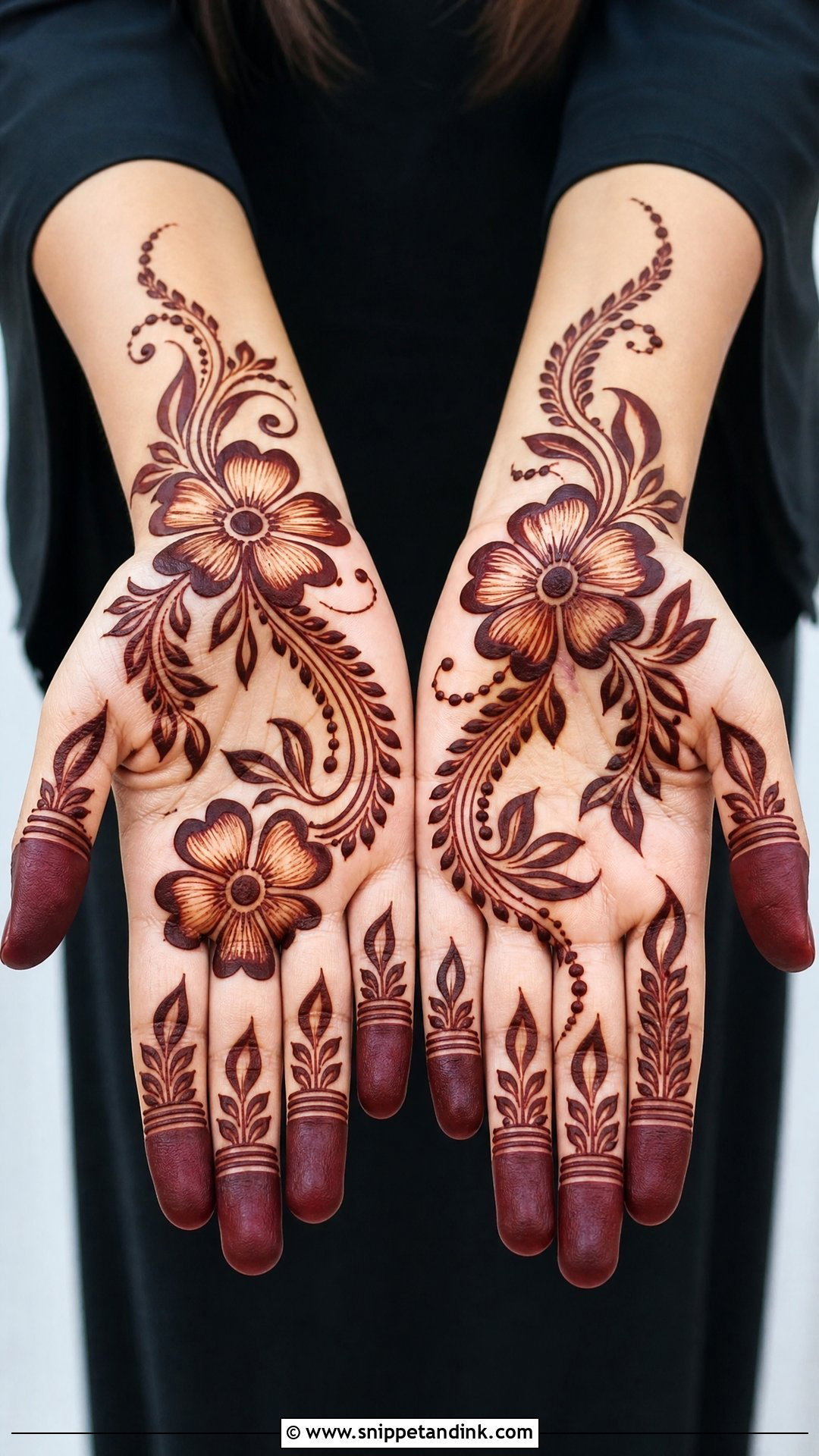
Khaleeji-inspired palm work uses bold florals, leafy curves, thick outlines and generous open space. It sweeps from wrist to fingers with large flowers across the palm and looks dramatic from across a room without being crowded up close. The thick strokes stain deep and even, which gives that polished, glossy look in photos. It’s my go-to suggestion for anyone who wants glamour at Eid or a wedding party but can’t face hours of tiny filling.
28. Front Full Hand Negative Space Mehndi Design
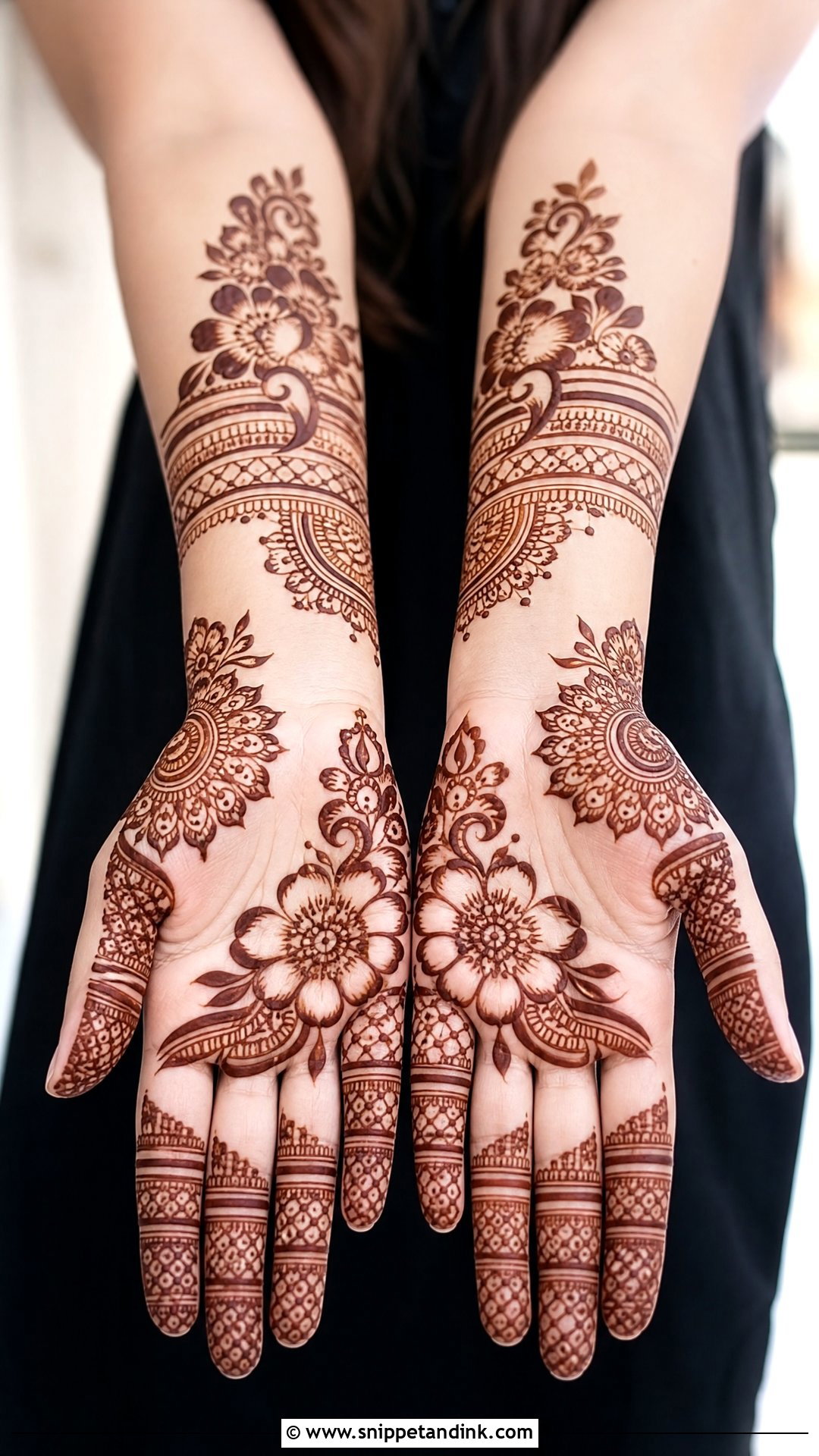
Negative-space designs treat bare skin as part of the drawing. Bold flowers, mandalas, paisleys or geometric bands sit with clear gaps between them, so the result is high-contrast and clean. Every shape stands out on camera. It suits people who want a full hand but dislike heavy mehndi, and it works well for engagements, parties and modern bridal looks. I draw the main motifs first and then decide where the gaps go, never the other way round.
29. Front Full Hand Shaded Mehndi Design
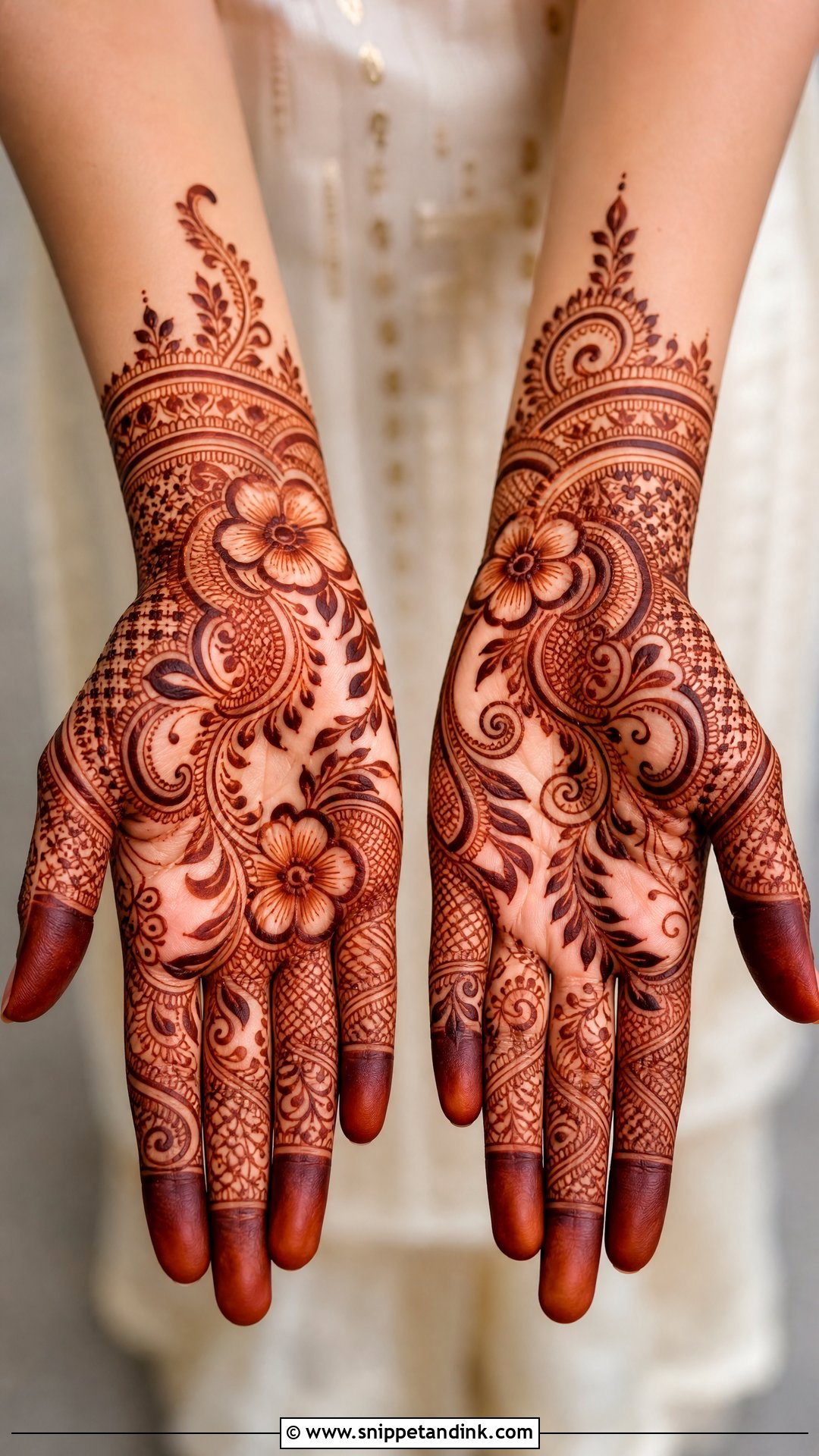
Shading adds depth inside flowers, leaves, paisleys and petals without needing micro-detail everywhere. Depending on technique it can be light, dark or graded, and it’s most common in Arabic and Indo-Arabic work where bold outlines frame a softer interior. I get the effect by drawing a thin, slightly translucent layer of paste, which stains paler than the outline. The difficulty is evenness. Patchy shading turns into blotches, so it needs a well-mixed, smooth cone.
30. Front Full Hand Personalized Mehndi Design
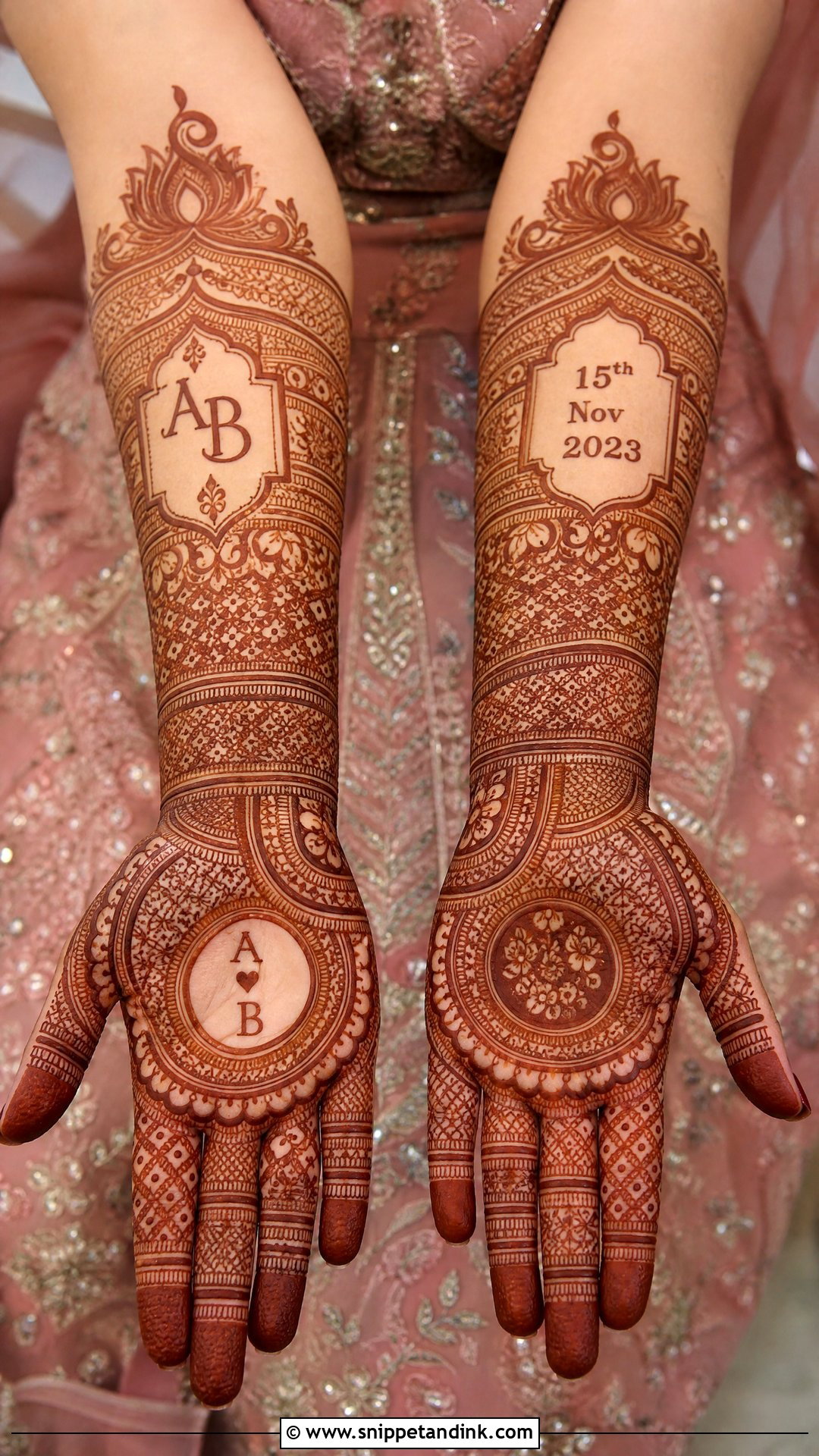
Small custom details turn a traditional full hand into something nobody else has: initials, a wedding date, tiny symbols, a favorite flower or something the couple shares. I blend them into the palm, wrist or forearm so they look like part of the pattern rather than stickers, then build mandalas, paisleys, jaali, florals and bracelet borders around them. Keep each custom element small and clear. Lettering that’s too fine fills in as the stain darkens and becomes unreadable.
Coverage Etiquette for the Bride’s Side and the Guests
At most mehndi functions there’s an unspoken order. The bride wears the fullest design, usually both hands to the elbow and often feet. Her sisters and mother come next, with heavy palms but shorter forearms or a lighter layout. Friends and wider family get medium palm designs or a single hand. Nobody will tell you off for breaking the pattern, but a guest whose hands outshine the bride’s will get noticed in the photos.
How many artists a guest line needs
This is a planning question I get asked late, and it should be asked early. A simple Arabic palm for a guest goes quickly, while a medium Indo-Arabic design with full fingers can take much longer per hand. Count how many guests realistically want mehndi, decide on a guest design level in advance, and ask your artist how many people one person can cover in the hours you have. If the answer leaves a queue still waiting when dinner is served, add a second artist rather than asking anyone to rush.
- Agree one or two guest designs ahead of time so nobody spends ten minutes choosing.
- Seat guests where they can dry without bumping into people or food.
- Keep a box of tissues and cotton buds near the artists for quick fixes on smudges.
Which Palm Design Fits Your Occasion?
Decide on the mood before you decide on a pattern, and the list narrows fast. Bridal and Rajasthani designs feel rich and traditional. Arabic, Gulf and shaded layouts are bold but airy. Mandala, lotus, paisley and jaali patterns give you balance, while minimal, modern and negative-space designs keep a full hand from feeling heavy. Then match it to the occasion, your outfit, your jewelry and how long you can sit, and give the paste enough time on your skin. A deep natural color does more for any palm design than an extra hour of detail.
You'll Like These Ideas:










Leave a Reply