
A wedding cake does more work than people expect. It sits in the room for hours before anyone cuts it, it ends up in half the reception photos, and it has to taste good at the end of a long night. The designs I’m asked for most right now are textured buttercream, revived vintage piping, pressed flowers, fruit and taller, slimmer tiers, alongside smaller cakes that carry a lot of character. Below are twenty full looks, each with what I’d tell you about it across the consultation table: how it holds up, what it costs you in effort or structure, and who it suits.
Reading a Cake Photo Before You Send It to Your Baker
A saved photo is a great start, but it hides things I need to know. Before you send one, look at it with a few practical questions in mind, because the answers decide whether the design can be copied, adapted or needs rethinking for your day.
- Count the servings, not just the tiers. A cake that looks huge in a photo may have dummy tiers, and one that looks small may be tall extended tiers. Tell me your guest count and I’ll size it from there.
- Identify the finish. Fondant, smooth buttercream, ganache and textured buttercream all look different up close and behave differently in heat. If you’re not sure which one you’re looking at, ask; it changes the price and the timing.
- Check where it was shot. Many styled photos are taken indoors with soft daylight. If your cake will sit near a window in July, the same design may need a firmer frosting.
- Notice the flowers. Sugar flowers are made weeks ahead and last; fresh flowers depend on your florist and the season. Out-of-season blooms in a photo may not be available to you.
Sending two or three photos with a note on what you like about each one is far more useful to me than ten photos with no comment.
1. Classic White Wedding Cake
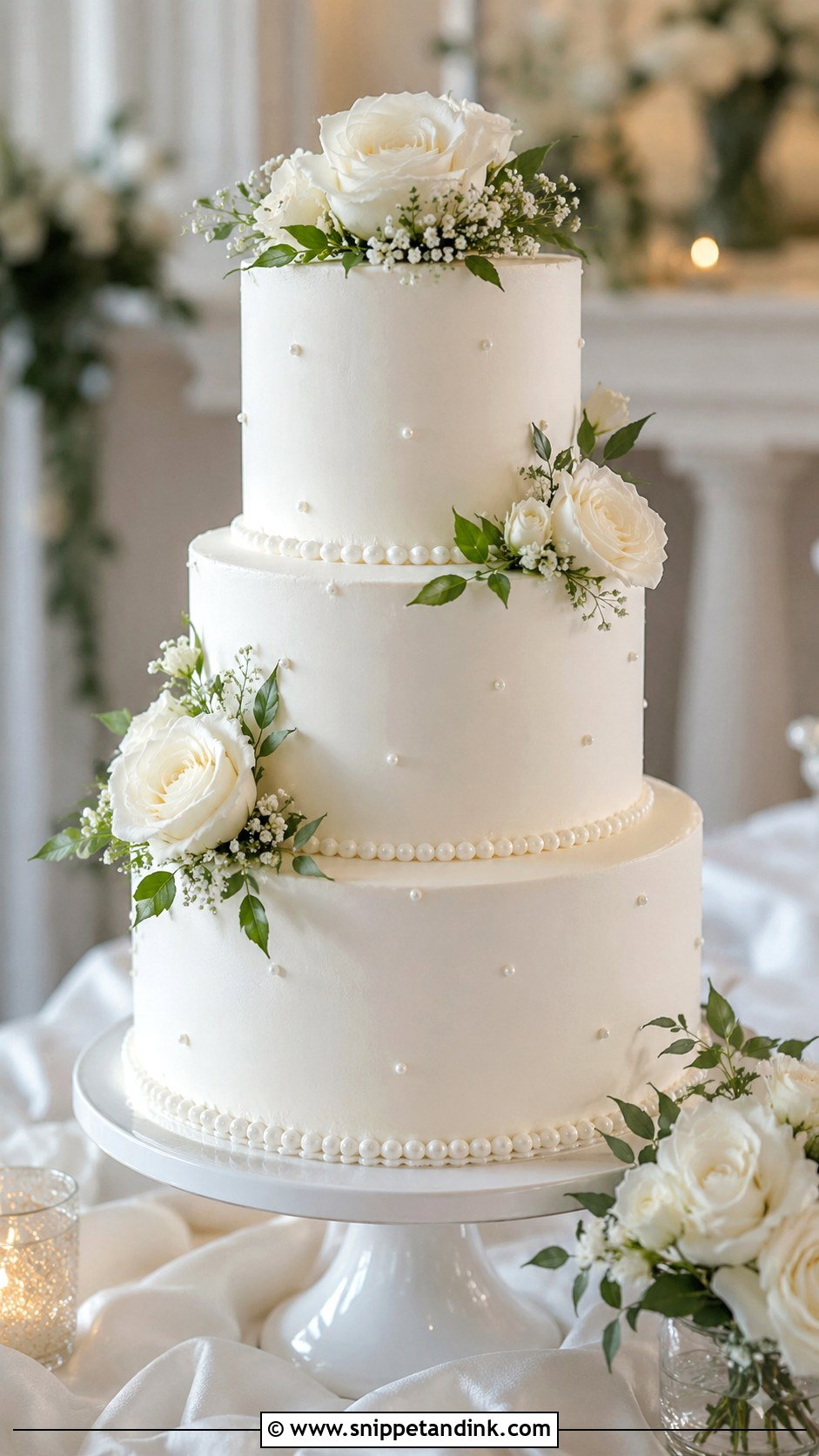
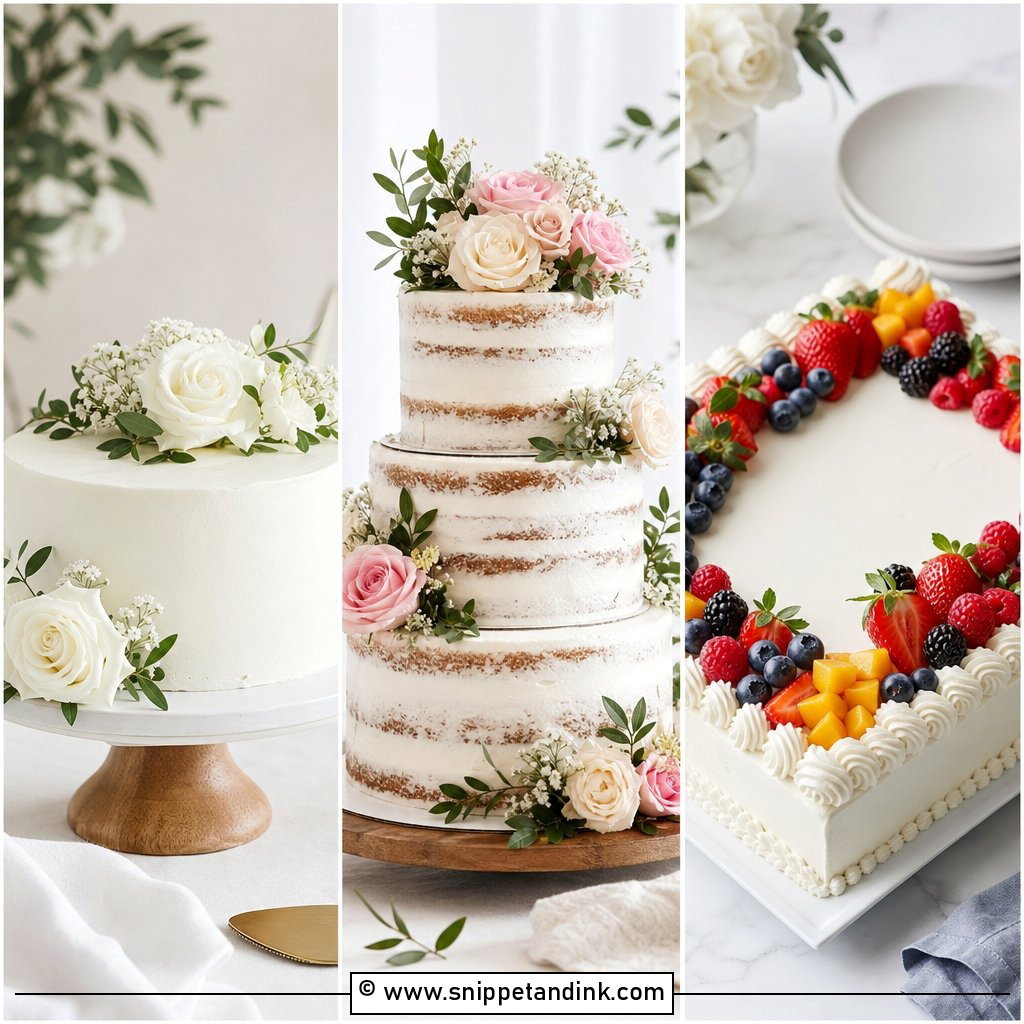
Plain white is harder to execute than it looks, because there’s nothing to hide behind. Every air bubble in the buttercream and every soft corner shows. When a couple asks me for this, the first thing I settle is the finish: razor-sharp edges for a modern room, or a slightly hand-spread surface if the venue is warmer and more relaxed. White roses, a pearl border or fine piping keep it traditional. One thing to know: pure white buttercream is made with a touch of violet or a whitening agent, because butter on its own sets ivory, so tell your baker if you’d rather keep the natural cream tone.
2. Buttercream Wedding Cake
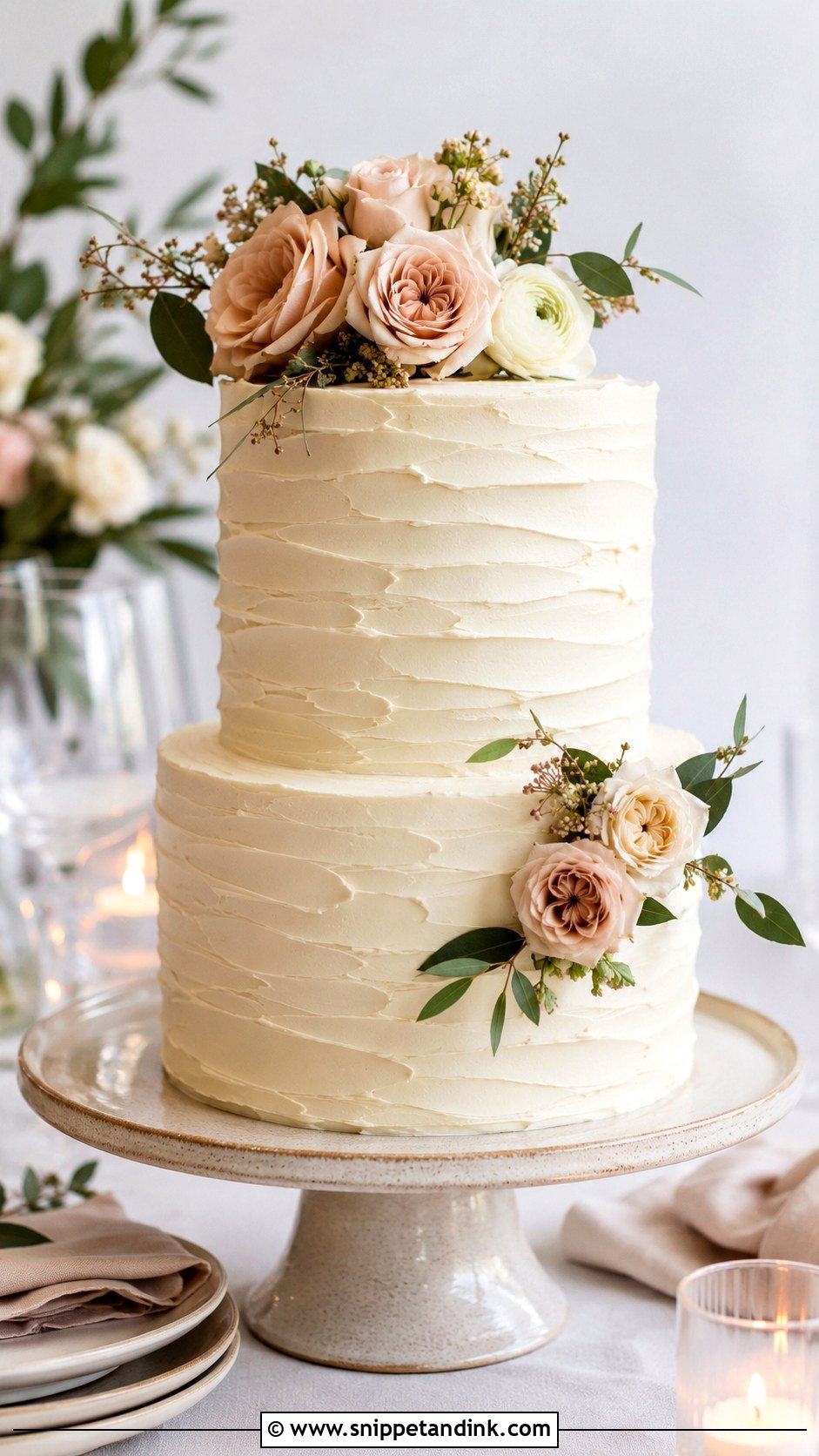
Most of the couples who come to me for buttercream care about flavor first, and that’s the right instinct. The finish can be glass smooth, lightly textured or combed into ridges with a palette knife, and it carries vanilla, almond, lemon, chocolate, strawberry or champagne sponge equally well. Fresh flowers, greenery or edible pearls are all it needs. The trade-off is heat. A meringue-based buttercream starts to slump in a warm marquee, so for an outdoor reception I plan shade, keep the cake chilled until the last sensible moment and set it out closer to the cutting time.
3. Vintage Wedding Cake
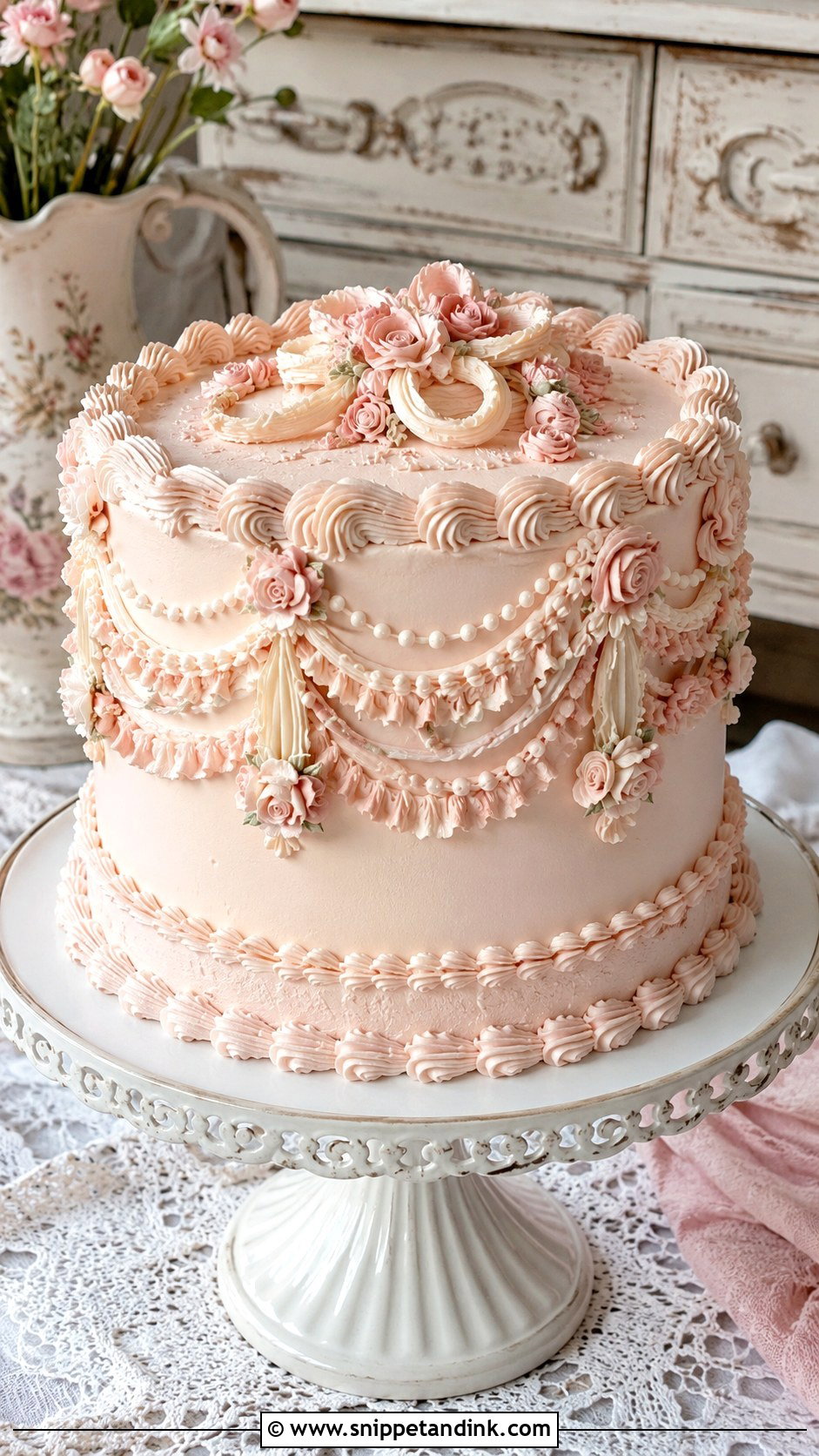
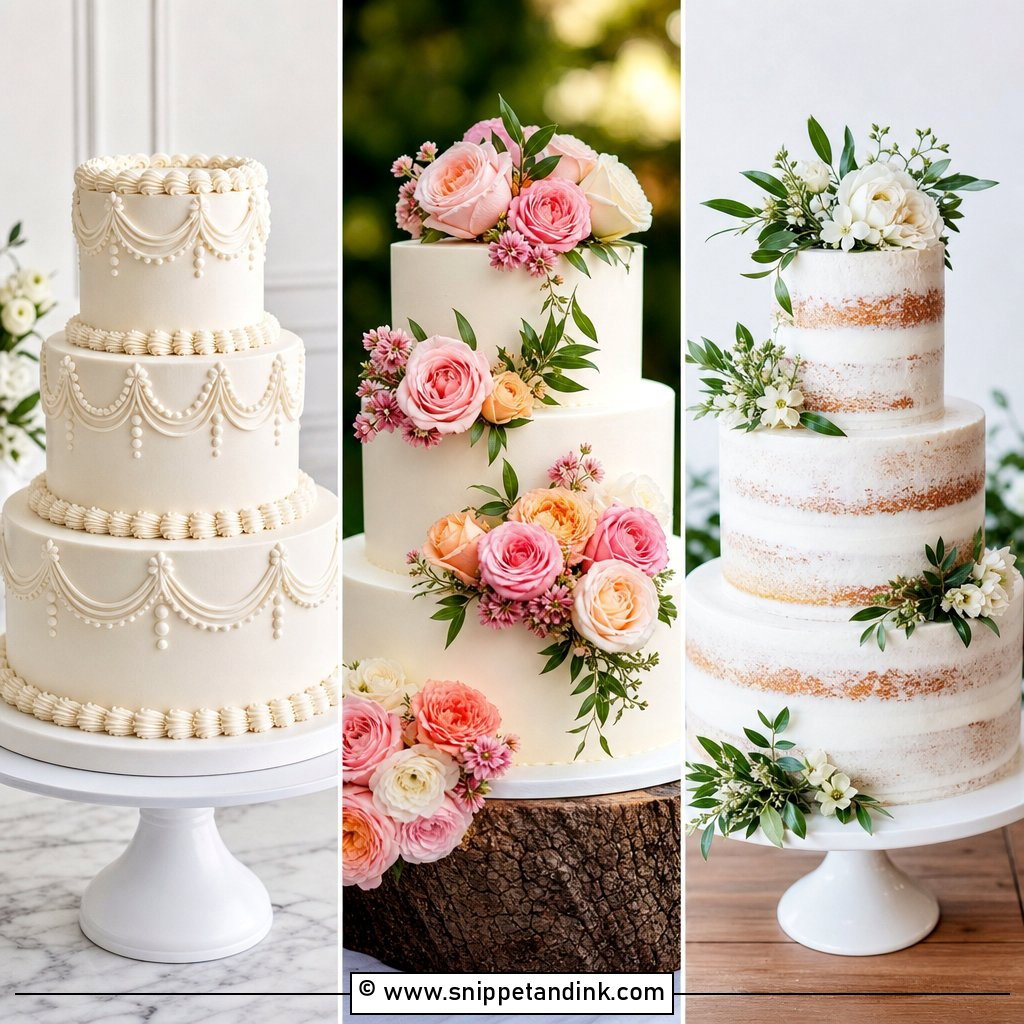
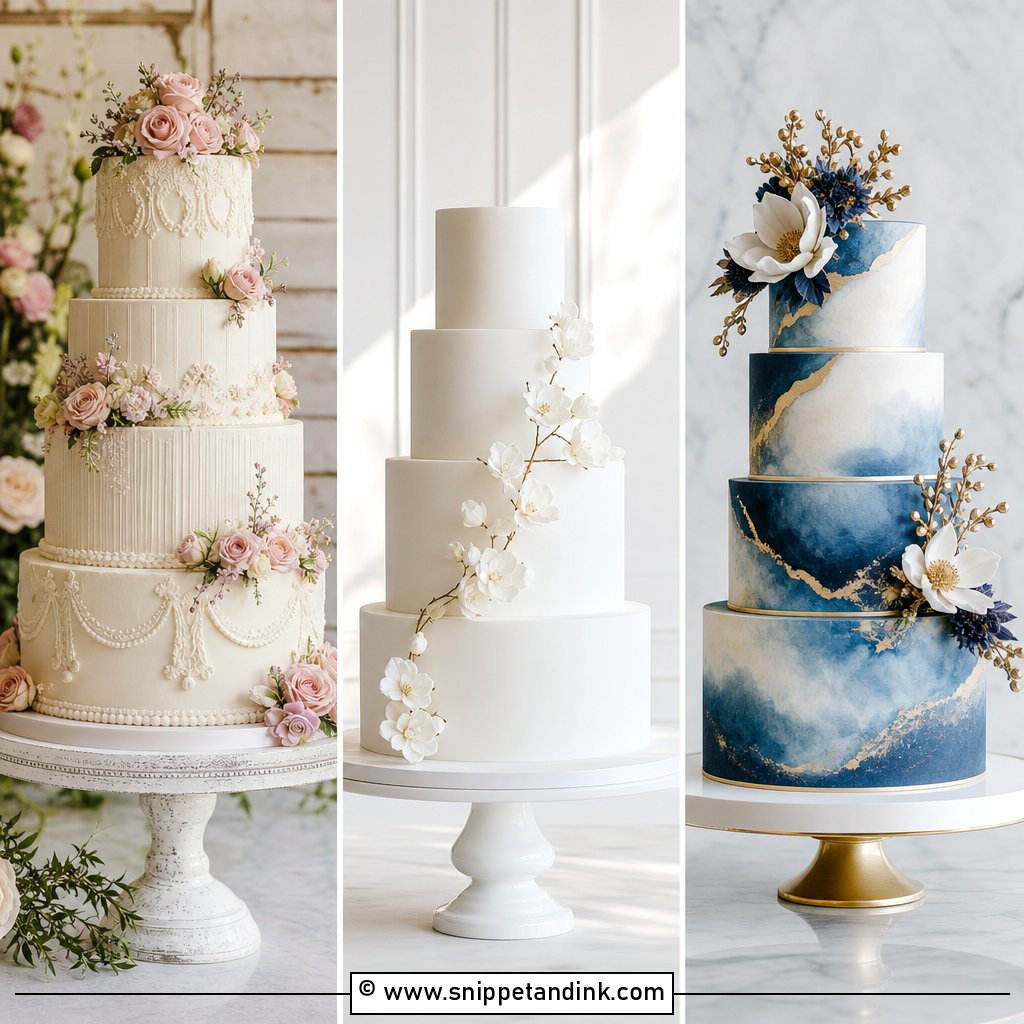
Vintage piping is the style I have to slow down for, because the shells, swags, bows and ruffles are all done by hand, tier by tier, and they need a firm buttercream that holds a crisp ridge. It reads well as one tall cake or as a tiered centerpiece. Ivory, blush, pale blue and champagne keep all that detail from looking cluttered; bright colors on heavy piping can tip it into novelty. Keep it formal with all-white work, or go playful with pastel frosting and glacé cherries. Because every angle carries detail, it photographs from the side as well as the front, which few designs can claim.
4. Floral Wedding Cake
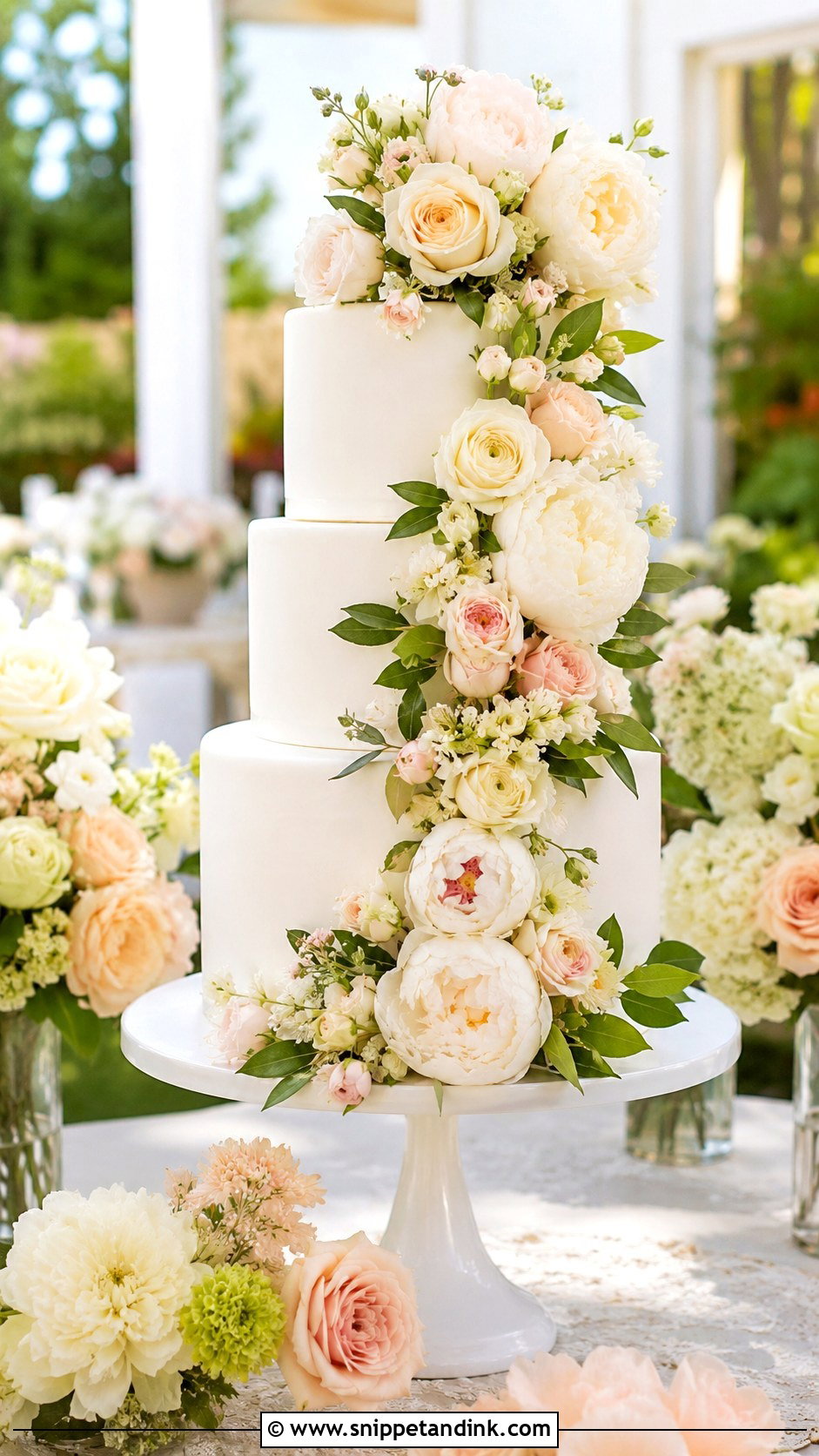
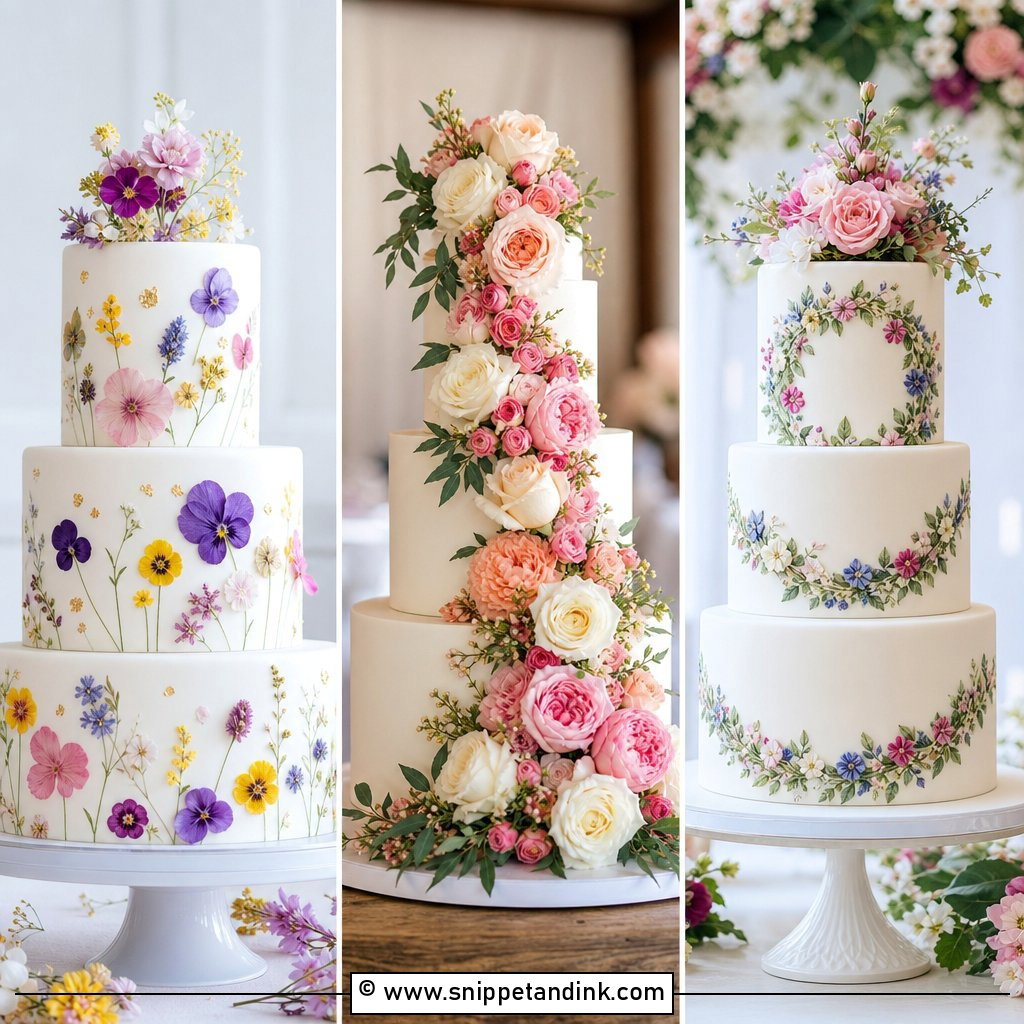
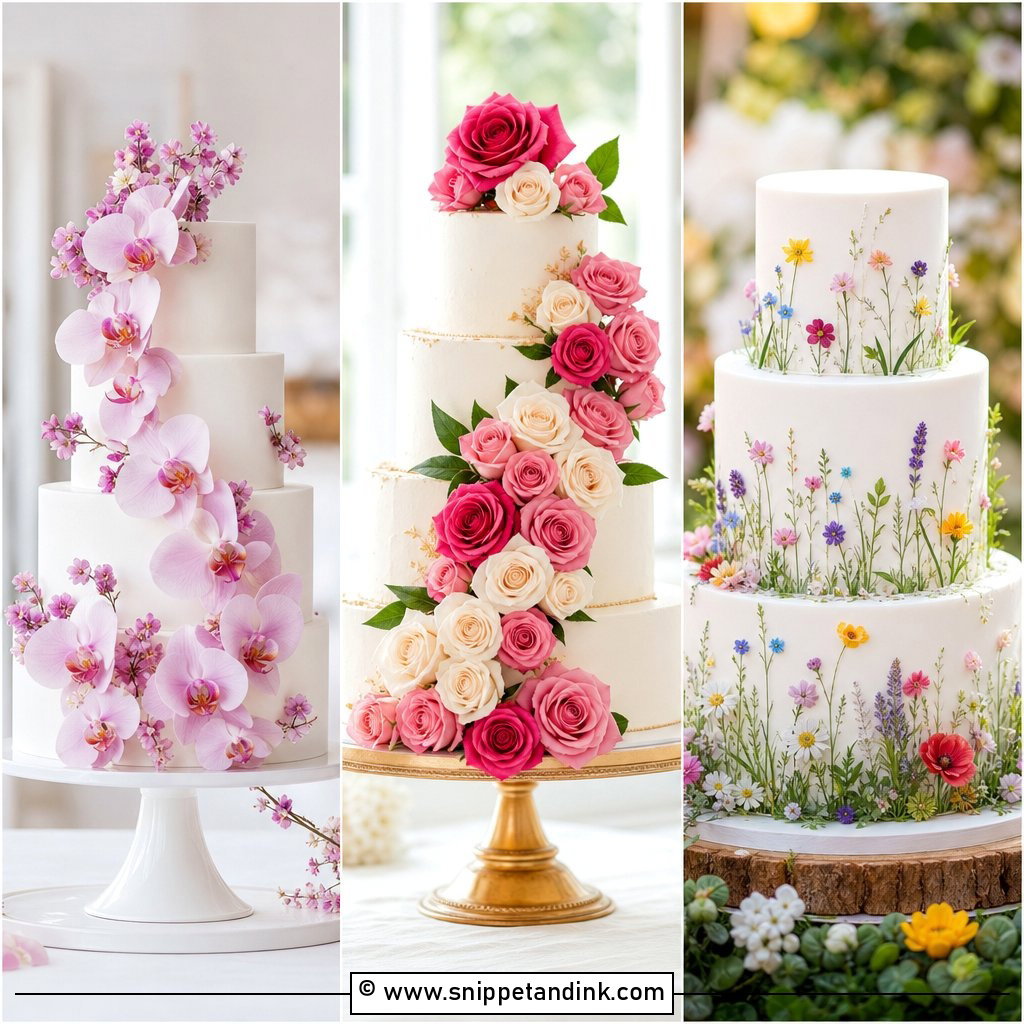
A floral wedding cake is the simplest way to tie dessert back to the bouquet and centerpieces. The flowers can be fresh, sugar, pressed, dried or piped. Roses, peonies, ranunculus and sweet peas give the classic romantic version; small blossoms with airy greenery lean toward a garden feel. The mistake I see most is too many stems, so the tiers disappear and you’re left with a flower mound. I’d rather see the cake’s outline. And fresh flowers never go straight into the sponge: I wrap stems in floral tape or put them in food-safe picks, and I check with the florist that nothing toxic, like lily of the valley or hydrangea, ends up on the tiers.
5. Pressed Flower Wedding Cake
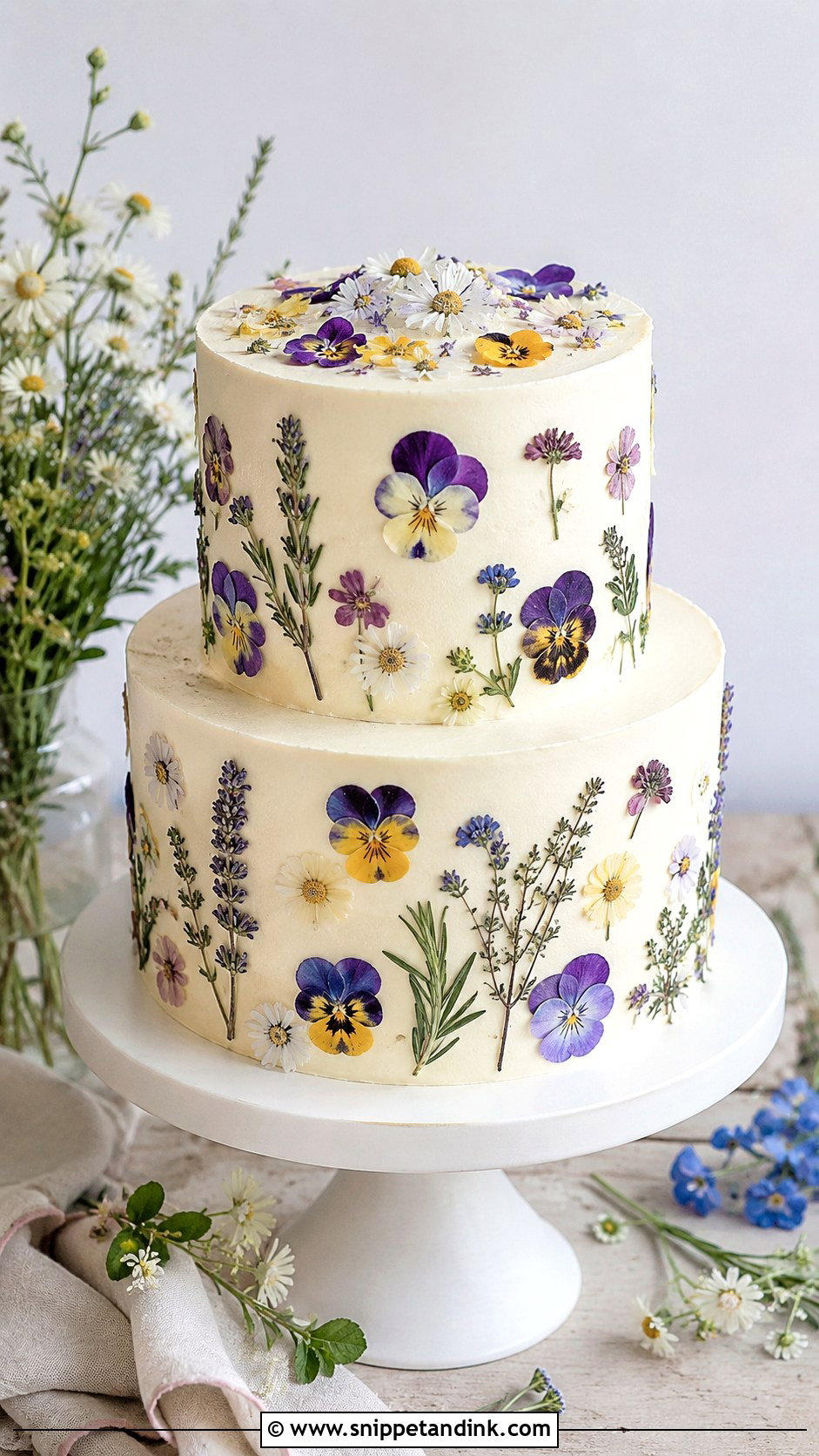
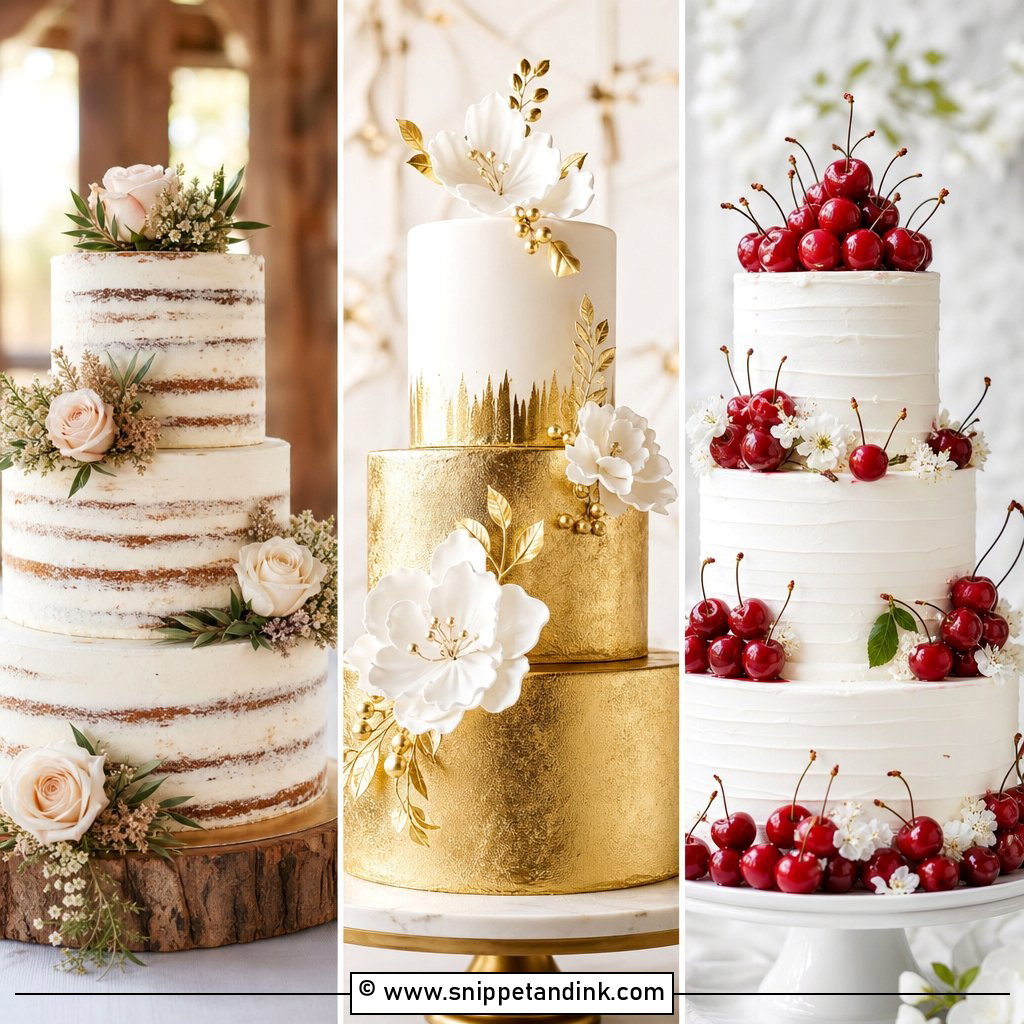
Pressed flowers are laid flat against a smooth buttercream or fondant surface, so the tier has to be perfectly level first or every petal sits crooked. I use edible blooms, herbs and petals in seasonal colors, and I press them myself a week or two ahead because they need to be fully dry or they’ll bleed color into the frosting. An ivory, cream or pale blush base lets them read clearly. A scattered layout gives a wildflower effect; a planned band looks more polished. It suits a garden or cottage-style reception more than a black-tie ballroom.
6. Minimalist Wedding Cake
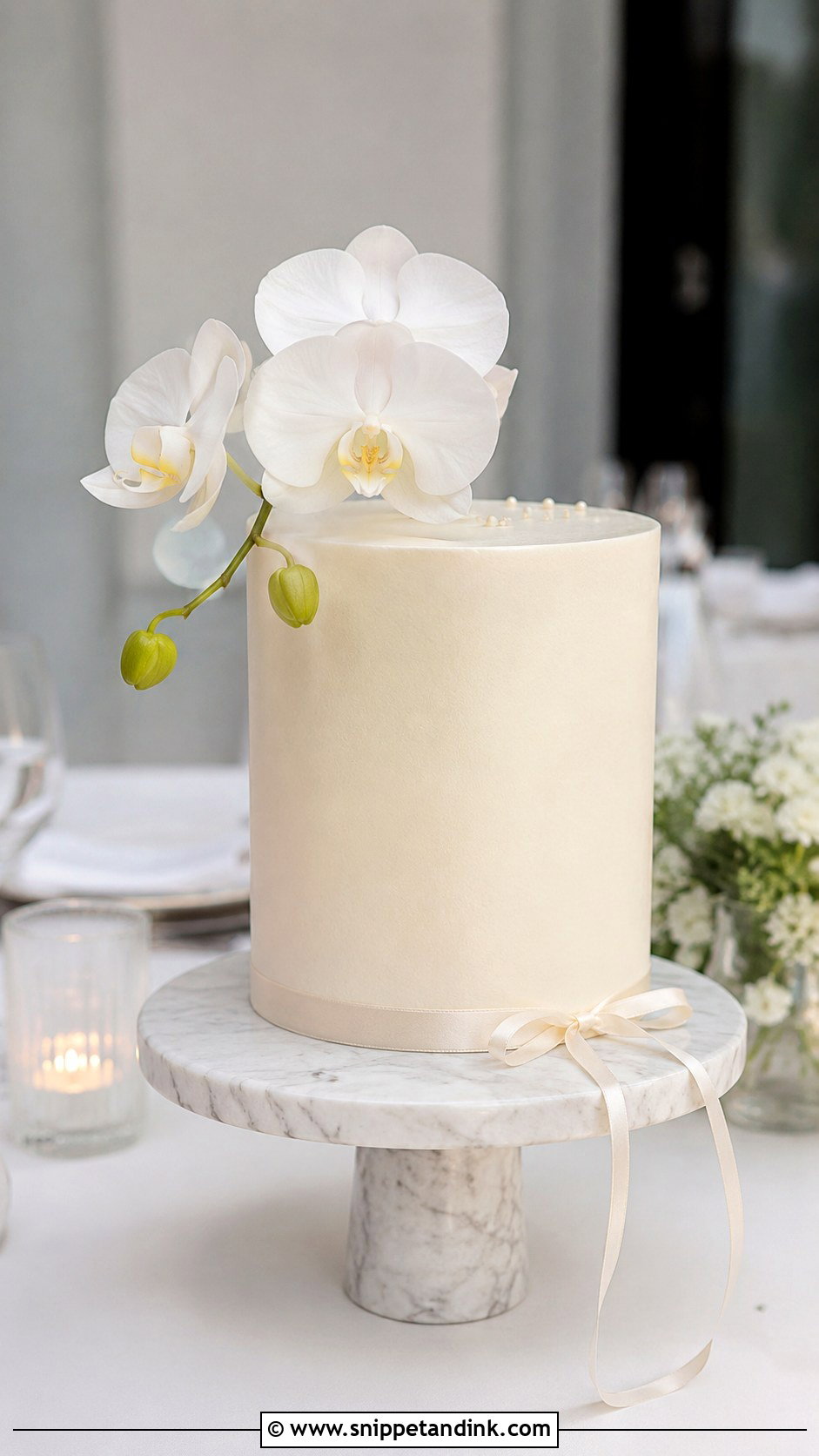
Minimal cakes are where proportion does all the work. With smooth frosting, a neutral color and one strong detail like a single bloom, a silk ribbon or a clean topper, the tier heights and the ratio between them become the design. I often suggest extended-height tiers here, or one wide single tier, because standard four-inch tiers can look squat when nothing else is happening. White, ivory, beige and soft grey suit city venues and small receptions best. Minimal doesn’t mean easy, though: a plain surface shows every flaw, so the finish has to be exact.
7. Rustic Wedding Cake
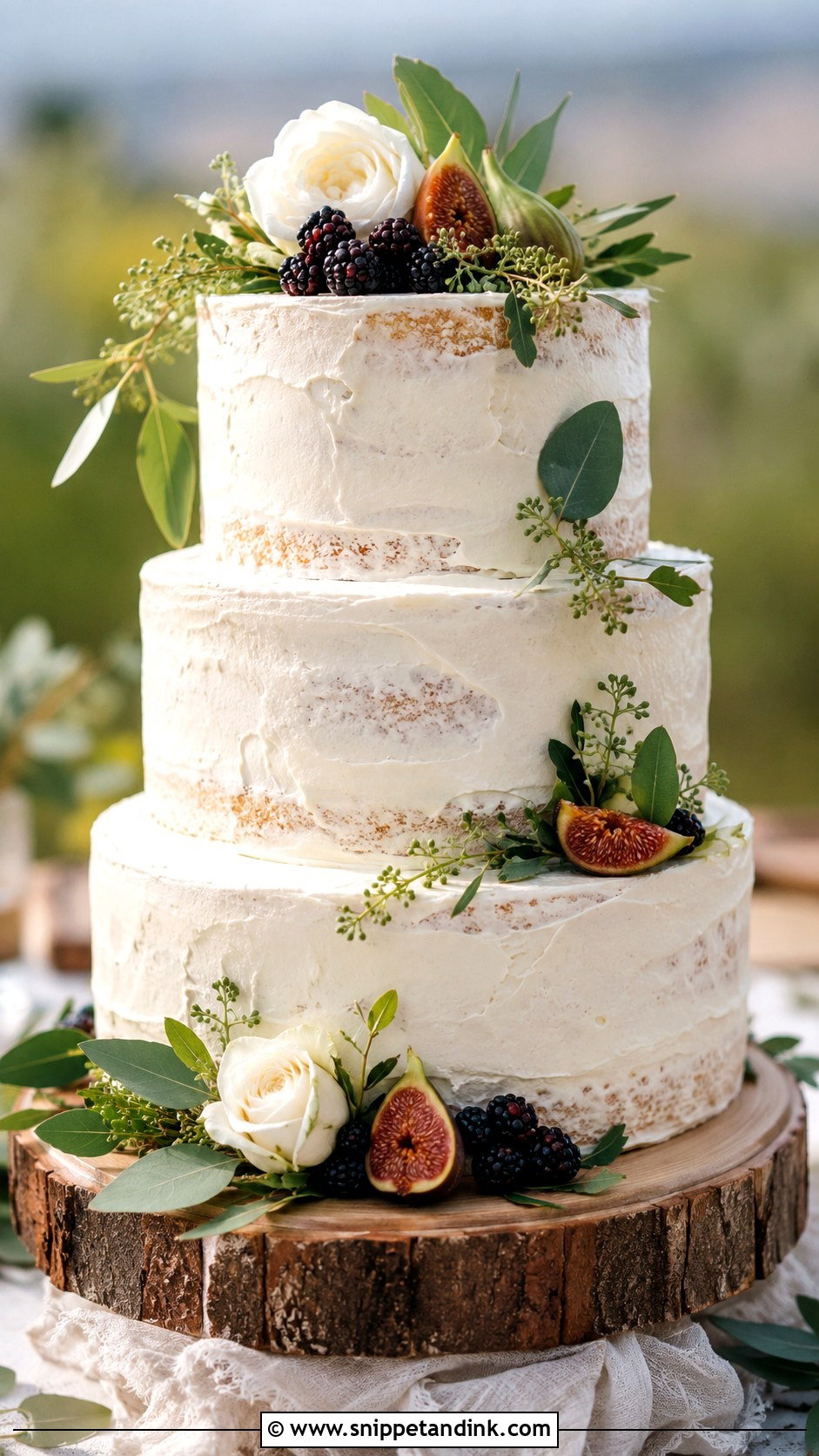
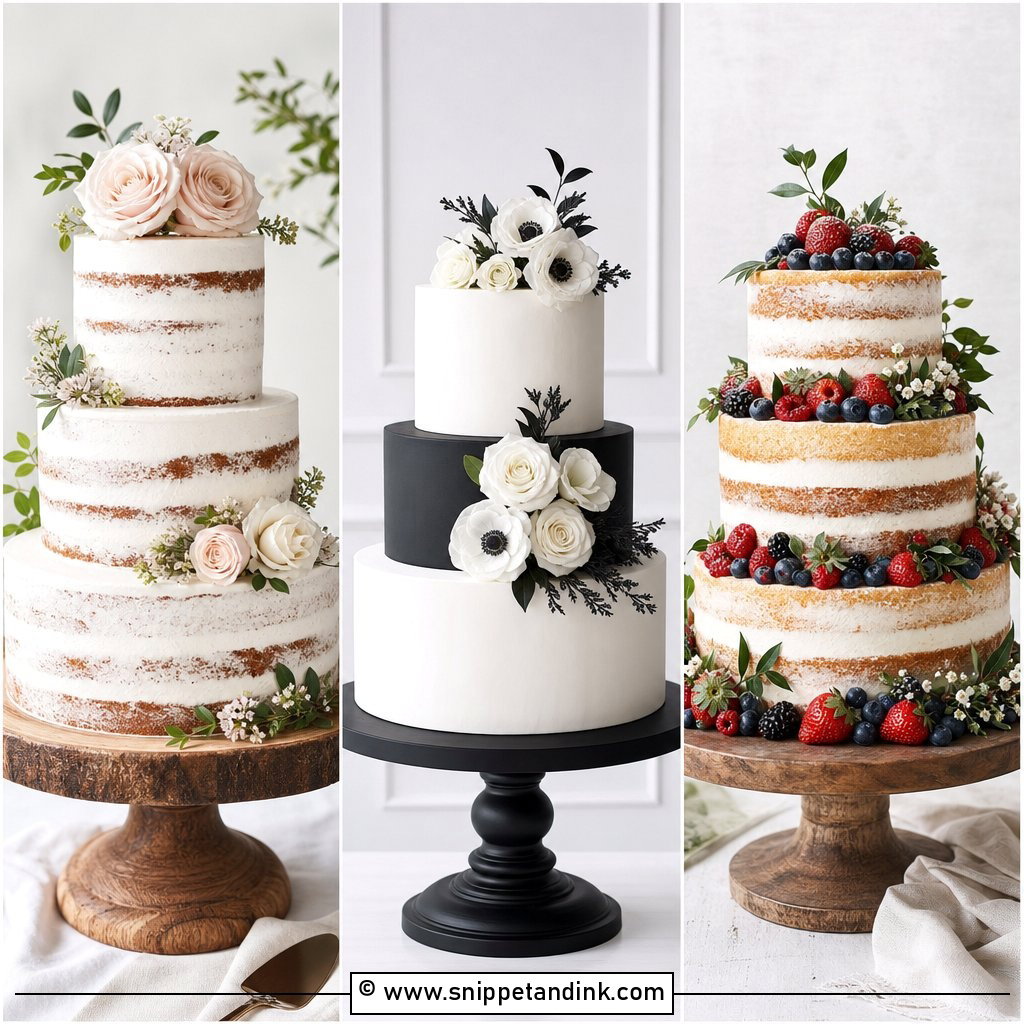
Rustic cakes belong in barns, vineyards and mountain venues, and they’re built on textured buttercream, semi-naked sides, greenery, berries, figs and simple flowers. The trick is making loose look intentional. I keep decoration asymmetric but weighted, usually a heavier cluster on one tier and a light trail on another, so it doesn’t look like everything was scattered at random. A wooden stand, a linen cloth and candles finish it. Flavor-wise, spice cake, carrot, almond and berry fillings make sense with this look in a way that a plain vanilla sometimes doesn’t.
8. Semi Naked Wedding Cake
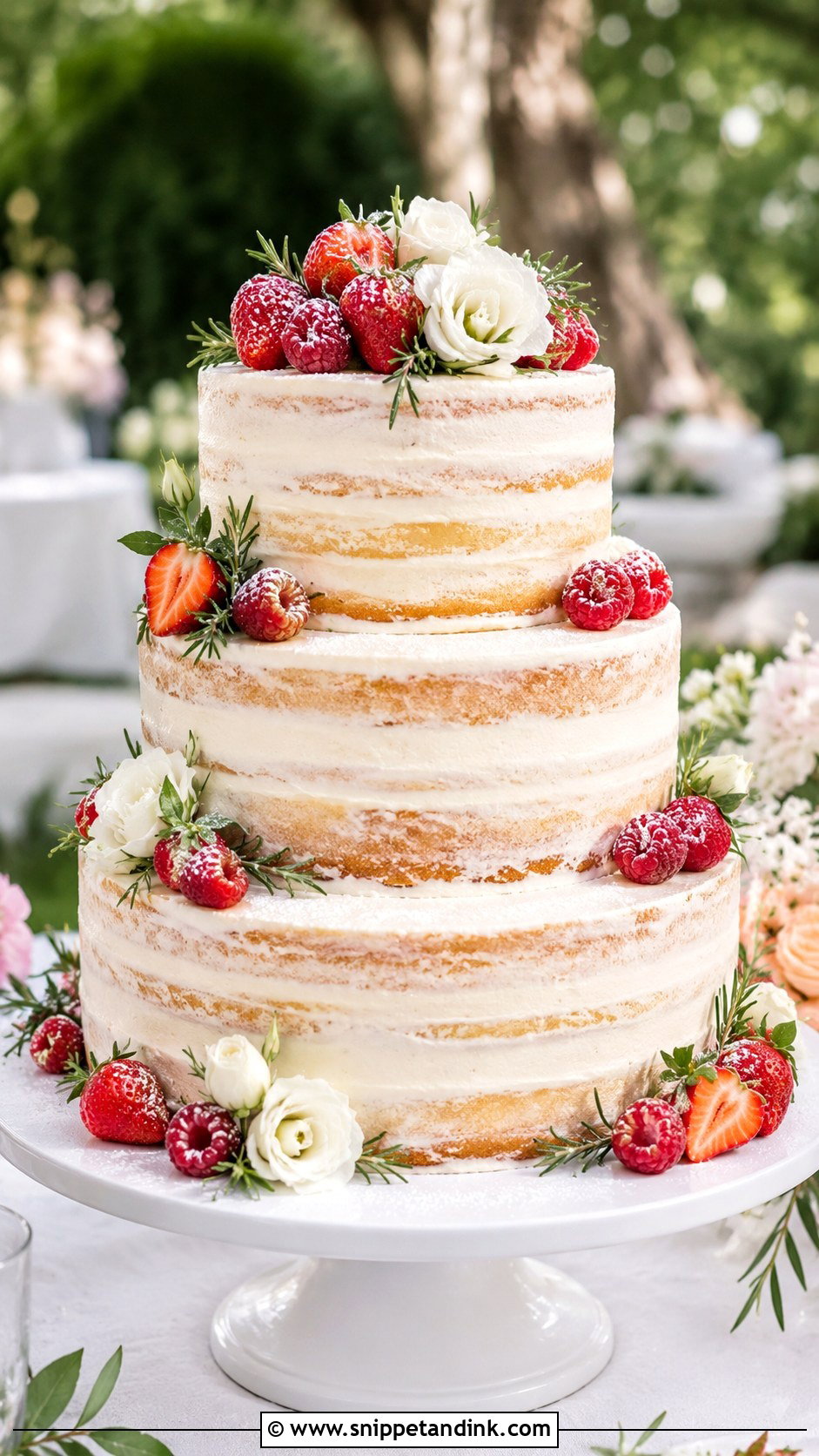
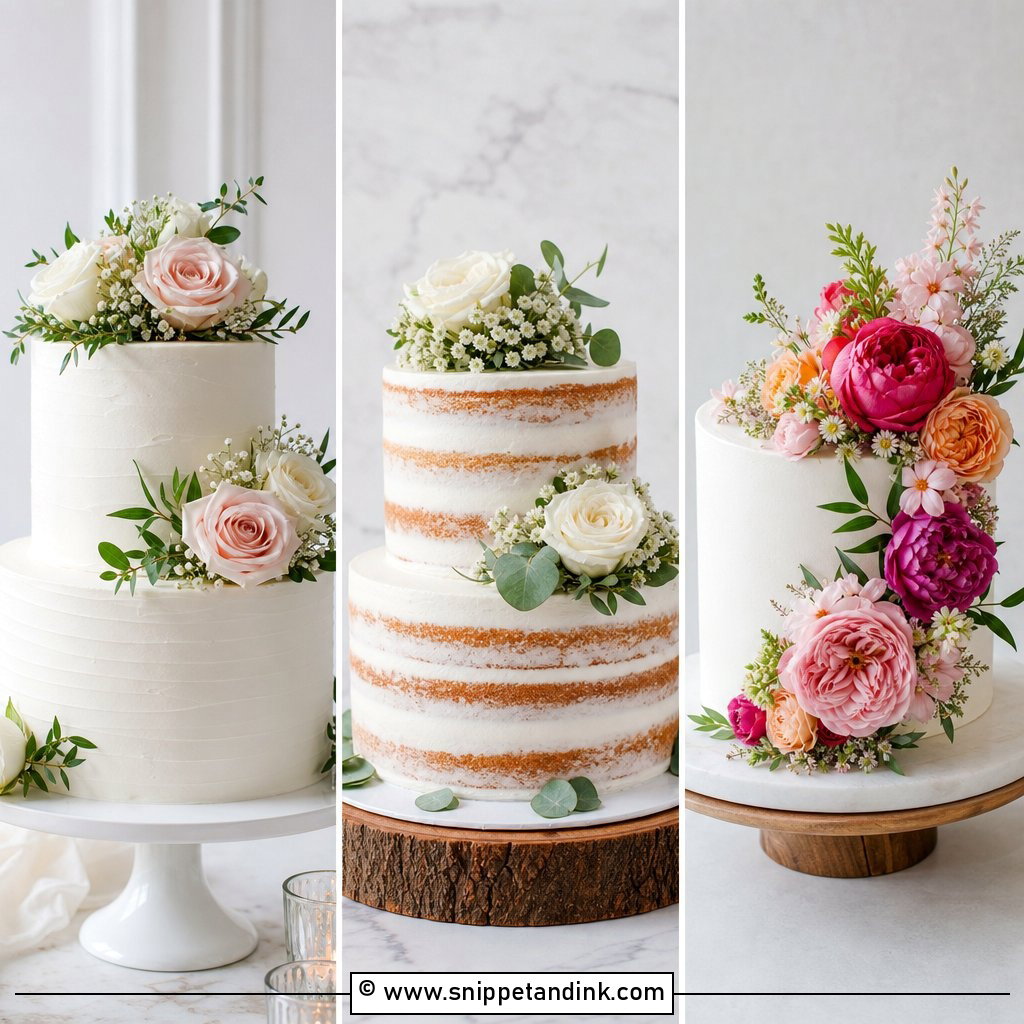
A semi naked wedding cake has a thin scrape of frosting so the sponge layers show through. It fits rustic, garden and beach weddings, and it looks good with berries, herbs, flowers or a dusting of icing sugar. What people don’t realise is that exposed sponge dries out faster than a fully coated cake, so I brush the layers with syrup and I don’t let it sit out uncovered for hours before the reception. Since you can see the crumb, pick a flavor whose color you like: a dark chocolate sponge reads very differently next to an ivory palette than lemon or almond does.
9. Three Tier Wedding Cake
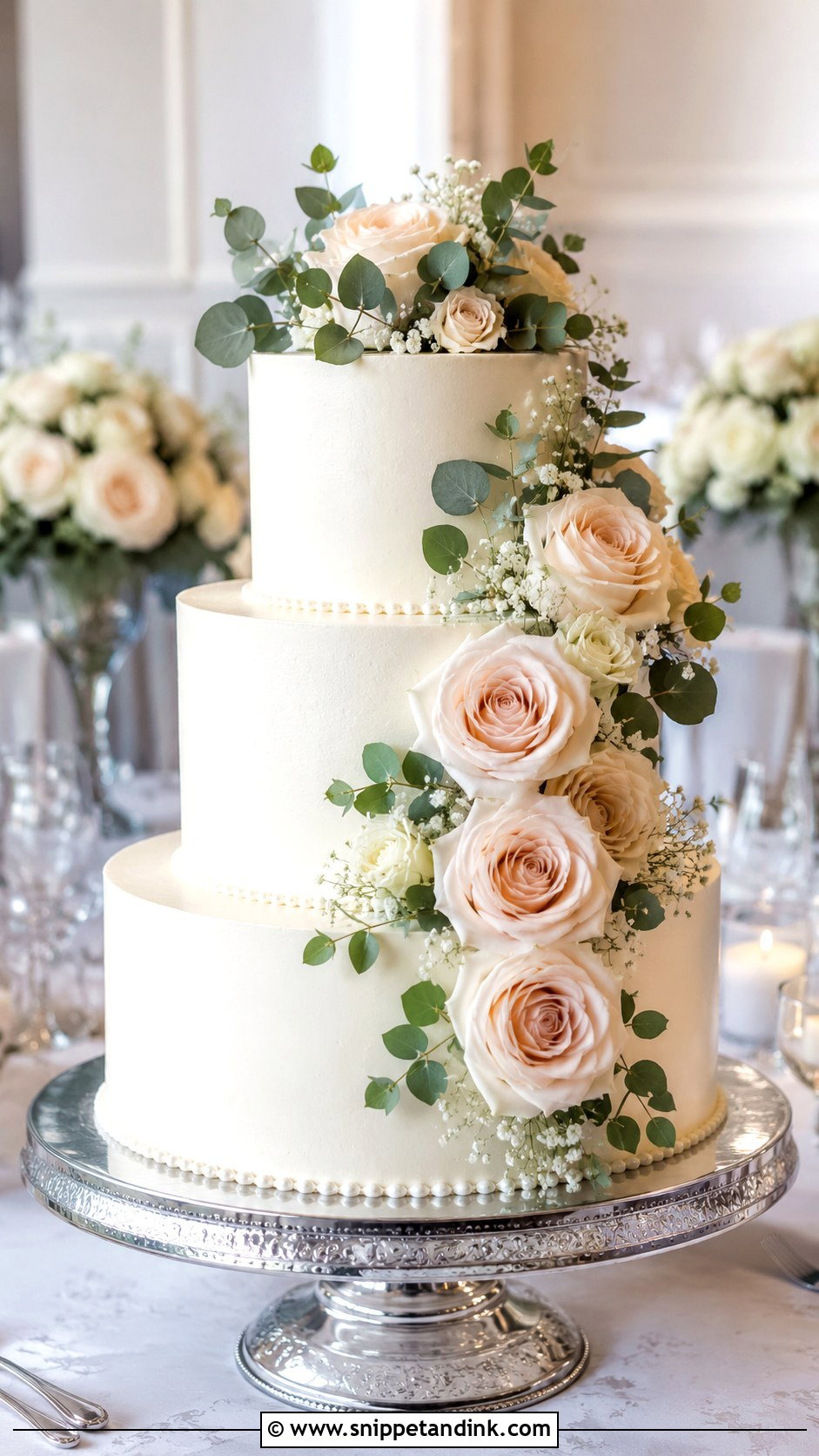
Three tiers is the size I build most often, because it gives real height without overwhelming a medium room. A common stack is 6, 8 and 10 inch, which serves somewhere around seventy to eighty wedding-sized slices depending on how it’s cut. It works classic with smooth white and roses, modern with clean edges, or romantic with texture and a cascade of flowers. The extra tiers also give you room for different flavors: I usually suggest the crowd-pleaser in the bottom tier, since that’s where most slices come from, and the more unusual flavor in a smaller tier above.
10. Tall Wedding Cake
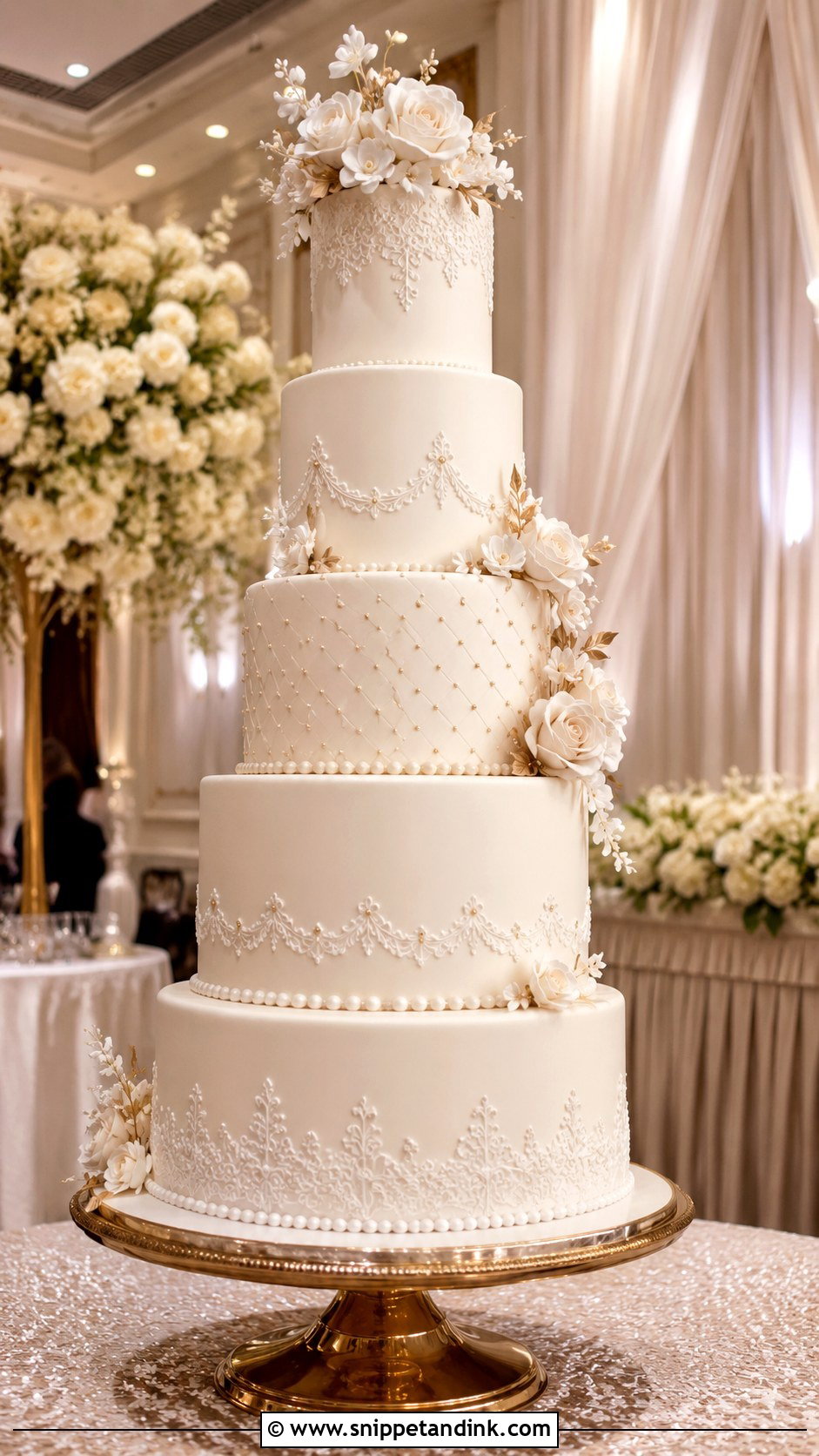
Four, five or more tiers, or fewer but taller ones, create instant height when guests walk in, and they suit ballrooms, hotels and rooms with high ceilings. Height is a structural decision before it’s a decorative one. Every tier sits on its own board supported by dowels, and anything this tall gets a central dowel through the whole stack. I often deliver very tall cakes in sections and stack them at the venue rather than risk a long drive. Smooth fondant, sugar flowers, lace or sculpted texture all suit it, but keep the decoration deliberate; at this scale, clutter is very visible.
11. Single Tier Wedding Cake
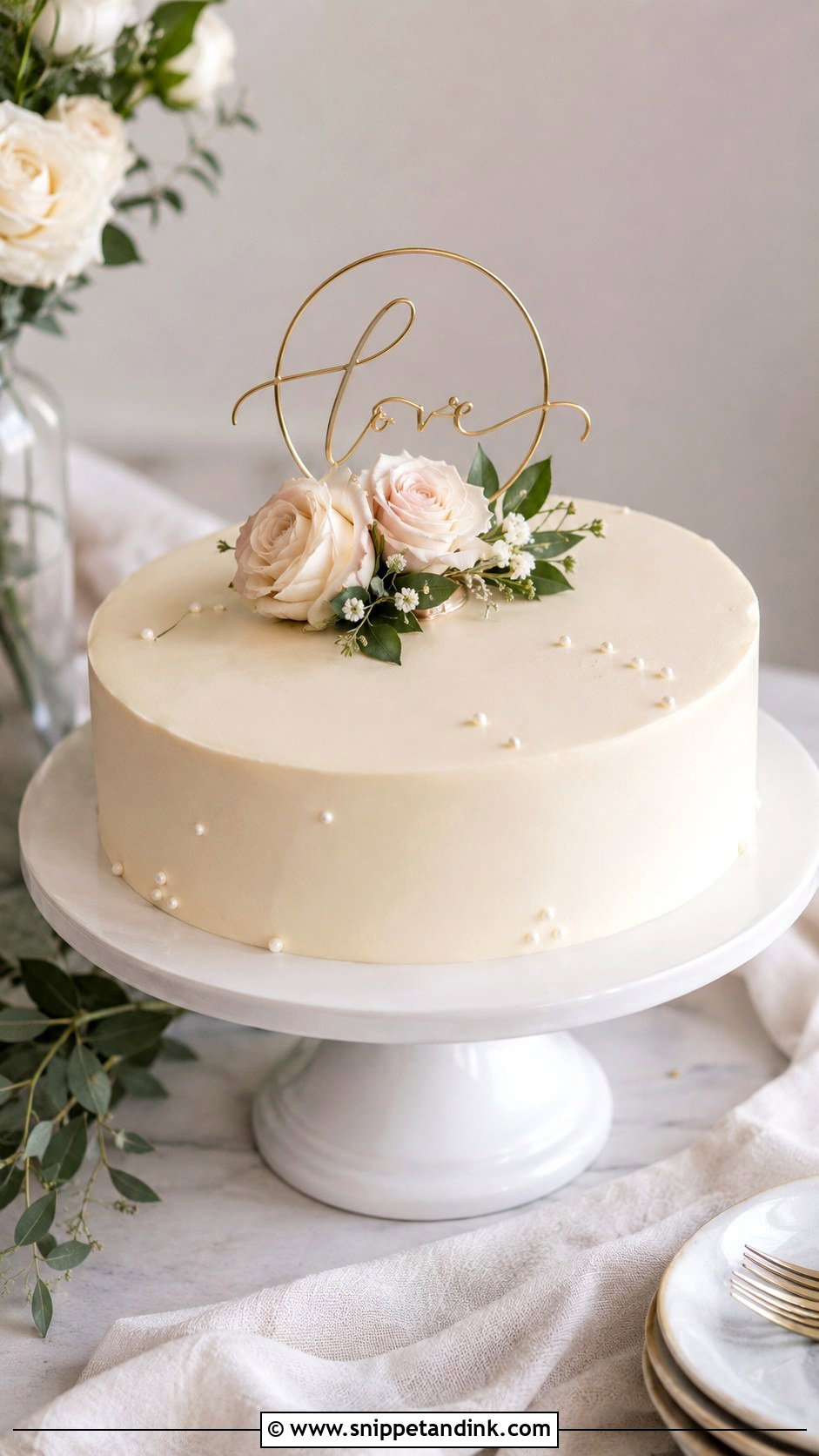
One tier is often the smartest order for an elopement, a courthouse wedding or a reception with a dessert table, since you get the cutting photo without paying for servings nobody eats. A wide, low tier looks editorial; a tall single tier gives more presence. Texture, fresh flowers, vintage piping, pressed petals or fruit all scale down well. I’d only steer you away if you want the cake itself to feed a large crowd. In that case I bake a matching sheet cake for the kitchen to slice, and nobody can tell the difference on the plate.
12. Square Wedding Cake
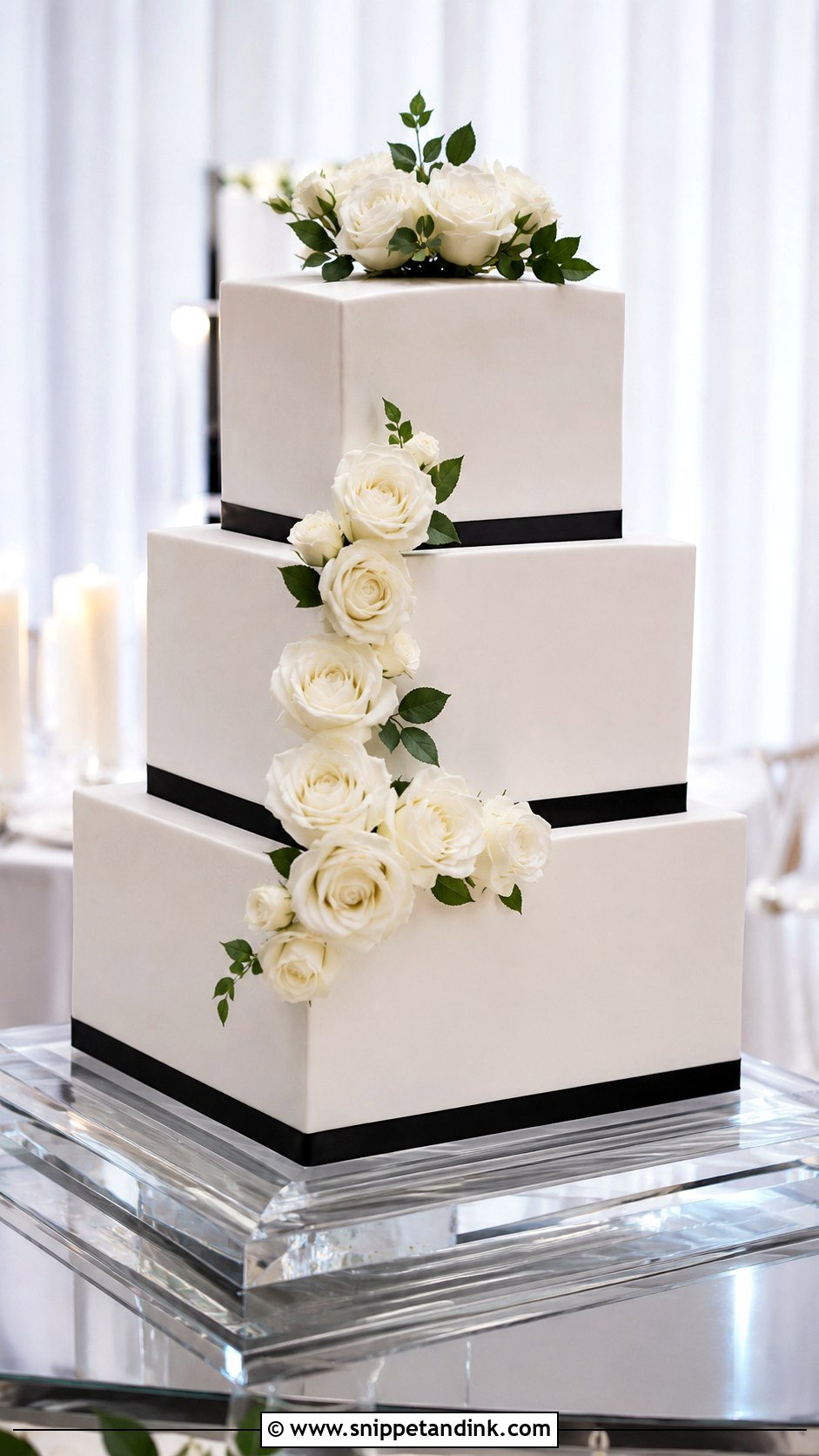
A square wedding cake gives a crisp, architectural outline that suits galleries, rooftops and black-and-white palettes. It’s also one of the hardest shapes to finish. Corners on buttercream want to round off, so I usually choose a ganache layer under the final coat, or fondant, to keep those edges sharp. Soften it with flowers, trailing greenery or ribbon, or keep it graphic with geometric details. Square tiers also give more servings than a round of the same width, which helps if you’re feeding more people than the design suggests.
13. Round Wedding Cake
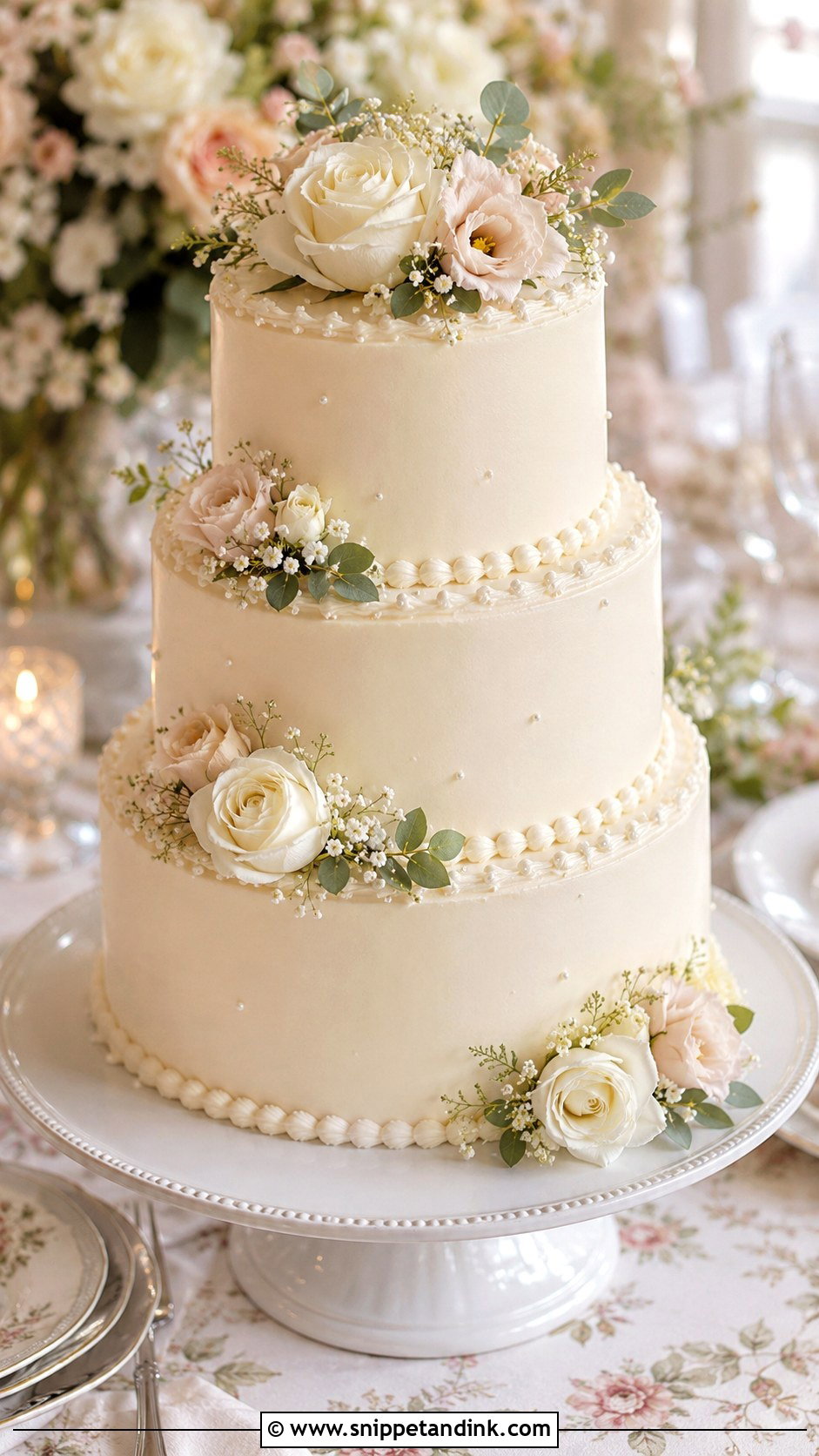
Round is the shape most people picture, and that’s why it rarely fails. The curve flatters almost any decoration, from white roses to one modern floral cluster to colorful piping. Rounds scale easily from one tier to many, they sit naturally on classic cake stands, and they’re the shape most bakers have the deepest experience with, which counts for something. If you can’t decide, I’d start here and spend your energy on the finish and the flowers instead.
14. Fondant Wedding Cake
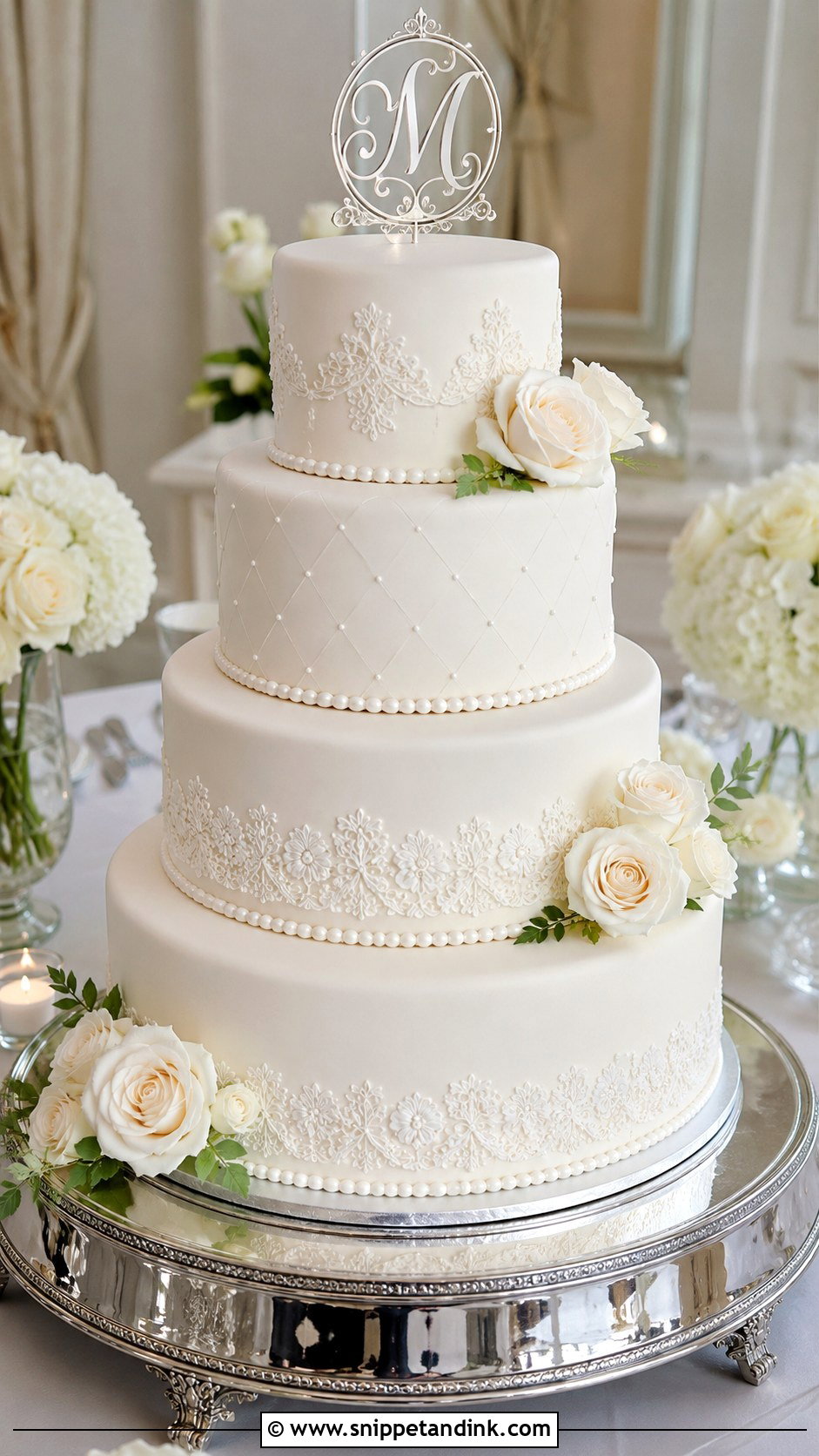
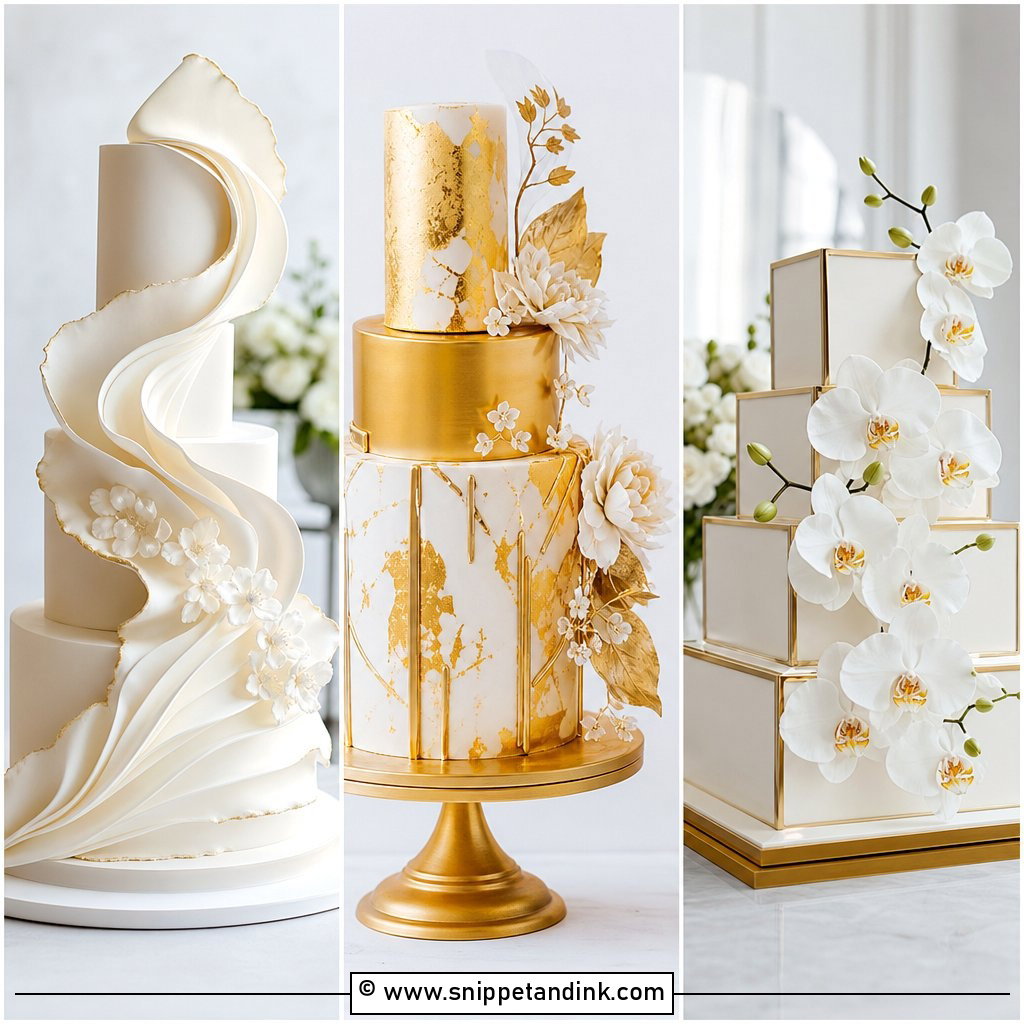
A fondant wedding cake gives the smoothest, most sculpted surface you can get, which is why it carries sugar flowers, lace impressions, hand painting, monograms and metallic leaf so well. It also holds up better in heat than buttercream alone. My honest caution is about storage: a fondant cake taken from the fridge into a humid room will sweat beads of moisture, so I let it come to room temperature in a closed box first. Underneath, ask for ganache or buttercream between the layers, because plenty of guests peel the fondant off and eat what’s beneath.

15. Textured Wedding Cake
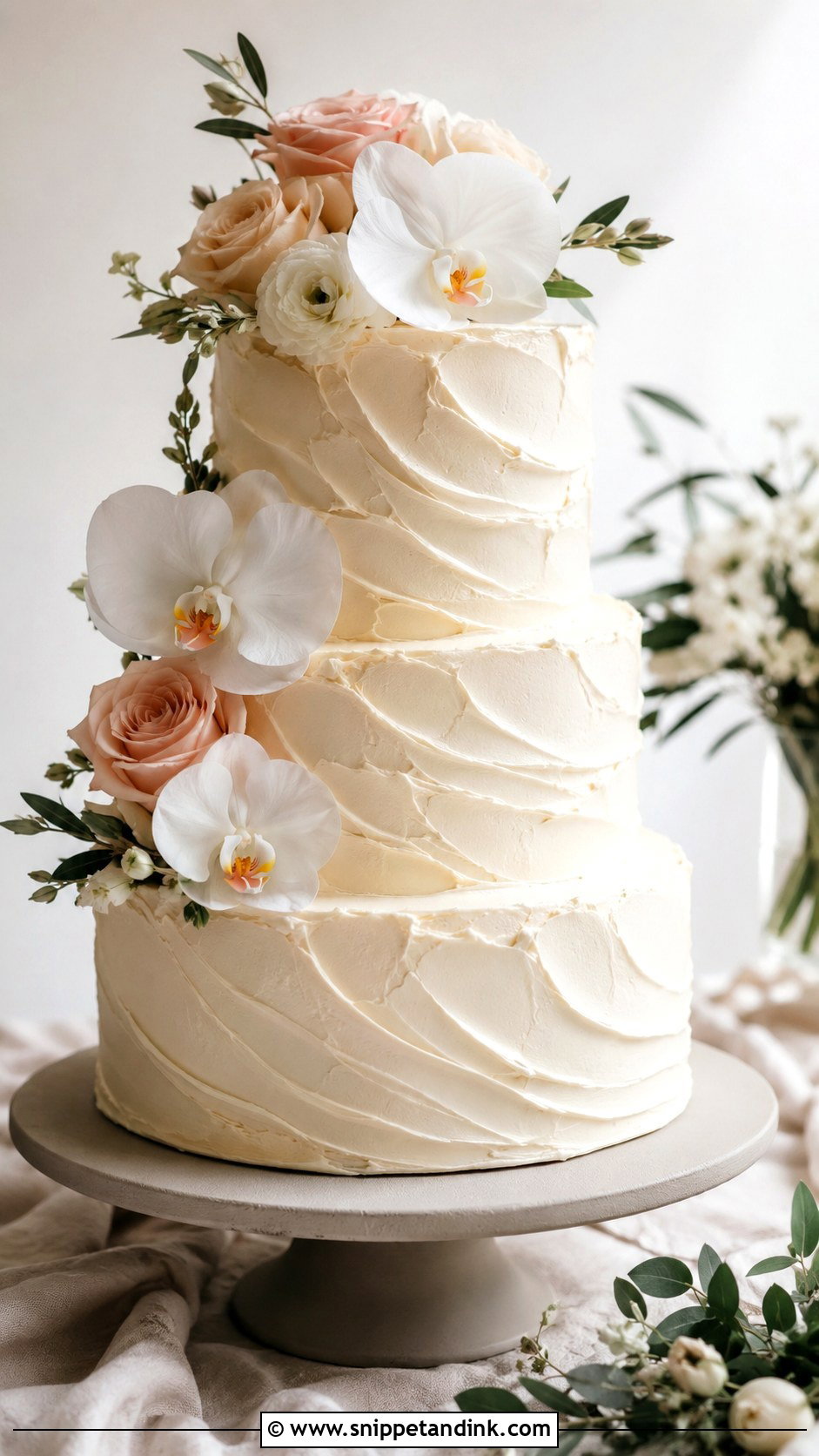
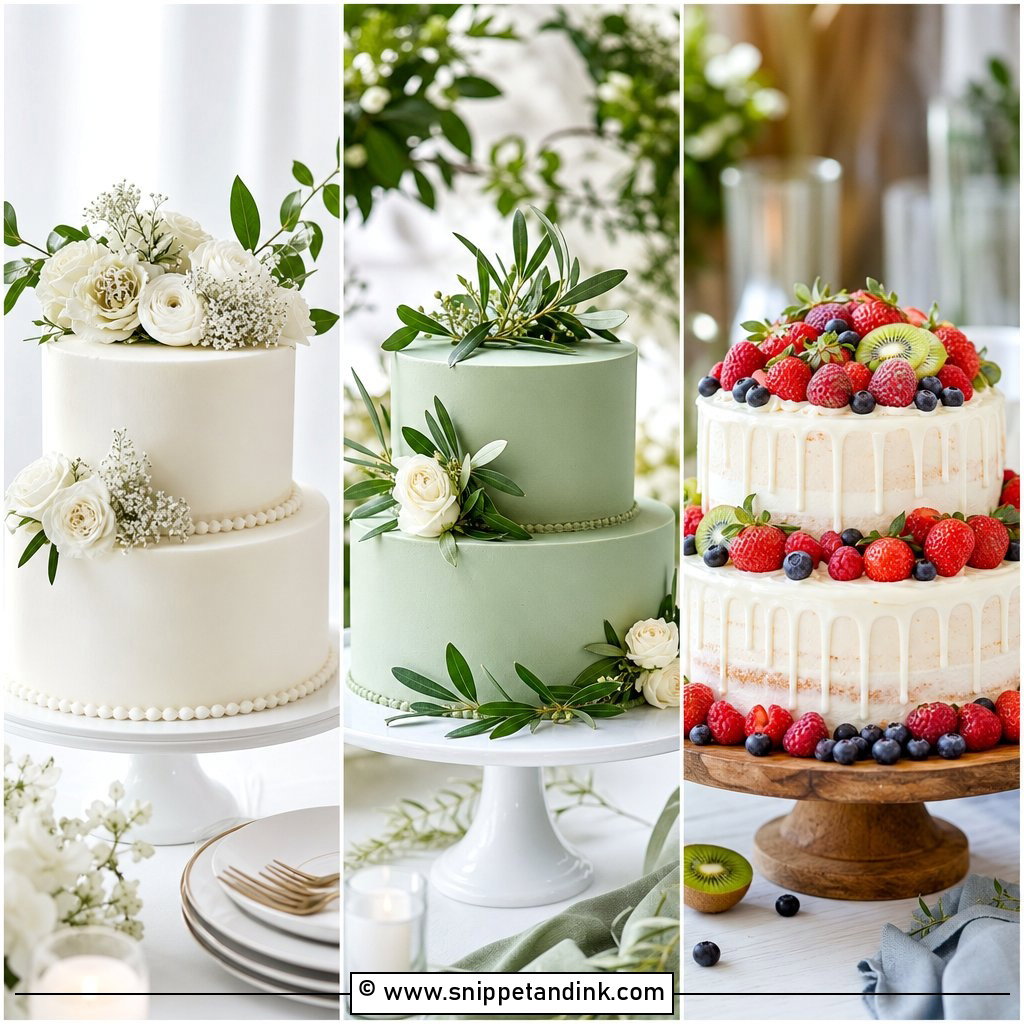
Texture gives a cake movement without adding anything on top of it. Ridges, palette-knife strokes, stucco finishes, ruffles, pleats and waves all come from how the frosting is applied. It works in white, ivory, blush, sage and champagne, and even deeper colors, because the shadows in the grooves add depth. Many couples choose no decoration at all on a textured cake. It’s also forgiving, which I appreciate: small surface marks blend into the pattern instead of standing out the way they would on a smooth finish.
16. Pearl Wedding Cake
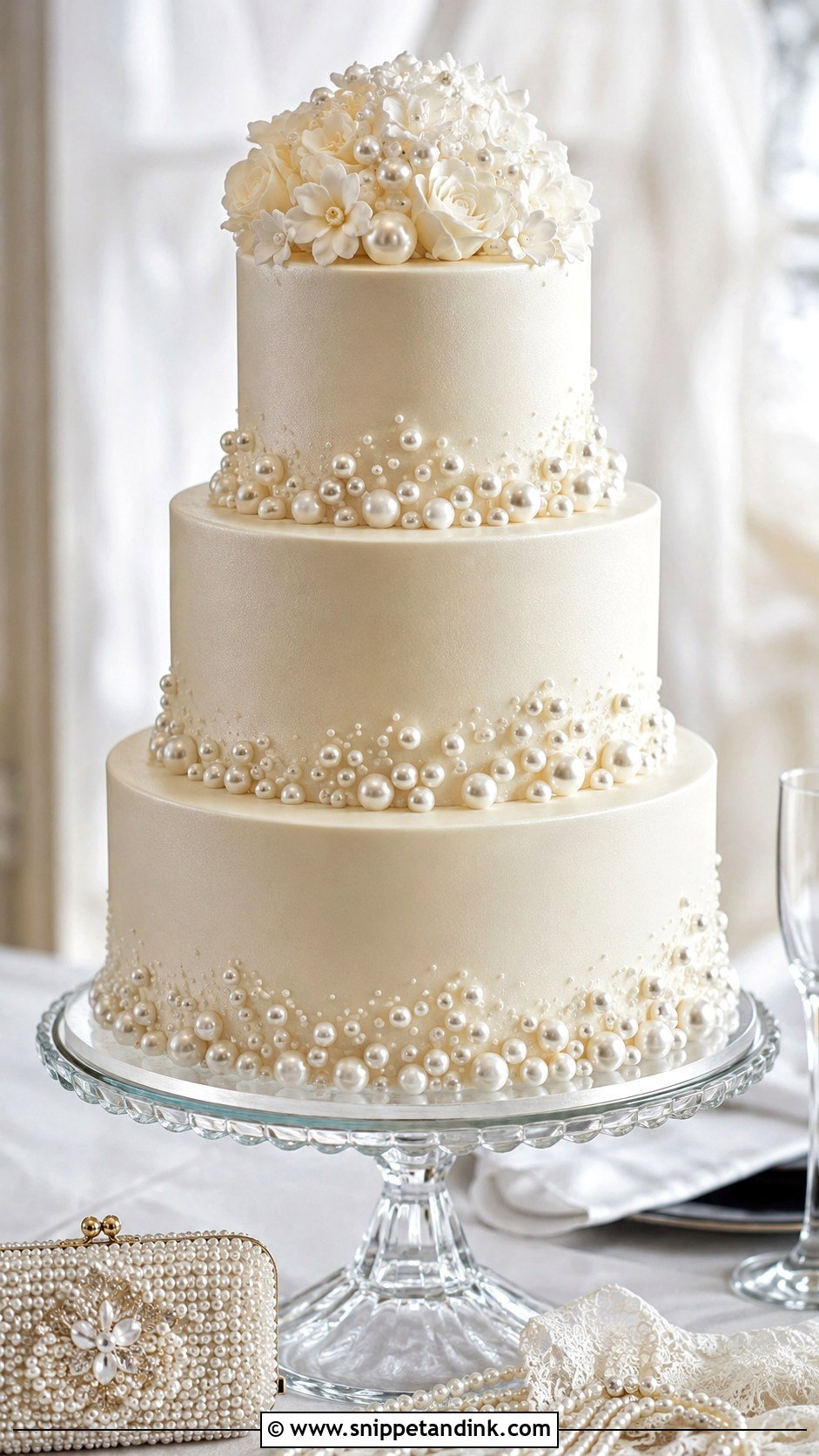
A pearl wedding cake can be quiet or quite glamorous depending on the quantity. Edible pearls can be scattered, set in neat rows, worked into piped borders or pressed into quilted fondant. They’re best on ivory, white, champagne or blush. For a modern take I’ll cluster them at the base of each tier on smooth buttercream; for a traditional one, pair them with lace piping and sugar roses. Placing them is slow work with tweezers, so a fully pearled cake takes far longer to decorate than it looks, and the quote usually reflects that.
17. Gold Wedding Cake
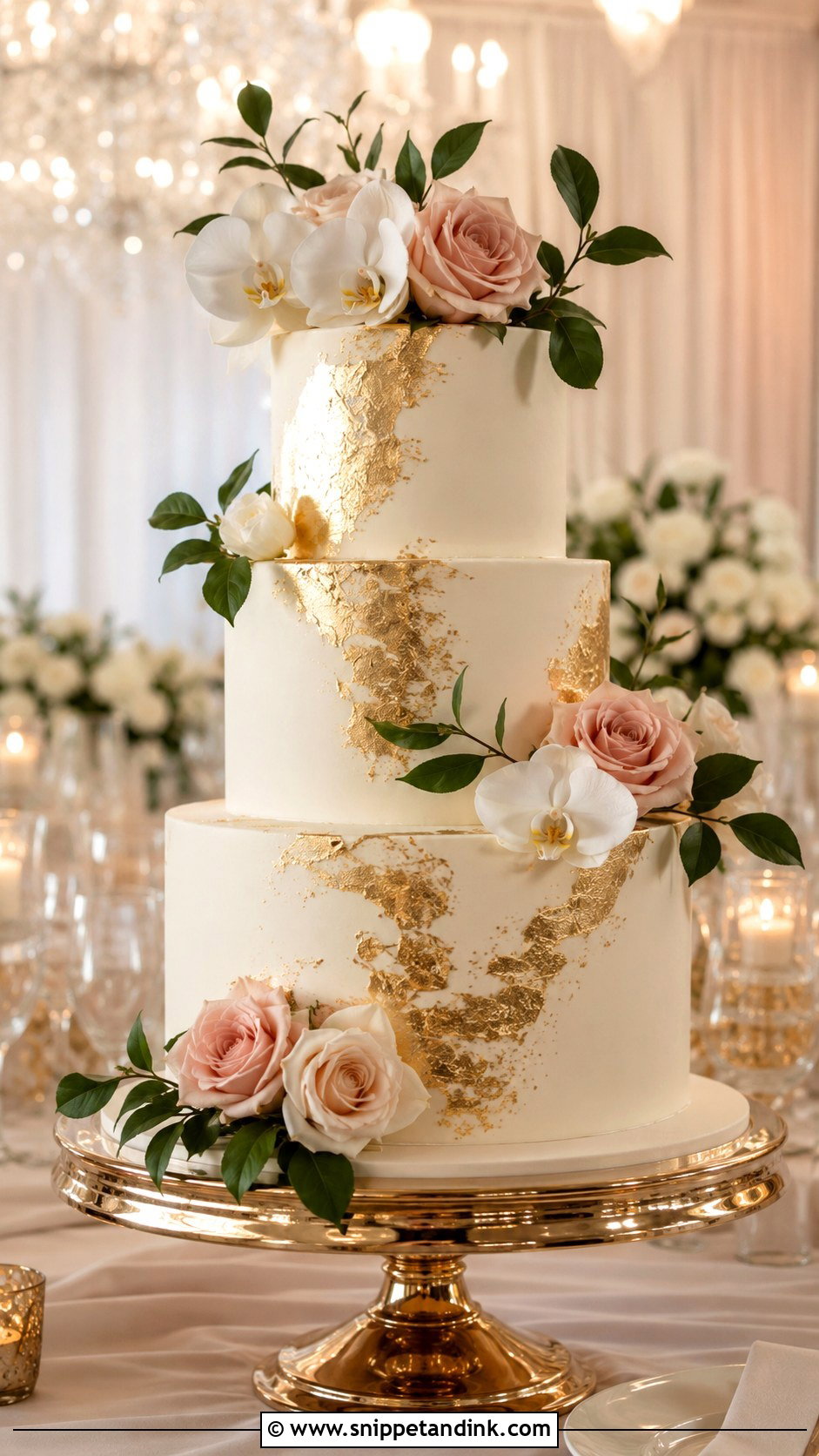
Gold can be painted in brushstrokes, laid as edible leaf, piped along edges or stenciled into patterns. It sits well with ivory frosting, blush flowers, white roses and deep greenery, and it suits evening receptions and hotels where candlelight picks it up. Restraint is everything here. A band of leaf or a few painted strokes reads as expensive; a fully gilded tier often looks heavy and flattens in flash photos. I also make sure the gold is a genuinely edible product, since some metallic dusts are labelled for decoration only.
18. Black And White Wedding Cake
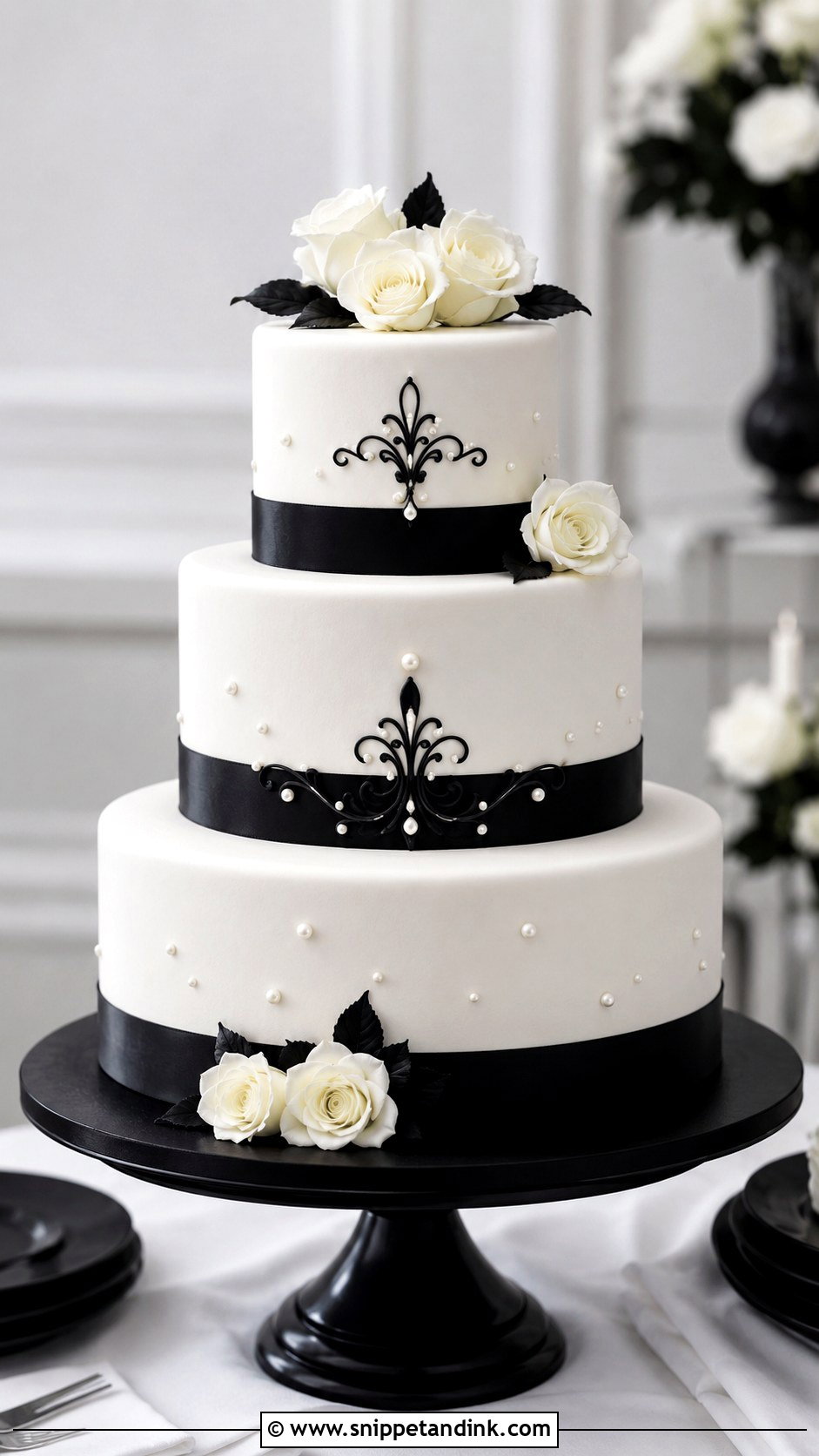
Black and white is a graphic choice for city weddings and formal rooms. It can be white tiers with black ribbon, black fondant with white flowers, or vintage piping in contrasting colors. Black icing is the tricky part: it takes a lot of color to get a true black, which can stain mouths and taste slightly bitter, so I keep black to fondant panels, ribbon or one accent tier rather than coating every slice. Classic flavors like vanilla bean, chocolate, almond or red velvet sit well inside. Soft texture, pearls or a few flowers stop the contrast from feeling cold.
19. Fruit Wedding Cake
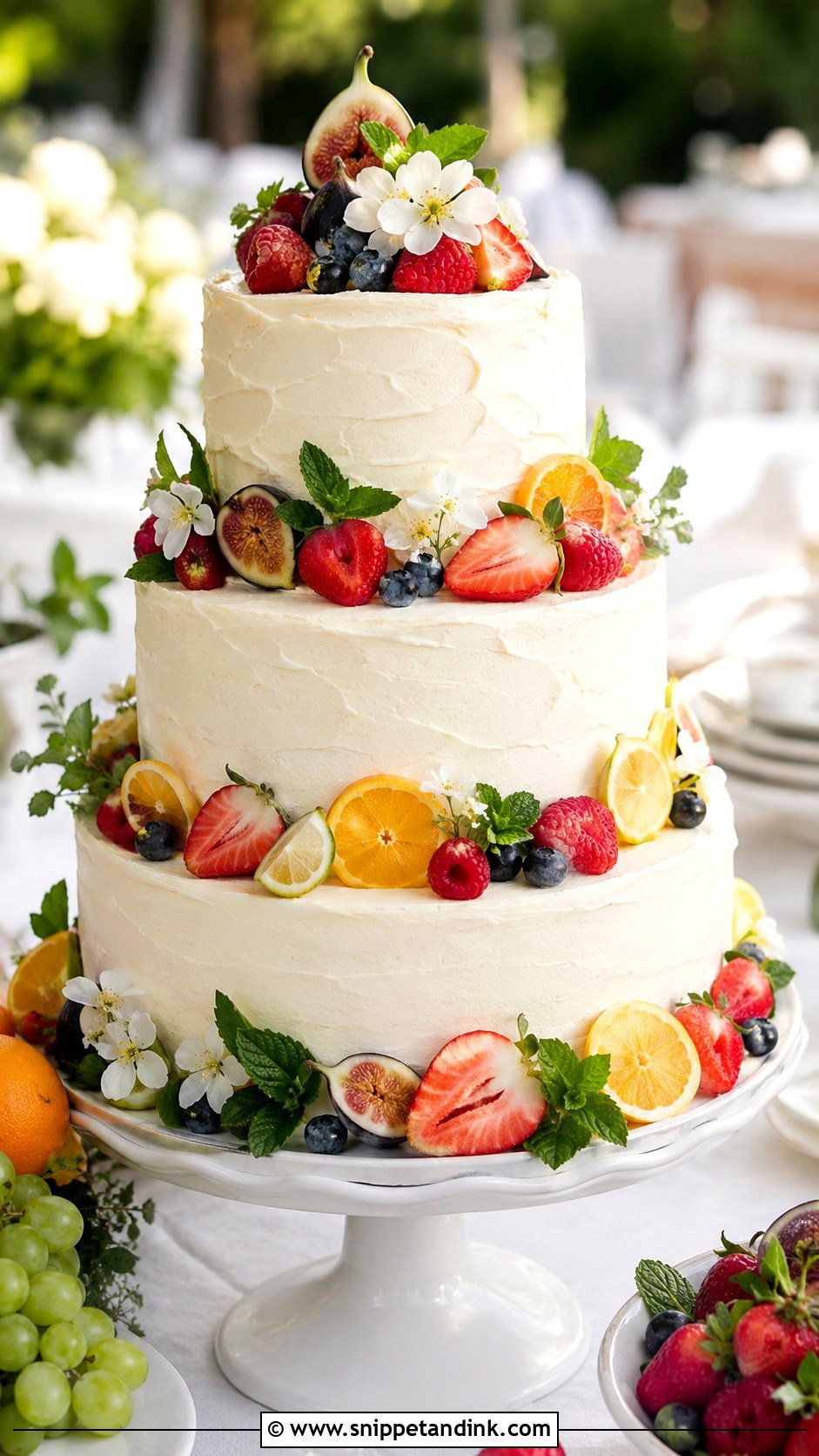
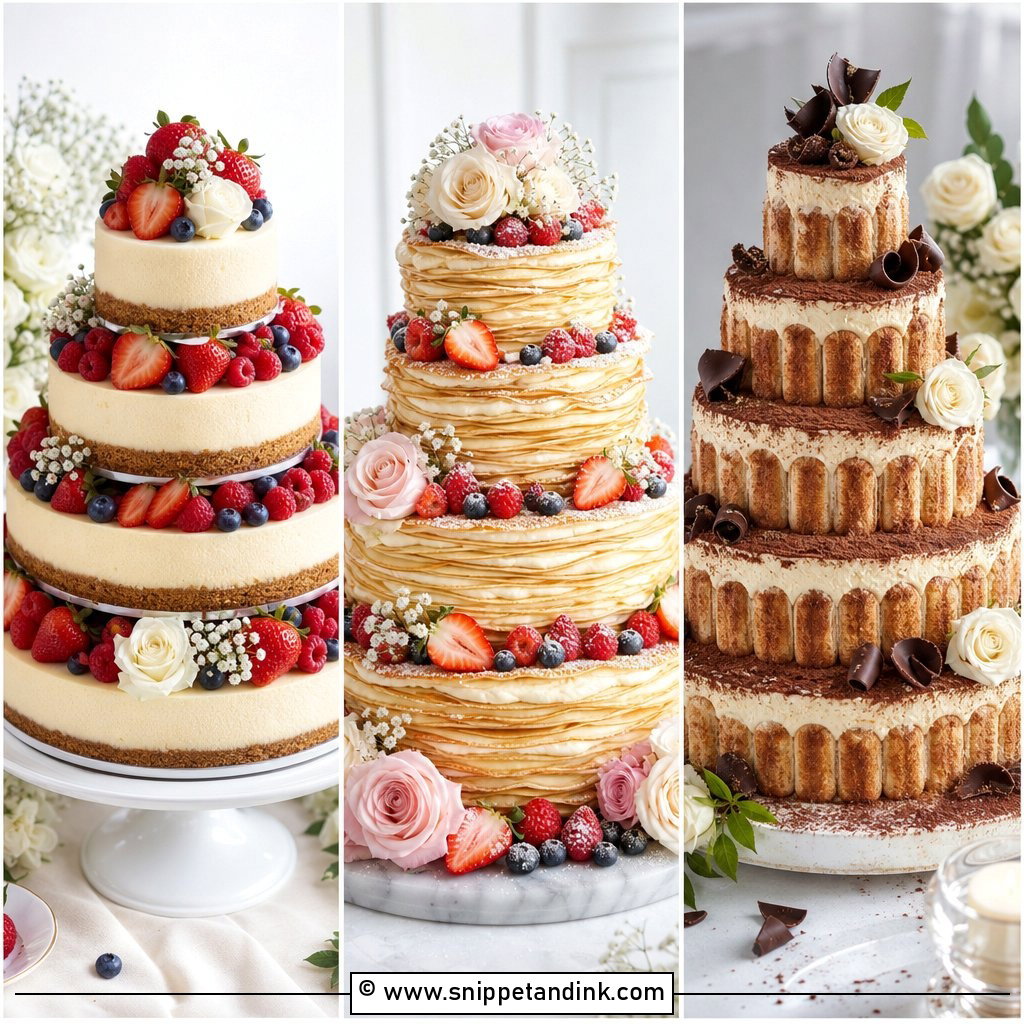
Fruit on a cake tells guests what they’re about to taste, which I like. Berries, figs, citrus, cherries, grapes, peaches and pears can all go on buttercream, semi-naked sides, whipped frosting or a glaze. Spring and summer suit strawberries, raspberries, blueberries and lemon; autumn calls for figs, pears, blackberries and warm spice sponge. Cut fruit weeps juice, so I add fruit as late as possible and favor whole berries and halved figs over sliced peaches, which brown and run. Keep the arrangement full but controlled, especially at a garden reception where it will sit for a while.

20. Watercolor Wedding Cake
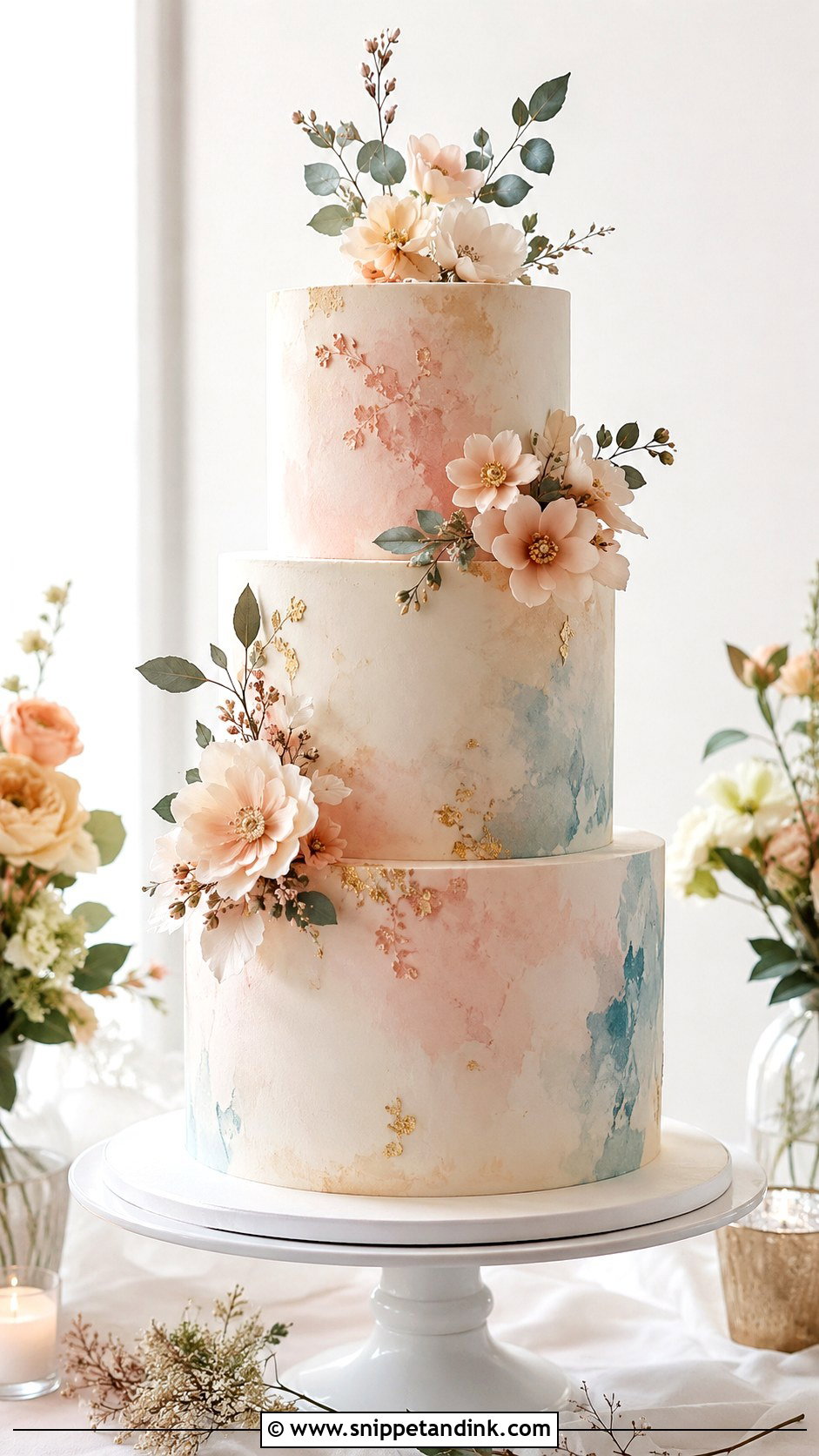
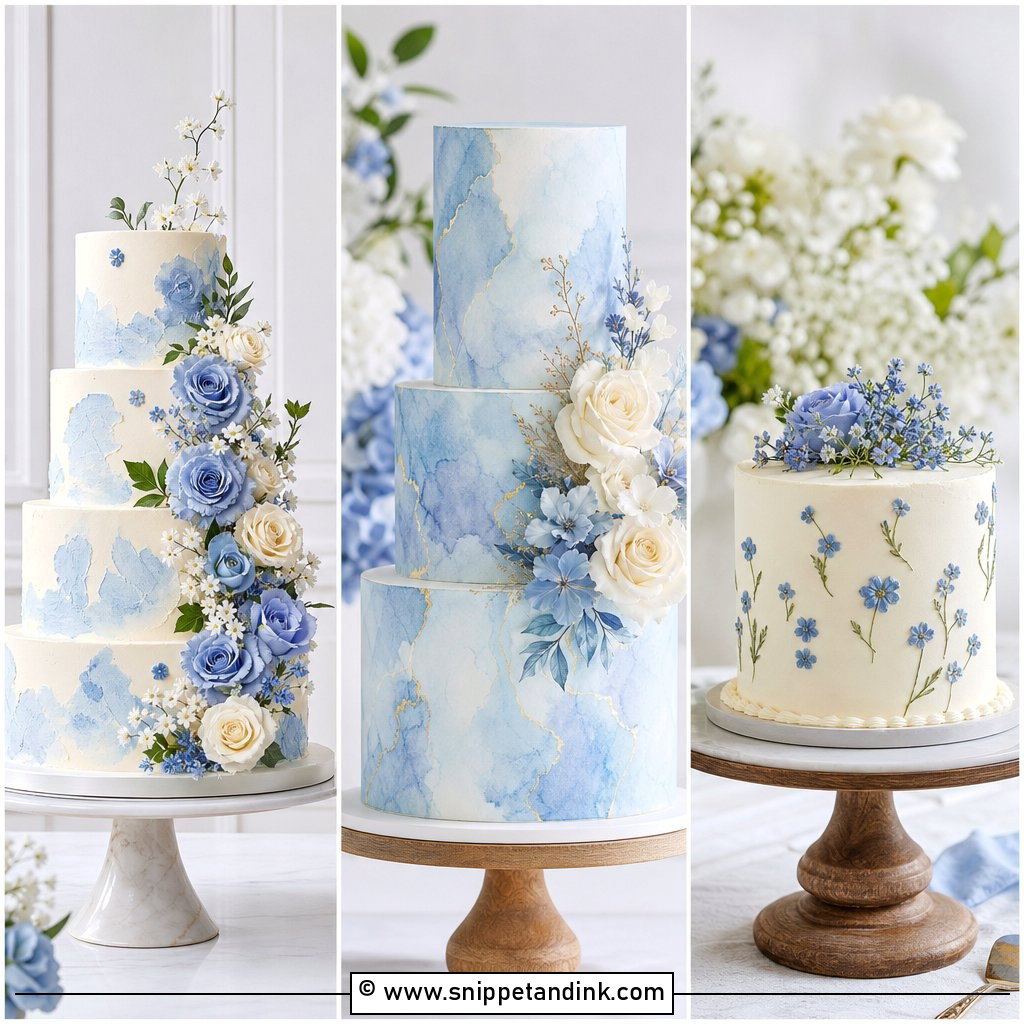
A watercolor wedding cake blends color across buttercream or fondant in soft washes of blush, dusty blue, lavender, sage, peach or champagne. On buttercream I apply the colors with a scraper while the frosting is still soft so they blend; on fondant the wash is painted on with thinned edible color. One painted tier is subtle, color flowing across every tier is bolder. It’s a good way to bring in your wedding palette without heavy decoration. I always test the colors under warm light first, because a pale blue can turn grey and a peach can go muddy.
Sizing Tiers to the Number of Guests Who Will Actually Eat
I size a cake for the guests who’ll eat it, not the total on the invitation list. If there’s a dessert table, late-night food or a lot of children, fewer people take a full slice. As a rough guide using standard wedding slices, which are tall and narrow, a 6 inch round gives around 12 servings, an 8 inch around 24, a 10 inch around 38 and a 12 inch around 56. Bakers cut differently, so treat these as a starting point rather than a promise.
If the design you love is bigger than your guest count, I can add a polystyrene dummy tier for height. If it’s smaller, a plain kitchen cake in the same flavor makes up the difference. Both are normal and nobody at the table will know.
What Heat, Sunlight and a Long Drive Do to Each Finish
Finishes don’t all behave the same once they leave my kitchen, and it’s worth knowing before you commit to one.
Buttercream
Soft meringue buttercreams start to lose their shape in a warm room, especially in direct sun. A crusting buttercream holds better. Either way I ask for the cake table to be out of sunlight and away from heaters, lighting rigs and the dance floor.
Ganache and fondant
A layer of chocolate ganache under the outer coat firms the cake considerably, which is why I use it for sharp edges and hot venues. Fondant protects the cake well but sweats if it’s moved quickly from cold to humid air.
Getting it there
Tall or heavy cakes travel in sections, flat, in an air-conditioned vehicle, and get stacked at the venue. Ask your baker how they deliver and how long before the reception they set up. For most outdoor summer weddings, I aim to put the cake out as close to the cutting as the timeline allows.
Your Tasting Appointment Is Where the Design Gets Settled
Every design here can work, but only once it fits your venue, season, guest count and the way the cake will be displayed. Save photos that show the whole cake from the front, not cropped details, and note what you like in each one: the finish, the flower placement, the tier height. Bring them to your tasting along with your guest count and the reception timeline. That’s the meeting where I can tell you what will hold, how many tiers you actually need and what to change so the cake still looks right when it’s finally cut.
You'll Like These Ideas:






Leave a Reply