
Feet get photographed more than brides expect: in the pheras, in the ring ceremony when you’re seated, when the hem of a lehenga lifts as you walk. They also work harder than hands, carrying you through hours of rituals and dancing in shoes that rub. Good foot henna has to handle both. Below you’ll find complete foot layouts rather than single motifs, from full-leg Indian work and Arabic trails to mandala soles, anklet designs, jaali grids and light toe-to-ankle patterns. As you browse, keep your wedding footwear in mind. It decides more about the right design than most brides realise.

Feet Stain Darker but Lose Their Color Sooner
Henna dye settles into the outer layer of skin, and the thick skin on the soles and the top of the toes takes it deeply. That’s why feet often end up darker than hands. The catch is that this skin also wears away faster. Every step, every pair of shoes and every barefoot ritual rubs at it, so a foot stain usually fades sooner than the hands, starting at the soles and the sides of the toes.
I plan foot designs around that. Bolder lines, fewer microscopic fillers, and the most important motifs on the top of the foot rather than the sole. If you have several events across a week, put your finest foot detail where it will rub least.
1. Full Foot Bridal Mehndi Design
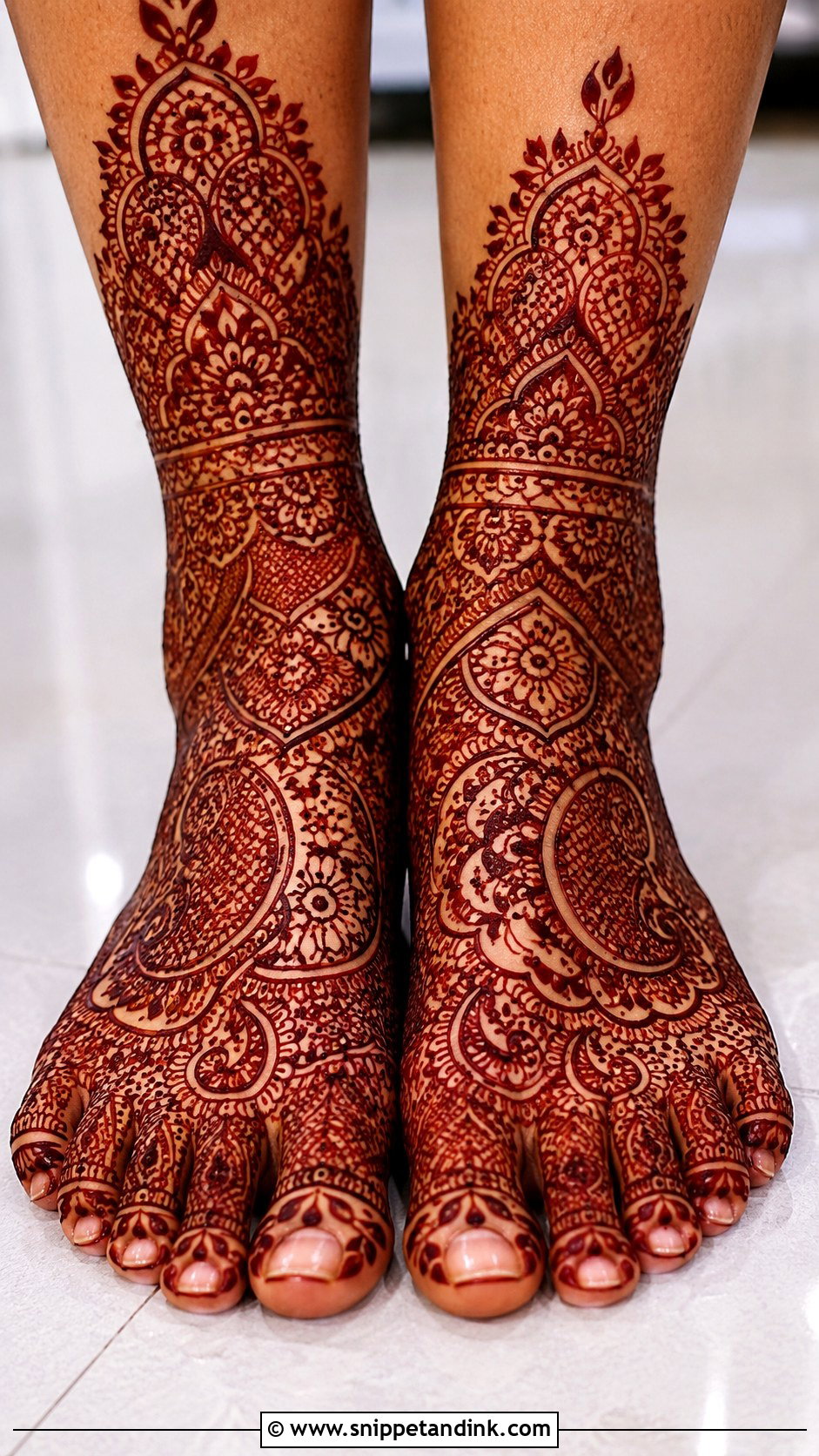
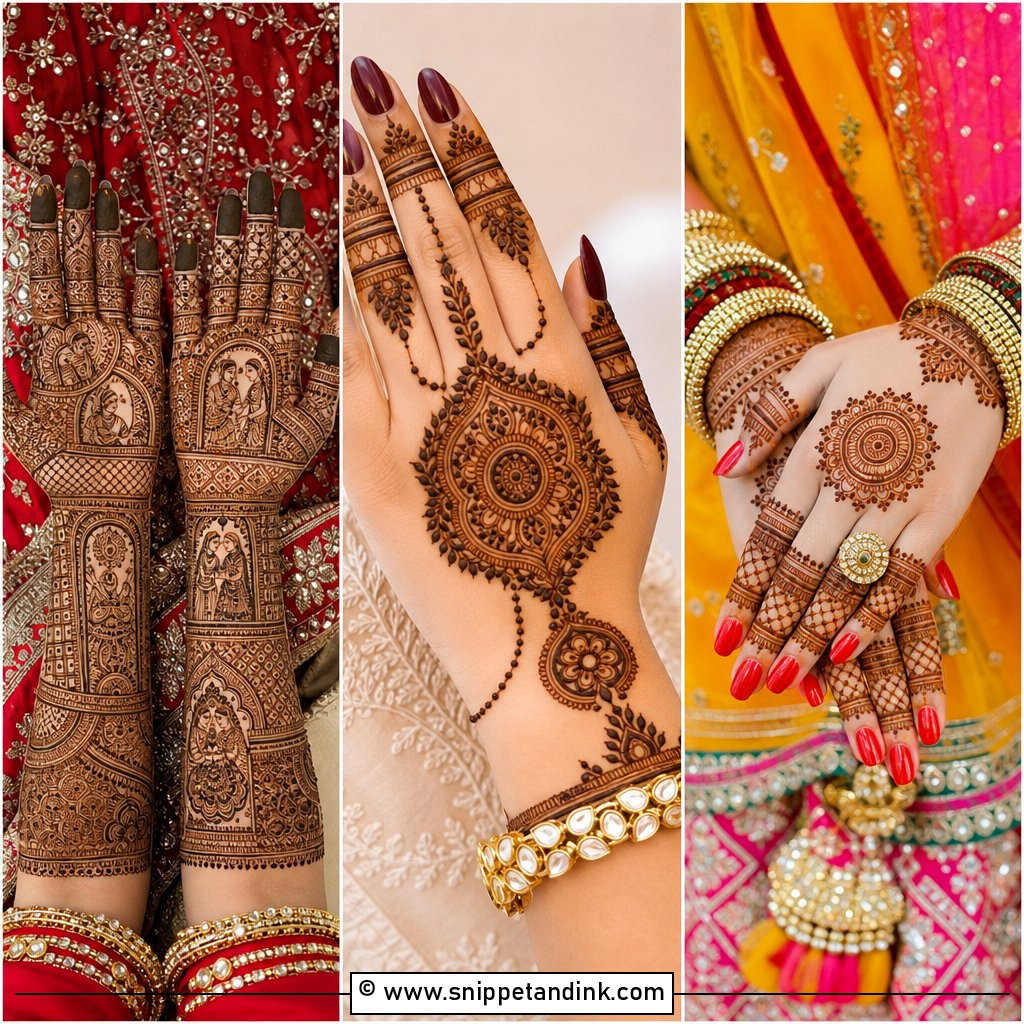
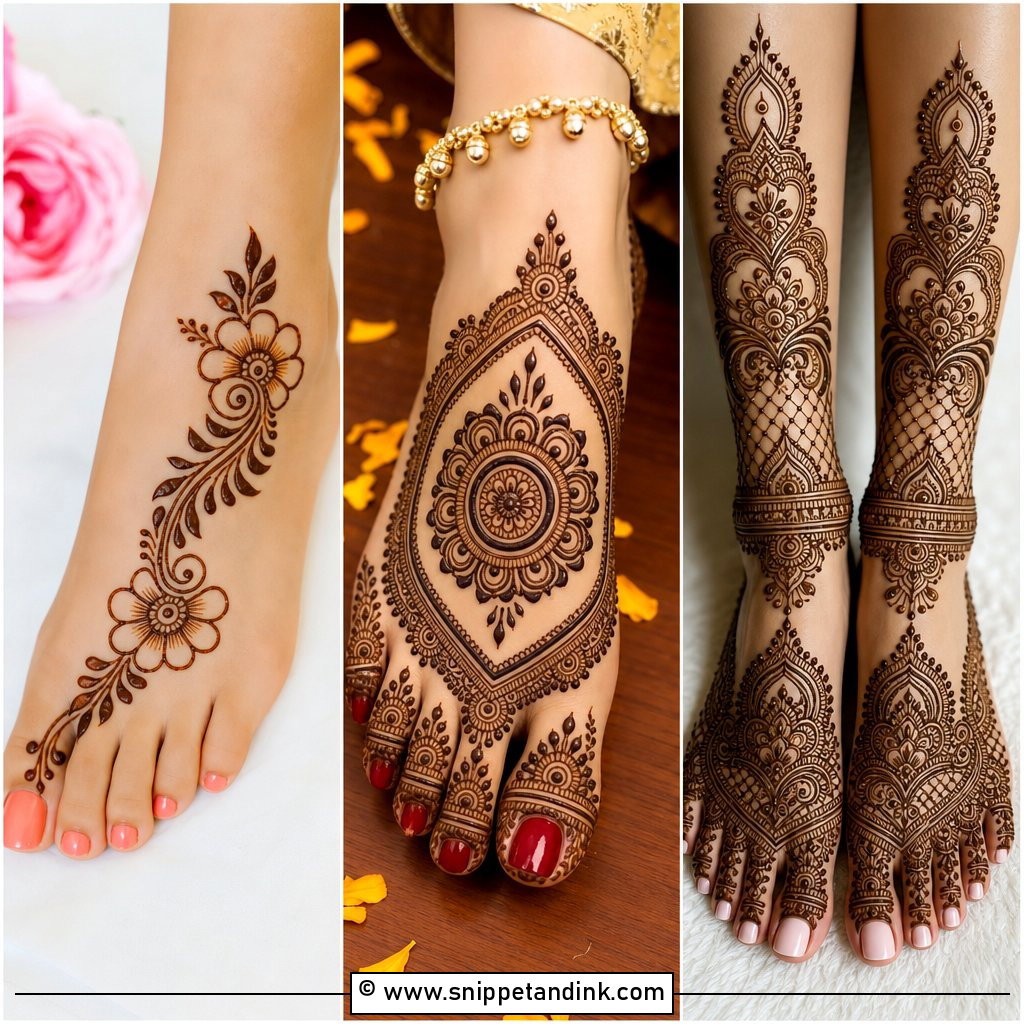
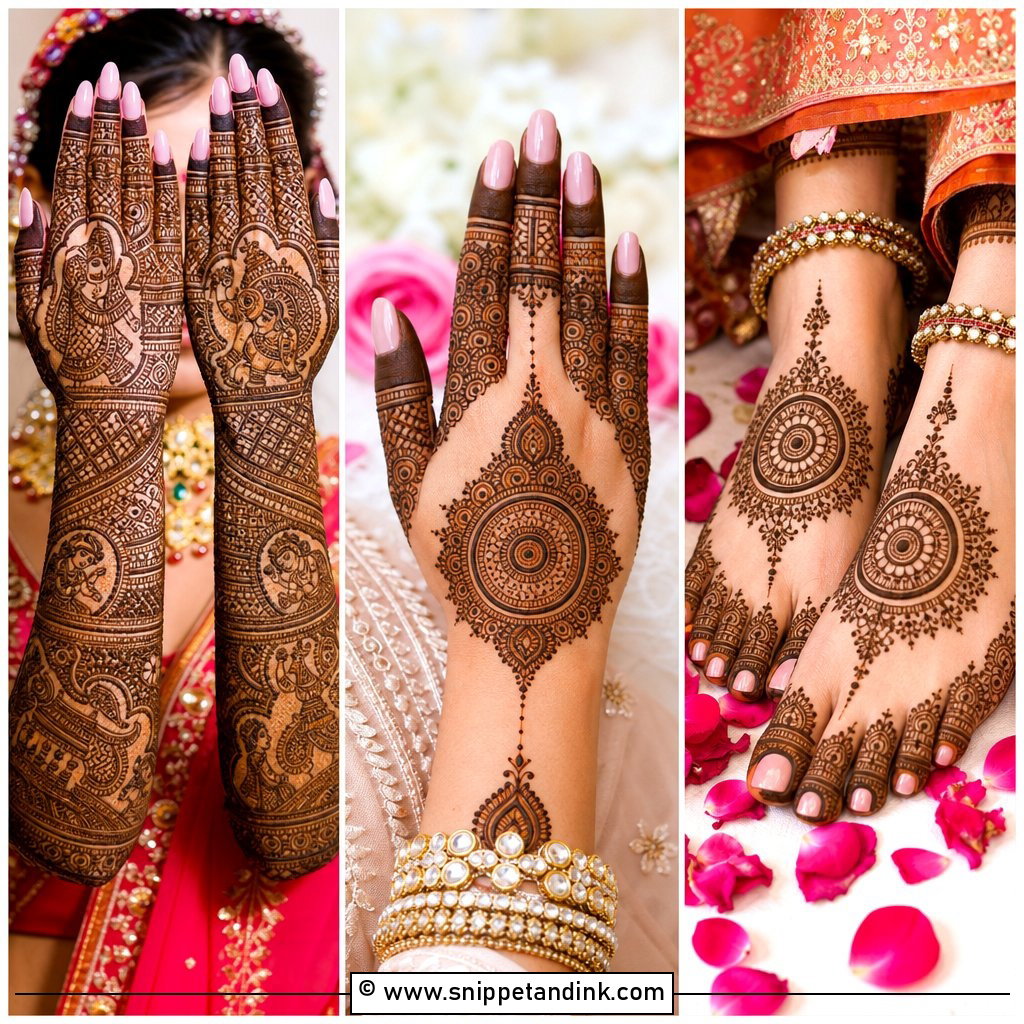
Full coverage from toes to ankles is the most traditional choice: dense paisleys, florals, fine dots, leafy filler and balanced borders across the top of both feet. It matches heavy lehengas, embroidered sarees and classic anklets, and it pairs naturally with full-hand bridal work. When I do a full foot, I keep the toe patterns neat and make the centre of the foot slightly bolder than the edges. The middle of the foot is what the camera sees from above, so that’s where the strongest motif belongs.
2. Arabic Bridal Foot Mehndi Design
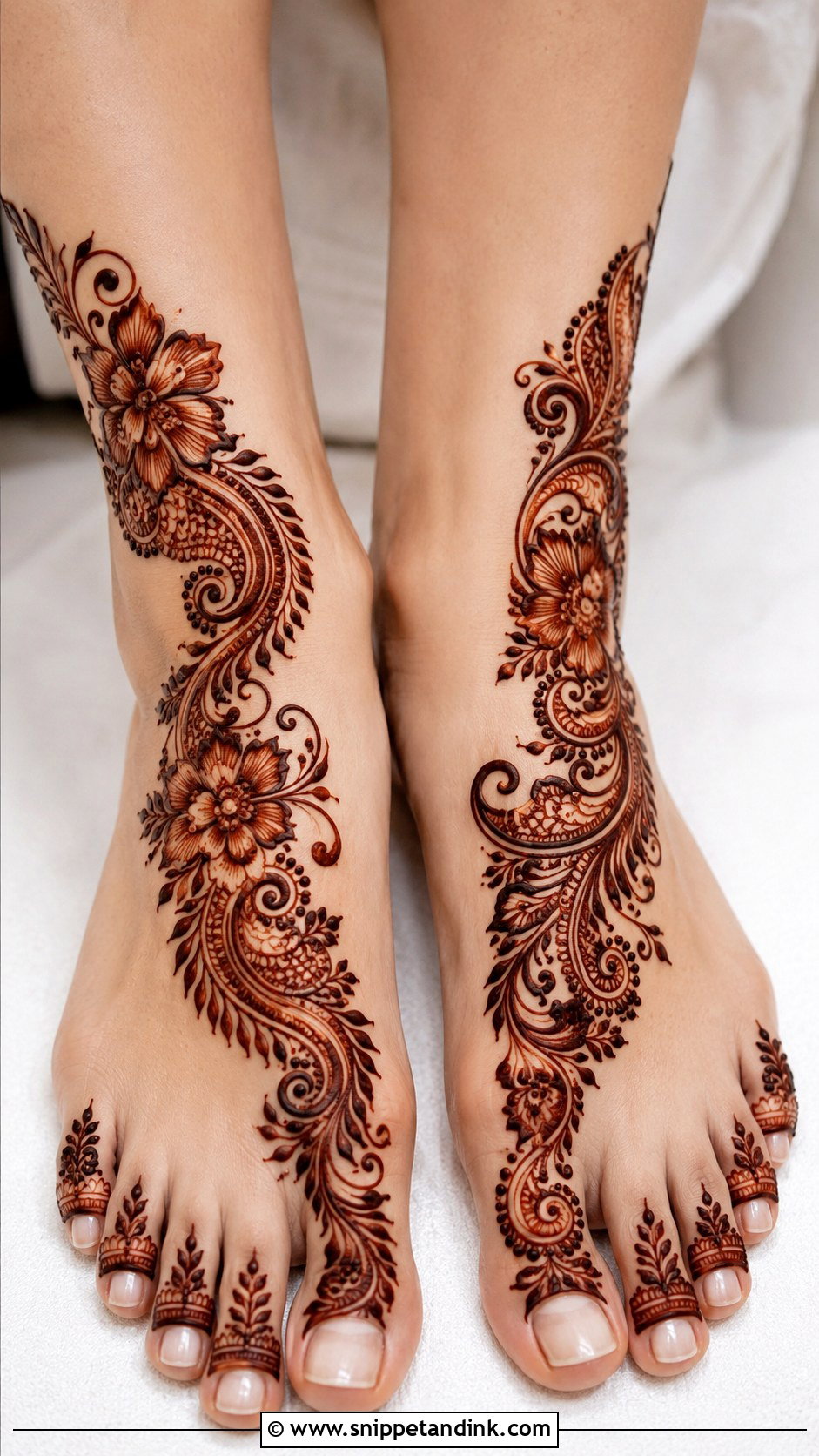
Arabic foot designs sweep diagonally from the toes across the foot toward the ankle, with large flowers, leafy vines, shaded petals and curved paisleys, and plenty of bare skin left showing. That open space keeps close-ups clean. They’re quicker to apply than dense work, which matters on feet because you can’t walk while the paste dries. I start the diagonal at the big toe, since a trail that begins at the little toe tends to pull the eye off the side of the foot.
3. Indian Bridal Foot Mehndi Design
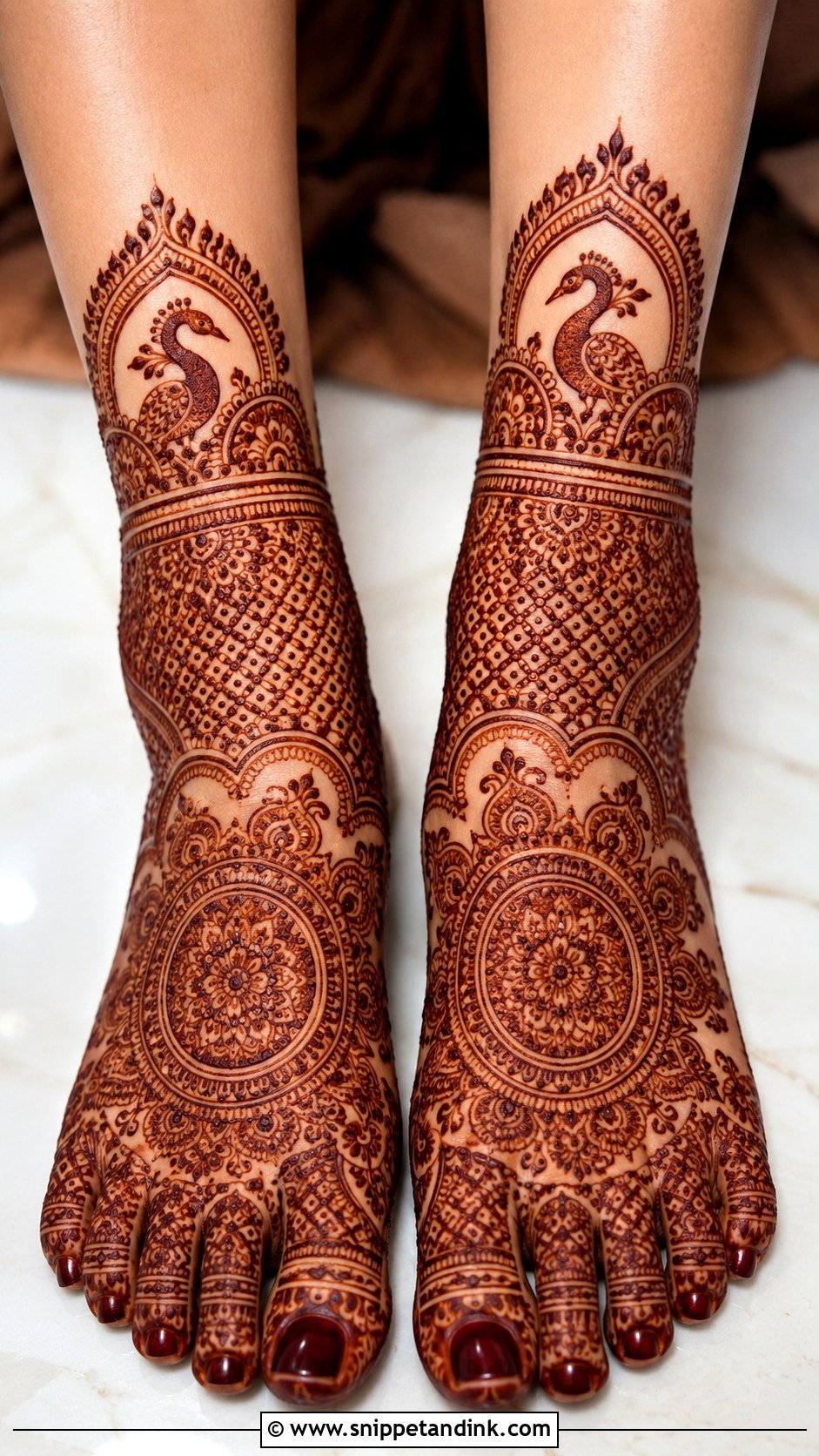
Indian foot mehndi brings paisleys, peacocks, lotuses, mandalas, checkered jaali and tiny filler, running from the toes to the ankle or a little higher. It balances heavy hand mehndi and sits well with traditional jewelry. On feet I draw the outlines thicker than I would on the palm. The top of the foot stains strongly, but fine filler blurs where skin flexes at the toes and ankle, and a firm outline keeps each motif readable after the color matures.
4. Simple Bridal Foot Mehndi Design
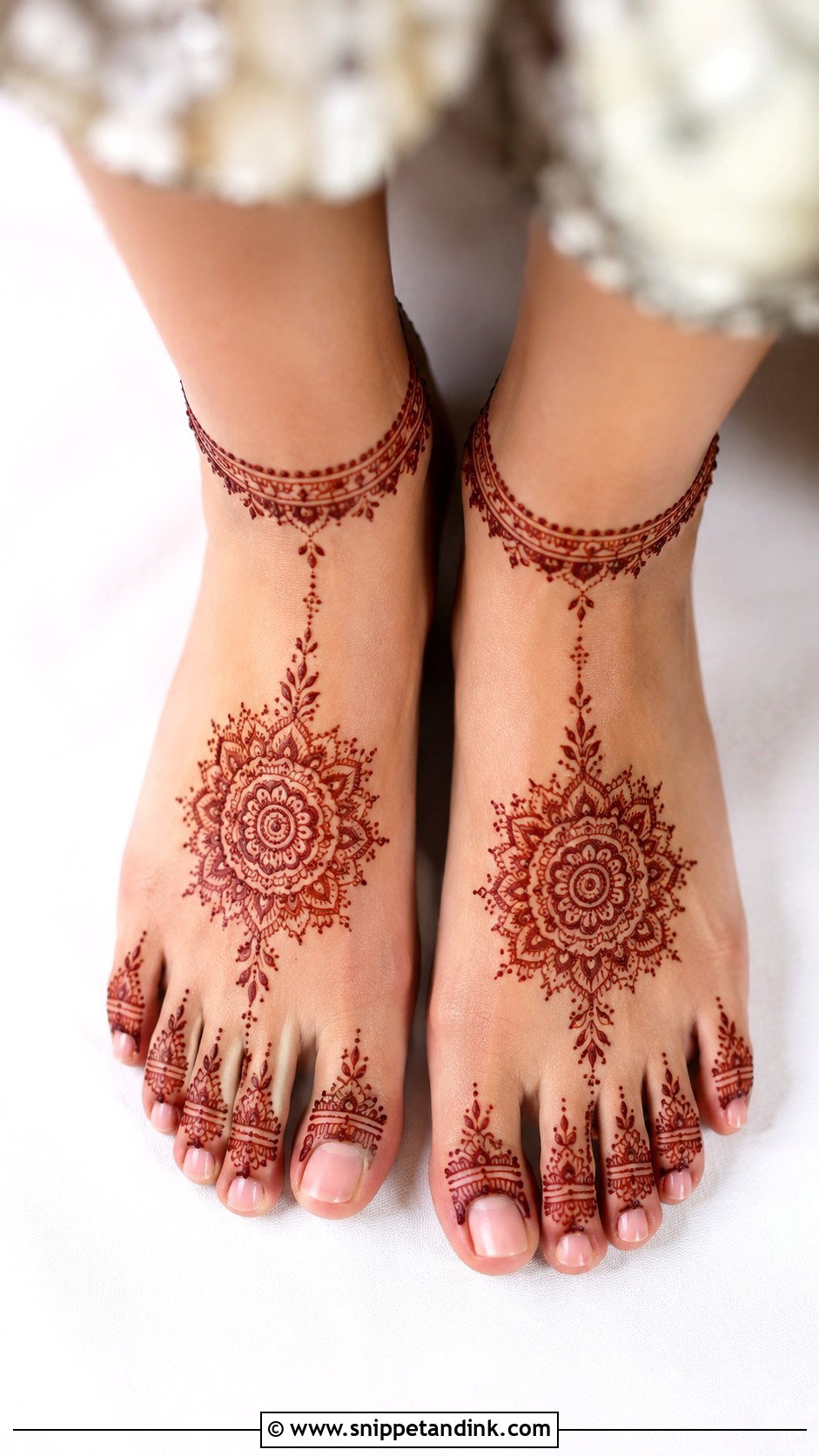
A light foot design still looks bridal when it’s planned as a whole: a centred mandala, delicate toe work, small floral trails and a slim anklet border. It suits intimate weddings, engagements, destination ceremonies and brides who don’t want leg coverage. A simple foot mehndi lives or dies on balance, so I measure the mandala placement against both feet before drawing. Vines or dotted chains linking the ankle to the toes stop it looking like scattered stickers.
5. Full Leg Bridal Mehndi Design
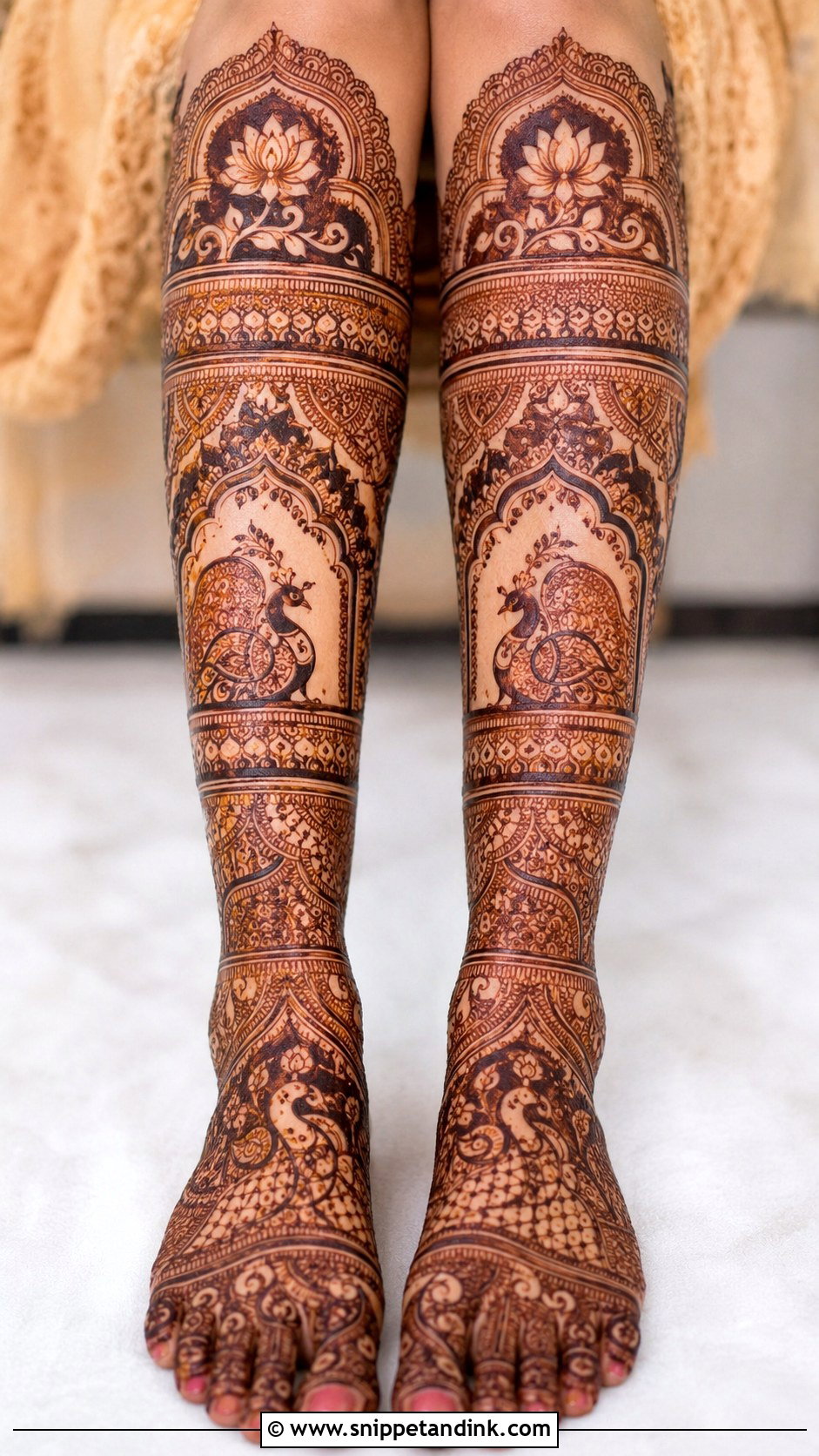
Full-leg mehndi starts at the toes, covers the feet, wraps the ankles and climbs the calf. Dense Indian patterns, peacocks, royal arches, bride-groom elements, lotus panels and fine mesh can all appear. It’s for grand weddings where the outfit lets the legs show during rituals and portraits. It adds hours to the appointment, and the bride has to stay off her feet until the paste sets. I break up long stretches of dense work with a few larger motifs so the leg doesn’t look like one dark stocking from a distance.
6. Mandala Bridal Foot Mehndi Design
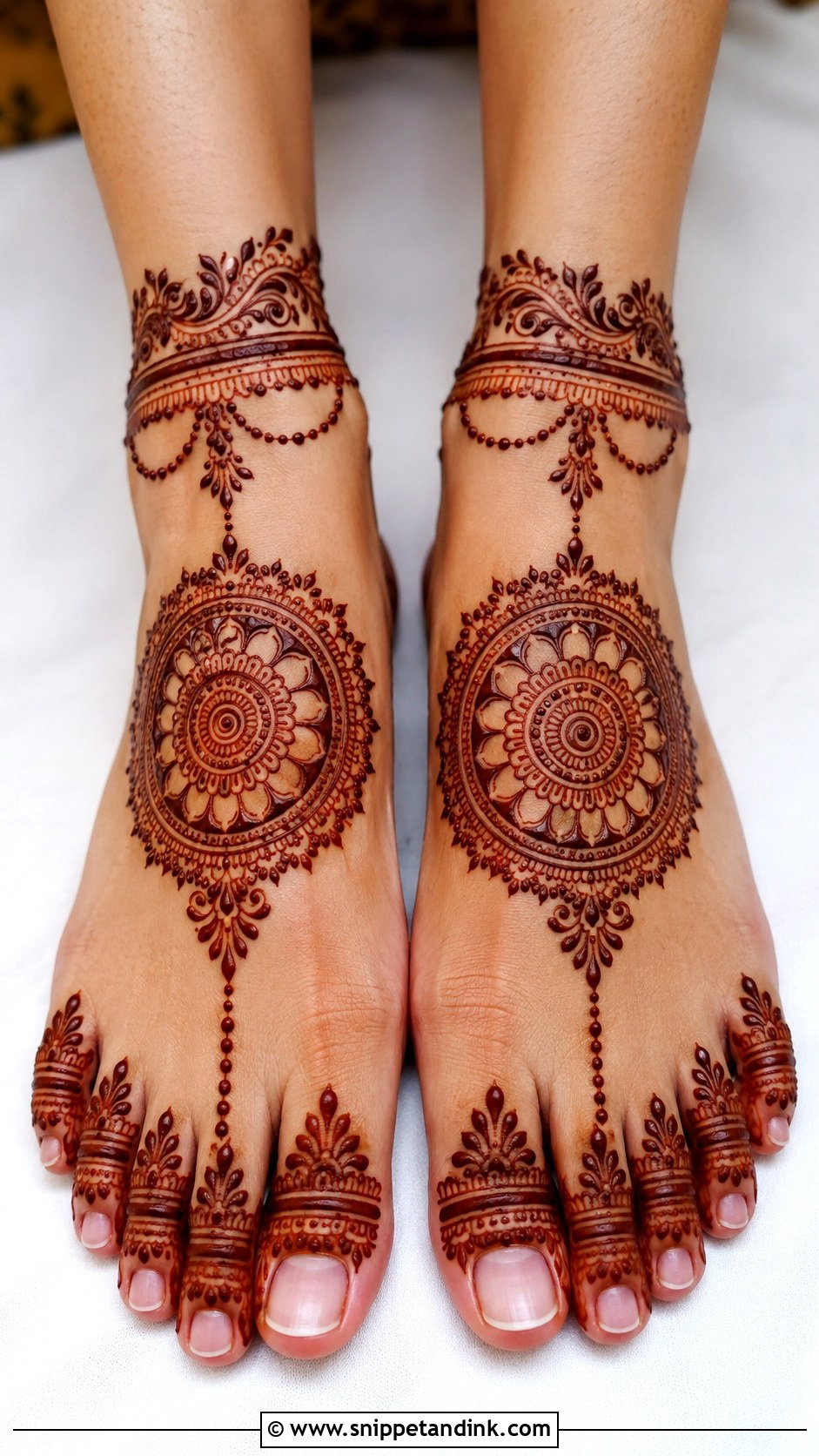
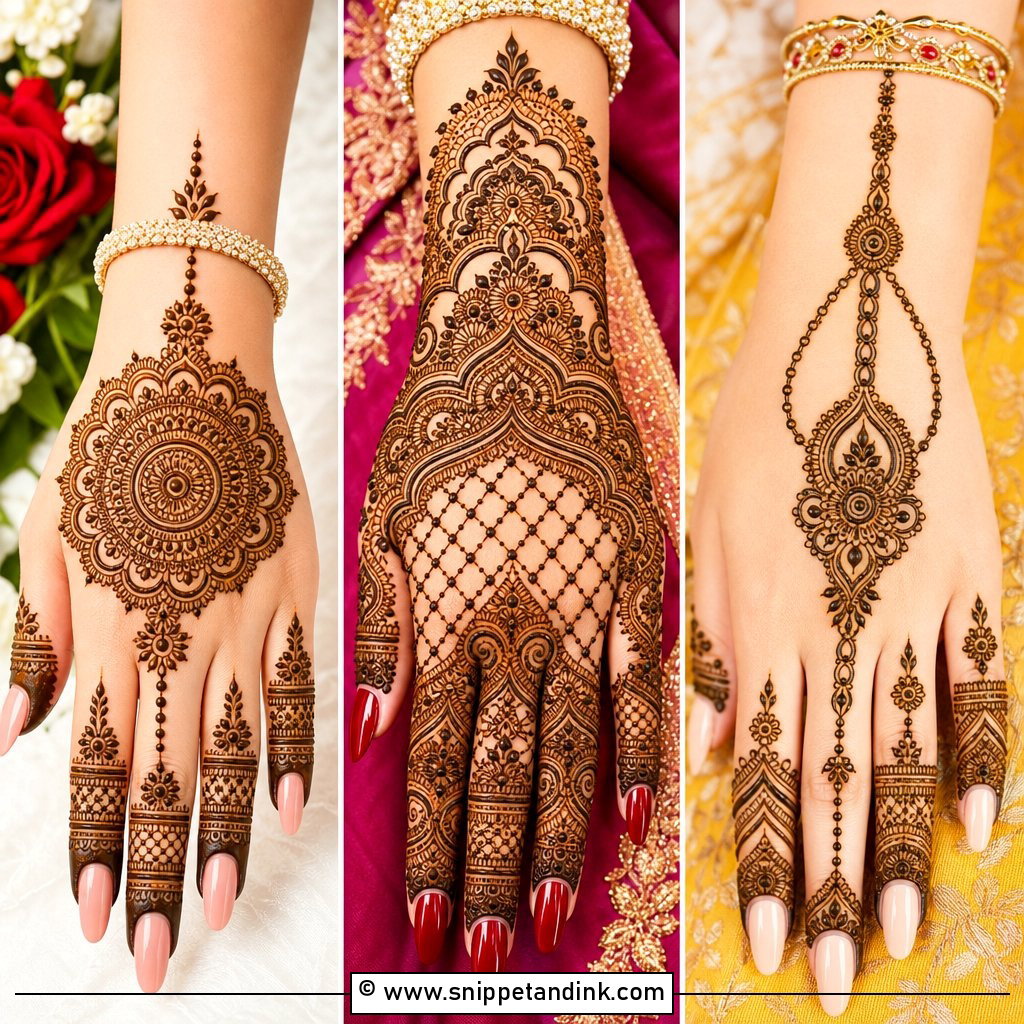
A round mandala on the top of each foot gives a centred, symmetrical look, linked to the toes and ankle with dotted chains, petals or fine vines. It can be simple or highly detailed, and the circle draws the eye naturally in photos. The detail I’m fussiest about is size: both feet are rarely identical, so I scale each mandala to its own foot while keeping them looking the same. Slim ankle bands frame the pair.
7. Jaali Bridal Foot Mehndi Design
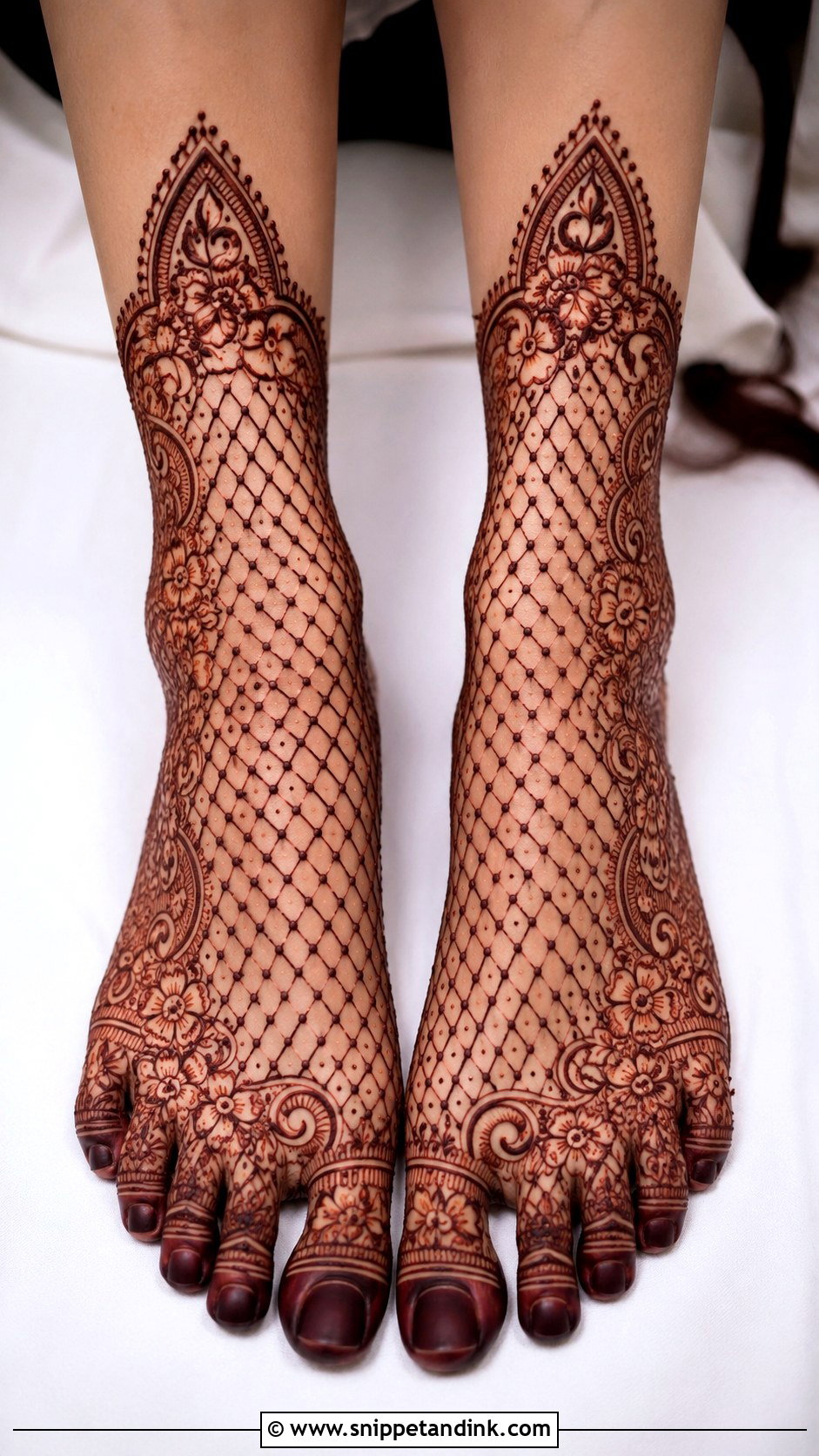
Jaali gives the feet a net-like, lace finish. It can cover the top of the foot, sit inside paisley frames, or form panels between floral borders, and it pairs with embroidered outfits and fine anklets. Line spacing has to be even, and on feet I draw the mesh a touch heavier than on hands, because very thin lines can break up where the skin creases at the ankle. Floral corners, toe borders and a tidy ankle edge make it a finished design rather than a patch of pattern.
8. Peacock Bridal Foot Mehndi Design
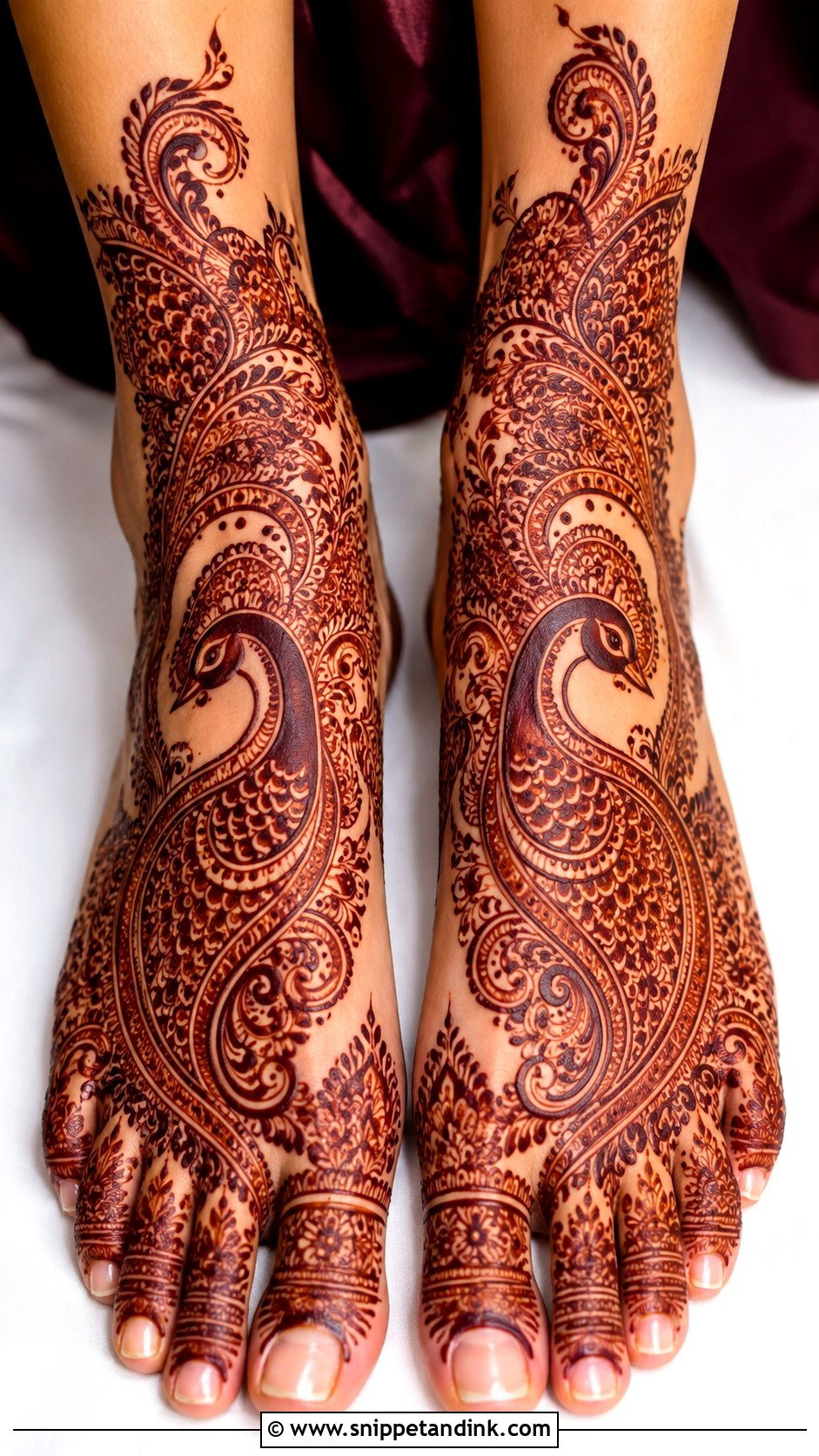
A peacock can sit near the ankle, across the top of the foot, or mirrored on both feet, with its feathers flowing into paisleys, florals, swirls and filler. It’s festive and symbolic, and it fits Indian bridal outfits well. Keep the head and the main feather curves bold. Those are the parts that disappear first if the line is thin, and a peacock without a clear head just reads as a swirl.
9. Floral Bridal Foot Mehndi Design
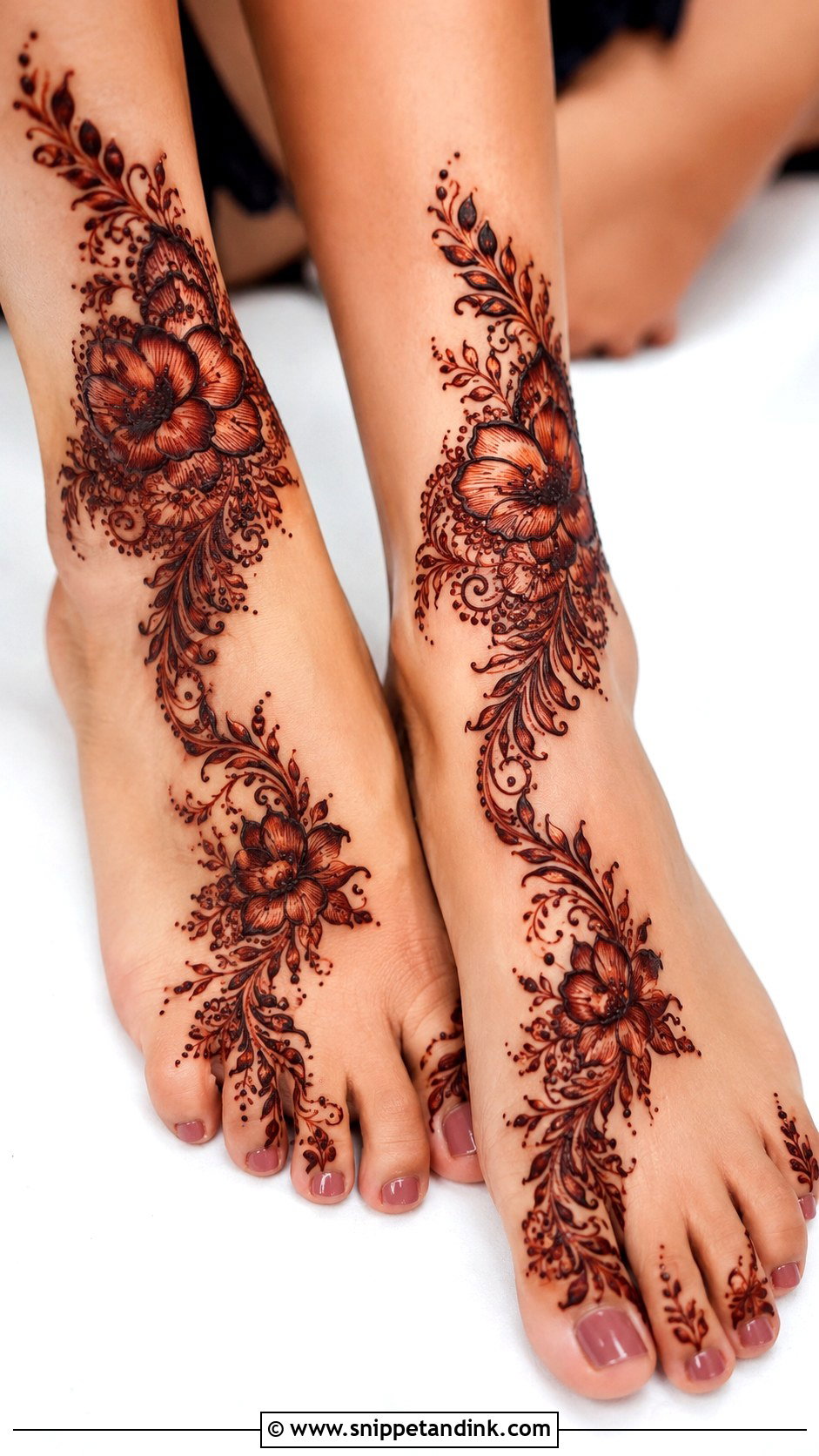
Floral foot designs use large shaded flowers, small blossom clusters, leafy vines and curved trails that travel from toes to ankle. They work best in Arabic and Indo-Arabic layouts, where each flower gets space to breathe. Mixing bold petals with fine leaves gives depth. If you’re wearing open sandals with a strap across the top of the foot, I’ll place the flowers either side of the strap line so the biggest bloom doesn’t vanish under leather.

10. Paisley Bridal Foot Mehndi Design
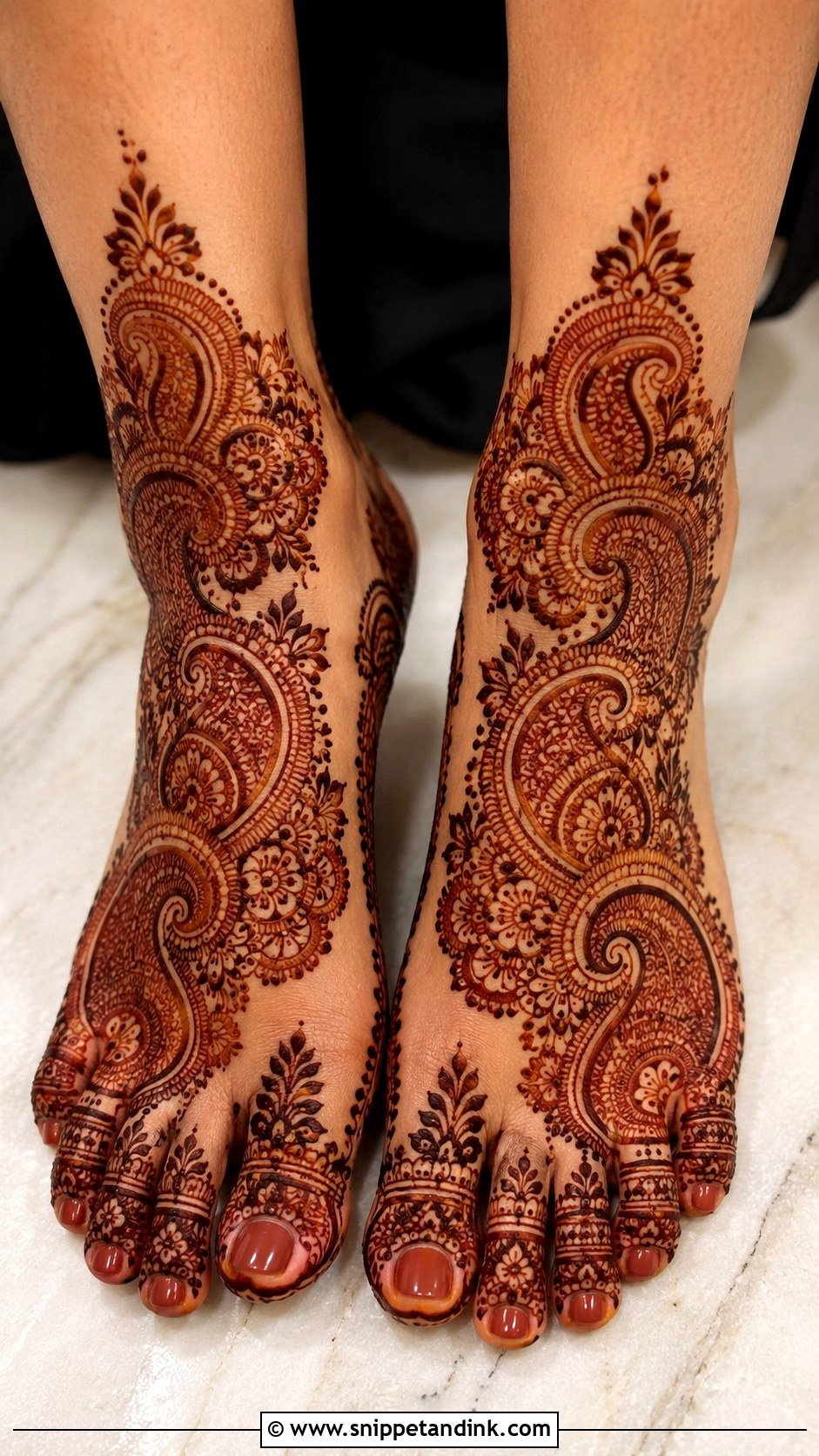
Paisleys flex between simple, heavy, modern and royal. They can sit as large central motifs or repeat in rows from toes to ankle, mixing with florals, dots, leafy filler and jaali panels. For feet, I’d lean toward bigger paisleys; small ones turn into dots in photos taken from standing height. Mirrored paisley trails on both feet make the pair look planned.
11. Anklet Bridal Foot Mehndi Design
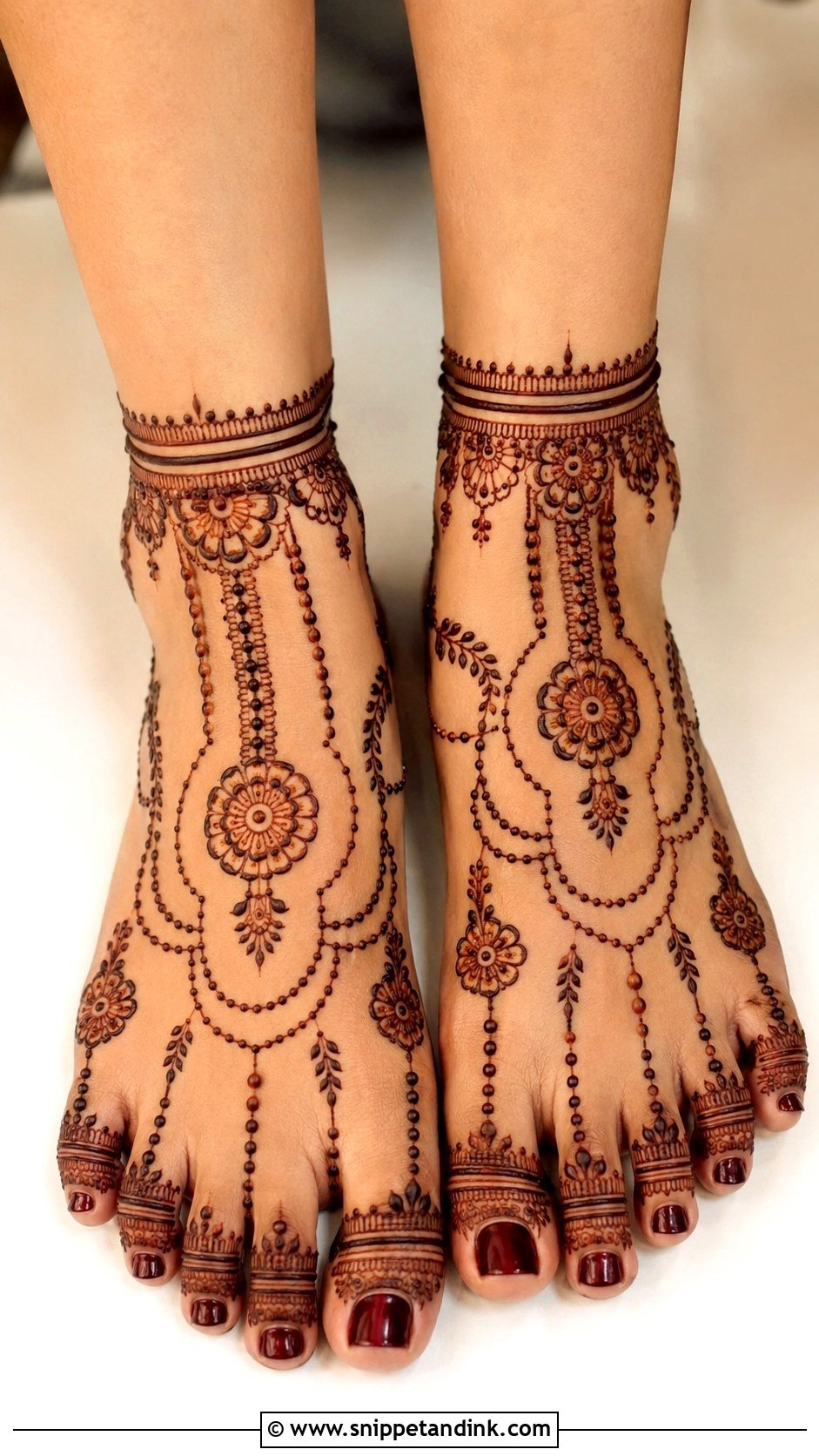
An anklet design focuses on a detailed band around the ankle, often with hanging chains, dots, beads, small florals and toe-ring patterns, while the top of the foot stays light. It complements real anklets without competing, and it suits modern outfits. The band must wrap evenly. I draw it with the foot resting flat on the floor, not raised, because an ankle band drawn on a pointed foot sits crooked once you stand.
12. Toe Ring Bridal Foot Mehndi Design
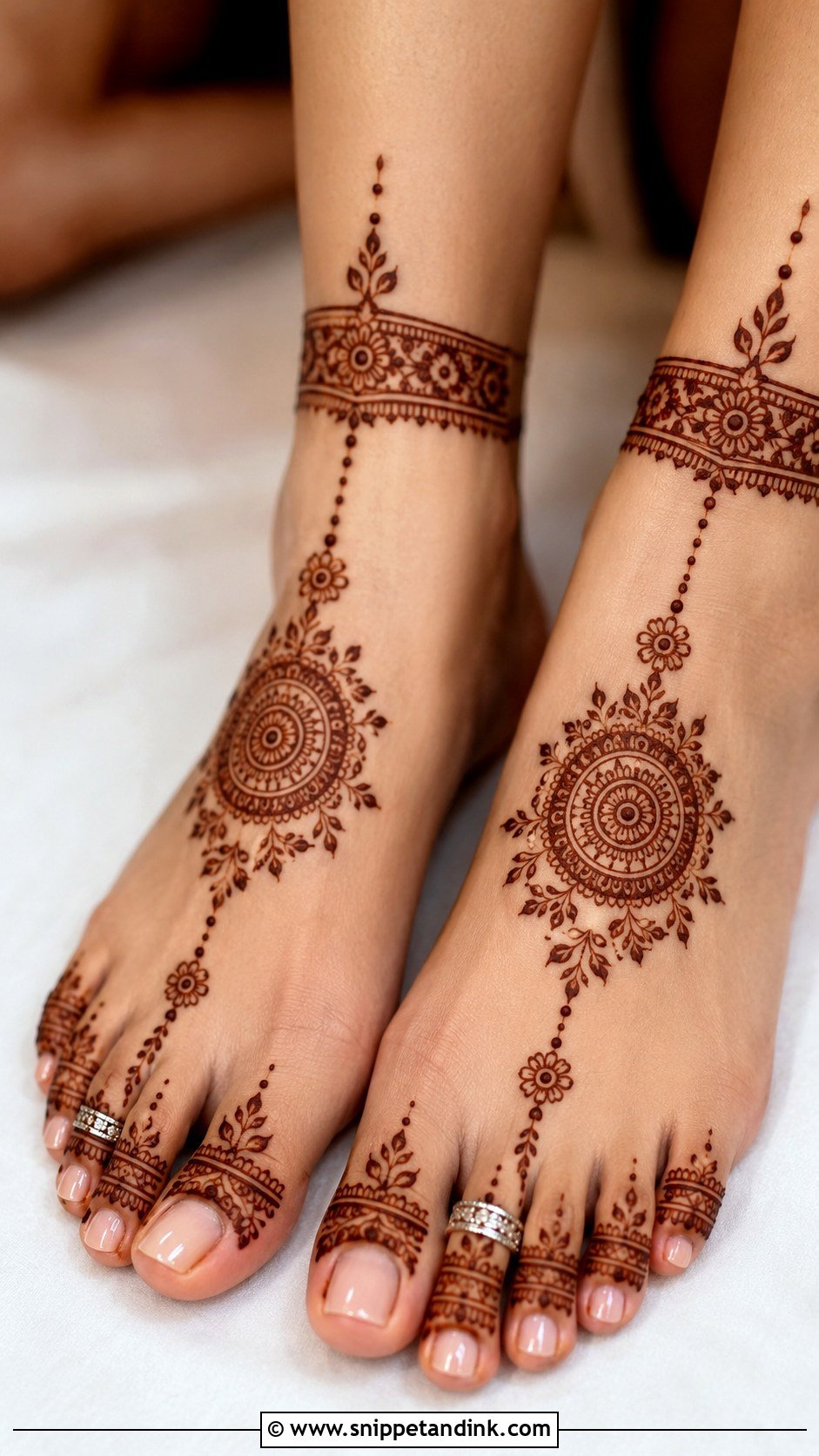
Here the toes carry the detail: neat bands, tiny dots, floral caps or ring-like curves, linked to a small mandala, paisley or floral cluster on the top of the foot with fine chains or vines. Open sandals and traditional toe rings suit it. Around the nail I keep a small clean margin. Paste right against the nail fold stains the cuticle and nail edge, which looks untidy next to a fresh pedicure.
13. Indo Arabic Bridal Foot Mehndi Design
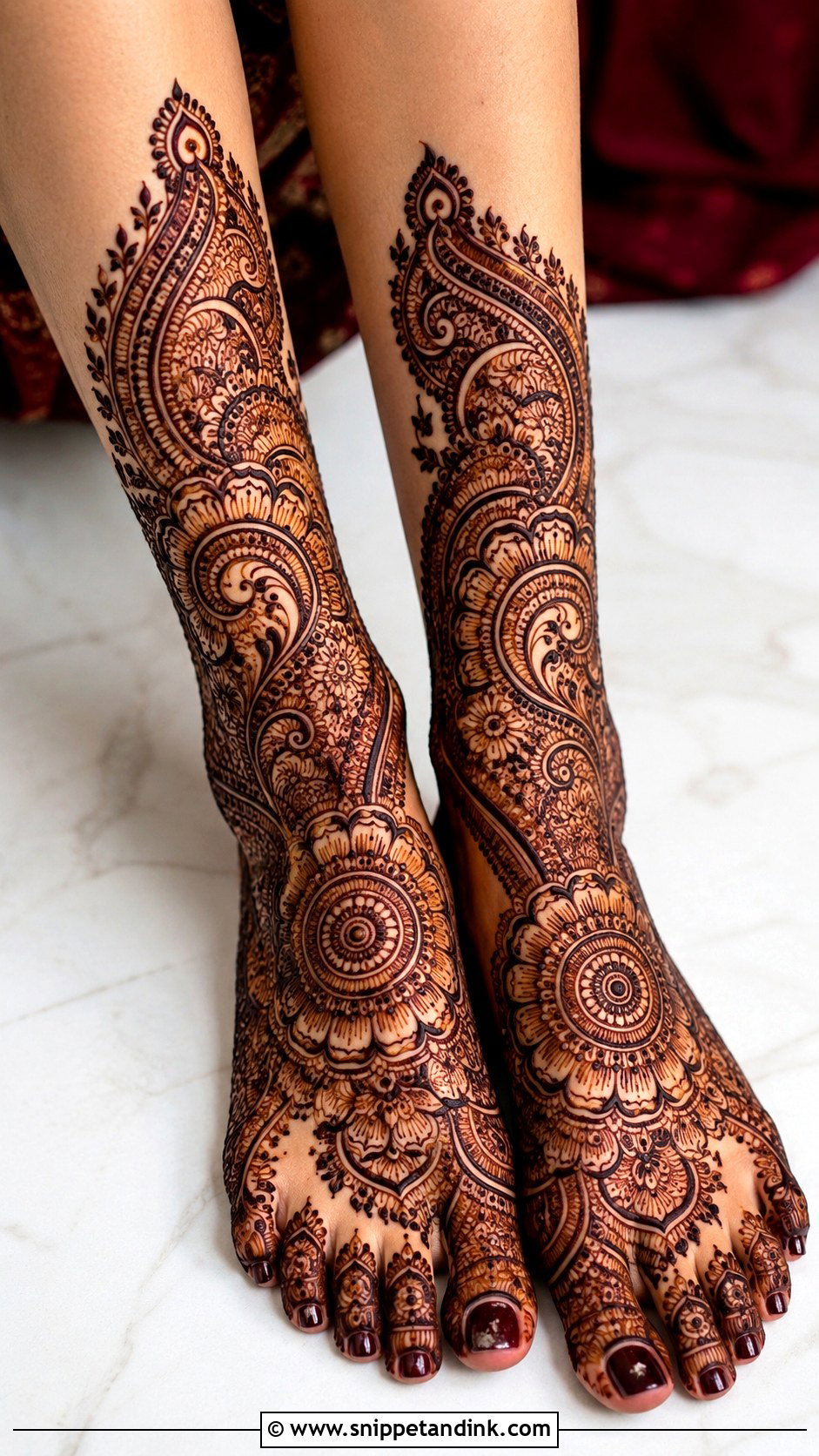
Indo Arabic bridal foot mehndi design combines Indian motifs with Arabic flow: bold florals, paisley trails, mandala centres, leafy curves and small detailed filler, spaced so some skin shows. It’s the middle ground I suggest when a bride wants detail but not full density. The foot can be covered diagonally from the big toe toward the ankle or framed with a soft border. Classic red and softer pastel outfits both work with it.
14. Moroccan Bridal Foot Mehndi Design
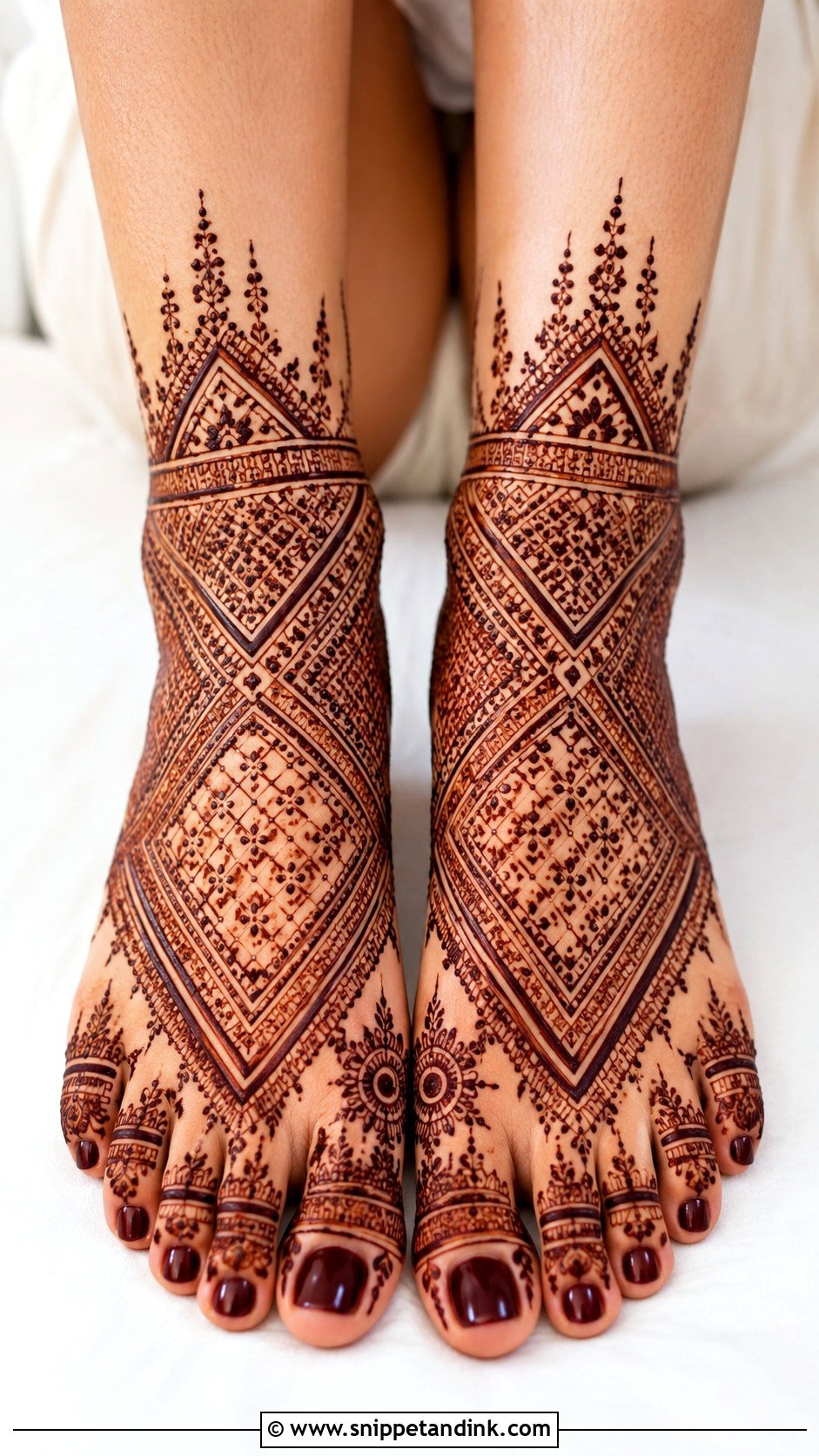
Geometry replaces flowers in Moroccan work: diamond grids, triangles, bold lines, repeated dots, tile-like panels and sharp borders. It looks clean and artistic while staying ceremonial, and its symmetry reads easily on the top of the foot and around the ankle. Straight lines on a curved foot are tricky, so I let the grid bend slightly with the arch rather than forcing it flat. A soft mandala, an anklet band or a few florals make it bridal.

15. Gulf Bridal Foot Mehndi Design
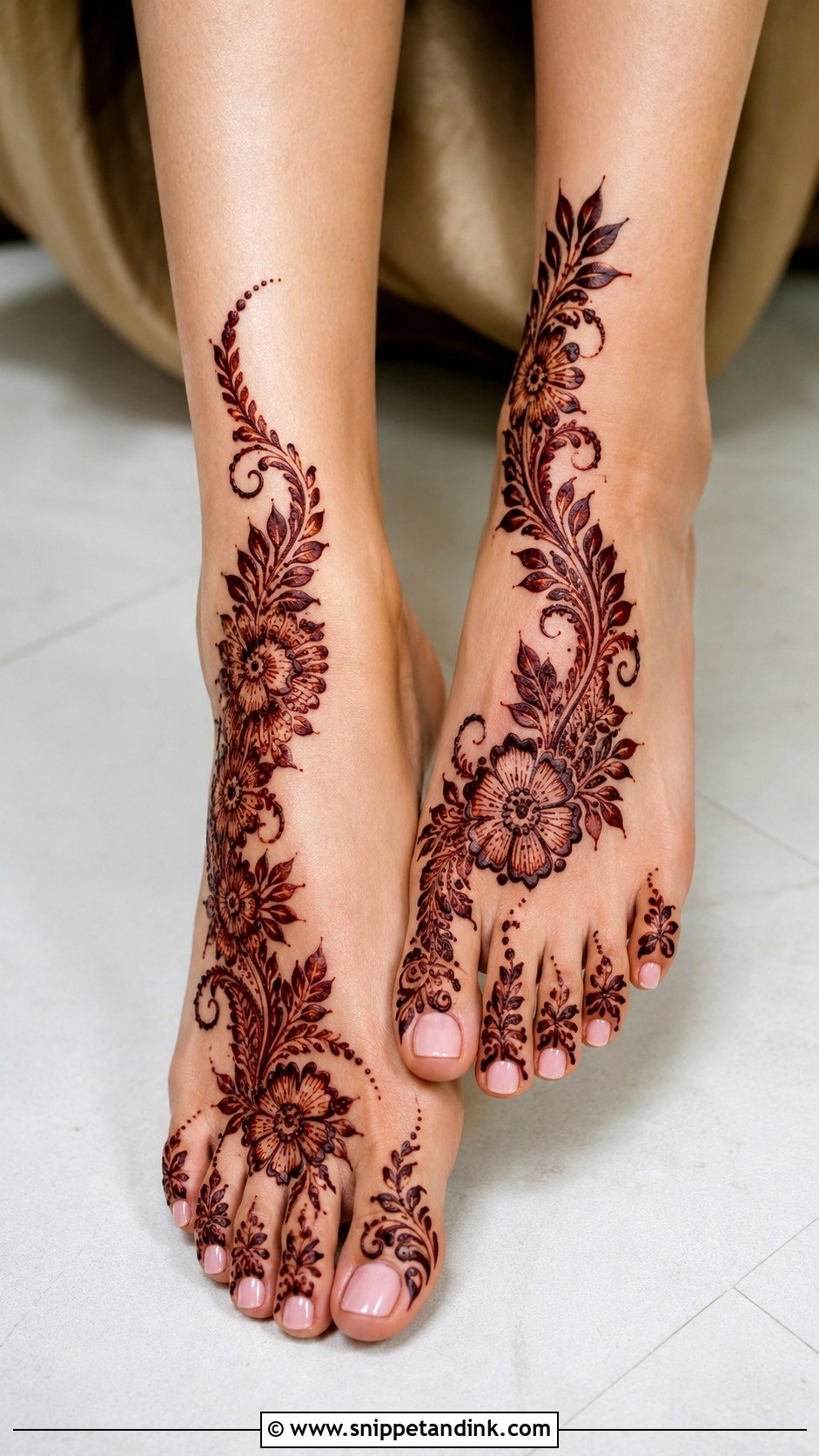
Gulf, or Khaleeji-inspired, foot designs use bold florals, leafy trails, heavy outlines and plenty of negative space. On the feet they usually sweep from one side of the toes across the foot and up toward the ankle. Large flowers and thick leaves give a strong stain that photographs well. The heavier paste line also helps on feet, as it holds up better against the friction of walking. Keep the vines curving naturally so the foot doesn’t feel overloaded.
16. Rajasthani Bridal Foot Mehndi Design
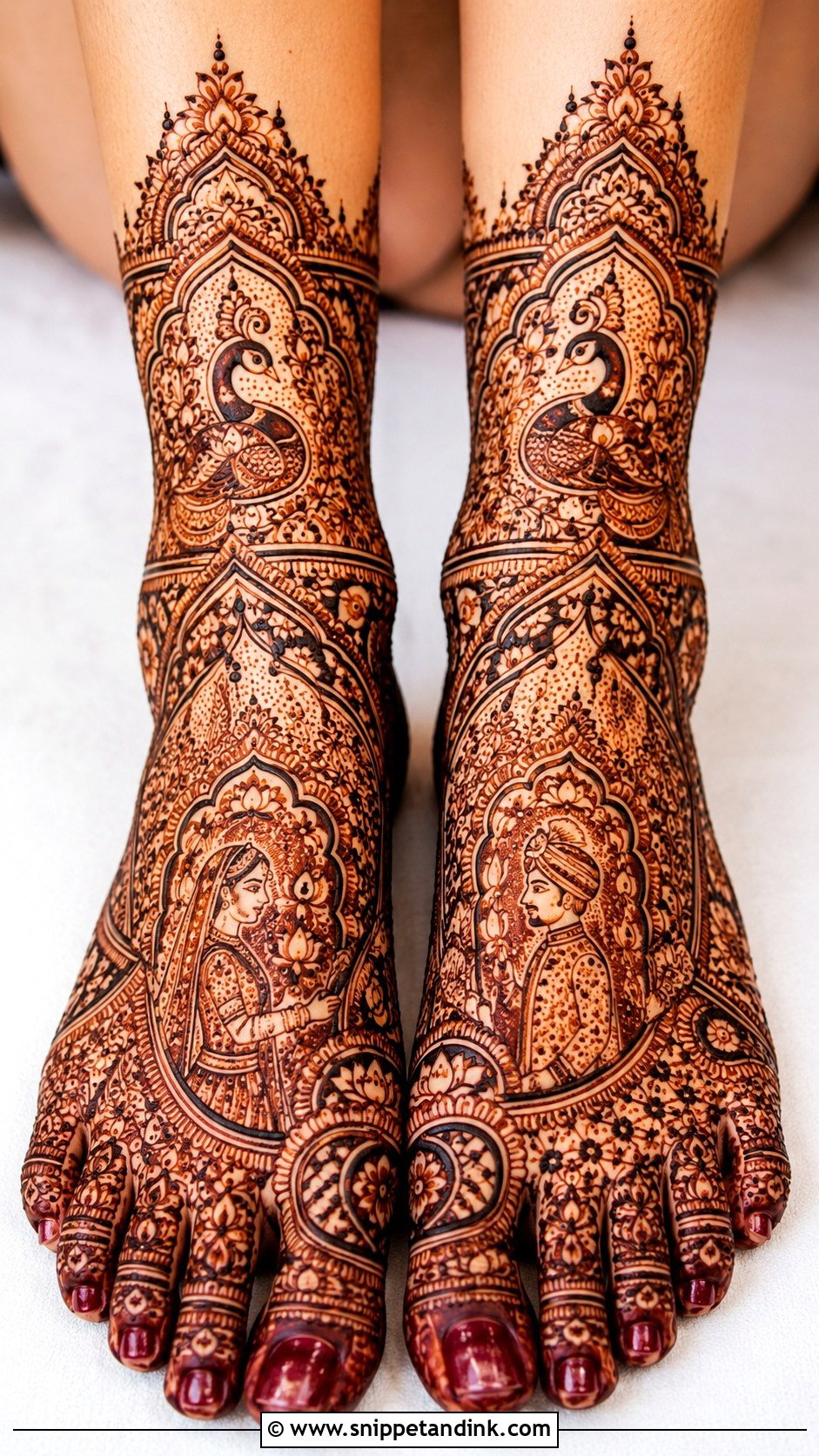
Rajasthani foot mehndi tells a story with royal arches, peacocks, paisleys, bride-groom elements, lotus shapes and dense fine-line filler, usually from toes to ankles and sometimes higher. It matches traditional lehengas, bandhani, gota work and heavy jewelry. Ask for clear sections rather than wall-to-wall tiny patterns. I separate each panel with a slim open line, which keeps the story readable in photos.
17. Minimal Bridal Foot Mehndi Design
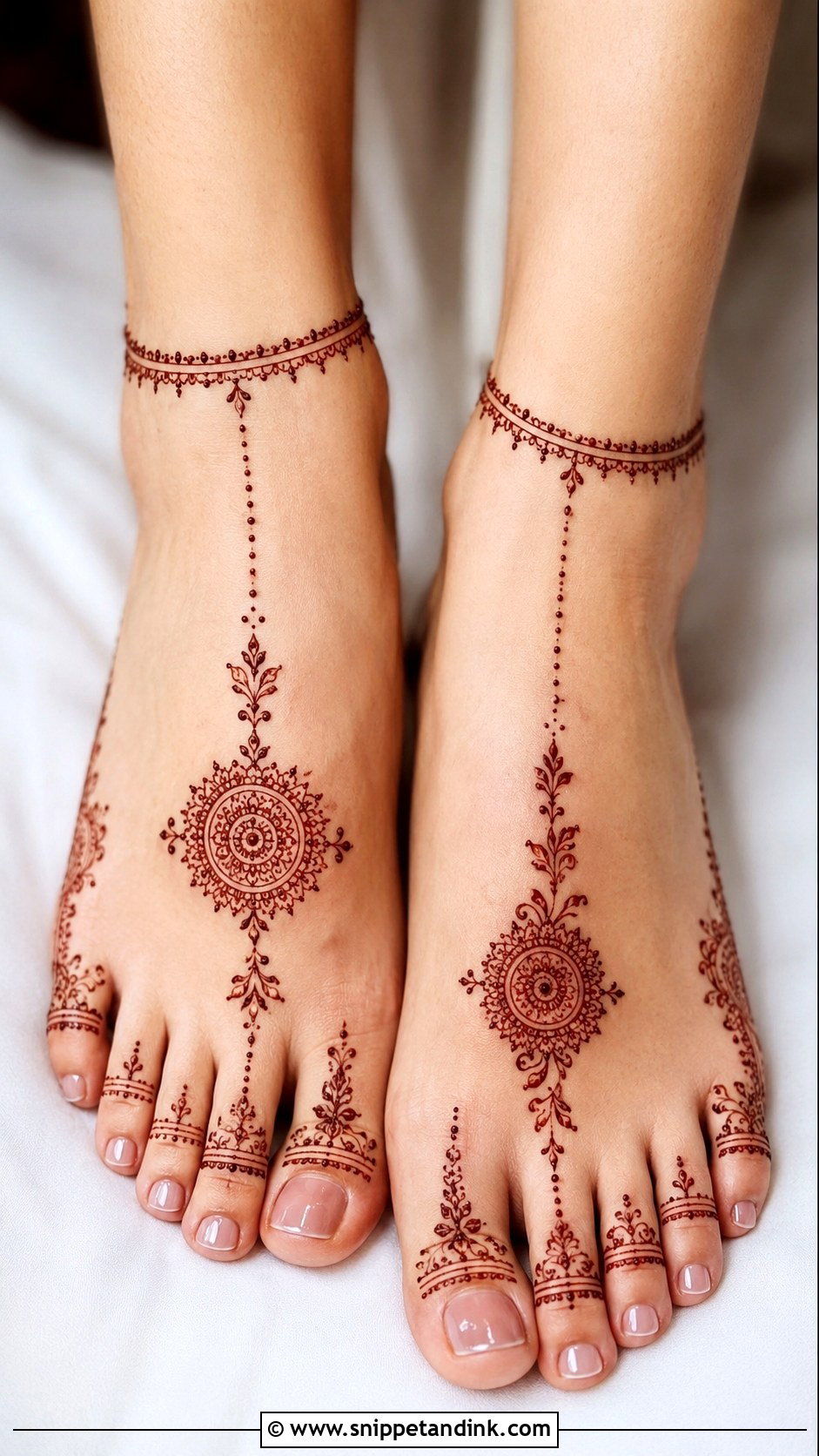
A small mandala on each foot, tiny toe details, fine dotted chains and a delicate ankle vine: that’s enough for a minimal bridal foot. Every placement is deliberate, which is why it still feels complete. It suits beach weddings, courthouse ceremonies and small celebrations. On a beach, go minimal for a practical reason too, since sand and water scrub at a fresh stain and dense work would fade unevenly.
18. Heavy Bridal Foot Mehndi Design
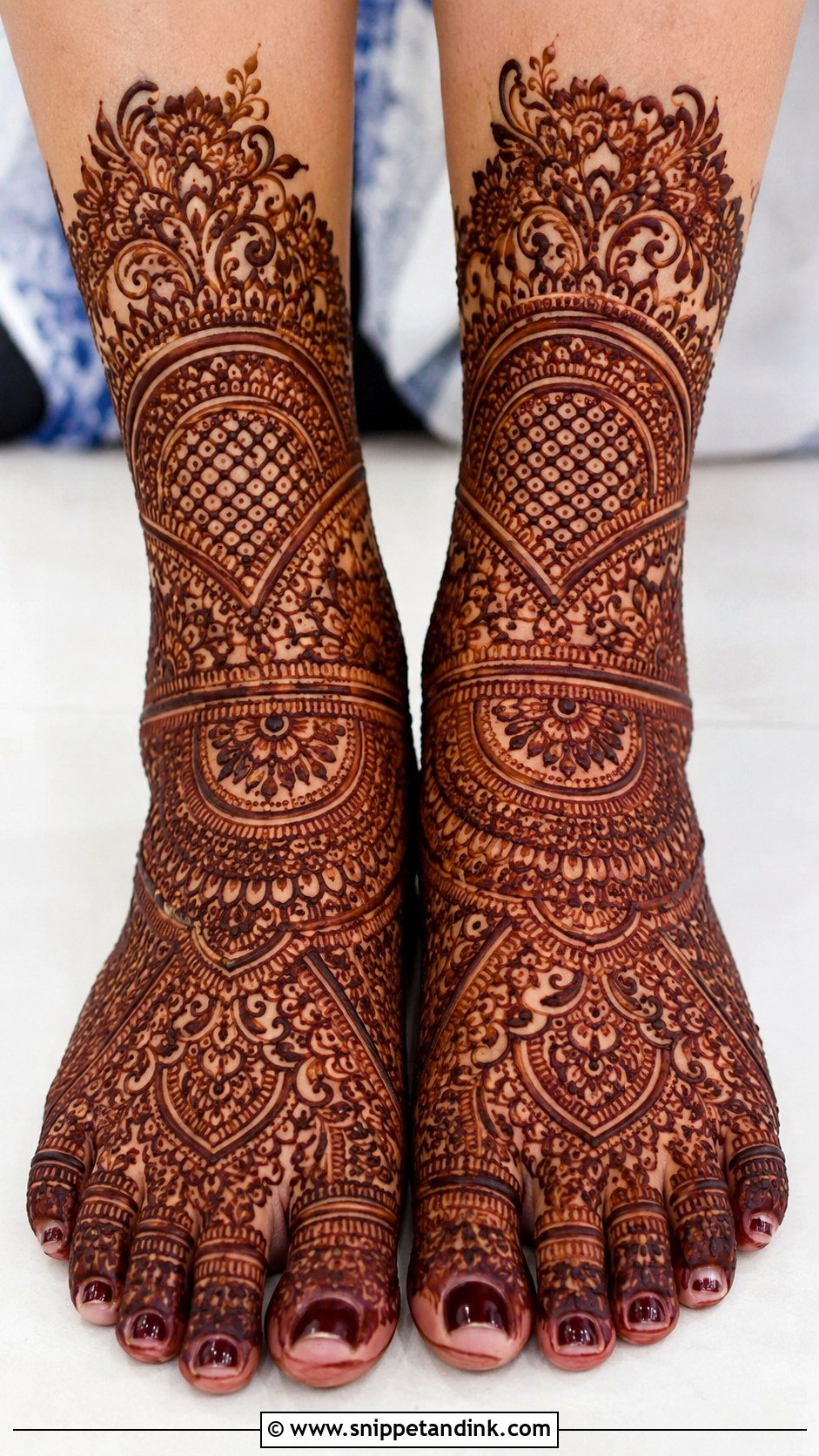
Heavy foot designs combine dense paisleys, florals, jaali, mandalas, toe borders, ankle bands and layered filler, often reaching just above the ankle. They suit traditional outfits and elaborate hand mehndi. The challenge is staying clean. I vary motif sizes deliberately, a few large shapes among smaller details, and leave planned breathing spaces. That contrast is what reads as rich rather than cluttered.
19. Rose Bridal Foot Mehndi Design
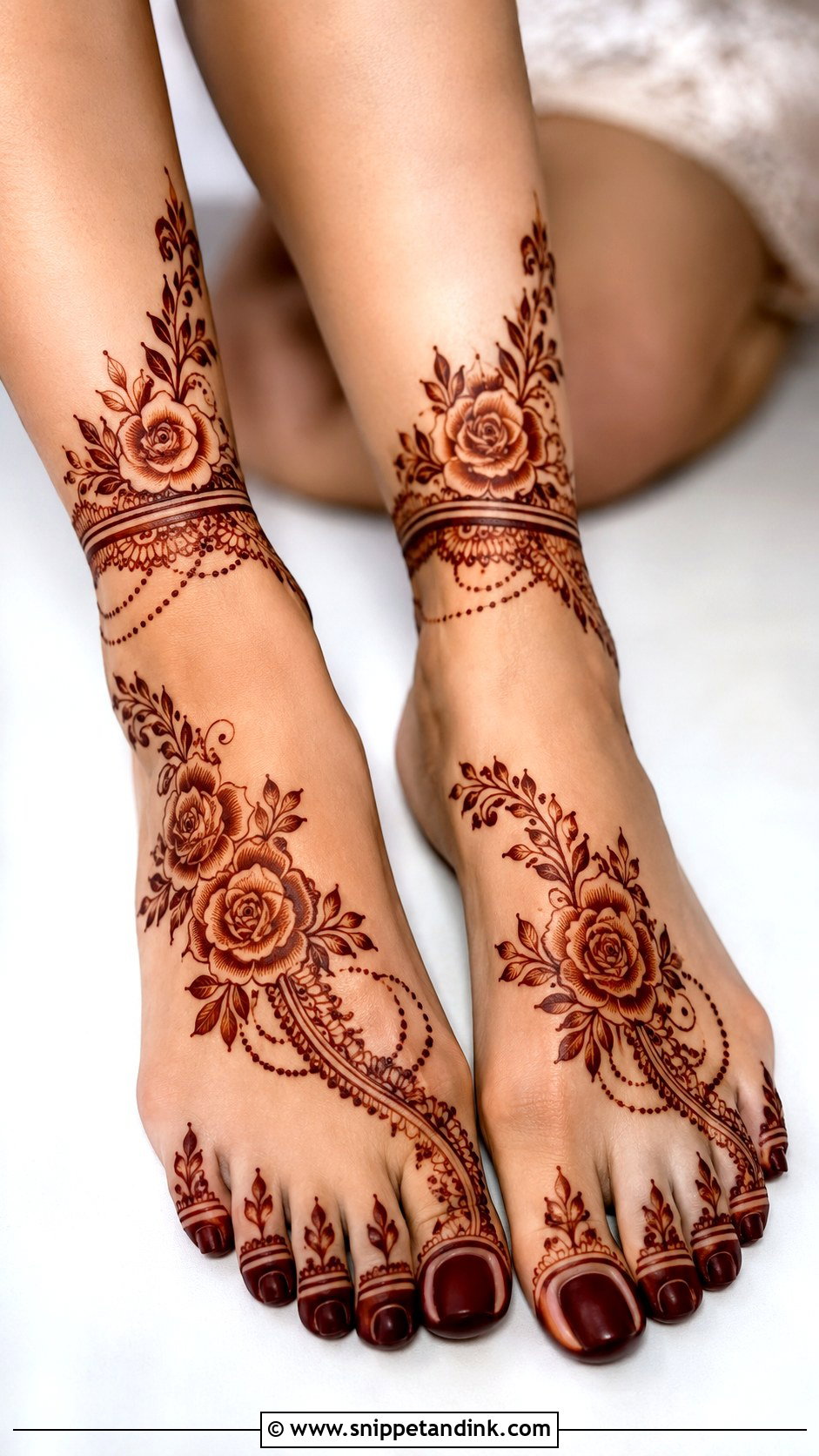
Roses suit brides who like florals with a modern touch. They can be shaded, boldly outlined, or arranged in an Arabic trail across the foot, with leaves, dotted curves, lace-like edges and slim ankle bands. Pastel outfits, floral embroidery and delicate jewelry all match. Size matters on feet: I draw roses larger than I would on a finger, with light shading inside the petals, so they still look like roses from standing height.
20. Lotus Bridal Foot Mehndi Design
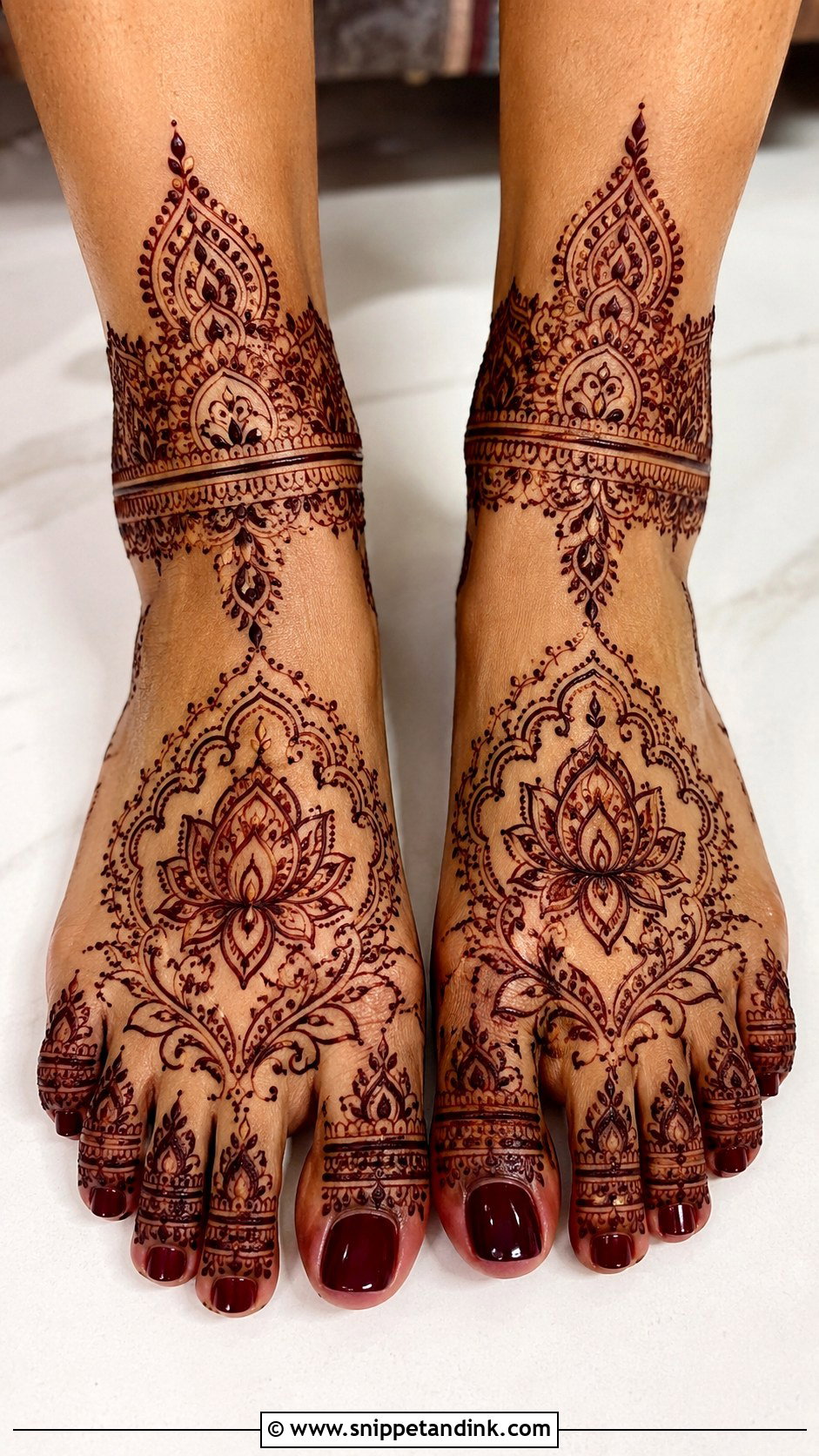
The lotus can sit at the centre of the foot, near the ankle, or repeat in panels up the lower leg, alongside mandalas, curved vines, paisleys and dotted borders. It feels calm and balanced, and it suits Indian bridal wear. I keep the petals wide and the inner lines open. Narrow petals packed with detail tend to merge once the stain darkens, and the lotus shape is lost.
21. Bridal Sole Mehndi Design
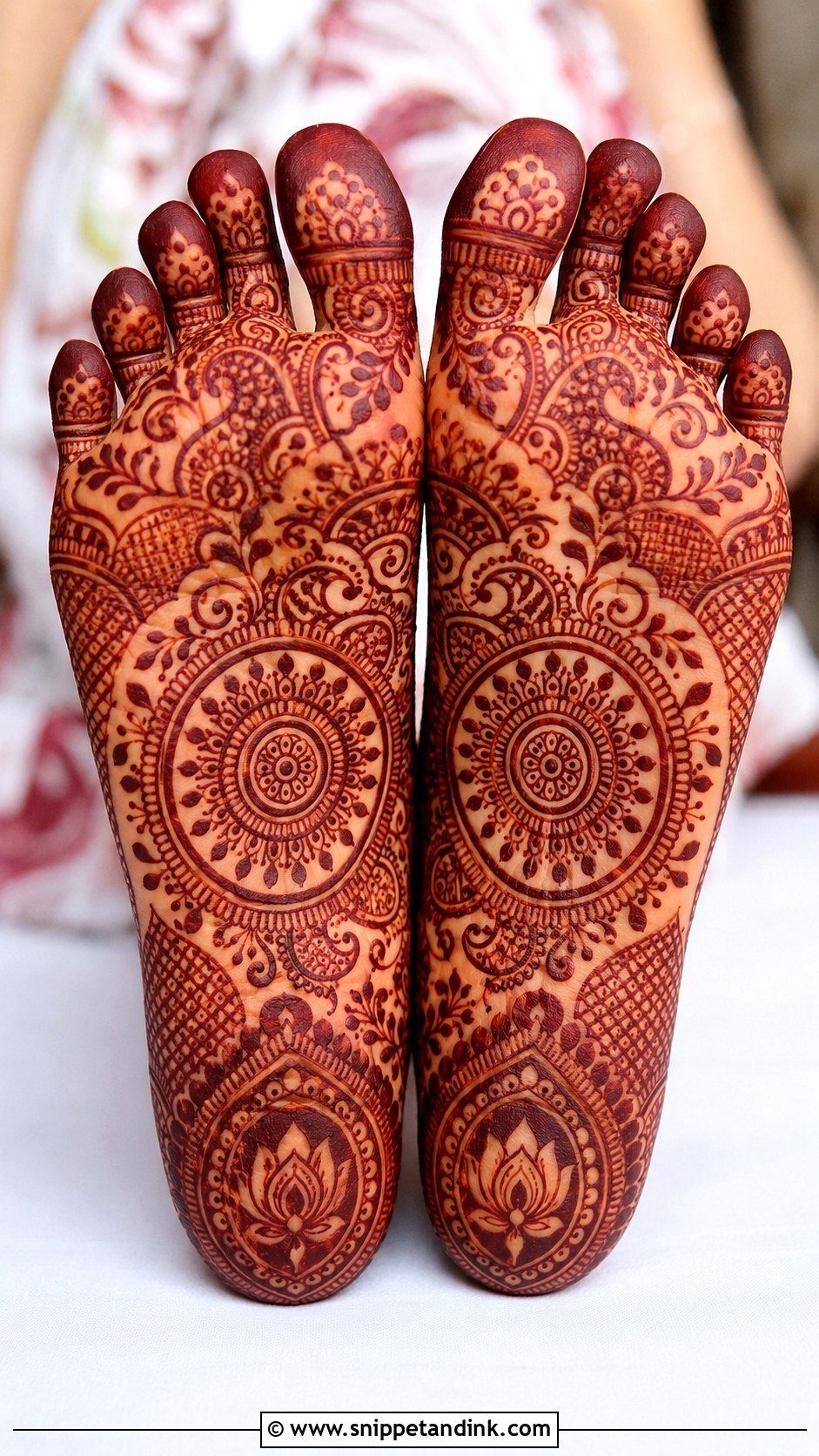
Sole mehndi decorates the bottom of the feet, a detail revealed during rituals and in seated portraits. Mandalas, paisleys, lotus patterns, dotted borders and symmetrical fillers are typical. Soles stain very deeply, but they also take all your weight and friction. I keep sole designs bold and avoid tiny details that will blur. The bride can’t stand at all until the paste has dried and set, so plan to be carried, wheeled or simply seated for a good while. Soles also shed skin quickly, so this stain fades sooner than the top of the foot.
22. Back Foot Bridal Mehndi Design
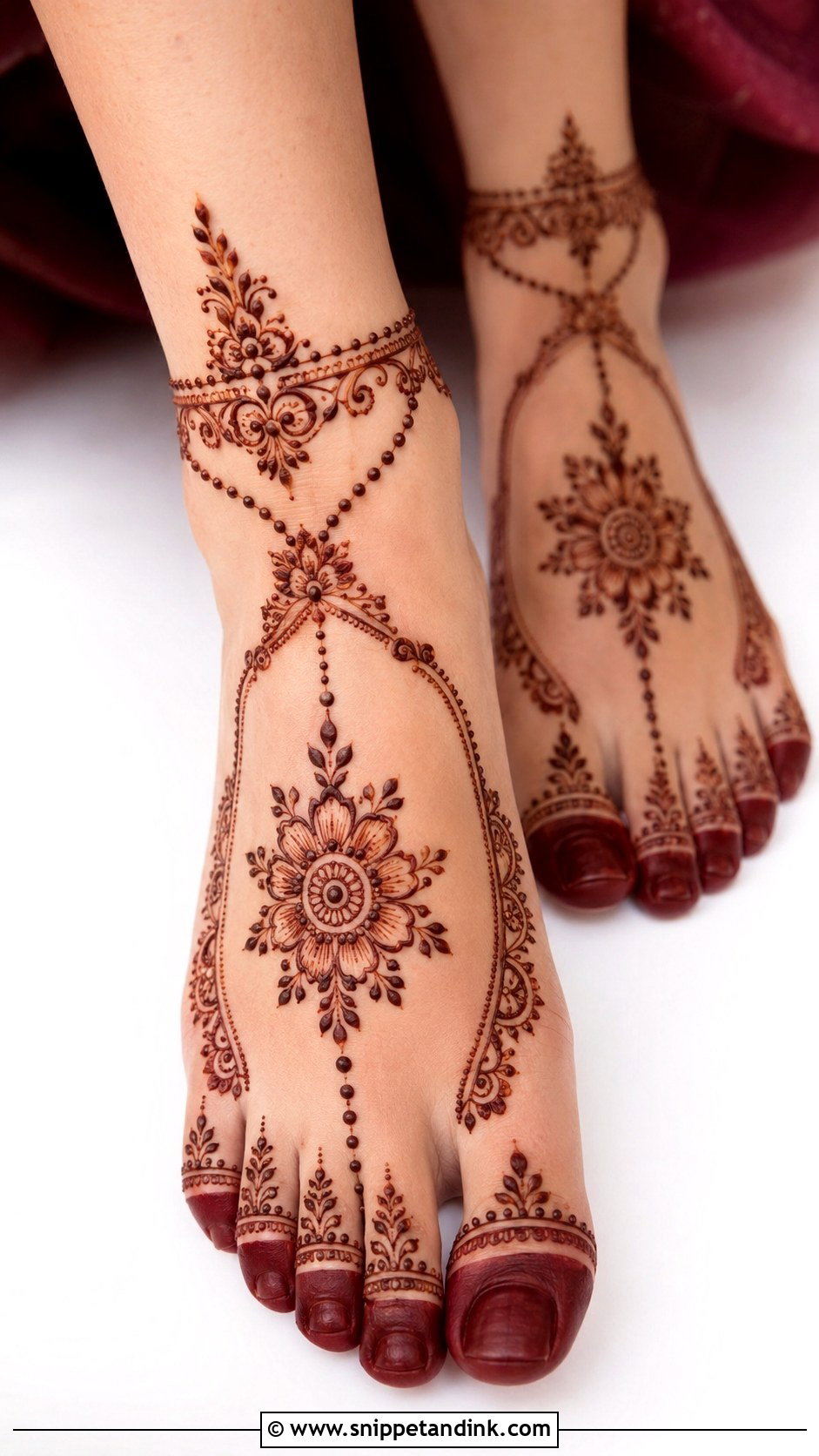
Back foot bridal mehndi design means the top of the foot, the side that faces the camera. Toe patterns, a central motif, side borders and an ankle connection are typical, in Arabic, Indian or Indo-Arabic style. It rubs less than the sole, which makes it the most practical place for detail. A clear central design with matching toe work and a slim anklet band is a reliable formula.
23. Front Foot Bridal Mehndi Design
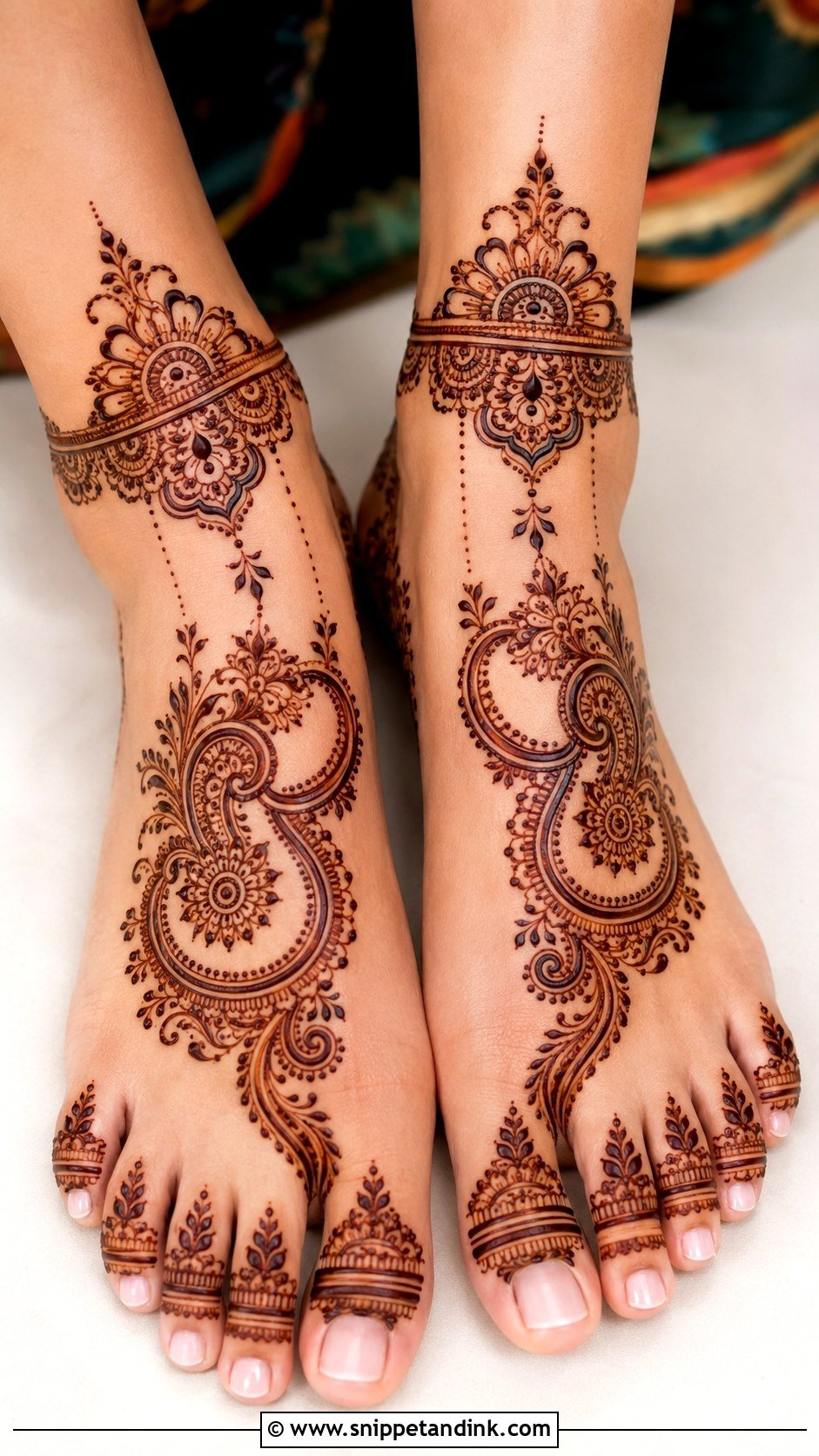
Front-of-foot designs highlight the toes, upper foot and the area leading to the ankle, which shows in sandals, juttis and outfits that reveal the front of the feet. Toe caps, small bands, floral trails, paisleys or mandala chains all work. Very thick patterns crowded round the toes can make them look stubby. A strong central trail with clean side spacing lengthens the foot instead.
24. Ankle Length Bridal Foot Mehndi Design
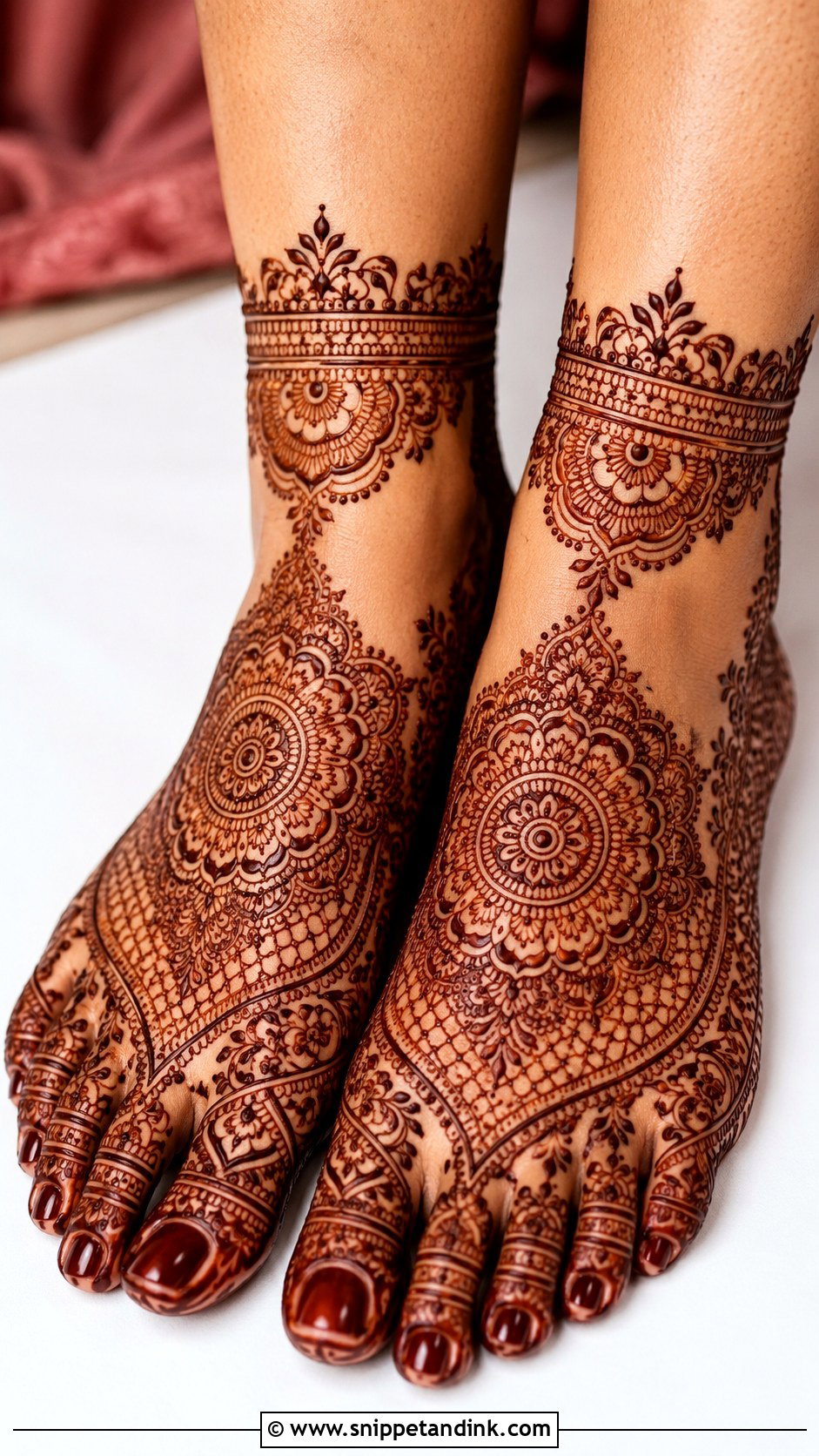
Ankle-length coverage takes in the toes, the top of the foot and the ankle without going up the leg. It’s quicker to apply and easier to live with across several events. A mandala centre, floral borders, jaali panels, paisleys and an anklet-style finish all fit, and it works with heavy or light outfits. For most brides who want medium coverage, this is what I recommend. Matching ankle bands on both feet tie it together.
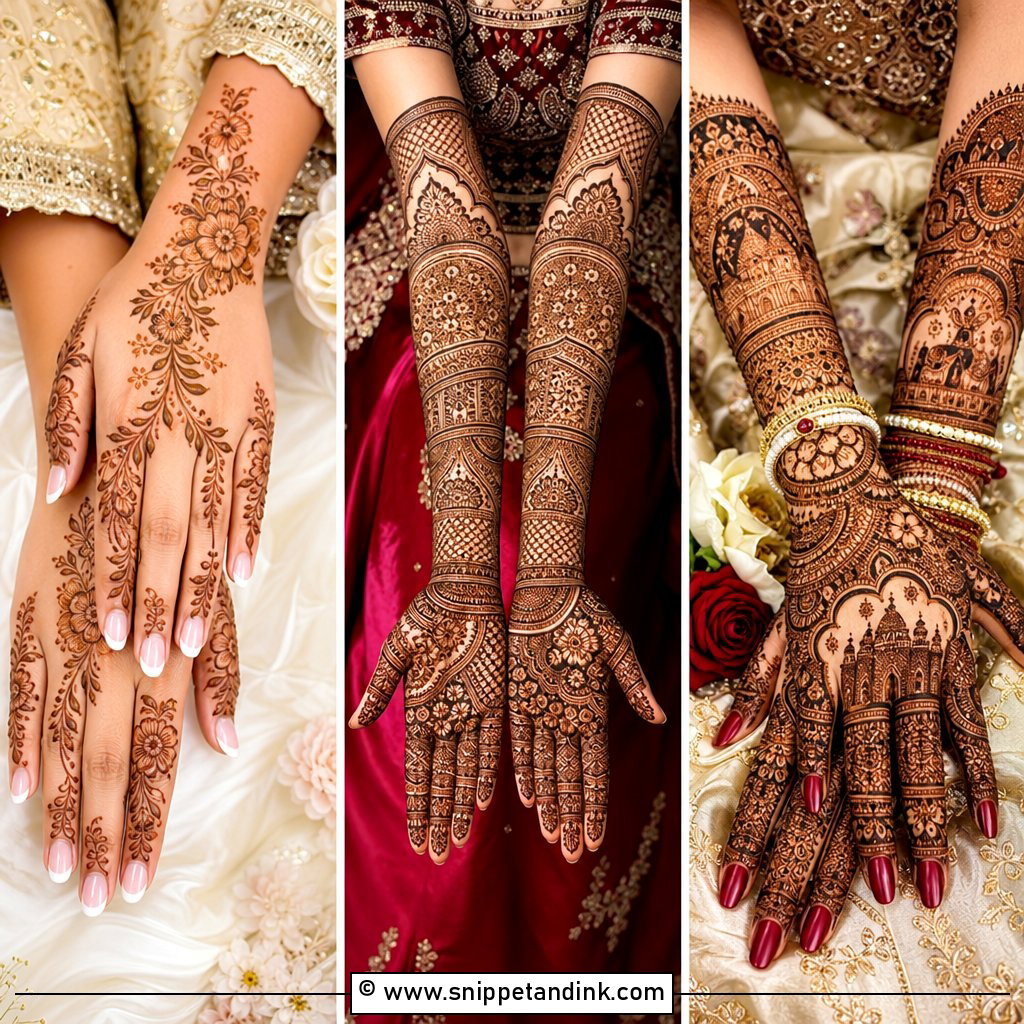
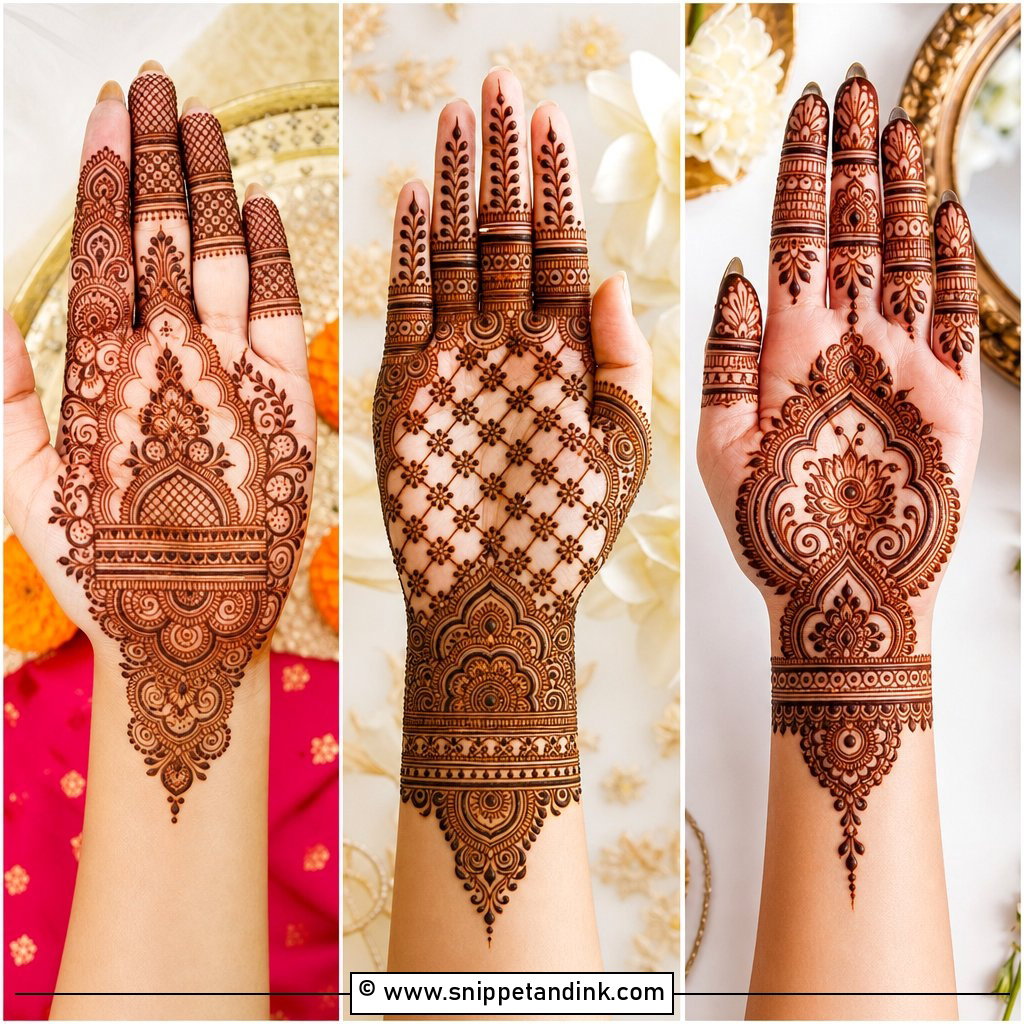
25. Knee Length Bridal Foot Mehndi Design
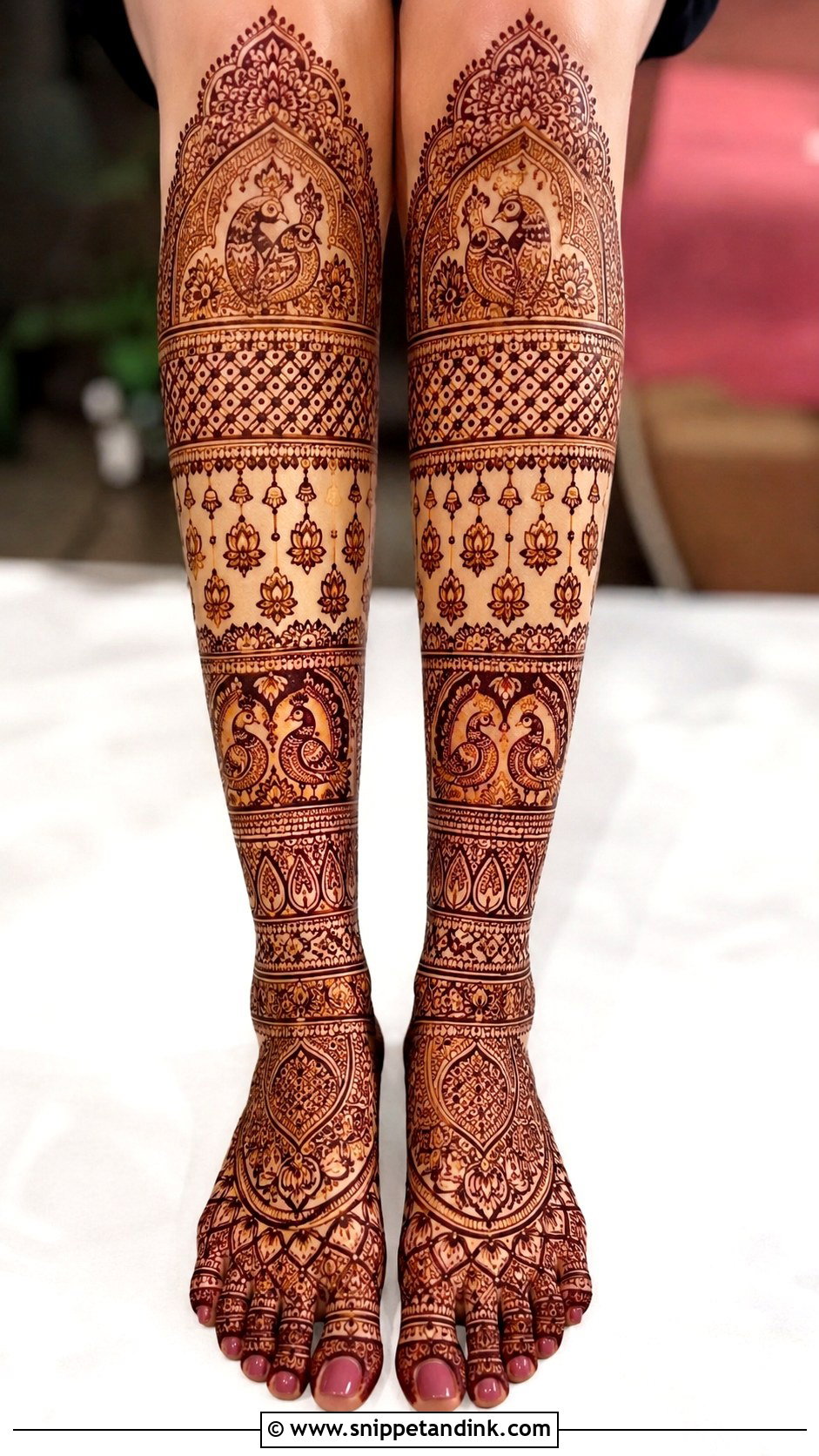
Knee length bridal foot mehndi design runs from the toes over the feet and ankles and up the legs toward the knees, with large bridal motifs, ornamental panels, peacocks, lotus chains, jaali and royal borders. It makes for dramatic portraits when the outfit is styled to reveal the lower legs. The shin stains lighter than the foot, so I use bolder motifs and fewer tiny fillers as the design climbs. Expect a very long sitting and choose an artist experienced with legs, as working on a curved calf is a different skill from hands.
26. Side Foot Bridal Mehndi Design
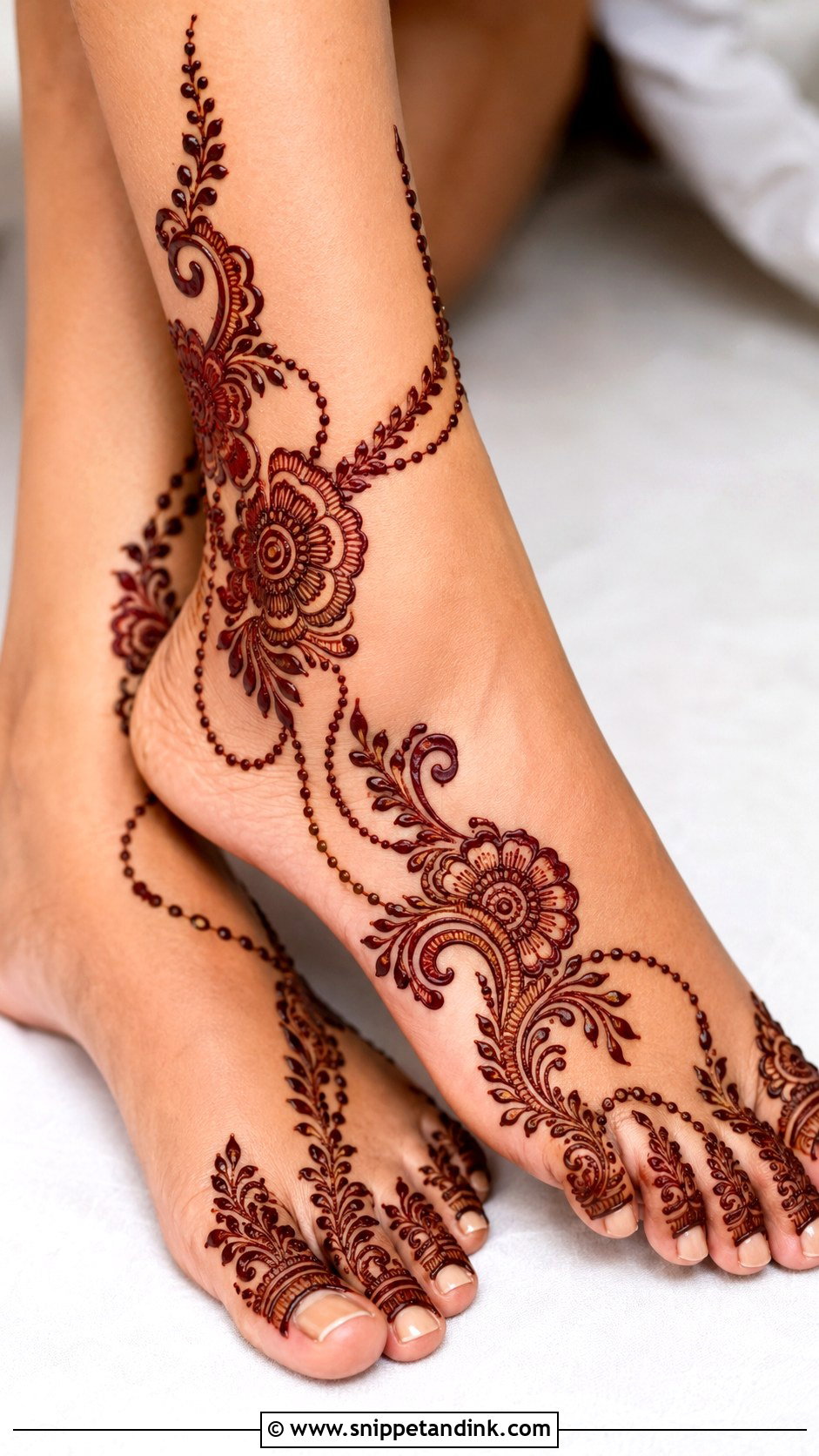
Side designs run along the inner or outer edge of the foot with florals, vines, paisleys and dotted chains instead of covering the whole top. It looks light and modern, especially with open footwear, and pairs well with toe work and an ankle band. Follow the natural curve of the foot. I trace the edge with the bride standing, because the side of the foot changes shape when weight goes onto it.
27. Jewelry Bridal Foot Mehndi Design
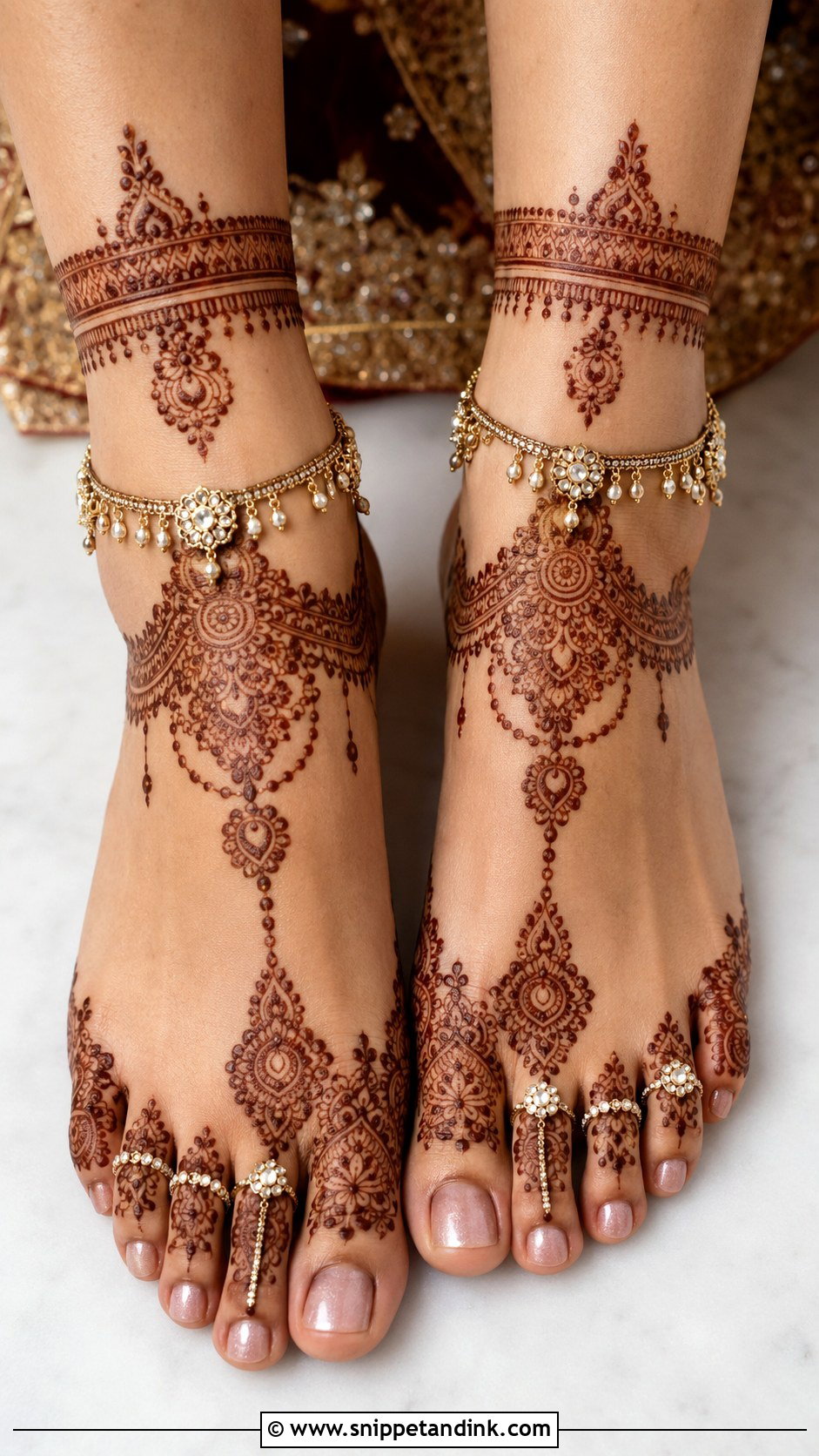
Jewelry-style foot mehndi mimics anklets, toe rings, chains and charms in henna, so the feet look dressed even before the real pieces go on. Toe bands connect to an ankle band with dotted chains or leafy strings, and a small floral or mandala piece can sit on the top of the foot like a pendant. It suits minimal and heavy outfits alike. Precision is everything, so ask for evenly spaced chains and crisp bands. If you’ll wear payal, I draw the henna band slightly above or below where it sits, so the two don’t overlap and hide each other.
28. Modern Bridal Foot Mehndi Design
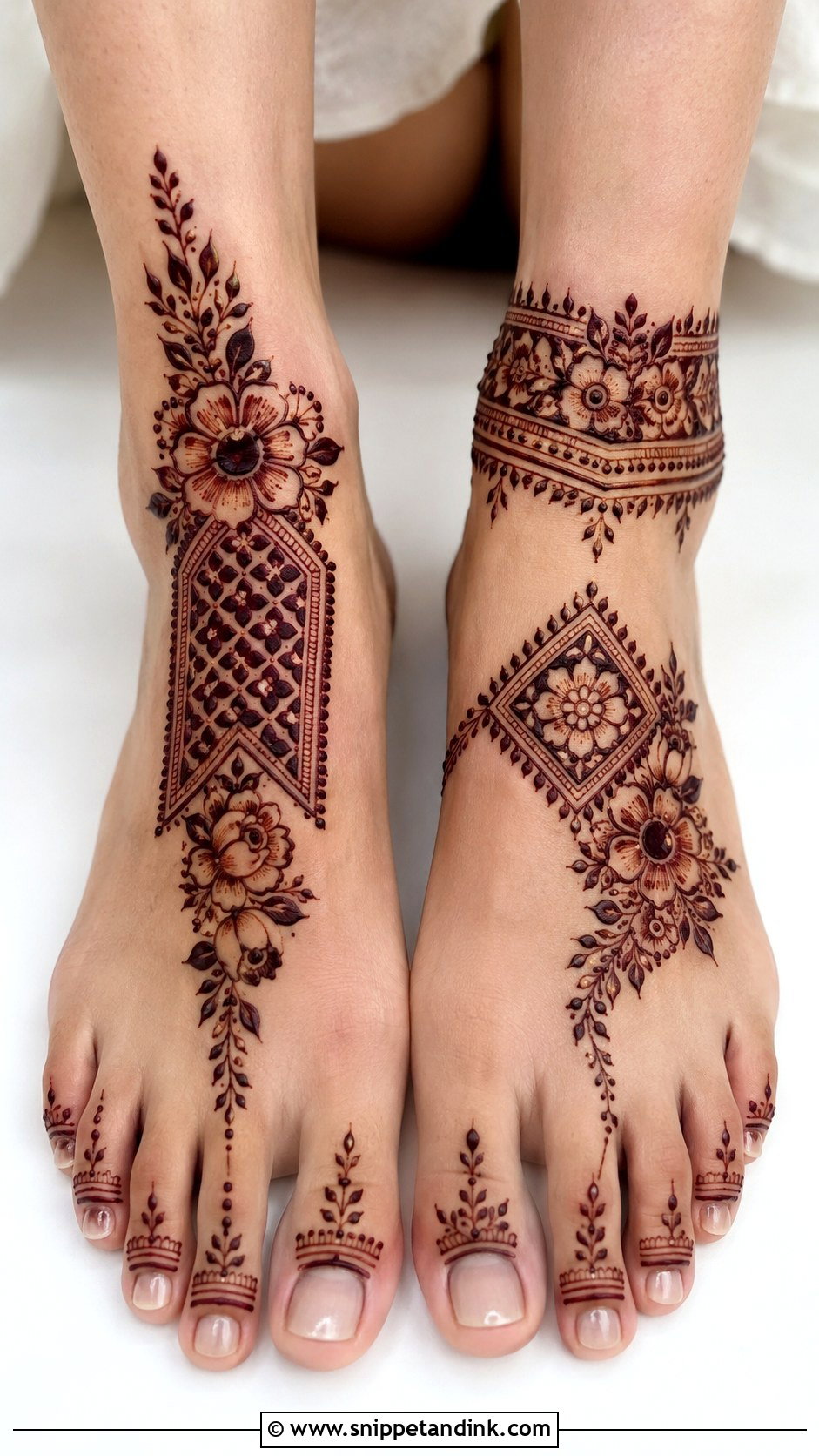
Modern foot designs use asymmetrical trails, bold flowers, geometric panels, half-foot coverage, fine linework and negative space. They feel current with contemporary lehengas, fusion outfits and softer palettes. Every empty area has to look chosen. I include toe details, one clear flow down the centre and a light ankle finish, so the foot reads as complete rather than half done.
29. Shaded Bridal Foot Mehndi Design
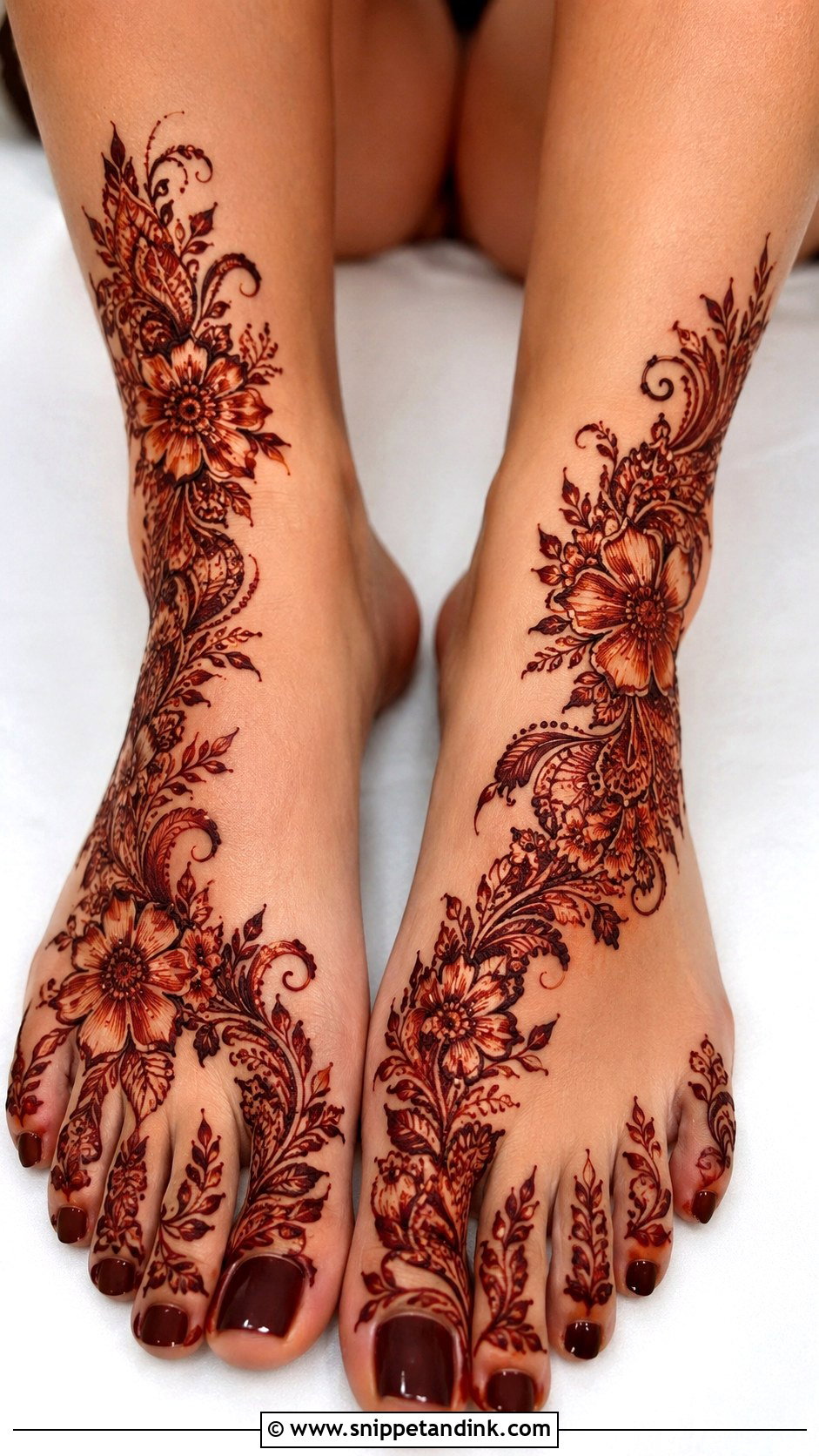
Shading fills flowers, leaves, paisleys and trails with soft texture so motifs look fuller without very dense detail. It’s common in Arabic and Gulf foot work and blends well with Indian elements. Shaded designs give a bold stain that reads from a distance. The risk is mud: if shading is laid on too thick, it blots into a dark patch. I build it with fine close strokes and keep outlines clean and some skin open around each motif.
30. Matching Hands And Foot Bridal Mehndi Design
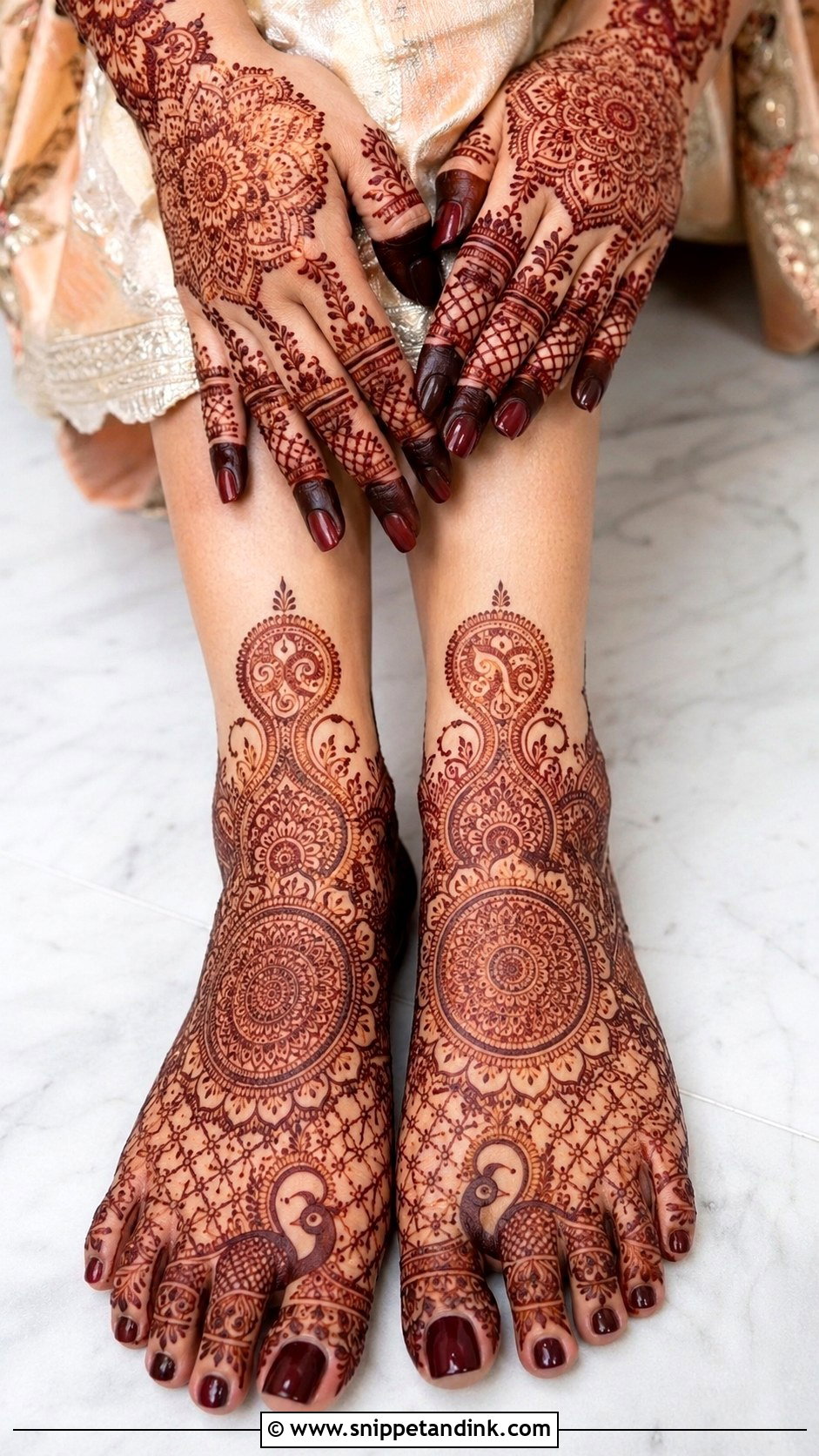
Matching doesn’t mean identical. The motifs on your hands, lotus, paisley, jaali, mandala, peacock or florals, should reappear on the feet in a scale and density that suits them. Hands can carry fine detail that would blur on a foot, so I simplify as I translate. Share your hand mehndi reference with your artist and ask for a foot version that fits your outfit and how much time you can spend off your feet.
Straps, Juttis and Heels Against a Fresh Stain
Bring your wedding shoes, or at least a photo of them, to the consultation. Straps across the top of the foot, a closed jutti or a heel that grips the side of the foot all change where henna will show and where it will be rubbed away.
- Closed juttis or pumps: concentrate detail on the ankle and lower leg, since the top of the foot will be covered.
- Strappy sandals: I place motifs between the strap lines and keep the strap path itself light.
- Toe-post sandals: leave the gap between the big and second toe fairly open, as the post rubs it constantly.
- Barefoot ceremonies: a design on the soles makes sense here, because they will actually be seen.
Avoid putting on new shoes for the first time on the wedding day. A stiff strap rubbing over fresh henna can lift the color in a line, and it’s one of the most common reasons a bride’s foot design looks patchy in later photos.
A Night With Paste on Your Feet
Once the feet are done, you can’t walk until the paste is dry, and even then it cracks easily. I usually do the feet at a point when the bride can sit with her legs raised and someone else can bring her what she needs. A lemon and sugar dab keeps the paste in contact with the skin as it dries.
For sleeping, wrap the feet loosely in tissue or cotton and put old cotton socks over the top, which hold the paste in place and protect the sheets. Skip plastic wrap; it traps sweat and blurs the lines. In the morning, scrape the paste off rather than washing it, and keep water away as long as you can so the stain has time to deepen.
What Your Footwear Should Decide Before Your Artist Does
Full-leg Indian work, Arabic trails, mandala centres, jewelry patterns and light ankle designs can all be right; the deciding factors are your outfit, your shoes, the ceremony and the hours you can spend sitting still. Favour clear outlines and placements that won’t sit under a strap. Plan the drying time as carefully as the design, and your feet will look as finished at the last dance as they did in the first photo.
You'll Like These Ideas:




Leave a Reply