
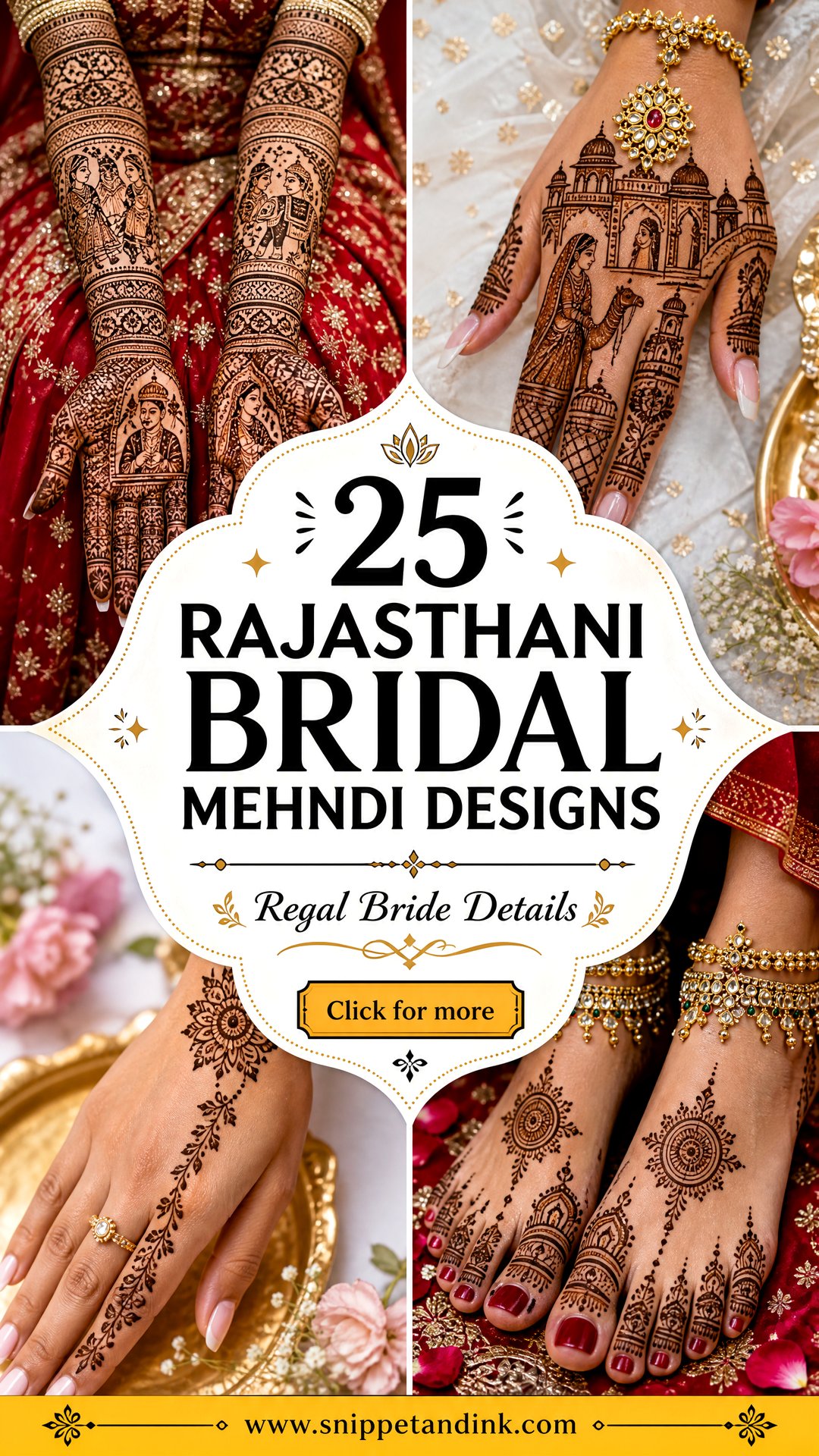
Rajasthani bridal henna is the work I plan longest for, because it is less a pattern than a small painting that has to read clearly on a moving hand. Expect dulha-dulhan portraits, peacocks, elephants, jaali panels, palanquins and procession scenes, all packed with fine filler. What separates a good Marwari layout from a crowded one is hierarchy: two or three bold focal points, and everything else drawn thinner so it supports them. Below are 25 layouts I’d talk a bride through, with notes on where each one works and where it struggles.
How Long a Full Marwari Sitting Really Takes
Brides tend to underestimate this. A full Rajasthani design on both hands to the forearm, front and back, is a long sitting, often several hours, and adding feet can stretch it close to a full day. Portrait and procession work adds more on top, because figures can’t be rushed. Ask your artist for an honest estimate based on your exact coverage, not on a photo of someone else’s hands.
I schedule bridal henna one or two days before the wedding. Natural henna comes off the skin a bright orange and darkens over the next 24 to 48 hours, so applying it the night before means you walk into the ceremony before the colour has peaked.
- Eat properly and use the bathroom before we start; once the palms are wet you can’t do much for yourself.
- Wear something with wide sleeves or a front opening you won’t need to pull over your head.
- Book feet as a separate block if the day is already packed. They can go on while your hands dry.
- Skip lotion, oil and scrubs on the day. Clean, dry skin takes the dye best.
1. Rajasthani Full Hand Bridal Mehndi Design
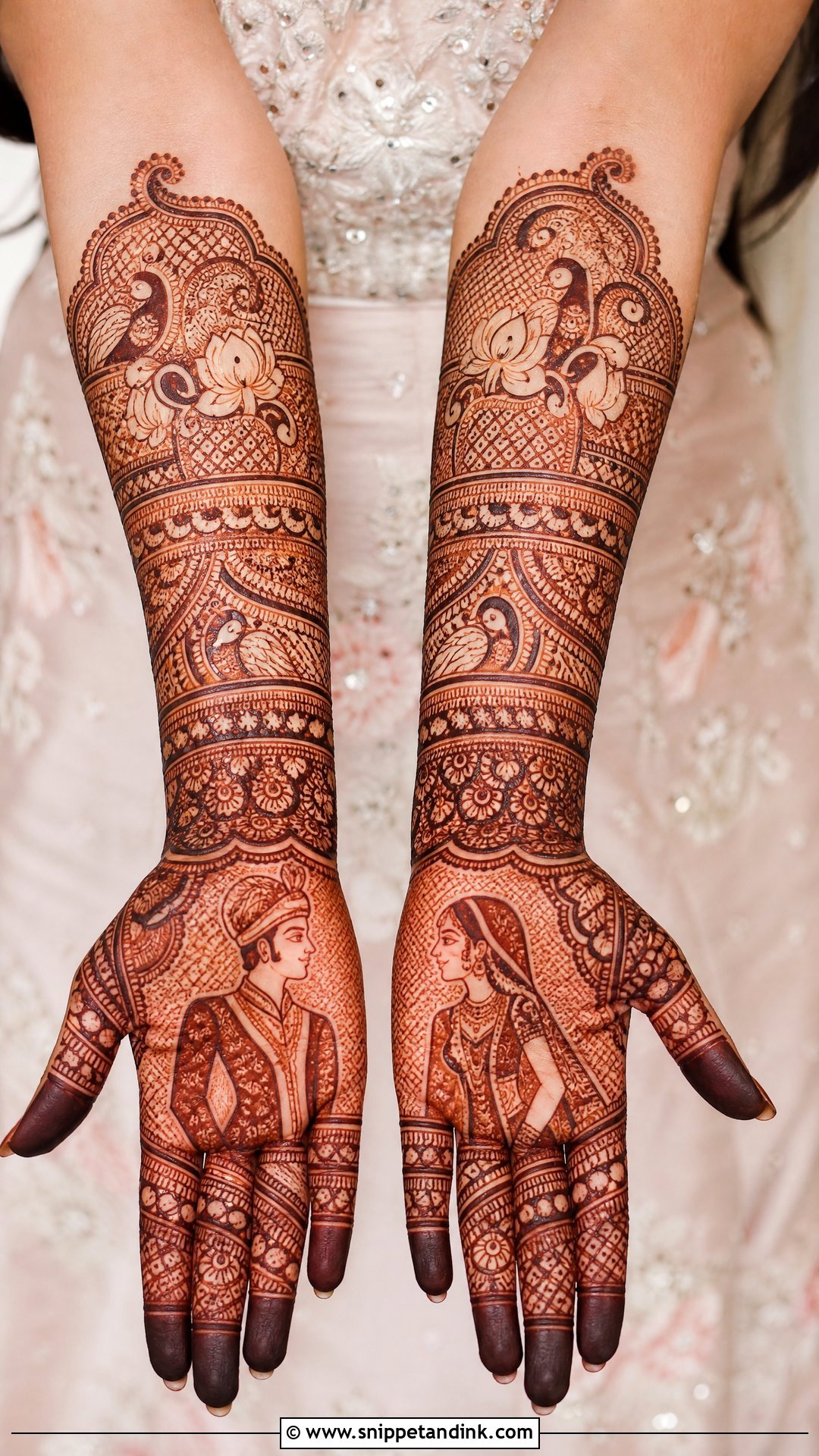
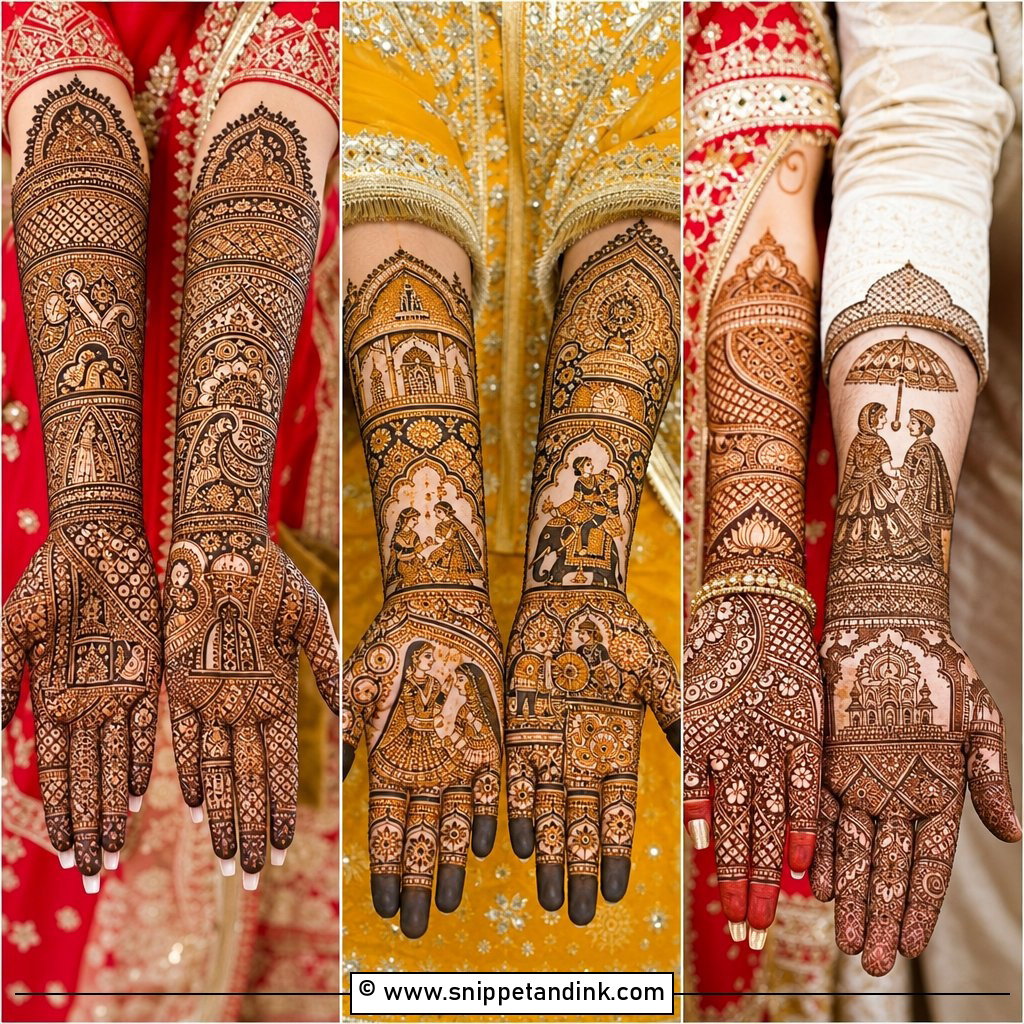
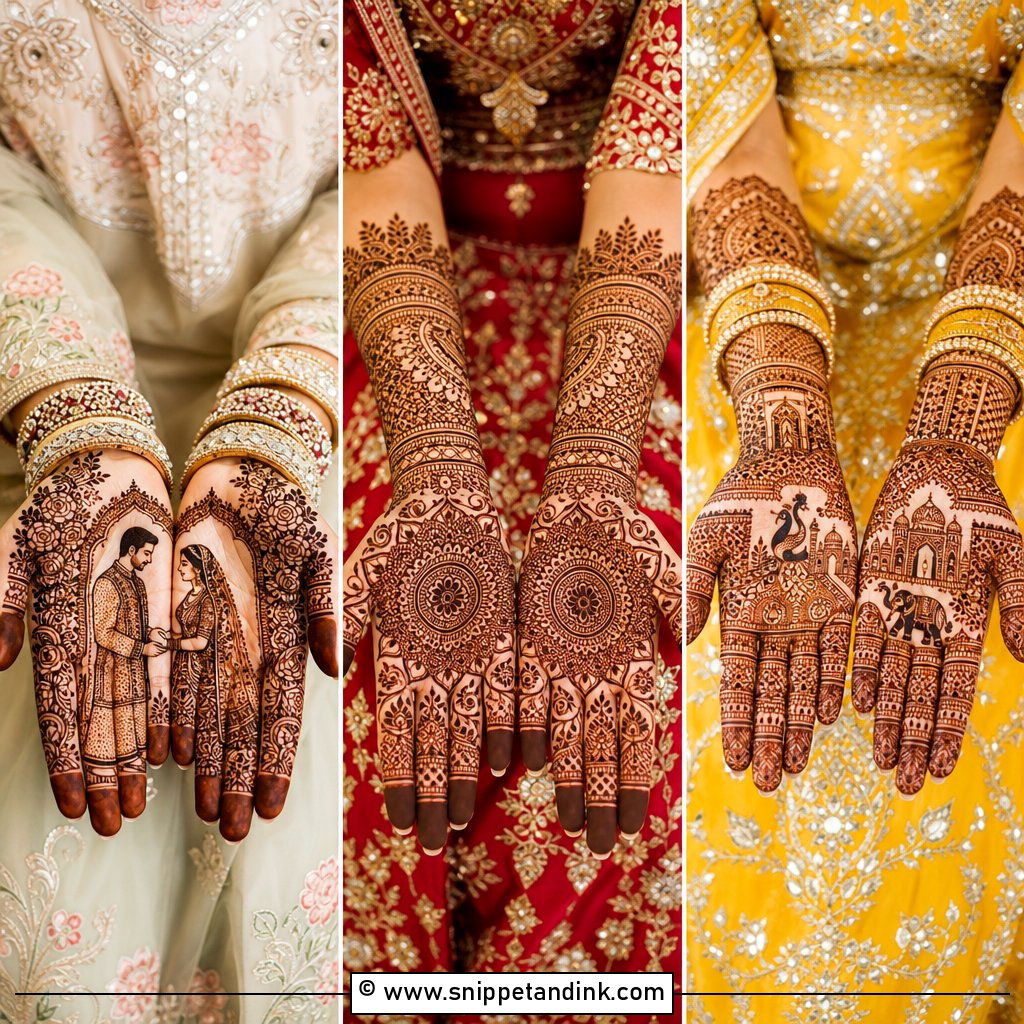
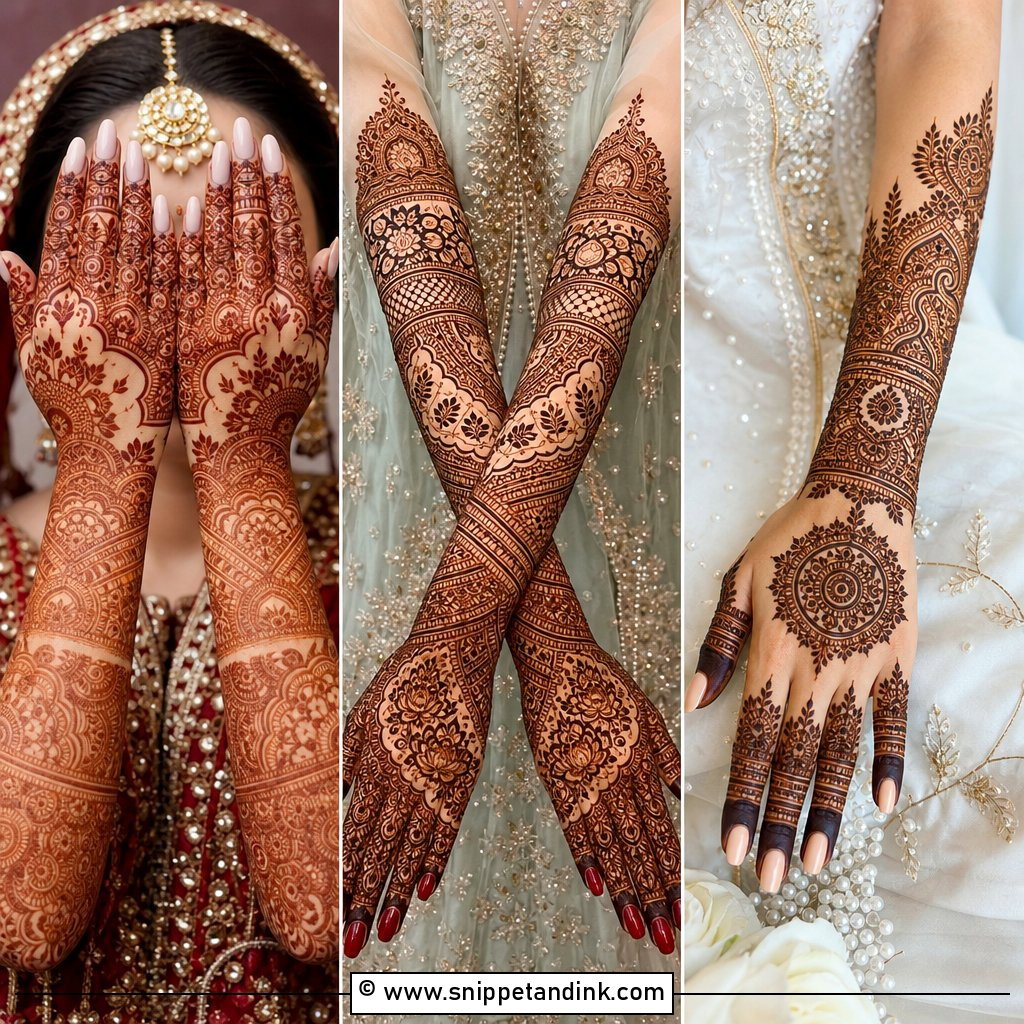
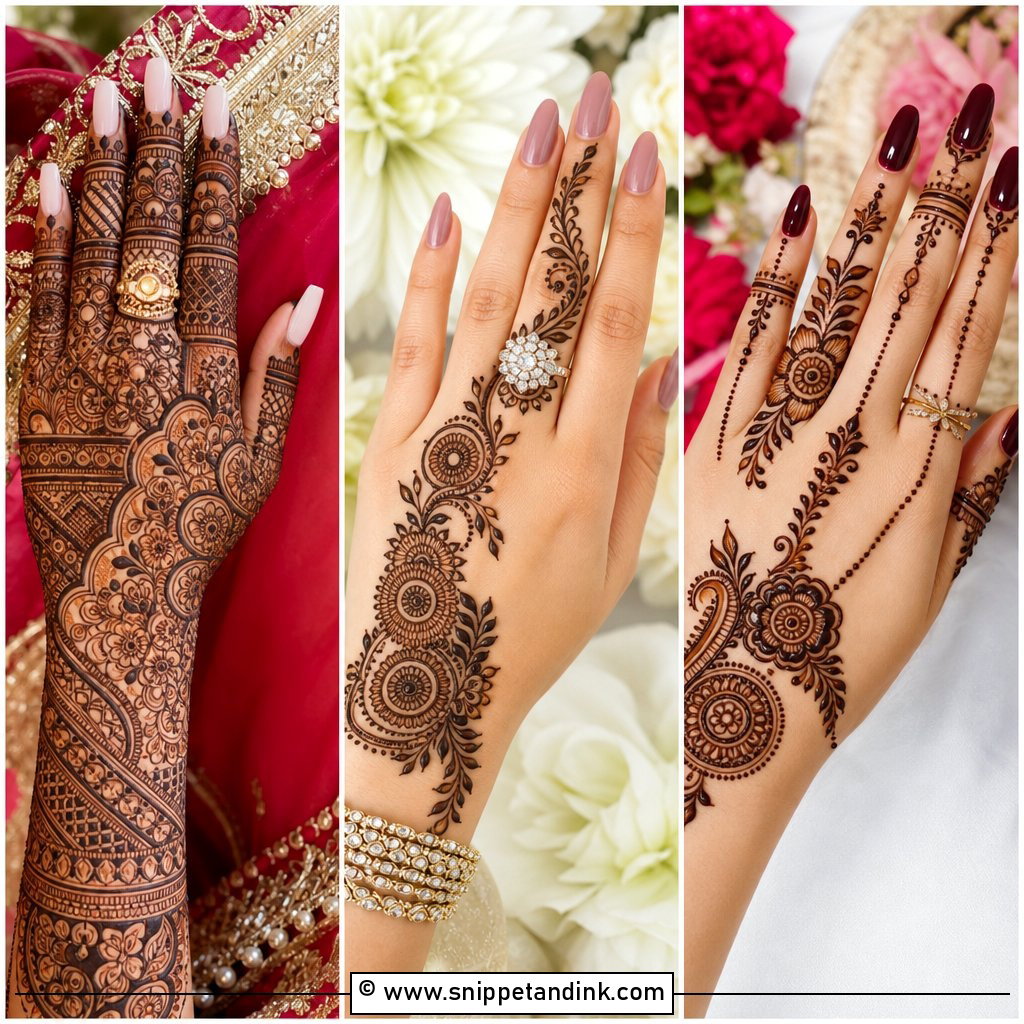
This is the full traditional coverage: fingertips to past the wrist, often climbing toward the elbow. A Rajasthani full hand bridal mehndi design usually puts a portrait or mandala in the palm, then fills the rest with paisleys, lotus vines and fine jaali, while the back of the hand carries a mandala, bracelet bands and finger caps. I always draw the main motifs first and in a thicker line, then fill. If the fillers go in first, the portrait ends up squeezed into whatever space is left. Heavy lehengas and Rajputi poshak carry this density well; a light chiffon outfit can make it look out of proportion.
2. Rajasthani Dulha Dulhan Mehndi Design
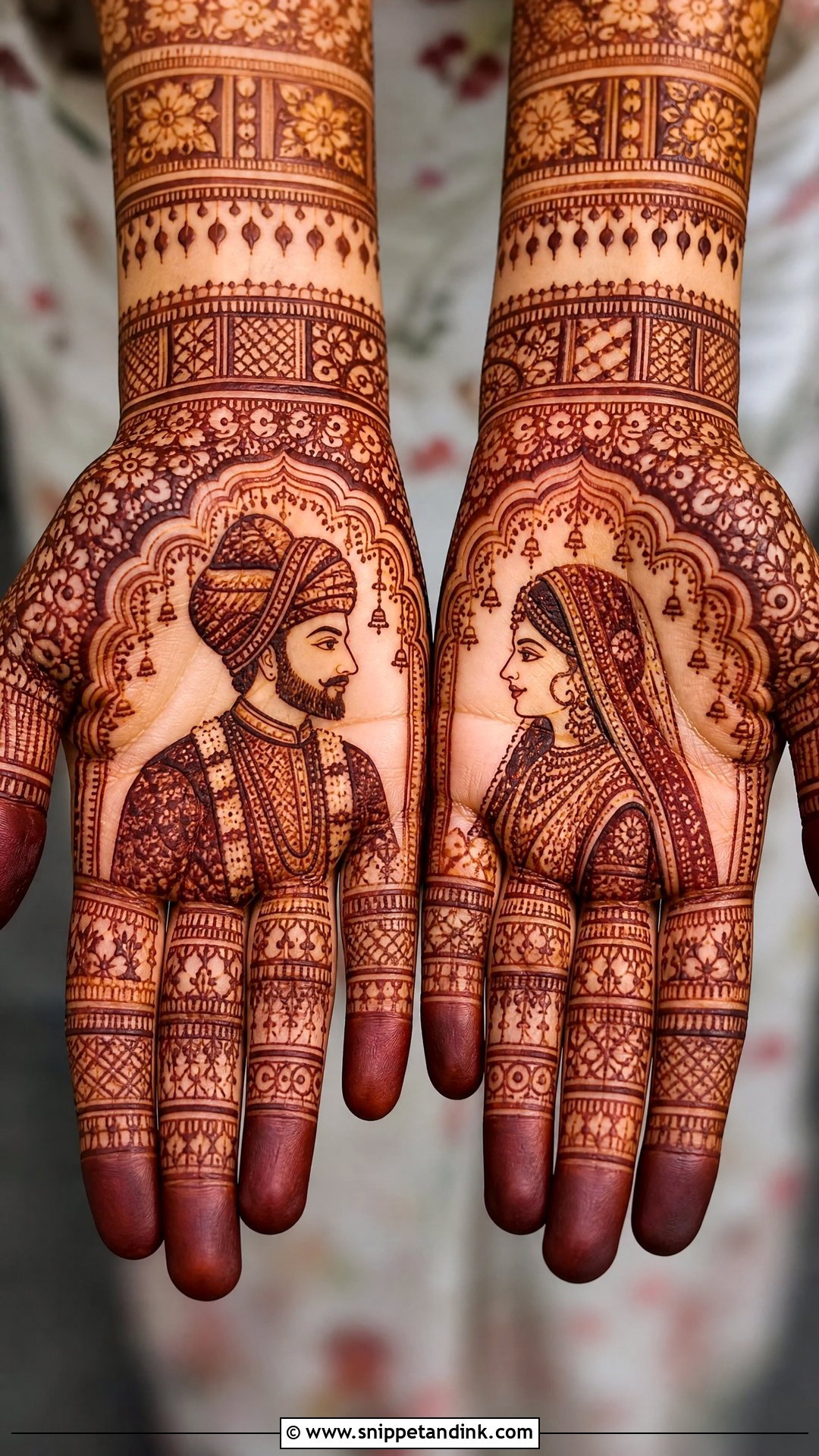
One palm holds the bride, the other the groom, so the couple only meets when she joins her hands. That’s the detail I explain before I start, because it decides which way each face turns. I frame the figures with jharokha arches or garlands and pack dots, leaves and netting around them. Faces are the hardest part: the eyes and nose sit in a space smaller than a fingernail, and a cone that drips even slightly will blur them, so I keep a fresh fine-tip cone just for portraits. Initials or a date can hide near the figures without upsetting the balance.
3. Rajasthani Peacock Bridal Mehndi Design
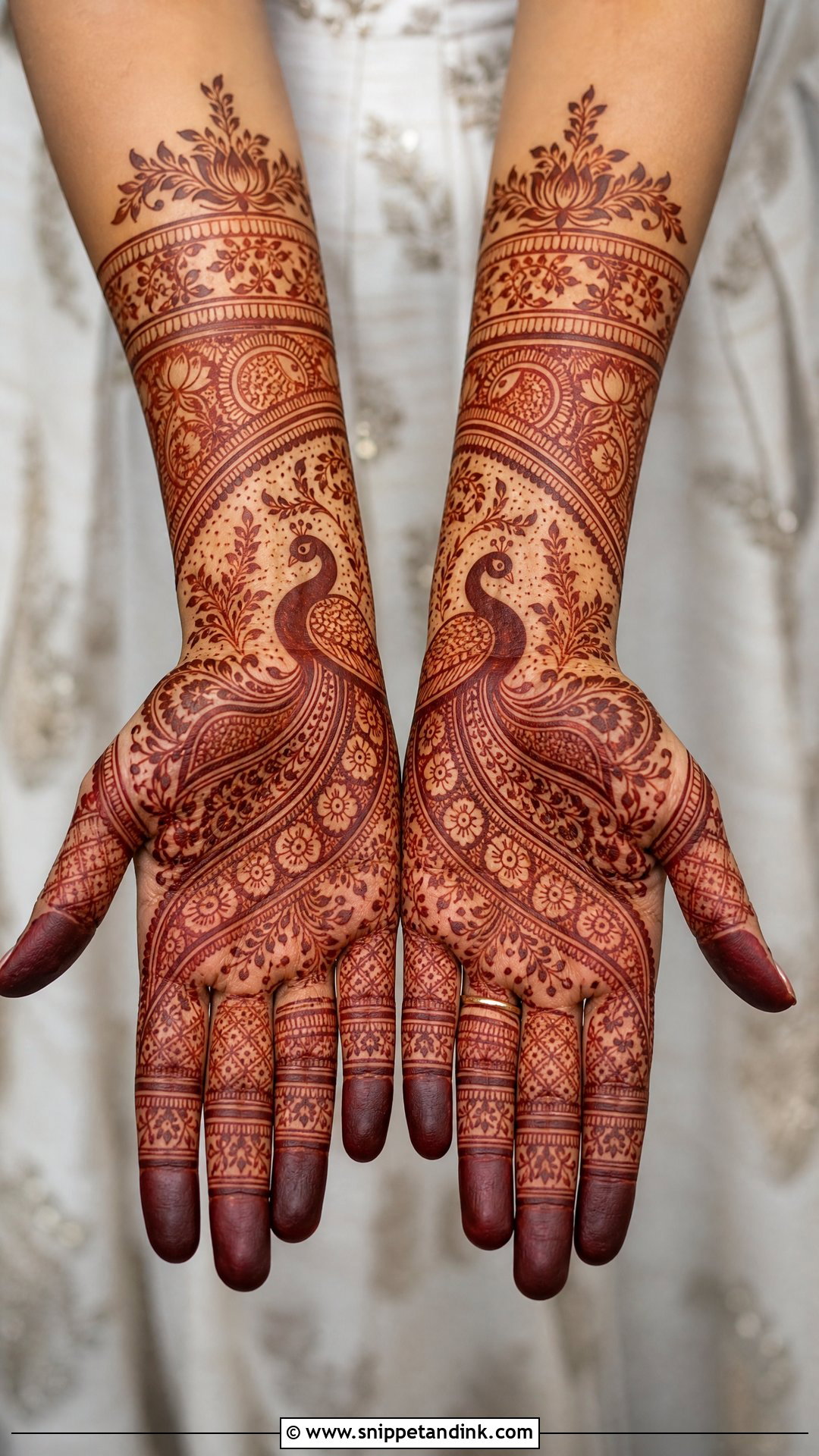
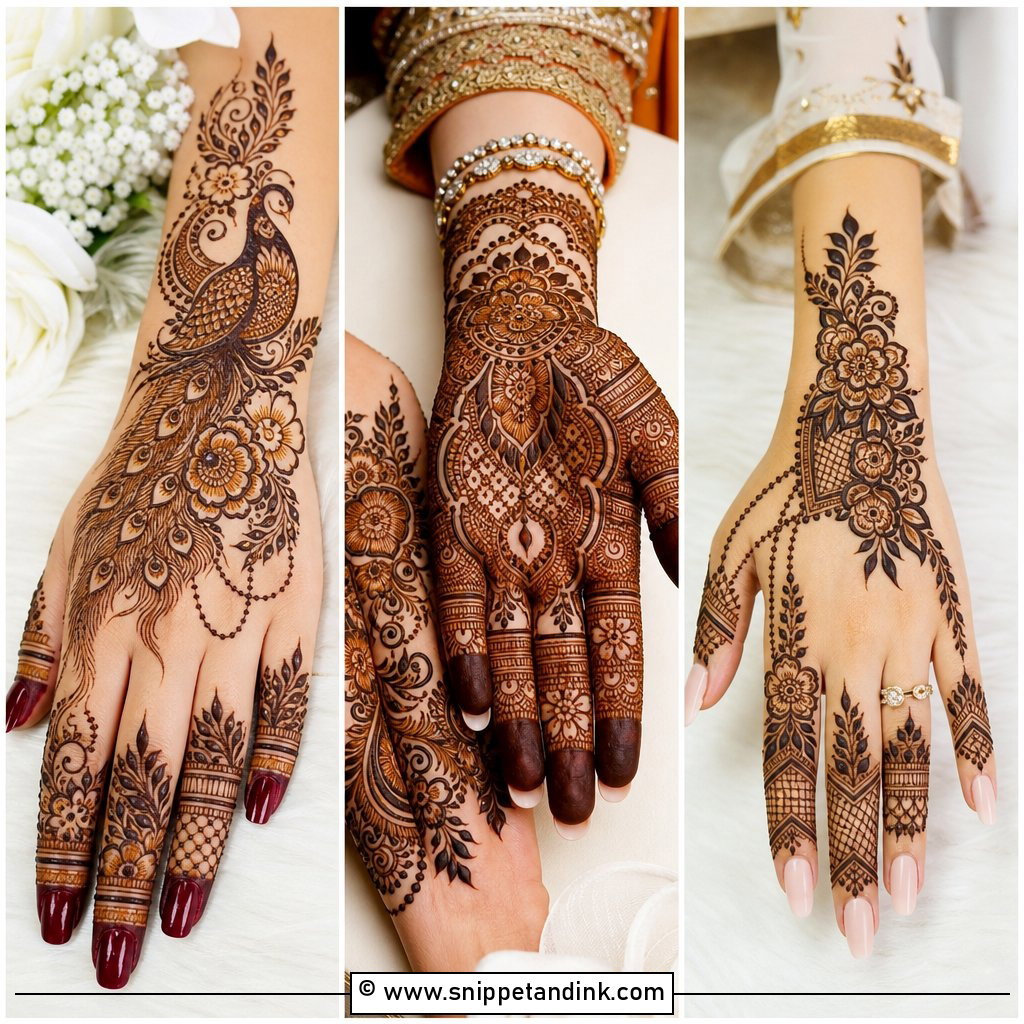
A peacock is the motif I’m asked for most after the portraits, and it is forgiving because the feathers can stretch to fit any hand. It can sit in the palm, curve along the wrist or fan up the forearm. The feathers are where the work shows: tiny checks, dots and leafy strokes in each eye, with a shaded outline. Mirroring the bird on both hands so the heads face each other gives a tidy close-up when the hands are held together. Brides who want something traditional but would rather skip figures usually land here.
4. Rajasthani Mandala Bridal Mehndi Design
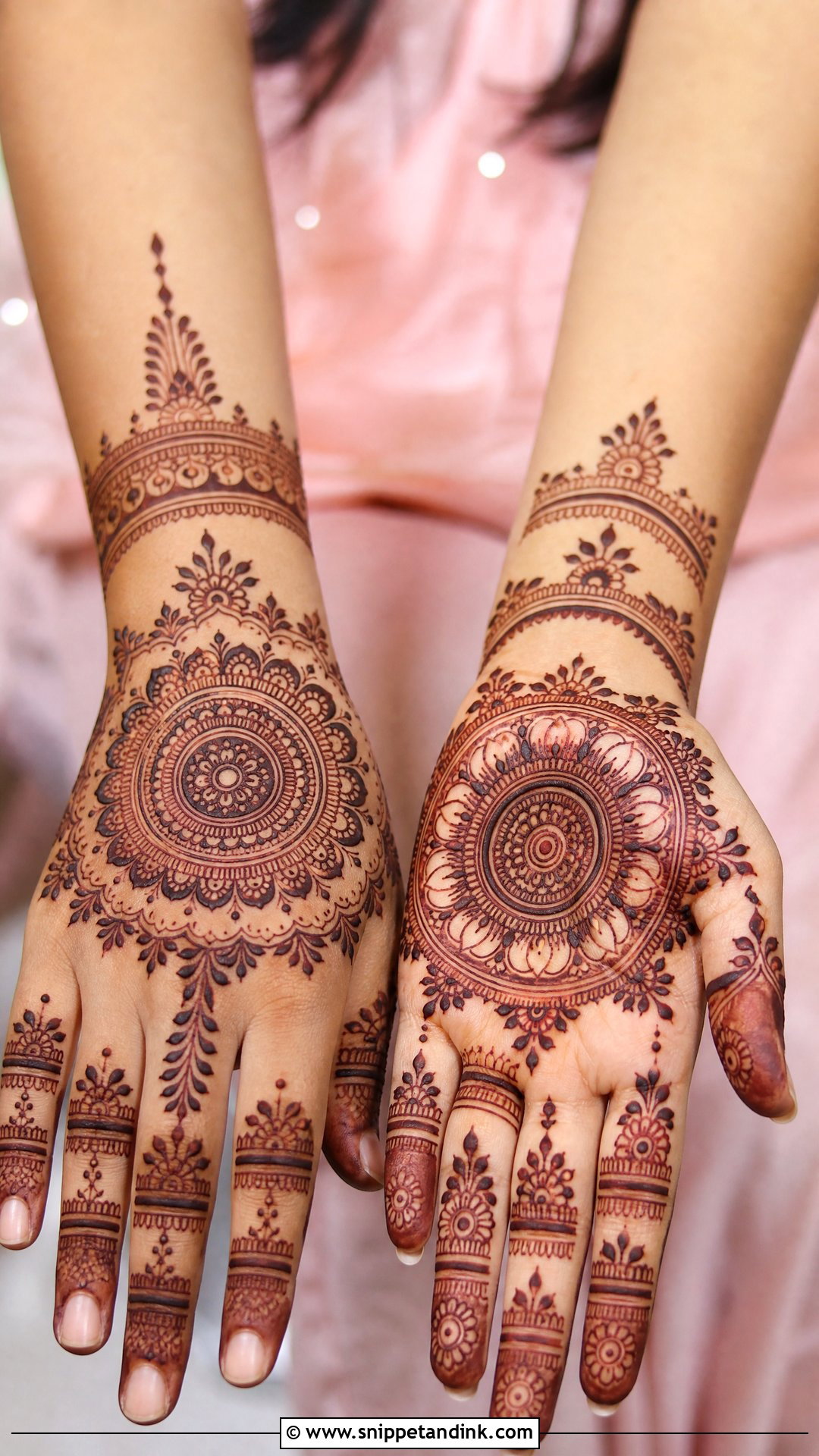
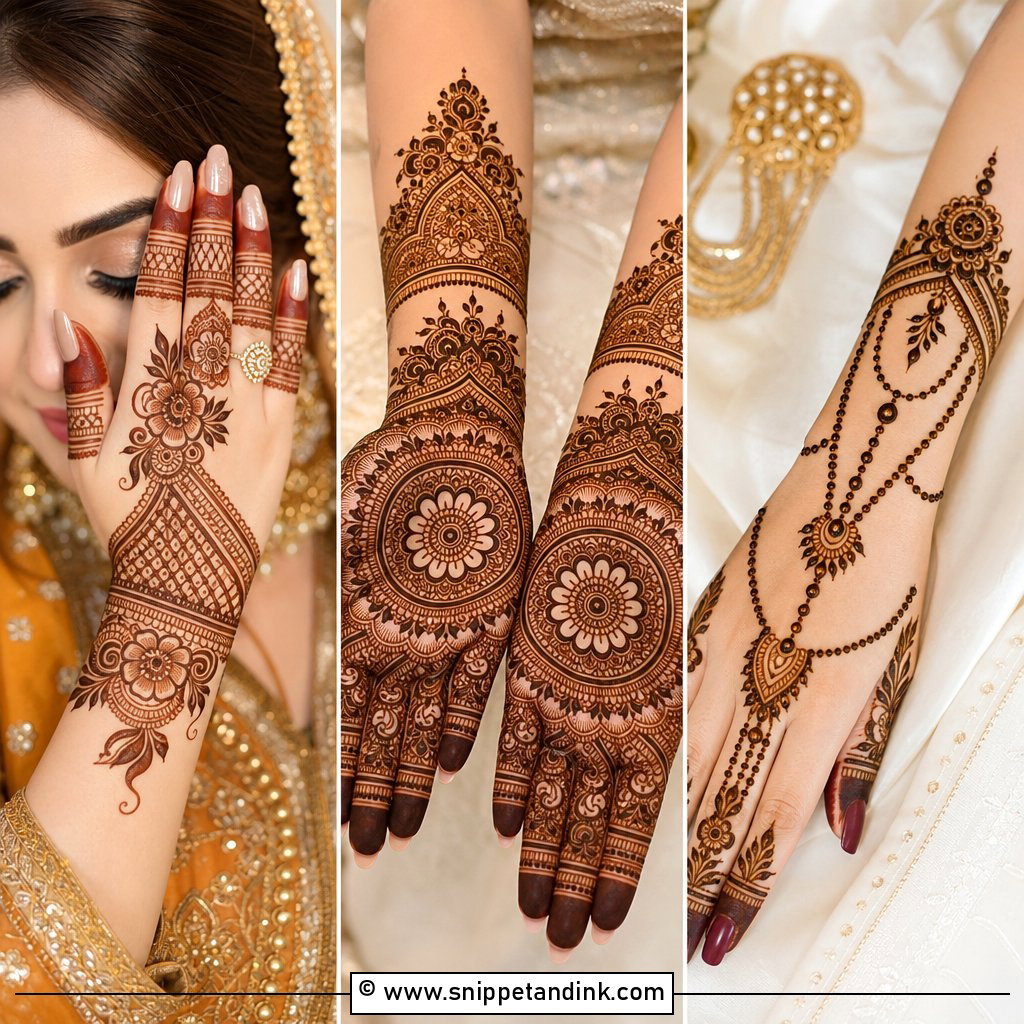
A mandala calms down a busy layout. I place a bold circle in the centre of the palm, ring it with lotus petals, dotted borders and paisleys, then keep the fingers in fine lines and small mesh. On the back hand the same circle can link to the fingers with a haathphool chain. Getting it centred matters more than people expect: I mark the middle of the palm with a dot while the hand is relaxed, since a flattened palm shifts the centre and the circle looks off once the fingers curl. Smaller hands suit this well because one round focal point does the job without crowding.
5. Rajasthani Jaal Bridal Mehndi Design
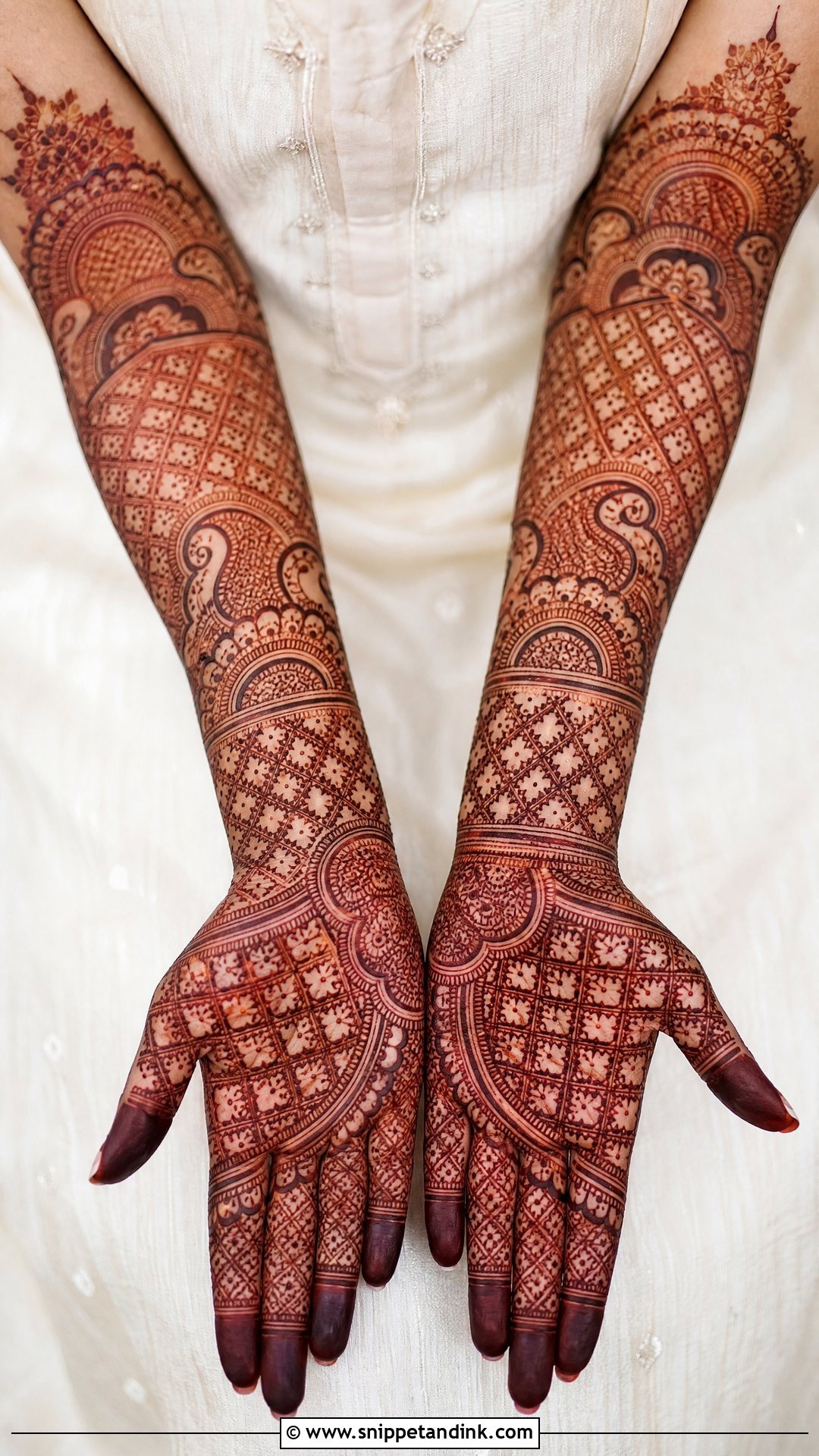
Jaal is a net of diamonds or ovals across the hand, each cell filled with a dot, a flower or a tiny paisley. It reads as dense from a distance and neat up close, which is why so many Rajasthani brides choose it. A central bride-groom motif can sit in the palm with bold bands framing the mesh at the wrist and forearm. The discipline is in spacing: if the cells drift wider toward the edge of the palm, the eye catches it straight away. I draw the grid lines first, all of them, before filling a single cell.
6. Rajasthani Elephant Bridal Mehndi Design
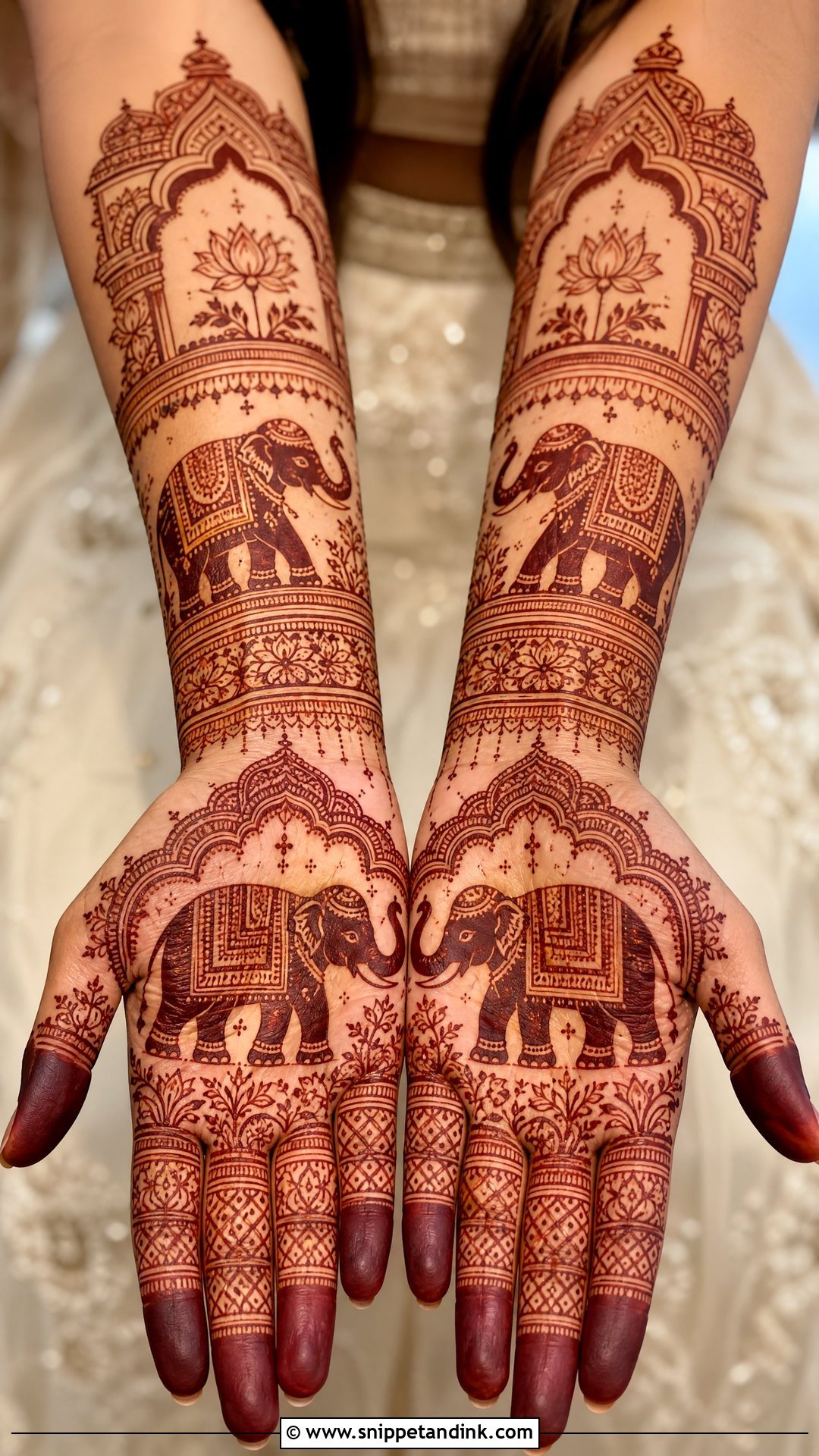
Elephants bring the procession feeling, decorated with tiny blankets, bells and ornamental lines. I usually place them near the wrist or lower palm, facing inward on both hands, with a mandala or the couple between them. The trunk and ears need room; squeezed onto a narrow wrist, an elephant turns into an unreadable blob once the stain darkens. When the hands are joined for photos, the two animals frame the centre scene, and that inward placement is the whole point of the design.
7. Rajasthani Baraat Mehndi Design
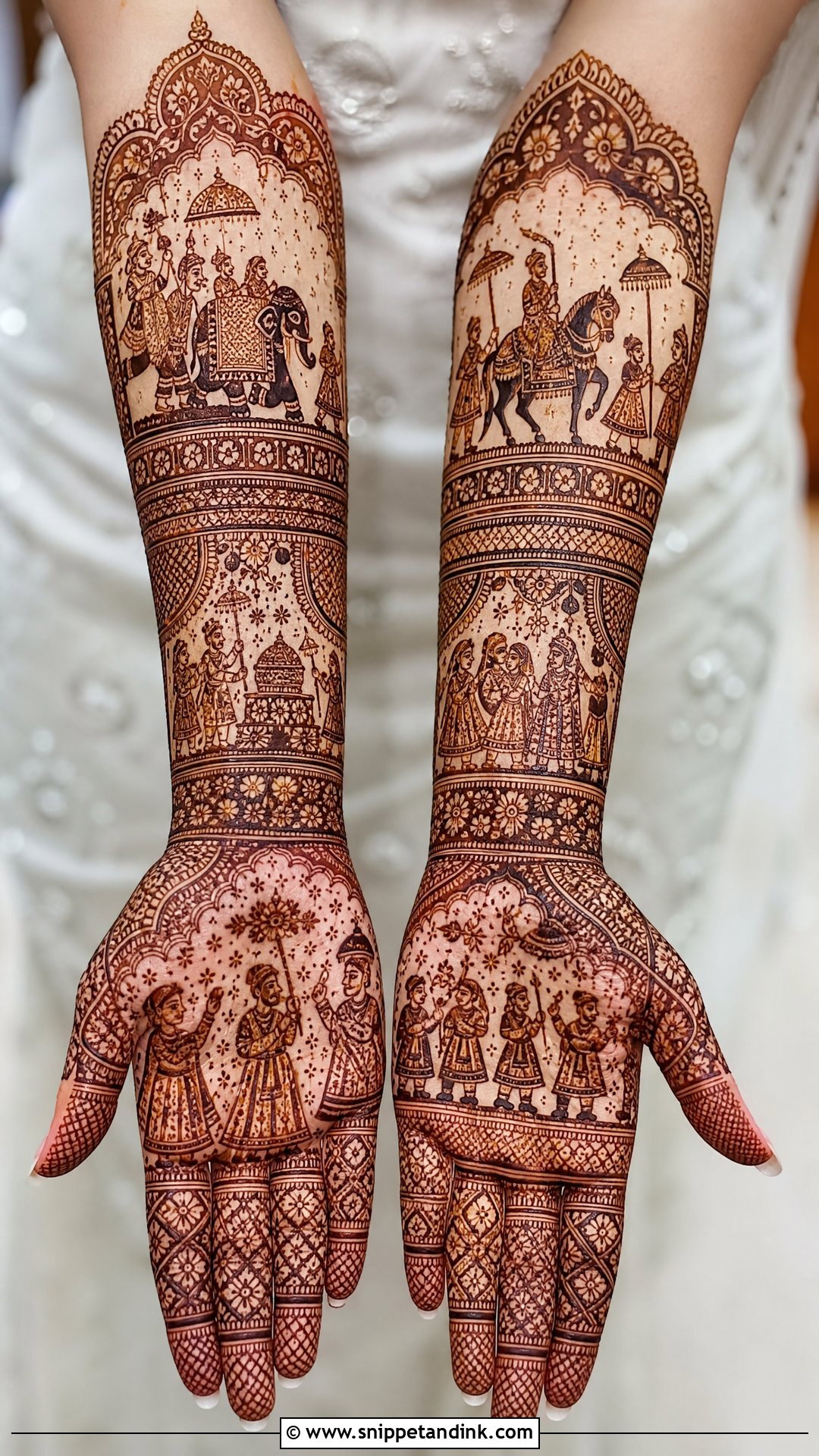
Baraat scenes show the groom’s procession: a groom on horseback, dhol players, elephants, falling flowers. They need space, so I put them on the forearm or split them across both palms, with checks, vines and dot clusters around the figures. This is not one to give a newer artist. Small figures drawn in a shaky line lose their shape once the paste swells slightly as it dries, and a horse’s legs are the first thing to merge. In steady hands it ends up looking like a miniature painting on skin.
8. Rajasthani Jharokha Bridal Mehndi Design
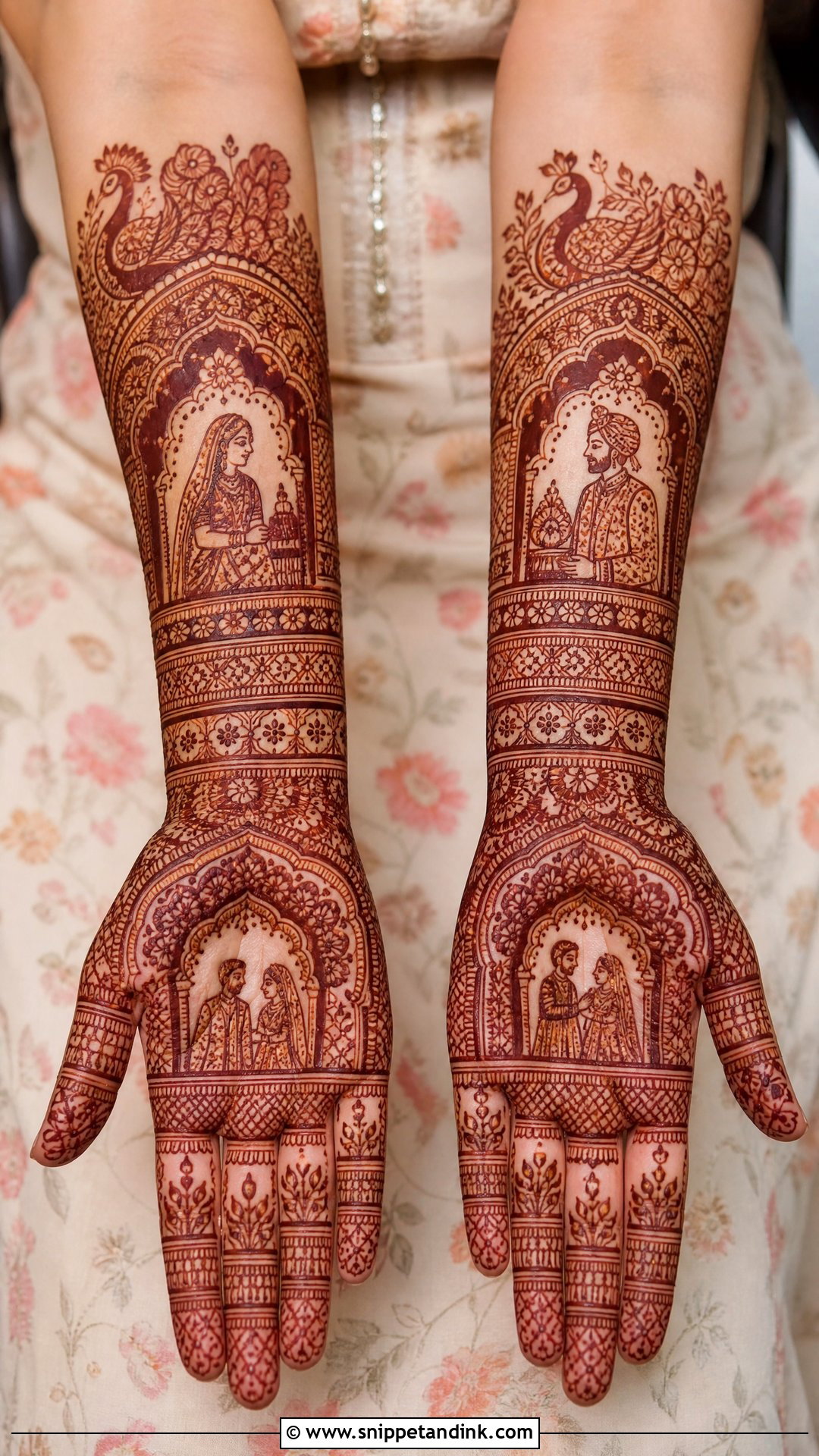
The jharokha, an arched window shape, is the motif people recognise first as Rajasthani. I use it to frame a portrait, a peacock or a lotus on the palm or forearm, where the arch has room to show its curve. Fine jaali and paisley vines fill the space around it. In a dense bridal hand, the arch gives the eye somewhere to rest, so I draw its outline in my thickest line. On a short palm it can look cramped, and I’d move it to the inner forearm instead.
9. Rajasthani Lotus Bridal Mehndi Design
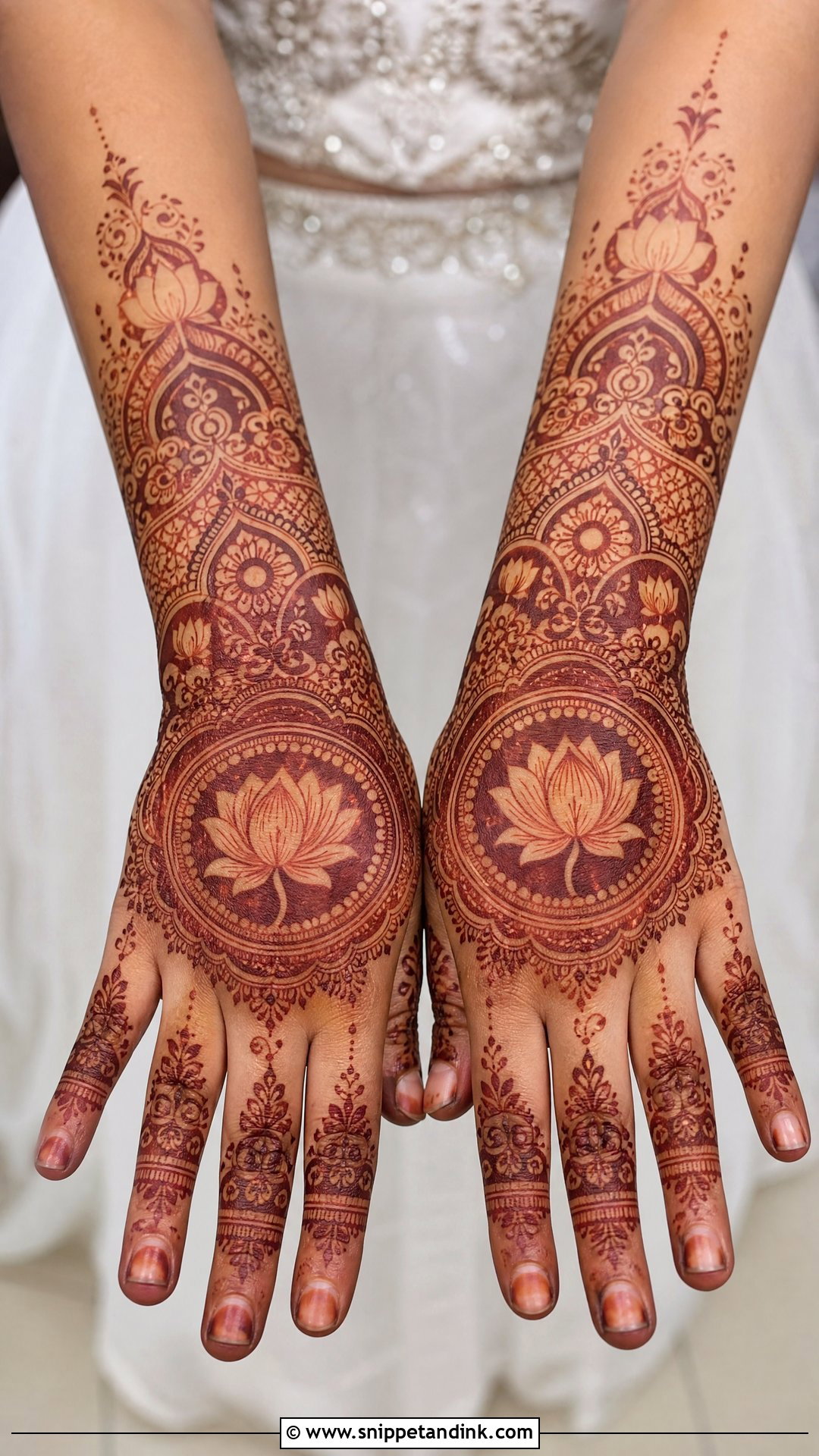
A large lotus in the palm with smaller buds drifting toward the fingers and wrist softens a heavily traditional design. I like the petals outlined with dots or filled with fine inner lines rather than solid shading; solid fill on the palm stains so dark that the petal shape disappears. The lotus pairs easily with mandalas, peacocks and paisleys, and on the back hand it can sit at the centre of a haathphool pattern that sits nicely under bangles and rings. It feels rich without tipping into heavy.
10. Rajasthani Paisley Bridal Mehndi Design
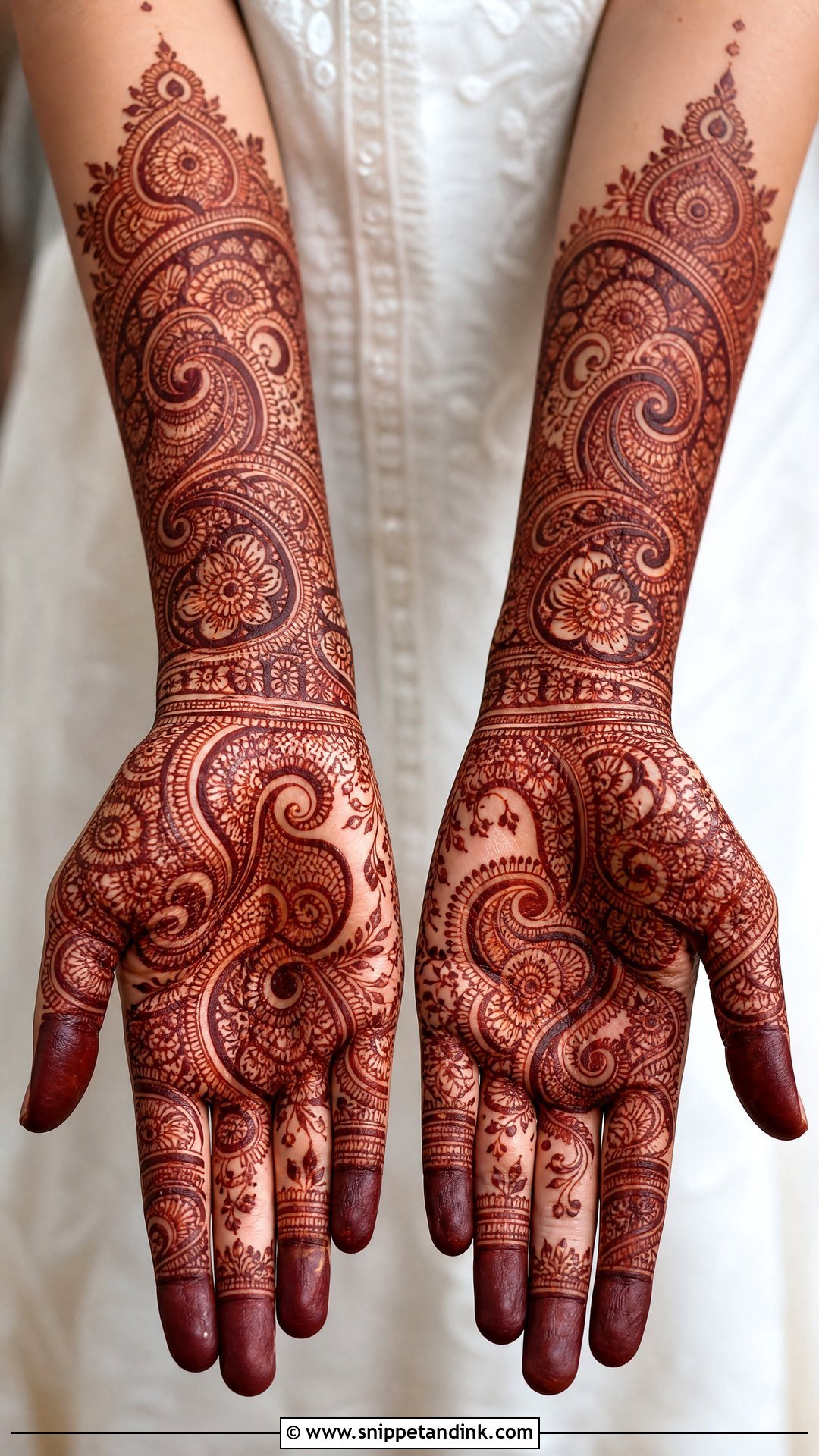
Paisley is the backbone of full-hand Rajasthani coverage. Large ones run across the palm and wrist, smaller ones fill the fingers and forearm, and each one holds flowers, spirals, checks or leaves inside. It’s my usual suggestion for a bride who wants traditional density but no portraits. Direction changes how the hand reads: a diagonal flow of paisleys makes fingers look longer, while round clusters make the hand look fuller. I ask a bride to hold her hand naturally before I decide which way they should travel.
11. Rajasthani Marwari Bridal Mehndi Design
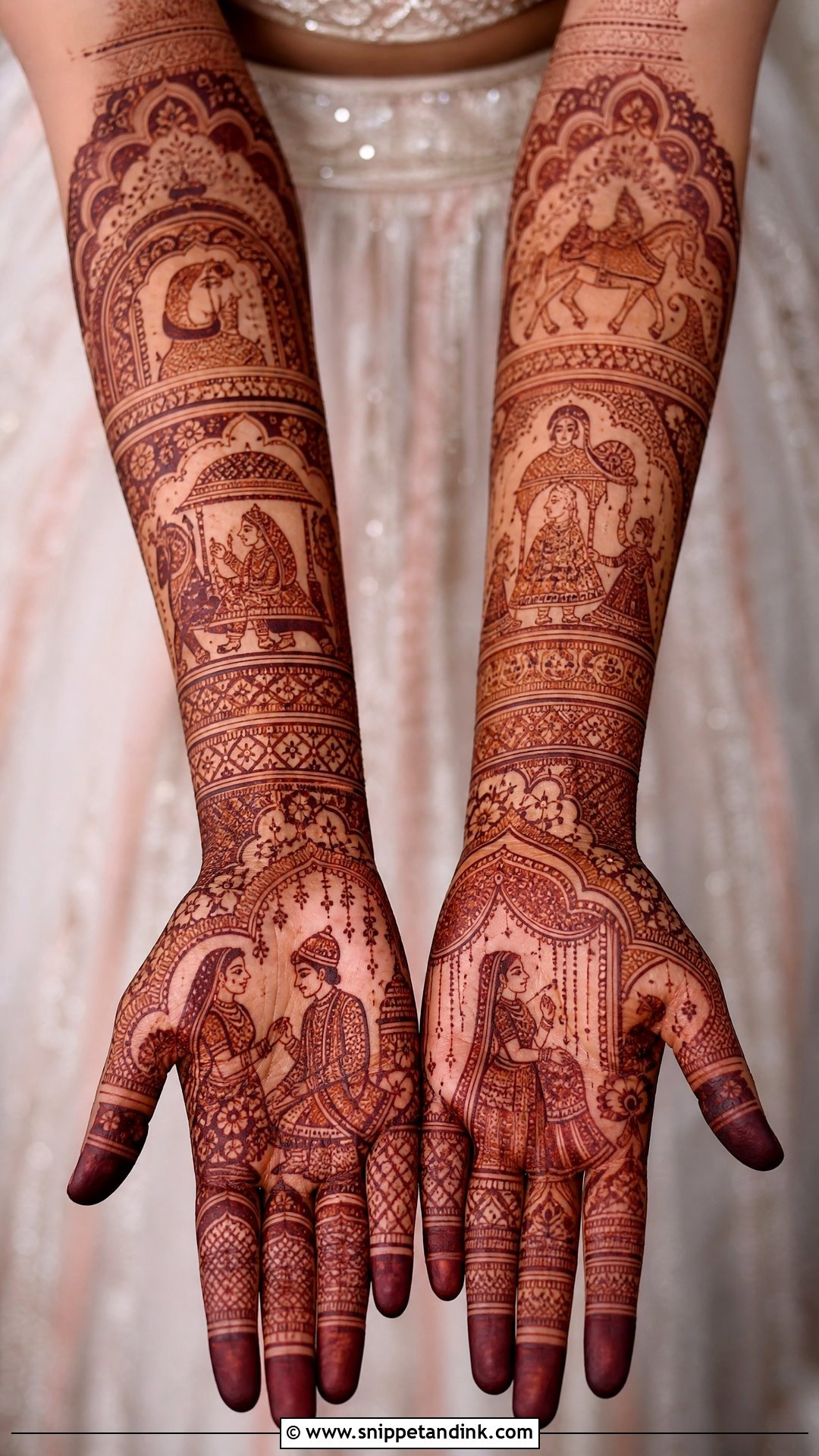
Marwari work is thin lines and almost no empty skin. Dulha-dulhan figures, horses, palanquins, lotus flowers and peacocks are packed together with tight filler, so the hand reads as rich from any angle. The front usually carries the story while the back takes bracelets, mandalas and finger patterns. Be ready for the time it asks of you. Very fine Marwari lines also need a well-mixed, smooth paste, because a lumpy batch breaks the line every few millimetres and the gaps show once it stains.
12. Rajasthani Bridal Mehndi Design Front Hand
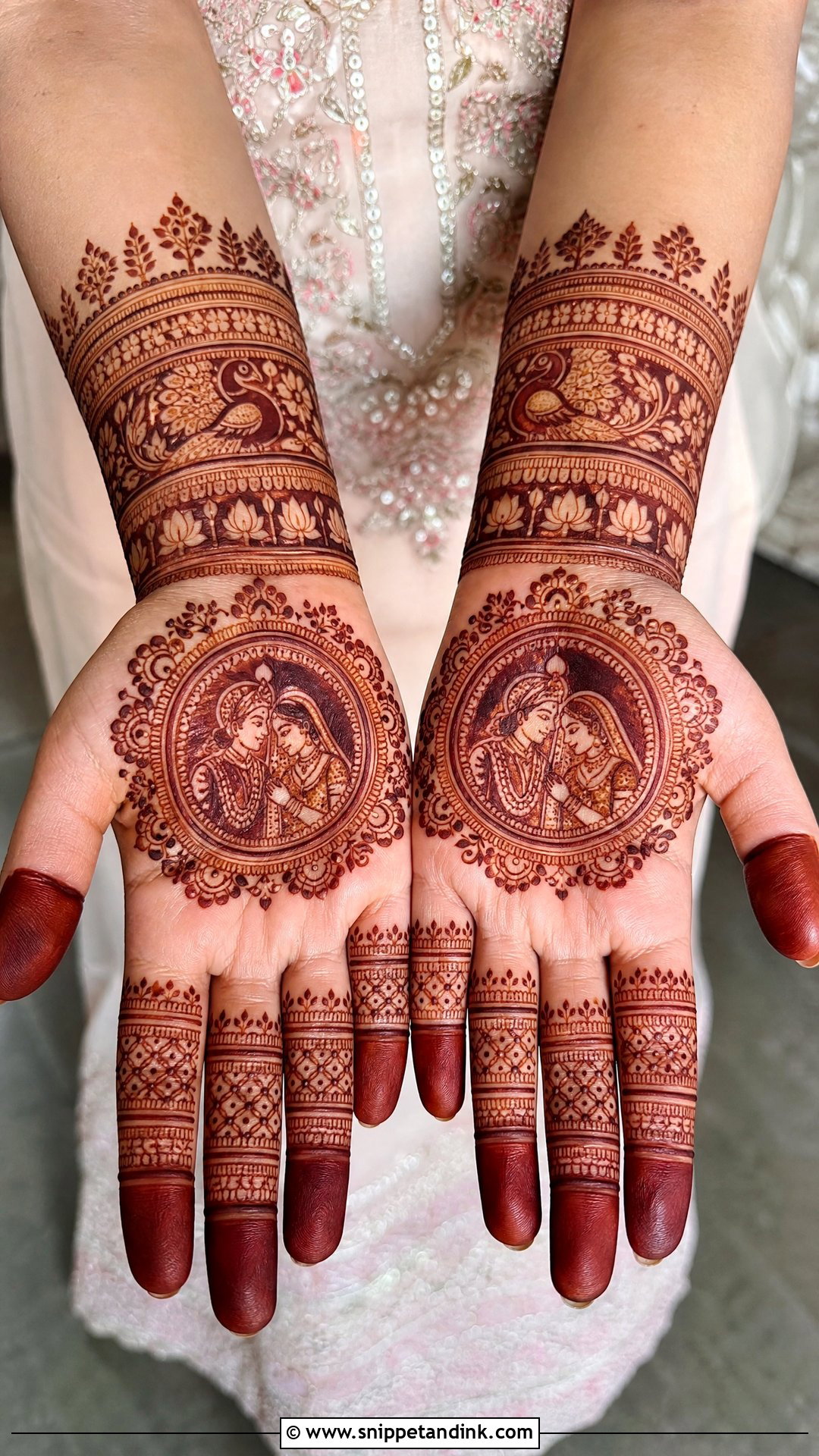
The palm is what the camera sees during the rituals, so the front hand gets the boldest focal point: a mandala, a portrait, a peacock or a garland scene. I never leave the fingers plain on a bridal front hand; leaves, checks, dots and curved bands carry the design to the tips. A layered wrist border then ties the palm to the forearm. My rule here is bold centre, delicate fillers. Reverse that and the palm photographs as a dark smudge.
13. Rajasthani Bridal Mehndi Design Back Hand
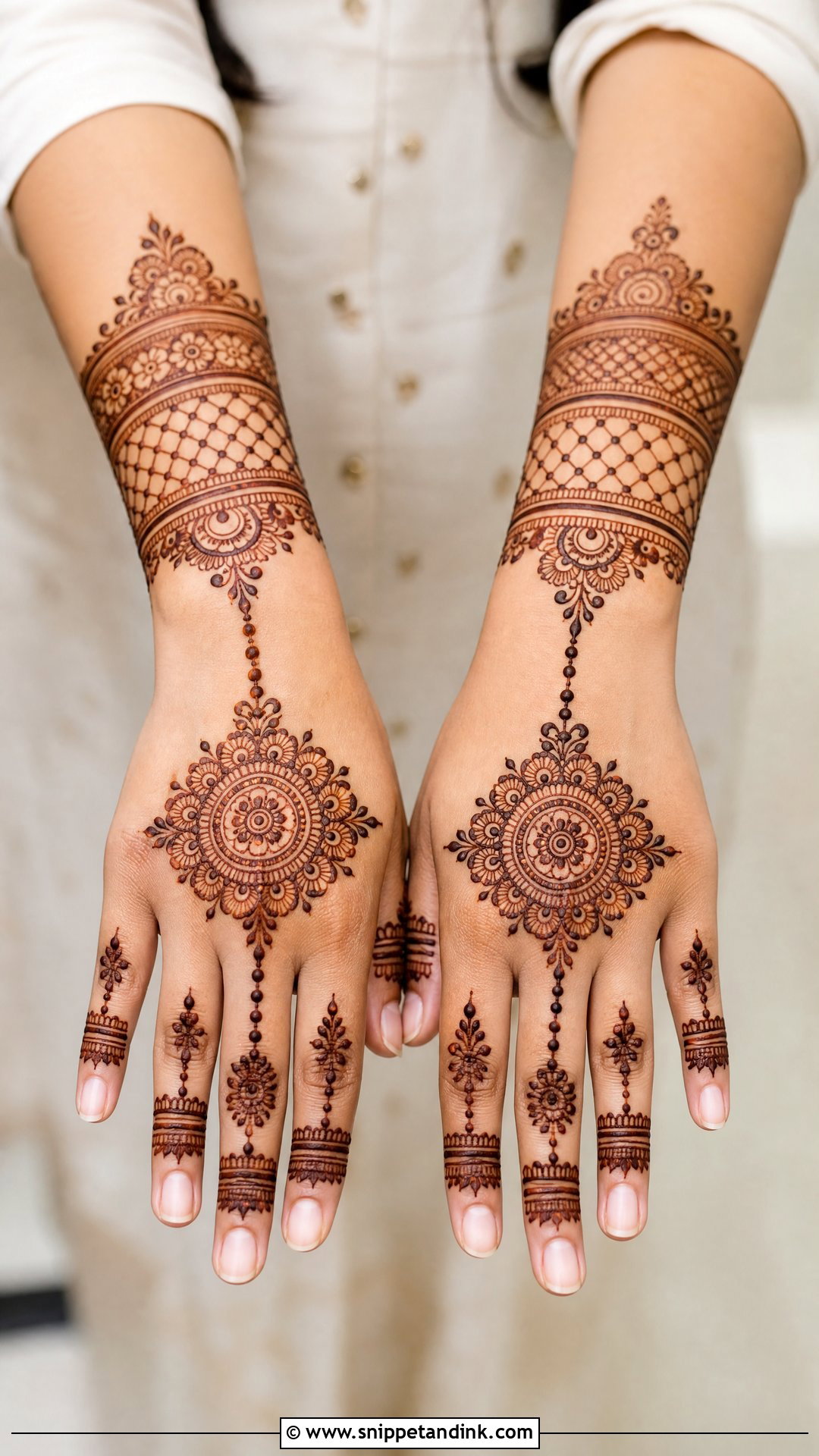
The back hand sits under bangles, rings and kaleeras, so I design it around where the jewellery will fall. A central mandala, a haathphool chain, jaali sections and decorated fingertips are the usual Rajasthani pieces, and a heavier version runs from the fingers up the forearm with peacocks, lotus bands and paisley vines. Knuckles stretch and wrinkle, which distorts any motif placed straight across them, so I keep the finger work slim and let the lines follow the bones rather than fight them. A strong wrist border finishes it off.
14. Rajasthani Bridal Mehndi Design With Name
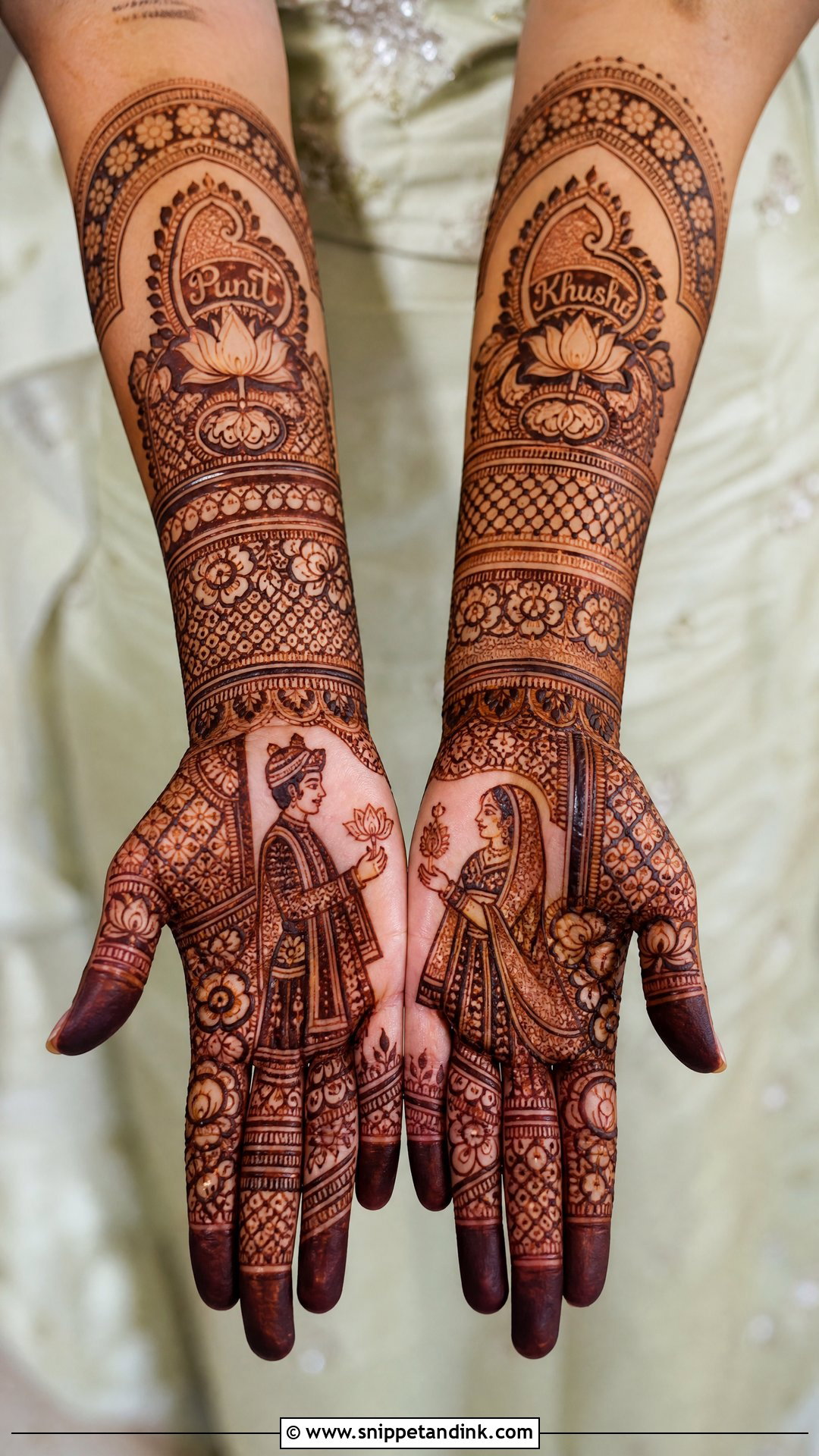
Hiding the groom’s name is still one of the most requested details I get. In a Rajasthani hand I tuck the letters into a paisley, a jaal cell, a lotus petal or beside the couple’s portrait, written in the same line weight as the fillers so they disappear into the pattern. Initials, a date or a small private symbol work the same way. A full-hand design gives the most hiding places. I’d skip it on very minimal hands, because there is nowhere to hide anything and the name just sits there in plain sight.
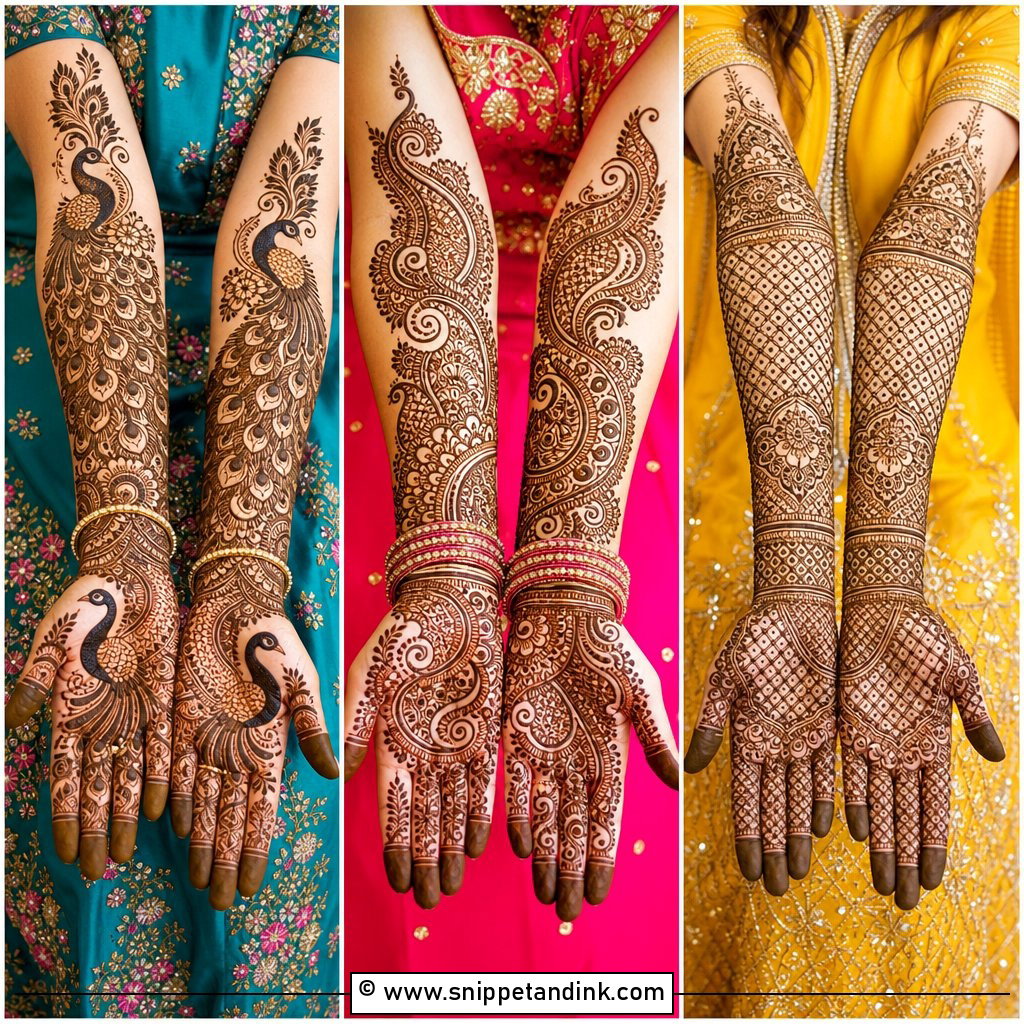
15. Rajasthani Radha Krishna Bridal Mehndi Design
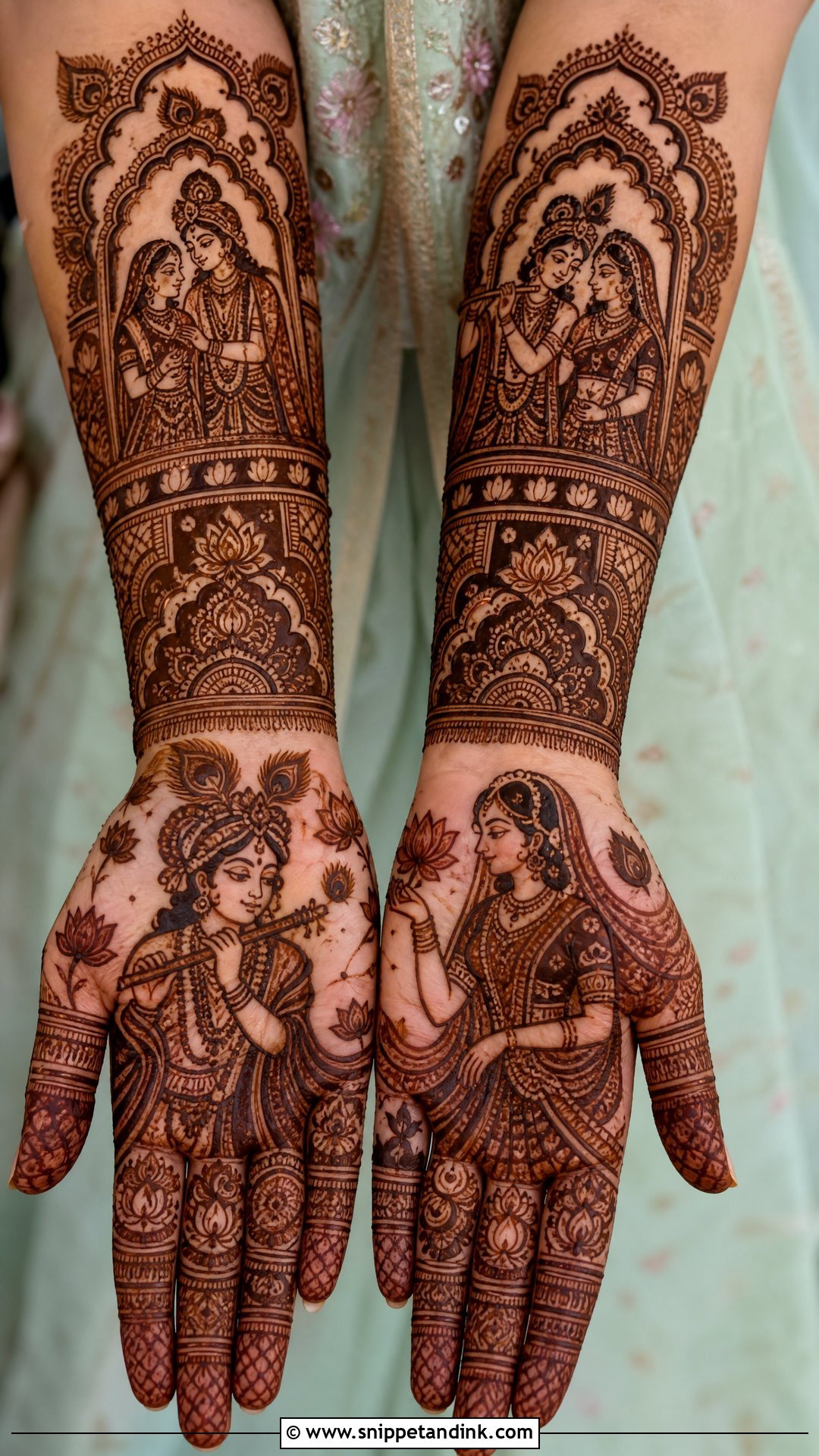
A Radha Krishna bridal mehndi design puts the couple on the palms or forearms, framed by jharokha arches, lotus flowers and peacock feathers, with mandala and jaali filler finishing the coverage. The faces and poses need clean, confident lines; hesitation shows as a wobble that the stain makes darker, not softer. I check with the bride beforehand how she feels about a devotional image on her hands, since some families prefer figures of deities kept off the feet and away from areas that get washed constantly.
16. Rajasthani Doli Bridal Mehndi Design
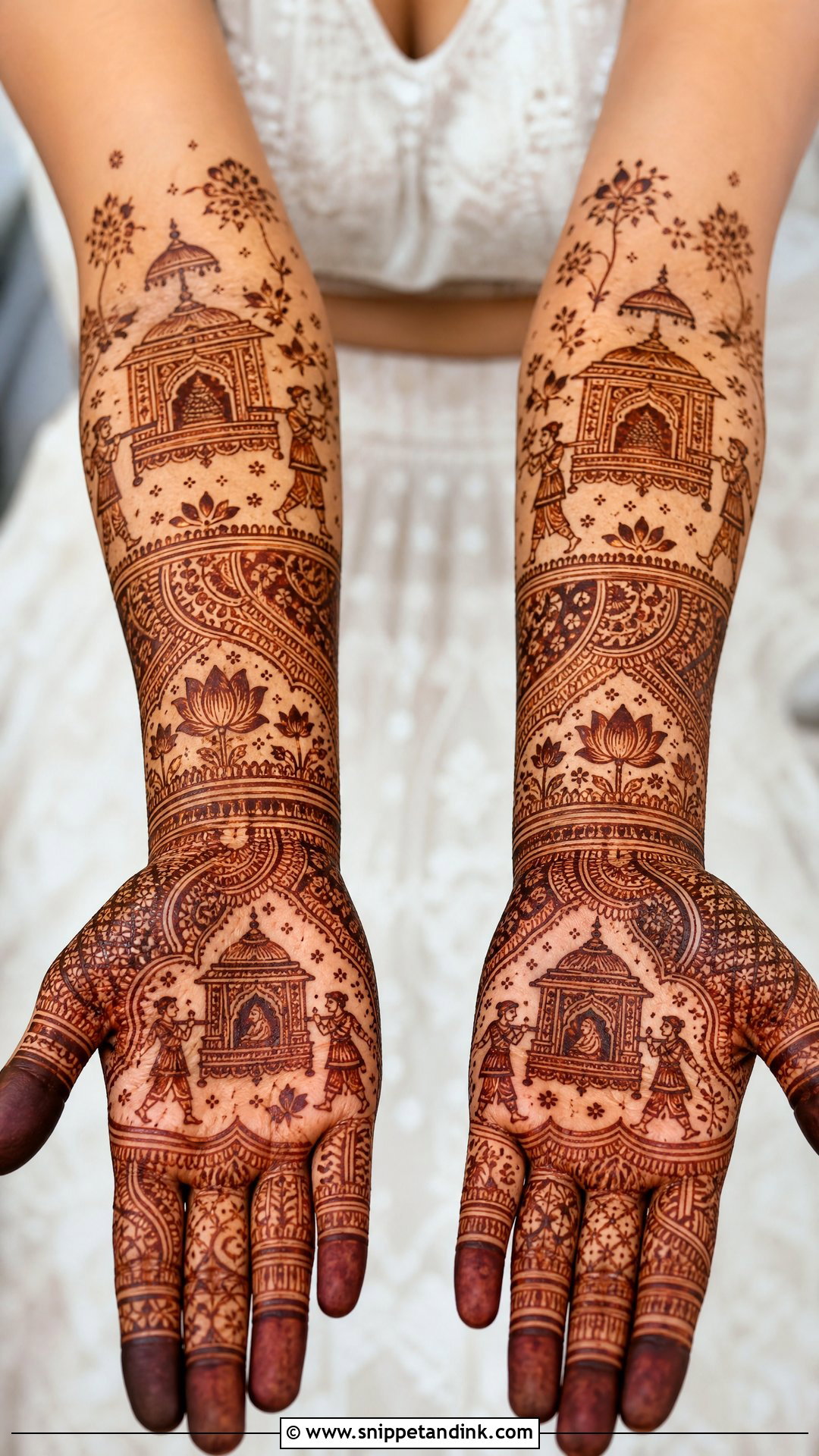
The doli marks the bride’s departure, so this design carries real emotion for many families. The palanquin can sit on the forearm, the lower palm or across both hands, with falling flowers, leaves and paisleys around it, and sometimes the bride shown inside with tiny carriers. I like pairing it with a baraat scene on the opposite hand so the two read as arrival and farewell. The carriers’ poles are long straight lines, and straight lines are where a tired hand shows, so I draw them early in the sitting.
17. Rajasthani Palace Bridal Mehndi Design
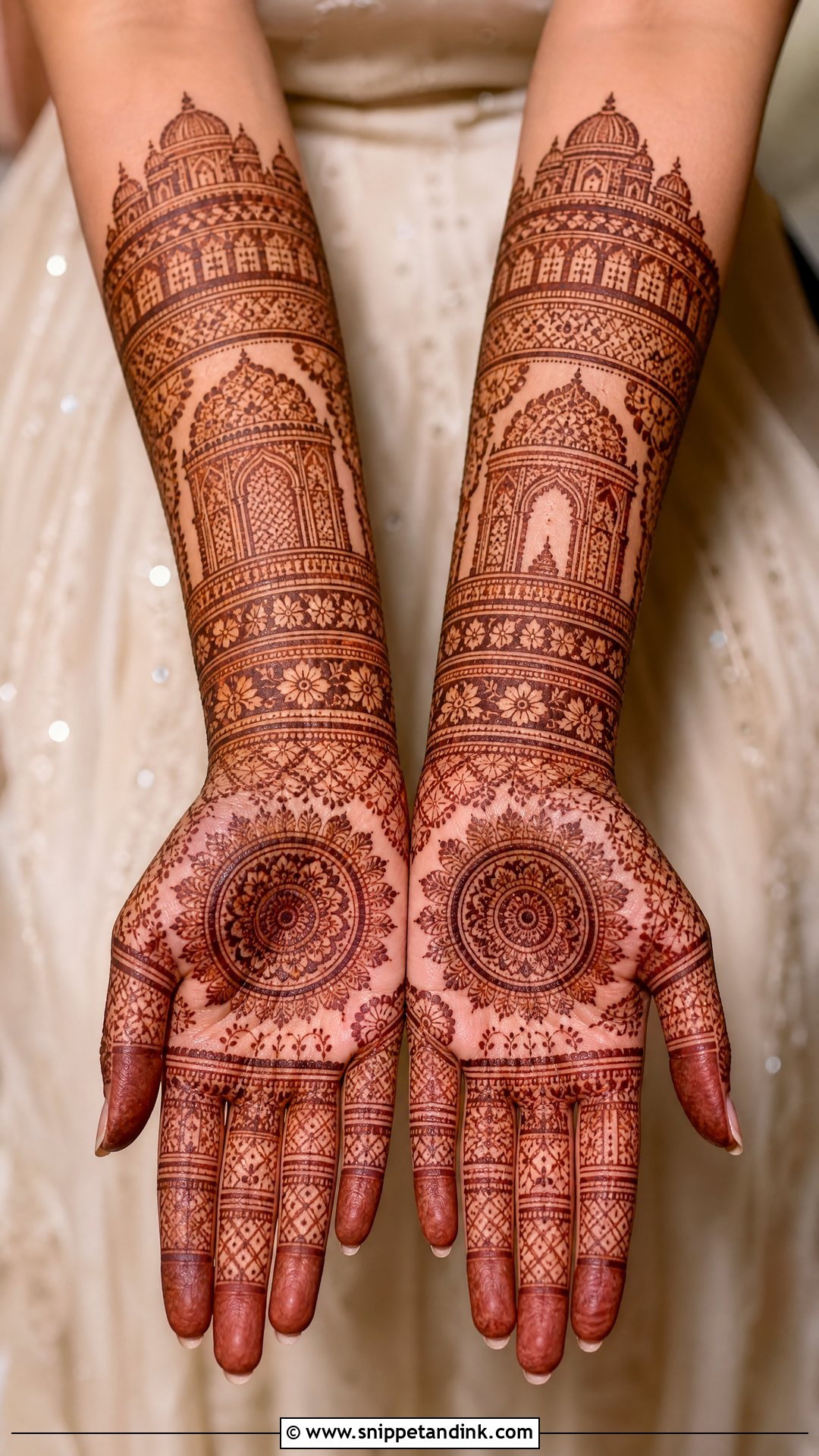
Palace mehndi borrows domes, pillars, windows and arches. I put the architecture on the forearm, where there is length for it, and keep a mandala, lotus or portrait in the palm. Linework has to stay fine and evenly spaced or the pillars start to lean. Small arches, dots and leafy bands finish the fingers. For a bride who wants a royal theme without a single human figure on her hands, this is the design I point to.
18. Rajasthani Haathphool Bridal Mehndi Design
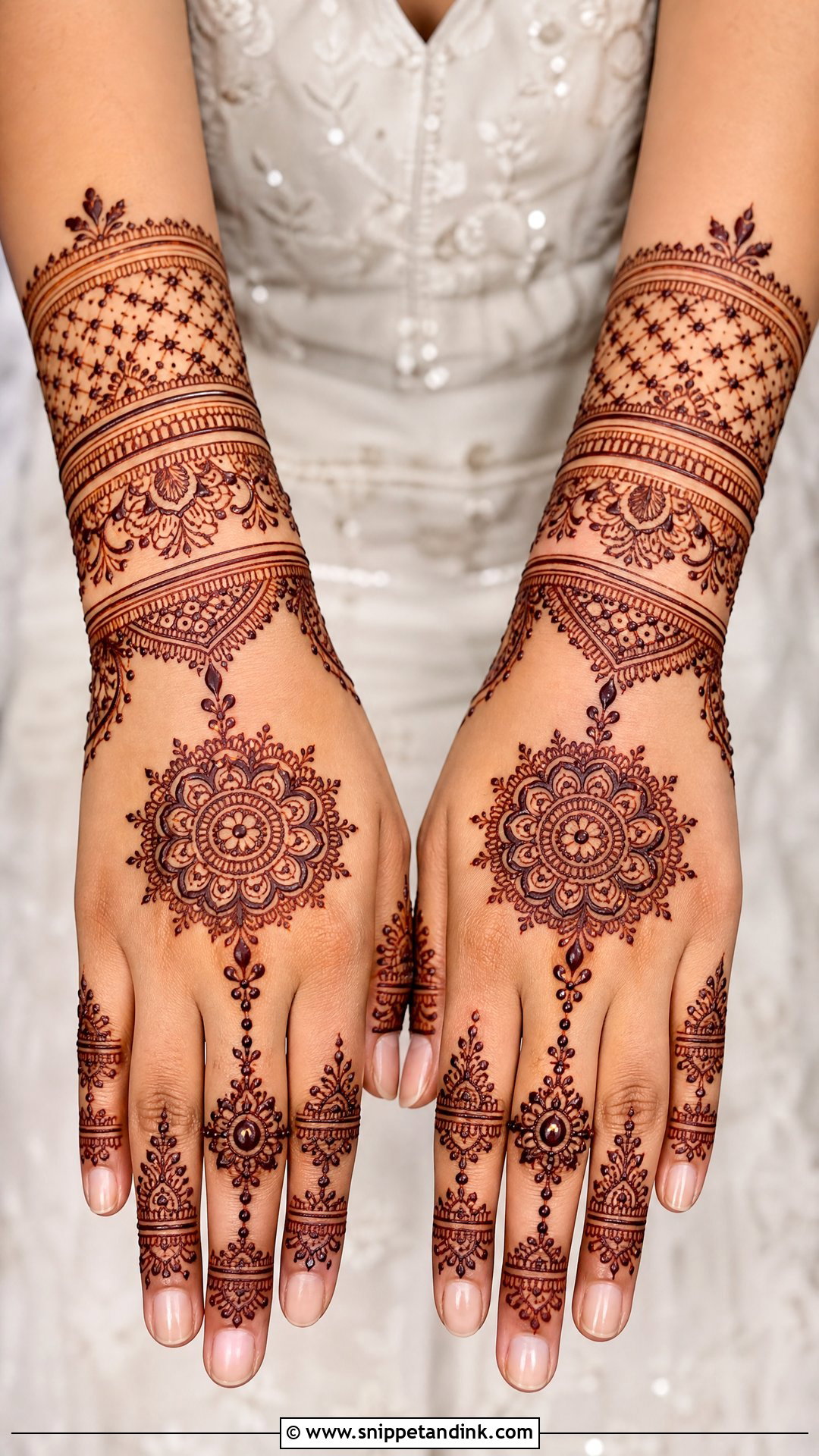
Haathphool mehndi draws hand jewellery in henna: a flower in the centre of the back hand, chains running to rings on each finger and to a band at the wrist. Jaali, dots, leaves and small paisleys fill around the chains. Symmetry is everything in this one. I measure by eye from the centre knuckle before drawing any chain, because a ring line placed a touch too high on one finger is obvious the moment the hand is flat. It also layers nicely under real haathphool and bangles.
19. Rajasthani Bridal Mehndi Design For Small Hands
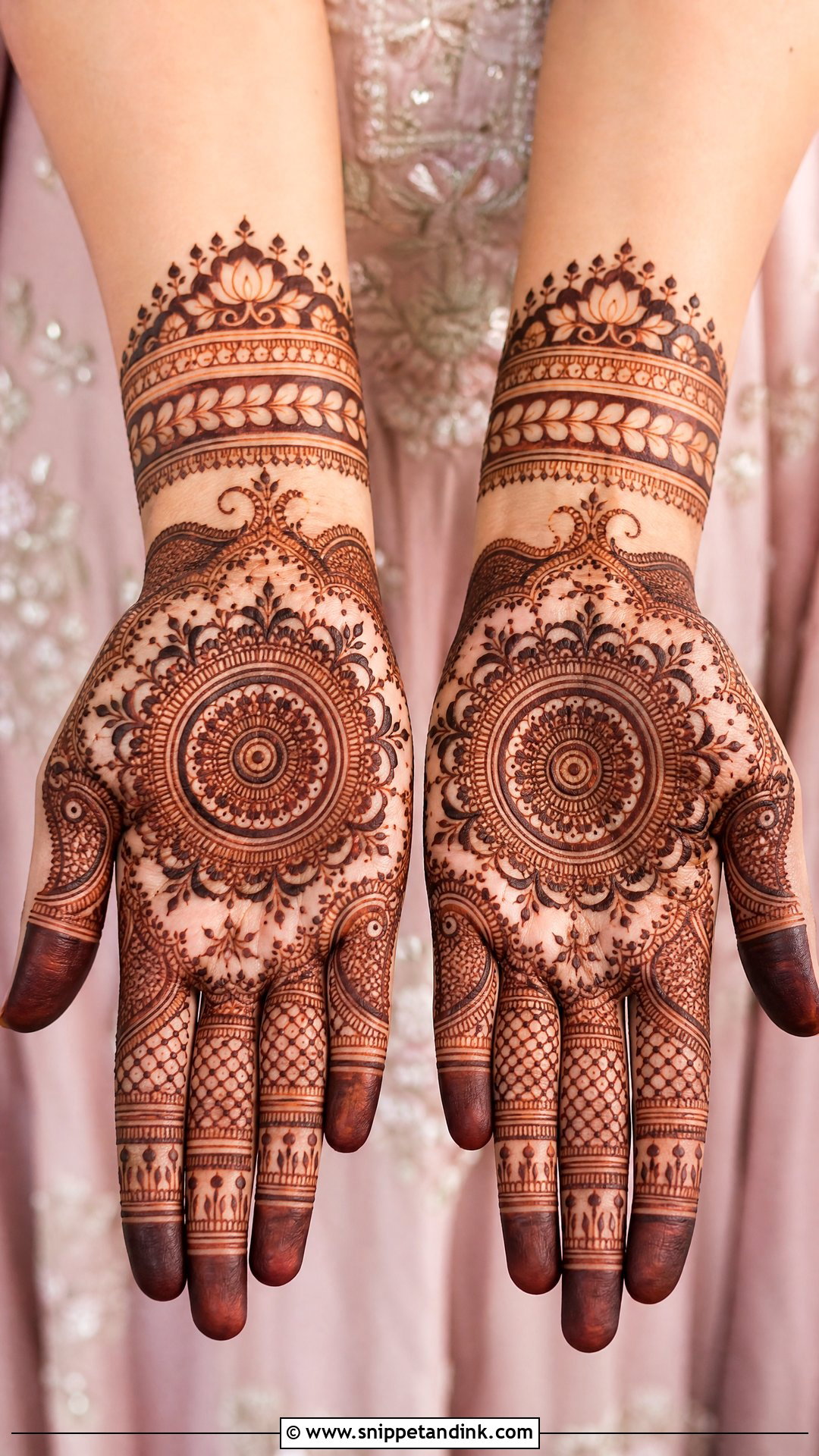
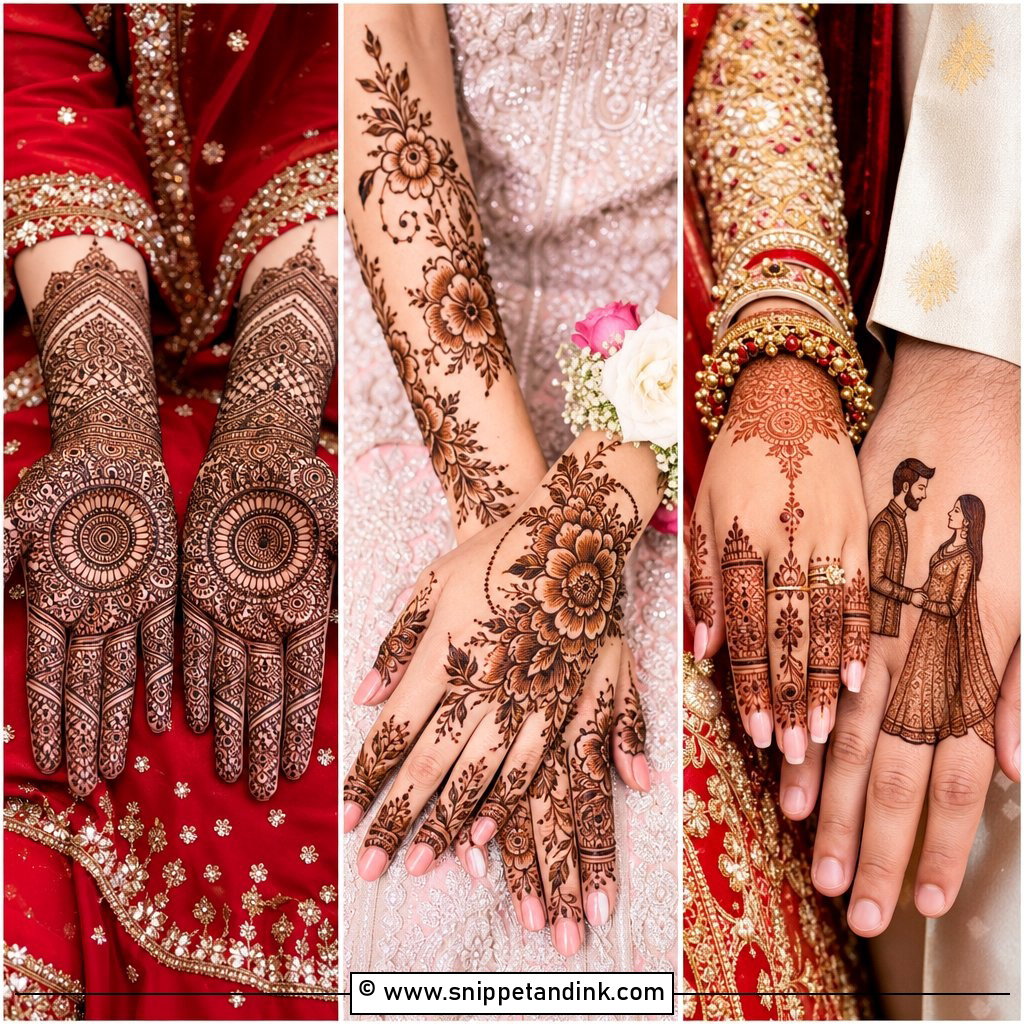
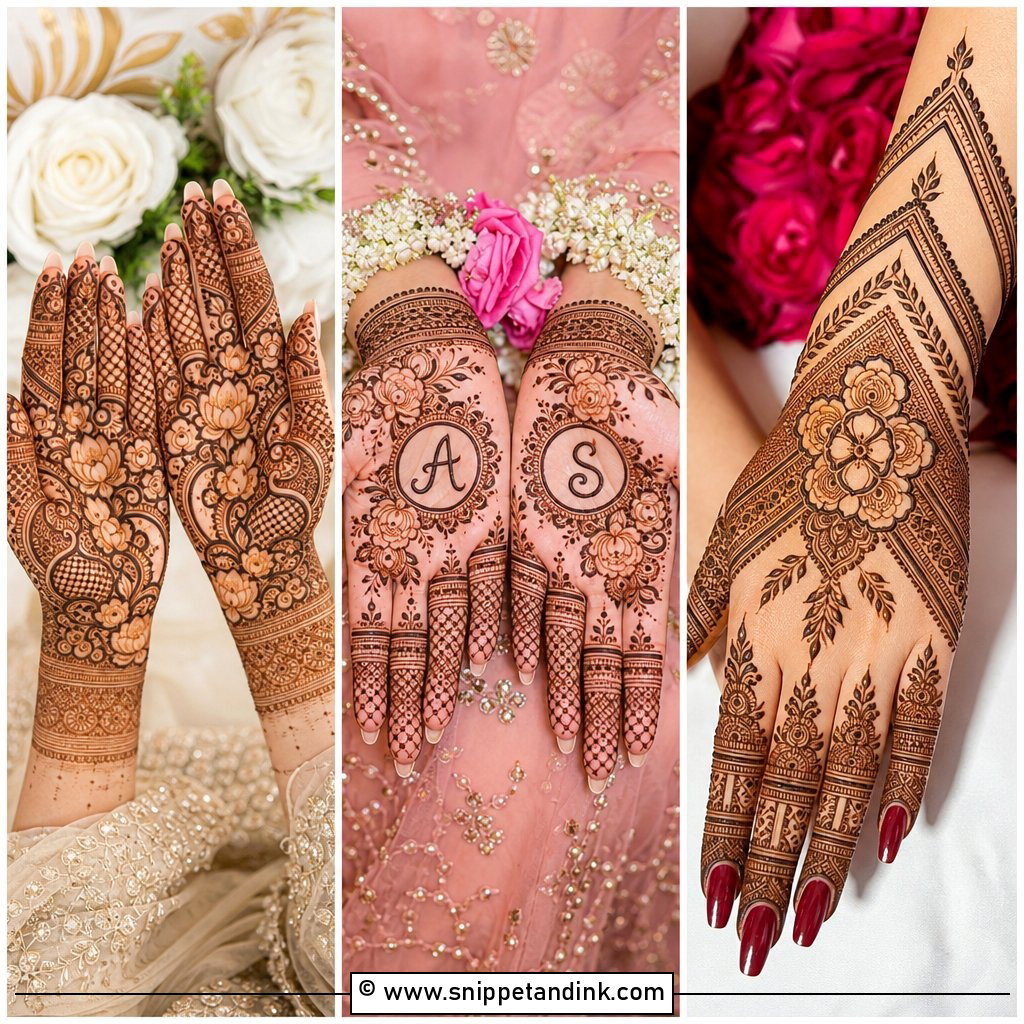
On small hands the danger is crowding, so I choose one focal point, a mandala, a peacock, a lotus or a small portrait frame, and keep the fillers fine and slightly open. Slim paisleys, light jaal and narrow wrist bands draw the eye upward and lengthen the hand. Fingers get vertical patterns rather than heavy horizontal blocks, which chop them visually. You can still have full Rajasthani coverage on a small hand. It just needs fewer, larger motifs rather than many tiny ones.
20. Rajasthani Bridal Mehndi Design For Long Hands
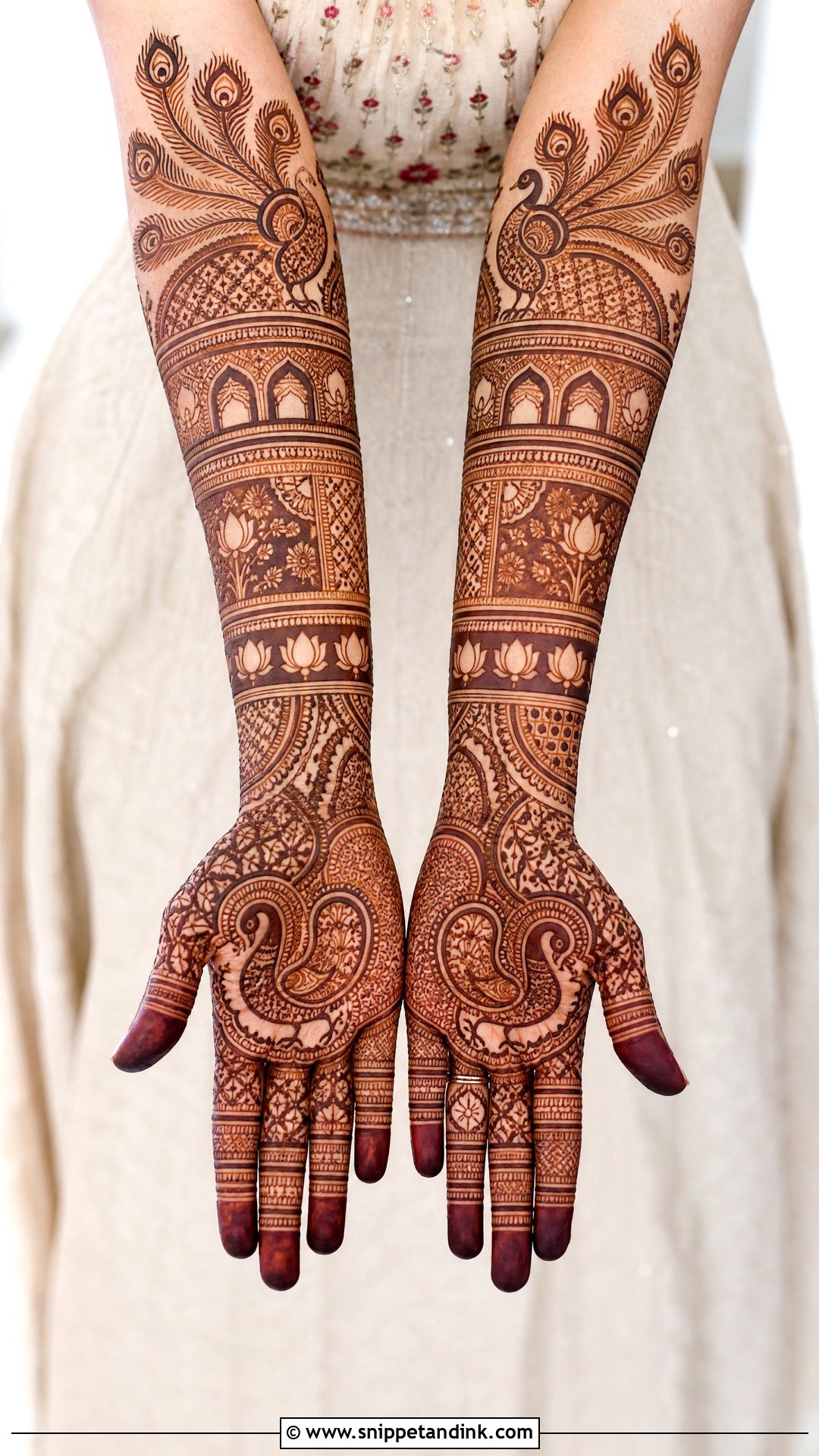
Long hands give me room to tell a proper story. The palm can hold a large mandala or portrait while the forearm continues with doli, baraat, or elephant details, tall peacock feathers, layered paisleys and arches. Long fingers suit stacked bands, leafy trails and fine mesh. The space is a gift, but it also tempts an artist to keep adding. I plan where the story ends on the arm before starting, so the top edge finishes with a deliberate border instead of trailing off when time runs short.
21. Rajasthani Minimal Bridal Mehndi Design
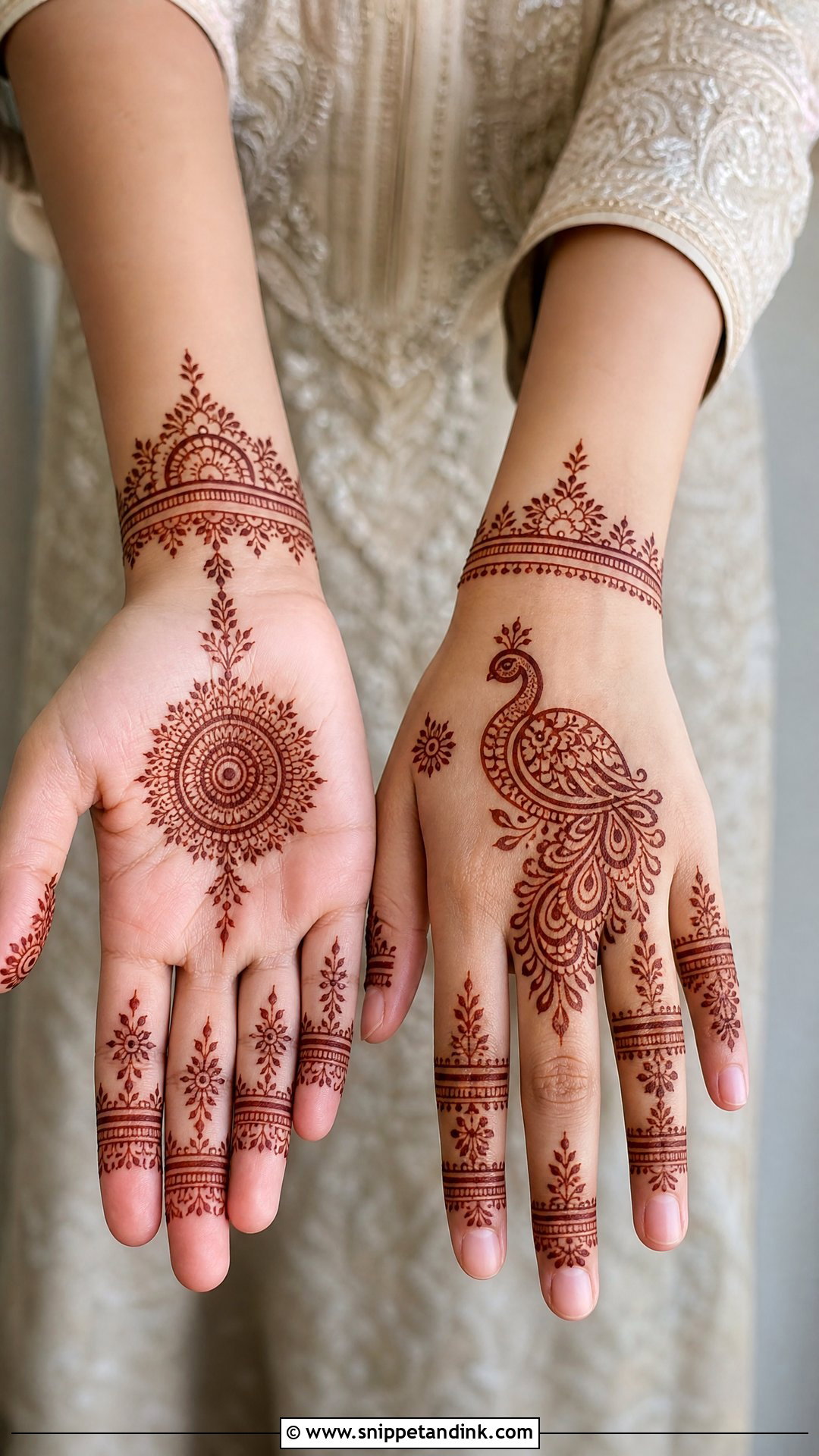
Not every bride wants dense hands. A minimal Rajasthani version keeps the royal motifs and gives them air: one peacock, mandala, lotus or jharokha in the palm, clean bands and small florals on the fingers, a single bracelet border at the wrist. It still reads as Rajasthani because of the motif choice and the fine line. Engagement functions, intimate weddings and brides who will be cooking, hosting or working that week all suit it. It also dries faster, which matters if you can’t sit still for half a day.
22. Rajasthani Indo Arabic Bridal Mehndi Design
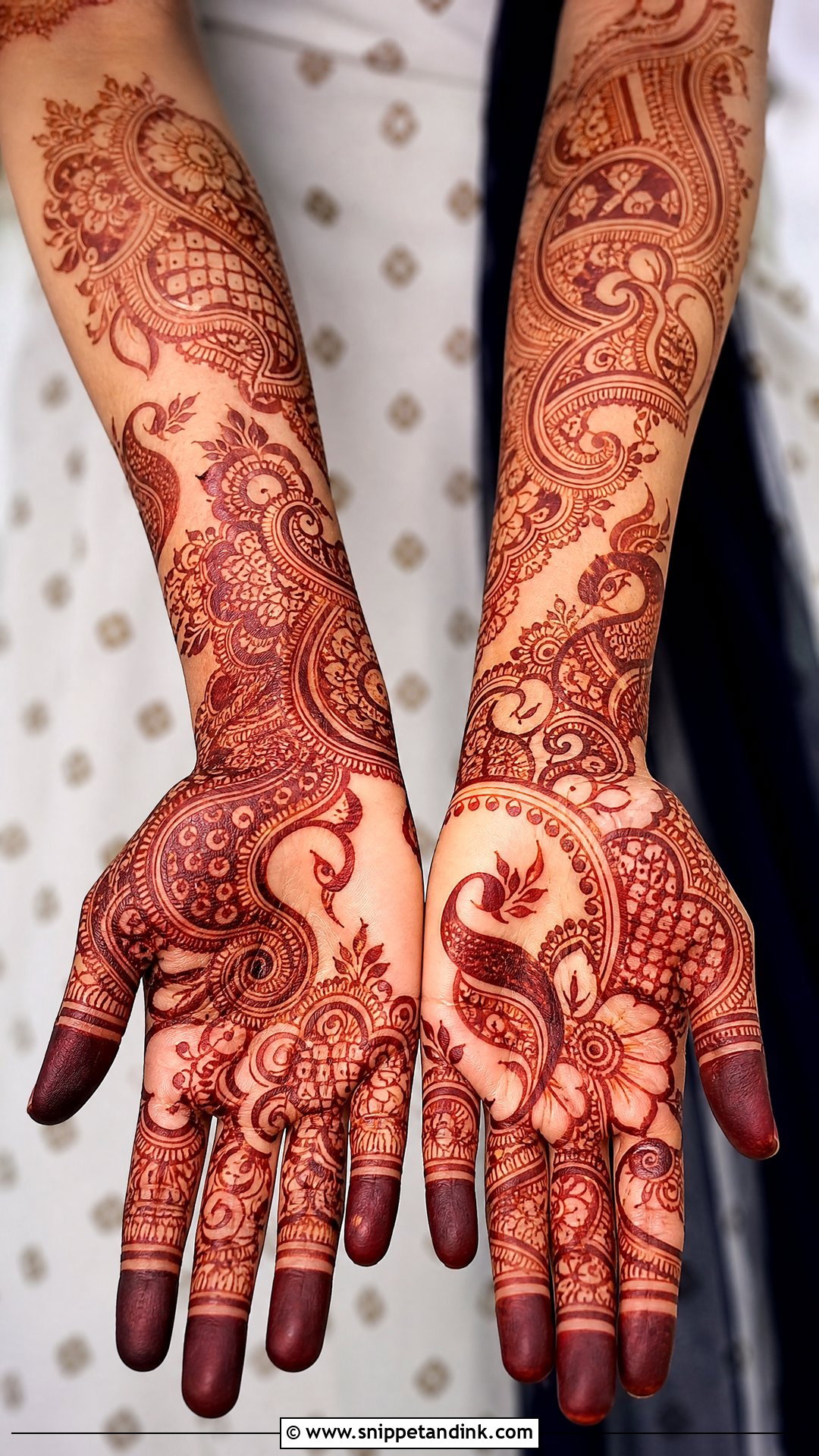
Indo-Arabic blends Indian density with Arabic spacing. The pattern travels diagonally across the hand with bold flowers, paisleys, peacock accents and shaded leaves, and Rajasthani touches like jharokha frames, small jaal patches and dot work keep it bridal. The empty skin between motifs makes each one stand out, and the full wrist and finger detailing still look finished. It takes noticeably less sitting time than a packed Marwari hand. The trade-off is that it reads modern; a family expecting full traditional coverage may see it as too light for the main day.
23. Rajasthani Bridal Mehndi Design With Gota Pattern
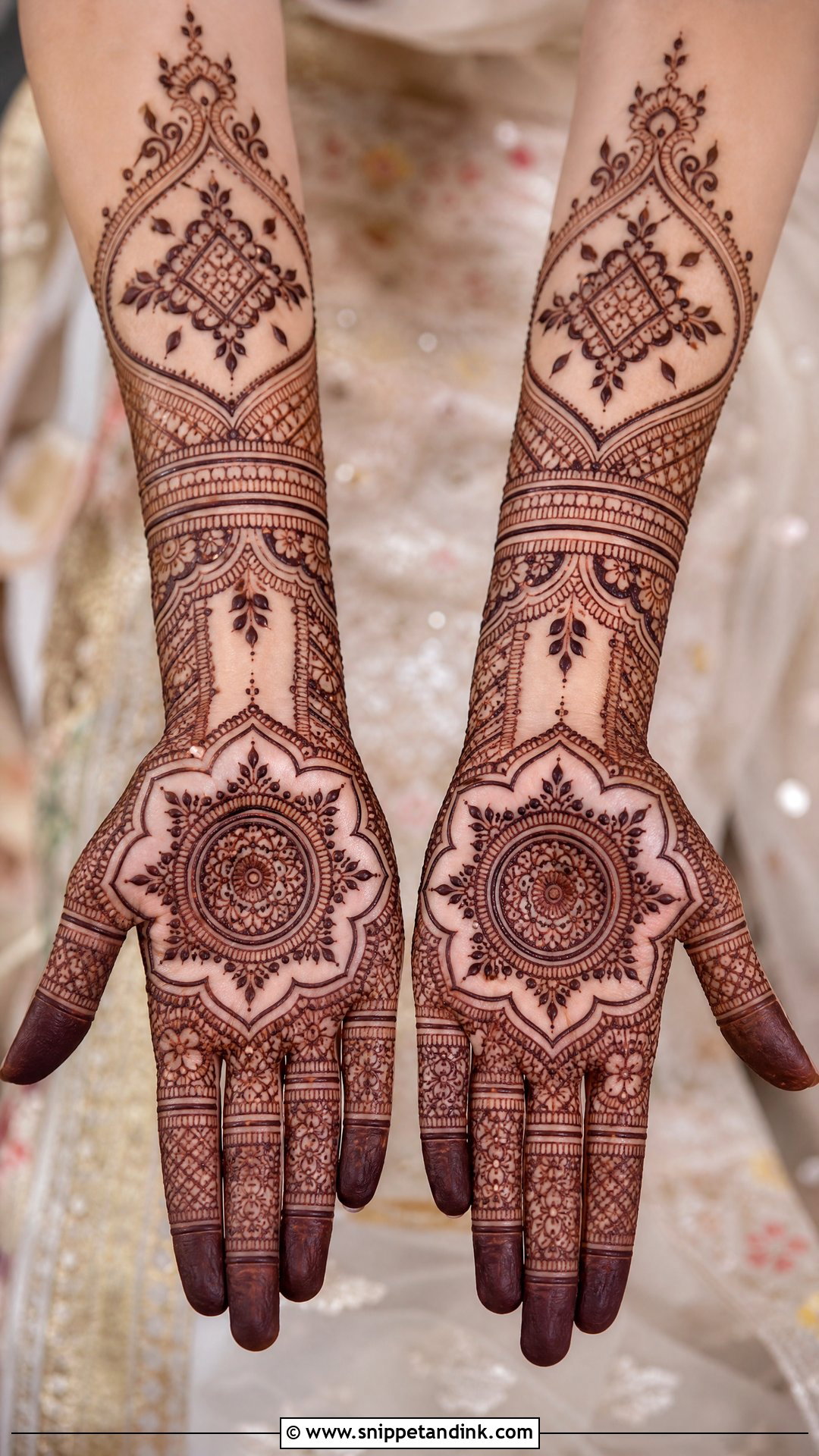
Gota patterns copy the metallic ribbon trim on Rajasthani lehengas and odhnis: repeated bands, small diamonds, dotted edges and floral bootas. I run them around the wrist, the fingers and up the forearm, usually with a central mandala or lotus on the palm. If a bride is wearing gota patti, I ask her to bring a photo of the border, because matching the shape of her actual trim is what makes the connection obvious. It’s detailed but orderly, so it stays readable in photos.
24. Rajasthani Bridal Mehndi Design For Feet
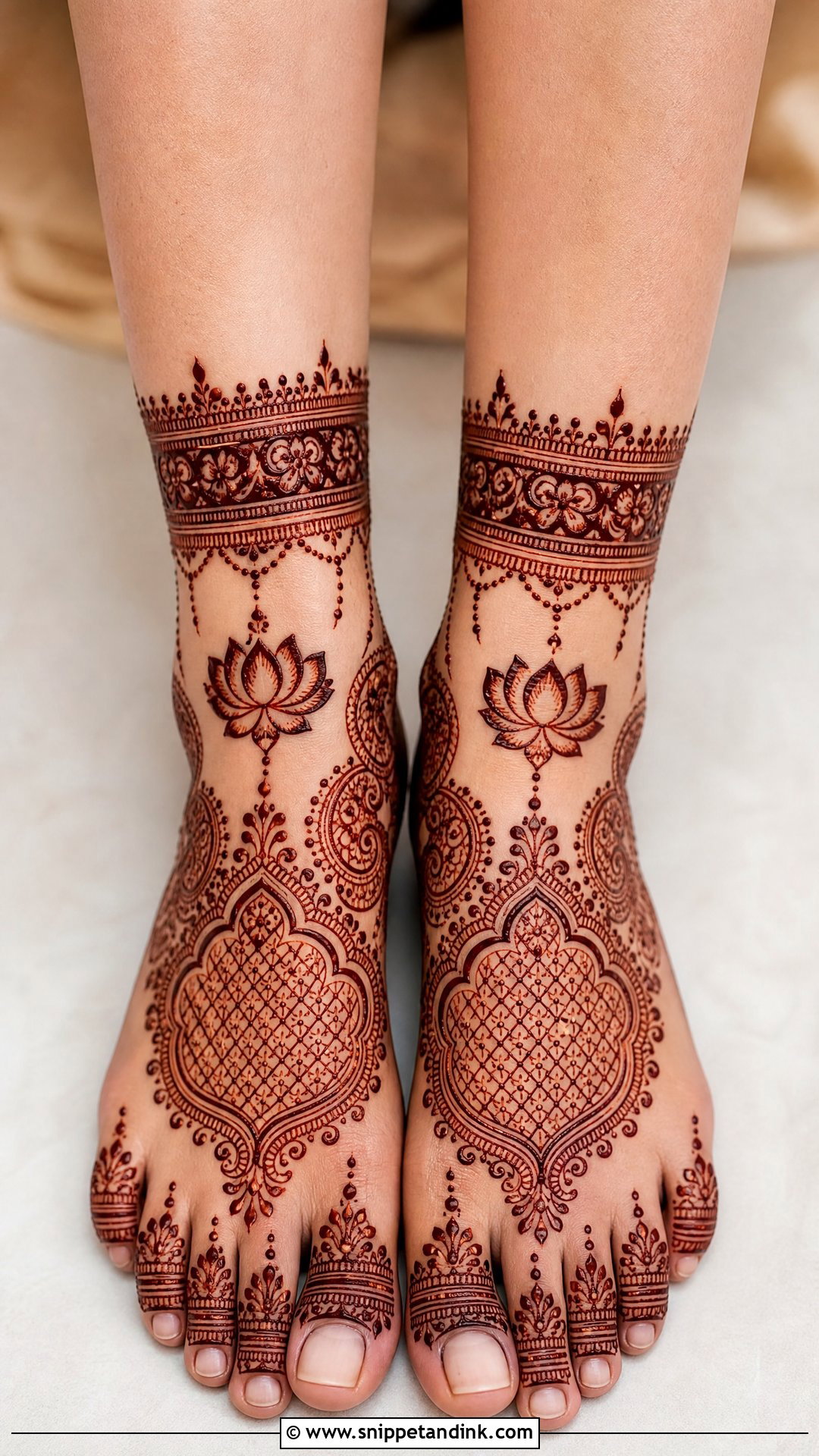
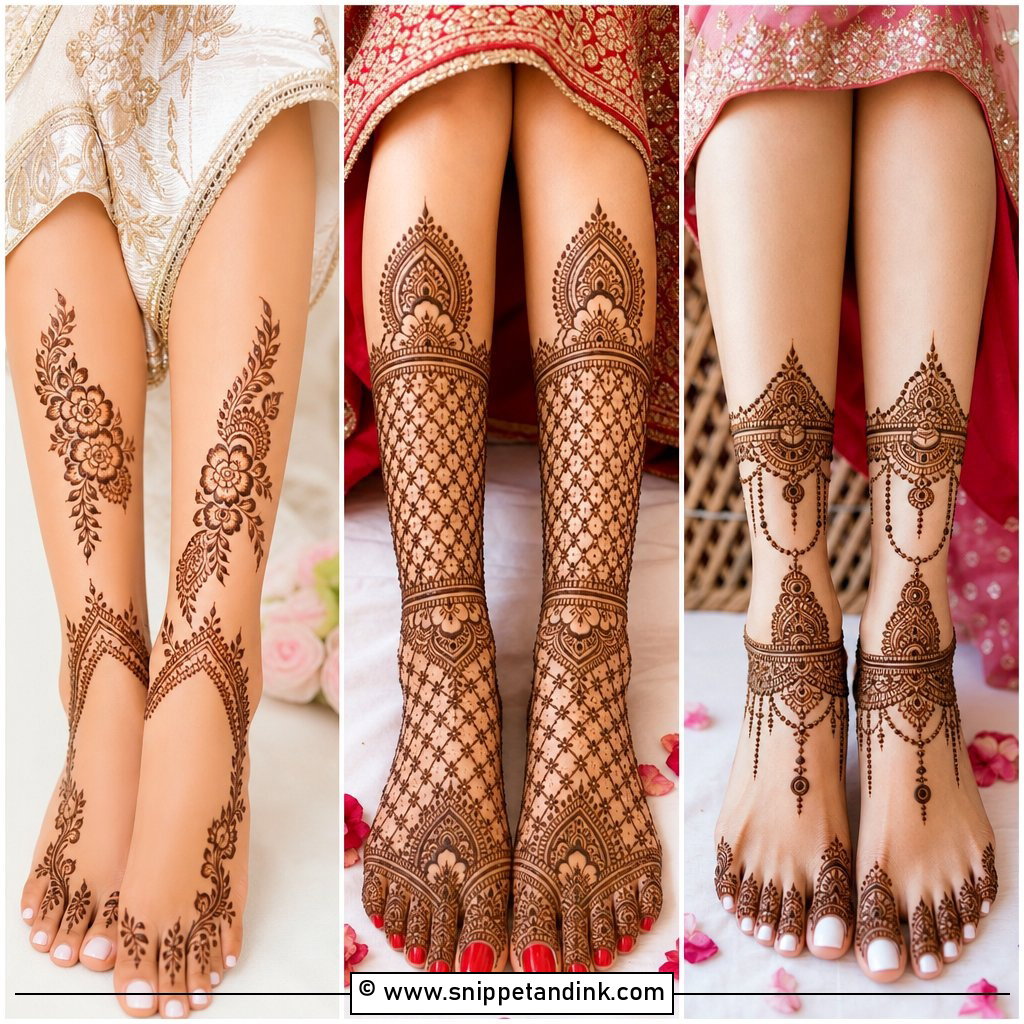
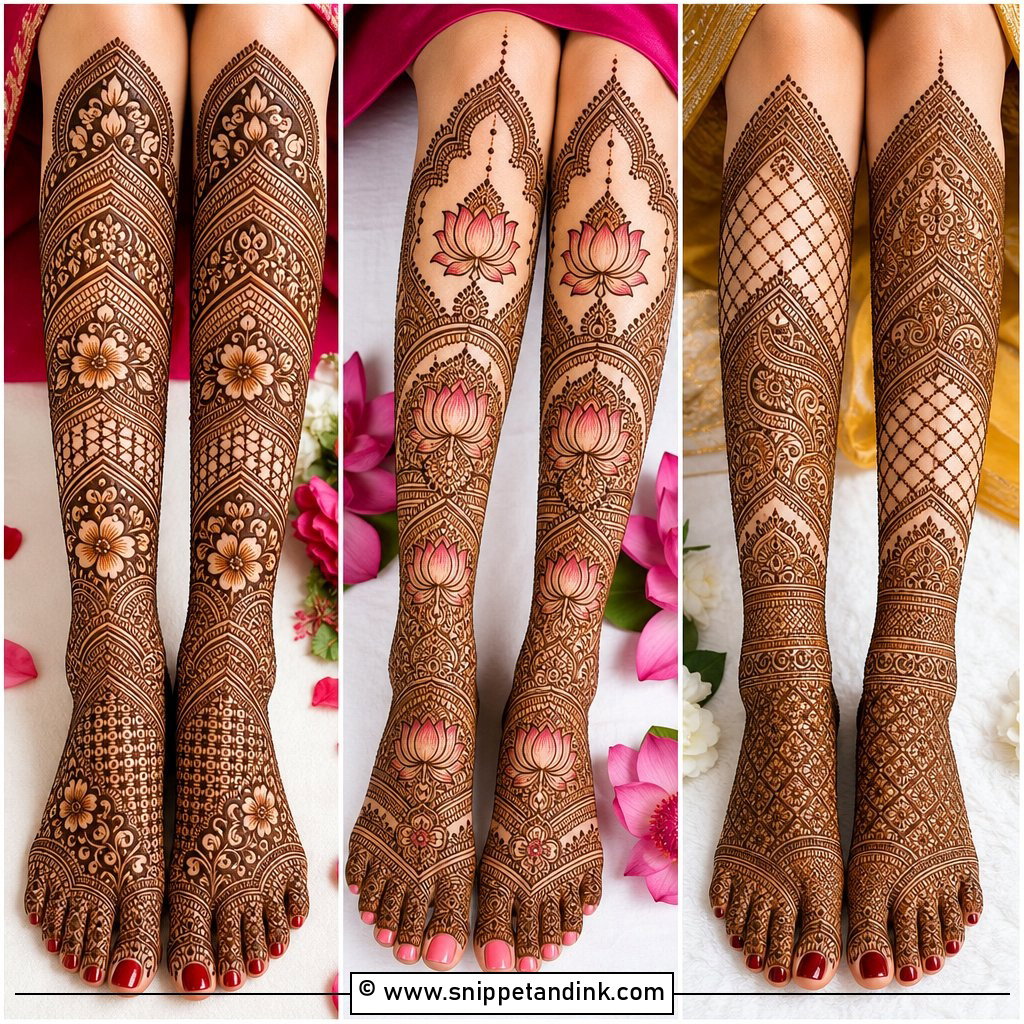
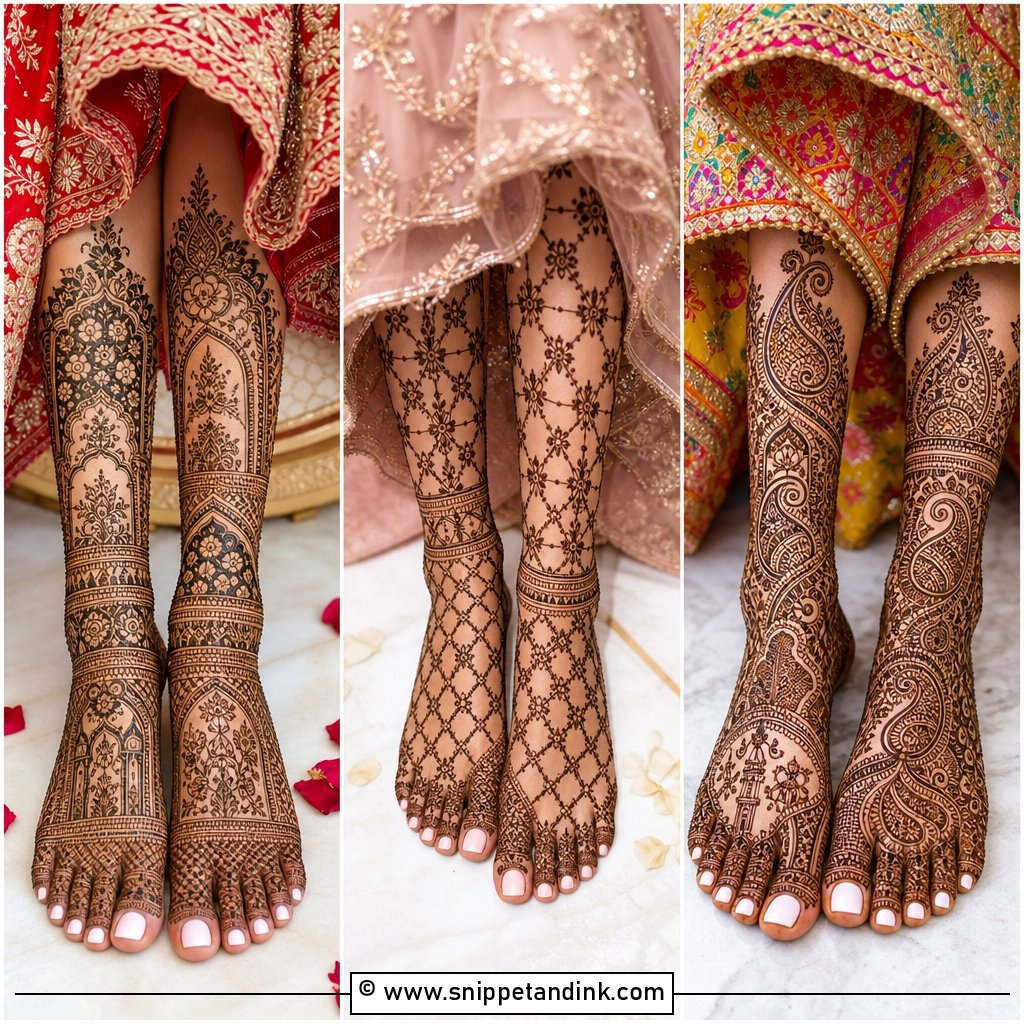
Feet are usually bolder than hands. Rajasthani bridal mehndi for feet puts mandalas, lotus flowers, paisley trails and jaali panels on the top of the foot, small bands and dots on the toes and heavier lines around the ankle like a payal. I repeat one motif from the hands, a lotus or peacock, so the set looks planned. Skin on the feet is thicker and stains darker, so I keep the fill slightly lighter than on the hands; otherwise the foot design can look heavier than everything else in full-length photos.
25. Rajasthani Bridal Mehndi Design With Wedding Story
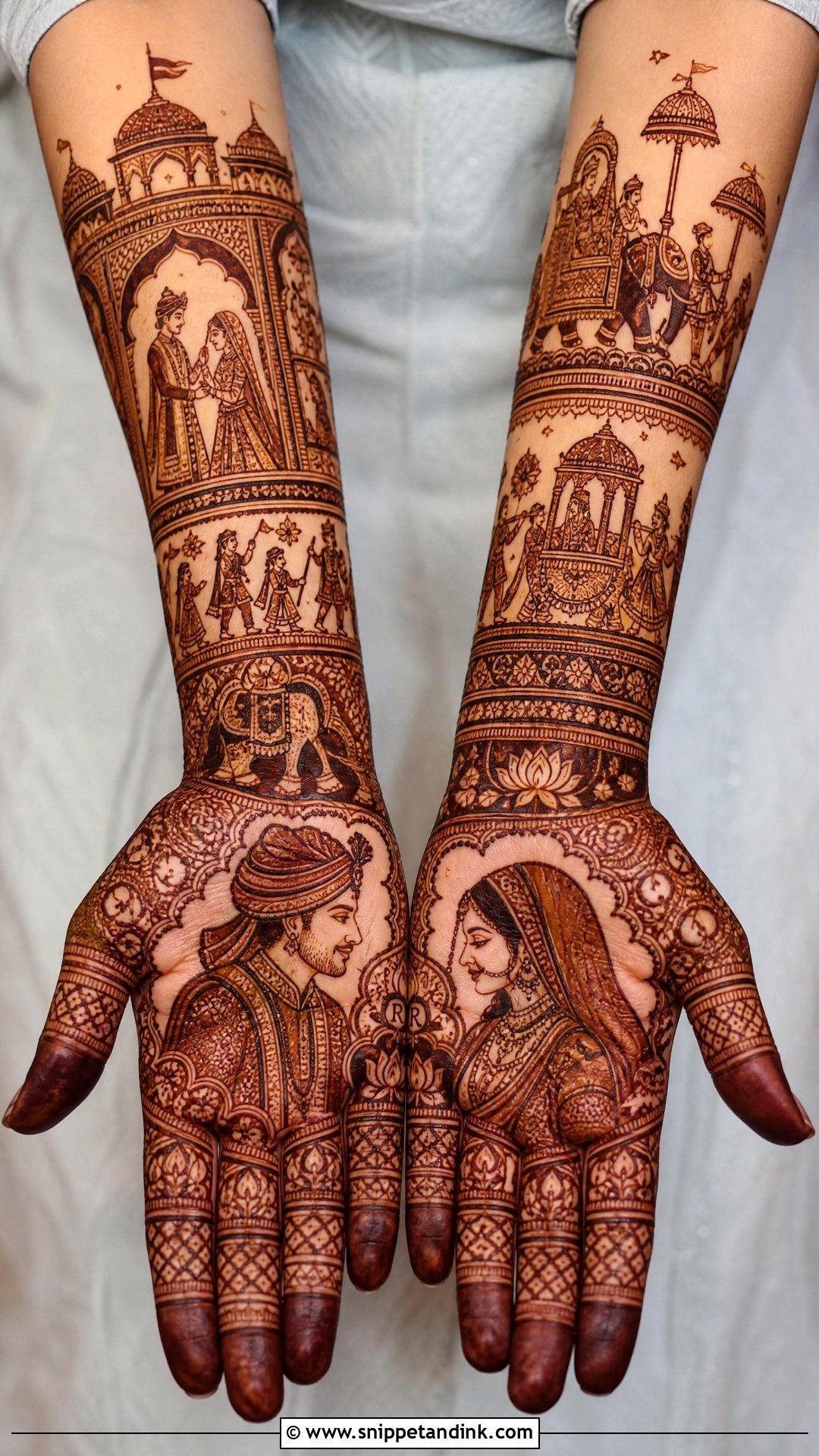
A wedding story design is the most involved Rajasthani work I do. It can trace the couple’s first meeting, the proposal, the varmala, the baraat and the doli across both hands and forearms, with palms carrying the main scenes and wrists holding elephants, arches and flowers. This one cannot be improvised on the day. I need the story, the order of scenes and any personal symbols at least a week ahead so I can sketch where each one sits. Done with that planning, the hands become a record of the wedding itself.
Getting Fine Portrait Lines to Stain Deep Maroon
The thinnest lines in Rajasthani work are also the ones that fade first, because there is so little paste sitting on the skin. Aftercare decides whether the faces and jaali stay crisp or go patchy.
- Leave the paste on as long as you can bear, ideally six to eight hours or overnight.
- Have your artist dab a lemon and sugar mix over it once it starts to dry. It keeps the paste stuck to the skin instead of flaking off early.
- Scrape the dried paste off with a blunt edge or your fingers. Don’t wash it off.
- Keep water away for as long as possible after removal, ideally until the next morning, and avoid hot showers and hand sanitiser for the first day.
- Warmth helps the stain develop, so keep your hands warm rather than sitting under a cold fan.
One warning I give every bride: ask what is in the cone. Fresh natural henna needs time to stain and smells earthy. A paste that promises jet black in an hour often contains chemical dyes like PPD, which can cause serious skin reactions. If you have sensitive skin, ask for a small patch test a few days before the wedding.
Matching the Design to Your Hands, Outfit and Sitting Time
Rajasthani bridal mehndi rewards a bride who knows what she is willing to sit for. Portraits, peacocks, jaal, elephants, doli scenes and palace arches all carry that royal feel, but the right one depends on your hand size, your outfit, your jewellery and how many hours you can give. If the story matters most, go for full-hand Marwari or a wedding scene. If you care more about clean lines, a mandala, lotus or haathphool layout will serve you better. Bring photos of your outfit to the consultation and I can tell you very quickly which of these your hands will carry well.
You'll Like These Ideas:


Leave a Reply