
Bridal mehndi is the one wedding detail that grows on you, literally, darkening for two days after the paste comes off. When a bride sits down with me, I ask about three things before I sketch anything: what she’s wearing, how much skin will show at each event, and how many hours she can realistically sit still. Those answers decide whether we go dense Indian full-hand, airy Arabic trails, a portrait palm, or modern negative space with finger-focused detail. Below are 35 designs I draw for brides, with notes on how each one stains, how long it takes, and who it suits.
The Stain Peaks Two Days Later, So Plan Backward
Natural henna doesn’t come off the skin in its final color. When the dried paste is removed, the stain is bright orange. Over the next 24 to 48 hours it oxidizes and deepens to reddish brown or maroon, then holds for a week or two before fading as the skin renews. That’s why I apply bridal mehndi one or two days before the wedding, never on the morning itself.
Before you book, ask what’s in the cone. Real bridal paste is henna powder, lemon or water, sugar and essential oil, and it stains brown-red. Anything sold as “black henna” or promising instant dark color may contain PPD, a hair-dye chemical that can cause serious skin reactions and scarring. I’d never put that on a bride. If you have sensitive skin or reacted to henna before, do a small patch test on the inner arm a week or so in advance.
Coverage also changes the schedule. Light Arabic hands may take an hour or two; heavy bridal hands and feet can take most of a day. Book your slot so you have that time plus several hours afterward with nothing to do.
1. Full Hand Indian Bridal Mehndi Design
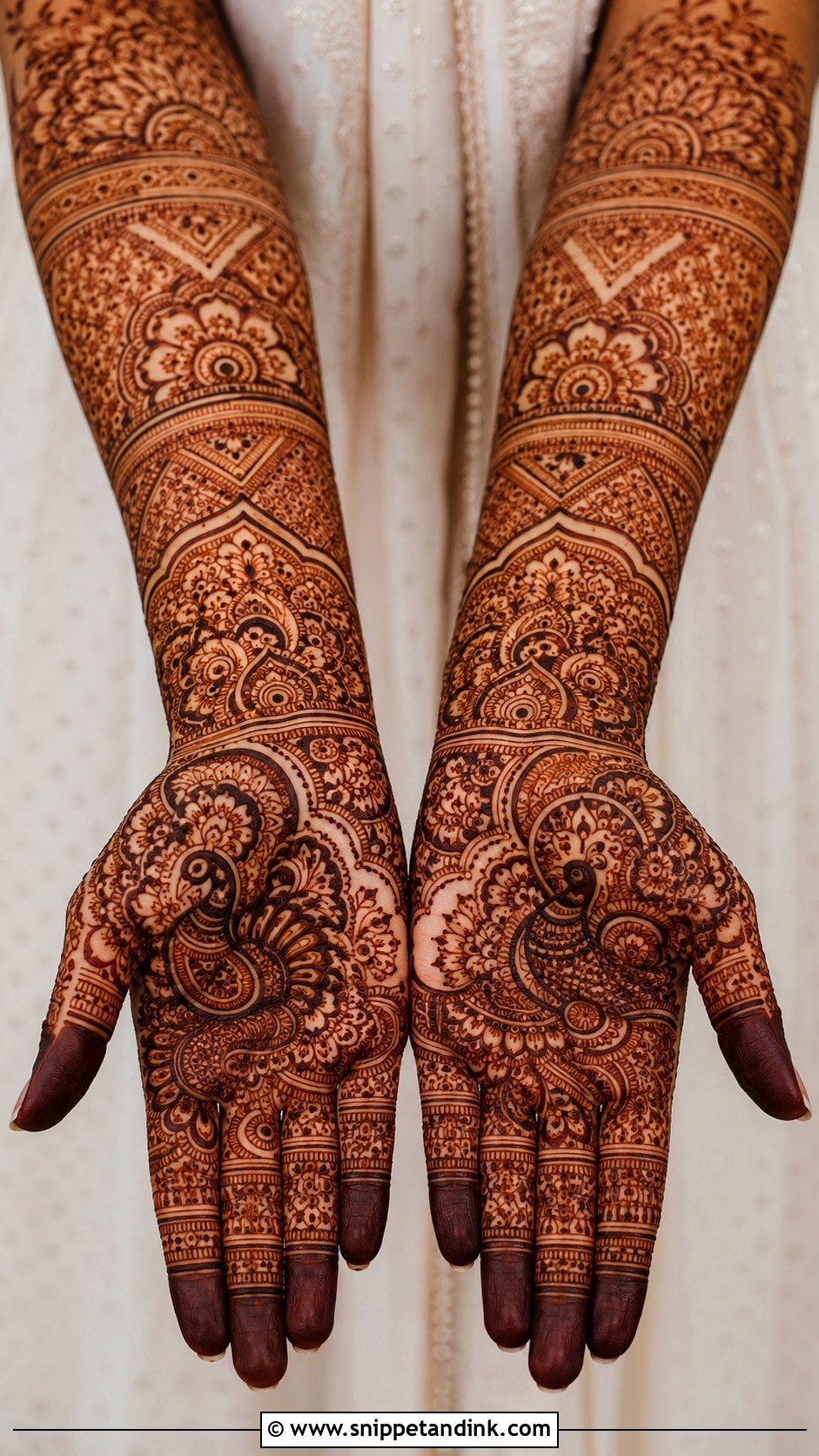
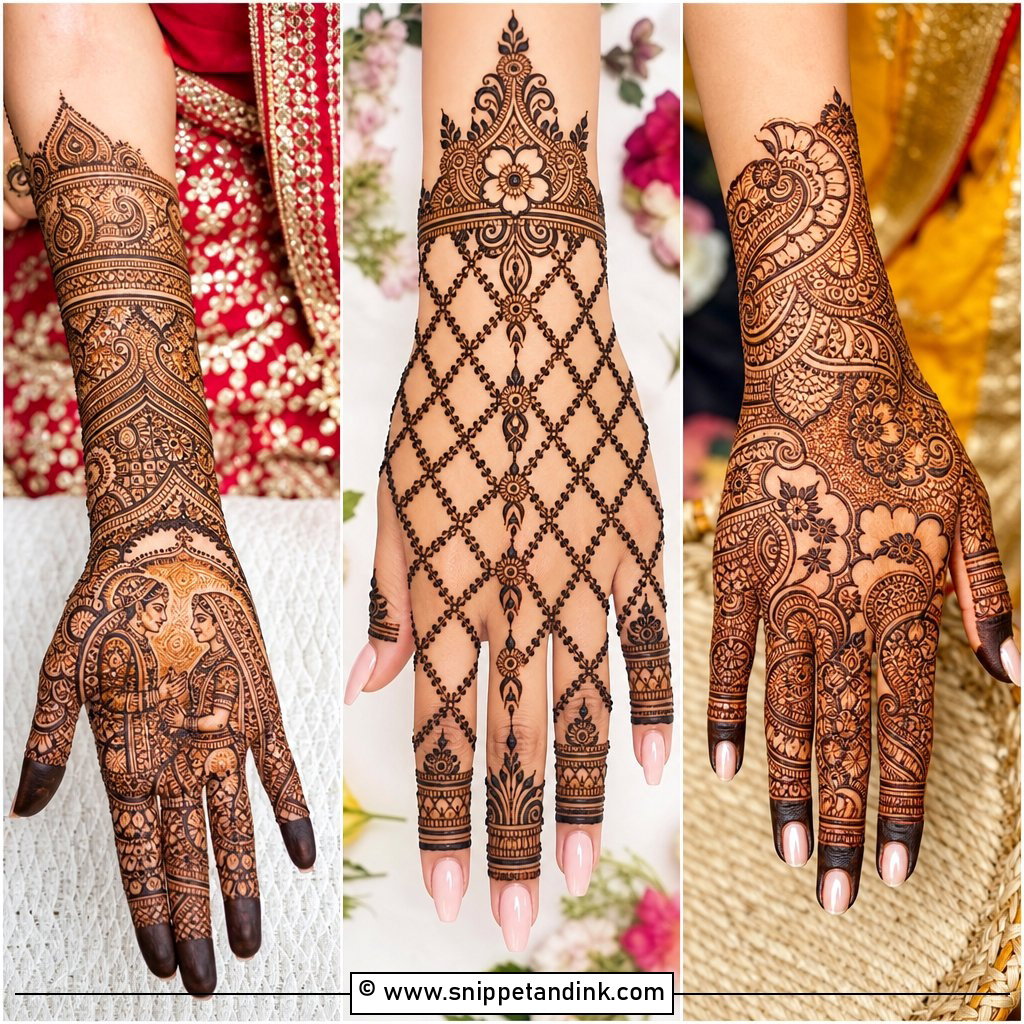
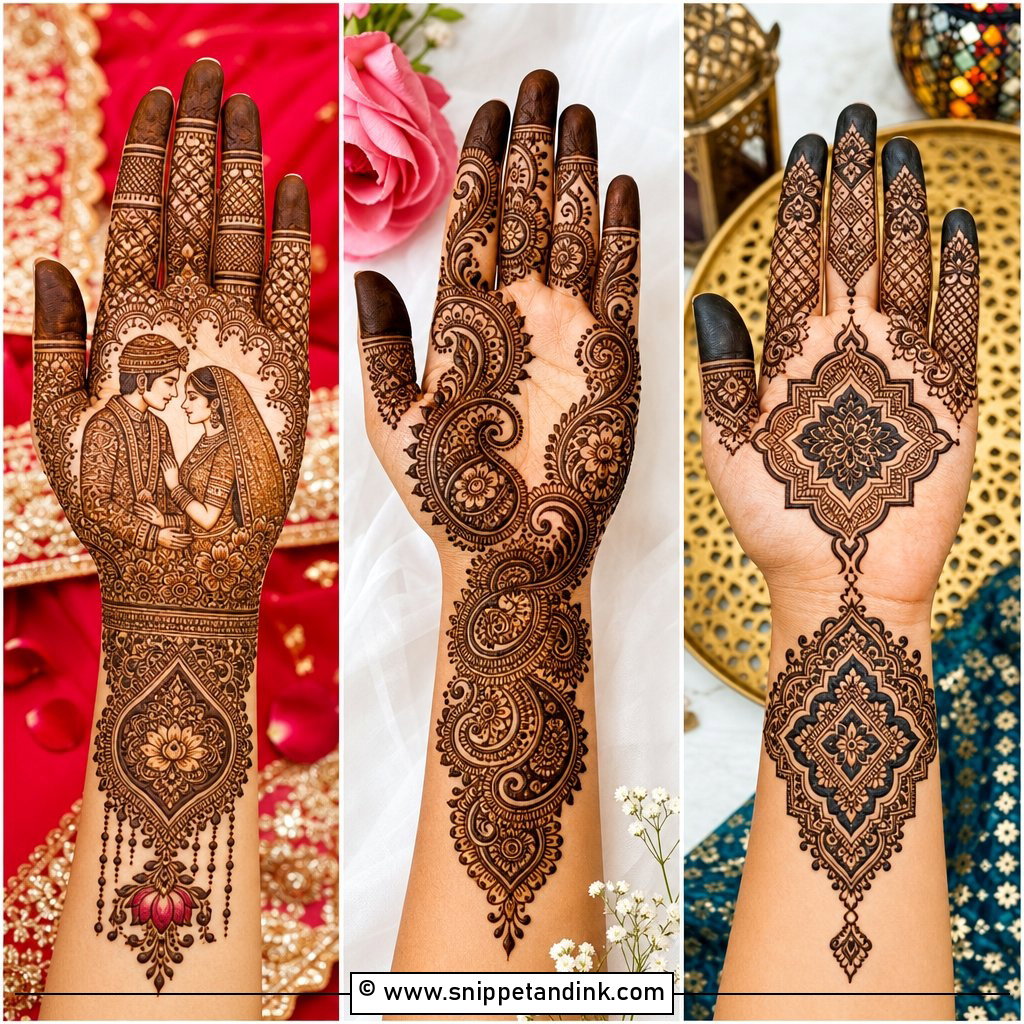
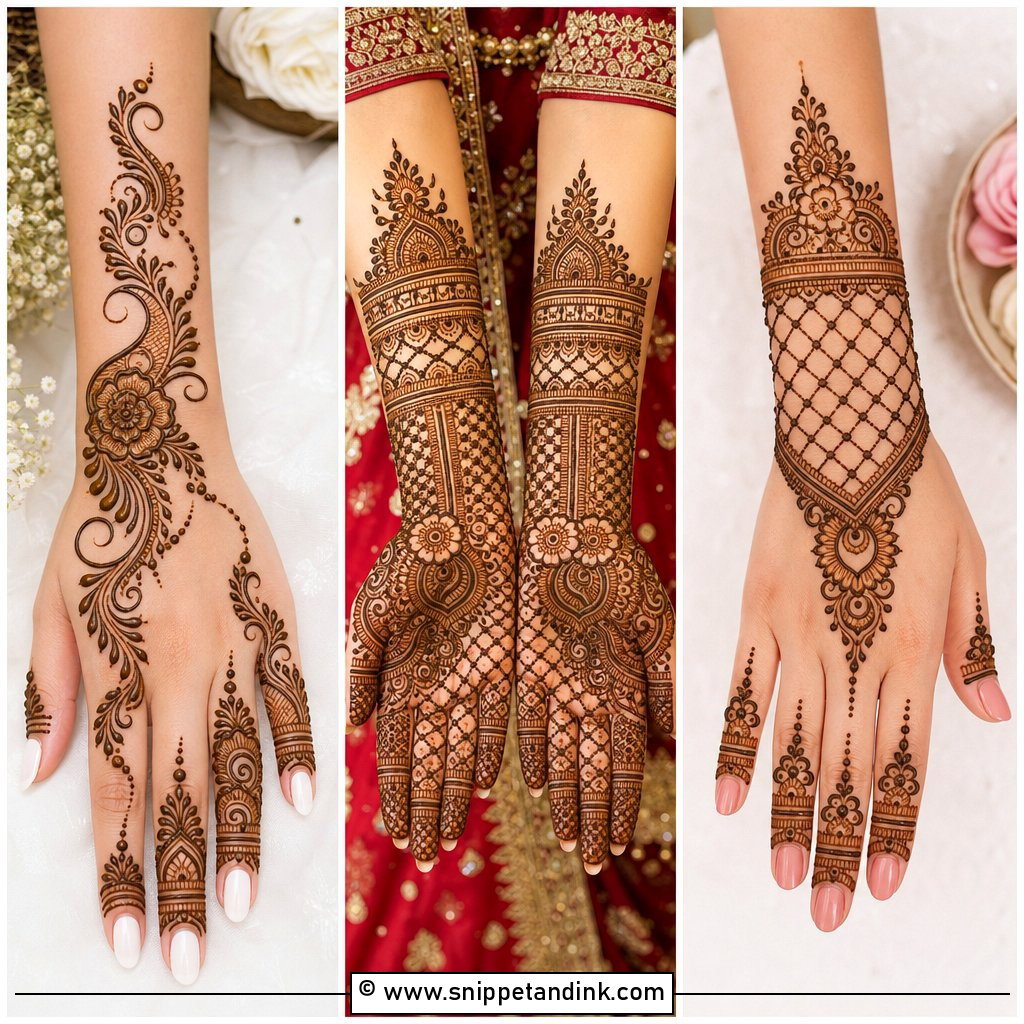
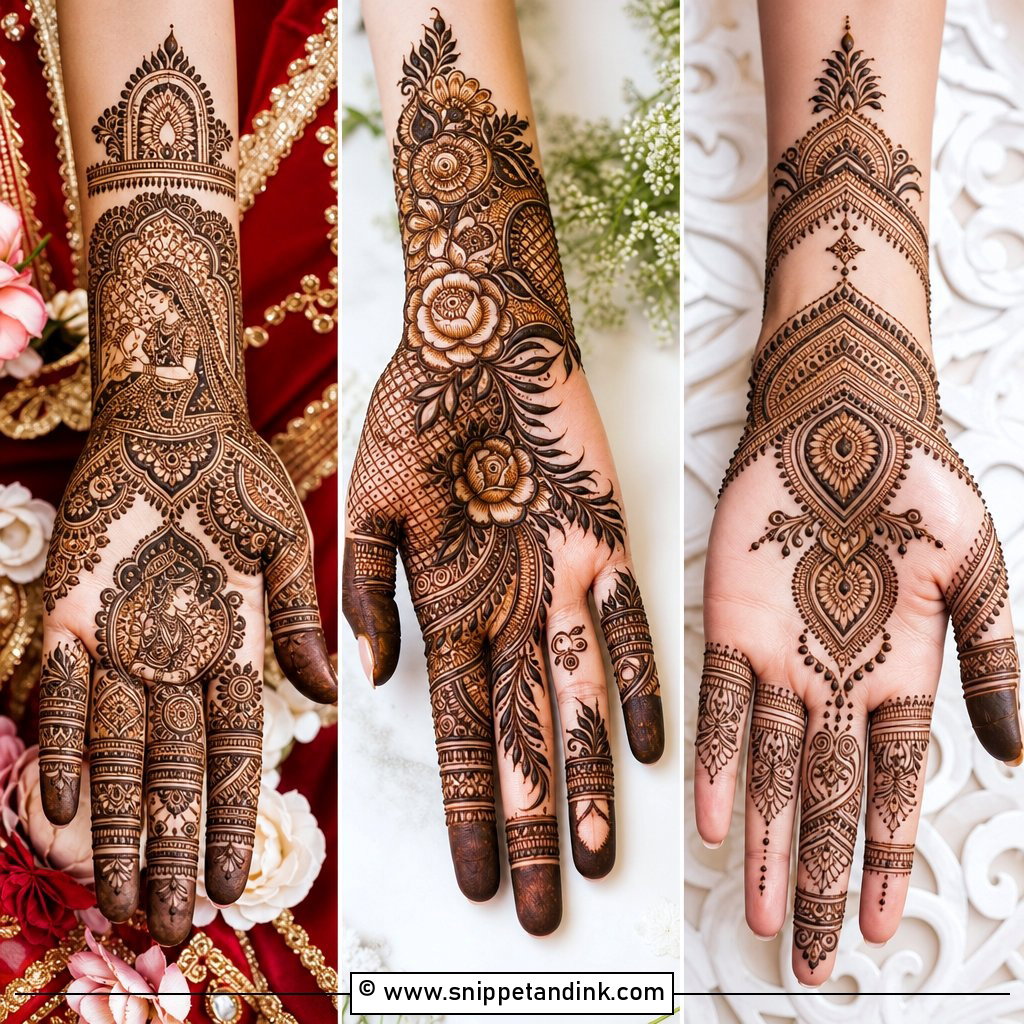
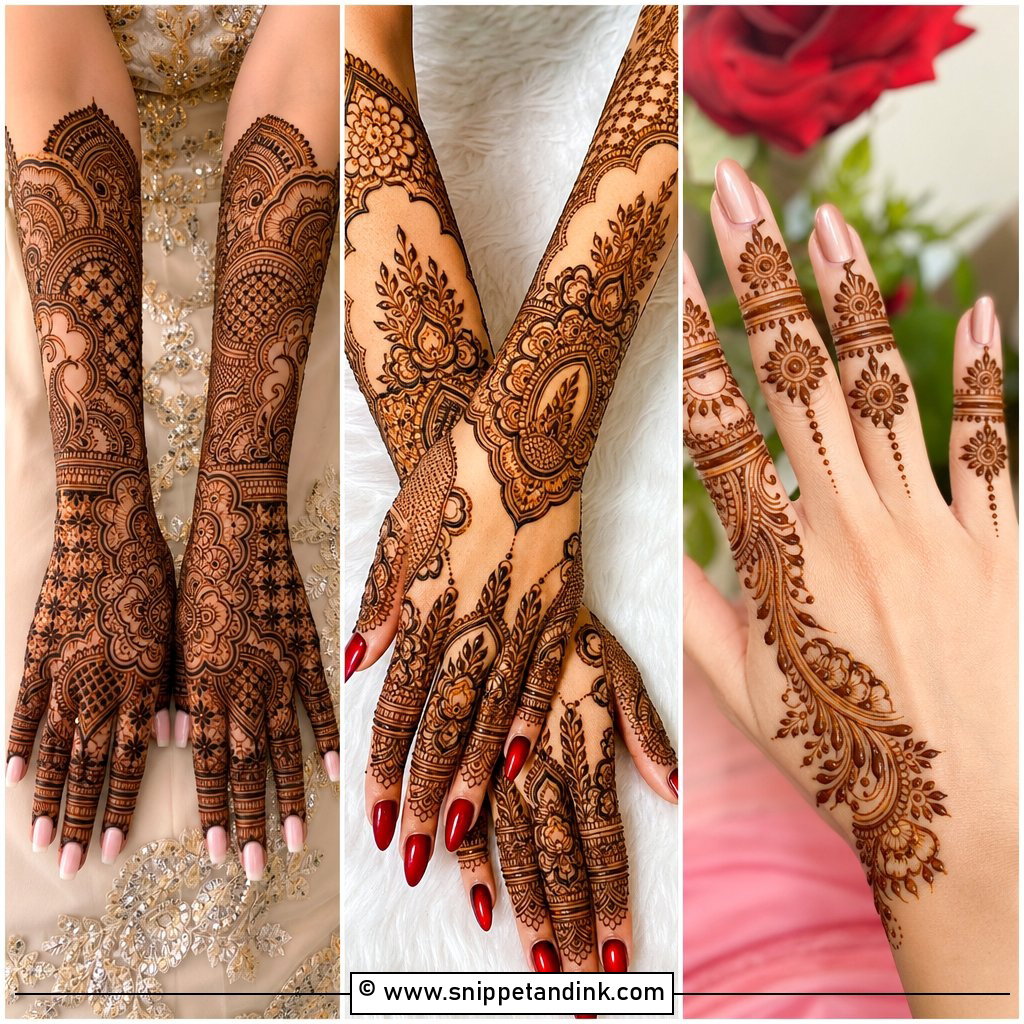
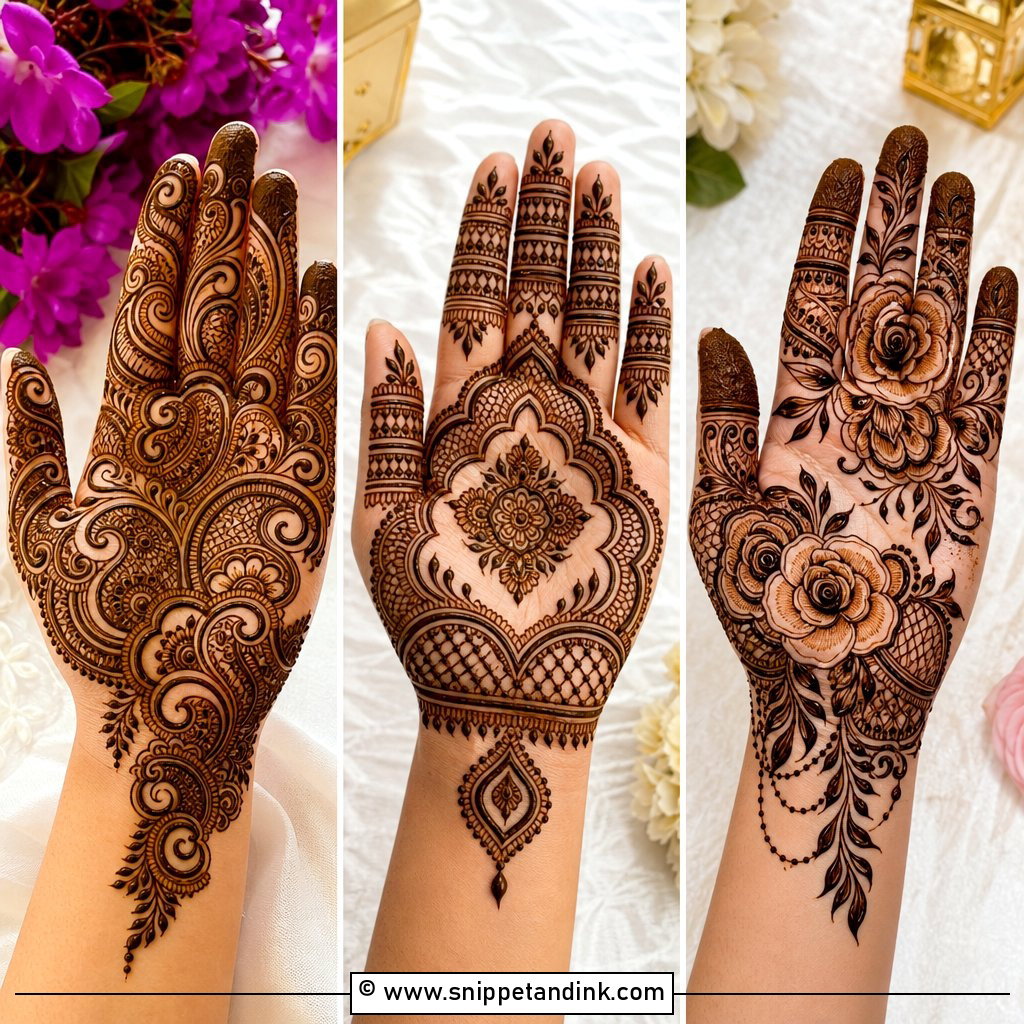
Full-hand Indian mehndi is the traditional bridal choice: palms, backs, fingers and wrists filled to the forearm with paisleys, florals, mandalas, peacocks and fine fillers. With this much coverage, every angle looks complete next to bangles, kalire and heavy jewelry. Small personal motifs like wedding bells, a lotus or tiny initials slot into the filler without breaking the flow. Plan for a long sitting, often most of an afternoon for both hands and arms. Dense line work also needs a good, fresh paste, because thin lines from an old cone stain patchily.
2. Rajasthani Bridal Mehndi Design
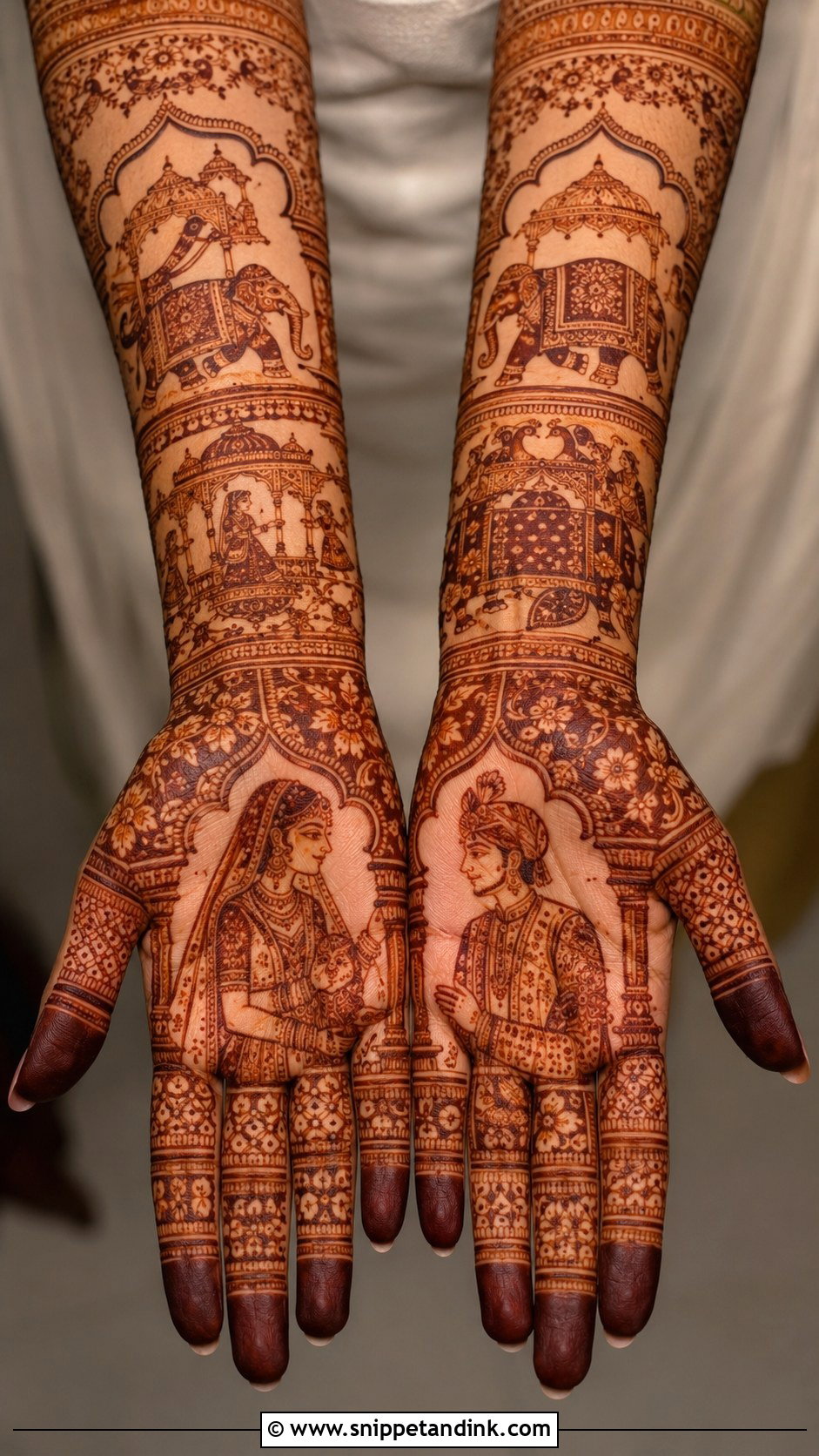
Rajasthani mehndi is narrative. It often carries bride and groom figures, doli scenes, elephants, peacocks and palaces, with mirror symmetry and filled fingertips. I usually put the couple on the palms and let the forearms carry heritage bands, because figures need the flattest surface of the hand to stay readable. Coverage runs heavy, often to the elbow. Heavy gota work and regal jewelry suit it best. Figure work takes more time than filler, so book an artist whose portraits you’ve seen in person or in unedited photos.
3. Arabic Bridal Mehndi Design
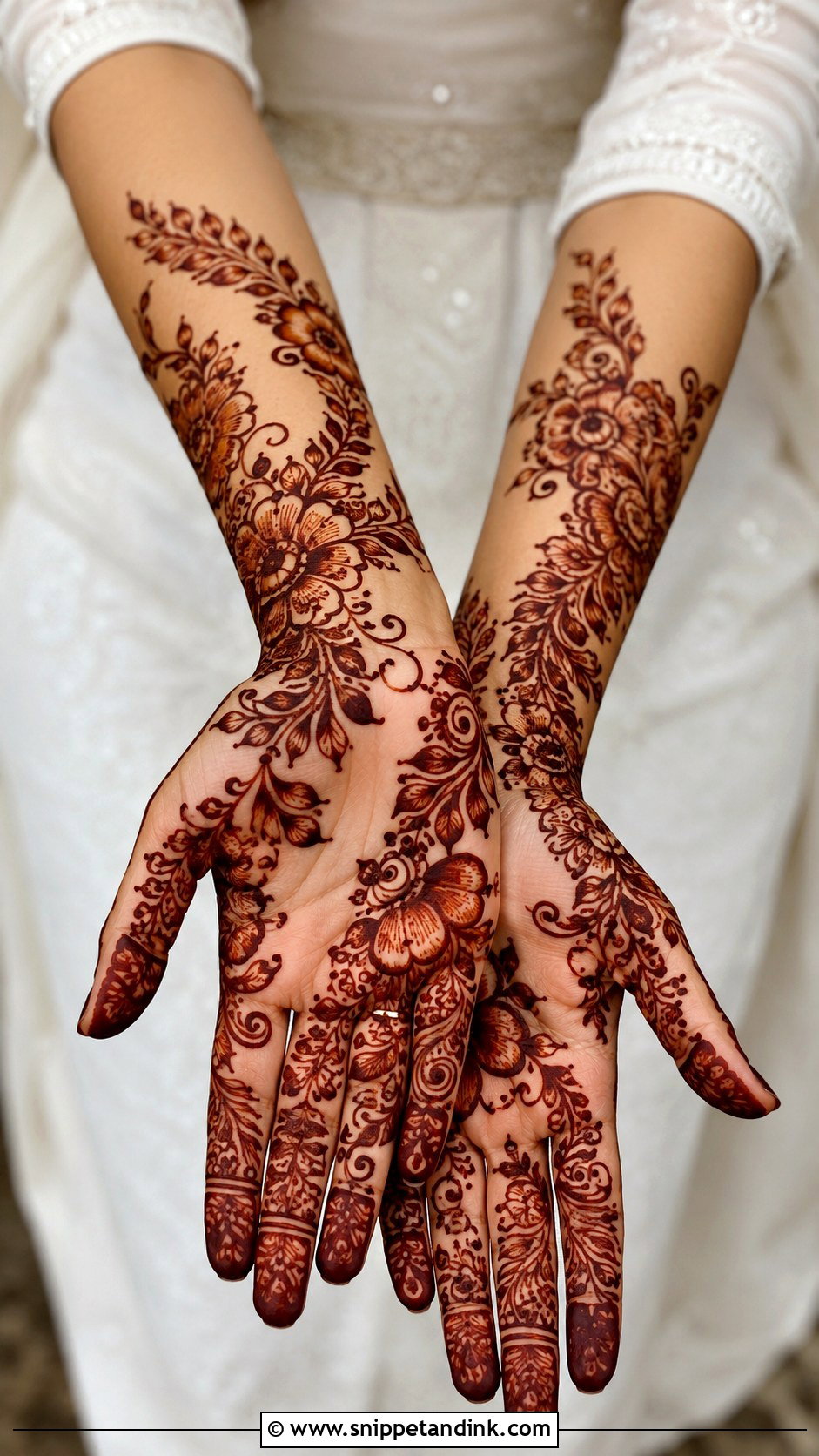
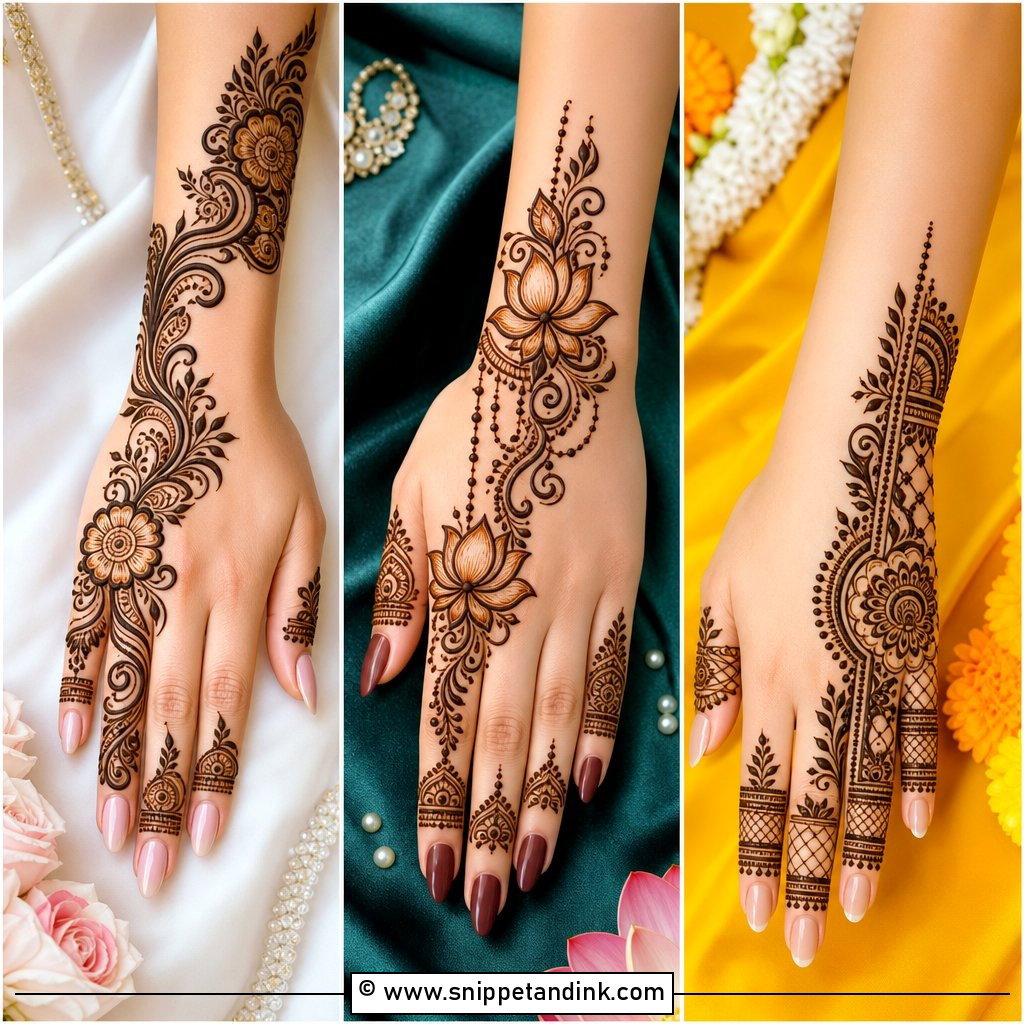
Arabic mehndi uses bold floral trails, shaded petals and open skin rather than dense filling. The trail usually starts at the fingers and sweeps diagonally across the palm toward the wrist. It reads clearly from across a room, and it’s much quicker to apply, which matters if you have several functions in one week. Because Arabic work relies on thick outlines, it also tends to stain more evenly than very fine filler. If it feels too casual for the main wedding, I add fine Indian detail inside the flowers.
4. Indo Arabic Bridal Mehndi Design
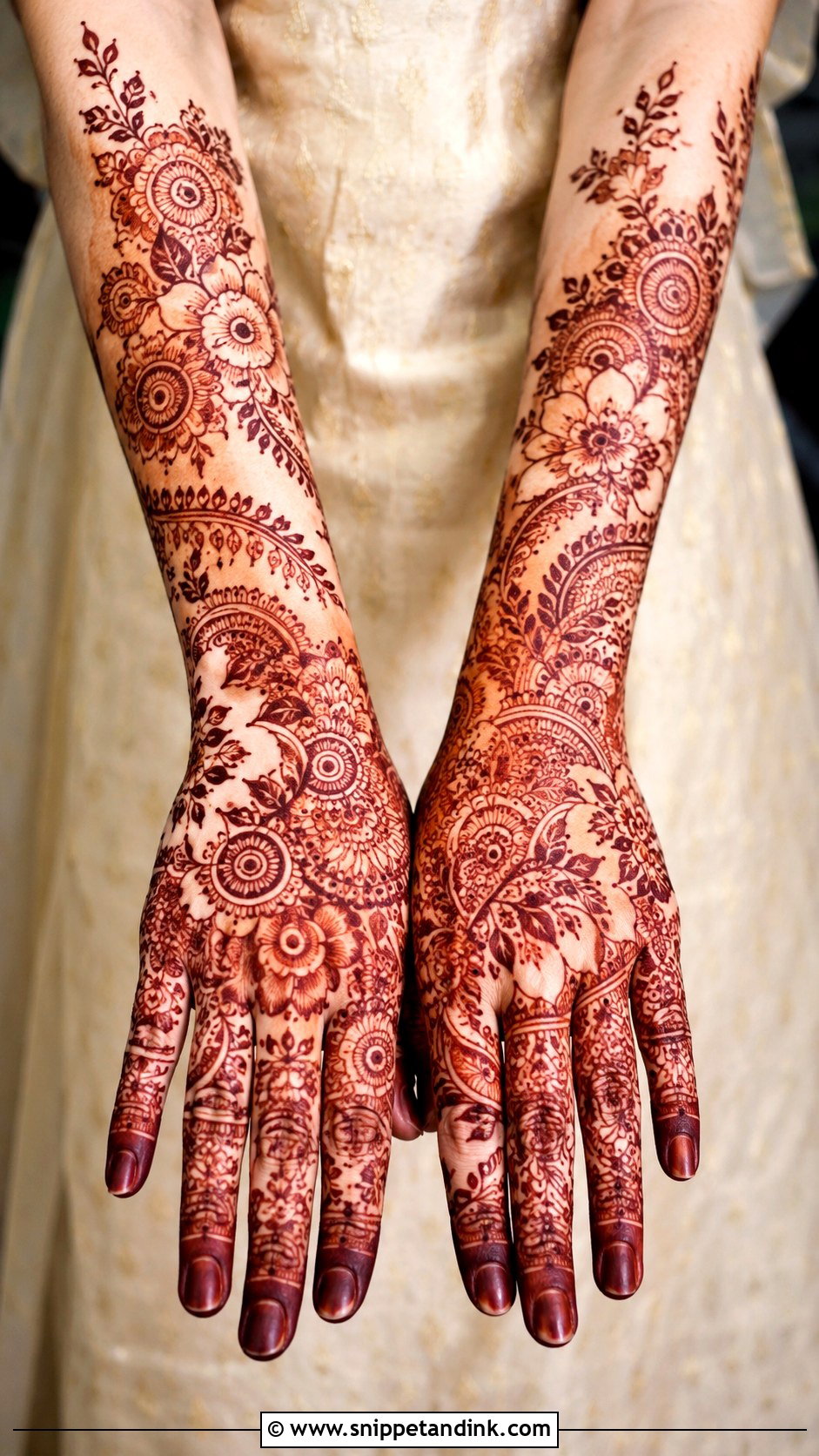
Indo-Arabic sits between the two traditions: the spacing of Arabic with the fine fillers of Indian work. Large roses, lotus clusters, paisleys and mandalas share the hand with neat finger detailing. I find it suits brides who want noticeable pattern but dislike fully packed hands, since the open skin lets each motif breathe. It pairs well with pastel and fusion outfits, and the shorter sitting time makes it practical for destination weddings and pre-wedding events.
5. Bridal Mehndi Design With Bride And Groom Portrait
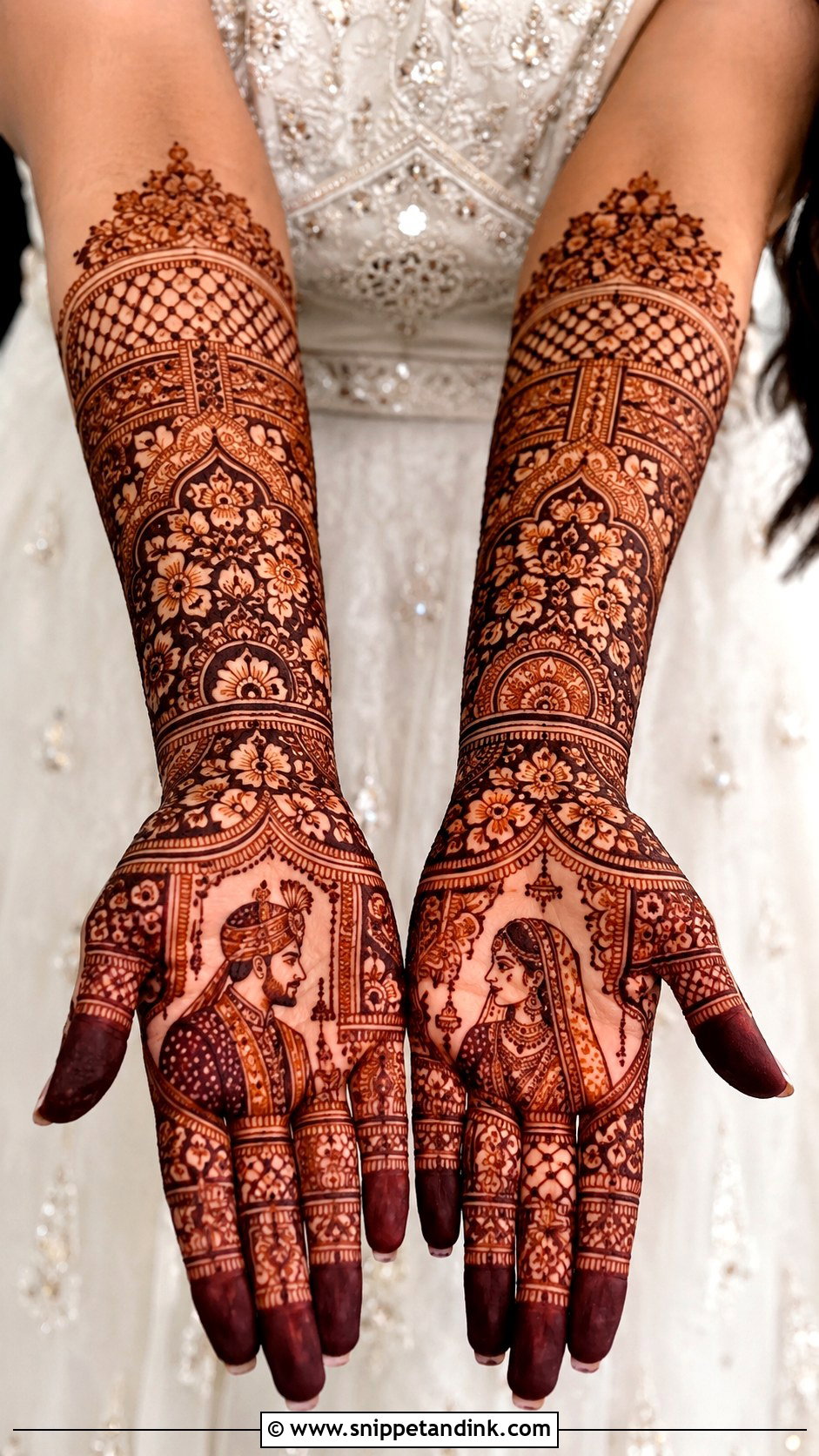
Portrait palms are the most personal design I draw, and the least forgiving. Tiny faces or silhouettes of the couple sit on the palms, surrounded by florals, paisleys, jaali and wedding symbols. Faces need clean, even lines and correct spacing, and a shaky stroke changes an expression, so this is not the place to try a new artist. Many brides hide the groom’s name or initials nearby. The palm stains darkest, which keeps the faces sharp in close-up photos.
6. Peacock Bridal Mehndi Design
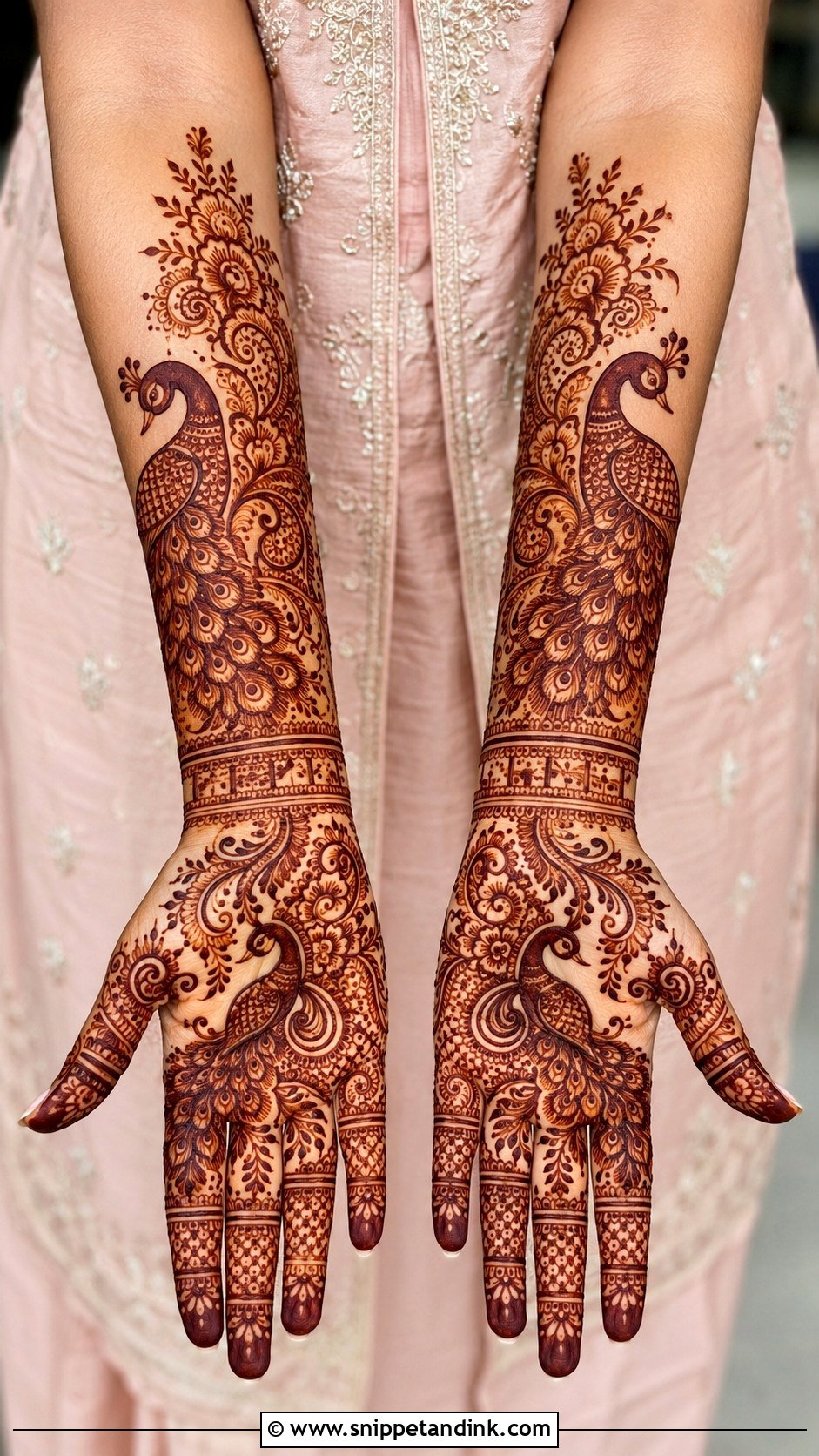
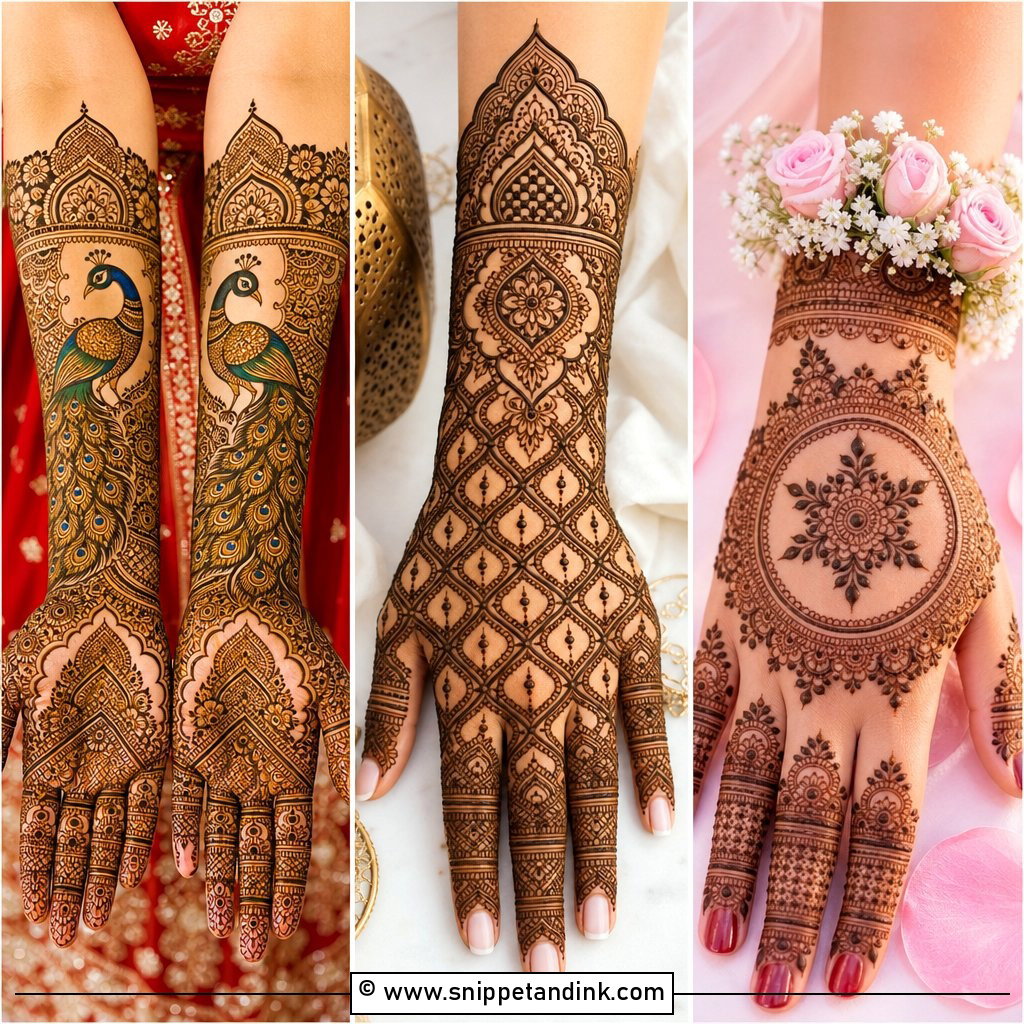
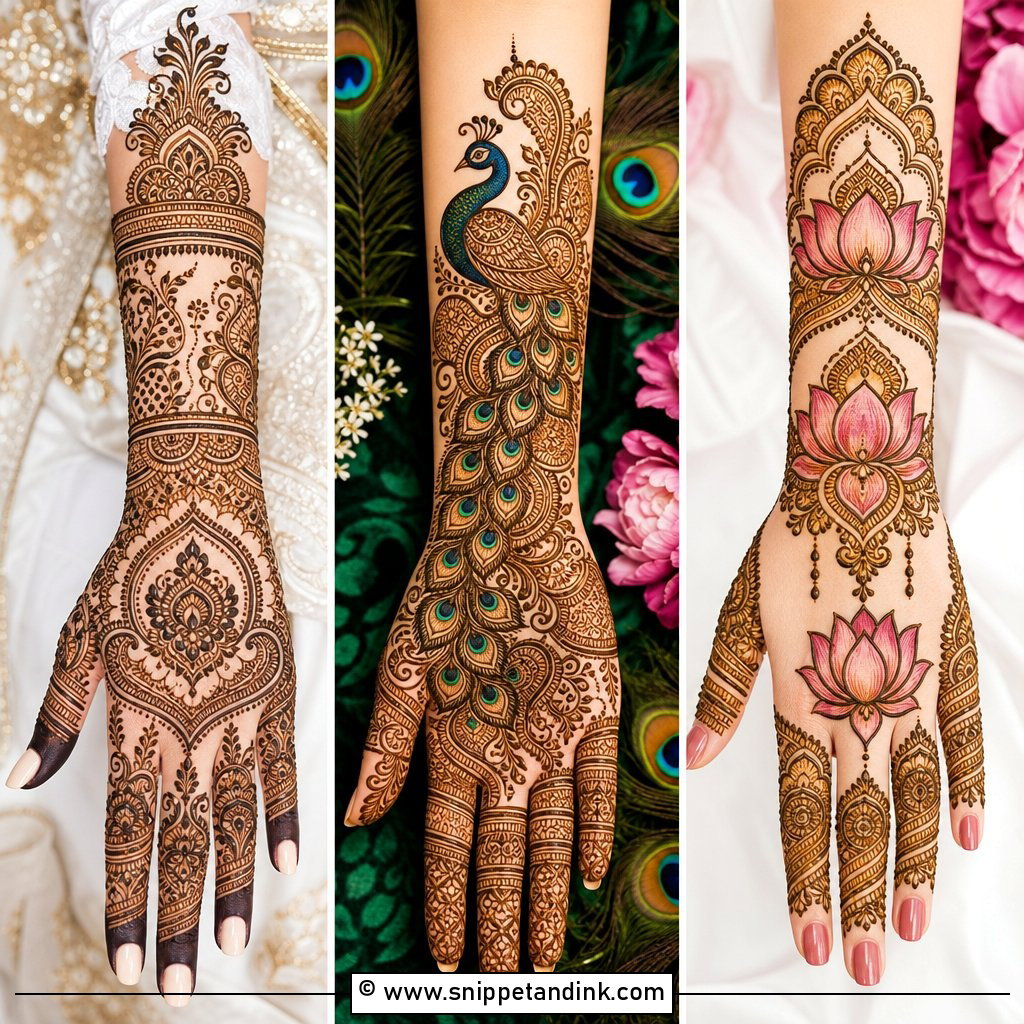
The peacock has stayed in bridal mehndi because its curved body and tail follow the natural shape of the hand. It can sit on the palm, wrist, forearm or back of the hand, framed by feathers, paisleys and vines. For a heavy version I add shaded wings, detailed feather sections and fine filler. For a cleaner look, I draw one large peacock and leave space around it. Shading in henna comes from thinner, lighter strokes, and those areas stain paler, so I keep shading inside a strong outline. Silk, velvet and jewel-toned outfits suit it.
7. Lotus Bridal Mehndi Design
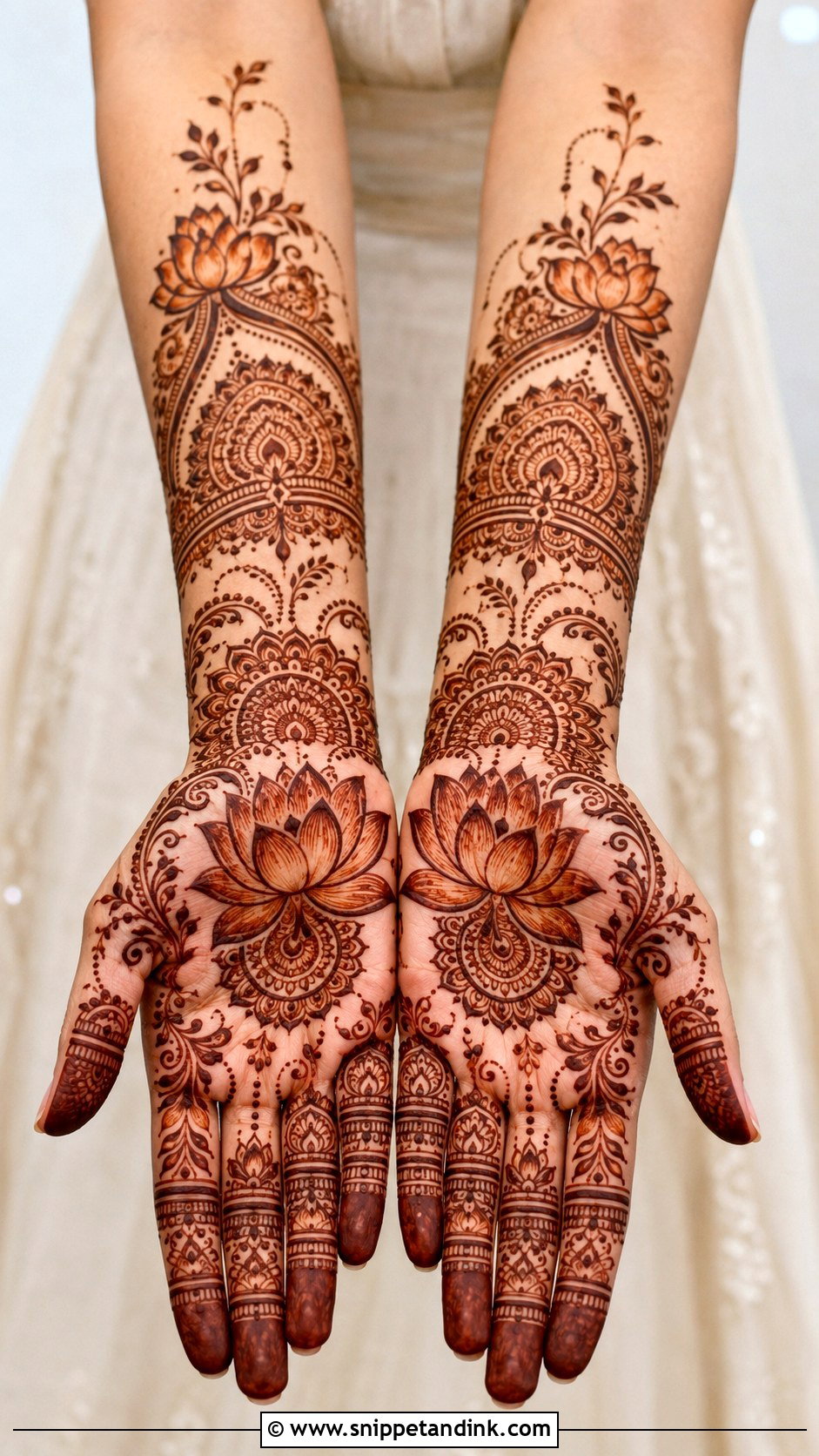
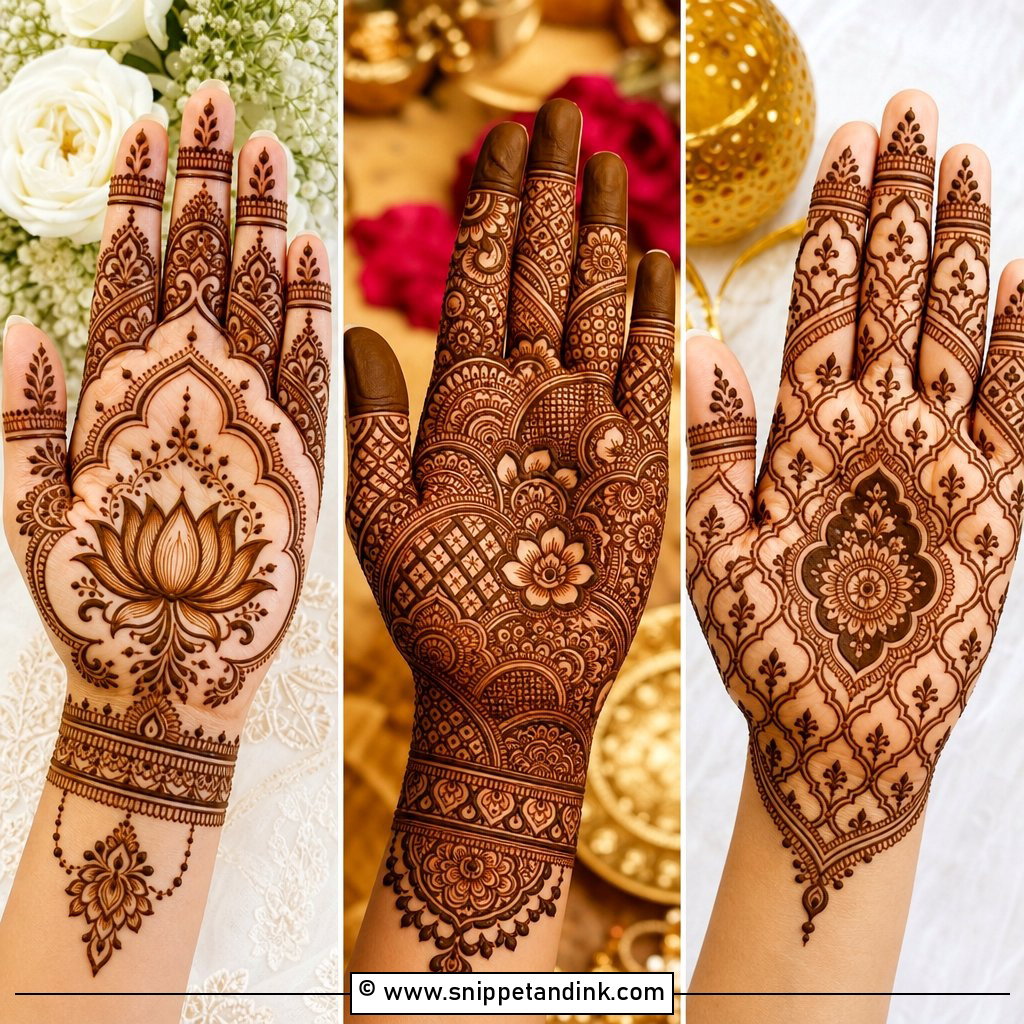
Lotus motifs have rounded petals that balance well on both palms and backs. A full bridal version has large lotus flowers at the center, smaller lotus vines along the fingers and ornamental bands at the wrist and forearm. It can go dense or semi-open. It sits quietly next to pastel lehengas, temple jewelry or minimal gold. Lotus also blends easily into mandalas, jaali, paisleys and fine dot work, which makes it a good anchor if you can’t settle on one theme.
8. Mandala Bridal Mehndi Design
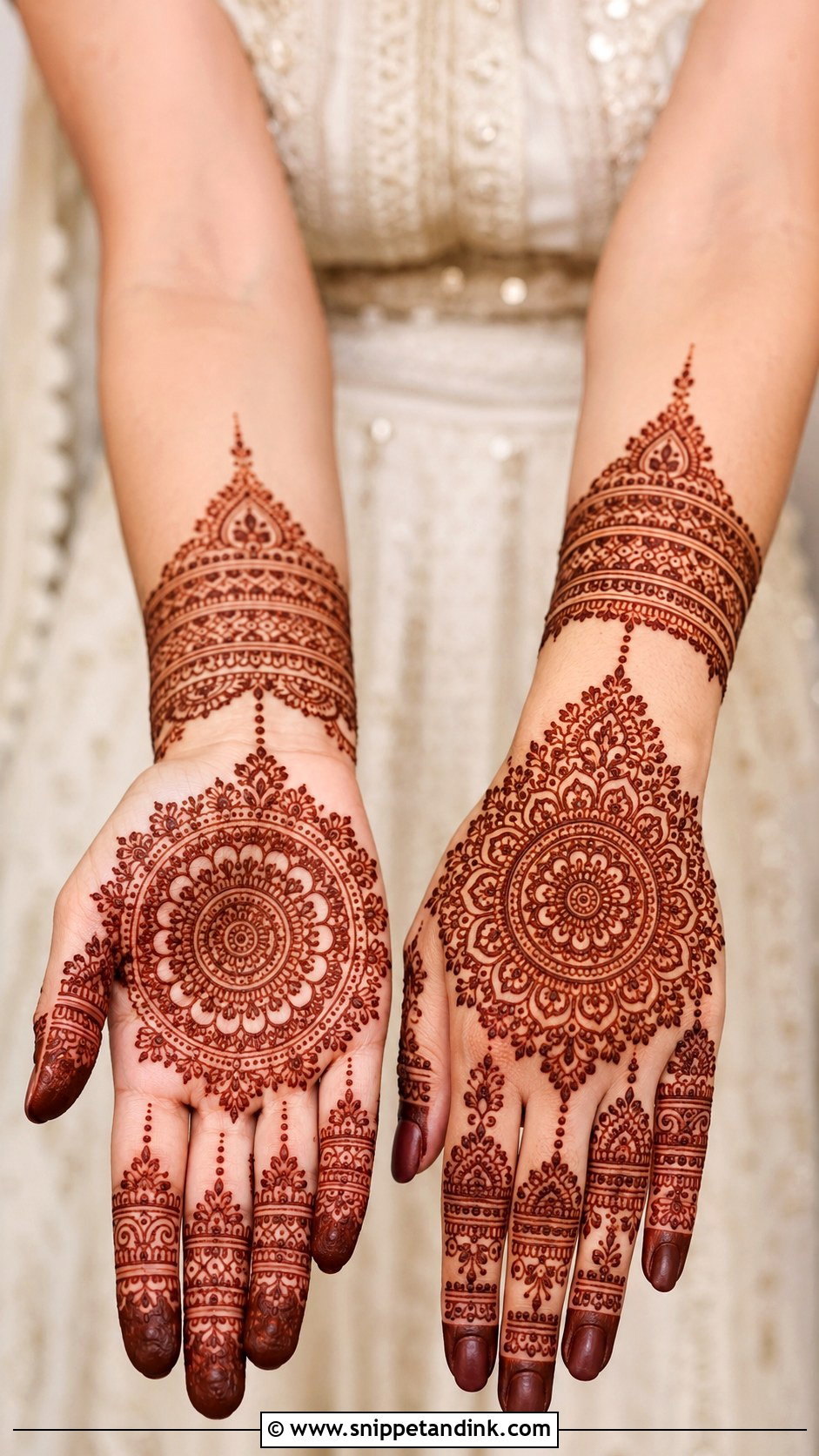
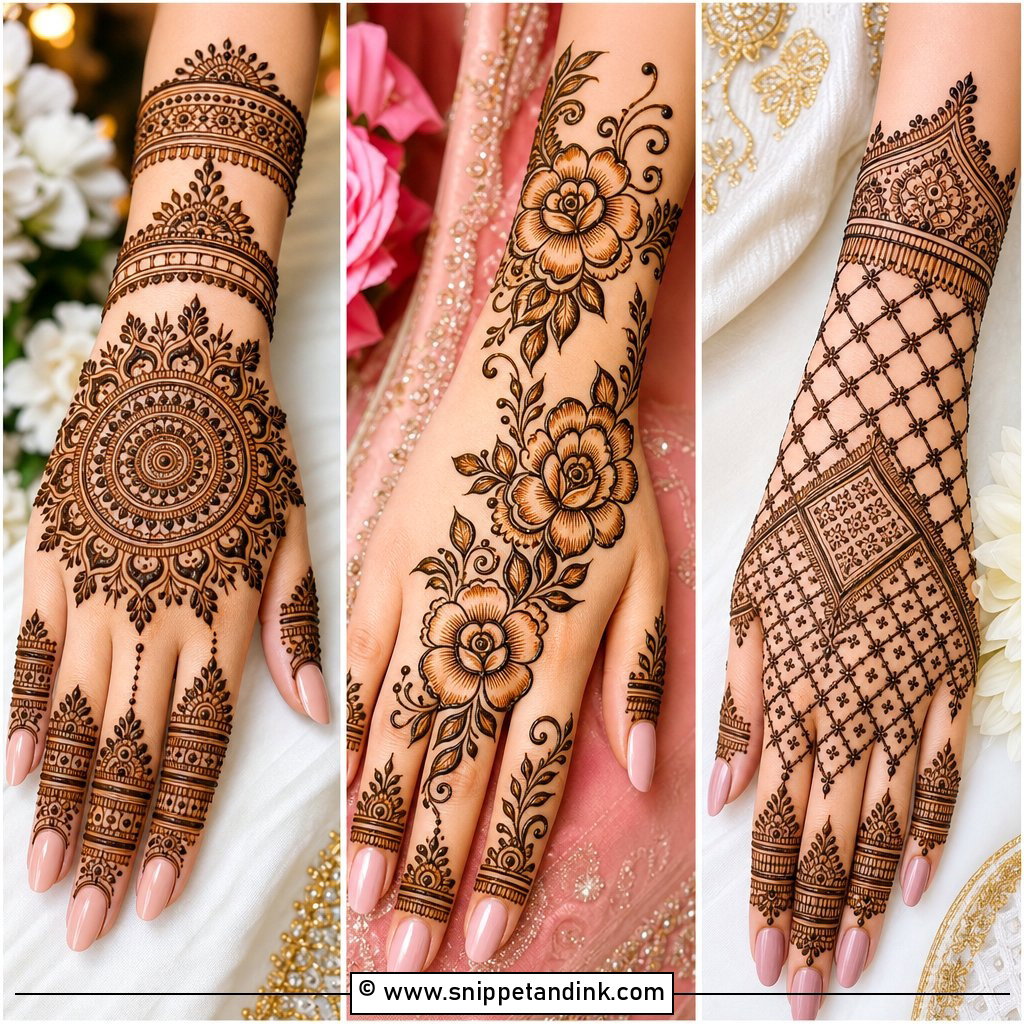
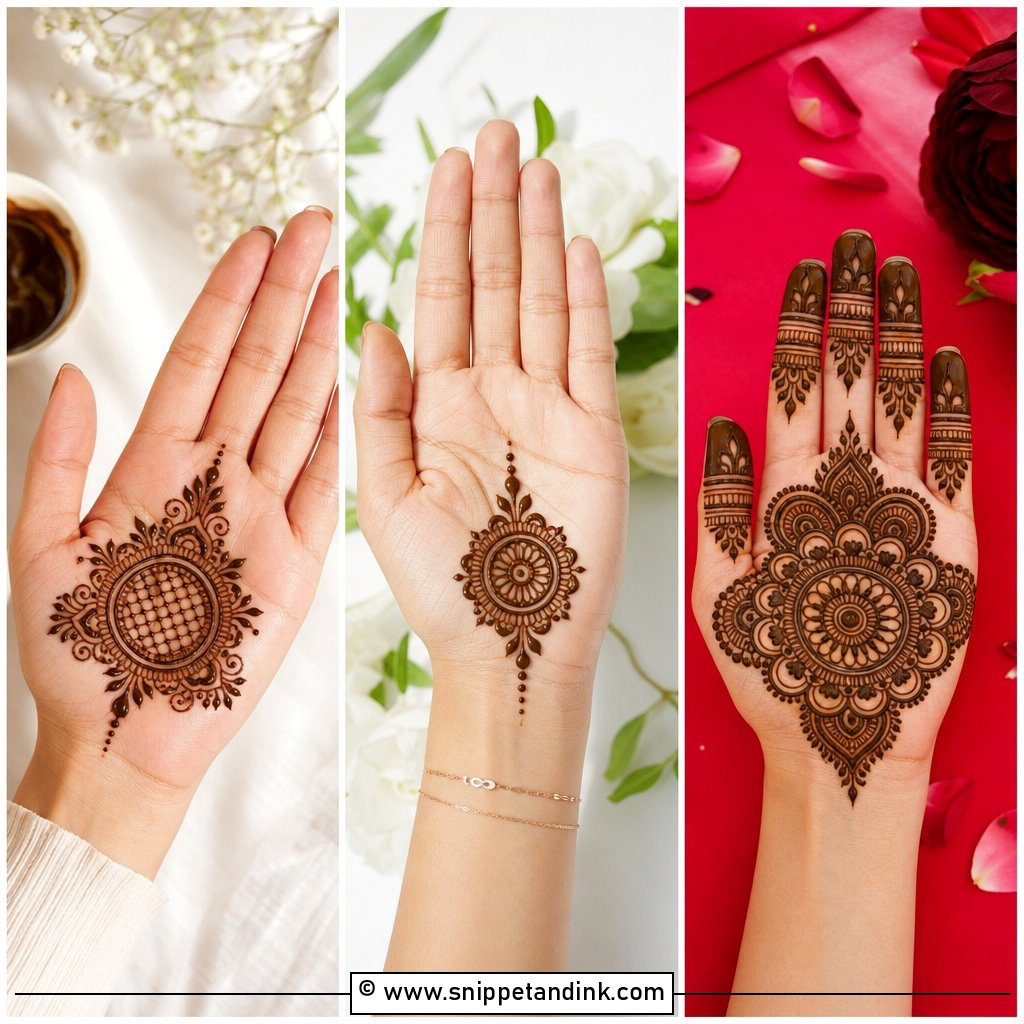
A mandala gives the hand a single, centered focal point, with petals, dots and rings expanding out from the middle of the palm or back of the hand. A lone mandala looks unfinished on a bride, though, so I always connect it to decorated fingers, a wrist cuff and forearm pattern. Its centered shape frames rings well in close-up shots. I draw the circles while the hand is flat and relaxed; if the hand is cupped, the mandala comes out oval once the fingers straighten.
9. Back Hand Bridal Mehndi Design
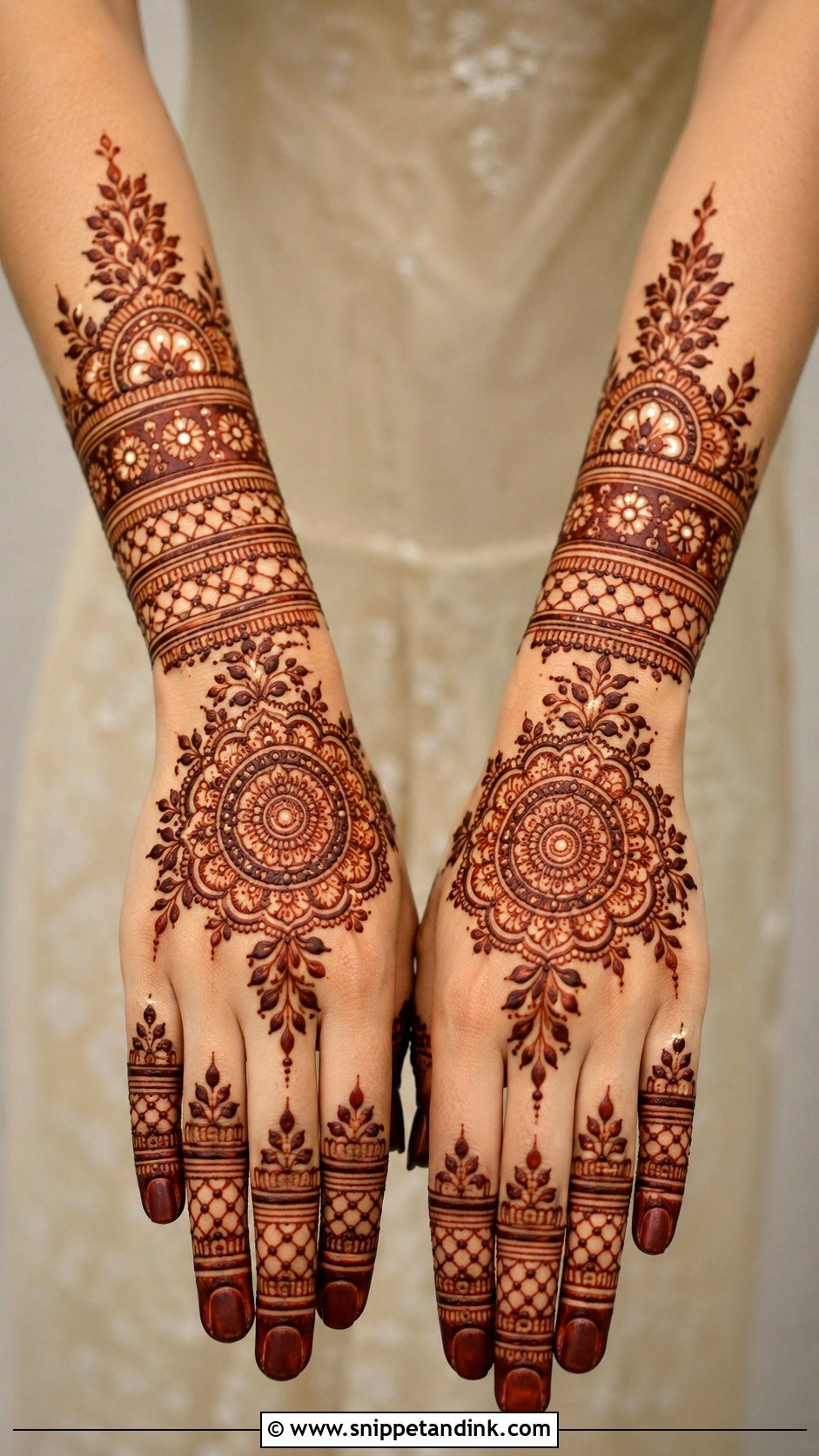
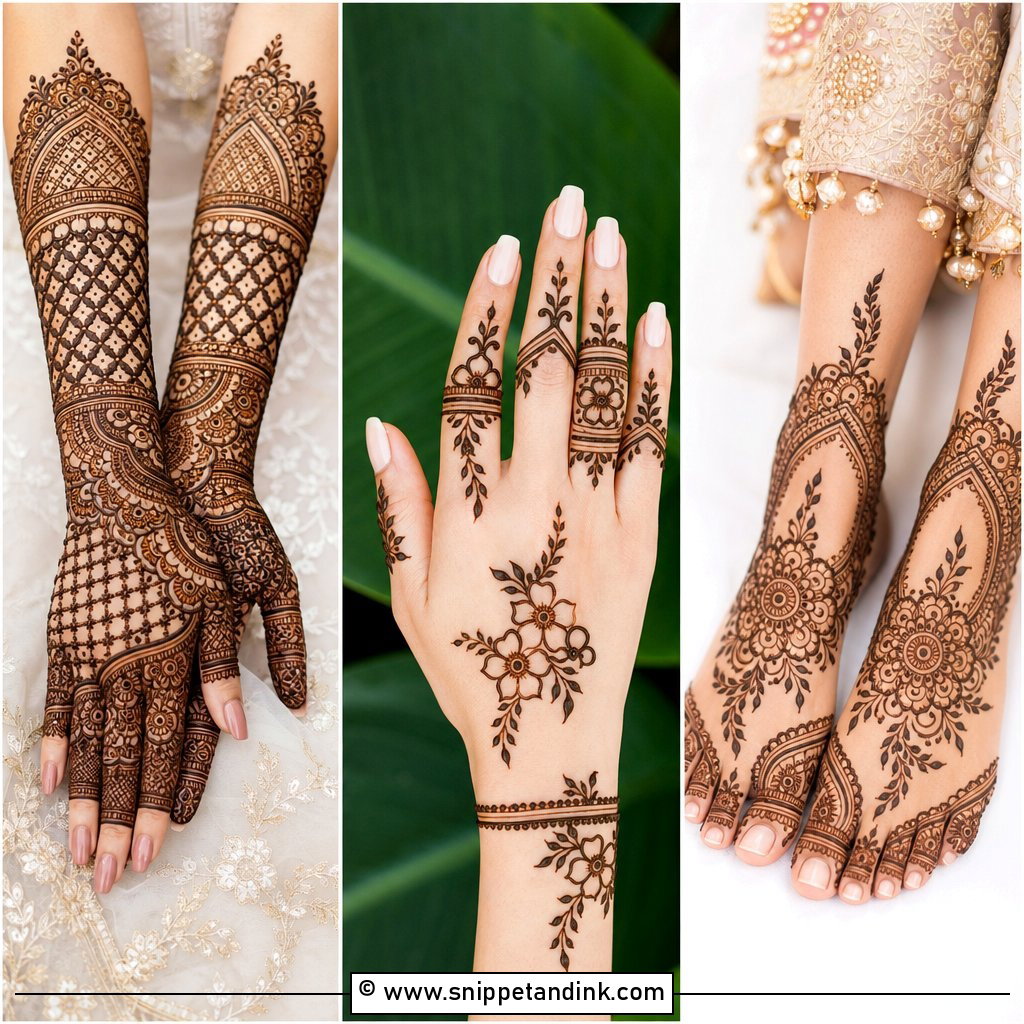
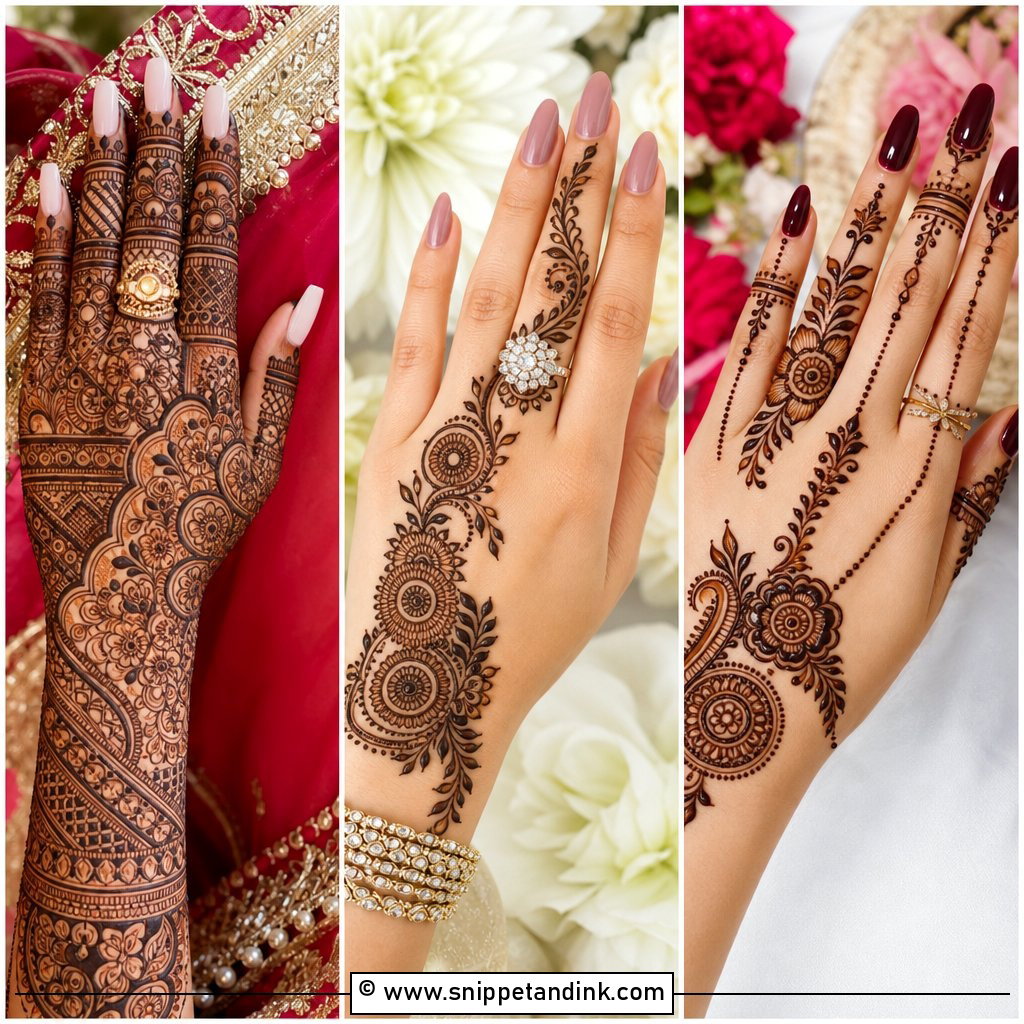
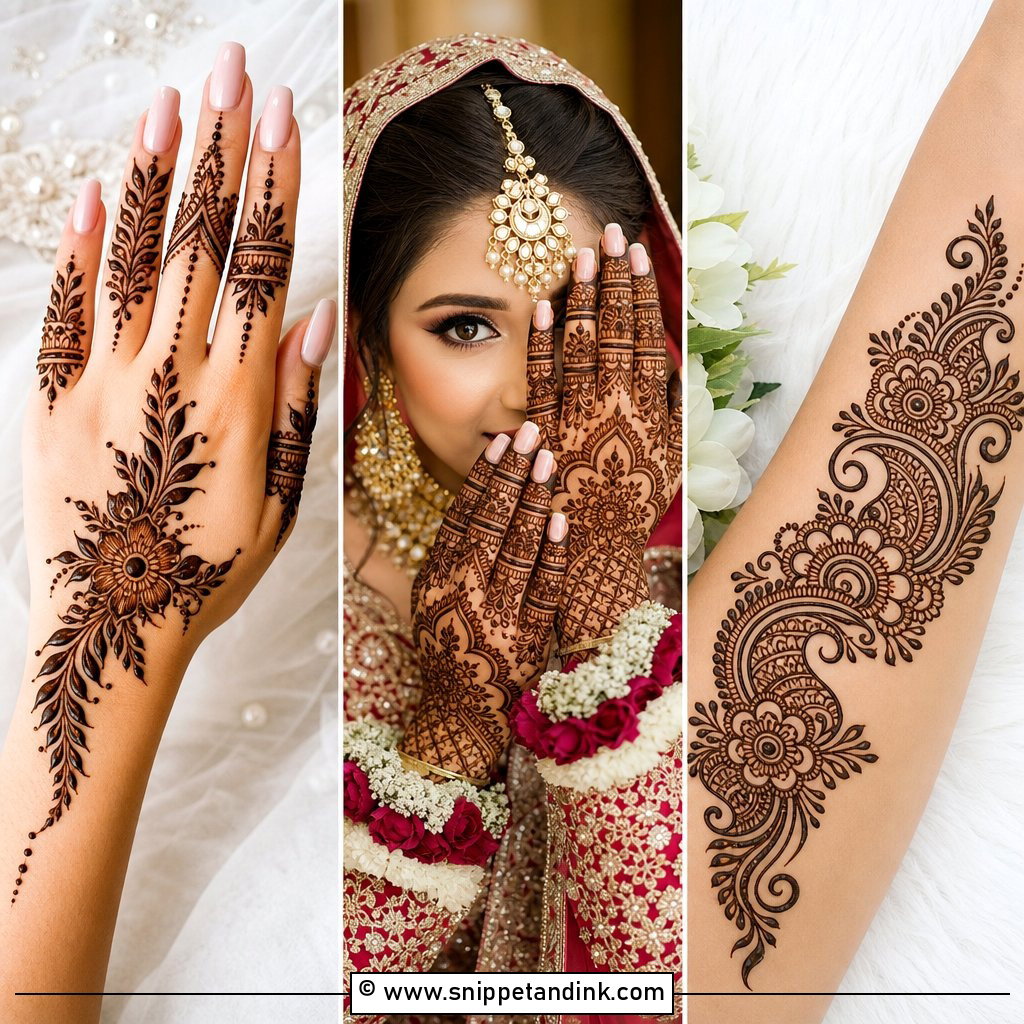
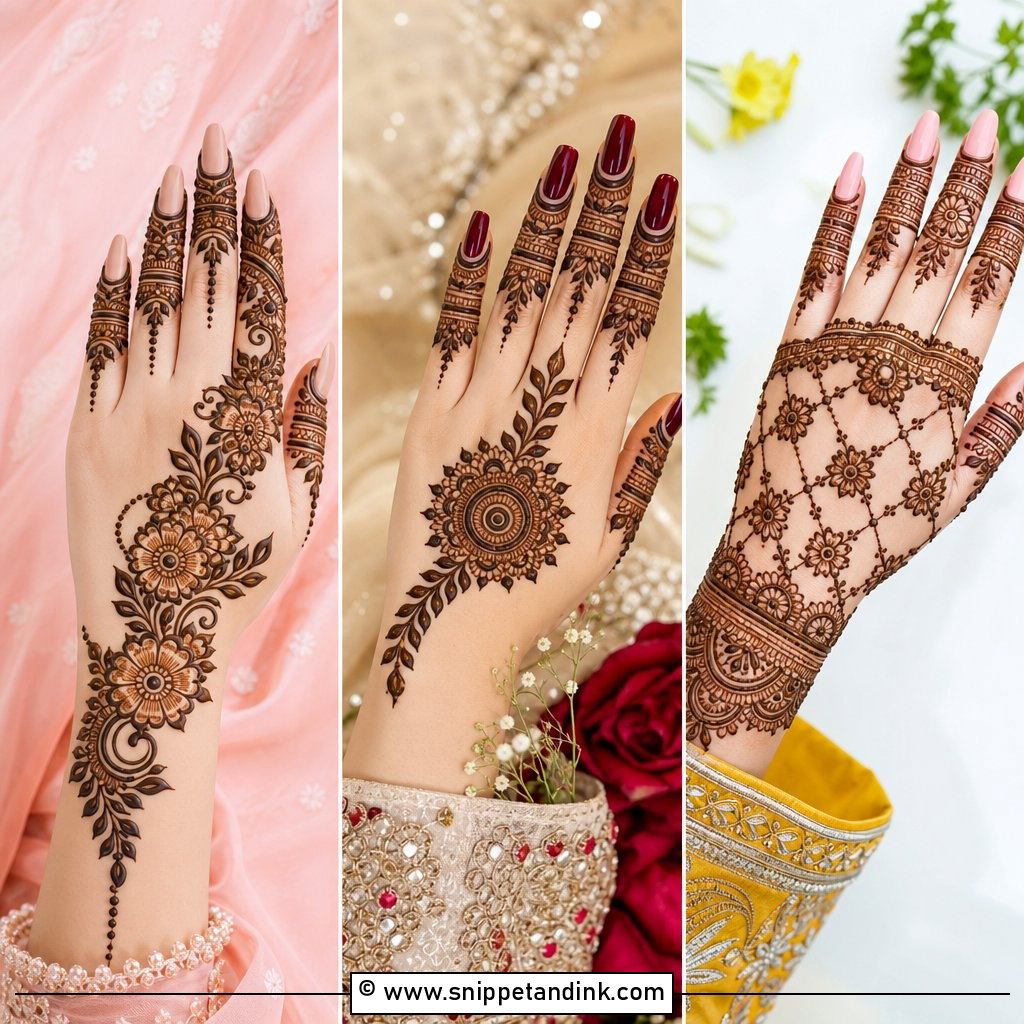
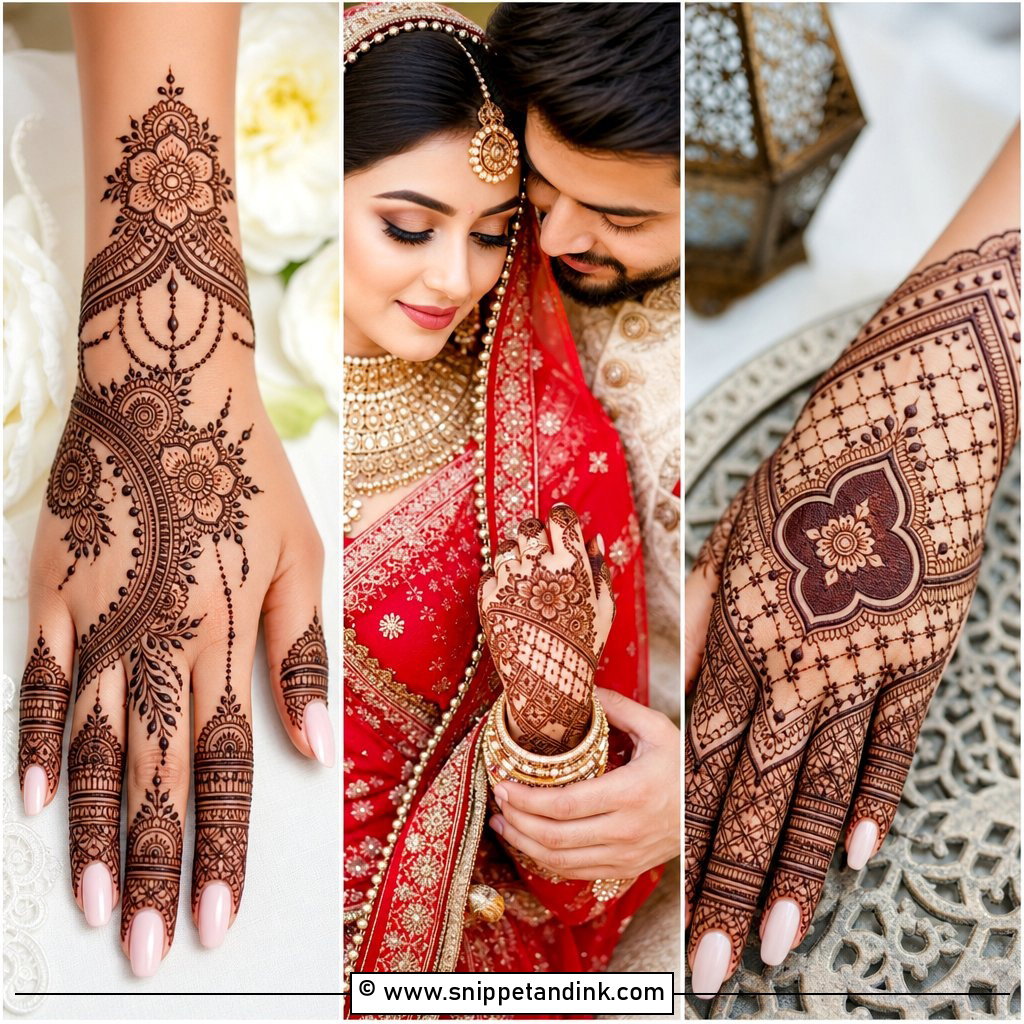
The back of the hand is what the camera sees most: ring shots, bouquet poses, candid photos with a glass. A complete bridal back hand usually has a central floral or mandala, decorated fingers, bracelet bands and trails toward the forearm. Be aware that the back of the hand stains lighter than the palm, because the skin is thinner and drier there. I use bolder outlines on the back so it doesn’t look faint beside the palm. If you’ll wear haath phool, rings or stacked bangles, tell me early so I can leave space around them.
10. Front Hand Bridal Mehndi Design
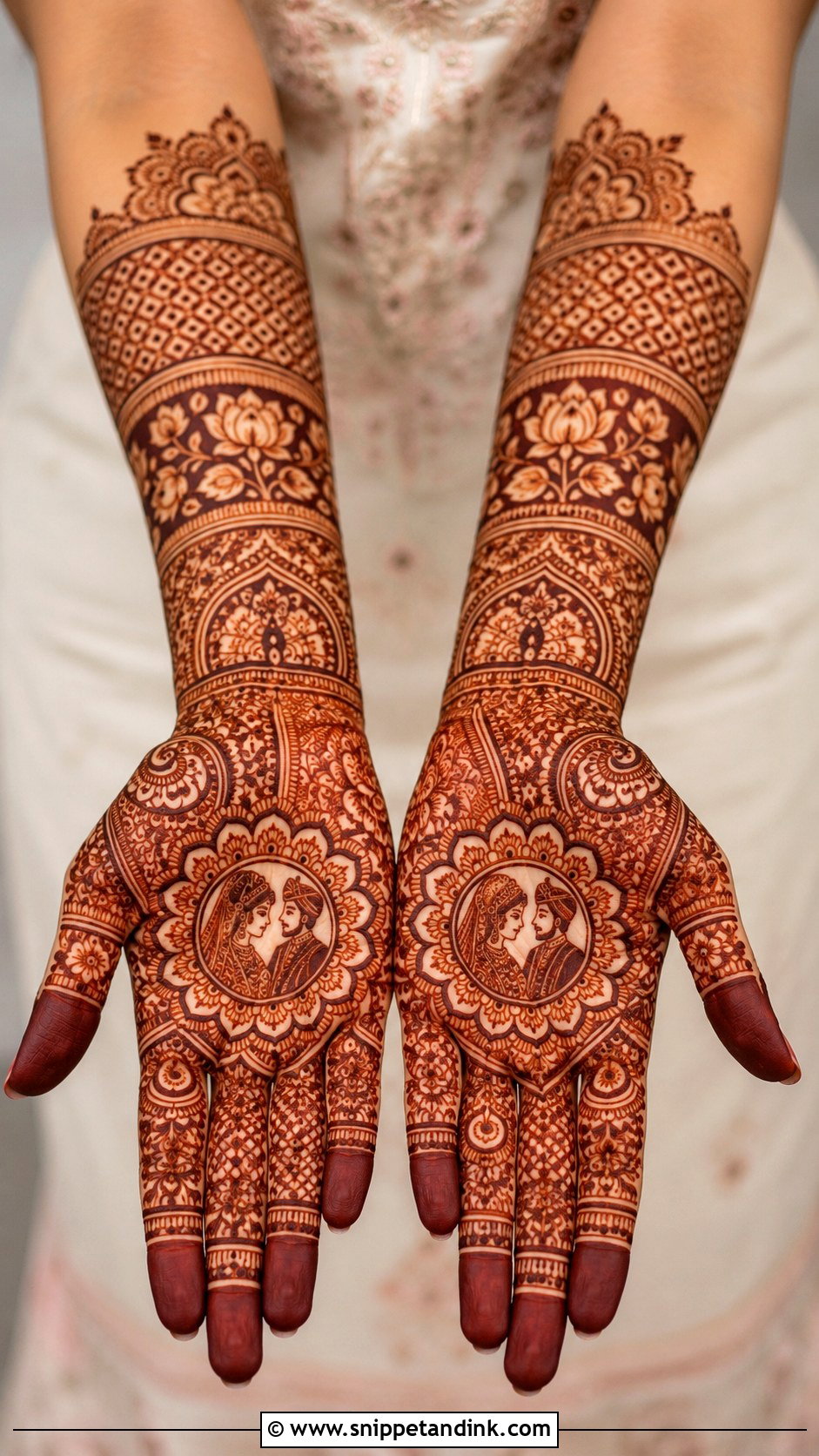
The palm stains darkest of anywhere on the body, because the skin there is thicker and warmer, which is why most of the meaningful work goes on the front of the hand. A full palm can carry mandalas, paisleys, bride-groom art, florals, peacocks or hidden names, with fine bands, checks and filled tips on the fingers. If you prefer clean, put one main motif on each palm. If you want classic, fill from fingertips to wrist and forearm. Either way, the palm is what you’ll see yourself every time you look down.
11. Simple Bridal Mehndi Design
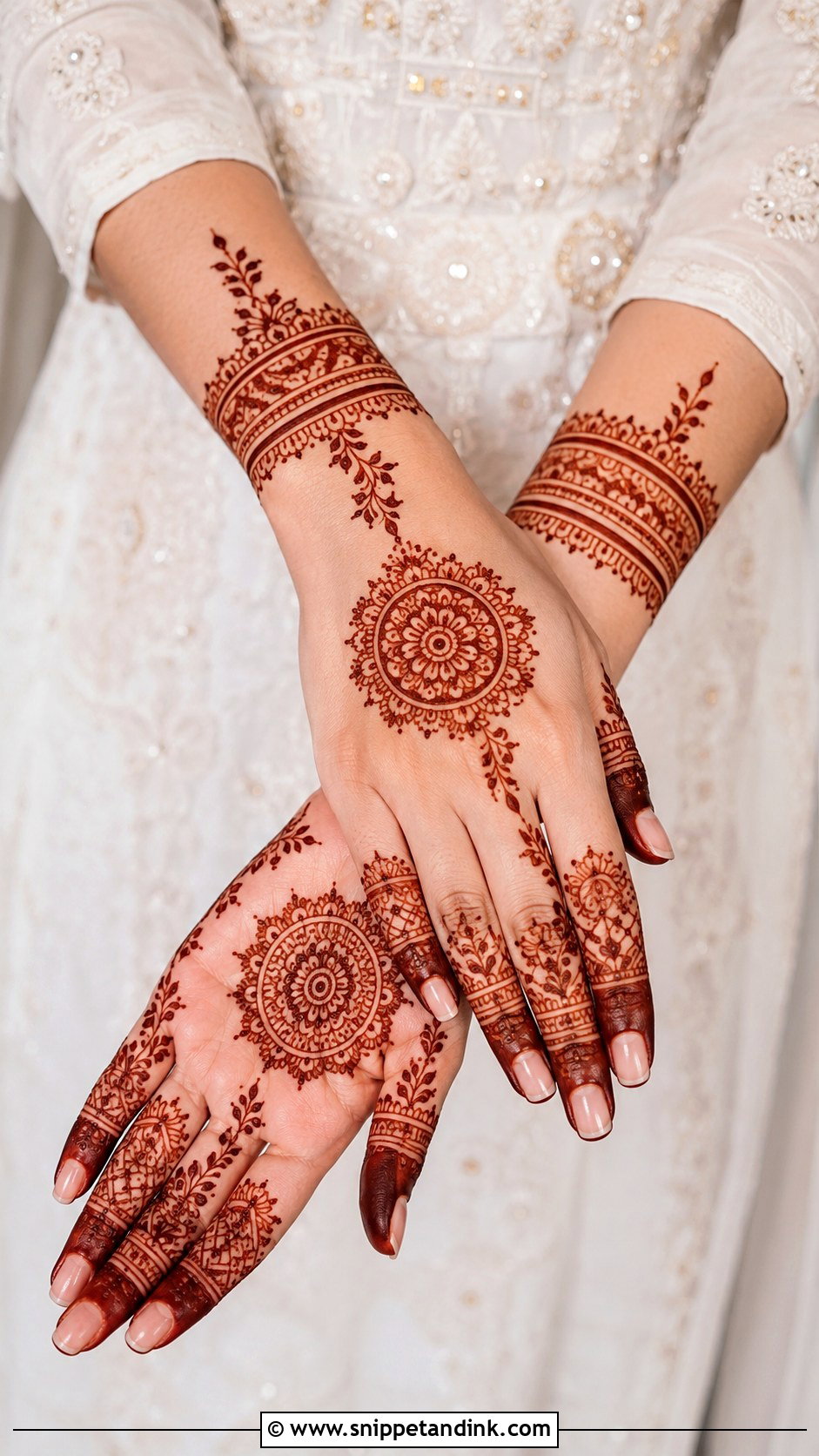
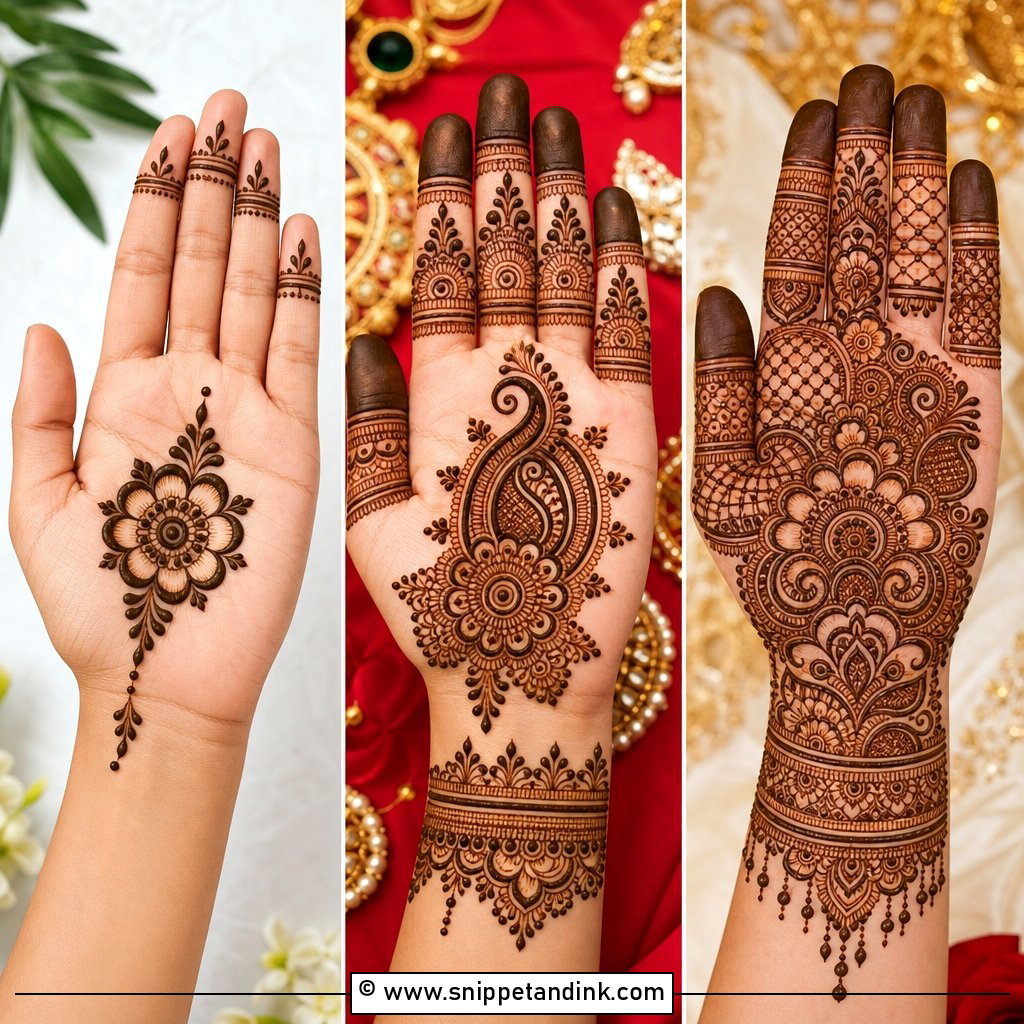
Simple doesn’t mean casual. A neat palm mandala, floral fingers, a wrist bracelet and soft vines toward the forearm still read as bridal because the placement covers the whole hand. I’d rather draw a few strong motifs with clean lines and even spacing than crowd a simple design with tiny details. It suits court weddings, intimate ceremonies and engagement functions, and takes a fraction of the sitting time. A deep stain does most of the work here, so aftercare matters even more with light coverage.
12. Minimal Bridal Mehndi Design
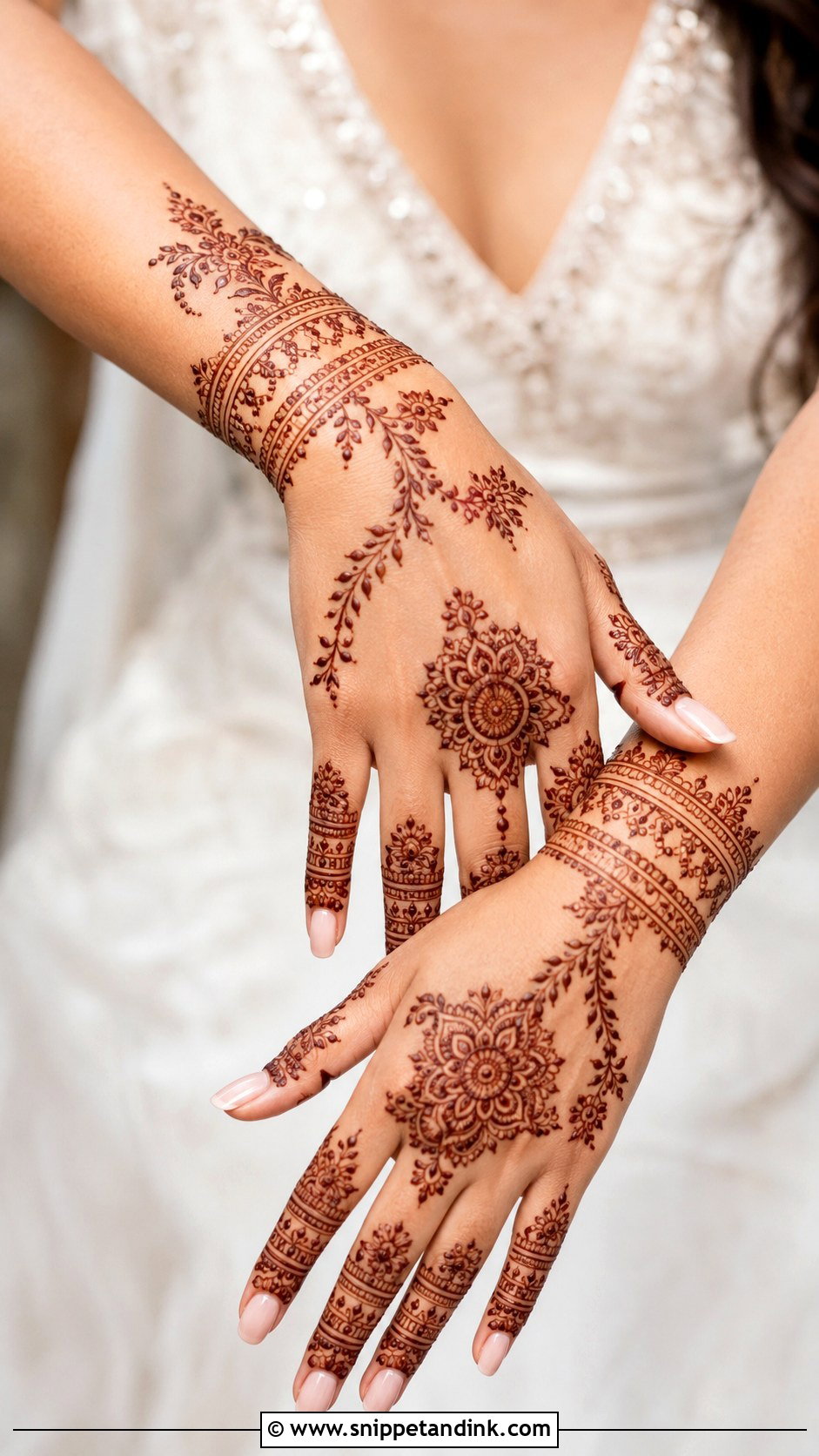
Minimal mehndi works on negative space and placement: fingers, the center of the palm, wrist and back of the hand, with tiny florals, fine vines, slim bands, dots and small mandalas. It looks fresh with contemporary outfits and sleek jewelry. The risk is looking unfinished next to a bridal outfit, so I keep both hands matching and add a small wrist cuff and a hint of forearm detail. Very fine lines can stain faintly, so I go a touch bolder on minimal work than you’d expect.
13. Modern Bridal Mehndi Design
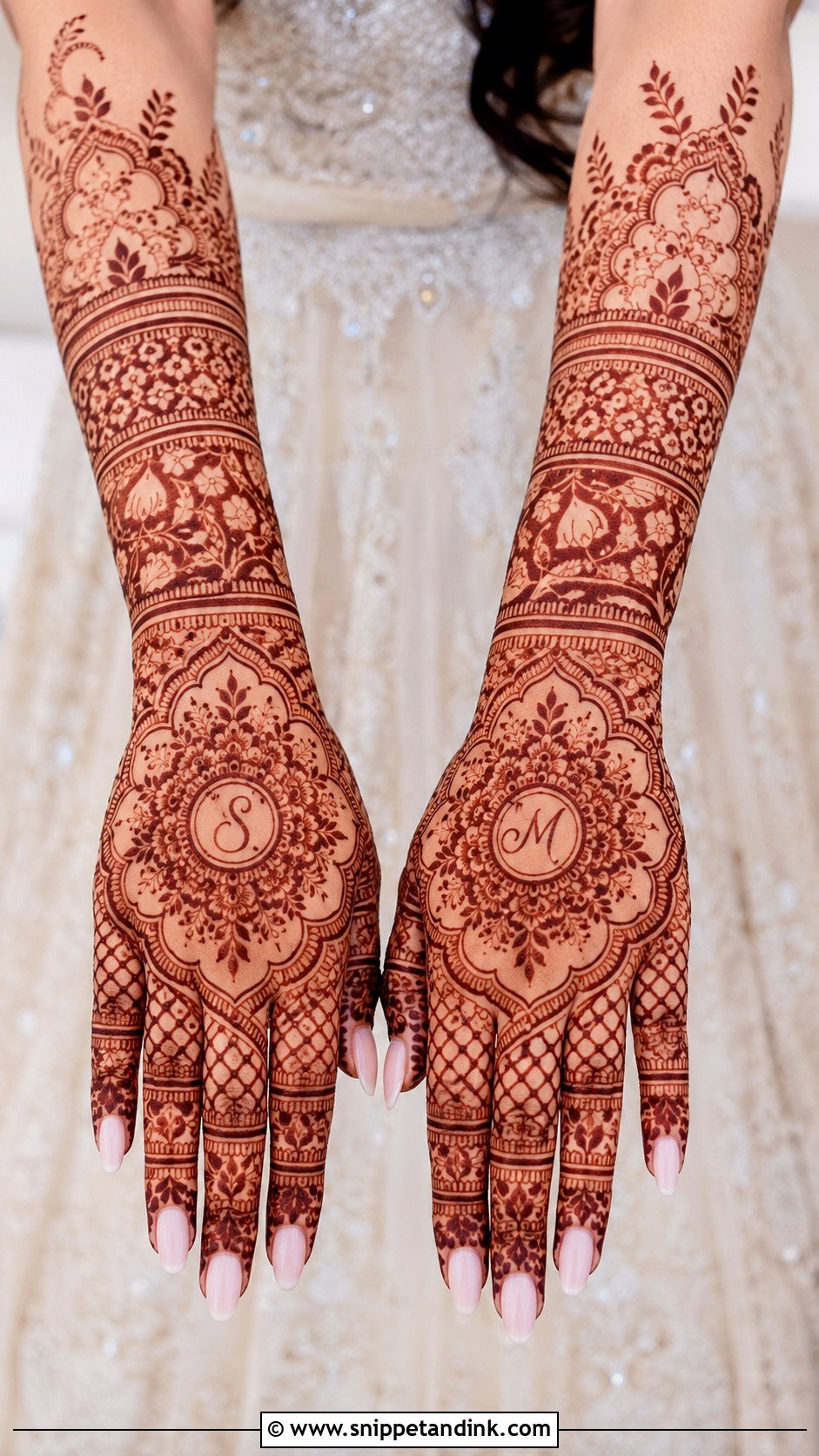
Modern bridal mehndi uses negative space, fine-line florals, geometric borders and personal motifs: initials, wedding dates, a pet, a travel symbol, a nod to the proposal. Coverage can be medium or full, but the layout breathes more than classic Indian work. The thing I insist on is structure. Pick one or two themes and let everything else support them, otherwise personal motifs turn into clutter. It suits modern lehengas, pearls and sleek buns.
14. Heavy Bridal Mehndi Design
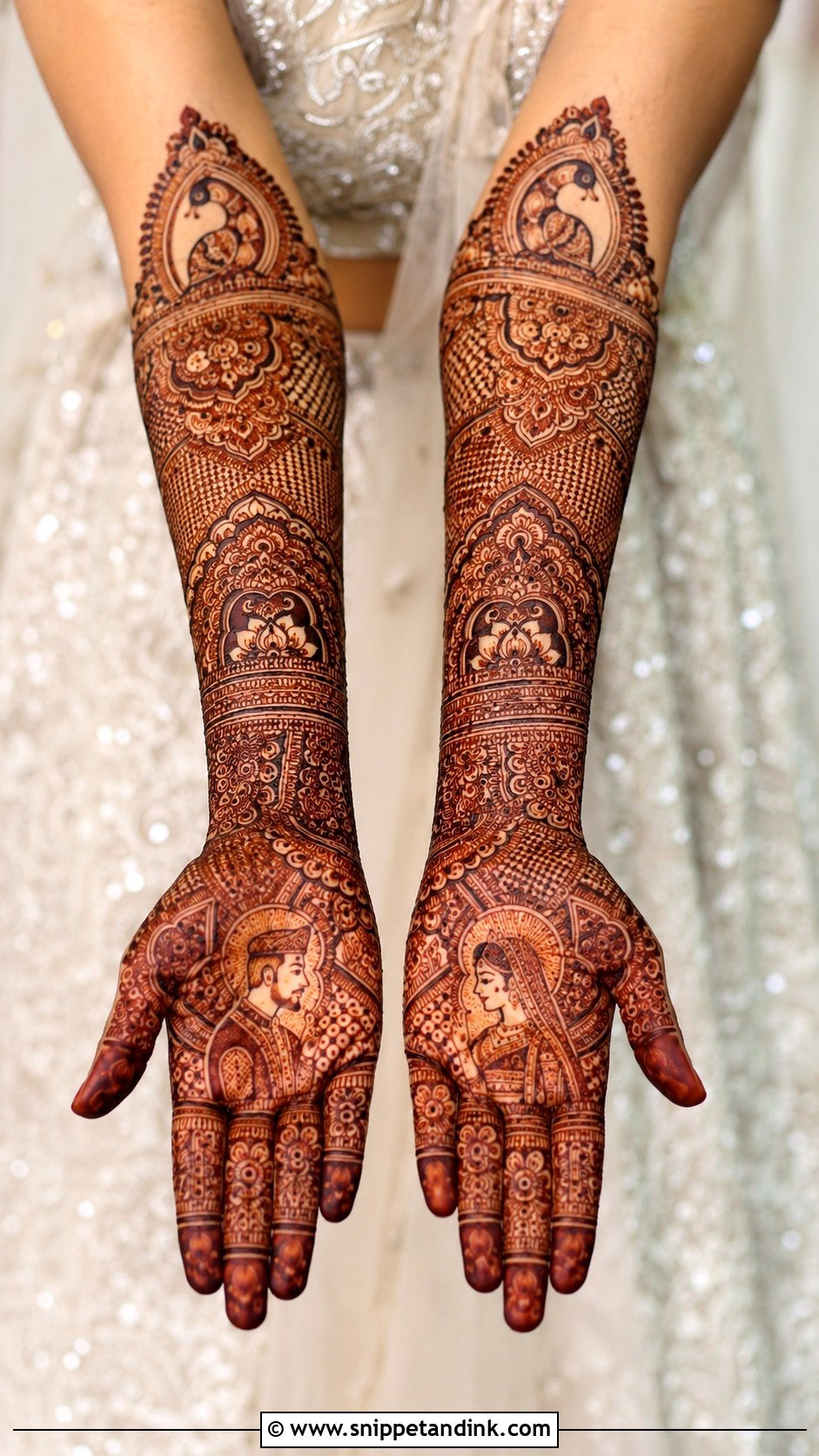
Heavy bridal mehndi covers the hands and arms with almost no empty skin: paisleys, jaali, peacocks, florals, mandalas, portraits and ornamental borders. It takes the longest of anything here, so plan a full sitting and get comfortable: a supported chair, a cushion under each arm, and someone to feed you. Dense work also needs the paste to stay on longer for a deep stain. Red, maroon, gold, emerald and royal blue outfits all look rich beside it.
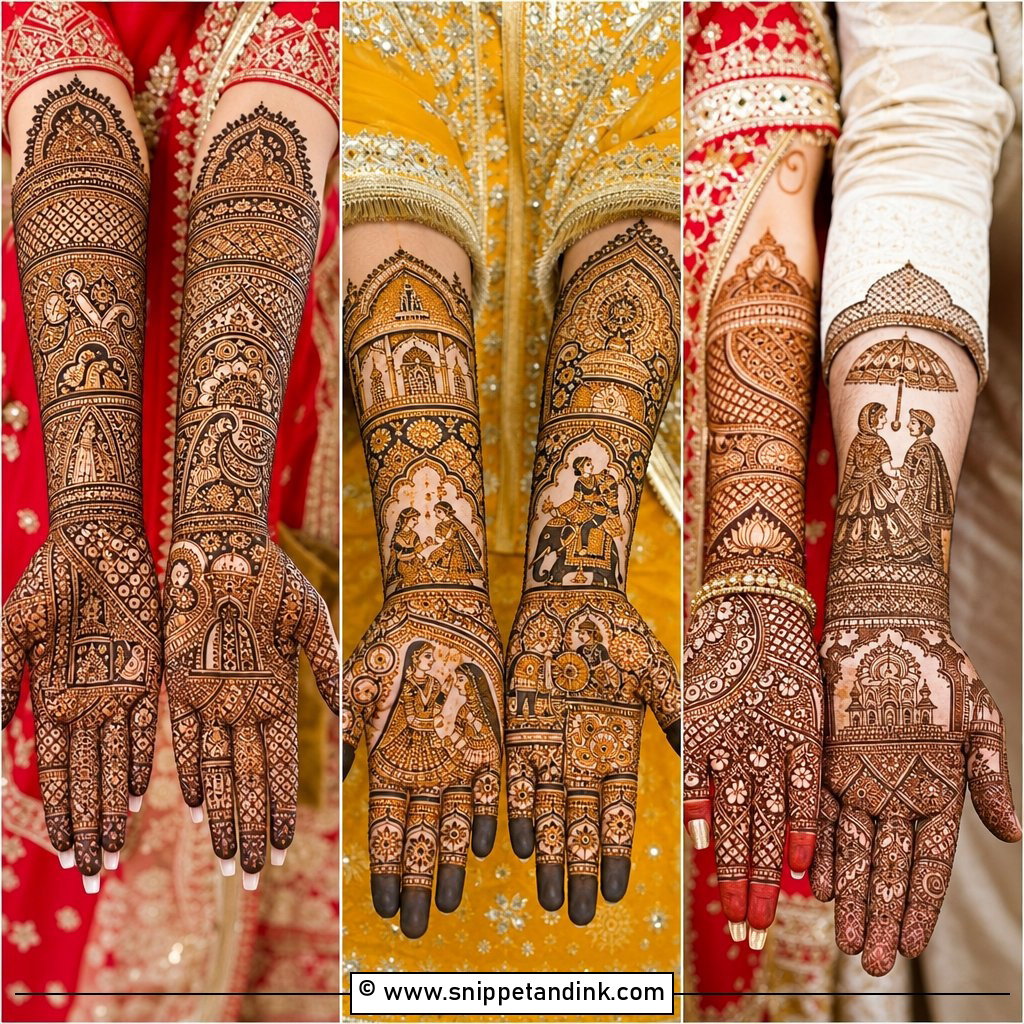
15. Royal Bridal Mehndi Design
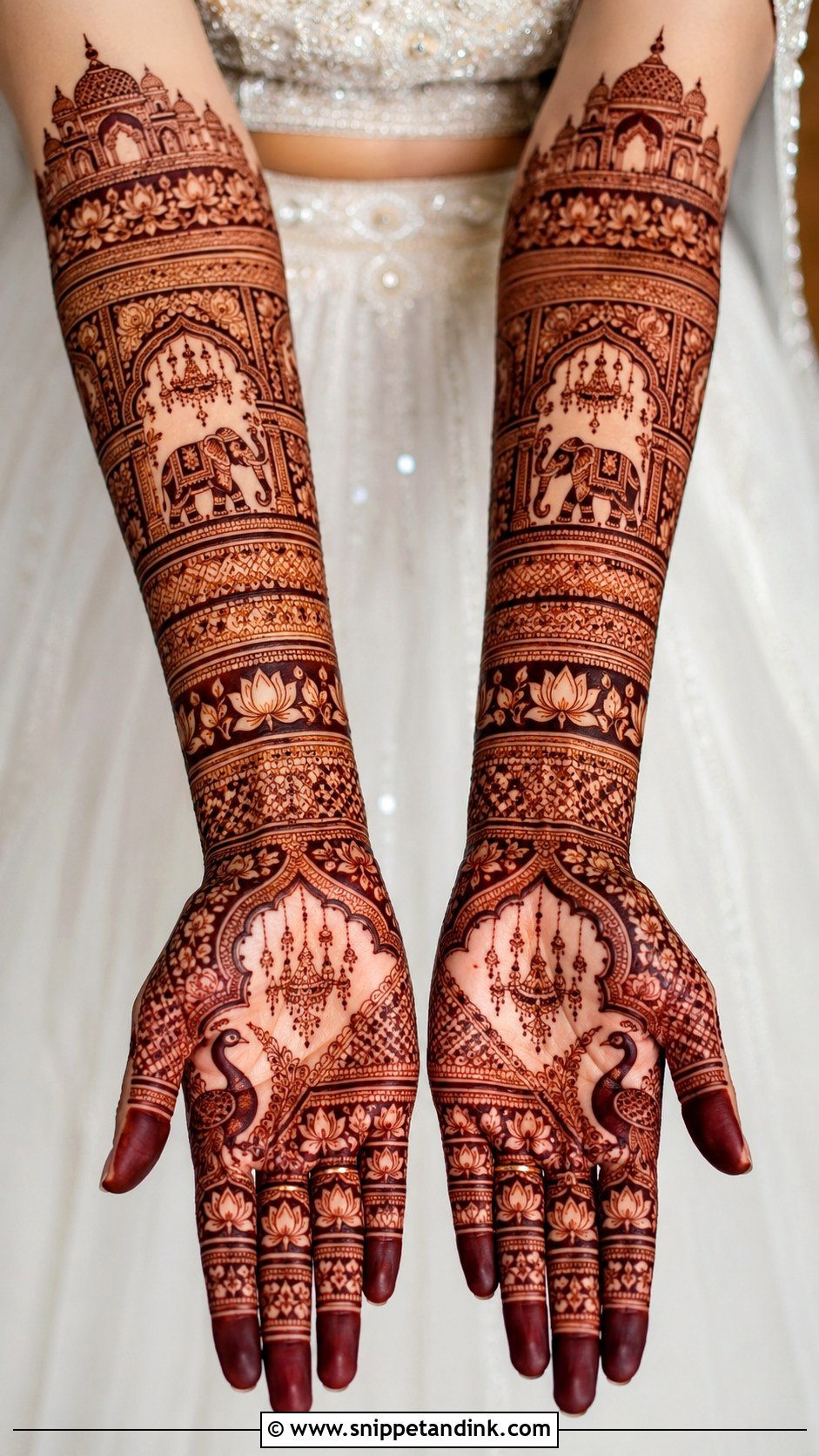
Royal mehndi looks like embroidery on skin: elephants, arches, domes, chandeliers, peacocks, lotus borders and layered cuffs, each in its own section. I usually put wedding scenes on the palms and royal arches or symmetrical bands on the forearms, then fill the fingers richly so nothing looks unfinished. It belongs with heavy lehengas and formal photography. Architectural elements need straight, steady lines, which is harder on the curved forearm than on a palm, so I map those sections before starting.
16. Pakistani Bridal Mehndi Design
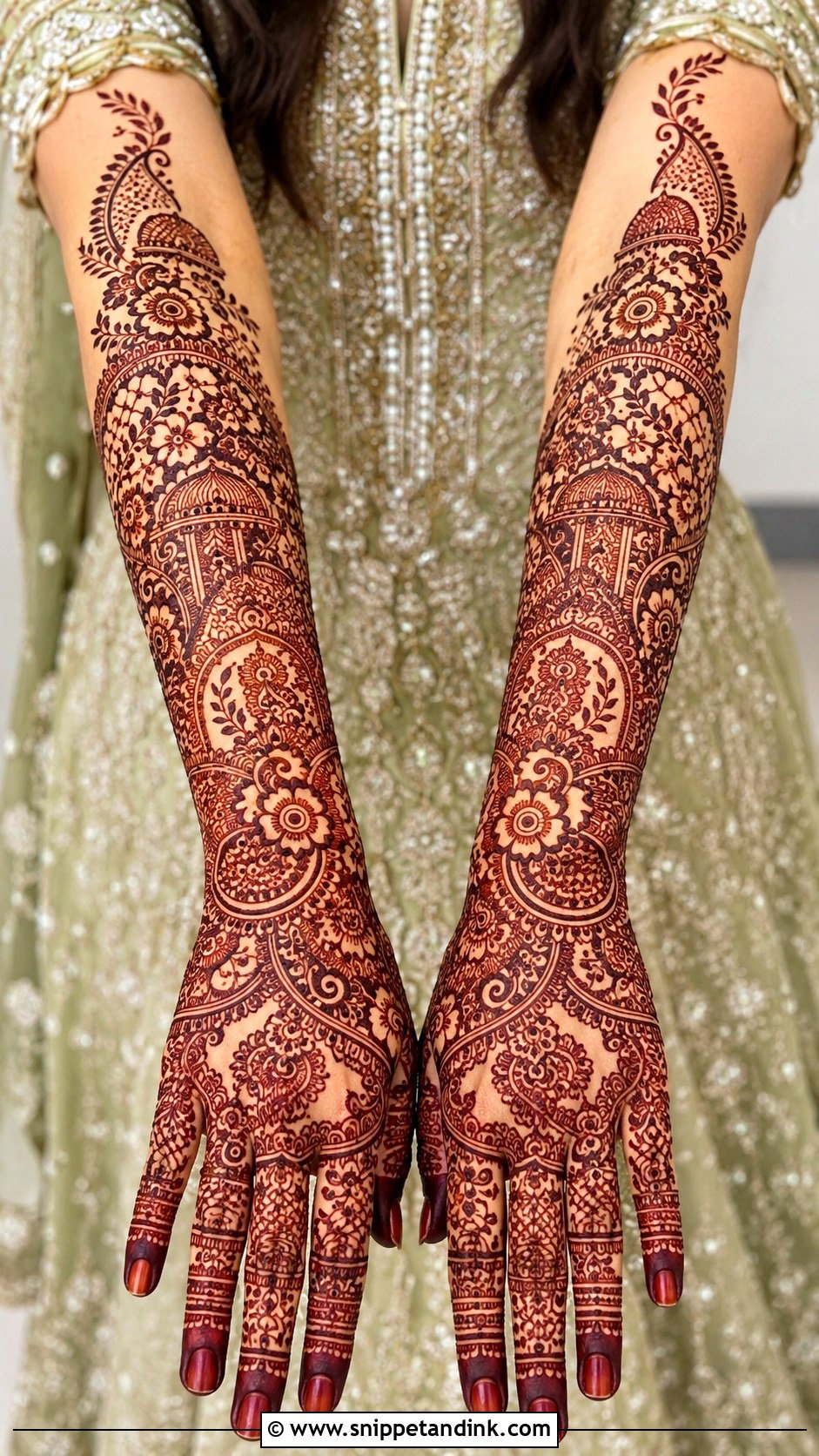
Pakistani bridal mehndi blends dense Indian-style detail with Arabic flow: large florals, paisleys, leafy trails, domes, net patterns and fine wrist-to-forearm extensions. It has strong structure but doesn’t always cover every inch. The back of the hand is where it shines, with bracelet patterns and floral trails that sit well around rings and bangles. It’s a good middle ground if dense Indian mehndi feels too heavy for you but Arabic feels too light.
17. Moroccan Bridal Mehndi Design
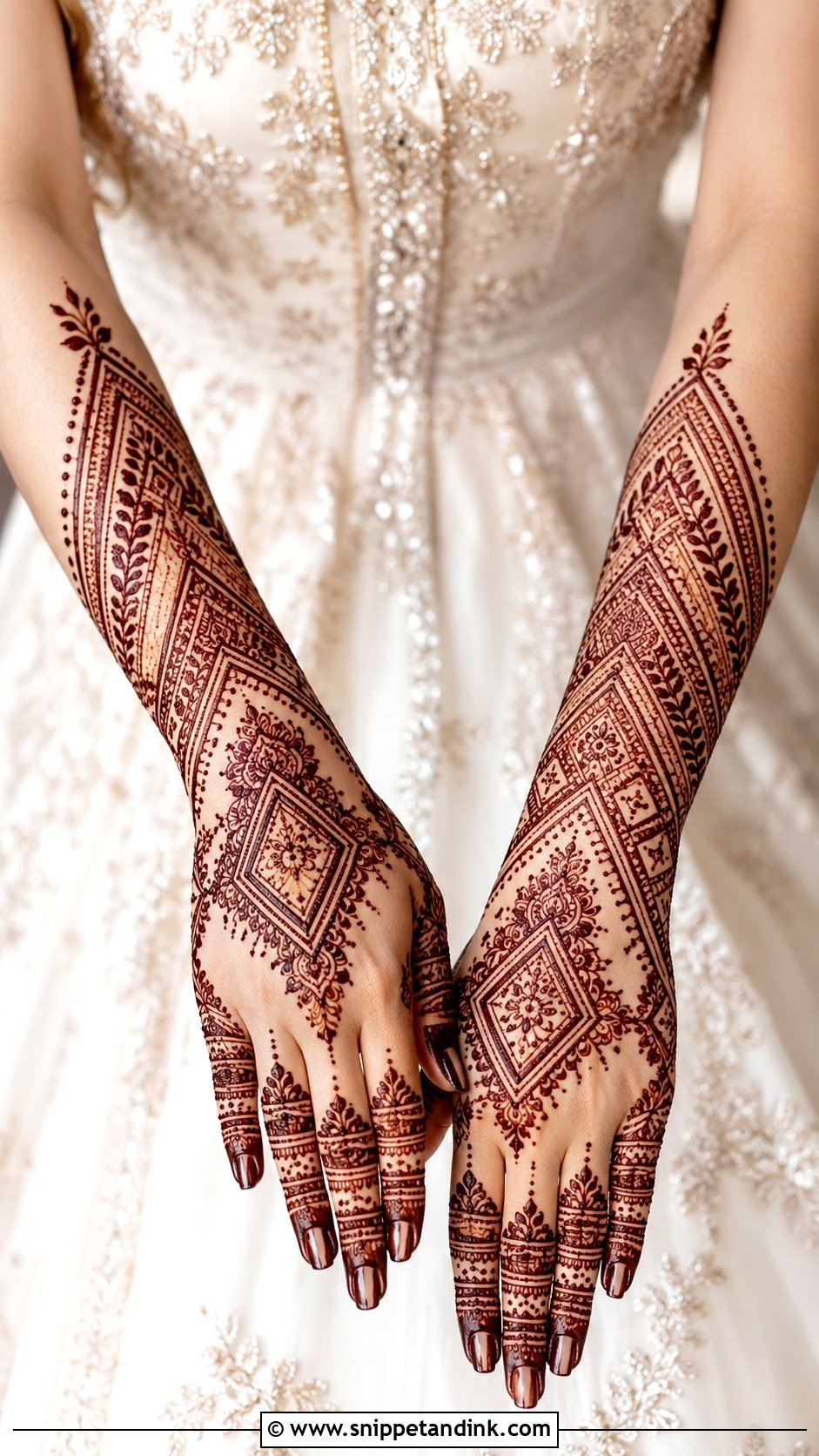
Moroccan-style mehndi swaps paisleys and florals for geometry: diamonds, triangles, grids, lines, dots and structured bands repeated across fingers, palm, wrist and forearm. It looks bold and clean, and it’s unusual enough to stand out in photos. Straight lines are less forgiving than curves, because any wobble shows, so I work slower on this style. Small flower accents or curved borders soften it if pure geometry feels too stark. Modern outfits suit it best.
18. Gulf Bridal Mehndi Design
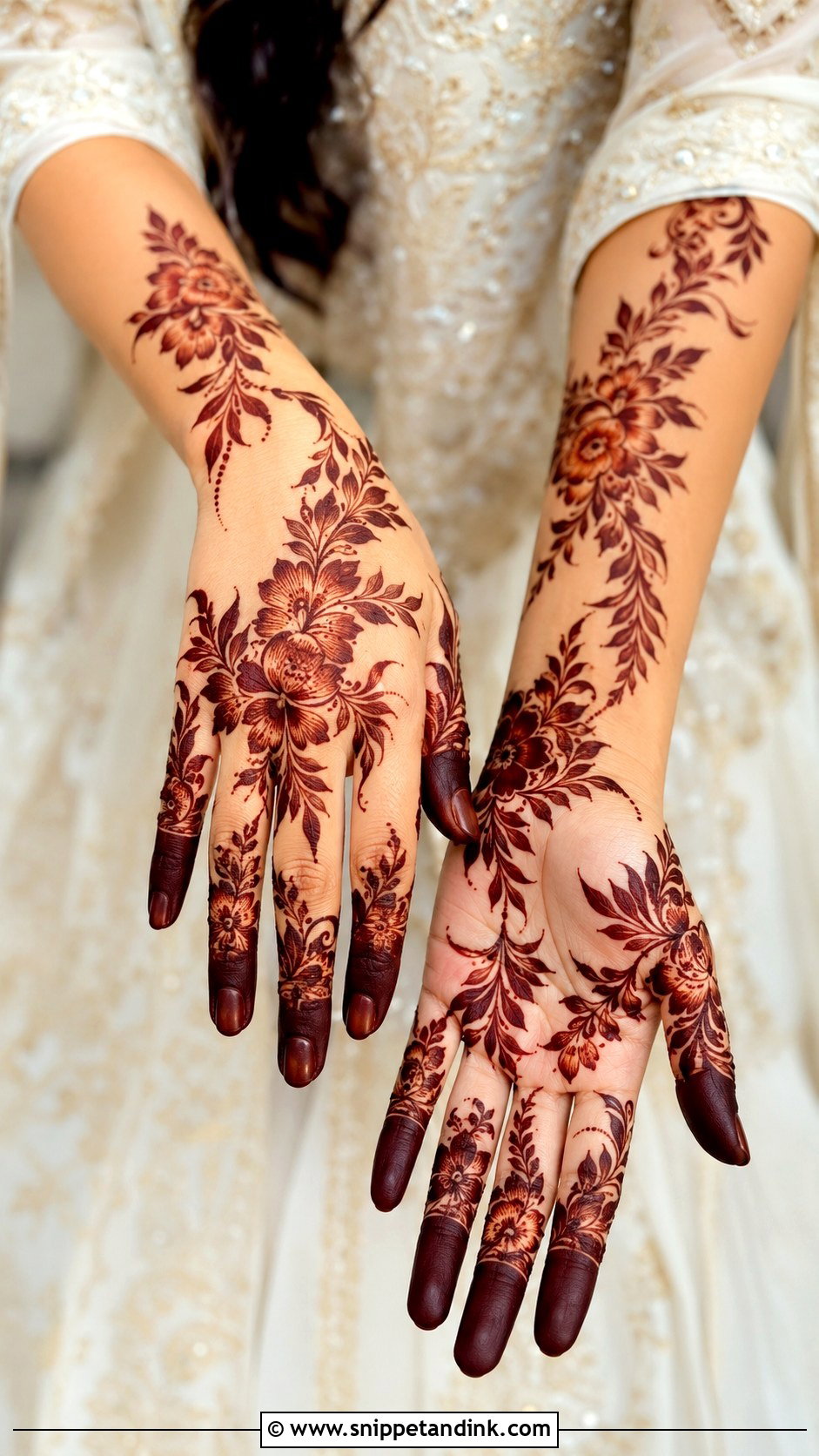
Gulf bridal mehndi, also called Khaleeji-style bridal henna, uses bold florals, leafy vines, open spacing and shaded petals with clean outlines. Large flowers travel from the fingers across the back of the hand and down the wrist. It’s less dense than Indian mehndi but reads clearly from a distance. It suits engagement, nikah and reception looks. For a full bridal version, I add matching palm work, filled fingertips and a coordinated trail from wrist to forearm.
19. Floral Bridal Mehndi Design
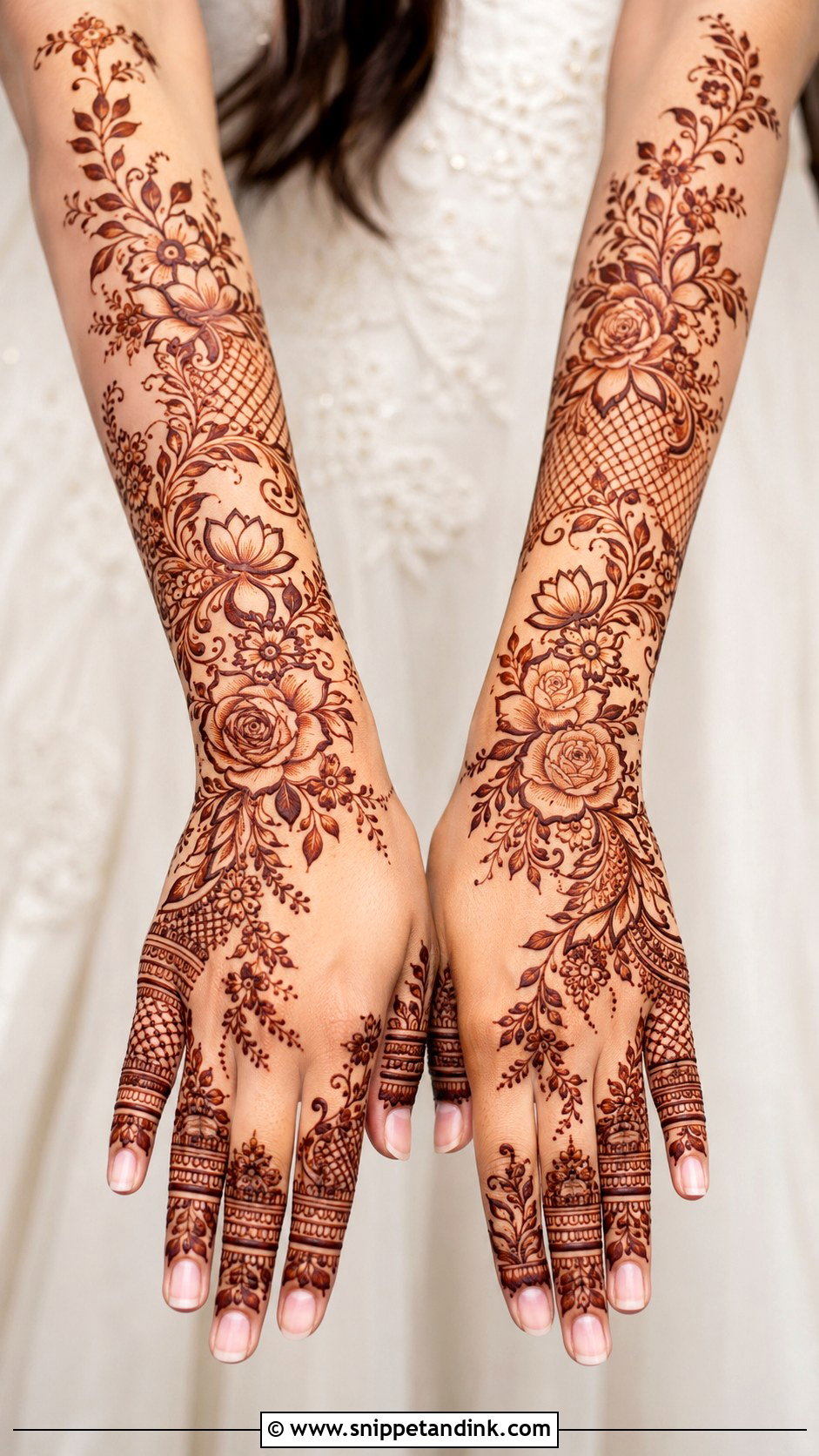
Florals adapt to any tradition, Indian, Arabic, Indo-Arabic or Gulf, depending on how much fill you want. Roses, lotus, small blossoms, vines and shaded petals can be arranged in trails, circular mandalas or full-hand patterns. For a richer finish I combine flowers with jaali mesh and paisley borders; for a modern one, I leave more open skin. Florals sit as comfortably with pastel outfits as with deep reds, which is why many brides start here.
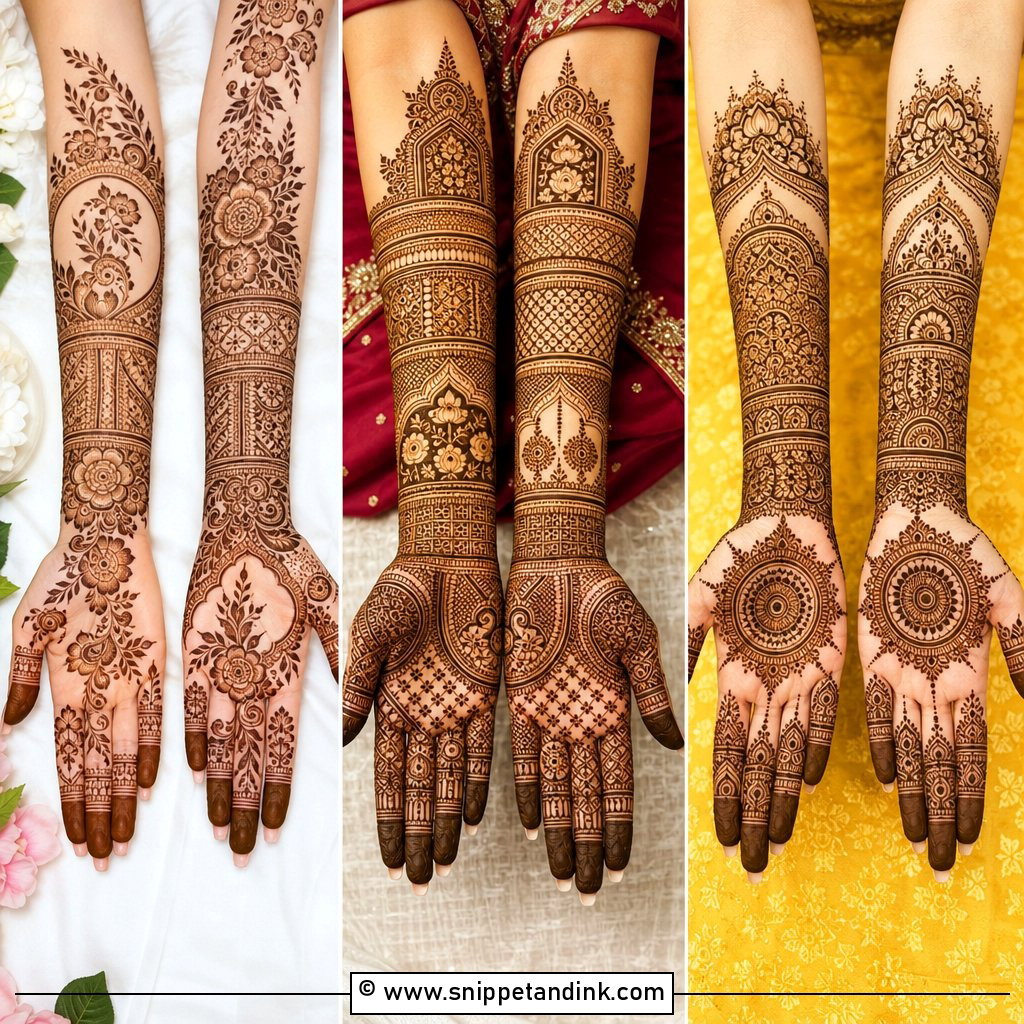
20. Paisley Bridal Mehndi Design
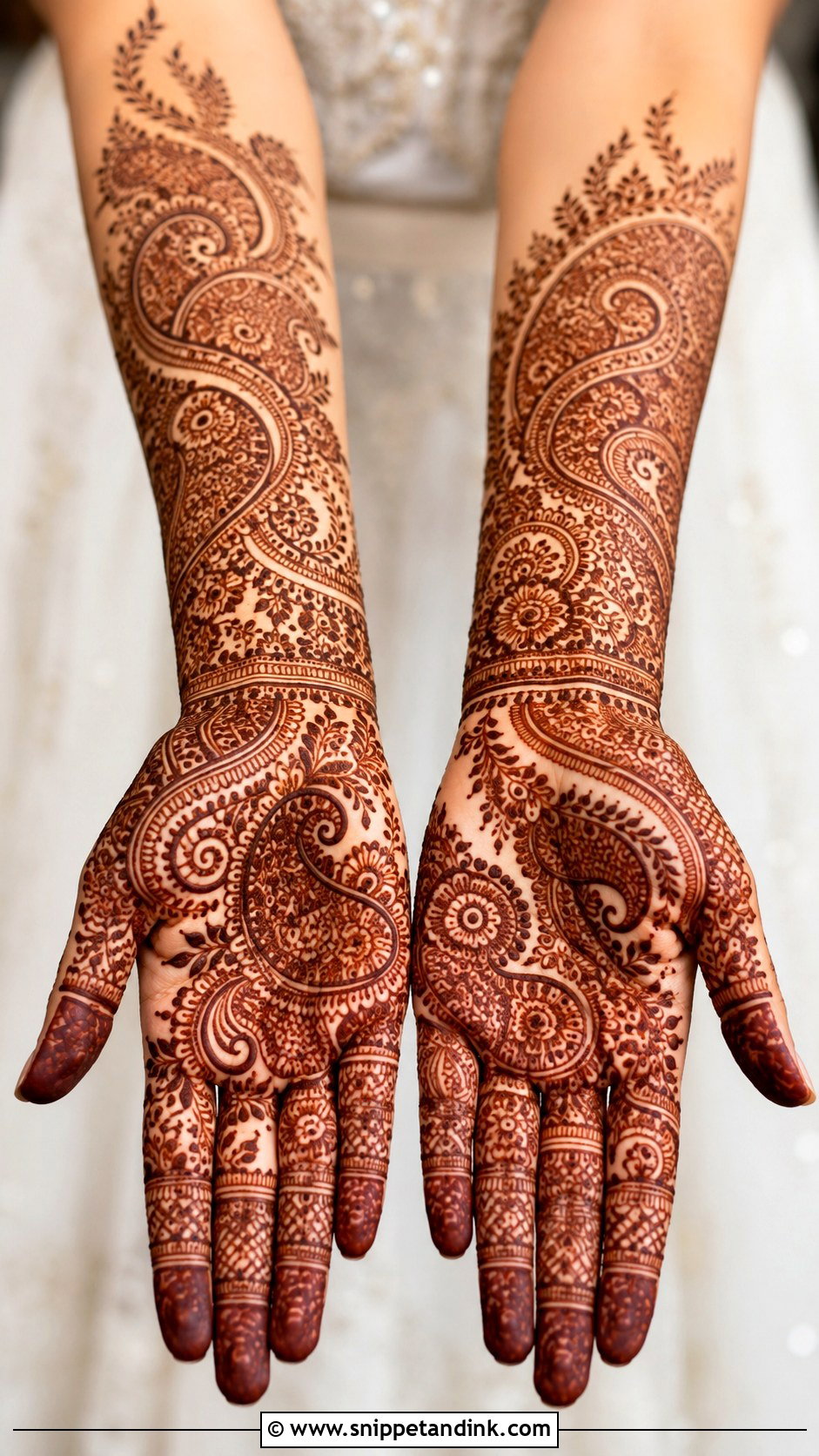
The paisley, the curved mango shape, fits the hand so naturally that it shows up in almost every bridal design I do. It can be large and bold or small and repeated, mixed with florals, dots, checks, leaf borders and shaded sections. It gives a traditional Indian feel without needing portraits or scenes. For classic coverage, I fill densely from fingertips to elbow; for lighter work, I draw larger paisleys with open space around them. It’s also the easiest style to scale up or down if your sitting time changes.
21. Jaali Bridal Mehndi Design
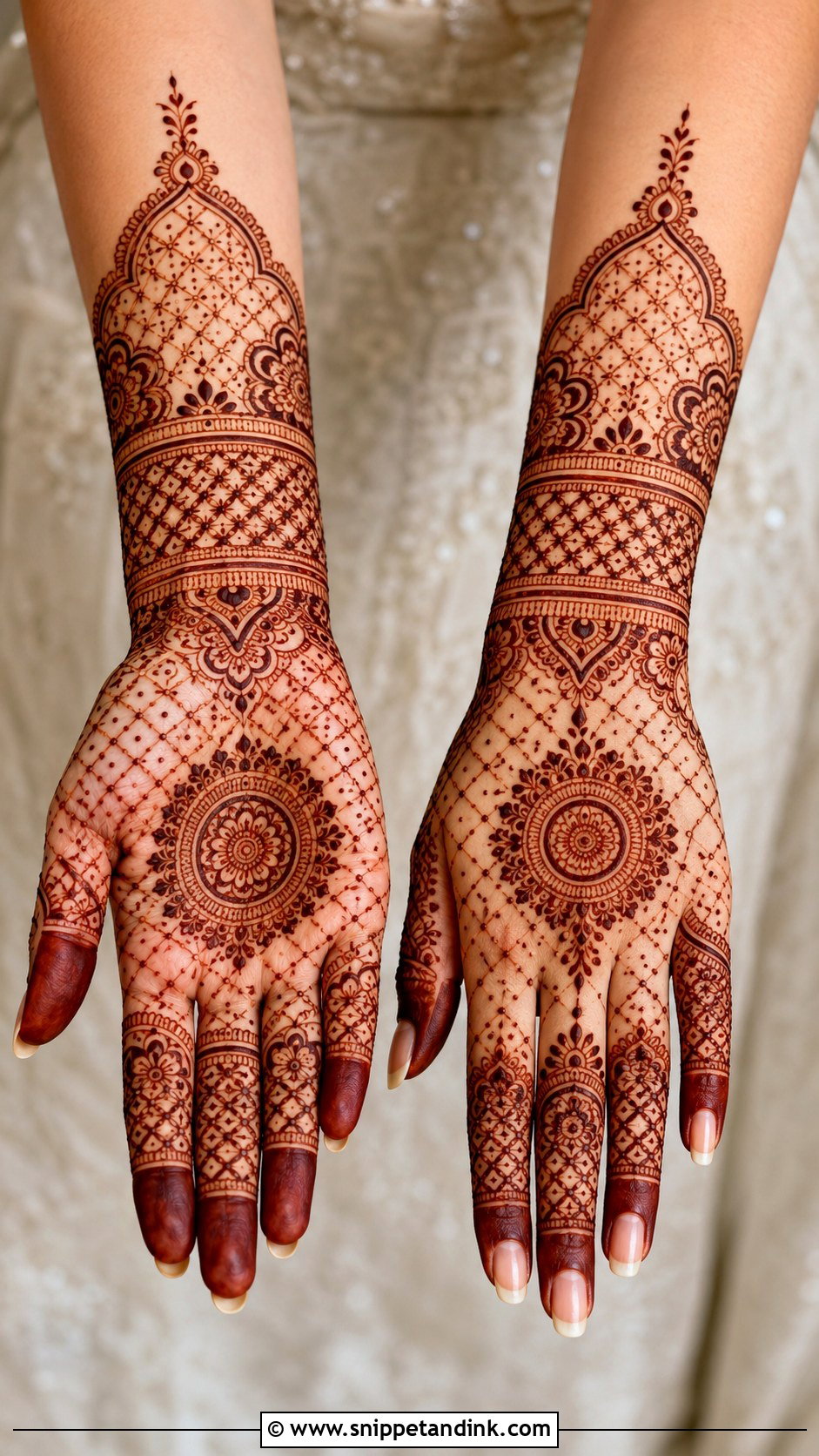
Jaali is a fine mesh that looks like lace on the skin: netted diamonds, tiny dots, floral corners and ornamental borders. I like it on the back of the hand and the forearm, where the surface is smooth enough for even lines. Paired with decorated fingers, a central mandala, wrist cuffs and floral edges, it reads complete without being busy. The honest caveat is that very fine mesh lines can blur together if the paste is too runny or the skin is oily, so I prep the skin with a clean, dry wipe first.
22. Bridal Mehndi Design With Hidden Name
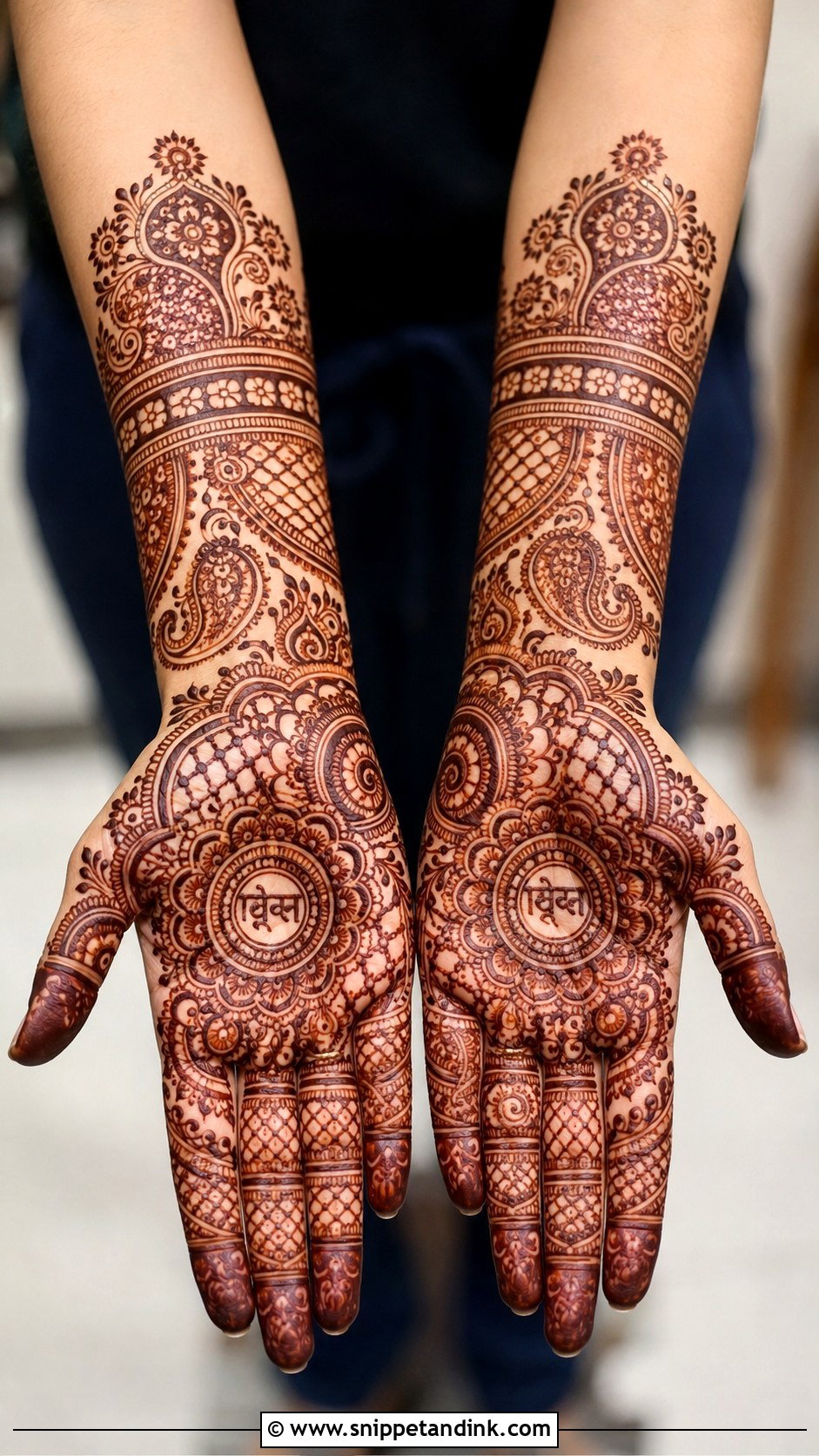
Hiding the groom’s name in the mehndi is a playful tradition, and the search usually becomes a fun moment at the celebrations. Names or initials can sit inside paisleys, petals, jaali, mandala rings or wrist bands. I make the letters clear enough to find but woven into the pattern so they don’t look stuck on. Tell me the exact spelling in writing, ideally in the script you want, before I start. This works within Indian, Rajasthani, Indo-Arabic or modern layouts.
23. Bridal Mehndi Design With Wedding Date
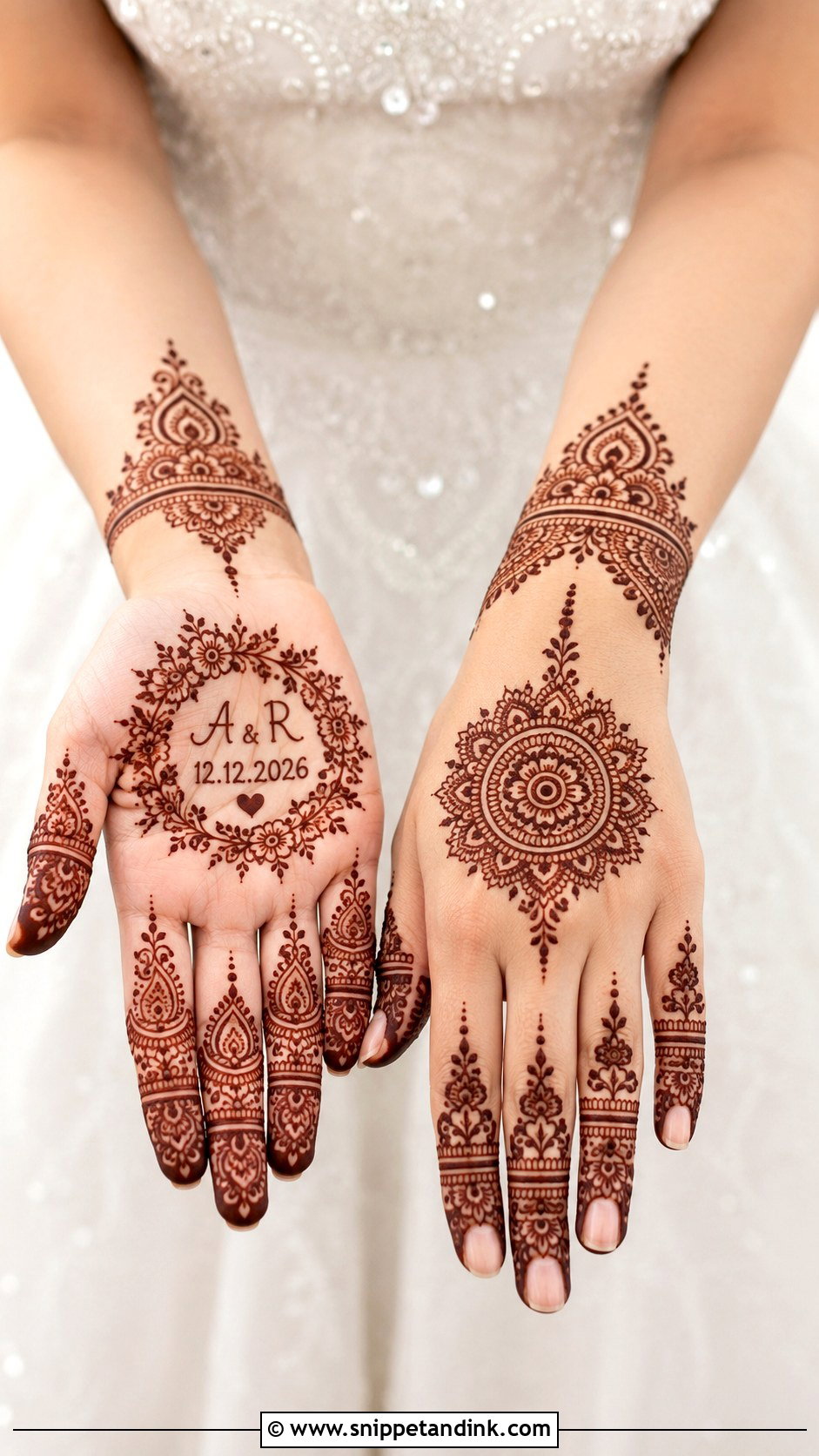
A wedding date can sit inside a heart, mandala, wrist bracelet, floral frame or small banner, often alongside initials or couple symbols. The practical point is legibility: numbers drawn too small fill in as the stain darkens and spreads slightly, so I keep them a little larger and well spaced. The rest of the hand needs balanced bridal motifs, paisleys, lotus, vines and finger patterns, so the date reads as one detail rather than the whole design. It adds meaning without committing to full portrait work.
24. Bridal Mehndi Design With Doli Motif
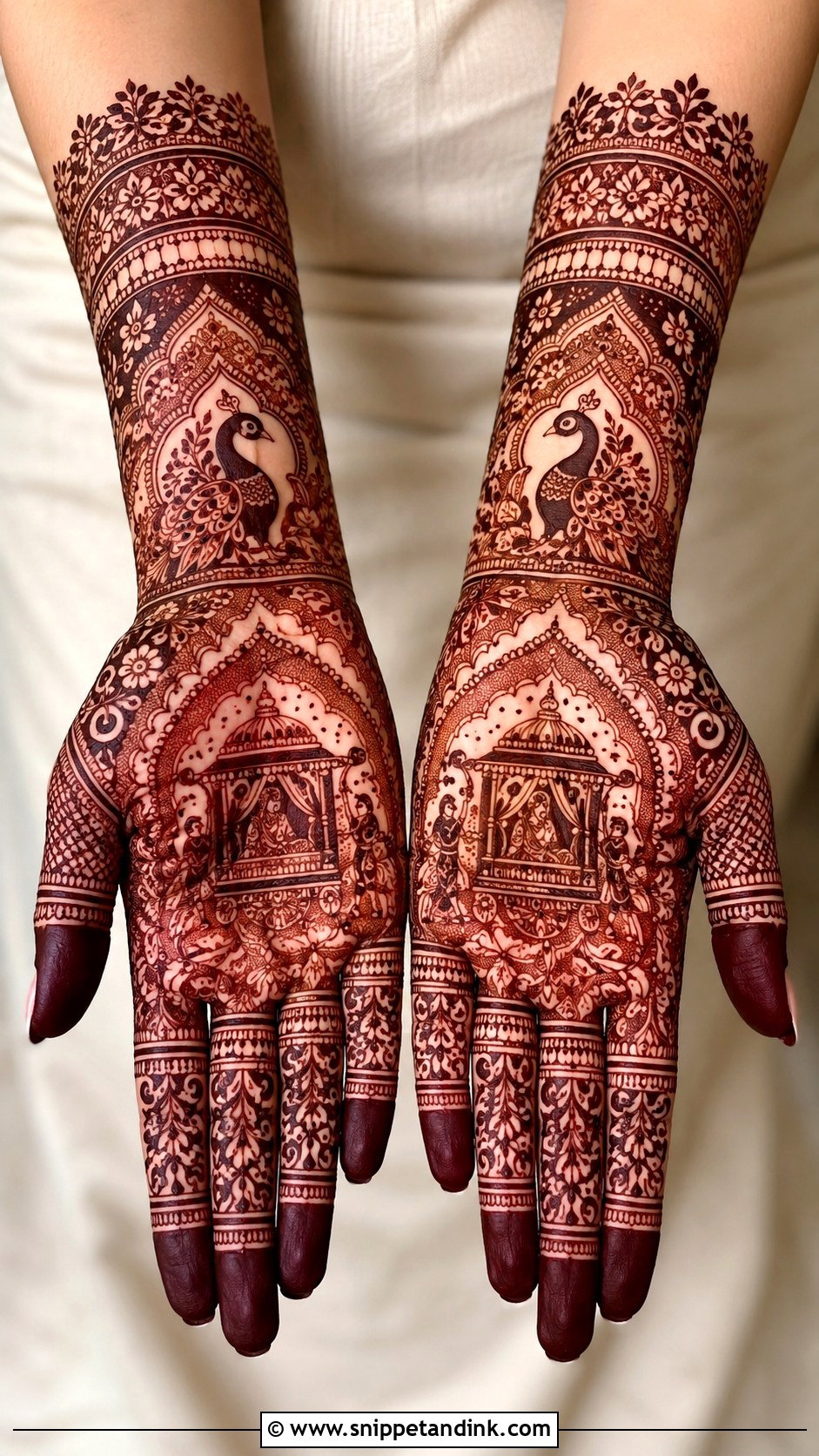
The doli represents the bride’s departure from her family home, and it carries real emotion for many families. I place it on the palm or forearm, surrounded by florals, paisleys, peacocks and fine borders. A full doli design usually comes with dense filling, decorated fingers and connected wrist-to-arm work. It suits classic Indian and Rajasthani outfits. For a modern take, I keep the doli small inside a clean frame with open space around it.
25. Bridal Mehndi Design With Elephant Motif
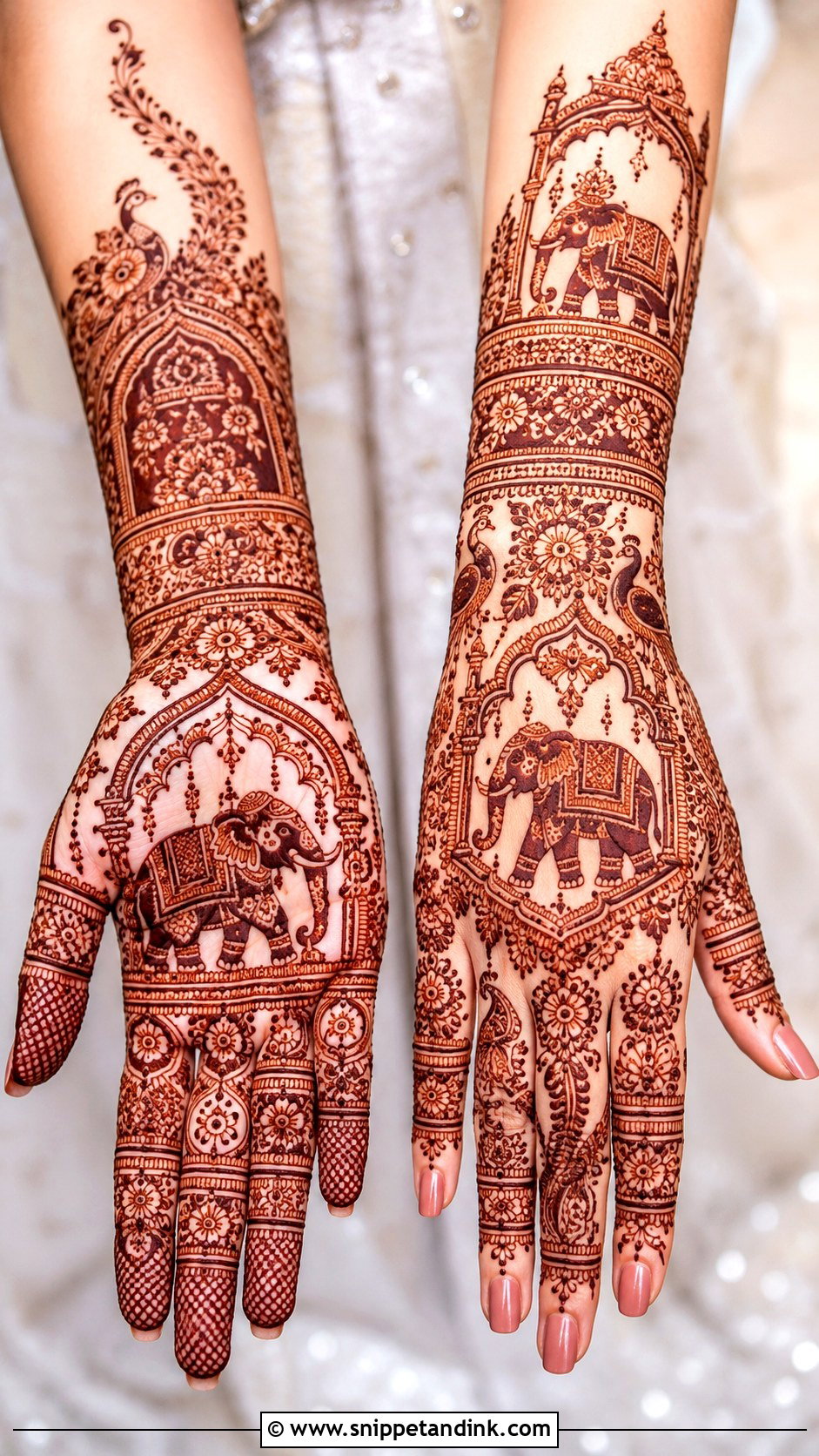
Elephants feel royal and festive, usually drawn on the forearm, wrist or palm with decorative blankets, bells and floral surroundings. They pair with palace arches, peacocks, paisleys and mandalas in Rajasthani and royal Indian work. Because elephants are large motifs, placement matters: on the inner wrist or near a joint, the shape distorts whenever the hand bends. I put them on the flattest part of the forearm or palm, where the outline stays true in photos.
26. Bridal Mehndi Design With Kalash Motif
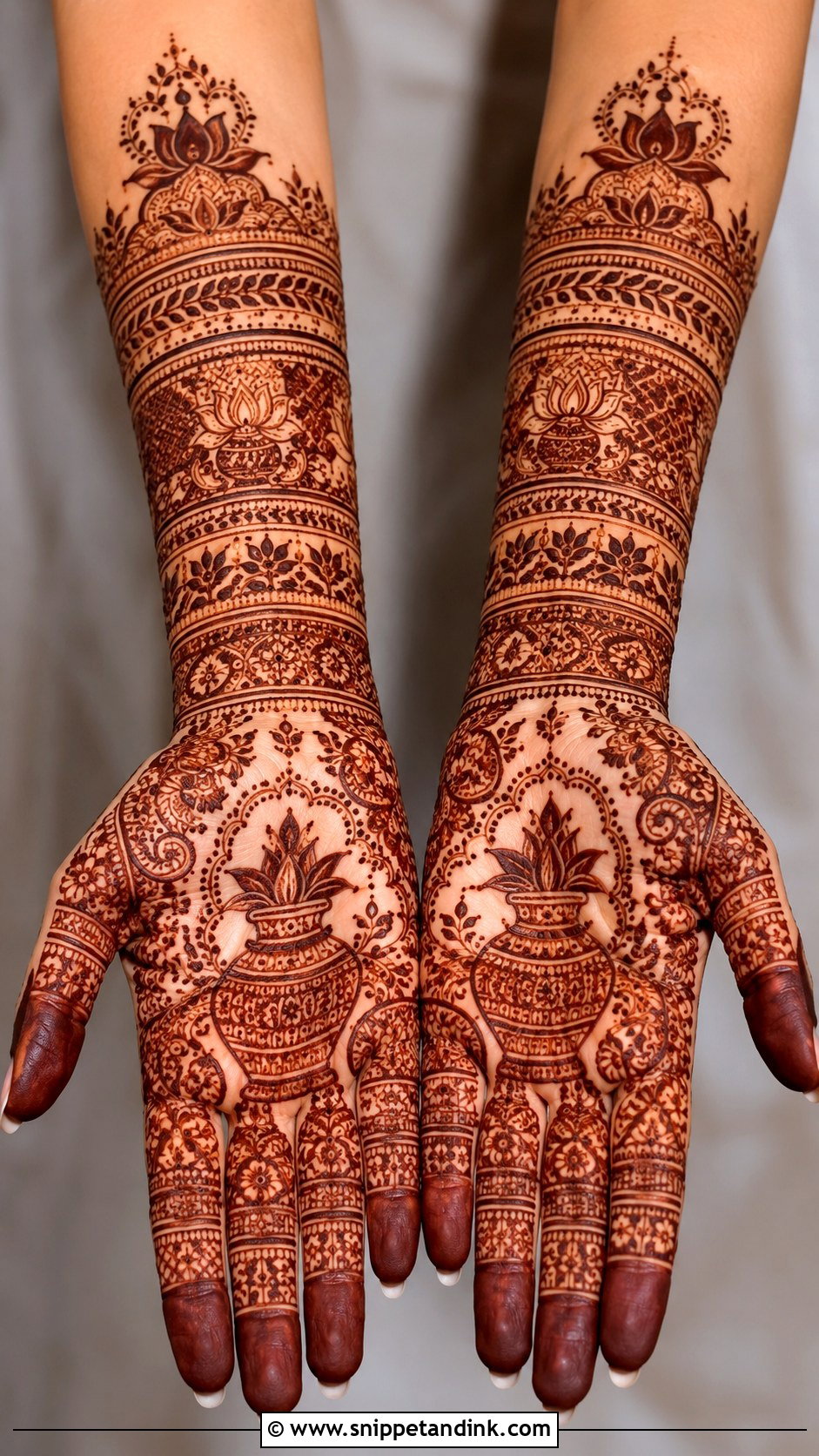
A kalash brings sacred and auspicious elements into the design, and the pot is widely connected with blessings, prosperity and new beginnings in wedding rituals. I place it on the palm, wrist or forearm and surround it with lotus petals, leaves, paisleys and fine dots. It feels traditional without needing portraits. To complete it, I add dense finger patterns, mandala borders and matching motifs on both hands. Families who want ritual symbolism without figures often settle on it.
27. Bridal Mehndi Design For Short Hands
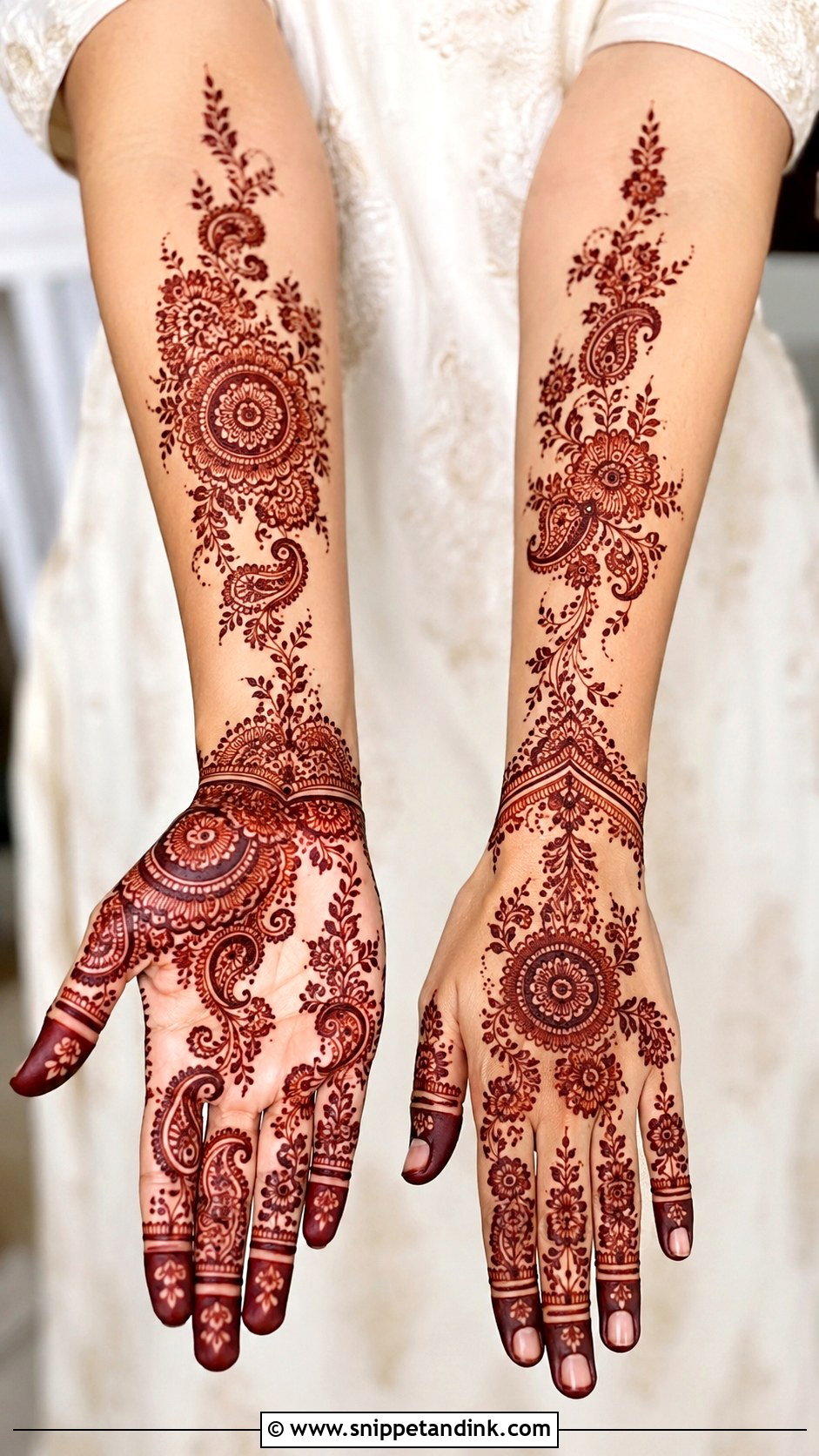
On shorter hands the aim is to add length without crowding. Vertical trails, slim paisleys, elongated florals and narrow wrist extensions lead the eye upward. Very large motifs that fill the whole palm make the hand look smaller, so I use a medium mandala with long finger lines, delicate jaali and a tapered forearm pattern. Open space also helps the hand look less packed. Fine fillers around the main elements keep it bridal without heavy blocks everywhere.
28. Bridal Mehndi Design For Long Hands
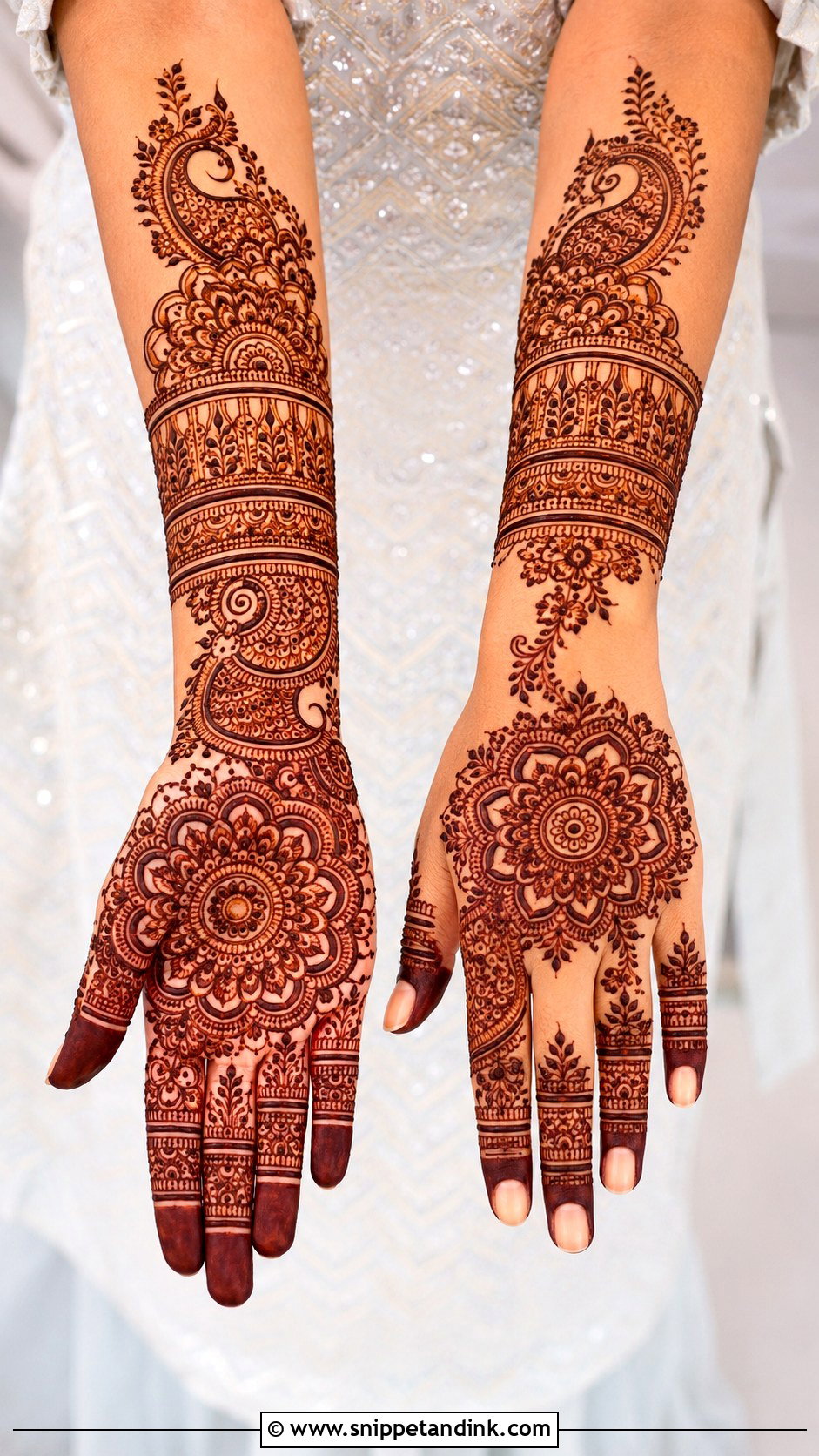
Long hands and fingers can carry large mandalas, layered paisleys, full floral trails and detailed wrist-to-forearm extensions without looking crowded. Dense Indian, royal Rajasthani or Indo-Arabic layouts all fit. The mistake I see on long hands is plain fingers, which look unfinished; balanced bands, leafy lines and fingertip detail fix that. A wide bracelet section at the wrist frames the hand well. Full coverage and negative space both work here, as long as the proportions are planned.
29. Bridal Mehndi Design For Dark Skin
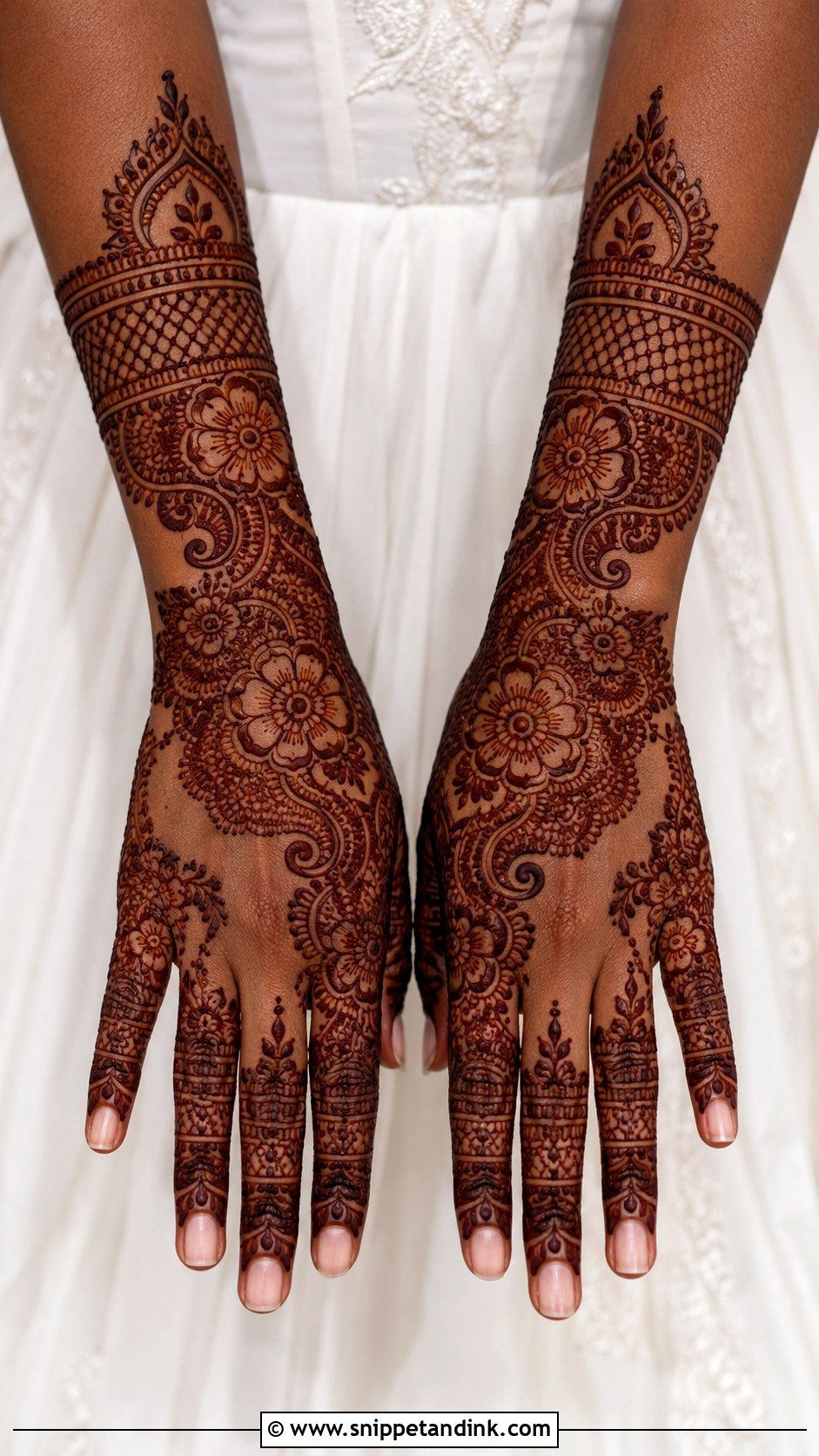
On deeper skin, contrast and spacing matter more than fineness. The stain shows as a deep reddish brown that can sit close to the skin tone, so I use bold outlines, clean florals, medium-to-large motifs and clearly defined finger sections that stay readable in photos. Fine work still has a place, supported by larger shapes and open areas. Very tiny details on their own may disappear from a distance. Arabic, Indo-Arabic, bold floral, jaali and paisley designs all suit deep skin when they’re well spaced.
30. Bridal Mehndi Design For Fair Skin
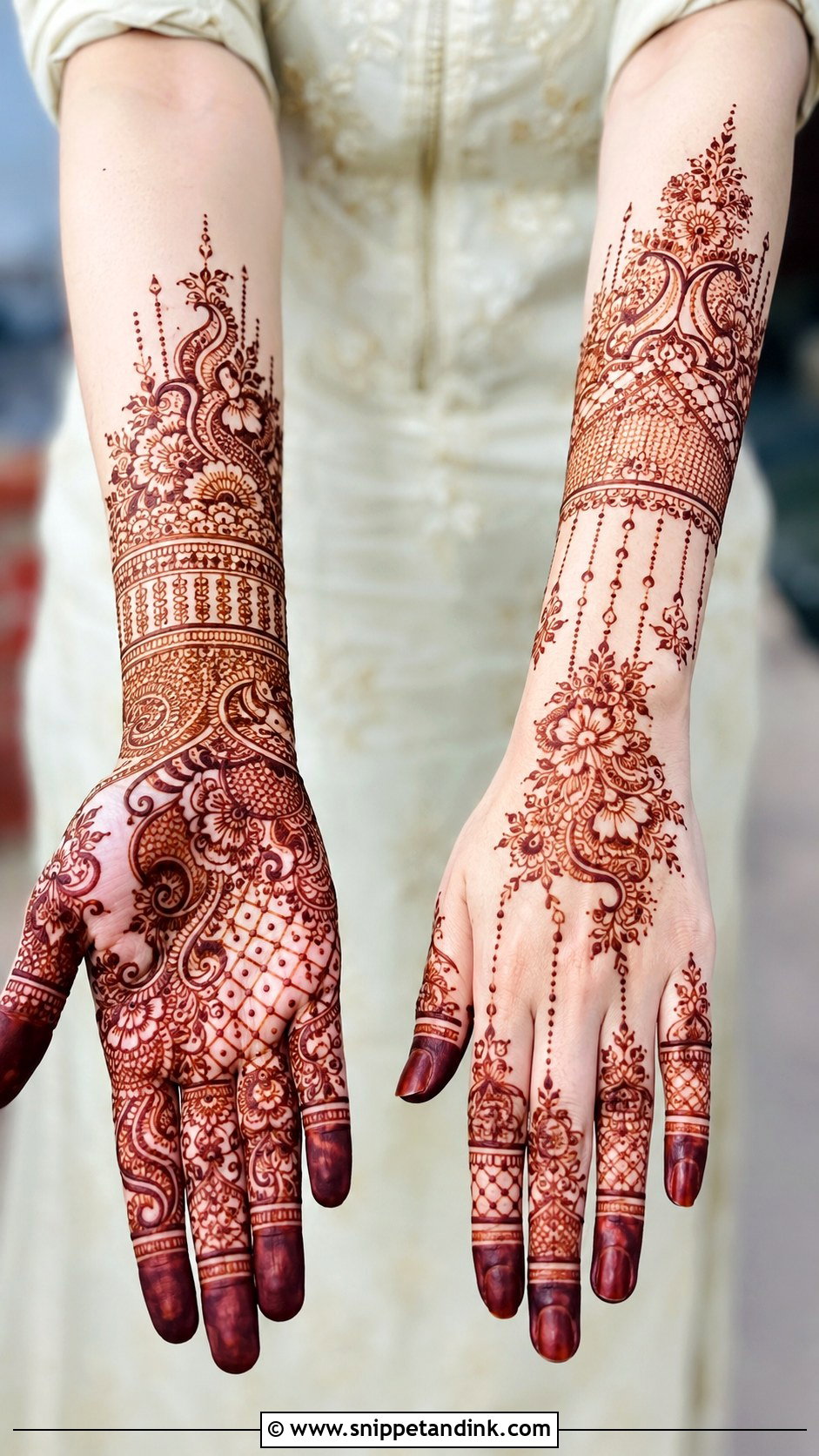
Fair skin shows even the finest lines, so lace-like jaali, tiny dots, thin vines and intricate fillers all read clearly. Dense Indian mehndi looks dramatic because the contrast after the stain deepens is so strong. That also means mistakes and uneven patches show more, so a steady hand and even paste matter. Minimal and modern designs with negative space suit fair skin too. I’d pick by outfit and personality more than skin tone; then aim for a deep maroon stain, detailed palms and balanced forearm coverage.
31. Bridal Mehndi Design For Engagement
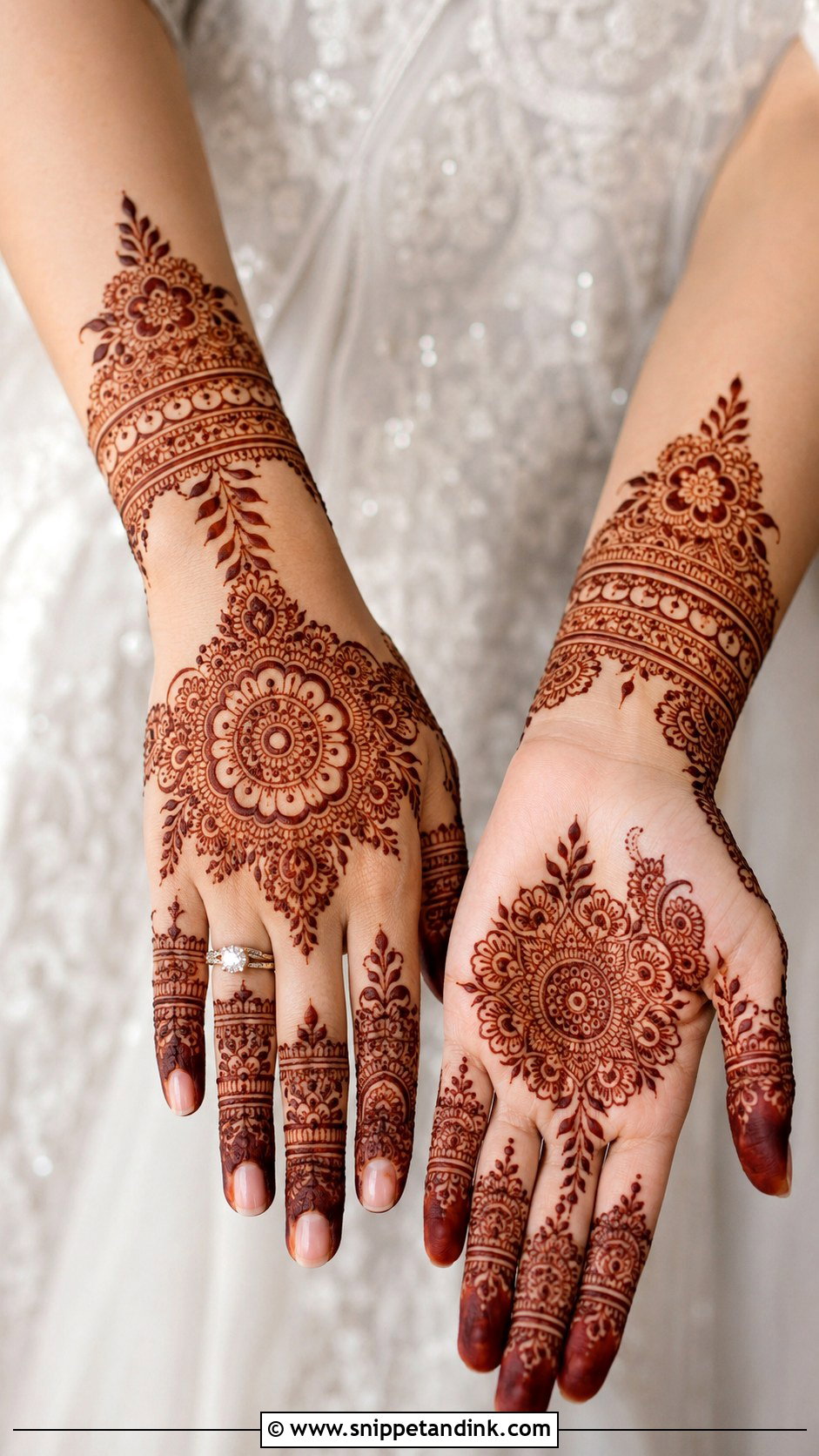
Bridal mehndi design for engagement is usually lighter than the wedding version, but the engagement hand has a specific job: framing the ring. I usually draw a back-hand floral mandala, decorated fingers, a wrist bracelet and a small palm design, and I leave the ring finger’s base clear so the band sits on clean skin. Arabic or Indo-Arabic layouts suit most engagement outfits. For a modern look, I lean into negative space and fine vines; for a traditional one, paisleys, lotus and fuller fingers.
32. Bridal Mehndi Design For Nikah
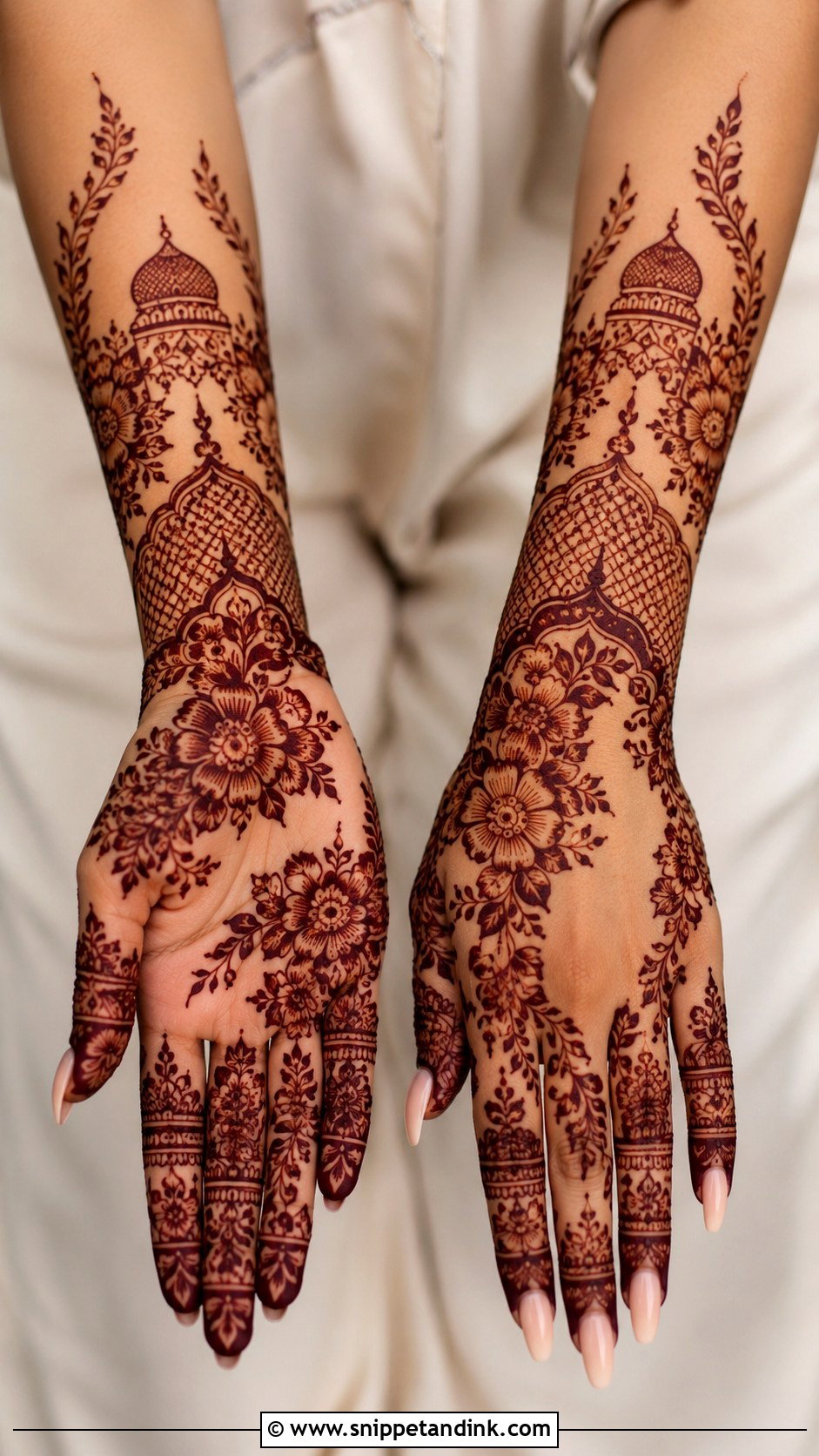
Nikah mehndi tends to be refined: Arabic, Pakistani, Gulf or Indo-Arabic patterns with florals, vines, domes, jaali and fine wrist detail. Coverage can be full or semi-full depending on the outfit. For a soft look, I use open space, shaded petals and neat fingers. For a traditional one, I add paisleys, mandalas and fuller palms. Ivory, gold, blush, green and jewel tones all suit it. Clean lines and a balanced composition matter most, since nikah photos are often taken close up while signing.
33. Bridal Mehndi Design For Reception
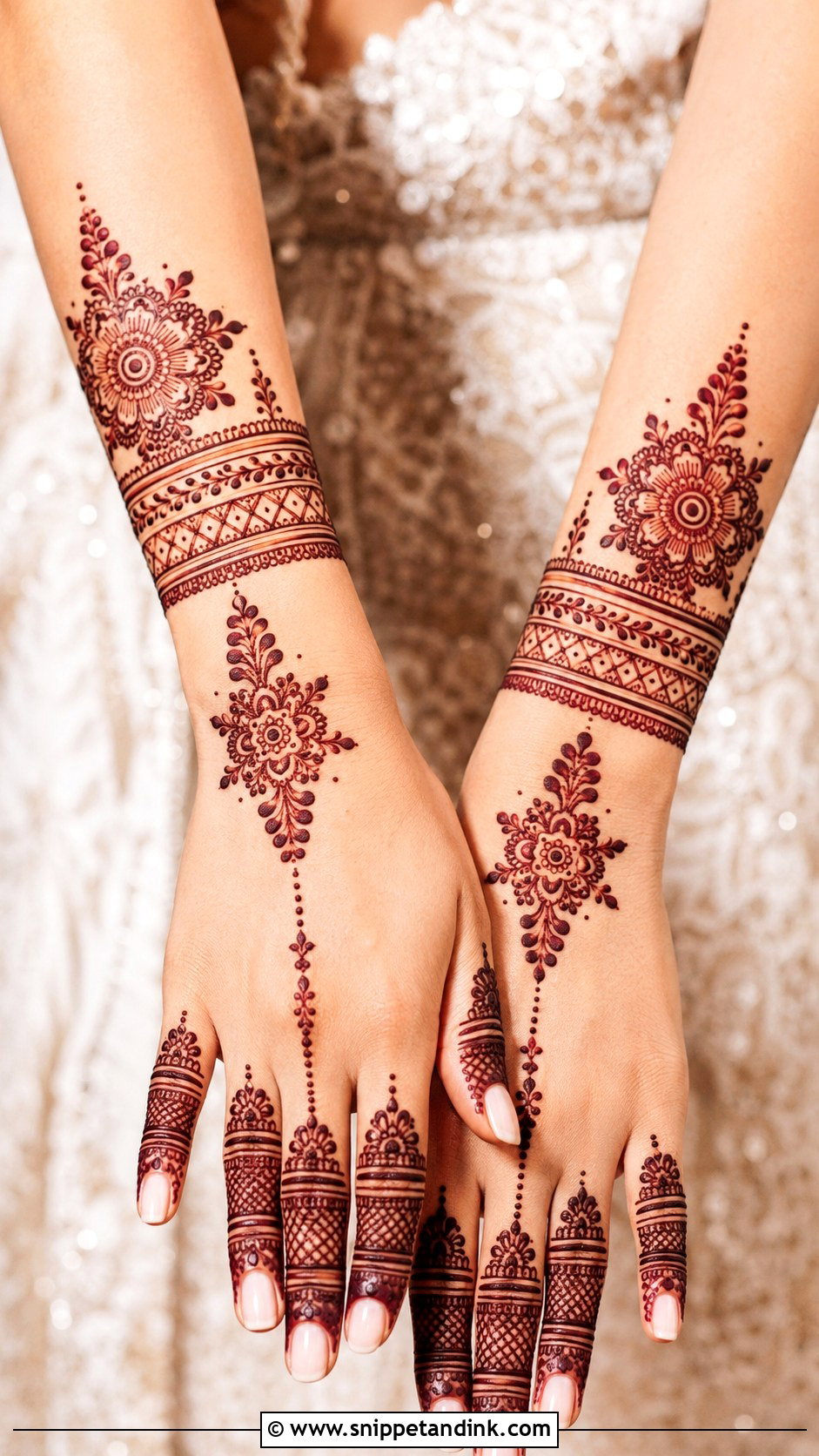
By the reception, the wedding mehndi is usually at or just past its darkest, so most brides don’t reapply. If you are adding fresh mehndi for the reception, remember it will start out orange and won’t reach full color for a day or two, so a design applied that morning won’t look its best at night. I’d suggest bold florals, geometric bands, bracelet-style back-hand patterns or minimal trails, kept light if the outfit is already heavily embellished. Back-hand detail matters, because reception photos catch hands holding dupattas and clutches.
34. Bridal Foot Mehndi Design
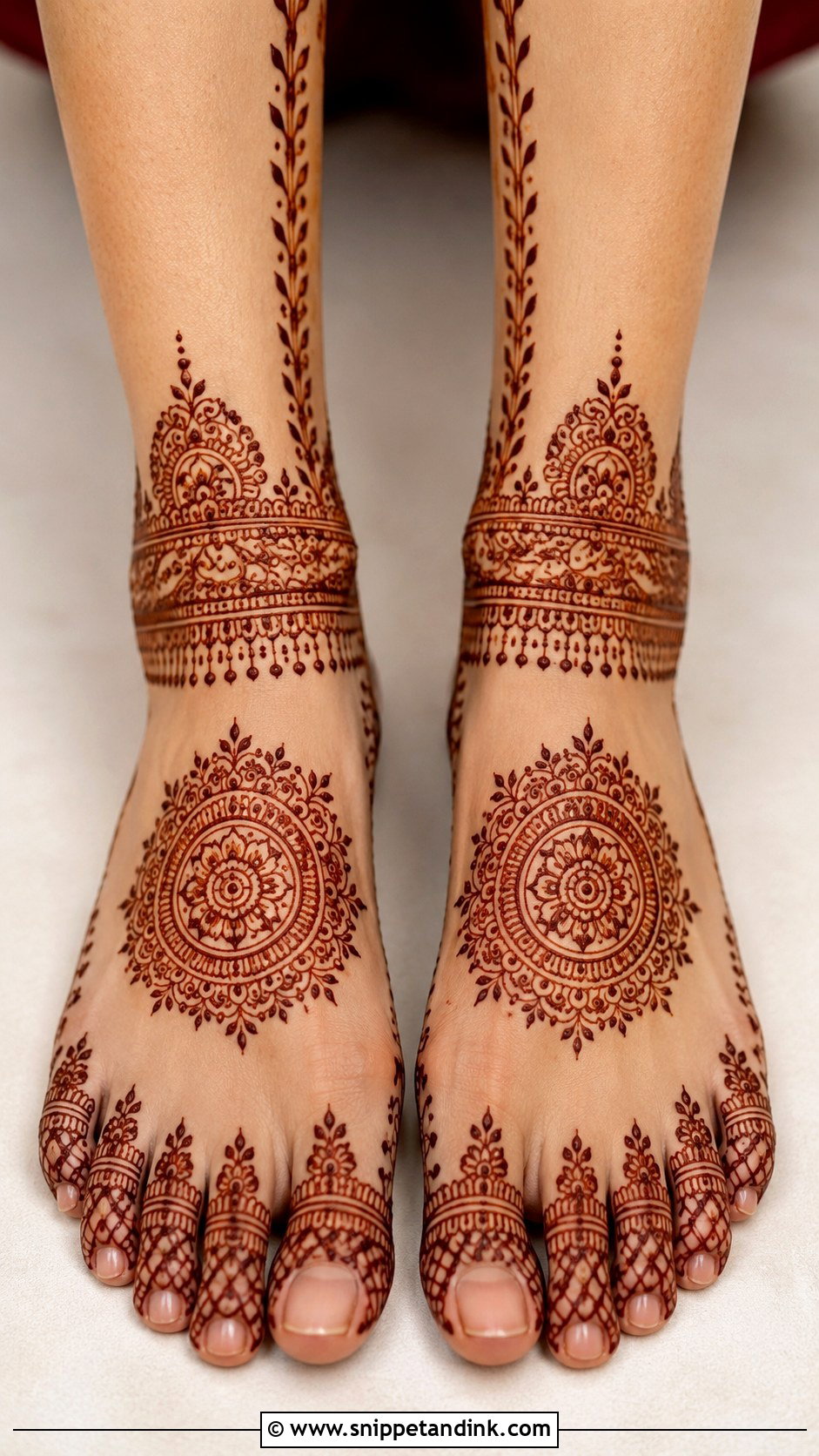
Feet complete the look for ceremonies where they show, with sandals, anklets or in rituals. A full bridal foot design can include mandalas on top of the foot, paisley borders, toe detailing, anklet bands and vines along the sides. Feet usually stain deep, like palms, because the skin is thick there. Coverage ranges from heavy work up to the ankles to one central motif with fine toe lines. I keep motifs matched to the hands. Feet are slow to dry and easy to smudge, so plan to stay seated with them propped up until the paste sets.
35. Bridal Mehndi Design For Both Hands And Feet
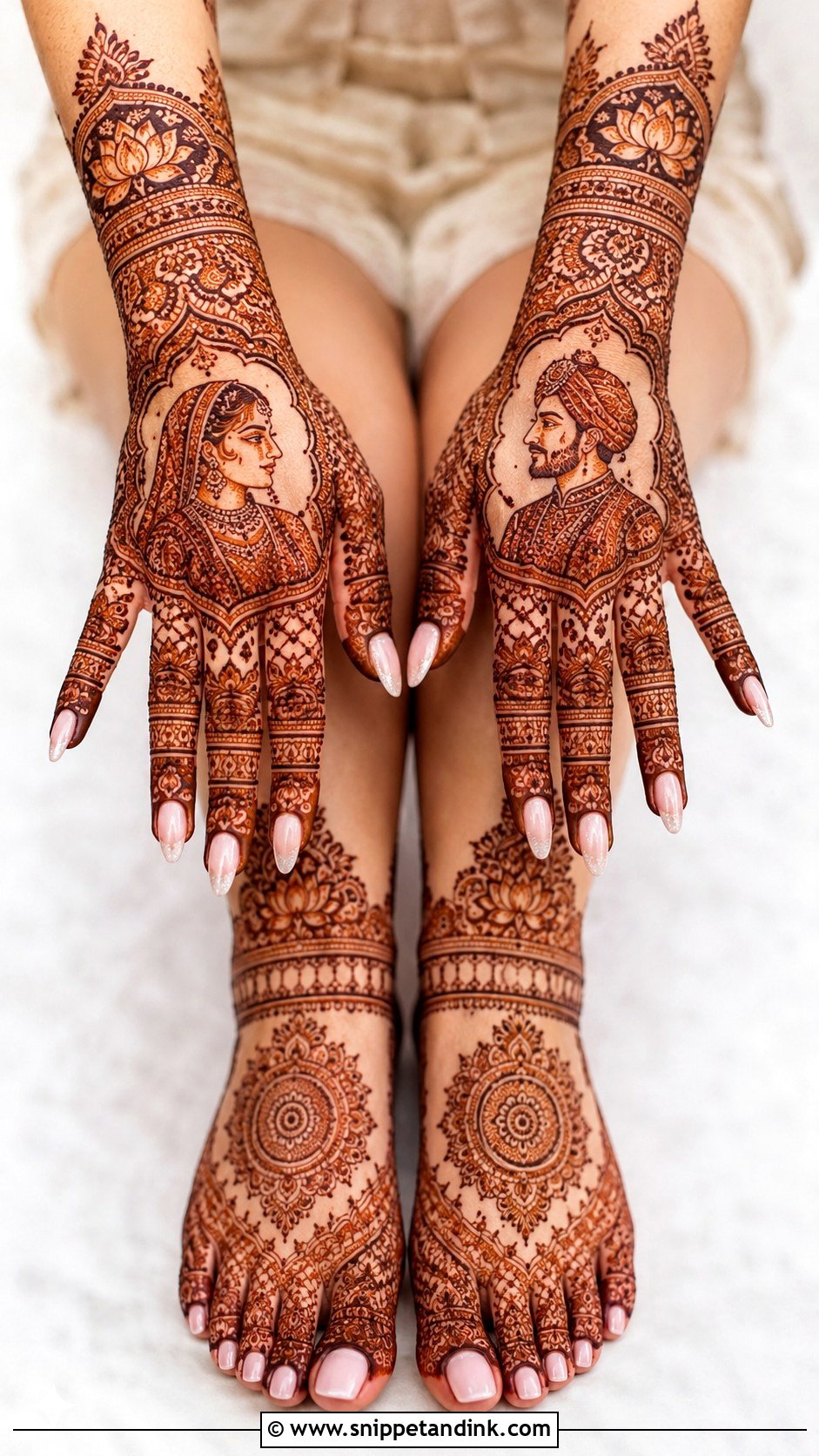
Covering both hands and feet gives the most complete bridal look, and it’s the longest sitting of all. I coordinate rather than copy: hands might carry portraits, paisleys and mandalas while the feet repeat lotus, jaali and anklet bands, so shared motifs tie it together. Plan time, drying space and help, because you won’t have the use of your hands or feet for hours. Many brides have the feet done by a second artist at the same time to shorten the session.
From Wet Paste to Wedding Morning
What you do after I finish affects the color as much as the design itself. My aftercare runs in this order:
- Let the paste dry fully without touching anything. Once it’s dry, I dab on a little lemon and sugar mix so it stays stuck to the skin.
- Keep the paste on as long as you can, ideally six hours or overnight. Wrapping hands loosely in tissue or cotton at night stops it flaking onto the bed.
- Remove it by scraping with a blunt edge or rubbing gently, not by washing.
- Avoid water on the design for the next 12 to 24 hours if you can. Soap, sanitizer and chlorine can stop the stain from developing fully.
- Keep your hands warm. Warmth helps the stain darken; cold, air-conditioned rooms slow it down.
- Moisturize with a plain oil or balm before showers in the days afterward, which protects the color from water.
Coordinate the rest of your beauty schedule around this. Get manicures, waxing and any hand exfoliation done before your mehndi, not after, because scrubbing and acetone will lighten it. Eat before you sit down, wear a button-front top, and have a straw ready, since your hands are out of action until the paste dries.
A Design Is Only as Good as Its Stain
The right design follows your outfit, how long you can sit, and what you want the mehndi to say. A traditional bride may want full Indian or Rajasthani mehndi; a modern bride may prefer minimal, Arabic or Indo-Arabic work. Initials, dates, doli or kalash motifs and portraits add meaning; florals, mandalas, jaali and paisleys add elegance. Book an artist whose line work you’ve seen, use natural paste, and protect the stain for the first day. That last part is what makes the color on your wedding morning.
You'll Like These Ideas:


Leave a Reply