
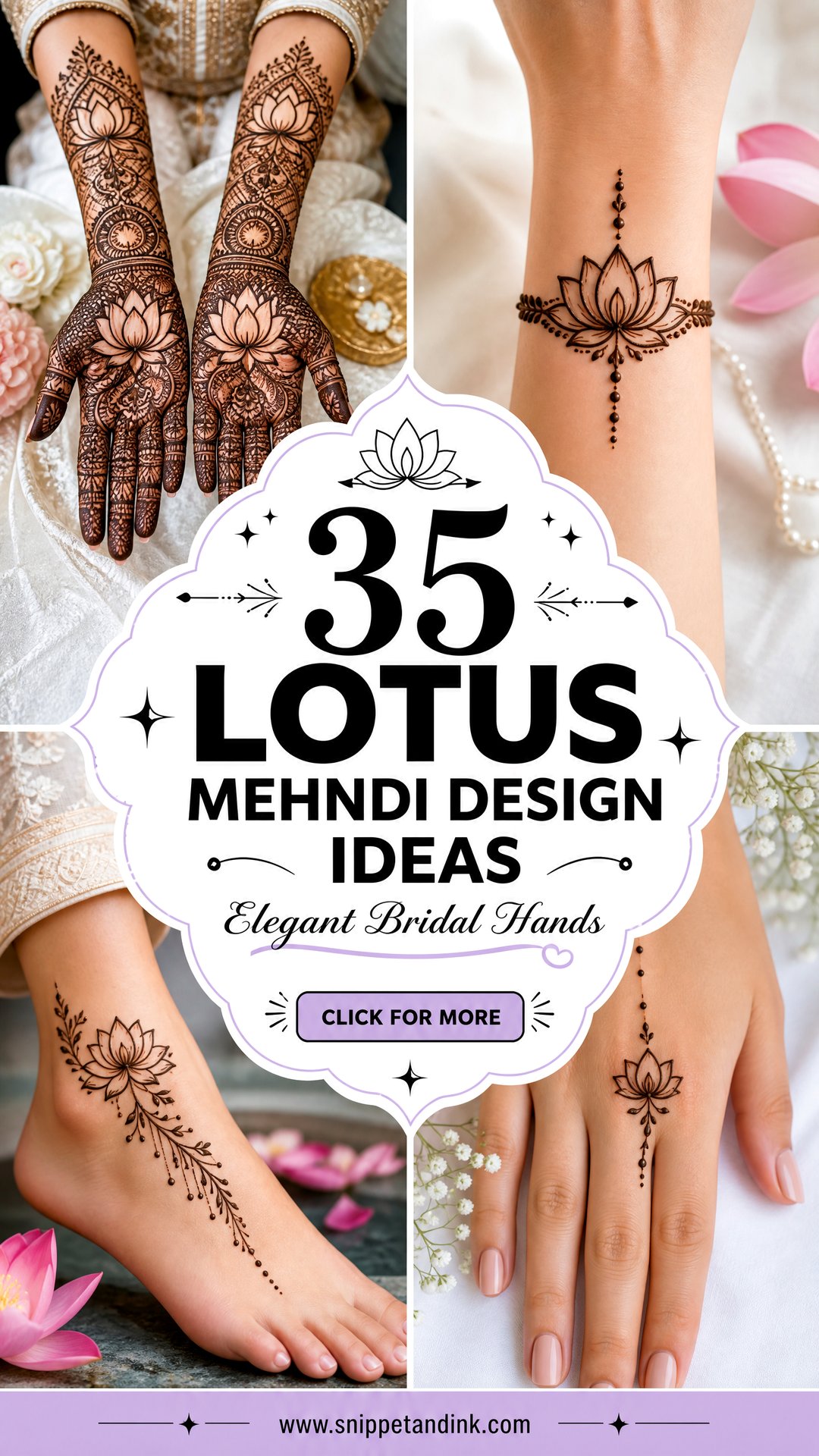
I draw more lotuses than almost any other flower. Part of it is meaning, since it carries ideas of purity and new beginnings in a lot of Indian tradition, and part of it is practical: a lotus is easy to scale. It can be one petal ring on a fingertip or the centre of a full bridal palm. It sits in palm mandalas, Arabic trails, back-hand jewelry patterns and minimal finger work, and it pairs naturally with paisleys, peacocks, jaali, vines and bracelet bands. Below are lotus layouts for weddings, festivals and smaller functions, each with a note on how it stains and what I’d change for different hands.
Three Lotus Shapes I Draw, and the Hands Each One Suits
Almost every lotus in this list is one of three shapes. Knowing which one you’re looking at makes it much easier to explain what you want and to judge whether it will suit your hand.
The side-view lotus
Seen from the side, the flower is a fan of five or seven upright petals sitting on a curved base. It’s narrow, so it fits fingers, wrists and Arabic trails. On short fingers, I keep it to five petals; more than that and it spreads past the edges of the finger.
The top-down lotus
Viewed from above, it becomes rings of petals around a centre, which is really a mandala. It needs a broad, flat-ish surface: the centre of the palm, the back of the hand, the top of the foot. Wide palms carry it beautifully. On a narrow hand, I limit it to two rings so it doesn’t run off the sides.
The bud
A closed bud is a teardrop with two or three petal lines. I use buds as the small notes in a design: at fingertips, at the ends of vines, near the elbow on a forearm. If you love lotuses but want a light design, a cluster of buds around one open flower looks considered without much coverage.
1. Lotus Mehndi Design Front Hand
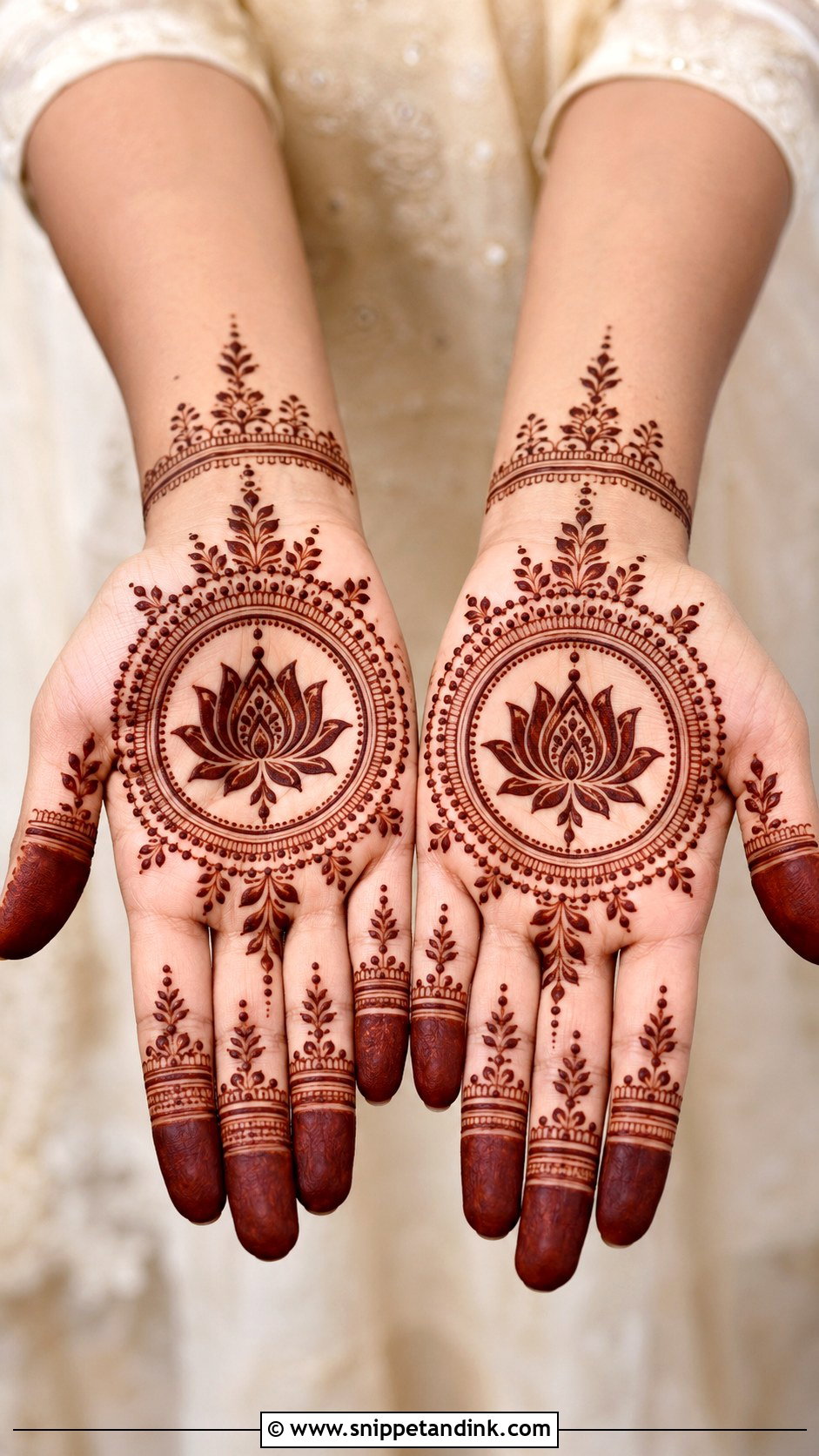
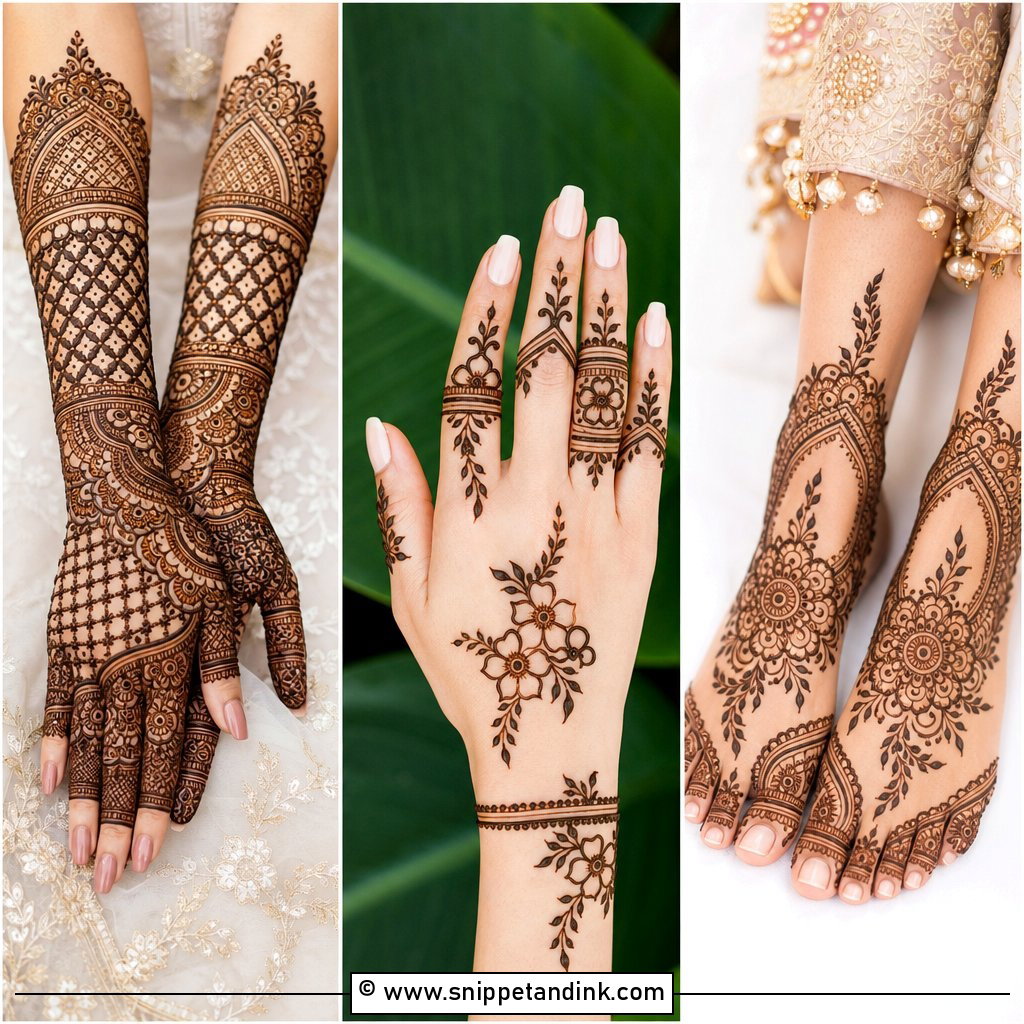
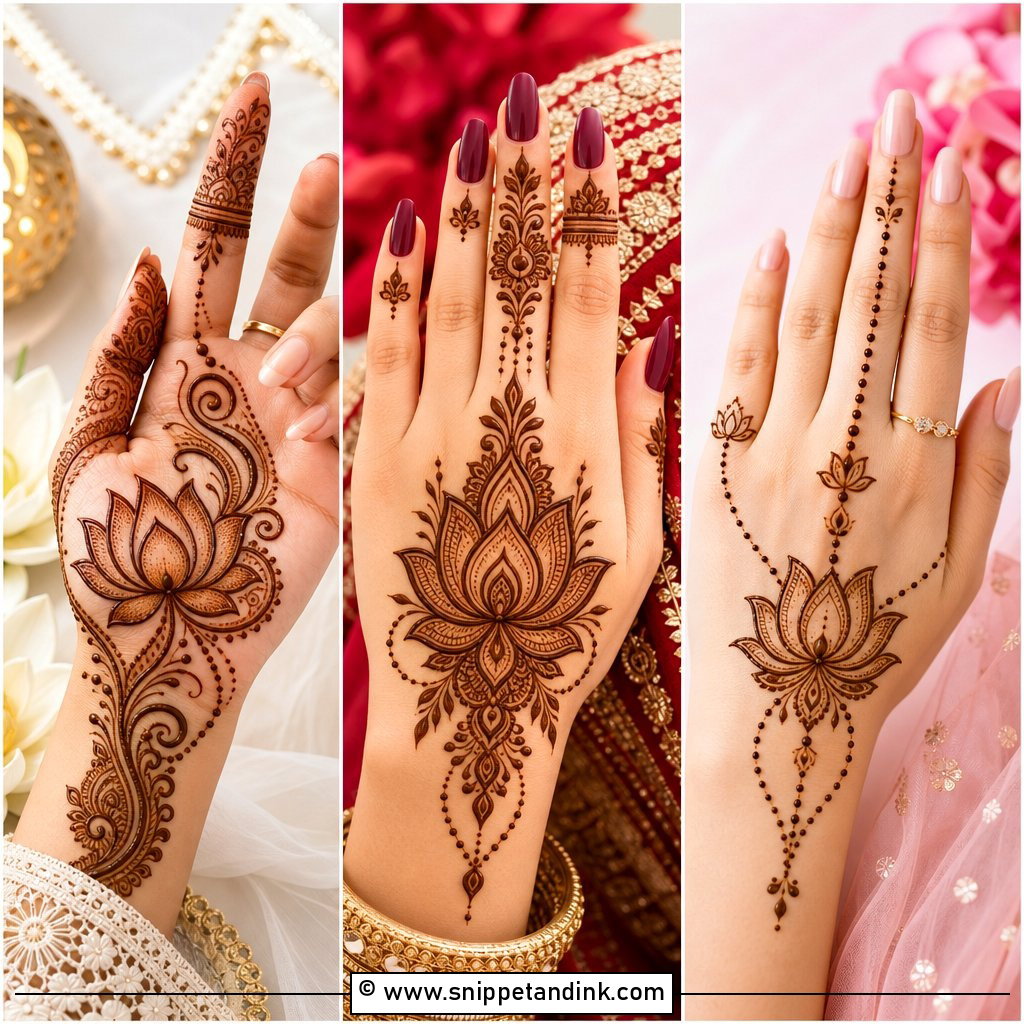
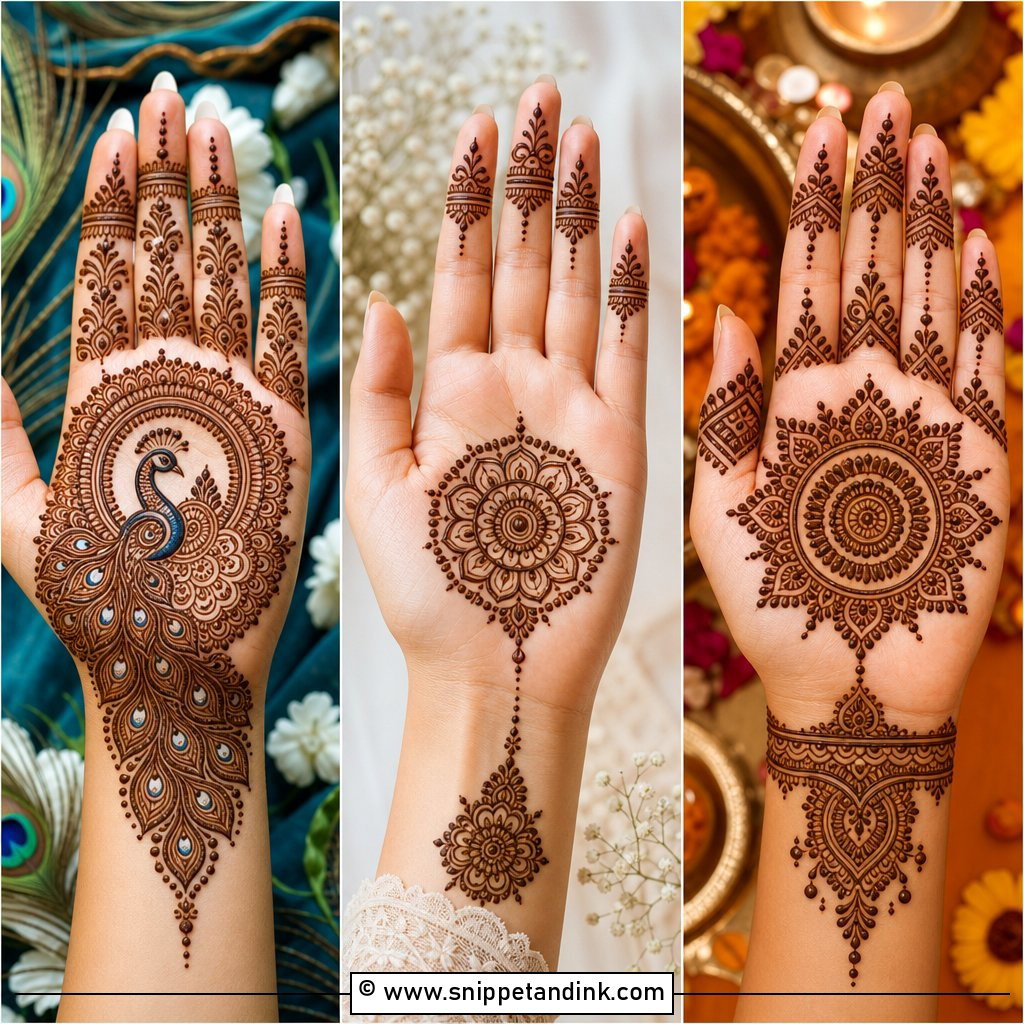
The palm is a natural frame for a round flower, so I place a large lotus in the center and build outward with fine rings, dots, leaf trails and finger details. The palm also stains darker than the back of the hand, which means even a lightly filled lotus here comes out strong. For more coverage, stretch the petals toward the base of the fingers and add buds near the wrist. Keep the fingers tidy; the palm is already doing the work. It’s a good fit for Eid, Diwali, pooja days, engagements and guests.
2. Lotus Mehndi Design Back Hand
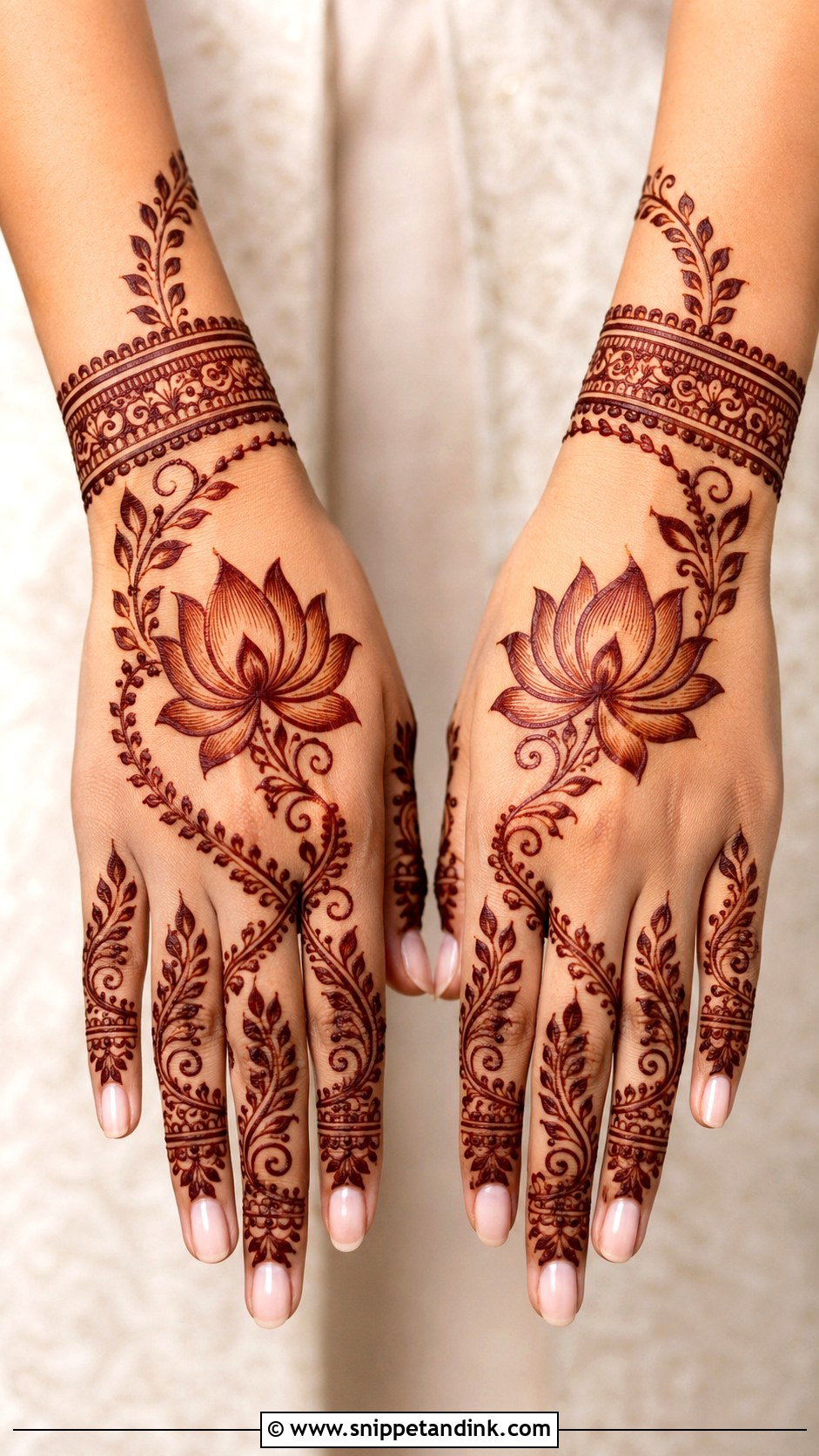
The back of the hand is flatter and more even than the palm, which makes it easier to keep petals symmetrical. One large lotus near the centre, linked to the wrist with vines or bracelet bands, is the classic layout. Shift the flower slightly toward the index finger and add a diagonal trail, and the fingers look longer. Leave a ring of bare skin around the petals. The back of the hand stains a little lighter than the palm, so that bare outline is what keeps the flower readable.
3. Simple Lotus Mehndi Design
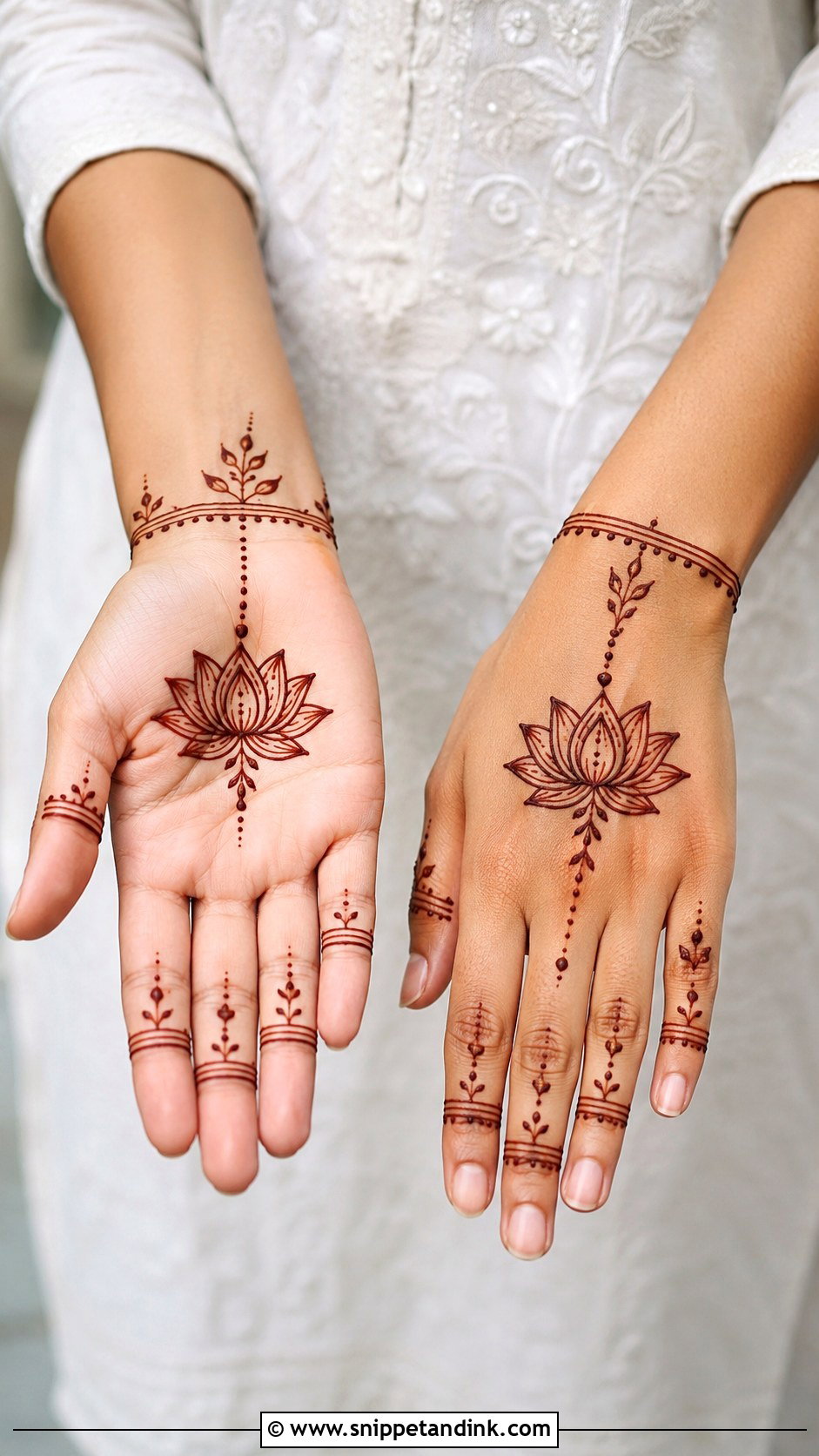
An open lotus on the palm or back of the hand, a dotted border, two curved leaves and light finger lines. Nothing else. When I teach beginners, this is the lotus I start with, because it forces you to get petal spacing right without filler to hide behind. Keep the petals even and the centre uncrowded. Small family events, school functions and quiet festive days all suit it, and the open spaces mean every petal stays distinct once the colour develops.
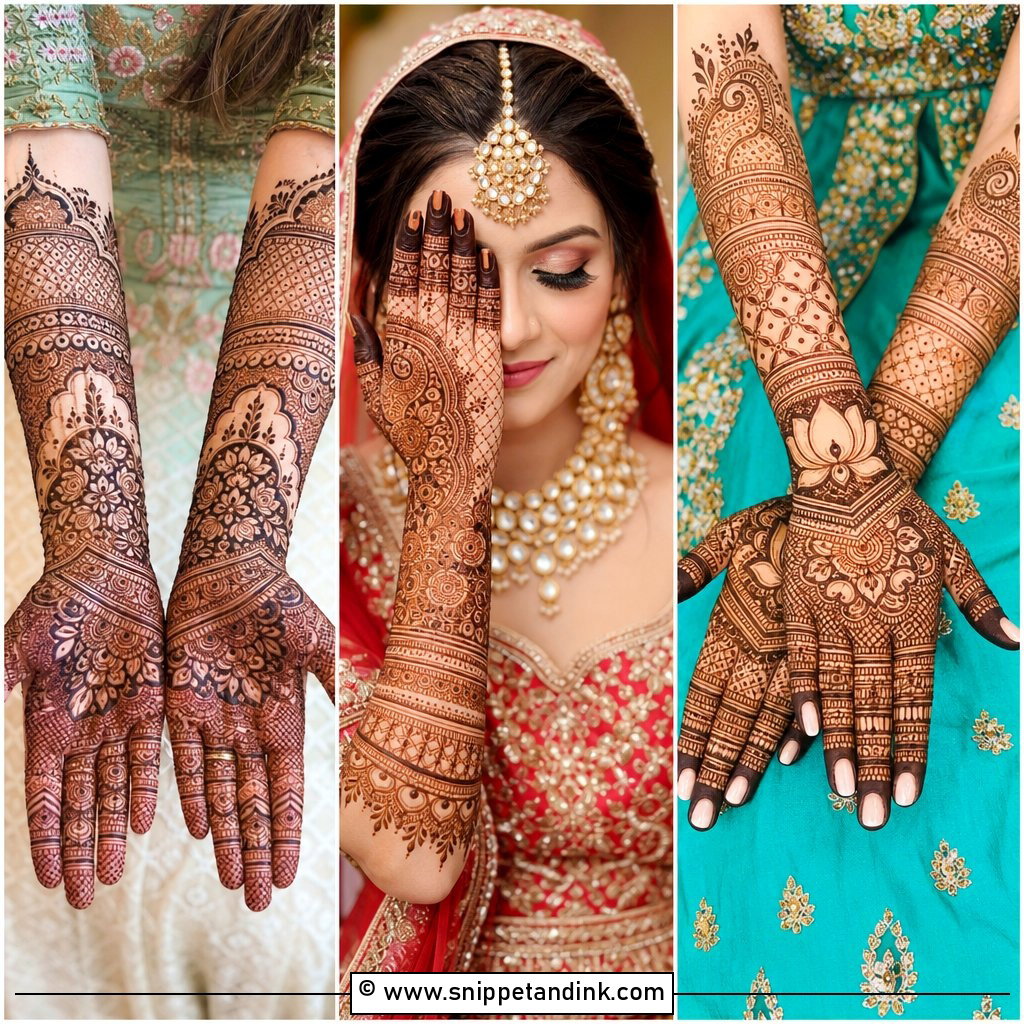
4. Bridal Lotus Mehndi Design
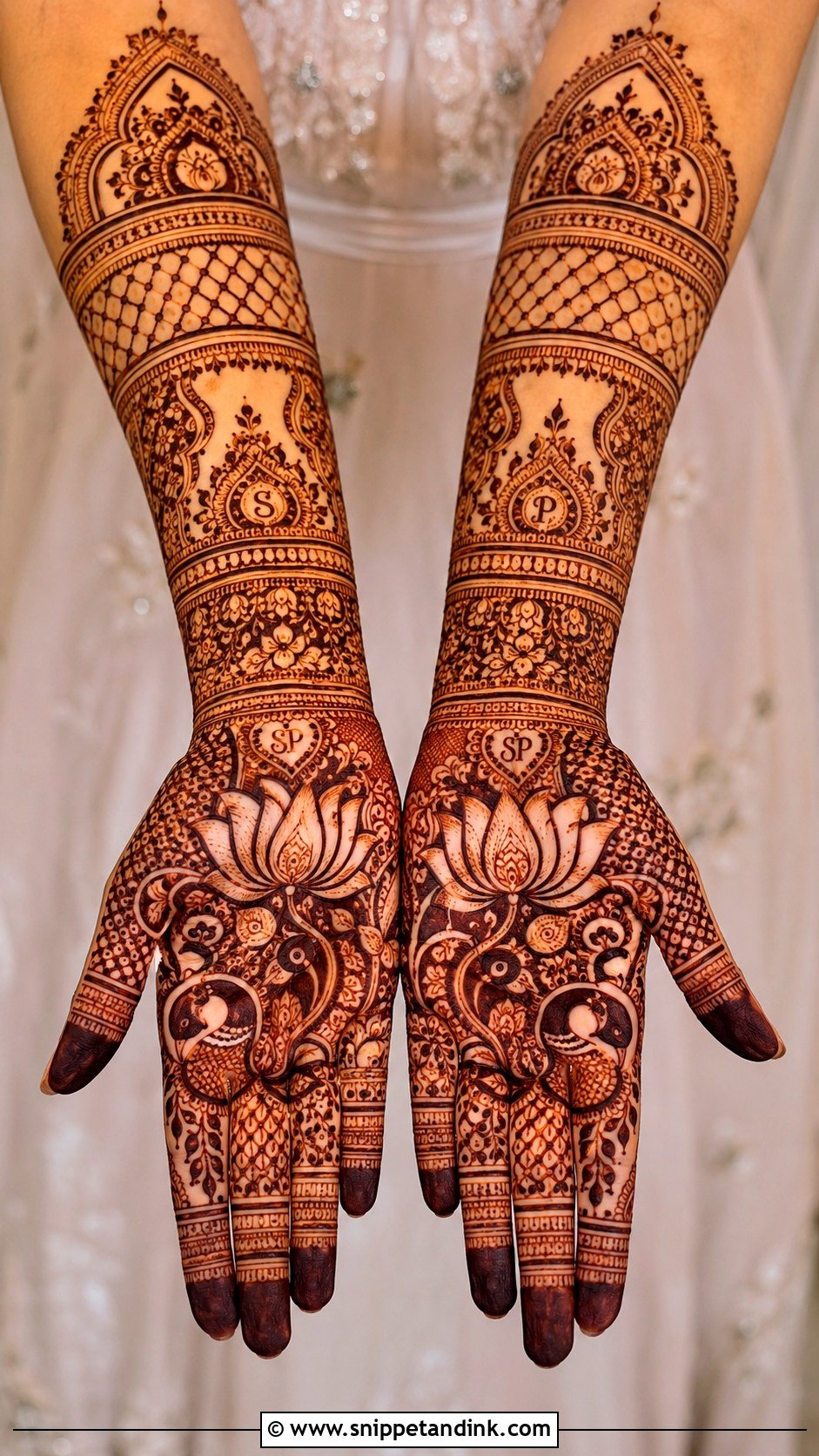
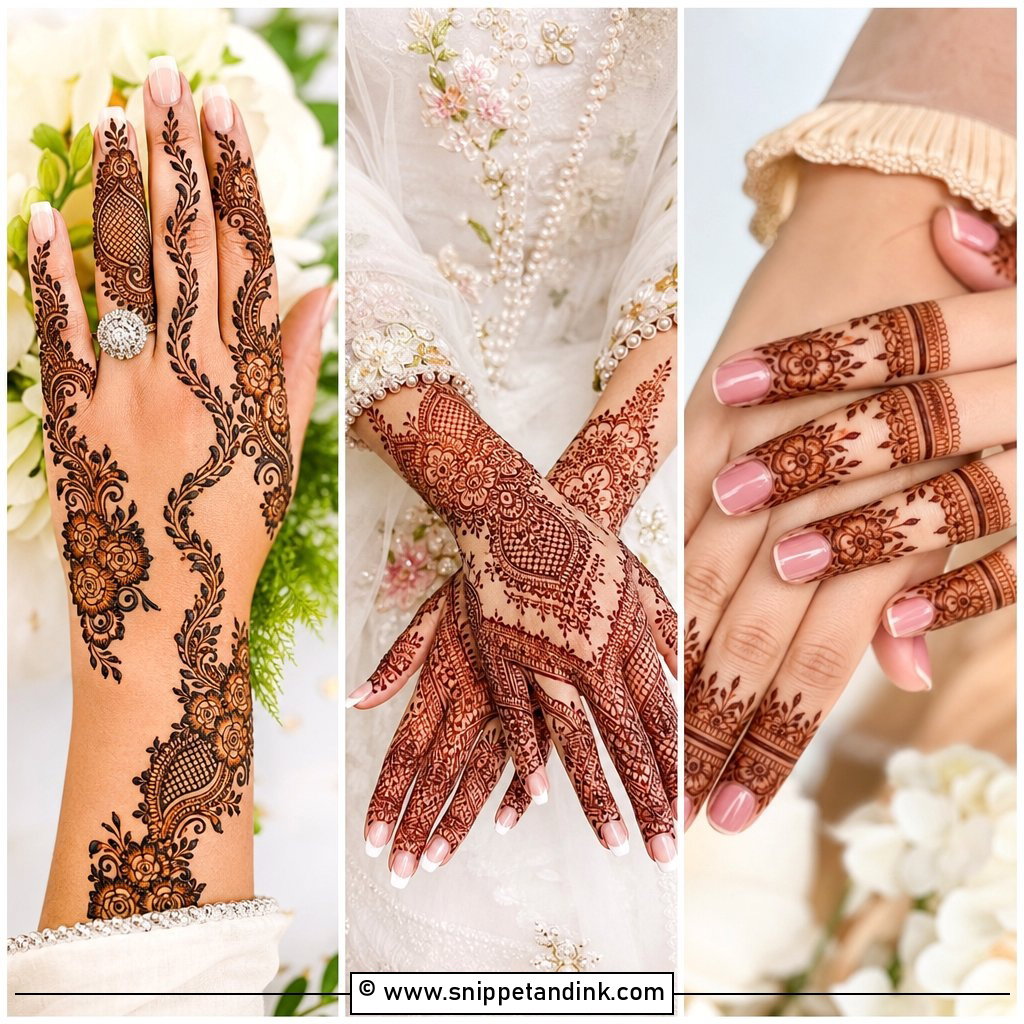
For a bride, the lotus becomes the anchor and everything else (paisleys, peacocks, jaali, mandala rings, fine florals) grows around it, from the palms up the forearms. I keep the two hands balanced but not identical, because exact mirroring on hands of slightly different sizes always looks a little off. Initials can be tucked inside a petal or a wrist band. The detail I’m strict about is the lotus outline: I draw it thicker than anything around it, so it doesn’t sink into the dense Indian work once everything stains.
5. Lotus Mandala Mehndi Design
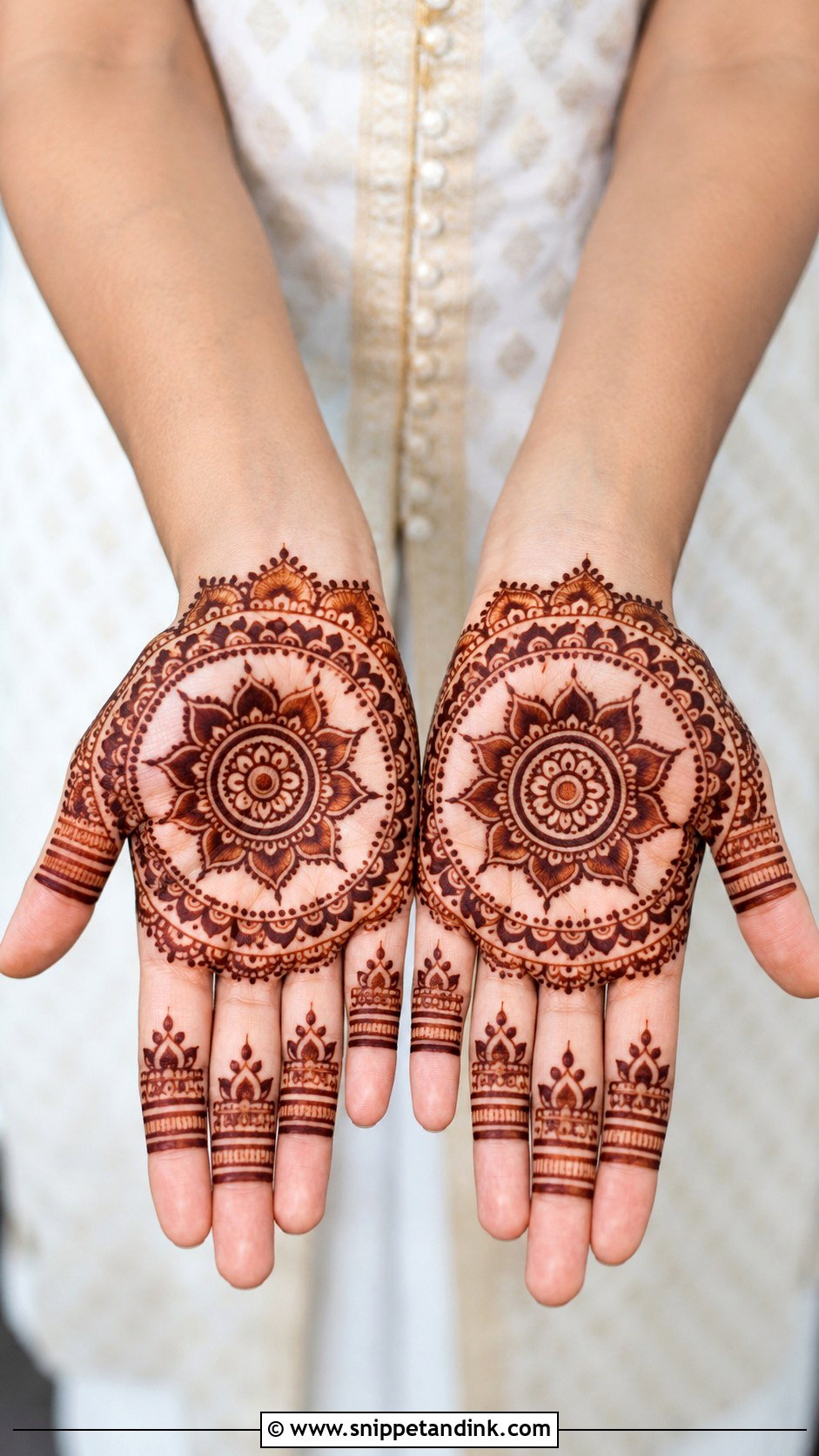
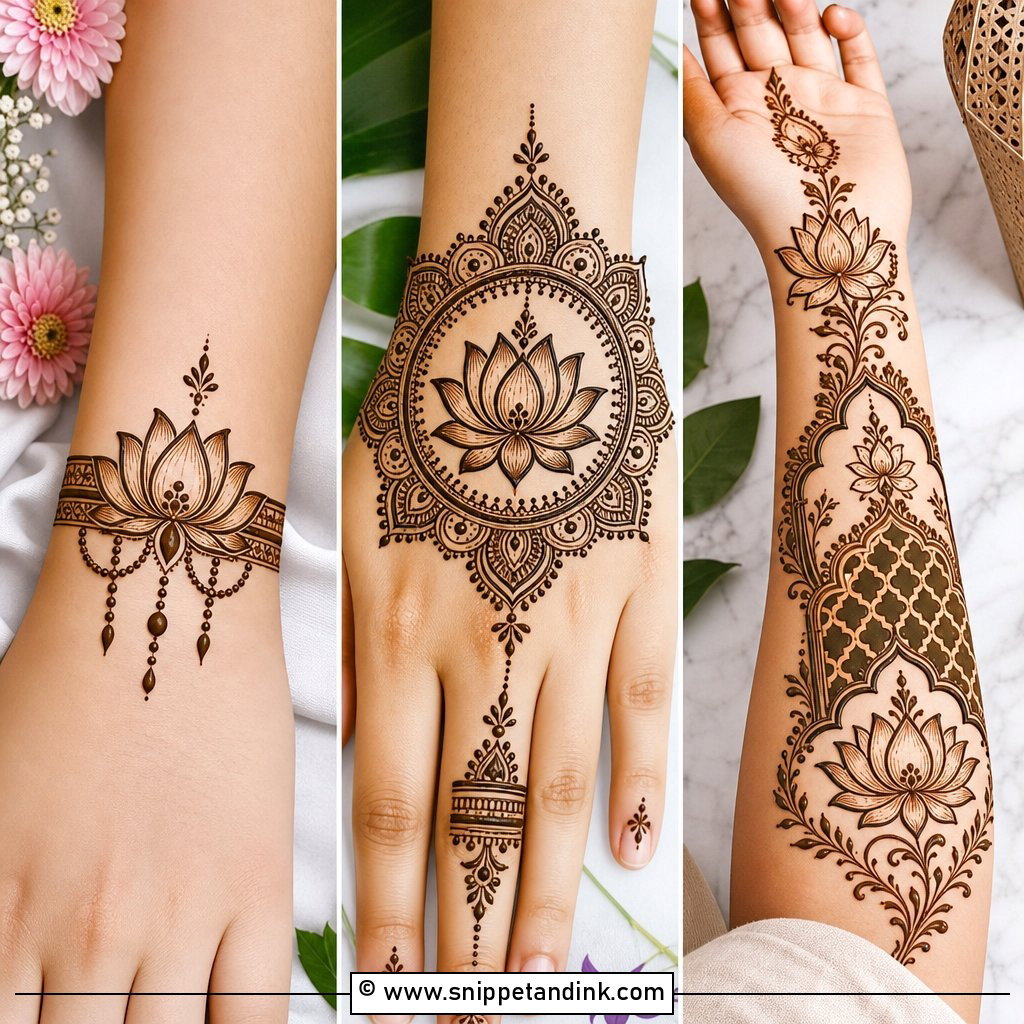
Here the mandala’s outer ring is shaped into layered lotus petals, finished with dots, scalloped borders and thin circular lines. It suits people who like centred, symmetrical henna, and hands with a broad, square palm, where a round motif fills the space better than a diagonal trail. Fingers can carry leafy bands or a mini petal on each one. I add one ring at a time and turn the hand between rings to check it’s still round, since a palm curves more at the edges than people expect.
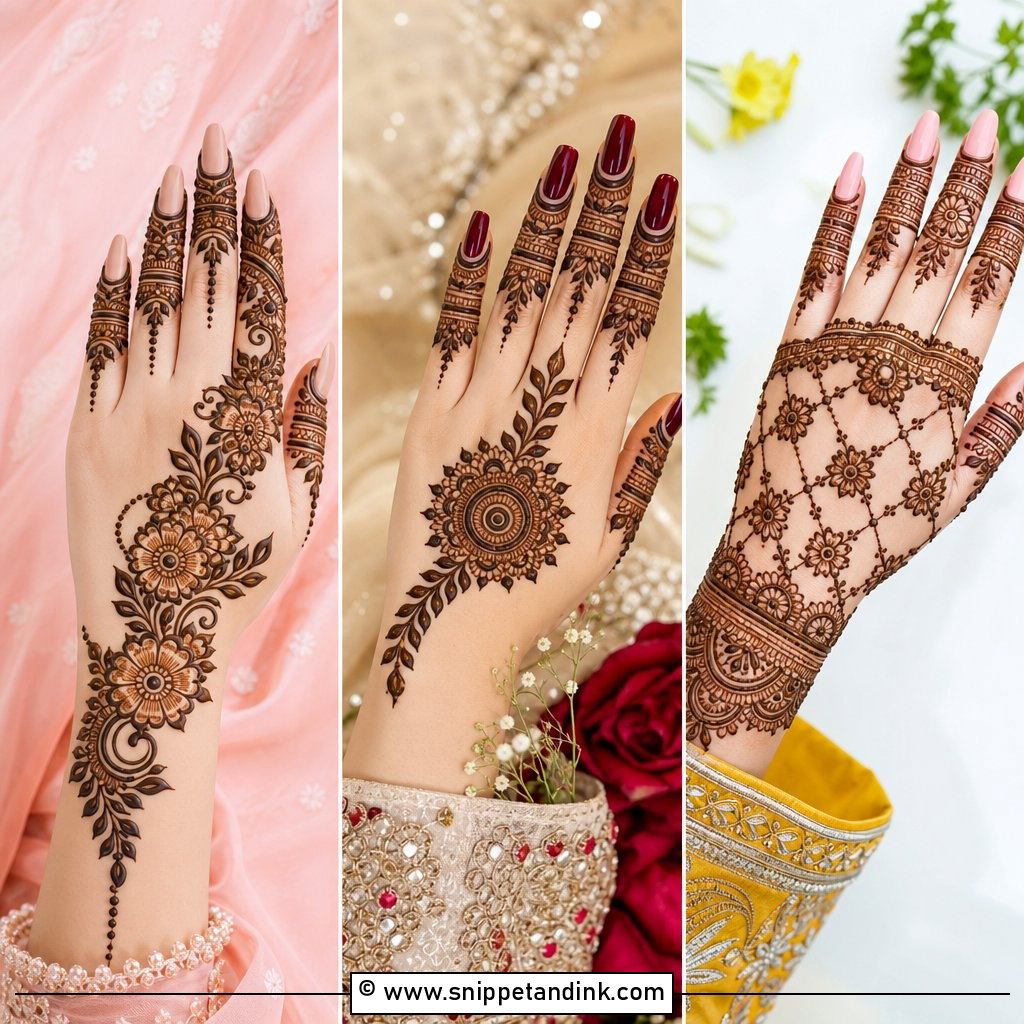
6. Arabic Lotus Mehndi Design
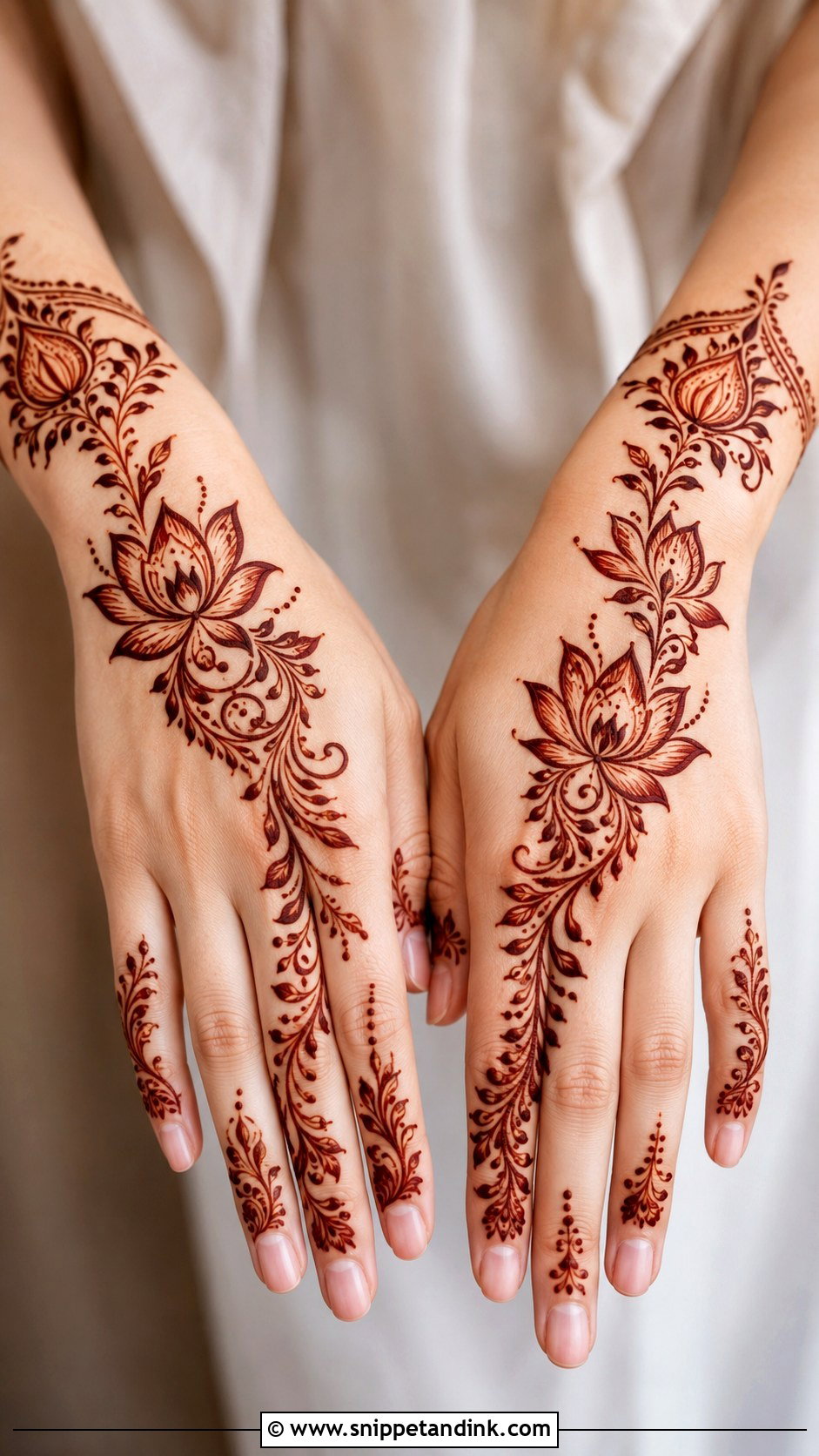
Arabic lotus work is a diagonal trail: lotus flowers, leaves and curved strokes from the wrist across the back of the hand toward one or two fingers. The gaps matter as much as the lines. I give the lotus a thick outline and keep the inside of the petals light, a single vein or some soft shading, which reads better from a distance than full filling. It’s much quicker than bridal work, which makes it a favourite for Eid, weddings and parties.
7. Indo Arabic Lotus Mehndi Design
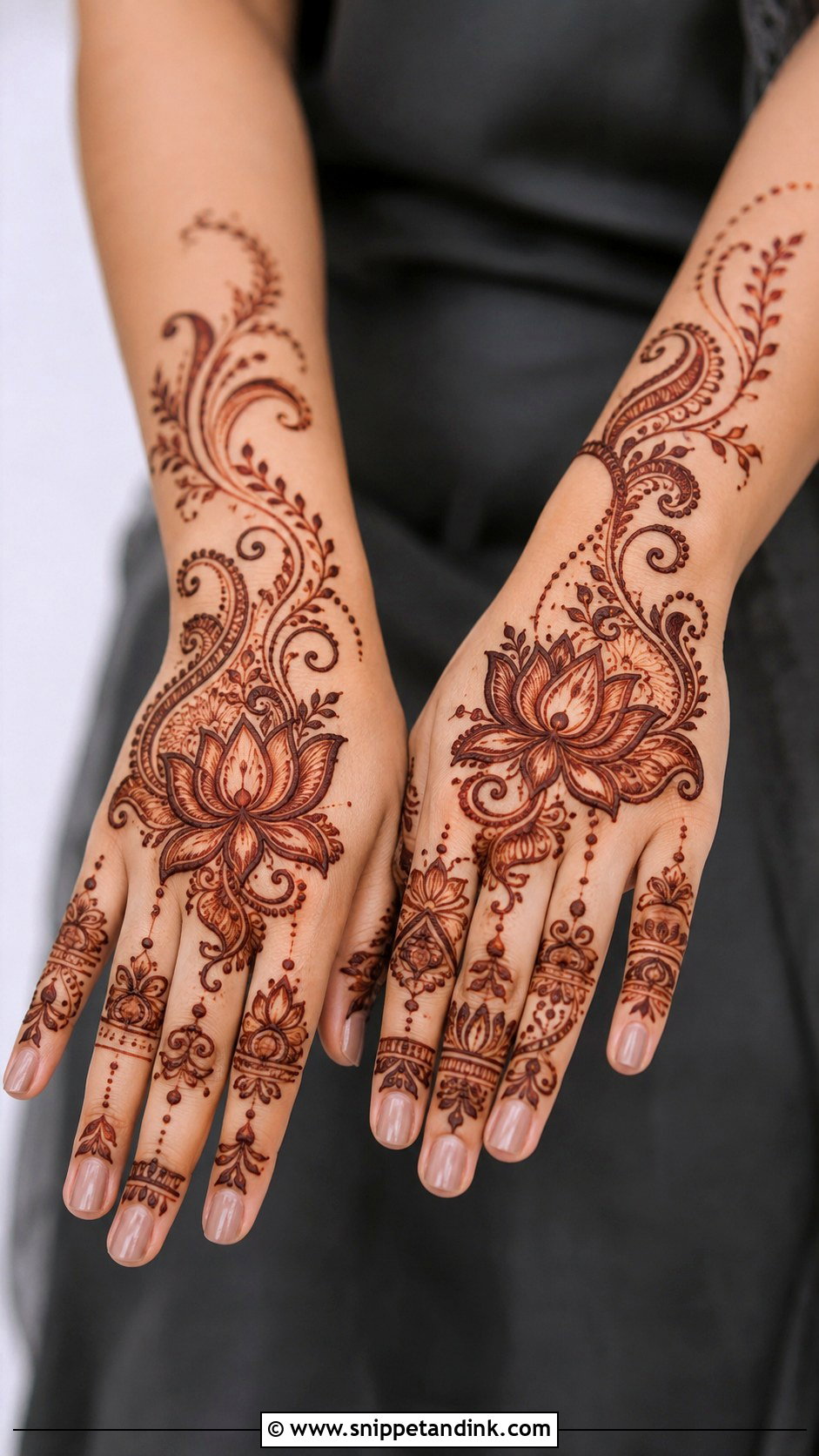
Indo-Arabic takes the bold Arabic lotus trail and fills chosen petals with Indian lines, dots, jaali and small paisleys. The trick is choosing which petals to fill: I fill alternate ones, or only the inner layer, so there’s still contrast. The usual placement is diagonal across the back hand or from the wrist to the palm, with one side of the hand left open. Bridesmaids and close family often choose it when they want something semi-heavy without matching the bride.
8. Full Hand Lotus Mehndi Design
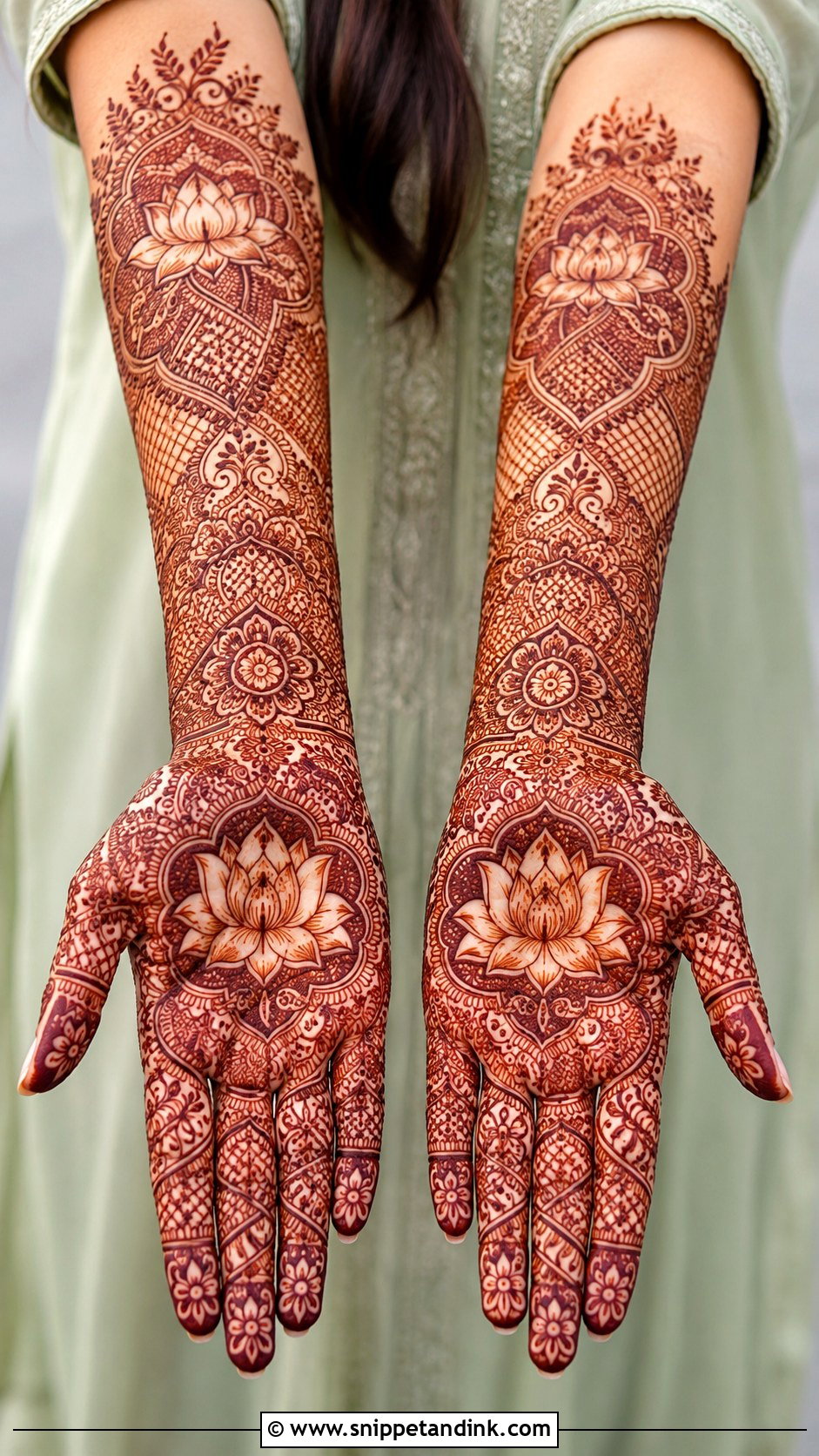
Full-hand lotus work covers the fingers, palms, wrists and sometimes the forearms, with lotus flowers as anchor points and vines, paisleys, mandalas and mesh in between. I map it before filling anything: a large lotus on the palm, a second near the wrist, buds on the fingers. Those three anchors give the hand a planned flow. Without them, full coverage tends to look busy rather than rich. The stain should deepen to maroon over a day or two.
9. Half Hand Lotus Mehndi Design
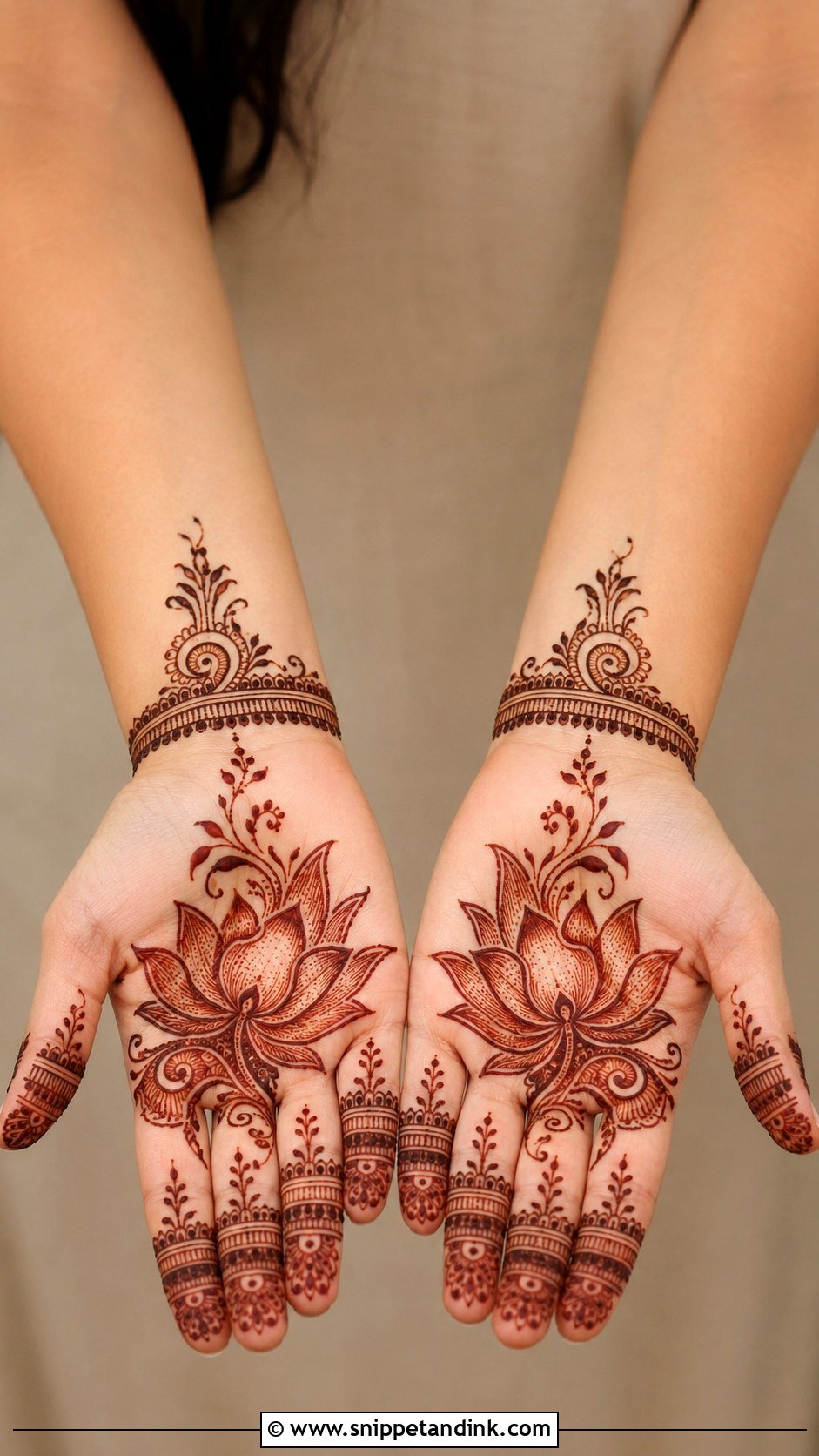
Half-hand designs either decorate the palm and lower fingers or skip the palm and cover the wrist and back of the hand. A lotus anchors either one. The line where the design stops needs a proper border, otherwise it looks like the session ran out of time. It’s the practical choice when you need your hands back soon, for a pre-wedding brunch or a festive lunch where you’ll be serving food. Clean petals, soft vines and light fingertips are all it needs.
10. Lotus Finger Mehndi Design
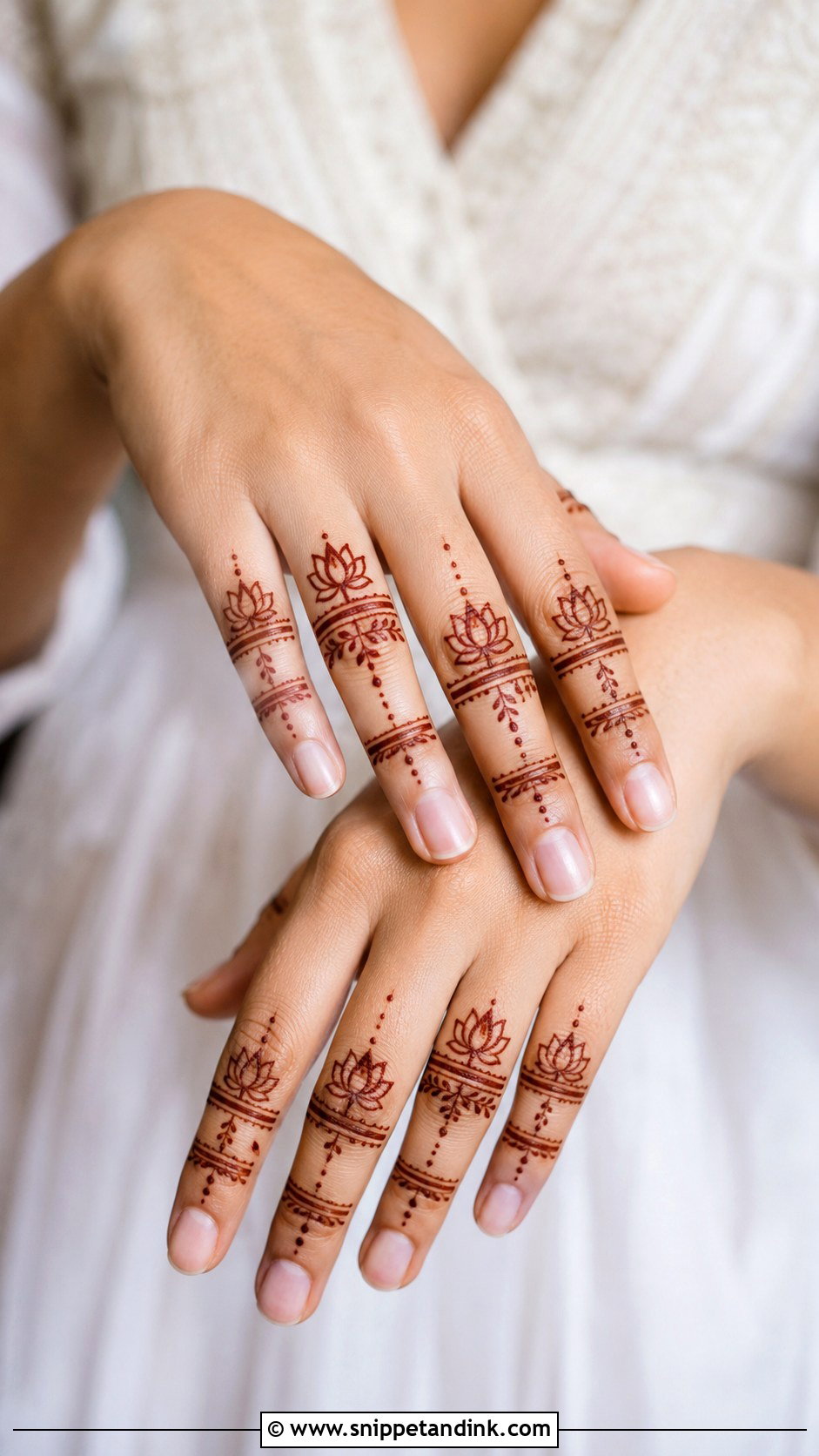
Tiny lotus blooms at the base of each finger, or a slim lotus trail climbing from the index finger toward the back of the hand, joined by dots, leafy bands and fine lines. It keeps a recognisable floral theme in a very small space. Fingers are narrow and curved, so I use a three or five petal side-view lotus here rather than a full round one, which would wrap around the finger and lose its shape. Leave the rest of the hand bare or add a slim wrist band.
11. Lotus Bracelet Mehndi Design
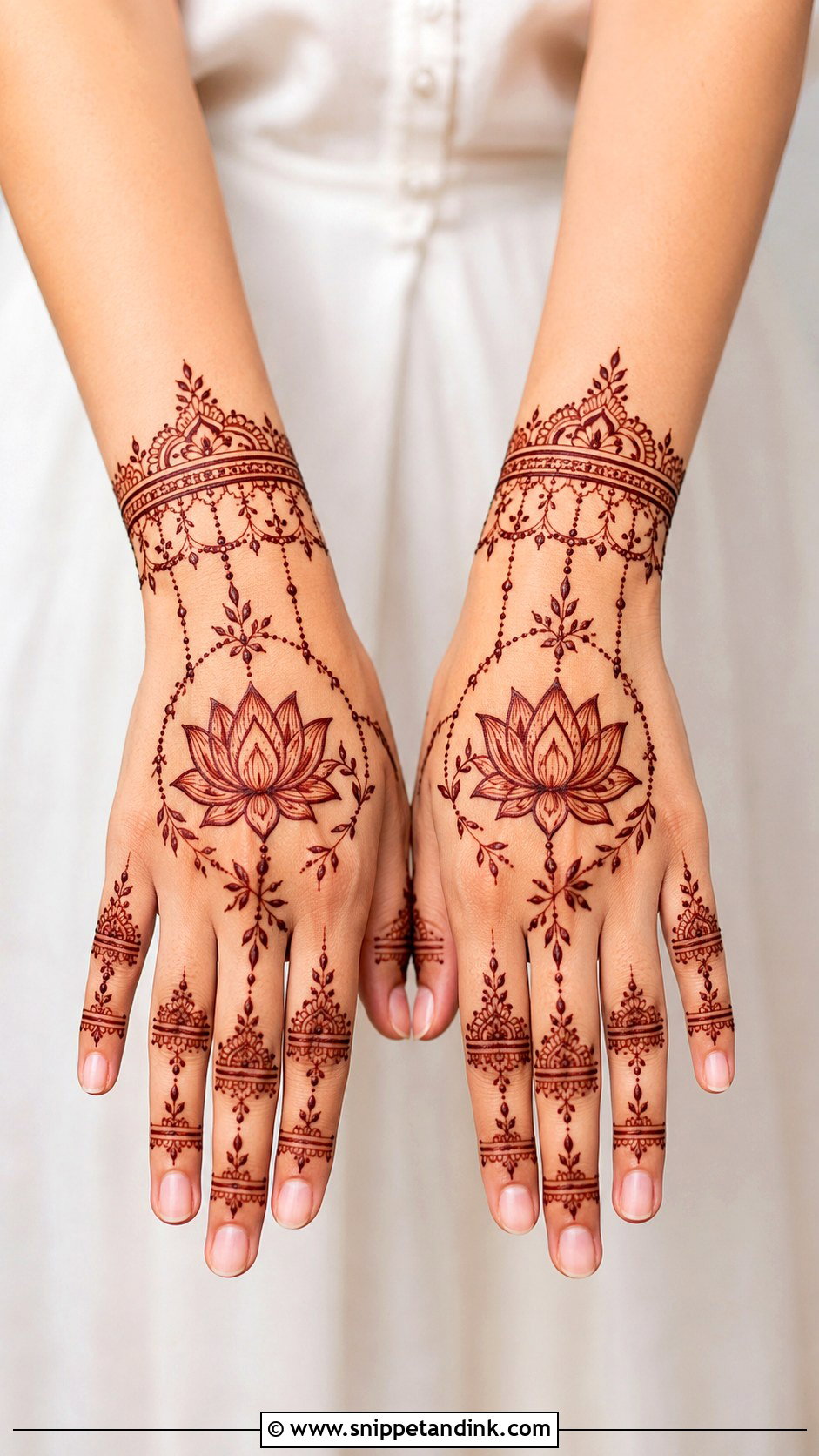
This one imitates jewelry: a lotus on the back of the hand, chains and dots running to bracelet bands at the wrist, small hanging details below the flower, and sometimes a thin chain to the middle finger for a haath phool effect. Engagement parties and sangeet nights are where I draw it most. The chains are only as good as the paste, since a smooth, slightly loose cone is what gives an unbroken line. Keep the lotus the largest element so the chains read as its setting, not the other way round.
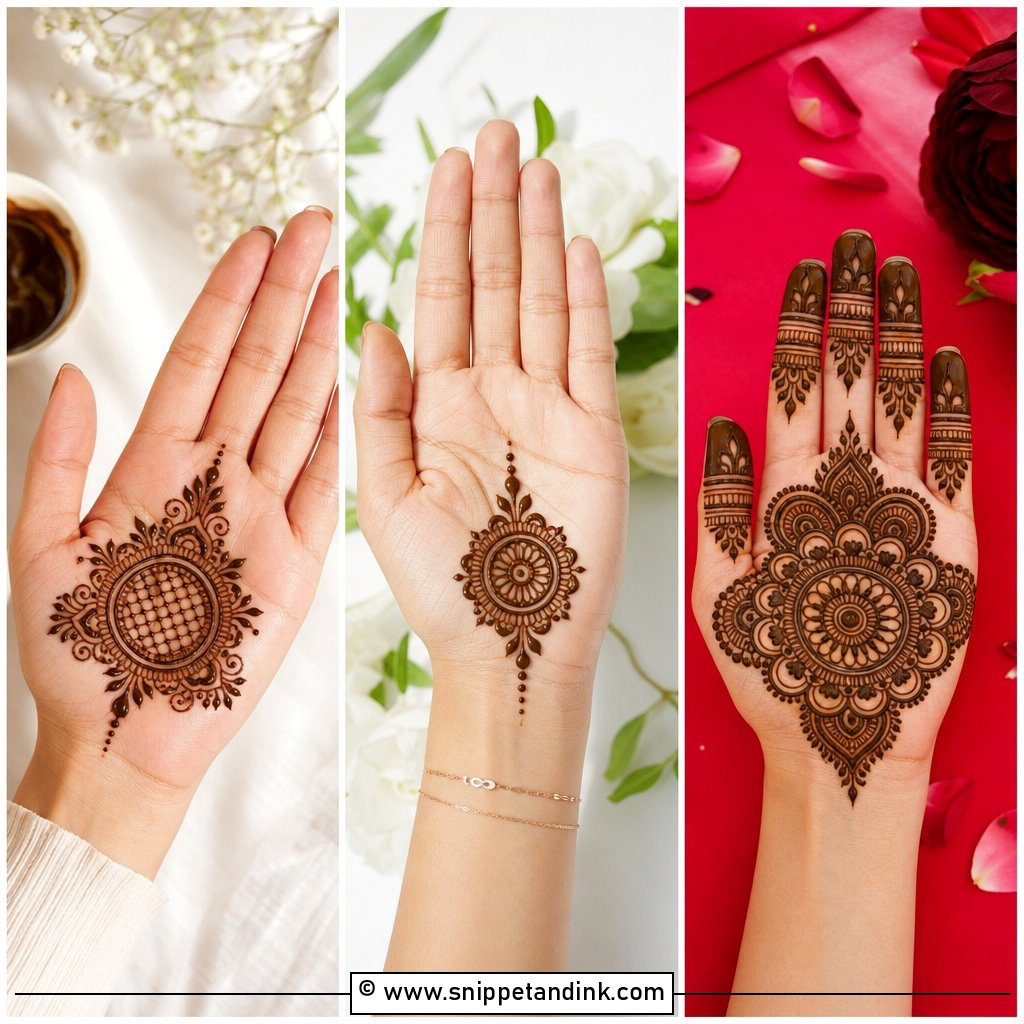
12. Lotus Palm Mehndi Design
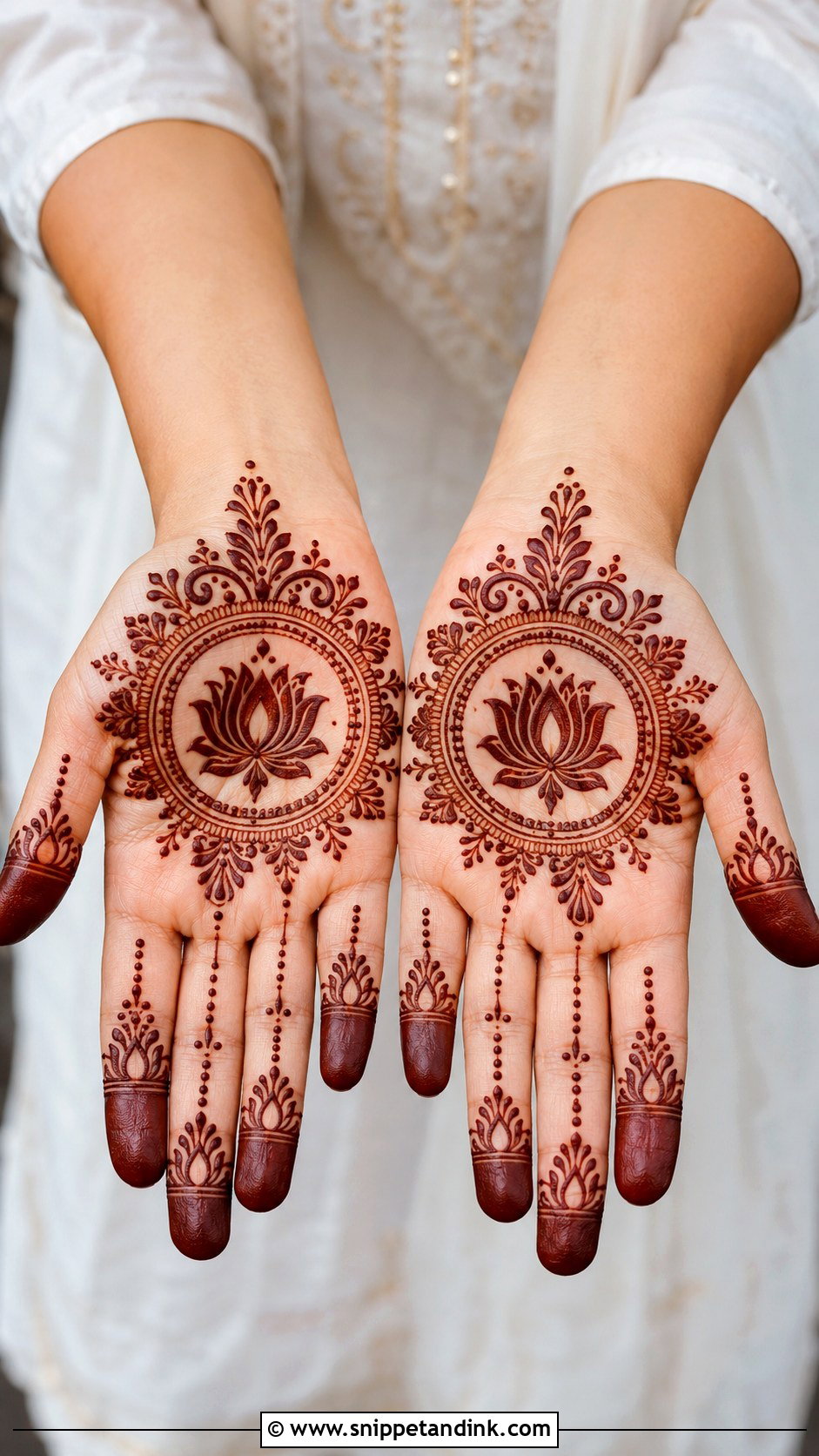
The lotus sits dead centre on the palm, with circular borders, dots and curved leaves around it, and simple vertical lines or small petals on the fingertips. Palms stain darkest, so this flower comes up bold even with modest filling. People see the palm when you greet them and during rituals, which is part of why it’s popular for religious events and family ceremonies. Don’t let the lotus be too small. On an adult palm, I’d go no smaller than the space between the base of the fingers and the middle crease.
13. Lotus Jaali Mehndi Design
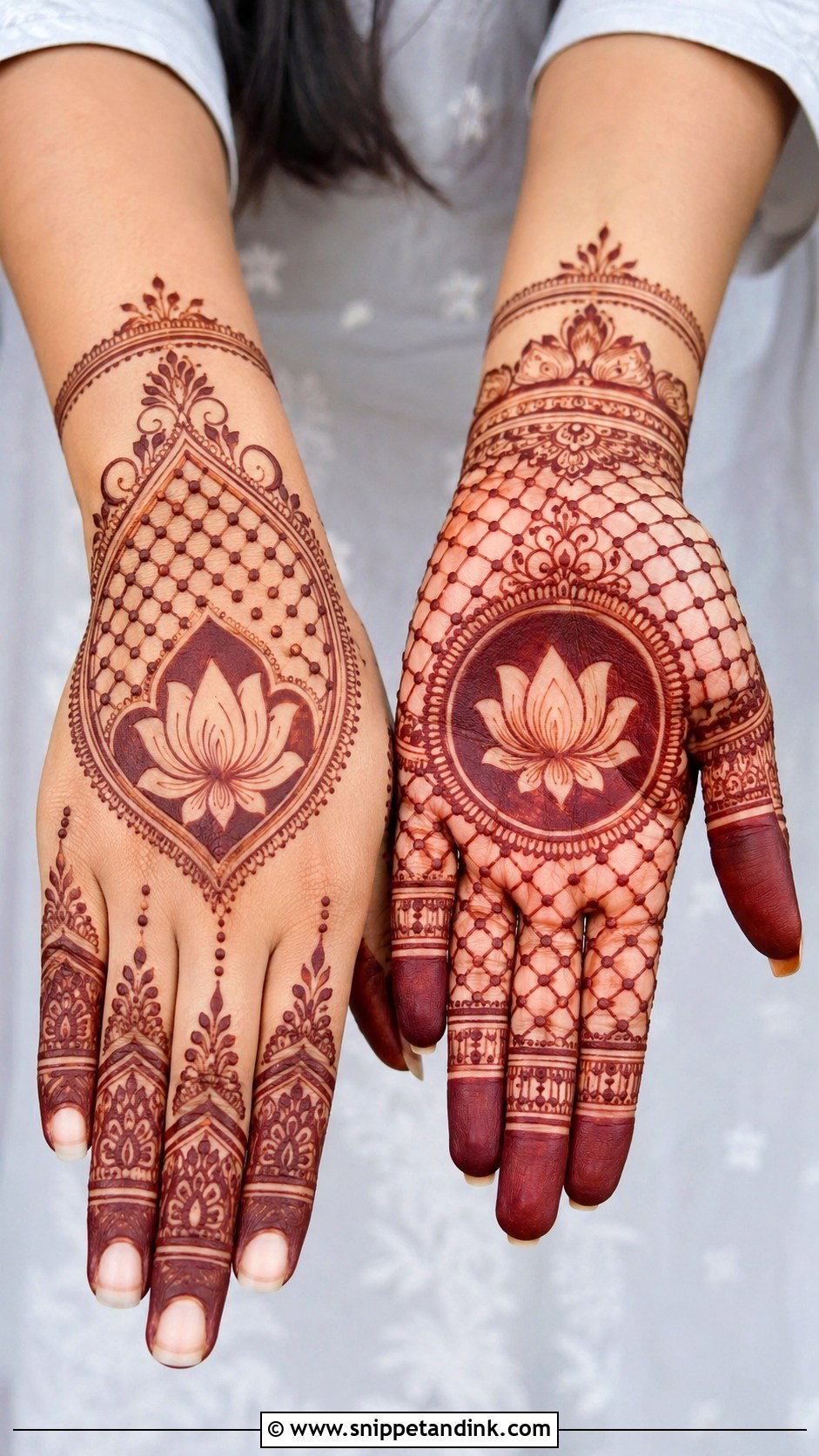
Jaali panels set around a lotus look like windows framing a flower. I size the mesh to the surface: finer on the back of the hand, slightly larger on the palm, because palm skin stains so dark that a tight grid there fills in. Dotted borders between the lotus and the mesh keep the sections separate. Uneven squares are the giveaway of a rushed jaali, and they pull the eye away from the flower, so this is a design to book with someone patient.
14. Lotus Paisley Mehndi Design
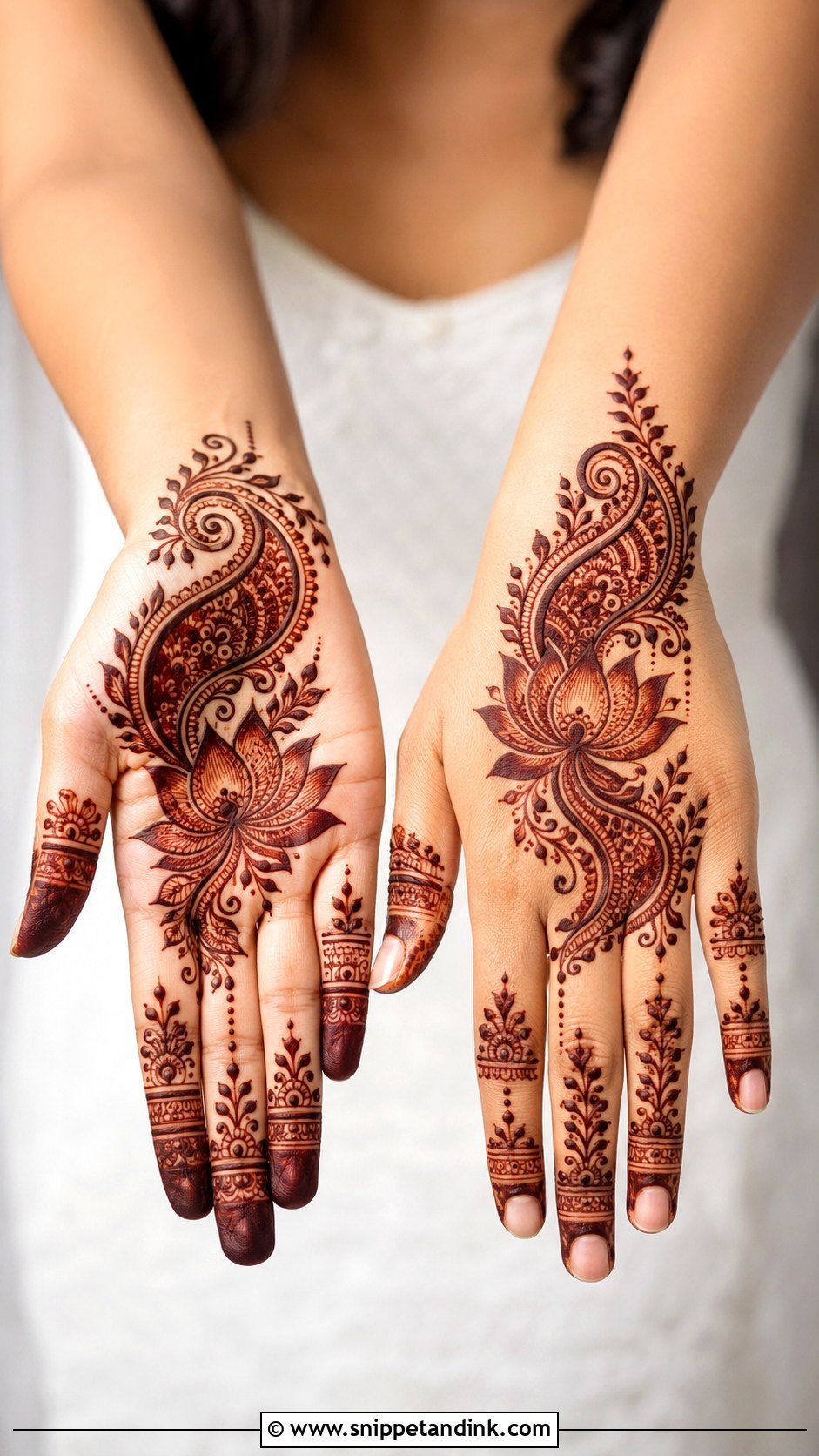
Two traditional favourites together. In a lotus paisley mehndi design, the lotus sits in the centre or to one side and curved paisleys move around it, filled with fine lines, dots, tiny petals or shading. On the palm, the paisleys follow the natural curve of the hand. On the back, I run a diagonal paisley and lotus trail from the wrist to the index finger. Keep the lotus outline bold, or it gets lost in all those curves. Weddings, Karwa Chauth, Diwali and Eid all suit it.


15. Lotus Peacock Mehndi Design
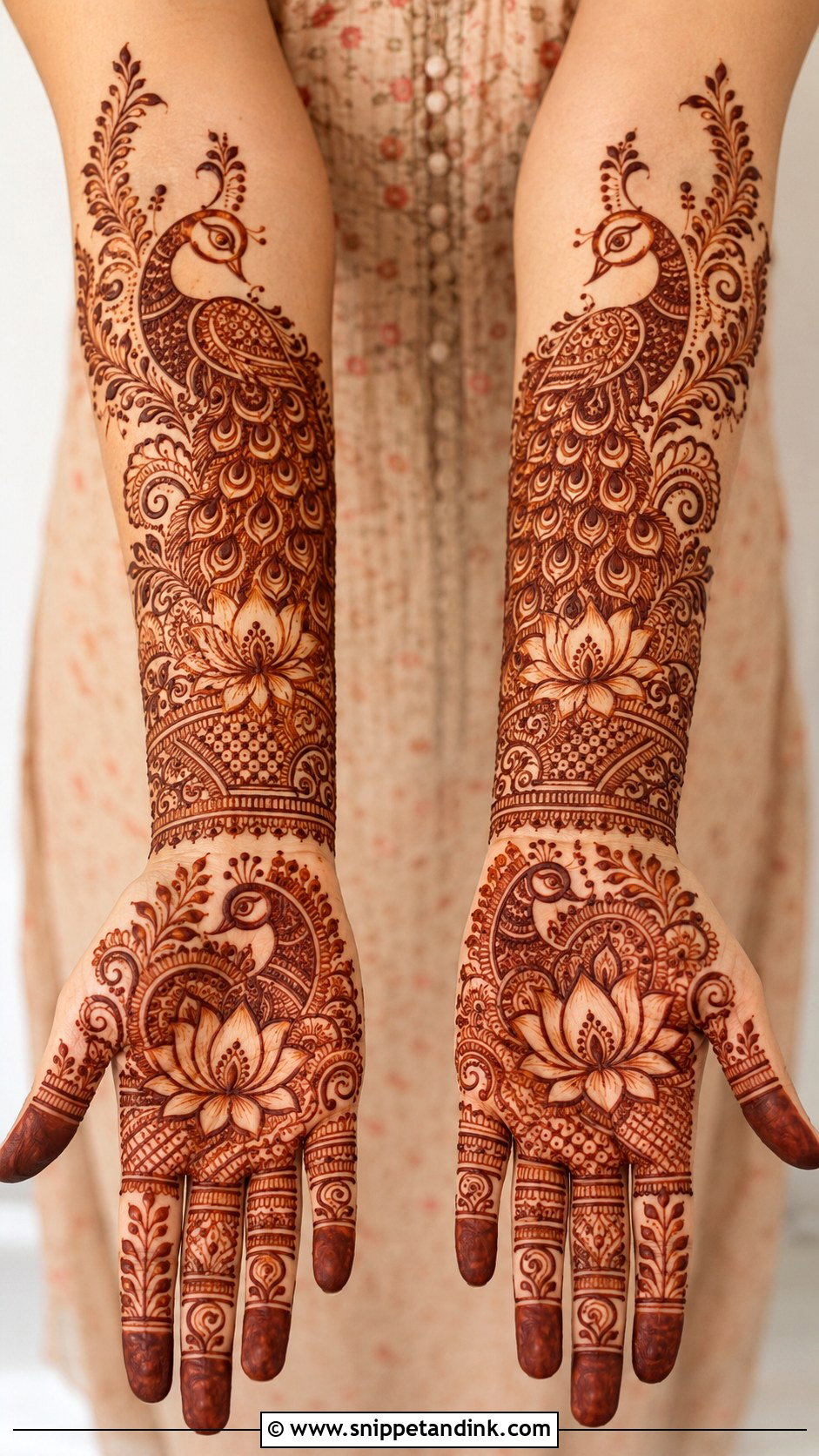
The peacock sits to one side with its feathers curling around a lotus base. It’s a bridal and semi-bridal combination, because both motifs are dense with tradition. On the palm it reads classic; on the back of the hand, more decorative. Two detailed motifs in one space can fight, so I keep the peacock’s neck as one smooth, unbroken line and the lotus petals wide and lightly filled. If both are packed with detail, the design turns into texture with no clear subject.
16. Lotus Vine Mehndi Design
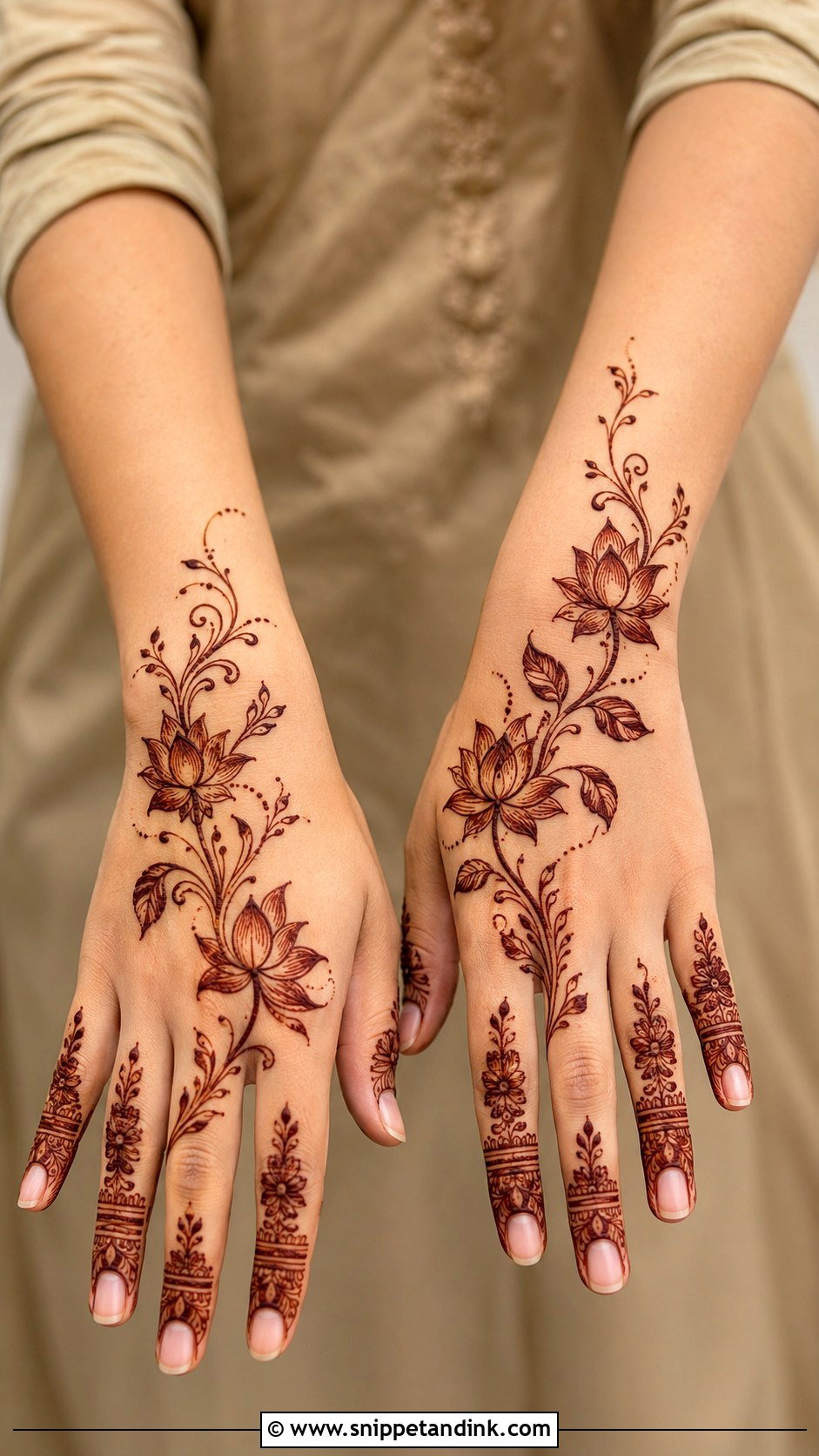
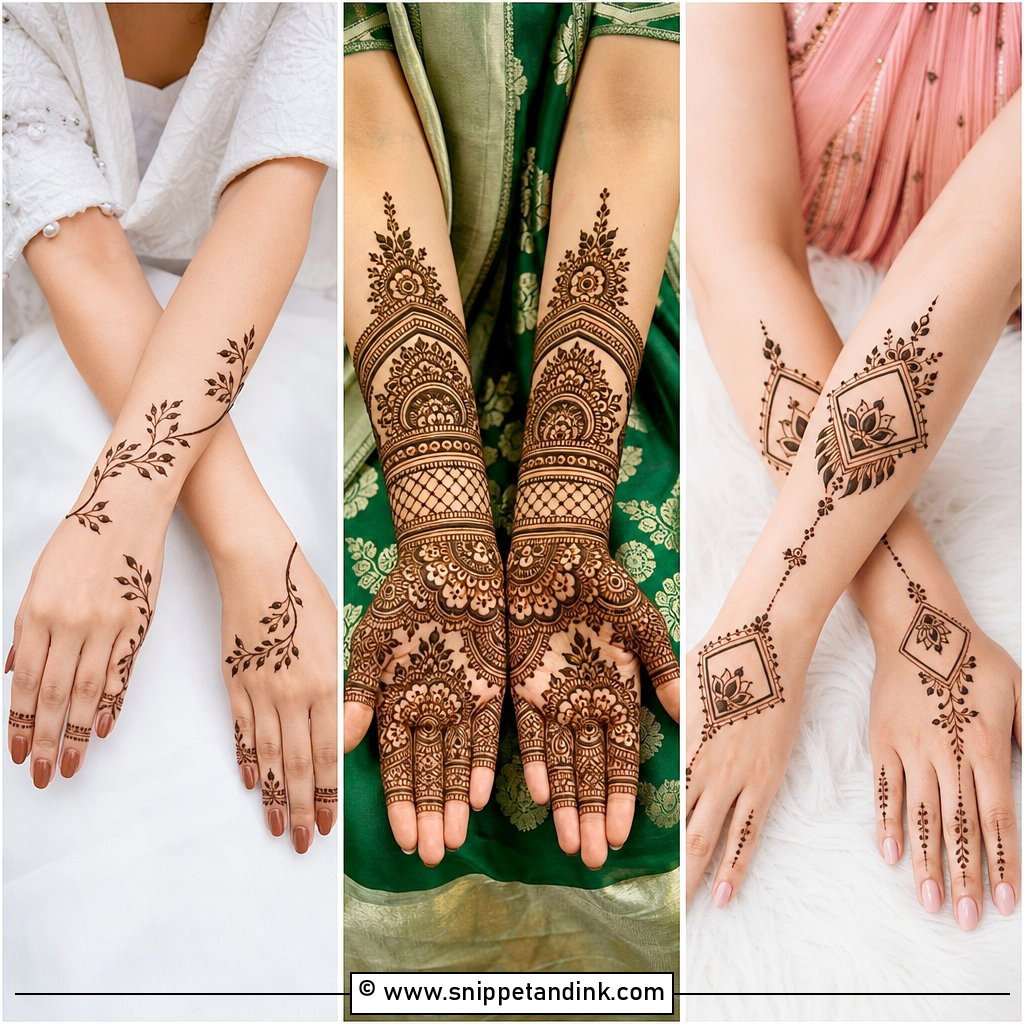
A lotus near the wrist or palm with a vine running across the hand, carrying buds, leaves and smaller flowers. It adapts to almost any hand. On long, slender hands, I let the vine run straight and long. On shorter or wider hands, I curve it, because a straight line across a broad hand only emphasises the width. Arabic and Indo-Arabic versions both suit the vine. Wedding guests who want something graceful and quick choose it often.
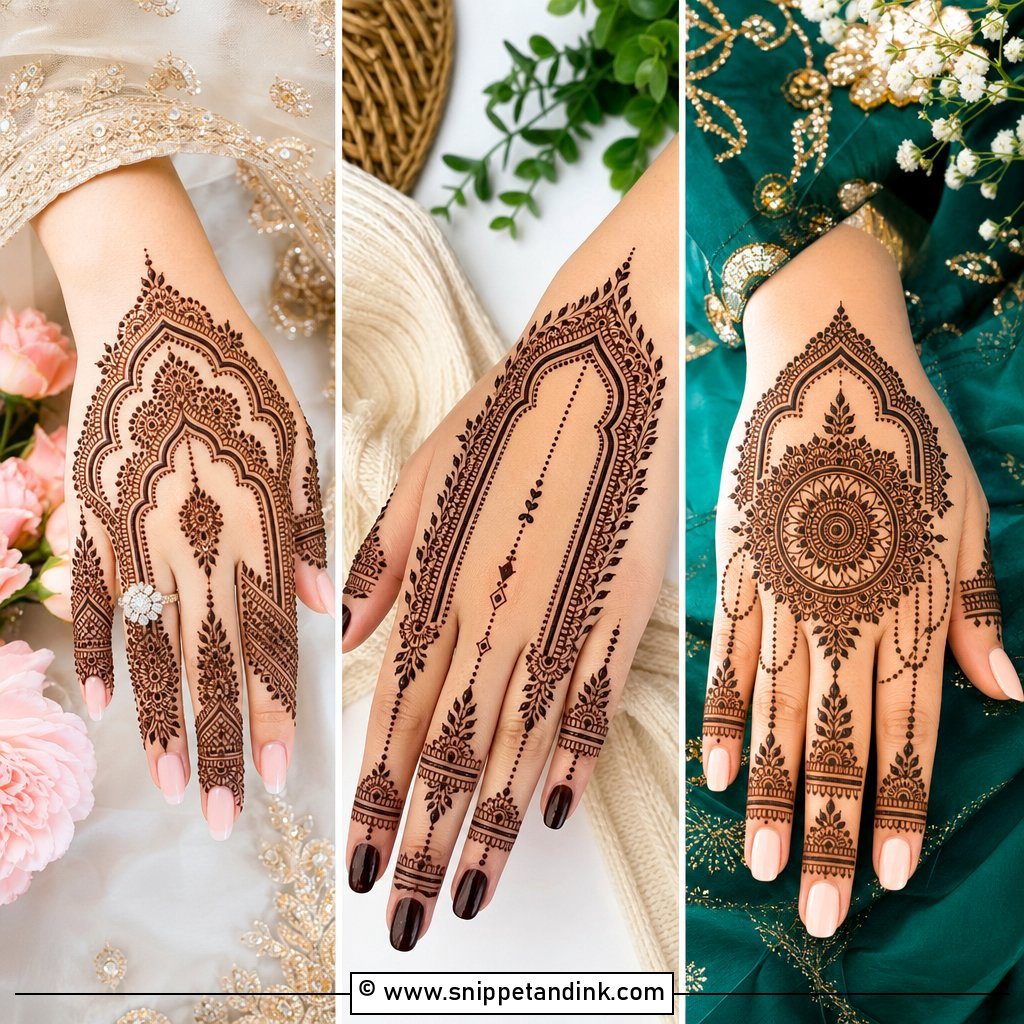
17. Lotus Back Finger Mehndi Design
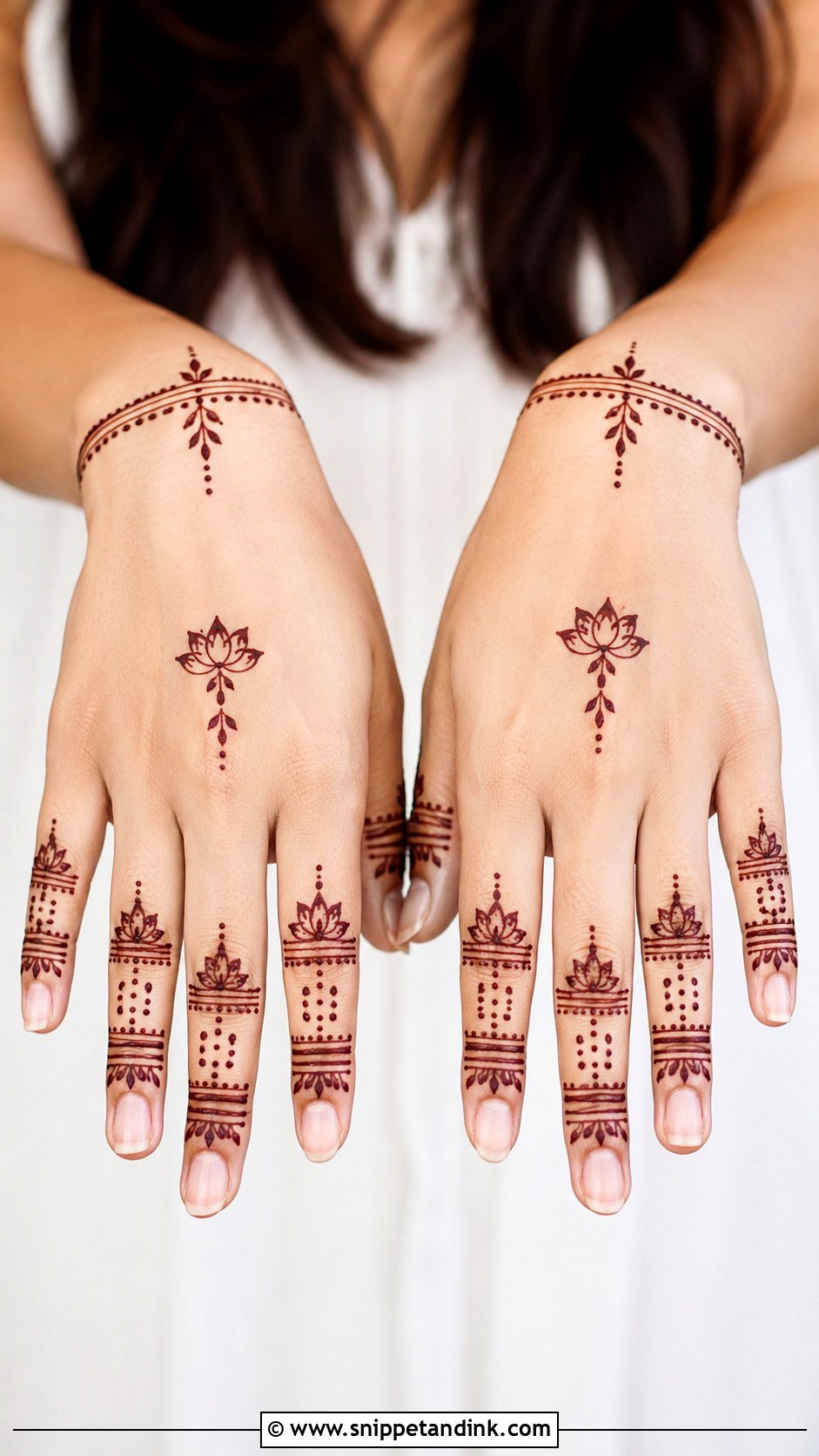
A small lotus on the back of the hand, close to the knuckles, joined to finger bands and tiny leaf trails, with the wrist bare or crossed by one slim line. Knuckles crease every time you make a fist, so I keep the petal edges just below the knuckle line rather than across it; henna on a crease cracks while it dries and stains broken. It shows nicely next to rings and festive nail colour without committing to full coverage.
18. Lotus Wrist Mehndi Design
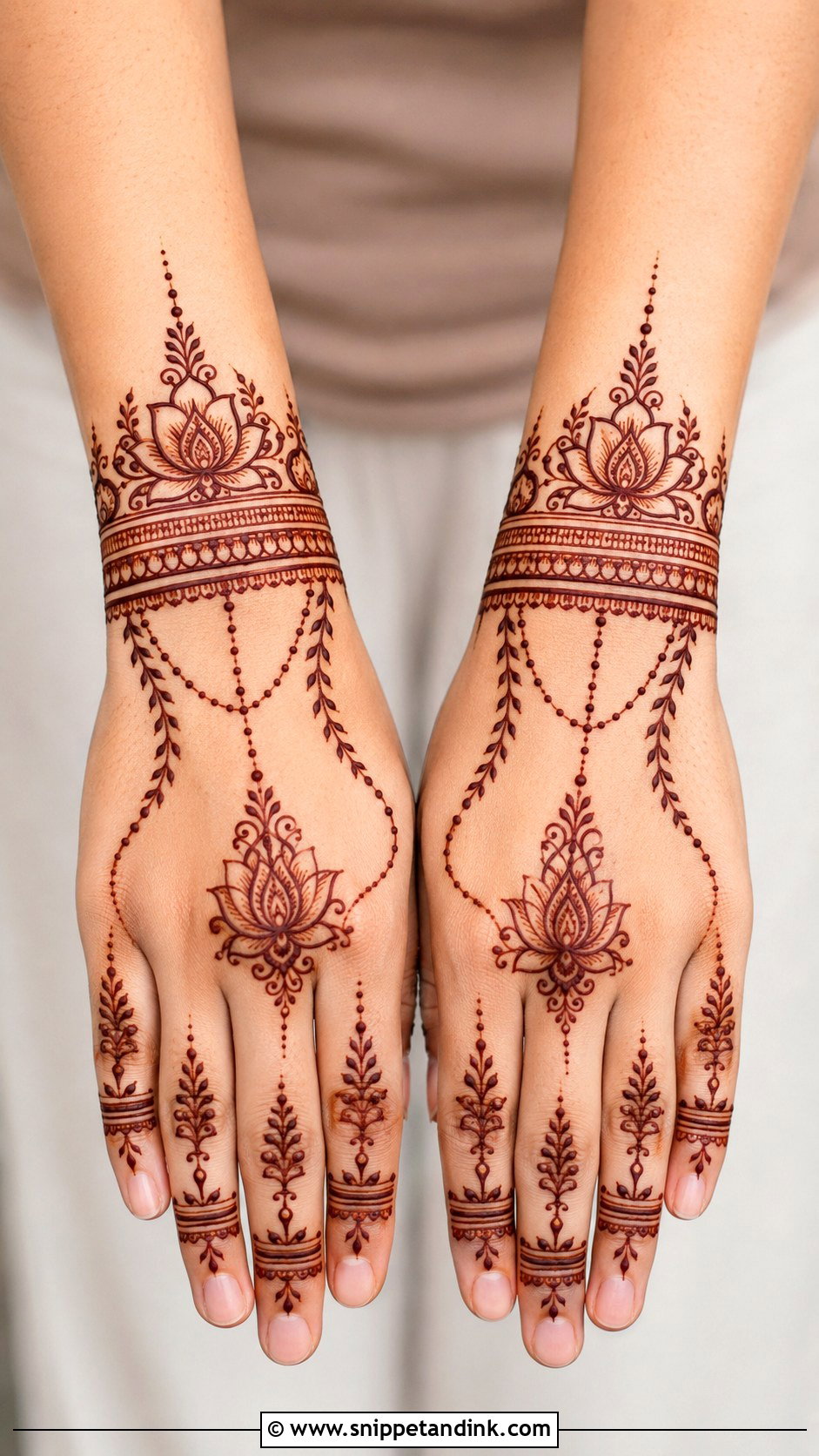
One or more lotuses around the wrist, joined by bands, dots, leaves and borders into a floral cuff. The hand can stay bare or carry a short vine. It’s comfortable, sits well with bangles and gives bridesmaids a coordinated but light look. The wrist isn’t a cylinder, it’s flatter on top, so I draw the band following the wrist bone rather than a straight line across. Otherwise it looks crooked as soon as you turn your hand.
19. Lotus Forearm Mehndi Design
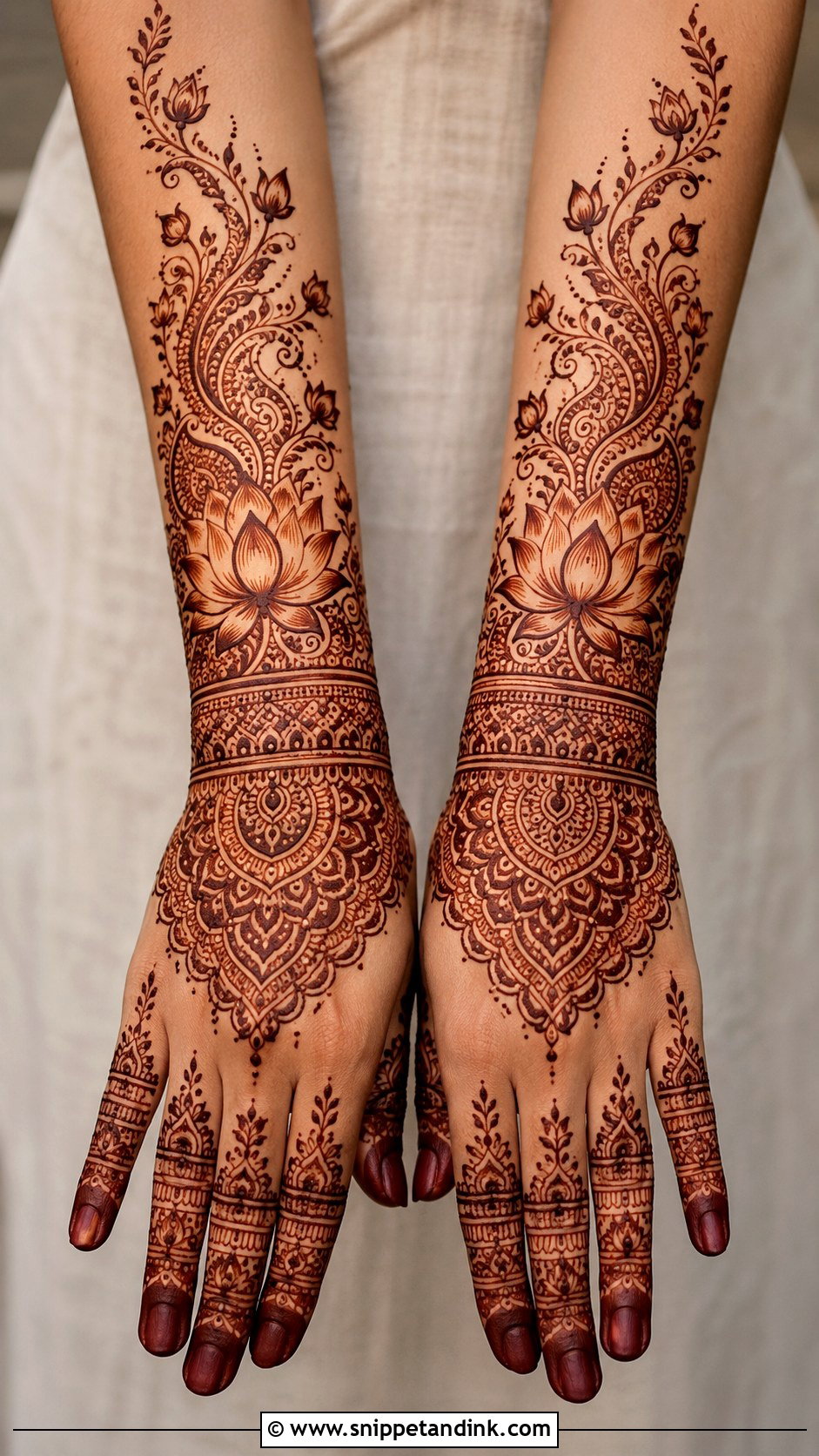
Starting with a lotus at the wrist and climbing upward with vines, paisleys, mandalas or ornamental bands, the forearm turns a hand design into a statement. It shows best with sleeveless, short or three-quarter sleeves. Brides can fold it into a full-hand design; guests can keep the palm simple and let the arm carry it. I scale the flowers down as they climb, a large lotus at the wrist and buds near the elbow, which looks more natural. Forearm skin is thinner and stains lighter than the hand, so expect a softer colour up there.
20. Lotus Feet Mehndi Design
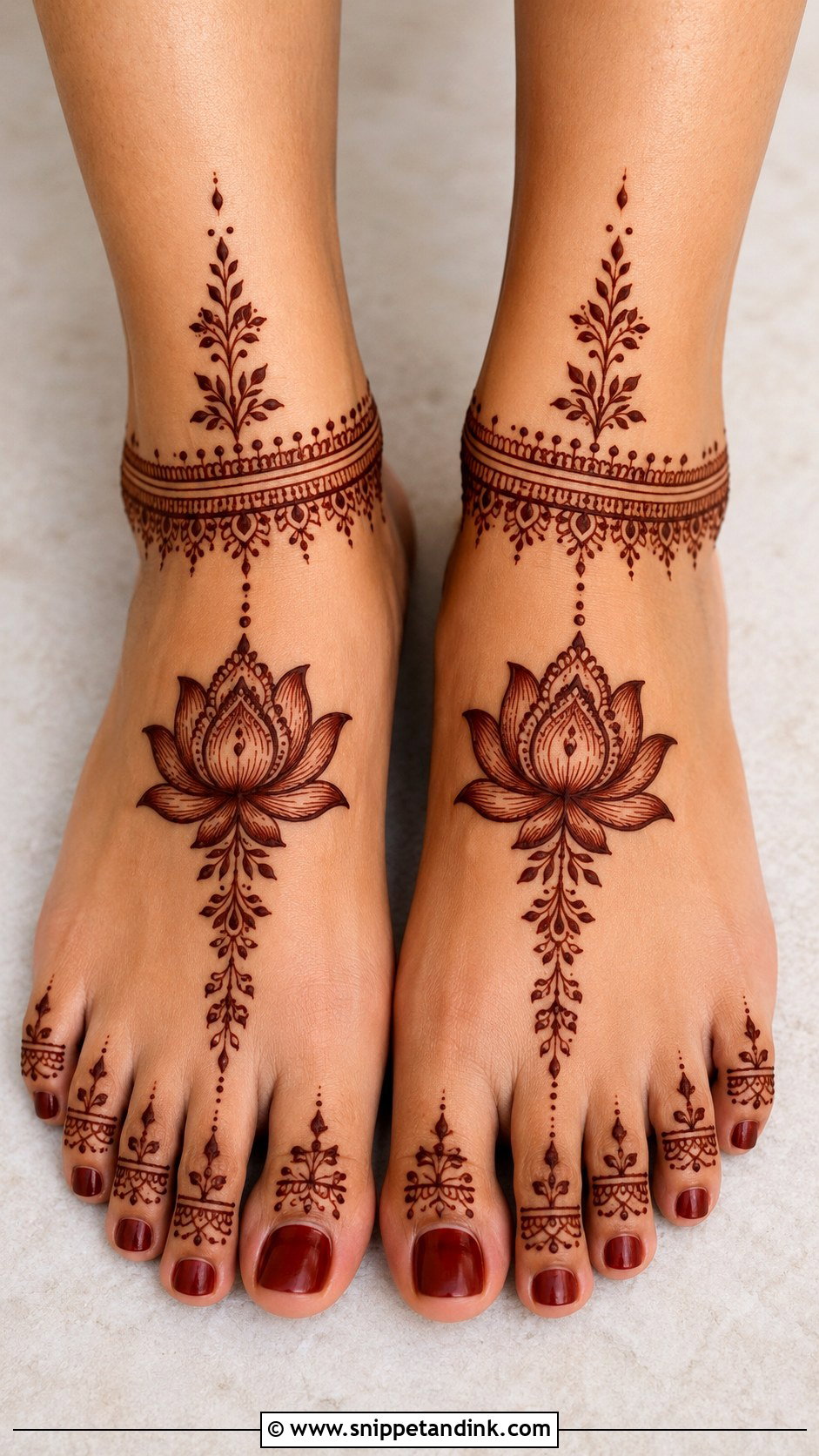
A lotus on top of each foot or near the ankle, with vines toward the toes and anklet-style bands, dots and leafy curves. For a bride, I add jaali, paisleys and shaded petals; for a simpler look, one lotus per foot and neat toes. The top of the foot is broad, so a tiny flower looks lost there. I go a size larger than I would on the back of the hand. It sits well with sandals, anklets and traditional outfits.
21. Lotus Ankle Mehndi Design
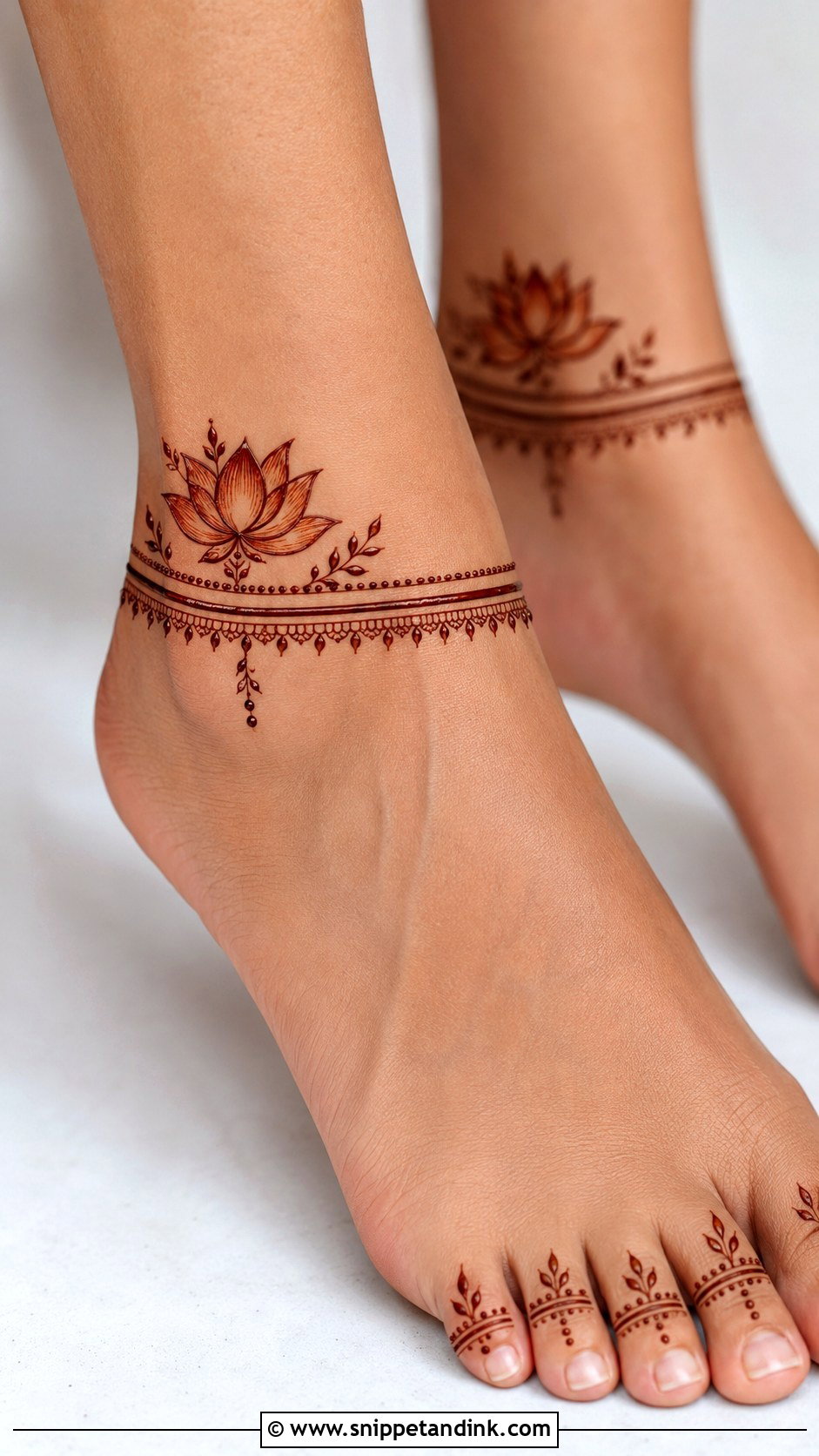
A lotus on the outer ankle with a band of dots, leaves and curves wrapped around it, the foot mostly bare or with small toe details. Destination weddings suit it, as does any bride wanting foot henna without full coverage. I place the flower just above the ankle bone rather than on it, where it stays visible and doesn’t crease every time you flex your foot. If you’ll wear real anklets, keep the henna band light so the two don’t fight.
22. Lotus Bridal Feet Mehndi Design
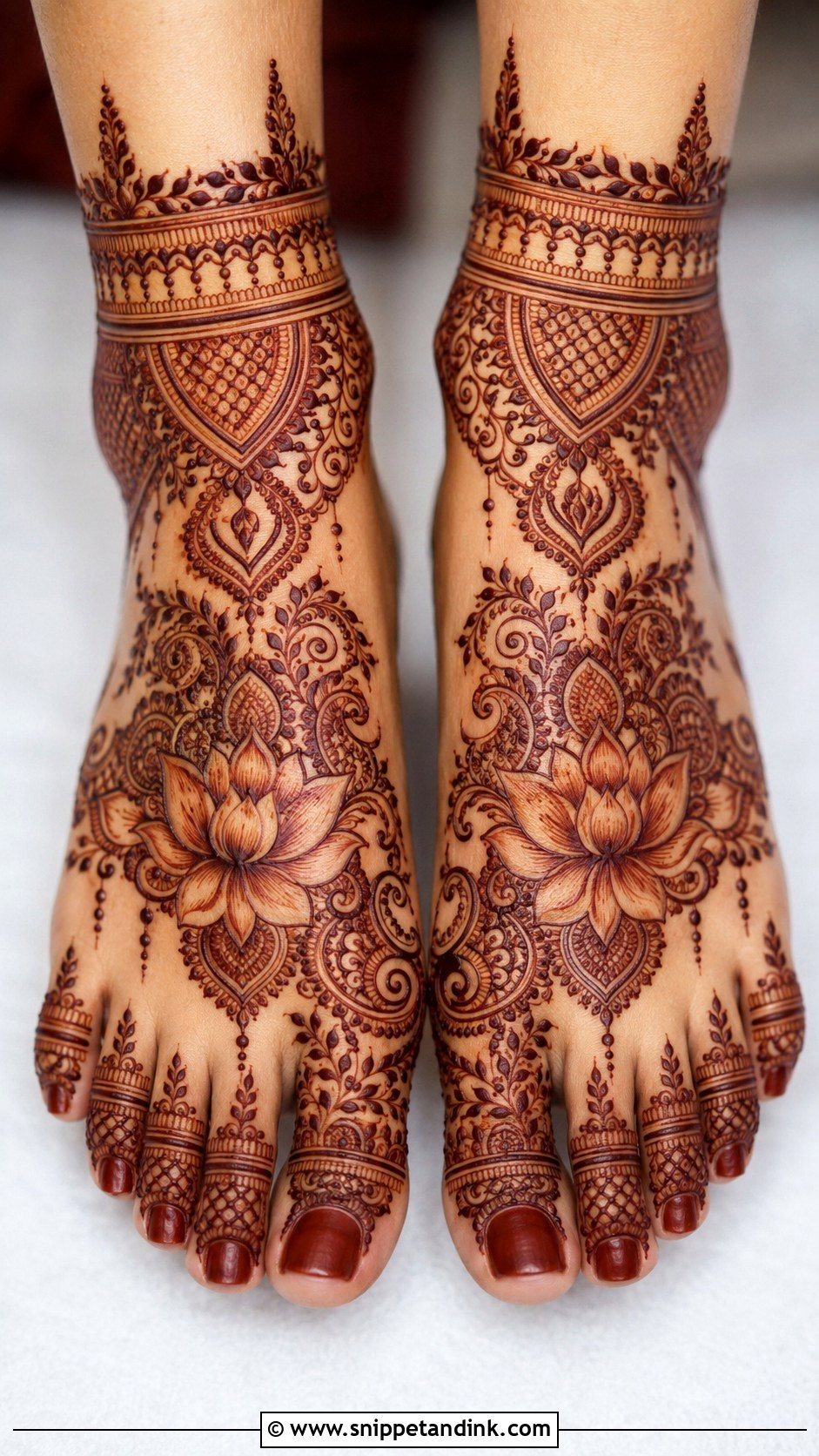
Large lotus flowers on both feet, with paisleys, jaali, vines and toe patterns around them and anklet bands linking to the ankle. The flowers can be placed symmetrically or mirrored. Toe details fade fastest, because toes rub inside shoes, so I keep them fine but slightly bolder than I’d draw on fingers. It suits brides who want traditional detail on the feet with a softer floral centre.
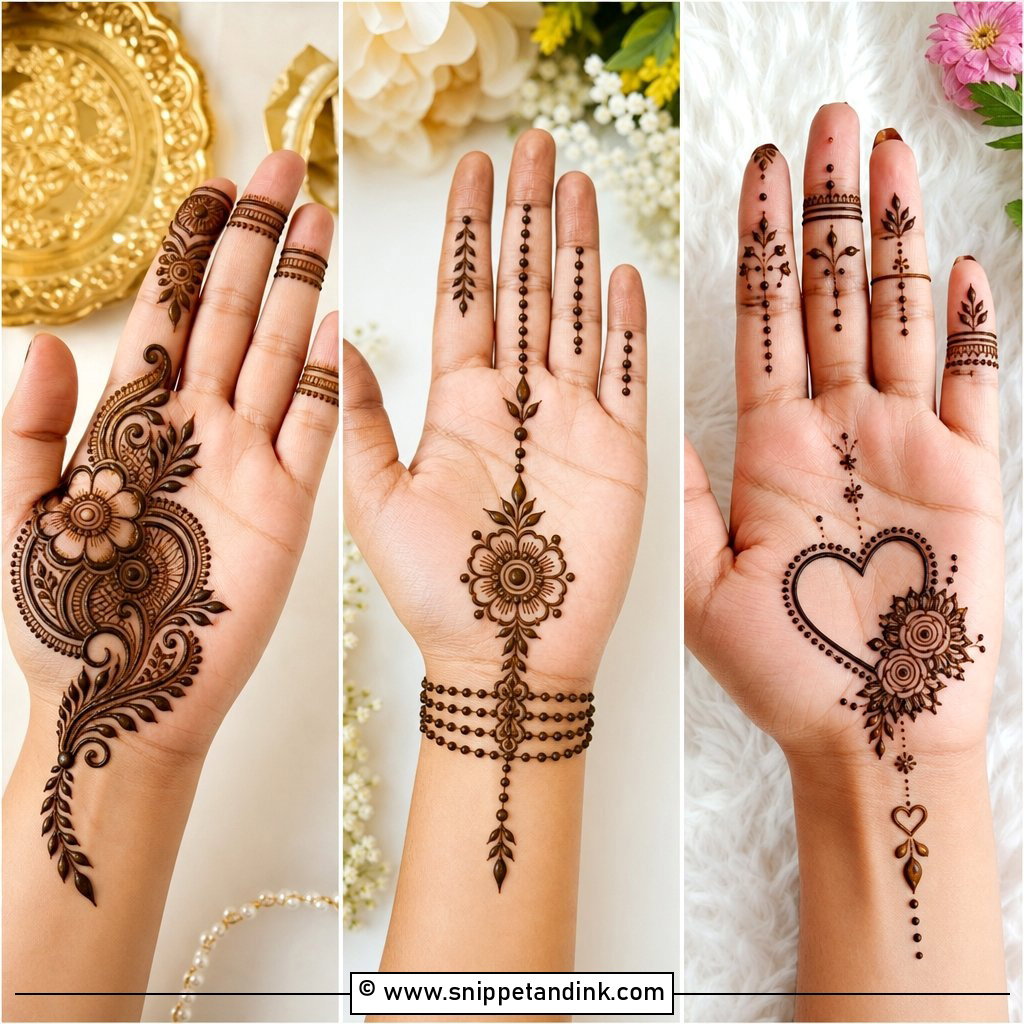
23. Minimal Lotus Mehndi Design
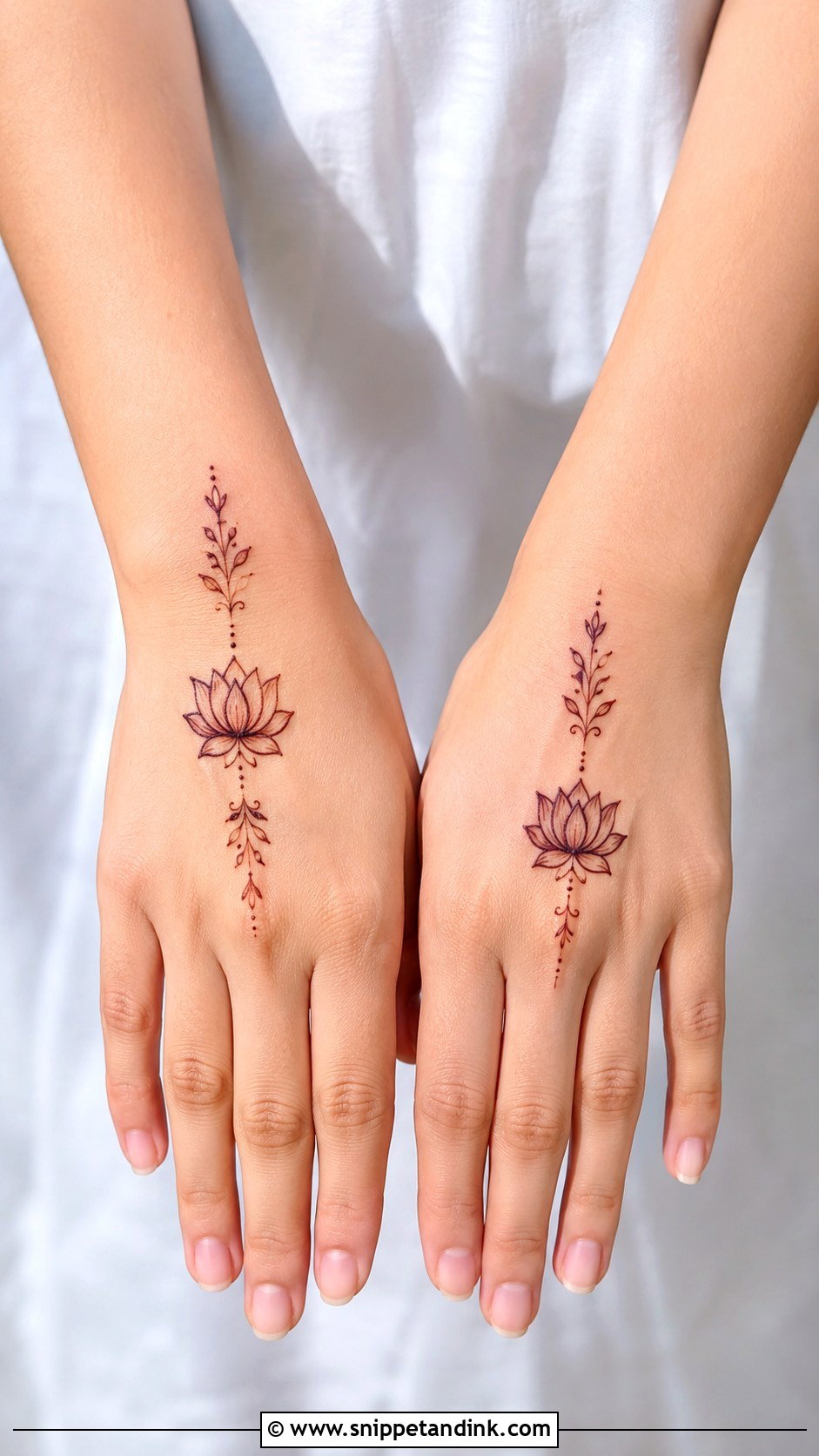
One small lotus on the back of the hand, palm, wrist or a finger, and only a few dots or leaves beside it. It’s appropriate for work, school and casual gatherings. Precision is the whole job: with no filler, every wobble shows. I choose a slim lotus with an odd number of petals, five or seven, because an odd count gives a natural centre petal and looks balanced even at small sizes. A tiny dotted frame finishes it.
24. Modern Lotus Mehndi Design
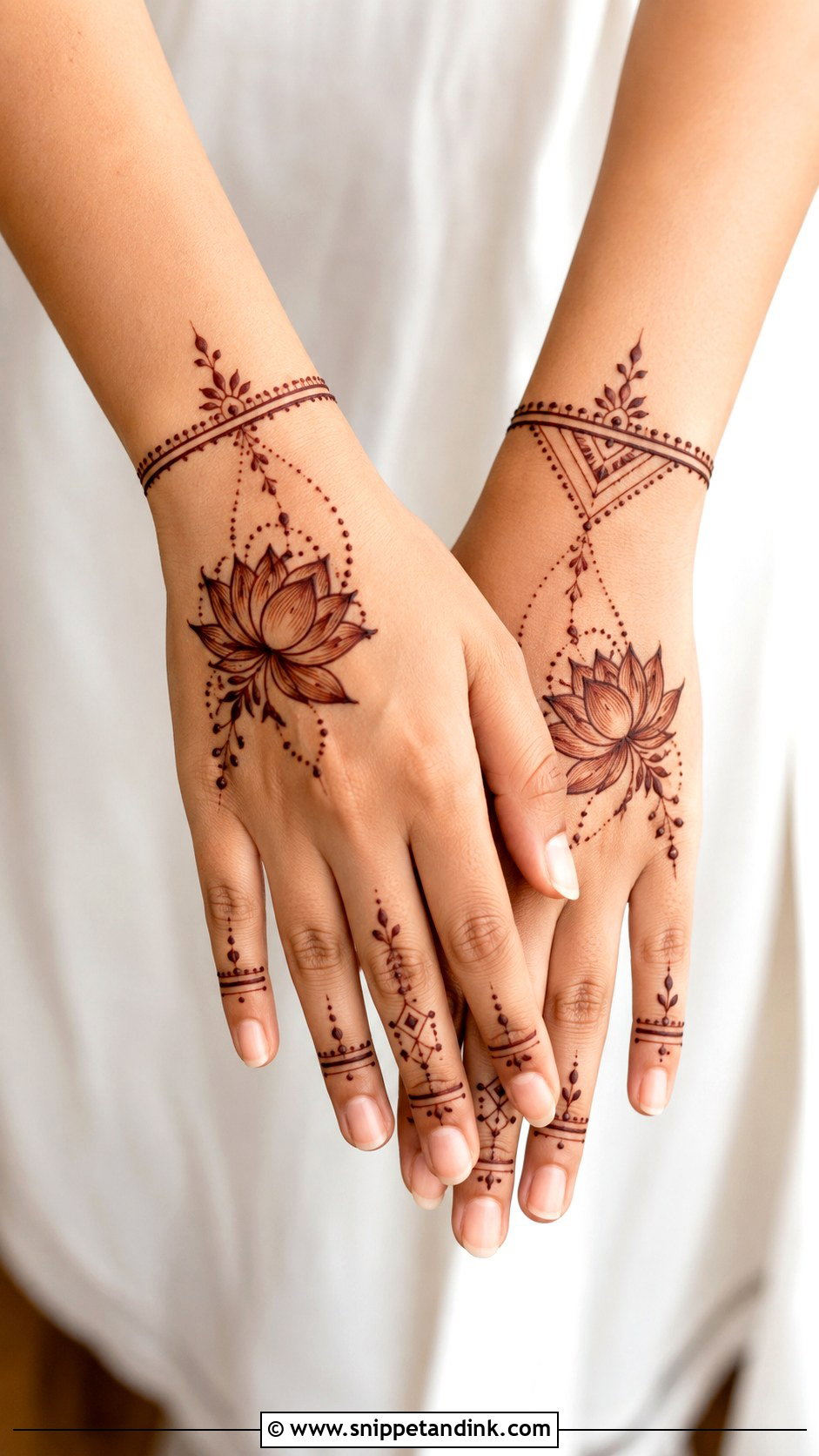
Modern lotus work is about space: a large open flower on the back of the hand with bare skin around it, then thin finger lines, small geometric borders or one wrist band. An off-centre lotus feels fresher still. It pairs with fusion wear and simple festive clothes. The hardest part is stopping. I’d rather leave a modern design one element short than add a filler that turns it traditional again.



25. Shaded Lotus Mehndi Design
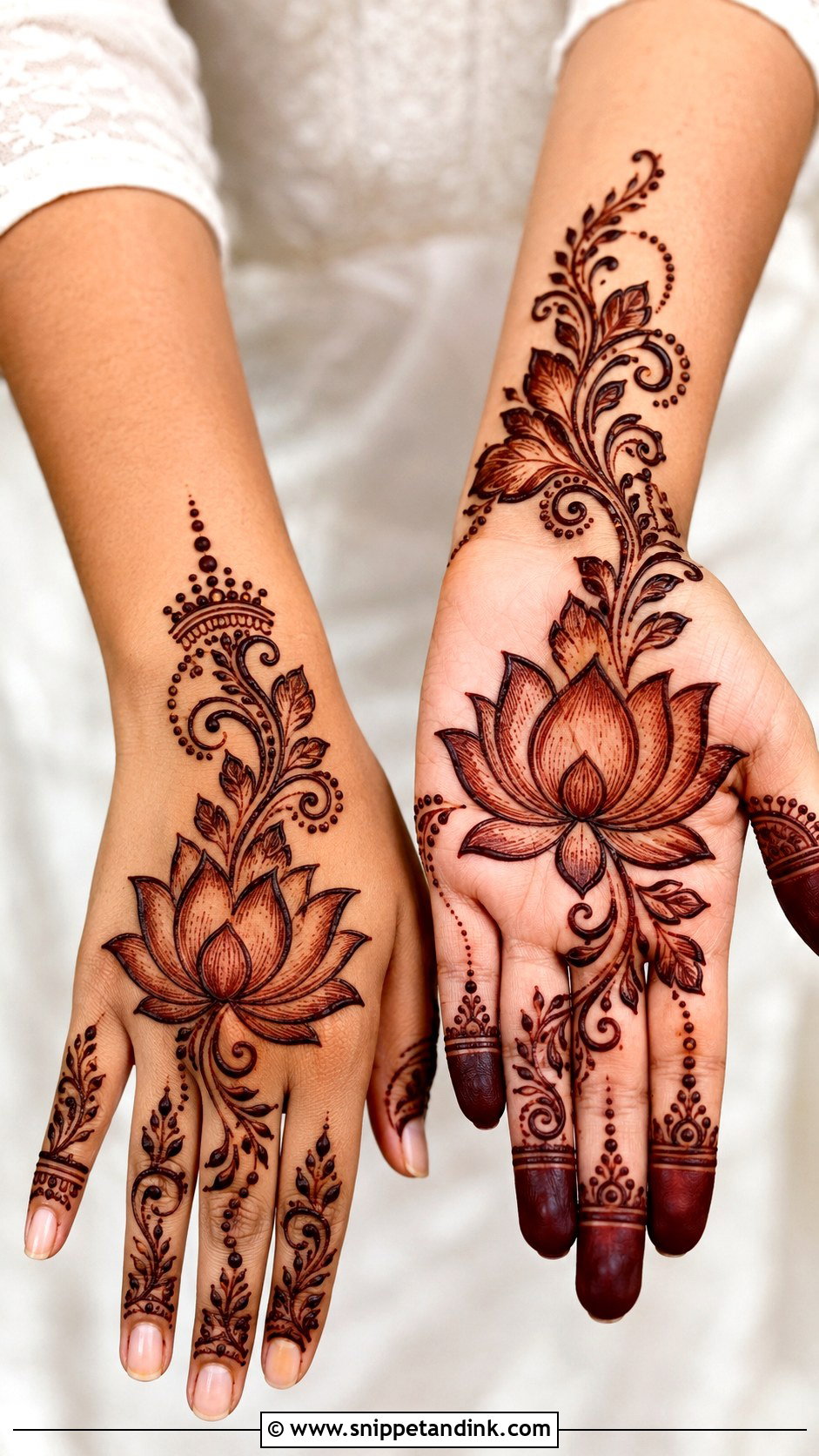
Shading gives a lotus depth: darker at the base of each petal, lighter toward the tip. In practice, I lay paste thick at the base and drag the cone tip out thin toward the edge, so the stain itself develops a gradient. It suits medium and large flowers on the palm, back of the hand or feet. Keep the leaves, dots and borders simple so the shading stays the focus, and make sure the outline is bold, since shading without a strong edge just looks smudged.
26. Bold Lotus Mehndi Design
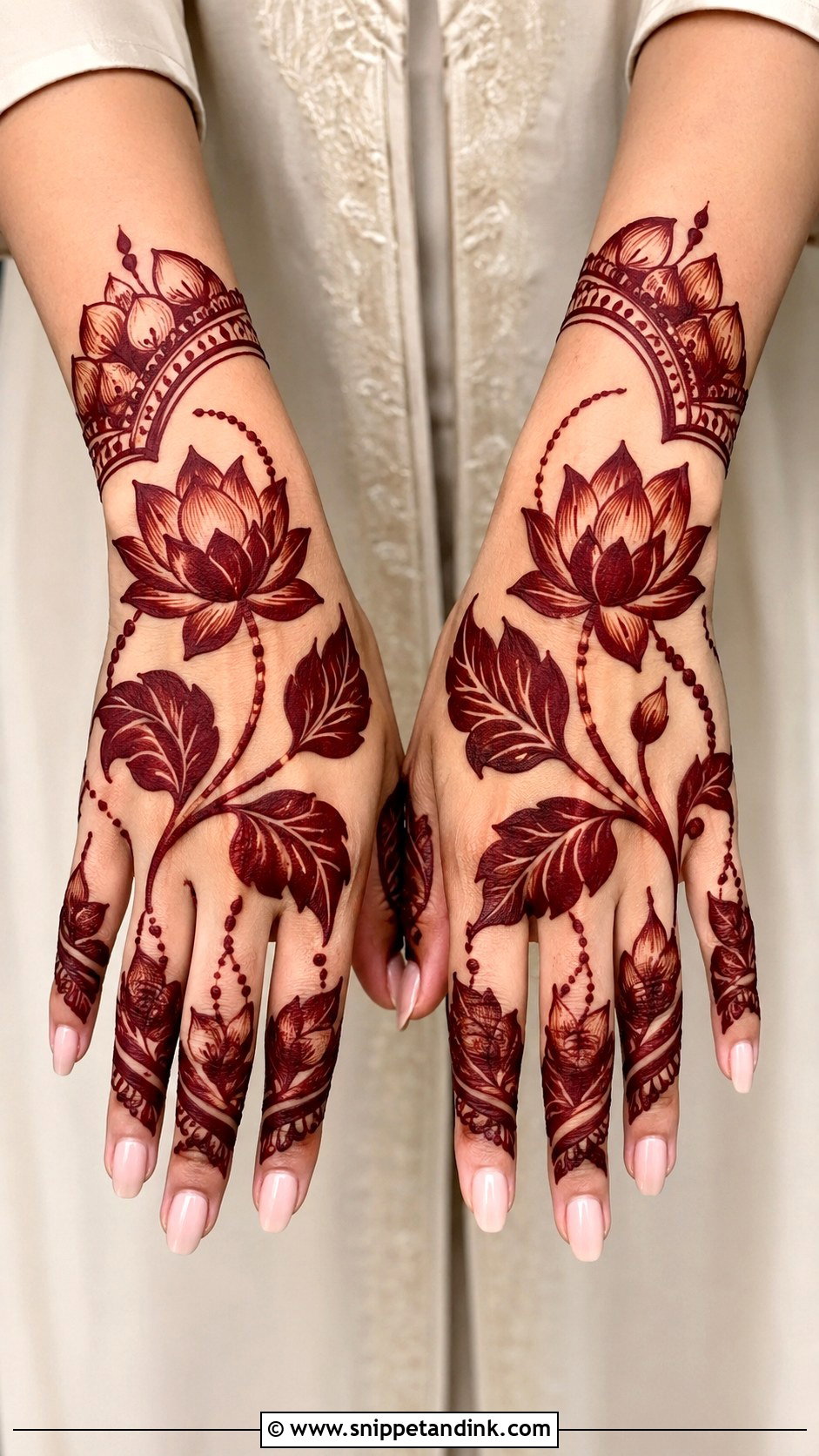
Thick outlines, large petals and strong contrast: a lotus you can read from across the room or at the back of a group photo. Chunky leaves, curved bands and simple dots are all it needs, and tiny fillers just take attention from the flower. Arabic and Gulf layouts suit it best. Thick lines hold more paste, which usually means a deeper stain, so this is a good choice if your skin tends to stain light.
27. Fine Line Lotus Mehndi Design
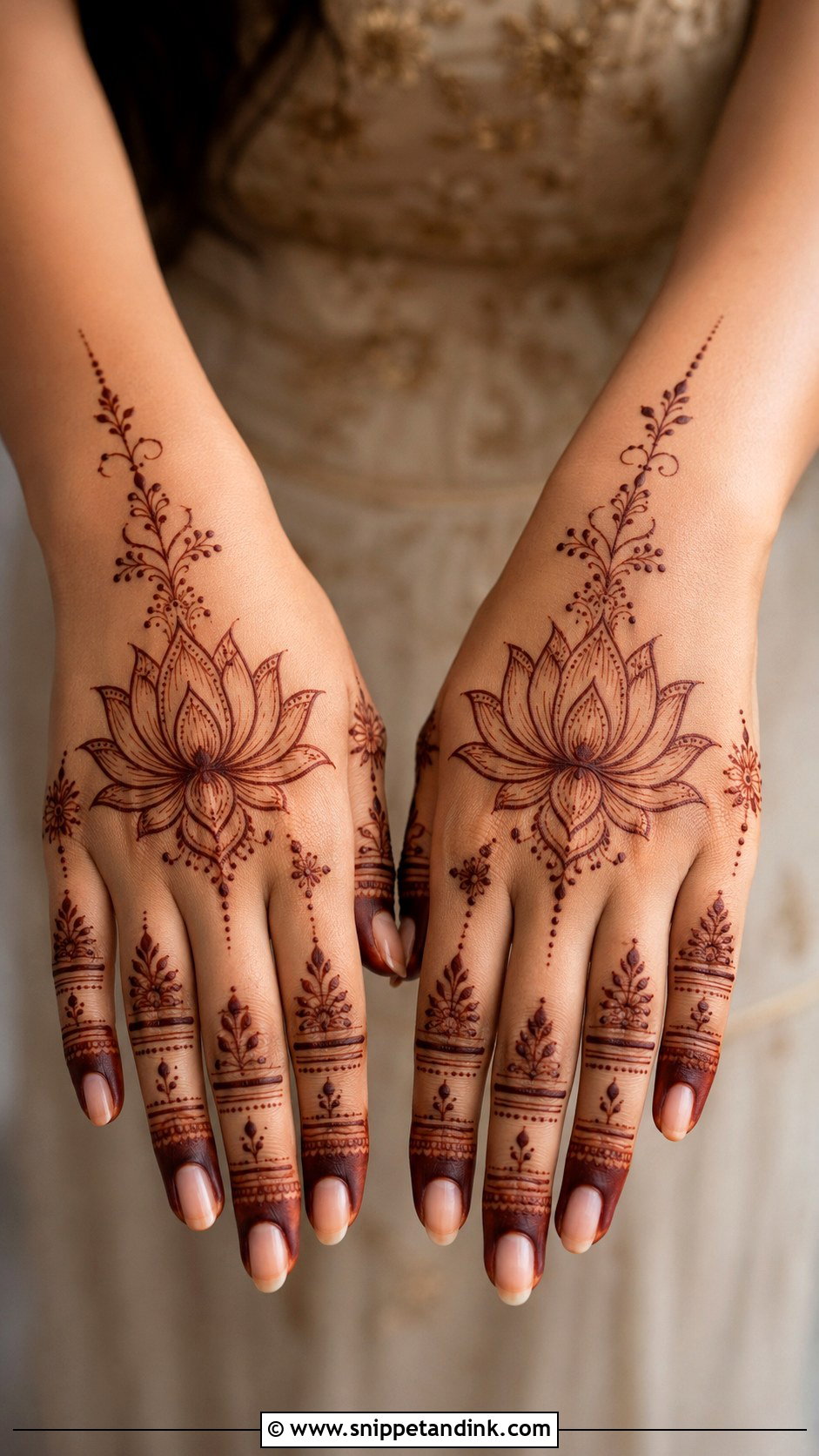
Layered petals, tiny veins, dot clusters and light borders drawn with a very fine cone. Fine line work is easiest to see on the back of the hand, the fingers and the wrist, which are flatter. It suits people who love intricate detail without coverage. The risk is that lines drawn too close blur together as the stain darkens, since henna spreads very slightly into the skin. I leave at least a line’s width of bare skin between parallel strokes.
28. Lotus Chain Mehndi Design
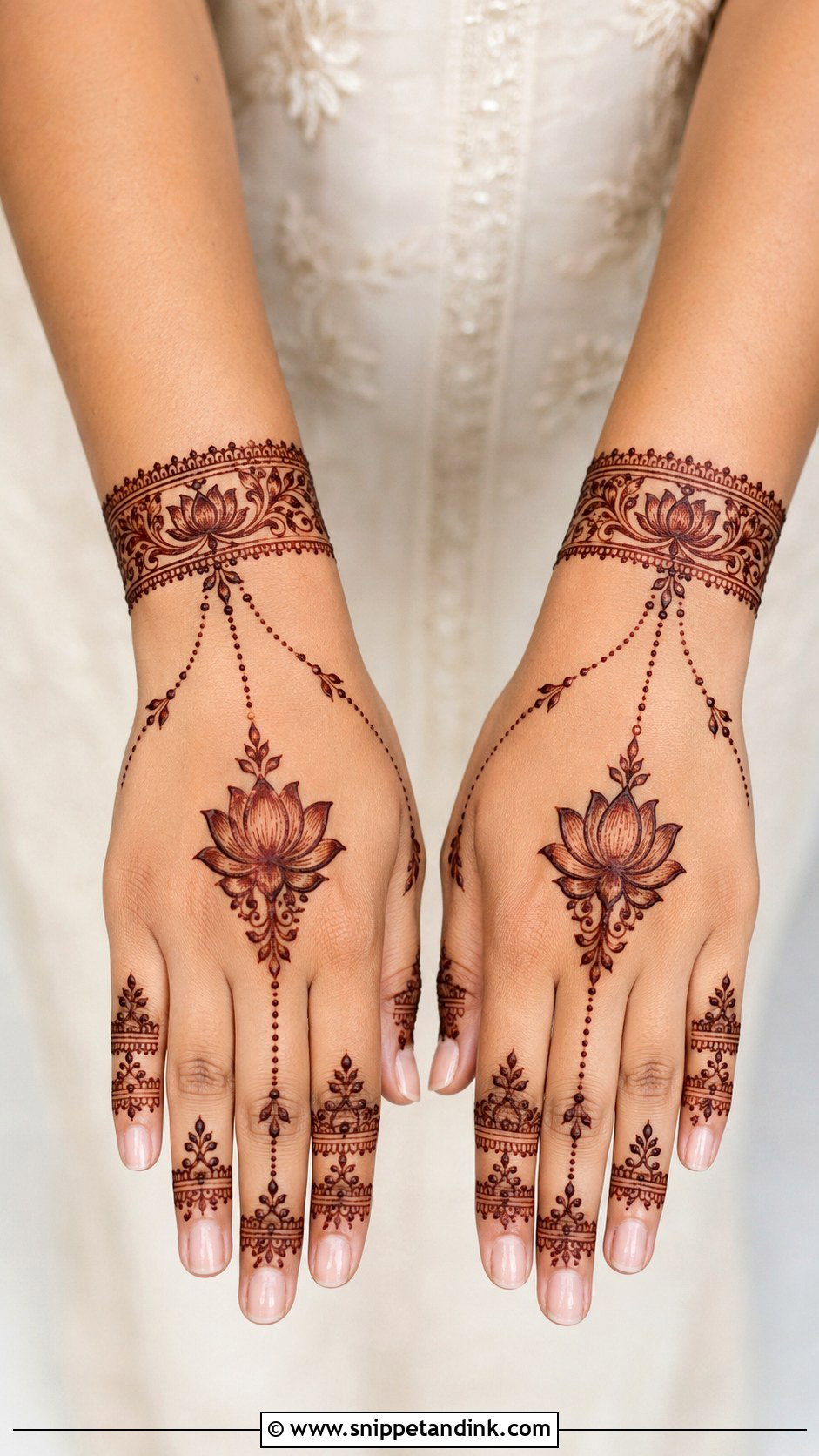
A lotus on the back of the hand with dotted chains running to a ring band and a wrist cuff gives the look of haath phool jewelry without the metal. Engagement shoots and bridesmaids are where I see it most. Keep the chains light and evenly spaced so they don’t overpower the flower, and put a tiny leaf or dot where each chain meets it. Because the chain lines are so thin, they’re the first to fade, usually within a week.
29. Lotus Bangle Mehndi Design
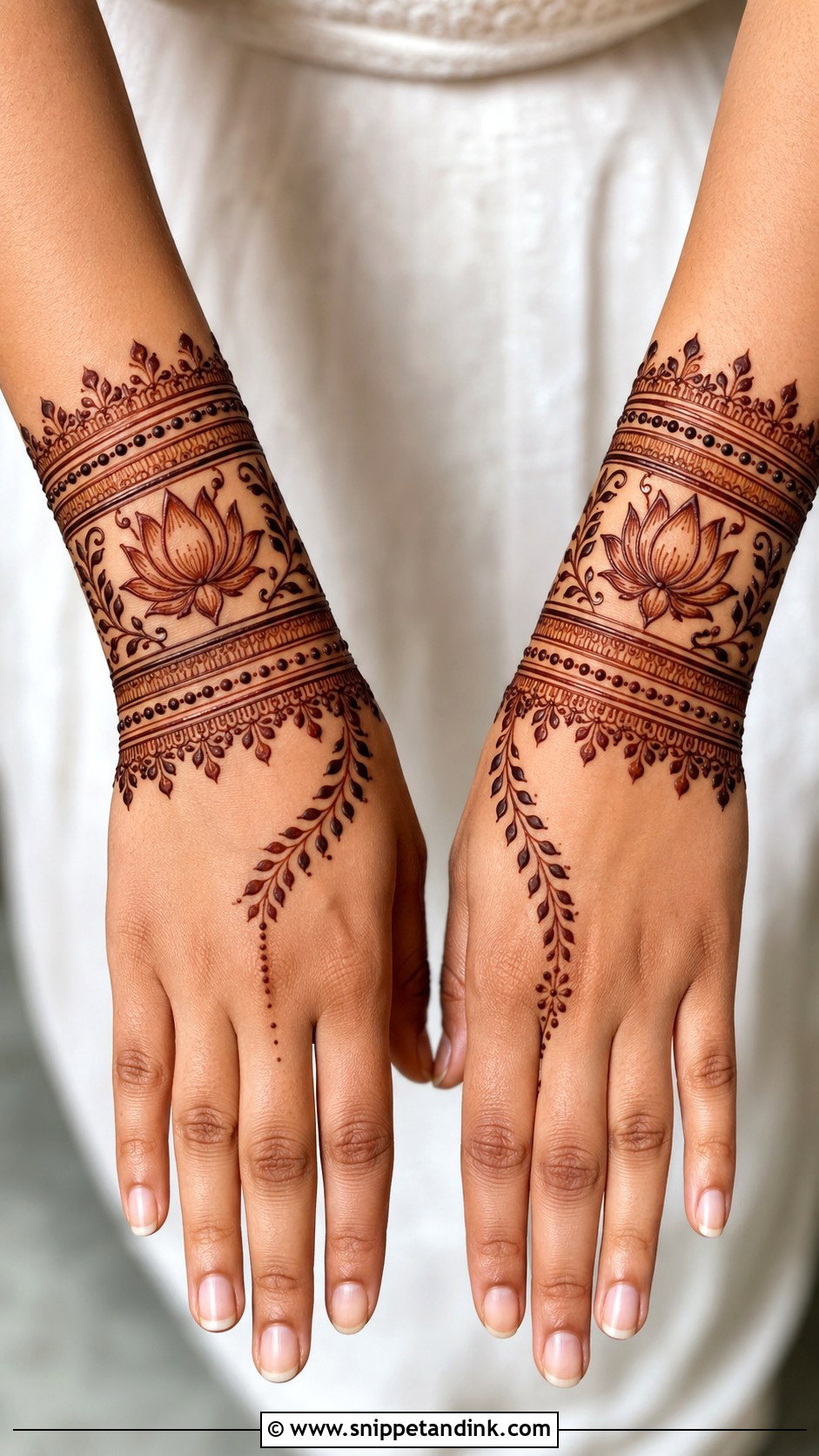
A lotus at the centre of a wrist band, with two or three bangle lines around it and dots, scallops and leafy edges. The hand can stay bare or carry a small matching lotus near the thumb. If you’ll wear real bangles, the henna band needs to sit just above or below where they rest, or the metal will cover it and the friction will fade it. I ask you to put your bangles on before I start, which takes ten seconds and saves a lot of disappointment.
30. Lotus Eid Mehndi Design
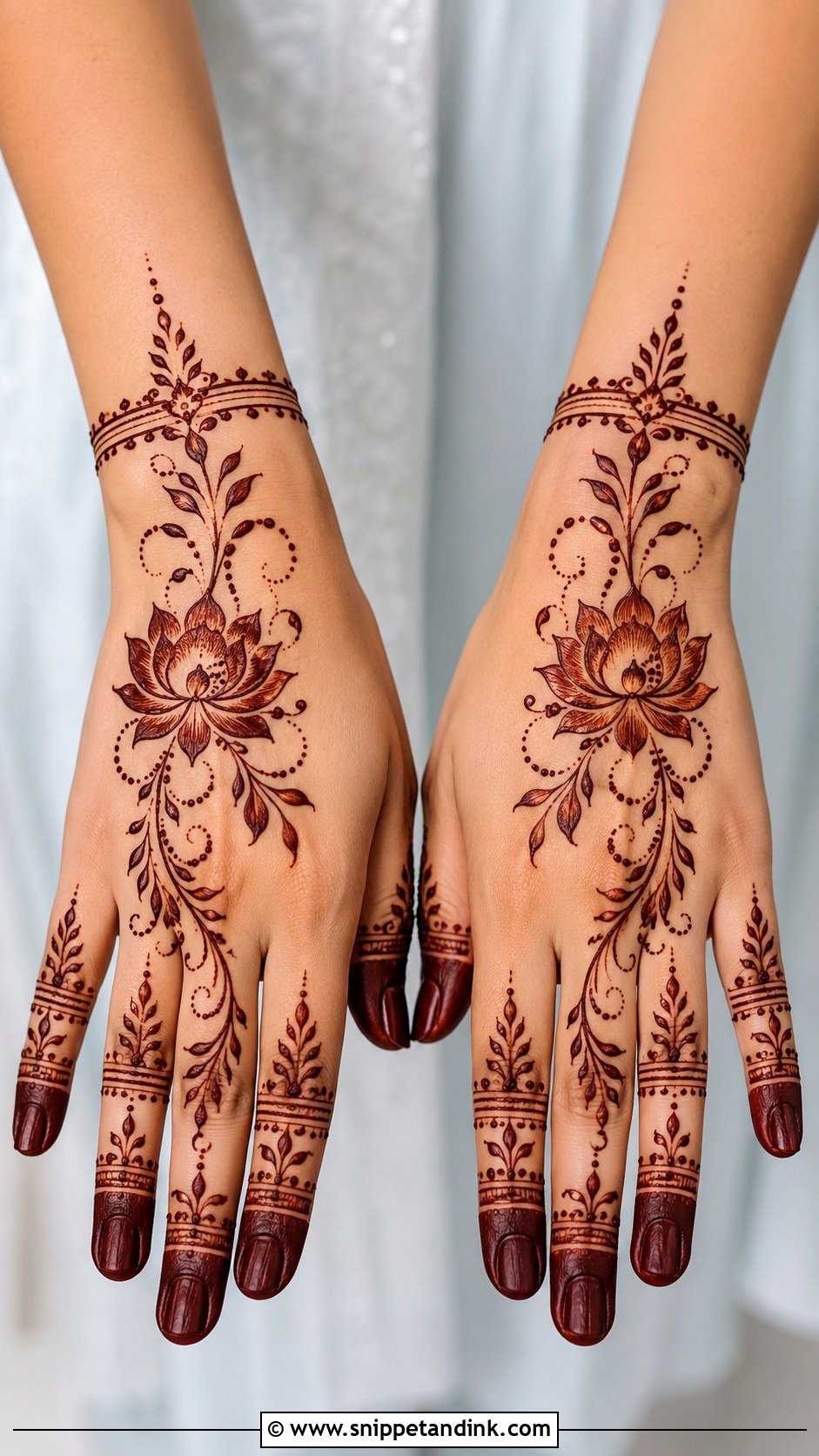
For Eid, a flowing Arabic or Indo-Arabic layout with lotus flowers, leafy trails and open spaces, the main flower on the back of the hand or palm and the design reaching two or three fingers. Dotted accents and soft wrist details finish it. Eid henna is usually done the night before, often for several people in a row, so quick application matters. Decorate the fingertips but don’t pack them, since you’ll be cooking, serving and hugging all day.
31. Lotus Diwali Mehndi Design
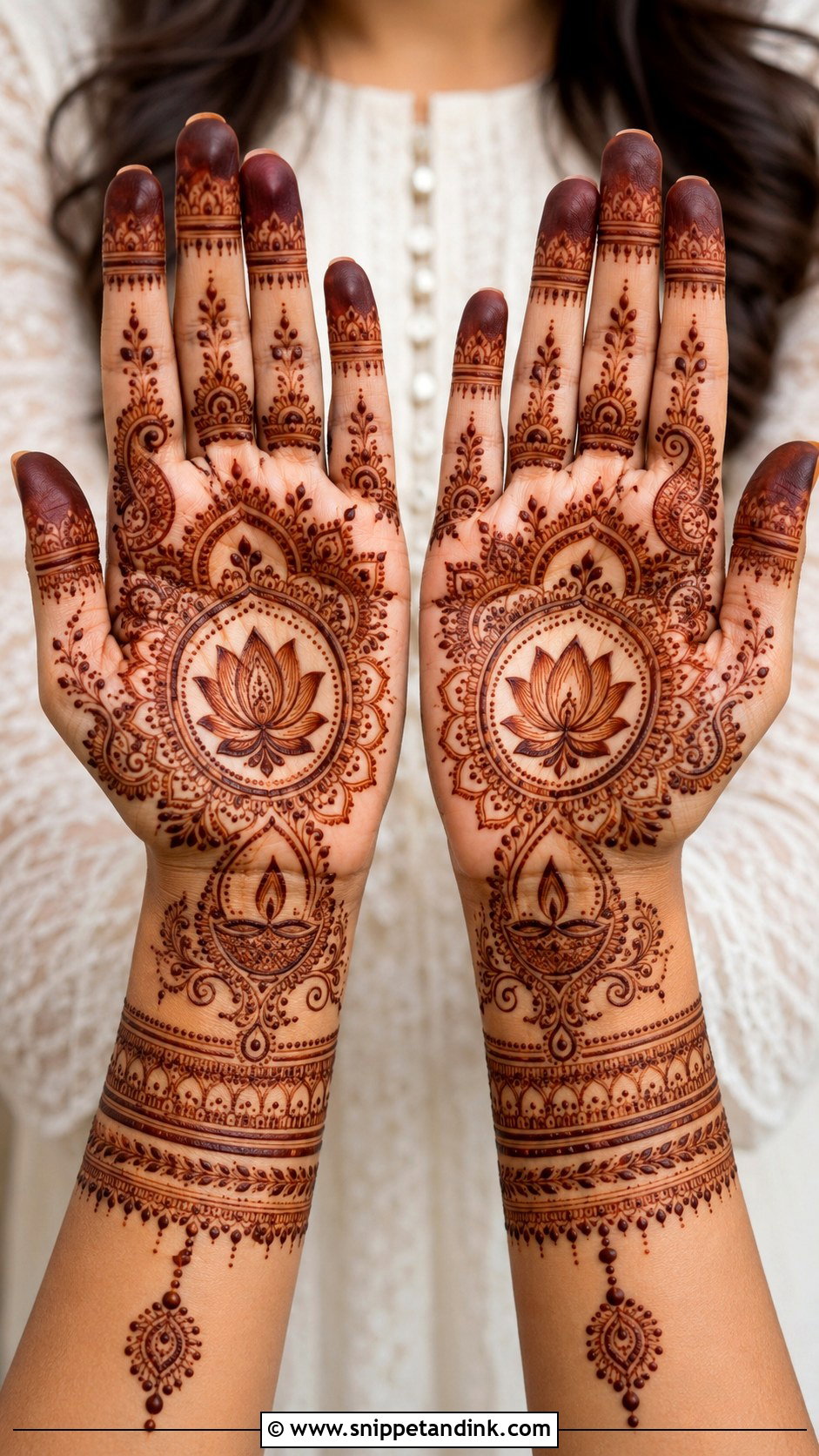
Lotus is linked to Lakshmi, which is part of why it feels so right for Diwali. A lotus mandala on the palm with paisleys, dots, diya-inspired curves and finger bands is the usual layout, or a lotus bracelet with small floral chains on the back of the hand. Keep it neat rather than crowded. Medium coverage is the practical choice, because Diwali week involves a lot of cleaning and washing up, and heavy fillers fade unevenly with all that water.
32. Lotus Engagement Mehndi Design
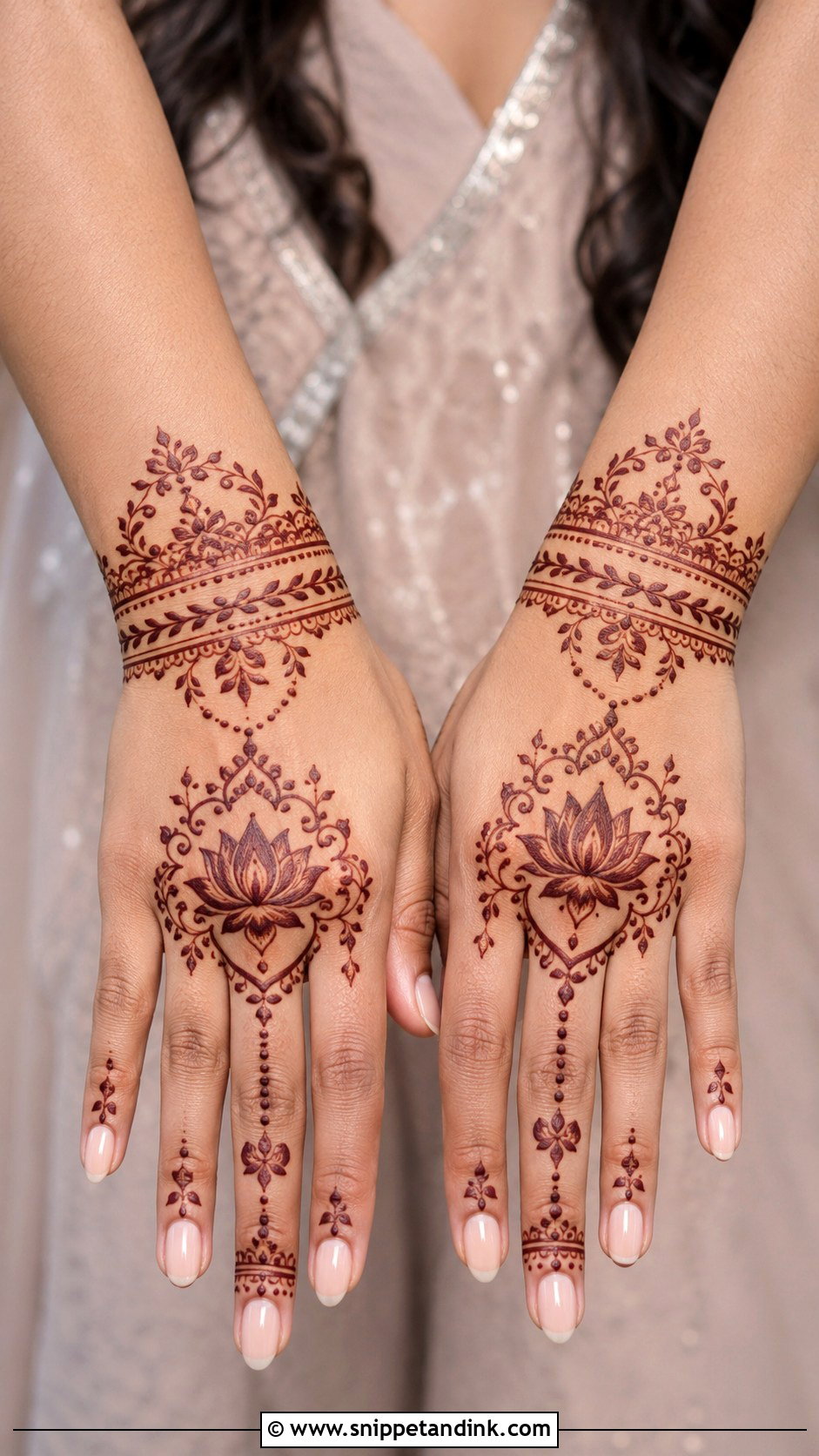
Ring photos are taken of the back of the hand, so that’s where this design lives: a lotus near the centre, linked to the ring finger by dotted chains or a delicate finger band, with a slim wrist bracelet. I keep the base of the ring finger clear, or very lightly drawn, so the ring sits on clean skin and stays the focus. Fine line work with open space is best here. It suits the bride-to-be, bridesmaids and close family.
33. Lotus Karwa Chauth Mehndi Design
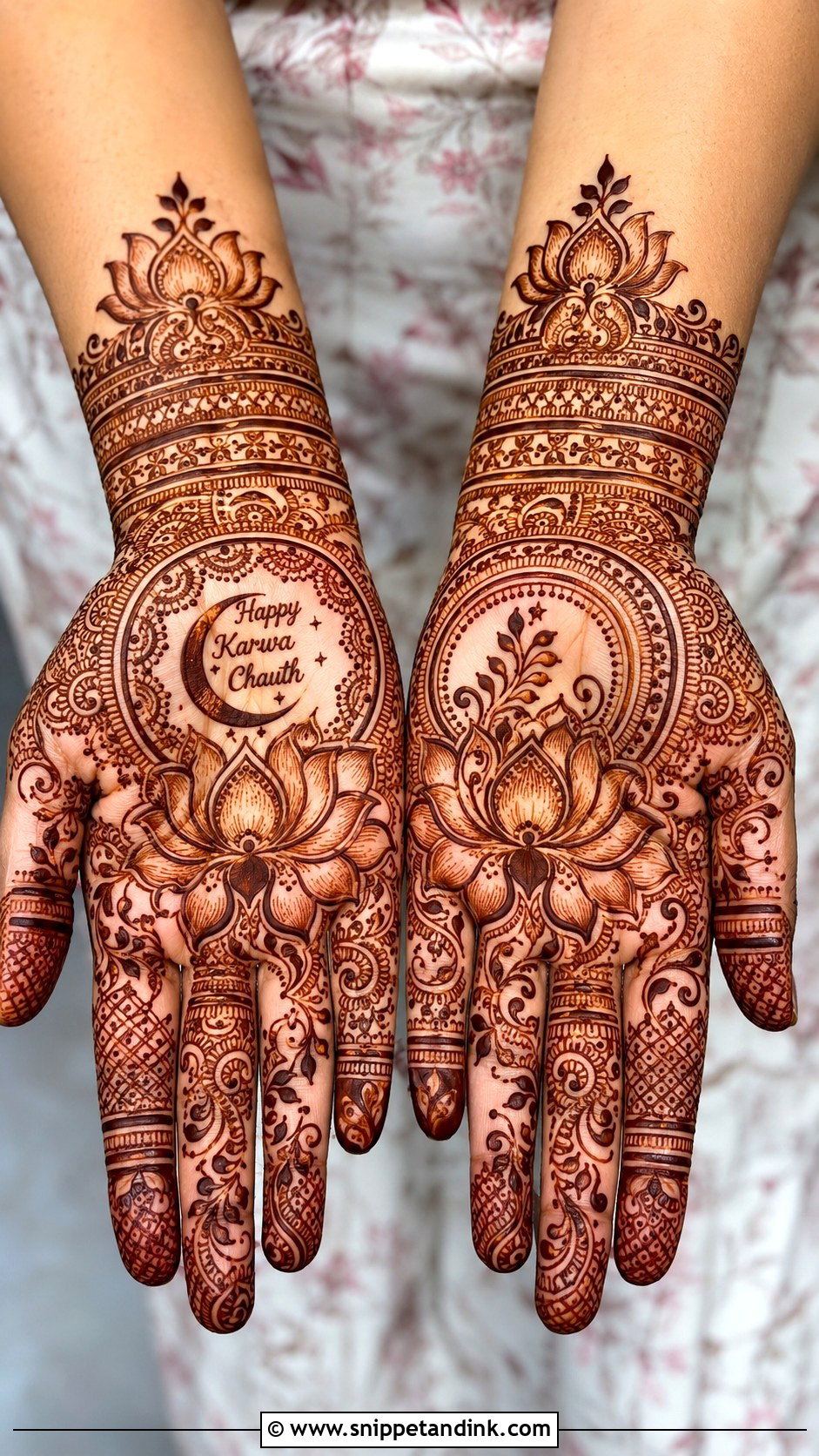
Karwa Chauth designs can be fuller: a lotus as the main motif with paisleys, mandala rings, vines and wrist bands, covering the palm and rising slightly past the wrist. Small symbolic elements can be tucked in, but I keep the lotus central. Dark shading and bold outlines suit the day. Both hands should carry similar lotus placements. Applying a day or two ahead gives the stain time to reach its darkest by the evening puja.
34. Lotus Gulf Mehndi Design
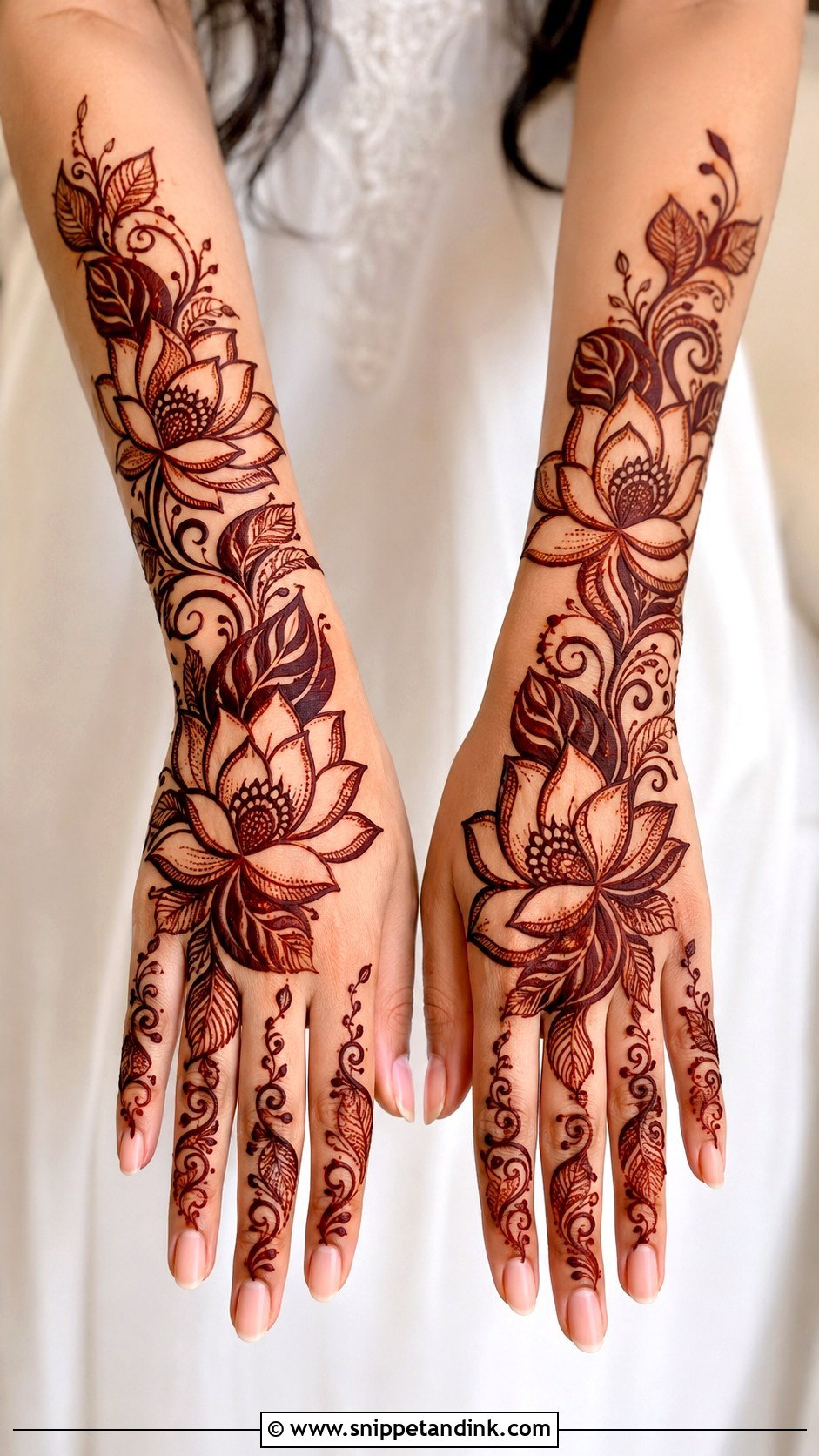
Gulf-style lotus work uses oversized flowers along one side of the hand, thick leaves, curved vines and open gaps between motifs. It looks luxurious without dense filling, and the back of the hand and forearm give the big shapes room. The paste is laid on generously for those thick outlines, so the stain tends to be deep. Keep the inner details minimal. Scale, flow and contrast carry it, not tiny patterns.
35. Moroccan Lotus Mehndi Design
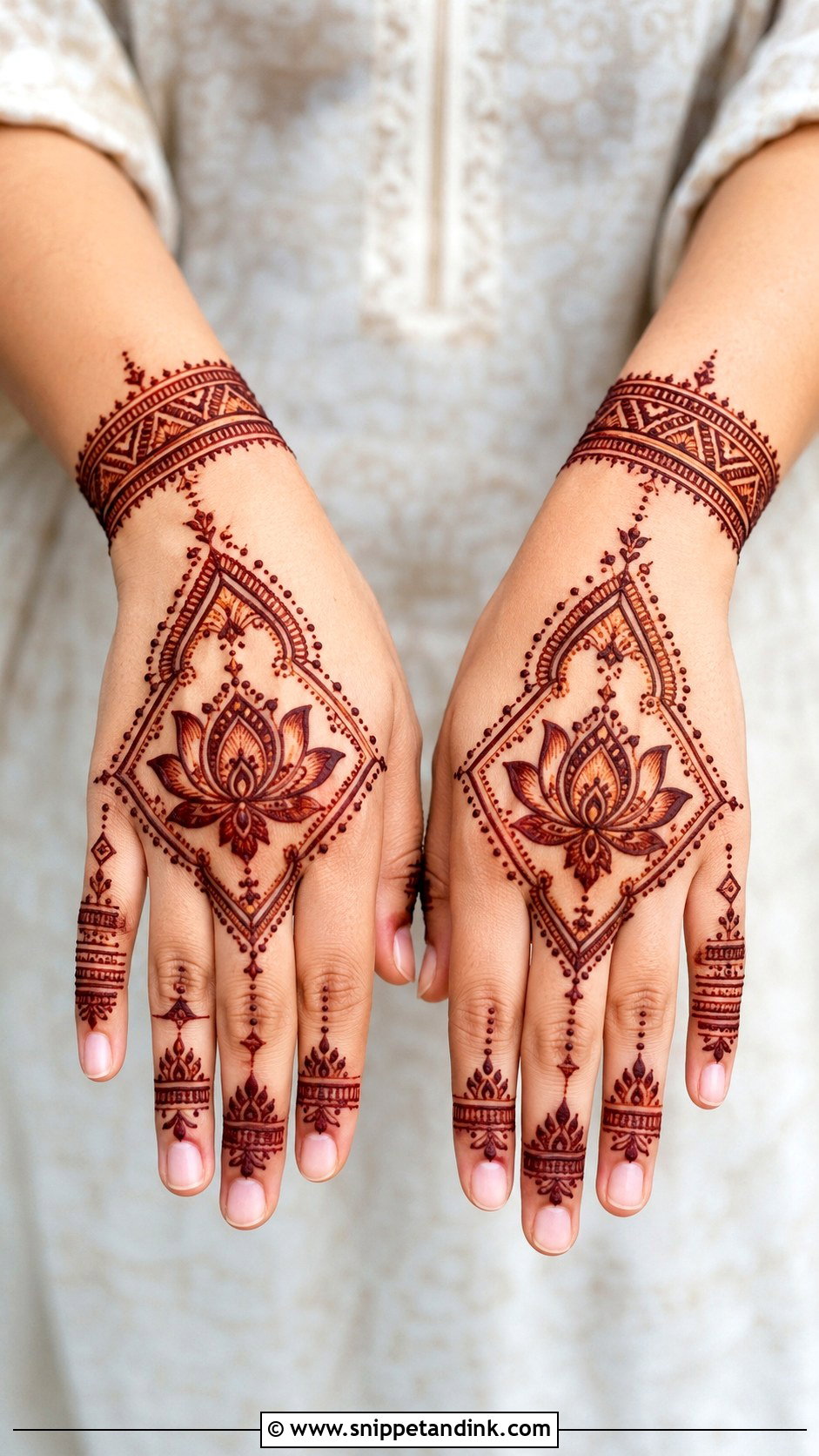
A lotus framed with diamonds, angular borders, straight lines and dot clusters: a fusion of soft and sharp. I place it on the back of the hand because geometric lines need a flat surface; on the palm, the curve distorts them. A wrist cuff of repeated triangles or squares finishes it. I keep the petals round and full so they contrast with the angles around them. It’s a good choice for someone who wants the lotus without yet another floral design.
Show Your Artist the Petals, Then Settle the Dates
Pictures help, but only if they’re specific. Before an appointment, I’d rather you tell me which part of a picture you like (the petal shape, the spacing, the bracelet band) than show me ten photos you half like. Then a few practical points make the difference between a lotus you’re happy with and one that’s just fine.
- Tell me which is your writing hand. I usually start on it, so it has the most time to dry before you need it.
- Mention your rings and bangles, and whether there’s a ring ceremony. I’ll keep the right spaces clear.
- For a wedding, have bridal henna applied one to two days before. The stain darkens for about 48 hours, so it peaks on the day.
- Expect the palm to come up darkest and the forearm lightest. That’s skin, not a flaw in the paste.
- Ask what’s in the cone. Natural henna smells earthy and stains orange to brown; anything promising instant black colour should be avoided.
After it’s done, leave the paste on as long as you can, keep water off for the first several hours, and scrape rather than wash the dried paste away. A lotus with clean, separate petals on day two is the result of good spacing on day one and patience in between.
One Flower, Drawn a Dozen Ways
One lotus can become a palm mandala, a back-hand jewelry pattern, a wrist cuff, a foot design or a full bridal layout. Minimal and finger lotus work is the lightest option; bridal, full-hand, peacock and jaali patterns are the grandest. Between them, let your occasion, your outfit and how long you can sit decide. Take your favourites to your appointment and point to the petals you love. That tells an artist more than any description.
You'll Like These Ideas:




Leave a Reply