
The peacock is the motif I draw more than any other, and it still surprises me how far it stretches. The same bird can be a single feather on the side of a finger, a curved trail from wrist to knuckle, or two facing birds filling a bride’s palms and forearms. It sits comfortably beside mandalas, paisleys, jaali, florals and modern open spacing, and it turns up at weddings, Teej, Karwa Chauth, Eid, engagements and small celebrations at home. What makes it so useful is movement: the S of the neck and the fan of the tail lead the eye across the hand in a way a flower can’t. Below are 35 ways to wear it, from beginner outlines to full bridal work.
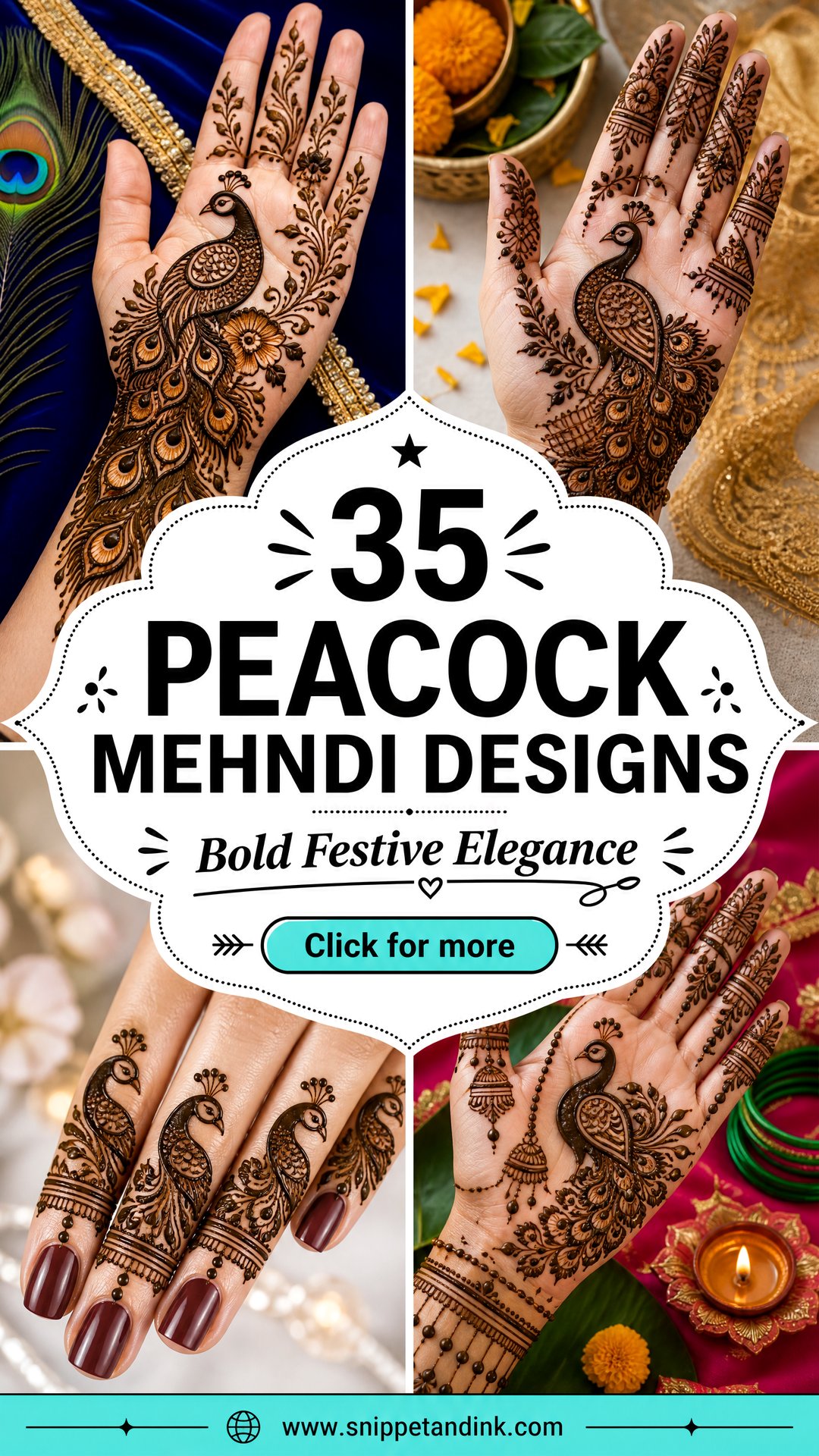
Drawing the Bird From Neck to Feather Eye
Most peacocks that look wrong in henna go wrong in the first few strokes, long before the filling. I build every one in the same order, whatever style it ends up in:
- The neck comes first, as one smooth S. A neck drawn in short pieces looks kinked, and a neck that’s too thick makes the bird look like a duck.
- Then the head, kept small, with a dot for the eye, a short beak and a three-dot crest. Oversized heads are the most common beginner mistake.
- Next the body, a rounded teardrop that tucks under the neck, often with a simple wing line.
- The tail fans out from one point behind the body. If the feathers start from different places, the fan looks broken.
- Feather eyes go in last: a teardrop inside a rounder outline with a thin gap between them. Without that gap, the eye stains as one dark spot.
Only after those shapes are on the skin do I add paisleys, flowers or jaali around them. Filling first and fitting the bird in afterwards is how peacocks end up squeezed, and once a line of paste is on, you can’t move it.
1. Bridal Peacock Mehndi Design
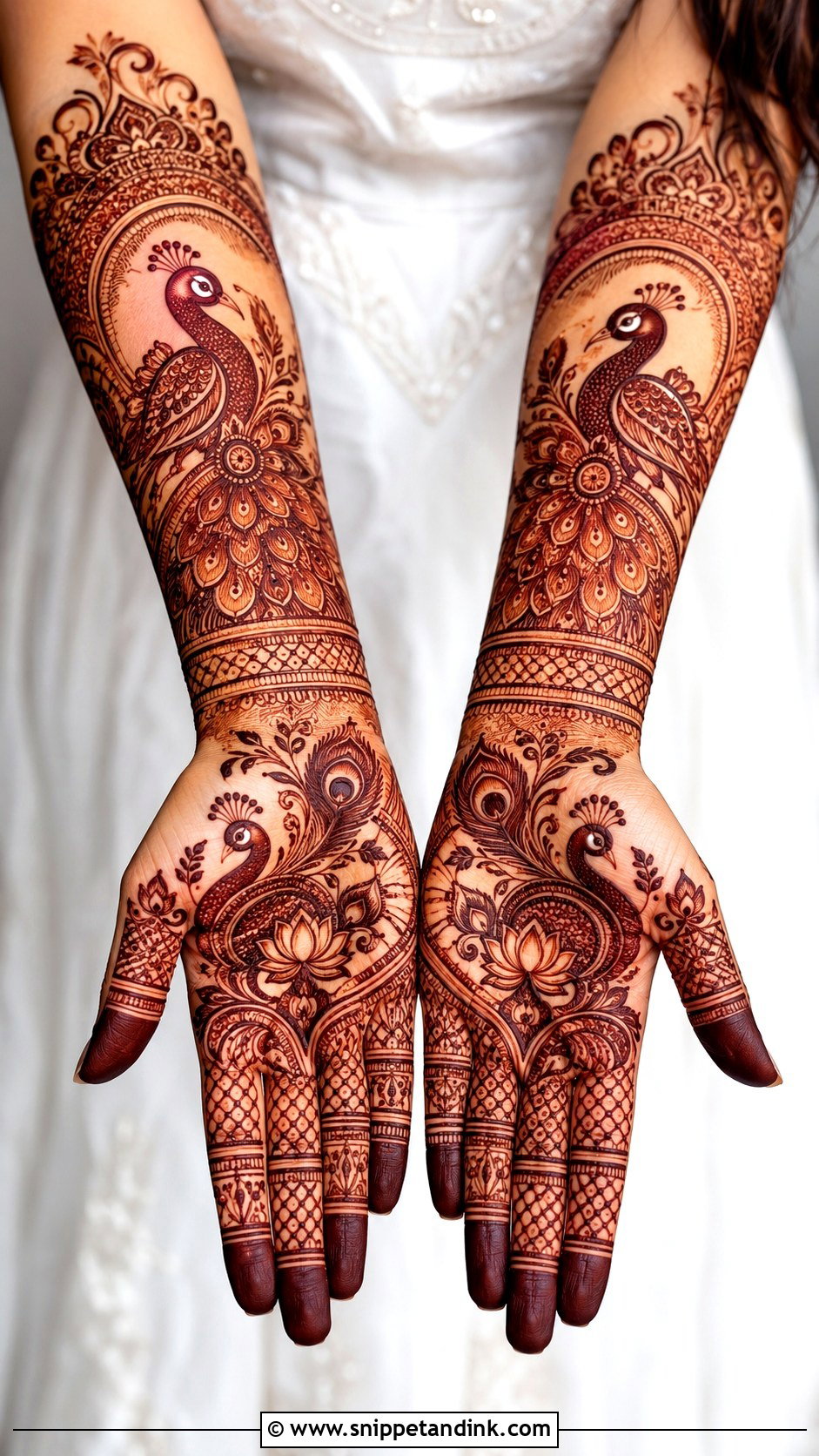
For a bride, the peacock usually becomes the anchor of the whole hand. Its body sits near the centre of the palm, its feathers open into paisleys, flowers, vines and fine filling, and the design runs on through the fingers, wrist and forearm. Initials, small mandalas or wedding symbols can sit in the gaps. I make the bird’s outline the boldest line on the hand, since fine bridal filling darkens alongside it and a thin outline gets lost. Plan both hands together, either as a matching pair of birds or one peacock answered by a floral story on the other hand.
2. Simple Peacock Mehndi Design
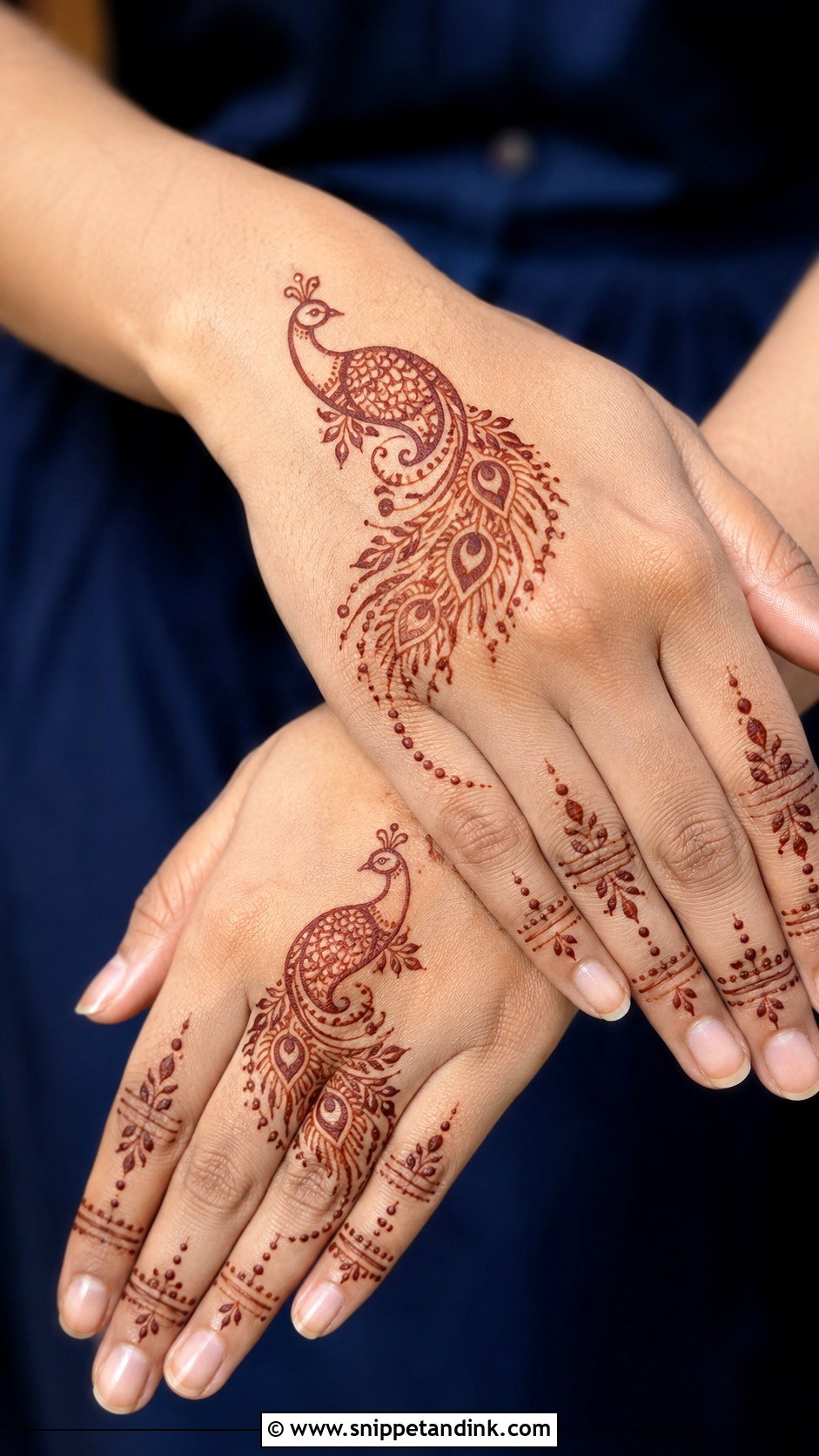
One clean outline on the back of the hand, a curved neck, a small crown and a few open feathers toward the fingers. That’s all a simple peacock needs. Dots, tiny leaves and soft curves fill in instead of dense pattern, which keeps the hand light for festivals, small ceremonies and school events. Beginners do well with it because the shape forgives a slightly uneven line. Leave some bare skin around the bird and it reads at a glance.
3. Arabic Peacock Mehndi Design
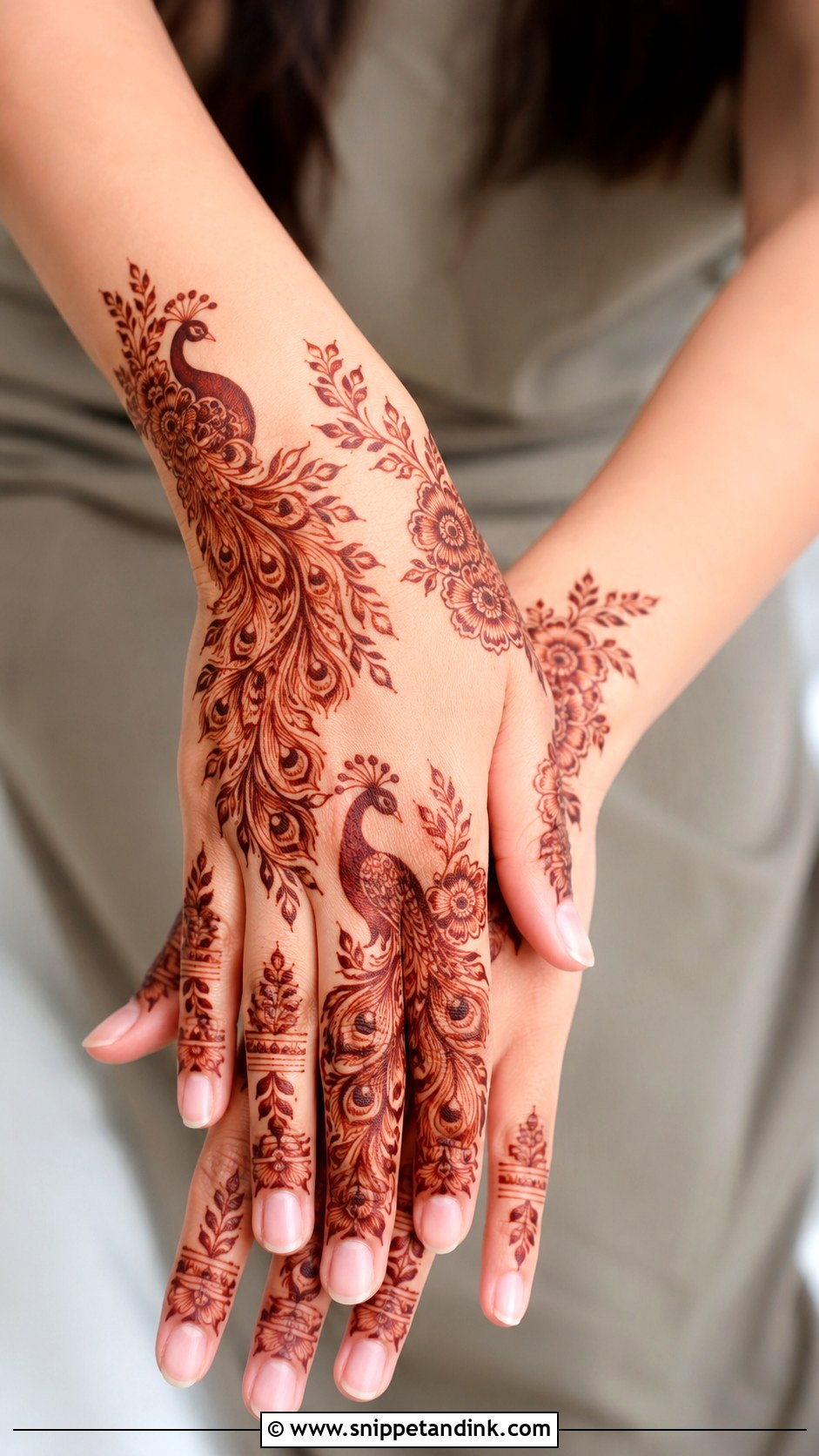
In an Arabic layout, the peacock rides the diagonal. Its body starts near the wrist, the neck turns toward the middle of the hand, and the feathers stretch upward into a leafy trail, with open skin all around. Thick outlines, shaded petals and spaced paisleys are what give it that bold look. I keep the fingers deliberately sparse here, a few dots, vines and small feather shapes, because a heavy finger section fights the diagonal. Eid and engagement parties suit it well.
4. Full Hand Peacock Mehndi Design
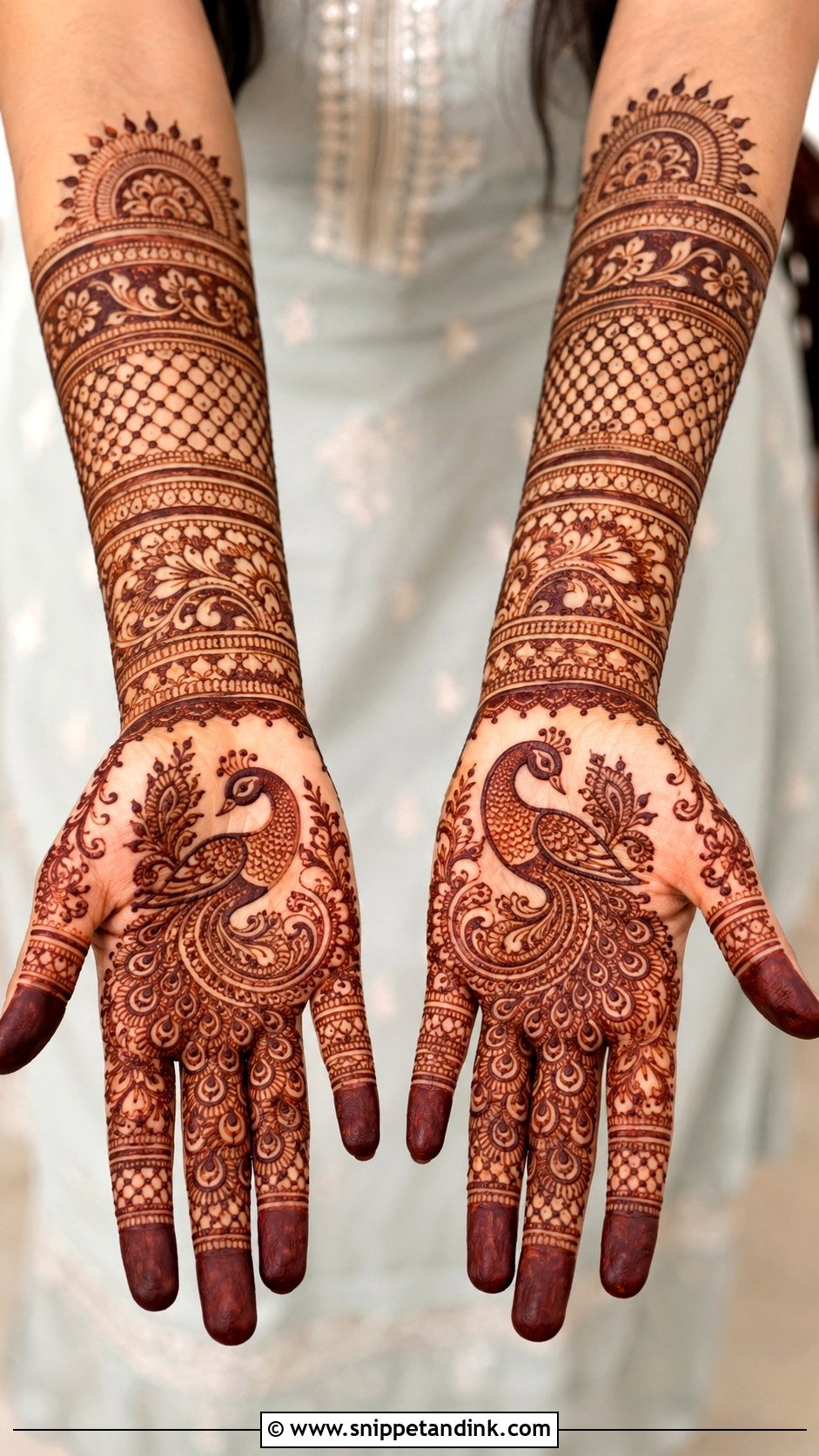
A full hand peacock mehndi design runs from fingertips to forearm. The palm carries a large, detailed bird, and the wrist and lower arm continue in jaali, paisley, florals and mandala bands. Without zones, this much detail blurs into one dark patch once the stain turns maroon, so I block out the bird first, then the cuffs and borders, then the finger panels, leaving small gaps between dense areas. Brides and the closest family are the usual wearers.
5. Back Hand Peacock Mehndi Design
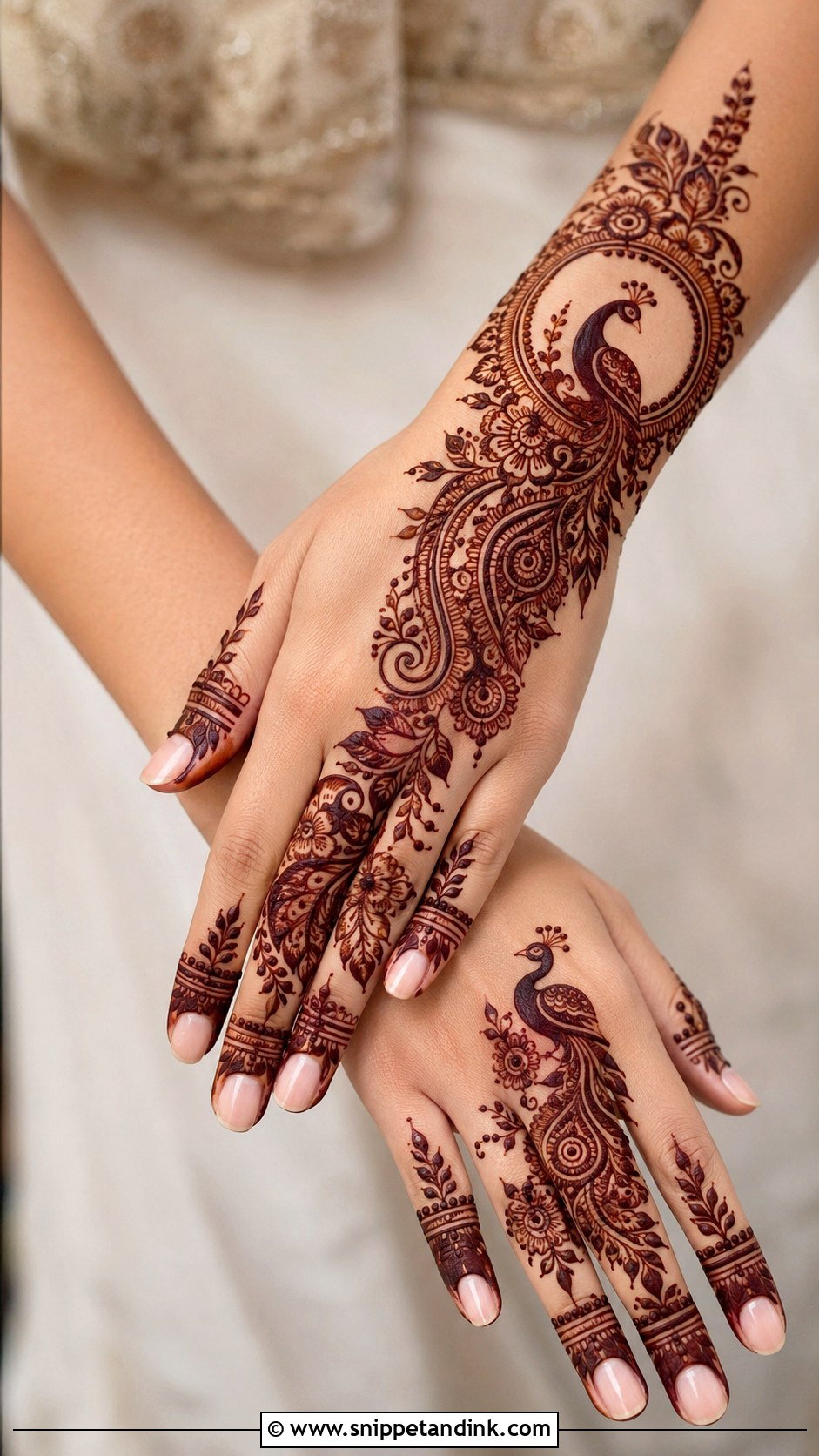
The back of the hand is flat, which gives the tail room to fan out properly. One placement puts the body near the wrist with the feathers sweeping toward the knuckles; another centres the bird in front of a round mandala that frames it like a halo. It sits well with bangles and rings in photos. Expect the colour to come up a little lighter than on the palm, so I draw the outline slightly heavier than I would on the front. Slim vines or feather tips on the fingers tie it together.
6. Front Hand Peacock Mehndi Design
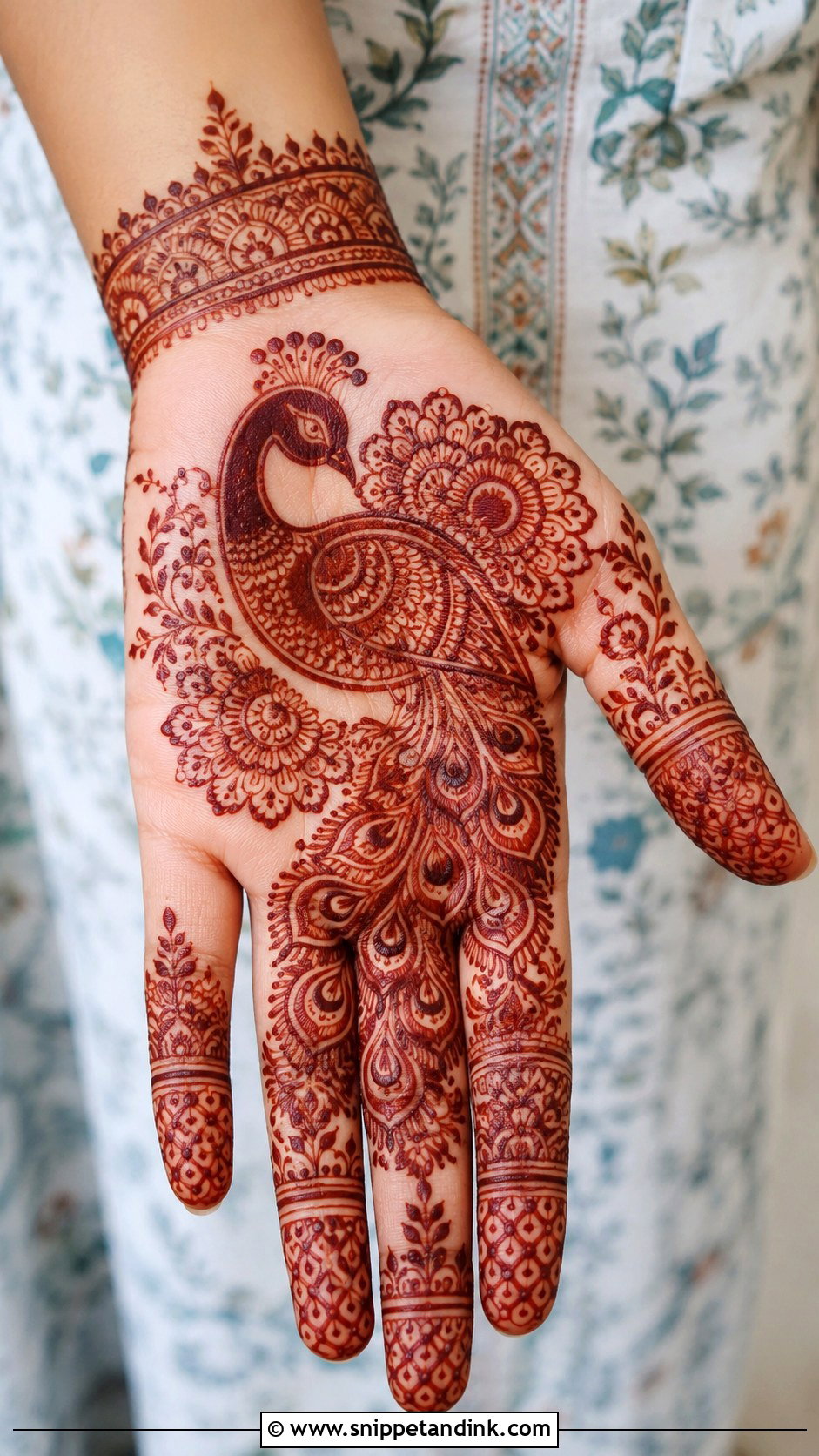
On the palm, the peacock becomes the clear centre of the hand: neck curving toward the thumb, tail opening toward the wrist, with floral circles, paisley borders and small feather eyes around it. During rituals the palms are what everyone sees, which is why families often request this placement. The palm stains darkest of anywhere, so the feather eyes come out rich. Matching bands, leafy tips and dotted lines on the fingers finish it.
7. Peacock Feather Mehndi Design
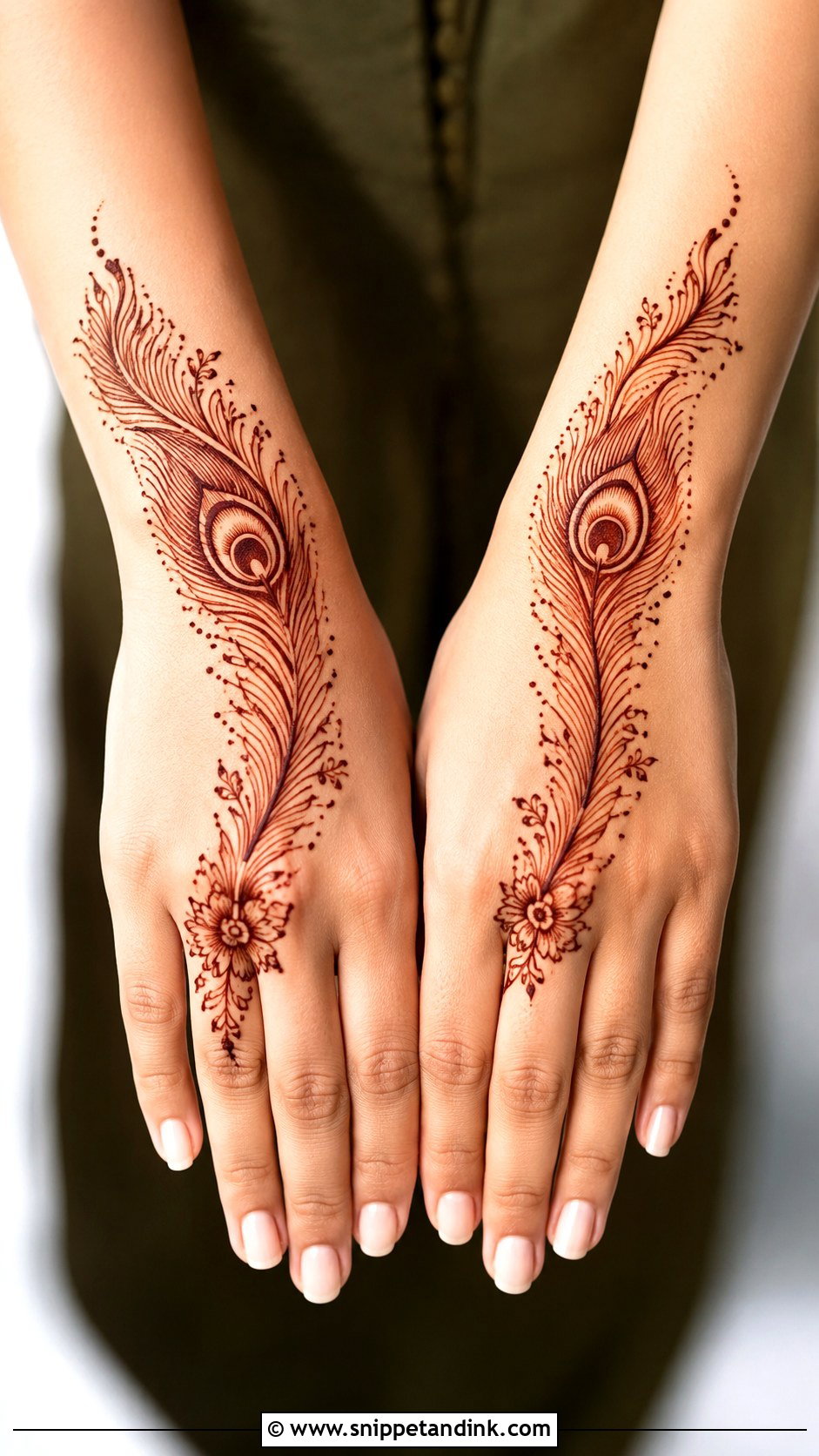
Skip the bird altogether and draw just the feather. One or more long feathers, each with the classic eye, curved barbs and fine lines, can rise from the wrist across the back of the hand or run along the side of the palm. It’s my usual suggestion for anyone who loves the symbolism but wants very light henna. The eye is the part to get right: a clear teardrop inside a rounder outline, with a small gap between them, so it doesn’t stain as a solid blot. Small florals and dots can fill out the hand.
8. Peacock Mandala Mehndi Design
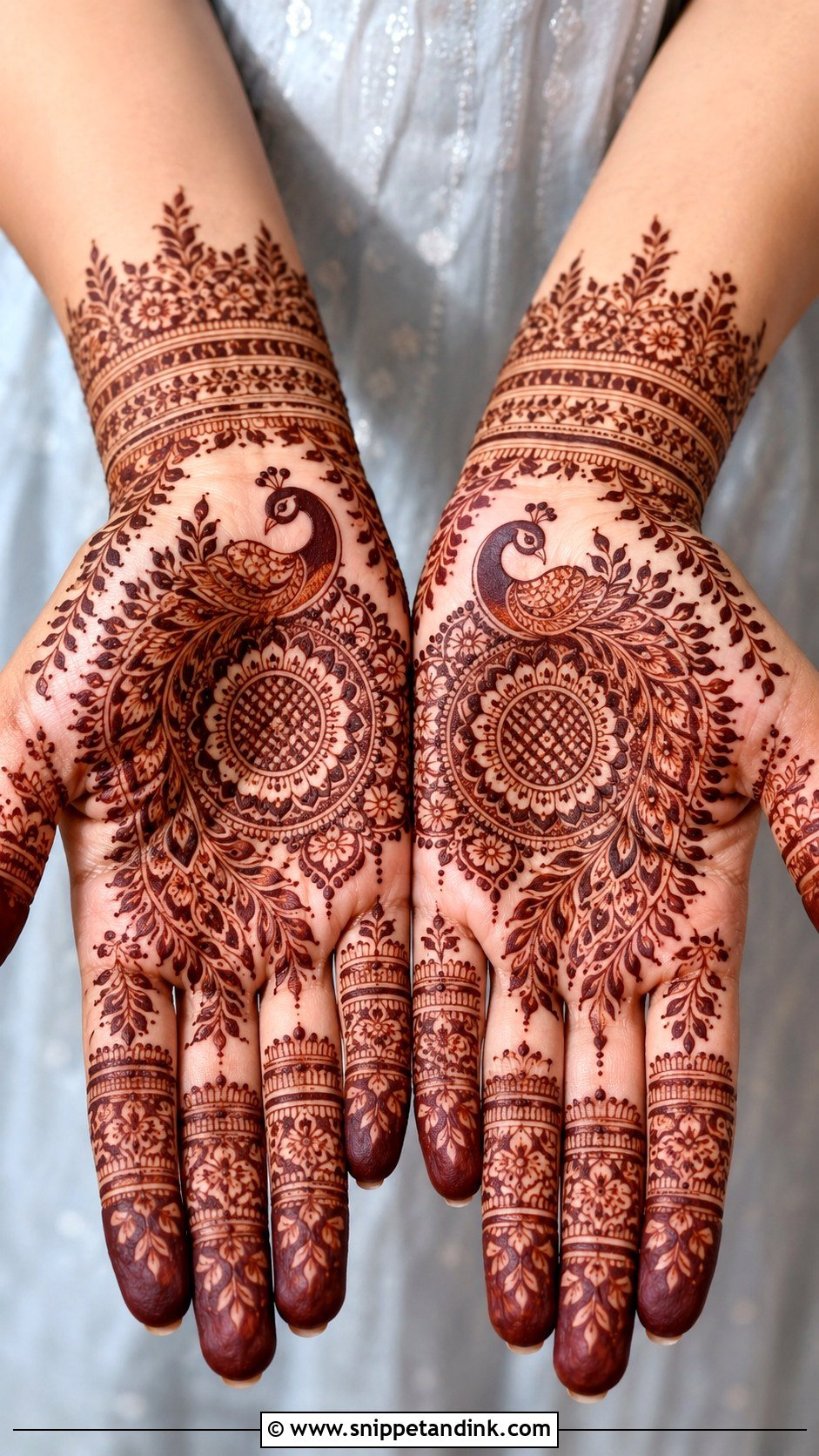
A mandala brings symmetry, a peacock brings movement, and here they share the hand. The mandala sits in the centre of the palm or back of the hand while the peacock curves around it like a frame, its feathers trailing into paisleys and vines. Balancing them is the whole challenge. If the mandala is densely detailed, I keep the bird cleaner, and if the bird is heavily filled, the mandala gets simpler, so neither one disappears.
9. Peacock Paisley Mehndi Design
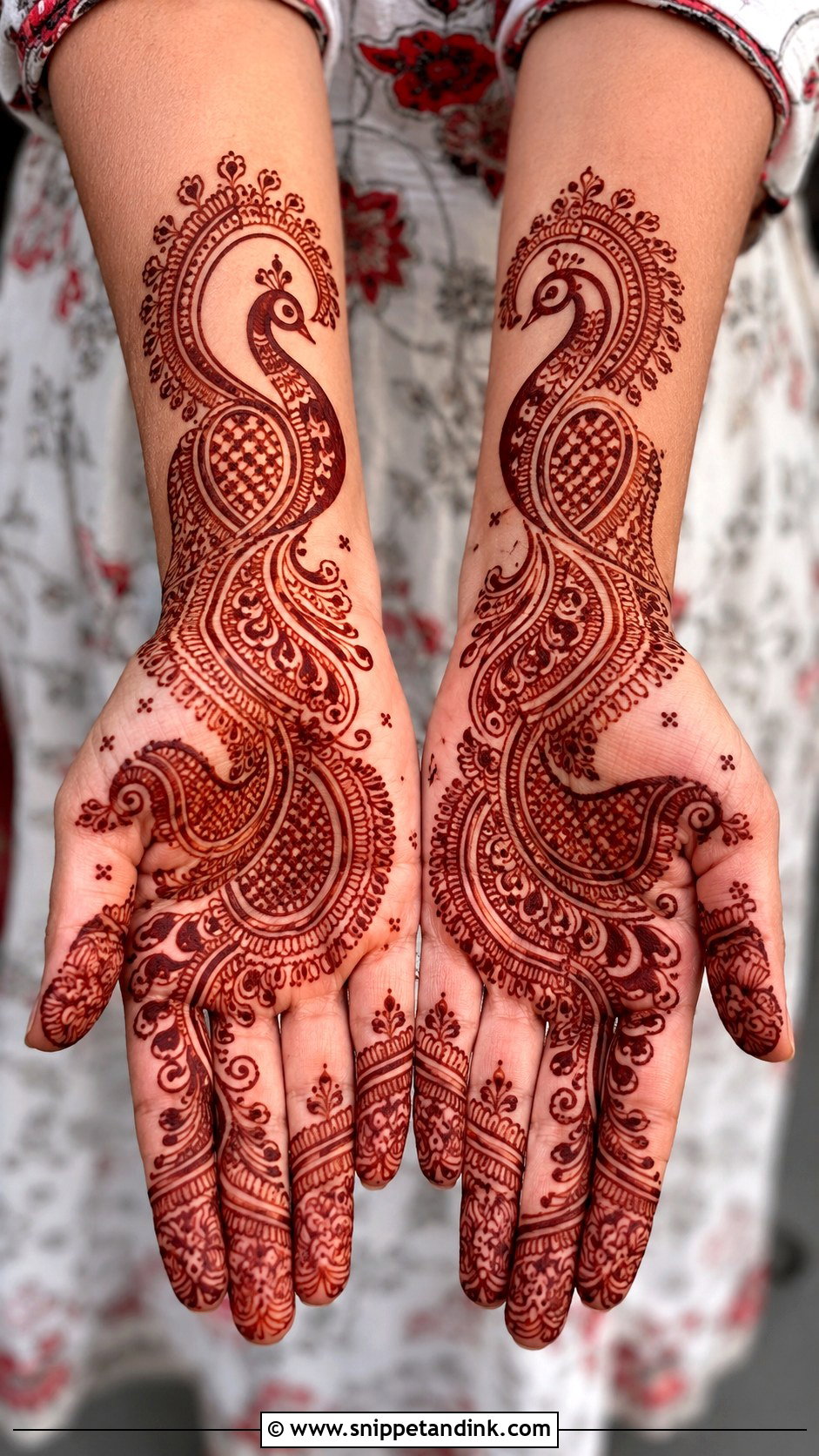
The body of the bird can melt into a large paisley here, and the tail fills with smaller paisleys carrying dots, petals, checks and fine lines. It’s soft and traditional, and it suits palms, back hands and bridal layouts alike. Paisleys inside a tail can easily turn into a crowd of teardrops, so I give the main peacock and paisley outlines extra weight and keep the inner filling fine. That contrast keeps the shapes sharp once the stain develops.
10. Peacock Jaali Mehndi Design
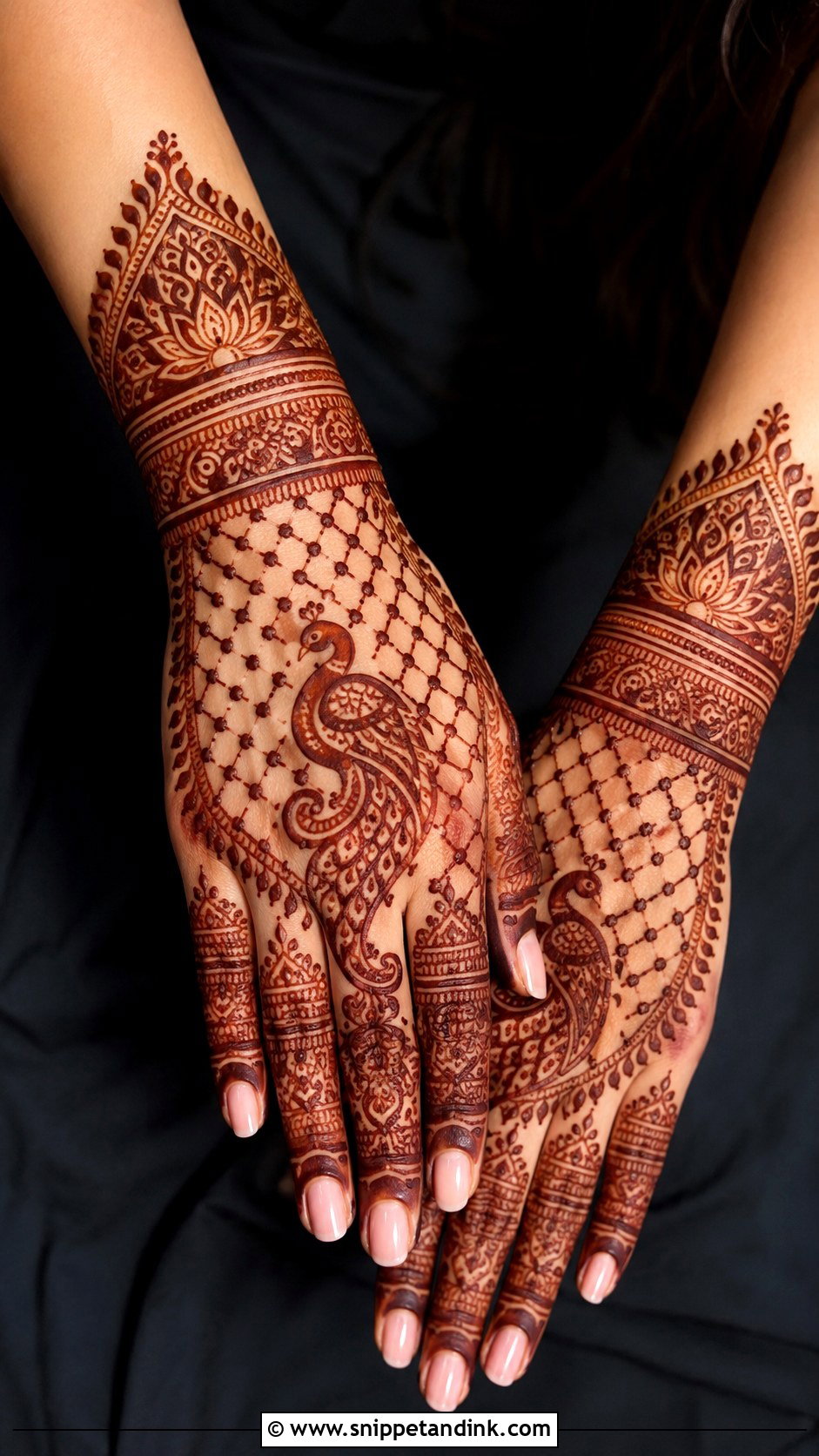
Jaali behind a peacock gives texture without relying only on flowers. The bird sits on the palm or the back of the hand, surrounded by neat mesh in diamonds, squares or curved net lines, often with tiny dots at the crossings. The mesh creates contrast against bare skin that reads clearly in close-up photos. The danger is that the neck vanishes into the net, so I draw the peacock’s outline fully before the first jaali line goes in, and stop the mesh a little short of the bird. A wrist cuff finishes the hand.
11. Royal Peacock Mehndi Design
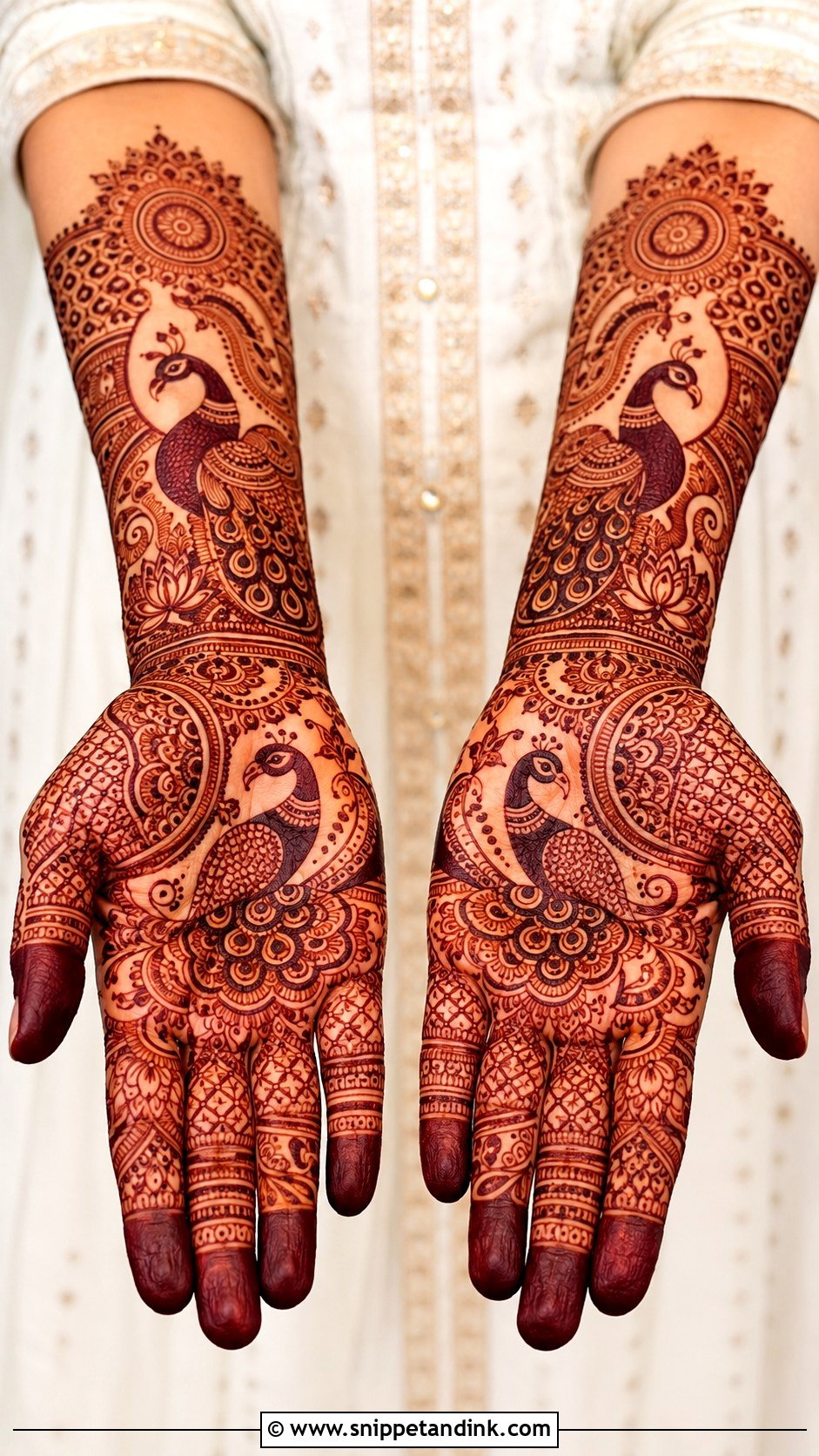
Two facing peacocks, large feather fans, ornamental borders and palace-style arches give this design its royal feel. It can cover the palm and wrist or carry on up the forearm. I outline the birds in thick strokes and keep the feathers in fine curves, dots and leaf shapes, because symmetry only looks rich when it’s tidy. Bracelet bands at the wrist and decorated finger panels close it off. It suits brides, sisters of the bride and formal family events.
12. Indian Peacock Mehndi Design
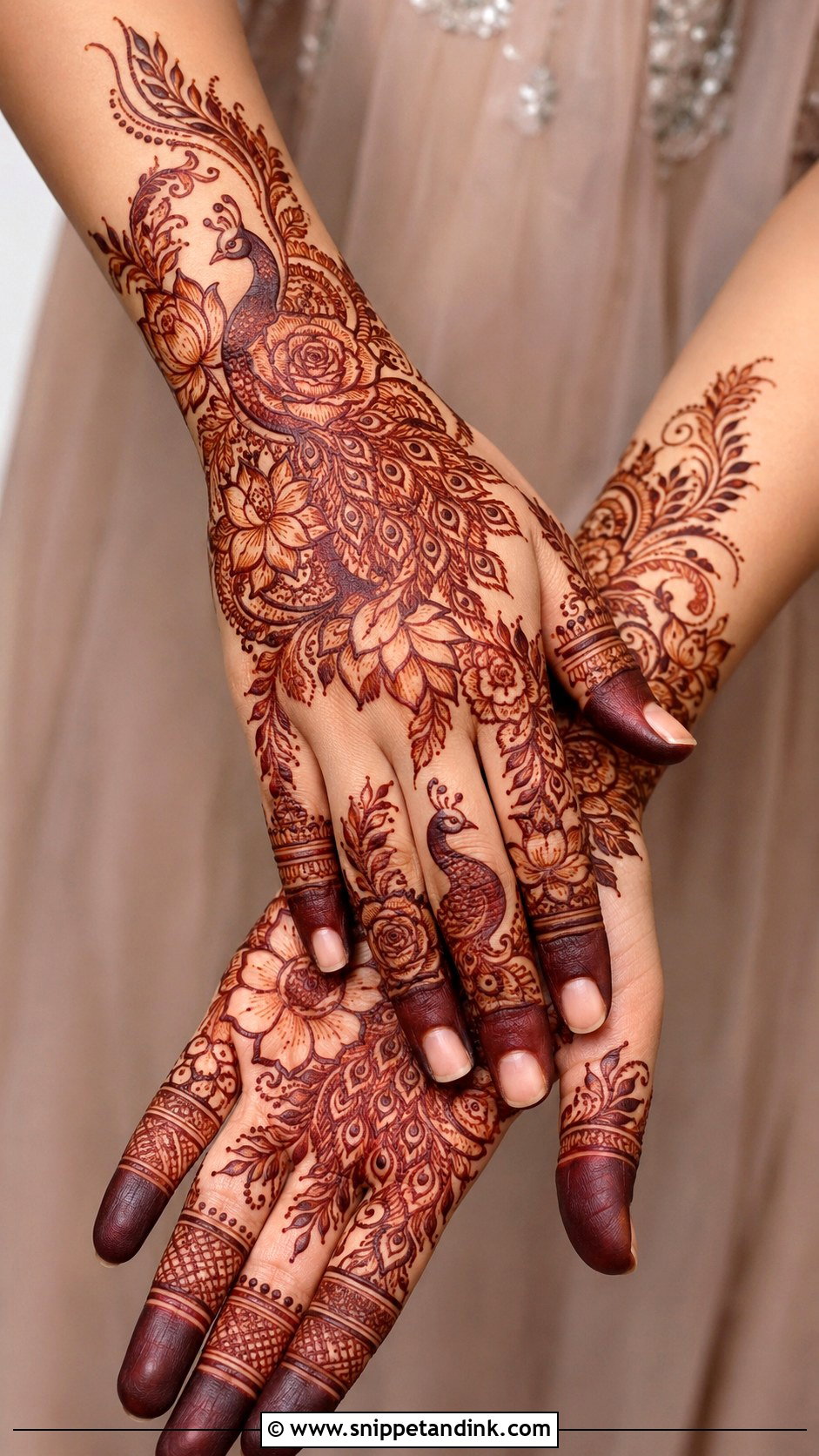
Indian peacock work tells a story: the bird sits among lotus flowers, paisleys, mandalas, vines and filled fingertips, with matching borders and floral panels running up the wrist and forearm. There’s much less open skin than in Arabic work, so the spacing between motifs carries a lot of weight. My rule of thumb is thin lines for filling and bold lines for outlines, without exception. Break it and the peacock stops being the first thing you see.
13. Indo Arabic Peacock Mehndi Design
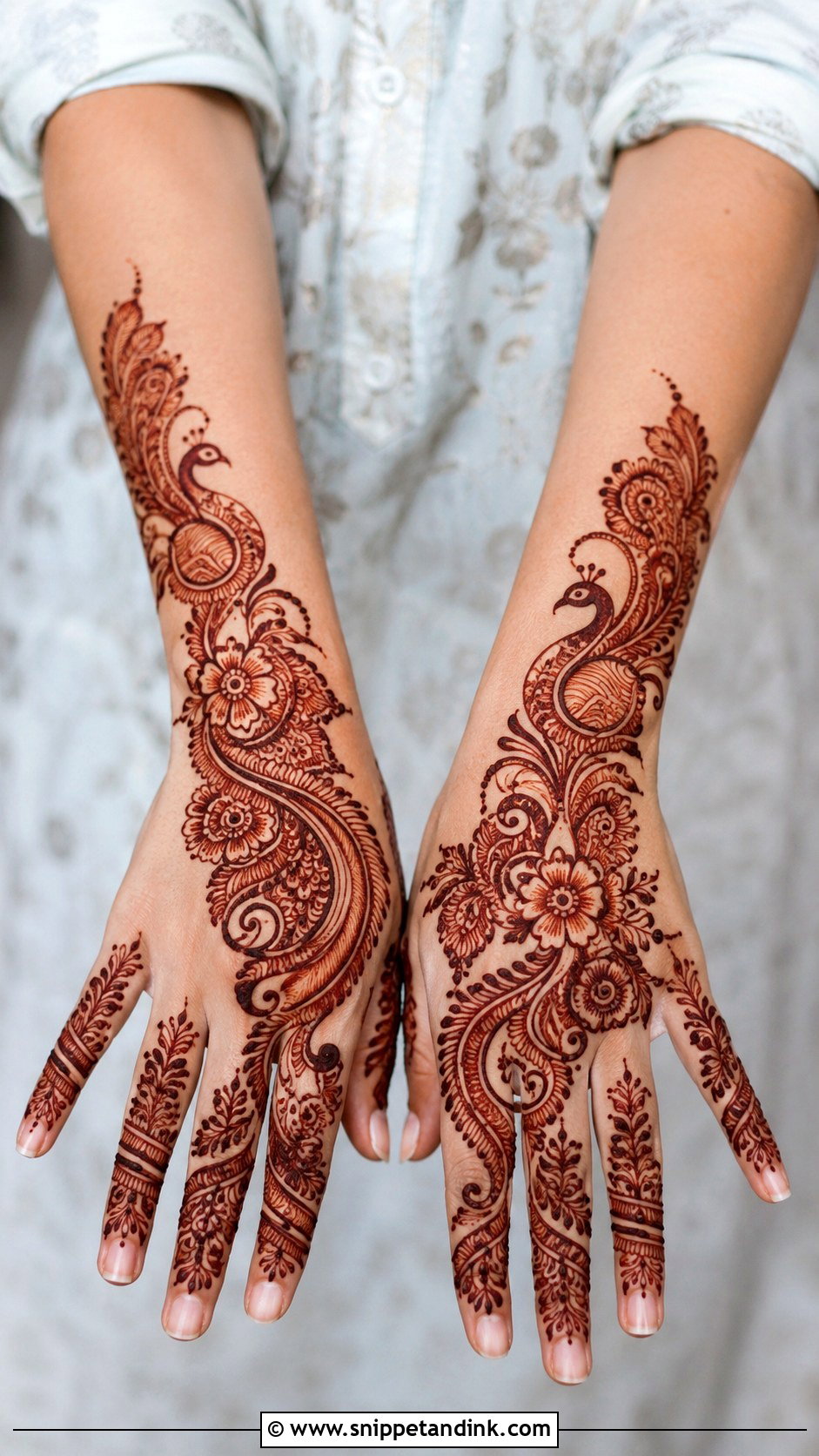
Indo-Arabic peacocks borrow the diagonal flow and open spaces of Arabic work and fill selected areas with Indian detail. The bird often starts near the wrist with its feathers sweeping toward the index finger, the feathers carrying fine filling while the background stays airy. It’s one of the most wearable versions for weddings, sangeet and Eid, festive without much weight. Bold flowers balance the delicate feather work, and clean negative space holds it together.
14. Moroccan Peacock Mehndi Design
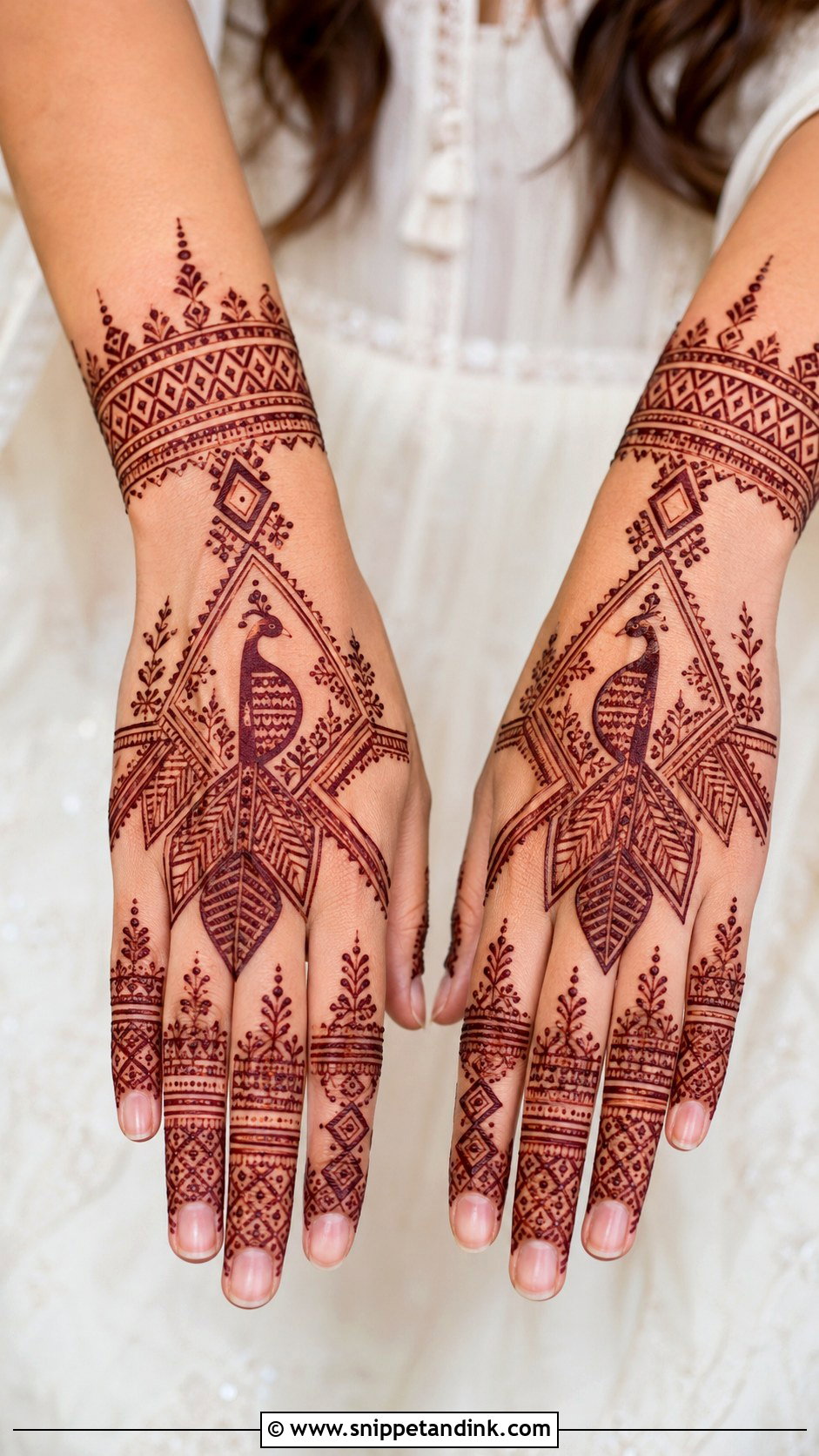
Geometry changes the peacock completely. Diamonds, triangles, straight lines and patterned bands surround a simplified bird with a curved neck and a tail built from repeated shapes. It’s a good pick if you’ve seen enough classic floral peacocks. Flat areas like the back of the hand, the fingers and the wrist suit it best, since straight lines are harder to keep true over the hollow of a palm. Even spacing is non-negotiable; a geometric pattern shows every irregularity.
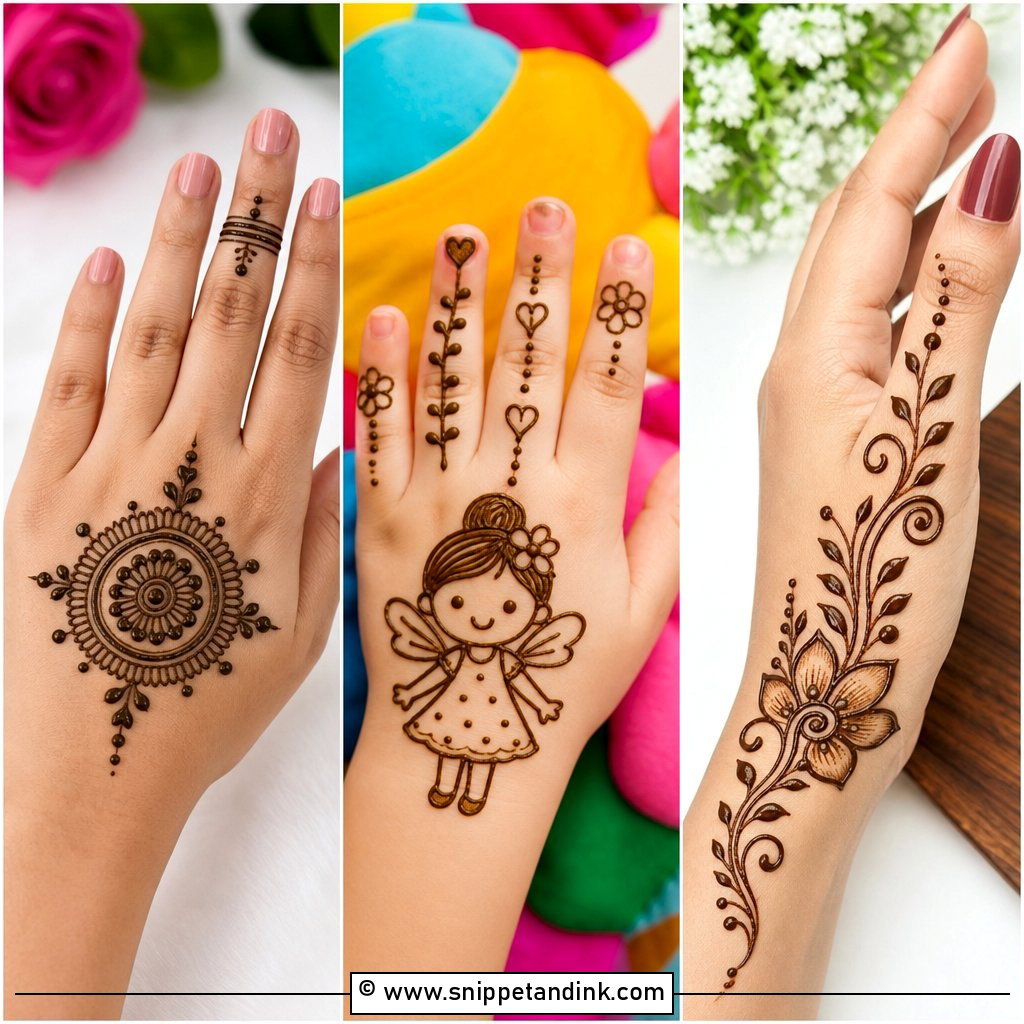
15. Gulf Peacock Mehndi Design
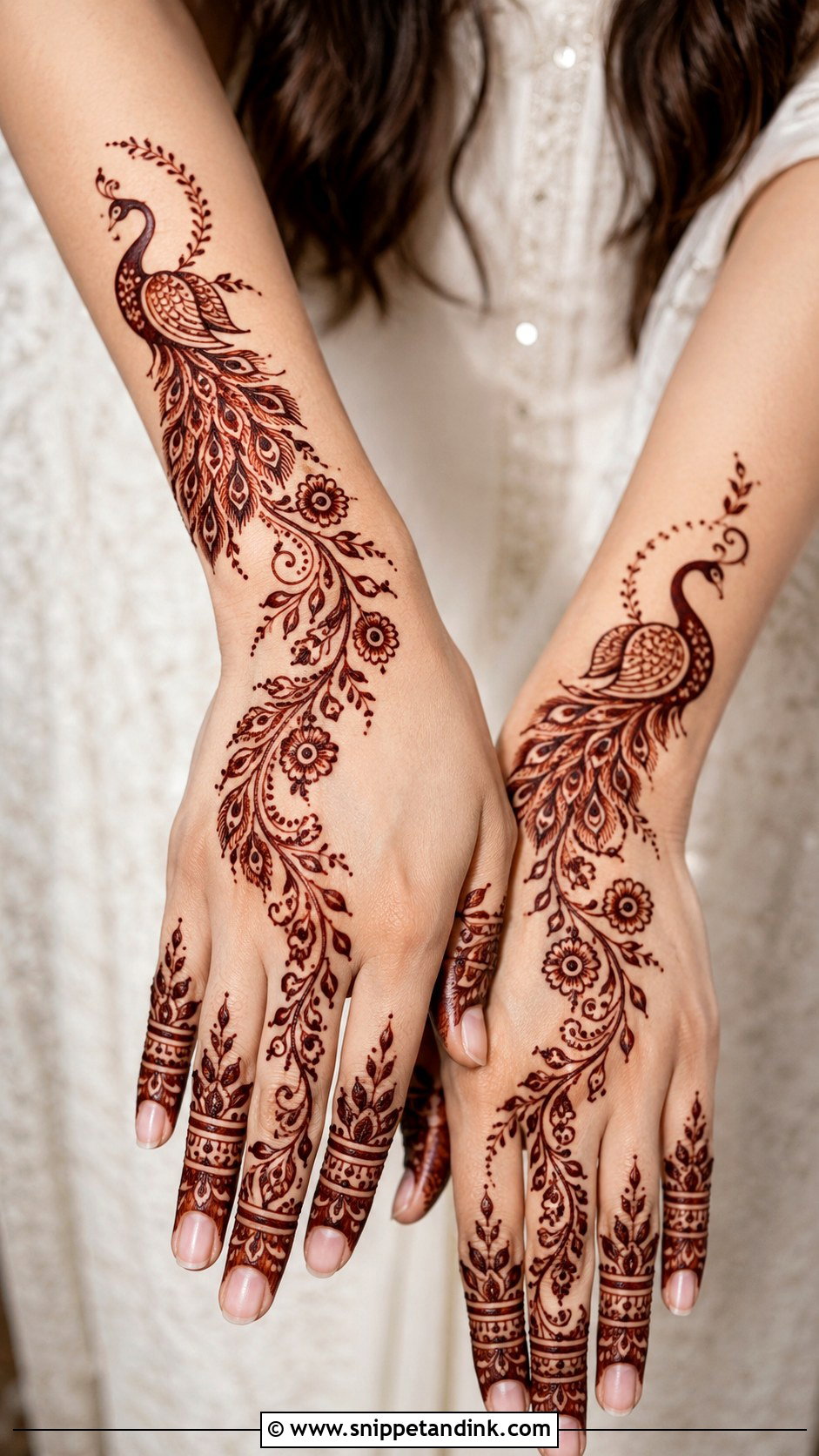
Khaleeji-style peacocks sit on a sweeping vine running from wrist to fingers, with bold outlines, floral clusters, large airy feathers, shaded petals and thick borders. The skin left visible around them is what makes the bird stand out, and the design reads well from across a room at an evening event. Large shaded feathers need even shading; a patchy fill is far more noticeable on a big petal than a small one. Decorated fingertips and a soft wrist trail complete it.
16. Minimal Peacock Mehndi Design
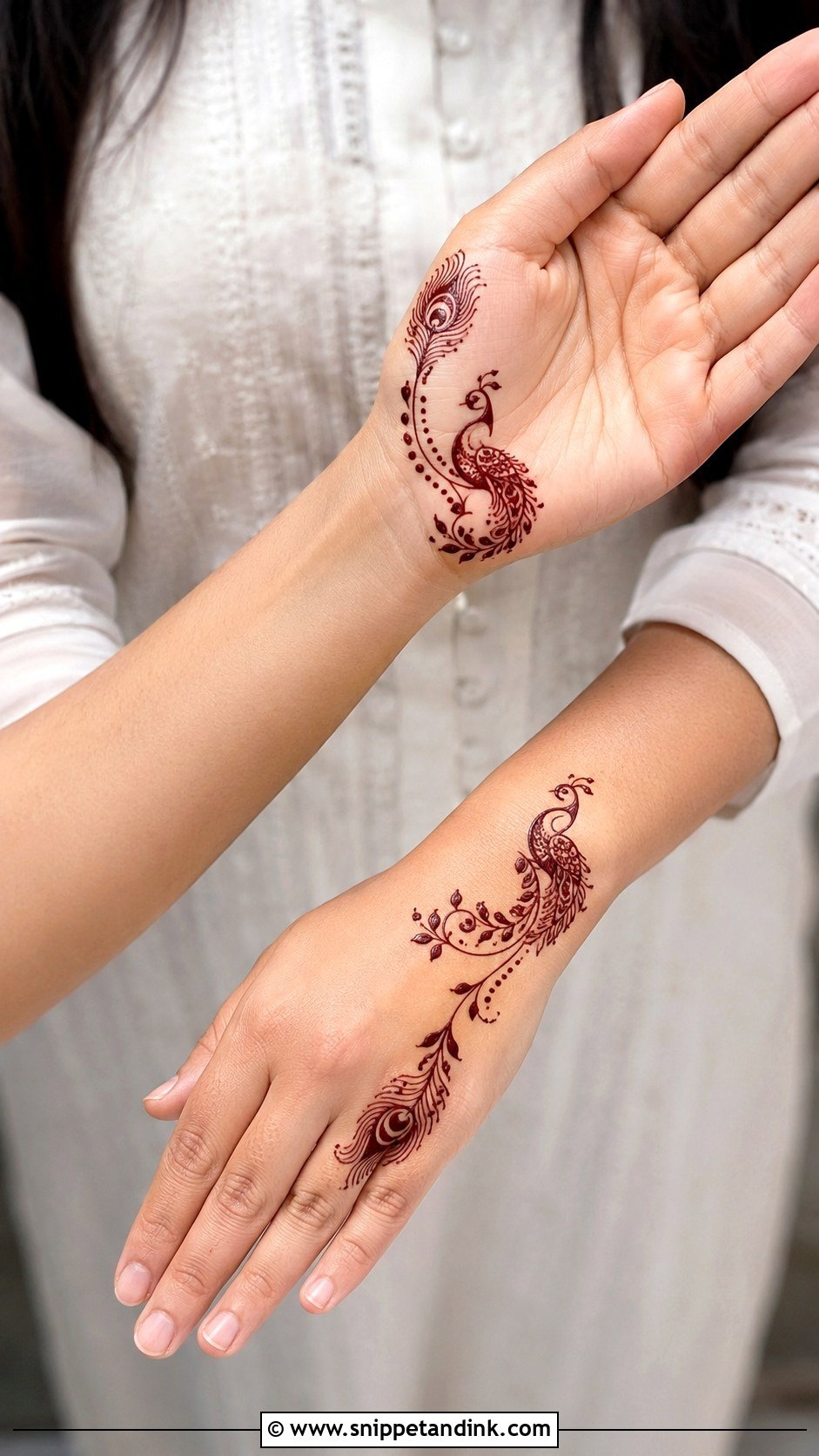
A small peacock outline on the side of the palm, a single feather on the back of the hand, or a tiny bird near the wrist with a few dots and leaves. With so little on the hand, the open skin is the design. Clean curves, thin lines and limited filling are all it needs, and it goes on fast enough for a casual festival. I’d still take care over the neck curve, because on a minimal piece one stiff line is all anyone sees.
17. Modern Peacock Mehndi Design
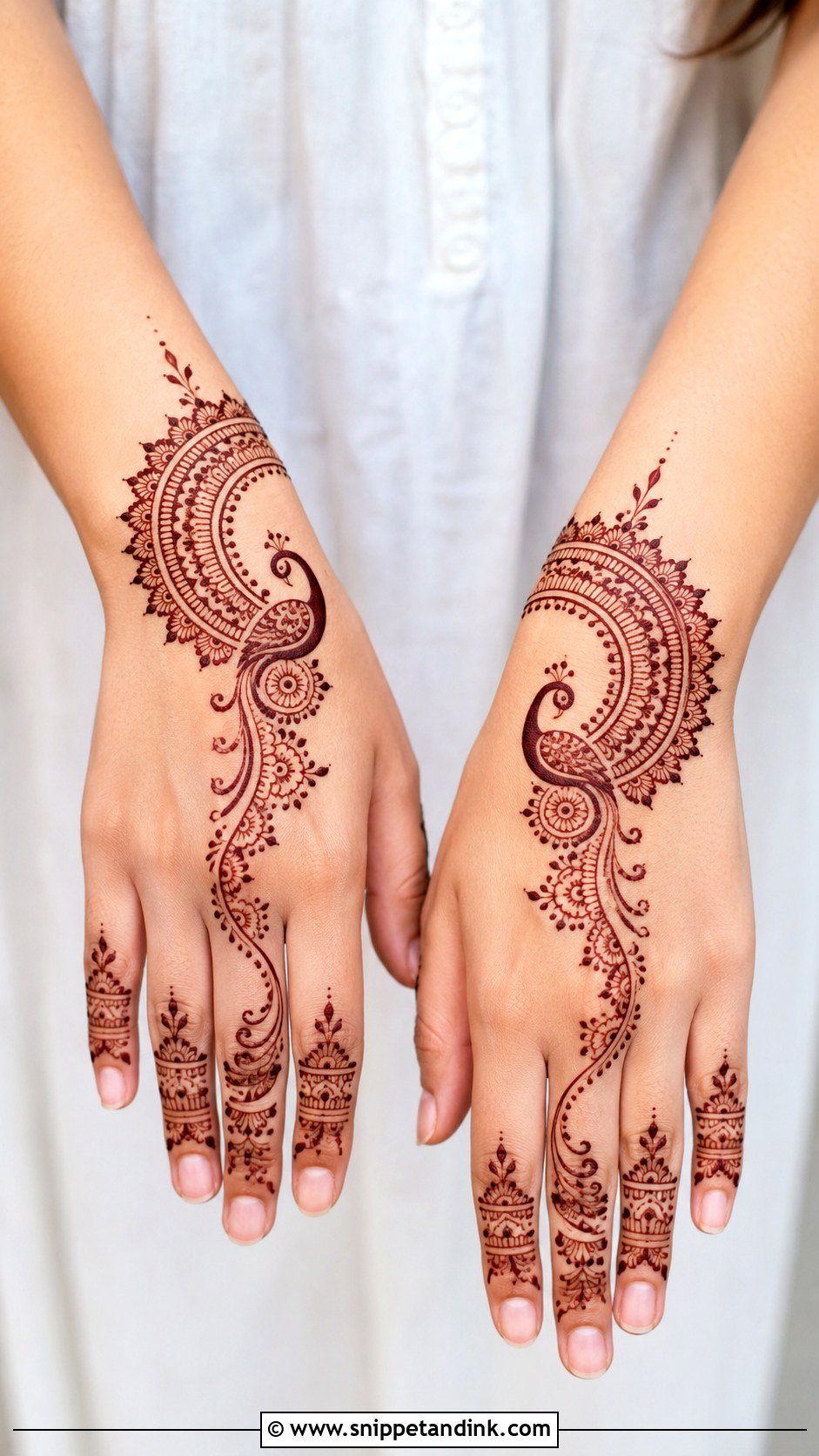
Modern peacocks lean on negative space, bold curves, half-mandala frames and simplified feather lines, and they often cover only the back of the hand, the side of the palm or a wrist-to-finger trail. Engagements and receptions are where I see them most, and they pair with contemporary outfits as easily as traditional ones. The temptation is to fill every feather. Resist it: leave some feathers open and let fine dots, vines or a geometric border supply the contrast.
18. Easy Peacock Mehndi Design
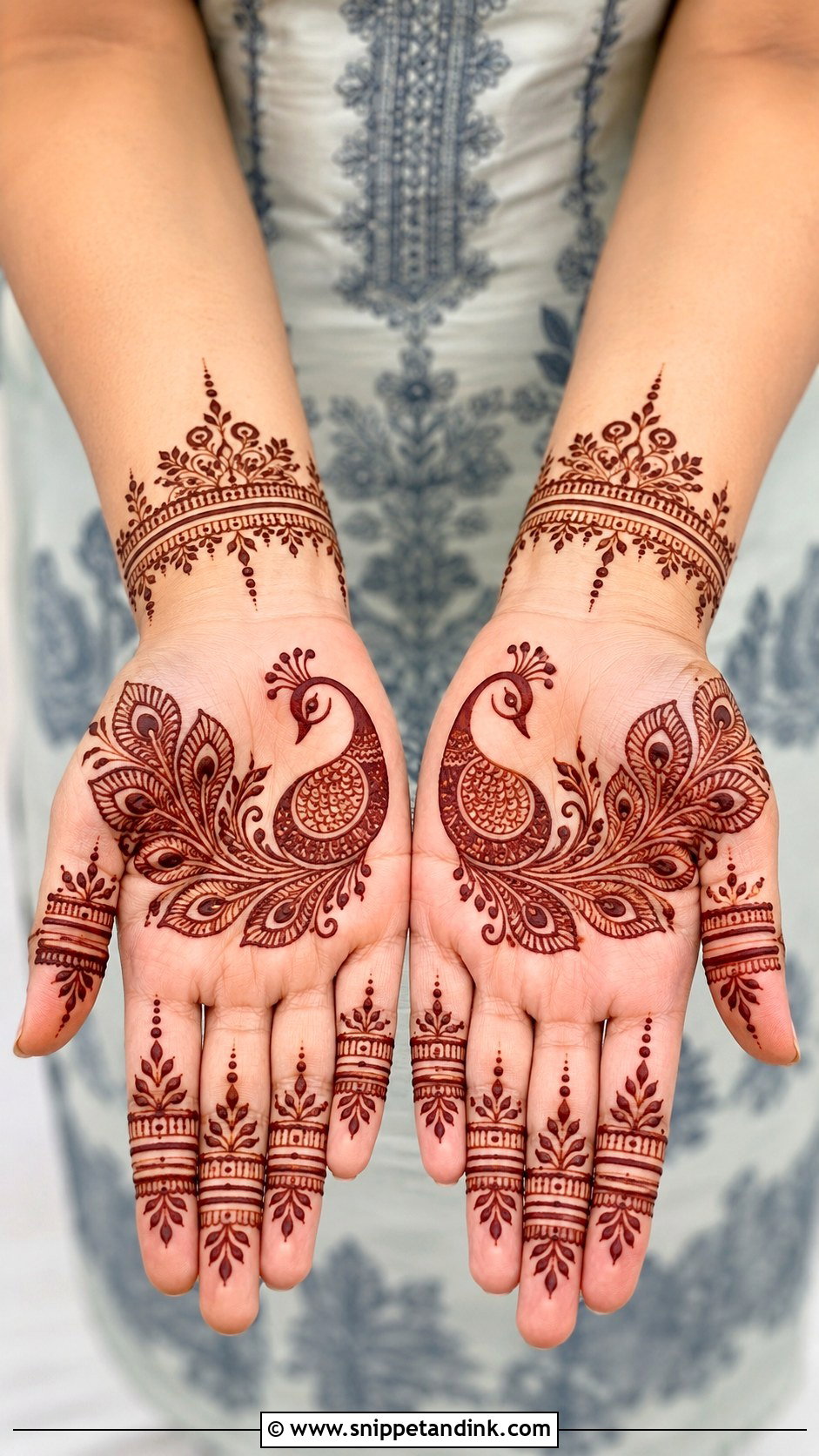
Here’s how I teach a peacock to someone picking up a cone for the first time. Draw an S for the neck, a small head with a dot for the eye, and a rounded body. Add three to five simple feathers fanning out from behind the body, and fill them with dots, curved lines and small leaves. Finish the fingers with matching dots and bands. It looks festive on the palm or the back of the hand and takes very little sitting time, so kids and teens enjoy it.
19. Peacock Vine Mehndi Design
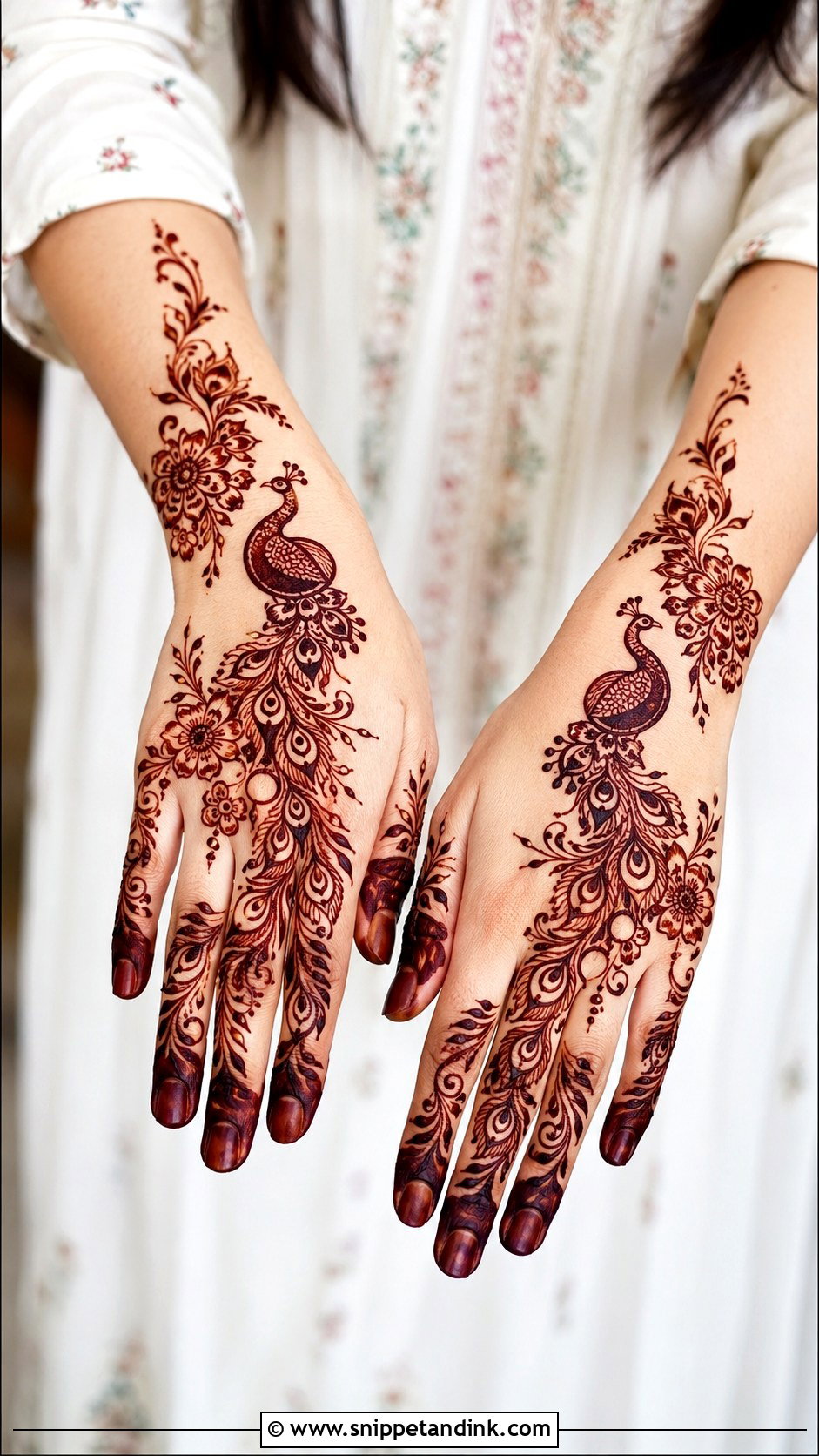
A vine design uses the length of the hand. The peacock sits near the wrist or lower palm while vines and leaves climb toward the fingers, linked by small flowers, feather tips and dotted curves. The back of the hand suits it best, and it slots easily into Arabic and Indo-Arabic layouts. I keep the bird noticeably larger than anything on the vine, otherwise it reads as one more leaf. Light enough for most occasions.
20. Peacock Flower Mehndi Design
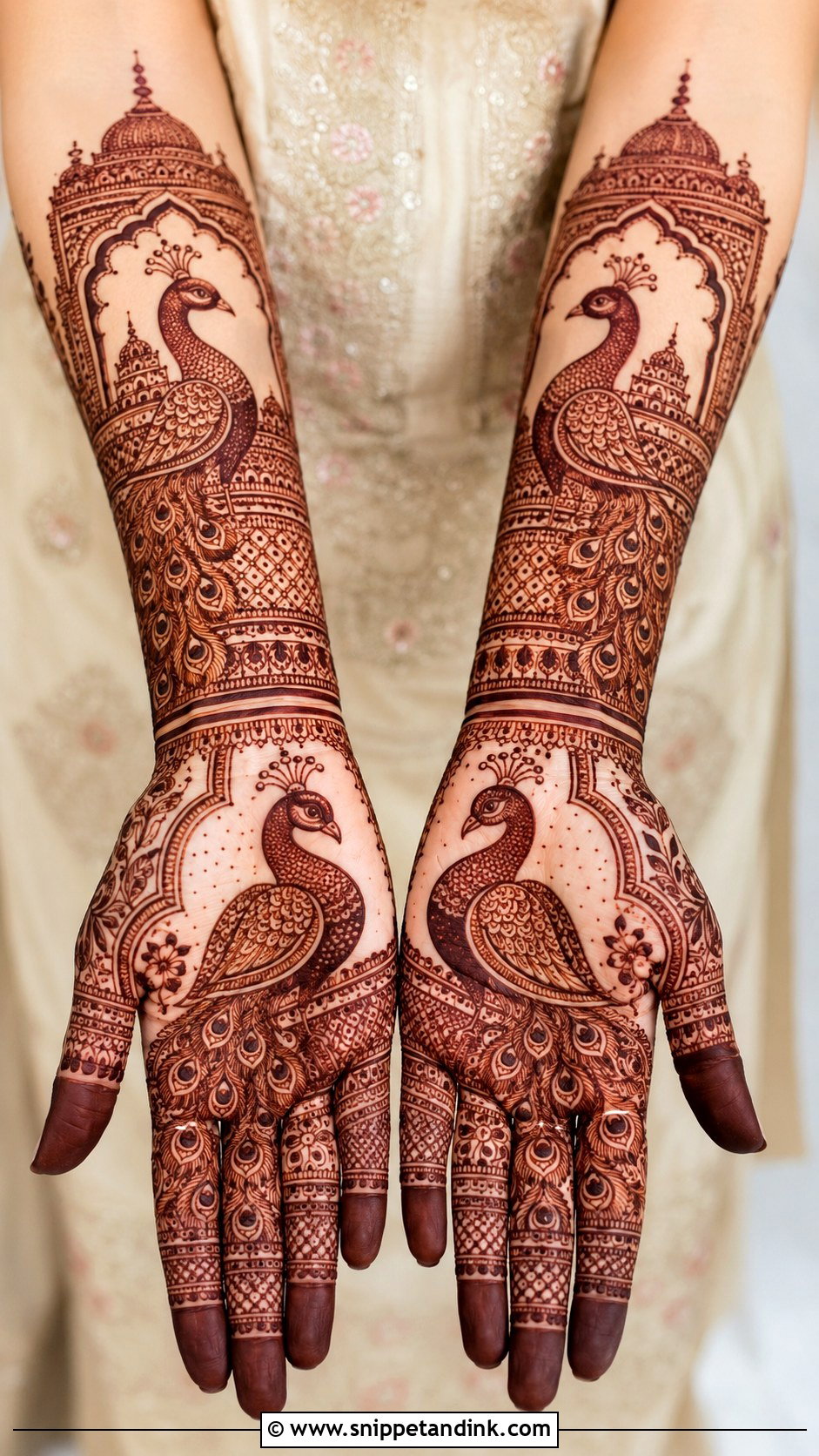
Flowers can fill the tail, ring the bird or sit beside it: roses, lotus petals, small blossoms or round clusters. They help the peacock blend into a larger design on the palm, the back of the hand or the forearm. For depth, I shade inside the petals but keep the feathers in fine line work, so flowers and feathers don’t merge into the same texture. Tiny flowers and leafy trails connect the fingers. Weddings and festivals suit it.
21. Peacock Lotus Mehndi Design
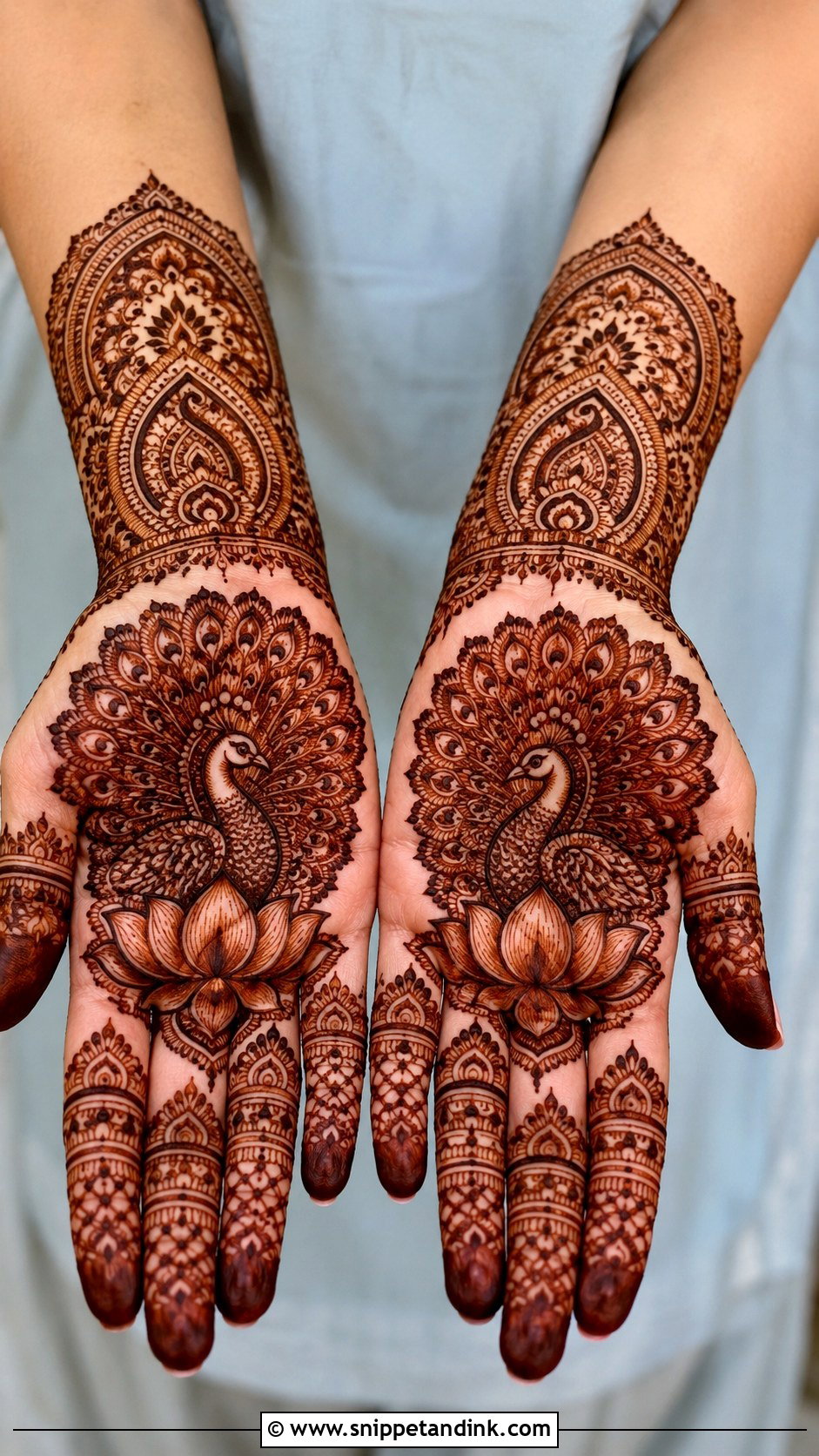
Peacock and lotus together carry a lot of meaning in Indian tradition, which is why brides choose the pairing even without other personal details. The lotus can sit at the base of the tail, inside a mandala, or along the wrist as a band. Layered lotus petals with fine shading go down first, then the feathers fan out around them. A strong central motif on the palm and clean borders continuing to the wrist keep the composition steady.
22. Peacock Bracelet Mehndi Design
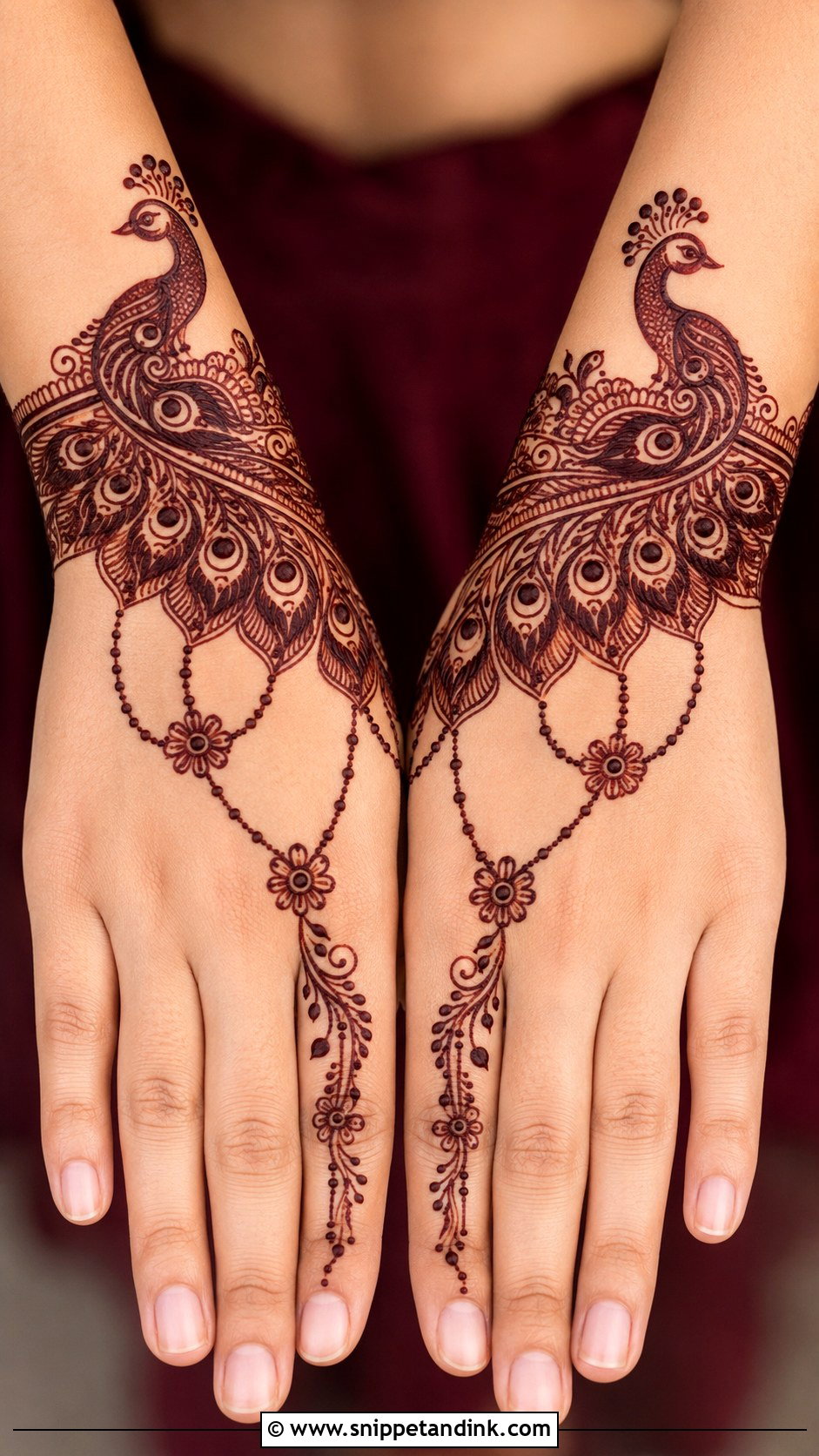
The peacock sits just above the wrist and its feathers wrap into a bracelet band, with a fine chain, vine or dotted line running from there to one finger. It works like jewellery, and next to real bangles it reads as one more ornament. Detail the band with small checks, dots and petals. I’d keep the bracelet a finger’s width below the wrist crease, since henna drawn on the crease cracks every time the hand bends, and leave space around the bird so the effect stays clean.
23. Peacock Finger Mehndi Design
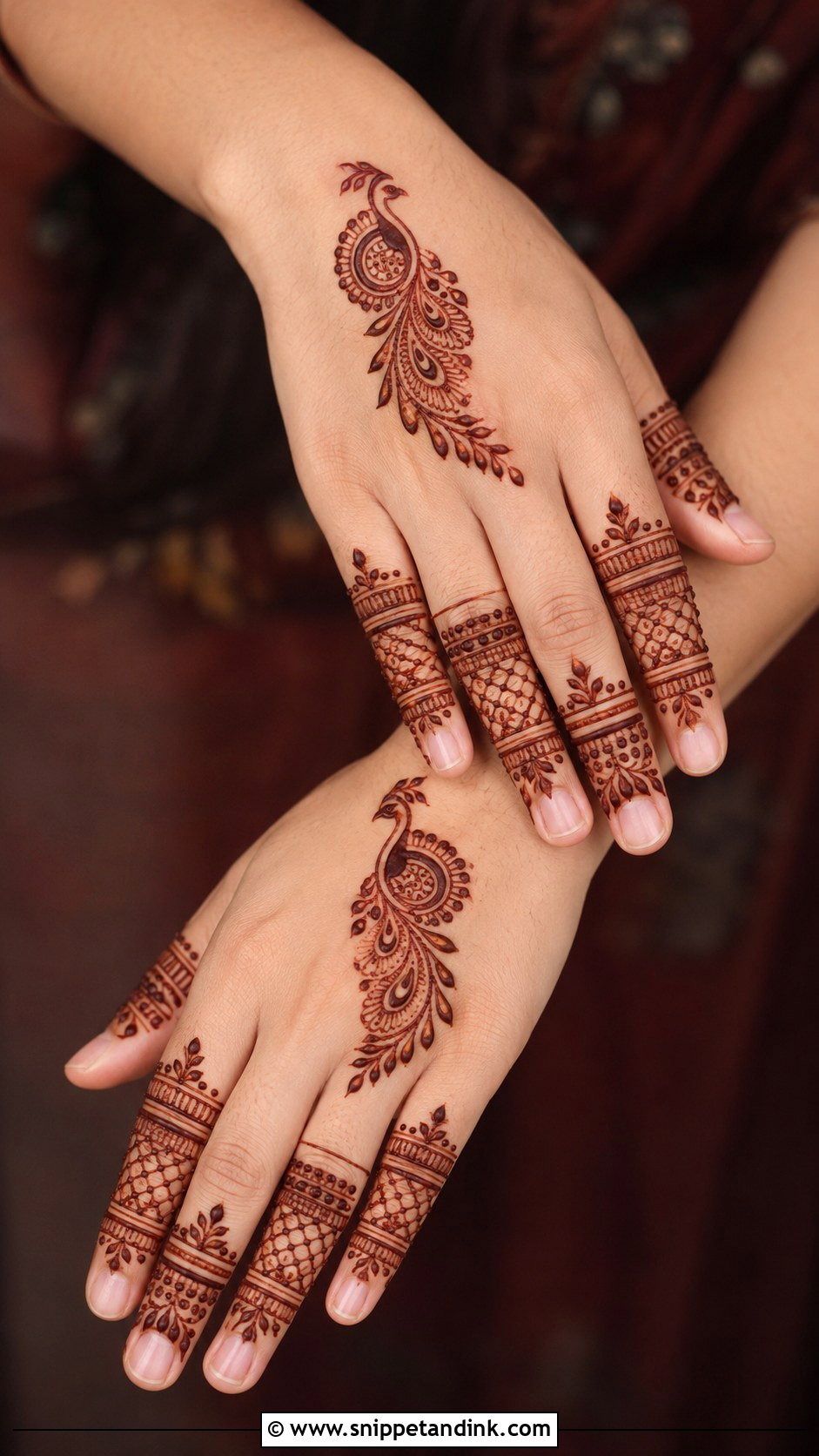
Putting the peacock on the fingers means working in very narrow space. The body can sit at the base of the index or middle finger with feathers running up the fingers in slim panels, or each finger can carry its own small feather, tied to a tiny bird near the knuckles. My finest cone tip comes out for this, and I keep filling minimal, because detail crammed onto a finger smudges into a smear. Dots, leafy tips and small jaali sections finish it. Engagement photos show it off well.
24. Peacock Tikka Mehndi Design
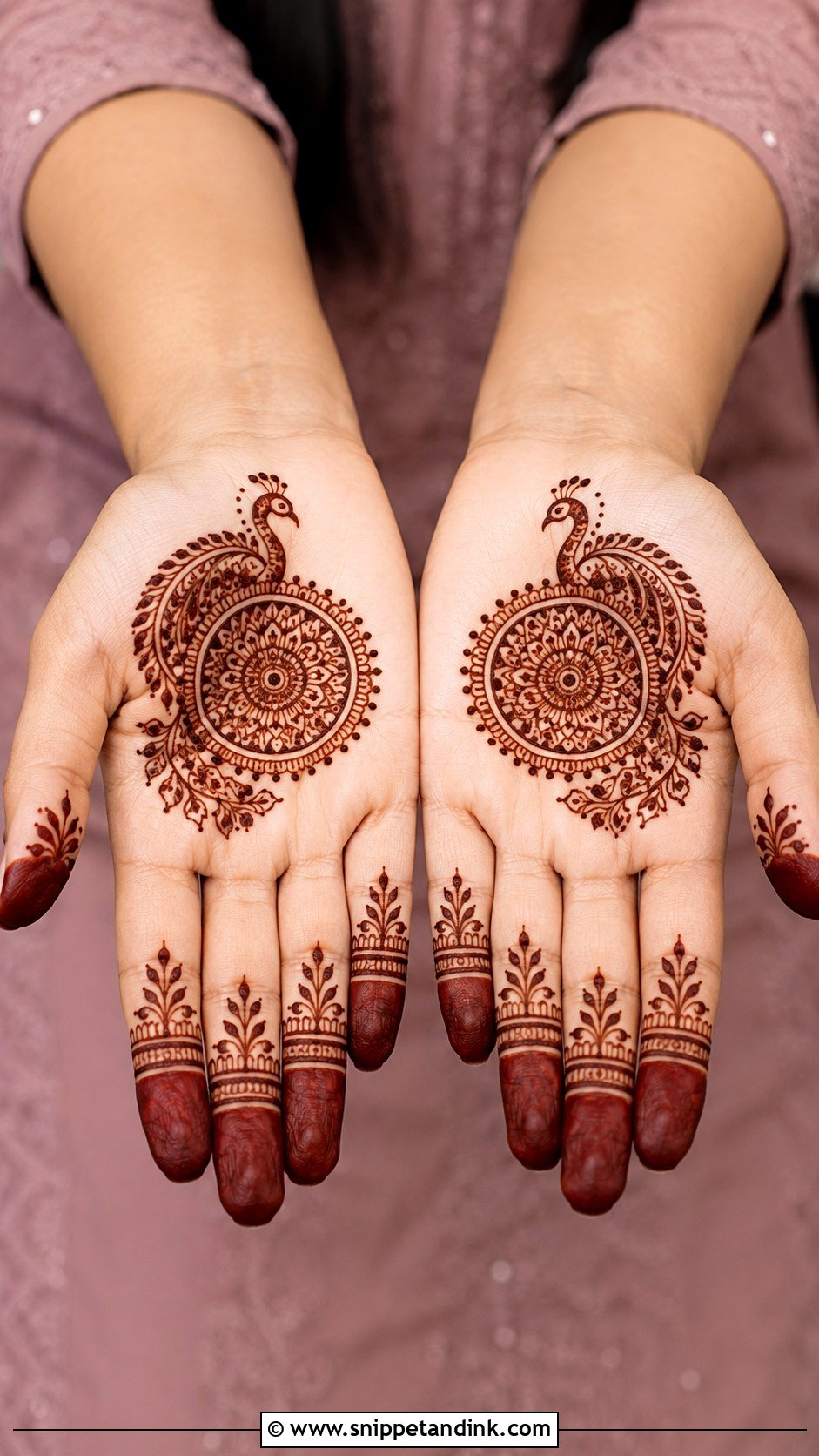
The round gol tikka gets a twist here: a circular mandala in the palm with a small peacock wrapped around one side. Simple bands, dots and leafy tips on the fingers keep it light. It’s quick, it doesn’t need full coverage, and it suits Eid, Teej and casual festive days. I draw the circle first and get it perfectly round before the bird goes anywhere near it, because the peacock’s curve only looks natural against a true circle.

25. Peacock Trail Mehndi Design
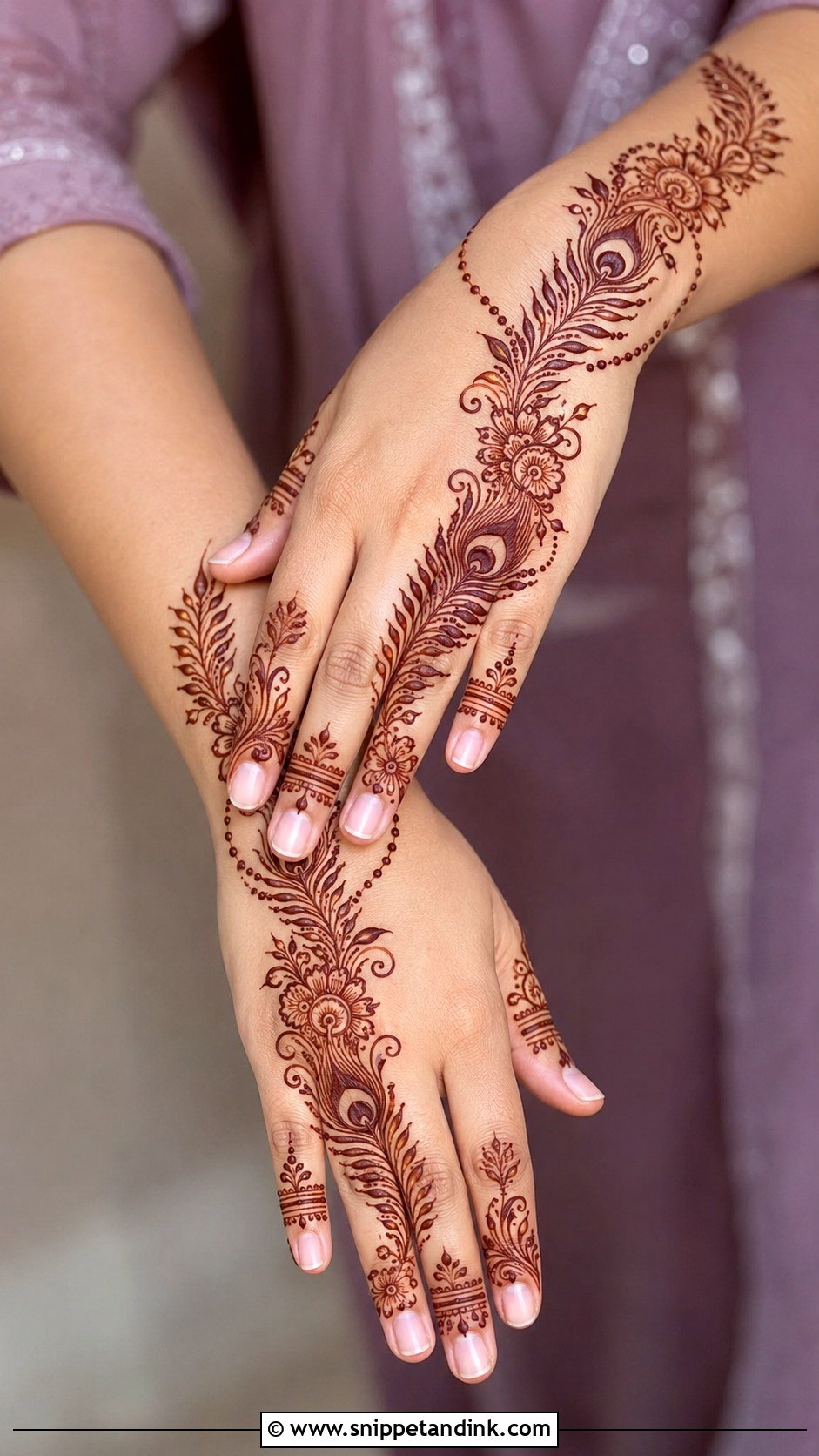
A trail runs in one continuous path: peacock body at the wrist, then feathers, florals and vines travelling diagonally toward the fingertips. It looks full without covering every inch, which suits Arabic, Indo-Arabic and modern tastes. Every motif has to hand off to the next, so I sketch the path with a faint guide line before committing. Keep one side of the hand open for contrast and finish the fingers with light bands or feather tips.
26. Double Peacock Mehndi Design
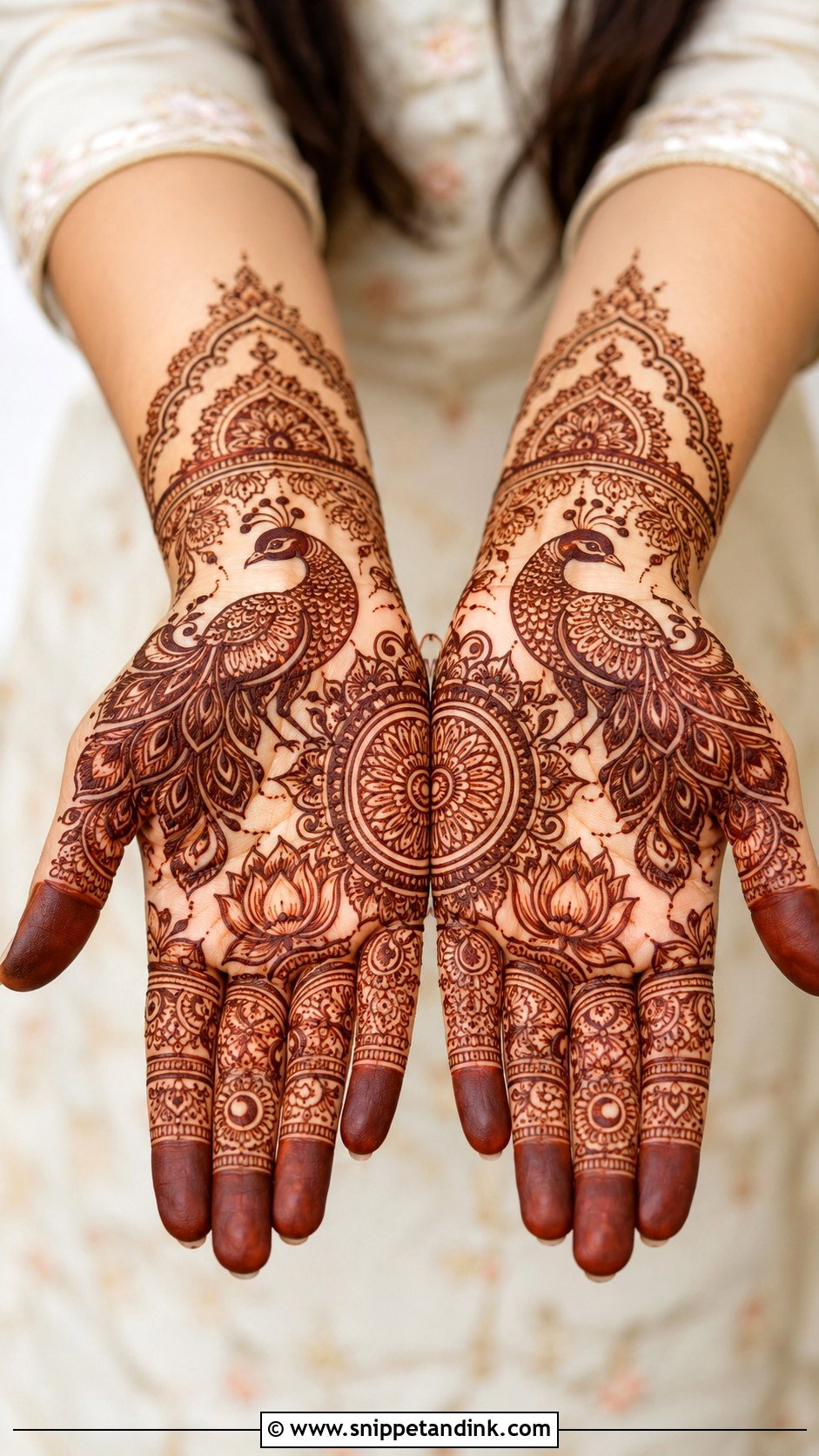
Two peacocks facing each other on the palm, two mirrored birds on the back of the hand, or one bird on each hand that meet when the palms come together. Brides love the symmetry. Between them can sit a mandala, a lotus, a floral heart or a paisley centre, with feathers spreading toward the wrists and fingers. Mirroring is harder than it looks; I draw the first bird, then build the second by checking each curve against it, not from memory.
27. Peacock Dulhan Mehndi Design
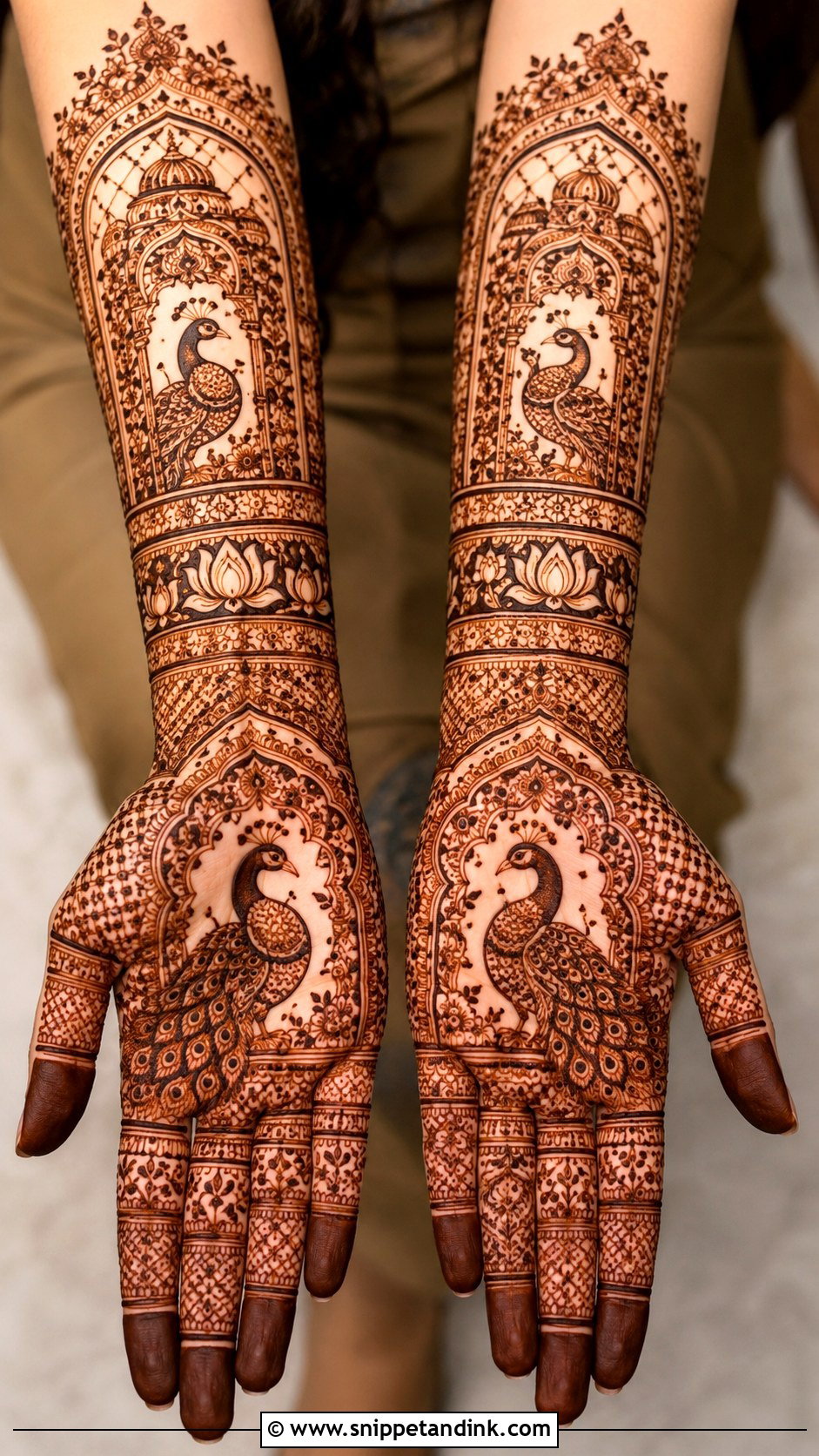
A peacock dulhan mehndi design covers both hands completely: full palms, filled fingers, wrist cuffs, forearm panels and peacocks as the main theme throughout. Doli shapes, the groom’s initials, lotus borders, paisleys and fine jaali often join them. With that much density, the important motifs need to be drawn large enough to survive it, so I don’t let the peacocks shrink into fillers. It’s made for the wedding mehndi, bridal portraits and close-up hand shots.
28. Peacock Engagement Mehndi Design
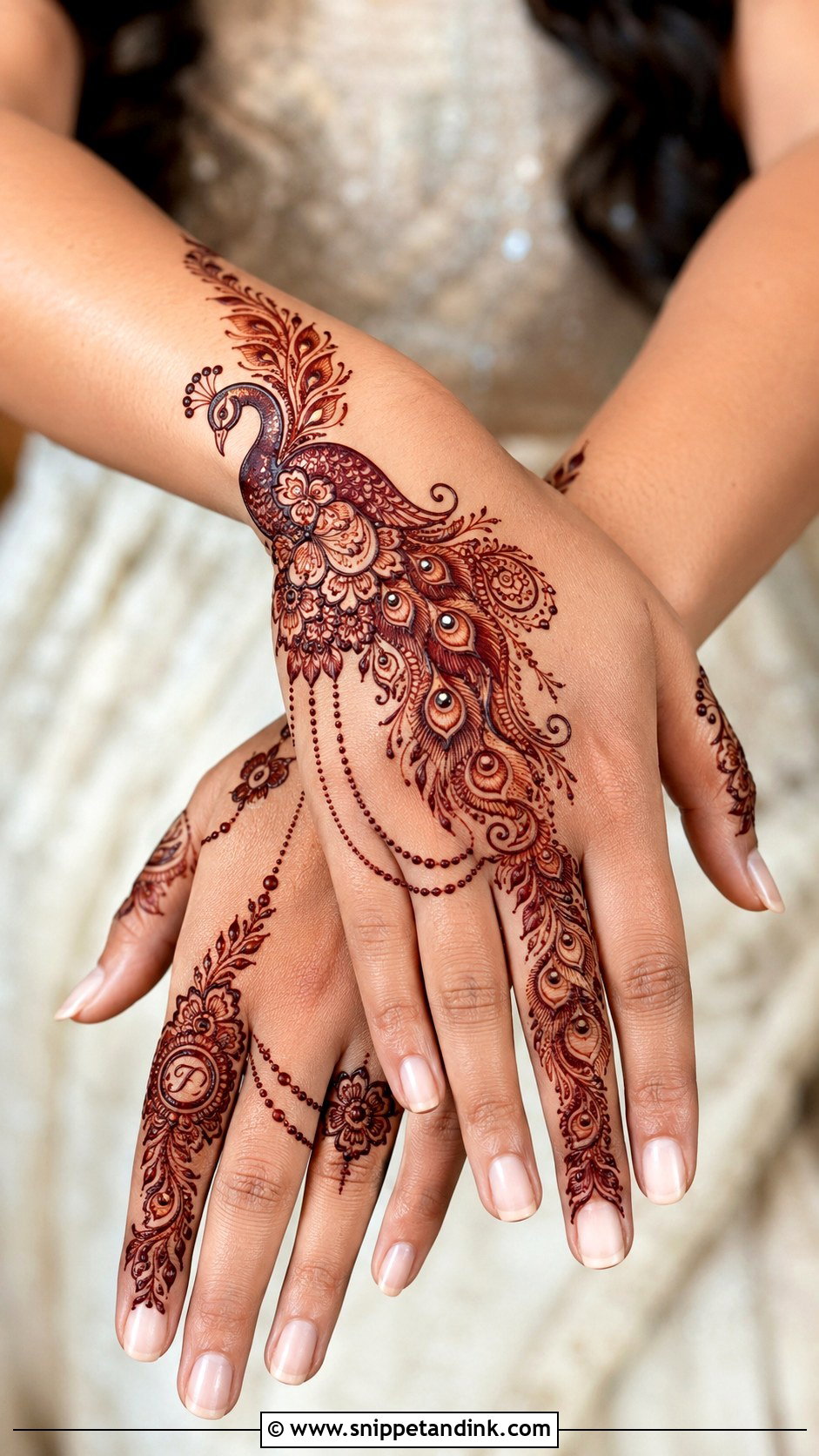
For an engagement, I like the peacock on the back of the hand. Its body sits near the wrist and the feathers flow toward the ring finger, framing the ring rather than covering it. Florals, dots and fine chains finish it, and a small initial hidden in the feathers is a nice personal touch. Keeping the palm lighter makes the evening more comfortable, since you’ll be shaking hands and holding things all night.
29. Peacock Eid Mehndi Design
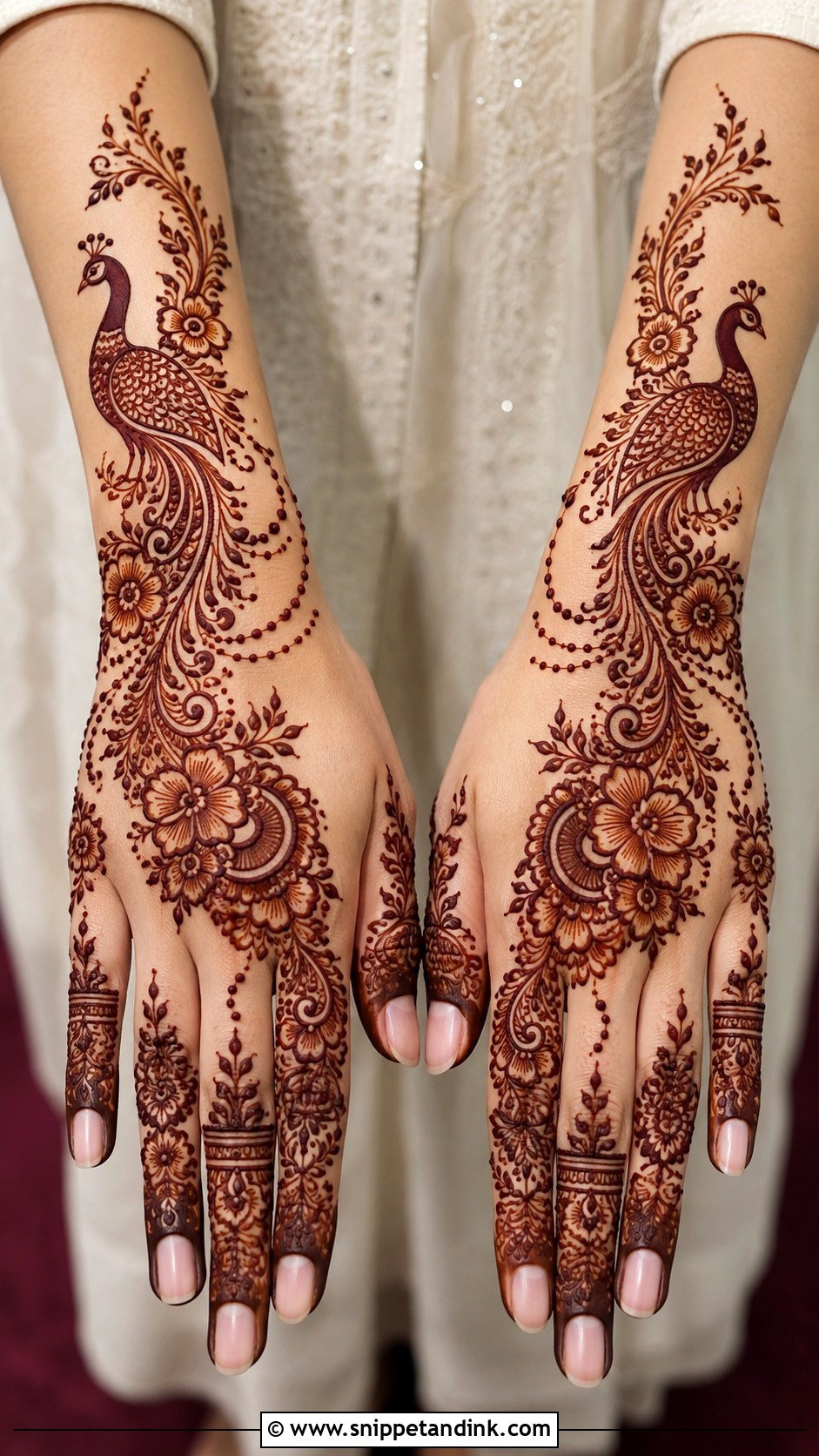
Eid is a busy day of cooking, visiting and greeting family, so a medium-coverage peacock suits it better than a dense one. An Arabic trail, a back-hand bird with florals, or a palm design with open fingers all work. Flowing feathers, shaded flowers and dotted vines give the festive feel; simple bands or leafy caps finish the fingertips. Teens and adults both wear it easily. Keep the bird itself clear so it reads from across the room.
30. Peacock Karwa Chauth Mehndi Design
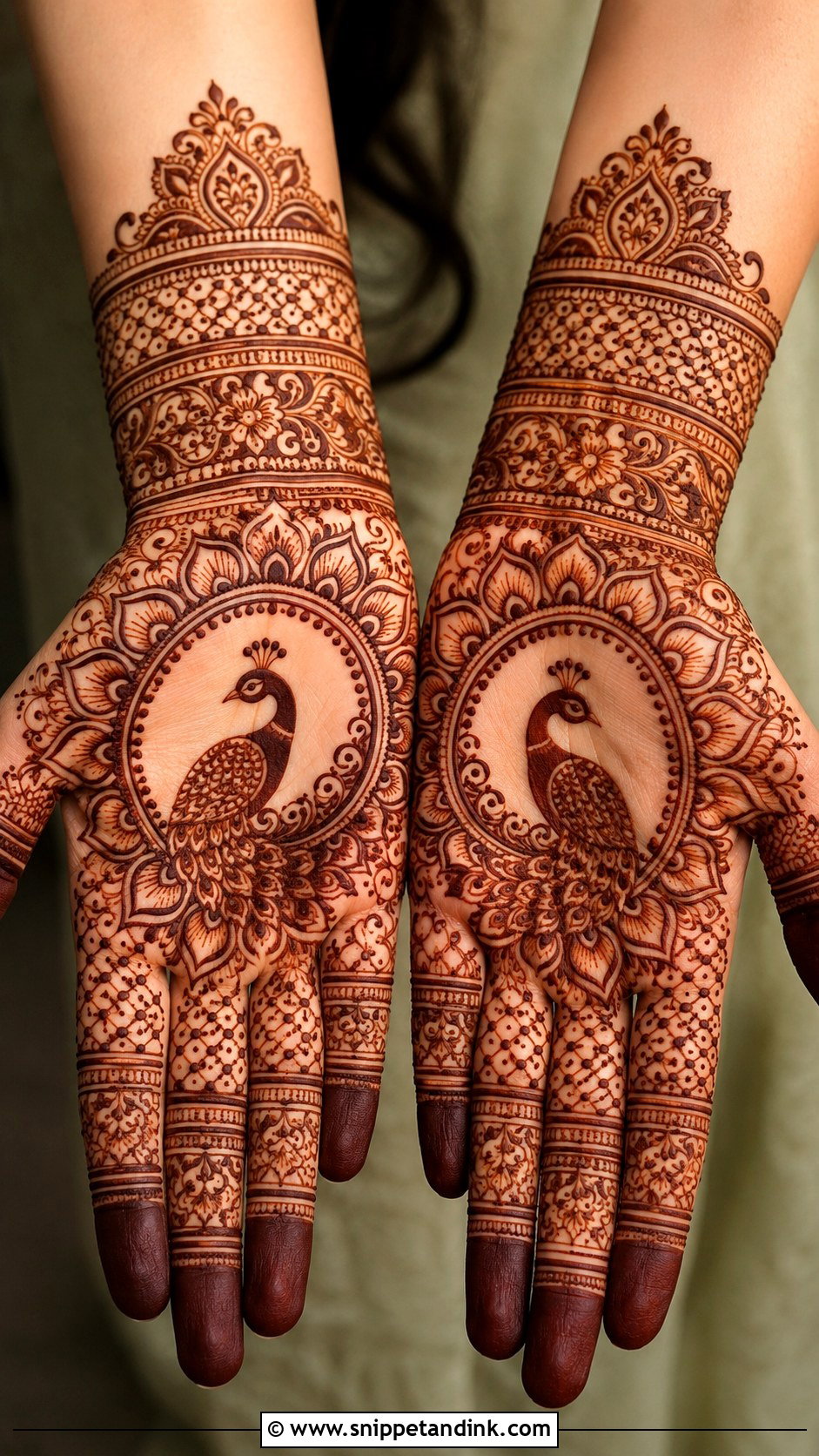
Karwa Chauth peacocks are usually traditional and detailed: the bird on the palm inside a mandala, paisley or lotus frame, with bracelet bands, jaali mesh and floral borders carrying on to the wrist. Most women want both hands done, so matching birds on each palm balance nicely. You’ll be fasting and still carrying out rituals and daily tasks, so I keep the fingers comfortable rather than packed. Bold outlines for the peacock, delicate filling around it.
31. Peacock Teej Mehndi Design
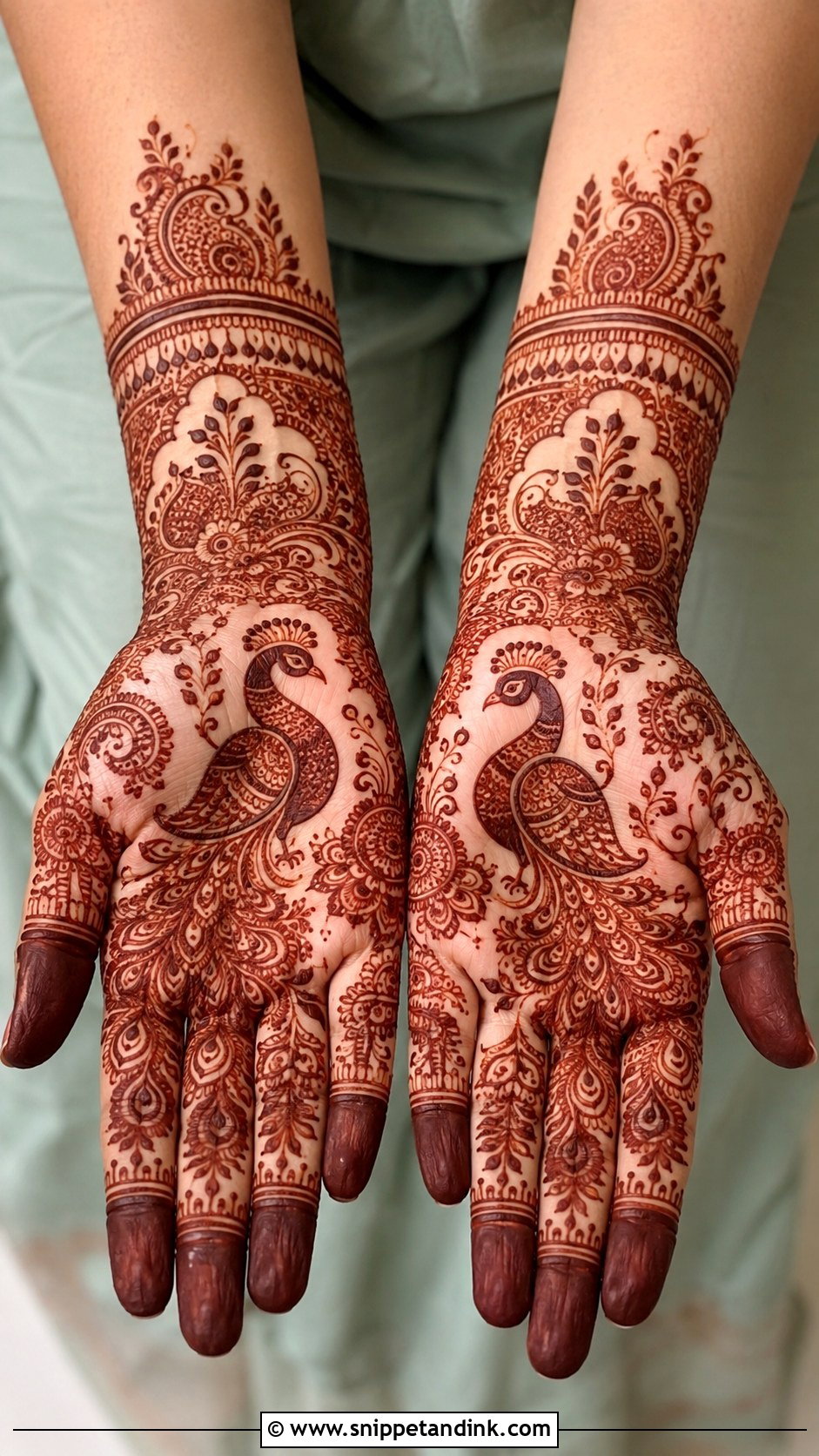
Teej falls in the monsoon, the season Indian folk songs link with dancing peacocks, so the bird feels especially at home on Teej hands. A central peacock on the palm, leafy vines along the wrist and filled fingertips make a classic look, with florals, paisleys and curved feather fans for life. Medium to full coverage sits well with the bright green and red outfits and bangles of the festival. A sweeping tail rather than a stiff fan keeps it lively.
32. Peacock Feet Mehndi Design
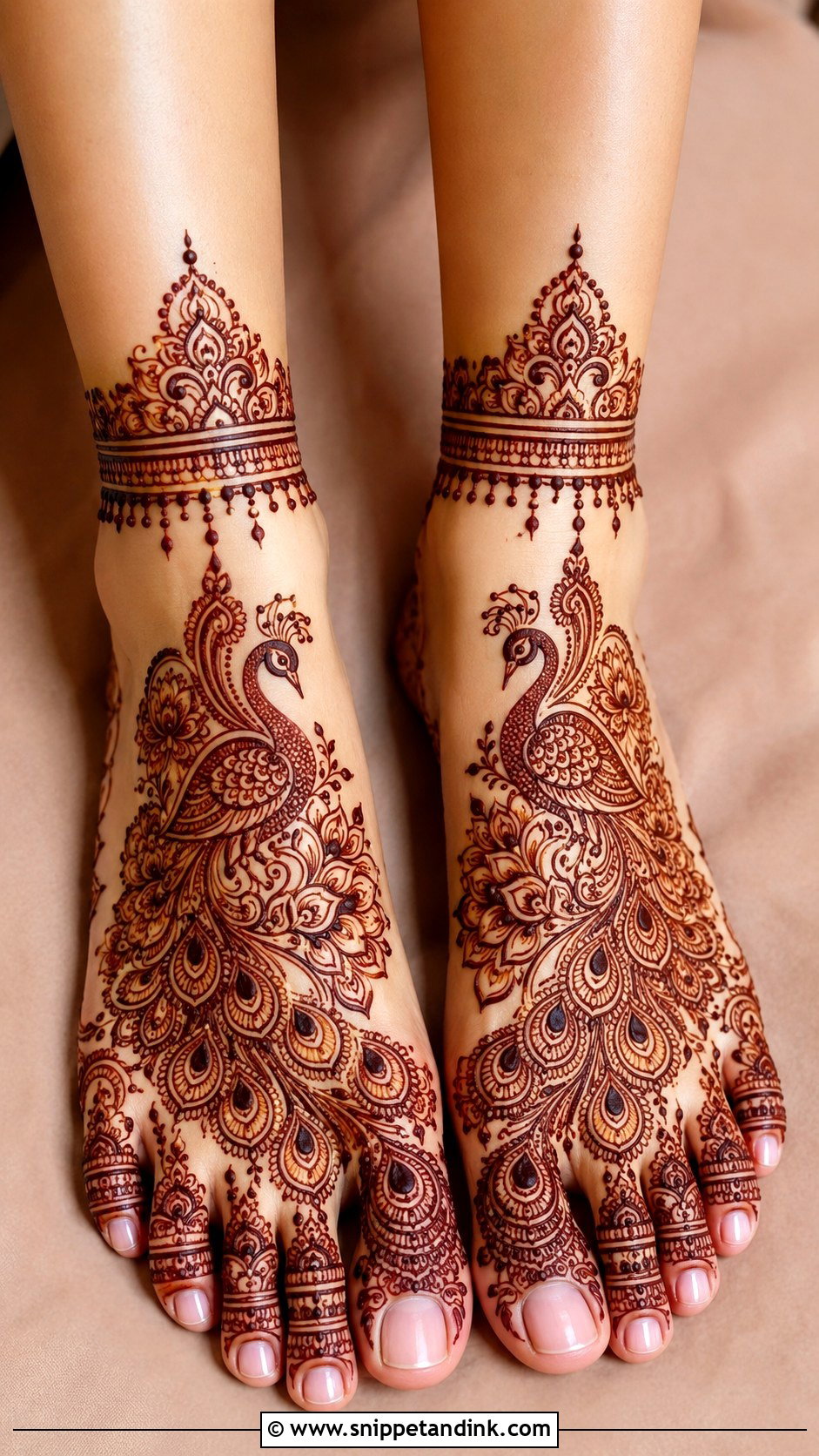
A peacock feet mehndi design places the bird on top of the foot with feathers spreading toward the toes or ankle, then adds anklet borders, lotus petals, paisleys and dotted chains. I use slightly bolder lines on feet than on hands, because walking, footwear and floors wear fine detail away quickly. Small bands or leafy tips decorate the toes, and bridal versions climb toward the ankle and lower leg. Barefoot ceremony moments show it off.
33. Peacock Anklet Mehndi Design
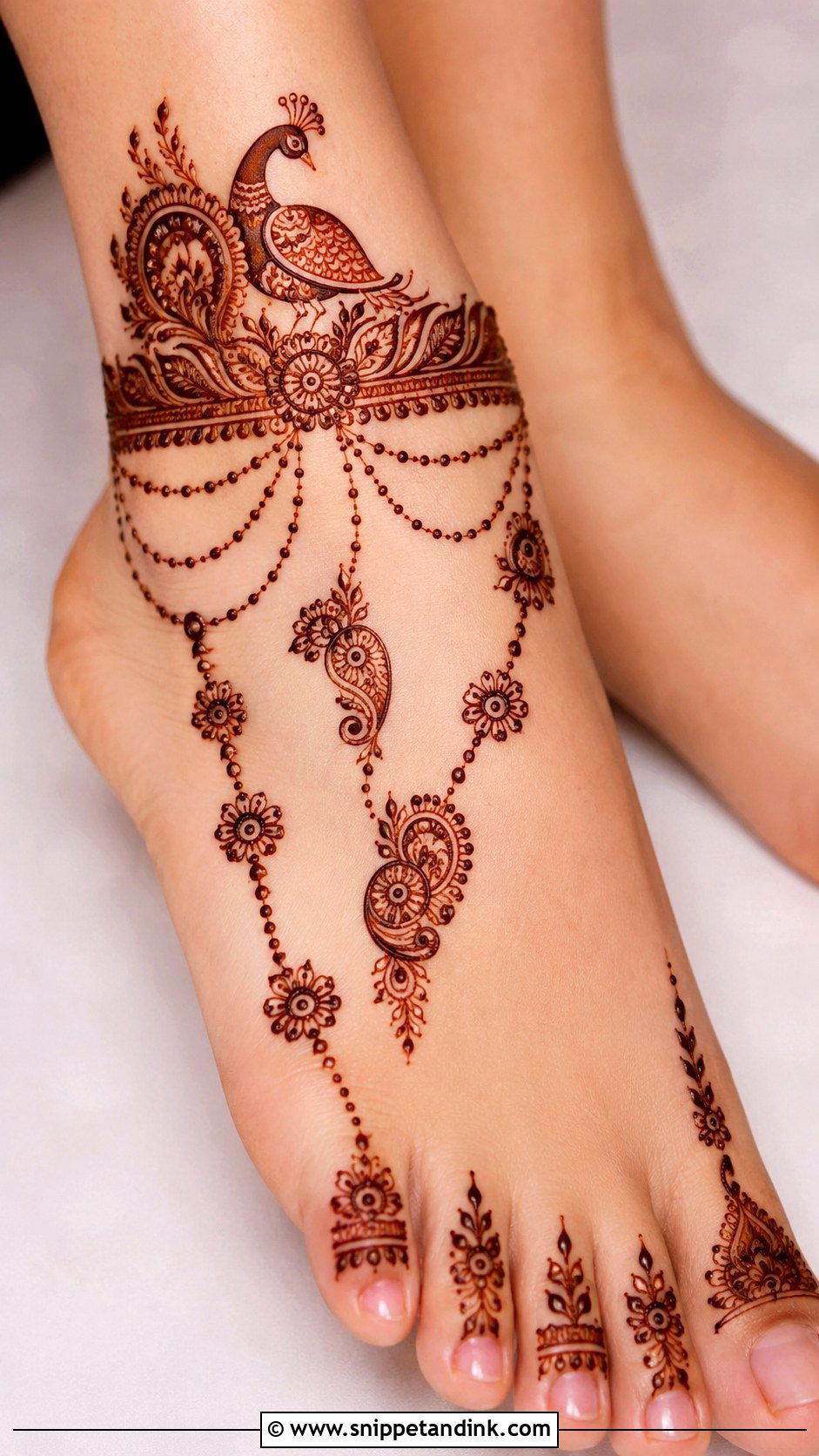
This one turns the peacock into an anklet. The bird sits on one side of the ankle and its feathers curve into a band around the foot, with dotted chains, tiny flowers and paisley links completing the jewellery effect. It’s lighter than full foot mehndi but still looks festive, and bridesmaids and Eid guests like it with sandals. Leave the top of the foot clean or add a small matching feather. Expect sandal straps to rub at the band over a long evening, so place it where the strap doesn’t sit.
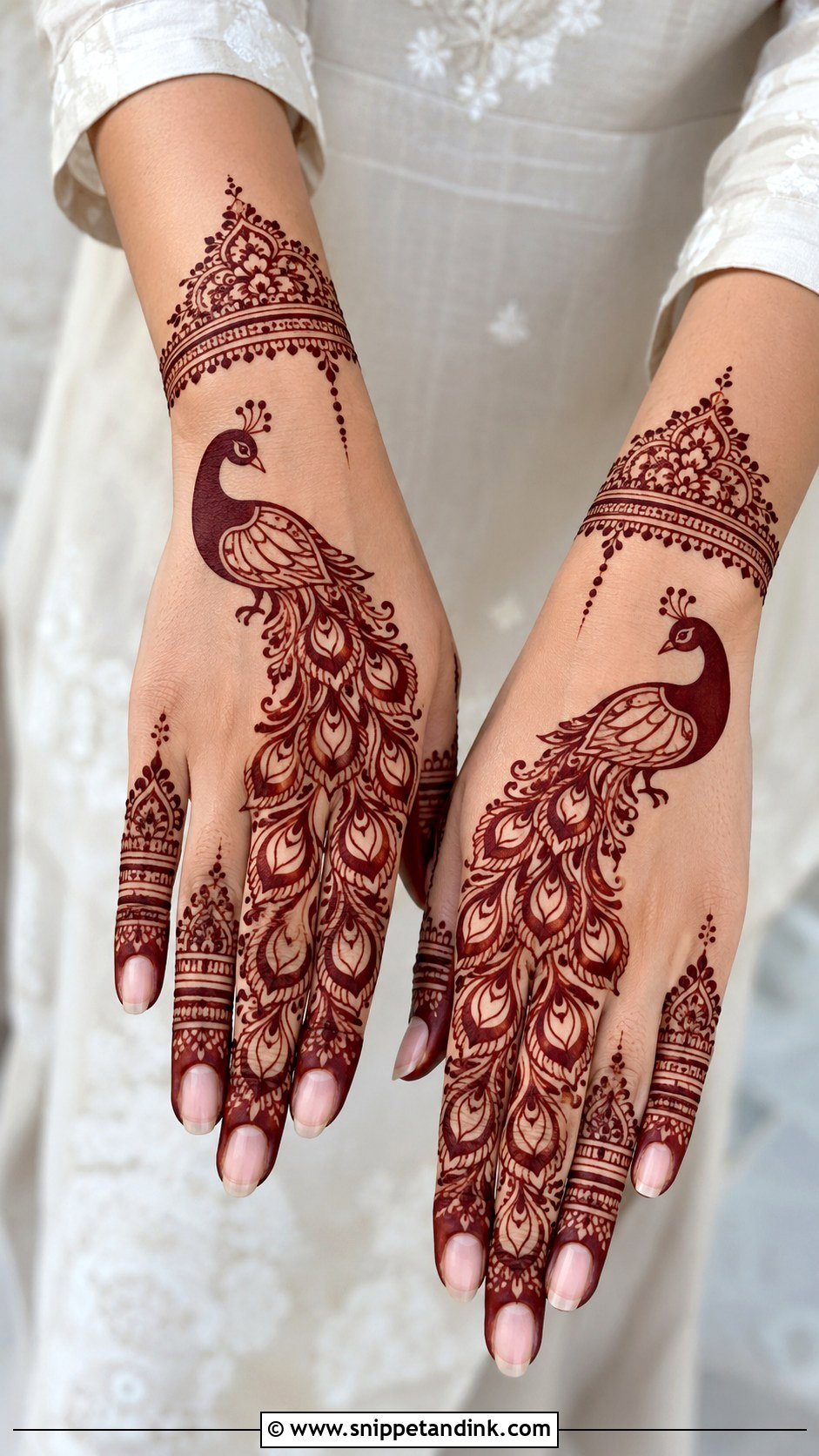
34. Peacock Shaded Mehndi Design
Shading gives the peacock depth through soft filled areas: feathers shaded with thin strokes, flowers and paisleys darker at the edges and lighter in the centre. It looks full without every section being dense, and it suits Arabic, Indo-Arabic and modern layouts. I outline everything boldly first, then shade inside petals, wings and feather eyes. Over-shade the whole hand and you lose the contrast that makes it work, so leave clean skin around the bird.
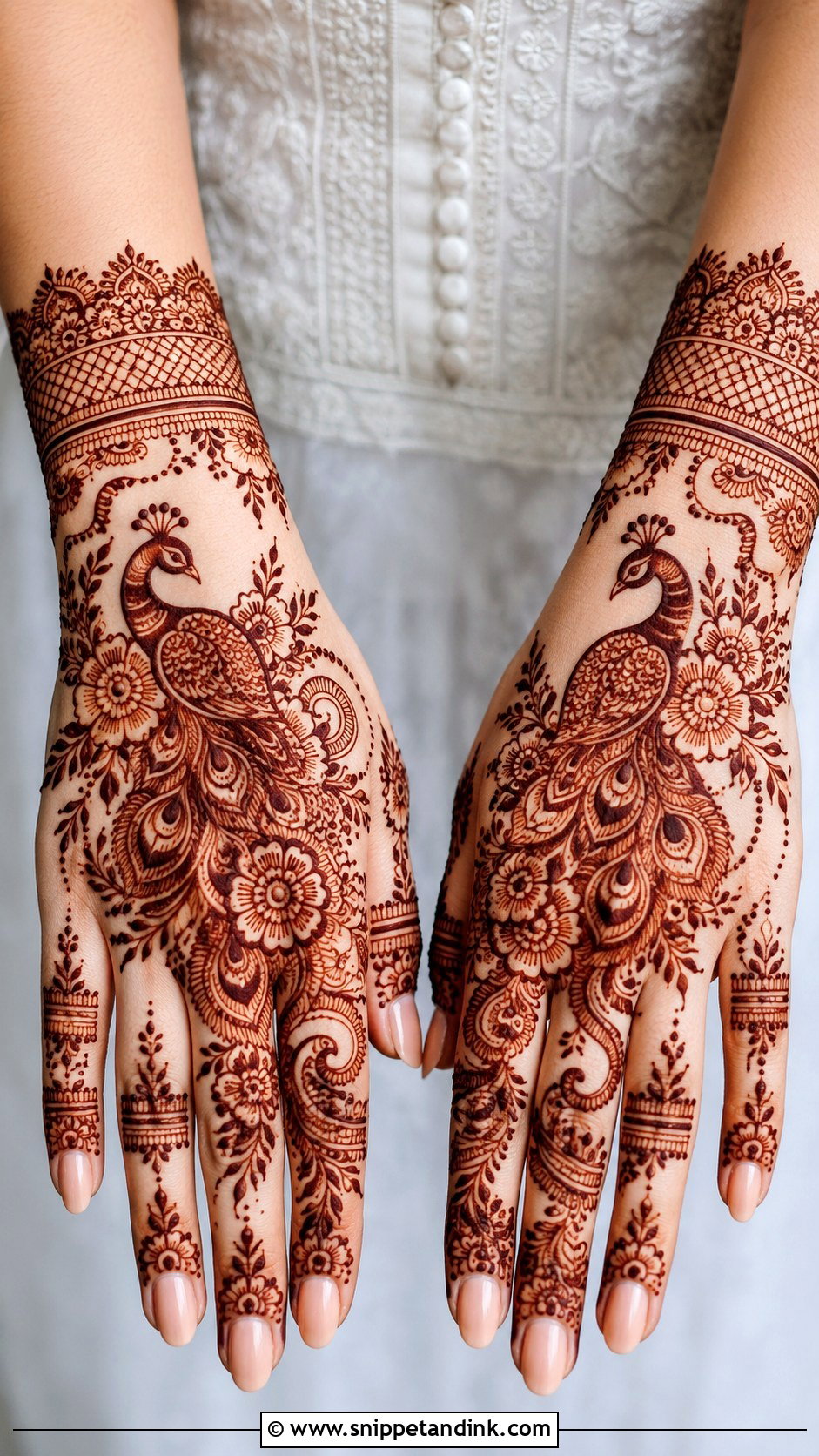
35. Peacock Negative Space Mehndi Design
Negative space flips the usual approach: open skin is left inside the feathers, wings or body so the bird is defined by its outline and the gaps. The contrast makes the peacock stand out sharply on the back of the hand, the palm or a wrist-to-finger trail. Fine dots, clean borders and small florals around the empty areas balance it. It suits engagements, receptions and light festive days. Confident, unbroken outlines are what it depends on, since there’s no filling to hide a wobble.
Which Way Should the Peacock Face?
It’s a small question that changes the whole hand, and I ask it before anything else. A peacock facing inward, toward the thumb on the palm or toward the centre of the back of the hand, keeps the eye on the hand. One facing outward leads the eye off the edge, which can look like the bird is leaving.
For brides, I think about both hands at once. When the palms are held side by side for photos, two birds that face each other read as a pair, and many families like that symbolism. If you’d prefer them facing the same way, tell your artist beforehand, because it’s very hard to fix once the first hand is done.
- Bring a picture of your outfit’s sleeves. If the forearm will show, the tail can travel up the arm; if not, it needs to fan within the hand.
- Decide where the rings and bangles will sit, so the bird isn’t hidden under a kada or a ring.
- If you want initials hidden in the feathers, say so before the drawing starts. Adding them later means squeezing them into whatever gap is left.
- Tell her which hand you write with. I put the larger bird on the hand you’ll use less, since that hand stays still while the paste sets.
One Bird, From a Single Feather to Both Arms
A few changes in layout take the peacock from simple to bridal, modern, royal or festive. A full bird looks grand and traditional, a single feather looks light. Mandalas, paisleys, florals, jaali, vines and negative space all sit comfortably beside it. Palm placements suit ritual-heavy days, back-hand placements suit photos, and feet or anklet designs round out a bridal look. If you’re new to henna, practise the simple outline with open feathers first; for a wedding, go fuller, with bold birds and fine filling.
You'll Like These Ideas:








Leave a Reply