
A full hand of bridal mehndi is the one part of your wedding look you keep wearing for weeks, and it turns up in almost every close-up from the first ritual to the farewell. Full hand henna is still the booking I’m asked for most, because it gives a design room to tell a story: initials hidden in a vine, a palace arch across the wrist, two peacocks facing each other across both palms. The twenty layouts below run from dense Indian and Rajasthani work to airy Arabic trails and modern negative space. Before you fall for one, think about your sleeve length, how long you can sit still, and how dark the stain will read on your skin.
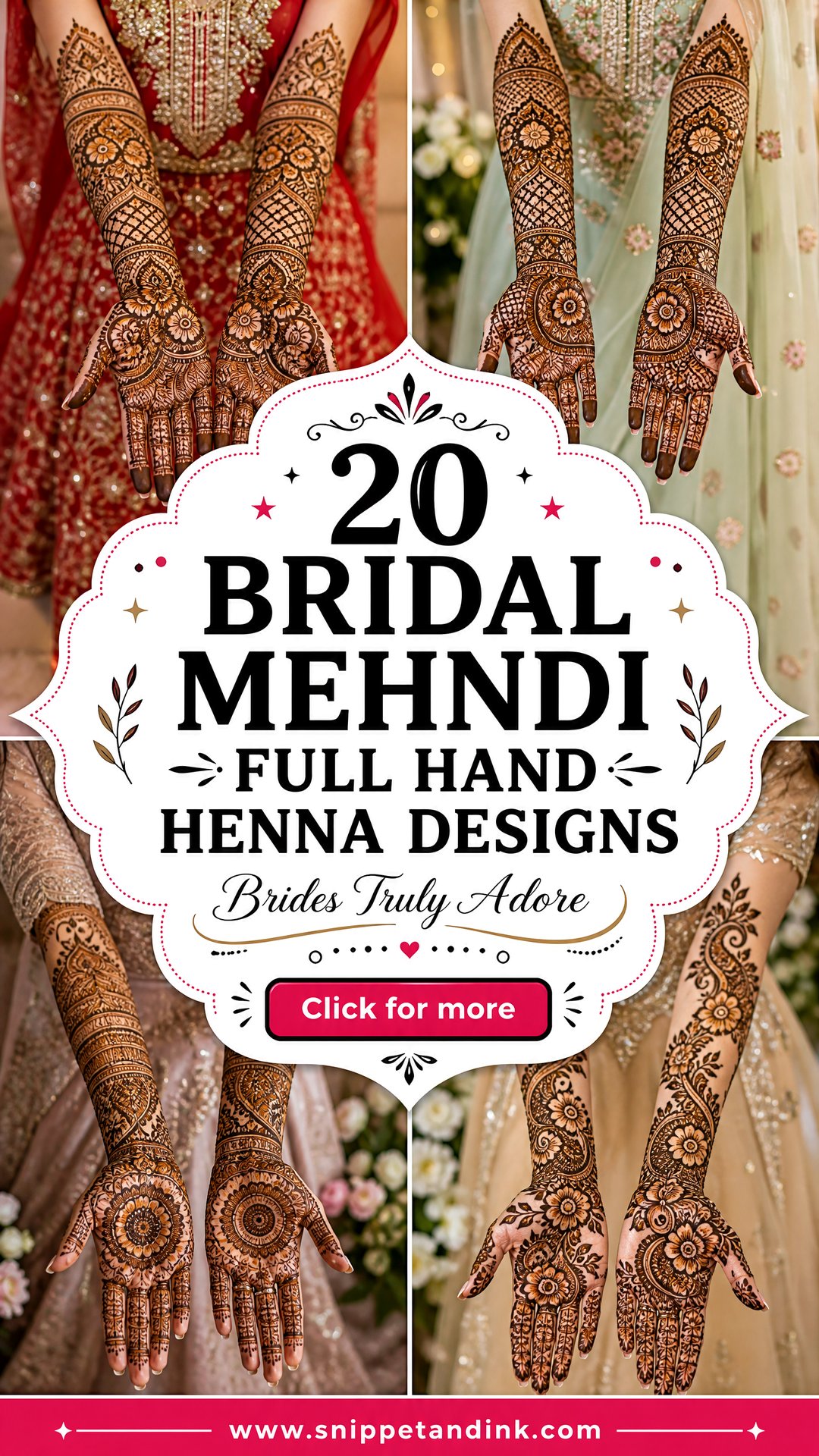
Planning Full Coverage Around Your Sleeves, Skin and Sitting Time
Before I draw a single line, I ask three things: how far your sleeves come down, how long you can realistically sit, and which function matters most. Those answers shape the design more than any reference photo.
Your sleeve decides where the design ends
There’s no point drawing elbow-length detail that a full sleeve will hide. If your blouse or kurta stops mid-forearm, I finish the design in a clean cuff just below the hem, so the border shows instead of being cut off by fabric.
Palms stain darker than the backs of your hands
Henna stains deepest where the skin is thickest. Palms and inner fingers go maroon, while the backs of the hands and the forearms stay a few shades lighter. Very fine fill on the back of the hand can look faint next to the palm, so I use bolder shapes there to balance the two sides.
What to bring to the appointment
- Photos of your outfit, especially the sleeve and cuff.
- The bangles, rings and hathphool you plan to wear.
- Any initials, dates or symbols you want hidden in the pattern.
- Motifs your family would rather avoid, so we settle that before the cone comes out.
- Something to eat and a friend to hold your phone, because a front-and-back set to the elbows can take most of a day.
1. Indian Bridal Mehndi Full Hand
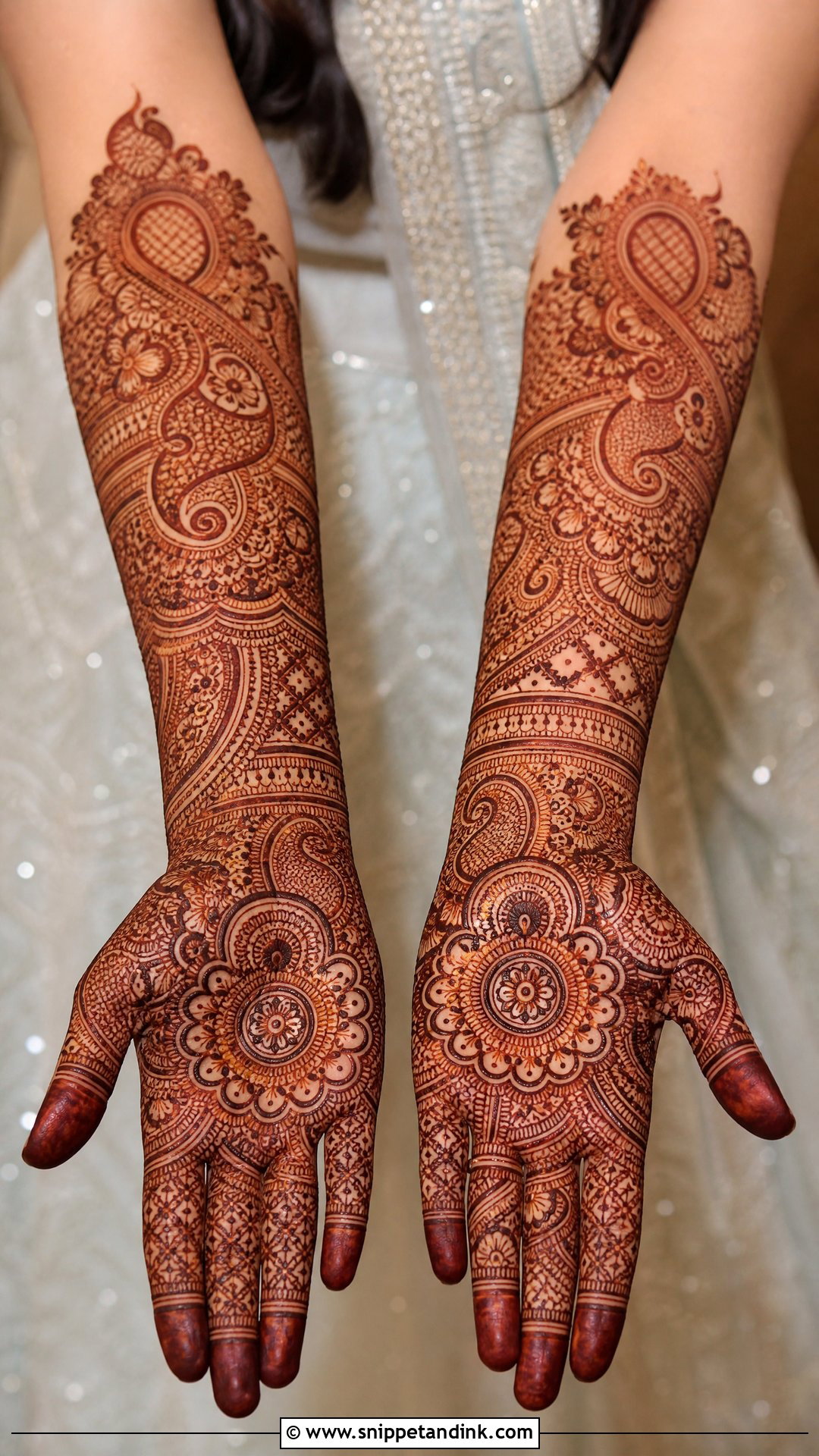
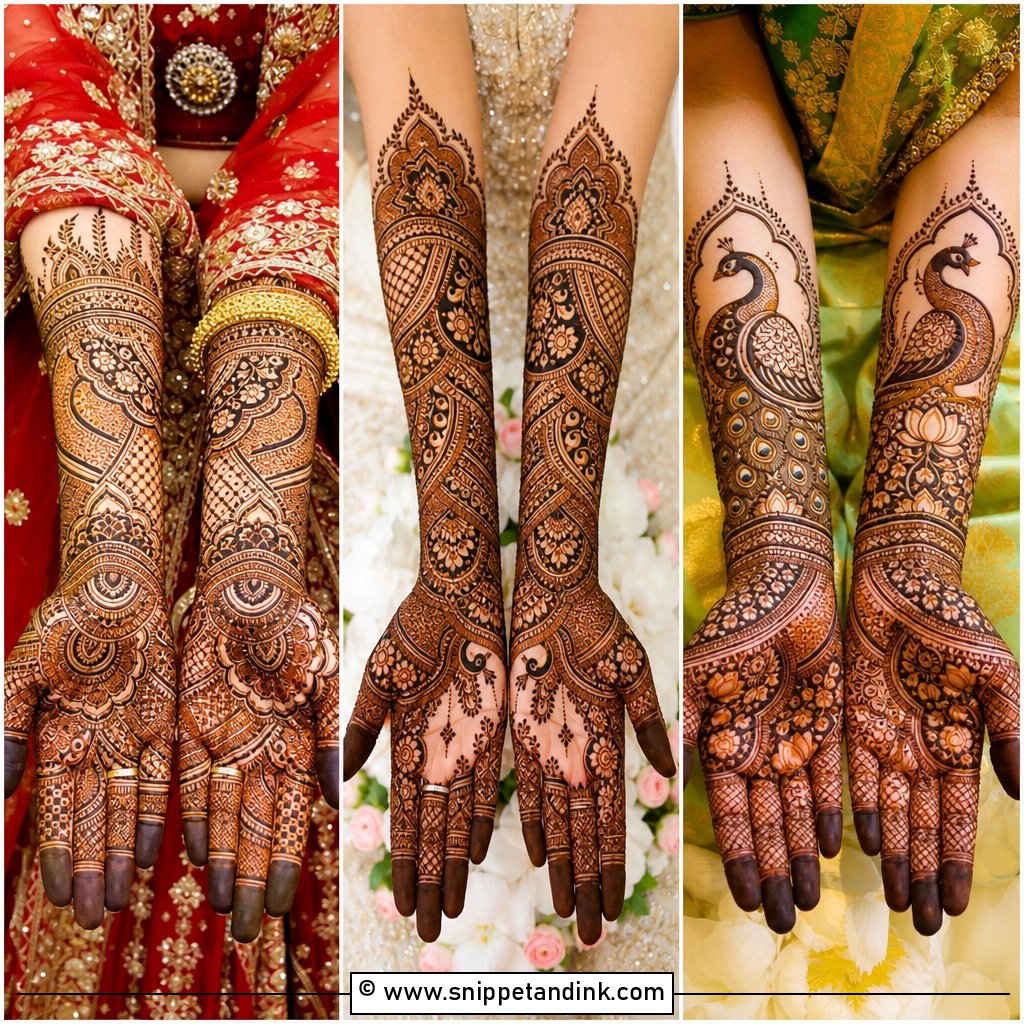
This is the layout most people picture: palms, fingers, wrists and forearms filled with paisleys, florals, mandalas, peacocks and fine filler lines. Next to a heavily embroidered outfit, that density reads almost like a second layer of jewelry. Plenty of brides tuck the groom’s name, the date or a small personal symbol into it. What I watch while drawing is breathing room. Henna lines swell slightly as the paste sits, and the stain creeps a fraction into the skin, so fillers drawn too tight can merge into a muddy patch by day two. I leave tiny gaps on purpose, and those gaps are what keep the detail legible once the color has deepened.
2. Arabic Bridal Mehndi Full Hand
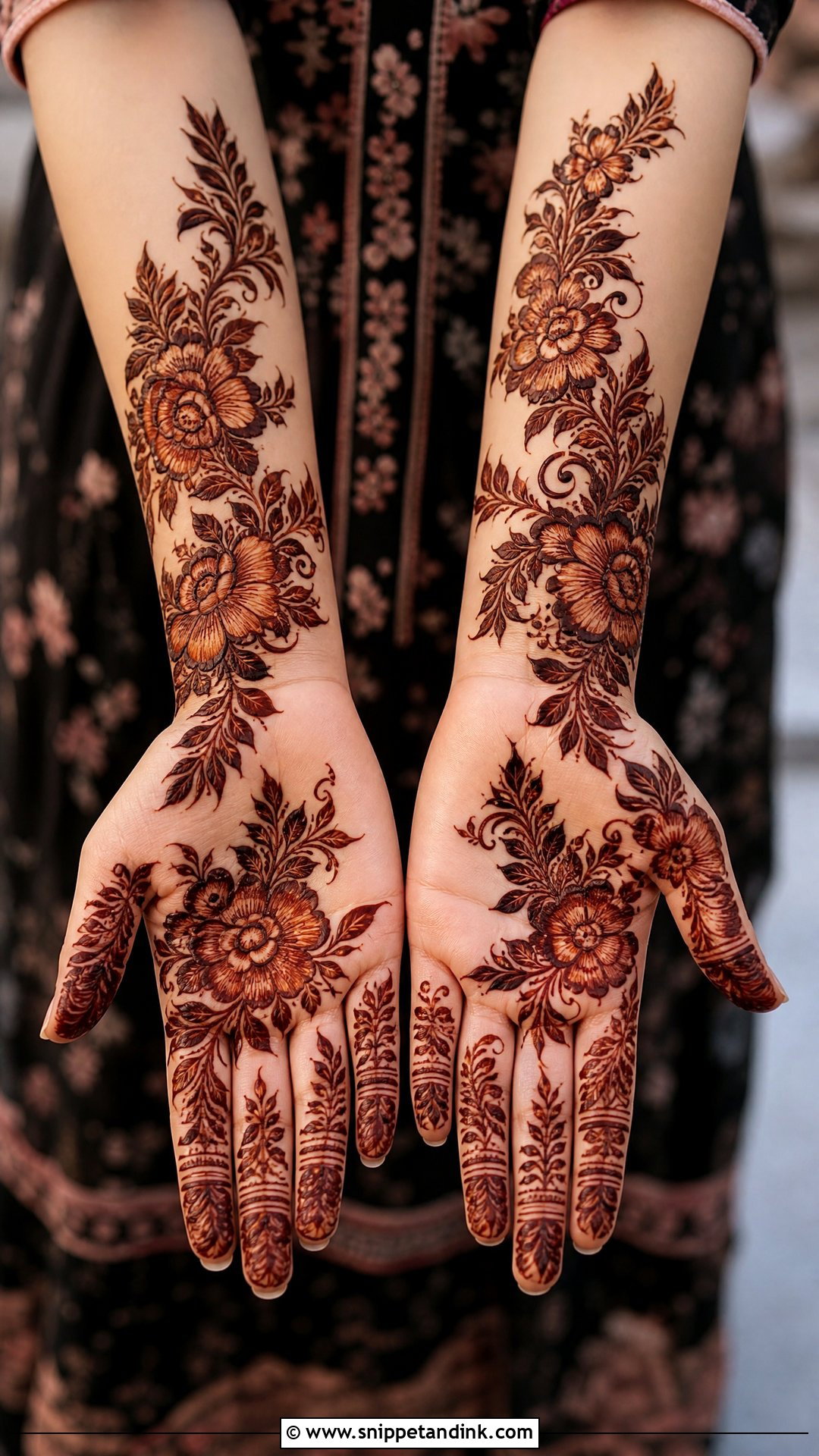
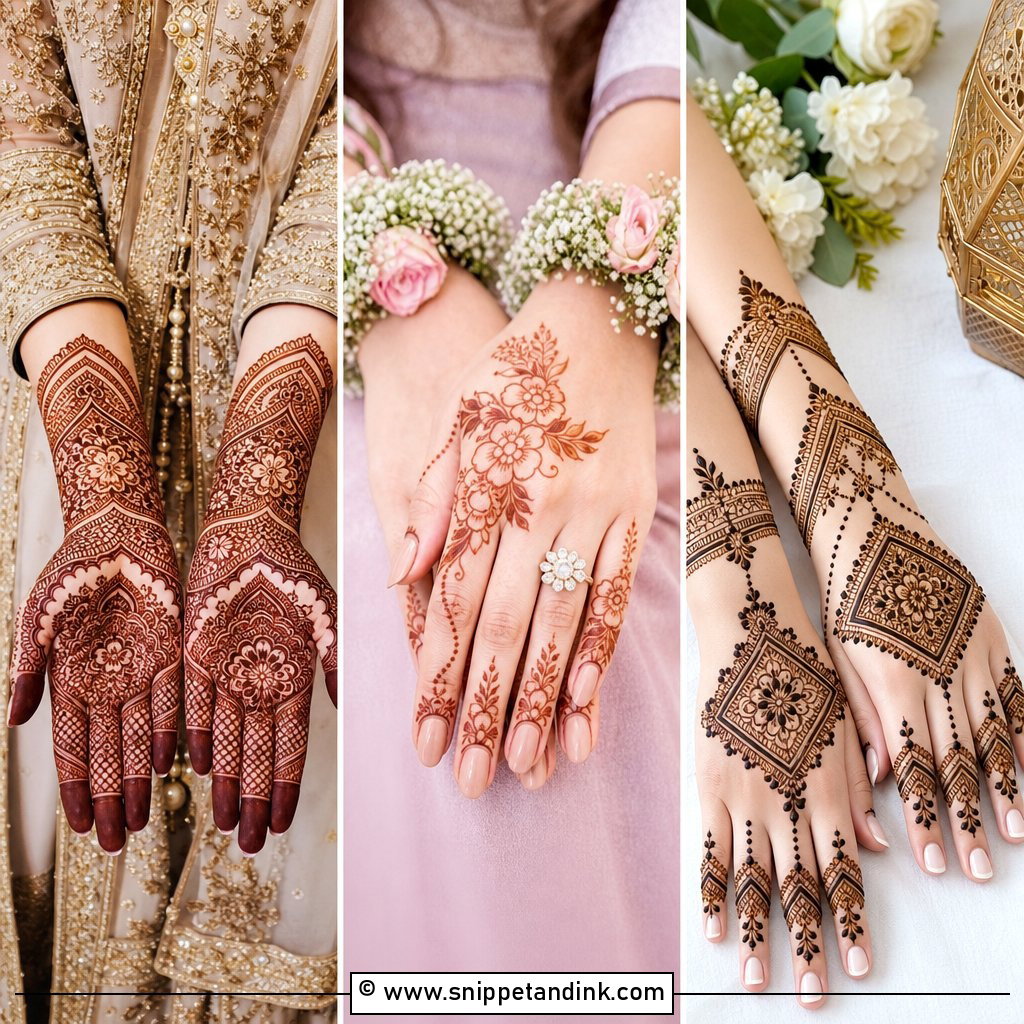
Arabic work moves diagonally across the palm and climbs the wrist and forearm in a trail of bold flowers, leafy vines and shaded petals, with bare skin left between them. That bare skin is the point. Each motif separates cleanly on camera, which is why I suggest it to brides in pastel lehengas or lighter makeup. Shading is done by dragging a thin layer of paste across the petal, and it stains a shade paler than the outline, so ask to see that effect on your own skin first. To make it read as bridal rather than party henna, carry the trail up to the elbow and add finger caps or a bracelet band at the wrist.
3. Indo Arabic Bridal Mehndi Full Hand
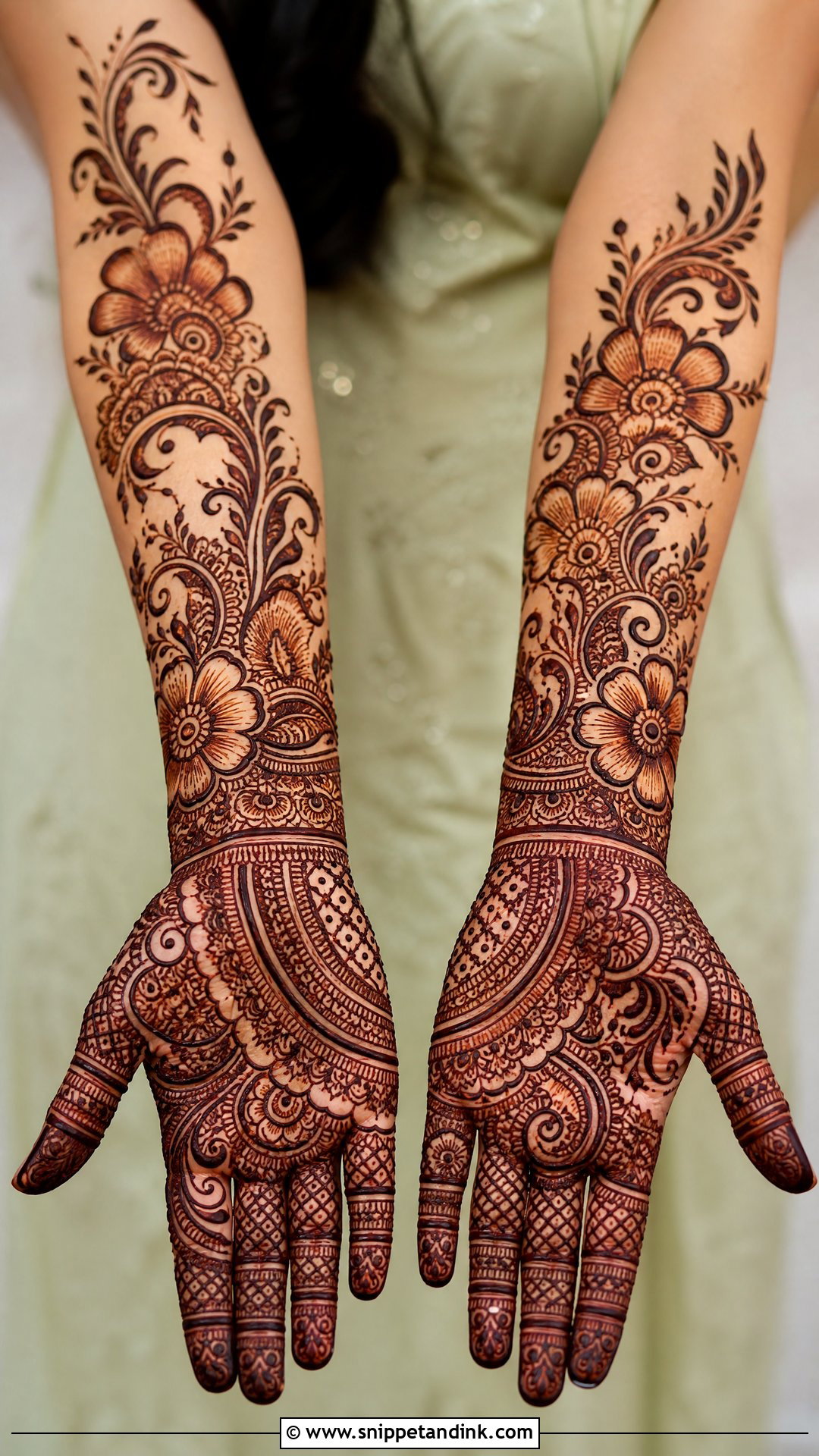
Indo Arabic bridal mehndi takes the bold flow of Arabic henna and fills chosen pockets of it with the fine detailing of Indian work. Big flowers and paisley vines form the skeleton; mandala centers and small mesh fillers go only where they earn their place. It reads at two distances, with the large shapes visible across a room and the fine lines rewarding a close-up. I suggest it when a bride wants front and back done but dreads a solid wall of pattern. The real skill is deciding where the fine work stops. Fill every pocket and you are back to plain Indian density.
4. Rajasthani Bridal Mehndi Full Hand
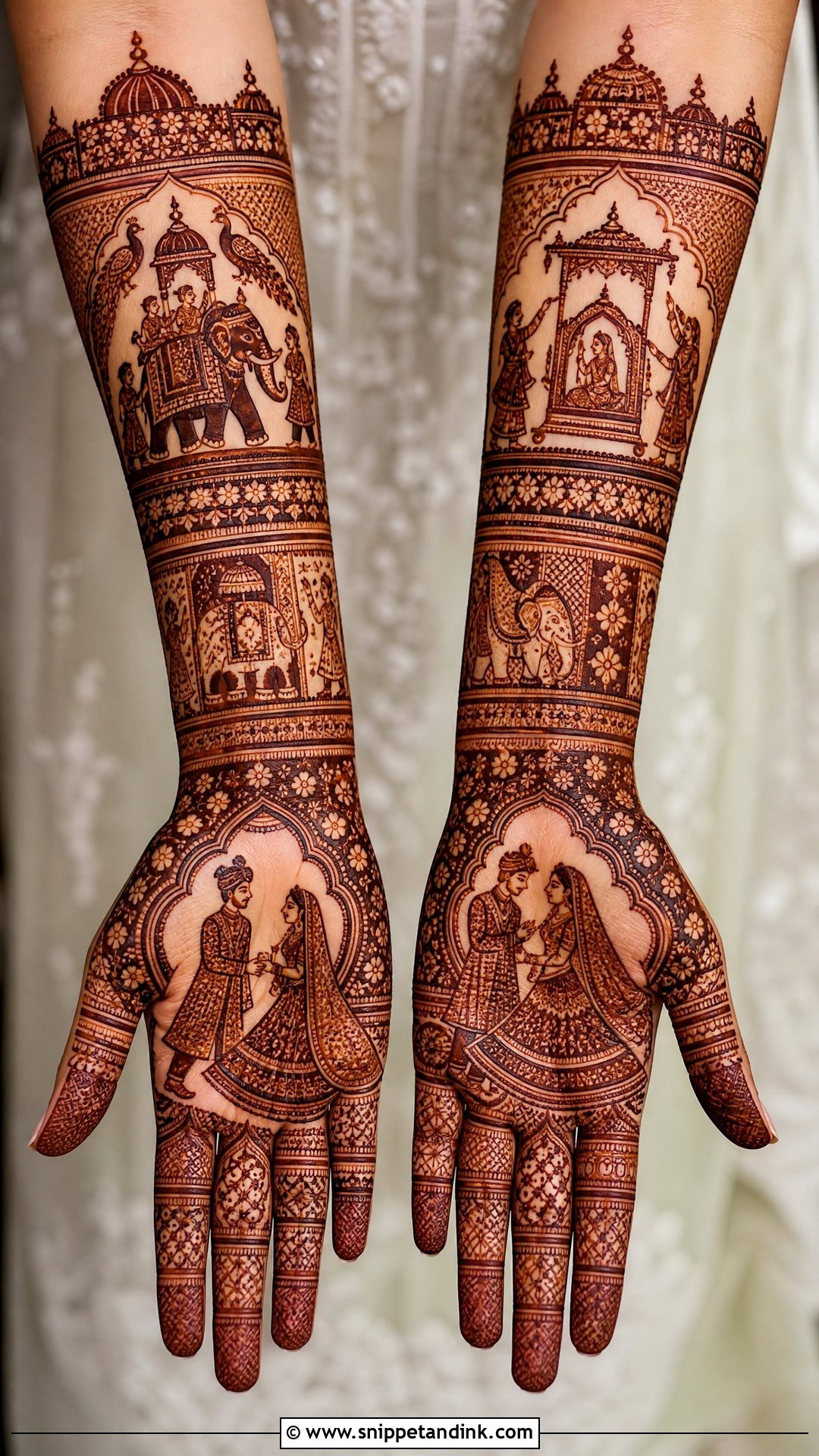
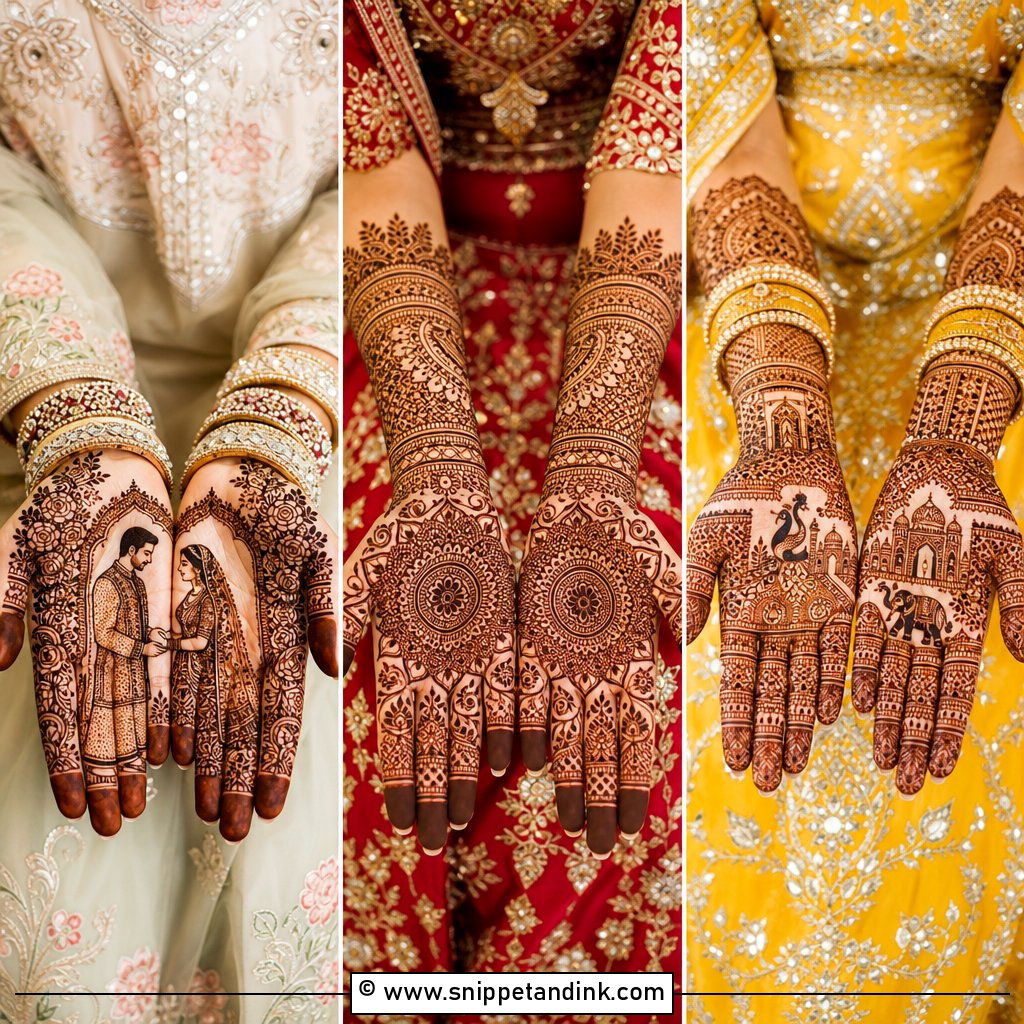
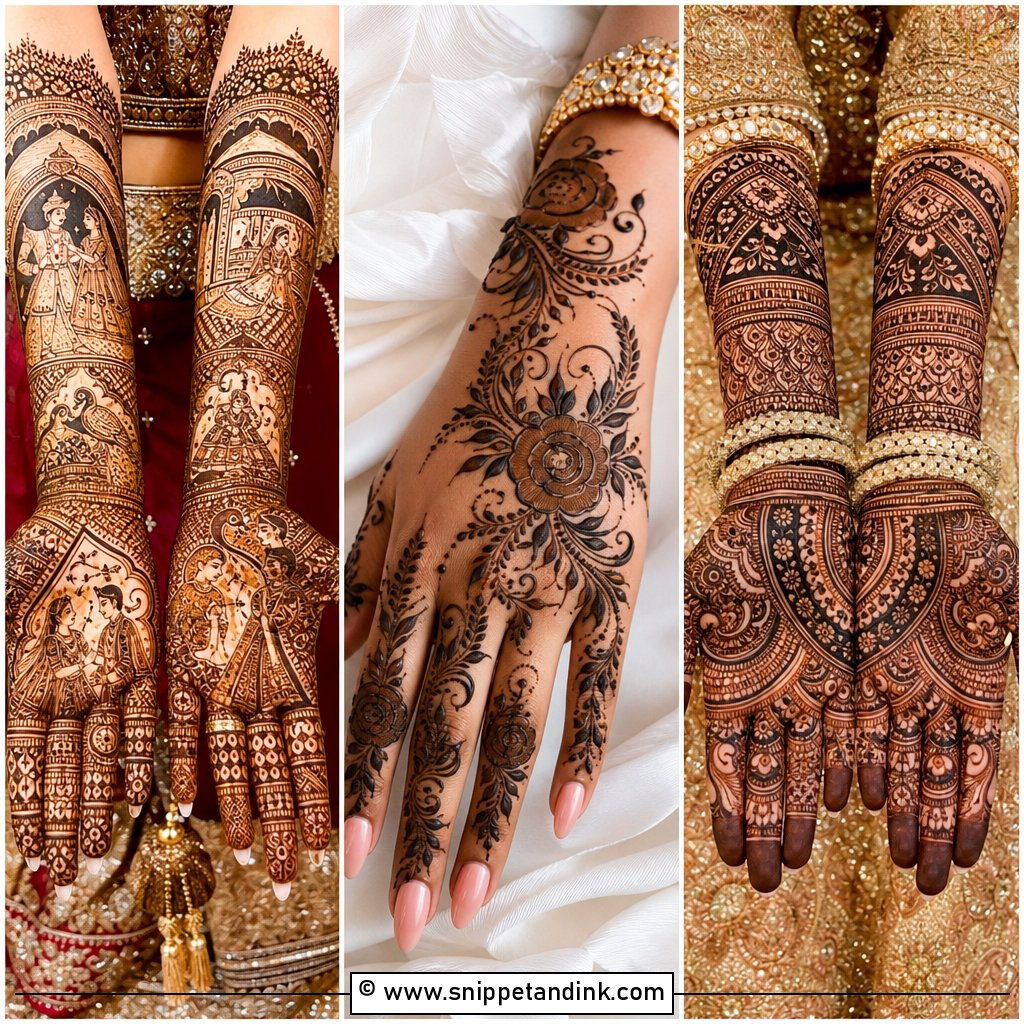
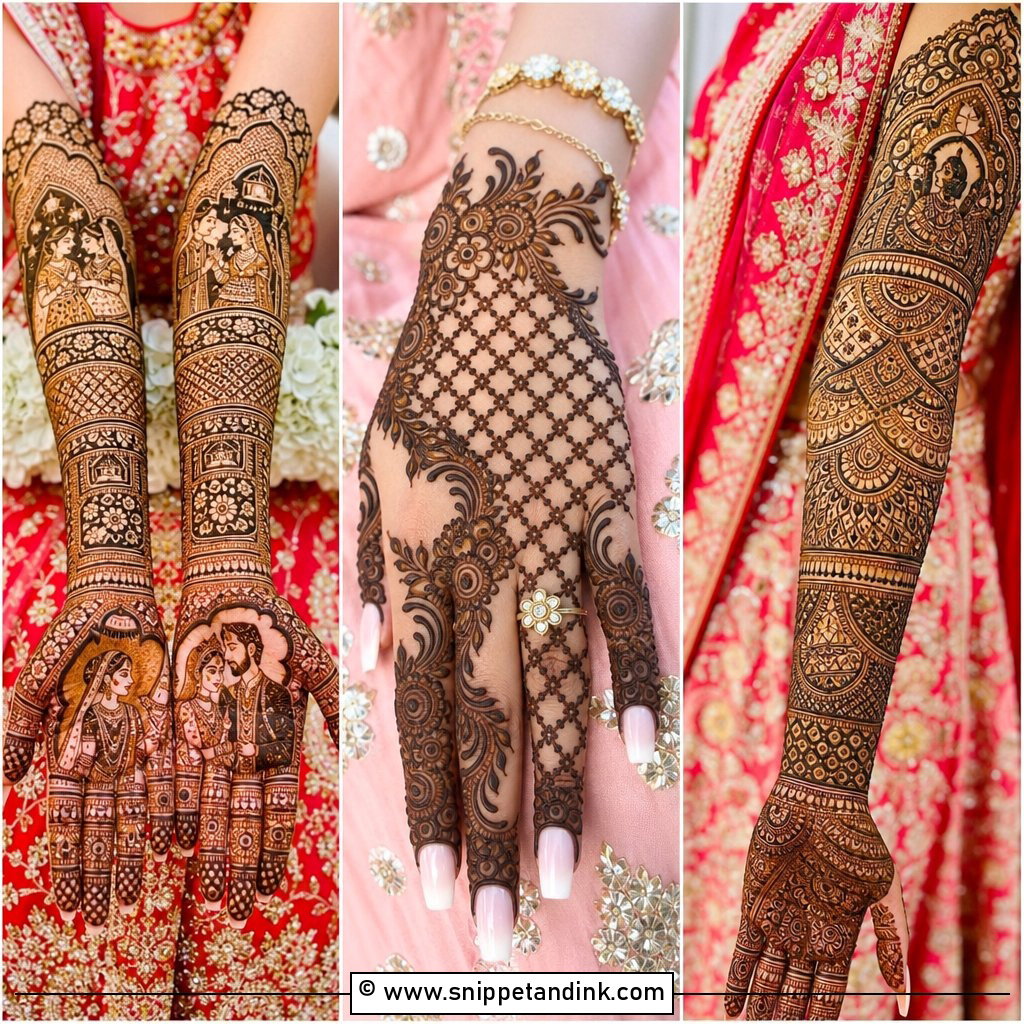
Rajasthani bridal mehndi is narrative work: bride and groom figures, jharokha windows, elephants, peacocks, a doli carried along the forearm, musicians tucked into the borders. It covers hand and forearm densely, and it is slow. Expect a long sitting, with pauses to let one hand set before the other is touched. Tiny figures need a very fine cone tip and smooth paste, and faces are where a rushed artist shows. Against red, maroon or gold-worked outfits, the dark stain holds its own. Ask for the groom’s initial hidden somewhere in the borders; searching for it is an old mehndi-night game.
5. Marwari Bridal Mehndi Full Hand
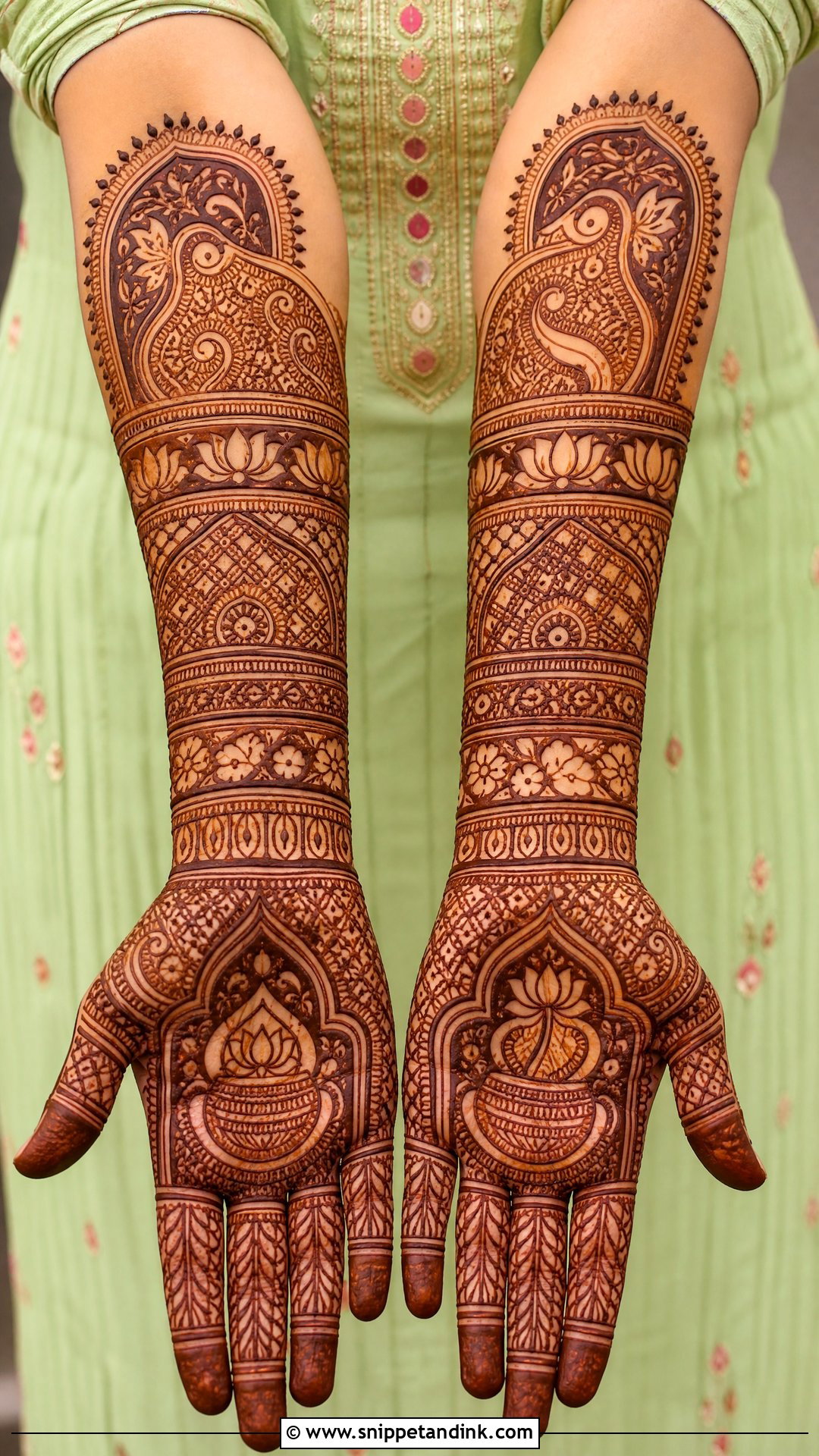
Marwari designs are built in panels. Dense paisleys, fine checks, lotus details and symmetrical blocks run from fingertips to forearm, with domes and layered bands stacked up the arm. Because the whole look depends on symmetry, I set the center of the palm by eye before drawing anything and compare both hands side by side after each panel. Even line weight matters more here than almost anywhere else, since one shaky outline in a checkered block is visible from across a room. If you want traditional richness without glitter or colored cones, plain natural henna on this pattern stains to a deep maroon on the palms.
6. Pakistani Bridal Mehndi Full Hand
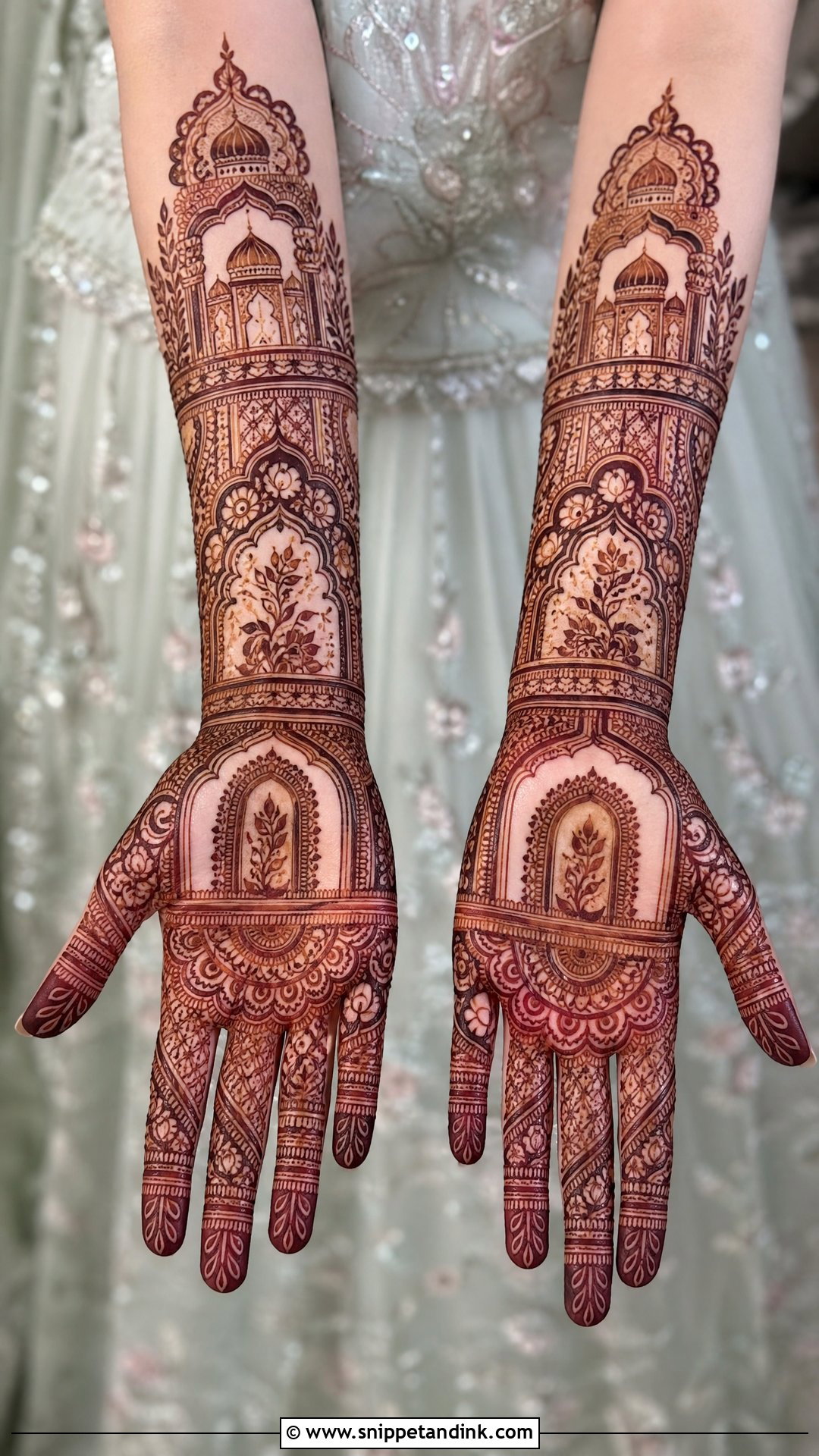
Pakistani bridal work often feels softer than Indian coverage even when it is just as full. The flow comes from domes, leafy vines, mandalas and net patterns linked by fine shading, with delicate work along each finger. Many brides wear one application across nikkah, mehndi and walima, so time it around the function you care most about, because natural henna peaks roughly two days after the paste comes off. Some want identical hands; others prefer two different layouts. A reddish-brown stain sits comfortably next to pearls, mirror work and heavy embroidery.
7. Peacock Bridal Mehndi Full Hand
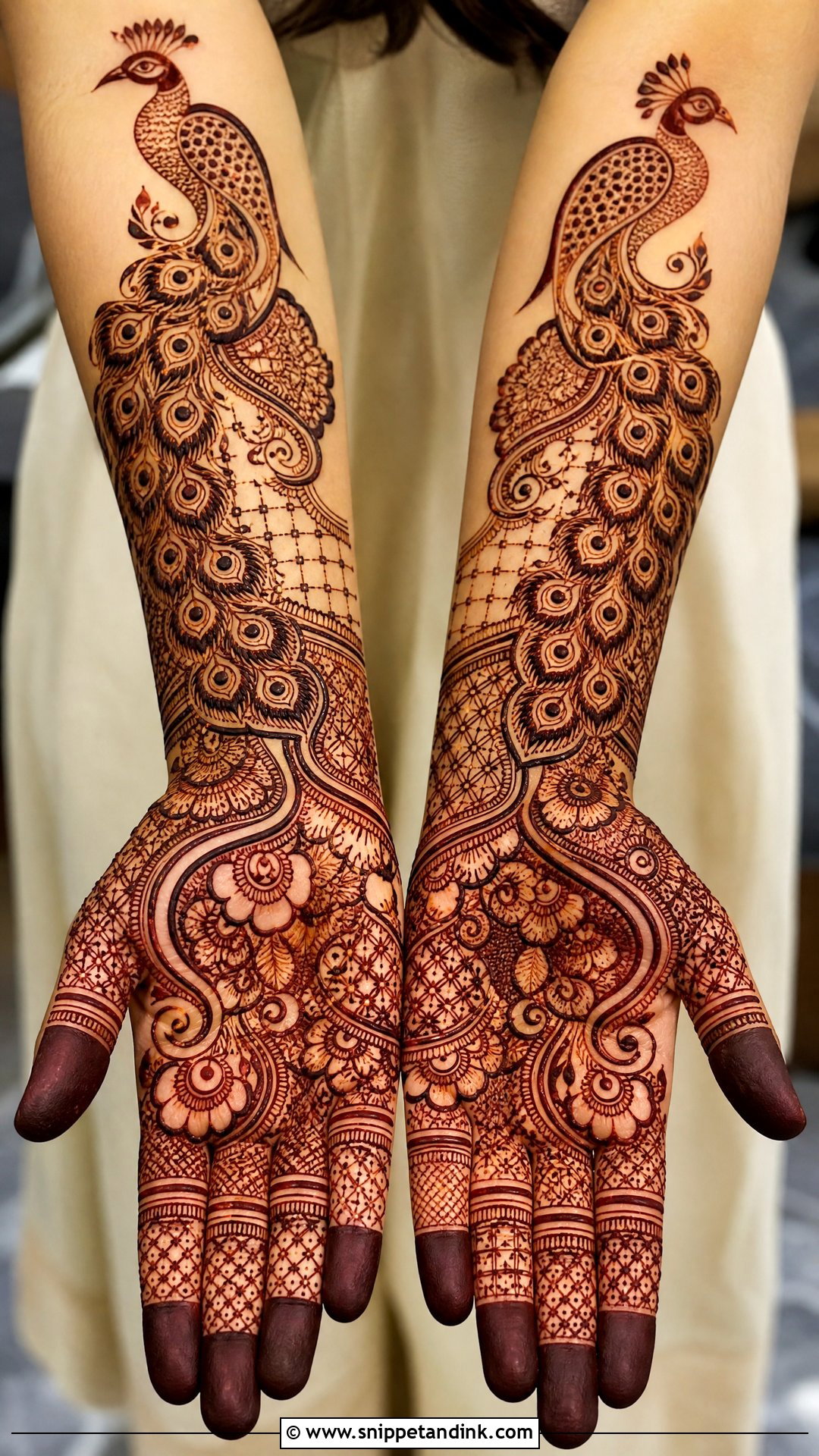
A peacock gives the hand a clear focal point without the risk of a portrait. It can sit in the palm, sweep its tail up the forearm, or appear as a mirrored pair that meets when you hold your hands together. Around it go feathers, paisleys, jaali mesh and vines. Here’s what usually goes wrong: the tail feathers get so much internal detail that the bird’s body disappears into them. I keep the body as the simplest, darkest shape on the hand and fill the fingers neatly so they frame it instead of competing.
8. Lotus Bridal Mehndi Full Hand
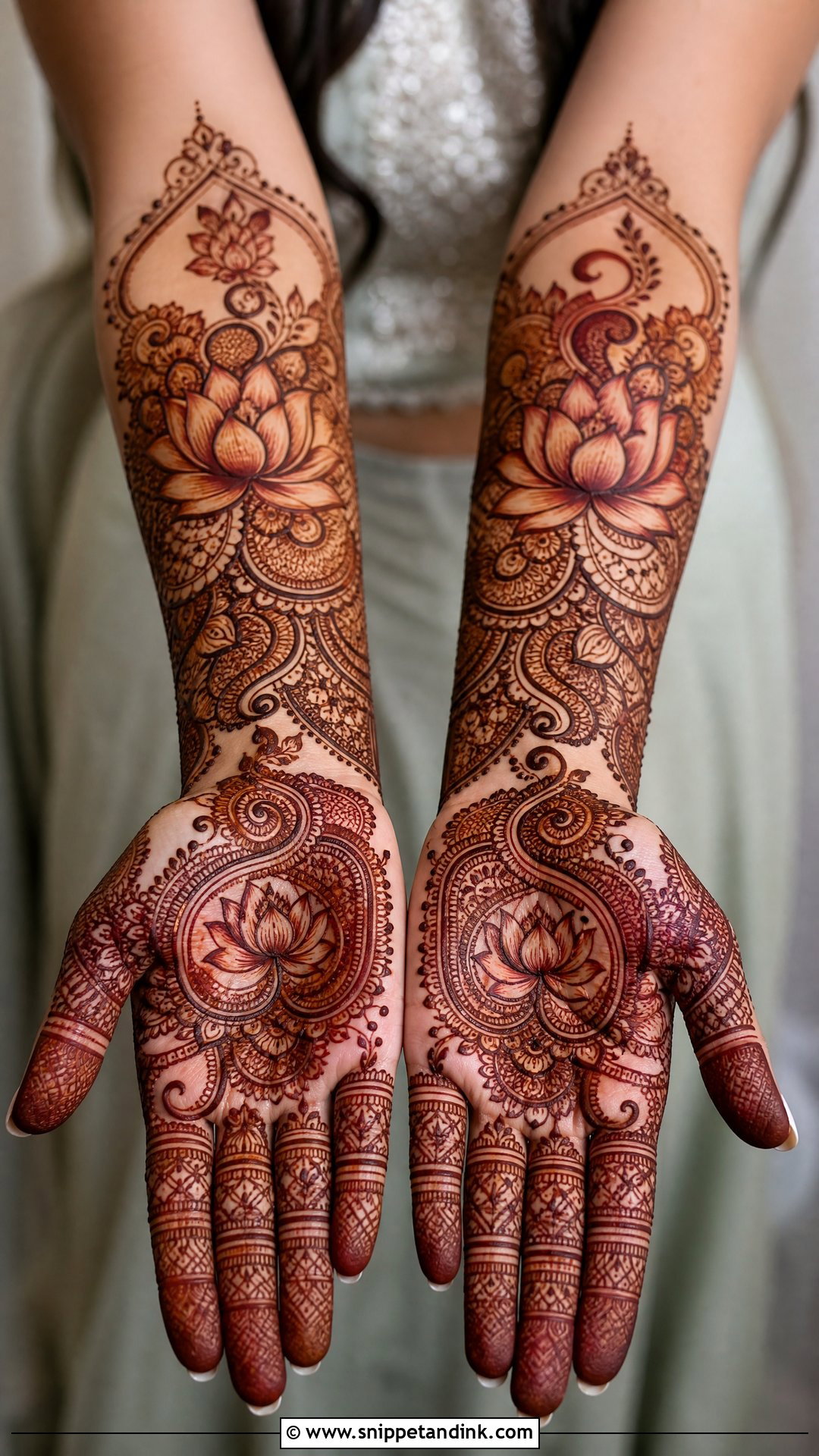
Lotus bridal mehndi holds its shape, which is why I reach for it on hands that will be photographed a lot. A lotus has broad, simple petals, so even after the surrounding fillers darken, its outline stays clear. It can sit in the palm center, ring the wrist, or repeat up the forearm with curved vines and dot work between the blooms. Petal shading is a nice touch, kept to the outer edges. Strict symmetry feels right beside a silk saree; let the vines wander a little if your outfit is contemporary.
9. Mandala Bridal Mehndi Full Hand
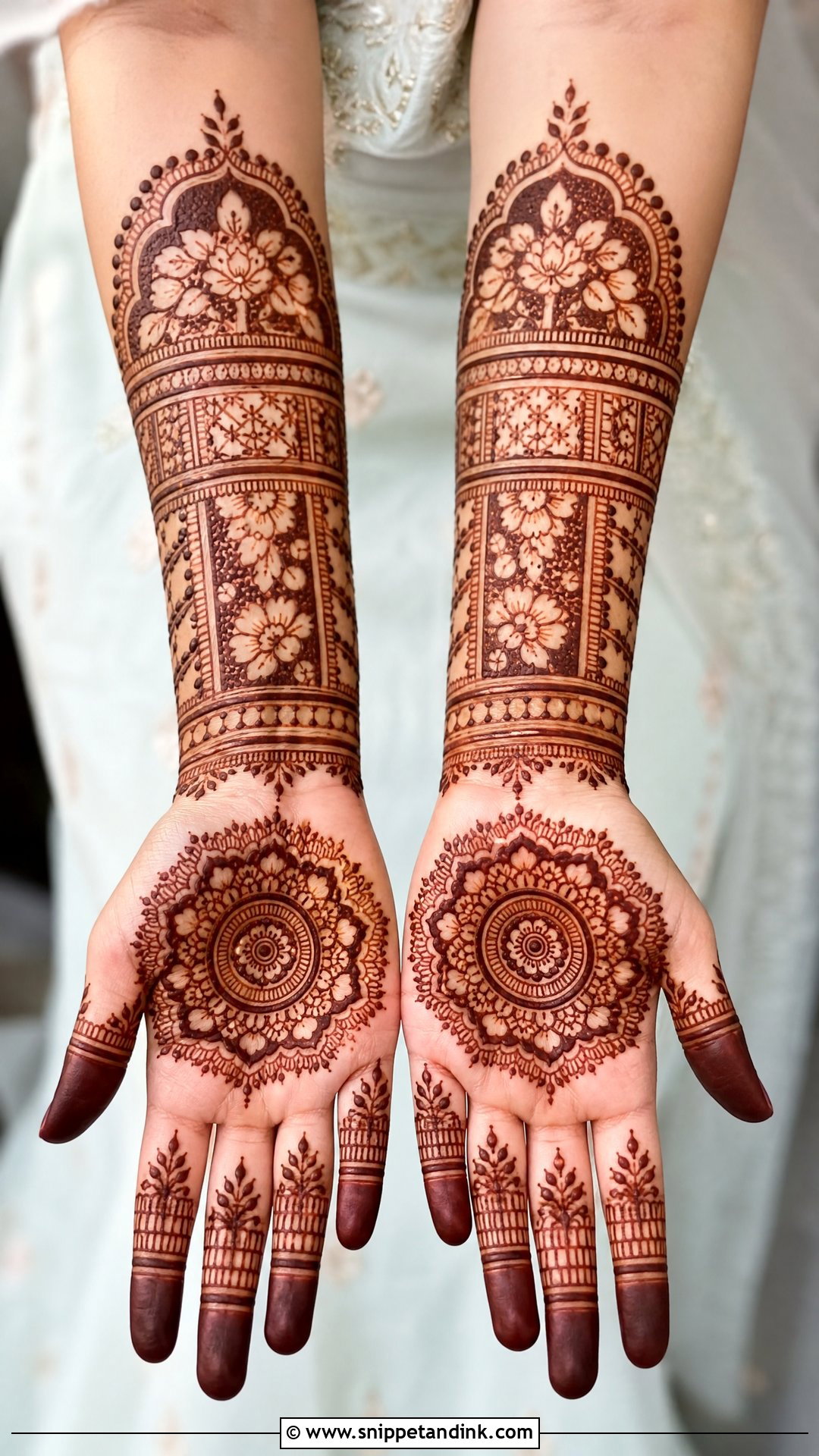
Mandalas suit brides who like order. The palm starts with a round center that expands into finger work, wrist cuffs and forearm panels, and the circle pulls the eye straight to the palm in the classic both-hands-up shot. The catch is that a mandala exposes every wobble. A slightly oval ring looks wrong in a way a crooked vine never does. So I draw the center first, while your hand is still fresh and relaxed, then build outward with leafy borders and dot rings.
10. Portrait Bridal Mehndi Full Hand
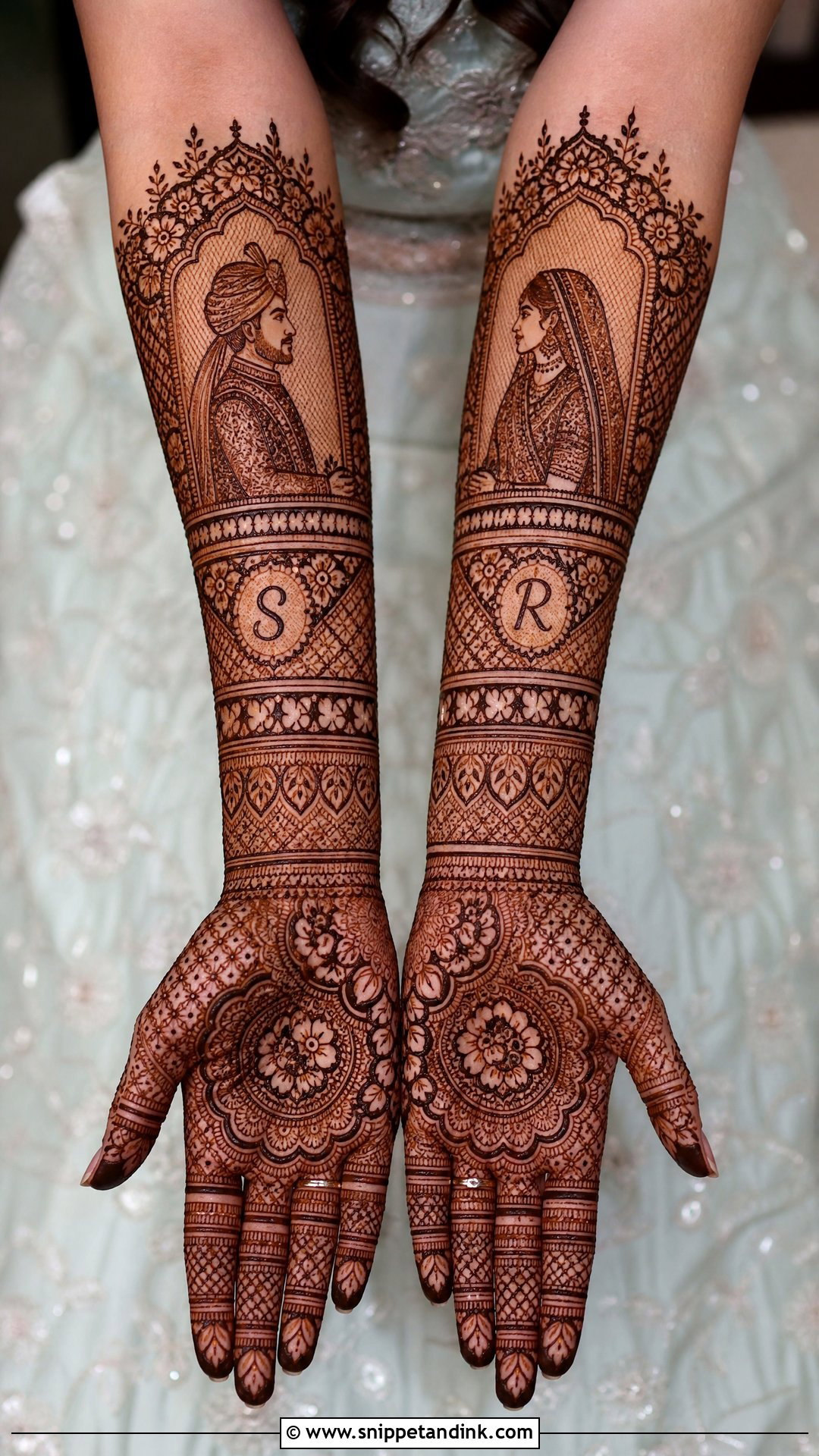
Portrait bridal mehndi puts the bride on one palm and the groom on the other, or works both into a single wedding scene, with florals, jaali and initials filling the rest. Faces are the hardest thing I draw in henna. The paste has to flow without blobbing, an eyelid is often a single stroke, and a nose cannot be corrected once it touches skin. Book an artist who can show you stained portraits, not only fresh paste, because the dark stain changes how a face reads. A little open space around each face helps it survive the darkening.
11. Bride Groom Bridal Mehndi Full Hand
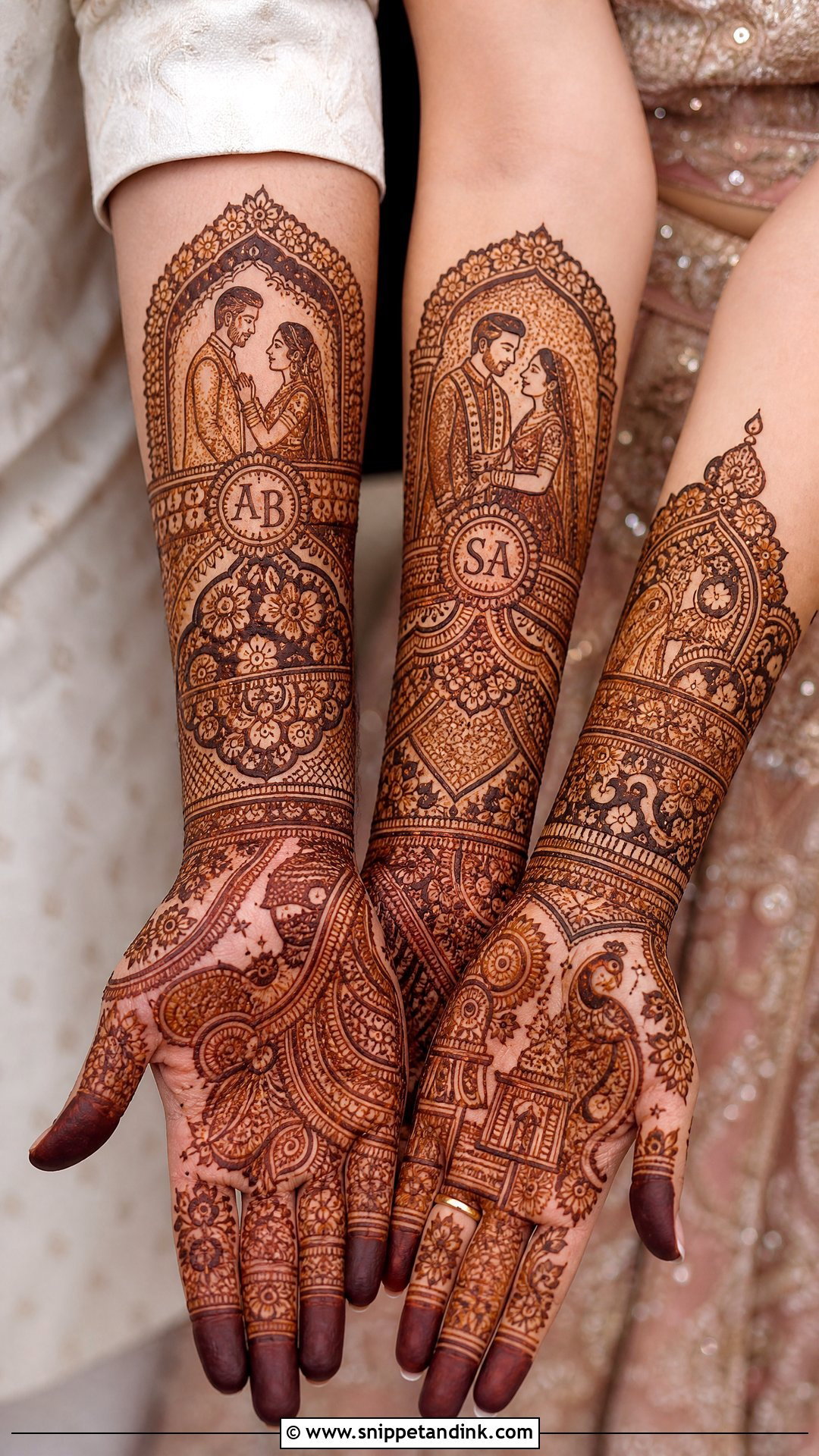
Couple motifs tell the wedding story without full faces: symbolic figures, a varmala moment, wedding seats, a palanquin, initials. Paisleys, flowers and traditional fillers cover the rest of the hand. Simple figures are also kinder to a nervous bride, since they forgive the small movements that happen during a long sitting. Placement is the first thing I’d settle with you. On the palm or lower forearm the scene shows without bending the wrist, while one drawn across the knuckles folds out of sight every time your hand relaxes.
12. Jaali Bridal Mehndi Full Hand
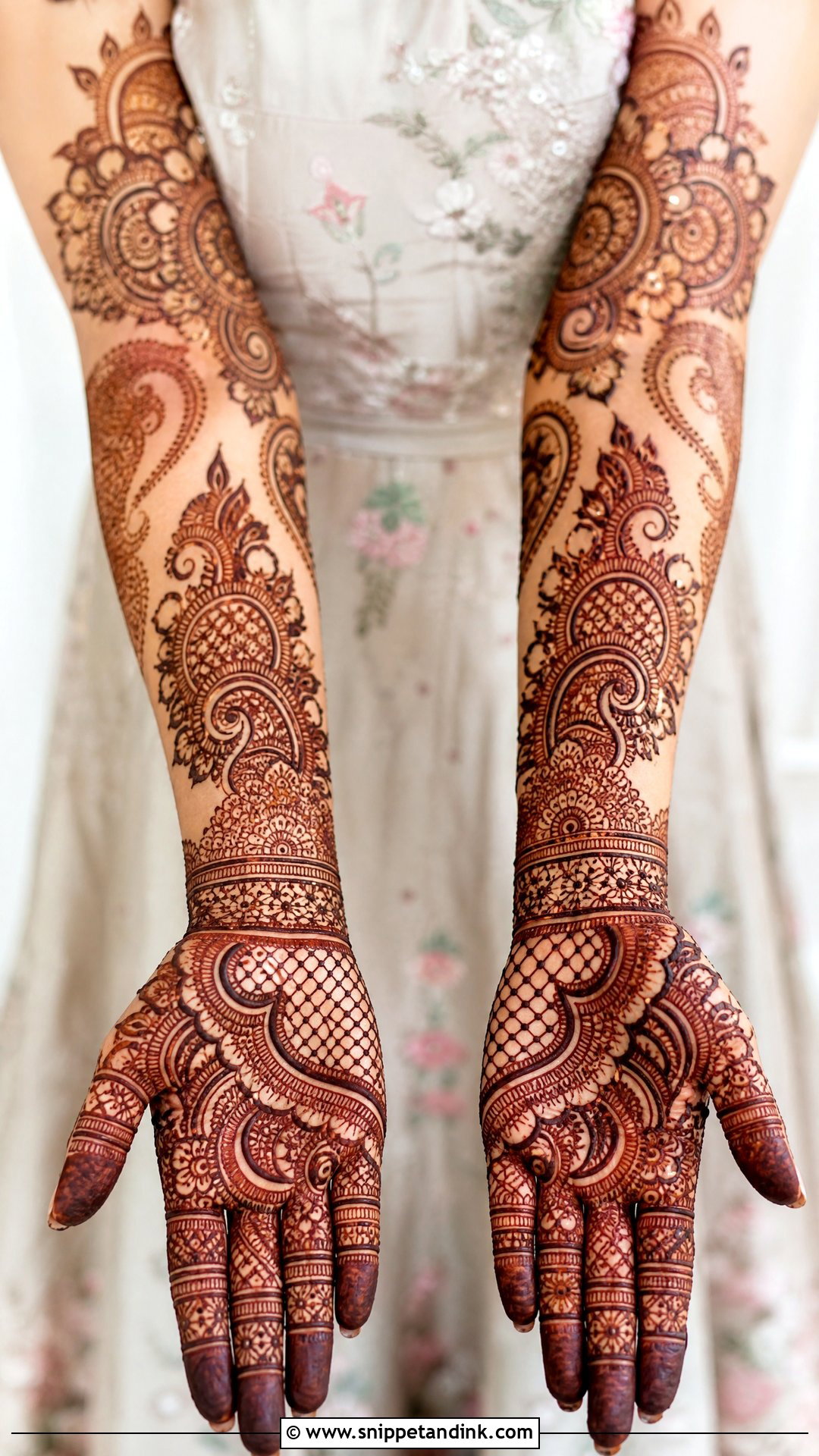
Jaali is mesh, a crisscross of fine lines that reads like lace across the palms, wrists or forearms, broken up by florals, cuffs and finger detail. It gives full coverage while letting skin show through, so the hand never turns solid dark, and it echoes net, organza and heavy embroidery naturally. Mesh has one weakness. Grid lines drawn too close bleed into each other as the stain develops. I keep the squares a touch wider than seems necessary on wet paste and frame each mesh panel with a bold border for contrast.
13. Floral Bridal Mehndi Full Hand
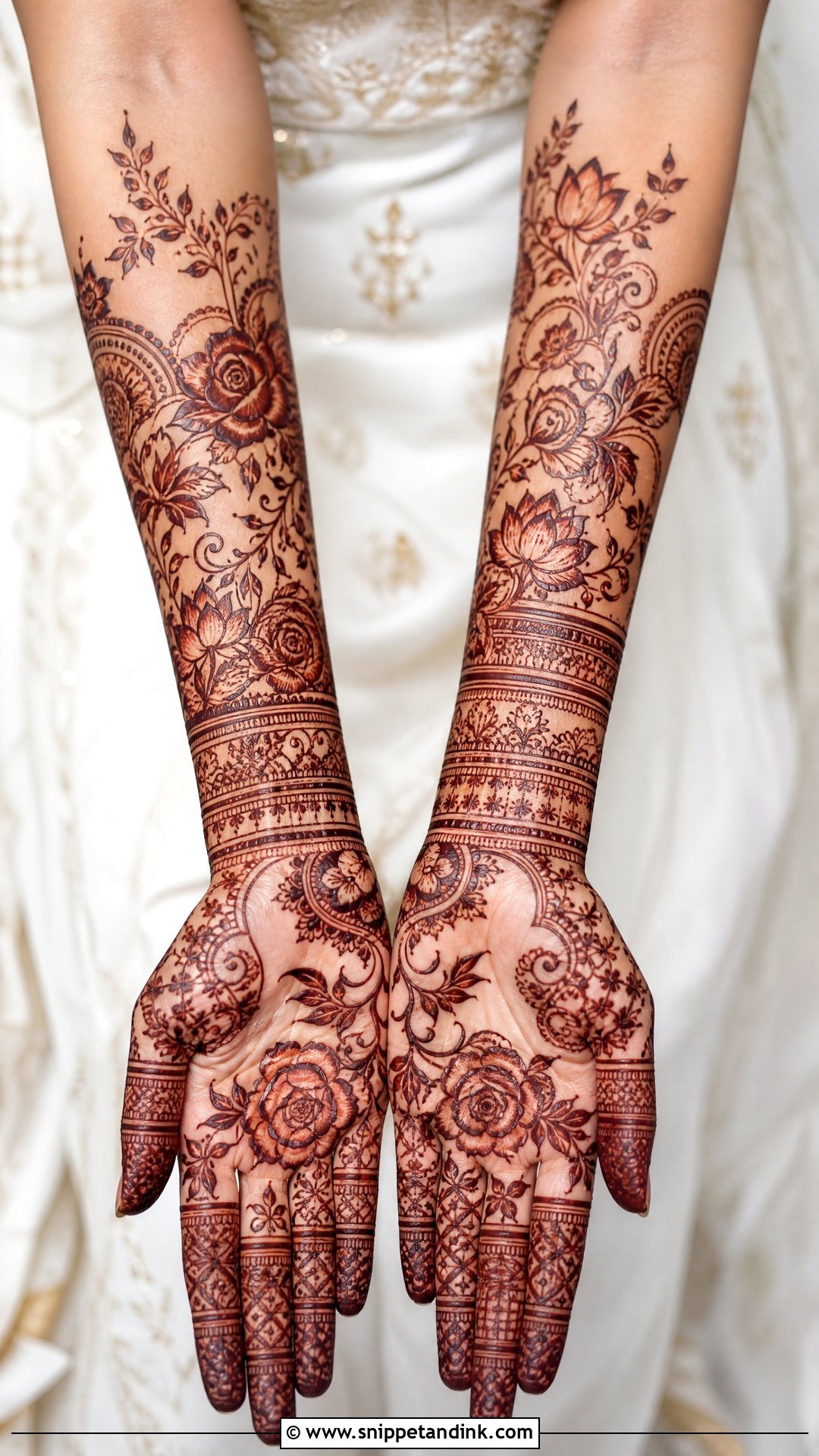
Florals adapt to any tradition. Drawn as bold Arabic roses with shaded petals they feel modern; drawn small and dense in the Indian manner they read as classic full coverage. A bridal floral hand usually mixes roses, lotuses, leafy vines, wrist bands and detailed fingers. My own rule is two sizes of flower, not five. Large blooms carry the design in photos and small fillers add richness, but a spread of in-between sizes leaves the hand busy with no focal point.
14. Paisley Bridal Mehndi Full Hand
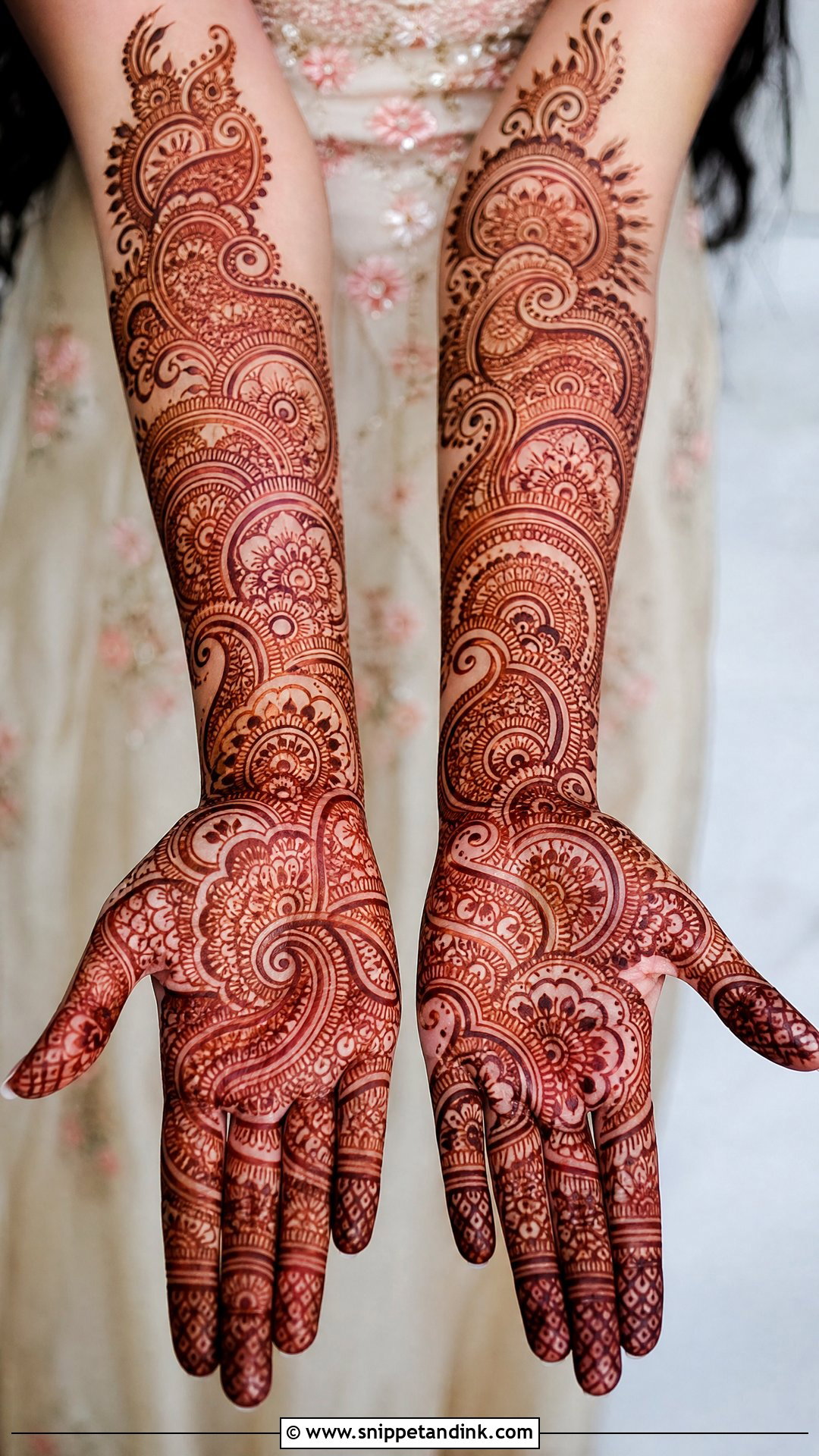
Paisley, the mango or keri shape, is the backbone of most bridal henna, and it earns that place by bending to fit any hand. I can stretch one along a long slim finger, stack them diagonally across a broad palm, or curl them around the wrist bone. For a full bridal hand I pair large paisleys with fine line shading, tiny dots and scalloped borders. If you want traditional coverage without portraits or scenes, this is the safest choice on the list, and it rarely looks dated in photos years later.
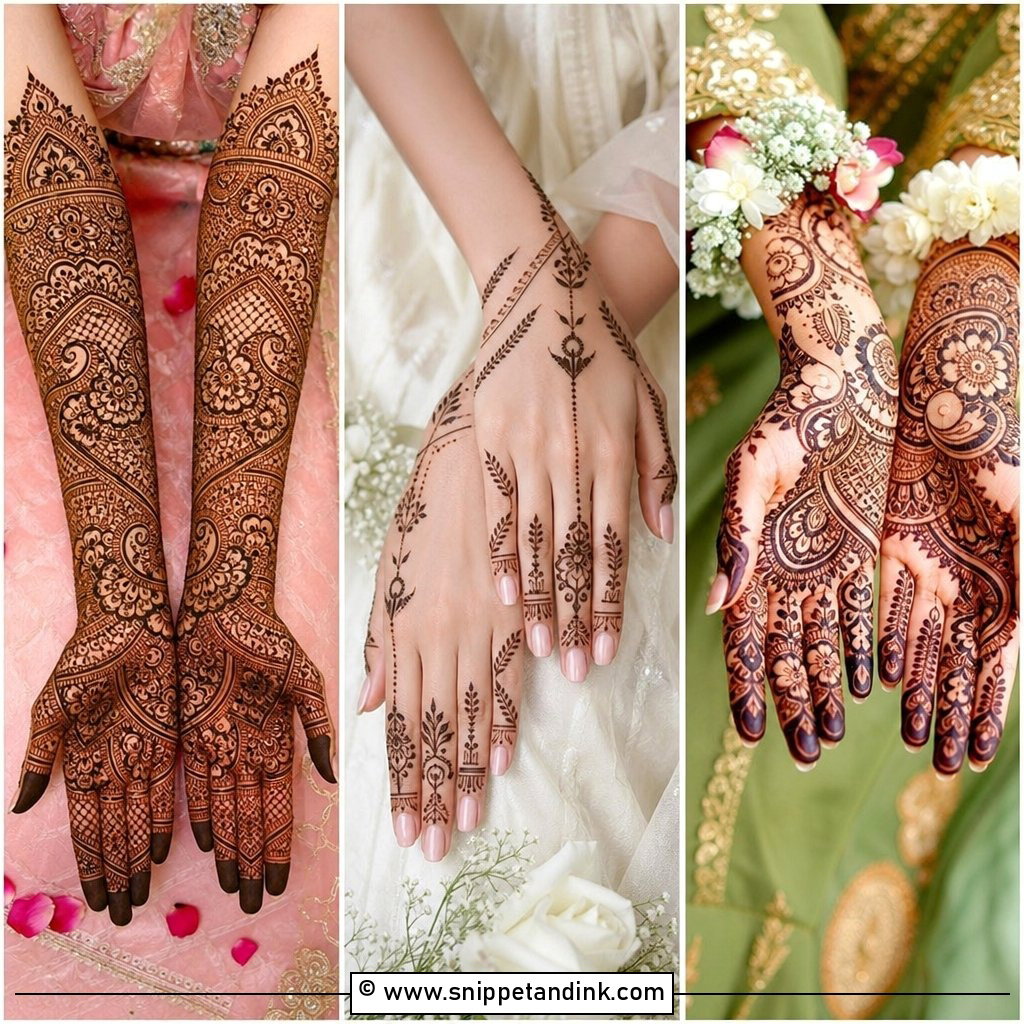

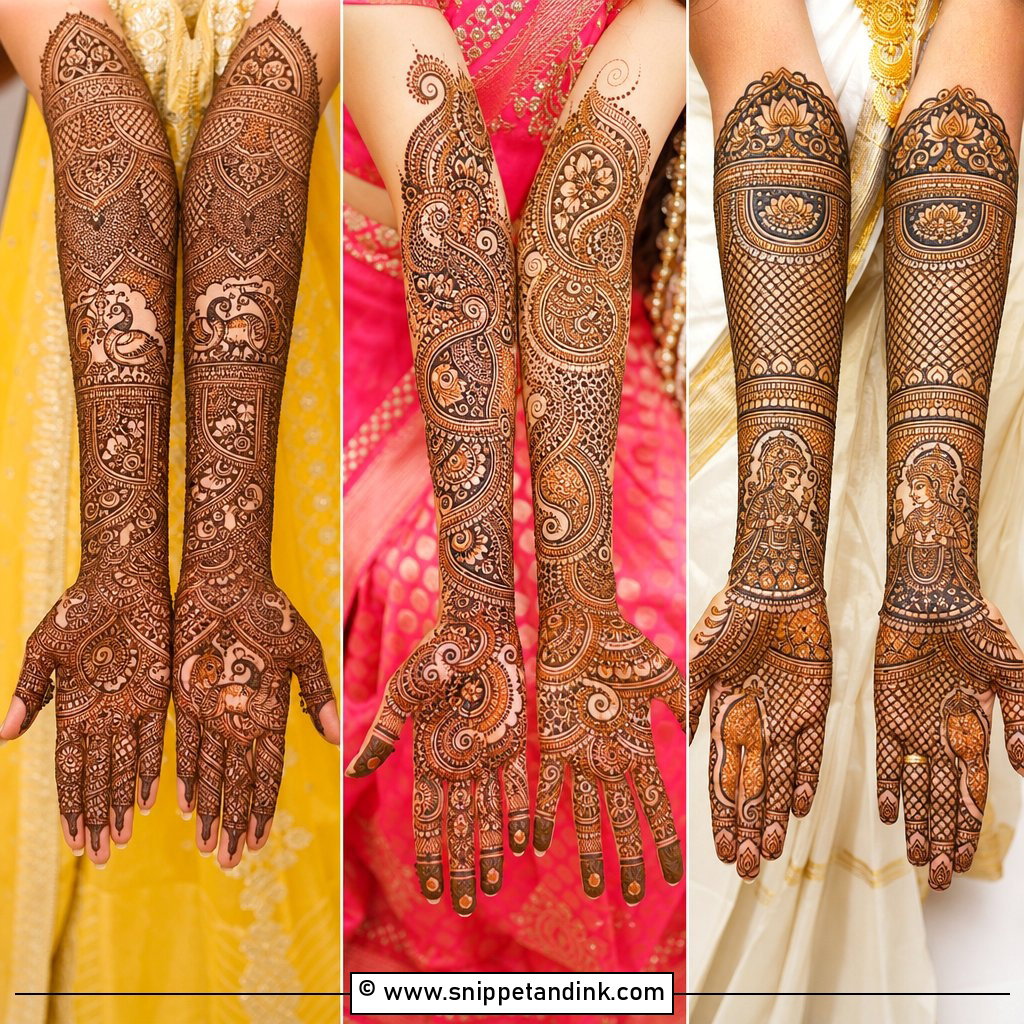
15. Royal Bridal Mehndi Full Hand
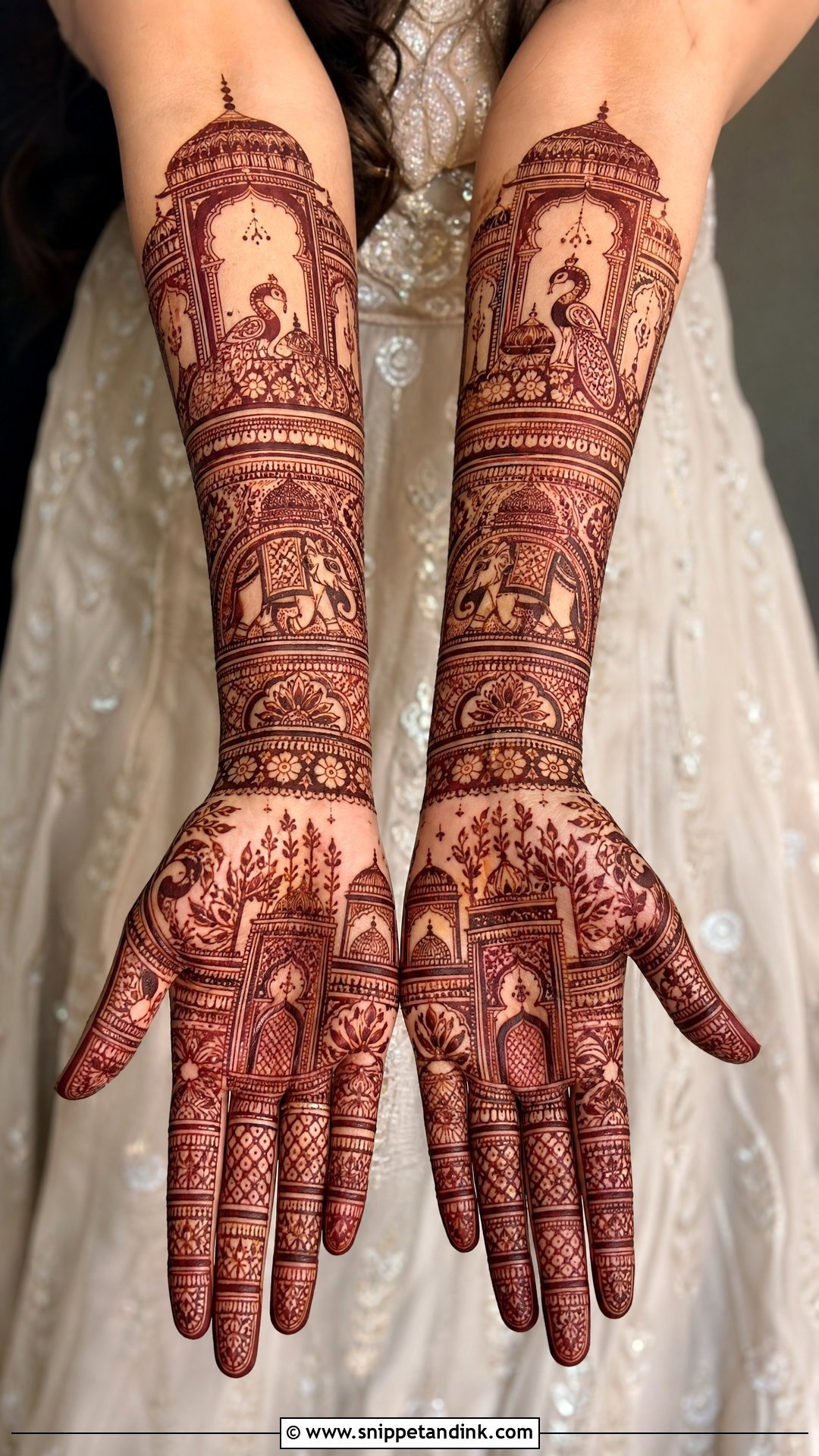
Royal layouts are drawn architecture: domes, arches, jharokha windows, elephants and lotus borders stacked into cuff bands up the forearm. It is the most structured style here, closer to drafting a building than drawing a vine, and it stands up to heavy lehengas and kundan jewelry. Clutter is the risk. I divide the arm into clear bordered sections before filling anything, so every motif keeps its own space and the whole hand stays readable after staining.
16. Minimal Bridal Mehndi Full Hand
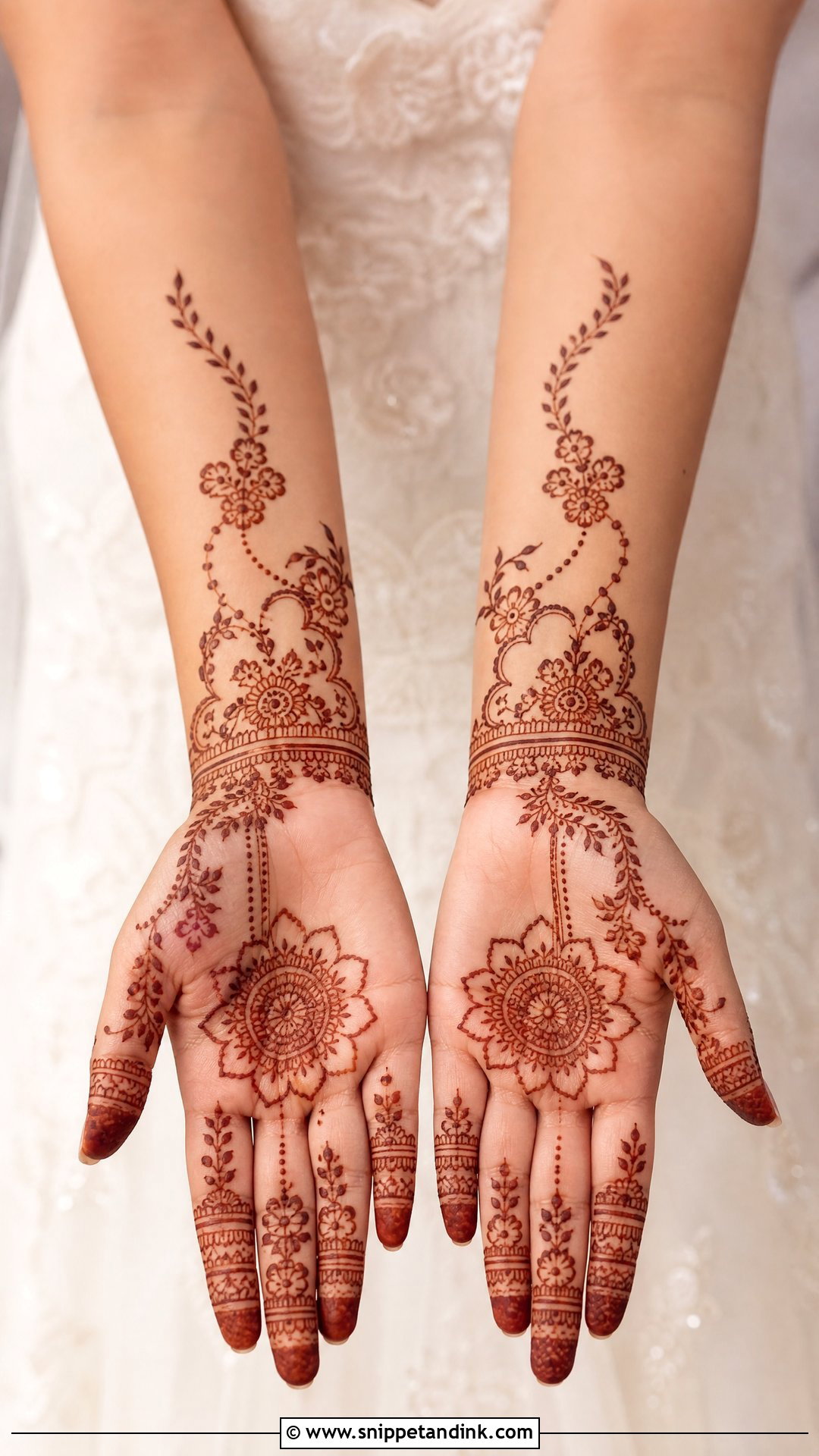
Minimal does not mean small. The design still runs from fingertips to wrist or forearm; the difference is open spacing, thin vines, small mandalas and bracelet-style wrist work with plenty of skin left bare. It suits intimate weddings, modern outfits and brides who know they cannot manage an all-afternoon sitting. It is also the most forgiving style on the backs of the hands, where henna naturally stains paler than on the palm, because sparse lines look intentional there. Keep the lines thin and give the fingers enough detail to frame the hand.
17. Modern Bridal Mehndi Full Hand
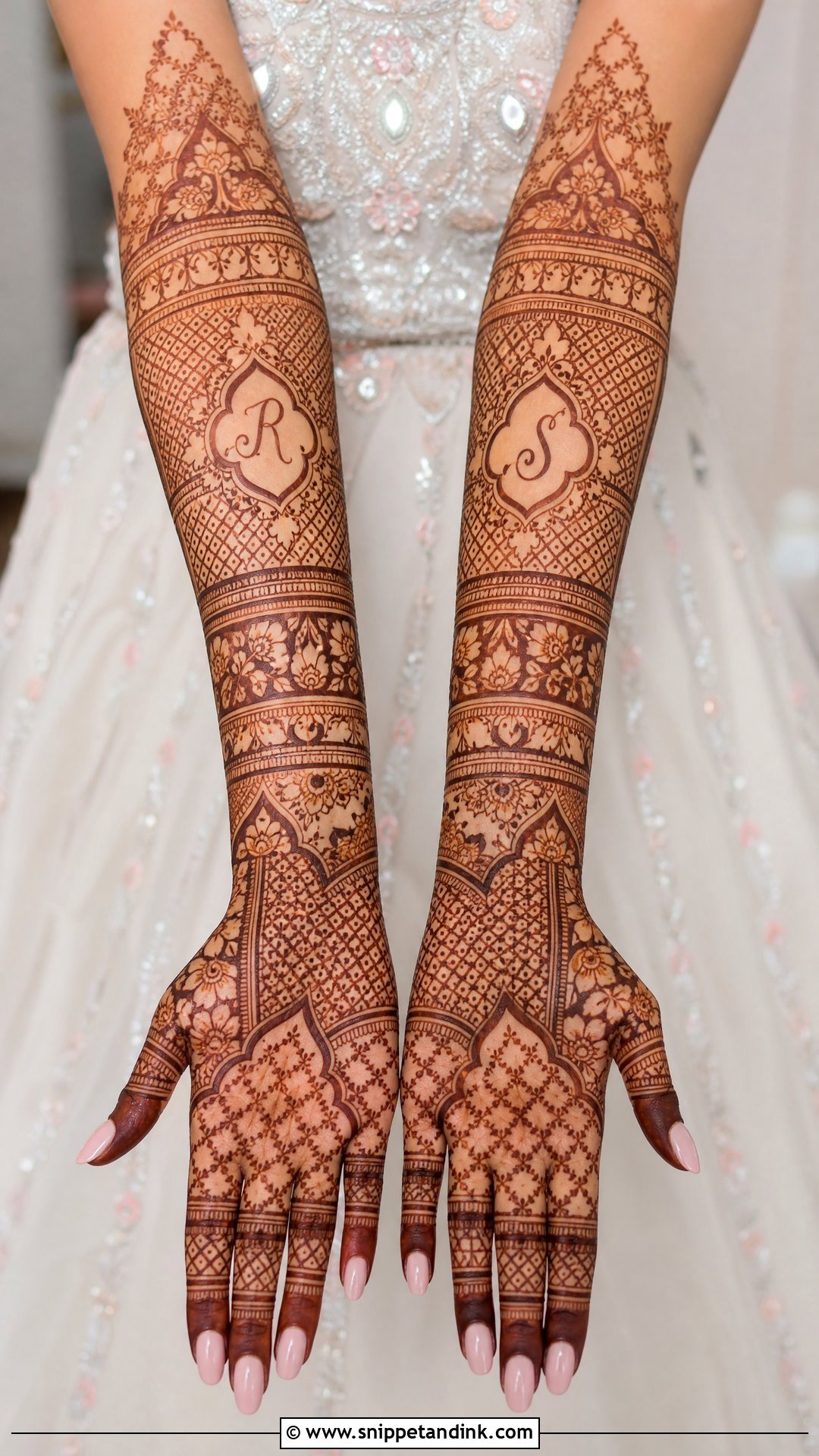
Modern bridal henna borrows from graphic design: grids, clean negative space, half-and-half palms, floral bands, initials and jewelry-inspired cuffs. It sits naturally next to fusion outfits and sleek jewelry. The discipline is restraint. Cover the hand, but resist filling every gap with tiny lines, because the contrast between bold shapes and bare skin is the entire effect. Close-ups make these designs look sharp, and they also expose any unevenness, so a steady cone hand matters more here than intricate fill work.
18. Moroccan Bridal Mehndi Full Hand
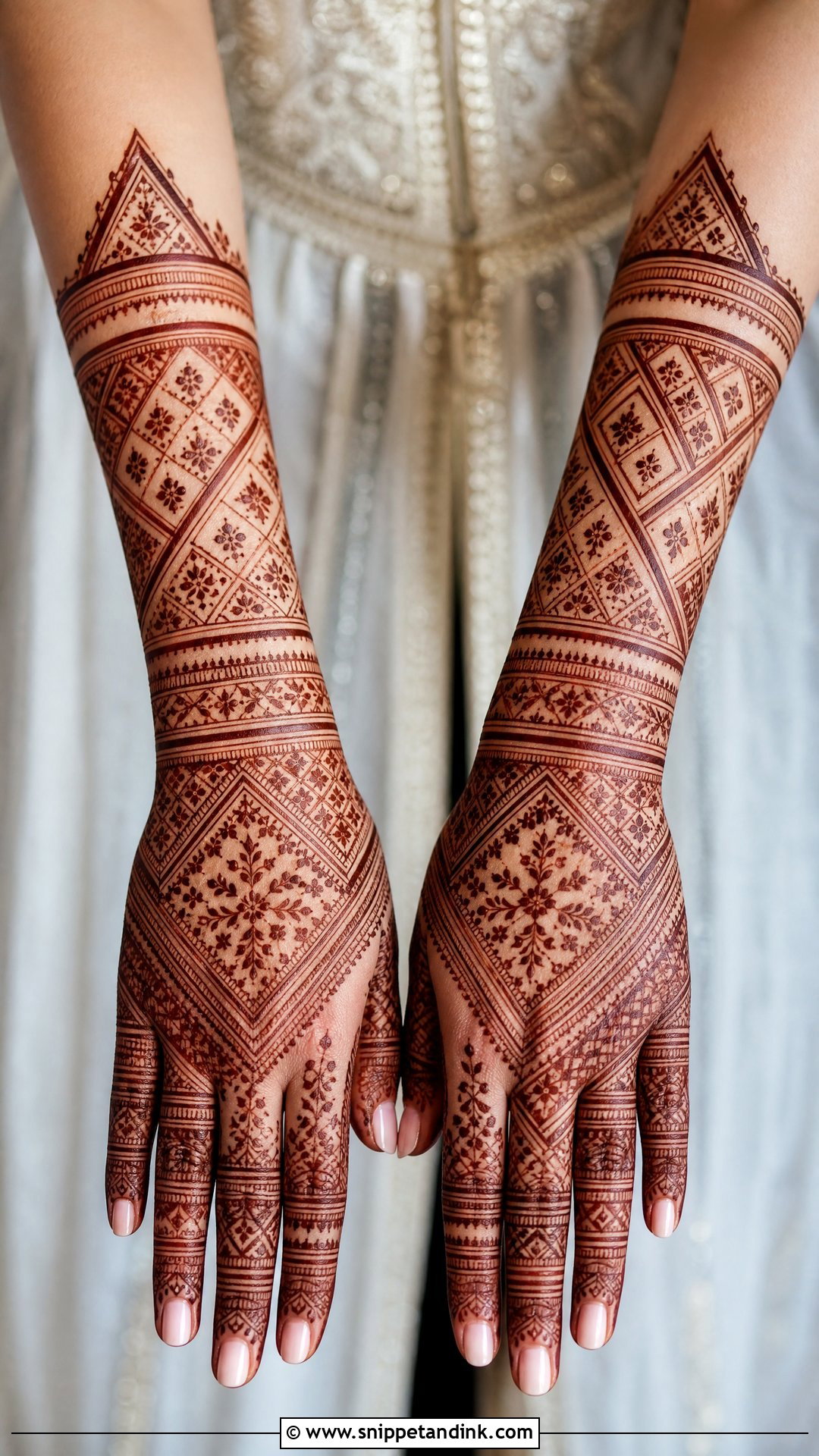
Moroccan-inspired henna is geometric: diamonds, triangles, grids, straight lines, dots and structured bands. For a bride, I soften it with a floral border or a small mandala so it doesn’t feel stark beside a wedding outfit. Pick it if you’re tired of paisley-heavy hands and love clean symmetry. Straight lines are harder in henna than curves, since the cone has to be pulled at even pressure without pausing, so ask to see an artist’s past geometric work specifically. Laid out in panels from fingertip to forearm, it stains to a strong deep maroon.
19. Gulf Bridal Mehndi Full Hand
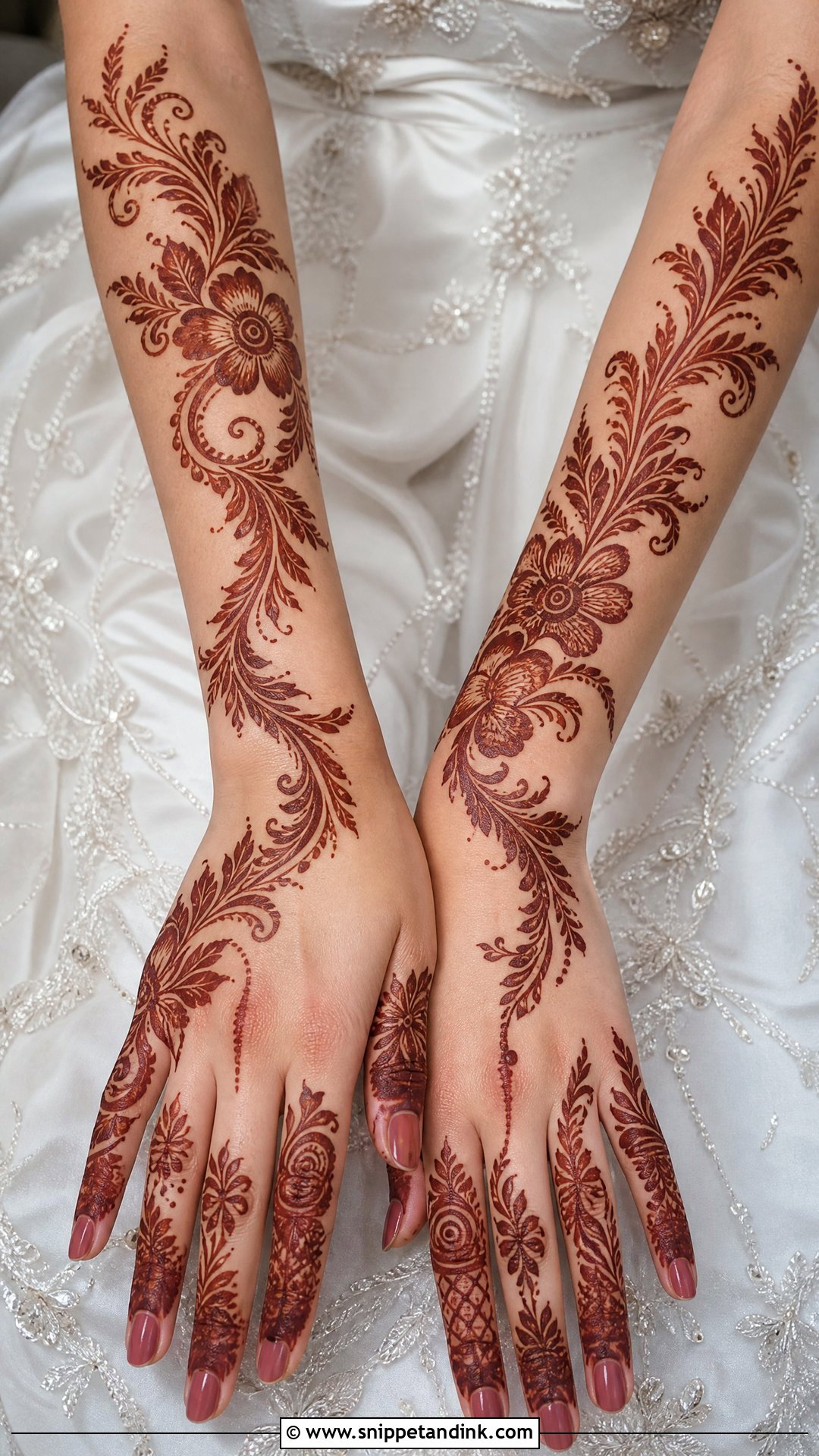
Gulf or Khaleeji-style henna uses bold florals, flowing vines and big leaves with generous space between them. Because the motifs are large, they come through clearly even on the back of the hand, where the stain is lighter, and they read well from a distance at a reception or in a wide pre-wedding shot. Petals and leaves are often filled solid, which needs thick, smooth paste; thin paste leaves blotchy fills. For a bridal version, add wrist cuffs, extend the trail along the forearm and detail the fingertips while keeping the main floral flow airy.



20. Jewelry Bridal Mehndi Full Hand
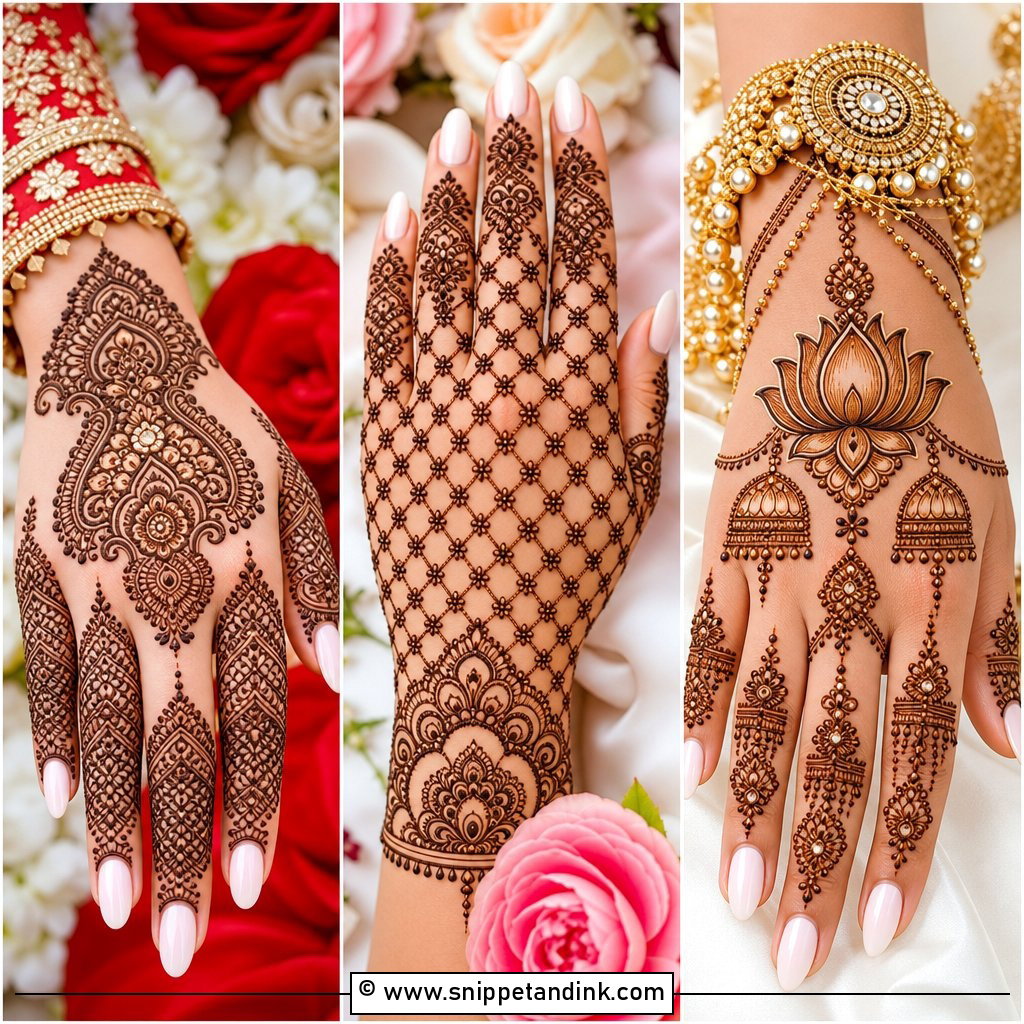
Jewelry mehndi draws ornaments straight onto the skin: bracelet bands, ring chains, hathphool patterns, wrist cuffs and finger chains around a central motif. For a full bridal hand I extend that frame with florals, paisleys and forearm bands so it doesn’t look unfinished. Plan it with your real bangles and rings in front of you. A drawn cuff that ends exactly where a bangle sits simply disappears, and a drawn chain that clashes with a real ring looks like an error. Even, neatly weighted chain lines are what make the design read as deliberate.
From Orange Paste Mark to Deep Maroon in Two Days
When the dried paste first comes off, natural henna is bright orange. That surprises a lot of brides. The dye keeps oxidizing for the next day or two, moving through red-brown to its darkest shade at around 48 hours. That’s why I book bridal applications one to two days before the main event, so the color peaks on the day rather than after it.
My aftercare instructions
- Leave the paste on for at least six to eight hours, overnight if you can sleep with your hands wrapped.
- Scrape the dry paste off with a blunt edge or your fingernail. Don’t wash it off.
- Keep water away for as long as you can, ideally twelve hours or more.
- Keep your hands warm. Warmth helps the stain develop, and cold hands stain lighter.
- Rub a little balm or oil over the design before showers and hand washing in the following days.
- Skip scrubs, chlorine and heavy sanitizer use until after the wedding.
Why I won’t use a cone that stains black
Natural henna never stains black. Cones sold as black henna or instant dark henna often contain PPD, a hair-dye chemical that can cause blistering and lasting skin sensitivity. Ask your artist what is in the paste. A good one will happily tell you, and if your skin is reactive, a small test spot a week before the wedding costs nothing. Expect the real stain to stay rich for one to three weeks, fading first on the palms as the skin renews.
Dense, Airy or Somewhere in Between
Start with your outfit and how long you can sit. Dense Indian, Rajasthani and Marwari work feels grand but asks for a long session. Arabic, Gulf and minimal layouts are lighter and quicker. Indo-Arabic, floral, lotus, mandala and jewelry designs sit in the middle. If personal meaning matters most, portraits, couple scenes and hidden initials give you that. Whichever you pick, book an artist whose stained results you have actually seen, leave the paste on long enough, and protect your hands for the first two days. The pattern is only half of it; the stain is what you’ll wear.
You'll Like These Ideas:







Leave a Reply