
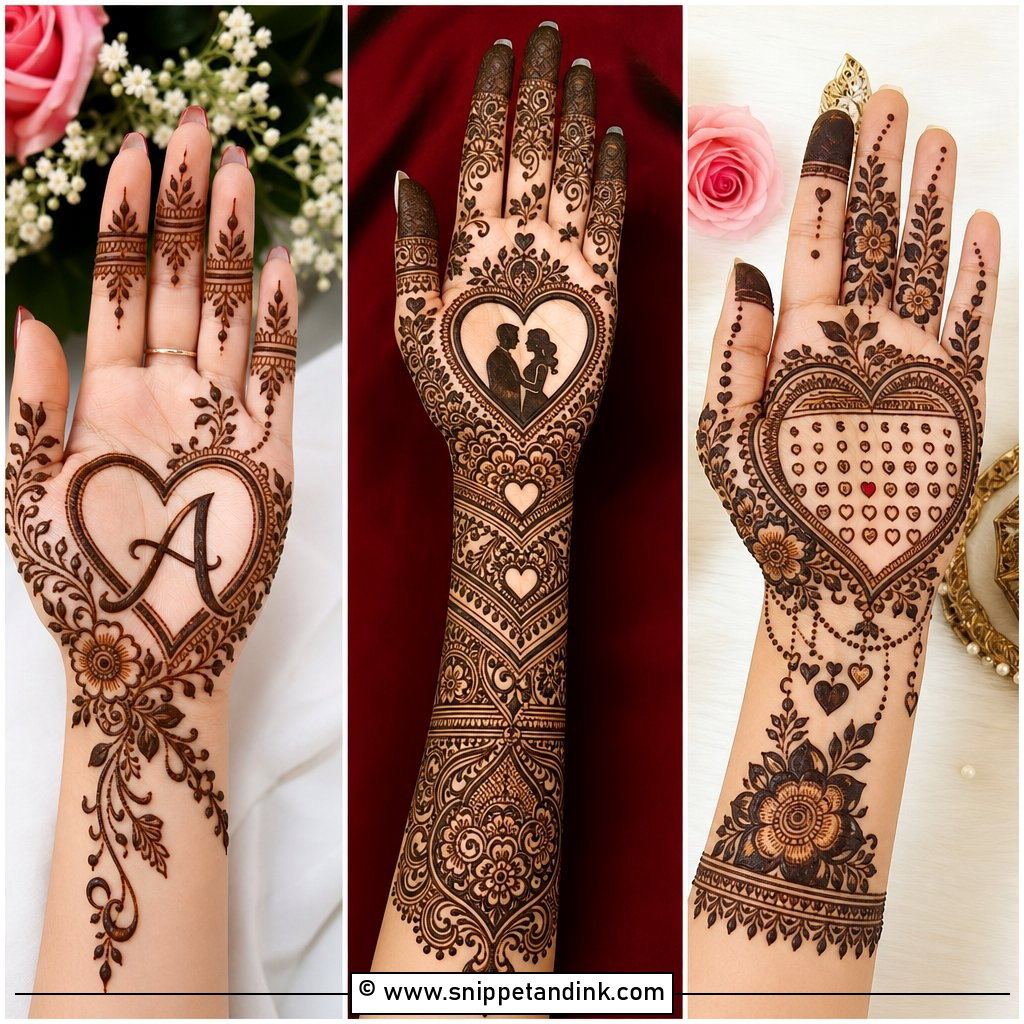
At an Indian wedding, the bride’s mehndi is applied surrounded by family, songs and teasing, and it carries blessings as much as decoration. When a bride sits down with me, I want to know three things before I pick up a cone: what she’s wearing, which rituals will show her palms, and how much of the day she can spend sitting still. Dense Indian detail, open Arabic trails, modern negative space and full-hand dulhan mehndi with portraits and initials all have their place. The twenty complete bridal looks below show whole hands rather than single motifs, so you can judge how each design sits from fingertip to forearm.
Mapping the Story Across Two Hands
Brides often arrive with a dozen saved pictures, each of a different design. That’s useful, but I need a plan, not a collage. Before the sitting, I sketch where each element will go so that the two hands, front and back, work as one composition.
Think in four zones
- Palms: the ritual views, where portraits, names and the main mandala usually go.
- Back hands: the jewellery views, seen in ring, chooda and kalire photos.
- Fingers: they frame rings and should match the density of the rest of the hand.
- Wrists and forearms: where the design either ends neatly at a band or flows into panels.
Tell your artist which of these matters most to you. If it’s the palms, I’ll spend most of the time there and keep the forearms lighter; if your chooda and kalire are the centre of your photos, the back hands get the finest work.
Your outfit sleeve decides the finish line
Check where your blouse sleeves end before deciding on the length. A design that stops just under a three-quarter sleeve looks cut off. I either end it at a clean band below the sleeve or carry it to the elbow.
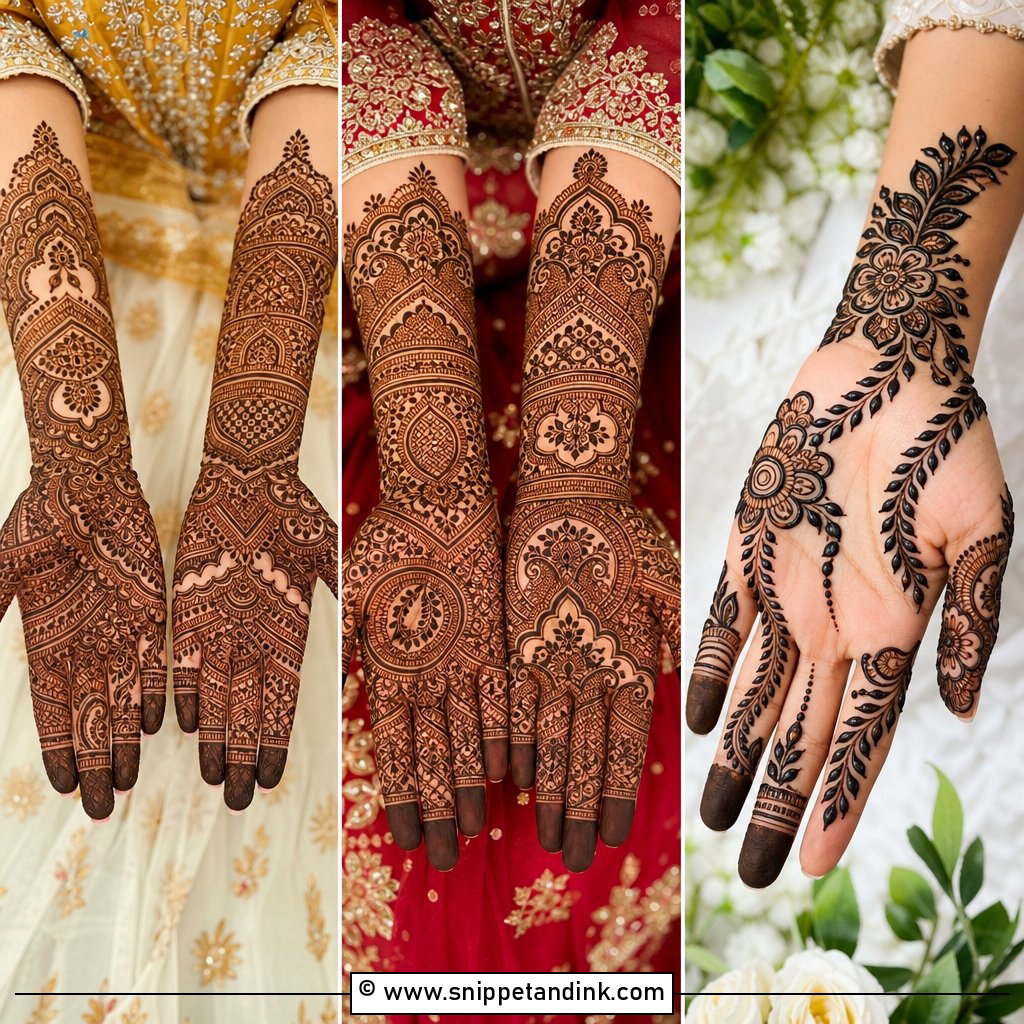
1. Full Hand Bridal Mehndi Design
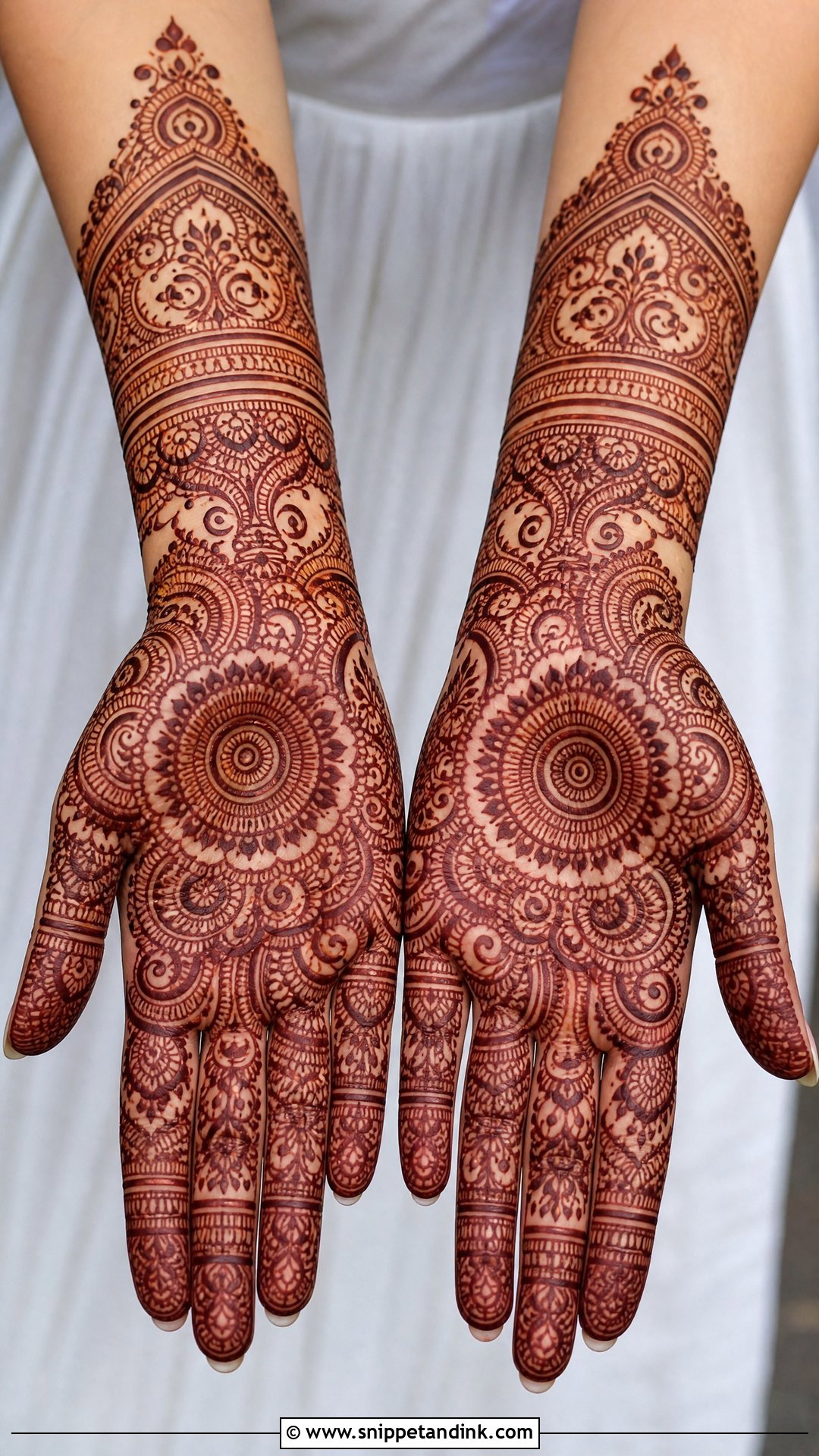
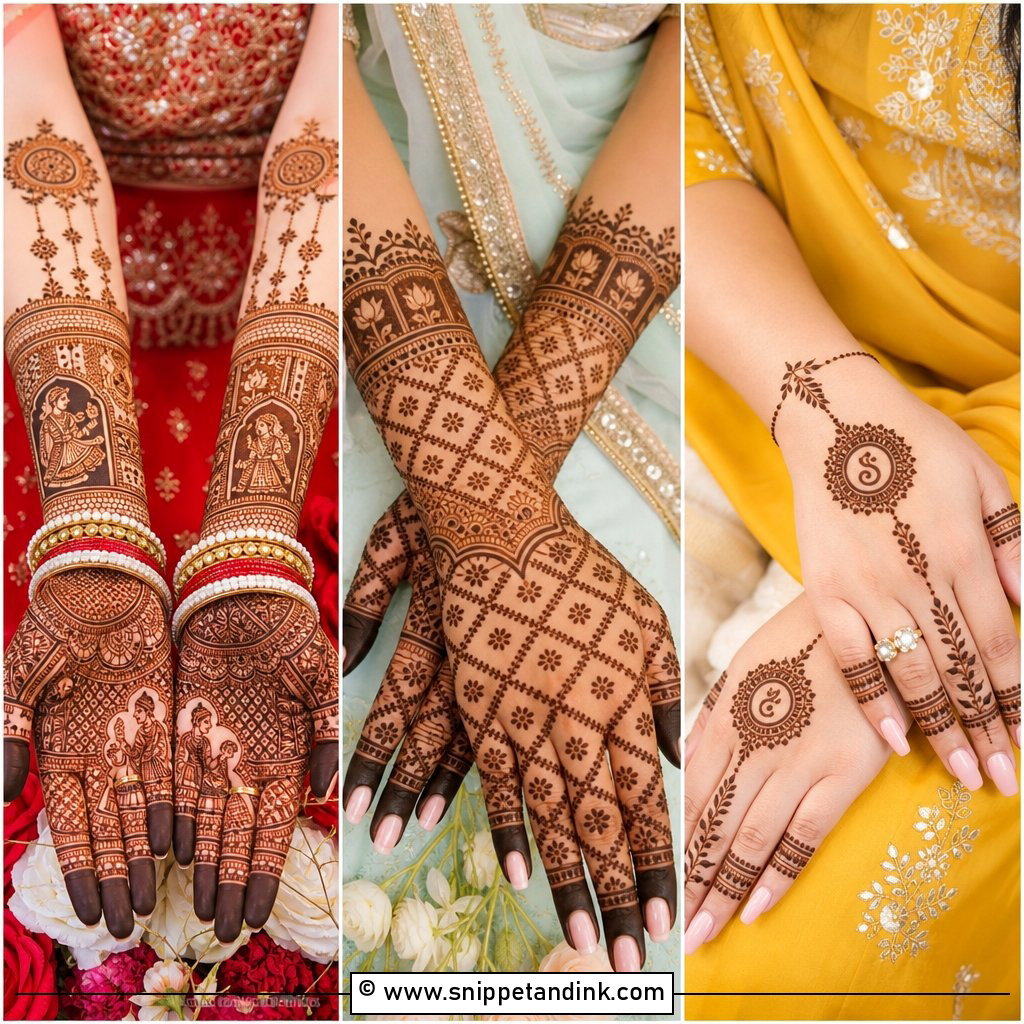
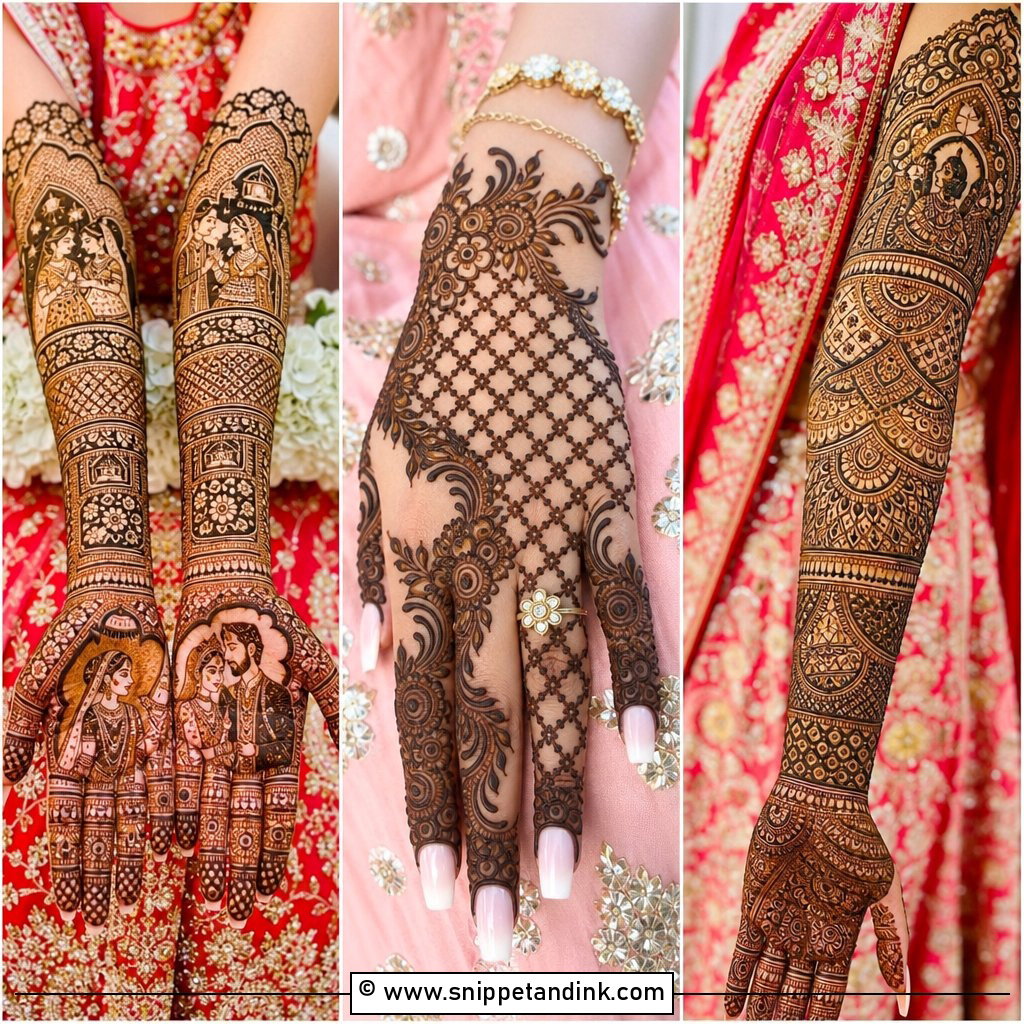
Covering palm, fingers, wrist and forearm is still the most traditional request I get. Paisleys, florals, fine vines, shaded leaves and mandalas build a hand that looks fully dressed beside a lehenga and heavy bangles. The layout is where it succeeds or fails. I give the palm one strong focal motif and let the forearm move into bands or story panels; without that hierarchy, a full hand reads as noise once the stain turns dark.
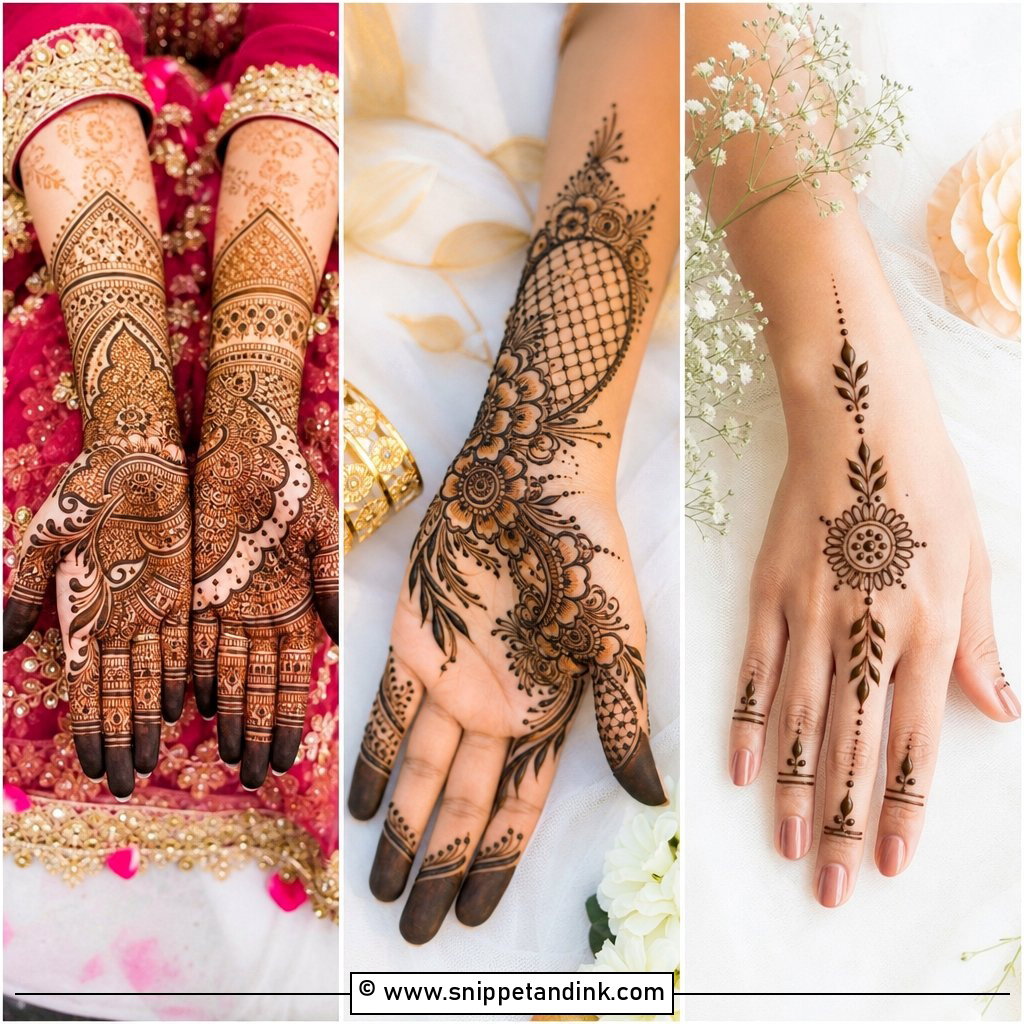
2. Indian Bridal Mehndi Design
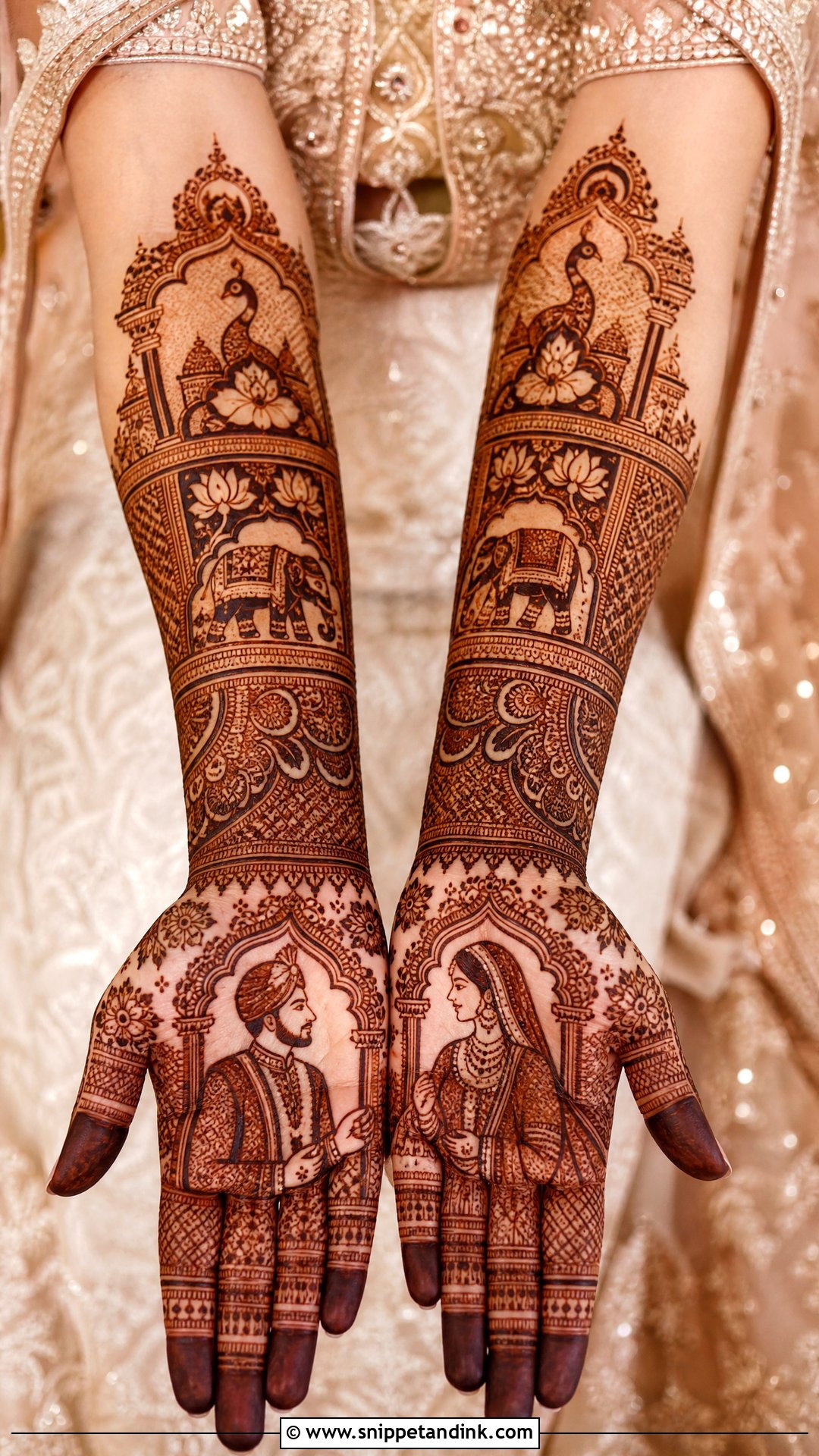
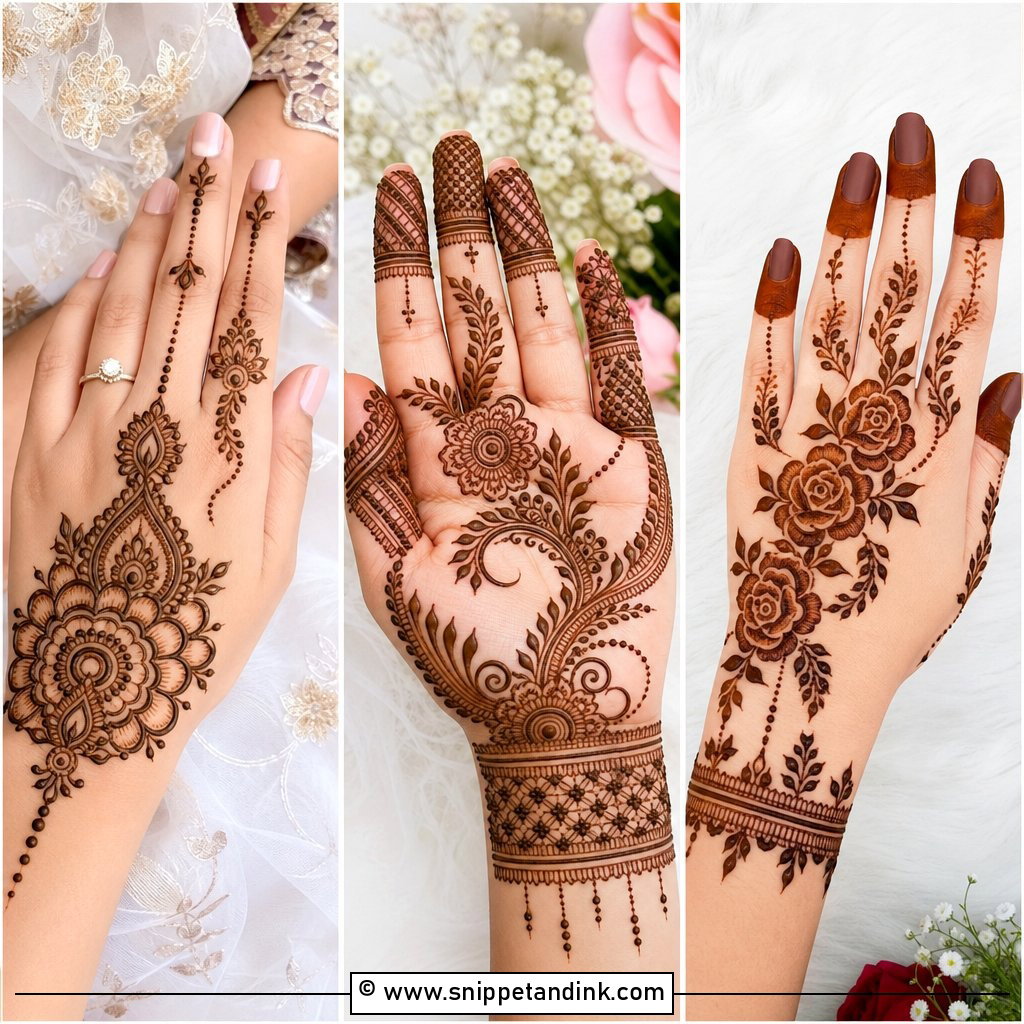
Fine lines and close filling are what set traditional Indian bridal work apart. Both hands carry matching or answering patterns: paisleys, lotus, peacocks, bride and groom figures, dholki art, elephants, kalash details and mandap scenes. The detail is so dense that cone control matters more than speed; a line that’s a fraction too thick fills in the gap beside it once the stain develops. Ask me to tuck the groom’s name, your date or a small symbol from your story somewhere in the pattern, and I’ll hide it where it still survives the stain.
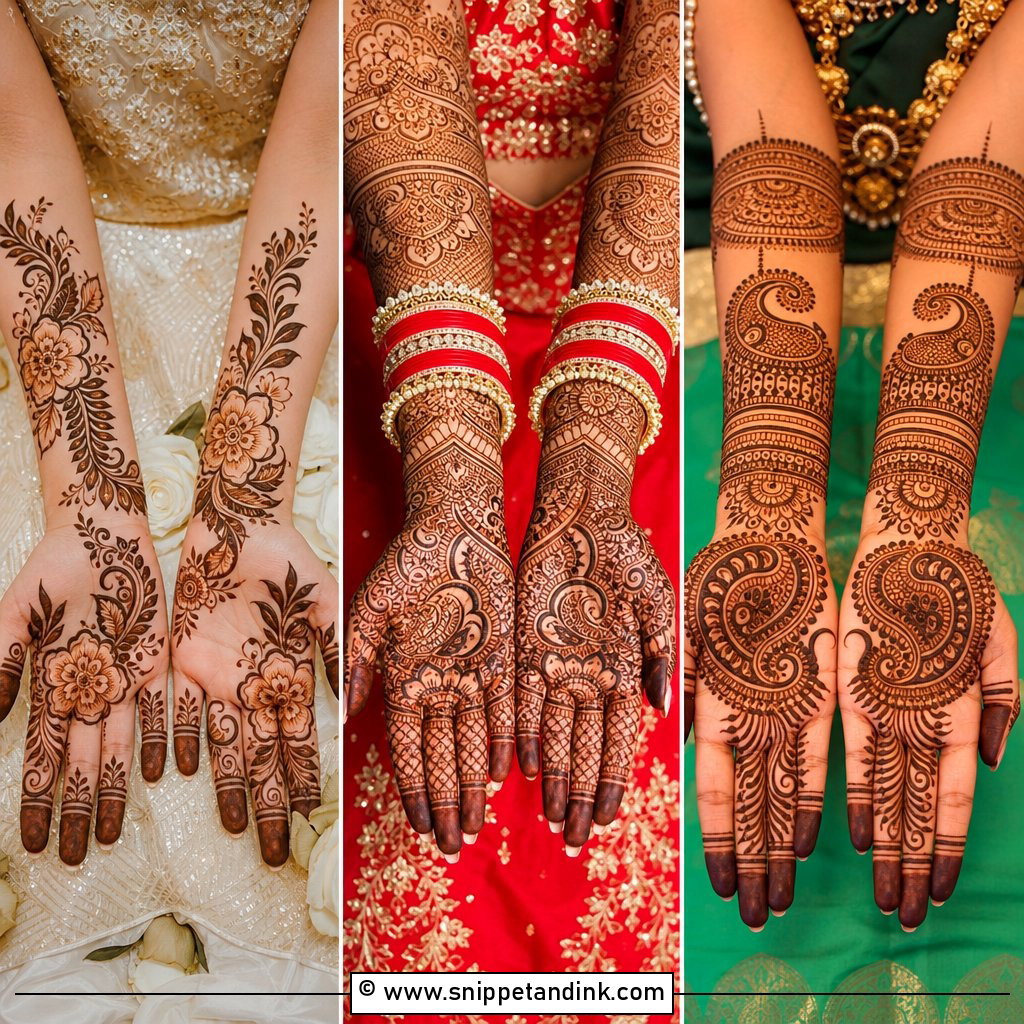
3. Arabic Bridal Mehndi Design
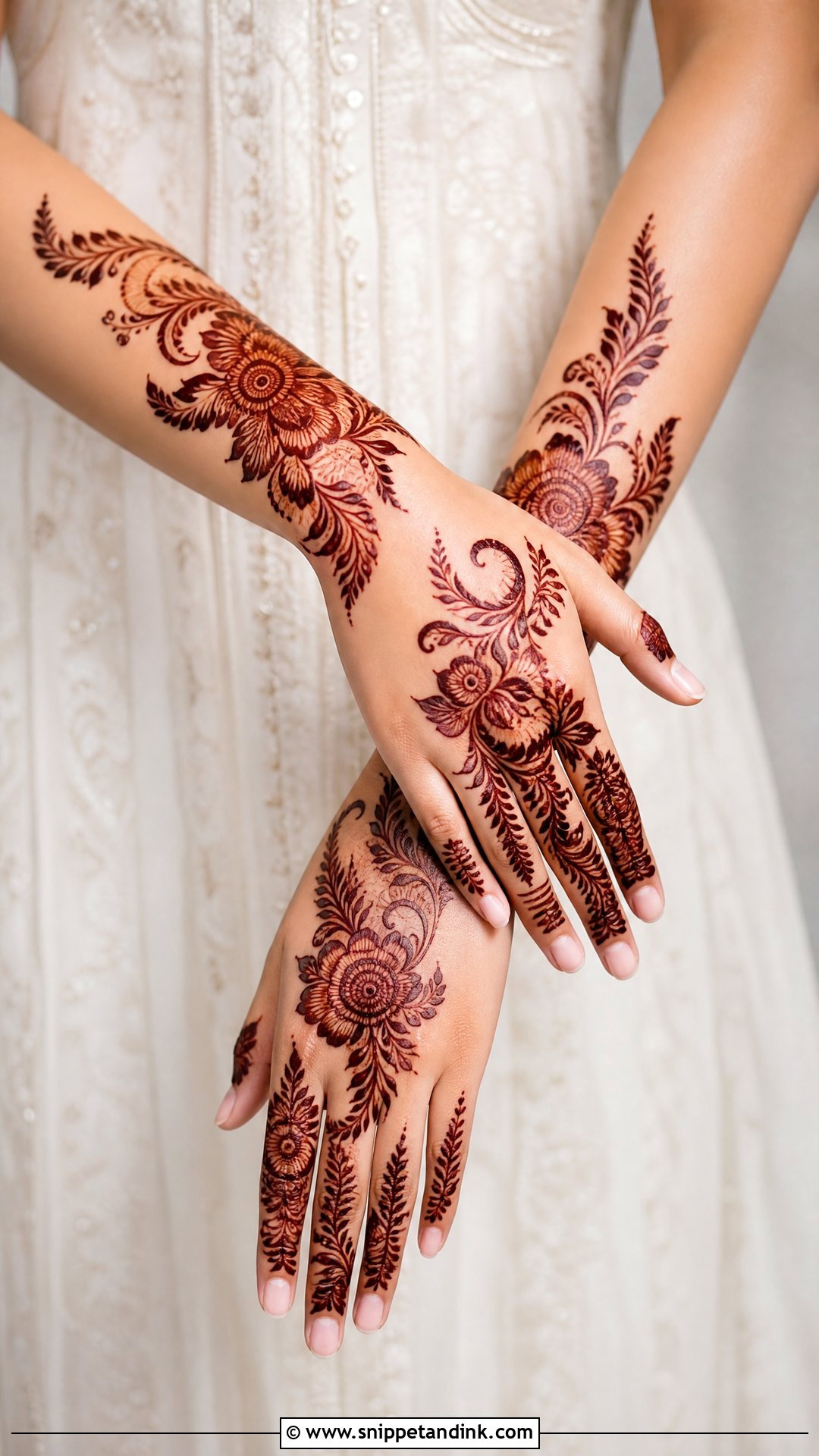
Do you want hands that look graceful rather than crowded? Arabic layouts use flowing trails, bold flowers, leafy vines and curved paisleys with plenty of bare skin between them, and that bare skin is what makes the stain look so crisp. At Indian weddings I usually start the trail at the fingers, cross the palm diagonally and carry it toward the wrist or forearm. It’s quicker to apply than dense work, which matters when the bride also has a sangeet to get ready for.
4. Indo Arabic Bridal Mehndi Design
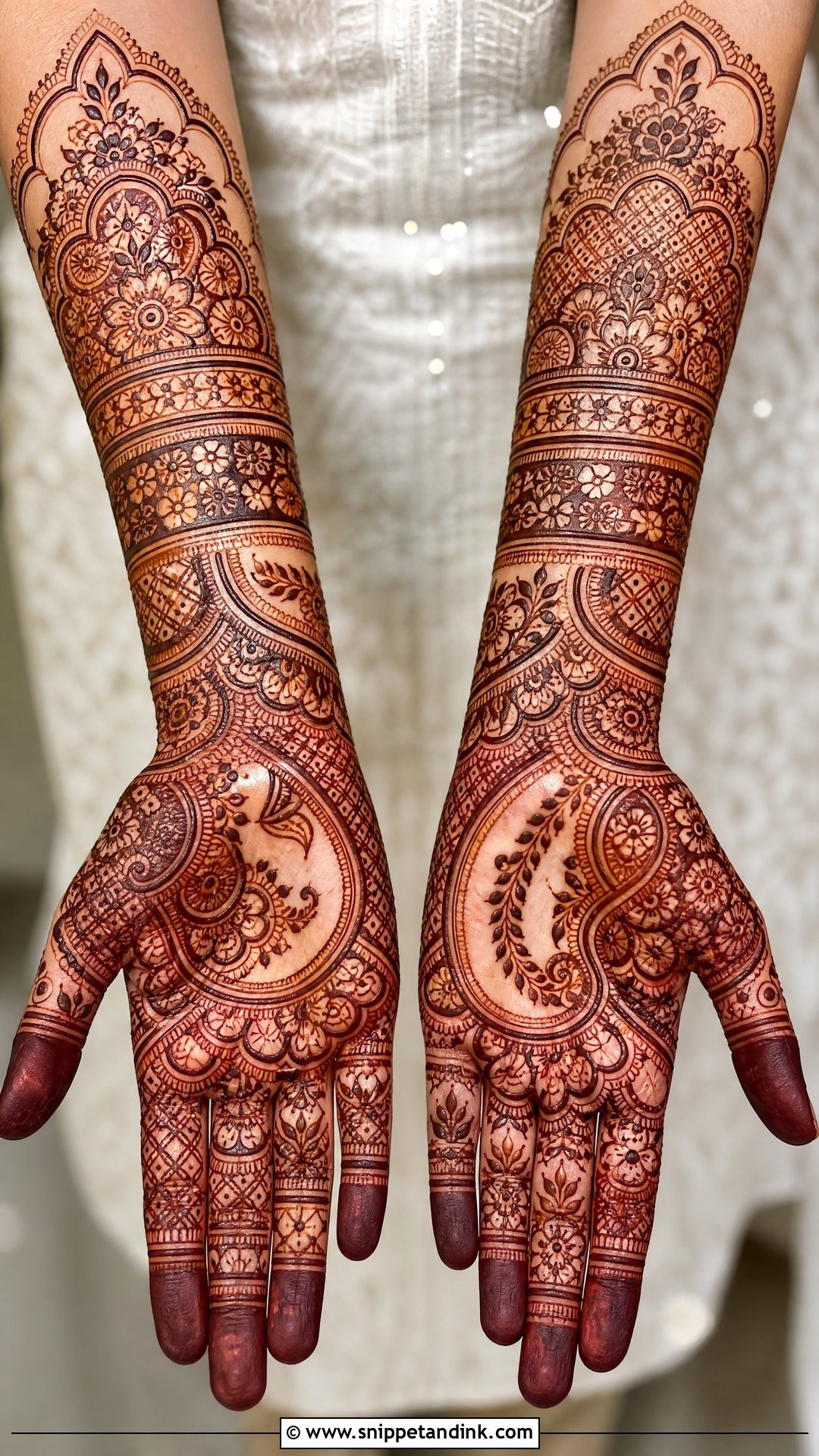
Indo-Arabic borrows the airy flow of Arabic work and fills its shapes with Indian detail: bold floral trails, paisley clusters, mandala centres, scalloped borders and worked fingers. The gaps between motifs keep every line legible after the stain darkens. I suggest it often to brides who love detail but don’t want to look covered. It’s also my usual recommendation for bridesmaids and sisters who want something wedding-worthy without matching the bride’s coverage.
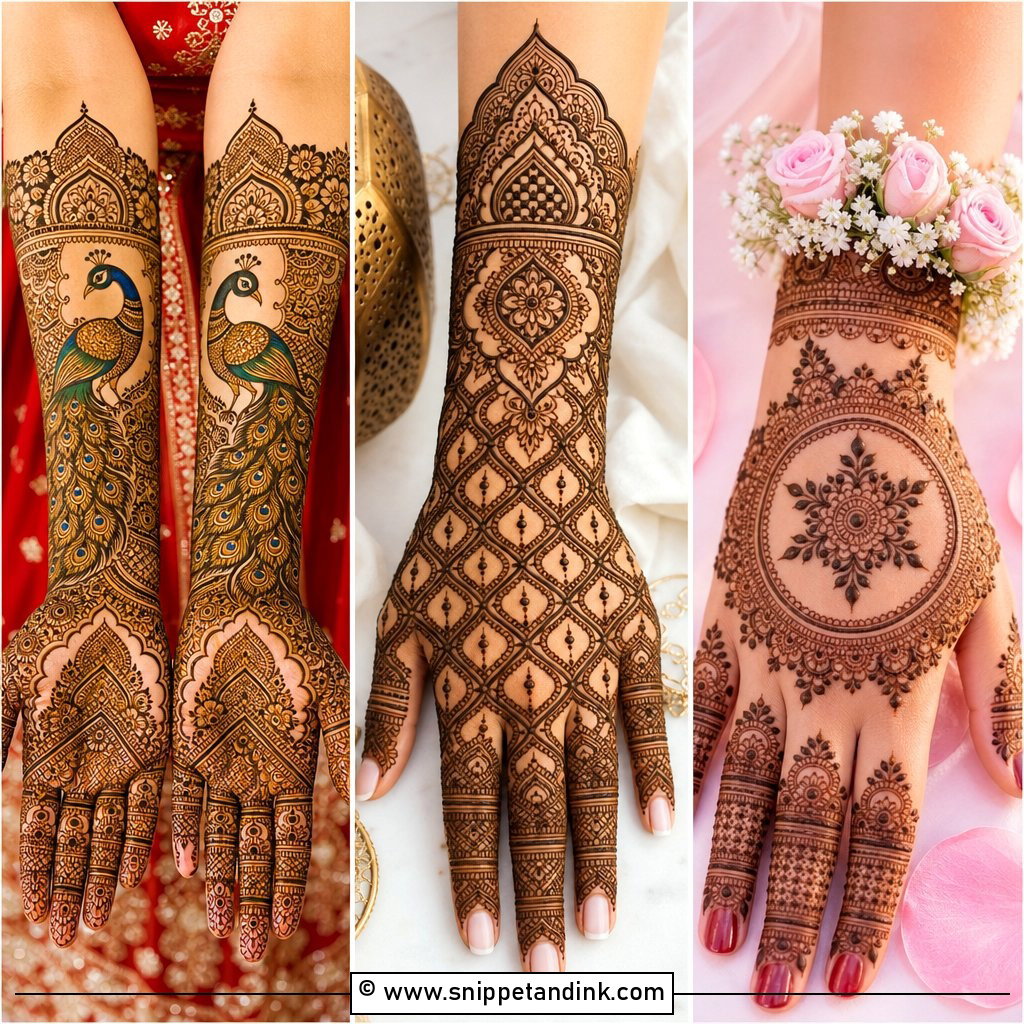
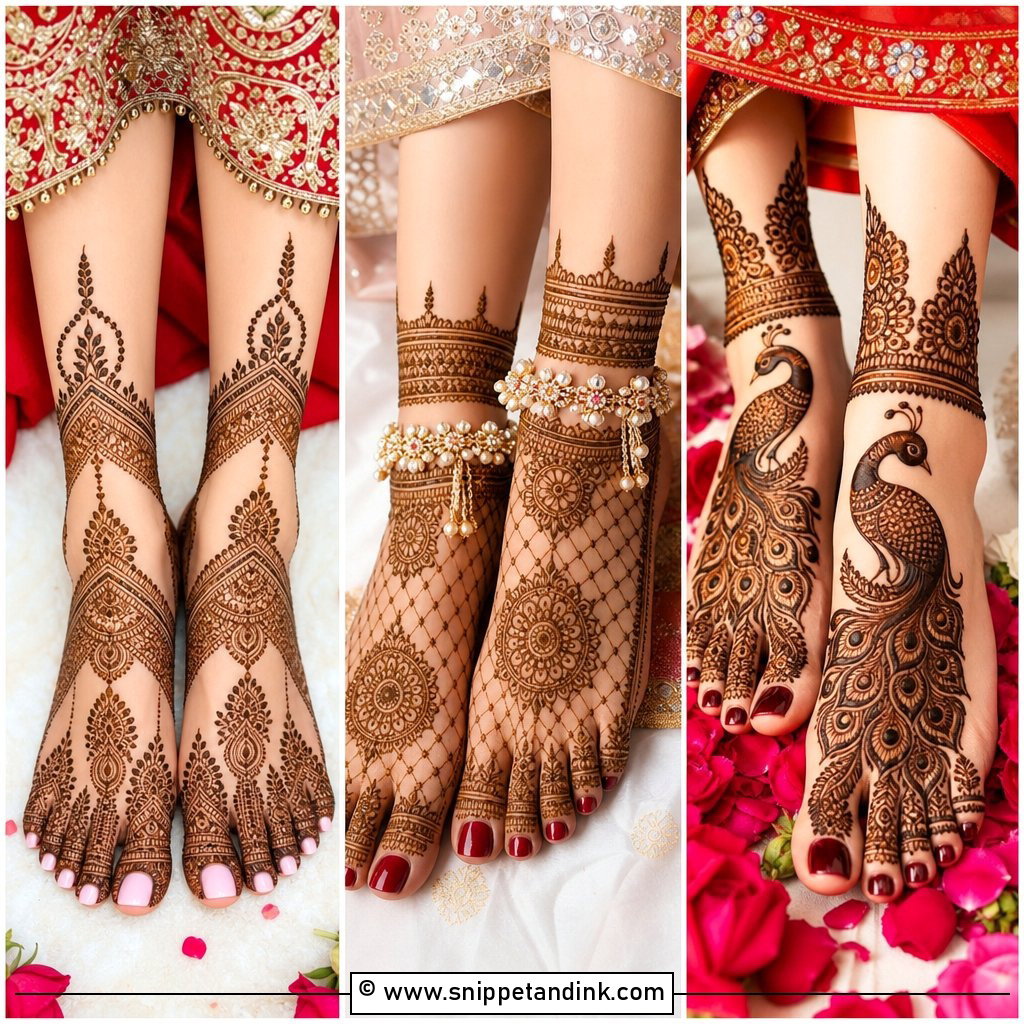
5. Peacock Bridal Mehndi Design
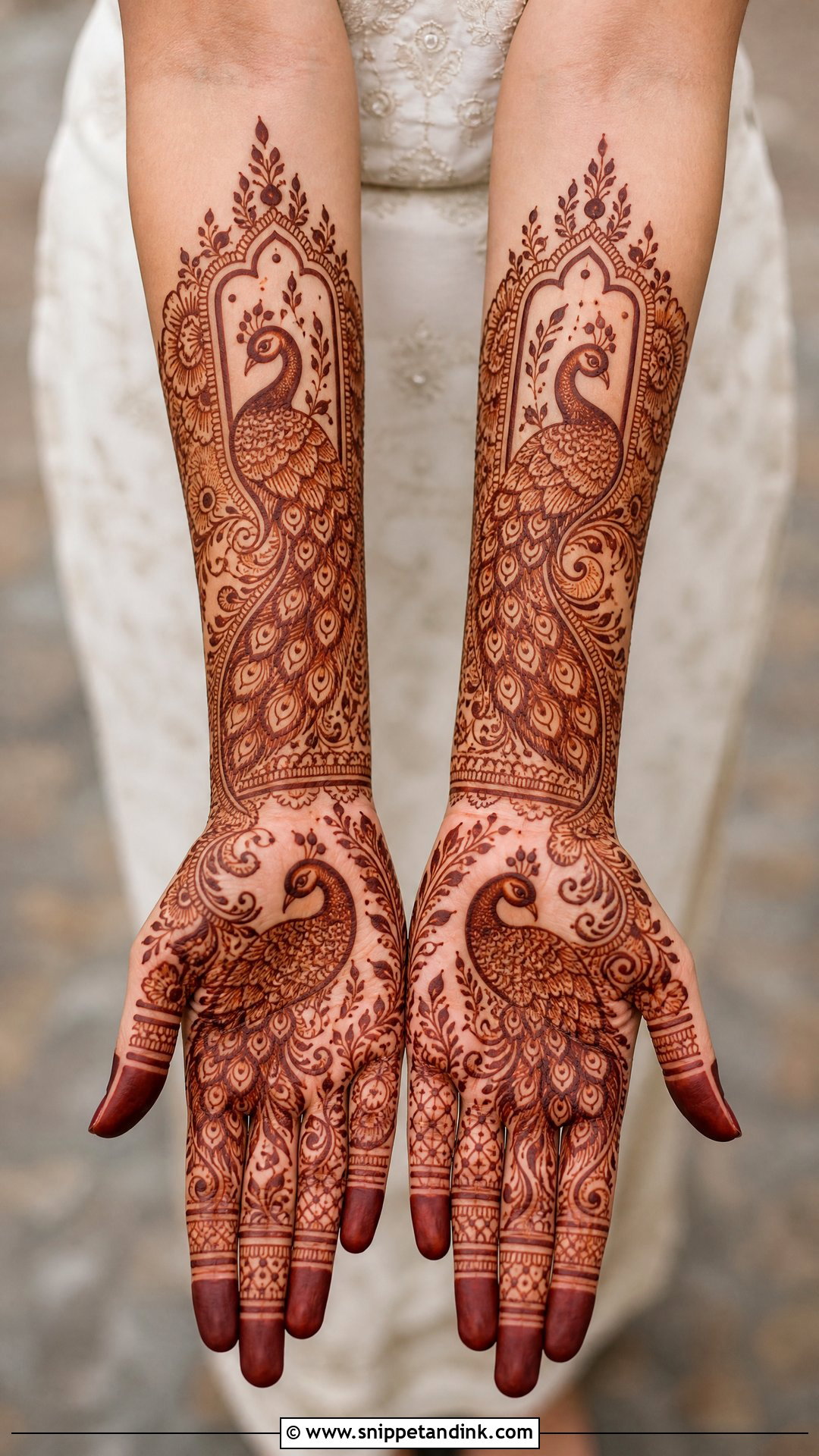
Few motifs feel as royal at an Indian wedding as the peacock. Peacock bridal mehndi design can sit on the palm, back hand or forearm, surrounded by feathers, paisleys, florals, jaali and vines. Some brides want mirrored peacocks; I often prefer one large bird on one hand balanced by a mandala or lotus on the other. The feathers need fine, separate strokes and light shading around the body, otherwise they merge into a dark fan. Jewel-toned lehengas and gold jewellery suit it well.
6. Bride Groom Mehndi Design
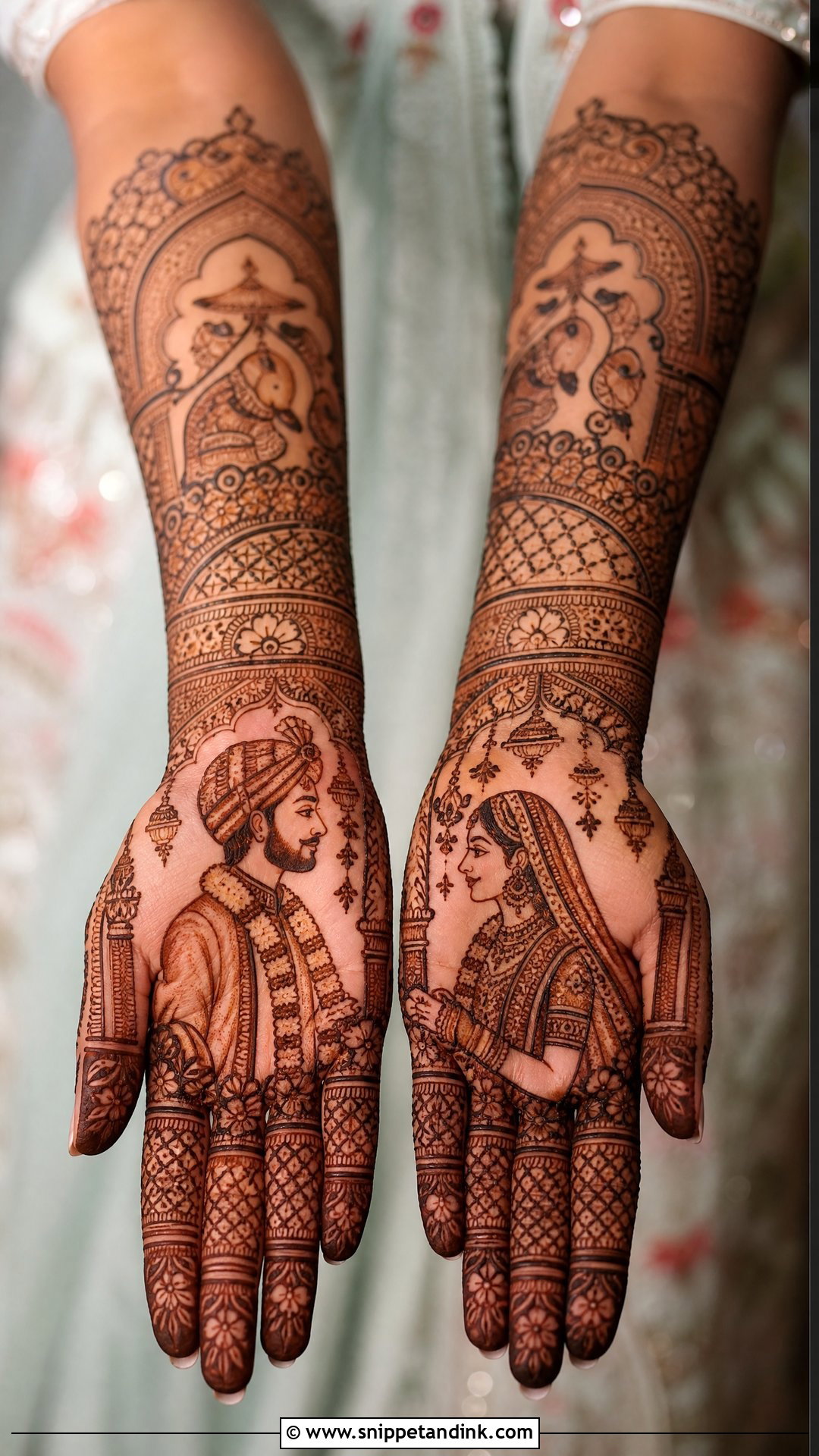
This is the design families crowd around to look at. Bride groom mehndi design usually places her portrait on one palm and his on the other, framed by garlands, mandap art, a doli, the varmala and paisley borders, so the two hands only make sense together. Faces are unforgiving: a slightly misplaced eye changes the whole expression, and fine features can blur if the paste line is heavy. Book an artist whose healed portraits you’ve seen, then let jaali, wrist bands and lotus details fill the rest quietly.
7. Dulhan Mehndi Design
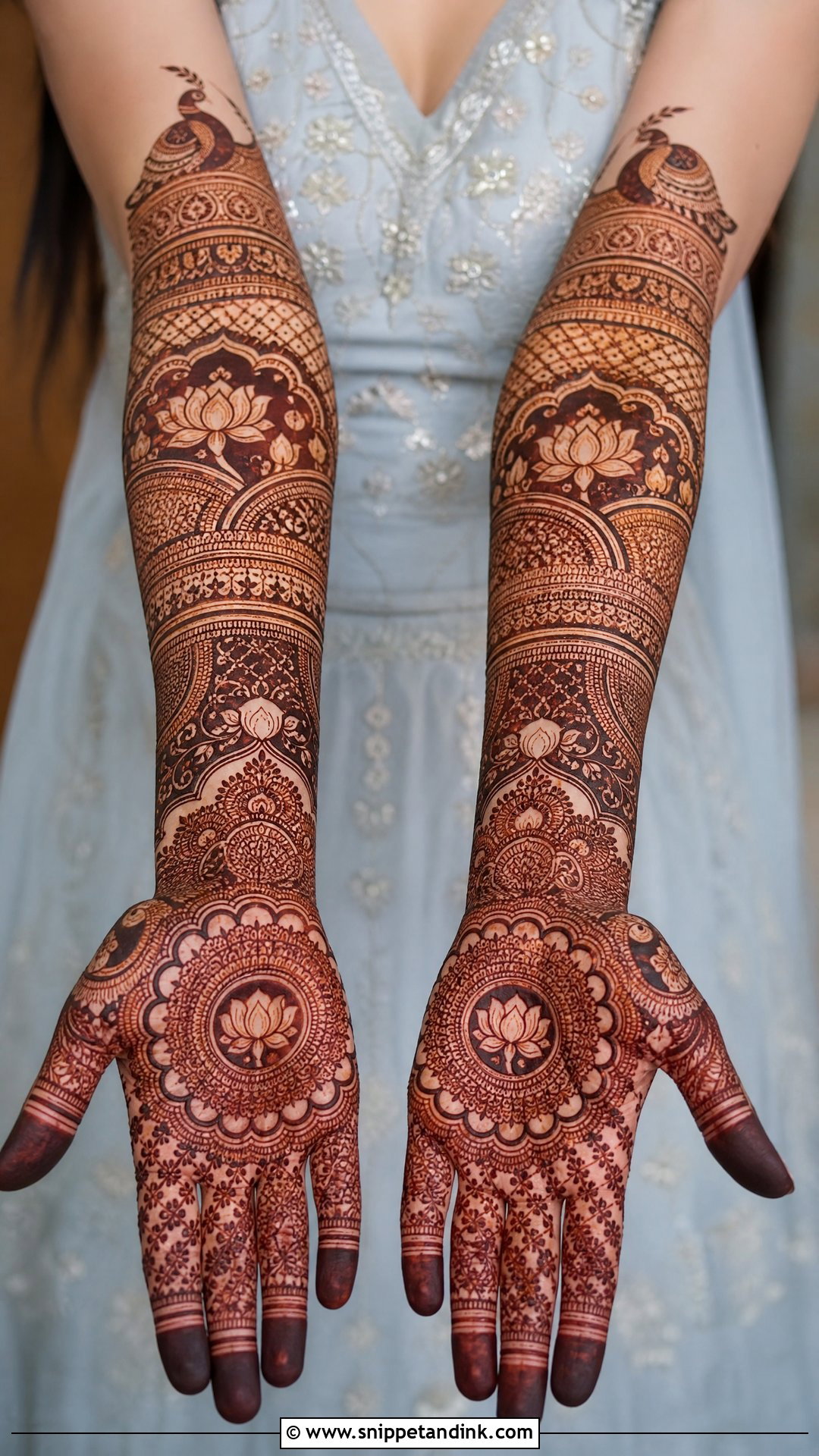
Dulhan mehndi is heavier than anything a guest wears, and that difference is deliberate. It runs from fingertips to forearms in dense Indian patterns, with mandalas, bride and groom art, lotus or initials on the palms and paisleys, bells, leaves and bands along the arms. Because so much skin is covered, I plan the symmetry in sections before I start, so the two arms finish level at the same height. It comes into its own in photos of your hands holding the dupatta, kalire or chooda.
8. Rajasthani Bridal Mehndi Design
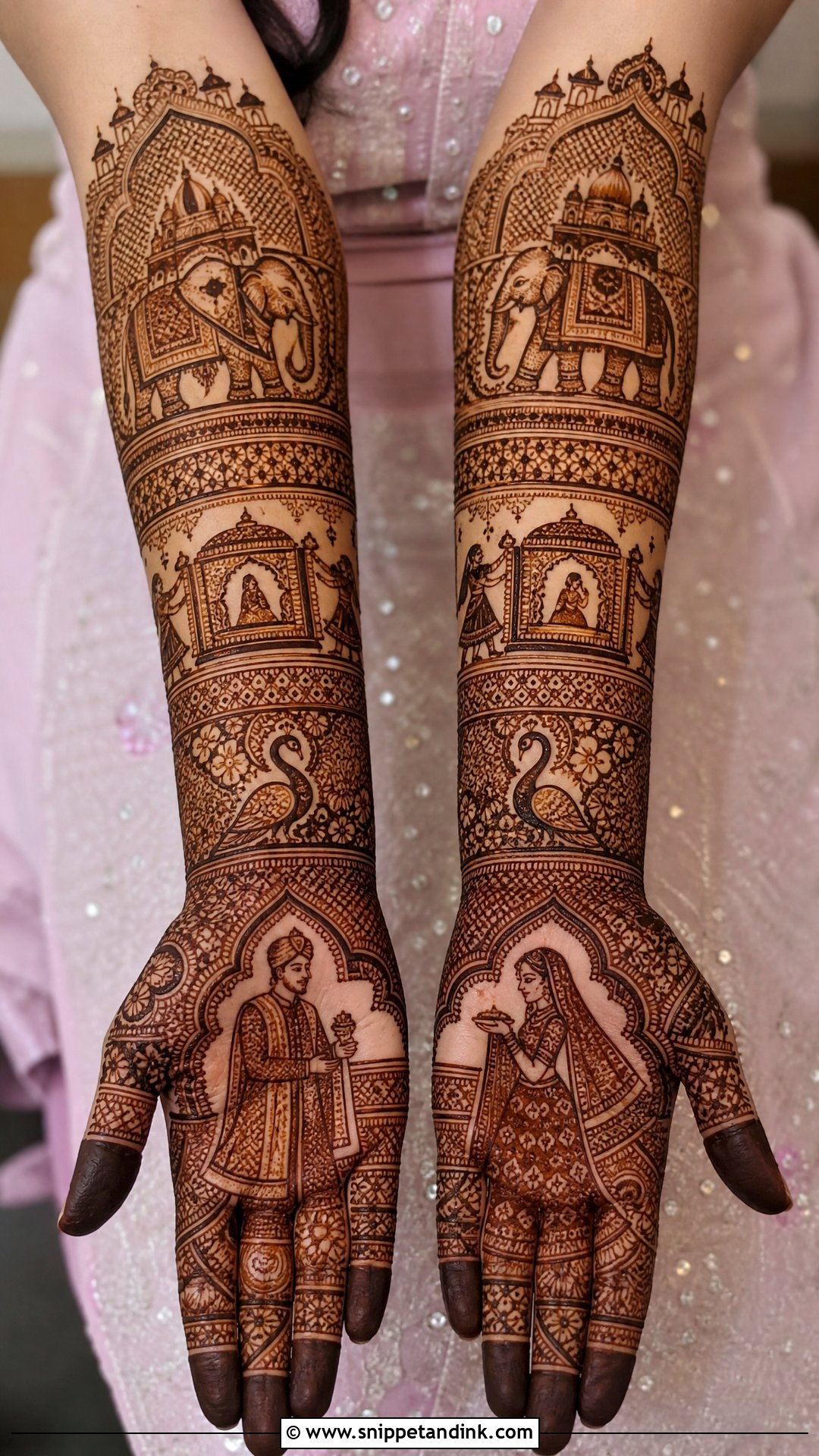
Rajasthani designs leave very little bare skin. Elephants, palaces, a doli, baraat scenes, peacocks, mirror motifs, bride and groom figures and fine jaali fill the hands and arms, which gives that rich heritage look so many brides want with a heavy lehenga. It’s a long sitting, so plan for snacks, water and breaks, and someone to hold your phone. The stain only looks grand if the panels are cleanly separated; I draw the borders first and fill afterwards for exactly that reason.
9. Marwari Bridal Mehndi Design
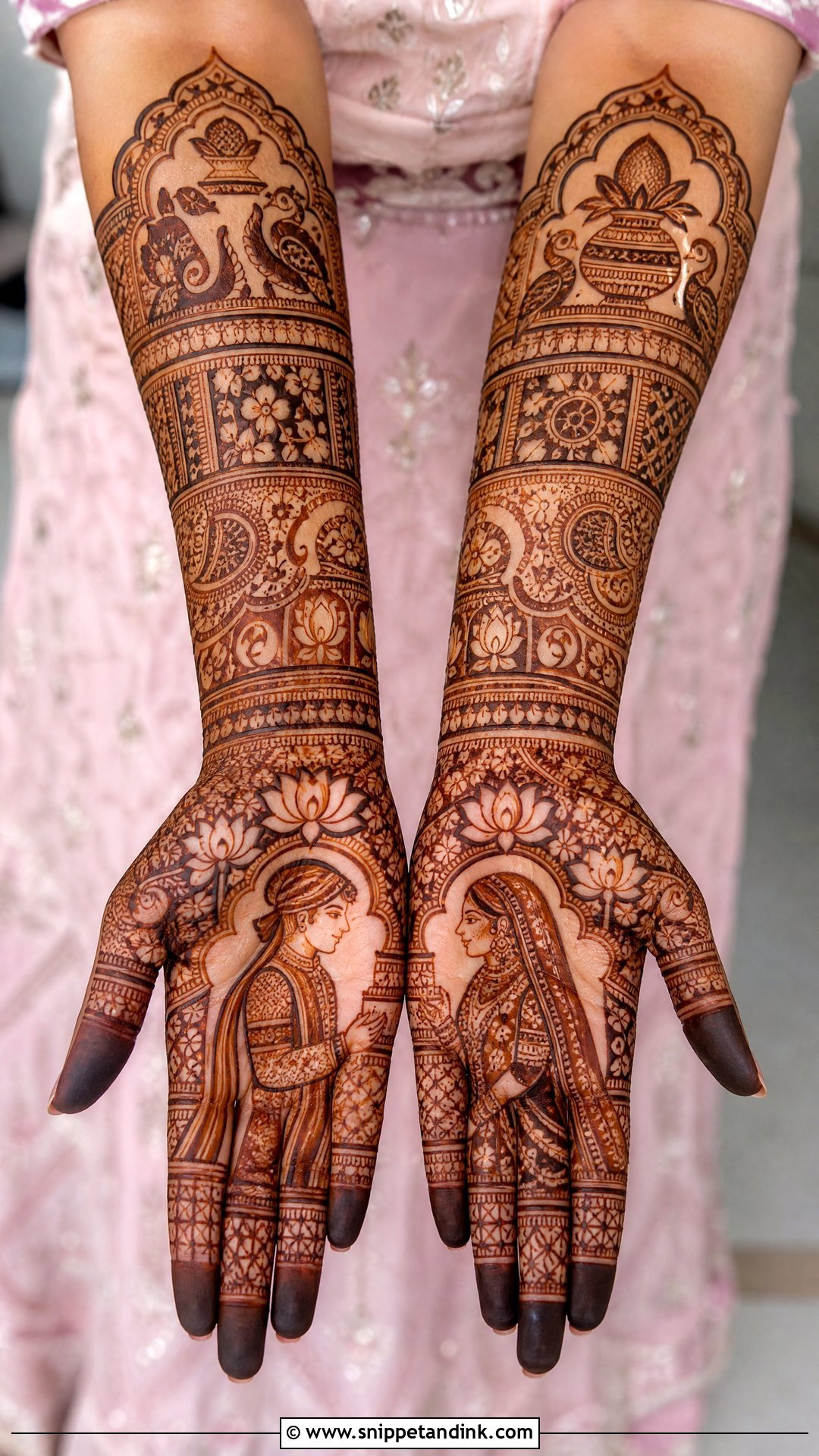
Marwari work is compact and dense, with detailed finger caps, symmetrical palms and motifs tied to marriage and prosperity: dulha-dulhan art, mandap details, kalash, lotus, peacocks and layered paisleys. It suits a bride who wants heavy coverage with almost no empty areas, and it looks right beside red, orange, pink and gold outfits. The danger with so much detail is mush. Clear borders between the major sections are what keep it readable, so ask for them.
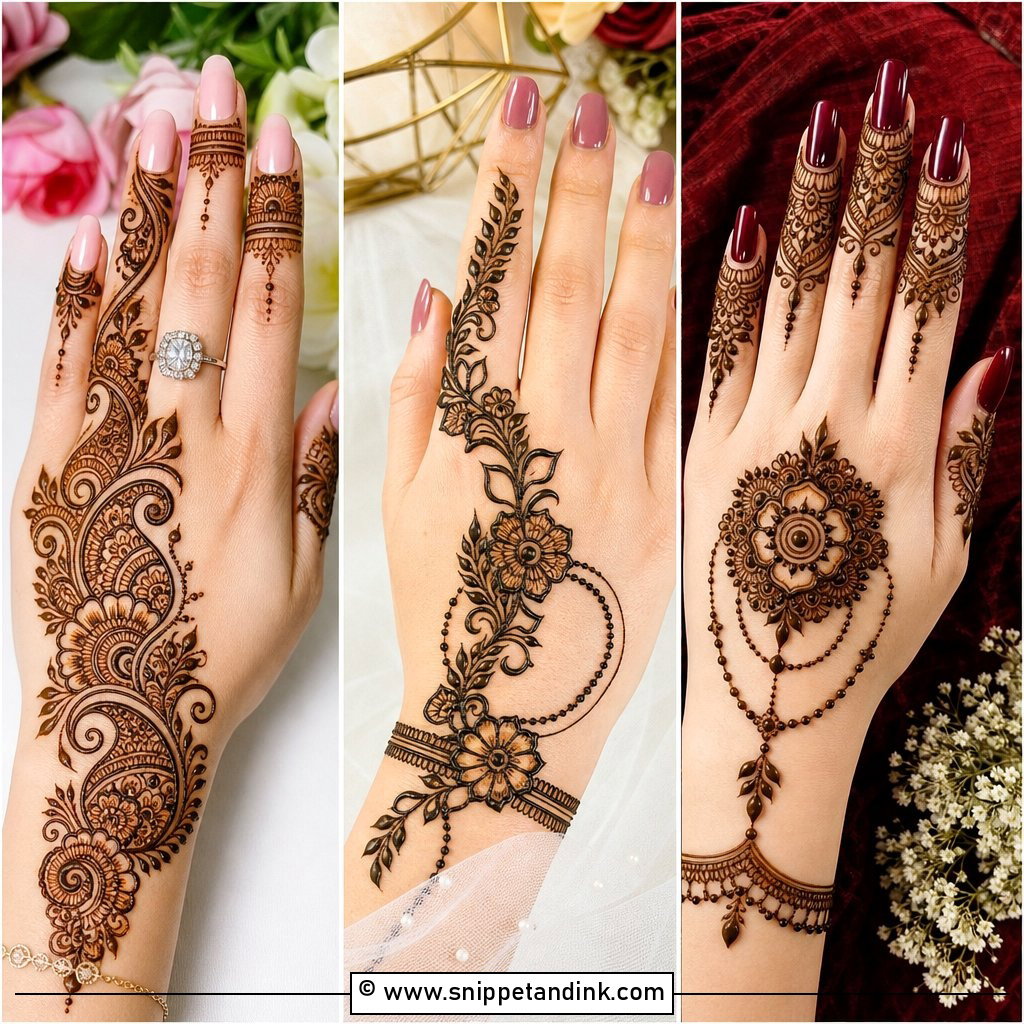
10. Mandala Bridal Mehndi Design
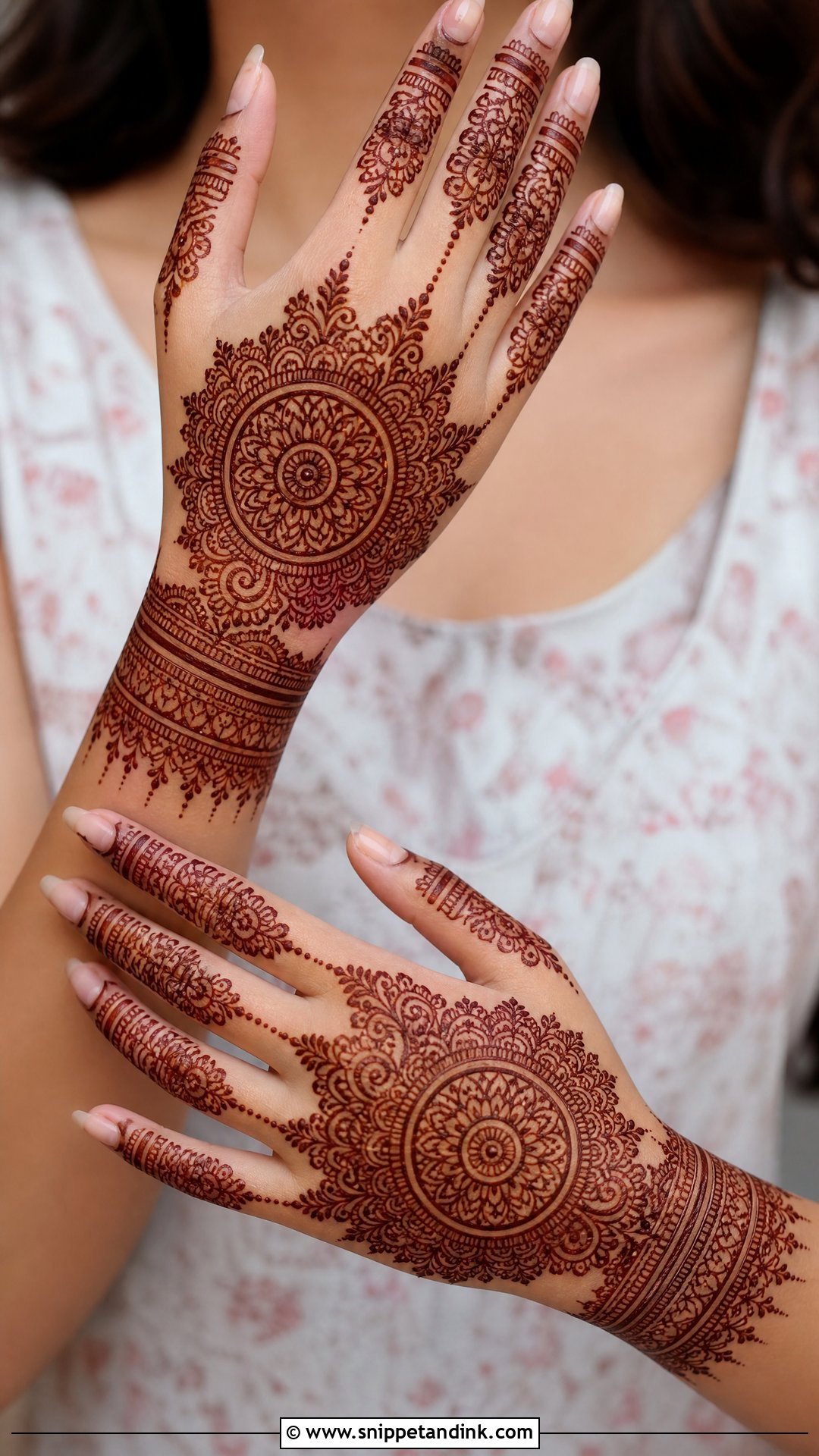
Soft circles and clean symmetry make the mandala a favourite with modern Indian brides. I place a bold round motif in the centre of the palm or back hand and build outward with florals, dots, lace borders, vines and finger work. It can stay open or go dense depending on the wedding. Mandalas coordinate two hands easily for photos, and for a bridal version I extend them to the wrist and forearm with bands, paisleys and lotus trails so the design doesn’t stop abruptly at the wrist.
11. Jaali Bridal Mehndi Design
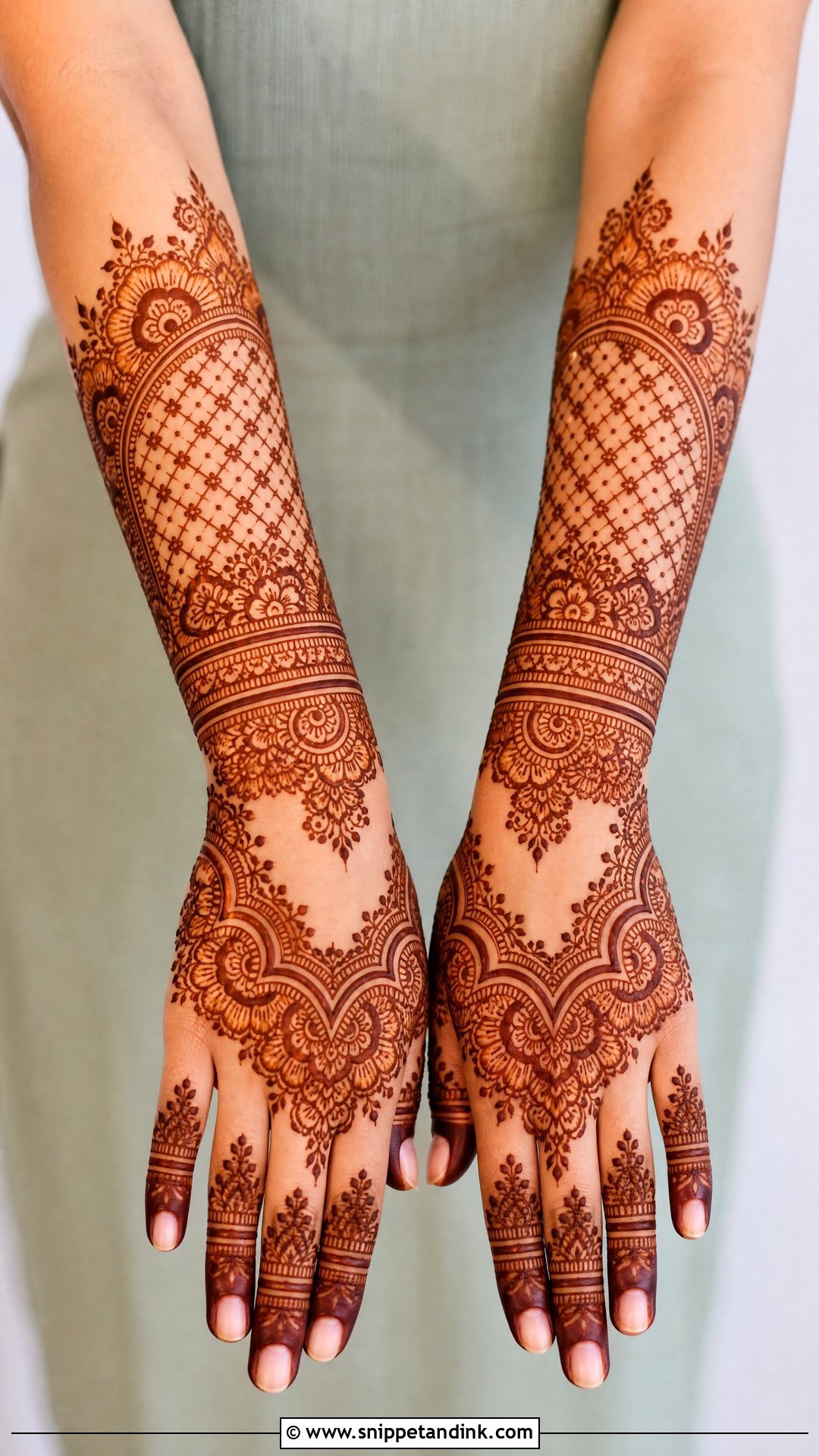
Jaali is mesh work, a grid of fine crossing lines that reads like lace once it stains. It sits best on the back hand, wrist or forearm, paired with flowers, paisleys, leafy borders and detailed fingers. The grid has to be even; one wandering line throws the whole net off, and close-up photos show it. For a fuller Indian bridal look I combine jaali panels with mandala palms or peacock forearms.
12. Lotus Bridal Mehndi Design
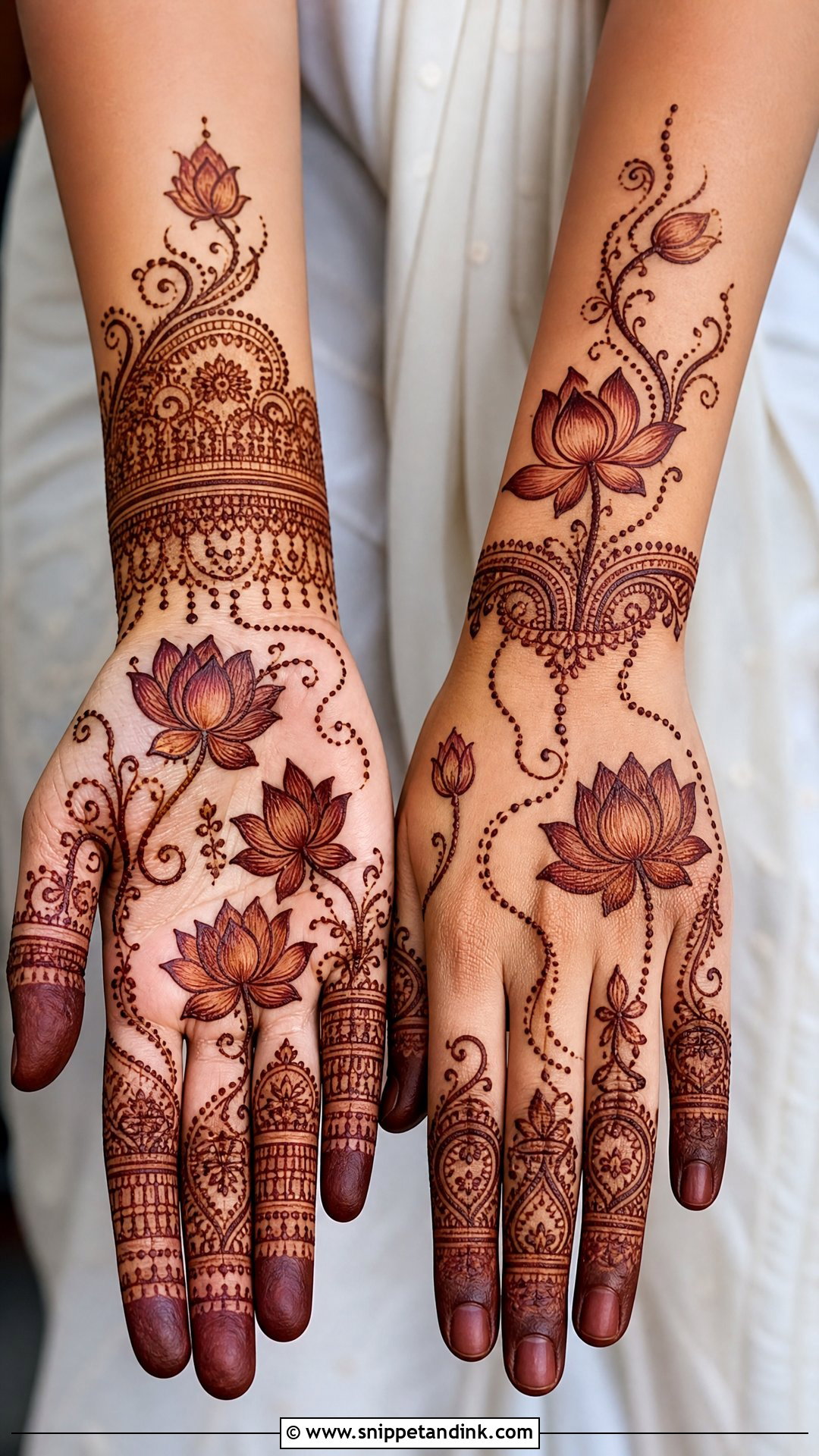
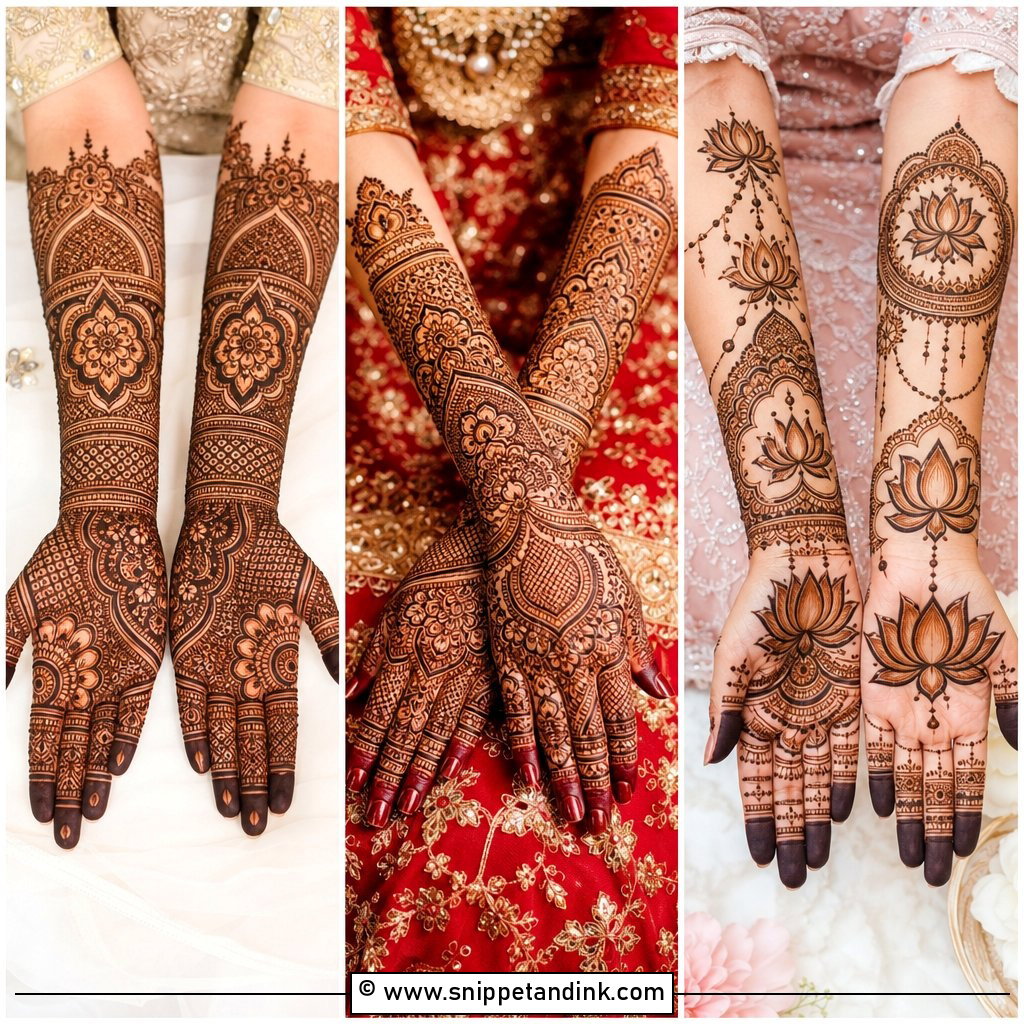
The lotus carries a sacred meaning in many Indian rituals, and a complete lotus look might put large blooms on the palms, small buds on the fingers and vines running toward the wrist. It pairs naturally with mandalas, paisleys, dotted chains and light shading. Pastel lehengas, temple jewellery and floral accessories for the mehndi ceremony sit comfortably with it. I layer the petals with a small gap between each row, because petals drawn touching each other stain as one blob.
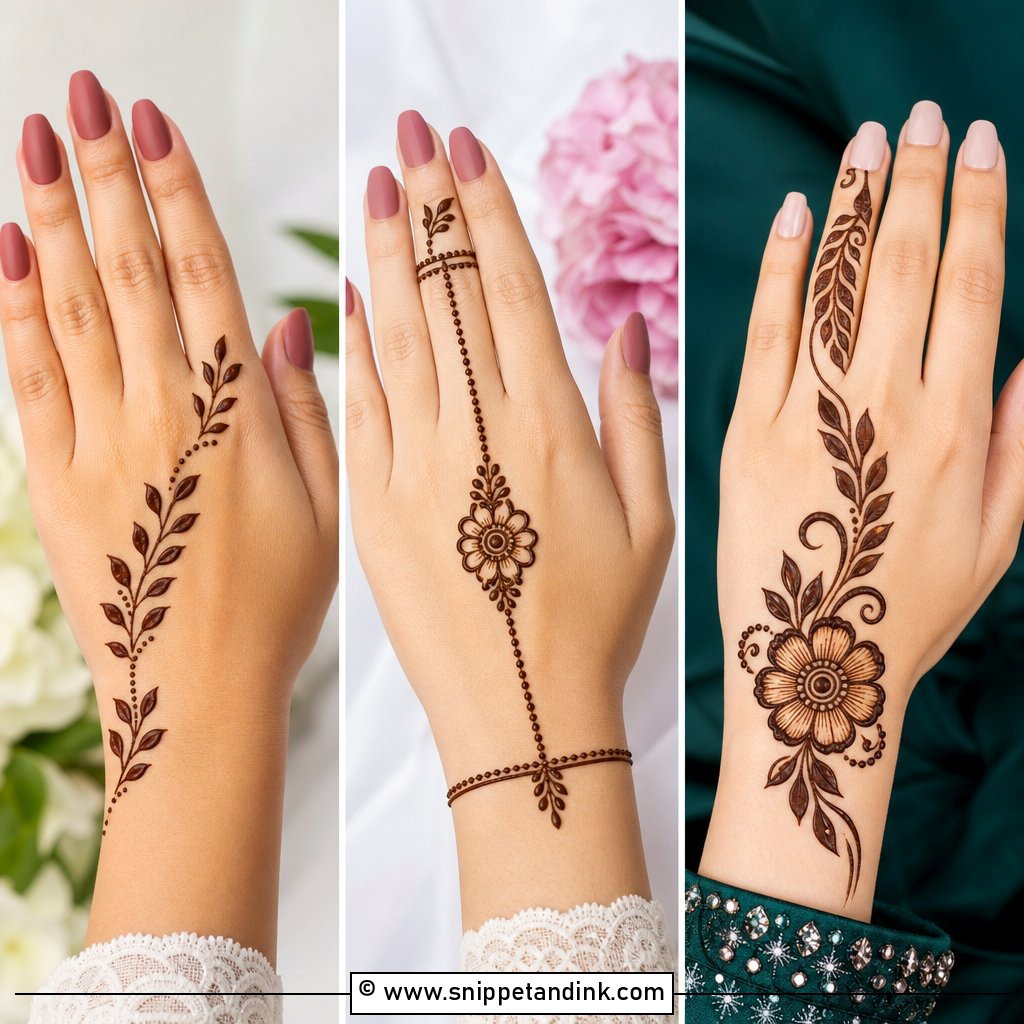
13. Minimal Bridal Mehndi Design
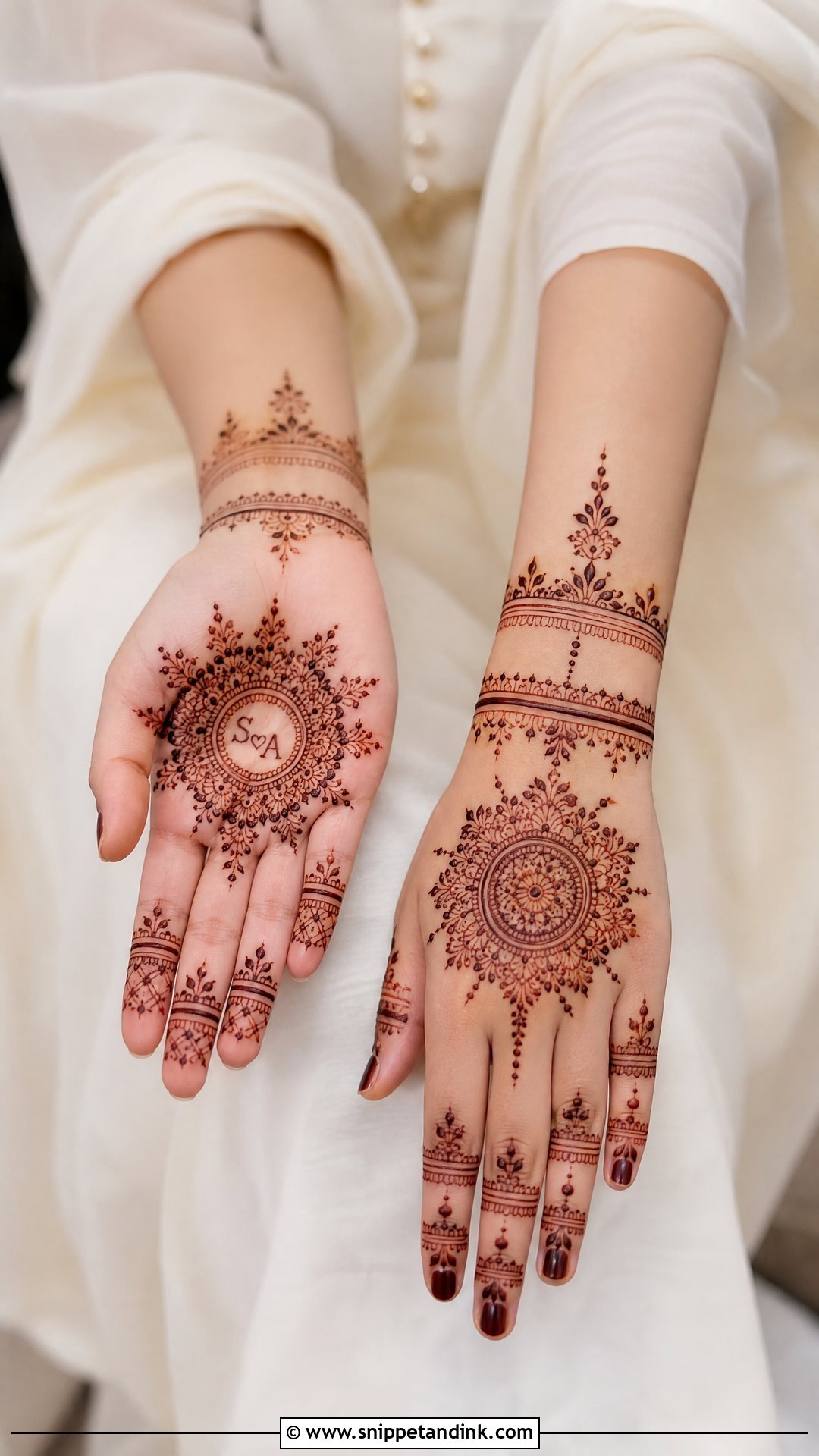
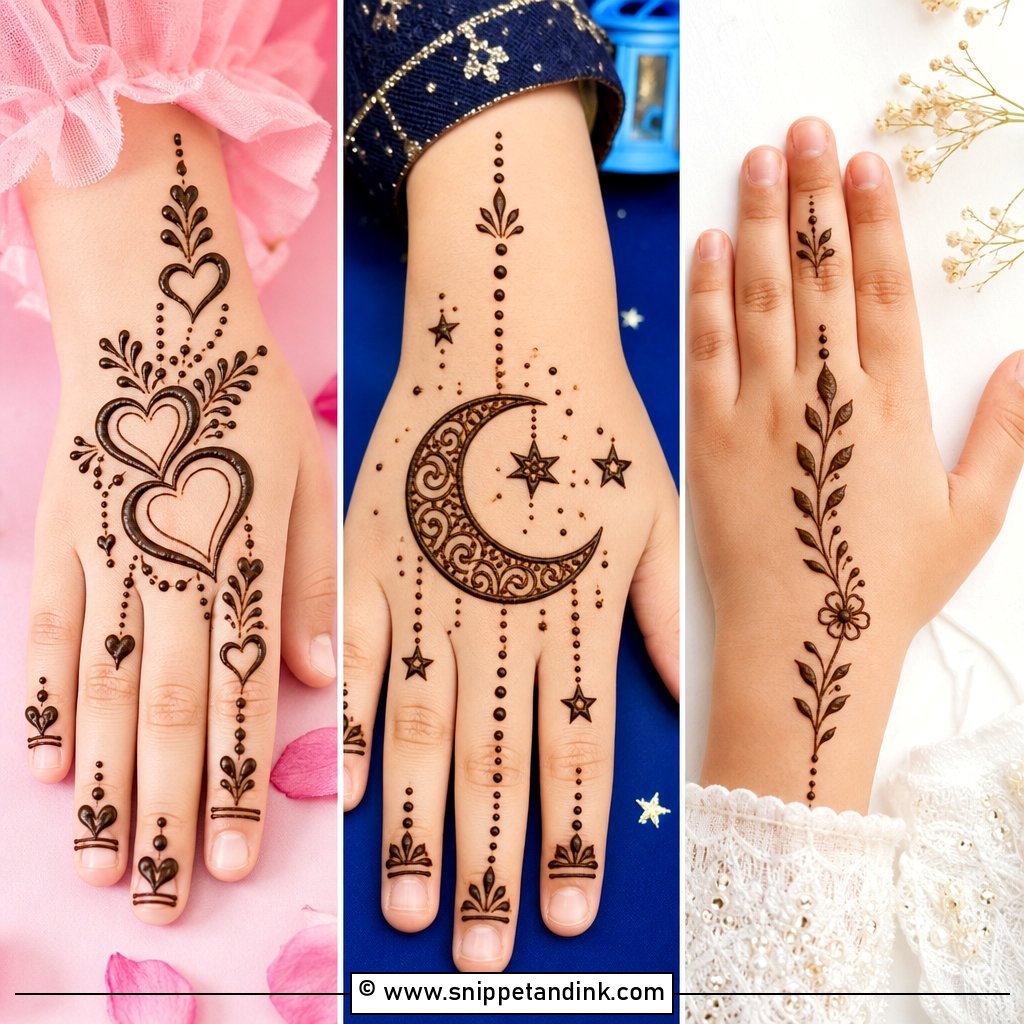
Not every bride wants heavy coverage, and a minimal design can still look finished. Clean palms, a small mandala, finger patterns, wrist cuffs, small florals and open space make up the look. It suits modern outfits, lighter jewellery and destination weddings, and it keeps your hands free sooner. What stops it looking casual is one personal detail, such as initials, a tiny date or a meaningful flower, plus neat, intentional spacing across both hands.
14. Back Hand Bridal Mehndi Design
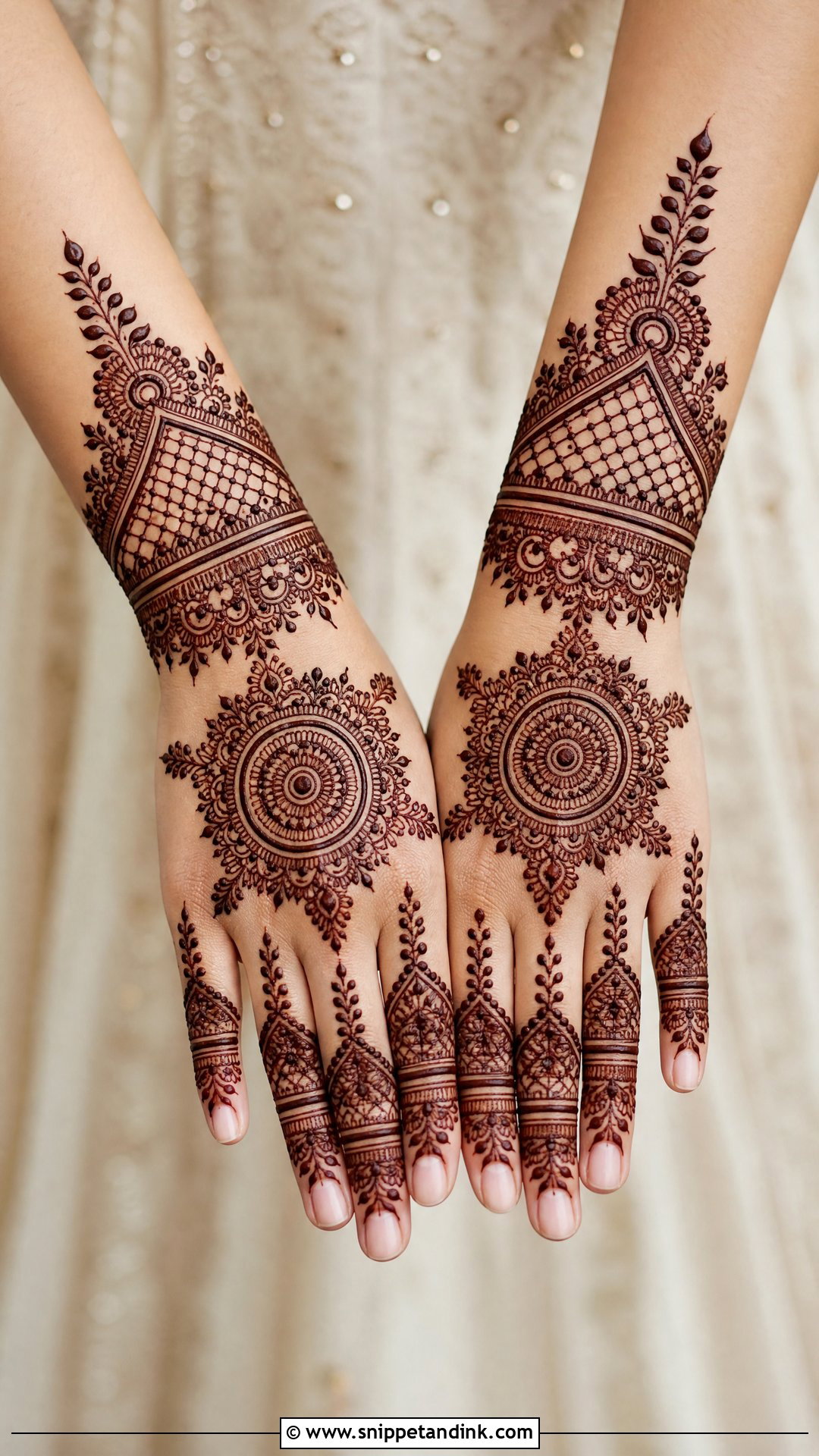
The back of the hand appears in ring photos, chooda pictures, kalire shots and bridal portraits, often more than the palm does. A central mandala, a bracelet-style wrist band, detailed fingers, jaali, vines and paisley trails should connect into one piece. Matching both hands is traditional, but coordinated motifs that differ slightly also look good. Whatever the density, don’t leave the fingers plain: they frame your rings, and bare fingers next to a heavy hand look unfinished.
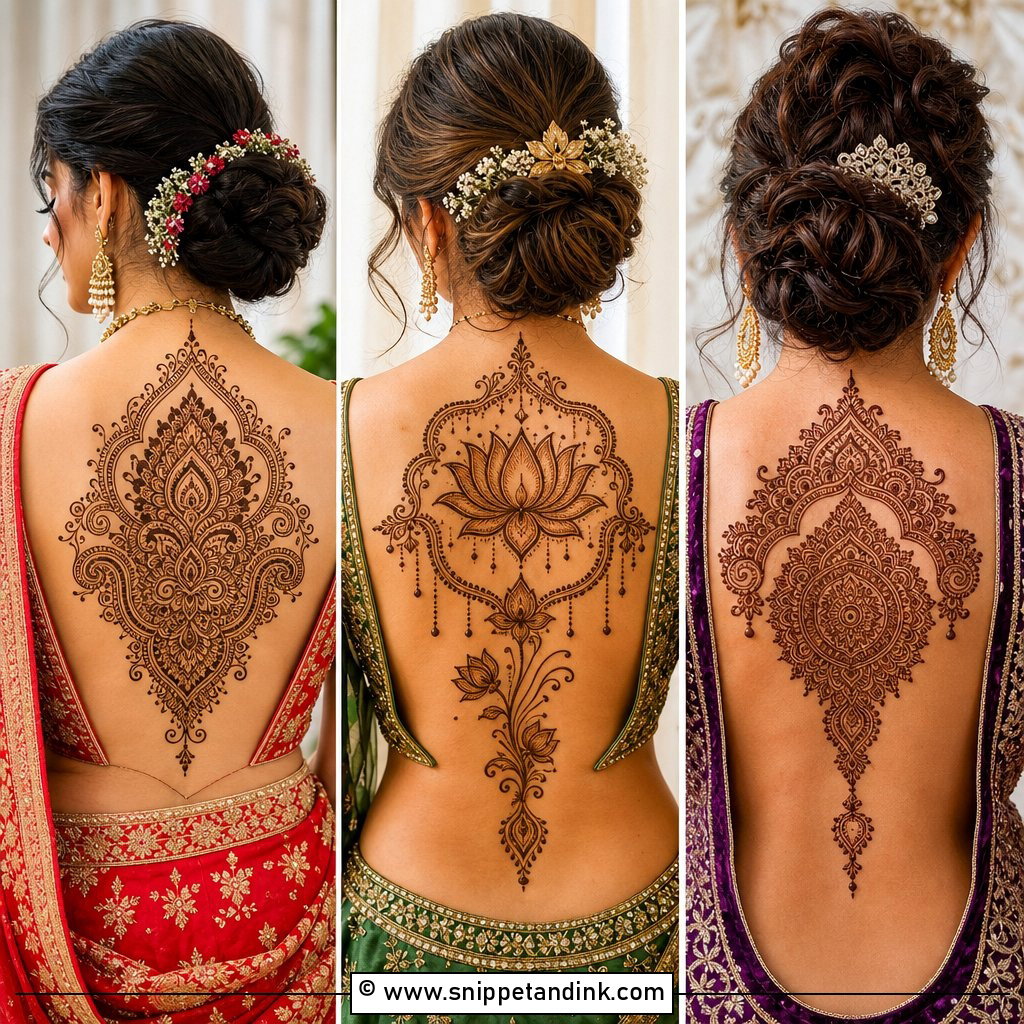
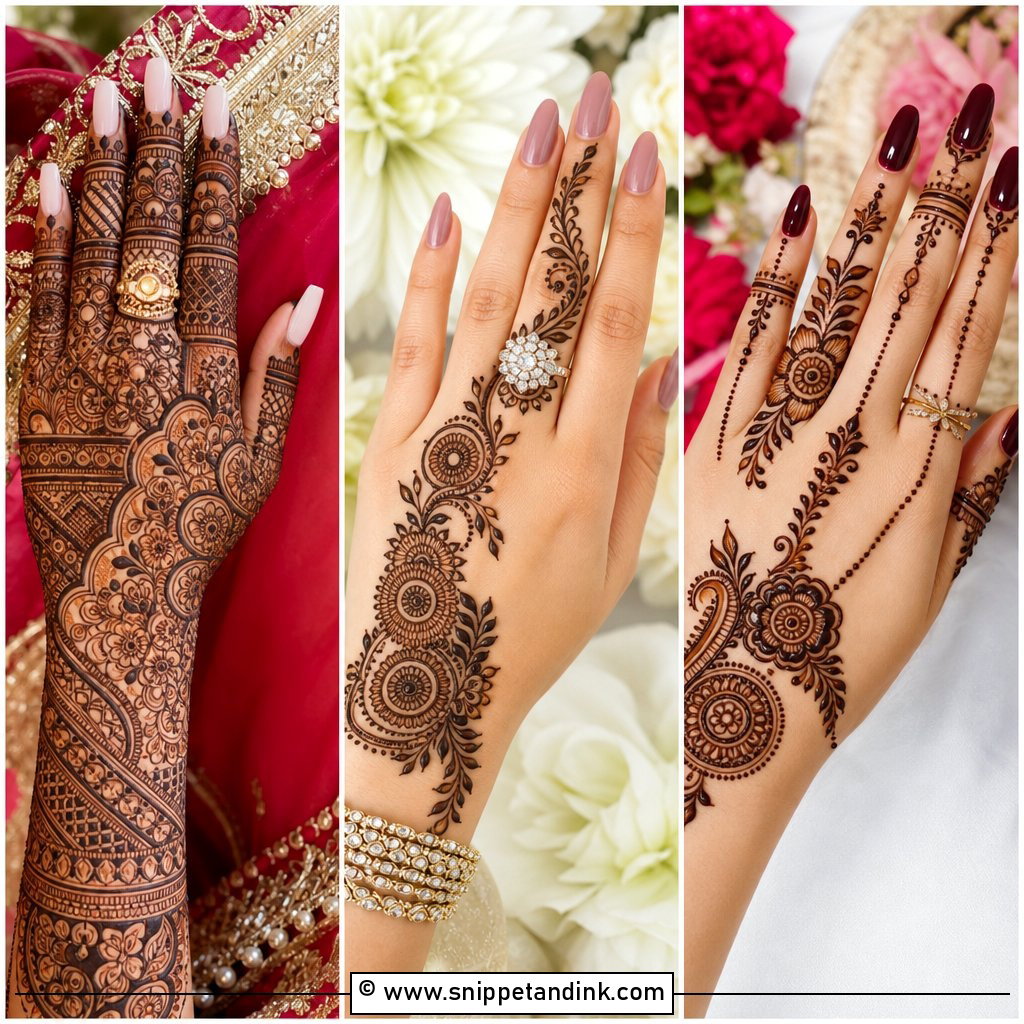
15. Front Hand Bridal Mehndi Design
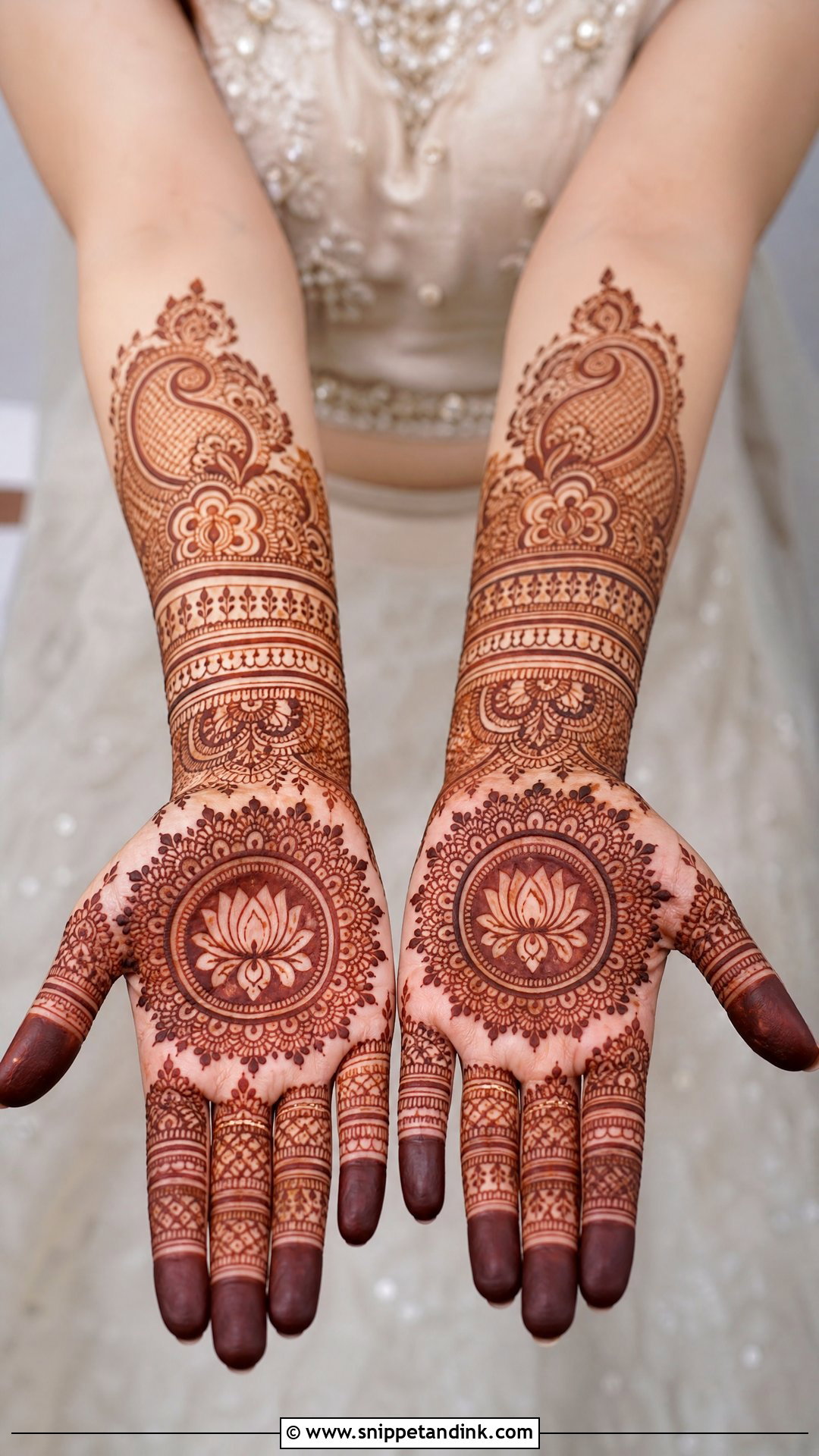
Palms are on show during haldi, the varmala, blessings and every close-up of your hands held open, and they stain darker than any other part of the body. That’s where the meaningful motifs go: a mandala, a portrait, a peacock, a lotus or a wedding symbol, with dense fingers and a wrist band or trail to finish. I’d keep to one clear focal point per palm. Two or three large motifs competing on the same palm end up crowding each other.
16. Portrait Bridal Mehndi Design
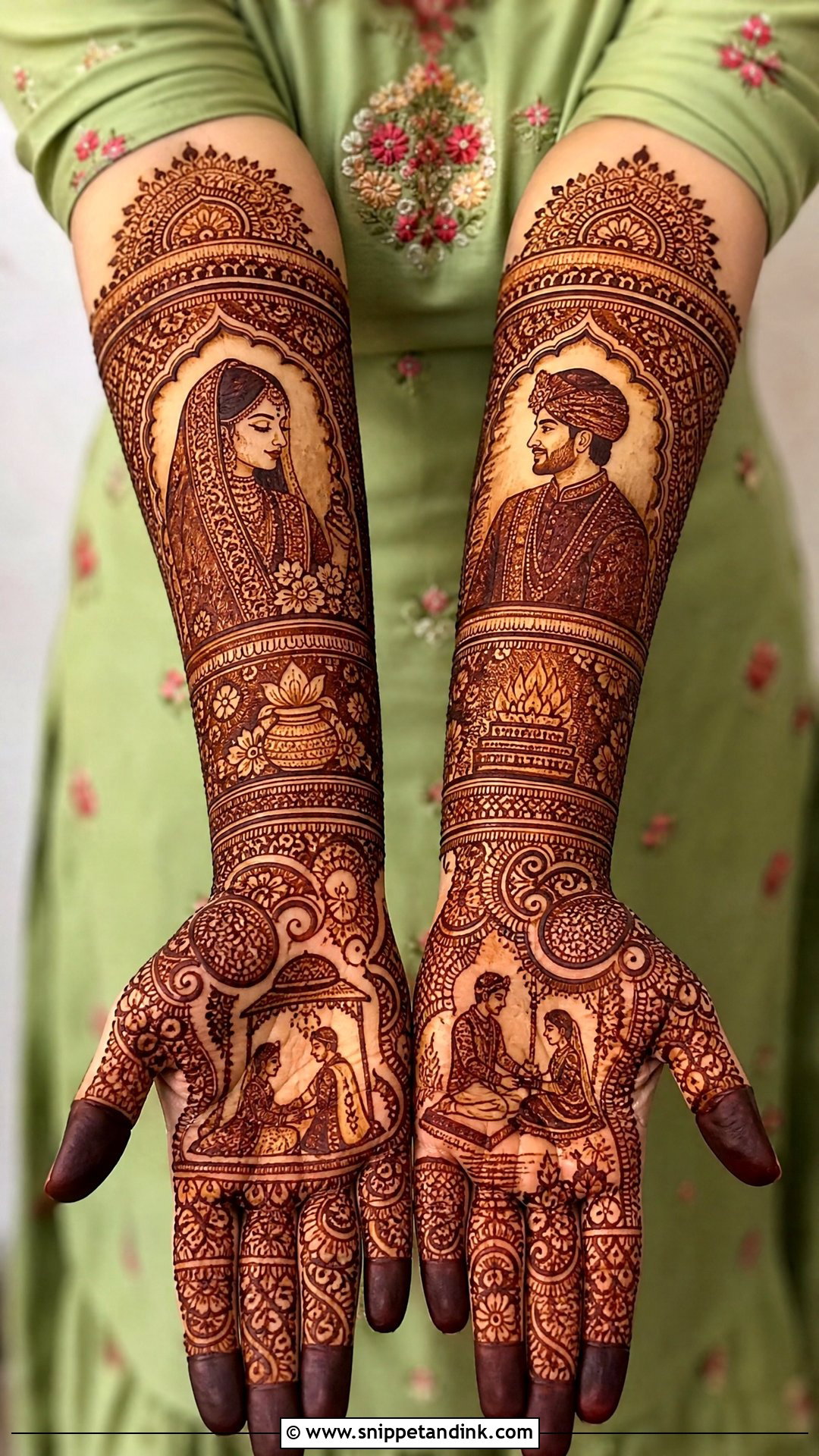
Portraits turn your hands into a record of your story: the couple’s faces, a proposal scene, rituals, pets or a favourite place, set on the palms or forearms with florals, paisleys and jaali around them. This is specialist work. Look for an artist who does fine bridal detailing regularly, and keep the surrounding pattern quieter than usual so the faces stay the focus. Send reference photos with good light on the faces well before the day.
17. Personalized Bridal Mehndi Design
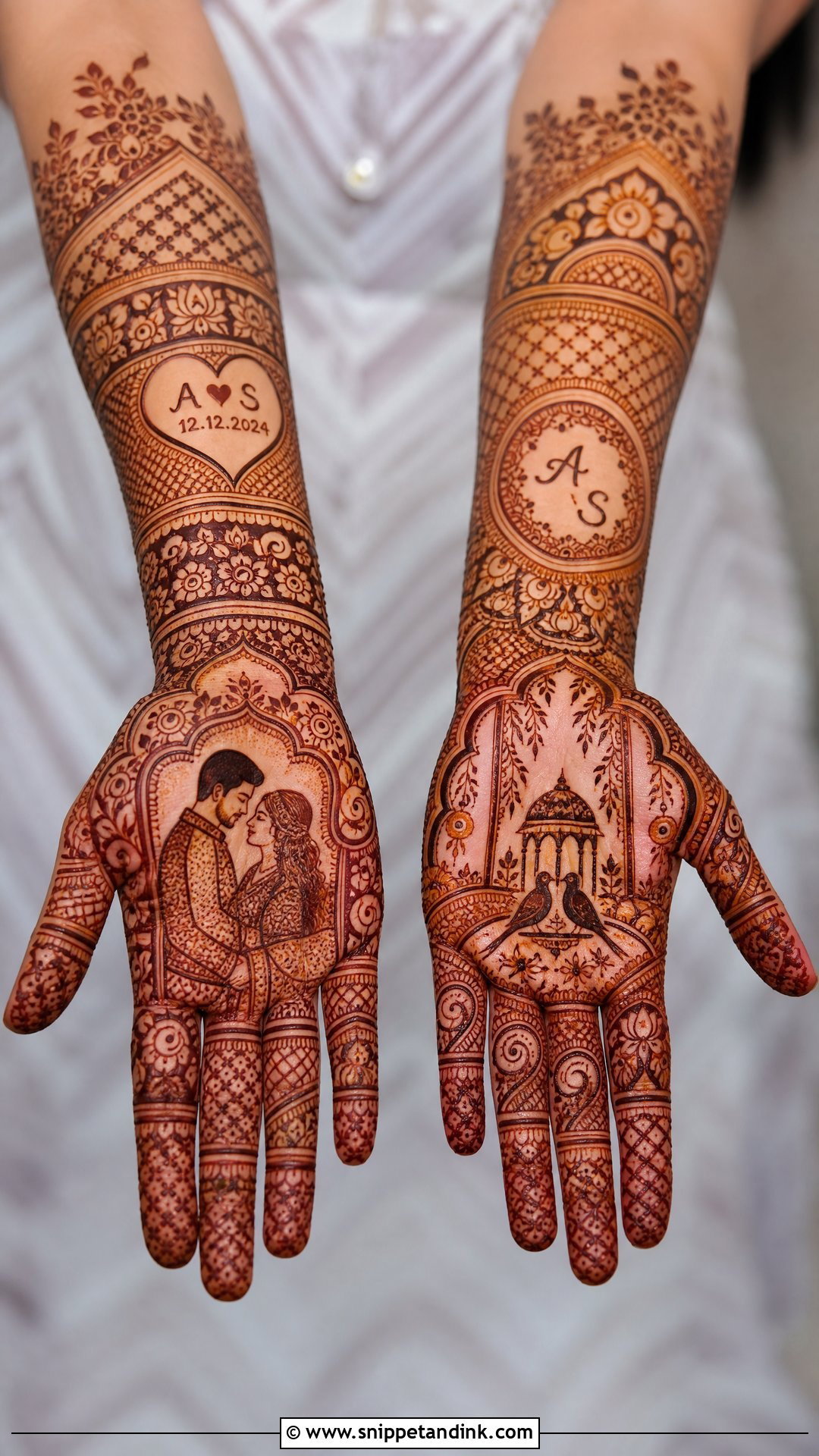
Personal details are what make a design yours alone: the groom’s name, your date, initials, a skyline, a favourite flower, a shared hobby or a zodiac sign. I hide them inside paisleys, near the wrist or within a mandala or jaali panel, and draw the letters a touch bolder than the fillers so they stay readable after staining. The rest of the hand should still look bridal. Guests love leaning in to find the surprises, and the groom’s search for his name is still one of the funniest moments of the evening.
18. Modern Bridal Mehndi Design
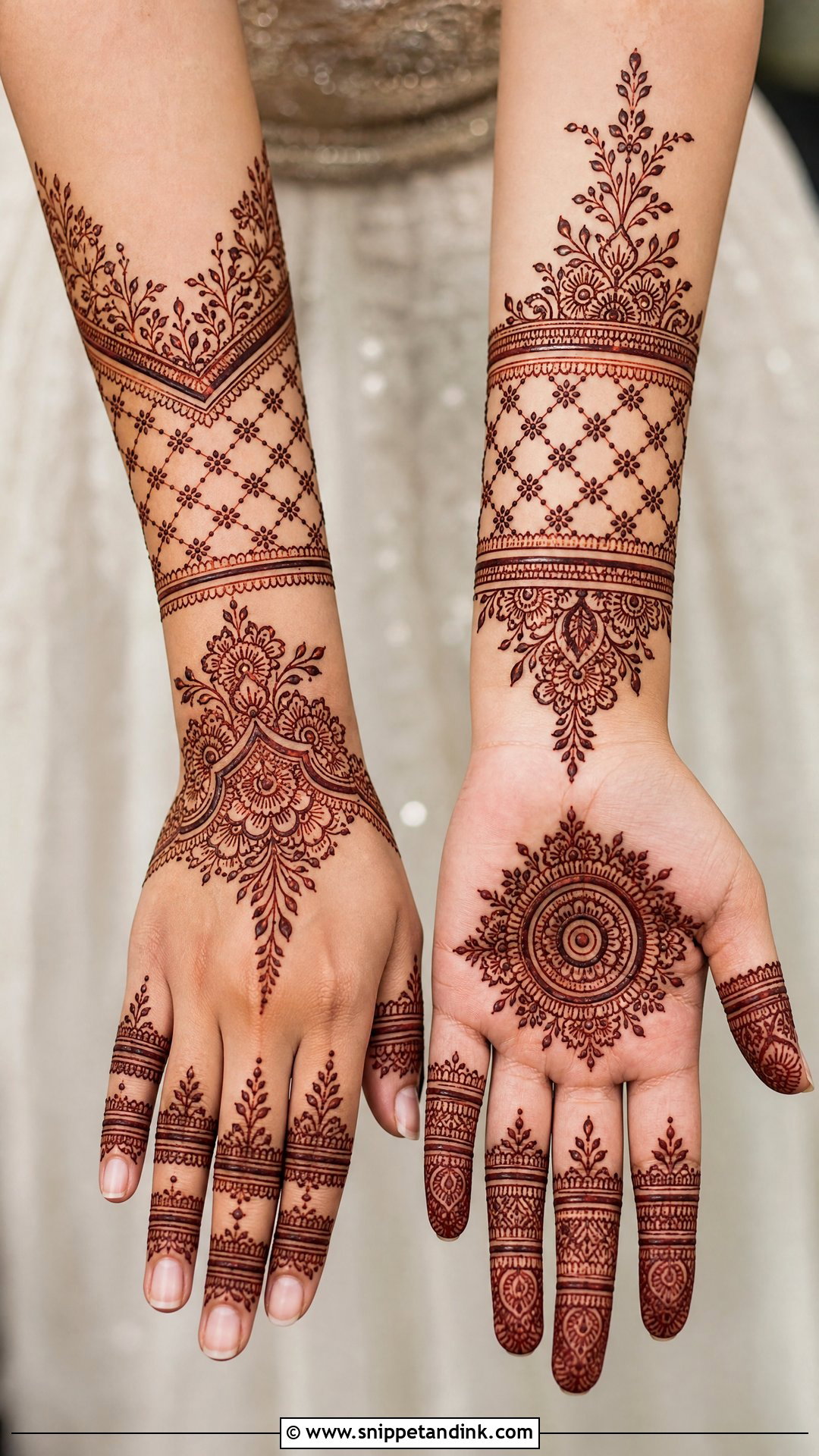
Modern bridal designs suit contemporary outfits: negative space, geometric grids, bracelet bands, floral trails, finger-focused patterns, mandala palms and looser spacing than traditional full-hand work. Some brides go asymmetric; others want neat mirrored hands. It works especially well for engagements, receptions and destination weddings. The open space is the risky part. Without a strong wrist-to-forearm flow and worked fingers, a sparse design can look unfinished rather than deliberate.
19. Heavy Bridal Mehndi Design
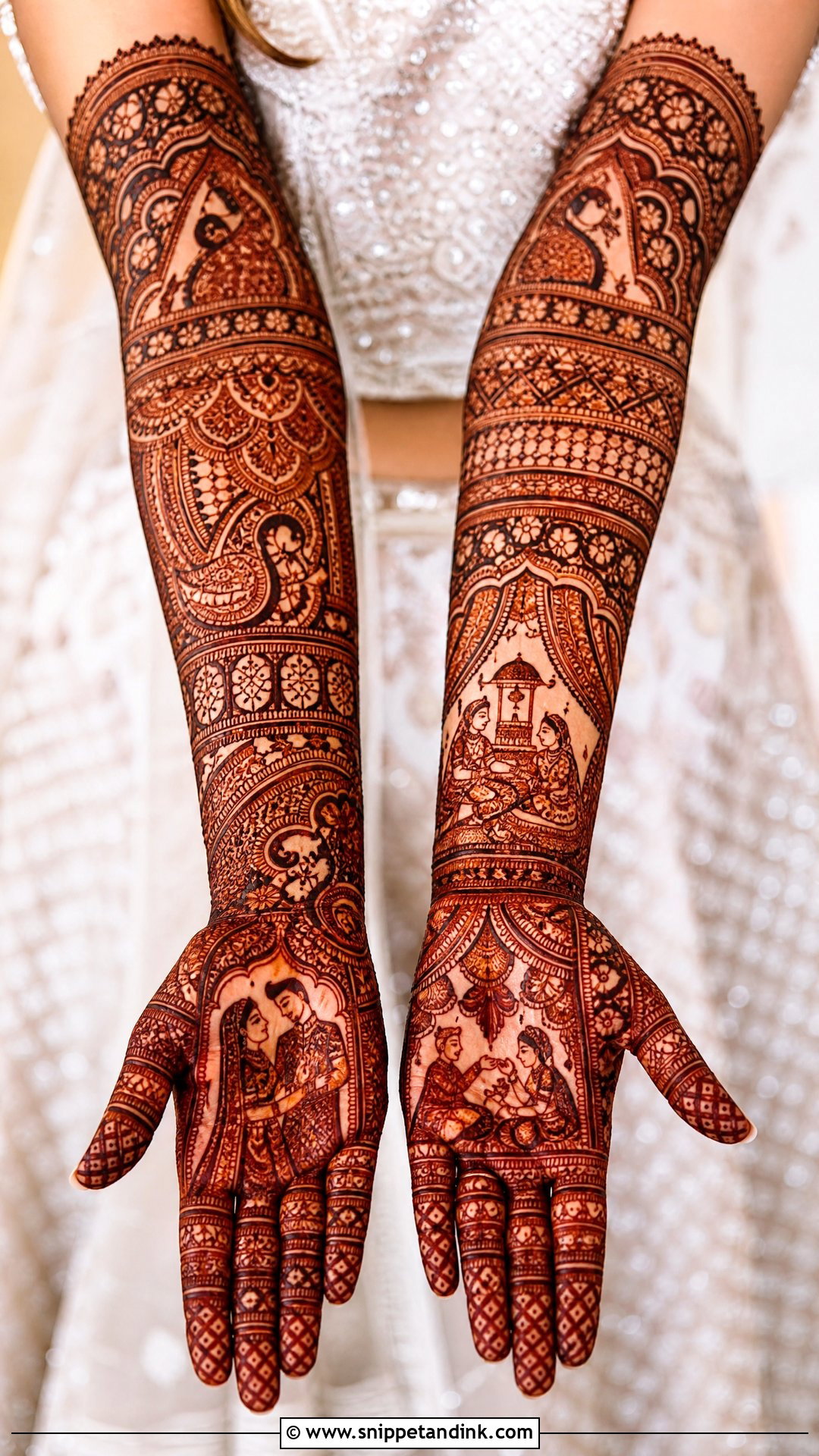
Heavy work fills the hands from fingertips to forearms with paisleys, peacocks, florals, jaali, mandap scenes, bride and groom art and layered borders. It stands out in every photo and suits brides who love traditional Indian wedding styling. With so little bare skin, strong sectioning is essential, or the stain turns into one dark sleeve. It takes the longest of anything here. Chooda, bangles, kalire, rings and an embroidered outfit all sit naturally with it.
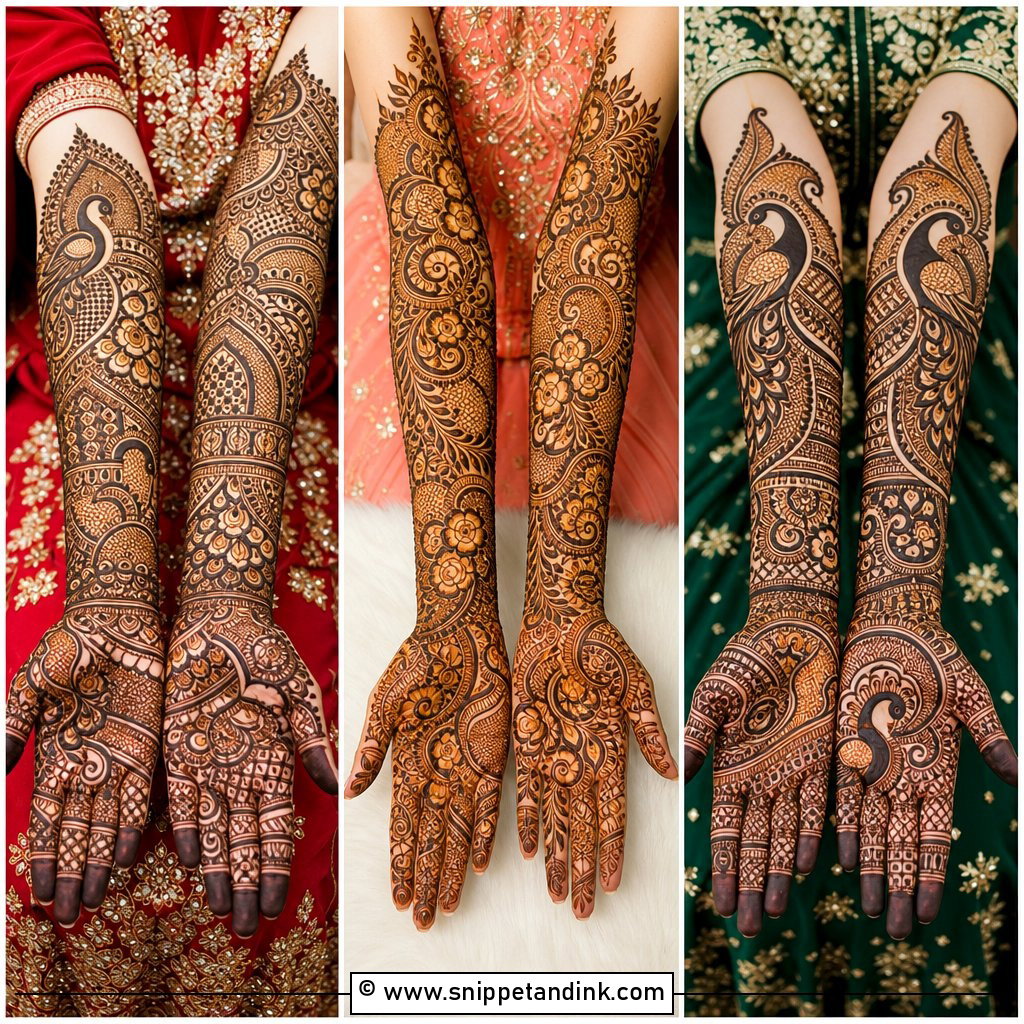
20. Simple Bridal Mehndi Design
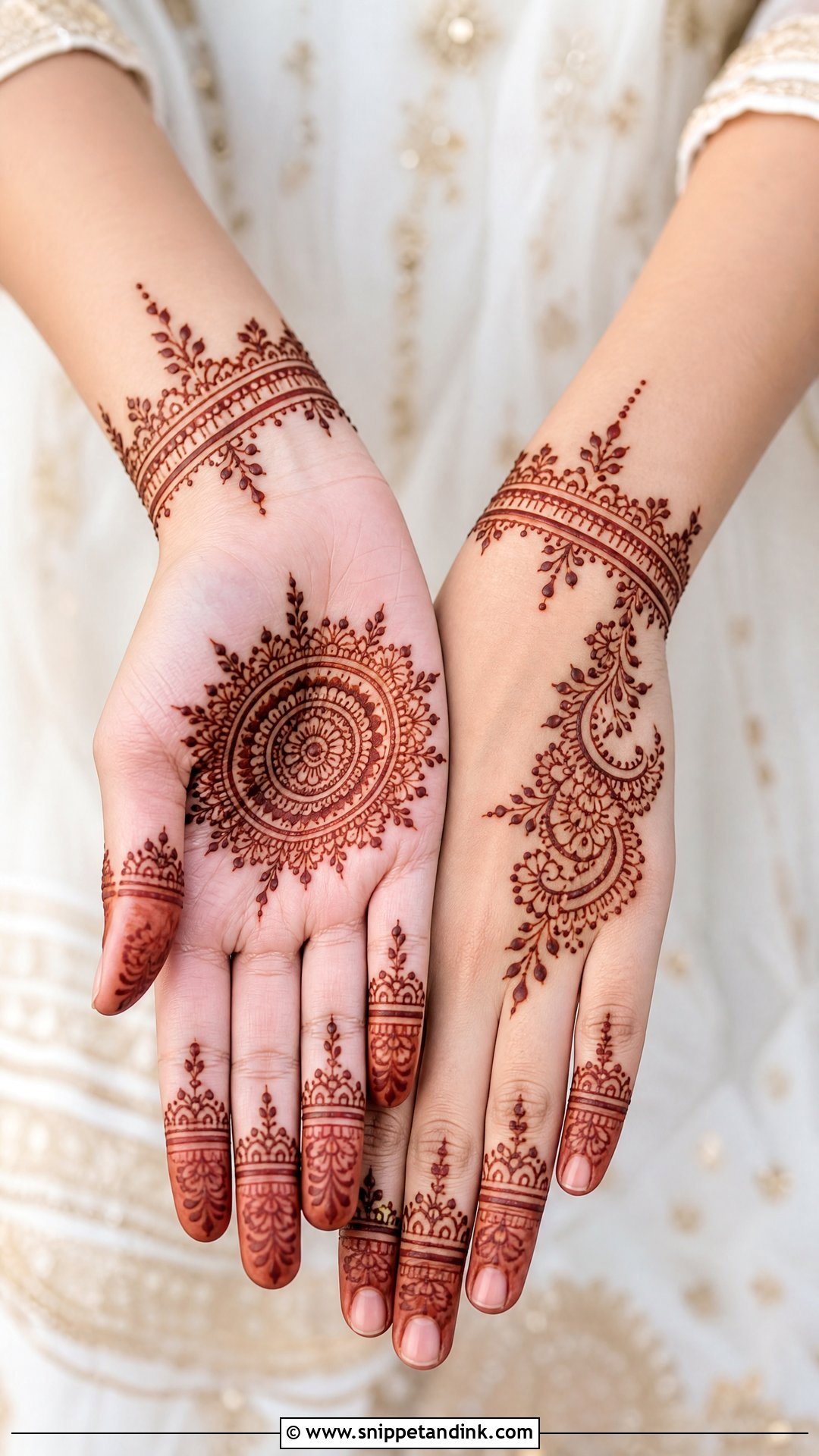
A simple bridal design might be a neat palm mandala, floral trails on the back hand, light finger detail, a bracelet band and a short forearm extension. It’s comfortable through long events and suits smaller ceremonies or minimal jewellery while still feeling traditional. I draw the motifs slightly larger than usual and keep the lines clean, because small, sparse details can look faint once stained. Less coverage, done neatly, still reads as bridal.
Reading a Portfolio for Healed Stain, Not Wet Paste
Almost every mehndi photo online shows fresh paste, which always looks neat and dark. The real test is the stain a day or two later, after the paste is off. Ask to see those photos. Lines should be crisp, gaps between motifs should still be visible, and the colour should be even across the palm rather than patchy.
Look at the fingers and wrists, not only the centrepiece. They’re where tired hands and rushed work show first. And ask what the artist puts in her paste; natural henna never stains black.
Mothers, Sisters and Guests on Mehndi Night
The bride’s design takes hours, so one artist can’t also cover the guests at the same function. For the family, I usually suggest booking extra artists who work alongside the main one, and giving guests a short list of simpler options: an Arabic trail, a small mandala, a finger pattern. Those can each be done in a fraction of the bride’s time.
Traditionally, close female relatives may wear slightly fuller designs than other guests, but nobody’s should rival the bride’s coverage. Agree that line with your family in advance; it saves awkward requests on the night.
Where Should the Eye Land First?
Heavy Indian and Rajasthani designs feel royal; Arabic, Indo-Arabic and modern layouts feel lighter. Portraits, initials and hidden symbols make it personal, while mandalas, lotus, peacocks and jaali keep it rooted in tradition. Before you commit, decide on the one place you want people to look first, whether that’s a portrait palm, a peacock forearm or a back hand framing your rings, and build everything else around it. Save references, check an artist’s stained bridal work, and you’ll come to the sitting with a clear brief.
You'll Like These Ideas:


Leave a Reply